
DEZL 560LT - Truck GPS GARMIN - Free user manual and instructions
Find the device manual for free DEZL 560LT GARMIN in PDF.


| Product type | GPS for trucks |
| Brand | Garmin |
| Model | dezl 560LT |
| Dimensions (L x W x H) | 14.9 × 8.4 × 2.0 cm |
| Weight | 190 g |
| Screen size | 5 inches (12.7 cm) touchscreen |
| Screen resolution | 480 × 272 pixels |
| Power supply type | 12/24 V adapter (cigarette lighter) |
| Battery | Rechargeable lithium-ion |
| Battery life | Up to 2 hours |
| Preloaded maps | Europe (46 countries) with lifetime updates |
| Main features | Truck-specific routing, hazard zone alerts, truck points of interest, compatibility with Garmin Trucking |
| Connectivity | USB, Bluetooth (for hands-free calling) |
| Internal memory | 8 GB |
| Care and cleaning | Clean with a soft dry cloth; avoid solvents |
| Safety | Windshield mount with suction cup |
| Spare parts and repairability | USB cable, mounting bracket, power cable available online |
| Warranty | 1 year (depending on retailer) |
| General information | Device dedicated to heavy truck drivers with customizable vehicle profiles |
Frequently Asked Questions - DEZL 560LT GARMIN
User questions about DEZL 560LT GARMIN
0 question about this device. Answer the ones you know or ask your own.
Ask a new question about this device
Download the instructions for your Truck GPS in PDF format for free! Find your manual DEZL 560LT - GARMIN and take your electronic device back in hand. On this page are published all the documents necessary for the use of your device. DEZL 560LT by GARMIN.
USER MANUAL DEZL 560LT GARMIN
2011 Garmin Ltd. or its subsidiaries
All rights reserved. Except as expressly provided herein, no part of this manual may be reproduced, copied, transmitted, disseminated, downloaded or stored in any storage medium, for any purpose without the express prior written consent of Garmin. Garmin hereby grants permission to download a single copy of this manual onto a hard drive or other electronic storage medium to be viewed and to print one copy of this manual or of any revision hereto, provided that such electronic or printed copy of this manual must contain the complete text of this copyright notice and provided further that any unauthorized commercial distribution of this manual or any revision hereto is strictly prohibited.
Information in this document is subject to change without notice. Garmin reserves the right to change or improve its products and to make changes in the content without obligation to notify any person or organization of such changes or improvements. Go to the Garmin Web site (www.garmin.com) for current updates and supplemental information concerning the use and operation of this and other Garmin products.
Garmin®, the Garmin logo, and MapSource^® are trademarks of Garmin Ltd. or its subsidiaries, registered in the USA and other countries. cityXplorer™, dēzl™, ecoRoute™, Garmin Lock™, myGarmin™, myGarmin Agent™, myTrends™, nuMaps Guarantee™, nuMaps Lifetime, nuRoute™, and trafficTrends™ are trademarks of Garmin Ltd. or its subsidiaries. These trademarks may not be used without the express permission of Garmin.
The Bluetooth® word mark and logos are owned by the Bluetooth SIG, Inc., and any use of such name by Garmin is under license. Mac® is a trademark of Apple Computer, Inc., registered in the U.S. and other countries. microSD™ is a trademark of SD-3C, LLC. Windows® is a registered trademark of Microsoft Corporation in the United States and other countries.

Table of Contents
Getting Started. 1
Mounting the Device 1
About my Dashboard 6
Entering a Truck or RV Profile... 7
Acquiring Satellites 7
Device Overview 8
Adjusting the Screen Brightness 8
Resetting the Device 8
Adjusting the Volume. 9
Using the Main Menu. 9
Using the On-screen Buttons 10
Using the On-screen Keyboard 10
Transportation Modes. 11
Using a Backup Camera. 11
Searching for a Location . 12
Finding an Address 12
Using the Location Map. 12
Finding a Location Using the Map 13
Finding NTTS Services. 13
Using Exit Services. 14
Finding Trucking Points of Interest 14
Setting a Home Location 14
About Points of Interest 15
Finding Your Last Parking Spot 17
Viewing a List of Recently Found Locations 17
Favorites 17
Entering Coordinates 19
Changing the Search Area..... 19
Planning a Trip 20
Scheduling a Trip 20
Navigating a Saved Trip 21
Editing a Saved Trip 21
Setting a Simulated Location... 21
Simulating a Route 21
Navigation 22
Map Features While Navigating 22
Using the Navigation Map 23
Viewing Trip Information 24
Viewing the Turn List 25
Viewing the Next Turn 25
Viewing the Junction View..... 26
Selecting a Route Calculation Mode 26
Adding One Point to the Active Route 26
Taking a Detour 27
Stopping the Route 27
About myTrends 28
Using the Pedestrian Navigation Map 28
Traffic 30
Subscription Activation 30
Traffic Receiver 30
Receiving Traffic Information... 31
About the Traffic Icon. 31
Traffic on Your Route 32
Viewing the Traffic Map 32
Searching for Traffic Delays .... 33
Adding a Subscription 33
About Offers and
Advertisements 34
Using Trucking Features.. 35
About IFTA Logging 35
About Hours of Service. 38
Using the Tools. 43
Viewing Current Location Information 43
Using Help 43
About ecoRouteTM 43
Using the Picture Viewer 47
Using the World Clock 48
Using the Calculator 48
Capturing Screenshot 48
Using the Unit Converter 48
Hands-Free Phone Calls.. 50
About Pairing the Devices.....50
Receiving a Call 52
Using the Device During a Call 52
Dialing a Point of Interest 53
Dialing a Number 53
Entering Your Phone Number 53
Placing Calls Using Voice Dial 54
Checking the Phone Status..... 54
Data Management. 55
File Types 55
About Memory Cards. 55
Transferring Files To Your Computer 56
Deleting Files 57
Customizing the Device... 58
System Settings 58
Customizing the Main Menu.... 58
Adding Truck or RV Profiles .... 60
Automobile, Truck, and RV Navigation Settings 61
Pedestrian Navigation Settings 63
Choosing Route Preferences. 63
Display Settings 66
Language Settings 66
Viewing Map Information 67
Bluetooth Settings 67
Enabling Traffic 67
Restoring Settings 67
Appendix 68
Warning Icons 68
Power Cables 69
Caring for Your Device. 70
About Garmin Lock 71
Erasing User Data 72
Battery Information 72
Changing the Fuse in the Vehicle Power Cable. 73
Removing the Device, Cradle, and Mount 74
About nuMaps Lifetime 75
Table of Contents
Device Models. 75
Purchasing Additional Maps .... 75
Custom Points of Interest 75
Safety Cameras 76
Purchasing Accessories 77
Contacting Garmin Product Support 77
Specifications 77
Troubleshooting 78
Index 80
Getting Started

WARNING
See the Important Safety and Product Information guide in the product box for product warnings and other important information.
Before you use your device for the first time, you should complete these tasks.
-
Mount the device (page 1):
-
Portable friction mount (page 2).
- Dash mount (page 3).
-
External antenna (page 5).
-
Register the device (page 6).
-
Check for updates:
-
Software updates (page 6).
Free map update (page 7). -
Enter a truck or RV profile (page 7).
- Acquire satellites (page 7).
Mounting the Device

WARNING
This product contains a lithium-ion battery. To prevent the possibility of personal injury or product damage caused by battery exposure to extreme heat, remove the device from the vehicle when exiting or store it out of direct sunlight.
Before you use your device on battery power, you should charge it.
The dezl comes with either a portable friction mount or an adhesive dash mount.
Installing the Portable Friction Mount
If you are using a portable friction mount, you should follow these instructions.
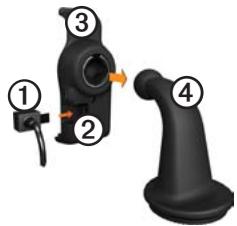
- Plug the vehicle power cable ① into the mini-USB connector ② on the cradle ③.
-
Snap the cradle onto the arm ④.
-
Slide the locking lever ⑤ on the base to the unlocked position.
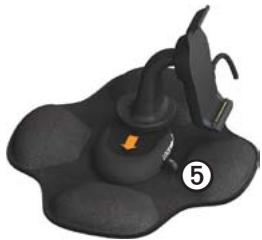
- Slide the disk on the bottom of the arm into the base until it clicks.
- Slide the locking lever to the locked position.
-
Fit the bottom of the device into the cradle.
-
Tilt the device ⑥ back until it snaps.
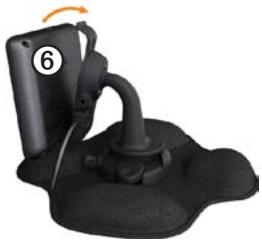
- Plug the other end of the vehicle power cable into a power outlet in your vehicle.
Installing the Dash Mount
If you are using an adhesive dash mount, you should follow these instructions.
Installing the Base
NOTICE
The adhesive pad is permanent and is very difficult to remove after it is installed. If you move the adhesive pad, use rubbing alcohol to help remove the adhesive residue.
- Select a mounting location where the device has an unobstructed view of the sky.
Ensure the location does not block the driver's view. - Clean the mounting location with rubbing alcohol.
-
Dry the mounting location using a clean, dry cloth.
-
Remove one side of the protective liner from the adhesive pad ①
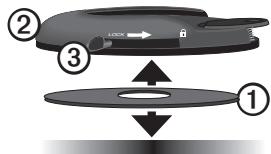
- Place the adhesive pad on the bottom of the mounting base ②
- Remove the remaining protective liner.
- Ensure the locking lever ③ on the mounting base is facing toward you, and position the mounting base on the newly cleaned mounting area.
To ensure an effective bond between the adhesive pad and mounting location, wait 24 hours before attaching a device.
Attaching the Device to the Base Before you use your device on battery power, you should charge it.
- Plug the vehicle power cable ① into the mini-USB connector ② on the cradle ③.
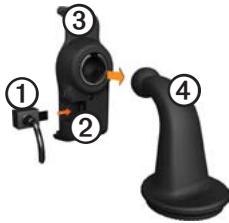
- Snap the cradle onto the arm ④
- Slide the locking lever ⑤ on the base to the unlocked position.
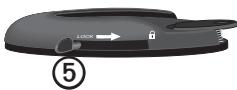
- Slide the disk on the bottom of the arm into the base until it clicks.
- Slide the locking lever to the locked position.
- Fit the bottom of the device into the cradle.
- Tilt the device back until it snaps.
- Plug the other end of the vehicle power cable into a power outlet in your vehicle.
Connecting the External Antenna
NOTICE
Before mounting the device, see the Important Safety and Product Information guide for information about laws pertaining to windshield mounting.
If you are using a traffic receiver in Europe, you must connect the external antenna to receive traffic information.
- Connect the external antenna ① to the traffic receiver ②
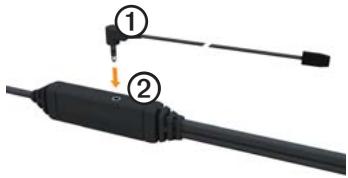
- Secure the external antenna to the windshield using the suction cups.
NOTE: To optimize signal strength, route the external antenna on the windshield vertically, if possible.
About my Dashboard
Use my Dashboard to register your device, check for software and map updates, access product manuals and support, and more.
Setting Up my Dashboard
- Connect the USB cable to the micro-USB connector ① on the device.
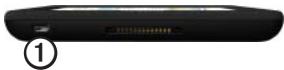
- Connect the USB cable to the USB port on your computer.
- Go to www.garmin.com /dashboard.
- Follow the on-screen instructions.
Registering the Device
- From my Dashboard, click Register Now.
-
Follow the on-screen instructions.
-
Keep the original sales receipt, or a photocopy, in a safe place.
Updating the Software
- Open my Dashboard (page 6).
- If necessary, under Software Updates, click Update Now.
- Follow the on-screen instructions.
nüMaps Guarantee
Your device is eligible for one free map update within 60 days of acquiring satellites while driving with your device. You are not eligible for the free map update if you register by phone or wait longer than 60 days after the first time you acquire satellites while driving with your device. For more information, go to www.garmin.com/numaps.
Updating Maps
- Open my Dashboard (page 6).
- Register the device (page 6).
- If necessary, under Map Updates, click Update Now.
- Follow the on-screen instructions.
Entering a Truck or RV Profile
WARNING
Entering your vehicle profile does not guarantee that your vehicle's characteristics will be accounted for in all route suggestions. It is your responsibility to account for your vehicle's height, length, weight, and other relevant restrictions when driving. Always defer to all posted road signs and road conditions when making driving decisions.
Before you can operate in Truck or RV mode, you must enter your truck or RV profile.
Truck transportation mode is selected the first time you turn on your device. You can select Switch Mode to enter an RV profile.
- When the warning screen appears, touch Agree.
- Touch Yes to enter your truck profile.
- Follow the on-screen instructions.
Acquiring Satellites
Before you can navigate with your device, you must acquire satellites.
For more information about GPS, go to www.garmin.com/aboutGPS.
- Turn on your device.
- If necessary, go outdoors to an open area, away from tall buildings and trees.
Acquiring satellites can take a few minutes. When the device has acquired satellite signals, the signal strength bars on the main menu are green. When it loses satellite signals, the bars turn red or clear
Device Overview
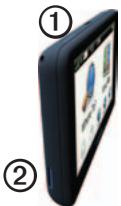
| ① | Power key |
| ② | microSD™ card slot |
Adjusting the Screen Brightness
- Press and quickly release the Power key.
- Touch and drag the scroll bar.
Resetting the Device
You can reset the device if it stops functioning.
- Hold the Power key for 8 seconds, and release it.
The device turns off.
- Wait 1 second.
- If the device is using battery power, press and release the Power key.
Adjusting the Volume
1. Touch Volume.
-
Select an option:
-
Adjust the slider left to right to adjust the volume.
- Touch to mute all audio.
Using the Main Menu
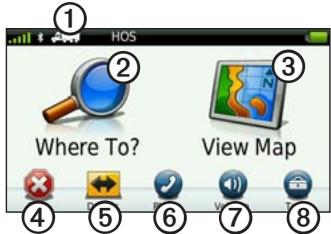
- Touch ① to select a transportation mode.
- Touch ② to find a destination.
- Touch ③ to view the map.
- Touch ④ to stop a route.
- Touch ⑤ to detour a route.
- Touch ⑥ to make a call when connected to a compatible mobile phone.
Go to www.garmin.com
/bluetooth for information.
- Touch ⑦ to adjust the volume.
- Touch to open the menu of tools and settings.
Using the On-screen Buttons
- Touch to return to the previous screen.
- Touch and to see more choices.
- Touch and hold and to scroll faster.
- Touch to search by name.
Using the On-screen Keyboard
See "Language Settings" to change the keyboard layout (page 66).
-
Touch a character on the keyboard to enter a letter or number.
-
Touch to add a space.
- Touch within the field to move the cursor.
- Touch to delete a character.
- Touch and hold to erase the entire entry.
- Touch to select the keyboard language mode.
- Touch &7% to enter special characters, such as punctuation marks.
- Touch to change character capitalization.
Transportation Modes
| Automobile mode | |
| Truck mode | |
| RV mode | |
| Pedestrian mode |
Routing is calculated differently based on your transportation mode.
Changing the Transportation Mode
- From the main menu, touch the transportation mode icon.
- Select a mode.
- Touch Save.
Using a Backup Camera
If a composite video backup camera has been installed in your vehicle, you can view the output of the camera on your device.
Connect the camera to the video-in jack ① on the cradle.
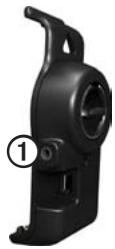
The camera output appears when a video signal is present.
Searching for a Location
Finding an Address
NOTE: Depending on the version of the built-in map data on your device, the button names and the order of steps could be different from the steps below.
- From the main menu, touch Where To? > Address.
- If necessary, change the state, the country, or the province.
- Touch Search All.
TIP: You can touch Spell City to search by city or postal code. Not all map data provides postal code searching.
-
Enter the number for the address, and touch Done.
-
Enter the street name, and touch Done.
- If necessary, select the street.
- If necessary, select the address.
Using the Location Map
The location map opens after you select a location from the Where To? menu.
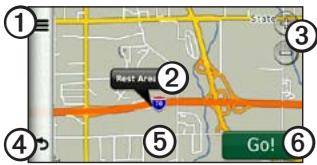
- Touch ① to save the location to your favorites.
-
On some models, touch ① to call the selected location when the device is connected to a phone.
-
Touch the information balloon ② to view more information for the location.
- Touch ③ to zoom in and out.
- Touch ④ to return to the previous page.
- Touch and drag ⑤ to view different parts of the map.
- Touch to create a turn-by-turn route to this location.
Finding a Location Using the Map
1.From the main menu, touch Where To? > Browse Map.
2. Select a location. An information balloon appears for the location.
Viewing a Route on the Map
- From the location map, touch the information balloon.
- Touch the route information box.
Finding NTTS Services
The National Truck and Trailer Services (NTTS) Breakdown Directory lists businesses for the trucking industry, such as truck repair and tire sales. NTTS information is available in some areas.
Data for NTTS Services is updated periodically. To purchase updates, go to http://buy.garmin.com.
- From the main menu, touch Where To? >NTTS.
- Select a category.
- If necessary, select a subcategory.
- Select a destination.
Using Exit Services
You can find services such as fuel, lodging, and truck stops at upcoming highway exits. The device displays available services based on the usage mode. Exit service information is available only on controlled-access roads, such as interstates or motorways.
NOTE: Exit services are not available for Pedestrian mode.
- While navigating a route, from the main menu, touch Where To? >Exit Services.
- Select an option.
Finding Trucking Points of Interest
The detailed maps loaded in your device contain trucking points of interest, such as truck stops, rest areas, and weigh stations.
- From the main menu, touch Where To? > Points of Interest > Trucking.
- Select a category.
- If necessary, select a subcategory.
- Select a destination.
Setting a Home Location
You can set your home location for the location you return to most often.
- From the main menu, touch Where To? > Go Home.
- Select Enter My Address, Use My Current Location, or Recently Found.
Going Home
Before you can navigate to home, you must set a home location.
From the main menu, touch Where To? > Go Home.
Resetting Your Home Location
- From the main menu, touch Where To? > Set Home Location.
- Select an option.
Editing Your Home Location Information
- From the main menu, touch Where To? > Favorites > Home.
- Touch Edit.
- Enter your changes.
- Touch Done.
About Points of Interest
The detailed maps loaded in your device contain points of interest, such as restaurants, hotels, and auto services. You can use the Points of Interest category to browse for nearby businesses and attractions.
Finding a Location by Spelling the Name
- From the main menu, touch Where To? > Points of Interest > Spell Name.
- Enter all or part of the name, and touch Done.
- Select a destination.
Finding a Point of Interest by Category
- From the main menu, touch Where To? > Points of Interest.
- Select a category.
- If necessary, select a subcategory.
- Select a destination.
Using Photo Navigation
You can upload pictures onto your device or memory card that include location information and create routes to the pictured locations.
- Connect your device to your computer (page 6).
- Go to http://connect.garmin.com /photos.
- Follow the instructions to select and load pictures to your device.
- Disconnect the device from the computer.
- Turn on the device.
- From the main menu, touch Where To? > Favorites > Photos.
A list of pictures with location information appears.
- Select a picture.
Removing an Incorrect Point of Interest
When your search results contain an outdated or incorrect point of interest, you can remove the location from future searches.
- From the location map, touch the information balloon.
- Touch > Report Error > Yes. The location is removed from future searches.
Reporting an Incorrect Point of Interest
Before you can report an incorrect point of interest, you must remove it from future searches (page 16).
- Connect your device to your computer (page 6).
- Go to www.garmin.com/ dashboard.
- Under my Dashboard Preferences, click Change Preferences > Yes. myDashboard collects the data from your device.
Rating a Point of Interest
When available, you can view and change the star rating for a point of interest.
- From the location map, touch the information balloon.
If available, the star ratings appear under the address of the location. - Touch the stars to rate the point of interest.
The star rating updates on your device.
Finding Your Last Parking Spot
From the main menu, touch Where To? > Parking > Last Spot.
Viewing a List of Recently Found Locations
Your device stores the last 50 locations you have found.
From the main menu, touch Where To? > Recently Found.
Clearing the List of Recently Found Locations
From the main menu, touch
Where To? > Recently Found > Clear > Yes.
Favorites
You can save locations in your favorites so you can quickly find them and create routes to them. Your home location is also stored in favorites.
Saving Your Current Location to Favorites
- From the map, touch the vehicle icon.
- Touch Save.
- Enter a name.
The location is saved in Favorites.
Saving Locations to Favorites
- Search for the location (page 12).
- From the Go! page, touch > Save > OK.
Finding Favorites
- From the main menu, touch Where To? > Favorites.
- If necessary, select a category.
- Select a saved location.
Editing Favorites
- From the main menu, touch Where To? > Favorites.
-
Select a category.
-
Select a favorite.
- Touch the information balloon.
- Touch Edit.
-
Select an option:
-
Touch Name.
- Touch Phone Number.
- Touch Categories to enter a category name for the favorite.
NOTE: Categories appear if the device contains at least 12 favorites.
- Touch Assign Photo to save a photo with the favorite.
-
Touch Change Map Symbol to change the symbol used to mark the favorite on a map.
-
Edit the information.
- Touch Done.
Deleting Favorites
- From the main menu, touch Where To? > Favorites.
- If necessary, select a category.
- Select a favorite.
- Touch Delete > Yes.
Entering Coordinates
If you know the geographic coordinates of your destination, you can use your device to navigate to the destination using the latitude and longitude coordinates. This can be especially helpful when geocaching.
- From the main menu, touch Where To? > Coordinates.
- Touch a field to enter the latitude and longitude data.
- Touch View on Map.
Changing the Map Coordinate Format
- From the Home Screen, touch Where To? > Coordinates > Format.
- Select a format.
Changing the Search Area
The device automatically searches for places near your present location. You can also search for a location near a different city, near a recent destination, or near a favorite destination.
- From the main menu, touch Where To? > Near.
- Select an option.
- Touch Save.
Planning a Trip
You can use Trip Planner to create and save a trip with multiple destinations.
- From the main menu, touch Where To? > Trip Planner.
- Touch +
- Touch Select Start Location.
- Search for a location (page 12).
- Touch Select.
- Touch + to add additional locations.
- Touch Next.
- Enter a name, and touch Done.
- Touch Map to view the trip on the map.
Scheduling a Trip
The trip planner allows you to set a departure time and trip duration.
- From the main menu, touch Where To? > Trip Planner.
- Select a trip.
- Select a location.
- Touch Departure Time or Arrival Time.
- Select a date and time.
- Touch Save.
- Touch Duration.
- Select the amount of time you will spend at the location.
- Touch Save.
- If necessary, repeat steps 3-9 for each location.
Navigating a Saved Trip
- From the main menu, touch Where To? > Trip Planner.
- Select a saved trip.
- Touch Go!.
Editing a Saved Trip
- From the main menu, touch Where To? > Trip Planner.
- Select a saved trip.
- Touch
-
Select an option:
-
Touch Rename Trip to edit the trip name.
- Touch Edit Destinations to add or delete locations.
- Touch Delete Trip.
- Touch Optimize Order to arrange your trip locations in the most-efficient order.
Setting a Simulated Location
- From the main menu, touch Tools > Settings > System > GPS Simulator > On.
- From the main menu, touch Where To? > Browse Map.
- Touch an area on the map.
- Touch Set Location.
Simulating a Route
- From the main menu, touch Tools > Settings > System > GPS Simulator > On.
- Search for a location (page 12).
- Touch Go! > Yes.
Navigation
Map Features While Navigating
NOTICE
The speed limit icon feature is for information only and does not replace the driver's responsibility to abide by all posted speed limit signs and to use safe driving judgment at all times. Garmin will not be responsible for any traffic fines or citations that you may receive for failing to follow all applicable traffic laws and signs.
Your route is marked with a magenta line. A checkered flag marks your destination.
As you travel, your device guides you to your destination with voice
prompts, arrows on the map, and directions at the top of the map. If you depart from the original route, your device recalculates the route and provides new directions.
An icon displaying the current speed limit may appear as you travel on major roadways.
Truck speed limits may appear for Truck mode based on truck configuration data and applicable laws for the state or province.
When you are driving in Truck mode or RV mode, a tone may sound and may appear, indicating that truck suitability for this roadway is unknown. Always obey posted signs and regulations.
NOTE: Truck speed limits are not available for all areas.
Using the Navigation Map
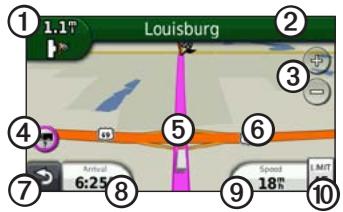
- Touch ① to view the next turn. The turn indicator also tells you which lane you should be in to prepare for your next maneuver, when available.
- Touch ② to view the turn list.
- Touch ③ to zoom in and zoom out.
-
Touch ④ to view warning information, when available (page 68).
-
Touch ⑤ to view information for the location.
- Touch and drag ⑥ to view a different area of the map.
- Touch ⑦ to return to the main menu.
- Touch and hold ⑦ from any screen to return to the main menu.
- Touch ⑧ to display a different data field.
- Touch to view trip information.
- Touch to change the speed limit if the speed limit icon shown on the map is incorrect. A truck speed limit appears if available.
Viewing Trip Information
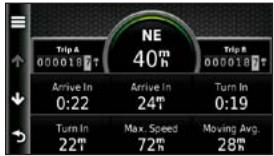
The trip information page displays your present speed and provides statistics about your trip.
TIP: If you make frequent stops, leave the device turned on so it can accurately measure elapsed time during the trip.
From the map, touch the Speed field.
Resetting Trip Information
-
From the map, touch Speed >
-
Select an option:
-
When not navigating a route, touch Reset All to reset every data field, except the speedometer, on the page.
- Touch Reset Trip Data to reset the information on the trip computer.
- Touch Reset Max. Speed to reset the maximum speed.
- Touch Reset Trip B to reset the odometer.
Viewing the Turn List
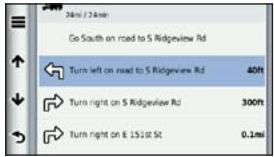
When you are navigating a route, you can view all of the turns for your entire route and the distance between turns.
- Touch the text bar on the top of the map.
-
Select an option:
-
Select a turn on the list to view the next turn.
- Touch > Show Map to view the entire route on the map.
Viewing the Next Turn
Before you can view the next turn, you must be navigating a route.
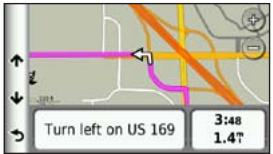
The next turn shows the turn on the map and the distance and time left before you reach the turn.
From the map, touch
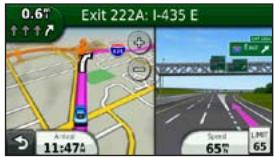
Viewing the Junction View
Before you can view the junction view, you must be navigating a route.
On some models, the junction view displays a view of some upcoming junctions and in which lane you should be driving.
NOTE: Junction view is not available for all junctions.
From the map, touch
Selecting a Route Calculation Mode
Before you can select a route calculation mode, you must set the device to prompt you (page 64).
- Search for the location (page 12).
- Select or .
Adding One Point to the Active Route
NOTE: You cannot add a point to a route in Pedestrian mode.
- While navigating a route, touch to return to the main menu.
- Touch Where To?
-
Search for the location (page 12).
-
Touch Go!.
- Touch Add to Active Route.
- Touch and drag the locations to order them, and touch Done.
Taking a Detour
While navigating a route, you can use detours to avoid obstacles ahead of you, such as construction zones. If Advanced Detours is enabled, you can select a specific distance or road to avoid (page 65).
- While navigating a route, touch to return to the main menu.
- Touch Detour.
- If necessary, select an option:
To avoid the next 1/2 mile, select Next 1/2 Mile on Route.
To avoid the next 2 miles, select Next 2 Miles on Route.
To avoid the next 5 miles, select Next 5 Miles on Route.
To select a specific road to avoid, select Detour by Road(s) on Route.
If the route you are currently taking is the only reasonable option, the device might not calculate a detour.
Stopping the Route
While navigating a route, touch
About myTrends
After you save your frequently-visited destinations as favorites, myTrends senses when you drive to them. After recording your driving patterns, myTrends displays the route and the estimated time of arrival in the navigation bar on the map.
Setting up myTrends
- From the main menu, touch Tools > Settings > Navigation.
- Select an option: Automobile, Truck, or RV.
- Touch nuRoute > myTrends > Enabled.
- Save a destination as a favorite (page 17).
-
With the device on, drive to the favorite at least three times.
-
When myTrends information appears in the navigation bar, touch it to view route information.
Using the Pedestrian Navigation Map
In Pedestrian mode, your route is displayed on a two-dimensional map.
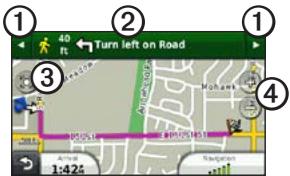
- Touch ① to switch between sections of the route.
- Touch ② to view the route itinerary.
- Touch ③ to center the map on your current location.
- Touch ④ to zoom in and zoom out.
Public Transit Options
If you have cityXplorer maps installed, the device calculates a route that uses a combination of public transit options, such as riding a bus or subway, and walking.
cityXplorer maps are not included with the device. See http://my.garmin.com to purchase cityXplorer maps.
The yellow icons indicate the navigation method used in each section of the route. For example, when you see 圆 board a bus at that point in the route.
The black dots on the map are public transit stops along your route.
NOTE: You can limit the distance spent walking during a pedestrian route (page 63).
Traffic
NOTICE
Garmin is not responsible for the accuracy or timeliness of the traffic information. Traffic information is not available in all areas.
This device can receive FM Traffic Message Channel (TMC) traffic content, which provides information on nearby traffic incidents and construction. Some models are packaged with a FM TMC traffic receiver, built into the vehicle power cable, and have a lifetime traffic subscription.
For information about traffic receivers and coverage areas, go to www.garmin.com/traffic.
Subscription Activation
You do not need to activate the subscription included with your FM traffic receiver. The subscription activates automatically after your device acquires satellite signals while receiving traffic signals from the pay service provider.
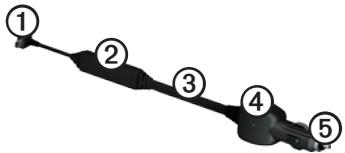
Traffic Receiver
| ① | Mini-USB connector |
| ② | External antenna connector |
| ③ | Internal antenna |
| ④ | Power LED |
| ⑤ | Vehicle power adapter |
Receiving Traffic Information
When the receiver is within a traffic coverage area, your device will begin displaying traffic information.
The traffic receiver and the device must be in data range of an FM station transmitting traffic information.
- Connect the traffic receiver to an external power source.
- Connect the traffic receiver to the device.
NOTE: Heated (metallized) windshields could degrade the performance of the traffic receiver.
About the Traffic Icon
When you are receiving traffic information, a traffic icon appears on the map. The traffic icon changes color to indicate the severity of traffic conditions.
| Color | Severity | Meaning |
| Green | Low | Traffic is flowing freely. |
| Yellow | Medium | Traffic is moving but there is a delay. There is moderate traffic congestion. |
| Red | High | Traffic is not moving or moving very slowly. There is a severe delay. |
Traffic on Your Route
CAUTION
If you choose to recalculate your route when you are navigating in Truck mode, the recalculated route might include roads that have not been verified for truck accessibility. You should use caution and good judgment and obey all posted signs and regulations.
When calculating your route, the device examines the current traffic and automatically optimizes the route for the shortest time. If a severe traffic delay occurs on your route while you are navigating, the device automatically recalculates the route. You might still be routed through traffic if no better alternative routes exist.
Manually Avoiding Traffic on Your Route
- From the map, touch
- Touch Traffic On Route.
- If necessary, touch the arrows to view other traffic delays on your route.
- Touch > Avoid.
Viewing the Traffic Map
The traffic map shows color-coded traffic flow and delays on nearby roads.
- From the map, touch
- Touch Traffic Map to view the traffic incidents on a map.
Searching for Traffic Delays
- From the map page, touch
- Touch Traffic Search to view a list of roads with traffic delays.
- Touch an item in the list to view delays on the road.
- If there is more than one delay, touch the arrows to view additional delays.
Adding a Subscription
You can purchase traffic subscriptions for other regions or countries.
- From the main menu, touch Tools > Settings > Traffic.
-
If necessary, touch Subscriptions.
-
Touch +.
- Write down the FM traffic receiver unit ID.
- Go to www.garmin.com/fmtraffic to purchase a subscription and get a 25-character code.
- Touch Next on the device.
- Enter the code.
- Touch Done.
The traffic subscription code cannot be reused. You must obtain a new code each time you renew your service. If you own multiple FM traffic receivers, you must obtain a new code for each receiver.
About Offers and Advertisements
If your device package includes a traffic receiver, you will receive location-relevant offers and coupons. Ad-based traffic information is only available in North America.
The traffic receiver must be connected to external power and you must be in a coverage area to receive ad-based traffic information.
See our privacy statement at www .garmin.com/products/privacy for important privacy information.
NOTE: This feature is not available in all areas.
Viewing Offers
CAUTION
Do not attempt to write down the coupon codes while driving.
- Select an offer that appears on the screen to search for the nearest location related to that offer.
- If the offer includes an icon, touch the icon on the location map to receive a coupon code.
- Write down this code, and present it when you arrive at the location.
Viewing an Offer List
From the main menu, touch Tools > Offers.
Disabling Traffic and Offers
Before you can disable offers, you must disable traffic.
From the main menu, touch Tools > Settings > Traffic > Disabled.
Using Trucking Features
About IFTA Logging
You can use IFTA Logging to archive data needed for International Fuel Tax Agreement documentation, such as fuel-purchase data and miles driven.
Before you can use IFTA Logging, you must be in Truck mode (page 11).
NOTE: This feature is not available in all areas.
Entering Fuel Data
- From the main menu, touch Tools > IFTA Logging > At the Pump.
- Enter the fuel price per gallon.
- Touch the Fuel Used field.
- Enter the amount of fuel purchased.
- If necessary, select an option:
To record the amount in liters, touch Gallons > Liters > Save.
To record the amount in gallons, touch Liters > Gallons > Save.
-
If necessary, select the Tax Included check box.
-
Touch Next.
- Select the vendor from whom you purchased the fuel.
-
Select the purchaser of the fuel.
-
Touch Save.
Using Fuel Logs
Before you can use IFTA Logging, you must be in Truck mode (page 11).
NOTE: This feature is not available in all areas.
- From the main menu, touch Tools > IFTA Logging > Fuel Logs.
- If necessary, select a truck.
- If necessary, select a quarter.
-
Select a log.
-
Select an option:
-
Touch a field to edit the information.
- Touch X > Yes to delete the log.
Viewing and Exporting a Jurisdiction Summary
The jurisdiction summary lists data for each state or province in which your vehicle has operated during each quarter. The jurisdiction summary is available in some areas.
Before you can use IFTA Logging, you must be in Truck mode (page 11).
NOTE: This feature is not available in all areas.
- From the main menu, touch Tools > IFTA Logging > Jurisdiction Summary.
- If necessary, select a truck.
- If necessary, select a quarter.
- To export a jurisdiction summary, touch Export OK. The device exports the summary to a CSV file and stores it in the Reports folder in the device memory.
Using Trip Reports
Before you can use IFTA Logging, you must be in Truck mode (page 11).
NOTE: This feature is not available in all areas.
- From the main menu, touch Tools > IFTA Logging > Trip Reports.
- If necessary, select a truck.
- If necessary, select a quarter.
- Select a report.
-
Select an option:
-
Touch Delete, and touch the check box to delete a report.
- Touch Combine, and touch the check boxes to combine reports.
- Touch > Export > OK. The device exports the report to a CSV file and stores it in the Reports folder in the device memory.
Viewing Exported Jurisdiction Summaries and Trip Reports
NOTICE
If you do not know the purpose of a file, do not delete it. Your device memory contains important system files that should not be deleted.
- Connect the device to your computer (page 6).
- Open the "Garmin" drive or volume, and open the Reports folder.
- Open the IFTA folder.
- Open the CSV file.
About Hours of Service
NOTICE
Although this device is enabled to record hours-of-service information, this device is NOT an approved substitute for paper logbook recording requirements under Federal Motor Carrier Safety Administration regulations. Drivers should comply with all applicable federal and state paper logbook requirements.
You can use Hours of Service to record your working hours, which will help you comply with safety regulations.
Before you can use Hours of Service, you must be in Truck mode (page 11), and you must create a driver profile (page 40).
NOTE: This feature is not available in all areas.
Recording Your Duty Status
- From the main menu, touch Tools >Hours of Service.
- Select a driver > Duty Status.
-
Select an option:
-
Touch Off Duty to record the time you are off duty.
- Touch Sleeper to record the time you are resting in a sleeper berth.
- Touch Driving to record the time you are driving a commercial motor vehicle in operation.
-
Touch On Duty to record the time you are on duty, but not driving a commercial motor vehicle.
-
Touch Save.
Using Driving Logs
Before you can use Hours of Service, you must be in Truck mode (page 11), and you must create a driver profile (page 40).
NOTE: This feature is not available in all areas.
- From the main menu, touch Tools >Hours of Service.
- Select a driver > View Log.
-
Select an option:
-
Touch the date field, and touch a different date to view.
- Touch a status bar to view status details.
- Touch the grid, and touch a field to edit.
- Touch to view violation information.
About Drivers
Multiple drivers can use the same device to track hours of service.
Before you can use Hours of Service, you must be in Truck mode (page 11).
If you work for more than one carrier in a 24-hour period, you must record each carrier. You must record the time zone of your home terminal even if you cross other time zones.
NOTE: This feature is not available in all areas.
Adding Drivers
- From the main menu, touch Tools >Hours of Service >+
- Follow the on-screen instructions.
Managing Driver Information
- From the main menu, touch Tools >Hours of Service.
- Select a driver > Driver Info.
-
Select an option:
-
Touch a field to edit the information.
- Touch > Delete Driver > Yes to delete the driver.
Adding Shipments
Before you can use Hours of Service, you must be in Truck mode (page 11), and you must create a driver profile (page 40).
NOTE: This feature is not available in all areas.
- From the main menu, touch Tools >Hours of Service.
- Select a driver > Manage Shipments > +
- Touch Reference Number, enter the reference information, and touch Done.
TIP: The reference number is the shipping document number, or the name of the company and the group you are transporting.
- If necessary, touch Start Day, and touch the date service begins.
- If necessary, touch End Day, and touch the date service ends.
- Touch Save.
Managing Shipments
Before you can use Hours of Service, you must be in Truck mode (page 11), and you must create a driver profile (page 40).
NOTE: This feature is not available in all areas.
- From the main menu, touch Tools >Hours of Service.
- Select a driver > Manage Shipments.
- Select a shipment.
-
Select an option:
-
Touch a field to edit the information.
- Touch Delete Shipment >OK to delete the shipment.
Exporting Driving Logs
Before you can use Hours of Service, you must be in Truck mode (page 11), and you must create a driver profile (page 40).
NOTE: This feature is not available in all areas.
- From the main menu, touch Tools >Hours of Service.
- Select a driver > Export Log.
- If necessary, enter your tractor number, tractor VIN, and trailer number.
- If necessary, select a log to export.
- If necessary, select the location to export the log.
The device exports the log to a CSV file and stores it in the Reports folder in the device memory or on the memory card.
Viewing Exported Driving Logs
NOTICE
If you do not know the purpose of a file, do not delete it. Your device memory contains important system files that should not be deleted.
- Connect the device to your computer (page 6).
-
Select an option:
-
To view the logs on your device, open the "Garmin" drive or volume, and open the Reports folder.
-
To view the logs on your memory card, open the drive or volume for the memory card, and open the Garmin folder.
-
Open the HOSExports folder.
- Open the CSV file.
Using the Tools
Viewing Current Location Information
Use the Where Am I? page to view information about your current location. This feature is helpful if you need to tell emergency personnel your location.
From the main menu, touch Tools >Where Am I?.
Finding Nearby Services
- From the main menu, touch Tools >Where Am I?
- Touch Hospitals, Police Stations, or Fuel to view the nearest locations in that category.
Using Help
From the main menu, touch Tools >Help to view information about using the device.
Searching Help Topics
From the main menu, touch Tools >Help>Q.
About ecoRoute™
The ecoRoute feature calculates your vehicle fuel economy, carbon footprint, and the fuel price of navigating to a destination, and offers tools for improving fuel efficiency.
The data provided by the ecoRoute feature are estimates only. The data is not actually read from your vehicle. To receive more-accurate fuel reports for your specific vehicle and driving habits, calibrate the fuel economy (page 44).
NOTE: ecoRoute is available only for Automobile mode.
Using ecoRoute
- From the main menu, select Tools > ecoRoute.
- If prompted, enter fuel and mileage information. The first time you use the ecoRoute features, you must enter vehicle information.
Calibrating the Fuel Economy
Calibrate the fuel economy to receive more-accurate fuel reports for your specific vehicle and driving habits. You should calibrate when you fill up your fuel tank.
- From the main menu, select Tools > ecoRoute > At the Pump.
-
Enter the current fuel price.
-
Enter how much fuel your vehicle has used since the last fill up.
- Enter the distance you have traveled since the last fill up.
- Select Next.
The device calculates the average vehicle fuel economy.
About the ecoChallenge
The ecoChallenge helps you maximize your fuel economy by scoring your driving habits. The higher your ecoChallenge scores, the more fuel you have saved. The ecoChallenge collects data and calculates a score whenever your device is moving and in Automobile transportation mode.
Viewing Your ecoChallenge Scores
From the main menu, select Tools > ecoRoute > ecoChallenge.
About the ecoChallenge Score
The leaf color on the ecoChallenge icon changes depending on your performance in the challenge.
Overall—displays an average of the speed, acceleration, and braking score.
Speed—displays your score for driving at your vehicle's optimal speed for conserving fuel (45-60 mph for most vehicles).
Acceleration—displays your score for smooth and gradual acceleration. You lose points for rapid acceleration.
Braking—displays your score for smooth and gradual braking. You lose points for hard braking.
Removing the ecoChallenge Score From the Map
From the map, select > > Settings > Hide.
Resetting the ecoChallenge
From the map, select > > Reset.
Viewing Fuel Economy Information
- From the main menu, select Tools >ecoRoute > Fuel Economy.
- Select a section of the graph to zoom in.
Adjusting the Vehicle Profile
- From the main menu, touch Tools >ecoRoute > Vehicle Profile.
-
Select an option to manually adjust your fuel settings.
-
Fuel Type
City Fuel Economy
Hwy. Fuel Economy
Fuel Price
TIP: For best results, calibrate your fuel economy (page 44) instead of adjusting the city and highway fuel efficiency.
About the Mileage Report
Mileage reports provide the distance, the time, the average fuel economy, and the fuel cost of navigating to a destination.
A mileage report is created for every route that you drive. If you stop a route on your device, a mileage report is created for the distance you traveled.
Viewing a Mileage Report
You can view saved mileage reports on your device. You can also access mileage reports in the Reports folder on your device drive/volume (page 56).
- From the main menu, touch Tools >ecoRoute > Mileage Report.
- Select a report.
Viewing Driving Tips
From the main menu, touch Tools >ecoRoute > Tips.
Resetting ecoRoute Data
- From the main menu, touch Tools >ecoRoute.
- Select a category.
- Touch Reset.
Using the Picture Viewer
You can view pictures that you have stored in your device or on a memory card. See page 55 for more information about loading pictures on the device.
From the main menu, touch Tools > Picture Viewer.
- Touch the arrows to scroll through the images.
-
Touch a picture to view a larger image of it.
-
Touch to view a slide show of the pictures.
- Touch the screen to stop the slide show.
Setting a Picture as Wallpaper
- From the main menu, touch Tools > Picture Viewer.
- Select a picture.
- Touch Set as Wallpaper.
- Use the on-screen buttons to adjust the wallpaper.
- Touch Save.
Deleting Pictures
- From the main menu, touch Tools > Picture Viewer.
- Select a picture.
- Touch Delete > Yes.
Using the World Clock
- From the main menu, touch Tools >World Clock.
- Touch a city name.
- Enter a new city name
- Touch Done.
- If necessary, select a city.
Viewing the World Map
From the main menu, touch Tools > World Clock >
Nighttime hours appear in the shaded area.
Using the Calculator
From the main menu, touch Tools > Calculator.
Capturing Screenshots
- From the main menu, touch Tools > Settings > Display > Screenshot > Enabled.
- Touch to take a screenshot.
The screenshot is saved as a PNG format image file in the Screenshot folder on the device (page 56).
Using the Unit Converter
- From the main menu, touch Tools > Unit Converter.
- Touch the box with a unit of measure listed.
- Select a unit of measure.
- Touch Save. Two units of measure are listed.
-
Touch a unit of measure to change.
-
Select a unit of measure.
- Touch Done.
- If necessary, repeat steps 5-7.
- Enter a value.
- Touch Done.
Setting Currency Conversion Rates Manually
You can update the currency conversion rates manually so that you are always using the most-current rates.
- From the main menu, touch Tools > Unit Converter.
- Select the box with a currency listed.
- Select Currency.
-
Touch Save.
-
Select a currency box.
- Select the currency you want to update.
- If necessary, repeat steps 3-6 to select a currency to convert to.
- Select a box under a currency.
- Enter a new value for the currency.
- Select Done.
- If necessary, repeat steps 8-10.
Hands-Free Phone Calls
Bluetooth® technology establishes a wireless link between two devices, such as a mobile phone and your device. To determine whether your mobile phone with Bluetooth technology is compatible with the device, go to www.garmin.com/bluetooth.
About Pairing the Devices
The first time you use two devices together, you must pair them by establishing a relationship using a PIN or passkey.
Your phone and the device must be turned on and be within 33 ft. (10m) of each other.
Pairing Using the Phone Settings
You can initiate pairing from your phone. Refer to your phone instructions.
- From the
dēzlmain menu, touch Tools > Settings > Bluetooth > Bluetooth > Enabled > Save. - Enable the Bluetooth component on your phone.
NOTE: This might be in a menu called Settings, Bluetooth Connections, or Hands-Free.
-
Search for Bluetooth devices using your phone.
-
Select the dezl from the list of devices.
- If necessary, enter the device Bluetooth PIN (1234) into your phone.
Pairing Using the Device Settings
- From the dēzl main menu, touch Tools > Settings > Bluetooth > Bluetooth > Enabled > Save.
- Enable the Bluetooth component on your phone.
- Enable Find Me/Discoverable/Visible mode on your phone. NOTE: This might be in a menu called Settings, Bluetooth, Connections, or Hands-Free.
-
On the dēzl, touch Add Phone > OK.
-
Select your phone from the list.
- Touch OK.
A prompt to pair the phone with your device appears on the phone.
- On your phone, accept the pairing.
- If necessary, enter the device Bluetooth PIN (1234) in your phone.
Tips After Pairing Your Devices
After the initial pairing, the two devices can connect automatically each time you turn them on.
- When your phone is connected to your device, you are ready to make phone calls.
- When you turn on the device, it tries to connect to the last phone to which it was connected.
- You might have to set your mobile phone to connect to the device automatically when it is turned on.
Managing the Bluetooth Device List
You can add, disconnect, or delete phones that your device detects while Bluetooth is enabled.
-
From the main menu, touch Tools > Settings > Bluetooth > Add Phone.
-
Select an option:
-
Select a phone for your device to connect with.
-
Touch + to add a phone to the menu.
-
Touch to delete a phone from the device memory.
- Touch None to drop your current connection.
Receiving a Call
- Touch Answer.
- Touch Ignore to ignore the call.
Using the Device During a Call
During a call, appears. Depending on the screen shown on your device, the In Call icon could look different.
1.From the main menu, touch > End Call.
-
Select an option:
-
Touch Keypad to view a keypad page for using automated systems such as voice mail.
-
Touch Handset to turn off the device but remain on the call, or if you need privacy.
TIP: To switch back, touch Hands-free.
- Touch Mute to turn off the sound on a call.
Using Call Waiting
When you are on a call and you receive a second call (call waiting), a window appears.
- Touch Answer to answer the call and place the first call on hold.
- Touch > Switch To.
- Touch End Call to hang up. This does not disconnect the call on hold.
Dialing a Point of Interest
- From the main menu, touch Phone > Points of Interest.
- Search for a point of interest.
- Touch Call.
Dialing a Number
- From the main menu, touch Phone > Dial.
- Enter the number.
- Touch Dial.
Entering Your Phone Number
You can enter the phone number you want the device to call when you touch Call Home.
- From the main menu, touch Phone > Call Home.
- Touch Enter Phone Number.
- Enter the phone number.
- Touch Done > Yes.
The device dials your home phone number.
Calling Home
Before you can call home, you must enter a phone number for your home location (page 53).
From the main menu, touch Phone > Call Home.
Placing Calls Using Voice Dial
Before you can place calls using voice dial, you may need to train your phone to recognize your voice dial commands. Refer to your phone instructions.
- From the main menu, touch Phone > Voice Dial.
- Speak the contact name.
Checking the Phone Status
You can check the battery level and signal strength for your phone.
From the main menu, touch Phone > Phone Status.
Data Management
You can store files, such as JPEG image files, on your device. The device has a memory card slot for additional data storage.
NOTE: The device is not compatible with Windows® 95, 98, Me, Windows NT®, and Mac® OS 10.3 and earlier.
File Types
The device supports these file types.
JPEG and JPG image files (page 47).
- Maps and GPX waypoint files from MapSource® (page 75).
GPI custom POI files from Garmin POI Loader (page 75).
About Memory Cards
You can purchase memory cards from an electronics supplier, or you can purchase pre-loaded Garmin mapping software (www.garmin.com/trip_planning). In addition to map storage, the memory card can be used to store files such as maps, images, geocaches, routes, waypoints, and custom POIs.
Installing a Memory Card
- Insert a memory card into the slot ① on the device.
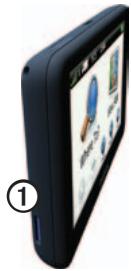
- Press it in until it clicks.
Transferring Files To Your Computer
- Connect the device to your computer (page 6).
Your device and memory card appear as removable drives in My Computer in Windows and as mounted volumes on Mac computers.
NOTE: Some computers with multiple network drives cannot display dēzl drives. See your operating system Help file to learn how to map the drives.
- Browse your computer for a file.
- Highlight the file.
-
Click Edit > Copy.
-
Open the "Garmin" or memory card drive or volume.
- Select Edit > Paste.
The file appears in the list of files in the device memory or on the memory card.
Disconnecting the USB Cable
-
Complete an action:
-
For Windows computers, click the eject icon in your system tray.
For Mac computers, drag the volume icon to the Trash -
Disconnect the cable from your computer.
Deleting Files
NOTICE
If you do not know the purpose of a file, do not delete it. Your device memory contains important system files that should not be deleted.
- Open the "Garmin" drive or volume.
- If necessary, open a folder or volume.
- Select a file.
- Press the Delete key on your keyboard.
Customizing the Device
System Settings
From the main menu, touch Tools > Settings > System.
GPS Simulator—stops the device from receiving a GPS signal, and saves battery power.
- Units—allows you to change the units of measure for distance.
Time Format—allows you to select a 12-hour, 24-hour, or UTC display time.
- Current Time—allows you to manually change the time.
- Safe Mode—disables all functions that require significant operator attention and could become a distraction while driving.
- Garmin Lock—locks the device (page 71).
- About—displays the software version number, the unit ID number, and information on several other software features.
NOTE: You need this information when you update the system software or purchase additional map data (page 75).
End User License Agreements
Customizing the Main Menu
You can create a customized main menu that contains up to 15 icons.
- From the main menu, select Tools > Settings > Main Menu.
- If necessary, select Customize.
-
Select
-
If necessary, select
- Select an icon.
- Select Save.
Editing the Main Menu Icons
You can change the size and location of the icons on your customized main menu.
- From the main menu, select Tools > Settings > Main Menu > Customize.
- Select an icon.
-
Select an option:
-
Select to delete the icon. NOTE: The Where To?, View Map, and Tools icons cannot be deleted.
- Select to enlarge the icon. The icon expands from one cell to four cells.
TIP: A customized main menu can fit up to two enlarged icons.
- Select to shrink a large icon.
-
Drag an icon across the screen to change its location.
-
Select > Save.
Choosing a Main Menu
- From the main menu, select Tools > Settings > Main Menu.
- Select an option: Use Default or Use Customized.
While you use the customized main menu, the default main menu is saved on the device.
Adding Truck or RV Profiles
WARNING
Entering your vehicle profile does not guarantee that your vehicle's characteristics will be accounted for in all route suggestions. It is your responsibility to account for your vehicle's height, length, weight, and other relevant restrictions when driving. Always defer to all posted road signs and road conditions when making driving decisions.
- From the main menu, touch Tools > Settings > Truck Profile.
- Select an option: Truck or RV.
- Touch + .
- If necessary, touch Units to change the units of measurement.
- Follow the on-screen prompts.
Activating Truck or RV Profiles
The device calculates routes based on the width, length, height, weight, and other settings for the active profile.
You must activate a profile before you can navigate in Truck or RV mode. Before you can activate a profile, you must add the profile (page 60).
- From the main menu, touch Tools > Settings > Truck Profile.
- Select an option: Truck or RV.
- Touch the profile.
- Touch Select Profile to activate the profile.
Editing Truck or RV Profiles
Before you can delete a profile, you must activate a different profile (page 60).
- From the main menu, touch Tools > Settings > Truck Profile.
- Touch a profile, and touch
- Select an option: Edit or Delete.
Automobile, Truck, and RV Navigation Settings
From the main menu, touch Tools > Settings > Navigation, and select Automobile, Truck, or RV.
- niiRouteTM—see page 63.
Map Detail—sets the level of detail on the map. More detail may cause the map to draw slower. - Map View—sets the perspective on the map (page 62).
Map Theme—changes the color of the map data.
Map Data Layout—changes the amount of data visible on the map.
- Vehicle—changes the icon to represent your position on the map. Go to www.garmingarage.com for more icons.
- Trip Log
Show on Map—displays the path of your travels on the map.
Clear Trip Log
- Proximity Points—changes the proximity points setting (page 62).
- Sharp CurveWarnings—allows you to set alerts for sharp curves.
Changing the Map Perspective
- From the main menu, touch Tools > Settings > Navigation.
- Select an option: Automobile, Truck, or RV.
- Touch Map View.
-
Select an option:
-
Touch Track Up to display the map in two dimensions (2-D), with your direction of travel at the top.
- Touch North Up to display the map in 2-D with North at the top.
- Touch 3-D to display the map in three dimensions.
Choosing Proximity Points Settings
This option is visible only if you have proximity points or safety cameras loaded on your device. Proximity points include custom POIs and safety camera databases. Go to www.garmin.com /extras for more information.
- From the main menu, touch Tools > Settings > Navigation.
- Select an option: Automobile, Truck, or RV.
- Touch Proximity Points.
-
Select an option:
-
Touch Alerts to enable alerts that sound as you approach proximity points.
- Touch Audio to set the type of alerts that sound as you approach proximity points.
Pedestrian Navigation Settings
From the main menu, touch Tools > Settings > Navigation > Pedestrian.
- Limit Walking—controls how much of a public transit route will include walking.
Public Transit-avoids selected transit types. - Trip Log—displays the path of your travels on the map.
Show on Map—displays the path of your travels on the map.
Clear Trip Log
Avoiding Transit Types
NOTE: Transit types are available when cityXplorer maps are loaded (page 29).
- From the main menu, touch Tools > Settings > Navigation > Pedestrian > Public Transit.
- Select the transit type to avoid on your routes.
- Touch Save.
Choosing Route Preferences
- From the main menu, touch Tools > Settings > Navigation.
- Select an option: Automobile, Truck, or RV.
- Touch nüRoute > Calculation Mode.
The route calculation is based on road speeds and vehicle acceleration data for a given route.
-
Select an option, if available:
-
Touch Faster Time to calculate routes that are faster to drive but can be longer in distance.
- Touch Shorter Distance to calculate routes that are shorter in distance but can take more time to drive.
- Touch Less Fuel to calculate routes that could use less fuel than other routes.
- Touch Prompted to select a route calculation mode before navigating (page 26).
- Touch Off Road to calculate a direct line from your location to your destination.
Avoiding Road Features
- From the main menu, touch Tools > Settings > Navigation.
- Select an option: Automobile, Truck, or RV.
- Touch nuiRoute > Avoidances.
- Select the road features to avoid on your routes.
- Touch Save.
Setting Custom Avoidances
You can set specific areas or roads for your device to avoid when calculating routes.
- From the main menu, touch Tools > Settings > Navigation.
-
Select an option: Automobile, Truck, or RV.
-
Touch nüRoute > Custom Avoidances.
- Select Add Avoid Area or Add Avoid Road.
- Follow the on-screen instructions.
About Advanced Detours
When this feature is enabled, the device calculates a new route based on specific options you select (page 27).
Enabling Advanced Detours
- From the main menu, touch Tools > Settings > Navigation.
- Select an option: Automobile, Truck, or RV.
- Touch nuRoute > Advanced Detours.
- Select Enabled.
About trafficTrends
When the trafficTrends feature is enabled, your device uses historic traffic information to calculate more-efficient routes. Different routes may be calculated based on traffic trends for the day of the week or based on the time of day.
Enabling trafficTrends
- From the main menu, touch Tools > Settings > Navigation.
- Select an option: Automobile, Truck, or RV.
- Touch nuRoute > trafficTrends > Enabled.
Display Settings
From the main menu, touch Tools > Settings > Display.
Color Mode—sets a light background (Day), a dark background (Night), or automatically switches between the two based on the sunrise time and the sunset time for your current location (Auto).
- Brightness—changes the brightness of the screen. Decreasing the brightness can save battery power.
- Screenshot—allows you to take a picture of the device screen (page 48).
Language Settings
From the main menu, touch Tools > Settings > Language.
Voice Language—sets the language for voice prompts.
- Text Language—sets all on-screen text to the selected language.
NOTE: Changing the text language does not change the language of user-entered data or map data, such as street names.
Keyboard Language—sets the language for your keyboard.
- Keyboard Layout—sets the keyboard layout to QWERTY (similar to a computer keyboard) or alphabetical.
Viewing Map Information
From the main menu, touch Tools > Settings > myMaps.
Enabling Maps
- From the main menu, touch Tools > Settings > myMaps.
- Touch a map.
Bluetooth Settings
From the main menu, touch Tools > Settings > Bluetooth.
- Add Phone—see page 52.
- Bluetooth—enables the Bluetooth component. The Bluetooth icon appears on the main menu if the Bluetooth component is turned on.
- Friendly Name—allows you to enter a friendly name that identifies your dezl on devices with Bluetooth technology.
Enabling Traffic
The traffic receiver is included in some device packages.
From the main menu, touch Tools > Settings > Traffic > Traffic > Enabled.
About Traffic Subscriptions
You can purchase additional subscriptions or a renewal if your subscription expires. Go to www.garmin.com/fmtraffic.
Viewing Traffic Subscriptions
From the main menu, touch Tools > Settings > Traffic > Subscriptions.
Restoring Settings
- From the main menu, touch Tools > Settings.
- If necessary, select a settings category.
- Select > Restore > Yes.
Appendix
Warning Icons
WARNING
Entering your vehicle profile characteristics does not guarantee that your vehicle's characteristics will be accounted for in all route suggestions or that you will receive the warning icons in all cases. Limitations may exist in the map data such that your device cannot account for these restrictions or road conditions in all cases. Always defer to all posted road signs and road conditions when making driving decisions.
RestrictionWarnings
| Height | |
| Weight | |
| Axle Weight | |
| Length | |
| Width | |
| No Trucks Allowed | |
| No Trailers Allowed | |
| No Hazardous Materials Allowed | |
| No Flammables Allowed | |
| No Water Pollutants Allowed | |
| ← | No Left Turn |
| → | No Right Turn |
| ← | No U Turn |
Road ConditionWarnings
| Risk of Grounding | |
| Lateral Wind | |
| Narrow Road | |
| Sharp Curve | |
| Steep Down Hill | |
| Tree Overhang |
OtherWarnings
| Weigh Station | |
| Road Not Verified for Trucks |
Power Cables
You can use these options to power your device.
- Vehicle power cable
USB cable (page 6) - AC adapter (optional accessory)
Caring for Your Device
NOTICE
Avoid dropping your device and operating it in high-shock and high-vibration environments.
Do not expose the device to water.
Contact with water can cause this device to malfunction.
Do not store the device where prolonged exposure to extreme temperatures can occur, because it can cause permanent damage.
Never use a hard or sharp object to operate the touchscreen, or damage may result.
Cleaning the Outer Casing
NOTICE
Avoid chemical cleaners and solvents that can damage plastic components.
- Clean the outer casing of the device (not the touchscreen) using a cloth dampened with a mild detergent solution.
- Wipe the device dry.
Cleaning the Touchscreen
- Use a soft, clean, lint-free cloth.
- If necessary, use water, isopropyl alcohol, or eyeglass lens cleaner.
- Apply the liquid to the cloth.
- Gently wipe the screen with the cloth.
Avoiding Theft
- Remove the device and mount from sight when not in use.
- Remove the residue left on the windshield by the suction cup.
- Do not keep your unit in the glove compartment.
Register your device at http://my.garmin.com.
Use the Garmin LockTM feature (page 71).
About Garmin Lock
Garmin Lock is a theft-deterrent system that locks your device. Each time you turn on the device, you must enter the PIN or drive to the security location.
About the Security Location
Your security location should be a location you return to often, such as your home. If the device has satellite signals and you are at the security location, you do not need to enter the PIN.
NOTE: If you forget your PIN and your security location, you must send your device to Garmin to get it unlocked. You must also send a valid product registration or proof of purchase.
Locking the Device
- From the main menu, touch Tools > Settings > System > Garmin Lock > Lock Device.
The Garmin Lock menu appears.
- Touch Enabled.
- Enter a 4-digit PIN twice.
- Drive to a security location.
- Touch Set.
Changing Your Garmin Lock PIN
- From the Garmin Lock menu, touch Change PIN.
- Enter a new 4-digit PIN twice.
Changing Your Security Location
- From the Garmin Lock menu, touch Security Location.
- Drive to the new security location.
- Touch Set.
Erasing User Data
- Turn on the device.
- Hold your finger on the lowerright corner of the device screen.
- Keep your finger pressed until the pop-up window appears.
- Touch Yes.
All original settings are restored. Any items that you have saved are erased.
Battery Information
The battery icon in the status bar indicates the status of the internal battery.
To increase the accuracy of the battery gauge, fully discharge the battery and then fully charge it. Do not unplug the device until it is fully charged.
Maximizing the Battery Life
- From the main menu, touch Tools > Settings > Display > Brightness to turn down the backlight.
- Do not leave your device in direct sunlight.
- Avoid prolonged exposure to excessive heat.
Changing the Fuse in the Vehicle Power Cable
NOTICE
When replacing the fuse, do not lose any of the small pieces and make sure they are put back in the proper position. The vehicle power cable does not work unless it is assembled correctly.
If your device does not charge in your vehicle, you may need to replace the fuse located at the tip of the vehicle adapter.
- Use a coin to push down the silver tip ① , and turn the coin counter-clockwise one-quarter turn.
- Remove the end piece ② the silver tip, and the fuse ③
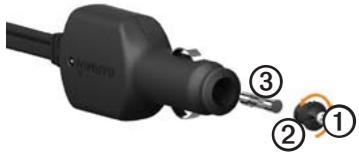
- Install a 2 A fast-blow fuse.
- Verify that the silver tip is located in the end piece.
- Using a coin, replace the end piece.
Removing the Device, Cradle, and Mount
Removing the Device from the Cradle
- Press up on the tab on the top of the cradle.
- Tilt the device forward.
Removing the Cradle from the Mount
- Turn the cradle to the right or left.
- Apply pressure until the socket on the cradle releases the ball on the mount.
Removing the Mounting Arm from the Mounting Base
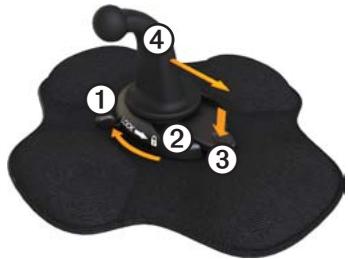
- Slide the locking lever ① on the mounting base ② to the unlocked position.
- Press the release tab ③ down.
- Slide the arm ④ out of the base.
About nuMaps Lifetime
For a one-time payment, you can receive up to four map updates each year for the life of your device. For more information on niMaps Lifetime and complete terms and conditions, go to www.garmin.com /numaps, and click Maps.
Device Models
- Models with "LM" after the model number include a nuMaps Lifetime subscription.
- Models with "LT" after the model number include a lifetime traffic subscription and a traffic receiver.
- Models with "LMT" after the model number include a nuMaps Lifetime subscription, a lifetime traffic subscription (page 75), and a traffic receiver.
Purchasing Additional Maps
You can purchase additional maps for your device.
- Go to your device product page on the Garmin Web site (www .garmin.com).
- Click the Maps tab.
- Follow the on-screen instructions.
Custom Points of Interest
Custom POIs are customized points on the map. They can contain alerts that let you know if you are near a designated point or if you are traveling faster than a specified speed.
Installing a POI Loader
You can create or download custom POI lists and install them on your device using POI Loader software.
- Go to www.garmin.com/extras.
- Click Services > POI Loader.
- Install the POI Loader onto your computer.
Using the POI Loader Help Files For more information on the POI Loader, refer to the Help file.
With the POI Loader open, click Help.
Finding Extras
- From the main menu, touch Where To? >Extras.
- Select a category.
Safety Cameras

CAUTION
Garmin is not responsible for the accuracy of, or the consequences of using, a custom point of interest or a safety camera database.
Safety camera information is available in some locations. Go to http://my.garmin.com for availability. For these locations, the device includes the locations of hundreds of safety cameras. Your device alerts you when you are approaching a safety camera and can warn you if you are driving too fast. The data is updated at least weekly, so you always have access to the most up-to-date information.
You can purchase a new region or extend an existing subscription at any time. Each region that you purchase has an expiration date.
Purchasing Accessories
Go to http://buy.garmin.com.
Contacting Garmin Product Support
You can contact Garmin Product Support if you have any questions about this product.
In the USA, go to www.garmin.com/support, or contact Garmin USA by phone at (913) 397.8200 or (800) 800.1020.
In the UK, contact Garmin (Europe) Ltd. by phone at 0808 2380000.
In Europe, go to www.garmin.com/support and click Contact Support for in-country support information, or contact Garmin (Europe) Ltd. by phone at +44 (0) 870.8501241.
Specifications
Operating temperature range: 32^ - 140^ (0^ - 60^)
Charging temperature range: 32^ - 113^ (0^ - 45^)
Troubleshooting
| Problem | Solution |
| My device is not acquiring satellite signals. | ·Verify that the GPS simulator is turned off. ·From the main menu, touch Tools > Settings > System > GPS Simulator > Off. ·Take your device out of parking garages and away from tall buildings and trees. ·Remain stationary for several minutes. |
| The device does not charge in my vehicle. | ·Check the fuse in the vehicle power cable (page 73). ·Verify the vehicle is turned on and is supplying power to the power outlet. ·Your device can only charge between 32°F and 113°F (between 0°C and 45°C). If the device is placed in direct sunlight or in a hot environment, it cannot charge. |
| My battery does not stay charged for very long. | To maximize the time between charges, turn down the backlight (page 66). |
| How do I clear all of my user data? | See page 72. |
| My battery gauge does not seem accurate. | Allow the unit to fully discharge, and fully charge it (without interrupting the charge cycle). |
| How do I know my device is in USB mass storage mode? | When your device is in USB mass storage mode, a picture of a device connected to a computer is shown on the device screen. Also, you should see two new removable disk drives listed in My Computer. |
| The device is connected to the computer, but it will not go into mass storage mode. | 1. Disconnect the USB cable from your computer. 2. Turn off the device. 3. Plug the USB cable into a USB port on your computer and into your device. The device automatically turns on and goes into USB mass storage mode. 4. Verify your device is connected to a USB port and not a USB hub. |
| I cannot see any new removable drives in my list of drives. | If you have several network drives mapped on your computer, Windows can have trouble assigning drive letters to your device drives. Refer to your operating system Help file to learn how to map or assign drive letters. |
| My phone will not connect to the device. | From the main menu, touch Tools > Settings > Bluetooth. The Bluetooth field must be set to Enabled. Your phone must be turned on and be less than 33 feet (about 10 meters) away from your device. Go to www.garmin.com/bluetooth for more help. |
Index
Numbers
2-D, 3-D map view 62
A
accessories 77
acquiring satellite signals 7, 7-8
addresses, finding 12
adhesive pad 3-5
advanced detours 65
anti-theft feature 71
avoiding
areas and roads 64-65
public transit types 63
road features 64
theft 71, 71-72
traffic 32
B
backup camera 11
battery
heat and 1
information 72
life 72, 78
Bluetooth technology
50-54
pairing with a phone 50-52
settings 67
brightness, adjusting 8
businesses and attractions, finding 15-17
buttons, on-screen 10
C
calculator 48
calls
answering 52
call waiting 53
hanging up 52
home 54
making 53
muting 53
to businesses 53
voice dial 54
cameras
backup 11
safety 76-77
caring for your device 70-71
changing the fuse 73
charging your device 78
cityXplorer maps 29, 63
cleaning your device 6, 70
clearing. See deleting
clock 48
computer, connecting to 6-7
converting
currency 49
units of measure 48-49
coordinates 19
cradle, removing 74
current location 43
current location, saving 18
customized main menu settings 58-59
custom points of interest 75-76
custom points of interest, safety cameras and 76
D
dash mount 3-5
deleting
favorites 19
files 57
recently found
locations 17
user data 72
destinations,multiple 20-21
detours
advanced 65
taking 27-28
device
care 70-71
charging 78
help 43
pairing with a phone 50-52
protecting 70-71
registering 6
removing 74
resetting 8
device settings,Bluetooth and 51
display settings 66
drivers, truck 40
driving directions 25
driving logs 39
exporting 42
viewing exported 42
duty status 39
E
ecoRoute
calibrating fuel
economy 44
ecoChallenge score 45
fuel economyinformation .
mileage report 46
tips 46
vehicle profile 46
end user license
agreements 58
erasing. See deleting
exit services 14
exporting
driving logs 42
jurisdiction summaries
36-37
trip reports 37
extras 75
F
favorites 17-19
deleting 19
editing 18
finding 18
saving locations to 18
saving your current location to 18
files
deleting 57
supported types 55
friction mount 2-3
fuel
data 35-36
finding 43
logs 36
fuel economy, calibrating 44
fuel economy information 45
fuse, changing 73
G
Garmin Lock 71-72
Garmin Product Support 77
geocaching 19
GPS
satellite signals 7-8
settings 58
simulator 21, 58
guarantee, nuMaps 6
H
help 43
home
calling 54
editing location information 15
navigating 14
phone number 54
resetting the location 15
setting a location 14
hospitals 43
hours of service 38-42
drivers 40
driving logs 39, 42
duty status 39
regulations 38
shipments 40-41
1
IFTA (International Fuel Tax Agreement) 35
IFTA logging 35-38
exported summaries and reports 38
fuel data 35-36
fuel logs 36
jurisdiction summary 36-37
trip reports 37-38
Important Safety and
Product Information
guide 1,5
installing the mount 1-5
International Fuel Tax
Agreement (IFTA) 35
J
JPEG image files 55
junction view 26
jurisdiction summary 36-37
K
keyboard 10
L
language settings 66
lithium-ion battery 1, 72
loading pictures 15-19
location, current 43
location map options 12-13
location, security 71
locations, finding addresses 12
businesses and attractions 15-17
coordinates 19
home 14
recently found 17
saved locations
(favorite) 18
trucking points of interest 14-19
using photos 15-17
using the map 13
locations, saving to favorites 18
locking the device 71
logs
driving 38, 39
fuel 36
M
main menu 9
customizing 58-59
default 59
editing 59
maps
adding 75
cityXplorer 29,63
errors 16
information 67
location 12-13
navigation 23
pedestrian 28-29
purchasing 75
settings 61-62
updating 7
MapSource 55, 75
mass storage mode 55-57, 79
measurements, converting 48-49
memory cards 55-56
memory card slot 8
micro-B connector 6-7
microSD card slot 8
mileage reports 46
modes, transportation 11
mounting the device installing 1-5
removing from mount 74
mounts
dash 3-5
friction 2-3
removing 74
multiple destinations 20-21
muting
audio 9
phone calls 53
my Dashboard 6-7
myMaps settings 67
myTrends 28
N
National Truck and Trailer Services (NTTS) 13
navigation
maps 23
offroad64
pedestrian 28
photo 15-19
navigation settings
pedestrian 63
vehicle 61-62
nearby services 43
next turn 25
NTTS (National Truck and Trailer Service) 13
nuMaps guarantee 6
nuMaps Lifetime 75
0
offers (ad-based)
disabling 34
viewing 34
off-road navigation 64
on-screen buttons 10
P
pad, adhesive 3-4
pairing a mobile phone 50-52
pedestrian maps 28-29
pedestrian mode, settings 63
phone, pairing 50-52
phone settings, Bluetooth and 50-51
phone status 54
photo navigation 15-19
picture viewer 47
PIN
Bluetooth 51
Garmin Lock 71
POI loader 55
POI loader software 76
points of interest calling 53
custom 75-76
finding 15-17
rating 17
removing incorrect 16
reporting incorrect 16 trucking 14
police stations 43
portable friction mount 2-3
power cables 69
power key 8
predictive routing 28
present location 43
present location, saving 18
product support 77
profiles
truck or RV 7, 60-61
vehicle (ecoRoute) 46
protecting your device 70-71
public transit
avoidances 63
city maps 29
purchasing maps 75
R
rating points of interest 16
recalculating routes detours 27-28
traffic 32
receiver, traffic 30-34
recently found locations 17
registering the device 6
regulations, hours of service 38
removing incorrect points of interest 16
removing the device, cradle, and mount 74
reports
mileage 46
trip 37-38
resetting
device 8
home location 15
trip information 24
restoring settings 67
restrictions, vehicle 7, 60
reverse camera 11
route preferences 26-28
routes. See trips
route settings 63-65
RV
profiles 7,60-61
settings 61-62
s
safe mode 58
safety cameras 76-77
satellite signals 7, 7-8
saved locations.
See favorites
saving
found locations 18
your current location 18
school zone database 75
score, ecoChallenge 45
screen
brightness 8, 66
buttons 10
keyboard 10
screenshot 48
search area 17
search area, changing 19
security
Garmin Lock 71-72
location 71
theft, avoiding 71
security location 71
services
exit 14
nearby 43
NTTS 13
settings
Bluetooth 67
customized main menu 58-59
display 66
GPS 58
language 66
map 61-62, 67
navigation, pedestrian 63
navigation, vehicle 61-62
restoring 67
route 63-65
simulator 21, 58
system 58
traffic 67
truck or RV 60-61
shipments 40-41
simulator 21, 58
software
information 58
updating 6
version 58
specifications 77
speed limit feature 22
status, duty 39
storing the device 70
subscriptions, traffic 30, 67
support 77
system settings 58
T
theft, avoiding 71
tips
Bluetooth 51-52
driving 46
troubleshooting 78-79
traffic
avoiding 32
icons 31
receiver 30-34
route recalculation 32
settings 67
subscriptions 30, 67
trafficTrends 65
traffic information, accuracy and availability 30
transportation modes 11
trip information
resetting 24
viewing 24
trip reports 37-38
trips 20-21
troubleshooting 78-79
truck
drivers 40
profiles 7,60-61
settings 61-62
shipments 40-41
speed limits 22
trucking points of interest 14-19
turn-by-turn directions 25
turn, next 25
U
unit converter 48-49
unit ID 58
USB connector cradle 2,4 device 6 traffic receiver 30
USB mass storage mode 55-57, 79
user data, deleting 72
V
vehicle profiles ecoRoute 46 truck or RV 7, 60-61
vehicle restrictions 7, 60
version information 58
viewing
junctions 26
trip information 24
voice dial 54
volume 11
W
wallpaper 47
warning icons, truck and RV 68-69
warnings, product 1
windshield mounting 5
world clock, world map 48
For the latest free software updates (excluding map data) throughout the life of your Garmin products, visit the Garmin Web site at www.garmin.com.

© 2011 Garmin Ltd. or its subsidiaries
Garmin International, Inc.
1200 East 151st Street, Olathe, Kansas 66062, USA
Garmin (Europe) Ltd.
Liberty House, Hounsdown Business Park, Southampton, Hampshire, SO40 9LR UK
Garmin Corporation
No. 68, Jangshu 2^nd Road, Sijih, Taipei County, Taiwan
www.garmin.com
- Garmin Ltd. or its subsidiaries
- Table of Contents
- Getting Started. 1
- Searching for a Location . 12
- Planning a Trip 20
- Navigation 22
- Traffic 30
- Using Trucking Features.. 35
- Using the Tools. 43
- Hands-Free Phone Calls.. 50
- Getting Started
- WARNING
- Mounting the Device
- Installing the Portable Friction Mount
- Installing the Dash Mount
- Installing the Base
- NOTICE
- Attaching the Device to the Base Before you use your device on battery power, you should charge it.
- Connecting the External Antenna
- About my Dashboard
- Setting Up my Dashboard
- Registering the Device
- Updating the Software
- nüMaps Guarantee
- Updating Maps
- Entering a Truck or RV Profile
- Acquiring Satellites
- Device Overview
- Adjusting the Screen Brightness
- Resetting the Device
- Adjusting the Volume
- Touch Volume.
- Using the Main Menu
- Using the On-screen Buttons
- Using the On-screen Keyboard
- Transportation Modes
- Changing the Transportation Mode
- Using a Backup Camera
- Searching for a Location
- Finding an Address
- Using the Location Map
- Finding a Location Using the Map
- Viewing a Route on the Map
- Finding NTTS Services
- Using Exit Services
- Finding Trucking Points of Interest
- Setting a Home Location
- Going Home
- Resetting Your Home Location
- Editing Your Home Location Information
- About Points of Interest
- Finding a Location by Spelling the Name
- Finding a Point of Interest by Category
- Using Photo Navigation
- Removing an Incorrect Point of Interest
- Reporting an Incorrect Point of Interest
- Rating a Point of Interest
- Finding Your Last Parking Spot
- Viewing a List of Recently Found Locations
- Clearing the List of Recently Found Locations
- Favorites
- Saving Your Current Location to Favorites
- Saving Locations to Favorites
- Finding Favorites
- Editing Favorites
- Deleting Favorites
- Entering Coordinates
- Changing the Map Coordinate Format
- Changing the Search Area
- Planning a Trip
- Scheduling a Trip
- Navigating a Saved Trip
- Editing a Saved Trip
- Setting a Simulated Location
- Simulating a Route
- Navigation
- Map Features While Navigating
- Using the Navigation Map
- Viewing Trip Information
- Resetting Trip Information
- Viewing the Turn List
- Viewing the Next Turn
- Viewing the Junction View
- Selecting a Route Calculation Mode
- Adding One Point to the Active Route
- Taking a Detour
- Stopping the Route
- About myTrends
- Setting up myTrends
- Using the Pedestrian Navigation Map
- Public Transit Options
- Traffic
- Subscription Activation
- Receiving Traffic Information
- About the Traffic Icon
- Traffic on Your Route
- CAUTION
- Manually Avoiding Traffic on Your Route
- Viewing the Traffic Map
- Searching for Traffic Delays
- Adding a Subscription
- About Offers and Advertisements
- Viewing Offers
- Viewing an Offer List
- Disabling Traffic and Offers
- Using Trucking Features
- About IFTA Logging
- Entering Fuel Data
- Using Fuel Logs
- Viewing and Exporting a Jurisdiction Summary
- Using Trip Reports
- Viewing Exported Jurisdiction Summaries and Trip Reports
- About Hours of Service
- Recording Your Duty Status
- Using Driving Logs
- About Drivers
- Adding Drivers
- Managing Driver Information
- Adding Shipments
- Managing Shipments
- Exporting Driving Logs
- Viewing Exported Driving Logs
- Using the Tools
- Viewing Current Location Information
- Finding Nearby Services
- Using Help
- Searching Help Topics
- About ecoRoute™
- Using ecoRoute
- Calibrating the Fuel Economy
- About the ecoChallenge
- Viewing Your ecoChallenge Scores
- About the ecoChallenge Score
- Removing the ecoChallenge Score From the Map
- Resetting the ecoChallenge
- Viewing Fuel Economy Information
- Adjusting the Vehicle Profile
- About the Mileage Report
- Viewing a Mileage Report
- Viewing Driving Tips
- Resetting ecoRoute Data
- Using the Picture Viewer
- Setting a Picture as Wallpaper
- Deleting Pictures
- Using the World Clock
- Viewing the World Map
- Using the Calculator
- Capturing Screenshots
- Using the Unit Converter
- Setting Currency Conversion Rates Manually
- Hands-Free Phone Calls
- About Pairing the Devices
- Pairing Using the Phone Settings
- Pairing Using the Device Settings
- Tips After Pairing Your Devices
- Managing the Bluetooth Device List
- Receiving a Call
- Using the Device During a Call
- Using Call Waiting
- Dialing a Point of Interest
- Dialing a Number
- Entering Your Phone Number
- Calling Home
- Placing Calls Using Voice Dial
- Checking the Phone Status
- Data Management
- File Types
- About Memory Cards
- Installing a Memory Card
- Transferring Files To Your Computer
- Disconnecting the USB Cable
- Deleting Files
- Customizing the Device
- System Settings
- Customizing the Main Menu
- Editing the Main Menu Icons
- Choosing a Main Menu
- Adding Truck or RV Profiles
- Activating Truck or RV Profiles
- Editing Truck or RV Profiles
- Automobile, Truck, and RV Navigation Settings
- Changing the Map Perspective
- Choosing Proximity Points Settings
- Pedestrian Navigation Settings
- Avoiding Transit Types
- Choosing Route Preferences
- Avoiding Road Features
- Setting Custom Avoidances
- About Advanced Detours
- Enabling Advanced Detours
- About trafficTrends
- Enabling trafficTrends
- Display Settings
- Language Settings
- Viewing Map Information
- Enabling Maps
- Bluetooth Settings
- Enabling Traffic
- About Traffic Subscriptions
- Viewing Traffic Subscriptions
- Restoring Settings
- Appendix
- Warning Icons
- Road ConditionWarnings
- OtherWarnings
- Power Cables
- Caring for Your Device
- Cleaning the Outer Casing
- Cleaning the Touchscreen
- Avoiding Theft
- About Garmin Lock
- About the Security Location
- Locking the Device
- Changing Your Garmin Lock PIN
- Changing Your Security Location
- Erasing User Data
- Battery Information
- Maximizing the Battery Life
- Changing the Fuse in the Vehicle Power Cable
- Removing the Device, Cradle, and Mount
- Removing the Device from the Cradle
- Removing the Cradle from the Mount
- Removing the Mounting Arm from the Mounting Base
- About nuMaps Lifetime
- Device Models
- Purchasing Additional Maps
- Custom Points of Interest
- Installing a POI Loader
- Finding Extras
- Safety Cameras
- Purchasing Accessories
- Contacting Garmin Product Support
- Specifications
- Troubleshooting
- Index
- Numbers
- A
- B
- C
- D
- E
- F
- G
- H
- 1
- J
- K
- L
- M
- N
- 0
- P
- R
- s
- T
- U
- V
- W
Brand : GARMIN
Model : DEZL 560LT
Category : Truck GPS