ANTI-VIRUS 2011 - Security Software GRISOFT - Free user manual and instructions
Find the device manual for free ANTI-VIRUS 2011 GRISOFT in PDF.


| Product Type | Antivirus security software |
| Brand | GRISOFT (AVG Technologies) |
| Model | ANTI-VIRUS 2011 |
| Version | 2011 (build 10.0.xxxx) |
| Supported operating systems | Windows XP SP2, Vista, 7 (32 and 64-bit) |
| Minimum system requirements | 1.5 GHz processor, 512 MB RAM, 390 MB disk space |
| Recommended system requirements | 1.8 GHz processor, 512 MB RAM, 510 MB disk space |
| Available languages | Multilingual (French, English, etc.) |
| Main features | Anti-Virus, Anti-Spyware, Link Scanner (Search-Shield, Surf-Shield), Resident Shield, E-mail Scanner, Online Shield, Anti-Rootkit, ID Protection, PC Analyzer, Automatic update |
| Real-time protection | Yes (Resident Shield, Online Shield, ID Protection) |
| Scheduled scan | Yes (full scan, files/folders, anti-rootkit) |
| Update | Automatic (definitions and program) |
| Quarantine | Virus Vault to isolate threats |
| Browser toolbar | AVG Security Toolbar (Internet Explorer, Firefox) |
| Technical support | Online FAQ, email via form |
| License | Paid (trial available) |
| Maintenance and cleaning | Regular updates, periodic scan, maintenance via PC Analyzer |
| Security | Protection against viruses, spyware, rootkits, phishing, malicious websites |
| Spare parts and repairability | Not applicable (software) |
| General information | 158-page user manual available in PDF |
Frequently Asked Questions - ANTI-VIRUS 2011 GRISOFT
User questions about ANTI-VIRUS 2011 GRISOFT
0 question about this device. Answer the ones you know or ask your own.
Ask a new question about this device
Download the instructions for your Security Software in PDF format for free! Find your manual ANTI-VIRUS 2011 - GRISOFT and take your electronic device back in hand. On this page are published all the documents necessary for the use of your device. ANTI-VIRUS 2011 by GRISOFT.
USER MANUAL ANTI-VIRUS 2011 GRISOFT
Copyright AVG Technologies CZ, s.r.o. All rights reserved.
All other trademarks are the property of their respective owners.
This product uses RSA Data Security, Inc. MD5 Message-Digest Algorithm, Copyright (C) 1991-2, RSA Data Security, Inc. Created 1991.
This product uses code from C-SaCzech library, Copyright (c) 1996-2001 Jaromir Dolecek (dolecek@ics.muni.cz).
This product uses compression library zlib, Copyright (c) 1995-2002 Jean-loup Gailly and Mark Adler.
This product uses compression library libbbzip2, Copyright (c) 1996-2002 Julian R. Seward.
Contents
- Introduction 7
- AVG Installation Requirements 8
2.1 Operation Systems Supported 8
2.2 Minimum & Recommended HW Requirements 8
- AVG Installation Options 9
- AVG Installation Process 10
4.1 Welcome 10
4.2 Activate your AVG license 11
4.3 Select type of installation 12
4.4 Custom options 13
4.5 Install the AVG Security Toolbar 14
4.6 Close running applications 15
4.7 Install progress 16
4.8 Installation was successful 16
- After Installation 19
5.1 Product registration 19
5.2 Access to user interface 19
5.3 Scanning of the whole computer 19
5.4 Eicar test 19
5.5 AVG default configuration 20
6.AVGUser Interface 21
6.1 System Menu 22
6.1.1 File 22
6.1.2 Components 22
6.1.3 History 22
6.1.4 Tools 22
6.1.5 Help 22
6.2 Security Status Info 24
6.3 Quick Links 25
6.4 Components Overview 25
6.5 Statistics 26
6.6 System Tray Icon 26
6.7 AVG gadget 27
7. AVG Components 29
7.1 Anti-Virus 29
7.1.1 Anti-Virus Principles 29
7.1.2 Anti-Virus Interface 29
7.2 Anti-Spyware 30
7.2.1 Anti-Spyware Principles 30
7.2.2 Anti-Spyware Interface 30
7.3 Link Scanner 32
7.3.1 Link Scanner Principles 32
7.3.2 Link Scanner Interface 32
7.3.3 Search-Shield 32
7.3.4 Surf-Shield 32
7.4 Resident Shield 35
7.4.1 Resident Shield Principles 35
7.4.2 Resident Shield Interface 35
7.4.3 Resident Shield Detection 35
7.5 E-mail Scanner 40
7.5.1 E-mail Scanner Principles 40
7.5.2 E-mail Scanner Interface 40
7.5.3 E-mail Scanner Detection 40
7.6 Update Manager 43
7.6.1 Update Manager Principles 43
7.6.2 Update Manager Interface 43
7.7 License 45
7.8 Remote Administration 47
7.9 Online Shield 47
7.9.1 Online Shield Principles 47
7.9.2 Online Shield Interface 47
7.9.3 Online Shield Detection 47
7.10 Anti-Rootkit 51
7.11 PC Analyzer 51
7.12 ID Protection 53
7.12.1 ID Protection Principles 53
7.12.2 ID Protection Interface 53
8. AVG Security Toolbar 55
8.1 AVG Security Toolbar Interface 55
8.1.1 AVG logo button 55
8.1.2 AVG Secure Search powered search box 55
8.1.3 Page Status 55
8.1.4 AVG News 55
8.1.5 News 55
8.1.6 Delete history 55
8.1.7 E-mail Notifier 55
8.1.8 Weather Info 55
8.1.9 Facebook 55
8.2 AVG Security Toolbar Options 63
8.2.1 Tab General 63
8.2.2 Tab Useful Buttons 63
8.2.3 Tab Security 63
8.2.4 Tab Advanced Options 63
- AVG Advanced Settings 67
9.1 Appearance 67
9.2 Sounds 69
9.3 Ignore Faulty Conditions 70
9.4 Virus Vault 71
9.5 PUP Exceptions 72
9.6 Online Shield 74
9.6.1 Web Protection 74
9.6.2 Instant Messaging 74
9.7 Link Scanner 78
9.8 Scans 79
9.8.1 Scan Whole Computer 79
9.8.2 Shell Extension Scan 79
9.8.3 Scan Specific Files or Folders 79
9.8.4 Removable Device Scan 79
9.9 Schedules 84
9.9.1 Scheduled Scan 84
9.9.2 Virus Database Update Schedule 84
9.9.3 Program Update Schedule 84
9.10 E-mail Scanner 94
9.10.1 Certification 94
9.10.2 Mail Filtering 94
9.10.3 Servers 94
9.11 Resident Shield 102
9.11.1 Advanced Settings 102
9.11.2 Excluded items 102
9.12 Cache Server 105
9.13 Anti-Rootkit 107
9.14 Update 108
9.14.1 Proxy 108
9.14.2 Dial-up 108
9.14.3 URL 108
9.14.4 Manage 108
9.15 Remote Administration 115
9.16 Temporarily disable AVG protection 116
9.17 Product Improvement Programme 117
9.18 AVG Security Toolbar 119
10. AVG Scanning 120
10.1 Scanning Interface 120
10.2 Predefined Scans 121
10.2.1 Whole Computer Scan 121
10.2.2 Scan Specific Files or Folders 121
10.2.3 Anti-Rootkit Scan 121
10.3 Scanning in Windows Explorer 131
10.4 Command Line Scanning 131
10.4.1 CMD Scan Parameters 131
10.5 Scan Scheduling 134
10.5.1 Schedule Settings 134
10.5.2 How to Scan 134
10.5.3 What to Scan 134
10.6 Scan Results Overview 143
10.7 Scan Results Details 144
10.7.1 Results Overview Tab 144
10.7.2 Infections Tab 144
10.7.3 Spyware Tab 144
10.7.4Warnings Tab 144
10.7.5 Rootkits Tab 144
10.7.6 Information Tab 144
10.8 Virus Vault 152
11. AVG Updates 154
11.1 Update Levels 154
11.2 Update Types 154
11.3 Update Process 154
12.Event History 156
13. FAQ and Technical Support 158
1. Introduction
This user manual provides comprehensive documentation for AVG Anti-Virus 2011.
Congratulations on your purchase of AVG Anti-Virus 2011!
AVG Anti-Virus 2011 is one of a range of award winning AVG products designed to provide you with peace of mind and total security for your PC. As with all AVG products AVG Anti-Virus 2011 has been completely re-designed, from the ground up, to deliver AVG's renowned and accredited security protection in a new, more user friendly and efficient way. Your new AVG Anti-Virus 2011 product has a streamlined interface combined with more aggressive and faster scanning. More security features have been automated for your convenience, and new 'intelligent' user options have been included so that you can fit our security features to your way of life. No more compromising usability over security!
AVG has been designed and developed to protect your computing and networking activity. Enjoy the experience of full protection from AVG.
All AVG products offer
- Protection that's relevant to the way you use your computer and the Internet: banking and shopping, surfing and searching, chatting and emailing, or downloading files and social networking – AVG has a protection product that's right for you
- Hassle-free protection that's trusted by over 110 million people around the world and fueled by a global network of highly-experienced researchers
- Protection that's backed by round-the-clock expert support
2. AVG Installation Requirements
2.1. Operation Systems Supported
AVG Anti-Virus 2011 is intended to protect workstations with the following operating systems:
- Windows XP Home Edition SP2
- Windows XP Professional SP2
- Windows XP Professional x64 Edition SP1
- Windows Vista (x86 and x64, all editions)
- Windows 7 (x86 and x64, all editions)
(and possibly higher service packs for specific operating systems)
Note: The ID Protection component is not supported on Windows XP x64. On this operating system you can install AVG Anti-Virus 2011 but only without the IDP component.
2.2. Minimum & Recommended HW Requirements
Minimum hardware requirements for AVG Anti-Virus 2011:
Intel Pentium CPU 1,5 GHz
- 512 MB of RAM memory
- 390 MB of free hard drive space (for installation purposes)
Recommended hardware requirements for AVG Anti-Virus 2011:
Intel Pentium CPU 1,8 GHz
- 512 MB of RAM memory
- 510 MB of free hard drive space (for installation purposes)
3. AVG Installation Options
AVG can be installed either from the installation file available on your installation CD, or you can download the latest installation file from AVG website (http://www.avg.com/).
Before you start installing AVG, we strongly recommend that you visit AVG website (http://www.avg.com/) to check for a new installation file. This way you can be sure to install the latest available version of AVG Anti-Virus 2011.
During the installation process you will be asked for your license/sales number. Please make sure you have it available before starting the installation. The sales number can be found on the CD packaging. If you purchased your copy of AVG on-line, your license number will have been delivered to you via e-mail.
4. AVG Installation Process
To install AVG Anti-Virus 2011 on your computer, you need to get the latest installation file. You can use the installation file from the CD that is a part of your box edition but this file might be out-of-date. Therefore we recommended getting the latest installation file online. You can download the file from AVG website (http://www.avg.com/), the Support Center / Download section.
The installation is a sequence of dialog windows with a brief description of what do at each step. In the following, we offer an explanation for each dialog window:
4.1. Welcome
The installation process starts with the Welcome dialog window. Here you select the language used for the installation process, and the default language of AVG user interface. In the upper section of the dialog window find the drop-down menu with the list of languages you can chose from:
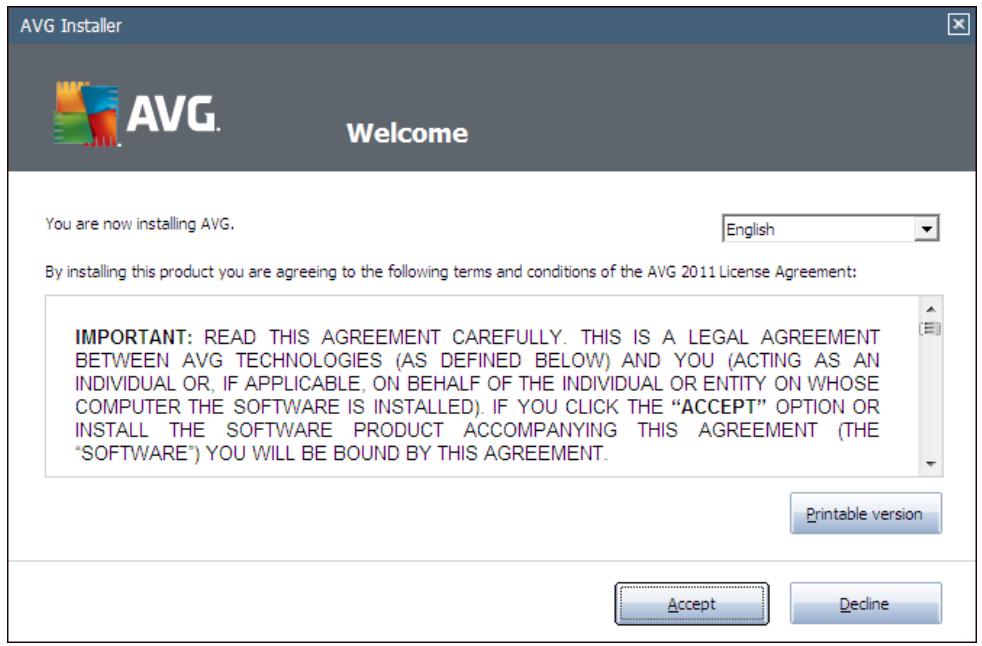
Attention: Here, you are selecting the language for the installation process. The language you select will be installed as the default language for AVG user interface, together with English that is installed automatically. If you want to have installed other additional languages for the user interface, please define them within the setup dialog Custom Options.
Further, the dialog provides the full wording of the AVG license agreement. Please read it carefully. To confirm that you have read, understood and accept the agreement press the Accept button. If you do not agree with the license agreement press the Decline button, and the installation process will be terminated immediately.
4.2. Activate your AVG license
In the Activate Your License dialog you are invited to fill in your license number into the provided text field.
The sales number can be found on the CD packaging in your AVG Anti-Virus 2011 box. The license number will be in the confirmation email that you received after purchasing your AVG Anti-Virus 2011 on-line. You must type in the number exactly as shown. If the digital form of the license number is available (in the email), it is recommended to use the copy and paste method to insert it.
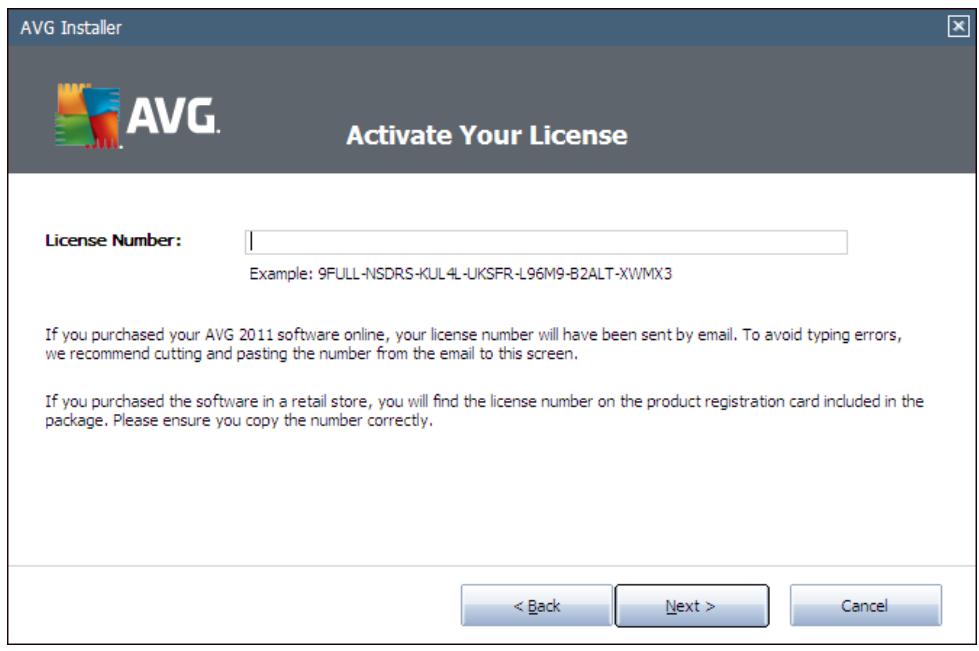
Press the Next button to continue the installation process.
4.3. Select type of installation
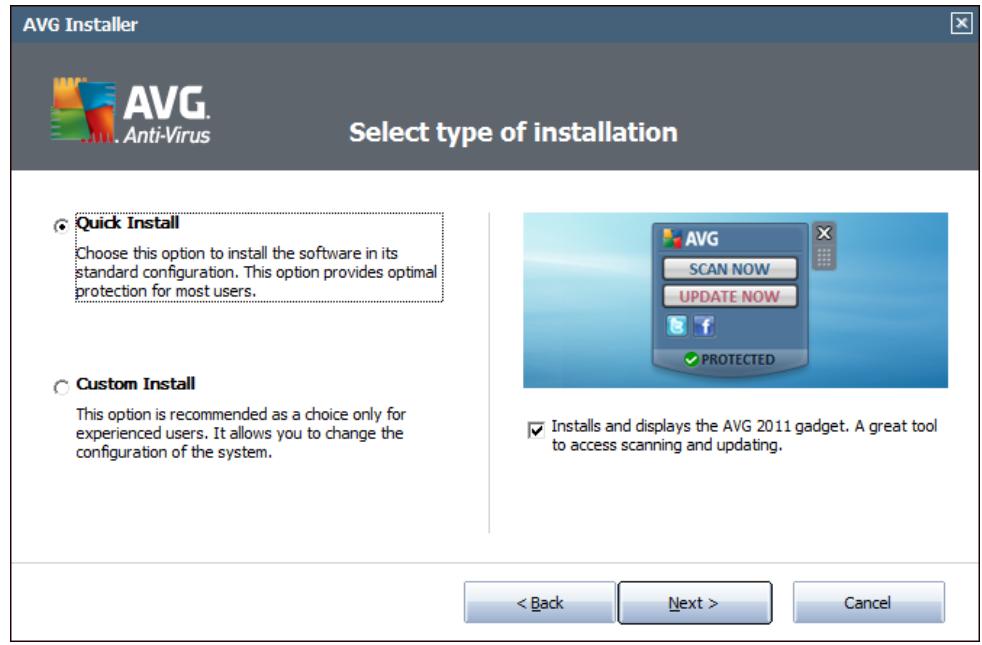
The Select type of installation dialog offers the choice of two installation options: Quick Install and Custom Install.
For most users, it is highly recommended to keep to the standard Quick Install that installs AVG in fully automatic mode with settings predefined by the program vendor. This configuration provides maximum security combined with the optimal use of resources. In the future, if the need arises to change the configuration, you will always have the possibility to do so directly in the AVG application. If you have selected the Quick Install option, press the Next button to proceed to the following Install the AVG Security Toolbar dialog.
Custom Install should only be used by experienced users who have a valid reason to install AVG with non-standard settings; e.g. to fit specific system requirements. Having selected this option, press the Next button to proceed to the Custom Options dialog.
In the right-hand section of the dialog you can find the check box related to AVG gadget (supported in Windows Vista/Windows 7). If you wish to have installed this gadget, mark the respective checkbox. AVG gadget will then be accessible from the Windows Sidebar providing you an immediate access to the most important features of your AVG Anti-Virus 2011, i.e. scanning and updating.
4.4.Custom options
The Custom Options dialog allows you to set up two parameters of the installation:
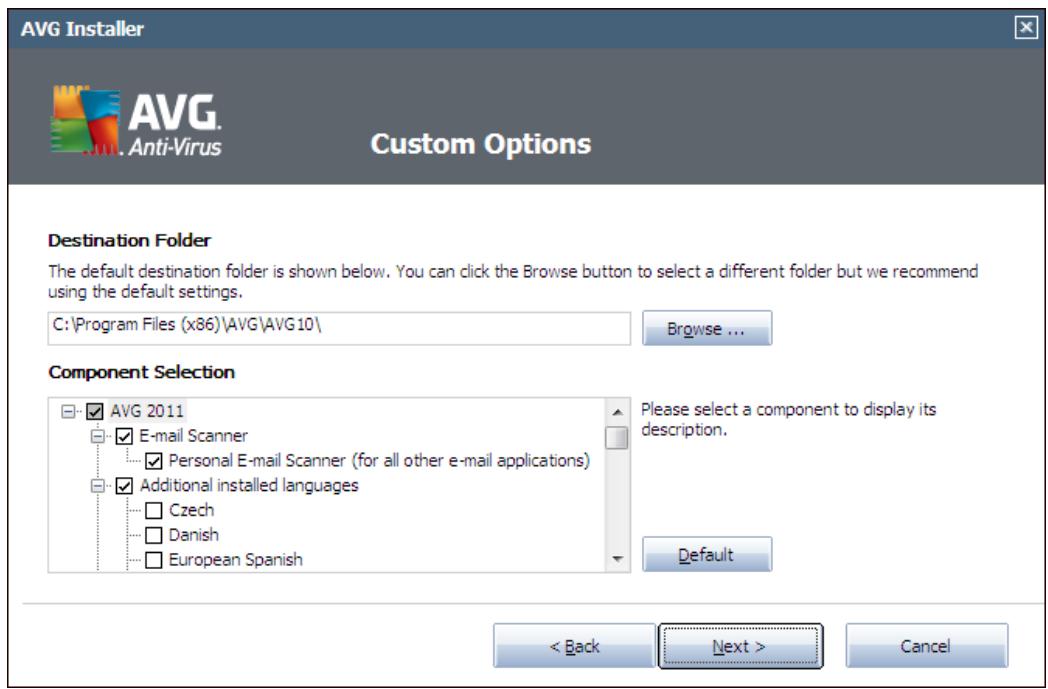
Destination Folder
Within the Destination Folder section of the dialog you are supposed to specify the location where AVG Anti-Virus 2011 should be installed. By default, AVG will be installed to the program files folder located on drive C:. In case the folder does not exist yet, you will be asked in a new dialog to confirm you agree AVG creates this folder now. If you want to change this location, use the Browse button to display the drive structure, and select the respective folder.
Component Selection
The Component Selection section provides an overview of all AVG Anti-Virus 2011 components that can be installed. If the default settings do not suit you, you can remove/add specific components.
However, you can only select from components that are included in your purchased AVG edition!
Highlight any item in the Component Selection list, and a brief description of the respective component will be displayed on the right side of this section. For detailed information on each component's functionality please consult the Components Overview chapter of this documentation. To revert to the default configuration preset by the software vendor use the Default button.
Press the Next button to continue.
4.5. Install the AVG Security Toolbar
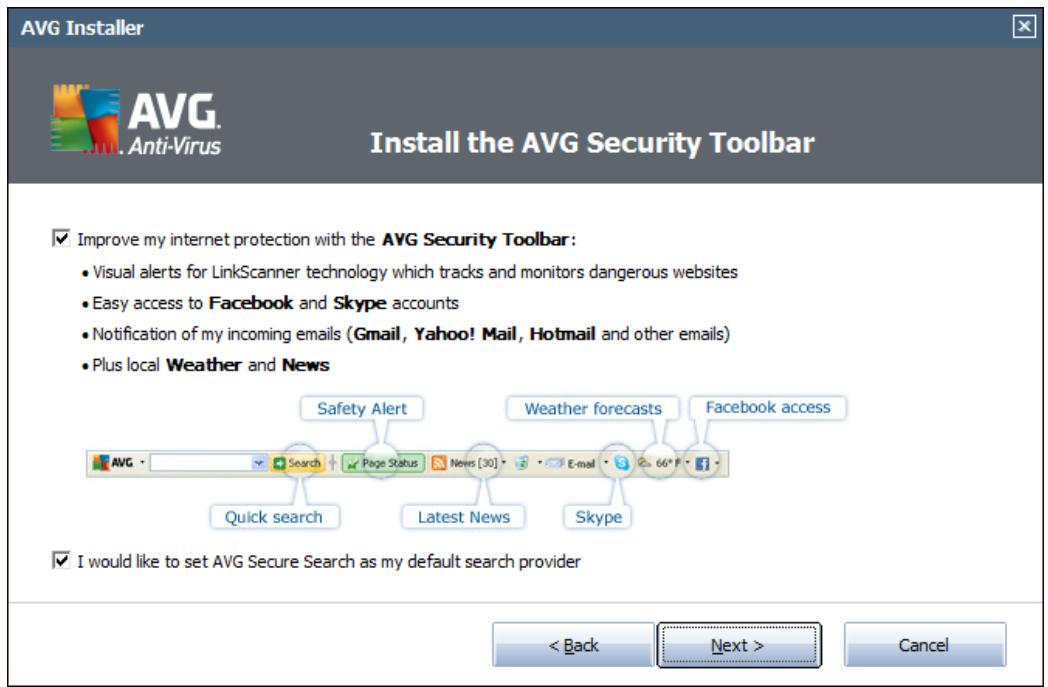
In the Install the AVG Security Toolbar dialog, decide whether you want to install the AVG Security Toolbar. If you do not change the default settings, this component will be installed automatically into your Internet browser (currently supported browsers are Microsoft Internet Explorer v. 6.0 or higher, and Mozilla Firefox v. 3.0 or higher) and to provide you with comprehensive online protection while surfing the Internet.
Also, you have the option to decide whether you want to choose AVG Secure Search as your default search provider. If so, keep the respective check box marked.
4.6. Close running applications
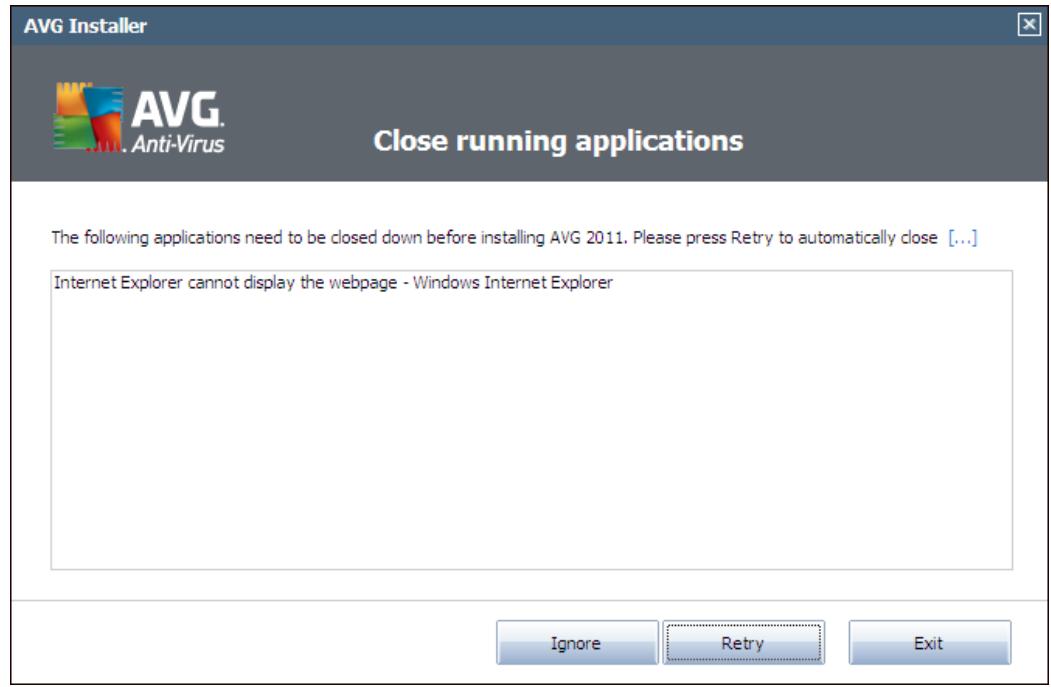
The Close running applications dialog appears during the installation process only in case there are some other clashing programs running on your computer at the moment. Then, the list of programs that need to be closed in order to successfully finish the installation process will be provided. Press the Exit button over a selected item in the list to terminate the respective application, or press the Retry button to confirm you agree to close down the respective applications, and to continue to the next step.
4.7. Install progress
The Install Progress dialog shows the progress of the installation process, and does not require any intervention:
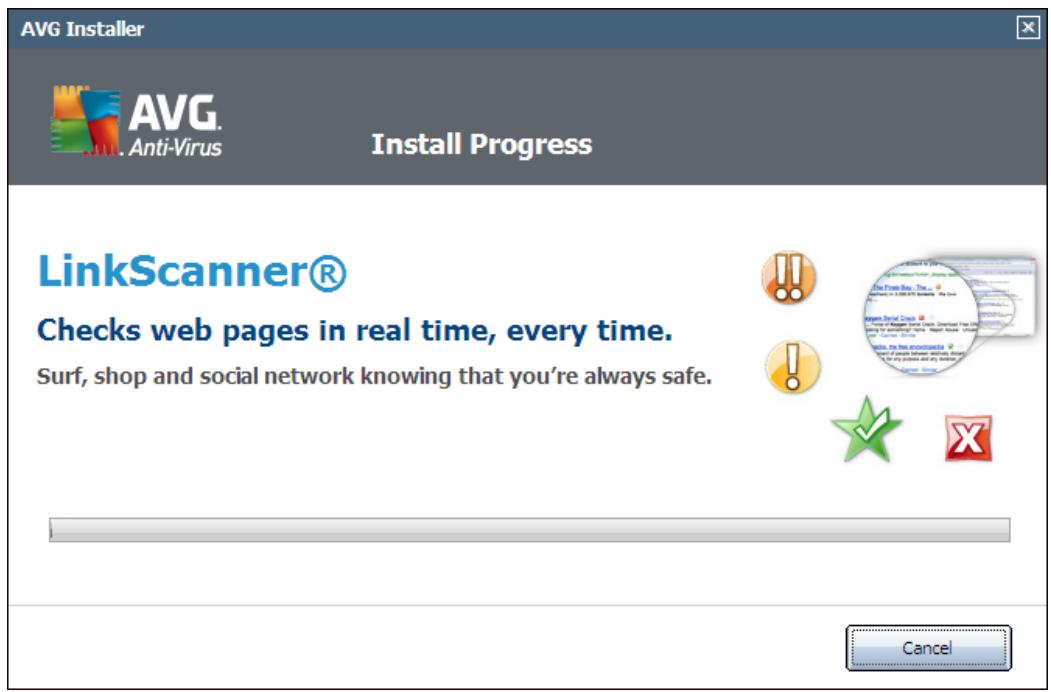
After the installation process is finished, the virus database and program will be updated automatically. Then, you will be redirected to the next dialog.
4.8. Installation was successful
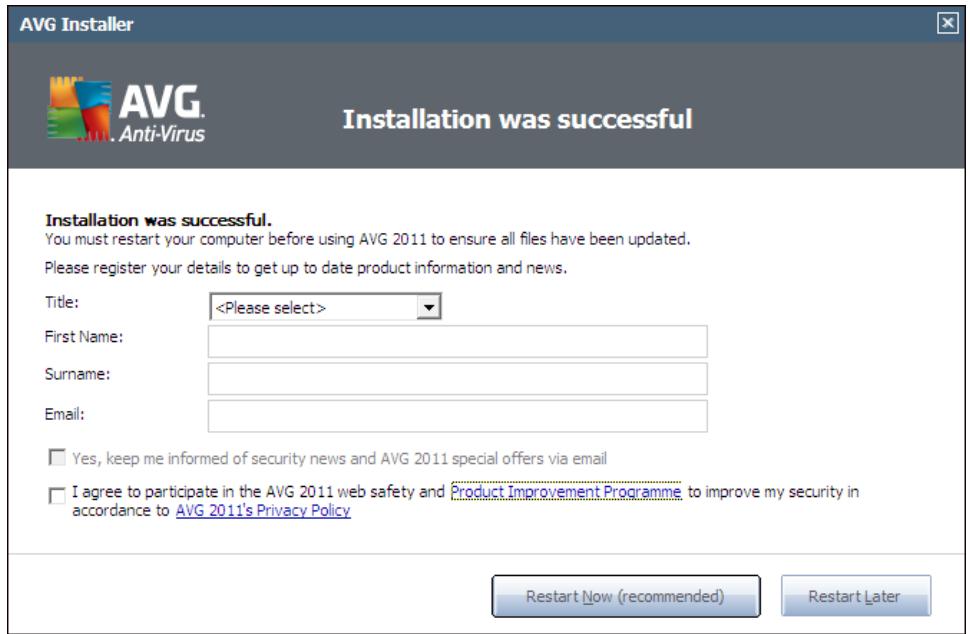
The Installation was successful dialog confirms that your AVG Anti-Virus 2011 has been fully installed and configured.
In this dialog please provide your contact information so that you can receive all product related information and news. Below the registration form you will find the following two options:
- Yes, keep me informed of security news and AVG 2011 special offers via e-mail - mark the checkbox to state you would like to be informed about what is new in the Internet security sphere, and would like to receive information on AVG product special offers, improvements and upgrades, etc.
- I agree to participate in the AVG 2011 web safety and Product Improvement Programme ... - mark this checkbox to agree you want to participate in the Product Improvement Programme (for details see chapter AVG Advanced Settings / Product Improvement Programme) that collects anonymous information on detected threats in order to increase the overall Internet security level.
To finalize the installation process you need restart your computer: select whether you want to Restart Now, or you want to postpone this action - Restart Later.
Note: If using any AVG business license, and in case that you have previously selected the Remote administration item to be installed (see Custom Options), the Installation was successful dialog appears with the following interface:
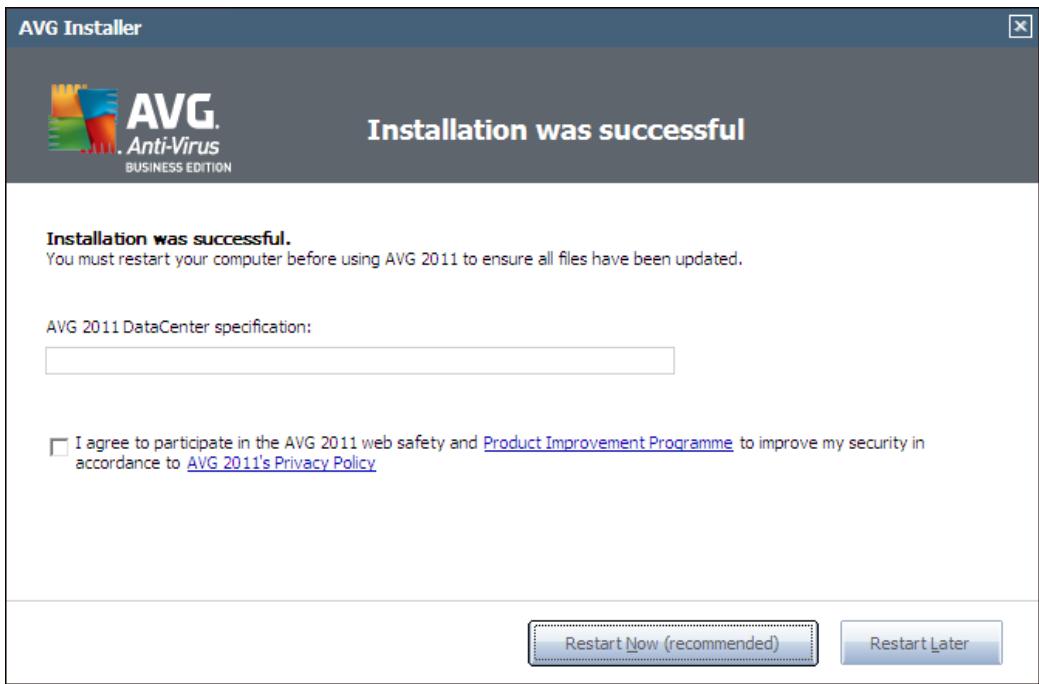
You need to specify AVG DataCenter parameters - please provide the connection string to AVG DataCenter in the form of server:port. If this information is not available at the moment, leave the field blank and you can set the configuration later in within the Advanced Settings / Remote
Administration dialog. For detailed information on AVG Remote administration please consult AVG Network Edition user manual; to be downloaded from AVG website (http://www(avg.com/).
5. After Installation
5.1. Product registration
Having finished the AVG Anti-Virus 2011 installation, please register you product online on AVG website (http://www.avg.com/), Registration page (follow the instruction provided directly in the page). After the registration you will be able to gain full access to your AVG User account, the AVG Update newsletter, and other services provided exclusively for registered users.
5.2. Access to user interface
The AVG User Interface is accessible in several ways:
- double-click the AVG system tray icon
- double-click the AVG icon on the desktop
- double click the status line located in the bottom section of the AVG gadget (if installed; supported on Windows Vista/Windows 7)
- from the menu Start/Programs/AVG 2011/AVG User Interface
- from AVG Security Toolbar via option Launch AVG
5.3. Scanning of the whole computer
There is a potential risk that a computer virus has been transmitted to your computer prior to AVG Anti-Virus 2011 installation. For this reason you should run a Scan of the whole computer to make sure there are no infections on your PC.
For instructions on running a Scan of the whole computer please consult the chapter AVG Scanning.
5.4. Eicar test
To confirm that AVG Anti-Virus 2011 has been installed correctly you can perform the EICAR test.
The EICAR test is a standard and absolutely safe method used to test antivirus system functioning. It is safe to pass around, because it is not an actual virus, and does not include any fragments of viral code. Most products react to it as if it were a virus (though they typically report it with an obvious name, such as "EICAR-AV-Test"). You can download the EICAR virus from the EICAR website at www.eicar.com, and you will also find all necessary EICAR test information there.
Try to download the eicar.com file, and save it on your local disk. Immediately after you confirm downloading of the test file, the Online Shield will react to it with a
warning. This notice demonstrates that AVG is correctly installed on your computer.
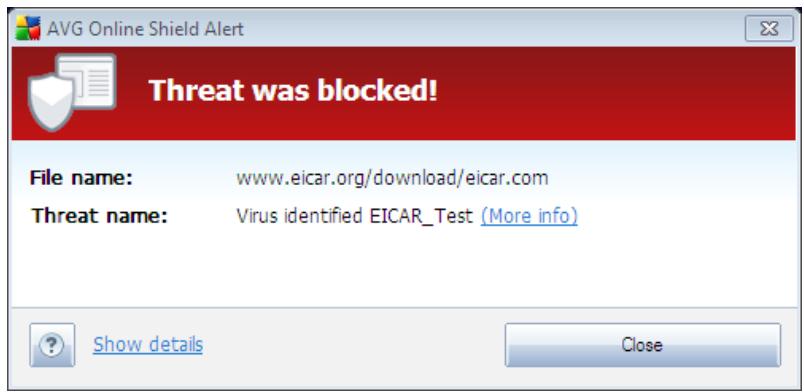
From the http://www.eicar.com website you can also download the compressed version of the EICAR 'virus' (e.g. in the form of eicar_com.zip). Online Shield allows you to download this file and save it on your local disk but then the Resident Shield detects the 'virus' as you try to unpack it. If AVG fails to identify the EICAR test file as a virus, you should check the program configuration again!
5.5. AVG default configuration
The default configuration (i.e. how the application is set up right after installation) of AVG Anti-Virus 2011 is set up by the software vendor so that all components and functions are tuned up to achieve optimum performance.
Unless you have a real reason to do so, do not change the AVG configuration! Changes to settings should only be performed by an experienced user.
Some minor editing of AVG components settings is accessible directly from the specific component user interface. If you feel you need to change the AVG configuration to better suit your needs, go to AVG Advanced Settings: select the system menu item Tools/Advanced settings and edit the AVG configuration in the newly opened AVG Advanced Settings dialog.
6. AVG User Interface
AVG Anti-Virus 2011 open with the main window:
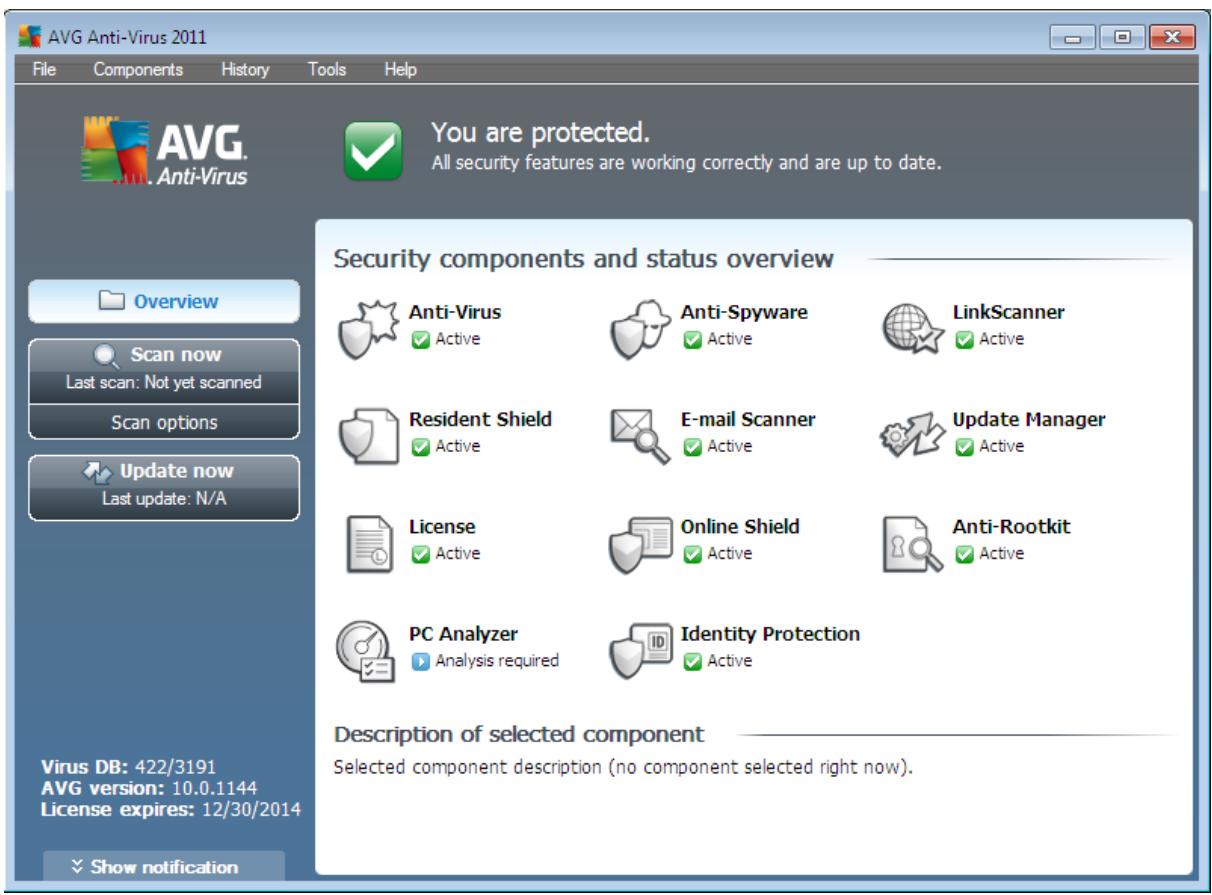
The main window is divided into several sections:
- System Menu (top system line in the window) is the standard navigation that allows you to access all AVG components, services, and features - details >>
- Security Status Info (upper section of the window) provides you with information on the current status of your AVG program - details >>
- Quick Links (left section of the window) allow you to quickly access the most important and most frequently used AVG tasks - details >>
- Components Overview (central section of the window) offer an overview of all installed AVG components - details >>
- Statistics (left bottom section of the window) provide you with all statistical data regarding the programs operation - details >>
- System Tray Icon (bottom right corner of the monitor, on the system tray) indicates the AVG current status - details >>
- AVG gadget (Windows sidebar, supported in Windows Vista/7) allows quick
access to AVG scanning and update - details >>
6.1. System Menu
The System menu is the standard navigation used in all Windows applications. It is located horizontally in the very top part of the AVG Anti-Virus 2011 main window. Use the system menu to access specific AVG components, feature, and services.
The system menu is divided into five main sections:
6.1.1. File
- Exit - closes the AVG Anti-Virus 2011's user interface. However, the AVG application will continue running in the background and your computer will still be protected!
6.1.2. Components
The Components item of the system menu includes links to all installed AVG components, opening their default dialog page in the user interface:
- System overview - switch to the default user interface dialog with the overview of all installed components and their status
- Anti-Virus ensures that your computer is protected from viruses trying to enter your computer - details >>
- Anti-Spyware ensures that your computer is protected from spyware and adware - details >>
6.1.3. History
- Scan results - switches to the AVG testing interface, specifically to the Scan Results Overview dialog
- Resident Shield Detection - open a dialog with an overview of threats detected by Resident Shield
- E-mail Scanner Detection - open a dialog with an overview of mail messages attachments detected as dangerous by the E-mail Scanner component
- Online Shield findings - open a dialog with an overview of threats detected by Online Shield
- Virus Vault - opens the interface of the quarantine space (Virus Vault) to where AVG removes all detected infections that cannot be healed automatically for some reason. Inside this quarantine the infected files are isolated and your computer's security is guaranteed, and at the same time the infected files are stored for possible future repair.
- Event History Log - opens the history log interface with an overview of all logged AVG Anti-Virus 2011 actions.
6.1.4. Tools
- Scan computer - switches to the AVG scanning interface and launches a scan of the whole computer
- Scan selected folder - switches to the AVG scanning interface and allows you to define within the tree structure of your computer which files and folders should be scanned
- Scan file - allows you to run an on-demand test over a single file selected from the tree structure of your disk
- Update - automatically launches the update process of AVG Anti-Virus 2011
- Update from directory - runs the update process from the update files located in a specified folder on your local disk. However, this option is only recommended as an emergency, e.g. in situations where there is no connection to the Internet (for example, your computer is infected and disconnected from the Internet; your computer is connected to a network with no access to the Internet, etc.). In the newly opened window select the folder where you have previously placed the update file, and launch the update process.
- Advanced settings - opens the AVG advanced settings dialog where you can edit the AVG Anti-Virus 2011 configuration. Generally, it is recommended to keep the default settings of the application as defined by the software vendor.
6.1.5. Help
- Contents - opens the AVG help files
- Get Help Online - opens AVG website (http://www.avg.com/) at the customer support center page
- Your AVG Web - opens AVG website (http://www.avg.com/)
- About Viruses and Threats - opens the online Virus Encyclopedia where you can look up detailed information on the identified virus
- Reactivate - opens the Activate AVG dialog with the data you have entered in the Personalize AVG dialog of the installation process. Within this dialog you can enter your license number to either replace the sales number (the number you have installed AVG with), or to replace the old license number (e.g. when upgrading to a new AVG product).
- Register now - connects to the registration page of AVG website (http://www.avg.com/). Please fill in your registration data; only customers who register their AVG product can receive free technical support.
Note: If using the trial version of AVG Anti-Virus 2011, the latter two items appear as Buy now and Activate, allowing you to buy the full version of the program right away. For AVG Anti-Virus 2011 installed with a sales number,
the items display as Register and Activate. For more information please consult the License section of this documentation.
- About AVG - opens the Information dialog with five tabs providing data on program name, program and virus database version, system info, license agreement, and contact information of AVG Technologies CZ.
6.2. Security Status Info
The Security Status Info section is located in the upper part of the AVG main window. Within this section you will always find information on the current security status of your AVG Anti-Virus 2011. Please see an overview of icons possibly depicted in this section, and their meaning:

- The green icon indicates that your AVG is fully functional. Your computer
is completely protected, up to date and all installed components are working properly.

- The orange icon warns that one or more components are incorrectly tuned and you should pay attention to their properties/settings. There is no problem in AVG and you have probably decided to switch some element off for some reason. You are still protected by AVG. However, please be attention to the problem component's settings! Its name will be provided in Security Status Info section.
This icon also appears if for some reason you have decided to ignore a component's error status (the "Ignore component state" option is available from the context menu opened by a right-click over the respective component's icon in the component overview of the AVG main window). You may need to use this option in a specific situation but it is strictly recommended to switch off the "Ignore component state" option as soon as possible.

- The red icon indicates that AVG is in critical status! One or more
components does not work properly and AVG cannot protect your computer. Please pay immediate attention to fixing the reported problem. If you are not able to fix the error yourself, contact the AVG technical support team.
In case AVG is not set to the optimum performance, a new button named Fix (alternatively Fix all if the problem involves more than one component) appears next to the security status information. Press the button to launch an automatic process of program checkout and configuration. This is an easy way to set AVG to the optimum performance and reach the maximum security level!
It is strongly recommended that you pay attention to Security Status Info and in case the report indicates any problem, go ahead and try to solve it immediately. Otherwise your computer is at risk!
Note: AVG status information can also be obtained at any moment from the system tray icon.
6.3. Quick Links
Quick links (in the left section of the AVG User Interface) allow you to immediately access the most important and most frequently used AVG features:
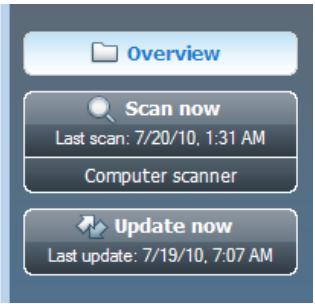
- Overview - use this link to switch from any currently opened AVG interface to the default one with an overview of all installed components - see chapter Components Overview >>
- Scan now - by default, the button provides information (scan type, date of last launch) of the last scan launched. You can either execute the Scan now command to launch the same scan again, or follow the Computer scanner link to open the AVG scanning interface where you can run scans, schedule scans, or edit their parameters - see chapter AVG Scanning >>
- Update now - the link provides the date of the last launch of the update process. Press the button to open the updating interface, and run AVG update process immediately - see chapter AVG Updates >>
These links are accessible from the user interface at all times. Once you use a quick link to run a specific process, the GUI will switch to a new dialog but the quick links are still available. Moreover, the running process is further graphically depicted.
6.4. Components Overview
The Components Overview section is located in the central part of the AVG User Interface. The section is divided into two parts:
- Overview of all installed components consisting of a panel with the component's icon and the information of whether the respective component is active or inactive
- Description of a selected component
Within the AVG Anti-Virus 2011 the Components Overview section contains information on the following components:
- Anti-Virus ensures that your computer is protected from viruses trying to
enter your computer - details >>
- Anti-Spyware ensures that your computer is protected from spyware and adware - details >>
6.5. Statistics
The Statistics section is located in the left bottom part of the AVG User Interface. It offers a list of information regarding the program's operation:
- Virus DB - informs you about the currently installed version of the virus database
- AVG version - informs you about the AVG version installed (the number is in the form of 10.0.xxxx, where 10.0 is the product line version, and xxxx stands for the number of the build)
- License expires - provides the date of your AVG license expiration
6.6. System Tray Icon
System Tray Icon (on your Windows taskbar) indicates the current status of your AVG Anti-Virus 2011. It is visible at all times on your system tray, no matter whether your AVG main window is opened or closed:
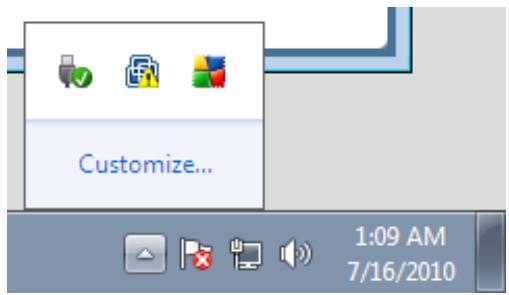
If in full color, the System Tray Icon indicates that all AVG components are active and fully functional. Also, AVG system tray icon can be displayed in full color if AVG is in error state but you are fully aware of this situation and you have deliberately decided to Ignore the component state. An icon with an exclamation mark indicates a problem (inactive component, error status, etc.). Double-click the System Tray Icon to open the main window and edit a component.
The system tray icon further informs on current AVG activities and possible status changes in the program (e.g. automatic launch of a scheduled scan or update, a component's status change, error status occurrence, ...) via a pop-up window opened from the AVG system tray icon:
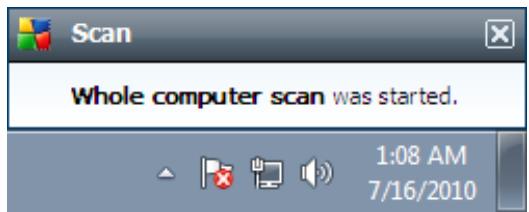
The System Tray Icon can also be used as a quick link to access the AVG main window at any time - double click on the icon. By right-click on the System Tray Icon you open a brief context menu with the following options:
- Open AVG User Interface - click to open the AVG User Interface
- Scans - click to open the context menu of
- Running scans - this item is displays only in case a scan is currently running on your computer. For this scan you can then set its priority, alternatively stop or pause the running scan. Further, the following actions are accessible: Set priority for all scans, Pause all scans or Stop all scans.
- Update now - launches an immediate update
- Help - opens the help file on the start page
6.7. AVG gadget
AVG gadget displays on the Windows desktop (Windows Sidebar). This application is only supported in operating systems Windows Vista and Windows 7. AVG gadget offers an immediate access to the most important AVG Anti-Virus 2011 functionality, i.e. scanning and updating:
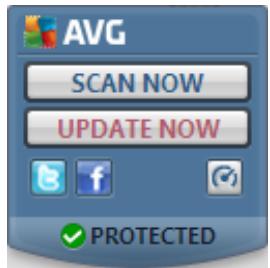
AVG gadget provides the following quick access options:
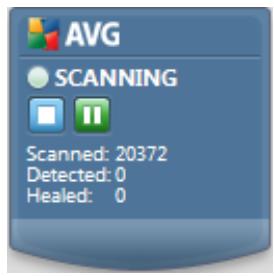
- Scan now - click the Scan now link to start the whole computer scan directly. You can watch the progress of the scanning process in the alternated user interface of the gadget. A brief statistics overview provides information on the number of scanned objects, threats detected, and threats healed. During the scan you can always pause or stop the scanning process. For detailed data related to the scan results please consult the standard Scan results overview dialog; the respective item will be listed as sidebar gadget scan.
- Update now - click the Update now link to launch the AVG update directly from within the gadget:
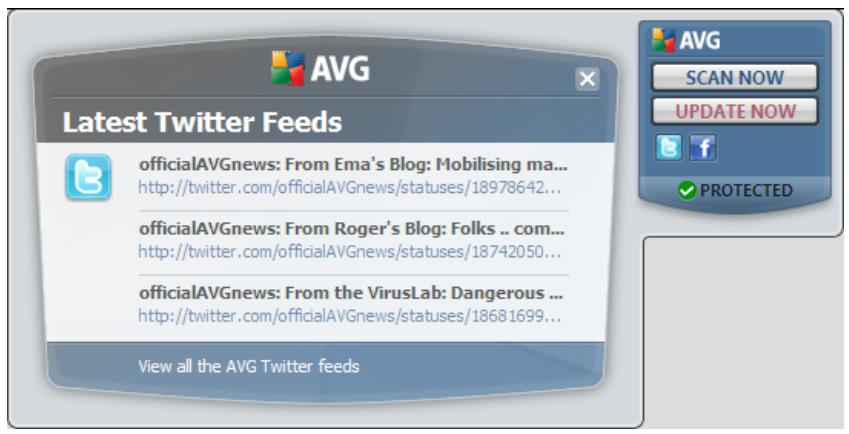
- Twitter link - opens a new AVG gadget interface providing an overview of the latest AVG feeds posted at the Twitter. Follow the View all the AVG Twitter feeds link to open your Internet browser in a new window, and you will be redirected directly to the Twitter website, specifically to the page devoted to AVG related news:
- Facebook link - opens your Internet browser on the Facebook website, specifically on the AVG community page
- PC Analyzer - open the user interface in the PC Analyzer component
7. AVG Components
7.1. Anti-Virus
7.1.1. Anti-Virus Principles
The antivirus software's scanning engine scans all files and file activity (opening/closing files, etc.) for known viruses. Any detected virus will be blocked from taking any action and will then be cleaned or quarantined. Most antivirus software also uses heuristic scanning, where files are scanned for typical virus characteristics, so called viral signatures. This means that the antivirus scanner can detect a new, unknown virus, if the new virus contains some typical characteristics of existing viruses.
The important feature of antivirus protection is that no known virus can run on the computer!
Where just a single technology might fall short of detecting or identifying a virus, AntiVirus combines several technologies to ensure that your computer is protected from viruses:
- Scanning - searching for character strings that are characteristic of a given virus
- Heuristic analysis - dynamic emulation of the scanned object's instructions in a virtual computer environment
- Generic detection - detection of instructions characteristic of the given virus/ group of viruses
AVG is also able to analyze and detect executable applications or DLL libraries that could be potentially unwanted within the system. We call such threats Potentially Unwanted Programs (various kinds of spyware, adware etc.). Furthermore, AVG scans your system registry for suspicious entries, temporary Internet files and tracking cookies, and allows you to treat all potentially harmful items in the same way as any other infection.
7.1.2. Anti-Virus Interface
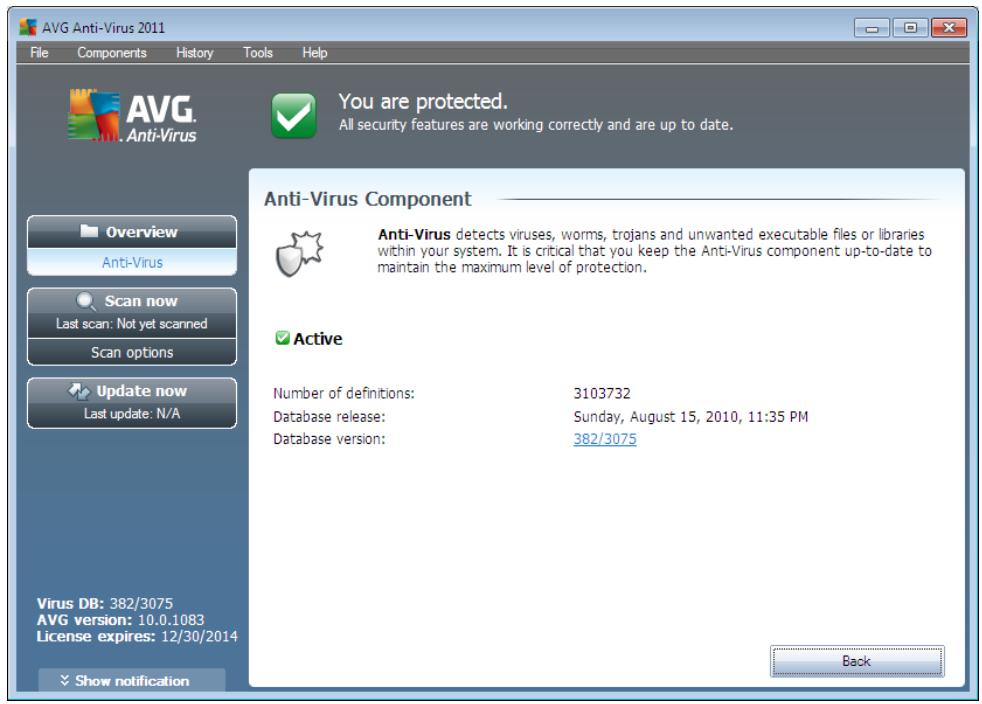
The Anti-Virus component's interface provides some basic information on the component's functionality, information on the component's current status (Anti-Virus component is active.), and a brief overview of Anti-Virus statistics:
- Number of definitions - number provides the count of viruses defined in the up-to-date version of the virus database
- Database release - specifies when and at what time the virus database was last updated
- Database version - defines the number of the currently installed virus database version; and this number increases with every virus base update
There is just one operating button available within this component's interface (Back) - press the button to return to the default AVG user interface (components overview).
7.2. Anti-Spyware
7.2.1. Anti-Spyware Principles
Spyware is usually defined as a type of malware, i.e. software, that gathers information from a user's computer without the user's knowledge or consent. Some spyware applications may also be installed on purpose and often contain advertisements, window pop-ups or different types of unpleasant software.
Currently, the most common source of infection is websites with potentially dangerous content. Other methods of transmission, such as via e-mail or transmission by worms and viruses are also prevalent. The most important protection is to use an always-on background scanner, Anti-Spyware, that works like a resident shield and scans your applications in the background as you run them.
There is also the potential risk that malware has been transmitted to your computer prior to AVG installation, or that you have neglected to keep your AVG Anti-Virus 2011 up-to-date with the latest database and program updates. For this reason, AVG allows you to fully scan your computer for malware/spyware using the scanning feature. It also detects sleeping and non-active malware, i.e. malware that has been downloaded but not yet activated.
7.2.2. Anti-Spyware Interface
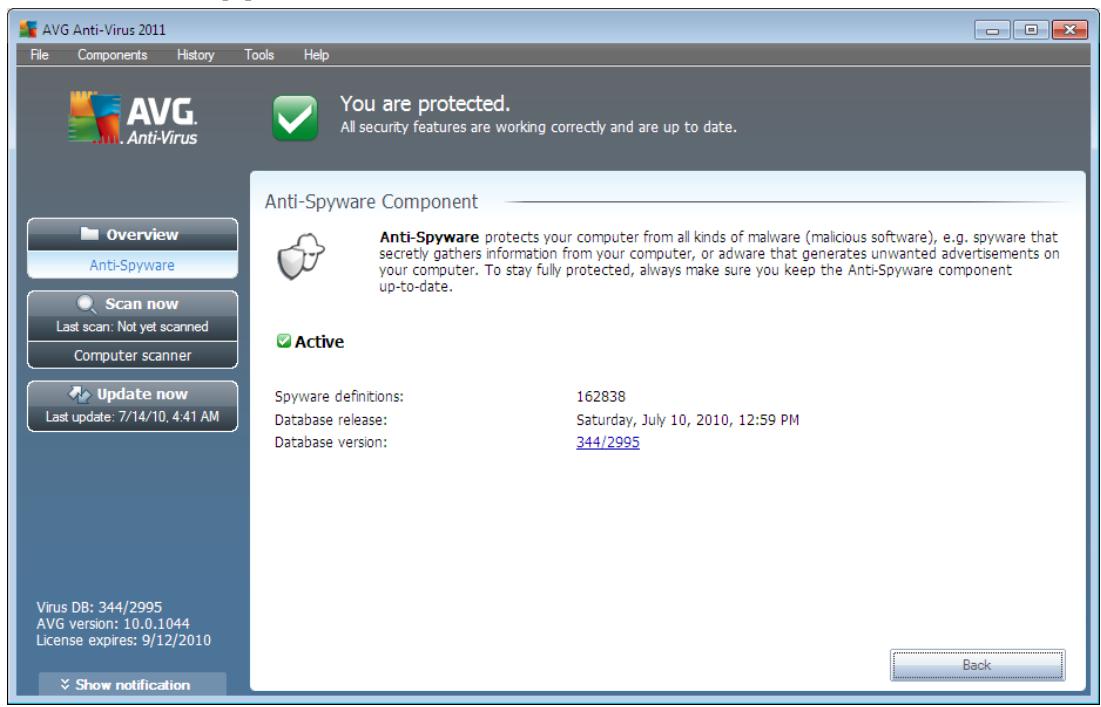
The Anti-Spyware component's interface provides a brief overview on the component's functionality, information on the component's current status, and some Anti-Spyware statistics:
- Spyware definitions - number provides the count of spyware samples defined in the latest spyware database version
- Database release - specifies when and at what time the spyware database was updated
- Database version - defines the number of the latest spyware database version; and this number increases with every virus base update
There is just one operating button available within this component's interface (Back) - press the button to return to the default AVG user interface (components overview).
7.3. Link Scanner
7.3.1. Link Scanner Principles
LinkScanner protects you from the increasing number of 'here today, gone tomorrow' threats on the web. These threats can be hidden on any type of website, from governments to big, well-known brands to small businesses, and they rarely stick around on those sites for more than 24 hours. LinkScanner protects you by analyzing the web pages behind all the links on any web page you're viewing and making sure they're safe at the only time that matters - when you're about to click that link.
The LinkScanner technology consists of two features, Search-Shield and Surf-Shield:
- Search-Shield contains list of websites (URL addresses) which are known to be dangerous. When searching with Google, Yahoo!, WebHledani, Yandex, Baidu, Bing, AOL, AltaVista, EarthLink, Ask, Seznam, eBay, Twitter, Digg, orSlashDot, all results of the search are checked according to this list and a verdict icon is shown (for Yahoo search results only "exploited website" verdict icons are shown).
- Surf-Shield scans the contents of the websites you are visiting, regardless of the websites address. Even if some website is not detected by Search-Shield (e.g. when a new malicious website is created, or when a previously clean website now contains some malware), it will be detected and blocked by Surf-Shield once you try to visit it.
Note: LinkScanner is not intended for server platforms!
7.3.2. Link Scanner Interface
The LinkScanner component interface provides a brief description of the component's functionality and information on its current status. Further, you can find the information on the latest LinkScanner database version number (LinkScanner version).
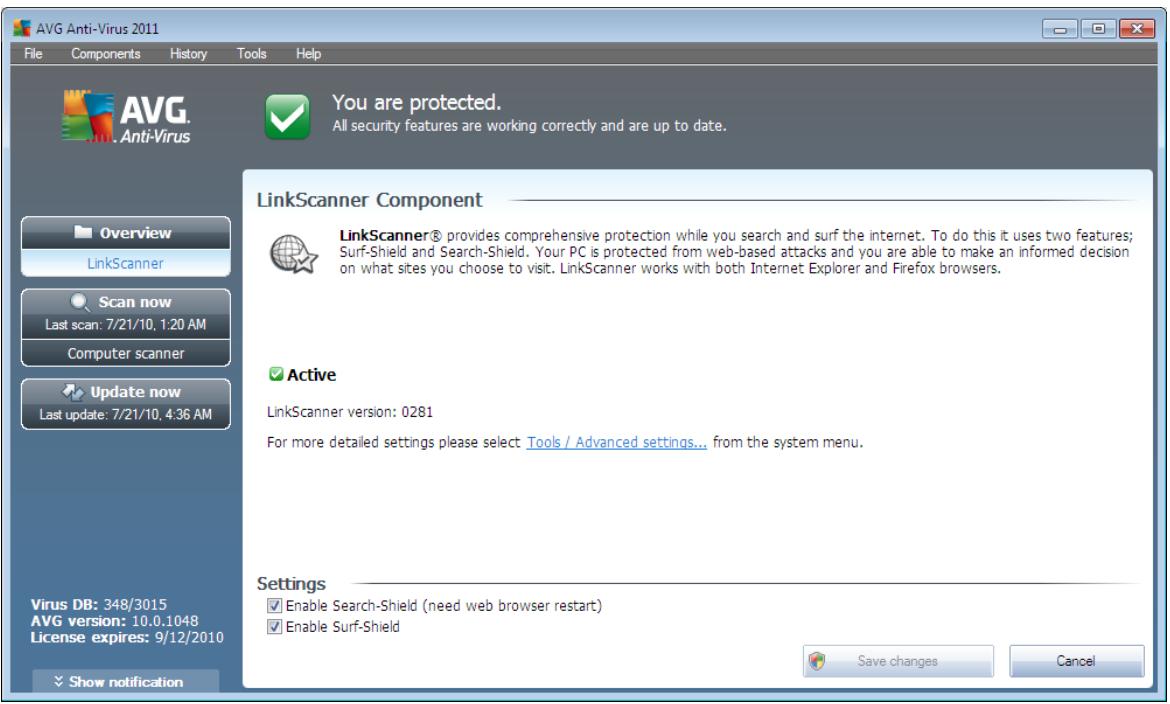
LinkScanner Settings
In the bottom part of the dialog you can edit several options:
- Enable Search-Shield - (on by default): advisory notifying icons on searches performed with Google, Yahoo!, WebHledani, Yandex, Baidu, Bing, AOL, AltaVista, EarthLink, Ask, Seznam, eBay, Twitter, Digg, orSlashDot: having checked ahead the content of sites returned by the search engine.
- Enable Surf-Shield - (on by default): active (real-time) protection against exploitive sites as they are accessed. Known malicious site connections and their exploitive content is blocked as they are accessed by the user via a web browser (or any other application that uses HTTP).
7.3.3. Search-Shield
When searching Internet with the Search-Shield on, all search results returned from the most popular search engines (Google, Yahoo!, WebHledani, Yandex, Baidu, Bing, AOL, AltaVista, EarthLink, Ask, Seznam, eBay, Twitter, Digg, andSlashDot) are evaluated for dangerous or suspicious links. By checking these links and marking the bad links, the AVG Link Scanner warns you before you click on dangerous or suspicious links, so you can ensure you only go to safe websites.
While a link is being evaluated on the search results page, you will see a graphic sign next to the link informing that the link verification is in progress. When the evaluation is complete, the respective informative icon will be displayed:

The linked page is safe (this icon will not be displayed for safe Yahoo! search
results).
The linked page does not contain threats but is somewhat suspicious ( questionable in origin or motive, therefore not recommended for e-shopping etc.).
The linked page can be either safe itself, but containing further links to positively dangerous pages; or suspicious in code, though not directly employing any threats at the moment.
The linked page contains active threats! For your own safety, you will not be allowed to visit this page.
The linked page is not accessible, and so could not be scanned.
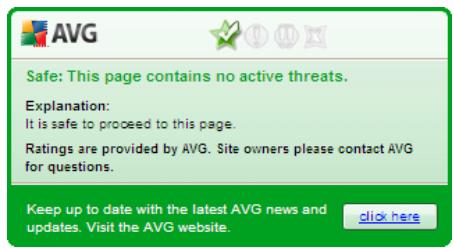
Hovering over an individual rating icon will display details about the particular link in question. Information include additional details of the threat (if any), the IP address of the link and when the page was scanned by AVG:
7.3.4. Surf-Shield
This powerful protection will block malicious content of any webpage you try to open, and prevent it from being downloaded to your computer. With this feature enabled, clicking a link or typing in a URL to a dangerous site will automatically block you from opening the web page thus protecting you from inadvertently being infected. It is important to remember that exploited web pages can infect your computer simply by visiting the affected site, for this reason when you request a dangerous webpage containing exploits or other serious threats, the AVG Link Scanner will not allow your browser to display it.
If you do encounter a malicious web site, within your web browser the AVG Link Scanner will warn you with a screen similar to:
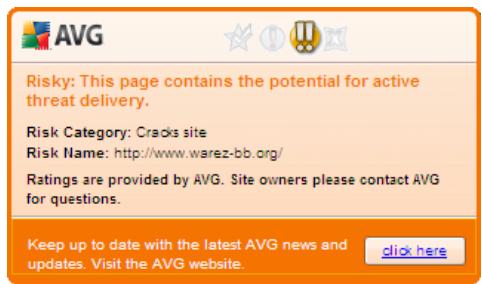
Entering such web site is highly risky and it cannot be recommended!
7.4. Resident Shield
7.4.1. Resident Shield Principles
The Resident Shield component gives your computer continuous protection. It scans every single file that is being opened, saved, or copied, and guards the system areas of the computer. When Resident Shield discovers a virus in a file that is accessed, it stops the operation currently being performed and does not allow the virus to activate itself. Normally, you do not even notice the process, as it runs "in the background", and you only get notified when threats are found; at the same time, Resident Shield blocks activation of the threat and removes it. Resident Shield is being loaded in the memory of your computer during system startup.
What the Resident Shield can do:
- Scan for specific kinds of possible threats
- Scan removable media (flash disk etc.)
- Scan files with specific extensions or without extensions at all
- Allow exceptions from scanning - specific files or folders that should never be scanned
Warning: Resident Shield is loaded in the memory of your computer during startup, and it is vital that you keep it switched on at all times!
7.4.2. Resident Shield Interface
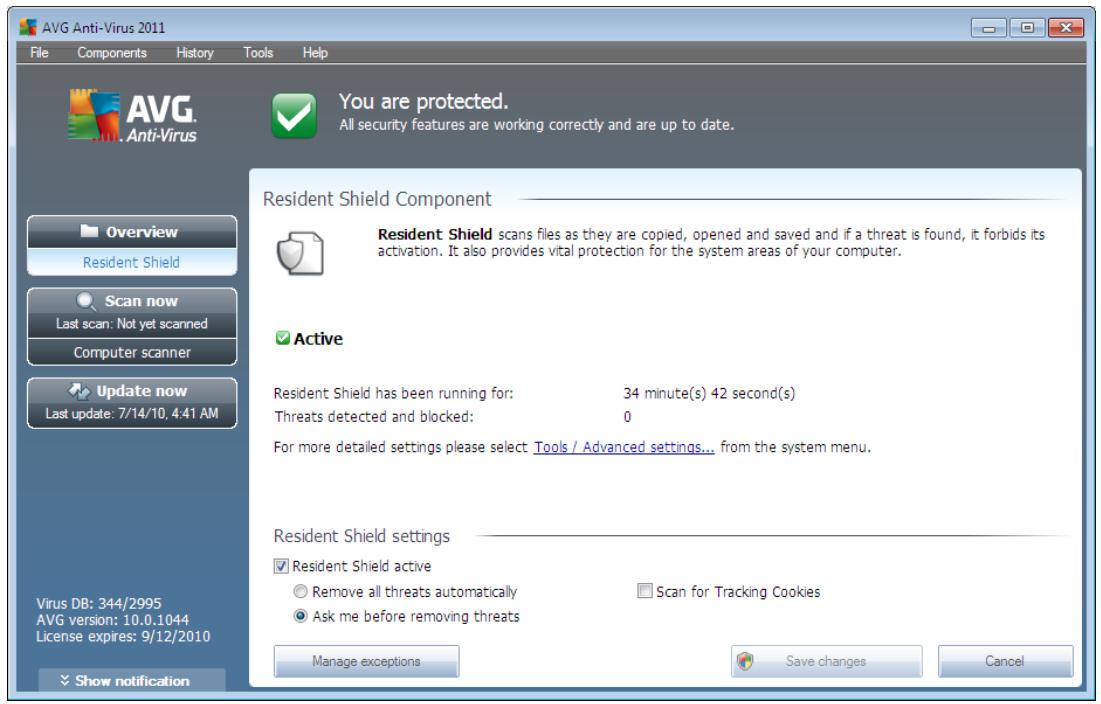
Besides an overview of the Resident Shield functionality, and the information on the component's status, the Resident Shield interface offers some statistic data as well:
- Resident Shield has been running for - provides the time since the latest component's launch
- Threats detected and blocked - number of detected infections that were prevented from being run/opened (if needed, this value can be reset; e.g. for statistic purposes - Reset value)
Resident Shield settings
In the bottom part of the dialog window you will find the section called Resident Shield settings where you can edit some basic settings of the component's functionality (detailed configuration, as with all other components, is available via the Tools/Advanced settings item of the system menu).
The Resident Shield is active option allows you to easily switch on/off resident protection. By default, the function is on. With resident protection on you can further decide how the possibly detected infections should be treated (removed):
either automatically (Remove all threats automatically)
or only after the user's approval (Ask me before removing threats)
This choice has no impact on the security level, and it only reflects your preferences.
In both cases, you can still select whether you want to Scan for tracking cookies. In specific cases you can switch this option on to achieve maximum security levels, however it is switched off by default. (cookies = parcels of text sent by a server to a web browser and then sent back unchanged by the browser each time it accesses that server. HTTP cookies are used for authenticating, tracking, and maintaining specific information about users, such as site preferences or the contents of their electronic shopping carts).
Please note: The software vendor has set up all AVG components to give optimum performance. Unless you have a real reason to do so, do not change the AVG configuration. Any changes to settings should only be performed by an experienced user. If you need to change AVG configuration, select the system menu item Tools / Advanced Settings and edit the AVG configuration in the newly opened AVG Advanced Settings dialog.
Control buttons
The control buttons available within the Resident Shield interface are as follows:
- Manage exceptions - opens the Resident Shield - Excluded Items dialog where you can define folders and files that should be left out from the Resident Shield scanning
- Save changes - press this button to save and apply any changes made in this dialog
- Cancel - press this button to return to the default AVG user interface (components overview)
7.4.3. Resident Shield Detection
Resident Shield scans files as they are copied, opened or saved. When a virus or any kind of threat is detected, you will be warned immediately via the following dialog:
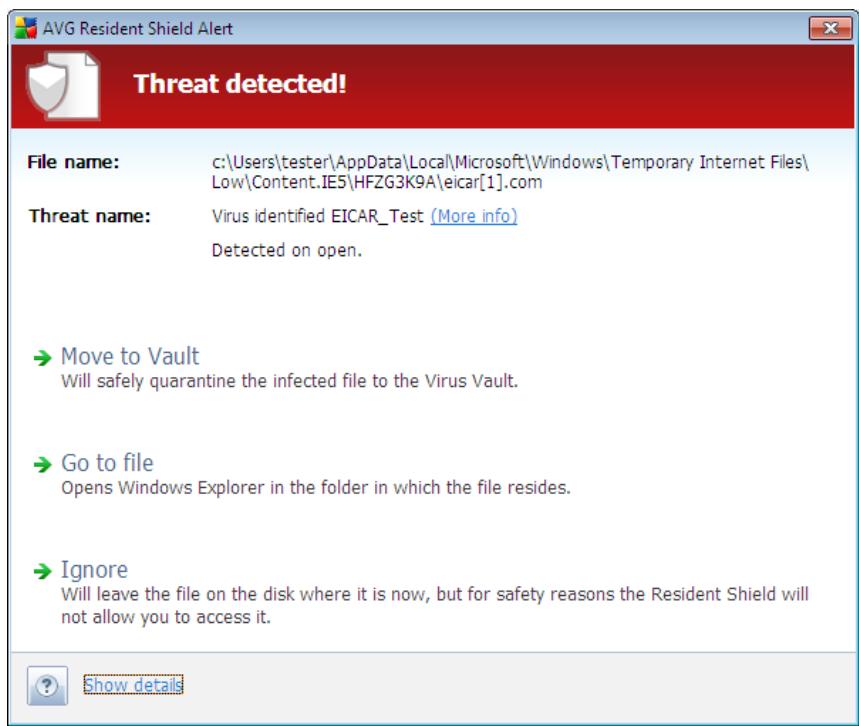
Within this warning dialog you will find data on the file that was detected and assigned as infected (File name), the name of the recognized infection (Threat name), and a link to the Virus encyclopedia where you can find detailed information on the detected infection, if known (More info).
Further, you have to decide what action should be taken now - the following options are available:
Please note that, upon specific conditions (what kind of file is infected, and where it is located), not all of the options are always available!
- Remove threat as Power User - check the box if you suppose that you might not have sufficient rights to remove the threat as a common user. Power Users have extensive access rights, and if the threat is located in a certain system folder, you might need to use this checkbox to successfully remove it.
- Heal - this button only appears if the detected infection can be healed. Then, it removes it from the file, and restores the file to the original state. If the file itself is a virus, use this function to delete it (i.e. removed to the Virus Vault)
- Move to Vault - the virus will be moved to AVG Virus Vault
-
Go to file - this option redirects you to the exact location of the suspicious object (opens new Windows Explorer window)
-
Ignore - we strictly recommend NOT TO use this option unless you have a very good reason to do so!
In the bottom section of the dialog you can find the link Show details - click it to open a pop-up window with detailed information on the process running while the infection was detected, and the process' identification.
The entire overview of all threats detected by Resident Shield can be found in the Resident Shield detection dialog accessible from system menu option History / Resident Shield detection:
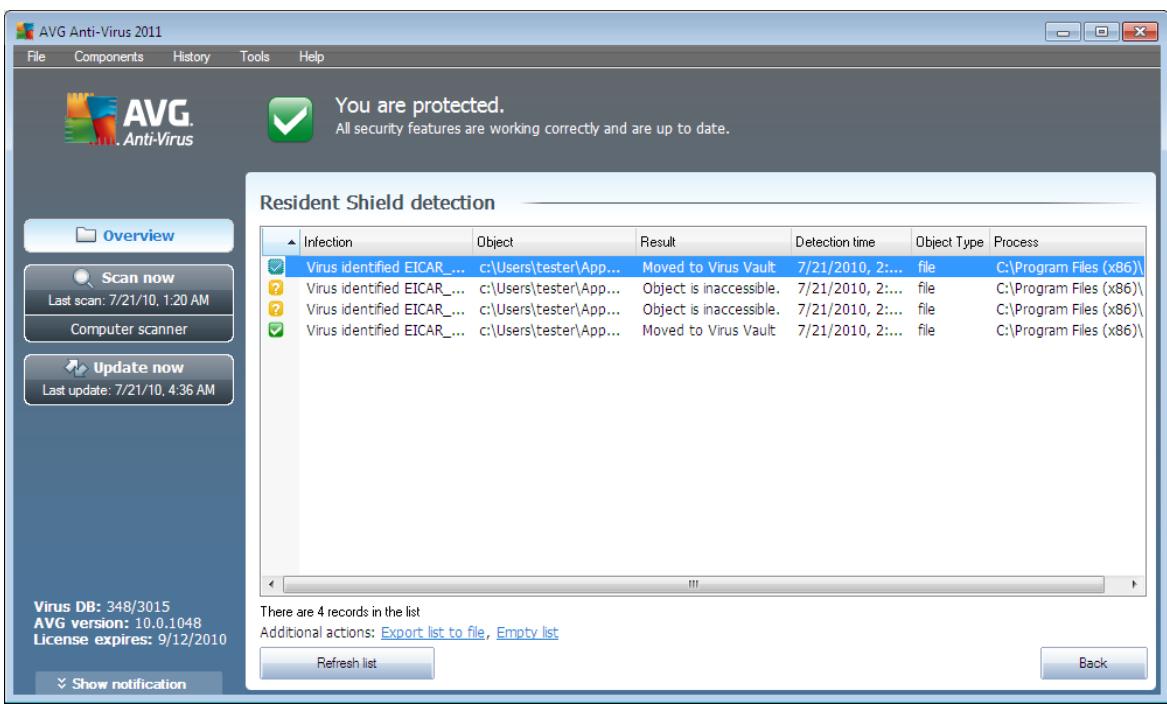
The Resident Shield detection offers an overview of objects that were detected by the Resident Shield, evaluated as dangerous and either cured or moved to the Virus Vault. For each detected object the following information is provided:
- Infection- description (possibly even name) of the detected object
- Object - object location
- Result - action performed with the detected object
- Detection time - date and time the object was detected
- Object Type - type of the detected object
- Process - what action was performed to call out the potentially dangerous object so that it could be detected
In the bottom part of the dialog, under the list, you will find information on total number of detected objects listed above. Further you can export the entire list of
detected objects in a file (Export list to file) and delete all entries on detected objects (Empty list). The Refresh list button will update the list of finding detected by Resident Shield. The Back button switches you back to the default AVG user interface (components overview).
7.5. E-mail Scanner
One of the most common sources of viruses and trojans is via e-mail. Phishing and spam make e-mail an even greater source of risks. Free e-mail accounts are more likely to receive such malicious e-mails (as they rarely employ anti-spam technology), and home users rely quite heavily on such e-mail. Also home users, surfing unknown sites and filling in online forms with personal data (such as their e-mail address) increase exposure to attacks via e-mail. Companies usually use corporate e-mail accounts and employ anti-spam filters etc, to reduce the risk.
7.5.1. E-mail Scanner Principles
Personal E-mail Scanner scans incoming/outgoing e-mails automatically. You can use it with e-mail clients that do not have their own plug-in in AVG (but can be also used to scan e-mail messages for e-mail clients that AVG supports with a specific plug-in, i.e. Microsoft Outlook, and The Bat). Primarily, it is to be used with e-mail applications like Outlook Express, Mozilla, Incredimail, etc.
During AVG installation AVG there are automatic servers created for e-mail control: one for checking incoming e-mails and the second one for checking outgoing e-mails. Using these two servers e-mails are automatically checked on ports 110 and 25 ( standard ports for sending/receiving e-mails).
E-mail Scanner works as an interface between e-mail client and e-mail servers on the Internet.
- Incoming mail: While receiving a message from the server, the E-mail Scanner component tests it for viruses, removes infected attachments, and adds certification. When detected, viruses are quarantined in Virus Vault immediately. Then the message is passed to the e-mail client.
- Outgoing mail: Message is sent from e-mail client to E-mail Scanner; it tests the message and its attachments for viruses and then sends the message to the SMTP server (scanning of outgoing e-mails is disabled by default, and can be set up manually).
Note: AVG E-mail Scanner is not intended for server platforms!
7.5.2. E-mail Scanner Interface
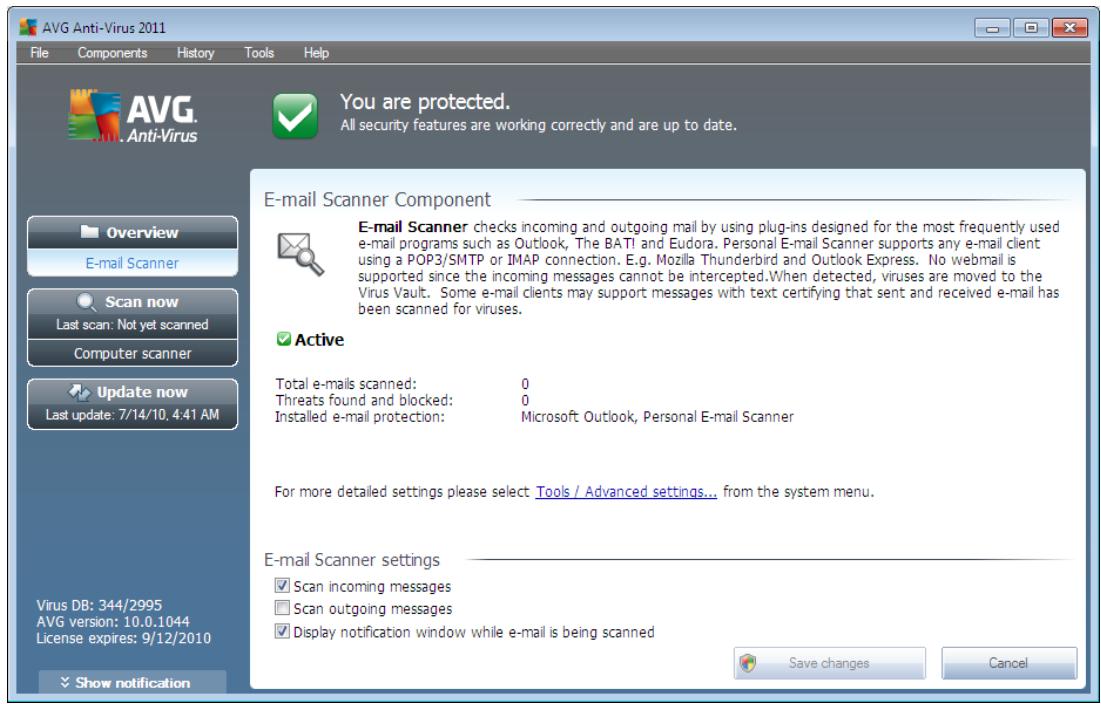
In the E-mail Scanner component's dialog you can find a brief text describing the component's functionality, information on its current status, and the following statistics:
- Total e-mails scanned - how many e-mail messages were scanned since the E-mail Scanner was last launched (if needed, this value can be reset; e.g. for statistic purposes - Reset value)
- Threats found and blocked - provides the number of infections detected in e-mail messages since the last E-mail Scanner launch
- Installed e-mail protection - information about a specific e-mail protection plug-in referring to your default installed e-mail client
E-mail Scanner settings
In the bottom part of the dialog you can find the section named E-mail Scanner settings where you can edit some elementary features of the component's functionality:
- Scan incoming messages - check the item to specify that all e-mails delivered to your account should be scanned for viruses. By default, this item is on, and it is recommended not to change this setting!
-
Scan outgoing messages - check the item to confirm all e-mail sent from your account should be scanned for viruses. By default, this item is off.
-
Display notification window while e-mail is being scanned - check the item to confirm you want to be informed via notification dialog displayed over the AVG icon on the system tray during the scanning of your mail via E-mail Scanner component. By default, this item is on, and it is recommended not to change this setting!
The advanced configuration of the E-mail Scanner component is accessible via the Tools/Advanced settings item of the system menu; however advanced configuration is recommended for experienced users only!
Please note: The software vendor has set up all AVG components to give optimum performance. Unless you have a real reason to do so, do not change the AVG configuration. Any changes to settings should only be performed by an experienced user. If you need to change AVG configuration, select the system menu item Tools / Advanced Settings and edit the AVG configuration in the newly opened AVG Advanced Settings dialog.
Control buttons
The control buttons available within the E-mail Scanner interface are as follows:
- Save changes - press this button to save and apply any changes made in this dialog
- Cancel - press this button to return to the default AVG user interface (components overview)
7.5.3. E-mail Scanner Detection
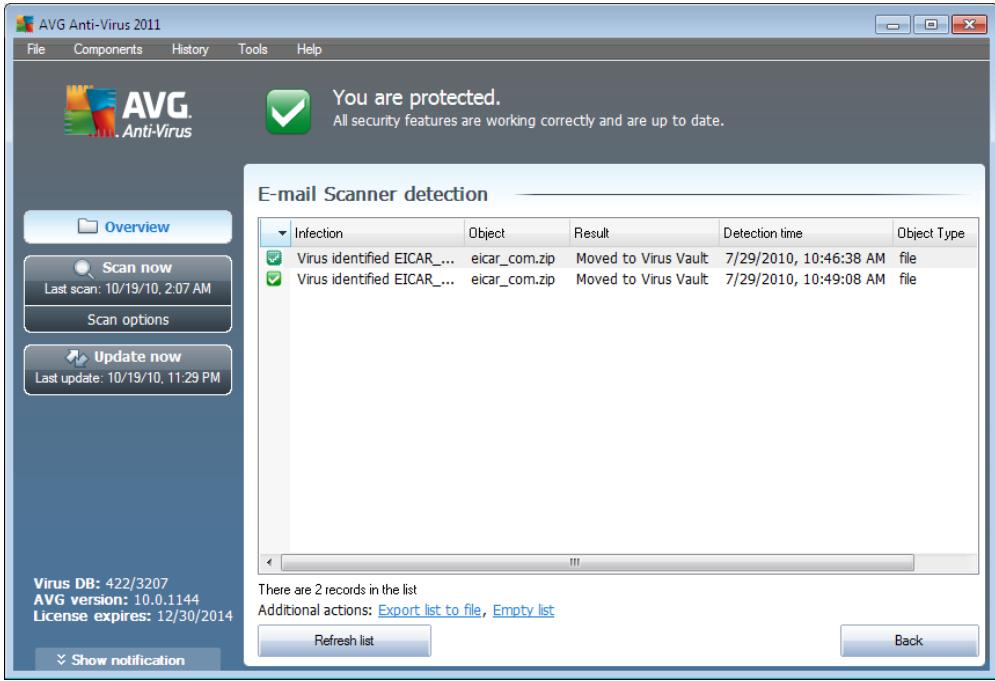
In the E-mail Scanner detection dialog (accessible via system menu option History / E-mail Scanner detection) you will be able to see a list of all findings detected by the E-mail Scanner component. For each detected object the following information is provided:
- Infection- description (possibly even name) of the detected object
- Object - object location
- Result - action performed with the detected object
- Detection time - date and time the suspicious object was detected
- Object Type - type of the detected object
In the bottom part of the dialog, under the list, you will find information on total number of detected objects listed above. Further you can export the entire list of detected objects in a file (Export list to file) and delete all entries on detected objects (Empty list).
Control buttons
The control buttons available within the E-mail Scanner detection interface are as follows:
- Refresh list - updates the list of detected threats
- Back - switches you back to the previously displayed dialog
7.6. Update Manager
7.6.1. Update Manager Principles
No security software can guarantee true protection from various types of threats unless it is regularly updated! Virus writers are always looking for new flaws that they can exploit in both software and operating systems. New viruses, new malware, new hacking attacks appear daily. For this reason, software vendors are continually issuing updates and security patches, to fix any security holes that are discovered.
It is crucial to update your AVG regularly!
The Update Manager helps you to control regular updating. Within this component you can schedule automatic downloads of update files either from the Internet, or the local network. Essential virus definition updates should be daily if possible. Less urgent program updates can be weekly.
Note: Please pay attention to the AVG Updates chapter for more information on update types and levels!
7.6.2. Update Manager Interface
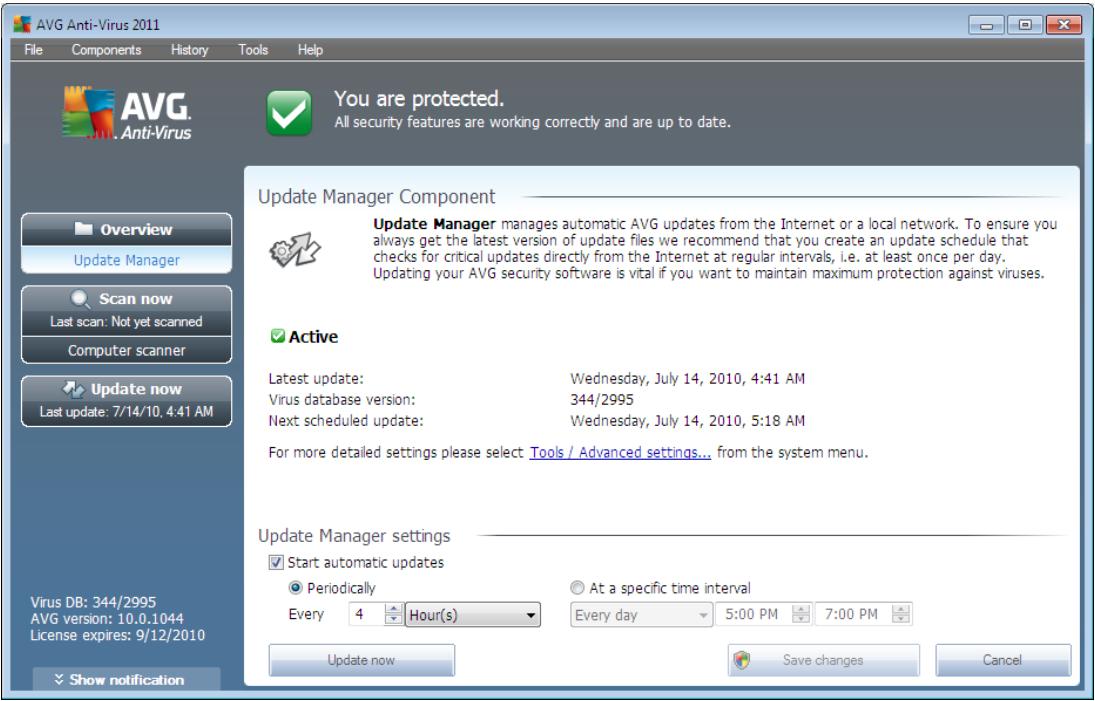
The Update Manager's interface displays information about the component's functionality and its current status, and provides the relevant statistical data:
- Latest update - specifies date and time of the last database update
- Virus database version - defines the number of the currently installed virus database version; and this number increases with every virus base update
- Next scheduled update - specifies the date and time of the next database update
Update Manager settings
In the bottom part of the dialog you can find the Update Manager settings section where you can perform some changes to the rules of the update process launch. You can define whether you wish the update files to be downloaded automatically (Start automatic updates) or just on demand. By default, the Start automatic updates option is switched on and we recommend to keep it that way! Regular download of the latest update files is crucial for proper functionality of any security software!
Further you can define when the update should be launched:
Periodically - define the time interval
- At a specific time interval - define the exact day time the update should be launched
By default, the update is set for every 4 hours. It is highly recommended to keep this setting unless you have a true reason to change it!
Please note: The software vendor has set up all AVG components to give optimum performance. Unless you have a real reason to do so, do not change the AVG configuration. Any changes to settings should only be performed by an experienced user. If you need to change AVG configuration, select the system menu item Tools / Advanced Settings and edit the AVG configuration in the newly opened AVG Advanced Settings dialog.
Control buttons
The control buttons available within the Update Manager interface are as follows:
- Update now - launches an immediate update on demand
- Save changes - press this button to save and apply any changes made in this dialog
- Cancel - press this button to return to the default AVG user interface (components overview)
7.7. License
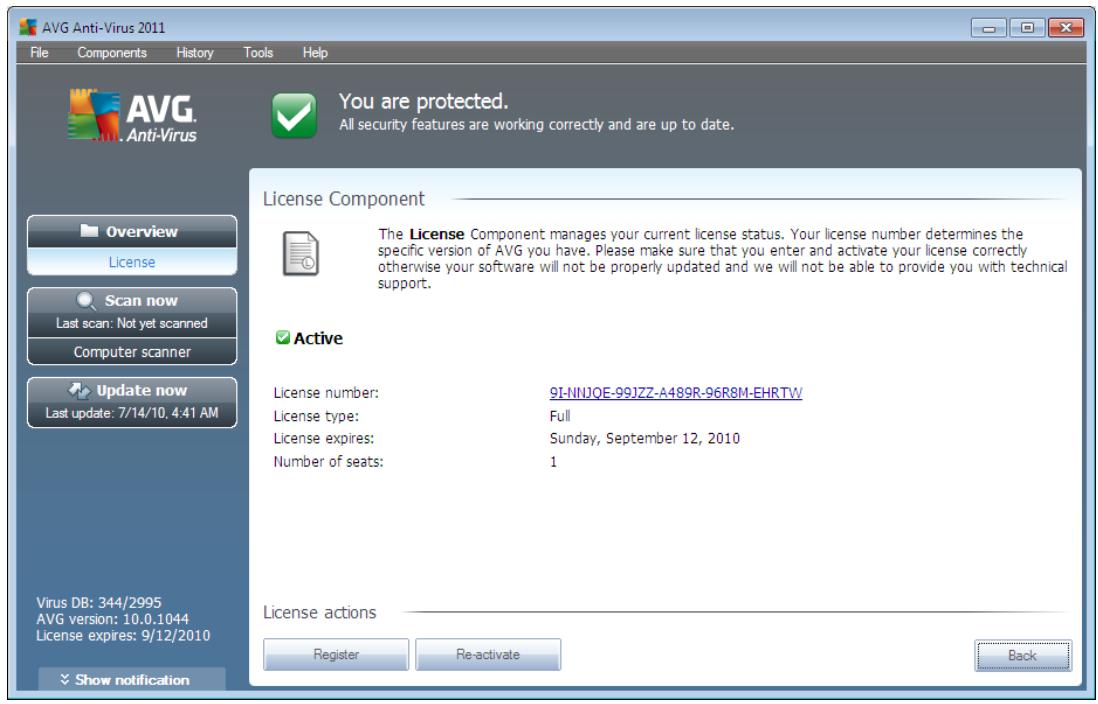
In the Licence component interface you will find a brief text describing the component's functionality, information on its current status, and the following information:
- License number - provides the shortened form of your license number (for security reasons the last four symbols are missing). When entering your license number, you have to be absolutely precise and type it exactly as shown. Therefore we strongly recommend to always use "copy & paste" method for any manipulation with the license number.
- License type - specifies the product type installed.
- License expires - this date determines the period of validity of your license. If you want to go on using AVG Anti-Virus 2011 after this date you have to renew your license. The license renewal can be performed online on AVG website.
- Number of seats - how many workstations on which you are entitled to install your AVG Anti-Virus 2011.
Control buttons
- Register - connects to the registration page of AVG website (http://www AVG.com/). Please fill in your registration data; only customers who register their AVG product can receive free technical support.
- Re-activate - opens the Activate AVG dialog with the data you have entered in the Personalize AVG dialog of the installation process. Within this dialog you can enter your license number to either replace the sales number (the number you have installed AVG with), or to replace the old license number (e.g. when upgrading to a new AVG product).
Note: If using the trial version of AVG Anti-Virus 2011, the buttons appear as Buy now and Activate, allowing you to buy the full version of the program right away. For AVG Anti-Virus 2011 installed with a sales number, the buttons display as Register and Activate.
- Back - press this button to return to the default AVG user interface (components overview).
7.8. Remote Administration
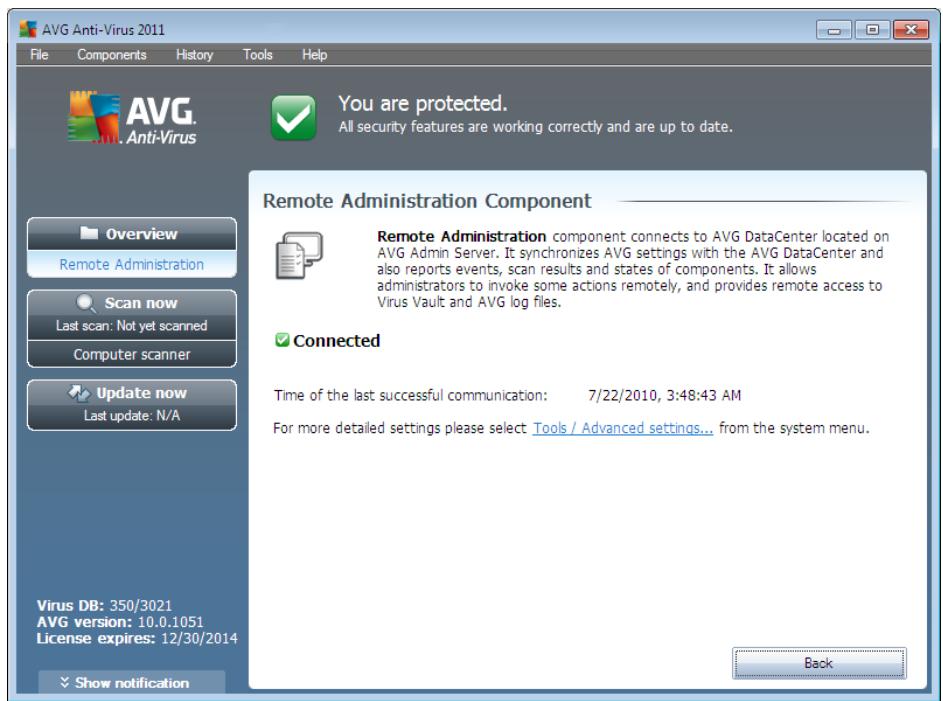
The Remote Administration component only displays in the user interface of AVG Anti-Virus 2011 in case you have installed the network edition of your product (see component License). In the Remote Administration dialog you can find the information on whether the component is active and connected to server. All settings of the Remote Administration component is to be done within the Advanced Settings / Remote Administration.
For detailed description of the component's options and functionality within the AVG Remote Administration system please refer to the specific documentation dedicated to this topic exclusivity. This documentation is available for download at AVG website (www.avg.com), in the Support center / Download / Documentation section.
Control buttons
- Back - press this button to return to the default AVG user interface (components overview).
7.9. Online Shield
7.9.1. Online Shield Principles
Online Shield is a type of a real time resident protection; it scans the content of visited web pages (and possible files included in them) even before these are displayed in your web browser or downloaded to your computer.
Online Shield detects that the page you are about to visit includes some dangerous javascript, and prevents the page from being displayed. Also, it recognizes malware contained in a page and stops its downloading immediately so that it never gets to your computer.
Note: AVG Online Shield is not intended for server platforms!
7.9.2. Online Shield Interface
The Online Shield component's interface describes the behavior of this type of protection. Further you can find information on the component's current status. In the bottom part of the dialog you will then find the elementary editing options of this component's functionality:
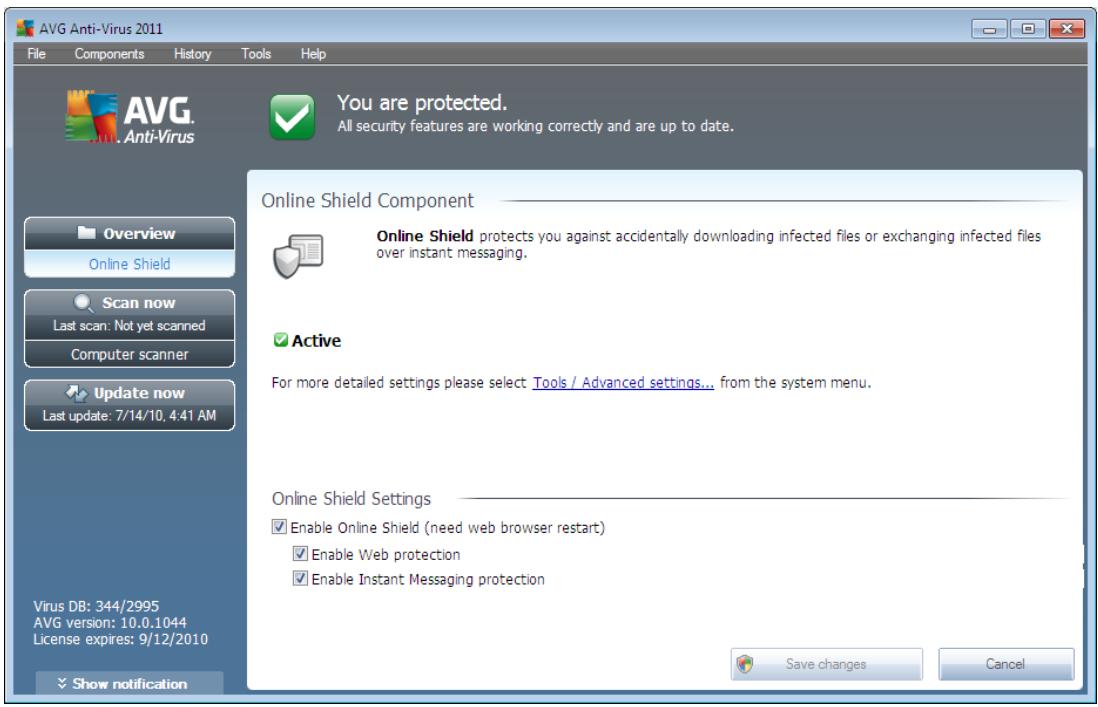
Online Shield Settings
First of all, you have the option to immediately switch on/off the Online Shield by checking the Enable Online Shield item. This option is enabled by default, and the Online Shield component is active. However, if you do not have a good reason to change this settings, we recommend to keep the component active. If the item is checked, and the Online Shield is running, two more configuration options get activated:
- Enable Web protection - this option confirms that the Online Shield should perform scanning of the website content.
- Enable Instant Messaging protection - check this item if you wish the Online Shield to verify the instant messaging communication (e.g. ICQ, MSN Messenger, ...) is virus free.
Please note: The software vendor has set up all AVG components to give optimum performance. Unless you have a real reason to do so, do not change the AVG configuration. Any changes to settings should only be performed by an experienced user. If you need to change AVG configuration, select the system menu item Tools / Advanced Settings and edit the AVG configuration in the newly opened AVG Advanced Settings dialog.
Control buttons
The control buttons available within the Online Shield interface are as follows:
- Save changes - press this button to save and apply any changes made in this dialog
- Cancel - press this button to return to the default AVG user interface (components overview)
7.9.3. Online Shield Detection
Online Shield scans the content of visited web pages and possible files included in them even before these are displayed in your web browser or downloaded to your computer. If a threat is detected, you will be warned immediately with the following dialog:
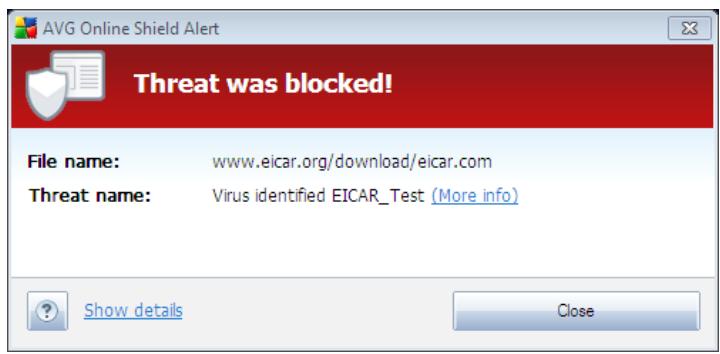
Within this warning dialog you will find data on the file that was detected and assigned as infected (File name), the name of the recognized infection (Threat name), and a link to the Virus encyclopedia where you can find detailed information on the detected infection (if known). The dialog provides the following buttons:
-
Show details - click the Show details button to open a new pop-up window where you can find information on the process running while the infection was detected, and the process' identification.
-
Close - click the button to close the warning dialog.
The suspect web page will not be opened, and the threat detection will be logged in the list of Online Shield findings - this overview of detected threats is accessible via system menu History / Online Shield findings.
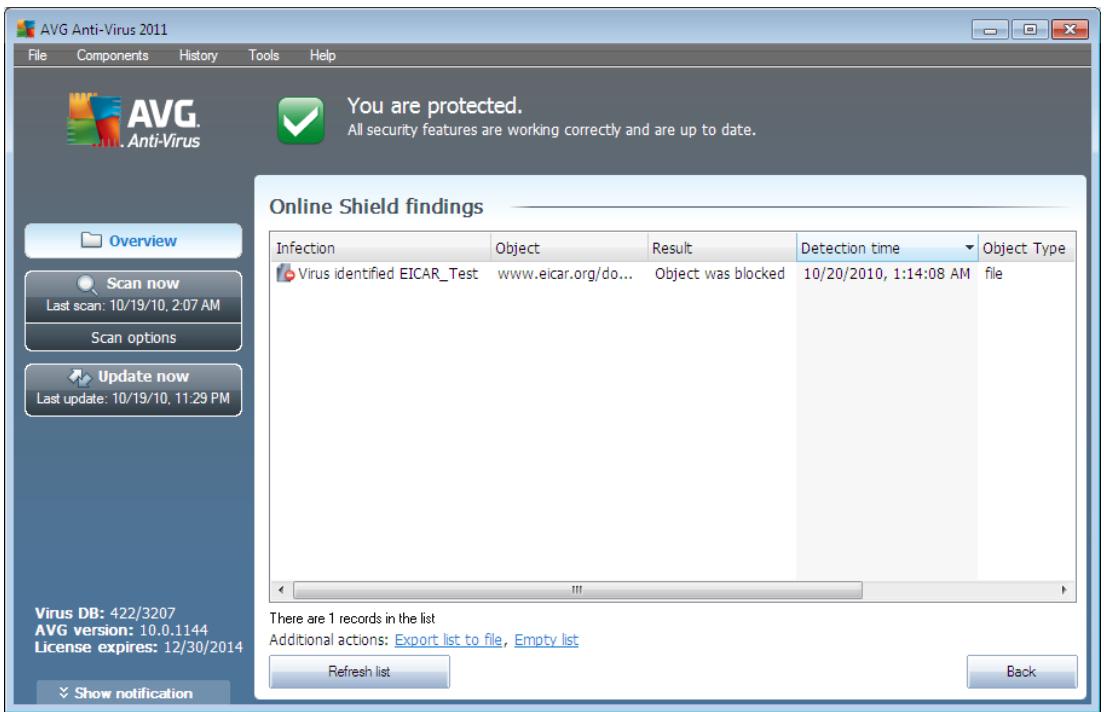
For each detected object the following information is provided:
- Infection- description (possibly even name) of the detected object
- Object - object source (web page)
- Result - action performed with the detected object
- Detection time - date and time the threat was detected and blocked
- Object Type - type of the detected object
- Process - what action was performed to call out the potentially dangerous object so that it could be detected
In the bottom part of the dialog, under the list, you will find information on total number of detected objects listed above. Further you can export the entire list of detected objects in a file (Export list to file) and delete all entries on detected objects (Empty list). The Refresh list button will update the list of finding detected by Online Shield. The Back button switches you back to the default AVG user interface (components overview).
7.10. Anti-Rootkit
A rootkit is a program designed to take fundamental control of a computer system, without authorization by the system's owners and legitimate managers. Access to the hardware is rarely required as a rootkit is intended to seize control of the operating system running on the hardware. Typically, rootkits act to obscure their presence on the system through subversion or evasion of standard operating system security mechanisms. Often, they are also Trojans as well, thus fooling users into believing they are safe to run on their systems. Techniques used to accomplish this can include concealing running processes from monitoring programs, or hiding files or system data from the operating system.
7.11. PC Analyzer
The PC Analyzer component is able to scan your computer for system problems, and give you a transparent overview of what might be aggravating your computer's overall performance. In the component's user interface you can see a chart divided into four lines referring to respective categories: registry errors, junk files, fragmentation, and broken shortcuts:
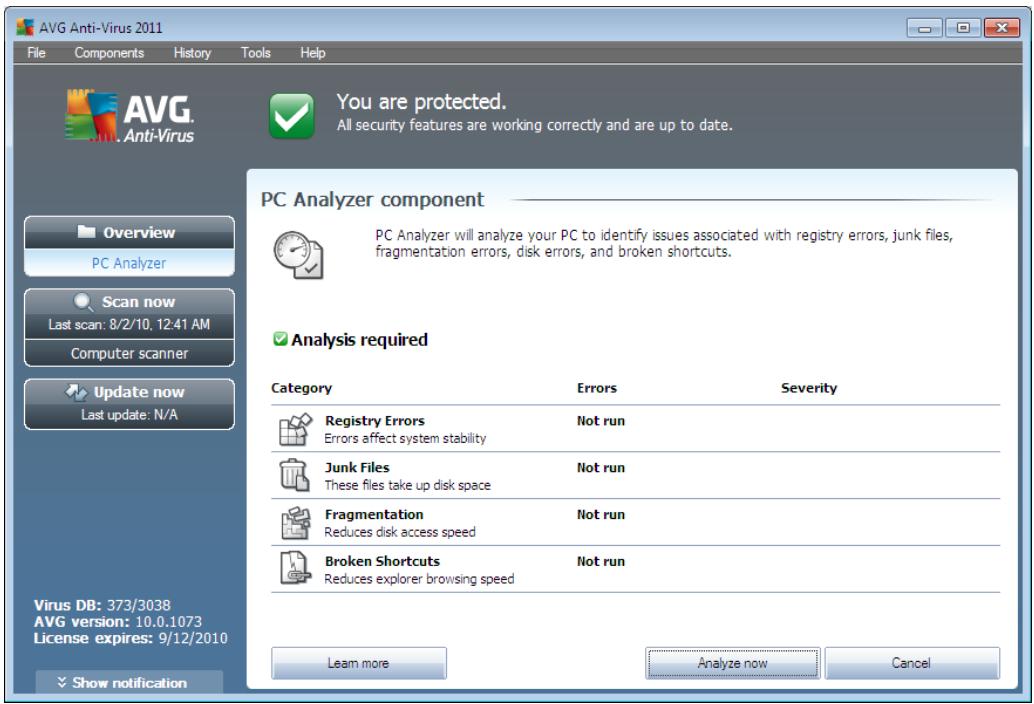
- Registry Errors will give you the number of errors in Windows Registry. As fixing the Registry requires quite advanced knowledge, we do not recommend to try and fix it yourself.
- Junk Files will give you the number of files that can be most likely done without. Typically, these will be many kinds of temporary files, and files in the Recycle Bin.
- Fragmentation will calculate the percentage of your harddisk that is
fragmented, i.e. used for a long time so that most files are now scattered on different parts of the physical disk. You can use some defragmentation tool to fix this.
- Broken Shortcuts will notify you of shortcuts that no longer work, lead to non-existing locations etc.
To start the analysis of your system, press the Analyze now button. You will then be able to watch the analysis progress and its results directly in the chart:
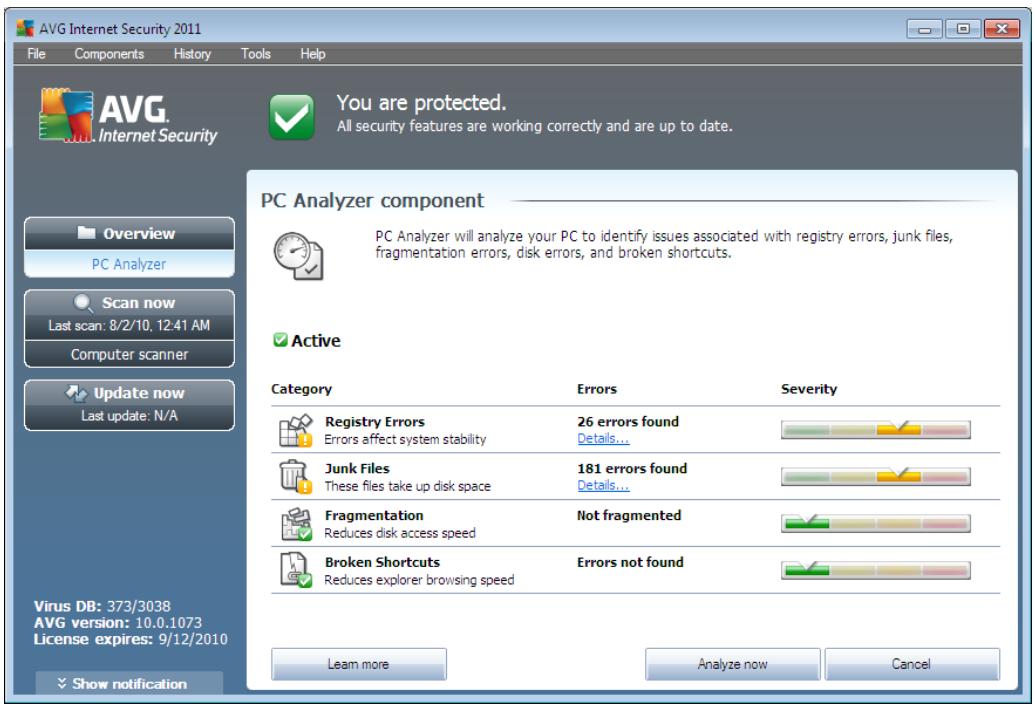
The results overview provides the number of detected system problems (Errors) divided according to the respective categories tested. The analysis results will also be displayed graphically on an axis in the Severity column.
Control buttons
-
Learn more - press the button to get to the AVG website (http://www(avg.com/) at page providing detailed and up-to-date information related to PC Analyzer component
-
Analyze now (displayed before the analysis stars) - press this button to launch the immediate analysis of your computer
Fix now (displayed once the analysis is finished) - press the button to get to the AVG website (http://www.avg.com/) at page providing detailed and up-to-date information related to PC Analyzer component - Cancel - press this button to stop the running analysis, or to return to the
default AVG_user interface (components overview) once the analysis is completed
7.12. ID Protection
AVG Identity Protection is an anti-malware product that is focused on preventing identity thieves from stealing your passwords, bank account details, credit card numbers and other personal digital valuables from all kinds of malicious software (malware) that target your PC. It makes sure that all programs running on your PC are operating correctly. AVG Identity Protection spots and blocks suspicious behavior on a continuous basis and protects your computer from all new malware.
7.12.1. ID Protection Principles
AVG Identity Protection is an anti-malware component that protects you from all kinds of malware (spyware, bots, identity theft, ...) using behavioral technologies and provide zero day protection for new viruses. As malware gets sophisticated and comes in a form of normal programs that can open up your PC to the remote attacker for identity theft, AVG Identity Protection secures you from these new execution based malware. It is a complimentary protection to AVG Anti-Virus that protects you from file based and known viruses using signature mechanism and scanning.
We strongly recommend you have the both AVG Anti-Virus and AVG Identity Protection components installed, in order to have complete protection for your PC.
7.12.2. ID Protection Interface
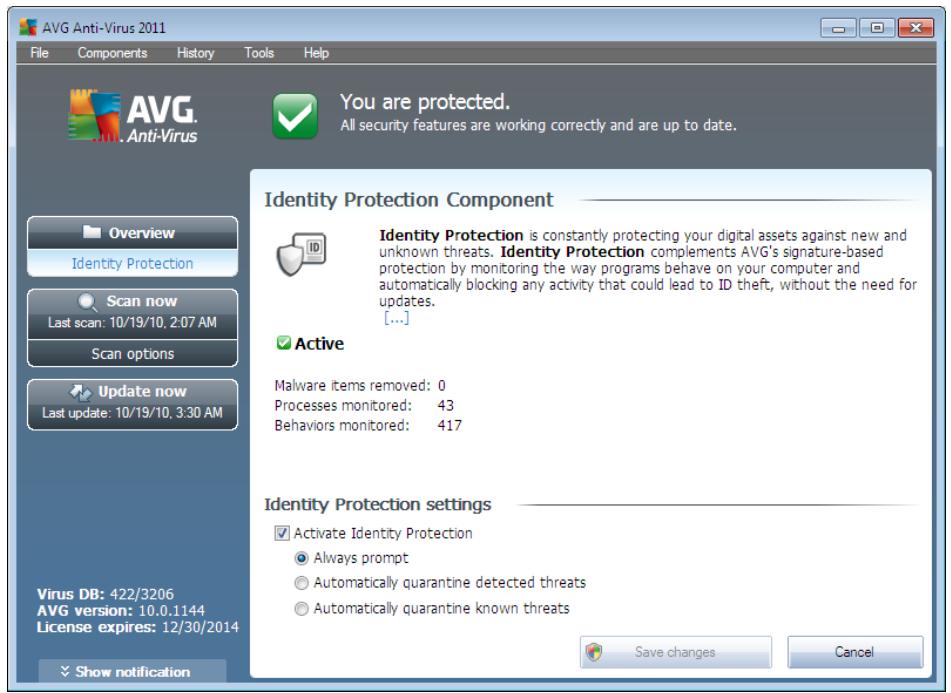
The Identity Protection component interface provides a brief description of the
component's basic functionality, its status, and some statistical data:
- Malware items removed - gives the number of applications detected as malware, and removed
- Processes monitored - number of currently running applications that are being monitored by IDP
- Behaviors monitored - number of specific actions running within the monitored applications
Identity Protection settings
In the bottom part of the dialog you will find the Identity Protection settings section where you can edit some elementary features of the component's functionality:
- Activate Identity Protection - (on by default): check to activate the IDP component, and to open further editing options.
In some cases, Identity Protection may report that some legitimate file is suspicious or dangerous. Since Identity Protection detects threats based on their behavior, this usually occurs when some program tries to monitor key presses, install other programs or a new driver is installed on the computer. Therefore please select one of the following options specifying Identity Protection component's behavior in case of a suspicious activity detection:
- Always prompt - if an application is detected as malware, you will be asked whether it should be blocked (this option is on by default and it is recommended not to change it unless you have a real reason to do so).
- Automatically quarantine detected threats - all applications detected as malware will be blocked automatically
○ Automatically quarantine known threats - only those applications that are with absolute certainty detected as malware will be blocked
Control buttons
The control buttons available within the Identity Protection interface are as follows:
- Save changes - press this button to save and apply any changes made in this dialog
- Cancel - press this button to return to the default AVG user interface (components overview)
8. AVG Security Toolbar
AVG Security Toolbar is a new tool which works together with the LinkScanner component. AVG Security Toolbar can be used to control LinkScanner functions and to adjust its behavior.
If you select to install the toolbar during the installation of AVG Anti-Virus 2011, it will be added into your web browser (Internet Explorer 6.0 or higher, and Mozilla Firefox 3.0 or higher) automatically. Other internet browsers are not supported at the moment.
Note: In case you are using some alternative Internet browser (e.g Avant Browser) you can meet unexpected behavior.
8.1. AVG Security Toolbar Interface
The AVG Security Toolbar is designed to work with MS Internet Explorer (version 6.0 or higher) and Mozilla Firefox (version 3.0 or higher). Once you have decided you want to install AVG Security Toolbar (during the AVG installation process you were asked to decide whether or not you wish to install the component), the component will be located in your web browser just under the address bar:

The AVG Security Toolbar consists of the following:
8.1.1. AVG logo button
This button provides access to general toolbar items. Click the logo button to get redirected to AVG website. Clicking the pointer next to the AVG icon will open the following:
- Toolbar Info - link to the AVG Security Toolbar home page with detailed information on the toolbar's protection
- Launch AVG - opens the AVG Anti-Virus 2011 user interface
-
AVG Info - opens a context menu with the following links leading important security information related to AVG Anti-Virus 2011:
-
About Threats - opens the AVG website at page providing most important data on top threats, virus removal recommendations, AVG update information, access to Virus database and more relevant info
AVG News - opens the web page providing the latest AVG related press release -
Current Threat Level - opens the virus lab web page with a graphical display of the current threat level on the web
○ AVG Threat Labs - opens the AVG Site Reports website where you can search the specific threats by name and get detailed information on each one -
Options - opens a configuration dialog where you can adjust your AVG Security Toolbar settings to suit your needs - see the following chapter AVG Security Toolbar Options
- Delete History - allows you within AVG Security Toolbar delete complete history, or separately to delete search history, delete browser history, delete download history and delete cookies.
- Update - checks for new updates for your AVG Security Toolbar
- Help - provides options to open the help file, contact AVG technical support, send your product related feedback, or view the details of the current version of the toolbar
8.1.2. AVG Secure Search powered search box
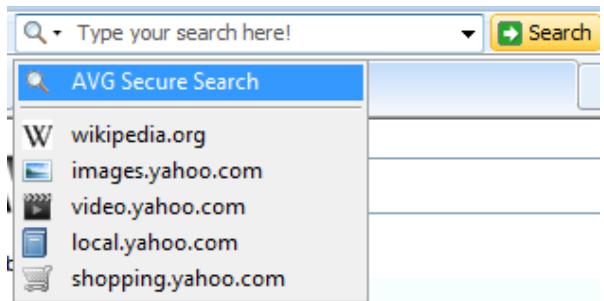
AVG Secure Search box is easy and safe way to search the web using AVG Secure Search. Enter a word or phrase into the search box press the Search button, or the Enter key, to start the search on the AVG Secure Search server directly, no matter what page is currently displayed. The search box also lists your search history. Searches done through the search box are analyzed using the Search-Shield protection.
Alternatively, within the search field you can switch to Wikipedia, or some other specific search service - see picture:
8.1.3. Page Status
Directly in the toolbar, this button displays the evaluation of the currently displayed web page base on criteria of the Surf-Shield component:
-
The linked page is safe
-
Page is somewhat suspicious.
- Page containing links to positively dangerous pages.
- The linked page contains active threats! For your own safety, you will not be allowed to visit this page.
- The page is not accessible, and so could not be scanned.
Click the button to open an information panel with detailed data on the specific web page.
8.1.4. AVG News
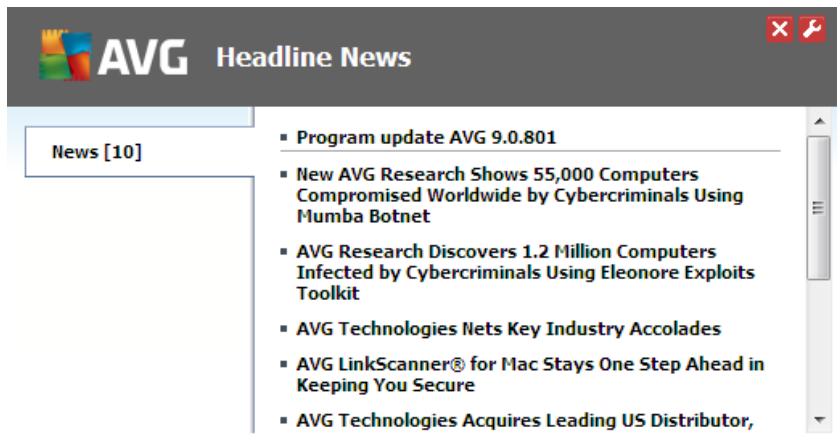
Directly from within the AVG Security Toolbar, this button opens an overview of the latest Headline news related to AVG, both news from the press and company press release:
In the right upper corner you can see two red control buttons:
-
- the button opens the editing dialog where you can specify parameters of the AVG News button displayed within the AVG Security Toolbar:
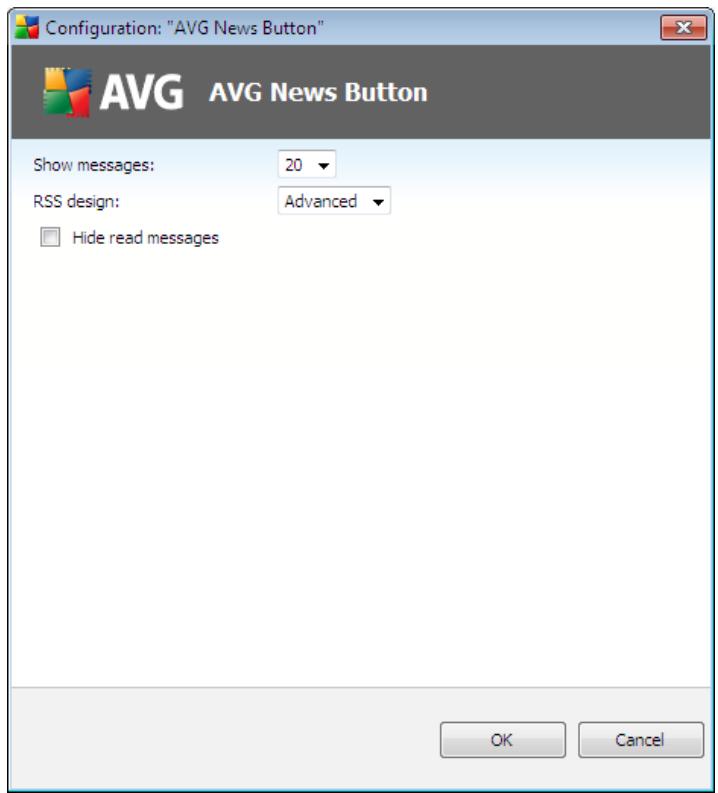
- Show messages - change the desired number of messages that are to be displayed at a time
- RSS design - select between Advanced/Basic mode of the current display of the news overview (by default, the Advanced mode is selected - see picture above)
-
Hide read messages - mark this item to confirm that each read message should not be displayed any longer, so that new messages can be supplied
-
- click this button to close the currently opened news overview
8.1.5. News
Similarly, directly from within the AVG Security Toolbar, this button opens an overview of the latest news from selected media divided into several sections:
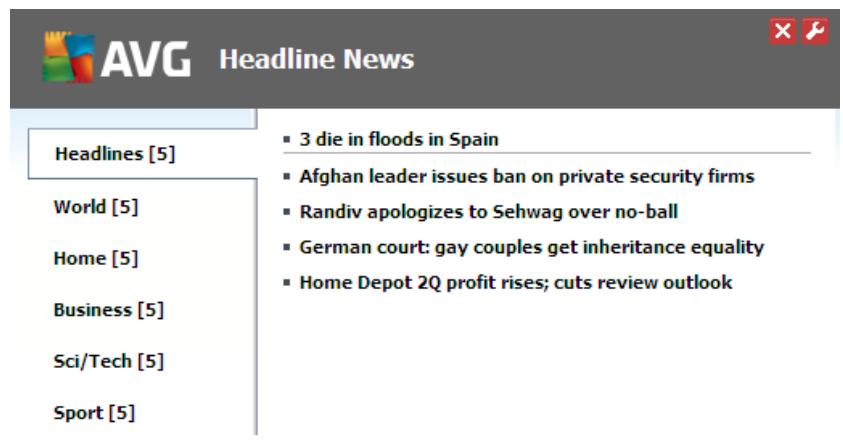
In the right upper corner you can see two red control buttons:
-
- the button opens the editing dialog where you can specify parameters of the News button displayed within the AVG Security Toolbar:
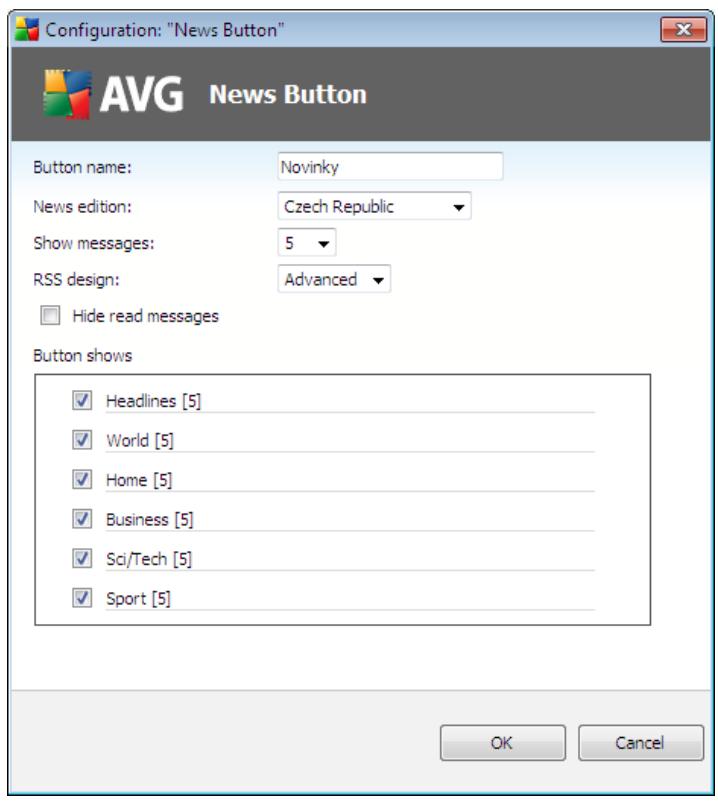
-
Button name - you have the option of changing the button name as it is displayed within AVG Security Toolbar
-
News edition - chose a country from the list to have displayed news from the selected region
o Show messages - specify the desired number of messages that are to be displayed at a time
o RSS design - switch between the Basic/Advanced option to select the design of the news overview (advanced design is set by default, see picture above)
○ Hide read messages - mark this item to confirm that any read message should not be displayed any longer in the news overview, and should be replaced by a new headline -
Button shows - in this field you can assign what sort of news should be displayed in the AVG Security Toolbar news overview
-
× - click this button to close the currently opened news overview
8.1.6. Delete history
Using this button you can delete the history of your browser just like via the AVG logo - > Delete history option.
8.1.7. E-mail Notifier
The E-mail Notifier button allows you to activate the option of being informed about newly arrived e-mail messages directly in the AVG Security Toolbar interface. The button opens the following editing dialog where you can define parameters of your e-mail account and the e-mail display rules. Please follow the instructions in the dialog:
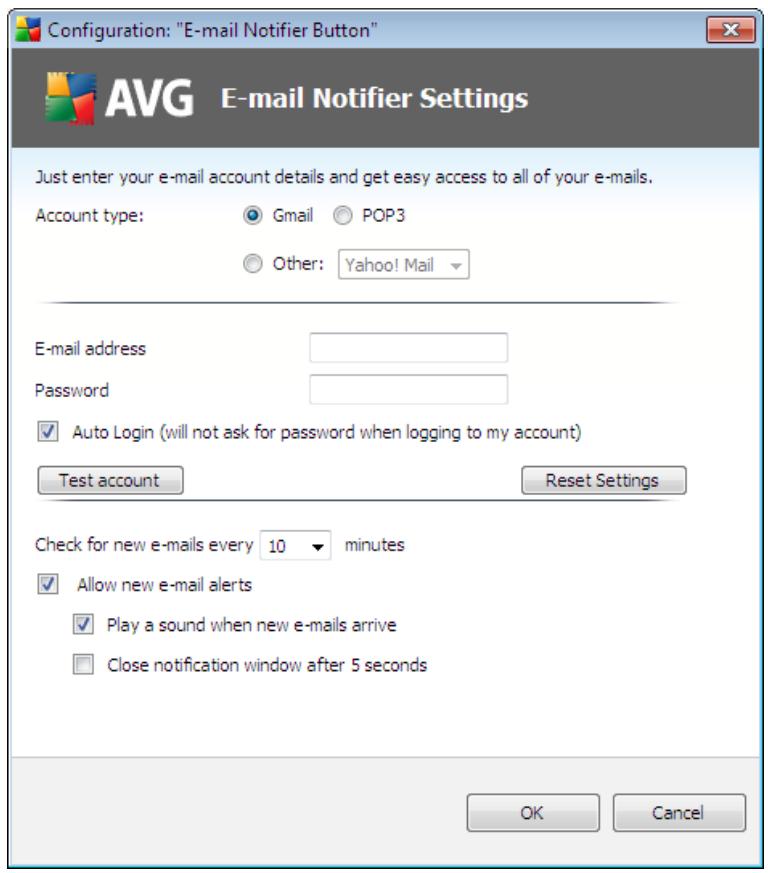
- Account type - Specify the protocol type your e-mail account uses. You can select among the following alternatives: Gmail, POP3, or select the server name from the drop down menu within the Other item (at the moment, you can use this option if your account is on Yahoo! Mail or Hotmail). If you are not sure what e-mail server type your account uses, try to find the information from your e-mail provider, or your internet service provider.
- Login - In the section below provide the exact form of your e-mail address, and the respective password. Keep the Auto Login option marked so that you do not have to fill in the data repeatedly.
- Test account - Use this button to test the entered details.
- Reset Settings - Quickly removes the above entered e-mail address details.
- Check for new e-mails every ... minutes - Define the time interval to be used to check for new e-mail messages (in the range of 5-120 minutes), and specify whether and how you want to be informed about the new message arrival.
-
Allow new e-mail alerts - Uncheck this to disable visual notifications of new e-mail messages arrival.
-
Play a sound when new e-mails arrive - Uncheck this to disable sound notifications of new e-mail messages arrival.
- Close notification window after 5 seconds - Check this to automatically close the visual notification window of new e-mail messages arrival after 5 seconds.
8.1.8. Weather Info
The Weather button displays the information on the current temperature (updated every 3-6 hours) in your selected destination directly within the AVG Security Toolbar interface. Click the button to open a new info panel with detailed weather overview:
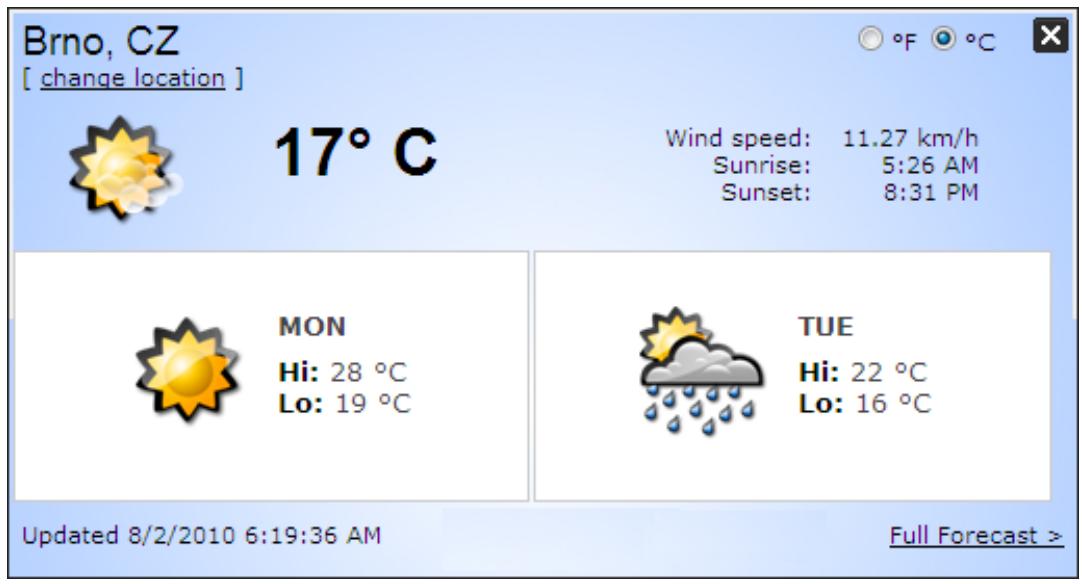
Following find the editing options:
- Change location - click the Change location text to display a new dialog called Search for your location. Fill in the name of your desired location into the text field, and confirm by clicking the Search button. Next, within the list of all locations of the same name select the destination you are looking for. Finally, the info panel will be displayed again providing the weather information for the selected location.
- Fahrenheit / Celsius converter - in the upper right-hand corner of the info panel you can chose between the Fahrenheit and Celsius scales. Based on your selection, the temperature information will be further provided in the selected scale.
- Full Forecast - if interested in full and detailed forecast, use the Full Forecast link to get to the specialized weather website.
8.1.9. Facebook
The Facebook button allows you connect to the Facebook social network from the AVG Security Toolbar directly. Click the button, and the login invitation appears; click again to open the Facebook login dialog. Provide your access data, and press the Connect button. If you do not have a Facebook account yet, you can create one directly using the Sign up for Facebook link.
Once you get through the Facebook registration process, you will be invited to allow the AVG Social Extension application. This application functionality is essential for the toolbar - Facebook connection, therefore it is recommended to allow its functioning, therefore make sure you allow it. Then, the Facebook connection will be activated, and the Facebook button within AVG Security Toolbar now offers the standard Facebook menu options.
8.2. AVG Security Toolbar Options
All AVG Security Toolbar parameters configuration is accessible directly within the AVG Security Toolbar panel. The editing interface opens via the AVG/Options toolbar menu item in a new dialog called Toolbar Options divided into four sections:
8.2.1. Tab General
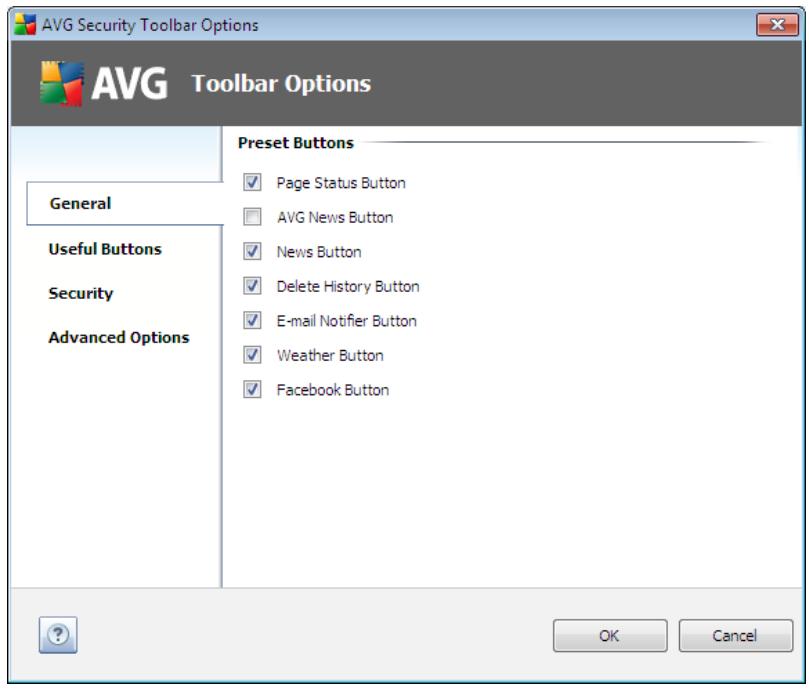
On this tab you can specify toolbar control buttons that should be displayed or hidden within the AVG Security Toolbar panel. Mark any option in case you want to have displayed the respective button. Further find described the functionality of each of the toolbar buttons:
- Page Status Button - the button offers the possibility of having displayed the information on the currently opened page security status within AVG Security Toolbar
- AVG News Button - the button opens a web page providing the latest AVG related press release
- News Button - the button provides a structured overview of current news from the daily press
- Delete History Button - this button allows you to Delete complete history, or Delete search history, Delete browser history, Delete download history, or Delete cookies directly from the AVG Security Toolbar panel
-
E-mail Notifier Button - the button allows you to have displayed your newly arrived e-mail messages within the AVG Security Toolbar interface
-
Weather Button - the button offers an immediate information on the weather situation in a selected location
- Facebook Button - the button offers a direct connection to the Facebook social network
8.2.2. Tab Useful Buttons
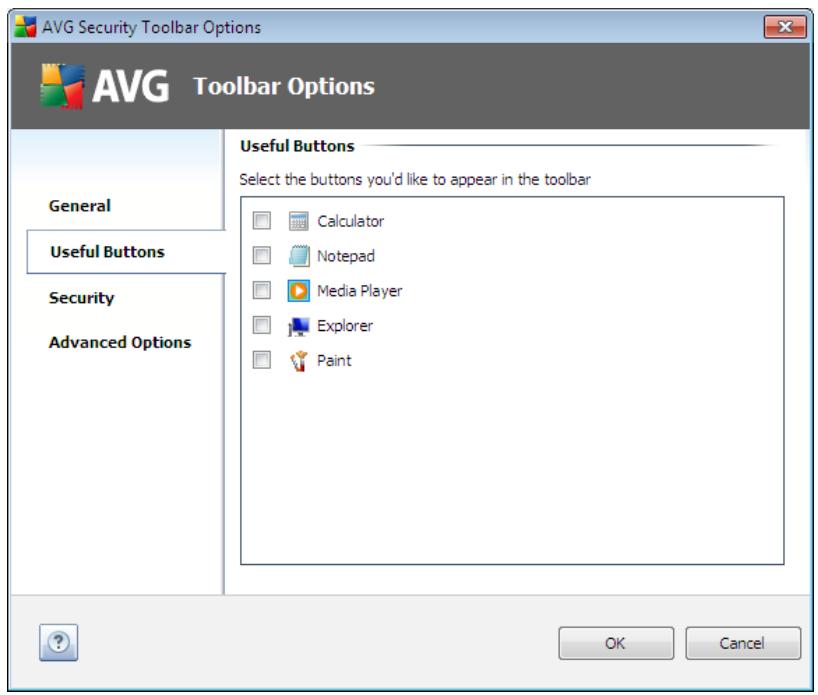
The Useful Buttons tab allows you to select applications from a list and have their icon displayed in the toolbar interface. The icon then serves as a quick link enabling to launch the respective application immediately.
8.2.3. Tab Security
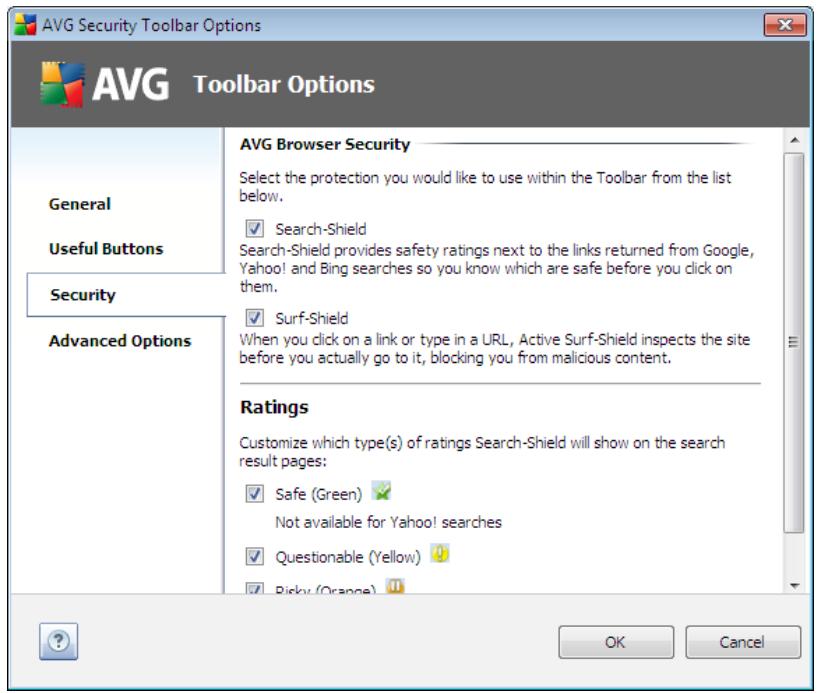
The Security tab is divided into two sections, AVG Browser Security and Ratings, where you can mark specific check-boxes to assign AVG Security Toolbar functionality you want to use:
- AVG Browser Security - check this item to activate or switch-off the Search-Shield and/or Surf-Shield service
- Ratings - select graphical symbols used for search results ratings by the Search-Shield component that you want to use:
page is safe
page is somewhat suspicious
page containing links to positively dangerous pages
Ox page contains active threats
page is not accessible, and so could not be scanned
Mark the respective option to confirm you want to be informed about this specific threat level. However, display of the red mark assigned to pages containing active and dangerous threats cannot be switched-off. Again, it is recommended to keep the default configuration set by the program vendor unless you have a real reason to change it.
8.2.4. Tab Advanced Options
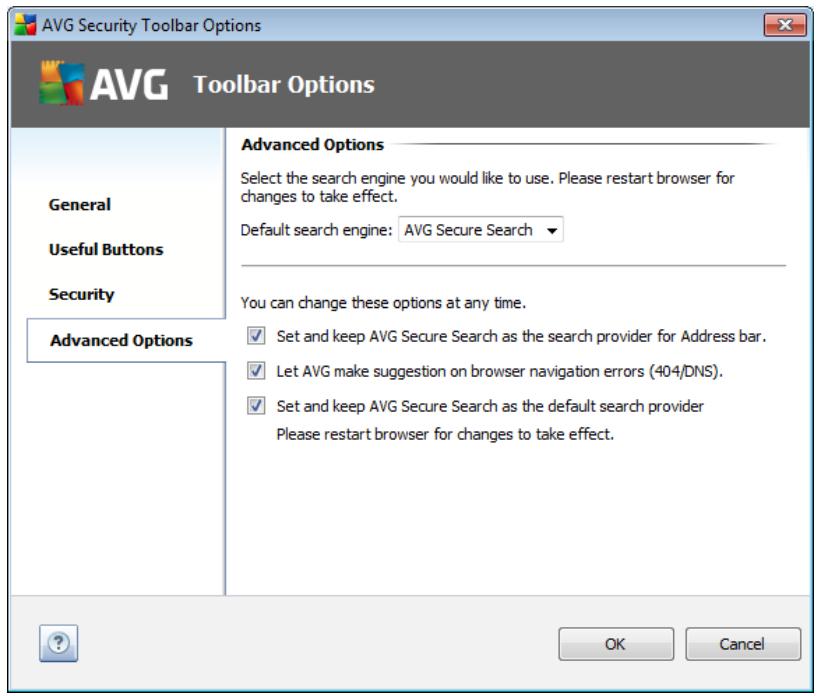
On the Advanced Options tab first select what search engine you want to use as default. You have the choice of AVG Secure Search, Baidu, WebHledani, Yandex and Yahoo!. Having changed the default search engine, please restart your internet browser for the change to take effect.
Further, you can activate or switch-off further specific AVG Security Toolbar settings (the listed caption refers to the default AVG Secure Search settings):
- Set and keep AVG Secure Search as the search provider for Address bar - if marked, this option allows you to type a search keyword directly into the address bar into your Internet browser and the Google service will be used automatically to search for relevant websites.
- Let AVG make suggestion on browser navigation errors (404/DNS) - if when searching the web you run into a non-existing page, or a page that cannot be displayed (404 error), you will be automatically redirected to a web page that allows you to select from an overview of alternative topic-related pages.
- Set and keep AVG Secure Search as the default search provider - Google is the default search engine for web search within AVG Security Toolbar, and activating this option it can also become your web browser default search engine.
9. AVG Advanced Settings
The advanced configuration dialog of AVG Anti-Virus 2011 opens in a new window named Advanced AVG Settings. The window is divided into two sections: the left part offers a tree-arranged navigation to the program configuration options. Select the component you want to change the configuration of (or its specific part) to open the editing dialog in the right-hand section of the window.
9.1. Appearance
The first item of the navigation tree, Appearance, refers to the general settings of the AVG user interface and a few elementary options of the application's behavior:
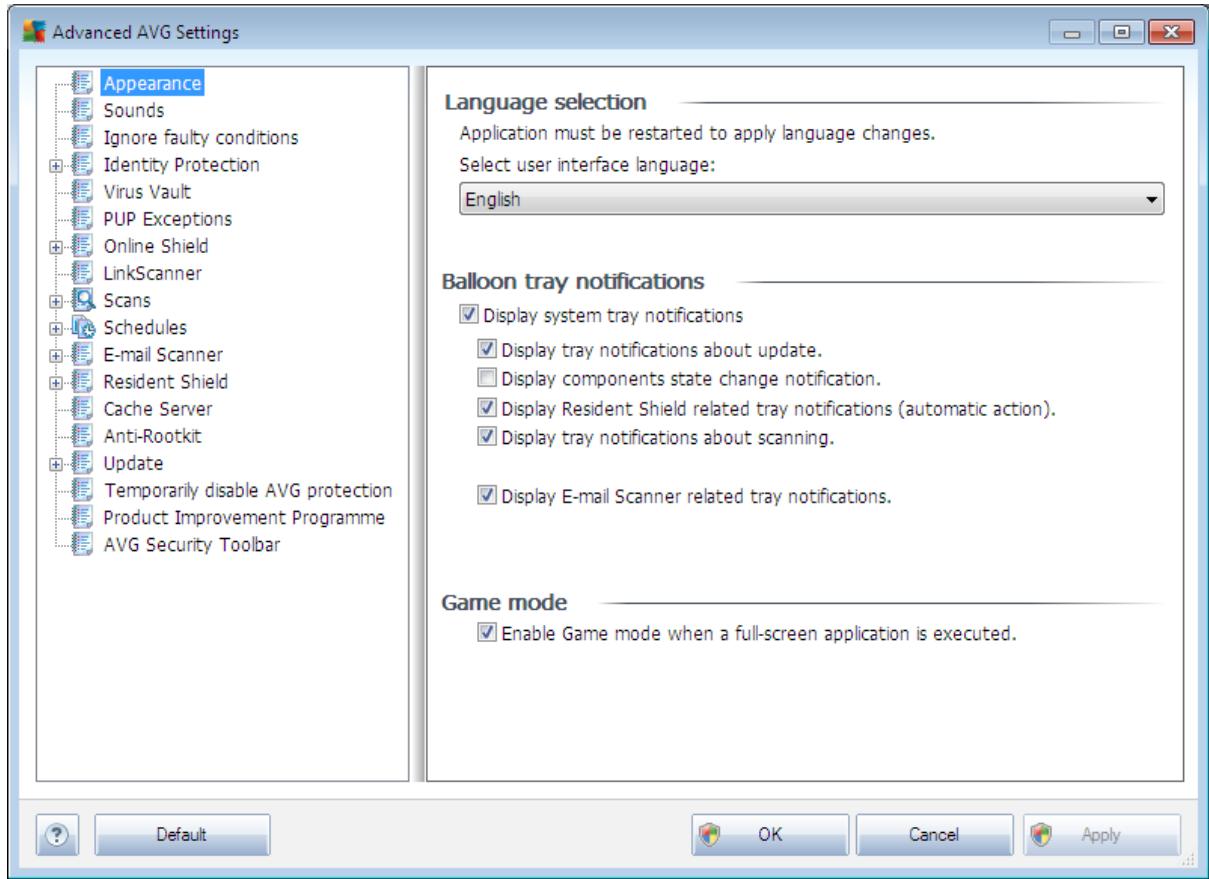
Language selection
In the Language selection section you can chose your desired language from the drop-down menu; the language will then be used for the entire AVG user interface. The drop-down menu only offers those languages you have previously selected to be installed during the installation process (see chapter Custom Option) plus English (that is installed by default). However, to finish switching the application to another language you have to restart the user interface; follow these steps:
- Select the desired language of the application and confirm your selection by pressing the Apply button (right-hand bottom corner)
- Press the OK button confirm
- New dialog window pops-upinforming you the language change of AVG user interface requires the application restart:
Balloon tray notifications
Within this section you can suppress display of system tray balloon notifications on the status of the application. By default, the balloon notifications are allowed to be displayed, and it is recommended to keep this configuration! The balloon notifications typically inform on some AVG component's status change, and you should pay attention to them!
However, if for some reason you decide you do not wish these notifications to be displayed, or you would like only certain notifications (related to a specific AVG component) to be displayed, you can define and specify your preferences by checking/unchecking the following options:
-
Display system tray notifications - by default, this item is checked (switched on), and notifications are displayed. Uncheck this item to completely turn off the display of all balloon notifications. When turned on, you can further select what specific notifications should be displayed:
-
Display tray notifications about update - decide whether information regarding AVG update process launch, progress, and finalization should be displayed;
- Display components state change notifications - decide whether information regarding component's activity/inactivity or its possible problem should be displayed. When reporting a component's fault status, this option equals to the informative function of the system tray icon (color changing) reporting a problem in any AVG component;
-
Display Resident Shield related tray notifications (automatic action) - decide whether information regarding file saving, copying, and opening processes should be displayed or suppressed (this configuration only demonstrates if the Resident Shield Auto-heal option is on);
-
Display tray notifications about scanning - decide whether information upon automatic launch of the scheduled scan, its progress and results should be displayed;
- Display E-mail Scanner related tray notifications - decide whether information upon scanning of all incoming and outgoing e-mail messages should be displayed.
Gaming mode
This AVG function is designed for full-screen applications where possible AVG information balloons (displayed e.g. when a scheduled scan is started) would be disturbing (they could minimize the application or corrupt its graphics). To avoid this situation, keep the check box for the Enable gaming mode when a full-screen application is executed option marked (default setting).
9.2. Sounds
Within the Sounds dialog you can specify whether you want to be informed about specific AVG actions by a sound notification. If so, check the Enable sound events option (off by default) to activate the list of AVG actions:
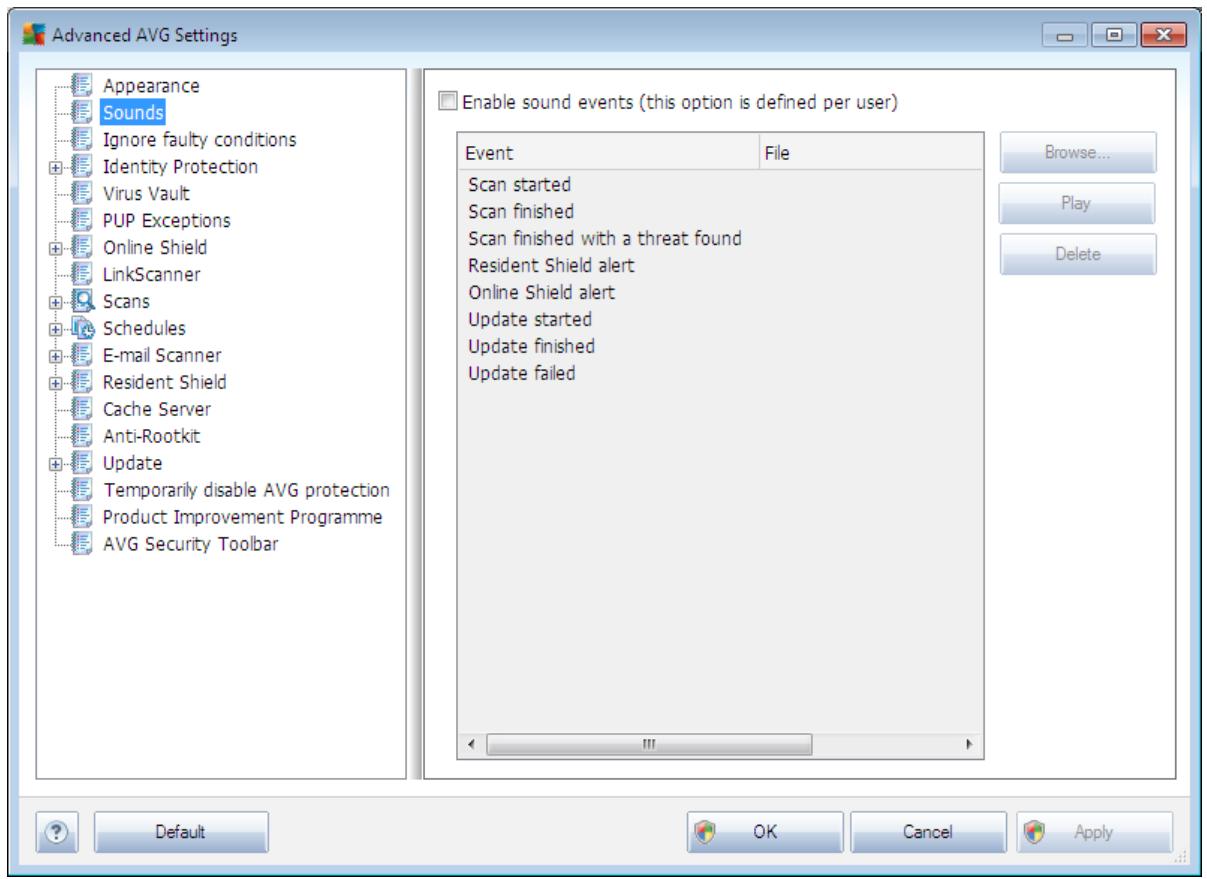
Then, select the respective event from the list and browse (Browse) your disk for an appropriate sound you want to assign to this event. To listen to the selected sound, highlight the event in the list and push the Play button. Use the Delete button to remove the sound assigned to a specific event.
Note: Only *.wav sounds are supported!
9.3. Ignore Faulty Conditions
In the Ignore faulty components conditions dialog you can tick those components that you do not want to get informed about:
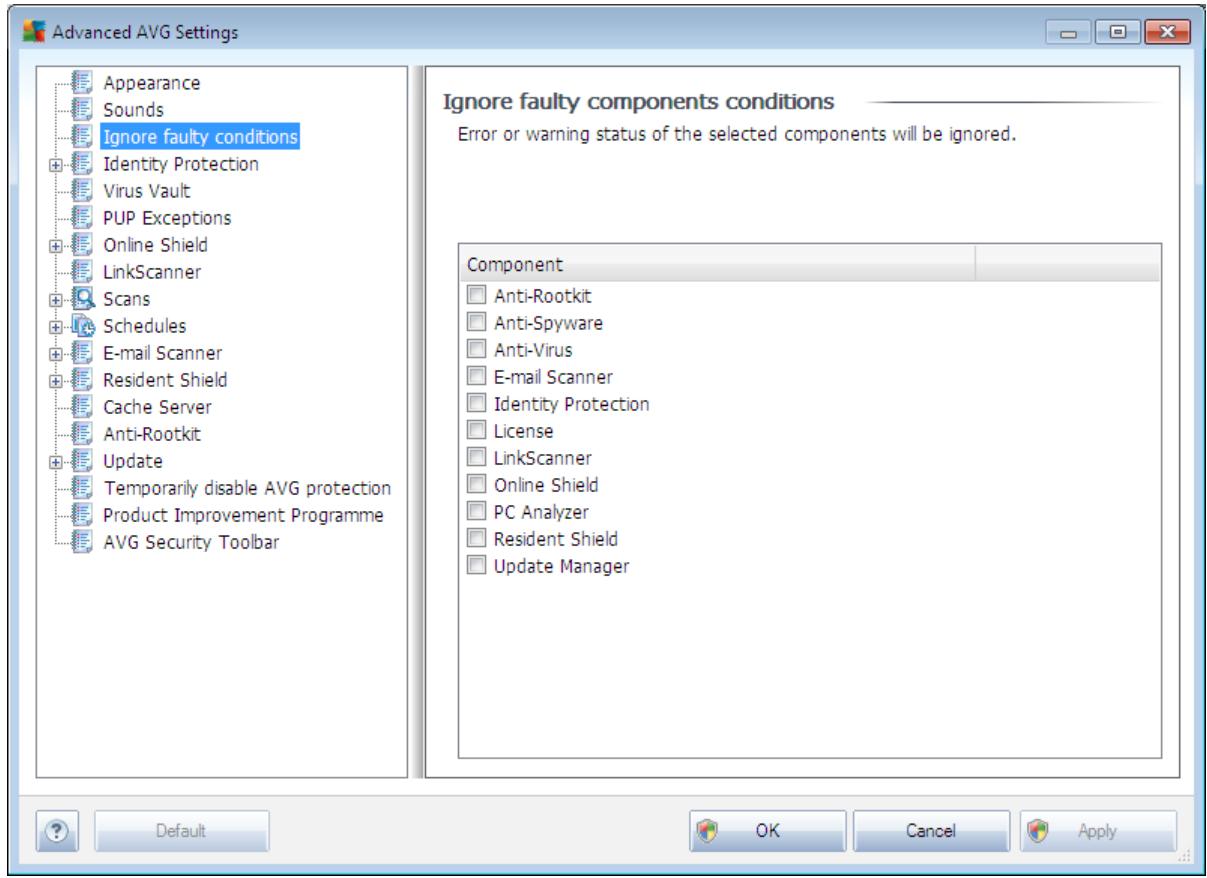
By default, no component is selected in this list. It means that if any component gets to an error status, you will be informed about it immediately via:
- system tray icon - while all parts of AVG are working properly, the icon is displayed in four colors; however, if an error occurs, the icon appears with a yellow exclamation mark,
- text description of the existing problem in the Security Status Info section of the AVG main window
There might be a situation that for some reason you need to switch a component off temporarily (this is not recommended, you should try to keep all components
permanently on and in default configuration, but it may be happen). In that case the system tray icon automatically reports the component's error status. However, in this very case we cannot talk about an actual error since you have deliberately induced it yourself, and you are aware of the potential risk. At the same time, once being displayed in grey color, the icon cannot actually report any possible further error that might appear.
For this situation, within the above dialog you can select components that may be in an error state (or switched off) and you do not wish to get informed about it. The same option of Ignoring component state is also available for specific components directly from the components overview in the AVG main window.
9.4. Virus Vault
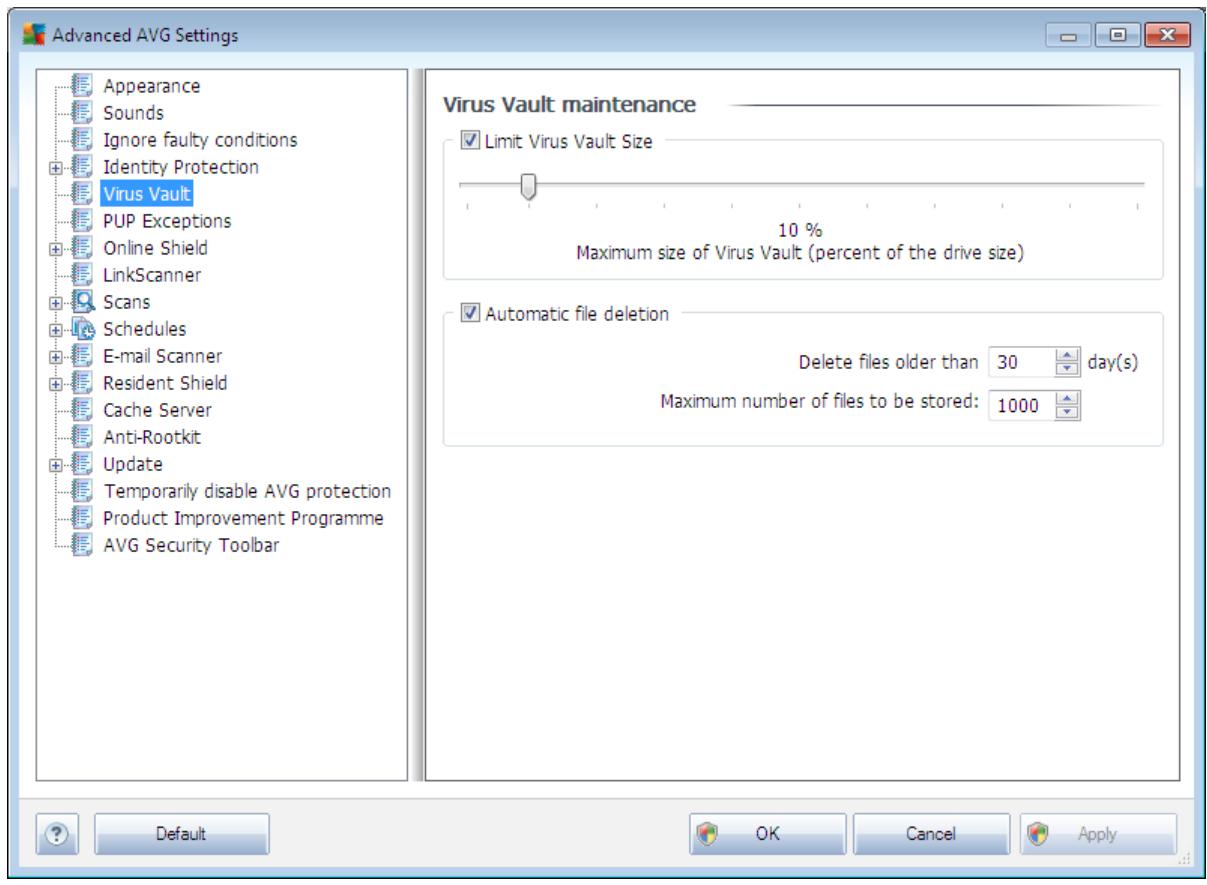
The Virus Vault maintenance dialog allows you to define several parameters regarding the administration of objects stored in the Virus Vault:
- Limit Virus Vault size - use the slider to set up the maximum size of the Virus Vault. The size is specified proportionally compared to the size of your local disk.
- Automatic file deletion - in this section define the maximum length of time that objects should be stored in the Virus Vault (Delete files older than ... days), and the maximum number of files to be stored in the Virus Vault (
Maximum number of files to be stored)
9.5. PUP Exceptions
AVG Anti-Virus 2011 is able to analyze and detect executable applications or DLL libraries that could be potentially unwanted within the system. In some cases the user may wish to keep certain unwanted programs on the computer (programs that were installed on purpose). Some programs, especially free ones, include adware. Such adware might be detected and reported by AVG as a potentially unwanted program. If you wish to keep such a program on your computer, you can define it as a potentially unwanted program exception:
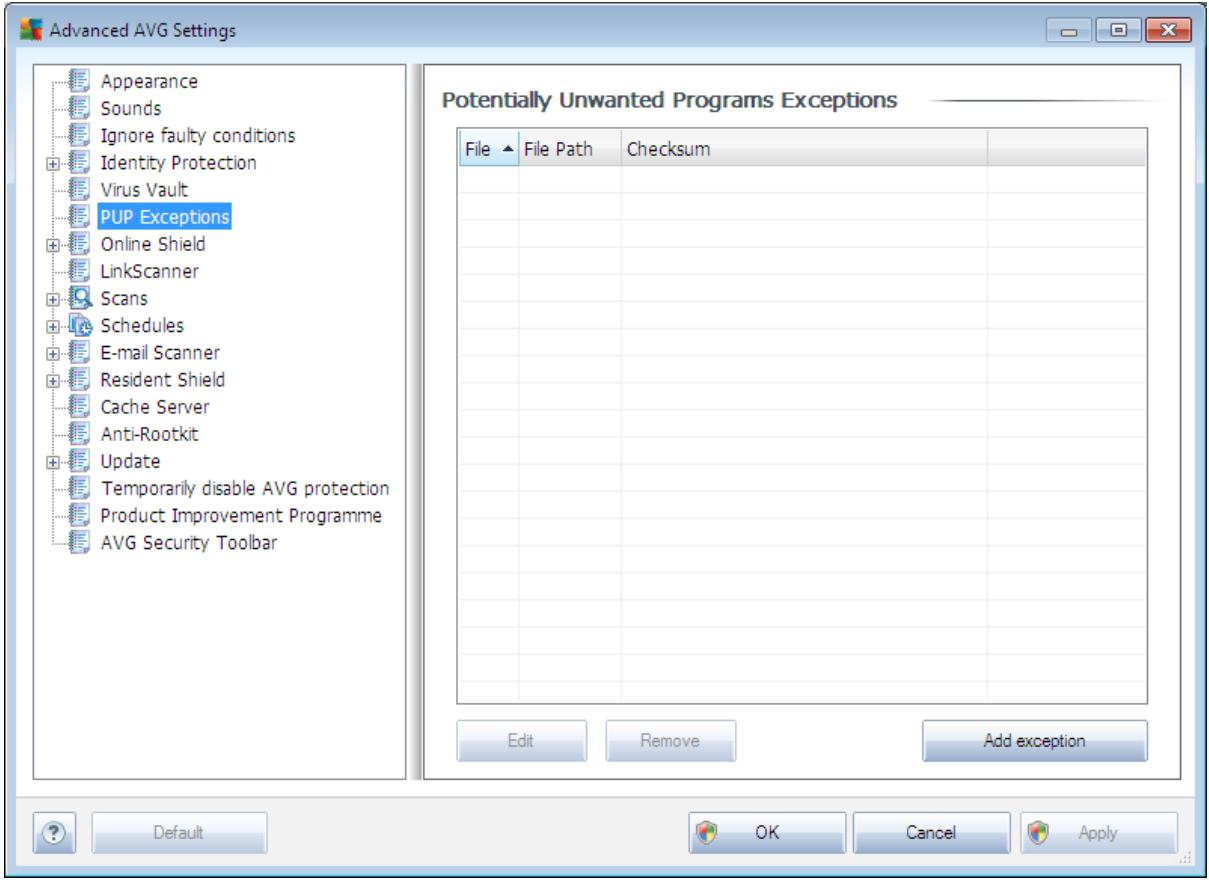
The Potentially Unwanted Programs Exceptions dialog displays a list of already defined and currently valid exceptions from potentially unwanted programs. You can edit the list, delete existing items, or add new exceptions. The following information can be found in the list for every single exception:
- File - provides the name of the respective application
- File Path - shows the way to the application's location
- Checksum - displays the unique 'signature' of the chosen file. This checksum is an automatically generated string of characters, which allows AVG to unequivocally distinguish the chosen file from other files. The checksum is
generated and displayed after successful addition of the file.
Control buttons
- Edit - opens an editing dialog (identical with the dialog for a new exception definition, see below) of an already defined exception where you can change the exception's parameters
- Remove - deletes the selected item from the list of exceptions
- Add exception - open an editing dialog where you can define parameters of the new exception to be created:
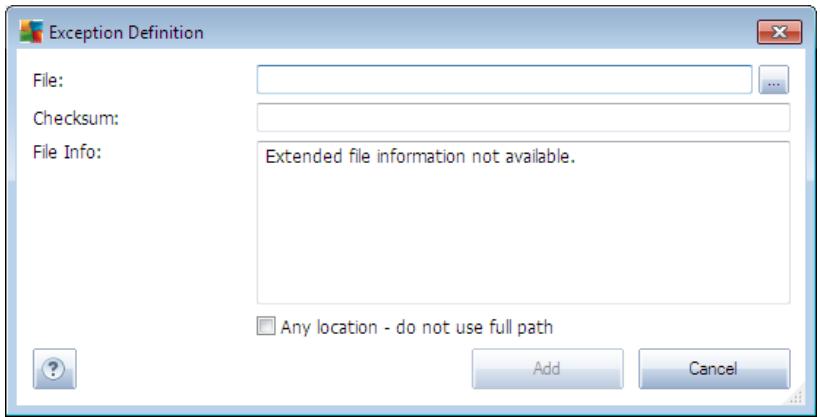
- File - type the full path to the file that you want to mark as an exception
- Checksum - displays the unique 'signature' of the chosen file. This checksum is an automatically generated string of characters, which allows AVG to unequivocally distinguish the chosen file from other files. The checksum is generated and displayed after successful addition of the file.
- File Info - displays any additional information available about the file (license/version information etc.)
- Any location - do not use full path - if you want to define this file as an exception only for the specific location, then leave this checkbox unchecked. If the checkbox is marked, the specified file is defined as an exception no matter where it is located (however, you have to fill in the full path to the specific file anyway; the file will then be used as a unique example for the possibility that two files of the same name appear in your system).
9.6. Online Shield
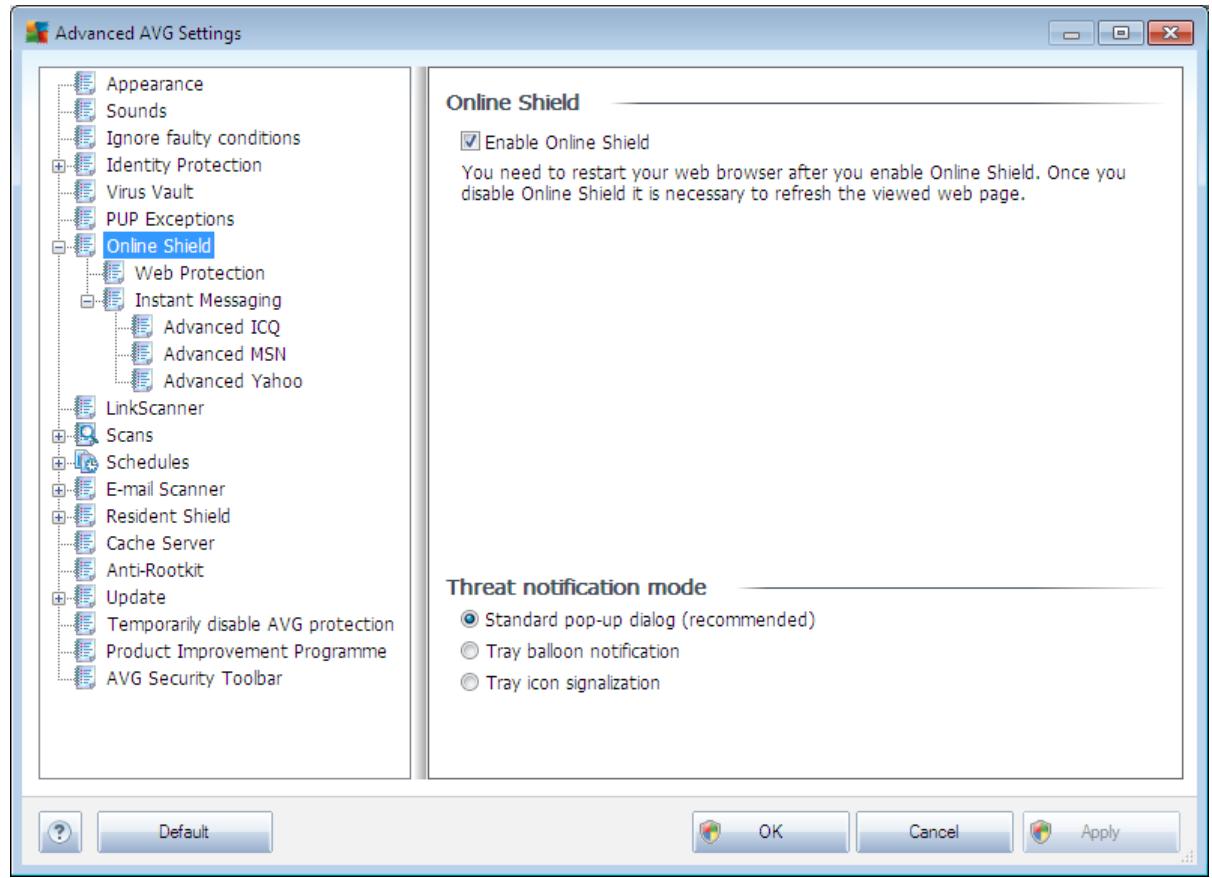
The Online Shield dialog allows you to activate/deactivate the entire Online Shield component via the Enable Online Shield option (activated by default). For further advanced settings of this component please continue to the subsequent dialogs as listed in the tree navigation:
Web Protection
- Instant Messaging
Threat notification mode
In the bottom section of the dialog, select in which way you wish to be informed about possible detected threat: via standard pop-up dialog, via tray balloon notification, or via tray icon info.
9.6.1. Web Protection
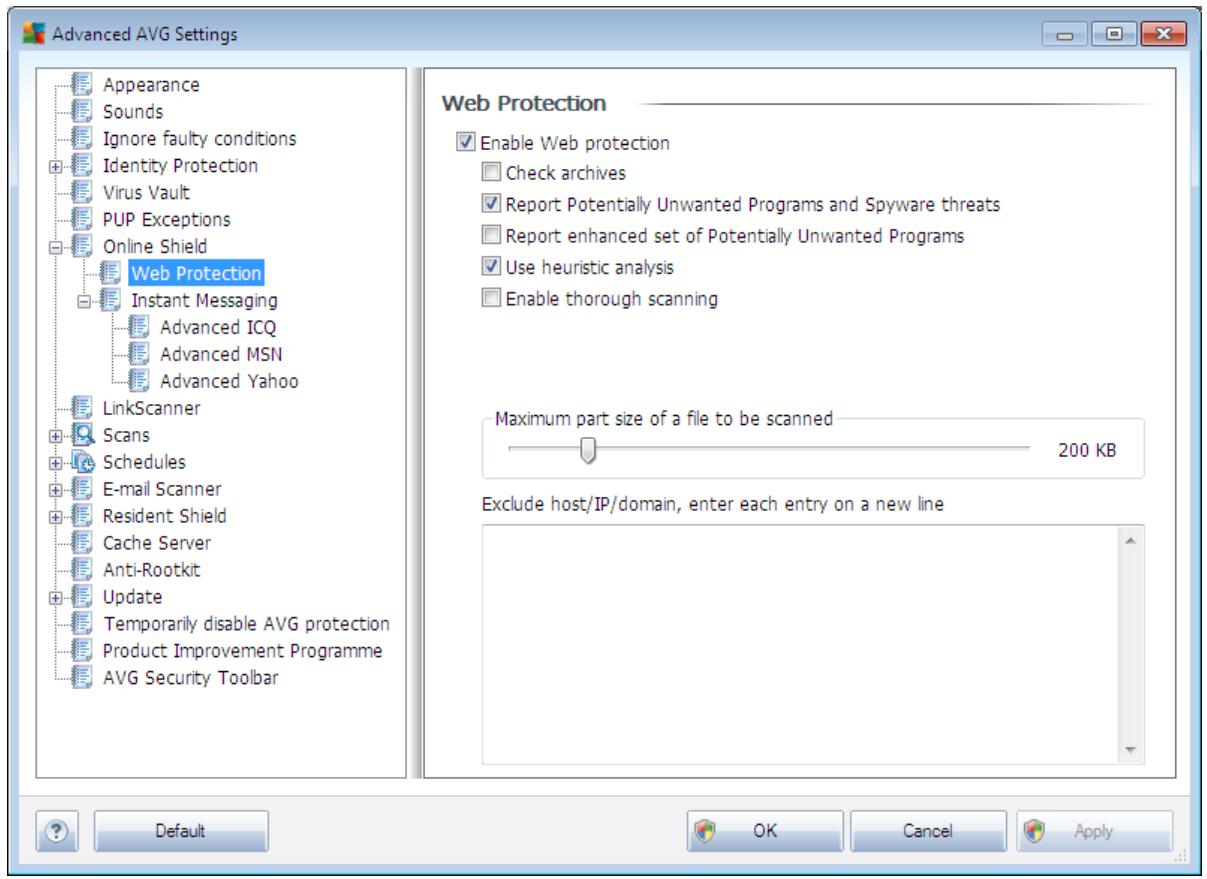
In the Web Protection dialog you can edit the component's configuration regarding the scan of the website content. The editing interface allows you to configure the following elementary options:
-
Enable Web protection - this option confirms that the Online Shield should perform scanning of the www pages content. Provided this option is on (by default), you can further switch on/off these items:
-
Check archives - (off by default): scan the content of archives possibly included in the www page to be displayed.
- Report Potentially Unwanted Programs and Spyware threats - (on by default): check to activate the Anti-Spyware engine, and scan for spyware as well as for viruses. Spyware represents a questionable malware category: even though it usually represents a security risk, some of these programs can be installed intentionally. We recommend to keep this feature activated as it increases your computer security.
- Report enhanced set of Potentially Unwanted Programs - (off by default): mark to detect extended package of spyware: programs that are perfectly ok and harmless when acquired from the manufacturer directly, but can be misused for malicious purposes later. This is an
additional measure that increases your computer security even more, however it can possibly block legal programs, and is therefore switched off by default.
-
Use heuristic analysis - (on by default): scan the content of the page to be displayed using the heuristic analysis method (dynamic emulation of the scanned object's instructions in a virtual computer environment).
-
Enable thorough scanning (off by default) - in specific situations (suspicious of your computer being infected) you may check this option to activate the most thorough scanning algorithms that will scan even those areas of your computer that can hardly get infected, just to be absolutely sure. Remember though that this method is rather time consuming.
Maximum part size of a file to be scanned - if included files are present in the displayed page you can also scan their content even before these are downloaded to your computer. However, scanning of large files takes quite some time and the web page download might be slowed significantly. You can use the slide bar to specify the maximum size of a file that is still to be scanned with Online Shield. Even if the downloaded file is bigger than specified, and therefore will not be scanned with Online Shield, you are still protected: in case the file is infected, the Resident Shield will detect it immediately. - Exclude host/IP/domain - into the text field you can type the exact name of a server (host, IP address, IP address with mask, or URL) or a domain that should not be scanned by Online Shield. Therefore exclude only host that you can be absolutely sure would never provide dangerous website content.
9.6.2. Instant Messaging
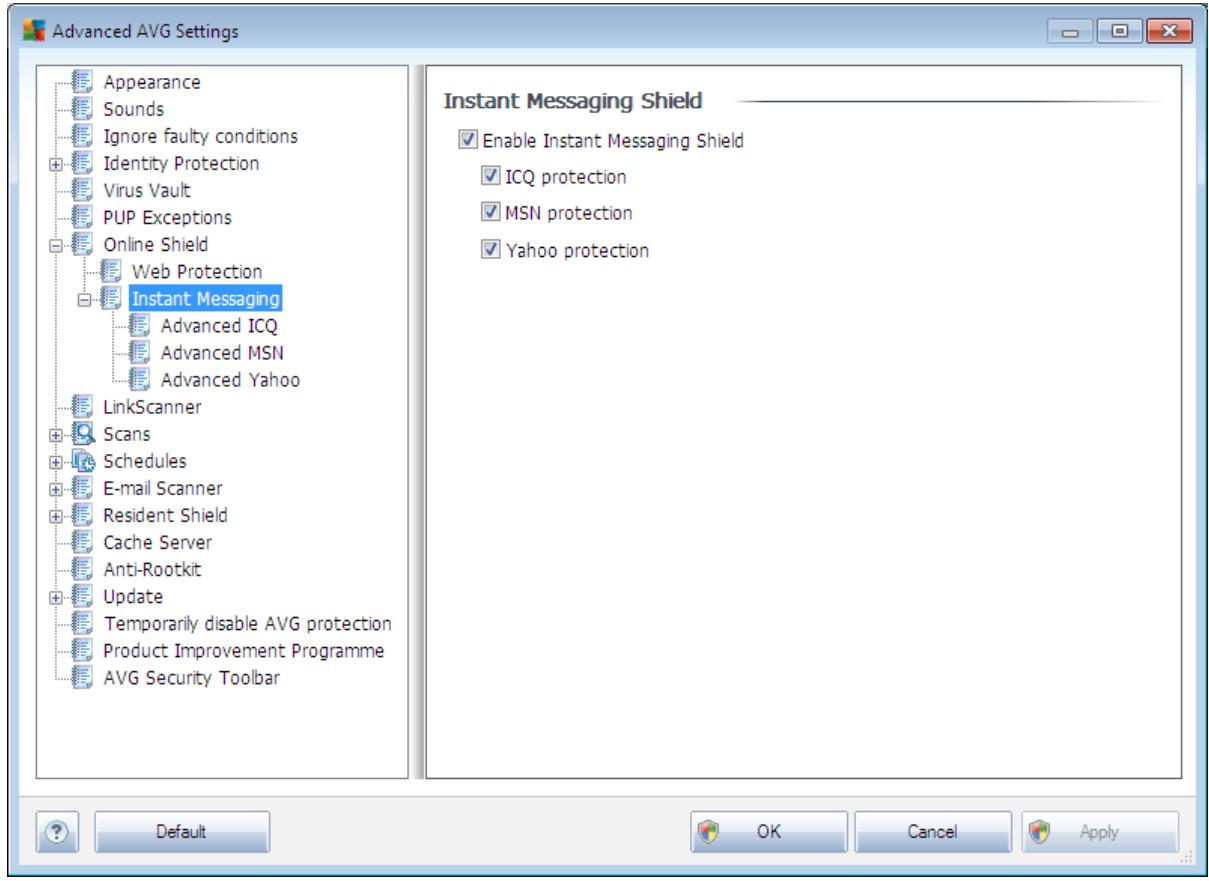
In the Instant Messaging Shield dialog you can edit the Online Shield components settings referring to instant messaging scanning. Currently the following three instant messaging programs are supported: ICQ, MSN, and Yahoo - tick the respective item for each of them if you want the Online Shield to verify the on-line communication is virus free.
For further specification of allowed/blocked users you can see and edit the respective dialog (Advanced ICQ, Advanced MSN, Advanced Yahoo) and specify the Whitelist (list of users that will be allowed to communicate with you) and Blacklist (users that should be blocked).
9.7. Link Scanner
The LinkScanner settings dialog allows you to switch on/off the elementary features of the LinkScanner:
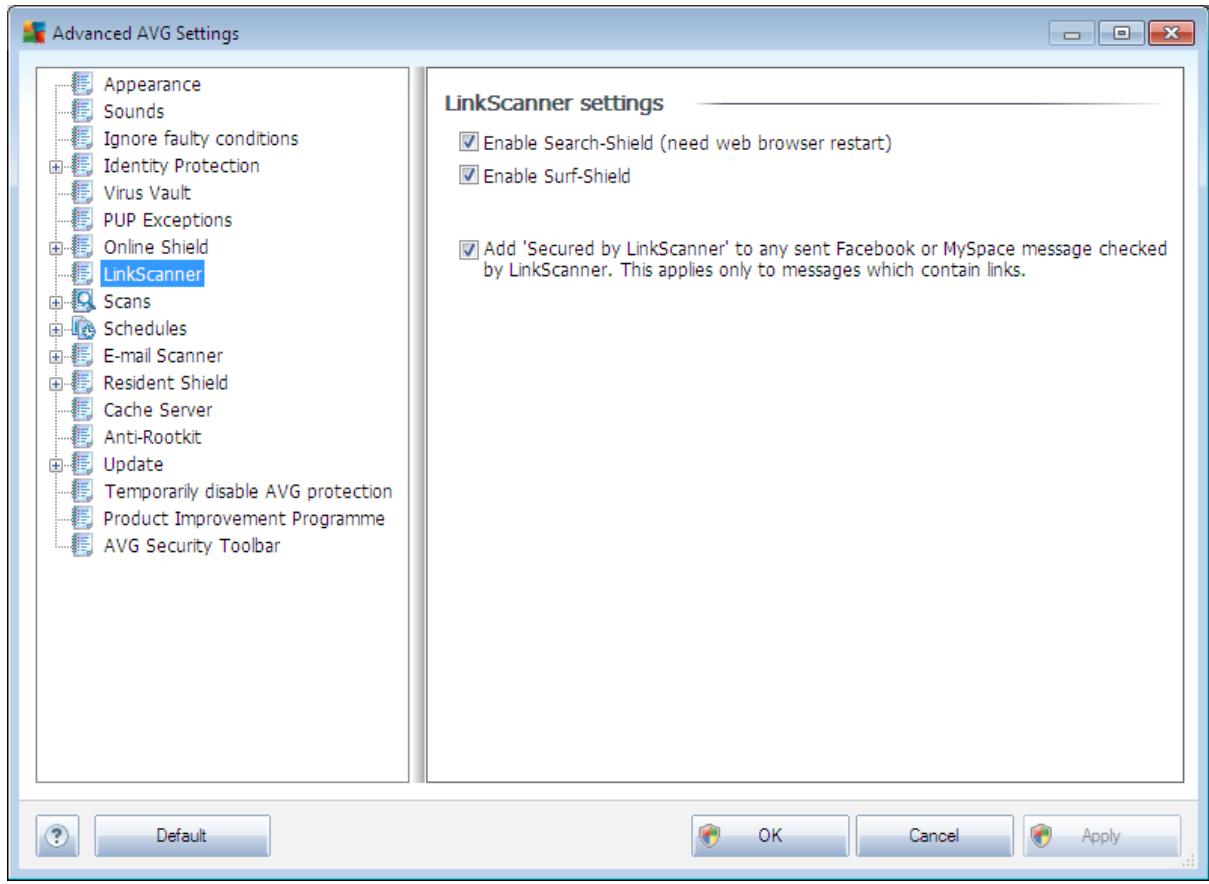
- Enable Search-Shield - (on by default): advisory notifying icons on searches performed with Google, Yahoo!, WebHledani, Yandex, Baidu, Bing, AOL, AltaVista, EarthLink, Ask, Seznam, eBay, Twitter, Digg, orSlashDot having checked ahead the content of sites returned by the search engine.
- Enable Surf-Shield - (on by default): active (real-time) protection against exploitive sites as they are accessed. Known malicious site connections and their exploitive content is blocked as they are accessed by the user via a web browser (or any other application that uses HTTP).
- Add 'Secured by LinkScanner' ... - mark this item to confirm you wish to enter the certification notice on Link Scanner check into all messages containing active hyperlinks, that were sent from Facebook and MySpace social networks.
9.8. Scans
The advanced scan settings is divided into four categories referring to specific scan types as defined by the software vendor:
- Whole Computer scan - standard predefined scan of the entire computer
- Shell Extension Scan - specific scanning of a selected object directly from the Windows Explorer environment
- Scan Specific Files or Folders - standard predefined scan of selected areas of your computer
- Removable Device Scan - specific scanning of removable devices attached to your computer
9.8.1. Scan Whole Computer
The Whole Computer scan option allows you to edit parameters of one of the scans predefined by the software vendor, Scan of the whole computer:
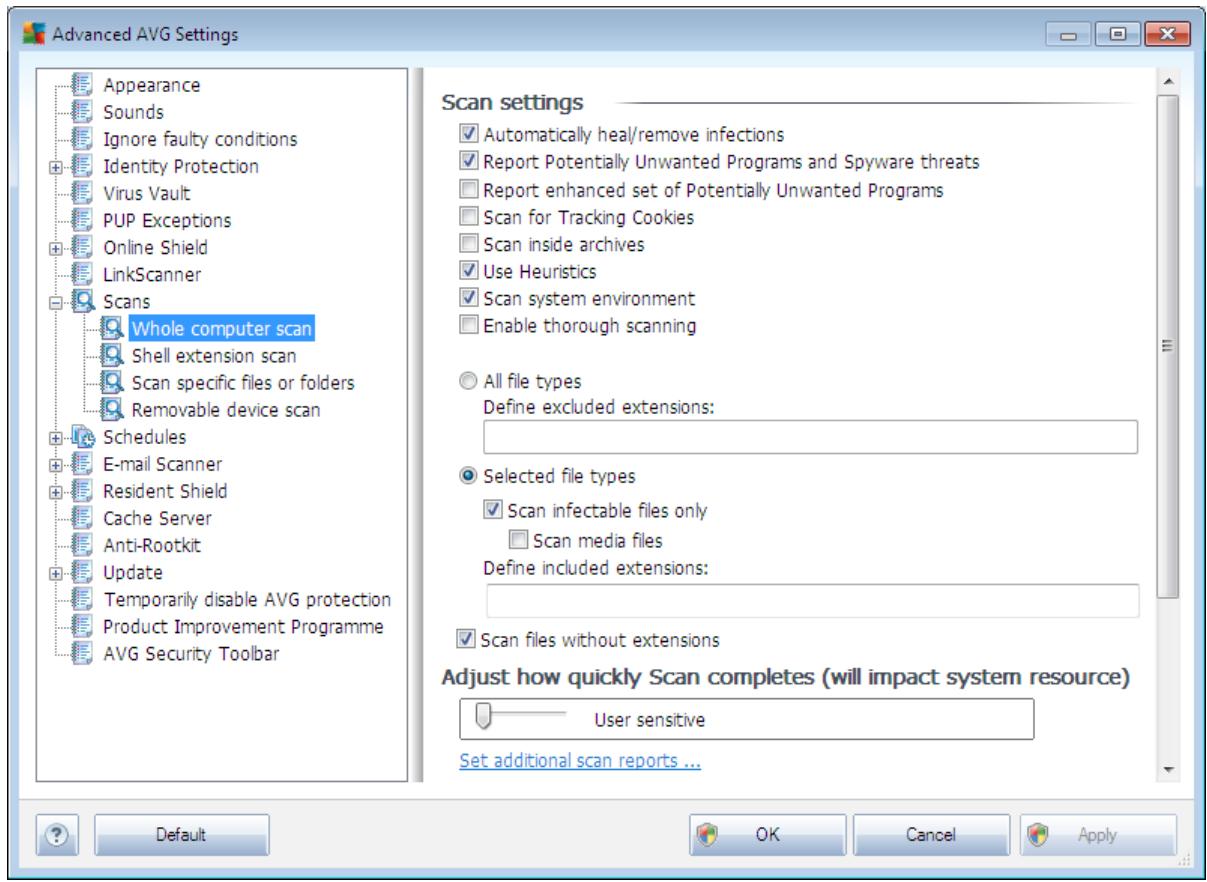
Scan settings
The Scan settings section offers a list of scanning parameters that can be optionally switched on/off:
- Automatically heal/remove infection (on by default) - if a virus is identified during scanning it can be healed automatically if a cure is available. If the infected file cannot be healed automatically, the infected object will be moved to the Virus Vault.
- Report Potentially Unwanted Programs and Spyware threats (on by default) - check to activate the Anti-Spyware engine, and scan for spyware as well as for viruses. Spyware represents a questionable malware category: even though it usually represents a security risk, some of these programs can be installed intentionally. We recommend to keep this feature activated as it increases your computer security.
- Report enhanced set of Potentially Unwanted Programs (off by default) - mark to detect extended package of spyware: programs that are perfectly ok and harmless when acquired from the manufacturer directly, but can be misused for malicious purposes later. This is an additional measure that increases your computer security even more, however it can possibly block legal programs, and is therefore switched off by default.
- Scan for Tracking Cookies (off by default) - this parameter of the Anti-Spyware component defines that cookies should be detected; (HTTP cookies are used for authenticating, tracking, and maintaining specific information about users, such as site preferences or the contents of their electronic shopping carts)
- Scan inside archives (off by default) - this parameters defines that scanning should check all files stored inside archives, e.g. ZIP, RAR, ...
- Use Heuristics (on by default) - heuristic analysis (dynamic emulation of the scanned object's instructions in a virtual computer environment) will be one of the methods used for virus detection during scanning;
- Scan system environment (on by default) - scanning will also check the system areas of your computer.
- Enable thorough scanning (off by default) - in specific situations (suspicious of your computer being infected) you may check this option to activate the most thorough scanning algorithms that will scan even those areas of your computer that can hardly get infected, just to be absolutely sure. Remember though that this method is rather time consuming.
Further you should decide whether you want to have scanned
-
All file types with the possibility of defining exceptions from scanning by providing a list of comma separated (having been saved, the commas change into semicolons) file extensions that should not be scanned;
-
Selected file types - you can specify that you want to scan only files that are possibly infectable (files that cannot get infected will not be scanned, for instance some plain text files, or some other non-executable files), including media files (video, audio files - if you leave this box unchecked, it will reduce the scanning time even more, because these files are often quite large and are not too likely to be infected by a virus). Again, you can specify by extensions which files are those that should always be scanned.
- Optionally, you can decide you want to Scan files without extension - this option is on by default, and it is recommended that you keep it so unless you have a real reason to change it. Files with no extension are rather suspicious and should be scanned at all times.
Adjust how quickly Scan completes
Within the Adjust how quickly scan completes section you can further specify the desired scanning speed dependent on system resource usage. By default, this option value is set to the medium level of automatic resource usage. If you want the scanning to run faster, it will take less time but system resources usage will increase significantly during the scan, and will slow down your other activities on the PC (this option can be used when your computer is switched on but nobody is currently working on it). On the other hand, you can decrease system resources usage by extending the scanning duration.
Set additional scan reports ...
Click the Set additional scan reports ... link to open a standalone dialog window called Scan reports where you can tick several items to define what scan findings should be reported:
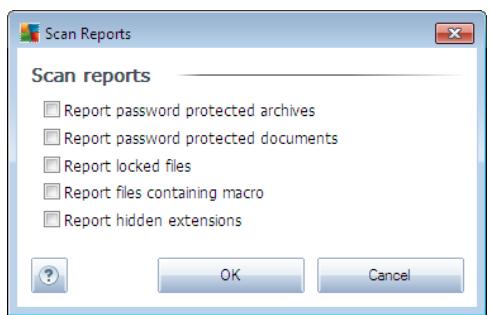
9.8.2. Shell Extension Scan
Similar to the previous Whole Computer scan item, this item named Shell extension scan also offers several options for editing the scan predefined by the software vendor. This time the configuration is related to scanning of specific objects launched directly from the Windows Explorer environment (shell extension), see chapter Scanning in Windows Explorer:
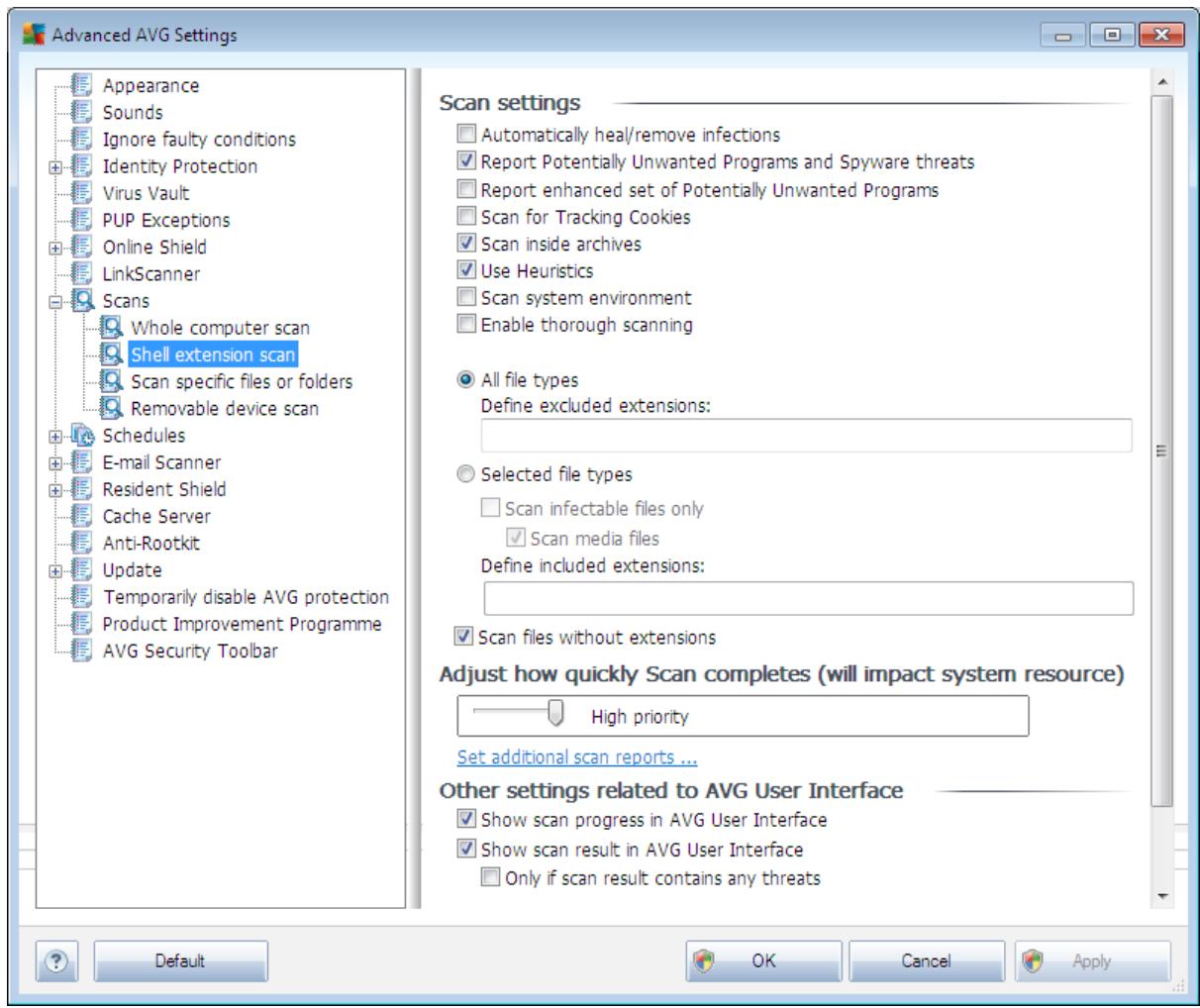
The list of parameters is identical to those available for the Scan of the whole computer. However, the default settings differ (for instance, Whole Computer scan by default does not check the archives but it does scan the system environment, while with the Shell Extension Scan it is the other way).
Note: For a description of specific parameters please consult the chapter Advanced Settings / Scans / Whole Computer scan.
Compared to Whole Computer scan dialog, the Shell extension scan dialog also includes the section named Other settings related to AVG User Interface, where you can specify whether you want the scan progress and scan results to be accessible from the AVG user interface. Also, you can define that the scan result should only be displayed in case an infection is detected during scanning.
9.8.3. Scan Specific Files or Folders
The editing interface for Scan specific files or folders is identical to the Whole Computer scan editing dialog. All configuration options are the same; however, the default settings are more strict for the Scan of the whole computer:
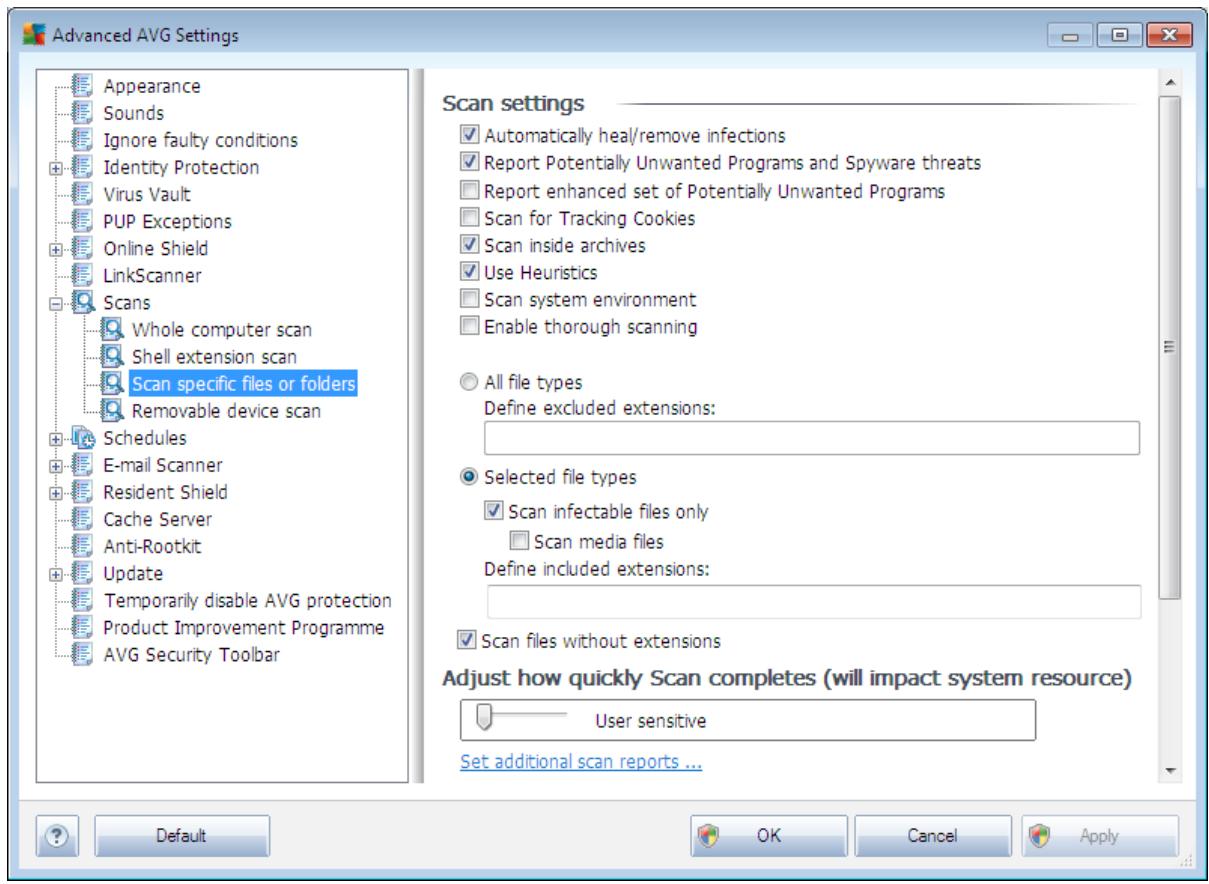
All parameters set up in this configuration dialog apply only to the areas selected for scanning with the Scan of specific files or folders!
Note: For a description of specific parameters please consult the chapter Advanced Settings / Scans / Whole Computer scan.
9.8.4. Removable Device Scan
The editing interface for Removable device scan is also very similar to the Whole Computer scan editing dialog:
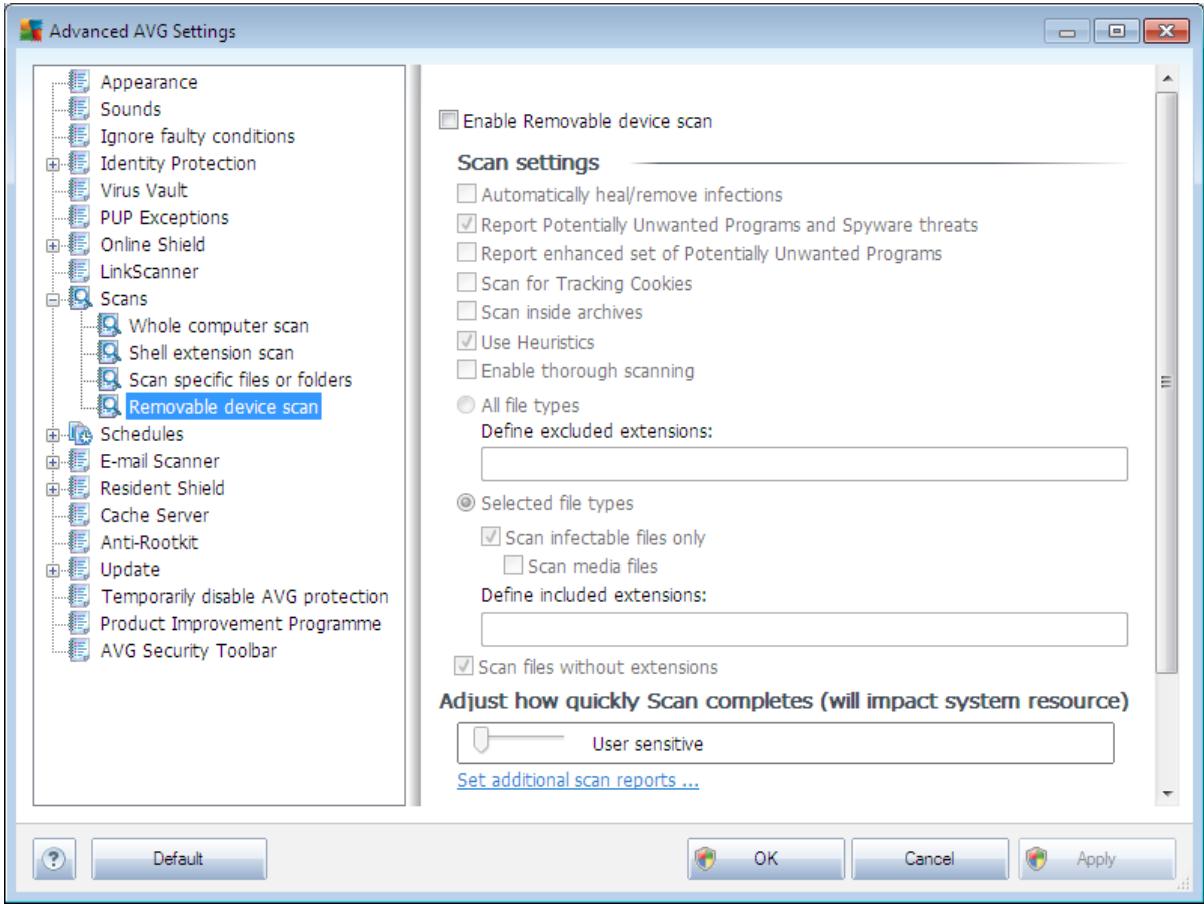
The Removable device scan is launched automatically once you attach any removable device to your computer. By default, this scanning is switched off. However, it is crucial to scan removable devices for potential threats since these are a major source of infection. To have this scanning ready and launched automatically when needed, mark the Enable Removable device scan option.
Note: For a description of specific parameters please consult the chapter Advanced Settings / Scans / Whole Computer scan.
9.9. Schedules
In the Schedules section you can edit the default settings of:
Scheduled scan
- Virus database update schedule
- Program update schedule
9.9.1. Scheduled Scan
Parameters of the scheduled scan can be edited (or a new schedule set up) on three tabs:
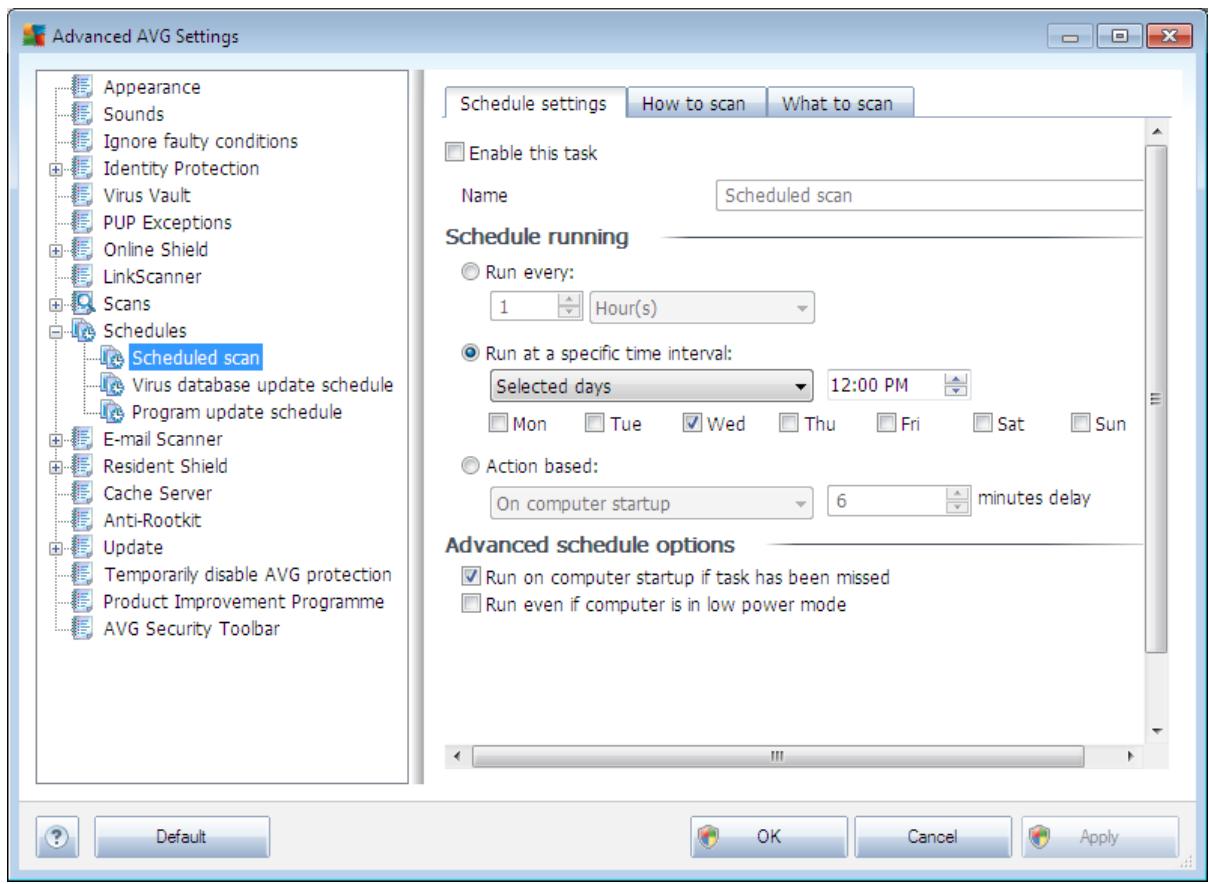
On the Schedule settings tab you can first check/unchecked the Enable this task item to simply deactivate the scheduled test temporarily, and switch it on again as the need arises.
Next, in the text field called Name (deactivated for all default schedules) there is the name assigned to this very schedule by the program vendor. For newly added schedules (you can add a new schedule by mouse right-click over the Scheduled scan item in the left navigation tree) you can specify your own name, and in that case the text field will be open for editing. Try to always use brief, descriptive and apt names for scans to make it easier to later recognize the scan from others.
Example: It is not appropriate to call the scan by the name of "New scan" or "My scan" since these names do not refer to what the scan actually checks. On the other hand, an example of a good descriptive name would be "System areas scan" etc. Also it is not necessary to specify in the scan's name whether it is the scan of the whole of the computer or just a scan of selected files or folders - your own scans will always be a specific version of the scan of selected files or folders.
In this dialog you can further define the following parameters of the scan:
Schedule running
Here, you can specify time intervals for the newly scheduled scan launch. The timing can either be defined by the repeated scan launch after a certain period of time (Run every ...) or by defining an exact date and time (Run at specific time interval ...), or possibly by defining an event that the scan launch should be associated with (Action based on computer startup).
Advanced schedule options
This section allows you to define under which conditions the scan should/should not be launched if the computer is in low power mode or switched off completely.
Once the scheduled scan is launched in the time you have specified, you will be informed on this fact via a pop-up window opened over the AVG system tray icon:
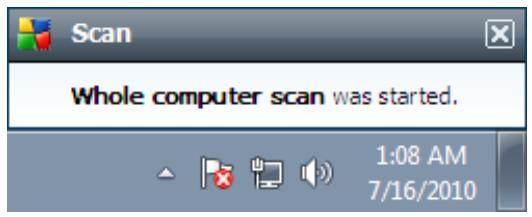
A new AVG system tray icon then appears (in full color with a flash light) informing a scheduled scan is running. Right-click on the running scan AVG icon to open a context menu where you can decide to pause or even stop the running scan, and also change the priority of the currently running scan:
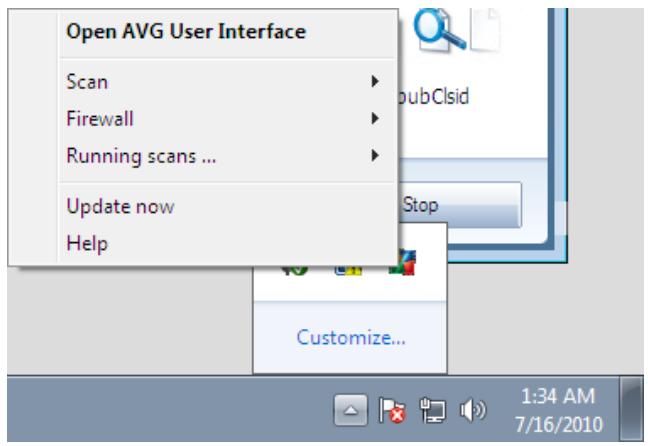
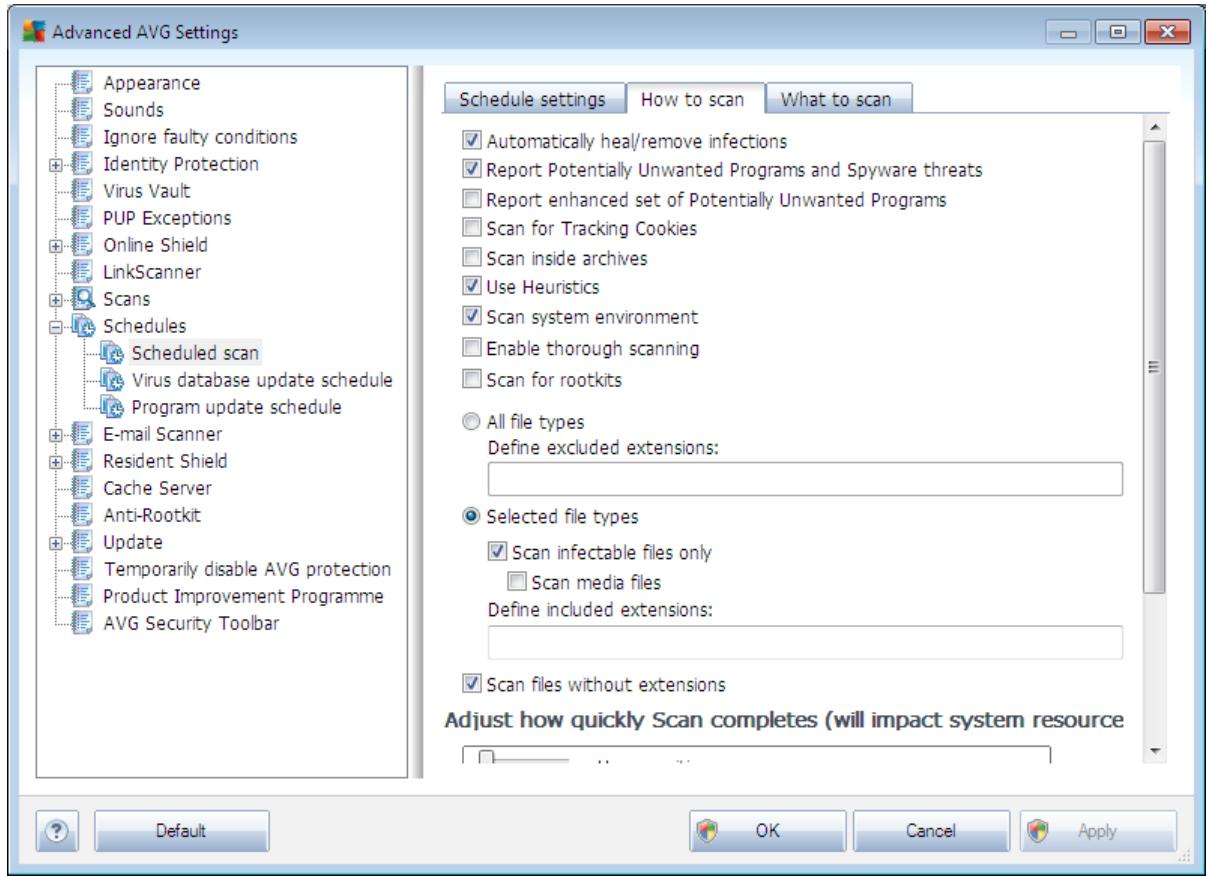
On the How to scan tab you will find a list of scanning parameters that can be optionally switched on/off. By default, most parameters are switched on and the functionality will be applied during scanning. Unless you have a valid reason to change these settings we recommend to keep the predefined configuration:
- Automatically heal/remove infection (on by default): if a virus is identified during scanning it can be healed automatically if a cure is available. If the infected file cannot be healed automatically, the infected object will be moved to the Virus Vault.
- Report Potentially Unwanted Programs and Spyware threats (on by default): check to activate the Anti-Spyware engine, and scan for spyware as well as for viruses. Spyware represents a questionable malware category: even though it usually represents a security risk, some of these programs can be installed intentionally. We recommend to keep this feature activated as it increases your computer security.
-
Report enhanced set of Potentially Unwanted Programs (off by default): mark to detect extended package of spyware: programs that are perfectly ok and harmless when acquired from the manufacturer directly, but can be misused for malicious purposes later. This is an additional measure that increases your computer security even more, however it can possibly block legal programs, and is therefore switched off by default.
-
Scan for Tracking Cookies (off by default): this parameter of the Anti-Spyware component defines that cookies should be detected during scanning; (HTTP cookies are used for authenticating, tracking, and maintaining specific information about users, such as site preferences or the contents of their electronic shopping carts)
- Scan inside archives (off by default): this parameter defines the scanning should check all files even if they are stored inside an archive, e.g. ZIP, RAR, ...
- Use Heuristics (on by default): heuristic analysis (dynamic emulation of the scanned object's instructions in a virtual computer environment) will be one of the methods used for virus detection during scanning;
- Scan system environment (on by default): scanning will also check the system areas of your computer;
- Enable thorough scanning (off by default) - in specific situations (suspicious of your computer being infected) you may check this option to activate the most thorough scanning algorithms that will scan even those areas of your computer that can hardly get infected, just to be absolutely sure. Remember though that this method is rather time consuming.
- Scan for rootkits (off by default): tick this item if you want to include the rootkit detection into scanning of the entire computer. The rootkit detection is also available on its own within the Anti-Rootkit component;
Further you should decide whether you want to have scanned
- All file types with the possibility of defining exceptions from scanning by providing a list of comma separated (having been saved, the commas change into semicolons) file extensions that should not be scanned;
- Selected file types - you can specify that you want to scan only files that are possibly infectable (files that cannot get infected will not be scanned, for instance some plain text files, or some other non-executable files), including media files (video, audio files - if you leave this box unchecked, it will reduce the scanning time even more, because these files are often quite large and are not too likely to be infected by a virus). Again, you can specify by extensions which files are those that should always be scanned.
- Optionally, you can decide you want to Scan files without extension - this option is on by default, and it is recommended that you keep it so unless you have a real reason to change it. Files with no extension are rather suspicious and should be scanned at all times.
Adjust how quickly Scan completes
Within the Adjust how quickly Scan completes section you can further specify the desired scanning speed dependent on system resource usage. By default, this option
is set to the medium level of automatic resource usage. If you want the scanning to run faster, it will take less time but the system resources usage will increase significantly during the scan, and will slow down your other activities on the PC (this option can be used when your computer is switched on but nobody is currently working on it). On the other hand, you can decrease the system resources usage by extending the scanning duration.
Set additional scan reports
Click the Set additional scan reports... link to open a standalone dialog window called Scan reports where you can tick several items to define what scan findings should be reported:
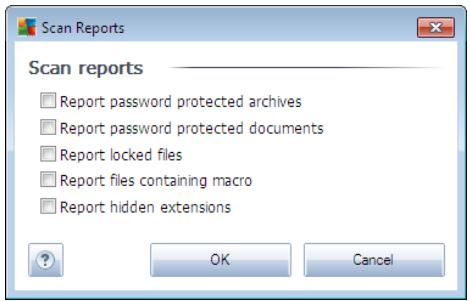
Additional scan settings
Click the Additional scan settings ... to open a new Computer shutdown options dialog where you can decide whether the computer should be shut down automatically once the running scanning process is over. Having confirmed this option (Shutdown computer upon scan completion), a new option activates that allows the computer to shut down even if it is currently locked (Force shutdown if computer is locked).
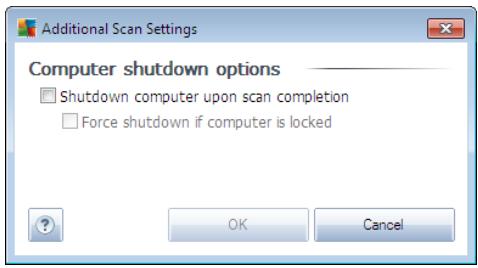
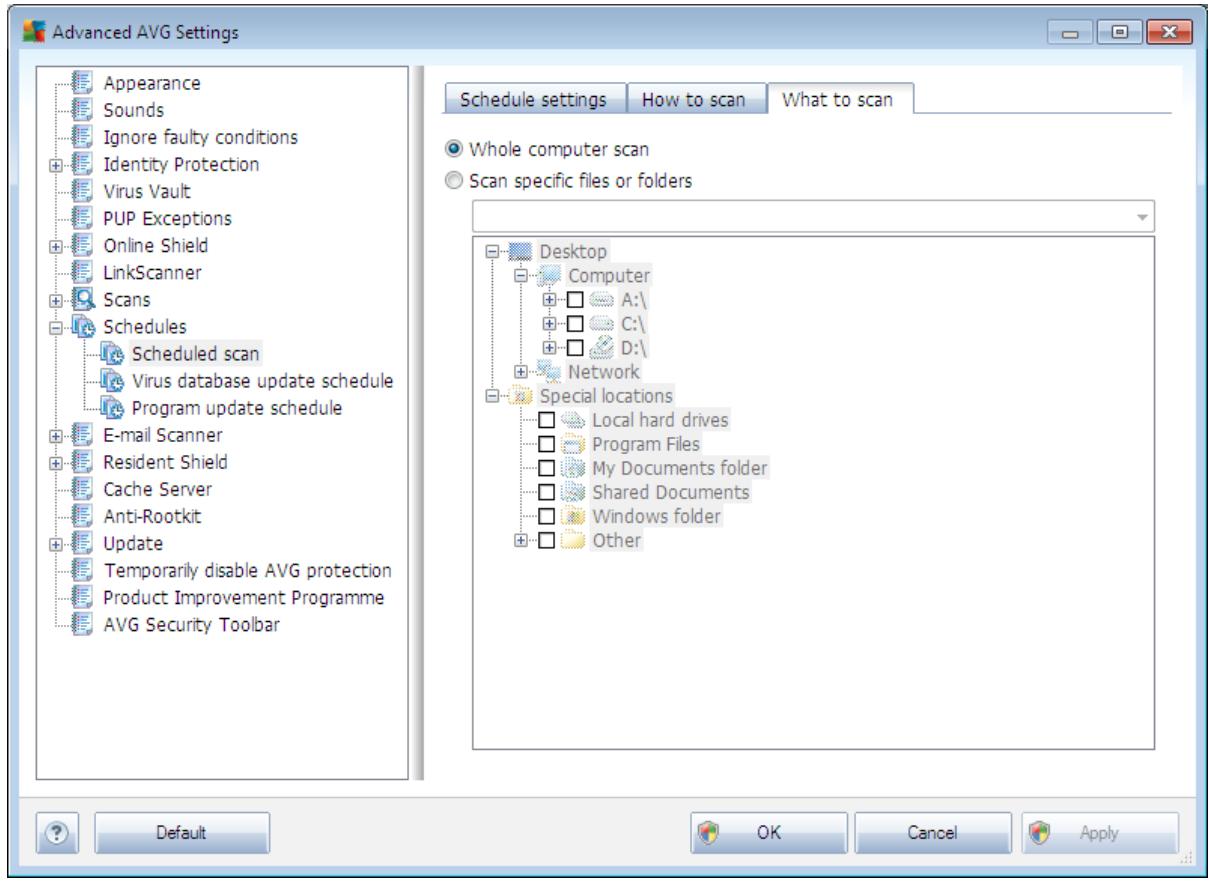
On the What to scan tab you can define whether you want to schedule scanning of the whole computer or scanning of specific files or folders. If you select scanning of specific files or folders, in the bottom part of this dialog the displayed tree structure activates and you can specify the folders to be scanned.
9.9.2. Virus Database Update Schedule
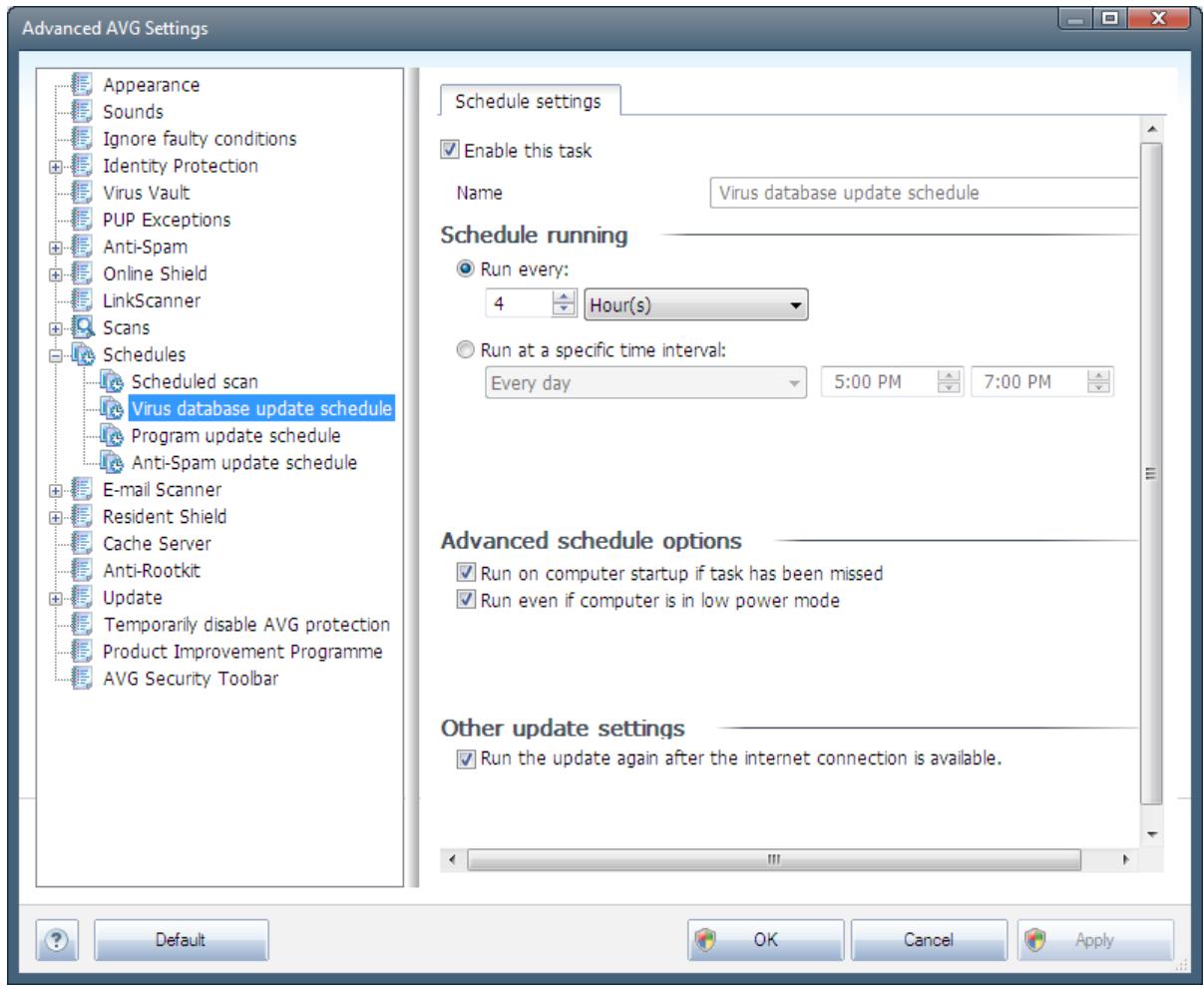
On the Schedule settings tab you can first check/uncheck the Enable this task item to simply deactivate the scheduled virus database update temporarily, and switch it on again as the need arises. The basic virus database update scheduling is covered within the Update Manager component. Within this dialog you can set up some detailed parameters of the virus database update schedule. In the text field called Name (deactivated for all default schedules) there is the name assigned to this very schedule by the program vendor.
Schedule running
In this section, specify the time intervals for the newly scheduled virus database update launch. The timing can either be defined by the repeated update launch after a certain period of time (Run every ...) or by defining an exact date and time (Run at specific time ...).
Advanced schedule options
This section allows you to define under which conditions the virus database update should/should not be launched if the computer is in low power mode or switched off completely.
Other update settings
Finally, check the Run the update again as soon as the Internet connection is available option to make sure than if the internet connection gets corrupted and the update process fails, it will be launched again immediately after the internet connection is restored.
Once the scheduled update is launched in the time you have specified, you will be informed on this fact via a pop-up window opened over the AVG system tray icon ( provided that you have kept the default configuration of the the Advanced Settings/ Appearance dialog).
9.9.3. Program Update Schedule
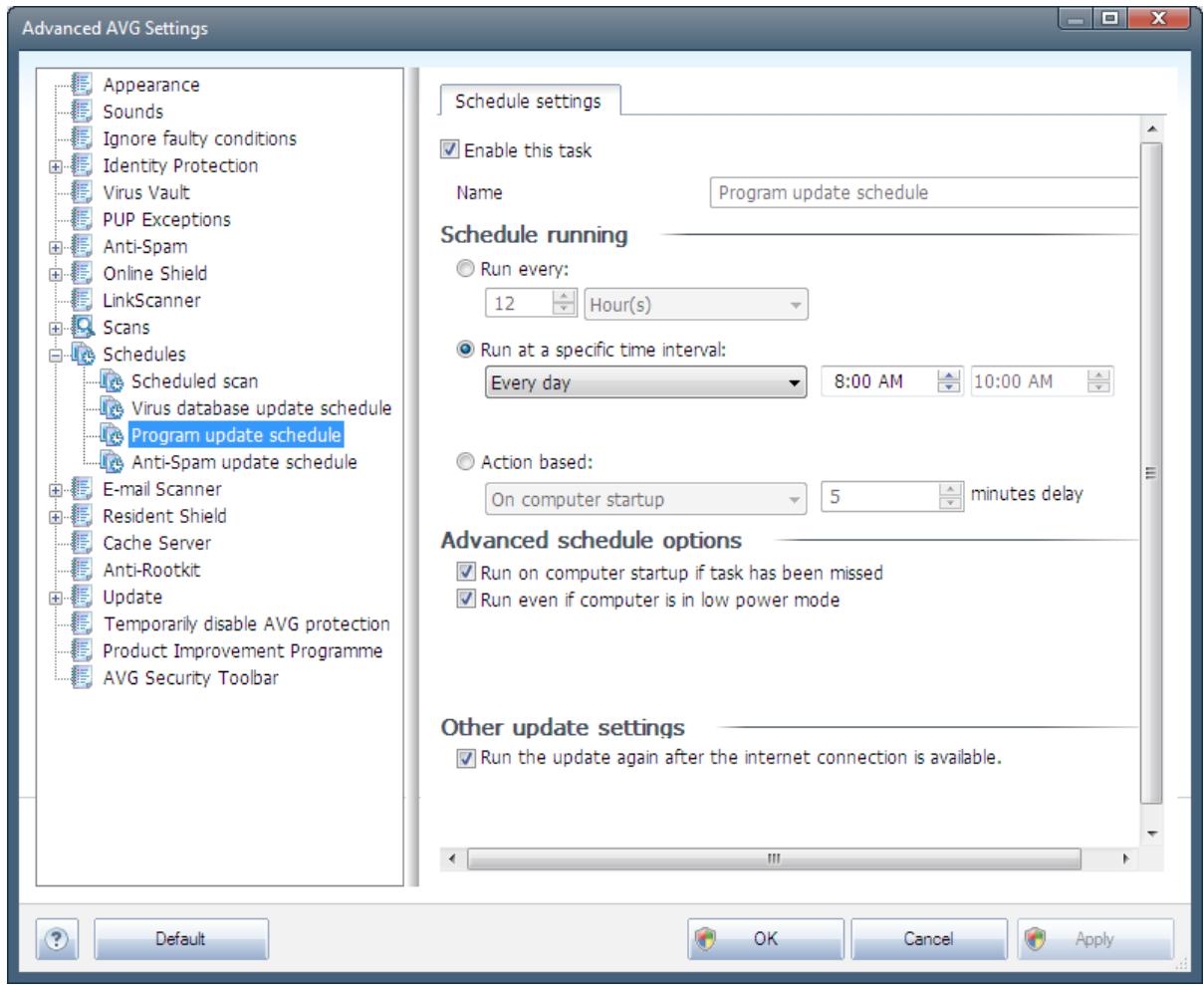
On the Schedule settings tab you can first check/unchecked the Enable this task item to simply deactivate the scheduled program update temporarily, and switch it on again
as the need arises. In the text field called Name (deactivated for all default schedules) there is the name assigned to this very schedule by the program vendor.
Schedule running
Here, specify the time intervals for the newly scheduled program update launch. The timing can either be defined by the repeated update launch after a certain period of time (Run every ...) or by defining an exact date and time (Run at specific time ...), or possibly by defining an event that the update launch should be associated with (Action based on computer startup).
Advanced schedule options
This section allows you to define under which conditions the program update should/ should not be launched if the computer is in low power mode or switched off completely.
Other update settings
Check the Run the update again as soon as the Internet connection is available option to make sure than if the internet connection gets corrupted and the update process fails, it will be launched again immediately after the internet connection is restored.
Once the scheduled update is launched in the time you have specified, you will be informed on this fact via a pop-up window opened over the AVG system tray icon ( provided that you have kept the default configuration of the the Advanced Settings/ Appearance dialog).
Note: If a time coincidence of a scheduled program update and scheduled scan occurs, the update process is of higher priority and the scan will get interrupted.
9.10. E-mail Scanner
The E-mail Scanner dialog is divided into three sections:
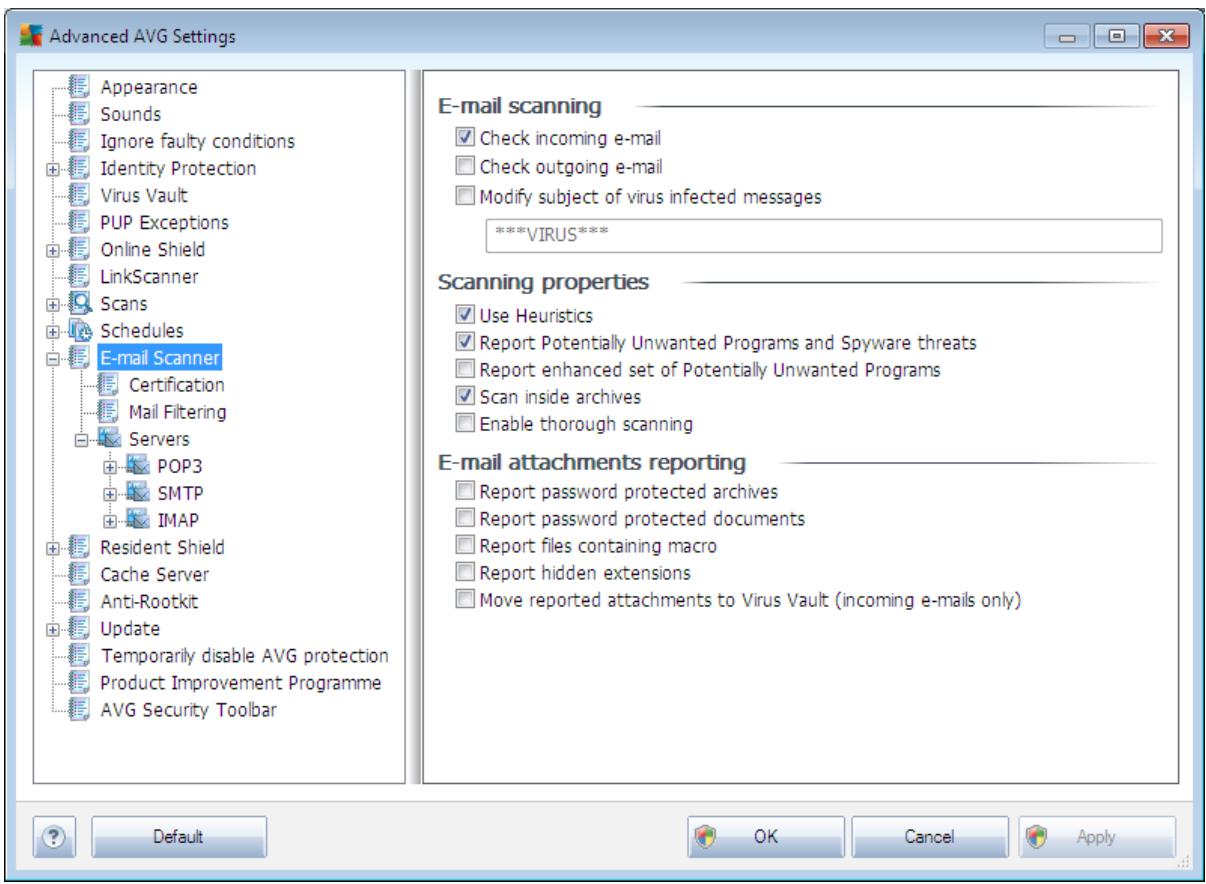
E-mail scanning
In this section, you can set these basics for incoming and/or outgoing e-mail messages:
- Check incoming e-mail (on by default) - mark to switch on/off the option of scanning of all e-mail messages delivered to your e-mail client
- Check outgoing e-mail (off by default) - mark to switch on/off the option of scanning of all e-mails sent from your account
- Modify subject of virus infected messages (off by default) - if you want to be warned the scanned e-mail message was detected as infectious, mark this item and fill in the desired text into the text field. This text will then be added to the "Subject" field for each detected e-mail message for easier identification and filtering. The default value is VIRUS which we recommend to keep.
Scanning properties
In this section, you can specify how the e-mail messages will be scanned:
- Use Heuristics (on by default) - check to use heuristics detection method when scanning e-mail messages. When this option is on, you can filter e-mail attachments not only by extension but also the actual contents of the attachment will be considered. The filtering can be set in the Mail Filtering dialog.
- Report Potentially Unwanted Programs and Spyware threats (on by default) - check to activate the Anti-Spyware engine, and scan for spyware as well as for viruses. Spyware represents a questionable malware category: even though it usually represents a security risk, some of these programs can be installed intentionally. We recommend to keep this feature activated as it increases your computer security.
- Report enhanced set of Potentially Unwanted Programs (off by default) - mark to detect extended package of spyware: programs that are perfectly ok and harmless when acquired from the manufacturer directly, but can be misused for malicious purposes later. This is an additional measure that increases your computer security even more, however it can possibly block legal programs, and is therefore switched off by default.
- Scan inside archives (on by default) - check to scan contents of archives attached to e-mail messages.
- Enable thorough scanning (off by default) - in specific situations (e.g. suspicious of your computer being infected by an virus or exploit) you may check this option to activate the most thorough scanning algorithms that will scan even those areas of your computer that can hardly get infected, just to be absolutely sure. Remember though that this method is rather time consuming.
E-mail attachments reporting
In this section, you can set additional reports about potentially dangerous or suspicious files. Please note that no warning dialog will be displayed, only a certification text will be added to the end of the e-mail message, and all such reports will be listed in the E-mail Scanner detection dialog:
- Report password protected archives – archives (ZIP, RAR etc.) that are protected by password are not possible to scan for viruses; check the box to report these as potentially dangerous.
- Report password protected documents - documents protected by password are not possible to scan for viruses; check the box to report these as potentially dangerous.
- Report files containing macros - a macro is a predefined sequence of steps aimed to make certain tasks easier for a user (MS Word macros are widely known). As such, a macro can contain potentially dangerous instructions, and
you might like to check the box to ensure that files with macros will be reported as suspicious.
- Report hidden extensions - hidden extension can make e.g. a suspicious executable file "something.txt.exe" appear as harmless plain text file "something.txt"; check the box to report these as potentially dangerous.
- Move reported attachments to Virus Vault - specify whether you wish to be notified via e-mail about password protected archives, password protected documents, macro containing files and/or files with hidden extension detected as an attachment of the scanned e-mail message. If such a message is identified during scanning, define whether the detected infectious object should be moved to the Virus Vault.
9.10.1. Certification
In the Certification dialog you can specify the text and language of the certification for both incoming mail and outgoing mail:
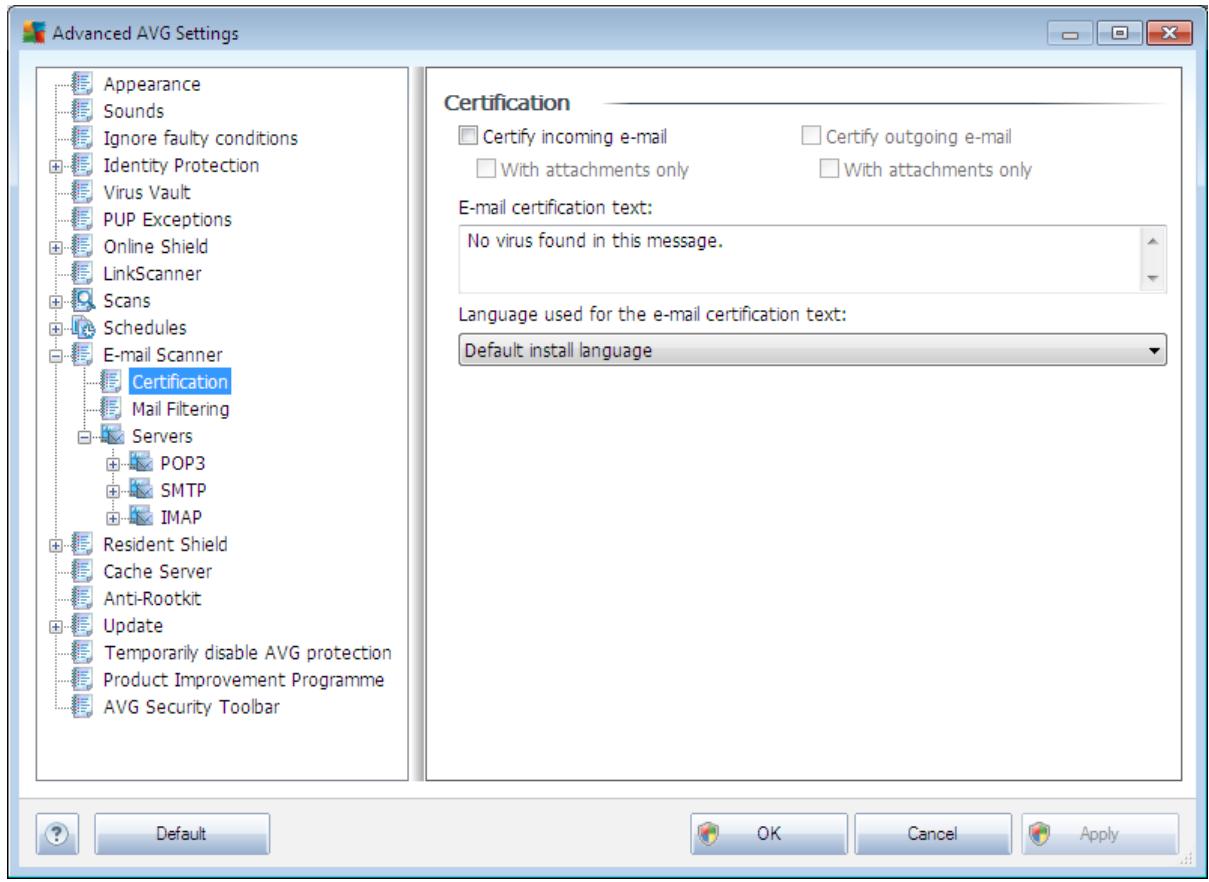
The certification text consists of two parts, user part and system part - see the following example: the first line represents the user part, the rest is generated automatically:
No virus found in this message.
Checked by AVG.
Version: x.y.zz / Virus Database: xx.y.z - Release Date: 12/9/2010
If you decide to use certification of either incoming or outgoing e-mail messages, further in this dialog you can specify the exact wording of the user part of the certification text (E-mail certification text), and chose what language should be used for the automatically generated system part of the certification (Language used for the e-mail certification text).
The Attachment filter dialog allows you to set up parameters for e-mail messages attachment scanning. By default, the Remove attachments option is switched off. If you decide to activate it, all e-mail message attachments detected as infectious or potentially dangerous will be removed automatically. If you want to define specific types of attachments that should be removed, select the respective option:
- Remove all executable files - all *.exe files will be deleted
- Remove all documents - all .doc, .docx, .xls, .xlsx files will be deleted
- Remove files with these comma separated extensions - will remove all files with the defined extensions
9.10.3. Servers
In the Servers section you can edit parameters of the E-mail Scanner component servers, or set up a new server fusing the Add new server button.
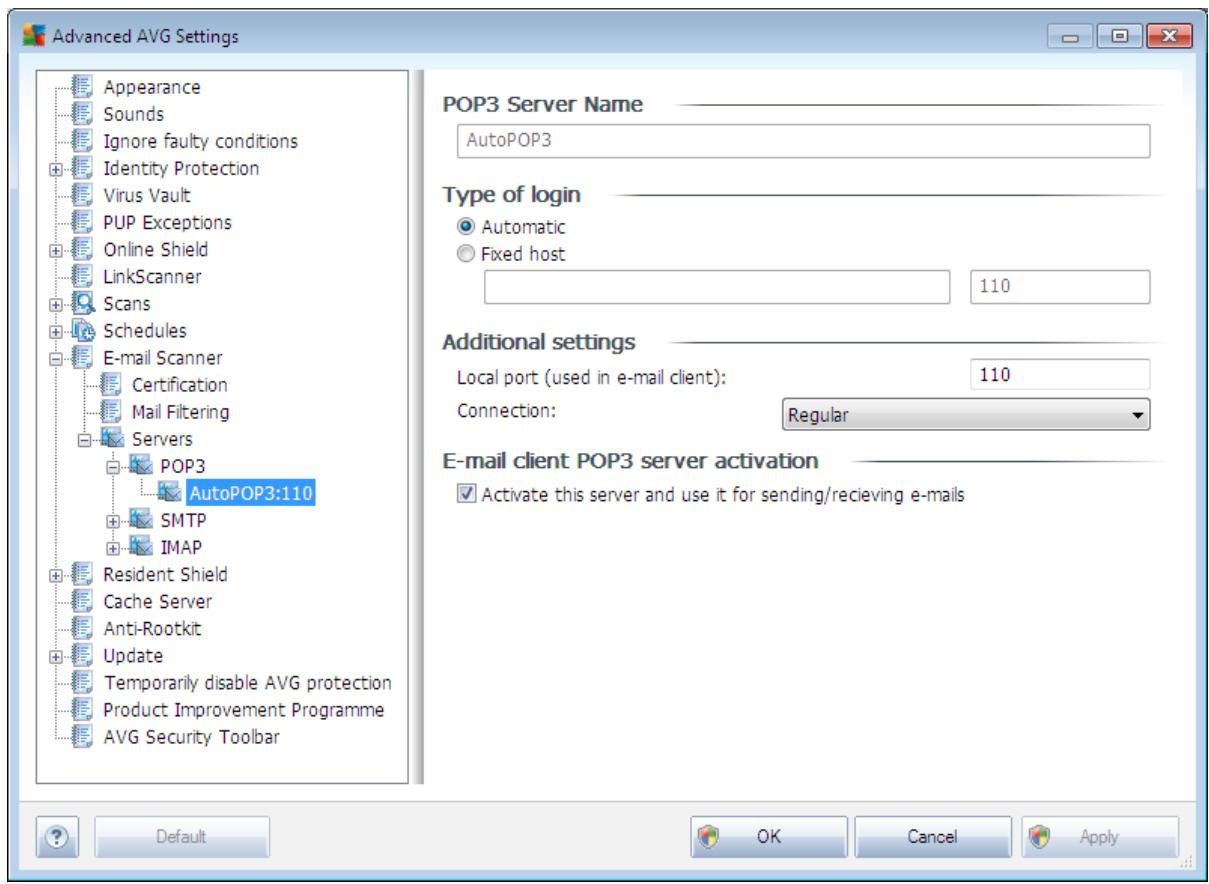
In this dialog (opened via Servers / POP3) you can set up a new E-mail Scanner server using the POP3 protocol for incoming mail:
- POP3 Server Name - in this field you can specify the name of newly added servers (to add a POP3 server, click the right mouse button over the POP3 item of the left navigation menu). For automatically created "AutoPOP3" server this field is deactivated.
-
Type of login - defines the method for determining the mail server used for incoming mail:
-
Automatic - Login will be carried out automatically, according to your e-mail client settings.
- Fixed host - In this case, the program will always use the server specified here. Please specify the address or name of your mail server. The login name remains unchanged. For a name, you may use a domain name (for example, pop.acme.com) as well as an IP address (for
example, 123.45.67.89). If the mail server uses a non-standard port, you can specify this port after the server name by using a colon as the delimiter (for example, pop.acme.com:8200). The standard port for POP3 communication is 143.
Additional settings - specifies more detailed parameters:
- Local port - specifies the port on which the communication from your mail application should be expected. You must then specify in your mail application this port as the port for POP3 communication.
-
Connection - in the drop-down menu, you can specify which kind of connection to use (regular/SSL/SSL default). If you choose SSL connection, the data sent is encrypted without the risk of being traced or monitored by a third party. This feature is also only available when the destination mail server supports it.
-
E-mail client POP3 server activation - check/uncheck this item to activate or deactivate the specified POP3 server
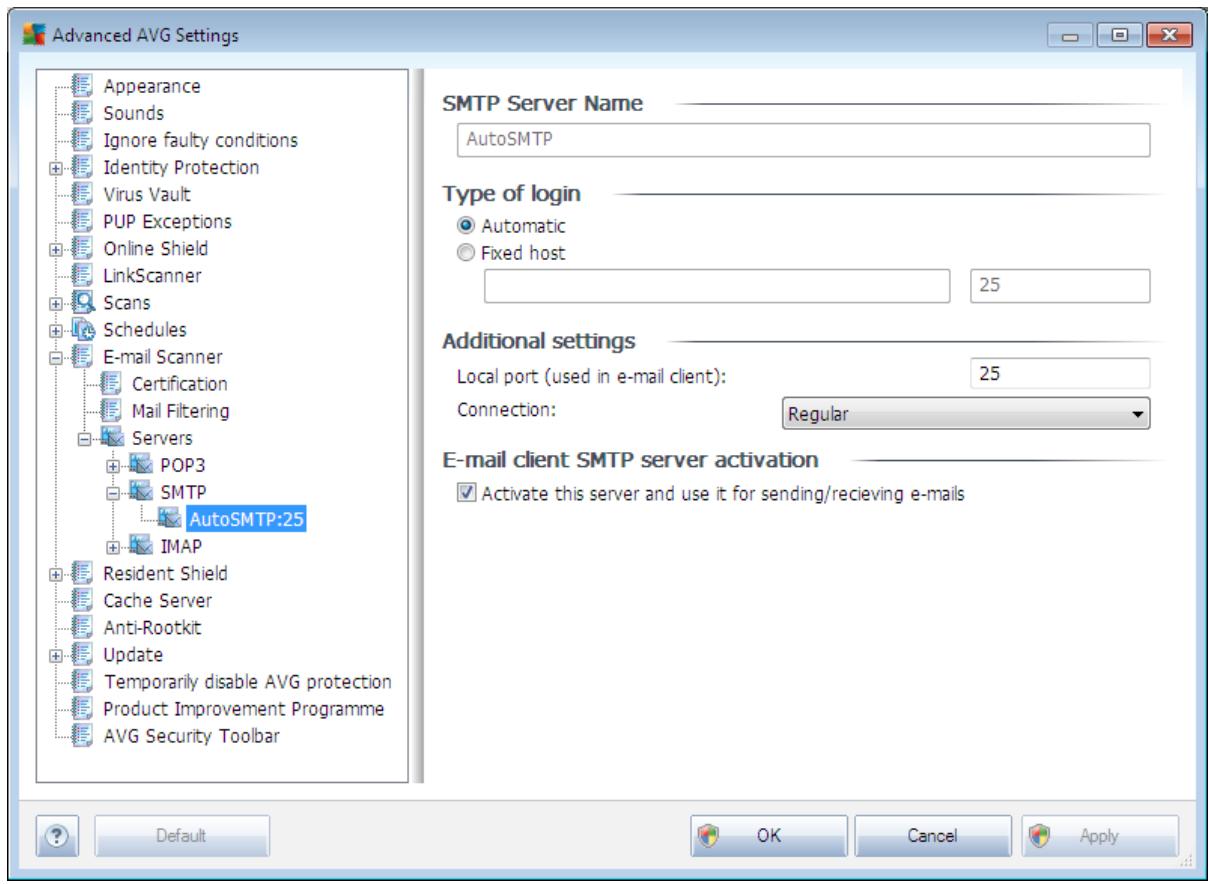
In this dialog (opened via Servers / SMTP) you can set up a new E-mail Scanner server using the SMTP protocol for outgoing mail:
- SMTP Server Name - in this field you can specify the name of newly added servers (to add a SMTP server, click the right mouse button over the SMTP item of the left navigation menu). For automatically created "AutoSMTP" server this field is deactivated.
- Type of login - defines the method for determining the mail server used for outgoing mail:
○ Automatic - login will be carried out automatically, according to your e-mail client settings
- Fixed host - in this case, the program will always use the server specified here. Please specify the address or name of your mail server. You may use a domain name (for example, smtp.acme.com) as well as an IP address (for example, 123.45.67.89) for a name. If the mail server uses a non-standard port, you can type this port behind the server name using a colon as the delimiter (for example, smtp.acme.com:8200). The standard port for SMTP communication is 25.
Additional settings - specifies more detailed parameters:
- Local port - specifies the port on which the communication from your mail application should be expected. You must then specify in your mail application this port as the port for SMTP communication.
-
Connection - in this drop-down menu, you can specify which kind of connection to use (regular/SSL/SSL default). If you choose SSL connection, the data sent is encrypted without the risk of being traced or monitored by a third party. This feature is available only when the destination mail server supports it.
-
E-mail client SMTP server activation - check/uncheck this box to activate/deactivate the above specified SMTP server
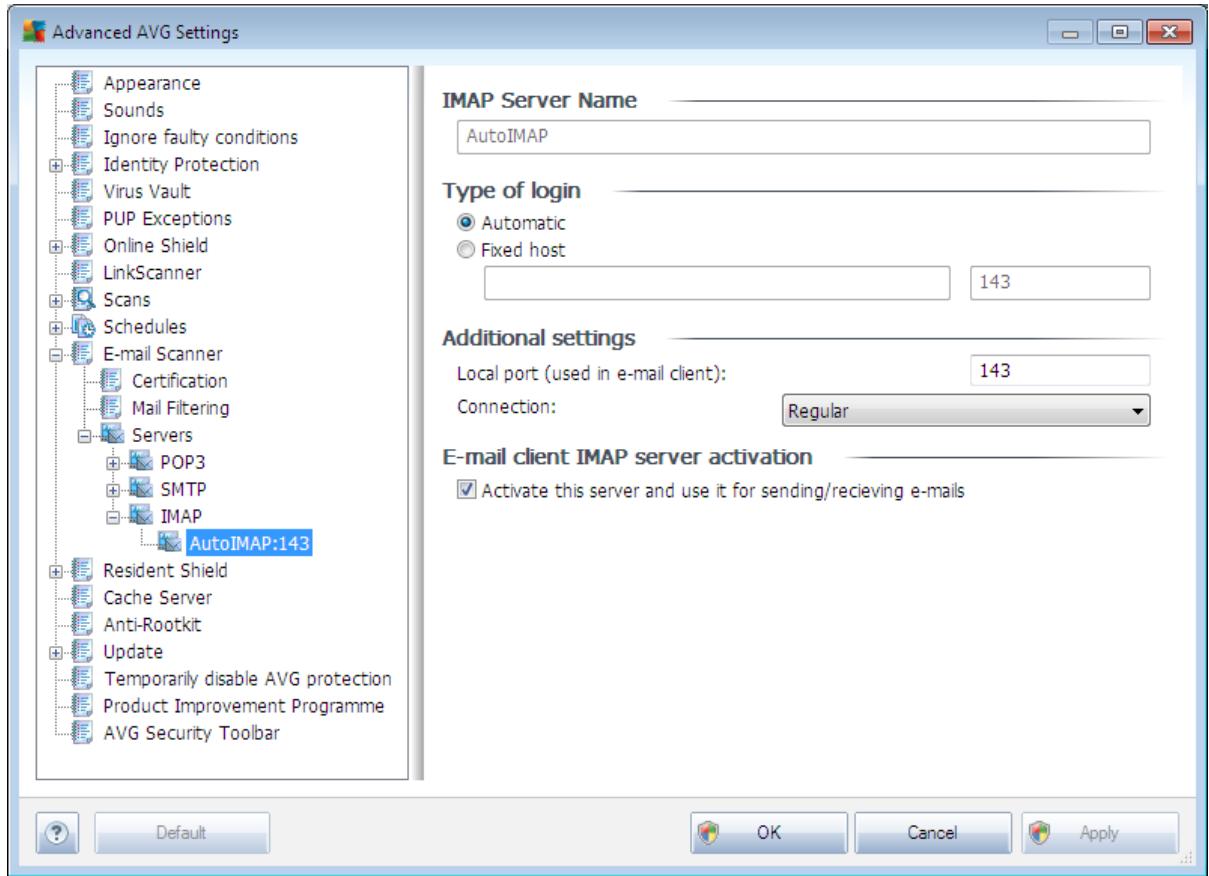
In this dialog (opened via Servers / IMAP) you can set up a new E-mail Scanner server using the IMAP protocol for outgoing mail:
- IMAP Server Name - in this field you can specify the name of newly added servers (to add a IMAP server, click the right mouse button over the IMAP item of the left navigation menu). For automatically created "AutoIMAP" server this field is deactivated.
-
Type of login - defines the method for determining the mail server used for outgoing mail:
-
Automatic - login will be carried out automatically, according to your e-mail client settings
- Fixed host - in this case, the program will always use the server specified here. Please specify the address or name of your mail server. You may use a domain name (for example,smtp.acme.com) as well as an IP address (for example, 123.45.67.89) for a name. If the mail server uses a non-standard port, you can type this port behind the server name using a colon as the delimiter (for example,imap.acme.com:8200). The standard port for SMTP communication is 25.
Additional settings - specifies more detailed parameters:
- Local port - specifies the port on which the communication from your mail application should be expected. You must then specify in your mail application this port as the port for IMAP communication.
-
Connection - in this drop-down menu, you can specify which kind of connection to use (regular/SSL/SSL default). If you choose SSL connection, the data sent is encrypted without the risk of being traced or monitored by a third party. This feature is available only when the destination mail server supports it.
-
E-mail client IMAP server activation - check/uncheck this box to activate/deactivate the above specified IMAP server
9.11. Resident Shield
The Resident Shield component performs live protection of files and folders against viruses, spyware and other malware.
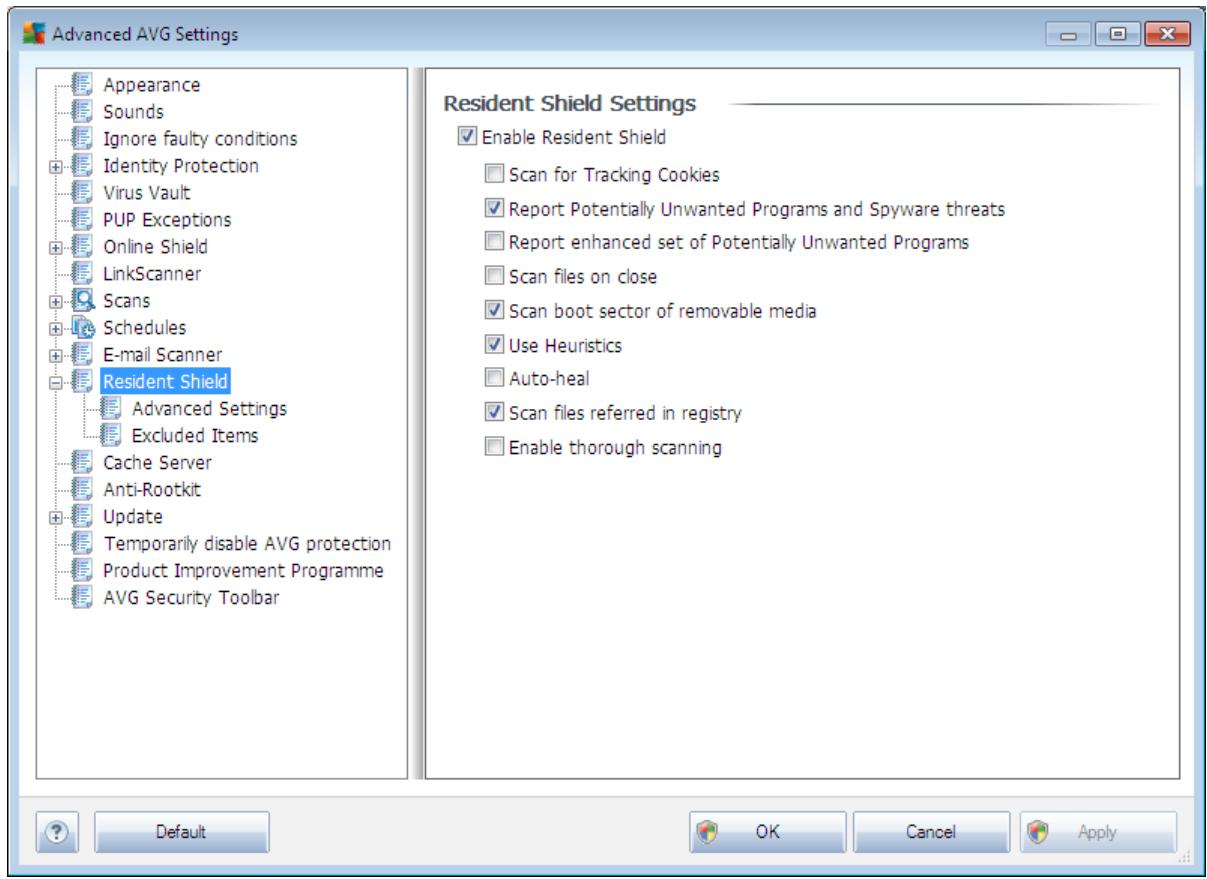
In the Resident Shield Settings dialog you can activate or deactivate the Resident Shield protection completely by checking/unchecking the Enable Resident Shield item (this option is switched on by default). In addition you can select which Resident Shield features should be activated:
- Scan for Tracking cookies (off by default) - this parameter defines that cookies should be detected during scanning. (HTTP cookies are used for
authenticating, tracking, and maintaining specific information about users, such as site preferences or the contents of their electronic shopping carts)
- Report Potentially Unwanted Programs and Spyware threats - (on by default): check to activate the Anti-Spyware engine, and scan for spyware as well as for viruses. Spyware represents a questionable malware category: even though it usually represents a security risk, some of these programs can be installed intentionally. We recommend to keep this feature activated as it increases your computer security.
- Report enhanced set of Potentially Unwanted Programs (off by default) - mark to detect extended package of spyware: programs that are perfectly ok and harmless when acquired from the manufacturer directly, but can be misused for malicious purposes later. This is an additional measure that increases your computer security even more, however it can possibly block legal programs, and is therefore switched off by default.
- Scan files on close (off by default) - on-close scanning ensures that AVG scans active objects (e.g. applications, documents ...) when they are being opened, and also when they are being closed; this feature helps you protect your computer against some types of sophisticated virus
- Scan boot sector of removable media (on by default)
- Use Heuristics - (on by default) heuristic analysis will be used for detection (dynamic emulation of the scanned object's instructions in a virtual computer environment)
- Auto-heat (off by default) - any detected infection will be healed automatically if there is a cure available, and all infection that cannot be cured will be removed.
- Scan files referred in registry (on by default) - this parameter defines that AVG will scan all executable files added to startup registry to avoid a known infection being executed upon next computer startup.
- Enable thorough scanning (off by default) - in specific situations (in a state of extreme emergency) you may check this option to activate the most thorough algorithms that will check all possibly threatening objects into the deep. Remember though that this method is rather time consuming.
9.11.1. Advanced Settings
In the Files scanned by the Resident Shield dialog it is possible to configure which files will be scanned (by specific extensions):
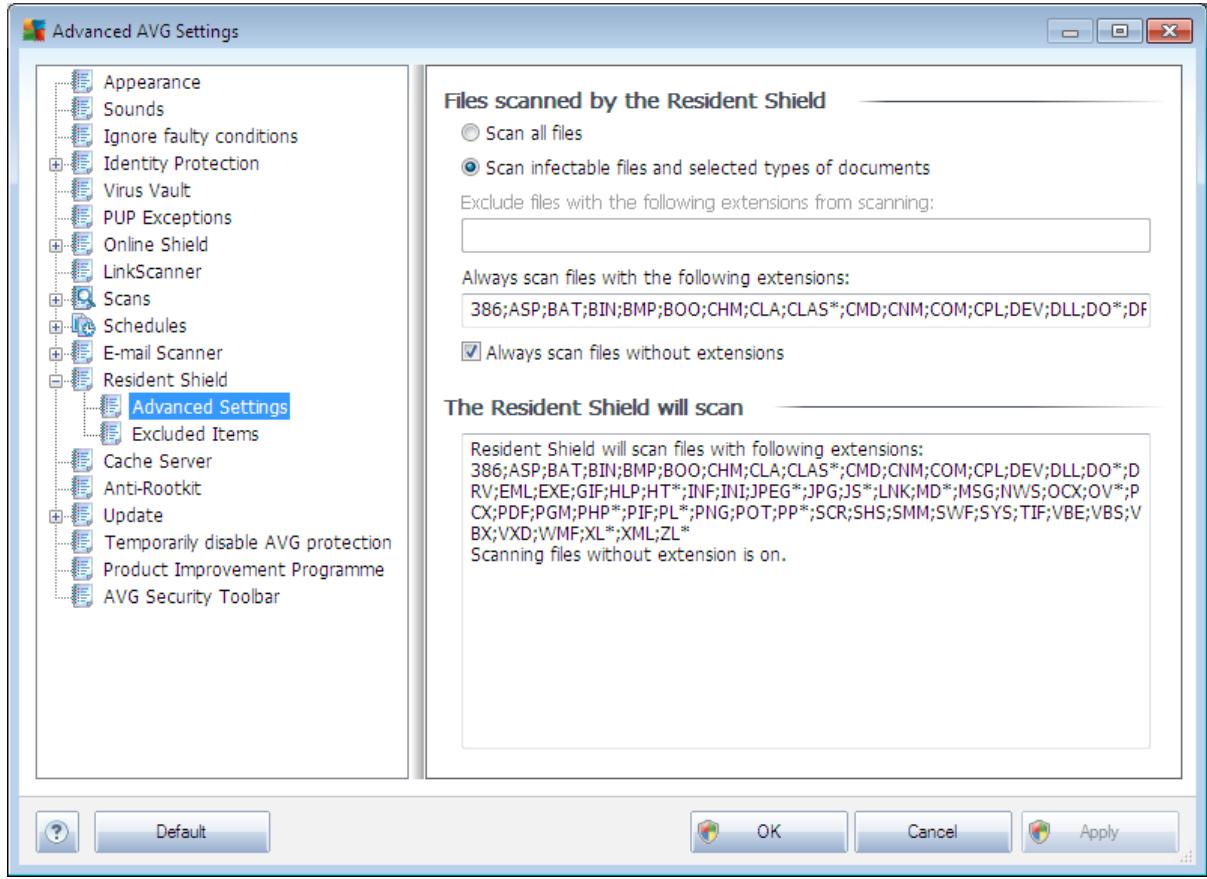
Decide whether you want all files to be scanned or just infectable files - if so, you can further specify a list of extensions defining files that should be excluded from scanning, and also a list of file extensions defining files that must be scanned under all circumstances.
The below section called The Resident Shield will scan further summarizes the current settings, displaying a detailed overview of what the Resident Shield will actually scan.
9.11.2. Excluded items
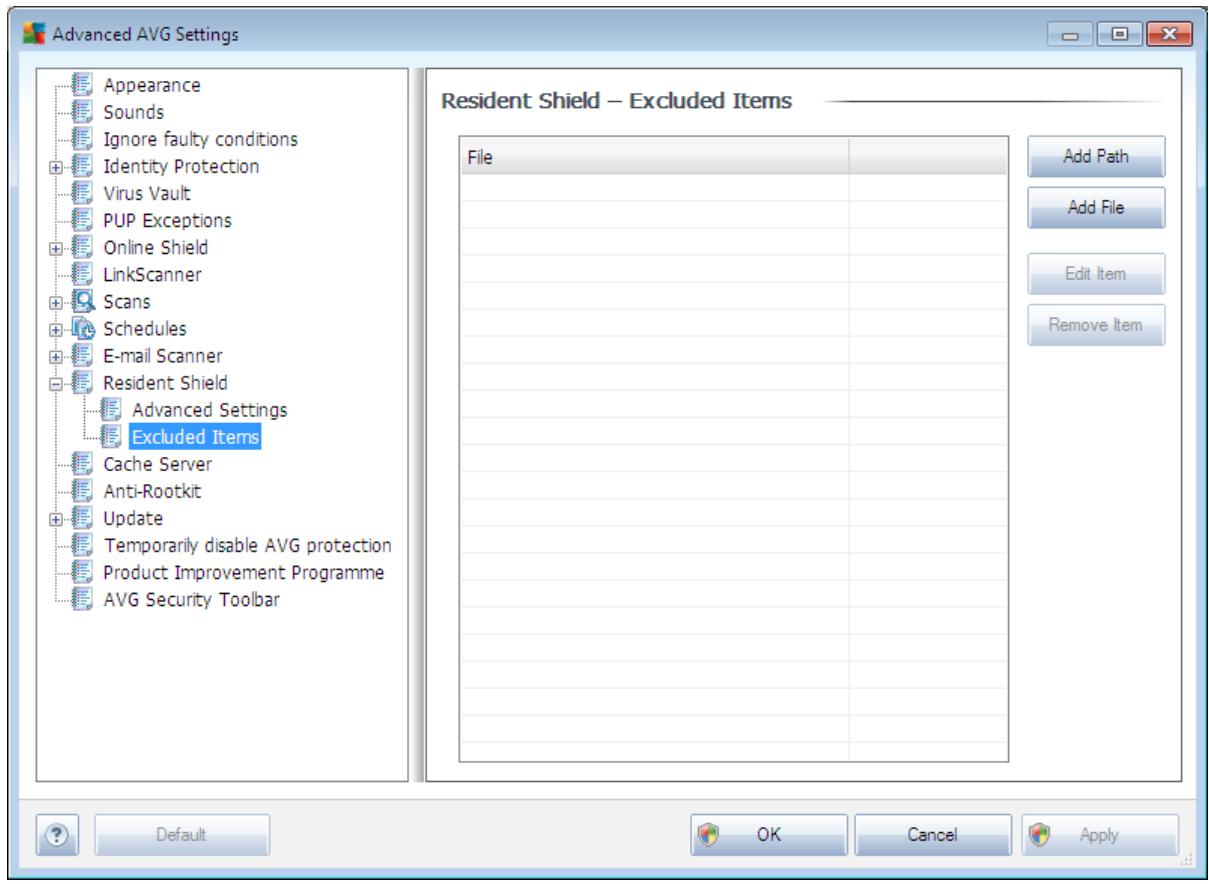
The Resident Shield - Excluded Items dialog offers the possibility of defining files and/or folders that should be excluded from the Resident Shield scanning.
If this is not essential, we strongly recommend not excluding any items!
The dialog provides the following control buttons:
- Add Path - specify a directory (directories) to be excluded from the scanning by selecting them one by one from the local disk navigation tree
- Add File - specify files to be excluded from the scanning by selecting them one by one from the local disk navigation tree
- Edit Item - allows you to edit the specified path to a selected file or folder
- Remove Item - allows you to delete the path to a selected item from the list
9.12. Cache Server
The Cache Server is a process designed to speed up any scan (on-demand scan, scheduled whole computer scan, Resident Shield scan). It gathers and keeps information of trustworthy files (system files with digital signature etc.): These files
are then considered safe, and during scanning are skipped.
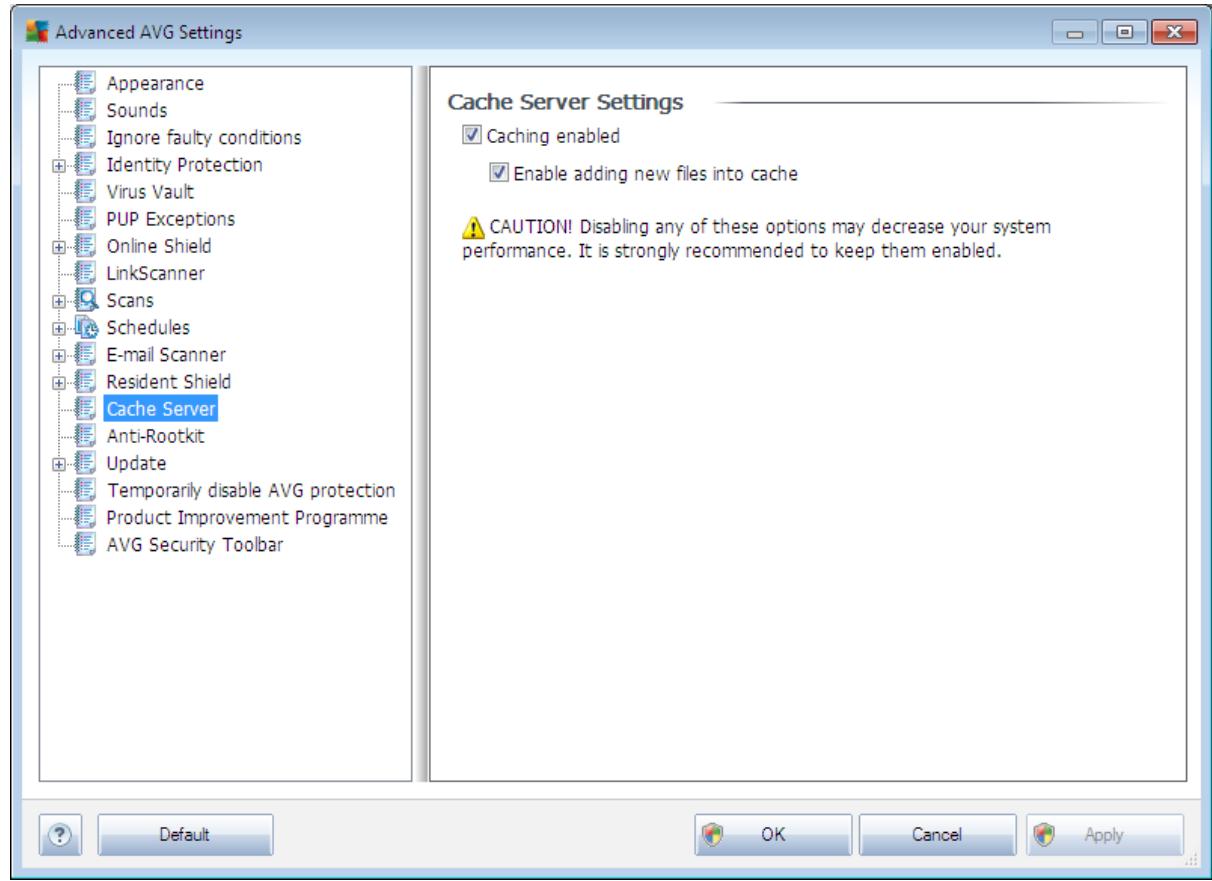
The settings dialog offers two options:
- Caching enabled (on by default) - uncheck the box to switch off the Cache Server, and empty the cache memory. Please note that scanning might slow down, and overall performance of your computer decrease, as every single file in use will be scanned for viruses and spyware first.
- Enable adding new files into cache (on by default) - uncheck the box to stop adding more files into the cache memory. Any already cached files will be kept and used until caching is turned off completely, or until the next update of the virus database.
9.13. Anti-Rootkit
In this dialog you can edit the Anti-Rootkit component's configuration:
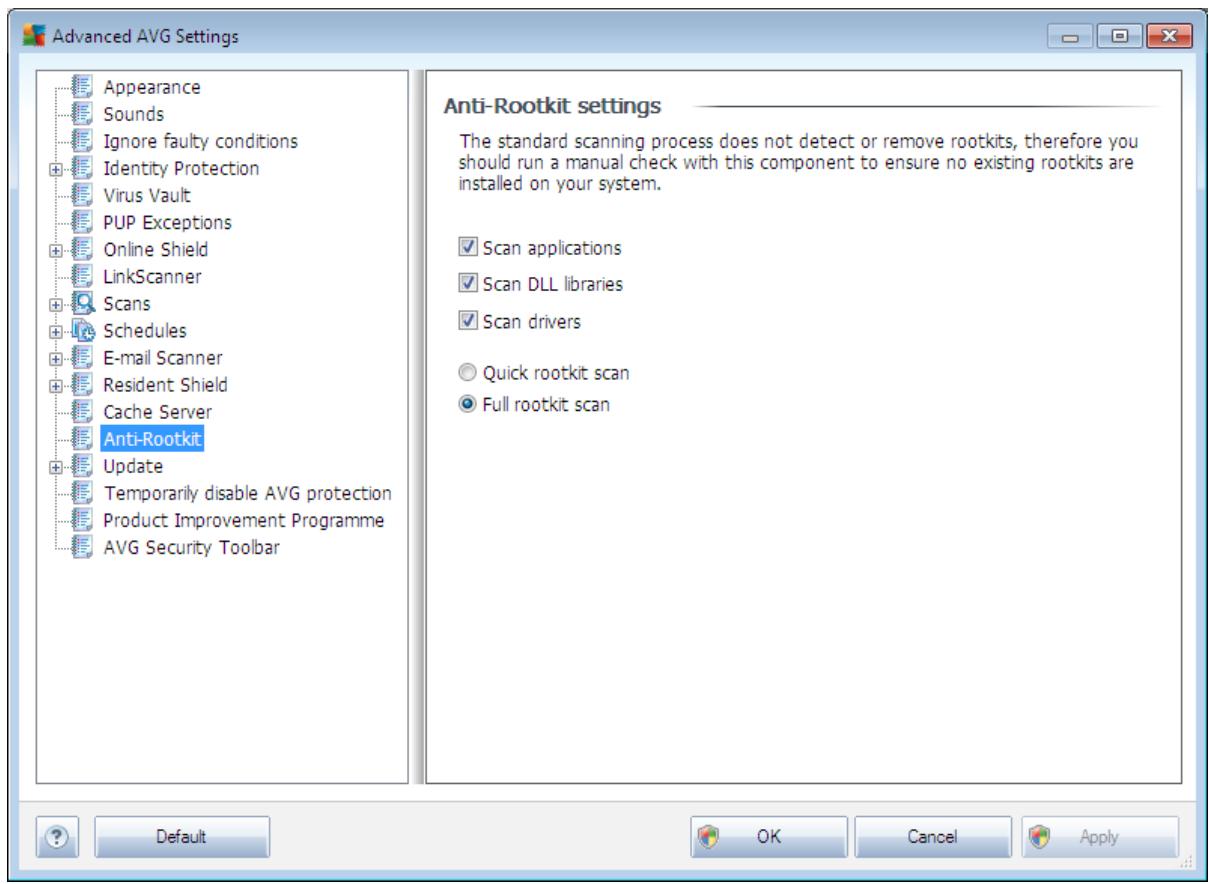
Editing of all functions of the Anti-Rootkit component as provided within this dialog is also accessible directly from the Anti-Rootkit component's interface.
Mark up the respective check-boxes to specify objects that should be scanned:
- Scan applications
- Scan DLL libraries
- Scan drivers
Further you can pick the rootkit scanning mode:
- Quick rootkit scan - scans all running processes, loaded drivers and the system folder (typically c:\Windows)
- Full rootkit scan - scans all running processes, loaded drivers, the system folder (typically c:\Windows), plus all local disks (including the flash disk, but excluding floppy disk/CD drives)
9.14. Update
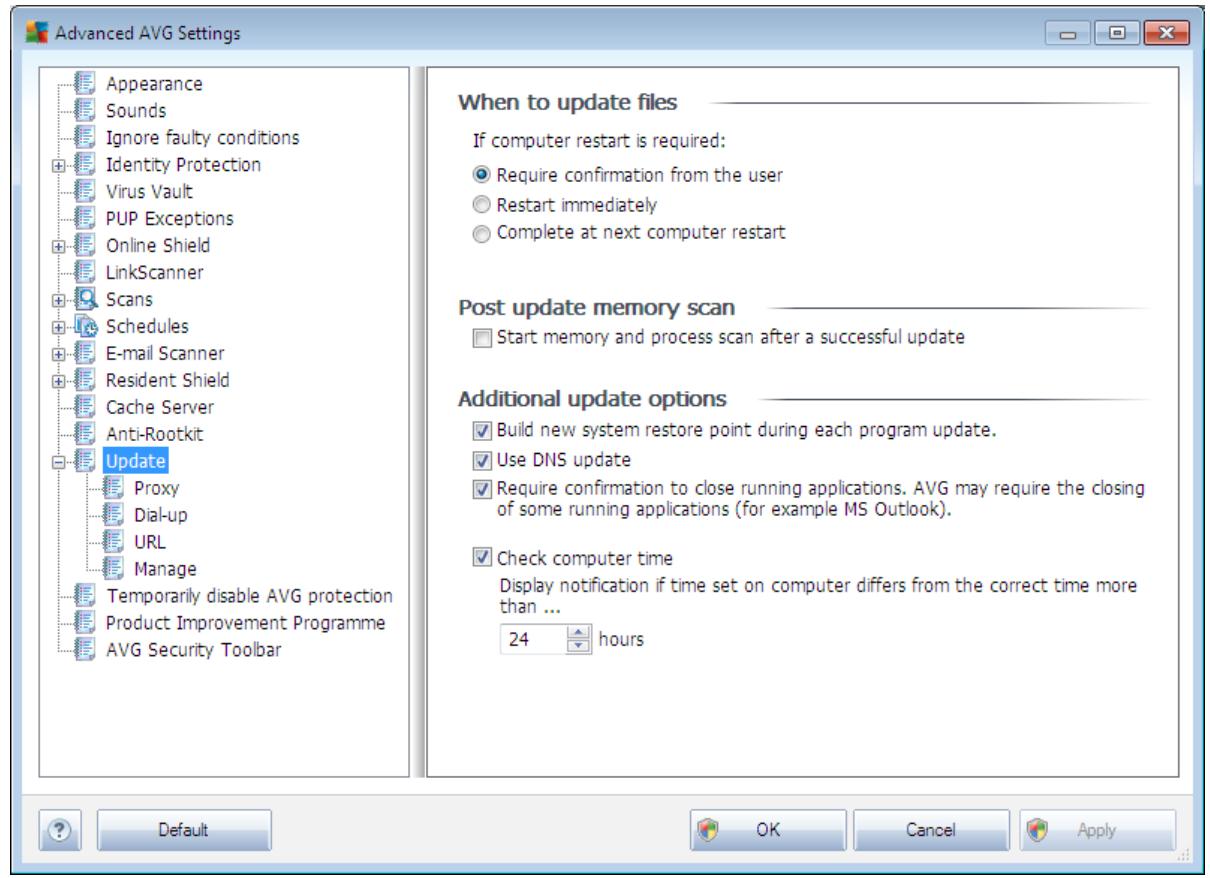
The Update navigation item opens a new dialog where you can specify general parameters regarding the AVG update:
When to update files
In this section you can select between two alternative options: update can be scheduled for the next PC restart or you can launch the update immediately. By default, the immediate update option is selected since this way AVG can secure the maximum safety level. Scheduling an update for the next PC restart can only be recommended if you are sure the computer gets restarted regularly, at least daily.
If you decide to keep the default configuration and launch the update process immediately, you can specify the circumstances under which a possible required restart should be performed:
- Require confirmation from the user - you will be asked to approve a PC restart needed to finalize the update process
-
Restart immediately - the computer will be restarted automatically immediately after the update process has finished, and your approval will not be required
-
Complete at next computer restart - the update process finalization will be postponed until the next computer restart - again, please keep in mind that this option is only recommended if you can be sure the computer gets restarted regularly, at least daily
Post update memory scan
Mark this check box to define you want to launch a new memory scan after each successfully completed update. The latest downloaded update might have contained new virus definitions, and these could be applied in the scanning immediately.
Additional update options
-
Build new system restore point during each program update - before each AVG program update launch, a system restore point is created. In case the update process fails and your operating system crashes you can always restore your OS in its original configuration from this point. This option is accessible via Start / All Programs / Accessories / System tools / System Restore, but any changes can be recommended to experienced users only! Keep this check-box ticked if you want to make use of this functionality.
-
Use DNS update (on by default) - with this item marked, once the update is launched, your AVG Anti-Virus 2011 looks up the information about the latest virus database version and the latest program version on the DNS server. Then only the smallest indispensably required update files are downloaded, and applied. This way the total amount of data downloaded is minimized, and the update process runs faster.
- Require confirmation to close running applications (switched on by default) will help you make sure no currently running applications will be closed without your permission - if required for the update process to be finalized;
- Check computer time - mark this option to declare you wish to have notification displayed in case the computer time differs from the correct time more than specified number of hours.
9.14.1. Proxy
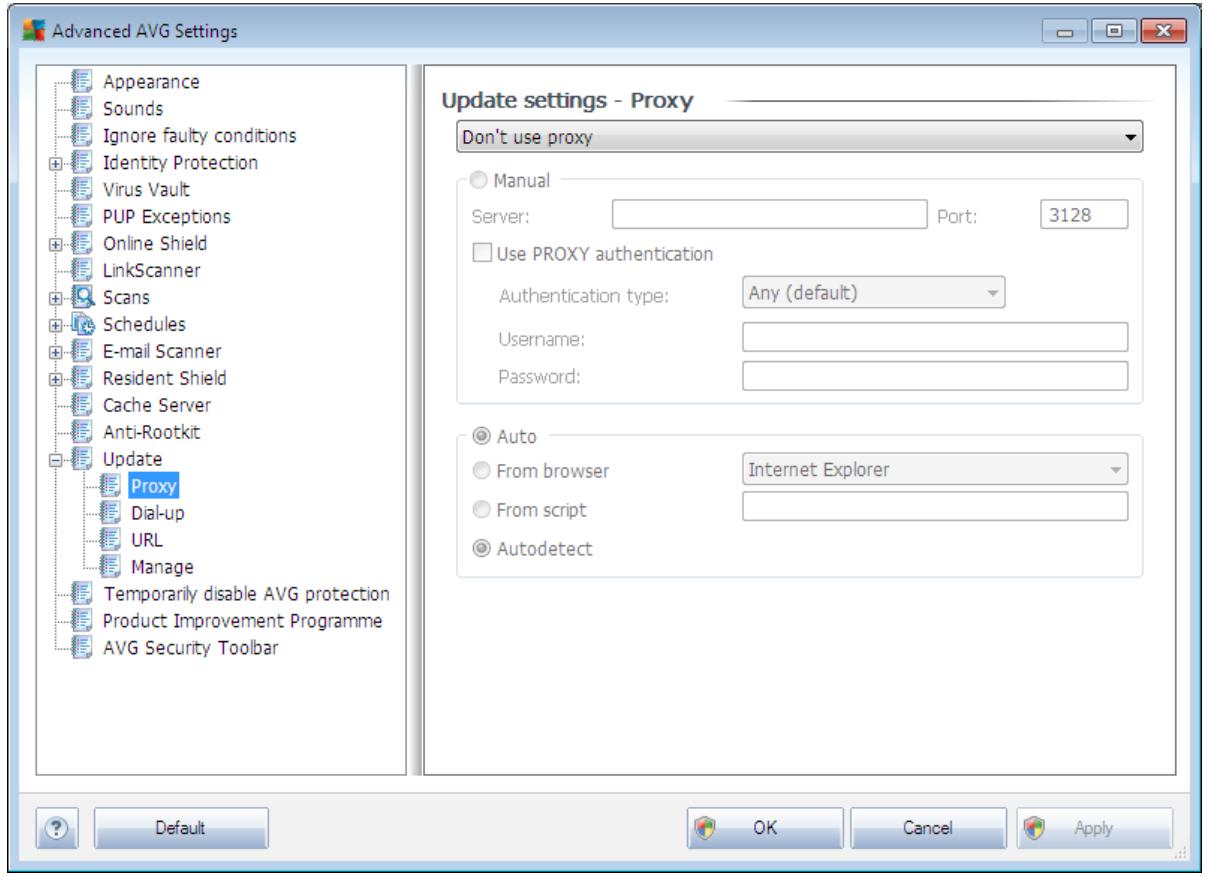
The proxy server is a stand-alone server or a service running on a PC that guarantees safer connection to the Internet. According to the specified network rules you can then access the Internet either directly or via the proxy server; both possibilities can also be allowed at the same time. Then, in the first item of the Update settings - Proxy dialog you have to select from the combo box menu whether you want to:
Use proxy
- Do not use proxy server - default settings
- Try connection using proxy and if it fails, connect directly
If you select any option using proxy server, you will have to specify some further data. The server settings can be configured either manually or automatically.
Manual configuration
If you select manual configuration (check the Manual option to activate the respective dialog section) you have to specify the following items:
-
Server - specify the server's IP address or the name of the server
-
Port - specify the number of the port that enables Internet access (by default, this number is set to 3128 but can be set differently - if you are not sure, contact your network administrator)
The proxy server can also have configured specific rules for each user. If your proxy server is set up this way, check the Use Proxy authentication option to verify that your user name and password are valid for connecting to the Internet via the proxy server.
Automatic configuration
If you select automatic configuration (mark the Auto option to activate the respective dialog section) then please select where the proxy configuration should be taken from:
- From browser - the configuration will be read from your default internet browser
- From script - the configuration will be read from a downloaded script with the function returning the proxy address
- Autodetect - the configuration will be detected automatically directly from the proxy server
9.14.2. Dial-up
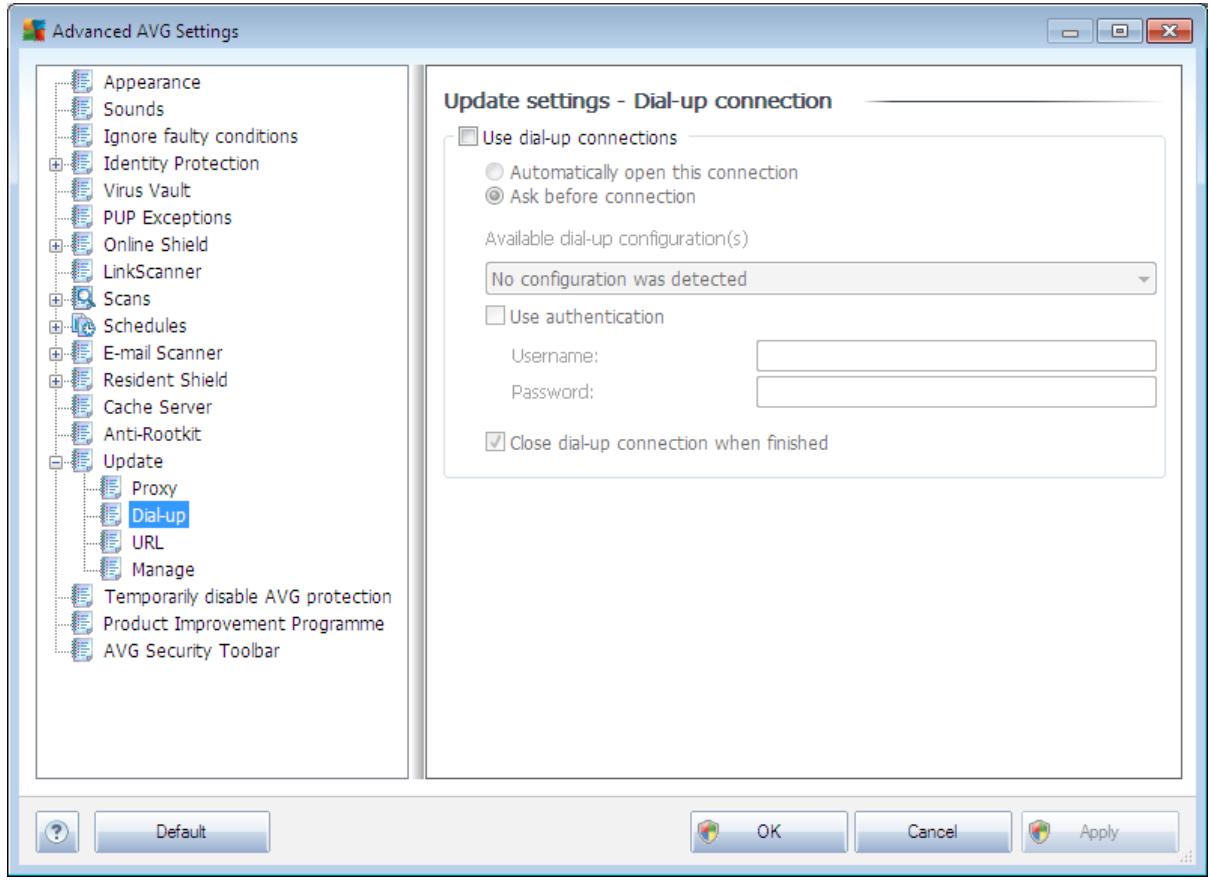
All parameters optionally defined in the Update settings - Dial-Up connection dialog refer to the dial-up connection to the Internet. The dialog's fields are inactive until you check the Use dial-up connections option that activates the fields.
Specify whether you want to connect to the Internet automatically (Automatically open this connection) or you wish to confirm the connection manually every time (Ask before connection). For automatic connection you should further select whether the connection should be closed after the update is finished (Close dial-up connection when finished).
9.14.3. URL
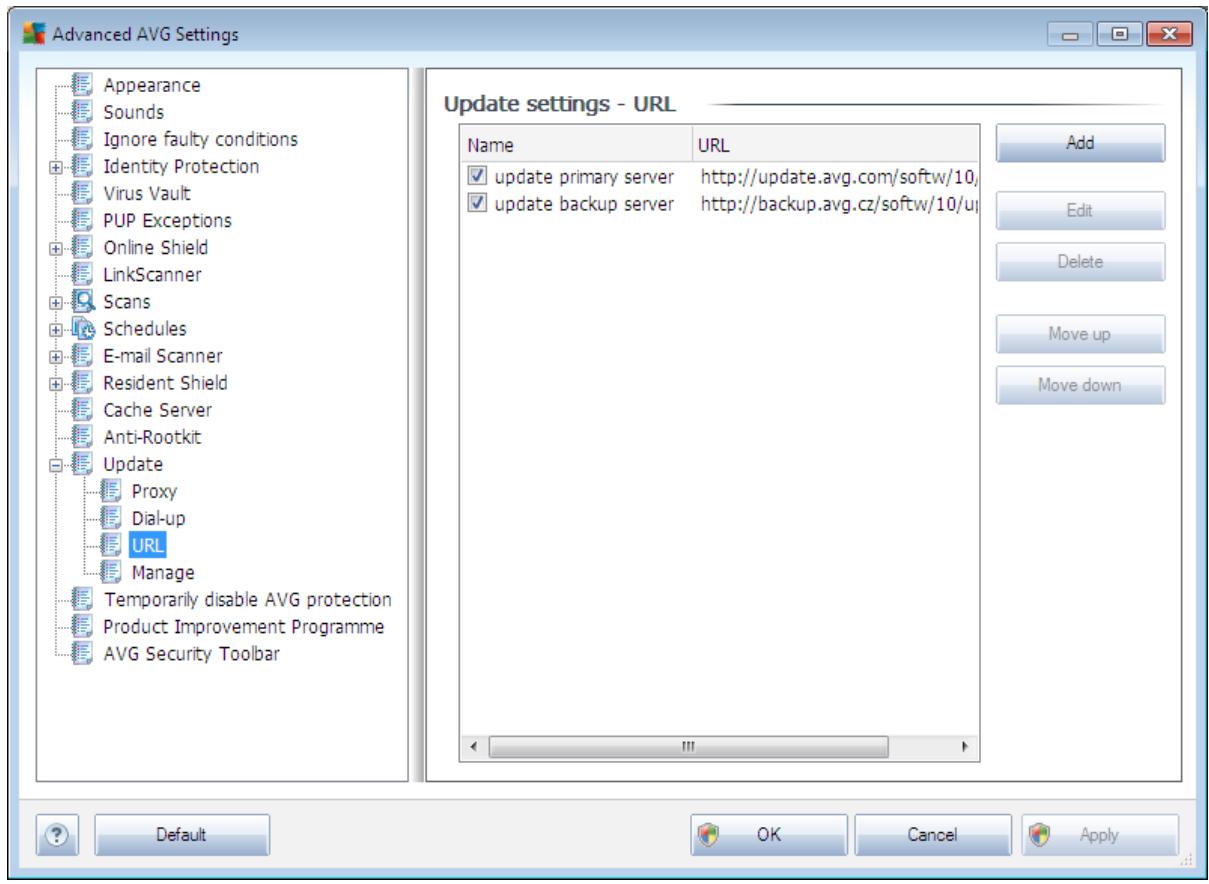
The URL dialog offers a list of Internet addresses from which the update files can be downloaded. The list and its items can be modified using the following control buttons:
- Add - opens a dialog where you can specify a new URL to be added to the list
- Edit - opens a dialog where you can edit the selected URL parameters
- Delete - deletes the selected URL from the list
- Move Up - moves the selected URL one position up in the list
- Move Down - moves the selected URL one position down in the list
9.14.4. Manage
The Manage dialog offers two options accessible via two buttons:
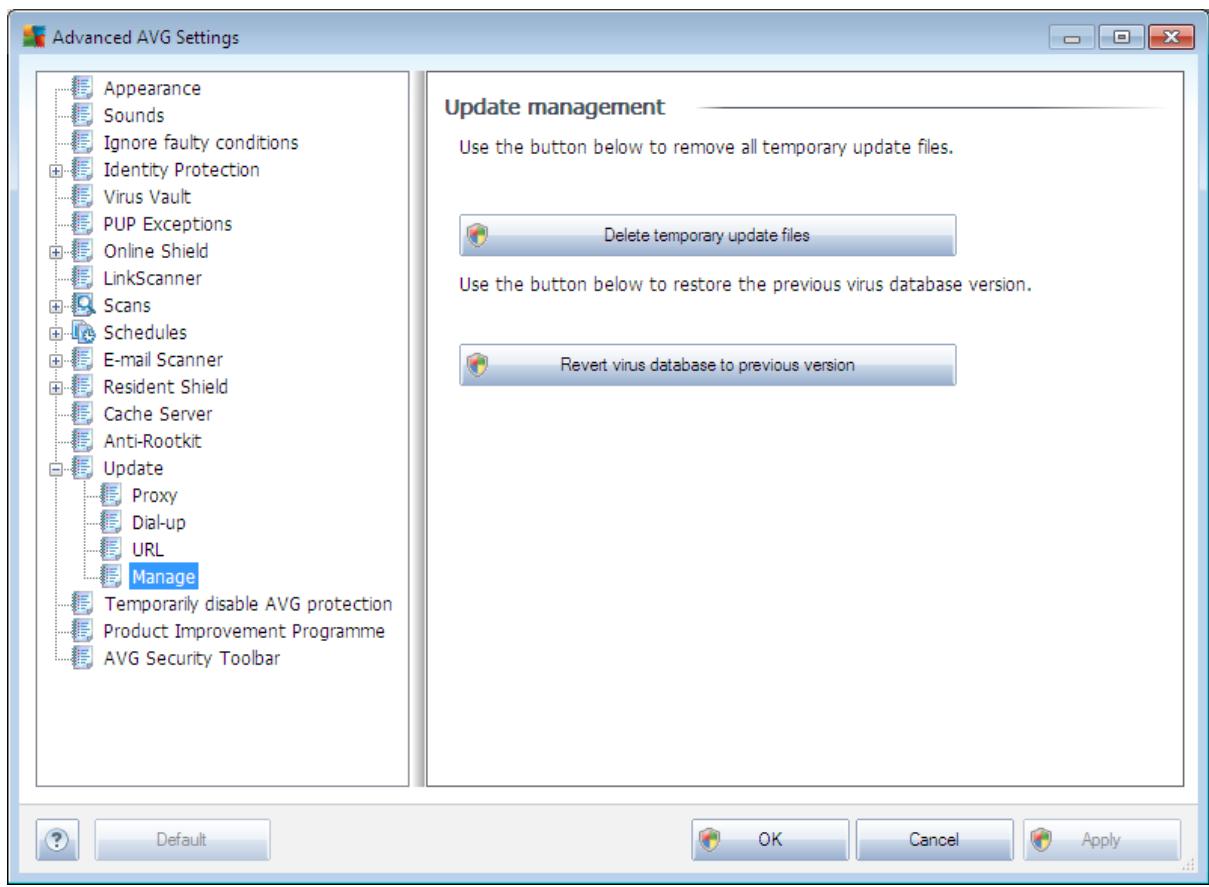
- Delete temporary update files - press this button to delete all redundant update files from your hard disk (by default, these files are being saved for 30 days)
- Revert virus database to previous version - press this button to delete the latest virus base version from your hard disk, and to return to the previously saved version (new virus base version will be a part of the following update)
9.15. Remote Administration
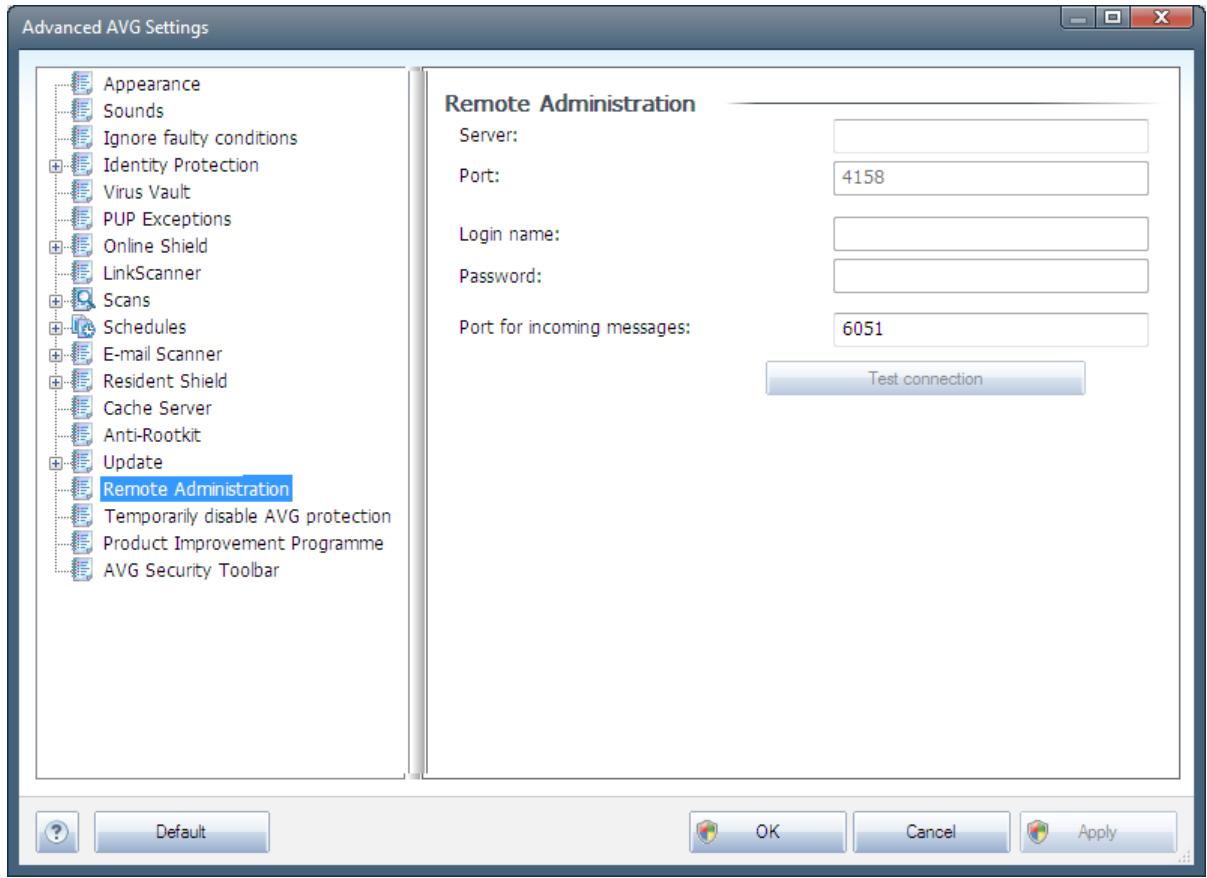
The Remote Administration settings refer to connecting the AVG client station to the remote administration system. If you plan to connect the respective station to remote administration please specify the following parameters:
- Server - server name (or server IP address) where the AVG Admin Server is installed
- Port - provide the number of the port on which the AVG client communicates with the AVG Admin Server (port number 4158 is considered as default - if you use this port number you do not have to specify it explicitly)
- Login - if communication between the AVG client and the AVG Admin Server is defined as secured, provide your username ...
- Password - ... and your password
- Port for incoming messages - number of the port on which the AVG client accepts incoming messages from the AVG Admin Server
The Test connection button helps you to verify that all above stated data are valid and can be used to successfully connect to DataCenter.
Note: For a detailed description on remote administration please consult the AVG SMB edition documentation.
9.16. Temporarily disable AVG protection
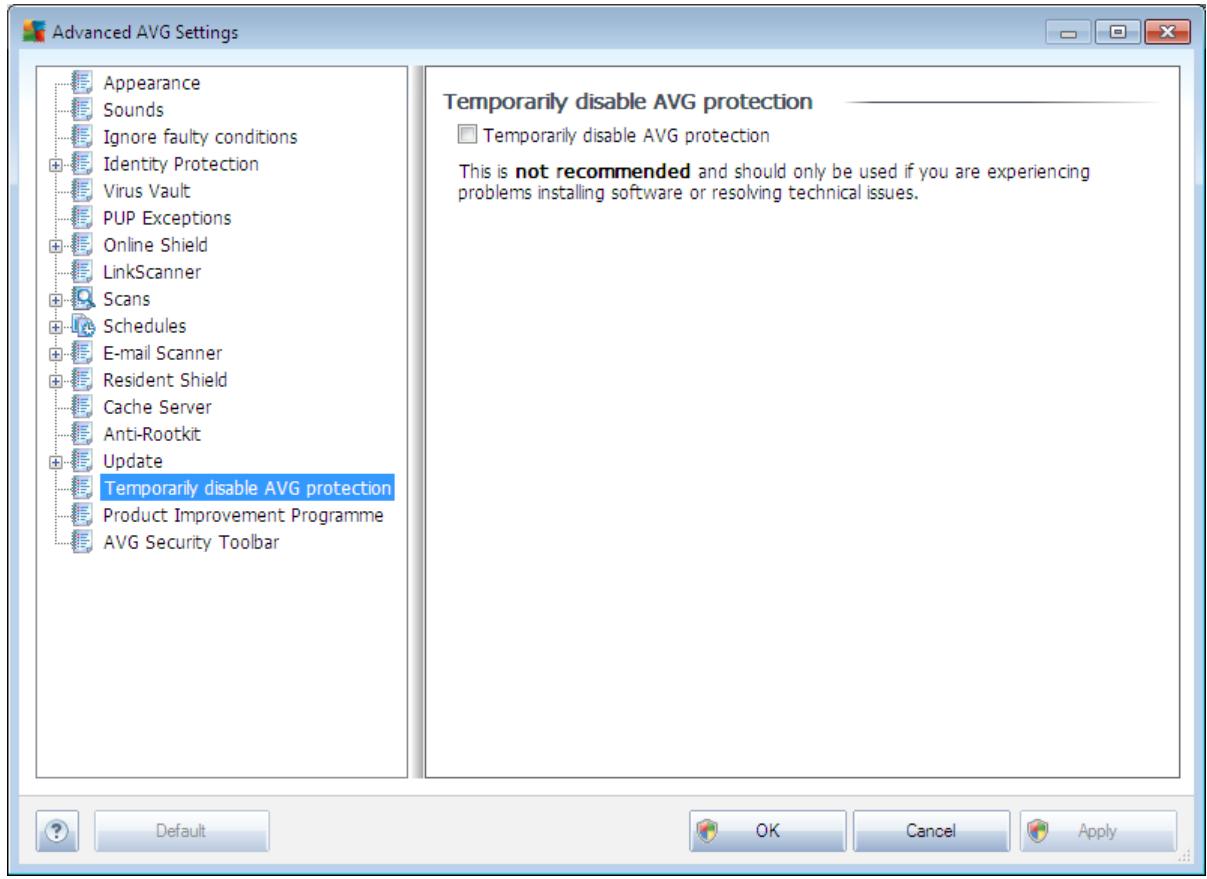
In the Temporarily disable AVG protection dialog you have the option of switching off the entire protection secured by your AVG Anti-Virus 2011 at once.
Please remember that you should not use this option unless it is absolutely necessary!
In most cases, it is not necessary to disable AVG before installing new software or drivers, not even if the installer or software wizard suggests that running programs and applications be shut down first to make sure there are no unwanted interruptions during the installation process. Should you really experience problem during installation, try to deactivate the Resident Shield component first. If you do have to temporarily disable AVG, you should re-enable it as soon as you're done. If you are connected to the Internet or a network during the time your antivirus software is disabled, your computer is vulnerable to attacks.
9.17. Product Improvement Programme
The AVG Web Safety and Product Improvement Programme dialog invites you to participate in AVG product improvement, and to help us increase the overall Internet security level. Mark the Allow reporting option to enable reporting of detected threats to AVG. This helps us to collect up-to-date information on the latest threats from all participants worldwide, and in return we can improve protection for everyone.
The reporting is taken care of automatically, therefore does not cause you any inconvenience, and no personal data is included in the reports. Reporting of detected threats is optional, however, we do ask you to switch this feature on, too, as it helps us improve protection for both you and other AVG users.
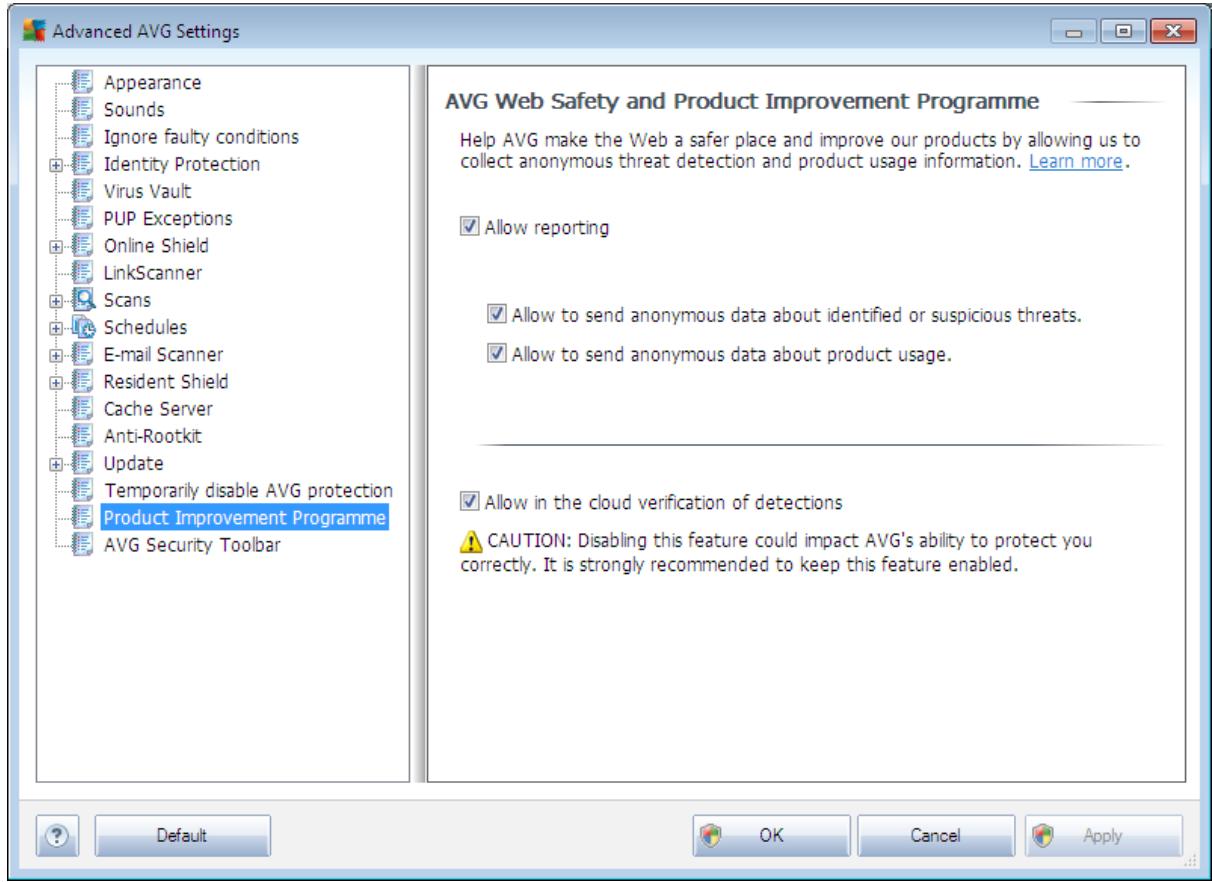
Nowadays, there are far more threats out there than plain viruses. Authors of malicious codes and dangerous websites are very innovative, and new kinds of threats emerge quite often, the vast majority of which are on the Internet. Here are some of the most common:
-
A virus is a malicious code that copies and spreads itself, often unnoticed until the damage is done. Some viruses are a serious threat, deleting or deliberately changing files on their way, while some viruses can do something seemingly harmless, like playing a piece of music. However, all viruses are dangerous due to the basic ability of multiplying - even a simple virus can take up all the computer memory in an instant, and cause a breakdown.
-
A worm is a subcategory of virus which, unlike a normal virus, does not need a "carrier" object to attach to; it sends itself to other computers self-contained, usually via e-mail, and as a result often overloads e-mail servers and network systems.
- Spyware is usually defined as a malware category (malware = any malicious software, including viruses) encompassing programs – typically Trojan horses – aimed at stealing personal information, passwords, credit card numbers, or infiltrating a computer and allowing the attacker to control it remotely; of course, all without the computer owner's knowledge or consent.
- Potentially unwanted programs are a type of spyware that can be may but not necessarily have to be dangerous to your computer. A specific example of a PUP is adware, software designed to distribute advertisements, usually by displaying ad pop-ups; annoying, but not really harmful.
- Tracking cookies can also be considered a kind of spyware, as these small files, stored in the web browser and sent automatically to the "parent" website when you visit it again, can contain data such as your browsing history and other similar information.
- Exploit is a malicious code that takes advantage of a flaw or vulnerability in an operating system, Internet browser, or other essential program.
- Phishing is an attempt to acquire sensitive personal data by shamming a trustworthy and well-known organization. Usually, the potential victims are contacted by a bulk e-mail asking them to e.g. update their bank account details. In order to do that, they are invited to follow the link provided which then leads to a fake website of the bank.
- Hoax is a bulk e-mail containing dangerous, alarming or just bothering and useless information. Many of the above threats use hoax e-mail messages to spread.
- Malicious websites are ones that deliberately install malicious software on your computer, and hacked sites do just the same, only these are legitimate websites that have been compromised into infecting visitors.
To protect you from all of these different kinds of threats, AVG includes these specialized components:
- Anti-Virus to protect your computer from viruses,
- Anti-Spyware to protect your computer from spyware,
- Online Shield to protect you from both viruses and spyware when surfing the Internet,
- LinkScanner to protect you from other online threats mentioned in this chapter.
9.18. AVG Security Toolbar
AVG Security Toolbar is a new tool which works together with the LinkScanner component. AVG Security Toolbar can be used to control LinkScanner functions and to adjust its behavior. If you select to install the toolbar during the installation of AVG Anti-Virus 2011, it will be added into your web browser (Internet Explorer 6.0 or higher, and Mozilla Firefox 3.0 or higher) automatically. Other internet browsers are not supported at the moment.
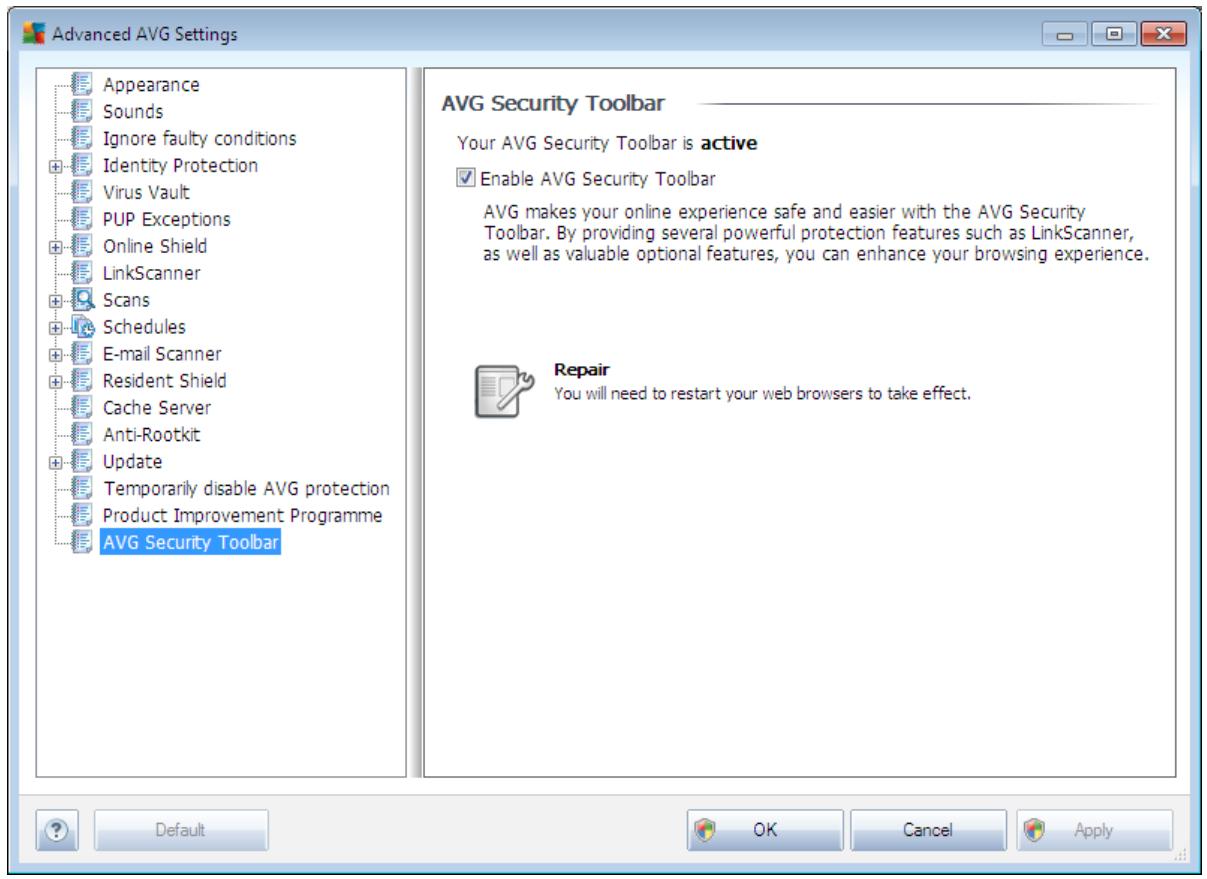
Within this AVG Security Toolbar dialog you can activate or deactivate the entire AVG Security Toolbar component from AVG application advanced settings interface, via the Enable AVG Security Toolbar option.
The Repair button will put all parts of AVG Security Toolbar to fully functional state ( revert to default settings), and make sure that AVG Security Toolbar will work faultlessly in all supported internet browsers. If you have previously deactivated AVG Security Toolbar, whether within this dialog or directly in the internet browser, press the Repair button to activate the component.
10. AVG Scanning
Scanning is a crucial part of AVG Anti-Virus 2011 functionality. You can run on-demand tests or schedule them to run periodically at convenient times.
10.1. Scanning Interface

The AVG scanning interface is accessible via the Computer scanner quick link. Click this link to switch to the Scan for threats dialog. In this dialog you will find the following:
- overview of predefined scans - three types of scans defined by the software vendor are ready to be used immediately on demand or scheduled:
Whole computer scan
Scan specific files or folders
Anti-Rootkit scan
- scan scheduling section - where you can define new tests and create new schedules as needed.
Control buttons
Control buttons available within the testing interface are the following:
- Scan history - displays the Scan results overview dialog with the entire
history of scanning
- View Virus Vault - opens a new window with the Virus Vault - a space where detected infections are quarantined
10.2. Predefined Scans
One of the main features of AVG Anti-Virus 2011 is on-demand scanning. On-demand tests are designed to scan various parts of your computer whenever suspicion of possible virus infection arises. Anyway, it is strongly recommended to carry out such tests regularly even if you think that no virus can be found on your computer.
In the AVG Anti-Virus 2011 you will find the following types of scanning predefined by the software vendor:
10.2.1. Whole Computer Scan
Whole Computer scan - scans your entire computer for possible infections and/or potentially unwanted programs. This test will scan all hard drives of your computer, will detect and heal any virus found, or remove the detected infection to the Virus Vault. Scanning of the whole of your computer should be scheduled on a workstation at least once a week.
Scan launch
The Whole Computer scan can be launched directly from the scanning interface by clicking on the scan's icon. No further specific settings have to be configured for this type of scan, the scanning will start immediately within the Scan is running dialog (see screenshot). The scanning can be temporarily interrupted (Pause) or canceled (Stop) if needed.
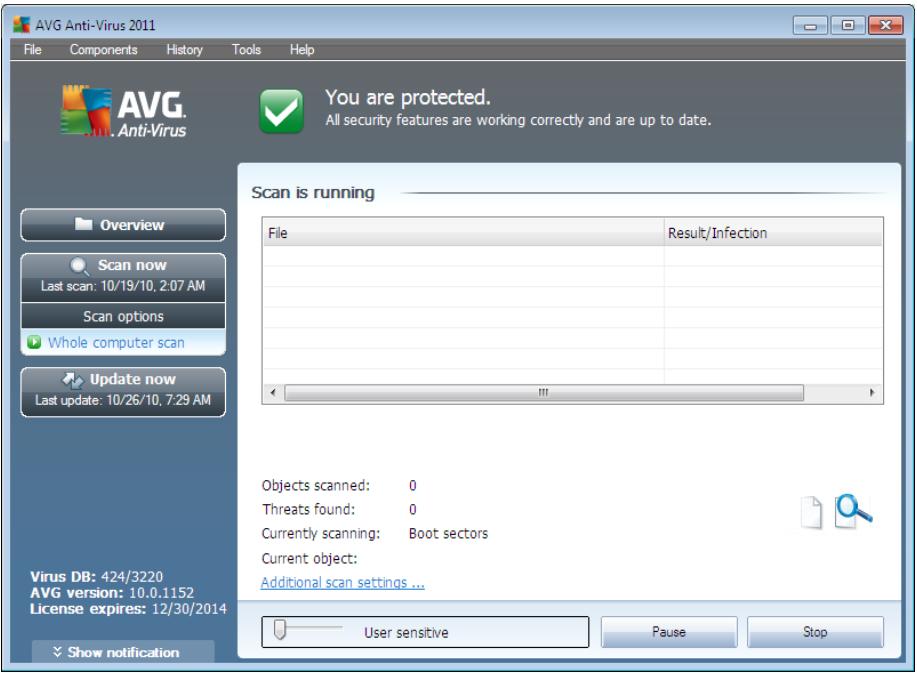
Scan configuration editing
You have the option of editing the predefined default settings of the Whole computer scan. Press the Change scan settings link to get to the Change scan settings for Whole Computer scan dialog (accessible from the scanning interface via the Change scan settings link for the Whole computer scan). It is recommended to keep to the default settings unless you have a valid reason to change them!
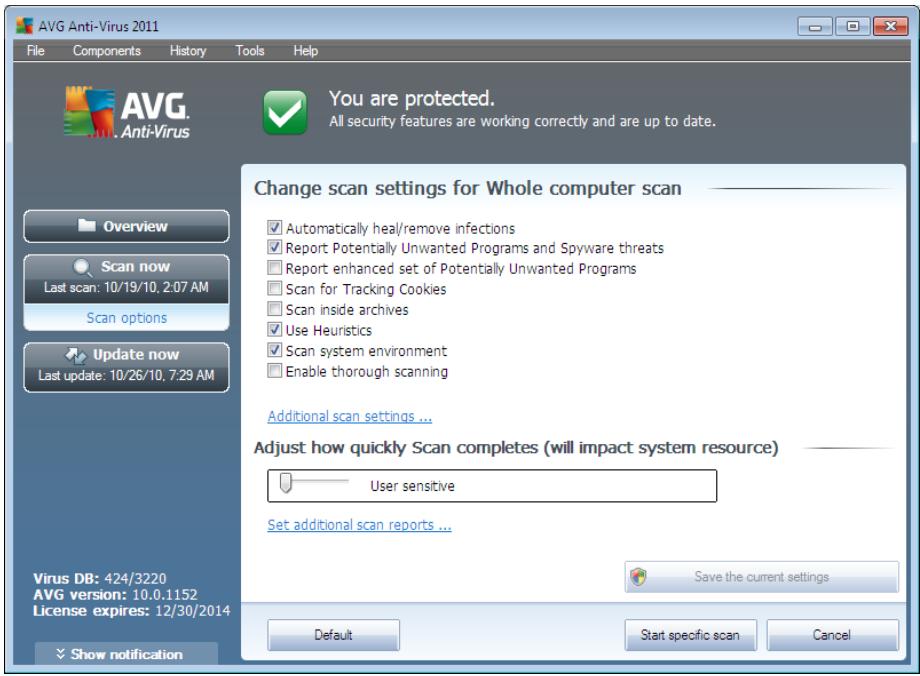
-
Scanning parameters - in the list of scanning parameters you can switch on/off specific parameters as needed:
-
Automatically heal/remove infection (on by default) - if a virus is identified during scanning it can be healed automatically if a cure is available. If the infected file cannot be healed automatically, the infected object will be moved to the Virus Vault.
- Report Potentially Unwanted Programs and Spyware threats (on by default) - check to activate the Anti-Spyware engine, and scan for spyware as well as for viruses. Spyware represents a questionable malware category: even though it usually represents a security risk, some of these programs can be installed intentionally. We recommend to keep this feature activated as it increases your computer security.
- Report enhanced set of Potentially Unwanted Programs (off by default) - mark to detect extended package of spyware: programs that are perfectly ok and harmless when acquired from the manufacturer directly, but can be misused for malicious purposes later. This is an additional measure that increases your computer security even more, however it can possibly block legal programs, and is therefore switched off by default.
- Scan for Tracking Cookies (off by default) - this parameter of the Anti-Spyware component defines that cookies should be detected; (HTTP cookies are used for authenticating, tracking, and maintaining specific information about users, such as site preferences or the contents of their electronic shopping carts).
- Scan inside archives (off by default) - this parameters defines that scanning should check all files stored inside archives, e.g. ZIP, RAR, ...
- Use Heuristics (on by default) - heuristic analysis (dynamic emulation of the scanned object's instructions in a virtual computer environment) will be one of the methods used for virus detection during scanning.
- Scan system environment (on by default) - scanning will also check the system areas of your computer.
-
Enable thorough scanning (off by default) - in specific situations ( suspicious of your computer being infected) you may check this option to activate the most thorough scanning algorithms that will scan even those areas of your computer that can hardly get infected, just to be absolutely sure. Remember though that this method is rather time consuming.
-
Additional scan settings - the link opens a new Additional scan settings dialog where you can specify the following parameters:
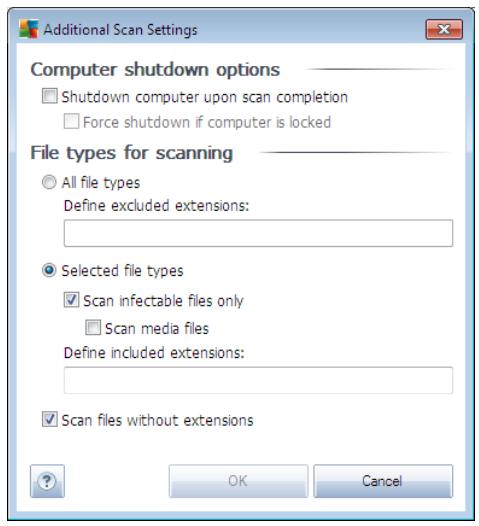
- Computer shutdown options - decide whether the computer should be shut down automatically once the running scanning process is over. Having confirmed this option (Shutdown computer upon scan completion), a new option activates that allows the computer to shut down even if it is currently locked (Force shutdown if computer is locked).
- Define file types for scanning - further you should decide whether you want to have scanned:
All file types with the possibility of defining exceptions from scanning by providing a list of comma separated file extensions that should not be scanned;
Selected file types - you can specify that you want to scan only files that are possibly infectable (files that cannot get infected will not be scanned, for instance some plain text files, or some other non-executable files), including media files (video, audio files - if you leave this box unchecked, it will reduce the scanning time even more, because these files are often quite large and are not too likely to be infected by a virus). Again, you can specify by extensions which files are those that should always be scanned.
Optionally, you can decide you want to Scan files without extension - this option is on by default, and it is recommended that you keep it so unless you have a real reason to change it. Files with no extension are rather suspicious and should be scanned at all times.
- Adjust how quickly Scan completes - you can use the slider to change the scanning process priority. By default, the priority is set to medium priority that optimizes the scanning process speed and the use of system resources. Alternatively, you can run the scanning process slower which means the system resources load will be minimized (useful when you need to work on the computer but you do not care so much how long the scanning takes), or faster with increased system resources requirements (e.g. when the computer
is temporarily unattended).
- Set additional scan reports - the link opens a new Scan reports dialog where you can select what types of possible findings should be reported:
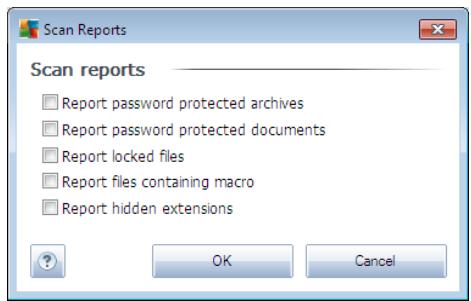
Warning: These scan settings are identical to the parameters of a newly defined scan - as described in the chapter AVG Scanning / Scan scheduling/ How to Scan. Should you decide to change the default configuration of the Scan the whole computer you can then save your new setting as the default configuration to be used for all further scans of the whole computer.
10.2.2. Scan Specific Files or Folders
Scan specific files or folders - scans only those areas of your computer that you have selected to be scanned (selected folders, hard disks, floppy discs, CDs, etc.). The scanning progress in case of virus detection and its treatment is the same as with the scan of the whole computer: any virus found is healed or removed to the Virus Vault. Specific files or folders scanning can be used to set up your own tests and their scheduling based on your needs.
Scan launch
The Scan of specific files or folders can be launched directly from the scanning interface by clicking on the scan's icon. A new dialog called Select specific files or folders for scanning opens. In the tree structure of your computer select those folders you want to have scanned. The path to each selected folder will generate automatically and appear in the text box in the upper part of this dialog.
There is also a possibility of having a specific folder scanned while all its sub folders are excluded from this scanning; to do that write a minus sign "-" in front of the automatically generated path (see screenshot). To exclude the entire folder from scanning use the ! parameter.
Finally, to launch the scanning, press the Start scan button; the scanning process itself is basically identical to the Whole computer scan.
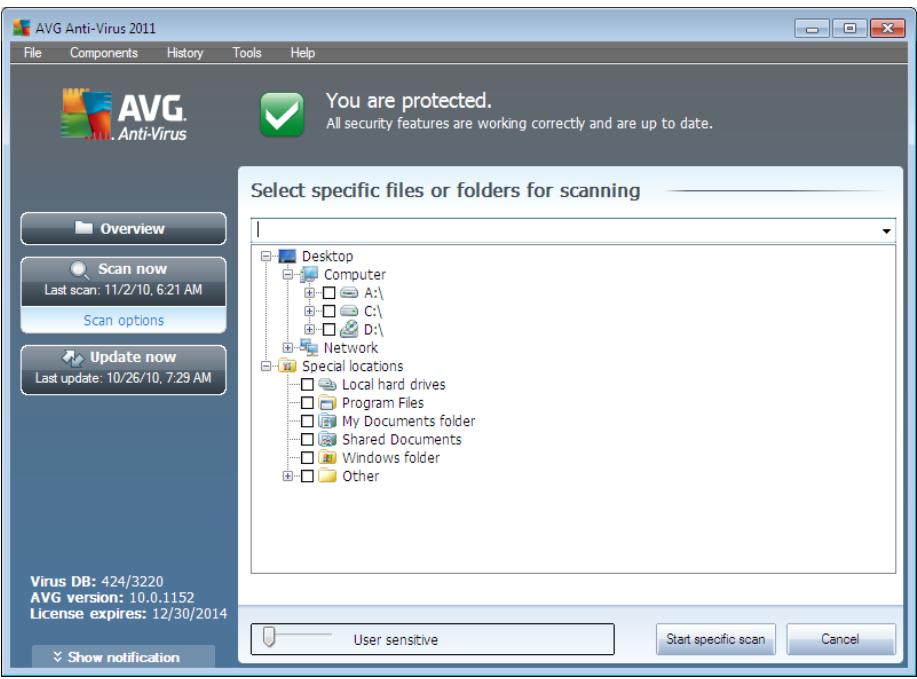
Scan configuration editing
You have the option of editing the predefined default settings of the Scan of specific files or folders. Press the Change scan settings link to get to the Change scan settings for Scan of specific files or folders dialog. It is recommended to keep to the default settings unless you have a valid reason to change them!
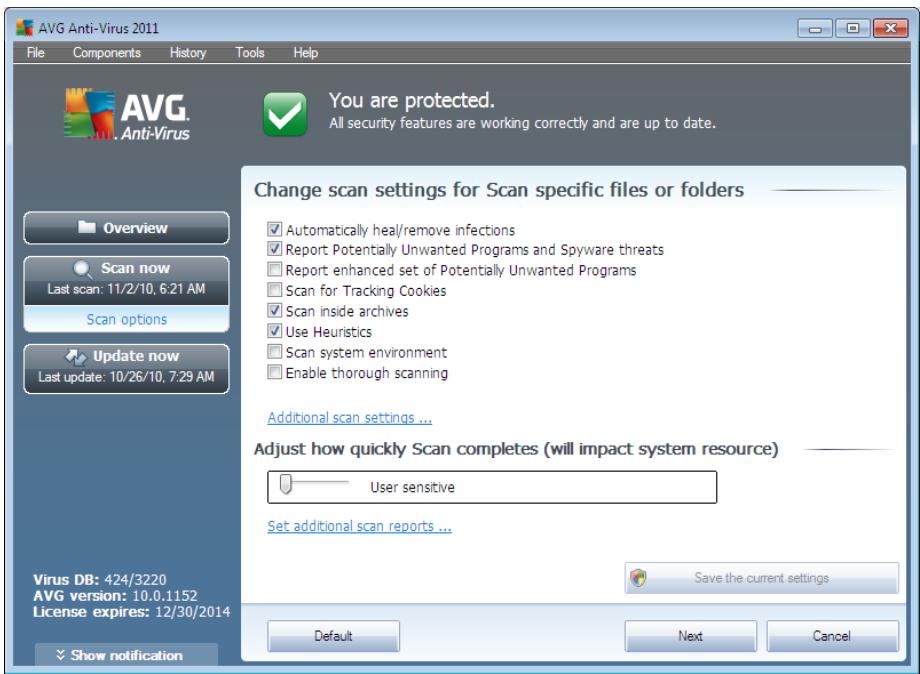
- Scanning parameters - in the list of scanning parameters you can switch on/
off specific parameters as needed:
- Automatically heal/remove infection (on by default) - if a virus is identified during scanning it can be healed automatically if a cure is available. If the infected file cannot be healed automatically, the infected object will be moved to the Virus Vault.
- Report Potentially Unwanted Programs and Spyware threats (on by default) - check to activate the Anti-Spyware engine, and scan for spyware as well as for viruses. Spyware represents a questionable malware category: even though it usually represents a security risk, some of these programs can be installed intentionally. We recommend to keep this feature activated as it increases your computer security.
- Report enhanced set of Potentially Unwanted Programs (off by default) - mark to detect extended package of spyware: programs that are perfectly ok and harmless when acquired from the manufacturer directly, but can be misused for malicious purposes later. This is an additional measure that increases your computer security even more, however it can possibly block legal programs, and is therefore switched off by default.
- Scan for Tracking Cookies (off by default) - this parameter of the Anti-Spyware component defines that cookies should be detected; (HTTP cookies are used for authenticating, tracking, and maintaining specific information about users, such as site preferences or the contents of their electronic shopping carts).
- Scan inside archives (on by default) - this parameters defines that scanning should check all files stored inside archives, e.g. ZIP, RAR, ...
- Use Heuristics (off by default) - heuristic analysis (dynamic emulation of the scanned object's instructions in a virtual computer environment) will be one of the methods used for virus detection during scanning.
- Scan system environment (off by default) - scanning will also check the system areas of your computer.
-
Enable thorough scanning (off by default) - in specific situations ( suspicious of your computer being infected) you may check this option to activate the most thorough scanning algorithms that will scan even those areas of your computer that can hardly get infected, just to be absolutely sure. Remember though that this method is rather time consuming.
-
Additional scan settings - the link opens a new Additional scan settings dialog where you can specify the following parameters:
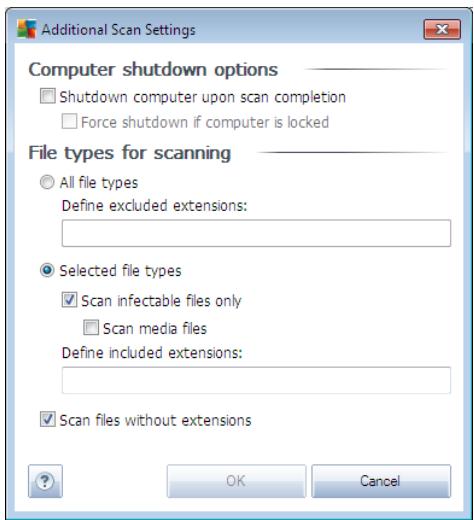
- Computer shutdown options - decide whether the computer should be shut down automatically once the running scanning process is over. Having confirmed this option (Shutdown computer upon scan completion), a new option activates that allows the computer to shut down even if it is currently locked (Force shutdown if computer is locked).
- Define file types for scanning - further you should decide whether you want to have scanned:
All file types with the possibility of defining exceptions from scanning by providing a list of comma separated file extensions that should not be scanned;
Selected file types - you can specify that you want to scan only files that are possibly infectable (files that cannot get infected will not be scanned, for instance some plain text files, or some other non-executable files), including media files (video, audio files - if you leave this box unchecked, it will reduce the scanning time even more, because these files are often quite large and are not too likely to be infected by a virus). Again, you can specify by extensions which files are those that should always be scanned.
Optionally, you can decide you want to Scan files without extension - this option is on by default, and it is recommended that you keep it so unless you have a real reason to change it. Files with no extension are rather suspicious and should be scanned at all times.
- Scan process priority - you can use the slider to change the scanning process priority. By default, the priority is set to medium level (Automatic scan) that optimizes the scanning process speed and the use of system resources. Alternatively, you can run the scanning process slower which means the system resources load will be minimized (useful when you need to work on the computer but you do not care so much how long the scanning takes), or faster with increased system resources requirements (e.g. when the computer
is temporarily unattended).
- Set additional scan reports - the link opens a new Scan Reports dialog where you can select what types of possible findings should be reported:
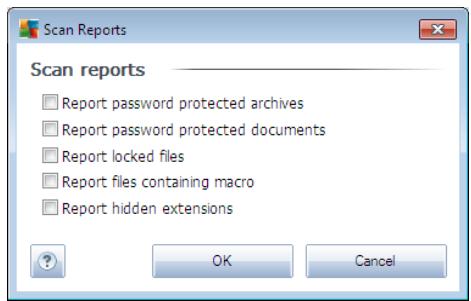
Warning: These scan settings are identical to the parameters of a newly defined scan - as described in the chapter AVG Scanning / Scan scheduling/ How to Scan. Should you decide to change the default configuration of the Scan specific files or folders you can then save your new setting as the default configuration to be used for all further scans of specific files or folders. Also, this configuration will be used as a template for all of your newly scheduled scans (all customized scans are based on the current configuration of the Scan of selected files or folders).
10.2.3. Anti-Rootkit Scan
Anti-Rootkit scan searches your computer for possible rootkit (programs and technologies that can cover malware activity in your computer). If a rootkit is detected, this does not necessarily mean your computer is infected. In some cases, specific drivers or sections of regular applications may be misleadingly detected as rootkits.
Scan launch
Anti-Rootkit scan can be launched directly from the scanning interface by clicking on the scan's icon. No further specific settings have to be configured for this type of scan, the scanning will start immediately within the Scan is running dialog (see screenshot). The scanning can be temporarily interrupted (Pause) or canceled (Stop) if needed.
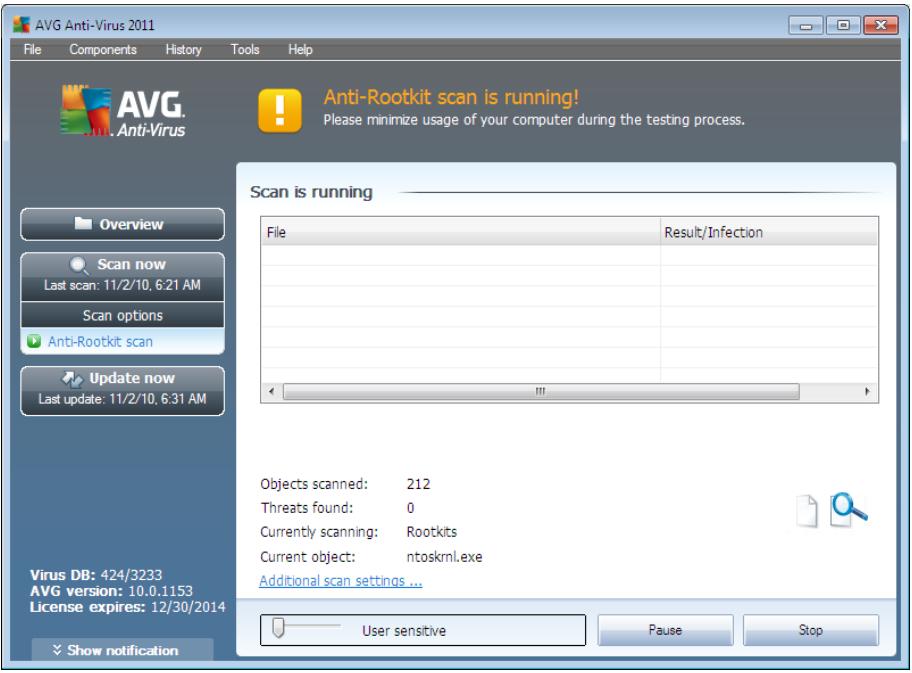
Scan configuration editing
Anti-Rootkit scan is always launched in the default settings, and editing of the scan parameters is only accessible within the AVG Advanced Settings / Anti-Rootkit dialog. In the scanning interface, the following configuration is available but only while the scan is running:
- Automatic scan - you can use the slider to change the scanning process priority. By default, the priority is set to medium level (Automatic scan) that optimizes the scanning process speed and the use of system resources. Alternatively, you can run the scanning process slower which means the system resources load will be minimized (useful when you need to work on the computer but you do not care so much how long the scanning takes), or faster with increased system resources requirements (e.g. when the computer is temporarily unattended).
- Additional scan settings - this link opens a new Additional scan settings dialog where you can define possible computer shutdown conditions related to the Anti-Rootkit scan (Shutdown computer upon scan completion, possibly Force shutdown if computer is locked):
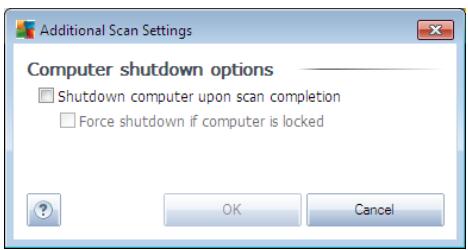
10.3. Scanning in Windows Explorer
Besides the pre-defined scans launched for the entire computer or its selected areas, AVG Anti-Virus 2011 also offers the option of quick scanning of a specific object directly in the Windows Explorer environment. If you want to open an unknown file and you cannot be sure of its content, you may want to have it checked on demand. Follow these steps:
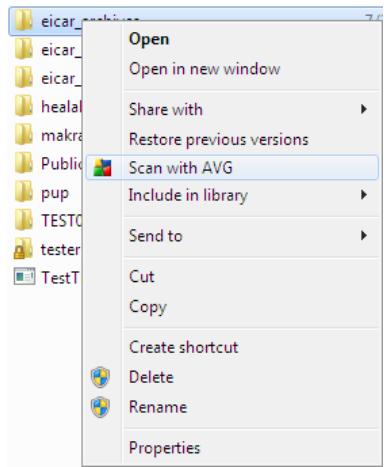
- Within Windows Explorer highlight the file (or folder) you want to check
- Right-click your mouse over the object to open the context menu
- Select the Scan with AVG option to have the file scanned with AVG
10.4. Command Line Scanning
Within AVG Anti-Virus 2011 there is the option of running the scan from the command line. You can use this option for instance on servers, or when creating a batch script to be launched automatically after the computer boot. From the command line, you can launch the scanning with most parameters as offered in AVG graphical user interface.
To launch AVG scan from the command line, run the following command within the folder where AVG is installed:
- avgscanx for 32 bits OS
- avgscan a for 64 bits OS
Syntax of the command
The syntax of the command follows:
- avgscanx /parameter ... e.g. avgscanx /comp for scanning the whole
computer
- avgscanx /parameter /parameter .. with multiple parameters these should be lined in a row and separated by a space and a slash character
- if a parameters requires specific value to be provided (e.g. the /scan parameter that requires information on what are the selected areas of your computer that are to be scanned, and you have to provide an exact path to the selected section), the values are divided by semicolons, for instance: avgscanx /scan=C:\;D:\
Scanning parameters
To display a complete overview of available parameters, type the respective command together with the parameter /? or /HELP (e.g. avgscanx /?). The only obligatory parameter is /SCAN to specify what areas of the computer should be scanned. For a more detailed explanation of the options, see the command line parameters overview.
To run the scan press Enter. During scanning you can stop the process by Ctrl+C or Ctrl+Pause.
CMD scanning launched from graphic interface
When you run your computer in Windows Safe Mode, there is also a possibility to launch the command line scan from the graphic user interface. The scan itself will be launched from the command line, the Command LineComposer dialog only allows you to specify most scanning parameters in the comfortable graphic interface.
Since this dialog is only accessible within the Windows Safe Mode, for detailed description of this dialog please consult the help file opened directly from the dialog.
10.4.1. CMD Scan Parameters
Following please find a list of all parameters available for the command line scanning:
- /SCAN SCAN=C:\;D:) Scan specific files or folders /SCAN=path;path (e.g. / SCAN=C:\;D:)
- /COMP Whole Computer scan
- /HEUR Use heuristic analyse
- /EXCLUDE Exclude path or files from scan
Command file/file name/ - /EXT Scan these extensions /for example EXT=EXE,DLL/
-
/NOEXT Do not scan these extensions /for example NOEXT=JPG/
-
/ARC Scan archives
- /CLEAN Clean automatically
- /TRASH Move infected files to the Virus Vault
- /QT Quick test
/MACROW Report macros
Report password-protected files - /IGNLOCKED Ignore locked files
REPORT Report to file/file name/ - /REPAPPEND Append to the report file
- /REPOK Report uninfected files as OK
- /NOBREAK Do not allow CTRL-BREAK to abort
- /BOOT Enable MBR/BOOT check
- /PROC Scan active processes
- /PUP Report "Potentially unwanted programs"
- /REG Scan registry
Scan cookies
Display help on this topic - /HELP Display help on this topic
- /PRIORITY Set scan priority /Low, Auto, High/ (see Advanced settings / Scans)
- /SHUTDOWN Shutdown computer upon scan completion
FORCESHUTDOWN Force computer shutdown upon scan completion - /ADS Scan Alternate Data Streams (NTFS only)
- /ARCBOMBSW Report re-compressed archive files
10.5. Scan Scheduling
With AVG Anti-Virus 2011 you can run scanning on demand (for instance when you suspect an infection has been dragged to your computer) or based on a scheduled plan. It is highly recommended to run the scans based on a schedule: this way you can make sure your computer is protected from any possibility of getting infected, and you will not have to worry about if and when to launch the scan.
You should launch the Whole Computer scan regularly, at least once a week. However, if possible, launch the scan of your entire computer daily - as set up in the scan schedule default configuration. If the computer is "always on" then you can schedule scans out of working hours. If the computer is sometimes switched off, then schedule scans to occur on a computer start-up when the task has been missed.
To create new scan schedules, see the AVG scanning interface and find the bottom section called Schedule scans:
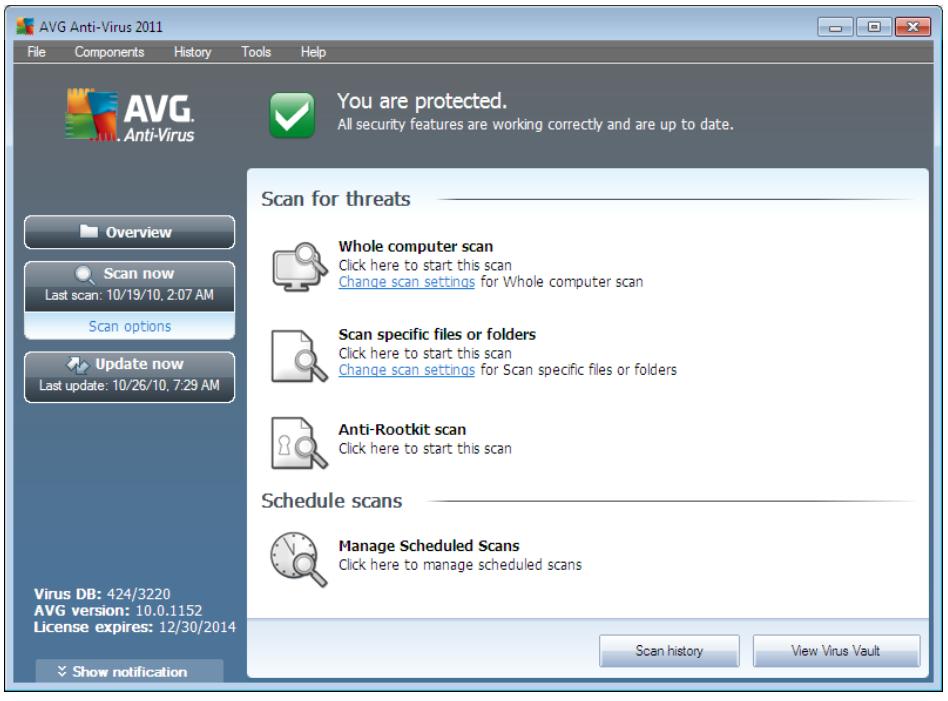
Schedule scans
Click the graphical icon within the Schedule scans section to open a new Schedule scans dialog where you find a list of all currently scheduled scans:
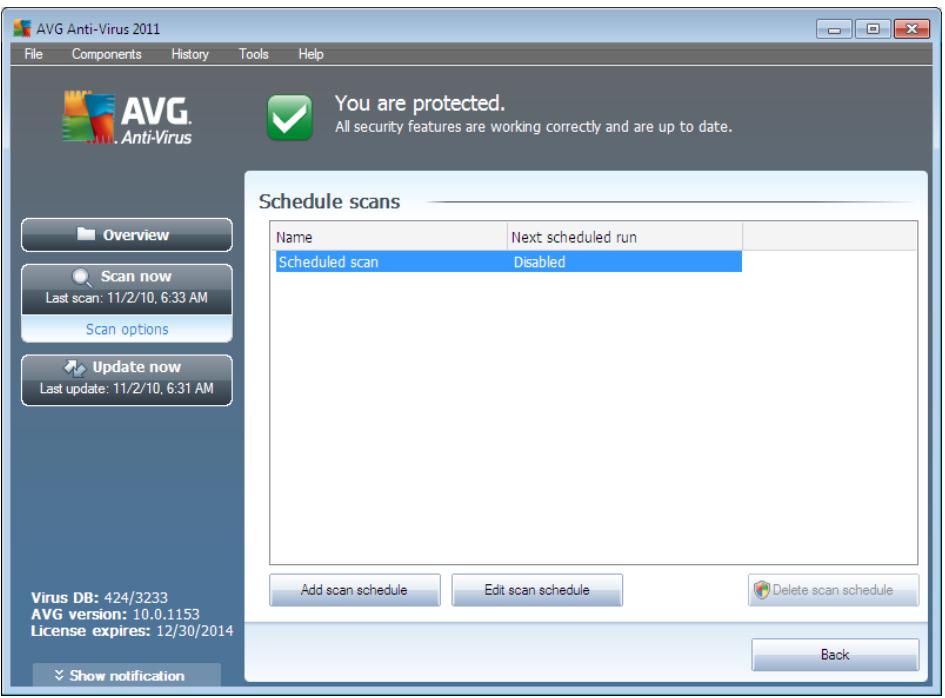
You can edit / add scans using the following control buttons:
- Add scan schedule - the button opens the Settings for scheduled scan dialog, Schedule settings tab. In this dialog you can specify the parameters of the newly defined test.
- Edit scan schedule - this button can only be used if you have already previously selected an existing test from the list of scheduled tests. In that case the button appears as active and you can click it to switch to the Settings for scheduled scan dialog, Schedule settings tab. Parameters of the selected test are already specified in here and can be edited.
- Delete scan schedule - this button is also active if you have already previously selected an existing test from the list of scheduled tests. This test can then be deleted from the list by pressing the control button. However, you can only remove your own tests; the Whole computer scan schedule predefined within the default settings can never be deleted.
- Back - return to AVG scanning interface
10.5.1. Schedule Settings
If you wish to schedule a new test and its regular launch, enter the Settings for scheduled test dialog (click the Add scan schedule button within the Schedule scans dialog). The dialog is divided into three tabs: Schedule settings - see picture below (the default tab that you will be automatically redirected to), How to scan and What to scan.
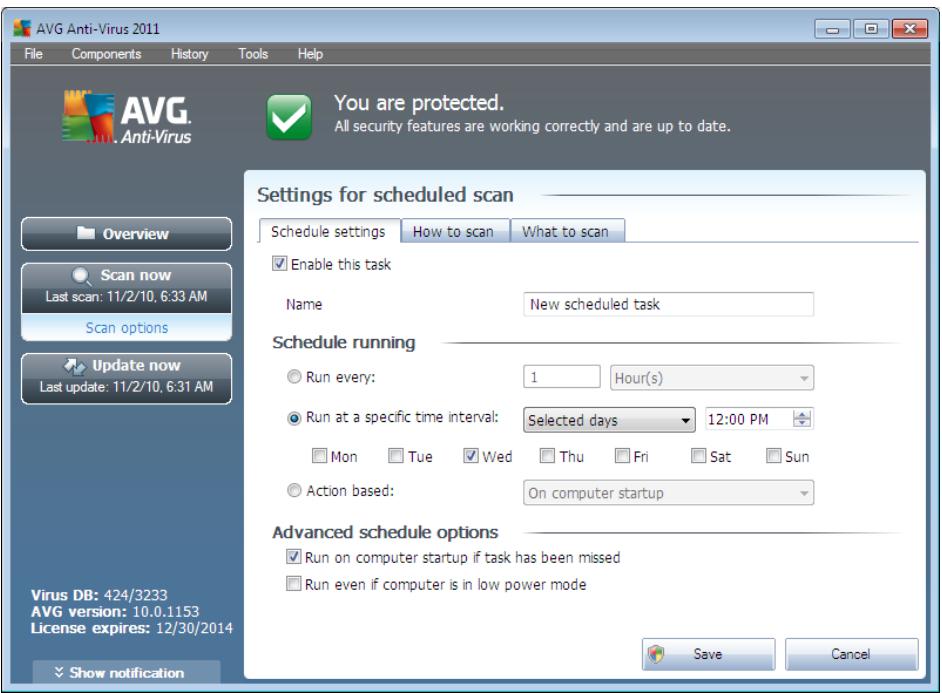
On the Schedule settings tab you can first check/uncheck the Enable this task item to simply deactivate the scheduled test temporarily, and switch it on again as the need arises.
Next, give a name to the scan you are about to create and schedule. Type the name into the text field by the Name item. Try to use brief, descriptive and apt names for scans to make it easier to later recognize the scan from others.
Example: It is not appropriate to call the scan by the name of "New scan" or "My scan" since these names do not refer to what the scan actually checks. On the other hand, an example of a good descriptive name would be "System areas scan" etc. Also it is not necessary to specify in the scan's name whether it is the scan of the whole of the computer or just a scan of selected files or folders - your own scans will always be a specific version of the scan of selected files or folders.
In this dialog you can further define the following parameters of the scan:
- Schedule running - specify the time intervals for the newly scheduled scan launch. The timing can either be defined by the repeated scan launch after a certain period of time (Run every ...) or by defining an exact date and time (Run at specific time ...), or possibly by defining an event that the scan launch should be associated with (Action based on computer startup).
- Advanced schedule options - this section allows you to define under which conditions the scan should/should not be launched if the computer is in low power mode or switched off completely.
Control buttons of the Settings for scheduled scan dialog
There are two control buttons available on all three tabs of the Settings for scheduled scan dialog (Schedule settings, How to scan and What to scan) and these have the same functionality no matter on which tab you currently are:
- Save - saves all changes you have performed on this tab or on any other tab of this dialog and switches back to the AVG scanning interface default dialog. Therefore if you wish to configure the test parameters on all tabs, press the button to save them only after you have specified all your requirements.
- Cancel - cancels any changes you have performed on this tab or on any other tab of this dialog and switches back to the AVG scanning interface default dialog.
10.5.2. How to Scan
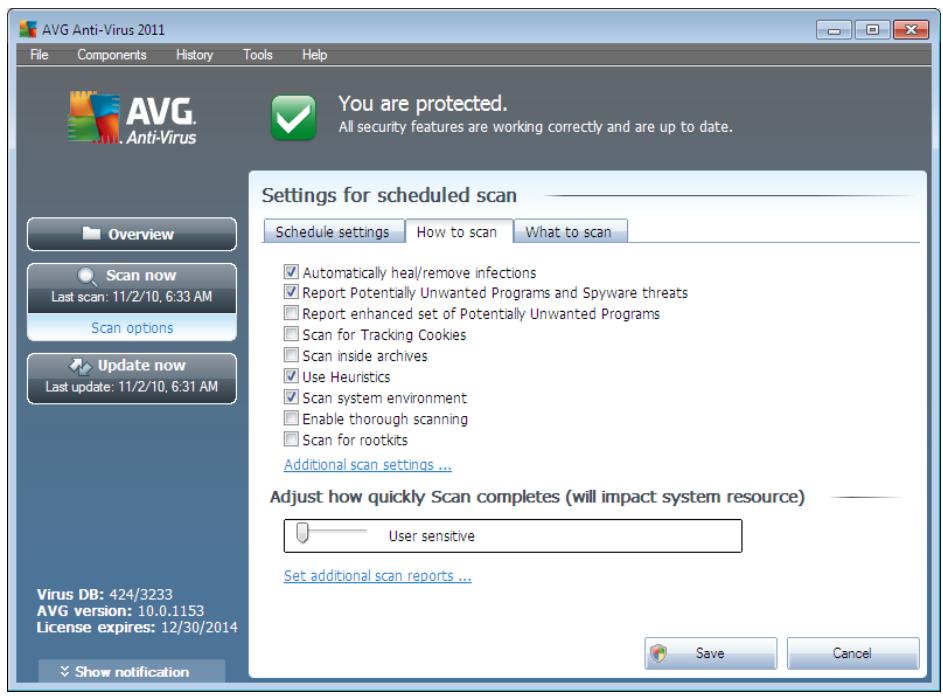
On the How to scan tab you will find a list of scanning parameters that can be optionally switched on/off. By default, most parameters are switched on and the functionality will be applied during scanning. Unless you have a valid reason to change these settings we recommend to keep to the pre-defined configuration:
- Automatically heal/remove infection (on by default): if a virus is identified during scanning it can be healed automatically if a cure is available. In case the infected file cannot be healed automatically, or if you decide to switch off this option, you will be notified upon a virus detection and will have to decide what to do with the detected infection. The recommended action is to remove the infected file to the Virus Vault.
- Report Potentially Unwanted Programs and Spyware threats (on by default): check to activate the Anti-Spyware engine, and scan for spyware as well as for viruses. Spyware represents a questionable malware category:
even though it usually represents a security risk, some of these programs can be installed intentionally. We recommend to keep this feature activated as it increases your computer security.
- Report enhanced set of Potentially Unwanted Programs (off by default): mark to detect extended package of spyware: programs that are perfectly ok and harmless when acquired from the manufacturer directly, but can be misused for malicious purposes later. This is an additional measure that increases your computer security even more, however it can possibly block legal programs, and is therefore switched off by default.
- Scan for Tracking Cookies (off by default): this parameter of the Anti-Spyware component defines that cookies should be detected during scanning (HTTP cookies are used for authenticating, tracking, and maintaining specific information about users, such as site preferences or the contents of their electronic shopping carts).
- Scan inside archives (off by default): this parameters defines that the scanning should check all files even if these are packed inside some type of archive, e.g. ZIP, RAR, ...
- Use Heuristics (on by default): heuristic analysis (dynamic emulation of the scanned object's instructions in a virtual computer environment) will be one of the methods used for virus detection during scanning.
- Scan system environment (on by default): scanning will also check the system areas of your computer.
- Enable thorough scanning (off by default) - in specific situations (suspicious of your computer being infected) you may check this option to activate the most thorough scanning algorithms that will scan even those areas of your computer that can hardly get infected, just to be absolutely sure. Remember though that this method is rather time consuming.
Then, you can change the scan configuration as follows:
- Additional scan settings - the link opens a new Additional scan settings dialog where you can specify the following parameters:
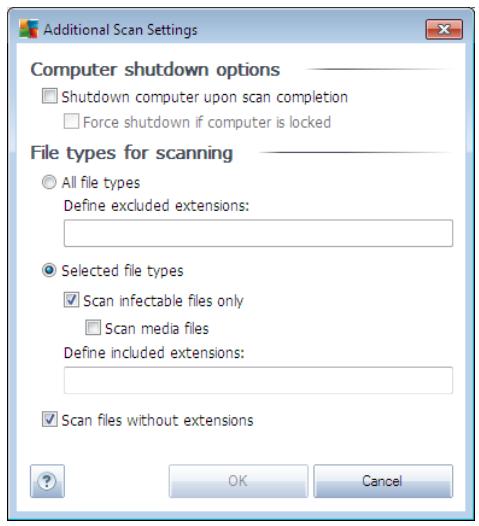
- Computer shutdown options - decide whether the computer should be shut down automatically once the running scanning process is over. Having confirmed this option (Shutdown computer upon scan completion), a new option activates that allows the computer to shut down even if it is currently locked (Force shutdown if computer is locked).
- Define file types for scanning - further you should decide whether you want to have scanned:
All file types with the possibility of defining exceptions from scanning by providing a list of comma separated file extensions that should not be scanned;
Selected file types - you can specify that you want to scan only files that are possibly infectable (files that cannot get infected will not be scanned, for instance some plain text files, or some other non-executable files), including media files (video, audio files - if you leave this box unchecked, it will reduce the scanning time even more, because these files are often quite large and are not too likely to be infected by a virus). Again, you can specify by extensions which files are those that should always be scanned.
Optionally, you can decide you want to Scan files without extension - this option is on by default, and it is recommended that you keep it so unless you have a real reason to change it. Files with no extension are rather suspicious and should be scanned at all times.
-
Adjust how quickly Scan completes - you can use the slider to change the scanning process priority. The medium level optimizes the scanning process speed and the use of system resources. Alternatively, you can run the scanning process slower which means the system resources load will be minimized (useful when you need to work on the computer but you do not care so much how long the scanning takes), or faster with increased system resources requirements (e.g. when the computer is temporarily unattended).
-
Set additional scan reports - the link opens a new Scan reports dialog where you can select what types of possible findings should be reported:
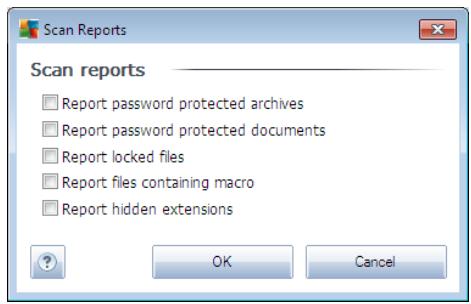
Note: By default, the scanning configuration is set up for optimum performance. Unless you have a valid reason to change the scanning settings it is highly recommended to stick to the predefined configuration. Any configuration changes should be performed by experienced users only. For further scanning configuration options see the Advanced settings dialog accessible via the File / Advanced setting system menu item.
Control buttons
There are two control buttons available on all three tabs of the Settings for scheduled scan dialog (Schedule settings, How to scan and What to scan) and these have the same functionality no matter on which tab you currently are:
- Save - saves all changes you have performed on this tab or on any other tab of this dialog and switches back to the AVG scanning interface default dialog. Therefore if you wish to configure the test parameters on all tabs, press the button to save them only after you have specified all your requirements.
- Cancel - cancels any changes you have performed on this tab or on any other tab of this dialog and switches back to the AVG scanning interface default dialog.
10.5.3. What to Scan
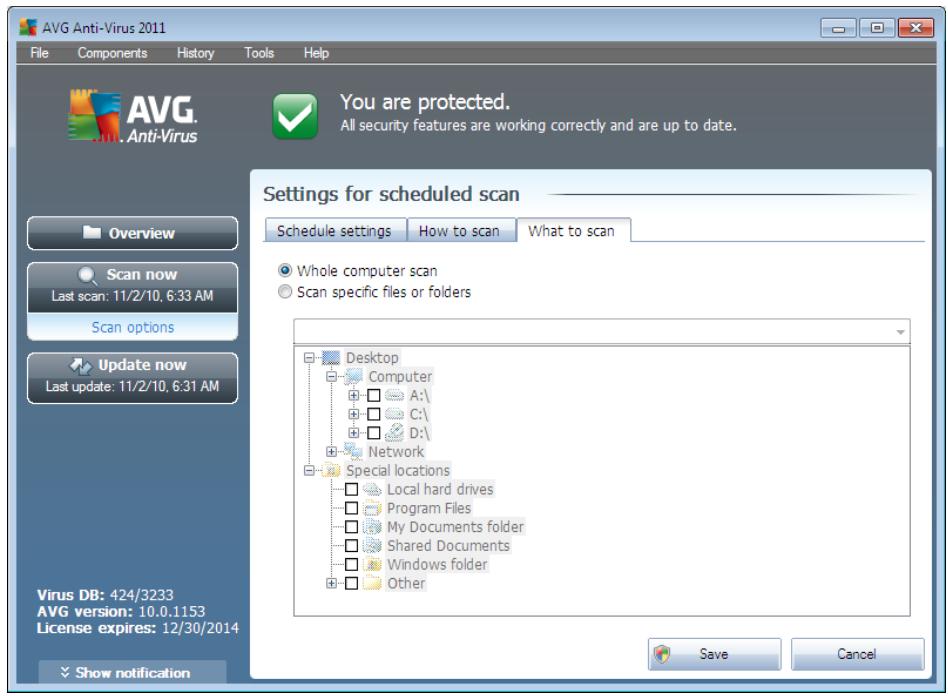
On the What to scan tab you can define whether you want to schedule scanning of the whole computer or scanning of specific files or folders.
In case you select scanning of specific files or folders, in the bottom part of this dialog the displayed tree structure activates and you can specify folders to be scanned ( expand items by clicking the plus node until you find the folder you wish to scan). You can select multiple folders by checking the respective boxes. The selected folders will appear in the text field on the top of the dialog, and the drop-down menu will keep your selected scans history for later use. Alternatively, you can enter full path to the desired folder manually (if you enter multiple paths, it is necessary to separate with semi-colons without extra space).
Within the tree structure you can also see a branch called Special locations.
Following find a list of locations that will be scanned once the respective check box is marked:
- Local hard drives - all hard drives of your computer
- Program files
C:\Program Files\
in 64-bit version C:\Program Files (x86)
- My Documents folder
o for Win XP: C:\Documents and Settings\Default User\My Documents\
for Windows Vista/7: C:\Users user\Documents\
- Shared Documents
口 for Win XP: C:\Documents and Settings\All Users\Documents\
o for Windows Vista/7: C:\Users\Public\Documents\
- Windows folder - C:\Windows\
Other
- System drive - the hard drive on which the operating system is installed (usually C:)
- System folder - C:\Windows\System32\
Temporary Files folder - C:\Documents and Settings\User\Local\ (Windows XP); or C:\Users\user\DataAppData\LacalTemp\ (Windows Vista/7)
Temporary Internet Files - C:\Documents and Settings\User\Local Settings\Temporary Internet Files\ (Windows XP); or C: \Users\user\DataData\Local\Microsoft\Windows\Temporary Internet Files (Windows Vista/7)
Control buttons of the Settings for scheduled scan dialog
There are two control buttons available on all three tabs of the Settings for scheduled scan dialog (Schedule settings, How to scan and What to scan) and these have the same functionality no matter on which tab you currently are:
- Save - saves all changes you have performed on this tab or on any other tab of this dialog and switches back to the AVG scanning interface default dialog. Therefore if you wish to configure the test parameters on all tabs, press the button to save them only after you have specified all your requirements.
- Cancel - cancels any changes you have performed on this tab or on any other tab of this dialog and switches back to the AVG scanning interface default dialog.
10.6. Scan Results Overview
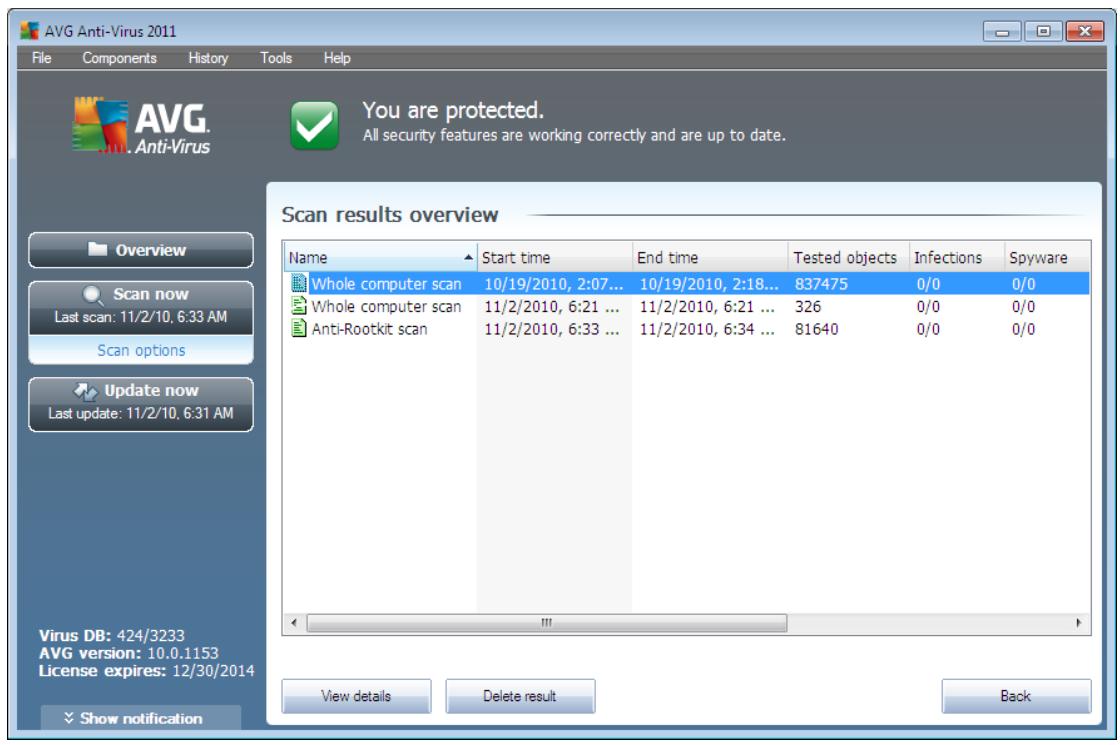
The Scan results overview dialog is accessible from the AVG scanning interface via the Scan history button. The dialog provides a list of all previously launched scans and information of their results:
-
Name - scan designation; it can either be the name of one of the predefined scans, or a name you have given to your own scheduled scan. Every name includes an icon indicating the scan result:
-
green icon informs there was no infection detected during the scan
- blue icon announces there was an infection detected during the scan but the infected object was removed automatically
- red icon warns there was an infection detected during the scan and it could not be removed!
Each icon can either be solid or cut in half - the solid icons stand for a scan that was completed and finished properly; the cut-in-half icon means the scan was canceled or interrupted.
Note: For detailed information on each scan please see the Scan Results dialog accessible via the View details button (in the bottom part of this dialog).
-
Start time - date and time when the scan was launched
-
End time - date and time when the scan ended
- Tested objects - number of objects that were checked during scanning
- Infections - number of virus infections detected / removed
- Spyware - number of spyware detected / removed
-Warnings - number of detected suspicious objects - Rootkits - number of detected rootkits
- Scan log information - information relating to the scanning course and result (typically on its finalization or interruption)
Control buttons
The control buttons for the Scan results overview dialog are:
- View details - press it to switch to the Scan results dialog to view detailed data on the selected scan
- Delete result - press it to remove the selected item from the scan results overview
- Back - switches back to the default dialog of the AVG scanning interface
10.7. Scan Results Details
If in the Scan Results Overview dialog a specific scan is selected, you can then click the View details button to switch to the Scan Results dialog providing detailed data on the course and result of the selected scan.
The dialog is further divided into several tabs:
- Results Overview - this tab is displayed at all times and provides statistical data describing the scan progress
- Infections - this tab is displayed only if a virus infection was detected during scanning
- Spyware - this tab is displayed only if spyware was detected during scanning
- Warnings - this tab is displayed for instance if cookies were detected during scanning
- Information - this tab is displayed only if some potential threats were detected but these cannot be classified as any of the above categories; then the tab provides a warning message on the finding. Also, you will find here information on objects that could not be scanned (e.g. password protected
archives).
10.7.1. Results Overview Tab
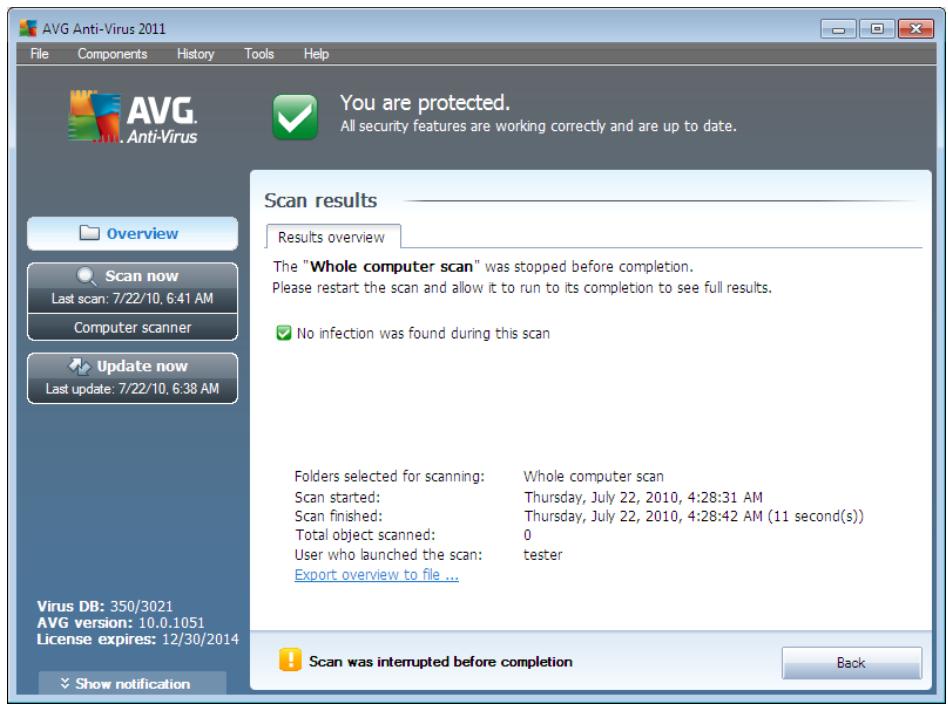
On the Scan results tab you can find detailed statistics with information on:
- detected virus infections / spyware
- removed virus infections / spyware
- the number of virus infections / spyware that cannot be removed or healed
In addition you will find information on the date and exact time of the scan launch, on the total number of scanned objects, on the scanning duration and the number of errors that have occurred during scanning.
Control buttons
There is only one control button available in this dialog. The Close results button returns to the Scan results overview dialog.
10.7.2. Infections Tab
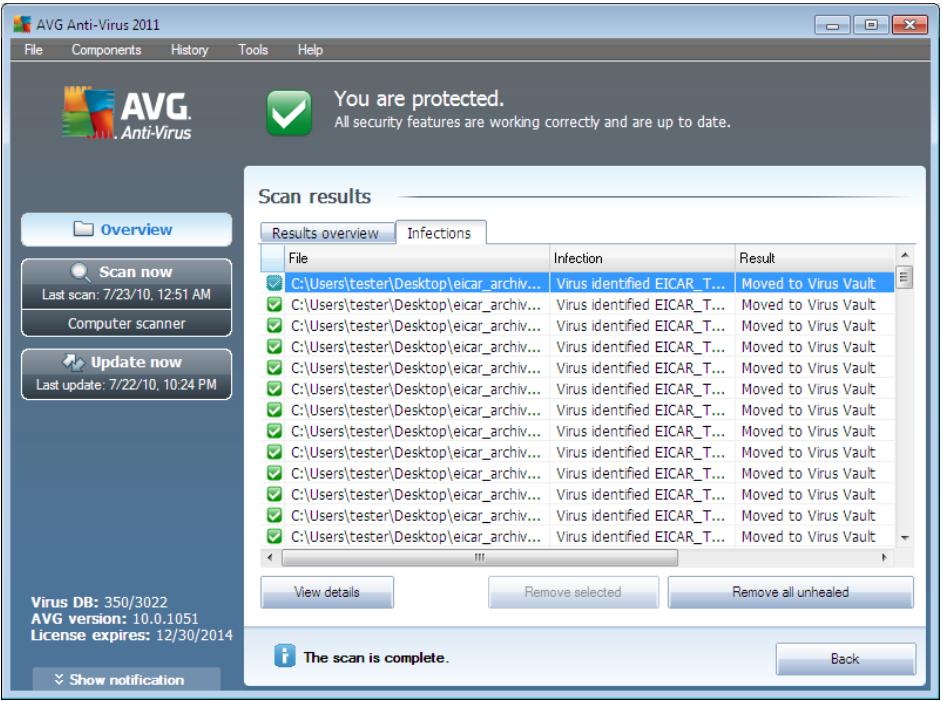
The Infections tab is only displayed in the Scan results dialog if a virus infection was detected during scanning. The tab is divided into three sections providing the following information:
- File - full path to the original location of the infected object
- Infections - name of the detected virus (for details on specific viruses please consult the Virus Encyclopedia online)
-
Result - defines the current status of the infected object that was detected during scanning:
-
Infected - the infected object was detected and left in its original location (for instance if you have switched off the automatic healing option in a specific scan settings)
Healed - the infected object was healed automatically and left in its original location - Moved to Virus Vault - the infected object was moved to the Virus Vault quarantine
- Deleted - the infected object was deleted
-
Added to PUP exceptions - the finding was evaluated as an exception and added to the list of PUP exceptions (configured in the PUP Exceptions dialog of the advanced settings)
-
Locked file - not tested - the respective object is locked and AVG is therefore unable to scan it
- Potentially dangerous object - the object was detected as potentially dangerous but not infected (it can contain macros, for instance); the information should be taken as a warning only
- Reboot is required to finish the action - the infected object cannot be removed, to remove it completely you have to restart your computer
Control buttons
There are three control buttons available in this dialog:
- View details - the button opens a new dialog window named Detailed object information:
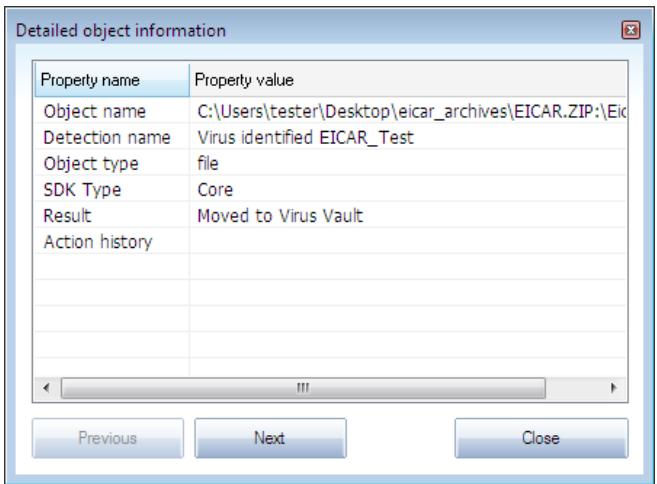
In this dialog you can find detailed information on the detected infectious object (e.g. infected object name and location, object type, SDK type, detection result and history of actions related to the detected object). Using the Previous / Next buttons you can view information on specific findings. Use the Close button to close this dialog.
- Remove selected - use the button to move the selected finding to the Virus Vault
- Remove all unhealed - this button deletes all findings that cannot be healed or moved to the Virus Vault
- Close results - terminates the detailed information overview and returns to the Scan results overview dialog
10.7.3. Spyware Tab
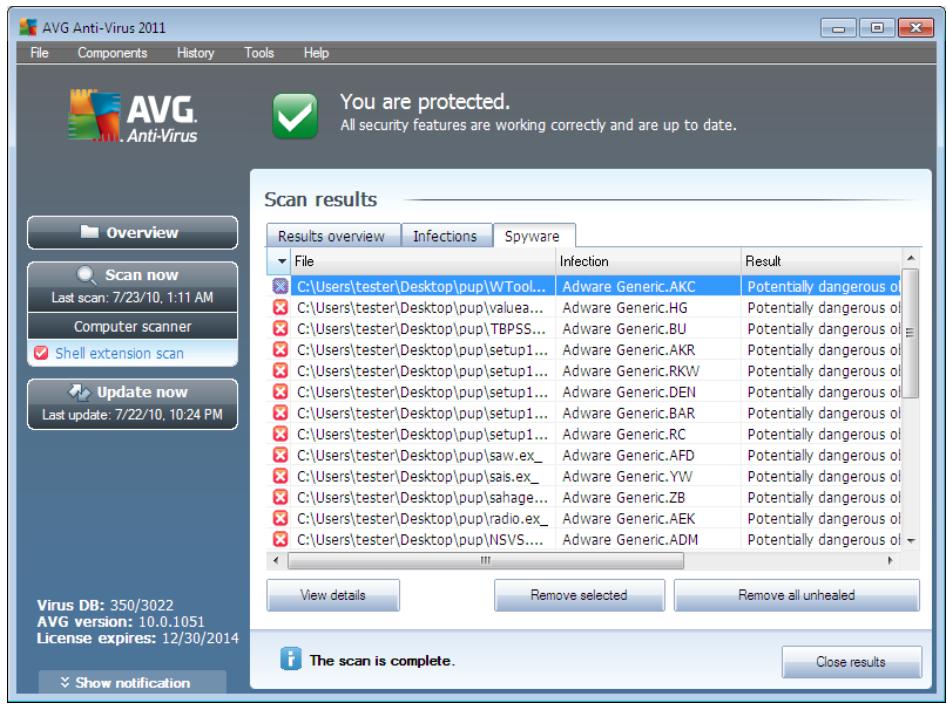
The Spyware tab is only displayed in the Scan results dialog in if spyware was detected during scanning. The tab is divided into three sections providing the following information:
- File - full path to the original location of the infected object
- Infections - name of the detected spyware (for details on specific viruses please consult the Virus Encyclopedia online)
-
Result - defines the current status of the object that was detected during scanning:
-
Infected - the infected object was detected and left in its original location (for instance if you have switched off the automatic healing option in a specific scan settings)
Healed - the infected object was healed automatically and left in its original location - Moved to Virus Vault - the infected object was moved to the Virus Vault quarantine
- Deleted - the infected object was deleted
-
Added to PUP exceptions - the finding was evaluated as an exception and added to the list of PUP exceptions (configured in the PUP Exceptions dialog of the advanced settings)
-
Locked file - not tested - the respective object is locked and AVG is therefore unable to scan it
- Potentially dangerous object - the object was detected as potentially dangerous but not infected (it can contain macros, for instance); the information is a warning only
Reboot is required to finish the action - the infected object cannot be removed, to remove it completely you have to restart your computer
Control buttons
There are three control buttons available in this dialog:
- View details - the button opens a new dialog window named Detailed object information:
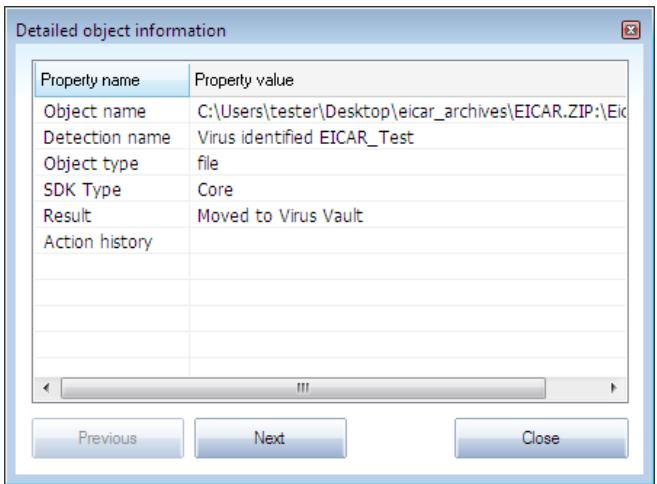
In this dialog you can find detailed information on the detected infectious object (e.g. infected object name and location, object type, SDK type, detection result and history of actions related to the detected object). Using the Previous/Next buttons you can view information on specific findings. Use the Close button to leave this dialog.
- Remove selected - use the button to move the selected finding to the Virus Vault
- Remove all unhealed - this button deletes all findings that cannot be healed or moved to the Virus Vault
- Close results - terminates the detailed information overview and returns to the Scan results overview dialog
10.7.4.Warnings Tab
TheWarnings tab displays information on "suspected" objects (typically files) detected during scanning. When detected by the Resident Shield, these files are blocked from being accessed. Typical examples of this kind of findings are: hidden files, cookies, suspicious registry keys, password protected documents or archives, etc. Such files do not present any direct threat to your computer or security. Information about these files is generally useful in case there is an adware or spyware detected on your computer. If there are onlyWarnings detected by an AVG test, no action is necessary.
This is a brief description of the most common examples of such objects:
- Hidden files - The hidden files are by default not visible in Windows, and some viruses or other threats may try to avoid their detection by storing their files with this attribute. If your AVG reports a hidden file which you suspect to be malicious, you can move it to your AVG Virus Vault.
- Cookies - Cookies are plain-text files which are used by websites to store user-specific information, which is later used for loading custom website layout, pre-filling user name, etc.
- Suspicious registry keys - Some malware stores its information into Windows registry, to ensure it is loaded on startup or to extend its effect on the operating system.
10.7.5. Rootkits Tab
The Rootkits tab displays information on rootkits detected during scanning if you have launched the Anti-Rootkit scan.
A rootkit is a program designed to take fundamental control of a computer system, without authorization by the system's owners and legitimate managers. Access to the hardware is rarely required as a rootkit is intended to seize control of the operating system running on the hardware. Typically, rootkits act to obscure their presence on the system through subversion or evasion of standard operating system security mechanisms. Often, they are also Trojans as well, thus fooling users into believing they are safe to run on their systems. Techniques used to accomplish this can include concealing running processes from monitoring programs, or hiding files or system data from the operating system.
The structure of this tab is basically the same as the Infections tab or the Spyware tab.
10.7.6. Information Tab
The Information tab contains data on such "findings" that cannot be categorized as infections, spyware, etc. They can neither be positively labeled as dangerous but they are still worth your attention. AVG scan is able to detect files which may not be infected, but are suspicious. These files are reported either as Warning, or as Information.
The severity Information can be reported for one of the following reasons:
- Run-time packed - The file was packed with one of less common run-time packers, which may indicate an attempt to prevent scanning of such file. However, not every report of such file indicates a virus.
- Run-time packed recursive - Similar to above, however less frequent amongst common software. Such files are suspicious and their removal or submission for analysis should be considered.
- Password protected archive or document - Password protected files can not be scanned by AVG (or generally any other anti-malware program).
- Document with macros - The reported document contains macros, which may be malicious.
- Hidden extension - Files with hidden extension may appear to be e.g. pictures, but in fact they are executable files (e.g. picture.jpg.exe). The second extension is not visible in Windows by default, and AVG reports such files to prevent their accidental opening.
- Improper file path - If some important system file is running from other than default path (e.g. winlogon.exe running from other than Windows folder), AVG reports this discrepancy. In some cases, viruses use names of standard system processes to make their presence less apparent in the system.
- Locked file - The reported file is locked, thus cannot be scanned by AVG. This usually means that some file is constantly being used by the system (e.g. swap file).
10.8. Virus Vault

Virus Vault is a safe environment for the management of suspect/infected objects detected during AVG tests. Once an infected object is detected during scanning, and AVG is not able to heal it automatically, you are asked to decide what is to be done with the suspect object. The recommended solution is to move the object to the Virus Vault for further treatment. The main purpose of the Virus Vault is to keep any deleted file for a certain period of time, so that you can make sure you do not need the file any more in its original location. Should you find out the file absence causes problems, you can send the file in question to analysis, or restore it to the original location.
The Virus vault interface opens in a separate window and offers an overview of information on quarantined infected objects:
- Severity - in case you decided to install the Identity Protection component within your AVG Anti-Virus 2011, a graphical identification of the respective finding severity on a four-levels scale from unobjectionable (□□□) up to very dangerous (■■■) will be provided in this section; and the information on the infection type (based on their infective level - all listed objects can be positively or potentially infected)
- Virus Name - specifies the name of the detected infection according to the Virus Encyclopedia (online)
- Path to file - full path to the original location of the detected infectious file
- Original object name - all detected objects listed in the chart have been labeled with the standard name given by AVG during the scanning process. In
case the object had a specific original name that is known (e.g. a name of an e-mail attachment that does not respond to the actual content of the attachment), it will be provided in this column.
- Date of storage - date and time the suspected file was detected and removed to the Virus Vault
Control buttons
The following control buttons are accessible from the Virus Vault interface:
- Restore
- removes the infected file back to its original location on your disk
- Restore As - moves the infected file to a selected folder
- Details - this button only applies to threats detected by Identity Protection. Upon clicking, it displays synoptic overview of the threat details (what files/ processes have been affected, characteristics of the process etc.). Please note that for all other items than detected by IDP, this button is greyed out and inactive!
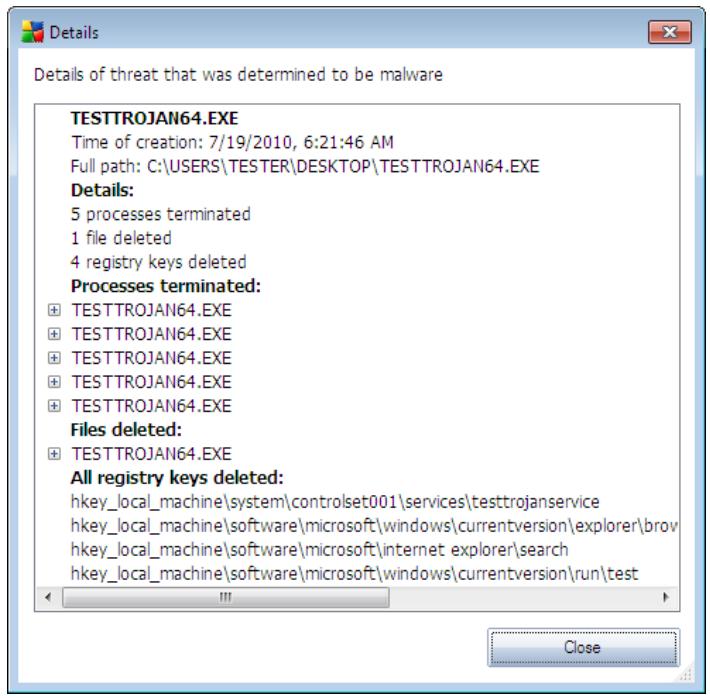
- Delete - removes the infected file from the Virus Vault completely and irreversibly
- Empty Vault - removes all Virus Vault content completely. By removing the files from the Virus Vault, these files are irreversibly removed from the disk (not moved to the recycle bin).
11. AVG Updates
Keeping your AVG up-to-date is crucial to ensure that all newly discovered viruses will be detected as soon as possible.
Since AVG updates are not released according to any fixed schedule but rather in reaction to amount and severity of new threats, it is recommended to check for new updates at least once a day or even more often. Only this way you can be sure your AVG Anti-Virus 2011 is kept up-to-date also during the day.
11.1. Update Levels
AVG offers two update levels to select from:
- Definitions update contains changes necessary for reliable anti-virus protection. Typically, it does not include any changes to the code and updates only the definition database. This update should be applied as soon as it is available.
- Program update contains various program changes, fixes and improvements.
When scheduling an update, it is possible to select which priority level should be downloaded and applied.
Note: If a time coincidence of a scheduled program update and scheduled scan occurs, the update process is of higher priority and the scan will get interrupted.
11.2. Update Types
You can distinguish between two types of update:
- On demand update is an immediate AVG update that can be performed any time the need arises.
- Scheduled update - within AVG it is also possible to pre-set an update plan. The planned update is then performed periodically according to the setup configuration. Whenever new update files are present on the specified location, they are downloaded either directly from the Internet, or from the network directory. When no newer updates are available, nothing happens.
11.3. Update Process
The update process can be launched immediately as the need arises by the Update now quick link. This link is available at all times from any AVG user interface dialog. However, it is still highly recommended to perform updates regularly as stated in the update schedule editable within the Update manager component.
Once you start the update, AVG will first verify whether there are new update files available. If so, AVG starts their downloading and launches the update process itself. During the update process you will get redirected to the Update interface where you can view the process progressing in its graphical representation as well as in an
overview of relevant statistic parameters (update file size, received data, download speed, elapsed time, ...).
Note: Before the AVG program update launch a system restore point is created. In case the update process fails and your operating system crashes you can always restore your OS in its original configuration from this point. This option is accessible via Start / All Programs / Accessories / System tools / System Restore.
Recommended to experienced users only!
12. Event History
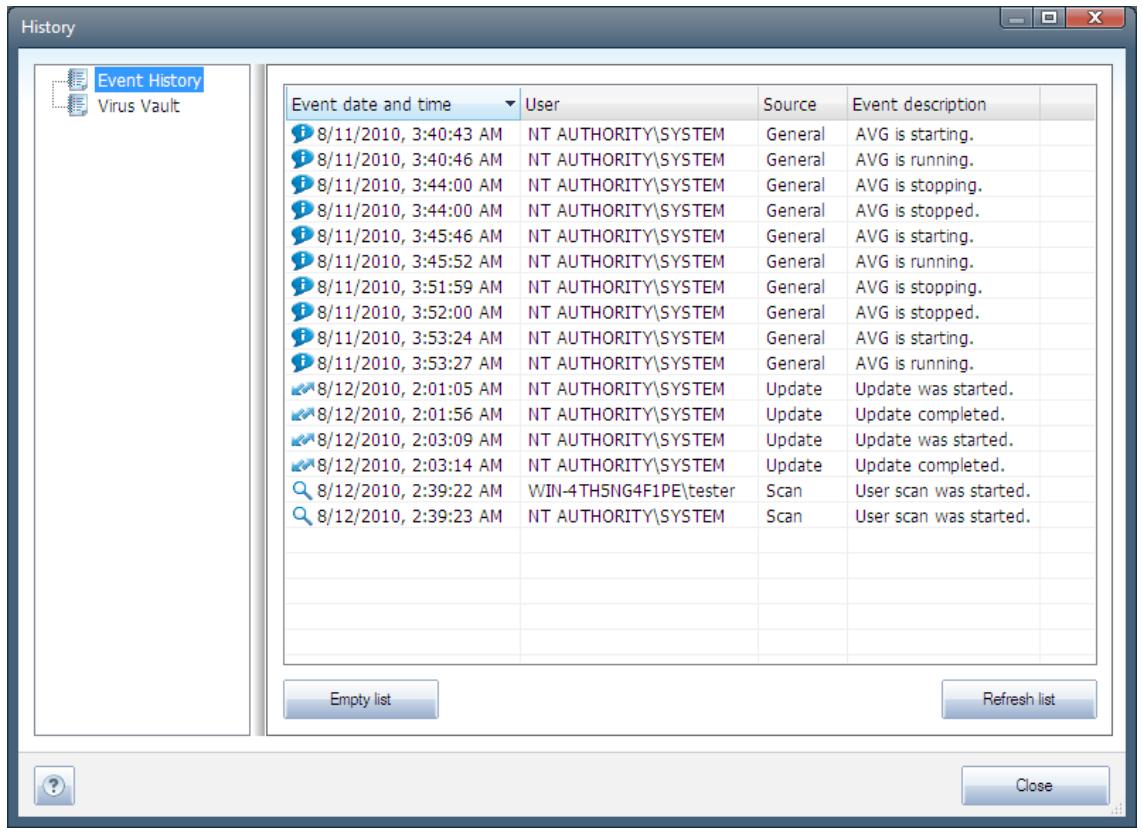
The History dialog is accessible from the system menu via the History/Event History Log item. Within this dialog you can find a summary of important events that occurred during AVG Anti-Virus 2011 operation. History records the following types of events:
- Information about updates of the AVG application
- Scanning start, end or stop (including automatically performed tests)
- Events connected with virus detection (by the Resident Shield or scanning) including occurrence location
- Other important events
For each event, the following information are listed:
- Event date and time gives exact date and time the event occurred
- User states who initiated the event
-
Source gives the source component or other part of the AVG system that triggered the event
-
Event description gives brief summary of what actually happened
Control buttons
- Empty list - deletes all entries in the list of events
- Refresh list - updates all entries in the list of events
13. FAQ and Technical Support
Should you have any problems with your AVG, either business or technical, please refer to the FAQ section of AVG website (http://www.avg.com/).
If you do not succeed in finding help this way, contact the technical support department by email. Please use the contact form accessible from the system menu via Help / Get help online.
- Contents
- AVG Components 29
- AVG Security Toolbar 55
- AVG Scanning 120
- AVG Updates 154
- Introduction
- Congratulations on your purchase of AVG Anti-Virus 2011!
- All AVG products offer
- AVG Installation Requirements
- Operation Systems Supported
- Minimum & Recommended HW Requirements
- AVG Installation Options
- AVG Installation Process
- Welcome
- Activate your AVG license
- Select type of installation
- 4.4.Custom options
- Destination Folder
- Component Selection
- However, you can only select from components that are included in your purchased AVG edition!
- Install the AVG Security Toolbar
- Close running applications
- Install progress
- Installation was successful
- After Installation
- Product registration
- Access to user interface
- Scanning of the whole computer
- Eicar test
- AVG default configuration
- Unless you have a real reason to do so, do not change the AVG configuration! Changes to settings should only be performed by an experienced user.
- AVG User Interface
- System Menu
- File
- Components
- History
- Tools
- Help
- Security Status Info
- Quick Links
- Components Overview
- Statistics
- System Tray Icon
- AVG gadget
- AVG Components
- Anti-Virus
- Anti-Virus Principles
- The important feature of antivirus protection is that no known virus can run on the computer!
- Anti-Virus Interface
- Anti-Spyware
- Anti-Spyware Principles
- Anti-Spyware Interface
- Link Scanner
- Link Scanner Principles
- Link Scanner Interface
- LinkScanner Settings
- Search-Shield
- Surf-Shield
- Resident Shield
- Resident Shield Principles
- Resident Shield Interface
- Resident Shield settings
- Control buttons
- Resident Shield Detection
- E-mail Scanner
- E-mail Scanner Principles
- E-mail Scanner Interface
- E-mail Scanner settings
- E-mail Scanner Detection
- Update Manager
- Update Manager Principles
- It is crucial to update your AVG regularly!
- Update Manager Interface
- Update Manager settings
- License
- Remote Administration
- Online Shield
- Online Shield Principles
- Online Shield Interface
- Online Shield Settings
- Online Shield Detection
- Anti-Rootkit
- PC Analyzer
- ID Protection
- ID Protection Principles
- ID Protection Interface
- Identity Protection settings
- AVG Security Toolbar
- AVG Security Toolbar Interface
- AVG logo button
- AVG Secure Search powered search box
- Page Status
- AVG News
- News
- Delete history
- E-mail Notifier
- Weather Info
- AVG Security Toolbar Options
- Tab General
- Tab Useful Buttons
- Tab Security
- Tab Advanced Options
- AVG Advanced Settings
- Appearance
- Language selection
- Balloon tray notifications
- Gaming mode
- Sounds
- Ignore Faulty Conditions
- Virus Vault
- Maximum number of files to be stored)
- PUP Exceptions
- Online Shield
- Threat notification mode
- Web Protection
- Instant Messaging
- Link Scanner
- Scans
- Scan Whole Computer
- Scan settings
- Adjust how quickly Scan completes
- Set additional scan reports ...
- Shell Extension Scan
- Scan Specific Files or Folders
- Removable Device Scan
- Schedules
- Scheduled Scan
- Schedule running
- Advanced schedule options
- Set additional scan reports
- Additional scan settings
- Virus Database Update Schedule
- Other update settings
- Program Update Schedule
- E-mail Scanner
- E-mail scanning
- Scanning properties
- E-mail attachments reporting
- Certification
- Servers
- Resident Shield
- Advanced Settings
- Excluded items
- If this is not essential, we strongly recommend not excluding any items!
- Cache Server
- Anti-Rootkit
- Update
- When to update files
- Post update memory scan
- Additional update options
- Proxy
- Manual configuration
- Automatic configuration
- Dial-up
- URL
- Manage
- Remote Administration
- Temporarily disable AVG protection
- Please remember that you should not use this option unless it is absolutely necessary!
- Product Improvement Programme
- To protect you from all of these different kinds of threats, AVG includes these specialized components:
- AVG Security Toolbar
- AVG Scanning
- Scanning Interface
- Predefined Scans
- Whole Computer Scan
- Scan launch
- Scan configuration editing
- Scan Specific Files or Folders
- Anti-Rootkit Scan
- Scanning in Windows Explorer
- Command Line Scanning
- Syntax of the command
- computer
- Scanning parameters
- CMD scanning launched from graphic interface
- CMD Scan Parameters
- Scan Scheduling
- Schedule scans
- Schedule Settings
- How to Scan
- What to Scan
- - Shared Documents
- Other
- Control buttons of the Settings for scheduled scan dialog
- Scan Results Overview
- Scan Results Details
- Results Overview Tab
- Infections Tab
- Spyware Tab
- 10.7.4.Warnings Tab
- Rootkits Tab
- Information Tab
- Virus Vault
- AVG Updates
- Update Levels
- Update Types
- Update Process
- Event History
- FAQ and Technical Support
Brand : GRISOFT
Model : ANTI-VIRUS 2011
Category : Security Software