 ManualGo.com
AV830CP - To scan AVISION - Free user manual and instructions
Find the device manual for free AV830CP AVISION in PDF.


Download the instructions for your To scan in PDF format for free! Find your manual AV830CP - AVISION and take your electronic device back in hand. On this page are published all the documents necessary for the use of your device. AV830CP by AVISION.
USER MANUAL AV830CP AVISION
Trademarks Microsoft is a U.S. registered trademark of Microsoft Corporation. Windows and MS-DOS are trademarks of Microsoft Corporation. IBM, PC, AT, XT are registered trademarks of International Business Machines Corp. Other brands and product names herein are trademarks or registered trademarks of their respective holders. Copyright Al rights reserved. No part of this publication may be reproduced, transmitted, transcribed, stored in a retrieval system, or translated into any language or computer language, in any form or by any means, electronic, mechanical, magnetic, optical, chemical, manual, or otherwise, without the prior written permission of Avision Inc. Material scanned by this product may be protected by governmental laws and other regulations, such as copyright laws, the customer is solely responsible for complying with all such laws and regulations.
Warranty The information contained in this document is subject to change without notice. Avision makes no warranty of any kind with regard to this material, including, but not limited to, the implied warranties of fitness for a particular purpose. Avision shall not be liable for errors contained herein or for incidental or consequential damages in connection with the furnishing, performance, or use of this material.
FCC Radio Frequency Interference Statement This equipment has been tested and found to comply with the limits for a class B digital device, pursuant to Part 15 of the FCC rules. These limits are designed to provide reasonable protection against harmful interference in a residential installation. This equipment generates, uses, and can radiate radio frequency energy and, if not installed and used in accordance with the instruction manual, may cause harmful interference to radio communication. However, there is no guarantee that interference will not occur in a particular installation. If this equipment does cause harmful interference to radio or television reception, which can be determined by turning the equipment off and on, the user is encouraged to try to correct the interference by one or more of the following measures: _ Reorient or relocate the receiving antenna _ Increase the separation between the equipment and receiver. _ Connect the equipment into an outlet on a circuit different from that to which the receiver is connected. _ Consult the dealer or an experienced radio/ TV technician for help. FCC CAUTION: To assure continued compliance, (example - use only shield interface cables when connecting to computer or peripheral devices). Any changes or modifications not expressly approved by the manufacture of this device could void the user's authority to operate the equipment. This device complies with Part 15 of the FCC Rules. Operation is subject to the following two conditions: (1) This device may not cause harmful interference, and (2) this device must accept any interference received, including interference that may cause undesired operation. Safety Regulation UL1950, Third edition EN 60950 IEC 60950 FCC Part 15 Subchapter ] Class B EMI Regulation DOC Class B (Canada) Responsible Party: Avision Labs, Inc Telephone No. #1 (510) 739-2369
6.2 PAPER] AM IN THE ADF.
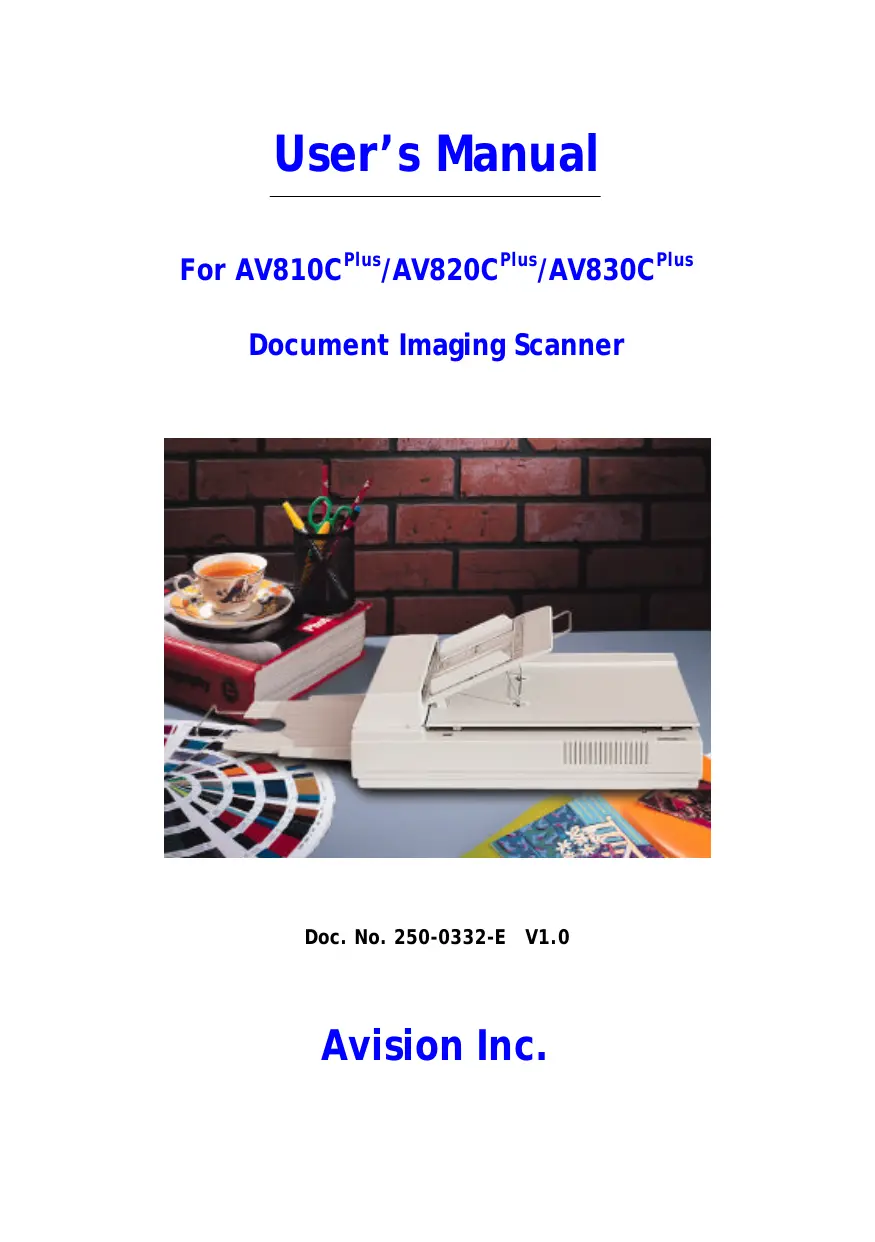
Congratulations on your purchase of thavision document scanner. Avision is one of the leading company to make high quality document scanner. To ensure the optimum performance of the scanner, please take a few minutes to read through this manual before you install and operate the new scanner. The manual contains important information on how to unpack, install, operate, and maintain the scanner properly. Figure 2-1 in below shows how the scanner is packed. Please check if all items are included.
User's Manual, Software CD SCSI Card
SCANNER INSTALLATION PRECAUTIONS Keep the scanner out of direct sunlight. Direct exposure to the sun or excessive heat may cause damage to the unit. Do not install the scanner in a humid or dusty place. Be sure to use the proper AC power source. Only use the AC adapter (model name SA60-24 made yo America) included with the machine. Using other AC adapters may damage the machine and therefore void the warranty. Place the scanner securely on an even, flat surface. Tilted or uneven surfaces may cause mechanical or paper-feeding problems. Keep the shipping box and the material in case you may need to ship the scanner again. SCANNER UNPACKING Please unpack the scanner carefully. 1f any item is missing or damaged, please contact your authorizedAvision dealer immediately. Remove the shipping retainer: 1 Place the scanner on its side as shown to reveal the shipping retainer as shown in Figure 2-1.
2. Unscrew the retainer screw.
3. Pull out the shipping retainer and put it in the “use position” (See
Figure 2-2) and secure it with the screw.
4. Lay down the scanner on the desk for normal operation.
4 “Shipping Position” Figure 2-1 Remove the shipping retainer. ‘Use Position” Figure 2-2 Fasten the shipping retainer. 2-2
Refit the shipping retainer: Whenever you need to transport the scanner, please follow the instructions below: L Turn off the scanner.
2. Raise the document cover. You can see clearly the flatbed glass as
well as the reading engine.
3. Turn onthe scanner. At this moment, the reading engine will move
a few inches forward and stay there for a few seconds. Turn off the scanner during this pause.
4. Raise the scanner high enough to unscrew the shipping retainer
from the “use position” and fix it in the “shipping position." SCSI ID: When you have several devices on a SCSI chain, you may need to adjust the SCSI ID selector setting located on the back of the scanner(See Figure 2-3). This setting assigns a specific "device ID" to the scanner. If the ID number is duplicate with an existing SCSI device, please select a new ID. Note: The factory setting for the scanner is ID#6. Usually, ID#0 is assigned to an internal hard disk drive, and ID#7, to SCSI adapter or host. ID#8 and #9 are not in use actual. Setting Terminator The scanner is equipped with a built-in terminator switch on the rear of the scanner. (See Figure 2-3) Turn the terminator switch on if the scanner is to be connected to the computer as the only or the last SCSI device. Turn the terminator switch off if the scanner is to be located between the computer and other SCSI device. 2-3
1 Raise the document cover to about 45 degrees.
2. Place the ADF paper chute to about 45 degrees. Insert the ADF
paper chute to auto feeder holes on the document cover as shown in Figure 2-4.
3. Pull out the wire leg under the paper chute.
4. Pull out the paper chute extension to the length you wish.
ADF Paper Chute Paper Chute Extension Document Cover Figure 2-4 Install the ADF paper chute 2-5
ADF output paper rack installation
Hold the output paper rack some 30 degrees as shown in Figure 2-5. Insert the three clasp-joints on the output paper rack in their respective places on the ADF. Release the paper rack gently. Make sure the rack is firmly attached to the ADF. Pull out the output paper rack extension to the length you want. ADF Output l +. - Paper Tray Figure 2-5 Install the ADF output paper rack 2-6
For flatbed scanning, see Figure 2-6. Document Cover Reference Mark Original Document Glass Reference Frame Figure 2-6 Lay the paper on the scanner
Standard paper size should feed easily through the scanner. To prevent occasional paper jam when automatically feeding multiple documents, loosen the paper before loading(See Figure 2-7). Left Guide Balance Wire Document Right Guide Figure 2-7 Use ADF to load multiple documents 2-8
Be sure the scanner power is switched off. Connect the power cable and signal cable as Figure 2-8 and Figure 2-9. Turning on the Power The power is controlled by a toggle switch on the side of the scanner. To turn on the scanner, press the switch toward "1." At this moment, the POWER LED should light up. If not, check the power. Scanner Diagnostics The scanner has a built-in self-diagnostic function to detect system errors. The self test is initiated each time the scanner is turned on. During the test, the READY LEDis flashing. At the end of the test, if no error occurs, the READY LED is steadily on. 2-9
Hardware Installation L Turn off your computer.
2. Plug the SCSI card in an available slot of your computer. Be
sure to screw it firmly.
3. Turn on your computer.
Software Installation Windows 3.1 If your scanner comes with an Adaptec AVA-1505Ae, then the installation of the SCSI card driver will be complete during the installation of the scanner driver. Windows 95/Windows 98/Windows NT4.0 Windows 95/98 has embedded driver support for your host adapter. When you start Windows 95/98, the host adapter is detected and the appropriate driver is automatically installed.
Windows NT 4.0 L Press Start>Setting>Control Panel. And choose “SCSI Adapter” from the Control Panel menu. The “SCSI Adapter” dialog box is displayed. Choose Driver. Choose “Add” and “Select manufacturer and SCSI adapter”. Select “Adaptec” as the manufacturer and “AIC-6X60 ISA Single Chip SCSI Controller” as the adapter and then Confirm.
4. Follow the on-screen instruction to complete the installation.
If you purchase your SCSI card separately from the scanner, then please follow the installation instruction provided by your SCSI card supplier.
The Mac system already has SCSI controller built in. Connect the system, thereforeset a different SCSI ID for each SCSI device.
The AV800C series document scanner must have the following minimum requirements to run at rated speed as recommended: . MAC Il series; Quadra serieBerfoma series; Power Macintosh series, PowerBook series or later; + At least 20M bytes of free hard disk space; + A minimum of 16M bytes of system memory required, 32M bytes or higher recommended; + Mac compatible display card and monitor with at least 256 colors; thousands colors or million colors display card recommended; . System 7 or later. + Afloppy disk drive The installation procedures ofAvision scanner driver are as follows: L Close all the applications including the anti-virus program. Install on your computer the image-editing or scanner-related application you want to use with the scanner, such as OmniPage, PhotoShop, etc.
3. Insert “Avision Driver Kit” disk into your floppy disk drive. The
Avision Driver Kik.x.x dialog box as Fig. 3-1 will appear. Read "Read Me First" for some valuable information which you should note.
4. Double click on the “AV KitX.x.x Installer” icon. AV Kix.x.x
Installer dialog box will appear as Fig. 3-2.
5. Click Easy Install icon and drag it to the system icon in the right
side. A "Select a folder for plug-in" dialog box as Fig. 3-3 will appear. Select your application folder and select the "Choose 3-1
plug-ins" button. The installation will then be completed. Choose Restart to proceed your next step. If you want to use other Optical Character Recognition (OCR)applications such a@mniPage, XeroXextBridge, Type Reader, etc., you have to setup the ISIS driver to access the scanner. The ISIS driver is a file namedVision Scan.” To setup, select “Chooser” command from the “Apple é menu. A dialog box as Figure 3-4 will appear on the screen. Select the “Avision Scan” icon, ignore the “Scanner Model” list and the “set SCSI ID” button, The list of scanner model will be displayed. Click on the "Set SCSI ID" button. The "Scanner ID" window as Fig. 3-5 will appear. Choose "Detect". The current Scanner ID number will be verified and highlighted. Press OK button. You can then start your application to use the scanner, or refer to your application manual for more details. ED poision Driver Kit Wex CES av dut HE Vian PadTePre jo] Figure 3-1 Avision Driver Kit Xxx Figure 3-2 AV Kit X.x.x Installer Figure 3-3 Select a folder Figure 3-4 Chooser for plug-in 3-2
Figure 3-5 Scanner ID Note: You can find the latest driver in our homepage located at the World Wide Web(WWW) with the web sitëttp://www.avision.com
To run the scanner at rated speed as recommended, you must have the following minimum requirements: IBM compatible PC 486, Pentium or later; Microsoft Windows 3.1, Windows 95, Windows 98, Windows 2000, or Windows NT 4.0; One SCSI card installed one your computer; 20M bytes of available hard disk space for installation; 16M bytes of RAM (32M bytes or higher recommended); A video graphics array (VGA) monitor; A Microsoft Windows-compatible pointing device (e.g., the mouse); A CD-ROM drive. Installation procedures ofAvision Scanner driver are as follows:
From the File Menu, choose RUN. Typd:\driver\scsi.exe (d means the letter indicating your current CD-ROM drive). Choose O.K. 3-4
(d means the letter indicating your current your CD-ROM drive). Choose O.K.
4. Follow the subsequent instruction on the screen to complete
the instruction. (Normally just press OK and the installation will be completed.)
AV830C Plus allows you to operate the scanner from within a TWAIN or plug-in software application.As the scanner driver is not a stand-alone software, it has to be started from withinTWAIN*-compliantoftware application and then the scanner driver is able to scan and load the image to your computer. The command to start the scanner driver may vary due to different software applications. To check the correct command, please refer to the user manual of your software application.
4.1 STARTING YOUR FIRST SCAN FROM WITHIN A
TWAIN OR A PLUG-IN APPLICATION
1. Start your application(For example, Adobe PhotoShoÿlead
ImagePals, MGhotoSuite and so on.) From File menu, choose Import command .
2. Select MrScan X.x.x from the submenu dfmport.
The Mac Plug-in user interface will pop up on the screen. Place the document upside down on the document glass with the text facing away from you.
5. Click the Preview or Scan button to preview or scan your
document or image. CENT IE EI E sem —] Settiog D — DEA C E= Ts JL rreue ]|S EEE Figure 4-1 Mac Plug-in user interface *T WAIN Stands for Technology Without An Interesting Name, an industry-standard protocol which exchanges information between the application and image acquisition device such as scanners.
PC Users 1 Open your application and chooseSelect Sourcefrom the File menu. If theSelect Source command is not available from the File menu, see the user guide of your application to learn how the TWAIN link is used.
2. A dialog box appears containing the differeñtWAINsources
for you to choose from to bring an image into your application. 2 MGl PhotoSuite SE Ele arScan-Expert 1690 24 rSican- Expert 22 0
Select MrScan-Experts the source. You need to select MrScan-Expert for just once except when you need to use the dialog box to select a different source. In that case, you will need to selectMrScan-Expert as the source again before you can reuse the scanner. Place the document upside down on the document board with the text facing away from you. From the File menu, choosäcquire Avision TWAIN user interface as Figure 4-2 will pop up on the screen. ClickPreviewor Scanbutton to scan the document. Sous frac Mode: Fins co Figure 4-2 PC TWAIN user interface
Two scanning sources are provided - flatbed as well as transparency. However, if you have not installed the transparency kitlease leave the source to the flatbed option. Setting-| Untitled “| Souce[ Flames 2] rr Elatbed Figure 4-3 Scanning Source
A good control of the resolutionresults a satisfactory detail of an image that scans. The resolution is measured by dots per inch(dpi). Normally, the greater the dpi number, the higher the resolution and the image file size. Be aware that the greater resolution takes more time, memory and disk space, therefore, up to a certain degree of dpi, the resolution will not visually be improved, on the contrary, it makes your files more unmanageable. dpi Resolution: 50 dpi Resolution: 100 dpi 4-6
1. For your information, an A4 size color image scanned at 300 dpi
at True Color mode consumes approximately 25 MB of disk space. À higher resolution (usually means over 600 dpi) is recommended only when you need to scan a small area at True Color mode.
2. You can also refer to the following table to choose a proper
resolution while applying your image to other application. Emme" Sertinss Image Type | Resolution Application (dpi) File, Fax, E-mail Your Document LineArt 200 View, Copy, Edit Your Color True Color 100 Picture OCR* Your Document LineArt 300 #OCR: Stands for Optical Character Recognition, the process to convert an image to a text format
Select image type through the mode from thscanner user interface for your own purpose. Please see Figure 4-4 as shown in below: Setting:| Untitled x Source:| Flatbed “| 2| True color x Line art Halftone Grayscale 256 color Figure 4-4 Image Type
Each image typés described as follows: Line art LineArt presents the image in black and white only and there are no intermediate shades of gray in between. That means each pixel of the image is 100%black or 100%whiteLineArtis the best choice of image type if you want to scan text, pen or ink drawing. Since only 1-bit of black or white information is required for eaglixel*, the disk space required for savinneArt image is only about 1/24 of that required to save 24-bit true color images. Figure 4-5 A Lineart Image #Pixel: À combination of two words: picture and element, a pixel is a single dot on a computer display or in a digital image.
Halftone In addition to the black and white display, Halftorèmulates grayscale by using different size of dots. Particularly when you view the image at a certain distance, it looks very closely like a gray image yet it consumes the least disk space. Halftone is the picture that we usually see in newspapers or magazines. Since Halftone is one type of black and white image, the disk space required to save a halftone image is 1/ 24 of that required to save a 24-bit true color image. Figure 4-6 À Halftone Image
Gray (4096 levels gray scale/Internally) A single-channel image consists of at least 256 levels of shades of gray in an image. A 12 bits scanner produces a Grayage with 4096 shades of gray between pure black and pure white. Gray is the best choice of image if you wish to scan a black and white photograph. With 12 bits of color information per pixel, the disk space required to save a gray image is eight times more than lineArt and 1/3 of that required to save a 24-bit true color image. Figure 4-7 A Gray Image
256 Colors The 256 colorsimage provides 256 levels of color hues. The disk space required to save an image in 256 colors is 1/3 of that required to save a 24-bit true color image. Figure 4-8 À 256 Color Image True Color A 36-bit Color image consists of three 12-bit color channels. The red, green, and blue channels are mixed together to create a combination of one billion(é) colors which give a more true-to- life quality to the image. True Colas the best choice if you want to scan a color photo. Figure 4-9 A True Color Image
Brightness: Adjusts the lightness or darkness of an image. The higher the value, the brighter the image. Decrease your Normal Increase your Brightness Brightness
Contrast: Adjusts the range between the darkest and the lightest shades in the image. The higher the contrast, the bigger the different gray scales. Decrease your Contrast Normal Increase your Contrast Gamma: Adjusts themidtone of the image without losing details of the lightest and the darkest areas. Gamma Value: 1.0 Gamma Value: 1.4 Gamma Value: 2.0
intensity: Saturation: Adjust the hue up to 360° by clicking your desired color on the Color wheel or clicking the up or down arrow button. (Note the level of intensity for the color will be changed simultaneously when the hue adjustment is made).
ï ci) 240: . The Color Wheel Adjust the color strength by clicking the Up or Down arrow button. Adjust the saturation level for the color by clicking the Up or Down arrow button. The level of saturation decides if the color is pale or rich.
Speed Mode Advance Settings FA Auto Crop Color Matching K] FILe Ee Invert Image Quality Mode Advance Settings: (PC) Click the button and a dialog box in below will be displayed. This dialog allows you to remove one of the R(Red), G(Green), or B(Blue) color channel while scanning. For example, if your image contains red color text or red color background, choose the R(Red) channel then any text or background in red color will be removed. Yet this function supports only black & white and gray image. Therefore, be sure to choose any black & white or gray image type while applying this function. {Color drop-aut- Besel Merge data CR channel & E channel 0 B channel once _| Tip: An increase of brightness after removing one of the color channel will make your image more clear.
Your original with blue color background Your original with red watermark mahetes 8e) Te bee ve ot der alcgmant proue 1 property mortes Our quais D Ace e Bd menton complete cutomer émifochen After click the B(Blue) channel “The trees are in th utumn beauty, The woodiand paths are dry, Under the October twilight the water Mirrors a still sky; Upon the brimming water among he stones Are nine-and-ffty Swans.” —W.B. Yeats After click the R(Red) channel [The red removed] watermark has been ABC Ine. diaributes and ses 25 product worldwide treugh OEMS/ODMS, and ditrbutors. As of June 1999, ABÛ has employed over 21 weltraines marketing sales, sd support personnel To better serve 29 customers, ABC has sesignad an account manager for each of ts CEMODM customers These account managers are responsible for effecteby cooränate be outstanding rues in sales, manufacturing. er development and assure 1he status of each customers Broductis proper montored. Our goalis to achieve maintain complete customer satisfaction. Note: SRGB: The SRGB function allows your scanned image to retain the same image quality among your scanning software, computer monitor, and printing output if both your computer monitor and printer support SRGB. However, the gamma adjustment will be disabled while applying this item since it has been optimized.
Invert Image: The invert command reverses the brightness and the color in the image. For color images, each pixel will be changed into its complementary color at the command ofnvert. Original After Invert
Color Matching: Adjusts the color quality of the image so that it comes close to that of the original. This function uses default parameters to adjust the image. Before Color Matching After Color Matching Quality/Speed Mode: Choose Speed Mode if you need to speed up your scanning task. Choose Quality Mode if you need a better quality of your scanning result.
Auto Level: (Mac) Automatically adjusts the highlight and shadow areas of the scanned image to give it an optimal effect. Before Auto Level After Auto Level Auto Crop: Automatically sets the whole document as the scan area, no matter what its size. Before Auto Crop After Auto Crop 1 PP] Él LH E Li 8 F] LE z BI
Sharpen: Sharpens the scanned image. Look for more selections under this item. Sharpen: [None Original
Descreen: Eliminates themoire patternstommonly found in printed matter. Descreen: [None + ] *Moire pattern: An undesirable pattern in a color printing resulting from incorrect screen angle of overprinting halftone.
Select Scan Area A— Zoom H] Move Image Quick Zoom: Provide frequently used magnification ratios (1x, 2x, 4x, 8x, or view the whole image) to perform a quick enlargement of your preview image. Select Scan Area: Select your desired scan area. (Click the button and place your cursor at the preview area. The cursor turns a cross sign. Hold your left mouse button to create your scan area. Release the left mouse button when the area has been successfully selected.) Zoom: Click and place your cursor on the preview area. The cursor will turn à zoom sign to enlarge or reduce(press the Alt key) you preview image. Move Image: Click and place your cursor anywhere onthe preview area. The cursor now turns a hand sign to allow you to move the preview image to view a specific portion clearly. (This function is only available after the preview image has been enlarged.) 4-24
Scale: Width: Height: Unit: OTHER TOOLS Scale: |100 AE — Rescale your Image Width: [416 [a Lock Image Width & Height Heïght: (5.10 [IE] Quick Choice Scan Size Unit: Tinoh À — Unit Enlarge or reduce your image in a pre-set proportion (from 50%to 800%. Display current image width. Display current image height. A reminder of the measuring system in use. By clicking on the abbreviation you can change the measuring system. Lock Image Width & Height: Fix your output width and height despite of the scan size you have selected. Note the scale value will be changed automatically when you applying this function and resizing your selected area at the same time. Quick Choice Scan Size: Provide frequently used scan size option including Business Card, 5"x 3”, 6"x 4", Letter, Legal, B5, A5, A4, A3, or your current scan area to perform an immediate selection of your scan size.
Exit | Preview | Preview: Previews your image to allocate the area to be scanned. Scan: Scans the area with the parameters you have set . Exit: Cancels the current job. As shown in the figure below, in the Preview window, you can define the area to be scanned by dragging the cursor auxiliary lines with the mouse.
5.1 CLEANING THE ADF
Your scanner is designed to be maintenance-free. However, it still needs to be cleaned occasionally to ensure optimum image quality and performance. The scanner parts may be contaminated with ink, toner particles or paper coatings. As a result, the scanner needs to be cleaned occasionally particularly in the following cases:
1. Documents do not feed smoothly or easily;
2. Several documents feed at one time.
The cleaning procedures
1. Wet a cotton swab with some isopropyl alcohol. (95%
2. Open the ADF unit as shown in Figure 5-1 and wipe the upper
feeding roller by moving the swab from side to side. Rotate the roller forward with your finger and repeat the above cleaning procedures until the entire roller is cleaned. Be careful not to snag or damage the pick springs.
3. Wipe the pad in the direction from top to bottom. Be careful not
to hook the pick springs.
4. Close the ADF unit. Your scanner is now ready for use.
ADF Pad Feeding Roller Figure 5-1 Opening the ADF unit. 5-2
5.2 CLEANING THE GLASS
1) Soak a cotton swab with some isopropyl alcohol. (95%
2?) Open the ADF unit and document cover as shown in Figure 5-2. Wipe the glass of flatbed and ADF area by moving the swab from side to side.
3) Close the ADF unit and document cover. Your scanner is now
ready for use. Glass Figure 5-3 The cleaning area 5-3
5.3 REPLACING THE ADF DETACHABLE PAD
MODULE After scanning approximately 150,000 pages through the ADF, the pad spring may be worn out and you may experience problems with document feeding. In this case, it is highly recommended to replace the pad module with a new one. For ordering the pad module, please consult your nearest dealer and follow the procedure in below to replace it. Removing Procedure L Open the ADF front cover by depressing the ADF release button.
2. Use your fingers to hold the ADF detachable pad module and pull
it out as shown in Figure 1. ADF Release Button Figure 1 Remove the pad module 5-4
Assembling Procedure L Take out the ADF pad module from the box.
2. Use your fingers to hold the ADF pad module and place it gently
to the pad holder as shown in Figure 2. ADF Pad Module Figure 2 Install the pad module 5-5
The scanner will automatically perform a simple self-test each time it is turned on. This will help spot major system errors in the scanner itself. When the test is initiated, the READY LED is flashing. When the test is completed, the READY LED is steadily on. If you have problems with the operation of your scanner, please check the following troubleshooting hints.
6.1 FREQUENTLY ASKED QUESTIONS
Question: The LED indicates that the scanner is ready, but the scanner does not respond to the scan command form the host computer. Answer: Please check the signal cable is firmly seated, and invoke the scan command again. If there is still no response, please reset the scanner by turning it off and then on again, and reboot your host computer as well. Question: Paper becomes jammed during scanning. Answer: 1) Open the ADF unit.
2) Pull out the jammed paper carefully.
3) Close the ADF unit.
Question: Answer: Question: Answer: Question: Answer: Question: Answer: More than one sheet of paper were fed into the scanner.
2) Remove the multi-fed sheets of paper.
3) Close the ADF unit.
4) Flatten the corners and edges; loosen the paper
before reloading it in the paper guide.
5) Check the feeding roller condition and do the
cleaning if necessary. Paper becomes skewed in the scanner.
When | power on the scanner, it makes noises and will not stand ready. There are two possibilities:
1) You forgot to remove the shipping retainer from the
scanner. Please remove the shipping retainer first.
2) You did not place the scanner on a flat desktop
surface. This may cause the scanner to function improperly. The scanner is power-on and ready, but is not accessible from the application. It is a connection problem and can be explained in terms of PC and SCSI] version. 6-2
Question: Answer: Question: Answer: Question: Answer: Question: Answer: Getting an image from the scanner is not a problem, but, when scanning, the scanner or system will often crash. Please check
1) If the cable is firmly seated:
2) Please note only two SCSI terminators can be connected
to your SCSI daisy chain. Oneisattheendof the SCSI device, another is already in your host adapter. While scanning, the scanner often makes noises or it scans back and forth. Please choose lower speed from the TWAIN user interface for low speed PC. The scanned image always comes out to be too dark.
1) Use your application to modify the Gamma setting to
2.2 and 1.8 for your printer and monitor respectively.
2) Adjust Brightness setting from the TWAIN
interface to get a brighter image. The scanner works well except for the line art, the lines of which seem much thicker than the original. Increase the Brightness or adjust the Threshold setting to adjust the line art image. 6-3
6.2 PAPER] AM IN THE ADF
In case of paper jam, please follow the procedures below. 1 Turn off the scanner. Press the button at the front left of the scanner
2. The ADF cover will pop up a little.
3. Backward on its hinge, open the ADF cover to its full position.
4. Pull the paper gently out of the ADF unit.
ADF Release Button Figure 6-1 Handle the paper jam problem - press the button. 6-4
ADF Unit ADF Paper Chute
Document Figure 6-2 Handle the paper jam problem - pull out the paper. 6-5
Technical support forAvision scanner is provided &vision Technical Assistance Center (ATAC). Before contact with ATAC, please prepare the following information. + Scanner serial & revision number (located on the bottom of the scanner) + Hardware configuration (e.g., your host CPU type, RAM size, free disk space, display card, interface card, etc.) + The name and version of your software application + The version of your scanner driver. Please call us at: US and Canada Area: Avision Labs., Inc. Address: 6815Mowry Ave. Newark CA 94560, USA Telephone number: +1 (510) 739-2369 Fax number: #1 (510) 739-6060 Web Site: http://www.avision. com E-mail: support@avision-labs. com Other Area: Avision Inc. Address: No.20, Creation Road |, Science-Based Industrial ParkHsinchu, Taiwan Telephone number: +886 (3) 578-2388 Fax number: +886 (3) 577-7017 Web Site: http://www.avision. com Email: service@avision.com.tw 6-6
SPECIFICATIONS Scanner Type Scanning Mode Optical Resolution Light Source ADF Capacity ADF Scanning Speed AV810È AV820€"S AV830€" Scanning Document Size Drivers Bundled Interface Power Requirement Power Consumption Humidity Operation Temperature Storage Temperature Dimension Weight 7-1 All specifications are subject to change without notice. 1-pass color Flatbed with ADF built-in 36-bit color 12-bit Gray scale Line Art / Halftone Error Diffusion (single bit) 300 * 600 dpi Cold cathode fluorescent lamp 50 pages 10 PPM(200 dpi, B&W mode) 20 PPM(200 dpi, B&W mode) 30 PPM(200 dpi, B&W mode) ADF mode 8.5“ x 14” Flatbed mode 8.5“ x 11.69” TWAIN & ISIS SCSI-2 DC 24V, 1.2A 36W 20%to 80%RH 10 to 40°C -10 to 50°C 570 x 350 x 165 mri/KDxH) 12 kgs (26.3bs)
The following can not be properly fed by the ADF: Paper with clip or staple attached; Paper with ink not totally dry; Paper with inconsistent thickness, such as envelopes; Paper with wrinkles, curls, folds or tears; Tracing paper; Coated paper; Carbonless paper; Paper narrower than 3.5" or wider than 8.5"; Items other than papers, such as cloth, metal or OHP film; Notched paper; Paper with an odd (non-rectangular) shape; Very thin paper. 7-2