POWER AMPLIFIERS 900 - Audio Amplifiers AUDIOVOX - Free user manual and instructions
Find the device manual for free POWER AMPLIFIERS 900 AUDIOVOX in PDF.



| Product type | Mono subwoofer amplifier |
| Brand | AUDIOVOX |
| Model | Power 900 |
| Amplifier class | Optimized class B |
| Power supply | 12 V DC (negative ground system) |
| Max current | 60 A |
| Recommended fuse | 2 × 30 A (ATO type) |
| RMS output power (THD+N <1%) | 230 W × 1 (4 Ω) / 340 W × 1 (2 Ω) |
| RMS output power (THD+N <2%) | 300 W × 1 (4 Ω) / 450 W × 1 (2 Ω) |
| Frequency response | 10 Hz to 240 Hz (-3 dB) |
| Low-pass filter | 40 Hz to 240 Hz, 12 dB/octave |
| Subsonic filter | 10 Hz to 40 Hz, 12 dB/octave |
| Bass EQ | 0 to +12 dB at 45 Hz |
| Input level | 400 mV to 5 V |
| Signal-to-noise ratio | >100 dB (A-weighted, ref. 1 W) |
| Distortion (THD+N) | <0.02% (5 W, 125 Hz, 14.4 V) |
| Input impedance | 20 kΩ nominal |
| Remote control | Remote input level (5 m cable) |
| Protection | Short circuit, DC offset, thermal overload |
| Dimensions (L × W × H) | 15.75" × 9.0" × 2.5" (400 × 229 × 64 mm) |
| Warranty | 12 months |
| Customer service | 1-800-323-4815 |
Frequently Asked Questions - POWER AMPLIFIERS 900 AUDIOVOX
User questions about POWER AMPLIFIERS 900 AUDIOVOX
0 question about this device. Answer the ones you know or ask your own.
Ask a new question about this device
Download the instructions for your Audio Amplifiers in PDF format for free! Find your manual POWER AMPLIFIERS 900 - AUDIOVOX and take your electronic device back in hand. On this page are published all the documents necessary for the use of your device. POWER AMPLIFIERS 900 by AUDIOVOX.
USER MANUAL POWER AMPLIFIERS 900 AUDIOVOX
Installation & Operation Manual
Amplificadores Power
Features and Specifications 2
Installation 3
Power Wiring. 4
Speaker Wiring 6
Indicators and Controls 10
Testing 11
Remote Input Level Control. 11
Troubleshooting 12
CEA Power Output 13
Contedio
Introduccion 15
The Jensen Power series of amplifiers were designed to meet or exceed the CEA-2006 test standards. These new standards give all participating manufacturers (and many don't participate) a baseline when comparing amplifiers of similar power output. The CEA Power rating protects you, the customer. "Power is power - it doesn't matter who makes it," is not always true. What does matter is whether the power can be produced in the first place. The RMS rating is the true power you are getting. At Jensen, to be fair to you and to the competition, we rate our amps in the two most popular ratings, including the CEA RMS rating. So feel confident that your Jensen purchase decision was a sound one, and remember "If it's Too Loud, You're Too Old."
Before You Begin
We need to get the legal stuff out of the way, so please keep reading. Afterwards, you'll be armed with the knowledge to install your new hard-hitting, speaker-pumping Jensen amplifier.
Exposure to loud sounds or music can permanently damage your hearing. Unfortunately, in many cases, the damage is not noticeable until years later. In addition, loud music may hinder your ability to hear traffic, police, and fire or emergency vehicles. Please be responsible and have respect for other people by listening at moderate volumes!
Warranty Service
If your Jensen amplifier should ever require service, you will need the original dated receipt. If you must return the unit for any reason, always include the receipt with the product.
Features and Specifications
Your new Jensen Power mobile stereo power amplifier is the amplifier of choice for the high demands of auto sound reproduction. With its deep-bass reproduction and plenty of reserve power, low harmonic distortion and neutral reproduction, the Power series of amplifiers takes Mobile Hi-Fi to new heights. Like all Jensen products, when it comes to accurate sound reproduction the Power series takes a back seat to no one. Jensen will bring your Hi-Fi experience to new heights with the following features:
MOSFET Power Supply
High Current Bi-Polar Output Transistors
- Optimized Class B Design Minimizes Distortion and Reduces Idle Current
- Easily Drives 2-Ohm Loads
Pass-Thru RCA's
- Variable Bass EQ 0 - 12dB @ 45 Hz
12dB / Octave Low Pass and High Pass filters
- Variable Input Level 400mV - 5 V
- Short Circuit, DC-offset and Thermal Overload Protection Circuitry
Diagnostic LED's - Green: Power, Red: Standby / Fault
Power 400 / 760 / 880 / 920
- Low Pass Filter 40 - 300 Hz
High Pass Filter 40 - 300 Hz
High Pass / Low Pass / Full Range Selector Switch - Stereo / Mono Mode Switch (Power 400 and 880 only)
2/3/4 Channel Mode Switch (Power 760 and 920 only))
Power 900 / 1050
Mono Subwoofer Amp
- Low Pass Filter 40 - 240 Hz (Power 900)
- Low Pass Filter 40 - 150 Hz (Power 1050)
- Subsonic Filter 10 - 40 Hz, 12dB / octave (Power 900)
- Subsonic Filter 15 - 55 Hz, 12dB / octave (Power 1050)
- Remote Input Level Control (Remote Bass Control) w/ 5 Meter Interface Cable
Specifications
Power 400 / 760 / 880 / 920
- Load Impedance: 2 / 4-Ohm
- Signal to Noise @ 1 kHz: >100dB (rated power)
- Channel Separation @ 1 kHz: >60dB
-
Frequency Response: 5-60 kHz, -3dB
-
Input Impedance: 20kHz , nominal
- THD+N @ 5 Watts: 0.02% , 1 kHz, 14.4VDC
Power 900 / 1050
- Signal to Noise @ 120 Hz: >100dB (Rated Power)
- Channel Separation Not Applicable
- THD+N @ 5 Watts: 0.02% , 125 Hz, 14.4VDC
Power Output
RMS Power Output @ 2% THD+N, 1kHz, 14.4VDC
Power 400
- 75 × 2 Watts,4-Ohm
- 100 × 2 Watts,2-Ohm
- 200 × 1 Watts,4-Ohm Bridged
Power 760
- 75 × 4 Watts,4-Ohm
- 100 × 4 Watts,2-Ohm
190 x 2 Watts, 4-Ohm Bridged Stereo
Power 880
135 x 2 Watts, 4-Ohm
- 220 × 2 Watts, 2-Ohm
- 440 × 1 Watts,4-Ohm Bridged
Power 900
- 300 × 1Watts,4 - Ohm
- 450 × 1 Watts,2-Ohm
Power 920
100 x 4 Watts, 4-Ohm
140 x 4 Watts, 2-Ohm
- 230 × 2 Watts,4-Ohm Bridged Stereo
Power 1050
- 350 × 1 Watts,4-Ohm
- 525 × 1 Watts,2-Ohm
Specifications subject to change without notice.
Installation
Before you begin the installation of your Power series amp remember, there are two ways to do things - right and twice! Use the proper installation techniques, tools and accessories to ensure that your Jensen Power series amp will put out all the power it was designed to. If necessary, seek a professional installer to have the amplifier installed correctly. Most mobile amp installations do not have the proper gauge wire for power and ground - do not let your amp be a victim of this common installation oversight!
NOTE: This device is a high-power audio amplifier intended for installation in vehicles with a 12-Volt negative ground electrical system. Attempting to connect or operate the amplifier with another type of electrical system may cause damage to the amplifier or the electrical system.
Installation Assistance
For installation assistance, call 1-800-323-4815 during normal business hours, or visit www.jensen.com at any time.
Supplies and Tools Needed
To install the amplifier, you will need tools, supplies and adapters. It is best to make sure you have everything you need before you start.
Supplies
- Black electrical tape
- Amplifier Installation Kit
Tools
- Cordless drill with assortment of bits
- Flat-head and Philips screwdrivers
- Wire cutters/strippers
- Crimping tool
12-volt test light or digital multimeter - Wire brush, sandpaper or scraping tool (ground connection to vehicle should be a clean, unpainted metal surface)
Disconnect Battery
Disconnect the negative (-) battery cable before starting the installation. Check the battery ground (there should be two (2) ground wires coming from the battery - one going to the starter mounting bolt or engine block and another
going to the vehicle chassis) and make sure the battery is grounded to the chassis with at least a #8 gauge wire. Also check the alternator connections, making sure they are tight and free from corrosion, rust or dirt.
Location and Mounting
The amplifier's compact design allows great flexibility in mounting. Common mounting locations include under the front passenger seat or in the trunk area.
When selecting a location, remember that amplifiers generate heat. Select a location on a flat surface away from heat and moisture where air can circulate around the amplifier.
Place the amplifier in the mounting location and mark the positions of the holes with a marker, pen or pencil. Carefully drill the mounting holes in the marked positions, then use the supplied mounting screws to securely fasten the amplifier to the mounting surface.
WARNING: Do not cover the amplifier with carpets or enclose it behind interior trim panels, and do not mount the amplifier in an inverted or upside down configuration. Be sure the mounting location and the drilling of pilot holes will not damage any wires, control cables, fuel lines, fuel tanks, hydraulic lines or other vehicle systems or components.
Routing Wires
Proper wiring connections are illustrated on the following pages. If wiring connections are made incorrectly, the unit will not operate properly and could become permanently damaged. Follow the installation instructions carefully, or have the amplifier installed by an experienced technician.
Power Wiring
Charging System
In some cases, the installation of just one (1) amplifier could be enough to overload your factory electrical system (i.e., alternator). Depending on the state of your electrical system and overall condition of your vehicle, you may need to upgrade your alternator and battery. After the vehicle is started, the alternator provides the power to your electrical system, not the battery. When the engine is running, the alternator is your main source of power. Upgrading the alternator should be your first consideration if you should experience a voltage drop in the system when operating your audio system. Adding capacitors and/or batteries without upgrading the alternator will only make the problem worse because these devices put an extra load on the alternator. After upgrading the alternator, capacitors and/or batteries can be installed if desired.
Use the following recommended wire gauge as a guide when installing your amplifier(s):
| MODEL NUMBER | MAX CURRENT DRAW | MIN WIRE GAUGE |
| 400 | 25A | #8 |
| 760 | 40A | #8 |
| 880 | 60A | #6 |
| 900 | 60A | #6 |
| 920 | 60A | #6 |
| 1050 | 100A | #4 |
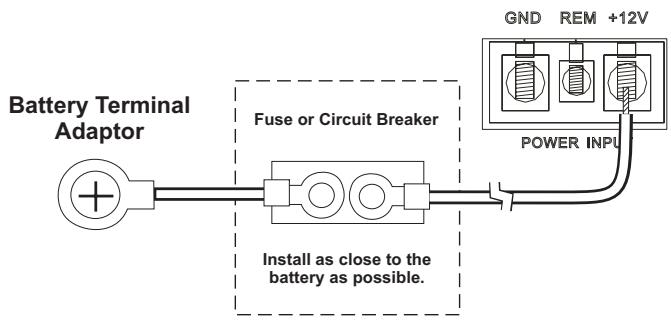
Power Terminal (+12V / B+)
Connect the main power wire to the battery, within 18 inches from the positive (+) battery post, using an adequate size fuse or circuit breaker capable of handling the current of the selected power wire. A fuse or circuit breaker must be installed to prevent a possible electrical fire should the main power wire short to ground.
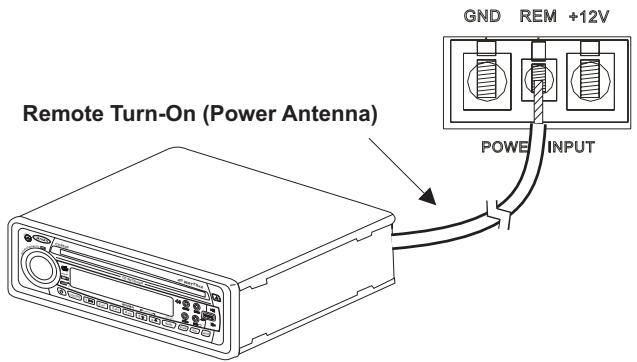
Remote Terminal (REM)
Connect the power antenna or amplifier turn-on lead from the receiver to the amplifier remote terminal.
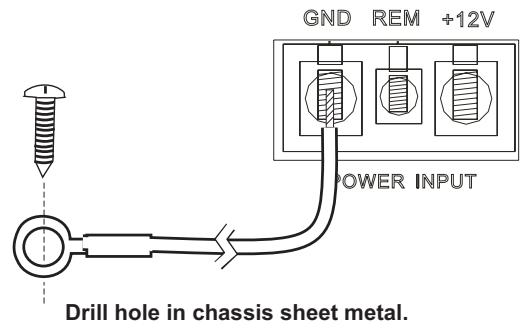
Ground Terminal (GND)
Make the ground lead as short as possible, leaving enough length to complete the installation and to allow for any service that may be needed at a later date. To ensure a good ground, scrape away any paint or undercoating to expose bare metal. Use a "ring" terminal of the proper gauge and an "outside star washer" (between the chassis and ring terminal) when making your ground connection. Although you've scraped away the paint to expose bare metal, the outside star washer will help to "bite into" the chassis for a tight, secure ground.
Replacement Fuse Requirements (FUSE)
| Model | Quantity | Amps | Type |
| 400 | 1 | 25 | ATO |
| 760 | 2 | 20 | ATO |
| 880 | 2 | 30 | ATO |
| 900 | 2 | 30 | ATO |
| 920 | 2 | 30 | ATO |
| 1050 | 4 | 25 | ATO |
Speaker Wiring
The Speaker Wiring diagrams illustrate options for connecting one or two speakers. Observe the proper speaker polarity.
NOTE: Power amplifiers can drive speakers with a nominal impedance range of 2~4-ohms. For maximum power, configure your speakers for a nominal 2-ohm load.
NOTE: Do not overlook the use of the proper gauge speaker wire. The Power series of amplifiers require a minimum of 12-gauge wire.
Power 900/1050
Two Subwoofer
One Subwoofer
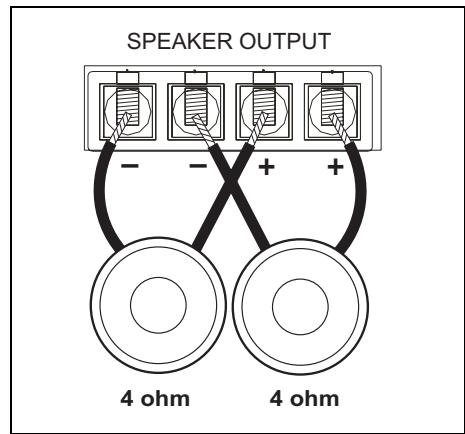
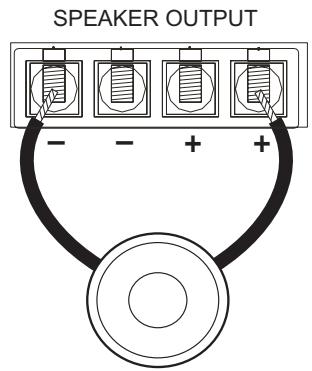
4 ohm nominal
Power 400/880
Two Speakers
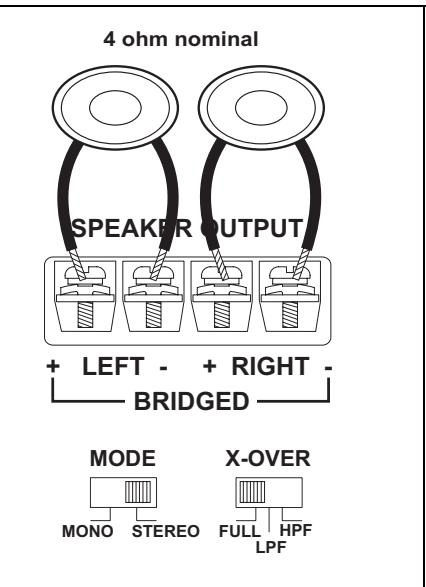
One Subwoofer
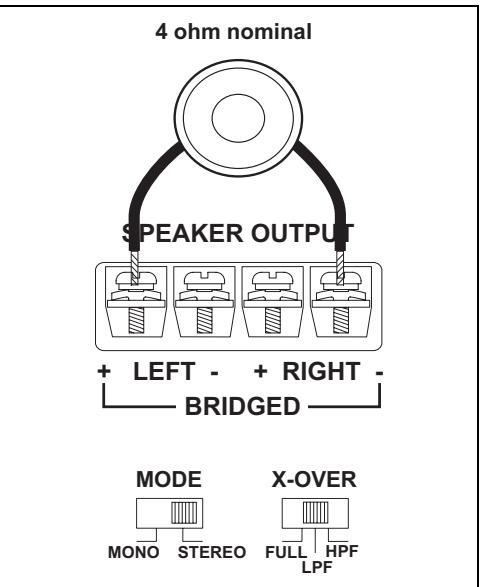
Tri-Mode
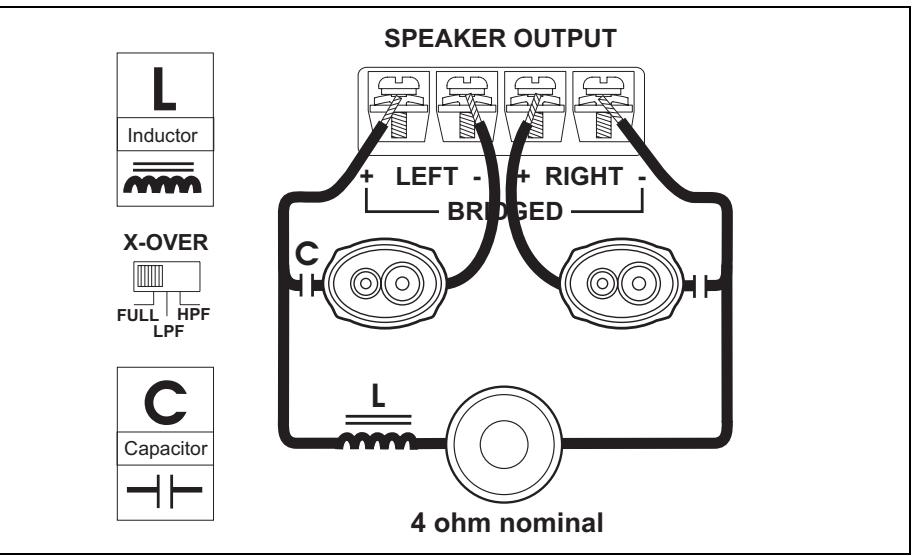
Power 760/920
Four Speakers
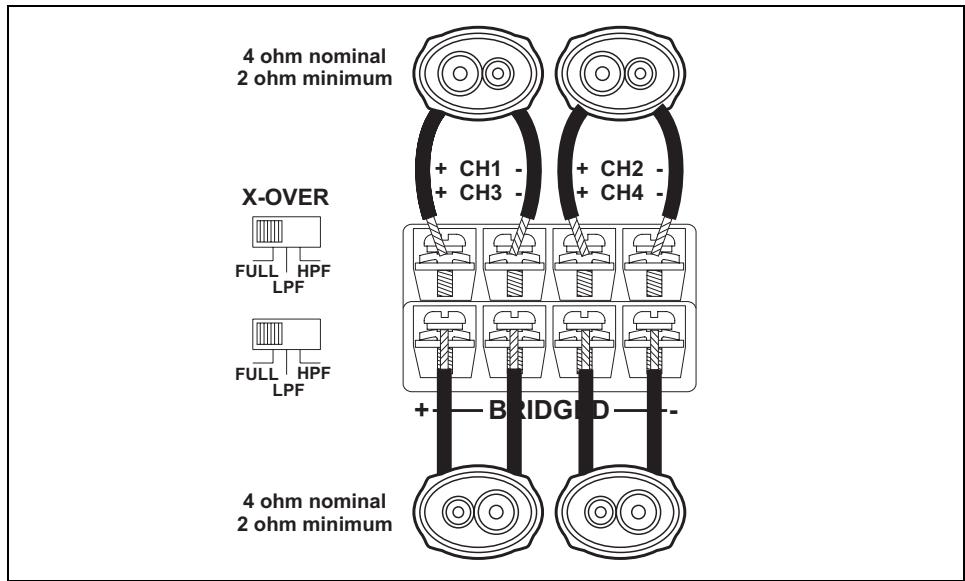
Two Speakers and Bridged Subwoofer
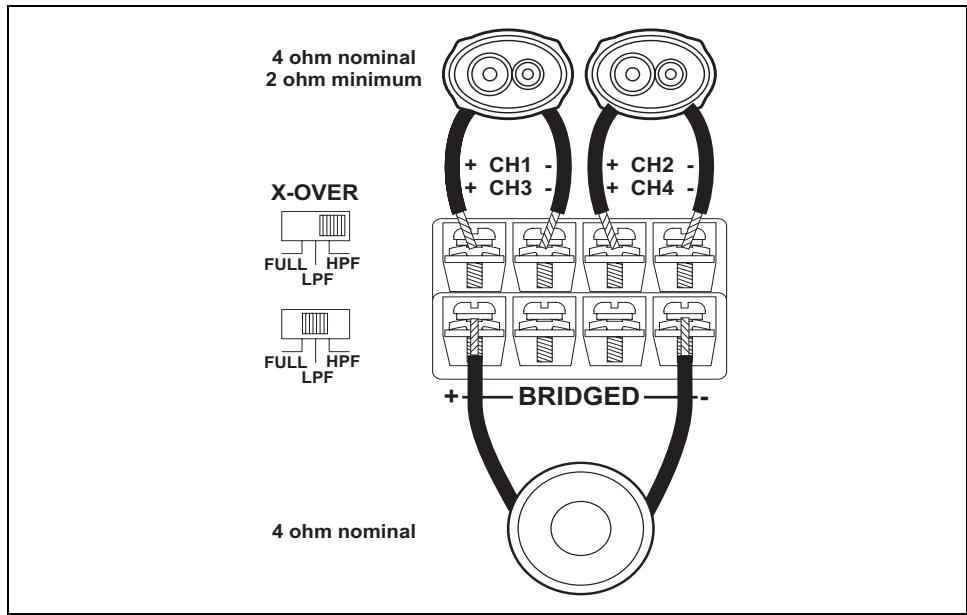
Two Subwoofoers
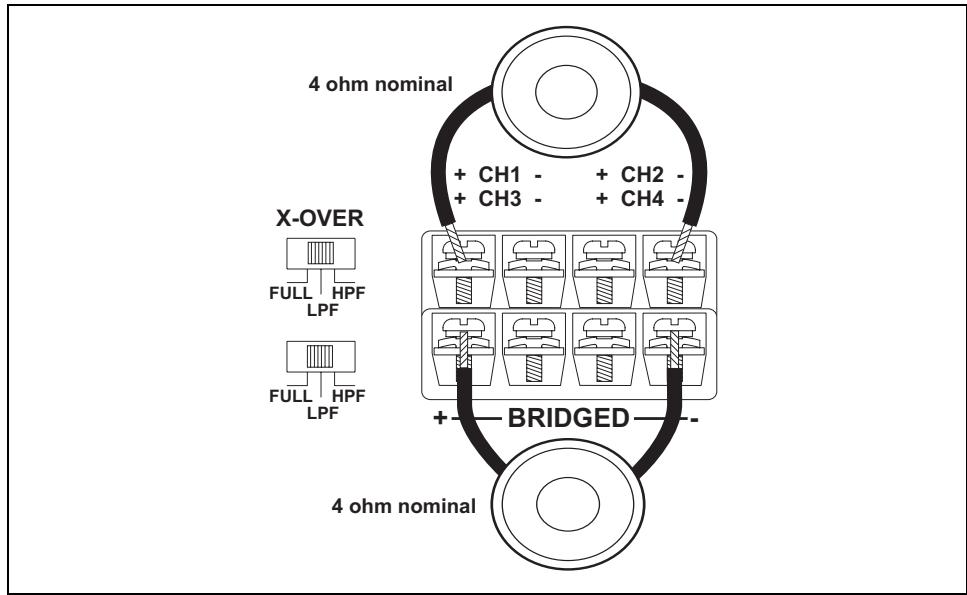
Input Wiring
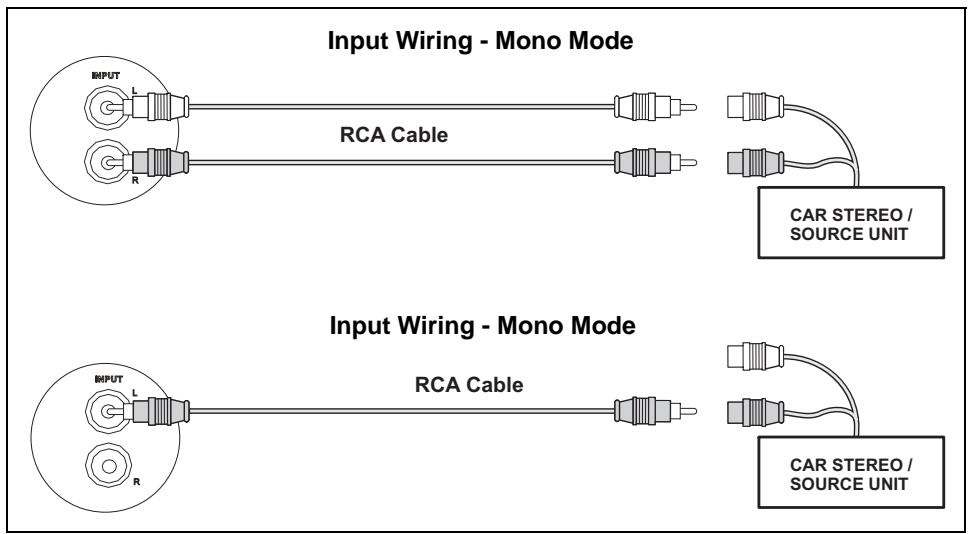
Most trunk/hatchback installations will require a 15-20 foot RCA cable, while pickup trucks and under-seat mounting will require a 6-12 foot RCA cable. Connect an RCA cable from your receiver to the RCA input on your amplifier.
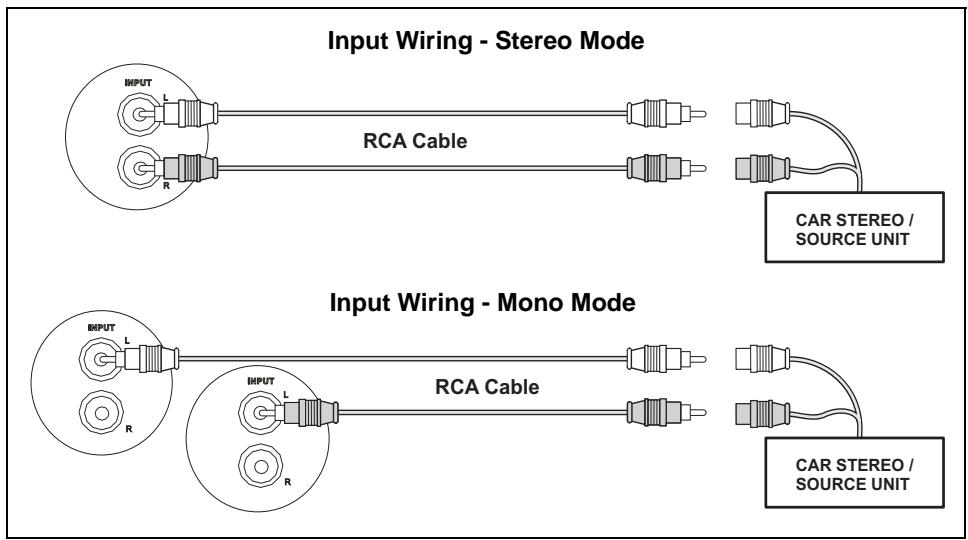
Power 400/880
Power 900/1050
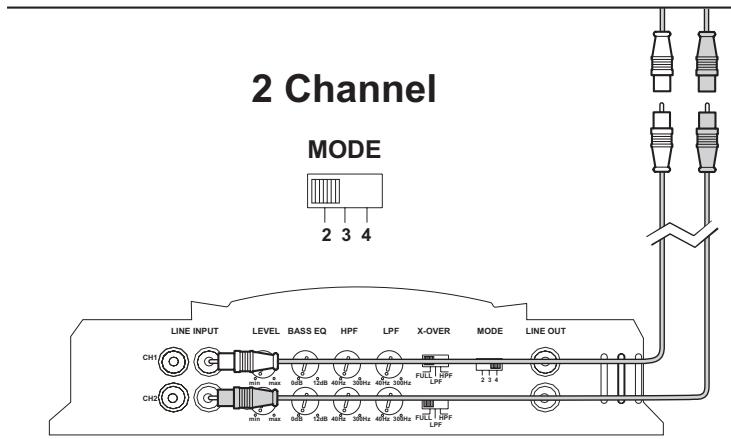
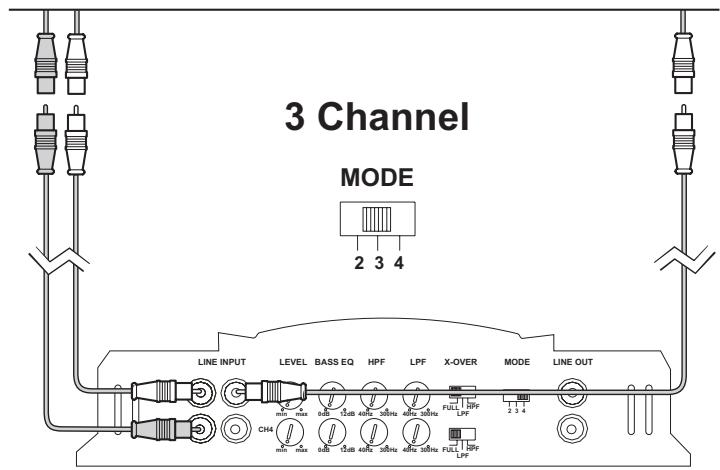
Power 760/920
The Power 760 and 920 can be configured for three different input modes: 2 channel, 3 channel or 4 channel.
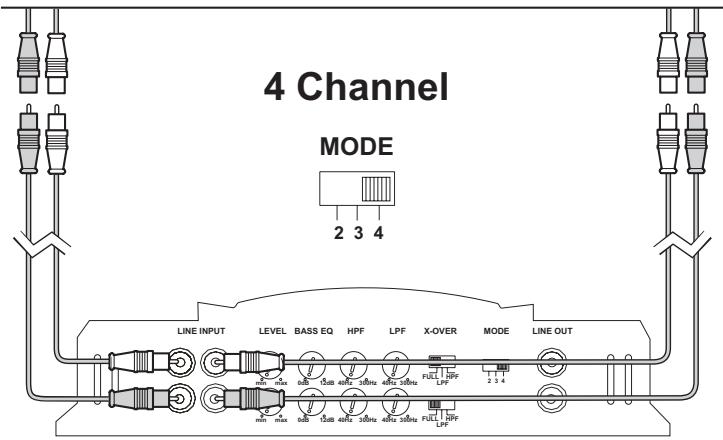
NOTE: The use of good quality RCA cables is just as important as power and speaker wire. Choose a high quality low capacitance cable for the best results.
Connecting Additional Amplifiers
Pass-Thru RCA connectors are provided to connect additional amplifiers without the need to purchase "Y" adapters.
Indicators and Controls
Power Indicator (POWER)
The power indicator provides a visual indication that the amplifier is turned on.
Input Level Control (LEVEL)
The input LEVEL control matches the output of your radio to the input of the amplifier. After the installation is complete, make sure the input level control on the amplifier is turned down all the way (counter-clockwise or all the way to the left). Play a tape or CD (make sure bass and treble settings or Bass EQ are flat) and turn the volume up slowly until you just start to hear distortion. Back the volume down just a bit. On the amplifier, slowly turn up the input level control (clockwise or to the right) until you just start to hear distortion, then back it down a bit. Now your radio and amplifier levels are matched.
BASS EQ
The Bass EQ is continuously adjustable from 0 to +12dB @ 45Hz. Adjusting the Bass Boost level allows different subwoofer/enclosure combinations to be equalized. Use this control to increase the level of low bass available from your subwoofer/enclosure combination. Ported and Band Pass enclosures should be limited to about +6dB to +9dB of boost. Sealed enclosures should be able to accept the full +12dB of boost, if necessary. The full +12dB of boost should be reserved for special applications since improper use of the Bass Boost could damage your subwooers at high volumes.
Low Pass Filter (LPF)
The Low Pass Filter controls adjust the crossover point. Typical crossover is between 60Hz and 80Hz for ported and sealed enclosures. Bandpass boxes will typically use a higher crossover setting between 125Hz and 150Hz . Since musical tastes vary, you should play music that you would normally listen to in your vehicle, with the above settings as a starting point. If necessary, set the crossover by ear.
High Pass Filter (HPF)
The high pass filter will limit the low frequencies being transmitted to your speakers. This can be useful in number of situations. For example, if you selected the high pass filter and set the crossover to 40Hz , then you would have an infra-sonic (sub-sonic) filter at 40Hz , which would be useful with certain enclosure/subwoofer combinations that were tuned between 45Hz and 50Hz . Other uses might include limiting the low frequencies to smaller
speakers (6 1/2", 6 X 9", etc.) by adjusting the crossover to a higher setting (80-100Hz).
Crossover (X-OVER)
The Jensen Power series of amplifiers have built-in low-pass and high-pass crossover filters for bi-amplifying the system. Adjust the crossover to accommodate your chosen installation method. Select LPF (low pass filter) when the amplifier will be driving woofers or subwoofer. Choose FULL when crossover mode is not active and the amplifier is in "full range" mode. Select HPF (high pass filter) when the amplifier will be driving full-range or separate speakers, and you want to limit the "bass" being transferred to these speakers.
Mode Switch
Power 400 and 880
The 400 and 880 come equipped with a MONO/STEREO MODE switch. Use STEREO mode when you have a 2-channel input from the source unit. Use MONO mode when you have a single input from the source unit. See "Input Wiring" on page 8.
Power 760 and 920
The 760 and 920 come equipped with a 2/3/4 MODE switch and can be configured for three different input modes: 2 channel, 3 channel or 4 channel.
Testing
Before finishing the installation, perform the following tests to make sure the wiring is correct and everything is operating properly.
Reconnect Battery
When wiring is complete, reconnect the battery negative terminal.
Test Power Wiring
Turn on the receiver, but do not turn up the volume. The amplifier power light should come on. If not, check the REM and +12V (B+) wires. Turn up the receiver volume slightly. All speakers should operate. If not, check wiring connections at amplifier and speakers.
Test Speaker Connections
These tests make sure the speakers are connected properly. If speakers don't play at all, one (or both) speaker wires may be disconnected.
Remote Input Level Control
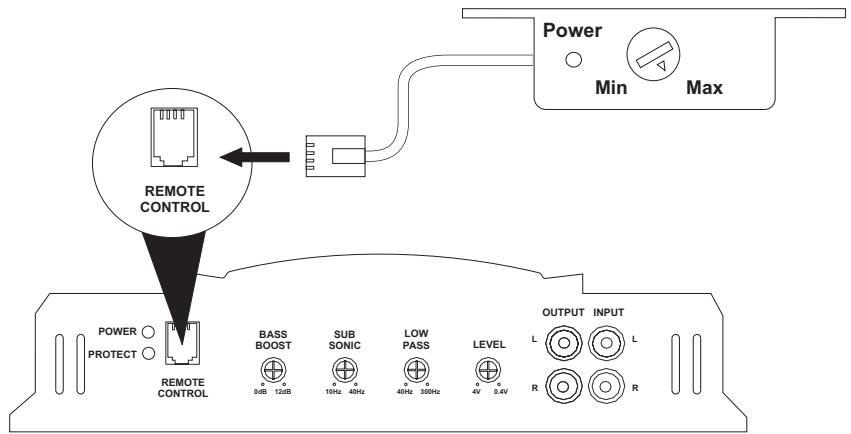
The Power 900 and 1050 come equipped with a Remote Input Level Control. The Remote Input Level Control allows the input level to be adjusted from an alternate location. It can be mounted under-dash or in-dash. When the amplifier is used to drive subwoofoers and the low pass crossover is activated, the Remote Input Level Control can be used as a "remote bass level control". This enables you to control the bass level independent from the rest of the system. This is convenient for system tuning and/or when playing many different types of music.
The Remote Input Level Control uses a 6-pin modular cable for connectivity. Simply plug the 6-pin modular cable into the amplifier and then into the Remote Input Level Control to activate the circuit.
Troubleshooting
| Problem | Possible Cause | Corrective Action |
| Amplifier does not turn on | No power to +12V terminal | Check fuse(s) |
| No power to REM terminal | Check head unit fuse(s) and wiring | |
| Blown main fuse at battery | Replace fuse and identify cause of failure | |
| Blown fuse at amplifier | Replace fuse and identify cause of failure | |
| Faulty ground | Re-ground main power ground to bare metal chassis | |
| Volume control too sensitive | Input level control adjusted too high | Re-adjust the input level (refer to page 8) |
| Distorted sound | Input level control adjusted too high | Re-adjust the input level (refer to page 8) |
| Blows fuse(s) at amp | Power wires connected backwards | Reconnect power wires properly |
| Internal problem with amp | Take unit for service | |
| Engine noise / Alternator whine | Ground loop(s) | Use good quality shielded RCA cables |
| Faulty ground at amp | Re-ground amp to clean bare metal chassis | |
| Faulty ground at head unit | Re-ground head unit to clean bare metal chassis | |
| Inductive coupling | Re-route RCA and/or speaker wires away from factory harnesses | |
| Input level on amp set too high | Re-adjust input level (refer to page 8) | |
| Thermal protection activated | Amplifier driving 2 ohm load for long durations | If the amplifier “thermals” frequently while driving subwoofoers, install fan to keep amp cool. |
| Short circuit protection activated | Blown speakers | Check all speakers |
| Speaker wire(s) shorting to ground | Check for faulty wiring | |
| Defective crossover | Faulty passive crossover | |
| Low impedance protection activated | Amp connected to improper load | Check speaker connections |
| Amp will not drive a 1 ohm mono load, 2 ohm minimum in mono configuration | Verify that speakers are connected properly | |
| Speakers defective/ blown | Check speakers | |
| Faulty passive crossovers | Check crossovers | |
| Poor bass response | Speakers out of phase | Check speaker polarity; reverse the connection to one speaker only if two subwoofer are connected to the amplifier. |
NOTE: If the protection light is activated with no speakers connected to the amplifier, and all the power connections are correct, this would indicate an internal problem with the amplifier.
CEA Power Output

RMS Power Output @ 1% THD+N, 14.4VDC
Power 400
Power Output: 60 watts RMS X 2 channels into 4-ohms @ < 1% THD+N
Signal to Noise Ratio: 100dBA below reference (Reference: 1 watt, 4-ohms)
Additional Power Output:
80 watts RMS X 2 channels into 2-ohms @ < 1% THD+N
160 watts RMS X 1 channels (Bridged Mono) into 4-ohms @ < 1% THD+N
Frequency Response: 10Hz to 60 kHz, -3dB (Reference: 1 watt)
Dimensions: L9.5" x H2.5" x W9.0"
Power 760
Power Output: 60 watts RMS X 4 channels into 4-ohms @ < 1% THD+N
Signal to Noise Ratio: 100dBA below reference (Reference: 1 watt, 4-ohms)
Additional Power Output:
80 watts RMS X 4 channels into 2-ohms @ < 1% THD+N
155 watts RMS X 2 channels (Bridged Stereo) into 4-ohms @ < 1% THD+N
Frequency Response: 10Hz to 60 kHz, -3dB (Reference: 1 watt)
Dimensions: L12.5" x H2.5" x W9.0"
Power 880
Power Output: 125 watts RMS X 2 channels into 4-ohms @ < 1% THD+N
Signal to Noise Ratio: 100dBA below reference (Reference: 1 watt, 4-ohms)
Additional Power Output:
200 watts RMS X 2 channels into 2-ohms @ < 1% THD+N
410 watts RMS X 1 channels (Bridged Mono) into 4-ohms @ < 1% THD+N
Frequency Response: 10Hz to 60kHz, -3dB (Reference: 1 watt)
Dimensions: L14.0" x H2.5" x W9.0"
Power 900
Power Output: 230 watts RMS X 1 channels into 4-ohms @ < 1% THD+N
Signal to Noise Ratio: 100dBA below reference (Reference: 1 watt, 4-ohms)
Additional Power Output:
340 watts RMS X 1 channels into 2-ohms @ < 1% THD+N
Frequency Response: 10Hz to 240Hz, -3dB (Reference: 1 watt)
Dimensions: L15.75" x H2.5" x W9.0"
Power 920
Power Output: 90 watts RMS X 4 channels into 4-ohms @ < 1% THD+N
Signal to Noise Ratio: 100dBA below reference (Reference: 1 watt, 4-ohms)
Additional Power Output:
120 watts RMS X 4 channels into 2-ohms @ < 1% THD+N
190 watts RMS X 2 channels (Bridged Stereo) into 4-ohms @ < 1% THD+N
Frequency Response: 10Hz to 60kHz , -3dB (Reference: 1 watt)
Dimensions: L15.75" x H2.5" x W9.0"
Power 1050
Power Output: 290 watts RMS X 1 channels into 4-ohms @ < 1% THD+N
Signal to Noise Ratio: 100dBA below reference (Reference: 1 watt, 4-ohms)
Additional Power Output:
430 watts RMS X 1 channel into 2-ohms @ < 1% THD+N
Frequency Response: 10Hz to 150Hz, -3dB (Reference: 1 watt)
Dimensions: L17.25" x H2.5" x W9.0"
Introduccion
Power 400/760/880/920
Power 400/760/880/920
Power 400/760/880/920
Impedance de charge 2-4 ohm
Audiovox Electronics Corporation ("the Company") is committed to quality and customer service, and are pleased to offer you this Warranty. Please read it thoroughly and contract the Company at 1-800-323-4815 with any questions.
Who is covered?
The Company extends this warranty to the original retail purchaser of products purchased through an authorized Audiovox retailer in the U.S.A., Puerto Rico or Canada. This warranty is not transferable or assignable. Proof of purchase is required in the form of an original sales receipt.
What is covered?
The Company warrants that should this product or any part thereof, under normal use, be proven defective in material or workmanship within 12 months from the date of original purchase, such defect(s) will be repaired or replaced with a new or reconditioned product (at the Company's option) without charge for parts and repair labor.
What is not covered?
This Warranty does not cover the following:
- Damage incurred during shipping or transporting the product to the Company or a service center
- Elimination of car static or motor noise
Defects in cosmetic, decorative or non-operative structural parts
Costs incurred for installation, removal or reinstallation of the product
- Consequential damage to any included plexiglass or lighting (i.e. neon or LED lights), accessories, or vehicle electrical systems
- Damage caused by improper installation, mishandling, misuse, neglect, accident, blown fuse, battery leakage, theft or improper storage; burned voice coils caused by over-driving the speaker; or mechanical failures due to punctures or tears
- Products whose factory serial number/bar code label(s) or markings have been removed or defaced
- Damage resulting from moisture, humidity, excessive temperature, extreme environmental conditions or external natural causes
Please review the "Care and Maintenance" section of your Installation and Operation Manual for additional information regarding the proper use of your product.
Limitations
THE EXTENT OF THE COMPANY'S LIABILITY UNDER THIS WARRANTY IS LIMITED TO THE REPAIR OR REPLACEMENT PROVIDED ABOVE AND, IN NO EVENT, SHALL THE COMPANY'S LIABILITY EXCEED THE PURCHASE PRICE PAID BY PURCHASER FOR THE PRODUCT.
This Warranty is in lieu of all other express warranties or liabilities. ANY IMPLIED WARRANTY, INCLUDING ANY IMPLIED WARRANTY OF MERCHANTABILITY, SHALL BE LIMITED TO THE DURATION OF THIS WRITTEN WARRANTY. ANY ACTION FOR BREACH OF ANY WARRANTY HEREUNDER INCLUDING ANY IMPLIED WARRANTY OF MERCHANTABILITY MUST BE BROUGHT WITHIN A PERIOD OF 24 MONTHS FROM DATE OF ORIGINAL PURCHASE. IN NO CASE SHALL THE COMPANY BE LIABLE FOR ANY CONSEQUENTIAL OR INCIDENTAL DAMAGES FOR BREACH OF THIS OR ANY OTHER WARRANTY, EXPRESS OR IMPLIED, WHATSOEVER. No person or representative is authorized to assume for the Company any liability other than expressed herein in connection with the sale of this product.
Some states do not allow limitations on how long an implied warranty lasts or the exclusion or limitation of incidental or consequential damage so the above limitations or exclusions may not apply to you. This Warranty gives you specific legal rights and you may also have other rights which vary from state to state.
Obtaining Warranty Service
- To obtain repair or replacement within the terms of this Warranty, call 1-800-323-4815 for the location of a warranty station serving your area.
- You must prepay the initial shipping charges to the Company. The Company will pay the return shipping charges for all warranted products returned to an address within the U.S.A., Puerto Rico or Canada.
- Please package the product securely to avoid shipping damage. We recommend using a carrier that provides tracking service to prevent lost packages. Lost or damaged packages are not covered by this warranty.
- Provide a detailed description of the problem(s) for which you require service.
Audiovox Electronics Corporation
Hauppauge, NY 11788
1-800-323-4815
www.jensen.com
© 2007 Audiovox
v. 012407
- Installation & Operation Manual
- Contedio
- Before You Begin
- Warranty Service
- Features and Specifications
- Power 400 / 760 / 880 / 920
- Power 900 / 1050
- Specifications
- Power Output
- Power 400
- Power 760
- Power 880
- Power 900
- Power 920
- Power 1050
- Installation
- Installation Assistance
- Supplies and Tools Needed
- Supplies
- Tools
- Disconnect Battery
- Location and Mounting
- Routing Wires
- Power Wiring
- Charging System
- Power Terminal (+12V / B+)
- Remote Terminal (REM)
- Ground Terminal (GND)
- Speaker Wiring
- Power 900/1050
- Power 400/880
- Power 760/920
- Four Speakers
- Two Speakers and Bridged Subwoofer
- Two Subwoofoers
- Input Wiring
- Connecting Additional Amplifiers
- Indicators and Controls
- Power Indicator (POWER)
- Input Level Control (LEVEL)
- BASS EQ
- Low Pass Filter (LPF)
- High Pass Filter (HPF)
- Crossover (X-OVER)
- Mode Switch
- Power 400 and 880
- Power 760 and 920
- Testing
- Reconnect Battery
- Test Power Wiring
- Test Speaker Connections
- Remote Input Level Control
- CEA Power Output
- RMS Power Output @ 1% THD+N, 14.4VDC
- Introduccion
- Power 400/760/880/920
- Who is covered?
- What is covered?
- What is not covered?
- Limitations
- Obtaining Warranty Service
Brand : AUDIOVOX
Model : POWER AMPLIFIERS 900
Category : Audio Amplifiers