PPC-6600 - Smartphone AUDIOVOX - Free user manual and instructions
Find the device manual for free PPC-6600 AUDIOVOX in PDF.


| Product type | Smartphone |
| Brand | AUDIOVOX |
| Model | PPC-6600 |
| Operating System | Windows Mobile |
| Screen | TFT touch screen 3.5 inches |
| Screen resolution | 240 x 320 pixels |
| Processor | Intel XScale 400 MHz |
| RAM | 64 MB |
| Internal storage | 128 MB |
| Expandable storage | SD/MMC card |
| Connectivity | GSM/GPRS, Bluetooth, Wi-Fi 802.11b |
| Camera | 1.3 megapixels |
| Battery | Lithium-ion 1200 mAh |
| Standby time | Up to 150 hours |
| Talk time | Up to 4 hours |
| Dimensions | 122 x 70 x 18 mm |
| Weight | 180 g |
| Care and cleaning | Wipe with a soft, dry cloth. Do not use abrasive cleaners. |
| Safety | Avoid exposure to water and extreme temperatures. Use only approved accessories. |
| Spare parts and repairability | Replaceable battery and memory card. For other repairs, contact an authorized service center. |
Frequently Asked Questions - PPC-6600 AUDIOVOX
User questions about PPC-6600 AUDIOVOX
0 question about this device. Answer the ones you know or ask your own.
Ask a new question about this device
Download the instructions for your Smartphone in PDF format for free! Find your manual PPC-6600 - AUDIOVOX and take your electronic device back in hand. On this page are published all the documents necessary for the use of your device. PPC-6600 by AUDIOVOX.
USER MANUAL PPC-6600 AUDIOVOX
Congratulations on the purchase of a new Windows Mobile™-based PPC6600. The integrated wireless voice and data capabilities mean that as well as keeping your important PIM information up-to-date and close at hand, you can make calls, send and receive e-mail, and look up valuable information from the Internet or your company's network anytime, anywhere. Also, with Microsoft ActiveSync the power of your device is increased by allowing you to synchronize the information on your PC with your device.
Before getting started
Before using and exploring your new PPC6600, some warning notes and regulatory information are very important for you to go through.
| THE DEVICE IS NOT CHARGED WHEN YOU TAKE IT OUT OF THE BOX. (For information, see Chapter 1 : Getting Started) |
| DO NOT REMOVE THE BATTERY PACK WHEN THE DEVICE IS CHARGING. |
| IN MANY COUNTRIES YOU ARE REQUIRED BY LAW TO TURN OFF YOUR PHONE WHEN YOU FLY. TURNING OFF YOUR PPC6600 DOESN'T TURN OFF YOUR PHONE; YOU MUST TURN OFF YOUR WIRELESS CONNECTION TO YOUR OPERATOR'S NETWORK. |
| YOUR WARRANTY IS INVALIDATED IF YOU OPEN OR TAMPER WITH THE DEVICE'S OUTER CASING. (For more information, see the enclosed warranty information) |
Important Safety Precautions
When using this product, the safety precautions below must be taken against possible legal issues and damages.
ELECTRICAL SAFETY
This product is intended for use when supplied with power from the battery pack BTR6600. Other usage will invalidate any approval given to this product and may be dangerous.
SAFETY IN AIRCRAFT
Your phone can cause interference with an aircraft's navigation system and its network. In most countries, using this product on board an airplane is against the law.
SAFETY FOR ENVIRONMENTS
Do not use this product in gas stations, fuel depots, chemical plants or where blasting operations are in progress, or in potentially explosive atmospheres such as fueling areas, below deck on boats, fuel or chemical transfer or storage facilities, and areas where the air contains chemicals or particles, such as grain, dust, or metal powders. Please be aware that Sparks in such areas could cause an explosion or fire resulting in bodily injury or even death.
SAFETY ON THE ROAD
Vehicle drivers in motion are not permitted to use telephony services with the handheld device, except in the case of emergency. In some countries, using hand-free devices as an alternative is allowed.
SAFETY FOR MEDICAL EQUIPMENT
This product may cause malfunctions of medical equipment. In most hospital or medical centers, use of this product is forbidden.
NON-IONISING RADIATION
This product should be operated in the suggested normal condition only to ensure the radiative performance and safety of the interference. As with other mobile radio transmitting equipment, users are advised that for satisfactory operation of the equipment and for the safety of personnel, it is recommended that no part of the human body be allowed to come too close to the antenna during operation of the equipment.
Contents
Chapter 1 Getting Started
2.1 Starting Up 20
2.2 Entering Information 26
2.3 Writing on the Screen 30
2.4 Drawing on the Screen 32
2.5 Recording a Message 33
2.6 Finding Information 34
Chapter 3 Using Your PPC6600
3.1 About Your Phone 36
3.2 Making a Call 40
3.3 Receiving a Call 43
3.4 In-Call Options 44
3.5 Contacts Information 46
3.6 Additional Dialing Information...48
3.7 Secure Your Phone 48
Chapter 4 Synchronizing Information
4.1 Using ActiveSync 52
4.2 Synchronizing Information 54
4.3 Synchronizing Using an Infrared Connection 56
4.4 ActiveSync Errors 57
Chapter 5 Personalizing Your PPC6600
5.1 Device Settings 60
5.2 Phone Settings 68
Chapter 6 Using Outlook
6.1 Calendar 74
6.2 Contacts 76
6.3 Tasks 79
6.4 Notes 81
Chapter 7 Getting Connected
7.1 About Connections 84
7.2 Connect to the Internet 84
7.3 Terminal Services Client 87
7.4 Bluetooth 89
Chapter 8 Messaging Features
8.1 E-mail Messages: Using Inbox104
8.2 Messaging 108
8.3 MSN Messenger 109
8.4 Managing Messages and Folders 111
Chapter 9 Applications
9.1 Pocket Word 114
9.2 Pocket Excel 117
9.3 Windows Media Player for PPC6600 119
9.4 Pictures 120
Chapter 10 Using Camera and Album
10.1 Before Using the Camera..... 124
10.2 Camera 125
10.3 Album 135
Appendix
Adding or Removing Programs..... 146
Managing Memory 148
Backing Up Files 150
Reset the PPC6600 and
Clear Memory 151
Regulatory Agency IDs. 153
FCC Compliance Statement............153
Important Health and Safety
Information 154
Specification 160
Troubleshooting. 162
Chapter 1
Getting Started
1.1 Knowing Your Device
1.2 Battery
1.3 Accessories
1.1 Knowing Your Device

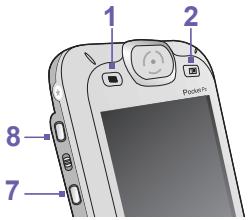
Front, Top and Left Side Panel Components
MMC/SD cards or SDIO accessories slot
Insert either MMC/SD cards or SDIO accessories in this slot.
Contact
Press for quick access to your Contacts.
Record
Press to record a voice note/ launch voice commander.
Volume
Press up/down to adjust the volume of your device.
Camera
Press to launch camera /video program. Press again to take a picture.
Infrared Port
Enables you to exchange file(s) or data with other devices without cables/wires.
Start
Press to display program menu.
Send
Press to answer an incoming call or to dial a number.
Messaging
Press for quick access to email/MSN messages.
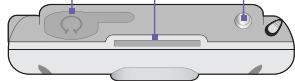
- Power Button/Backlight
Press to turn on/off your PPC6600 or Backlight.
Earphone Plug
Allows you to listen to audio media or use the phone's hands-free kit.
Speaker Listen to audio media or a phone call from here.
Calendar Press for quick access to your calendar.
Touch Screen
- Pocket IE
Press for quick access to WEB and WAP sites.
OK/Close
Press to end a call.
Navigation Pad
Press to move up/down and left/right through any of the drop down menus or program instructions; select by pressing in the center. When in the dialer screen:
Left - Press once to access the Speed Dial feature.
Right- Press once to access the Call History feature.
QWERTY Keyboard
Silde the screen up to access. Press to enter letters/symbols.

Back, Bottom and Right Side Panel Components
Antenna Connector
If available, you can attach your phone to its antenna and utilize its superior reception quality.
Stylus and Stylus Slot
Notification LED
Bi-color LED on the right:
- Flashing Green (Every 3 seconds) - CDMA Network Signal.
- Flashing Red (Every 1.5 second) - Notification/ Alarm/ Reminder/ Missed call
- NO LED Light - CDMA Network Detached or Mobile is OFF.
- Steady Red - Battery empty when plugged in AC Adapter.
- Flashing Red - Low battery.
- Steady Amber - (DC-in) Battery charging with AC Adapter or USB port.
- Steady Green - (DC-in) Battery fully charged.
Blue LED on the left:
- Flashing Blue (Every 6 seconds) - Blue Tooth is On
- No LED light - BT is OFF.
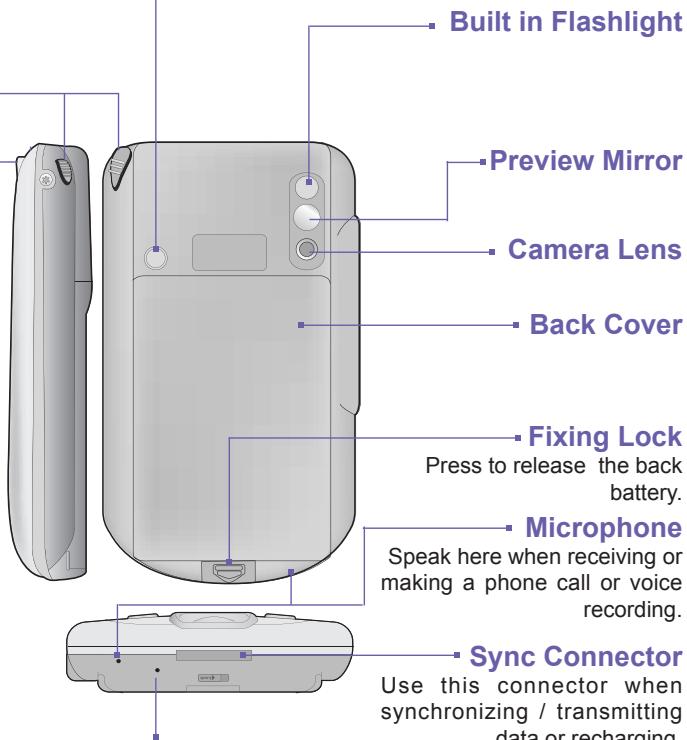
Soft Reset
Press here with stylus to reset your device.
- Sync Connector Use this connector when synchronizing / transmitting data or recharging.
1.2 Battery

Warning : To reduce risk of fire or burns, do not disassemble, crush, puncture, short external contacts, heat above 60ircC (140ircF) , or dispose of in fire or water. Replace only with manufacturer specified batteries. Recycle or dispose of used batteries to the local regulations.

Your PPC6600 contains a rechargeable Li-ion polymer battery under the back cover. Battery power depends on whether you are talking on the phone, using the PDA functions or if the device is on standby.
Battery life estimates :
Talk-time: 3 4 hrs,
PDA: 15 hrs (approx.),
Standby: 168 hrs (approx.),
Data retention time: 72 hrs.
The above times are based on using one function at a time, interchanging between functions will vary the battery life.
Data Retention
It is vital to keep your battery charged. Because your PPC6600 does not have a hard drive, all data and any new programs you install are stored in RAM. If the battery completely drains any data or new programs you installed will be erased. Only the default programs on the device when you bought it will remain.
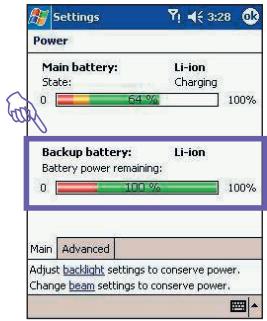
To prevent this kind of data loss, a portion of the main battery will keep your data safe for 72 hours if your device runs out of power. The additional backup is designed to keep your data safe when you remove the main battery. It will keep this data safe for 20 minutes.

WARNING: BEFORE REMOVING THE MAIN BATTERY, MAKE SURE THE BACKUP BATTERY POWER REMAINS AT 50% OR ABOVE, BY TAPPING → Settings → System tab → Power
Recharging your device
You can recharge your device in the following ways:

Place your PPC6600 in the cradle and connect the cradle to an external power source with the AC Adapter. Before using your PPC6600 for the first time, charge the battery for at least 8 hours. Then, place it in the cradle for a short time each day to recharge it to its full capacity.
Plug the AC Adapter into the optional USB cable head and then connect your PPC6600 directly to an external power source.
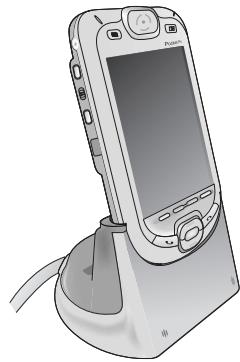
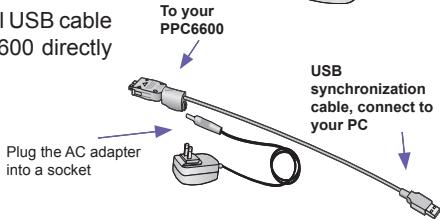
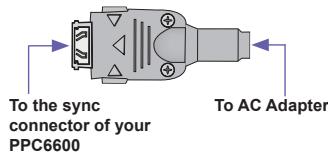
Plug the AC Adapter into the optional AC Adapter Converter and then connect the sync connector of your PPC6600 directly to an external power source without using the cradle.
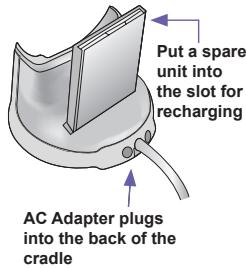
If you have a spare battery for your PPC6600, you can put the battery into the slot in the cradle for recharging.
When Your Battery is Low
When the low battery-warning message appears, immediately save any data you are working on, perform a synchronization with your PC, then turn off your PPC6600. If your device does shut down, the backup portion of your main battery will protect the data for about 72 hours.
To view the battery status:

Tap → Settings → System tab → Power.

ALWAYS KEEP THE POWER STATUS OF THE BACKUP BATTERY AT LEAST AT 50% OR ABOVE.
1.3 Accessories
USB Cradle
Your PPC6600 comes with a USB cradle. This allows you to recharge your PPC6600 with the AC ADAPTER, as well as synchronize information between your PPC6600 and a PC using ActiveSync.

To synchronize, the USB Cradle must be plugged into an available USB port on your PC.

For battery recharging, you must plug the AC Adapter into the back of cradle.
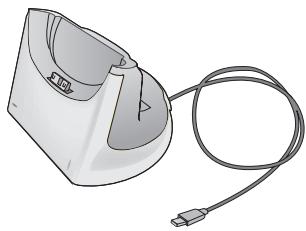
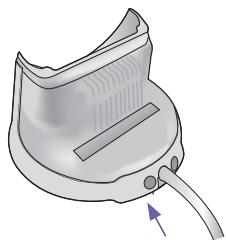
AC Adapter plugs into the back of the cradle for battery recharging
AC Adapter Converter
The AC Adapter converter in combination with the AC Adapter allows you to recharge your device without the cradle.
USB Sync Cable
The USB cable ( user's optional item) allows you to synchronize with your desktop without the cradle. The AC converter also allows you, in combination with an AC Adapter, to recharge your device.
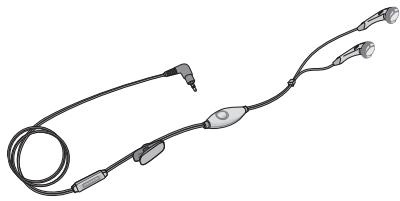
Stereo Headset
The stereo headset has a volume control jog dial and a button to press to answer a phone call.
Chapter 2
Knowing Your PPC6600
2.1 Starting Up
2.2 Entering Information
2.3 Writing on the Screen
2.4 Drawing on the Screen
2:5 Recording a Message
2.6 Finding and Organizing
Information
2.1 Starting Up
Screen Tapping, Calibration and Re-calibration
When you first turn on your PPC6600, you will be asked to calibrate the screen by tapping the center of a cross with your stylus as it moves around the screen. This process ensures that when you tap the screen with your stylus the item tapped is activated.
To re-calibrate the screen :
If your device does not accurately respond to screen taps, you will need to re-calibrate it.

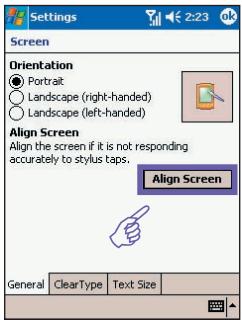
Tap → Settings → System tab → Screen.
To re-calibrate the screen as described above, tap Align Screen button on General tab.

When aligning the touch screen, tap the target firmly and accurately.
Screen Orientation
To switch the orientation of your LCD screen between Portrait and Landscape mode if needed, you can select the Orientation options by tapping → Settings → System tab → Screen. This Provides a better view or a better operation interface when running certain programs on your PPC6600. Long blocks of text may be easier to read using Landscape orientation.
For easier reading of text in programs that support ClearType, tap the ClearType tab, and then select Enable ClearType.
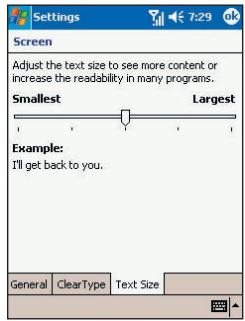
To increase readability or see more content by adjust the size of text in programs it by tapping the Text Size tab, and then use the slider to make text larger or smaller.
Today Screen
The Today screen displays important information, such as today's appointments and status icons for your device. Tap the information listed on the Today screen to open the associated program.
Tap to go to a program.
Tap to view notification information.
3 Tap to view network status and options.
4 Tap to change volume or mute all sounds.
5 Tap and hold to change time format.
6 Tap to change date and time.
7 Tap to change owner information.
8 Your day at a glance. Tap to open the associated program.
9 Tap to create a new item.
Tap to disconnect ActiveSync or tap to turn on/off Bluetooth.
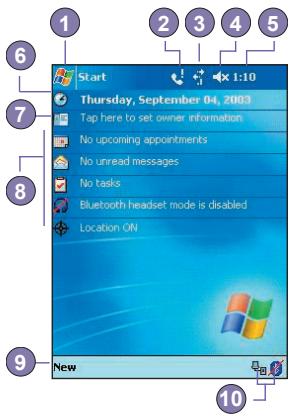

To go back to Today screen when you are using other programs, just tap → Today.

To customize the Today screen display, including the background image, tap → Settings → Personal tab → Today (For more information, please see Chapter 5).
Indicators
Following are some of the status icons you may see.
| Indicators | Meaning |
| Turns sounds on / off. | |
| Main battery with full strength / No battery. | |
| Main battery low / very low. | |
| Backup battery is very low. | |
| Indicates that the Caller ID monitor program is not yet ready to receive calls. | |
| Connection is active. | |
| Indicates that you are roaming in a different network area. | |
| Notification that one or more instant messages were received. | |
| Notification that one or more mobile e-mail / SMS messages were received. | |
| Indicates the connection to your mobile phone service provider is on / off and the strength of the signal. | |
| If more notification icons need to be displayed and there is no room to display them, this indicator will display. Tap the icon to view all notification icons. | |
Notifications
Your device reminds you in a variety of ways when you have something to do or receive a SMS. For example, if you've set up an appointment in Calendar, a task with a due date in Tasks, or an alarm in Clock, you will be notified in any of the following ways:
A message box appears on the screen.
A sound, which you can specify, is played.
A light flashes on your device.
The device vibrates.

To choose reminder types and sounds for your device, tap → Settings → Personal → Sounds & Notifications. The options you choose here apply throughout the device.
Navigation Bar
The navigation bar, located at the top of the screen, displays active programs and the current time, enables you to switch to programs and closes screens.

Tap to switch to a program.
Tap to switch to a program that you recently used.
3 Tap to see more programs.
4 Tap to change device settings.
5 Tap to see a Help topic for the current screen.
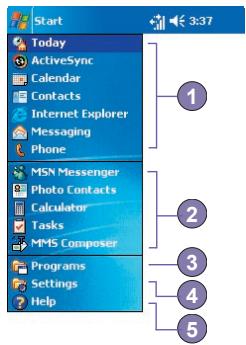
In Portrait mode :
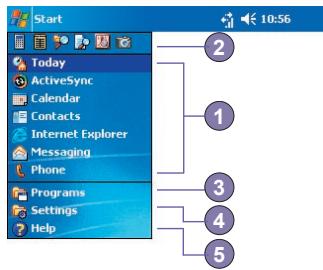
In Landscape mode :
Command Bar
Use the command bar at the bottom of the screen to perform tasks in programs. The command bar includes menu names, buttons, and the Input Panel button.

To create a new item in the current program, tap New.
2 Tap to select menu commands.
3 Tap to select button commands.
4 Tap to display the input panel.
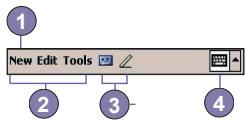

To see the name of a button, tap and hold the stylus on the button.
Drag the stylus off the button so that the command is not carried out.
Pen
New Edit Tools


Pop-Up Menus
Use pop-up menus to quickly perform an action on an item. To access a pop-up menu, tap and hold the item that you want to perform the action on. When the menu appears, tap the action you want to perform, or tap anywhere outside the menu to close it without performing an action.

Tap and hold to display the pop-up menu.
Lift the stylus and tap the action you want.
3 Tap outside the menu to close it without performing an action.
Programs
You can switch from one program to another by selecting it from the menu.

To access some programs, tap → Programs, then the program name.
You can also switch to some programs by pressing a program button on your device. For more information about the Button settings, please see Chapter 5.
The following table contains a partial list of programs on your device. Look on the PPC6600 Companion CD for additional programs that you can install onto your device.
| Icon | Program | Description |
| ActiveSync | Synchronizes information between your device and PC. | |
| Calendar | Keeps track of your appointments and creates meeting requests. | |
| Contacts | Keeps track of your friends and colleagues. | |
| Messaging | Sends and receives email/ text messages. | |
| Pocket IE | Pocket Internet Explorer browses Web and WAP sites, and downloads new programs and files from the Internet. | |
| Notes | Creates handwritten or typed notes, drawings, and recordings. | |
| Phone | Makes and receives calls, switches between calls and sets up confer-ence calling. | |
| Tasks | Keeps track of your tasks. | |
| Windows Media | Enables the multimedia function on your PPC6600. | |
| Pocket Excel | Creates new workbooks or view and edit Excel workbooks. | |
| Pocket Word | Creates new documents or view and edit MS-Word documents. | |
| MSN Messenger | Sends and receives instant messages with your MSN Messenger contacts. | |
| Picture | Collects, organizes and sorts .jpg picture files on your PPC6600 or on a storage card. | |
| Calculator | Performs basic arithmetic, such as addition, subtraction, multiplication, and division. | |
| Games | By default, there are two games, Jawbreaker and Solitaire, included in this folder. | |
| File Explorer | Views all the files on your PPC6600. | |
| Camera | Snap photos or shoots video clips with accompanying audio. | |
| Album | Collects, organizes and sorts .JPG/.BMP/.GIF picture files on your PPC6600 from Camera or ActiveSync. | |
| Photo ID | Input the image files according to your Contacts list and set up the Caller ID function. | |
| MMS | Sends and receives MMS messages. | |
| Wireless Modem | Enables your PPC6600 as an external modem for a PC or Notebook by using a USB port, Bluetooth or infrared. | |
| xBackup | Backs up your PPC6600 files to ROM or an SD card. |
The Program buttons can be reprogrammed.
2.2 Entering Information
You can enter information on your device in several ways, depending on the type of device you have and the program you are using.
Synchronizing - Using ActiveSync, exchange information between your PC and device. (For more information on ActiveSync, see Chapter 4.)
Typing - Using the Input Panel or the QWERTY keyboard on the bottom of your device, enter typed text into the device. You can do this by tapping keys on the on screen soft keyboard, by pressing the QWERTY keyboard or by using the handwriting recognition software.
Writing - Using the stylus, write directly on the screen.
- Drawing - Using the stylus, draw directly on the screen.
- Recording - Create a stand-alone recording or embed a recording into a document or note.
Using the Input Panel
Use the input panel to enter information in any program on your device. You can either type using the QWERTY Keyboard, or soft Keyboard or write using Letter Recognizer, Block Recognizer, or Transcriber. In either case, the characters appear as typed text on the screen.
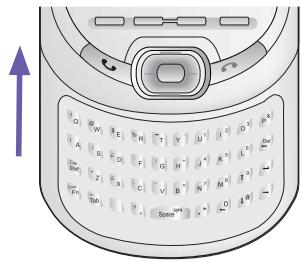
Typing in QWERTY Keyboard

① Slide the main screen upward to reveal the QWERTY keyboard.
To type lowercase letters, press the keys with using your fingers.
To type a single uppercase letter or symbol, press the key.
To type capital letters, press to release it press again.
5 To type a number or symbol, press Ln. To type a series of numeric symbols, press Ln twice.
To type with the soft keyboard
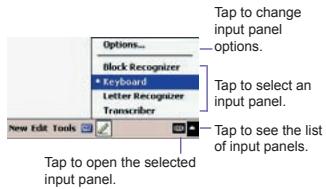
To show or hide the input panel, tap the Input Panel button. To see your choices tap the arrow next to the Input Panel button.

Tap the arrow next to the Input Panel button and then Keyboard.
To type lowercase letters, tap the keys with the stylus.
3 To type a single uppercase letter or symbol, tap the Shift key. To tap multiple uppercase letters or symbols, tap the CAP key.
To add a space, tap the space bar, or you can also tap and hold any key and then drag the stylus to the right across at least two others.
5 To backspace one character, except tapping the backspace key, you can also tap and hold any key and then drag the stylus to the left across at least two others.
6 To insert a carriage return, tap and hold the stylus anywhere on the keyboard and drag down.
When you use the input panel, your device anticipates the word you are typing or writing and displays it above the input panel. When you tap the displayed word, it is automatically inserted into your text at the insertion point. The more you use your device, the more words it learns to anticipate.
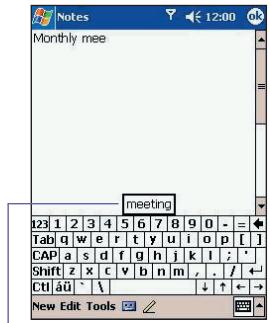
Tap to add the word if it is the right one.

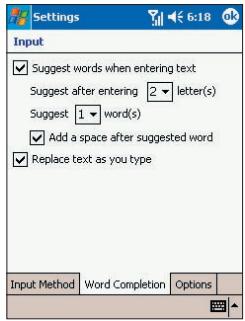
To change word suggestion options, such as the number of words suggested at one time, Tap → Setting → Personal tab → Input → Word Completion tab.
For more information about Input settings, please see Chapter 5.
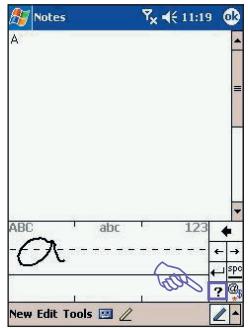
Using Letter Recognizer
With Letter Recognizer you can write letters using the stylus just as you would on paper.

Tap the arrow next to the Input Panel button and then Letter Recognizer.
2 Write a letter in the box.
When you write a letter, it is converted to typed text that appears on the screen. For specific instructions on using Letter Recognizer, with Letter Recognizer open, tap the question mark ? next to the writing area.
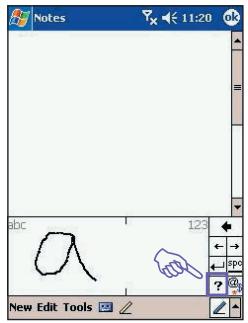
Using Block Recognizer
With Block Recognizer you can input character strokes using the stylus that are similar to those used on other devices.

Tap the arrow next to the Input Panel button and then Block Recognizer.
2 Write a letter in the box.
When you write a letter, it is converted to typed text that appears on the screen. For specific instructions on using Block Recognizer, with Block Recognizer open, tap the question mark ? next to the writing area.
Switching to Transcriber
With Transcriber you can write anywhere on the screen using the stylus just as you would on paper. Unlike Letter Recognizer and Block Recognizer, you can write a sentence or more of information. Then, pause and let Transcriber change the written characters to typed characters.

Tap the arrow next to the Input Panel button and then Transcriber.
2 Write anywhere on the screen.
For specific instructions on using Transcriber, with Transcriber open, tap the question mark in the lower right hand corner of the screen.
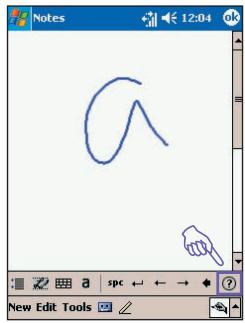
To punctuate in Transcriber:

1 Tap the keyboard button on the tool bar.
Tap the desired punctuation.
To hide the keyboard, tap OK.
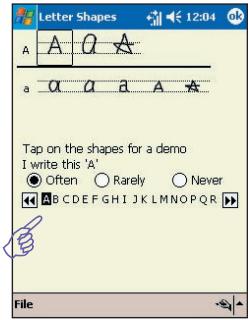
To learn writing in Transcriber:

Tap button on the tool bar.
A Letter Shapes Selector screen appears :
At the bottom of the screen, select the character you wish to explore.
At the top of the screen, tap the picture of this character. It slowly redraws, showing the writing sequence.
- Select how often you write the character using that method.

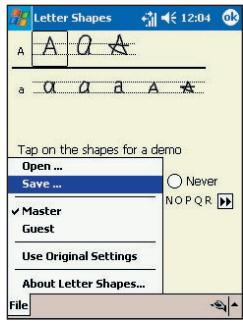
When you finish the letters, you can save your writing profile by tapping File → Save → then enter the name for the profile.
Using Profiles
Letter Shape Selector supports two profiles by tapping File → Master or Guest :
Master: Typically used by the PPC6600's primary user. This profile is unaffected by any Guest user settings.
Guest: For temporary device usage by another person.
Editing/Selecting Text
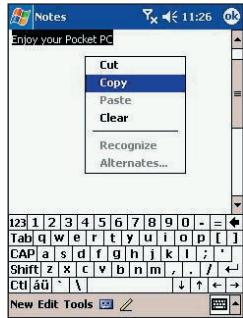
Each input program provides cursor keys to move through text and backspace so that you can correct spelling, grammar or insert additional information. Alternatively, you can use your stylus to make an insert.
To select typed text, drag the stylus across the text you want to select. You can cut, copy, and paste text by tapping and holding the selected words and then tapping an editing command on the pop-up menu, or by tapping the command on the Edit menu.
2.3 Writing on the Screen
In any program that accepts writing, such as the Notes program, and in the Notes tab in Calendar, Contacts, and Tasks, you can use your stylus to write directly on the screen. Write the way you do on paper. You can edit and format what you have written and convert the information to text at a later time.

Tap the pen button 2 to switch to writing mode. This action displays lines on the screen to help you write.

Some programs that accept writing may not have the pen button. See the documentation for that program to find out how to switch to writing mode.
Selecting Writing
If you want to edit or format writing, you must select it first.

To exit writing, tap the button again. This makes it easier to select text.
Tap and hold the stylus next to the text you want to select until the insertion point appears.
3 Without lifting, drag the stylus across the text you want to select.
If you accidentally write on the screen, tap Edit, then Undo and try again.
You can cut, copy, and paste written text in the same way you work with typed text: tap and hold the selected words and then tap an editing command on the pop-up menu, or tap the command on the Edit menu.
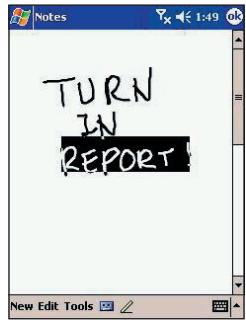
Tap the Pen button and use your stylus like a pen.
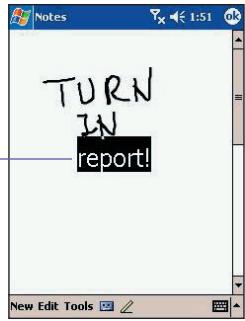
Converting writing to text

On the writing note, tap Tools and Recognize from the menu bar.
If you want to convert only certain words, select them before tapping Recognize on the Tools menu (or tap and hold the selected words and then tap Recognize on the pop-up menu).
If a word is not recognized, it will be left as writing. If the conversion is incorrect, you can select different words from a list of alternates or return to the original writing.

Tap and hold the incorrect word (tap one word at a time), then tap Alternates from the pop-up menu. A menu with a list of alternate words appears. Tap the word you want to use, or tap the writing at the top of the menu to return to the original writing.
The writing is turned into text.
Getting better recognition :

1 Write neatly.
2 Write on the lines and draw descanters below the line. Write the cross of the "t" and apostrophes below the top line so that they are not confused with the word above. Write periods and commas above the bottom line.
For better recognition, change the zoom to 150% or higher by tapping Tools → Zoom.
4 Write the letters of a word closely and leave big gaps between words so that the device can easily tell where words begin and end.
5 Hyphenated words, foreign words that use special characters such as accents, and some punctuation cannot be converted.
If you edit or add to a word after attempting to recognize it, the new writing will not be included if you attempt to recognized it again.
2.4 Drawing on the Screen
You can draw on the screen in the same way that you write on the screen. The difference between writing and drawing on the screen is how you select items and how they can be edited. For example, selected drawings can be re-sized, while writing cannot.
Creating a drawing:

Cross three ruled lines on your first stroke. A drawing box appears. Subsequent strokes in or touching the drawing box become part of the drawing. Drawings that do not cross three ruled lines will be treated as writing.
The drawing box indicates the boundaries of the drawing.
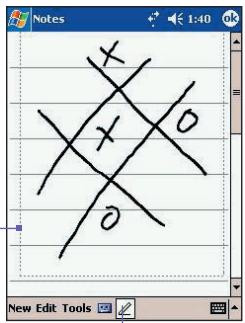
Pen button
To select a drawing:
If you want to edit or format a drawing, you must select it first.

Tap and hold the stylus on the drawing until the selection handle appears. To select multiple drawings, deselect the pen button and then drag to select the drawings you want.
2 You can cut, copy, and paste selected drawings by tapping and holding the selected drawing and then tapping an editing command on the pop-up menu, or by tapping the command on the Edit menu. To re-size a drawing, make sure the Pen button is not selected, then drag a selection handle.
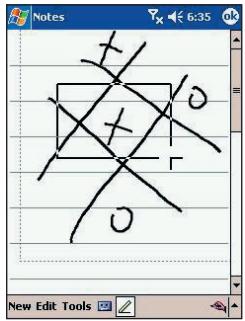

To change the zoom level so it is easier to work or view your drawing, tap Tools and then select a zoom level.
2.5 Recording a Message
In any program where you can write or draw on the screen, you can also quickly capture thoughts, reminders, and phone numbers by recording a message. In Calendar, Tasks, and Contacts, you can include a recording in the Notes tab.
In the Notes program, you can either create a stand-alone recording or include a recording in a written note. If you want to include the recording in a note, open the note first. In the Inbox program, you can also add a recording to an e-mail message.
To create a recording

To add a recording to a note, open the note before recording. Tap → Notes
If you do not see the Record/Playback toolbar, tap
Hold your device's microphone near your mouth or other source of sound.
4 To start recording, tap A beep will sound.
5 To stop recording, tap. Two beeps will sound. The new recording appears in the note list or as an embedded icon.
To play a recording, tap it in the open note or tap the recording in the note list.

You can also activate the Record/Playback toolbar by pressing the Record button, the first button from the top on the left side of your PPC6600.

To quickly create a recording, hold down the Record button. When you hear the beep, begin your recording. Release the button when you are finished. The new recording is stored in the open note or as a stand-alone recording if no note is open.
Indicates an embedded recording.
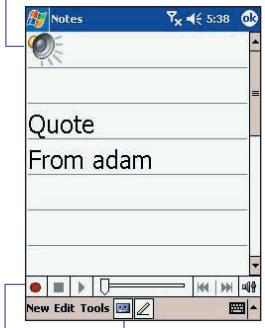
Tap to show or hide
the Recording tool bar
Tap to begin recording
Change recording formats
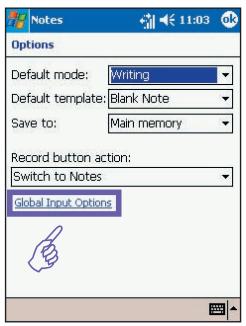
In the note list, tap Tools → Options → Global Input Options link (at the bottom of the page).

1 Mobile Voice is a 2.4 KB audio coded (compressor decompressor). It is the recommended format because it provides good voice recording and takes far less storage space than PCM.
2 Pulse Code Modulation (PCM) provides slightly better sound quality. However, PCM recordings may take up to 50 times more storage space than Mobile Voice recordings. PCM cannot be used to create recordings that are embedded in notes.
2.6 Finding Information
The Find feature on your PPC6600 helps you quickly locate the information you need.

1 Tap → Programs → Find.
In Find, enter the file name, word, or other information you want to search for. If you have looked for this item before, tap the Find arrow and select the item from the list.
To help narrow your search select a data type under Type.
4 Tap Go. The My Documents folder and subfolders are searched.
In the Results list, tap the item you want to open.
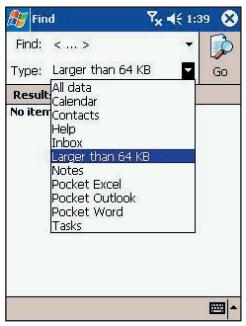

To quickly find information that is taking up storage space on your device, select Type, then Larger than 64 KB.
Chapter 3
Using Your Phone
3.1 About Your Phone
3.2 Making a Call
3.3 Receiving a Call
3.4 In-call-Options
3.5 Contacts Information
3.6 Additional-Dialing Information
3.7 Secure Your Phone
3.1 About Your Phone
Like a standard mobile phone you can use your PPC6600 to keep track of calls and send SMS messages. You can also take notes while talking and dial directly from Microsoft Contacts.
About The Dialer Screen
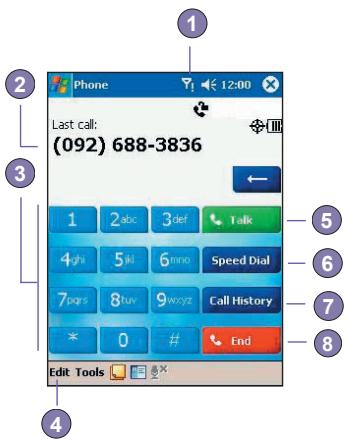
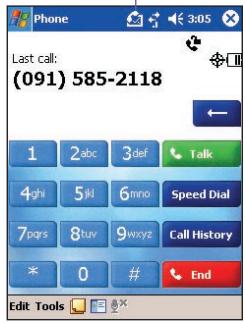
To access the Dialer Screen, tap on your device. From this screen, you can access Call History, Speed Dial and Phone Setting. Signal status information and important icons that tell you about your call include :

The icon indicates the strength of the signal.
Last number details are displayed here.
3 Keypad for inputting.
4 Task bar to access phone setting.
5 Tap to make a call.
Stores frequently dialed numbers.
View all call history, including received, dialed and missed calls.
8 Tap to end a call.
Indicators
Below are some of the status icons you may see.
| Indicator | Meaning |
| Tx | Phone off or out of network service. Tap this icon to turn on the phone |
| T | In network service, tap this icon to turn off the phone. |
| ↓ | Call Missed. Tap this icon to view missed calls. |
| M | Unread E-mail or SMS. Tap the icon to view unread SMS or E-mail. |
| R | Unread Voice Mail. Tap the icon to view unread Voice Mail. |
| + | Connecting in progress. The icon will disappear when you are connected to your ISP. |
| C | Voice privacy is not available. |
| A | Roaming allows you to use the phone anywhere in the world using local phone number. |
| Φ | Enables the network to detect your position. |
| Y | Indicates your connection is at full strength. |
The Navigation Pad and Dialing

Take Call - Press to take an incoming call.
Dialer Screen -Press to activate the dialer screen.
Speakerphone - During a call, press and hold to turn the speakerphone on or off.
Dial - Press to dial a number.
Scroll Up - Press to scroll up through a list.
3 End Call - Press to end a call.
Call History - After launching the dialer screen, press to enter the Call History feature.
Scroll Down - Press to scroll down through a list.
Center - Press to select a menu item.
Speed Dial - After launching the dialer screen, press to enter the Speed Dial feature.
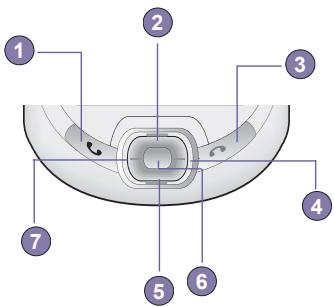
Checking Your Connection
The default settings for your device are programmed to assume that you want to use your phone. Your device will automatically connect your mobile phone to your service provider's network.
The icon indicates that you are connected to your service provider's network. A full strength signal is indicated by . As the strength of the signal diminishes so will the number of vertical bars in the icon, with no bars indicating no signal.

IN MANY COUNTRIES YOU ARE REQUIRED BY LAW TO TURN OFF YOUR PHONE WHEN YOU FLY. TURNOING OFF YOUR PPC6600 DOESN'T TURN OFF YOUR PHONE; YOU MUST TURN OFF YOUR WIRELESS CONNECTION TO YOUR OPERATOR'S NETWORK.
Turning The Phone On and Off
You can turn your phone on and off while keeping your actual device turned on.

While using any program on your device, tap Y in the title bar at the top of the phone's display.
Tap Turn on flight mode or Turn off flight mode option in the pop-up menu.
3 To receive calls when your device is turned off, leave the Phone turned on.

You can use other programs on your device during a call. To quickly switch back to Phone, tap → Phone.
Adjusting The Phone Volume

During a call, tap or press the volume buttons on the side of your device.
2 You can select to adjust the phone volume (ring) or device volume (notification levels and MP3) on the pop-up menu.
3 If you select Vibrate mode, will appear in the title bar at the top of the phone display.
4 Turn off the volume by choosing the Off option.
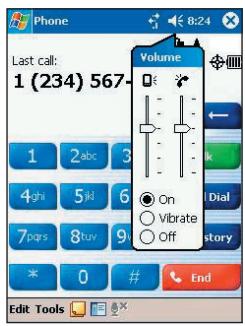

To adjust the conversation phone volume, you must do it during a call. Adjusting the volume at another time will affect the ring, notification and MP3 levels.
3.2 Making a Call
With your PPC6600, you can make a call from the Dialer, Contacts, Speed Dial, and Call History.
Making a call from the Dialer:
The most direct method is by using the Phone keypad.

To bring up the dialer screen, press
Tap the number on the keypad then tap or press

Back Spacing and Deleting

If you tap a wrong number, you can tap the back space arrow key to erase individual numbers one at a time. To erase the entire number, tap and hold the back space arrow key.

You can also delete all the numbers in the window by tapping Edit and then Clear.
Making a call from Contacts:
You can make a call from Contacts in the following ways :
Option 1

Press the Microsoft Contacts Button, find the contact and then tap twice -- once to send to the dialer screen and once to call.

By default, the pop-up menu and button will display Call Work Tel. However, you can customize it so that the mobile number or e-mail is displayed instead. "See Option 3 below for specific details."
Option 2

To select a phone numbe, select a contact in the contacts list and then press left or right on the navigation pad. To call press
Option 3

In the contacts list, tap the w in the right column next to the contact you want to customize. A pop-up menu will display the phone numbers and e-mail addresses for this contact. Tap the desired phone number to call.
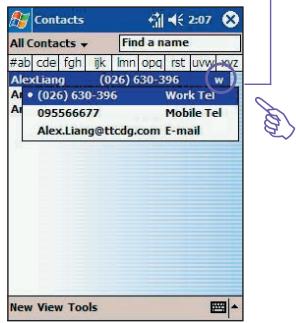
tap the w here to pop-up all the phoned numbers and e-mail for this contact
Making a call from Speed Dial:
Speed Dial allows you to call frequently dialed numbers with a single tap. Before you can create a speed dial entry for a phone number, that number must already exist in Contacts.

From the Phone keypad, tap Speed Dial → New.
2 Tap the desired contact name and number.
In the Location field, tap the Up/Down arrows to select an available location to assign as the new speed dial entry. The first speed dial location is reserved for your voice mail.
By memorizing the position in the Speed Dial list of a number, you can dial the number by entering its position number.
For example:
Alex Liang is at position 3. To dial his number simply tap and hold 3 on the dialer keypad; if the number holds a position of 10 or more, tap the first number, and then tap and hold the second to dial.

By default the Location function will give you the next available position in the Speed Dial list. If you want to put a number in a position that is already occupied, the new number will replace the number already there.
Tips for Speed Dial Setting

To create a speed dial entry from Contacts, tap and hold the contact name, tap Add to Speed Dial, and then tap the Up/Down arrows to select an available location to assign as the new speed dial entry.

To delete a speed dial entry, go to the Speed Dial list, tap and hold the contact name in the box to the right of the assigned speed dial number, and then tap Delete.
Making a call from the Call History:

1 Go to Phone then press the right side of the navigation pad or tap Call History
2 Find the call details by first selecting the category it is filed under. Tap on All Calls on the top left corner, a pop-up menu will appear. You can then select All Calls, Missed, Outgoing, Incoming and By Caller...For example, if it is in All Calls select All calls from the drop down menu in the top-left corner.
Use the navigation pad to find the number and then press or the icon to the left of the number you wish to call.
4 Call History icons include: → incoming calls; → outgoing calls; → missed calls.
3.3 Receiving a Call
Answering an incoming call:

Tap Answer, or press on your device.
To reject the call, tap Ignore or press

If you reject a call the busy tone will be sent out.
Ending a call:

To ens a call, press

or tap

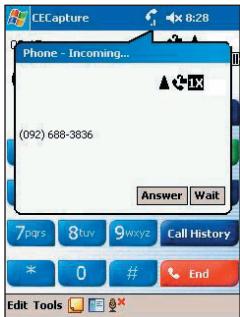
3.4 In-Call Options
Your device notifies you when you have another incoming call and gives you the choice of rejecting or accepting the call. If you accept, you can choose to switch between the two callers or set up a conference call between all three parties. A conference call can include up to six people. See page 47 for more details.
Putting a call on hold

Tap Answer to the take the 2nd call and put the 1st on hold.
To end the 2nd call and go back to the 1st , tap or press.
To swap between calls:

You can choose to swap backwards and forwards between 2 callers by tapping Talk or
To set up conference calls:

Dial the first number. When the party answers, dial the second number and wait for it to be answered.
When it is picked up, press set up the conference.

orTalkto
If the conference connection is successful, In Call will appear at the top of the phone dialer screen (See right).

You must dial out to set up conference calling.
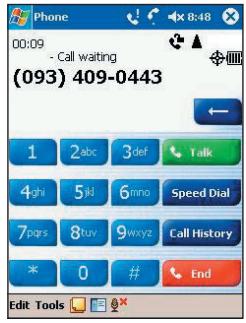
Making a Note
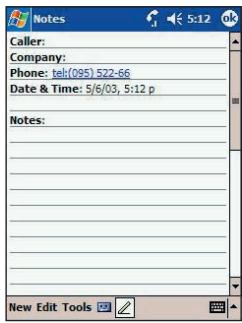
Regardless of whether you call from the Dialer, Contacts, Call Log and Speed Dial, you can take notes during a call. After you have finished the note it will be saved as an attachment to your call in one of the Call Log folders.
a. To make a note :

During a call, tap of the screen.

orTalkat the bottom

Use any of the input methods to record your note and then tap OK. You can finish your note during or after the call.
b. To view a note:

Press the right side of the navigation pad or tap Call History, tap and hold the call, and then from the pop-up menu tap view note. (The icon indicates a note).
Or, go to Notes of the file from the list. (For more information, see Chapter 2 Entering information.)

If you decide to create an entry for this caller -- see Adding and Transferring Contacts information in section 3.5 later in this chapter -- the call and file names will be amended to reflect the name in contacts; the file will be unaffected.
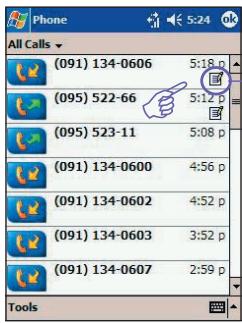
Tap here to view the notes
Enabling the Speakerphone Mode
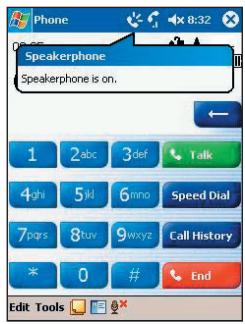
Your device has a speakerphone allowing you to talk hands-free and/or let other people listen to the caller.
To enable speakerphone mode:

Wait until the phone is ringing.
Press and hold until the speakerphone comes on and the icon appears in the top toolbar.
3 To turn off the speakerphone, press and hold again.

DO NOT LEAVE THE PHONE IN SPEAKERPHONE MODE AND HOLD IT ON YOUR EAR;THE SOUND MAY DAMAGE YOUR EAR.
Checking Your Voice Mail
The first speed dial location defaults as your voice mailbox. It will automatically detect and set as default the voice mailbox number of your mobile service provider.
To retrieve your voice mail :

On the Phone screen, tap Speed Dial or press the left side of the navigation pad, select 1 Voice Mail and then press
3.5 Contacts Information
Contacts can be imported by:

Call History - New contact numbers can be found in incoming or missed calls.

Important to import contacts - Creating Contacts in Microsoft Contacts creates more detailed records.
Tap the icon to view unread Voice Mail.
Call History
Tap Call History on the phone screen to view the call history list:
To add an entry to Contacts from Call History :

Find the call details you want to add.
Tap an entry and hold with the stylus or press and hold the navigation pad center; select Save to Contacts in the pop-up menu that appears.
In the Save to Contacts screen, add additional contact details then press the navigation pad center or tap OK.
The call details in the Call History will then be amended and displayed under the name of the contact, not their telephone number.
Manage Your Call History
Call History details all incoming, outgoing, and missed calls and also provides a summary of total calls. Call History can also tell you when a call was initiated, how long it lasted, and provides easy access to any notes taken during the call.
a. Viewing calls details
Tap in the top left corner of the screen and then select a category from the drop down menu.
Calls are categorized as follows:
All Calls - displays all calls made to and from the phone in chronological order.
Missed - displays calls that were not answered.
Outgoing - displays calls made from the phone.
- Incoming - displays calls made to the phone.
By Caller - list calls alphabetically according to caller.
b. To view duration of calls:

Go to Call History, find the call you are looking for, then tap it once.
c. To delete individual calls from Call History:

Tap and hold the stylus on the call to be deleted, then select Delete from the pop-up menu.
d. To delete all calls from Call History:

Tap Tools → Delete all Calls.
e. To set limits on the size of your Call History:


Tap Call History → Tools tab → Call Timers.
You can choose a time period that you wish to display all your Call History. Select a time period in the drop down menu from the Deleted call history items older than. When finished, tap OK.
3.6 Additional Dialing Information
Making an emergency call:

Enter the emergency number 112 then tap Talk or press button.
3.7 Secure Your Phone
You can customize the level of security you want to have on your PPC6600 by locking the keypad, the entire device.
Locking the keypad
The keypad lock turns off the keypad functionality. This is a helpful feature if, for example, your PPC6600 is turned off and in your pocket, and you want to prevent accidental key presses.
To lock the keypad:

Tapping → Settings → System tab → Button Lock
2 Select Lock all buttons except Power button.
3 To unlock your keypad, tap Do not lock buttons.
Locking your phone
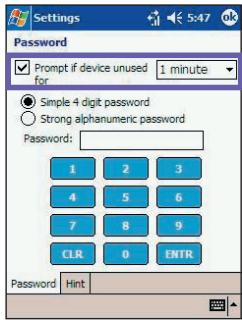
Locking your PPC6600 prevents access to personal data. When you enable this feature, your PPC6600 will automatically lock after a specified time of inactivity. A screen will be displayed prompting you to enter your password before access is granted.

Tap → Settings → Personal → Password.
2 Select the type of password you would like to use: Simple 4 digit password or Strong alphanumeric password.

A strong password must have at least 7 characters that are a combination of uppercase and lowercase letters, numerals, and punctuation.
3 Enter the password and, if necessary, confirm the password.
To select how long your mobile device must be turned off before the password is required for using the device tap Prompt if device unused for.
Chapter 4
Synchronizing Information
4.1 Using ActiveSync
4.2 Synchronizing Information
4.3 Synchronizing by Using an Infrared Connection
4.4 ActiveSync Errors
4.1 Using ActiveSync
Using Microsoft ActiveSync you can synchronize the information on your PC with the information on your PPC6600. Synchronization compares the data on your device with your PC and updates both with the most recent information. With ActiveSync, you can:
- Keep Pocket Outlook data up-to-date by synchronizing your device with Microsoft Outlook data on your PC.
- Choose to synchronize Inbox, Calendar, and Contacts with a server so that you have the latest information, even when your desktop computer is turned off.
- Copy (rather than synchronize) files between your device and your desktop PC.
Control when synchronization occurs by selecting a synchronization mode. - Select which information types are synchronized and control how much data is synchronized.

By default, ActiveSync does not automatically synchronize all types of information. Use ActiveSync options to turn synchronization on and off for specific information types.

Using Server ActiveSync, you can synchronize information directly with a Microsoft Exchange Server if your company is running Microsoft® Mobile Information Server 2002 or later.
Installing ActiveSync
Before you begin synchronization, install ActiveSync on your desktop computer from the PPC6600 Companion CD. ActiveSync is already installed on your PPC6600.
Creating a Partnership
After the installation is complete, the New Partnership Wizard helps you set up a partnership between your phone and your desktop computer and/or a server so that you can start synchronizing information and customizing your synchronization settings.

In the New Partnership Wizard select Synchronize with this desk-top computer. If you are certain that your company is running Microsoft Mobile Information Server 2002 or later and you know the server name, then choose Synchronize with Microsoft Mobile Information Server and/or this desktop compute. For more information, contact your network administrator or service provider.
Your first synchronization will automatically begin when you finish using the wizard. After the first synchronization, you will notice that your Outlook information now appears on your PPC6600.
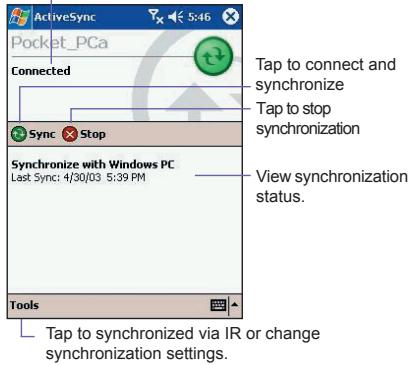
View connection status.
4.2 Synchronizing Information
This section provides an overview of the types of Outlook information you can synchronize. By default, ActiveSync does not automatically synchronize all types of Outlook information. Use ActiveSync options to turn synchronization on and off for specific information types.
Synchronizing Inbox
When you select Inbox for synchronization in ActiveSync, e-mail messages are synchronized as part of the general synchronization process. During synchronization, the following events occur:
- Messages are copied from the Outlook Inbox folder on your desktop computer, or from a Microsoft Exchange Server, to the Inbox folder on your PPC6600.
- By default, when synchronizing Inbox information with your desktop computer, you will receive only messages from the last three days and the first 500 bytes of each new message. You can also choose to download file attachments.
The messages on your phone and on your desktop computer are linked. When you delete a message on your phone, it is deleted from your desktop computer the next time you synchronize, and vice versa. - Messages in sub folders in other e-mail folders in Outlook are synchronized only if the folders have been selected for synchronization in the Inbox on your PPC6600.

SMS messages are not received in your Inbox through synchronization. Instead, they are sent to your phone by way of your service provider. For more details, please see Message Features in Chapter 8.
Synchronizing Calendar
Calendar items stored on your PPC6600 can be synchronized with calendar items stored on your desktop PC and/or on a Microsoft Exchange Server. By default, calendar items from the last two weeks will be synchronized.
Calendar items created on your PPC6600 are copied to your desktop PC and/or server during synchronization, and vice versa.
Synchronizing Contacts
- Contacts stored on your phone can be synchronized with contacts stored on your desktop computer or on a Microsoft Exchange Server. By default, all of your contacts will be synchronized.
- Contacts created on your phone are copied to your desktop computer and/or server during synchronization, and vice versa.
Synchronizing Tasks
Tasks stored on your phone can be synchronized with tasks stored on your desktop computer. Tasks synchronization is automatically selected in ActiveSync. By default, all of your incomplete tasks will be synchronized.
Tasks created on your phone are copied to your desktop computer during synchronization, and vice versa.

Tasks can be synchronized only with your computer. They cannot be synchronized with a server.
4.3 Synchronizing Using an Infrared Connection
You can use an infrared connection to quickly create a direct connection between your phone and another mobile device or computer. This method is ideal for quickly switching between multiple devices since there are no cables or adapters to change. When creating a partnership, you must connect using infrared, a cable, or a cradle connection.
For more information about synchronizing using an infrared connection or other connection types, see ActiveSync Help on your desktop computer.
Transferring Items Using Infrared
Using infrared (IR), you can also send and receive information, such as contacts and appointments, between two devices.
a. To send information :

Switch to the program where you created the item you want to send and locate the item in the list.
Align the IR ports so that they are unobstructed and within close range.
3 Tap and hold the item, then tap Beam Item on the pop-up menu.

You can send items, but not folders, from File Explorer. Tap and hold the item you want to send, and then tap Beam File on the pop-up menu.
b. To receive information :

Align the IR ports so that they are unobstructed and within close range.
2 Have the owner of the other device send the information to you. Your device will automatically receive it.
4.4 ActiveSync Errors
Whenever ActiveSync cannot successfully synchronize your information, it displays an error on your phone.
To view ActiveSync error information:

Press the Action button when the error text is displayed. ActiveSync will then display more information about the error that occurred.

Some types of errors can interfere with automatic synchronization. If you suspect that a scheduled automatic synchronization has not occurred, you should attempt to manually synchronize your information. Successfully completing manual synchronization will reset automatic synchronization. For more information, see the Synchronizing Information section of ActiveSync Help on your computer.
Chapter 5
Personalizing Your PPC6600
5.1 Device Settings
5.2 Phone Settings
5.1 Device Settings
You can adjust device settings to suit the way you work. To see available options, tap → Settings → Personal or System tab located at the bottom of the screen.
Personal Tab
| Icon | Program |
| Button(s) | |
| Assigns an application program to hardware button. | |
| Input | |
| Sets up the input portion of your device. | |
| Menu | |
| Customizes the menu appearance and enables a pop-up menu from the New button. | |
| Owner Information | |
| Displays your contact information. | |
| Password | |
| Limits access to your device. | |
| Phone | |
| Sets up the phone function of your wireless feature. | |
| Sounds & Notifications | |
| Sets the notification type, event and volume. | |
| Today | |
| Customizes the look and the information that appears on the Today screen. |
System Tab
| Icon | Program |
| About Displays important device information. | |
| Add ring tone To listen to and select new ring tones. | |
| Backlight Customizes the backlight and brightness for power saving purpose. | |
| Button Lock Enables you to lock the buttons on your device except Power button when device is off. | |
| Certificates Displays the name of the certificate issuer and the expiration date. | |
| Clock & Alarm Changes the time and sets alarms | |
| Device information Find information about version, hardware, identity and call duration. | |
| Keyboard Allows you to customize the keyboard settings, eg. to switch on/off the keyboard backlight with a time limit. | |
| Memory Displays the memory allocation status and current running programs. | |
| Microphone AGC Automatically adjusts the volume when you are recording. | |
| Permanent save Saves contacts to permanent flash memory. | |
| Power Maximizes battery life. | |
| Regional settings Customizes the region and relative format for the region you use. | |
| Remove programs Creates more memory by removing programs. | |
| Screen Re-calibrates the screen and enables/disables Clear Type feature. |

Buttons
To customize the program hardware buttons to open your most used programs:

Tap → Settings → Personal tab → Buttons → Program Buttons tab
Under Select a button, tap the button you want to assign to a program, and then select a program from Assign a program.
Default settings:
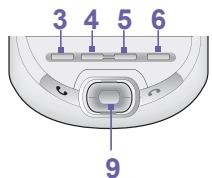
1 - Contacts
2-Calender
3-Start Menu
4 - Messaging
5 - Internet Explorer
6 - OK/Close
7 - Camera
8 - Record
9 - Action button
In the Up/Down Control tab, Delay before first repeat changes the time elapsed before scrolling begins. Repeat rate changes the time it takes to scroll from one item to the next. Just press and hold the Up/Down control scrolls through the items in a list to adjust

Input

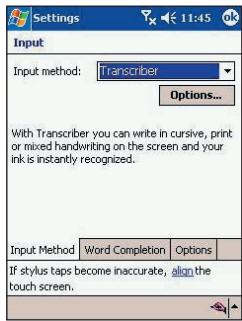
1 Tap → Settings → Personal tab → Input.
On the Input Method tab, select an input method and change desired options. On the Word Completion tab, select desired settings for word completion. On the Options tab, select desired options for writing and recording. These options apply to any program on the device where you can record or write. These options do not apply to text you enter using the input panel.

You can also change input options by tapping the arrow and Options.

Menu
To add the programs you use most often to the

Tap → Settings → Personal tab → Meals.
2 Select the programs you want, then tap OK.

Only 7 programs are allowed in the Start Menu.
On the New Menu tab, you can select Turn on New button menu and then select the items to appear on the menu. When you do this, an arrow appears next to New in the command bar of certain programs such as Pocket Word, Pocket Excel, Contacts, Calendar and Tasks. You can tap this arrow and then tap a new item to create.

You can create sub folders and shortcuts to appear under 4. In ActiveSync on your PC, click Explore → Double-click My PPC6600 → click Windows → click Start Menu → then create the folders and shortcuts that you want.

Owner Information

Tap → Settings → Personal tab → Owner Information.
On the Identification tab, enter your personal information.
On the Notes tab, enter any additional text you want to display when the device is turned on, such as: Reward if found.
On the Options tab, select Identification Information so that if you lose your device, it can be returned to you.

Password

Tap → Settings → Personal tab → Password.
To enable this function, select how long your mobile device must be turned off before the password is required for using the device by tapping Prompt if device unused for.
3 Select the type of password you would like to use : Simple 4 digit or Strong alphanumeric.

A strong password must have at least 7 characters that are a combination of uppercase and lowercase letters, numerals, and punctuation.
4 Enter the password and, if necessary, confirm the password.

If your device is configured to connect to a network, use a strong password to help protect network security.
If you forget your password, you must clear the memory before you can access your device. This will erase all files and data you have created and programs you have installed. For more information about clearing memory, please see Appendix A.
If you've used ActiveSync to create a backup file, all of your program data can be restored. For more information on creating a backup file, also see Appendix.

Sounds & Notifications

Tap → Settings → Personal tab → Sounds & Notifications.
On the Sounds tab, you can select the actions for which you want to hear sounds.
On the Notifications tab, you can customize how you are notified about different events. Select the event name and then select the type of reminder. You can select a special sound, a message, or a flashing light.

- Turning off sounds and the notification light helps conserve battery power.
Use Phone settings to change the ring type and volume for your phone.

Today
You can customize the Today screen the following ways:
a. To change the background:

Tap → Settings → Personal tab → Today.
On the Appearance tab, select the desired theme for the background. To use your own background, select Use this picture as the background then tap Browse to locate the desired file.

Choose a folder and tap the file you want then tap OK.
Recommend picture size for the background is 240x320 pixels in .jpg file.

To beam a favorite theme to a friend, on the Appearance tab, select the desired theme and tap Beam.
b. To customize the information you want displayed:

Tap → Settings → Personal tab → Today → then Items tab.
2 Select the information you want displayed on the Today screen.
To further customize the information, select an information type, and then tap Options (not available for all information type).

About
The Version tab displays important device information, including the amount of memory installed.
On the Device ID tab, you may need to change the device name if you are unable to connect to a network because another device with the same name is already connected.

Backlight

Tap → Settings → System tab → Backlight.
Tap Battery power tab to turn on/off the back-light when using battery power.
3 Tap External power tab to turn on/off the back-light when using external power.
Tap Brightness tab to adjust the brightness level.

Using the backlight while on battery power substantially reduces battery life.

Clock & Alarms

Tap → Settings → System tab → Clock & Alarms.
If you visit a particular time zone often, select it as your Visiting time zone on the Time tab so that you can quickly see the correct date and time.
- You can use your device as a travel alarm clock by setting a wake-up alarm on the Alarms tab. Tap the alarm icon to select the type of alarm you want.
To change the way the date or time is displayed on your PPC6600, go to Regional Settings by tapping → Settings → System tab → Regional Settings.

Memory

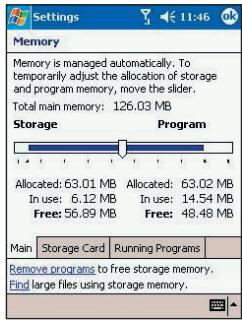
Tap → Settings → System tab → Memory.
The Main tab displays the amount of memory the system has allocated to file and data storage versus program storage. This tab also displays the amount of memory in use versus the available memory. For information about making memory available, see Free Memory in Appendix A.
The Storage Card tab displays how much memory is available on the storage card that is inserted into your device. If you have more than one card inserted, tap the list box and then the name of the storage card whose information you want to view.
The Running Programs tab displays the list of currently active programs. You can stop a program by selecting it in the list and then tapping Stop or just tap Stop All to stop all the running programs.

You may need to stop a program if it becomes unstable or program memory is low.

Power

Tap → Settings → System tab → Power.
The Battery tab displays the amount of battery power remaining. Battery power depends on the battery type and how the device is being used.
- On the Advanced tab you can select options for turning off your device to conserve battery power. To conserve the most power, select the option that turns off the device after 3 minutes or less.

Permanent Save
You can choose to backup Contacts and Appointments, Tasks, and Connection Setting to non-volatile memory. Backing them up in this way means they will not be lost in the event your device loses all power or you have to perform a full reset.
To backup to FlashROM:

Tap → Settings → System tab → and then Permanent Save.
2 Select the desired item by checking the boxes → tap OK to start backup

When you select to backup Contacts and Appointments, your PPC6600 will automatically backup newly added contacts, appointments or tasks items. This will not happen for Connection Setting; if you add new connection you will need to back it up manually.
To restore to FlashROM:

Tap → Settings → System tab → and then Permanent Save.
Select the desired item by checking the boxes → tap OK to start restoring.

Keyboard
Your PPC6600 comes with a QWERTY keyboard accessed by sliding down the bottom end of the device. Tap → Settings → System tab → and then Keyboard to open the Keyboard setting program. This allows you to switch on the keyboard backlight, set a time limit for the keyboard backlight to switch off when it is not being used; then provides links so you can customize the way your keyboard repeats and assign favorite programs to a specific key.
5.2 Phone Settings
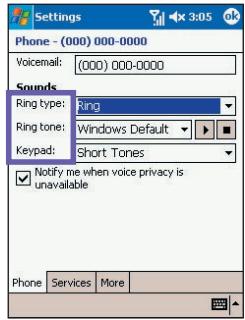
You can easily view and change settings, such as the ring type and ring tone to be used for incoming calls, and the keypad tone to be used when entering phone numbers. You can also protect your phone from unauthorized use. There are two ways to change phone settings:

Tap → Settings → Personal tab → Phone.
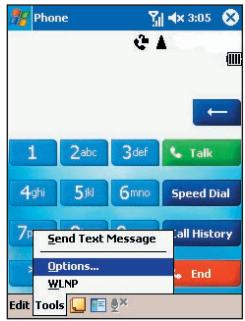
To change phone settings from the Phone keyboard. Tap Tools → Options → Phone tab.
Ring Type
You can change the way that you are notified of incoming calls. For example, you can choose to be notified by a ring, a vibration, or a combination of both.

Tap the Ring type list, then select the desired option.
Ring Tone

Tap the Ring tone list, then select the sound you want to use.
To set .wav or .mid files as ring tones, use ActiveSync on your PC to copy the file to the /Windows/Rings folder on your device. Then, select the sound from the Ring tone list.
To download ring tones, you can make a connection to the Internet and then download ring tones that are compatible with the .wav or .mid format.

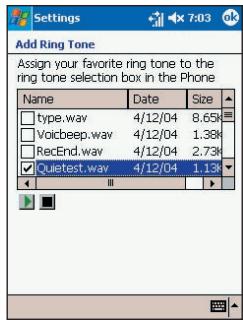
Add Ring Tone
Add Ring Tone allows you to quickly find and display all the ring tones stored on your device, then gives you the option to listen, and then add or remove them from the Phone Settings list mentioned above.

To display all ring tones on your device, tap → Settings → System → then Add Ring Tone. The program will automatically list and display all the .wav and .mid files on your PPC6600.
After the ring tones have loaded, you can see that some are already selected; these ones are presently listed in the phone settings.
3 To play a ring tone, select it, and then tap If you don't like the ring tone deselect it; this will add/remove the selected/deselected ring tones from the list in your phone settings.
Keypad Tone
You can change the tone you hear when entering a phone number on the keypad. If set to Tones, the tone is heard continuously for as long as the number on the keypad is pressed. If set to Beep, the tone is heard only for one or two seconds.

Tap the Keypad list, then select the option you want.
To prevent tones from being heard when entering a phone number → select Off.
Services
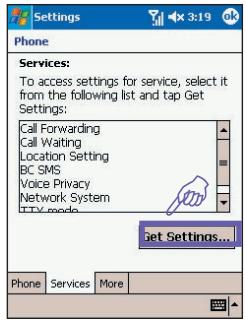
Services settings on the Settings → Phone → Services tab are primarily used to set options such as Voice Privacy, SMS Setting, and Location Setting.
| Feature | Function |
| Voice Privacy | Amethod for encrypting voice calls to provide extra security. |
| SMS Setting | By default your device will automatically detect and set your voice mail and SMS access numbers. |
| BC SMS | Enables you to receive a range of service, such as weather reports and news, pushed to your device as SMS. |
| Location Setting | Enables you to decide to allow your network to lock onto your position or not. |
| Network System | Enables syou to choose to accept roaming (Standard) or restrict your phone to calls from your home network only (Home only) |
| TTY Mode | Enables the use of a TTY (for the deaf) machine together with your device. |
Tap Get Settings to access the settings for a service.

To change service settings from the phone dial screen, tap Tools → Options → Services tab → select a service → Get Settings.
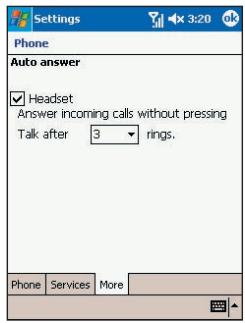
Automatic Answer
This feature enables your phone to automatically pick up a call and transfer it to the headset.

In phone dialer, tap Tool → Option → More.
To enable, check the box next to Headset and then set the number of rings after which to pickup.
Chapter 6
Scheduling and Communicating - Microsoft Pocket Outlook
6.1 Calendar
6.2 Contacts
6.3 Tasks
6.4 Notes
6.1 Calendar: Scheduling Appointments and Meetings
Use Calendar to schedule appointments, including meetings and other events. You can check your appointments in one of several views (Day, Week, Month, and Agenda) and set Calendar to remind you of appointments with a sound or other method. Appointments for the day can be displayed on the Today screen.

If you use Outlook on your PC, you can synchronize appointments between your PPC6600 and PC. See ActiveSync in Chapter 4.

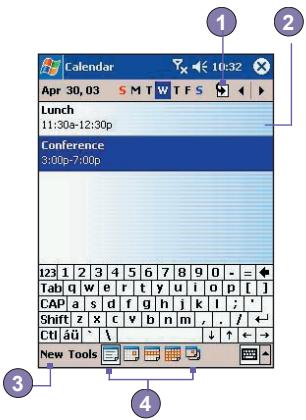
Tap to go back to view today's appointment.
2 Tap to display or edit the appointment details.
3 Tap to create a new appointment.
Tap to change the appointments in various displayed view.
Create or Change an Appointment

To create an appointment, tap New. To select a new date from a pop-up calendar, tap the display date. To enter or select a new time, tap the display time. Enter the appointment details, and when finished, tap OK to return to the calendar.
If you are working in Day view, tap the time slot for the new appointment and then New to have the time automatically entered for you.
3 To change an appointment, tap it in the calendar, and then tap Edit. Change any appointment detail by tapping it and entering the new information.
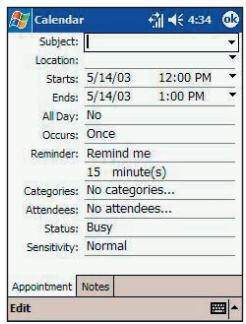

When entering a time, you can type military and abbreviated time forms, such as 2300 (becomes 11:00 PM), 913pm (becomes 9:13 PM), 911 (becomes 9:11 AM), and 9p (becomes 9:00 PM).
Send a Meeting Request
You can use Calendar to set up meetings with users of Outlook or Pocket Outlook. The meeting request will be created automatically and sent either when you synchronize Inbox or when you connect to your e-mail server.

1 Create an appointment and enter the meeting information.
Tap Attendees (you will need to hide the input panel to see this box).
3 Select the meeting attendees from the list of e-mail addresses you've entered in Contacts. Only those contacts with e-mail addresses will be displayed.
4 Select other desired options and then tap OK.
5 Messaging automatically creates a meeting request and sends it to the attendees the next time you synchronize with your PC. Any textual notes entered in the Notes tab (excluding writing or recordings) will also be sent.

If you are sending the meeting request through a connection to an ISP or the network, rather than through synchronization with your PC, tap Tools → Options → Appointments tab. In Send meeting requests via, tap the service you want to use to send the meeting request.
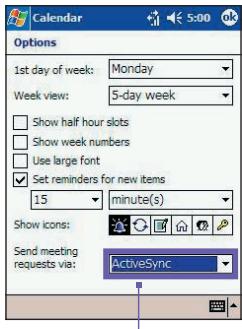
Tap the service you want to use to send the meeting request.
Use the Summary Screen

When you tap an appointment in Calendar, a summary screen is displayed. To change the appointment, tap Edit.
Set a reminder for an appointment

In the Calendar, tap the appointment, and then tap the upper portion of the summary screen.
Tap Reminder and select Remind me.
To change how many minutes before the appointment you are reminded, tap the minutes displayed.

To automatically set a reminder for all new appointments, in the calendar, tap Tools → Options → Appointments tab and select Set reminders for new items.
Beam an appointment
To beam an appointment, in the calendar list, tap and hold the appointment. On the pop-up menu, tap Beam Appointment.

When using infrared (IR), align the IR ports between the devices so that they are unobstructed and within a close range.
6.2 Contacts: Tracking Friends and Colleagues
Contacts maintains a list of your friends and colleagues so that you can easily find the information you're looking for, whether you're at home or on the road. You can enter both personal and business information.
If you use Outlook on your PC, you can synchronize contacts between your device and PC. See ActiveSync in Chapter 4.
View contacts

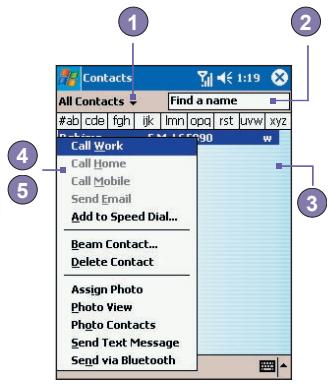
1 Select the category of contacts you want displayed in the list.
Tap and enter part of a name to quickly find it in the list.
3 Tap letters, such as h (home), w (work), or m (mobile) to the right of the contact to see additional phone numbers and e-mail addresses.
4 Tap to display or edit the contact details.
5 Tap and hold to display a pop-up menu of available actions.

To change the way information appears in the list, tap Tools and then Options.
Create or Change a Contact:

Tap → Programs → Contacts → New.
Using the input panel, enter a name and other contact information. You will need to scroll down to see all available fields.
3 To assign the contact to a category, scroll to and tap Categories and select a category from the list. In the contact list, you can display contacts by category.
To add notes, tap the Notes tab. You can enter text, draw, or create a recording.
To change a contact, tap it in the contact list, and then tap Edit. To cancel edits, tap Edit → Undo. When finished, tap OK to return to the contact list.

If you enter a name with more than 2 words, the middle word will be recorded as a middle name. If your contact has a double first or last name, tap the Name arrow and enter the names in the proper box.
Finding a contact:
There are several ways to find a contact:

Tap → Programs → Find, enter the contact name (first, last, or middle), phone number, or address, select Contacts for the type, and then tap Go.
From Contacts, start typing a contact name until you see it displayed on the screen. To show all contacts again, tap the text box at the top of the screen and clear the text, or tap the arrow icon to the right of the text box.
3 Tap one of the sets of letters displayed at the top of the contact list. This takes you to the contact names beginning with those letters.
In the contact list, tap the category list (labeled All Contacts by default) and tap the category to which you've assigned a contact. To show all contacts again, select All Contacts. To view a contact not assigned to a category, select No Categories.
To view the names of companies your contacts work for, in the contact list, tap View → By Company. The number of contacts that work for that company will be displayed to the right of the company name.
Press and hold the top of the navigation pad until alphabetical letters appear on the screen in large type. Then use the navigation pad to scroll through the alphabet and select a letter.
Beam a contact

To beam a contact, in the contact list, tap and hold the contact. On the pop-up menu, tap Beam Contact.
To beam multiple contacts, tap and drag to select the contacts. Then, tap Tools → Beam Contact.

When using infrared (IR), align the IR ports between the devices so that they are unobstructed and within a close range.
Change Options
In the contact list, tap Tools → Options.

To increase the available space for displaying contacts in the list, clear Show ABC tabs.
The area code and country/region for new contacts are automatically entered based on the information in Country/Region settings.
Using the Summary Screen
When you tap a contact in the contact list, a summary screen is displayed. To change the contact information, tap Edit.
6.3 Tasks: Keeping a To Do List
Use Tasks to keep track of things you need to do.
A variety of task information can be displayed on the Today screen.
If you use Outlook on your PC, you can synchronize tasks between your device and PC. See ActiveSync in Chapter 4.
Create or Change a task:

To create a task with detailed information, such as start and due dates, tap → Tasks → New.
In the task list, you can display tasks by category.
To assign the task to a category, tap Categories and select a category from the list.
To create a new category, tap the Add/Delete tab, enter the category name, and then tap Add. The new category is automatically selected in the Select tab.
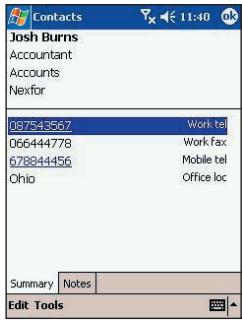
3 To add notes, tap the Notes tab. You can enter text, draw, or create a recording. When finished, tap OK to return to the task list.
4 To change a task, tap it in the task list, and then tap Edit.

To quickly create a task, enter text in the Tap here to add a new task box at the top of the screen. If you don't see this box, tap Tools → Entry Bar.
Set a reminder for a task

In the task list, tap the task, and then tap Edit.
If you have not already done so, tap the Due box and set a due date.
3 Tap the Reminder box and select Remind me. You will be reminded at 8:00 in the morning on the due date.
To change the reminder date, tap the date displayed.

To be automatically reminded of new tasks with a due date, in the task list, tap Tools → Options and select Set reminders for new items.

To choose how you are reminded, for example by a sound, tap → Settings → Personal tab → Sounds & Notifications.
Using the Summary Screen

When you tap a task in the task list, a summary screen is displayed. To change the task, tap Edit.
Beam a Task

To beam a task, in the task list, tap and hold the task. On the pop-up menu, tap Beam Task.
6.4 Notes: Capturing Thoughts and Ideas
Notes helps you quickly capture your ideas, notes, and thoughts. You can create a note using written and typed text, drawings, and recordings. You can also share your notes with others through e-mail, infrared, and synchronization with your PC. See ActiveSync in Chapter 4.

To create documents with advanced formatting or templates, such as bulleted lists and tabs, use word processing software developed for your device, such as Pocket Word.
Creating a note:

Tap → Programs → Notes → New.
Create your note by writing, drawing, typing, and recording, see Entering Information in Chapter 2 for more information about using the input panel, writing and drawing on the screen, and creating recordings.

You can insert the date in a note. First, deselect 2 and make sure that no drawings are selected. Next, tap and hold anywhere on the note and then tap Insert Date.
Send a note via e-mail

If you haven't already set up Messaging to send and receive messages, please do so now. See Account Settings in Chapter 8.
In the note list, tap and hold the note or recording. To select multiple notes or recordings, tap and drag. Then, tap and hold the selected items.
On the pop-up menu, tap Send via E-mail. A new message is created with the item attached.
Beam a Note

To beam a note, in the note list, tap and hold the note.
On the pop-up menu, tap Beam File.
Change options
In the note list, tap Tools → Options.

From the Default template list, you can select a pre-designed template to use with all new notes.
2 If you store most of your notes and recordings on a storage card, in Save to, tap Storage card to have new items automatically stored on your storage card.
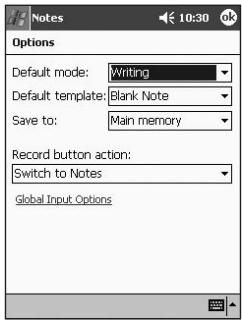
Chapter 7
Getting Connected
7.1 About Connection
7.2 Connect to the Internet
7.3 Terminal Client Service
7.4 Bluetooth
7.1 About Connections
You can set up connections to the Internet and corporate network at work in order to do such activities as browse the Internet or intranet, send and receive e-mail and instant messages, and synchronize information using ActiveSync.
Connections can be made using a modem, wireless network, or network (Ethernet) card. A modem connection can be used to set up connections with an external modem, or through your mobile phone network using a cellular line.
Your PPC6600 has two groups of connection settings: My ISP and My Work Network. My ISP settings are used to connect to the Internet, and My Work Network settings can be used to connect to any private network, such as a corporate network you use at work. Simply fill in the settings and you'll be ready to start connecting.
7.2 Connect to the Internet
You can use My ISP settings to connect to the Internet and use the connection to send and receive e-mail messages and view Web pages.
Connect to the Internet via ISP

Obtain the following information from your ISP:
- ISP server phone number.
- User name.
- Password.
- Access point name.
(required for CDMA connection)
2 Tap → Setting → Connections tab → Connections
To create a new connection, in My ISP, tap Add a new modem connection and follow the instruction in the New Connection wizard.
Wireless connections can be made via a mobile phone network or CDMA. If you are using a mobile phone network to connect, in the Select a modem list, tap Cellular Line.
5 To view additional information for any screen, tap
To start the connection, begin using the desired program. For example, switch to Pocket Internet Explorer and browse a Web page. Your device will automatically connect.

To change modem connection settings, in either My ISP or My Work Network, tap Manage existing connections. Select the desired modem connection, tap Settings, and follow the instructions on the screen.
Set up a WAP gateway
To access WAP sites through Pocket Internet Explorer, configure your device to use a WAP gateway. Use the following steps to create a new set of connections to the Internet with WAP gateway settings.

Get the following information from your ISP : ISP server phone number, user name, and password. Also, contact your mobile phone service provider and ask for your WAP gateway server name and port number.
2 Tap → Settings → Connections tab → Connections → Tasks tab.
Tap Edit my proxy server. If a proxy server has not been set up, tap Set up my proxy server.
For Programs that automatically connect to the Internet, tap New and enter a name for the ISP connection.
On the Proxy Settings tab, select This network connects to the Internet and This network uses a proxy server to connect to the Internet.
If necessary, in the Proxy server box, enter the proxy server name.
7 Tap Advanced.
In the WAP box, enter the WAP gateway server name. Under Port, enter the port number. The most common WAP port number is 9201.
9 Create a modem connection. Also, if necessary, set dialing rules.

Pocket Internet Explorer
Once connected, you can use Pocket Internet Explorer to view Web HTML, cHTML, xHTML and WAP pages on your PPC6600 in two ways: by downloading pages through synchronization or by connecting to the Internet. While browsing, you can also download files and programs from the Internet or intranet.
During synchronization with your PC, download your favorite links and mobile favorites that are stored in the Mobile Favorites folder in Internet Explorer on the PC.

To synchronize and download your favorite links from your PC, tap the sync option Favorites in ActiveSync on your PC.
Browsing the Internet
Access the internet by tapping → Internet Explorer.

In the address bar that appears at the top of the screen, enter the Web address you want to visit.
To go to the web address you entered, tap
Tap , the Favorites button, then tap the favorite you want to view.

To add a favorite link while using your PPC6600, go to the page you want to add → tap and hold on the page, and tap Add to Favorites from the pop-up menu.
To go back to the Homepage you set, Tap
To refresh the web page on the screen, tap
To choose from previously entered addresses, Tap the arrow
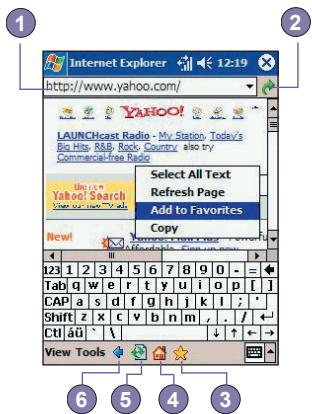
7.3 Terminal Services Client
Using the Terminal Services Client, you can log onto a PC running Terminal Services or Remote Desktop and use all of the programs available on that PC from your mobile device. For example, instead of running Microsoft Pocket Word, you can run the PC version of Microsoft Word and access all of the .doc files on that PC from your PPC6600.
Connecting to a Terminal Server

Tap → Programs → Terminal Services Client.
To connect to a server you have previously connected to, tap a server name in Recent Servers. To connect to a new server, enter the server's name in the Server box. Select the Limit size of server desktop to fit on this screen check box only when using applications that have been specifically sized for use with PPC6600.
3 Tap Connect.

If the network administrator has configured Terminal Services Client to reconnect to disconnected sessions, and you previously disconnected from a Terminal Server without ending the session, the Terminal Services Client reconnects to that session.
Navigating Within Terminal Services Client
Once connected to the server, the PC's screen may more than fill your mobile device's screen. If scroll bars are displayed on the server's screen, you will see more than one set of scroll bars on your PPC6600: one to scroll information on the PC, and one to scroll the PC display through the Terminal Services window in Terminal Services Client.
To ensure you are scrolling the PC display through Terminal Services Client, use the five directional buttons at the bottom of the Terminal Services Client screen.
To better fit information on your mobile device's screen, select Limit size of server desktop to fit on this screen. For best effect, programs on the desktop computer should be maximized.
Disconnecting Without Ending a Session
The following commands must be accessed from the Start menu in the Terminal Services window used to access the PC's commands. Do not use the Start menu on your PPC6600.

In the Terminal Services window, tap Start → Shutdown.
2 Tap Disconnect.

If your administrator has configured Terminal Services Client to reconnect to disconnected sessions, you will be reconnected to this session the next time you connect to this server.
Disconnecting and Ending a Session

In the Terminal Services Client window, tap Start → Shutdown.
2 Tap Log Off.
Tips and Tricks
Improving display performance
Display performance is improved by decreasing the time it takes for the screen to be refreshed on the desktop computer.

On your desktop computer, select Start → Settings → Control Panel.
2 Click Display.
3 Clear the Transition effects for menus and tooltips check box.
Improving browser performance
Performance with Internet Explorer on the desktop computer is improved by decreasing the time it takes for Web pages to be refreshed.

In Internet Explorer on your PC, select Tools → Internet Options.
2 Click the Advanced tab.
3 Clear the Use smooth scrolling check box.
7.4 Bluetooth
Bluetooth is a short-range wireless communications technology. Unlike infrared, you don't need to line up the devices to beam information within a closer range when operating with Bluetooth connection.
With Bluetooth powered on, you can send information or perform the following tasks wirelessly between two Bluetooth devices within a range of about 10 meters (30 feet):
Exchange information, such as files, calendar items, tasks, and contacts or business cards.
Synchronize with a PC with Bluetooth capability through an ActiveSync connection.
Partner with a Bluetooth-enabled mobile phone and use it as a wireless modem.
Connect to, use, and disconnect to other Bluetooth devices.
Using Bluetooth
The Bluetooth icon in the lower-right corner of the Today screen provides quick access to the Bluetooth Manager and Bluetooth Settings.
The icon changes subject to the Bluetooth using status:

- Bluetooth is active.

- Bluetooth is disabled (Default status).

- Bluetooth is initializing.

When your Bluetooth is powered on, the LED indicator for Bluetooth, located on the left upper corner of your PPC6600, will blink blue every 6 seconds to indicate Bluetooth is on or alternate between blinking blue and blinking green every 3 seconds if Wireless LAN is also turned on.
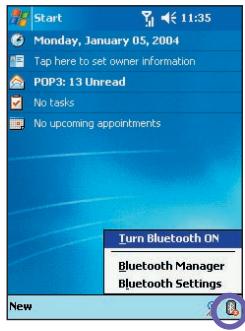
Bluetooth Settings
With Bluetooth Settings, you can:
- Turn Bluetooth on/off and enable/disable Bluetooth services.
Create or Change a name for your PPC6600 when using Bluetooth to connect with other devices.
Set your connection preferences and user profile. - Specify security settings and define settings for sharing and connecting.
Turning On Bluetooth
You can turn on Bluetooth by tapping at lower-right corner of the Today screen, then you can turn Bluetooth on by either:

1 Select Turn Bluetooth ON.
or
2 Select Bluetooth Settings → and then tap Turn On.
Tap to create, delete, or rename a profile
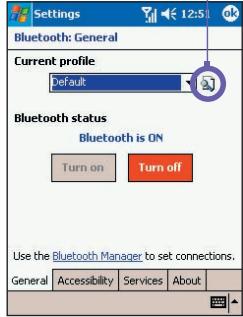
Using Profiles
Setting the profiles allows:
- Different users to quickly re-configure the PPC6600 to the personal preferences. For example, if Joe and Mary both use the same PPC6600, but each uses it for a different purpose, selecting a pre-configured profile will alter the settings to those of the appropriate user.
A single user to quickly re-configure the PPC6600 for a different environment. If Joe uses his device primarily at the office, but also uses it when traveling, he can easily switch to a pre-configured profile that has more secure settings for hotel, airport, or similar "public" environments.

All Bluetooth Settings are saved in the active profile. When your PPC6600 is turned off, Bluetooth Settings saves the last-used profile and reloads that profile the next time your PPC6600 is turned on.
a. To Create a new profile:

From the General tab → tap to access a screen from which you can Add, Rename and Delete a profile.
2 Tap the New button.
3 Enter a descriptive name for the new profile, for example, Office.
4 Select an existing profile on which to base the new profile.
5 Tap OK.

The new profile does NOT automatically become the active profile; to activate the new profile, select if from the Current Profile field on the General tab.
b. To Rename or Delete a profile:

From the General tab → tap to access a screen from which you can Add, Rename and Delete a profile.
2 Tap a profile from the profile name list and then tap Rename or Delete button to rename or delete the selected profile.
c. To Save configuration settings in a profile:
When you make changes to the PPC6600's configuration, those changes are automatically saved when you select a different profile, turn Bluetooth off, or shut down your PPC6600.

From the General tab → tap to access a screen from which you can Add, Rename and Delete a profile.
2 Select the desired profile from the Current Profile field on the General tab.
3 Setup your PPC6600 including the necessary settings in Accessibility and Services tab described later so that it behaves in your desired manner.
Tap OK and then close the Bluetooth Settings screen; the changes are saved automatically.

To avoid saving unwanted changes to a regularly used profile, create a new profile that is based on the profile currently in use, select the new profile, and then make the changes while the new profile is active.
Setting Accessibility Properties
You can enter or change the accessibility properties to define how your PPC6600 interacts with other Bluetooth devices by tapping the Bluetooth icon on the lower-right corner of Today screen → Bluetooth Settings → Accessibility tab.

Enter the Bluetooth name of your PPC6600, that will be displayed to remote devices when the associated profile is active, if this name will only appear Use PocketPC device name for Bluetooth checkbox is un-checked.
If the box Use PocketPC device name for Bluetooth is checked, the name assigned to your PPC6600 (select by tapping → Settings → System tab → About → Device ID tab → Device Name) will always be displayed to the remote user as the Bluetooth name of your PPC6600.
3 Allow other devices to connect - when this option is enabled, other devices are permitted to connect to this device. Two mutually exclusive sub-options provide additional refinement. They are:
All devices - select this option to allow all devices to connect.
Paired devices only - select this option to allow only devices that have a paired relationship with your PPC6600 to connect.
Other devices can discover me - when this option is enabled, other Bluetooth devices can see and report your PPC6600. This allows any device, even those unknown to your, to connect to your PPC6600.

The ability of remote devices to connect is also subject to the security restrictions and whether Bluetooth is enabled on your PPC6600.
Enabling Bluetooth Services
The services that your PPC6600 provides to other devices when using Bluetooth include :
File Transfer - file-related operations such as get a file/use a file/delete a file, etc.
Information Exchange - send the default business card (Pocket Outlook contact) on request.
- Serial Port - Bluetooth serial port operations. Bluetooth serial ports are used as a replacement for a physical cable between devices.
Personal Network Server - join or host a Bluetooth-based personal area network
- Dial-up Networking Server- provide access, via a phone line or other access system, to a remote computer network such as an Internet service.
Hands Free - allows you to connect to a remote headset or other audio device.
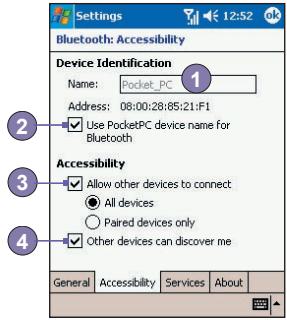
All the services can be individually configured by tapping the Bluetooth icon on the lower-right corner of Today screen → Bluetooth Settings → Services tab.

In the Services field, select the service to be configured.
In the Service settings area, enable the desired options by checking the Enable service box.
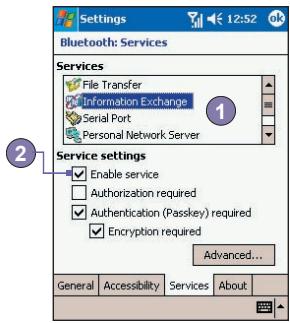
Service Security Settings
Each Bluetooth service has its own individual security settings. Even though the options are the same for each service, in each case they are specific to the individual service being configured.
In the Service settings area of Services tab, tap the Bluetooth icon on the lower-right corner of Today screen → Bluetooth Settings:

1 Authorization required
When enabled, your PPC6600 will require that each attempt to establish a connection be individually authorized on the pop-up Authorization Request screen; that is, you must authorize each connection, when a remote device attempts to connect to this service.
Authentication (Passkey) required
When enabled, a passkey or a Link Key is required from the remote device before allowing the connection.

A passkey is a code you enter to authenticate connections requested by other devices. This passkey must be known and used by both parties, otherwise, the connection will not be allowed.
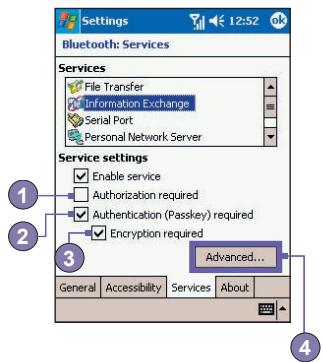
3 You can also enable the Encryption required function if you want to require all data exchanged between your PPC6600 and the remote Bluetooth device to be encrypted.
Some services have advanced configuration options; if available, tap Advanced to access the additional settings.
Bluetooth Manager

Tap the Bluetooth icon on the lower-right corner of Today screen → Bluetooth Manager.
The Bluetooth Manager provides a user friendly interface for establishing connections based on the connection preferences and profiles that you have set in the Bluetooth Settings. With Bluetooth Manager, you can:
Exchanging information or business cards.
Create, manage, and use the services connection that you have enabled in the Bluetooth Settings with other remote devices.
Display shortcuts.
Control the on-screen display.

Opening Bluetooth Manager automatically turns on Bluetooth.
Exchanging Information or Business Cards
When you tap the Bluetooth icon on the lower-right corner of Today screen → select Bluetooth Manager → and then tap Tools menu. There are two options: Paired devices and Business Card Exchange
a. To pair with another device:
Pairing essentially means giving two devices permission to communicate with each other.
When two devices are paired, they share, and exchange prior to each connection, an internally generated security key. This security key, called a Link Key, is based on a unique Bluetooth Device Address, a random number, and a user-defined password.

From the Bluetooth Manager → Tools menu, → select Paired devices.
On the Paired devices screen → tap Add.
On the Device Pairing screen: tap to access the Select a Bluetooth device screen → and then select one from the available list to return to the prior screen and populate the Device: field → Enter the correct password in the Passkey: field.
4 Tap OK.
b. To exchange Business Cards:

From the Bluetooth Manager → Tools menu, → select Business Card Exchange.
2 Tap the link at the bottom of the screen to select a default business card. After the card is selected, tap OK to return to the Business Card Exchange screen.

To Send or Exchange business card(s) you must first specify your default business card in the Bluetooth Settings screen → Services tab → Select Information Exchange service → and then tap Advanced button to set your business card.
3 Tap the Send, Exchange or Request icon, as appropriate.
4 From the Bluetooth Browser screen tap the name of the remote device → and then tap OK.
Bluetooth Connection Wizard
From the Bluetooth Manager, tap the New menu to start the Bluetooth Connection Wizard, which walks you through the process of creating a connection. Choose the type of connection and then tap Next. The succeeding wizard screens will guide you through establishing the parameters of the connection. The exact content of the succeeding screen will vary, depending on the type of connection being created.
Tap Next to move to the next page, or Back to return to the previous page.
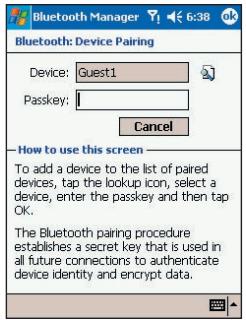
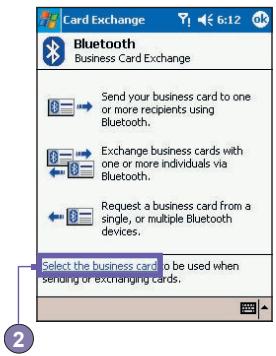
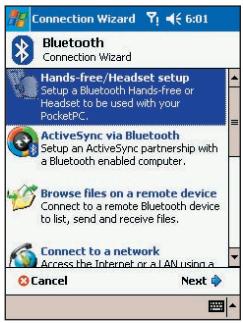
Some of the connection types included in the wizard:
Hands-free/Headset setup (optional item):
Locate and pair with a Bluetooth headset or other hands-free device.
ActiveSync via Bluetooth:
Locate a Bluetooth PC and create a connection shortcut that will establish a synchronization link between the Personal Information Manager on your PPC6600 and the desktop computer.
Browse files on a remote device:
Locate and connect to a remote device to examine the contents of a remote folder and/or send/receive file(s) to/from that device. An optional connection shortcut can be created.
Connect to a network:
Locate a remote device that can provide access to the Internet. Examples include a Bluetooth cell phone, a Bluetooth modem, or possibly a Local Area Network. Once the connection shortcut is created, open the connection and then open a browser such as Internet Explorer.
Join a Personal Network:
Create, or locate and join, a Bluetooth network. Create a shortcut to a connection that can be used to share files, collaborate with co-workers, participate in multiplayer games....
Exchange business cards:
Locate and connect to a remote Bluetooth device and then send, receive and/or exchange electronic business cards with that device.
Explore a Bluetooth device:
Locate a remote device, view the services the remote device can provide, and then create a connection shortcut to one or more of those services (hold down the Navigation/Action Button) to tap and select multiple services.
a. Using a Serial Port Connection
The use of a Bluetooth wireless serial port connection is identical to the use of a physical cable serial port connection between two devices. As with a physical connection, the application that will use the connection must be configured to use the correct serial port.
To determine the communications port assigned to the Bluetooth serial port:

Tap the Bluetooth icon on the lower-right corner of Today screen → Bluetooth Settings → Services tab.
2 Select Serial Port from the services area → and then tap Advanced.
The Outbound COM Port is the lower listing on the screen. You must configure the application that will use the Bluetooth Serial Port to send data to this port.

For more information about configuring your application's outbound COM port, refer to the application's documentation.
To establish a serial connection:

Tap the Bluetooth icon on the lower-right corner of Today screen → Bluetooth Manager.
Tap New → select Explore a Bluetooth device → tap Next.
3 Follow the connection wizard instructions.
b. Setting up a Bluetooth Hands-free/Headset Connection

From the Today screen → tap Bluetooth icon → Bluetooth Manager.
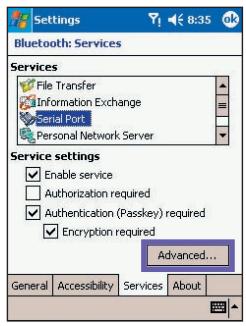
2 Tap New → Hands-free/Headset setup → tap Next.

Be sure that the Hands-free device you are trying to connect to is ready to receive incoming connection requests. Please refer to the device's manual for more information.
3 Follow the connection wizard instructions.
c. Setting up an ActiveSync via Bluetooth on your PPC6600
You can set up an ActiveSync partnership with a Bluetooth-enabled computer. First, you need to set up the Bluetooth Configuration of your computer (follow the instruction in the user manual of your Bluetooth device or PC), then setting up your PPC6600.
To establish an ActiveSync connection on your PPC6600:

From the Today screen → tap Bluetooth icon → Bluetooth Manager.
Tap New → ActiveSync via Bluetooth → Next.
3 Follow the connection wizard instructions.

Be sure the ActiveSync COM port setting on your PC is the same as the COM port setting used for Bluetooth on your PC.
4 Follow the Bluetooth Browser screen, select the PC you want to synchronize with → tap Next.
Under Serial Port Selection → select the name of the serial port for the PC selected above → then tap Next → Finish.
d. Dial-Up Networking : Connect to Remote PC
Dial-up Networking (DUN) allows you to connect to a remote computer via a phone line. Once connected, you can browse the Internet, check your e-mail, etc.
The remote Bluetooth device that will provide the Dial-up Networking service must have access to a telephone system (either a hard-wired or cellular connection).
Devices that might provide the Dial-up Networking service include:
Bluetooth-enabled cellular telephones
Bluetooth-enabled desktop computers that are attached to a telephone system
Bluetooth modems.
The remote computer to which you are connecting must also be attached to the phone system and capable of answering a call.
To use Dial-up Networking:

From the Today screen → tap Bluetooth icon → Bluetooth Manager.
Tap New → Connect to a network → Next.
3 Follow the connection wizard instructions.

After you create the Dial-up Networking shortcut with a device → tap and hold the shortcut icon in the My Shortcuts tab of the Bluetooth Manager → and tap Connect.
4 Tap New Connection → Tap OK.
5 Enter a name for the connection in the Connection Name field.
6 Enter a phone number. You may need to enter the country code and area code, depending on where you are calling.
7 To begin dialing tap OK.
To make this connection the default dial-up connection for Pocket Internet Explorer when using Bluetooth modem, you still need to complete the following steps:

From the Today screen, tap → Settings → Connections tab.
2 Tap the Connections icon → Advanced tab → Select Networks.
Enable Bluetooth Settings from the dropdown list.
e. Send via Bluetooth
Pocket Outlook Contacts, Calendar items, and Tasks can be sent individually or collectively to a remote device.
To send data via Bluetooth transfer:

Tap → Programs → open Calendar, Contacts or Tasks.
2 Highlight the item(s) to be sent
③ Tap-and-hold the item(s), and from the pop-up menu, tap Send via Bluetooth.
On the Select a Bluetooth device screen, tap the name of the destination device, and then tap OK.
f. Bluetooth Personal Area Network
A Bluetooth personal area network is a private, temporary, ad-hoc network of up to eight devices. A Bluetooth personal area network makes it easy to exchange information that would normally require a TCP/IP network. For example, most chat utilities, multi-player games, etc. are fully functional in a Bluetooth personal area network environment.
Bluetooth personal area networks are subject to the same security settings that govern other Bluetooth communications (service availability, authorization, authentication, and encryption).
One Bluetooth device must be the host of the personal area network. Other Bluetooth devices join the network as clients. The host can accept and reject clients on an individual basis.
To host a Personal Area Network:

From Bluetooth Manager → select New → Connect → Join a personal network → and then tap Next.
On the next wizard screen select Host a personal network → and then tap Next.
3 if desired, add remote devices to the Bluetooth Personal Area Network:
- Tap the Add button and select the device to be added.
- Add additional devices, if desired, (up to eight total, including the host)
After all the desired devices have been added, tap OK to complete the setup and close the wizard.

Adding devices is optional; devices do not have to be added to the personal area network when the Host is configured. Devices can join the personal area network later.
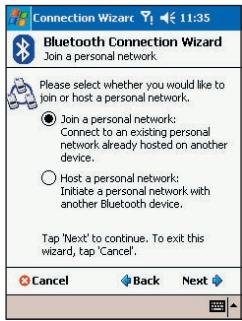
To join a Personal Area Network:

From Bluetooth Manager → select New → Connect → Join a personal network → tap Next.
On the next wizard screen select Join a personal network → tap Next.
The Bluetooth Browser appears; select the host of the personal area network, and then tap Next to establish a connection to the personal area network. If asked to enter IP network settings, select Use server-assigned IP address, and then tap OK.

The network host's authorization and authenti-cation settings, and/or its Personal Area Network service availability may prevent you from joining the network. Any application that requires a network connection can use the Personal Area Network connection.
My Shortcuts
The default tab on the Bluetooth Manager is My Shortcuts. This screen displays the icons that have been created for connections to other devices. The icons provide visual feedback about the status of the connection to which they are linked.
The double-tap is context sensitive:
If the connection is not open—double-tap its icon to establish a connection.
If the connection is open—double-tap its icon to display the connection's status.
Connections can also be opened/closed, and other options accessed, using the tap-and-hold technique. If you tap a connection icon and hold the stylus in place for a few seconds, a context sensitive menu appears.
Active Connections
This tab displays the active Outgoing and Incoming Connections on your PPC6600.
Chapter 8
Messaging Features
8.1 E-Mail Messages
8.2 Messaging
8.3 MSN Messenger
8.4 Managing Messages
and Folders
8.1 E-mail Messages: Using Inbox
You can set up a connection to an e-mail server so that you can send and receive e-mail messages by using a modem or network connection and Inbox on your device.

The ISP or network must use a POP3 or IMAP4 e-mail server and an SMTP gateway.
You can use multiple e-mail services to receive your messages. For each e-mail service you intend to use, first set up and name the e-mail service. If you use the same service to connect to different mailboxes, set up and name each mailbox connection.
Setting up an e-mail service:

Open Messaging on your device, tap Accounts → New Account. Follow the directions in the New Account Wizard.

Fill in you e-mail address then tap Next.

Next will initiate auto-configuration which attempts to connect your PPC6600 to your e-mail server and automatically download the necessary e-mail connection settings.
If auto-configuration is successful you can immediately begin sending/ receiving e-mails.
If auto-configuration is unsuccessful you will need to manually enter the settings.

Enter Your name, User name and Password, then tap Next.

From the drop down menu select the Account type that your e-mail provider supports (POP3 or IMAP4).

Enter a Name for your e-mail account then tap Next.

Enter your e-mail provider's server name information for Incoming mail and Outgoing mail, then tap Finish. When finished, to connect to your e-mail server, tap Accounts → Connect.

For an explanation of a screen, tap and then Help.
Sending and Receiving E-mail
You can use Inbox to send and receive e-mail messages in either of these ways:
Synchronize e-mail messages with Microsoft Exchange or Microsoft Outlook on your PC.
- Connect directly to an e-mail server through an Internet service provider (ISP) or a network.
You also can use Inbox to send and receive text messages; it supports 8 bits of data with class 0, 1, 2, 3, and Unstructured Supplementary Service Data (USSD) as well.
a. Synchronizing E-mail Messages
E-mail messages can be synchronized as part of the general synchronization process. You will need to enable Inbox synchronization in ActiveSync. For information on enabling Inbox synchronization, see ActiveSync Help on the PC.
During synchronization:
- Messages are copied from the mail folders of Exchange or Outlook on your PC to the ActiveSync folder in Inbox on your device. By default, you will receive messages from the past five days only, and the first 100 lines of each message.
E-mail messages in the Outbox folder on your device are transferred to Exchange or Outlook, and then sent from those programs.
E-mail messages in folders must be selected in ActiveSync on your PC in order to be transferred.
b. Connecting Directly to an Email Server
Once your e-mail account is set up and you're connected, new messages will be downloaded to the device's Inbox folder, and messages in the device Outbox folder will be sent.
- When you delete a message on your device that was downloaded from your e-mail server, it will also be deleted from the e-mail server the next time you connect.
- You can work online or offline. When working online, you read and respond to messages while connected. Messages are sent as soon as you tap Send, which saves space on your device.
- When working offline, once you have downloaded new message headers or partial messages, you can disconnect from the e-mail server and then decide which messages to download completely. The next time you connect, Inbox downloads the complete messages you have marked for retrieval and sends the messages you have composed.
c. Using the Message List
- Messages you receive are displayed in the message list. By default, the most recently received messages are displayed first in the list.
- When you receive a message, tap to open it. Unread messages are displayed in bold.
- You can mark the messages that you want to retrieve in full during your next synchronization or e-mail server connection. In the message list, tap and hold the message you want to retrieve. On the pop-up menu, tap Mark for Download. The icons in the Inbox message list provide visual indication of message status.
- Specify your downloading preferences when you set up the service or select your synchronization options. You can change them at any time:
Change options for Inbox synchronization using ActiveSync options. For more information, see ActiveSync Help.
Change options for direct e-mail server connections in Inbox on your device. Tap Tools → Options. On the Account tab, tap the service you want to change. Tap and hold the service and select Delete to remove a service.
d. Creating an E-mail message

Tap New.
In the To field, enter either the e-mail address of one or more recipients, separating them with a semicolon, or select a name from the contact list by tapping the Address Book button. All e-mail addresses entered in the e-mail fields in Contacts appear in the Address Book.

Phone messages can be sent by entering the SMS numbers in the To field.
③ Compose your message. To enter preset or frequently used messages, tap My Text and select a message.
When you finish your message, tap Send button. If you are working offline, the message is moved to the Outbox folder and will be sent the next time you connect.

Tap Account to switch between Outlook Email and Text Messages .
8.2 Messaging
Messages can be sent in two ways:
- Go to Messaging, open a new e-mail message and select Outlook Email or Text Messages account in the Account type options.
- Or you can directly send in phone dialer in the Tools menu bar.
Sending Messages in phone dialer:

In phone dialer screen, tap Tools → Send Text Message. A new message screen appears in Inbox.
In the To field, enter the Phone number of one or more recipients, separating them with a semicolon, or select a name from the contact list by tapping the Address Book button.
3 Compose your message. To enter preset or frequently used messages, tap My Text and select a message.
4 Tap when you have finished the message. If you are working offline, the message is moved to the Outbox folder and will be sent the next time you connect.

Text Message cannot be used to send e-mail messages. You can tap the double arrows next to the subject field to show the complete header. From the Account list, select an e-mail account.

If you are sending a text message and want to know if it was received, tap Tools, Options, and select Request message delivery notification before sending the message.
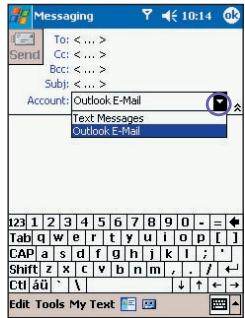
8.3 MSN Messenger: Instant Messaging
MSN Messenger on your mobile device is an instant messaging program that lets you:
See who is online.
Send and receive instant messages.
Have instant message conversations with groups of contacts.
Notify contacts of your on-line status.
- Block contacts from seeing your status or sending you messages.
To use MSN Messenger, you must have a Microsoft Passport™ account or a Microsoft Exchange e-mail account. Once you have obtained one of these accounts, you are ready to sign in to MSN Messenger.

If you have a Hotmail® or MSN account, you already have a Passport.
To set up a Microsoft Passport account, go to http://www+pessenger.com
To set up a Hotmail account, go to http://www.hotmail.com
Switching to MSN Messenger:

Tap → Program → MSN Messenger
Setting Up and Signing In

Connect to the Internet using any methods outlined in Chapter 7 Getting Connected.
Tap anywhere on the MSN Messenger screen, enter your sign-in name and password then tap Sign in.
Or tap Tools → Options → Accounts tab to set your sign-in name and password by selecting Enable MSN Messenger Service.

Your sign-in name is usually in the form: username@domain.com.

If you already use MSN Messenger on your PC, your contacts will automatically appear on your device.
Working with Contacts
The MSN Messenger window displays all of your messenger contacts at a glance, divided into Online and Not Online categories. From this view, while connected, you can chat, send e-mail, block a contact from chatting with you, or delete contacts from your list using the pop-up menu.

To see others online without being seen, open the Tools menu, tap My Status and select Appear Offline. If you block a contact, you will appear offline but will remain on the blocked contact's list. To unblock a contact, tap and hold the contact, then tap Unblock on the pop-up menu.
Chatting with Contacts
Tap a contact name to open a chat window. Enter your message in the text entry area at the bottom of the screen, or tap My Text to enter a preset message, then tap Send. To invite another contact to multi-user chat, open the Tools menu, tap Invite then tap the contact you want to invite.
To see if the contact you are chatting with is responding, look for the message under the text entry area.
For more information on using MSN Messenger, tap → Help.
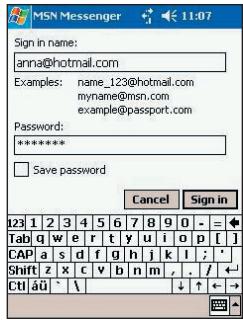
8.4 Managing Messages and Folders
By default, messages are displayed in one of five folders for each service you have created: Inbox, Deleted Items, Drafts, Outbox, and Sent Items. The Deleted Items folder contains messages that have been deleted on the device. The behavior of the Deleted and Sent Items folders depends on the options you have chosen. In the message list, tap Tools and then Options. On the Message tab, select your options.
To organize messages into additional folders, create new folders by tapping Tools, then Manage Folders. To move a message to another folder, in the message list, tap and hold the message and then tap Move to on the pop-up menu.
Folder behavior with a direct connection to an e-mail server
The behavior of the folders you create depends on whether you are using ActiveSync, SMS, POP3, or IMAP4.
If you use ActiveSync, e-mail messages in the Inbox folder in Outlook will automatically be synchronized with your device. You can select to synchronize additional folders by designating them for ActiveSync. The folders you created and the messages you moved will then be mirrored on the server. For example, if you move two messages from the Inbox folder to a folder named Family and you have designated Family for synchronization, the server creates a copy of the Family folder and copies the messages into that folder. You can then read the messages while away from your PC.
If you use Text Messages, messages are stored in the Inbox folder of Text messages category.
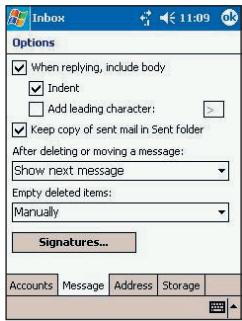
If you use POP3 and you move e-mail messages to a folder you created, the link is broken between the messages on the device and their copies on the mail server. The next time you connect, the mail server will see that the messages are missing from the device Inbox and delete them from the server. This prevents you from having duplicate copies of a message, but it also means that you will no longer have access to messages that you move to folders created from anywhere except the device.
If you use IMAP4, the folders you created and the e-mail messages you moved are mirrored on the server. Therefore, messages are available to you anytime you connect to your mail server, whether it is from your device or PC. This synchronization of folders occurs whenever you connect to your mail server; create new folders, or rename/delete folders when connected.
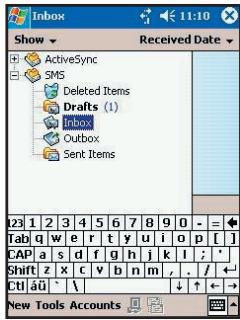
Chapter 9
Companion Programs
9.1 Pocket Word
9.2 Pocket Excel
9.3 Windows Media Player
9.4 Pictures
Companion programs consist of Microsoft Pocket Word, Microsoft Pocket Excel, Windows Media Player, and Pictures.

To switch to a companion program on your device, tap Programs on the menu, and then tap the program.
9.1 Pocket Word
Pocket Word works with Microsoft Word on your PC to give you easy access to copies of your documents. You can create new documents on your device, or you can copy documents from your PC to your device. Synchronize documents between your PC and your device so that you have the most up-to-date content in both locations.
Creating a new file:

Tap → Programs → Pocket Word → New. A blank document appears.
If you have selected a template for new documents in the Tool → Options dialog box, that template appears with appropriate text and formatting already provided.

You can open only one document at a time; when you open a second document, you will be asked to save the first. You can save a document you create or edit in a variety of formats, including Word (.doc), Pocket Word (.psw), Rich Text Format (.rtf), and Plain Text (.txt).
Pocket Word contains a list of the files stored on your device. Tap a file in the list to open it. To delete, make copies of, and send files, tap and hold a file in the list. Then, select the appropriate action on the pop-up menu.

1 Select the folder type you want displayed in the list.
Tap to change the sort order of the list.
3 Tap to open a document.
Tap and hold an item to see a pop-up menu of actions.
5 Tap to create a new documents.
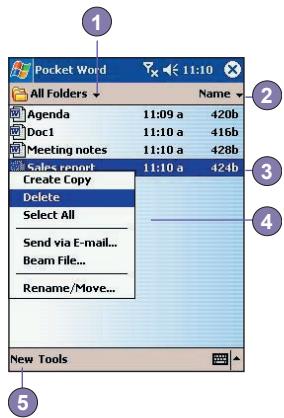

You can change the zoom magnification by tapping View and then Zoom. Select a higher percentage to enter text and a lower one to see more of your document.

If you are opening a Word document created on a PC, select Wrap to Window on the View menu so that you can see the entire document.
Entering Information in a New File
You can enter information in Pocket Word in one of four modes (typing, writing, drawing, and recording), which are displayed on the View menu. Each mode has its own toolbar, which you can show and hide by tapping the Show/Hide Toolbar button on the command bar.
a. Typing Mode
Using the input panel, enter typed text into the document. For more information on entering typed text, see Chapter 2.
To format or edit existing text, first select it by using your stylus to drag through the text. You can search a document for text by tapping Edit → Find/Replace.
Entering Information in a New File (Cont'd.)
b. Writing Mode
In writing mode, use your stylus to write directly on the screen. Ruled lines are displayed as a guide, and the zoom magnification is greater than in typing mode to allow you to write more easily. For more information on writing and selecting writing, see Chapter 2.

If you cross three ruled lines in a single stylus stroke, the writing becomes a drawing and can be edited and manipulated as described in the following section.
Written words are converted to graphics (metafiles) when a Pocket Word document is converted to a Word document on your PC.
c. Drawing Mode
In drawing mode, use your stylus to draw on the screen. Gridlines appear as a guide. When you lift your stylus off the screen after the first stroke, you'll see a drawing box indicating the boundaries of the drawing. Every subsequent stroke within or touching the drawing box becomes part of the drawing. For more information on drawing and selecting drawings, see Chapter 2.
d. Recording Mode
In recording mode, you can embed a recording into your document. Recordings are saved as .wav files. For more information on recording, see Making a Recording in Chapter 2. For more information on using Pocket Word, tap → Help.
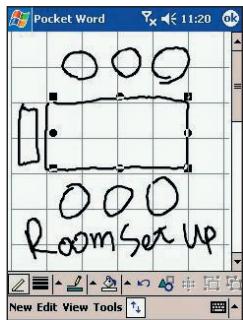
9.2 Pocket Excel
Pocket Excel works with Microsoft Excel on your PC to provide easy access to copies of your workbooks. You can create new workbooks on your device, or you can copy workbooks from your PC to your device. Synchronize workbooks between your PC and your device so that you have the most up-to-date content in both locations.
Creating a new Pocket Excel File:

Tap → Programs → Pocket Excel → New. A blank workbook appears.
If you have selected a template for new workbooks in the Options dialog box, that template appears with appropriate text and formatting already provided.
Pocket Excel provides fundamental spreadsheet tools, such as formulas, functions, sorting, and filtering. To display the toolbar, tap View → Toolbar.

You can open only one workbook at a time; when you open a second workbook, you will be asked to save the first. You can save a workbook you create or edit in a variety of formats, including Pocket Excel (.pxl) and Excel (.xls).

If your workbook contains sensitive information, you can protect it with a password. To do so, open the workbook; tap Tools → Password. Every time you open the workbook, you will need to enter the password, so choose one that is easy for you to remember but hard for others to guess.
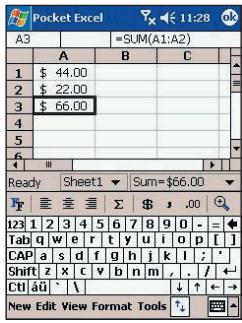
Tips for Working in Pocket Excel
Note the following when working in large worksheets in Pocket Excel:
View in full screen mode to see as much of your worksheet as possible. Tap View → Full Screen. To exit full screen mode, tap Restore.
Show and hide window elements. Tap View → tap the elements you want to show or hide.
- Freeze panes on a worksheet. First select the cell where you want to freeze panes. Tap View → Freeze Panes. You might want to freeze the top and left most panes in a worksheet to keep row and column labels visible as you scroll through a sheet.
- Split panes to view different areas of a large worksheet. Tap View → Split. Then drag the split bar to where you want it. To remove the split, tap View → Remove Split.
Show and hide rows and columns. To hide a hidden row or column, select a cell in the row or column you want to hide. Then tap Format → Row or Column → Hide. To show a hidden row or column, tap Tools → Go To, and then type a reference that appears in the hidden row or column. Then tap Format → Row or Column → Unhide.
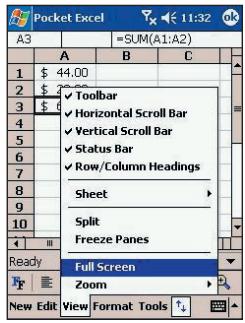
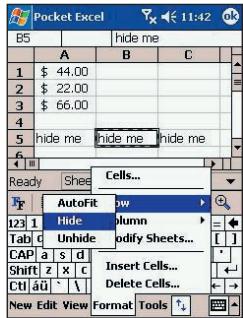
9.3 Windows Media Player for PPC6600
Use Windows Media Player to play audio and video files that are stored on your PPC6600, a network, or the Internet.
You can play files in either Windows Media or MP3 format (this includes files with the extensions .asf, .wma, .wmv, and .mp3.) To find contents in the Windows Media Format for your PPC6600, please go to http://www.windowsmedia.com.
To turn on Windows Media Player on your PPC6600 tap the Start menu > Programs > Windows Media.
About the playlist
A playlist is a list of digital media files that play in a specified order. By using playlists, you can group audio and video files together for convenient playback. For example, you can create a playlist of your favorite songs by a particular artist or a playlist of work-related video clips.
For more information about creating and editing a playlist on your PPC6600, select Help from the Start menu.
Play a file on a network:
To play streaming media, your PPC6600 must be connected to a network. See the remote connection settings in Chapter 7 for more information.
- In Player Screen, tap Menu > Open URL.
- Enter a URL in the Location to Open: field
9.4 Pictures
Pictures collects, organizes and sorts .jpg picture files on your device. You can download images to your PC, and then use ActiveSync to copy the files to your PPC6600 Phone. After that, you can view the images as a slide show.

Pictures can also be stored and transferred to your device from an MMC, SD or digital camera card. Insert a card into the memory card slot and then copy or drag the pictures from your PC to the My Documents directory on the memory card (If the memory card does not have a My Documents directory you must create one first).
Transferring Pictures
Pictures stored on your PC can be synchronized with Pictures on your device. Picture synchronization is not automatically selected in ActiveSync. To activate this function you need to tap the sync option Files in ActiveSync on your desktop.
Finding and listing pictures

Tap → Programs → Pictures.
Tap My Pictures and select a folder from the drop-down menu.
Viewing Pictures

In picture, tap to view pictures as a slide show.
2 Tap to view pictures stored in your My Picture folder.
3 Tap to view pictures stored on a storage card.
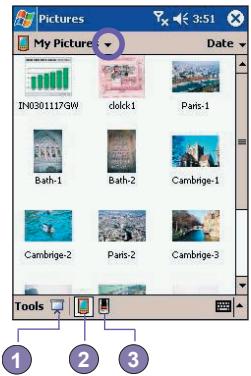

- Tap anywhere on the screen to display the Slide show toolbar, which you can use to pause the slide show, rotate the view, and more.
Press the Left / Right controls to move forward or backward through the slides.
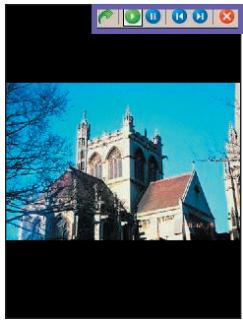
Sorting Pictures

Tap → Programs → Pictures.
Tap Name and select an option from the drop-down menu.
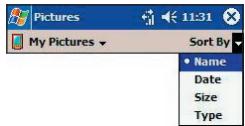
Deleting an Image

Hold the stylus firmly on the file name of the picture you want to delete, then select Delete from the pop-up menu.
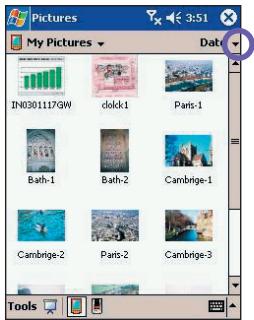
Edit Pictures
You can rotate, crop, zoom and adjust the brightness and color contrast of your .jpg pictures.

Tap to rotate a picture 90 degrees counterclockwise.
2 Tap to crop a picture by dragging and selecting the crop area. Tap outside of the box to stop cropping.
3 Tap to display the Zoom panel, from which you can zoom in or out of a picture, or return a picture to full-screen size.
Tap Edit → Brightness and Contrast to adjust the brightness and contrast levels of a picture.
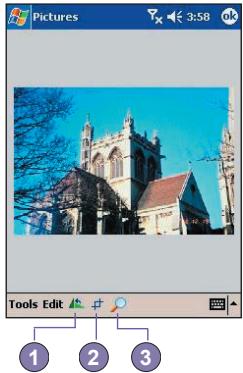

Tap Edit → Undo to undo an edit.
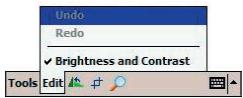
Set Pictures as Background
You can use one of your own .jpg pictures as the background on the Today screen, and specify how you want it displayed on the screen, such as adjusting the transparency level.

In Pictures, tap the picture you want to set as the background.
Tap Tools → Set as Today Wallpaper.

The default setting for the transparency level of the background picture is 65% . To change the setting, tap the option Set as Today Wallpaper.
Customizing Pictures
You can opt to launch the Pictures program automatically when a digital camera storage card is inserted and decide on a time delay length between slides when showing a slide show.
a. To select launch automatically:

1 Tap → Programs → Pictures.
2 Tap Tools → Options → General.
3 Then check the box next to Detect digital camera storage cards.
b. To select the time delay between slides:

1 Tap → Programs → Pictures.
2 Tap Tools → Options → Slide Show.
3 Select a number of seconds then tap OK.
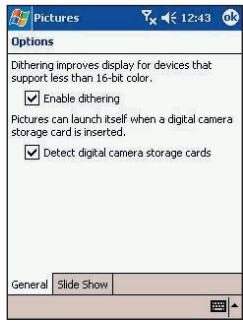
Chapter 10
Using Your Camera
10.1 Before Using the
Camera
10.2 Camera
10.3 Album
10.1 Before Using the Camera
With Camera Wizard, you can use the attached camera on the back of your device to snap new photos or shoot video clips with accompanying audio. Combined with Album, it provides many powerful features to manage, organize, and manipulate the image, video, and audio files.
When in Image Capture mode, you can capture standard still images. In Picture Frame mode, you can place your captured images into attractive frames (templates). Or, switch to Video Capture mode and capture "live" video streams (with audio if desired), then share them with others or play them on your own PPC6600, desktop PC, or whenever you want. You can even send the captured files via E-mail. Just Snap and Send a newly-captured image, or Select and Send an existing image.
Of course, you can also get image, video, and audio files from received E-mail, a Storage Card, infrared beaming, or via synchronization from a PC via ActiveSync, and organize them into albums and Slide Shows.
File formats supported
File formats that you can browse and view / play in Album include:
| File Type | Formats |
| Still-image formats | BMP GIF JPEG |
| Animation format | Animated GIF |
| Video formats | Motion-JPEG AVI (.avi) MPEG-4 Simple profile (.mp4) 3GPP-H.263 baseline (.3gp) |
| Audio formats | MPEG-4 AAC (Advanced Audio Coding in .mp4 format) AMR-Narrow Band (in .mp4 and .3gp format) WAV MIDI (standard MIDI type 0,1, and SP-MIDI) |

You can set an audio file to be used as your PPC6600 's ring tone. For more information about ring tone settings, please see Chapter 5.
You can use Camera to capture files in the following formats:
| File Type | Formats |
| Still-image formats | BMP JPEG |
| Video formats | Motion-JPEG AVI (.avi) MPEG-4 simple profile (.mp4) 3GPP-H.263 baseline (.3gp) |
| Audio formats | AMR-NB (Adaptive Multi-Rate Narrow Band) |
10.2 Camera
There are two ways to enter the Camera mode:

Tap → Programs → Camera.
Or just press the lowest button on the left side of your device.
When you initially enter Camera mode, the Image Capture submode will be active. The icon at the right side of the LCD Display area indicates the current submode. After starting one, you can easily switch to the other.
Photo Capture mode (capture still images)
Video mode (capture video clips )
Picture Frame mode (capture still images and place in frame)
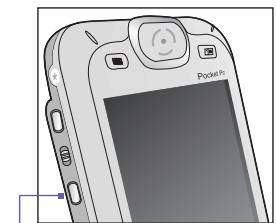
Press to enter the Camera mode
Usage of Buttons in Camera Mode
When in Camera mode, you can press the following buttons on your PPC6600 as a shortcut to performing various functions.
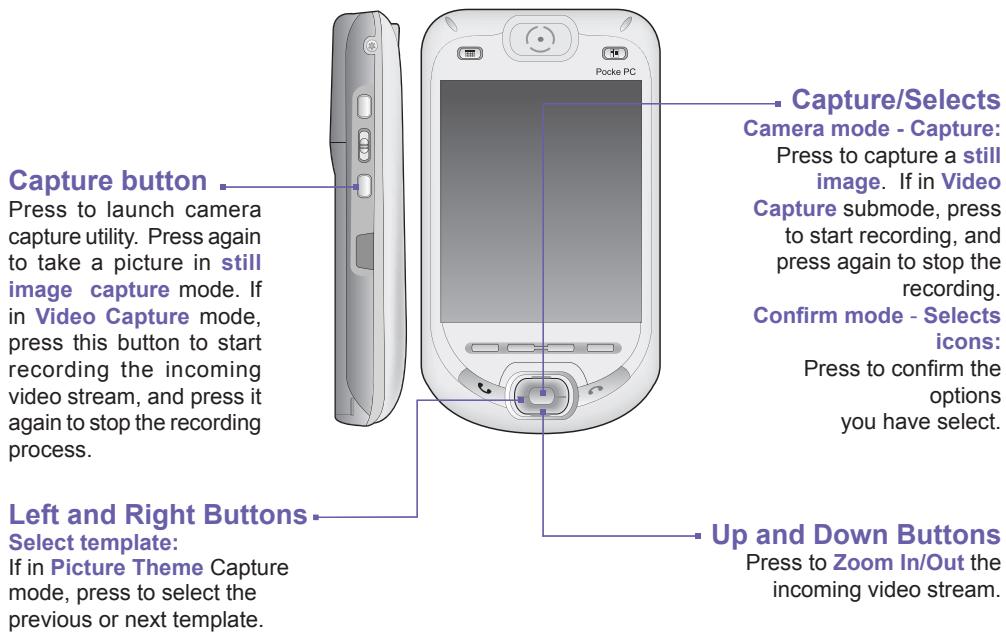
Select icons:
If in Confirm mode (after capturing an image or video), press to highlight the previous or next icon.
Photo Capture Mode
When in Photo Capture mode, you can capture a single still image by either pressing the Capture button on your PPC6600, or by pressing the Action button. This captures the current content shown on your screen, and saves it to a file immediately using your currently specified filename convention in Options. You can choose JPEG or BMP as the output format for saved image files, among other settings in Options.
Components of the LCD Display Panel in Photo Capture mode are identified below.
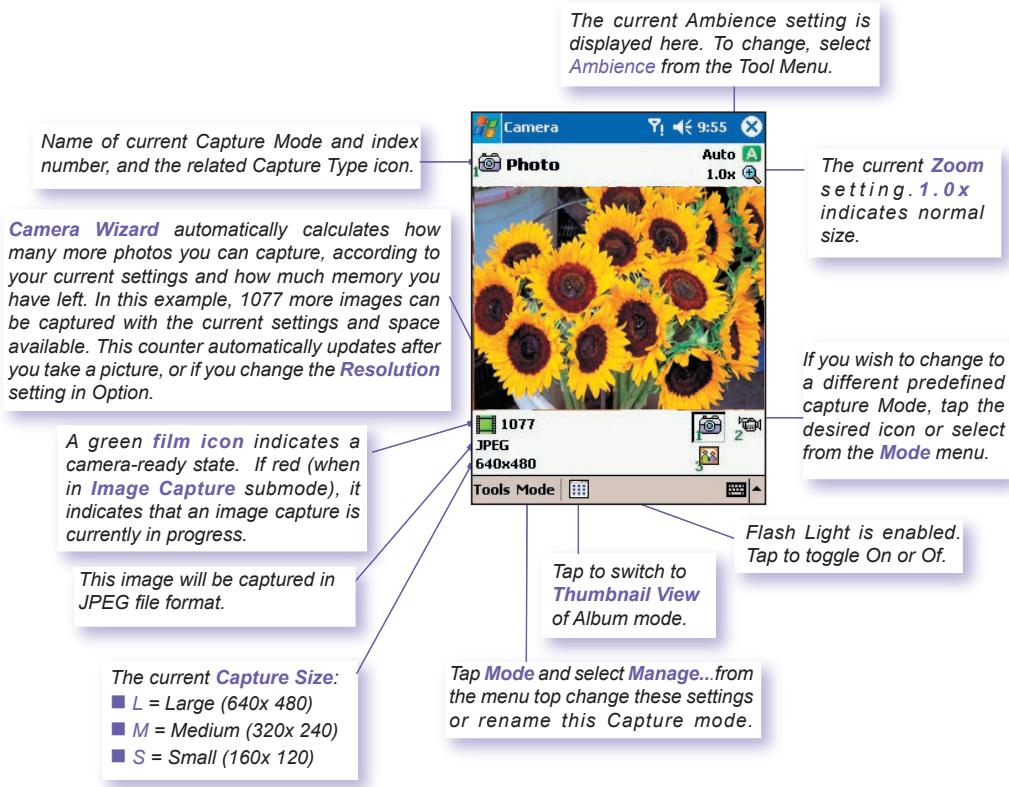
If you check Review file after capture checkbox in the Options → General screen, immediately after you take a picture, it will be displayed on the screen along with four icons.

To return to the previous screen, tap the Camera icon.
To immediately send a captured image/video, tap the mail icon then select an option from the Send File dialog box.
3 To delete the image press the rubbish bin option.
To view and edit the picture tap the Album icon (for edit options see Album.)
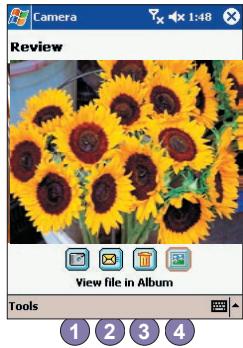
Confirm mode screen:
Zooming In/Out
When in Video Capture submode or Image Capture submode, you can press the Up navigational button on your PPC6600 to Zoom In the incoming video stream. Each time you press the "Up" button, the enlargement increases by .2 (1.0, 1.2, 1.4, etc.). When the Zoom limit has been reached for the current mode/capture size, a beep will sound.
Different maximum limits are available for Zooming, depending on the current Capture mode, and also depending on the current Capture Size. The table below summarizes the Zoom function availability.
| Submode | Capture Size Setting | Zoom Available | Remarks |
| Video Capture | Large (320 x 240) | 1.0x to 2.0x | 1x = normal size (no Zoom) 2x = double enlargement 3x = triple enlargement 4x = quadruple enlargement |
| Medium (176 x 144) | 1.0x to 3.0x | ||
| Small (128 x 96) | 1.0x to 4.0x | ||
| Image Capture | Large (640 x 480) | 1.0x (no Zoom available) | |
| Medium (320 x 240) | 1.0x to 2.0x | ||
| Small (160 x 480) | 1.0x to 4.0x | ||
| Composition Capture | N/A | Depending on the size of the currently loaded template. |
Video Capture Mode
To start video recording:

Press the Capture button on the left side of your PPC6600, or the Action button.
To stop recording, press it again. This captures the current content shown on your screen, and saves it to a file immediately using your currently specified filename convention in Option.
Video capture output format: Motion-JPEG AVI file format, or H.263, or MPEG4, depending on what you specify in the Encoder field in the Mode tab of Options. Components of the LCD Display Panel in Video Capture mode are identified below.
The Camera Wizard calculates how much time is still available for capturing more video clips, according to your current settings and how much memory you have left. In this example, 33 minutes and 41 seconds are available for new video capture. This counter automatically updates after you capture a video, or if you change the Resolution or Encoder setting in Option.

When video capture is in progress, this indicator functions as a time counter which displays the number of minutes/ seconds that have elapsed during the current recording.
A green icon indicates a camera-ready state. If red (when in Video Capture mode), it indicates that video recording is currently in progress.
The current Capture Size:
L = Large 320x 240
M = Medium 176x 144
S = Small 128x 96
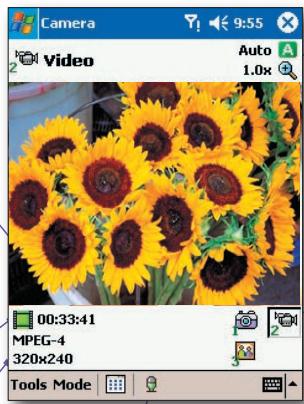
Indicates the current Ambience setting is set to Daylight and the current Zoom ratio is 1.0.
If you wish to a different predefined capture Mode, tap the desired icon or select from the Mode menu.
This is the Audio On icon. When this icon is shown, audio will be recorded along with the video. Tap this icon to toggle the Audio recording capability On or Off. When Off, video will be recoreded silently.
Picture Frame Capture Mode
The Picture Frame capture mode lets you choose a template in which you can place one or more images. You can think of a template as a type of frame in which you would insert a photograph. A few templates are already included with your Camera Wizard, in the subfolder named \My Documents\Templates. There are three ways to browse and select different templates:

Press the Right or Left navigational button on your PPC6600.
Tap the buttons to display the Previous or Next template.
3 Tap the icon in the Command Bar at the bottom of the screen to display a pop-up menu that contains the names of all templates residing in the folder that is currently specified in the Template Folder.
Components of the LCD Display Panel in Picture Frame Capture mode are identified below.
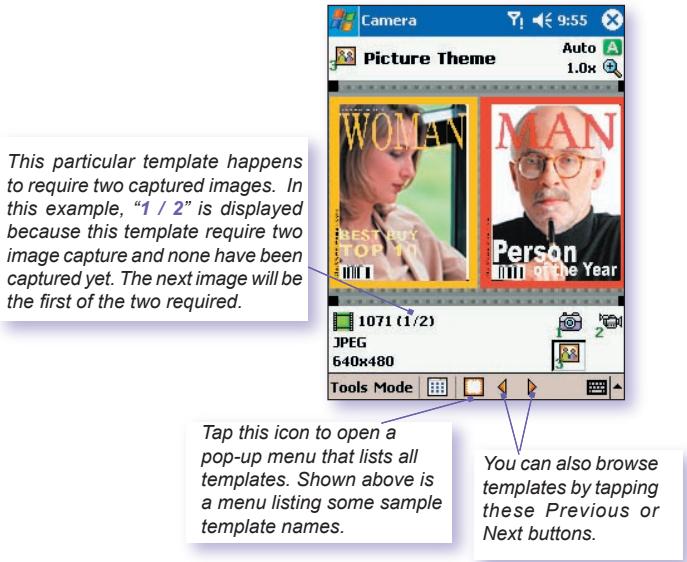
You can also browse templates by tapping these Previous or Next buttons.
Tools Menu
The Tools Menu provides many more settings that let you customize the behavior of Camera mode functions.
a) Ambience
This allows you to easily adjust the Captured screen so that the incoming video stream looks its best in various environments. By default, Auto setting is currently active, other choices available are Daylight, Fluorescent, Incandescent, and Dim.
Alternatively, you can select one of the other Effects which also changes the appearance of the incoming video stream:
Sepia (reddish tint)
Gray scale (shades of black, white, and gray, instead of color)
Cool (bluish tint)
Negative (darkness and lightness are reversed, as with a photographic negative)
b) Adjust View...
This enable you to adjust the "View properties", Contrast, Gamma, Saturation, and/or Sharpness.
If you wish to reset all values to the original default values, tap Tools and then tap Reset.
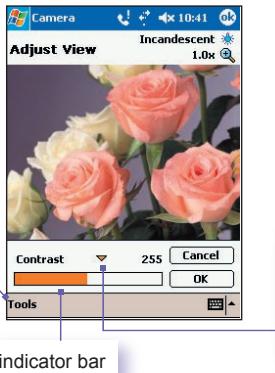
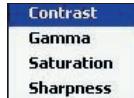
Tap the triangular icon above the indicator bar to open a menu containing the choices. Or, press the Up and Down navigational buttons on your PPC6600 to switch to other choices.
The preview window in the screen interactively shows the effects of the changes you made in the incoming video stream.
Tap OK, when you are ready to save all changes and return to the capture screen.
c) Options...
The Options screen contains four tabs: General, Image, Video, and Modes.
- General tab
The General tab is shown at the right. These options are mostly self-explanatory. However, note that Flicker Adjustment refers to the electrical voltage used in your country.
- Image tab
These options affect only your still image captures.
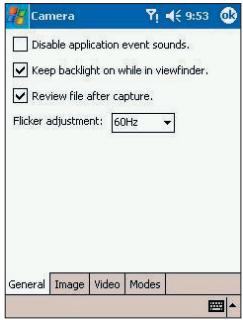
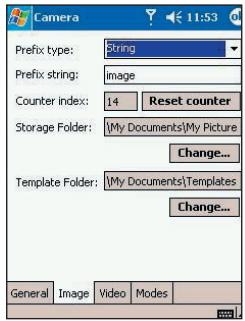
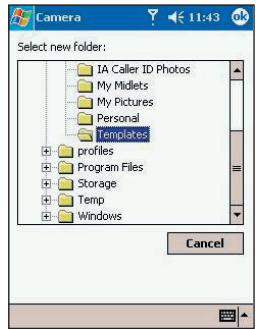
| Options | Function |
| Prefix Type and Prefix String | By default, the filename of each new captured image file will be image followed by a sequential number, for example: image_00001.jpg. If you wish to change this prefix to a different arbitrary text string, select String in the Prefix Type field and type the desired characters into the Prefix String field. For example, entering “party” in the Prefix String field would produce the filename party_00001.jpg. Alternatively, you can choose Date or Date and Time as the Prefix Type. |
| Counter Index | By default, sequential numbers are automatically incorporated into each filename for all new image files you capture, such as 00000, 00001, 00002, etc. The number follows the Prefix (explained above). To reset the numbering to “00000” for your captured image files, tap Reset counter. |
| Storage Folder | By default, your captured image files will be saved to your \My Documents\My Pictures folder. The current Save folder is displayed in the Image tab. If you wish to change the Save folder, tap the Change... button. Select the desired folder, then tap OK. |
| Template Folder | When you switch to the Picture Frame capture mode, Camera Wizard looks in the \My Documents\Templates folder for the templates to be used. If you want to specify that a different folder be searched for templates when you are using the Creative Fun capture type, tap the Change....button, select the desired folder, and tap OK. |
- Video tab
The options on the Video tab affect only your captured video files.
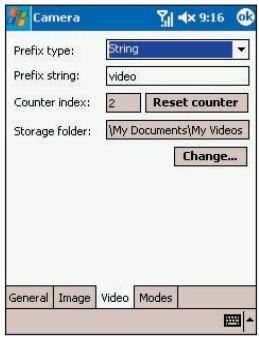
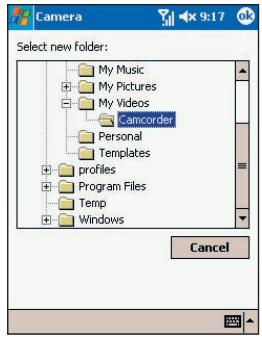
| Options | Function |
| Prefix Type and Prefix String | By default, the file name of each new captured video file will be “video” followed by a sequential number, for example: video_00001.avi. If you wish to change this prefix to a different arbitrary text string, select String in the Prefix Type field and type the desired characters into the Prefix String field. For example, entering “vacation” in the Prefix String field would produce the filename vacation_00001.jpg. Alternatively, you can choose Date or Date and Time as the Prefix Type. |
| Counter Index | By default, sequential numbers are automatically incorporated into each filename for all new video files you capture, such as 00000, 00001, 00002, etc. The number follows the Prefix (explained above). To reset the numbering to “00000” for your captured video files, tap Reset counter. |
| Storage Folder | By default, your captured video files will be saved to your \My Documents folder. The current “Save” folder is displayed in the Video tab. If you wish to change the “Save” folder, tap the Change... button. A “tree view” of your existing folders will be displayed. Select the desired folder, then tap OK. |
- Modes tab
The Settings you specify in the Modes tab play a key part in camera Wizard's behavior when you are in a capture mode. You can access the Modes tab in either of the two ways:

Select Tool → Option → Modes tab
Or, select Mode → Manage....
10.3 Album
Select the Album icon in your PPC6600 Edition's Programs group to view image and video files, and to play audio files. Three view modes are available: Thumbnail view, Detailed view, and Slide Show view.
To enter Album mode,

Tap → Program →
Or, tap the Album icon in Camera mode.
Thamburger View Mode
The first time you enter Album mode, Camera Wizard's Thumbnail View mode will be invoked. By default, your \My Documents\My Pictures folder will be searched initially.

You can manually change the position of a thumbnail simply by pressing your stylus on it and then dragging it to the desired location.
To select multiple thumbnails, press your stylus in an empty part of the screen, then drag your stylus across all thumbnails you want to include in the multi-selection.

Current folder is shown here. Tap this field if you want to search a different folder. Large
2 Tap to select a different thumbnail size.
3 Tap to change the way the thumbnails are sorted.
This speaker icon indicates that an audio annotation has been recorded and associated with this file.
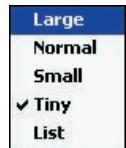
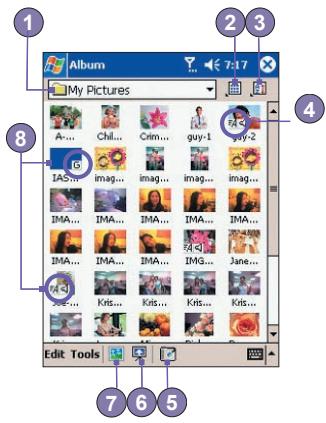
5 Tap to switch to Camera mode.
6 Tap to switch to Slide Show view.
Tap to switch to Detailed view. (Or, tap directly on a thumbnail to load that file into Detailed View.) If it is an audio or video file, it will begin playing.
A letter icon in lower left corner of thumbnail indicates various meanings:
- indicates that text annotation has been associated with this file.
G - indicates an animated GIF file.
V - indicates that it is a video file.
indicates that audio annotation has been associated with this file.

To open a convenient pop-up menu that contains frequently used commands, tap and hold your stylus on the thumbnail you want to operate on.
To see a still image full-screen, or to play a video or audio file, tap the desired thumbnail.
Making an annotation on your file:
This command lets you add (or remove) text or audio annotation for a file. The associated text and/or audio recording can then be set to display/play during a Slide Show.

In the Thumbnail View mode screen, Select the desired file → then select the Annotate... command from Edit menu.

After text annotation has been added, an icon will be shown in the thumbnail. A separate text file will be created for that text.
After audio annotation has been added, an icon will be shown in the thumbnail. A separate audio file, in the WAV file format, will be created.
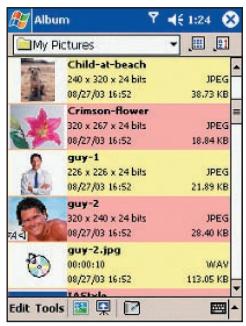
List View:
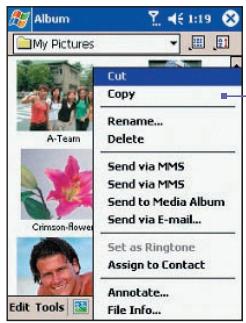
The pop-up menu appears when you tap and hold on a thumbnail.
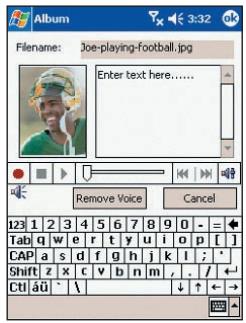
2 If you wish to associate text with the file, enter it in the text box.
3 To create an audio recording (either voice or music) as an annotation using your built-in PPC6600 microphone, tap to begin recording, tap to stop recording.

If an audio recording already exists and you then tap the Record button, there is no warning confirmation. Your previous recording will be instantly lost and overwritten by the new recording. If you have tapped Remove Voice by accident, simply tap Cancel (this cancels the removal operation so that the audio is retrieved).
Sending E-mail in Album

1 First select the desired file, tap Tools, and then select Send via Email from the menu.
2 Follow the relevant procedures for sending that type of message.
Setting audio files as Ring Tones:
Simply select the desired file, then select Set as Ring Tone from the Tools Menu (or the menu that pops up when you tap and hold on a thumbnail). The previous ring tone will be immediately replaced. A message will display the filename and confirm that the operation was successful.
Options in Album Settings

To change the settings from Album, tap Tools → Options to view the General Association and Slide Show options.
- General tab
| Function | Explanation |
| Default zoom | The setting in the Default Zoom field controls the size of the selected file when it is initially displayed in Detailed View. If set to Smart, the Camera Wizard will automatically calculate the best size in which to display the file on the screen. However, if you want files to always be initially displayed in their original size, select Original Size from the drop-down list box. If you want Camera Wizard to automatically display selected files so that they fit within the screen, select Fit In Window. |
| Function | Explanation |
| Full Screen | If None is selected, no automatic rotation will take place when a file is displayed in Detailed View (but you can still rotate the display manually using the Rotate Clockwise and Rotate Counterclockwise icons on the Toolbar in Detailed View). Select Left to automatically rotate images 90 degrees to the left in Detailed View, or Right if you want rotation to occur 90 degrees to the right. |
| Animation speed | The setting in the Animation Speed field controls the speed at which animated GIF files will be played. By default, this is set to Normal. You can select Faster, Slower, or No Delay from the drop-down list. |
| Keep backlight on while playing video | If you have set your Backlight to dim after a certain number of seconds, you can override it by checking this checkbox. This ensures that the Backlight will not dim during your video playbacks. |
| Adjust Gamma | The Adjust Gamma setting controls image brightness/darkness. The minimum setting of 0.01 will cause images to display very dark. The maximum setting of 3.00 will cause them to display very light ("wash out"). If you change this setting, you can conveniently reset it to 1.00 by tapping the Reset button. This feature assists you in viewing an image more easily under different lighting conditions. |
| Keep system powered on during video and audio playback | Overrides your system Power settings to ensure that the system will not automatically power off your device whenever a video playback or audio playback is in progress. |
Association tab
You can associate any or all of the supported file types (listed in the figure below) with the Album program. When selecting a file of the associated type in the File Explorer, it will automatically be opened using the album application. (If Album is not already running when you select the associated file type, Album will launch.)
Slide Show tab
These settings control only the behavior of Slide Show view mode. These options are mostly self-explanatory, just choose the item you need and follow the relevant procedures for the way you want the Slide Show to work.
Detailed View Mode
Detailed View mode displays the selected file in an enlarged view, and you can further manipulate the view in various ways (zoom, rotate, pan, etc.).

1 Toolbar
Command Bar
3 Hide or display the Toolbar.
Switch to Thumbnail view.
Switch to Slide Show view.
Switch to Camera mode.
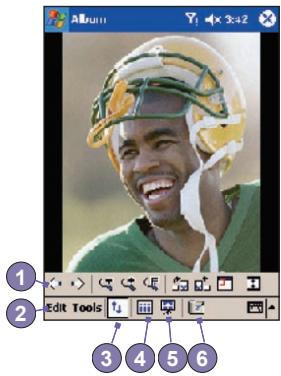
Icons on the Toolbar
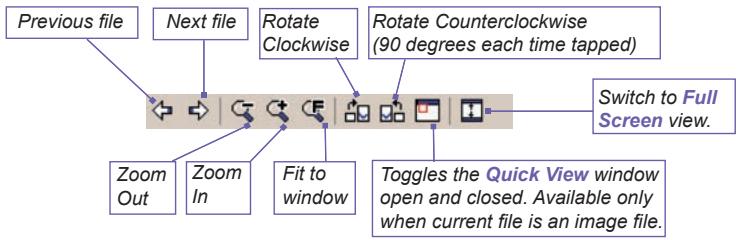
Images too big for screen

Whenever the image is too large to be shown in the display area in its entirety, you can simply press your stylus anywhere in the display area and drag, to interactively quick-pan the image to any desired position.
Alternatively, you can open the Quick View window as shown on the right, by tapping the Quick View icon on the Toolbar. The dotted outline within the Quick View window shows the currently displayed portion, in relation to the entire image. Drag the outline within the Quick View window to the desired position, or tap within the Quick View window to jump the outline to a different position. When satisfied with the position, tap the Quick View icon again to close the Quick View window.
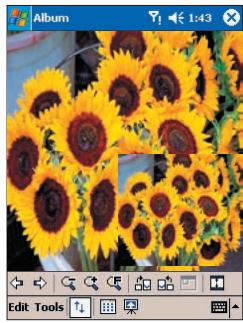
To set as Today Wallpaper:
This command allows you to change the background image of the Today screen on your PPC6600 to any image you want.

In Album, tap the video file or image you want to use as the image for the wallpaper.
If desired, you can manipulate it in any way you wish: Zoom In or Out, Rotate, Pan, etc. The exact state of the image as displayed on your screen will be used as the Today screen image.
Likewise, if you have chosen a video file and do not wish to use the first frame of the video as the wallpaper, you can start playing the video and then open the Tools Menu at the frame you want to use. (The video is paused when the menu is open.)

In the Tools menu, select Set as Today Wallpaper. The message "The Today screen background image has been successfully changed" will display.
To Reset the Today Screen back to the Default Wallpaper:
If you later decide that you want to re-set the Today screen back to the original default background:

Tap → Settings → Today icon in the Personal tab. Select Windows Default in the list, then make sure the Use this picture as the background checkbox is checked, then tap OK.
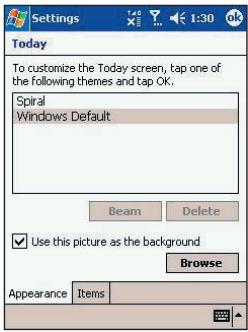
Slide Show View
When in Thumbnail View or Detailed View, you can tap the icon in the Command Bar to enter Slide Show mode.
In Slide Show mode, all image, video, and audio files will automatically be displayed/ played, one after another. If video and audio files are encountered during a Slide Show, they will be played once, and then the next file in the Slide Show will be displayed/played. However, you can play it over again manually if desired.
Tapping anywhere on the screen will momentarily display the Toolbar.
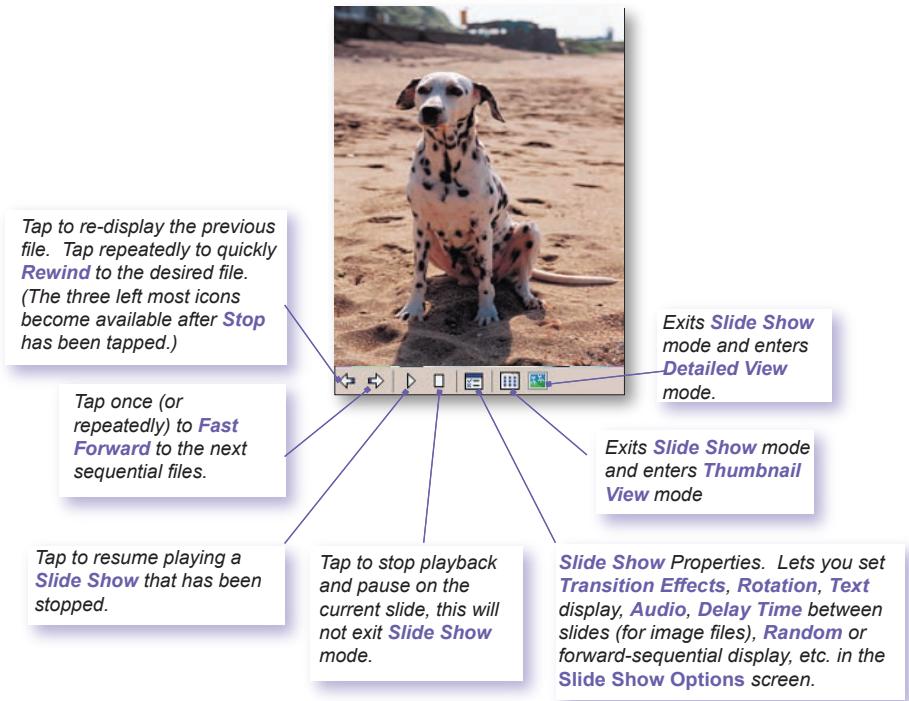
Full Screen View Mode
You can enter Full Screen View only from Detailed View. When in Detailed View mode, simply tap the Full Screen icon on the Toolbar to switch to Full Screen.
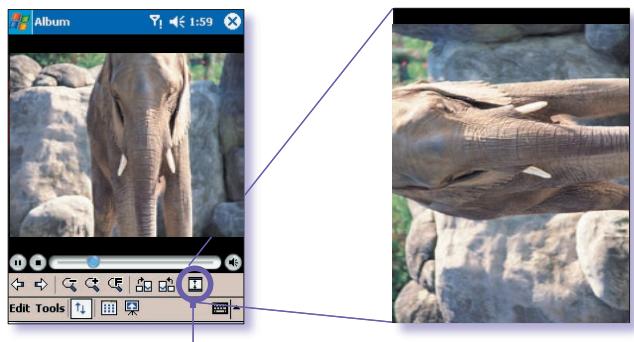
Tap to switch to Full Screen View mode.
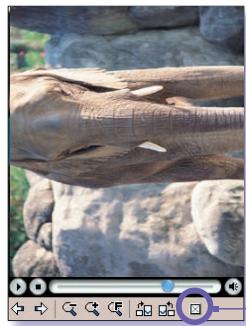

As with Detailed View, if the image or video is currently displayed in a size that is too large to fit in its entirety on the screen, you can "pan" the desired portion into view by pressing and dragging your stylus on the screen.
When you are ready to exit Full Screen View, tap anywhere on the screen to display the Toolbar. Tap the left most icon to exit. (If no action is taken, the Toolbar will automatically disappear again after a few seconds.)
Appendix
Maintaining Your PPC6600
- Adding or Removing Program
Managing Memory
Backing-Up Files
- Resetting your PPC6600
and Clearing Memory
Product Regulatory Information
Adding or Removing Programs
Programs added to your device at the factory by default are stored in ROM (read only memory). You cannot remove them, and you will never accidentally lose them. You can install any other programs created for your device, as long as your device has enough memory. The most popular place to find software for your device is on the PPC6600 Web site http://www.microsoft.com/mobile/pocketpc.
To add programs using ActiveSync:
You will need to install the appropriate software for your device on your PC before installing it on your device.

Download the program to your PC (or insert the CD or disk that contains the program into your PC). Be sure to select the program designed for the PPC6600 and your device process or type.
2 Read any installation instructions, or documentation that comes with the program. Many programs provide special installation instructions.
3 Connect your device and PC.
Double click the .exe file.

If the file is an installer, the installation wizard will begin. Follow the directions on the screen. Once the software has been installed on your PC, the installer will automatically transfer the software to your device.
If the file is not an installer, you will see an error message stating that the program is valid but it is designed for a different type of PC. You will need to move this file to your device. If you cannot find any installation instructions for the program in the Read Me file or documentation, use ActiveSync Explore to copy the program file to the Program Files folder on your device.
Once installation is complete, tap → Programs → and then its program icon.
To add a program directly from the Internet:

Determine your device and processor type so that you know which version of the software to install.
2 Download the program to your device directly from the Internet using Pocket Internet Explorer. You may see a single .zip, .exe or .zip file, a setup.exe file, or several versions of files for different device types and processors. Be sure to select the program designed for the PPC6600 and your device processor type.
3 Read any installation instructions, Read Me files, or documentation that comes with the program. Many programs provide special installation instructions.
Tap the file, such as a .xip or *.exe file. The installation wizard will begin. Follow the directions on the screen.
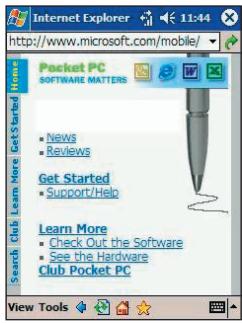
To remove a program:

Tap → Settings → System → Remove Programs.

You can only remove programs that you installed in storage memory. Programs that came with your device cannot be removed.
You can quickly return your device to the factory default configuration by clearing all memory. All data will be lost. For instructions, see the details later in this chapter.
Managing Memory
Memory on your PPC6600 is shared between storage memory and program memory. Storage memory is used to store the information you created and programs you installed. Program memory is used to run programs on your PPC6600. PPC6600 automatically manages the allocation between storage and program memory.
To view memory allocation and availability:

Tap → Settings → System tab → Memory icon.
Finding Space in Storage memory
In some situations, such as when memory is low, your PPC6600 may not be able to automatically adjust the allocation. If you receive a message stating that storage or program memory is unavailable, try the following solution :
a. Move data to a SD storage card

1 Tap Programs → File Explorer.
2 Tap and hold the file you want to move, and tap Cut. Open the My Documents folder in the storage card folder, tap Edit, and then tap Paste.
Files stored in folders other than My Documents or stored in folders within subFolders in My Documents may not show up in the list view of some programs. When using Notes, Pocket Word, or Pocket Excel, you can also move files by opening the item and tapping Tools or Edit and then Rename/Move.
b. Move e-mail attachments

On Inbox → tap Tools → Options.
On the Storage tab, select Store attachments on storage card then tap OK. All existing attachments are moved to the storage card, and new attachments are automatically stored on the storage card.
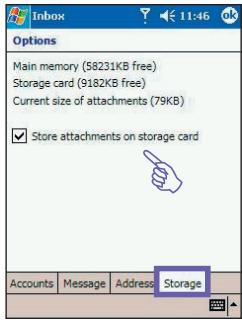
c. Save new items on the storage card
Set programs such as Notes, Pocket Word, and Pocket Excel to automatically save new items on the storage card.

In the program → tap Tools → and then Options.
In the Save to field, select Storage Card.
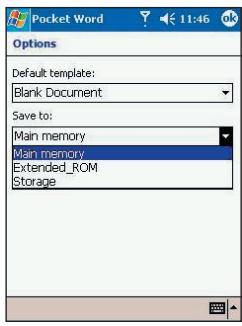
d. Delete unnecessary files

Tap → Programs → File Explorer.
Tap and hold the file, and then tap Delete on the pop-up menu.

To find your largest files, tap and then Find. In the Type list, tap Larger than 64 KB, and then tap Go.
e. Delete all files and clear history in Internet Explore

In Internet Explorer, tap Tools and then Options. In the Memory tab, tap Delete Files and/or Clear History.
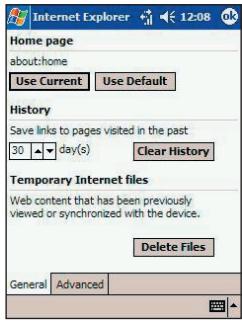
Backing Up Files
Because any new programs or data are stored in RAM, and therefore will be lost if your device loses power for any reason, it is critical that you backup files to your computer or a memory card. When you are at your desktop you can synchronize with your computer to backup files. However, if you are going outside and unable to access your desktop, you will need to backup files to an SD or MMC card. Your device enables you to backup individual files in Word or Excel or all files in XBackup. Further more, you can also backup and then restore Contacts, Calendar, Internet and E-mail Settings.
SD and MMC Cards
Your device has an expansion slot compatible with a range of SD and MMC Memory cards, which are primarily used to backup or transfer files and data.
To insert or remove a memory card:

Push the memory card into slot until it clicks into place. The card is secure when it is not protruding from the top.
To remove the card push it in and then release, letting the card spring out.
When you receive your device there will be a piece of plastic in the slot; remove as described in ② above.
To save Word or Excel files to a memory card:

Push the memory card into the slot until it clicks into place. The card is secure when it is not protruding from the top.
In application programs (e.g. Pocket Word or Excel), tap Tools → Options.
3 Tap the drop down menu box under Save To and select Storage Card.
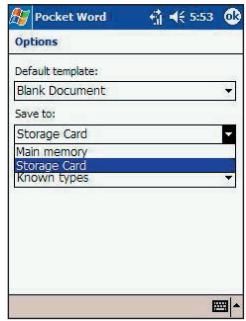
Backup or restore your system using xBackup:

Tap → Programs → xBackup → then the Backup or Restore tab.
If you have inserted the SD card properly, it will appear next to Target. Tap Open and then select Storage Card under the task bar.
3 Make sure there are no application programs running, then tap Start.
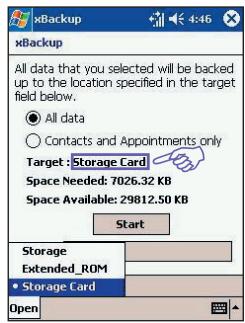
Backup or restore your system via ActiveSync

Double click the icon of ActiveSync in the task bar of your PC.
Select Backup/Restore option in the drop-down menu of Tool in ActiveSync.
3 Select the Backup tab to backup your system; Select the Restore tab to restore your system.
Reset the PPC6600 and Clear Memory
You can perform a soft reset or a full reset. During a soft reset, the device is restarted and only some data in open programs may be lost. However, a full reset turns the battery off and returns the device to its original factory settings and deletes all programs, files, contacts and other information you have saved to the device. Therefore it is extremely important to backup data to a storage card or your computer on a regular basis in the event that a full reset has to be performed.
To perform a soft reset:
If your PPC6600 responds slowly stops responding or freezes, try a soft reset. A soft reset causes the PPC6600 to restart and re-adjust memory allocation. Unsaved data in open windows may be lost.

Use the stylus to press and hold the Reset button.
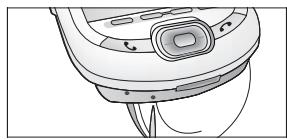
To perform a full reset:
A full device reset clears memory, deletes all data and restores the PPC6600 to its default settings. Programs installed at the factory remain, while data you have created and programs you have installed are all erased.

Press and hold the power button, and then use stylus to press the soft reset button at the same time.

Be sure you have backup all your data in a SD card or in your PC before performing a full reset.
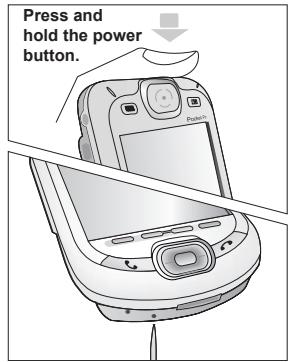
Regulatory Agency Identification Numbers
For regulatory identification purposes your product is assigned a model number PH20AX. The following accessories have been approved for use with your device. Their assigned model numbers listed below can identify these approved accessories. To ensure continued reliable and safe operation of your PPC6600, use only the accessories listed below with your PH20A2.
| Accessories | Model Number |
| Cradle | PH25 |
| Battery Pack | BTR6600 |

The above X may be any alphanumeric character or blank denoting external cosmetic changes.
This product is intended for use with certified Class 2 Limited Power Source, rated 5 VDC, minimum 2A power supply unit.
FCC Compliance Statement
FCC part 15, part 22 and part 24
This device complies with Part 15 of the FCC Rules. Operation is subject to the following two conditions : (!) this device may not cause harmful interference, and (2) this device must accept any interference received, including interference that may cause undesired operation.
FCC ID:NM8 HARRIER
Statement according to FCC part 15.105
NOTE : This equipment has been tested and found to comply with the limits for a Class B digital device, pursuant to Part 15 of the FCC Rules. These limits are designed to provide reasonable protection against harmful interference in a residential installation. This equipment generates, uses and can radiate radio frequency energy and, if not installed and used in accordance with the instructions, may cause harmful interference to radio communications. However, there is no guarantee that interference will not occur in a particular installation. If this equipment does cause harmful interference to radio or television reception, which can be determined by turning the equipment off and on, the user is encouraged to try to correct the interference by one or more of the following measures :
Reorient or relocate the receiving antenna.
Increase the separation between the equipment and receiver.
Consult the dealer or an experienced radio/TV technician for help.
- Connect the equipment into an outlet on a circuit different from that to which the receiver is connected.
Important Health and Safety Information
Retain and follow all product safety and operating instructions. Observe all warn and in the operating instructions on the product
To reduce the risk of bodily injury, electric shock, fire, and damage to the equipment observe the following precautions.
a) General Precautions
Heed service markings
Except as explained elsewhere in the Operating or Service documentation, do not service any product yourself. Service needed on components inside these compartments should be done by an authorized service technicians or provider.
Damage requiring service
Unplug the product from the electrical outlet and refer servicing to an authorized service technicians or provider under the following conditions:
Liquid has been spilled or an object has fallen into the product.
The product has been exposed to rain or water.
The product has been dropped or damaged.
There are noticeable signs of overheat-ing.
The product does not operate normally when you follow the operating instructions.
Avoid hot areas
The product should be placed away from heat sources such as radiators, heat registers, stoves, or other products (including amplifiers) that produce heat.
Avoid wet areas
Never use the product in a wet location.
Avoid pushing objects into product
Never push objects of any kind into cabinet slots or other openings in the product. Slots and openings are provided for ventilation. These openings must not be blocked or covered.
Mounting Accessories
Do not use the product on an unstable table, cart, stand, tripod, or bracket. Any mounting of the product should follow the manufacturer's instructions, and should use a mounting accessory recommended by the manufacturer.
Avoid unstable mounting
Do not place the product with an unstable base.
Use product with approved equipment
This product should be used only with personal computers and options identified as suitable for use with your equipment.
Adjust the volume
Turn down the volume before using headphones or other audio devices.
Cleaning
Unplug the product from the wall outlet before cleaning. Do not use liquid cleaners or aerosol cleaners. Use a damp cloth for cleaning, but NEVER use water to clean the LCD screen.
b) Safety Precautions for Power Supply Unit
Use the correct external power source
A product should be operated only from the type of power source indicated on the electrical ratings label. If you are not sure of the type of power source required, consult your authorized service provider or local power company. For a product that operates from battery power or other sources, refer to the operating instructions that are included with the product
Handle battery packs carefully
This product contains a Li-ion Polymer battery. There is a risk of fire and burns if the battery pack is handled improperly. Do not attempt to open or service the battery pack.
Do not disassemble, crush, puncture, short external contacts or circuits, dispose of in fire or water, or expose a battery pack to temperatures higher than 60ircC ( 140ircF ).

Warning: DANGER OF EXPLOSION IF BATTERY IS INCORRECTLY RE-PLACED. TO REDUCE RISK OF FIRE OR BURNS, DO NOT DISASSEMBLE, CRUSH, PUNCTURE, SHORT EXTERNAL CONTACTS, HEAT ABOVE 60ircC (140ircF) , OR DISPOSE OF IN FIRE OR WATER. REPLACE ONLY WITH SPECIFIED BATTERIES. RECYCLE OR DISPOSE OF USED BATTERIES ACCORDING TO THE LOCAL RE-GULATIONS OR REFERENCE GUIDE SUPPLIED WITH YOUR PRODUCT.
c) SAR Information
Your wireless phone is a radio transmitter and receiver. It is designed and manufactured not to exceed the emission limits for exposure to radiofrequency (RF) energy set by the Federal Communications Commission of the U.S. Government. These limits are part of comprehensive guidelines and establish permitted levels of RF energy for the general population. The guidelines are based on standards that were developed by independent scientific organizations through periodic and thorough evaluation of scientific studies. The standards include a substantial safety margin designed to assure the safety of all persons, regardless of age and health.
The exposure standard for wireless mobile phones employs a unit of measurement known as the Specific Absorption Rate, or SAR. The SAR limit set by the FCC is 1.6W / kg . Tests for SAR are conducted using standard operating positions specified by the FCC with the phone transmitting at its highest certified power level in all tested frequency bands. Although the SAR is determined at the highest certified power level, the actual SAR level of the phone while operating can be well below the maximum value. This is because the phone is designed to operate at multiple power levels so as to use only the power required to reach the network. In general, the closer you are to a wireless base station antenna, the lower the power output.
Before a phone model is available for sale to the public, it must be tested and certified to the FCC that it does not exceed the limit established by the government-adopted requirement for safe exposure. The tests are performed in positions and locations (e.g., at the ear and worn on the body) as required by the FCC for each model. The highest SAR value for this model phone when tested for use at the ear is 0.122W / Kg and when worn on the body, as described in this user guide, is 1.47W / Kg . (Body-worn measurements differ among phone models, depending upon available accessories and FCC requirements). [Labeling Committee note: if applicable, if body-worn SARs are required]. While there may be differences between the SAR levels of various phones and at various positions, they all meet the government requirement for safe exposure.
The FCC has granted an Equipment Authorization for this model phone with all reported SAR levels evaluated as in compliance with the FCC RF emission guidelines. SAR information on this model phone is on file with the FCC and can be found under the Display Grant section of http://www.fcc.gov/oet/fccid after searching on FCC ID NM8HARRIER.
Additional information on Specific Absorption Rates (SAR) can be found on the CTIA – The Wireless Association TM (CTIA) web-site at http://www.ctia.org/wireless Consumers/health_and_safety/
- In the United States and Canada, the SAR limit for mobile phones used by the public is 1.6 watts/kg (W/kg) averaged over one gram of tissue. The standard incorporates a substantial margin of safety to give additional protection for the public and to account for any variations in measurements.
TIA Safety information
Exposure to Radio Frequency Signals
Your wireless handheld portable telephone is a low power radio transmitter and receiver. When it is ON, it receives and also sends out radio frequency (RF) signals.
In August, 1996, the Federal Communications Commissions (FCC) adopted RF exposure guidelines with safety levels for hand-held wireless phones. Those guidelines are consistent with the safety standards previously set by both U.S. and international standards bodies:
ANSI C95.1 (1992)*
NCRP Report 86 (1986)
ICNIRP (1996)
*American National Standards Institute; National Council on Radiation Protection and Measurements; International Commission on Non-Ionizing Radiation Protection
Those standards were based on comprehensive and periodic evaluations of the relevant scientific literature. For example, over 120 scientists, engineers, and physicians from universities, government health agencies, and industry reviewed the available body of research to develop the ANSI Standard (C95.1).
The design of your phone complies with the FCC guidelines (and those standards).
Antenna Care
Use only the supplied or an approved replacement antenna. Unauthorized antennas, modifications, or attachments could damage the phone and may violate FCC regulations.
Phone Position
Normal Position: Hold the phone as you would any other telephone with the antenna pointed up and over your shoulder.
Tips on Efficient Operation
For your phone to operate most efficiently:
Extend your antenna fully.
- Do not touch the antenna unnecessarily when the phone is in use. Contact with the antenna affects call quality and may cause the phone to operate at a higher power level than otherwise needed.
Driving
Check the laws and regulations on the use of wireless telephones in the areas where you drive. Always obey them. Also, if using your phone while driving, please:
Give full attention to driving - driving safely is your first responsibility
Use hands-free operation, if available
Pull off the road and park before making or answering a call if driving conditions so require.
Electronic Devices
Most modern electronic equipment is shielded from RF signals. However, certain electronic equipment may not be shielded against the RF signals from your wireless phone.
Pacemakers
The Health Industry Manufacturers Association recommends that a minimum separation of six (6") inches be maintained between a handheld wireless phone and a pacemaker to avoid potential interference with the pacemaker. These recommendations are consistent with the independent research by and recommendations of Wireless Technology Research.
Persons with pacemakers:
Should ALWAYS keep the phone more than six inches from their pacemaker when the phone is turned ON
Should not carry the phone in a breast pocket
Should use the ear opposite the pacemaker to minimize the potential for interference
If you have any reason to suspect that interference is taking place, turn your phone OFF immediately
Hearing Aids
Some digital wireless phones may interfere with some hearing aids. In the event of such interference, you may want to consult your service provider [or call the customer service line to discuss alternatives.] Optional for each phone manufacturer.
Other Medical Devices
If you use any other personal medical device, consult the manufacturer of your device to determine if they are adequately shielded from external RF energy. Your physician may be able to assist you in obtaining this information.
Turn your phone OFF in health care facilities when any regulations posted in these areas instruct you to do so. Hospitals or health care facilities may be using equipment that could be sensitive to external RF energy.
Vehicles
RF signals may affect improperly installed or inadequately shielded electronic systems in motor vehicles. Check with the manufacturer or its representative regarding your vehicle. You should also consult the manufacturer of any equipment that has been added to your vehicle.
Posted Facilities
Turn your phone OFF in any facility where posted notices so require.
Aircraft
FCC regulations prohibit using your phone while in the air. Switch OFF your phone before boarding an aircraft.
Blasting Areas
To avoid interfering with blasting operations, turn your phone OFF when in a "blasting area" or in areas posted: "Turn off two-way radio". Obey all signs and instructions.
Potentially Explosive Atmospheres
Turn your phone OFF when in any area with a potentially explosive atmosphere and obey all signs and instructions. Sparks in such areas could cause an explosion or fire resulting in bodily injury or even death.
Areas with a potentially explosive atmosphere are often, but not always marked clearly. Potential areas may include: fueling areas (such as gasoline stations); below deck on boats; fuel or chemical transfer or storage facilities; vehicles using liquefied petroleum gas (such as propane or butane); areas where the air contains chemicals or particles (such as grain, dust, or metal powders); and any other area where you would normally be advised to turn off your vehicle engine.
For Vehicles Equipped with an Air Bag
An air bag inflates with great force. DO NOT place objects, including either installed or portable wireless equipment, in the area over the air bag or in the air bag deployment area. If in-vehicle wireless equipment is improperly installed and the air bag inflates, serious injury could result.
Specifications
| System Information | |
| Processor | Intel PXA 263 CPU at 400MHz / Qualcomm MSM5500 |
| Memory | - ROM : 64MB |
| - RAM : 128MB | |
| Operating System | Windows Mobile™ software |
| Display | |
| Type | TFT-LCD 16bit, touch-sensitive, 3.5 inches |
| Resolution | 240 x 320 at 64K colors |
| CDMA Module (Dual Band) | |
| PCS | 1900MHZ |
| Celluar | 800MHZ |
| 1xRTT/1xEV-DO* | |
| (*1xEV-DO is a network dependent feature and your device may not be configured to support this functionality. Please contact your carrier for more information.) | |
| Camera Module | |
| Type | Color CMOS camera module |
| Resolution | VGA 480 x 640 |
| Video Light | Yes |
| Physical | |
| Dimensions (typical) | 69.8mm (w) x 125mm (h) x 18.7mm (l) |
| Weight (typical) | 210g |
| Expansion Slots | |
| SDIO/MMC supports | Yes |
| Controls and Lights | |
| Navigation | 5-way navigation pad |
| Buttons | -6 program buttons: Calendar, Contacts, Start, Inbox, menu, Done/OK |
| -2 phone function: Send (Yes) & End (No) | |
| -Volume control button (up, down) | |
| -Power on / off | |
| -Reset switch | |
| Keyboard | -Built-in 39 keys extractable QWERTY keyboard |
| LED Lights | -Event notification |
| -Charge status | |
| -CDMA signals | |
| Connection | |
| Infrared | SIR |
| I/O port | 22 pin individual port for signals (for USB slave, Serial, and power) |
| Audio | Stereo headphone jack (2.50) |
| Bluetooth | 1.1 compliant |
| Audio | |
| Audio controller | AGC |
| Microphone/Speaker | Built-in |
| Headphone | WAV/WMA/MP3 stereo |
| Power Supply | |
| Battery | -Main:1490mAh Removable,rechargeable Li-ion Polymer battery, data retention time:72 hrs |
| -Backup:20mAh rechargeable, | |
| Data retention time:20 mins. (in full charge) | |
| Battery life:150hrs of PDA only (without RF) [TBD] | |
| -Talktime:3~4hrs (at normal RF Tx power level) | |
| -Standby:168hrs | |
| AC adapter | -AC input / Frequency :100 ~ 240 VAC / 50 ~ 60Hz |
Troubleshooting
If you encounter any problems with your PPC6600, consult the following Trouble Guide. If you are still having problems after reviewing these, contact Technical Support or your dealer.
Operating Problems
Problem
Solution
My PPC6600 keeps turning itself off.
Your PPC6600 is designed by default to turn itself off if not used for 3 minutes. This period can be set up to 5 minutes. Check the auto-off function on the Advanced tab on Power setting in Chapter 5.
My PPC6600 is not making any sound.
1 Tap at the right corner of title bar to check the volume status.
2 Check the settings of Sound and Notifications on the Personal tab by tapping → Settings.
My PPC6600 does not vibrate when the phone rings or alarms occur.
1 Tap in the right corner of title bar to check if the vibrate function is activated.
2 Check the setting of Sound and Notifications on the Personal tab by tapping → Settings.
3 Check the event note in your Calendar to see if the Reminder has been activated.
Screen freezes or no response
Reset your device. See Reset your PPC6600 and clear memory section in Appendix.
Screen is blank.
If your PPC6600 does not respond when you briefly press the Power button, press and hold the button for a full second. If that does not work :
Plug the AC power into the device to charge it.
2 Reset the device. See Reset your PPC6600 and clear memory section in Appendix.
Problem
Screen is dark.
A warning message about Running out of memory pops up on the screen.
The warning message about Battery low pops up on the screen.
Screen is hard to read, or the text on the screen is too small for you.
Solution
1 Check the Brightness setting by tapping → Settings → System tab → Backlight → Brightness tab.
2 Prolonged exposure to direct sunlight may also cause your PPC6600 screen to temporarily darken. This is normal for LCD screens and is not permanent.
Memory on you PPC6600 is shared between storage memory and program memory :
1 Delete any unnecessary information you have entered to release storage memory space.
2 Delete the unnecessary programs you have installed to release program memory space.
See Managing memory section in Appendix.
Plug the AC power in to your device to charge it.
If you are having a hard time viewing a document in Notes, try changing the size of the view, by tapping a zoom percentage on the Tools menu.
1 In Pocket Word and Pocket Excel, on the View menu, tap Zoom and then select a zoom percentage.
2 In Pocket Internet Explorer, on the View menu, tap Text Size and then select a size.
3 In Pocket Outlook data, try enlarging the display font. To do this within Calendar, Tasks or Contacts, tap Tools, then Options, and then select Use large font.
Tapping and Writing Problems
Problem
Solution
Device buttons do not respond or bring up the wrong program.
Check the Buttons setting to see if the program assignment for each function button is set as you want. Tap → Settings → Personal tab → Buttons. For detailed information about Button settings, see Chapter 5.
Inaccurate response to stylus taps.
Adjust the touch screen to respond more accurately to screen taps. Tap → Settings → System tab → Screen → Align Screen.
- PPC6600 does not recognize handwriting.
For your PPC6600 to recognize your handwriting input with the stylus, you need to use Transcriber writing. To learn how to write in Transcriber, see Chapter 2.
ActiveSync Problems
Problem
Solution
ActiveSync operation cannot be performed or connected.
1 Make sure the ActiveSync cradle/cable is connected securely.
2 Make sure you have installed the ActiveSync software included on the PPC6600 companion CD.
3 Make sure you selected Local USB or Local Serial, as appropriate, from the Connection Settings on ActiveSync Manager menu on your desktop computer.
4 If you are using the optional serial cradle/cable, make sure you are not running another program which also works with the serial port you selected when installed.
5 IfActiveSync still doesn't work, remove the ActiveSync software from your desktop computer then re-install it.
Problem
Solution
ActiveSync is connected, but data or information cannot be transferred.
On your desktop computer, check the Sync Options on ActiveSync Manager menu to see if the information type for the program you want has been selected for synchronizing. See more details about synchronizing information in Chapter 4.
Connection Problems
Problem
Solution
- Unable to use Infrared (IR) to transfer information.
Try the following:
1 Line up the IR ports so that they are unobstructed and within a close range with 20cm.
2 Make sure nothing is between the two IR ports.
3 Adjust the room lighting. Some types of light interfere with IR connections. Try moving to a different location or turning off some lights.
Cannot connect to Internet, web surfing doesn't work.
Try the following:
1 Check that you have set up and connected to an Internet service provider.
2 Check that your wireless connection to your mobile service provider is switched on and the signal is unobstructed.
3 Verify with your Internet service provider that your user name and password are correct.
See Chapter 7 Getting Connected. Additional information is also available in Connections Help on the PPC6600 and ActiveSync Help on the PC.
Problem
Problems in cable and cradle connection.
Solution
1 Ensure your PPC6600 is turned on.
2 Ensure that you do not have any other active connections. Tap → Today, and then tap or at the bottom of the screen and then Disconnect.
3 Ensure the cable is securely plugged into the COM port on the back of your PC. Use the cable that came with the PPC6600 without any extra cables or extenders attached.
4 Plug the other end of the cable securely into the correct port on your PPC6600. If you are using a cradle, push your PPC6600 securely into the cradle.
- Before getting started
- Important Safety Precautions
- ELECTRICAL SAFETY
- SAFETY IN AIRCRAFT
- SAFETY FOR ENVIRONMENTS
- SAFETY ON THE ROAD
- SAFETY FOR MEDICAL EQUIPMENT
- NON-IONISING RADIATION
- Contents
- Chapter 1 Getting Started
- Chapter 3 Using Your PPC6600
- Chapter 4 Synchronizing Information
- Chapter 5 Personalizing Your PPC6600
- Chapter 6 Using Outlook
- Chapter 7 Getting Connected
- Chapter 8 Messaging Features
- Chapter 9 Applications
- Chapter 10 Using Camera and Album
- Appendix
- Chapter 1
- Getting Started
- Knowing Your Device
- Front, Top and Left Side Panel Components
- MMC/SD cards or SDIO accessories slot
- Contact
- Record
- Volume
- Camera
- Infrared Port
- Start
- Send
- Messaging
- - Power Button/Backlight
- Earphone Plug
- Touch Screen
- - Pocket IE
- OK/Close
- Navigation Pad
- QWERTY Keyboard
- Back, Bottom and Right Side Panel Components
- Antenna Connector
- Stylus and Stylus Slot
- Notification LED
- Blue LED on the left:
- Soft Reset
- Battery
- Data Retention
- Recharging your device
- When Your Battery is Low
- To view the battery status:
- Accessories
- USB Cradle
- AC Adapter Converter
- USB Sync Cable
- Stereo Headset
- Chapter 2
- Knowing Your PPC6600
- Starting Up
- Screen Tapping, Calibration and Re-calibration
- To re-calibrate the screen :
- Screen Orientation
- Today Screen
- Indicators
- Notifications
- Navigation Bar
- Command Bar
- Pop-Up Menus
- Programs
- Entering Information
- Using the Input Panel
- Typing in QWERTY Keyboard
- To type with the soft keyboard
- Using Letter Recognizer
- Using Block Recognizer
- Switching to Transcriber
- To punctuate in Transcriber:
- To learn writing in Transcriber:
- Using Profiles
- Editing/Selecting Text
- Writing on the Screen
- Selecting Writing
- Converting writing to text
- Getting better recognition :
- Drawing on the Screen
- Creating a drawing:
- To select a drawing:
- Recording a Message
- To create a recording
- Change recording formats
- Finding Information
- Chapter 3
- About Your Phone
- About The Dialer Screen
- The Navigation Pad and Dialing
- Checking Your Connection
- Turning The Phone On and Off
- Adjusting The Phone Volume
- Making a Call
- Making a call from the Dialer:
- Back Spacing and Deleting
- Making a call from Contacts:
- Option 1
- Option 2
- Option 3
- Making a call from Speed Dial:
- Tips for Speed Dial Setting
- Making a call from the Call History:
- Receiving a Call
- Answering an incoming call:
- Ending a call:
- In-Call Options
- Putting a call on hold
- To swap between calls:
- To set up conference calls:
- Making a Note
- a. To make a note :
- b. To view a note:
- Enabling the Speakerphone Mode
- To enable speakerphone mode:
- Checking Your Voice Mail
- To retrieve your voice mail :
- Contacts Information
- Call History
- To add an entry to Contacts from Call History :
- Manage Your Call History
- a. Viewing calls details
- b. To view duration of calls:
- c. To delete individual calls from Call History:
- d. To delete all calls from Call History:
- e. To set limits on the size of your Call History:
- Additional Dialing Information
- Making an emergency call:
- Secure Your Phone
- Locking the keypad
- To lock the keypad:
- Locking your phone
- Chapter 4
- Synchronizing Information
- Using ActiveSync
- Installing ActiveSync
- Creating a Partnership
- Synchronizing Information
- Synchronizing Inbox
- Synchronizing Calendar
- Synchronizing Contacts
- Synchronizing Tasks
- Synchronizing Using an Infrared Connection
- Transferring Items Using Infrared
- a. To send information :
- b. To receive information :
- ActiveSync Errors
- To view ActiveSync error information:
- Chapter 5
- Personalizing Your PPC6600
- Device Settings
- Personal Tab
- System Tab
- Buttons
- Default settings:
- Input
- Menu
- Owner Information
- Password
- Sounds & Notifications
- Today
- a. To change the background:
- b. To customize the information you want displayed:
- About
- Backlight
- Clock & Alarms
- Memory
- Power
- Permanent Save
- To backup to FlashROM:
- To restore to FlashROM:
- Keyboard
- Phone Settings
- Ring Type
- Ring Tone
- Add Ring Tone
- Keypad Tone
- Services
- Automatic Answer
- Chapter 6
- Scheduling and Communicating - Microsoft Pocket Outlook
- Calendar: Scheduling Appointments and Meetings
- Create or Change an Appointment
- Send a Meeting Request
- Use the Summary Screen
- Set a reminder for an appointment
- Beam an appointment
- Contacts: Tracking Friends and Colleagues
- View contacts
- Create or Change a Contact:
- Finding a contact:
- Beam a contact
- Change Options
- Using the Summary Screen
- Tasks: Keeping a To Do List
- Create or Change a task:
- Set a reminder for a task
- Beam a Task
- Notes: Capturing Thoughts and Ideas
- Creating a note:
- Send a note via e-mail
- Beam a Note
- Chapter 7
- Getting Connected
- About Connections
- Connect to the Internet
- Connect to the Internet via ISP
- Set up a WAP gateway
- Pocket Internet Explorer
- Browsing the Internet
- Terminal Services Client
- Connecting to a Terminal Server
- Navigating Within Terminal Services Client
- Disconnecting Without Ending a Session
- Disconnecting and Ending a Session
- Tips and Tricks
- Improving display performance
- Improving browser performance
- Bluetooth
- Using Bluetooth
- Bluetooth Settings
- Turning On Bluetooth
- a. To Create a new profile:
- b. To Rename or Delete a profile:
- c. To Save configuration settings in a profile:
- Setting Accessibility Properties
- Enabling Bluetooth Services
- Service Security Settings
- Authorization required
- Authentication (Passkey) required
- Bluetooth Manager
- Exchanging Information or Business Cards
- a. To pair with another device:
- b. To exchange Business Cards:
- Bluetooth Connection Wizard
- Hands-free/Headset setup (optional item):
- ActiveSync via Bluetooth:
- Browse files on a remote device:
- Connect to a network:
- Join a Personal Network:
- Exchange business cards:
- Explore a Bluetooth device:
- a. Using a Serial Port Connection
- b. Setting up a Bluetooth Hands-free/Headset Connection
- c. Setting up an ActiveSync via Bluetooth on your PPC6600
- d. Dial-Up Networking : Connect to Remote PC
- To use Dial-up Networking:
- e. Send via Bluetooth
- f. Bluetooth Personal Area Network
- To join a Personal Area Network:
- My Shortcuts
- Active Connections
- Chapter 8
- Messaging Features
- E-mail Messages: Using Inbox
- Setting up an e-mail service:
- Sending and Receiving E-mail
- a. Synchronizing E-mail Messages
- During synchronization:
- b. Connecting Directly to an Email Server
- c. Using the Message List
- d. Creating an E-mail message
- Messaging
- Sending Messages in phone dialer:
- MSN Messenger: Instant Messaging
- Switching to MSN Messenger:
- Setting Up and Signing In
- Working with Contacts
- Chatting with Contacts
- Managing Messages and Folders
- Folder behavior with a direct connection to an e-mail server
- Chapter 9
- Companion Programs
- Pocket Word
- Creating a new file:
- Entering Information in a New File
- a. Typing Mode
- Entering Information in a New File (Cont'd.)
- b. Writing Mode
- c. Drawing Mode
- d. Recording Mode
- Pocket Excel
- Creating a new Pocket Excel File:
- Tips for Working in Pocket Excel
- Windows Media Player for PPC6600
- About the playlist
- Play a file on a network:
- Pictures
- Transferring Pictures
- Finding and listing pictures
- Viewing Pictures
- Sorting Pictures
- Deleting an Image
- Edit Pictures
- Set Pictures as Background
- Customizing Pictures
- a. To select launch automatically:
- b. To select the time delay between slides:
- Chapter 10
- Using Your Camera
- Before Using the Camera
- File formats supported
- Camera
- Usage of Buttons in Camera Mode
- Select icons:
- Photo Capture Mode
- Zooming In/Out
- Video Capture Mode
- Picture Frame Capture Mode
- Tools Menu
- a) Ambience
- b) Adjust View...
- c) Options...
- - General tab
- - Image tab
- - Video tab
- - Modes tab
- Album
- Thamburger View Mode
- Making an annotation on your file:
- Sending E-mail in Album
- Setting audio files as Ring Tones:
- Options in Album Settings
- Association tab
- Slide Show tab
- Detailed View Mode
- Icons on the Toolbar
- Images too big for screen
- To set as Today Wallpaper:
- To Reset the Today Screen back to the Default Wallpaper:
- Slide Show View
- Full Screen View Mode
- Maintaining Your PPC6600
- Adding or Removing Programs
- To add programs using ActiveSync:
- To add a program directly from the Internet:
- To remove a program:
- Managing Memory
- To view memory allocation and availability:
- Finding Space in Storage memory
- a. Move data to a SD storage card
- b. Move e-mail attachments
- c. Save new items on the storage card
- d. Delete unnecessary files
- e. Delete all files and clear history in Internet Explore
- Backing Up Files
- SD and MMC Cards
- To save Word or Excel files to a memory card:
- Backup or restore your system using xBackup:
- Backup or restore your system via ActiveSync
- Reset the PPC6600 and Clear Memory
- To perform a soft reset:
- To perform a full reset:
- Regulatory Agency Identification Numbers
- FCC Compliance Statement
- FCC part 15, part 22 and part 24
- FCC ID:NM8 HARRIER
- Statement according to FCC part 15.105
- Important Health and Safety Information
- a) General Precautions
- Heed service markings
- Damage requiring service
- Avoid hot areas
- Avoid wet areas
- Avoid pushing objects into product
- Mounting Accessories
- Avoid unstable mounting
- Use product with approved equipment
- Adjust the volume
- Cleaning
- b) Safety Precautions for Power Supply Unit
- Use the correct external power source
- Handle battery packs carefully
- c) SAR Information
- TIA Safety information
- Exposure to Radio Frequency Signals
- Antenna Care
- Phone Position
- Tips on Efficient Operation
- Driving
- Electronic Devices
- Pacemakers
- Persons with pacemakers:
- Hearing Aids
- Other Medical Devices
- Vehicles
- Posted Facilities
- Aircraft
- Blasting Areas
- Potentially Explosive Atmospheres
- For Vehicles Equipped with an Air Bag
- Specifications
- Troubleshooting
- Operating Problems
- Problem
- Solution
- Tapping and Writing Problems
- ActiveSync Problems
- Connection Problems
Brand : AUDIOVOX
Model : PPC-6600
Category : Smartphone