JSI4362W - Dishwasher JUNO - Free user manual and instructions
Find the device manual for free JSI4362W JUNO in PDF.


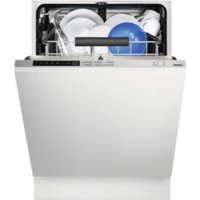
| Product type | Built-in dishwasher |
| Brand | JUNO |
| Model | JSI4362W |
| Dimensions (W x H x D) | 59.6 x 81.8-87.8 x 57 cm |
| Depth with door open | 111.4 cm |
| Capacity | 12 place settings |
| Water consumption | 22 L per cycle |
| Power consumption | 1.5 kWh per cycle |
| Rated voltage | 230 V - 50 Hz |
| Total power | 2300 W |
| Motor power | 200 W |
| Heating element power | 2100 W |
| Water pressure | 50 - 800 kPa (0.5 - 8 bar) |
| Wash programs | 65° Normal, 65° Quick, Pre-wash |
| Adjustable water softener | Yes, 5 levels |
| Regenerating salt reservoir | Yes, capacity approx. 1.5-1.8 kg |
| Rinse aid reservoir | Yes, capacity approx. 110 ml, adjustable dosage |
| Filters | Central filter (clean after each wash), large filter (clean every 2 months) |
| Anti-flood protection | Yes, device in the water inlet hose and in the base of the appliance |
| Automatic stop when door opened | Yes |
| Adjustable upper basket height | Yes, 2 positions |
| Installation | Built-in under counter, adjustable feet (max 60 mm) |
Frequently Asked Questions - JSI4362W JUNO
User questions about JSI4362W JUNO
0 question about this device. Answer the ones you know or ask your own.
Ask a new question about this device
Download the instructions for your Dishwasher in PDF format for free! Find your manual JSI4362W - JUNO and take your electronic device back in hand. On this page are published all the documents necessary for the use of your device. JSI4362W by JUNO.
USER MANUAL JSI4362W JUNO
Important safety information
It is most important that this instruction book should be retained with the appliance for future reference. Should the appliance be sold or transferred to another owner, or should you move house and leave the appliance, always ensure that the book is left with the appliance in order that the new owner can get to know the functioning of the appliance and the relevant safety information.
This information has been provided in the interest of safety. You MUST read it carefully before installing or using the appliance.
Installation
This appliance is heavy. Care should be taken when moving it.
It is dangerous to alter the specifications or attempt to modify this product in any way.
- Care must be taken to ensure that the appliance does not stand on the electrical supply cable.
- Any electrical work required to install this appliance should be carried out by a qualified electrician or competent person.
- Any plumbing work required to install this appliance should be carried out by a qualified plumber or competent person.
Child Safety
This appliance is designed to be operated by adults. Children should not be allowed to tamper with the controls or play with the product.
- Keep all packaging well away for children.
- Keep all detergents in a safe place out of children's reach.
During Use
- Items that are contaminated by petrol, paint, steel or iron debris, corrosive, acidic or alkaline chemicals must not be washed in this dishwasher.
Under no circumstances should you open the door whilst the appliance is in operation. Always turn off the appliance before opening the door. - Only use detergent specifically designed for use in dishwashers.
- When finishing loading or unloading close the door, as an open door can be a hazard.
-
Do not sit or stand on the open door.
■ Isolate the appliance from the power supply and turn off the water supply after use. -
Care should be taken when cleaning the bottom door seal and hinge area as any exposed metal edges may cut if care is not taken.
This product should be serviced by an authorised Service engineer, and only genuine spare parts should be used. - Under no circumstances should you attempt to repair the machine yourself. Repairs carried out by inexperienced persons may cause injury or serious malfunctioning. Contact your local Service Force Centre. Always insist on genuine spare parts.
Conservation
In the interest of the environment:
Materials marked with the symbol are recyclable.
- Check with your local Council or Environmental Health Office to see if there are facilities in your area for re-cycling this appliance.
- When the appliance is to be scrapped, cut off the power supply cable and make the door closing device unusable to prevent young children from being trapped inside.
- Help to keep your country tidy - use authorised disposal sites for your old appliance.
Contents
For the user
Important safety information 26
Guide to use the instruction book 27
Description of the appliance 28
The control panel 29
Before use 30
Setting the water softener 30
Rinse aid 32
Use of detergent 33
Using your appliance 34
Loading your appliance 34
Adjusting the height of the upper basket 35
Hints and tips 36
Washing programmes 37
Operating sequence 38
Maintenance and cleaning 39
Internal cleaning 39
Cleaning the central filter 39
Cleaning the large filter 39
External cleaning 40
Prolonged periods of non-operation 40
Frost precautions 40
Moving the machine 40
Something not working 41
Protection against flooding 42
Service and spare parts 42
For the installer
Installation instruction 43
Technical specifications 43
Water supply connections 44
Water outlet hose connection 45
Electrical connection 45
Building-in 46
Adjusting the height of the appliance 46
The furniture door 47
Fixing to the adjacent units 48
Adjusting the door balance 48
Kitchen plinth adjustment 49
Guide to use the instruccion book
The following symbols will be found in the text to guide you throughout the instructions:

Safety instructions

Step by step instructions

Hints and tips
Description of the appliance
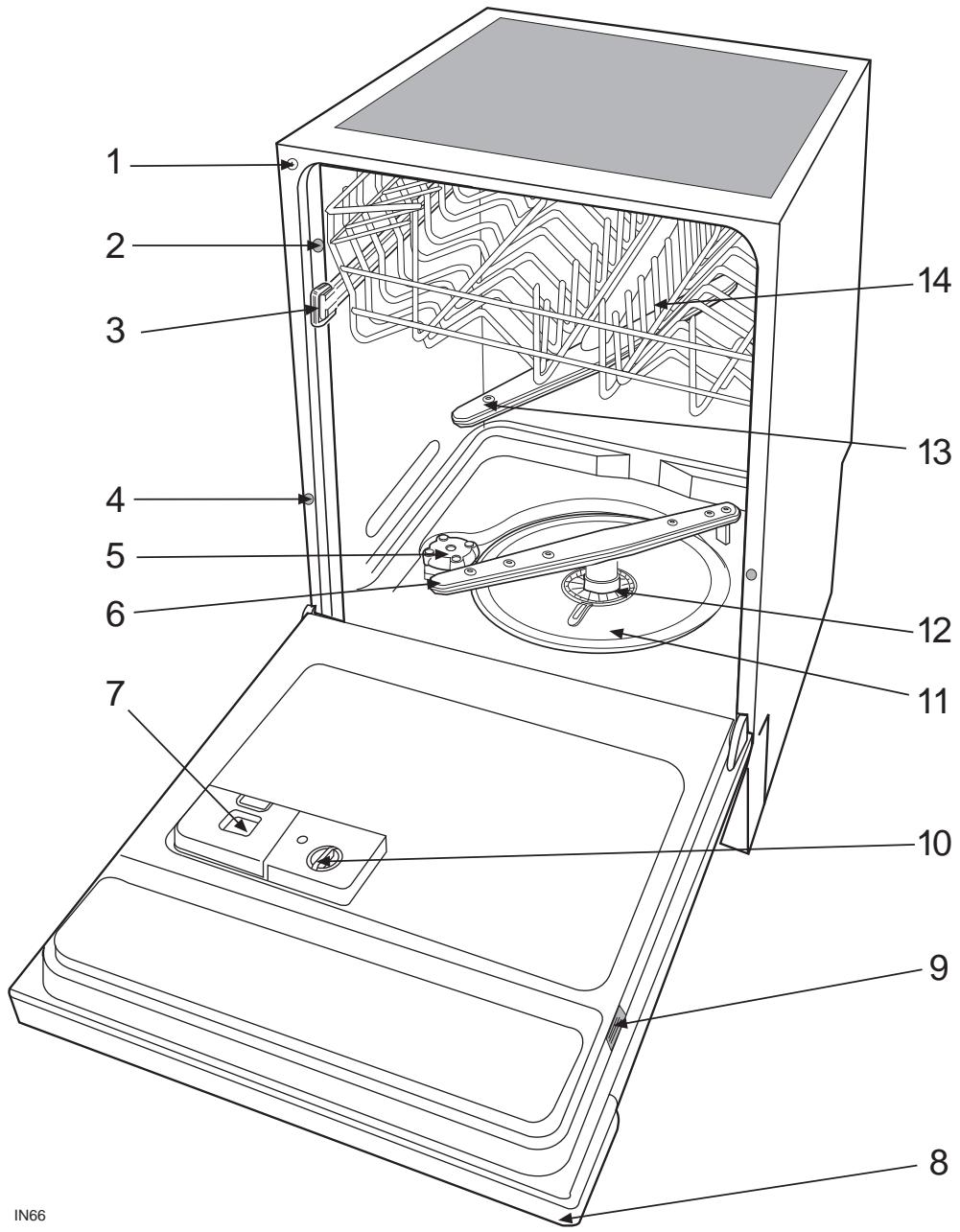
- Water hardness adjustment
- Levelling spacers
- Upper basket stop
- Door balancers
- Salt container
- Lower spray arm
- Detergent dispenser
- Control panel
-
Rating plate
-
Rinse aid dispenser
- Large filter
- Central filter
- Upper spray arm
- Upper basket
The control panel
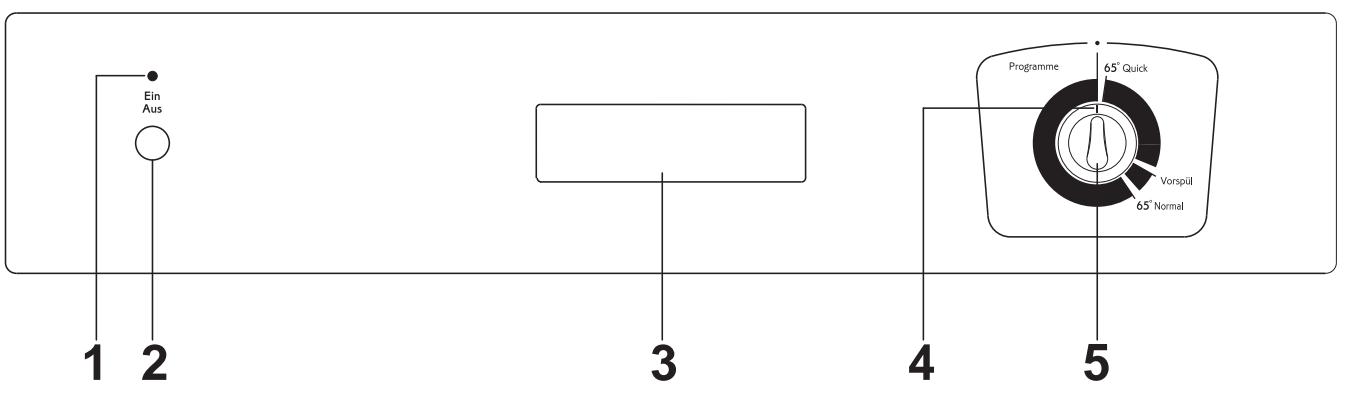
1. On/Off indicator light
2. On/Off pushbutton
On
By depressing this button the machine starts operating and, at the same time the On/Off indicator light illuminates.
Off
When the washing programme has finished, the machine stops automatically and the pilot light remains on.
To switch the indicator light off or to stop the machine at any time, press this button.
3. Door handle
To open the door press the catch in the top of the recess and pull the door toward you at the same time.
To close the door simply push it.
4. Programme marker
5. Programme selector dial
To select a programme, turn the programme selector dial clockwise, making sure that the programme marker is in line with the programme you wish to select.
Before use
Before using your dishwasher for the first time:
ensure that the electrical and water connections comply with the installation instructions
remove all packaging from inside the appliance
set the water softener
fill the salt container
fill the rinse aid dispenser.
Setting the water softener
The dishwasher is equipped with a water softener designed to remove minerals and salts from the water supply, which would have a detrimental or adverse effect on the operation of the appliance.
The higher the content of these salts, the harder your water is.
Water hardness is measured in equivalent scales, for example German, French degrees, and parts per million.
The softener should be adjusted according to the hardness of the water in your area. Your local Water Authority can advise you on the hardness of the water in your area.
The dishwasher is factory set at level 2.
If this level is not suitable for your area the softener should be adjusted.
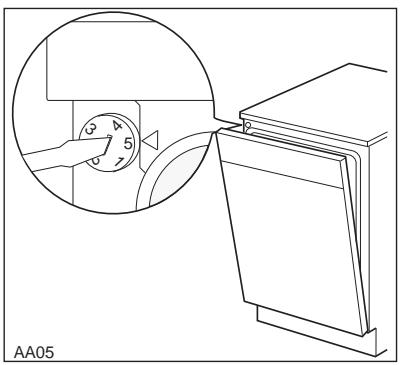
To adjust the water softener:
With a screwdriver turn the selector on the upper front corner of the machine until the level required corresponds with the marker.
| Water hardness | Level | Use of salt | ||
| German degrees (°dH) | French degrees (°TH) | PPM (Parts per million) | ||
| <4 | <7 | 0-80 | 0 | NO |
| 5-11 | 8-20 | 81-200 | 1 | SI |
| 12-22 | 21-40 | 201-400 | 2 | SI |
| 23-34 | 41-60 | 401-600 | 3 | SI |
| 35-50 | 61-90 | 601-900 | 4 | SI |
| 51-67 | 91-120 | 901-1200 | 5 | SI |
Filling with salt
If your water is "level 0" it is already soft and therefore there is no need to use salt.
Salt must be used from level 1 upward.
i Only use salt specifically designed for use in dishwashers.
All other types of salt not specifically designed for use in dishwasher, specially table salt, will damage the water softener.
Only fill with salt just before starting one of the complete washing programmes (not the Rinse and Hold programme). This will prevent any grains of salt or salty water, which may have been spilled, remaining on the bottom of the machine for any period of time, which may cause corrosion.
To fill:
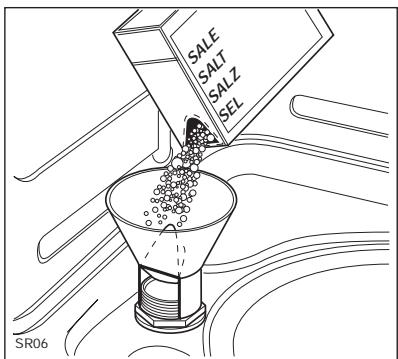
- To fill with salt, unscrew the cap of the salt container.
- Pour about 1 litre of water inside the container, or until it is full (this is necessary only before filling with salt for the first time).
- Then using the funnel provided, pour in the salt until the container is full (approx. 1.5 - 1.8kg ). Do not worry if water over flows from the unit when filling with salt, this is quite normal.
- Replace the cap making sure that there is no trace of salt on the screw thread or on the gasket.
- Screw on the cap tightly.
The salt container will require topping up periodically.
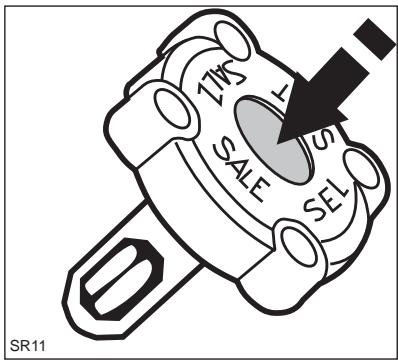
The salt cap has a refill indicator window in the centre.
A green floater is clearly visible when there is salt inside the container, and almost disappears when the salt has finished, (ie. every 30 - 50 washes depending on the setting of the water softener) reminding you to add salt.
Rinse aid
Rinse aid is automatically added during the last rinse, ensuring through rinsing, spot and streak free drying. The dispenser, which is positioned inside the door, holds about 110 ml of rinse aid, which is sufficient for 16 - 40 dishwashing programmes, depending upon the dosage setting.
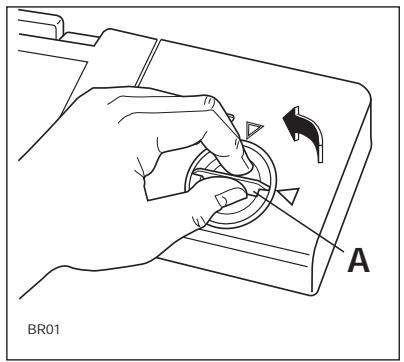
Filling with Rinse Aid:
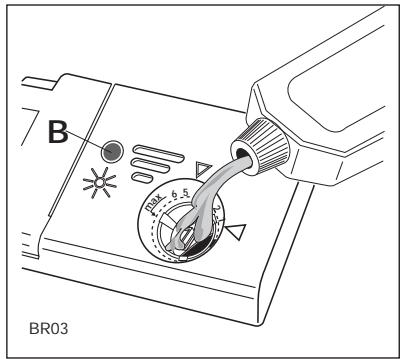
- Open the container by turning the lid (A) anticlockwise.
- Add the rinse aid until the container is completely full (approx. 110ml ). The indicator (B) will be completely dark.
- Top up the rinse aid when the indicator (B) becomes clear.
Ensure that the lid is closed after every refill.
Do not put liquid detergent in the rinse aid department. Clean up any rinse aid spilt during filling with an absorbent cloth to avoid excess foaming during the next wash.
Adjusting the dose
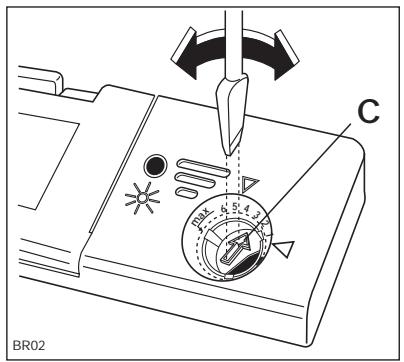
According to the finish and drying results obtained, adjust the dose of rinse aid by means of the 6 position selector (C) (position 1 minimum dosage, position 6 maximum dosage). (Start from position 3). Gradually increase the dose if there are drops of water or lime spots on the dishes after washing. Reduce it if there are sticky whitish streaks on the dishes.
Use of detergent
Only use detergents specifically designed for use in dishwashers.
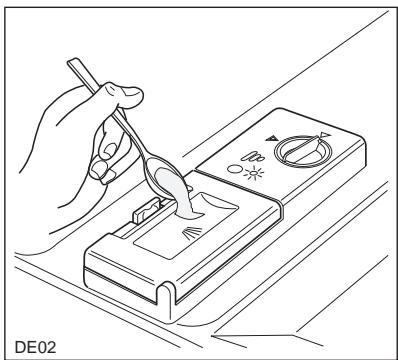
To fill the dishwasher with detergent proceed as follows:
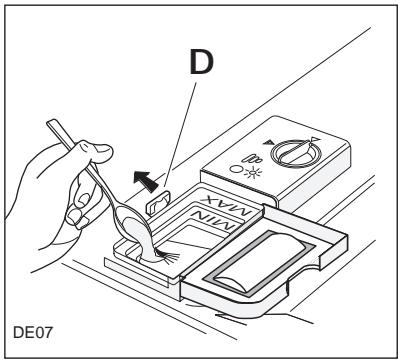
- Open the dispenser lid by pulling the catch (D).
- Add the detergent according to the recommendations in the programme chart. As all detergents are not the same, you should also consult the instructions on the packet specially for tablets.
To help correctly dose the right amount of detergent, inside the container there are two reference marks:
-MIN = 15ml
- MAX = 30ml
- Always close the lid.
- If the programme has a prewash add the required detergent over the lid of the dispenser.
Insufficient quantities of detergent will produce poor washing results, whereas an excessive amounts of detergent will not improve washing results and is also wasteful. Using no more than the correct amount also contributes to reducing pollution.
Phosphate free detergents with enzymes
In these low-alkaline compact powders the environment unfriendly components have been replaced by natural enzymes and other more biodegradable substances.
These new compact powders are generally phosphate-free.
As phosphates have water softening properties, we suggest you add salt to the salt container even if the hardness of your water is as low as 4^ (7^) .
This will avoid lime deposits on crockery and the inner tub.
Using your appliance
Loading your appliance
Before placing dishes in the machine, remove any scraps of food, to avoid clogging the filters and consequently reducing the performance.

Do not load very small items which can fall through the baskets.
Open the door and slide out the baskets to load the dishes.
The lower basket
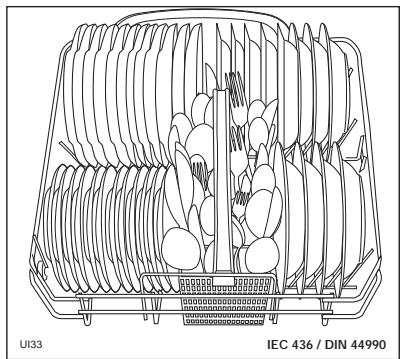
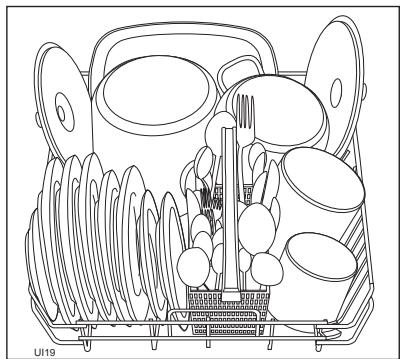
The lower basket is designed to take saucepans, lids, plates (up to 27 cm in diameter), salad bowls, cutlery etc.
Serving dishes and large lids should be arranged around the edge of the basket, ensuring that the upper spray arm can turn freely.
The cutlery basket

Long bladed knives stored in an upright position are a potential hazard.
Long and/or sharp items of cutlery such as carvings knives must be positioned horizontally in the upper basket.
Take care when loading or unloading sharp items such as knives.
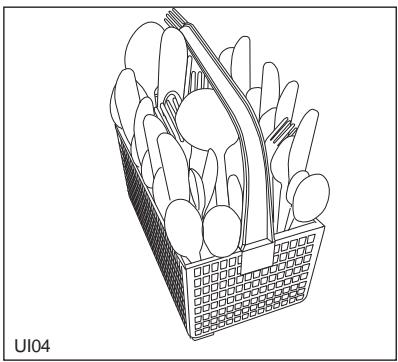
Cutlery should be placed in the removable cutlery basket with the handles facing downwards. If the handles protrude from the bottom of the basket, obstructing the lower spray arm, load the cutlery with the handles facing upwards.
Mix spoons with other cutlery to prevent them from sticking together.
Silver cutlery tends to go black if mixed with steel cutlery. Place it in the cutlery basket separate from the others.
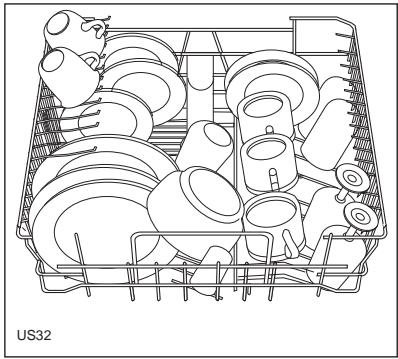
The upper basket
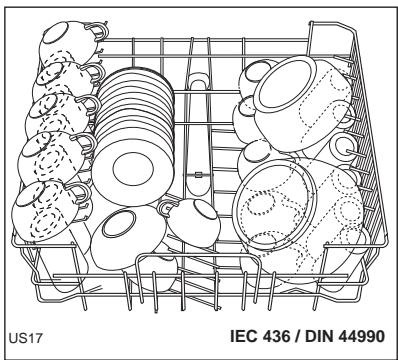
The upper basket is designed for plates (dessert plates, saucers, dinner plates of up to 24 cm in diameter), salad bowls, cups and glasses.
Arrange items on and underneath the fold-down cup racks so that water can reach all surfaces. For taller items, the cup racks can be folded upwards. Long-stem glasses can then be suspended from the prongs of the cup racks.
Larger plates (dinner plates up to 24 cm in diameter) must be loaded in the front part of the upper basket.
Light items (plastic bowls etc.) should be loaded in the upper basket and arranged so they do not move.

Before closing the door, ensure that the spray arms can rotate freely.
Adjusting the height of the upper basket
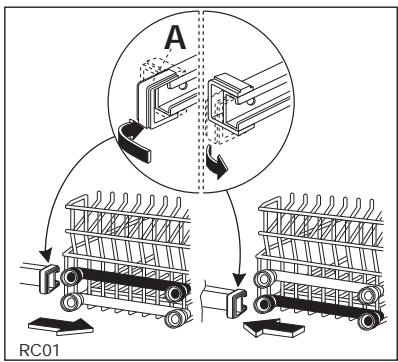
If washing very large plates (over 27 cm and up to 31 cm in diameter) you can load them in the lower basket after moving the upper basket to the higher position.
To move to the higher position proceed as follows:
- Move the front runner stops (A) of the upper basket outward and slide the basket out.
- Refit the basket in the higher position and replace the stops (A) in their original position.

When the top basket is in the higher position it will only take plates up to 20~cm in diameter and you will not be able to use the raised cup racks.

After loading your machine always close the door, as an open door can be a hazard.
Hints and tips
To save energy
Place dishes in the machine immediately after every meal and wait until the dishwasher is full before washing.
If necessary run the Rinse and Hold programme (see Programme Chart on the following pages), so that any food scraps do not become caked on the dishes while you are waiting to run the complete wash programme.
Do not prewash dishes under running water.
Select an economic programme when the dishes are not very soiled, following the instructions given in the "Washing programmes" chart.
For best washing results:
Before loading remove all scraps of food and soak very heavily soiled pots and pans.
Arrange saucepans, cups and glasses etc. upside-down.
Tilt items with convex or concave surfaces so that the water drains off easily.
Avoid contact between the dishes as far as possible.
You will improve drying results by leaving the dishwasher door ajar for at least 15-30 minutes as soon as the programme finishes.
Wait a few minutes before removing the dishes; in this way they will be cooler and the drying will be improved.
Empty the lower basket first and then the upper one; this will avoid water dripping from the upper basket onto the dishes in the lower one.
Items not suitable for dishwashers:
The following items should not be washed in the dishwasher (unless they are sold as dishwasher proof):
Cutlery with wooden or horn handles or glued parts
-bronze cutlery
- saucepans with wooden handles
- aluminium ware
crystalware
- leaded glass
- plastic items
- antique or fine decorated china
Certain types of decoration can discolour when washed in a dishwasher.
Crystal-ware and plastic objects, if not guaranteed dishwasher proof should be washed by hand.
Certain types of glass can also become opaque after being washed several times in a dishwasher.
A chemical reaction can occur between silver cutlery and stainless steel cutlery. As a precaution, do not wash together.
Iron and cast iron objects can rust and stain other items.
Aluminium tends to go black, copper, pewter and brass tend to stain.
If in doubt check with manufacturer of the item.
When buying new dishes, ensure that they are dishwasher proof.
Washing programmes
| Programme | Degree of soil and type of load | Starting position of the programmer | Required pushbuttons | Recommended quantity of detergent | Cycle description | |
| in the dispenser | on the dispenser lid | |||||
| * 65° Normal | Normal soil. Crockery, cutlery pots and pans | 65° Normal | On Off | 25 g | 5 g | Cold prewash Main wash up to 65°C 1 cold rinse 1 hot rinse up to 65°C Thermal dry |
| ** 65° Quick | Light soil. Crockery and party crockery | 65° Quick | On Off | 25 g | / | Main wash up to 65°C 1 cold rinse 1 hot rinse up to 65°C |
| Vorsprüß (Rinse and Hold) | Any. Partial load (to be completed later in the day). | Vorsprüß | On Off | / | / | 1 cold rinse (to avoid food scraps from sticking to dishes). |
* Testing programme according to IEC 436/DIN 44990
Programme: "65° Normal" with detergent type A;
Recommended setting of rinse aid: 3.
Standard place setting: 12.
Recommended quantity of detergent: 25 ~g in the dispenser
5 g on the dispenser lid.
** This is a special programme for quick washing (approx. 52 minutes) a full load of lightly soiled dishes, glasses and crockery (except pots) so that you may re-use them promptly.
Operating sequence
1. Check the filters
Ensure they are clean and properly positioned (see cleaning instructions).
2. Check that there is rinse aid and salt
3. Load the dishes
Remove any scraps of food.
Pull the lower basket out and arrange the saucepans, plates and cutlery in it.
Pull the upper basket out and arrange the plates, saucers, glasses and cups etc. in it. Slide the basket back into the machine.
4. Ensure that the spray arms can rotate freely.
5. Measure out detergent
Add the required amount of detergent into the dispenser according to the "Washing programmes" chart.
6. Close the detergent dispenser lid
7. Close the dishwasher door
8. Set the programme
Turn the programme selector dial clockwise until the programme marker on the programme selector corresponds with the programme you wish to select.
9. Start the programme
Depress the On/Off button.
The On/Off indicator light will come on and the machine will start.
If you wish to interrupt the wash programme at any time press the button again.
10. At the end of the washing programme
At the end of the washing programme the machine stops automatically.
The On/Off indicator light remains on until the On/Off button is depressed.
11. Switch off the dishwasher
Switch off the dishwasher by pressing the On/Off button and open the door.
When the wash programme has finished, it is recommended that the dishwasher is unplugged and the water tap turned off.
In general it is not advisable to open the door while the machine is working; if the door is opened however, a safety device ensures that the machine stops.
A Caution
Do not open the door during the hot phase: this may cause hot water escape.
Care must be taken if the door is opened during the hot phase or immediately after a programme has finished, as steam may escape.
Maintenance and cleaning
Internal cleaning
Ensure that the seals around the door, the detergent and rinse aid dispensers are cleaned regularly with a damp cloth.
We recommend every 3 months to run a 65^ C wash programme without dishes using detergent.
Cleaning the central filter
(After each wash)
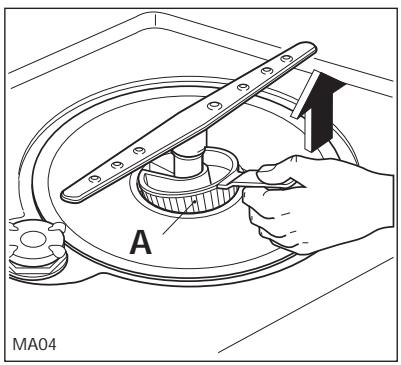
Scrap of food may accumulate in the drain filter (A) and should be removed by rinsing the filter under running water.

To remove the drain filter: simply pull it out by the hand
Once cleaned, refit the filter by pushing it back to its original position until it engages.
Cleaning the large filter
(Every two months)
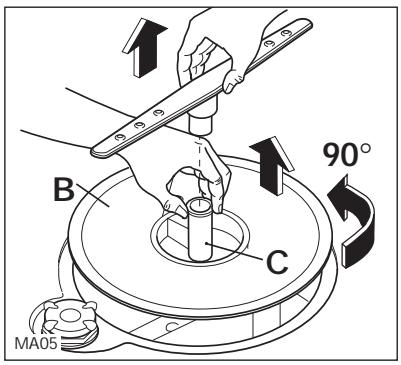
If necessary clean the large filter (B) on both sides under running water, using a brush.

To remove the large filter:
- Remove the spray arm by pulling it upward on one side.
- Turn the column (C) anticlockwise by 90^ and then slide out the filter.
- Once cleaned refit it following the above instructions in reverse order.
- Ensure the filter is in its original position, the handle of the drain filter should be pointing towards the front of the appliance.

The dishwasher must not be used without filters.
Incorrect repositioning and fitting of the filters will produce poor washing results.
Cleaning the filters is vital to ensure correct operation of the machine.
External cleaning
Clean the external surfaces of the machine and control panel with a damp soft cloth. If necessary use only neutral detergents. Never use abrasive products, scouring pads or solvent (acetone, trichloroethylene etc....).
Prolonged periods of non-operation
If you are not using the machine for any period of time you are advised to:
- Unplug the appliance and then turn off the water;
- Fill the rinse aid dispenser;
- Leave the door ajar to prevent the formation of any unpleasant smells;
- Leave the inside of the machine clean.
Frost precautions
Avoid placing the machine in a location where the temperature is below 0^ . If this is unavoidable, empty the machine, close the appliance door, disconnect the water inlet pipe and empty it.
Moving the machine
If you have to move the machine (moving house etc....):
- Unplug it;
- Turn the water tap off;
- Remove the water inlet and discharge;
- Pull the machine out together with the hoses.
Avoid over tilting the machine during transport.
Something not working
Certain problems are due to lack of simple maintenance or oversights, which can be solved easily without calling out an engineer. Before contacting your local Service Force Centre, please carry out the checks listed below.
| Symptom | Solution |
| The machine will not start | ■ The door has not been properly closed. ■ The plug is not properly inserted in the power socket. ■ Check the plug fuse. ■ There is not current at the socket. |
| The dishwasher does not fill with water | ■ Ensure the water tap is open. ■ Ensure the mains water supply has not been cut off. ■ The inlet hose may be squashed or bent. Reposition the hose. ■ The inlet hose may be blocked. Switch off the water supply, and clean the filter. |
| The filters are blocked | ■ Clean the filters (refer to “Maintenance and cleaning”). |
| The spray arms are not rotating | ■ Ensure the crockery is loaded correctly. |
| The dishwasher will not drain | ■ The drain hose may be squashed or bent. Reposition the hose. ■ The sink may be blocked. Clear any blockages. ■ The drain hose extension is not correct. Follow the instructions for connecting to the waste. ■ There is no vent in the end of the drain hose. |
| The machine is noisy | ■ Dishes are rattling against each other, (refer to “Loading your machine”). ■ The spray arms are knocking against the dishes. |
| The door is difficult to close | ■ The dishwasher is not level, or not properly built-in. |
| The dishes are not clean (poor wash) | ■ The baskets are too full. ■ The dishes have not been arranged properly. ■ The spray arms do not rotate. ■ The spray arms are clogged. ■ The filters are clogged. ■ The filters are not in position. ■ Not enough detergent has been used or it is unsuitable. ■ The detergent is old or has gone hard. ■ The salt container cap is not properly closed. ■ The washing programme selected is too gentle. |
| Visible lime deposits or white film on the dishes | ■ The rinse aid has run out or too little is being used. ■ Check that there is salt and that the salt cap is tight. |
| The dishes are not quite dry | ■ The dishes have been left too long inside the machine. |
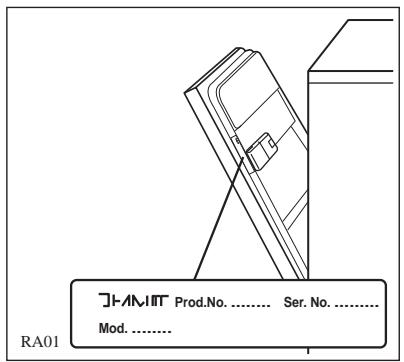
If after all these checks, the problem persists, contact your local Service Force Centre, quoting the model and serial number. This information can be found on the rating plate located on the right hand side of the dishwasher door (see picture).
Protection against flooding
In order to prevent water floods, the machine has been provided with two additional devices, having the following characteristics:
- In the water inlet hose (see Water supply connections): the device comes into operation as a result of any damage to the water inlet hose and stops the water inflow. It functions even with the machine off.
- In the bottom of the machine: the device comes into operation as a result of any water leaks in the machine and it functions only with the machine on.
To repair the machine, call the Service Centre.
Service and spare parts

This product should be serviced by an authorised Service engineer, and only genuine spare parts should be used. Under no circumstances should you attempt to repair the machine yourself. Repairs carried out by inexperienced persons may cause injury or serious malfunctioning. Contact your local Service Force Centre.
Always insist on genuine spare parts.
Installation instruction

Any electrical work required to install this appliance should be carried out by a qualified electrician or competent person.

Any plumbing work required to install this appliance should be carried out by a qualified plumber or competent person.
Technical specifications
| DIMENSIONS | Width Height Max depth Max depth with open door | 59.6 cm 81.8 - 87.8 cm 57 cm 111.4 cm |
| ELECTRICAL CONNECTION MOTOR RATING DURING WASH POWER OF HEATING ELEMENT OVERALL POWER | Voltage | 230 V - 50 Hz 200 W 2100 W 2300 W |
| WATER SUPPLY PRESSURE | Minimum Maximum | 50 kPa (0.5 bar) 800 kPa (8 bar) |
| CAPACITY (STANDARD IEC) PLACE SETTINGS | 12 | |
| CONSUMPTION | Water Electricity | 22 l 1.5 kW/h |
Remove all packaging before positioning the machine.
If possible, position the machine next to a water tap and a drain.
Water supply connections
This dishwasher may be fed with either hot (max. 60^ ) or cold water.
Nevertheless we advise you a cold water supply.
A hot water supply is not always efficient with very soiled crockery as it shortens the washing programmes a lot.
The water pressure must be within the limits given in the technical specifications.
Your local Water Authority will advise you on the average mains pressure in your area.
The dishwasher features fill and drain hoses which can be turned either to the left or the right to suit the installation.
The locknut must be correctly fitted to avoid water leaks.
Avoid bends or kinks in the hose which could prevent or slow down the water supply.
If the machine is connected to new pipes or pipes which have not been used for a long time, you should run the water for a few minutes before connecting the inlet hose. This will prevent deposits of sand or rust clogging the inlet hose filter.
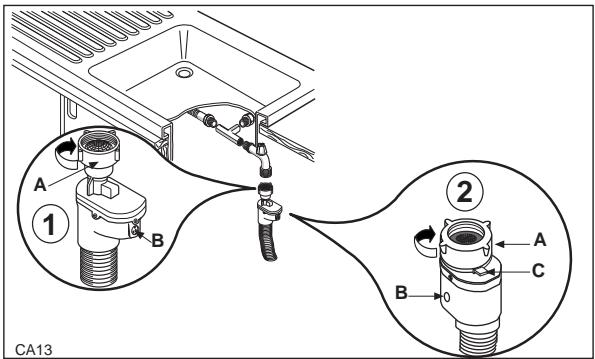
For making the connection itself, the coupling nut fitted to the machine's supply hose is designed to screw onto either a 3/4 inch gas thread spout, or to a purpose made quick-coupling tap such as the Press-block.
The water supply hose is fitted with a safety device, which prevents water from entering the machine should the inner hose split, due to wear.
The problem is signalled by a red indicator which appears in the window (B - ① ②).
If this happens, close the water tap and have the hose replaced.
The retaining ring (A - ① ②) must be properly fitted so as to avoid water leaks.
Note:
Only for water supply hoses with Lock-fast safety device to prevent inadvertent loosening. To detach the hose press yellow lever (C - ② ) and turn the retaining ring anticlockwise ② .
Water outlet hose connection
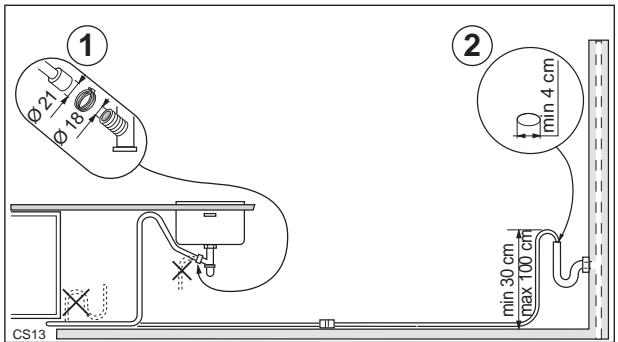
The end of the drain hose can be connected in the following ways:
- To the sink outlet siphon, securing it if necessary with a clip.
- To a stand pipe provided with vent-hole, minimum internal diameter 4 cm.
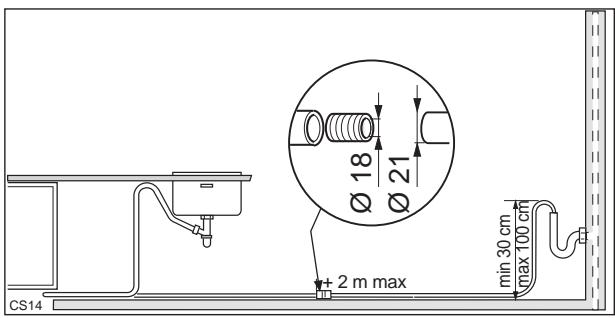
The waste connection must be at a height of between 30 cm (minimum) and 100 cm (maximum) from the bottom of the dishwasher.
The drain hose can face either to the right or left of the dishwasher
Ensure the hose is not bent or squashed as this could prevent or slow down the discharge of water.
If you use a drain hose extension it must be no longer than 2 metres and its internal diameter must be no smaller than the diameter of the hose provided.
Likewise the internal diameter of the couplings used for connections to the waste outlet must be no smaller than the diameter of the hose provided.
The sink plug must not be in place when the machine is draining as this could cause the water to siphon back into the machine.
Electrical connection
Before plugging the appliance into the wall socket, make sure that:
- The mains voltage corresponds to the voltage given in the "Technical specifications".
- The meter, fuses, mains power supply and wall socket can all take the maximum load required. Make sure that the socket and plug are compatible without having to use any type of adaptor. If necessary, have the domestic wiring system socket replaced.
Safety standards require the appliance to be earthed.
The manufacture accepts no liability for failure to observe the above safety precautions.

This appliance complies with the following E.E.C. Directives:
- 73/23 of 19.2.73 (Low Voltage Directive) and subsequent modifications;
- 89/336 of 3.5.89 (Electromagnetic Compatibility Directive) and subsequent modifications.
Building-in
This dishwasher is designed to be fitted under a kitchen counter or worksurface.
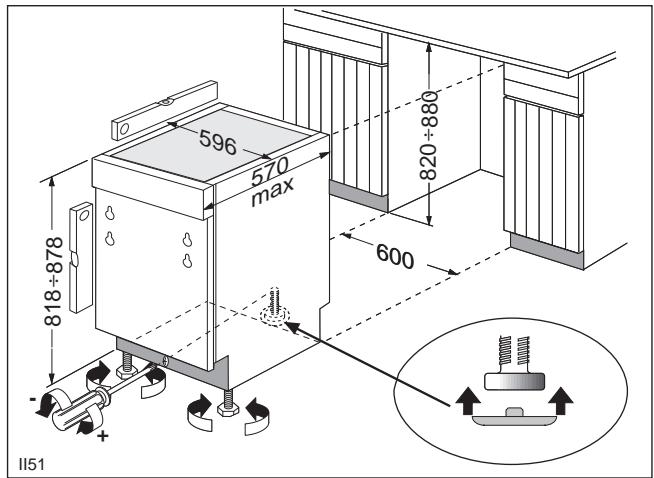
It is essential that the recess dimensions indicated in the diagram are followed.
No further openings for venting of the dishwasher are required, but only to let the water fill and drain hose and power supply cable pass through.
The recess height may be anywhere between 820 and 880mm from the floor since the dishwasher incorporates adjustable feet (max 60~mm ).
A distance of 2mm should be allowed between the top of the dishwasher and the counter top.
Adjusting the height of the appliance
To adjust the height proceed as follows:
- Loosen or tighten the two front feet.
- The rear foot is adjusted by turning the screw in the middle of the front kick plate to the left or right.
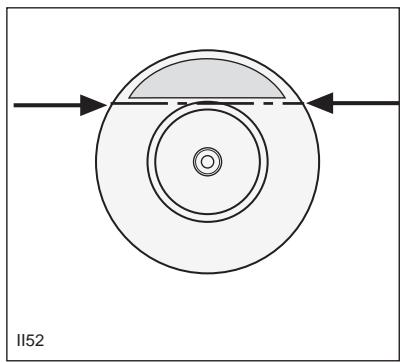
A pad is supplied for the rear foot to make sliding the appliance in and out of the recess easier.
To fit the pad, press it onto the foot.
If required, the dimensions of this pad can be reduced by breaking it where marked.
Good levelling is essential for correct closure and sealing of the door. When the appliance is correctly levelled, the door will not catch on the levelling spacers, either side of the cabinet.
If the door does not close correctly, loosen or tighten the adjustable feet until the machine is perfectly level.
The furniture door
The door on this appliance is designed for the overlay of a panel having the following dimensions:
Width 596 cm
Height 604 mm max
Thickness 20 mm max
Weight 2 - 7.5 kg max
The panel height should be no more than indicated, otherwise complete opening of the door will no longer be possible as the panel hits against the dishwasher plinth.
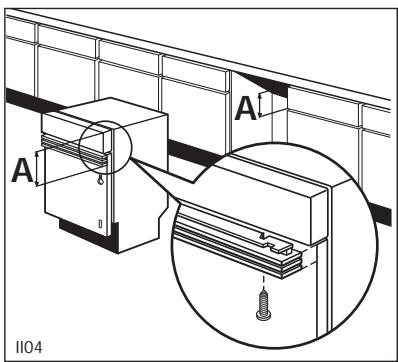
Furthermore, it is possible to fine up the control panel to correspond with the height of the drawers of the adjacent pieces of furniture, thus perfectly co-ordinating with the style of the rest of the unit furniture in your kitchen.
Add one or more of the fillets provided until you reach the desired height.
Secure the fillets as shown in the picture, by means of two screws 4 × 40 provided therewith.
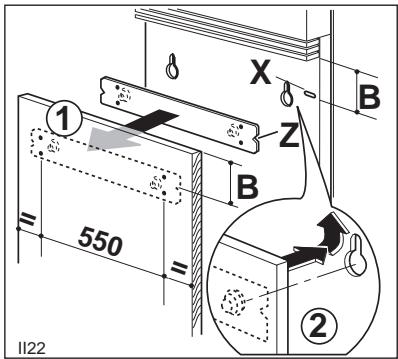
Prepare the panel as follows:
Measure the distance (B) between the part below the control panel (or fillets) and the reference notch (X) on the door.
Measure the same distance (B) on the wooden panel starting from the upper edge.
At this distance position the supporting cross-bar provided, in correspondence with the reference (Z). Keep the same distance between the centre of the support's fastening holes and the lateral edges of the wooden panel.
On the panel sign the seats for the four fastening screws. Drill the panel with a 2 × 12 bit and fix the supporting cross-bar onto the wooden panel with the 3.5 × 16 screws provided.
Mount the decor panel by inserting the two pivots of the cross-bar into the slotted holes of the door.
Lift the decor panel until the perfect alignment with the facia panel is obtained.
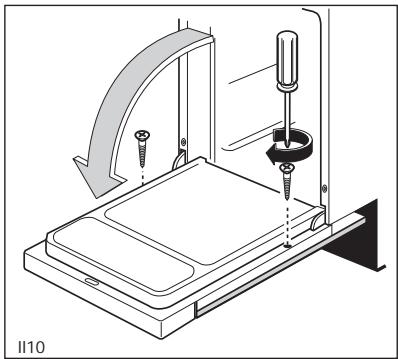
Once the correct position has been found, open the door and fasten the decor panel on the lower section by means of the two 4 x 40 screws provided, using the holes through the inner door.
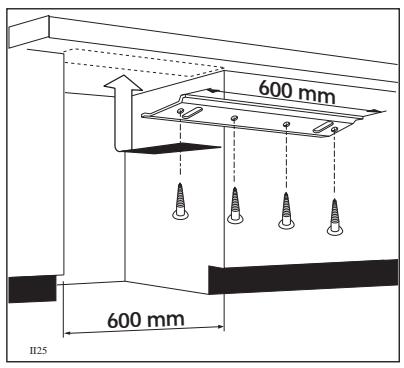
Fitting the vapour protection
Screw the vapour protecting strip onto the front part of the worktop using four 3.5 × 16 screws.
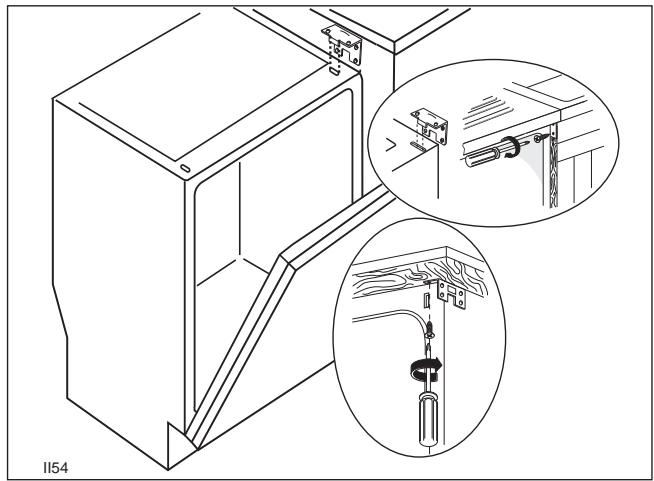
Fixing to the adjacent units
To prevent the dishwasher tilting, it must be secured to either the worktop or adjacent kitchen cabinet/wall using the brackets supplied. Insert the two fixing brackets into the slots provided in the top front part of the dishwasher as shown in the figure. Secure the brackets to adjacent units with the 3.5 × 16 screws using the upper or the side holes.

The appliance must be secured to the underside of the worktop using the brackets provided.
Failure to do this could cause damage or injury.
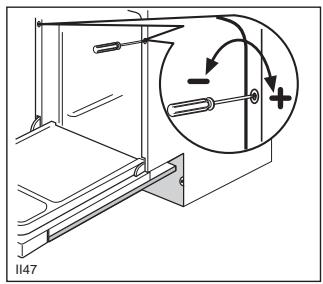
Adjusting the door balance
When the dishwasher door is correctly balanced it will remain in position when left ajar. The door balance may need to be adjusted when the decor panel is fitted. Turn the screws until the correct balance is reached:
- heavy panel - turn clockwise
- light panel - turn anticlockwise
After the adjustment of the door balance, cover the screw holes with the two plugs supplied with the machine.
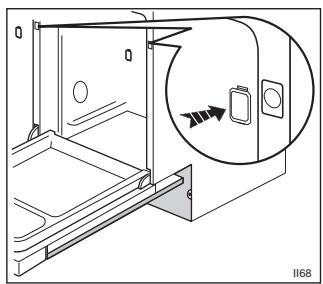
Kitchen plinth adjustment
To allow correct opening of the door it is sometimes necessary to cut the kitchen plinth. refer to the cutting table.
According to dimensions (a) and (b) as shown on the figure, you will find on the following table the depth (x) of the cut to be made on the plinth.
The dimensions (a) and (b) of the table are those most frequently used in the kitchen furnitures.
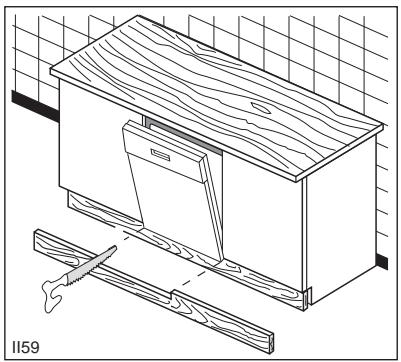
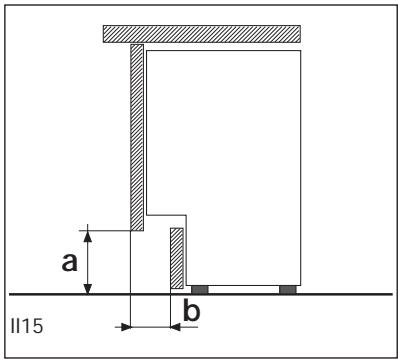
Height (a)*
| Depth(b*) | 170 | 160 | 150 | 140 | 130 | 120 | 110 | 100 | 90 | |
| 40 | 136 | 131 | 125 | 118 | 110 | 100 | 93 | 85 | 75 | |
| 50 | 135 | 131 | 125 | 118 | 110 | 102 | 92 | 85 | 75 | |
| 60 | 137 | 132 | 125 | 118 | 110 | 102 | 94 | 85 | 75 | |
| 70 | 138 | 134 | 128 | 120 | 110 | 104 | 95 | 85 | 75 | |
| 80 | / | 139 | 130 | 124 | 115 | 105 | 98 | 88 | 78 | |
| 90 | / | / | 138 | 129 | 120 | 110 | 100 | 90 | 80 | |
| 100 | / | / | / | 135 | 125 | 115 | 105 | 95 | 85 |
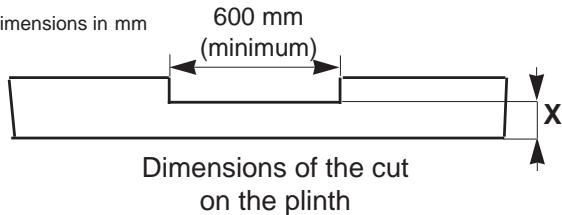
(^*) dimensions in mm
- Important safety information
- Installation
- Child Safety
- During Use
- Conservation
- In the interest of the environment:
- Contents
- For the user
- For the installer
- Guide to use the instruccion book
- Description of the appliance
- The control panel
- On/Off indicator light
- On/Off pushbutton
- On
- Off
- Door handle
- Programme marker
- Programme selector dial
- Before use
- Setting the water softener
- To adjust the water softener:
- Filling with salt
- i Only use salt specifically designed for use in dishwashers.
- To fill:
- Rinse aid
- Filling with Rinse Aid:
- Ensure that the lid is closed after every refill.
- Adjusting the dose
- Use of detergent
- To fill the dishwasher with detergent proceed as follows:
- Phosphate free detergents with enzymes
- Using your appliance
- Loading your appliance
- The lower basket
- The cutlery basket
- The upper basket
- Adjusting the height of the upper basket
- To move to the higher position proceed as follows:
- Hints and tips
- To save energy
- For best washing results:
- Items not suitable for dishwashers:
- Washing programmes
- * Testing programme according to IEC 436/DIN 44990
- Operating sequence
- Check the filters
- Check that there is rinse aid and salt
- Load the dishes
- Ensure that the spray arms can rotate freely.
- Measure out detergent
- Close the detergent dispenser lid
- Close the dishwasher door
- Set the programme
- Start the programme
- At the end of the washing programme
- Switch off the dishwasher
- When the wash programme has finished, it is recommended that the dishwasher is unplugged and the water tap turned off.
- In general it is not advisable to open the door while the machine is working; if the door is opened however, a safety device ensures that the machine stops.
- A Caution
- Care must be taken if the door is opened during the hot phase or immediately after a programme has finished, as steam may escape.
- Maintenance and cleaning
- Internal cleaning
- Cleaning the central filter
- (After each wash)
- Cleaning the large filter
- (Every two months)
- To remove the large filter:
- External cleaning
- Prolonged periods of non-operation
- Frost precautions
- Moving the machine
- Something not working
- Protection against flooding
- Service and spare parts
- Installation instruction
- Remove all packaging before positioning the machine.
- Water supply connections
- Note:
- Water outlet hose connection
- Electrical connection
- Building-in
- Adjusting the height of the appliance
- To adjust the height proceed as follows:
- The furniture door
- Prepare the panel as follows:
- Fitting the vapour protection
- Fixing to the adjacent units
- Adjusting the door balance
- Kitchen plinth adjustment
Brand : JUNO
Model : JSI4362W
Category : Dishwasher