
6R15 - Automatic watch movement SEIKO - Free user manual and instructions
Find the device manual for free 6R15 SEIKO in PDF.


| Product Type | Automatic watch movement |
| Brand | SEIKO |
| Model | 6R15 |
| Diameter | 28.4 mm |
| Thickness | 4.8 mm |
| Weight | Approximately 20 g |
| Winding type | Automatic (self-winding by arm movement) |
| Power reserve | Approximately 50 hours |
| Frequency | 21,600 vibrations/hour (6 beats per second) |
| Jewels | 23 jewels |
| Main functions | Hours, minutes, seconds, date (aperture display) |
| Power source | Automatic, no battery |
| Accuracy | -15 to +25 seconds per day |
| Number of parts | Approximately 140 parts |
| Recommended maintenance | Every 3 to 5 years, overhaul by a qualified watchmaker |
| Cleaning | Wipe with a soft, dry cloth |
| Repairability | Spare parts available via SEIKO and authorized dealers |
| Warranty | 2 years (parts and labor) |
| Water resistance | Depends on the watch case (not applicable to the movement alone) |
| Safety instructions | Keep out of reach of children; do not expose to magnetic fields |
Frequently Asked Questions - 6R15 SEIKO
User questions about 6R15 SEIKO
0 question about this device. Answer the ones you know or ask your own.
Ask a new question about this device
Download the instructions for your Automatic watch movement in PDF format for free! Find your manual 6R15 - SEIKO and take your electronic device back in hand. On this page are published all the documents necessary for the use of your device. 6R15 by SEIKO.
USER MANUAL 6R15 SEIKO
INSTRUCTIONS (P. 40)
ISTRUZIONI (P. 59)
You are now the proud owner of a SEIKO Automatic Watch Cal. 6R15. To ensure its optimum performance, please read the instructions in this booklet carefully before using it. Please keep this manual handy for ready reference.
HOW TO SET THE TIME AND DATE 9
TO PRESERVE THE QUALITY OF YOUR WATCH 12
PLACES TO KEEP YOUR WATCH 16
NOTES ON OVERHAUL 17
NOTES ON GUARANTEE AND REPAIR 17
TROUBLESHOOTING 18
ACCURACY OF MECHANICAL WATCHES 19
SPECIFICATIONS 20
SEIKO CAL. 6R15
CHARACTERISTICS OF A MECHANICAL WATCH
(self-winding type, automatic winding type)
This mechanical watch operates using power obtained from a mainspring.
If the watch is completely stopped, manually turn the crown approximately 20 times to wind up the mainspring to start the watch.
While loss/gain of a quartz watch is indicated by a monthly or annual rate, accuracy of a mechanical watch is normally indicated by a daily rate (loss/gain per day).
Normal usage accuracy of a mechanical watch varies according to conditions of use (time period that the watch is worn on the wrist, temperature environment, hand movement, and winding state of the mainspring).
When the watch is affected by strong magnetism, it temporarily gains or loses time. If the watch encounters a strong magnetic field, the parts of the watch may be magnetized. In this case, repairs such as removal of magnetism are required.
NAMES OF THE PARTS

English
CROWN
a) Normal position : winding up the mainspring (manual operation)
b) First click position : date setting
c) Second click position : time setting
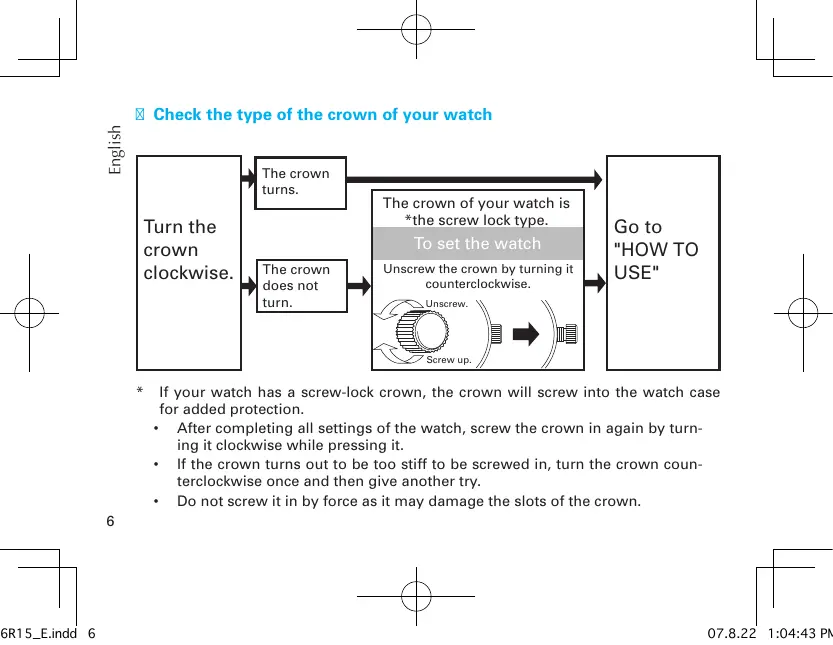
Check the type of the crown of your watch

-
If your watch has a screw-lock crown, the crown will screw into the watch case for added protection.
-
After completing all settings of the watch, screw the crown in again by turning it clockwise while pressing it.
- If the crown turns out to be too stiff to be screwed in, turn the crown counterclockwise once and then give another try.
- Do not screw it in by force as it may damage the slots of the crown.
HOW TO USE
This watch is an automatic watch equipped with a manual winding mechanism.
- When the watch is worn on the wrist, the motion of the wearer's arm winds the mainspring of the watch.
If your watch is completely stopped, it is recommended that you manually wind the mainspring by turning the crown.
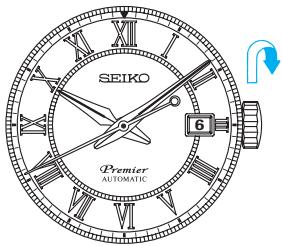
How to manually wind the mainspring by turning the crown
-
Slowly turn the crown clockwise (in the 12 o'clock direction) to wind the main-spring.
-
Turning the crown counterclockwise (the 6 o'clock direction) does not wind the mainspring.
-
Continue to turn the crown until the mainspring is sufficiently wound. The second hand will start moving.
-
Set the time and date before putting the watch on your wrist.
-
There is no need to turn the crown further when the mainspring is fully wound. But the crown can be turned without damaging the watch mechanism.
- Once the watch is wound up fully, it operates for about 50 hours.
- If the watch is used without being wound up fully, gain or loss of the watch may result. To avoid this, wear the watch for more than 10 hours a day. If the watch is used without wearing on the wrist (if it is used on the desk like a clock, for example), be sure to wind it up fully every day at a fixed time.
- If the watch has stopped with the mainspring unwound, winding the mainspring with the crown will not start the watch immediately. This is because the mainspring torque (force) is low at the beginning of its winding due to the characteristics of mechanical watches. The second hand starts to move when a certain degree of strong torque is reached after the mainspring has been wound up. However, swinging the watch from side to side to forcibly turn the balance can start the watch sooner.
HOW TO SET THE TIME AND DATE
- Check that the watch is operating, and then set the time and date.
-
The watch is provided with a date function and is so designed that the date changes once every 24 hours. The date changes around 12 o'clock midnight. If AM/PM is not properly set, the date will change around 12 o'clock noon.
-
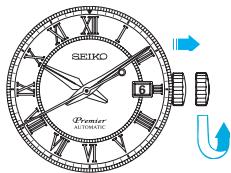
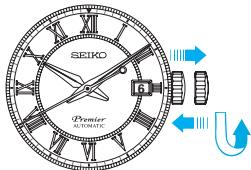
Pull out the crown to the first click. (The second hand continues moving and the accuracy of the watch is unimpaired.)
- The date can be set by turning the crown counterclockwise. Turn it until the previous day's date appears.
Ex.) If today is the 6th of the month, first set the date to "5" by turning the crown counterclockwise.

CAUTION
-
Do not set the date between 10:00 p.m. and 1:00 a.m. If you do, the date may not change properly / it may cause a malfunction.
-
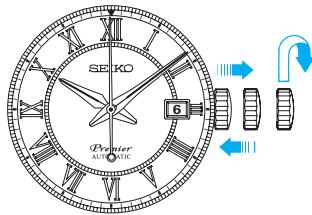
Pull out the crown to the second click when the second hand is at the 12 o'clock position. (The second hand stops on the spot.)
Turn the crown to advance the hands until the date changes to the next. The time is now set for the a.m. period. Advance the hands to set the correct time.
- Push the crown back in to the normal position in accordance with a time signal.

CAUTION
- The mechanism of mechanical watches is different from that of quartz watches.
When setting the time, be sure to turn back the minute hand a little behind the desired time and then advance it to the exact time.
Date adjustment at the beginning of the month
It is necessary to adjust the date on the first day after a month that has less than 31 days.
Ex.) To adjust the date in the a.m. period on the first day of a month following a 30-day month.
- The watch displays "31" instead of "1". Pull out the crown to the first click.
- Turn the crown to set the date to "1" and then push the crown back in to the normal position.

CAUTION
- Do not set the date between 10:00 p.m. and 1:00 a.m. If you do, the date may not change properly / it may cause a malfunction.
TO PRESERVE THE QUALITY OF YOUR WATCH

CAUTION
CARE OF YOUR WATCH
- The case and band touch the skin directly. Keep the case and band clean at all times. This will help to extend the life of the watch and will reduce the risk of skin irritations.
- When you take the watch off, wipe off moisture, sweat or soil with a soft dry cloth as soon as possible. This will help to extend the life of the case, band and gasket.
- Gently blot up the moisture using a soft dry cloth. Do not rub the leather, as this may cause abrasions or discoloration.
- To keep the bracelet clean, use a soft toothbrush dipped in clean or soapy water. Be careful not to get water on the case.

CAUTION
RASH AND ALLERGIC REACTION
- Adjust the band to allow a little clearance around your wrist to ensure proper airflow.
-
Prolonged and/or repeated contact with the band may cause skin irritation or dermatitis for those susceptible.
Possible causes of dermatitis -
Allergic reaction to metals or leathers
-
Rust, contamination or perspiration accumulated on the watch case or band.
-
If you should develop any allergic symptoms or skin irritation, immediately stop wearing the watch and seek medical attention.
WATER RESISTANCE
Non-water resistance
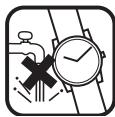
If "WATER RESISTANT" is not inscribed on the case back, your watch is not water resistant, and care should be taken not to get it wet as water may damage the movement. If the watch becomes wet, we suggest that you have it checked by the retailer from whom the watch was purchased or your SERVICE CENTER.
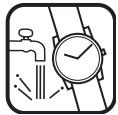
Water resistance (3 bar)
If "WATER RESISTANT" is inscribed on the case back, your watch is designed and manufactured to withstand up to 3 bar, such as accidental contact with splashes of water or rain, but it is not designed for wearing while swimming or diving.
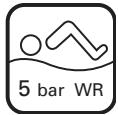
Water resistance (5 bar)*
If "WATER RESISTANT 5 BAR" is inscribed on the case back, your watch is designed and manufactured to withstand up to 5 bar and is suitable for wearing while swimming, yachting and taking a shower.

Water resistance (10 bar/15 bar/20 bar)*
If "WATER RESISTANT 10 BAR", "WATER RESISTANT 15 BAR" or "WATER RESISTANT 20 BAR" is inscribed on the case back, your watch is designed and manufactured to withstand up to 10 bar/15 bar/20 bar, respectively, and is suitable for wearing while taking a bath or shallow diving, but not for scuba diving. We recommend that you wear a SEIKO Diver's watch while scuba diving.
- Before using a water resistant 5, 10, 15 or 20 bar watch in water, make sure the crown is pushed in completely.
Do not operate the crown when the watch is wet or in water. If used in sea water, rinse the watch in fresh water and dry it completely.
- When taking a shower while wearing a water resistant 5 bar watch, or taking a bath while wearing a water resistant 10, 15 or 20 bar watch, make sure to observe the following:
- Do not operate the crown when the watch is wet with soapy water or shampoo.
- If the watch is left in warm water, a slight time loss or gain may be caused. This condition, however, will be corrected when the watch returns to normal temperature.
NOTE:
Pressure in bar is a test pressure and should not be considered as corresponding to an actual diving depth since swimming movements tend to increase the pressure at a given depth. Care should also be taken when diving with the watch into water.
PRECAUTIONS ON WEARING YOUR WATCH
- Exercise care when you hold an infant or small child while wearing the watch on your wrist, as the infant or child may be injured or develop an allergic reaction caused by direct contact with the watch.
- Avoid undue shocks such as dropping or scratching against hard surfaces or playing active sports, which may cause temporary malfunctions.
- There is a possibility of injury caused by wearing the watch on your wrist especially if you fall down or bump into other people or objects.
PLACES TO KEEP YOUR WATCH
Do not leave the watch in a place where the temperature drops below 5^ or rises above 35^ for a long time.
Do not leave the watch in a place where it will be subjected to strong magnetism (for example, near television sets, loudspeakers or magnetic necklaces) or static electricity.
Do not leave the watch where there are strong vibrations.
Do not leave the watch in dusty places.
Do not expose the watch to chemical substances or gases.
(Ex.: Organic solvents such as benzine and thinner, gasoline, nail polish, cosmetic sprays, detergents, adhesives, mercury, and iodine antiseptic solution.)
Do not leave the watch in close contact with hot spring water.
NOTES ON OVERHAUL
The watch is a precision device with many moving parts lubricated with special oils. If the parts run short of oil or get worn out, the watch may lose time or stop operation. In such a case, have the watch overhauled.
uS18
NOTES ON GUARANTEE AND REPAIR
Please contact the retailer the watch was purchased from or SEIKO CUSTOMER SERVICE CENTER for repair or overhaul.
Within the guarantee period, please present the certificate of guarantee to receive repair services.
Guarantee coverage is provided in the certificate of guarantee. Please read carefully and retain it.
TROUBLESHOOTING
| Problem | Possible causes | Solutions |
| The watch stops operating. | The power supplied by the mainspring has been consumed. | Turn the crown or swing the watch to wind it up. The watch will start operating. If the watch does not start, consult the retailer from whom the watch was purchased. |
| Even though you wear the watch every day, it soon stops operating. | The watch is worn on your wrist only for a short period of time, or the amount of arm movement is small. | Wear the watch for an extended period of time, or when taking off the watch, turn the crown to wind the mainspring. |
| The watch gains/loses temporarily. | The watch has been left in extremely high or low temperatures for a long time. | Normal accuracy will resume when the watch returns to normal temperature. |
| The watch was brought into close contact with a magnetic object. | Normal accuracy will resume when the watch is kept away from close contact with the magnetic source. If this condition persists, consult the retailer from whom the watch was purchased. | |
| You dropped the watch, hit it against a hard surface or wore it while playing active sports. The watch was exposed to strong vibrations. | Normal accuracy will not resume. Consult the retailer from whom the watch was purchased. | |
| The watch has not been overhauled for more than 3 years. | Consult the retailer from whom the watch was purchased. | |
| The date change at 12 o'clock noon. | AM/PM is not properly set. | Advance the hands by 12 hours. |
| The glass is blurred and the blur persists for a long time. | Water got inside the watch due to the deterioration of the gasket, etc. | Consult the retailer from whom the watch was purchased. |
ACCURACY OF MECHANICAL WATCHES
The accuracy of mechanical watches is indicated by the daily rates of one week or so.
The accuracy of mechanical watches may not fall within the specified range of time accuracy because of loss/gain changes due to the conditions of use, such as the length of time during which the watch is worn on the wrist, arm movement, whether the mainspring is wound up fully or not, etc.
The key components in mechanical watches are made of metals which expand or contract depending on temperatures due to metal properties. This exerts an effect on the accuracy of the watches. Mechanical watches tend to lose time at high temperatures while they tend to gain time at low temperatures.
In order to improve accuracy, it is important to regularly supply energy to the balance that controls the speed of the gears. The driving force of the mainspring that powers mechanical watches varies between when it is fully wound and immediately before it is unwound. As the mainspring unwinds, the force weakens.
Relatively steady accuracy can be obtained by wearing the watch on the wrist frequently for the self-winding type and winding up the mainspring fully everyday at a fixed time to move it regularly for the wind-up mechanical type.
When affected by external strong magnetism, a mechanical watch may loss/gain time temporarily. The parts of the watch may become magnetized depending on the extent of the effect. In such a case, consult the retailer from whom the watch was purchased since the watch requires repair, including demagnetizing.
English
SPECIFICATIONS
1 Features 3 hands, time display (Hour, minute and second hands) and date display
2 Vibrations per hour 21,600
3 Loss/gain (daily rate) +25 - 15 seconds at normal temperature range (between 5^ and 35^ )
4 Continuous operating time . More than approx. 50 hours
5 Driving system. Automatic winding type with manual winding mechanism
6Jewels 23jewels
- The accuracy above is factory adjusted.
** Due to the characteristics of mechanical watches, any actual daily rate may not fall within the range of time accuracy specified above dependent on the conditions of use, such as the length of time during which the watch is worn on the wrist, temperature, arm movement, and whether the mainspring is wound up fully or not, etc.
- SEIKO CAL. 6R15
- CHARACTERISTICS OF A MECHANICAL WATCH
- (self-winding type, automatic winding type)
- NAMES OF THE PARTS
- CROWN
- Check the type of the crown of your watch
- HOW TO USE
- How to manually wind the mainspring by turning the crown
- HOW TO SET THE TIME AND DATE
- CAUTION
- Date adjustment at the beginning of the month
- TO PRESERVE THE QUALITY OF YOUR WATCH
- CARE OF YOUR WATCH
- RASH AND ALLERGIC REACTION
- WATER RESISTANCE
- Non-water resistance
- Water resistance (3 bar)
- Water resistance (5 bar)*
- Water resistance (10 bar/15 bar/20 bar)*
- NOTE:
- PRECAUTIONS ON WEARING YOUR WATCH
- PLACES TO KEEP YOUR WATCH
- NOTES ON OVERHAUL
- NOTES ON GUARANTEE AND REPAIR
- TROUBLESHOOTING
- ACCURACY OF MECHANICAL WATCHES
- English
- SPECIFICATIONS
Brand : SEIKO
Model : 6R15
Category : Automatic watch movement