Tiny Amp Destroyer - Guitar effect pedal Jam Pedals - Free user manual and instructions
Find the device manual for free Tiny Amp Destroyer Jam Pedals in PDF.


User questions about Tiny Amp Destroyer Jam Pedals
0 question about this device. Answer the ones you know or ask your own.
Ask a new question about this device
Download the instructions for your Guitar effect pedal in PDF format for free! Find your manual Tiny Amp Destroyer - Jam Pedals and take your electronic device back in hand. On this page are published all the documents necessary for the use of your device. Tiny Amp Destroyer by Jam Pedals.
USER MANUAL Tiny Amp Destroyer Jam Pedals


JAM
PEDALS
X
Stu Mackenzie
(King Gizzard & the Lizard Wizard)
Tiny Amp Destroyer
JAM pedals × Stu Mackenzie (King Gizzard & the Lizard Wizard)
A NOTE FROM STU
What kind of absolute maniacs would decide to recreate a tiny \$30 pawn shop amp in a guitar pedal? An amp that no one (except me) thinks is cool. One deliberately designed to be cheap and nasty. Crunchy. Boxy. Buzzy. But... there's something about that amp... It can do things that nice big amps can't do. And anyway, shitty is pretty! JAM pedals and I chatted a couple of years ago about some other cool ideas which never eventuated, but when they asked if I'd be up for a limited-edition King Gizz pedal to celebrate our 2025 residency in Athens I said:
"TINY AMP DESTROYER!"
I'm sure they thought to themselves "what the fuck", but what they said to me was: "Colour us intrigued!" (I'd been running two Boomster clean boost pedals into my favourite tiny amp and it felt like destruction.)
JAM pedals tracked down the same amp and I told them all about how it had been around the world with me and why I loved it, and through some kind of sorcery they recreated my favourite tiny amp in a pedal (I have no idea how).
I am forever grateful because this pedal rules. It also has some other cool tricks up its sleeve. Like a treble boost. And a "magic" switch. It can actually be subtle if you want. Or extremely wild. You can use a clean amp or a dirty amp. Any guitar, any pickup. You'll get different results, but always exciting. But you don't need to know any of this. You just need a guitar. And a couple of cables. And a 9V power supply. And some fingers. And then you can be the destroyer. It's fun.
Enjoy the Tiny Amp Destroyer! Love, Stu xox
HOW WE GOT HERE
Stu had been building around a very particular sound in recent KGLW records: two Boomsters pushing a tiny Cash Converters amp far beyond where it was meant to go.
We recreated that setup on our side and spent time with it until we understood where it starts to come apart. There's a point where the amp stops smoothing itself out. The breakup shifts, the response changes, and the whole thing starts behaving in a way bigger amps simply don't.
That's the part we kept.
TAD is a way of getting into that same territory, but with enough control to shape it. The gain is split into two stages you can run on their own or stack, letting it move from driven tones through to much heavier ground.
It can lean into that blown-out, small-amp character, or sit as a full-range drive that holds its place in a mix, from low gain breakup through to dense, saturated distortion. There's enough shaping there to move well beyond that boxed-in feel when you want it to.
It's not a polished distortion. It comes from pushing something past where it's meant to go and staying there.
The artwork by Jason Galea, the visual mind behind much of King Gizzard's world, reflects that same idea. Something held in place and forcing its way out.
We took a prototype to Stu during KGLW's residency in Athens to see how close we had got. He plugged in, played for a minute, and said, "you nailed it." He used it for the rest of the tour, and from there the final shape of TAD came through real-world use.
CONTROLS & OPERATION
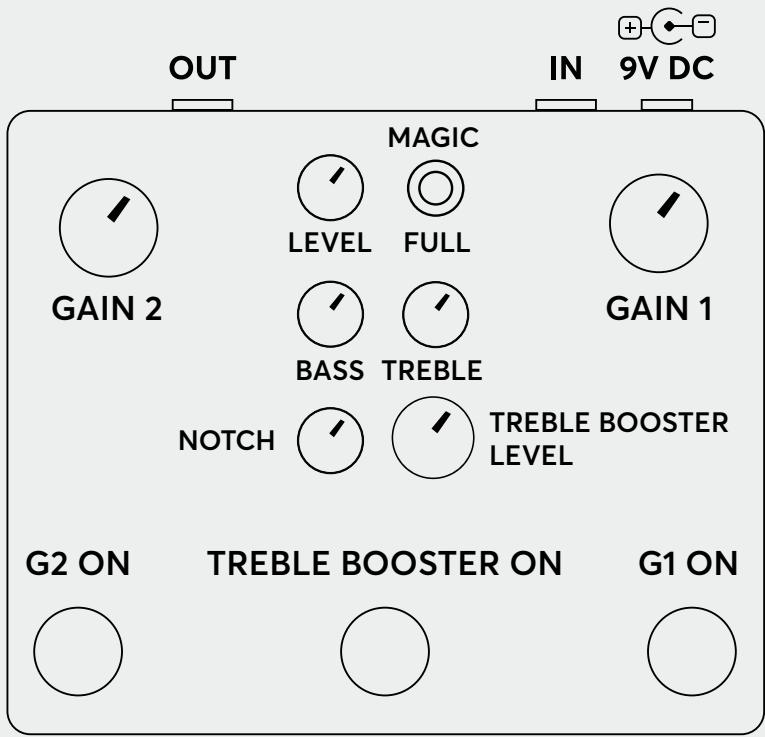
TAD is built around three footswitches.
Two of them control the gain stages, G1 and G2, each with its own gain control. G1 runs hotter, G2 is more restrained. On their own, G2 covers lower gain while G1 moves into more driven and distorted tones.
Stacked together, they reach much heavier territory.
The two gain stages share a common set of controls:
• Level sets overall output
- Bass and Treble are active, allowing both boost and cut
These give you enough range to move from fuller sounds to something more focused without losing control of the signal.
Two additional controls define the character of TAD:
• MAGIC toggle shifts the overall voicing closer to the response of a small amp when engaged
- Notch starts neutral and progressively removes a key band as you turn it up, shifting the pedal from a fuller, more forward sound into a more scooped, hollow character, dramatically revoicing the entire pedal
For the most pronounced small-amp feel, keep the gain stages lower, engage the MAGIC toggle, and shape the "boxiness" with the Notch.
The third footswitch engages an independent treble booster, based on the original JAM pedals Rooster. It sits at the front of the circuit and reshapes how the gain stages react, tightening the low end and shifting the overall character. An internal dip switch lets you choose between a more traditional voicing and a fuller response. It also works beautifully on its own as a standalone treble boost.
By default TAD ships with the treble booster set to the fuller voicing.
ADVANCED OPERATION
TAD can be set so that the signal only passes when G1 is engaged. This lets you leave G2 and the treble booster on, and bring the entire sound in with a single footswitch.
MODE CHANGE
Hold G1 while powering up
• 2 × blinks → Normal operation
• 3 × blinks → G1 Global Bypass
GETTING STARTED
Start simple. Use one gain stage at a time and get a feel for how it reacts. Then bring the second stage in and listen to how they interact. Go back to a single gain stage and bring in the treble booster. Use it to add focus or tighten the response, and pay attention to how its output level drives the rest of the circuit. It also works well on its own, so don't hesitate to use it as a standalone boost.
Tip: Small adjustments go a long way.
IN PRACTICE
TAD can sit as a low gain driver, a main distortion, or something much more pushed.
It's stable when you need it to be, but it doesn't flatten everything out. It keeps some movement in the sound, especially as you start stacking gain stages. That's usually where TAD starts becoming itself.
SPECIFICATIONS
• Power Requirement: 9VDC, centre-negative
• Bypass: True bypass
• Maximum Power Consumption: 90 mA (all circuits engaged)
• Input Impedance (Treble Booster OFF): \~500 kΩ
• Input Impedance (Treble Booster ON): \~50 kΩ
• Output Impedance: <5 kΩ
• Dimensions: 14.5 × 12.4 × 5.9 cm ( 5.7 × 4.8 × 2.3 in)
• Weight: 511 g (1.13 lb)
TAD SIGNAL FLOW


TREBLE BOOSTER VOICING
FULL
STANDARD


Brand : Jam Pedals
Model : Tiny Amp Destroyer
Category : Guitar effect pedal