
MC351 - Color multifunction printer OKI - Free user manual and instructions
Find the device manual for free MC351 OKI in PDF.


| Product type | Color multifunction printer |
| Brand | OKI |
| Model | MC351 |
| Dimensions (W x D x H) | 430 x 440 x 340 mm |
| Weight | 14.5 kg |
| Power supply | 220-240 V, 50/60 Hz |
| Power consumption (average) | 350 W (printing), 50 W (standby) |
| Main functions | Print, copy, scan |
| Printing technology | Color LED |
| Maximum print resolution | 1200 x 1200 dpi |
| Print speed (A4 color) | 20 ppm |
| Input tray capacity | 250 sheets |
| Media types | Paper, cards, labels, transparencies |
| Connectivity | USB 2.0, Ethernet |
| Maintenance and cleaning | Clean the exterior with a soft cloth; use a cleaning kit for the interior |
| Safety | Unplug before any intervention; do not use near water |
| Spare parts and repairability | Ink cartridges, drum, fuser unit, rollers |
| General information | Manual available as PDF download; OKI technical support |
Frequently Asked Questions - MC351 OKI
User questions about MC351 OKI
0 question about this device. Answer the ones you know or ask your own.
Ask a new question about this device
Download the instructions for your Color multifunction printer in PDF format for free! Find your manual MC351 - OKI and take your electronic device back in hand. On this page are published all the documents necessary for the use of your device. MC351 by OKI.
USER MANUAL MC351 OKI
Every effort has been made to ensure that the information in this document is complete, accurate, and up-to-date. The manufacturer assumes no responsibility for the results of errors beyond its control. The manufacturer also cannot guarantee that changes in software and equipment made by other manufacturers and referred to in this guide will not affect the applicability of the information in it. Mention of software products manufactured by other companies does not necessarily constitute endorsement by the manufacturer.
While all reasonable efforts have been made to make this document as accurate and helpful as possible, we make no warranty of any kind, expressed or implied, as to the accuracy or completeness of the information contained herein.
The most up-to-date drivers and manuals are available from:
http://www.okiprintingsolutions.com
07110101 Iss. 1; Copyright © 2010. All rights reserved.
Oki is a registered trademark of Oki Electric Industry Company, Ltd.
Oki Printing Solutions is a trademark of Oki Data Corporation.
Energy Star is a trademark of the United States Environmental Protection Agency.
Microsoft, MS-DOS and Windows are registered trademarks of Microsoft Corporation.
Apple, Macintosh, Mac and Mac OS are trademarks of Apple Inc.
Other product names and brand names are registered trademarks or trademarks of their proprietors.

As an Energy Star Program Participant, the manufacturer has determined that this product meets the Energy Star guidelines for energy efficiency.

This product complies with the requirements of the Council Directives 2004/108/EC (EMC), 2006/95/EC (LVD), 1999/5/ EC (R&TTE) and 2009/125/EC (EuP), as amended where applicable on the approximation of the laws of the member states relating to electromagnetic compatibility, low voltage, radio & telecommunications terminal equipment, and energy using products.
The following cables were used to evaluate this product to achieve EMC directive 2004/108/EC compliance and configurations other than this may affect that compliance.
| CABLE TYPE | LENGTH (METRE) | CORE | SHIELD |
| Power | 1.8 | x | x |
| USB | 5.0 | ✓ | x |
| LAN | 15.0 | x | x |
| Tel | 1.5 | x | x |
| Modular | 15 | x | x |
EMERGENCY FIRST AID
Take care with toner powder:
If swallowed, give small amounts of cold water and seek medical attention. DO NOT attempt to induce vomiting.

If inhaled, move the person to an open area for fresh air. Seek medical attention.
If it gets into the eyes, flush with large amounts of water for at least 15 minutes keeping eyelids open. Seek medical attention.
Spillages should be treated with cold water and soap to help reduce risk of staining skin or clothing.
MANUFACTURER
Oki Data Corporation,
4-11-22 Shibaura, Minato-ku,
Tokyo 108-8551,
Japan
IMPORTER TO THE EU/AUTHORISED REPRESENTATIVE
Oki Europe Limited (trading as OKI Printing Solutions)
Blays House
Wick Road
Egham
Surrey, TW20 0HJ
United Kingdom
For all sales, support and general enquiries contact your local distributor.
ENVIRONMENTAL INFORMATION

CONTENTS
Preface 2
Emergency first aid 3
Manufacturer. 3
Importer to the EU/authorised representative. 3
Environmental information 3
Contents 4
Notes,cautions and warnings. 7
About this guide 8
Documentation suite 8
Purpose of this guide 8
On-line usage 9
Printing pages. 9
Introduction 10
Overview 12
Front view 12
Rear view. 13
Control panel 14
Keypad - character switching 16
Qwerty keyboard (MC561 only). 17
Changing the display language 17
Getting started 18
Switching on. 18
Switching off. 18
Power saving mode 19
Sleep mode 19
Installing drivers and utilities 20
Windows - scanner and printer drivers. 21
Mac - printer driver 22
Fax driver (MC361 and MC561). 23
Configuration tool 24
ActKey utility 25
Paper recommendations 27
Cassette trays. 27
Multi purpose tray 28
Face down stacker. 28
Face up stacker. 28
Duplex. 28
Loading paper 29
Cassette trays. 29
Multi purpose tray 32
Configuring the tray settings 32
Registering custom sizes 33
User authentication and access control 34
PIN authentication. 34
Logging into the machine 34
Logging out of the machine 34
User name and password authentication 34
Logging into the machine 34
Logging out of the machine 34
Operation from the computer 35
Operation 37
Multi-tasking. 38
Loading document(s) 39
Document requirements. 39
Scannable area 39
Placing document(s) in the ADF 40
Placing document(s) on the glass 41
Copying 42
Basic operation 42
Increasing copy count 42
Advanced operation. 43
Resetting copy settings 45
Auto reset 45
Using the reset/login button 45
Scanning 46
Scan to e-mail 47
Scan to network PC .51
Scan to USB memory. 54
Scan to local PC 56
Actkey interface 57
Scan to remote PC. .58
Managing profiles 60
Adding a new network profile 60
Deleting a network profile 61
Managing the address book 62
Setting sender and reply to e-mail addresses (from-reply to) . . . . . . . . . . . . . . . . . . . . . . . . . . . . . . . . . . . . . . . . . . . . . . . . . . . . . . . . . . . . . .
Creating e-mail templates .63
Adding an e-mail address entry to the address book .64
Deleting an e-mail address entry from the address book .64
Modifying an e-mail address entry from the address book .65
Adding a group entry to the address book 65
Deleting a group address entry from the address book .66
Modifying a group address entry from the address book. .66
Printing 67
Job lists 67
Print job (MC561 only). 68
Print from USB memory 69
Basic operation 69
Advanced operation. 70
Switching online/offline 71
Faxing - MC361 and MC561 only. 72
Sending a fax from the MFP 72
Basic operation 72
Advanced operation. 73
Fax receiving 82
Managing the phone book 85
Adding a speed dial entry to the phone book .85
Adding a group entry to the phone book .86
Deleting a speed dial entry from the phone book. .86
Deleting a group dial entry from the phone book. .86
Modifying a speed dial entry 87
Modifying a group dial entry 87
Registering an entry from reception or transmission history .87
Internet fax 88
Sending a fax from your PC .88
Receiving an internet fax 91
Adding fax numbers to the phone book 92
Adding new groups to the phone book 92
Importing and exporting fax numbers 93
Functions common to copy, fax and scan operations 94
Continuous scan mode. 94
Job macros (MC561 only). 95
Maintenance 97
Replacing consumable items. 97
Toner cartridge replacement. 97
Image drum replacement 102
Replacing the transfer belt unit 102
Fuser replacement. 105
Cleaning. 107
...the unit casing. 107
...the LED head 107
...the paper path in the ADF 109
...the underside of the ADF. 109
...the document glass 110
Installing upgrades. 111
Memory upgrade. 111
SD card (MC561 only) 114
Additional paper tray 116
Setting the driver device options. 117
Windows 117
Mac OS X 117
Troubleshooting 119
Checking the machine's status 119
Checking the device and job status 119
Clearing paper jams 120
In the scanner ADF section 120
In the printer section. 121
Dealing with unsatisfactory printing 128
Dealing with unsatisfactory copying 129
Fax problem checklist (MC361 and MC561) 130
Specifications 132
Appendix A - menu system 133
Reports 134
Paper setup 135
Address book 137
Phone book 138
Profile 139
Network scan destination 141
Store document settings 141
View information 142
Shutdown. 142
Easy setup 143
Admin setup 144
Index. 164
Oki contact details. 165
NOTE
A note provides additional information to supplement the main text.
CAUTION!
A caution provides additional information which, if ignored, may result in equipment malfunction or damage.
WARNING!
A warning provides additional information which, if ignored, may result in a risk of personal injury.
For the protection of your product, and in order to ensure that you benefit from its full functionality, this model has been designed to operate only with genuine original toner cartridges. Any other toner cartridge may not operate at all, even if it is described as "compatible", and if it does work, your product's performance and print quality may be degraded.
Use of non-genuine products may invalidate your warranty.
Specifications subject to change without notice. All trademarks acknowledged.
NOTE
Images used in this manual may include optional features that your product does not have installed.
DOCUMENTATION SUITE
This guide is part of a suite of online and printed documentation provided to help you become familiar with your product and to make the best use of its many powerful features. The documentation is summarised below for reference and is found on the manuals DVD unless indicated otherwise:
Installation Safety booklet: provides information for safe use of your product.
This is a paper document that is packaged with the product and should be read before setting up your machine.
Set-up guide: describes how to unpack, connect and turn on your product.
This is a paper document that is packaged with the product.
User's Guide: helps you become familiar with your product and make the best use of its many features. Also included are guidelines for troubleshooting and maintenance to ensure that it performs at its best. Additionally, information is provided for adding optional accessories as your printing needs evolve.
Configuration Guide: provides machine, fax and network configuration information.
Printing Guide: helps you become familiar with the many features of the driver software supplied with your product.
Barcode Printing Guide: helps you become familiar with your product's built in barcode printing feature.
Security Guide: helps you become familiar with your product's security features.
Installation Guides: accompany consumable items and optional accessories to describe how to install them.
These are paper documents that are packaged with the consumables and optional accessories.
On-line Help: on-line information accessible from the printer driver and utility software.
PURPOSE OF THIS GUIDE
The purpose of this guide is to provide you with in-depth information on how to use your machine efficiently and effectively for printing, copying, scanning and faxing1.
NOTE
The User Guide assumes that the machine has been set up and fully configured. Refer to the Setup Guide and Configuration Guide for guidance.
ON-LINE USAGE
This guide is intended to be read on screen using Adobe Reader. Use the navigation and viewing tools provided in Adobe Reader.
There are many cross-references within this book, each highlighted as blue text. When you click on a cross-reference the display will instantly jump to the part of the manual containing the referenced material.
By using the ° button in Adobe Reader, you can navigate directly back to where you were before.
You can access specific information in two ways:
In the list of bookmarks down the left hand side of your screen, click on the topic of interest to jump to the required topic. (If the bookmarks are not available, use the "Contents" on page 4.)
In the list of bookmarks, click on Index to jump to the Index. (If the bookmarks are not available, use the "Contents" on page 4.) Find the term of interest in the alphabetically arranged index and click on the associated page number to jump to the page containing the term.
PRINTING PAGES
The whole manual, individual pages, or sections may be printed. The procedure is:
- From the toolbar, select File > Print (or press the Ctrl + P keys).
- Choose which pages you wish to print:
(a) All pages, (1), for the entire manual.
(b) Current page, (2), for the page at which you are looking.
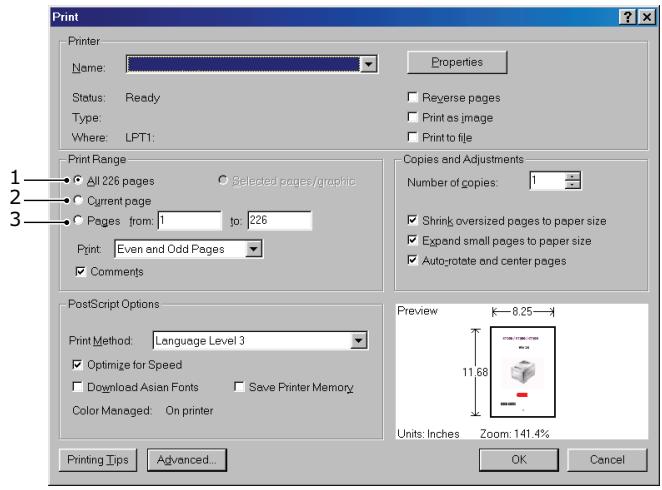
(c) Pages from and to, (3), for the range of pages you specify by entering their page numbers.
(d) Click OK.
INTRODUCTION
Congratulations on choosing this Multi Function Product (MFP). It is designed with advanced features, to give you clear, vibrant colour prints and crisp black and white pages at high speed on a range of office print media.
With this MFP, you can instantly scan paper-based documents and deliver the electronic image to various destinations including e-mail addresses, printers, ftp servers or someone else's computer on the network. This MFP also has a "walk-up" fax facility allowing you to send your documents to a destination fax number instantly.
Your MFP includes these features:
Multi-tasking to allow scanning one job while printing another to ensure greater productivity.
Digital Copying - An intuitive control panel, makes digital copying fast and easy.
Up to 600 × 600 dpi (dots per inch) copy resolution.
Actkey utility - enables the MFP to receive one key touch commands from a locally connected computer ("pull scan").
Scan to E-mail - Connected to an Ethernet network and a SMTP server, this MFP allows you to transmit document(s) over the internet via e-mail. With a touch of the e-mail on-screen button and the selection of your recipients' e-mail addresses, the document(s) is/are first scanned and converted into an image file, and then transmitted to remote recipients within minutes.
Scan to Network PC - Allows you to send scanned documents to a server or a personal computer's file folder over an intranet with FTP (File Transfer Protocol), HTTP (Hypertext Transfer Protocol), CIFS (Common Internet File System) protocol. The scan to filing feature removes the need for the mail server to handle large attachments.
Multiple Pages Sending - With the Auto Document Feeder (ADF), the MFP allows a stack of up to 50 page document(s) to be continuously scanned.
MC361 and MC561: Faxing - An intuitive control panel, makes direct faxing fast and easy.
MC361 and MC561: Advanced fax transmission and reception, including delayed transmissions, sending to multiple locations, confidential transmission and reception, and polling.
Address Book/Phone Book/Profiles Managing - This provides a convenient way to manage all the e-mail addresses, fax numbers and profiles (filing destinations).
ProQ2400, multi-level technology produces subtler tones and smoother gradations of colour to lend photographic quality to your documents.
> 600 × 600,1200 × 600 dpi (dots per inch) and ProQ2400 print resolution for high quality image production showing the finest detail.
Internet Protocol version 6 (IPv6).
Single Pass colour Digital LED technology for high speed processing of your printed pages.
PostScript 3, PCL 5C, PCL 6 and Epson FX emulations for industry standard operation and wide compatibility with most computer software.
10Base-T and 100Base-TX network connection lets you share this valuable resource among users on your office network.
Photo Enhance mode to improve printouts of photographic images (not available on PS drivers).Automatic two-sided (duplex) printing for economical use of paper and compact printing of larger documents.
"Ask Oki" - a user-friendly function for Windows that provides a direct link from your printer driver screen to a dedicated web site specific to the exact model you are using. This is where you'll find all the advice, assistance and support you could need to help you get the best possible results from your Oki printer.
Template Manager utility for Windows enables the design and print of business cards, banners, labels with ease.
Additionally, the following optional features are also available:
Additional paper tray for loading a further 530 sheets to minimise operator intervention, or different paper stocks for letterhead stationery, alternative paper sizes or other print media.
Additional memory allows printing of more complex pages. For example, high resolution banner printing.
MC561: SD card for storage of overlays, macros and downloadable fonts, and automatic collation of multiple copies of multipage documents and the download of ICC Profiles.
OVERVIEW
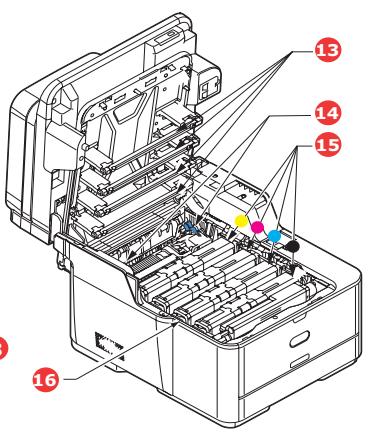
FRONT VIEW
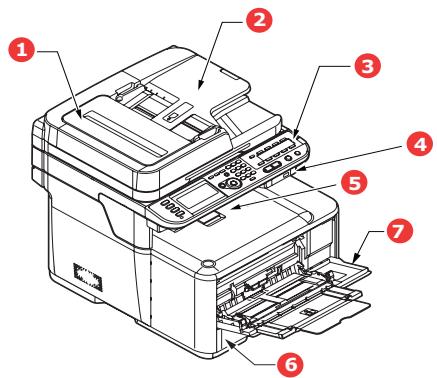
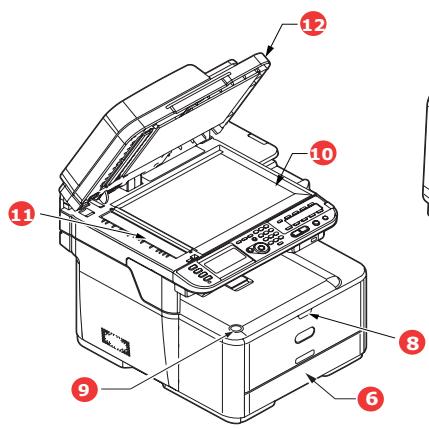
- ADF unit.
- ADF paper tray.
- Operator panel.
Menu driven operator controls and LCD panela.
- USB memory port.
-
Output stacker, face down. Standard printed copy delivery point. Holds up to 150 sheets at 80g / m2
-
Paper tray.
Standard paper tray. Holds up to 250 sheets of 80g / m2 paper.
- Multi purpose tray.
Used for feeding heavier paper stocks, envelopes and other special media. Also for manual feeding of single sheets when required.
- Multi-purpose tray release recess.
- Top cover release button.
- Document glass.
- ADF document glass.
- Document cover.
- LED heads.
- Fuser release levers.
- Toner cartridges (C,M,Y,K).
- ID unit.
a. The display language can be changed to show different languages. (see "Changing the display language" on page 17).
REAR VIEW
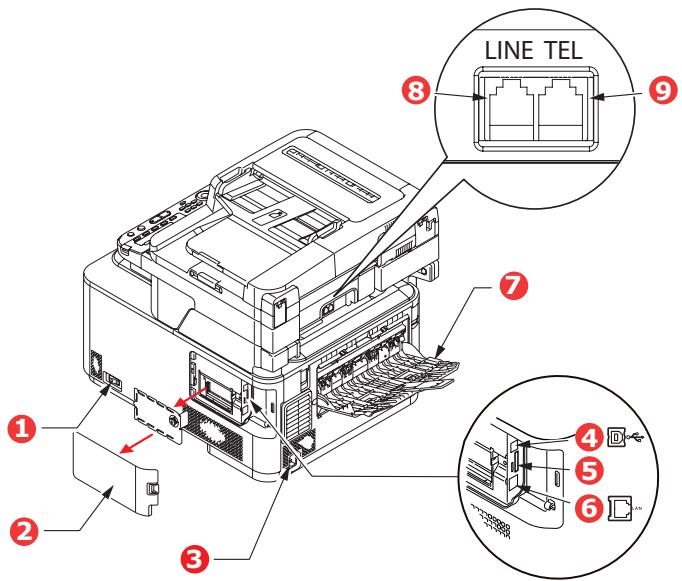
- ON/OFF switch.
- Access panel.
- AC power socket.
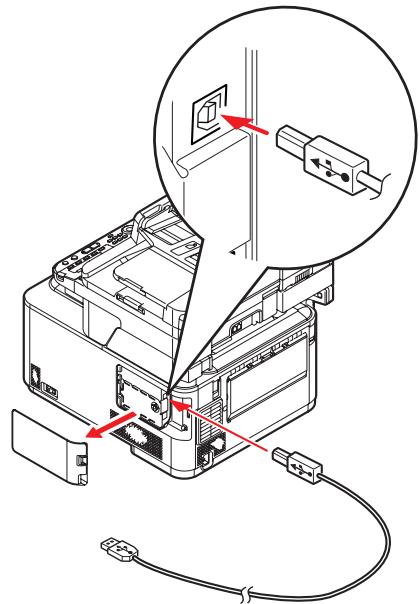
- USB interface.
-
SD card slot (MC561 only).
-
Network interface.a
- Rear, face up stacker.
- LINE connection.
- TEL connection.
a. The Network Interface may have a protective "plug" which must be removed before connection can be made.
When the rear paper stacker is folded down paper exits the printer through the rear of the printer and is stacked here face up. This is mainly used for heavy print media. When used in conjunction with the multi purpose feed tray, the paper path through the printer is essentially straight. This avoids bending the paper around curves in the paper path and enables feeding of up to 220g / m2 media.
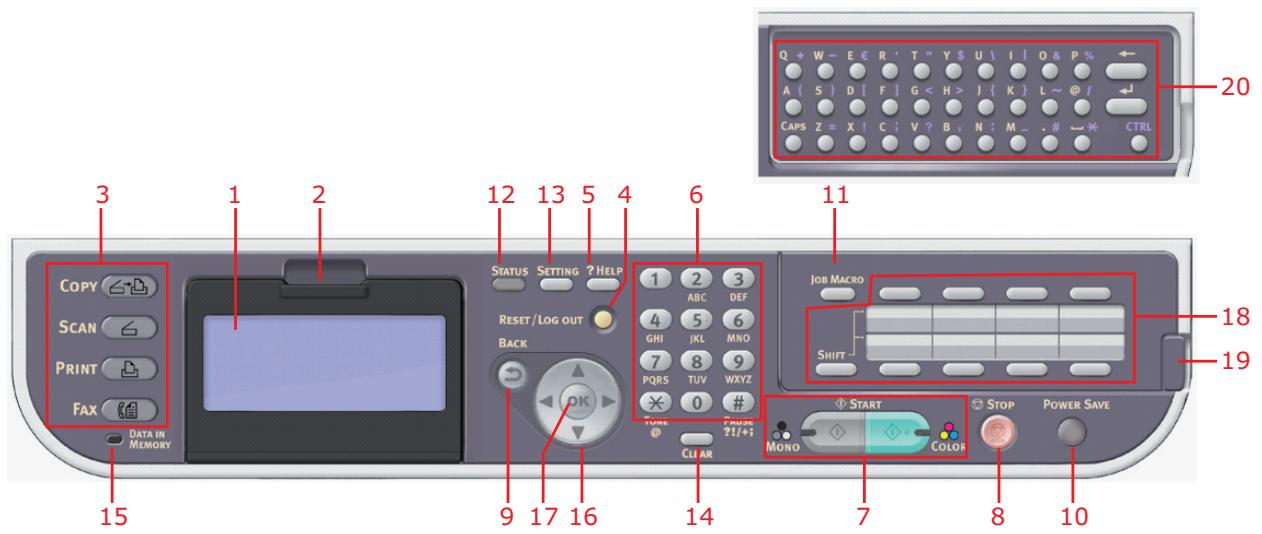
| REF. | DESCRIPTION |
| 1. | Liquid crystal display (LCD)Displays operating instructions and status of your machine. |
| 2. | Panel adjust recessThe LCD panel can be swivelled upwards from its base position for ease of use. |
| 3. | Main function buttonsCOPY: Pressing this button selects copy mode. This allows you to control the copying processwhereby documents to be copied are scanned in the scanner unit (document glass or ADF) and thecopies are automatically printed in the printer unit.SCAN: Pressing this button gives access to several send modes. These allow you to select andcontrol the process whereby a document is scanned and the scanned data is sent: by email as anattachment, to a local PC, to a network PC, to a USB memory stick. It also allows you to arrange fora document to be scanned from a remote PC.PRINT: Pressing this button selects print mode. This allows you to select and print out a stored job,an encrypted print job or a job stored on a USB memory stick. It also allows you to print out a joblist of all recent prints, or switch the machine to an "offline" state.FAX (MC361 and MC561): Pressing this button selects fax send mode. This allows you to controlthe process whereby a document is scanned and then the scanned data is sent as a fax. |
| 4. | RESET/LOG OUT:Pressing this button returns all settings of a selected function to their default values, but does notstop any jobs that are already in progress.At the top level screen, pressing this button logs the user out (if access control is enabled andactive). |
| 5. | ?HELP:Pressing this button when the green LED on the START button is flashing, displays help informationon the LCD screen. |
| 6. | KeypadUse the numeric buttons to enter, for example, number of copies or a fax number.MC361 and MC561: The * and # buttons are also used to navigate menus in touch-tone systemssuch as voice mail (if you have a telephone handset connected), or in vertical service codes.Refer to "Keypad - character switching" on page 16. |
| 7. | START:> MONO - Pressing this button starts the copying, faxing or scanning process in black & white.> COLOR - Pressing this button starts the copying or scanning process in colour.Green LED illuminates when copying/scanning is possible, if the LED is unlit then that function is notpossible, e.g only the Mono button LED illuminates when faxing (colour faxing is not possible). |
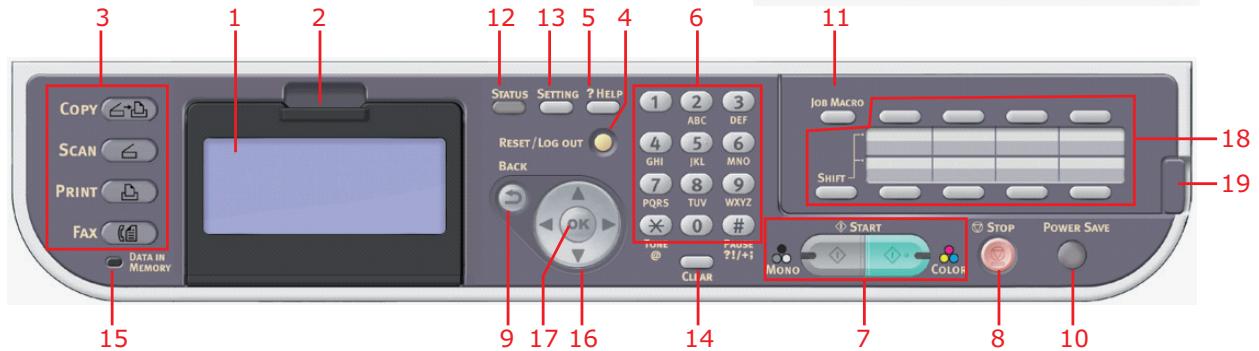
| REF. | DESCRIPTION |
| 8. | STOP: Pressing this button stops the copying or scanning process. |
| 9. | BACK: Used to cancel selections and go back to the top level of the setting. The key is also used to cancel any previous input. |
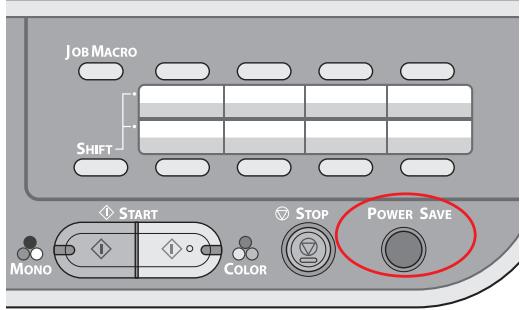
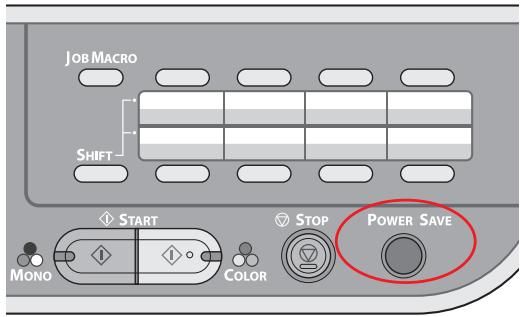
| 10. | POWER SAVE: Pressing this button switches the power save mode on or off, its LED being illuminated when power save mode is on. If the machine has gone into power save mode as indicated by the screen being black and the LED being illuminated, you can return to normal mode by pressing the POWER SAVE button. |
| 11. | JOB MACRO (MC561 only): Pressing this button allows you to program short-cuts to your most used operations. For example a fax number you send to every day can be programmed in and then allows you to perform that operation at the touch of a button. Refer to "Job macros (MC561 only)" on page 95. |
| 12. | STATUS: Pressing this button gives access to the status menu screen. Use to check detailed status information about the machine. Flashes/illuminates if there is a status item to be displayed. |
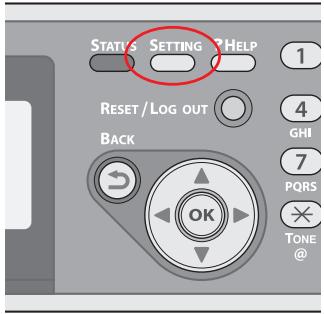
| 13. | SETTING: Pressing this button gives access to several setup options on the LCD screen, including the administrator menu, profile options and address books settings. |
| 14. | CLEAR: Executes the following actions according to the entered items when pressed or held: > Minimizes a setting value. > Enters zero as a setting value. > Clears what is entered. > Cancels a selected item. |
| 15. | DATA IN MEMORY indicator light LED illuminates to show data is stored in the MFP memory. |
| 16. | Arrow keys Up: moves the cursor up. Down: moves the cursor down. Left: moves the cursor left. Can also be used to return to the previous screen. Right: moves the cursor right. Can also be use to proceed to the next screen. |
| 17. | OK: Used to select and confirm current setting selections. |
| 18. | One-touch speed dial keys (MC361 and MC561 only): Provides one-touch dialling of your most often used or favourite fax numbers or email addresses. Eight keys x two groups (press the SHIFT key to switch the groups). |
| 19. | Panel lift handle (MC561 only): Lift panel to reveal qwerty keyboard. |
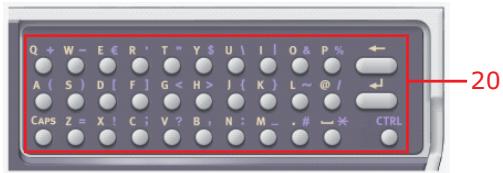
| 20. | Qwerty keyboard (MC561 only): Refer to "Qwerty keyboard (MC561 only)" on page 17. |
KEYPAD - CHARACTER SWITCHING
Numbers, upper and lower case letters and symbols can be entered using the keypad. Press the key multiple times to switch between characters.
NOTE
When pressing multiple times, you must re-press the key within 2 seconds of the previous press.
The example below is based on English being the display language:
| KEY | AVAILABLE CHARACTER |
| 1 | 1 -> 1 |
| 2 | a -> b -> c -> 2 -> A -> B -> C |
| 3 | d -> e -> f -> 3 -> D -> E -> F |
| 4 | g -> h -> i -> 4 -> G -> H -> I |
| 5 | j -> k -> l -> 5 -> J -> K -> L |
| 6 | m -> n -> o -> 6 -> M -> N -> O |
| 7 | p -> q -> r -> s -> 7 -> P -> Q -> R -> S |
| 8 | t -> u -> v -> 8 -> T -> U -> V |
| 9 | w -> x -> y -> z -> 9 -> W -> X -> Y -> Z |
| 0 | SP (space) -> 0 -> SP (space) |
| * | @ -> * -> @ |
| # | . -> __-> ---> P -> SP (space) -> + -> ! -> " -> $ -> % -> & -> ' -> ( -> ) -> , -> / -> : -> ; -> < -> = -> > -> ? -> [ -> £ -> ] -> ^ -> # |
QWERTY KEYBOARD (MC561 ONLY)
You can also enter upper and lower case letters and symbols using the qwerty keyboard.
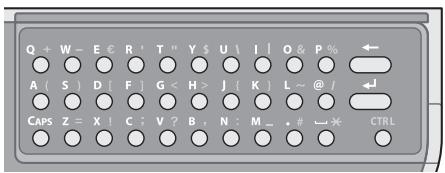
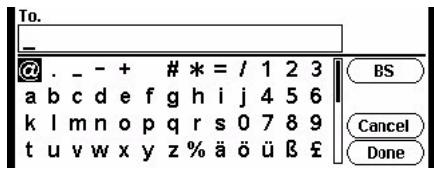
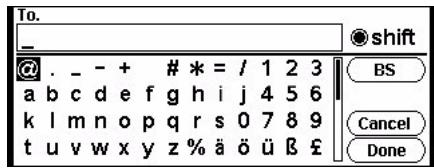
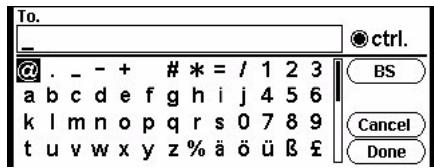
You can switch the entry mode from normal mode, CAPS mode and CTRL mode. The mode change is reflected on the screen keyboard display.
Normal mode You can enter lower-case letters.
CAPS mode By pressing the CAPS key, you can enter upper-case letters.
CTRL mode By pressing the CTRL key, you can enter symbols.
NOTE
Numbers and certain characters cannot be entered using the qwerty keyboard. To enter them, use the screen keyboard or keypad.
CHANGING THE DISPLAY LANGUAGE
The default language used by your MFP for display messages and for report printing is English1. If required, this can be changed using the Panel Language Setup utility.
GETTING STARTED
SWITCHING ON
- Check that the power switch is OFF.
- Plug the power cable into the power socket of your machine.
- Plug the power cable into the electric socket.
- Check that no documents are on the document glass or ADF, and the ADF cover is closed.
- Press the power switch ON.
SWITCHING OFF
CAUTION!
Do not turn off the power switch suddenly as this may damage your MFP.
If you have an SD card fitted, always follow the correct shutdown procedure to ensure that no data is lost.
Do not turn off while scanning is in progress.
- Press the SETTING button on the control panel to enter the menu.
- Using the arrow keys, scroll to the Shutdown menu.
- Press the OK button.
- Using the arrow keys, highlight Yes to continue or No to cancel.
- Press the OK button to execute.
- At the prompt, turn the power switch OFF.
POWER SAVING MODE
If you do not use the machine for a while, it will enter power saving mode to control the power consumption of the device. To cancel or initiate power saving mode, press the Power Save button on the control panel.
NOTE
If your machine is connected locally (via USB), when it transitions to Sleep mode its status is viewed as off-line. To use the printer in this state, you must press the Power Save button to exit sleep mode.
By default, the time interval to enter the power saving mode is set to 30 minutes. Refer to "Power Save Time" on page 161.
You can enable or disable the power saving mode. Refer to "Power Save Enable" on page 162.
SLEEP MODE
Your machine transitions from power saving mode to sleep mode after a set period of time. In sleep mode the power consumption of the device in minimal. To cancel or initiate sleep mode, press the Power Save button on the control panel.
NOTE
The machine will not enter sleep mode if an error occurs and the machine requires attention.
By default, the time interval to enter sleep mode is set to 10 minutes. Refer to "Sleep Time" on page 161.
You can enable or disable sleep mode. Refer to "Sleep" on page 162.
INSTALLING DRIVERS AND UTILITIES
NOTE
Example screenshots have been used throughout and may not represent your machine, however the procedure is the same.
NOTE
You must be logged on as an administrator or a member of the Administrators group in order to complete this procedure. If your computer is connected to a network, network policy settings may also prevent you from completing this procedure.
The installation instructions below refer to USB connection. For network connection details refer to the Configuration Guide.
If you are running Windows Server 2003 or Server 2008, you may need to follow these steps to ensure the WIA service starts when using the scanner driver and ActKey Utility:
NOTE
In the case of Server 2008, Desktop Experience needs to be installed.
- Click Start > Administrative Tools > Services.
- Double-click Services.
- Double-click Windows Image Acquisition (WIA).
- From the Startup type menu, select Automatic.
- Under Service status, click Start.
- Click OK.
WINDOWS - SCANNER AND PRINTER DRIVERS
The scanner driver is used for "Pull Scan", i.e. Initiating a scan from your PC via software. Compare this to "Push Scan" where you start the scan by pressing a button on the MFP's front panel.
NOTE
The Oki driver installer program is the recommended installation method.
NOTE
Do not connect the USB cable at this time. You will be instructed when to connect the USB cable when you run the Oki driver installer program.
- Insert the DVD-ROM and click Easy Installation to start the Oki driver installer program.
- Follow the on-screen instructions to install the drivers.
- Attach the printer to a USB port of your computer.
- Switch on the printer.
MAC - PRINTER DRIVER
The information in this section is based on Mac OS X Leopard (10.5). Other versions may appear slightly different, but the principles are the same.
- Insert the DVD-ROM and run the Oki driver installer program.
- Follow the on-screen instructions to install the printer driver.
- Attach the printer to a USB port of your computer.
- Switch on the printer.
- Choose Apple Menu > System Preferences > Print & Fax.
- If the printer is already in the list of printers, click " - " to remove it.
NOTE
This is necessary as Leopard may not be using the correct Oki printer driver files.
- Click "+" to add a new printer.
- Ensure:
The Default tab is selected and select your machine from the list.
Your machine is displayed as Kind "USB" in the list of available printers.
The Print Using: selection matches your machine. If "Generic PostScript Printer" is displayed, select a driver that matches.
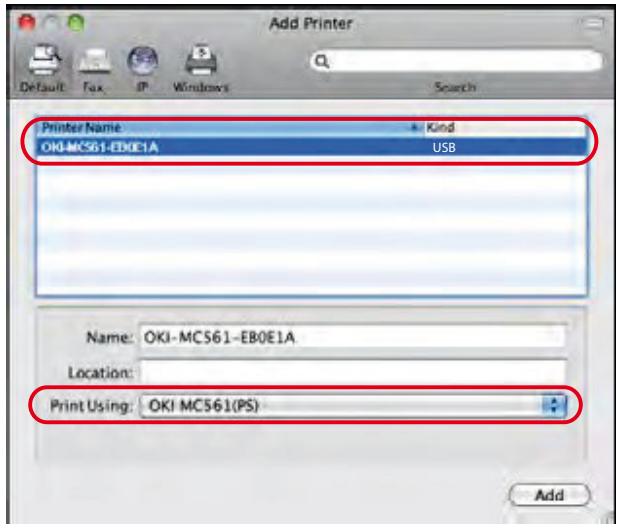
- Click Add.
- Click Configure... and ensure the hardware options displayed match your machine.
NOTE
Hardware options are not configured automatically.
- The printer is added to the list of printers.
- Restart your computer.
FAX DRIVER (MC361 AND MC561)
The fax driver allows you to send faxes directly from your computer without printing the document first.
Windows XP has built-in fax support - you can use your computer's modem to send faxes directly from your computer.
With Oki's fax driver you are sending the fax data from your computer to the MFP, and then the MFP automatically sends the document.
NOTE
Before using the internet fax function, you need to configure the server
settings. Refer to the Configuration Guide for details.
Installing the fax driver
This is installed as part of the Oki driver installer wizard.
CONFIGURATION TOOL
Installation of the Configuration Tool is optional and can be found on the DVD in the Utilities folder. Follow the on-screen instructions to complete the Configuration Tool installation.
The Configuration Tool can discover devices over USB or network connections.
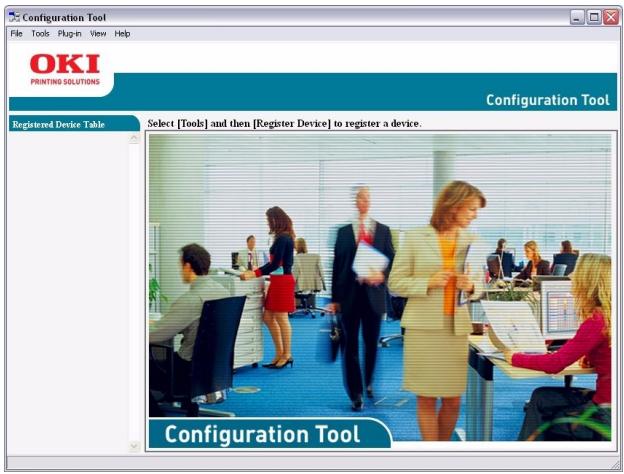
- To search and install, select Tools > Register Device.
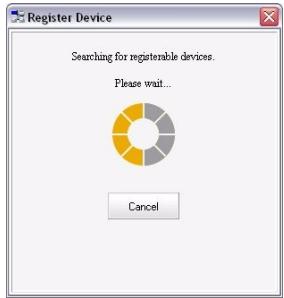
- Highlight the required search result and when prompted click Yes.
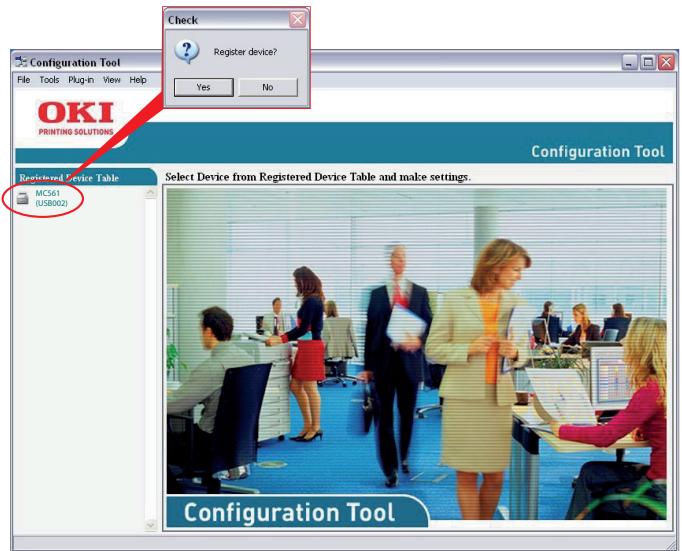
The Configuration Tool allows you to set up and manage your MFP. Refer to the Configuration Guide for detailed instructions.
NOTE
Network settings, such as LDAP configuration, cannot be saved to the MFP from the Configuration Tool. For such settings, use the MFP operator panel or MFP web page.
NOTE
The ActKey utility only supports Windows.
You must have the scanner driver installed.
The ActKey utility enables the MFP to receive one key touch commands from a connected computer.
Installation of the ActKey utility is optional and can be found on the DVD in the Utilities folder.
Information on using the ActKey utility can be found in "Scan to remote PC" on page 58.
Setting up the ActKey utility
- Install the ActKey utility from the DVD:
Set-up will place an "ActKey" icon on your desktop.
- Double-click this icon to open the ActKey console.
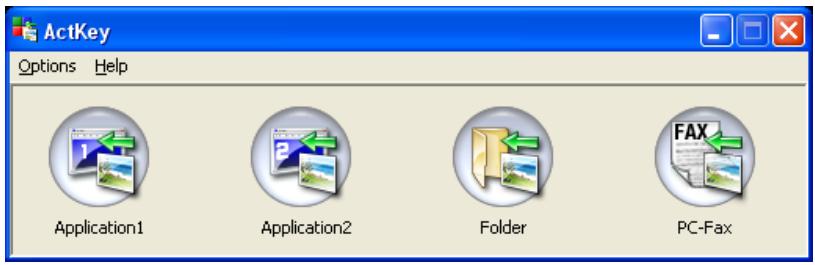
- Select Options > Button Settings. The following screen displays.
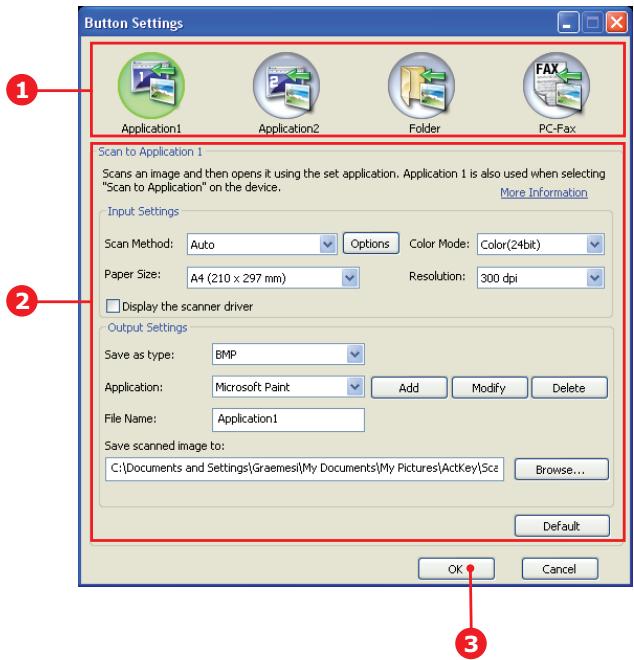
- Select the function you want to set in section (1).
- Set the parameters for this function in section (2).
-
When you have completed settings, press OK (3). The Utility will return to the ActKey console.
-
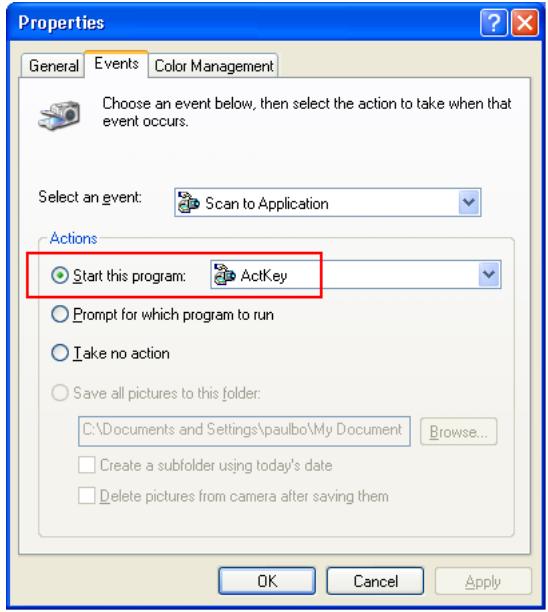
To use ActKey in Local PC mode (i.e. push scanning), it must be set as the program to handle scanner events:
NOTE
The following example uses Windows XP. The steps may vary if you are using any other operating system, but the principle is the same.
(a) Select Start > Control Panel.
(b) Double-click Scanners and Cameras.
(c) Right-click the MFP icon and click Properties.
(d) Select the Events tab.
(e) Choose an event from the Select an event drop-down menu.
(f) In the Actions field, click Start this program and choose ActKey from the drop-down menu.
(g) Click Apply.
(h) Repeat steps e to g for each event, e.g. Scan to Application, Folder and PC-Fax.
(i) Click OK to confirm.
PAPER RECOMMENDATIONS
Your MFP will handle a variety of print media, including a range of paper weights and sizes. This section provides general advice on choice of media, and explains how to use each type.
The best performance will be obtained when using standard 75 90g / m2 paper designed for use in copiers and laser printers.
Use of heavily embossed or very rough textured paper is not recommended.
Pre-printed stationery can be used, but the ink must not offset when exposed to the high fuser temperatures used in the printing process.
Envelopes
CAUTION!
Envelopes should be free from twist, curl or other deformations. They should also be of the rectangular flap type, with glue that remains intact when subjected to hot roll pressure fusing used in this type of printer. Window envelopes are not suitable.
Labels
CAUTION!
Labels should also be of the type recommended for use in copiers and laser printers, in which the base carrier page is entirely covered by labels. Other types of label stock may damage the printer due to the labels peeling off during the printing process.
CASSETTE TRAYS
| SIZE | DIMENSIONS | WEIGHT (G/M2) | |
| A6a | 105 x 148mm | Light | 64 - 74g/m2 |
| A5 | 148 x 210mm | Medium Light | 75 - 82g/m2 |
| B5 | 182 x 257mm | Medium | 83 - 104g/m2 |
| 16K (184x260mm) | 184 x 260mm | Heavy | 105 - 120g/m2 |
| Executive | 184.2 x 266.7mm | Ultra heavy1 | 121 - 176g/m2 |
| 16K (195x270mm) | 195 x 270mm | Ultra heavy2 | 177 - 220g/m2 |
| 16K (197x273mm) | 197 x 273mm | Tray 1/2: | 64 - 176g/m2 |
| A4 | 210 x 297mm | MP Tray: | 64 - 220g/m2 |
| Letter | 215.9 x 279.4mm | Duplex: | 64 - 176g/m2 |
| Legal 13in. | 216 x 330mm | ||
| Legal 13.5in. | 216 x 343mm | ||
| Legal 14in. | 216 x 356mm | ||
a. A6 printing from Tray 1 or the MP Tray only.
If you have identical paper stock loaded in another tray (2nd tray if you have one, or multi purpose tray) you have the printer automatically switch to the other tray when the current tray runs out of paper. When printing from Windows applications, this function is enabled in the driver settings. When printing from other systems, this function is enabled in the Print Menu. (See "Auto Tray Switch:" on page 149.)
MULTI PURPOSE TRAY
The multi purpose tray can handle the same sizes as the cassette trays but in weights up to 220g / m2 . For very heavy paper stock use the face up (rear) paper stacker. This ensures that the paper path through the printer is almost straight.
The multi purpose tray can feed paper widths from 76mm to 215.9mm and lengths from 127.0mm to 1320mm (banner printing).
For paper lengths exceeding 356mm (Legal 14in.) use paper stock between 90g / m2 and 128g / m2 and the face up (rear) paper stacker.
Use the multi purpose tray for printing on envelopes. Up to 10 envelopes can be loaded at one time, subject to a maximum stacking depth of 10mm .
FACE DOWN STACKER
The face down stacker on the top of the printer can hold up to 150 sheets of 80g / m2 standard paper, and can handle paper stocks up to 176g / m2 .
Pages printed in reading order (page 1 first) will be sorted in reading order (last page on top, facing down).
FACE UP STACKER
The face up stacker at the rear of the printer should be opened and the tray extension pulled out when required for use. In this condition paper will exit via this path, regardless of driver settings.
NOTE
The face up stacker cannot be used when printing duplex.
The face up stacker can hold up to 100 sheets of 80g / m2 standard paper, and can handle stocks up to 220g / m2 .
Always use this stacker and the multi purpose feeder for paper stocks heavier than 176g / m2
DUPLEX
Automatic two-sided printing on the same range of paper sizes as tray 2 (i.e. all cassette sizes except A6), using paper stocks from 64 - 176g / m2
LOADING PAPER
CASSETTE TRAYS
- Remove the paper tray from the machine.
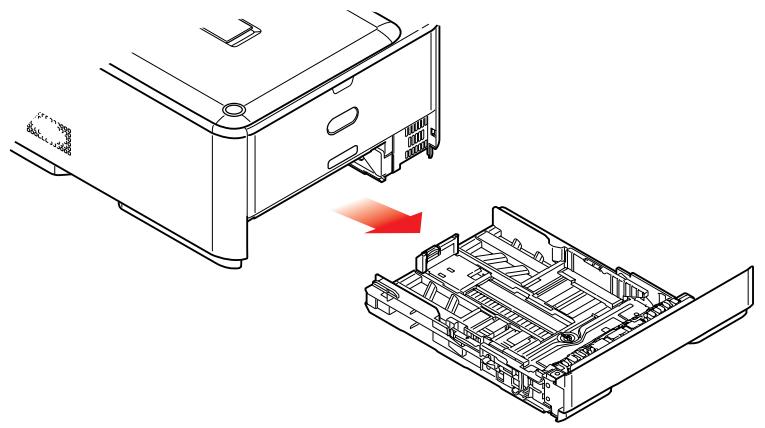
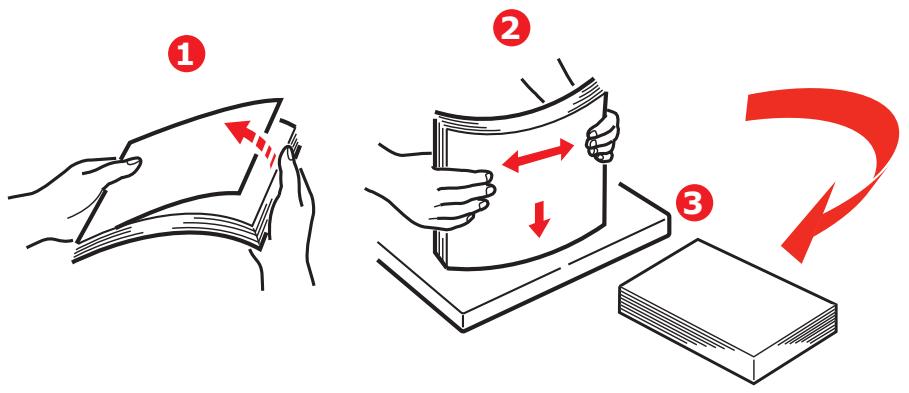
- Fan the paper to be loaded at the edges (1) and in the middle (2) to ensure that all sheets are properly separated, then tap the edges of the stack on a flat surface to make it flush again (3).
- Load paper (letter headed paper face down and top edge towards the front of the printer), as shown.
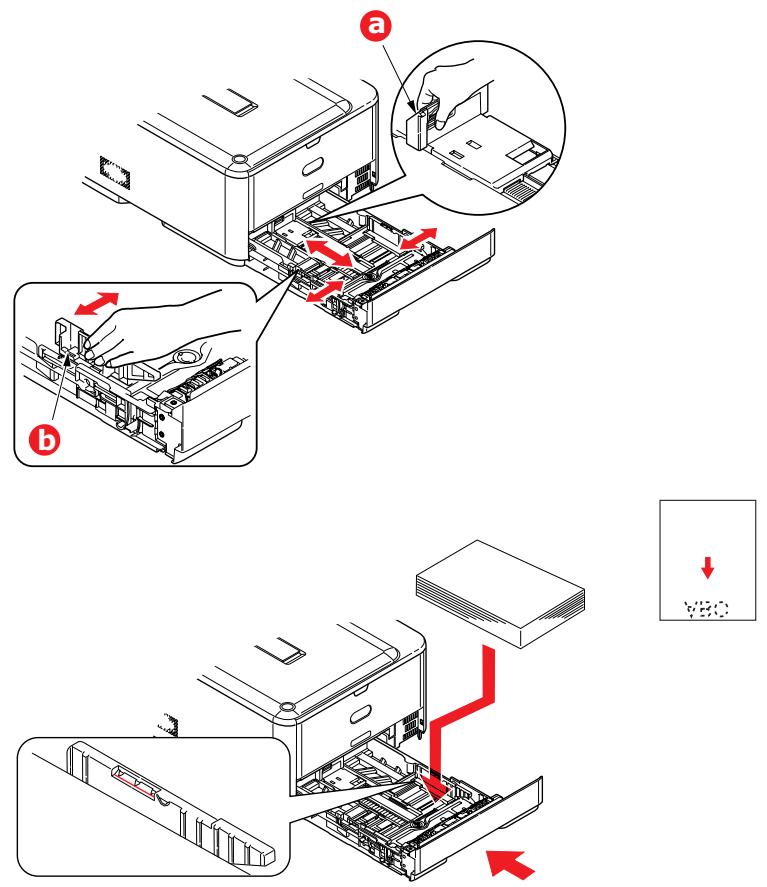
- Adjust the rear stopper (a) and paper guides (b) to the size of paper being used.
- Close the paper tray gently.
- Set the correct paper size. Refer to "Configuring the tray settings" on page 32 and "Registering custom sizes" on page 33.
To prevent paper jams:
Do not leave space between the paper and the guides and rear stopper.
Do not overfill the paper tray. Capacity depends on the type of paper stock.
Do not load damaged paper.
Do not load paper of different sizes or types at the same time.
Close the paper tray gently.Do not pull the paper tray out during printing (except as described below for the 2nd tray).
NOTE
If you have two trays and you are printing from the 1st (upper) tray, you can pull out the 2nd (lower) tray during printing to reload it. However, if you are printing from the 2nd (lower) tray, do not pull out the 1st (upper) tray. This will cause a paper jam.
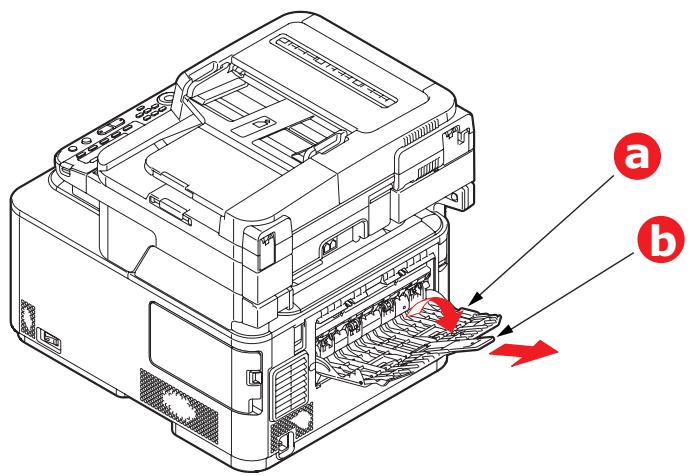
For face down printing, make sure the face up (rear) stacker (a) is closed (the paper exits from the top of the printer). Stacking capacity is approximately 150 sheets, depending on paper weight.
For face up printing, make sure the face up (rear) stacker (a) is open and the paper support (b) is extended. Paper is stacked in reverse order and tray capacity is approximately 100 sheets, depending on paper weight.
Always use the face up (rear) stacker for heavy paper (card stock, etc.).
CAUTION!
Do not open or close the rear paper exit while printing as it may result in a paper jam.
MULTI PURPOSE TRAY
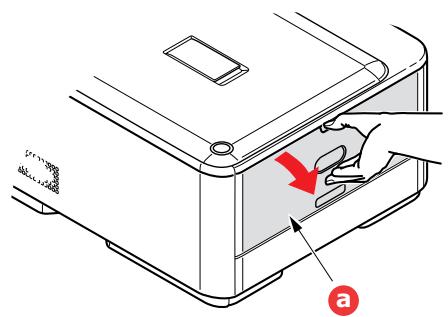
- Open the multi purpose tray (a).
- Fold out the paper supports (b).
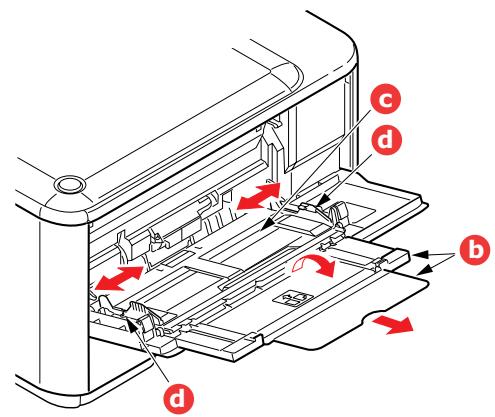
- Press gently down on the paper platform (c) to ensure it is latched down.
- Load the paper and adjust the paper guides (d) to the size of paper being used.
For single-sided printing on headed paper load the paper into the multi purpose tray with pre-printed side up and top edge into the printer.
For two-sided (duplex) printing on headed paper load the paper with pre-printed side down and top edge away from the printer.
Envelopes should be loaded face up with top edge to the left and short edge into the printer. Do not select duplex printing on envelopes.
Do not exceed the paper capacity of about 100 sheets or 10 envelopes. Maximum stacking depth is 10mm .
- Press the tray latch button inwards to release the paper platform, so that the paper is lifted and gripped in place.
- Set the correct paper size. Refer to "Configuring the tray settings" on page 32 and "Registering custom sizes" on page 33.
CONFIGURING THE TRAY SETTINGS
After you load paper in tray 1, tray 2 (optional), or the MP tray, you need to register the loaded paper on your machine.
- Press the SETTING button on the control panel.
- Using the Down arrow key, scroll to Paper Setup and press OK.
- Using the arrow keys, scroll to the required paper tray and press OK.
- Press OK to select Paper Size.
- Using the arrow keys, scroll to the loaded paper size and press OK.
- Using the Down arrow key, scroll to Media Type and press OK.
- Using the arrow keys, scroll to the type of media loaded and press OK.
- Using the Down arrow key, scroll to Media Weight and press OK.
- Using the arrow keys, scroll to the weight of the loaded paper and press OK.
- Press the Left arrow key to exit the menu.
REGISTERING CUSTOM SIZES
To load custom size paper, you need to register the width and length of the paper before printing.
The range of the sizes you can set differs according to the paper tray.
| TRAY | AVAILABLE SIZE RANGE |
| Tray 1 | Width: 105 to 216 mm (4.1 to 8.5 inches) Length: 148 to 356 mm (5.8 to 14.0 inches) |
| Tray 2 (optional) | Width: 148 to 216 mm (5.8 to 8.5 inches) Length: 148 to 356 mm (8.3 to 14.0 inches) |
| MP tray | Width: 64 to 216 mm (2.5 to 8.5 inches) Length: 127 to 1321 mm (5.0 to 52.0 inches) |
NOTE
For tray 1 and tray 2, you can configure the Custom setting only when Paper Size is set to Custom.
The available size range for duplex printing is the same as that for tray 2.
- Press the SETTING button on the control panel.
- Using the Down arrow key, scroll to Paper Setup and press OK.
- Using the arrow keys, scroll to the required paper tray and press OK.
- Using the Down arrow key, scroll to Custom and press OK.
- Using the keypad, enter the width and Length of the loaded paper. Press the Right arrow key to move between digits.
- Press OK.
- Press the Left arrow key to exit the menu.
USER AUTHENTICATION AND ACCESS CONTROL
If your Administrator has enabled access control on your machine, it will automatically start up in access control mode. You will not be able to use it until you have provided valid login information. If the access control setting is:
PIN; you will need to provide a valid PIN (personal identification number).
User name and password; you will need to provide a valid user name and password.
After using it, you will be expected to log out, leaving the machine in access control mode, unable to be used by unauthorised users.
PIN AUTHENTICATION
LOGGING INTO THE MACHINE
- Enter your PIN using the keypad on the control panel.
- Press OK.
If authentication succeeds, the top screen displays.
LOGGING OUT OF THE MACHINE
When you have finished operations, be sure to log out of the machine.
- Press the BACK button or Left arrow key until the top screen displays.
- Press the RESET/LOGOUT button on the control panel.
NOTE
After a certain period of time, the machine automatically logs out users.
USER NAME AND PASSWORD AUTHENTICATION
LOGGING INTO THE MACHINE
- Make sure that User Name is selected and then press the Right arrow key.
- Enter your name.
- Using the arrow keys, highlight Done and then press OK.
- Make sure that Password is selected and then press OK.
- Enter your password.
- Using the arrow keys, highlight Done and then press OK.
- At the Login screen, press OK.
If authentication succeeds, the top screen displays.
LOGGING OUT OF THE MACHINE
When you have finished operations, be sure to log out of the machine.
- Press the BACK button or Left arrow key until the top screen displays.
- Press the RESET/LOGOUT button on the control panel.
NOTE
After a certain period of time, the machine automatically logs out users.
NOTE
The authentication type specified on the computer overrides the one specified on the machine.
Printing from Windows
NOTE
You cannot use the PCL XPS printer driver for this function.
This procedure uses Windows 7 and NotePad as an example. The procedures and menus may differ depending on the OS you use.
- Open the file you want to print.
- From the File menu, select Print.
- Choose the printer driver you want in Select Printer and click Preferences.
- Select the Job Options tab.
- Click User Auth....
- Select the Enable User Authentication check box.
- Enter the user name inUsername and the password in Password.
Clicking Use Windows Login automatically enters your login name on Windows.
- Click OK.
- Click OK and then click Print.
Printing from Mac
NOTE
This procedure uses Mac OS X 10.6 as an example. The procedures and menus may differ depending on the OS you use.
- Open the file you want to print.
- From the File menu, select Print.
- Select your machine's printer driver.
- Select User Auth... from the panel menu under the Printer and Presets menus.
- Select the Enable User Authentication check box.
- Enter the user name in User Name and the password in Password.
- Click Print.
Faxing (Windows only)
NOTE
This procedure uses Windows 7 and NotePad as an example. The procedures and menus may differ depending on the OS you use.
- Open the file you want to fax.
- From the File menu, select Print.
- Select your machine (fax driver) in Select Printer and click Preferences.
- On the Setup tab, click User Authentication....
- Select the Enable User Authentication check box.
- Enter the user name inUsername and the password in Password.
Clicking Use Windows Login automatically enters your login name on Windows.
- Click OK.
- Click OK and then click Print.
OPERATION
With its intuitive control panel, this Multi Function Product (MFP) is designed to be easy to use. After the machine has been configured, operating is quite straight forward.
NOTE
If your Administrator has enabled access control on your machine, it will automatically start up in access control mode. You will not be able to use it until you have provided valid login information. Refer to "User authentication and access control" on page 34 for details.
The following sections describe how to copy, fax, and scan your documents.
NOTE
Fax function is available on the MC361 and MC561 only.
Refer to "Printing" on page 67 for details of how to use the printing options available from the control panel. For full details of how to use your machine and any optional accessories to print jobs efficiently and effectively, please refer to the Printing Guide and the Barcode Printing Guide.
For full details of how to access and use the security features, please refer to the Security Guide.
MULTI-TASKING
Your machine can handle more than one task at a time. The table below details which combination of tasks can be performed.
| 2nd1st | Copy | Scan to email/ network PCInternet Fax (Tx) | Scan to USB memory | Fax Tx | Fax Rx | Print from USB (direct print) | PC scan (remote PC) | Email to print Internet Fax (Rx) | Print Print from Web (direct print) |
| Copy | No | Yes | Yes | No | Yesa | Yesb | Yes | Yesa | Yesa |
| Scan to email/ network PCInternet Fax (Tx) | Yes | Yes | Yes | No | Yes | Yes | Yes | Yes | Yes |
| Scan to USB memory | No | No | No | No | Yes | No | No | Yes | Yes |
| Fax Tx | Yes | Yes | Yes | Yesc | No | Yes | Yes | Yes | Yes |
| Fax Rx | Nod | Yes | Yes | Yesc | No | Yesb | Yes | Yesa | Yesa |
| Print from USB (direct print) | No | Yes | Yes | Yes | Yesa | Yesb | Yes | Noe | Yesa |
| PC scan (remote PC) | No | No | No | No | Yes | No | No | Yes | Yes |
| Email to printInternet Fax (Rx) | No | Yes | Yes | Yes | Yes | Yesb | Yes | Noe | Yesa |
| PrintPrint from Web (direct print) | Nof | Yes | Yes | Yes | Yesa | Yesb | Yes | Yesa | Yesa |
a. Data is accepted but printing is halted until the 1st action is complete.
b. While only printing the first print action (scan is completed), the second action can be allowed to browse the files on the USB memory.
c. Operation is accepted but operation is halted until the 1st action is complete.
d. Copy is enabled only before the start of printing of a received fax image.
e. The second action won't be able to do due to less available memory.
f. Copy is enabled after completing the first print action.
LOADING DOCUMENT(S)
The MFP can scan/copy/send document(s) either from the ADF (Automatic Document Feeder) or on the glass. If you need to send multiple pages, load your papers in the ADF. The ADF can hold up to 50 pages at one time.
If you need to scan/copy/send pages from books, newspaper clippings, or paper with wrinkles or curls, place them on the glass.
DOCUMENT REQUIREMENTS
Before using the ADF, please make sure that your paper meets the following specifications:
Document(s) can range in size from 114.3 x 139.7mm to 215.9 x 355.6mm.
Document(s) can range in weight from 60 to 120g / m2
Document(s) should be square or rectangular and in good condition (not fragile or worn).
Document(s) should be free of curl, wrinkle, tears, wet ink, or punch holes.
Document(s) should be free of staples, paper clips, paper sticky notes.
Keep the glass clean and without any documents left on it.
NOTE
To transmit irregular types of document(s), place the document(s) on the glass or make a copy first and then transmit the copy instead.
When faxing, you can load only A4, letter, or legal size documents in the ADF, and A4 or letter size documents on the document glass. You cannot load mixed size documents.
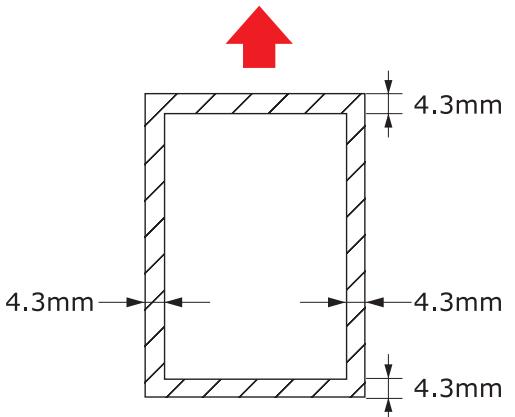
SCANNABLE AREA
Text or images within the shaded area are not scanned.
PLACING DOCUMENT(S) IN THE ADF
- If you have multiple pages, fan the pages to avoid paper jams. The ADF holds up to 50 pages at one time.
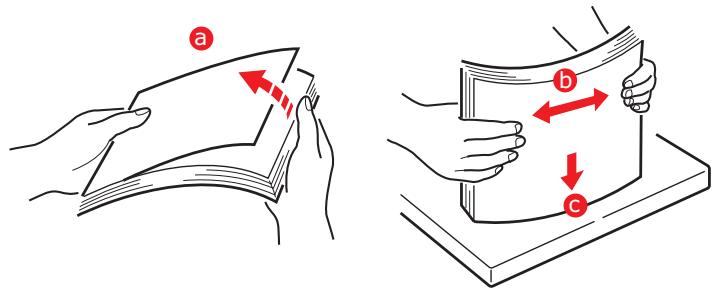
- Place the document with the text face UP in the ADF:
If your document is portrait, load with the top edge of the document in first.
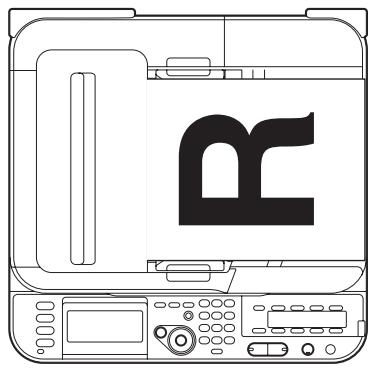
If your document is landscape, load with the left edge of the document in first.
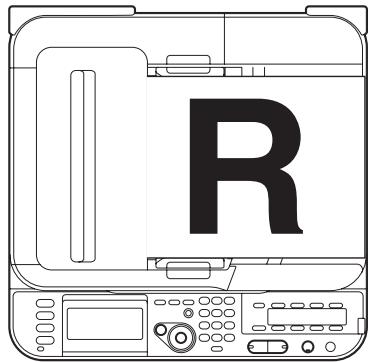
- Adjust the Paper Guides to centre the document in the ADF.
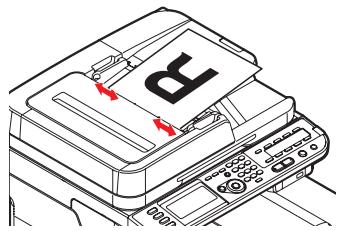
PLACING DOCUMENT(S) ON THE GLASS
- Open the document cover.
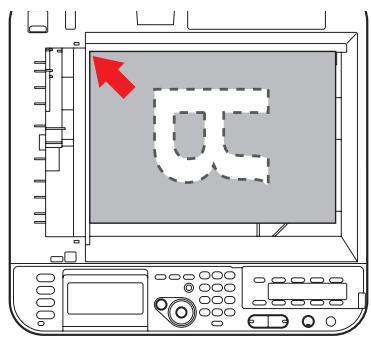
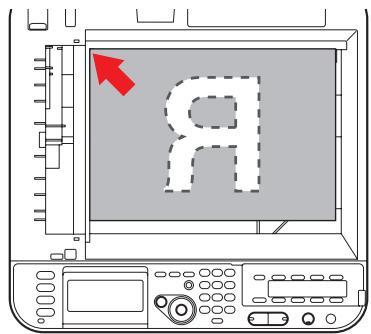
- Place your document with the text face DOWN on the glass:
If your document is portrait, align its top edge to the upper-left corner of the glass.
If your document is landscape, align its right edge to the upper-left corner of the glass.
- Close the document cover.
NOTE
If your Administrator has enabled access control on your machine, it will automatically start up in access control mode. You will not be able to use it until you have provided valid login information. Refer to "User authentication and access control" on page 34 for details.
BASIC OPERATION
- Place your document(s) with text face UP in the ADF or face DOWN on the glass.
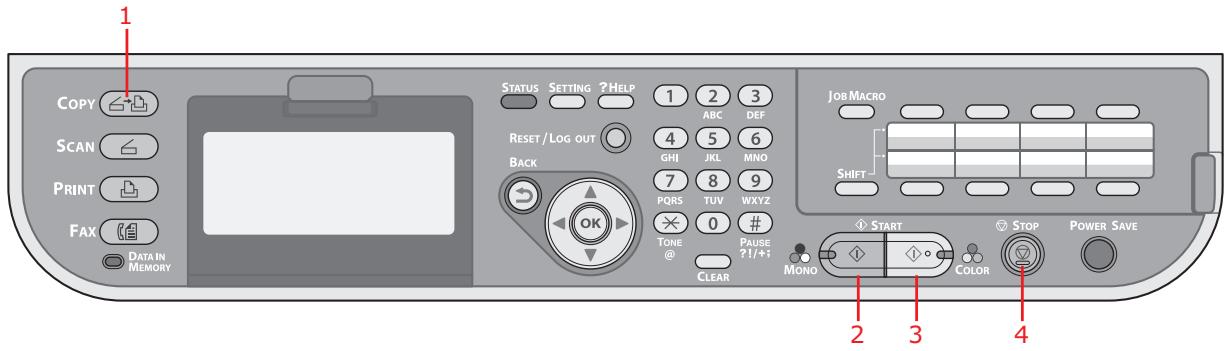
- If required, press the Copy button (1) on the control panel to prompt the Copy screen.
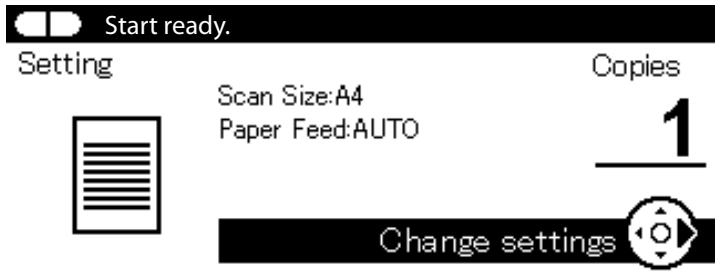
NOTE
Factory default setting is Copy mode.
- Press Mono (2) to copy your document(s) in black and white, or Colour (3) to copy your document(s) in colour.
NOTE
If you wish to cancel the copy process, press Stop (4) to abort the operation.
INCREASING COPY COUNT
The machine is preset to a copy count of 1. If you wish to increase the number of copies, select the number of copies with the numeric keypad.
To increase the copy count:
- If required, press the Copy button on the control panel to prompt the Copy screen.
- Enter number of copies required using the numeric keypad. The screen display will confirm the copy count selected.
NOTE
You can select up to 99 copies.
ADVANCED OPERATION
Using the options available you can alter the copy output to suit your needs:
- Press the Right arrow key.
- Select required parameter with Down arrow key and press the OK button or the Right arrow key to display the available options.
- Using Up or Down arrow keys, select value and press OK.
Options are (factory default settings in bold text):
| FEATURE | OPTION | DESCRIPTION | |
| Scan Size | A4, A5, A6, B5, Letter, Legal 13, Legal 13.5, Legal 14, Executive | Allows you to select the document size. | |
| Duplex Copy | OFF(Simplex), Simplex -> Duplex LE, Simplex -> Duplex SE, Duplex -> Duplex, Duplex LE -> Simplex, Duplex SE -> Simplex | Turns the duplex (2-sided) function off or on. | |
| Binding | Long Edge Bind, Short Edge Bind | Sets the default binding to LEF or SEF. Display condition: Duplex Copy is set to Duplex -> Duplex and N-up or Repeat is ON. | |
| Paper Feed | Auto, Tray 1(A4), Tray 2(A4)*, MP Tray(A4) | Allows you to define the paper tray for printing. Auto - Allows for automatic tray selection based on the document image size and/or scaling setting defined. * If fitted. | |
| Zoom | Auto, 100%, Zoom (25-400%), A4->A5(70%), Leg14->Let(78%), Leg13.5->Let(81%), Leg13->Let(84%), A4->B5(86%), A4->Let(94%), Let->A4(97%), Fit to page(98%), B5->A4(115%), A5->A4(141%) | Allows you to scale the copy using the presets values or by scaling in 1% increments up to 400% and down to 0 by entering the value using the keypad. | |
| Sort | ON, OFF | ON prints 1 entire copy/set of the multiple copy document at a time (e.g. pages 1,2,3,1,2,3,1,2,3,...) OFF batch prints the multiple copy document page by page (e.g. pages 1,1,1,2,2,2,3,3,3,...) | |
| FEATURE | OPTION | DESCRIPTION | |
| Image Settings | Density | -3, -2, -1, 0, +1, +2, +3 | Adjust density Darker: Keep colour intensity and darker image. Lighter: Reduce colour intensity and gives lighter image. |
| Document Type | Text, Text&Photo, Photo, Photo (Glossy) | Allows you to specify the type of images on the document. | |
| Scan Resolution | Normal, Extra Fine | Allows you to select the scanning resolution. The Extra Fine setting reproduces a higher resolution image with greater detail, however this requires more disk space. Note: In Mono copy mode, the resolution is fixed to Extra Fine. | |
| Background Removal | OFF, 1, 2, 3, 4, 5, 6 | Allows you to block out the colour background of the image (assuming document has a colour background) - such that the background colour is not printed. | |
| Contrast | -3, -2, -1, 0, +1, +2, +3 | Contrast setting High: Enhance brightness Low: Reduce brightness | |
| Hue | -3, -2, -1, 0, +1, +2, +3 | Red / green balance adjustment. Low: Enhance red. High: Enhance green. | |
| Saturation | -3, -2, -1, 0, +1, +2, +3 | Saturation setting High: Enhance image sharpness Low: Reduce hue | |
| RGB | Red: -3, -2, -1, 0, +1, +2, +3 Green: -3, -2, -1, 0, +1, +2, +3 Blue: -3, -2, -1, 0, +1, +2, +3 | Adjust RGB contrast settings. Use the arrow keys to increment and decrement the values and to move to the next colour setting. | |
| Direction | Portrait, Landscape | Selects the default page orientation. | |
| N-In-1 | OFF2-in-14-in-1: Vertical4-in-1: Horizontal | Allows you to print multiple pages of the document to a single sheet of paper.2-n-1 layout orientation and image order is fixed. If you specify 4-in-1 you can specify horizontal or vertical orientation. If you specify 2-in-1 or 4-in-1, set your original documents on the ADF, alternatively enable Continue Scan mode and use the document glass (see "Continue Scan" on page 45). | |
| Repeat | OFFx2x4 | Allows you to print multiple images of an original document on a single sheet. | |
| ID Card Copy | ON, OFF | Allows you to set ID card copying as the default copy mode. | |
| FEATURE | OPTION | DESCRIPTION | |
| Continue Scan | ON, OFF | Allows you to continue scanning more documents. Allows you to construct a single scan job from multiple individual sheets or originals. | |
| Mixed Size | ON, OFF | Allows you to load originals of same width but different length in the ADF. The following document sizes can be set concurrently; A3 and A4 LEF, B4 and B5 LEF, A4SEF and A5 LEF. When enabled, the tray setting is automatic, you cannot specify a tray manually. | |
| Margin | ON, OFF | Allows you to change the document top and left margin areas. Input range: -25 to +25mm. | |
| Edge Erase | ON, OFF | Allows you to block out the peripheral areas of the document where spurious shadows and borders may arise when copying with the document cover open (such as with books and magazines) or for other purposes. Input range: 5 to 50mm. | |
- Press the Left arrow key or Back button to return to the start menu.
- If access control is enabled, logout once you are finished to avoid any unauthorised access.
RESETTING COPY SETTINGS
AUTORESET
All settings you configured for your copy job return to their default values if no operation is made for a set period of time.
The factory default setting is 3 minutes. Refer to "Operation Timeout" on page 160.
USING THE RESET/LOGOUT BUTTON
By pressing the RESET/LOGOUT button, the settings you configured for your copy job return to their default values.
After copying, press the RESET/LOGOUT key to reset the default settings for the next user.
NOTE
If your Administrator has enabled access control on your machine, it will automatically start up in access control mode. You will not be able to use it until you have provided valid login information. Refer to "User authentication and access control" on page 34 for details.
- Place your document(s) with text face UP in the ADF or face DOWN on the glass.
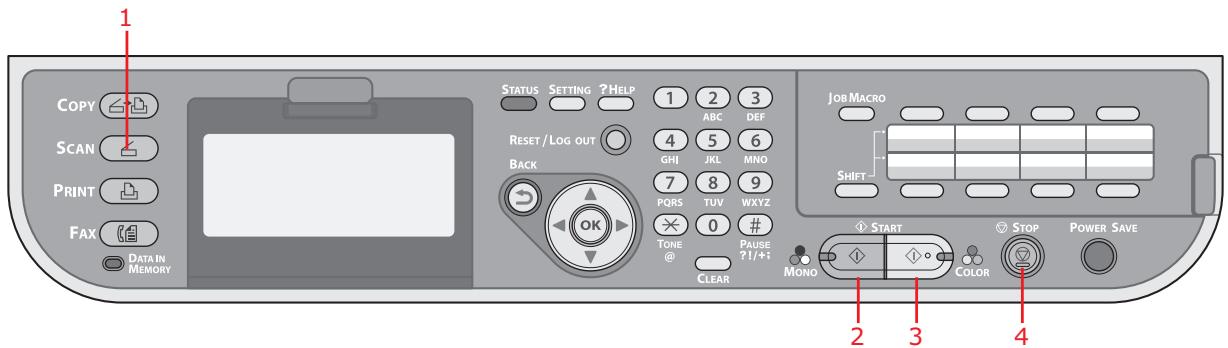
- Press the Scan button (1) on the control panel to prompt the Scan Menu screen.
- Select the scan destination from the following options:
Network PC
USB Memory
Local PC
RemotePC
NOTE
Local PC; select target application from the control panel on the MFP.
Remote PC; select target application from utility on your PC.
- Set your scanning options as required. For further details refer to the following sections.
- Press Mono (2) to scan your document(s) in black and white, or Colour (3) to scan your document(s) in colour.
NOTE
If you wish to cancel the scan process, press Stop (4) to abort the operation.
NOTE
For illustration purposes only, the features shown are as accessed from the control panel.
Using the options available, you can enter e-mail information and alter the scan output to suit your needs:
- Place your document(s) with text face UP in the ADF or face DOWN on the glass.
- Press the Scan button on the control panel to prompt the Scan Menu screen.
- If required, use the arrow keys and scroll to E-mail, then press OK.
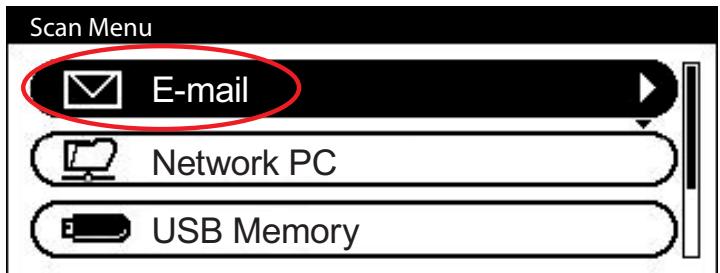
- Using the options available, you can enter e-mail destination(s) and alter the scan output to suit your needs.
| FEATURE | OPTION | DESCRIPTION | ||
| Destination | ||||
| Add Destination | To:Cc:Bcc: | Address Book | Select e-mail address from the address book.Input range: 001-100 | |
| E-mail Group List | Select destination group from the list.Input range: 01-20 | |||
| E-mail Send History | Displays the list of sent e-mails. | |||
| Direct Input | Enter e-mail address using the on-screen keyboard. | |||
| LDAP | Simple Search | Use the on-screen keyboard to enter a search value. | ||
| Advanced Search Search Method:User Name:E-mail Address: | Use Advanced Search to search the LDAP address book by user name and/or e-mail address.Can display up to 100 addresses. | |||
| Scan Settings | Scan Size | A4, A5, A6, B5, Letter, Legal 13, Legal 13.5, Legal 14, Executive | Allows you to select the scan size. | |
| Duplex Scan | OFF, Long Edge Bind, Short Edge Bind | Select the bound originals binding position. | ||
| Scan Settings (cont.) | Image Settings | Density | -3, -2, -1, 0, +1, +2, +3 | Adjust density Darker: Keep colour intensity and darker image. Lighter: Reduce colour intensity and gives lighter image. |
| Document Type | Text, Text&Photo, Photo, Photo (Glossy) | Allows you to specify the type of images on the document. | ||
| Resolution | 75dpi, 100dpi, 150dpi, 200dpi, 300dpi, 400dpi, 600dpi | Allows you to select the appropriate resolution. Remember the higher the resolution the bigger the file size! | ||
| Background Removal | OFF, 1, 2, 3, 4, 5, 6 | Allows you to block out any unintended background colour. | ||
| Contrast | -3, -2, -1, 0, +1, +2, +3 | Contrast setting High: Enhance brightness Low: Reduce brightness | ||
| Hue | -3, -2, -1, 0, +1, +2, +3 | Red / green balance adjustment. Low: Enhance red. High: Enhance green. | ||
| Saturation | -3, -2, -1, 0, +1, +2, +3 | Saturation setting High: Enhance image sharpness Low: Reduce hue | ||
| RGB | Red: -3, -2, -1, 0, +1, +2, +3 Green: -3, -2, -1, 0, +1, +2, +3 Blue: -3, -2, -1, 0, +1, +2, +3 | Adjust RGB contrast settings. Use the arrow keys to increment and decrement the values and to move to the next colour setting. | ||
| Reply To | Address Book | Select e-mail address from the address book. Input range: 001-100 | ||
| Direct Input | Enter e-mail address using the on-screen keyboard. | |||
| LDAP | Simple Search | Use the on-screen keyboard to enter a search value. | ||
| Advanced Search Search Method: User Name: E-mail Address: | Use Advanced Search to search the LDAP address book by user name and/or e-mail address. Can display up to 100 addresses. | |||
| Scan Settings (cont.) | Edit E-mail | Subject | Select Subject | Enter new or edit the default e-mail subject and text templates.For further details refer to "Creating e-mail templates" on page 63. |
| Direct Input | ||||
| E-mail Body | Select Text | |||
| Direct Input | ||||
| File Name | User defined | Use the on-screen keyboard to enter an appropriate file name. | ||
| Continue Scan | ON, OFF | Allows you to continue scanning more documents. Allows you to construct a single scan job from multiple individual sheets or originals. Refer to "Continuous scan mode" on page 94 for details. | ||
| Greyscale | ON, OFF | Select ON to print in grayscale. | ||
| File Format | Colour:PDF, TIFF, JPEG, XPSMono (Grayscale):PDF, TIFF, JPEG, XPSMono (Binary):PDF, TIFF, XPS | Select the appropriate file format. | ||
| Encrypted PDF | Not EncryptEncrypt | Low, Medium, High | Select the appropriate encryption level. | |
| Compression Rate | Color:High, Medium, LowMono (Grayscale):High, Medium, LowMono (Binary):High, Medium, Raw | Select the appropriate compression level.Note:Mono (Binary);High = G4Medium = G3 | ||
| Edge Erase | ON, OFF | Use the keypad to enter the width settings.Input range: 5 to 50mm | ||
| E-mail Send History | Displays the list of sent e-mails. | |||
NOTE
If you want to use the address book or group list features, be sure to register the e-mail addresses in advance. Refer to "Managing the address book" on page 62.
This machine allows you to send scanned document(s) to multiple e-mail addresses. Simply select the destination you require and press OK, then repeat until all the destinations you require are selected.
Up to 48 characters can be entered in the "Destination", "Reply to" and the "Subject" fields.
If the administrator has set SMTP or POP3 authentication, after sending your scanned document to e-mail addresses, and if no more transmission is required, log out of the system. This is to prevent misuse of the user's e-mail account for sending e-mails. If there is no other operation within 3 minutes, the system will log out automatically.
- Press the Mono button to scan your document(s) in black and white, or the Colour button to scan your document(s) in colour.
| NOTE If you wish to cancel the scan process, press the Stop button to abort the operation. |
| On completion the machine will beep and a confirmation message displays. |
| NOTE MDN (message disposition notification) and DSN (delivery status notification) can enabled/disabled by the administrator. Refer to "MDN Response" on page 148. |
- If access control is enabled, logout once you are finished to avoid any unauthorised access.
NOTE
The MFP must be connected to a Network server to enable Scan to Network PC to be set up. Refer to the Configuration Guide for details.
Before sending your document to a file server, profiles should be set up first to speed up the process. A profile contains a list of filing parameters such as your filing protocol, directory, file name and other scanning parameters.
NOTE
Profiles can be created and managed using the machine's web page or the MFP Setup Tool.
You can create up to 50 profiles. Refer to "Managing profiles" on page 60.
- Place your document(s) with text face UP in the ADF or face DOWN on the glass.
- Press the Scan button on the control panel to prompt the Scan Menu screen.
- Using the Down arrow key, scroll to Network PC and press OK.
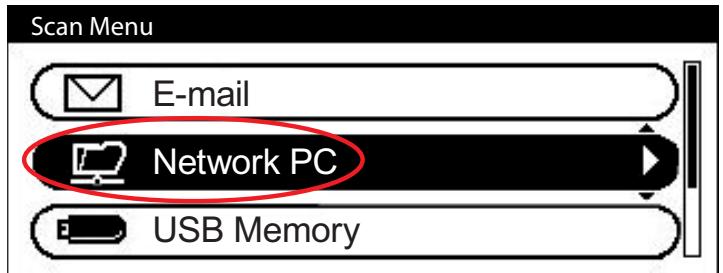
- Using the Down arrow key, scroll to Select Profile and press OK.
The list of registered profiles displays.
- Using the Down arrow key, scroll to the required profile and press OK.
- Using the Down arrow key, scroll to Scan Setting and press OK.
Using the options available, you can enter network information and alter the scan out put to suit your needs.
| FEATURE | OPTION | DESCRIPTION | |
| Scan Size | A4, A5, A6, B5, Letter, Legal 13, Legal 13.5, Legal 14, Executive | Allows you to select the scan size. | |
| Duplex Scan | OFF, Long Edge Bind, Short Edge Bind | Select the bound originals binding position. | |
| FEATURE | OPTION | DESCRIPTION | |
| Image Settings | Density | -3, -2, -1, 0, +1, +2, +3 | Adjust density Darker: Keep colour intensity and darker image. Lighter: Reduce colour intensity and gives lighter image. |
| Document Type | Text, Text&Photo, Photo, Photo (Glossy) | Allows you to specify the type of images on the document. | |
| Background Removal | OFF, 1, 2, 3, 4, 5, 6 | Allows you to block out the colour background of the image (assuming document has a colour background) - such that the background colour is not printed. | |
| Resolution | 75dpi, 100dpi, 150dpi, 200dpi, 300dpi, 400dpi, 600dpi | Allows you to select the appropriate resolution. Remember the higher the resolution the bigger the file size! | |
| Contrast | -3, -2, -1, 0, +1, +2, +3 | Contrast setting High: Enhance brightness Low: Reduce brightness | |
| Hue | -3, -2, -1, 0, +1, +2, +3 | Red / green balance adjustment. Low: Enhance red. High: Enhance green. | |
| Saturation | -3, -2, -1, 0, +1, +2, +3 | Saturation setting High: Enhance image sharpness Low: Reduce hue | |
| RGB | Red: -3, -2, -1, 0, +1, +2, +3 Green: -3, -2, -1, 0, +1, +2, +3 Blue: -3, -2, -1, 0, +1, +2, +3 | Adjust RGB contrast settings. Use the arrow keys to increment and decrement the values and to move to the next colour setting. | |
| File Name | User defined | Use the on-screen keyboard to enter an appropriate file name. | |
| Subfolder | User defined | Enter the subdirectory where the scanned document will be stored. | |
| Continue Scan | ON, OFF | Allows you to continue scanning more documents. Allows you to construct a single scan job from multiple individual sheets or originals. Refer to“Continuous scan mode” on page 94 for details. | |
| Greyscale | ON, OFF | Select ON to print in grayscale. | |
| File Format | Colour: PDF, TIFF, JPEG, XPS Mono (Grayscale): PDF, TIFF, JPEG, XPS Mono (Binary): PDF, TIFF, XPS | Select the appropriate file format. | |
| Encrypted PDF | Not Encrypt Encrypt | Low, Medium, High | Select the appropriate encryption level. |
| FEATURE | OPTION | DESCRIPTION |
| Compression Rate | Color: High, Medium, Low Mono (Grayscale): High, Medium, Low Mono (Binary): High, Medium, Raw | Select the appropriate compression level. Note: Mono (Binary): High = G4 Medium = G3 |
| Edge Erase | ON, OFF | Use the keypad to enter the width settings. Input range: 5 to 50mm |
- Press the Mono button to scan your document(s) in black and white, or the Colour button to scan your document(s) in colour.
NOTE
If you wish to cancel the scan process, press the Stop button to abort the operation.
On completion the machine will beep and a confirmation message displays.
- If access control is enabled, logout once you are finished to avoid any unauthorised access.
SCAN TO USB MEMORY
- Plug the USB memory into the USB port at the front of the machine.
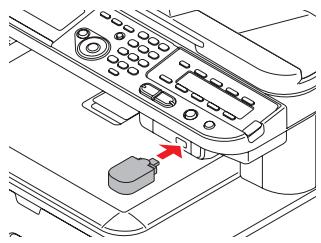
- Place your document(s) with text face UP in the ADF or face DOWN on the glass.
- Press the Scan button on the control panel to prompt the Scan Menu screen.
- Using the Down arrow key, scroll to USB Memory and press OK.
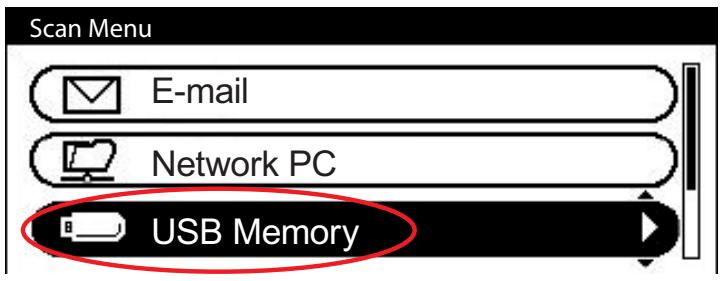
Using the options available, you can enter a file name and alter the scan output to suit your needs.
| FEATURE | OPTION | DESCRIPTION | |
| Scan Size | A4, A5, A6, B5, Letter, Legal 13, Legal 13.5, Legal 14, Executive | Allows you to select the scan size. | |
| Duplex Scan | OFF, Long Edge Bind, Short Edge Bind | Select the bound originals binding position. | |
| Image Settings | Density | -3, -2, -1, 0, +1, +2, +3 | Adjust density Darker: Keep colour intensity and darker image. Lighter: Reduce colour intensity and gives lighter image. |
| Document Type | Text, Text&Photo, Photo, Photo (Glossy) | Allows you to specify the type of images on the document. | |
| Background Removal | OFF, 1, 2, 3, 4, 5, 6 | Allows you to block out the colour background of the image (assuming document has a colour background) - such that the background colour is not printed. | |
| Resolution | 75dpi, 100dpi, 150dpi, 200dpi, 300dpi, 400dpi, 600dpi | Allows you to select the appropriate resolution. Remember the higher the resolution the bigger the file size! | |
| Contrast | -3, -2, -1, 0, +1, +2, +3 | Contrast setting High: Enhance brightness Low: Reduce brightness | |
| Image Settings (cont.) | Hue | -3, -2, -1, 0, +1, +2, +3 | Red / green balance adjustment. Low: Enhance red. High: Enhance green. |
| Saturation | -3, -2, -1, 0, +1, +2, +3 | Saturation setting High: Enhance image sharpness Low: Reduce hue | |
| RGB | Red: -3, -2, -1, 0, +1, +2, +3 Green: -3, -2, -1, 0, +1, +2, +3 Blue: -3, -2, -1, 0, +1, +2, +3 | Adjust RGB contrast settings. Use the arrow keys to increment and decrement the values and to move to the next colour setting. | |
| File Name | User defined | Use the on-screen keyboard to enter an appropriate file name. | |
| Continue Scan | ON, OFF | Allows you to continue scanning more documents. Allows you to construct a single scan job from multiple individual sheets or originals. Refer to "Continuous scan mode" on page 94 for details. | |
| Greyscale | ON, OFF | Select ON to print in grayscale. | |
| File Format | Colour: PDF, TIFF, JPEG, XPS Mono (Greyscale): PDF, TIFF, JPEG, XPS Mono (Binary): PDF, TIFF, XPS | Select the appropriate file format. | |
| Encrypted PDF | Not Encrypt Encrypt | Low, Medium, High | Select the appropriate encryption level. |
| Compression Rate | Color: High, Medium, Low Mono (Greyscale): High, Medium, Low Mono (Binary): High, Medium, Raw | Select the appropriate compression level. Note: Mono (Binary); High = G4 Medium = G3 | |
| Edge Erase | ON, OFF | Use the keypad to enter the width settings. Input range: 5 to 50mm | |
- Press the Mono button to scan your document(s) in black and white, or the Colour button to scan your document(s) in colour.
NOTE
If you wish to cancel the scan process, press the Stop button to abort the operation.
On completion a confirmation message displays.
- Remove the USB memory from the machine.
- If access control is enabled, logout once you are finished to avoid any unauthorised access.
SCAN TO LOCAL PC
You can save scanned data into your local computer. When you press the START button, the scan job starts and the ActKey utility and the scanner driver start automatically. You can send the scanned document to a specified application, save it into a specified folder, or send it by fax. The machine can be connected to USB interface or network, but only one computer can be connected at the same time. Refer to the Configuration Guide for details.
NOTE
The scan to local PC function is available for Windows only.
Ensure that the Actkey Utility is installed and set up first.
User action is performed at the MFP (Push Scan).
- Place your document(s) with text face UP in the ADF or face DOWN on the glass.
- Press the Scan button on the control panel to prompt the Scan Menu screen.
- Using the Down arrow key, scroll to Local PC and press OK.
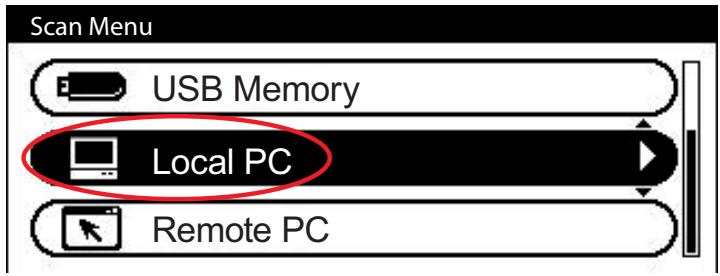
- If required, use the arrow keys to highlight Select A Connecting PC and press OK.
- Using the arrow keys, highlight the appropriate connection option and press OK. Choose either:
From Network
From USB Interface
- Using the Down arrow key, highlight Select An Application and press OK.
The Select An Application screen displays the following options:
Application
Folder
PC-FAX
- Select the option you require, followed by the Colour/Mono button to start scanning.
(a) Application
When the Application function is selected the PC's Actkey Utility executes PC Scan in accordance with your settings for "Scan to Application1". The scanned image data is opened in the application specified by the Actkey Utility for Application 1.
(b) Folder
When the Folder function is selected the Actkey Utility executes PC Scan in accordance with your settings for "Scan to Folder". The scanned image data is saved in the specified folder.
(c) Fax
When the PC-Fax function is selected, the Actkey Utility executes PC Scan in accordance with your settings for "Scan to PC-Fax". The scanned image data is saved in the specified folder and is ready for the software to send as an attachment. Complete the data on screen and send.
ACTKEY INTERFACE
Double click the Actkey Icon on your desktop. The Actkey console (below) displays.
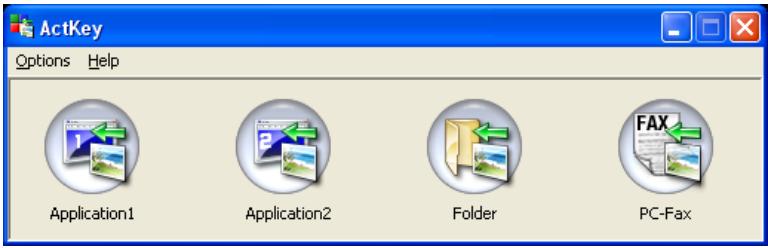
The functions below, can now be controlled from the PC:
Scan to Application1
Scan to Application2
Scan to Folder
Scan to PC-Fax
As the cursor passes over an icon, the parameters set for that icon appear in a text box. A single click will select that option.
"Scan to Application2" works exactly the same as scan to Application1, simply allowing an alternative application to be selected.
NOTE
By default the PC scan mode is set to simple. To enable Secure Scan Mode refer to "PC Scan Mode" on page 149.
NOTE
After Remote PC is selected, user action is performed at your PC (Pull Scan).
NOTE
The example below is relevant to a machine being connected via USB.
The instructions below use PaperPort® 11 SE (supplied with your machine) as an example. If you use an alternative application, the instructions and user interface will differ.
Only the basic instructions are included here; for full instructions on how to use PaperPort® 11 SE, refer to the documentation that accompanies the utility.
The following example is based on your printer being connected via USB.
- At the MFP: Place your document(s) with text face UP in the ADF or face DOWN on the glass.
- Press the Scan button on the control panel to prompt the Scan Menu screen.
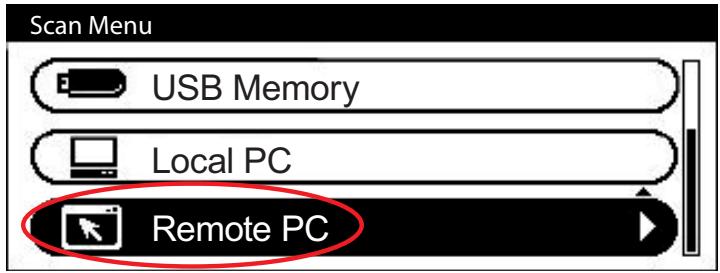
- Using the Down arrow key, scroll to Remote PC and press OK.
- At your PC: Start your scanning application.
- Select the File menu and choose Scan or Get Photo.
A dialogue box with a list of scanning sources displays.
- Select TWAIN: OKI MC361_561 Twain.
You need to select the source only once, unless you want to choose another scanner.
- Select a profile. Choose from:
- Press the Scan button to display the scanning options.
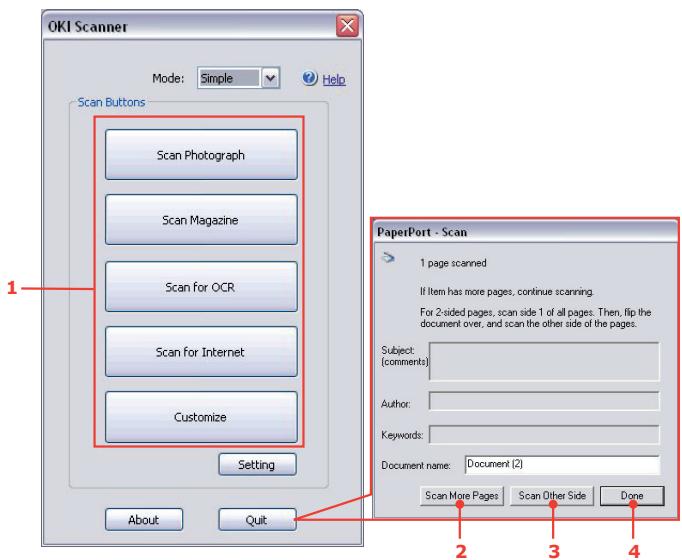
-
Press the required scan button (1) to start scanning.
-
Press Quit to continue:
(a) Press Scan More Pages (2) to continue scanning further documents.
(b) Press Scan Other Side (3) to scan the reverse side of the original document.
(c) Press Done (4) to finish scanning.
MANAGING PROFILES
ADDING A NEW NETWORK PROFILE
Register the information you configured on the computer as a profile. It is necessary when you perform Scan To Network PC with the computer.
- Press the SETTING button on the control panel to prompt the Setting screen.
- Using the Down arrow key, scroll to Profile and press OK.
- Select the desired profile number.
- Press the Right arrow key to prompt the Operation Menu screen.
From here you can register or sort profiles.
- When registering a new profile, press the Right arrow key to prompt the Profile screen.
- Ensure Profile Name: is highlighted then press the Right arrow key.
- Using the arrow keys and on-screen keypad, enter a suitable profile name.
NOTE
MC561 only: You can also use the qwerty keyboard to enter details.
- Using the arrow keys, highlight Done and press OK.
- Using the Down arrow key, scroll to Target URL then press the Right arrow key.
- Using the arrow keys and on-screen keypad, enter the name of the destination computer and the shared folder name as "\name of the destination computer\shared folder name".
- Using the arrow keys, highlight Done and press OK.
- Using the Down arrow key, scroll to User Name then press the Right arrow key.
- Using the arrow keys and on-screen keypad, enter a suitable user name.
NOTE
If domain management is done, enter "user name@domain name".
- Using the arrow keys, highlight Done and press OK.
- Using the Down arrow key, scroll to Password then press the Right arrow key.
- Using the arrow keys and on-screen keypad, enter a suitable password.
- Using the arrow keys, highlight Done and press OK.
- Using the Down arrow key, scroll to File Name then press the Right arrow key.
- Using the arrow keys and on-screen keypad, enter a suitable file name.
NOTE
You can enter up to 64 characters.
By adding "#n" to the end of the file name, a serial number is automatically assigned to the end of the name of sent files.
By adding "#d" to the end of the file name, a date is automatically assigned to the end of the name of sent files.
- Using the arrow keys, highlight Done and press OK.
-
Configure other items if necessary, for example: \PC1\SalesDev
-
Press OK to register the settings and save the profile entry.
The setup for Scan To Network PC is complete.
DELETING A NETWORK PROFILE
To delete a network profile:
- Press the SETTING button on the control panel to prompt the Setting screen.
- Using the Down arrow key, scroll to Profile List and press OK.
- Select the desired profile number.
- Ensure Delete is highlighted then press the Right arrow key.
- At the prompt:
press OK to continue deleting the profile entry,
or...
use the Right arrow key to highlight No, then press OK to cancel.
MANAGING THE ADDRESS BOOK
SETTING SENDER AND REPLY TO E-MAIL ADDRESSES (FROM/REPLY TO)
You can set the e-mail address from which e-mails are sent and the address to which responses are sent.
- Press the SETTING button on the control panel.
- Using the Down arrow key, scroll to Admin Setup and then press OK.
- Using the arrow keys and on-screen keyboard, enter the administrator password.
NOTE
The default password is "aaaaa".
MC561 only: You can also use the qwerty keyboard to enter details.
- Select Done and then press OK.
- Using the Down arrow key, scroll to Scanner Setup and then press OK.
- Using the Down arrow key, scroll to E-mail Setup and then press OK.
- Using the Down arrow key, scroll to From/Reply to and then press OK.
- Using the Down arrow key, scroll to From or Reply to and then press OK.
- Using the on-screen keyboard, enter the e-mail address up to 48 characters.
NOTE
MC561 only: You can also use the qwerty keyboard to enter details.
- Select Done and then press OK.
NOTE
You can select e-mail addresses from the address book.
- Using the Down arrow key, scroll to Close and then press OK.
- Press the RESET/LOGOUT button.
CREATING E-MAILTEMPLATES
You can create up to five e-mail templates with various subject lines and body text.
Registering a subject
- Press the SETTING button on the control panel.
- Using the Down arrow key, scroll to Admin Setup and then press OK.
- Using the arrow keys and on-screen keyboard, enter the administrator password.
NOTE
The default password is "aaaaa".
MC561 only: You can also use the qwerty keyboard to enter details.
- Select Done and then press OK.
- Using the Down arrow key, scroll to Scanner Setup and then press OK.
- Using the Down arrow key, scroll to E-mail Setup and then press OK.
- Using the Down arrow key, scroll to Template and then press OK.
- Make sure that Edit Subject is selected and then press OK.
- Using the Down arrow key, select a template entry number and then press OK.
- Using the on-screen keyboard, enter the subject up to 80 characters.
NOTE
MC561 only: You can also use the qwerty keyboard to enter details.
- Select Done and then press OK.
Registering body text
- Follow steps 1 to 7 in "Registering a subject" on page 63.
- Using the Down arrow key, scroll to Edit Body and then press OK.
- Using the on-screen keyboard, enter the body text up to 256 characters.
NOTE
MC561 only: You can also use the qwerty keyboard to enter details.
- Select Done and then press OK.
ADDING AN E-MAIL ADDRESS ENTRY TO THE ADDRESS BOOK
The machine can hold up to 100 e-mail addresses in the address book. To assign a new e-mail address to the address book:
- Press the SETTING button on the control panel.
- Using the Down arrow key, scroll to Address Book and press OK.
- Press OK to select E-mail Address.
- Using the arrow keys, scroll to the required entry position and press OK.
- Press OK to select Register.
- Press the Right arrow key to select Name.
- Using the keypad or arrows keys and the on-screen keypad, type in the name.
NOTE
The maximum length of name is 16 characters.
If you do not enter a name, this column remains blank.
- Highlight Done and press OK.
- Using the Down arrow key, scroll to E-mail Address and press the Right arrow key.
- Using the keypad or arrows keys and the on-screen keypad, type in the new e-mail address.
NOTE
The maximum length of address is 80 characters.
- Highlight Done and press OK.
- If required, use the arrow keys and scroll to Group No. then press the Right arrow key.
- Using the arrow keys, select the group number to assign the e-mail address to and press OK.
The check box is selected. You can select multiple entries.
- Press the Right arrow key to complete.
- Press OK to confirm.
- Press OK once more to add your entry to the address book.
- Press the Left arrow key to exit the menu.
DELETEING AN E-MAIL ADDRESS ENTRY FROM THE ADDRESS BOOK
To delete an e-mail address entry from the address book:
- Press the SETTING button on the control panel.
- Using the Down arrow key, scroll to Address Book and press OK.
- Press OK to select E-mail Address.
- Using the arrow keys, scroll to the required entry position and press OK.
- Using the arrow keys, scroll to Delete and press OK.
- At the prompt select Yes to continue or select No to cancel the operation.
-
Press OK.
-
Press the Left arrow key to exit the menu.
MODIFYING AN E-MAIL ADDRESS ENTRY FROM THE ADDRESS BOOK
To edit an e-mail address entry from the address book:
- Press the SETTING button on the control panel.
- Using the Down arrow key, scroll to Address Book and press OK.
- Press OK to select E-mail Address.
- Using the arrow keys, scroll to the required entry position and press OK.
- Press OK to select Edit.
- Modify the Name, E-mail Address and/or Group No. details as required then press OK.
- Press the Left arrow key to exit the menu.
ADDING A GROUP ENTRY TO THE ADDRESS BOOK
The machine can hold up to 20 group addresses. To add a new group address to the address book:
- Press the SETTING button on the control panel.
- Using the Down arrow key, scroll to Address Book and press OK.
- Using the Down arrow key, scroll to E-mail Group and press OK.
- Using the arrow keys, scroll to the required entry position and press OK.
- Press OK to select Register.
- Press the Right arrow key to select Name.
- Using the keypad or arrows keys and the on-screen keypad, type in the name.
NOTE
The maximum length of name is 16 characters.
- Highlight Done and press OK.
- Using the Down arrow key, scroll to Address No. and press the Right arrow key.
- Using the arrow keys, select the destination to assign the e-mail group to and press OK.
The check box is selected. You can select multiple entries.
- Press the Right arrow key to complete.
- Press OK to confirm.
- Press OK once more to add your entry to the address book.
- Press the Left arrow key to exit the menu.
DELETEING A GROUP ADDRESS ENTRY FROM THE ADDRESS BOOK
To delete a group address entry from the address book:
- Press the SETTING button on the control panel.
- Using the Down arrow key, scroll to Address Book and press OK.
- Using the Down arrow key, scroll to E-mail Group and press OK.
- Using the arrow keys, scroll to the required entry position and press OK.
- Using the arrow keys, scroll to Delete and press OK.
- At the prompt select Yes to continue or select No to cancel the operation.
- Press OK.
- Press the Left arrow key to exit the menu.
MODIFYING A GROUP ADDRESS ENTRY FROM THE ADDRESS BOOK
To edit a group address entry from the address book:
- Press the SETTING button on the control panel.
- Using the Down arrow key, scroll to Address Book and press OK.
- Using the Down arrow key, scroll to E-mail Group and press OK.
- Using the arrow keys, scroll to the required entry position and press OK.
- Press OK to select Edit.
- Modify the Name and/or Address No. details as required then press OK.
- Press the Left arrow key to exit the menu.
NOTE
If your Administrator has enabled access control on your machine, it will automatically start up in access control mode. You will not be able to use it until you have provided valid login information. Refer to "User authentication and access control" on page 34 for details.
This chapter details how to use the following print options from the control panel:
Job Lists
Print Job (MC561 only)
Print from USB memory
Switch Online/Offline
For full details of how to use your machine and any optional accessories to print jobs efficiently and effectively, please refer to the Printing Guide and the Barcode Printing Guide.
MC561 only: For full details of how to access and use the security features, please refer to the Security Guide.
JOB LISTS
You can cancel a print job by deleting it from the job list:
- Press the Print button (1) on the control panel to prompt the Print Menu screen.
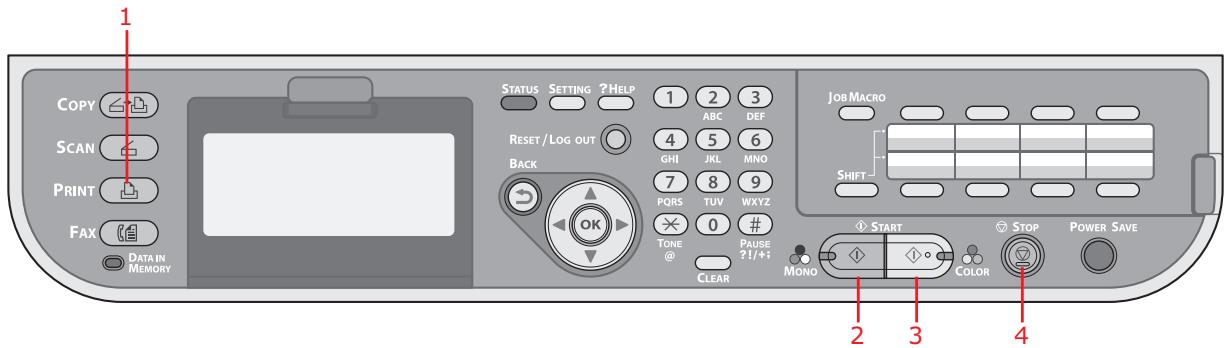
- Press OK to select Job Lists.
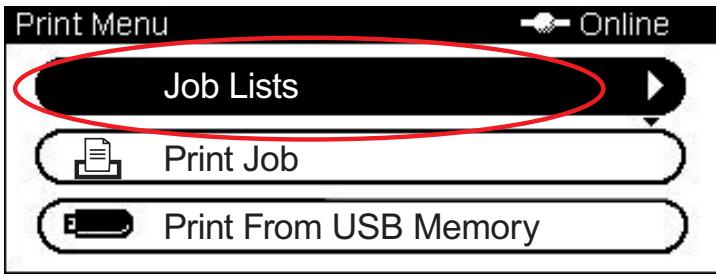
- Using the arrow keys, scroll to the job you want to cancel and then press OK.
PRINT JOB (MC561 ONLY)
This section gives a brief overview of how to select and print an encrypted job or a print job that has been stored in the machine. For full details of how to access and use the security features, please refer to the Security Guide.
- Press the Print button (1) on the control panel to prompt the Print Menu screen.
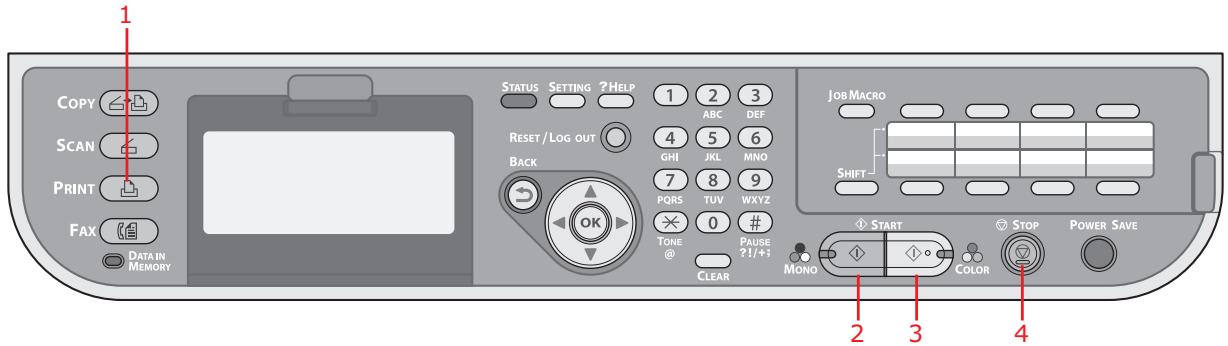
- Using the Down arrow key, scroll to Print Job and press OK.
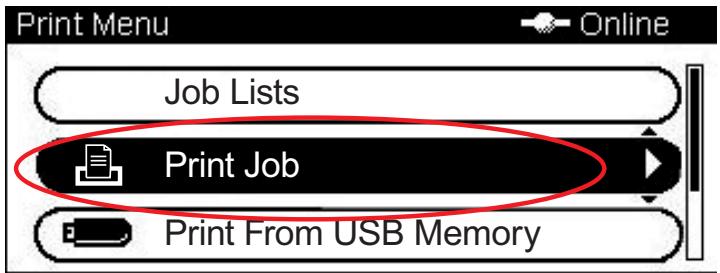
- Using the arrow keys, scroll to the job option you require and then press OK. Choose from:
Stored Job
Encrypted Job
- Enter the PIN or password as appropriate then press OK.
- Using the Down arrow key, scroll to Print and press OK.
NOTE
If you select Delete you can cancel the print job. Be aware, if you select Delete to cancel an encrypted job, it will delete all jobs with the same password.
NOTE
Supported file systems: FAT12, FAT16, FAT32.
Supported file formats: JPEG, PDF (v1.7), M-TIFF (v6 Baseline), PRN (PCL, PS).
Supported: Up to 32 GB capacity of USB memory.
Not Supported: USB hubs, external USB HDDs and encrypted PDFs.
NOTE
Up to 100 files in supported file formats stored in USB memory are displayed on the file list. If more files are stored in USB memory, the list of the stored files may not be displayed properly.
You can select and print one file in your USB memory at a time.
BASIC OPERATION
- Plug the USB memory into the USB port at the front of the machine.
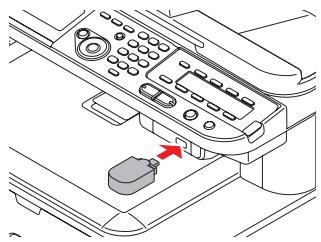
- Press the Print button (1) on the control panel to prompt the Print Menu screen.
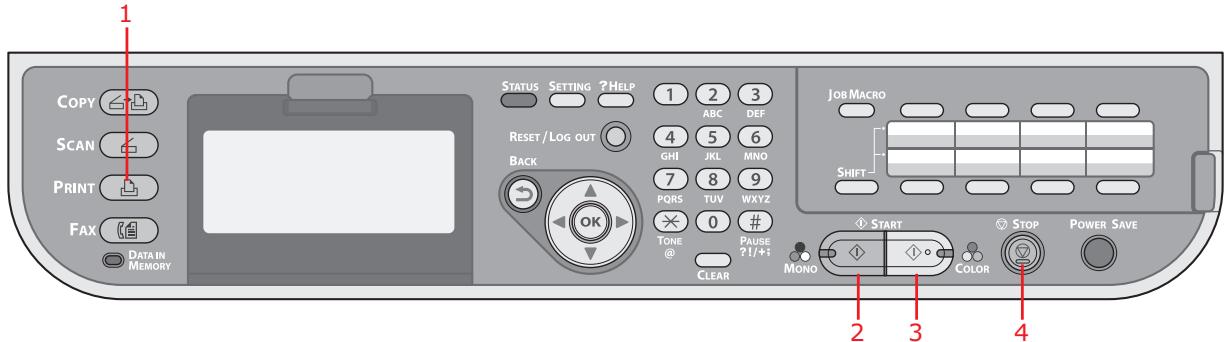
- Using the Down arrow key, scroll to Print From USB Memory and press OK.
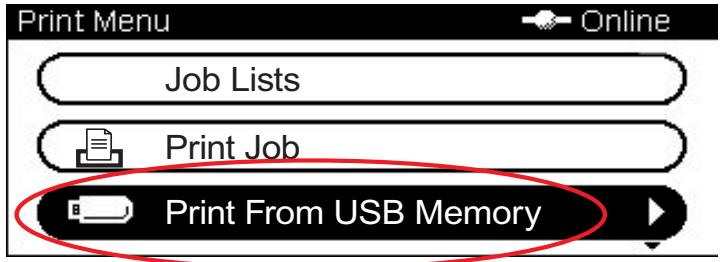
-
Ensure Select Print File is highlighted, then press OK. The list of supported files on the USB stick are display.
-
If your file is contained within a folder:
(a) Using the arrow keys, scroll to the required folder and press OK.
NOTE
If required, scroll to Folder Property and press OK to check the file information.
(b) Press OK to select Open Folder.
- Using the arrow keys scroll to the file you want to print and press the OK.
NOTE
If required, scroll to File Property and press OK to check the file information.
- Ensure Select is highlighted, then press OK.
- If required, scroll to Print Setup and configure the print settings then press OK. Refer to "Advanced operation" on page 70 for details.
- Press Mono (2) to print your document(s) in black and white, or Colour (3) to print your document(s) in colour.
NOTE
If you wish to cancel the print process, press Stop (4) to abort the operation.
- Remove the USB memory from the port after a message is displayed indicating that it is OK to remove the USB memory.
ADVANCED OPERATION
Using the options available you can alter the print output to suit your needs:
- Select required parameter with Down arrow key and press the OK button or the Right arrow key to display the available options.
- Using Up or Down arrow keys, select value and press OK.
Options are (factory default settings in bold text):
| PARAMETER | VALUE | DESCRIPTION |
| Paper Feed | Tray 1(A4), MP Tray(A4) | Allows you to define the paper tray for printing. |
| Copies | 1 | Enter the number of copies of a document to be printed from 1 to 999. |
| Duplex Copy | ON, OFF | Select the copy method. If duplex copying is specified, select the required binding method. |
| Binding | Long Edge Bind, Short Edge Bind | Sets the default binding to LEF or SEF. Only available when duplex is ON. |
| Fit | ON, OFF | Match the page size to the paper size. If the page size of your file is larger or smaller than the effective print area, the page is resized to fit the paper size. |
- Press the Back button to return to the print menu.
If you wish to alter the print status of your machine:
- Press the Print button (1) on the control panel to prompt the Print Menu screen.
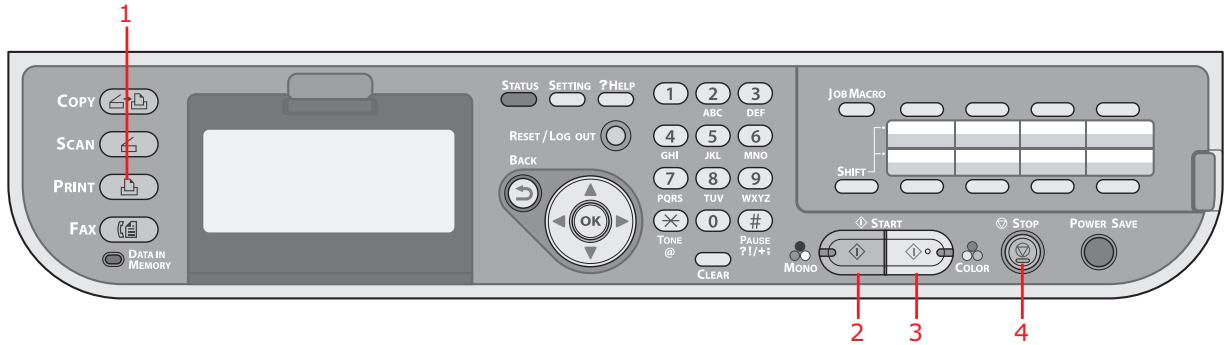
- Using the Down arrow key, scroll to Switch Online/Offline and press OK.
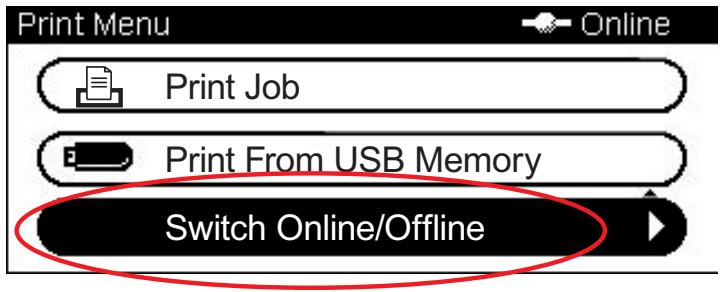
- Using the arrow keys, scroll to your required option and press OK.
NOTE
If you switch the machine Offline it will disable the Copy function also.
NOTE
If your Administrator has enabled access control on your machine, it will automatically start up in access control mode. You will not be able to use it until you have provided valid login information. Refer to "User authentication and access control" on page 34 for details.
When faxing, you can load only A4, letter, or legal size documents in the ADF, and A4 or letter size documents on the document glass. You cannot load mixed size documents.
SENDING A FAX FROM THE MFP
This section details how to send a fax directly from your MFP.
BASIC OPERATION
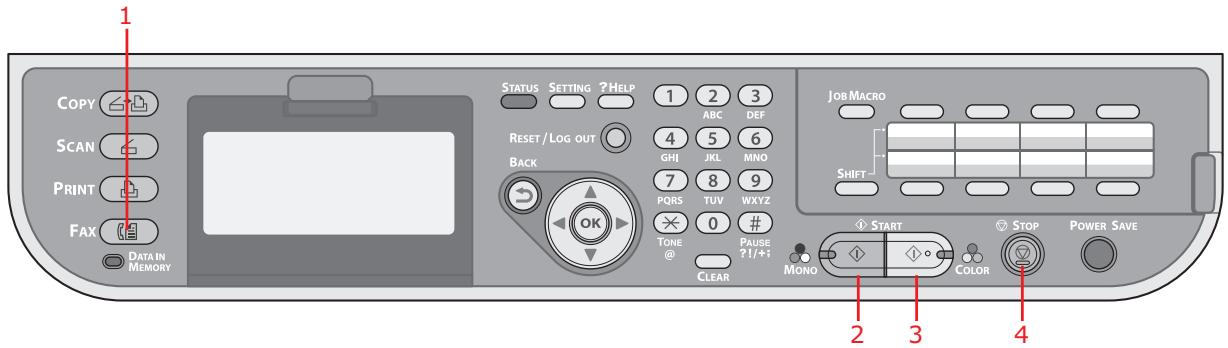
- Place your document(s) with text face UP in the ADF or face DOWN on the glass.
- Press the Fax button (1) on the control panel to prompt the Fax Mode screen.
- Ensure Fax is highlighted, then press OK.
- Set your destination and send properties as required. Refer to "Advanced operation" on page 73 for details.
- Press the Mono button (3) to start sending your document(s).
NOTE
If you wish to cancel faxing, press Stop (4) to abort the operation. You can cancel a job that is being transmitted as long as the message indicating the job has been completed has not displayed. Refer to "Fax view/cancel" on page 82 for details on how to cancel a reserved job.
When you select a broadcast job, the job itself is cancelled. If you want to cancel an individual destination within a broadcast job, refer to "Deleting specified destinations" on page 75.
Fax transmissions are sent in black and white only.
ADVANCED OPERATION
Using the options available, you can alter the fax output to suit your needs:
| FEATURE | OPTION | DESCRIPTION | |
| Fax | |||
| Add Destination | Speed Dial List | Select the required speed dial number. You can select multiple entries. Entries must be registered in advance, refer to "Adding a speed dial entry to the phone book" on page 85. | |
| Group List | Select the required group dial number. You can select multiple entries. Entries must be registered in advance, refer to "Adding a group entry to the phone book" on page 86. | ||
| Direct Input | Enter the destination fax number using the keypad. Use the arrow keys and OK button to select dialling function from the on-screen options: > - (Hyphen) Inserts a hyphen to the entered fax number. > Pause Pauses two seconds when dialling. You can use multiple pauses. > Tone Switches to tone dialling if pulse dialling is set. > PreFix Inserts a prefix number registered in advance. | ||
| Tx History | Select a destination from the ten most recent transmissions. | ||
| Rx History | Select a destination from the ten most recent receptions. | ||
| Fax Functions | Scan Size | A4, Letter, Legal 13, Legal 13.5, Legal 14 | Allows you to select the paper size to match the document size. |
| Resolution | Normal, Fine, Extra-Fine, Photo | Allows you to specify the type of images on the document. | |
| Density | -3, -2, -1, 0, +1, +2, +3 | Adjust density Darker: Keep colour intensity and darker image. Lighter: Reduce colour intensity and gives lighter image. | |
| Duplex Scan | OFF, Long Edge Bind, Short Edge Bind | Select the bound originals binding position. | |
| Continue Scan | ON, OFF | Allows you to continue scanning more documents. Allows you to construct a single fax job from multiple individual sheets or originals. Refer to "Continuous scan mode" on page 94 for details. | |
| Fax Functions (cont.) | TTI | ON, OFF | Prints the sender name on the header of the transmitted fax. By default, the name you specified in Sender ID is printed. Refer to "Sender ID" on page 143. |
| TTI Select | user defined | Select the user defined TTI header. Note: TTI must be ON. | |
| Transmit Confirmation Report | ON, OFF | Select ON to print a fax confirmation after transmission. | |
| Delayed Tx | OFF Date Time | Delayed transmission allows you to fax documents at a specific date and time. Up to one hundred transmission times can be scheduled up to one month in advance. | |
| Fcode Polling | ON, OFF | To turn ON, use the numeric keypad to enter the sub-address of the remote machine. If required, use the numeric keypad to enter the password of the remote machine. | |
| Fcode Tx | ON, OFF | F Code transmission is a function to communicate using sub addresses or passwords in accordance with the standard of ITU-T. by creating and registering F Code boxes you can execute confidential communication and notice board communication. Use the numeric keypad to enter the sub-address. If required, use the numeric keypad to enter the password of the remote machine. Note: up to 20 F code boxes can be registered, Up to 30 documents can be stored in one box. Note: Polling and FPolling must be OFF. | |
| Memory Tx | ON, OFF | Select OFF to enable real time transmission, i.e. fax transmission synchronisation with scanning. | |
| Fax Job View/Cancel | View or cancel a reserved fax job from the list. | ||
| Fax History | Tx History | Check the transmission or reception history and results of a fax job. | |
| Rx History | |||
Manual feed
If you wish to send multiple sets of documents from the ADF or flatbed, enable the "continuous scan" feature. Refer to "Continuous scan mode" on page 94 for full details.
Broadcasting
This function allows you to send a fax to multiple recipients at the same time. By combining abbreviation dials, groups and entering addresses using the numeric keypad, you can specify up to 100 destinations at one time.
NOTE
When real time transmission (Memory Tx set to OFF) or polling is executed during broadcasting data, they are executed preferentially. In the case of polling, it is executed preferentially when there is only one address specified.
When Broadcast Destination is enabled, the destination numbers are displayed before transmission. Refer to "Broadcast Destination" on page 145.
Deleting specified destinations
You can cancel an individual destination within a broadcast job.
- Make sure that the required destination is selected on the fax standby screen and then press OK.
- Using the arrow keys, scroll to the destination you want to delete and then press OK.
A check box is selected. You can select multiple entries.
- When you have selected all the destinations to be deleted, press the Right arrow key.
- Make sure that Delete this destination is selected and then press OK.
Manual redial
Your machine is set to radial automatically (refer to "Redial Tries" on page 146), if you wish to manually radial:
- Press the FAX button on the control panel.
- Press OK to select Fax.
- Press OK to select Add Destination.
- Using the Down arrow key, scroll to Tx History and press OK.
- Using the arrow keys, scroll to the required destination and press OK. The check box is selected. You can select multiple entries.
- When you have selected all the destinations, press the Right arrow key.
- Press OK to select Finish Destination Selection.
- Press the Mono button (3) to start sending your document(s).
F Code communication
F Code transmission is a function to communicate, using sub addresses or passwords in accordance with the ITU-T standard. By creating F code boxes/sub addresses/passwords, you can execute secure communication, bulletin box communication and polling communication.
NOTE
Up to 16 F code boxes can be registered.
Sub address and ID code
A sub address is a number to distinguish various F code boxes that are set in the memory.
A password is a key to prevent wrongful sending and receiving.
An ID code is a key to access a secure box.
By using a sub address, the following functions can be used:
F Code Confidential Communication
When an F code confidential box is set in the recipient machine, by specifying the sub address of its box, confidential communication can be executed.
On the receiving side of the confidential communication, unless the specified ID code is entered, a received document cannot be printed, therefore, this function is useful when sending a document that needs a security protection. Refer to:
"Transmission using a sub address (F code transmission)" on page 79.
"Printing stored documents" on page 81.
F Code Bulletin Box Communication
When the F code bulletin box is set in the recipient machine, by specifying the sub address of its notice board, a document can be sent to the bulletin box or a document stored in the bulletin box can be taken out (polling). (A password can be specified, if necessary.) Refer to:
"Transmission using a sub address (F code transmission)" on page 79.
"Receiving using a sub address (F code polling)" on page 80.
"Storing documents in a bulletin box" on page 80.
Registering an F code box
To use F code communication, register an F code box. Register a sub address in each F code box.
NOTE
Make sure to register a sub address.
When a secret number is set, only the specific person can operate the F code box.
- Press the SETTING button on the control panel.
- Using the Down arrow key, scroll to Admin Setup and press OK.
- Using the arrow keys and on-screen keypad, enter the Administrator password. Highlight Done and press OK.
- Using the Down arrow key, scroll to Fax Setup and press OK.
- Using the Down arrow key, scroll to Fcode Box and press OK.
-
Using the arrow keys, scroll to the required entry position and press OK.
-
Press OK to select Register.
- Select a type of F code box:
Bulletin Box - refer to "Registering an F code Bulletin box" on page 77
Confidential Box - refer to "Registering an F code confidential box" on page 77.
Registering an F code Bulletin box
- Press OK to select Bulletin Box.
- Press the Right arrow key to select Box Name.
(a) Using the arrow keys and on screen keyboard, enter a box name.
(b) Highlight Done and press OK.
NOTE
If using one-byte characters, up to 16 characters can be registered.
- Using the Down arrow, scroll to Sub-Address and press the Right arrow key.
(a) Using the keypad enter the sub address.
(b) Highlight Done and press OK.
NOTE
A sub address can be registered using up to 20 digits. Numbers, # and * can be registered.
If you make a mistake when entering the digits, press the Clear button to delete and then enter the correct digit.
- Using the Down arrow key, scroll to I.D.Code and press the Right arrow key:
(a) Register an ID Code number (4 digits) using the numeric keypad.
NOTE
The ID code is not displayed, write it down and keep it safe!
(b) Press OK.
- Press OK to complete.
Registering an F code confidential box
- Press OK to select Confidential Box.
- Press the Right arrow key to select Box Name.
(a) Using the arrow keys and on screen keyboard, enter a box name.
(b) Highlight Done and press OK.
NOTE
If using one-byte characters, up to 16 characters can be registered. If using double-byte characters, up to 8 characters can be registered.
- Using the Down arrow, scroll to Sub-Address and press the Right arrow key.
(a) Using the keypad enter the sub address.
(b) Highlight Done and press OK.
NOTE
A sub address can be registered using up to 20 digits. Numbers, # and * can be registered.
If you make a mistake when entering the digits, press the Clear button to delete and then enter the correct digit.
- Using the Down arrow key, scroll to I.D.Code and press the Right arrow key:
(a) Register an ID Code number (4 digits) using the numeric keypad.
NOTE
The ID code is not displayed, write it down and keep it safe!
(b) Press OK.
- If required, use the Down arrow key to scroll to Hold Time. Press the Right arrow key:
(a) Enter the required hold time (00 31) using the numeric keypad.
(b) Press OK.
NOTE
Specify a retention period between 0 and 31 days.
If "00" is specified, the data will be retained for an indefinite period.
Retention period input range is between 0 and 31 days). When 0 is set, documents are retained for an indefinite period.
- Press OK to complete.
Deleting an F code box
NOTE
You cannot delete an F code box in which documents are stored, it must be empty.
- Press the SETTING button on the control panel.
- Using the Down arrow key, scroll to Admin Setup and press OK.
- Using the arrow keys and on-screen keypad, enter the Administrator password. Highlight Done and press OK.
- Using the Down arrow key, scroll to Fax Setup and press OK.
- Using the Down arrow key, scroll to Fcode Box and press OK.
- Using the arrow keys, scroll to the required entry position and press OK.
- Using the Down arrow key, scroll to Delete and press OK.
- Using the arrow keys, highlight Yes to continue or No to cancel.
- Press the OK button to execute.
Transmission using a sub address (F code transmission)
By entering a sub address and ID code, F code confidential transmission, F code bulletin transmission and F code polling transmission can be performed.
NOTE
Before operating, ensure you have the necessary sub address and ID code to hand.
- Place your document(s) with text face UP in the ADF or face DOWN on the glass.
- Press the Fax button on the control panel to prompt the Fax Ready screen.
- Press OK to select Fax.
- Using the Down arrow key, scroll to Fax Functions and press OK.
- Using the Down arrow key, scroll to Fcode Tx and press OK.
- Using the arrow keys, scroll to Yes and press OK.
- Using the numeric keypad, enter the sub-address of the box registered in the recipient machine.
- Highlight Done and press OK.
- Press the Left arrow key to exit.
- Press OK to select Add Destination.
- Using the arrow keys, scroll to the required destination input method and press OK.
- Specify a destination.
- Press OK to complete.
- Press the Mono button to start sending your document(s).
Receiving using a sub address (F code polling)
By entering a sub address and ID code, a document stored in the bulletin box of a recipient machine can be taken out (polling).
NOTE
Before operating, ensure you have the necessary sub address and ID code to hand.
- Press the Fax button on the control panel to prompt the Fax Ready screen.
- Press OK to select Fax.
- Using the Down arrow key, scroll to Fax Functions and press OK.
- Using the Down arrow key, scroll to Fcode Polling and press OK.
- Using the arrow keys, scroll to ON and press OK.
- Using the numeric keypad, enter the sub-address of the box registered in the sender machine.
- Highlight Done and press OK.
- Press the Left arrow key to exit.
- Press OK to select Add Destination.
- Using the arrow keys, scroll to the required destination input method and press OK.
- Specify a destination.
- Press OK to complete.
- Press the Mono button to start receiving your document(s)
Storing documents in a bulletin box
NOTE
Before operating, ensure you have registered the bulletin box in the F-Code box.
- Place your document(s) with text face UP in the ADF or face DOWN on the glass.
- Press the SETTING button on the control panel.
- Using the Down arrow key, scroll to Store Document Settings and press OK.
- Press OK to select Store.
- Press OK to select Fcode Bulletin Board.
- Select the F code box in which to store the document.
- If an ID code is set, enter the number (4 digits) using the numeric keypad. Press OK.
- Select a method of storing documents:
Over Write: replace a document in the box.
Add: add a new document to the box.
-
Using the arrow keys, highlight Yes to continue or No to cancel.
-
Press the OK button to execute.
Printing stored documents
Print secure received documents, documents received in the bulletin box and documents stored in the bulletin box.
NOTE
When a document is received into an F code box, the F code receiving notice is printed.
Check the F code box number and print the stored document.
- Press the SETTING button on the control panel.
- Using the Down arrow key, scroll to Store Document Settings and press OK.
- Using the Down arrow key, scroll to Print and press OK.
- Press OK to select Fcode Box.
- Select the F code box storing the document you want to print.
- If an ID code is set, enter the number (4 digits) using the numeric keypad. Press OK.
- Select the file number of the document you want to print. Press OK.
- Using the arrow keys, highlight Yes to continue or No to cancel.
- Press the OK button to execute.
The document that is stored or received is printed.
NOTE
Confidential received documents are automatically deleted after printing.
Documents that are received or stored in the bulletin box are not deleted after printing.
Deleting stored documents
- Press the SETTING button on the control panel.
- Using the Down arrow key, scroll to Store Document Settings and press OK.
- Using the Down arrow key, scroll to Delete and press OK.
- Press OK to select Fcode Bulletin Board.
- Select the F code box storing the document you want to delete. Press OK.
- If an ID code is set, enter the number (4 digits) using the numeric keypad. Press OK.
- Select the file number of the document you want to delete. Press OK.
- Using the arrow keys, highlight Yes to continue or No to cancel.
- Press the OK button to execute.
Fax job view/cancel
If you no longer require a stored fax job, you can cancel and remove it from your MFP's memory.
- Press the Fax button on the control panel to prompt the Fax Mode screen.
- Using the arrow keys, scroll to Fax and press OK.
- Using the Down arrow key, scroll to Fax Job View/Cancel and press OK.
- Using the Down arrow key, scroll to the fax job you wish to delete and press OK.
- Check the job contents, then press the Right arrow key.
- Using the Down arrow key, scroll to Delete and press OK.
- Using the arrow keys, select Yes to continue or No to cancel and press OK.
NOTE
When you select a broadcast job, the job itself is deleted. If you wish to cancel an individual destination within the broadcast job, refer to "Deleting specified destinations" on page 75 for details.
Fax job reports and listings
Refer to "Reports" on page 134.
FAX RECEIVING
Your MFP is set to receive faxes automatically, if you wish to change this to manual receive refer to "Forced Memory Rx" on page 146 for details.
Your MFP is set to fax ready reception mode, if you wish to change this refer to "Reception Mode" on page 163.
NOTE
If the MFP is actively sending or receiving a fax, then any incoming faxes will be rejected.
The machine behaviour differs depending on the specified reception mode.
When the machine is receiving faxes, the DATA IN MEMORY indicator is lit and the sender information is displayed on screen. The indicator remains lit while the data is stored in memory.
NOTE
The sender name and fax number registered on the sender machine are displayed on screen.
If the memory overflows while the machine is receiving data, the reception is cancelled. If this happens, ask the sender to resend the fax.
Fax ready mode
This is the factory default setting; your machine is set so that it automatically receives taxes.
Tel/Fax ready mode
When the machine is set to Tel/Fax Ready Mode, you can receive calls and faxes. You must connect an external telephone in advance to receive calls, refer to the Configuration Guide for details.
Receiving faxes
The machine automatically starts fax reception.
Receiving calls
The telephone starts ringing when it receives calls.
- Pick up the handset to talk when the machine rings.
- If necessary, press the mono START button and then put down the handset to receive faxes.
Ans/Fax ready mode
When the machine is set to Ans/Fax Ready Mode, you can use an answering machine and receive faxes automatically. You must connect an external answering machine in advance, refer to the Configuration Guide for details.
NOTE
Depending on the answering machine and the sender machine, Ans/Fax Ready Mode may not operate correctly.
Receiving taxes
The machine automatically starts fax reception.
Receiving calls
The answering machine rings, the reply message starts, and then it starts recording a message.
Tel ready mode
Tel Ready Mode is recommended if you often use the external telephone connected to the machine. You must connect an external telephone in advance to receive calls, refer to the Configuration Guide for details.
Receiving calls
The telephone starts ringing when it receives calls.
Receiving faxes
The telephone starts ringing when it receives a signal.
- Pick up the handset when the machine rings.
- Press the mono START button and then put down the handset to receive faxes.
Forward mode
When the machine is set to Forward Mode, it automatically forwards the received faxes to a specified destination. You must specify a forwarding destination in advance.
NOTE
You can register one forwarding destination for this function.
DRD
This mode allows the machine to detect a distinctive ring if it has been enabled on the phone line. In this mode, the machine distinguishes the DRD type of the sender. The machine then answers only when it matches the registered DRD type.
You can register up to four DRD types:
Type 1: short-long
Type 2: long-long
Type 3: short-short-long
Type 4: short-long-short
Refer to "DRD Type" on page 163.
Printing received faxes
The machine automatically prints out the received fax.
NOTE
Use only standard or recycled paper.
Available paper sizes are A4, letter, or legal.
Images larger than the specified paper are reduced, discarded, or printed onto multiple sheets of paper depending on the reception print settings. Refer to "Rx Reduc. Rate" on page 146.
If the machine cannot print received faxes due to a lack of paper or a paper jam, it will store the received fax data temporarily it's memory. When the problem is resolved, it starts printing automatically.
NOTE
For details on how to load paper, refer to "Loading paper" on page 29.
For details on how to clear paper jams, refer to "Clearing paper jams" on page 120.
To check the reception history, refer to "Rx History" on page 74.
MANAGING THE PHONE BOOK
The following section describes how to add/remove/modify speed and group dial entries to/ from the Phone Book.
ADDING A SPEED DIAL ENTRY TO THE PHONE BOOK
The machine can hold up to 100 speed dial numbers in the phone book. To add a new speed dial number to the phone book:
- Press the SETTING button on the control panel.
- Using the Down arrow key, scroll to Phone Book and press OK.
- Press OK to select Speed Dial List.
- Using the arrow keys, scroll to the required entry position and press OK.
- Press OK to select Register.
- Press the Right arrow key to select Name.
- Using the keypad or arrows keys and the on-screen keypad, type in the name.
NOTE
The maximum length of name is 24 characters.
- Highlight Done and press OK.
- Using the Down arrow key, scroll to Fax Number and press the Right arrow key.
- Using the keypad, type in the destination fax number.
NOTE
The maximum length of number is 40 digits.
If the destination fax number has an "extension number", press the Pause button between numbers. The machine will enter a pause when dialling.
If your MFP is connected to a PBX (private branch exchange), you will need to add a Prefix in order to access to the outside line. Refer to the Configuration Guide for details.
If you need to change the dialling method for the region, press the Tone button to change the call parameters for this particular number.
If you make a mistake while entering the number, press the Clear button to delete the last digit.
- Highlight Done and press OK.
- If required, use the arrow keys and scroll to Group No. then press the Right arrow key.
- Using the arrow keys, select the group number to assign the fax number to and press OK.
The check box is selected. You can select multiple entries.
NOTE
Numbers registered to groups from the Speed Dial function are synchronized with the numbers that are registered to groups using the Group No. function.
- Press the Right arrow key to complete.
- Press OK to confirm.
-
Press OK once more to add your entry to the phone book.
-
Press the Left arrow key to exit the menu.
ADDING A GROUP ENTRY TO THE PHONE BOOK
The machine can hold up to 20 group dial settings. To add a new group dial number to the phone book:
- Press the SETTING button on the control panel.
- Using the Down arrow key, scroll to Phone Book and press OK.
- Using the Down arrow key, scroll to Group No. Book and press OK.
- Using the arrow keys, scroll to the required entry position and press OK.
- Press OK to select Register.
- Press the Right arrow key to select Name.
- Using the keypad or arrows keys and the on-screen keypad, type in the name.
NOTE
The maximum length of name is 16 characters.
- Highlight Done and press OK.
- Using the Down arrow key, scroll to Speed Dial and press the Right arrow key.
- Using the arrow keys, select the speed dial number you wish to assign to the group and press OK.
The check box is selected. You can select multiple entries.
- Press the Right arrow key to complete.
- Press OK to confirm.
- Press OK once more to add your entry to the phone book.
- Press the Left arrow key to exit the menu.
DELETING A SPEED DIAL ENTRY FROM THE PHONE BOOK
To delete a speed dial entry from the phone book:
- Press the SETTING button on the control panel.
- Using the Down arrow key, scroll to Phone Book and press OK.
- Press OK to select Speed Dial List.
- Using the arrow keys, scroll to the required entry position and press OK.
- Using the arrow keys, scroll to Delete and press OK.
- At the prompt select Yes to continue or select No to cancel the operation.
- Press OK.
- Press the Left arrow key to exit the menu.
DELETING A GROUP DIAL ENTRY FROM THE PHONE BOOK
To delete a group dial entry from the phone book:
- Press the SETTING button on the control panel.
- Using the Down arrow key, scroll to Phone Book and press OK.
- Using the Down arrow key, scroll to Group No. Book and press OK.
-
Using the arrow keys, scroll to the required entry position and press OK.
-
Using the arrow keys, scroll to Delete and press OK.
- At the prompt select Yes to continue or select No to cancel the operation.
- Press OK.
- Press the Left arrow key to exit the menu.
MODIFYING A SPEED DIAL ENTRY
To modify a speed dial entry:
- Press the SETTING button on the control panel.
- Using the Down arrow key, scroll to Phone Book and press OK.
- Press OK to select Speed Dial List.
- Using the arrow keys, scroll to the required entry position and press OK.
- Press OK to select Edit.
- Modify the Name, Fax Number and/or Group No. details as required then press OK.
- Press the Left arrow key to exit the menu.
MODIFYING A GROUP DIAL ENTRY
To modify a group dial entry:
- Press the SETTING button on the control panel.
- Using the Down arrow key, scroll to Phone Book and press OK.
- Using the Down arrow key, scroll to Group No. Book and press OK.
- Using the arrow keys, scroll to the required entry position and press OK.
- Press OK to select Edit.
- Modify the Name, and/or Speed Dial details as required then press OK.
- Press the Left arrow key to exit the menu.
REGISTERING AN ENTRY FROM RECEPTION OR TRANSMISSION HISTORY
- Press the Fax button on the control panel to prompt the Fax Mode screen.
- Ensure Fax is highlighted, then press OK.
- Using the Down arrow key, scroll to Fax History and press OK.
- Using the arrow keys, highlight Tx History or Rx History as appropriate and press OK.
- Using the arrow keys, scroll to the required entry and press OK.
- Check the entry contents and then press the Right arrow key.
- Press OK to select Register To Speed Dial.
- Using the arrow keys, scroll to the required entry position and press OK.
- Continue the registration process as described in "Adding a speed dial entry to the phone book" on page 85.
The fax number is automatically entered. You do not have to enter it manually.
NOTE
You must have the fax driver installed on your PC. Download the latest fax driver from your support website.
Basic operation
- At the MFP: Place your document(s) with text face UP in the ADF or face DOWN on the glass.
- Press the Fax button on the control panel to prompt the Fax Mode screen.
- Using the Down arrow key, scroll to Internet Fax and press OK.
- Set your destination and send properties as required. Refer to "Advanced operation" on page 90 for details.
- At your PC: From your application's File menu, select Print.
- In the Select Printer window, highlight the fax driver option.
- Press the Preferences button to display the fax driver window.
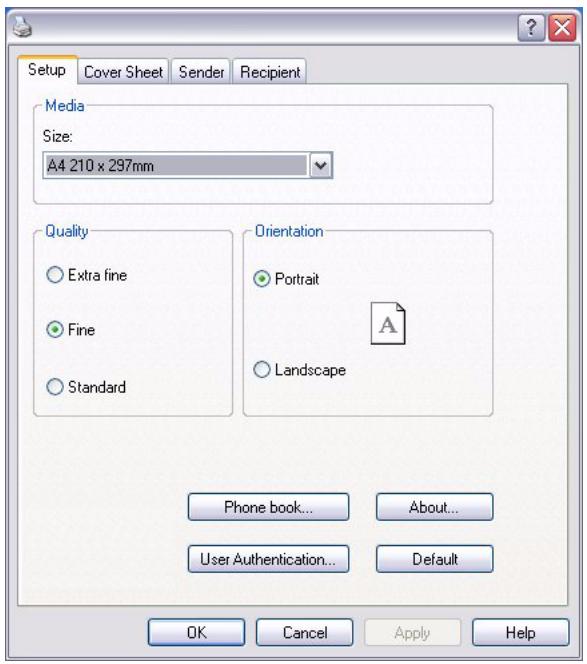
- On the Setup tab:
(a) Select the appropriate media size from the drop-down menu.
(b) Set the resolution quality to Extra fine, Fine or Standard.
(c) Set the orientation to Portrait or Landscape.
- On the Cover Sheet tab:
(a) Set the cover sheet usage settings as appropriate.
(b) Select a cover sheet format.
- On the Sender tab:
(a) Enter your name.
(b) Enter your fax number.
(c) Enter comments if required.
(d) If required select the Add an outside call number checkbox and enter the Outside call number as appropriate.
11. On the Recipient tab:
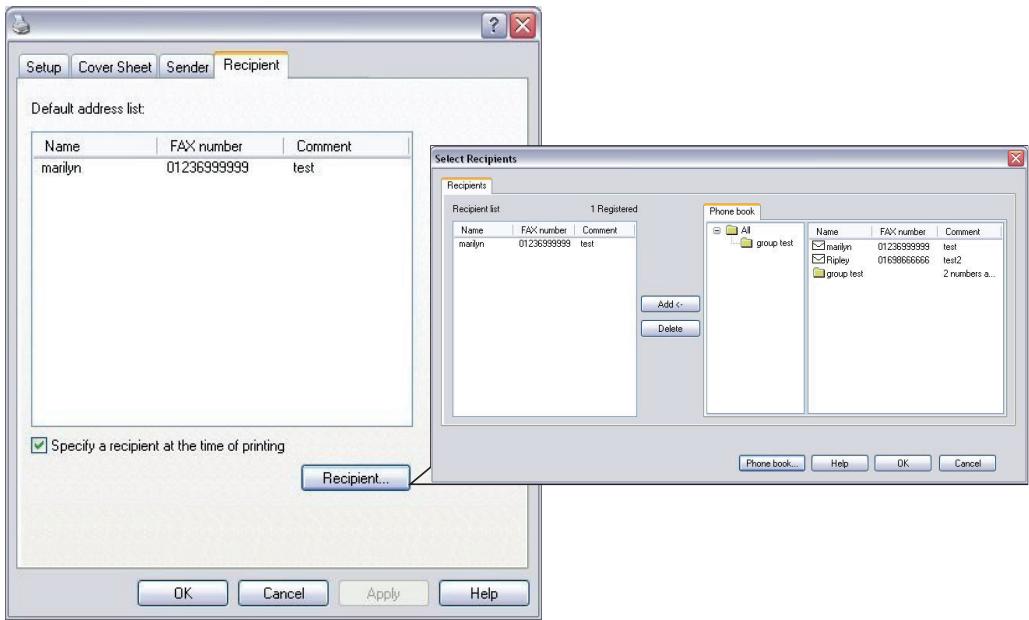
(a) Click the Recipient... button.
(b) Select a fax number from the Phone book panel on the right hand side. Refer to "Adding fax numbers to the phone book" on page 92.
(c) Press the Add button to add this number to the recipient list.
(d) Repeat (b) and (c) as required to create the recipient list.
(e) If you need to remove a number from the recipient list, highlight the appropriate name and then press the Delete button.
(f) Once you have completed your list, press the OK button to close the Select Recipients window.
12. Press the OK button to close the fax driver window.
13. Press OK to start sending your fax.
NOTE
If you wish to cancel faxing during transmission to the MFP:
- Double-click the printer icon in the notification area.
- Select the job from the print queue.
- From the Document menu, select Cancel.
Once the job is stored in the MFP, you cannot cancel it from the PC, instead you must cancel it directly from the machine. Refer to "Fax job view/cancel" on page 82 for details.
Advanced operation
Using the options available, you can alter the fax output to suit your needs:
| FEATURE | OPTION | DESCRIPTION | ||
| Internet Fax | ||||
| Add Destination | To:Cc:Bcc: | Address Book | Select e-mail address from the address book.Input range: 001-100 | |
| Email Group List | Select destination group from the list.Input range: 01-20 | |||
| Email Send History | Displays the list of sent e-mails. | |||
| Direct Input | Enter e-mail address using the on-screen keyboard. | |||
| LDAP | Simple Search | Use the on-screen keyboard to enter a search value. | ||
| Advanced Search Search Method:User Name:Email Address: | Use Advanced Search to search the LDAP address book by User Name and/or E-mail address. | |||
| Scan Setting | Scan Size | A4, Letter, Legal 13, Legal 13.5,Legal 14 | Allows you to select the paper size to match the document size. | |
| Density | -3,-2,-1, 0,+1,+2,+3 | Adjust densityDarker: Keep colour intensity and darker image.Lighter: Reduce colour intensity and gives lighter image. | ||
| Resolution | Normal, Fine, Extra-Fine, Photo | Allows you to specify the type of images on the document. | ||
| Background Removal | OFF, 1, 2, 3, 4, 5, 6 | Allows you to block out the colour background of the image(assuming document has a colour background) - such that the background colour is not printed. | ||
| Reply to | Address Book | Select e-mail address from the address book.Input range: 001-100 | ||
| Direct Input | Enter e-mail address using the on-screen keyboard. | |||
| LDAP | Simple Search | Use the on-screen keyboard to enter a search value. | ||
| Advanced Search Search Method:User Name:E-mail Address: | Use Advanced Search to search the LDAP address book by User Name and/or E-mail address. | |||
| Edit E-mail | Subject | Select Subject | Enter new or edit the default e-mail subject and text templates.For further details refer to "Creating e-mail templates" on page 63. | |
| Direct Input | ||||
| E-mail Body | Select Text | |||
| Direct Input | ||||
| Scan Setting (cont.) | File Name | User defined | Use the on-screen keyboard to enter an appropriate file name. | |
| Duplex Scan | ON, OFF | Turns the duplex (2-sided) function off or on. | ||
| Continue Scan | ON, OFF | Allows you to continue scanning more documents. Allows you to construct a single fax job from multiple individual sheets or originals. Refer to “Continuous scan mode” on page 94 for details. | ||
| Compression Rate | High, Medium, Low | Select the appropriate compression level. | ||
| Internet Fax Tx History | Check the transmission history and results of an internet fax job. | |||
RECEIVING AN INTERNET FAX
The machine automatically prints the internet faxes it receives. If the document is larger than A4 size, the machine automatically reduces it to the size of the paper in the specified paper tray.
NOTE
you can register up to 1000 destinations.
To add a fax destination number to the phone book:
- From your application's File menu, select Print.
- In the Select Printer window, highlight the fax driver option.
- Press the Preferences button to display the fax driver window.
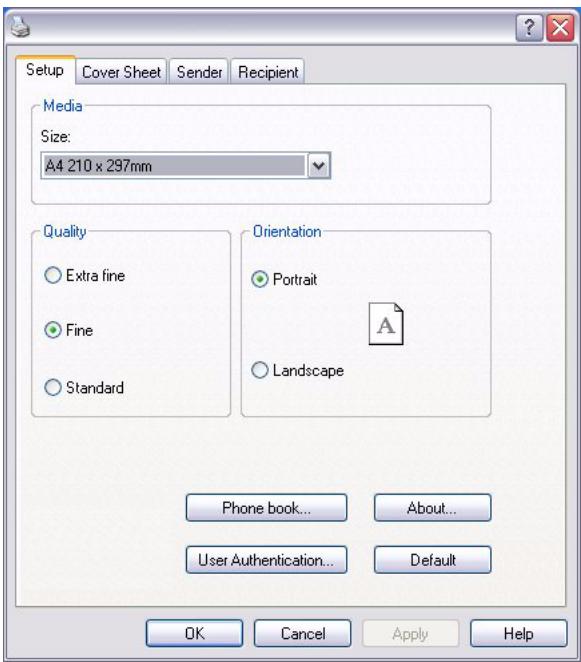
- Click the Phone book... button.
The phone book screen displays.
- Select FAX number -> New (FAX number).
- Type in the fax number destination Name.
- Type in the required FAX number.
- If required, type in a Comment.
- Press the OK button to save.
ADDING NEW GROUPS TO THE PHONE BOOK
To add a new group to the phone book:
- From your application's File menu, select Print.
- In the Select Printer window, highlight the fax driver option.
- Press the Preferences button to display the fax driver window.
- Click the Phone book... button.
The phone book screen displays.
- Select FAX number -> New (Group).
- Type in the Group name.
-
If required, type in a Comment.
-
Add recipients to the group list:
| NOTE Maximum 100 recipients in any one group. | |
| (a) | Select a fax number from the Phone book panel on the right hand side. |
| NOTE You can add a new fax number directly by clicking the New (FAX number)... button and adding an entry to the phone book panel. | |
(b) Press the Add-> button to add this number to the group list.
(c) Repeat steps (a) and (b) as required to create the group list.
(d) If you need to remove a number from the recipient list, highlight the appropriate name and then press the - Delete button.
- Once you have completed your list, press the OK button to close the New Group window.
IMPORTING AND EXPORTING FAX NUMBERS
By using the import and export functions, you can manage fax numbers in a phone book created on another computer.
- In Windows:
Windows 7: select Start > Devices and Printers.
Vista: select Start > Control Panel > Hardware and Sound > Printers.
Server 2008: select Start > Control Panel > Printers.
XP: select Start > Control Panel > Printer and Other Hardware > Printers and Faxes.
Server 2003: select Start > Printers and Faxes.
2000: select Start > Settings > Printers.
- Right-click your machine icon and select Printer Preferences.
- In the Setup tab, click the Phone Book button.
- From the pull-down menu, click Tool > Export.
- In the Export File screen, enter a name for the file and click the Save button. The phone book is saved.
- Import the saved phone book file to the other computer:
(a) In the fax driver installed on the computer that the phone book file was imported, start the phone book in the same way, and click Tool > Import in the menu.
(b) In the Import File screen, select a phone book file to import. When the Open button is clicked, data is imported to the phone book.
NOTE
Registration of groups cannot be exported. (Destinations included in the group are exported.)
FUNCTIONS COMMON TO COPY, FAX AND SCAN OPERATIONS
CONTINUOUS SCAN MODE
If you need to scan, copy or fax multiple sets of documents from the ADF or document glass, enable the "Continue Scan" option.
NOTE
The example below uses the fax feature, however, the scan and copy features follow the same process.
To set the fax to continuous scan:
- Place your document(s) with text face UP in the ADF or face DOWN on the glass.
- Press the Fax button on the control panel to prompt the Fax Ready screen.
- Ensure Fax is highlighted, then press OK.
- Using the Down arrow key, scroll to Fax Functions and press OK.
- Using the Down arrow key, scroll to Continue Scan and press OK.
- Select ON and press OK.
- Press the BACK button to exit the menu and return to the Fax Ready screen.
- Set your send properties as required.
- Press Mono to start scanning the first document.
Once the current scanning operation is complete, the screen will display "Please set next document". If you have further documents to scan, ensure Start Scan is highlighted then press OK to continue scanning or use the Down arrow key to select Scan Complete.
JOB MACROS (MC561 ONLY)
If you have a routine copy, fax or scan job that you perform on a regular basis, you can program the steps into your MFP and create a "short cut" allowing you to perform the steps at the touch of a button. You can create up to ten short cuts using the Job Macro function.
You can create a macro for the following functions:
Copying (colour and/or mono)
Printing from USB memory
Scanning to e-mail
Scanning to network PC
Scanning to USB memory
Fax sending
Internet fax sending
NOTE
Changes to an existing speed dial number or adding a new speed dial number are not carried over to previously configured Job Macros. The Job Macro must be reprogrammed to reflect the changes/ editions to the speed dial directory.
Creating:
To register a short cut:
- Key in the steps you wish to program; for example if you wish to program a copy job that is double-sided, A5 scan size and the output is 20 copies:
(a) Press the Copy button on the control panel.
(b) Press the Right arrow key.
(c) Press OK to select Scan Size.
(d) Using the Down arrow key, scroll to A5 then press OK.
(e) Using the Down arrow key, scroll to Duplex Copy then press OK.
(f) Using the Down arrow key, highlight the required duplex option then press OK.
(g) Press the Back button.
(h) Using the numeric keypad, type in 20.
- Press the Job Macro button on the control panel to prompt the Job Macro screen.
- Using the arrow keys, select a job number you wish to associate to your program.
- Press OK.
- Press OK again.
- Using the arrow keys and on-screen keyboard enter an appropriate title for the macro.
- Highlight Enter on-screen then press OK.
- Select Yes to continue, or No to exit without saving.
- Press the OK button to complete the registration.
NOTE
You cannot edit the steps within a program, if you wish to change them then you must reprogram the job number.
Using:
To use a pre-programmed short cut:
- Press the Job Macro button on the control panel to prompt the Job Macro screen.
- Using the arrow keys, scroll to the macro you wish to use then press OK.
- Ensure Restore is highlighted then press OK.
- Check the settings and then press OK.
- At the prompt, select Yes to execute the program or No to exit.
NOTE
If access control is enabled and you are not permitted to use certain functions, a message will display and then the screen will return to the confirmation prompt. Select No to return to the Job Macro screen.
Deleting:
To delete a Job Macro function:
- Press the Job Macro button on the control panel to prompt the Job Macro screen.
- Using the arrow keys, scroll to the macro you wish to delete then press OK.
- Using the arrow keys, scroll to Delete then press OK.
- At the prompt, select Yes to confirm deletion or No to exit.
Editing the title:
To edit a Job Macro title:
- Press the Job Macro button on the control panel to prompt the Job Macro screen.
- Using the arrow keys, scroll to the macro you wish to edit then press OK.
- Using the arrow keys, scroll to Title Edit then press OK.
- Using the arrow keys and on-screen keyboard enter an appropriate title for the macro.
- Highlight Enter on-screen then press OK.
MAINTENANCE
REPLACING CONSUMABLE ITEMS
Only use genuine original consumables to ensure the best quality and performance from your hardware. Non original products may adversely affect your printer's performance and invalidate your warranty.
TONER CARTRIDGE REPLACEMENT
NOTE
When the LCD display indicates TONER LOW, or if print appears faded, first open the top cover and try tapping the cartridge a few times to evenly distribute the toner powder. This will enable you to obtain the best "yield" from your toner cartridge.
CAUTION!
To avoid toner wastage and possible toner sensor errors, do not change the toner cartridge(s) until "TONER EMPTY" is displayed.
The toner used in this printer is a very fine dry powder. It is contained in four cartridges: one each for cyan, magenta, yellow and black.
Have a sheet of paper handy so that you have somewhere to place the used cartridge while you install the new one.
Dispose of the old cartridge responsibly, inside the recycle bag that came with the new cartridge. Follow any regulations, recommendations, etc., which may be in force concerning waste recycling.
If you do spill any toner powder, lightly brush it off. If this is not enough, use a cool, damp cloth to remove any residue.
Do not use hot water, and never use solvents of any kind. They will make stains permanent.
WARNING!
If you inhale any toner or get it in your eyes, drink a little water or bathe your eyes liberally in cold water. Seek medical attention immediately.
- Gently raise the scanner.
- Press the cover release (a) and open the top cover (b) fully.
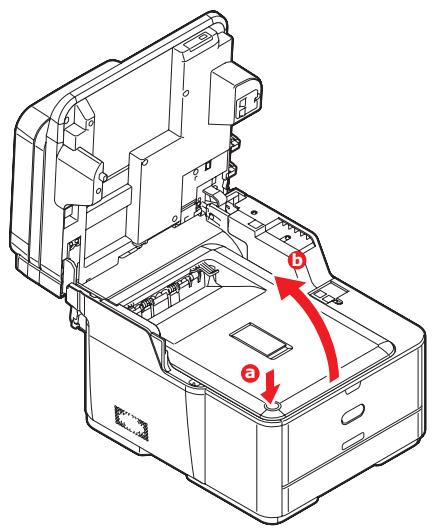
WARNING!
If the MFP has been powered on, the fuser will be hot. This area is clearly labelled. Do not touch.
- Note the positions of the four cartridges. It is essential that they go back in the same order.
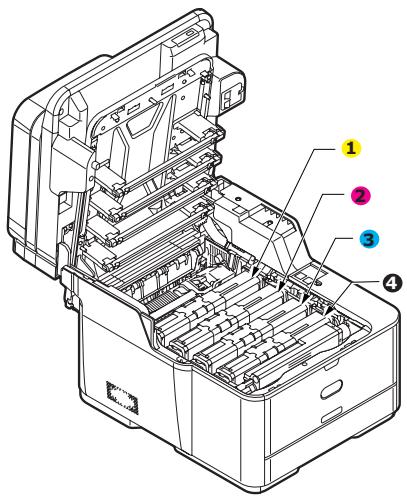
-
Yellow cartridge
-
Magenta cartridge
-
Cyan cartridge
-
Black cartridge
(a) Slide the coloured release collar on the cartridge to be replaced fully towards the right hand side of the printer.
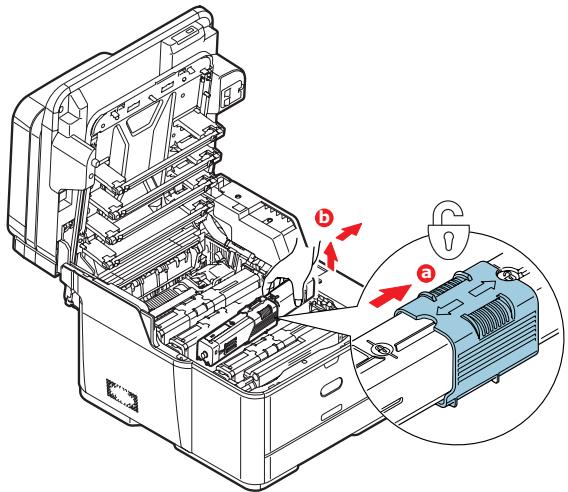
(b) Lift the right-hand end of the cartridge and then draw the cartridge to the right to release the left-hand end as shown, and withdraw the toner cartridge out of the printer.
-
Put the cartridge down gently onto a piece of paper to prevent toner from marking your furniture.
-
Clean the top of the ID unit with a clean, lint free cloth.
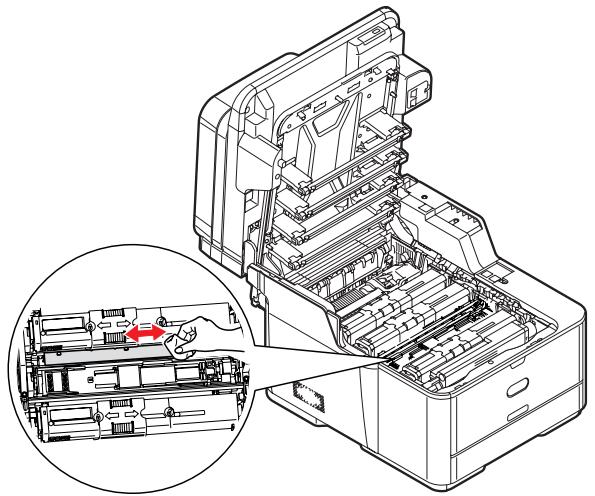
- Remove the new cartridge from its box but leave its wrapping material in place for the moment.
- Gently shake the new cartridge from end to end several times to loosen and distribute the toner evenly inside the cartridge.
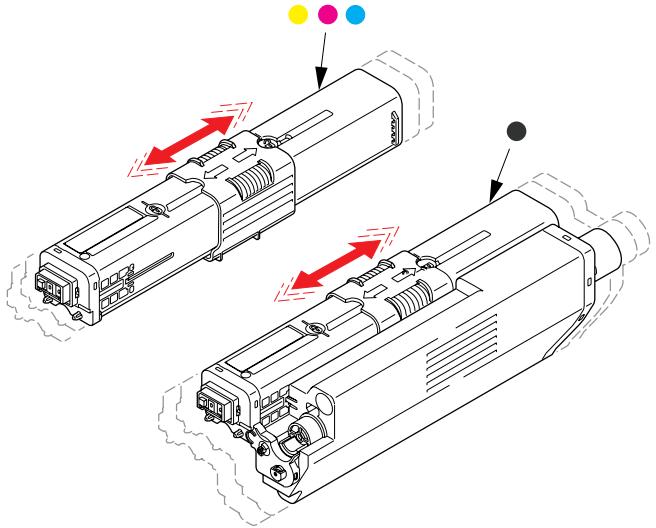
- Remove the wrapping material.
- Holding the cartridge by its top centre, lower it into the printer over the image drum unit from which the old cartridge was removed.
- Insert the left end of the cartridge into the top of the image drum unit first, pushing it against the spring on the drum unit, then lower the right end of the cartridge down onto the image drum unit.
- Pressing gently down on the cartridge to ensure that it is firmly seated, slide the coloured collar fully towards the left hand side of the printer. This will lock the cartridge into place and release toner into the image drum unit.
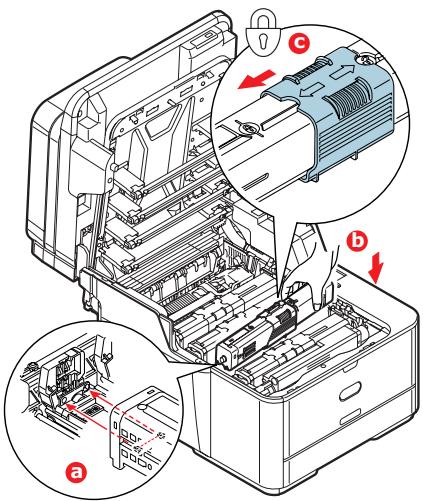
- Gently wipe the LED head surface with a clean, lint free cloth.
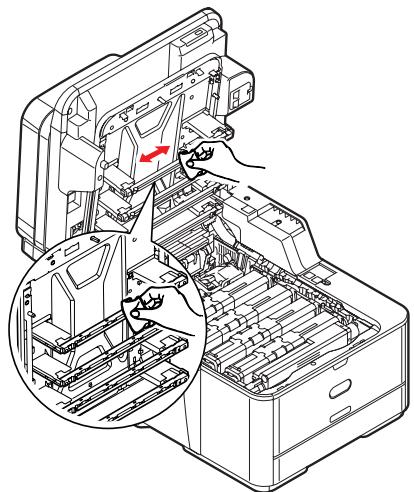
- Close the top cover and press down firmly so that the cover latches closed.
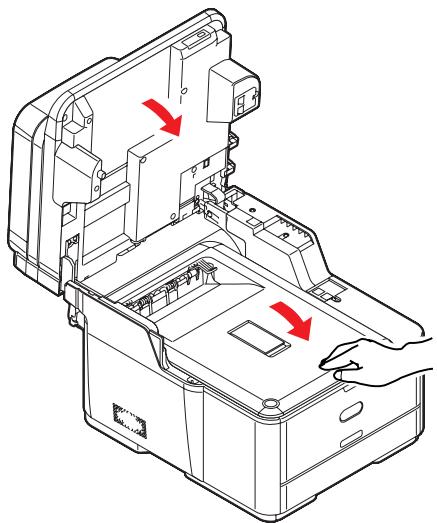
- Gently lower the scanner.
IMAGE DRUM REPLACEMENT
The image drum assembly comes complete with its own installation details which give full instructions on replacement. You are advised to follow these instructions carefully.
REPLACING THE TRANSFER BELT UNIT
The belt unit is located under the image drum assembly.
Switch off the MFP and allow the fuser to cool for about 10 minutes before opening the cover. Refer to "Switching off" on page 18 for details.
- Gently raise the scanner.
- Press the cover release (a) and open the top cover (b) fully.
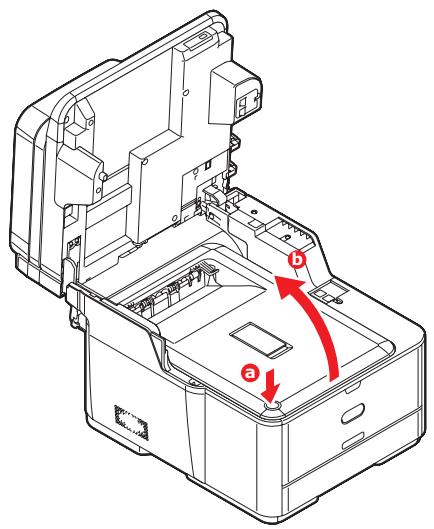
WARNING!
If the MFP has been powered on, the fuser will be hot. This area is clearly labelled. Do not touch.
- Holding it by its handles, lift the image drum assembly, complete with toner cartridges, up and out of the printer.
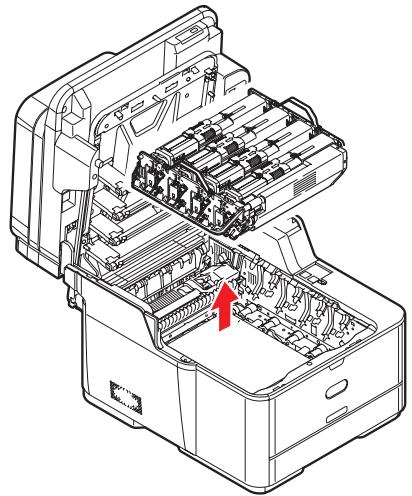
- Place the assembly in a safe place away from direct sources of heat and light.
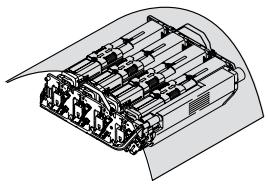
CAUTION!
The green image drum surface at the base of each cartridge is very delicate and light sensitive. Do not touch it and do not expose it to normal room light for more than 5 minutes. If the drum unit needs to be out of the printer for longer than this, please wrap the cartridge inside a black plastic bag to keep it away from light. Never expose the drum to direct sunlight or very bright room lighting.
- Pull the locking levers at each side of the transfer belt up and towards the front of the machine.
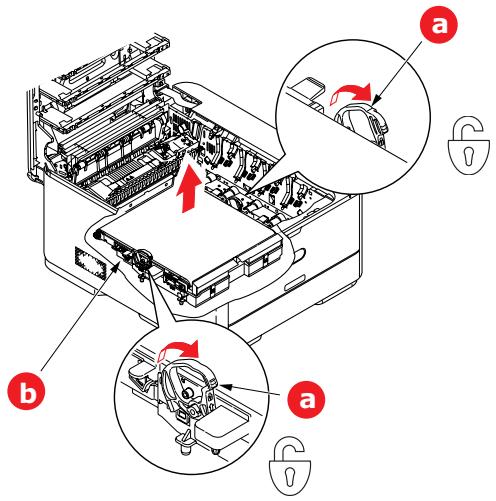
- Using the locking levers (a), lift the belt (b) upwards and withdraw from the machine.
- Lower the new belt unit into place, with the drive gear towards the rear of the printer. Locate the drive gear into the gear inside the printer by the rear right corner of the unit, and lower the belt unit flat inside the printer.
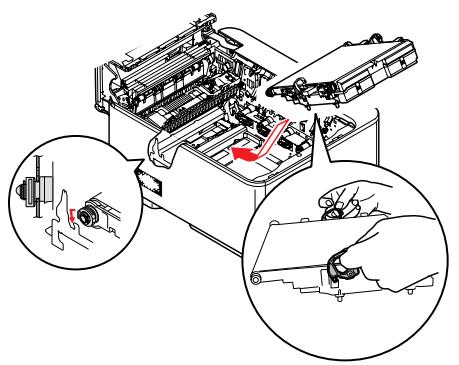
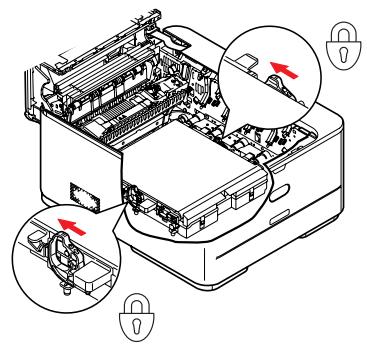
-
Push the locking levers towards the rear of the machine. This will secure the belt unit in place.
-
Holding the image drum assembly by its handles, lower it into place in the machine, locating the pegs at the sides into their slots in the sides of the printer cavity.
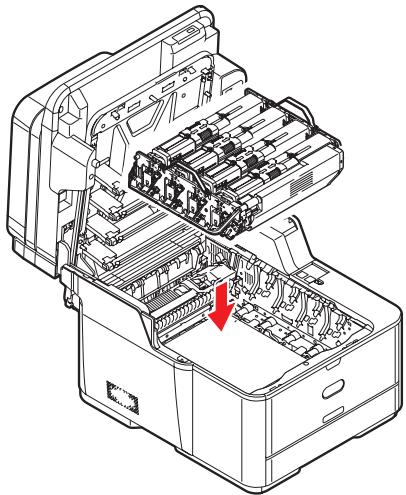
- Close the top cover and press down firmly so that the cover latches closed.
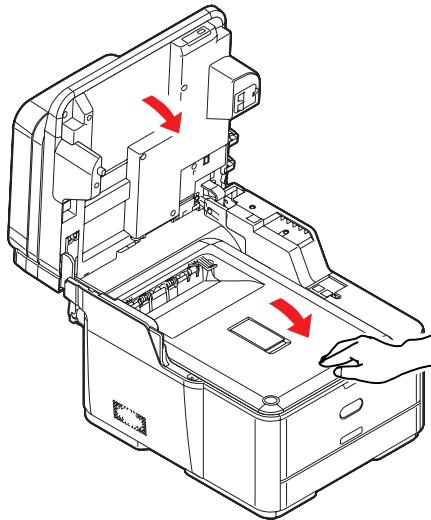
- Gently lower the scanner.
FUSER REPLACEMENT
The fuser is located inside the printer just behind the toner cartridges.
WARNING!
If the MFP has recently been powered on, some fuser components will be very hot. Handle the fuser with extreme care, holding it only by its handle, which will only be mildly warm to the touch. A warning label clearly indicates the area.
Switch off the MFP and allow the fuser to cool for about 10 minutes before opening the cover. Refer to "Switching off" on page 18 for details.
- Gently raise the scanner.
- Press the cover release (a) and open the top cover (b) fully.
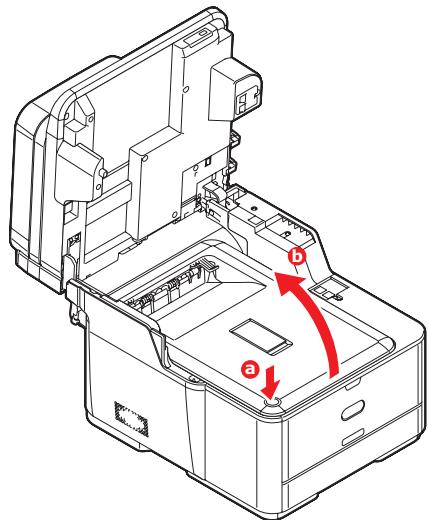
- Identify the fuser handle (a) on the top of the fuser unit.
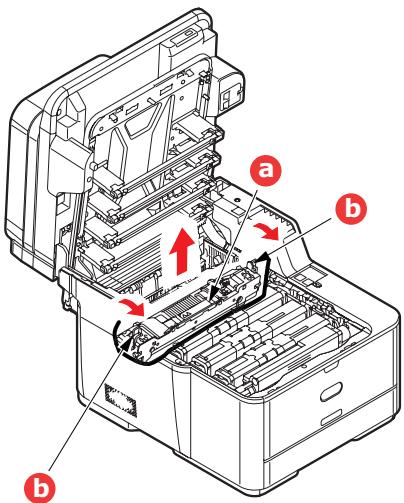
- Pull the two fuser retaining levers (b) towards the front of the printer so that they are fully upright.
- Holding the fuser by its handle (a), lift the fuser straight up and out of the printer. If the fuser is still warm, place it on a flat surface which will not be damaged by heat.
-
Remove the new fuser from its packaging and remove the transit material.
-
Holding the new fuser by its handle, make sure that it is the correct way round. The retaining levers (b) should be fully upright, and the two locating lugs (c) should be towards you.
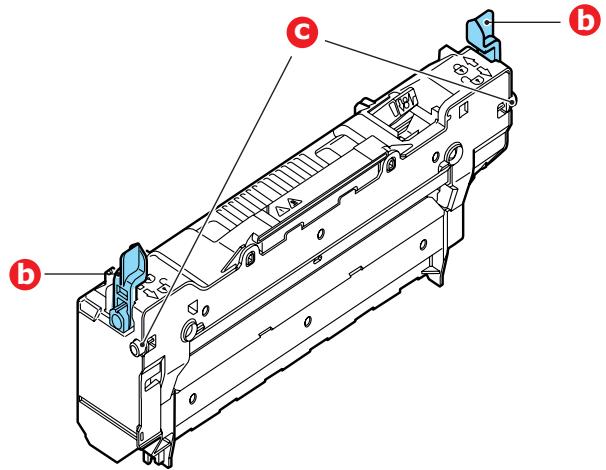
- Lower the fuser into the printer, locating the two lugs (c) into their slots in the sides of the printer cavity.
- Push the two retaining levers (b) towards the rear of the printer to lock the fuser in place.
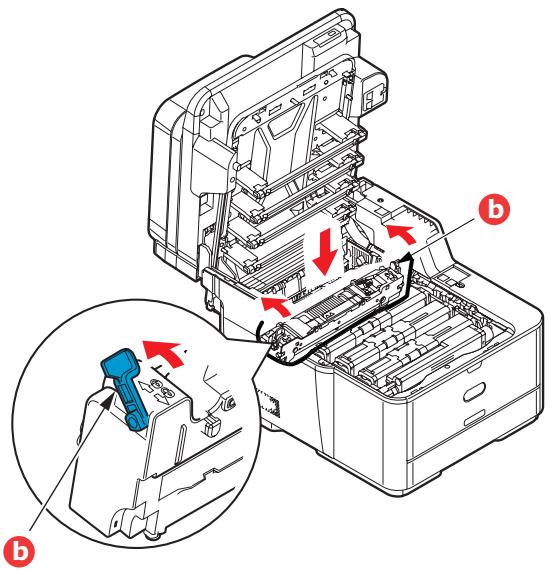
- Close the top cover and press down firmly so that the cover latches closed.
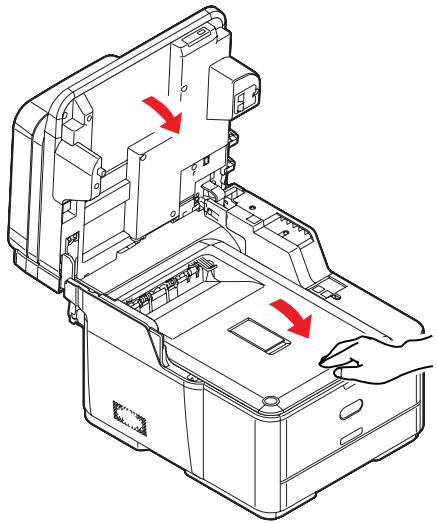
- Gently lower the scanner.
CLEANING
CAUTION!
Use a clean, moist, lint-free cloth for cleaning. Do not use benzine, thinners or alcohol as a cleaning agent.
...THE UNIT CASING
- Switch the printer off. Refer to "Switching off" on page 18 for details.
- Wipe the unit surface with a soft cloth moistened sparingly with water or neutral detergent.
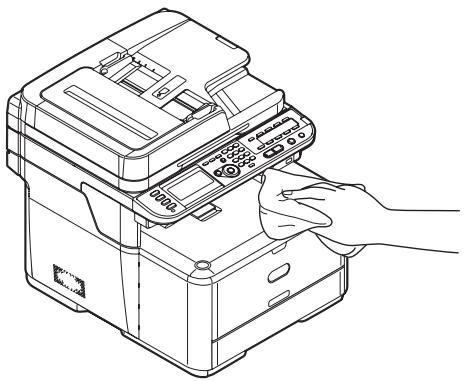
- Use a soft dry cloth to dry the unit surface.
- Switch the printer on.
...THE LED HEAD
Clean the LED heads when printing does not come out clearly, has white lines or when text is blurred.
There is no need to switch off the printer to clean the lens.
- Gently raise the scanner.
- Press the cover release (a) and open the top cover (b) fully.
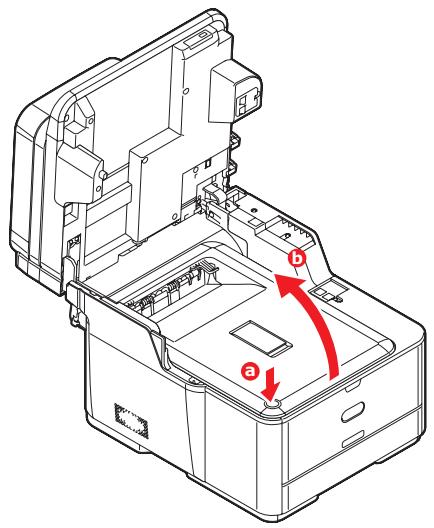
- Gently wipe the LED head surface with a clean, lint free cloth.
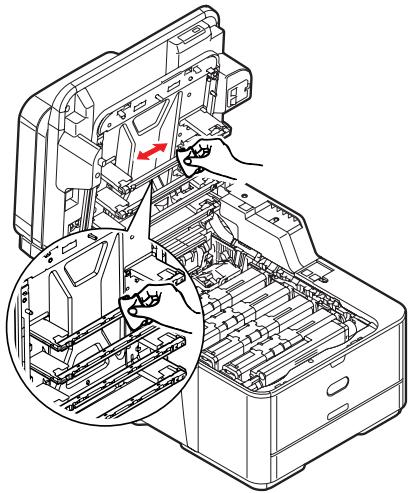
CAUTION!
Do not use methyl alcohol or other solvents on the LED head as damage to the lens surface will occur.
- Close the top cover and press down firmly at both sides so that the cover latches closed.
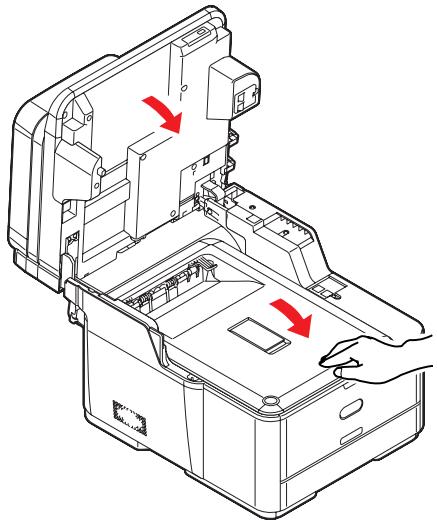
- Gently lower the scanner.
...THE PAPER PATH IN THE ADF
If marks are found on an image which has been read by the ADF, or the ADF does not feed documents smoothly, follow the cleaning procedure below.
- Switch the MFP OFF. Refer to "Switching off" on page 18 for details.
- Open the ADF top cover.
- Moisten a soft, clean, lint-free cloth and wipe the feed rollers (1) by moving the cloth from side to side.
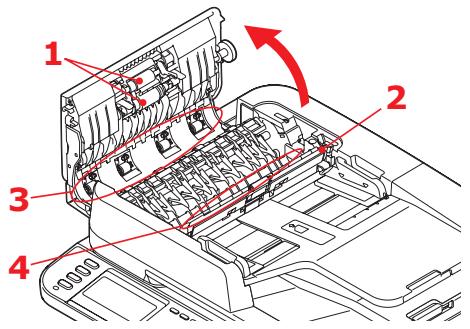
- Rotate the rollers forward with your finger and repeat step 3 until the rollers are clean.
- Carefully lift inner cover (2).
- Wipe rollers (3 & 4) by moving the cloth from side to side.
- Rotate the rollers forward with your finger and repeat step 6 until the rollers are clean.
- Return the inner cover to its original position.
- Close the ADF top cover.
...THE UNDERSIDE OF THE ADF
- Open the document cover.
- Moisten a soft, clean, lint free cloth and remove any marks, as shown.
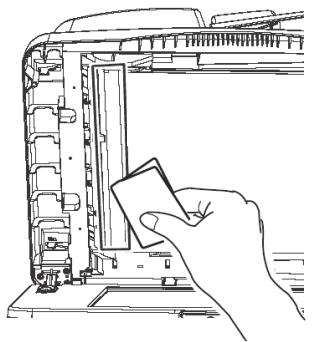
- Close the document cover.
...THE DOCUMENT GLASS
The document glass needs to be cleaned occasionally to ensure optimum image quality and performance.
- Open the document cover.
- Moisten a soft, clean, lint free cloth and remove any marks, as shown.
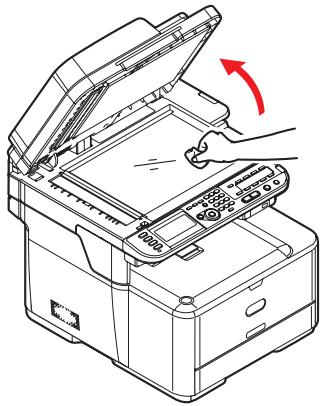
- Close the document cover.
INSTALLING UPGRADES
This section explains how to install optional equipment into your MFP. This includes:
additional RAM memory
SD card (MC561 only)
additional paper tray
MEMORY UPGRADE
The basic models come equipped with 256MB of main memory. This can be upgraded with an additional memory board of 256MB or 512MB, giving a maximum total memory capacity of 768MB.
- Switch the MFP off and disconnect the power cable. Refer to "Switching off" on page 18 for details.
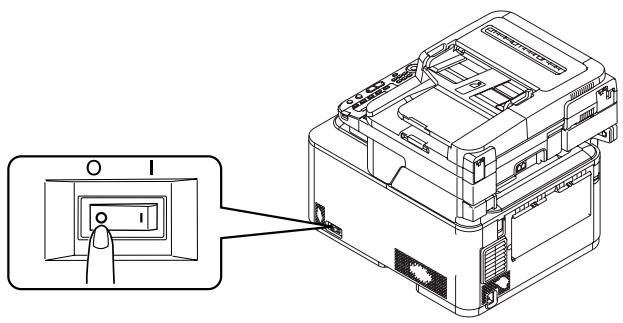
- Remove the outer access cover and place it safely to one side.
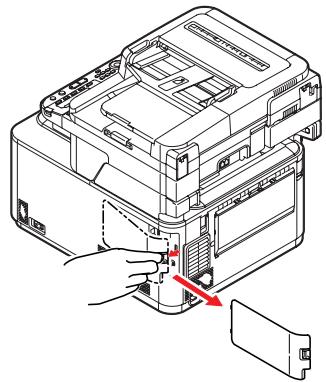
- Turn locking screw (a) anti-clockwise and remove the inner access cover (b). Place it safely to one side.
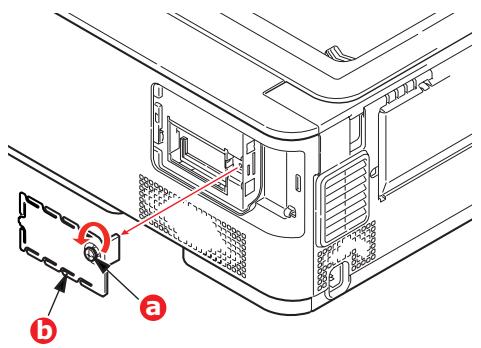
-
Carefully remove the new memory board from its wrapping. Try to handle the board only by its short edges, avoiding contact with any metal parts as far as possible. In particular, avoid touching the edge connector.
-
Notice that the memory board has a small cutout in the edge connector, which is closer to one end than the other.
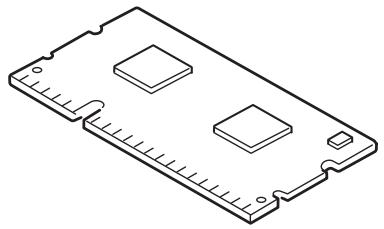
- Identify the RAM expansion slot in the printer.
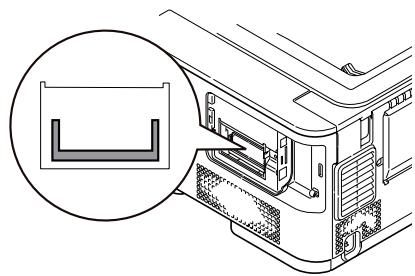
- If the RAM expansion slot already contains a memory upgrade board, that board will have to be removed before you can install the new one. To remove it, proceed as follows, otherwise skip to step 8.
(a) Release retaining clips and pull the board out of the slot.
(b) Place the removed memory board in the antistatic bag which originally contained the new memory board.
- Hold the new memory board by its short edges, so that the edge connector faces in towards the RAM expansion slot, and the small cutout is closer to the rear of the printer.
- Gently push the board into the RAM expansion slot until it latches in and will not go any further.
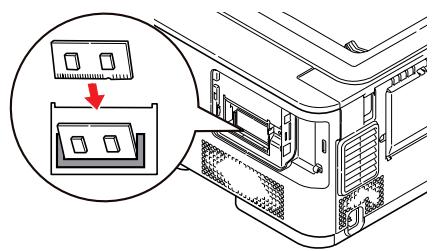
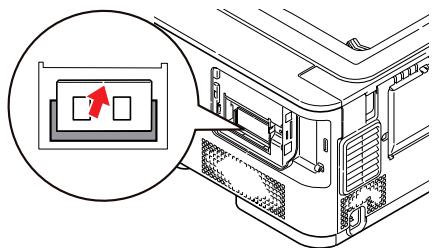
- Replace the inner access cover (b) and turn locking screw (a) clockwise to secure it shut.
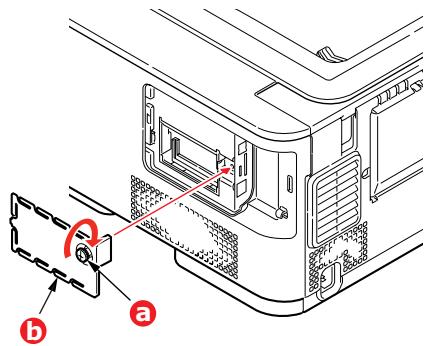
- Replace the access cover and latch it closed.
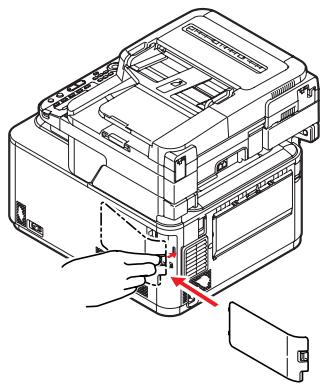
- Reconnect the power cable and switch the MFP on.
- When the machine is ready, print a menu map as follows:
(a) Press the SETTING button.
(b) Press the OK button to select Reports.
(c) Press the OK button to select Configuration.
(d) Press the OK button once more to execute.
(e) When the Configuration map is printed, press the Back button to exit the menu system.
- Examine the first page of the menu map.
Near the top of the page, between the two horizontal lines, you will see the current printer configuration. This list contains the figure for total memory size.
This should indicate the total memory now installed.
SD CARD (MC561 ONLY)
The SD card enables collating of printed pages and can be used to store overlays and macros, fonts, and secure or proof documents waiting to be printed.
Your machine is fitted with a 4GB class 6 SD card as standard. If you wish you can upgrade this as your machine supports 16GB class 6 SD cards. After replacement, you need to configure the printer driver settings. Refer to "Setting the driver device options" on page 117.
- Switch the MFP off and disconnect the power cable. Refer to "Switching off" on page 18 for details.
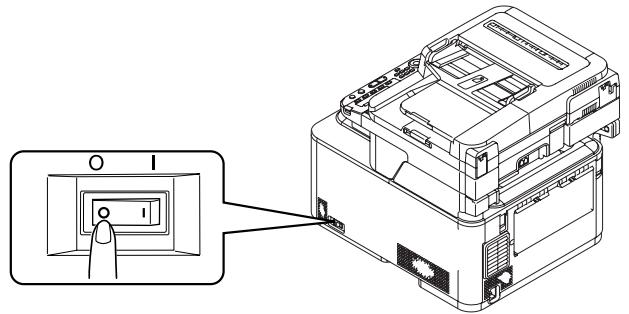
- Remove the outer access cover and place it safely to one side.
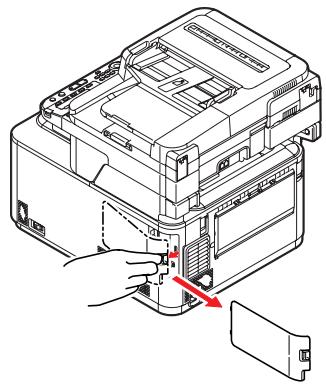
- Turn locking screw (a) anti-clockwise and remove the inner access cover (b). Place it safely to one side.
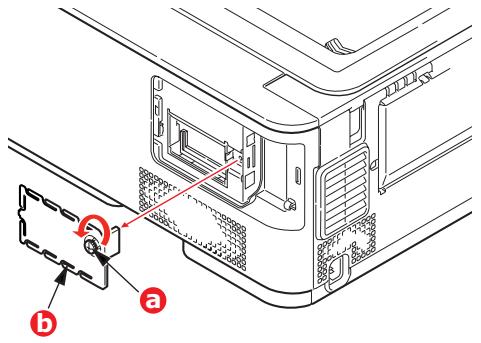
- Notice that the SD card has one chamfered corner.
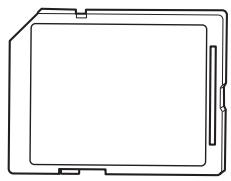
- Gently push the SD card into the slot as shown.
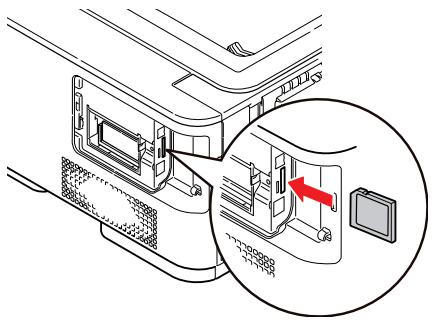
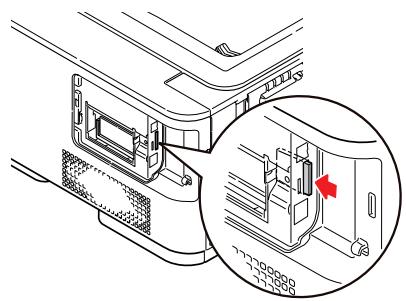
- Replace the inner access cover (b) and turn locking screw (a) clockwise to secure it shut.
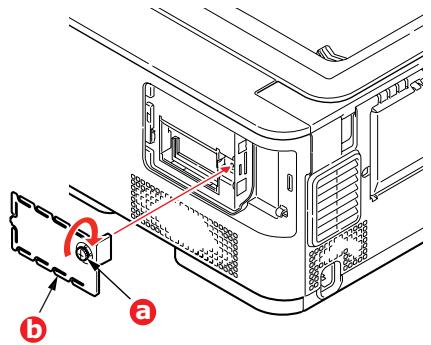
- Replace the access cover and latch it closed.
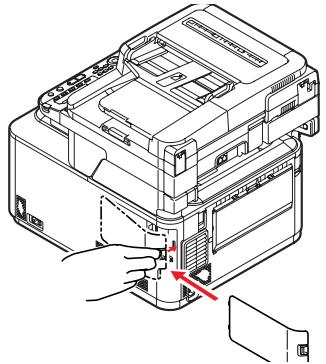
- Reconnect the power cable and switch the MFP on.
- When the machine is ready, print a menu map as follows:
(a) Press the SETTING button.
(b) Press the OK button to select Reports.
(c) Press the OK button to select Configuration.
(d) Press the OK button once more to execute.
(e) When the Configuration map is printed, press the Back button to exit the menu system.
- Examine the first page of the menu map.
Near the top of the page, between the two horizontal lines, you will see the current printer configuration. This should now indicate that the SD card is installed.
ADDITIONAL PAPER TRAY
- Switch the MFP off and disconnect the power cable. Refer to "Switching off" on page 18 for details.
- Place additional paper tray on desired location.
- Observing safety rules for lifting and, using locating guides, place machine on top of the additional paper tray.
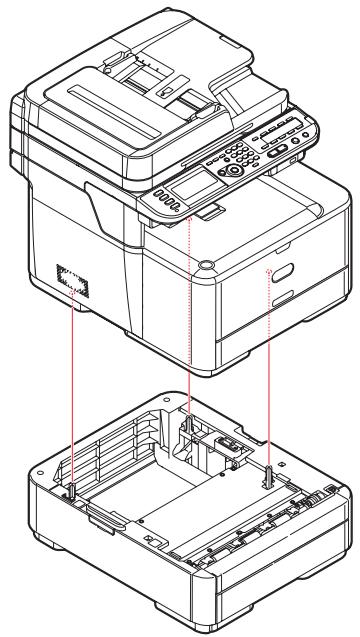
- Fit retaining clips as shown.
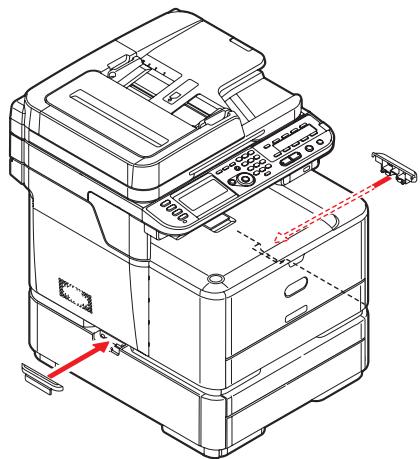
- Reconnect the power cable and switch the MFP on.
All that remains is to adjust the printer driver to make full use of the new features ("Setting the driver device options" on page 117).
SETTING THE DRIVER DEVICE OPTIONS
Once your new upgrade has been installed, you may need to update the printer driver so that the additional features are available to your applications.
Accessories such as additional paper trays will only be usable if the printer driver on your computer knows they are there.
In some cases the hardware configuration of your machine is automatically detected when the driver is installed. However, it is advisable to at least check whether all of the available hardware features are listed in the driver.
This procedure is essential if you subsequently add extra hardware features to your machine after the drivers have been installed and set up.
Remember that if your machine is shared between users on different computers, the driver must be adjusted on each user's machine.
WINDOWS
- Access the driver's Properties window.
(a) Open the "Printers" window via the Start Menu or from the Windows Control Panel.
(b) Right-click the icon for this machine, and choose the "properties" option from the pop-up menu.
- Select the "Device" tab.
- Set the options for any devices you have just installed.
- Click OK to close the window and save your changes.
MAC OS X
Snow Leopard (Mac OS X 10.6) and Leopard (Mac OS X 10.5)
- Open the Mac OS X Print & Fax Preferences.
- Ensure your machine is selected.
- Click Options & Supplies.
- Click Driver.
- Select all hardware options appropriate to your machine and click OK.
Tiger (Mac OS X 10.4)
- Open the Mac OS X Print & Fax Preferences.
- Ensure your machine is selected.
- Click Printer Setup....
- Click the menu and choose Installable Options....
- Select all hardware options appropriate to your machine and click Apply Changes....
Panther (Mac OS X 10.3)
- Open the Mac OS X Print & Fax Preferences.
- Click Printing.
- Click Set Up Printers....
- Ensure your machine is selected and click Show Info....
- Click the menu and choose Installable Options....
- Select all hardware options appropriate to your machine and click Apply Changes...
TROUBLESHOOTING
CHECKING THE MACHINE'S STATUS
From the STATUS key on the control panel, you can check the status of your machine.
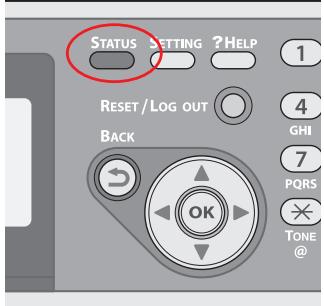
The STATUS key illuminates or flashes when any trouble is occurring in your machine.
- Press the STATUS key on the control panel to open the status menu.
- Ensure that System Status is selected and then press OK.
- Using the arrow keys, scroll to the item you want to check and then press OK.
CHECKING THE DEVICE AND JOB STATUS
You can check the device status, such as the residual life of the consumable items, and job lists from the STATUS key.
- Press the STATUS key on the control panel to open the status menu.
- Using the Down arrow key, scroll to Device Information and then press OK.
- Using the arrow keys, scroll to the item you want to check and then press OK. Choose from:
Copy/Print: Displays the list of copy/print jobs currently stored in the machines memory.
Fax Job View/Cancel: displays the list of fax jobs currently stored in the machine's memory.
Supplies Status: Displays consumable status information.
Counter:
Print Count: Displays the print count from all available trays.
Scan Count: Displays the number of pages scanned from the flatbed and ADF.
CLEARING PAPER JAMS
Provided that you follow the recommendations in this guide on the use of print media, and you keep the media in good condition prior to use, your MFP should give years of reliable service. However, paper jams occasionally do occur, and this section explains how to clear them quickly and simply.
Jams can occur due to paper misfeeding from a paper tray or at any point on the paper path through the MFP. When a jam occurs, the machine immediately stops, and the STATUS LED on the control panel informs you of the event.
NOTE
You can also refer to the instructions on how to clear paper jams by pressing
the ?HELP key on the control panel while the error message is displayed.
If printing multiple pages (or copies), do not assume that, having cleared an obvious sheet, others will not also be stopped somewhere along the path. These must also be removed in order to clear the jam fully and restore normal operation.
IN THE SCANNER ADF SECTION...
If a sheet is well advanced out of the ADF, simply grip it and pull gently to draw it fully out.
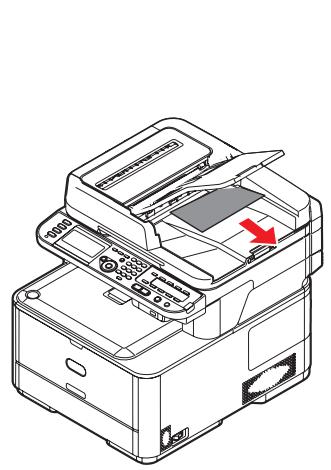
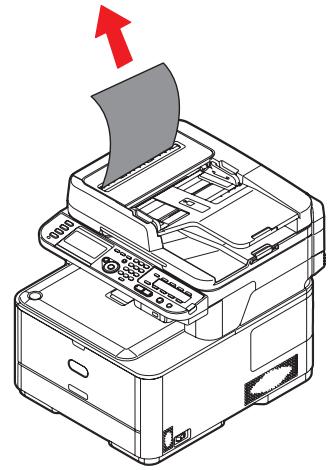
NOTE
If it does not remove easily, do not use excessive force.
- Lift the ADF cover (1).- from MC3x0
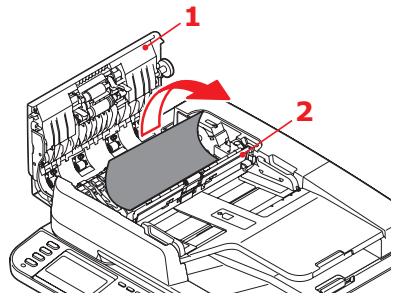
- Remove any loose paper from the entry to the sheet feeder.
- If there is any paper trapped in the feed mechanism:
(a) Lift the feeder mechanism (2).
(b) Remove any paper from ADF mechanism.
- Lower the ADF cover (1).
- Press the STOP button to restore the scanning head to the correct position.
IN THE PRINTER SECTION...
- If a sheet is well advanced out of the top of the printer, simply grip it and pull gently to draw it fully out. If it does not remove easily, do not use excessive force. It can be removed from the rear later.
- Gently raise the scanner.
- Press the cover release (a) and open the top cover (b) fully.
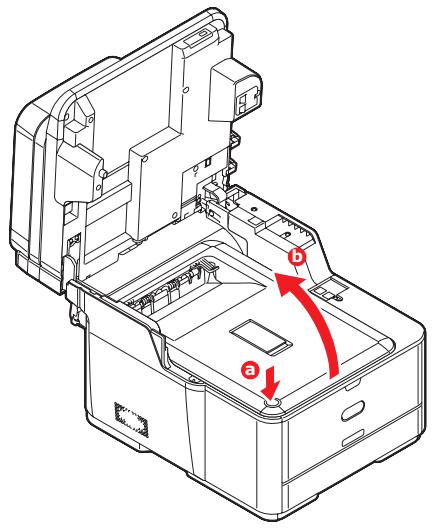
WARNING!
If the MFP has been powered on, the fuser will be hot. This area is clearly labelled. Do not touch.
- Holding it by its handles, lift the image drum assembly, complete with the toner cartridges, up and out of the printer.
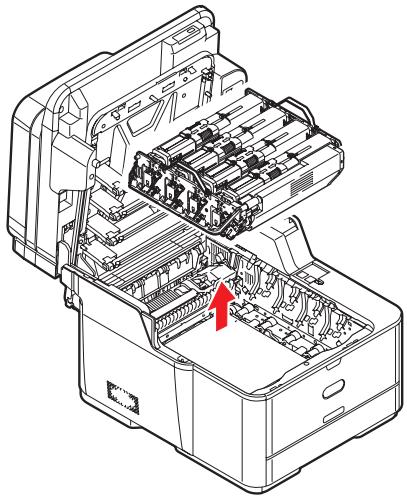
- Put the assembly down gently onto a piece of paper to prevent toner from marking your furniture and to avoid damaging the green drum surface, and cover.
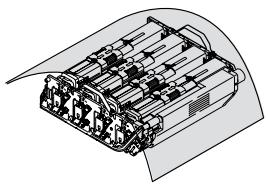
CAUTION!
The green image drum surface at the base of the Image Drum is very delicate and light sensitive. Do not touch it and do not expose it to normal room light for more than 5 minutes. If the drum unit needs to be out of the printer for longer than this, please wrap the cartridge inside a black plastic bag to keep it away from light. Never expose the drum to direct sunlight or very bright room lighting.
- Look into the printer to check whether any sheets of paper are visible on any part of the belt unit.
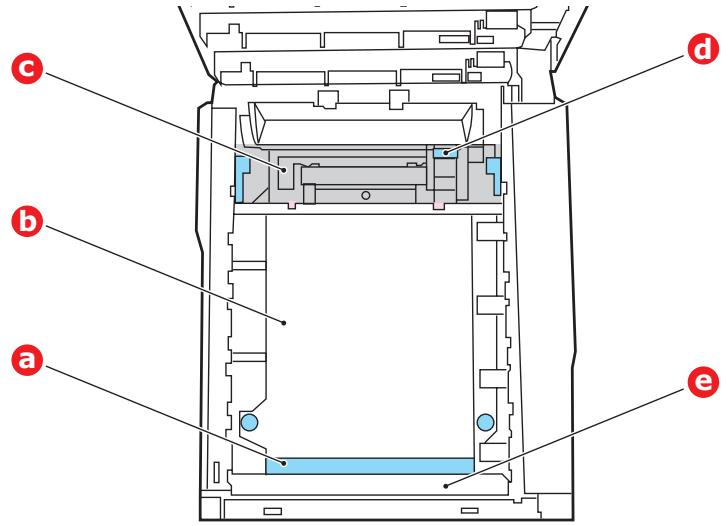
CAUTION!
Do not use any sharp or abrasive objects to separate sheets from the belt. This may damage the belt surface.
(a) To remove a sheet with its leading edge at the front of the belt (a), lift the plastic guard (e) at the front of the printer, then carefully lift the sheet from the belt and pull it forwards into the internal drum cavity and withdraw the sheet.
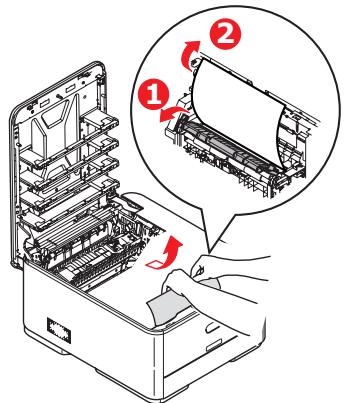
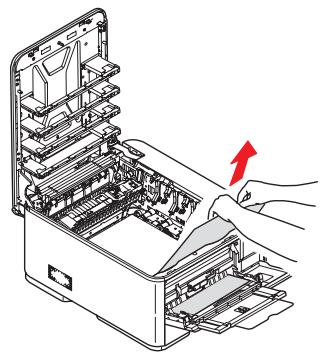
(b) To remove a sheet from the central area of the belt (b), carefully separate the sheet from the belt surface and withdraw the sheet.
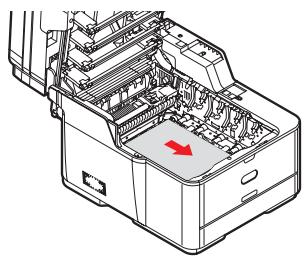
(c) To remove a sheet just entering the fuser (c), separate the trailing edge of the sheet from the belt, push the fuser pressure release lever (d) towards the front and down to release the fuser's grip on the sheet, and withdraw the sheet
through the drum cavity area. Then allow the pressure release lever to rise again.
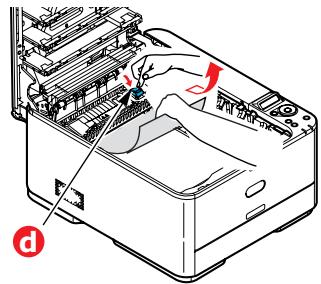
NOTE
If the sheet is well advanced into the fuser (only a short length is still visible), do not attempt to pull it back.
(d) To remove a sheet in the fuser, move the two retaining levers (e) towards the front of the machine to release the fuser. Withdraw the fuser unit using the handle (f).
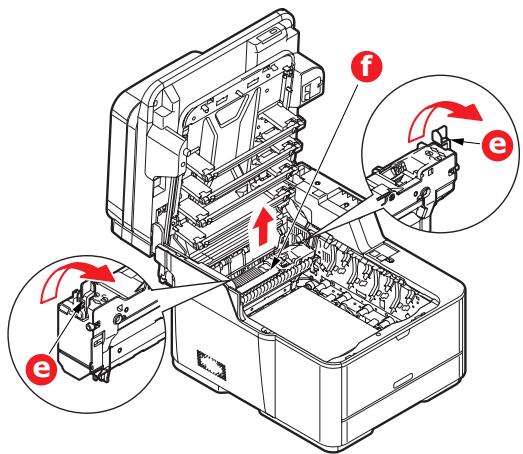
(e) Press release lever (g) and pull the trapped paper from the fuser.
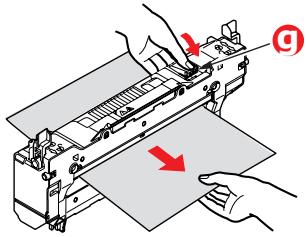
(f) Replace fuser unit into the machine and move locking levers (e) toward the rear of the machine.
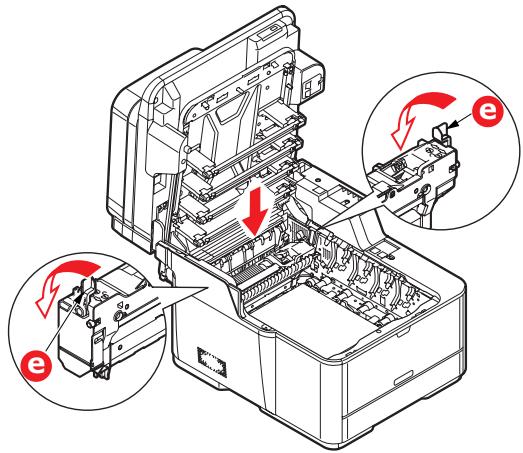
- If you were duplex printing when the jam occurred, check the duplex paper path:
(a) Pull the locking levers at each side of the transfer belt up and towards the front of the machine.
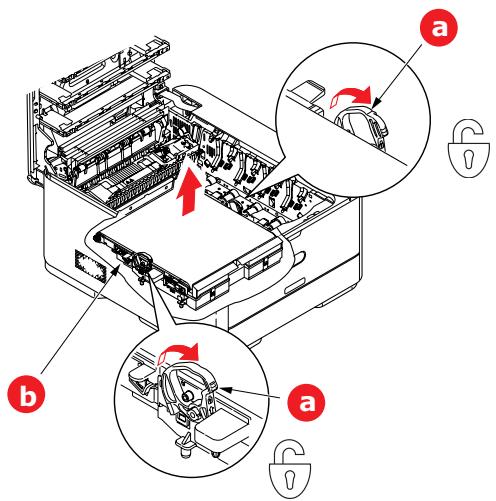
(b) Using the locking levers (a), lift the belt (b) upwards and withdraw from the machine.
(c) Look into the printer to check whether any sheets of paper are visible on any part of the paper path. Pull out any sheets found in this area.
(d) Lower the belt unit into place, with the drive gear towards the rear of the printer. Locate the drive gear into the gear inside the printer by the rear right corner of the unit, and lower the belt unit flat inside the printer.
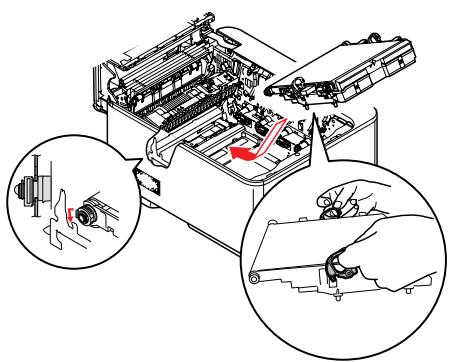
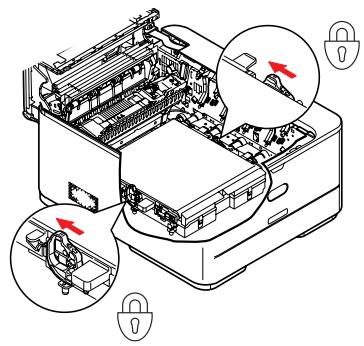
(e) Push the locking levers towards the rear of the machine. This will secure the belt unit in place.
- Holding the image drum assembly by its handles, lower it into place in the machine, locating the pegs at the sides into their slots in the sides of the printer cavity.
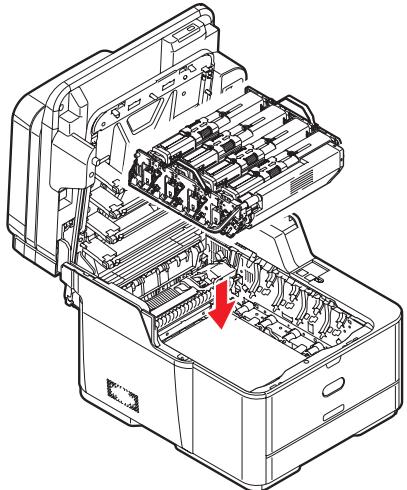
-
Lower the top cover but do not press down to latch it closed yet. This will protect the drum from excessive exposure to room lighting while you check the remaining areas for jammed sheets.
-
Open the rear exit tray (h) and check for a sheet of paper in the rear path area (i).
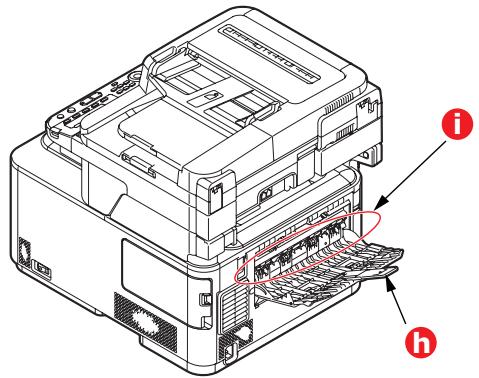
Pull out any sheets found in this area.
If the sheet is low down in this area and difficult to remove, it is probably still gripped by the fuser. In this case raise the top cover, reach around and press down on the fuser pressure release lever (d).
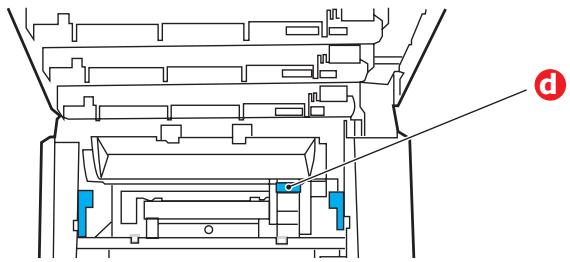
-
If you are not using the rear exit tray, close it once any paper has been removed from this area.
-
Pull out the paper tray and ensure that all paper is stacked properly, is undamaged, and that the paper guides are properly positioned against the edges of the paper stack. When satisfied, replace the tray.
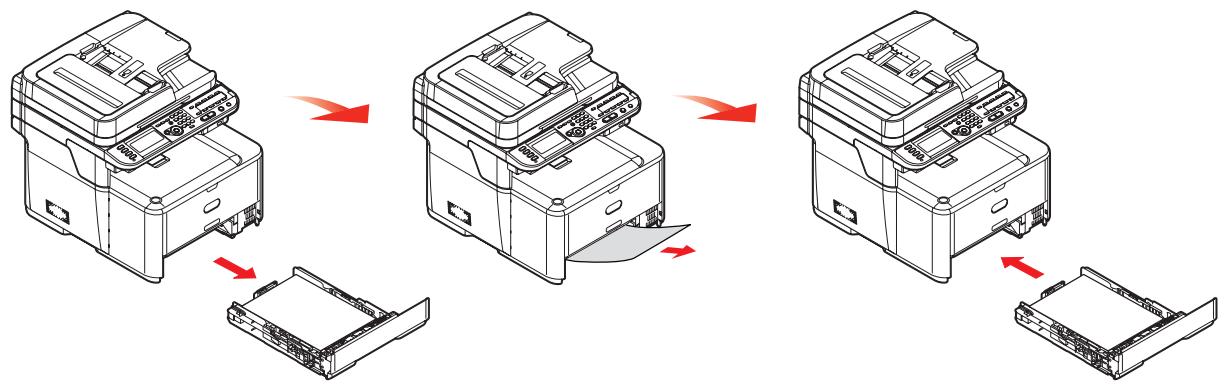
- Close the top cover and press down firmly so that the cover latches closed.
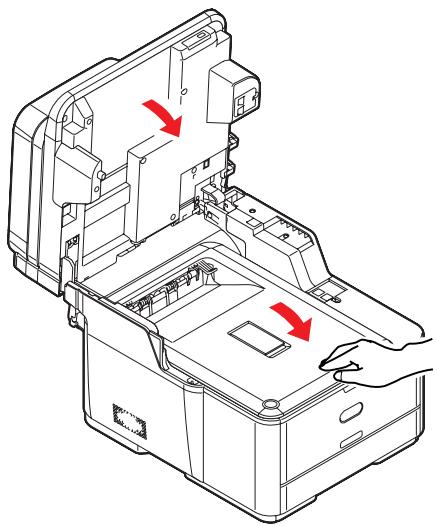
- Gently lower the scanner.
When the jam has been cleared, if Jam Recovery is enabled in the Printer Adjust menu, the MFP will attempt to reprint any pages lost due to paper jams (see "Jam Recovery:" on page 150).
DEALING WITH UNSATISFACTORY PRINTING
| SYMPTOMS | POSSIBLE CAUSES | STEPS TO TAKE |
| Vertical white lines can be seen on the printed page. | The LED head is dirty. | Wipe the LED head with a soft, lint-free cloth. |
| The toner is low. | Open the top cover and tap the cartridge a few times to evenly distribute any remaining toner. If symptoms persist, replace the toner cartridge. | |
| Foreign materials may be present in the image drum. | Replace the image drum cartridge. | |
| Light-shielding film of the image drum cartridge is dirty. | Wipe the film with a soft, lint-free cloth. | |
| Printed images are fading vertically. | The LED head is dirty. | Wipe the LED head with a soft, lint-free cloth. |
| The toner is low. | Open the top cover and tap the cartridge a few times to evenly distribute any remaining toner. If symptoms persist, replace the toner cartridge. | |
| The paper is not suitable for the printer unit. | Use recommended paper. | |
| Printing is light. | The toner cartridge is not properly seated. | Reinstall the toner cartridge. |
| The toner is low. | Open the top cover and tap the cartridge a few times to evenly distribute any remaining toner. If symptoms persist, replace the toner cartridge. | |
| The paper is moist. | Use paper stored in proper temperature and humidity conditions. | |
| The paper is not suitable for the printer unit. | Use recommended paper. | |
| Thickness and type of paper are inappropriate. | Set the correct value of media type and media weight in the Media menu or set one value thicker for media weight. | |
| Recycled paper is being used. | Set one value thicker for media weight in the Media menu. | |
| Partially faded images. White spots and lines appear in solid printing. | Paper is moist or dry. | Use paper stored in proper temperature and humidity conditions. |
| Vertical lines appear. | The image drum cartridge is damaged. | Replace the image drum cartridge. |
| The toner is low. | Open the top cover and tap the cartridge a few times to evenly distribute any remaining toner. If symptoms persist, replace the toner cartridge. | |
| Horizontal Lines and spots appear periodically. | When the interval is about 94mm (4in), the image drum (the green tube) is damaged or dirty. | Wipe it lightly with a soft cloth. Replace the image drum cartridge when it is damaged. |
| When the interval is about 30mm (1.2in), there may be foreign particles in the image drum cartridge. | Open/close the top cover, and print again. | |
| When the interval is about 86mm (3.4in), the fuser unit is damaged. | Replace the fuser unit. | |
| The image drum cartridge has been exposed to light. | Replace the image drum cartridge if the problem is not resolved. | |
| White area of paper is lightly stained. | Paper contains static. | Use paper stored in proper temperature and humidity conditions. |
| Too thick paper is used. | Use thinner paper. | |
| The toner is low. | Open the top cover and tap the cartridge a few times to evenly distribute any remaining toner. If symptoms persist, replace the toner cartridge. | |
| Periphery of the letters is smudged. | The LED head is dirty. | Wipe the LED head with a soft, lint-free cloth. |
| Toner comes off when it is rubbed. | The thickness and type of the paper are incorrectly set. | Set the correct value of media type and media weight in the Media menu or set one value lighter for media weight. |
| Recycled paper is used. | Set one value thicker for media weight in the Media menu. | |
| Glossiness is not uniform. | The thickness and type of the paper are incorrectly set. | Set the correct value of media type and media weight in the Media menu or set one value lighter for media weight. |
DEALING WITH UNSATISFACTORY COPYING
As well as the suggestions provided in "Dealing with unsatisfactory printing" on page 128, ensure that the scanner unit glass is clean at all times. Refer to "Cleaning" on page 107.
FAX PROBLEM CHECKLIST (MC361 AND MC561)
If a problem occurs, read through the list of problems and solutions before calling for service.
The machine will not dial a telephone number: Check the power cable and wall outlet. Make sure that the telephone line (not external telephone or handset) is connected to the LINE socket on the back of the machine. If an external telephone is installed, lift the handset and check for a dial tone. If there is no dial tone, there may be a problem with the telephone line. If there is a dial tone, the machine may be using the wrong dialling method (pulse or tone) for the region. If alternating tones are heard instead of dialling pulses and the region uses pulse dialling, change the call parameters ("MF(Tone)/DP(Pulse)" on page 162).
The display shows a communications error: This indicates any of a number of problems.
The machine may be incompatible with the remote machine, or the remote machine may not be able to perform the function requested of it such as polling or confidential faxing.
The remote machine may also be out of paper or experiencing a paper jam.
Bad telephone line conditions can also cause communication errors. Try sending the fax again and check to make sure that the correct telephone number is being dialled.
If a prefix number must be dialled to get an outside line, or if the call is to an international destination, a pause may need to be entered after the dial prefix or international dialling code to tell the machine to wait for a dial tone. If there are frequent problems communicating with a particular remote machine, try programming the number into a speed dial key, and then change the parameters for that key.
Lastly, either the local or remote machine may require servicing. Try sending a fax to another location to check the local machine.
Faxing is possible but the image of the document printed by the remote machine is very poor: If the faxed document has small type, complex illustrations, photos, or is very light or very dark, try changing the fax density settings (see "Density" on page 145). Copy the document on the machine to determine how it will transmit. The problem may be caused by telephone line interference. Try sending the document again later.
Fax sent but received message was completely blank: Make sure that the document is loaded correctly before faxing; with text face UP in the ADF or face DOWN on the glass.
Image of received fax is very poor: Try making a copy of a document on the local machine to make sure it is working properly. If there is still a problem, contact the person sending the fax and ask them to change their fax quality and density settings. Ask the person to make a copy of the document on their machine to ensure that it is working properly. Then ask them to send the fax again.
Dialling was tried with a Speed Dial/Group Dial number but nothing happened: Make sure that the Speed Dial number being used is programmed correctly.
Documents received are light or have vertical streaks on them, and machine is not out of toner: Gently wipe the lens surface of the MFP's LED array, and then check to see if the machine is working properly (see "...the LED head" on page 107). Then check to see if the toner or image drum need replacing (see "Replacing consumable items" on page 97).
Machine is set for delayed transmission but it did not send: Check the display to make sure that the MFP is set to the correct time and date (see "Time Setup" on page 162).
MFP will not poll a remote machine.: Call the person at the remote machine and make sure that they have loaded documents and that their machine is set to polling transmission mode.
Machine is connected to a PBX but it is not possible to dial out: Be certain that the dial prefix is entered before the telephone number for each number dialled or programmed into the machine. Additionally, the machine must be programmed for PBX operation before it will work with a PBX (refer to the Configuration Guide for details).
Machine always answers before it's possible to use the external telephone: If an external telephone is connected, increase the machine's ring response setting (see "Ring Response" on page 146).
Faxes received sometimes look distorted: If the document received is wider or longer than the paper loaded in the paper tray, the machine automatically reduces the width or length of the document so that it will fit on the paper. This type of problem could also be communication related.
SPECIFICATIONS
MC351 - N34305B
MC361 - N34306B
MC561 - N34307B
| ITEM | SPECIFICATION | ||
| MC351 | MC361 | MC561 | |
| Dimensions | 427 x 509 x 445mm (W x D x H) | ||
| Weight | 29Kg approx. | ||
| Power supply | 220 to 240VAC (range 198 to 264 VAC) | ||
| Power consumption | |||
| Sleep: | <1.2 W | <1.5 W | |
| Power saving: | < 20 W | ||
| Stand-by: | 100 W | ||
| Operating (Average): | 500 W | 570 W | |
| Operating (Max.): | 1170 W | ||
| Operating environment | Operating 10 to 32 °C/20 to 80% RH (optimum 25 °C wet, 2 °C dry) Idle: 0 to 43 °C/10 to 90% RH (optimum 26.8 °C wet, 2 °C dry) | ||
| Print environment | Colour 17 to 27 °C @ 50 to 70% RH | ||
| Noise (Sound pressure level) | |||
| Operating: | 52dB(A) | 54dB(A) | |
| 54dB(A) | 55.5dB(A) | ||
| Copy | |||
| Standby: | Inaudible | ||
| Power saving: | Inaudible | ||
APPENDIX A - MENU SYSTEM
The top-level function menus are:
Reports
Paper Setup
Address Book
Phone Book
Profile
Network Scan Destination
Store Document Settings
View Information
Shutdown
Easy Setup
Admin Setup
The menu trees are given to the lowest menu item level. Typically, this can be a parameter that can be set by selecting from a range of values provided or a command that can be executed to display or print a status or setting value.
REPORTS
| ITEM | OPTION | OPTION/DESCRIPTION | ||
| Configuration | Yes, No | Prints out a report of the machine's configuration | ||
| System | File List | Yes, No | Prints out a file list | |
| Demo Page | 01:DEMO1 | Yes, No | Prints a Demonstration page | |
| Error Log | Yes, No | Prints out an error log | ||
| MFP Usage | Yes, No | Prints a full report of the machine usage. | ||
| Network Information | Yes, No | Prints out a report of the Network configuration | ||
| \( Fax^a \) | Speed Dial List | Enter the Admin Password | Yes, No | Prints the list of fax numbers registered for speed dials. |
| Group List | Enter the Admin Password | Yes, No | Prints the list of fax numbers registered under groups. | |
| Fax Tx/Rx Log | Enter the Admin Password | Yes, No | Prints the list of the communication results for the latest 100 fax jobs received or sent. | |
| Fcode Box List | Yes, No | Prints the list of fcode boxes. | ||
| Block Junk Fax | Yes, No | Prints the list of blocked senders. | ||
| E-mail/Internet Fax | Journal Report | Enter the Admin Password | Yes, No | Prints the results of the latest 50 Internet Fax jobs. |
| Address Book | Enter the Admin Password | Yes, No | Prints the registered address list. | |
| PCL Font List | Yes, No | Prints the list of PCL font samples. | ||
| PSE Font List | Yes, No | Prints the list of PostScript font samples. | ||
| PPR Font List | Yes, No | Prints the list of IBM PPR font samples. | ||
| FX Font List | Yes, No | Prints the list of EPSON FX font samples. | ||
| Color Tuning Pattern | Yes, No | Prints a color tuning pattern for adjusting gradation characteristics. | ||
| Color Profile List | Yes, No | Prints the list of colour profiles. | ||
a. MC361 and MC561 only.
PAPER SETUP
| ITEM | OPTION | OPTION/DESCRIPTION | ||
| Tray 1 | Paper Size | A4/A5/A6/B5/Letter/Legal13/Legal13.5/Legal14/Executive/16K(184x260mm)/16K(195x270mm)/16K(197x273mm)/Custom | Sets paper in Tray 1. | |
| Custom | Width:105~210~216mmLength:148~297~356mm | Enter paper width and length. | ||
| Media Type | Plain/Letter Head/Bond/Recycled/CardStock/Rough/Glossy | Select the type of media loaded in this tray. This will help the MFP to adjust its internal operating parameters, such as engine speed and fusing temperature, to better accommodate the media to be fed. For example, letterhead may benefit from a slightly lower fusing temperature to ensure that its ink does not offset. | ||
| Media Weight | Light/Medium Light/Medium/Heavy/Ultra Heavy1 | Adjusts the MFP for the weight of paper stock loaded in this tray. | ||
| Tray 2 | Paper Size | A4/A5/B5/Letter/Legal13/Legal13.5/Legal14/Executive/16K(184x260mm)/16K(195x270mm)/16K(197x273mm)/Custom | Sets paper in Tray 2. | |
| Custom | Width:148~210~216mmLength:210~297~356mm | Enter paper width and length. | ||
| Media Type | Plain/Letter Head/Bond/Recycled/CardStock/Rough/Glossy | Select the type of media loaded in this tray. This will help the MFP to adjust its internal operating parameters, such as engine speed and fusing temperature, to better accommodate the media to be fed. For example, letterhead may benefit from a slightly lower fusing temperature to ensure that its Ink does not offset. | ||
| Media Weight | Light/Medium Light/Medium/Heavy/Ultra Heavy1 | Adjusts the MFP for the weight of paper stock loaded in this tray. | ||
| ITEM | OPTION | OPTION/DESCRIPTION | ||
| MP Tray | Paper Size | A4/A5/A6/B5/Letter/Legal13/Legal13.5/Legal14/Executive/16K(184x260mm)/16K(195x270mm)/16K(197x273mm)/Custom/COM-9Envelope/COM-10Envelope/MonarchEnvelope/DLEnvelope/C5Envelope/Index Card | Select the size of paper to be fed from the multi purpose tray. | |
| Custom | Width:64~210~216mmLength:127~297~1321mm | Enter paper width and length. | ||
| Media Type | Plain/Letter Head/Labels/Bond/Recycled/CardStock/Rough/Glossy | Select the type of media to be fed from the multi purpose tray so that the MFP can adjust its internal parameters to better accommodate the selected type of media. | ||
| Media Weight | Light/Medium Light/Medium/Heavy/Ultra Heavy1/Ultra Heavy2 | Select the media weight to be fed from the multi purpose tray. | ||
| Select Tray | \( Fax^a \) | Tray 1: | ON/OFF/ON(Prior) | Fax: Set tray for received Fax.Tray usage, priority given to trays set to ON(Prior), then ON.If tray is set to OFF,it will not be used. |
| Tray 2: | ON/OFF/ON(Prior) | |||
| MP Tray: | ON/OFF/ON(Prior) | |||
| Copy | Tray 1: | ON/OFF/ON(Prior) | Copy: Set tray for copy jobs.If Tray Selection is set to "Auto": Tray usage, priority given to trays set to ON, then ON(Prior).If tray is set to OFF,it will not be used. | |
| Tray 2: | ON/OFF/ON(Prior) | |||
| MP Tray: | ON/OFF/ON(Prior) | |||
a. MC361 and MC561 only.
ADDRESS BOOK
| ITEM | OPTION | OPTION/DESCRIPTION | |
| E-mail Address | Select an address number. Max. 100 entries. | ||
| Register | Name | user defined | Enter a name for the e-mail address entry. Max. 16 characters. |
| E-mail Address | user defined | Enter the e-mail address. Max. 80 digits. | |
| Group No. | Add to a registered group. | ||
| Edit | Edit settings. Refer to options above for details. | ||
| Delete | Yes, No | Delete entry. | |
| Sort By Name | Sort list of entries by name. | ||
| Sort By Number | Sort list of entries by number. | ||
| E-mail Group | Select a group number. Max. 20 group entries. | ||
| Register | Name | user defined | Enter a name for the e-mail group entry. Max. 16 characters. |
| Address No. | Select and assign addresses from resultant list. Max. 100 entries can be register to a group. | ||
| Edit | Edit settings. Refer to options above for details. | ||
| Delete | Yes, No | Delete entry. | |
| Sort By Name | Sort list of entries by name. | ||
| Sort By Number | Sort list of entries by number. | ||
NOTE
MC361 and MC561 only.
| ITEM | OPTION | OPTION/DESCRIPTION | |
| Speed Dial | Select a speed dial number. Max. 100 speed dial entries. | ||
| Register | Name | user defined | Enter a name for the speed dial entry. Max. 24 characters. |
| Fax Number | user defined | Enter the fax number for the speed dial entry. Max. 40 digits. | |
| Group No. | Add to a registered group. | ||
| Edit | Edit settings. Refer to options above for details. | ||
| Delete | Yes, No | Delete entry. | |
| Sort By Name | Sort list of entries by name. | ||
| Sort By Number | Sort list of entries by number. | ||
| Group No. | Select a group number. Max. 20 group entries. | ||
| Register | Name | user defined | Enter a name for the group dial entry. Max. 16 characters. |
| Speed Dial | Select and assign speed dial entries from resultant list. Max. 100 entries can be register to a group. | ||
| Edit | Edit settings. Refer to options above for details. | ||
| Delete | Yes, No | Delete entry. | |
| Sort By Name | Sort list of entries by name. | ||
| Sort By Number | Sort list of entries by number. | ||
PROFILE
| ITEM | OPTION | VALUE/DESCRIPTION | ||
| No. | Select a profile number. | |||
| Register | Profile Name | user defined | Sets a profile name. Max. 16 characters. | |
| Protocol | CIFS, FTP, HTTP | Selects a protocol to use for storing files. | ||
| Target URL | user defined | Sets a server address and a directory to store the scanned data. Max. 144 characters. | ||
| Port No. | 1 ~ 445 ~65535 | Sets a port number. | ||
| PASV Mode | OFF | Sets whether to use the FTP Passive mode. Display condition: Protocol set to FTP. | ||
| User Name | user defined | Sets a user name to use for logging onto the server. Max. 32 characters. | ||
| Password | user defined | Sets a password to use when logging onto the server. Max. 32 characters. | ||
| CIFS Character Set | UFT-16, ASCII | Sets a character set to use in CIFS. Display condition: CIFS is set as a protocol. | ||
| Encode Communication | None | Selects an encryption method for communication. Not available when using CIFS protocol. Choices vary depending on the protocol selected. | ||
| Scan Size | A4, A5, A6, B5, Letter, Legal 13, Legal 13.5, Legal 14, Executive | Selects a scan size. | ||
| Image Settings | Density | 0 | Sets the density of images. | |
| Document Type | Text&Photo | Sets the image quality. | ||
| Background Removal | 3 | Sets the default setup of the background removal. | ||
| Resolution | 200dpi | Selects a resolution. | ||
| Contrast | 0 | Sets the contrast. | ||
| Hue | 0 | Sets the red-green colour balance. | ||
| Saturation | 0 | Sets the colour saturation. | ||
| RGB | R:[0], G:[0], B:[0] | Sets the RGB contrast. | ||
| File Name | user defined | Sets a file name. Max. 64 characters. The following options can be set as the default file name: #n: adding a serial number from 00000 to 99999 #d: adding the date of a file creation (yymmddhhmmss) | ||
| Greyscale | OFF, ON | Select ON to print in grayscale. | ||
| Register (cont.) | File Format | Color | PDF, TIFF, JPEG, XPS | Sets a file format for scanning. |
| Mono (Greyscale) | PDF, TIFF, JPEG, XPS | |||
| Mono (Binary) | PDF, TIFF, XPS | |||
| Encrypted PDF | Not Encrypt | Encryption disabled. | ||
| Encrypt | Low, Medium, High | Set encryption level. Also enable/disable document open and permissions passwords. | ||
| Compression Rate | Color | High, Medium, Low | Sets a compression rate for scanning. | |
| Mono (Greyscale) | High, Medium, Low | |||
| Mono (Binary) | High, Medium, Raw | |||
| Edge Erase | OFF | Sets whether to erase the edge shadow created in the surrounding of 2-page spread documents. | ||
| ON | Width: 5 mm | Sets an erasing width. Range: 5 to 50 mm. | ||
| Edit | Edit profile settings. Refer to options above for details. | |||
| Delete | Yes, No | Delete profile. | ||
| Sort By Name | Sort list of entries by name. | |||
| Sort By Number | Sort list of entries by number. | |||
NETWORK SCAN DESTINATION
| ITEM | OPTION | OPTION/DESCRIPTION | |
| No. | Select a destination number. | ||
| Register | Destination | user defined | Sets a destination name. Max. 16 characters. |
| Destination Address | user defined | Sets a destination address. Max. 16 characters. | |
| Port No. | 9968 | Sets a port number. Available range: 1 to 65535. | |
| Edit | Destination | Edit destination name. | |
| Destination Address | Edit destination address. | ||
| Port No. | Edit port no. | ||
| Delete | Yes, No | Deletes destination. | |
| Sort By Name | Sort list of entries by name. | ||
| Sort By Number | Sort list of entries by number. | ||
STORE DOCUMENT SETTINGS
| ITEM | OPTION | OPTION/DESCRIPTION | |
| Store | Fcode Bulletin Board | Over Write | Stores documents in a bulletin box. |
| Delete | Fcode Bulletin Board | Deletes accumulated documents. | |
| Received Documents | |||
| Fcode Box | Prints accumulated documents. | ||
| Reserved Tx Doc. | |||
| Received Documents | |||
VIEW INFORMATION
| ITEM | OPTION | OPTION/DESCRIPTION |
| System Information | Serial No. | Displays system information |
| Asset No. | ||
| Lot No. | ||
| CU Version | ||
| PU Version | ||
| Scanner Version | ||
| Total Memory | ||
| Flash Memory | ||
| SD Memory \( Card^a \) | ||
| Network | IPv4 \( Address^b \) | Displays network information |
| Subnet \( Mask^b \) | ||
| Gateway \( Address^b \) | ||
| MAC Address | ||
| NIC Program Version | ||
| IPv6 \( Address (Local)^c \) | ||
| IPv6 \( Address (Global)^c \) |
a. MC561 only.
b. Appears only when the "TCP/IP" setting is "Enable" and the "IP Version" setting is "IPv4".
c. Appears only when the "TCP/IP" setting is "Enable" and the "IP Version" setting is "IPv6".
SHUTDOWN
| ITEM | OPTION | OPTION/DESCRIPTION |
| Shutdown | Yes, No | Select Yes to perform a controlled shutdown of the MFP, ensuring that all files on the internal hard disk are closed before power is turned off. Only power the MFP off when the display indicates that shutdown is complete. |
NOTE
The Easy Setup menu is blocked by the Admin password.
| ITEM | OPTION | OPTION/DESCRIPTION | ||
| Date/Time Setting | user defined | Using the arrow keys, select your time zone, in relation to GMT, from the list. Press OK to continue. | ||
| Not Summer TimeNow Summer Time | Manual | DayMonthYear | Using the keypad and arrow keys, enter the correct date and time. | |
| HourMinuteSecond | ||||
| Server | Set Address of SNMP Server (Primary) | user defined | ||
| Set SNMP Server (Secondary) | ||||
| Fax Settinga | Fax Number | user defined | Using the keypad and on screen options, enter the fax number of this machine. | |
| Sender ID | user defined | Using the arrow keys and on screen keyboard, enter the sender ID. | ||
| Network Setting | Manual Auto | IP Address | Specifies whether IP address allocation is automatic (DHCP) or manually assigned. Display condition: TCP/IP protocol must be enabled. | |
| Subnet Mask | Current assigned subnet mask. To change, enter the address using the keypad. Press OK to register new address. Display condition: TCP/IP protocol must be enabled. | |||
| Default Gateway | Current assigned gateway address. To change, proceed as above. Display condition: TCP/IP protocol must be enabled. | |||
| DNS Server (Primary) | Current assigned DNS server (primary). | |||
| DNS Server (Secondary) | Current assigned DNS server (secondary). | |||
| WINS Server (Primary) | Current assigned WINS server (primary). | |||
| WINS Server (Secondary) | Current assigned WINS server (secondary). | |||
| E-mail Setting | Set IP Address of Mail Server | user defined | Enter the IP address of the mail server. | |
| From | user defined | Enter the sender's address | ||
| No Authentication | Set the authentication method. | |||
| SMTP Auth | User Name | |||
| Password | ||||
| POP Before SMTP | Set Address of POP3 Server | UserID | ||
| Password | ||||
a. MC361 and MC561 only.
ADMIN SETUP
NOTE
The Admin Setup option is blocked by a password.
| ITEM | OPTION | DEFAULT VALUE/DESCRIPTION | ||
| Copy Setup | Default Settings | Scan size | A4 | Refer to “Advanced operation” on page 43 for further details. |
| Duplex Document -> Bind Position | OFF(Simplex) | |||
| Zoom | 100% | |||
| Sort | ON | |||
| Image Settings Density : Document Type : Scan Resolution : Background Removal : Contrast : Hue : Saturation : RGB : | 0 Text&Photo Normal 3 0 0 0 R:0/G:0/B:0 | |||
| Direction | Portrait | |||
| ID Card Copy | OFF | |||
| Continue Scan | OFF | |||
| Mixed Size | OFF | |||
| Margin | OFF | |||
| Edge Erase | OFF | |||
| Fax Setupa | Default Settings | Resolution | Normal | Refer to "Advanced operation" on page 73 for further details. |
| Density | 0 | |||
| Scan Size | A4 | |||
| Continue Scan | OFF | |||
| TTI | ON | |||
| Transmit Confirmation Report | OFF | |||
| Memory Tx | ON | |||
| Fcode Box Register Edit Delete | Confidential Box Box Name Sub-Address Hold Time I.D.Code | user defined user defined 0 user defined | Confidential Box: received data cannot be printed without entering ID code (for secret documents). You can also enter a Box Name, Password and specify the hold time for your secure box. Range: 00 - 31 | |
| Bulletin Box Box Name Sub-Address | user defined user defined | Bulletin Box: Enable to transmit/receive documents to/from Bulletin. | ||
| Edit settings. Refer to options above for details. | ||||
| Yes, No | Delete entry. | |||
| Security Function | ID Check Tx | OFF | Check and match the last four digits of the destination fax numbers with those registered in the target. If ON, the MFP will send only when they match. | |
| Broadcast Destination | ON | Fax number confirmation screen displays before sending the fax. | ||
| Confirm Dial | OFF | When ON, you will be asked to reenter the destination fax number. The fax will only be sent when the two numbers match. | ||
| Fax Setupa(cont.) | Other Settings | Redial Tries | 2 time(s) | Set the number of radial attempts. Range: 0 - 10 time(s) |
| Redial Interval | 1 minute(s) | Set the time between radial attempts. Range: 0 - 5 minute(s) | ||
| Forced Memory Rx Setting I.D.Code | OFF user defined | |||
| Block Junk Fax Setting Registered List | OFF select from list | Can prevent unnecessary fax reception. | ||
| Ring Response | 1 Ring | Enter the number of rings required before receiving an incoming fax. | ||
| Dialling Pause Duration | 2 second(s) | Enter the pause duration required. Range: 0 - 10 second(s) | ||
| Rx Reduc. Rate | Auto | Select the Rx reduction rate. | ||
| Reduc. Margin | 24 mm | Select the reduction margin. Range: 1 - 100 mm | ||
| ECM Mode | ON | Error correction mode (ECM) automatically detects and corrects errors in the fax transmission process that are sometimes caused by telephone line noise. | ||
| Prefix | user defined | Enter the require dialing prefix (if you are connected via a PBX then you need to enter a prefix to obtain an outside line connection). | ||
| Received Time Stamp | OFF | Set to ON if you want the time stamp printed on incoming faxes. | ||
| Print Check Message | ON | If enabled, when a transmission error occurs the error content is reported. | ||
| Fax Setupa(cont.) | Fax Setting | Service Bit | OFF | |
| Country Code | International | Select the country in which the MFP is situated. | ||
| H/Modem Rate (For Tx) | 33.6 Kbps | Specify modem rate. | ||
| H/Modem Rate (For Rx) | 33.6 Kbps | Specify modem rate. | ||
| PBX Line | OFF | |||
| Forwarding Setting | OFF | |||
| TAD Mode | Type 3 | Specify TAD mode type. | ||
| Tel Priority Mode | OFF | |||
| CNG Detection | OFF | |||
| T/F Timer Programming | 20 seconds | |||
| Soft Ringer Volume | High | Select volume level. | ||
| Remote Receive Number | OFF | |||
| Internet Fax Setup | Default Settings | Scan Size | A4 | Refer to "Advanced operation" on page 90 for further details. |
| Density | 0 | |||
| Resolution | Normal | |||
| Background Removal | 3 | |||
| Continue Scan | OFF | |||
| Compression Rate | Low | |||
| Scanner Setup | Default Settings | Scan Size | A4 | Allows you to select the scan size. |
| Image Settings | 0 | Allows you to adjust image settings. | ||
| Density : Document Type : Background Removal : Resolution : Contrast : Hue : Saturation : RGB : | Text&Photo3200dpi00R:0/G:0/B:0 | |||
| Continue Scan | OFF | Allows you to continue scanning more documents. Allows you to construct a single scan job from multiple individual sheets or originals. | ||
| Greyscale | OFF | Select ON to print in grayscale. | ||
| File FormatColor:Greyscale:Mono: | PDFPDFPDF | Select the appropriate file format. | ||
| Scanner Setup (cont.) | Default Settings (cont.) | Encrypted PDF Setting Document Open Password: Permissions Password: Display Default Password: | user defined user defined Disable | Set the encryption passwords and display option. |
| Compression Rate Color: Greyscale: Mono: | Low Low High | Select the appropriate compression level. | ||
| Edge Erase | OFF | Input range: 5 to 50mm. | ||
| E-mail Setup File Name Template From / Reply To | user defined | |||
| Edit Subject Edit Body | Select template from list | |||
| From: Address Book Direct Input LDAP Reply To: | Select e-mail address from the address book. | |||
| Enter e-mail address using the on-screen keyboard. | ||||
| Simple Search | Use the on-screen keyboard to enter a search value. | |||
| Advanced Search Search Method User Name E-mail Address | Use Advanced Search to search the LDAP address book by user name and/or e-mail address. | |||
| user defined | ||||
| ON | ||||
| OFF | ||||
| OFF | ||||
| OFF | Select ON to print a fax confirmation after transmission. | |||
| Broadcast Destination MDN Response A/R Full Print MCF Report Timeout of MCF Report Print Check Message | 15 minutes | |||
| OFF | If enabled, when a transmission error occurs the error content is reported. | |||
| Scanner Setup (cont.) | USB Memory Setup | File Name | user defined | Max. 64 characters. #n:Assigns a consecutive number as the file name. #d:Assigns a created date and time (YYMMDDHHMMSS format) as the file name. |
| TWAIN Setup | Network TWAIN | ON | ||
| Port No. | 9967 | Range: 1 - 65535 | ||
| PC Scan Mode | Simple Scan Mode | |||
| Timeout Setting | 5 minute(s) | Range: 1 - 30 minute(s) | ||
| Scanner Calibration | Execute | Yes, No | ||
| Print From USB Memory Setup | Default Settings | Paper Feed | Tray 1(A4) | Selects the default tray for paper feed, Tray 1 (upper), Tray 2 (lower, if installed) or MP Tray (multi purpose tray). |
| Copies | 1 | Enter the number of copies of a document to be printed. | ||
| Duplex | OFF | Switches the Duplex (2 sided) function ON/OFF. | ||
| Binding | Long Edge Bind | Display condition: duplex setting is enabled. | ||
| Fit | ON | Sets the printing mode that can fit print data in the printable area. | ||
| Print Setup | Print Menu | Tray Configuration Paper Feed: Auto Tray Switch: Tray Sequence: MP Tray Usage: Media Check: | Tray 1 ON Down Do Not Use Enable | Adjust tray configuration settings. |
| Print Setup (cont.) | Print Menu (cont.) | Print Setup Copies: Duplex: Binding: Resolution: Toner Save Mode: Mono-Print Speed: Orientation: Lines Per Page: Edit Size: Width: Length: | 1 OFF Long Edge Bind 600x1200dpi OFF Auto Portrait 64 Line(s) Cassette Size 210 mm 297 mm | Adjust print setup. |
| Printer Adjust Manual Timeout: Wait Timeout: Print Mode Without Color Toner: Jam Recovery: Paper Black Setting: Paper Color Setting: SMR Setting: BG Setting: | 60 seconds 40 seconds Alarm Enable 0 0 0 | Adjust general printer settings. | ||
| Print Position Adjust Front X Adjust: Front Y Adjust: Back X Adjust: Back Y Adjust: | 0.00 mm 0.00 mm 0.00 mm 0.00 mm | Range: -2.00 to +2.00 mm | ||
| Drum Cleaning | OFF | Set to produce idling of a drum before printing in order to reduce horizontal white lines. This shortens image drum life. | ||
| Hex Dump | OFF | Prints out the data received from the host PC in hexadecimal code. | ||
| Print Setup (cont.) | Color Menu | Density Control | Auto | If set to Auto, image density will be automatically adjusted at power on, when a new image drum or toner cartridge is installed, and at intervals of 100, 300 and 500 drum counts. If a 500 drum count interval occurs during a print job it will occur at the end of that job, and will take up to 55 seconds. If set to manual, this adjustment will only be performed when initiated by the next menu item. |
| Adjust Density | Execute | Selecting this will perform the auto density set up immediately. | ||
| Color Tuning/Print Pattern | Yes, No | Selecting this item prints the colour tuning pattern to help you adjust the colour balance. | ||
| Cyan Highlight | 0 | Adjusts image density for each colour component (cyan, magenta, yellow and black). Normal setting is 0. | ||
| Cyan Mid-Tone | 0 | |||
| Cyan Dark | 0 | |||
| Magenta Highlight | 0 | |||
| Magenta Mid-Tone | 0 | |||
| Magenta Dark | 0 | |||
| Yellow Highlight | 0 | |||
| Yellow Mid-Tone | 0 | |||
| Yellow Dark | 0 | |||
| Black Highlight | 0 | |||
| Black Mid-Tone | 0 | |||
| Black Dark | 0 | |||
| Cyan Darkness | 0 | Adjusts darkness of each colour (cyan, magenta, yellow and black). Normal setting is 0. | ||
| Magenta Darkness | 0 | |||
| Yellow Darkness | 0 | |||
| Black Darkness | 0 | |||
| Print Setup (cont.) | Color Menu (cont.) | Adjust Registration | Execute | Performs automatic colour registration adjustment. Normally this is done on power on and when the top cover is opened and then closed. This process accurately aligns the cyan, magenta and yellow images to the black image. |
| Cyan Reg Fine Adj | 0 | Performs fine adjustment of image timing in relation to the black image component. | ||
| Magenta Reg Fine Adj | 0 | |||
| Yellow Reg Fine Adj | 0 | |||
| Ink Simulation | OFF | Selects from a range of industry standard colour swatches. | ||
| UCR | Low | Selects the limitation of the toner layer thickness. If paper curl occurs in dark printing, selecting Medium or Low sometimes helps reduce curl. | ||
| CMY100% Density | Disable | When enabled, black areas are produced using 100% C, M, and Y instead of black. This results in a glossier finish. | ||
| CMYK Conversion | ON | Setting to OFF will simplify the conversion process of CMYK data, which will reduce process time. This setting is ignored when Ink Simulation function is used. | ||
| System Configuration Menu | Personality | Auto Emulation | This item selects which industry standard emulation your MFP should use. When set to Auto, incoming data is examined and the correct emulation is automatically selected each time a print job is received. | |
| Print Setup (cont.) | System Configuration Menu (cont.) | Alarm Release | Manual | When Manual, non-critical warnings, such as requests for a different paper size, can be cleared by pressing the RESET button. When set to Auto, they are cleared when the print job resumes. |
| Auto Continue | OFF | Determines whether or not the MFP will automatically recover from a memory overflow condition. | ||
| Error Report | OFF | If ON, the MFP will print error details when a PostScript emulation error occurs. | ||
| PCL Setup | Font Source | Resident | Specifies the location of the PCL default font. Normally this will be internal unless additional fonts are installed in the expansion POM slot or additional fonts have been downloaded to RAM as permanent fonts. | |
| Font No. | IO | Sets the PCL font number. | ||
| Font Pitch | 10.00 CPI | Sets the width of the PCL default font. | ||
| Font Height | 12.00 point(s) | Sets the height of the PCL default font. | ||
| Symbol Set | PC-8 | PCL symbol set. If the font source and number are changed to one which does not support the selected symbol set, this must be changed to an available symbol set for that font. | ||
| A4 Print Width | 78 Column | Sets the number of columns subject to Auto LF with A4 paper in PCL. This is the value when Auto CR/LF Mode is set to OFF with the 10CPI character. | ||
| White Page Skip | OFF | Selects whether blank pages are printed or not. | ||
| Print Setup (cont.) | PCL Setup (cont.) | CR Function | CR | Selects whether a received carriage return character (ODh) also causes a line feed. |
| LF Function | LF | Selects whether a received line feed character (0Ah) also causes a carriage return. | ||
| Print Margin | Normal | Sets the non-printable page area. Normal is PCL compatible. | ||
| True Black | OFF | Selects whether black image data is printed using black toner (True Black ON) or 100% CMY. (Valid in PCL emulation mode only.) | ||
| Pen Width Adjust | ON | The thinnest line width in PCL, a 1-dot line, may look broken. ON: when the thinnest line width is specified, line width is emphasized to look wider. OFF: the line appears as specified. | ||
| Tray ID#Tray 2 :MP Tray : | 54 | Sets the number to specify Tray 2 and MP Tray for the paper feed destination command in PCL5e emulation. | ||
| PS Setup | L1 Tray | Type 1 | Switches between Postscript types. | |
| SIDM Setup | SIDM Manual ID# | 2 | Set up Pn specified in MANUAL by MANUAL-1 ID No.FX/PPR Emu in CSF control command (ESC EM Pn). | |
| SIDM Manual2 ID# | 3 | Set up Pn specified MANUAL by MANUAL-2 ID No.FX/PPR Emu in CSF control command(ESC EM Pn). | ||
| SIDM MP Tray ID# | 4 | Set up Pn specified TRAYO(MP Tray) by MP Tray ID No.FX/PPR Emu in CSF control command(ESC EM Pn). | ||
| Print Setup (cont.) | SIDM Setup (cont.) | SIDM Tray1 ID# | 1 | Set up Pn specified TRAY 1by Tray 1 ID No.FX/PPR Emu in CSF control command(ESC EM Pn). |
| SIDM Tray2 ID# | 5 | Set up Pn specified TRAY 2 by Tray 2 ID No.FX/PPR Emu in CSF control command (ESC EM Pn). | ||
| IBM PPR Setup | Character Pitch | 10 CPI | Specifies character pitch in IBM PPR emulation. | |
| Font Condense | 12CPI to 20CPI | Specifies 12CPI pitch for Condense Mode. | ||
| Character Set | SET-2 | Specifies a character set. | ||
| Symbol Set | IBM-437 | Specifies a symbol set. | ||
| Letter O Style | Disable | Specifies the style that replaces 9BH with letter o and 9DH with a zero | ||
| Zero Character | Normal | Sets the zero to be slashed or unslashed. | ||
| Line Pitch | 6 LPI | Specifies the line spacing. | ||
| White Page Skip | OFF | Selects whether blank pages are printed or not. | ||
| CR Function | CR | Selects whether a received carriage return character (ODh) also causes a line feed. | ||
| LF Function | LF | Selects whether a received line feed character (0Ah) also causes a carriage return. | ||
| Line Length | 80 Column | Specifies the number of characters per line. | ||
| Form Length | 11.7 inch | Specifies the length of paper. | ||
| TOF Position | 0.0 inch | Specifies the distance of print from the top edge of the paper. | ||
| Left Margin | 0.0 inch | Specifies the distance of print from the left hand edge of the paper. | ||
| Print Setup (cont.) | IBM PPR Setup (cont.) | Fit To Letter | Disable | Sets the printing mode that can fit print data, equivalent to 11 inches (66 lines), in the LETTER-size printable area. |
| Text Height | Same | Sets the height of a character. SAME: Regardless of CPI, same height DIFF: As CPI, character heights vary. | ||
| EPSON FX Setup | Character Pitch | 10 CPI | Specifies character pitch in this emulation. | |
| Character Set | SET-2 | Specifies a character set. | ||
| Symbol Set | IBM-437 | Specifies a symbol set. | ||
| Letter O Style | Disable | Specifies the style that replaces 9BH with letter o and 9DH with a zero | ||
| Zero Character | Normal | Sets the zero to be slashed or unslashed. | ||
| Line Pitch | 6 LPI | Specifies the line spacing. | ||
| White Page Skip | OFF | Selects whether blank pages are printed or not. | ||
| CR Function | CR | Selects whether a received carriage return character (ODh) also causes a line feed. | ||
| Line Length | 80 Column | Specifies the number of characters per line. | ||
| Form Length | 11.7 inch | Specifies the length of paper. | ||
| TOF Position | 0.0 inch | Specifies the distance of print from the top edge of the paper. | ||
| Left Margin | 0.0 inch | Specifies the distance of print from the left hand edge of the paper. | ||
| Fit To Letter | Disable | Sets the printing mode that can fit print data, equivalent to 11 inches (66 lines), in the LETTER-size printable area. | ||
| Print Setup (cont.) | EPSON FX Setup (cont.) | Text Height | Same | Sets the height of a character. SAME: Regardless of CPI, same height DIFF: As CPI, character heights vary. |
| Network Menu | Network Setup | TCP/IP | Enable | Enables or disables this network protocol. |
| IP Version | IPv4 | Set up the IP version. Display condition: TCP/IP protocol must be enabled. | ||
| NetBEUI | Disable | Enables or disables this network protocol. | ||
| NetBIOS Over TCP | Enable | Enables or disables this network protocol. Display condition: TCP/IP protocol must be enabled. | ||
| NetWare | Disable | Enables or disables this network protocol. | ||
| EtherTalk | Disable | Enables or disables this network protocol. | ||
| Frame Type | Auto | Selects the Ethernet MAC layer frame type. Display condition: Netware must be enabled. | ||
| IP Address Set | Auto | Specifies whether IP address allocation is automatic (DHCP) or manually assigned. Display condition: TCP/IP protocol must be enabled. | ||
| IPv4 Address | xxx.xxx.xxx.xxx | Current assigned IP address. To change, enter the address using the numerical keypad. Press Enter to register new address. Display condition: TCP/IP protocol must be enabled. | ||
| Subnet Mask | xxx.xxx.xxx.xxx | Current assigned subnet mask. To change, proceed as above. Display condition: TCP/IP protocol must be enabled. | ||
| Network Menu (cont.) | Network Setup (cont.) | Gateway Address | xxx.xxx.xxx.xxx | Current assigned gateway address. To change, proceed as above.Display condition: TCP/IP protocol must be enabled. |
| DNS Server (Primary) | user defined | The IP address of your DNS server (primary). | ||
| DNS Server (Secondary) | user defined | The IP address of your DNS server (secondary). | ||
| WINS Server (Primary) | user defined | The IP address of your WINS server (primary). | ||
| WINS Server (Secondary) | user defined | The IP address of your WINS server (secondary). | ||
| Web | Enable | Enables or disables web config. facility.Display condition: TCP/IP protocol must be enabled. | ||
| Telnet | Disable | Enables or disables Telnet config. facility.Display condition: TCP/IP protocol must be enabled. | ||
| FTP | Disable | Enables or disables communication via FTP.Display condition: TCP/IP protocol must be enabled. | ||
| IPSec | Disable | Enable via the web page or Configuration Tool. | ||
| SNMP | Enable | Enables or disables SNMP of FTP (TCP/IP or NetWare). Display condition: TCP/IP protocol must be enabled. | ||
| Network Menu (cont.) | Network Setup (cont.) | Network Scale | Normal | Normal: Can work effectively even when connected to a HUB that has a spanning tree feature.However, printer start up time gets longer when computers are connected to two or three small LANs.Small: Computers can cover from two or three small LANs to a large LAN, but it may not work effectively when it is connected to a HUB with a spanning tree feature. |
| HUB Link Setting | Auto Negotiate | Sets the hub linking method. | ||
| Network PS-Protocol | RAW | Select PostScript data format for the network port. | ||
| Factory Defaults | Execute | Select Yes to reload the settings present when the unit was setup by the manufacturer. | ||
| Mail Server Setup | SMTP Server | user defined | Set the host name for the SMTP server. | |
| SMTP Port | 25 | Set the port number. | ||
| SMTP Encryption | None | Select encryption method. | ||
| POP3 Server | user defined | Set the IP address or host name for the POP3 server. | ||
| POP3 Port | 110 | Set the port number. | ||
| POP3 Encryption | None | Select encryption method. | ||
| Authentication Method | None | Set the authentication method. | ||
| SMTP User ID | user defined | Set a user ID for the SMTP server. | ||
| SMTP Password | user defined | Set a password for the SMTP server. | ||
| POP User ID | user defined | Set a user ID for the POP3 server. | ||
| POP Password | user defined | Set a password for the POP3 server. | ||
| Network Menu (cont.) | LDAP Server Setting | Server Setting LDAP Server: Port No.: Timeout: Max. Entries: Search Root: | user defined 389 30 second(s) 100 Entries user defined | Edit the LDAP server settings. |
| Attribute Name1: Name2: Name3: E-mail Address: Additional Filter: | cn sn givenName mail user defined | Edit the LDAP search attribute if required. | ||
| Authentication Method: User ID: Password: | Anonymous | Set the authentication method for LDAP. | ||
| user defined | Set a user ID and password for the LDAP server. Displays when authentication method is set. | |||
| user defined | ||||
| Encryption | None | Set the encryption method. | ||
| Secure Protocol Server Setting | Domain | user defined | Domain must be registered in the DNS server. | |
| Management | Default Mode | Copy | ||
| Operation Clear | Operation Timeout | 3 | ||
| Clear After Job | OFF | |||
| Sound Control | Key Touch Tone Volume | Middle | Select key touch volume level. | |
| Fax Buzzer Volume | Middle | Select volume level. | ||
| Local Interface | USB Menu Soft Reset: Speed: USB PS_Protocol: Offline Receive: Serial Number: | Disable 480Mbps RAW Disable Enable | Default settings listed, these can be changed if required. | |
| System Setup | Access Control | Disable | Enable access control to restrict usage to authorised user only. | |
| Unit Of Measure | Millimeter | Select unit of measure. | ||
| Date Format | dd/mm/yyyy | Select desired date format. | ||
| Allow All Reports To Print | Disable | Enable/disable report printing. | ||
| Near Life LED | Enable | Enable/disable near life LED. | ||
| Management (cont.) | System Setup (cont.) | Status In Near Life | Enable | Enable: Display a near-life warning. Disable: Do not display a near-life warning. |
| Address Information Lock Time Out | 3 minute(s) | Enter time-out duration. | ||
| USB Memory Interface | Enable | Select disable to turn off scan to USB function. | ||
| Panel Contrast | 0 | Adjust the LCD panel contrast. | ||
| Power Save | Power Save Time | 30 minutes | Select desired time interval before machine enters power save mode. | |
| Sleep Time | 10 minutes | Select desired time interval before machine enters sleep mode. | ||
| Silent Mode | ON | Enable/disable silent mode. | ||
| ECO Mode | ON | When ON, if the machine is in power save mode and you send a small print job (1 or 2 pages), the machine will print the job without warming the fuser to the "normal" operating temperature beforehand. | ||
| Memory Setup | Receive Buffer Size | Auto | Specify the size of the buffer you want to use to receive data. | |
| Resource Save | OFF | Specify the size of the buffer you want to use for resource saving. | ||
| Storage Maintenance Setup | Check File System | Execute | Making changes will automatically restart the system. | |
| Erase SD Memory Card | Execute | Deletion of all data stored in the SD Card. Data cannot be recovered. | ||
| Initial Lock | Enable | Enable/disable initial lock. | ||
| Management (cont.) | Encryption Setup | Job Limitation | Disable | Enable/disable limitation setting. |
| Language Maint Setup | Initialize | Execute | Making changes will automatically restart the system. | |
| Admin Password | New Password | user defined | Enter new password. Retype your password when prompted to verify. Note: password must be six characters or more. | |
| Enter Password (Verify) | user defined | |||
| Reset Settings | Execute | Continuing will automatically restart the system. | ||
| Job Log Setup | Save Job Log | Disable | ||
| Print Statistics | Supplies Report | Disable | Indication of frequency of consumable exchange/non indication is set. | |
| Reset Main Counter | Execute | Zeros the counter. | ||
| User Install | Time Setup | Auto SetupSNTP Server (Primary):SNTP Server (Secondary): | user defineduser defined | Set todays date and time automatically. |
| ManualDate:Time: | user defineduser defined | Enter todays date and time using the keypad. Use the arrow keys to move between digits. | ||
| Set Daylight Saving | ON | Enable/disable daylight saving setting. | ||
| Time Zone | 00:00 | Range: -12:00 to +12:00 minutes in 15 minute increments. | ||
| Power Save | Power Save Enable | ON | Enable/disable power save mode. | |
| Sleep | ON | Enable/disable sleep mode. | ||
| High Humid Mode | OFF | If moistened paper is curled significantly after printing, change the setting to ON.Note: Moistened paper means paper that has been left in a high-humidity environment. | ||
| MF(Tone)/DP(Pulse) | Tone | Select the appropriate dialling method for the region you are in. | ||
| User Install (cont.) | Reception Mode | Fax Ready Mode | Specify the reception mode. | |
| DRD Type | Type 1 | Allows the machine to detect a distinctive ring if it has been enabled on the phone line. Refer to "DRD" on page 84. | ||
| Dial Tone Detection | OFF | Enable/disable dial tone detection. | ||
| Busy Tone Detection | ON | Enable/disable busy tone detection. | ||
| TTI Register/Edit | TTI 1: TTI 2: TTI 3: | user defined | Register/Edit transmit terminal identification (TTI) settings. | |
| Standard TTI | TTI 1 | Select default TTI from the registered list. | ||
| TTI Number | user defined | Enter your fax number. | ||
| TTI Calendar Type | dd/mm/yyyy | Specify the TTI calendar date format. | ||
| Super G3 | ON | OFF=G3, ON=SuperG3 | ||
| Erase Privacy Data | Execute | Continuing will delete all settings and registered data. | ||
a. MC361 and MC561 only.
INDEX
A
Address book adding a group entry.....65 adding an email entry.....64 deleting a group entry.....66 deleting an email entry.....64 editing a group entry.....66 editing an email entry.....65
B
Belt how to replace. 102
C
Cleaning the LED head.....107
D
Duplex paper size and weight limits 28
E
Envelopes loading. 32
F
Fax job view/cancel button 82
Fuser how to replace. 105
I
Installing drivers fax 23
printer. 21, 22
TWAIN . 21
Installing MFP drivers and Utilities Setting up the Actkey Utility. 25
Installing utilities. 20
L
Loading documents in the ADF. 39 on the glass.. 41
M
Multi purpose tray
how to use. 32
paper metrics .28
Multi-tasking .38
0
Operation
Scan to PC (server)
option. 54
Sending Document(s) via
E-mail. 47
P
Paper loading cassette trays.....29 loading letterhead.....30 recommended types.....27 supported sheet sizes.....27
Phone book adding a group dial entry. 86 adding a speed dial entry. 85 deleting a group dial entry. 86 deleting a speed dial entry. 86
Printer overview.. 12
Problem checklist fax issues 130 unsatisfactory printing. 128
s
SD Card how to install 114
T
Toner how to replace. 97
U
Upgrades additional paper tray..... 116 memory. 111 SD card. 114
OKI CONTACT DETAILS
Oki Systems (UK) Limited
550 Dundee Road
Slough Trading Estate
Slough, SL1 4LE
Tel:44 (0) 1753 819819
Fax:44 (0) 1753 819899
http://www.oki.co.uk
Oki Systems Ireland Limited
The Square Industrial Complex
Tallaght, Dublin 24, Ireland
Tel: +353 1 4049590
Fax:+35314049591
http://www.oki.ie
OKI Systems - Northern Ireland
40 Sydenham Park
Belfast, BT4 1PW
Tel:+44 (0)28 90 20 1110
http://www.oki.ie
Technical Support for all Ireland:
Tel: +353 1 4049570
Fax:+35314049555
E-mail: tech.support@oki.ie
OKI EUROPE LIMITED
Blays House
Wick Road
Egham
Surrey, TW20 0HJ
United Kingdom
Tel: +44 (0) 208 219 2190
Fax: +44 (0) 208 219 2199
WWW.OKIPRINTINGSOLUTIONS.COM
- HTTP://WWW.OKIPRINTINGSOLUTIONS.COM
- EMERGENCY FIRST AID
- MANUFACTURER
- IMPORTER TO THE EU/AUTHORISED REPRESENTATIVE
- ENVIRONMENTAL INFORMATION
- CONTENTS
- OPERATION 37
- COPYING 42
- SCANNING 46
- PRINTING 67
- FAXING - MC361 AND MC561 ONLY. 72
- FUNCTIONS COMMON TO COPY, FAX AND SCAN OPERATIONS 94
- MAINTENANCE 97
- INSTALLING UPGRADES. 111
- TROUBLESHOOTING 119
- SPECIFICATIONS 132
- APPENDIX A - MENU SYSTEM 133
- INDEX. 164
- OKI CONTACT DETAILS. 165
- CAUTION
- WARNING
- DOCUMENTATION SUITE
- PURPOSE OF THIS GUIDE
- ON-LINE USAGE
- PRINTING PAGES
- INTRODUCTION
- OVERVIEW
- FRONT VIEW
- REAR VIEW
- KEYPAD - CHARACTER SWITCHING
- QWERTY KEYBOARD (MC561 ONLY)
- CHANGING THE DISPLAY LANGUAGE
- GETTING STARTED
- SWITCHING ON
- SWITCHING OFF
- POWER SAVING MODE
- NOTE
- SLEEP MODE
- INSTALLING DRIVERS AND UTILITIES
- WINDOWS - SCANNER AND PRINTER DRIVERS
- MAC - PRINTER DRIVER
- FAX DRIVER (MC361 AND MC561)
- INSTALLING THE FAX DRIVER
- CONFIGURATION TOOL
- SETTING UP THE ACTKEY UTILITY
- PAPER RECOMMENDATIONS
- ENVELOPES
- LABELS
- CASSETTE TRAYS
- MULTI PURPOSE TRAY
- FACE DOWN STACKER
- FACE UP STACKER
- DUPLEX
- LOADING PAPER
- CONFIGURING THE TRAY SETTINGS
- REGISTERING CUSTOM SIZES
- USER AUTHENTICATION AND ACCESS CONTROL
- PIN AUTHENTICATION
- LOGGING INTO THE MACHINE
- LOGGING OUT OF THE MACHINE
- USER NAME AND PASSWORD AUTHENTICATION
- PRINTING FROM WINDOWS
- PRINTING FROM MAC
- FAXING (WINDOWS ONLY)
- OPERATION
- MULTI-TASKING
- LOADING DOCUMENT(S)
- DOCUMENT REQUIREMENTS
- SCANNABLE AREA
- PLACING DOCUMENT(S) IN THE ADF
- PLACING DOCUMENT(S) ON THE GLASS
- INCREASING COPY COUNT
- ADVANCED OPERATION
- RESETTING COPY SETTINGS
- AUTORESET
- USING THE RESET/LOGOUT BUTTON
- SCAN TO USB MEMORY
- SCAN TO LOCAL PC
- FAX
- ACTKEY INTERFACE
- MANAGING PROFILES
- ADDING A NEW NETWORK PROFILE
- DELETING A NETWORK PROFILE
- MANAGING THE ADDRESS BOOK
- SETTING SENDER AND REPLY TO E-MAIL ADDRESSES (FROM/REPLY TO)
- CREATING E-MAILTEMPLATES
- REGISTERING A SUBJECT
- REGISTERING BODY TEXT
- ADDING AN E-MAIL ADDRESS ENTRY TO THE ADDRESS BOOK
- DELETEING AN E-MAIL ADDRESS ENTRY FROM THE ADDRESS BOOK
- MODIFYING AN E-MAIL ADDRESS ENTRY FROM THE ADDRESS BOOK
- ADDING A GROUP ENTRY TO THE ADDRESS BOOK
- DELETEING A GROUP ADDRESS ENTRY FROM THE ADDRESS BOOK
- MODIFYING A GROUP ADDRESS ENTRY FROM THE ADDRESS BOOK
- JOB LISTS
- PRINT JOB (MC561 ONLY)
- BASIC OPERATION
- SENDING A FAX FROM THE MFP
- MANUAL FEED
- BROADCASTING
- DELETING SPECIFIED DESTINATIONS
- MANUAL REDIAL
- F CODE COMMUNICATION
- SUB ADDRESS AND ID CODE
- REGISTERING AN F CODE BOX
- REGISTERING AN F CODE BULLETIN BOX
- REGISTERING AN F CODE CONFIDENTIAL BOX
- DELETING AN F CODE BOX
- TRANSMISSION USING A SUB ADDRESS (F CODE TRANSMISSION)
- RECEIVING USING A SUB ADDRESS (F CODE POLLING)
- STORING DOCUMENTS IN A BULLETIN BOX
- PRINTING STORED DOCUMENTS
- DELETING STORED DOCUMENTS
- FAX JOB VIEW/CANCEL
- FAX JOB REPORTS AND LISTINGS
- FAX RECEIVING
- FAX READY MODE
- TEL/FAX READY MODE
- RECEIVING FAXES
- RECEIVING CALLS
- ANS/FAX READY MODE
- RECEIVING TAXES
- TEL READY MODE
- FORWARD MODE
- DRD
- PRINTING RECEIVED FAXES
- MANAGING THE PHONE BOOK
- ADDING A SPEED DIAL ENTRY TO THE PHONE BOOK
- ADDING A GROUP ENTRY TO THE PHONE BOOK
- DELETING A SPEED DIAL ENTRY FROM THE PHONE BOOK
- DELETING A GROUP DIAL ENTRY FROM THE PHONE BOOK
- MODIFYING A SPEED DIAL ENTRY
- MODIFYING A GROUP DIAL ENTRY
- REGISTERING AN ENTRY FROM RECEPTION OR TRANSMISSION HISTORY
- ON THE RECIPIENT TAB
- PRESS THE OK BUTTON TO CLOSE THE FAX DRIVER WINDOW
- PRESS OK TO START SENDING YOUR FAX
- RECEIVING AN INTERNET FAX
- ADDING NEW GROUPS TO THE PHONE BOOK
- IMPORTING AND EXPORTING FAX NUMBERS
- FUNCTIONS COMMON TO COPY, FAX AND SCAN OPERATIONS
- CONTINUOUS SCAN MODE
- JOB MACROS (MC561 ONLY)
- CREATING
- USING
- DELETING
- EDITING THE TITLE
- MAINTENANCE
- REPLACING CONSUMABLE ITEMS
- TONER CARTRIDGE REPLACEMENT
- IMAGE DRUM REPLACEMENT
- REPLACING THE TRANSFER BELT UNIT
- FUSER REPLACEMENT
- CLEANING
- THE UNIT CASING
- THE LED HEAD
- THE PAPER PATH IN THE ADF
- THE UNDERSIDE OF THE ADF
- THE DOCUMENT GLASS
- INSTALLING UPGRADES
- MEMORY UPGRADE
- SD CARD (MC561 ONLY)
- ADDITIONAL PAPER TRAY
- SETTING THE DRIVER DEVICE OPTIONS
- WINDOWS
- MAC OS X
- SNOW LEOPARD (MAC OS X 10.6) AND LEOPARD (MAC OS X 10.5)
- TIGER (MAC OS X 10.4)
- PANTHER (MAC OS X 10.3)
- TROUBLESHOOTING
- CHECKING THE MACHINE'S STATUS
- CHECKING THE DEVICE AND JOB STATUS
- CLEARING PAPER JAMS
- IN THE SCANNER ADF SECTION
- IN THE PRINTER SECTION
- DEALING WITH UNSATISFACTORY COPYING
- FAX PROBLEM CHECKLIST (MC361 AND MC561)
- SPECIFICATIONS
- APPENDIX A - MENU SYSTEM
- ADMIN SETUP
- INDEX
- A
- B
- C
- D
- E
- F
- I
- L
- M
- 0
- P
- S
- T
- U
- OKI CONTACT DETAILS
Brand : OKI
Model : MC351
Category : Color multifunction printer