
SG 11 - Blower STIHL - Free user manual and instructions
Find the device manual for free SG 11 STIHL in PDF.


| Product type | Leaf blower |
| Brand | STIHL |
| Model | SG 11 |
| Power source | Gasoline (2-stroke engine) |
| Engine displacement | 11.4 cc |
| Max air velocity | 65 m/s |
| Max air volume | 400 m³/h |
| Fuel tank capacity | 0.25 L |
| Fuel mixture ratio | 50:1 (STIHL two-stroke oil) |
| Weight | 3.5 kg (without fuel) |
| Noise level | 95 dB(A) at ear |
| Vibration level | 3.5 m/s² |
| Ignition system | Electronic (solid state) |
| Starter | Recoil starter |
| Operating features | Variable speed trigger, cruise control switch |
| Safety features | Anti-vibration system, spark arrestor |
| Maintenance | Air filter cleaning, spark plug inspection |
| Cleaning | Clear cooling fins and air intake |
| Spare parts | Available through STIHL dealers |
| Repairability | High; standard tools sufficient |
| Warranty | 2 years limited |
Frequently Asked Questions - SG 11 STIHL
User questions about SG 11 STIHL
0 question about this device. Answer the ones you know or ask your own.
Ask a new question about this device
Download the instructions for your Blower in PDF format for free! Find your manual SG 11 - STIHL and take your electronic device back in hand. On this page are published all the documents necessary for the use of your device. SG 11 by STIHL.
USER MANUAL SG 11 STIHL

WARNING
Read Instruction Manual thoroughly before use and follow all safety precautions – improper use can cause serious or fatal injury.

ADVERTENCIA
Guide to Using this Manual 2
Safety Precautions and Working Techniques 2
Filling the Container 8
Spraying 8
After Spraying 9
Inspection and Maintenance by User 9
Main Parts 10
Specifications 11
Disposal 11
Trademarks 12
Addresses 13
Allow only persons who fully understand this manual to operate your sprayer.
To receive maximum performance and satisfaction from your STIHL sprayer, it is important that you read, understand and follow the safety precautions and the operating and maintenance instructions in chapter "Safety Precautions and Working Techniques" before using your sprayer. For further information you can go to www.stihlusa.com.
Contact your STIHL dealer or the STIHL distributor for your area if you do not understand any of the instructions in this manual.

WARNING
Because a sprayer is a tool for spraying chemicals, some special safety precautions must be observed as with any other tool to reduce the risk of personal injury. Careless or improper use may cause serious or even fatal injury.
STIHL®
SG 11, SG 11 PLUS
This instruction manual is protected by copyright. All rights reserved, especially the rights to reproduce, translate and process with electronic systems.
Guide to Using this Manual Safety! Precautions and
Pictograms
All the pictograms attached to or embossed on the machine are shown and explained in this manual.
Symbols in Text
Many operating and safety instructions are supported by illustrations.
The individual steps or procedures described in the manual may be marked in different ways:
●A bullet marks a step or procedure.
A description of a step or procedure that refers directly to an illustration may contain item numbers that appear in the illustration. Example:
●Loosen the screw (1).
●Lever (2) ...
In addition to the operating instructions, this manual may contain paragraphs that require your special attention. Such paragraphs are marked with the following symbols and signal words:
DANGER
Indicates a hazardous situation that, if not avoided, will result in death or serious injury.
Indicates a hazardous situation that, if not avoided, could result in death or serious injury.
NOTICE
Indicates a risk of property damage, including damage to the machine or its individual components.
Engineering Improvements
STIHL's philosophy is to continually improve all of its products. As a result, engineering changes and improvements are made from time to time. Therefore, some changes, modifications and improvements may not be covered in this manual. If the operating characteristics or the appearance of your machine differs from those described in this manual, please contact your STIHL dealer or the STIHL distributor for your area for assistance.
Working Techniques

Because the sprayer is a tool for spraying chemicals, special safety precautions must be observed to reduce the risk of personal injury.

It is important that you read, fully understand and observe the following general safety precautions and warnings. Read the instruction manual and the safety precautions periodically. In addition, read and follow the chemical manufacturer's instructions for the chemical products being applied. Since such products may vary greatly in handling/application requirements and risks, the chemical product label is normally your best guide for safe and effective use.
WARNING
Read the label each time before mixing or using the chemical and before storing or disposing of it. Do not trust your memory. Careless or improper use may cause serious or fatal injury.
Have your STIHL dealer show you how to operate your sprayer. Observe all applicable federal, state and local safety regulations, standards and ordinances.
All operating and servicing personnel should be trained and familiarized with the proper handling procedures for the chemical products being used, as well as with first aid/emergency care, and liquid chemical disposal regulations.

WARNING
Do not lend or rent your sprayer without the instruction manual. Be sure that anyone using it understands the information contained in this manual.

WARNING
The chemicals sprayed with your sprayer may contain toxic substances.
Avoid direct contact with chemicals. Follow the chemical manufacturer's instructions with respect to any contact with its product.
Use your sprayer for spraying chemicals and other liquids to control pests and weeds in fruit, flower and vegetable gardens, on trees and bushes and on other plants. It is also useful in the maintenance of young trees, controlling the bark beetle and other plant diseases.
The SG 11 PLUS is also suitable for spraying alkaline chemicals (e.g. cleaning agents) with a pH in the range of 7-14.
Do not use the SG 11 for chemicals outside the specified pH range.
The use of chemicals can be dangerous and cause serious or fatal injury to persons and animals and/or severe damage to plants and the environment.
Only use chemicals that are specifically approved for use in sprayers.

WARNING
Do not use it for other purposes, since misuse may result in personal injury or property damage, including damage to the sprayer itself.

WARNING
Minors should never be allowed to use this sprayer. Bystanders, especially children, and animals should not be allowed in the area where it is in use. Make sure that unauthorized persons do not use it.
Most of these safety precautions and warnings apply to the use of all STIHL sprayers. Different models may have different parts and controls. See the appropriate section of your instruction manual for a description of the controls and the function of the parts of your model.
Safe use of a sprayer involves
- the operator
- the sprayer
- the use of the sprayer
- the handling of the chemicals to be sprayed.
THE OPERATOR
Physical Condition
You must be in good physical condition and mental health and not under the influence of any substance (drugs, alcohol, etc.) which might impair vision,
dexterity or judgment. Do not operate this handheld sprayer when you are fatigued.
Proper Clothing

WARNING
To reduce the risk of injury when working with chemical agents, the operator should wear proper protective apparel when filling, using and cleaning the sprayer. Always follow all of the chemical manufacturer's instructions with respect to proper eye, skin, nose and mouth protection. They may differ from and exceed the following precautions.
English

WARNING

To reduce the risk of eye injury, always wear goggles or close-fitting protective glasses with adequate side protection that are impact-rated and marked as complying with ANSI Z87 "+". Wearers of prescription (Rx) eyewear should wear eye protection that meets these requirements and that incorporates the prescription in its design or that can be worn over prescription lenses without disrupting either the prescription eyewear or the protective eyewear. Check the product label for the chemical you are spraying.
When working with toxic chemicals, the operator need to wear a properly fitted respirator approved by NIOSH/MSHA for the chemical being used. Consult the product label. Breathing toxic chemicals can cause serious or fatal injury.

Always wear rub- ber/chemical-resistant gloves when handling the sprayer.

For some chemicals it is advisable to wear impermeable coveralls or an impermeable work apron. Check the product label. If you are spraying overhead or if the spray may reach head height, wear a wide brim hat or other suitable head covering. Do not wear shorts, sandals or go barefoot.

Wear rubber/chemical-resistant boots.

WARNING
Sprayers may also be used in greenhouses that are well-ventilated if the chemical being sprayed allows such use and if the operator can protect himself or herself from any harmful effects through the use of proper eye, skin, nose and mouth protection. Such work may require special precautions.
THE SPRAYER
For illustrations and definitions of the sprayer parts see the chapter on "Main Parts and Controls."

WARNING
Never modify this sprayer in any way. Only attachments supplied by STIHL or expressly approved by STIHL for use with the specific STIHL model are authorized.
If this tool is subjected to unusually high loads for which it was not designed (e.g. heavy impact or a fall), always check that it is in good condition before continuing work. Check in particular that the container system is tight (no leaks) and that the controls are working properly. Do not continue operating this sprayer if it is damaged. In case of doubt, have it checked by your STIHL servicing dealer.

WARNING
Make sure the lid and pump assembly is securely attached and in good condition before pressurizing the container. Never attempt to pressurize the unit by any other method than with the pump module provided.
HANDLING OF CHEMICALS

WARNING
Chemicals can be harmful to individuals, animals and the environment if improperly used. In addition, some chemicals that are caustic, corrosive or poisonous should not be used in your sprayer.
Carefully read the labels on chemical containers prior to use. Chemicals are classified into categories of toxicity. Pesticides regulated by the EPA, for instance, use signal words to indicate the product's potential to make you sick. "Caution" appears on pesticides found to be least harmful to humans. "Warning" indicates a product that is more poisonous than those in the "Caution" group. Pesticides with the signal word "Danger" on the label are
very poisonous or irritating. They should be used with extreme care. Finally, pesticides labeled "Danger – Poison" are for restricted use only and generally must be used under the supervision of a certified applicator.
Similarly, the EPA rates herbicides with the signal words "Caution", "Warning" and "Danger." Each category will have unique handling characteristics. Familiarize yourself with the characteristics for the category you are using.

WARNING
Mix only compatible pesticides and/or herbicides. Wrong mixtures can produce toxic fumes.
When handling chemicals and when spraying, make sure you are operating in accordance with local, state, and federal environmental protection rules and guidelines. Do not spray in windy conditions. To help protect the environment, use only the recommended dosage – do not overuse.

WARNING
Do not eat, drink, or smoke while handling chemicals or while you are spraying. Never blow through nozzles, valves, pipes or any other component by mouth. Always handle chemicals in a well-ventilated area while wearing appropriate protective clothing and safety equipment. Do not store or transport chemicals with food or medicines, and never reuse a chemical container for any other purpose.
Do not transfer spray materials to other containers, especially food and/or drink containers.

WARNING
In case of accidental contact or ingestion of chemicals or in case of contamination of clothing, stop work and immediately consult the chemical manufacturer's instructions. If in doubt as to what to do, consult a poison control center or doctor immediately. Have the product's label available to read to or show the persons you consult.
Clean all chemical spills immediately. Dispose of any residue in accordance with state or federal laws and regulations.

WARNING
Keep chemicals out of reach of children, other unauthorized people or animals. When not in use, store chemicals in a safe place. Follow the manufacturer's recommendations for proper storage.
THE USE OF THE SPRAYER
Transporting the Sprayer
Empty container when transporting it in a vehicle; properly secure it to prevent damage to the unit.
Filling the Container
Before using the sprayer with chemicals, fill it with fresh water to assure that you have it properly assembled; pressurize it and practice spraying. Also, check for any leaks at this time. When thoroughly
familiar with the sprayer operation, drain the water and follow normal operating procedures.
Fill your sprayer in well-ventilated areas, outdoors.

WARNING
Do not use:
- flammable substances/materials in the sprayer, which can explode causing serious or fatal injury;
- caustic or corrosive materials in the sprayer, which could result in damage to the unit and serious or fatal injuries;
- liquids with a temperature above 30 °C (86 °F) to avoid scalding and damage to the unit. Do not leave pressurized sprayer in the hot sun or near any heat source.
To fill the sprayer, place it on a level surface. To reduce the risk of contaminating the surrounding environment, be careful not to overfill the container with chemical solution.
If you fill the container with a hose attached to a central water supply, be sure the end of the hose is out of the solution to reduce the risk of backflow, i.e. the chemicals being sucked into the water supply in the case of a sudden vacuum.
Calculate the correct amount of chemical solution so that it is used up at one time, with no extra solution left in the container.
English

WARNING
To reduce the risk of personal injury and/or property damage from solutions that are too strong, make sure that chemicals that require dilution are diluted properly. When filled to the maximum mark, the tank contains approximately 1.5 l (50.7 oz.). See the Specifications for the exact amount.

WARNING
Check for leakage while refilling and during operation. A leak from the container or a loose fitting could soak your clothing and come into contact with your skin.
Before Spraying

WARNING
Always inspect your sprayer before and after each use. To reduce the risk of leakage and skin contact with chemicals, check that the cap is tight, and in good condition before pressurizing the container.

WARNING
Never use a sprayer that is damaged or not properly maintained.

WARNING
Your sprayer is a one-person tool. Do not allow other persons in the general work area.
During Operation
Holding and Controlling the Sprayer
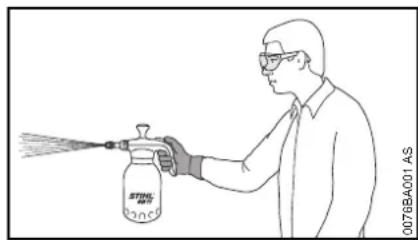
The sprayer is operated with either the right hand or the left hand on the trigger valve.

WARNING
Keep the container upright to reduce the risk of spillage.

WARNING
To reduce the risk of injury from loss of control, never work on a ladder, in a tree or on any other insecure support.
Working conditions
Operate your sprayer only in a well-ventilated area. Operate it under good visibility and daylight conditions only. Work carefully.

WARNING
Inhalation of certain chemicals can cause susceptible persons to have an allergic or asthmatic reaction.
Substantial or repeated inhalation of certain chemicals may cause respiratory disease, cancer, birth defects, or other reproductive harm. Control the chemical spray at the source where possible. Use good work practices, such as operating the unit so that the wind or operating process does not blow the spray back on the operator. Follow the recommendations of
EPA/OSHA/NIOSH and occupational and trade associations with respect to proper usage. When the inhalation of the chemical being sprayed cannot be avoided, the operator and any bystanders may need to wear a respirator approved by NIOSH/MSHA for the type of chemical encountered.
Consult the label of the chemical product being used.

WARNING
If you are unfamiliar with the risks associated with the particular chemical at issue, review the product label and/or material safety data sheet for that substance and/or consult the material manufacturer/supplier. You may also consult your employer, governmental agencies such as the EPA, OSHA and NIOSH and other sources on hazardous materials. The state of California and some other authorities, for instance, have published lists of substances known to cause cancer, reproductive toxicity, etc.
Operating Instructions

WARNING
Never spray in the direction of humans, animals or property which might be injured or damaged by spray formula.
Pay attention to the direction of the wind, i.e., do not work against the wind. When spraying, stand so that the wind does not blow towards you or bystanders.
Keep children and pets away from areas that have just been sprayed. After the use of some chemicals, especially agricultural pesticides, a notice must be posted on the treated area that a "Restricted Entry Interval" (REI) is in effect. See the product's label and any applicable governmental regulations.

DANGER

To reduce the risk of electrocution, never operate this sprayer in the vicinity of any wires or cables (power, etc.) which may be carrying electric current. Do not spray on or near electrical systems.

WARNING
To reduce the risk of injury, always release pressure in the container prior to filling, cleaning or servicing the sprayer and when spraying is completed. Pull up on the pressure release valve while holding the unit in an upright position.
After Finishing Work
Always release the pressure out of the container after finishing work. To release the pressure, turn the knurled wheel on the pressure relief valve while holding the unit upright until there is no more air or mist coming out. Open the cover slowly to make sure that the container is completely depressurized. Avoid breathing in the mist which is released.
Always wash thoroughly with soap and water after spraying or handling chemicals. Shower immediately, and
wash all protective clothing separately. Follow any additional recommendations of the chemical manufacturer.
Always clean dust and dirt off the sprayer.

WARNING
Empty, rinse and clean the container and sprayer assembly after each use. This helps to prevent the solution from crystallizing, which could later cause clogging and chemical damage to the unit. In addition, residual chemicals may have undesirable effects during subsequent spraying with a different type of chemical (e.g., residual herbicide may damage or kill plants being sprayed with a pesticide).
Disposal of contaminated rinse should be in accordance with applicable ordinances. Observe the precautionary instructions of the chemical manufacturer.
Do not store sprayer under pressure or with spray solution in the container.
Maintenance, Repair and Storing

WARNING
Use only identical STIHL replacement parts for maintenance and repair. Use of non-STIHL parts may result in personal injury or property damage.
Strictly follow the maintenance and repair instructions in the appropriate section of your instruction manual. Please refer to the maintenance chapter in this manual.

WARNING
Always first release pressure in the container prior to cleaning or servicing the sprayer.
Do not attempt any maintenance or repair work not described in your instruction manual. Have such work performed by your STIHL servicing dealer only.
English
Filling the Container
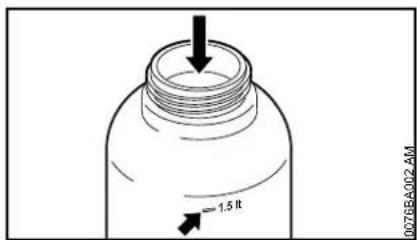
●Stand the tank on a level surface.
●Fill up with thoroughly mixed plant protection/cleaning product. Do not exceed maximum capacity of 1.5 liters (50.5 fl.oz) (see arrow).
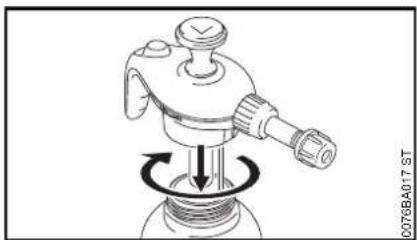
●Fit the cover and tighten it down firmly.
Spraying
Pressurizing the Tank
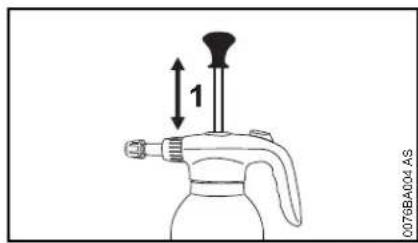
- Move the pump shaft (1) up and down uniformly about 20-30 times.
Checking Operation of Pressure Relief Valve
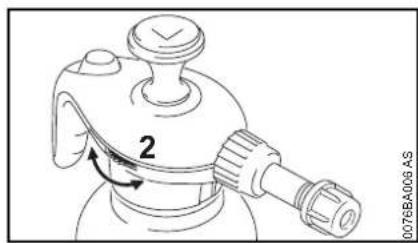
- Rotate the knurled wheel (2) as far as stop.
You should hear air escaping.
Spraying
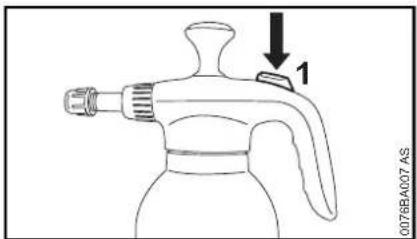
●Operate the button (1).
When pressure begins to drop:
- Move the pump shaft up and down uniformly – about 15 strokes are necessary to restore full pressure.
SG 11 PLUS – Adjusting Spray Pattern
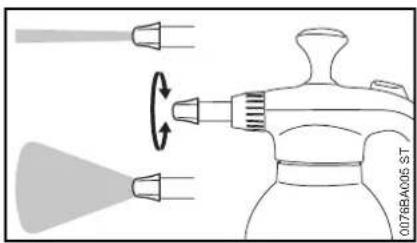
Rotate the nozzle to adjust the spray pattern (solid jet or fine mist).
After Spraying
Releasing Pressure in Tank
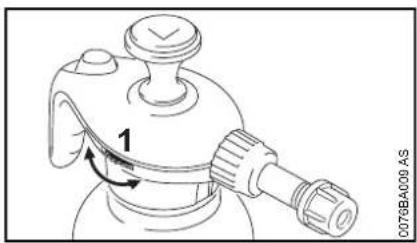
●Turn the knurled wheel (1) as far as stop and hold it there until the tank is no longer under pressure.
Emptying Tank and Cleaning the Sprayer
●Empty the tank in a well ventilated location.
●Rinse the tank with clean water.
●Fill the tank with clean water.
●Fit the cover on the tank and tighten it down firmly.
●Pressurize the tank and continue spraying until the tank is empty and no longer under pressure.
Inspection and Maintenance by User
Lubricating the O-rings

●Unscrew the pump barrel and pull it off the piston.
After frequent use, lubricate the following O-rings with food-safe grease:
- O-ring (1) between pump barrel and cover.
- O-ring (2) on pump piston.
- Seat of O-ring (1) between pump barrel and cover.
- Slide the piston into the pump barrel. Screw the pump barrel into the cover and tighten it down firmly.
Cleaning the Nozzle
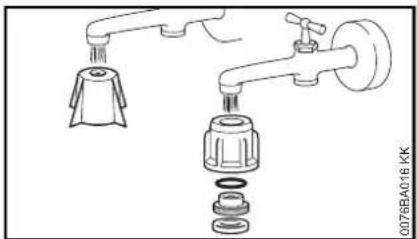
●Rinse the nozzle under running water.
Main Parts
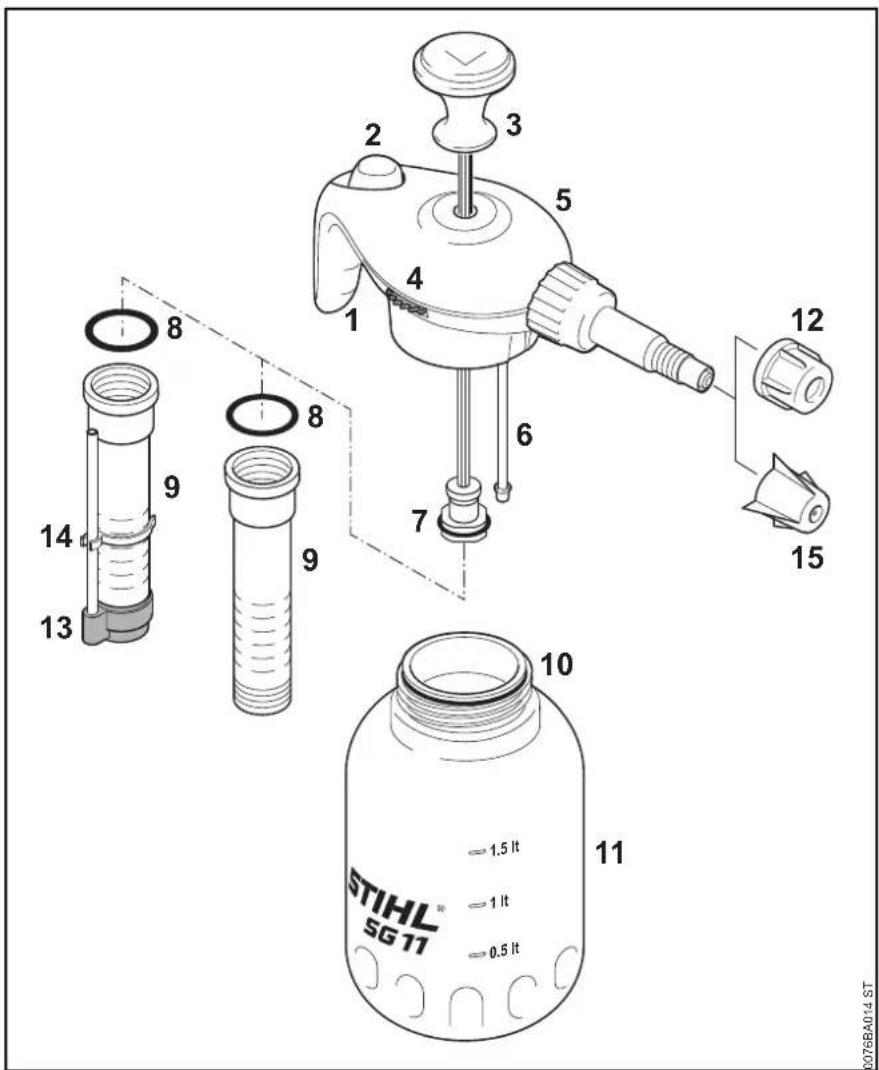
1 Handle
2 Lever
3 Pump Shaft
4 Pressure Relief Valve
5 Cover
6 Pick-up Tube Liquid
7 Piston Seal
8 Sealing Pump Cylinder
9 Pump Cylinder
10 Sealing Ring
11 Container
12 Hollow Cone Nozzle
Model SG 11 PLUS
13 Pick-up Tube Cap
14 Pick-up Tube Air
15 Adjustable Nozzle
Definitions
- Handle.
For holding the SG 11.
- Lever.
Opens and closes the valve. Starts and stops spraying.
- Pump Shaft.
Produces high pressure in the tank via the pump.
- Pressure Relief Valve.
Allows overpressure to escape from the tank.
- Cover.
For closing the tank.
- Pick-up Tube Liquid.
Feeds liquid from tank to the spray nozzle. - Piston Seal
Seals the piston to the pump cylinder for producing pressure. - Sealing Pump Cylinder.
Seals the pump cylinder to the cover. - Pump Cylinder.
Houses the piston for generating pressure.
10 Sealing Ring.
Seals the the tank when the cover is closed. - Container.
Contains the spray solution. - Hollow Cone Nozzle.
Produces a conical spray pattern. - Pick-up Tube Cap.
Protects the valve from liquid. - Pick-up Tube Air.
Feeds air from pump cylinder to the top of the tank. - Adjustable Nozzle.
Adjustable from conical to full jet spray pattern.
Model SG 11 PLUS
Specifications
Max. capacity: 1.5 l (50.7 fl.oz)
Tank volume: 1.9 l (64.2 fl.oz)
Max. pressure: 3 bar (43.5 PSI)
Max. temperature: 30°C (86°F)
Spray rate at 3 bar 600 cc/min
(43.5 PSI): (36.6 cu.in/min)
Weight: 0.47 kg (1.0 lbs)
Disposal
Observe all country-specific waste disposal rules and regulations.

STIHL products must not be thrown in the garbage can. Take the product, accessories and packaging to an approved disposal site for environment-friendly recycling.
Contact your STIHL servicing dealer for the latest information on waste disposal.
English
Trademarks
STIHL Registered Trademarks
STIHL®
STIHL 8
G
The color combination orange-grey (U.S. Registrations #2,821,860; #3,010,057, #3,010,058, #3,400,477; and #3,400,476)




MASTERWRENCH | STIHL
SERVICE®
AutoCut®
FARM BOSS®
iCademy®
MAGNUM®
MasterWrench Service®
MotoMix®
OIOMATIC®
ROCK BOSS®
STIHL Cutquik®
STIHL DUROMATIC®
STIHL Quickstop®
STIHL ROLLOMATIC®
STIHL WOOD BOSS®
TIMBERSPORTS®
WOOD BOSS®
YARD BOSS®
Some of STIHL's Common Law Trademarks


4-MIX TM
BioPlus TM
Easy2Start ™
EasySpool ™
ElastoStart ™
Ematic TM
FixCut TM
IntelliCarb ™
Master Control Lever TM
Micro TM
Pro Mark TM
Quiet Line TM
STIHL M-Tronic TM
STIHL OUTFITTERS TM
STIHL PICCO TM
STIHL PolyCut TM
STIHL PowerSweep ™
STIHL Precision Series TM
STIHL RAPID TM
STIHL SuperCut TM
TapAction TM
TrimCut TM
This listing of trademarks is subject to change.
Any unauthorized use of these trademarks without the express written consent of ANDREAS STIHL AG & Co. KG, Waiblingen is strictly prohibited.
English
Addresses
STIHL Inc.
536 Viking Drive
P.O. Box 2015
Virginia Beach, VA
23452-2015
Contenido
- Coloque la cubierta y apriétela firmemente.
español / EE.UU
Pulverización
MasterWrench Service®
MotoMix®
OILOMATIC®
ROCK BOSS®
STIHL Cutquik®
STIHL DUROMATIC®
STIHL Quickstop®
STIHL ROLLOMATIC®
STIHL WOOD BOSS®
TIMBERSPORTS®
WOOD BOSS®
YARD BOSS®
This product contains chemicals known to the State of California to cause cancer, birth defects or other reproductive harm.
0458-596-8621-B
0458-596-8621-B



- WARNING
- ADVERTENCIA
- GUIDE TO USING THIS MANUAL SAFETY! PRECAUTIONS AND
- PICTOGRAMS
- SYMBOLS IN TEXT
- DANGER
- NOTICE
- ENGINEERING IMPROVEMENTS
- WORKING TECHNIQUES
- THE OPERATOR
- PHYSICAL CONDITION
- PROPER CLOTHING
- ENGLISH
- THE SPRAYER
- HANDLING OF CHEMICALS
- THE USE OF THE SPRAYER
- TRANSPORTING THE SPRAYER
- FILLING THE CONTAINER
- DO NOT USE
- BEFORE SPRAYING
- DURING OPERATION
- WORKING CONDITIONS
- OPERATING INSTRUCTIONS
- AFTER FINISHING WORK
- MAINTENANCE, REPAIR AND STORING
- AFTER SPRAYING
- RELEASING PRESSURE IN TANK
- EMPTYING TANK AND CLEANING THE SPRAYER
- INSPECTION AND MAINTENANCE BY USER
- LUBRICATING THE O-RINGS
- CLEANING THE NOZZLE
- MAIN PARTS
- DEFINITIONS
- MODEL SG 11 PLUS
- SPECIFICATIONS
- DISPOSAL
- TRADEMARKS
- STIHL REGISTERED TRADEMARKS
- STIHL 8
- G
- ADDRESSES
- CONTENIDO
- PULVERIZACIÓN
Brand : STIHL
Model : SG 11
Category : Blower