
HUS-130CNSIL.1 - Refrigerator Husky - Free user manual and instructions
Find the device manual for free HUS-130CNSIL.1 Husky in PDF.


| Product Type | Refrigerator |
| Brand | Husky |
| Model | HUS-130CNSIL.1 |
| Capacity | 130 Liters |
| Energy Class | A+ |
| Climate Class | N-ST |
| Dimensions (H x W x D) | 85 x 55 x 55 cm |
| Weight | 25 kg |
| Voltage | 220-240 V |
| Frequency | 50 Hz |
| Power Consumption | 0.35 kWh/24h |
| Noise Level | 40 dB |
| Temperature Range | 0 °C to 10 °C |
| Thermostat | Adjustable |
| Defrost Type | Manual |
| Shelving | Adjustable glass shelves |
| Crisper | Yes |
| Door Storage | Yes |
| Refrigerant | R600a |
| Warranty | 2 years |
| Maintenance | Clean condenser annually |
Frequently Asked Questions - HUS-130CNSIL.1 Husky
User questions about HUS-130CNSIL.1 Husky
0 question about this device. Answer the ones you know or ask your own.
Ask a new question about this device
Download the instructions for your Refrigerator in PDF format for free! Find your manual HUS-130CNSIL.1 - Husky and take your electronic device back in hand. On this page are published all the documents necessary for the use of your device. HUS-130CNSIL.1 by Husky.
USER MANUAL HUS-130CNSIL.1 Husky
Fridges And Sunlight, LOW E Glass And IP Ratings - An information sheet from Bar Fridges Australia
Direct Sunlight - One of the biggest killers of a glass door fridge is direct sunlight, there is no way in any situation that your installation will allow direct sunlight on the glass. On some recent tests done, we had units reaching over 65oC inside fridge after 1 hour of morning sun, not the ideal beer drinking temperature.
This is not to say that units cannot be ok in an area that is under cover and gets some ‘secondary sunlight’, as in through a clear UV blind shade or roof Laser Lite etc. With secondary it is not as harmful and unit may be able to handle an hour or so in this situation. It is important to ask us about your idea for installation first.
GLASS DOOR fridges with some secondary sunlight for alfresco.

A 'Glass Door Fridge' can be in 'open' alfresco area's like picture to left. This install is fully open to the elements with large openings throughout, however refrigerator is position to only get small amount of sun through a large 'tinted' UV window. No part of the install allows direct sunlight. In heavy water unit could still get rainwater through main opening so make sure you have the IP rating that is suitable, more about IP ratings below.
Ask the staff for advice.

SOLID DOOR Units for 'Exposed' Alfresco

A 'Solid Door' unit that is located undercover (under bench) outside can still survive if sun is passing 'over' the fridge, as in fridge facing North or South etc. Here is an installation below that has been going fine in Perth WA since August 2015, unit is in a position where the actual sunlight does not meet the fridge 'directly, and with solid door it really makes a difference from glass door.
Remembering that in this application the IP rating also comes into effect as units can get rain in weather. So the best option here is the GSP Rhino range as the IP rating allows water to spray at 360o on the unit.
Ask the staff for advice.

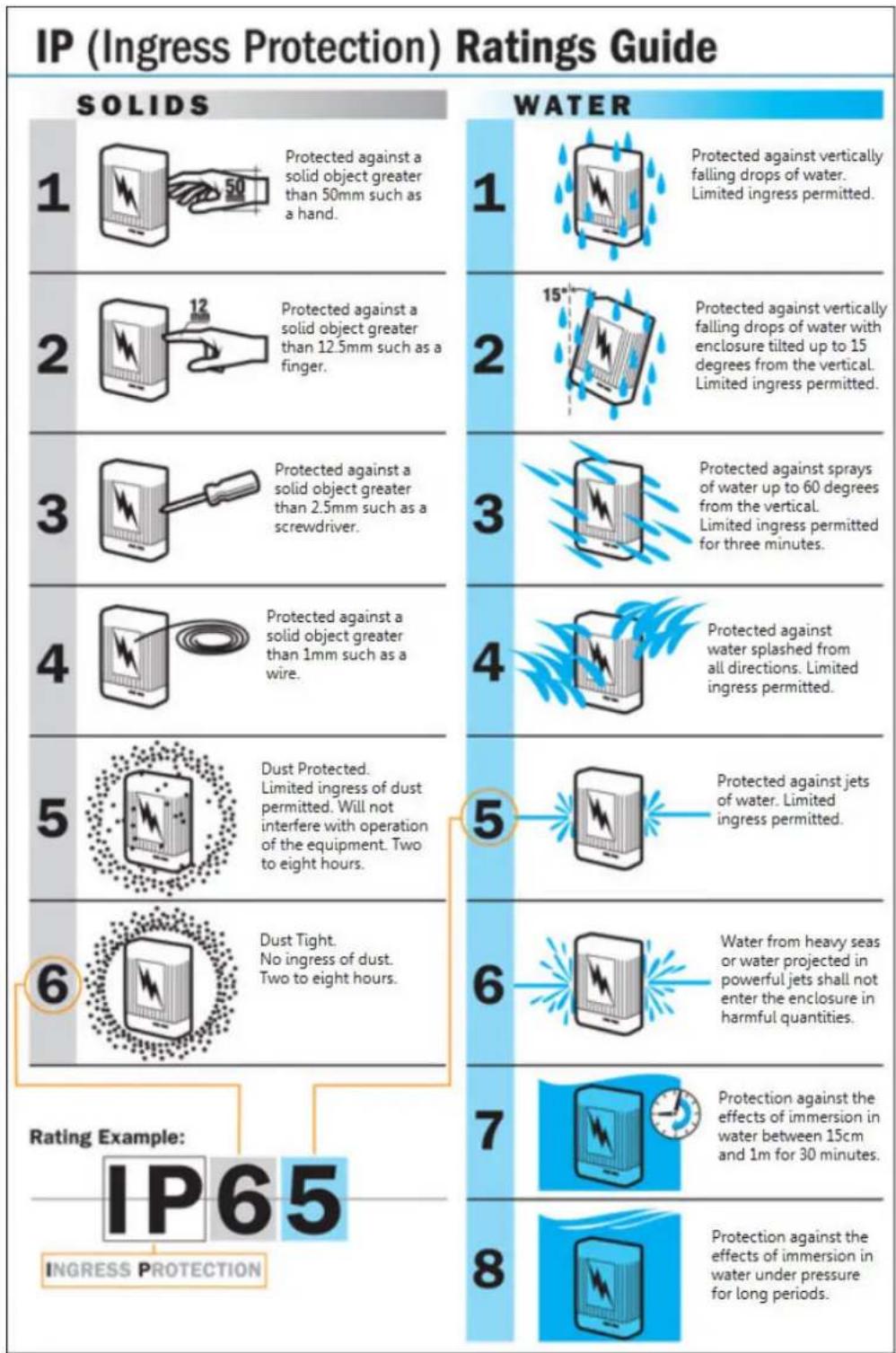
IP Rating Chart – IP it is known as ‘Ingress Protection’ and is a universal code used worldwide for all types of products, it measures ‘solid particle’ and ‘water’ ingress that could enter into a product and damage it etc. The chart below shows the full list and allows you to understand what is what. 95% of fridges on market have NO official IP testing done, mainly because costs are really high to get this done and usually when done often the changes required to pass are just too much cost for the manufacturer to pay for. The Rhino GSP range we have is only officially tested IP unit on the market.
Often you may see an IP rating of say X3, well the X means that no test had been done and the 3 is the water one below (3minutes only of light water spray at 60o from vertical). If 2 x digits are on the rating then both are tested to that.
LOW E Glass- If you think of a car in a carpark with windows closed on a hot day, well that explains the effect that occurs with a fridge that has glass door.
Units with LOW E glass are designed to reflect heat rays 70% better that normal glass, but even this feature becomes insignificant if you have direct sunlight. See LOW E info for the 'Brainiac' explanation of it's function.

Low E (low emission) glass has been specially designed to provide increased thermal insulation. It is a high quality, clear float glass with specially formulated permanent transparent coating. The effect of the coating is to absorb and reflect long wave length energy (infrared heat energy generated by the sun, lighting etc). This keeps the radiant energy out of the cabinet and simultaneously increases the temperature of the outer glass pane causing it not to condensate in high humidity conditions.

Low E glass doors are standard on ALL Staycold products.
| Glazing Type | U Value (W/m2K)* |
| Standard glass doors | 2.6 |
| Low E glass doors | 1.6 |
U values express the rate of heat loss. The lower the U value the greater the thermal insulation. 70% of energy loss on any glass door cooler is lost through the glass doors. Thus, Low E glass will reduce the total energy loss on a cooler by: 70% x (2.6-1.6)/2.6 = 27% *U values quoted above have been calculated in accordance with BS 6993: part 1, based on 6mm thick glass with a 12mm argon filled cavity. The U value on Low E glass doors will improve as the respective technology improves.
Below shows 70% humidity with Normal Glass above and LOW E Glass at bottom with no fog.


So really be careful when doing your design and make sure if you want glass door bar fridge that you allow the location to be 100% out of direct sunlight.

Brand : Husky
Model : HUS-130CNSIL.1
Category : Refrigerator