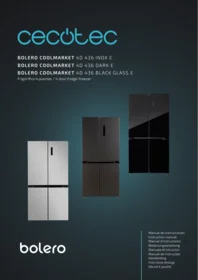
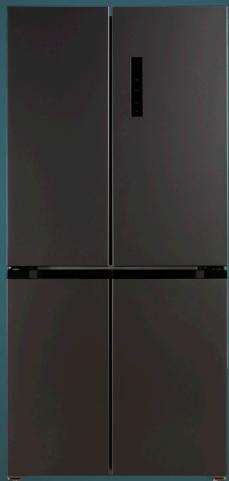
Bolero Coolmarket 4d 436 Glass E - Refrigerator CECOTEC - Free user manual and instructions
Find the device manual for free Bolero Coolmarket 4d 436 Glass E CECOTEC in PDF.


| Product type | Combined refrigerator with freezer |
| Number of doors | 4 doors (French Door type) |
| Total net capacity | 436 liters (approx) |
| Refrigerator capacity | ~300 liters |
| Freezer capacity | ~136 liters |
| Energy class | E (old scale A to G) |
| Annual energy consumption | ~350 kWh/year |
| Dimensions (H × W × D) | 185 × 70 × 70 cm (approx) |
| Net weight | ~70 kg |
| Power supply | 220-240 V, 50 Hz |
| Rated current | 1.5 A |
| Defrost type | Automatic (No Frost) in both compartments |
| Shelves | Tempered glass shelves |
| Interior lighting | LED |
| Adjustable thermostat | Yes, mechanical or electronic |
| Open door alarm | Yes |
| Vacation mode | Not specified but possible |
| Spare parts and repairability | Available through Cecotec after-sales service, repairable |
| Maintenance and cleaning | Clean with a soft cloth and soapy water; do not use abrasive products |
| Safety | Child lock (depending on model) |
Frequently Asked Questions - Bolero Coolmarket 4d 436 Glass E CECOTEC
User questions about Bolero Coolmarket 4d 436 Glass E CECOTEC
0 question about this device. Answer the ones you know or ask your own.
Ask a new question about this device
Download the instructions for your Refrigerator in PDF format for free! Find your manual Bolero Coolmarket 4d 436 Glass E - CECOTEC and take your electronic device back in hand. On this page are published all the documents necessary for the use of your device. Bolero Coolmarket 4d 436 Glass E by CECOTEC.
USER MANUAL Bolero Coolmarket 4d 436 Glass E CECOTEC

Safety instructions 10
-
Parts and components 70
-
Before use 70
-
Installation 71
-
Operation 72
-
Instructions on food storage 73
-
Cleaning and maintenance 76
-
Troubleshooting 78
-
Technical specifications 80
-
Disposal of old electrical and electronic appliances 81
-
Technical support and warranty 81
-
Copyright 82
SOMMAIRE
Read these instructions thoroughly before using the appliance. Keep this instruction manual for future reference or new users.
- It is important to make sure all users are familiar with the operation and safety features of the appliance to prevent faults and unnecessary accidents.
- Make sure that the mains voltage in your house matches the voltage stated on the rating label of the appliance.
- This appliance can be used by children aged 8 and above and people with reduced physical, sensory, or mental capabilities or lack of experience and knowledge, as long as they have been given supervision or instruction concerning the use of the appliance in a safe way and understand the hazards involved. Children must not play with the appliance. The cleaning and maintenance of the appliance should not be carried out by children without supervision.
- Keep the packaging material away from children, as there is a risk of suffocation.
- WARNING: if the interior light is damaged, contact the official Cecotec Technical Support Service. Do not try to repair it on your own.
- WARNING: when positioning the appliance, make sure the power cable does not get trapped or damaged. A crushed or damaged connector may heat up and cause a fire.
- Make sure the appliance plug is accessible after installation.
- Do not place food directly against the air outlet on the interior of the appliance.
- Keep the ventilation openings clear from obstructions.
- Do not place carbonated or fizzy drinks in the freezer compartment, as this creates pressure in the container, which could explode and damage the appliance.
- WARNING: do not use mechanical appliances or other means to accelerate the defrosting process other than those recommended by Cecotec.
- WARNING: do not damage the refrigeration circuit.
- If the cable is damaged, it must be replaced by the manufacturer, the supplier, or qualified personnel to avoid hazards.
- WARNING: do not use electrical appliances inside the refrigerator.
- We recommend you check the power cable regularly to detect any sign of possible damage. Do not use the appliance if the cable is damaged.
- To avoid injuries or death caused by electric shock, do not use the appliance with your hands wet or over a wet surface.
- You should never use this refrigerator with an extension lead or a multi-socket adaptor. Make sure the appliance is plugged in directly to a power supply.
- When positioning the appliance, make sure there is enough free space at the rear, as it is the main heat outlet. This will allow for adequate ventilation.
- Do not place hot food or drinks in the refrigerator, allow them to cool down to room temperature beforehand.
- Do not place any other appliance on the refrigerator and do not wet it.
- Do not store explosive substances such as aerosols or flammable propellants in this appliance.
- This device is designed for domestic use only and is not intended for bars, restaurants, farmhouses, hotels, motels, and offices.
- WARNING: to avoid any risk due to the instability of the refrigerator, you must install it according to the instructions.
-
This appliance has a built-in earthed plug. Make sure the power supply in your house is properly earthed.
-
Wait 5 minutes after a power failure before turning the appliance back on. Otherwise, the compressor may get damaged.
- This appliance is not intended to be operated by means of an external timer or separate remote-control system.
- Always handle the appliance carefully to avoid any damage on it.
- Frozen food can cause ice burns if consumed right after removing it from the freezer compartment.
- Do not remove or touch items in the freezer compartment with your hands wet, as it could cause skin abrasions or frost/freeze burns.
- Never use the base, drawers, or door as support.
- Do not overload the door shelves or place too much food on the drawers to prevent items from falling off and damaging the appliance.
- WARNING: do not attach multi-socket adaptors or multiple power supplies to the rear part of the appliance.
- To avoid food contamination, please follow the instructions below:
A. Opening the door for a long period of time may cause a significant increase in temperature in the appliance compartments.
B. Regularly clean the surfaces that come into contact with food and with the accessible draining systems.
C. Clean the water tank if it has not been used for 48 hours.
D. Store raw meat and fish in proper containers in the freezer, so they do not come into contact with or leak on other food.
E. The two-star compartments are suitable for storing pre-frozen food, storing, or making ice cream, and making ice cubes.
F. Compartments with one, two, or three stars are not suitable for freezing fresh food.
- Before carrying out any maintenance and cleaning task, turn off the appliance and unplug it.
- It is advisable to wait for at least four hours before connecting the appliance to allow oil to flow through the compressor.
- Air must flow around the appliance. Lack of air leads to overheating. To achieve good ventilation, follow the installation instructions.
- Whenever possible, the rear part of the appliance should not be too close to the wall to prevent it from touching or reaching the hot parts (the compressor and the condenser). To avoid risk of fire, follow the installation instructions.
- Make sure that the plug is accessible after installation of the appliance.
- All electrical work required to maintain this appliance must be carried out by a qualified electrician.
- Use the appliance only for the purposes described in this manual. Incorrect or improper use can damage the appliance and be dangerous for the user.
Temperature range
- The appliance temperature range information can be found on its marking. Indicates the optimum room temperature for proper operation of the appliance.
| Climate range | Optimum room temperature |
| SN | From +10 °C to +32 °C |
| N | From +16 °C to +32 °C |
| ST | From +16 °C to +38 °C |
| T | From +16 °C to +43 °C |
Note:
Taking into account the limiting values of the room temperature range for the climates for which the appliance is designed and that internal temperatures may be affected by factors such as the location of the appliance, room temperature and frequency of door opening, it may be necessary to modify the setting of any temperature control device according to these factors.
- If the appliance is operated in an environment other than the specified climate type (i.e. beyond the rated ambient temperature range), it may not be able to maintain the desired compartment temperatures.
Refrigerant
- Isobutane refrigerant (R600a), contained within the refrigeration circuit of the appliance, is a natural gas with a high level of environmental compatibility; however, it is flammable. Make sure that no components of the refrigeration circuit have been damaged during the transport and installation of the appliance.
- WARNING: the refrigerant and the insulator gas are flammable. When disposing of the appliance, only dispose of it at an authorised waste-disposal facility. Do not expose it to flames.
- WARNING: the appliance contains refrigerant and gases in the insulation. The appliance and gases must be disposed of professionally, as they may cause injuries to eyes or ignition. Make sure the refrigeration-circuit pipe is not damaged before disposing of it correctly.
- This symbol means: warning, risk of fire/flammable materials.
- If the refrigeration circuit is damaged:
A. Avoid open flames and sources of ignition.
B. Completely air the room where the appliance is located.
INSTRUCTIONS DE SÉCURITÉ
A. Refrigerator compartment
1. Door shelves
2. Glass shelves
3. Crisper drawer
B. Freezer compartment
4. Glass shelves
5. Drawers
Control panel. Fig. 2
Fig. 2 key:
- Refrigerator compartment temperature display
- Refrigerator compartment icon
- Freezer compartment temperature display
- Freezer compartment icon
- Fast Cooling mode indicator light
- Fast Freezing mode indicator light
- Holiday mode indicator light
- Modes icon
- Lock indicator light
- Lock icon
NOTE:
- The graphics in this manual are schematic representations and may not exactly match the device.
- To make the most out of the appliance in terms of energy efficiency, place all the shelves and drawers in their original position, that is, as shown in Figure 1.
2. BEFORE USE
- This appliance is packaged in a way as to protect it during transport. Take the appliance out of its box and remove all packaging materials. You can keep the original box and other packaging elements in a safe place. This will help you prevent damage to the appliance when transporting it in the future. In case the original packaging is disposed of, make sure all packaging materials are recycled accordingly.
-
Make sure all parts and components are included and in good conditions. If there is any piece missing or in bad conditions, contact the official Cecotec Technical Support Service immediately.
-
This refrigeration appliance is not suitable for built-in installation.
- Remove all packaging, including the plastic protection on the bottom of the appliance and the adhesive tape securing the shelves.
- Place the refrigerator in a suitable position and adjust the feet to level it. It is recommended to clean the appliance with a cloth dampened with warm water and a little soap, and to dry it thoroughly before use.
- Place the refrigerator and adjust its height, clean it, let it stand idle for 4 to 6 hours and then switch it on. This will help ensuring that the compressor oil has properly settled, and that the appliance is running normally.
Box content
- Refrigerator
- Instruction manual
3. INSTALLATION
Installation dimensions. Fig. 3
- Choose an appropriate level-surfaced location to place your appliance for easy use. Avoid placing the appliance near heat sources, under direct sunlight, or in moist environments.
| A (mm) | B (mm) | C (mm) | D (mm) | E (mm) | F (mm) | H (mm) | M (mm) |
| 551 | 836 | 1774 | 1830 | 636 | 1521 | 382 | 1006 |
- The above measurements are indicative for installation purposes. The actual dimensions of the appliance may vary slightly.
- To ensure that the appliance runs at maximum efficiency, allow enough space around the appliance as shown in Figure 4.
- The refrigerator must be placed on a solid, flat surface.
- If cushioning is necessary, use stable, solid, and non-flammable cushioning blocks. DO NOT USE FOAM PACKAGING AS CUSHIONING BLOCKS!
- The appliance should be kept away from damp or wet environments. Water or dirt should be removed from any surface of the appliance as soon as possible with a soft cloth. This will help prevent rust and help your appliance run at maximum efficiency.
- Place the refrigerator in a well-ventilated place. Leave some space around and behind the refrigerator, and do not cover or block the air grille of the compressor rear cover plate (located at the rear of the appliance). Keep the refrigerator away from heat sources or direct sunlight.
- In the refrigerator packing box, feet come tightly packed. After removing the refrigerator from the box, be sure to adjust the two front plastic feet to the desired height. Tighten the two plastic feet with a spanner or directly by hand.
ENGLISH
Adjustable feet Fig. 5
- The adjustable feet and rear rollers must touch the floor to prevent the refrigerator from moving, vibrating, or rattling.
- When moving the refrigerator, adjust the plastic feet counterclockwise so that they do not touch the floor, then gently tilt the refrigerator to start moving it.
4. OPERATION
Start-up
- Connect the power cable and turn on the switch.
- When switching on the refrigerator for the first time, the display will show the respective preset temperature values. The default temperature of the refrigerator compartment is 5 °C, and the default temperature of the freezer compartment is -18 °C.
- The default mode is power saving mode: the display will be on for 20 seconds, after which time it will turn off. This mode saves energy and extends the lifespan of the LED lights.
Selecting modes and functions
- Press the modes icon to cycle through the different operating modes:
A. Holiday mode: the refrigerator compartment will operate at 8 °C while the freezer compartment will operate at -15 °C.
B. Fast Freezing mode: when you select this mode, the compressor runs continuously to freeze food faster. This mode will be automatically deactivated 24 hours after its activation or when the freezer compartment reaches -28 °C. When deactivated, the indicator light will switch off and the freezer compartment will return to the set temperature.
C. Fast Cooling mode: when you select this mode, the refrigerator compartment will reach the set temperature in a very short time. When this mode is activated, the temperature of the refrigerator compartment will be 2 °C. This mode will be active for a maximum of 150 minutes and will then be automatically deactivated. When deactivated, the indicator light for this mode will switch off and the refrigerator temperature will return to the last temperature selected before activating Fast Cooling mode.
Freezer compartment settings
- The default temperature of the freezer compartment is -18 °C. To change it, press the freezer compartment icon. The temperature selection sequence is as follows: -18 °C → -19 °C → -20 °C → -21 °C → -22 °C → -23 °C → -15 °C → -16 °C → -17 °C → -18 °C.
WARNING: do not place fresh food directly on top of frozen food.
Refrigerator compartment settings
- The default temperature of the refrigerator is 5 °C. To change it, press the refrigerator
compartment icon. The temperature selection sequence is as follows: 5 ^ 4 ^ 3 ^ 2 ^ 8 ^ 7 ^ 6 ^ 5 ^ .
Lock icon
- This appliance features a function that allows the control panel to be locked. While this mode is activated, the icons on the display will not operate.
- Press the lock icon to activate the control panel lock, the lock indicator light will light up. If you press any icon, the appliance will beep, and the lock indicator light will flash.
- To deactivate the lock mode, press and hold the lock icon for 3 seconds until the lock indicator light switches off.
Open door alarm
- When the refrigerator door stays open for more than 1 minute, an alarm will sound to remind the user to close the door. Once the door is closed, the alarm will automatically stop sounding.
Switching the refrigerator compartment on and off
- Press and hold the refrigerator compartment icon for 10 seconds to switch the refrigerator compartment on and off. When the refrigerator compartment is switched off, the corresponding temperature indicator will switch off as well. Press the refrigerator compartment icon again for 10 seconds to switch on the compartment again.
5. INSTRUCTIONS ON FOOD STORAGE
WARNING
- When storing frozen foods, put them inside the freezer compartment.
- Do not put bottled or canned foods in the freezer compartment to prevent them from cracking due to ice formation.
- Before putting hot food in the refrigerator compartment, cool it down to room temperature first for lower energy consumption.
- Label the freezing date on the packaging bag according to the different shelf life of the food.
- Divide food into portions and package them separately, so that they freeze more easily and do not stick together.
- Packaging materials must be odourless, airtight, impermeable, and non-contaminating, so that the packaged food does not lose quality.
- Do not put too much fresh food in the freezer compartment at once.
- Defrosted food cannot be refrozen unless you cook them.
- Glass bottles or containers must not be placed in the freezer compartment or in the air outlet of the refrigerator compartment, otherwise they may explode.
ENGLISH
- Do not place food in such a way that it blocks the air outlet.
Food storage
- In this section, we offer you tips on how to store food optimally in the different parts of the refrigerator. The glass shelves and crisper drawer can be removed for food storage if necessary.
Note: do not allow food to directly touch surfaces inside the appliance. These should be wrapped separately in aluminium foil, cellophane, or airtight plastic boxes.
Dairy products and eggs
- Most pre-packaged dairy products have an expiry date. Store them in the refrigerator compartment and consume them before the best-before date.
- Butter can be easily contaminated by strong odours, so it is best to keep it in a sealed container. Eggs must be stored in the refrigerator compartment, not in the freezer compartment.
Red meat
- Place fresh red meat in a dish and cover it without pressing it with wax paper, plastic, or aluminium foil.
- Store raw and cooked meat in different dishes. This will prevent liquids from transferring from raw meat and contaminating cooked meat.
Poultry
- Whole birds should be rinsed inside and out with cold tap water. Afterwards, dry them and place them on a plate. Cover them without pressing with plastic or aluminium foil.
- Store poultry parts in the same way. Stuff whole poultry right before cooking it. Otherwise, it can lead to food poisoning.
Fish and seafood
- You must consume whole fish and fillets on the day of purchase. Store it in a dish covered with plastic wrap, wax paper, or aluminium foil until ready to eat. If you are leaving the fish in the refrigerator compartment overnight or for a longer period of time, make sure it is very fresh.
- You must rinse whole fish with cold water to remove scales and dirt, and then dry it with paper towels. Place whole fish or fillets in an airtight plastic bag.
- Keep seafood refrigerated at all times. Consume it within 1-2 days. You can store this food in appropriate, closed containers so that the food does not dry out. Conserve it only for 1-2 days.
- Reheat the leftovers only once until they give off steam.
Crisper drawer
- This drawer is ideal for storing fresh fruit and vegetables.
- Be careful not to store the following foods at temperatures below 6 °C for long periods of time: citrus fruit, melon, aubergine, pineapple, papaya, courgette, passion fruit, cucumber, pepper, and tomatoes.
- There may be undesired changes at low temperature, like softening, browning or accelerated decomposition
- Do not store avocados (until ripe), bananas or mangoes.
| Food | Refrigerator compartment |
| Butter, cheese | Door top shelf |
| Eggs | Door shelves |
| Fruits and vegetables | Crisper drawer |
| Meat, sausages, cheese, milk | Low area (lower shelf, crisper drawer cover) |
| Dairy products, canned food, cans | Top door shelf |
| Drinks and bottles | Door shelves |
| Food | Freezer compartment |
| Small frozen food | Shelf |
| Frozen packaged food | Large freezer compartment drawer |
| Fish, meat, ice cream | Low area (bottom shelf or drawer) |
Freezer compartment
Use the freezer compartment to:
- store previously frozen food
- make ice cubes
- freeze food
Note: make sure the freezer compartment door is properly closed.
Buying frozen food
- The packaging must be intact.
- Consume food before the expiry date.
- If possible, transport fully frozen food in an insulated bag and place it immediately in the freezer compartment.
ENGLISH
Storing frozen food
- Store frozen food at -18 °C or below. Avoid opening the freezer-compartment door unnecessarily.
Freezing fresh food
- Freeze only food that's fresh and in good conditions.
- To best preserve nutritional value, flavour, and colour, vegetables should be blanched before freezing. Aubergines, peppers, courgettes, and asparagus do not require blanching.
- The following foods are suitable for freezing: cakes and pastries, fish and seafood, meat, game, poultry, vegetables, fruits, herbs, shelled eggs, dairy products such as cheese and butter, ready meals, and leftovers such as soups, stews, boiled meat and fish, potato dishes, soufflés, and desserts.
- The following foods are not suitable for freezing: types of vegetables that are usually eaten raw, such as lettuce or radishes, shell eggs, grapes, apples, whole pears and peaches, hard-boiled eggs, yoghurt, sour milk, sour cream, and mayonnaise.
Recommended storage times for frozen foods in the freezer compartment
- These times vary depending on food type. Frozen food can be stored for 1 to 12 months (-18 °C minimum).
| Food | Storage time |
| Bacon, stews, milk | 1 month |
| Bread, ice cream, sausages, cakes, cooked seafood, oily fish, etc. | 2 months |
| White fish, seafood, pizza, pastries, and muffins | 3 months |
| Ham, cakes, biscuits, veal and lamb chops, poultry meat | 4 months |
| Butter, vegetables (blanched), whole eggs and yolks, cooked crayfish, minced meat (raw), pork (raw) | 6 months |
| Fruit (dried or in syrup), egg whites, beef (raw), whole chicken, lamb (raw), fruit cakes | 12 months |
6. CLEANING AND MAINTENANCE
Precautions for cleaning the inside and outside of the refrigerator:
- Before cleaning, always switch off the appliance and unplug it from the mains.
- During cleaning, make sure that no water enters the socket, display, door light or control panel.
-
Remove dirt from the outside of the refrigerator with a soft, clean cloth and allow the refrigerator to dry naturally.
-
When cleaning the door seal, always use clean water and a dry cloth and allow it to dry naturally. Dampen a soft cloth with lukewarm water or a neutral cleaning agent to clean the body of the refrigerator. Do not wipe the door seal with this cloth.
- Do not clean the refrigerator directly with water, as this will affect the electrical insulation properties, among other things.
- The refrigerator must not be cleaned with metal scouring pads, brushes, abrasive cleaning agents, strong alkaline detergents, or flammable or toxic cleaning liquids.
Cleaning
- Before cleaning, always switch off the appliance and unplug it from the mains.
- During cleaning, make sure that no water enters the socket, display, door light or control panel.
- Remove dirt from the outside of the refrigerator with a soft, clean cloth and allow the refrigerator to dry naturally.
- When cleaning the door seal, always use clean water and a dry cloth and allow it to dry naturally. Dampen a soft cloth with lukewarm water or a neutral cleaning agent to clean the body of the refrigerator. Do not wipe the door seal with this cloth.
- Do not clean the refrigerator directly with water, as this will affect the electrical insulation properties, among other things.
- The refrigerator must not be cleaned with metal scouring pads, brushes, abrasive cleaning agents, strong alkaline detergents, or flammable or toxic cleaning liquids.
- After cleaning, connect the power plug of the refrigerator and switch it on again.
Holiday
- When you want to go on holiday, it is better not to turn off the refrigerator and not to take out food that can be preserved during your holiday period. If you wish to turn off the refrigerator, remove all food, disconnect the power plug, clean the inside of the refrigerator thoroughly, and open the door to prevent unpleasant odours.
Power failure
- Generally, a short power failure will not affect the temperature of the refrigerator abruptly. However, if the power failure lasts for a long time, you should decrease door-opening frequency and not put fresh food in the refrigerator (to avoid accelerating the interior temperature increase).
- If you are aware of possible power failures, you can enable the Fast freezing mode in advance to keep the refrigerator temperature at the lowest value.
Switch-off
- It is generally not recommended to switch off the refrigerator or unplug the power cord, otherwise the lifetime of the refrigerator may be affected.
ENGLISH
Energy-saving tips
- Make sure to keep the refrigerator away from heat sources and direct sunlight.
- Before storing hot food, cool it down to room temperature and store it in the refrigerator.
- Do not leave the door open. Reduce the door-opening frequency and shorten the opening time.
- When defrosting frozen food, you can put it in the refrigerator compartment.
- Make sure the temperature sensor is not obstructed or covered by food and maintain an adequate distance between the food.
Carrying
- Do not carry the refrigerator horizontally or lying down.
- Do not carry the refrigerator by the door or handle; it must be carried by lifting the bottom.
- Never carry the appliance alone—at least two people are required for safe lifting or carrying of the appliance.
7. TROUBLESHOOTING
| Normal occurrences | |
| Faulty icons | Check if the refrigerator control panel is locked, if so, the icons will not work. |
| Low voltage, compressor cannot be started | It is recommended to install a pressure regulator of more than 1000 W in the installation area of the refrigerator to better protect it. |
| The refrigerator takes a long time to start up | When the room temperature is too high, the refrigerator takes a long time to start. |
| The central separators of the compartments heat up | The central separators of the compartments heat up after some time of operation of the appliance. This is quite normal. |
| Condensation droplets are formed | When outside air enters the cold inner surface of the refrigerator, condensation droplets may appear. If it's rainy season or humidity at the place of installation is high, condensation droplets may appear on the outside of the refrigerator. This is a natural phenomenon, simply wipe off the water droplets with a dry cloth. |
| The refrigerator makes some noise | When the refrigerator is switched on for the first time, it will run at high speed to cool down quickly and may emit a louder sound. When the internal temperature drops below a certain level, the noise will decrease.You will hear some noises when the compressor starts or stops, when some parts expand or contract or when the temperature inside the refrigerator changes. This is normal. |
| The refrigerator heats up | During operation, the temperature of the compressor is higher than 80 °C. Do not touch it, as this could cause serious injury. |
| The refrigerator takes a long time to cool down | If room temperature is too high or you put too much fresh food in the refrigerator, it will take a long time to bring the temperature down to the set values. |
Troubleshooting
| Problem | Possible causes | Solution |
| Nothing is shown on the display | The plug of the appliance is not properly inserted in the socket. | Check for power supply. |
| Alarm sounds | Door is slightly open or has not been closed for more than 1 minute. | Close the door completely. |
| The refrigerator does not work | Defrost mode enabled. | This is normal if it is defrosting. |
| The appliance is not properly connected. | Check if the appliance is properly connected. | |
| The refrigerator takes a long time to cool down | The refrigerator has recently been switched off. | The refrigerator takes a few hours to cool down completely. |
| You have put in too much fresh or hot food. | Hot food causes the refrigerator to take longer to reach the desired temperature. | |
| Doors are opened too often or for too long. | The warm air entering the refrigerator causes the compressor to run longer. Do not open the door too often. | |
| The refrigerator vibrates | The floor is uneven or loose. | Make sure that the floor is level, solid, and can support the weight of the refrigerator. |
| Vibration comes from food placed on top of the refrigerator. | Remove the food placed on top. | |
| The refrigerator touches the wall or a piece of furniture. | Move the refrigerator so that it does not touch the wall or furniture. |
Note:
If none of these situations match your problem, do not attempt to disassemble, or repair the appliance by yourself. Repairs carried out by unqualified persons may result in injury or serious malfunctions. Contact the official Cecotec Technical Support Service. The repair must be carried out by an authorised technician, and you must use only original spare parts.
8. TECHNICAL SPECIFICATIONS
You can find more information on this model by scanning the QR code (and the energy label as well).
| Product | Bolero CoolMarket 4D 436 Inox E | Bolero CoolMarket 4D 436 Dark E | Bolero CoolMarket 4D 436 Black Glass E |
| Reference | 01948 | 01949 | 01950 |
| QR code |  |  |  |
| Voltage | 220 - 240 V~ | ||
| Rated frequency | 50 Hz | ||
| Rated current | 1.2 A | ||
| Climate class (*) | SN / N / ST / T | ||
| Refrigerant | R600a (75 g) | ||
| Base plate | Cyclopentane | ||
This product features a light source with a Class F energy efficiency.
(*) Refrigerating appliance intended for use at room temperatures between 10 °C and 43 °C.
Technical specifications may change without prior notification to improve product quality. Made in China | Designed in Spain
9. DISPOSAL OF OLD ELECTRICAL AND ELECTRONIC APPLIANCES

This symbol indicates that, according to the applicable regulations, the product and/or batteries must be disposed of separately from household waste. When this product reaches the end of its shelf life, you should dispose of the cells/batteries/accumulators and take them to a collection point designated by the local authorities.
Consumers must contact their local authorities or retailer for information concerning the correct disposal of old appliances and/or their batteries.
Compliance with the above guidelines will help protecting the environment.
10. TECHNICAL SUPPORT AND WARRANTY
Cecotec shall be liable to the end user or consumer for any lack of conformity that exists at the time of delivery of the product under the terms, conditions, and deadlines established by the applicable regulations.
It is recommended that repairs be carried out by qualified personnel.
If at any moment you detect any problem with your product or have any doubt, do not hesitate to contact the official Cecotec Technical Support Service at +34 963 210 728.
ENGLISH
11. COPYRIGHT
The intellectual property rights over the texts in this manual belong to CECOTEC INNOVACIONES, S.L. All rights reserved. The contents of this publication may not, in whole or in part, be reproduced, stored in a retrieval system, transmitted, or distributed by any means (electronic, mechanical, photocopying, recording or similar) without the prior authorization of CECOTEC INNOVACIONES, S.L.
1. PIÈCES ET COMPOSANTS
Image 1
7. PROBLEEMOPLOSSING

Fig./Img./Abb./Afb./Rys. 3

Fig./Img./Abb./Afb./Rys. 4

Fig./Img./Abb./Afb./Rys. 5
www.cecotec.es

- SOMMAIRE
- Temperature range
- Note:
- Refrigerant
- INSTRUCTIONS DE SÉCURITÉ
- Control panel. Fig. 2
- Fig. 2 key:
- BEFORE USE
- Box content
- INSTALLATION
- Installation dimensions. Fig. 3
- ENGLISH
- Adjustable feet Fig. 5
- OPERATION
- Start-up
- Selecting modes and functions
- Freezer compartment settings
- Refrigerator compartment settings
- Lock icon
- Open door alarm
- Switching the refrigerator compartment on and off
- INSTRUCTIONS ON FOOD STORAGE
- WARNING
- Food storage
- Dairy products and eggs
- Red meat
- Poultry
- Fish and seafood
- Crisper drawer
- Freezer compartment
- Buying frozen food
- Storing frozen food
- Freezing fresh food
- Recommended storage times for frozen foods in the freezer compartment
- CLEANING AND MAINTENANCE
- Precautions for cleaning the inside and outside of the refrigerator:
- Cleaning
- Holiday
- Power failure
- Switch-off
- Energy-saving tips
- Carrying
- TROUBLESHOOTING
- TECHNICAL SPECIFICATIONS
- DISPOSAL OF OLD ELECTRICAL AND ELECTRONIC APPLIANCES
- TECHNICAL SUPPORT AND WARRANTY
- COPYRIGHT
- PIÈCES ET COMPOSANTS
- Image 1
- PROBLEEMOPLOSSING
Brand : CECOTEC
Model : Bolero Coolmarket 4d 436 Glass E
Category : Refrigerator