
SS-M3 - Loudspeaker SONY - Free user manual and instructions
Find the device manual for free SS-M3 SONY in PDF.
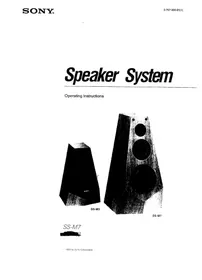


| Product Type | Bookshelf loudspeaker |
| Brand | Sony |
| Model | SS-M3 |
| Dimensions (W x H x D) | Approx. 230 x 380 x 220 mm |
| Weight | Approx. 5.5 kg per speaker |
| Speaker Configuration | 2-way, bass reflex |
| Woofer | 200 mm (8 in) cone |
| Tweeter | 25 mm (1 in) soft dome |
| Impedance | 6 ohms |
| Frequency Response | 45 Hz - 20 kHz |
| Sensitivity | 88 dB (2.83V/1m) |
| Recommended Amplifier Power | 20 - 100 Watts RMS |
| Max Input Power | 120 Watts |
| Crossover Frequency | 3 kHz |
| Enclosure Type | Bass reflex with front port |
| Terminals | Screw-type binding posts |
| Magnetic Shielding | Yes |
| Grille | Removable, black cloth |
| Color | Black ash vinyl |
| Power Source | Passive (no power required) |
| Maintenance | Wipe with dry cloth; avoid solvents |
| Safety Features | Designed for stable placement; no sharp edges |
| Spare Parts / Repairability | Drivers available from Sony service centers |
Frequently Asked Questions - SS-M3 SONY
User questions about SS-M3 SONY
0 question about this device. Answer the ones you know or ask your own.
Ask a new question about this device
Download the instructions for your Loudspeaker in PDF format for free! Find your manual SS-M3 - SONY and take your electronic device back in hand. On this page are published all the documents necessary for the use of your device. SS-M3 by SONY.
USER MANUAL SS-M3 SONY
Operating Instructions

SS-M7

Features
Transducers
- Diaphragms with ideal mass/stiffness ratios are utilized to maximize linear frequency range.
- Vented magnetic metalwork, large-diameter vented aluminum voice coil formers, and ultra-high-temperature voice coil wire assure excellent power handling capability.
- Transducer parameters are computer-optimized for ideal bass performance in each enclosure size.
Crossover Networks
- Computer-optimized 24 dB/octave attenuation filters ensure optimum frequency division for minimum distortion and maximum power handling.
• Networks are also computer-optimized for ideal polar (off-axis), power, and phase response. - Separate high- and low-frequency inputs and circuit boards help maintain high signal quality and provide bi-amp capability.
Enclosures
• Non-parallel internal surfaces are employed to minimize standing waves (which distort the sound).
- Baffle area around transducers has been minimized to dramatically reduce diffraction and baffle effect.
- Time alignment of all transducers at the ideal listening position (3 meters instead of 1 meter) minimizes time-delay distortions.
- 25 mm (1 in.) thick walls with special bracing design reduce cabinet resonances and colorations.
Connections
- Before connection, turn off the amplifier to avoid damaging the speaker system.
- The + input terminal of the speaker system should be connected to the + terminal of the amplifier, and the - terminal to the - terminal.
- This speaker system is driven best by an amplifier or receiver rated as per the wattage indicated in the specification section.
A low-powered amplifier could result in signal clipping which could result in tweeter burn-out. Therefore, it is recommended to use an amplifier or receiver with sufficient power rating. - Power amplifiers which are used for Bi-Amplified connection should have identical gain characteristics to ensure proper balance and best sound quality.
Note
An amplifier or receiver with less than recommended wattage can be used when you want to use your speaker systems for background music, or at low levels in a small room. However, please be sure to use the amplifier or receiver with its volume not beyond its normal limits.
• To connect the speaker cords

Normal Connection
Connect the speaker cords to the lower terminals of the speaker.

Precautions
- Do not attempt to open the enclosure or remove speaker units. There are no user-serviceable parts inside.
- Keep TV set, recorded tapes, watches, and personal credit cards using magnetic coding away from the speaker system.
• Periodically wipe the cabinet with a soft cloth. Do not use any type of scouring powder, abrasive pad or solvent.
Speaker Placement
Please note that room acoustics can often produce large differences in the sound for small changes in speaker placement.
- Place the right and left speaker systems in a similar acoustic environment.
- Place each speaker system a minimum distance of 1 meter (39 in.) from any side or rear walls for best imaging.
- Speakers should be placed on speaker stands such that the tweeter to floor height is approximately 102 cm (40 in.) for proper time alignment and best imaging. If speaker stands are used on a carpeted floor they should be spiked to the floor to ensure stability and best sound.
- If possible, avoid having large objects between the speakers and, especially, between the listener and the speakers.
Bi-Wired Connection
Remove the jumpers and connect the speaker cords as shown in the illustration below.

Bi-Amplified Connection
Remove the jumpers and connect the speaker cords as shown in the illustration below.
![graph TD A["Left speaker"] --> B["Power amplifier"] C["Right speaker"] --> B B --> D["Control amplifier"] D --> E["Speaker"] E --> F["Output"] F --> G["Speaker"] G --> H["Power amplifier"] H --> I["Control amplifier"] I --> J["Speaker"] J --> K["Output"] K --> L["Power amplifier"] L --> M["Control a…](/content/2026/07/1508644/images/eb1bb088cfe7802585bb7d5f0effbaf7bdfc0dafcf73e6bfa9f69da5b8689a36.jpg)
Specifications
SS-M7
Speaker system 3-way
Loudspeaker units Woofer: 20 cm (8 inches), cone type
Midrange: 10 cm (4 inches), cone type
Tweeter: 2.5 cm (1 inch), dome type
Rated Impedance 8 ohms
Maximum recommended amplifier power
200 W (Non clip)
Characteristic sensitivity level
86 dB (1W, 1m)
Effective frequency range
47 Hz to 20,000 Hz (-3 dB)
Crossover frequency 400 Hz, 4000 Hz/24 dB/oct
Dimensions (w/h/d) Approx. 400 x 745 x 400 mm
(15 3/4 × 29 3/8 × 15 3/4 inches)
Mass Approx. 25.2 kg (55 lb 9 oz)
Optional accessories Speaker stands WS-M7
SS-M3
Speaker system 2-way
Loudspeaker units Wooler: 18 cm (6 1/2 inches), cone type
Tweeter: 2.5 cm (1 inch), dome type
Rated impedance 8 ohms
Maximum recommended amplifier power
120 W (Non clip)
Characteristic sensitivity level
85 dB (1W, 1m)
Effective frequency range
70 Hz to 20,000 Hz (-3dB)
Crossover frequency 2000 Hz/24 dB/oct
Dimensions (w/h/d) Approx. 300 x 465 x 345 mm
(11 7/8 × 18 3/8 × 13 5/8 inches)
Mass Approx. 13.2 kg (29 lb)
Optional accessories Speaker stands WS-M3
Design and specifications are subject to change without notice.
Brand : SONY
Model : SS-M3
Category : Loudspeaker