
TEW-648UB - Wi-Fi Adapter TRENDNET - Free user manual and instructions
Find the device manual for free TEW-648UB TRENDNET in PDF.


| Product Type | USB Wi-Fi Adapter |
| Brand | TRENDnet |
| Model | TEW-648UB |
| Interface | USB 2.0 (compatible with USB 1.1) |
| Wireless Standards | IEEE 802.11 b/g/n |
| Frequency Band | 2.4 GHz |
| Maximum Speed | Up to 150 Mbit/s |
| Security | WEP 64/128-bit, WPA, WPA2, WPA-PSK, WPA2-PSK |
| Supported Operating Systems | Windows 2000, XP, Vista, 7 |
| Minimum System Requirements | 300 MHz processor, 256 MB RAM, USB port, CD-ROM drive |
| Package Contents | TEW-648UB Adapter, CD-ROM with drivers and utilities, multilingual quick installation guide |
| Dimensions | Approximately 7.5 x 2.0 x 1.2 cm |
| Weight | Approximately 15 g |
| Power Supply | Via USB port (5 V) |
| Key Features | Wireless connection to an access point, infrastructure and ad-hoc mode, configuration utility |
| Care and Cleaning | Disconnect the adapter and clean with a soft, dry cloth |
| Spare Parts and Repairability | Not user-serviceable, no spare parts available |
| General Information | Compliant with Directive 1999/5/EC, online registration recommended |
Frequently Asked Questions - TEW-648UB TRENDNET
User questions about TEW-648UB TRENDNET
0 question about this device. Answer the ones you know or ask your own.
Ask a new question about this device
Download the instructions for your Wi-Fi Adapter in PDF format for free! Find your manual TEW-648UB - TRENDNET and take your electronic device back in hand. On this page are published all the documents necessary for the use of your device. TEW-648UB by TRENDNET.
USER MANUAL TEW-648UB TRENDNET
- Cliquez sur Install Utility.
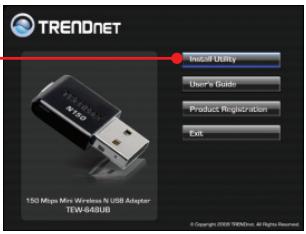
Hardware Installation

The software you are installing for this hardware:
TRENDnet Wireless N USB Adapter
has not passed Windows Logo testing to verify its compatibility with Windows XP. (Tell me why this testing is important.)
Continuing your installation of this software may impair the performance of your system. However, you can either immediately or in the future. Microsoft strongly recommends that you stop this installation now and start it again for software that has passed Windows Logo testing.
Continue Anyway
STOP Installation
The wizard has finished installing the software for

TRENDnet Wireless N USB Adaptor
Click Finish to close the wizard.


I inserted the Utility & Driver CD-ROM into my computer's CD-ROM Drive and the installation menu does not appear automatically. What should I do?
- For Windows 2000/XP, if the installation menu does not appear automatically, click Start, click Run, and type D:\%\autorun where "D" in "D:\%\autorun.exe" is the letter assigned to your CD-ROM Drive, and then press the ENTER key on your keyboard.
- For Windows Vista, if the installation menu does not appear automatically, click on the Windows Icon on the bottom left hand corner of the screen, click on the "Start Search" box, and type D:\autorun.exe, where "D" in "D:\autorun.exe" is the letter assigned to your CD-ROM Driver, and then press the ENTER key on your keyboard.
- For Windows 7, if the installation menu does not appear automatically, click on the Windows Icon on the bottom left hand corner of the screen, click the "Search programs and files" box, and type D:\autorun.exe, where "D" in "D:\autorun.exe" is the letter assigned to your CD-ROM Driver, and then press the ENTER key on your keyboard.
I completed all the steps in the quick installation guide, but my Wireless USB Adapter is not connecting to my access point. What should I do?
- Verify that the SSID matches your wireless router or access point's SSID.
- Please check with your network administrator for the security key in order to access a secured wireless access point or router. Refer to the User's Guide for more information regarding wireless network security.
- Check your TCP/IP properties to ensure that Obtain an IP address automatically is selected.
- Double-click the Wireless Configuration Utility icon, click Site Survey and then click Refresh to check and see if there are any available wireless networks listed.
Windows is unable to recognize my hardware. What should I do?
- Make sure your computer meets the minimum requirements as specified in Section 1 of this quick installation guide.
- You must complete the installation of the Wireless Configuration Utility (as described in Section 2) before connecting the Wireless USB Adapter to your computer.
- Connect the Wireless USB Adapter to a different USB port on your computer.
I cannot open the Wireless Configuration Utility. What should I do?
Access your device manager to make sure the adapter is installed properly. If you see a networking device with a yellow question mark or exclamation point, you will need to reinstall the device and/or the drivers.
- To access the device manager on Windows 2000/XP, right-click My Computer, click Properties, click the Hardware tab, and then click Device Manager.
- To access the device manager on Windows Vista, right-click Computer, click Properties and then click Device Manager.
- To access the device manager on Windows 7, click on the Windows icon on the bottom left-hand corner, click Computer, click System Properties and then click Device Manager.
If you still encounter problems or have any questions regarding the TEW-648UB, please refer to the User's Guide included on the Utility & Driver CD-ROM or contact TRENDnet's Technical Support Department.
The following are some general wireless tips to help minimize the impact of interference within an environment.
Assign your network a unique SSID
Do not use anything that would be identifying like "Smith Family Network". Choose something that you would easily identify when searching for available wireless networks.
Do not turn off the SSID broadcast
The SSID broadcast is intended to be on and turning it off can cause connectivity issues. The preferred method of securing a wireless network is to choose a strong form of encryption with a strong and varied encryption key.
Note: after setting up the SSID, encryption type and encryption key/passphrase, please make a note of them for future reference. You will need this information to connect your wireless computers to the wireless router/access point.
Change the channel
Most wireless access points and routers are defaulted to channel 6. If you have a site survey tool that will display the channels you can plan your channel selection around neighboring access points to minimize interference from them. If your site survey tool does not display the channel try using channels 1 or 11.
Change the channel bandwidth
If you are using an 802.11n router or access point you can also make the following changes. Change the channel bandwidth to 20/40MHz. This will provide the highest possible performance using an 802.11n device. Also, if using 802.11n you should be securing the network with WPA2 security.
Note: Due to Wi-Fi certification considerations if you choose WEP, WPA or WPA2-TKIP encryption this device may operate in legacy wireless mode (802.11b/g). You may not get 802.11n performance as these forms of encryption are not supported by the 802.11n specification.
Avoid stacking hardware on top of each other to prevent overheating issues
Maintain enough free space around the hardware for good ventilation and airflow. There should also be plenty of free space around the antennas to allow the wireless signal to propagate. Please also make sure that the wireless hardware is not placed in any type of shelving or enclosures.
There are a number of other environmental factors that can impact the range of wireless devices.
-
Adjust your wireless devices so that the signal is traveling in a straight path, rather than at an angle. The more material the signal has to pass through the more signal you will lose.
-
Keep the number of obstructions to a minimum. Each obstruction can reduce the range of a wireless device. Position the wireless devices in a manner that will minimize the amount of obstructions between them.
- Building materials can have a large impact on your wireless signal. In an indoor environment, try to position the wireless devices so that the signal passes through less dense material such as dry wall. Dense materials like metal, solid wood, glass or even furniture may block or degrade the signal.
- Antenna orientation can also have a large impact on your wireless signal. Use the wireless adapter's site survey tool to determine the best antenna orientation for your wireless devices.
- Interference from devices that produce RF (radio frequency) noise can also impact your signal. Position your wireless devices away from anything that generates RF noise, such as microwaves, HAM radios, Walkie-Talkies and baby monitors.
- Any device operating on the 2.4GHz frequency will cause interference. Devices such as 2.4GHz cordless phones or other wireless remotes operating on the 2.4GHz frequency can potentially drop the wireless signal. Although the phone may not be in use, the base can still transmit wireless signals. Move the phone's base station as far away as possible from your wireless devices.
If you are still experiencing low or no signal consider repositioning the wireless devices or installing additional access points. The use of higher gain antennas may also provide the necessary coverage depending on the environment.
150Mbps Mini Wireless N USB Adapter
Modèle:
TEW-648UB
Nom Commercial:
TRENDnet

Detalls standard applicable:
EN300328
V1.7.1: 10-2006
EN 301 489-1
V1.8.1:04-2008
EN 301 489-17
V1.3.2:04-2008
EN 62311:2008
EN 60950-1: 2006
Déclaration:
Director of Technology
Position / Title
Legal Signature
Certifications
This equipment has been tested and found to comply with FCC and CE Rules.
Operation is subject to the following two conditions:
(1) This device may not cause harmful interference.
(2) This device must accept any interference received. Including interference that may cause undesired operation.

ANATEL

017898431240668
0556-10-2375
Estequipmentoperamecaratersecundario,istoé,nemtalemiridetoa protegaocontrainteferencia prejudicejical,mesmedestacoesdemosqmateria,e,no poadocausear interferenciaasistemasoperandoarmcateriprimario


Waste electrical and electronic products must not be disposed of with household waste. Please recycle where facilities exist. Check with you Local Authority or Retailer for recycling advice.

NOTE: THE MANUFACTURER IS NOT RESPONSIBLE FOR ANY RADIO OR TV INTERFERENCE CAUSED BY UNAUTHORIZED MODIFICATIONS TO THIS EQUIPMENT. SUCH MODIFICATIONS COULD VOID THE USER'S AUTHORITY TO OPERATE THE EQUIPMENT.
ADVERTENCIA
Product Warranty Registration
Please take a moment to register your product online. Go to TRENDnet's website at http://www.trendnet.com/register
Brand : TRENDNET
Model : TEW-648UB
Category : Wi-Fi Adapter