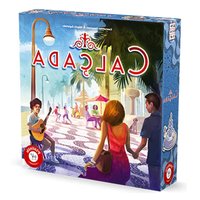
Calçada - Board game Piatnik - Free user manual and instructions
Find the device manual for free Calçada Piatnik in PDF.


| Product type | Board game |
| Brand | Piatnik |
| Model | Calçada |
| Number of players | 2 to 4 players |
| Recommended age | 8 years and up |
| Game duration | 30 to 45 minutes |
| Game language | French, German, English, Hungarian |
| Box dimensions | 30 cm × 30 cm × 7 cm |
| Weight | 0.8 kg |
| Box contents | Game board, cards, pawns, rulebook |
| Materials | Cardboard, plastic |
| Power supply | None (board game) |
| Care and cleaning | Clean with a soft, dry cloth |
| Safety | Not suitable for children under 3 years, small parts |
| Spare parts and repairability | Parts available on request from the manufacturer |
| General information | Family board game, Portuguese theme |
Frequently Asked Questions - Calçada Piatnik
User questions about Calçada Piatnik
0 question about this device. Answer the ones you know or ask your own.
Ask a new question about this device
Download the instructions for your Board game in PDF format for free! Find your manual Calçada - Piatnik and take your electronic device back in hand. On this page are published all the documents necessary for the use of your device. Calçada by Piatnik.
USER MANUAL Calçada Piatnik
4 Tableaus

1 Startmarker
4 Wertungssteine

27 Bonus-Plättchen
1 Spielplan

SPIELZIEL:
5.



5 Motive + 1 Bonus-Symbol


SPIELABLAUF:
![graph LR A["0"] --> B["1"] B --> C["2"] C --> D["3"] D --> E["4"] E --> F["5"]](/content/2026/07/1455118/images/6fd8434e028732a872b891fbcecbeea9674b38c341bb9047738d5399d4264881.jpg)


Beispiel:

Create your own beautiful Portuguese paving
A tile-placement game with hidden depth by Konstantinos Karagiannis and Vangelis Bagiartakis

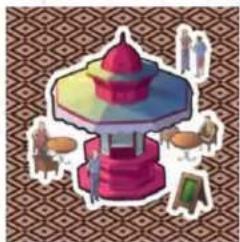
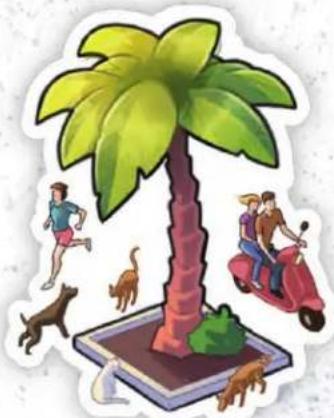
Bustling along the Portuguese streets, people wander across the characteristic paving: the Calçada. Bars, kiosks and street cafés entice crowds of people inside, as loved-up couples meander along the street and happy children scamper and down. Older people sit back on the benches in the shade, just watching the world go by.
Now it's up to you... Who will match up the right Calçada tiles to create a winning combination? Make sure you don't concentrate on a single district, because connecting up the same motif across different districts will earn you more points.
COMPONENTS:

125 Calçada tiles
25 tiles in each of the 5 colours
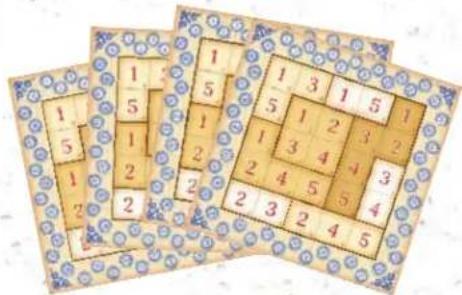
4 Calçada boards

Gameboard
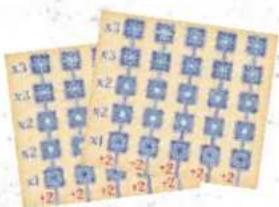
2 Double-sided scoreboards
1
1 First-player marker
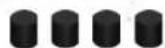
4 Scoring stones

20 Bonus tiles

Rule20 Cobblestones:
4 stones in each of the 5 colours

AIM OF THE GAME:
Your aim is to earn the most points by choosing and moving cobblestones to gain the right Calçada tiles and cleverly place them on your Calçada board. Be the first player to design valuable districts and make sure you combine your motifs well so that you have the most valuable Calçada at the end of the game.
SETUP:
Before your first game, carefully remove all the pieces from the punchboard.
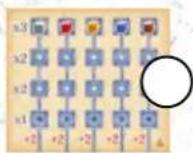
① Place the scoreboard for your player count [e.g.] in the centre of the table, with the player count symbol at the top. Place 1 coloured cobblestone at the top of each of the columns, with a different colour for each column. Return the other scoreboard to the box, since you will not need it for this game.
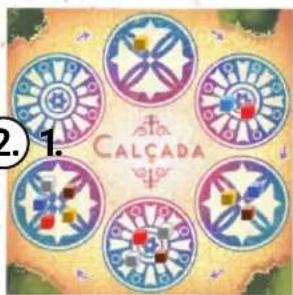
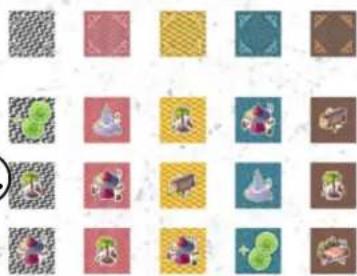
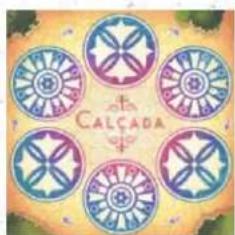
② Place the gameboard in the centre of the table next to the scoreboard. The gameboard has 6 round spaces. Place 1 random cobblestone on any space, then 2 random cobblestones in the next clockwise space, and so on. Continue in this way until you have placed the remaining 15 cobblestones in 5 of the spaces (1/2/3/4/5). The sixth space remains empty.
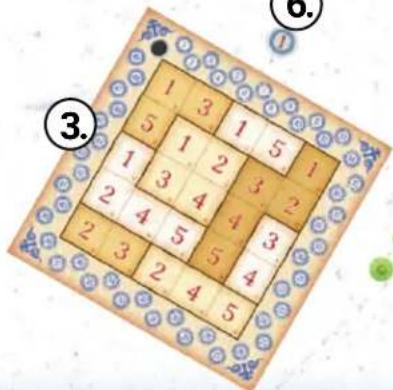
③. Each player takes 1 Calçada board and 1 scoring stone. Agree which side of the Calcada board you all want to play on and place it before you accordingly. Place the scoring marker on the 0 space of your score track.
4. Sort the Calçada tiles by the colour on the back and shuffle each stack face down. Put them in 5 facedown piles next to each other near the gameboard. Reveal the top 3 Calçada tiles of each stack, and lay them below that stack of tiles to create a face-up display.
⑤. Each player takes 2 bonus tiles and places them in front of themselves. Place the remaining bonus tiles nearby to create a general supply. Note: The supply of bonus tiles is considered unlimited. If you run out of them during the course of the game, make do with suitable replacement material.
6. Choose a player to start. That player takes the first-player marker.




5.
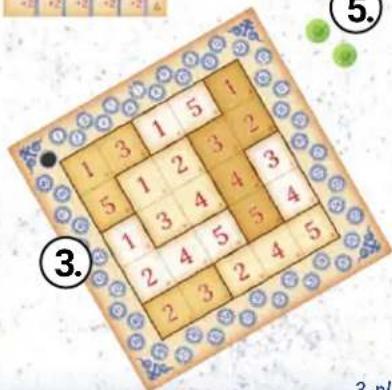
3-player setup

CALÇADA BOARDS:
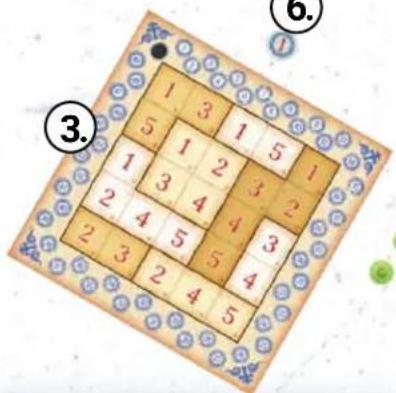
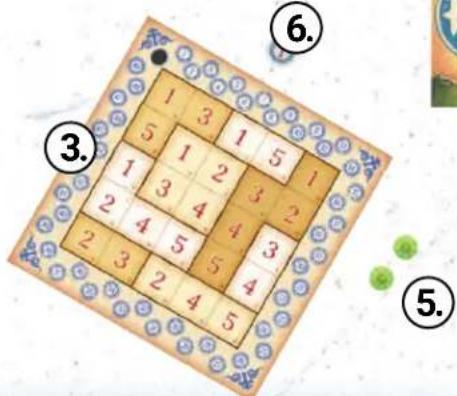
All the Calçada boards have the same layout:
A Depending on the side chosen, the central area will have either 8 or 9 districts with different numbers of squares. Each square contains a number between 1 and 5, and a small mark (U to III) in the bottom right corner, which indicates the size of that district. Note: The different colours of the districts are for the purpose of better recognition only.
B Your score track runs around the edge of that central area. Note: If you score more than 49, simply continue around again from 0 and add 50 points to your score at the end of the game.

CALÇADA TILES:
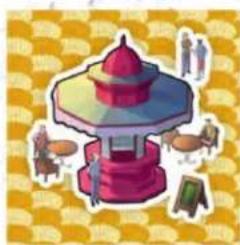
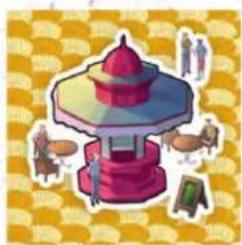
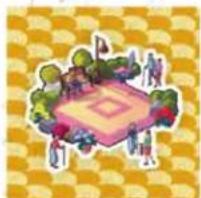
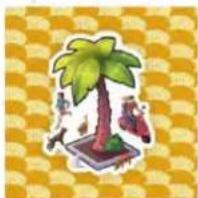
There are 5 different colours of Calçada tiles. Most of the Calçada tiles also feature one of the five different motifs, with each motif appearing 4 times in each colour. Tiles without a motif have a bonus symbol on them instead (see BONUS TILES for more detail).
5 Colours





HOW TO PLAY:
Each game has several rounds. The players take turns clockwise. On your turn, follow these two steps:
(A) DECLARE AND MOVE A COBBLESTONE
(B) PLACE A CALÇADA TILE
Play then passes to the next player.
(A) DECLARE AND MOVE A COBBLESTONE
Choose any 1 cobblestone on a space on the gameboard and state out loud the colour of that cobblestone and the total number of cobblestones currently on that space. Then move the cobblestone you have chosen around to the next clockwise space on the gameboard. Important: If there is more than 1 cobblestone of that colour on that space, you still only move 1 cobblestone around to the next space.
(B) PLACE A CALÇADA TILE:
Take 1 Calçada tile from the face-up display for the colour you declared. Place it on an empty square on your Calçada board. Follow these rules when placing it:

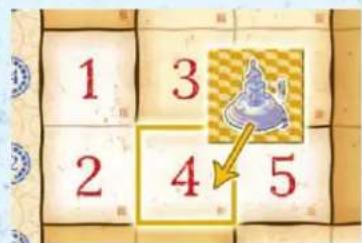
The square must show the number that you said when you declared the cobblestone colour (i.e. the number of cobblestones on the gameboard space you chose before moving the cobblestone). If the total number of cobblestones on the space was 6 or more, you may place your Calçada tile on any square.

Important: The Calçada tiles within a district on your Calçada board must all be the same colour.

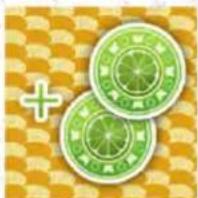
If you place a Calçada tile with a bonus symbol on your Calçada board, you immediately take 2 bonus tiles from the general supply and place them in front of you.
Example:


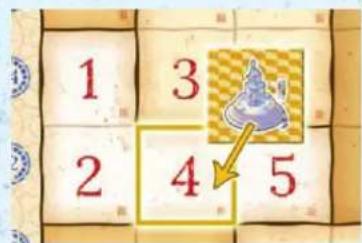
Isobel chooses a yellow cobblestone, and there are 4 cobblestones on that space. She says out loud, 'Yellow; moves the yellow cobblestone 1 space clockwise. Finally, she takes a yellow Calçada tile from the face-up di places it on a square on her Calçada board that shows the number 4.
Important: Do not automatically refill the face-up display after you take a Calçada tile. You only place 3 new Calçada tiles to refill the face-up display for a colour once a player has taken the last face-up tile. Take the new tiles from the corresponding stack.
SCORING YOUR DISTRICTS:
Whenever you complete a district, you then score that district:
-
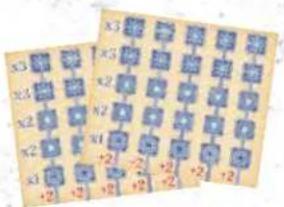
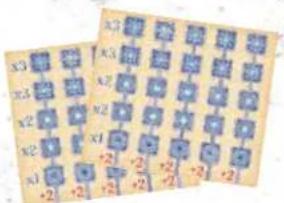
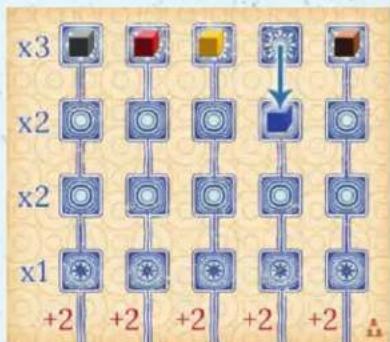
Multiply the number of Calçada tiles in the district you have just completed by the multiplier shown in the row for that colour on the scoreboard. You gain that number of points. Move your scoring stone that many points along your score track.
-
Then move the cobblestone for that colour 1 space down the scoreboard.
Important: If a cobblestone is already on the bottom space, you move it off the end of the scoreboard and gain 2 additional points. From this point on, you may no longer take Calçada tiles of this colour from the open display for the rest of the game!
Example:

![graph LR A["0"] --> B["1"] B --> C["2"] C --> D["3"] D --> E["4"] E --> F["5"]](/content/2026/07/1455118/images/41c3af4460d89d516a5f6fb6928f7563d4d2ecac25b601e765d4de440c579f41.jpg)

Clare completes a district of 2 tiles that contains blue Calçada tiles. On the scoreboard, the blue cobblestone is in the row alongside the multiplier ×3. This means Clare gets 2×3=6 points, so she moves her scoring stone 6 spaces along score track. Finally, she moves the blue cobblestone 1 space down on the scoreboard. The multiplier for districts with blue Calçada tiles is now ×2.
BONUS TILES:
On your turn, you may use your bonus tiles to perform the following actions as many times as you want:

Discard 1 bonus tile to move any 1 cobblestone 1 extra space clockwise before performing STEP (A) DECLARE AND MOVE A COBBLESTONE.

Discard 1 bonus tile to replace the face-up display tiles for a particular colour before performing STEP (B) PLACE A CALÇADA TILE. Return the current tiles to the bottom of that stack and refill the display with 3 new Calçada tiles from the top of that stack.
Return all discarded bonus tiles to the general supply.
GAME END & FINAL SCORING:
The end of the game is triggered when someone moves a second cobblestone off the end of the scoreboard, after completing a district. Continue playing to the end of the current round, so that all players have the same number of turns. Then proceed to scoring:
a) If you have connected the same motif orthogonally (i.e. vertically/horizontally), you receive additional points as listed in the table below. Neither the colour of those Calçada tiles nor the districts in which those motifs are placed matt when scoring these connections.
Number of connected motifs
Points awarded
 | 2 | 3 | 4 | 5 | 6 | 7 | 8+ |
 | 1 | 3 | 5 | 8 | 11 | 14 | 18 |
Note: The bonus symbols on Calçada tiles are not motifs and so do not count for these additional points.
b) You receive 1 point for each Calçada tile in incomplete districts.
c) You get 1 additional point for every 2 bonus tiles you have.
Move your scoring stone forward the corresponding number of points along the score track on your Calçada board. If your marker has moved beyond space 49, add 50 points to your score. The winner is the player with the most points the case of a tie, the tied players share the victory.


Example:

Over the course of the game, Kirstin gained 33 points. During final scoring, she gets 17 points for her connected mot (1+3+5+8). She receives 3 points for 3 Calçada tiles in incomplete districts (A + B + C). Her 7 unused bonus tiles give her an additional 3 points, so she moves her points marker along the score track to space 6. As her marker has passed space 49, she adds 50 points to her score.
Kirstin gained a total of 56 points+17+3+3)
If you have any questions or suggestions about Calçada, you can get in touch with us by post: Piatnik, Hütteldorfer Straße 229-231, A-1140 Wien, AUSTRIA; or email: info@piatnik.com
Find us on:

/PiatnikSpiele

Warning! Not for children under 3 years. Contains small parts that could be swallowed. Retain address.

Un jeu raffiné de placement de tuiles de Konstantinos Karagiannis et Vangelis Bagiartakis.
4 Tableaux
1 Carrousel
2 tables de score (recto verso)




DÉROULEMENT DE LA PARTIE :

![graph TD A["0"] --> B["1"] B --> C["2"] C --> D["3"] D --> E["4"] E --> F["5"]](/content/2026/07/1455118/images/3c3b31f1e626ab6f0d6eea68c428b8f7e8ad715167b7b9b2473444a2e25e906d.jpg)
![graph TD A["x1"] --> B["+2"] C["x2"] --> D["+2"] E["x3"] --> F["+2"] G["+"] --> H["+2"] I["+"] --> J["+2"] K["+"] --> L["+2"] M["+"] --> N["+2"] O["+"] --> P["+2"] Q["+"] --> R["+2"] S["+"] --> T["+2"] U["+"] --> V["+2"] W["+"] --> X["+2"] Y["+"] --> Z["+2"] style A fill:#f9f,stroke:#333 style C fil…](/content/2026/07/1455118/images/8f7af81d44bbded2a0f54dea51a5a128de805716a377dbf9eae0abe96aebb4f0.jpg)
Exemple :

4 játékostábla
1 játéktábla







A JÁTEK MENETE:


EGY KERÜLET' ERTEKELESE:
![graph LR A["0"] --> B["1"] B --> C["2"] C --> D["3"] D --> E["4"] E --> F["5"]](/content/2026/07/1455118/images/183d68c8a3056ef99f12358912ca2aaee6251ce6a0ea0f5c7938aaea4ed090cf.jpg)
Példa:

- SPIELZIEL
- SPIELABLAUF
- CREATE YOUR OWN BEAUTIFUL PORTUGUESE PAVING
- AIM OF THE GAME
- SETUP
- CALÇADA BOARDS
- CALÇADA TILES
- HOW TO PLAY
- DECLARE AND MOVE A COBBLESTONE
- PLACE A CALÇADA TILE
- SCORING YOUR DISTRICTS
- BONUS TILES
- GAME END & FINAL SCORING
- DÉROULEMENT DE LA PARTIE
- A JÁTEK MENETE
- EGY KERÜLET' ERTEKELESE
Brand : Piatnik
Model : Calçada
Category : Board game