
SRT 5010 - Satellite decoder STRONG - Free user manual and instructions
Find the device manual for free SRT 5010 STRONG in PDF.


| Product Type | Satellite Decoder |
| Brand | STRONG |
| Model | SRT 5010 |
| Dimensions (approx.) | 200 x 150 x 40 mm |
| Weight (approx.) | 0.5 kg |
| Power Supply | 12V DC, 1A power adapter |
| Flash Memory | 16 Mbits |
| SDRAM Memory | 64 Mbits |
| Code Rate | 1/2, 2/3, 3/4, 5/6, 7/8 |
| Symbol Rates | 1/4, 1/8, 1/16, 1/32 |
| Max Input Bitrate | 60 Mbits/s |
| Transport Standard | MPEG-2 ISO/IEC 13818 |
| Video Profile | MPEG-2 MP@ML |
| Video Resolution | 720 x 576 (PAL), 720 x 480 (NTSC) |
| Aspect Ratios | 4:3, 16:9 |
| Frame Rate | PAL: 25 Hz, NTSC: 30 Hz |
| Audio Decoding | MPEG/MusiCam Layer 1 & 2, 20 Hz - 20 kHz |
| Main Functions | Satellite channel reception, teletext, electronic program guide (EPG) |
| Remote Control | 36 keys, infrared |
| Maintenance and Cleaning | Clean with a soft, dry cloth. Do not use chemical products. |
| Safety | Do not expose to moisture or extreme temperatures. Disconnect before cleaning. |
| Available Spare Parts | Remote control, power adapter |
| Repairability | Repairability index not communicated by the manufacturer |
Frequently Asked Questions - SRT 5010 STRONG
User questions about SRT 5010 STRONG
0 question about this device. Answer the ones you know or ask your own.
Ask a new question about this device
Download the instructions for your Satellite decoder in PDF format for free! Find your manual SRT 5010 - STRONG and take your electronic device back in hand. On this page are published all the documents necessary for the use of your device. SRT 5010 by STRONG.
USER MANUAL SRT 5010 STRONG
Digital Terrestrial Receiver SRT 5005/5010/5015
User Manual
1.0 Safety Instructions 3
2.0 Features & Accessories 4
3.0 Safety Precautions 5
4.0 Storage 5
5.0 Equipment Set-up 5
6.0 Connection 6
6.1 Connecting to Terrestrial Antenna 6
6.2 Connecting to TV & VCR 6
6.3 Connecting to Digital Audio Amplifier 7
6.4 Connecting to PC 7
7.0 Your Receiver 7
7.1 Front Panel 7
7.2 Rear Panel 8
7.3 Remote Control Unit 9
8.0 First Time Installation 10
9.0 Main Menu 12
9.1 Channel Organiser 12
9.2 Channel Search 14
9.3 Installation 27
9.4 Timer 28
9.5 Game 29
10.0 Other operations 31
10.1 Mosaic 31
10.2 EPG function 32
10.3 Teletext function 34
10.4 Information 35
A.1 Trouble Shooting 36
A.2 Specifications 38
A.3 Glossary of terms 40
1.0 Safety Instructions
DO NOT INSTALL YOUR RECEIVER:
In a closed or poorly ventilated cabinet;
- Directly on top of or under any another equipment;
On a surface which might obstruct the ventilation slots.
DO NOT EXPOSE THE RECEIVER OR ITS ACCESSORIES:
To direct sunlight or near any other equipment that generates heat;
To rain or intense moisture;
To any shock which may cause permanent damage to your receiver;
To any magnetic objects, such as loudspeakers, transformers, etc.;
To intense vibration;
- Never open the cover. It is dangerous to touch the inside of the receiver due to high voltage currents and possible electrical hazards. Your warranty will be void if the receiver has been opened.
- When the receiver is not used for a long period of time, you should unplug the power cord from the wall socket.
- Do not use a damaged power cord. It may cause a fire or an electrical shock.
- Do not touch a power cord with wet hands. It may cause an electric shock.
Place the receiver in a well-ventilated environment.
- When you are connecting the cables, be sure that the receiver is disconnected from the mains supply voltage.
- Do not use your receiver in a humid environment.
Make sure you read this user manual before installing your receiver.
HOW TO USE THIS MANUAL
This manual provides complete instructions for installing and using this receiver.
The following symbols will serve as follow.

Warning
Indicates warning information.

Tips
Indicates any other additional important or helpful information.
MENU
Represents a button on the remote control or the receiver. (Bold Character)
Move to
Represents a menu item within a window. (Italic Character)
2.0 Features & Accessories
SRT 5005/ 5010/ 5015 Digital Terrestrial Receiver:
Multi norm UHF modulator Ch 21-69 (Pal BG-I-DK-MN)
For all digital Free-To-Air TV and Radio programmes (with outdoor- or indoor terrestrial antenna)
DVB-T compliant, Digital UHF/VHF Tuner with Loop-through function
Set-up support for first time installation
Quick and easy installation & user-friendly menu
Multi-lingual support on screen Menu: English, German, French, Italian, Spanish, Hungarian, Czech
Excellent Audio- and Video quality
Automatic and manual channel scan options
Support of active antenna by 5V output
Support of channel numbering defined by broadcaster
1000 channels memory capacity
Favorite list for TV and Radio
Parental lock function for menu, selectable per channel
Electronic Programme Guide (EPG) for present/ following event information and up to 7 days for on screen programme information
3 Operation Modes (Digital TV, Digital Radio, Favourite)
Support of Teletext (OSD & UHF modulator)
Multi-lingual subtitling and audio track support
2-SCART Connectors (TV, VCR)
Build-in RF modulator
S/PDIF output for connection with a digital audio amplifier
S-VHS Connector
Mosaic function: 9 TV Channels in overview
Automatic clock change: summer/winter time
Timer programmable via EPG
NTSC/PAL identification and converting automatically and manually
Separate power switch
Future proof: Over Air Download of the software updates
RS 232 port for updating control software and additional services
Subject of local broadcast condition
2 Only in models SRT 5010 and SRT 5015
3 Only in model SRT 5015
Accessories:
User's Manual
1 Remote control unit
2 x Batteries (AAA type)
Note: The batteries should not be recharged, disassembled, electrically short-circuited or be mixed or used with other types of batteries.
3.0 Safety Precautions
To maintain your receiver's optimum performance, you are advised to apply the following safety precautions:
Read this manual carefully and make sure you fully understand the instructions given.
Refer all maintenance or servicing to suitably qualified personnel.
If you wish, you may clean your receiver with a soft lint-free cloth slightly made damp with a mild soap solution, only after disconnecting from the mains voltage supply.
- Do not use alcohol or ammonia based liquids to clean the receiver.
- Do not open the receiver cover, as you will be exposed to a shock hazard.
Do not open the receiver cover this will void your warranty.
- Do not place any objects on top of the receiver because this might prevent proper cooling of the components inside.
- Make sure no foreign objects fall through the ventilation slots because this could cause fire or an electric shock.
Wait a few seconds after switching off the receiver before you move the receiver or disconnect any equipment.
Please ensure that the electrical power supply corresponds with the voltage on the electrical identification plate at the back of the receiver.
It is a necessity that you only use an approved extension and compatible wiring that is suitable for the electrical power consumption of the installed equipment.
If the receiver does not operate normally even after strictly following the instructions in this user manual, it is recommended to consult your dealer.
4.0 Storage
Your receiver and its accessories are stored and delivered in a packaging, protective against electric damage and moisture. When unpacking it, make sure that all the parts are included and keep packaging away from children. When transporting the receiver from one place to another or if you are returning it under warranty make sure you repack the receiver in its original packaging with its accessories. Failing to comply with such packaging procedures could void your warranty.
5.0 Equipment Set-up
We recommend you to consult a professional installer to set up your equipment.
Otherwise, please follow the following these instructions carefully:
Refer to the user manual of your TV and your antenna.
Make sure that the SCART cable is in a good condition.
Make sure that the SCART cable connections are well shielded.
Make sure that the outdoor components of the antenna are in good condition.
6.0 Connection
6.1 Connecting to Terrestrial Antenna
To receive the broadcast signal, the terrestrial antenna cable should be connected to the ANT IN connector at the back of the receiver. (FIGURE 1)
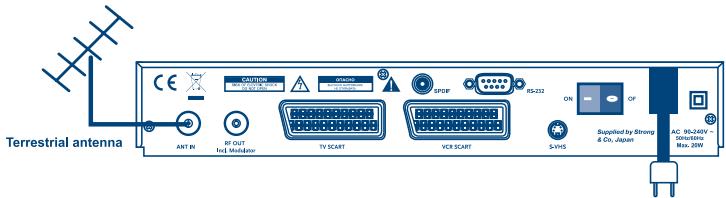
FIGURE 1
6.2 Connecting to TV & VCR
The TV set should be connected with the receiver through a SCART cable. This terrestrial receiver may also be operated together with a VCR using the loop through function. The loop-through function of this terrestrial receiver is active when the receiver is powered off. As soon as the VCR is turned on, its video and audio signals are looped through the terrestrial receiver. (FIGURE 2)
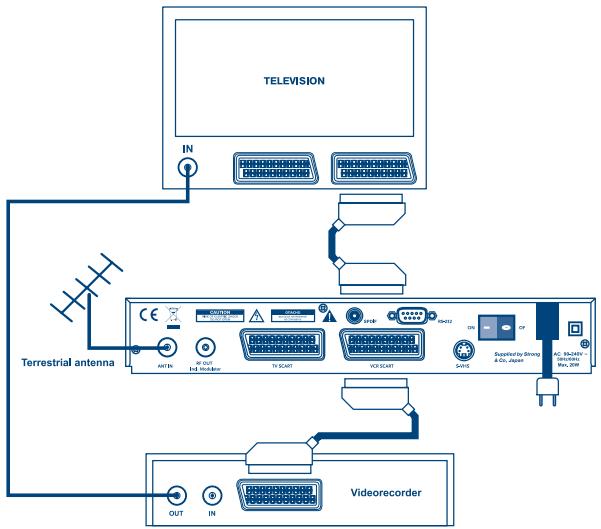
FIGURE 2
6.3 Connecting to Digital Audio Amplifier
The Digital Audio Amplifier is connected with the receiver from the S/PDIF connector. (FIGURE 3)
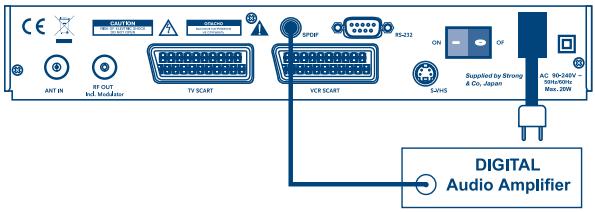
FIGURE 3
6.4 Connecting to PC
The RS-232 connector of the receiver helps to connect to the PC using a serial cable. This serial cable can be used to connect your PC with your receiver, and allows you to download new versions of software to your receiver. (FIGURE 4)
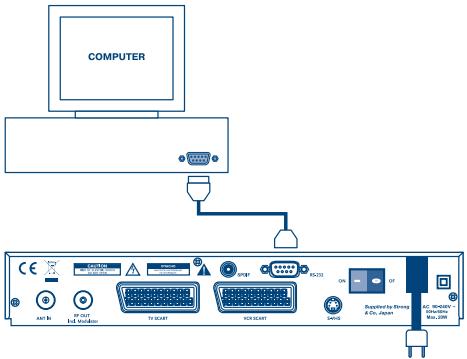
FIGURE 4
7.0 Your Receiver
7.1 Front Panel
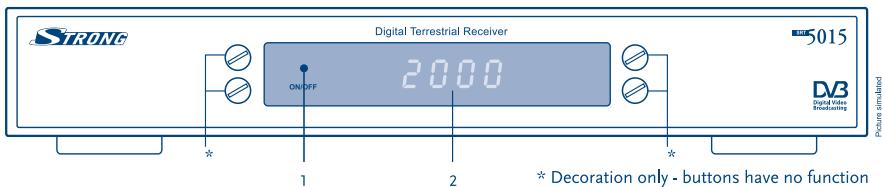
FIGURE 5. Front Panel
1. Mode indicator
The RED light indicates that the receiver is in STAND-BY mode.
The GREEN light indicates that the receiver is in AWAKE mode.
2.4 Digits display
In STAND-BY mode indicates current time.
In AWAKE mode indicates current channel number.
1 Only in models SRT 5010 and SRT 5015
7.2 Rear Panel
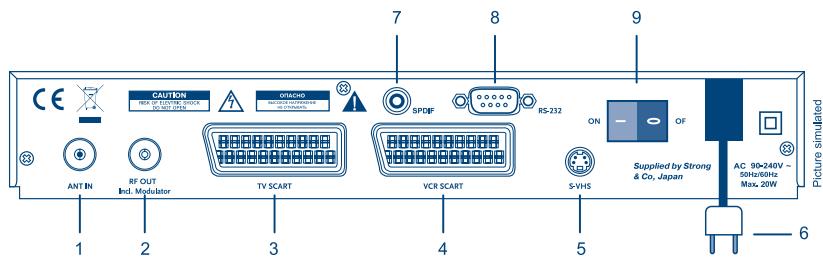
FIGURE 6. Real Panel
1.ANT IN
Use to connect a general Aerial Antenna for receiving broadcasting signal.
2. To TV
This gives you the possibility to connect a TV set in order to receive analogue channels or to an extra receiver. (Includes modulator output in the model SRT 5015).
3. TV SCART Connector
Use this connector to connect your receiver with your TV set using a SCART cable.
4. VCR SCART Connector
Use this connector to connect your receiver to your video recorder using a scart cable. Your video signal will now be looped through the receiver and your video recorder to your TV set.
5. S-VHS
Use this connector to connect your receiver to your TV and VCR using S-Video cable for better picture quality.
6. Power Cord
Your receiver requires a current of 90 240V AC (Auto-selectable), 50 60Hz + / - 5%
Make sure to check the power specification before connecting your receiver to the wall outlet.
7. S/PDIF Digital audio output
Use this coaxial output to connect your receiver to the input of your digital audio amplifier.
8. RS 232 Serial Port
This serial port can be used to connect your PC with your receiver, and allows you to download new versions of software to your receiver.
9. Power ON/OFF Switch
1 Only in models SRT 5010 and SRT 5015
2 Only in model SRT 5015
7.3 Remote Control Unit

FIGURE 7. Remote Control Unit
All features of the set-top box can be controlled with the remote control unit.

Turns the receiver On/Standby.

Mutes audio output of the receiver.
C.AV
Toggle between TV and AV mode.
D. 0 9
Channel selection.
E. FAV
Toggle Favorite mode ON/OFF.
F. TV/R
Toggle between TV or RADIO mode.
G.MENU
Shows the main menu and exits from any level of menu to view mode.
H. INFO
Shows information of the current channel.
I. EPG
Shows the EPG (Electronic Program Guide) during No-menu state only.
J. EXIT
Exits from the menu or sub-menu and cancels the progressing function if applicable.
K. ▲ ▼
Menu Off: Change the current program to the previous/next program.
Menu On: Moves the cursor up/down.
L.
Menu Off: Increases/decreases the volume level.
Menu On: Change the setting values in specific Menu item.
M. OK
Activates the highlighted menu item. Displays a channel list according to TV/Radio Mode
N. V_+ / V_-
Use to increase or decrease the receiver volume level.
O. P + / P-
Page up and down in menu list.
P. MOSAIC
Show pictures of 9 channels on the screen simultaneously
Q. PAUSE
Freeze/Resume picture.
R.AUDIO
Shows the list of available audio languages for the channel you are watching. In addition it sets the current channel audio to stereo () , left-mono ( or right-mono ) .
S. EDIT
Program edit.
T. TEXT
Shows current service's Teletext on OSD (On Screen Display).
U. SUB
Show the list of subtitled languages the current channel supports.
V. RECALL
Switches back to previous channel.
8.0 First Time Installation
Make sure that your terrestrial receiver correctly connected to your Television and a terrestrial antenna and that the signal quality is good enough. Confirm that the power plug of the receiver is plugged into the wall outlet. Turn on the receiver. The following picture is shown at the first time.
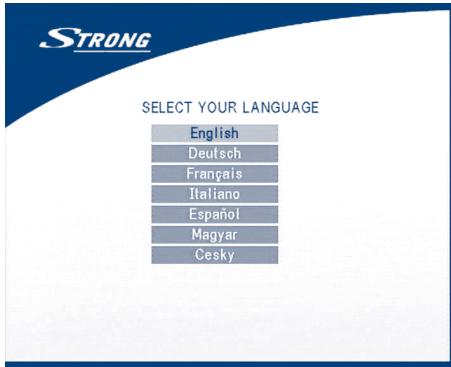
SCREEN 1
It is recommended that you perform the first time installation following Installation Wizard step by step. This will help you easily achieve system configuration and channel installation. If you are a professional installer then you can skip the wizard by pressing EXIT button and set-up the channels using the Channel Search menu. Press UP/DOWN to choose your language, press OK to confirm. The preference menu will appear as below.
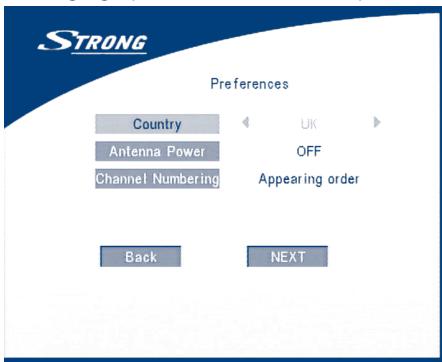
SCREEN 2
Please select your Country, Antenna Power mode and Channel numbering. Press UP/DOWN to select the items, press RIGHT/LEFT to change the value of the item.
If you choose BACK, It will go back to SCREEN 1.
Press OK to confirm those setting and enter the Adjust antenna menu (shown as SCREEN3).
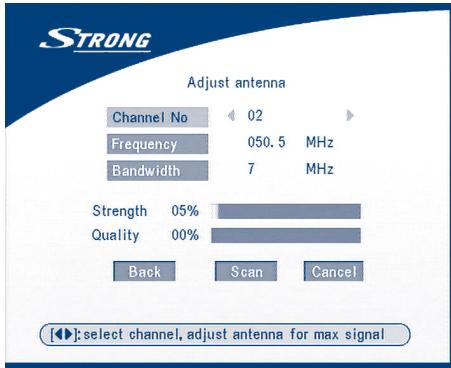
SCREEN 3
Press LEFT/RIGHT to select Channel No, adjust your antenna direction and position (if necessary) to get maximum levels of the signal level and quality indicators. You can check with your dealer on which channels digital terrestrial broadcast is available at your location.
Move cursor to Scan, press OK to confirm, The Automatic Search screen will appear as below.
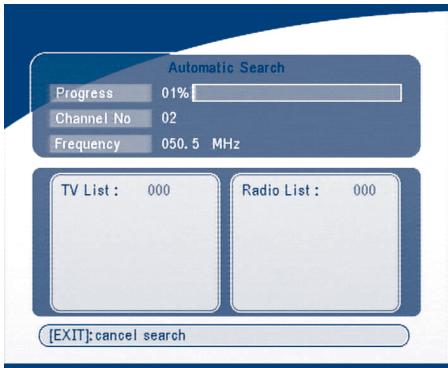
SCREEN 4
Completed search, receiver will save services information automatically and exit to normal play state.
9.0 Main Menu
All the important settings and features of your receiver can be operated in Main Menu. The Main Menu consists of five sub-menus such as "Channel Organiser", "Channel Search", "Installation", "Timer", "Game". With Menu off, press MENU key. The MAIN MENU screen will appear (SCREEN 5).
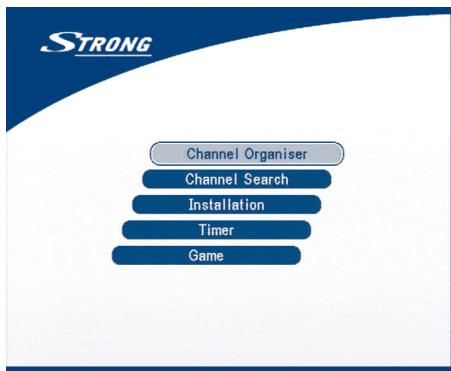
SCREEN 5
9.1 Channel Organiser
In MAIN MENU screen, press UP/DOWN to move the cursor to Channel Organiser, and then press OK to enter the Channel Organiser menu.
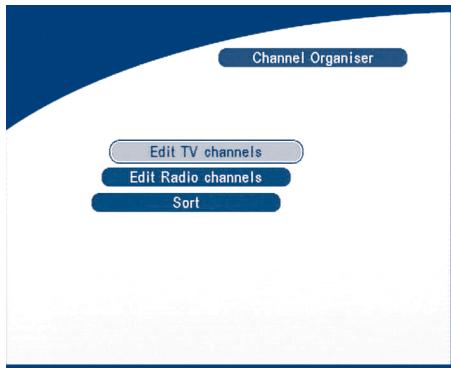
SCREEN 6
The Channel Organiser menu consists of three sub-menus, which are "Edit TV Channel", "Edit Radio Channel" and "Sort".
9.1.1 Edit TV channels
In this menu, you can set the favorite channels, change the order of channels and delete channels.

SCREEN 7
Press UP/DOWN keys to point focus of the menu to the channel of your selection.
Press LEFT/RIGHT keys to point focus of the menu to the column with the function, which you want to apply to the selected channel.
When the focus is on column "Favor", press the OK button to add selected channel to the Favourite list. When the focus is on column "Move", press the OK button to confirm selection of the channel, using UP/DOWN buttons move channel to new location and press the OK button to confirm new location. Repeat this for every channel that you want to move. When the focus is on column "Del", press the OK button to mark the channel as selected to be deleted from the list. To apply changes press the EXIT button and confirm channel deletion.
9.1.2 Edit Radio Channels
This menu is similar as to 9.1.1 "Edit TV Channels" description.
9.1.3 Sort
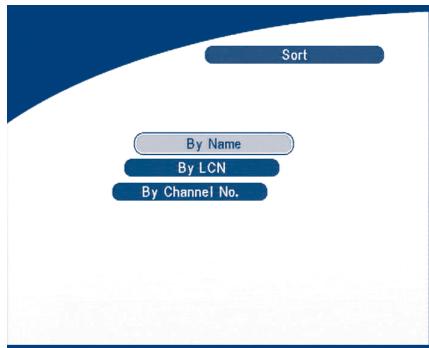
SCREEN 8
You can sort the order of the channel list by channel name, LCN (Logical Channel Number) or Channel Number.
9.2 Channel Search
There are 2 items in the channel Search menu:
- Automatic Search
- Manual Search
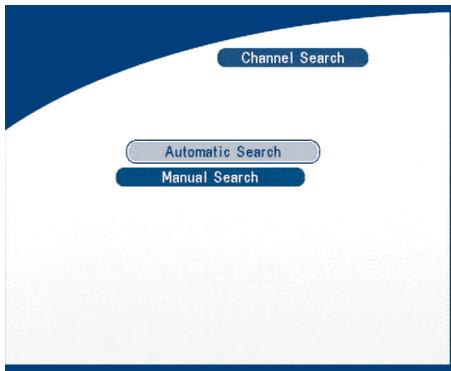
SCREEN 9
9.2.1 Automatic Search
Press OK over the Automatic Search. A warning message will appear.
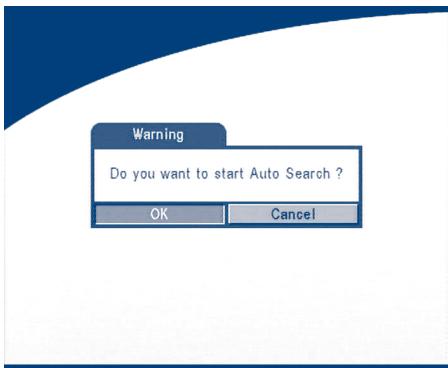
SCREEN 10
Press LEFT/RIGHT to move the cursor to OK and press OK to continue.
A message will appear. "Please Press LEFT/RIGHT to choose whether to erase your previous channel list".
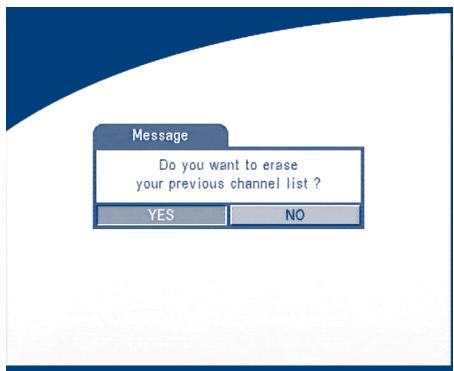
SCREEN 11
Then it will search for the programs automatically. If you want to cancel the channel search you may press the EXIT button.
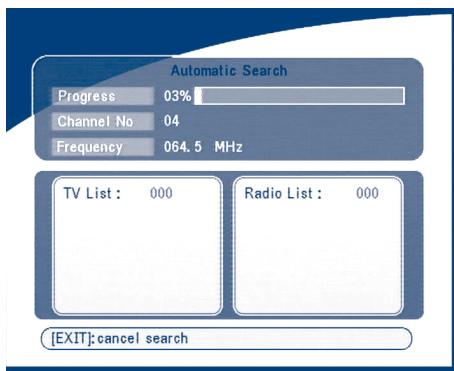
SCREEN 12
On completing the search, the receiver will save the services information automatically and exit to normal play state.
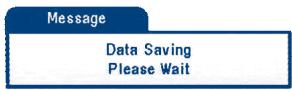
SCREEN 13
9.2.2 Manual Search
Press OK over the Manual Search, the Manual Search Screen will appear.
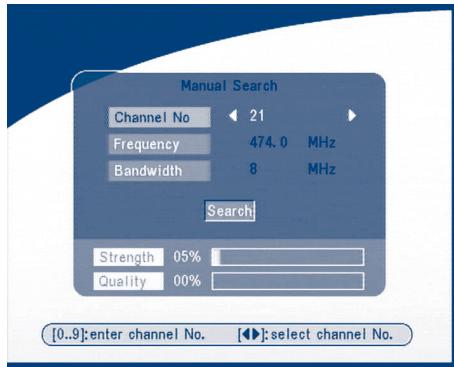
SCREEN 14
Press LEFT/RIGHT to choose channel No. or press numerical buttons to input channel No. Or
Press UP/DOWN to move focus to Frequency item and enter frequency value using numerical buttons.
Press UP/DOWN to move focus to Bandwidth and choose bandwidth using LEFT/RIGHT buttons.
Check indicators of the signal level and quality to make sure that values are entered correctly.
Press UP/DOWN to move cursor to Search and press OK to search current channel.
If no service is installed, there will be a warning. Press any key to return.
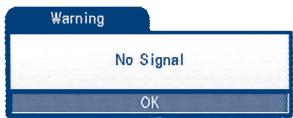
SCREEN 15

Tips
Different countries have different VHF/UHF frequencies plan. It is important to choose the proper region.
9.3 Installation
9.3.1 System Setting
In this menu, you can configure the systems such as language, TV Settings, Country, Channel Numbering, Antenna Power, Time Setting, and Factory Default.
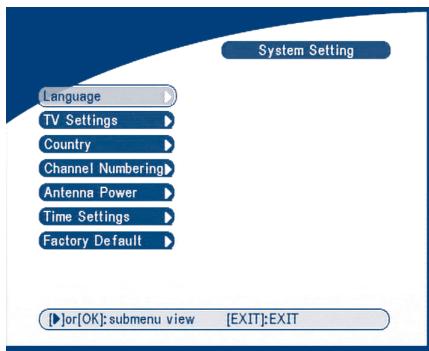
SCREEN 16
9.3.1.1 Language
You can change the language of the OSD and Audio.
Press UP/DOWN to select the OSD language or Audio language. Press OK/RIGHT to enter the language list and Press UP/DOWN to select the language. Press OK to confirm.
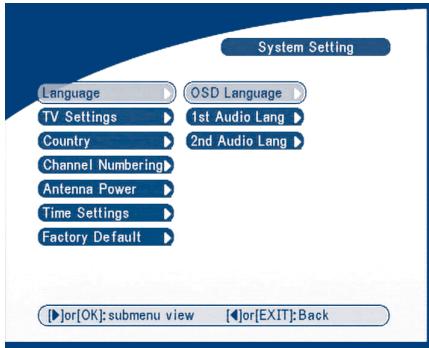
SCREEN 17
9.3.1.2 TV settings
You can set TV Standard, TV format, Video output and Modulator Settings.
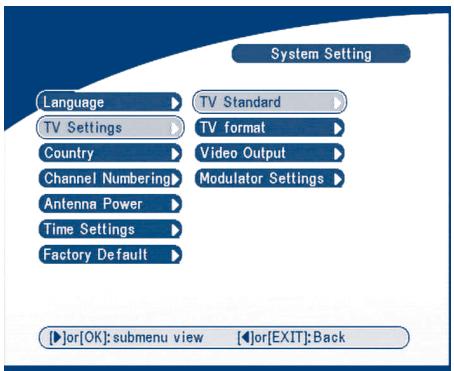
SCREEN 18
TV Standard
The TV Standard Screen will appear as follows:
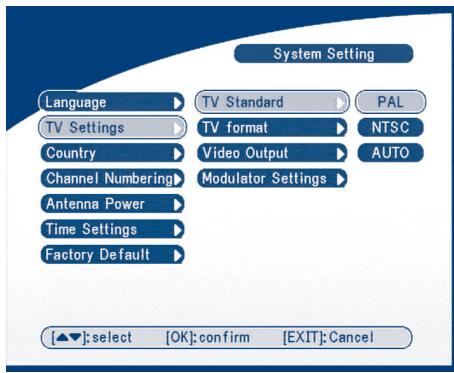
SCREEN 19
Press OK/RIGHT to select PAL or NTSC, press OK to confirm. If you don't know which standard your TV has, please select AUTO.
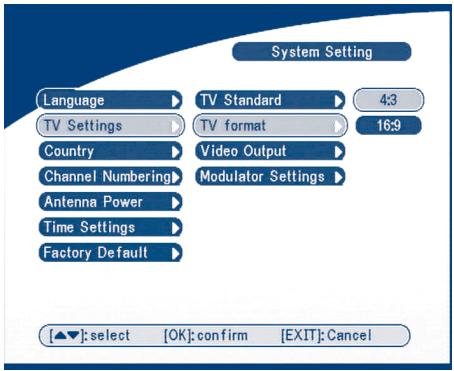
TV format
The TV format Screen will appear as follows:
SCREEN 20
Press OK/RIGHT to select 4:3 or 16:9, press OK to confirm.
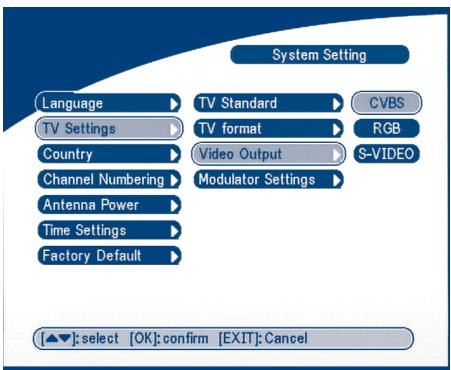
Video output
The Video output Screen will appear as follows:
SCREEN 21
Press OK/RIGHT to select CVBS/RGB or S-Video, press OK to confirm. Warning! If RGB is selected > S-VHS output is switched OFF totally.
Note: S-Video option available in model SRT 5015 only.
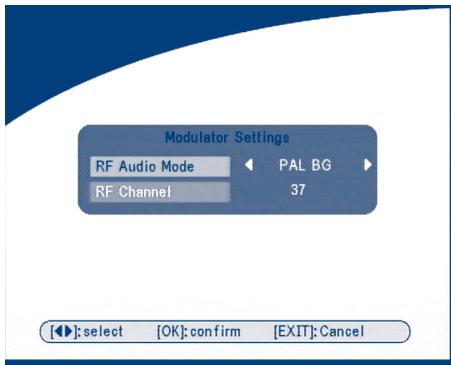
Modulator Settings (only for model SRT 5015)
The Modulator Settings Screen will appear as follows:
SCREEN 22
Press UP/DOWN to select RF Audio Mode or RF Channel. Use LEFT/RIGHT to set RF Audio Mode and RF Channel. Press OK to confirm.
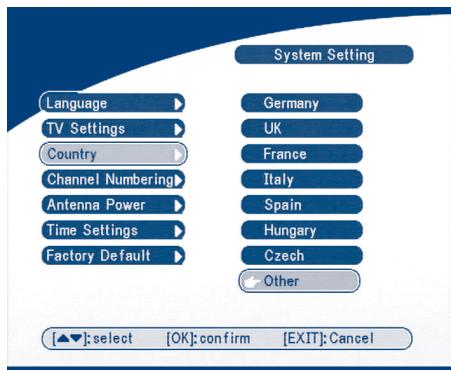
9.3.1.3 Country
SCREEN 23
Press OK/RIGHT to select your country in the country list, press OK to confirm. If your country is not in the list then select Other. It will apply the most common frequency plan for European countries.
9.3.1.4 Channel Numbering
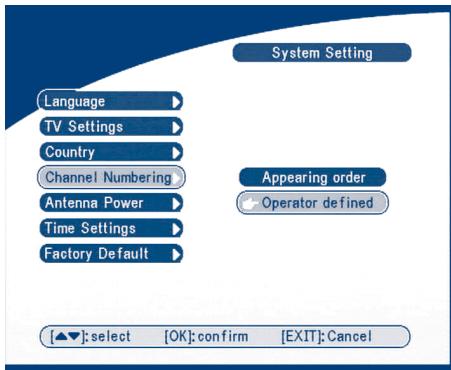
Here you can set the channel list by different number format, Appearing order or Operator defined.
SCREEN 24
9.3.1.5 Antenna Power
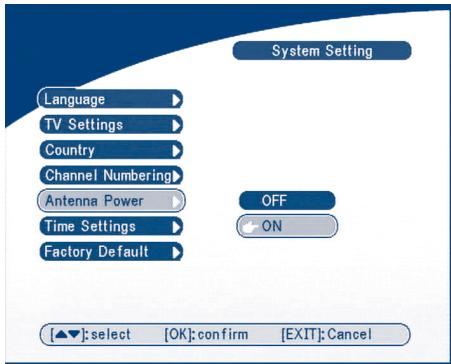
Press OK/RIGHT to select turn OFF or ON the antenna power, press OK to confirm. Before set Antenna Power to ON: make sure that your antenna is ACTIVE, requires power 5V DC and it's power consumption is not more than 100mA .
SCREEN 25
9.3.1.6 Time settings
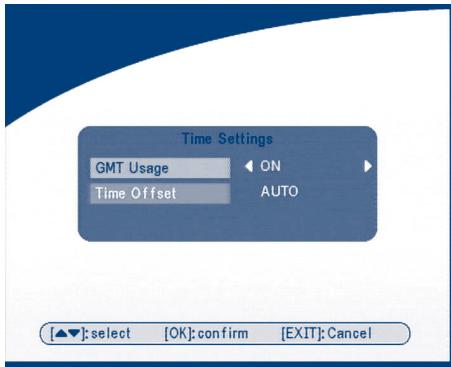
If a broadcaster provides GMT, you can set the time using GMT, or set your own time by yourself. If the GMT usage is ON then the Current time is set automatically or you can set the time zone. If your broadcaster provides the correct time offset then your receiver will change from summertime to wintertime automatically.
If you set GMT Usage to OFF, Set Data and Set Time item are displayed.
To set the time value manually, move the cursor to the time item and use the numeric buttons on the remote control.
SCREEN 26
9.3.1.7 Factory Default
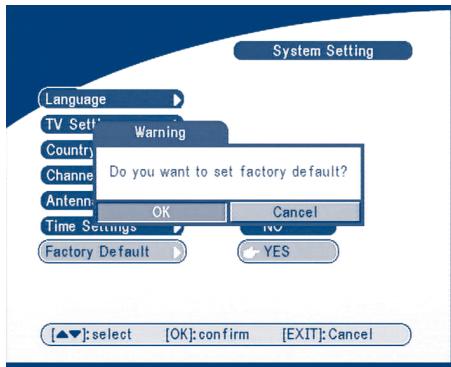
Select Factory default and press OK. Select YES and press OK key, the receiver will return to its factory default state, and all user data will be deleted.
SCREEN 27
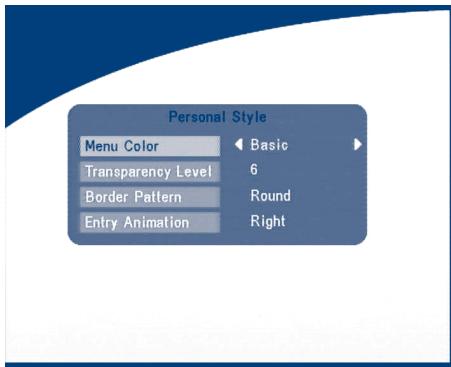
9.3.2 Personal Style
In this menu, we can set the menu colour, transparency level, border pattern and entry animation.
SCREEN 28
Press UP/DOWN to select the item, and Press LEFT/RIGHT to set the value, press OK to confirm.
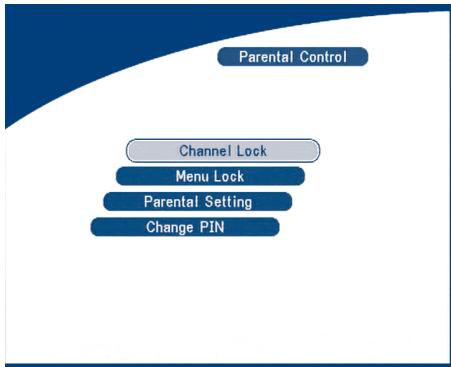
9.3.3 Parental Control
In this menu, you can set channel lock status (ON or OFF), the menu lock status, parental setting and change the PIN code (shown as SCREEN 29).
The default PIN code is 0000.
SCREEN 29
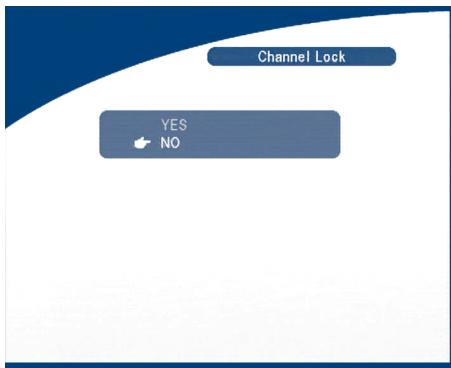
9.3.3.1 Channel Lock
Set the system channel lock to ON or OFF. If the channel locks on, user has to enter the parental PIN code correctly before watch the locked program.
SCREEN 30
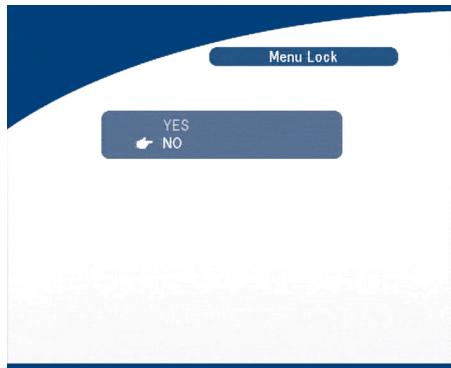
9.3.3.2 Menu Lock
Press OK to select whether you need the lock or not for the Menu, YES or NO, press OK to confirm. If the menu lock is on, then for some operations such as search program and set factory default, you need to enter your PIN.
SCREEN 31
9.3.3.3 Parental setting
Set some programs to lock status. If a channel is locked, the user has to enter the parental PIN code correctly before watching the locked channel.
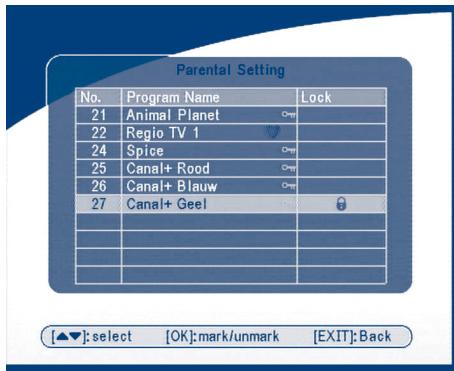
SCREEN 32
Use UP/DOWN keys to select channel which you want to lock. Press OK button to lock channel.
9.3.3.4 Change PIN
Modifying the password. You must enter the 4 digit password and then confirm it again; the system password will changed into the new password as shown on SCREEN 33.
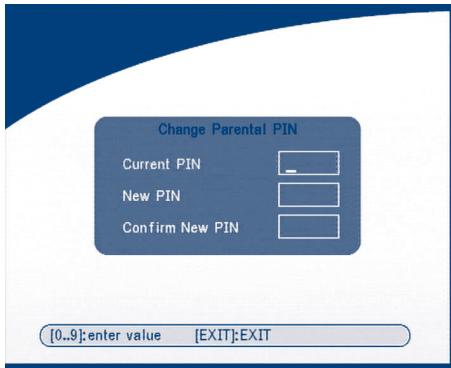
SCREEN 33
9.3.4 System Information
Display the software version information. Press OK/EXIT keys to return.
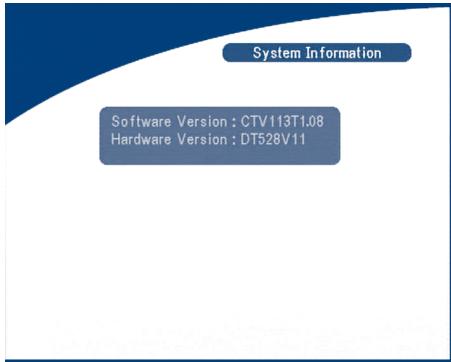
SCREEN 34
9.3.5 System Update
In this menu, you can select between "STB to STB" and "OAD".
9.3.5.1 Update through STB to STB
The System Update screen will appear.
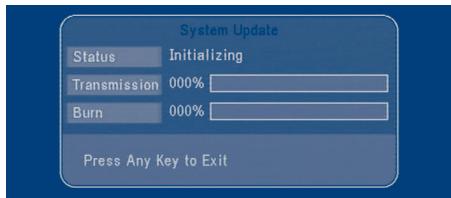
SCREEN 35
When it is necessary to update the System, please follow these steps:
a) First power off both STBs, connect them with cross RS 232.
b) Then power on master STB (master is STB from which you will copy software) and keep slave STB off. Navigate in the menu of master STB and select "System Update - STB to STB".
c) When the status displays "detecting slave STB", power on slave STB, after the master STB detects the slave, the master starts transmission and burns.
d) While transmitting and burning, it is very important to avoid other operations such as power off because this may cause destruction of the data in the FLASH memory and the receiver will need to be repaired.
e) When update complete, please first power off both STBs, then disconnect the RS 232 line.

Tips The system updates just update the software and the programsdatabase are not be updated.
9.3.5.2 Over Air Download (OAD)
Select this option in order to update your receiver with the latest software version.
The receiver will check availability of the software update on air and load the latest software, if available. You will be asked to confirm update. Do not switch power off and do not disconnect the receiver from the aerial during update process.
Availability of the software update is subject of local broadcast condition and may not work in all countries. Contact your vendor to find out more about this function.
9.3.5.3 Update through PC to STB
- Connect Computer to receiver (receiver must be power off) with a 9-pin cross cable (two females)
- The computer follows below steps: Start->Programs->Accessories->Communications->Hyper terminal
Then choose "COM1" or "COM2" according to which port you are using in the computer and port setting as follows:
Bits per Second: 115200
Data bits: 8
Parity: None
Stop bits: 1
Flow Control: None
- In Hyper Terminal menu select "Transfer" item and then press "Send file" item. Select the file with new software (.UPD) you want to download and choose the protocol "1K Xmodem". Finally press ok and a download menu will appear in the computer screen. Power on the receiver, then the download progress will start.
- After about 2.5 minutes, the message "OK, Reset" will appear on the computer on Hyper Terminal window, which means the download has completed successfully.
- Power off the receiver and then unplug out the RS 232 interface.
*Note: Incorrect operation may cause unreparable damage to the receiver.
- DO NOT POWER OFF THE RECEIVER DURING THE PROCESS OF DOWNLOAD.
- DO NOT PLUG IN OR UNPLUG THE RS232 INTERFACE WHEN RECEIVER IS POWERED ON.
9.4 Timer
You can set the timer to make the receiver perform designated actions including timer based wake up/sleep the set-top-box.
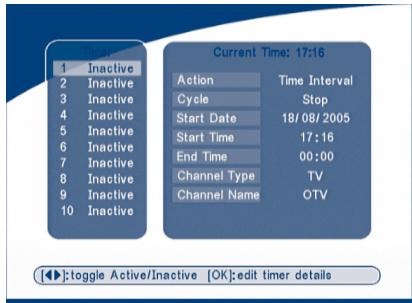
SCREEN 36
Use UP/DOWN buttons to select timer. Press LEFT/RIGHT key to activate/inactivate current timer. Press OK button to enter selected timer settings.
Action: You can select the following functions:
"Power On": The receiver powers on at the designated date and time.
"Time interval": The receiver switches on at the designated date and time, displays the channel and then switches off at the designated date and time (The value set at the end time).
"Power Off": The receiver powers off at the designated date and time.
■ Cycle: You can set the cycle of the action designated in the timer mode (one time, Daily or Weekly).
Start Date: You can set the starting date of the timer action.
Start Time: You can set the starting time of the timer action.
End Time: You can set the ending time of the channel view when the Timer mode is on. Time Interval.
Channel Type: Select between TV and Radio.
- Channel Name: Press RIGHT button to display channel list and using navigation buttons select channel to be shown when the receiver will power on by timer.
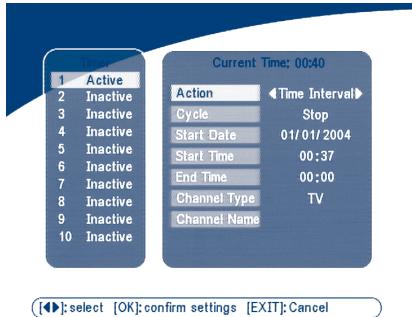
SCREEN 37
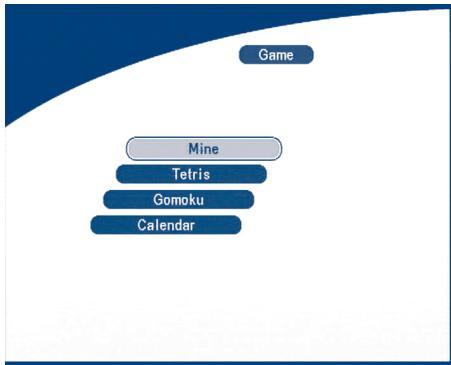
9.5 Game
The receiver has three games (Mine, Tetris and Gomoku) and calendar. In this menu user can select any game item and press OK to play the game. Or you can press GAME key on normal play state into the game menu directly.
SCREEN 38
9.5.1 Mine
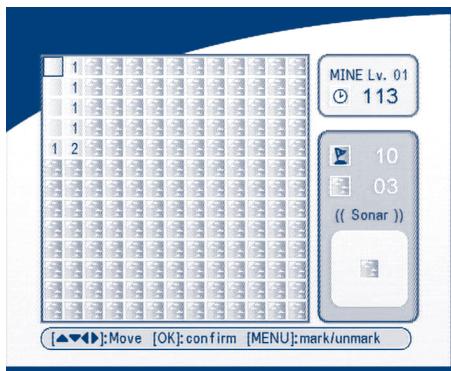
SCREEN 39
Key function:
UP/DOWN/LEFT/RIGHT button:Move the cursor.
MENU button: Make Mark to the mine.
9.5.2 Tetris
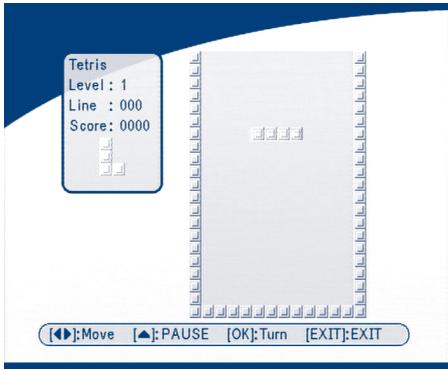
SCREEN 40
Key function:
LEFT/RIGHT: Move block to left or right direction.
DOWN: drop block.
UP: Rotate block.
9.5.3 Gomoku
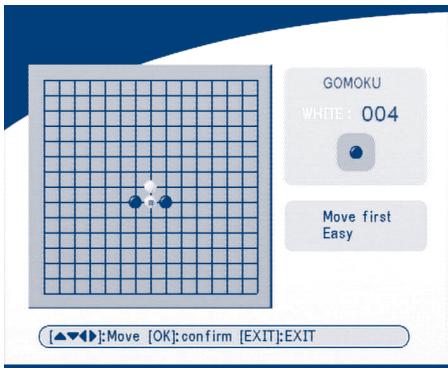
SCREEN 41
Key function:
UP/DOWN/LEFT/RIGHT: Move the cursor.
OK: Place the gobang.
9.5.4 Calendar
UP/DOWN: +/- months.
LEFT/RIGHT: +/- years the range from 1900 to 2100.
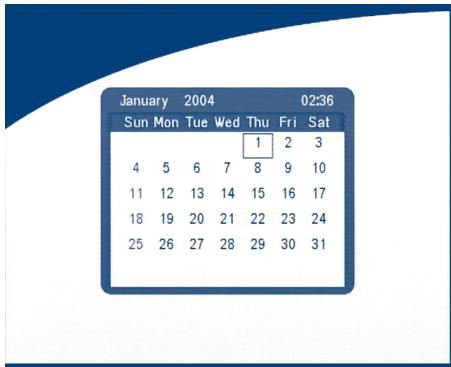
SCREEN 42
10.0 Other operations
10.1 Mosaic
In no-menu state, press MOSAIC button. Screen will be divided into nine pictures screen:
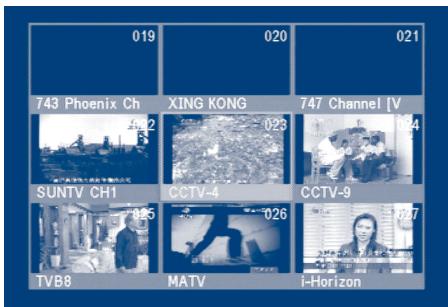
SCREEN 43
Press UP/DOWN/LEFT/RIGHT keys to choose one of current programs.
Press P + / P - keys to view another nine programs.
Press OK key to return to normal play state and play the selected program.
Press EXIT key to return normal play state and change nothing.
10.2 EPG function
In no-menu state, press EPG, EPG Menu will appear:
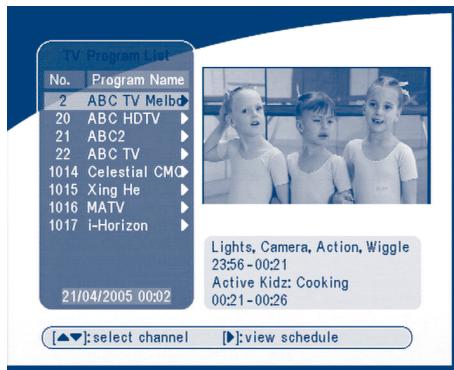
SCREEN 44
Press UP/DOWN to choose channel.
Press RIGHT into EPG schedules of current channel.
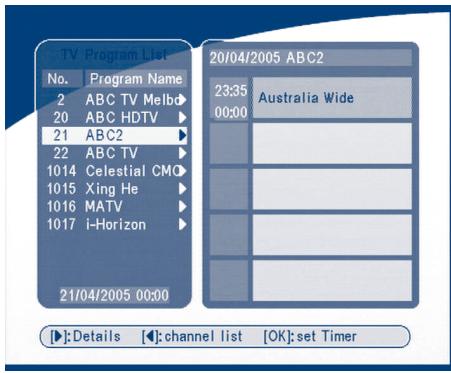
SCREEN 45
In EPG schedules menu:
Press UP/DOWN keys to choose schedule items.
Press P + / P into next/previous day schedules.
Press LEFT/EXIT return to EPG Menu.
Press OK/RIGHT to show the details of this item.
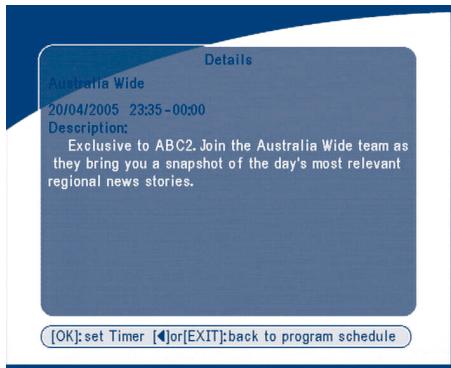
SCREEN 46
In EPG schedule details:
Press P + / P - into next/previous page.
Press LEFT/EXIT return to EPG schedule Menu.
You can set up the event timer by pressing OK in EPG schedule details or EPG schedule screen.
To set up an event timer:
- Press UP/DOWN to move the cursor to the event for which you want to add a timer.
- Press OK to add a timer.
SCREEN 47 shows you current event timer information based on the event you have chosen. You can also modify each value. To save the settings, press OK. To quit event timer setup, press EXIT.
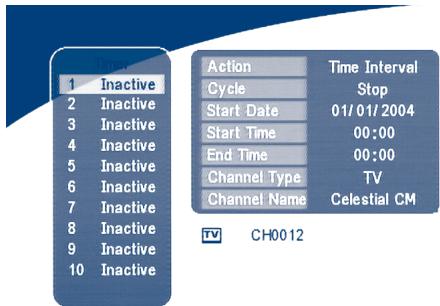
SCREEN 47
[]:toggle Active/Inactive [OK]:edit timer details
10.3 Teletext function
In no-menu state, press TEXT.
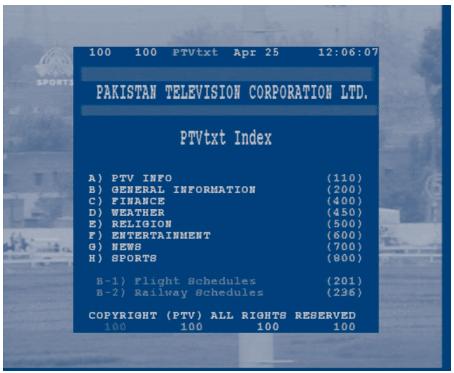
SCREEN 48
In TEXT on OSD:
Press UP/DOWN to add/ subtract displayed page number
Press NUMERIC keys to input page directly.
If the current program has no Teletext, the screen will appear as below:
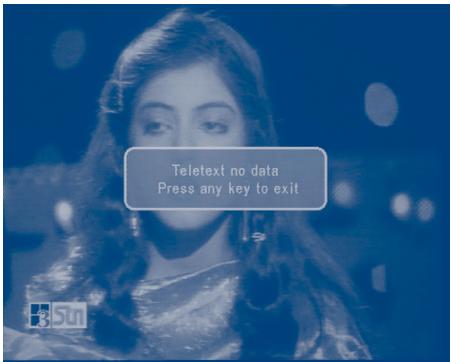
SCREEN 49
10.4 Information
The following screen will be shown when you press INFO key twice times in the no-menu state.
The screen will show you current channel information.
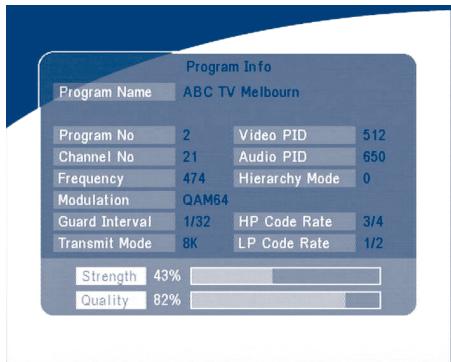
SCREEN 50
A.1 Trouble Shooting
Before requesting servicing for your receiver, please check the table below for a possible cause of the problem you are experiencing. Some simple checks or a minor adjustment on your behalf may eliminate the problem and restore proper operation. The most common problems that arise are related to cable connections. Make sure that your decoder is properly connected. To ensure that all the cables are in their place, disconnect and connect them again. If none of the remedies indicated in the table below solve the problem, consult your vendor.
Installation issues
Symptom
Your decoder does not find channels
Remedy
If you are using a directional aerial, make sure it is directed towards a digital TV transmitter and positioned correctly.
Make sure that it is possible to receive digital terrestrial signal in your area.
It is advisable to use a standard outdoor aerial, which normally have better characteristics than the indoor one.
Check the cable from the aerial.
If you cannot resolve the problem easily you may need to have your aerial and installation tested by a professional.
Symptom
No picture if receiver is connected only by S-VHS Cable
Remedy
If you are using only the S-VHS output, make sure that in System Setting S-Video is selected. If RGB is selected is S-VIDEO out disabled.
Symptom
No sound only picture
Remedy
You are using only the S-VHS output. This support only Video no Audio. Connect receiver also with the Digital output (S/PDIF) to an digital amplifier.
General issues
Symptom
The standby indicator on the receiver's front panel does not light up
Remedy
Check that power is available at the wall socket. Check if the SCART cable and antenna cable are correctly connected and the receiver is switched on. Disconnect these cables, and then reconnect them to ensure they are in place.
The standby indicator on the receiver's front panel is red
Your receiver is in standby, press the power button on your remote control.
Your remote control fails to operate your receiver
Check the batteries in your remote control. Make sure your receiver is in the operate mode. Make sure that you are pointing your remote control at the receiver's front panel.
Make sure that there is no direct sunlight from behind your receiver. There may be a temporary transmission error, or your receiver has lost some of its software settings. Switch off your receiver at the power source and switch it on again after a few seconds.
No program broadcast has been recorded on your VCR
Check the connection between the receiver and VCR. Please make sure your VCR is set properly.
Electronic Program Guide (EPG) issues
Symptom
The EPG is empty
Remedy
The selected program does not support EPG. The local time is incorrect. Set the correct local time.
Audio & video issues
Symptom
The picture on your TV screen changes color. This may happen after a power-cut or after your receiver has been disconnected from the power source.
Remedy
Your receiver has lost some of its software settings. Switch your receiver off and switch it on again after a few seconds. If the problem persists, contact your vendor.
Blocks appear in the picture on the screen.
The signal is too weak or defective due to e.g. bad weather conditions. Try to adjust your aerial position or wait for the signal to be re-established.
A.2 Specifications
1. Tuner & Channel for Terrestrial
Type
IEC 169-2 Female
Frequency Range
VHF and UHF
Bandwidth
8 MHz or 7 MHz or 6 MHz
Input impedance
75 ohm unbalanced
Signal Level
-82 ~ -20 dBm
2. Demodulation
Waveform
COFDM
Constellation
16 QAM, 64 QAM
Transmission mode
2K, 8K
Guard Interval
RGB, CVBS, Audio L/R Output with Volume Control
VCR Scart Input/Output
Input: CVBS, Audio L/R
Output: CVBS, Audio L/R Output with Volume Control
S/PDIF output
Digital audio output, coaxial
RF Modulator
UHF output channels CH21-69 selectable via menu
PAL B/G, D/K, M/N or I selectable
Data Interface
RS 232, Bit Rate: 115200 baud
S-VHS output
Connector: 9-Pin D-Sub Male type
High video quality output.
6. Power Supply
Input Voltage
90-240VAC,50/60Hz+/-5%
Power Consumption
Max. 20 W
Stand-by Power
< = 8 ~W
7. Physical Specification
8. Environmental Conditions
Operating Temperature
0 40^
Storage Temperature
-30°C ~ 80°C
Operating Humidity Range
10 85% RH, Non-condensing
Storage Humidity Range
5 ~ 90% RH, Non-condensing
Available in models SRT 5010 and SRT 5015
Available in model SRT 5015
A.3 Glossary of terms
| DVB-T | Digital Video Broadcasting Terrestrial - Digital TV via antenna (same as DTT- Digital Terrestrial Television). |
| EPG | Electronic program guides that are transmitted by some broadcasters to display information guide about a program content. |
| MPEG | The Moving Picture Experts Group is founded by the ISO. MPEG is a standard method fordigital transmission of video and audio. Network A network which is also known as a bouquet is a set of channels that is offered by a single broadcaster. |
| PAL | Referring to the Phase Alternate Line colour system adopted by European broadcasters. |
| Parental lock | This function gives you the possibility to ‘lock’ several functions of the receiver to prevent unauthorized users such as children to view channels that are not suitable for them. A PIN code is required to use of the parental lock. |
| PID | The transmitted packages have identifiers (PID) that tells the receiver what to do with the received information. Receivers normally use four types of PID, these are V-PID (video PID), A-PID (audio PID), P-PID (Program PID) and data PID (EPG information). |
| PIN CODE | Personal Identification Number. A four-digit code that is used for locking/unlocking, e.g. with the parental control feature. |
| RS 232 | Serial data port. |
| S-VIDEO | Specially Video output without Audio, which transport Colors and Screen information separate to the TV-set. For a better picture quality. |
Environmental Issues
Strong is committed to reducing the impact of its products on the environment. To maximise the benefits of our design enhancements, your co-operation is required.
Electronic product recycling
Do not dispose of this product with your domestic rubbish
At the end of its useful life, this product contains materials which when processed correctly can be recovered and recycled. By participating in the responsible recycling of this product you will be reducing the requirement for new raw materials and reducing the amount of material that would otherwise end up in landfill. When you purchase a new, similar product your retailer may offer to take this old one off you. Alternatively, you can take it to your local recycling centre. Your retailer or local municipal authority will advise you of the collection facilities available for waste electronically products in your area. User of this service will be free to you.
Within the scope of the European legislation on Waste Electrical and Electronic Equipment (Directive 2002/96/EC valid as of August 2005) STRONG provides a recycling system free of charge for consumers to returning products after end of life. For more information about STRONG's environmental policy to you:
www,strongsat.com - select "About us" and "Environmental Policy" from the submenu.

Packaging
When disposing of this product packaging, please ensure that it is recycled. Packaging material is to be depolluted in waste separation.

Power Saving
To save power and money, please put the product into standby mode when not in use. We also recommend disconnection from mains supply when not in use for longer periods of time.

Batteries
Do not dispose of the batteries from your handset with your domestic waste

Where they are available, participate in your local municipal or retailer collection schemes for spent batteries. Batteries discarded in landfill sites or incinerated increases the chances of pollutants being dispersed into the atmosphere.
Alternations reserved 9/2005
- Digital Terrestrial Receiver SRT 5005/5010/5015
- Safety Instructions
- DO NOT INSTALL YOUR RECEIVER:
- DO NOT EXPOSE THE RECEIVER OR ITS ACCESSORIES:
- Make sure you read this user manual before installing your receiver.
- HOW TO USE THIS MANUAL
- Features & Accessories
- SRT 5005/ 5010/ 5015 Digital Terrestrial Receiver:
- Accessories:
- Safety Precautions
- Storage
- Equipment Set-up
- Connection
- Connecting to Terrestrial Antenna
- Connecting to TV & VCR
- Connecting to Digital Audio Amplifier
- Connecting to PC
- Your Receiver
- Front Panel
- Mode indicator
- Digits display
- Rear Panel
- 1.ANT IN
- To TV
- TV SCART Connector
- VCR SCART Connector
- S-VHS
- Power Cord
- S/PDIF Digital audio output
- RS 232 Serial Port
- Power ON/OFF Switch
- Remote Control Unit
- EDIT
- TEXT
- SUB
- RECALL
- First Time Installation
- Main Menu
- Channel Organiser
- Edit TV channels
- Edit Radio Channels
- Sort
- Channel Search
- Automatic Search
- Manual Search
- Tips
- Installation
- System Setting
- Language
- TV settings
- TV Standard
- TV format
- Video output
- SCREEN 21
- Modulator Settings (only for model SRT 5015)
- Country
- Channel Numbering
- Antenna Power
- Time settings
- Factory Default
- Personal Style
- Parental Control
- Channel Lock
- Menu Lock
- Parental setting
- Change PIN
- System Information
- System Update
- Update through STB to STB
- Over Air Download (OAD)
- Update through PC to STB
- Timer
- SCREEN 36
- SCREEN 37
- Game
- Mine
- Key function:
- Tetris
- Gomoku
- Calendar
- Other operations
- Mosaic
- SCREEN 43
- EPG function
- In EPG schedules menu:
- In EPG schedule details:
- To set up an event timer:
- Teletext function
- In TEXT on OSD:
- Information
- A.1 Trouble Shooting
- Installation issues
- Symptom
- Remedy
- General issues
- Electronic Program Guide (EPG) issues
- Audio & video issues
- A.2 Specifications
- Tuner & Channel for Terrestrial
- Demodulation
- Power Supply
- Physical Specification
- Environmental Conditions
- A.3 Glossary of terms
- Environmental Issues
- Electronic product recycling
- Packaging
- Power Saving
- Batteries
Brand : STRONG
Model : SRT 5010
Category : Satellite decoder