
8050 - Printer KONICA MINOLTA - Free user manual and instructions
Find the device manual for free 8050 KONICA MINOLTA in PDF.


| Product type | Color multifunction copier |
| Brand | KONICA MINOLTA |
| Model | 8050 |
| Dimensions (W x D x H) | 1619 x 1021 x 1275 mm (with RADF feeder) |
| Weight | Approx. 250 kg |
| Power supply | Mains (120-240 V depending on configuration) |
| Standard paper capacity | 1,750 sheets (3 x 500 + bypass tray 250) |
| Maximum paper capacity | 4,250 sheets with LT-211 tray |
| Paper sizes | From A5R to 13x19 inches (A3) |
| Paper weight | 64 to 256 g/m² depending on tray |
| Paper types | Plain, recycled, color, high quality, coated, etc. |
| Copy functions | Color, black & white, automatic, single color |
| Advanced functions | Duplex, collate, staple, fold, perforate, trim (optional) |
| Touch screen | Color LCD with interactive interface |
| Memory | 512 MB (expandable with MU-412, HDD) |
| Connectivity | Ethernet, Web Utilities, Fiery controller |
| Energy saving | Auto Low Power, Auto Shut-Off, Power Saver |
| Finishing options | Finisher FS-115/215, large capacity tray LT-211, trimmer TU-109 |
| Document feeder | RADF up to 100 originals, automatic duplex |
| Maintenance | Toner replacement, recovery tray, waste basket |
| Security | EKC password protection, auto shutdown |
Frequently Asked Questions - 8050 KONICA MINOLTA
User questions about 8050 KONICA MINOLTA
0 question about this device. Answer the ones you know or ask your own.
Ask a new question about this device
Download the instructions for your Printer in PDF format for free! Find your manual 8050 - KONICA MINOLTA and take your electronic device back in hand. On this page are published all the documents necessary for the use of your device. 8050 by KONICA MINOLTA.
USER MANUAL 8050 KONICA MINOLTA
natural_image
Line drawing of a multi-robot printer with front-mounted screens and control panels (no text or symbols)Thank you very much for your purchase of the Konica 8050.
This Manual deals with making copies, correct handling of the machine, and precautions for safety. Please read before copying.
In order to maintain a satisfactory copying performance, please keep this Manual readily available for reference in the rear pocket of the machine.

ENERGY STAR® Program
The ENERGY STAR Program has been established to encourage the widespread and voluntary use of energy-efficient technologies that reduce energy consumption and prevent pollution. As an ENERGY STAR Partner, Konica Business Technologies Corporation has determined that this product meets the ENERGY STAR guidelines for energy efficiency grounding it on the following features.
Auto Low Power
This function conserves energy by lowering the set temperature of the fixing unit. In the standard setting, Auto Low Power operates automatically when 15 minutes have elapsed after completion of the last copy, with the copier remaining in the ready to copy state during that time.
The time period for the Auto Low Power function can be set for 5 minutes, 10 minutes, 15 minutes, 30 minutes, 60 minutes, 90 minutes, 120 minutes, or 240 minutes. See p. 2-19 for details.
Automatic Shut-Off
This function achieves further energy conservation by partially turning OFF the power supply, thereby reducing energy consumption to 20 W or less. In the standard setting, Automatic Shut-Off follows Auto Low Power, operating automatically when 90 minutes have elapsed after completion of the last copy, with the copier remaining in the ready to copy state during that time.
The time period for the Automatic Shut-Off function can be set for 30 minutes, 60 minutes, 90 minutes, 120 minutes or 240 minutes. See p. 2-19 for details.
Automatic Duplex Copying
To reduce paper consumption, use this function to make double-sided (duplex) copies, automatically.
We recommend that you utilize the Auto Low Power function, the Automatic Shut-Off function, and the Automatic Duplex Copying function.
Copyright © 2000 GoAhead Software, Inc. All rights Reserved.
Contents
Contents
Features of the Konica 8050
Legal Restrictions on Copying
Basic
Section 1: Safety Information
Caution Labels and Indicators 1-2
Requirements for Safe Use.... 1-6
Power Source 1-6
Environment.... 1-7
Precautions for Routine Handling 1-10
Section 2: Machine Information
Machine Configuration.... 2-2
External Machine Items 2-2
Internal Machine Items....2-4
Standard/Optional Equipment 2-5
Control Panel Layout 2-6
Basic Screen 2-8
FS-115/FS-215 Finisher (with PK-120 Punching Kit)....2-10
PI-110 Cover Sheet Feeder 2-12
LT-211 Large Capacity Tray 2-13
TU-109 Trimmer Unit 2-14
Turning On the Power Switch 2-16
To Turn On the Power 2-16
To Turn Off the Power 2-18
Reducing the Power in Standby Mode (Auto Low Power) 2-19
Shutting Off Automatically (Auto Shut-Off) 2-19
Shutting Off / Reducing the Power Manually 2-20
Entering an EKC Password (EKC)....2-21
Loading Paper 2-22
Loading Paper in Tray 1,2, and 3....2-23
Loading Paper in Multi-Sheet Bypass Tray.... 2-26
Loading Paper in LCT (LT-211) 2-27
Loading Tabbed Sheets in Tray 1, 2, or 3.... 2-30
Loading Tabbed Sheets in LCT (LT-211) 2-31
Loading Tabbed Sheets in Multi-Sheet Bypass Tray 2-32
Section 3: Copying Operations
Selecting Colour Mode 3-2
Positioning Originals 3-4
Positioning Originals in RADF 3-4
Positioning Original on Platen Glass....3-8
Setting Print Quantity 3-10
To Set Print Quantity....3-10
To Change Print Quantity....3-10
Setting Job During Warm-up 3-11
To Stop Scanning/Printing 3-13
Selecting Paper Size 3-14
To Select Paper Size Automatically (APS) 3-14
To Specify Desired Paper Size (AMS) 3-16
Copying Using Special Paper (Multi-Sheet Bypass Tray) ....3-18
Selecting Magnification Ratio (Lens Mode)....3-22
To Copy in 1.000 Magnification Mode....3-22
To Change Magnification Ratio (Fixed Magnification / Zoom Mode)3-23
Making Double-Sided Copies (1▶2, 2▶2) ...... 3-25
Using RADF 3-25
Using Platen Glass....3-28
Making Single-Sided Copies from Double-Sided Originals (2▶1) 3-31
To Scan Originals into Memory (Store Mode) 3-33
To Set Next Copying Job (Reserve) 3-35
To Check/Control Jobs in Progress (Job Status Screen)....3-38
Output Mode for Machine without Finisher 3-41
Output Mode for Machine with Finisher 3-45
Selecting Binding Mode 3-52
Section 4: Helpful Functions
Making Sample Copy (Proof Copy) 4-2
Checking Feature Selections / Proof Copying (Check Mode) 4-4
Interrupt Copying 4-8
Storing Job Conditions (Job Memory: Job Store) 4-11
Recalling Stored Job Settings (Job Memory: Job Recall)...... 4-14
Recalling Previous Job Settings 4-15
Displaying Screen for Operation Guide (Help Mode)...... 4-16
To Display Help Screen from Basic Screen 4-16
To Display Help Screen from Other Screens.... 4-18
Section 5: Troubleshooting
When “Call for Service” Message Is Displayed.... 5-2
Limited Use of the Copier in Trouble 5-3
Clearing Mishandled Paper.... 5-4
When “JAM” Appears on Folder Key (Or Arrow Key Flashes) 5-6
When “ADD PAPER” Appears on Folder Key (Or Arrow Key Flashes) 5-8
When “Memory Full” Message Is Displayed (Memory Overflow) 5-9
Memory Overflow in Current Job 5-9
Memory Overflow in Reserve Job 5-10
When Power OFF/ON Screen Is Displayed 5-11
Troubleshooting Tips 5-12
Section 6: Machine Specifications
Main Body Specifications.... 6-2
Main Body 6-2
Option Specifications 6-4
RADF (DF-319)......6-4
FS-115/215 In-Bin Stapler Finisher....6-4
PI-110 Cover Sheet Feeder 6-5
TU-109 Trimmer Unit 6-5
PK-120 Punching Kit.... 6-6
LT-211 Large Capacity Tray 6-6
Memory Unit....6-6
Others 6-6
Advanced
Section 7: Colour Image Adjustment
About Colours 7-2
RGB and CMYK Models 7-2
HSB Model 7-3
Colour Copy Quality 7-4
Modifying Colours 7-4
Reproducing Images....7-11
What Is Image Detection? 7-12
Applying Filters....7-13
Improving Colour Copy Quality 7-14
Selecting Density Level and Whitening the Background(Copy Density)....7-15
To Adjust Copy Density / Background Whiteness....7-15
Setting Density Shift....7-17
Changing Colours Using RGB and HSB Values (Colour Adjustment)....7-19
Modifying RGB Value....7-19
Modifying HSB Value 7-21
Changing Colours Using CMYK Value (Colour Balance Adjustment) 7-24
Selecting Line Screen, Dot Screen, or High Compression (Screen Setting) 7-26
Adjusting Sharpness and Contrast / Selecting Gloss Mode....7-29
Making Fine Adjustment in Image Detection (Image Judge) 7-32
Specifying Original Type (Original Image/Type in Special Original) 7-34
Section 8: Advanced Information
Programmed Shut-Off (Weekly Timer)....8-2
Rotation....8-4
Vertical/Horizontal Zoom Mode 8-5
Making Folded Booklet (Fold / Stitch & Fold)......8-8
Punching File Holes in Copies (Punch)......8-11
Output Three-Folded Copies (Three-Fold)......8-14
Making Trimmed Booklets (Trimming) 8-16
Cover Sheet Feeding 8-19
Off-Line Finishing 8-22
Section 9: Special Original
Specifying Original Direction.... 9-2
Copying Non-Standard Size Originals (Original Form) 9-4
Copying Mixed Size Originals (Mixed Original).... 9-6
Copying Z-Folded Originals (Z-Folded Original) 9-8
Scanning Thin/Thick Originals in RADF (Original Thickness) 9-10
Section 10: Applications
To Display Application Selection Screen 10-2
Inserting Sheets and Covers (Sheet/Cover Insertion) 10-3
Locating Title Pages on the Right Side (Chapter).... 10-7
Lay Out Several Pages onto One Sheet (Combination) 10-10
Making a Multiple Page Signature Booklet (Booklet).... 10-13
Inserting Images into Printed Sets (Image Insert)...... 10-17
Dividing an Image into Right and Left Pages (Dual Page) 10-20
Programming Different Settings for an Output Job (Program Job) 10-24
Dividing an Image for Enlarged Copy (Multi-Page Enlargement)....10-27
Erasing Outside of the Original (Non-Image Area Erase)...... 10-30
Reversing Colour in Black and White Image (Reverse Image) 10-32
Repeating Selected Image Area (Repeat: Vert./Horiz. Mode) 10-34
Repeating Automatically or Selecting RepeatingTimes (Repeat: AUTO/ Repeat Mode)....10-37
Eliminating Copy Marks Along Borders (Frame/Fold Erasure).... 10-40
Copying Image in the Centre of Copy Paper (AUTO Layout)....10-43
Adjusting Position of Copy Image (Image Shift) 10-45
Reducing Images to Create Binding Margin (Reduce&Shift)....10-48
Printing Stamp, Page, Date/Time onto Copies (Stamp) 10-51
Printing Watermark onto Copies (Stamp) 10-58
Overlaying an Image onto Each Page Copied in the Job (Overlay)....10-62
Storing an Overlay Image in HDD / Overlaying Image Stored in HDD (Overlay Memory) 10-65
Section 11: Network Function
To Use Web Utilities....11-2
To Display Information on Machine....11-4
To Display Current Machine Status (Job Status) 11-5
Setting E-Mail Transmission Function....11-7
Setting E.K.C. Function....11-9
Setting Scan Transmission Function.... 11-19
Transmitting/Editing Machine Setting File.... 11-23
Section 12: Paper and Original Information
Paper Information....12-2
Paper Weight 12-2
Tray/ Exit Tray Capacity 12-4
Paper Size....12-6
Special Paper in Multi-Sheet Bypass Tray....12-8
To Store Copy Paper 12-8
Original Information....12-9
Platen Glass Originals....12-9
RADF Originals 12-10
Section 13: Maintenance & Supplies
Adding Toner....13-2
Inserting a New Staple Cartridge into FS-115/215 Finisher....13-7
Empty Waste Basket of PK-120 Punching Kit.... 13-10
Empty Waste Basket of TU-109 Trimmer Unit 13-12
Exchanging Toner Recovery Box.... 13-14
Cleaning Image Scanning Section 13-16
Cleaning the Document Glass 13-16
Cleaning the RADF Platen Guide Cover....13-16
Cleaning the Platen Cover 13-17
Checking Copy Count 13-18
To Display the Counter List Screen 13-18
To Print the Counter List 13-19
Periodic Maintenance.... 13-20 To Check the PM Counter.... 13-20
Section 14: Key Operator Mode
An Outline of the Key Operator Mode.... 14-2 How to Access the Key Operator Mode.... 14-2
[1] System Initial Setting 14-4
[1] Date & Time Setting.... 14-4
[2] Language Select Setting....14-6
[3] IP Address Setting 14-7
[4] E-Mail Transmission Setting 14-8
[2] Copier Initial Setting.... 14-10
[3] User Setting Mode .... 14-11 [1] User Lens Mode Ratio Setting .... 14-11
[4] EKC (Electronic Key Counter) Function Setting ..... 14-12 How to Access the EKC Setting Mode..... 14-13 [1] E.K.C. Data Edit..... 14-14 [2] E.K.C. All Count Reset..... 14-17 [3] E.K.C. Function Setting..... 14-18 [4] Scanner Function Setting..... 14-19
[5] Lock/Delete Job Memory 14-20
[6] Paper Type / Special Size Set.... 14-21 [1] Paper Type / Special Size Set.... 14-21 [2] Paper Type Set (Bypass).... 14-23
[7] Panel Contrast / Key Sound Adjustment.... 14-24 [8] Key Operator Data Setting.... 14-25
[9] Weekly Timer.... 14-26 How to Access the Weekly Timer Setting Mode.... 14-27
[1] Weekly Timer On/Off Setting 14-28
[2] Timer Setting.... 14-29
[3] Timer Action On/Off Setting 14-31
[4] Lunch Hour Off Setting 14-32
[5] Timer Interrupt Password Setting 14-33
[10] Control Panel Adjustment 14-34
[11] Tray Auto Select Setting 14-35
[12] Power Save Setting 14-36
[13] Memory Switch Setting 14-37
[14] Machine Management List Print 14-43
[15] Call Remote Centre 14-44
[16] Finisher Adjustment 14-45
Section 14: Key Operator Mode (continued)
[17] Front & Back Density Setting 14-47
[18] Scan Transmission Setting 14-48
[19] Non-Image Area Erase Setting 14-50
[20] AE Adjustment 14-51
[21] Execute Adjustment Operation 14-52
[22] Magnification Adjustment.... 14-53
[23] Timing Adjustment 14-54
[24] Centring Adjustment.... 14-56
[25] Printer Gamma Sensor Adjustment 14-57
Index
Features of the Konica 8050
AE - Automatic Exposure
Automatically adjusts exposure to compensate for quality of the original.
AMS - Automatic Magnification Selection
Automatically selects an appropriate magnification ratio when Paper Size is selected manually. Automatically selected when the AMS key is touched.
APS - Automatic Paper Selection
Automatically selects copy paper size to match the original documents.
ATS - Automatic Tray Switching
Automatically switches tray to allow copying to continue without interruption if the selected tray empties while copying is in progress.
Auto Layout
The original image on the platen glass or in the document feeder is copied and centred on a sheet.
Auto Low Power
Automatically lowers the power after a specified period of copier inactivity.
Auto Reset
Automatically resets to auto mode defaults after a specified period of copier inactivity.
Auto Shut-Off
Automatically shuts off the main power after a specified period of copier inactivity.
Booklet
Creates a multiple page signature booklet copied on both sides of paper in 1▶2 or 2▶2 copy mode.
Chapter
Starts chapter pages on the right side (front pages) of the finished document. Only duplex mode (1▶2) is compatible with this feature.
Colour Mode
Copies full-coloured originals or makes single-coloured copies, and also adjusts image quality of the copies.
Combination
Copies a fixed number (2, 4, or 8) of pages onto one sheet of copy paper to create a draft copy of a multi-page report at the same time as saving paper.
Copy Density
Manually selects up to 9 density levels.
Copy Mode
Selects the desired simplex mode (1▶1 or 2▶1); or duplex mode (1▶2 or 2▶2).
Counter List
Displays on the screen and prints the following data: total counter of the machine, copier counter, print counter and the date when the counter started.
Density Shift
Shifts each of nine density levels in four density modes (Auto, Text, Photo, Map) to three levels lighter or three levels darker.
Dual Page
Copies both pages of an open book or A3/B4 size sheet separately onto two A4/B5 size sheets in 1▶1 mode or separately onto each side of one A4/B5 size sheet in 1▶2 mode. You can use the Dual Page mode with the Front or Front/Back cover mode. The cover page(s) will be scanned and copied normally before image division is performed on the other pages.
Frame/Fold Erasure
Erases border and/or fold image area using Frame (1 - 300 mm), Fold (1 - 99 mm), or Frame & Fold.
Image Insert
Stores pages in memory from the platen glass, and inserts the pages into a document copied from the document feeder.
Image Shift
Creates or removes a binding margin at the top, bottom, right and left edges (shift amount from 0 \~ 250 mm, in 1 mm increments); reduces image to prevent image loss (reduce & shift amount from 0 \~ 250 mm, in 1 mm increments).
Interrupt Copying
Interrupts copying-in-progress to perform an urgent copy, using any of the copier features for the interrupt job.
Job Memory
Programs up to 30 jobs and recalls each job by job number, as needed. All compatible platen glass functions can be programmed into Job Memory directly after they are selected.
Job Status
Displays the Job Status Screen to view the current machine status, changes the operation order of reserve jobs, deletes the unused reserve job, or displays the previous job list.
Lens Mode (Fixed, Zoom)
Selects fixed ratios, four reduction, four enlargement, and three user-set ratios.
Zoom ratios can be selected from 25% \~ 400% in 1% increments.
Machine Status Confirmation
Displays the current machine status on LCD for confirmation.
Manual Shut-off
Shuts off the machine power when pressing [POWER SAVER ON/OFF] on the control panel.
Mixed Original
Copies mixed size originals from the document feeder in APS or AMS mode. APS automatically selects the paper size of each original. AMS mode allows you to select one paper size for all originals.
Multi-Page Enlargement
Makes an enlarged copy, made up of several copied pages divided and enlarged from an original image.
Network Function by Web Browser
When the machine is connected to a PC over a network, uses a web browser on the PC to check the machine or job information, and to perform the Key Operator settings concerning the network environment.
Non-Image Area Erase
When copying from the platen glass when the document cover is open, copies only the image area and not the exposed area of glass, which would otherwise copy as black.
Non STD Size for Multi-Sheet Bypass Tray
Enters the special paper size to be loaded on the Multi-sheet bypass tray using the touch screen keypad in order to avoid paper misfeed.
Non STD Size for Original
Identifies the special original size which the 8050 cannot detect, in order to select the optimal paper size for copying or printing.
Original Image
Enhances photo image in PHOTO mode, regular image in TEXT/PHOTO mode, text image in TEXT mode, coloured image with small text in MAP mode.
Original Type
Improves the image quality by specifying the printed original type.
Output Mode for Machine with FS-115/215 Finisher Installed:
Non-Sort, Sort, Staple-Sort, and Group modes using the primary (main) tray
Non-Sort Face Down exit, Non-Sort Face Up exit, Group Face Down exit, and
Group Face Up exit modes using the secondary (sub) tray
Fold and Stitch & Fold modes using the booklet tray (FS-215 only)
Selects an output tray and output mode on the Output Mode popup menu.
Output for Machine with no Finisher Installed:
Non-sort, Rotation sort, Group, and Rotation group modes are available in combination with Face down or Face up exit.
Selects an output mode on the Output Mode popup menu.
Output for FS-115/215 Finisher with PI-110 Cover Sheet Feeder Installed:
Cover Sheet mode
Off-Line Finishing mode
For details, see Section 8: Advanced Information.
Overlay
Scans an original image and overlays it on the pages of another document. For example, you may want to incorporate a page heading, graphic design or logo into the pages of your document.
Overlay Memory
Same as for Overlay except the overlay image is stored in memory.
Paper Capacity
Total 1,750 sheets, including three 500-sheet trays and a 250-sheet Multi-sheet bypass tray.
Total 4,250 sheets, including 2,500-sheet optional large capacity tray.
Platen Memory
Scans documents into memory from the platen glass and/or the document feeder and inserts the pages into another document copied from the document feeder. If an incompatible function is selected in this mode, the latter function will not be selected, and an Error message will be displayed.
Power Saver
Automatically turns off all but nominal power supply after a specified period of copier inactivity, for optimal efficiency. Power is returned after a brief warm up period by pressing [POWER SAVER ON/OFF] on the control panel.
Program Job
Scans documents into memory while designating different copy conditions for each original, then prints all the documents collectively.
Proof Copy
To ensure correct output before running multiple copies, run a proof copy by pressing [PROOF COPY] on the control panel or touching PROOF COPY on the Check Screen.
Punch Mode for FS-115/215 Finisher with PK-120 Punching Kit Installed:
Punches four holes in output copies.
Repeat
Selects the horizontal image area across the page, and repeats it down the page as many times as the repeat width setting (10 \~ 150 mm) permits in manual or auto.
Reserve
Scans in subsequent copy jobs while the 8050 is busy printing or copying.
Reverse Image
Reverses the image from black-on-white to white-on-black or vice versa.
Rotation
Rotates the image before copying when the portrait/landscape orientation of the original is different from the orientation of the copy paper.
Rotation Exit (Rotation Sort / Rotation Group)
When no Finisher is installed, Rotation Exit alternately switches the horizontal and vertical orientation of each sorted set as it outputs to the exit tray. Be sure to load both A4 and A4R in separate trays (including the Multi-sheet bypass tray) before selecting this feature.
Sheet/Cover Insertion
Insert up to 30 blank or copied sheets from any tray including the Multi-sheet bypass tray, or inserts blank or copied front and back covers from any tray including the Multi-sheet bypass tray to enhance the presentation of multi-page documents.
Stamp
Prints watermark, regular stamp, date/time, page number, and numbering onto the output copies to enhance the presentation and usefulness of the copies.
Staple
Selects the stapling position and number of staples.
STD Size (Special)
Detects the standard paper sizes which cannot normally be detected when loaded in a main body tray or Multi-sheet bypass tray.
Tab Paper
Copies onto tabbed sheets from tabbed originals, allowing the image on the tab part of the original to be printed on the same part of the tabbed copy paper.
Three-Fold Mode for Machine with FS-215 Finisher Installed:
Folds A4 or 8.5"x11"R output copies in three.
Trimming Mode for FS-215 Finisher with TU-109 Trimmer Unit Installed:
Trim the end of folded or stitched & folded booklets.
Weekly Timer
Can be set according to the needs of each work environment. Turns main body power Off/On daily or weekly, during lunch time, on holidays, and also enables the Timer Interrupt mode, which allows temporary use of the machine even when the machine is in the daily, weekly, or holiday Off mode.
Wide Size Paper
Copies onto paper slightly larger than the specified regular size.
Z-Folded Original
This feature sets the RADF to accept Z-folded originals.
Legal Restrictions on Copying
Certain types of documents must never be copied with the purpose or intent to pass copies of such documents off as the originals.
The following is not a complete list, but is meant to be used as a guide to responsible copying.
- Personal checks
- Travelers checks
- Money orders
• Certificates of deposit
• Bonds or other certificates of indebtedness
• Stock certificates
- Food stamps
- Postage stamps (canceled or uncanceled)
- Checks or drafts drawn by government agencies
- Internal revenue stamps (canceled or uncanceled)
- Passports
- Immigration papers
- Motor vehicle licenses and titles
• House and property titles and deeds
- Identification cards, badges, or insignias
• Copyrighted works without permission of the copyright owner
You are prohibited under any circumstances to copy domestic or foreign currencies, or works of art without permission of the copyright owner.
When in doubt about the nature of a document, consult with legal counsel.
Basic
SECTION
1
Safety Information
Precautions for Installation and Use
Caution Labels and Indicators 1-2
Requirements for Safe Use 1-6
Caution Labels and Indicators
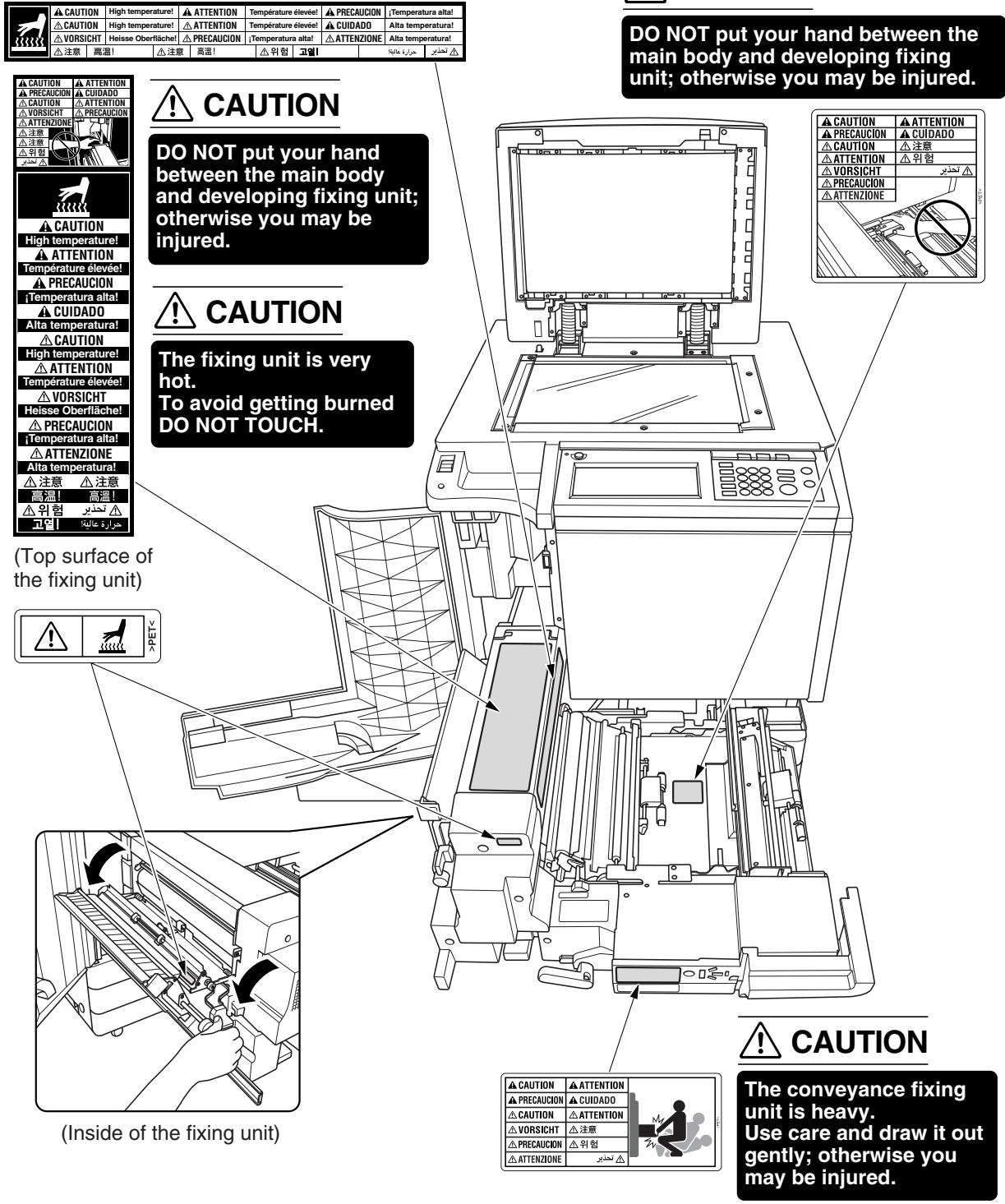
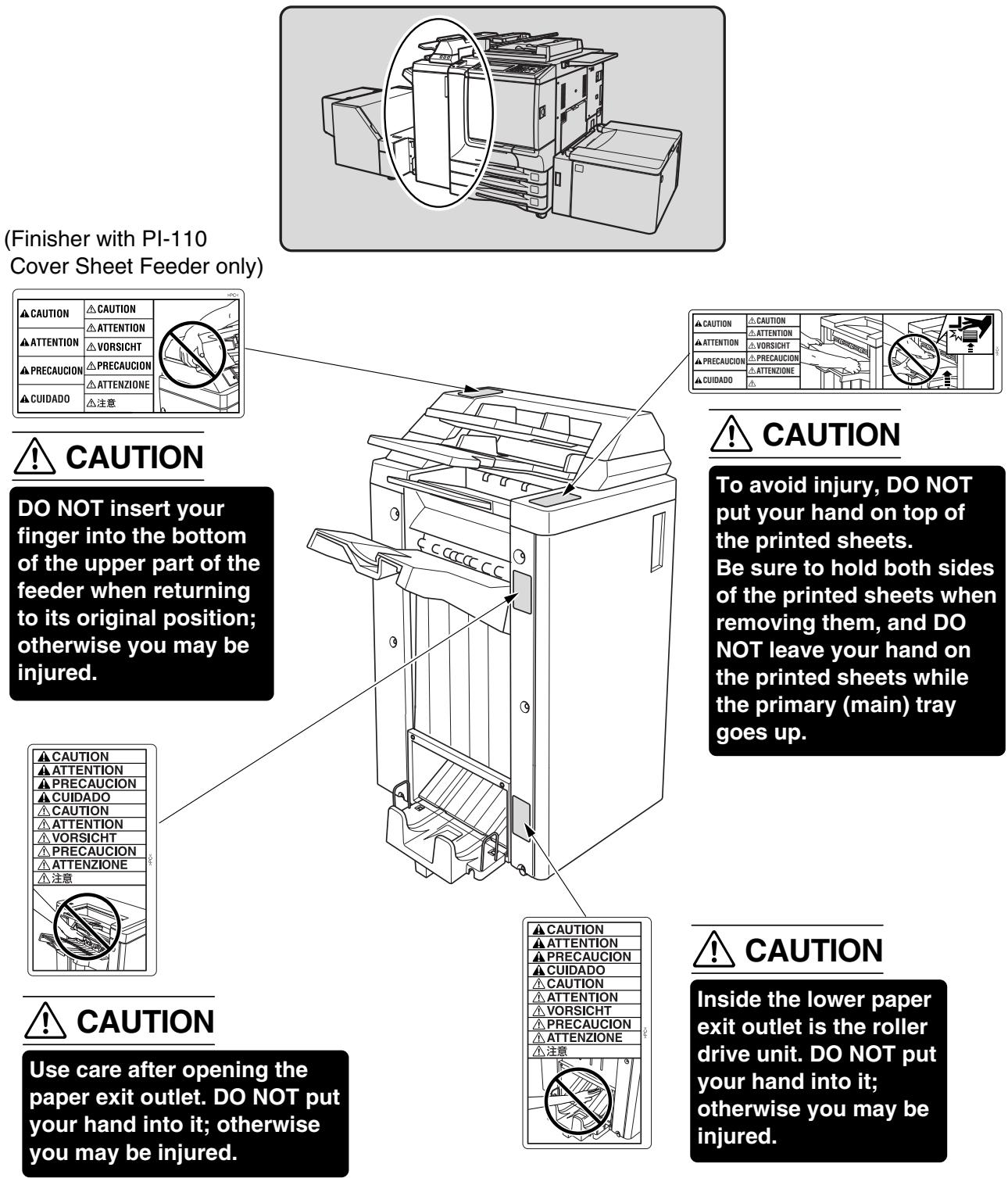
The caution labels and indicators are attached to the machine areas, as shown below, where you are advised to pay special attention to avoid any dangerous situations or serious injury.
(Right side of the fixing unit)
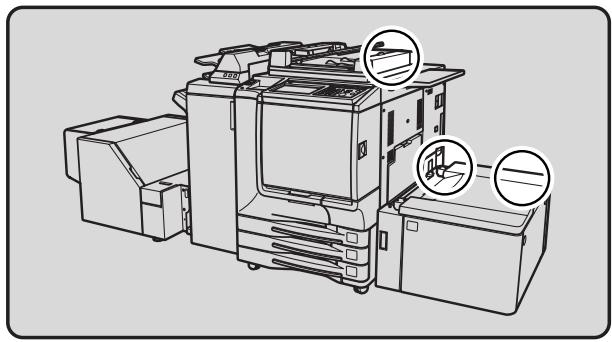
natural_image
Line drawing of a printer with two circular annotations highlighting internal components (no text or symbols present)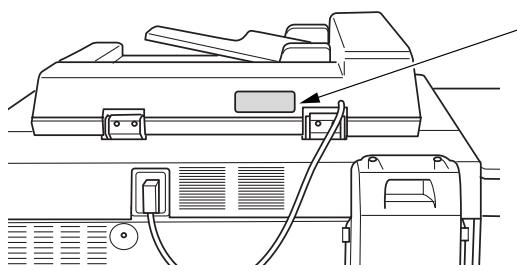
natural_image
Technical line drawing of a printer with attached circuit board and cable (no text or symbols)(Rear side of the RADF)
| CAUTION | CAUTION | ATTENZIONE |  |
| ATTENTION | ATTENTION | 注意 | |
| PRECAUCION | VORSICHT | 위험 | |
| CUIDADO | PRECAUCION | تحذير |
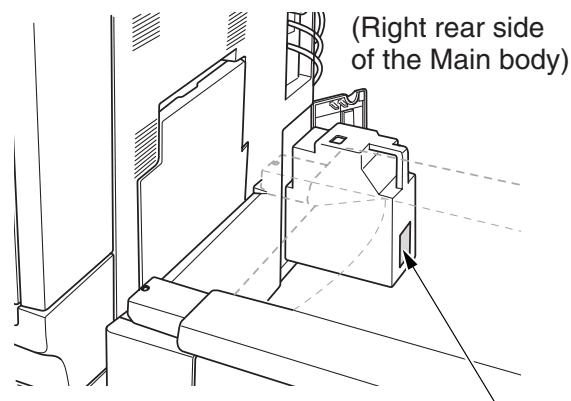

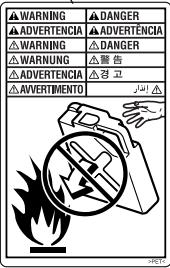
WARNING
DO NOT throw the toner recovery box into a fire. If it is thrown into a fire, the toner may ignite and cause a dangerous situation.
natural_image
Technical line drawing of an internal mechanical assembly (no text or symbols)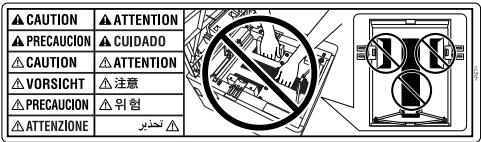

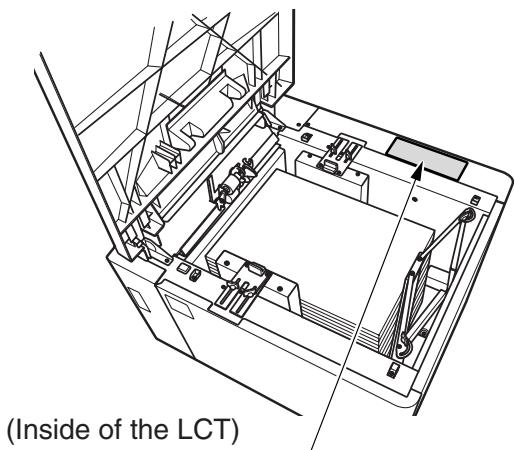
CAUTION
To avoid any unexpected injury, DO NOT put your hand into the holes (3 places) on the bottom plate of the LCT.

CAUTION
Burns or injury may occur from touching the areas detailed in the caution labels and caution indicators. Do not remove caution labels or indicators. If any caution label or caution indicator is soiled, please clean to make legible. If you cannot make them legible, or if the caution label or indicator is damaged, please contact your service representative for replacement labels.
The following indicators are used on the caution labels or in this manual to categorize the level of safety cautions.

DANGER:
Action highly liable to cause death or serious injury.

WARNING:
Action liable to cause death or serious injury.

CAUTION:
Action liable to cause minor injury, machine trouble or physical damage.
If you find any of these indicators when removing jammed paper, adding toner, or reading the manual, be sure to follow the information.

Reminder!
If the safety cautions in the manual become illegible due to soilage, etc., please procure a new copy from your service representative.
Requirements for Safe Use
To ensure your safe use of the machine, the following describes the precautions you are required to observe without fail for the power source of the machine and during installation and routine handling. Be sure to read and observe them.
Power Source

CAUTION: Plug Socket
- A plug socket is limited in capacity. Use only a power source with the correct rating for the machine; otherwise, hazardous situations such as smoking or overheating may occur.
- Avoid multiple connections in the same outlet. Do not use multiple outlet adaptors.

CAUTION: Power Plug and Cord
- Be sure to insert the power plug firmly into the power socket. Otherwise an accident may occur as a result of smoking or overheating. If the inserted power plug is loose in the socket, even after it has been positively inserted, disconnect the plug and contact your electrical contractor.
- For plug cable equipment, the socket-outlet shall be installed near the equipment and shall be easily accessible.
- Do not bend or crush the power cord. If your copier power cord is bent or damaged in any way, contact your service representative immediately. Do not attempt to repair it yourself, and do not continue to operate the copier. A damaged power cord may result in overheating, a short circuit, or fire.
- Do not bundle or coil the power cord of the copier. Otherwise an accident may occur as a result of overheating or fire.

CAUTION: Connecting Multiple Loads to One Socket Outlet Prohibited
Never connect multiple loads to one socket outlet using a multi-outlet extension cord or branched socket. Otherwise an accident may occur as a result of overheating or fire.

CAUTION: Extension Cord
An extension cord must never be used with this machine.
Environment

CAUTION: Prevention of Fire
Do not install near flammable materials, curtains and volatile combustibles, that can catch or cause fire.

CAUTION: Prevention of Short Circuit
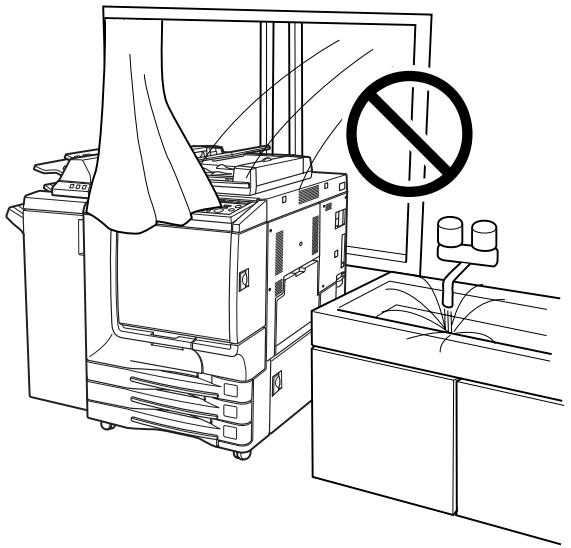
Do not install the copier where it could be splashed with rain water, or water from a tap, to avoid a short circuit.

CAUTION: Temperature and Humidity
- Keep away from direct sunlight, heat sources such as stoves, cool air from an air conditioner and hot air from a heater.
- Avoid any environment that is outside the range shown below: 10 to 30°C in temperature 10 to 80% in humidity

CAUTION: Ventilation
- Keep the installation place well-ventilated.
- Keep away from dust or corrosive gases. These materials may cause poor image quality.
- During the use of machine, the machine generates ozone in an insufficient amount to cause any hazard to the human body. However, if the machine is used in a poorly ventilated room, many copies are made, or more than one copier is used at the same time, an odor may be detected. Ensure adequate ventilation for a comfortable working environment.

CAUTION: Vibration
Do not install on a floor which is subject to vibration or is not level.

CAUTION: Transportation
Be sure to contact your service representative when moving or transporting the machine. If you move the machine with the Hard disk drive or Memory unit installed, machine trouble may be caused by vibration.
natural_image
Line drawing of a printer machine with a prohibition symbol (no text or labels present)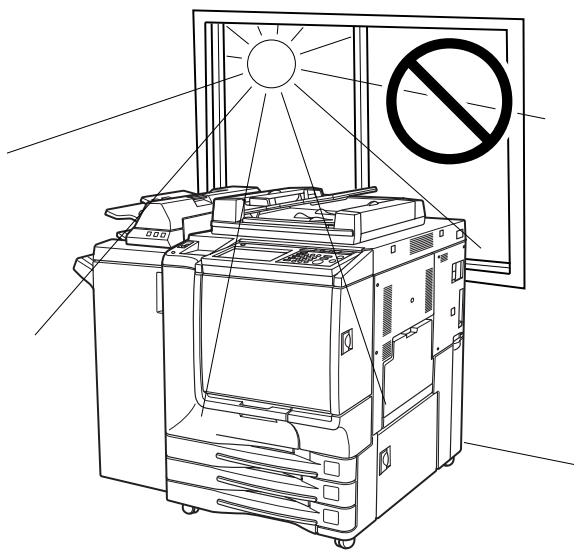
natural_image
Line drawing of an electronic device with a prohibition symbol above it, no text or labels present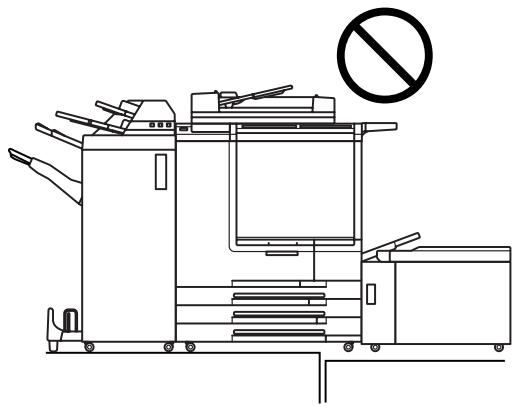
natural_image
Line drawing of an industrial machine with a prohibition symbol (no text or labels)
CAUTION: Installation Space
Allow sufficient space for facilitating copy operation, changing parts, and periodic inspection. Leave an adequate space behind the machine to let hot air out from the rear fan.
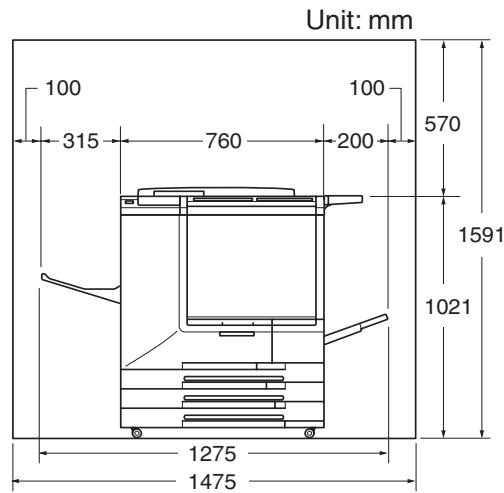
Konica 8050 + CV-131 (Front)
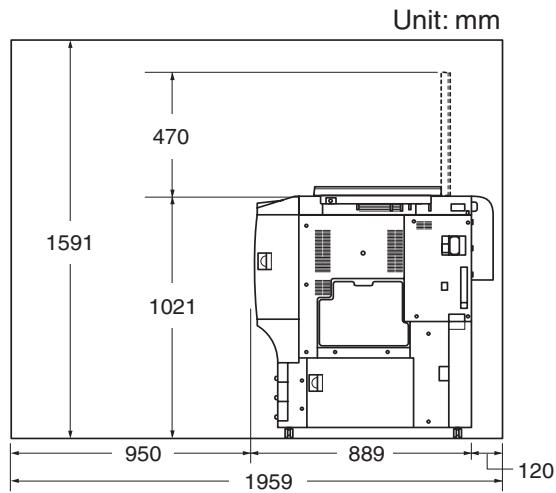
Konica 8050 + CV-131 (Right side)
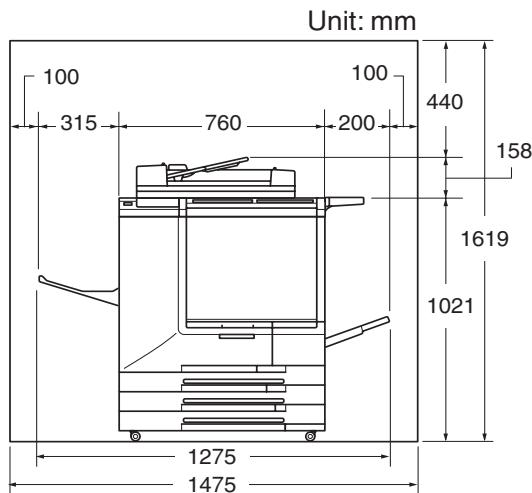
Konica 8050 + DF-319 (Front)
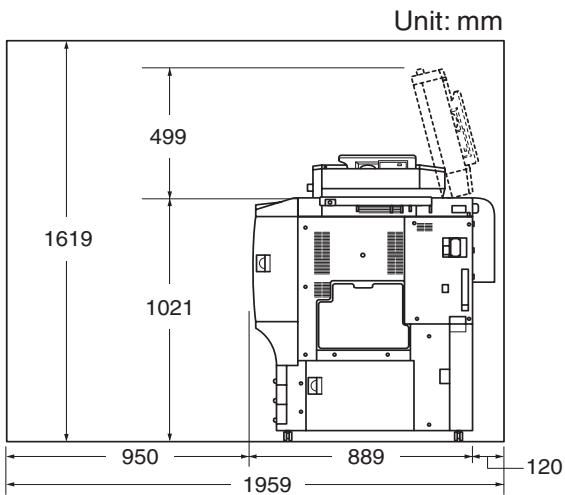
Konica 8050 + DF-319 (Right side)
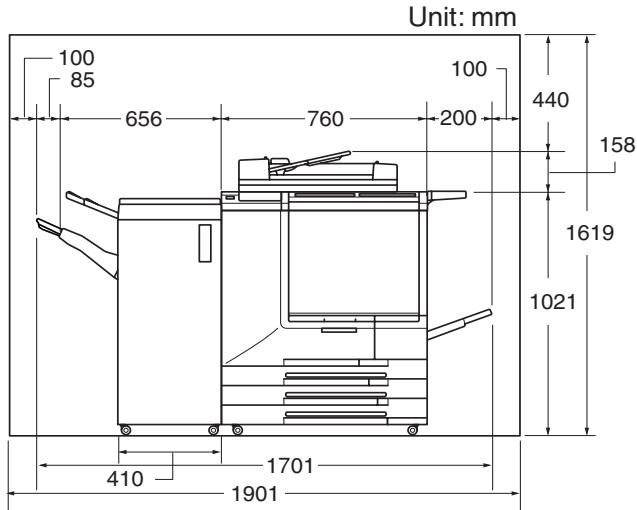
Konica 8050 + DF-319 + FS-115 (Front)
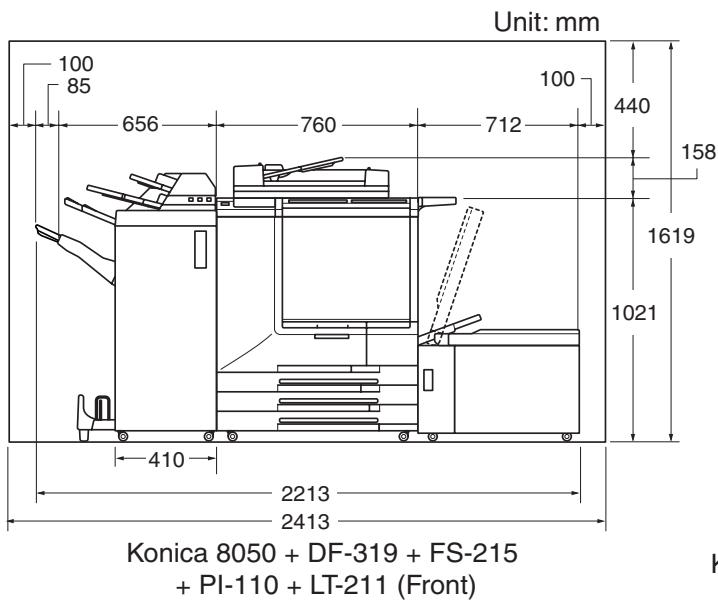
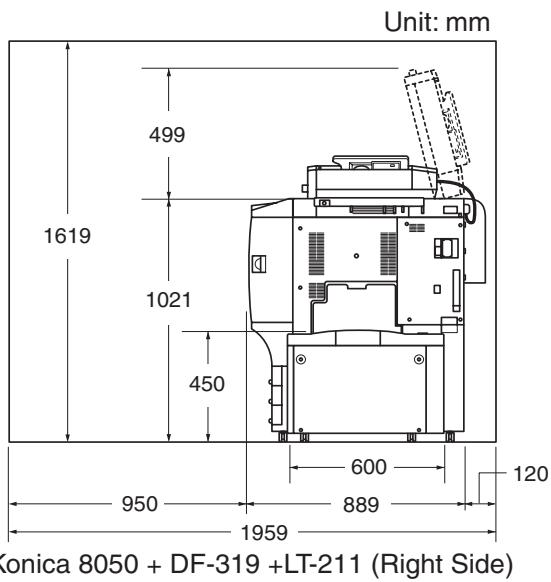
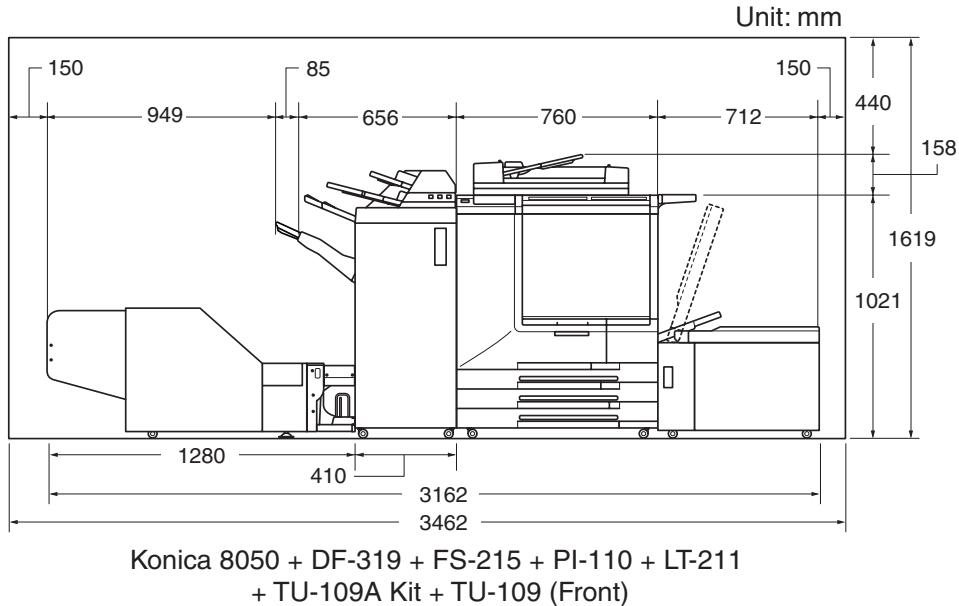

Reminder!
Finisher primary (main) tray of FS-115/215 Finisher gradually goes down while printed materials output. DO NOT allow any object to interfere with the operation of the tray on the left side of the finisher, as any interference may cause damage to the finisher.
Precautions for Routine Handling

WARNING: Toner Recovery Box
DO NOT THROW the toner recovery box into a fire. If it is thrown into a fire, the toner may ignite and cause a dangerous situation.

CAUTION: Actions in Response to Troubles
- If the Service Call screen is displayed and copier operations cannot be continued anymore, stop the operation to prevent any unexpected accident. Write down the report code as stated on the 2nd line of the message, then switch off the copier and disconnect from the power socket. Contact your service representative and inform them of the report code.
- Do not touch the high temperature parts indicated with CAUTION labels or described in the manual.
- Do not touch the inside of the machine for any other purpose than removing jammed paper or adding toner.
- If machine repair is necessary, be sure to contact your service representative. Never attempt to repair it by yourself.
- If any abnormal sound, smell or smoke comes from the machine, immediately stop using it, turn off the power switch, disconnect the power plug and contact your service representative.
- If the breaker trips or the fuse blows, turn off the power switch, reset the breaker or the fuse, and turn on the machine. If the same situation occurs again, contact your service representative.
- Ensure the replacement fuse conforms with the rating of the power source. Never use a fuse with an incorrect rating.

CAUTION: Prevention of Fire
Do not use volatile combustibles, such as thinner or alcohol, near the machine.

CAUTION: Prohibition of Machine
Modification
Do not modify or remove any parts by yourself.

natural_image
Three black-and-white icons showing screwdriver, wrench, and pliers above prohibition symbols (no text or labels)
CAUTION: Prevention of Machine Troubles
- Do not drop small metallic objects, such as paper clips or staples, inside the machine.
- Do not place any heavy or hard objects such as a vase, books or ornaments on the machine.

CAUTION: Recommendation of Periodic
Check
Be sure to periodically check the following points:

natural_image
Three black line drawings of paper clips and prohibition symbols on white background (no text or labels)(1) The main cord or the power plug does not generate abnormal heat.
(2) The power plug is not inserted loosely or the cord is not cut or scratched.
(3) The grounding wire is correctly connected.
(4) The power plug or the power outlet is not covered with dust.
If you find anything abnormal in the above items, stop using the machine and contact your service representative.

CAUTION: Toner
- Keep the toner cartridge away from children. The toner is nontoxic; however if you inhale or contact with eyes by accident, flush with water and seek medical advice.
- Do not throw the empty toner cartridge into a fire. If it is thrown into a fire the toner may ignite and cause a dangerous situation.

CAUTION: Paper
Check paper to be sure it conforms to the specifications outlined in Section 12.
- Do not use paper with staples or paper that conducts electricity (silver, carbon, etc.), otherwise an accident may occur as a result of fire.
- To avoid machine trouble, do not use heat-sensitive paper, coloured transparency, or paper specifically designed for ink-jet printers, such as photo-paper.

CAUTION: Power Saver and Weekly Timer
- In Power Saver mode the copier is still connected to the main power supply and power is still applied to certain areas of the machine. To avoid any unexpected troubles turn the power OFF when not using the copier for long periods of time.
- When the Weekly Timer function is operating, turning power OFF will disable the function.

CAUTION: Inside the Booklet Mode Outlet
Inside the Booklet mode outlet is the roller drive unit. DO NOT put your hand into it, when removing the folded or stitched & folded sheet; otherwise you may be injured.

CAUTION: Finisher Paper Exit Outlet
To avoid injury when stapling large size copies, DO NOT put your hand into the open Paper Exit Outlet.

CAUTION: Fixing Unit
The internal fixing unit is very hot. To avoid getting burned, DO NOT TOUCH. Be careful when withdrawing the fixing unit.

WARNING: Drum Unit
The internal drum unit generates a high voltage.
To avoid an electrical shock, DO NOT TOUCH.

CAUTION: LCT Bottom Plate
To avoid any unexpected injury, DO NOT put your hand into the holes (3 places) on the bottom plate of the LCT.

CAUTION: Disposal of Copier
Do not dispose of this copier yourself. Contact your service representative, who can arrange for its safe disposal.
If you change the place of installation, please contact your service representative.

CAUTION: Paper Capacity for the Exit Tray
The exit tray capacity is max. 150 sheets (80 g/m ^2 paper). If a copy run of more than 150 is required, be sure to remove the copies from the exit tray before the maximum capacity is reached. Failure to do so will cause the copier to jam.

CAUTION: FS-115/215 Finisher Paper Capacity
The FS-115 Finisher is equipped with two exit trays, and FS-215 Finisher is equipped with three exit trays.
Select an exit tray and output mode on the Output Mode popup menu.
To prevent paper misfeed, do not exceed the paper capacity of the Finisher.
When the total number of copies in the copy run exceeds the capacity stated in Section 12, be sure to unload the exit tray while the copier is still copying. Failure to do so will cause the copier to jam.

CAUTION: FS-115/215 Finisher Primary (Main) Tray
When printed materials are removed from the primary (main) tray of the Finisher, the tray goes up automatically. To avoid injury, DO NOT put your hand on top of the printed sheets. Be sure to hold both sides of the printed sheets when removing them, and DO NOT leave your hand on the printed sheets while the primary tray goes up.
SECTION
2
Machine Information
Machine Configuration, Turning On the Power and Loading Paper
Machine Configuration.... 2-2
Turning On the Power Switch.... 2-16
Loading Paper 2-22
External Machine Items
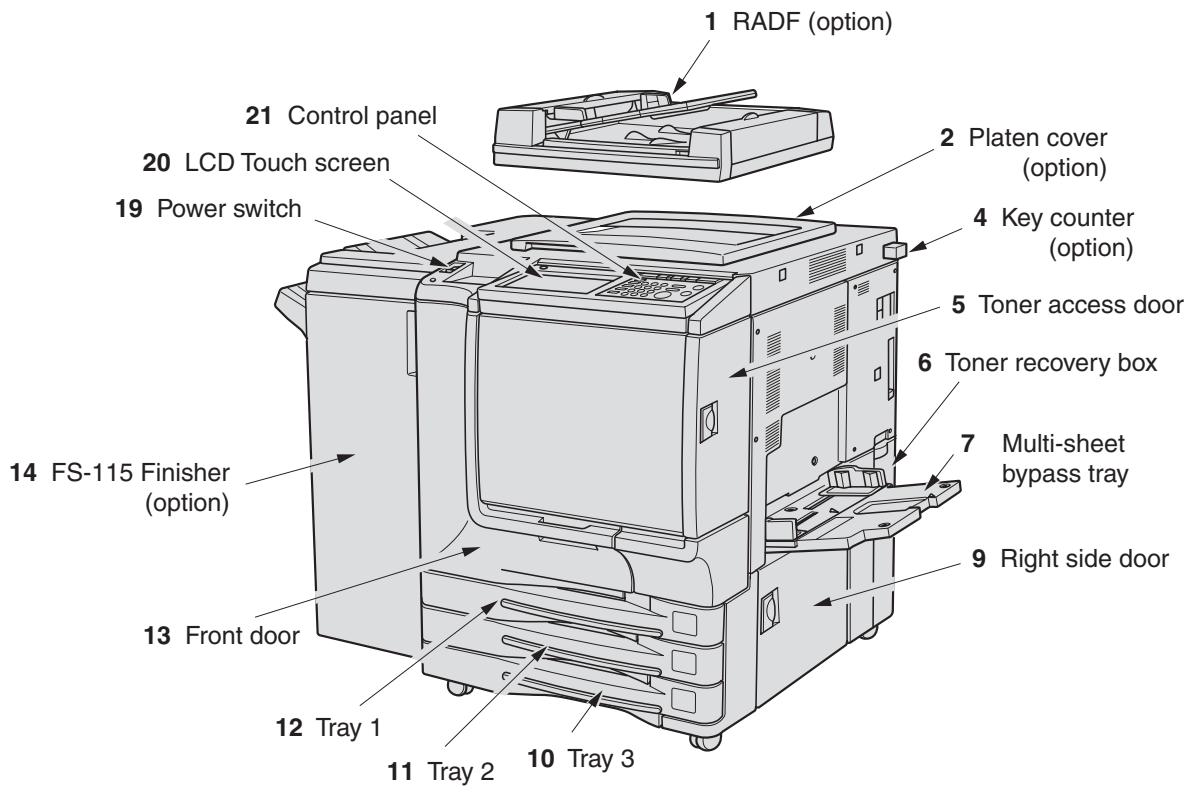
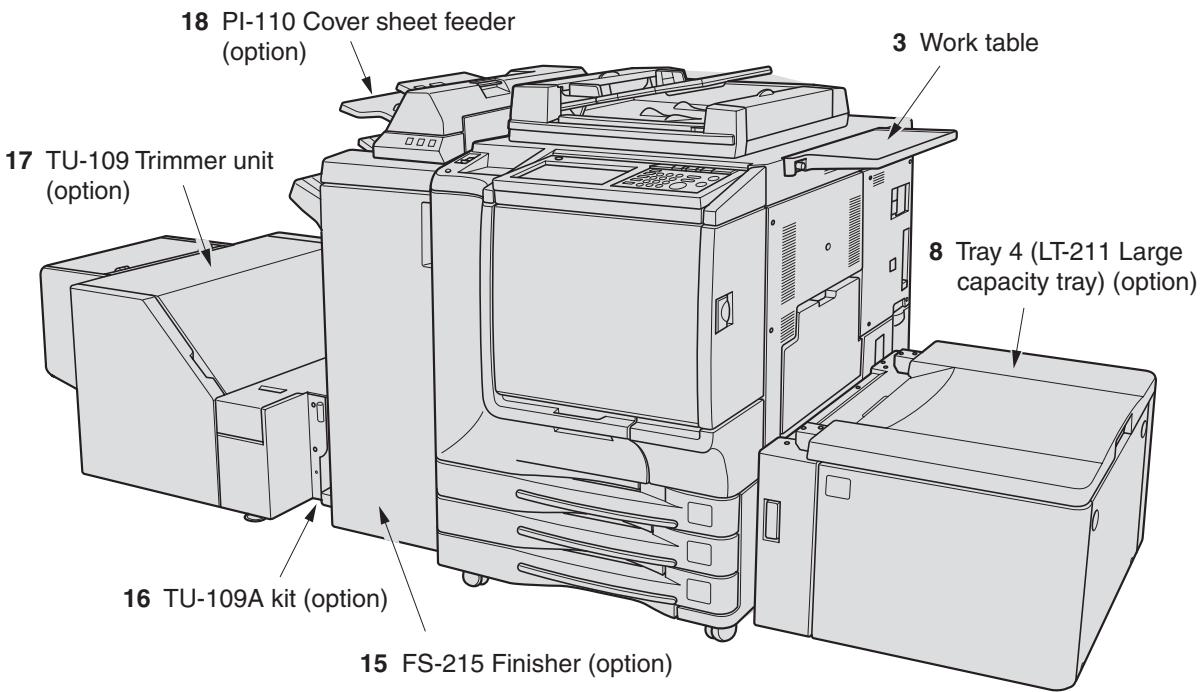
1 RADF (Reversing Automatic Document Feeder) (option) automatically feeds multiple originals one at a time to the platen glass for copying.
2 Platen cover (option) covers documents to be copied and holds them in place.
3 Work table provides a convenient workspace for documents both before and after copying.
4 Key counter (option) manages the number of copies made on the machine.
5 Toner access door opens to replenish the black toner or colour toner.
6 Toner recovery box opens to replace the filled toner box with new one.
7 Multi-sheet bypass tray opens to use copy paper of the other size or type than those loaded in the main body trays or LCT.
8 Tray 4 (LT-211 Large Capacity Tray) (option) holds 2,500 sheets (90 g/m ^2 paper) from 13"x19" to B5.
9 Right side door opens to allow removal of mishandled paper.
10 Tray 3 (universal tray) is user-adjustable and holds 500 sheets (90 g/m ^2 paper) from 13"x19" to A5R.
11 Tray 2 (universal tray) is user-adjustable and holds 500 sheets (90 g/m ^2 paper) from 13"x19" to A5R.
12 Tray 1 (universal tray) is user-adjustable and holds 500 sheets (90 g/m ^2 paper) from 13"x19" to A5R.
13 Front door opens to allow removal of mishandled paper.
14 FS-115 Finisher (option) sorts, staple-sorts, or groups copies into finished sets.
15 FS-215 Finisher (option) sorts, staple-sorts, or groups copies into finished sets. FS-215 also folds or staples & folds copies into booklet-styled sets, or folds max. 3 copies in three.
16 TU-109A kit (option) connects the finisher and trimmer unit.
17 TU-109 Trimmer unit (option) trims the end of booklet.
18 PI-110 Cover sheet feeder (option) loads cover sheet paper and feeds the sheet as cover to the sorted sets, used in combination with FS-115/215 Finisher.
19 Power switch turns copier power On/Off when pressed.
20 LCD Touch screen displays interactive operation screens.
21 Control panel controls copier operations and displays messages as required.
Internal Machine Items
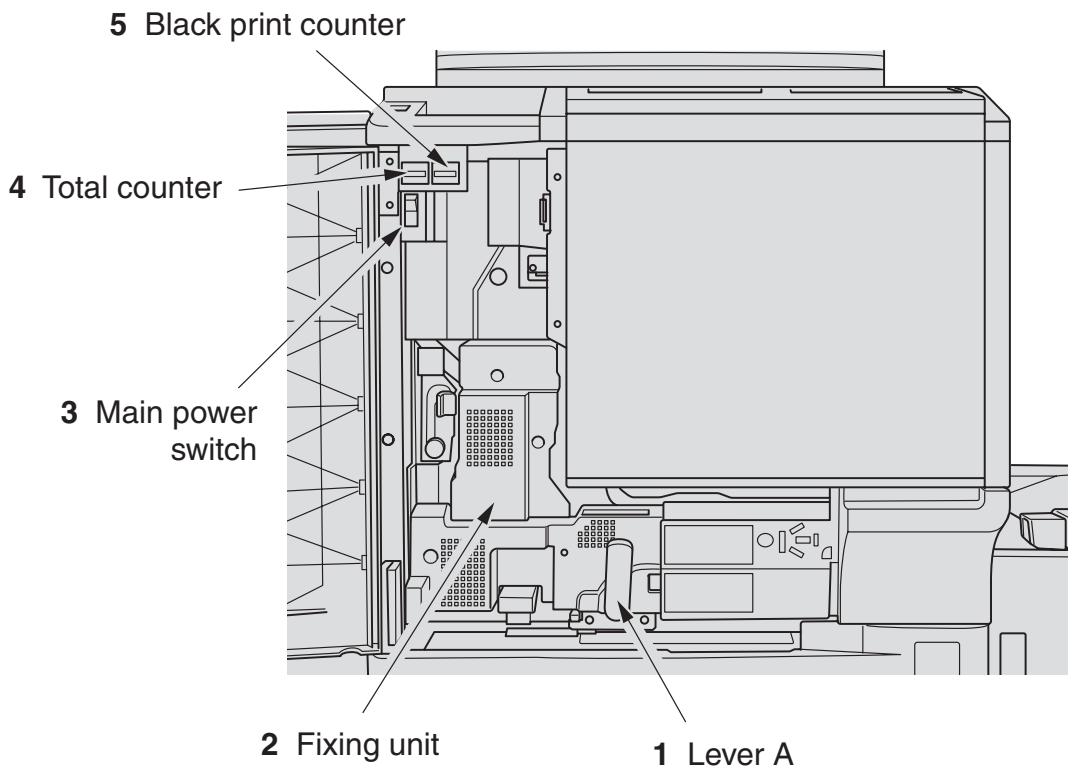
1 Lever A can be moved to withdraw the conveyance fixing unit for removal of mishandled paper.
2 Fixing unit fuses the toner onto the copy paper.
3 Main power switch used only by service representative turns machine power on/off when pressed.
4 Total counter indicates the total number of prints made.
5 Black print counter indicates the total number of the black prints made.
Standard/Optional Equipment
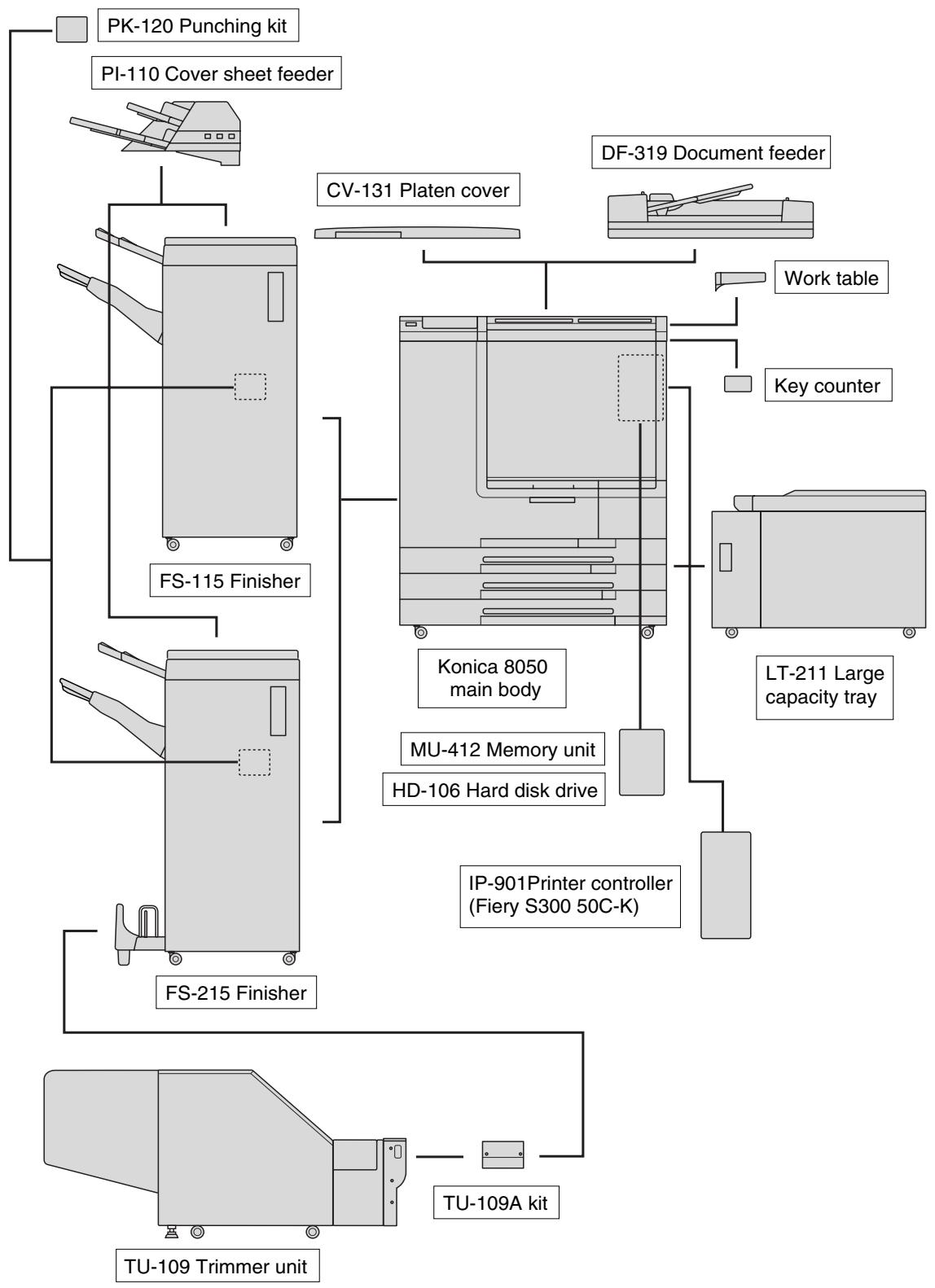
flowchart
graph TD
    A["PK-120 Punching kit"] --> B["PI-110 Cover sheet feeder"]
    B --> C["FS-115 Finisher"]
    C --> D["FS-215 Finisher"]
    D --> E["TU-109 Trimmer unit"]
    F["DF-319 Document feeder"] --> G["Work table"]
    G --> H["Key counter"]
    H --> I["Konica 8050 main body"]
    I --> J["MU-412 Memory unit"]
    J --> K["HD-106 Hard disk drive"]
    K --> L["IP-901Printer controller (Fiery S300 50C-K)"]
    L --> M["TU-109A kit"]
    N["CV-131 Platen cover"] --> O["Transfer screen"]
    P["KT-1200 Padable Screen"] --> Q["Transfer screen"]
    R["LT-211 Large capacity tray"] --> S["Transfer screen"]
Control Panel Layout
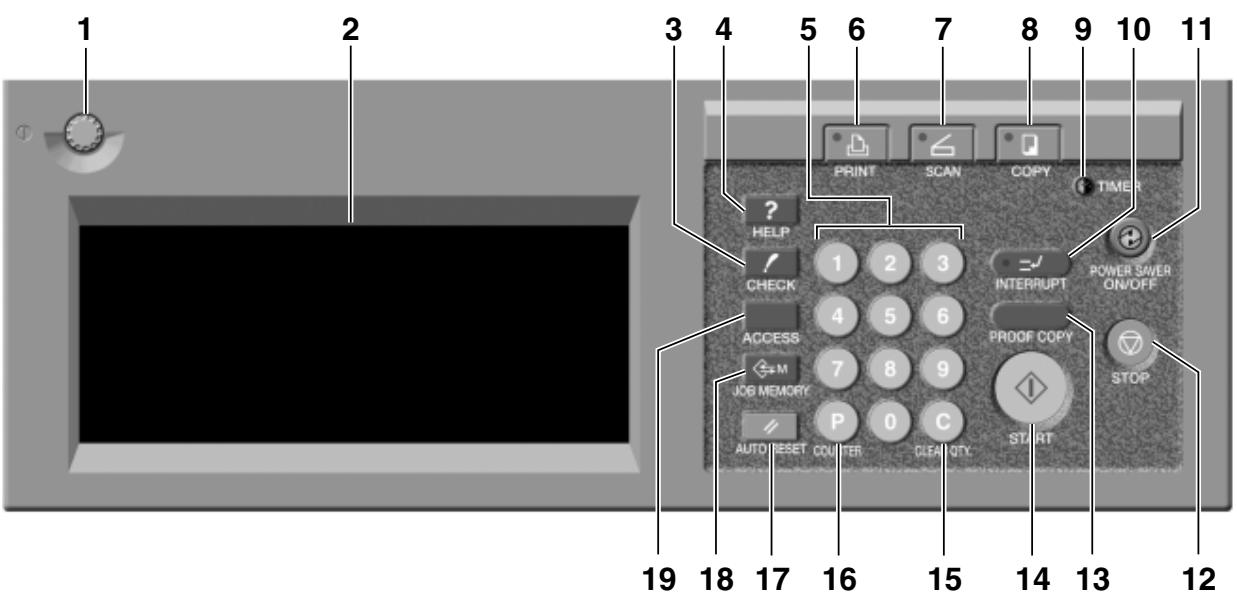
1 CONTRAST ADJUSTMENT DIAL can be turned to adjust the touch panel contrast.
2 LCD TOUCH SCREEN displays machine and copying status, help information, interactive screens, and touch keys for selecting all functions.
3 CHECK displays a screen showing all settings that are selected for the current job.
4 HELP displays a screen with help for the currently selected function, or to access the Key Operator Mode Screen.
5 KEYPAD enters numeric values.
6 PRINTER switches the machine operation mode to printer. (This key does not function at present.)
7 SCANNER switches the machine operation mode to scanner.
8 COPY switches the machine operation mode to copy.
9 TIMER lights when the timer function is set.
10 INTERRUPT stops copying in progress to allow copying from the platen glass.
11 POWER SAVER ON/OFF activates power-saving mode for times when the copier is inactive, or activates Timer Interrupt mode when Weekly Timer function is active.
12 STOP stops the copying sequence; deletes the stored memory.
13 PROOF COPY outputs a single set of copies to confirm whether the current settings are selected properly.
14 START activates copying or scanning.
15 [C] (CLEAR QTY.) allows resetting of print quantity.
16 [P] (COUNTER) displays the Counter Screen or accesses programming modes for setting special functions.
17 AUTO RESET restores copier to automatic mode settings or to Key Operator settings.
18 JOB MEMORY displays screens for selecting job store/job recall functions.
19 ACCESS sets the machine to allow copying only when the EKC password is entered.

CAUTION
The touch screen of the control panel is covered with glass. Do not drop heavy objects on the glass or put excess weight or pressure on it, otherwise the glass may be scratched or break to cause injury.

CAUTION
When the Call for Service Screen (p. 5-2) is displayed, be sure to contact your service representative immediately.

DETAILS
The control panel of this machine can be slightly lowered to three angled positions to ensure easy access by anyone, regardless of the physical or positional status of the operator. Your authorized Konica service representative can make this setting for you.
Basic Screen
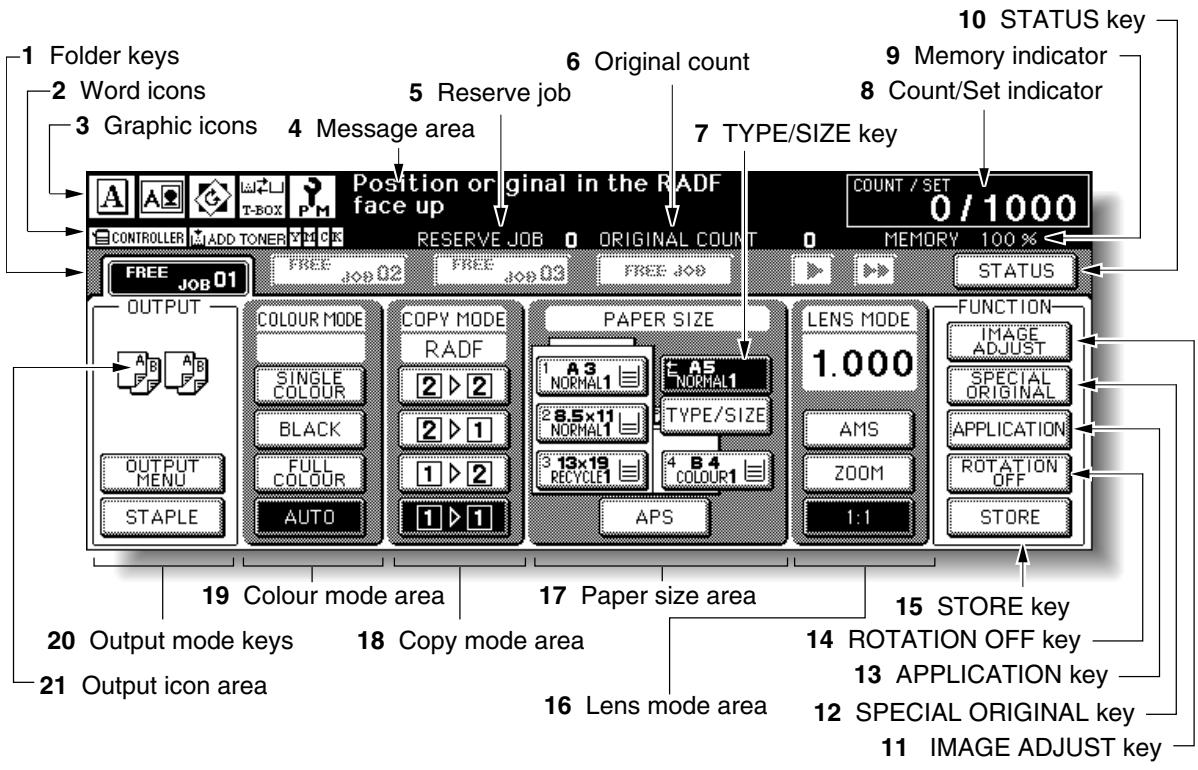
1 Folder keys:
FREE JOB is selected to specify a copy job conditions.
When scanning starts, FREE JOB changes to SCAN JOB, then changes to PRINT JOB when the machine starts printing.
FREE JOB at the right side of SCAN JOB or PRINT JOB can be touched to specify a reserve job conditions. Up to 7 reserve jobs can be set. The arrow keys at the right side of folder keys are used to scroll.
2 Word icons:
ADD TONER icon is displayed when toner supply becomes low. The toner colour to be supplied is indicated by a letter; C (cyan), M (magenta), Y (yellow), or K (black).
PM CALL icon is displayed when preventive maintenance is due.
Printer icon indicates the machine status when operating as a printer.
3 Graphic icons:
Original direction icon indicates the original direction specified on the Special Original popup menu.
Image adjust icon indicates the enhance mode specified on the Special Original popup menu.
Rotation icon is displayed when Rotation automatically functions.
Toner recovery box icon is displayed when replacement of the toner recovery box is due.
PM icon is displayed when preventive maintenance is due.
4 Message area displays the machine status and procedure required at that time.
5 Reserve job counts the reserve jobs already specified.
6 Original count counts the original pages placed in the document feeder as they are scanned.
7 TYPE/SIZE key is touched to specify the type and size of the paper loaded in the Multi-sheet bypass tray.
8 Count/Set indicator indicates the print quantity entered from the control panel keypad, and also indicates the print count on the left of the set count while printing.
9 Memory indicator indicates the remaining memory available for the next operation.
10 STATUS key is touched to view the current job status, to change the printing order of reserve jobs, or to cancel printing a reserve job.
11 IMAGE ADJUST key is touched to display five sorts of the Image Adjustment Setting Screens to adjust the image quality.
12 SPECIAL ORIGINAL key is touched to specify the condition of originals to be scanned.
13 APPLICATION key is touched to select various application functions.
14 ROTATION OFF key is touched to release the Rotation function.
15 STORE key is touched to store scanned images into memory.
16 Lens mode area is used to select the desired magnification ratio.
17 Paper size area is used to select the desired paper size or APS.
18 Copy mode area is used to select the copy mode (1▶1, 1▶2, 2▶1, or 2▶2).
19 Colour mode area is used to specify the desired colour mode (single colour, black, full colour, or auto).
20 Output mode keys are used to specify the desired output mode.
21 Output icon area displays the appropriate output icon according to the selected output mode.
FS-115/FS-215 Finisher (with PK-120 Punching Kit)
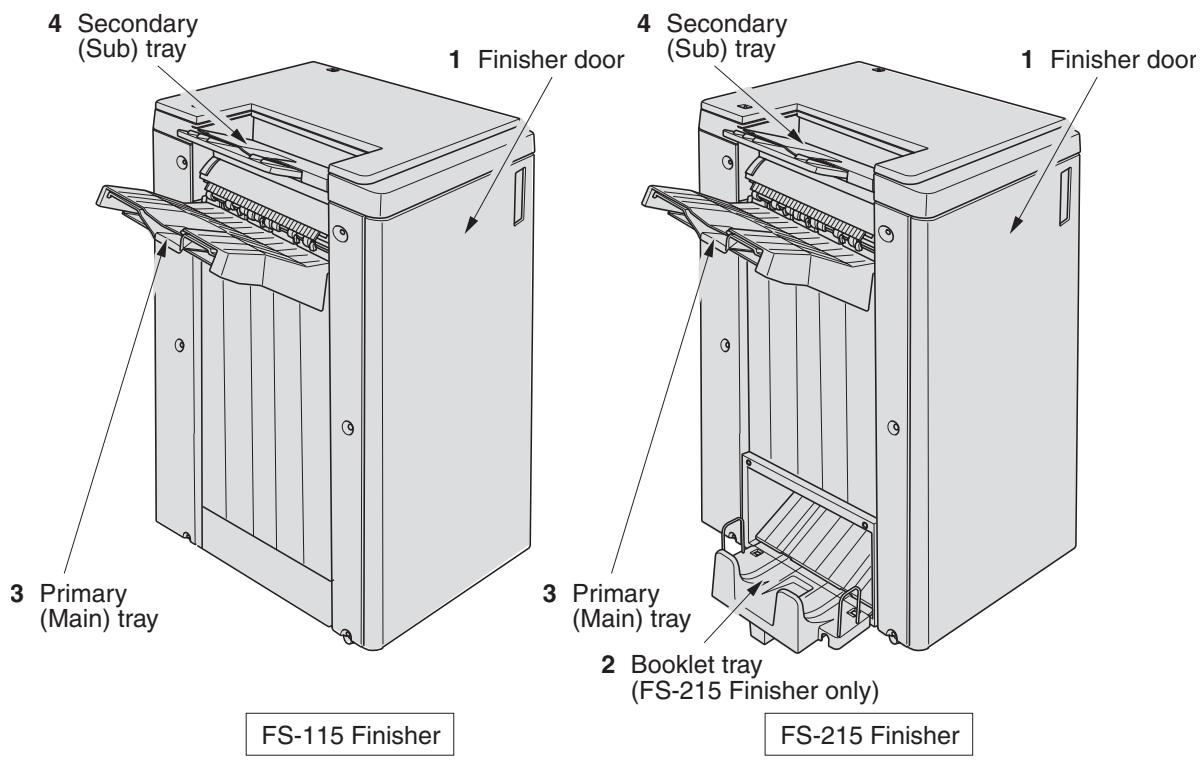
1 Finisher door opens to the internal Finisher to allow clearing mishandled paper, replenishing staples, and emptying waste basket of Punching kit.
2 Booklet tray (FS-215 Finisher only) holds sets output in Fold mode, Stapling & Fold mode, or Three-fold mode.
3 Primary (Main) tray holds sets output in Non-sort mode, Sort mode (offset), Staple-sort mode, or Group mode (offset).
4 Secondary (Sub) tray holds sets output in Sort mode or Group mode with face down/up mode.
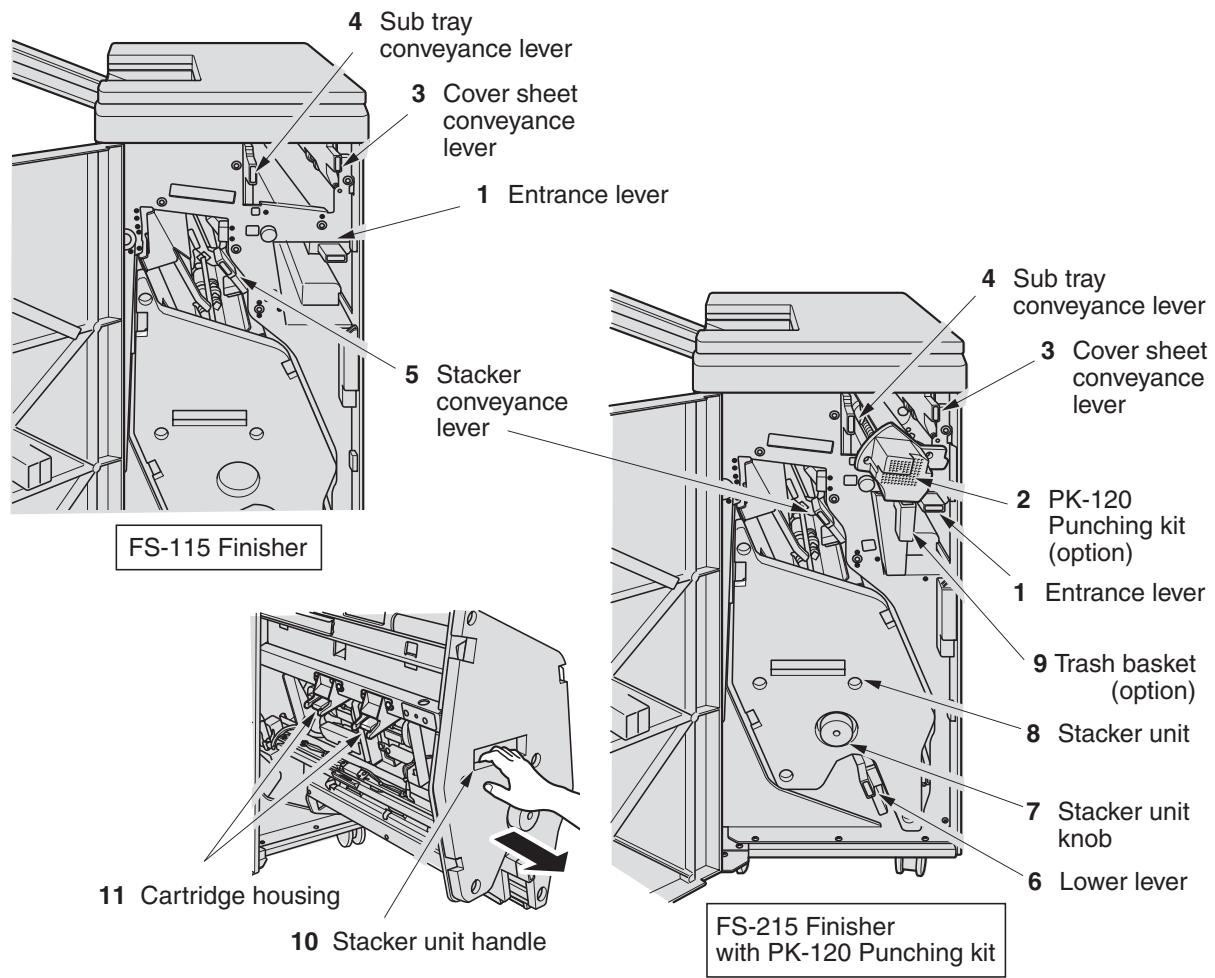
1 Entrance lever opens downward to remove mishandled paper.
2 PK-120 Punching kit (option) punches file holes in the output copies.
3 Cover sheet conveyance lever opens to remove mishandled paper.
4 Sub tray conveyance lever opens to remove mishandled paper.
5 Stacker conveyance lever opens to remove mishandled paper.
6 Lower lever opens to remove mishandled paper.
7 Stacker unit knob can be turned to ease removal of mishandled paper from the Stacker unit.
8 Stacker unit folds or stitches & folds copies into booklet-styled sets, and also folds max. 3 copies in three.
9 Waste basket (option) holds waste paper punched out.
10 Stacker unit handle withdraws unit to allow removal of mishandled paper and replacement of staple cartridge.
11 Cartridge housing holds staple cartridge to be replaced when supplying staples.
PI-110 Cover Sheet Feeder
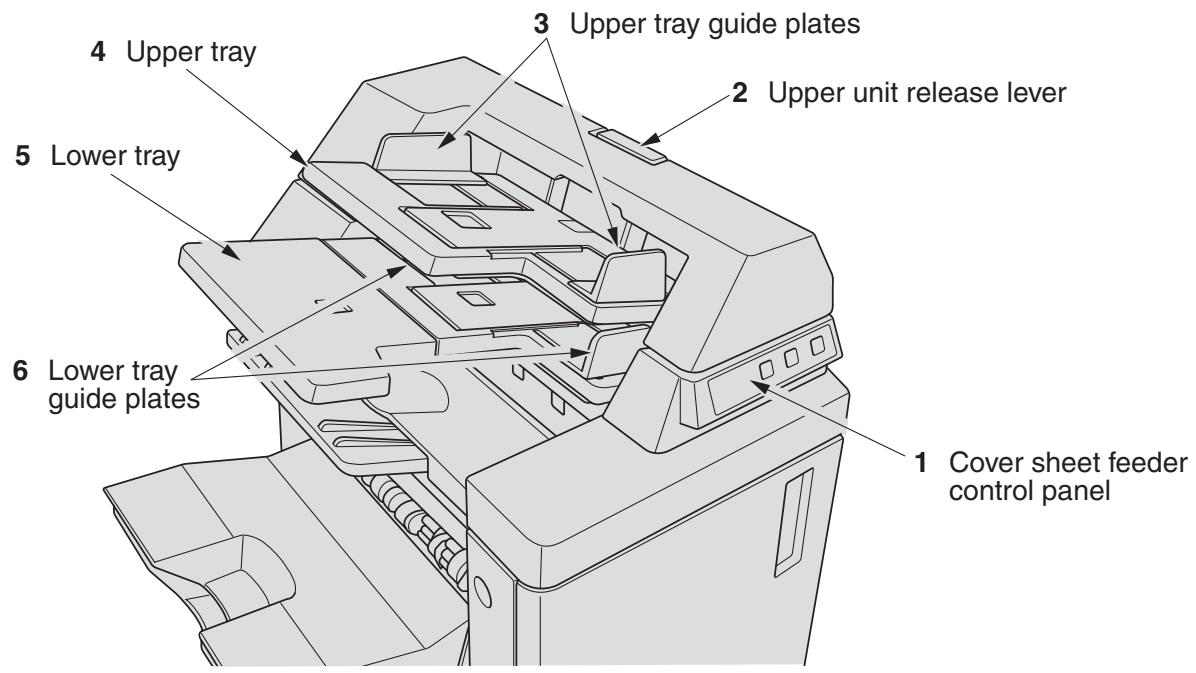
1 Cover sheet feeder control panel controls cover sheet feeder operations.
2 Upper unit release lever can be moved to slide the upper unit of cover sheet feeder for removal of mishandled paper.
3 Upper tray guide plates hold cover sheets to fix the position.
4 Upper tray holds cover sheets for use in cover sheet output mode.
5 Lower tray holds cover sheets for use in cover sheet output mode or a copied set in manual stapling/punching/three-fold mode.
6 Lower tray guide plates hold cover sheets to fix the position.
LT-211 Large Capacity Tray
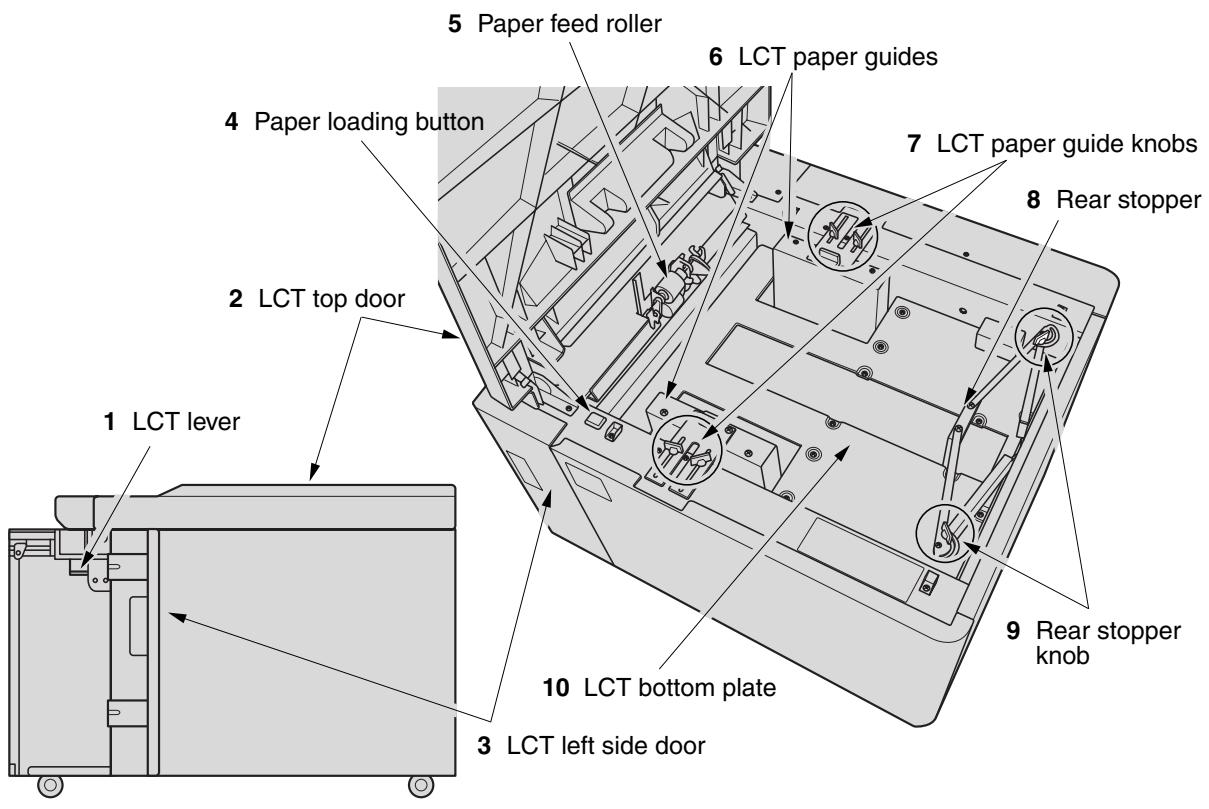
1 LCT lever can be moved downward to ease removal of mishandled paper.
2 LCT top door opens to allow paper loading or removal of mishandled paper.
3 LCT left side door opens to allow removal of mishandled paper.
4 Paper loading button is pressed to lower the bottom plate to allow loading paper.
5 Paper feed roller conveys the copy paper to the main body.
6 LCT paper guides hold copy paper to fix the position.
7 LCT paper guide knobs can be turned to move or fix the LCT paper guide.
8 Rear stopper fixes the rear end of copy paper.
9 Rear stopper knobs can be turned to move or fix the rear stopper.
10 LCT bottom plate goes up automatically when paper supply becomes low, and goes down when the paper loading button is pressed.
TU-109 Trimmer Unit
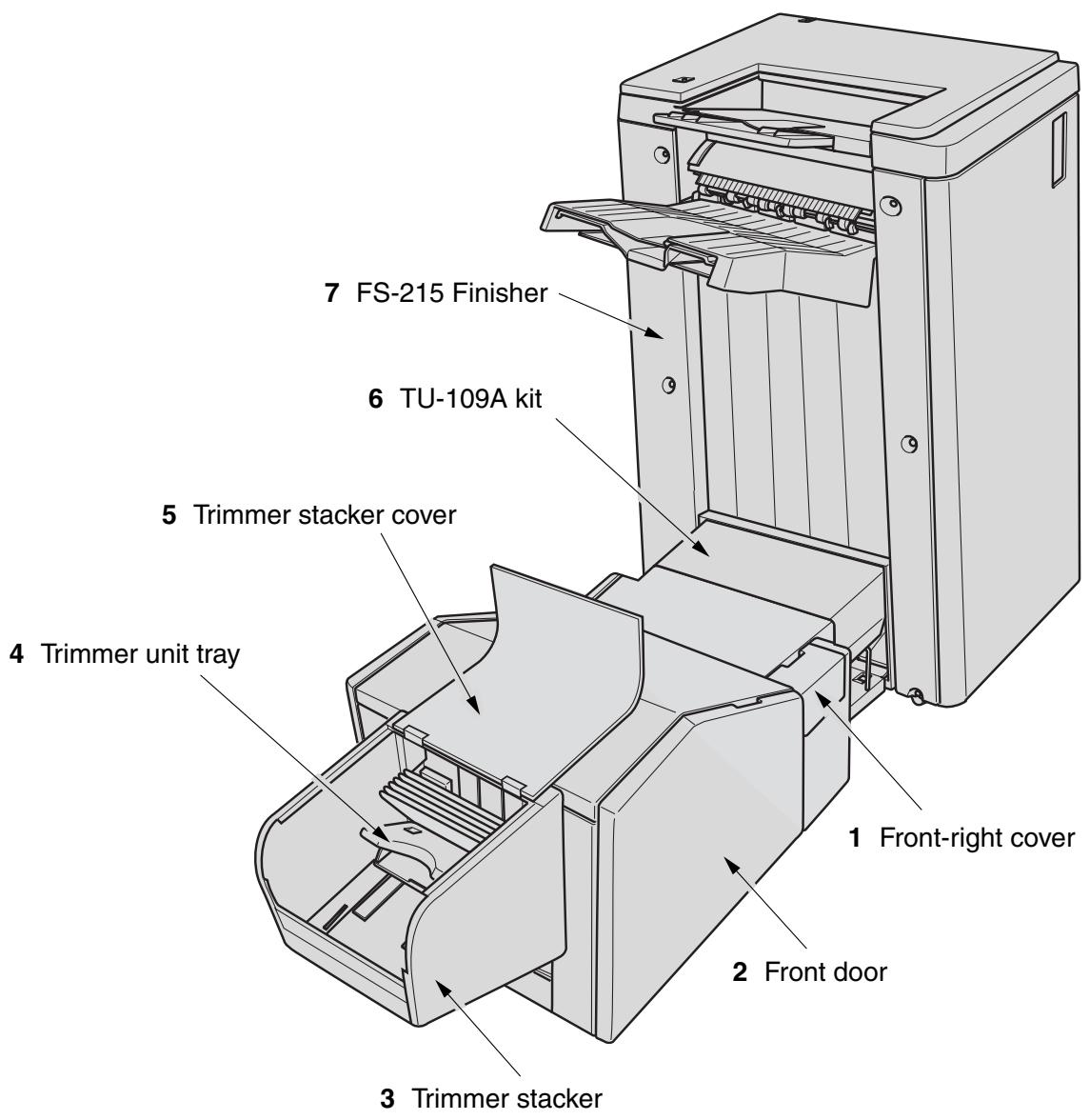
1 Front-right cover opens to allow removal of mishandled paper.
2 Front door opens to allow removal of mishandled paper or waste paper.
3 Trimmer stacker holds sets output in Trimming mode.
4 Trimmer unit tray slides to the left side each time a trimmed booklet is delivered.
5 Trimmer stacker cover opens to allow you to take out the finished sets.
6 TU-109A kit connects the Finisher and Trimmer unit.
7 FS-215 Finisher allows the Trimmer unit to be installed.

Reminder!
DO NOT place heavy objects on the trimmer stacker or apply any weight on it, and DO NOT use it for storage.
Excessive weight applied to the inside or outside of the trimmer stacker will damage the equipment.
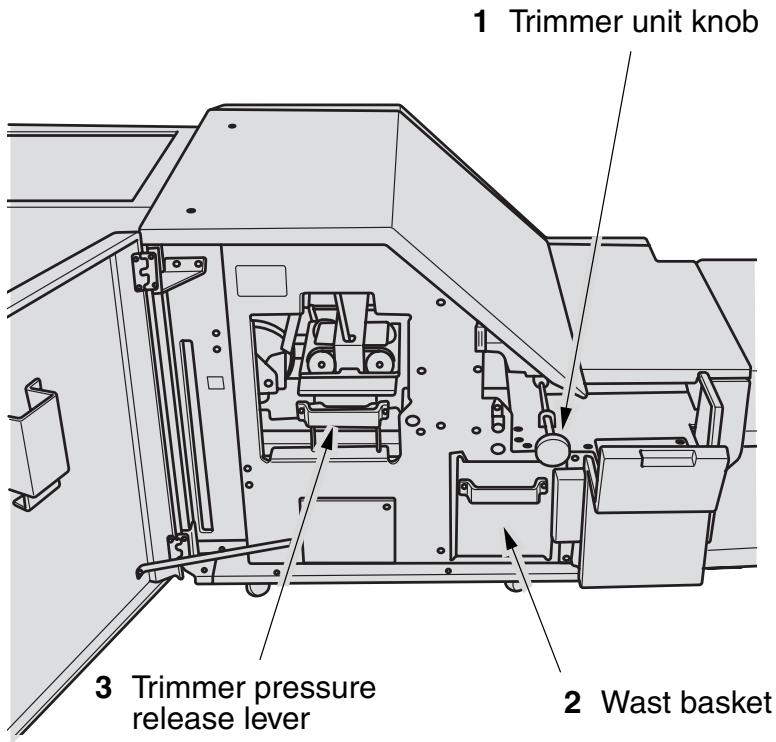
1 Trimmer unit knob can be turned to ease removal of mishandled paper.
2 Waste basket holds waste paper cut off from the booklets.
3 Trimmer pressure release lever opens to allow removal of mishandled paper.
To Turn On the Power
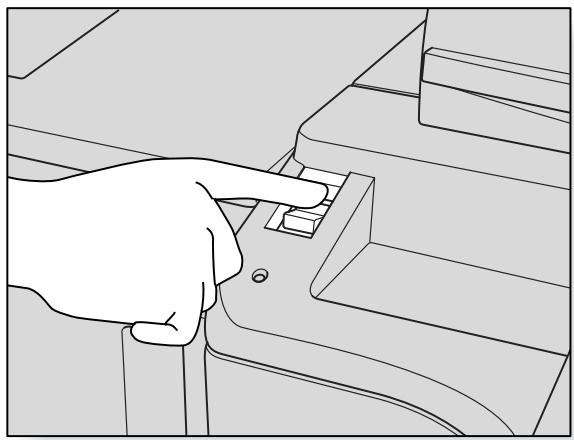
1. Turn ON the power switch.
The power switch is located on the left side of the control panel.
natural_image
Line drawing of a hand pressing a button on a mechanical component (no text or symbols)
DETAILS
The main power switch is located on the upper-left side of the internal main body. Be sure not to use the main power switch in usual operation.
2. The Wake-up Screen and Warm-up Screens will be displayed.
Konica
natural_image
Illustration of a rocket launch with a vertical launch tower and a separate white rocket ascending against a starry night sky (no text or symbols)A few seconds after the Wake-up Screen appears in the LCD touch screen, seven types of Warm-up Screens will be displayed in succession for approx. 7.0 minutes.

HINT
You can set reserve jobs while the machine is warming up. Touch the LCD screen to change the Warm-up Screen to the Basic Screen, then check that the message “Ready to copy reserve” is displayed on the Basic Screen. See p. 3-11 to p. 3-12.
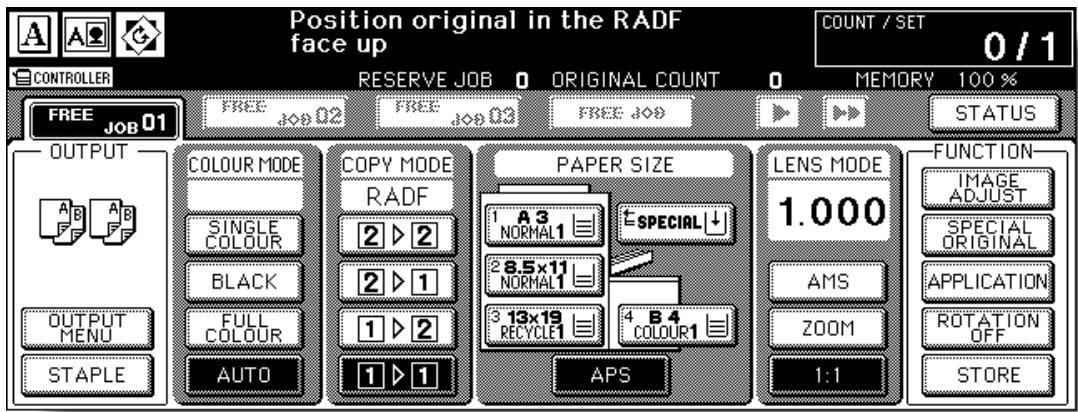
3. The Basic Screen will be displayed.
The message on the Basic Screen will inform you that copying job is now available.

DETAILS
- When the initial settings are changed by the Key Operator, the modified conditions will be displayed on the Basic Screen.
- When “Enter E.K.C. password” is displayed, enter your password to use the machine.
- When “Set the key counter” is displayed, insert the key counter to its inlet on the right side of the main body.
To Turn Off the Power
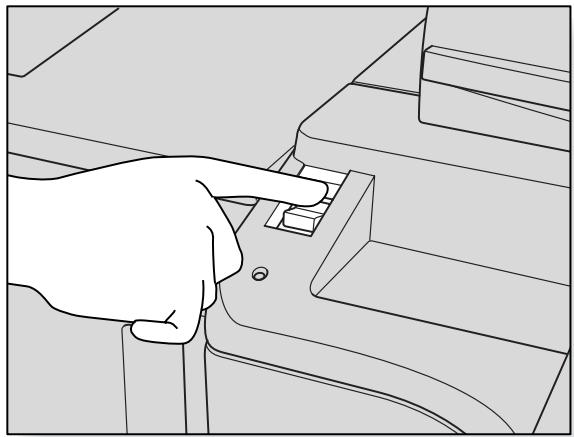
1. Turn OFF the power switch.
The power switch is located on the left side of the control panel. The touch screen and all the LEDs on the control panel will go out.
natural_image
Line drawing of a hand pressing a button on a mechanical component (no text or symbols)
Reminder!
Be sure not to use the main power switch in usual operation.

DETAILS
When the machine is under control of the Weekly Timer function, turning off the power switch will deactivate the function.
Reducing the Power in Standby Mode (Auto Low Power)
This function automatically lowers the power after a specified period (initially 15 minutes) of copier inactivity. The LCD screen will go off.

HINT
The Auto Low Power function can be set to 5 minutes/ 10 minutes/ 15 minutes/ 30 minutes/ 60 minutes/ 90 minutes/ 120 minutes/ 240 minutes in the Key Operator mode. For information about the Key Operator setting, see p. 14-36.
To start a copying job, press any key on the control panel.
The Auto low power will be released and the LCD screen recovers usual brightness.

DETAILS
- If the Auto Shut-Off function activates at the same time, the power will be turned off without the LCD screen becoming dark.
- The LCD screen will not go off during a duplex copying job or when the Jam Position Screen is displayed.
Shutting Off Automatically (Auto Shut-Off)
This function automatically shuts off the power after a specified period (initially 90 minutes) of copier inactivity.
To start a copying job, press [POWER SAVER ON/OFF].
The copying operation will become available.
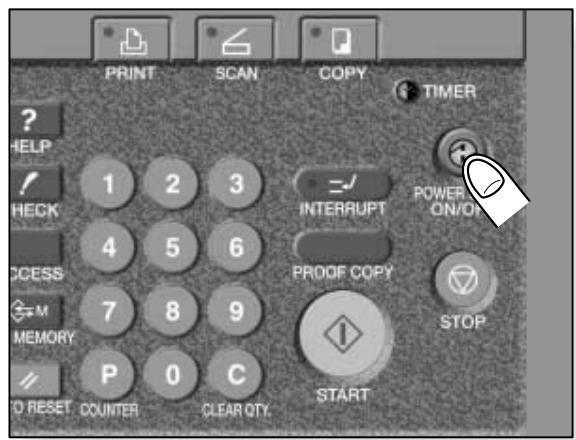

HINTS
- The Auto shut-off can be set for 30 minutes/ 60 minutes/ 90 minutes/ 120 minutes/ 240 minutes in the Key Operator mode. For information about the Key Operator setting, see p. 14-36.
- When "Timer interrupt mode / Enter password" is displayed after pressing [POWER SAVER ON/OFF], see p. 8-2 and follow the procedure to continue.
Shutting Off / Reducing the Power Manually
Follow the procedure below to shut off the power manually.

HINT
The machine is initially set to activate the Manual Shut-Off function. The Manual Low Power can be selected in the Key Operator setting. See p. 14-37 to p. 14-42.
1. Press [POWER SAVER ON/OFF] for one second or longer, then release it.
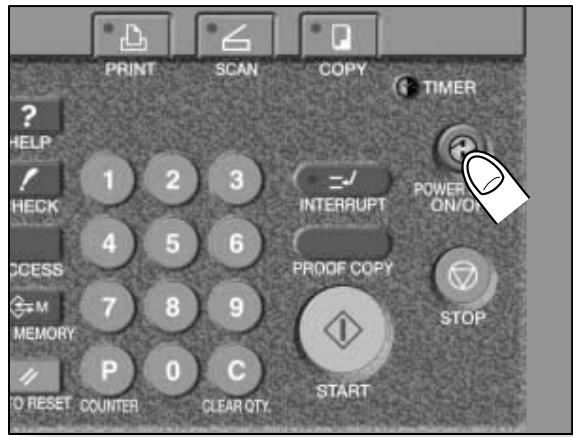
![KONICA MINOLTA 8050 - Press [POWER SAVER ON/OFF] for one second or longer, then release it. - 2](/content/2025/01/139766/images/8df43b5e9d9de4a55fdcc645d5f204dfd1e660b94f18ef343477fc936972c529.jpg)
DETAILS
If Manual Low Power is selected in the Key Operator setting, the machine automatically activates the Low Power mode before releasing [POWER SAVER ON/OFF].
2. The Shut-Off mode will be activated.
The [POWER SAVER ON/OFF] LED will be lit and all other LEDs and the LCD screen will be turned off.

DETAILS
Be sure to press [POWER SAVER ON/OFF] for one second or longer, otherwise the following message will be displayed and the Shut-Off (Low Power) mode will not be activated.
Press POWER SAVER more than one second, then release it for shut off mode
Press POWER SAVER continuously more than one second for low power mode
To release the mode, press [POWER SAVER ON/OFF].
The machine will be available for copying operation.
Entering an EKC Password (EKC)
The Electronic Key Counter (EKC) allows the Key Operator to monitor all copying activities by controlling EKC password accounts. Copy quantity limits for specific accounts can be set.
The EKC is not factory-set. An EKC password is required only when the EKC is activated, a User Password is assigned, and “Enter E.K.C. password” is displayed on the touch screen.
Copying will be available by following procedure:

HINT
For details of the EKC setting, see p. 14-12 to p. 14-19.
1. Enter EKC password.
Enter your 8-digit EKC password, using the keypad.

HINT
To set an EKC password, see p. 14-14 to p. 14-16.

DETAILS
If an invalid EKC password is entered, continue by entering the correct password.
2. Press [START].
Your current copy count and copy limit will be displayed for 3 sec.
Current count / limit 018888/025000
3. Start a copying job.
When the message changes to “Ready to copy”, copying job is available on the machine.

DETAILS
When your copy count reaches the copy limit, the message “Copy limit reached” will be displayed. In that case, contact the Key Operator to reset your copy limit.
4. Press [ACCESS].
The initial state will be restored, with the message “Enter E.K.C. password” displayed on the screen.
A paper indicator is shown on each tray key of the Basic Screen to indicate the paper level (six levels are provided: || | || | || | || | || _| ) of the tray. (The Multi-sheet bypass tray displays only “ ” when paper in the tray becomes empty.)
When paper supply in a tray becomes low, the indicator “ _ ” appears on the tray key, and then it changes to “ ” when paper in that tray becomes empty and the tray key blinks on the screen.
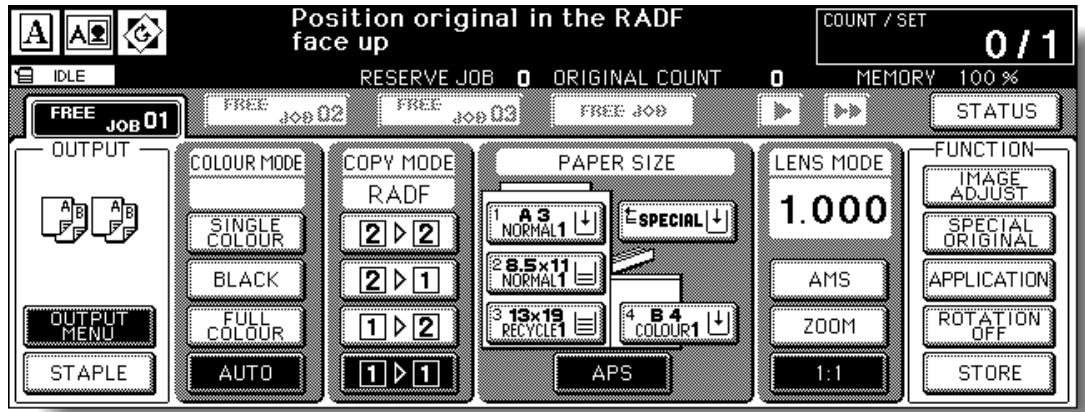
Follow the procedure below to supply the empty tray with copy paper.
![KONICA MINOLTA 8050 - Press [ACCESS]. - 2](/content/2025/01/139766/images/62b715023eb18320c199234f8f9beeede78fcf534d6fe7e234b5f59a25627e0c.jpg)
DETAILS
Each tray key displays a paper type and a number which indicates the paper weight to be loaded. The following paper types are provided:
Normal, Recycled, Coloured, High Q, Coated, Colour sp, Tab paper, Exclusive A to D
The numbers corresponding to the paper weight are:
1: 64\~74 g/m ^2
2: 75\~80 g/m²
3: 81\~105 g/m²
4: 106\~162 g/m²
5: 163\~209 g/m²
6: 210\~256 g/m ^4 (for LCT and Multi-sheet bypass tray only)
Key Operator can change this setting. See p. 14-21 to p. 14-22 for the main body trays and the LCT. See p. 3-18 to p. 3-21 for the Multi-sheet bypass tray.

Reminder!
- Be sure to load only the paper type and weight set for the tray.
- Using paper with punch holes, copy result may not be satisfactory due to the hole positions.
Loading Paper in Tray 1,2, and 3
1. Withdraw tray 1, 2, or 3, and open the paper feed roller.

CAUTION
Do not withdraw the tray forcibly; otherwise you may be injured.
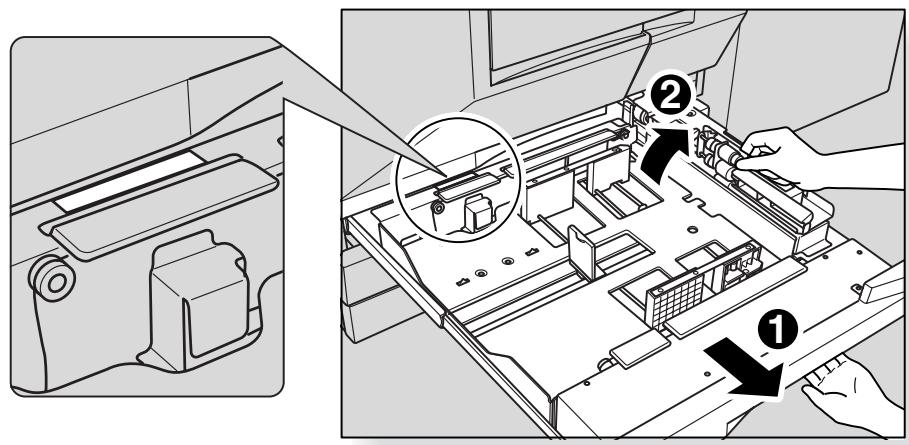

Reminder!
Withdraw the tray completely until the green line appears at the left rear side of the tray. Otherwise, the paper feed roller may not open or machine trouble may be caused.
To load the same size as loaded before, proceed to step 4. If changing the paper size, proceed to the next step.
2. Adjust the position of the side guide plate.
Pull up the lock lever at the front, then slide the side guide plate to the desired position.

DETAILS
See the size indication on the bottom plate of the tray to determine the position of the side guide plate.
Push down the lock lever firmly until it clicks in position in order to fix the side guide plate.
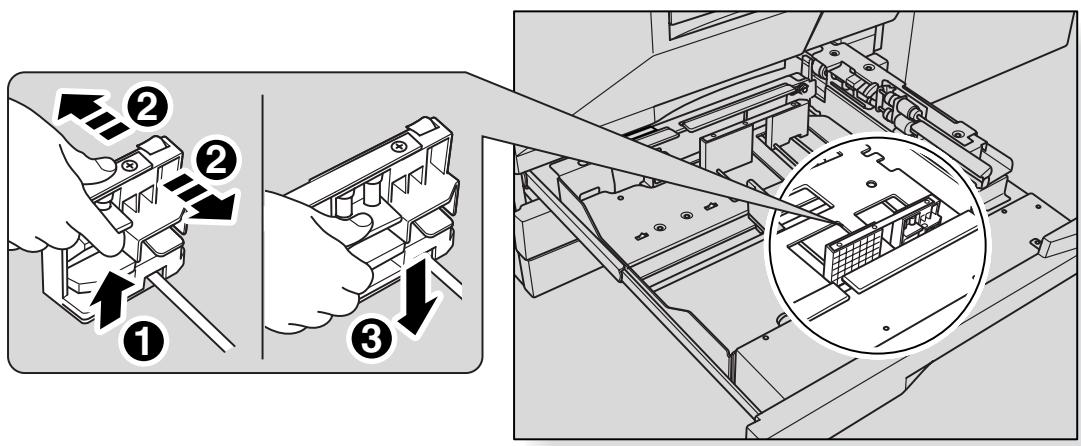

Reminder!
Be sure to fix the side guide plate in position according to the size indication on the tray bottom plate so that the machine can detect the correct paper size.
3. Adjust the position of the rear stopper.
To slide the rear stopper to the right, hold it at the upper part and slide it while pressing down slightly.
On the other hand, hold the rear stopper at the lower part to slide it to the left.
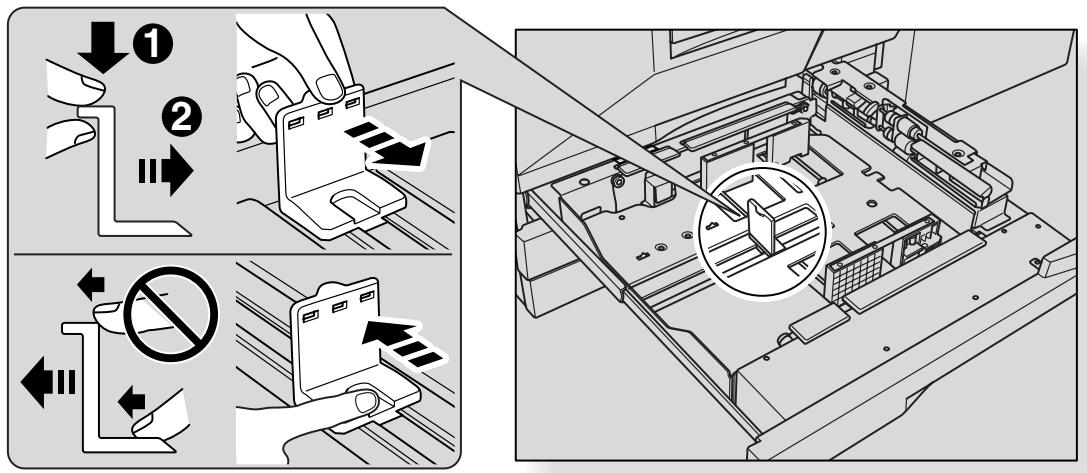

Reminder!
Be sure to press down the rear stopper when moving it to the right, and also be sure to hold it at the lower part when moving it to the left. Do not move the rear stopper forcibly, otherwise it may be damaged.
4. Place paper on the tray.
Load paper aligning it to the right side of the tray, then align the rear stopper to the paper.
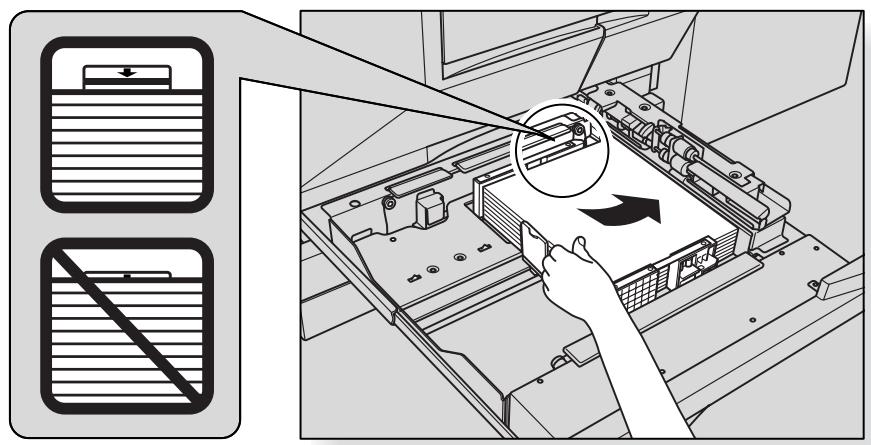

Reminder!
- Be sure that the rear guide plate is securely aligned to the paper; otherwise machine trouble may occur.
-
Do not load above the limit indicated on the side guide plate.
-
When paper is seated properly, close the paper feed roller.
- Gently push in the tray until it locks into place.
The indicator “↓” on the tray key will change to “≡”.

Reminder!
Do not clam the tray into the main body; otherwise machine trouble may be caused.
Loading Paper in Multi-Sheet Bypass Tray
When using the Multi-sheet bypass tray, specify the paper type to be loaded on the tray at the same time. See p. 3-18 to p. 3-21 for details.
1. Open the Multi-sheet bypass tray located on the right side of the copier.
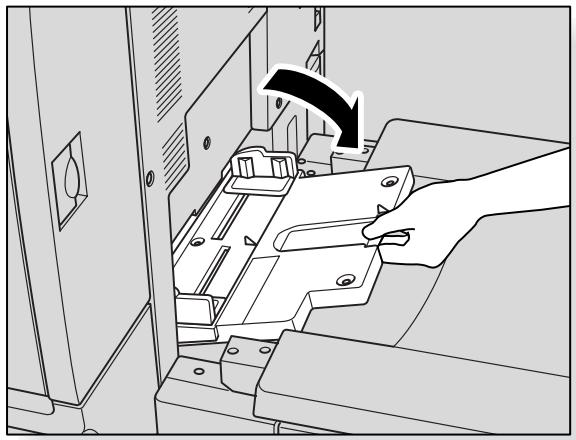
natural_image
Illustration of a hand inserting a component into a device panel, showing a black arrow indicating the direction (no text or symbols present)2. Load copy paper, and adjust the paper guides to the paper size.
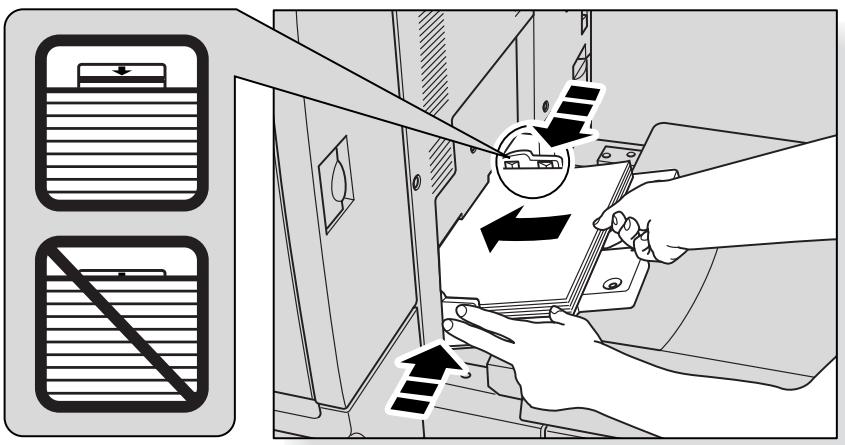

Reminder!
- Stack paper up to 250 sheets 90 ~g / m^2 . When loading special paper, do not exceed the limit indicated on the paper guides, otherwise paper misfeed may occur.
- The transparency film or ink-jet paper is not available on this machine. Do not load the transparency film or ink-jet paper on the Multi-sheet bypass tray.
3. When copying is completed, close the Multi-sheet bypass tray.
Loading Paper in LCT (LT-211)
1. Open the LCT top door.
The LCT bottom plate will go up.
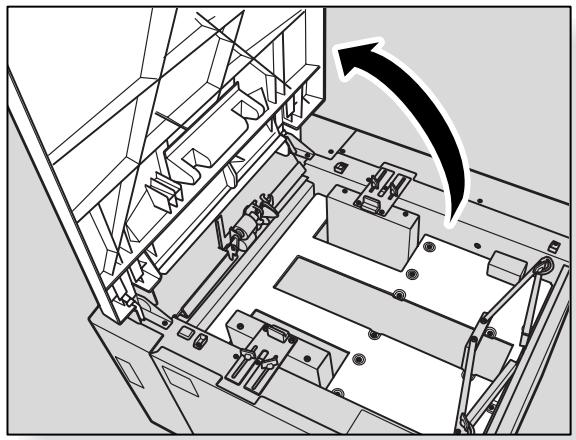
natural_image
Technical line drawing of a mechanical assembly with no visible text or symbols
Reminder!
Without the power turned on, the LCT bottom plate will not function. Be sure to turn on the power switch before loading paper in the LCT.
To load the same size as loaded before, proceed to step 3. If changing the paper size, proceed to the next step.
2. Adjust the position of the LCT paper guides and rear stopper.
(1) Turn the four LCT paper guide knobs and two rear stopper knobs counterclockwise to loosen them.
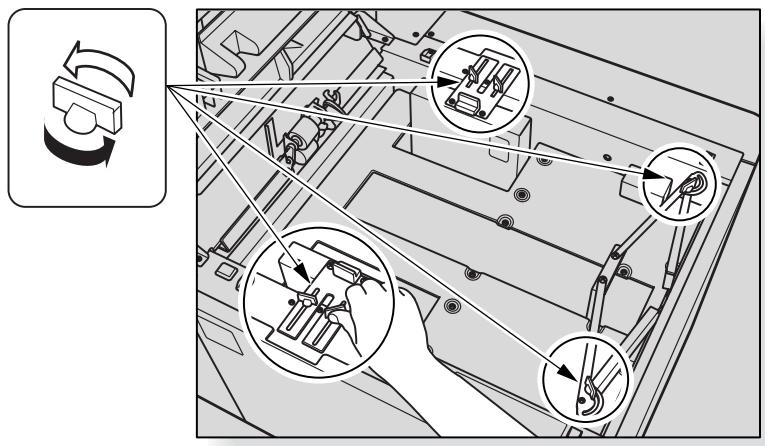
(2) Move the upper part of the two LCT paper guides to the appropriate positions according to the size indication, then turn the LCT paper guide knobs (two for each) clockwise to fix the guides.
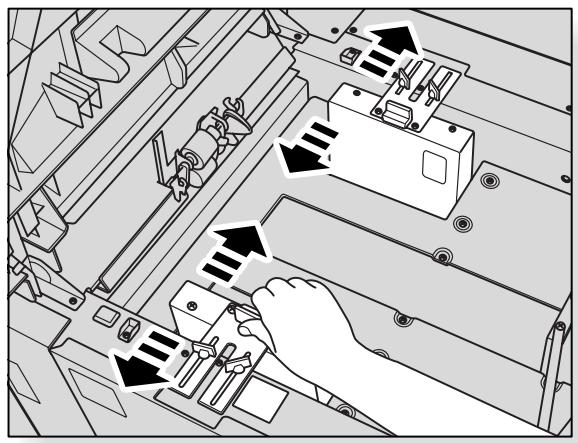
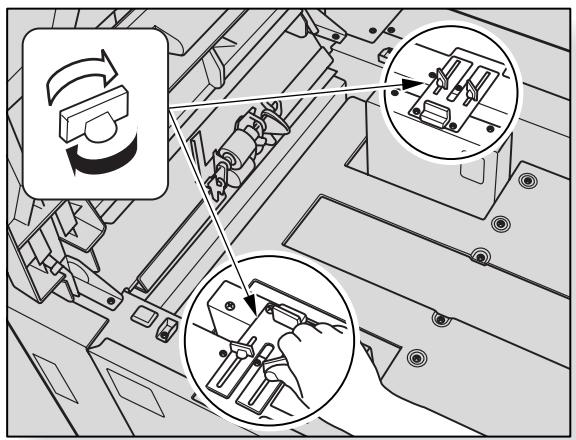
(3) Move the position of the rear stopper to the appropriate positions according to the size indication on the bottom plate, then turn the two rear stopper knobs clockwise to fix the rear stopper.
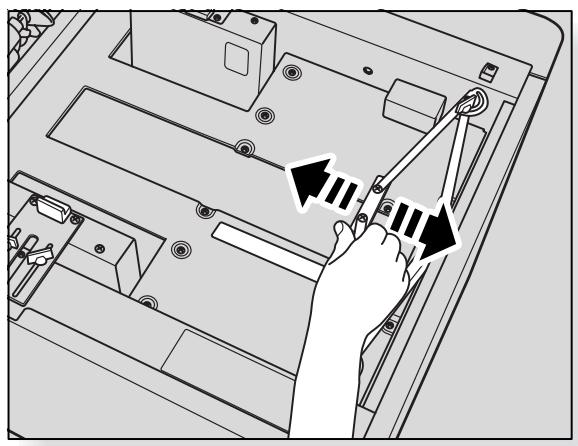
natural_image
Illustration of a hand using a tool to adjust or install electronic components on a device chassis (no text or symbols visible)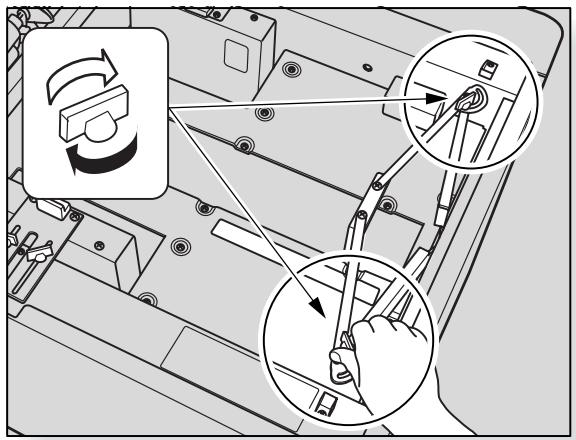
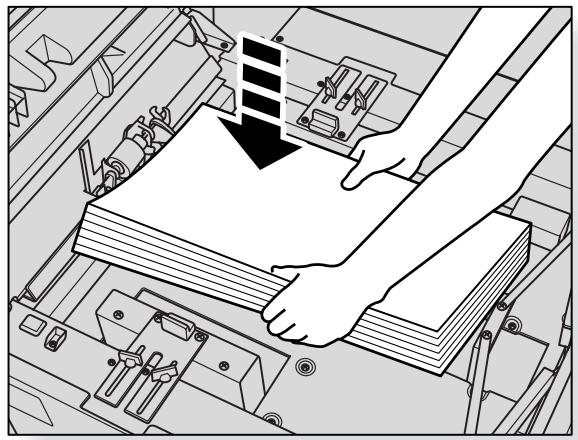
3. Press the paper loading button once, then load the paper into the LCT.
The LCT bottom plate will go down.
natural_image
Illustration of hands operating a document with a black arrow indicating a drop or change (no text or symbols present)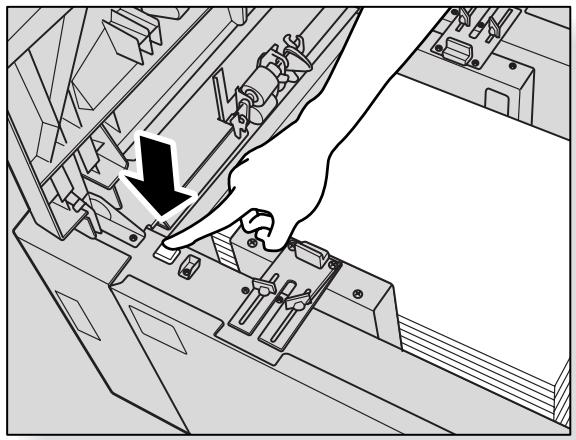
natural_image
Technical line drawing of a mechanical assembly with a hand holding a tool, showing no text or symbols.4. Repeat the step 3 until the bottom plate will not go down any more.
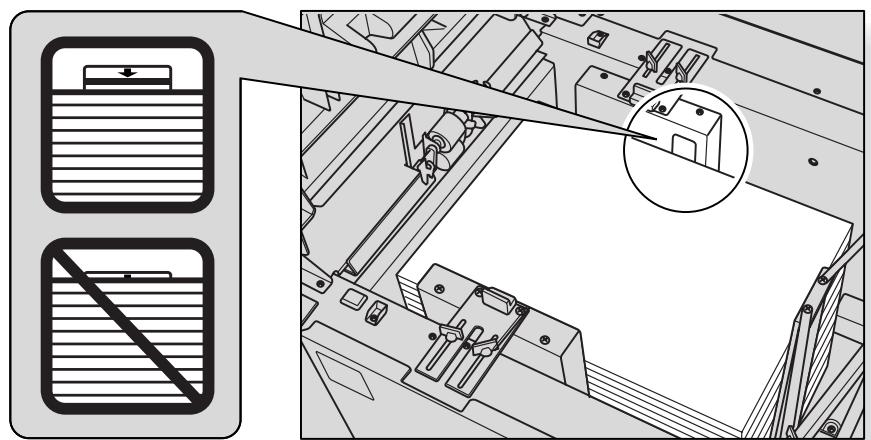
natural_image
Technical diagram of a printer or printer mechanism with no visible text, numbers, or symbols.
Reminder!
- Do not load above the limit indicated on the LCT paper guides.
- Be sure that the rear stopper is correctly positioned according to the paper size to be loaded; otherwise machine trouble may occur.
5. Close the LCT top door.
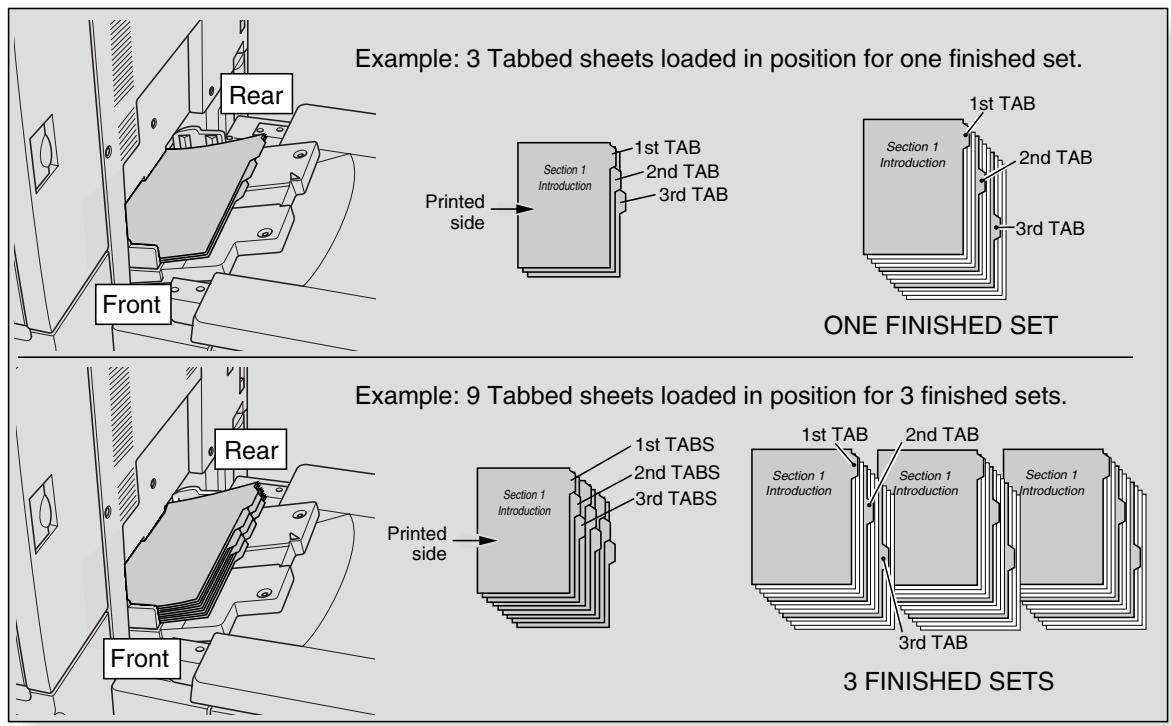
Loading Tabbed Sheets in Tray 1, 2, or 3
When TAB is displayed on the tray key of the Basic Screen, follow the procedure below to supply the tray with tabbed sheets.

HINT
The tray paper type can be specified in the Key Operator setting. For details, see p. 14-21 to p. 14-22.
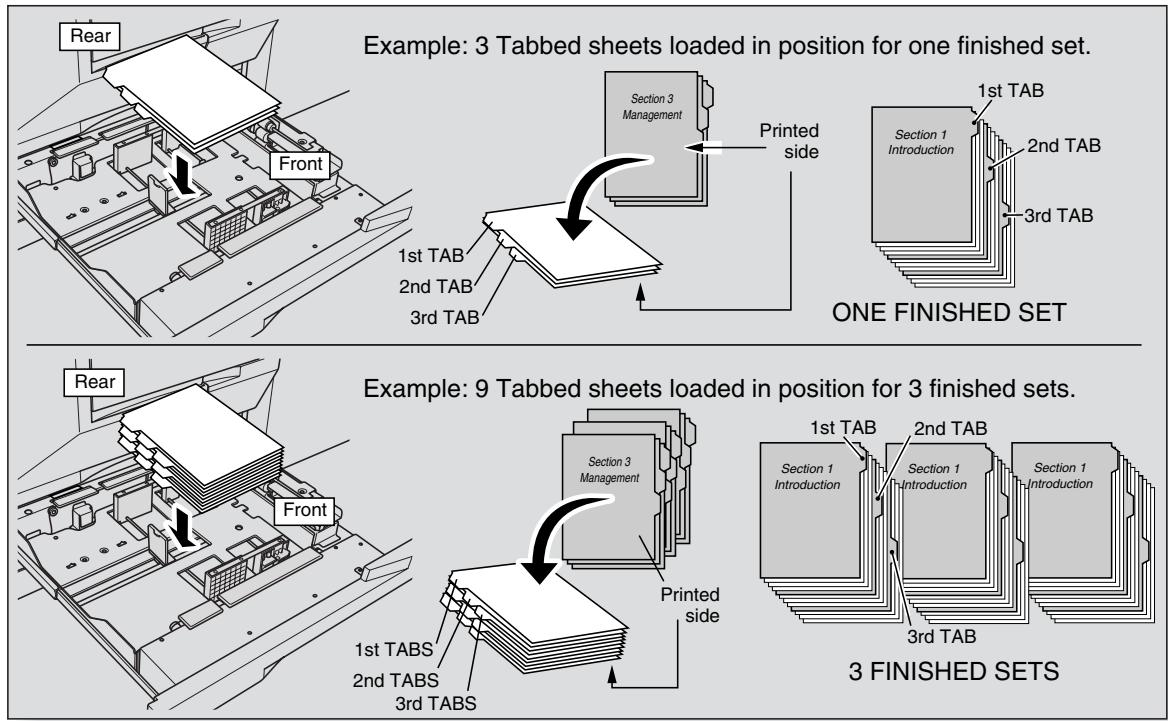

Reminder!
The tab extension width must be 12.5 mm or less.
- Withdraw tray 1, 2, or 3.
- Open the paper feed roller.
- Place the tabbed sheets on the tray as illustrated above.
- Move the green levers (located at the front and the left side) to the edge of the paper.
- Close the paper feed roller, then push in the tray until it locks into place.
Loading Tabbed Sheets in LCT (LT-211)
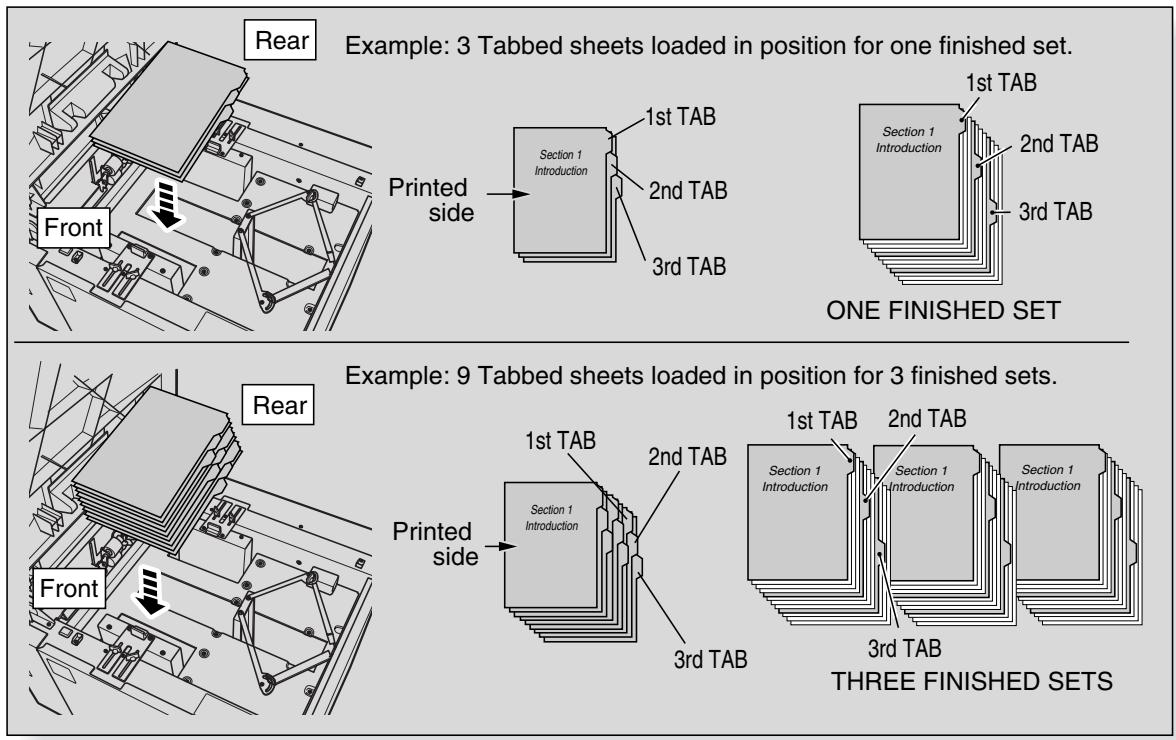

Reminder!
- The tab extension width must be 12.5 mm or less.
-
To load the tabbed sheets into LCT, contact your service representative to position the rear stopper for the paper size to be loaded.
-
Open the LCT top door.
- Press the paper loading button to lower the LCT bottom plate.
- Load the tabbed sheets into the LCT as illustrated above.
- Close the LCT top door.
Loading Tabbed Sheets in Multi-Sheet Bypass Tray

Reminder!
The tab extension width must be 12.5 mm or less.
- Open the Multi-sheet bypass tray located on the right side of the copier.
- Load tabbed sheets as illustrated above.
- Adjust the paper guides to the paper size.
- Specify the paper type as TAB for the Multi-sheet bypass tray.

HINT
See p. 3-18 to p. 3-21 for specifying the paper type of the Multi-sheet bypass tray.
SECTION
3
Copying Operations
How to Make a Basic Copy
Selecting Colour Mode 3-2
Positioning Originals.... 3-4
Setting Print Quantity.... 3-10
Setting Job During Warm-up 3-11
To Stop Scanning/Printing 3-13
Selecting Paper Size 3-14
Copying Using Special Paper (Multi-Sheet Bypass Tray)... 3-18
Selecting Magnification Ratio (Lens Mode) 3-22
Making Double-Sided Copies (1▶2, 2▶2).... 3-25
Making Single-Sided Copies from Double-Sided Originals (2▶1). 3-31
To Scan Originals into Memory (Store Mode) 3-33
To Set Next Copying Job (Reserve).... 3-35
To Check/Control Jobs in Progress (Job Status Screen) ... 3-38
Output Mode for Machine without Finisher 3-41
Output Mode for Machine with Finisher.... 3-45
Selecting Binding Mode.... 3-52
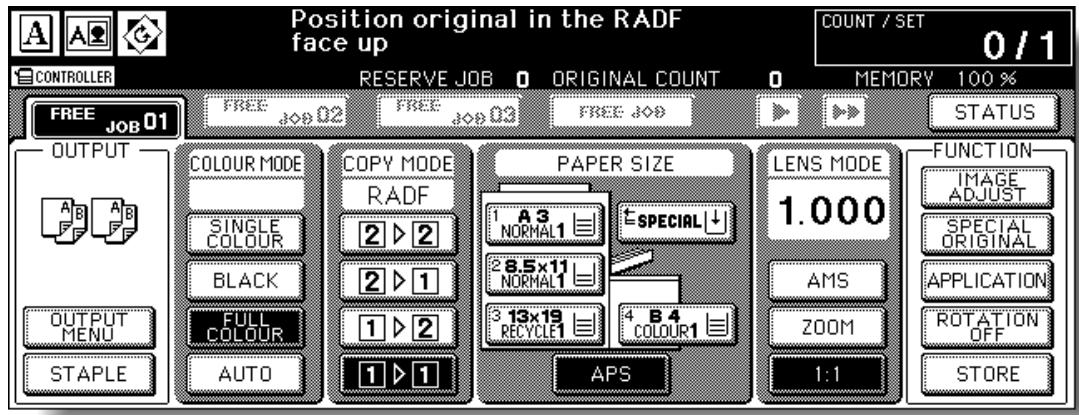
The following four colour modes are available:
AUTO mode detects whether the scanned original is coloured or black-and-white image, and automatically selects either FULL COLOUR mode or BLACK mode for copying.
FULL COLOUR mode makes full-coloured copies whether the original image is coloured or not.
BLACK mode makes black-and-white copies whether the original image is coloured or not.
SINGLE COLOUR mode copies in one colour to be selected from red, green, blue, magenta, cyan, or yellow.
The FULL COLOUR mode is initially selected. Follow the procedure below to change the Colour mode.
Specification for Colour Mode
☐ A colour mode is incompatible with another colour mode.
☐ Incompatible with AUTÓ: Tab Paper, Fold/Stitch&Fold/Trimming (with Booklet selected), Combination, Booklet, Reverse Image, Overlay, Overlay Memory
☐ Incompatible with FULL COLOUR: Tab Paper, Reverse Image
☐ Incompatible with SINGLE COLOUR: Tab Paper

HINT
The colour adjustment function is provided on this machine. See Section 7: Colour Adjustment.

DETAILS
Some adjustments cannot be made in the BLACK mode and SINGLE COLOUR mode.
Incompatible with BLACK: Hue/Saturation/Brightness in Colour Adjust, Colour Balance, Any function except Auto in Screen, Colour/Text of Image Judge in Others, Original Type in Special Original
Incompatible with SINGLE COLOUR: Hue/Saturation/Brightness in Colour Adjust, Colour Balance, Colour/Text of Image Judge in Others, Original Type in Special Original
1. Touch a mode key under the COLOUR MODE on the Basic Screen to select the desired Colour mode.

Reminder!
When starting a new copying job, be sure to close the RADF securely, then press [AUTO RESET].
FULL COLOUR is already highlighted when the initial settings are restored.

HINT
The initial settings may have been altered by Key Operator. See p. 14-10 for details.
Selecting SINGLE COLOUR will display the popup menu to specify a colour.
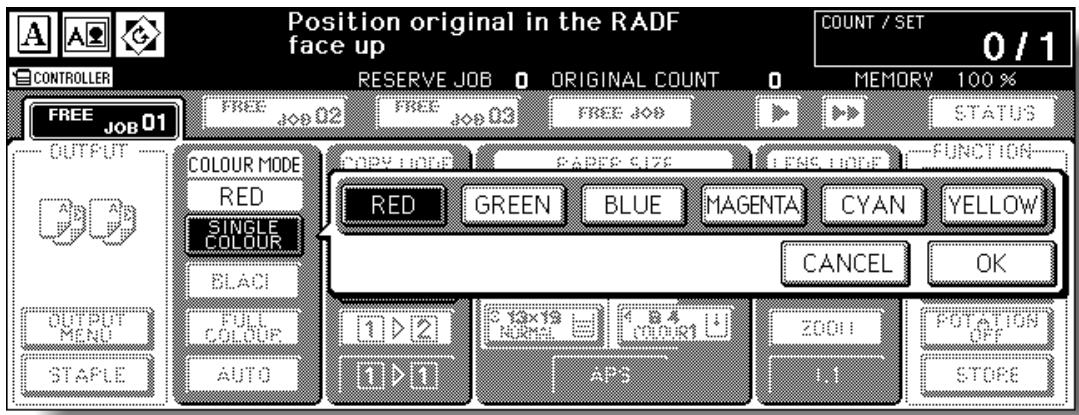
Touch the desired colour key, then touch OK.
The selected colour will be indicated under the COLOUR MODE indication of the Basic Screen, with the SINGLE COLOUR key highlighted.

DETAILS
Touch CANCEL to restore the previous setting.
- Select additional copy conditions, as desired.

HINT
If the colour adjustment is desired, see Section 7: Colour Adjustment.
- Enter the desired print quantity from the control panel keypad.

HINT
See p. 3-10 for details on setting print quantity.
- Position original(s).

HINT
See p. 3-4 to p. 3-9 for details on positioning originals.
- Press [START].
Set the originals in the RADF or on the platen glass to copy.
Positioning Originals in RADF
The document feeder (RADF) automatically feeds up to 100 originals directly to the platen area, starting with the top sheet. The RADF should only be used for unstapled, smooth, flat originals.

HINT
See p. 12-10 for details of the original sizes available in the RADF.
Positioning originals in Normal mode
1. Arrange originals in order.
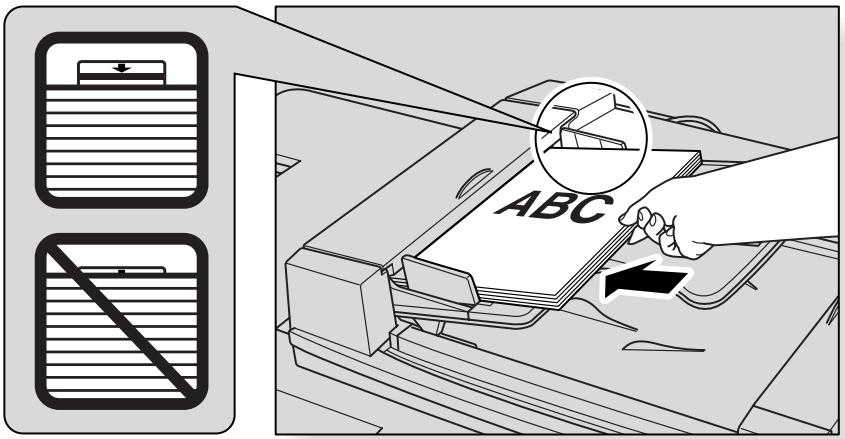
2. Position original(s) FACE UP in the document feeder tray.
Place two-sided originals with page one FACE UP.
The direction of the originals should conform to the Original direction icon displayed at the upper left corner of the Basic Screen.
Up to 100 originals can be set at a time.

Reminder!
- The copy result may not be satisfactory if the originals are set in wrong direction. Be sure that the originals are set in the same direction as indicated by the Original direction icon, especially when making double-sided copies or using Staple, Stitch&Fold, Fold, or Booklet mode. See p. 9-2 to p. 9-3 for details.
- Be sure not to use unsuitable RADF originals. See p. 12-9 for details.
- Do not set more than 100 originals or over the limit indicated on the paper guides; otherwise a paper misfeed will occur to cause damage to the originals.

Reminder!
Before placing originals in the tray, be sure the document feeder is closed fully. Once closed, do not open the document feeder, otherwise the selected copy conditions may be altered automatically.
3. Adjust paper guides.
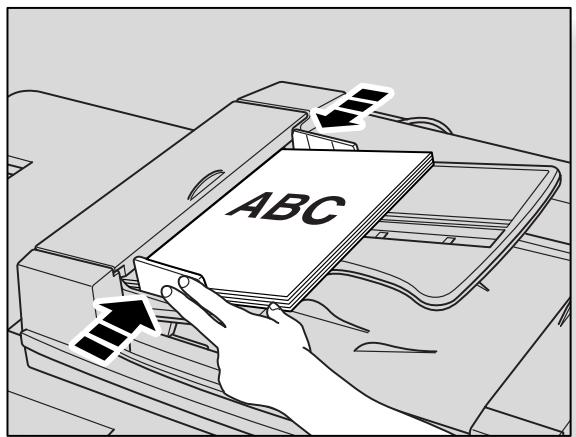
Positioning originals in Mixed original mode
Mixed size originals can be copied together from the document feeder.

HINTS
• To use the Mixed original mode, see procedure on p. 9-6 to p. 9-7.
• See p. 12-10 for available combinations of mixed originals.
1. Arrange originals in order.
Arrange the mixed size originals as illustrated below.
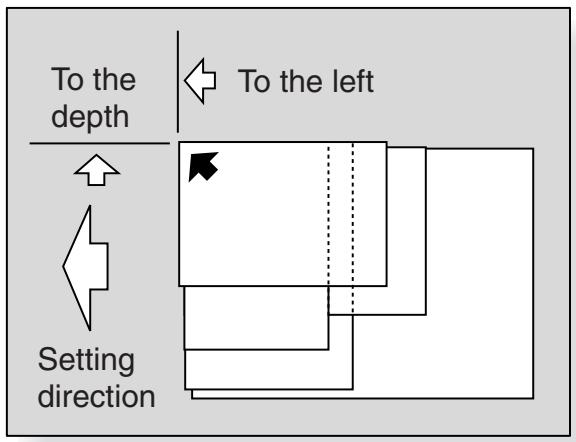
2. Position mixed originals FACE UP, aligned with the left rear side of the document feeder tray.
Place two-sided originals with page one FACE UP.
Up to 100 originals can be set at a time.

Reminder!
- Be sure not to use unsuitable RADF originals. See p. 12-9 for details.
- Do not set more than 100 originals or over the limit indicated on the paper guides; otherwise a paper misfeed will occur to cause damage to the originals.

Reminder!
Before placing originals in the tray, be sure the document feeder is closed fully. Once closed, do not open the document feeder, otherwise the selected copy conditions may be altered automatically.
3. Adjust paper guides.
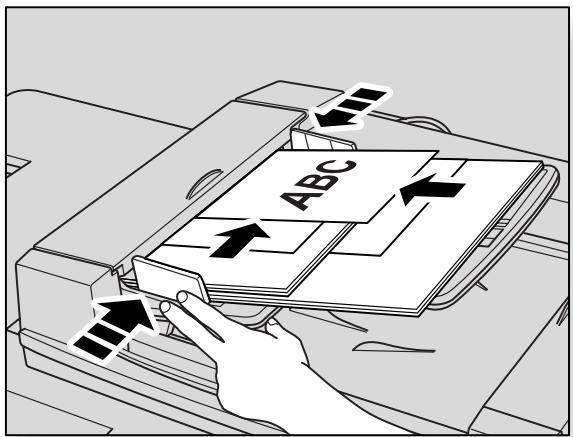
Positioning originals in Z-Folded original mode
Z-Folded original mode detects the folded original size without using the size detection sensor of the RADF.

HINTS
• To use the Z-Folded original mode, see procedure on p. 9-8 to p. 9-9.
• See p. 12-11 for available sizes of folded originals.
1. Arrange originals in order.
2. Position original(s) FACE UP in the document feeder tray.
Place two-sided originals with page one FACE UP. Up to 100 originals can be set at a time.

Reminder!
- Be sure not to use unsuitable RADF originals. See p. 12-9 for details.
- Do not set more than 100 originals or over the limit indicated on the paper guides; otherwise a paper misfeed will occur to cause damage to the originals.

Reminder!
Before placing originals in the tray, be sure the document feeder is closed fully. Once closed, do not open the document feeder, otherwise the selected copy conditions may be altered automatically.
3. Adjust paper guides.
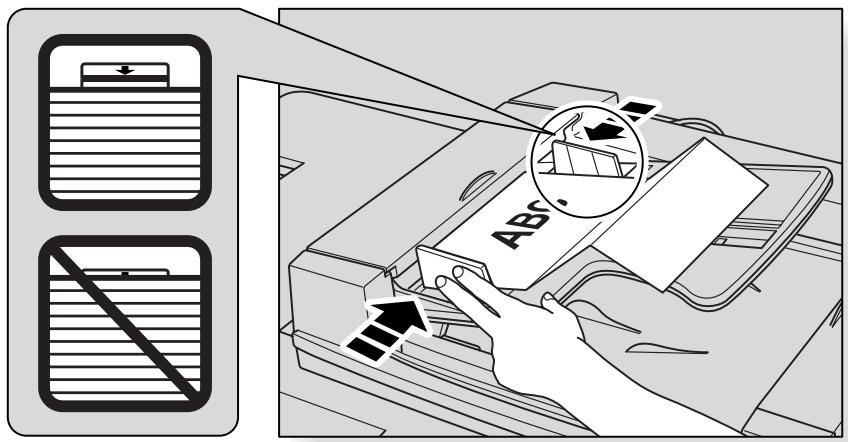
Positioning Original on Platen Glass
Use the platen glass when originals are not suitable for use with the document feeder, e.g., when size is incompatible, or when originals are folded, stapled, torn, or in generally poor condition.
- Raise the document feeder or platen cover.
- Place original FACE DOWN in the left rear corner.
The direction of the original should conform to the Original direction icon displayed at the upper left corner of the Basic Screen.
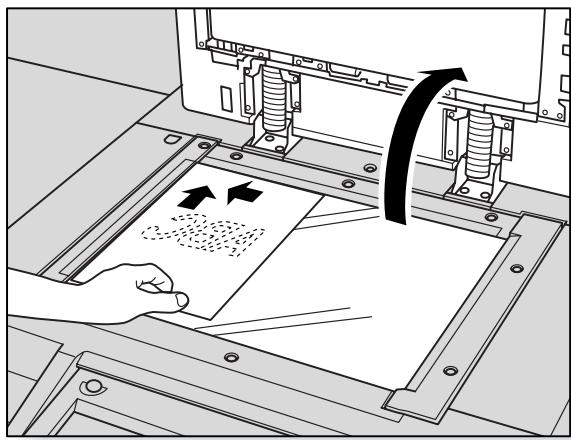
natural_image
Diagram of a printer printing process with arrows indicating motion, no text or symbols present
Reminder!
The copy result may not be satisfactory if the original is set in wrong direction. Be sure that the original is set in the same direction as indicated by the Original direction icon, especially when making double-sided copies or using Staple, Stitch&Fold, Fold, or Booklet mode. See p. 9-2 to p. 9-3 for details.
- Gently close the document feeder or platen cover to prevent the original from shifting on the glass.
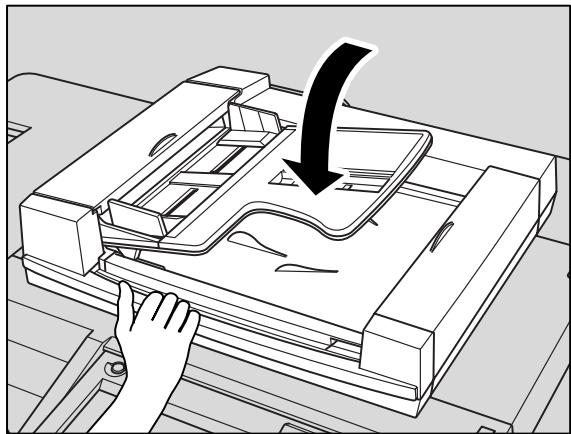
natural_image
Illustration of a hand pressing down on a mechanical device with a black arrow indicating motion (no text or symbols present)
Reminder!
When selecting Dual Page, Non-Image Area Erase, AUTO mode in Repeat, or AUTO Layout, DO NOT CLOSE the document feeder. For details on each function, see Section 10.
CAUTION
Do not place too heavy originals, or do not press strongly when thick original is placed and is under pressure of RADF; otherwise the glass may be broken and you may be injured.
This section describes how to set or change print quantity.
To Set Print Quantity
The copier is initially set to copy the original set in amounts determined by the print quantity setting, then outputs sorted sets.
1. Enter the desired print quantity from the control panel keypad.
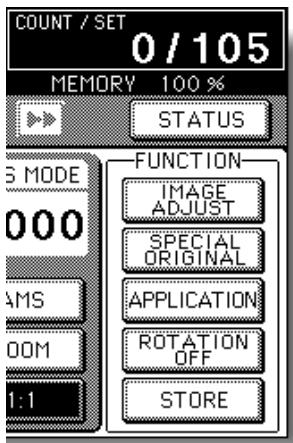
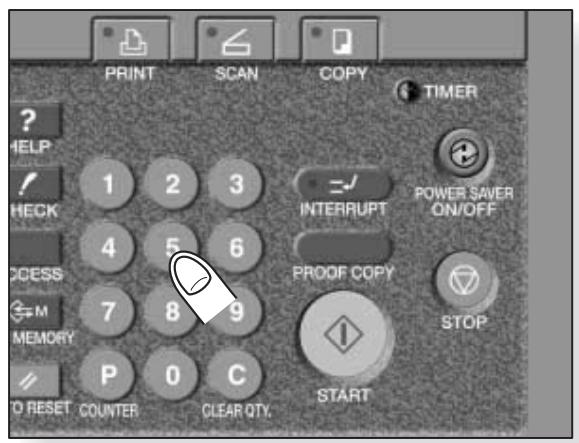
Entered quantity will be displayed on the touch panel.
To Change Print Quantity
Follow the procedure below to change the print quantity that has been already entered.
1. Press [C (CLEAR QTY).].
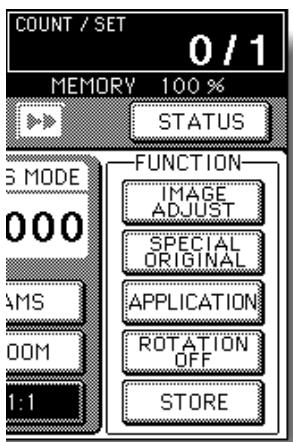
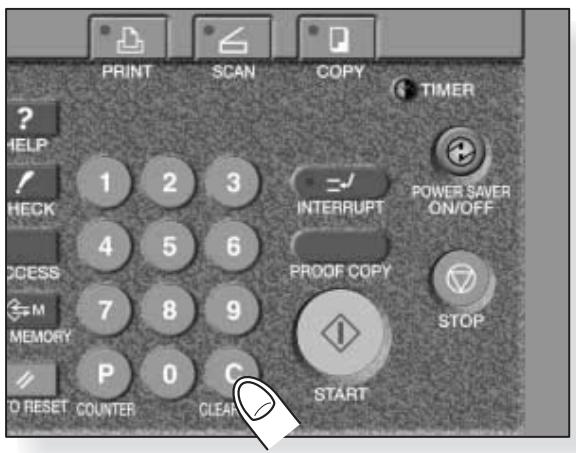
The quantity displayed on the touch panel will return to 1.
2. Enter the correct quantity.
Entered quantity will be displayed on the touch panel.
Setting Job During Warm-up
While the copier is warming up after power is turned on, select copy conditions and start scanning so that the copier may start printing immediately when the copier engine is ready.
1. Turn on the power switch of the machine.
Seven types of Warm-up Screens display in succession.
natural_image
Illustration of a rocket launching into space, with a vertical launch tower and a stylized rocket below (no text or symbols)
HINT
See p. 2-16 to p. 2-17 for details on turning on the power switch.
2. Touch the LCD panel to change the Warm-up Screen to the Basic Screen.
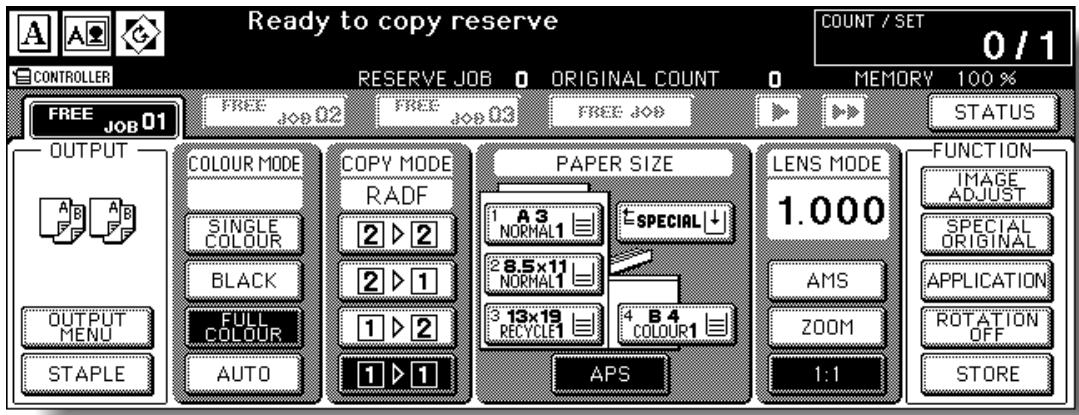
Check that the message “Ready to copy reserve” is displayed on the Basic Screen.
3. Set the desired copying conditions, and enter the print quantity.

HINT
See p. 3-10 for details on setting print quantity.
4. Position original(s) FACE UP in the RADF or FACE DOWN on the platen glass.

HINT
See p. 3-4 to p. 3-9 for details on positioning originals.
5. Press [START].
The original for the job will be scanned, and the highlighted FREE JOB folder key will change to SCAN JOB.
When scanning is completed, SCAN JOB will change to RESERVE JOB, and the next FREE JOB becomes active.
![Copier is warming up Ready to copy reserve/Select [FREE JOB] COUNT / SET 0 / 1 CONTROLLER RESERVE JOB 1 ORIGINAL COUNT 50 MEMORY 83 % RESERVE JOB 01 FREE JOB 02 FREE JOB FREE JOB STATUS OUTPUT A B A B SINGLE COLOUR BLACK FULL COLOUR STAPLE AUTO COPY MODE RADF PAPER SIZE LENS MODE FUNCTION 1 A3 NORMAL1 ESPECIAL↓ 2 8.5x11 NORMAL1 3 13x19 RECYCLE1 4 B4 COLOUR1 AMS ZOOM 1:1 IMAGE ADJUST SPECIAL ORIGINAL APPLICATION ROTATION OFF STORE CAPS](/content/2025/01/139766/images/1a62da393b6ed3dd8ac12986b0a18707a09b279f9757b48b8b57ae5b30021e0a.jpg)
6. If setting more than one reserve job, touch the next FREE JOB to highlight it.
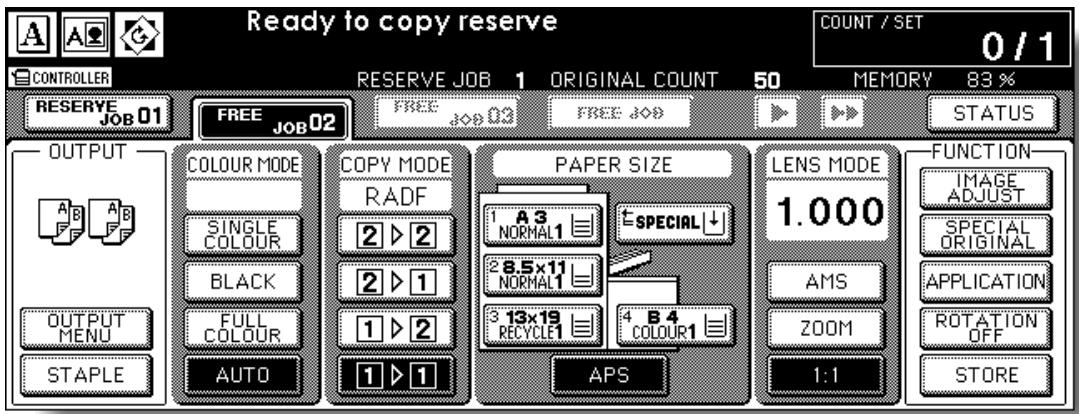
7. Set the desired copying conditions, enter the print quantity, position original(s), then press [START].
Up to 8 reserve jobs can be prepared.
Copying on the reserve job will start automatically after completing the warm-up.
![KONICA MINOLTA 8050 - Set the desired copying conditions, enter the print quantity, position original(s), then press [START]. - 1](/content/2025/01/139766/images/644a3c813d21dca1e4b0f31df0cea8f4f2ae6b33421ed58d0b765fbbdabc3baf.jpg)
DETAILS
- The Job Status Screen allows you to alter the output order of the reserve jobs or to delete the reserve job. See p. 3-38 \~ p. 3-40.
- If all three reserve job keys are used, touch the active FREE JOB key at the far right to scroll. See p. 3-35 \~ p. 3-37.

HINT
To stop printing, press [STOP]. See p. 3-13 for details.
Follow the procedure below to stop scanning or printing.
- Touch to highlight SCAN JOB or PRINT JOB to be suspended.
- Press [STOP].
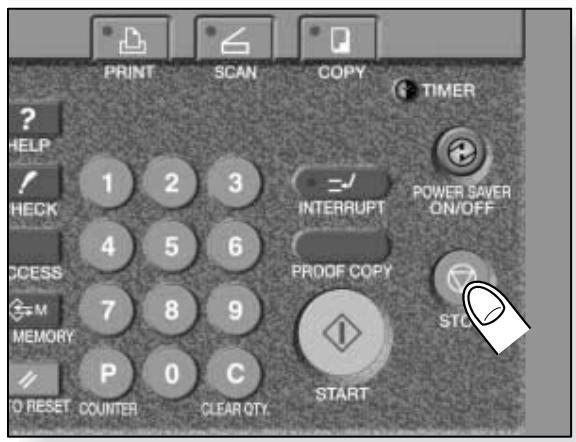
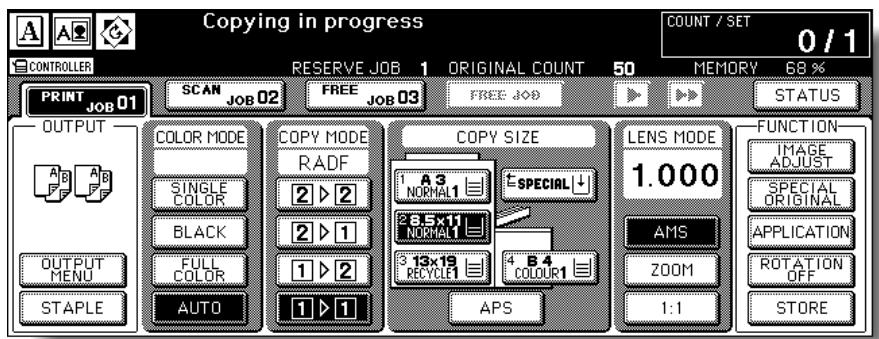
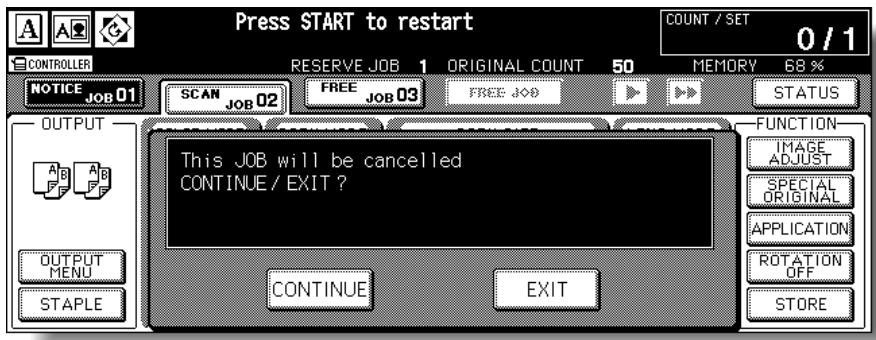
The current machine operation of the selected job will be suspended.

DETAILS
If wrong job is suspended, touch CONTINUE on the popup menu immediately, select the correct job, then press [STOP] to suspend it.
- Touch EXIT to cancel the job.
All the data of the selected job will be deleted.

DETAILS
To restart the suspended job, touch CONTINUE on the popup menu.
To select an appropriate paper size for getting your desired copy result, use APS (Automatic Paper Selection), or select paper size manually on the touch screen, as required.
To Select Paper Size Automatically (APS)
APS detects the size of originals placed on the RADF or platen glass and automatically selects and feeds copy paper of the same size, or selects an appropriate size according to the magnification ratio selected.

Reminder!
APS is not available when using non-standard size or wide size paper.
1. Touch to highlight APS under the PAPER SIZE on the Basic Screen.
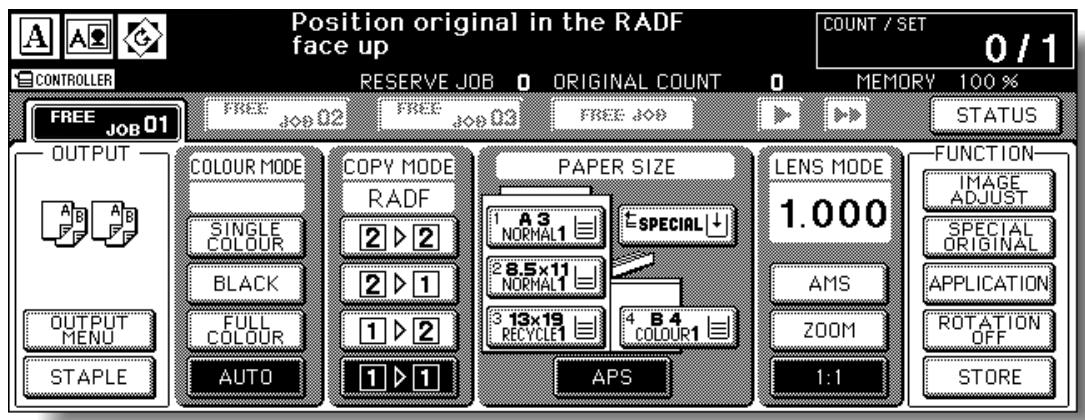
- Select additional copy conditions, as desired.
- Enter the desired print quantity from the control panel keypad.

HINT
See p. 3-10 for details on setting print quantity.
4. Position original(s).

HINTS
- See p. 12-9 to p. 12-11 for the original sizes detectable from the RADF or on the platen glass.
- Detectable original sizes can be changed from AB sizes to inch sizes, only A sizes, or AB sizes and inch sizes mixed. See p. 14-37 to p. 14-42.
• See p. 3-4 to p. 3-9 for details on positioning originals. - Key Operator can deactivate APS when the original is set in the RADF or on the platen glass. See p. 14-37 to p. 14-42.
5. Press [START].
Scanned image will be printed on the paper size automatically selected.
![KONICA MINOLTA 8050 - Press [START]. - 1](/content/2025/01/139766/images/fd0bc12f6be92fb6eb33ad20f07818207640e1373cd4262d1c61dcc8905a7cac.jpg)
DETAILS
- If the appropriate copy paper is not loaded in any tray, no copying will be performed, and a message will prompt you to load the appropriate paper.
- Copy result may not be satisfactory due to the Rotation function. In this case, turn the function OFF manually. See. p. 8-4.
See the table below for the relation of original size, magnification ratio and copy paper size.
To Specify Desired Paper Size (AMS)
When a paper size is specified on the touch screen, an appropriate reduction or enlargement ratio will be selected automatically according to the original size detected from the RADF or the platen glass.

DETAILS
Wide paper size can be specified when AMS is in use.
In this case, the same magnification ratio as that of the standard size will be selected automatically.
1. Touch a tray key on the Basic Screen to select the desired paper size.
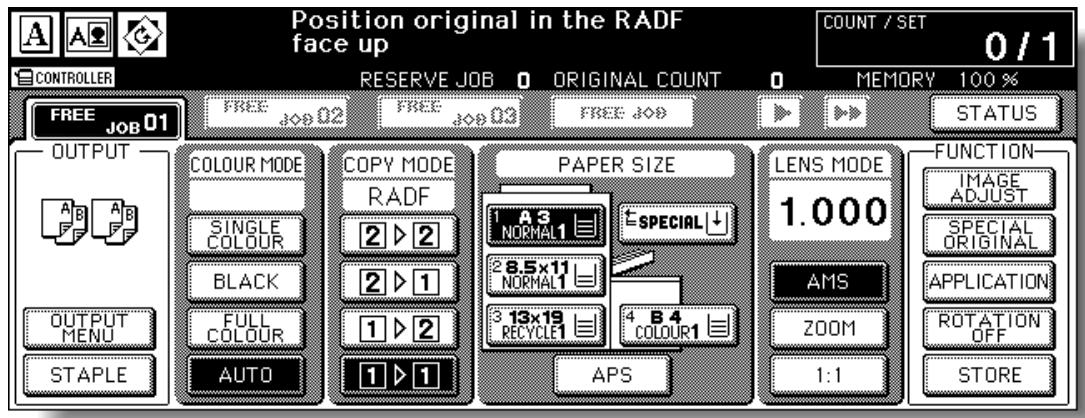
Selected tray key will be highlighted, and under the LENS MODE the AMS key will also be highlighted.

HINT
If copying in 1.000 (100%) magnification mode and specifying a paper size, see p. 3-22.
2. Select additional copy conditions, as desired.
3. Enter the desired print quantity from the control panel keypad.

HINT
See p. 3-10 for details on setting print quantity.
4. Position original(s).

HINTS
- See p. 12-9 to p. 12-11 for the original sizes detectable from the RADF or on the platen glass.
• See p. 3-4 to p. 3-9 for details on positioning originals.
5. Press [START].
Scanned image will be printed on the specified paper size in the magnification ratio automatically selected.
![KONICA MINOLTA 8050 - Press [START]. - 1](/content/2025/01/139766/images/5e7e7251bfbdc54dc75e58cf85f0e931f96fc78809f9d67b976fa8677951494d.jpg)
DETAILS
- Copy result may not be satisfactory due to the Rotation function. In this case, turn the function OFF manually. See. p. 8-4.
- See the table below for the relation of original size, copy paper size, and magnification ratio automatically selected.
Copying Using Special Paper (Multi-Sheet Bypass Tray)
Use the Multi-sheet bypass tray to copy using special (non-standard) paper.
Select the special paper type and weight from the selections previously specified by the Key Operator, then select the size to be loaded on the Multi-sheet bypass tray, as described below.

Reminder!
Transparency cannot be used on this machine. DO NOT load the transparencies into the Multi-sheet bypass tray.

DETAILS
8.5"x11"R and B6R sizes (unavailable in Tray 1 to 4) can be used in the Multi-sheet bypass tray. Also, 210\~256 g/m² paper can be used in the Multi-sheet bypass tray.

HINTS
- To specify the combinations of special paper type and weight to be selected for the Multi-sheet bypass tray, see p. 14-23.
- To specify the special paper type, weight and size in Tray 1 to 4 to be used on a regular basis, see p. 14-21 to p. 14-22.
1. Open the Multi-sheet bypass tray, and load the copy paper.

HINT
See p. 2-26 for further details of loading procedure.
For the specifications of paper in the Multi-sheet bypass tray, see p. 12-2 to p. 12-8.
2. Touch the Multi-sheet bypass tray key in the PAPER SIZE area of the Basic Screen to highlight it.
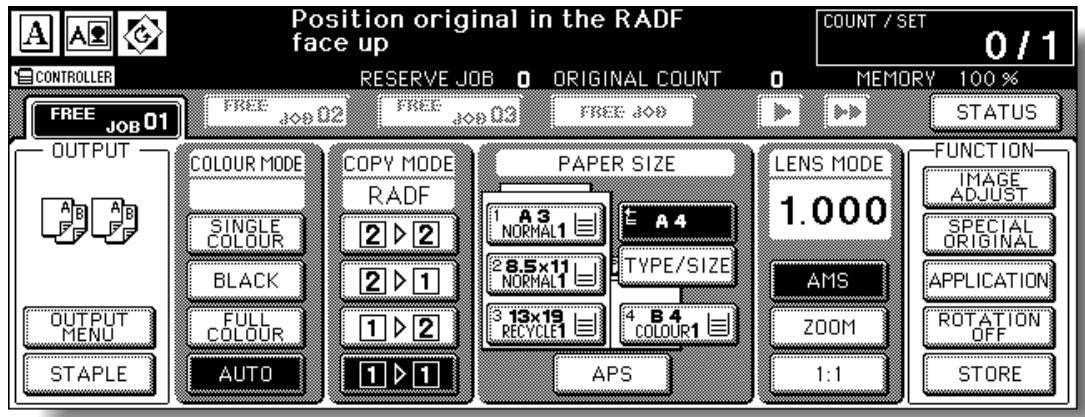
The TYPE/SIZE key will appear under the bypass tray key, APS will be deselected, and AMS will be highlighted on the Basic Screen.
3. Touch TYPE/SIZE.
The Paper Type/Size popup menu will be displayed.
4. Select the paper type and weight.
To select the paper type and weight:
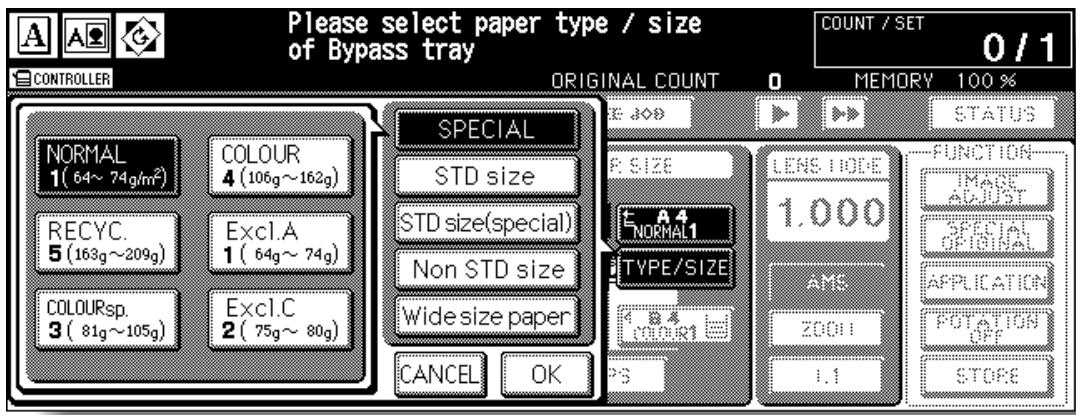
Select the desired one out of the six keys on the menu to highlight it.

HINTS
- If the desired paper type and weight cannot be found on the popup menu, specify it in the Key Operator mode. See p. 14-23 for details.
- When selecting Tab Paper as the special paper type to copy onto the tabbed paper including the tab part, specify the original paper type as Tab Paper on the Special Original popup menu. See p. 9-4 to p. 9-5.
If no paper type and weight indication is needed, touch the highlighted key to clear the selection of the six keys.
The selected paper type and number indicating the paper weight will appear on the bypass tray key of the Basic Screen.
5. Specify the paper size.
When using a standard size, touch STD size to highlight it.
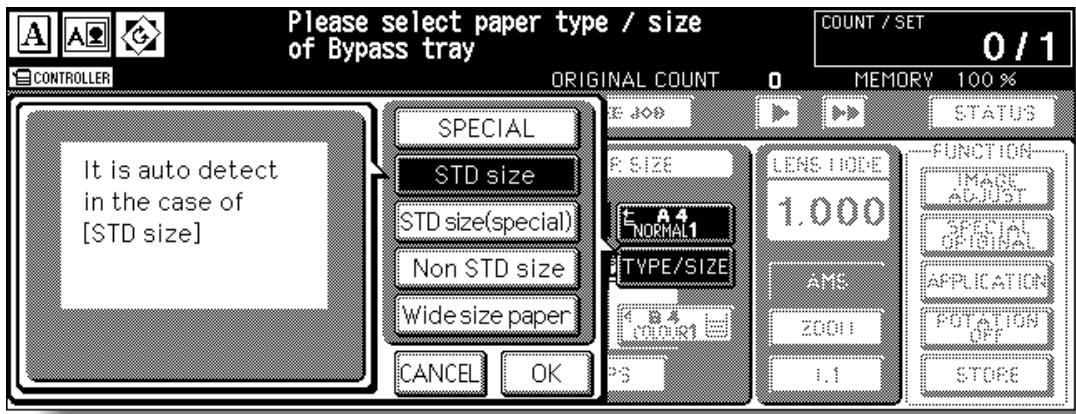
When using a special size, specify the paper size as follows.
Copying Using Special Paper (Multi-Sheet Bypass Tray) (continued)
To select the STD size (special):
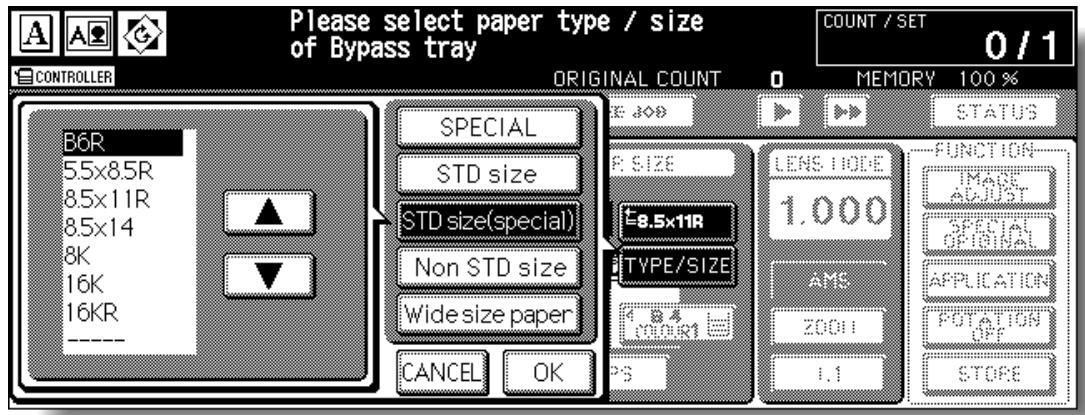
Touch STD size (special) to display the popup menu, then use arrow keys to scroll to the desired size.
To select the Non STD size
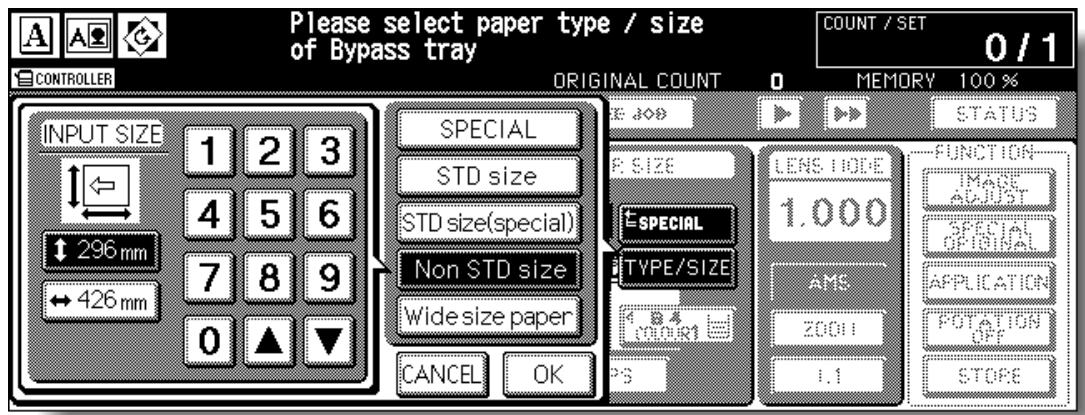
Touch Non STD size to display the popup menu, touch the vertical or horizontal size key to highlight it, then use the keypad on the popup menu to enter the vertical/horizontal size, or use arrows to scroll to that number.
To select the Wide size paper:
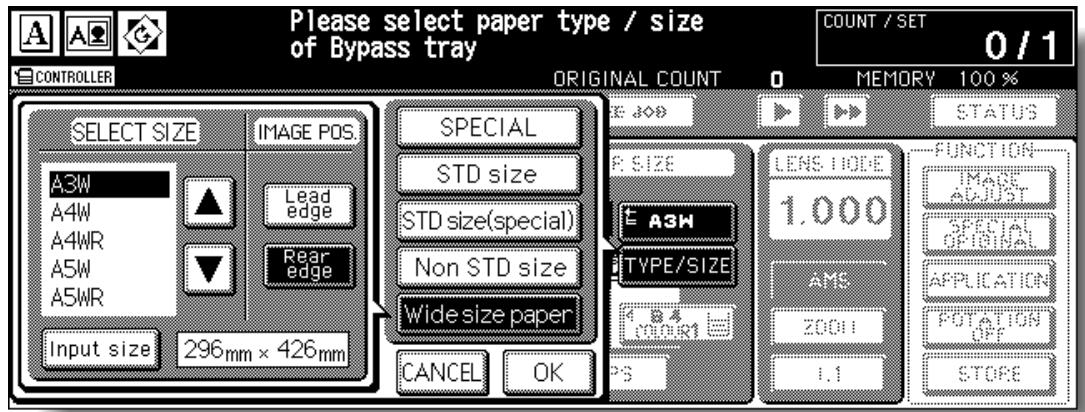
Touch Wide size paper to display the popup menu, use arrow keys to scroll to the desired wide size, then touch Lead edge or Rear edge to
Copying Using Special Paper (Multi-Sheet Bypass Tray) (continued)
select the paper dimensions corresponding to the wide paper sizes entered.
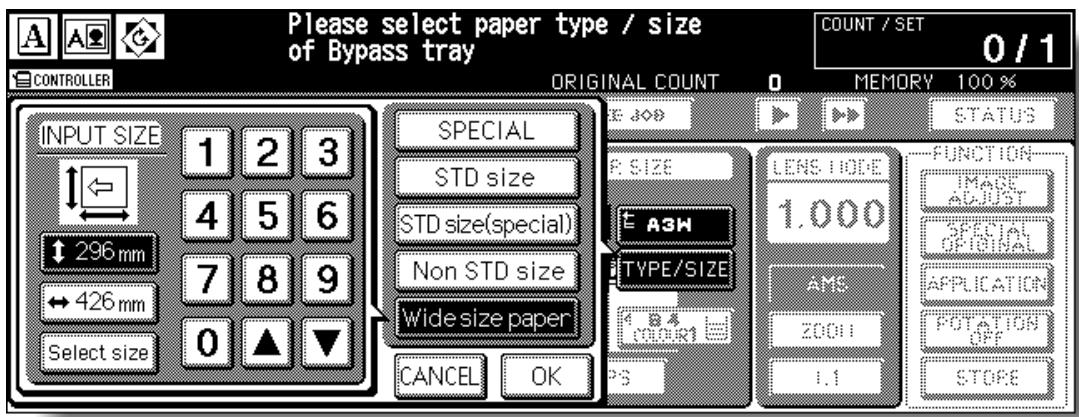
Touch Input size to display the Input Size popup menu, touch the vertical or horizontal size key to highlight it, then use the keypad on the popup menu to enter the vertical/horizontal size, or use arrow keys to scroll to that number.
The entered number should fall within the range from the vertical/horizontal size of the standard size corresponding to the selected wide size, to a maximum of 330 mm/487 mm.

Reminder!
When selecting Wide size paper, be sure to specify the actual size of the wide size paper to be loaded. Wide paper size information is not initially input in this machine.
6. Touch OK.
The Basic Screen will be restored. The bypass tray key shows the specified size, paper type and the number indicating paper weight, and is highlighted along with the TYPE/SIZE key.

DETAILS
When the STD size (special) or Wide size paper is selected, the size specified on the popup menu will be indicated on the bypass tray key. When Non STD size is selected, the SPECIAL indication will appear instead.
- Select additional copy conditions, as desired.
- Enter the desired print quantity from the control panel keypad.

HINT
See p. 3-10 for details on setting print quantity.
- Position original(s) FACE UP in the document feeder or FACE DOWN on the platen glass.

HINTS
• See p. 3-4 to p. 3-9 for details on positioning originals.
- See p. 9-4 to p. 9-5 for details on positioning non-standard size or tabbed paper originals.
- Press [START].
Selecting Magnification Ratio (Lens Mode)
When the copier is turned ON, the magnification ratio is set to 1.000 (100%) automatically on the Basic Screen.
Follow each procedure described in this section to select the desired magnification ratio.
To Copy in 1.000 Magnification Mode
Follow this procedure to make a 100% copy of the original image.
1. Close the RADF securely, then press [AUTO RESET].
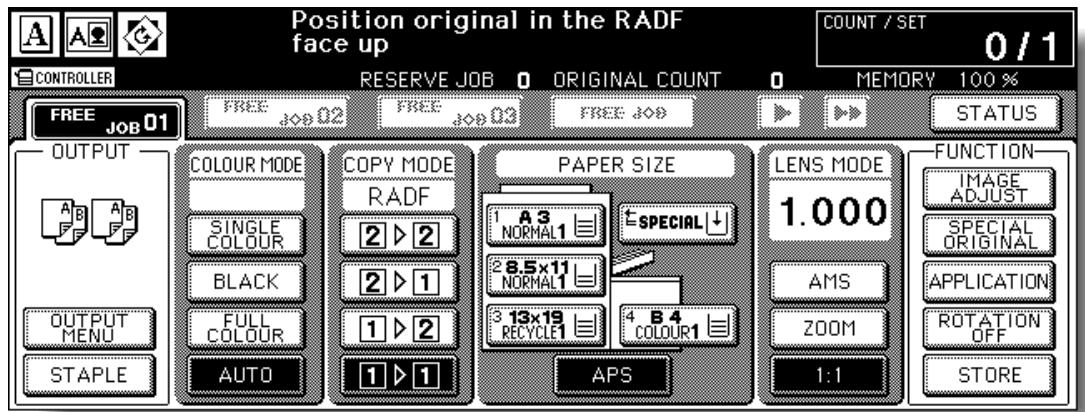
The initial settings are restored. Check that APS is highlighted to indicate that the 1.000 magnification is selected.
![KONICA MINOLTA 8050 - Close the RADF securely, then press [AUTO RESET]. - 2](/content/2025/01/139766/images/8bb15a2dded17c1bf4b65d274ffcf9606aa24ff697cad0f9f68318716e001e13.jpg)
HINT
The initial settings may be altered by the Key Operator. See p. 14-10.
2. Select additional copy conditions, as desired.

DETAILS
Specifying paper size will release 1.000 magnification and set AMS automatically. In this case, touch 1:1 to highlight it again.
3. Enter the desired print quantity from the control panel keypad.

HINT
See p. 3-10 for details on setting print quantity.
4. Position original(s).

HINT
See p. 3-4 to p. 3-9 for details on positioning originals.
5. Press [START].
To Change Magnification Ratio (Fixed Magnification / Zoom Mode)
Use the 8 preset ratios (0.500, 0.707, 0.816, 0.866, 1.154, 1.224, 1.414, 2.000) and 3 user preset ratios to increase or decrease magnification in fixed amounts, or use the Zoom mode to reduce or enlarge the copied original image in 0.001% increments.
Specification for Fixed Magnification / Zoom Mode
☐ Incompatible Conditions: AMS, Repeat mode in Repeat, Reduce & Shift in Image Shift

HINT
See p. 8-5 to p. 8-7 for Vertical/Horizontal Zoom mode.
1. Touch ZOOM on the Basic Screen.
The popup menu for changing magnification ratio will be displayed.

Reminder!
When starting a new copying job, be sure to close the RADF securely, then press [AUTO RESET].
2. Specify the desired magnification ratio.
To select a preset or user preset ratio:
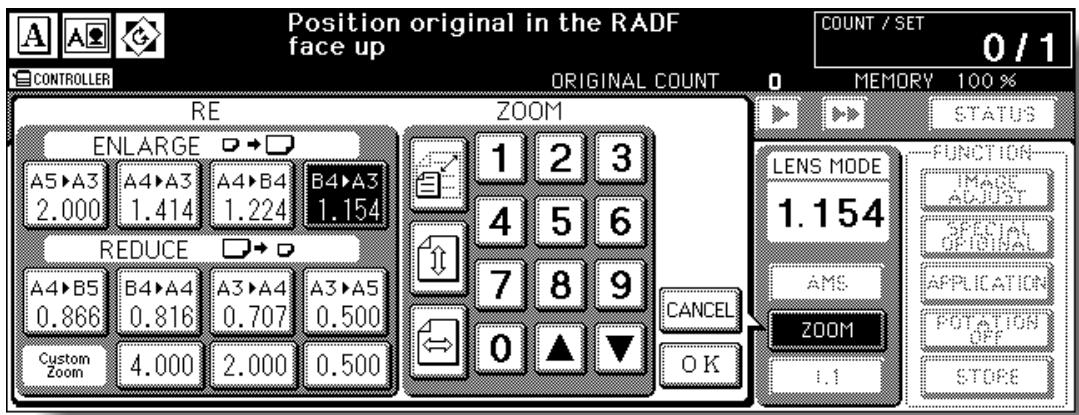
Touch the desired preset or userset ratio key in the RE area to highlight it, then touch OK.

DETAILS
To restore the previous setting, touch CANCEL.
The selected ratio will be displayed on the Basic Screen.
To specify a zoom ratio:
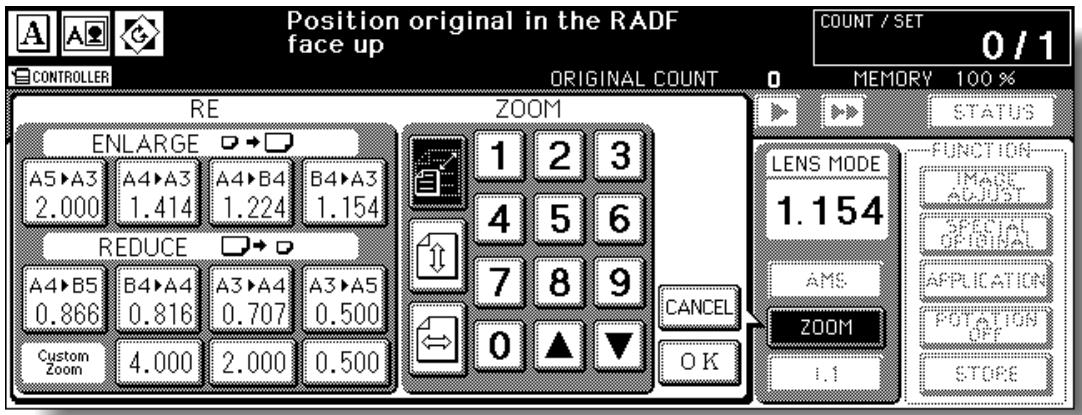
Touch the Vertical/Horizontal zoom key in the ZOOM area to highlight it. Use the keypad on the popup menu to enter the desired magnification ratio, then touch OK.
The selected ratio will be displayed on the Basic Screen.

DETAILS
- The magnification ratio should be a 4-digit number. Start with 0 if the magnification ratio is under 1.000. If an incorrect ratio is entered, continue by entering the correct ratio.
- Use the upper arrow (▲) to enlarge, or the lower arrow (▼) to reduce the ratio in 0.001 % increments.
-
To restore the previous setting, touch CANCEL.
-
Select additional copy conditions, as desired.
- Enter the desired print quantity from the control panel keypad.

HINT
See p. 3-10 for details on setting print quantity.
- Position original(s).

HINT
See p. 3-4 to p. 3-9 for details on positioning originals.
- Press [START].
Making Double-Sided Copies (1▶2, 2▶2)
The Basic Screen is initially set to 1-1 copy mode to make single-sided copies from single-sided originals.
Follow the procedure below to make double-sided copies from the originals scanned from the document feeder or from the platen glass.
Using RADF
Select the copy mode according to the original type (single-sided or double-sided).
Specifications for Double-Sided Copying Using RADF
☐ See p. 12-9 for the information on unsuitable RADF originals.
☐ Incompatible Conditions: Face Up, Multi-Page Enlargement, Non-Image Area Erase, Verti./Horiz. mode or Auto mode of Repeat, AUTO Layout, Storing Image in Overlay Memory
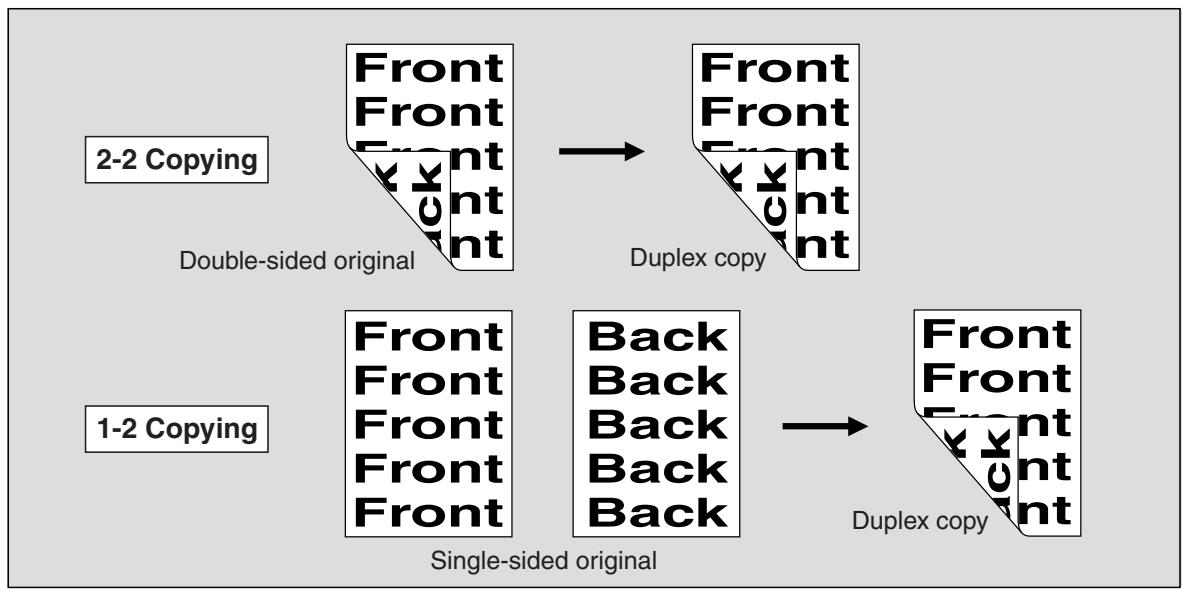
flowchart
graph TD
    A["2-2 Copying"] --> B["Double-sided original"]
    B --> C["Duplex copy"]
    D["1-2 Copying"] --> E["Single-sided original"]
    E --> F["Duplex copy"]
    B --> G["Front Front Front Front Front"]
    E --> H["Back Back Back Back Back"]
    G --> I["Front Front Front Front Front"]
    H --> J["Back Back Back Back Back"]
1. Touch 1▶2 or 2▶2 on the Basic Screen to highlight it.
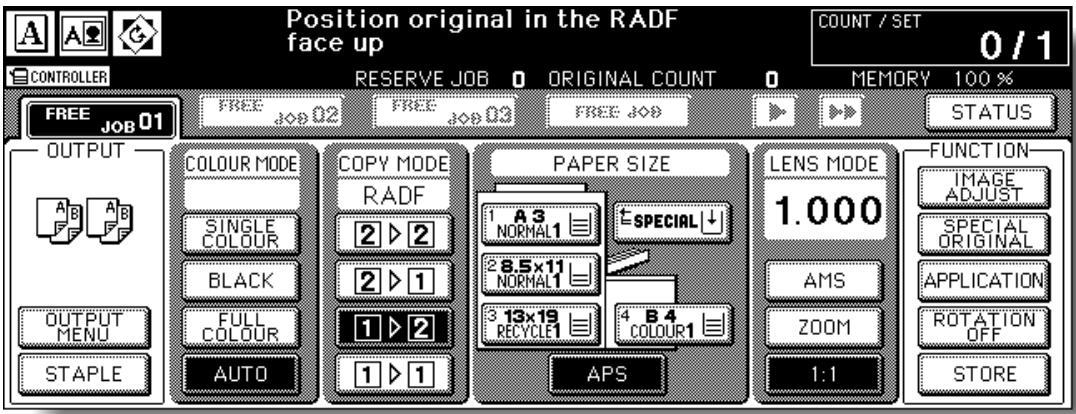

Reminder!
When starting a new copying job, be sure to close the RADF securely, then press [AUTO RESET].
2. Check the original set direction.
The Original direction icon is located at the upper left corner of the Basic Screen.
To change the original set direction, touch SPECIAL ORIGINAL on the Basic Screen to display the Special Original popup menu, then touch the desired original direction key to highlight it.
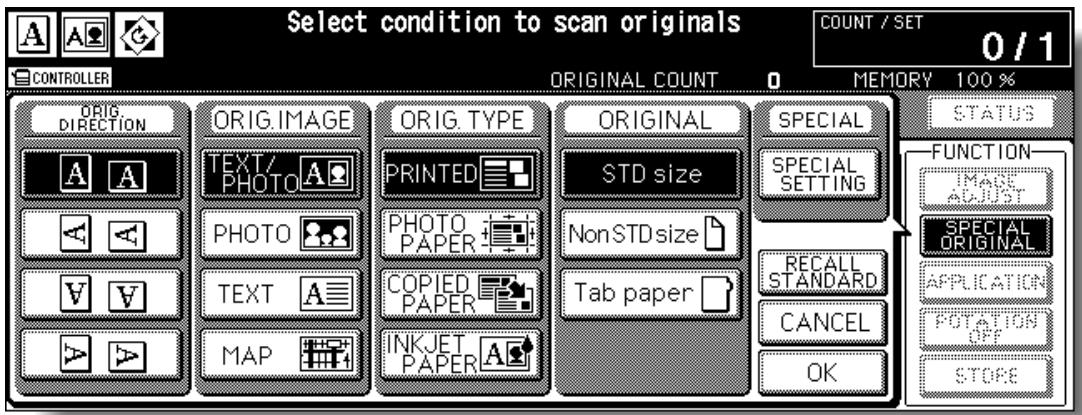
Touch OK to return to the Basic Screen.
3. Select the binding mode.
Touch OUTPUT MENU on the Basic Screen to display the Output Mode popup menu, then touch the desired binding mode key to highlight it.
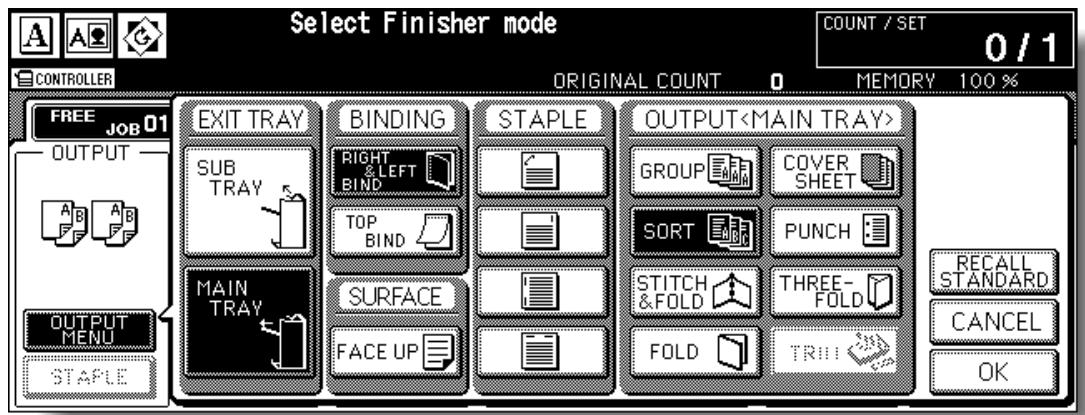
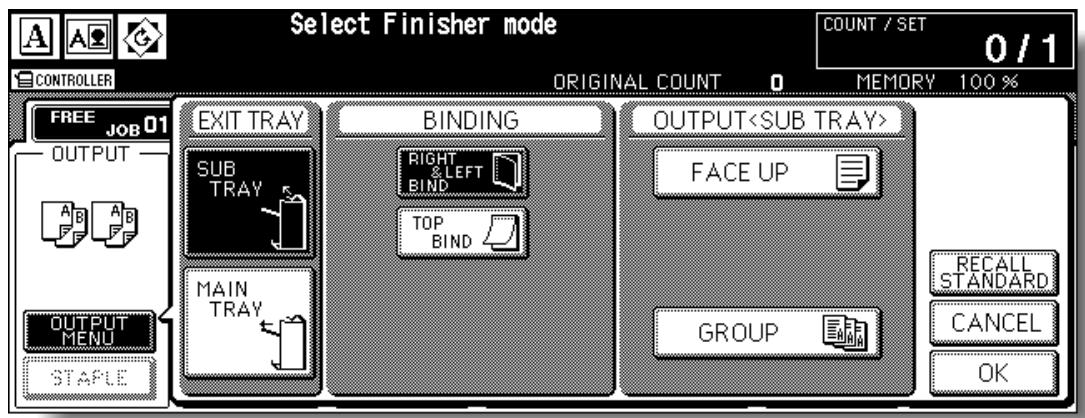

DETAILS
Selecting TOP BIND will make copies upside down on the reverse side, while RIGHT&LEFT BIND copies normally.
Touch OK to return to the Basic Screen.
4. Select additional copy conditions, as desired.

DETAILS
Some incompatible conditions may automatically release the selected copy mode. In this case, arrange the settings so that they are compatible with the selected copy mode.
5. Enter the desired print quantity from the control panel keypad.

HINT
See p. 3-10 for details on setting print quantity.
6. Position originals FACE UP in the document feeder according to the original direction.

HINTS
• See p. 3-4 to p. 3-7 for details on positioning originals.
- Use RADF store mode (p. 3-33 to p. 3-34) when the original count exceeds 100.
7. Press [START].
The machine starts to scan originals, then prints duplex copies when ready for output.
![KONICA MINOLTA 8050 - Press [START]. - 1](/content/2025/01/139766/images/603feca97fb92924f1fb5e92f2ba58a364a0d7d22c2fe522270a7e18c2996812.jpg)
DETAILS
Press [STOP] to suspend the scanning or printing job. See p. 3-13 for details.

CAUTION
When the finisher / trimmer unit / paper exit tray capacity is exceeded due to the print quantity selected, remove the copied sets as they exit; otherwise, mishandled paper will occur.
Using Platen Glass
Use the platen glass to scan originals unsuitable for the document feeder.
Specification for Double-Sided Copying Using Platen Glass
☐ Use the Platen store mode.
☐ See p. 12-9 for the information on unsuitable RADF originals.
☐ Incompatible Conditions: Face Up, Image Insert, Multi-Page Enlargement, Storing Image in Overlay Memory
1. Check the original set direction.
The Original direction icon is located at the upper left corner of the Basic Screen.
To change the original set direction, touch SPECIAL ORIGINAL on the Basic Screen to display the Special Original popup menu, then touch the desired original direction key to highlight it.
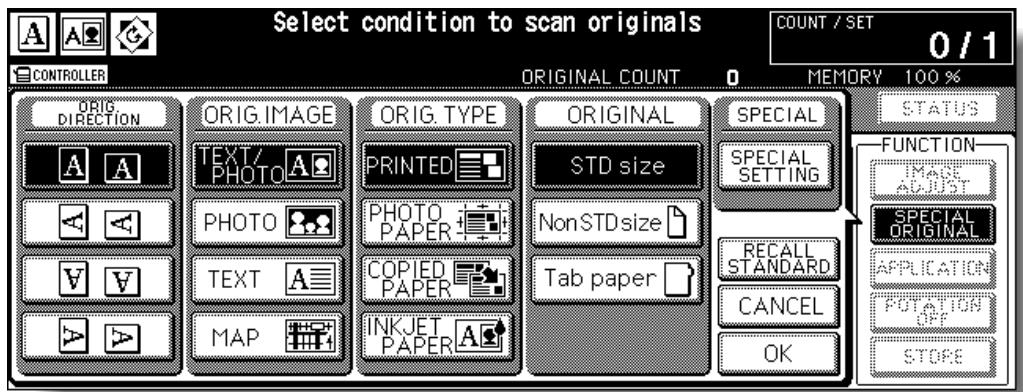
Touch OK to return to the Basic Screen.
2. Select the binding mode.
Touch OUTPUT MENU on the Basic Screen to display the Output Mode popup menu, then touch the desired binding mode key to highlight it.
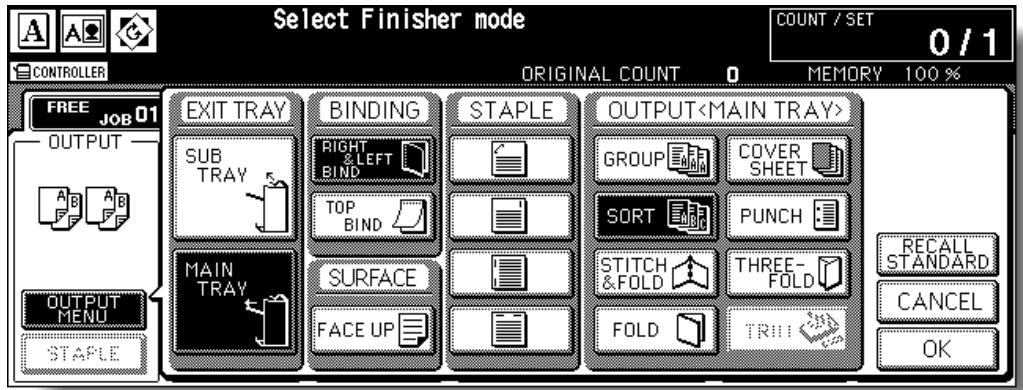
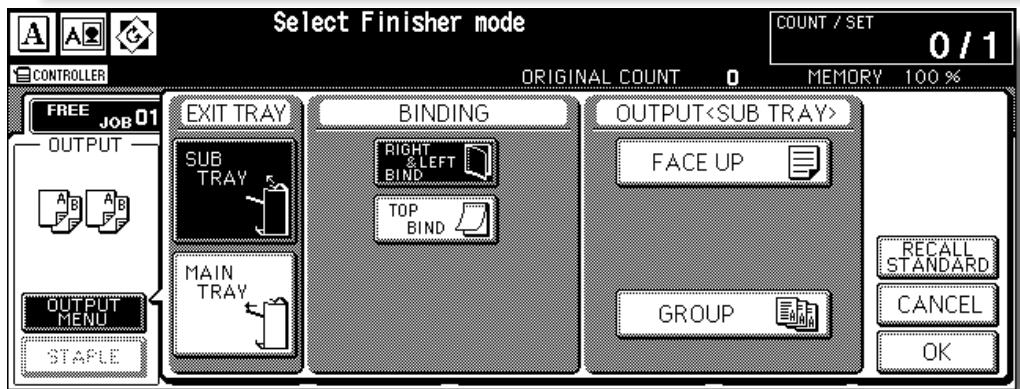

DETAILS
Selecting TOP BIND will make copies upside down on the reverse side, while RIGHT&LEFT BIND copies normally.
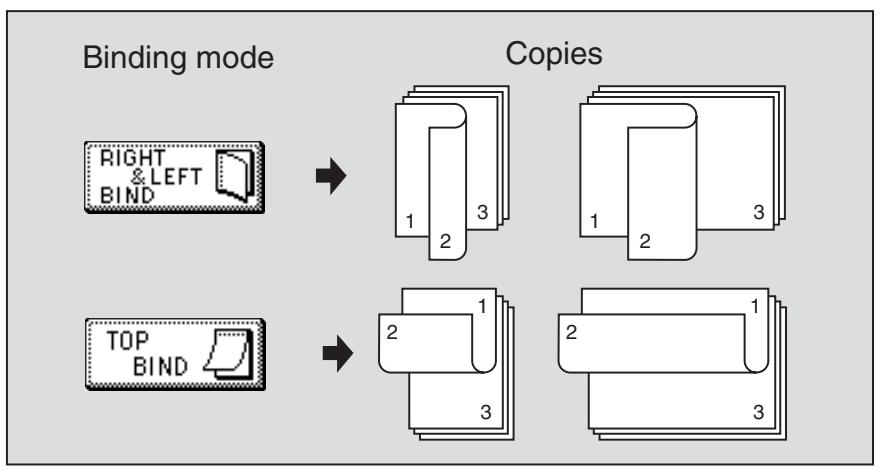
flowchart
graph LR
    A["Binding mode"] --> B["Copies"]
    C["Top BIND"] --> B
    B --> D["1 2 3"]
    D --> E["1 2 3"]
    E --> F["2 1 3"]
    F --> G["2 1 3"]
Touch OK to return to the Basic Screen.
3. Position original FACE DOWN on the platen glass according to the original direction, then close the document feeder or platen cover.
Be sure to start from the first page.

HINTS
• See p. 12-9 for paper sizes detectable on the platen glass.
• See p. 3-8 for details on positioning originals.
- Use Non-Image Area Erase to prevent the black copy marks to be produced when scanning the original with the document feeder or platen cover open. See p. 10-30 to p. 10-31.
4. Touch 1▶2 on the Basic Screen to highlight it.
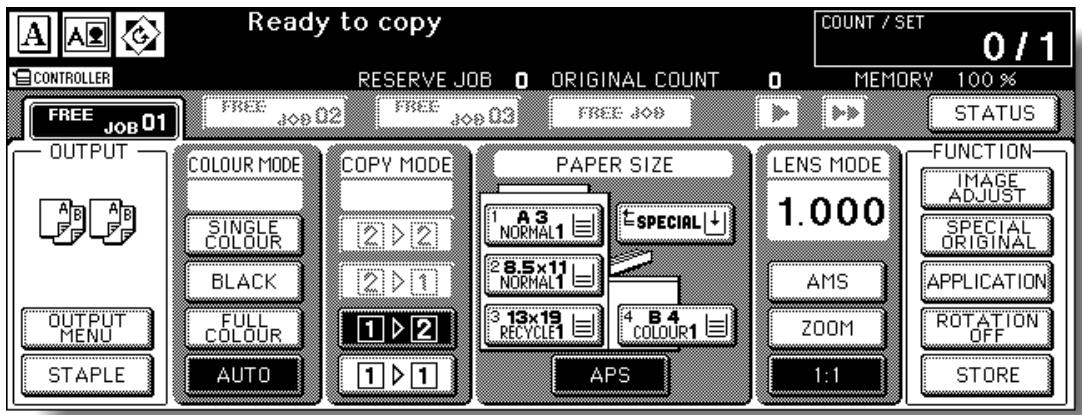
The STORE key will be automatically highlighted on the screen.

Reminder!
DO NOT press [AUTO RESET] at this point, otherwise the platen mode will be released to disable the copier from scanning the original placed on the platen glass.
5. Select additional copy conditions, as desired.

DETAILS
Some incompatible conditions may automatically release the selected copy mode. In this case, arrange the settings so that they are compatible with the selected copy mode.
6. Enter the desired print quantity from the control panel keypad.

HINT
See p. 3-10 for details on setting print quantity.
7. Press [START] to scan.
The front side image of the double-sided copy will be scanned into memory.
8. Replace the original on the platen glass with the back side image original, then press [START].
Repeat this step until all originals are scanned.
![KONICA MINOLTA 8050 - Replace the original on the platen glass with the back side image original, then press [START]. - 1](/content/2025/01/139766/images/a9623db28fde8a7963231e0b187e1ced6aa8f3f302bf1f95777a3e7fe8d8b826.jpg)
DETAILS
- Memory indicator on the upper right of the Basic Screen allows you to check the remaining memory.
- To delete the scanned data without printing, press [STOP]. See p. 3-13 for details.
9. After all originals are scanned, touch STORE to exit the Store mode.
STORE will no longer be highlighted.
10. Press [START] to print.
All the data in memory will be output.
![KONICA MINOLTA 8050 - Press [START] to print. - 1](/content/2025/01/139766/images/60fa6dab47e1a98eeee84cfe991209b359d9583efa818e382b0b5b3142c3ddec.jpg)
DETAILS
Press [STOP] to suspend the printing job. See p. 3-13 for details.

CAUTION
When the finisher / trimmer unit / paper exit tray capacity is exceeded due to the print quantity selected, remove the copied sets as they exit; otherwise, mishandled paper will occur.
Making Single-Sided Copies from Double-Sided Originals (2▶1)
Use RADF and select 2-1 copy mode to make single-sided copies from double-sided originals.
Specification for Single-Sided Copying from Double-Sided Originals
☐ See p. 12-9 for the information on unsuitable RADF originals.
☐ Incompatible Conditions: Fold/Stitch&Fold/Trimming (with Booilet selected), Tab Paper, Chapter, Booklet, Multi-Page Enlargement, Non-Image Area Erase, Repeat (except 2/4/8 Repeat), AUTO Layout, Storing Image in Overlay Memory
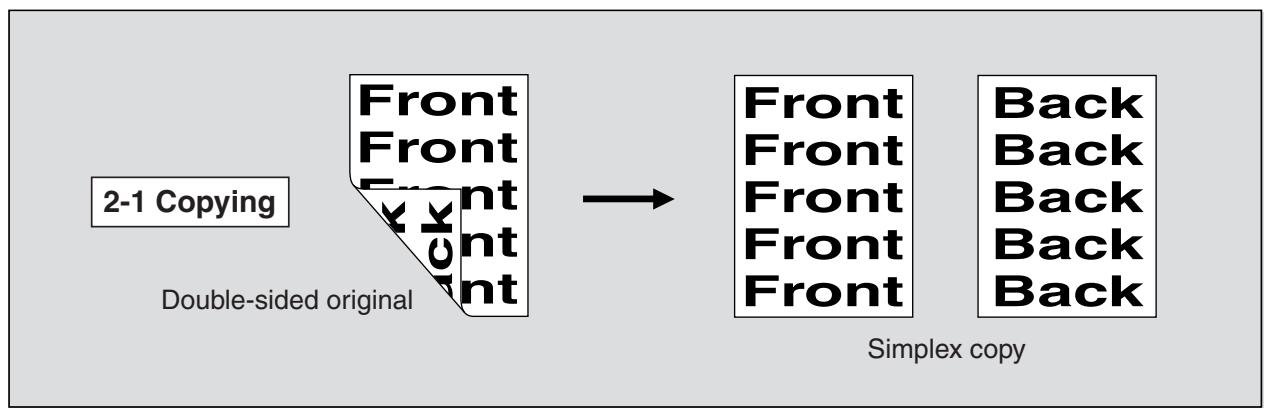
flowchart
graph LR
    A["2-1 Copying"] --> B["Double-sided original"]
    B --> C["Simplex copy"]
    C --> D["Back Back Back Back"]
1. Touch 2▶1 on the Basic Screen to highlight it.
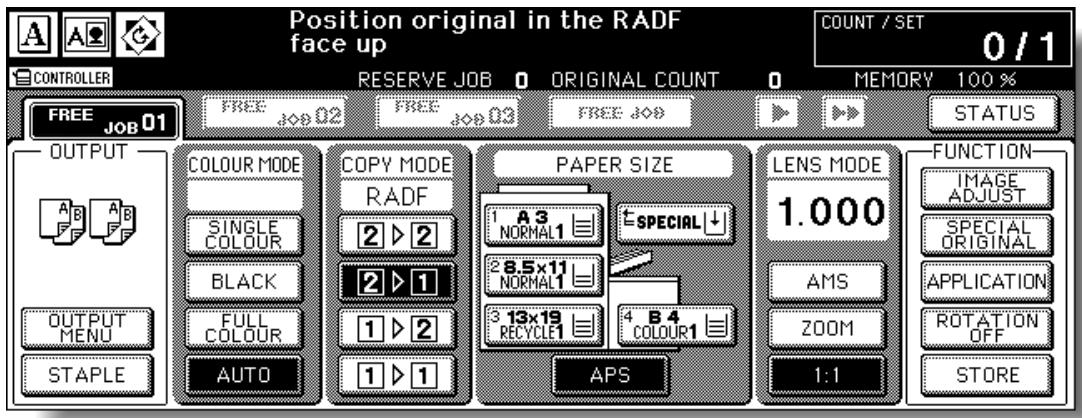

Reminder!
When starting a new copying job, be sure to close the RADF securely, then press [AUTO RESET].
- Select additional copy conditions, as desired.
- Enter the desired print quantity from the control panel keypad.

HINT
See p. 3-10 for details on setting print quantity.
- Position originals FACE UP in the document feeder.

HINTS
• See p. 3-4 to p. 3-7 for details on positioning originals.
- Use RADF store mode (p. 3-33 to p. 3-34) when the original count exceeds 100.
Making Single-Sided Copies from Double-Sided Originals (2▶1) (continued)
5. Press [START].
The machine starts to scan originals, then prints simplex copies when ready for output.
![KONICA MINOLTA 8050 - Press [START]. - 1](/content/2025/01/139766/images/6fa88c57693be736fba3c7cdfd9a99580b4c69a33f8d4c6095d43aedf074acb8.jpg)
DETAILS
Press [STOP] to suspend the scanning or printing job. See p. 3-13 for details.

CAUTION
When the finisher / trimmer unit / paper exit tray capacity is exceeded due to the print quantity selected, remove the copied sets as they exit; otherwise, mishandled paper will occur.
To Scan Originals into Memory (Store Mode)
Store mode allows you to scan all the originals first, then to start a continuous printing job.
Use RADF store mode to scan a large amount of originals.
Use Platen store mode for originals that cannot be fed through the document feeder due to thickness, size or condition.
These two modes can be used in combination.

DETAILS
RADF tray capacity is 100; however, more than 100 originals can be scanned into memory using RADF store mode.
Specification for Store Mode
☐ Incompatible with RADF store mode: Image Insert, Storing image in Overlay Memory
1. Make copying selections, as desired.

Reminder!
When starting a new copying job, be sure to close the RADF securely, then press [AUTO RESET].
2. Touch STORE on the Basic Screen to highlight it.
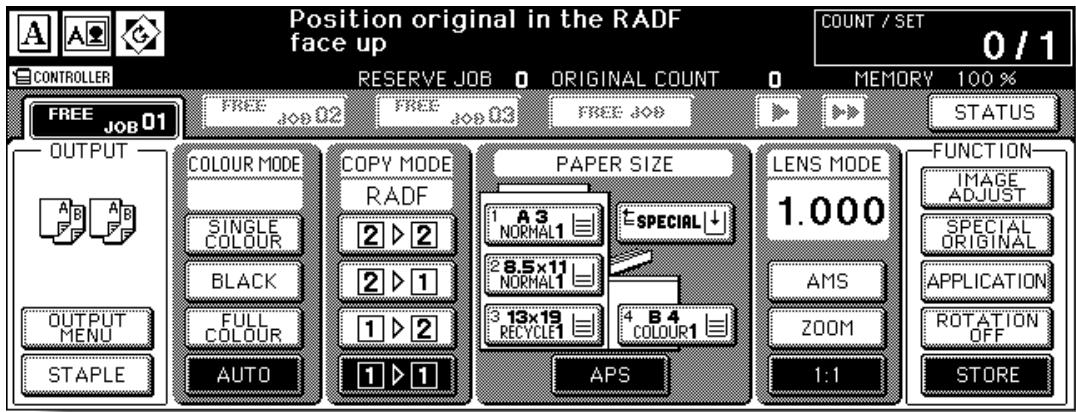
3. Enter the desired print quantity from the control panel keypad.

HINT
See p. 3-10 for details on setting print quantity.
4. Position original(s).
Using platen glass:
Place original FACE DOWN. Start scanning from the first page.

Reminder!
When Dual Page, Non-Image Area Erase, Auto detection mode of Repeat, or AUTO Layout is selected, keep the RADF open throughout the scanning procedure.
Using RADF:
Position originals with page one FACE UP. Up to 100 originals can be loaded.
If the number of originals exceeds 100, divide them into blocks not exceeding 100 sheets and load them beginning with the block with the first page.
Be sure to check the original direction according to the Original direction icon displayed at the upper left corner of the Basic Screen.

Reminder!
The copy result may not be satisfactory if the originals are set in wrong direction. Be sure that the originals are set in the same direction as indicated by the Original direction icon, especially when making double-sided copies or using Staple, STITCH&FOLD, Fold, or Booklet mode. See p. 9-2 to p. 9-3 for details.

HINT
See p. 3-4 to p. 3-9 for details on positioning originals.
5. Press [START] to scan.
![KONICA MINOLTA 8050 - Press [START] to scan. - 1](/content/2025/01/139766/images/5b3b4e62e9c883422f41d1e4a37b0b4f322219e998a5042db04802b0a26dd88f.jpg)
DETAILS
- Repeat steps 4 and 5 until all originals are scanned.
- Memory indicator on the upper right of the Basic Screen allows you to check the remaining memory.
- To delete the scanned data without printing, press [STOP]. See p. 3-13 for details.

HINT
See p. 5-9 to p. 5-10 if memory overflow occurs. Should memory overflow occur frequently, it is recommended that you contact your service representative to expand the memory capacity in your machine.
6. Touch STORE to exit the Store mode.
STORE will no longer be highlighted.
7. Press [START].
All the data in memory will be output.
![KONICA MINOLTA 8050 - Press [START]. - 1](/content/2025/01/139766/images/0283439a9b1ec4c61a9cacb80fca1d0d2faaef0b9e2f61b3677d8f17ff8e4531.jpg)
DETAILS
Press [STOP] to suspend the scanning or printing job. See p. 3-13 for details.

CAUTION
When the finisher / trimmer unit / paper exit tray capacity is exceeded due to the print quantity selected, remove the copied sets as they exit; otherwise, mishandled paper will occur.
To Set Next Copying Job (Reserve)
The Reserve function allows you to set up a new job while a current job is in process. When the current job is finished, the Reserve job starts printing immediately.
Specifications for Reserve
☐ Job settings: Max. 8 (current job plus 7 reserve jobs)
☐ When the current job is in Store mode, Image Insert, or Dual Page, the reserve job setting will be available after the copier starts to print the current job.
☐ Incompatible Conditions: Interrupt copying, Scanning in Store mode, Proof copy, Storing image in Overlay Memory
- Press [START] to start scanning/printing for the current job. FREE JOB will become active to show that the reserve job setting is now available.
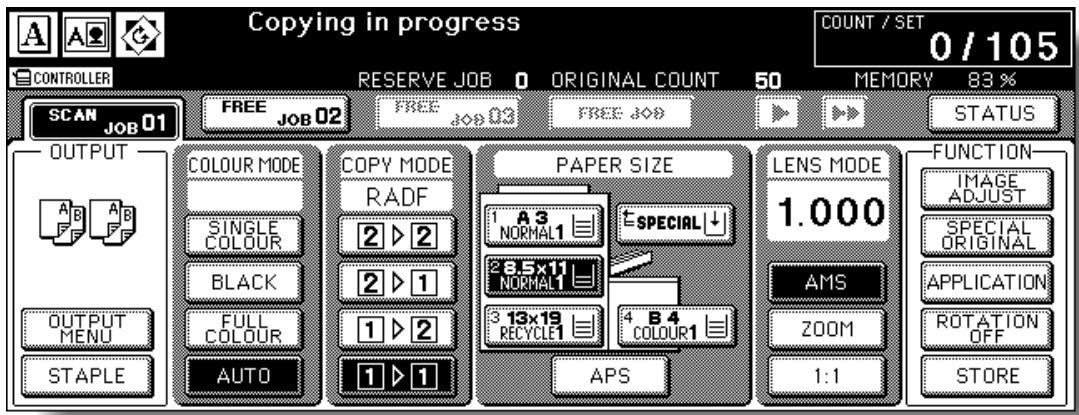
2. Touch FREE JOB to highlight it.
The Reserve Job Setting Screen will be displayed.
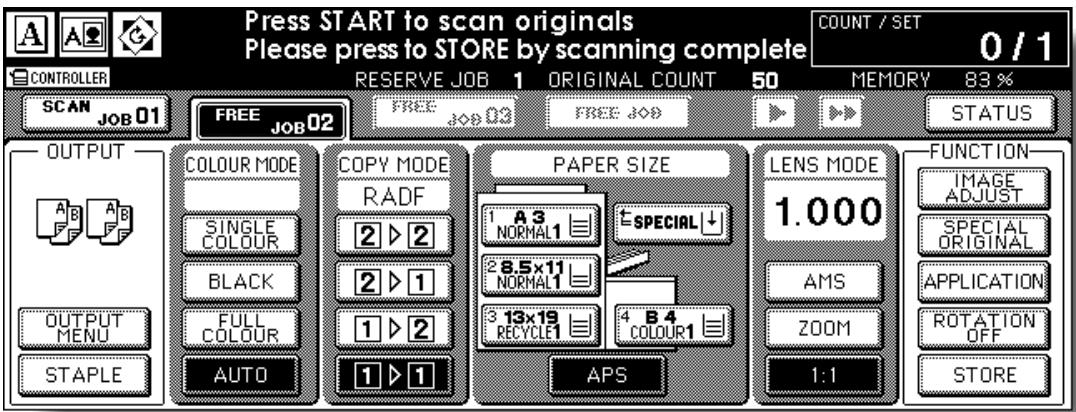
On the Reserve Job Setting Screen, all keys on the LCD and control panel will function for the reserve job.
- Select copy conditions for the reserve job, as desired.

HINT
When trouble occurs while setting the reserve job, the PRINT or SCAN JOB key on the Basic Screen will change to JAM or ADD PAPER key. See p. 5-6 to p. 5-8.
4. Position original(s) after completing the scan for the current job.

HINT
See p. 3-4 to p. 3-9 for details on positioning originals.

DETAILS
To cancel the reserve job, touch STATUS on the Basic Screen to display the Job Status Screen. See p. 3-38 to p. 3-40 for details.
5. Press [START] to start scanning for the reserve job.
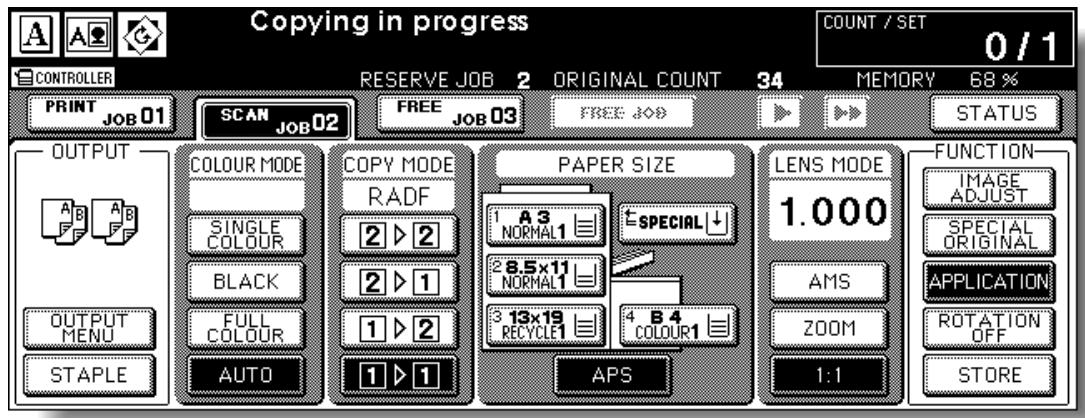
Up to 8 jobs (current job included) can be set.
![KONICA MINOLTA 8050 - Press [START] to start scanning for the reserve job. - 2](/content/2025/01/139766/images/b0a5ec75e3359b1b852a911e60a232a0a3d97dccb0bbf263af7c2257c7b22593.jpg)
DETAILS
When setting more than one reserve job, the next reserve job setting will be available after the copier starts to scan for the previous reserve job.
To set the fourth copying job, touch the active FREE JOB key at the far right to scroll to the next reserve setting screen. Another three reserve job settings (04-06) will be available.
![Copying in progress Ready to copy reserve/Select [FREE JOB] COUNT / SET 0 / 1 CONTROLLER RESERVE JOB 3 ORIGINAL COUNT 34 MEMORY 68 % PRINT JOB 01 RESERVE JOB 02 SCAN JOB 03 FREE JOB STATUS OUTPUT COLOUR MODE COPY MODE PAPER SIZE LENS MODE FUNCTION A B A B SINGLE COLOUR RADF 1 A 3 NORMAL1 ESPECIAL↓ BLACK 2 ▷ 2 FULL COLOUR 2 ▷ 1 1 ▷ 2 3 8.5x11 NORMAL1 13x19 RECYCLE1 4 B 4 COLOUR1 OUTPUT MENU AUTO APS ZOOM 1:1 ZOOM STAPLE STORE](/content/2025/01/139766/images/d2f5f8c822531578d4452fea6b64ea192bbf5c99b17757b0bd113e70e5dbaeb3.jpg)
To set the seventh copying job, touch the active FREE JOB key at the far right to scroll to the next reserve setting screen. Another two reserve job settings (07-08) will be available.
![Copying in progress Ready to copy reserve/Select [FREE JOB] COUNT / SET 0 / 1 CONTROLLER RESERVE JOB 8 ORIGINAL COUNT 50 MEMORY 33 % RESERVE JOB 07 FREE JOB 08 FREE JOB FREE JOB STATUS OUTPUT A B A B SINGLE COLOUR BLACK FULL COLOUR OUTPUT MENU STAPLE AUTO COPY MODE RADF PAPER SIZE LENS MODE FUNCTION A3 NORMAL1 ESPECIAL↓ 2.8.5x11 NORMAL1 3.13x19 RECYCLE1 4 B4 COLOUR1 AMS ZOOM 1:1 IMAGE ADJUST SPECIAL ORIGINAL APPLICATION ROTATION OFF STORE](/content/2025/01/139766/images/05ff6fcc04e81291052af83a361f52138b51c44793fdd3b33b89b2f6c0b6208a.jpg)

DETAILS
The number of reserve jobs including current job will be indicated in the middle of the message area.
When completed, the Basic Screen for the current printing job will be restored.
To scroll to the next/previous screen, touch the arrow keys displayed at the right side of the folder keys.

HINT
When trouble occurs on a reserve job which is not currently displayed on the screen, the arrow key to scroll to that job will blink. See p. 5-6 to p. 5-8.
6. Copying of the reserve job will start automatically after completing the current job.

CAUTION
When the finisher / trimmer unit / paper exit tray capacity is exceeded due to the print quantity selected, remove the copied sets as they exit; otherwise, mishandled paper will occur.
To Check/Control Jobs in Progress (Job Status Screen)
The Job Status Screen allows you to perform the following functions.
- Confirm machine status
- Delete reserve job
• View noncomplete job list
- Change order of reserve job
• View previous job list

DETAILS
Not only the copy reserve jobs but the print jobs made in Printer mode can also be checked and controlled on this screen.
1. Touch STATUS on the Basic Screen.
The Job Status Screen will be displayed.
Check the current status of the machine.

HINT
See p. 3-40 for details of the screen.
2. Perform the desired setting on the screen.
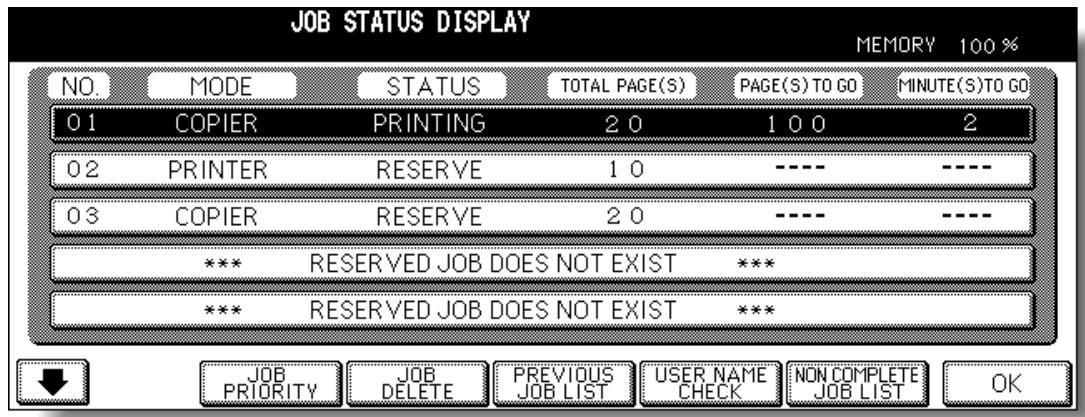
To change the order of reserve job:
Touch to highlight the desired reserve job key, then touch JOB PRIORITY. The highlighted reserve job is advanced by one in printing order unless the job preceding the selected one is already in progress.

DETAILS
If more than six jobs are entered, use the page down arrow key at the lower left corner of the screen to scroll to the desired job.
To clear reserve job:
Touch to highlight the desired reserve job key, then touch JOB
CLEAR.
Touch YES to clear the highlighted reserve job, or NO to cancel.
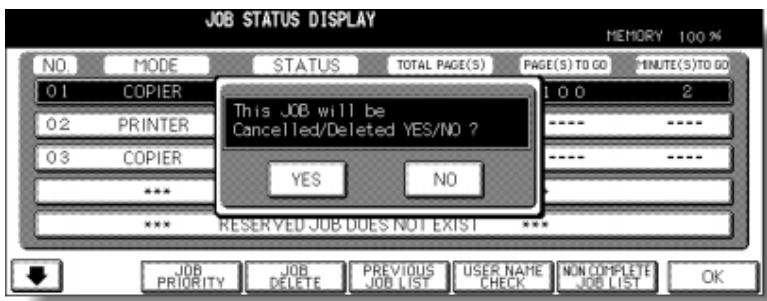
To Check/Control Jobs in Progress (Job Status Screen) (continued)
To check user name (print jobs only):
Touch USER NAME CHECK to display the User Name Check Screen. Check the user name indicated on the right side of the job number and operation mode. Touch OK to return to the Job Status Screen.
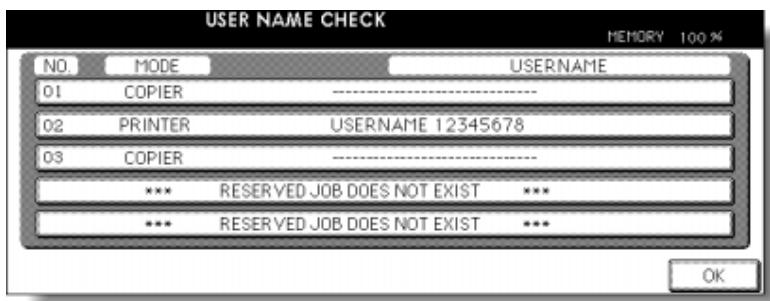
To display previous job list:
Touch PREVIOUS JOB LIST to display the Previous Job List Screen.
Touch 🏠 to scroll to the next page. Up to 16 previous jobs (4 pages) can be displayed.
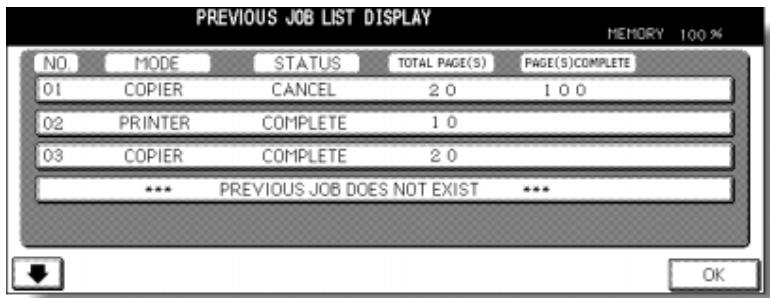
Touch ↑ to return to the previous page. Touch OK to return to the Job Status Screen.
To display noncomplete job list:
Touch NONCOMPLETE JOB LIST to display the Noncomplete Job List Screen.
Touch 📋 to scroll to the next page. Up to 16 noncomplete jobs (4 pages) can be displayed.
Touch ↑ to return to the previous page. Touch OK to return to the Job Status Screen.
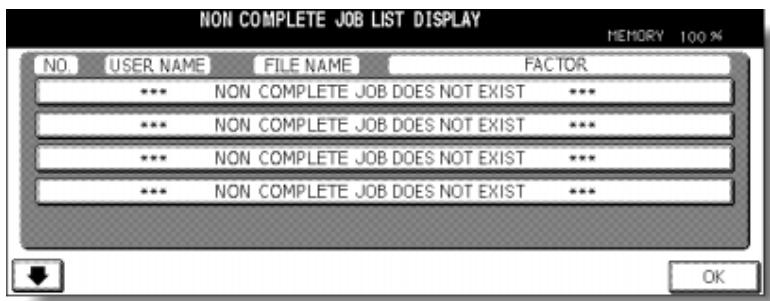
3. Touch OK on the Job Status Screen.
The Basic Screen will be restored.
To Check/Control Jobs in Progress (Job Status Screen) (continued)
Contents of Job Status Screen
NO. : Displays the No. (01-99) for each job assigned to the machine.
MODE: Displays the machine's current mode of operation. Three modes are listed below. COPIER PRINTER SCANNER
STATUS: Displays the current status of the machine for each job. READY : Ready to use in each mode INTERRUPT : Interrupting the previous job ERROR : Error in each mode PRINTING : Printing in each mode NO PAPER : No paper in copy/print mode STOP : Stop in each mode RESERVE : Ready to reserve JAM : Jam in each mode
TOTAL PAGE(s): Displays the number of scanned pages for each job. (0 to 9999)
PAGE(s) TO GO: Displays the remaining copy count of the job. 0 to 9999 (The number exceeding 9999 will be displayed as 9999 ^^ .) Copy count = No. of scanned pages x Print quantity
MINUTE(s) TO GO: Displays the time (in minutes) required for completing the job. Exceeding 999 minutes: 999 ^^ Shorter than 1 minute: <1
Other: The following message will be displayed on the bar when the reserved job does not exist.
RESERVED JOB DOES NOT EXIST
Output Mode for Machine without Finisher
This section describes the output modes for a copier without the Finisher. The Non-sort mode is initially selected.
1 Non-sort mode copies the original set in amounts determined by the print quantity setting, then outputs sorted sets normally.
2 Rotation sort mode rotates every other sorted sets by 90° upon exit, provided the same paper size is loaded in two trays, one tray with paper loaded in portrait orientation and the other tray with paper loaded in landscape orientation, e.g., A4 and A4R.
3 Group mode copies each original page in amounts determined by the print quantity setting, then outputs grouped sets normally.
4 Rotation group mode rotates every other grouped set by 90° upon exit, provided the same paper size is loaded in two trays, one tray with paper loaded in portrait orientation and the other tray with paper loaded in landscape orientation, e.g., A4 and A4R.
Using Face up mode in combination with the above four modes, simplex copies exit face up on the exit tray.
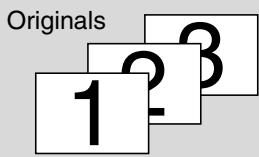
Example: 3-set copies
Face down
non-sort (default)
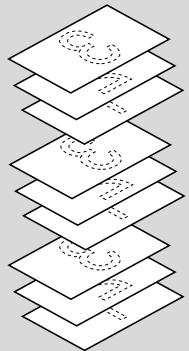
natural_image
Stacked isometric diagram of layered planes with dashed circular outlines (no text or symbols)Face down
rotation sort
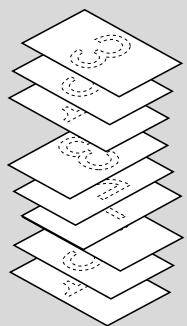
natural_image
Stacked isometric diagram of layered planes with dashed outlines and a small symbol in the top section (no text or labels)Face down
group
natural_image
Stacked isometric diagrams of layered planes with dashed and solid lines, no text or symbols presentFace down
rotation group
natural_image
Stacked isometric diagram of layered planes with dashed and dotted lines indicating internal structures (no text or symbols)Face up non-sort
Face up
rotation sort
Face up
group
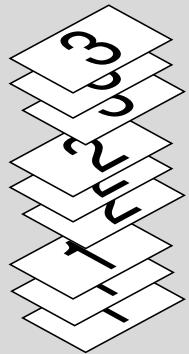
Face up
rotation group
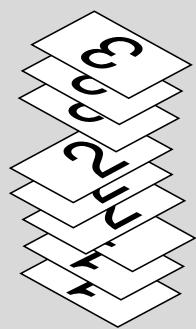
Specification for Output Modes without Finisher
☐ Incompatible with Group mode: Proof Copy, Sheet/Cover Insertion, Chapter, Combination, Booklet, Image Insert, Program Job, Repeat, AUTO Layout, Non-Image Area Erase, Stamp (Numbering)
☐ Incompatible with Rotation Group mode: Proof Copy, Mixed Original, Z-Folded Original, Non STD Size (FULL AREA), Sheet/Cover Insertion, Chapter, Combination, Booklet, Image Insert, Dual Page, Program Job, Repeat, AUTO Layout, Non-Image Area Erase, Stamp (Numbering), Overlay
☐ Incompatible with Rotation Sort mode: Mixed Original, Sheet/Cover Insertion, Booklet, Repeat, AUTO Layout, Non-Image Area Erase
1. Load copy paper.
When using Rotation sort or Rotation group mode, load the same paper size into two trays in different orientation.

Reminder!
- Do not release the Rotation function.
- When starting a new copying job, be sure to close the RADF securely, then press [AUTO RESET].
2. Select the desired output mode.
To select Face down non-sort mode:
Confirm that OUTPUT MENU is not highlighted on the Basic Screen.
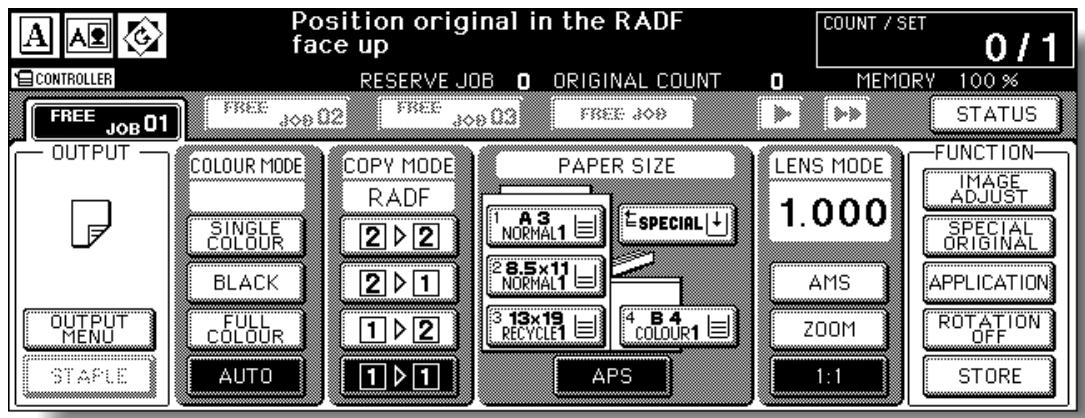

HINT
Face down non-sort mode is initially selected. Key Operator can change the initial output mode. See p. 14-10.
To select Group, Rotation group, Rotation sort or Face up mode:
Touch OUTPUT MENU on the Basic Screen to display the Output Mode popup menu, then touch the desired mode key to highlight it.
To use Face up mode in combination, simply touch FACE UP to highlight it.
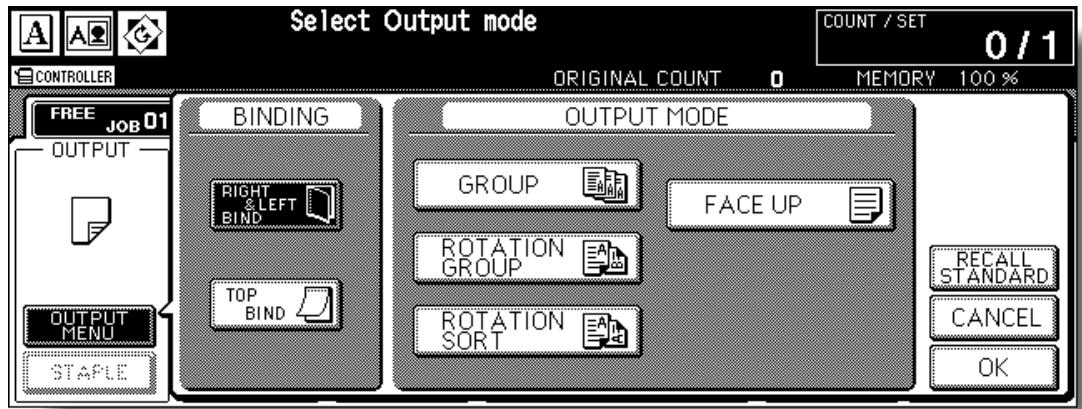
3. Touch OK on the Output Mode popup menu.
The Basic Screen will be restored with the output icon indicating the Output mode currently selected.

DETAILS
Touch CANCEL on the Output Mode popup menu to restore the previous setting.
Touch RECALL STANDARD to restore the initial setting.

HINT
See the next page for details of the output icons displayed on the Basic Screen.
4. Select additional copy conditions, as desired.
5. Enter the desired print quantity from the control panel keypad.

Reminder!
The exit tray capacity is 120 sheets. Be sure that the capacity is not exceeded.

HINT
See p. 3-10 for details on setting print quantity.
6. Position original(s) FACE UP in the document feeder or FACE DOWN on the platen glass.

HINT
See p. 3-4 to p. 3-9 for details on positioning originals.
7. Press [START].
![KONICA MINOLTA 8050 - Press [START]. - 1](/content/2025/01/139766/images/d139291e9497467ee64c6798e2e25d14017f44ef884e11bab62240f001f4ccec.jpg)
DETAILS
Press [STOP] to suspend the scanning or printing job. See p. 3-13 for details.

CAUTION
When the paper exit tray capacity is exceeded due to the print quantity selected, remove the copied sets as they exit; otherwise, mishandled paper will occur.

DETAILS
Output Icons on the Basic Screen
Face Down
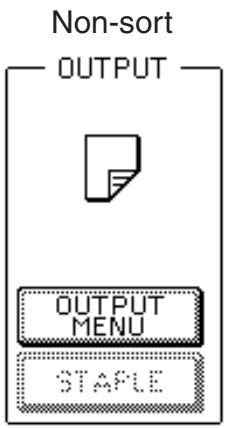
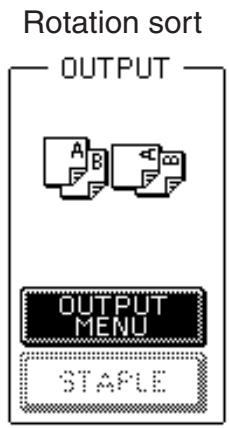
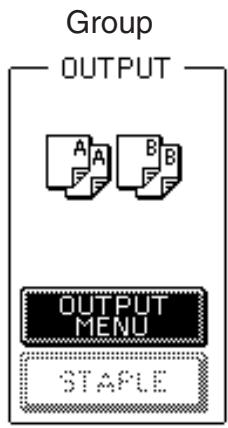
flowchart
graph TD
    A["OUTPUT"] --> B["A"]
    A --> C["B"]
    B --> D["OUTPUT MENU"]
    C --> D
    D --> E["STAPLE"]
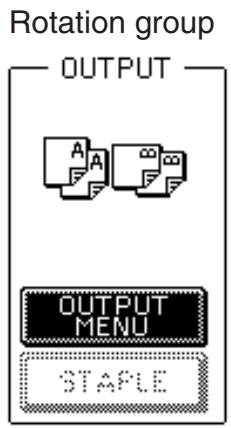
Face Up
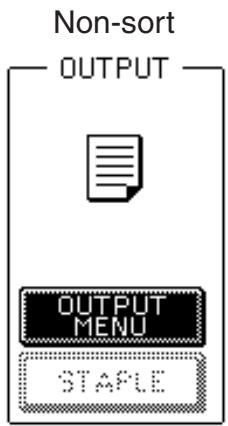
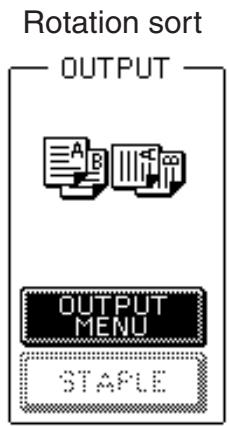
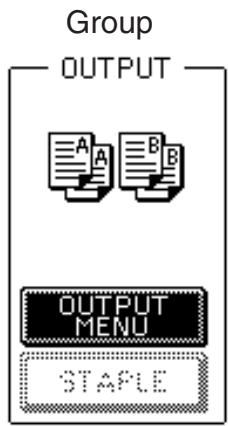
flowchart
graph TD
    A["Group OUTPUT"] --> B["Document Icon A"]
    A --> C["Document Icon B"]
    B --> D["OUTPUT MENU"]
    C --> D
    D --> E["STAPLE"]
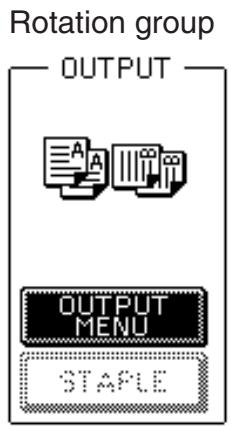
Output Mode for Machine with Finisher
Finisher FS-115/215 is equipped with a primary (main) and a secondary (sub) exit trays. Without using any optional equipment, each exit tray provides the output modes as described below.
Primay (Main) Tray:
1 Non-sort mode simply means that the offset-stacker finisher modes are not selected. Copies will be stacked upon exit without being offset by sorted sets.
2 Sort mode outputs multiple copies of the original set, having each sorted set offset by 30mm upon exit.
3 Staple mode offsets and staples each sorted set. Up to 50 sheets (or within 5mm thick) can be stapled.
4 Group mode groups together multiple copies of each original and offsets the sets by 30mm upon exit.
Using Face up mode in combination with the above four modes, simplex copies exit face up on the exit tray.
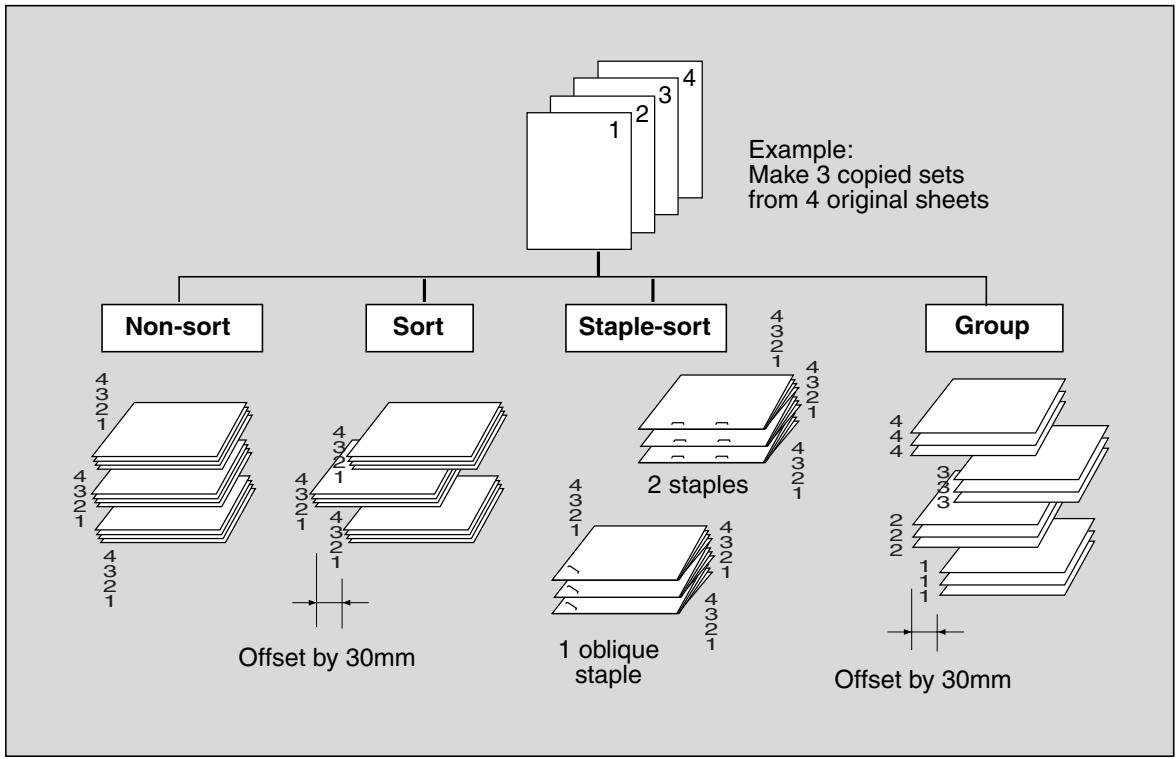
flowchart
graph TD
    A["Example: Make 3 copied sets from 4 original sheets"] --> B["Non-sort"]
    A --> C["Sort"]
    A --> D["Staple-sort"]
    A --> E["Group"]
    B --> F["4 1 2 3 4"]
    C --> G["4 2 3 4"]
    D --> H["4 3 2 1 2 3 4"]
    E --> I["4 4 3 2 1 2 3 4"]
    F --> J["4 3 2 1 2 3 4"]
    G --> K["4 3 2 1 2 3 4"]
    H --> L["4 3 2 1 2 3 4"]
    I --> M["4 4 3 2 1 2 3 4"]
    J --> N["4 3 2 1 2 3 4"]
    K --> O["4 4 3 2 1 2 3 4"]
    L --> P["4 4 3 2 1 2 3 4"]
    M --> Q["4 4 3 2 1 2 3 4"]
    N --> R["4 4 3 2 1 2 3 4"]
    O --> S["4 4 3 2 1 2 3 4"]
    P --> T["4 4 3 2 1 2 3 4"]
    Q --> U["4 4 3 2 1 2 3 4"]
    R --> V["4 4 3 2 1 2 3 4"]
    S --> W["4 4 3 2 1 2 3 4"]
    T --> X["4 4 3 2 1 2 3 4"]
    U --> Y["4 4 3 2 1 2 3 4"]
    V --> Z["4 4 3 2 1 2 3 4"]
    W --> AA["4 4 3 2 1 2 3 4"]
    X --> AB["4 4 3 2 1 2 3 4"]
    Y --> AC["4 4 3 2 1 2 3 4"]
    Z --> AD["4.5 mm Offset by 30mm"]
Secondary (Sub) Tray:
1 Face down non-sort exit outputs simplex copies and odd numbered duplex copies face down, without offsetting the sorted sets.
2 Face down group exit outputs multiple copies of each original face down, without offsetting the grouped sets upon exit.
3 Face up non-sort exit outputs simplex copies and odd numbered duplex copies face up, without offsetting the sorted sets.
4 Face up group exit outputs multiple copies of each original face up, without offsetting the grouped sets upon exit.
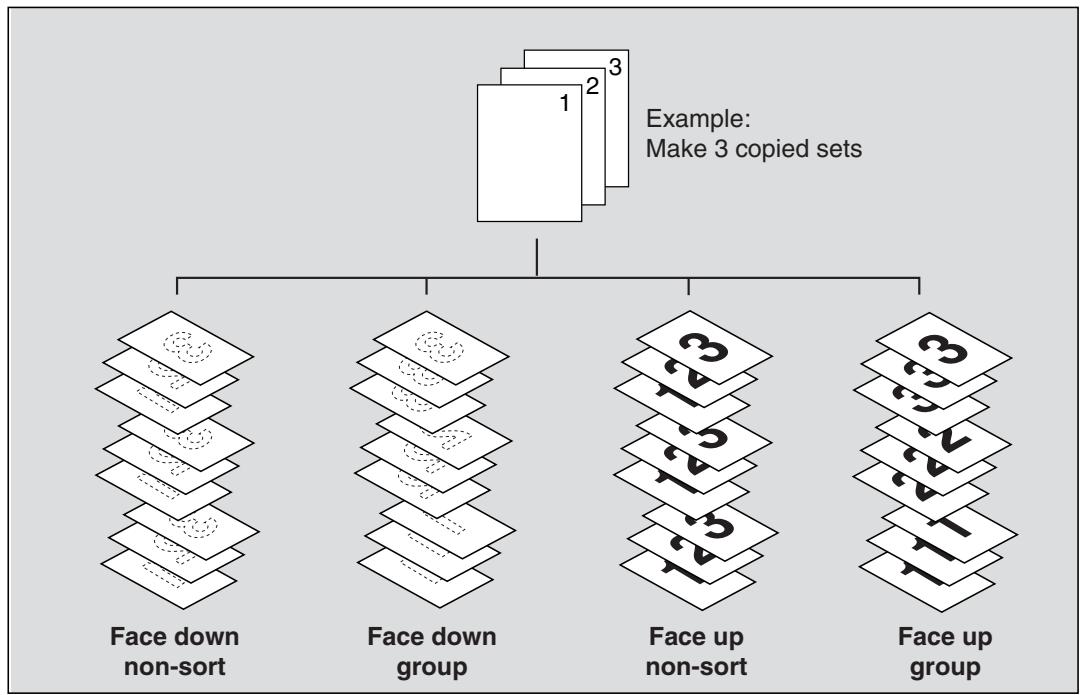
flowchart
graph TD
    A["Example: Make 3 copied sets"] --> B["1"]
    A --> C["2"]
    A --> D["3"]
    B --> E["Face down non-sort"]
    B --> F["Face down group"]
    C --> G["Face up non-sort"]
    C --> H["Face up group"]
    D --> I["Face up group"]
The copier is initially set to output to Primary (main) tray in Sort mode. Follow the procedure on the next page to change the output mode, as desired.

HINT
See Section 8 for the output modes using Finisher options.
Specification for Output Modes with Finisher
☐ Incompatible with Sort mode: Using platen glass (unless Image Insert, Dual Page, or Platen store mode is used), Fold, Stitch & Fold, Three-Fold, Trimming,
☐ Incompatible with Staple mode: Using platen glass (unless Image Insert, Dual Page, or Platen store mode is used), Fold, Stitch & Fold, Three-Fold, Trimming

Reminder!
Using excessively curled paper or some types of thin paper in Staple mode may cause poor results in arrangement of the stapled sets.
☐ Incompatible with Group mode: 1▶2 or 2▶2 mode using platen glass (unless Platen store mode is used), Proof Copy, Fold, Stitch & Fold, Three-Fold, Trimming, Sheet/Cover Insertion, Chapter, Combination, Booklet, Image Insert, Repeat
☐ Incompatible with Group using Secondary (sub) tray: 1▶2 or 2▶2 mode using platen glass (unless Platen store mode is used), Proof Copy, Fold, Stitch & Fold, Three-Fold, Trimming, Punch, Cover sheet feeding, Sheet/Cover Insertion, Chapter, Combination, Booklet, Image Insert, Repeat
☐ Incompatible with Face Up exit: 1▶2 or 2▶2 mode using platen glass, Fold, Stitch & Fold, Three-Fold, Trimming, Cover sheet feeding
1. Close the RADF securely, then press [AUTO RESET].
Check that the Sort mode icon is displayed and the OUTPUT MENU key is highlighted in the OUTPUT area.
![KONICA MINOLTA 8050 - Close the RADF securely, then press [AUTO RESET]. - 1](/content/2025/01/139766/images/84e0978390cde88606a708f8327e7fc1ebf25a5de3ba2b135bfad8f1820644d4.jpg)
HINT
Key Operator can change the initial output mode. See p. 14-10.
2. Select the desired output mode.
To set output to the Primary (main) tray (except Staple): proceed to the next step.
To set Staple mode: proceed to step 4.
To set output to the Secondary (sub) tray: proceed to step 5.
3. Touch OUTPUT MENU to display the Output Mode popup menu, then touch MAIN TRAY to highlight it.
To select Non-sort mode, deselect all the keys in the OUTPUT
To select Sort mode, touch SORT to highlight it.
To select Group mode, touch GROUP to highlight it.
To select Face up mode, touch FACE UP in the SURFACE area to highlight it. The Face up mode is compatible with Non-sort, Sort and Group modes.

Reminder!
Using Face up mode and Non-sort or Sort mode in combination, the sorted copies will be output in the reverse order of the originals.
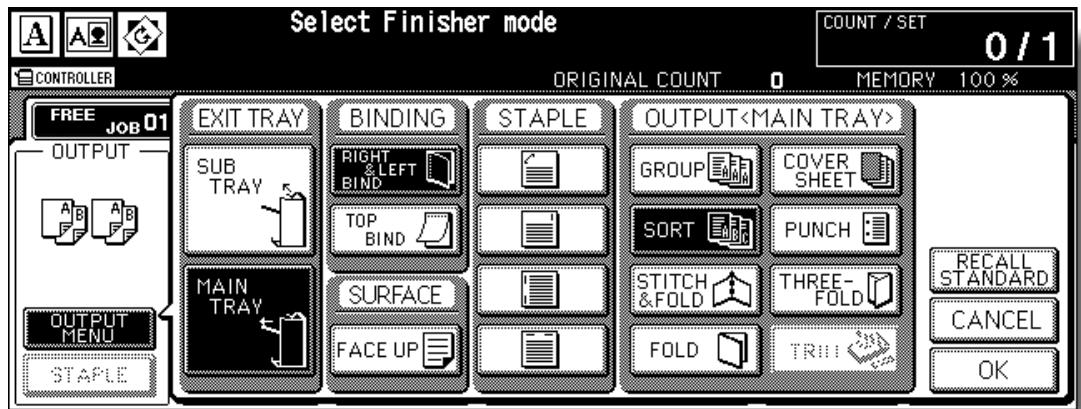
Touch OK on the Output Mode popup menu to return to the Basic Screen. OUTPUT MENU will be highlighted, and the output icon of the selected output mode will be displayed in the OUTPUT area.
Proceed to step 6.

HINTS
See p. 3-50 for details of the output icons displayed on the Basic Screen.
4. To set Staple-sort mode:
(1) Touch STAPLE on the Basic Screen to highlight it.
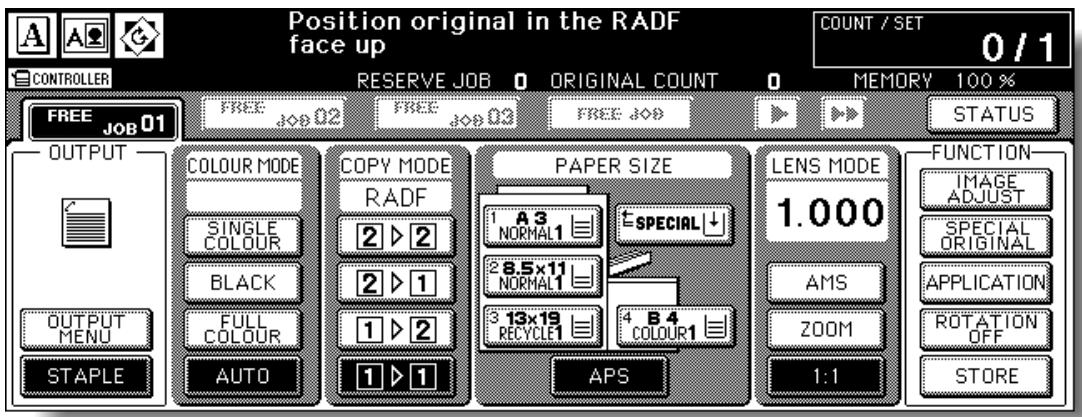
The staple position icon will be displayed in the output icon area. To change the staple position, proceed to the next step. Proceed to step (3), if the present setting is desired.
(2) Touch OUTPUT MENU on the Basic Screen to display the Output Mode popup menu, touch the desired staple position key, then touch OK.
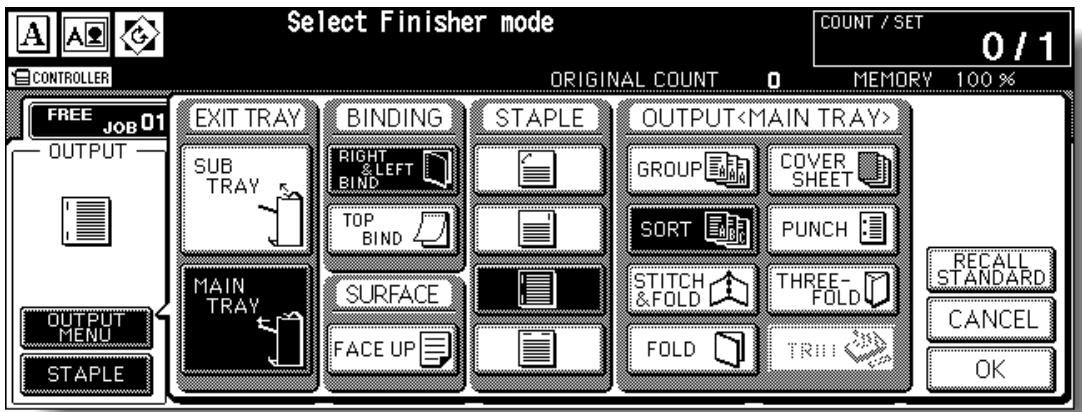
The Basic Screen will be restored, with the selected staple position icon displayed.

HINT
When making double-sided copies, select the desired binding mode on the Output Mode popup menu. See p. 3-52 for details of the binding mode.
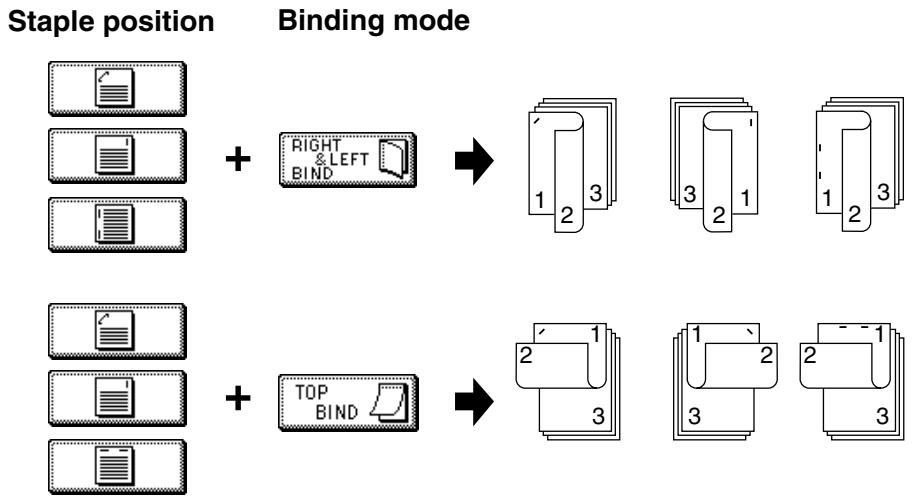
flowchart
graph LR
    A["Staple position"] --> B["+ RIGHT & LEFT BIND"]
    C["Binding mode"] --> D["→"]
    E["Top BIND"] --> F["→"]
    G["Staple position"] --> H["+ Right & Left BIND"]
    I["Binding mode"] --> J["→"]
    K["Staple position"] --> L["+ Right & Left BIND"]
    M["Binding mode"] --> N["→"]
    O["Staple position"] --> P["+ Right & Left BIND"]
    Q["Binding mode"] --> R["→"]
    S["Staple position"] --> T["+ Right & Left BIND"]
    U["Binding mode"] --> V["→"]
    W["Staple position"] --> X["+ Right & Left BIND"]
    Y["Binding mode"] --> Z["→"]
    AA["Staple position"] --> AB["+ Right & Left BIND"]
    AC["Binding mode"] --> AD["→"]
    AE["Staple position"] --> AF["+ Right & Left BIND"]
    AG["Binding mode"] --> AH["→"]
    AI["Staple position"] --> AJ["+ Right & Left BIND"]
    AK["Binding mode"] --> AL["→"]
    AM["Staple position"] --> AN["+ Right & Left BIND"]
    AO["Binding mode"] --> AP["→"]
    AQ["Staple position"] --> AR["+ Right & Left BIND"]
    AS["Binding mode"] --> AT["→"]
    AU["Staple position"] --> AV["+ Right & Left BIND"]
    AW["Binding mode"] --> AX["→"]
    AY["Staple position"] --> AZ["+ Right & Left BIND"]
    BA["Binding mode"] --> BB["→"]
    BC["Staple position"] --> BD["+ Right & Left BIND"]
    BE["Binding mode"] --> BF["→"]
    BG["Staple position"] --> BH["+ Right & Left BIND"]
    BI["Binding mode"] --> BJ["→"]
    BK["Staple position"] --> BL["+ Right & Left BIND"]
    BM["Binding mode"] --> BN["→"]
    BO["Staple position"] --> BP["+ Right & Left BIND"]
    BQ["Binding mode"] --> BR["→"]
    BS["Staple position"] --> BT["+ Right & Left BIND"]
    BU["Binding mode"] --> BV["→"]
    BW["Staple position"] --> BX["+ Right & Left BIND"]
    BY["Binding mode"] --> BZ["→"]
    CA["Staple position"] --> CB["+ Right & Left BIND"]
    CC["Binding mode"] --> CD["→"]
    CE["Staple position"] --> CF["+ Right & Left BIND"]
    BGX["Binding mode"] --> GX["→"]
    BYX["Staple position"] --> BYX["+ Right & Left BIND"]
    BZX["Staple position"] --> BZX["+ Right & Left BIND"]
    CCX["Staple position"] --> CCX["+ Right & Left BIND"]
(3) Check the original set direction with the Original direction icon at the upper left corner of the Basic Screen.
To change the original set direction, touch SPECIAL ORIGINAL on the Basic Screen to display the Special Original popup menu, touch the desired original set direction key, then touch OK to return to the Basic Screen.
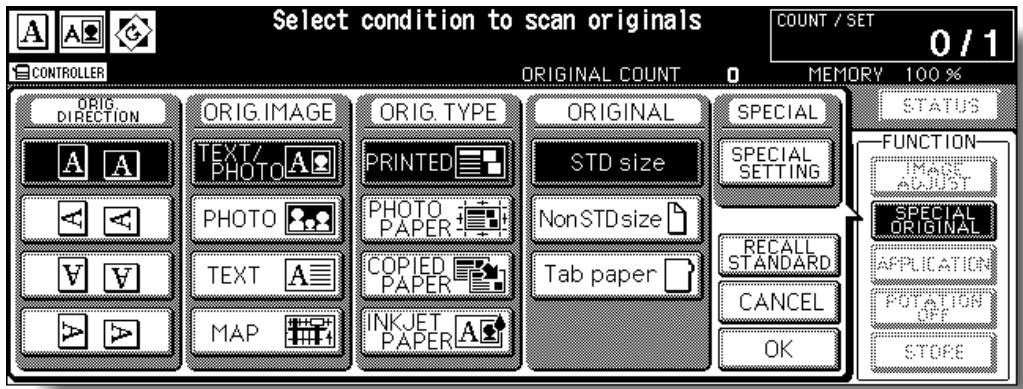
Proceed to step 6.
5. Touch OUTPUT MENU to display the Output Mode popup menu, then touch SUB TRAY to highlight it.
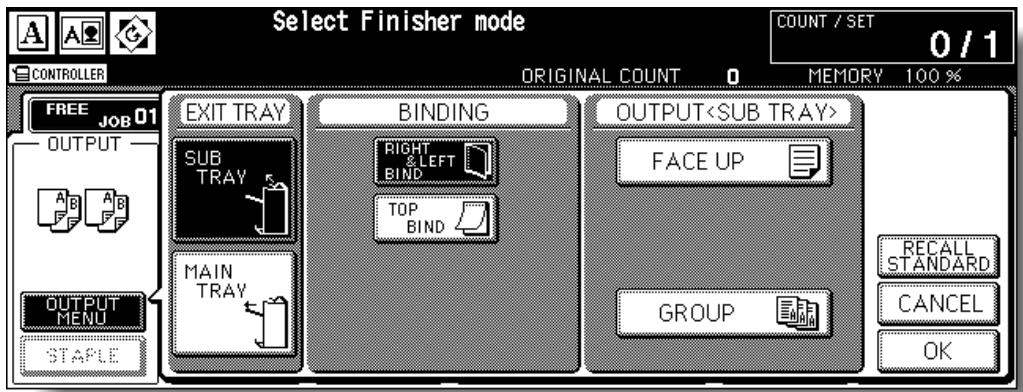
To select Face down non-sort mode, deselect both FACE UP and GROUP. To select Face up non-sort mode, touch FACE UP to highlight it. To select Face down group mode, touch GROUP to highlight it.
To select Face up group mode, touch FACE UP and GROUP to highlight them.
Touch OK to restore the Basic Screen. OUTPUT MENU will be highlighted, and the output icon of the selected output mode will be displayed in the OUTPUT area.

HINT
See p. 3-50 for details of the output icons displayed on the Basic Screen.
6. Select additional copy conditions, as desired.
7. Enter the desired print quantity from the control panel keypad.

Reminder!
See p. 12-4 to p. 12-5 to be sure that the finisher capacity is not exceeded.

HINT
See p. 3-10 for details on setting print quantity.
8. Position original(s).

HINT
See p. 3-4 to p. 3-9 for details on positioning originals.
9. Press [START].
![KONICA MINOLTA 8050 - Press [START]. - 1](/content/2025/01/139766/images/2feb07dc0a459849cbbf9a45db3d1e1b3341a8bfc19f8daaff7fdbb1272478dc.jpg)
DETAILS
Press [STOP] to suspend the scanning or printing job. See p. 3-13 for details.

Reminder!
Finisher primary (main) tray of Finisher FS-115/215 gradually goes down while printed materials output. DO NOT allow any object to interfere with the operation of the tray on the left side of the finisher, as any interference may cause damage to the finisher.

CAUTION
When the finisher exit tray capacity is exceeded due to the print quantity selected, remove the copied sets as they exit; otherwise, mishandled paper will occur.

DETAILS
Output Icons on the Basic Screen
Primary (Main) tray: Face down
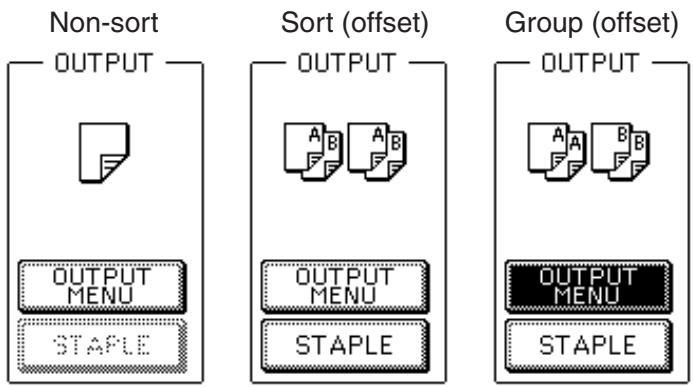
flowchart
graph TD
    A["Non-sort OUTPUT"] --> B["Output MENU"]
    B --> C["STAPLE"]
    D["Sort (offset) OUTPUT"] --> E["OUTPUT MENU"]
    E --> F["STAPLE"]
    G["Group (offset) OUTPUT"] --> H["OUTPUT MENU"]
    H --> I["STAPLE"]
Primary (Main) tray: Face up
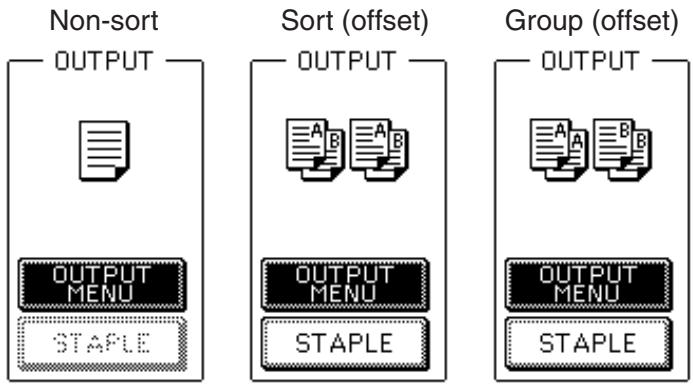
flowchart
graph TD
    A["Non-sort OUTPUT"] --> B["OUTPUT MENU"]
    B --> C["STAPLE"]
    D["Sort (offset) OUTPUT"] --> E["OUTPUT MENU"]
    E --> F["STAPLE"]
    G["Group (offset) OUTPUT"] --> H["OUTPUT MENU"]
    H --> I["STAPLE"]
Primary (Main) tray: Staple-Sort
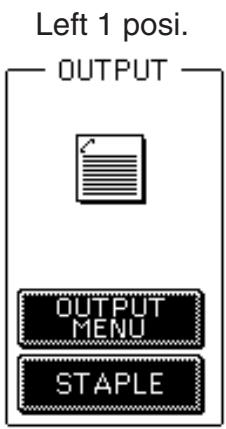
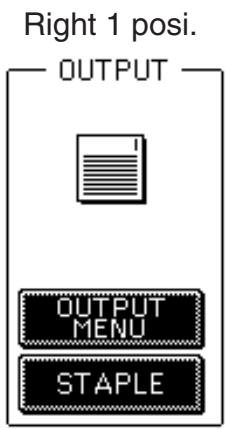
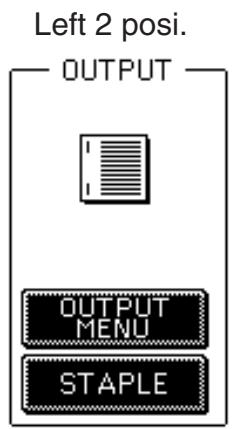
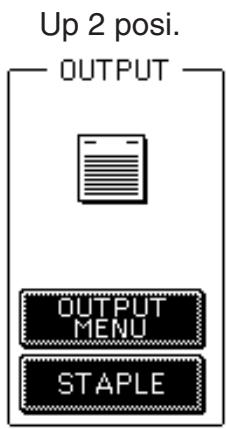
Secondary (Sub) tray: Face down
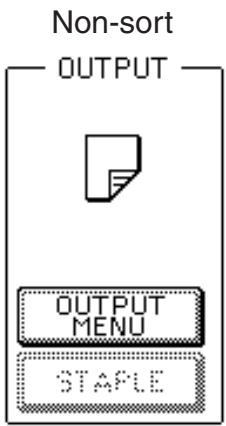
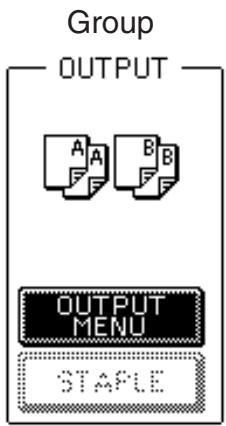
flowchart
graph TD
    A["OUTPUT"] --> B["Block A"]
    A --> C["Block B"]
    B --> D["OUTPUT MENU"]
    C --> D
    D --> E["STAPLE"]
Secondary (Sub) tray: Face up
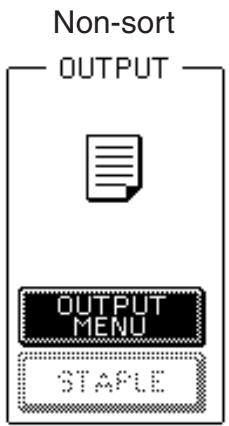
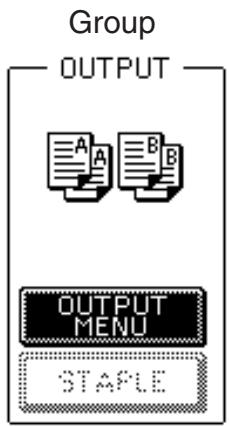
flowchart
graph TD
    A["Group OUTPUT"] --> B["Document Icon A"]
    A --> C["Document Icon B"]
    B --> D["OUTPUT MENU"]
    C --> D
    D --> E["STAPLE"]
Selecting Binding Mode
When copying in 1▶2 or 2▶2 mode, specify the binding mode on the Output Mode popup menu to obtain the desired copy result.
Right & Left bind: Normal duplex copies
Top bind: Duplex copies arranged upside down on the reverse side
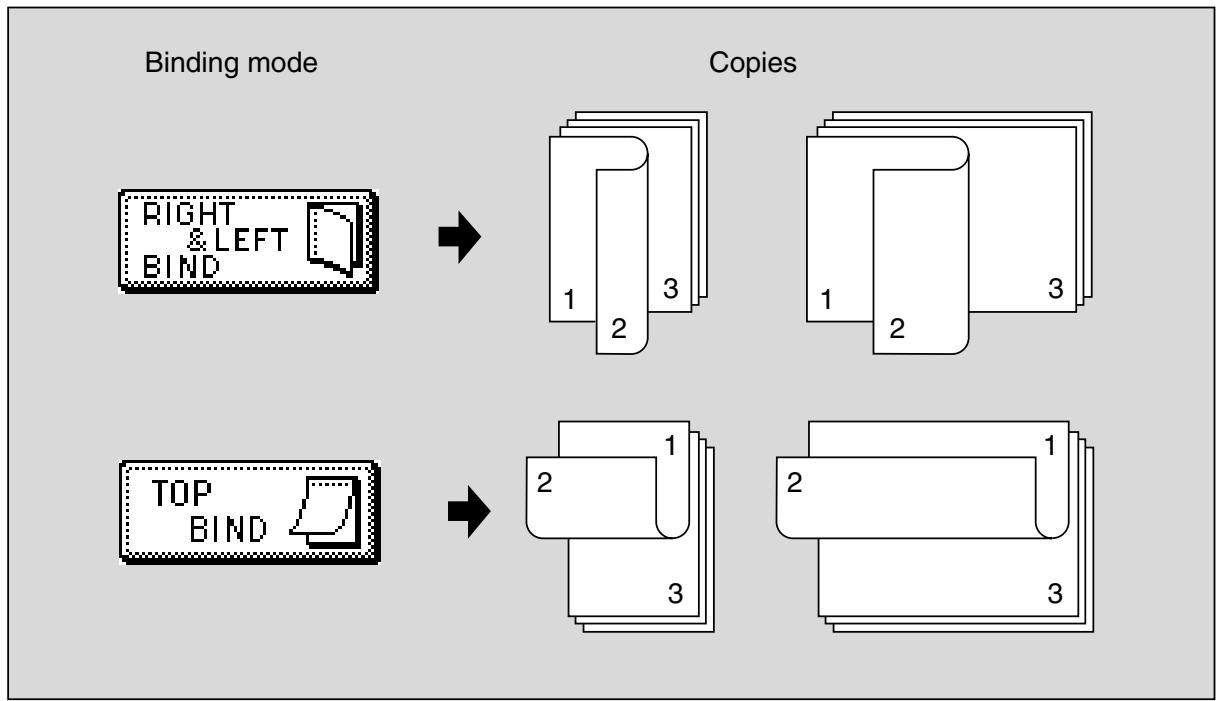
flowchart
graph TD
    A["Binding mode"] --> B["Copies"]
    C["TOP BIND"] --> B
    B --> D["Two copies folded out"]
- Touch OUTPUT MENU to display the Output Mode popup menu.
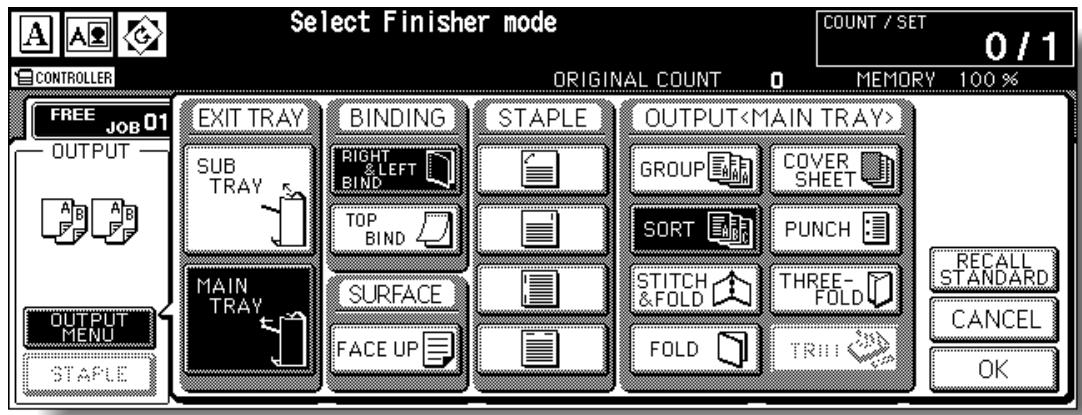
- Touch to highlight the desired binding mode key.
- Touch OK to return to the Basic Screen.
SECTION
4
Helpful Functions
How to Use Helpful Functions
Making Sample Copy (Proof Copy) 4-2
Checking Feature Selections / Proof Copying (Check Mode).... 4-4
Interrupt Copying 4-8
Storing Job Conditions (Job Memory: Job Store)...... 4-11
Recalling Stored Job Settings (Job Memory: Job Recall) ... 4-14
Recalling Previous Job Settings 4-15
Displaying Screen for Operation Guide (Help Mode) ..... 4-16
Use Proof copy to produce a sample of the copied set before making multiple copies. This is a convenient and cost effective way of viewing the results of the following copying selections.
- Copying conditions using Store mode
• Sheet/Cover Insertion - Chapter
-
Combination
-
Booklet
- Image Insert
- Dual Page
- Program Job
Specifications for Proof Copy
☐ Proof copy is available when using RADF or Platen store mode for multiple originals.
☐ Proof copy is not compatible with Group or Rotation group output mode.
1. Select the desired copy conditions and enter the desired print quantity.

Reminder!
When starting a new copying job, be sure to close the RADF securely, then press [AUTO RESET].
2. Position original(s).

HINT
See p. 3-4 to p. 3-9 for details on positioning originals.
3. Press [PROOF COPY] on the control panel.
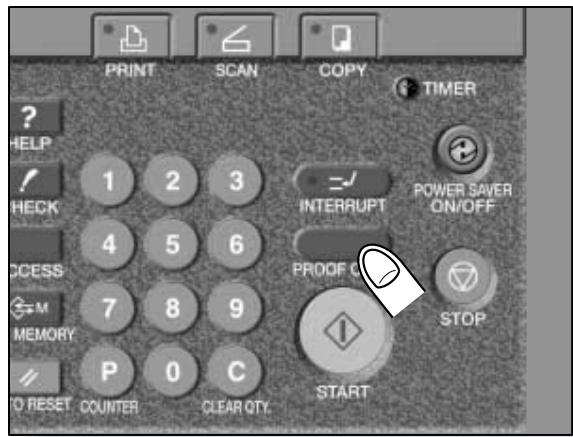
A sample copy will be output, and the Check Screen will be displayed.
![KONICA MINOLTA 8050 - Press [PROOF COPY] on the control panel. - 2](/content/2025/01/139766/images/a4ad579039b91b1fe08cc2ee1d30ab819aa925aaed5a9391eec2c2ab808f6d99.jpg)
DETAILS
- Press [STOP] to suspend the proof copying. In this case, the scanned image data will not be deleted from memory.
- You cannot change or release selections that appeared dimmed after proof copying.
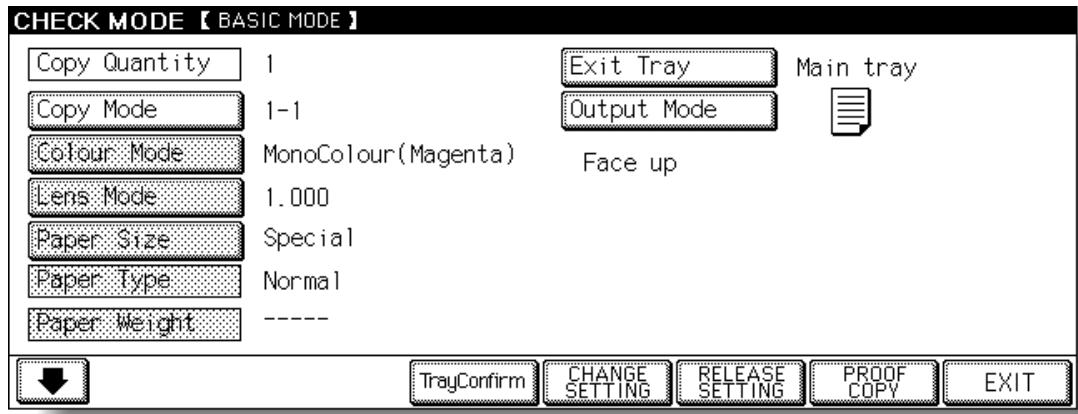
If the copy result is satisfactory, proceed to step 5.
If any setting changes are required, refer to p. 4-6 under the next heading.
- Repeat proof copying until the copy result becomes satisfactory.
- Change the print quantity, as required.

DETAILS
Proof copy can be performed as needed, until the print quantity amount on the Basic Screen reaches zero.
If required, change the print quantity on the Basic Screen.
- Press [START].
If the print quantity is not changed, the copier will output the rest, minus the sample sets.

CAUTION
When the finisher / trimmer unit / paper exit tray capacity is exceeded due to the print quantity selected, remove the copied sets as they exit; otherwise, mishandled paper will occur.
Checking Feature Selections / Proof Copying (Check Mode)
Use the Check mode to confirm copying selections before starting print operation. In this mode, use Proof copy to produce a sample of the copied set before making multiple copies. This is a convenient and cost effective way of viewing the results of the following copying selections.
- Copying conditions using Store mode
- Sheet/Cover insertion
- Chapter
- Combination
- Booklet
- Image insert
- Dual Page
- Program job
Specifications for Check Mode and Proof Copy
☐ Proof copy is available when using RADF, or Platen store mode for multiple originals.
☐ Proof copy cannot be used for testing the Userset density.
☐ Proof copy is unavailable with Group output mode.
1. Select the desired copy conditions and enter the desired print quantity.

Reminder!
When starting a new copying job, be sure to close the RADF securely, then press [AUTO RESET].
2. Position original(s).

HINT
See p. 3-4 to p. 3-9 for details on positioning originals.
3. Press [CHECK] on the control panel.
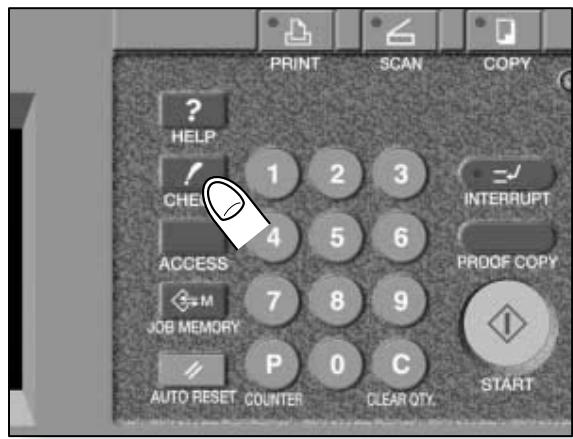
Checking Feature Selections / Proof Copying (Check Mode) (continued)
The Check Screen will be displayed.
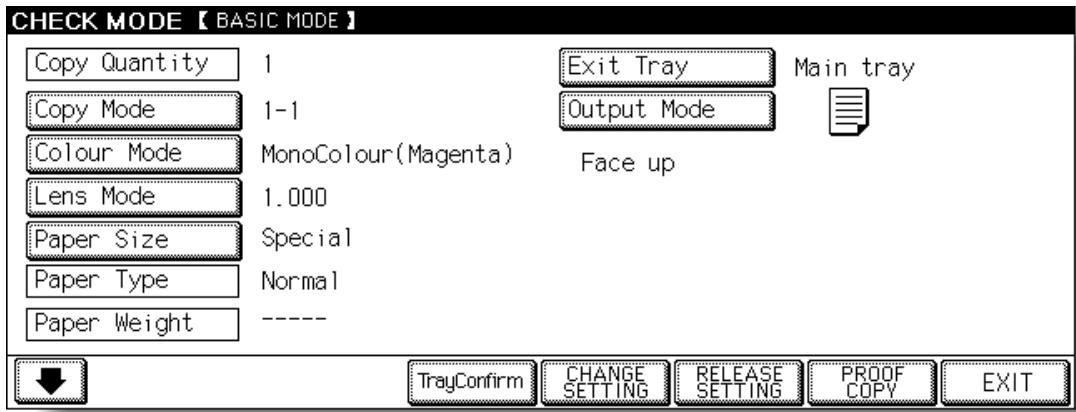
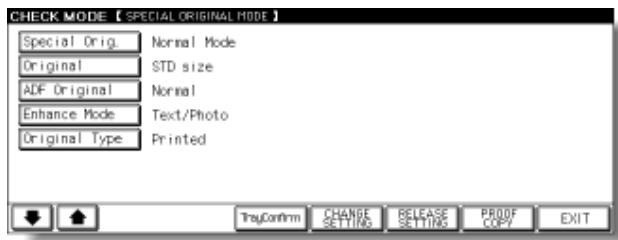
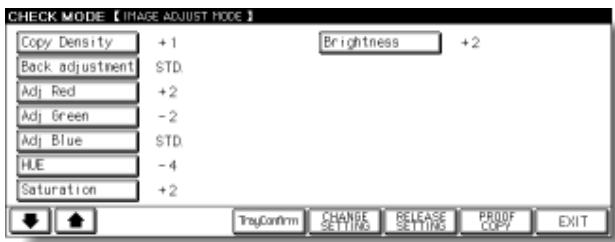
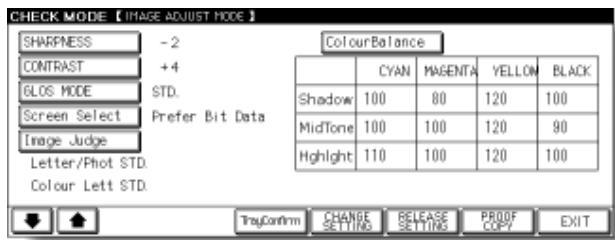
![CHECK MODE 【APPLICATION MODE】 Fiv/Fld Erasure All sides 10mm Image Shift SHIFT [++] 10.0mm [+] 0.0mm SHIFT [++] 10.0mm [+] 0.0mm Stamp/Overlay Page numbering MID TrayConfirm CHANGE SETTING RELEASE SETTING PROOF COPY EXIT](/content/2025/01/139766/images/7d176edb34f758d380469edd930528f49cb5059f549aedf173e244522e1aa5f7.jpg)
Tray Setting Check Screen
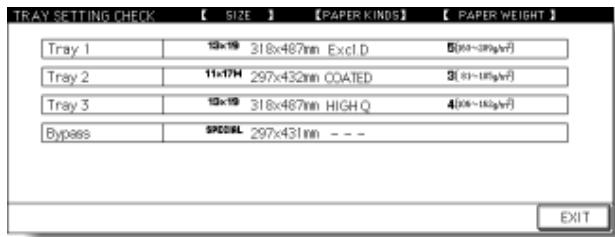
Touch the lower arrow key to scroll to the next screen in order as shown above. Touching the upper arrow key will resume the previous screen.
Touch TrayConfirm to display the Tray Setting Check Screen.
Verify all the settings made for the current job.
- If settings are OK, proceed to step 8.
- If a sample copy is needed, proceed to step 6.
- If making any setting change from the Check Screen, proceed to the next step.
- If releasing any setting from the Check Screen, proceed to step 5.
4. To change the settings:
Touch the desired copying condition key on the Check Screen to highlight it.
Any key that cannot be highlighted indicates that the copying condition cannot be changed from the Check Screen.
Touch CHANGE SETTING.
The LCD will display an appropriate screen to change the copying condition selected.

DETAILS
- Selecting a basic copying condition key will display the Basic Screen.
- Selecting a Special Original Mode key will display the Special Original popup menu.
- Selecting an Image Adjust Mode key will display the Change Image Adjustment Setting Screen.
When BOOK MARK has been checked on a subsequent screen, selecting the mode key will jump to that screen. - Selecting an Application Mode key will display the Change Application Selection Screen.
When BOOK MARK has been checked on a subsequent screen, selecting the application function key will jump to that screen. See p. 10-2 for details. - CHANGE SETTING will not function for the following application functions, however they can be released by touching RELEASE SETTING: Program Job, Non-Image Area Erase, Reverse Image, AUTO Layout, Overlay.
Change the setting as desired, then restore the Check Screen to return to the checking steps.
From the Basic Screen, press [CHECK] to return to the Check Screen. From the Special Original popup menu, Change Image Adjustment Setting Screen or Change Application Selection Screen, touch OK to return to the Check Screen.
- When making a set or sample copy, proceed to step 6.
• To start printing without proofcopying, proceed to step 8.
5. To release the settings:
Touch the desired copying condition key on the Check Screen to highlight it, then touch RELEASE SETTING.
The confirmation screen will appear on the Check Screen.
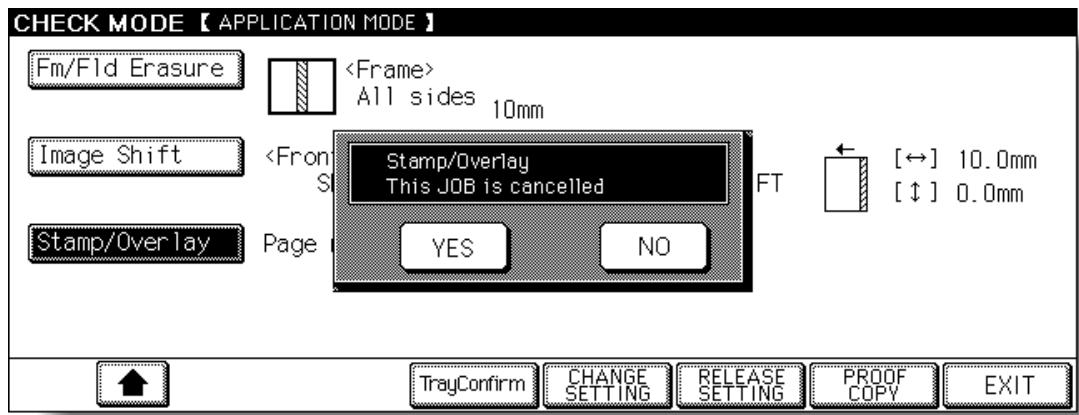
7. Change the print quantity, as required.
DETAILS
Proof copy can be performed as needed, until the print quantity amount on the Basic Screen reaches zero. (Note that the print quantity amount on the Check Screen does not change.) If required, change the print quantity on the Basic Screen.8. Press [START].
If the print quantity is not changed, the copier will output the rest, minus the sample sets. CAUTION
When the finisher / trimmer unit / paper exit tray capacity is exceeded due to the print quantity selected, remove the copied sets as they exit; otherwise, mishandled paper will occur. Use the Interrupt mode to interrupt copying in progress to perform a simple job. When interrupt copying is completed, the settings for the initial job restore automatically and the Basic Screen displays. Interrupt copying is available when the copier is performing the following operations: • Continuously printing the image stored in memory - Scanning the originals into memory - Scanning the originals into memory in Reserve mode while printing HINT
If desired, Key Operator can change the timing to stop current machine operation for interrupt copying. Note that the compatible copying conditions vary according to the timing selected. See p. 14-37 to p. 14-42.Specification for Interrupt Mode
☐ The Interrupt mode cannot be selected with the following copier conditions: The Basic Screen is not displayed. Overlay Memory is in use. The Call for Service message displays or a paper misfeed occurs. ☐ Incompatible: 2▶1, 2▶2, Applications, Mixed Original, Z-Folded Original1. Press [INTERRUPT] on the control panel.
 The [INTERRUPT] LED turns on and all JOB indicators on the Basic Screen change to INTERRUPT.  HINT
The timing to enter the Interrupt mode varies according to the job in progress on the machine when [INTERRUPT] is pressed. See the following page. DETAILS
In Reserve mode, pressing [INTERRUPT] before the copier finishes scanning the reserve job originals clears the settings selected for the reserve job. For details of Reserve mode, see p. 3-35 to p. 3-37.2. Set copy conditions, as desired.
The initial settings in Interrupt mode are as follows. Colour Mode : Full Colour Copy Mode : 1▶1 RADF : ON AE : ON Lens Mode : 1.000 (100%) APS : ON Print Quantity : 1 Finisher : Main Tray in Sort mode DETAILS
Remove any document from the platen glass or from the document feeder, if present.3. Position original(s).
HINT
See p. 3-4 to p. 3-9 for details on positioning originals.4. Press [START] to start the interrupt copying.
DETAILS
When [CHECK] is pressed during Interrupt copying, the information displayed reflects the initial copy job settings. Check mode will not display Interrupt copy job information.5. When Interrupt copying is completed, press [INTERRUPT] again.
The [INTERRUPT] LED turns out and the INTERRUPT indicator on the Basic Screen returns to the JOB indicators. The settings of the initial job will be restored on the Basic Screen.6. Press [START] to resume copying.
CAUTION
When the finisher / trimmer unit / paper exit tray capacity is exceeded due to the print quantity selected, remove the copied sets as they exit; otherwise, mishandled paper will occur. DETAILS
For particular jobs in progress, copying will cease only after certain phases of the immediate operation are completed, as indicated by the [INTERRUPT] LED conditions described below. • Collectively printing image stored in memory The LED blinks until one set of the current job is printed. Then the LED remains steady for the temporary job performed in Interrupt mode. - Scanning originals into memory The LED blinks until scanning is completed for all originals placed in the document feeder. Then, the LED remains steady for the temporary job performed in Interrupt mode. - Scanning originals into memory while printing in Reserve mode The LED blinks until the copier completes the current printing job, scans all originals placed on the document feeder, and prints one set of the Reserved job. The LED remains steady for the temporary job performed in Interrupt mode.Storing Job Conditions (Job Memory: Job Store)
Use Job Store to store up to 30 frequently used copy job settings, which can be recalled at any time. The stored jobs can be given alphabetical names.Specifications for Job Memory
☐ All copying functions can be selected. ☐ Interrupt mode cannot be used while in Job Memory.1. Make job selections from the Basic Screen and/or Application Selection Screen.
Reminder!
When starting a new copying job, be sure to close the RADF securely, then press [AUTO RESET].2. Press [JOB MEMORY] on the control panel.
 The Job No. Selection Screen will be displayed.3. Touch STORE.
 The Job Store Check Screen will be displayed.4. Review the settings on the Job Store Check Screen.
 Touch the lower arrow key to scroll to the following pages. Check that the selections made in step 1 are correctly entered. DETAILS
If any correction is required, touch CANCEL to return to the Basic Screen. Make new selections, then restart the Job Store operation from step 2.5. Touch OK.
The Job No. Selection Screen will be restored. DETAILS
To suspend the storing job after step 6, press [AUTO RESET]. Job Memory mode will be cancelled, and the Basic Screen will return from any screen.6. Touch to highlight one of the keys numbered from 1\~30 to store the job under that number.
 The screen displays 15 job number keys. The arrow key at the lower left corner can be used to scroll to the next/previous page. A blank key indicates that no job is stored under that key, and a named job without a lock icon ( 🔍 ) displayed can be overwritten. The key with a lock icon (💡) displayed is locked and cannot be selected. HINT
To lock or unlock a job, and to delete a locked job, see p. 14-20. DETAILS
If you wish to cancel the job number selection, touch CANCEL to restore the Basic Screen, which displays the settings made in step 1. If you wish to cancel the settings, press [AUTO RESET].7. Touch OK.
The Job Name Registration Screen will be displayed. 8. Enter a job name.
Enter a job name in up to 16 characters, using the touch screen alphabet keypad. To correct an entry, touch 1-CHARACTER DELETE repeatedly to delete each character entered, then enter the correct job name. DETAILS
If you do not wish to enter a name, simply touch OK. The key displays 16 asterisks (\*) in place of a name. When changing the name of a job previously stored, touch 1-CHARACTER DELETE repeatedly to delete the previous name, then enter the new name.9. Touch OK.
The Job No. Selection Screen will be restored. Check that the job name has been correctly entered. 10. Touch OK to complete the setting and return to the Basic Screen.Recalling Stored Job Settings (Job Memory: Job Recall)
Use Job Recall to recall jobs that are already stored in Job Memory. 1. Press [JOB MEMORY] on the control panel. The Job No. Selection Screen will be displayed. 2. Touch to highlight a job number key to select a job you want to recall.  The screen displays 15 job number keys. If required, scroll to the next page with the arrow key to reach the desired job number key (16\~30). 3. If desired, touch JOB CHECK. The Job Recall Check Screen displays to enable you to review the settings.  4. Touch OK. The settings of the selected job will be recalled on the restored Basic Screen. To cancel the recall mode, touch CANCEL to return to the Basic Screen. 5. Position original(s), then press [START] to print. Follow the procedure below to copy with a previous job's settings. DETAILS
- Only the last-completed output job settings can be recalled as the previous job settings. Non-complete job or reserve job settings cannot be recalled, even if the setting operations have been made last. - The previous job settings can be recalled, even after the machine power is turned off then on. 1. Press [JOB MEMORY] on the control panel. The Job No. Selection Screen will be displayed. 2. Touch PRE-JOB RECALL.  The JOB CHECK key will be displayed between STORE and PRE-JOB RECALL on the screen 3. Touch JOB CHECK to display the Job Check Screen. Check the settings of the previous output job. 4. Touch OK to return to the Basic Screen. The settings of the previous output job is recalled on the screen. 5. Change the settings recalled on the screen, if desired. 6. When all settings are acceptable, position original(s) in the document feeder or on the platen glass, then press [START].Displaying Screen for Operation Guide (Help Mode)
The Help Screen provides you with the information about the current screen mode and about setting procedures. Help mode can be accessed from any screen except Job Memory and Key Operator Screens. Help mode provides two types of Help Screens according to the current screen mode: 1 Help Screen accessed from Basic Screen 2 Help Screen accessed from screens other than Basic ScreenTo Display Help Screen from Basic Screen
1. Return to the Basic Screen, then press [HELP].
 The Help Screen will be displayed.2. Touch the desired key to display specific information.
flowchart
graph TD
    A["STAPLE SUPPLY"] --> B["PUNCH"]
    B --> C["TONER SUPPLY"]
    C --> D["TRIMMER"]
    D --> E["RADF"]
    E --> F["PAPER SUPPLY"]
    F --> G["PAPER SUPPLY"]
    G --> H["PAPER SUPPLY"]
    H --> I["PAPER SUPPLY"]
    I --> J["PAPER SUPPLY"]
    J --> K["PAPER SUPPLY"]
    K --> L["PAPER SUPPLY"]
    L --> M["PAPER SUPPLY"]
    M --> N["PAPER SUPPLY"]
    N --> O["PAPER SUPPLY"]
    O --> P["PAPER SUPPLY"]
    P --> Q["PAPER SUPPLY"]
    Q --> R["PAPER SUPPLY"]
    R --> S["PAPER SUPPLY"]
    S --> T["PAPER SUPPLY"]
    T --> U["PAPER SUPPLY"]
    U --> V["PAPER SUPPLY"]
    V --> W["PAPER SUPPLY"]
    W --> X["PAPER SUPPLY"]
    X --> Y["PAPER SUPPLY"]
    Y --> Z["PAPER SUPPLY"]
    Z --> AA["PAPER SUPPLY"]
    AA --> AB["PAPER SUPPLY"]
    AB --> AC["PAPER SUPPLY"]
    AC --> AD["PAPER SUPPLY"]
    AD --> AE["PAPER SUPPLY"]
    AE --> AF["PAPER SUPPLY"]
    AF --> AG["PAPER SUPPLY"]
    AG --> AH["PAPER SUPPLY"]
    AH --> AI["PAPER SUPPLY"]
    AI --> AJ["PAPER SUPPLY"]
    AJ --> AK["PAPER SUPPLY"]
    AK --> AL["PAPER SUPPLY"]
    AL --> AM["PAPER SUPPLY"]
    AM --> AN["PAPER SUPPLY"]
    AN --> AO["PAPER SUPPLY"]
    AO --> AP["PAPER SUPPLY"]
    AP --> AQ["PAPER SUPPLY"]
    AQ --> AR["PAPER SUPPLY"]
    AR --> AS["PAPER SUPPLY"]
    AS --> AT["PAPER SUPPLY"]
    AT --> AU["PAPER SUPPLY"]
    AU --> AV["PAPER SUPPLY"]
    AV --> AW["PAPER SUPPLY"]
    AW --> AX["PAPER SUPPLY"]
    AX --> AY["PAPER SUPPLY"]
    AY --> AZ["PAPER SUPPLY"]
    AZ --> BA["PAPER SUPPLY"]
    BA --> BB["PAPER SUPPLY"]
    BB --> BC["PAPER SUPPLY"]
    BC --> BD["PAPER SUPPLY"]
    BD --> BE["PAPER SUPPLY"]
    BE --> BF["PAPER SUPPLY"]
    BF --> BG["PAPER SUPPLY"]
    BG --> BH["PAPER SUPPLY"]
    BH --> BI["PAPER SUPPLY"]
    BI --> BJ["PAPER SUPPLY"]
    BJ --> BK["PAPER SUPPLY"]
    BK --> BL["PAPER SUPPLY"]
    BL --> BM["PAPER SUPPLY"]
    BM --> BN["PAPER SUPPLY"]
    BN --> BO["PAPER SUPPLY"]
    BO --> BP["PAPER SUPPLY"]
    BP --> BQ["PAPER SUPPLY"]
    BQ --> BR["PAPER SUPPLY"]
    BR --> BS["PAPER SUPPLY"]
    BS --> BT["PAPER SUPPLY"]
    BT --> BU["PAPER SUPPLY"]
    BU --> BV["PAPER SUPPLY"]
    BV --> BW["PAPER SUPPLY"]
    BW --> BX["PAPER SUPPLY"]
    BX --> BY["PAPER SUPPLY"]
    BY --> BZ["PAPER SUPPLY"]
Displaying Screen for Operation Guide (Help Mode) (continued)
- PANEL CONTRAST 📄 displays the screen to adjust the contrast of the LCD panel. - Toner Recovery box provides information on exchanging the toner recovery box. • FOR ASSISTANCE displays the extension number of the Key Operator. - TELEPHONE/FAX displays the phone/fax number of your service centre. DETAILS
- Touch ↓ on the Help Screen, if provided, to scroll to the next page. Touch ↑ to return to the previous page. \- Touch KEY OPERATOR MODE to enter the Key Operator mode. See p. 14-2.3. Touch EXIT to return to the Basic Screen.
DETAILS: Help Menu Screen
 Select one of the 8 help menu items on the Help Menu Screen to display subsequent Help Screens. Touch ↓ on the Help Screen, if provided, to scroll to the next page. Touch ↑ to return to the previous page. Touch MENU on the subsequent Help Screen to return to the Help Menu Screen, then touch EXIT to restore the Basic Screen. - “1. Hard keys” displays the information on control panel buttons. - “2. RADF/Platen” displays the information on unsuitable RADF originals and maintenance of the document feeder and platen glass. - “3. Basic modes” displays the information on basic functions provided on the Basic Screen. - “4. Applications” displays operational information on 16 application functions provided on the Application Selection Screen. - “5. Special orig.” displays the information on functions provided on the Special Original popup menu. - “6. Output modes” displays the information on Finisher functions. - “7. Job memory” displays the information on Job Memory. - “8. Image Adjust” displays the information on Colour Image Adjustment.To Display Help Screen from Other Screens
1. While in any screen other than the Basic Screen, press [HELP].
 The Help Screen displays to provide the information about the current screen mode and setting procedures.2. Touch EXIT.
The screen that was displayed before pressing [HELP] will be restored.SECTION
5
Troubleshooting
How to Handle Machine Troubles
When “Call for Service” Message Is Displayed 5-2 Clearing Mishandled Paper 5-4 When “JAM” Appears on Folder Key (Or Arrow Key Flashes)...... 5-6 When “ADD PAPER” Appears on Folder Key (Or Arrow Key Flashes).. 5-8 When “Memory Full” Message Is Displayed (Memory Overflow) .... 5-9 When Power OFF/ON Screen Is Displayed 5-11 Troubleshooting Tips 5-12When “Call for Service” Message Is Displayed
A “Call for Service” message indicates a machine condition that requires the attention of your service representative. The Call for Service Screen usually displays the telephone and facsimile numbers of your service representative.  CAUTION
When the Call for Service Screen is displayed, be sure to contact your service representative immediately by following the procedure below.1. Make note of the Report code No. indicated in the second line of the message area.
HINT
If your machine uses the Remote Diagnostics option and is automatically monitored by your service representative, the Key Operator can call for service using the Key Operator setting. See p. 14-44. Reminder!
After calling for service using the Key Operator setting, be sure to turn OFF the power switch immediately, then unplug the machine as described here.2. Turn OFF the power switch.
natural_image
Line drawing of a hand pressing a button on a mechanical component (no text or symbols)Limited Use of the Copier in Trouble
If the message shown below is displayed on the Call for Service Screen, you may continue operating the copier on a limited function basis and utilize the trays and ADU that are not affected by the trouble. To obtain this limited functionality of the copier, consult your service representative. Be sure to utilize the limited function only temporarily, and arrange for machine repair immediately. 1. If the limited use of the copier is available, the following message is displayed in the message area instead of the Report code. ex. Tray 2 failure Press AUTO to select except this tray 2. Press [AUTO RESET]. Please switch ON/OFF E 18-2 Make note of the Report code No. 3. Turn OFF then ON the power switch. A copying job can continue without using the troubled portion of the machine (ex. Tray 2). CAUTION EVEN IF THE COPYING JOB CAN BE CONTINUED WITH THE ABOVE OPERATION, BE SURE TO CONTACT YOUR SERVICE REPRESENTATIVE IMMEDIATELY WHEN THE CALL FOR SERVICE SCREEN IS DISPLAYED.Clearing Mishandled Paper
When a paper misfeed occurs, the copier stops making copies and mishandled paper codes display on the screen to indicate misfeed area(s). Copying operation cannot be continued until all the misfeed locations are cleared.  DETAILS
The above screen displays all the jam numbers for the sake of explanation. Actually a few numbers appear when a paper misfeed occurs.1. Touch Graphic Illustration on the screen.
The screen illustrating the method for the disposal action will be displayed. Reminder!
Before performing the clearing procedure, see p. 1-2 for the caution label locations inside the machine.2. Follow the procedure on the screen to remove misfed paper.
Touch ↓ on the screen, if provided, to go to the next page of a series of illustrations. Reminder!
When removing mishandled paper, be sure to leave no torn paper inside the machine.3. When completed, the Basic Screen will be restored.
If any misfeed location is left, the screen displays the next disposal procedure in the message area and the location number in the jam position display. Repeat steps 1 to 2 until all the locations are cleared. WARNING
The drum unit generates high voltage. To avoid bodily electrical shock, NEVER TOUCH the area. CAUTION
The internal fixing unit is very hot. To avoid getting burned, DO NOT TOUCH. CAUTION
Be careful of removing staples stuck inside the machine so as not to get injured. CAUTION
DO NOT INSERT your finger into the two RADF hinge portions, otherwise you may be injured.When “JAM” Appears on Folder Key (Or Arrow Key Flashes)
If a misfeed occurs with the print/scan job in progress while you are setting a reserve job, SCAN or PRINT JOB folder key on the Basic Screen will change to flashing JAM JOB. When more than four jobs have been specified and the folder key of the print/scan job in trouble is not currently displayed on the screen, the arrow key to scroll to that job will flash. Follow the procedure below to remove mishandled paper.1. Display the Jam Position Screen.
Touch JAM JOB. The Jam Position Screen will be displayed.  When the arrow key flashes, touch the key to scroll to the JAM JOB folder key, then touch it to display the Jam Position Screen.  HINT
If ADD PAPER is displayed instead of JAM JOB, see p. 5-8.2. Touch Graphic Illustration.
 The screen illustrating the method for the disposal action will be displayed. HINT
See p. 5-4 to p. 5-5 for details on clearing procedure.3. Follow the procedure on the screen to remove misfed paper.
When all procedures are completed, the Basic Screen will be restored. DETAILS
JAM JOB has changed to STOP, and the settings for the current printing job are displayed on the screen.4. Press [START].
The scan/print job will resume.5. Touch FREE JOB to continue the reserve job setting.
WARNING
The drum unit generates high voltage. To avoid electrical shock, NEVER TOUCH the area. CAUTION
The internal fixing unit is very hot. To avoid getting burned, DO NOT TOUCH. CAUTION
Be careful of removing staples stuck inside the machine so as not to get injured. CAUTION
DO NOT INSERT your finger into the two RADF hinge portions, otherwise you may be injured.When “ADD PAPER” Appears on Folder Key (Or Arrow Key Flashes)
If the paper supply for a print job in progress becomes depleted while you are setting a reserve job, PRINT JOB on the Basic Screen will change to flashing ADD PAPER. When more than four jobs have been specified and the folder key of the print job in trouble is not currently displayed on the screen, the arrow key to scroll to that job will flash.  Follow the procedure below to continue the copying operation.1. Display the Basic Screen for the print job in progress.
Touch ADD PAPER. The Basic Screen for the print job will be displayed. When the arrow key flashes, touch the key to scroll to the ADD PAPER folder key, then touch it to display the Basic Screen for the print job. 2. Check the flashing tray key, then supply that empty tray with copy paper.
When paper supply is completed, ADD PAPER changes to STOP. HINT
See p. 2-22 to p. 2-32 for details on loading paper.3. Press [START].
The print job will resume.4. Touch FREE JOB to continue the reserve job setting.
When “Memory Full” Message Is Displayed (Memory Overflow)
In certain modes, this printer/copier uses memory to make operations convenient and smooth flowing. Occasional memory overflow may occur if the installed memory is inadequate for the copy conditions selected. To handle the Memory overflow condition while performing a job, take the appropriate action described below. These actions enable you to continue the job or suspend the job. DETAILS
Should memory overflow occur frequently, it is recommended that you contact your service representative to expand the memory capacity in your machine.Memory Overflow in Current Job
When memory overflow occurs while scanning the first job, the machine stops immediately, and the screen provides JOB STOP and SCAN STOP as the only two available options.  DETAILS
If the job settings include Booklet mode, SCAN STOP will disappear. • To delete all the scanned data and discontinue the job, touch JOB STOP. - To give up further scanning but print out all the data already scanned into memory, touch SCAN STOP.Memory Overflow in Reserve Job
When memory overflow occurs during the reserve operation, CONTINUE also appears on the active screen. In this case, the machine will not stop until all the jobs on standby for printing are completed.  DETAILS
If the job settings include Booklet mode, SCAN STOP will disappear. - To delete the scanned data and discontinue the last reserve job, touch JOB STOP. - To give up further scanning but print out the data already scanned for the last reserve job, touch SCAN STOP. - To continue scanning the last reserve job, touch CONTINUE as the current printing job gradually enables memory for new data.When Power OFF/ON Screen Is Displayed
When any trouble affects the electrical signal of the copier, the Power OFF/ON Screen will be displayed.  Follow the procedure below to turn the machine power off then on.1. Turn OFF the power switch.
natural_image
Line drawing of a hand pressing a button on a mechanical component (no text or symbols)Troubleshooting Tips
COPIER DOES NOT OPERATE WHEN POWER SWITCH IS ON
Fully insert paper trays. Close RADF. Close Front doors of main body. Close Finisher door. Check to be sure main power switch is ON. Check to be sure power plug is firmly inserted in electrical socket.COPY IMAGE IS TOO LIGHT
Manually adjust copy density to darker density. Check toner indicator and add toner, if required. Check paper for dampness. Do not leave paper in copier when humidity is high. Check to see if Photo, Text, or Map mode is required. Check the Density shift.COPY IMAGE IS TOO DARK
Manually adjust copy density to lighter density. Check to see if Photo, Text, or Map mode is required. Check the Density shift.COPY IMAGE IS NOT CLEAN OR SHOWS SPOTS
Use clean originals since dirt marks may be copied. Keep platen glass and inner surface of document cover clean. Call for service if “Call for service” is displayed in the message area. Check density indicator and lighten if required.COPY PAPER MISHANDLES DURING COPYING
Fan copy paper and load it with curl side in proper location. Do not exceed the tray capacity.COPY IMAGE CAN BE RUBBED OFF
Check copy paper thickness. Use Thick paper mode, if paper weight requires it.MAGNIFICATION CANNOT BE CHANGED
Reduce & Shift is incompatible with magnification. Press [AUTO RESET] and set desired copying conditions without using Reduce & Shift.DUPLEX MODES CANNOT BE SELECTED
Fully close RADF, then select Duplex mode again.COPYING DOES NOT BEGIN AFTER PRESSING [START]
Insert or adjust the appropriate paper tray for paper size selected. Close document cover firmly. Close Front doors and Toner access door of main body completely. Close Finisher door completely. Check to see if the message “Please close stacker cover of Trimmer” is displayed. Close Trimmer stacker cover or front door completely.COPYING DOES NOT RESUME AFTER MISHANDLED PAPER IS REMOVED
Check copier diagram on touch screen for additional indications of mishandled paper.COPY QUALITY IS POOR
Check paper for dampness, and replace it if necessary.THE ORIGINAL PAPER IS MISHANDLED OR SKEWED IN THE DOCUMENT FEEDER
Originals should conform to the recommended size and weight. Be sure originals are not stapled. Align originals evenly in the RADF. Check to make sure paper guides meet the width of mixed size originals.COPY IMAGE IS SKEWED WHEN BYPASS IS USED
Be sure copy paper is inserted straight.USING EKC, COPIES CANNOT BE MADE AFTER PASSWORD IS ENTERED
Check to see if the message EXCEEDS LIMIT is displayed. Contact Key Operator to reset limit.FINISHER DOES NOT OPERATE
Touch OUTPUT MENU. Check for a paper misfeed and remove it, as required. Properly close finisher door.RADF INDICATOR WILL NOT LIGHT AFTER [AUTO RESET] IS PRESSED
Fully close RADF.RADF LIGHT IS FLASHING
The document feeder is ready to accept originals. Insert originals on RADF tray, press [AUTO RESET], then [START].ADD TONER MESSAGE IS DISPLAYED
New toner supply is needed. Follow instructions for adding toner.CALL FOR PM IS DISPLAYED IN MESSAGE AREA
Contact your service representative for Preventive Maintenance.APS SELECTS THE WRONG PAPER SIZE
Paper guides must be adjusted exactly to the size of originals.IN MIXED ORIGINAL MODE, A MESSAGE TO LOAD A REQUIRED PAPER SIZE DISPLAYS, EVEN THOUGH THAT SIZE IS LOADED IN ONE OF THE TRAYS
Paper sizes loaded in the trays must be consistent with the tray position size; otherwise, the tray key on the Basic Screen will blink.THE BASIC SCREEN DOES NOT DISPLAY SETTINGS AS DESCRIBED IN INSTRUCTION MANUAL
Check with the Key Operator, as Initial Settings may have been changed."PLEASE CHECK ORIGINAL"
This message displays when the copier detects a non-standard paper size on the platen glass. Select paper size and press [START]. 1.000 magnification will be selected automatically. If this message continues to display after selecting paper size, select 1.000 magnification, even if it is already indicated, then press [START]. If desired, ask your service representative to enable the machine to default to 1.000 magnification in this situation.SHEET INSERTION RESULT IS NOT AS EXPECTED
Blank insertion: Be sure manuscript originals do not already include blank sheets in the locations designated for sheet insertion. Copy insertion: To ensure that chapter sheets in 1-2 mode always appear on the right hand side in the finished set, insertion sheets must be designated on the page setting screen with odd numbers, not even. If required, make an even numbered original page odd by inserting a blank sheet in front of that page, so that the blank sheet is even and the insertion sheet is odd.FINISHER STAPLE RESULT IS NOT AS EXPECTED
The 2 staple position functions only on copy paper that is loaded vertically (portrait style).COPIES SKEW IN THE STAPLED SETS
Check to see if copy paper is excessively curled in the tray. Reload the copy paper upside down.USING PUNCH, COPIES CANNOT BE PUNCHED
Check to see if the message “Waste basket of Punching kit is full” is displayed. Empty the waste basket.COPIES CANNOT BE STAPLED OR PUNCHED IN POSITION
Check to make sure the side guide plates are securely aligned to the copy paper in the paper tray to be used. Check to see if copy paper is excessively curled in the tray. Reload the copy paper upside down.USING TRIMMER, COPIES CANNOT BE TRIMMED
Check to see if the message “Waste basket of Trimmer is full” is displayed. Empty the waste basket.SECTION
6
Machine Specifications
Main Body & Option Specifications
Main Body Specifications 6-2 Option Specifications.... 6-4 Main Body| Name: | Konica 8050 |
| Type: | Console type |
| Transfer method: | Indirect electrostatic method |
| Platen glass: | Fixed |
| Light-sensitive unit: | OPC |
| Light source: | Xenon lamp |
| Developing method: | Dry, 2-component magnetic brush developing |
| Fixing method: | Heat roller |
| Density adjustment: | Automatic and manual (9 steps) |
| Magnification ratio: | 1:1 ± 1.0 %Enlargement: 1:1.154 (115.4 %), 1:1.224 (122.4 %), 1:1.414 (141.4 %), 1:2.000 (200 %)Reduction: 1:0.866 (86.6 %), 1:0.816 (81.6 %), 1:0.707 (70.7 %), 1:0.500 (50 %)Zoom/Special ratio magnification ratio: 25 % to 400 % in 1 % increments |
| Copy paper: | Plain paper: 64 to 256 g/m2Special paper: Tab, 3-hole* Set offset master, intermediate paper, or labels one sheet each on Multi-sheet bypass tray.* OHP films and ink-jet paper are unavailable. |
| Copying speed: | 51 copies/min. (A4), 38 copies/min. (A4R), 28 copies/min. (A3), 50 copies/min. (B5), 34 copies/min. (B4), 43 copies/min. (B5R) |
| Continuous copying: | 1 to 9,999 copies |
| Types of original: | Sheet, book originals |
| Original size: | A3 (11" x 17" or 303 mm x 438 mm) maximum |
| Copy size: | Standard size: A3 to A6R size (image cutoff width: leading and trailing ends 2 mm ± 2 mm, top and bottom 1.5 mm ± 1.5 mm)Wide size and non-standard size: Max. 330 mm x 487 mm* Full-Image Area function is not provided on this machine. |
| Paper supply method: | Tray 1, 2, 3 (universal); 500 sheets (90 g/m2)Tray 4 (LCT) (universal); 2,500 sheets (90 g/m2) (LT-211 option)Multi-sheet bypass tray; 250 sheets (90 g/m2) |
| Warm-up time: | Approx. 7 minutes (20°C 50 %RH, 230 V) |
| First copy time: | Approx. 5.2 seconds (A4) in Black modeApprox. 6.9 seconds (A4) in Full colour/Single colour mode |
| Function: | Feeds 1- and 2-sided originals automatically |
| Type of original: | 35 g/m2 ~ 200 g/m2 in Simplex mode(Use Thin mode of THICKNESS/SPECIAL ORIGINAL for 35 g/m2 ~ 49 g/m2 paper)50 g/m2 ~ 200 g/m2 in Duplex mode(Use Thick mode of THICKNESS/SPECIAL ORIGINAL for 129 g/m2 ~ 200 g/m2 paper) |
| Original size: | Max. 297 mm x 431.8 mm (11.7"x17")Min. 128 mm x 139.7 mm (5.0"x5.5")A3, B4, A4, A4R, B5, B5R, A5, A5R, 11"x17", 8.5"x13", 8.5"x11" |
| Original capacity: | 100 sheets max. (90 g/m2) |
| Original insertion: | Automatic feed at a time |
| Dimensions: | 588 (W) x 519 (D) x 135 (H) mm |
| Weight: | Approx. 14.5 kg |
| Power source: | Supply from main body |
| Type: | Offset catch tray |
| Sorting system: | Sorting by shifting (30 ± 2 mm) (copies are delivered face down) |
| Paper sizes: | A3, B4, F4, A4, A4R, B5, B5R, A5, A5R, B6, 13"x19", 12"x18", 11"x17", 8.5"x14", 8.5"x11", 8.5"x11"R, 5.5"x8.5"* A4R/8.5"x11"R only in Three-Fold mode.* Secondary (sub) tray is also available for exiting Non STD size paper. |
| Paper type: | 50 g/m2 ~ 256 g/m2 paper60 g/m2 ~ 90 g/m2 in Three-Fold modeSpecial (Label, Tab, 4-holes) |
| Number of stapled sheet: | 50 sheets max. or 5 mm or less (90 g/m2 paper) |
| Staple cartridge: | 5,000 staples |
| Dimensions: | 656 (W) x 656 (D) x 990 (H) mm |
| Weight: | Approx. 55 kg (FS-115) / 65 kg (FS-215) |
| Power source: | Supply from main body |
| Function: | Paper feed into Finisher FS-115/215 |
| Configuration: | 2 trays (upper/lower) |
| Types of paper: | 50 to 256 g/m2paper |
| Paper sizes: | Upper tray A4, A4R, B5, B5R, A5, 8.5"x11", 8.5"x11"R, 5.5"x8.5"Lower tray A3, B4, F4, A4, A4R, B5, B5R, A5, 11"x17", 8.5"x14", 8.5"x11", 8.5"x11"R, 5.5"x8.5", and those Wide sizes (max. 314 mm x 445 mm) |
| Stack capacity: | 200 sheets max. or 30 mm or less (200 g/m2paper) |
| Dimensions: | 511 (W) x 620 (D) x 220 (H) mm |
| Weight: | Approx. 10.5 kg |
| Power source: | Supply from finisher |
| Function: | Trimming the end of booklet |
| Types of paper: | 64 to 90 g/m2paperOne cover paper only (91 to 256 g/m2paper) |
| Paper sizes: | A3, B4, A4R, 8.5"x11"R |
| Number of trimmed sheet: | 3 sheets max. in Fold mode16 sheets max. using 90 g/m2paper only in Stitch&Fold mode15 sheets max. with a cover in Stitch&Fold mode |
| Trimming width: | 10 mm max. |
| Stack capacity: | Approx. 512 sheets max.100 sets max of 2~5-sheet-folded booklet (500 sheets max.)50 sets max. of 6~10-sheet-folded booklet (500 sheets max.)32 sets max. of 11~16-sheet-folded booklet (512 sheets max.) |
| Dimensions: | 1117 (W) x 604 (D) x 562 (H) mm |
| Weight: | Approx. 68 kg |
| Power source: | Supply from outlet |
PK-120 Punching Kit
Function: Punching file holes in copies Number of punch holes: 4 Hole diameter: 6.5 mm ± 0.5 mm Hole pitch: 80 mm ± 0.5 mm Paper sizes: A3, B4, A4, B5, 11"x17", 8.5"x11" Types of paper: 50 g/m^2 162 g/m^2 paper Dimensions: 68 (W) x 442 (D) x 120 (H) mm Weight: Approx. 2 kg Power source: Supply from finisherLT-211 Large Capacity Tray
Function: Paper feed into main body Paper sizes: A3, B4, A4, B5, 13"x19", 12"x18", 11"x17", 8.5"x14", 8.5"x11", and those Wide sizes Types of paper: 64 g/m^2 105 g/m^2 paper Thick: 106 g/m² \~ 256 g/m² paper Capacity: 4,000 sheets Dimensions: 720 (W) x 639 (D) x 485 (H) mm Weight: Approx. 40 kg Power source: Supply from main bodyMemory Unit
MU-412: 256 MB (available one for each colour)Others
Platen Cover (CV-131) Trimmer Relay Kit (TU-109A Kit) Image Processor (IP-901) Hard Disk Drive (HD-106) Key CounterAdvanced
SECTION
7
Colour Image Adjustment
About Colours....7-2 Colour Copy Quality 7-4 Selecting Density Level and Whitening the Background(Copy Density) .... 7-15 Changing Colours Using RGB and HSB Values (Colour Adjustment) . 7-19 Changing Colours Using CMYK Value (Colour Balance Adjustment).. 7-24 Selecting Line Screen, Dot Screen, or High Compression (Screen Setting) 7-26 Adjusting Sharpness and Contrast / Selecting Gloss Mode .... 7-29 Making Fine Adjustment in Image Detection (Image Judge) ... 7-32 Specifying Original Type (Original Image/Type in Special Original).... 7-34RGB and CMYK Models
Have you ever wondered why the world surrounding us appears coloured to our eyes? Light is electromagnetic waves with wavelengths between about 380 - 780 nm, also called visible rays. The wavelengths of visible rays can be separated into the rainbow colours violet, indigo, blue, green, yellow, orange, and red, from the shortest wavelength in order. When all the wavelengths of the visible rays strike your eye at the same time, white colour is perceived. We see the objects in colour because they reflect or transmit visible light of different wavelengths or frequencies.  The colours separated from visible light are called primary colours. Primary colours cannot be produced from other colours. These colours, however, can be combined to make up any other colour (colour mixture). The colour mixture provides two different types, three primary colours of light and three primary colours of pigment. The three primary colours of light are called additive colour mixture, and the more colours are added, the brighter it will be. Mixing red (R), green (G), and blue (B) coloured lights, various colours can be created. The three primary colours of pigment are called subtractive colour mixture, and the more colours are added, the darker it will be. Various colours can be created by mixing cyan (C), magenta (M), and yellow (Y) pigments (such as ink or toner), however, black (K) is actually used as the fourth colour in addition to the three primary pigments. natural_image
Color mixing diagram with overlapping circles in red, blue, green, magenta, yellow, and cyan (no text or symbols)natural_image
Three overlapping colored circles (blue, green, yellow, magenta) with no text or symbolsHSB Model
This model is based on the human perception of colour. When our eyes perceive colours in objects, we receive the information not only on the colour itself (reddish, bluish, etc.) but the brightness (rather bright, dark, etc.) and the purity (vivid, dull, etc.) of the colour. The colour perception (reddish, bluish, etc.) is defined as hue (H). The strength or purity of the colour is defined as saturation (S), and the lightness or darkness of the colour is defined as brightness (B). The above three elements are called the three attributes of colour. With these three attributes, the Munsell colour system has been created to describe colours in a three-dimensional space. Modifying Colours
As mentioned above, colours can be reproduced by mixing four pigments, the three primary colours cyan (C), magenta (M), yellow (Y), and black (K). To enhance the copy quality, this machine allows you to modify colours by means of the three attributes of colour based upon the human eye and perception. The following methods are provided: Adjust the density of the whole image. natural_image
Flower shop display with potted plants, flower baskets, and wooden lattice panels (no visible text or symbols)natural_image
Flower shop display with potted plants and wooden lattice fencing, no visible text or signagenatural_image
Flower market stall with potted plants and wooden lattice fencing, no visible text or signagenatural_image
Outdoor flower display with wooden lattice, potted plants, and a sign reading 'SEEDS' (no readable text on plants or background)natural_image
Flower shop display with potted plants, flower beds, and a sign reading 'SEEDS' (no readable text on plants or signage)natural_image
Flower shop display with potted plants and wooden lattice stands, no visible text or signagenatural_image
Outdoor flower display with potted plants and wooden lattice stands, no visible text or symbolsnatural_image
Flower shop display with potted plants and wooden lattice stands, no visible text or symbolsnatural_image
Flower shop display with potted plants and wooden lattice panels, no visible text or signagenatural_image
Flower shop display with potted plants and wooden lattice windows, no visible text or signageDETAILS
The hue adjustment leads the colour of the image to another colour adjacent in the colour circle of yellow (Y), red (R), magenta (M), blue (B), cyan (C), and green (G). Change the hue by varying the image's red (R), green (G), and blue (B) individually or mutually. natural_image
Flower shop display with potted plants and wooden lattice fencing, no visible text or signagenatural_image
Outdoor flower market stall with potted plants and wooden lattice background (no visible text or symbols)natural_image
Flower shop display with potted plants and wooden lattice fencing, no visible text or signagenatural_image
Flower shop display featuring potted plants, flower baskets, and a wooden lattice fence (no visible text or symbols)natural_image
Flower shop display with potted plants and wooden lattice girders, no visible text or signagenatural_image
Outdoor flower market stall with wooden lattice, potted plants, and floral displays (no visible text or symbols)natural_image
Flower shop display with potted plants and wooden lattice background (no visible text or symbols)natural_image
Outdoor flower market stall with potted plants and wooden lattice stands, no visible text or symbolsnatural_image
Outdoor flower market stall with potted plants, wooden lattice panels, and a sign reading 'SEEDS' (no readable text on plants or signage)natural_image
Outdoor flower market stall with potted plants and wooden lattice frames, no visible text or signagenatural_image
Flower market stall with potted plants and wooden lattice stands, no visible text or symbols on main subjectsnatural_image
Outdoor flower market stall with potted plants and wooden lattice fence, no visible text or symbolsnatural_image
Flower shop display with potted plants and wooden lattice background (no visible text or symbols)natural_image
Flower shop display with potted plants and wooden lattice fencing, no visible text or symbols on main subjectsnatural_image
Flower shop display with potted plants and wooden lattice fencing, no visible text or signagenatural_image
Flower shop display with potted plants and wooden lattice fencing, no visible text or signageReproducing Images
This machine provides two methods for reproducing images. The Dither (Error Diffusion) method uses small dots (600 dots per inch) to reproduce the image. This method is appropriate for text originals. The Screen method also provides two methods, Line Screen and Dot Screen. The Line Screen uses many halftone lines, like scanning lines of a television, while Dot Screen uses small dots to reproduce the image. The Screen image data requires much memory, though it provides fine quality in reproducing the scanned photographic image. Dot screen What Is Image Detection?
In many cases, originals include both photo and text. Although the text is normally printed in black, a colour printer inevitably uses not only the black toner but cyan, magenta, and yellow in layers to reproduce the black text. Using the Screen method, the colour printer may add colours in large or bold characters to reproduce the text in the same way as the photo. While scanning such originals, this machine detects and determines the photo portion and text area, so that the text area should be reproduced in single colour and the photo portion in full colour. This function also allows you to obtain the optimum print results by modifying the standard for image detection according to the character size of the text or its proportion in the whole original. Applying Filters
In addition to the colour adjustment and image reproduction methods, this machine allows you to apply the following filters to improve the copy image quality. Sharpen the outline of the image. (Sharpness) natural_image
Illustration of colorful flowers and plants with no text or symbolsnatural_image
Illustration of colorful flower beds with blue, pink, and yellow flowers growing in the background (no text or symbols)natural_image
Illustration of colorful flowers and plants with no text or symbolsnatural_image
Illustration of colorful flowers and plants with no text or symbolsnatural_image
Illustration of colorful flowers and plants with no text or symbolsnatural_image
Illustration of colorful flowers and plants in a garden setting (no text or symbols)natural_image
Close-up of vibrant purple and white flowers with yellow centers, growing in a potted lot (no text or symbols visible)natural_image
Close-up of vibrant purple and white flowers with yellow centers, surrounded by green foliage (no text or symbols visible)Improving Colour Copy Quality
To improve the colour copy quality, this machine provides the three types of adjustment methods: Colour adjustment, Selecting the image reproduction method and its adjustment, and other adjustments. The colour adjustment is performed by varying the level of pigments in RGB model or CMYK model, or by modifying the hue, saturation, and brightness of the image. To reproduce the copy image, select one of the two methods, Line Screen and Dot Screen. The Image Detection function will help in selecting the most appropriate method for each part of the original to make the copies of scanned image. For further improvement, use Copy Density or apply filters for Sharpness, Contrast, and Gloss Mode.Selecting Density Level and Whitening the Background(Copy Density)
Automatic Exposure (AE) operates to detect the density level of the original image while scanning, and automatically selects the appropriate density for the copy. HINT
The density to be selected automatically using AE can be adjusted on the machine. See “[20] AE Adjustment” in the Key Operator mode, p. 14-51.To Adjust Copy Density / Background Whiteness
Follow the procedure below to select the exposure (density) manually to make darker or lighter copies.Background Whiteness
Adjust the background whiteness when copying newspaper or recycled paper originals. natural_image
Cartoon character in blue hat and purple outfit holding a ball, surrounded by colorful balloons (no text or symbols)natural_image
Cartoon character in mid-air holding a ball, surrounded by colorful balloons (no text or symbols)natural_image
Cartoon character with blue hat and colorful balls, holding a ball (no text or symbols)1. Touch IMAGE ADJUST on the Basic Screen.
 The Image Adjustment Screen will be displayed.2. Touch COPY DENSITY to display the Copy Density Adjustment Screen.
3. Touch the desired density level key from -1 to -4 to make the copy image lighter, or from +1 to +4 to make it darker.
DETAILS
- Touch STD. to select the middle density level. • To resume the AE, touch AUTO to highlight it.4. Touch BACKGROUND ADJUST to adjust the background whiteness, if necessary.
Touch the desired level key from -1 to -4 to make the background lighter, or from +1 to +4 to make it darker.  Touch OK. The Copy Density Adjustment Screen will be restored. DETAILS
To resume the previous setting, touch CANCEL.5. Touch OK.
The Basic Screen will be restored, with the IMAGE ADJUST key highlighted. DETAILS
- To resume the previous setting, touch CANCEL. - To restore the initial settings, touch RECALL STANDARD.Setting Density Shift
Use this function to shift each of nine density levels to three levels lighter or three levels darker. This function can be set to use in combination with each of the four Original Image modes (Text/Photo, Photo, Text, and Map) in each of the three colour modes (Full colour, Black, and Single colour), therefore twelve sorts of settings are available for the density adjustment. 1. Select the desired colour mode from the Full colour, Black, or Single colour.  2. Touch SPECIAL ORIGINAL on the Basic Screen to display the Special Original popup menu. 3. Select the desired Original Image mode, then press [P(COUNTER)] .  (e.g.) Selected Original Image mode: MAP, colour mode: FULL COLOUR Density Shift (Map Full colour) 3 (0 - 5) Selected Original image mode: TEXT/PHOTO, Colour mode: BLACK Density Shift (Text/Photo Black) 3 (0 - 5) Selected Original image mode: TEXT, Colour mode: SINGLE COLOUR Density Shift (Text Single colour) 3 (0 - 5) HINT
For details of the Original Image mode, see p. 7-34 to p. 7-35. 4. Press any key (from 0 to 5) using the keypad to determine the Density Shift. DETAILS
Entering 6 or above will be ignored. 5. Touch OK on the Special Original popup menu. Density Shift in the selected Original Image mode of the desired Colour mode is determined.Changing Colours Using RGB and HSB Values (Colour Adjustment)
Change colour by modifying each value of red (R), green (G), and blue (B), and also adjust the value of hue, saturation, and brightness.Modifying RGB Value
Change the colour of the copy image by modifying each value of red (R), green (G), and blue (B).1. Touch IMAGE ADJUST on the Basic Screen.
2. Touch COLOUR ADJUST to display the Colour Adjustment Screen.
3. Touch the desired colour key.
Changing Colours Using RGB and HSB Values (Colour Adjustment) (continued)
4. Touch the desired level key from -1 to -4 to make the colour lighter, or from +1 to +4 to make it deeper. DETAILS
Touch STD. to select the middle level. 5. Touch OK. The Colour Adjustment Screen will be restored. DETAILS
To resume the previous setting, touch CANCEL. 6. Touch OK. The Basic Screen will be restored, with the IMAGE ADJUST key highlighted. DETAILS
- To resume the previous setting, touch CANCEL. - To restore the initial settings, touch RECALL STANDARD.Changing Colours Using RGB and HSB Values (Colour Adjustment) (continued)
Modifying HSB Value
Change the colour of the copy image by making adjustments to Hue, Saturation, and Brightness.1. Touch IMAGE ADJUST on the Basic Screen.
2. Touch COLOUR ADJUST to display the Colour Adjustment Screen.
3. Make an adjustment to Hue.
Touch HUE.  Touch the desired level key from -1 to -4 to make yellow closer to red, and red closer to magenta. Or, touch a key from +1 to +4 to make yellow closer to green, and green closer to cyan.Changing Colours Using RGB and HSB Values (Colour Adjustment) (continued)
DETAILS
Touch STD. to select the middle level. Touch OK. The Colour Adjustment Screen will be restored. DETAILS
To resume the previous setting, touch CANCEL.4. Make an adjustment to Saturation.
Touch SATURATION.  Touch the desired level key from -1 to -4 to make the colours dull, or from +1 to +4 to make them vivid. DETAILS
Touch STD. to select the middle level. Touch OK. The Colour Adjustment Screen will be restored. DETAILS
To resume the previous setting, touch CANCEL.5. Make an adjustment to Brightness.
Touch BRIGHTNESS.  Touch the desired level key from -1 to -4 to make the image darker, or from +1 to +4 to make it brighter. DETAILS
Touch STD. to select the middle level. Touch OK. The Colour Adjustment Screen will be restored. DETAILS
To resume the previous setting, touch CANCEL.6. Touch OK.
The Basic Screen will be restored, with the IMAGE ADJUST key highlighted. DETAILS
- To resume the previous setting, touch CANCEL. - To restore the initial settings, touch RECALL STANDARD.Changing Colours Using CMYK Value (Colour Balance Adjustment)
Change the hue by varying the image's cyan (C), magenta (M), yellow (Y), and black (K) individually or mutually. This adjustment can be made in each density area (shadow, mid tone, or highlight) of the individual colour, or in the whole density area of each colour. The adjustment value ranges from -10 to +10.1. Touch IMAGE ADJUST on the Basic Screen.
2. Touch COLOUR BALANCE to display the Colour Balance Adjustment Screen.
3. Select the desired density area.
 Check the shadow, mid tone, and highlight areas of the original, then select the desired density area to adjust the colour balance. If the adjustment is necessary for the whole density area, touch WHOLE AREA to highlight it.Changing Colours Using CMYK Value (Colour Balance Adjustment) (continued)
4. Select the colour and adjustment value.
Touch CYAN(C), MAGENTA(M), YELLOW(Y), or BLACK (K) to highlight it. Then, touch the ▲ or ▼ key to display the desired adjustment value from -10 to +10. DETAILS
The adjustment can be made for each density area. Repeat steps 3 and 4, if desired.5. Touch OK.
The Basic Screen will be restored, with the IMAGE ADJUST key highlighted. DETAILS
• To resume the previous setting, touch CANCEL. - To restore the initial settings, touch RECALL STANDARD.Selecting Line Screen, Dot Screen, or High Compression (Screen Setting)
This machine provides two methods to reproduce the print image; Line Screen and Dot Screen. The machine selects an appropriate method automatically according to the other copy conditions selected for the job. HINT
See p. 7-11 “Reproducing Images” for details of Line Screen and Dot Screen. Follow the procedure below to select the reproducing method manually.HIGH RESOLUTION / SMOOTH TONE
Specify either High Resolution or Smooth Tone, when selecting the reproducing method manually. High Resolution improves the resolution by maximizing the number of lines drawn. Smooth Tone provides a high-performance colour grading by lowering the drawing lines.HIGH COMPRESSION
The desired copy result may not be obtained because the internal memory overflows when using the reproducing method selected manually or automatically according to the other copy conditions of the job. In this case, select High Compression to give priority to compressing the scanned data.AUTO
Auto selects an appropriate reproducing method automatically according to the selected copy conditions. This mode is initially selected.1. Touch IMAGE ADJUST on the Basic Screen.
2. Touch SCREEN to display the Screen Setting Screen.
3. Select the desired reproducing method.
To select the Line Screen, touch HIGH RESOLUTION or SMOOTH TONE under the LINE SCREEN indication to highlight it.  To select the Dot Screen, touch HIGH RESOLUTION or SMOOTH TONE under the DOT SCREEN indication to highlight it.  To compress the scanned data, touch HIGH COMPRESSION to highlight it.  Touch AUTO to highlight it, if reproducing method should be selected automatically.4. Touch OK.
The Basic Screen will be restored, with the IMAGE ADJUST key highlighted. DETAILS
• To resume the previous setting, touch CANCEL. - To restore the initial settings, touch RECALL STANDARD.Adjusting Sharpness and Contrast / Selecting Gloss Mode
In addition to the colour adjustment and reproducing method selection, this machine allows you to apply the following filters to improve the copy image quality. Sharpen the outline of the image. (Sharpness) Increase the contrast of the image. (Contrast) Increase shine on the image. (Gloss Mode) Follow the procedure below to make the adjustment. HINT
See p. 7-13 to p. 7-14 for details of the Sharpness, Contrast, and Gloss mode.1. Touch IMAGE ADJUST on the Basic Screen.
2. Touch OTHERS to display the Other Adjustment Screen.
3. Select the desired sharpness level.
Touch SHARPNESS, then touch the desired level key from -1 to -4 to make the outline softer, or from +1 to +4 to make it sharper. Touch STD. to select the middle level. Touch OK.  DETAILS
To resume the previous setting, touch CANCEL.4. Select the desired contrast level.
Touch CONTRAST, then touch the desired level key from -1 to -4 to decrease the contrast, or from +1 to +4 to increase the contrast. Touch STD. to select the middle level. Touch OK.  DETAILS
To resume the previous setting, touch CANCEL.5. Select the Gloss Mode.
Touch GLOSS MODE to highlight it. 6. Touch OK.
The Basic Screen will be restored, with the IMAGE ADJUST key highlighted. DETAILS
- To resume the previous setting, touch CANCEL. - To restore the initial settings, touch RECALL STANDARD.Making Fine Adjustment in Image Detection (Image Judge)
Image Detection detects and determines the photo portion and text area of the original when scanned, allowing you to obtain the optimum print result by modifying the standard for detection according to the character size of the text or its proportion in the whole original. For this adjustment, two items are provided; Text/Photo proportion adjustment and Black/Colour text proportion adjustment. - TEXT/PHOTO changes the ratio of detecting the text area of the original. - COLOUR/TEXT changes the proportion in detecting that the original text is black or coloured. Follow the procedure below to make the adjustment.1. Touch IMAGE ADJUST on the Basic Screen.
2. Touch OTHERS to display the Other Adjustment Screen.
3. Touch IMAGE JUDGE.
4. Make an adjustment to TEXT/PHOTO.
Touch the desired level key from -1 to -4 to increase the proportion of photo. Or, touch a key from +1 to +4 to increase the proportion of text. Touch STD. to select the middle level.5. Make an adjustment to COLOUR/TEXT.
Touch the desired level key from -1 to -4 to increase the proportion of black text, or from +1 to +4 to increase the proportion of coloured text. Touch STD. to select the middle level.6. Touch OK.
The Other Adjustment Screen will be restored. DETAILS
To resume the previous setting, touch CANCEL.7. Touch OK.
The Basic Screen will be restored, with the IMAGE ADJUST key highlighted. DETAILS
- To resume the previous setting, touch CANCEL. - To restore the initial settings, touch RECALL STANDARD.Specifying Original Type (Original Image/Type in Special Original)
The image quality or type of the original may affect the copy result. Use Original Image to improve the image quality by specifying the original image type as follows. • Originals including both text and photo (TEXT/PHOTO) - Photo originals or originals mainly composed of photos (PHOTO) • Text originals (TEXT) - Coloured original with small text such as a map (MAP) Use Original Type to improve the image quality by specifying the printed original type. • Normal original (PRINTED) • Photo-printed original (PHÓTO PAPER) • Copied original (ČOPIĚD PAPER) • Original printed using Ink-jet printer (INKJET PAPER)1. Touch SPECIAL ORIGINAL on the Basic Screen.
The Special Original popup menu will be displayed.2. Touch the desired key in ORIG. IMAGE area and ORIG. TYPE area.
 Only one selection can be made in each area. HINT
In each ORIG. IMAGE mode, the copy density level can be shifted three levels darker or three levels lighter (Density Shift). See p. 7-17 for details.3. Touch OK.
 The Basic Screen will be restored, with the SPECIAL ORIGINAL key highlighted and the selected Original Image icon displayed. DETAILS
- To resume the previous setting, touch CANCEL. - To restore the initial settings, touch RECALL STANDARD.SECTION
8
Advanced Information
How to Use Advanced Functions
Programmed Shut-Off (Weekly Timer) 8-2 Rotation 8-4 Vertical/Horizontal Zoom Mode 8-5 Making Folded Booklet (Fold / Stitch & Fold) 8-8 Punching File Holes in Copies (Punch)...... 8-11 Output Three-Folded Copies (Three-Fold) 8-14 Making Trimmed Booklets (Trimming).... 8-16 Cover Sheet Feeding.... 8-19 Off-Line Finishing 8-22Programmed Shut-Off (Weekly Timer)
The Weekly Timer function turns a copier on and off at the time specified by the Key Operator. This function is not factory-set. When the copier is using the Weekly Timer function, the TIMER indicator on the right side of the control panel is lit.  Reminder!
IMPORTANT: WHEN THE TIMER INDICATOR IS LIT, THE COPIER WILL TURN OFF AUTOMATICALLY. DO NOT TURN IT OFF BY PRESSING POWER SWITCH. When the TIMER indicator light is on and other indicators are off, copying is unavailable due to the Weekly Timer function. However, copying can be available by using the following procedure.1. Press [POWER SAVER ON/OFF] on the control panel.
 HINT
For details of the Weekly Timer function, see p. 14-26 to p. 14-33. The Basic screen will be displayed along with the message shown below. Timer interrupt mode Enter password DETAILS
The machine power will be turned off automatically 5 minutes after this message is shown if a password is not entered. The Timer Interrupt password is not factory set and must be entered by the Key Operator. In the event the Timer Interrupt password has not been entered by the Key Operator, the following message will display instead. Input copy time 0 hour(s) 05 minute(s) When the above message displays, proceed to step 4.2. Enter the password.
Enter a 4-digit number Timer Interrupt password using the keypad on the control panel. HINT
For setting the Timer Interrupt password, see p. 14-33. DETAILS
If an invalid password is entered, continue by entering the valid 4-digit password.3. Press [START].
The following message will be displayed on the Basic Screen. Input copy time 0 hour(s) 05 minute(s)4. Set the hour for the interrupt use.
Enter a 1-digit hour (ex. 3 hours is 3) using the keypad on the control panel. (0 \~ 9)5. Press [START].
6. Set the minute for the interrupt use.
Enter a 2-digit minute (ex. 7 minutes is 07) using the keypad on the control panel. (00 \~ 59) DETAILS
Entering a number smaller than 5 will set the minute at 5.7. Press [START].
Copying is available until the set time is up.8. When Timer Interrupt of the copier is finished, press [POWER SAVER ON/OFF] for one second or longer, then release it.
The copier returns to the OFF condition and copying is again disabled. This function allows you to utilize APS or AMS and copy the original documents onto size A4 or B5, irrespective of the copy paper feeding direction. DETAILS
By default, Rotation requires APS or AMS to function. The Key Operator can set this function ON, or to operate when APS, AMS or reduce functions. See p. 14-37 to p. 14-42. flowchart
graph LR
    subgraph Original
        A1["ABCD"] -->|A3| B1["ABCD"]
        A2["ABCD"] -->|B4| B2["ABCD"]
        A3["A3"] --> B3["ABCD"]
        A4["R"] --> B4["ABCD"]
        A5["ABCD"] --> B5["ABCD"]
        A6["B5R"] --> B6["ABCD"]
    end

    subgraph Copy
        C1["Rotation copying"] --> D1["ABCD"]
        C2["Rotation copying"] --> D2["ABCD"]
        C3["Normal copying"] --> D3["ABCD"]
        C4["Normal copying"] --> D4["ABCD"]
        C5["Normal copying"] --> D5["ABCD"]
    end

    subgraph Original
        E1["Rotation copying"] --> F1["ABCD"]
        E2["Rotation copying"] --> F2["ABCD"]
        E3["Normal copying"] --> F3["ABCD"]
        E4["Normal copying"] --> F4["ABCD"]
        E5["Normal copying"] --> F5["ABCD"]
    end

    style Original fill:#f9f,stroke:#333
    style Copy fill:#ccf,stroke:#333
1. Touch ROTATION OFF on the Basic Screen to highlight it.
 When Rotation is released, the Rotation icon on the Basic Screen will disappear to indicate that this function is cancelled.2. Touch to deselect ROTATION OFF to resume this function.
When Rotation is resumed, the Rotation icon will be displayed on the screen.Vertical/Horizontal Zoom Mode
Use the Vertical/Horizontal zoom mode to reduce or enlarge vertical and horizontal dimensions, independently.Vertical/Horizontal Zoom Mode Specifications
☐ Vertical/Horizontal zoom range: 0.250\~4.000 ☐ Incompatible Conditions: APS, AMS, Reduce & Shift in Image Shift The figure shown below is the sample image using the Vertical/Horizontal zoom. 1. Touch ZOOM on the Basic Screen.
The popup menu for setting a zoom ratio will be displayed. Reminder!
When starting a new copying job, be sure to close the RADF securely, then press [AUTO RESET].2. Touch the vertical zoom key on the popup menu to highlight it, then set the vertical zoom ratio.
 Use the keypad on the popup menu to enter a 4-digit vertical zoom ratio, or use arrow keys (▲/▼) to scroll to the desired ratio. Similarly, touch the horizontal zoom key to highlight it, then set the horizontal zoom ratio.3. Touch OK.
The popup menu disappears automatically and the specified zoom ratio will be displayed on the Basic Screen.  4. Select additional copy conditions, as desired. 5. Enter the desired print quantity from the control panel keypad. HINT
See p. 3-10 for details on setting print quantity.6. Position original(s).
HINT
See p. 3-4 to p. 3-9 for details on positioning originals.7. Press [START].
DETAILS
The figure shown below is the sample image using the Vertical/Horizontal zoom with an original placed slanted on the platen glass.   Length: 0.500, Width: 2.000  Length: 2.000, Width: 0.500   Length: 0.500, Width: 2.000  Length: 2.000, Width: 0.500 The Fold and Stitch & Fold modes are available only when the FS-215 Finisher option is installed. When any of these modes is selected, the Booklet feature is automatically selected and indicated on the Application Selection Screen. DETAILS
- When copying two-sided signature originals using the Fold or Stitch & Fold mode, release the automatically selected Booklet mode on the Application Selection Screen. - When copying dark originals or using Reverse Image mode together with Fold or Stitch & Fold mode, the folded line of the output copies may be slightly shifted. The following copy results may be expected when using Fold or Stitch & Fold mode: In the Fold mode, each copied set is folded and output to the Booklet tray of the finisher. In the Stitch & Fold mode, each copied set is stapled at two positions (saddle stitched), then folded and output to the Booklet tray of the finisher.Specifications for Fold / Stitch & Fold Mode
☐ Max. number of folded sheets (80 g/m² paper) in both modes: Fold: 3 sheets (less than in Stitch & Fold mode because they are not clinched first) Stitch & Fold: 20 sheets 19 sheets when using thick cover paper ☐ Paper size: A3, B4, A4R, 11"x17", 8.5"x14", 8.5"x11"R ☐ Paper weight: 64 \~ 105 g/m ^2 (80 g/m ^2 paper is recommended) ☐ Booklet tray capacity: When the Booklet tray capacity is exceeded, the finisher will stop operating. Select the appropriate print quantity by referring to the following capacities. Approx. 80 sheets max. (A3, B4, 11"x17", 8.5"x14") Fold: 26 sets max. of 3-sheet-folded booklet (26 x 3 = 78 sheets) Stitch & Fold: 16 sets max. of 5-sheet-folded booklet (16 x 5 = 80 sheets) 5 sets max. of 15-sheet-folded booklet (5 x 15 = 75 sheets) Approx. 60 sheets max. (A4R, 8.5"x11"R) Fold: 20 sets max. of 3-sheet-folded booklet (20 x 3 = 60 sheets) Stitch & Fold: 12 sets max. of 5-sheet-folded booklet (12 x 5 = 60 sheets) ☐ Incompatible conditions with Booklet selected: APS, 1▶1, 2▶1, ACS, Sort, Staple-sort, Group, Face Up, Three-Fold, Rotation Sort, Rotation Group, Punch, Back cover feeding, Mixed Original, Full Area in Non STD size, Tab Paper, Sheet/Cover Insertion, Combination, Program Job, Multi-Page Enlargement, Non-Image Area Erase, Reverse Image, Repeat ☐ Incompatible conditions without Booklet: Sort, Staple-sort, Group, Face Up, Rotation Sort, Rotation Group, Three-Fold, Punch, Back cover feeding, Mixed Original, Dual Page, Program Job, Multi-Page Enlargement, Reverse Image  1. Touch OUTPUT MENU on the Basic Screen to display the Output Mode popup menu. Reminder!
When starting a new copying job, be sure to close the RADF securely, then press [AUTO RESET]. 2. Touch MAIN TRAY, if not highlighted.  3. Touch STITCH & FOLD or FOLD, as desired.  DETAILS
Selecting FOLD or STITCH & FOLD will automatically switch the output tray to Booklet tray. Notice that the arrow pointing from the Main tray shifts to the Booklet tray. When selecting STITCH & FOLD, the machine with the trimmer unit installed selects TRIM automatically. To cancel the trimming mode, touch TRIM to deselect it.4. Touch OK on the Output Mode popup menu.
The Basic Screen will be restored and the selection made in the output mode will be reflected in the OUTPUT icon area.5. Select additional copying features, as required.
DETAILS
NO COVER SHEET of Booklet is automatically selected. To change this selection, touch APPLICATION on the Basic Screen to display the Application Selection Screen, then touch Booklet twice to display the Booklet Mode Selection Screen to make another selection or to release the setting.6. Enter the desired print quantity from the control panel keypad.
HINT
See p. 3-10 for details on setting print quantity.7. Position originals.
HINT
See p. 3-4 to p. 3-9 for details on positioning originals. DETAILS
When loading originals, heed the following limits on capacity: Fold mode: 12 pages or less for simplex copying 6 pages or less for duplex copying Stitch & Fold mode: 64 pages or less for simplex copying 32 pages or less for duplex copying Exceeding the above capacity limits may cause trouble in the finisher.8. Press [START].
CAUTION
When the Booklet tray capacity is exceeded, the finisher will cease operating. To avoid this, select the appropriate print quantity from the specifications shown on p. 8-8.Punching File Holes in Copies (Punch)
The Punch mode is available only when the PK-120 Punching kit option is installed on the FS-115/FS-215 finisher. When the Punch mode is selected in combination with any of the Primary (Main) tray output modes, each copied sheet is punched and output to the Primary tray according to the selected output mode. DETAILS
- Some staple positions previously selected may conflict with this function. - Special size paper (STD size (special), Non STD size, Wide size paper) cannot be punched. - If the ATS (Automatic Tray Switching) functions while the machine uses the Punch mode, the punch holes may be slightly off the appropriate positions. Reminder!
- Do not punch special paper type such as labels, tabbed sheets, etc. Otherwise, machine trouble may occur in Punching kit. - Be sure that the paper guides of the paper tray are securely aligned to the paper; otherwise the copies may not be punched in position.Specifications for Punch Mode
☐ Copy paper size: A3, B4, F4, A4, B5 (80 g/m ^2 paper recommended) ☐ Paper weight: 60 \~ 90 g/m ^2 Thin paper: 50 \~ 59 g/m ^2 Thick paper: 91 \~ 170 g/m ^2 ☐ Number of holes: 4 holes ☐ Hole diameter: 6.5 mm ± 0.5 mm ☐ Hole pitch: 80 mm ± 0.5 mm ☐ Incompatible Conditions: Using platen glass (available when using Platen store mode), Rotation Sort, Rotation Group, Fold, Stitch & Fold, Three-Fold, Cover Sheet mode, Output modes using secondary tray, Mixed Original (A4R, B5 mixed), Copy insertion mode in Chapter, Cover sheet mode in Booklet 1. Touch OUTPUT MENU on the Basic Screen to display the Output Mode popup menu.
2. Touch MAIN TRAY, if not highlighted.
3. Touch PUNCH to display the Punch Position popup menu.
 4. Touch the desired punch position key to highlight it. 5. Touch OK on the Punch Position popup menu to restore the Output Mode popup menu. 6. Touch OK on the Output Mode popup menu to complete the setting and return to the Basic Screen. The selection made in punch position will be displayed in the OUTPUT icon area.7. Specify the original set direction.
 Touch SPECIAL ORIGINAL on the Basic Screen to display the Special Original popup menu. Touch to select the desired original set direction, then touch OK to return to the Basic Screen. 8. Select additional copying features, as required. 9. Enter the desired print quantity from the control panel keypad.  HINT See p. 3-10 for details on setting print quantity. 10. Position originals in the document feeder.  HINT See p. 3-4 to p. 3-7 for details on positioning originals. 11. Press [START].  CAUTION When the finisher exit tray capacity is exceeded due to the print quantity selected, remove the copied sets as they exit; otherwise, mishandled paper will occur.Output Three-Folded Copies (Three-Fold)
The Three-Fold mode is available only when the FS-215 Finisher option is installed. In this mode, the original image is copied on A4R/8.5"x11"R copy paper and output to the Booklet tray of the finisher.Specifications for Three-Fold Mode
☐ Copy paper size: A4R, 8.5"x11"R (80 g/m² paper recommended) ☐ Max. number of folded sheets (80 g/m² only): 3 sheets ☐ Paper weight: 64 \~ 105 g/m²; Special stock (80 g/m² paper is recommended) ☐ Booklet tray capacity: 50 sets max. of 1-sheet-folded set (50 sheets) ☐ Incompatible Conditions: Sort, Staple-sort, Group, Face Up, Rotation Sort, Rotation Group, Output modes using secondary tray, Fold, Stitch & Fold, Punch, Back cover feeding, Mixed Original, Dual Page, Program Job, Multi-Page Enlargement, Reverse Image  1. Load A4R or 8.5"x11"R copy paper in a tray. 2. Touch OUTPUT MENU on the Basic Screen to display the Output Mode popup menu. 3. Touch MAIN TRAY, if not highlighted. 4. Touch THREE-FOLD to highlight it.
 5. Touch OK on the popup menu to complete the setting and return to the Basic Screen. The THREE-FOLD icon will be displayed in the OUTPUT icon area. 6. Select additional copying features, as required. Touch to highlight the A4R or 8.5"x11"R tray key, if not already highlighted. 7. Enter the desired print quantity from the control panel keypad. HINT
See p. 3-10 for details on setting print quantity. 8. Position originals. HINT
See p. 3-4 to p. 3-9 for details on positioning originals. DETAILS
Up to 3 originals can be three-folded. 9. Press [START]. CAUTION
When the Booklet tray capacity is exceeded, the finisher will cease operating. To avoid this, select the appropriate print quantity from the specifications shown on p. 8-14.Making Trimmed Booklets (Trimming)
The Trimming mode is available only when the TU-109 Trimmer unit option is installed on the FS-215 Finisher. This function can be used with Fold or Stitch & Fold mode to make each copied set folded or stitched & folded, trimmed at the edge that opens the booklet, then output to the Trimmer unit tray.Specifications for Trimming Mode
☐ Max. number of folded sheets (80 g/m ^2 paper) in both modes: Fold and Trimming: 3 sheets Stitch & Fold and Trimming: 16 sheets 15 sheets when using thick cover paper ☐ Paper size: A3, B4, A4R, 11"x17", 8.5"x14", 8.5"x11"R (64 \~ 105 g/m²) ☐ Trimmer unit tray capacity: When the Trimmer unit tray capacity is exceeded, the Finisher and Trimmer unit will stop operating. Select an appropriate print quantity by referring to the following capacities. Approx. 410 sheets max. Fold and Trimming: 100 sets max. of 3-sheet-folded booklet (100 x 3 = 300 sheets max.) Stitch & Fold and Trimming:80 sets max. of 2\~5-sheet-folded booklet (80 x 5 = 400 sheets max.) 40 sets max. of 6\~10-sheet-folded booklet (40 x 10 = 400 sheets max.) 25 sets max. of 11\~16-sheet-folded booklet (25 x 16 = 400 sheets max.) ☐ Incompatible Conditions with Booklet selected: APS, 1▶1, 2▶1, ACS, Sort, Staple-sort, Group, Face Up, Rotation sort, Rotation group, Three-Fold, Punch, Back cover feeding, Mixed Original, Full Area in Non STD size, Tab Paper, Sheet/Cover Insertion, Combination, Program Job, Multi-Page Enlargement, Non-Image Area Erase, Reverse Image, Repeat ☐ Incompatible conditions without Booklet: Sort, Staple-sort, Group, Face Up, Rotation Sort, Rotation Group, Three-Fold, Punch, Back cover feeding, Mixed Original, Dual Page, Program Job, Multi-Page Enlargement, Reverse Image natural_image
Line drawing of a closed book with pages, no text or symbols presentnatural_image
Line drawing of a closed book with multiple pages (no text or symbols visible)1. Touch OUTPUT MENU on the Basic Screen
The Output Mode popup menu will be displayed.2. Touch MAIN TRAY, if not highlighted.
3. Select the desired trimming mode.
Touch STITCH & FOLD or FOLD, as desired. When selecting FOLD, also touch TRIM to highlight it. When selecting STITCH & FOLD, the machine with the trimmer unit installed selects TRIM automatically.  DETAILS
- When copying two-sided signature originals using the Fold or Stitch & Fold mode, release the automatically selected Booklet mode on the Application Selection Screen. - When copying dark originals or using Reverse Image mode together with Fold or Stitch & Fold mode, the folded line of the output copies may be slightly shifted.4. Touch OK on the Output Mode popup menu.
The Basic Screen will be restored and the selection made in the output mode will be reflected in the OUTPUT icon area.5. Select additional copying features, as required.
DETAILS
NO COVER SHEET of Booklet is initially selected. To change this selection, touch APPLICATION on the Basic Screen to display the Application Selection Screen, then touch Booklet twice to display the Booklet Mode Selection Screen to make another selection or to release the setting.6. Enter the desired print quantity from the control panel keypad.
HINT
See p. 3-10 for details on setting print quantity.7. Position originals.
HINT
See p. 3-4 to p. 3-9 for details on positioning originals. DETAILS
When loading originals, heed the following limits on capacity: Fold mode: 12 pages or less for simplex copying 6 pages or less for duplex copying Stitch & Fold mode: 64 pages or less for simplex copying 32 pages or less for duplex copying Exceeding the above capacity limits may cause trouble in the Finisher.8. Press [START].
CAUTION
When the Trimmer unit tray capacity is exceeded, the Finisher and Trimmer unit will cease operating. To avoid this, select the appropriate print quantity from the specifications shown on p. 8-16. The Cover Sheet Feeder (PI-110) is available as an option on the FS-115/215 finisher. Load cover sheet paper into this device and use the sheets as front covers for copied sets output to the Main tray or use the sheets as booklet-type covers for copied sets output to the Booklet tray in the Fold or Stitch & Fold mode. DETAILS
- Paper loaded into the cover sheet feeder cannot be copied. - This function is incompatible with cover sheet mode (COVER WITH COPY SHEET and COVER WITH BLANK SHEET) in Booklet and cover mode in Sheet/Cover Insertion.Specifications for Cover Sheet Feeding
☐ Cover paper size: Upper tray; A4, A4R, B5, B5R, A5\*, 8.5"x11", 8.5"x11"R, 5.5"x8.5"\* Lower tray; A3, B4, A4, A4R, B5, B5R, A5\*, 12"x18", 11"x17", 8.5"x14", 8.5"x11", 8.5"x11"R, 5.5"x8.5"\* \*A5 and 5.5"x8.5" paper sizes are available in portrait type feeding only. ☐ Cover paper weight: 50 \~ 200 g/m ^4 cover paper ☐ Tray capacity: 200 sheets (200 g/m ^2 cover paper) or 30mm thick for both trays ☐ Incompatible Conditions: Group, Rotation Sort, Rotation Group, Output to Secondary (sub) tray, Punch, Cover mode in Sheet/Cover Insertion, Cover sheet mode in Booklet, Multi-Page Enlargement ☐ Incompatible with Back cover feeding: Fold, Stitch&Fold, Three-Fold flowchart
graph TD
    A["Copied set with cover attached"] --> B["Stacked sheets with covers"]
    B --> C["Cover sheet"]
    D["Copied sets with cover attached in Fold or Stitch & Fold mode"] --> E["Stacked sheets with covers"]
    E --> F["Stacked sheets with covers"]
    F --> G["Copy sheet"]
1. Touch OUTPUT MENU on the Basic Screen to display the Output Mode popup menu.
2. Touch MAIN TRAY, if not highlighted.
 3. Touch COVER SHEET to display the Cover Sheet Insert Selection Screen. 4. Touch FRONT, FRONT+BACK, or BACK to highlight it, then select the covers tray.  When selecting FRONT+BACK mode, different tray sources can be specified for each. HINT
Copy paper sizes available to be loaded are different in each tray. See the specifications on p. 8-19. 5. Touch OK to restore the Output Mode popup menu. 6. Touch OK on the Output Mode popup menu. The Basic Screen will be restored. 7. Select additional copying features, as required.8. Load the cover sheet paper into the optional cover sheet feeder of the FS-115/215 finisher.
 If the paper size loaded in the cover sheet feeder is not suitable, the following messages will be displayed and copying will be unavailable till the correct size is loaded. Please load cover sheet in cover sheet feeder Adapt paper size between cover sheet and selected paper9. Enter the desired print quantity from the control panel keypad.
HINT
See p. 3-10 for details on setting print quantity.10. Position originals.
HINT
See p. 3-4 to p. 3-9 for details on positioning originals.11. Press [START].
CAUTION
When the finisher exit tray capacity is exceeded due to the print quantity selected, remove the copied sets as they exit; otherwise, mishandled paper will occur. The Off-Line Finishing function enables you to finish documents independent of copier operation. The Off-Line Finishing function is available only with the Cover Sheet Feeder option (PI-110) installed on the FS-115/215 Finisher. To use this convenient function, simply place a set of paper into the lower tray of the cover sheet feeder, select the desired mode from the Off-Line Finishing operation panel located on the top of the finisher, then press the Start/Stop button. Available finishing modes according to the optional configuration are described below. FS-115 Finisher + PI-110 Cover Sheet Feeder • 1 oblique staple: Primary (main) tray • 2 parallel staples: Primary (main) tray FS-115 Finisher + PI-110 Cover Sheet Feeder + PK-120 Punching Kit \- 1 oblique staple \- 2 parallel staples \- Punch FS-215 Finisher + PI-110 Cover Sheet Feeder \- 1 oblique staple \- 2 parallel staples \- Stitch & Fold (2 staples in the centre + Fold) \- Three-Fold FS-215 Finisher + PI-110 Cover Sheet Feeder+ PK-120 Punching Kit \- 1 oblique staple \- 2 parallel staples \- Stitch & Fold (2 staples in the centre + Fold) \- Three-Fold \- PunchSpecifications for Manual Stapling 1 oblique staple and 2 parallel staples
☐ Paper size: A3, B4, A4, A4R, B5, B5R, A5\*, 12"x18", 11"x17", 8.5"x14", 8.5"x11", 8.5"x11"R \*A5 paper is available in portrait type feeding only. ☐ Paper weight: 50 \~ 200 g/m² ☐ Staple capacity: 50 sheets max. ☐ Output tray: Primary (main) traySpecifications for Manual Punch
☐ Paper size: A3 to B5 ☐ Paper weight: 50 \~ 170\* g/m² cover \*Some 170 g/m² paper types may not be punched easily. ☐ Punch capacity: 200 sheets max. (200 g/m² paper) or within 30mm thick ☐ Output tray: Primary (main) traySpecifications for Manual Stitch & Fold mode
☐ Paper size: A3, B4, A4R, 12"x18", 11"x17", 8.5"x14", 8.5"x11"R ☐ Paper weight: 60 \~ 200 g/m² ☐ Staple capacity: 16 sheets max. (80 g/m ^2 paper) ☐ 15 sheets max. (80 g/m ^2 paper with a thick paper cover) ☐ Output tray: Booklet traySpecifications for Three-Fold mode
☐ Paper size: A4R, 8.5"x11"R ☐ Paper weight: 60 \~ 80 g/m ^2 ☐ Fold capacity: 3 sheets max. (80 g/m ^2 paper) ☐ Output tray: Booklet tray flowchart
graph TD
    A["Start/Stop button"] --> B["Stitch & Fold"]
    B --> C["1 oblique staple"]
    C --> D["2 parallel staples"]
    D --> E["Three-Fold"]
    E --> F["Punch"]
    F --> G["End"]
1. Place a set of paper to be finished into the lower tray of the cover sheet feeder, as described below for each mode.
• 1 oblique staple / 2 parallel staples: FACE UP - Punch: FACE UP - Stitch & Fold: FACE UP for the outside of the finished set - Three-Fold: FACE UP for the outside of the folded set Align the guide plate. The indicator light of Start/Stop button will turn green.  HINT
Refer to the specifications on previous page for available paper size and capacity in each mode.2. Press Staple Mode Selection button and/or Punch button to select the desired mode.
DETAILS
Punch mode is compatible with 1 oblique staple, 2 parallel staples, or Stitch & Fold mode.3. Press Start/Stop button.
Finished sheets will be delivered to the appropriate tray according to the selected mode. DETAILS
If you want to stop the Off-Line Finishing operation, press the Start/Stop button again. The finisher will cease operating. When using Stitch & Fold mode, the unfinished set will be left in the stacker unit inside the finisher. CAUTION
When the Booklet tray capacity is exceeded, the finisher will cease operating. To avoid this, select the appropriate print quantity from the specifications on p. 8-8 and p. 8-14. CAUTION
When the finisher exit tray capacity is exceeded due to the print quantity selected, remove the copied sets as they exit; otherwise, mishandled paper will occur.SECTION
9
Special Original
How to Make a Copy of Special Original
Specifying Original Direction 9-2 Copying Non-Standard Size Originals (Original Form)...... 9-4 Copying Mixed Size Originals (Mixed Original) 9-6 Copying Z-Folded Originals (Z-Folded Original)...... 9-8 Scanning Thin/Thick Originals in RADF (Original Thickness).. 9-10Specifying Original Direction
Specify the direction of the originals placed on RADF or platen glass. This setting is required to obtain copy results as expected when making double-sided copies with binding position specified or when staple position is specified. 1. Touch SPECIAL ORIGINAL on the Basic Screen.
The Special Original popup menu will be displayed. Reminder!
When starting a new copying job, be sure to close the RADF securely, then press [AUTO RESET].2. Touch to highlight the desired original direction key.
 3. Touch OK to complete the setting and return to the Basic Screen. The SPECIAL ORIGINAL key on the Basic Screen is highlighted, and the icon in the message area indicates the selected original direction.  4. Make other compatible selections. 5. Enter the desired print quantity from the control panel keypad. HINT
See p. 3-10 for details on setting print quantity. 6. Position originals FACE UP in the document feeder or FACE DOWN on the platen glass according to the original direction specified in step 2. HINT
See the illustration on previous page, and p. 3-4 to p. 3-9 for details on positioning originals. 7. Press [START]. CAUTION
When the finisher / trimmer unit / paper exit tray capacity is exceeded due to the print quantity selected, remove the copied sets as they exit; otherwise, mishandled paper will occur.Copying Non-Standard Size Originals (Original Form)
The copier usually detects the standard size of originals fed through RADF or positioned on the platen glass (STD size mode). Use Non STD size mode to specify the scanning area manually for copying or printing special size originals. Use Tab paper mode to copy a tabbed original, including the image of the tab part, onto tabbed copy paper.Specifications for Original Form
☐ Tab extension width: 12.5 mm or less ☐ Incompatible with Non STD Size: Mixed Original, Z-Folded Original, Tab Paper, Storing image in Overlay Memory ☐ Incompatible with FULL AREA: APS, AMS, Rotation Sort, Rotation Group, Mixed Original, Z-Folded Original, Tab Paper, Combination, Booklet, Dual Page, Non-Image Area Erase, Image Shift ☐ Incompatible with Tab Paper: 2▶2, 2▶1, APS, AMS, ACS, Single Colour, Full Colour, Original Type in Special Original, Mixed Original, Z-Folded Original, Non STD Size, Sheet/Cover Insertion, Chapter, Combination, Booklet, Image Insert, Dual Page, Multi-Page Enlargement, Storing image in Overlay Memory1. Touch SPECIAL ORIGINAL on the Basic Screen.
The Special Original popup menu will be displayed. Reminder!
When starting a new copying job, be sure to close the RADF securely, then press [AUTO RESET].2. Touch Non STD size or Tab paper.
The popup menu will appear for Non STD size or Tab paper size setting.  3. Touch the desired size key.
DETAILS
When selecting FULL AREA on the Non STD size mode menu, the copier scans the full area of the platen glass and copies with the paper size or magnification ratio currently selected.4. Touch OK on the popup menu to complete the setting.
The popup menu will disappear.5. Touch OK to complete the setting and return to the Basic Screen.
6. Load copy paper.
HINTS
- To load tabbed copy paper in the Multi-sheet bypass tray, specify the paper type as Tab paper. See p. 3-18 to p. 3-21. To load tabbed copy paper in any other tray, specify the paper type as Tab paper in the Key Operator mode. See p. 14-21 to p. 14-22. - For the procedure of tabbed copy paper supply, see p. 2-30 to p. 2-32.7. Enter the desired print quantity from the control panel keypad.
HINT
See p. 3-10 for details on setting print quantity.8. Position original(s) FACE UP in the document feeder, or FACE DOWN on the platen glass.
HINTS
• See p. 3-4 to p. 3-9 for details on positioning originals. - Use RADF store mode (p. 3-33 to p. 3-34) when the original count exceeds 100.9. Press [START].
CAUTION
When the finisher / trimmer unit / paper exit tray capacity is exceeded due to the print quantity selected, remove the copied sets as they exit; otherwise, mishandled paper will occur.Copying Mixed Size Originals (Mixed Original)
Use the Mixed original mode with the document feeder or with Store mode to copy mixed size originals. Each original in the mixed set will be copied to paper of the same size (APS mode) or to paper of desired size with appropriate ratio automatically selected (AMS mode).Specifications for Mixed Original
Use RADF. ☐ Combination of original sizes to be mixed depends on the width of the RADF original guides. See p. 12-10 for details. ☐ Incompatible Conditions: Rotation Sort, Rotation Group, Fold, Stitch & Fold, Trimming, Three-Fold, Punch (B6R mixed), Z-Folded Original, Non STD Size, Tab Paper, Sheet/Cover Insertion, Chapter, Combination, Booklet, Image Insert, Dual Page, Program Job, Multi-Page Enlargement, Non-Image Area Erase, Repeat, AUTO Layout, Reduce&Shift in Image Shift, Overlay, Storing image in Overlay Memory flowchart
graph TD
    A["Mixed size originals"] --> B["APS mode Automatically select the paper of the same size as that of the original."]
    C["AMS mode Automatically select magnification ratio to copy onto the same paper in size."] --> D["AMS mode Automatically select the same paper in size."]
1. Touch SPECIAL ORIGINAL on the Basic Screen.
The Special Original popup menu will be displayed. Reminder!
When starting a new copying job, be sure to close the RADF securely, then press [AUTO RESET].2. Touch SPECIAL SETTING.
 The Special Setting popup menu will be displayed.3. Touch Mixed Original, then touch OK.
 The Special Original popup menu will be restored. 4. Touch OK to return to the Basic Screen. 5. Select additional copying features, as desired. DETAILS
APS is automatically selected on the Basic Screen. To select AMS, touch the tray key on the Basic Screen to select the desired paper size. 6. Enter the desired print quantity from the control panel keypad. HINT
See p. 3-10 for details on setting print quantity. 7. Position mixed original(s) FACE UP in the document feeder. HINTS
• See p. 3-6 for details on positioning originals. - Use RADF store mode (p. 3-33 to p. 3-34) when the original count exceeds 100. 8. Press [START]. CAUTION
When the finisher / paper exit tray capacity is exceeded due to the print quantity selected, remove the copied sets as they exit; otherwise, mishandled paper will occur.Copying Z-Folded Originals (Z-Folded Original)
Use the Z-folded original mode with the document feeder to copy Z-folded originals. Otherwise, the size detection sensor of the RADF may function incorrectly. This mode requires more scanning time to detect the original size.Specifications for Z-Folded Original
Use RADF. ☐ Incompatible Conditions: Using platen glass, Rotation Sort, Rotation Group, Mixed Original, Non STD Size, Tab Paper, Multi-Page Enlargement, Non-Image Area Erase, Repeat, AUTO Layout, Storing image in Overlay Memory 1. Touch SPECIAL ORIGINAL on the Basic Screen.
The Special Original popup menu will be displayed. Reminder!
When starting a new copying job, be sure to close the RADF securely, then press [AUTO RESET].2. Touch SPECIAL SETTING.
 The Special Setting popup menu will be displayed.3. Touch Z-Folded original, then touch OK.
 The Special Original popup menu will be restored. 4. Touch OK to return to the Basic Screen. 5. Select additional copying features, as desired. 6. Enter the desired print quantity from the control panel keypad. HINT
See p. 3-10 for details on setting print quantity.7. Position Z-folded original(s) FACE UP in the document feeder.
HINTS
• See p. 3-7 for details on positioning originals. - Use RADF store mode (p. 3-33 to p. 3-34) when the original count exceeds 100.8. Press [START].
CAUTION
When the finisher / paper exit tray capacity is exceeded due to the print quantity selected, remove the copied sets as they exit; otherwise, mishandled paper will occur.Scanning Thin/Thick Originals in RADF (Original Thickness)
Use the Thin or Thick original mode with the document feeder to copy thin or thick originals. Otherwise, the originals may be misfed in the document feeder. Specifications for Original Thickness Use RADF. ☐ Incompatible Copying Conditions: None1. Touch SPECIAL ORIGINAL on the Basic Screen.
The Special Original popup menu will be displayed. Reminder!
When starting a new copying job, be sure to close the RADF securely, then press [AUTO RESET].2. Touch SPECIAL SETTING.
 The Special Setting popup menu will be displayed.3. Touch Thick or Thin as required, then touch OK.
 The Special Original popup menu will be restored. 4. Touch OK to return to the Basic Screen. 5. Select additional copying features, as desired.Scanning Thin/Thick Originals in RADF (Original Thickness) (continued)
6. Enter the desired print quantity from the control panel keypad.
 HINT See p. 3-10 for details on setting print quantity.7. Position original(s) FACE UP in the document feeder.
 HINTS • See p. 3-4 to p. 3-7 for details on positioning originals. - Use RADF store mode (p. 3-33 to p. 3-34) when the original count exceeds 100.8. Press [START].
 CAUTION When the finisher / trimmer unit / paper exit tray capacity is exceeded due to the print quantity selected, remove the copied sets as they exit; otherwise, mishandled paper will occur.SECTION
10
Applications
How to Use Application Functions
To Display Application Selection Screen.... 10-2 Inserting Sheets and Covers (Sheet/Cover Insertion) ...... 10-3 Locating Title Pages on the Right Side (Chapter) ...... 10-7 Lay Out Several Pages onto One Sheet (Combination) ... 10-10 Making a Multiple Page Signature Booklet (Booklet)...... 10-13 Inserting Images into Printed Sets (Image Insert) ...... 10-17 Dividing an Image into Right and Left Pages (Dual Page) .... 10-20 Programming Different Settings for an Output Job (Program Job) ... 10-24 Dividing an Image for Enlarged Copy (Multi-Page Enlargement) ..... 10-27 Erasing Outside of the Original (Non-Image Area Erase). 10-30 Reversing Colour in Black and White Image (Reverse Image)... 10-32 Repeating Selected Image Area (Repeat: Vert./Horiz. Mode) 10-34 Repeating Automatically or Selecting RepeatingTimes (Repeat: AUTO/ Repeat Mode).... 10-37 Eliminating Copy Marks Along Borders (Frame/Fold Erasure) ... 10-40 Copying Image in the Centre of Copy Paper (AUTO Layout) 10-43 Adjusting Position of Copy Image (Image Shift) ...... 10-45 Reducing Images to Create Binding Margin (Reduce&Shift). 10-48 Printing Stamp, Page, Date/Time onto Copies (Stamp) ... 10-51 Printing Watermark onto Copies (Stamp).... 10-58 Overlaying an Image onto Each Page Copied in the Job (Overlay).. 10-62 Storing an Overlay Image in HDD / Overlaying Image Stored in HDD (Overlay Memory) .. 10-65To Display Application Selection Screen
Follow the procedure below to display the Application Selection Screen and select the desired copying features.1. Touch APPLICATION on the Basic Screen.
 The Application Selection Screen will be displayed on the touch panel.  DETAILS
- When a function key is touched, it becomes highlighted. If you touch a function key, another screen or two will display to enable you to enter the appropriate settings. - Check BOOK MÄRK in the message area of the subsequent screen, if desired, so that the screen may be directly accessed from the Check Screen to change the setting you made. - If one function on the menu is incompatible with another, it will appear dimmed. - The APPLICATION key on the Basic Screen will be highlighted when application selections have been made. To restore the original copying conditions, touch CANCEL. To clear all Application settings, touch ALL CLEAR.2. Touch OK on the Application Selection Screen.
Selections will be completed and the Basic Screen will be restored. Reminder!
With the Basic Screen displayed, you can press [START] to perform the operation.Inserting Sheets and Covers (Sheet/Cover Insertion)
Use Sheet/Cover Insertion in copy mode or blank mode to insert chapter sheets or separator sheets into the finished set, as well as front and back covers.Specifications for Sheet/Cover Insertion
Use RADF. ☐ Trays for copy paper, front/back covers, and insertions should have the same paper size loaded. AMS (Automatic Magnification Selection) is automatically selected. ☐ Max. insert sheets: 30 locations, from 1\~999, including front and back covers ☐ Incompatible Conditions: APS, Group, Rotation Sort, Rotation Group, Fold/Stitch&Fold/Trimming (with Booklet selected), Mixed Original, Tab Paper, Combination, Booklet, Image Insert, Dual Page, Program Job, Multi-Page Enlargement, Non-image Area Erase, Repeat (except 2/4/8 Repeat), AUTO Layout, Overlay, Storing Image in Overlay Memory FRONT COVER COPIED   FRONT COVER BLANK   BACK COVER COPIED   BACK COVER BLANK   COPY SHEET INSERTION   BLANK SHEET INSERTION   Combination samples: FRONT & BACK COVERS COPIED, AND COPY SHEET INSERTION   FRONT & BACK COVERS BLANK, AND BLANK SHEET INSERTION  1. Load regular sheets into any tray, and insertion sheets and covers into each tray source to be designated on the Sheet/ Cover Insertion Screen.
DETAILS
- When using thick paper or tabbed paper for covers or insertions, load them in the Multi-sheet bypass tray, unless previously specified and loaded in any other tray. - Be sure that the trays for copy paper, front/back covers, and insertions have the same paper size loaded.2. Touch APPLICATION on the Basic Screen.
Reminder!
When starting a new copying job, be sure to close the RADF securely, then press [AUTO RESET].3. Touch Sheet/Cover Insertion on the Application Selection Screen.
 The Sheet/Cover Insertion Screen will be displayed.4. Select the desired cover mode.
 Example: Touch FRONT COPY to insert a copied front cover.5. Touch CHANGE OF THE TRAY to select the cover sheet tray source.
The tray source for covers currently selected is displayed on the Sheet/ Cover Insertion Screen. Every touch of the key shifts the selection in the display that includes paper type as specified in Key Operator mode. If no insertion is desired, proceed to step 8.6. When selecting Insertion mode:
Enter the page number.
 Touch to select the desired insertion mode, then use the control panel keypad to enter the page number of insertion location. Touch SET after each entry to move to the next key. To clear an incorrect entry, touch DELETE. The insertion location will be deleted. DETAILS: Entering Page Numbers
Fifteen keys are displayed on the screen to designate each insertion location. When setting more than 15 locations, touch the arrow key to move to the next page. The first (upper left) key displays the Front Cover icon if selected. The Back Cover icon appears, if selected, as the last (fixed) key, with one active blank key preceding it. Example: If p. 4 is entered in blank mode, a blank sheet will be inserted between p. 4 and p. 5; in copy mode, a copied sheet is inserted at p. 4.NOTES:
- The page numbers entered at random will be sorted automatically. - Entering "0" or the same page number twice will be ignored on the screen. - When a page number entered is larger than the total original page count, it will be ignored.7. Touch CHANGE OF THE TRAY to select the insertion tray source.
The tray source for covers currently selected is displayed on the Sheet/ Cover Insertion Screen. Every touch of the key shifts the selection in the display that includes paper type as specified in Key Operator mode.8. When all settings are completed, touch OK to return to the Application Selection Screen.
The Basic Screen will be restored.9. Enter the desired print quantity from the control panel keypad.
HINT
See p. 3-10 for details on setting print quantity.10. Position originals FACE UP in the document feeder.
HINTS
- For details on positioning originals, see p. 3-4. - Use RADF store mode (p. 3-33 to p. 3-34) when the original count exceeds 100.11. Press [START].
CAUTION
When the finisher / paper exit tray capacity is exceeded due to the print quantity selected, remove the copied sets as they exit; otherwise, mishandled paper will occur.Locating Title Pages on the Right Side (Chapter)
Chapter is used with RADF in 1-2 mode for the purpose of locating title pages on the right side, rather than reverse side, of a duplex copy to improve the presentation of double-sided copies. To effectively locate the title page on the right, a blank sheet will be automatically created on the reverse side of a sheet, if required.Specifications for Chapter
□ Use RADF. ☐ Max. title pages: 30 sheets, from 1 \~ 999 ☐ Use STAMP together with this function to print chapter number onto chapter page in addition to page number, numbering, or watermark numbering. See p.10-51 to p. 10-61. ☐ Incompatible Conditions: 1▶1, 2▶1, Group, Rotation Sort, Rotation Group, Face Up, Mixed Original, Tab Paper, Combination, Image Insert, Program Job, Multi-Page Enlargement, Non-Image Area Erase, Repeat, Storing Image in Overlay Memory 1-sided originals  Title pages Copies in Chapter mode   Title pages1. Touch APPLICATION on the Basic Screen.
Reminder!
When starting a new copying job, be sure to close the RADF securely, then press [AUTO RESET].2. Touch Chapter on the Application Selection Screen.
 The Chapter Insertion Setting No. Screen will be displayed.3. Use the control panel keypad to enter the page number of each title page.
 Touch SET after each entry to move to the next key. When setting more than 15 locations, touch the arrow key to move to the next page. To clear an incorrect entry, touch DELETE. The entered number will be deleted. DETAILS
- Entering "0" or the same page number twice will be ignored on the screen. - Chapter insertions occur in sequence even if original page numbers are entered out of sequence. - When a page number is larger than the total original page count, insertion occurs as the last page of the document. OPTION
Touch Booklet on the Chapter Insertion Setting No. Screen to use this function. To change the selection of paper tray for copying title pages, touch COPIED INSERT on the screen. In this case, you can touch CHANGE OF THE TRAY to change the currently selected paper tray displayed on the screen.  4. When all entries are made, touch OK. The Application Selection Screen will be restored. 5. Touch OK on the Application Selection Screen. The Basic Screen will be restored. 6. Enter the desired print quantity from the control panel keypad. HINT
See p. 3-10 for details on setting print quantity. 7. Position originals FACE UP in the document feeder. HINTS
- For details on positioning originals, see p. 3-4 to p. 3-7. - Use RADF store mode (p. 3-33 to p. 3-34) when the original count exceeds 100. 8. Press [START]. CAUTION
When the finisher / trimmer unit / paper exit tray capacity is exceeded due to the print quantity selected, remove the copied sets as they exit; otherwise, mishandled paper will occur.Lay Out Several Pages onto One Sheet (Combination)
Use this function to lay out and copy a fixed number (2, 4, or 8) of pages onto one sheet of copy paper (2 in 1, 4 in 1, or 8 in 1).Specifications for Combination
Use RADF. ☐ AMS is automatically selected. (Normally the fixed size of Tray 1 will be selected.) ☐ Incompatible Conditions: ACS, APS, Group, Rotation Sort, Rotation Group, Fold/ Stitch&Fold/ Trimming (with Booklet selected), Mixed Original, Tab Paper, Sheet/Cover Insertion, Chapter, Booklet, Image Insert, Dual page, Program Job, Multi-Page Enlargement, Non-Image Area Erase, Repeat, Overlay, Storing Image in Overlay Memory 1. Touch APPLICATION on the Basic Screen.
Reminder!
When starting a new copying job, be sure to close the RADF securely, then press [AUTO RESET].2. Touch Combination on the Application Selection Screen.
 The Combination Mode Selection Screen will be displayed.3. Select the desired Combination mode.
flowchart
graph TD
    A["Combination mode"] --> B["Horiz. order"]
    B --> C["2in1"]
    B --> D["4in1"]
    B --> E["8in1"]
    F["Combination mode"] --> G["Verti. order"]
    G --> H["4in1"]
    G --> I["8in1"]
    J["BOOK MARK"] --> K["3:4"]
    L["MARK"] --> M["3:4"]
    N["MARK"] --> O["3:4"]
    P["MARK"] --> Q["3:4"]
    R["MARK"] --> S["3:4"]
    T["MARK"] --> U["3:4"]
    V["MARK"] --> W["3:4"]
    X["MARK"] --> Y["3:4"]
    Z["MARK"] --> AA["3:4"]
    AB["MARK"] --> AC["3:4"]
    AD["MARK"] --> AE["3:4"]
    AF["MARK"] --> AG["3:4"]
    AH["MARK"] --> AI["3:4"]
    AJ["MARK"] --> AK["3:4"]
    AL["MARK"] --> AM["3:4"]
    AN["MARK"] --> AO["3:4"]
    AP["MARK"] --> AQ["3:4"]
    AR["MARK"] --> AS["3:4"]
    AT["MARK"] --> AU["3:4"]
    AV["MARK"] --> AW["3:4"]
    AX["MARK"] --> AY["3:4"]
    AZ["MARK"] --> BA["3:4"]
    BB["MARK"] --> BC["3:4"]
    BD["MARK"] --> BE["3:4"]
    BF["MARK"] --> BG["3:4"]
    BH["MARK"] --> BI["3:4"]
    BJ["MARK"] --> BK["3:4"]
    BL["MARK"] --> BM["3:4"]
    BN["MARK"] --> BO["3:4"]
    BP["MARK"] --> BQ["3:4"]
    BR["MARK"] --> BS["3:4"]
    BT["MARK"] --> BU["3:4"]
    BV["MARK"] --> BW["3:4"]
    BX["MARK"] --> BY["3:4"]
    BZ["OK"] --> CA["CANCEL"]
4. Touch OK.
The Application Selection Screen will be restored.5. Touch OK on the Application Selection Screen.
The Basic Screen will be restored.  AMS is automatically selected. When selecting any tray other than the one that is set and displayed on the Basic Screen, touch the desired tray key.6. Select the desired original direction.
 Touch SPECIAL ORIGINAL on the Basic Screen to display the Special Original popup menu. Touch to select the desired original direction, then touch OK to return to the Basic Screen.7. Enter the desired print quantity from the control panel keypad.
HINT
See p. 3-10 for details on setting print quantity.8. Position originals FACE UP in the document feeder.
HINTS
- For details on positioning originals, see p. 3-4 to p. 3-7. - Use RADF store mode (p. 3-33 to p. 3-34) when the original count exceeds 100.9. Press [START].
CAUTION
When the finisher / paper exit tray capacity is exceeded due to the print quantity selected, remove the copied sets as they exit; otherwise, mishandled paper will occur. DETAILS: Original Type and Layout Order
Refer to the table below to select the desired Combination mode.| LayoutOriginal | Horizontal order | Vertical order | |||
| 2 in 1 | 4 in 1 | 8 in 1 | 4 in 1 | 8 in 1 | |
Portrait type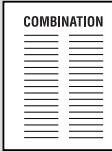 | 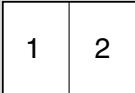 | 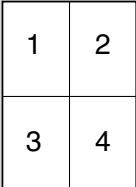 | 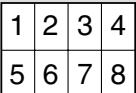 | 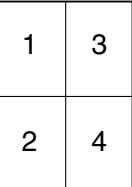 | 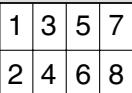 |
Landscape type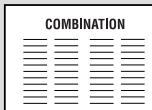 |  |  |  |  |  |
Making a Multiple Page Signature Booklet (Booklet)
Use the Booklet to make a multiple page signature booklet on both sides of paper from any tray unless it is specified as Thick (210 \~ 256 g/m² paper) or Tab paper of the paper type in the Key Operator mode. Original images are scanned into memory and automatically arranged in booklet format in correct order.Specifications for Booklet
Use RADF. ☐ Original pages should be a multiple of 4 in 1-2 mode or a multiple of 2 in 2-2 mode; otherwise blank pages are automatically inserted to the last. ☐ AMS is automatically selected. Select the desired paper size. ☐ Incompatible Conditions: ACS, APS, 1▶1, 2▶1, Group, Rotation Sort, Rotation Group, Face Up, Cover sheet feeder with Cover mode in Booklet, Mixed Original, Tab Paper, Sheet/Cover Insertion, Combination, Program Job, Multi-Page Enlargement, Non-Image Area Erase, Repeat, Storing Image in Overlay Memory flowchart
graph TD
    A["1-sided originals"] --> B["Booklet copying"]
    B --> C["2-sided originals"]
    style A fill:#f9f,stroke:#333
    style B fill:#ccf,stroke:#333
    style C fill:#cfc,stroke:#333
1. Load Copy Paper.
Load the desired copy paper size in a tray. When selecting cover sheet mode (Cover sheet (Copy sheet) or Cover sheet (Blank sheet)), load the same size paper in any other tray unless it is specified as Thick or Tab paper of the paper type in the Key Operator mode.2. Touch APPLICATION on the Basic Screen.
Reminder!
When starting a new copying job, be sure to close the RADF securely, then press [AUTO RESET].3. Touch Booklet on the Application Selection Screen.
4. Touch to highlight the desired Booklet mode key.
 When a cover sheet is required, touch CHANGE OF THE PAPER TRAY to select the cover sheet tray source. Touch the desired output order key if you want to change the output order.5. Touch OK.
The Application Selection Screen will be restored. Select additional Applications, as desired. HINT
Key Operator can set the machine to position the page numbers automatically on the outside edges of the copy when using Booklet with Page Numbering in Stamp. See p. 14-37 to p. 14-42.6. Touch OK on the Application Selection Screen.
The Basic Screen will be restored. AMS is selected automatically.7. Select the tray in which you loaded copy paper in step 1.
To release AMS, select the desired magnification, then select paper size.8. Select the 1▶2 or 2▶2 copy mode.
DETAILS
If the copier is equipped with FS-215 Finisher, Fold or Stitch & Fold output mode is available. Follow the procedure on p. 10-16 to use the function.9. Enter the desired print quantity from the control panel keypad.
HINT
See p. 3-10 for details on setting print quantity.10. Position originals FACE UP in the document feeder.
HINTS
- For details on positioning originals, see p. 3-4 to p. 3-7. - Use RADF store mode (p. 3-33 to p. 3-34) when the original count exceeds 100. Reminder!
Original pages should be a multiple of 4 in 1-2 mode or a multiple of 2 in 2-2 mode; otherwise blank pages are automatically inserted to the last. Reminder!
When loading originals, heed the following limits on capacity: Fold mode 12 pages or less for simplex copying 6 pages or less for duplex copying Stitch & Fold mode64 pages or less for simplex copying 32 pages or less for duplex copying Exceeding the above limits on capacity may cause misfeeds in the finisher.11. Press [START].
CAUTION
When the finisher / paper exit tray capacity is exceeded due to the print quantity selected, remove the copied sets as they exit; otherwise, mishandled paper will occur. CAUTION
When the Booklet / Trimmer unit tray capacity is exceeded, the finisher / trimmer unit will cease operating. To avoid such trouble, select an appropriate print quantity from the specifications on p. 12-4. CAUTION
The roller drive unit is located inside the Booklet tray of the finisher. DO NOT put your hand into the roller drive unit when removing folded or stapled & folded sheets; otherwise, you may be injured. DETAILS: Selecting Fold / Stitch & Fold Mode
1 Touch OUTPUT MENU on the Basic Screen to display the Output Mode popup menu, then touch MAIN TRAY to highlight it. 2 Touch STITCH & FOLD or FOLD, as desired. NOTE:
Selecting FOLD or STITCH & FOLD will automatically switch the output tray to Booklet tray. Notice that the arrow shown beside the Main tray shifts to the Booklet tray. 3 Touch OK on the Output Mode popup menu. The Basic Screen will be restored with the OUTPUT MENU highlighted.Inserting Images into Printed Sets (Image Insert)
Use the Image insert mode to combine images scanned from the platen glass, such as photos, paste-ups, newspaper articles, graphs, etc., with images scanned from the document feeder. Then, output the combined images as a finished set. The selected copy paper size is determined by the size of originals loaded in the document feeder.Specifications for Image Insert
☐ Use RADF and platen glass. ☐ Max. image insert: 30 locations, from p. 1 to p. 999 ☐ Incompatible Conditions: Group, Rotation Sort, Rotation Group, Mixed Original, Tab Paper, Sheet/Cover Insertion, Chapter, Combination, Dual Page, Program Job, Multi-Page Enlargement, Non-Image Area Erase, Repeat, AUTO Layout, Overlay, Storing Image in Overlay Memory flowchart
graph TD
    A["1-sided originals placed on RADF"] --> B["Insertion originals on platen glass"]
    C["2-sided originals placed on RADF"] --> B
    B --> D["Final image with 8 layers"]
1. Touch APPLICATION on the Basic Screen.
Reminder!
When starting a new copying job, be sure to close the RADF securely, then press [AUTO RESET].2. Touch Image Insert on the Application Selection Screen.
 The Image Insertion No. Setting Screen will be displayed.3. Use the control panel keypad to enter the page number.
 Touch SET after each entry to move to the next key. When setting more than 15 locations, touch the arrow key to move to the next page. To clear an incorrect entry, touch DELETE. The entered page number will be deleted. DETAILS: Entering Page Numbers
For example, if insertion locations are [2/2/6] , scanned platen images will be inserted as follows: The first scanned platen image will be inserted after page 2. The second scanned platen image will be inserted directly after the first scanned Image insertion. The third scanned platen image will be inserted after page 6.NOTES:
- When a page number is larger than the total original count, a sheet is inserted as the last page. - Insertions occur in sequence, even if page numbers are entered out of sequence. - Entering the same page number twice will insert two sheets at that location. OPTION
Touch Booklet on the Image Insertion No. Setting Screen to use this function.4. When all page number entries are made, touch OK.
The Application Selection Screen will be restored.5. Touch OK on the Application Selection Screen.
The Basic Screen will be restored. The STORE key on the Basic Screen appears highlighted to show that the Store mode is automatically selected.6. Enter the desired print quantity from the control panel keypad.
HINT
See p. 3-10 for details on setting print quantity.7. Scan the document feeder images:
Position originals FACE UP in the document feeder. If the number of originals exceeds 100, divide them into blocks not exceeding 100 sheets and load them from the block with the first page.8. Press [START].
The originals positioned in the document feeder will be scanned into memory.9. Scan the platen glass images.
Open the document feeder. Position an original FACE DOWN on the platen glass, then close the document feeder.  Reminder! PLACE AND SCAN THE ORIGINALS IN ORDER.10. Press [START].
11. Repeat steps 9 and 10 for all originals.
HINTS
• Memory overflow may occur during scanning. See p. 5-9 to p. 5-10. - Should memory overflow occur frequently, it is recommended that you contact your service representative to extend the memory capacity in your machine.12. Touch STORE to exit the Store mode.
13. Press [START].
The copier will start printing when ready for output. CAUTION
When the finisher / trimmer unit / paper exit tray capacity is exceeded due to the print quantity selected, remove the copied sets as they exit; otherwise, mishandled paper will occur.Dividing an Image into Right and Left Pages (Dual Page)
The Dual Page mode performs image division on the original image. Use this function to copy an open book or a ledger sheet onto two A4 sheets in 1-1 or 2-1 mode, or onto the front and back sides of one A4 sheet in 1-2 or 2-2 mode. The following three modes can be selected from the Dual Page Screen. - Facing Pages mode: Image division starts from the first scan. - Front Cover+Facing Pages mode: Image division starts from the second scan, after the first scan copies normally. - Front/Back Cover+Facing Pages mode: Image division starts from the third scan, after the first and second scan copy normally.Specifications for Dual Page
Store mode is automatically selected. □ Paper size: A4 ☐ Incompatible Conditions: APS, AMS, Rotation Sort, Rotation Group, Fold/Stitch&Fold/Trimming (available with Booklet selected), Mixed Original, Tab Paper, Sheet/Cover Insertion, Combination, Image Insert, Program Job, Multi-Page Enlargement, Repeat, Reduce & Shift in Image Shift, Overlay, Storing Image in Overlay Memory 1. Touch APPLICATION on the Basic Screen.
Reminder!
When starting a new copying job, be sure to close the RADF securely, then press [AUTO RESET].2. Touch Dual Page on the Application Selection Screen.
 The Dual Page Screen will be displayed.3. Select the desired Dual Page mode.
flowchart
graph TD
    A["Output-n to 1"] --> B["Facing pages"]
    C["Output-1 to n"] --> B
    D["Bookmark"] --> E["Additional Function"]
    E --> F["Booklet"]
    B --> G["Front cover +Facing pages"]
    B --> H["Front/Back cover +Facing pages"]
    E --> I["CANCEL OK"]
4. Touch Output-n to 1 or Output-1 to n to select the output order according to the original pagination.
OPTION
Touch Booklet on the Dual Page Screen to use this function.5. Touch OK.
The Application Selection Screen will be restored.6. Touch OK on the Application Selection Screen.
The Basic Screen will be restored. APS and AMS are automatically released, and the STORE key appears highlighted to show that the Store mode is automatically selected.7. Select the desired copy mode and magnification.
DETAILS
• Available paper size is A4. - When selecting Facing pages mode and scanning from the platen glass, select 1-1 or 1-2 copy mode. - APS and AMS are released and 1.000 magnification is selected automatically. Change the magnification manually, if desired.8. Enter the desired print quantity from the control panel keypad.
HINT
See p. 3-10 for details on setting print quantity.9. Position original(s).
When using platen glass to scan, position the first page FACE DOWN with document feeder kept open. When using document feeder, position original(s) FACE UP. For details on scanning originals in Front cover + Facing pages and Front/Back Cover + Facing pages mode, see the description on the following page.10. Press [START] to scan.
11. Repeat steps 9 and 10 for all originals.
Reminder!
When using platen glass, Non-Image Area Erase and AUTO Layout are automatically selected. DO NOT CLOSE the document feeder throughout the scanning job.12. Touch STORE to exit the Store mode.
13. Press [START].
The copier will start printing when ready for output. CAUTION
When the finisher / paper exit tray capacity is exceeded due to the print quantity selected, remove the copied sets as they exit; otherwise, mishandled paper will occur. Scanning Original for Cover
Use platen glass for scanning original for cover. 1 Open the document feeder. 2 Position original for front cover FACE DOWN on the platen glass. 3 Press [START] to start scanning. 4 When Front/Back Cover + Facing pages is selected, scan original for back cover according to the above steps 2 and 3. 5 Use platen glass or document feeder, as required, for scanning body text originals. To output the set in the same order as the originals, start scanning from the first page. 6 Press [START] to start scanning. 7 Repeat steps 5 and 6 for subsequent originals. flowchart
graph TD
    A["Front cover + Facing pages"] --> B["Scan from first page"]
    B --> C["Copies"]
    D["Front/Back cover + Facing pages"] --> E["Scan from first page"]
    E --> F["Copies"]
flowchart
graph TD
    A["Front cover + Facing pages"] --> B["Copy"]
    B --> C["Surveysor's Report 1"]
    C --> D["Copies"]
    E["Front/Back cover + Facing pages"] --> F["Copy"]
    F --> G["Surveysor's Report 2"]
    G --> H["Copies"]
    I[""Surveysor's Report 3"] --> J["Copies"]
    K[""Surveysor's Report 4"] --> L["Copies"]
    M[""Surveysor's Report 5"] --> N["Copies"]
    O[""Surveysor's Report 6"] --> P["Copies"]
    Q[""Surveysor's Report 7"] --> R["Copies"]
    S[""Surveysor's Report 8"] --> T["Copies"]
    U[""Surveysor's Report 9"] --> V["Copies"]
    W[""Surveysor's Report 10"] --> X["Copies"]
NOTES:
• Memory overflow may occur during scanning. See p. 5-9 to p. 5-10. - When using platen glass, Non-Image Area Erase and AUTO Layout are automatically selected. DO NOT CLOSE the document feeder throughout the scanning job.Programming Different Settings for an Output Job (Program Job)
In the ordinary Store mode, the combined features selected for the job are applied to all originals to be scanned. In the Program Job mode, you may scan multiple sets of originals and apply different settings on each set (referred to as JOB), then output them all as a complete set.Specifications for Program Job
☐ Max. 100 JOBs can be programmed for an output job. Once specified, paper size and the paper type/size setting for Multi-sheet bypass tray cannot be changed for another JOB. ☐ Output mode and print quantity setting cannot be specified for each JOB. The last setting made will be applied to all JOBs. ☐ Program Job settings cannot be stored in Job Memory. ☐ Incompatible Conditions: APS, Change paper size, Group, Rotation Sort, Rotation Group, Fold, Stitch & Fold, Trimming, Mixed Original, Sheet/Cover Insertion, Chapter, Combination, Booklet, Image Insert, Dual Page, Multi-Page Enlargement, 2/4/8 Repeat in Repeat, Overlay, Storing Image in Overlay Memory flowchart
graph TD
    A["Original A"] --> D["Printing"]
    B["Original B"] --> D
    C["Original C"] --> E["Printing"]
    D --> F["Copyed set"]
    E --> F
    style A fill:#f9f,stroke:#333
    style B fill:#f9f,stroke:#333
    style C fill:#f9f,stroke:#333
    style F fill:#ccf,stroke:#333
1. Touch APPLICATION on the Basic Screen.
Reminder!
When starting a new copying job, be sure to close the RADF securely, then press [AUTO RESET].2. Touch Program Job on the Application Selection Screen.
 The incompatible function keys will be dimmed to show inactivity.3. Touch OK on the Application Selection Screen.
The Basic Screen will be restored. The STORE key on the Basic Screen appears highlighted to show that the Store mode is automatically selected.4. Select the desired copy conditions.
5. Position originals FACE UP in the document feeder or FACE DOWN on the platen glass.
If the number of document feeder originals exceeds 100, divide them into blocks not exceeding 100 sheets and load them from the block with the first page.6. Press [START].
The paper size determined at this time will be applied to all subsequent JOBs. When scanning for the current JOB is completed, the popup menu will be displayed in the Basic Screen.7. Touch DECISION.
 The current JOB images will be stored. To delete the images, touch CANCEL.8. Repeat steps 4 to 7 until all JOB originals are scanned.
Reminder!
PLACE AND SCAN EACH ORIGINAL SET IN THE CORRECT ORDER OF PAGINATION. HINTS
• Memory overflow may occur during scanning. See p. 5-9 to p. 5-10. - Should memory overflow occur frequently, it is recommended that you contact your service representative to expand the memory capacity in your machine.9. Select the desired output mode and enter the print quantity from the control panel keypad.
HINT
See p. 3-10 for details on setting print quantity.10. Touch STORE to exit the Store mode.
11. Press [START].
CAUTION
When the finisher / paper exit tray capacity is exceeded due to the print quantity selected, remove the copied sets as they exit; otherwise, mishandled paper will occur.Dividing an Image for Enlarged Copy (Multi-Page Enlargement)
Use this function to make an enlarged copy, made up of several copied pages divided and enlarged from an original image.Specifications for Multi-Page Enlargement
☐ Use the platen glass only. ☐ Use APS, or select the desired paper size on the Basic Screen. If APS is used, the largest paper size will be selected automatically. ☐ The output size can be selected (standard size) or determined when a magnification ratio is entered on the screen. ☐ Incompatible Conditions: Using RADF, 1▶2, 2▶2, 2▶1, APS, AMS, 1:1, Staple, Group, Rotation, Rotation Sort, Rotation Group, Fold, Stitch&Fold, Three-Fold, Trimming, Cover Sheet Feeding, Mixed Original, Z-Folded Original, Non STD Size (except FULL AREA), Sheet/Cover Insertion, Chapter, Combination, Booklet, Image Insert, Dual Page, Program Job, Non-Image Area Erase, Repeat, Frame/Fold Erasure, AUTO Layout, Image Shift, Stamp/Overlay 1. Position original FACE DOWN on the platen glass.
The machine will detect the original size. Reminder!
When starting a new copying job, be sure to close the RADF securely, then press [AUTO RESET].2. Select the desired paper size on the Basic Screen.
 Touch the desired tray key to highlight it. If APS is selected (initial setting), the largest paper size loaded in a tray will be selected automatically. 3. Touch APPLICATION on the Basic Screen. 4. Touch Multi-page Enlargement on the Application Selection Screen.  The Multi-Page Enlargement Setting Screen will be displayed, with the original size and paper size (tray number) indicated.  5. Select an output size or magnification, as desired. To select an output size:  Touch STD. SIZE to display the popup menu, touch the desired size key to highlight it, then touch OK. To select a magnification ratio:  Touch ZOOM, enter the desired magnification ratio using the screen keypad or up/down arrow key on the popup menu, then touch OK.  The output size or magnification specified on the popup menu and output quantity to make up a whole image will be displayed on the Multi-Sheet Enlargement Setting Screen.6. Touch OK.
The Application Selection Screen will be restored.7. Touch OK on the Application Selection Screen.
The Basic Screen will be restored.8. Enter the desired print quantity from the control panel keypad.
The actual number of copies will be the product of output quantity multiplied by print quantity. HINT
See p. 3-10 for details on setting print quantity.9. Press [START].
CAUTION
When the finisher / paper exit tray capacity is exceeded due to the print quantity selected, remove the copied sets as they exit; otherwise, mishandled paper will occur.Erasing Outside of the Original (Non-Image Area Erase)
The Non-image area erase mode is used to copy non standard or special originals, such as books, magazines, paste-ups, graphs, thick or thin materials, etc. from the platen glass. The exposed glass area outside the borders of the original will not be copied.Specifications for Non-Image Area Erase
☐ Use the platen glass only. Keep RADF open throughout the procedure. ☐ Incompatible Conditions: Using RADF, 2▶2, 2▶1, APS, AMS, Rotation, Rotation Sort, Rotation Group, Fold/Stitch&Fold/Trimming (with Booklet selected), Mixed Original, Z-Folded Original, Tab Paper, Sheet/Cover Insertion, Chapter, Combination, Booklet, Image Insert, Dual Page in RADF Store mode, Multi-Page Enlargement, Reverse Image, Reduce & Shift in Image Shift, Storing Image in Overlay Memory 1. Touch APPLICATION on the Basic Screen.
Reminder!
When starting a new copying job, be sure to close the RADF securely, then press [AUTO RESET].2. Touch Non-image Area Erase on the Application Selection Screen.
 The incompatible function keys will be dimmed to show inactivity.3. Touch OK on the Application Selection Screen.
The Basic Screen will be restored.4. Select magnification and paper size, as desired.
DETAILS
- APS and AMS are automatically released. - Copy mode is automatically set to 1▶1. If 1▶2 is selected, Platen store mode will function automatically.5. Enter the desired print quantity from the control panel keypad.
HINT
See p. 3-10 for details on setting print quantity.6. Position original FACE DOWN on the platen glass.
Reminder!
DO NOT CLOSE THE DOCUMENT FEEDER. Original size should be larger than 10mm x 10mm.7. Press [START].
Having Any Problem?
This function may perform incorrectly if the lighting in the work place is directly over the platen glass. In this case, consult your service representative about an appropriate place for installation.Reversing Colour in Black and White Image (Reverse Image)
Use Reverse image to reverse the image from black-on-white to white-on-black, and vice versa. This is very good for copying white-on-black originals and reversing them to fax.Specifications for Reverse Image
☐ Incompatible Conditions: Fold, Stitch & Fold, Trimming, Non-Image Area Erase, Repeat, Stamp, Overlay  Original Reverse Image copying1. Touch APPLICATION on the Basic Screen.
Reminder!
When starting a new copying job, be sure to close the RADF securely, then press [AUTO RESET].2. Touch Reverse Image on the Application Selection Screen.
 The incompatible function keys will be dimmed to show inactivity.3. Touch OK on the Application Selection Screen.
The Basic Screen will be restored.4. Enter the desired print quantity from the control panel keypad.
HINT
See p. 3-10 for details on setting print quantity. 5. Position original(s) FACE UP in the document feeder or FACE DOWN on the platen glass.  HINT For details on positioning originals, see p. 3-4 to p. 3-9. 6. Press [START].  CAUTION When the finisher / paper exit tray capacity is exceeded due to the print quantity selected, remove the copied sets as they exit; otherwise, mishandled paper will occur.Repeating Selected Image Area (Repeat: Vert./Horiz. Mode)
Use this function to repeat the selected image area of 10 mm \~ 150 mm in both vertical and horizontal widths measured from the rear left corner of the A3 original area indicated on the left edge of the platen glass.Vertical/Horizontal Width Setting Mode Specifications
☐ Use the platen glass. (Document feeder cannot be used.) ☐ Incompatible Conditions: Using RADF, 2▶2, 2▶1, APS, AMS, Group, Rotation Sort, Rotation Group, Mixed Original, Z-Folded Original, Sheet/Cover Insertion, Chapter, Combination, Booklet, Image Insert, Dual Page, Multi-Page Enlargement, Non-Image Area Erase, Reverse Image, Frame/Fold Erasure, AUTO Layout, Reduce&Shift in Image Shift, Stamp/Overlay 1. Touch APPLICATION on the Basic Screen.
Reminder!
When starting a new copying job, be sure to close the RADF securely, then press [AUTO RESET].2. Touch Repeat on the Application Selection Screen.
 The Repeat Mode Selection Screen will be displayed.3. Touch MANUAL, then specify the vertical and horizontal widths of the scanning area.
 Use up/down arrow key to enter the width from 10 to 150 mm in 1 mm increments. Keep touching the key to increase/decrease the value continuously. Or, touch ENTER REPEAT WIDTH USING KEYPAD to display the popup menu to enter the value from the touch screen keypad.  Touch VERTI. WIDTH or HORIZ. WIDTH, enter the value for each, then touch OK to restore the Repeat Mode Selection Screen.4. Touch OK.
The Application Selection Screen will be restored.5. Touch OK on the Application Selection Screen.
The Basic Screen will be restored.6. Select the desired magnification and paper size.
DETAILS
- APS and AMS are automatically released, and 1.000 (100%) is selected as a magnification ratio. - Copy mode is automatically set to 1▶1. If 1▶2 is selected, Platen store mode will function automatically. 7. Enter the desired print quantity from the control panel keypad.  HINT See p. 3-10 for details on setting print quantity. 8. Position original FACE DOWN on the platen glass.  HINT See the illustration on p. 10-34 for details. 9. Press [START].  CAUTION When the finisher / trimmer unit / paper exit tray capacity is exceeded due to the print quantity selected, remove the copied sets as they exit; otherwise, mishandled paper will occur.Repeating Automatically or Selecting RepeatingTimes (Repeat: AUTO/ Repeat Mode)
Auto Detection mode will automatically set the equal repeat area to the size of the original placed onto the platen glass by activating Non-image area erase. Repeat mode will scan the image area specified by the selected paper size and mode (2 Repeat, 4 Repeat, or 8 Repeat), then arrange the image by specified times in one copy sheet.Auto Detection/ Repeat Mode Specifications
☐ Auto Detection Mode: Use the platen glass. RADF cannot be used. ☐ Repeat Mode Magnification ratio: 1.000 (100%) fixed ☐ Incompatible Conditions with Auto Detection Mode Using RADF, 2▶2, 2▶1, APS, AMS, Rotation, Group, Rotation Sort, Rotation Group, Mixed Original, Z-Folded Original, Tab Paper, Sheet/Cover Insertion, Chapter, Combination, Booklet, Image Insert, Dual Page, Multi-Page Enlargement, Reverse Image, Frame/Fold Erasure, AUTO Layout, Reduce & Shift in Image Shift, Stamp/Overlay ☐ Incompatible Conditions with Repeat Mode APS, AMS, Rotation (if magnification is changed from 1.000), Group, Rotation Sort, Rotation Group, Mixed Original, Z-Folded Original, Chapter, Combination, Booklet, Image Insert, Dual Page, Multi-Page Enlargement, Non-Image Area Erase, Reverse Image, Frame/Fold Erasure, AUTO Layout, Reduce&Shift in Image Shift, Overlay, Overlay Memory 1. Touch APPLICATION on the Basic Screen
Reminder!
When starting a new copying job, be sure to close the RADF securely, then press [AUTO RESET].2. Touch Repeat on the Application Selection Screen.
 The Repeat Mode Selection Screen will be displayed.3. Touch to highlight the desired mode key.
 Touch AUTO to select the Auto Detection mode. Touch 2 Repeat, 4 Repeat, or 8 Repeat to select the desired Repeat mode.4. Touch OK.
The Application Selection Screen will be restored. DETAILS
Non-Image Area Erase is automatically selected on the Application Selection Screen when AUTO mode is selected. HINT
When 2 Repeat mode is selected, Page space function of Image Shift can be used to make the desired amount of blank space between the two images on a page. See p. 10-45 to p. 10-47.5. Touch OK on the Application Selection Screen.
The Basic Screen will be restored.6. Select the desired magnification and paper size.
DETAILS
- APS and AMS are automatically released, and 1.000 (100%) is selected as a magnification ratio. - When 2 Repeat, 4 Repeat, or 8 Repeat is selected, the scanning area will be a portion of the selected paper size equally divided according to the selected mode. In this case, magnification ratio will be fixed to 1.000 (100%). - Copy mode is automatically set to 1▶1. If 1▶2 is selected, Platen store mode will function automatically.7. Enter the desired print quantity from the control panel keypad.
HINT
See p. 3-10 for details on setting print quantity.8. Position original.
For AUTO mode original, open the document feeder, then position the original FACE DOWN on the platen glass. For 2 Repeat, 4 Repeat or 8 Repeat mode original, RADF is also available. HINT
See the illustration on p. 10-37 for details. Reminder!
When AUTO mode is selected, Non-Image Area Erase functions automatically. DO NOT close the document feeder.9. Press [START].
CAUTION
When the finisher / trimmer unit / paper exit tray capacity is exceeded due to the print quantity selected, remove the copied sets as they exit; otherwise, mishandled paper will occur. DETAILS
The AUTO mode may not operate properly if the lighting in the work place is directly over the platen glass. In this case, consult your service representative about an appropriate place for installation.Eliminating Copy Marks Along Borders (Frame/Fold Erasure)
Use Frame/Fold Erasure to eliminate black copy marks along borders to clean up and improve the presentation of the copy.Specifications for Frame/Fold Erasure
☐ Incompatible Conditions: Multi-Page Enlargement, Repeat 1. Touch APPLICATION on the Basic Screen.
Reminder!
When starting a new copying job, be sure to close the RADF securely, then press [AUTO RESET].2. Touch Frame/Fold Erasure on the Application Selection Screen.
 The Frame/Fold Erasure Selection Screen will be displayed.3. Touch to highlight the desired mode key.
 Touch Frame Erasure (All sides), Frame Erasure (Each side), or Fold Erasure to highlight it. Either Frame erasure mode and Fold erasure can be selected in combination.4. Specify the erasure amount in the selected mode.
To specify Frame Erasure (All sides) amount:  \- Touch to highlight FRAME, if not highlighted, then use the touch screen keypad or up/down arrow key to enter the desired erasure amount of the TOP, BOTTOM, LEFT, and RIGHT sides collectively, from 1 to 300 mm in 1 mm increments. To specify Frame Erasure (Each side) amount:  \- Touch to highlight FRAME, if not highlighted, then touch TOP SIDE, RIGHT SIDE, BOTTOM SIDE, or LEFT SIDE. The selected side amount will be highlighted in the left illustration area of the screen.Eliminating Copy Marks Along Borders (Frame/Fold Erasure) (continued)
Use the touch screen keypad or up/down arrow key to enter the desired erasure amount, from 1 to 300 mm in 1 mm increments. To specify Fold Erasure amount:  \- Touch to highlight FOLD, if not highlighted, then use the touch screen keypad or up/down arrow key to enter the desired erasure amount, from 1 to 99 mm in 1 mm increments.5. Touch OK.
The Application Selection Screen will be restored.6. Touch OK on the Application Selection Screen.
The Basic Screen will be restored.7. Enter the desired print quantity from the control panel keypad.
HINT
See p. 3-10 for details on setting print quantity.8. Position original(s) FACE UP in the document feeder or FACE DOWN on the platen glass.
HINT
For details on positioning originals, see p. 3-4 to p. 3-9. DETAILS
When lowering the document feeder onto thick original (e.g. open book), do not press it down too hard. Keep the document feeder open, if required.9. Press [START].
CAUTION
When the finisher / trimmer unit / paper exit tray capacity is exceeded due to the print quantity selected, remove the copied sets as they exit; otherwise, mishandled paper will occur.Copying Image in the Centre of Copy Paper (AUTO Layout)
Use this function to detect the image area of the original and centre the whole image on the copy paper making it easy to copy small pieces of paper.Specifications for AUTO Layout
☐ Non-Image Area Erase is automatically selected. Release it manually when using RADF to scan originals. ☐ Incompatible Conditions: 2▶2, 2▶1, APS, AMS, Rotation, Rotation Sort, Rotation Group, Mixed Original, Z-Folded Original, Tab Paper, Sheet/Cover Insertion, Chapter\*, Combination\*, Booklet\*, Image Insert, Multi-Page Enlargement, Reverse Image\*, Repeat, Image Shift, Overlay, Storing Image in Overlay Memory \* Chapter, Combination, Booklet and Reverse Image are available when Non-Image Area Erase is released manually. flowchart
graph LR
    A["Set original"] --> B["→"]
    B --> C["ABCD"]
    B --> D["ABCD"]
    C --> E["Auto Layout copying"]
    D --> E
1. Touch APPLICATION on the Basic Screen.
Reminder!
When starting a new copying job, be sure to close the RADF securely, then press [AUTO RESET].2. Touch AUTO Layout on the Application Selection Screen.
 The incompatible function keys will be dimmed to show inactivity. DETAILS
- Non-Image Area Erase will be selected automatically. When using RADF to scan the original, touch to deselect this function. - If Dual Page is used with this function, the original smaller than the selected paper size will be printed in the centre of the copy paper without image division performed.Copying Image in the Centre of Copy Paper (AUTO Layout) (continued)
3. Touch OK on the Application Selection Screen.
The Basic Screen will be restored.4. Select the desired magnification and paper size on the Basic Screen.
DETAILS
- APS and AMS are automatically released, and 1.000 (100%) is selected as a magnification ratio. - Copy mode is automatically set to 1▶1. If 1▶2 is selected, Platen store mode will function automatically.5. Enter the desired print quantity from the control panel keypad.
HINT
See p. 3-10 for details on setting print quantity.6. Position original(s) FACE UP in the document feeder or FACE DOWN on the platen glass.
HINT
For details on positioning originals, see p. 3-4 to p. 3-9. Reminder!
DO NOT close the RADF when Non-Image Area Erase is selected. Placing original obliquely on the platen glass may cause black copy marks.7. Press [START].
CAUTION
When the finisher / trimmer unit / paper exit tray capacity is exceeded due to the print quantity selected, remove the copied sets as they exit; otherwise, mishandled paper will occur. Having Any Problem?
The AUTO layout function may not operate properly if the lighting in the work place is directly over the platen glass. In this case, consult your service representative about an appropriate place for installation.Adjusting Position of Copy Image (Image Shift)
Use Image Shift to adjust the position of copy images, e.g. for the purpose of creating a new binding margin on originals to make it easier for filing purposes. Page Space function is available only when Booklet or 2 Repeat mode of Repeat has been already selected. Use this function to make the desired amount of blank space between the two images on a page. See the illustration on p. 10-47 for details. If image loss is likely, select the Reduce & Shift mode instead of regular Image shift. See p.10-48.Specifications for Image Shift
Shift amount: 0 to 250 mm in 1 mm increments Setting in 0.1 mm increments using up/down arrow key is also available by Key Operator setting. See p. 14-37 to 14-42. ☐ Incompatible Conditions: Multi-Page Enlargement, AUTO Layout, Storing images in Overlay Memory flowchart
graph TD
    A["Original"] --> B["Right"]
    B --> C["Up"]
    C --> D["Down"]
    D --> E["Copies"]
    E --> F["Left"]
    F --> G["Right"]
    G --> H["Up"]
    H --> I["Down"]
    I --> J["Copies"]
    J --> K["Left"]
Reminder!
When starting a new copying job, be sure to close the RADF securely, then press [AUTO RESET].3. Touch Image Shift on the Application Selection Screen.
4. Touch SHIFT on the Image Shift Setting Screen, then specify the shift direction and amount.
 Touch FRONT or BACK to specify the shift direction and amount individually; or touch BOTH SIDES to specify collectively. The BACK and BOTH SIDES keys function only for duplex copying. Touch to highlight the desired shift direction key, then use the touch screen keypad or up/down arrow key to enter the desired shift amount, from 0 to 250 mm in 1 mm increments. The image display on the screen allows you to view the shift direction and amount to be created on the printed sheets. When Booklet or 2 Repeat mode of Repeat has been already selected, the PAGE SPACE key appears clear on the screen to show its availability.  If desired, touch PAGE SPACE to highlight it, then enter the desired amount using the touch screen keypad or up/down arrow key.5. Touch OK.
The Application Selection Screen will be restored.6. Touch OK on the Application Selection Screen.
The Basic Screen will be restored.7. Enter the desired print quantity from the control panel keypad.
 HINT See p. 3-10 for details on setting print quantity.8. Position original(s) FACE UP in the document feeder or FACE DOWN on the platen glass.
 HINT For details on positioning originals, see p. 3-4 to p. 3-9.9. Press [START].
 CAUTION When the finisher / trimmer unit / paper exit tray capacity is exceeded due to the print quantity selected, remove the copied sets as they exit; otherwise, mishandled paper will occur.  DETAILS: Page Space Function flowchart
graph TD
    A["Booklet"] --> B["Original"]
    B --> C["Page space"]
    C --> D["2 Repeat in Repeat"]
    D --> E["Original"]
    E --> F["Page space"]
    F --> G["Original"]
Reducing Images to Create Binding Margin (Reduce&Shift)
Use Reduce & Shift instead of regular Image Shift to prevent image loss when creating a binding margin.Specifications for Reduce & Shift
☐ AMS is automatically selected and cannot be released. ☐ Shift amount: 0 to 250 mm in 1 mm increments Setting in 0.1 mm increments using up/down arrow key is also available by Key Operator setting. See p. 14-37 to 14-42. ☐ Incompatible Conditions: Change magnification, V/H zoom, APS, Mixed Original, Dual Page, Multi-Page Enlargement, Non-Image Area Erase, Repeat, AUTO Layout, Overlay, Storing Image in Overlay Memory flowchart
graph TD
    A["Originals"] --> B["Front"]
    B --> C["Top"]
    C --> D["Left"]
    C --> E["Right"]

    subgraph Left_binding_margin
        F1["Front"] --> G1["Up"]
        G1 --> H1["Down"]
        H1 --> I1["12 3 4 5"]
        I1 --> J1["6 7 8 9"]
        J1 --> K1["10 11 12"]
        K1 --> L1["13 14 15"]
        L1 --> M1["16 17 18"]
    end

    subgraph Right_binding_margin
        N1["Front"] --> O1["Up"]
        O1 --> P1["Down"]
        P1 --> Q1["12 3 4 5"]
        Q1 --> R1["6 7 8 9"]
        R1 --> S1["10 11 12"]
        S1 --> T1["13 14 15"]
        T1 --> U1["16 17 18"]
    end

    style Left_binding_margin fill:#f9f,stroke:#333
    style Right_binding_margin fill:#bbf,stroke:#333
Reducing Images to Create Binding Margin (Reduce&Shift) (continued)
1. Select the copy mode and paper size, as required. 2. Touch APPLICATION on the Basic Screen. Reminder!
When starting a new copying job, be sure to close the RADF securely, then press [AUTO RESET]. 3. Touch Image Shift on the Application Selection Screen.  4. Touch REDUCE&SHIFT on the Image Shift Setting Screen, then specify the shift direction and amount.  Touch FRONT or BACK. In Reduce & Shift mode, the BOTH SIDES key appears dimmed to show inactivity. Touch to highlight the desired shift direction key, then use the touch screen keypad or up/down arrow key to enter the desired shift amount, from 0 to 250 mm in 1 mm increments. The image display on the screen allows you to view the shift direction and amount to be printed on the printed sheets. DETAILS
The AMS will automatically determine the magnification ratio according to the shift amount specified for the front page. The shift amount and magnification ratio determined for the front page will be automatically applied to the back page. If any positioning adjustment is required, touch BACK and make direction and amount change.Reducing Images to Create Binding Margin (Reduce&Shift) (continued)
5. Touch OK.
The Application Selection Screen will be restored.6. Touch OK on the Application Selection Screen.
The Basic Screen will be restored.7. Enter the desired print quantity from the control panel keypad.
 HINT See p. 3-10 for details on setting print quantity.8. Position original(s) FACE UP in the document feeder or FACE DOWN on the platen glass.
 HINT For details on positioning originals, see p. 3-4 to p. 3-9.9. Press [START].
 CAUTION When the finisher / trimmer unit / paper exit tray capacity is exceeded due to the print quantity selected, remove the copied sets as they exit; otherwise, mishandled paper will occur.Printing Stamp, Page, Date/Time onto Copies (Stamp)
This function allows you to print onto output copies the desired type of stamp, page number, numbering, and date/time at the location designated on the screen. The four stamp types and watermark (described in the next subsection) provided on the Stamp/Overlay Selection Screen can be used individually or in multiple combinations.Specification for STAMP, SET NUMBERING, PAGE NUMBERING, DATE/TIME
☐ Incompatible Conditions: Multi-Page Enlargement, Reverse Image, Repeat except 2/4/8 Repeat, Overlay (with STAMP and SET NUMBERING), Overlay Memory   Printing positions1. Touch APPLICATION on the Basic Screen.
Reminder!
When starting a new copying job, be sure to close the RADF securely, then press [AUTO RESET].2. Touch Stamp/Overlay on the Application Selection Screen.
 The Stamp/Overlay Selection Screen will be displayed.3. Touch to select the desired key in the STAMP area.
 The subsequent screen will be displayed to allow you to specify the selected stamp type.4. When selecting STAMP: Specify the stamp type, printing position, character size and printed page.
 Touch to highlight the desired stamp key and printing position key on the screen. If fine adjustment is required, touch FINE ADJ. OF POSITION to display the Fine Adjustment Setting Screen. See p. 10-55 for details. Touch CHANGE OF THE CHARACTER SIZE to select LARGER or SMALLER. Touch CHANGE OF THE PRINTED PAGE to designate whether to print the selected stamp on the cover only or on all pages. When selecting SET NUMBERING: Specify the numbering type, printing position, character size, printed page and starting No.  Touch to highlight the desired numbering type key and printing position key on the screen. If fine adjustment is required, touch FINE ADJ. OF POSITION to display the Fine Adjustment Setting Screen. See p. 10-55 for details. Touch CHANGE OF THE CHARACTER SIZE to select 20 pt or 36 pt. Touch CHANGE OF THE PRINTED PAGE to designate whether to print the selected stamp on the cover only or on all pages. Touch STARTING No. to designate the starting number, if required. See p.10-55 for details. When selecting PAGE NUMBERING: Specify the page numbering type, printing position, character size, printed page and starting No.  Touch to highlight the desired page numbering type key and printing position key on the screen. If fine adjustment is required, touch FINE ADJ. OF POSITION to display the Fine Adjustment Setting Screen. See p. 10-55 for details. Touch CHANGE OF THE CHARACTER to select the character size (8 pt, 10 pt, 12 pt or 14 pt) and type (GOTHIC or MING). See p. 10-56 for details. Touch CHANGE OF THE PRINTED PAGE to designate whether to print the selected stamp on the front/back cover or insertions. See p. 10-57 for details. Touch STARTING No. to designate the starting number, if required. See p.10-56 for details. When selecting DATE/TIME: Specify the date/time type, printing position, character size and printed page.  Touch to highlight the desired date, time, and printing position keys on the screen. If fine adjustment is required, touch FINE ADJ. OF POSITION to display the Fine Adjustment Setting Screen. See p. 10-55 for details. Touch CHANGE OF THE CHARACTER to select the character size (8 pt, 10 pt, 12 pt or 14 pt) and type (GOTHIC or MING). See p. 10-56 for details. Touch CHANGE OF THE PRINTED PAGE to designate whether to print the selected stamp on the cover only or on all pages.5. Touch OK.
The Stamp/Overlay Selection Screen will be restored. Touch to select another stamp function key to use in combination, if desired.6. Select the stamp colour.
 Touch STAMP COLOUR SELECT to display the Stamp Colour Selection Screen. Touch the desired stamp type key to highlight it, then select the stamp colour from the right side portion of the screen. Touch OK to return to the Stamp/Overlay Selection Screen.7. Touch OK on the Stamp/Overlay Selection Screen.
The Application Selection Screen will be restored.8. Touch OK on the Application Selection Screen.
The Basic Screen will be restored.9. Enter the desired print quantity from the control panel keypad.
HINT
See p. 3-10 for details on setting print quantity.10. Position original(s) FACE UP in the document feeder or FACE DOWN on the platen glass.
HINT
For details on positioning originals, see p. 3-4 to p. 3-9.11. Press [START].
CAUTION
When the finisher / trimmer unit / paper exit tray capacity is exceeded due to the print quantity selected, remove the copied sets as they exit; otherwise, mishandled paper will occur. DETAILS: Fine Adjustment Setting Screen
When FINE ADJ. OF POSITION is touched, the Fine Adjustment Setting Screen will be displayed.  Touch TOP SIDE, BOTTOM SIDE, RIGHT SIDE, or LEFT SIDE to specify the direction, then use the touch screen keypad or up/down arrow key to enter the desired amount, from 0 to 50 mm. Touch OK to return to the previous screen.Starting No. Setting Screen: Available from SET NUMBERING or WATERMARK NUMBERING
 Use the touch screen keypad or up/down arrow key to enter the desired starting number, then touch OK to return to the previous screen.Starting No. Setting Screen: Available from PAGE NUMBERING
When Chapter is already selected, the chapter starting number can also be specified on the Starting No. Setting Screen.  Touch PAGE NUMBER or CHAPTER NUMBER to highlight it, then use the touch screen keypad or up/down arrow key to enter the desired starting number for each. Use +<->- to enter a minus number to print from halfway through, e.g. -2 to print "1" from page 4. Touch OK to return to the previous screen.  Character Size/Type Selection Screen: from PAGE NUMBERING or DATE/TIME When CHANGE OF THE CHARACTER is touched, the Character Size/Type Selection Screen will be displayed.  Touch to select the desired key, then touch OK to return to the previous screen.Cover/Insert Print Setting Selection Screen: from PAGE NUMBERING
When copied/blank insertion mode of Sheet/Cover Insertion has been already selected, this screen allows you to specify whether to print the page number on insertions, or skip them from the page count.  Touch to select the desired key, then touch OK to return to the Page Numbering Type Selection Screen.Printing Watermark onto Copies (Stamp)
Use this function to print the desired letter type obliquely in the centre of the page (WATERMARK), or the numbers in the specified form repeatedly over the scanned image (WATERMARK NUMBERING).Specification for WATERMARK and WATERMARK NUMBERING
☐ Incompatible Conditions: Rotation Group, Rotation Sort, Multi-Page Enlargement, Reverse Image, Repeat except 2/4/8 Repeat, Overlay, Overlay Memory  WATERMARK  WATERMARK NUMBERING1. Touch APPLICATION on the Basic Screen.
Reminder!
When starting a new copying job, be sure to close the RADF securely, then press [AUTO RESET].2. Touch Stamp/Overlay on the Application Selection Screen.
 The Stamp/Overlay Selection Screen will be displayed.3. Touch WATERMARK or WATERMARK NUMBERING, as desired.
 The subsequent screen will be displayed to allow you to specify the selected watermark type.4. When selecting WATERMARK: Specify the desired watermark type, density, and colour.
 Touch to highlight the desired watermark key. If fine adjustment of the centred watermark position is required, touch FINE ADJ. OF POSITION to display the Fine Adjustment Setting Screen. See p. 10-55 for details. To select the density and colour of the watermark, touch DENSITY or COLOUR to display the popup menu, touch the desired density/colour key to highlight it, then touch OK.   When selecting WATERMARK NUMBERING: Specify the desired watermark numbering type, density, colour, character size and starting No.  Touch to highlight the desired watermark key. Touch CHANGE OF THE CHARACTER SIZE to select 20 pt or 36 pt. Touch STARTING No. to designate the starting number, if required. See p. 10-55 for details. To select the density and colour of the watermark numbering, touch DENSITY or COLOUR to display the popup menu, touch the desired density/colour key to highlight it, then touch OK.  5. Touch OK.
The Stamp/Overlay Selection Screen will be restored. Touch to select another stamp function key to use in combination, if desired.6. Touch OK on the Stamp/Overlay Selection Screen.
The Application Selection Screen will be restored.7. Touch OK on the Application Selection Screen.
The Basic Screen will be restored.8. Enter the desired print quantity from the control panel keypad.
 HINT See p. 3-10 for details on setting print quantity.9. Position original(s) FACE UP in the document feeder or FACE DOWN on the platen glass.
 HINT For details on positioning originals, see p. 3-4 to p. 3-9.10. Press [START].
 CAUTION When the finisher / trimmer unit / paper exit tray capacity is exceeded due to the print quantity selected, remove the copied sets as they exit; otherwise, mishandled paper will occur.Overlaying an Image onto Each Page Copied in the Job (Overlay)
Use this function to scan an image, then overlay the image onto each page copied in the job.Specification for Overlay
Store mode is automatically selected. ☐ Incompatible Conditions: ACS, Rotation, Rotation Sort, Rotation Group, Mixed Original, Sheet/Cover Insertion, Combination, Image Insert, Dual page, Program Job, Multi-Page Enlargement, Reverse Image, Repeat, AUTO Layout, Reduce & Shift in Image Shift, STAMP, SET NUMBERING, WATERMARK, WATERMARK NUMBERING flowchart
graph LR
    A["1st scanned original ABCD"] --> B["Originals scanned 2nd and later"]
    B --> C["Copies in Overlay mode"]
1. Touch APPLICATION on the Basic Screen.
Reminder!
When starting a new copying job, be sure to close the RADF securely, then press [AUTO RESET].2. Touch Stamp/Overlay on the Application Selection Screen.
 The Stamp/Overlay Selection Screen will be displayed.3. Touch OVERLAY.
 4. Touch OK on the Stamp/Overlay Selection Screen. The Application Selection Screen will be restored. 5. Touch OK on the Application Selection Screen. The Basic Screen will be restored. The Store mode is automatically selected. 6. Select the desired paper size and magnification on the Basic Screen. APS and AMS are automatically released, and 1.000 (100%) is selected as a magnification ratio. 7. Enter the desired print quantity from the control panel keypad. HINT
See p. 3-10 for details on setting print quantity. 8. Position the overlaying original. Position the original FACE UP in the document feeder or FACE DOWN on the platen glass. HINT
For details on positioning originals, see p. 3-4 to p. 3-9. 9. Press [START] to scan. The original image will be scanned into memory. 10. Position the original(s) to be overlaid. Position the original FACE UP in the document feeder or FACE DOWN on the platen glass. 11. Press [START] to scan. 12. Repeat steps 10 and 11 for all originals.13. Touch STORE to exit the Store mode, then press [START] to print.
CAUTION
When the finisher / trimmer unit / paper exit tray capacity is exceeded due to the print quantity selected, remove the copied sets as they exit; otherwise, mishandled paper will occur.Storing an Overlay Image in HDD / Overlaying Image Stored in HDD (Overlay Memory)
Use Overlay Memory to scan and store several images in HDD, then recall the desired image from the HDD to overlay onto each page copied in the job.Specification for Overlay Memory
☐ Incompatible Conditions with Image Store: Using RADF, ACS, 1▶2, 2▶2, 2▶1, AMS, Reserve Mode, Interrupt Mode, Selecting Output Mode, Mixed Original, Z-Folded Original, Tab Paper, Sheet/Cover Insertion, Chapter, Combination, Booklet, Image Insert, Dual Page, Program Job, Multi-Page Enlargement, Non-Image Area Erase, Reverse Image, Repeat, AUTO Layout, Image Shift, Stamp, Overlay ☐ Incompatible Conditions with Output: Rotation Group, Rotation Sort, Face Up, Multi-Page Enlargement, Reverse Image, Repeat (except 2/4/8 Repeat), STAMP, SET NUMBERING, WATERMARK, WATERMARK NUMBERING in Stamp, Overlay flowchart
graph TD
    A["Image Store"] --> B["ABCD"]
    B --> C["Overlapping image"]
    C --> D["Output"]
    D --> E["ABCD"]
    E --> F["Recalled image"]
    G["HDD"] --> H["Store in HDD"]
    H --> I["Recall overlaying image"]
    I --> J["Overlay originals"]
    J --> K["Output"]
    K --> L["Copies in Overlay Memory mode"]
1. Touch APPLICATION on the Basic Screen.
Reminder!
When starting a new copying job, be sure to close the RADF securely, then press [AUTO RESET].2. Touch Stamp/Overlay on the Application Selection Screen.
 The Stamp/Overlay Selection Screen will be displayed.3. Touch OVERLAY MEMORY.
 The Overlaying Image Selection Screen will be displayed. Proceed to step 9, when recalling only the stored image.4. Touch IMAGE STORE to display the Image Name Entry Screen.
5. Enter the desired image name.
 Use the touch screen keypad to enter the desired name up to 8 characters. The date when you made this entry will be stored automatically. To correct an entry, touch 1-CHARACTER DELETE repeatedly to delete each character, then enter the correct name.6. If the image name is correct, touch OK.
The Basic Screen to store the overlaying image will be displayed. Select the desired copy conditions. HINT
The popup menu may be displayed to prompt you that the entered image name has been already used. See p. 10-69 for details.7. Position the overlaying original on the platen glass.
DETAILS
The document feeder cannot be used for storing the overlaying image.8. Press [START] to scan.
The Overlaying Image Data Storing Screen will be displayed.  DETAILS
To stop scanning, press [STOP]. The machine automatically starts to store the overlaying image data in the HDD. The Overlaying Image Selection Screen will resume when the storing function is completed. To continue to store the overlaying image data, return to step 4.9. Touch to select the desired overlaying image data, then touch OK.
 The Stamp/Overlay Selection Screen will be restored. DETAILS: Image Delete Key on the Overlay Image Selection Screen
If the IMAGE DELETE key is displayed on the Overlay Image Selection Screen, you can delete the stored image and name. Select the image name using up/down arrow key to scroll, then touch IMAGE DELETE. 10. Touch OK to return to the Application Selection Screen. 11. Touch OK to return to the Basic Screen. The Store mode is automatically selected, and APS and AMS are released. Set the desired conditions on the Basic Screen. 12. Enter the desired print quantity from the control panel keypad. HINT
See p. 3-10 for details on setting print quantity. 13. Position the original(s) to be overlaid. Position the original FACE UP in the document feeder or FACE DOWN on the platen glass. 14. Press [START] to scan. 15. Repeat steps 13 and 14 for all originals. 16. Touch STORE to exit the Store mode, then press [START] to print. CAUTION
When the finisher / paper exit tray capacity is exceeded due to the print quantity selected, remove the copied sets as they exit; otherwise, mishandled paper will occur. DETAILS: Popup Menu for Name Duplication
If the popup menu with YES and NO keys is displayed instead of the Basic Screen, the entered name is duplicated. Touch YES to enter a new name, or NO to create a duplicate name.  If the popup menu with OK key is displayed, the entered name is duplicated. Touch OK, then enter a new name.  Changing the popup menu for duplicate name and displaying the IMAGE DELETE key is available in the Memory switch No. 41 of the Key Operator setting. See p. 14-37 \~ p. 14-42.SECTION
11
Network Function
How to Use Web Utilities
To Use Web Utilities.... 11-2 To Display Information on Machine 11-4 To Display Current Machine Status (Job Status) ...... 11-5 Setting E-Mail Transmission Function 11-7 Setting E.K.C. Function 11-9 Setting Scan Transmission Function 11-19 Transmitting/Editing Machine Setting File 11-23 When the machine is connected to a PC over a network, a web browser on the PC provides the following functions. 1 Main Page Displays the job in progress, service call, and machine information. 2 Job Status Displays the current and previous job status. 3 Environment Setup Makes the Key Operator setting concerning network environment and E.K.C. function. Browser: Internet Explorer 5.5 SP2 / Netscape Navigator 4.7 or later Follow the procedure below to access the Web Utilities of the machine using the web browser. 1. Turn on the power to the PC connected with the machine over a network. DETAILS
Contact your network manager for details on the network system. 2. Activate the web browser, then select [Open] from the File menu.  3. Enter the URL (http:// [IP address or host name of the machine]), then click on [OK]. DETAILS
Ask your network manager for the IP address or host name of the machine. The Main Page of the Web Utilities will be displayed.  The Main Page informs you of the current job status of the machine and the maintenance item, if required. - Service call - JAM - Paper supply - Toner supply - Staple cartridge supply - Complete Job • Non Complete Job - Finisher tray full - Dispose of Trimmer waste basket - Dispose of Punch waste basket - PM call DETAILS
- Click on [REFRESH] in the Web Utilities window to update the information. - The Web Utilities window is subject to change without notice.To Display Information on Machine
Follow the procedure below to display the machine information using the web browser. 1. Open the Web Utilities window. 2. Click on the 8050 image.  The window now provides the paper tray configuration, engine configuration, and option information. DETAILS
The same information will be provided also in the Job Status window. See p.11-5. Paper Tray Configuration| Paper Tray | Size | Type | Status |
| Manual Tray | 11x17 | Normal | No Paper In Tray |
| Tray1 | A4 | No Paper In Tray | |
| Tray2 | A3 | Paper In Tray | |
| Tray3 | A4 | Normal | Paper In Tray |
| Machine Type | 8050 |
| Country Code | Europe |
| Display Language | English |
| ERDH Capacity(MB) | 64 |
| ERDH Available(%) | 100 |
| Total Count | 8543 |
| Copy Count | 7300 |
| Printer Count | 1243 |
| Monochrome Count | 1315 |
| Monocolour Count | 219 |
| Colour Count | 7006 |
| Total PM Count | 13713 |
| Developer Count | 13729 |
| Drum Count | 13729 |
| Finisher Type | FS-215 |
| Trimmer Type | TU-109 |
| Sheet Feeder | Not Mount |
| Punch | Not Mount |
| ADU | Mount |
| DF Type | DF-319 |
| HDD Capacity(GB) | 19 |
| HDD Available(%) | 0 |
| LCT Type | LT-211 |
DETAILS
Click on [REFRESH] in the window to update the information.To Display Current Machine Status (Job Status)
Follow the procedure below to display the current job status, job list including reserved jobs and job information, and information on up to 16 previous jobs. 1. Open the Web Utilities window. 2. Click on [Job Status].  The current job status, number of jobs in waiting, and remaining time before the print job is completed. DETAILS
Clicking on the 8050 image will display the machine information. See p. 11-4. DETAILS
Click on [REFRESH] to update the information.3. Display the current job or reserved job information.
Click on the desired [Job Priority No.] under the “Job List”. The information on the specified job will appear in the second “Job List” area.  DETAILS
If no print job or reserved job exists, “Job Empty” will be displayed in the first “Job List” area.4. Display the previous job information.
Click on the desired [Job ID No.] under the “Job Status”. The information on the specified previous job will appear in the second “Job Status” area.  DETAILS
If no job has been printed after the machine has been powered on, “Jobs don’t exist” will be displayed in the first “Job Status” area.Setting E-Mail Transmission Function
Make the Key Operator setting concerning the network environment using the web browser. For details of the E-Mail Transmission Setting, refer to p. 14-8. 1. Open the Web Utilities window. 2. Click on [Environment Setup]. 3. Display the E-Mail Transmission Setting window. Enter the 4-digit Key Operator password, then click on [Apply].  Click on [E-Mail transmission setting].  The E-Mail Transmission Setting window will be displayed. DETAILS
The Extension for maintenance option will be exclusively used by your Konica service representative.4. Make the setting.
Enter the IP address of the mail server, IP address of the DNS server (if needed), time difference, and E-mail address to be informed of the machine status. Click on the check box of the desired transmission item.  Click on [Apply] to complete the setting and return to the Web Utilities window. Clicking on [Reset] will void the setting and restore the Web Utilities window. Clicking on [Sending test] will send a test mail to the manager. Make the following Key Operator settings concerning the E.K.C. function using the web browser on a PC. • E.K.C. Data Add (see step 4.) Add a new E.K.C. data (password, name, and copy limit) to the E.K.C. list. • E.K.C. Data List (see step 5.) Change or delete the E.K.C. data (password, name, or copy limit) in the list, or reset the counters. • E.K.C. Function Setting (see step 6.) Specify the following E.K.C. function settings. Switching the E.K.C.: ON/OFF Effect when the copy limit is reached: Immediately / After job / Warning E.K.C. password: 8 digits / under 8 digits E.K.C. password input timing: Auto reset timer/ Complete job Wrong E.K.C. password (from printer): Accept / Reject DETAILS
The above settings can also be made on the machine itself, except for the Wrong E.K.C. password (from printer) setting. Some settings may require operations on the machine. Refer to pages 14-12 and 14-37. 1. Open the Web Utilities window. 2. Click on [Environment Setup]. 3. Display the E.K.C. Function Setting window. Enter the 4-digit Key Operator password, then click on [Apply].  The Environment Setup menu window will be displayed. Click on [E.K.C. function setting].  The Enter Network Password dialog box will be displayed. Enter “ekc” in the User Name text box, and an 8-digit master key code in the Password text box, then click on [OK].  The E.K.C. Function Setting menu window will be displayed.4. Add an E.K.C. data.
Click on [E.K.C. data add] in the E.K.C. Function Setting menu window. The E.K.C. Data Setting window will be displayed.
 Enter the following items to register a new E.K.C. data, then click on [Registration]. Number: Automatically assigned Password: 8 digits max. Name: 8 characters max. Limit: 999,999 copies max. DETAILS
To clear the text boxes, click on [Reset]. To cancel adding a new E.K.C. data, click on any E.K.C. Function Setting menu item to jump to the desired window. DETAILS: Error Message
- A duplicate password or name will be rejected with an error message. However, duplicating a password is possible using the Key Operator setting. Refer to p. 14-15. - The Name entry box accepts letters (capital letters only), numbers, and four symbols: (,), -, and /. Any other symbols will be rejected with an error message displayed in the window. - Max. 1,000 E.K.C. entries can be registered. An error message will be displayed if the above limit is exceeded. - An error message may be displayed when the data entry has not been completed due to the machine operation in progress. Please click on [Registration] while the machine is in an idle state. The registered content will be displayed in the window. The new E.K.C. data will be transmitted to the machine immediately so that is valid for the user operations.  Click on any menu item to jump to the desired window.5. Edit the E.K.C. data.
Click on [E.K.C. data list] in the E.K.C. Function Setting menu window (see p. 11-10) or from the menu in any subsequent window. The E.K.C. Data List window will be displayed.| E.K.C data list | ||||||||||||
| Select SelectAll | Number | Name | Copy | Printer | Scanner Large Total | Limit Target | Permission for use | |||||
| FullColour Large Total | Monochrome Large Total Limit | Monochrome Large Total Limit | UserTotal | FullColour Large Total | Monochrome Large Total Limit | UserTotal | ||||||
| 0001 | ----KITA | 0 0 | 0 0 | 0 0 | 0 | 0 0 | 0 0 | 0 0 | 0 0 | Common set | ||
| 0002 | -YOSHIDA | 1 2 | 0 0 | 0 2 0 | 4 | 0 0 | 0 0 | 0 | 0 0 | Common set | ||
| 0003 | -BBBBBBBB | 0 0 | 0 0 | 0 0 | 0 | 0 0 | 0 0 | 0 | 0 0 | Common set | ||
| 0004 | -AAAAAAA | 0 0 | 0 0 | 0 0 | 0 | 0 0 | 0 0 | 0 | 0 0 | Common set | ||
| 0005 | ----AAA | 0 0 | 0 0 | 0 0 | 0 | 0 0 | 0 0 | 0 | 0 0 | Common set | ||
| ---- | Another user count (Count of print with wrong E.K.C. password (from printer)) | - - - - - - - - - - - - - - - - - - - - - - - - - - - - - - - - - - - - - - - - - - - - - - - - - - - - - - - - - - - - - - - - - - - - - - - - - - - - - - - - - - - - - - - - - - - - - - - - - - - - - 1.1.1.1.1.1.1.1.1.1.1.1.1.1.1.1.1.1.1.1.1.1.1.1.1.1.1.1.1.1.1.1.1.1.1.1.1.1.1.1.1.1.1.1.1.1.1.1.1.1.1. | ||||||||||
HINT
The “Another user count” in the list indicates the count accumulated for the jobs performed by non-registered users. This data cannot be edited other than resetting the counter.To change Password, Name, or Limit:
(1) Click on the number of the data to be edited.  The E.K.C. Edit Setting window will be displayed.  (2) Change the password, name, or limit, as desired. For details in entering procedure, refer to p. 11-11. (3) Click on [Registration]. DETAILS
To clear the text boxes, click on [Reset]. To cancel editing the E.K.C. data, click on any E.K.C. Function Setting menu item to jump to the desired window. DETAILS: Error Message
See “Details” on p. 11-11 if an error message is displayed after clicking on [Registration]. The edited content will be displayed in the window. The edited data will be transmitted to the machine immediately so that is valid for the user operations.  Click on any E.K.C. Function Setting menu item to jump to the desired window.To reset E.K.C. count:
(1) Click on the check box(es) to select the E.K.C. data of the counter to be cleared. If all the counters are to be cleared, click on [SelectAll]. (2) Click on the radio button (a white circle) heading the "Count reset selected item(s)." (3) Click on [Apply].| E.K.C data list | ||||||||||||
| Select SelectAll | Number | Name | Copy | Printer | Scanner Large Total | Limit Target | Permission for use | |||||
| FullColor Large Total | Monocolor Large Total Limit | Monochrome Large Total Limit | UserTotal | FullColor Large Total | Monochrome Large Total Limit | UserTotal | ||||||
| 0001 | ----KITA | 0 0 | 0 0 | 0 0 | 0 | 0 0 | 0 0 | 0 | 0 0 | Common set | ||
| 0002 | -YOSHIDA | 1 2 | 0 0 | 0 2 | 4 | 0 0 | 0 0 | 0 | 0 0 | Common set | ||
| 0003 | -BBBBBB | 0 0 | 0 0 | 0 0 | 0 | 0 0 | 0 0 | 0 | 0 0 | Common set | ||
| 0004 | -AAAAAAAA | 0 0 | 0 0 | 0 0 | 0 | 0 0 | 0 0 | 0 | 0 0 | Common set | ||
| 0005 | ----AAA | 0 0 | 0 10 | 0 10 | 0 | 0 0 | 0 0 | 0 | 0 0 | Common set | ||
| ---- | Another user count (Count of print with wrong E.K.C. password (from printer)) | - | - | - | - | 0 0 | 0 0 | 0 | - | -- | -- | |
DETAILS
To cancel resetting the E.K.C. data, click on any E.K.C. Function Setting menu item to jump to the desired window.  (4) Click on [Apply] to immediately reset the counters to zero. The message “Setting was changed” will be displayed.  DETAILS: Error Message
If an error message is displayed after clicking on [Apply], a counter has not been reset due to a machine operation in progress. The machine must be in an idle state when you click on [Apply]. Click on [Back] to return to the E.K.C. Data List window.To delete E.K.C. data:
(1) Click on the check box(es) to select the E.K.C. data to be deleted. If all the data are to be cleared, click on [SelectAll]. (2) Click on the radio button (a white circle) heading the “Delete selected item(s) (Except for Another user count).” (3) Click on [Apply].  The Delete Confirmation window will be displayed. DETAILS
To cancel deleting the E.K.C. data, click on any E.K.C. Function Setting menu item to jump to the desired window. (4) Click on [Apply] to immediately delete the data.
The message “Setting was deleted” will be displayed.  DETAILS: Error Message
If an error message is displayed after clicking on [Apply], data has not been deleted due to a machine operation in progress. The machine must be in an idle state when you click on [Apply]. Click on [Back] to return to the E.K.C. Data List window or any menu item to jump to the desired window.6. Set the E.K.C. function.
Click on [E.K.C. function setting] in the E.K.C. Function Setting menu window (see p. 11-10) or from the menu in any subsequent window. The E.K.C. Function Setting window will be displayed. Click on the radio button (white circle) of the desired selection item(s) so that a black dot appears in it.  Click on [Apply]. The change made in the settings will be transmitted immediately for the user operations. DETAILS
To restore the previous setting, click on [Reset]. To cancel the E.K.C. function setting, click on any E.K.C. Function Setting menu item. DETAILS: Error Message
If an error message is displayed after clicking on [Apply], a setting has not been completed due to a machine operation in progress. The machine must be in an idle state when you click on [Apply].  Click on [Back] to return to the E.K.C. Function Setting menu window or any menu item to jump to the desired window.Setting Scan Transmission Function
Make the Key Operator setting concerning the transmission of the scanned image data using the web browser. For details of the Scan Transmission Setting, contact your service representative.Specifications for Scan Transmission Setting
☐ The Scan Transmission Setting is available only when the IP-901 Printer Controller is installed in the machine. 1. Open the Web Utilities window. 2. Click on [Environment Setup]. 3. Display the Scan Transmission Setting window. Enter the 4-digit Key Operator password, then click on [Apply].  The Environment Setup menu window will be displayed. Click on [Scan transmission setting].  The Scan Transmission Setting window will be displayed. DETAILS
The [Scan transmission setting] key appears in the window only when the IP-901 Printer Controller (Fiery S300 50C-K) is connected to the machine.4. Register the E-Mail, HDD, and FTP, as required.
HINT
For details of this setting, refer to the instruction manual of the printer controller.  DETAILS
- The symbols that cannot be displayed in the entry box will be ignored, if entered. - The HDD Box No. will be registered as a 4-digit number. For example, entering [1] will be registered as [0001]. Click on [Registration] to complete the entry. The registered content will be displayed.  Click on [Back] to return to the Scan Transmission Setting window.5. Display the Entry List.
Click on [Entry List] of the desired item under the entry box to display the Entry List.  Click on [Back] to return to the Scan Transmission Setting window.6. Change the registered contents.
Display the Entry List of the desired item as described in step 5. Click on the entry name to be changed. The window for changing the selected item will be displayed.  Change the contents as desired, then click on [Registration]. The registered content will be displayed.  Click on [Back] to return to the Entry List window.7. Delete the registered contents.
Display the Entry List of the desired item as described in step 5. Click on the check box in the “Delete” column of the item to be deleted, then click on [Delete]. If all the items are to be deleted, click on [SelectAll], then click on [Delete]. The window for deleting the selected item will be displayed. DETAILS
Click on the check box again to release the selection.  Confirm the registered name to be deleted, then click on [Yes]. Click on [Back] on the web browser to return to the Entry List window.Transmitting/Editing Machine Setting File
Follow the procedure below to transmit the following setting file from the machine to a PC (export) using the web browser, edit the setting data on the PC, then return the file to the machine (import). • E.K.C. data (max. 1,000 files) - Three Scan Transmission Setting data E-mail data (max. 96 files) HDD (Box No.) (max. 48 files) FTP (FTP server address) (max. 12 files) DETAILS
- The machine setting file can be stored in a PC so that it may be returned to the machine at any time, and is available for common use if you have two or more machines. The file transmitted to a PC, being converted to a file type for batch processing, can be edited efficiently and returned to the machine. - The file transmitted to a PC normally contains the four data types mentioned above, however, each data type can be made into a file and transmitted separately. • For details of E.K.C. data, see p. 14-14. - For details of Scan Transmission Setting data, see p. 14-48. 1. Open the Web Utilities window. 2. Click on [Environment Setup]. 3. Display the Setting File Import/Export window. Enter the 4-digit Key Operator password, then click on [Apply].  The Environment Setup menu window will be displayed. Click on [Setting data Import/Export].  The Enter Network Password dialog box will be displayed. Enter “ekc” in the User Name text box, and an 8-digit master key code in the Password text box, then click on [OK].  The Setting File Import/Export window will be displayed.4. Export the machine setting file.
Select the desired file type from the pull-down menu, then click on [Export].  DETAILS
The data format cannot be changed from "TAB separated." Confirm that the radio button heading “Save this file to disk” is marked in the File Download dialog box, then click on [OK].  In the dialog box, designate the folder for saving the machine setting file, then click on [Save]. DETAILS
The file name is automatically assigned as described below. Select the data to be exported, changing the name if desired. • ekc tab.txt (E.K.C. data) - ip\_email.txt (E-mail data of Scan Transmission Setting data) - ip\_hdd.txt (HDD data of Scan Transmission Setting data) - ip\_ftp.txt (FTP data of Scan Transmission Setting data)  DETAILS: Error Message
The file cannot be accessed when the machine is operating. If an error message is displayed, try again to save the file after the current machine operation is completed. A dialog box will be displayed when the saving operation is completed. Click on [Close].5. Edit the machine setting file.
The machine setting file transmitted to a PC is a TAB separated text file which can be edited using an application software such as Text Editor or Table Editor. A new setting file can also be created according to the specifications for each file type. See p. 11-27 for details.6. Import the machine setting file.
Click on [Browse] to designate the machine setting file to be imported, then click on [Import].  The result message will be displayed when the registration is completed.  DETAILS: Error Message
If the registration cannot be completed successfully, error messages will be displayed as follows. - Can't transfer data (The machine is busy) Try again to import the data after the machine operation in progress is completed. - The data cannot be recognized Confirm that the data is the machine setting file. - Data size is too large Confirm that the data is the machine setting file. Check if the file size exceeds 100,000 bytes. - The data cannot be registered Check if inappropriate description is made in the machine setting file. See p. 11-27 for details. Check if the file entries are already over the limit. DETAILS: To Edit the Machine Setting File
- Save the file as a text. - Begin the file with a specified tag. (ex. #EKC\_TAB) • A line should be 300 bytes or less. - The file size should be 100,000 bytes or less. - The line that begins with “#” is a comment. ex. Machine setting file of an E.K.C. data #EKC\_TAB| #PASSWORDNAME | LIMIT | |
| 00003636 | ----ADMIN | 100000 |
| 00000001 | ----1 | 100000 |
| 00008156 | ----KEN | 000010 |
| 00000123 | ----AAA | 100000 |
| 12345678 | ----A | 001000 |
| 00000120 | ----AAAA | 010000 |
| 00003636 | ---- | 000000 |
| 36363636 | -ADADMIN | 100000 |
| 12341234 | ----HOHO | 100000 |
DETAILS: Specifications for Each Machine Setting File Type
E.K.C. data setting file: - Begin the file with #EKC\_TAB. • Max. 1,000 files can be edited. - A line should include PASSWORD, NAME, and LIMIT, separated by a tab. - Use up to 8 digits numbers (0 - 9) only to specify PASSWORD. - Use numbers, alphabets (capital letters only), and four symbols: ( , ), -, and / only to specify NAME. - Use up to 6 digits numbers (0 - 9) only to specify LIMIT (0 - 999,999). E-mail data setting file: - Begin the file with #IP\_EMAIL. • Max. 96 files can be edited. - A line should include ENTRY NAME and E-MAIL ADDRESS, being separated by a tab. - ENTRY NAME should be 18 bytes or less. • E-MAIL ADDRESS should be 60 bytes or less. HDD data setting file: - Begin the file name with #IP\_HDD. • Max. 48 files can be edited. - A line should include ENTRY NAME and BOX NUMBER, being separated by a tab. - ENTRY NAME should be 18 bytes or less. - Use up to 4 digits numbers (0 - 9) only to specify a BOX NUMBER.FTP data setting file:
- Begin the file name with #IP\_FTP. • Max. 12 files can be edited. - A line should include PROFILE NAME, HOST ADDRESS, FILE PATH, LOGIN, and PASSWORD, being separated by a tab. - PROFILE NAME should be 18 bytes or less. - HOST ADDRESS should be 63 bytes or less. - FILE PATH should be 96 bytes or less. - LOGIN should be 47 bytes or less. - PASSWORD should be 31 bytes or less.SECTION
12
Paper and Original Information
Paper Information.... 12-2 Original Information 12-9 This machine is equipped with the following trays for loading copy paper. - Tray 1, 2 and 3 (Main body tray) • LCT (LT-211 Large Capacity Tray) - Multi-sheet bypass tray Also, the following equipment is provided for conveying/delivering copies. • ADU (Automatic Duplex Unit) • Finisher (FS-115/FS-215) • Cover Sheet Feeder (PI-110) - Punching Kit (PK-120) - Trimmer Unit (TU-109) - Exit tray (for the machine without Finisher) Refer to the following information on paper capacity for each. Paper Weight| Paper Trays | Weight |
| Tray 1, 2, and 3 (Main body tray) | 64g/m2 ~ 209g/m2The tray number for paper weight is specified in the Key Operator mode.1: 64g/m2 ~ 74g/m22: 75g/m2 ~ 80g/m23: 81g/m2 ~ 105g/m24: 106g/m2 ~ 162g/m25: 163g/m2 ~ 209g/m2 |
| LCT | 64g/m2 ~ 256g/m2The tray number for paper weight is specified in the Key Operator mode.1: 64g/m2 ~ 74g/m22: 75g/m2 ~ 80g/m23: 81g/m2 ~ 105g/m24: 106g/m2 ~ 162g/m25: 163g/m2 ~ 209g/m26: 210g/m2 ~ 256g/m2 |
| Multi-sheet bypass tray | 64g/m2 ~ 256g/m2The tray number for paper weight can be selected on the Type/Size popup menu of Basic Screen, and the popup menu is specified in the Key Operator mode.1: 64g/m2 ~ 74g/m22: 75g/m2 ~ 80g/m23: 81g/m2 ~ 105g/m24: 106g/m2 ~ 162g/m25: 163g/m2 ~ 209g/m26: 210g/m2 ~ 162g/m2 |
| ADU | 64 g/m2 ~ 209 g/m2 |
| Finisher | 50 g/m2 ~ 256 g/m264 g/m2 ~ 105 g/m2 for Staple-sort/Stitch & Fold/Three Fold mode |
| Cover sheet feeder | 64 g/m2 ~ 200 g/m264 g/m2 ~ 170 g/m2 for Manual punching64 g/m2 ~ 105 g/m2 for Manual three fold |
| Punching kit | 64 g/m2 ~ 170 g/m2 |
| Trimmer unit | 164 g/m2 ~ 105 g/m2 |
| Exit tray | 64 g/m2 ~ 209 g/m2 |
DETAILS
Some 170 g/m ^2 paper types may not be punched easily. HINTS
• See p. 14-21 for Paper Type setting of Tray 1, 2, 3 or LCT. • See p. 3-18 for Paper Type setting of Multi-sheet bypass tray. Tray/ Exit Tray Capacity| Paper Trays | Capacity | |
| Tray 1, 2, and 3 (Main body tray) | 500 sheets ( 90 g/m^2 paper ) | |
| LCT (LT-211) | 2,500 sheets ( 90 g/m^2 paper ) | |
| Multi-sheet bypass tray | 250 sheets ( 90 g/m^2 paper )1 sheet each for offset master, Intermediate paper or Label.Transparency film or ink-jet paper is unavailable. | |
| Equipments | Capacity | |
| ADU | Unlimited | |
| Finisher (FS-115/ FS-215) | Secondary (sub) tray | 200 sheets ( 90 g/m^2 paper ) |
| Primary (main) tray | Non-sort mode ( 90 g/m^2 paper )500 sheets (A5, A5R, B6R)3,000 sheets (A4, A4R, B5R) (FS-115)2,500 sheets (A4, A4R, B5R, 8.5"x11", 8.5"x11"R) (FS-215)1,500 sheets (A3, B4, 12"x18", 11"x17", 8.5"x14")Sort/Group mode ( 90 g/m^2 paper )3,000 sheets (8.5"x11", 8.5"x11"R, A4, A4R, B5R) (FS-115)2,500 sheets (8.5"x11", 8.5"x11"R, A4, A4R, B5R) (FS-215)1,500 sheets (12"x18", 11"x17", 8.5"x14", A3, B4)Staple-sort mode ( 90 g/m^2 paper )1,000 sheets (Variable according to the number of pages to be stapled. See p. 12-5 for details) | |
| Finisher (FS-215) | Booklet tray | 100 sheets (A3, B4, 12"x18", 11"x17", 8.5"x14")Fold: 33 sets for 3-sheet-folded booklet(33 x 3 = 99 sheets, 396 pages)Stitch&Fold: 20 sets for 5-sheet-folded booklet(20 x 5 = 100 sheets, 400 pages)5 sets for 20-sheet-folded booklet(5 x 20 = 100 sheets, 400 pages)75 sheets (A4R, 8.5"x11"R)Fold: 25 sets for 3-sheet-folded booklet(25 x 3 = 75 sheets, 300 pages)Stitch&Fold: 12 sets for 5-sheet-folded booklet(15 x 5 = 75 sheets, 300 pages)3 sets for 25-sheet-folded booklet(3 x 25 = 75 sheets, 300 pages)* Maximum number of folded sheet is 3 for Fold mode, and 25 for Stitch&Fold mode. |
| Cover sheet feeder (PI-110) | 200 sheets ( 200 g/m^2 ) or 30 mm thick for Upper/lower tray | |
| Punching kit | Unlimited | |
| Trimmer unit (TU-109) | 512 sheets ( 90 g/m^2 paper ) (See p. 8-16 for details) | |
| Exit tray | 150 sheets ( 90 g/m^2 paper ) | |
| Paper sizeNo. of copies | A3/A3W(12"x18"/11"x17"/11"x17"W) | B4/B4R, A4/A4W, A4R/A4WR,B5/B5W (8.5"x14", 8.5"x11"/8.5"x11"W, 8.5"x11"R/8.5"x11"WR) |
| 2~9 | 50 sets | 100 sets |
| 10~20 | 50 | 50 |
| 21~30 | 30 | 30 |
| 31~40 | 25 | 25 |
| 41~50 | 20 | 20 |
| Paper Trays | Available Sizes |
| Tray 1, 2, and 3 (Main body tray) | STD size: A3, B4, A4, A4R, B5, B5R, A5R, 13"x19", 12"x18", 11"x17", 8.5"x14", 8.5"x11" STD (special): Detects F4/8.5"x14"R instead of A4R, 5.5"x8.5"R instead of A5R. Non STD size: Max. 330 mm x 487 mm (13" x 19") ~ Min. 210 mm x 140 mm Wide size: A3W, B4W, A4W, B5W, B5RW, A5RW, 11"x17"W, 8.5"x11"W, 8.5"x11"WR, 5.5"x8.5"RW |
| LCT (LT-211) | STD size: A3, B4, A4, B5, 13"x19", 12"x18", 11"x17", 8.5"x14", 8.5"x11" Non STD size: Max. 330 mm x 487 mm (13" x 19") ~ Min. 257 mm x 210 mm Wide size: A3W, B4W, A4W, B5W, 11"x17"W, 8.5"x14"W, 8.5"x11"W |
HINT
For special size setting of main body trays (Tray 1, 2, and 3), see p. 14-21 to p. 14-22.| Paper Trays | Available Sizes |
| Multi-sheet bypass tray | STD size: A3, B4, A4, A4R, B5, B5R, A5R, A6R, B6R, 13"x19", 12"x18", 11"x17", 8.5"x11", 8.5"x11"R, 5.5"x8.5"RSTD (special):Detects F4/8.5"x14" instead of A4R, or A5R/B6R instead of 5.5"8.5"R.Non STD size:Max. 330 mm x 487 mm (13" x 19") ~ Min. 100 mm x 148 mmWide size: A3W, B4W, A4W, A4WR, B5W, B5WR, A5WR, A6WR, B6WR, 13"x19"W, 12"x18"W, 11"x17"W, 8.5"x11"W, 8.5"x11"WR, 5.5"x8.5"WR |
| Equipments | Available Sizes |
| ADU | STD size / STD (special):330 mm x 487 mm (13"x19") to A5RNon STD size:330 mm x 487 mm (13"x19") to A5RWide size: A3W to A5RW |
| Finisher (FS-115/FS-215) | Primary (main) tray314 mm x 458 mm (12"x18") ~ 100 mm x 148 mm314 mm x 458 mm (12"x18") ~ A4R in Sort/Group/Staple-sort modeSecondary (sub) tray330 mm x 487 mm (13"x19") ~ 100 mm x 148 mmBooklet tray314 mm x 458 mm (12"x18") ~ A4R in Fold or Stitch & Fold modeA4R/8.5"x11"R only in Three-Fold mode |
| Cover sheet feeder (PI-110) | Upper tray: A4, A4R, 8.5"x11", 8.5"x11"R, 5.5"x8.5"Lower tray: 314 mm x 459 mm ~ A5 |
| Punching kit (PK-120) | A3, B4, A4, 12"x18", 11"x17", 8.5"x11" |
| Trimmer unit (TU-109) | A3, B4, A4R, 11"x17", 8.5"x14", 8.5"x11"R and those wide sizes |
| Exit tray | Max. 330 mm x 487 mm (13"x19") ~ Min. 100 mm x 148 mm |
HINT
See p. 3-18 to p. 3-21 for specifying the special paper size of the Multi-sheet bypass tray.Special Paper in Multi-Sheet Bypass Tray
Multi-sheet bypass tray accepts the following special paper type that cannot be loaded in the main body trays. Labels DETAILS
When using special paper type other than the above mentioned, select Excl.A to D as the paper type in Paper type/size setting for the Multi-sheet bypass tray.To Store Copy Paper
\- Store paper in a cool, dry area. Using damp copy paper may cause a paper misfeed. Keep partially used packages tightly wrapped during storage. \- Do not place paper packages vertically to store. Paper curl due to the vertical storage may cause a paper misfeed. Use the platen glass or document feeder to position originals to copy.Platen Glass Originals
Use the platen glass when originals are not suitable for use with the document feeder, e.g., when size is incompatible, or when originals are folded, stapled, torn, or in generally poor condition. HINT
See each description in this manual for copy conditions which cannot use the document feeder to scan.Unsuitable RADF Originals
1 Curled, creased or folded originals Curled, creased or folded originals | 2 cat date cat date | 3 Books Books |
4 Glossy or transparent originals, OHP film, art paper, cellophane Glossy or transparent originals, OHP film, art paper, cellophane | 5 Doubled, punched or stapled originals Doubled, punched or stapled originals | 6 Thin or thick originals Thin or thick originals |
Platen Glass Original Specifications
☐ Max. original size: 303 mm x 438 mm, sheet or book ☐ Max. book weight/thickness: 6.8 kg / 30 mm ☐ Original placement: Face down on left depth side of glass HINT
Detectable paper size can be changed from only A series to Inch series, AB series, or AB series and Inch series mixed by Key Operator. See p. 14-37 to p. 14-42. CAUTION
Do not place too heavy originals, or do not press strongly when thick original is placed and is under pressure of RADF; otherwise the glass may be broken and you may be injured.RADF Originals
Following three modes are provided when using the document feeder (RADF) to scan originals. - Normal mode - Mixed Original mode • Z-Folded Original mode Specifications for each mode are described as follows. HINT
Detectable paper size can be changed from only A series to Inch series, AB series, or AB series and Inch series mixed by Key Operator. See p. 14-37 to p. 14-42.Normal mode
☐ Detectable original size: A3, B4, A4, A4R, B5, B5R, A5, A5R, 11"x17", 8.5"x13", 8.5"x11" ☐ Original weight: Simplex: 35 g/m^2 200 g/m^2 Dulpex: 50 g/m^2 200 g/m^2 \* Use Thin mode for 35 g/m ^2 \~ 49 g/m ^2 paper, or Thick mode for 129 g/m ^2 \~ 200 g/m ^2 paper. ☐ Max. feeder capacity: 100 sheets (90 g/m ^2 paper) ☐ Curling tolerance: 10 mm or less ☐ Original placement: Face upMixed Original mode
Use Mixed Original mode to copy mixed size originals. See p. 9-6 for details. ☐ Original size: Three types of size combination are determined by the RADF guide width. A3, B4, A4, A4R, B5, and A5 mixed B4, A4R, B5, B5R, and A5 mixed B5R and A5R mixed ☐ Original weight: Simplex: 35g/m^2 200g/m^2 Dulpex: 50g/m^2 200g/m^2 \* Use Thin mode for 35 g/m ^2 \~ 49 g/m ^2 paper, or Thick mode for 129 g/m ^2 \~ 200 g/m ^2 paper. ☐ Max. feeder capacity: 100 sheets (90 g/m ^2 paper) ☐ Curling tolerance: 10 mm or less ☐ Original placement: Face up (see p. 3-6 for details.) DETAILS
See below for the guide width of each combination. Z-Folded Original mode
Use Z-Folded Original mode to scan folded originals without using the size detection sensor of the RADF. See p. 9-8 for details. ☐ Detectable original size: A3, B4, A4, A4R, B5, B5R, A5, A5R, 11"x17", 8.5"x13", 8.5"x11" ☐ Original weight: Simplex: 35 g/m^2 200 g/m^2 Dulpex: 50 g/m^2 200 g/m^2 \* Use Thin mode for 35 g/m ^2 \~ 49 g/m ^2 paper, or Thick mode for 129 g/m ^2 \~ 200 g/m ^2 paper. ☐ Max. feeder capacity: 100 sheets (90 g/m ^2 paper) ☐ Curling tolerance: 10 mm or less ☐ Original placement: Face up (see p. 3-7 for details.); orientation same as copy paperSECTION
13
Maintenance & Supplies
How to Maintain the Copier
Adding Toner 13-2 Inserting a New Staple Cartridge into FS-115/215 Finisher .... 13-7 Empty Waste Basket of PK-120 Punching Kit...... 13-10 Empty Waste Basket of TU-109 Trimmer Unit ...... 13-12 Exchanging Toner Recovery Box.... 13-14 Cleaning Image Scanning Section 13-16 Checking Copy Count...... 13-18 Periodic Maintenance 13-20 When toner supply is low, the message “Please add toner” and the ADD TONER icon (ADD TONER YMCK) display on the touch screen. The toner colour to be supplied is indicated by an alphabet: C (cyan), M (magenta), Y (yellow), or K (black).  Reminder!
Use the same number toner bottle as described on the label on the toner bottle cover. Otherwise, machine trouble may occur.  Add toner according to the procedure as follows. 1. Loosen toner by tapping both top and bottom of the new toner bottle on a solid surface at least five times, then shake the bottle at least five times.   natural_image
Illustration of hands holding a cylindrical mechanical component with directional arrows indicating motion or force (no text or symbols)natural_image
Technical line drawing of a mechanical assembly with a hand operating a component (no text or symbols present)natural_image
Illustration of a hand operating a mechanical device with rotating components and directional arrows indicating rotation (no text or symbols)natural_image
Illustration of hands installing or adjusting a mechanical component into a server rack (no text or symbols visible)8. Close and lock the toner bottle cover, then close the toner access door.
natural_image
Illustration of a hand operating a device with a circular component being turned, showing no text or symbols.natural_image
Illustration of a person inserting or adjusting a device into a rack, showing mechanical components and a directional arrow (no text or symbols present)DETAILS
The toner bottle cover cannot be locked if the toner bottle is not set in place. WARNING
Do not throw the empty toner bottle into a fire. If it is thrown into a fire, the toner may ignite and cause a dangerous situation. CAUTION
Keep the toner bottle away from children. The toner is non-toxic; however if you inhale or contact with eyes by accident, flush with water and seek medical advice.Inserting a New Staple Cartridge into FS-115/215 Finisher
When the staple cartridge of the Finisher is empty, the Basic Screen displays the following message in the message area.  Follow the procedure below to replace the staple cartridge. Reminder!
Use only the staples supplied by Konica. Please contact your service representative to purchase.1. Open the Finisher door.
natural_image
Diagram of a hand pressing down on a printer's door panel, with an arrow indicating left motion (no text or symbols present)2. Pull out the stacker unit by holding the stacker unit handle.
natural_image
Technical line drawing of a mechanical assembly with a hand operating a component (no text or symbols present)3. Pull up the cartridge housing, then remove it while sliding it along the stapler rail.
 natural_image
Illustration of a hand using a tool to adjust or install electronic components, with no visible text or symbols.4. Remove the empty cartridge from the cartridge housing.
natural_image
Illustration of hands using a tool to adjust or install a component, showing a step with an arrow indicating motion (no text or symbols present)5. Insert the new cartridge into the housing.
Firmly insert the cartridge into the housing while aligning the arrow sides of both case and housing, then remove the lock tape from the cartridge. natural_image
Illustration of two hands using a tool to adjust or install a component, showing step-by-step assembly (no text or symbols)Reminder!
Do not remove the staples remaining inside the housing; otherwise, the first sheet output after the replenishment will not be stapled. 6. Insert the cartridge housing while sliding it along the stapler rail, then push down and in to secure it in place. natural_image
Illustration of a hand inserting a component into a device, showing mechanical parts and wiring (no text or symbols)natural_image
Diagram of a hand operating a door panel with a black arrow indicating clockwise motion (no text or symbols present)natural_image
Line drawing of a hand pressing down on an open printer with a black arrow indicating rotation (no text or symbols)Empty Waste Basket of PK-120 Punching Kit
When the waste basket becomes full, “Waste basket of Punching kit is full / Please empty waste basket” message will be displayed on the touch screen, and the finished set will be output without being punched even if Punch mode is selected.  Follow the procedure below to empty the waste basket.1. Open the Finisher door.
natural_image
Illustration of a hand pressing down on a printer's door panel, with an arrow indicating left-hand rule (no text or symbols present)2. Withdraw the waste basket.
natural_image
Diagram of a hand inserting a component into a computer case, showing internal components and a black arrow indicating direction (no text or symbols present)3. Empty the waste basket.
natural_image
Line drawing of a hand pouring liquid from a container into a tray (no text or symbols)4. Return the waste basket to its original position, then close the Finisher door securely.
natural_image
Illustration of a hand inserting a component into a device panel (no text or symbols visible)natural_image
Line drawing of a hand pressing down on an open printer with a black arrow indicating rotation (no text or symbols)Empty Waste Basket of TU-109 Trimmer Unit
When the waste basket becomes full, “Waste basket of Trimmer is full / Please empty waste basket” message will be displayed on the touch screen, and the finished set will be output without being trimmed even if Trimming mode is selected.  Follow the procedure below to empty the waste basket.1. Open the trimmer front door.
natural_image
Diagram of a hand operating a machine with a curved arrow indicating rotation or movement (no text or symbols present)2. Withdraw the waste basket.
natural_image
Line drawing of a hand inserting a plastic bag into a machine, with no visible text or symbols3. Empty the waste basket.
natural_image
Illustration of hands using a griddle to generate leafy material, showing mechanical components and motion direction (no text or symbols)4. Return the waste basket to its original position, then close the trimmer front door securely.
natural_image
Illustration of a hand operating a printer drawer with a magnifying glass (no text or symbols visible)natural_image
Diagram of a hand operating a machine with a curved arrow indicating rotation or movement (no text or symbols present)Exchanging Toner Recovery Box
When the toner recovery box becomes full with the used toner, “Please change toner recovery box” message and an icon (T-BOX) will be displayed on the touch screen.  Follow the procedure below to exchange the toner recovery box. WARNING
DO NOT THROW the toner recovery box into a fire. If it is thrown into a fire, the toner may ignite and cause a dangerous situation. 1. Open the toner recovery box door on the rear-right side of the machine. natural_image
Diagram of a hand interacting with a door panel, showing a curved arrow indicating motion (no text or symbols present)natural_image
Diagram of a hand inserting a component into a device, showing a black arrow indicating direction (no text or symbols present)natural_image
Diagram of a hand inserting a component into a device, showing mechanical parts and a directional arrow (no text or symbols)natural_image
Diagram of a hand inserting a device into a device panel, showing a curved arrow indicating rotation (no text or symbols present)Cleaning Image Scanning Section
In order to maintain optimum copy quality, always keep the following areas clean.Cleaning the Document Glass
Raise the document cover, and clean the glass with a clean soft cloth. The glass may also clean with a soft cloth dampened slightly with water, if it is difficult to clean. natural_image
Line drawing of hands installing or cleaning a computer monitor on a base (no text or symbols)Reminder!
Never use paint solvents, such as benzene or thinners, to clean the platen glass.Cleaning the RADF Platen Guide Cover
The RADF platen guide cover should be kept clean; otherwise soil marks may be copied or the original size cannot be detected correctly. Raise the document cover, and clean the RADF platen guide cover with a clean soft cloth. natural_image
Line drawing of a hand cleaning a computer monitor with a power strip (no text or symbols)Reminder!
Never use paint solvents, such as benzene or thinners, to clean the RADF platen guide cover.Cleaning the Platen Cover
Keep the glass clean; otherwise soil marks may be copied, resulting in dark lines on the copies. Raise the document cover, and clean the left partition glass with a clean soft cloth. natural_image
Line drawing of a hand cleaning a whiteboard inside a machine (no text or symbols)Reminder!
Never use paint solvents, such as benzene or thinners, to clean the platen cover.Checking Copy Count
This function allows you to view the current indication of the following items as a list on the touch panel: Total counter, Full colour counter, Mono colour counter, Monochrome counter, Copier counter, Printer counter, Counter start date. Check the list, then print it from the Counter List Screen, if desired.To Display the Counter List Screen
1. Press [P (COUNTER)] on the control panel.
 The Counter List Screen will be displayed.  DETAILS
The Counter List Screen can be displayed even when the copying job is in progress.2. Touch EXIT to return to the Basic Screen.
To Print the Counter List
1. Press [P (COUNTER)] on the control panel.
 The Counter List Screen will be displayed.2. Touch COUNTER MENU.
 The Basic Screen will be displayed. 3. Touch the desired tray key to select the paper size. 4. Press [START]. The Counter list will be printed out, and the Management list mode will be released automatically.  After a set number of copies have been made on your copier, Periodic Maintenance (PM) will be required for maintaining optimal performance. When preventive maintenance is due, a message and the two icons (PM CALL) will prompt you to contact your service representative for maintenance. To Check the PM Counter
Follow the procedure below to check the PM counter to estimate the time when Periodic Maintenance is due.1. Press [P(COUNTER)] on the control panel.
 The Counter List Screen will be displayed.2. Press [CHECK].
 The PM counter will appear under the Printer counter on the screen. HINT
To print the Counter list including the PM counter, see p. 13-19.3. Touch EXIT.
The Basic Screen will be restored.SECTION
14
Key Operator Mode
How to Monitor Copier Activity and Modify Machine Settings
An Outline of the Key Operator Mode 14-2 [1] System Initial Setting 14-4 [2] Copier Initial Setting 14-10 [3] User Setting Mode.... 14-11 [4] EKC (Electronic Key Counter) Function Setting ..... 14-12 [5] Lock/Delete Job Memory.... 14-20 [6] Paper Type / Special Size Set.... 14-21 [7] Panel Contrast / Key Sound Adjustment ..... 14-24 [8] Key Operator Data Setting 14-25 [9] Weekly Timer.... 14-26 [10] Control Panel Adjustment.... 14-34 [11] Tray Auto Select Setting.... 14-35 [12] Power Save Setting 14-36 [13] Memory Switch Setting.... 14-37 [14] Machine Management List Print 14-43 [15] Call Remote Centre 14-44 [16] Finisher Adjustment.... 14-45 [17] Front & Back Density Setting.... 14-47 [18] Scan Transmission Setting.... 14-48 [19] Non-Image Area Erase Setting.... 14-50 [20] AE Adjustment.... 14-51 [21] Execute Adjustment Operation.... 14-52 [22] Magnification Adjustment 14-53 [23] Timing Adjustment.... 14-54 [24] Centring Adjustment 14-56 [25] Printer Gamma Sensor Adjustment.... 14-57An Outline of the Key Operator Mode
The Key Operator is trained to handle all special Key Operator functions that are not accessible to the general user, such as monitoring overall copier activity, machine performance, and service information, modifying machine settings as well as controlling user activity for billing purposes. A unique 4-digit Key Operator password is normally set by your service representative at installation. If the unique code is not set by your service representative, the copier will not display Key Operator Password Entry Screen when the Key Operator mode is being accessed; a Key Operator password will not be required. To ensure the security of Key Operator mode, it is recommended that you establish a unique Key Operator password, and keep it in a confidential file.How to Access the Key Operator Mode
1. Press [HELP] on the control panel to display the Help Screen. 2. Touch KEY OPERATOR MODE on the Help Screen. flowchart
graph TD
    A["STAPLE SUPPLY"] --> B["PUNCH"]
    C["TRIMMER"] --> D["TONER SUPPLY"]
    E["RADF"] --> F["PAPER SUPPLY"]
    G["PAPER SUPPLY"] --> H["PAPER SUPPLY"]
    I["PAPER SUPPLY"] --> J["PAPER SUPPLY"]
    K["PAPER SUPPLY"] --> L["PAPER SUPPLY"]
    M["PAPER SUPPLY"] --> N["PAPER SUPPLY"]
    O["HELP MENU"] --> P["FOR ASSISTANCE (TEL)"]
    Q["TELEPHONE"] --> R["0000000000000000"]
    S["FAX"] --> T["0000000000000000"]
    U["EXIT"] --> V["Key operator mode"]
3. Enter the Key Operator Password, then touch OK.
Use the keypad on the touch screen to enter your 4-digit Key Operator password. Touch OK to display the Key Operator Mode Screen.  DETAILS
The entered Key Operator password will not be displayed on the screen. If an invalid password is entered, continue by entering the valid 4-digit password. If the Key Operator password is not valid, check with your service representative.4. Make setting changes from the Key Operator Mode Screen, as described on the following pages.
   DETAILS
- To display menus [11] to [20] of the Key Operator Mode Screen, touch the lower arrow key to scroll. To return the previous menu, touch the upper arrow key. - The menus [21] to [25] will be displayed and available by service setting. Contact your service representative, if desired.5. Touch PREVIOUS SCREEN to exit the Key Operator Mode.
The Basic Screen will be restored.[1] System Initial Setting
Set the following initial conditions of the copier. - Date & Time setting: Current date and time, Summer time, Time difference • Language select setting: Language used in LCD - IP address setting: IP address to be accessed from PC, Line speed setting - E-mail transmission setting: E-mail address to be informed of machine trouble or request for supplies.[1] Date & Time Setting
Set the current date and time, the summer time, and also the time difference. ☐ Default setting: Summer time off System Initial Setting Menu Screen  Date & Time Setting Screen  Difference in Time Setting Screen Procedure
1 Touch [1] System initial setting to display the System Initial Setting Menu Screen. 2 Touch [1] Date & Time setting to display the Date & Time Setting Screen. 3 Adjust the time. The time indicated by the copier is displayed in the upper line and ordered by date, month, year and time (in 24-hour expression). (1) In the lower line, the highlighted section can be changed by using the keypad on the screen. (2) Touch SET to move the highlighted section to the number to be changed. 4 Set the Summer time. The Summer time is initially deactivated. To activate the summer time (Daylight Savings Time) function, touch Summer time to highlight it. The Present time will gain an hour. 5 The Difference in time setting is provided in order to give the time difference information at the same time when E-mail is received. To set this function, follow the procedure below. (1) Touch Diff. time setting to display the Difference in Time Setting Screen. (2) Touch +<->- to display “+” when the local time is earlier than the Universal time, or “-” when the local time is later. (3) Use the keypad on the screen to enter the time difference between the Universal time and the local time in the machine setting area. (e.g. Enter “-0600” for 6 hours later than the Universal time.) (4) Touch OK to return to the Date & Time Setting Screen. 6 Touch OK to update the Present time by the Setting time and return to the System Initial Setting Menu Screen. To restore the previous setting, touch CANCEL. 7 Touch PREVIOUS SCREEN to restore the Key Operator Mode Screen.[2] Language Select Setting
Select the language used in the LCD. ☐ Default setting: English System Initial Setting Menu Screen  Language Selection Screen Procedure
1 Touch [1] System initial setting to display the System Initial Setting Menu Screen. 2 Touch [2] Language select setting to display the Language Selection Screen. 3 Select the desired English mode. 4 Touch OK to complete the setting and return to the System Initial Setting Menu Screen, or touch CANCEL to restore the previous setting. 5 Touch PREVIOUS SCREEN to restore the Key Operator Mode Screen.[3] IP Address Setting
When using the server function, this setting is required to enable a PC to gain access to this machine. Set the line speed, if required.NOTE:
Consult your network manager to perform this setting. Incorrect setting may cause a trouble with other network systems. System Initial Setting Menu Screen  IP Address Setting Screen  IP Address Setting Screen (next page)  Line Speed Setting Screen Procedure
1 Touch [1] System initial setting to display the System Initial Setting Menu Screen. 2 Touch [3] IP address setting to display the IP Address Setting Screen. 3 Make the required setting. (1) Touch to highlight the address key on the left. To scroll to the next page, touch the arrow key at the lower left corner on the screen. (2) Enter the address numbers using the screen keypad. (3) Touch SET to fix the numbers, or touch RESET to clear. Touching SET shifts the cursor to the right. 4 Customize the line speed. (1) Touch Line speed setting to display the Line Speed Setting Screen. (2) Touch the desired key to highlight it. (3) Touch OK to restore the IP Address Setting Screen. 5 Touch OK to complete the setting and return to the System Initial Setting Menu Screen, or touch CANCEL to restore the previous setting. 6 Touch PREVIOUS SCREEN to restore the Key Operator Mode Screen.[4] E-Mail Transmission Setting
When the machine requires troubleshooting or maintenance such as paper or toner supply, this setting allows several network PCs to be informed of the current machine status by E-mail. The IP address of the mail server of the local network, E-mail address of the machine manager and of others to be informed can be set. The following information items are provided. - Service call - JAM - Paper supply - Toner supply - PM call - Complete job • Non complete job - Staple cartridge supply - Finisher tray full - Dispose of waste basketNOTE:
Consult your network manager to perform this setting. Incorrect setting may cause a trouble with other network systems. System Initial Setting Menu Screen  E-Mail Transmission Setting Screen Procedure
1 Touch [1] System initial setting to display the System Initial Setting Menu Screen. 2 Touch [4] E-Mail Transmission Setting to display the E-Mail Transmission Setting Screen. 3 Specify the IP address of the mail server. (1) Touch [1] IP address setting to display the IP Address Setting Screen. (2) Enter the IP address of the mail address in your network using screen keypad. Touch SET to fix the numbers, or touch RESET to clear. Touching SET shifts the cursor to the right. (3) Touch OK to restore the E-Mail Transmission Setting Screen. IP Address Setting Screen 4 Specify the E-mail address of the network manager.
E-Mail Set (Machine Manager) Screen  E-Mail Address Input Screen  (1) Touch [2] E-Mail set5 Specify the E-mail address of the network PC(s).
(1) Touch [3] E-Mail set6 Select the information items.
(1) Touch [4] E-Mail transmission item set to display the Information Setting Screen. (2) Touch the desired item key to highlight it. More than one item can be selected. Touching ALL CLEAR will release all the selections. (3) Touch OK to restore the E-Mail Transmission Setting Screen. E-Mail Set (Condition Inform) Screen  Transmission Item Setting Screen  7 Touch PREVIOUS SCREEN to complete the setting and return to the System Initial Setting Menu Screen. 8 Touch PREVIOUS SCREEN to restore the Key Operator Mode Screen.[2] Copier Initial Setting
Initial settings are the settings that display automatically when the copier is powered on, when Auto Reset timer or Power Saver is operated, when the EKC password is entered, when the key counter is set, or when [AUTO RESET] key is pressed. Initially, i.e., at installation, the Basic Screen displays the following condition to meet Energy Star requirements: Colour Mode: Full colour Copy Mode: 1-1 Paper Size: APS Lens Mode: 1:1 Output Mode: Offset sortNOTE:
The most commonly-used settings are established at installation. Before changing any of the copier settings, be sure that you understand the overall and long-range effect of the change. Key Operator Mode Screen  Copier Initial Setting Screen Procedure
1 Touch [2] Copier initial setting to display the Copier Initial Setting Screen. 2 Make a selection for each mode as initial settings. Touch RADF to select or deselect it.NOTE:
The machine will restore the initial settings specified as above unless the Memory switch No. 4 “Job memory (30) auto recall” is turned ON with the Job memory No. 30 registered. 3 Touch OK to complete the setting and return to the Key Operator Mode Screen, or touch CANCEL to restore the previous setting. Set the user-set magnification ratio.[1] User Lens Mode Ratio Setting
The preset and userset ratios available on the Basic Screen are used to reduce and enlarge the original image to accommodate copy paper size. Normally, users are allowed to change the three USERSETs in the bottom line on the User Lens Mode Ratio Setting Screen. The preset keys in the top and middle lines can be programmed in 2-5 DIP SW mode for special purposes, but ordinarily, it is recommended that they remain unchanged. Default setting: USERSET1: 4.000 USERSET2: 2.000 USERSET3: 0.500 User Setting Mode Menu Screen  User Lens Mode Ratio Setting Screen Procedure
1 Touch [3] User setting mode to display the User Setting Mode Menu Screen. 2 Touch [1] User lens mode ratio setting to display the User Lens Mode Ratio Setting Screen. 3 Touch the USERSET you want to change, then enter a ratio from 0.250 \~ 4.000, using the keypad. If a ratio under 0.250 is entered, 0.250 will be displayed. If a ratio over 4.000 is entered, 4.000 will be displayed. 4 Touch OK to complete the setting and return to the User Setting Mode Menu Screen, or touch CANCEL to restore the previous setting. 5 Touch PREVIOUS SCREEN to restore the Key Operator Mode Screen.[4] EKC (Electronic Key Counter) Function Setting
The Electronic Key Counter allows you to monitor all copying activity by controlling EKC password accounts. When the EKC is activated, copying can be performed only after a valid EKC password is entered. This feature can track copier usage for individual users and/or accounts as well as limit copier access to only authorized users. Copy quantity limits for specific accounts can also be set. Copy quantity and copy limits for each account can be visually confirmed on the screen. If EKC needs to be activated on your machine, contact your service representative. The following EKC settings can be made by the Key Operator:[1] E.K.C. data edit:
Assign an account number to an individual user or a group, and specify an EKC password, name, and copy limit for each. The registered EKC data will be listed on the screen, allowing you to change the data, reset the copy count, or even delete the individual account.[2] E.K.C. all count reset:
Clear the copy count for all accounts.[3] E.K.C. function setting:
Turn the EKC function on or off, and set conditions to stop immediately, stop after job is completed or display a warning message when copy limit is reached.[4] Scanner function setting:
Turn the EKC function on or off while the machine is in Scanner mode. This setting is available even if the print controller is not installed in the machine.How to Access the EKC Setting Mode
Key Operator Mode Screen  EKC Master Key Code Screen  EKC Setting Menu Screen Procedure
1 Touch [4] E.K.C. function setting. The EKC Master Key Code Screen displays if a code is required. 2 Use the keypad on the touch screen to enter your 8-digit EKC master key code, then touch OK to display the EKC Setting Menu Screen.NOTES:
1 The EKC master key code will be specified by your service representative and should be kept secret by the Key Operator. 2 If an invalid EKC master key code is entered, continue by entering the valid 8-digit code. 3 Touch CANCEL on the EKC Master Key Code Screen to return to the Key Operator Mode Screen. 3 Select the desired EKC function, and make settings as required. 4 To exit the EKC mode, touch PREVIOUS SCREEN on EKC Setting Menu Screen. The Key Operator Mode Screen will be restored.[4] EKC (Electronic Key Counter) Function Setting (continued)
[1] E.K.C. Data Edit
Use this setting to display the list of copy, printer, or scanner count and limit for each account, to change, add, or delete the EKC data, and to reset the copy count of the individual account. ☐ EKC No.: Designated by Key Operator ☐ EKC Password: Unique 8-digit numeric code programmed by Key Operator for user ☐ User Name: Max. 8 characters ☐ Limit: Limit target, Count 0 to 999,999 copies, Permission for use EKC Setting Menu Screen  EKC Data Edit Screen  EKC Data Change Screen  EKC Data Add Screen  EKC Limit Setting Popup Menu  Password Duplication Screen  Name Duplication Screen Procedure
1 Display the EKC Setting Menu Screen, referring to p. 14-13. 2 Touch [1] E.K.C. data edit. The EKC Data Edit Screen will be displayed.NOTE:
The EKC Data Edit Screen provides three sorts of EKC data; copier, printer, and scanner. Touch COPY, PRINTER, or SCANNER to display the desired screen. To change, add, or delete the EKC data, and to reset the copy count of an individual account, follow the procedure for each as described below.To Add EKC Data:
(1) Select the desired machine mode, then touch Add on the EKC Data Edit Screen. The EKC Data Add Screen will be displayed. (2) Note that the Password key is highlighted on the screen. Enter the password by using the touch screen keypad. Max. 8 digits can be specified. (3) Touch Name to highlight it, then enter the desired name using the touch screen keypad. Max. 8 characters can be specified. (4) Touch Limit to display the EKC Limit Setting popup menu. Select COPY or PRINTER, then select Common set or Separate set, as desired. Select Common set to specify a common limit for all copying jobs. Select Separate set to specify a limit separately for colour copies and monochrome copies. (5) Specify the desired limit using control panel keypad. Max. 6 digits (999,999 copies) can be specified. (6) Select PERMIT or PROHIBIT to enable or disable copying jobs in each mode. If PROHIBIT is selected, copying job cannot be made in that mode. (7) Touch OK to return to the EKC Data Add Screen.NOTES:
1 We recommend that you make a list of all EKC passwords and account numbers. 2 If an invalid user name or numeric value is entered, continue by entering the valid one. (8) Touch OK to complete the setting and to verify whether the same password or name has been already used for another account number. When a password is duplicated: The Password Duplication Screen will be displayed. Touch YES to re-enter new password, or NO to create duplicate password.NOTE:
If duplicate password is created, the number of copies will be counted only for the EKC password with the smallest number. We recommend you do not use duplicate EKC passwords. When a name is duplicated: The Name Duplication Screen will be displayed. Touch OK to re-enter new name. (9) If any duplication has not occur, the EKC Data Edit Screen will be restored.To Change EKC Data:
(1) Touch ▲ or ▼ key on the right side of the list to highlight the EKC data to be changed, then touch Change. The EKC Data Change Screen will be displayed.[4] EKC (Electronic Key Counter) Function Setting (continued)
(2) Touch the desired item key to highlight it, then enter new data by using the touch screen keypad. Password: 8 digits max. (See note 1.) Name: 8 characters max. (See note 2.) Limit: 999,999 copies max. / Limit Target / Permission for useNOTES:
1 We recommend that you make a list of all EKC passwords and account numbers. 2 If an invalid user name or numeric value is entered, continue by entering the valid one. (3) Touch OK to complete the setting and to verify whether the same password or name has been already used for another account number. When a password is duplicated: The Password Duplication Screen will be displayed. Touch YES to re-enter new password, or NO to create duplicate password.NOTE:
If duplicate password is created, the number of copies will be counted only for the EKC password with the smallest number. We recommend you do not use duplicate EKC passwords. When a name is duplicated: The Name Duplication Screen will be displayed. Touch OK to re-enter new name. (4) If any duplication has not occur, the EKC Data Edit Screen will be restored.To Delete EKC Data:
(1) Touch ▲ or ▼ key on the right side of the list to highlight the EKC data to be deleted, then touch Delete. The Delete Confirmation Screen will be displayed. (2) Touch YES to delete, or NO to cancel.To Clear EKC Count:
(1) Touch ▲ or ▼ key on the right side of the list to highlight the desired EKC data, then touch Count Reset. The Reset Confirmation Screen will be displayed. (2) Touch the desired colour mode key to clear the copy count of the selected mode. Delete Confirmation Screen  Reset Confirmation Screen  3 Touch PREVIOUS SCREEN on the EKC Data Edit Screen to return to the EKC Setting Menu Screen. 4 Touch PREVIOUS SCREEN to restore the Key Operator Mode Screen.[2] E.K.C. All Count Reset
Reset the count for all EKC accounts. EKC Setting Menu Screen  EKC All Count Reset Screen Procedure
1 Display the EKC Setting Menu Screen, referring to p. 14-13. 2 Touch [2] E.K.C. all count reset. The EKC All Count Reset Screen will be displayed. 3 Touch YES to reset all counters to zero and to return to the EKC Setting Menu Screen, or touch NO to cancel. Touching PREVIOUS SCREEN will also cancel this function and return to the EKC Setting Menu Screen. 4 Touch PREVIOUS SCREEN on the EKC Setting Menu Screen to restore the Key Operator Mode Screen.[3] E.K.C. Function Setting
Use this function to turn EKC On or Off and to select whether the copier will stop at the time the count limit is reached, or after the current copy job is completed.NOTE:
If EKC Off is selected on the machine with this function previously activated, copying operation will become available without entering an EKC password, while the counting function will be suspended. EKC Setting Menu Screen  EKC Function Setting Screen Procedure
1 Display the EKC Setting Menu Screen, referring to p. 14-13. 2 Touch [3] E.K.C. function setting. The EKC Function Setting Screen will be displayed. 3 Touch EKC On to activate EKC or touch EKC Off to de-activate EKC. The selected key will be highlighted. 4 Select the desired machine condition when the count limit is reached. The selected key will be highlighted. Touch Immediately to stop the machine at once when the copy limit is reached. In this case, copy conditions selected for the current job will be cleared. To continue the job using the same user password, change the copy limit of the password or clear the copy count. Touch After job to stop the machine after the current job is completed, when copy limit is reached. Copying job will be unavailable with the message “Copy limit reached” displayed on the screen. Touch Warning only to display a warning message when copy limit is reached. The message “Copy limit reached” will be displayed on the screen, while copying job can be continued. 5 Touch OK to complete the setting and return to the EKC Setting Menu Screen, or touch CANCEL to cancel. 6 Touch PREVIOUS SCREEN to restore the Key Operator Mode Screen.[4] Scanner Function Setting
Use this function to turn EKC On or Off while the machine is in Scanner mode. This setting is available even if the machine is not equipped with the optional IP-901 Print Controller. EKC Setting Menu Screen  Scanner Function Setting Screen Procedure
1 Display the EKC Setting Menu Screen, referring to p. 14-13. 2 Touch [4] Scanner function setting. The Scanner Function Setting Screen will be displayed. 3 Touch EKC On to activate EKC or touch EKC Off to de-activate EKC. The selected key will be highlighted. 4 Touch OK to complete the setting and return to the EKC Setting Menu Screen, or touch CANCEL to cancel. 5 Touch PREVIOUS SCREEN to restore the Key Operator Mode Screen. Use this function to lock/unlock or delete a Job that has been programmed using Job Memory function. Key Operator Mode Screen  Lock/Delete Job Memory Screen Procedure
1 Touch [5] Lock/delete job memory to display the Lock/Delete Job Memory Screen. 2 To lock/unlock a Job memory: (1) Touch the key on the left side of the desired Job number. Use arrow keys to scroll to the desired Job number, if required. (2) The lock icon will appear on the touched key to show that the selected job is locked. The previously locked Job will be unlocked when selected, and the lock icon on the touched key will disappear.NOTE:
The settings of a locked Job cannot be changed. To delete a Job memory: (1) Touch the Job number key you want to delete. The selected key will be highlighted. (2) Touch Delete. Selected programs and the name will be deleted from the Job memory.NOTE:
A locked job can also be deleted, with the lock on it released at the same time. Once deleted, the programs cannot be restored. 3 Touch OK to complete the setting and return to the Key Operator Mode Screen, or touch CANCEL to restore the previous setting.[6] Paper Type / Special Size Set
[1] Paper Type / Special Size Set
Use this function to indicate a specific paper type and weight, or to specify a special paper size for main body tray keys on the Basic Screen. This is especially useful when special paper is used on a regular basis and is always placed in a specific paper tray. Key Operator Mode Screen  Paper Type / Special Size Setting Menu Screen  Paper Type Setting Screen (Main Body Trays)  Special Size Setting Screen (STD size)  Special Size Setting Screen (STD size (special)  Special Size Setting Screen (Non STD size)  Special Size Setting Screen (Wide size (select)  Special Size Setting Screen (Wide size (input) NOTE:
Service setting is required to use the paper types Excl. A to D. Contact your service representative, if desired.Procedure
1 Touch [6] Paper type / Special size set to display the Paper Type / Special Size Setting Menu Screen. 2 Touch [1] Paper type / Special size set. The Paper Type Setting Screen will be displayed. 3 Specify paper type and weight. (1) Touch the desired tray key to highlight it. (2) Touch the desired paper type and weight keys to highlight them. The selected paper type and number indicating the paper weight will appear on the tray key. 4 Specify special size. (1) Touch Special size setting on the Paper Type Setting Screen to display the Special Size Setting Screen. (2) Touch the desired tray key to highlight it. (3) Touch a paper size key to specify a paper size for the selected tray. - Select STD size to allow the machine to automatically detect the size of paper loaded in the tray and indicate it on the tray key. - Select STD size (special) to display the popup menu to show available paper sizes to be specified. Use arrow keys on the popup menu to select the desired size. - Select Non STD size to display the popup menu to enter the paper size by using arrow keys or touch screen keypad. The selected tray key will indicate “SPECIAL” instead of the entered numeric value. - Select Wide size paper to display the popup menu to show available wide paper sizes to be specified. Use arrow keys on the popup menu to select the desired wide size. Touch Lead edge or Rear edge to select the image starting position. Then, touch Input size to display the popup menu to enter the actual paper size using arrow keys or touch screen keypad. The entered number should fall within the range from the standard size of the selected wide size, to a maximum of 330 mm x 487 mm.NOTE:
When selecting Wide size paper, be sure to input the actual paper size to be used. 5 Touch OK on the Special Size Setting Screen to complete the setting and return to the Paper Type / Special Size Setting Menu Screen, or touch CANCEL to restore the previous setting. 6 Touch PREVIOUS SCREEN to return to the Key Operator Mode Screen.[2] Paper Type Set (Bypass)
Use this function to specify six combinations of paper type and weight for the Multisheet bypass tray. Specified combinations will be used when selecting Bypass on the Basic Screen. Key Operator Mode Screen  Paper Type / Special Size Setting Menu Scree  Paper Type Setting Screen (Multi-Sheet Bypass Tray) Procedure
1 Touch [6] Paper type / Special size set to display the Paper Type / Special Size Setting Menu Screen. 2 Touch [2] Paper type set (Bypass). The Paper Type Setting Screen will be displayed. 3 Select the paper type and weight in combination to be loaded in the Multi-sheet bypass tray. (1) Touch the desired key in the Special setting section to highlight it. (2) Touch the desired paper type and weight keys to highlight them. The selected paper type and number indicating the paper weight will appear on the tray key. Repeat steps (1) and (2) for all the six keys. 4 Touch OK on the Paper Type Setting Screen to complete the setting and return to the Paper Type / Special Size Setting Menu Screen, or touch CANCEL to restore the previous setting. 5 Touch PREVIOUS SCREEN to return to the Key Operator Mode Screen.[7] Panel Contrast / Key Sound Adjustment
Use this feature to adjust the level of brightness of the touch screen portion of the control panel, and also the volume of the touch key. NOTE: The control panel contrast feature can be adjusted from the Help screen. Key Operator Mode Screen  Panel Contrast / Key Sound Adjustment Screen Procedure
1 Touch [7] Panel contrast/Key sound adj. to display the Panel Contrast / Key Sound Adjustment Screen. 2 Adjust the Backlight contrast or Buzzer volume, as desired. Touch the Dimmer arrow key to make the backlight contrast dimmer than currently displayed, or touch the Brighter arrow key to make the panel or backlight contrast brighter than currently displayed. Touch the Small or Big arrow key to regulate the buzzer volume of the touch keys. 3 Touch OK to complete the setting and return to the Key Operator Mode Screen.[8] Key Operator Data Setting
Use this screen to enter the name and extension number of the Key Operator indicated on the Help Screen that develops from the Basic Screen. Key Operator Mode Screen  Key Operator Data Setting Screen Procedure
1 Touch [8] Key operator data setting to display the Key Operator Data Setting Screen. 2 Touch Name to highlight it, then enter the key operator name up to 8 characters from the touch screen keypad. 3 Touch Key Operator Tel. No. to highlight it, then enter a 5-digit extension number from the touch screen keypad. If the extension number is less than 5 digits, use a hyphen [-] to make it five. The hyphen added in the beginning will be indicated as a space on the Help Screen. 4 Touch OK to complete the setting and return to the Key Operator Mode Screen, or touch CANCEL to restore the previous setting.[9] Weekly Timer
The Weekly Timer is a copier management function that shuts down power to the machine on a daily or hourly basis, and can be programmed specifically for lunch breaks, weekends and holidays, or any time the copier is not required. In addition, Timer Interrupt can be enabled (with or without a password requirement) to allow temporary use of the machine during periods when power is shut down by the Timer function. This function can be accessed only by the Key Operator after a unique 4-digit Weekly Timer password is entered. To ensure the security of this management function, it is recommended that you establish a unique password, and keep it in a confidential file. The Weekly Timer is not initially activated. If this function needs to be activated on your machine, contact your service representative.Conditions required to use the Weekly Timer
- The power plug is inserted into the socket. The Weekly Timer will not function with the machine being unplugged, while the setting data will remain. - The power switch is turned on. - The current date and time are correctly set. The following Weekly Timer settings can be made. [1] Weekly timer ON/OFF setting Enable and disable the Timer function. [2] Timer Setting Specify the times that the copier will turn ON and OFF for each day of the week or the entire week. [3] Timer action ON/OFF Setting Specify the working days of the machine by the Timer, for all Mondays through Sundays, and/or individually for each day of the specified month. [4] Lunch hour off setting Specify the lunch time interval during which the copier will turn off and on. [5] Timer interrupt password set Require password entry for the Timer off function and establish the amount of usage time.How to Access the Weekly Timer Setting Mode
Key Operator Mode Screen  Weekly Timer Master Key Code Screen  Weekly Timer Setting Menu Screen Procedure
1 Touch [9] Weekly timer on the Key Operator Mode Screen. The Weekly Timer Password Setting Screen displays, if a password is required. Otherwise, the Weekly Timer Setting Menu Screen displays without the password requirement.NOTE:
The Weekly Timer does not initially require the password setting. To ensure the security of this management function, it is recommended that you establish a unique password 2 If the Weekly Timer Password Setting Screen is displayed, use the keypad on the touch screen to enter your 4-digit Weekly Timer password, then touch OK to display the Weekly Timer Setting Menu Screen.NOTE:
If an invalid Weekly Timer password is entered, continue by entering the valid 4-digit password. 3 Select the desired Weekly Timer function, and make settings, as required. 4 To exit the Weekly Timer mode, touch PREVIOUS SCREEN on the Weekly Timer Setting Menu Screen to return to the Key Operator Mode Screen.[1] Weekly Timer On/Off Setting
Select to activate or deactivate the Weekly Timer function. Weekly Timer Setting Menu Screen  Weekly Timer On/Off Setting Screen Procedure
1 Touch [1] Weekly timer ON/OFF setting on the Weekly Timer Setting Menu Screen to display the Weekly Timer On/Off Setting Screen. 2 Touch Weekly timer On to activate Weekly Timer, or touch Weekly timer Off to deactivate Weekly Timer. The selected key will be highlighted. The default setting is Weekly Timer Off.NOTE:
If you select Weekly timer On to activate this function, be sure to keep the power switch turned on. 3 Touch OK to complete the setting and return to the Weekly Timer Setting Menu Screen, or touch CANCEL to restore the previous setting. 4 Touch PREVIOUS SCREEN on the Weekly Timer Setting Menu Screen to restore the Key Operator Mode Screen.[2] Timer Setting
Use this function to set the On/Off times in hours and minutes for each day of the week or set the collective time for the entire week, i.e., the same On/Off time for each day. Weekly Timer Setting Menu Screen  Weekly Timer On/Off Time Setting Screen  Weekly Timer On/Off Time Collective Setting Screen Procedure
1 Touch [2] Timer setting on the Weekly Timer Setting Menu Screen to display the Weekly Timer On/Off Time Setting Screen. 2 When the screen is displayed, the ON-time of Monday is always highlighted. Enter a 2-digit ON-hour and a 2-digit ON-minute using the touch screen keypad, and then touch SET. Monday OFF-time will be highlighted. Repeat this procedure to set all the On/Off times from Monday through Sunday.NOTES:
- The time is set in terms of the 24 hour clock, where hour [01] is the first hour after midnight; and hour [24] is midnight. For example, 6 a.m. is 06:00 hours; 6 p.m. is 18:00 hours. - If wrong number is entered, continue by entering the correct time. - Touching SET repeatedly will shift the input section from Monday ON, Monday OFF, Tuesday ON, Tuesday OFF. When setting Sunday OFF-time, Monday ON-time is highlighted again. - If ON-time and OFF-time are the same, power will not go on. - If the setting is 00:00\~00:00, you will not be able to set the copiers off/on condition for specific days. - Be sure to enter the ON/OFF-time for a day off also, so that you can specify the machine working days on the Weekly Timer Working Day Individual/Collective Setting Screen. 3 To set the ON/OFF time collectively for more than one day of the week, touch Block timer setting to display the Weekly Timer On/Off Time Collective Setting Screen. When you open this screen, the ON and OFF times are always set at 00:00\~00:00. Touch to highlight the day(s) of the week to be set. More than one can be selected at a time. Enter the ON-time and OFF-time using the touch screen keypad, and then touch SET after each entry. See step 2 for details in entering the time. 4 Touch OK on the Weekly Timer On/Off Time Setting Screen or on the Weekly Timer On/Off Time Collective Setting Screen to complete the setting, and return to the Weekly Timer Setting Menu Screen. Touching CANCEL will restore the previous setting, and return to the Weekly Timer Setting Menu Screen. 5 Touch PREVIOUS SCREEN on the Weekly Timer Setting Menu Screen to restore the Key Operator Mode Screen.[3] Timer Action On/Off Setting
Use this function to set the On/Off condition of the copier for a given month. Set the On-Off condition for specific days or collectively, for all Mondays through Sundays of the given month. The default setting is collective: On for Mondays through Saturdays, and Off for Sundays. Weekly Timer Setting Menu Screen  Timer Action On/Off Setting Screen  Timer Action Change Confirmation Screen Procedure
1 Touch [3] Timer action ON/OFF setting on the Weekly Timer Setting Menu Screen to display the Timer Action On/Off Setting Screen. 2 The days of the current month are displayed on the left half of the screen, with timer-active days highlighted. To activate or deactivate the Timer for any individual day, touch the key for that day to change its indication. To change the month, use arrows to scroll to the desired month. 3 To collectively set the on/off data for the entire month by the day of the week, touch the ON or OFF key for the desired day on the right half of the screen to highlight it. 4 If any change is made in the collective setting area, the Timer Action Change Confirmation Screen will be displayed. Touch YES to change the timer action, or touch NO to cancel. 5 Touch OK on the Timer Action On/Off Setting Screen to complete the setting and return to the Weekly Timer Setting Menu Screen, or touch CANCEL to restore the previous setting. 6 Touch PREVIOUS SCREEN on the Weekly Timer Setting Menu Screen to restore the Key Operator Mode Screen.[4] Lunch Hour Off Setting
The Weekly Timer function turns the copier ON and OFF once a day. Use the Lunch hour off function to shut down power during the lunch break and then turn it on again according to the Weekly Timer function setting. Only one off-time interval can be programmed. Weekly Timer Setting Menu Screen  Lunch Hour Off Setting Screen Procedure
1 Touch [4] Lunch hour off setting on the Weekly Timer Setting Menu Screen to display the Lunch Hour Off Setting Screen. 2 Touch Function Valid to activate the Lunch hour off function. Set OFF-time and Restart-time using the touch screen keypad, and then touch SET after each entry. 3 Touch Function Invalid to de-activate the Lunch hour off function. The time setting area will appear grayed out and cannot be selected. The Function Invalid setting is the factory default setting. 4 Touch OK to complete the setting and return to the Weekly Timer Setting Menu Screen. If other Weekly Timer setting changes are required, select the desired menu item, from [1]\~[5]. 5 Touch PREVIOÜS SCREEN on the Weekly Timer Setting Menu Screen to restore the Key Operator Mode Screen.[5] Timer Interrupt Password Setting
Use this password setting mode to establish a 4-digit password requirement for using Timer Interrupt function. The default password of 0000 allows the timer function to be interrupted without the requirement for password entry. Weekly Timer Setting Menu Screen  Timer Interrupt Password Setting Screen Procedure
1 Touch [5] Timer interrupt password set on the Weekly Timer Setting Menu Screen to display the Timer Interrupt Password Setting Screen. 2 Use the touch screen keypad to enter a 4-digit password, and then touch OK to complete the setting and return to the Weekly Timer Setting Menu Screen.NOTE:
When the password setting is 0000, Timer Interrupt can be used simply by turning the copier OFF, then ON. In this case, you will be asked to enter the duration of use (a period of time to turn the copier power on). 3 If other Weekly Timer setting changes are required, select the desired menu item, from [1]\~[5]. 4 Touch PREVIOUS SCREEN on the Weekly Timer Setting Menu Screen to restore the Key Operator Mode Screen.[10] Control Panel Adjustment
Use this feature to check the LCD touch screen and realign the position of the touch sensor that may have shifted. Key Operator Mode Screen  Control Panel Adjustment Screen Procedure
1 Touch [10] Control panel adjustment on the Key Operator Mode Screen to display the Control Panel Adjustment Screen. 2 Touch the “+” symbol at the upper right corner, then lower left corner on the screen. The present coordinates will be displayed in the message area of the screen. 3 Check that the X coordinate and Y coordinate displayed in the first line of the message area fall within the standard value displayed in the second line. 4 Touch the CHECK BUTTONs at the upper left and lower right corners on the screen to check if the buzzer tone functions normally. 5 If the coordinates fall out of the range of the standard value in step 3, or the buzzer tone does not sound in step 4, repeat the adjustment procedure from 2 to 4 or contact your service representative. 6 Press [1] of the control panel keypad to restore the Key Operator Mode Screen.[11] Tray Auto Select Setting
Select whether the tray size setting will be detected or not detected when ATS/APS functions. If you select it to be detected, you may also select the priority of the detection for each tray. Key Operator Mode Screen 1  Key Operator Mode Screen 2  Tray Auto Select Setting Screen Procedure
1 Touch [11] Tray auto select setting to display the Tray Auto Select Setting Screen. 2 On the left half of the screen, touch to highlight each tray key, then select OFF or ON to specify whether the selected tray is to be automatically detected or not when ATS/APS functions. Tray keys specified as ATS/APS ON will appear on the right half of the screen. 3 Specify the priority of the trays. Touch to highlight the desired tray key, then change its priority by using Up ▲ and Down ▼ arrow keys. 4 Touch OK to complete the setting and restore the Key Operator Mode Screen, or touch CANCEL to restore the previous setting. Select the interval of time that must elapse before Auto Low Power and Auto Shut Off become activated. Key Operator Mode Screen  Power Save Setting Screen Procedure
1 Touch [12] Power save setting on the Key Operator Mode Screen to display the Timer Setting Screen. 2 The periods of time currently selected for each power save function are located on the Timer Setting Screen below the Auto Low Power and Auto Shut Off indicators. Touch the arrow keys (▲) and (▼) in each area to select a specific waiting period before activating the Auto Low Power or Auto Shut Off.NOTES:
- The period of time selected for Auto Low Power cannot exceed the Auto Shut Off setting. - If the same period of time as Auto Shut Off is selected for Auto Low Power, the Auto Shut Off will function instead of Auto Low Power. 3 Touch OK on the Timer Setting Screen to complete the setting and restore the Key Operator Mode screen, or touch CANCEL to restore the previous setting.[13] Memory Switch Setting
This function allows you to change the Memory Settings listed below. See pp. 14-39\~14-42 for details of Memory Settings.SW No. Item
No. 01: Auto reset timer No. 02: AUTO RESET key function No. 03: RADF-Original effect No. 04: Job memory auto recall (30) No. 05: Finisher mode by Full-auto No. 06: Initial by Key counter insert No. 07: Erasure outside area of orig. No. 08: RADF frame erasure selection No. 09: Automatic tray switching No. 10: Platen APS No. 11: RADF APS No. 12: Platen AMS No. 13: RADF AMS No. 14: Select tray when APS cancel No. 15: Platen original size detect No. 16: RADF original size detect No. 17: Platen orig. size detect (SMALL) No. 18: Rotation No. 19: Staple mode reset-function No. 20: Job offset operating No. 21: Continuation print No. 22: Key click sound No. 23: 1 SHOT indication time No. 24: Power save screen No. 25: START key latch function No. 26: STOP key function No. 27: Auto select of Booklet copy No. 28: E.K.C. password No. 29: Arrow key change (Image Shift) No. 30: An interruption suspended way No. 31: E.K.C. password input timing No. 32: Sound (No paper, toner/JAM) No. 33: Reserve copy functionSetting (default is underlined)
OFF / 30 sec. / 60 sec. / 90 sec. / 120 sec. / 150 sec. / 180 sec. / 210 sec. / 240 sec. / 270 sec. / 300 sec. Full-Auto / Initial Setting RADF+AUTO RESET key selected / RADF selected OFF / ON Face down (Sub tray) / Non-sort / Sort / Staple sort / Stitch&Fold / Fold / Face up (Sub tray) OFF / ON Erased for except Platen (1:1) / Area outside of orig. erased / Erased for APS/AMS only None / 1mm frame / 2mm frame / 3mm frame / 4mm frame / 5mm frame OFF / ON OFF / ON OFF / ON OFF / ON OFF / ON APS preferential tray / Tray 1 / Tray 2 / Tray 3 / Tray 4 / Bypass tray Only A series / Full size / AB series / Inch series Only A series / Full size / AB series / Inch series A5R / B6R / 5.5"x8.5"R / B5 / A4 / 8.5x11 / A6R ON-APS/AMS only / ON-APS/AMS/Reduce only / ON-Always OFF / ON OFF / ON Copier:OFF/Printer:OFF / Copier:ON/Printer:ON / Copier:ON/Printer:OFF / Copier:OFF/Printer:ON OFF / ON 3 seconds / 5 seconds Shut off mode / Low power mode OFF / ON JOB momentary stop / JOB cancel Automatic selection / Non Automatic selection Under 8 digits / 8 digits Decimal point off (1 STEP 1mm) / Decimal point on (1 STEP 0.1mm) Division of a number of copies / During of a number of copies Auto reset timer / Complete job OFF / 3 seconds / 5 seconds / 10 seconds Reserve copy by folder select / Reserve copy by original set No. 34: Change page no. pos. (booklet) No. 35: Trimmer (STD/Non STD size) No. 36: Timer which prohibits Print No. 37: Bookmark function No. 38: Delete of overlay image No. 39: Orig. direction/Binding mode No. 40: SCREEN (Line Screen) No. 41: SCREEN (Dot Screen) No. 42: Side 2 drum clock adjust mode No. 43: Screen (FullColour - Text/Photo) No. 44: Screen (FullColour - Photo) No. 45: Screen (Monochrome - Text/Photo) No. 46: Screen (Monochrome - Photo) No. 47: Screen (MonoColour - Text/Photo) No. 48: Screen (MonoColour - Photo) No. 49: Colour gamut OFF / ON (Outside page numbering) STD size / Non STD size OFF / 15 seconds / 30 seconds / 60 seconds / 90 seconds ON (It is cancel every JOB) / ON (It is not cancel every JOB) / OFF Permission (Delete/Overwrite) / Prohibition (Delete/Overwrite) It is cancel every JOB / It is not cancel OFF / HighReso:Use SmoothTone:Use / HighReso:Use SmoothTone/NoUse / HighReso:NoUse SmoothTone:Use OFF / HighReso:Use SmoothTone:Use / HighReso:Use SmoothTone/NoUse / HighReso:NoUse SmoothTone:Use OFF / ON HighCompression / LineScreen-HighResolution / LineScreen-SmoothTone / DotScreen-HighResolution / DotScreen-SmoothTone HighCompression / LineScreen-HighResolution / LineScreen-SmoothTone / DotScreen-HighResolution / DotScreen-SmoothTone HighCompression / LineScreen-HighResolution / LineScreen-SmoothTone / DotScreen-HighResolution / DotScreen-SmoothTone HighCompression / LineScreen-HighResolution / LineScreen-SmoothTone / DotScreen-HighResolution / DotScreen-SmoothTone HighCompression / LineScreen-HighResolution / LineScreen-SmoothTone / DotScreen-HighResolution / DotScreen-SmoothTone HighCompression / LineScreen-HighResolution / LineScreen-SmoothTone / DotScreen-HighResolution / DotScreen-SmoothTone Normal / Wide Key Operator Mode Screen  Memory Switch Setting Screen Procedure
1 Touch [13] Memory switch setting to display the Memory Switch Setting Screen. 2 To select the desired item, touch the arrow keys (▲) and (▼) at the right of the Memory Switch Setting Screen to highlight it. To scroll, touch the arrow keys at the lower left corner of the screen. 3 To change the setting of the highlighted item, touch Change Setting Contents repeatedly till the desired setting is displayed. Repeat above steps 2 to 3 to make several changes in succession. 4 Touch PREVIOUS SCREEN on the Memory Switch Setting Screen to restore the Key Operator Mode Screen. The following functions can be provided by the Memory Switch settings. [1] Auto reset timer Set the reset interval starting from the completion of a copying job until the machine returns to the initial condition. [2] AUTO RESET key function Set the condition of the following modes when [AUTO RESET] is pressed: Copy mode, Copy density, Magnification, Tray selection. [3] RADF-Original effect Set the machine condition when original is set on RADF in non-RADF mode with RADF unit closed. [4] Job memory auto recall (30) Job memory number 30 is automatically recalled when power is turned on or when Auto-reset is restored. This job recall function works only when Job number 30 is registered. [5] Finisher mode by Full-auto Set the Output Mode to be recalled when [AUTO RESET] is pressed. [6] Initial by Key counter insert Set the machine to return to the initial state when Key counter is inserted. [7] Erasure outside area of original Set the machine to delete the outside area of originals. [8] RADF frame erasure selection Set Frame erasure to function anytime in RADF mode. [9] Automatic tray switching When paper is depleted during a copying job, the copier continues copying by switching to another tray that contains the same size paper. [10] Platen APS The copier automatically selects the same size copy paper as the original placed on the platen glass. (In reduction or enlargement mode, an appropriate paper size is selected according to the ratio selected.) [11] RADF APS The copier automatically selects the same size copy paper as the original placed on the RADF. (In reduction/enlargement mode, an appropriate paper size is selected according to the ratio.)[12] Platen AMS
The copier detects the size of the platen original and selects the appropriate magnification ratio to correspond to the selected paper size.[13] RADF AMS
After detecting the original size placed on the RADF the copier automatically selects an appropriate ratio for the copy when paper size is selected manually.[14] Select tray when APS cancel
Select the tray to be automatically selected when APS is released.[15] Platen original size detect
Select the series of the original paper size detected from the platen glass.[16] RADF original size detect
Select the series of the original paper size detected from the RADF.[17] Platen orig. size detect (SMALL)
Select the minimum original size detected from the platen glass.[18] Rotation
Select to activate the Rotation function, activate Rotation only when APS/AMS functions, or activate Rotation only when APS/AMS/Reduce functions.[19] Staple mode reset-function
Staple mode is automatically canceled after a job is completed with Staple sort mode ON. (Sort mode is selected.)[20] Job offset operating
Set the copier to offset the copies of different jobs.[21] Continuation print
Set the copier to output multiple reserve jobs in succession.[22] Key click sound
Activate or deactivate the sound each time a key is pressed on the touch panel.[23] 1 SHOT indication time
Select the SHOT indication time function.[24] Power save screen
Select the screen to display when pressing the [POWER SAVER ON/OFF] key.[25] START key latch function
Activate or deactivate the latch function.[26] STOP key function
Select to display or not to display the confirmation message when [STOP] key is pressed.[27] Auto select of Booklet copy
Set the copier with FS-215 mounted to automatically select the Booklet mode when Stitch&Fold or Fold output mode is selected.[28] E.K.C. password
Select the acceptable number of digits for the EKC master key code.[29] Arrow key change (Image Shift)
Select the 1 step unit of the touch key to specify the shift amount in Image shift.[30] An interruption suspend way
Select the timing to stop the job in progress when [INTERRUPT] is pressed.[31] E.K.C. password input timing
Set the input timing for the EKC password.[32] Key click sound (No paper, toner/JAM)
Select the duration of the buzzer that alerts when the machine is out of paper or when paper has misfed.[33] Reserve copy function
Set the timing for the reserve job setting.[34] Change page no. pos. (booklet)
Set the machine to position the page numbers automatically on the outside edges of the copy when using Booklet with Page Numbering in Stamp.[35] Trimmer (STD / Non STD size)
Set the machine to allow trimming the folded or stapled & folded sheets in non-standard size (or wide size).[36] Timer which prohibits Print
Set the timer to allow the printing job after operating the copying job.[37] Bookmark function
Select to set the Bookmark function only for the current job, set for all the following jobs, or deactivate the function.[38] Delete of overlay image
When selecting (or storing) overlaying image data in HDD using Overlay Memory, select to permit or prohibit deleting the selected data (or overwriting the data of the same name previously stored in HDD).[39] Orig. direction/Binding mode
Select to reset or save the original direction and bind position settings made on the Special Original popup menu and Output Mode popup menu after completion of each copying job.[40] SCREEN (Line Screen)
Specify the initial state of the Line Screen setting in SCREEN setting of IMAGE ADJUST.[41] SCREEN (Dot Screen)
Specify the initial state of the Dot Screen setting in SCREEN setting of IMAGE ADJUST.[42] Side 2 drum clock adjust mode
Set the same magnification ratio for the reverse side as that of the front side in double-sided copying.[43] Screen (FullColour - Text/Photo)
Specify the initial state of the SCREEN setting in Full Colour mode with Text/Photo specified in Special Original setting.[44] Screen (FullColour - Photo)
Specify the initial state of the SCREEN setting in Full Colour mode with Photo specified in Special Original setting.[45] Screen (Monochrome - Text/Photo)
Specify the initial state of the SCREEN setting in Black mode with Text/Photo specified in Special Original setting.[46] Screen (Monochrome - Photo)
Specify the initial state of the SCREEN setting in Black mode with Photo specified in Special Original setting.[47] Screen (MonoColour - Text/Photo)
Specify the initial state of the SCREEN setting in Single Colour mode with Text/Photo specified in Special Original setting.[48] Screen (MonoColour - Photo)
Specify the initial state of the SCREEN setting in Single Colour mode with Photo specified in Special Original setting.[49] Colour gamut
Specify the latitude of the colour in printing images.NOTE:
- If Wide is selected, a blur may appear in high density area of the printed image. - Be sure to select Wide before making calibration on the printer controller.[14] Machine Management List Print
Use this function to print out the list selected from the following items. • Job memory list: Programmed contents of Job memory - User management list: Home position settings selected by user • E.K.C. management list: Machine information managed by EKC - Font pattern list: Font patterns used in the machine Key Operator Mode Screen  Management List Print Menu Screen Procedure
1 Touch [14] Machine management list print on the Key Operator Mode Screen to display the Management List Print Menu Screen. 2 Touch the desired item on the screen. The Basic Screen will resume automatically. 3 Press [START] to start printing the selected list. To suspend printing, press [STOP]. Press [P] and [C] in order to return to the Management List Print Menu Screen. 4 Touch PREVIOUS SCREEN on the Management List Print Menu Screen to restore the Key Operator Mode Screen.[15] Call Remote Centre
When activated, the Remote Diagnostics option is automatically monitored by your service representative. In case of the following machine trouble, select the Call Remote Centre option. Your service representative will contact you to determine the appropriate means for resolving the problem. - Call for JAM concerns - Call for SC concerns - Toner bottle supply call - Paper supply call - Call for Image quality - Call for others Key Operator Mode Screen  Call Remote Service Centre Screen  Start Call Screen Procedure
1 Touch [15] Call remote centre on the Key Operator Mode Screen to display the Call Remote Service Centre Screen. 2 Touch the desired item key. The Start Call Screen will be displayed. 3 Touch Start to call. 4 Touch PREVIOUS SCREEN on the Start Call Screen to restore the Key Operator Mode Screen.[16] Finisher Adjustment
Use this mode to make fine adjustments to each function of the finisher. Key Operator Mode Screen  Finisher Adjustment Menu Screen  Stitch&Fold Stopper Position Adjustment Screen  Fold Stopper Position Adjustment Screen  Trimming Stopper Position Adjustment Screen  Punch Adjustment Menu Screen  Punch Kit Vertical Position Adjustment Screen  Punch Kit Horizontal Position Adjustment Screen  Three-Fold Position Adjustment Screen  2 Positions Staple Pitch Adjustment Screen  Finisher Output Limit Menu Screen  Output Quantity Limit Setting Screen  Permission Setting Screen Procedure
1 Touch [16] Finisher adjustment on the Key Operator Mode Screen to display the Finisher Adjustment Menu Screen. 2 Touch the desired menu key to display the adjustment screen for each function. 3 Make fine adjustment on the screen. Touch +<->- to select “+” or “-” as desired, enter the value, then touch SET. Check the entered value on the left side of the second line in the message area. If provided, touch NEXT ADJUSTMENT or PREVIOUS ADJUSTMENT to move to the next or previous adjustment item. Touch PREVIOUS SCREEN to restore the Finisher Adjustment Menu Screen. 4 Touch PREVIOUS SCREEN to restore the Key Operator Mode Screen.[17] Front & Back Density Setting
Use this function to make fine adjustments to the copy density of the front and back sides individually. Key Operator Mode Screen  Front&Back Density Setting Screen Procedure
1 Touch [17] Front & Back Density setting to display the Front & Back Density Setting Screen. 2 Touch the desired adjustment key to make an adjustment for each side. 3 Touch OK to complete the setting and restore the Key Operator Mode Screen, or touch CANCEL to restore the previous setting.[18] Scan Transmission Setting
Use this function to change or delete the address registered for transmitting the image data scanned on the machine. The following three address types can be registered. • E-mail (entry name, e-mail address) - HDD (entry name, box No.) - FTP (profile name, host address, file path, login, password)NOTE:
The [18] Scan Transmission Setting key will function only when IP-901 Print Controller is installed in the machine. Key Operator Mode Screen  Scan Transmission Setting Screen  Change E-Mail Address Screen  Change Box No. Screen  Change FTP Address Screen  Input Key Screen Procedure
1 Touch [18] Scan transmission setting on the Key Operator Mode Screen to display the Scan Transmission Setting Screen. 2 Select the desired address type. Touch E-Mail, HDD, or FTP to display the registered name keys on each page. 3 Select the name key to be changed or deleted. Touch the Lower arrow key to scroll, or Upper arrow key to return.To delete the address:
Touch to highlight the desired name key, then touch DELETE. The selected key will be deleted from the screen.To change the address:
(1) Touch to highlight the desired name key, then touch CHANGE. The subsequent screen according to the address type will be displayed. (2) Touch to highlight the registered item key on the left, touch Input key indicate to display the Input Key Screen, then change the information under the registered item key using the alphabet keys on the screen. Touch OK to return to the previous screen. (3) Touch OK on each screen to complete the setting and restore the Scan Transmission Setting Screen. 4 Touch OK on the Scan Transmission Setting Screen to restore the Key Operator Mode Screen, or touch CANCEL to restore the previous setting.[19] Non-Image Area Erase Setting
Select the original density level of Non-Image Area Erase function to be in effect when this feature is selected on the Application Selection Screen after power is turned on or after Auto Reset occurs. Key Operator Mode Screen  Non-Image Area Erase Setting Screen Procedure
1 Touch [19] Non-image area erase setting on the Key Operator Mode Screen to display the Non-Image Area Erase Setting Screen. 2 Touch AUTO to let the machine select the density level automatically, or manually select the density level from the five exposure levels provided on the screen. 3 Touch OK to complete the setting and restore the Key Operator Mode Screen, or touch CANCEL to restore the previous setting.[20] AE Adjustment
Use this function to set the adjustment level of the automatic exposure (AE) suitable for either text originals or photo originals. Different setting is available for each of the colour mode and monochrome mode. Key Operator Mode Screen  AE Adjustment Screen Procedure
1 Touch [20] AE adjustment on the Key Operator Mode Screen to display the AE Adjustment Screen. 2 Touch NEXT ADJUSTMENT or PREVIOUS ADJUSTMENT to select the mode to be adjusted. The selected mode will be displayed in the message area. 3 Specify the adjustment level. Touch +<->- to select “+” or “-” as desired, enter the value, then touch SET. Check the entered value on the left side of the second line in the message area. The AE will function suitable for text originals if specified value is positive, or for photo originals if negative value is entered. 4 Touch PREVIOUS SCREEN to complete the setting and return to the Key Operator Mode Screen.[21] Execute Adjustment Operation
Select the desired item to execute an adjustment operation. Auto gamma adjustment should be performed if reproducibility of the whole image is not satisfactory. Colour Regist auto adjustment should be performed if CMY colour layers show any gap compared with the original during successive copying. Toner refresh mode should be performed if you find the following conditions: - Printed image shows a rough texture. - White lines appear along with the paper feeding direction. - Small dots appear randomly on the printed paper. - Small white spot appears in the printed image.NOTE:
The Toner refresh mode is effective only when the above conditions appear in cyan or magenta colour layer. If you find them in yellow or black layer, please contact your service representative to change the setting of this function. Key Operator Mode Screen  Execute Adjustment Operation Screen Procedure
1 Touch [21] Execute adjust operation on the Key Operator Mode Screen to display the Execute Adjustment Operation Screen. 2 Touch the desired item key to highlight it. 3 Touch OK to complete the setting and restore the Key Operator Mode Screen. 4 Touch PREVIOUS SCREEN to restore the Basic Screen. The machine will execute the adjustment operation of the selected item automatically, with the executing adjustment message displayed in the message area (approx. 2' 30"). 5 When the adjustment is completed, "Position original in the RADF face up" message will be displayed on the Basic Screen.[22] Magnification Adjustment
Use this mode to make various adjustments concerning the magnification function. - Printer vertical mag. adj.: adjusts the vertical magnification of the printer system. - Printer horizontal mag. adj.: adjusts the horizontal magnification of the printer system. - Scanner vertical mag. adj.; adjusts the vertical magnification of the scanner system. Key Operator Mode Screen  Magnification Adjustment Menu Screen  Printer Drum Clock Adjustment Screen  Printer Horizontal Adjustment Screen  Scanner Drum Clock Adjustment Screen Procedure
1 Touch [22] Magnification adjustment on the Key Operator Mode Screen to display the Magnification Adjustment Menu Screen. 2 Touch the desired menu key to display the adjustment screen for each function. 3 Make fine adjustment on the screen. Touch +<->- to select “+” or “-” as desired, enter the value, then touch SET. Check the entered value on the left side of the second line in the message area. If provided, touch NEXT ADJUSTMENT or PREVIOUS ADJUSTMENT to move to the next or previous adjustment item. Touch PREVIOUS SCREEN to restore the Magnification Adjustment Menu Screen. 4 Touch PREVIOUS SCREEN to restore the Key Operator Mode Screen.[23] Timing Adjustment
Use this mode to make fine adjustments of the timing for printing or scanning function. - Printer lead edge timing adj.: adjusts the lead edge timing. - Printer registration loop adj.: adjusts the paper loop amount in the registration roller section. - Printer pre-registration adj.: adjusts the paper loop amount in each tray and ADU pre-registration roller section. - Printer erasure amount adj.: conducts a leading edge erasure amount adjustment. - Scanner re-start timing adj.: adjusts re-start timing for original scanning. - RADF registration loop adj.: adjusts the original loop amount in the RADF registration roller section. Key Operator Mode Screen  Timing Adjustment Menu Screen  Printer Lead Edge Timing Adjustment Screen  Printer Registration Loop Adjustment Screen  Printer Pre-registration Adjustment Screen  Printer Erasure Amount Adjustment Screen  Scanner Re-start Timing Adjustment Screen  RADF Registration Loop Adjustment Screen Procedure
1 Touch [23] Timing adjustment on the Key Operator Mode Screen to display the Timing Adjustment Menu Screen. 2 Touch the desired menu key to display the adjustment screen for each function. 3 Make fine adjustment on the screen. Touch +<->- to select “+” or “-” as desired, enter the value, then touch SET. Check the entered value on the left side of the second line in the message area. If provided, touch NEXT ADJUSTMENT or PREVIOUS ADJUSTMENT to move to the next or previous adjustment item. Touch PREVIOUS SCREEN to restore the Timing Adjustment Menu Screen. 4 Touch PREVIOUS SCREEN to restore the Key Operator Mode Screen.[24] Centring Adjustment
Use this mode to make various adjustments concerning the image centring function. - Printer centring adjustment: adjusts the mis-centring of images vertical to paper feed direction. - Scanner centring adjustment: adjusts the centring when scanning the platen original. - RADF centring adjustment: adjusts the centring when scanning the RADF original. Key Operator Mode Screen  Centring Adjustment Menu Screen  Printer Centring Adjustment Screen  Scanner (Platen) Centring Adjustment Screen  RADF Centring Adjustment Screen Procedure
1 Touch [24] Centring adjustment on the Key Operator Mode Screen to display the Centring Adjustment Menu Screen. 2 Touch the desired menu key to display the adjustment screen for each function. 3 Make fine adjustment on the screen. Touch +<->- to select “+” or “-” as desired, enter the value, then touch SET. Check the entered value on the left side of the second line in the message area. If provided, touch NEXT ADJUSTMENT or PREVIOUS ADJUSTMENT to move to the next or previous adjustment item. Touch PREVIOUS SCREEN to restore the Centring Adjustment Menu Screen. 4 Touch PREVIOUS SCREEN to restore the Key Operator Mode Screen.[25] Printer Gamma Sensor Adjustment
Use this function to make various adjustments concerning the gamma sensor. Key Operator Mode Screen  Printer Gamma Sensor Adjustment Screen Procedure
1 Touch [25] Printer Gamma Sensor adjustment on the Key Operator Mode Screen to display the Printer Gamma Sensor Adjustment Screen. 2 Select the desired adjustment item on the screen. Six items are provided: LS200, LS150, DS200, DS150, CONTONE, and ED. Touch NEXT ADJUSTMENT or PREVIOUS ADJUSTMENT to move to the next or previous adjustment item.NOTE:
Some adjustment items cannot be displayed if the screen is specified as OFF state in the Memory Switch setting. Touching Adj. data reset will display the Reset Confirmation Screen. Touch YES to reset the adjustment value to the initial state, or touch NO to cancel. 3 Touch COPY SCREEN to move to the Basic Screen to print a chart. Load several sheets of A4 paper on the Multi-sheet bypass tray, then press [START] to output the test chart. When output is completed, the Printer Gamma Sensor Adjustment Screen will be restored, with the message “Please load output paper in Platen and push [START] button” displayed. 4 Place the test chart face down on the platen glass with green arrow “◀” pointing at the left side as shown below, and put about 10 sheets of blank copy paper on top of the chart.  5 Touch the Start key on the screen. The machine starts the adjustment automatically.NOTE:
If no paper is left in the Multi-sheet bypass tray, the adjustment will not start even if the Start key is touched. The message “Completed” will be displayed when the adjustment is completed normally.NOTE:
If an error code (Error 1, 2, or 10) is displayed, check that the test chart is placed properly. If any other error code is displayed, please contact your service representative. 6 Repeat the steps 2 to 5 as desired. 7 Touch PREVIOUS SCREEN to restore the Key Operator Mode Screen.Index
Symbols
[C] (CLEAR QTY.) key 2-6 [P] (COUNTER) key 2-6Numerics
1.000 magnification mode 3-22 1-2 copying 3-25 2 in 1 copying 10-10 2-1 copying 3-31 2-2 copying 3-25 4 in 1 copying 10-10 8 in 1 copying 10-10A
About Colours 7-2 ACCESS key 2-7 ADD PAPER key 5-8 ADD TONER icon 2-8, 13-2 AE Adjustment 14-51 AMS (Automatic Magnification Selection) 3-16 APPLICATION key 2-9 Application Selection Screen 10-2 Applying Filters 7-13 APS (Automatic Paper Selection) 3-14 AUTO Layout 10-43 Auto Low Power 2-19 AUTO mode (Repeat) 10-37 AUTO RESET key 2-6 Auto Shut-Off 2-19B
Background Whiteness 7-15 Basic Screen 2-8 Binding mode 3-52 BLACK mode 3-2 Black print counter 2-4 Booklet 10-13 Booklet tray 2-10 Brightness (B) 7-3C
Call for Service Screen 5-2 Call Remote Centre 14-44 Cartridge housing 2-11 CAUTION 1-5 Caution indicator 1-2 Caution label 1-2 Centring Adjustment 14-56 Chapter 10-7 CHECK key 2-6 Check Mode 4-4 Cleaning Image Scanning Section 13-16 Clearing Mishandled Paper 5-4 CMYK Model 7-2 CMYK value 7-24 Colour Adjustment 7-19 Colour Balance Adjustment 7-24 Colour Mode 3-2 Combination 10-10 Contrast 7-13, 7-29 Contrast Adjustment Dial 2-6 Control panel 2-3 Control Panel Adjustment 14-34 Control Panel Layout 2-6 Copier Initial Setting 14-10 Copy count 13-18 Copy Density 7-15 COPY key 2-6 Count/Set indicator 2-9 Counter List Screen 13-18 Cover sheet feeder control panel 2-12 Cover sheet feeding 8-19D
DANGER 1-5 Date & Time Setting 14-4 Density Shift 7-17 Dither (Error Diffusion) method 7-11 Document glass 13-16 Dot Screen 7-11 Double-sided copies 3-25 Dual Page 10-20E
E.K.C. All Count Reset 14-17 E.K.C. Data Edit 14-14 E.K.C. Function (Web Utilities) 11-9 E.K.C. Function Setting 14-18 EKC (Electronic Key Counter) 14-12 EKC master key code 14-13 EKC password 2-21, 14-14 EKC Setting Menu Screen 14-13 Electronic Key Counter (EKC) 2-21 E-Mail Transmission Setting 14-8 E-Mail Transmission Setting (Web Utilities) 11-7 Environment 1-7 Execute Adjustment Operation 14-52 External Machine Items 2-2F
Face down group exit 3-46 Face down non-sort exit 3-46 Face up group exit 3-46 Face up mode (with Finisher) 3-45 Face up mode (without Finisher) 3-41 Face up non-sort exit 3-46 Finisher Adjustment 14-45 Finisher door 2-10 Fixed magnification mode 3-23 Fixing unit 2-4 Fold mode 8-8 Frame/Fold Erasure 10-40 FREE JOB key 2-8 Front & Back Density Setting 14-47 Front door 2-3 FS-115/FS-215 Finisher 2-10 FULL COLOUR mode 3-2G
Gloss Mode 7-14, 7-29 Group mode (with Finisher) 3-45 Group mode (without Finisher) 3-41H
HELP key 2-6 Help Mode 4-16 Help Screen 4-16 High Compression 7-26 High Resolution 7-26 HSB Model 7-3 HSB value 7-21 Hue (H) 7-3|
Image adjust icon 2-8 IMAGE ADJUST key 2-9 Image Detection 7-12 Image Insert 10-17 Image Shift 10-45 Improving Colour Copy Quality 7-14 Inserting a New Staple Cartridge 13-7 Installation space 1-8 Internal Machine Items 2-4 Interrupt Copying 4-8 INTERRUPT key 2-6 IP Address Setting 14-7J
Jam Position Screen 5-4, 5-7 Job Memory 4-11 JOB MEMORY key 2-7 Job Recall 4-14 Job Status (Web Utilities) 11-5 Job Status Screen 3-38 Job Store 4-11K
Key counter 2-3 Key Operator Data Setting 14-25 Key Operator Mode Screen 14-3 Key Operator password 14-2 Keypad 2-6L
Language Select Setting 14-6 LCD touch screen 2-6 Lens Mode 3-22 Line Screen 7-11 Loading Paper 2-22 Lock/Delete Job Memory 14-20 LT-211 Large Capacity Tray 2-13 Lunch Hour Off Setting 14-32M
Machine Management List Print 14-43 Machine setting file (Web Utilities) 11-23 Magnification Adjustment 14-53 Main Body Specifications 6-2 Main Page 11-3 Main power switch 2-4 Manual Low Power 2-20 Manual Shut-Off 2-20 Memory indicator 2-9 Memory Overflow 5-9 Memory Switch Setting 14-37 Message area 2-9 Mixed Original 9-6 Modifying Colours 7-4 Multi-Page Enlargement 10-27 Multi-sheet bypass tray 2-3, 3-18 Munsell colour system 7-3N
Non STD size mode 9-4 Non-Image Area Erase 10-30 Non-Image Area Erase Setting 14-50 Non-sort mode (with Finisher) 3-45 Non-sort mode (without Finisher) 3-410
Off-Line Finishing 8-22 Option Specifications 6-4 Original count 2-9 Original Direction 9-2 Original direction icon 2-8 Original Form 9-4 Original Image 7-34 Original Information 12-9 Original Thickness 9-10 Original Type 7-34 Output icon area 2-9 Output Mode 3-41, 3-45 Overlay 10-62 Overlay Memory 10-65P
Panel Contrast / Key Sound Adjustment 14-24 Paper indicator 2-22 Paper Information 12-2 Paper loading button 2-13 Paper Size 3-14, 12-6 Paper Type / Special Size Set 14-21 Paper Type Set (Bypass) 14-23 Paper Weight 12-2 Periodic Maintenance (PM) 13-20 PI-110 Cover Sheet Feeder 2-12 PK-120 Punching kit 2-11 Platen cover 2-3, 13-17 Platen glass 3-8 Platen Glass Originals 12-9 Platen store mode 3-33 PM CALL icon 2-8 PM counter 13-20 PM icon 2-8 Positioning Originals 3-4 Power OFF/ON Screen 5-11 Power Save Setting 14-36 POWER SAVER ON/OFF key 2-6 Power Source 1-6 Power switch 2-3 Precautions for Routine Handling 1-10 Primary (Main) tray 2-10 PRINT JOB key 2-8 Print quantity 3-10 Printer Gamma Sensor Adjustment 14-57 PRINTER key 2-6 Program Job 10-24 Proof Copy 4-2 PROOF COPY key 2-6 Punch mode 8-11R
RADF (Reversing Automatic Document Feeder) 2-3 RADF Originals 12-10 RADF platen guide cover 13-16 RADF store mode 3-33 Recalling Previous Job Settings 4-15 Reduce & Shift 10-48 Repeat 10-34, 10-37 Repeat mode (Repeat) 10-37 Reproducing Images 7-11 Reserve 3-35 Reverse Image 10-32 RGB Model 7-2 RGB value 7-19 Right & Left bind 3-52 Right side door 2-3 Rotation 8-4 Rotation group mode 3-41 Rotation icon 2-8 ROTATION OFF key 2-9 Rotation sort mode 3-41S
Saturation (S) 7-3 SCAN JOB key 2-8 Scan Transmission Setting 14-48 Scan Transmission Setting (Web Utilities) 11-19 Scanner Function Setting 14-19 SCANNER key 2-6 Screen Setting 7-26 Secondary (Sub) tray 2-10 Sharpness 7-13, 7-29 Sheet/Cover Insertion 10-3 SINGLE COLOUR mode 3-2 Smooth Tone 7-26 Sort mode 3-45 SPECIAL ORIGINAL key 2-9 Special paper 3-18, 12-8 Stamp 10-51 Standard/Optional Equipment 2-5 Staple mode 3-45 START key 2-6 STATUS key 2-9 Stitch & Fold mode 8-8 STOP key 2-6 STORE key 2-9 Store mode 3-33 System Initial Setting 14-4T
Tab paper mode 9-4 Thick original mode 9-10 Thin original mode 9-10 Three primary colours of light 7-2 Three primary colours of pigment 7-2 Three-Fold mode 8-14 Timer Action On/Off Setting 14-31 TIMER indicator 2-6 Timer Interrupt Password Setting 14-33 Timer Setting 14-29 Timing Adjustment 14-54 Toner access door 2-3 Toner recovery box 2-3, 13-14 Toner recovery box icon 2-8 Top bind 3-52 Total counter 2-4 Tray Auto Select Setting 14-35 Tray/ Exit Tray Capacity 12-4 Trimmer unit tray 2-14 Trimming mode 8-16 Troubleshooting Tips 5-12 TU-109 Trimmer Unit 2-14 TU-109A kit 2-14 TYPE/SIZE key 2-9U
Unsuitable RADF Originals 12-9 User Lens Mode Ratio Setting 14-11 User Setting Mode 14-11V
Vert./Horiz. mode (Repeat) 10-34 Vertical/Horizontal zoom mode 8-5W
Wake-up Screen 2-16 Warm-up Screen 2-16 WARNING 1-5 Waste basket 2-11, 2-15, 13-10, 13-12 Watermark 10-58 Web Utilities 11-2 Weekly Timer 8-2 Weekly Timer (Key Operator Mode) 14-26 Weekly Timer On/Off Setting 14-28 Weekly Timer password 14-26 Weekly Timer Setting Menu Screen 14-27 Work table 2-3z
Z-Folded Original 9-8 Zoom mode 3-23 Recycled paper is used for the inside pages of this manual. MANUFACTURER KONICA BUSINESS TECHNOLOGIES CORPORATION
 TOKYO JAPAN- ENERGY STAR® Program
- Auto Low Power
- Automatic Shut-Off
- Automatic Duplex Copying
- Contents
- Basic
- Section 1: Safety Information
- Section 2: Machine Information
- Section 3: Copying Operations
- Section 4: Helpful Functions
- Section 5: Troubleshooting
- Section 6: Machine Specifications
- Advanced
- Section 7: Colour Image Adjustment
- Section 8: Advanced Information
- Section 9: Special Original
- Section 10: Applications
- Section 11: Network Function
- Section 12: Paper and Original Information
- Section 13: Maintenance & Supplies
- Section 14: Key Operator Mode
- Section 14: Key Operator Mode (continued)
- Index
- Features of the Konica 8050
- AE - Automatic Exposure
- AMS - Automatic Magnification Selection
- APS - Automatic Paper Selection
- ATS - Automatic Tray Switching
- Auto Layout
- Auto Reset
- Auto Shut-Off
- Booklet
- Chapter
- Colour Mode
- Combination
- Copy Density
- Copy Mode
- Counter List
- Density Shift
- Dual Page
- Frame/Fold Erasure
- Image Insert
- Image Shift
- Interrupt Copying
- Job Memory
- Job Status
- Lens Mode (Fixed, Zoom)
- Machine Status Confirmation
- Manual Shut-off
- Mixed Original
- Multi-Page Enlargement
- Network Function by Web Browser
- Non-Image Area Erase
- Non STD Size for Multi-Sheet Bypass Tray
- Non STD Size for Original
- Original Image
- Original Type
- Output Mode for Machine with FS-115/215 Finisher Installed:
- Output for Machine with no Finisher Installed:
- Output for FS-115/215 Finisher with PI-110 Cover Sheet Feeder Installed:
- Overlay
- Overlay Memory
- Paper Capacity
- Platen Memory
- Power Saver
- Program Job
- Proof Copy
- Punch Mode for FS-115/215 Finisher with PK-120 Punching Kit Installed:
- Repeat
- Reserve
- Reverse Image
- Rotation
- Rotation Exit (Rotation Sort / Rotation Group)
- Sheet/Cover Insertion
- Stamp
- Staple
- STD Size (Special)
- Tab Paper
- Three-Fold Mode for Machine with FS-215 Finisher Installed:
- Trimming Mode for FS-215 Finisher with TU-109 Trimmer Unit Installed:
- Weekly Timer
- Wide Size Paper
- Z-Folded Original
- Legal Restrictions on Copying
- SECTION
- 1
- Safety Information
- Precautions for Installation and Use
- Caution Labels and Indicators
- WARNING
- CAUTION
- DANGER:
- WARNING:
- CAUTION:
- Reminder!
- Requirements for Safe Use
- Power Source
- CAUTION: Plug Socket
- CAUTION: Power Plug and Cord
- CAUTION: Connecting Multiple Loads to One Socket Outlet Prohibited
- CAUTION: Extension Cord
- Environment
- CAUTION: Prevention of Fire
- CAUTION: Prevention of Short Circuit
- CAUTION: Temperature and Humidity
- CAUTION: Ventilation
- CAUTION: Vibration
- CAUTION: Transportation
- CAUTION: Installation Space
- Precautions for Routine Handling
- WARNING: Toner Recovery Box
- CAUTION: Actions in Response to Troubles
- CAUTION: Prohibition of Machine
- Modification
- CAUTION: Prevention of Machine Troubles
- CAUTION: Recommendation of Periodic
- Check
- CAUTION: Toner
- CAUTION: Paper
- CAUTION: Power Saver and Weekly Timer
- CAUTION: Inside the Booklet Mode Outlet
- CAUTION: Finisher Paper Exit Outlet
- CAUTION: Fixing Unit
- WARNING: Drum Unit
- CAUTION: LCT Bottom Plate
- CAUTION: Disposal of Copier
- CAUTION: Paper Capacity for the Exit Tray
- CAUTION: FS-115/215 Finisher Paper Capacity
- CAUTION: FS-115/215 Finisher Primary (Main) Tray
- 2
- Machine Information
- Machine Configuration, Turning On the Power and Loading Paper
- External Machine Items
- Internal Machine Items
- Standard/Optional Equipment
- Control Panel Layout
- DETAILS
- Basic Screen
- Folder keys:
- Word icons:
- Graphic icons:
- FS-115/FS-215 Finisher (with PK-120 Punching Kit)
- PI-110 Cover Sheet Feeder
- LT-211 Large Capacity Tray
- TU-109 Trimmer Unit
- To Turn On the Power
- Turn ON the power switch.
- The Wake-up Screen and Warm-up Screens will be displayed.
- Konica
- HINT
- The Basic Screen will be displayed.
- To Turn Off the Power
- Turn OFF the power switch.
- Reducing the Power in Standby Mode (Auto Low Power)
- Shutting Off Automatically (Auto Shut-Off)
- HINTS
- Shutting Off / Reducing the Power Manually
- Press [POWER SAVER ON/OFF] for one second or longer, then release it.
- The Shut-Off mode will be activated.
- Entering an EKC Password (EKC)
- Enter EKC password.
- Press [START].
- Start a copying job.
- Press [ACCESS].
- Loading Paper in Tray 1,2, and 3
- Withdraw tray 1, 2, or 3, and open the paper feed roller.
- Adjust the position of the side guide plate.
- Adjust the position of the rear stopper.
- Place paper on the tray.
- Loading Paper in Multi-Sheet Bypass Tray
- Open the Multi-sheet bypass tray located on the right side of the copier.
- Load copy paper, and adjust the paper guides to the paper size.
- When copying is completed, close the Multi-sheet bypass tray.
- Loading Paper in LCT (LT-211)
- Open the LCT top door.
- Adjust the position of the LCT paper guides and rear stopper.
- Press the paper loading button once, then load the paper into the LCT.
- Repeat the step 3 until the bottom plate will not go down any more.
- Close the LCT top door.
- Loading Tabbed Sheets in Tray 1, 2, or 3
- Loading Tabbed Sheets in LCT (LT-211)
- Loading Tabbed Sheets in Multi-Sheet Bypass Tray
- 3
- Copying Operations
- How to Make a Basic Copy
- Specification for Colour Mode
- Touch a mode key under the COLOUR MODE on the Basic Screen to select the desired Colour mode.
- Positioning Originals in RADF
- Positioning originals in Normal mode
- Arrange originals in order.
- Position original(s) FACE UP in the document feeder tray.
- Adjust paper guides.
- Positioning originals in Mixed original mode
- Position mixed originals FACE UP, aligned with the left rear side of the document feeder tray.
- Positioning originals in Z-Folded original mode
- Positioning Original on Platen Glass
- To Set Print Quantity
- Enter the desired print quantity from the control panel keypad.
- To Change Print Quantity
- Press [C (CLEAR QTY).].
- Enter the correct quantity.
- Setting Job During Warm-up
- Turn on the power switch of the machine.
- Touch the LCD panel to change the Warm-up Screen to the Basic Screen.
- Set the desired copying conditions, and enter the print quantity.
- Position original(s) FACE UP in the RADF or FACE DOWN on the platen glass.
- Press [START].
- If setting more than one reserve job, touch the next FREE JOB to highlight it.
- Set the desired copying conditions, enter the print quantity, position original(s), then press [START].
- To Select Paper Size Automatically (APS)
- Touch to highlight APS under the PAPER SIZE on the Basic Screen.
- Position original(s).
- To Specify Desired Paper Size (AMS)
- Touch a tray key on the Basic Screen to select the desired paper size.
- Select additional copy conditions, as desired.
- Enter the desired print quantity from the control panel keypad.
- Copying Using Special Paper (Multi-Sheet Bypass Tray)
- Open the Multi-sheet bypass tray, and load the copy paper.
- Touch the Multi-sheet bypass tray key in the PAPER SIZE area of the Basic Screen to highlight it.
- Touch TYPE/SIZE.
- Select the paper type and weight.
- Specify the paper size.
- Copying Using Special Paper (Multi-Sheet Bypass Tray) (continued)
- Touch OK.
- Selecting Magnification Ratio (Lens Mode)
- To Copy in 1.000 Magnification Mode
- Close the RADF securely, then press [AUTO RESET].
- To Change Magnification Ratio (Fixed Magnification / Zoom Mode)
- Specification for Fixed Magnification / Zoom Mode
- Touch ZOOM on the Basic Screen.
- Specify the desired magnification ratio.
- Making Double-Sided Copies (1▶2, 2▶2)
- Using RADF
- Specifications for Double-Sided Copying Using RADF
- Touch 1▶2 or 2▶2 on the Basic Screen to highlight it.
- Check the original set direction.
- Select the binding mode.
- Select additional copy conditions, as desired.
- Enter the desired print quantity from the control panel keypad.
- Position originals FACE UP in the document feeder according to the original direction.
- Press [START].
- Using Platen Glass
- Specification for Double-Sided Copying Using Platen Glass
- Check the original set direction.
- Select the binding mode.
- Position original FACE DOWN on the platen glass according to the original direction, then close the document feeder or platen cover.
- Touch 1▶2 on the Basic Screen to highlight it.
- Select additional copy conditions, as desired.
- Enter the desired print quantity from the control panel keypad.
- Press [START] to scan.
- Replace the original on the platen glass with the back side image original, then press [START].
- After all originals are scanned, touch STORE to exit the Store mode.
- Press [START] to print.
- Making Single-Sided Copies from Double-Sided Originals (2▶1)
- Specification for Single-Sided Copying from Double-Sided Originals
- Touch 2▶1 on the Basic Screen to highlight it.
- Making Single-Sided Copies from Double-Sided Originals (2▶1) (continued)
- To Scan Originals into Memory (Store Mode)
- Specification for Store Mode
- Make copying selections, as desired.
- Touch STORE on the Basic Screen to highlight it.
- Using RADF:
- Press [START] to scan.
- Touch STORE to exit the Store mode.
- To Set Next Copying Job (Reserve)
- Specifications for Reserve
- Touch FREE JOB to highlight it.
- Position original(s) after completing the scan for the current job.
- Press [START] to start scanning for the reserve job.
- Copying of the reserve job will start automatically after completing the current job.
- To Check/Control Jobs in Progress (Job Status Screen)
- Touch STATUS on the Basic Screen.
- Perform the desired setting on the screen.
- CLEAR.
- To Check/Control Jobs in Progress (Job Status Screen) (continued)
- Touch OK on the Job Status Screen.
- Contents of Job Status Screen
- Output Mode for Machine without Finisher
- Specification for Output Modes without Finisher
- Load copy paper.
- Select the desired output mode.
- Touch OK on the Output Mode popup menu.
- Position original(s) FACE UP in the document feeder or FACE DOWN on the platen glass.
- Output Icons on the Basic Screen
- Output Mode for Machine with Finisher
- Primay (Main) Tray:
- Secondary (Sub) Tray:
- Specification for Output Modes with Finisher
- Touch OUTPUT MENU to display the Output Mode popup menu, then touch MAIN TRAY to highlight it.
- To set Staple-sort mode:
- Touch OUTPUT MENU to display the Output Mode popup menu, then touch SUB TRAY to highlight it.
- Select additional copy conditions, as desired.
- Enter the desired print quantity from the control panel keypad.
- Position original(s).
- Press [START].
- Selecting Binding Mode
- 4
- Helpful Functions
- How to Use Helpful Functions
- Specifications for Proof Copy
- Select the desired copy conditions and enter the desired print quantity.
- Position original(s).
- Press [PROOF COPY] on the control panel.
- Checking Feature Selections / Proof Copying (Check Mode)
- Specifications for Check Mode and Proof Copy
- Press [CHECK] on the control panel.
- Checking Feature Selections / Proof Copying (Check Mode) (continued)
- To change the settings:
- To release the settings:
- Press [PROOF COPY] on the control panel or touch PROOF COPY on the Check Screen.
- Change the print quantity, as required.
- Press [START].
- Specification for Interrupt Mode
- Press [INTERRUPT] on the control panel.
- Set copy conditions, as desired.
- Position original(s).
- Press [START] to start the interrupt copying.
- When Interrupt copying is completed, press [INTERRUPT] again.
- Press [START] to resume copying.
- Storing Job Conditions (Job Memory: Job Store)
- Specifications for Job Memory
- Make job selections from the Basic Screen and/or Application Selection Screen.
- Press [JOB MEMORY] on the control panel.
- Touch STORE.
- Review the settings on the Job Store Check Screen.
- Touch OK.
- Touch to highlight one of the keys numbered from 1\~30 to store the job under that number.
- Touch OK.
- Enter a job name.
- Touch OK.
- Recalling Stored Job Settings (Job Memory: Job Recall)
- Displaying Screen for Operation Guide (Help Mode)
- To Display Help Screen from Basic Screen
- Return to the Basic Screen, then press [HELP].
- Touch the desired key to display specific information.
- Displaying Screen for Operation Guide (Help Mode) (continued)
- Touch EXIT to return to the Basic Screen.
- DETAILS: Help Menu Screen
- To Display Help Screen from Other Screens
- While in any screen other than the Basic Screen, press [HELP].
- Touch EXIT.
- 5
- Troubleshooting
- How to Handle Machine Troubles
- When “Call for Service” Message Is Displayed
- Make note of the Report code No. indicated in the second line of the message area.
- Turn OFF the power switch.
- Limited Use of the Copier in Trouble
- Clearing Mishandled Paper
- Touch Graphic Illustration on the screen.
- Follow the procedure on the screen to remove misfed paper.
- When completed, the Basic Screen will be restored.
- When “JAM” Appears on Folder Key (Or Arrow Key Flashes)
- Display the Jam Position Screen.
- Touch Graphic Illustration.
- Follow the procedure on the screen to remove misfed paper.
- Press [START].
- Touch FREE JOB to continue the reserve job setting.
- When “ADD PAPER” Appears on Folder Key (Or Arrow Key Flashes)
- Display the Basic Screen for the print job in progress.
- Check the flashing tray key, then supply that empty tray with copy paper.
- Press [START].
- Touch FREE JOB to continue the reserve job setting.
- When “Memory Full” Message Is Displayed (Memory Overflow)
- Memory Overflow in Current Job
- Memory Overflow in Reserve Job
- When Power OFF/ON Screen Is Displayed
- Troubleshooting Tips
- COPIER DOES NOT OPERATE WHEN POWER SWITCH IS ON
- COPY IMAGE IS TOO LIGHT
- COPY IMAGE IS TOO DARK
- COPY IMAGE IS NOT CLEAN OR SHOWS SPOTS
- COPY PAPER MISHANDLES DURING COPYING
- COPY IMAGE CAN BE RUBBED OFF
- MAGNIFICATION CANNOT BE CHANGED
- DUPLEX MODES CANNOT BE SELECTED
- COPYING DOES NOT BEGIN AFTER PRESSING [START]
- COPYING DOES NOT RESUME AFTER MISHANDLED PAPER IS REMOVED
- COPY QUALITY IS POOR
- THE ORIGINAL PAPER IS MISHANDLED OR SKEWED IN THE DOCUMENT FEEDER
- COPY IMAGE IS SKEWED WHEN BYPASS IS USED
- USING EKC, COPIES CANNOT BE MADE AFTER PASSWORD IS ENTERED
- FINISHER DOES NOT OPERATE
- RADF INDICATOR WILL NOT LIGHT AFTER [AUTO RESET] IS PRESSED
- RADF LIGHT IS FLASHING
- ADD TONER MESSAGE IS DISPLAYED
- CALL FOR PM IS DISPLAYED IN MESSAGE AREA
- APS SELECTS THE WRONG PAPER SIZE
- IN MIXED ORIGINAL MODE, A MESSAGE TO LOAD A REQUIRED PAPER SIZE DISPLAYS, EVEN THOUGH THAT SIZE IS LOADED IN ONE OF THE TRAYS
- THE BASIC SCREEN DOES NOT DISPLAY SETTINGS AS DESCRIBED IN INSTRUCTION MANUAL
- "PLEASE CHECK ORIGINAL"
- SHEET INSERTION RESULT IS NOT AS EXPECTED
- FINISHER STAPLE RESULT IS NOT AS EXPECTED
- COPIES SKEW IN THE STAPLED SETS
- USING PUNCH, COPIES CANNOT BE PUNCHED
- COPIES CANNOT BE STAPLED OR PUNCHED IN POSITION
- USING TRIMMER, COPIES CANNOT BE TRIMMED
- 6
- Machine Specifications
- Main Body & Option Specifications
- PK-120 Punching Kit
- Memory Unit
- Others
- 7
- Colour Image Adjustment
- RGB and CMYK Models
- HSB Model
- Modifying Colours
- Reproducing Images
- What Is Image Detection?
- Applying Filters
- Improving Colour Copy Quality
- Selecting Density Level and Whitening the Background(Copy Density)
- To Adjust Copy Density / Background Whiteness
- Background Whiteness
- Touch IMAGE ADJUST on the Basic Screen.
- Touch COPY DENSITY to display the Copy Density Adjustment Screen.
- Touch the desired density level key from -1 to -4 to make the copy image lighter, or from +1 to +4 to make it darker.
- Touch BACKGROUND ADJUST to adjust the background whiteness, if necessary.
- Setting Density Shift
- Changing Colours Using RGB and HSB Values (Colour Adjustment)
- Modifying RGB Value
- Touch COLOUR ADJUST to display the Colour Adjustment Screen.
- Touch the desired colour key.
- Changing Colours Using RGB and HSB Values (Colour Adjustment) (continued)
- Modifying HSB Value
- Make an adjustment to Hue.
- Make an adjustment to Saturation.
- Make an adjustment to Brightness.
- Changing Colours Using CMYK Value (Colour Balance Adjustment)
- Touch COLOUR BALANCE to display the Colour Balance Adjustment Screen.
- Select the desired density area.
- Changing Colours Using CMYK Value (Colour Balance Adjustment) (continued)
- Select the colour and adjustment value.
- Selecting Line Screen, Dot Screen, or High Compression (Screen Setting)
- HIGH RESOLUTION / SMOOTH TONE
- HIGH COMPRESSION
- AUTO
- Touch SCREEN to display the Screen Setting Screen.
- Select the desired reproducing method.
- Touch OK.
- Adjusting Sharpness and Contrast / Selecting Gloss Mode
- Touch OTHERS to display the Other Adjustment Screen.
- Select the desired sharpness level.
- Select the desired contrast level.
- Select the Gloss Mode.
- Making Fine Adjustment in Image Detection (Image Judge)
- Touch IMAGE JUDGE.
- Make an adjustment to TEXT/PHOTO.
- Make an adjustment to COLOUR/TEXT.
- Specifying Original Type (Original Image/Type in Special Original)
- Touch SPECIAL ORIGINAL on the Basic Screen.
- Touch the desired key in ORIG. IMAGE area and ORIG. TYPE area.
- Touch OK.
- 8
- Advanced Information
- How to Use Advanced Functions
- Programmed Shut-Off (Weekly Timer)
- Press [POWER SAVER ON/OFF] on the control panel.
- Enter the password.
- Set the hour for the interrupt use.
- Set the minute for the interrupt use.
- When Timer Interrupt of the copier is finished, press [POWER SAVER ON/OFF] for one second or longer, then release it.
- Touch ROTATION OFF on the Basic Screen to highlight it.
- Touch to deselect ROTATION OFF to resume this function.
- Vertical/Horizontal Zoom Mode
- Vertical/Horizontal Zoom Mode Specifications
- Touch the vertical zoom key on the popup menu to highlight it, then set the vertical zoom ratio.
- Position original(s).
- Specifications for Fold / Stitch & Fold Mode
- Touch OK on the Output Mode popup menu.
- Select additional copying features, as required.
- Position originals.
- Punching File Holes in Copies (Punch)
- Specifications for Punch Mode
- Touch OUTPUT MENU on the Basic Screen to display the Output Mode popup menu.
- Touch MAIN TRAY, if not highlighted.
- Touch PUNCH to display the Punch Position popup menu.
- Specify the original set direction.
- Output Three-Folded Copies (Three-Fold)
- Specifications for Three-Fold Mode
- Touch THREE-FOLD to highlight it.
- Making Trimmed Booklets (Trimming)
- Specifications for Trimming Mode
- Touch OUTPUT MENU on the Basic Screen
- Select the desired trimming mode.
- Specifications for Cover Sheet Feeding
- Load the cover sheet paper into the optional cover sheet feeder of the FS-115/215 finisher.
- Enter the desired print quantity from the control panel keypad.
- Position originals.
- Press [START].
- Specifications for Manual Stapling 1 oblique staple and 2 parallel staples
- Specifications for Manual Punch
- Specifications for Manual Stitch & Fold mode
- Place a set of paper to be finished into the lower tray of the cover sheet feeder, as described below for each mode.
- Press Staple Mode Selection button and/or Punch button to select the desired mode.
- Press Start/Stop button.
- 9
- Special Original
- How to Make a Copy of Special Original
- Specifying Original Direction
- Touch to highlight the desired original direction key.
- Copying Non-Standard Size Originals (Original Form)
- Specifications for Original Form
- Touch Non STD size or Tab paper.
- Touch the desired size key.
- Touch OK on the popup menu to complete the setting.
- Touch OK to complete the setting and return to the Basic Screen.
- Load copy paper.
- Position original(s) FACE UP in the document feeder, or FACE DOWN on the platen glass.
- Copying Mixed Size Originals (Mixed Original)
- Specifications for Mixed Original
- Touch SPECIAL SETTING.
- Touch Mixed Original, then touch OK.
- Copying Z-Folded Originals (Z-Folded Original)
- Specifications for Z-Folded Original
- Touch Z-Folded original, then touch OK.
- Position Z-folded original(s) FACE UP in the document feeder.
- Scanning Thin/Thick Originals in RADF (Original Thickness)
- Touch Thick or Thin as required, then touch OK.
- Scanning Thin/Thick Originals in RADF (Original Thickness) (continued)
- Position original(s) FACE UP in the document feeder.
- 10
- Applications
- How to Use Application Functions
- To Display Application Selection Screen
- Touch APPLICATION on the Basic Screen.
- Touch OK on the Application Selection Screen.
- Inserting Sheets and Covers (Sheet/Cover Insertion)
- Specifications for Sheet/Cover Insertion
- Load regular sheets into any tray, and insertion sheets and covers into each tray source to be designated on the Sheet/ Cover Insertion Screen.
- Touch APPLICATION on the Basic Screen.
- Touch Sheet/Cover Insertion on the Application Selection Screen.
- Select the desired cover mode.
- Touch CHANGE OF THE TRAY to select the cover sheet tray source.
- When selecting Insertion mode:
- Enter the page number.
- DETAILS: Entering Page Numbers
- NOTES:
- Touch CHANGE OF THE TRAY to select the insertion tray source.
- When all settings are completed, touch OK to return to the Application Selection Screen.
- Position originals FACE UP in the document feeder.
- Locating Title Pages on the Right Side (Chapter)
- Specifications for Chapter
- Touch Chapter on the Application Selection Screen.
- Use the control panel keypad to enter the page number of each title page.
- OPTION
- Lay Out Several Pages onto One Sheet (Combination)
- Specifications for Combination
- Touch Combination on the Application Selection Screen.
- Select the desired Combination mode.
- Touch OK on the Application Selection Screen.
- Select the desired original direction.
- Position originals FACE UP in the document feeder.
- DETAILS: Original Type and Layout Order
- Making a Multiple Page Signature Booklet (Booklet)
- Specifications for Booklet
- Touch Booklet on the Application Selection Screen.
- Touch to highlight the desired Booklet mode key.
- Touch OK on the Application Selection Screen.
- Select the tray in which you loaded copy paper in step 1.
- Select the 1▶2 or 2▶2 copy mode.
- DETAILS: Selecting Fold / Stitch & Fold Mode
- NOTE:
- Inserting Images into Printed Sets (Image Insert)
- Specifications for Image Insert
- Touch Image Insert on the Application Selection Screen.
- Use the control panel keypad to enter the page number.
- When all page number entries are made, touch OK.
- Scan the document feeder images:
- Scan the platen glass images.
- Press [START].
- Repeat steps 9 and 10 for all originals.
- Touch STORE to exit the Store mode.
- Press [START].
- Dividing an Image into Right and Left Pages (Dual Page)
- Specifications for Dual Page
- Touch Dual Page on the Application Selection Screen.
- Select the desired Dual Page mode.
- Touch Output-n to 1 or Output-1 to n to select the output order according to the original pagination.
- Select the desired copy mode and magnification.
- Enter the desired print quantity from the control panel keypad.
- Position original(s).
- Press [START] to scan.
- Scanning Original for Cover
- Programming Different Settings for an Output Job (Program Job)
- Specifications for Program Job
- Touch Program Job on the Application Selection Screen.
- Touch OK on the Application Selection Screen.
- Select the desired copy conditions.
- Position originals FACE UP in the document feeder or FACE DOWN on the platen glass.
- Press [START].
- Touch DECISION.
- Repeat steps 4 to 7 until all JOB originals are scanned.
- Select the desired output mode and enter the print quantity from the control panel keypad.
- Touch STORE to exit the Store mode.
- Dividing an Image for Enlarged Copy (Multi-Page Enlargement)
- Specifications for Multi-Page Enlargement
- Position original FACE DOWN on the platen glass.
- Select the desired paper size on the Basic Screen.
- Touch OK on the Application Selection Screen.
- Erasing Outside of the Original (Non-Image Area Erase)
- Specifications for Non-Image Area Erase
- Touch Non-image Area Erase on the Application Selection Screen.
- Select magnification and paper size, as desired.
- Position original FACE DOWN on the platen glass.
- Having Any Problem?
- Reversing Colour in Black and White Image (Reverse Image)
- Specifications for Reverse Image
- Touch Reverse Image on the Application Selection Screen.
- Enter the desired print quantity from the control panel keypad.
- Repeating Selected Image Area (Repeat: Vert./Horiz. Mode)
- Vertical/Horizontal Width Setting Mode Specifications
- Touch Repeat on the Application Selection Screen.
- Touch MANUAL, then specify the vertical and horizontal widths of the scanning area.
- Select the desired magnification and paper size.
- Repeating Automatically or Selecting RepeatingTimes (Repeat: AUTO/ Repeat Mode)
- Auto Detection/ Repeat Mode Specifications
- Touch APPLICATION on the Basic Screen
- Touch to highlight the desired mode key.
- Position original.
- Eliminating Copy Marks Along Borders (Frame/Fold Erasure)
- Specifications for Frame/Fold Erasure
- Touch Frame/Fold Erasure on the Application Selection Screen.
- Specify the erasure amount in the selected mode.
- Eliminating Copy Marks Along Borders (Frame/Fold Erasure) (continued)
- Position original(s) FACE UP in the document feeder or FACE DOWN on the platen glass.
- Copying Image in the Centre of Copy Paper (AUTO Layout)
- Specifications for AUTO Layout
- Touch AUTO Layout on the Application Selection Screen.
- Copying Image in the Centre of Copy Paper (AUTO Layout) (continued)
- Select the desired magnification and paper size on the Basic Screen.
- Adjusting Position of Copy Image (Image Shift)
- Specifications for Image Shift
- Touch Image Shift on the Application Selection Screen.
- Touch SHIFT on the Image Shift Setting Screen, then specify the shift direction and amount.
- Reducing Images to Create Binding Margin (Reduce&Shift)
- Specifications for Reduce & Shift
- Reducing Images to Create Binding Margin (Reduce&Shift) (continued)
- Printing Stamp, Page, Date/Time onto Copies (Stamp)
- Specification for STAMP, SET NUMBERING, PAGE NUMBERING, DATE/TIME
- Touch Stamp/Overlay on the Application Selection Screen.
- Touch to select the desired key in the STAMP area.
- When selecting STAMP: Specify the stamp type, printing position, character size and printed page.
- Select the stamp colour.
- Touch OK on the Stamp/Overlay Selection Screen.
- Touch OK on the Application Selection Screen.
- Position original(s) FACE UP in the document feeder or FACE DOWN on the platen glass.
- DETAILS: Fine Adjustment Setting Screen
- Starting No. Setting Screen: Available from SET NUMBERING or WATERMARK NUMBERING
- Starting No. Setting Screen: Available from PAGE NUMBERING
- Cover/Insert Print Setting Selection Screen: from PAGE NUMBERING
- Printing Watermark onto Copies (Stamp)
- Specification for WATERMARK and WATERMARK NUMBERING
- Touch WATERMARK or WATERMARK NUMBERING, as desired.
- When selecting WATERMARK: Specify the desired watermark type, density, and colour.
- Touch OK on the Stamp/Overlay Selection Screen.
- Position original(s) FACE UP in the document feeder or FACE DOWN on the platen glass.
- Overlaying an Image onto Each Page Copied in the Job (Overlay)
- Specification for Overlay
- Touch OVERLAY.
- Touch STORE to exit the Store mode, then press [START] to print.
- Storing an Overlay Image in HDD / Overlaying Image Stored in HDD (Overlay Memory)
- Specification for Overlay Memory
- Touch OVERLAY MEMORY.
- Touch IMAGE STORE to display the Image Name Entry Screen.
- Enter the desired image name.
- If the image name is correct, touch OK.
- Position the overlaying original on the platen glass.
- Press [START] to scan.
- Touch to select the desired overlaying image data, then touch OK.
- DETAILS: Image Delete Key on the Overlay Image Selection Screen
- DETAILS: Popup Menu for Name Duplication
- 11
- Network Function
- How to Use Web Utilities
- To Display Information on Machine
- To Display Current Machine Status (Job Status)
- Display the current job or reserved job information.
- Display the previous job information.
- Setting E-Mail Transmission Function
- Make the setting.
- Add an E.K.C. data.
- The E.K.C. Data Setting window will be displayed.
- DETAILS: Error Message
- Edit the E.K.C. data.
- To change Password, Name, or Limit:
- Count reset selected item(s)
- To reset E.K.C. count:
- To delete E.K.C. data:
- Delete selected item(s) (Except for Another user count)
- Click on [Apply] to immediately delete the data.
- Set the E.K.C. function.
- Setting Scan Transmission Function
- Specifications for Scan Transmission Setting
- Register the E-Mail, HDD, and FTP, as required.
- Display the Entry List.
- Change the registered contents.
- Delete the registered contents.
- Transmitting/Editing Machine Setting File
- Export the machine setting file.
- Edit the machine setting file.
- Import the machine setting file.
- DETAILS: To Edit the Machine Setting File
- DETAILS: Specifications for Each Machine Setting File Type
- FTP data setting file:
- 12
- Paper and Original Information
- Special Paper in Multi-Sheet Bypass Tray
- To Store Copy Paper
- Platen Glass Originals
- Unsuitable RADF Originals
- Platen Glass Original Specifications
- RADF Originals
- Normal mode
- Mixed Original mode
- Z-Folded Original mode
- 13
- Maintenance & Supplies
- How to Maintain the Copier
- Close and lock the toner bottle cover, then close the toner access door.
- Inserting a New Staple Cartridge into FS-115/215 Finisher
- Open the Finisher door.
- Pull out the stacker unit by holding the stacker unit handle.
- Pull up the cartridge housing, then remove it while sliding it along the stapler rail.
- Remove the empty cartridge from the cartridge housing.
- Insert the new cartridge into the housing.
- Empty Waste Basket of PK-120 Punching Kit
- Withdraw the waste basket.
- Empty the waste basket.
- Return the waste basket to its original position, then close the Finisher door securely.
- Empty Waste Basket of TU-109 Trimmer Unit
- Open the trimmer front door.
- Return the waste basket to its original position, then close the trimmer front door securely.
- Exchanging Toner Recovery Box
- Cleaning Image Scanning Section
- Cleaning the Document Glass
- Cleaning the RADF Platen Guide Cover
- Cleaning the Platen Cover
- Checking Copy Count
- To Display the Counter List Screen
- Press [P (COUNTER)] on the control panel.
- Touch EXIT to return to the Basic Screen.
- To Print the Counter List
- Touch COUNTER MENU.
- To Check the PM Counter
- Press [P(COUNTER)] on the control panel.
- Press [CHECK].
- Touch EXIT.
- 14
- Key Operator Mode
- How to Monitor Copier Activity and Modify Machine Settings
- An Outline of the Key Operator Mode
- How to Access the Key Operator Mode
- Enter the Key Operator Password, then touch OK.
- Make setting changes from the Key Operator Mode Screen, as described on the following pages.
- Touch PREVIOUS SCREEN to exit the Key Operator Mode.
- [1] System Initial Setting
- [1] Date & Time Setting
- Procedure
- [2] Language Select Setting
- [3] IP Address Setting
- [4] E-Mail Transmission Setting
- Specify the E-mail address of the network manager.
- Specify the E-mail address of the network PC(s).
- Select the information items.
- [2] Copier Initial Setting
- [1] User Lens Mode Ratio Setting
- [4] EKC (Electronic Key Counter) Function Setting
- [1] E.K.C. data edit:
- [2] E.K.C. all count reset:
- [3] E.K.C. function setting:
- [4] Scanner function setting:
- How to Access the EKC Setting Mode
- [4] EKC (Electronic Key Counter) Function Setting (continued)
- [1] E.K.C. Data Edit
- To Add EKC Data:
- To Change EKC Data:
- To Delete EKC Data:
- To Clear EKC Count:
- [2] E.K.C. All Count Reset
- [3] E.K.C. Function Setting
- [4] Scanner Function Setting
- [6] Paper Type / Special Size Set
- [1] Paper Type / Special Size Set
- [2] Paper Type Set (Bypass)
- [7] Panel Contrast / Key Sound Adjustment
- [8] Key Operator Data Setting
- [9] Weekly Timer
- Conditions required to use the Weekly Timer
- How to Access the Weekly Timer Setting Mode
- [1] Weekly Timer On/Off Setting
- [2] Timer Setting
- [3] Timer Action On/Off Setting
- [4] Lunch Hour Off Setting
- [5] Timer Interrupt Password Setting
- [10] Control Panel Adjustment
- [11] Tray Auto Select Setting
- [13] Memory Switch Setting
- SW No. Item
- Setting (default is underlined)
- [12] Platen AMS
- [13] RADF AMS
- [14] Select tray when APS cancel
- [15] Platen original size detect
- [16] RADF original size detect
- [17] Platen orig. size detect (SMALL)
- [18] Rotation
- [19] Staple mode reset-function
- [20] Job offset operating
- [21] Continuation print
- [22] Key click sound
- [23] 1 SHOT indication time
- [24] Power save screen
- [25] START key latch function
- [26] STOP key function
- [27] Auto select of Booklet copy
- [28] E.K.C. password
- [29] Arrow key change (Image Shift)
- [30] An interruption suspend way
- [31] E.K.C. password input timing
- [32] Key click sound (No paper, toner/JAM)
- [33] Reserve copy function
- [34] Change page no. pos. (booklet)
- [35] Trimmer (STD / Non STD size)
- [36] Timer which prohibits Print
- [37] Bookmark function
- [38] Delete of overlay image
- [39] Orig. direction/Binding mode
- [40] SCREEN (Line Screen)
- [41] SCREEN (Dot Screen)
- [42] Side 2 drum clock adjust mode
- [43] Screen (FullColour - Text/Photo)
- [44] Screen (FullColour - Photo)
- [45] Screen (Monochrome - Text/Photo)
- [46] Screen (Monochrome - Photo)
- [47] Screen (MonoColour - Text/Photo)
- [48] Screen (MonoColour - Photo)
- [49] Colour gamut
- [14] Machine Management List Print
- [15] Call Remote Centre
- [16] Finisher Adjustment
- [17] Front & Back Density Setting
- [18] Scan Transmission Setting
- To delete the address:
- To change the address:
- [19] Non-Image Area Erase Setting
- [20] AE Adjustment
- [21] Execute Adjustment Operation
- [22] Magnification Adjustment
- [23] Timing Adjustment
- [24] Centring Adjustment
- [25] Printer Gamma Sensor Adjustment
- Symbols
- Numerics
- A
- B
- C
- D
- E
- F
- G
- H
- |
- J
- K
- L
- M
- N
- 0
- P
- R
- S
- T
- U
- V
- W
- z
- KONICA BUSINESS TECHNOLOGIES CORPORATION
Brand : KONICA MINOLTA
Model : 8050
Category : Printer