
HIL2002GSPB - Microwave HAIER - Free user manual and instructions
Find the device manual for free HIL2002GSPB HAIER in PDF.


| Product Type | Countertop Microwave Oven |
| Brand | Haier |
| Model | HIL2002GSPB |
| Capacity | 20 Liters |
| Microwave Power | 800 Watts |
| Control Type | Digital with Touch Buttons |
| Display | LED Digital Display |
| Cooking Programs | 8 Auto Cook Menus |
| Defrost Function | Yes, by Time or Weight |
| Timer | 0-99 Minutes |
| Child Lock | Yes |
| Turntable | Yes, Glass Turntable |
| Interior Light | Yes |
| Dimensions (W x D x H) | 45.5 x 36.0 x 26.5 cm |
| Cavity Dimensions (W x D x H) | 30.0 x 30.0 x 18.5 cm |
| Weight | 10.5 kg |
| Power Supply | 230 V ~ 50 Hz |
| Power Consumption | 1200 W |
| Cleaning | Wipe interior with damp cloth; avoid abrasive cleaners |
| Safety Features | Child Lock, Overheat Protection, Door Safety Switches |
| Spare Parts Availability | Glass Turntable, Roller Ring, Waveguide Cover available from service centers |
| Repairability | Refer to authorized service; user-replaceable parts: fuse, light bulb |
| Warranty | 1 Year Limited |
| Certifications | CE, RoHS |
Frequently Asked Questions - HIL2002GSPB HAIER
User questions about HIL2002GSPB HAIER
0 question about this device. Answer the ones you know or ask your own.
Ask a new question about this device
Download the instructions for your Microwave in PDF format for free! Find your manual HIL2002GSPB - HAIER and take your electronic device back in hand. On this page are published all the documents necessary for the use of your device. HIL2002GSPB by HAIER.
USER MANUAL HIL2002GSPB HAIER
Read these instructions carefully before using your microwave oven, and keep them in a safe place.
If you follow the instructions, your oven will provide you with many years of good service.
SAVE THESE INSTRUCTIONS CAREFULLY
PRECAUTIONS TO AVOID POSSIBLE EXPOSURE TO EXCESSIVE MICROWAVE ENERGY
(a) Do not attempt to operate this oven with the door open since this can result in harmful exposure to microwave energy. It is important not to break or tamper with the safety interlocks. (b) Do not place any object between the oven front face and the door or allow soil or cleaner residue to accumulate on sealing surfaces. (c) WARNING: If the door or door seals are damaged, the oven must not be operated until it has been repaired by a competent person.
ADDENDUM
If the apparatus is not maintained in a good state of cleanliness, its surface could be degraded and affect the lifespan of the apparatus and lead to a dangerous situation.
Specifications
| Model: | HIL2002GSPB |
| Rated Voltage: | 230V~50Hz |
| Rated Input Power(Microwave): | 1050W |
| Rated Output Power(Microwave): | 700W |
| Rated Input Power(Grill): | 1000W |
| Oven Capacity: | 20L |
| Turntable Diameter: | 255mm |
| External Dimensions: | 440x336x259mm |
| Net Weight: | Approx. 10.5kg |
IMPORTANT SAFETY INSTRUCTIONS WARNING
To reduce the risk of fire, electric shock, injury to persons or exposure to excessive microwave oven energy when using your appliance, follow basic precautions, including the following:
- Read and follow the specific: "PRECAUTIONS TO AVOID POSSIBLE EXPOSURE TO EXCESSIVE MICROWAVE ENERGY".
- This appliance can be used by children aged from 8 years and above and persons with reduced physical, sensory or mental capabilities or lack of experience and knowledge if they have been given supervision or instruction concerning use of the appliance in a safe way and understand the hazards involved. Children shall not play with the appliance. Cleaning and user maintenance shall not be made by children unless they are older than 8 and supervised. Children less than 8 years of age shall be kept away unless continuously supervised.
- Keep the appliance and its cord out of reach of children less than 8 years.
- If the supply cord is damaged, it must be replaced by the manufacturer, its service agent or similarly qualified persons in order to avoid a hazard. (For appliance with type Y attachment)
- WARNING: Ensure that the appliance is switched off before replacing the lamp to avoid the possibility of electric shock.
- WARNING: It is hazardous for anyone other than a competent person to carry out any service or repair operation that involves the removal of a cover which gives protection against exposure to microwave energy.
- WARNING: Liquids and other foods must not be heated in sealed containers since they are liable to explode.
- When heating food in plastic or paper containers, keep an eye on the oven due to the possibility of ignition.
- Only use utensils that are suitable for use in microwave ovens.
- If smoke is emitted, switch off or unplug the appliance and keep the door closed in order to stifle any flames.
- Microwave heating of beverages can result in delayed eruptive boiling, therefore care must be taken when handling the container.
- The contents of feeding bottles and baby food jars shall be stirred or shaken and the temperature checked before consumption, in order to avoid burns.
- Eggs in their shell and whole hard-boiled eggs should not be heated in microwave ovens since they may explode, even after microwave heating has ended.
- The oven should be cleaned regularly and any food deposits removed.
- Failure to maintain the oven in a clean condition could lead to deterioration of the surface that could adversely affect the life of the appliance and possibly result in a hazardous situation.
- The appliance must not be installed behind a decorative door in order to avoid overheating. (This is not applicable for appliances with decorative door.)
- Only use the temperature probe recommended for this oven. (for ovens provided with a facility to use a temperature-sensing probe.)
- The microwave oven shall not be placed in a cabinet unless it has been tested in a cabinet.
- The microwave oven must be operated with the decorative door open. (for ovens with a decorative door.)
- This appliance is intended to be used in household and similar applications such as:
-staff kitchen areas in shops, offices and other working environments;
-by clients in hotels, motels and other residential type environments;
-farm houses;
- bed and breakfast type environments.
- The microwave oven is intended for heating food and beverages. Drying of food or clothing and heating of warming pads, slippers, sponges, damp cloth and similar may lead to risk of injury, ignition or fire.
- Metallic containers for food and beverages are not allowed during microwave cooking.
- The appliance shall not be cleaned with a steam cleaner.
- The appliance is intended to be used freestanding.
- The rear surface of appliances shall be placed against a wall.
- The appliances are not intended to be operated by means of an external timer or separate remote-control system.
- The temperature of accessible surfaces may be high when the appliance is operating.
- WARNING: When the appliance is operated in the combination mode, children should only use the oven under adult supervision due to the temperatures generated.
READ CAREFULLY AND KEEP FOR FUTURE REFERENCE
To Reduce the Risk of Injury to Persons Grounding Installation
DANGER
Electric Shock Hazard. Touching some of the internal components can cause serious personal injury or death. Do not disassemble this appliance.
WARNING
Electric Shock Hazard. Improper use of the grounding can result in electric shock. Do not plug into an outlet until appliance is properly installed and grounded.
This appliance must be grounded. In the event of an electrical short circuit, grounding reduces the risk of electric shock by providing an escape wire for the electric current. This appliance is equipped with a cord having a grounding wire with a grounding plug. The plug must be plugged into an outlet that is properly installed and grounded.
Consult a qualified electrician or serviceman if the grounding instructions are not completely understood or if doubt exists as to whether the appliance is properly grounded. If it is necessary to use an extension cord, use only a 3-wire extension cord.
- A short power-supply cord is provided to reduce the risks resulting from becoming entangled in or tripping over a longer cord.
- If a long cord set or extension cord is used: 1) The marked electrical rating of the cord set or extension cord should be at least as great as the electrical rating of the appliance. 2) The extension cord must be a grounding-type 3-wire cord. 3) The long cord should be arranged so that it will not drape over the counter top or tabletop where it can be pulled on by children or tripped over unintentionally.
CLEANING
Be sure to unplug the appliance from the power supply.
- Clean the cavity of the oven after using with a slightly damp cloth.
- Clean the accessories in the usual way in soapy water.
- The door frame and seal and neighbouring parts must be cleaned carefully with a damp cloth when they are dirty.
- Do not use harsh abrasive cleaners or sharp metal scrapers to clean the oven door glass since they can scratch the surface, which may result in shattering of the glass.
- Cleaning Tip: For easier cleaning of the cavity walls that the food cooked can touch: Place half a lemon in a bowl, add 300ml (1/2 pint) water and heat on 100% microwave power for 10 minutes. Wipe the oven clean using a soft, dry cloth.
UTENSILS
CAUTION
Personal Injury Hazard
It is hazardous for anyone other than a competent person to carry out any service or repair operation that involves the removal of a cover which gives protection against exposure to microwave energy.
See the instructions on "Materials you can use in microwave oven or to be avoided in microwave oven."
There may be certain non-metallic utensils that are not safe to use for microwaving. If in doubt, you can test the utensil in question following the procedure below.
Utensil Test:
- Fill a microwave-safe container with 1 cup of cold water (250ml) along with the utensil in question.
- Cook on maximum power for 1 minute.
- Carefully feel the utensil. If the empty utensil is warm, do not use it for microwave cooking.
- Do not exceed 1 minute cooking time.
Materials you can use in microwave oven
| Utensils | Remarks |
| Browning dish | Follow manufacturer's instructions. The bottom of browning dish must be at least 3/16 inch (5mm) above the turntable. Incorrect usage may cause the turntable to break. |
| Dinnerware | Microwave-safe only. Follow manufacturer's instructions. Do not use cracked or chipped dishes. |
| Glass jars | Always remove lid. Use only to heat food until just warm. Most glass jars are not heat resistant and may break. |
| Glassware | Heat-resistant oven glassware only. Make sure there is no metallic trim. Do not use cracked or chipped dishes. |
| Oven cooking bags | Follow manufacturer's instructions. Do not close with metal tie. Make slits to allow steam to escape. |
| Paper plates and cups | Use for short-term cooking/warming only. Do not leave oven unattended while cooking. |
| Paper towels | Use to cover food for reheating and absorbing fat. Use with supervision for a short-term cooking only. |
| Parchment paper | Use as a cover to prevent splattering or a wrap for steaming. |
| Plastic | Microwave-safe only. Follow the manufacturer's instructions. Should be labeled "Microwave Safe". Some plastic containers soften, as the food inside gets hot. "Boiling bags" and tightly closed plastic bags should be slit, pierced or vented as directed by package. |
| Plastic wrap | Microwave-safe only. Use to cover food during cooking to retain moisture. Do not allow plastic wrap to touch food. |
| Thermometers | Microwave-safe only (meat and candy thermometers). |
| Wax paper Use as a cover to prevent splattering and retain moisture. | |
Materials to be avoided in microwave oven
| Utensils | Remarks |
| Aluminum tray | May cause arcing. Transfer food into microwave-safe dish. |
| Food carton with metal handle | May cause arcing. Transfer food into microwave-safe dish. |
| Metal or metal-trimmed utensils | Metal shields the food from microwave energy. Metal trim may cause arcing. |
| Metal twist ties | May cause arcing and could cause a fire in the oven. |
| Paper bags | May cause a fire in the oven. |
| Plastic foam | Plastic foam may melt or contaminate the liquid inside when exposed to high temperature. |
| Wood | Wood will dry out when used in the microwave oven and may split or crack. |
SETTING UP YOUR OVEN
Names of Oven Parts and Accessories
Remove the oven and all materials from the carton and oven cavity.
Your oven comes with the following accessories:
Glass tray 1 Turntable ring assembly 1 Instruction Manual 1
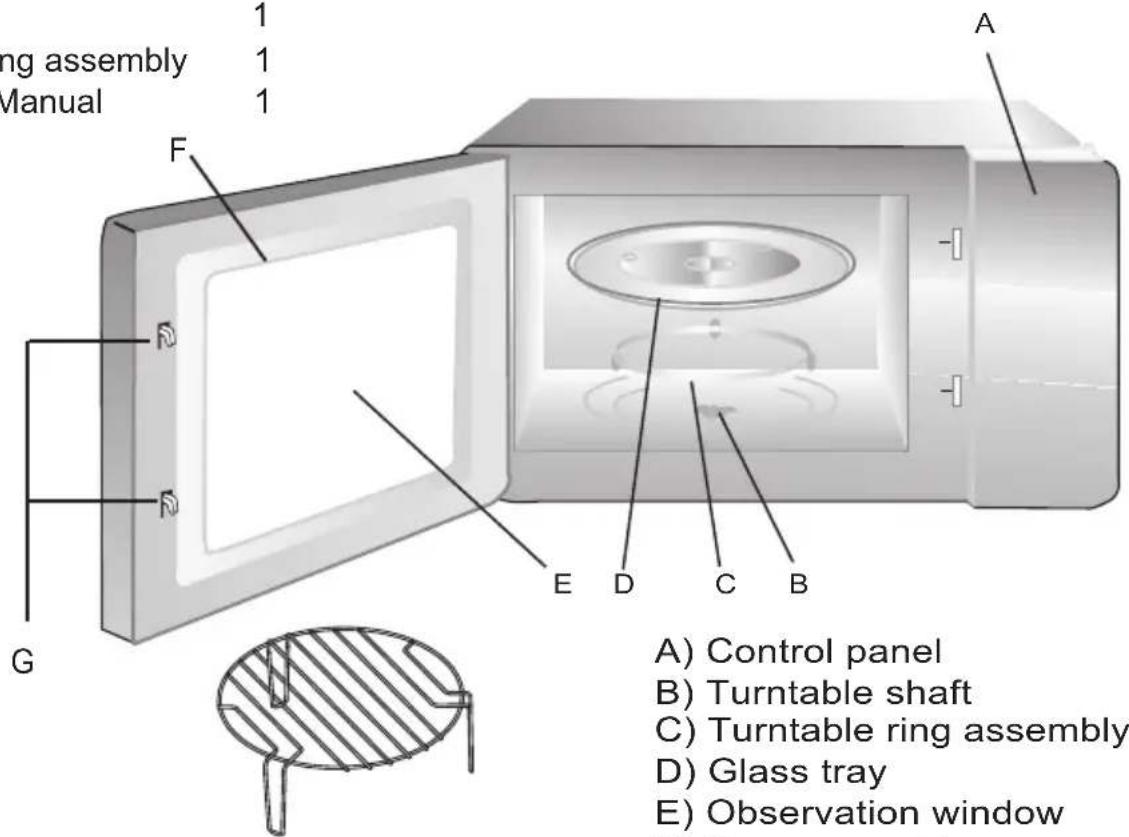
Grill Rack (Cannot be used in microwave function and must be placed on the glass tray)
A) Control panel B) Turntable shaft C) Turntable ring assembly D) Glass tray E) Observation window F) Door assembly G) Safety interlock system
Turntable Installation
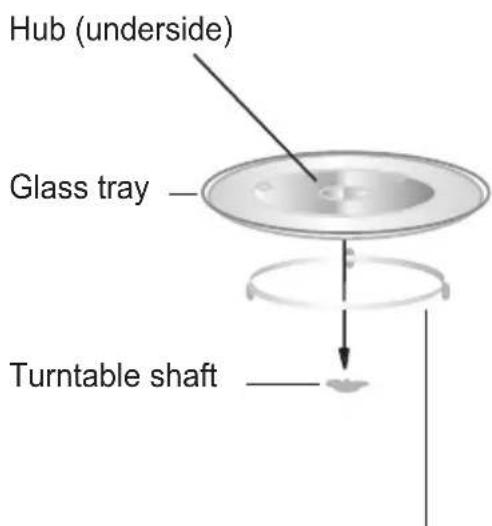
Turntable ring assembly
a. Never place the glass tray upside down. The glass tray should never be restricted. b. Both glass tray and turntable ring assembly must always be used during cooking. c. All food and containers of food are always placed on the glass tray for cooking. d. If glass tray or turntable ring assembly cracks or breaks, contact your nearest authorized service center.
Countertop Installation
Remove all packing material and accessories. Examine the oven for any damage such as dents or broken door. Do not install if oven is damaged.
Cabinet: Remove any protective film found on the microwave oven cabinet surface. Do not remove the light brown Mica cover that is attached to the oven cavity to protect the magnetron.
Installation
- Select a level surface that provides enough open space for the intake and/or outlet vents.
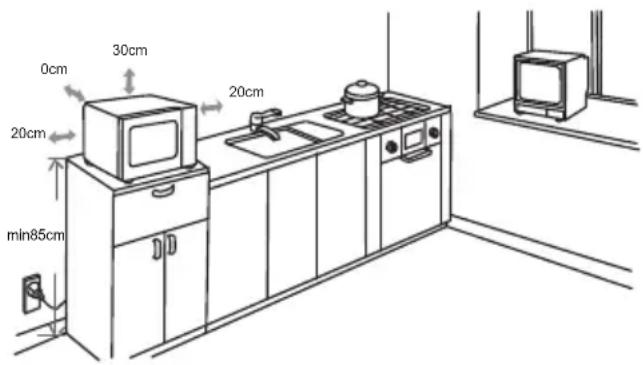
(1) The minimum installation height is 85cm. (2) The rear surface of the appliance shall be placed against a wall.
Leave a minimum clearance of 30cm above the oven, and a minimum clearance of 20cm is required between the oven and any adjacent walls.
(3) Do not remove the legs from the bottom of the oven. (4) Blocking the intake and/or outlet openings can damage the oven.
(5) Place the oven as far away from radios and TVs as possible. Operation of the microwave oven may cause interference to your radio or TV reception. 2. Plug your oven into a standard household outlet. Be sure the voltage and frequency are the same as the voltage and frequency on the rating label.
WARNING: Do not install the oven over a range cooktop or other heat-producing appliance. If installed near or over a heat source, the oven could be damaged and the warranty would be
void.
The accessible surface may be hot during operation.

OPERATION
Control Panel and Features
Operation Instructions
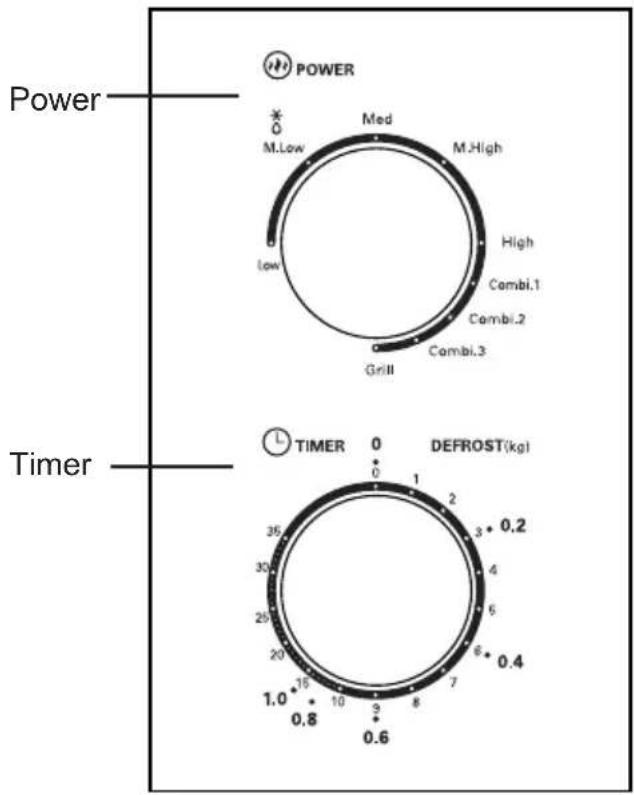
- To set the cooking power, turn the power knob to the desired level.
- To set the cooking time, turn the timer knob to the desired time according to your food cooking guide.
- The microwave oven will automatically start cooking after the power level and time are set.
- After the cooking time is up, the unit will "Dong" to stop.
- If the unit is not in use, always set the time to "0".
| Function/Power | Output | Application |
| Low | 17% micro. | Soften ice cream |
| Med. Low (Defrost) | 33% micro. | Soup stew, soften butter or defrost |
| Med. | 55% micro. | Stew, fish |
| Med. High | 77% micro. | Rice, fish, chicken, ground meat |
| High | 100% micro. | Reheat, milk, boil water, vegetables, beverage |
| Function/Power | Output | Application |
| Combi.1 | 80% grill 20% micro. | Sausage, Lamb, Kabobs, Seafood, Steak |
| Combi.2 | 70% grill 30% micro. | Chicken pieces, Chicken breasts, Pork chops |
| Combi.3 | 60% grill 40% micro. | Whole chicken |
| Grill | 100% grill | Baken bread, Slice food |
Notice: When removing food from the oven, please ensure that the oven power is switched off by turning the clock switch to 0 (zero). Failure to do so, and operating the microwave oven without food in it, can result in overheating and damage to the magnetron.
Troubleshooting
| Normal | |
| Microwave oven interfering TV reception | Radio and TV reception may be interfered when microwave oven operating. It is similar to the interference of small electrical appliances, like mixer, vacuum cleaner, and electric fan.It is normal. |
| Dim oven light | In low power microwave cooking, oven light may become dim. It is normal. |
| Steam accumulating on door, hot air out of vents | In cooking, steam may come out of food. Most will get out from vents. But some may accumulate on cool place like oven door. It is normal. |
| Oven started accidentally with no food in. | It is forbidden to run the unit without any food inside.It is very dangerous. |
| Trouble | Possible Cause | Remedy |
| Oven can not be started. | (1) Power cord not plugged in tightly. | Unplug. Then plug again after 10 seconds. |
| (2) Fuse blowing or circuit breaker works. | Replace fuse or reset circuit breaker (repaired by professional personnel of our company) | |
| (3) Trouble with outlet. | Test outlet with other electrical appliances. | |
| Oven does not heat. | (4) Door not closed well. | Close door well. |
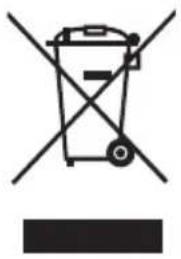
According to the Waste of Electrical and Electronic Equipment (WEEE) directive, WEEE should be separately collected and treated. If at any time in the future you need to dispose of this product, please do NOT dispose of this product with household waste. Please send this product to WEEE collecting points where available.
E-waste Guideline for Haier India
What is E-Waste or Electronic Waste?
Electronic waste (e-waste) is a term which refers to unusable, discarded, and old electric and electronic appliances such as refrigerators, LED/LCD/CTV, microwave ovens, washing machines, home air conditioners, etc. As per the E-waste (Management and Handling) Rules, 2016, e-waste means electrical and electronic equipment, whole or in part discarded as waste by the consumer or bulk consumer as well as rejects from manufacturing, refurbishment, and repair processes.
E-waste has been categorized into three main categories: Consumer Electronics/Home Appliances and IT & Telecom. Refrigerators, washing machines, home air conditioners, LED/LCD, etc. represent Consumer Electronics/Home Appliances. On the other hand, computers, desktops, laptops, mobile phones, etc. and their components represent Telecom & IT.
E-waste broadly covers waste from all electronic and electrical appliances and contains different hazardous materials which are harmful to human health and the environment if not disposed of carefully. While some naturally occurring substances are harmless in nature, their use in the manufacture of electronic equipment often results in compounds which are hazardous, for example, chromium becomes chromium VI. Thus, the Ministry of Environment, Forest & Climate Change, Govt. of India had issued directions for the reduction in the use of hazardous substances in the manufacture of electrical and electronic equipment and their components or consumables or parts or spares.
The Ministry of Environment, Forest & Climate Change, Govt. of India, in furtherance of its effort to reduce the hazard occurring from rapid growth in the Consumer durable and IT-Telecom market, had made rules called as E-Waste (Management and Handling) Rules, 2016 under the Environment Protection Act.
HAZARDS OF IMPROPER HANDLING AND/OR IMPROPER RECYCLING OF ELECTRONIC WASTE
Electronic equipment contains many hazardous metallic contaminants such as lead, cadmium, and beryllium and brominated flame-retardants. Improper handling and/or improper recycling of the Electronic Waste results in these hazardous metals/substances getting released into our eco and biological system, thereby leading to various health hazards. The hazardous contents in the electronic equipment include:
Health: The informal method of recycling extends health hazards. For example, primary and secondary exposure to toxic metals, such as lead, results generally from open-air burning used to retrieve valuable components such as gold. Incineration from burning e-waste creates fine particulate matter, which is linked to pulmonary and cardiovascular disease.
Environment: The informal method of recycling extends environment hazards too. For example, when different e-waste is burnt to extract metals from it, toxic chemicals are released into the air, damaging the atmosphere.
- Lead • Brominated Flame Retardants • Chromium • Mercury • Beryllium - Cadmium • Barium • Carbon Black • Phosphor
E-Waste Toxic Components and their Damage to Human Health
| Toxic Materials | Birth Defects | Brain Damage | Heart, Liver, Lung & Spleen Damage | Kidney Damage | Nervous/ Reproductive System Damage | Skeletal System Damage |
| Barium | X | X | ||||
| Cadmium | X | |||||
| Lead | X | X | X | X | ||
| Lithium | X | X | X | X | ||
| Mercury | X | X | X | X | X | |
| Nickel | X | X | X | X | ||
| Palladium | X | X | X | |||
| Rhodium | X | X | X | X | ||
| Silver | X | X |
Without safe recycling, most of these toxic components will end up in landfill - poisoning the soil and water.
The Dos of Electronic Waste Recycling:
- Give the discarded Electronic Equipments only at the authorized collection centers so that the same can be properly recycled.
- Drop the discarded Electronic Equipments only in the bins meant for the Electronic Waste.
- Consult the authorized service center as to whether the Electronic Equipment can be repaired or not, before discarding the same.
- Tell your neighbors and other persons about the hazards of improper disposal or handling or improper recycling of the Electronic Waste.
- If the unwanted Electronic Equipment still work or can be repaired then consider donating them.
The Don'ts of Electronic Waste Recycling:
- Don't dump the discarded Electronic Equipment in open or in any Land Fill Site as the same will result in contaminating the Soil and the groundwater.
- Do not dispose of discarded electronic equipment in household bins or municipal bins.
- Do not sell or give your discarded electronic equipment to any trash dealer or kabadiwala.
- Recycling electronic equipment helps to save natural finite resources and also reduces the environmental and health risks associated with improper handling or disposal of electronic waste.
- To minimize our impact on the earth and to protect the environment for future generations, return your discarded electronic equipment here for safe recycling:
Why is proper handling and management of e-waste required?
According to the MoEF, electrical and electronic equipment (EEE) contain valuable materials and hazardous/toxic substances in their components. Electronic products and electrical equipment after their useful life may not cause any harm if stored safely in households or stores. However, if the e-waste is opened up and attempts are made to retrieve useful components or materials in an unscientific manner, or if the material is disposed of in the open, it may cause health risks and damage to the environment. E-waste can be considered a resource that contains useful materials of economic benefit for recovery of plastics, iron, glass, aluminum, copper, and precious metals such as silver, gold, platinum, and palladium, as well as lead, cadmium, mercury, etc. However, at the same time, the presence of heavy metals (As, Cd, Hg, Pb, etc.) and other toxic substances such as polychlorinated biphenyls (PCBs), etched chemicals, etc. may pose risks to health and the environment during handling and recovery operations. E-waste is a problem of increasing proportions, especially when crude methods are adopted for the recovery of useful components from e-waste.
Thus, there is a need to encourage the recycling of all useful and valuable materials from e-waste so as to conserve the ever-depleting natural resources. Electronic components are increasingly made from recycled materials; for example, for making new LCDs, more than 50% of indium is sourced by recycling used LCDs. E-waste thus presents a scenario of urban mining for recovery of ferrous/non-ferrous/rare earth metals and precious metals in addition to plastics and glass. However, the presence of hazardous and toxic substances in the components of e-waste necessitates environmentally sound management of
e-waste, including collection and recycling/treatment in an environmentally sound manner.
Management and effect on sustainable future:
Sustainable development, as defined by the Brundtland Commission, is "development that meets the needs of the present without compromising the ability of future generations to meet their own needs."
E-waste has long been seen as an easy and cheap source of metals. However, due to the lack of proper consideration for such a source of metals as well as proper methods of recycling in India, we sent our e-waste to improper channels and thereby participated in degrading the environment.
Moreover, through this improper method of extracting metals, we have to date wasted at least forty percent of the precious metals and simultaneously caused damage to our environment. If we opt for the proper way to extract metals through proper channels of recycling, then we can achieve a ninety percent extraction rate of our metals as well as a better way to save our environment.
However, if today, while selling off our material to the improper channel, we do not think about our sustainable future, then it is certain that the coming generations will face a crisis of metals.
Customer/end-user responsibility
- Consumers shall ensure that their end-of-life product/e-waste is channelized through a collection center or dealer of the authorized producer or dismantler or recycler, or through the designated take-back service provider of the producer to an authorized dismantler or recycler;
- Consumers shall ensure that such end-of-life electrical and electronic equipment are not admixed with e-waste containing radioactive material;
Bulk Consumer Responsibility:-
- Bulk consumers of electrical and electronic equipment shall ensure that e-waste generated by them is channelized through a collection center or dealer of an authorized producer or dismantler or recycler, or through the designated take-back service provider of the producer to an authorized dismantler or recycler;
- Bulk consumers of electrical and electronic equipment shall ensure that such end-of-life electrical and electronic equipment are not admixed with e-waste containing radioactive material as covered under the provisions of the Atomic Energy Act, 1962 (33 of 1962) and rules made thereunder;
- Bulk consumers of electrical and electronic equipment listed in Schedule I shall maintain records of e-waste generated by them in Form-2 and make such records available for scrutiny by the concerned State Pollution Control Board;
- Bulk consumers of electrical and electronic equipment listed in Schedule I shall file annual returns in Form-3, to the concerned State Pollution Control Board on or before the 30th day of June following the financial year to which that return relates;
- In case of the bulk consumer with multiple offices in a State, one annual return combining information from all the offices shall be filed to the concerned State Pollution Control Board on or before the 30th day of June following the financial year to which that return relates.
Haier's Responsibility
Haier India, being a responsible and trustworthy brand, is taking all the necessary and expected steps for the betterment of the environment as well as living beings. Haier has joined hands with a number of recyclers to ensure environment-friendly recycling of electronic items such as refrigerators, washing machines, air conditioners, etc., that have either reached their end of life or are old, unusable, etc.
Apart from the above, Haier has taken the following steps for proper recycling of e-waste of its customers:
- Collection and Channelization of e-waste: Haier has set up a toll-free number where customers can call and register their products for recycling. As soon as e-waste pickup is registered by the customer, a representative will come to collect the product.
- Dismantling & Recycling of e-waste: Haier has appointed a number of recyclers who are leading names in the recycling industry to responsibly and in an environment-friendly manner recycle the e-waste generated in India.
- Awareness for e-waste: Haier is actively sharing infographics and engagement posts on its social platforms to create more awareness about e-waste and its hazards. In addition, Haier is also conducting awareness programs in schools, RWAs, office clusters, etc., to create awareness.

Collection Centre maintained by M/s WEEE-PRO Resource Recovery Solutions Private Limited (as on date)
| STATE | ADDRESS | CONTACT PERSON | CONTACT NUMBER |
| Andhra Pradesh | Shop No.5, New Gajuwaka, Opp. High School Road Andhra Pradesh-530026, | Mr.Jugti 955 | 3088577 |
| Assam | HN-34, Kundil Nagar Basistha Chariali,Near Parbhat ApartmentGuwahati-781029 | Mr.Sishram 9 | 864048000 |
| Chhattisgarh | Mig No. 7, Ring Road No-2 Kabir Nagar Raipur Chhattisgarh | Mr.Bijender Singh | 9303906097 |
| Gujrat | Shop No D-9, Pushp Tenament, Behind Mony Hotel, Isanpur Gujarat – 382443 | Mr.Sandeep 9 | 375688099 |
| Haryana | J-171, New Palam Vihar Phase-1, Gurugram, Haryana 122017 | Mr.Rajesh 97 | 11563229 |
| Jammu & Kashmir | 1.Sidco Chouk Bari Brahmana Jammu - 181133 Jammu& Kashmir jammu-181133 | Mr.Dharampal | 9622565431 |
| Jharkhand | A-36 Guru Nanak Nagar Near Hotel Amber Sakchi Jamshedpur Jharkhand – 831001 | Mr.Niraj 930 | 4002777 |
| Karnataka | No.43 1st floor 2nd Main D.D.U.T.T.L. Yeshwantpur Karnataka -560022 | Mr.Ratan Lal | 9886250346 |
| Kerala | Door No-84D SPW Road ,Vrindavan Ln, Choornikkara, Kochi, Kerala - 683106CochinKochi, Kerala -683106 | Mr.Manish 90 | 37991199 |
| Madhya Pradesh | 284 AS-3 Scheme No.-78, Vijay Nagar MP | Mr.Yogesh 93 | 302734152 |
| Maharashtra | Plot No. 92, Gali No. – 01, Sector 19CVashiNavi Mumbai – 400705 | Balwan Singh | 9372166155/9371644600 |
| Shop 3 Kachore Complex Amravati Road, Waddhamna Maharashtra – 440023 | Balwan Singh | 9860814787 | |
| Plot No 24, Sector 4, Shikshak ColonyNear Spine City, Moshi Pradhikaran Maharashtra- 412105 | Balwan Singh | 9370939911 | |
| New Delhi | Plot No. 619, Block A, Near Tata Telco Service Station, Rangpuri, Mahipalpur Delhi - 110037 | Rajkumar Poonia | 9810053907 |
| Orissa | 1st Floor Delta house Rajendra NagarMadhupatna Cuttack,Orissa | Mr.Nihar Mahapatra | 9337902236 |
| Punjab | Shop No: -15 & 16, Pabhat Road,Opp – Tennis Academy, Zirakpur,Punjab-140603 | Mr Sanjeev | 9316166155 |
| Rajasthan | Plot No.81, 200 ft. By Pass,Near Ajmer, Road, Heerapura,Rajasthan – 302021 | Mr.Yogesh Saharan | 9309413301 |
| Tamil Nadu | 3/27 Sakthi Garden Phase II, Senneerkuppam, Poonamallee, Near Bisleri Water Plant Tamil Nadu-600056 | Mr.Firoj Khan | 9363166155/9362005006 |
| Telangana | Shop No.-4, Block-3,4th Shatter at 179, MPR Estates Near Old Check Post, SecunderabadTelangana – 500011 | Mr.Ajay 9395 | 166155/9396166155 |
| Uttar Pradesh | S 317, Transport Nagar, Near RTO Office Lucknow UP- 226012 | Anuj Poonia | 9335166155/9305166155 |
| Bh – 122, Sector 70 Noida UP- 201301 | Anuj Poonia | 9999166155 | |
| West Bengal | 156A/73, Northern Park, B.T. Road DUNLOPWB – 700108 | Mr.Vinod Kumar | 9331522536 |
| West Bengal | R K Enterprise, Block Singhia, West Bengal 848209 | Mr Navaid 9 | 027392259 |
Our PRO Partners (E-waste Partner) (as on date)
1. M/s WEEE-PRO Resource Recovery Solutions Private Limited
Address: Flat-702, Tower-6, Unitech Horizon, Plot No.-6, Sector Pi-2, Greater Noida, Noida, Gautam Buddha Nagar, Uttar Pradesh, India, 201310. Contact Details: Mr. Bhagwati Prasad Suman; 9958445960; info@weee-pro.org; 1800-572-2961
2. PEGASUS SUSTAINABILITY PRIVATE LIMITED
Address: F-6, 1st Floor, 4648/1, 21, Ansari Road, Daryaganj, New Delhi, Delhi, 110002. Contact: Mr. Subratoo Mukherjee; 9811707777; http://www.pegasusnetwork.in; 1800-420-3177
3. M/s Green Planet
Address: 17D, 105, Vasundhra, Ghaziabad 201012. Contact Details: Mr. Anish Duggal; 9212503521; http://greenplanetpro.in/; 1800 8430 027
Contact for further information:
Haier Appliances (India) Pvt. Ltd. Building Number 1, Okhla Industrial Estate, Phase III, Opposite Modi Mill, New Delhi-110020.
Toll-Free Hotline Number
1800-102-9999 1800-419-9999
Query Between
9.00 AM to 9.00 PM (Monday to Saturday) Email: customercare@haierindia.com
HAIER WARRANTY
HAIER APPLIANCES (INDIA) PVT. LTD. (hereinafter referred to as "the Company") hereby offers the following warranty to the original domestic purchaser commencing from the date of the purchase. The Company, at its sole discretion, will free of charge repair or replace any defective part or parts which prove to be defective in workmanship and/or materials and not due to abnormal or improper usage.
CONDITIONS OF WARRANTY
1) This warranty will automatically terminate on the expiry of the warranty period from the date of delivery. 2) The Company is not liable for any delay in servicing due to reasons beyond the control of the Company or any of its authorised service centres. 3) Parts replaced or repaired under this warranty are warranted throughout the remaining of the original warranty period. 4) It is entirely left to the Company's discretion to repair/replace parts at the site of installation or at the authorised service centre of the Company. 5) This warranty shall be strictly limited to the repairs or replacement of defective parts specified in the warranty. This warranty shall not cover any consequential or resulting liability. 6) This warranty shall not, in any case, extend towards payment of any monetary consideration whatsoever or replacement or return of the product. 7) The Company may repair/supply parts free of cost during the warranty period. This warranty does not cover any Excise duty, Central or Sales tax, Octroi and other local taxes or levies on the components/parts. 8) The parts shall be replaced by functionally operating equivalent material only and not with brand new ones and are likely to be different from the one originally fitted. The parts thus removed shall be taken back by the Company. 9) The Company reserves the right to retain any part or component replaced at its sole discretion during the warranty period. 10) In no event the Company or its authorised service centre be liable for any consequential damages or resulting liability, damage or loss arising directly or indirectly out of any defect in the product. 11) This warranty is not valid in case of the following events:
a) If the Product has been Installed/Serviced/Repaired/Opened or Tampered by any unauthorised personnel.
b) If defects arise/caused by accidents, alteration, misuse, neglect, substitution of original components with spurious/non-genuine components, attacked by household pest / rodents, fire, flood, earthquake, lightning and/or any other act of God/natural calamities.
c) The product is shifted outside India.
12) For any service under this warranty beyond city/town/municipal limits from the Company/authorised service centre, a fixed charge of Rs. 50 will be collected from the customer in addition to the actual to and fro charges by the shortest route. 13) Any change of location or change in the ownership during the warranty period must be intimated in writing to the Company. 14) The Company's employees or its authorised representatives have no authority to vary the terms of this warranty. 15) This warranty is effected in New Delhi and claims, if any, shall be made only before the courts having jurisdiction in New Delhi and no claim shall be made against the Company outside New Delhi notwithstanding that the Appliance may have been sold or delivered elsewhere.
Haier
Haier Appliances (India) Pvt. Ltd,
Building No. - 1, Okhla Industrial Estate, Phase III, New Delhi – 110020
CIN: U74140DL2003PTC119101
Toll Free No - 1800-419-9999 | 1800-102-9999 (24*7)
Mail ID - customercare@haierindia.com
WhatsApp No - 8553049999


- PRECAUTIONS TO AVOID POSSIBLE EXPOSURE TO EXCESSIVE MICROWAVE ENERGY
- ADDENDUM
- IMPORTANT SAFETY INSTRUCTIONS WARNING
- TO REDUCE THE RISK OF INJURY TO PERSONS GROUNDING INSTALLATION
- DANGER
- WARNING
- CLEANING
- UTENSILS
- CAUTION
- PERSONAL INJURY HAZARD
- UTENSIL TEST
- SETTING UP YOUR OVEN
- NAMES OF OVEN PARTS AND ACCESSORIES
- TURNTABLE INSTALLATION
- COUNTERTOP INSTALLATION
- INSTALLATION
- OPERATION
- CONTROL PANEL AND FEATURES
- OPERATION INSTRUCTIONS
- E-WASTE GUIDELINE FOR HAIER INDIA
- WHAT IS E-WASTE OR ELECTRONIC WASTE
- HAZARDS OF IMPROPER HANDLING AND/OR IMPROPER RECYCLING OF ELECTRONIC WASTE
- THE DOS OF ELECTRONIC WASTE RECYCLING
- THE DON'TS OF ELECTRONIC WASTE RECYCLING
- WHY IS PROPER HANDLING AND MANAGEMENT OF E-WASTE REQUIRED
- MANAGEMENT AND EFFECT ON SUSTAINABLE FUTURE
- CUSTOMER/END-USER RESPONSIBILITY
- BULK CONSUMER RESPONSIBILITY
- HAIER'S RESPONSIBILITY
- OUR PRO PARTNERS (E-WASTE PARTNER) (AS ON DATE)
- M/S WEEE-PRO RESOURCE RECOVERY SOLUTIONS PRIVATE LIMITED
- PEGASUS SUSTAINABILITY PRIVATE LIMITED
- M/S GREEN PLANET
- CONTACT FOR FURTHER INFORMATION
- TOLL-FREE HOTLINE NUMBER
- QUERY BETWEEN
- HAIER WARRANTY
- CONDITIONS OF WARRANTY
- HAIER
Brand : HAIER
Model : HIL2002GSPB
Category : Microwave