
CRE-E10 - Hearing aid SONY - Free user manual and instructions
Find the device manual for free CRE-E10 SONY in PDF.


| Product Type | Digital Hearing Aid |
| Model | CRE-E10 |
| Brand | Sony |
| Form Factor | Behind-the-Ear (BTE) |
| Dimensions | Approx. 45 x 15 x 10 mm (without ear mold) |
| Weight | Approx. 5 g per device |
| Power Source | Rechargeable lithium-ion battery |
| Battery Life | Up to 18 hours on a full charge |
| Charging Time | Approx. 3 hours via USB-C charging |
| Sound Channels | 16 channels for precise sound tuning |
| Directional Microphone | Yes, adaptive beamforming |
| Feedback Cancellation | Active feedback management system |
| Noise Reduction | Multi-band noise reduction |
| Bluetooth Connectivity | Bluetooth 5.0 for streaming and remote control |
| Water Resistance | IP65 rating (dust and water jets) |
| Controls | Push button and sliding switch for volume/programs |
| Induction Loop | Integrated telecoil for loop systems |
| Mobile App | Compatible with Sony Hearing Aid App (iOS/Android) |
| Cleaning and Maintenance | Daily cleaning with soft cloth; replace wax guard every 2-3 months |
| Safety Features | Low battery alert, volume limiter, and IP65 protection |
| Spare Parts | Replacement wax guards, ear domes, and charging cable available |
| Repairability | Serviceable by authorized Sony centers; user-replaceable wax guard |
| Warranty | Standard 2-year warranty |
Frequently Asked Questions - CRE-E10 SONY
User questions about CRE-E10 SONY
0 question about this device. Answer the ones you know or ask your own.
Ask a new question about this device
Download the instructions for your Hearing aid in PDF format for free! Find your manual CRE-E10 - SONY and take your electronic device back in hand. On this page are published all the documents necessary for the use of your device. CRE-E10 by SONY.
USER MANUAL CRE-E10 SONY
Rechargeable self-fitting OTC hearing aids CRE-E10

WARNING
If you are younger than 18, do not use this.
You should go to a doctor, preferably an ear-nose-throat doctor (an ENT), because your condition needs specialized care. Over-the-counter hearing aids are only for users who are 18 or older.
This OTC hearing aid is for users who are 18 and older.
People who are younger than 18 with hearing loss should see a doctor, preferably an ENT, because they may need medical testing and management. Hearing loss can affect speech and learning, so professional fitting and continuing care are also important.

WARNING
When to see a doctor.
If you have any of the problems listed below, please see a doctor, preferably an ear-nose-throat doctor (an ENT).
Your ear has a birth defect or an unusual shape. Your ear was injured or deformed in an accident. You saw blood, pus, or fluid coming out of your ear in the past 6 months. Your ear feels painful or uncomfortable. You have a lot of ear wax, or you think something could be in your ear. You get really dizzy or have a feeling of spinning or swaying (called vertigo). Your hearing changed suddenly in the past 6 months.
Your hearing changes: it gets worse, then better again. You have worse hearing in one ear. You hear ringing or buzzing in only one ear.

WARNING
This hearing aid should not cause pain when inserting it.
Remove the device from your ear if it causes pain or discomfort when you insert or place it. To try again, make sure to follow the instructions. If you feel pain or discomfort again, contact the manufacturer. If your pain or discomfort does not go away, contact your hearing healthcare professional. You can also report this to FDA as an adverse event according to the instructions that appear later.

WARNING
Risk of injury!
Always wear the hearing aid with a Click Sleeve.
▶ Make sure that the Click Sleeve is completely attached. You should feel that it snaps into place. ▶ Ensure that only a single Click Sleeve is attached to each hearing aid. In the very rare case that the click sleeve gets stuck in the ear canal and you cannot remove it yourself, please contact a physician. Do not insert the Click Sleeves in your ears without the hearing aid attached.

WARNING
In case you have any doubt whether this device is appropriate for you, consult a licensed physician before using this device.

WARNING
This hearing aid is intended for you only and should not be worn by others.

NOTICE
Do not use your hearing aids while swimming or while taking a shower.

WARNING
Choking hazard!
Your hearing aids contain small parts which can be swallowed.
Keep hearing aids, batteries and accessories out of reach of children and pets. If parts have been swallowed consult a physician or hospital immediately.

CAUTION
This is not hearing protection.
You should remove this device if you experience overly loud sounds, whether short or long-lasting. If you're in a loud place, you should use the right kind of hearing protection instead of wearing this device. In general, if you would use ear plugs in a loud place, you should remove this device and use ear plugs.

CAUTION
The sound output should not be uncomfortable or painful.
You should turn down the volume or remove the device if the sound output is uncomfortably loud or painful. If you consistently need to turn the volume down, you may need to further adjust your device.

CAUTION
You might need medical help if a piece gets stuck in your ear.
If any part of your hearing aid, like the eartip, gets stuck in your ear, and you cannot easily remove it with your fingers, get medical help as soon as you can. You should not try to use tweezers or cotton swabs because they can push the part farther into your ear, injuring your eardrum or ear canal, possibly seriously.
Note: If you remain concerned, consult a professional.
If you try this device and continue to struggle with or remain concerned about your hearing, you should consult with a hearing healthcare professional.
Note: What you might expect when you start using a hearing aid.
A hearing aid can benefit many people with hearing loss. However, you should know it will not restore normal hearing, and you may still have some difficulty hearing over noise. Further, a hearing aid will not prevent or improve a medical condition that causes hearing loss.
People who start using hearing aids sometimes need a few weeks to get used to them. Similarly, many people find that training or counseling can help them get more out of their devices.
If you have hearing loss in both ears, you might get more out of using hearing aids in both, especially in situations that make you tired from listening - for example noisy environments.
Note: Tell FDA about injuries, malfunctions, or other adverse events.
To report a problem involving your hearing aid, you should submit information to FDA as soon as possible after the problem. FDA calls them "adverse events", and they might include: skin irritation in your ear, injury from the device (like cuts or scratches, or burns from an overheated battery), pieces of the device getting stuck in your ear, suddenly worsening hearing loss from using the device, etc.
Instructions for reporting are available at
https://www.fda.gov/Safety/MedWatch, call 1-800-FDA-1088.
You can also download a form to mail to FDA.
Content
Your hearing aids 19
Intended use 20
How to use QR codes 21
What you'll find in the box 23
Get to know your hearing aids 24
Get to know your charger 25
Start here 26
Activate and charge before first use 29
Charging 29
Turning on and off 30
Inserting and removing the hearing aids 31
How to change Click Sleeves 36
Charging 39
Charge devices while on the go 39
Charging via electrical outlet 40
Check charging status 41
Low power indication 44
Charging tips 45
How often do I need to charge the hearing aids? 45
How long does charging take? 45
What happens if I forgot to charge? 46
Switch off the hearing aids for long term storage 46
Charging your hearing aids 48
Requirements for the USB power adapter 51
Sony | Hearing Control app 52
Daily use 54
Adjusting the volume 54
Audio streaming with iPhone 55
Airplane mode for hearing aids 56
Adjusting your hearing aid 57
What to do in loud environments 58
Explosive atmospheres 60
Possible physiological side effects 61
Exposure to nickel 62
Cleaning and maintenance 63
Troubleshooting for hearing aids and charger 70
Technical information 75
Clinical data 78
Human factors data 78
Damaged devices, unauthorized changes 79
Restricted areas for wireless devices 81
Interference by strong radiation 82
Explanation of symbols 84
Important information 88
Operating, transport and storage conditions 88
Disposal information 92
Conformance information 92
Regulatory information 95
For hearing aid users 96
Quality of Service (QoS) for the ear-to-ear wireless technology 107
Cybersecurity 109
For children with hearing loss 110
Country/region specific information 111
Conformance information for charger 112
Support 113
Support 113

NOTICE
The left and the right hearing aid are intended to be worn together. They operate as a set.

CAUTION
Read this user guide thoroughly and completely to avoid damage and injury.
Your hearing aids
A power cell (lithium-ion rechargeable battery) is permanently built into your hearing aid. This enables easy charging with your charger.
The wireless functionality enables advanced audiological features and synchronization between your two hearing aids.
Your hearing aids feature Bluetooth® Low Energy* technology allowing for easy data exchange with your smartphone, and for seamless audio streaming with your iPhone**.
* The Bluetooth word mark and logos are owned by the Bluetooth SIG, Inc., and any use of such marks by Sony Corporation is under license. Other trademarks and trade names are those of their respective owners.
** Apple, the Apple logo, iPhone, iPad, and iPod are trademarks of Apple Inc., registered in the U.S. and other countries and regions.
Intended use
The self-fitting hearing aid is intended to amplify sound for individuals 18 years of age or older with perceived mild to moderate hearing impairment. It is adjusted by the user to meet the user's hearing needs through software tools. The device is intended for direct-to-consumer sale and use without the assistance of a hearing care professional.
The charger is intended to charge our specific hearing aids with built-in power cells (lithium-ion rechargeable batteries).
The Sony | Hearing Control app is intended to support self-fitting and fine-tuning of the hearing aid.
How to use QR codes
You will find QR codes* throughout the user guide. These QR codes will help you to install the Sony | Hearing Control app or to view instructional videos.
Start now by scanning the QR code with your smartphone camera or by typing the URL into your browser:
- Open the QR Code reader or smartphone camera on your phone.
- Hold your device over the QR Code so that the QR code is clearly visible within your smartphone's screen.
- The phone will automatically scan the QR code. When your smartphone reads the QR code, a link will appear. Click the link to go to the video.
* QR Code is registered trademark of DENSO WAVE INCORPORATED.

NOTICE
Not all smartphone readers work the same. Some may require additional steps.
What you'll find in the box

Left and right hearing aid, Click Sleeve S attached.

Cleaning brush Cleaning cloth
Quick start card and user guide Limited warranty

Charger + USB cable

Click Sleeves sizes XS, M, and L
Get to know your hearing aids

1 Click Sleeve ② Microphone openings
③ Side indicator
(R = right ear, L = left ear)
4 Charging contacts
You can use the following standard Click Sleeves:

Click Sleeve closed (standard)
Click Sleeve vented (optional)
Get to know your charger
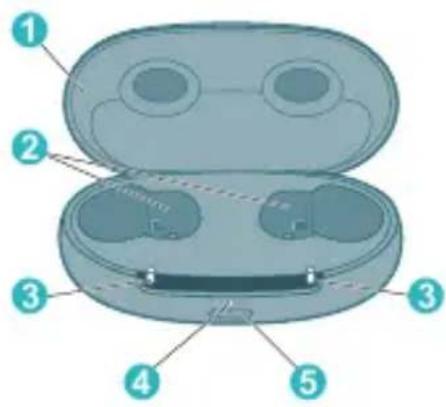

1 Lid ② Charging cups ③ LEDs – hearing aids 4 LED – charger
5 Push button ⑥ USB power port ⑦ USB power cable

Fully charge your hearing aids before using them for the first time.
Start here
It is required to complete all steps in the Sony | Hearing Control app to setup the hearing aids for your needs.
You will be guided through the process. It will take around 10 minutes.
Before starting the process, please do the following:
▶ Ensure strong internet access (Wi-Fi or cellular) throughout the customization process ▶ Find a place where you are not disturbed by other loud sounds
▶ Unmute your smartphone and disable silent mode Set the volume for media sounds of your smartphone to a high level (about 75%).
Download the Sony | Hearing Control app to personalize your hearing aids.

sony.net/hearing-e10-app
Follow the Sony | Hearing Control app for instructions.
Activate and charge before first use
Charging
Connect the charger and a suitable power adapter (not included) with the USB cable. Use the cable which came with the device.
Keep the hearing aids inside the charger.

While charging, the lights are pulsing orange. Your hearing aids are now activated. The lights change to constant green when the batteries are fully charged

Turning on and off
There is no on/off button on the hearing aids.
▶ Turning on: Take the hearing aids out of the charger. ▶ Turning off: Place the hearing aids in the charger.
Inserting and removing the hearing aids
Inserting a hearing aid:
Identify right and left hearing aid so that you insert it in the correct ear. Letters R and L indicate the side:
R = right ear
L = left ear
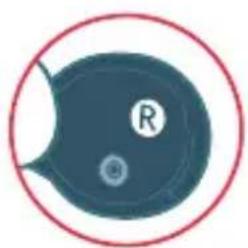

Make sure the Click Sleeve is positioned correctly. The shape should follow the shape of the hearing aid. Turn the Click Sleeve so the little tab is on the outside.

Hold the hearing aid correctly before inserting it.


NOTICE
▶ Push the device into the intended position, making sure there is no discomfort/resistance.
Place the hearing aid in the outer ear and twist it slightly until it sits well.


WATCH QUICK VIDEO TUTORIAL
sony.net/hearing-e10-insertion
i
If you have problems inserting the hearing aid, use the other hand to gently pull your earlobe downwards. This opens the ear canal and eases insertion of the hearing aid.
Removing a hearing aid:
Grip the hearing aid with two fingers and pull it out.

Clean and dry your hearing aids after usage. Read more in the Safety and maintenance information.
How to change Click Sleeves
The hearing aids come with the size S Click Sleeves pre-attached. If you do not feel comfortable using this size, you can change the Click Sleeves.
Please note that left and right ear sizes may differ.
Choose a smaller size if the hearing aid feels tight in your ear.
Choose a larger size if the hearing aid feels loose or makes a whistling noise.
Removing Click Sleeve
Pinch and pull off the Click Sleeve. Click Sleeves are designed to be discarded after removal from the device.
Installing new Click Sleeve
Make sure that the little tab of the Click Sleeve is on the outside of the hearing aid. You will hear a click when it is fully installed.

*Shown for the left device

NOTICE
Select the Click Sleeve size that gives you the best wearing comfort in each ear. Left and right ear sizes may differ. Choose a larger size in case of whistling problems.
Charging
Charge devices while on the go
When fully charged, the charging base holds two portable charges for on-the-go convenience.
Charging hearing aids
Place the right hearing aid in the charging cup marked with an “R”, and the left hearing aid in the charging cup marked with an “L”. Close the charger's lid.

The hearing aids are automatically turned off and start charging. The charging status is shown for 7 seconds. ▶ LED indicators pulsing orange: hearing aids are charging. If not: see the Troubleshooting section.
Charging via electrical outlet
Connect the charger to the power adapter and plug it into an electrical outlet. Or place the charger on a wireless Qi-charger. The internal battery of the charger is charged. Put the hearing aids in the charger to also charge the hearing aids.

The LEDs start pulsing orange to indicate that the hearing aids and the charger are being charged. If not: see troubleshooting section. When the charger is plugged into the wall, constant-on green LEDs indicate that charging is completed. For wireless Qi charging, the LEDs will turn off when charging is completed.
Check charging status
- The hearing aids are in the charger. Disconnect the charger from the electrical outlet.
- Check the charging status of the hearing aids and the charger either
- by opening the lid, or
- by briefly pressing the button
If the status LED does not light up when you press the button, check the following:
- The charger is off. Press and hold the button for 5 seconds to turn on the charger.
- The charger's internal battery is too low to display the status. Connect the charger to an electrical outlet, wait several minutes and try again.
LED Behavior of LED lights when using portable charging
| Solid greenInternal battery has enough capacity to fully charge two hearing aids. | |
| Solid orangeInternal battery does not have enough capacity to fully charge two hearing aids. |
LED Behavior of LED lights when using portable charging
| Blinking orangeInternal charger battery empty. Charging of hearing aids is not possible. |
LED Hearing aid LED
| Pulsing orangeHearing aid is being charged. | |
| Solid greenHearing aid is fully charged. | |
| LED is offNo hearing aid is in the charger, hearing aid is not placed correctly, or charger is off. |
LED Hearing aid LED
| Blinking twice orangeCooling phase. Charging is resumed when the device has cooled down. Refer to section "Troubleshooting for hearing aids and charger". | |
| Blinking redHearing aid error. Refer to section "Troubleshooting for hearing aids and charger". |
Low power indication
An audible alert signal to indicate the hearing aid power cell is running low will be played. The signal will be repeated every 20 minutes. Depending on the usage of your hearing aids, you have approximately 1.5 hours to charge your hearing aids before they stop working.
Charging tips
You may have some questions on how to best charge your hearing aids. Read the questions and answers below. For further information, visit https://www.sony.net/hearing-e10.
How often do I need to charge the hearing aids?
Hearing aids are meant to be charged daily, even if the power cell is not empty. Charge them overnight so you can be sure to start your day with fully charged hearing aids.
How long does charging take?
A full charging cycle takes approximately 4 hours (+/- 10 mins). After 30 minutes, it is possible to use your hearing aids for up to 6 hours. Charging times may vary due to the use of the hearing aids and the age of the power cell.
What happens if I forgot to charge?
Your hearing aids will automatically switch off when the power cell is empty. Charge the hearing aids as soon as possible.
Hearing aids which have not been charged for over 6 months may be damaged due to an unrecoverable deep-discharge of the power cell. Deep-discharged power cells cannot be charged anymore and have to be replaced.
Switch off the hearing aids for long term storage
Put the hearing aids in the charger and close the lid. Disconnect the charger from the electrical outlet. Press and hold the button for 5 seconds to turn the charger and the hearing aids off. The LEDs light up green and fade out.
To turn on the hearing aids and the charger again: press the button for 5 seconds, or connect the charger to an electrical outlet, or put the charger on a wireless Qi-charger. Keep the hearing aids inside the charger.
Charging your hearing aids
Safety information on lithium-ion rechargeable batteries

WARNING
A lithium-ion rechargeable battery is permanently built into your device. Incorrect use of the device can cause the lithium-ion rechargeable battery to burst.
Risk of injury, fire or explosion!
Follow the safety instructions for lithium-ion rechargeable battery in this section.

WARNING
Charge your hearing aids only with the approved charger. Immediately discontinue use if the hearing aids or the charger feel hot. Do not dispose of the device in fire or water. Keep the device away from combustible materials, due to the unlikely event of a lithium-ion battery bursting or exploding.
In any of the above cases, contact the customer service for help.

NOTICE
To avoid environmental pollution, do not throw batteries or hearing aids into household trash. Recycle or dispose hearing aids, accessories, batteries and packaging according to local regulations.

WARNING
Risk of burns!
Do not place anything other than your hearing aids in the charger.
Requirements for the USB power adapter

WARNING
Risk of electric shock!
Connect the charger only with a USB power supply which complies with IEC 60950-1 and/or IEC 62368-1.

NOTICE
Use of incompatible parts poses a risk of malfunction.
▶ Use standard USB power adapter which supports an output voltage of 5 V DC and an output current of 0.5 to 1 A. ▶ Use only the USB cable that is provided with the device. Do not insert incompatible connectors or foreign objects into the charger port.
Sony | Hearing Control app
The Sony | Hearing Control app supports you with the following:
Creating an account and signing in ▶ Pairing the hearing aids with the app Assessing your hearing profile ▶ Programming the hearing aids with your personalized settings Fine-tuning assistant For daily use: volume control, sound balance, and directivity

NOTICE
Set up the hearing aids in a quiet environment without interruptions for the best result.
Daily use
Adjusting the volume
Your hearing aids automatically adjust the volume to the listening situation.
If you prefer manual volume adjustment, use the Sony | Hearing Control app.
An optional signal can indicate the volume change.
Audio streaming with iPhone
Your hearing aids are Made for iPhone hearing aids. This means you can get phone calls and listen to music from your iPhone directly into your hearing aids.
For more information about compatible iOS devices, pairing, audio streaming and other useful functions, consult the Sony CRE-E10 website or contact customer service.
Made for

iPhone | iPad | iPod
"Made for iPhone", "Made for iPad", and
“Made for iPod” mean that an electronic accessory has been designed to connect specifically to iPhone, iPad, or iPod, respectively, and has been certified by the developer to meet Apple performance standards. Apple is not responsible for the operation of this device or its compliance with safety and regulatory standards. Please note that the use of this accessory with iPhone, iPad, or iPod may affect wireless performance.
Airplane mode for hearing aids
Airplane mode is when Bluetooth of your hearing aids is turned off. In areas where the use of Bluetooth technology is not allowed (e.g. on some airplanes), you can deactivate Bluetooth mode. This turns Bluetooth in your hearing aids off temporarily. The hearing aids still work without Bluetooth, however direct audio streaming will not be possible and other functions will not be available.
To deactivate or activate the Bluetooth mode, use the Sony | Hearing Control app.
An alert tone indicates when Bluetooth mode is deactivated or activated.
Adjusting your hearing aid

WARNING
Do not adjust the hearing aid when your attention is required on other activities, for example when crossing a street or driving a car.

WARNING
Your hearing devices may reduce certain background sounds, potentially also traffic or warning signals. Adjust the hearing aid to ensure you can hear surrounding sounds, including alarms and warning signals. Be aware that it may be more difficult to identify where a sound is coming from during the first few weeks of use.
What to do in loud environments

WARNING
Do not use this device as hearing protection in loud environments.

WARNING
Remove hearing aids before using hearing protection equipment. Noise-cancelling headphones should not be used as hearing protection.

WARNING
Frequent exposure to loud sounds may harm your hearing. Keep the loudness at comfortable listening levels. Wear hearing protection when exposed to loud environmental noise.

NOTICE
The smartphone generates short tone sequences to control the hearing aids. Do not hold the smartphone close to the ear while using the app.
Explosive atmospheres

WARNING
Risk of explosion!
Do not use your hearing aids in explosive atmospheres (e.g., mining areas).
Possible physiological side effects

WARNING
In case of a known contact allergy, consult the customer service regarding the presence of the allergen before using the hearing aid. If an allergic reaction develops after wearing the hearing aid, immediately discontinue use and consult a licensed physician.

WARNING
Contact your physician if you experience any unusual skin irritation, excessive accumulation of ear wax, dizziness, change in your hearing, or if you think there might be an object in your ear canal.
Exposure to nickel

WARNING
This product can expose you to nickel, which is known to the State of California to cause cancer. For more information, go to www.P65Warnings.ca.gov.
Cleaning and maintenance
Ear wax may accumulate in the Click Sleeves which may affect sound quality.

NOTICE
Clean your hearing aids daily with a soft and dry tissue. Never use water. Only use cleaning products declared for use with hearing aids.

NOTICE
Protect your hearing aids from high humidity. Do not wear them in the shower or when you apply make-up, perfume, aftershave, hairspray or suntan lotion.

Protect your hearing aids from extreme heat. Do not store them in direct sunlight.

Do not dry your hearing aids in the microwave oven.
Do not use alcoholic solvent on the charging contacts. To avoid corrosion, use a soft and dry tissue to wipe off sweat or liquid from the charging contacts or hearing aids before inserting them in the charger. ▶ Ask your customer service for recommended cleaning products, special care sets, or more information on how to keep your hearing aids in good condition.

In the unlikely event corrosion becomes visible on the surface of the charging contacts and cannot be wiped off, discontinue wearing the device and contact your customer service.
Storage
- Short-term storage (up to several days): Turn off your hearing aids by placing them in the charger.
- The charger must be on. If the charger is not on and you place your hearing aids in the charger, the hearing aids are not turned off.
- Note that when you turn off the hearing aids via a remote control or smartphone app, the hearing aids are not turned off completely. They are in standby-mode and still draw some power.
- Long-term storage (weeks, months, ...): First, fully charge your hearing aids. Leave them in the charger with the lid closed. Once the hearing aids are fully charged the charger and the hearing aids are turned off automatically.
If you need to store your hearing aids for more than 3 months, put them in the charger and make sure the charger is turned off. Observe the storage conditions in section "Operating, transport and storage conditions". Clean the Click Sleeves when you take it out of the ear with a soft and dry tissue. This prevents that ear wax becomes dry and hard.

Squeeze the tip of the Click Sleeve to remove ear wax.

Exchange standard Click Sleeve approximately every three months. Replace them sooner if you notice cracks or other changes.
Contact customer service if wax has collected underneath the Click Sleeve and it cannot be wiped off.
Cleaning of the charger

NOTICE
Risk of injuries caused by electric shock!
If cleaning is required, disconnect the charger from the power supply.
Clean the charger with a soft, dry tissue. ▶ Never use running water or immerse the charger in water. ▶ Do not sterilize or disinfect the charger.
Troubleshooting for hearing aids and charger
If the status LEDs do not light up when you insert the hearing aids, check the following:
The hearing aids are not correctly placed. Push them slightly into their charging cups or close the charger's lid. The charger is turned off. Press and hold the button for 5 seconds to turn on the charger or connect the charger to an electrical outlet. The charger's internal battery is too low for mobile charging. Connect the charger to an electrical outlet.
| LED | Hearing aid LED |
| Blinking redAn error in the hearing aid has occurred.Take the respective hearing aid out of the charger and disconnect the charger from the power supply.Contact your customer service for support. | |
| LED is offNo hearing aid is in the charger, hearing aid is not placed correctly, or charger is off. | |
| Blinking twice orangeCooling phase. Charging is resumed when the device has cooled down. | |
| LED | Charger LED |
| LED is off (wireless charging).Charger is fully charged | |
| Blinking twice orangeCharger has reached the temperature limit and is now in a cooling phase. Charging is resumed after cooling down (about 15 minutes).Do not touch the hearing aids while the LEDs are blinking twice orange. The hearing aids may be hot.In case the charger enters cooling phase multiple times during charging, make sure to place the charger in an environment that complies with the recommended operating conditions.Blinking redAn error in the charger has occurred.Take the hearing aids out of the charger and disconnect the charger from the power supply.Reconnect the charger to the power supply and re-insert the hearing aids in the charging cups. If the LEDs are still blinking red.Take the hearing aids out of the charger and disconnect the charger from the power supply.Contact your customer service for support. |
For an overview of the hearing aids' charging status, refer to the section "Charging".
No LED lights are on.
- Check if the power supply is connected correctly.
For more information on troubleshooting, visit sony.net/hearing-e10-support.
Technical information
| Output 2cc coupler | |
| OSPL 90 (Peak) 110 dB SPL | |
| Full-on gain (Peak) 40 dB | |
| Frequency range and noise | |
| Frequency range 125 – 8000 Hz | |
| Equivalent input noise 25 dBA | |
| Total harmonic distortion | 3% / 1% |
| 500 Hz, 70 dB SPL /100 dB SPL output | |
| Latency 12 ms | |
| Battery | |
| Battery runtime (without streaming) | up to 26 h |
| Battery runtime (incl. 2 h streaming) | up to 23 h |
| Battery capacity in the charger 450 mAh(1732 mWh) | |
All measurements performed according to ANSI/CTA 2051:2017.
Pre-configured sound profiles
Preconfigured sound profiles
Profile 1
Profile 2
Profile 3
Profile 4
Profile 5
Profile 6
Clinical data
Representative users with mild to moderate hearing impairment experienced similar benefits when comparing the self-fitting device with a comparable professionally fitted prescription hearing aid. There were no adverse events encountered during this study.
Human factors data
It was demonstrated in a human factors validation study, that the product can be used safely and effectively by the intended users and in the intended environments. No risk of unacceptable harm was found that could be reduced by modifying the user interface design.
Damaged devices, unauthorized changes

WARNING
Risk of injury!
Do not use damaged devices. Please consult customer service.

WARNING
Note that any unauthorized changes to the device may cause damage to the product or cause injury.
▶ Use only approved parts and accessories. Contact customer service for support. Do not modify this equipment without authorization from the manufacturer. If this equipment is modified, appropriate inspection and testing must be conducted to ensure safe use of the equipment.
Restricted areas for wireless devices

WARNING
Switch off the hearing aid in areas where the use of wireless devices is restricted.
Interference by strong radiation

NOTICE
Different types of strong radiation, e.g. during X-ray or MRI head examinations, may damage hearing aids.
Do not wear the hearing aids during these or similar procedures like electrosurgery (diathermy, electrocautery, HF-surgery).
Weaker radiation, e.g. from radio equipment or airport security, does not damage the hearing aids.

NOTICE
Your devices comply with international standards. However, it cannot be guaranteed that all products on the market work interference-free, for example some induction cookers, electromagnetic security systems (e.g. anti-theft systems and metal detectors), cellular telephones, RFID, room surveillance systems may cause audible interference. If you encounter unwanted noise in the vicinity of such a device, you should increase the distance between the hearing aid and that device.
Explanation of symbols
Symbols used in this document
| Points out a situation that could lead to serious, moderate, or minor injuries. | |
| Indicates possible property damage. | |
| Advice and tips on how to handle your device better. |
Symbols on the device or packaging

Do not dispose of the device with general domestic waste. Read more in section “Disposal information”.

Read and follow the instructions in the user guide.

According to IEC 60601-1, the applied parts of this device are classified as type B.

Keep dry during transportation and storage.
Symbols on the device or packaging
| Temperature during transportation and storage. Read more in section "Operating, transport and storage conditions". | |
| Relative humidity during transportation and storage. Read more in section "Operating, transport and storage conditions". | |
| Atmospheric pressure during transportation and storage. Read more in section "Operating, transport and storage conditions". | |
| Keep out of reach of children |
Symbols on the device or packaging

Compatible with Qi-certified wireless chargers.

Bluetooth® Low Energy technology
Important information
The hearing aids are designed for an expected service life of 5 years. They are expected to remain safe for use for this duration.
Operating, transport and storage conditions
The hearing aids operate in the following environmental conditions (also valid in between uses):
Temperature 0 to 50 °C (32 to 122 °F)
Relative humidity 5 to 93 %
Atmospheric pressure 700 to 1060 hPa
Note that you have to charge the hearing aids at least every 6 months.
Hearing aids:
Operating conditions Discharging Charging
| Temperature 0 to 50 °C | 10 to 35 °C |
| (32 to 122 °F) | (50 to 95 °F) |
| Relative humidity 5 to 93 % 5 to 93 % | |
| Atmospheric pressure 700 to 1060 hPa | 700 to 1060 hPa |
Charger:
Operating conditions USB-Charging QI Charging
| Temperature 10 to 35 °C(50 to 95 °F) | 10 to 30 °C(50 to 86 °F) |
| Relative humidity 5 to 93 % 5 to 93 % | |
| Atmospheric pressure 700 to 1060 hPa | 700 to 1060 hPa |
During extended periods of transport and storage, please observe the following conditions:
Storage Transport
| Temperature 10 to 40 °C(50 to 104 °F) | -20 to 60 °C(-4 to 140 °F) |
| Relative humidity 10 to 80 % 5 to 90 % | |
| Atmospheric pressure 700 to 1060 hPa | 700 to 1060 hPa |
For other parts, such as batteries, other conditions may apply.

NOTICE
Local regulations may apply for shipment of devices containing lithium-ion batteries.
Disposal information
Recycle hearing aids, accessories and packaging according to local regulations.
Conformance information
Devices with the FCC marking comply with the standards of the FCC regarding electromagnetic interference.
Notices
Changes or modifications made to this equipment not expressly approved by the legal manufacturer may void the FCC authorization to operate this equipment.
This device complies with Part 15 of the FCC Rules and with ISED's licence-exempt RSSs.
Operation is subject to the following conditions:
- this device may not cause harmful interference, and
- this device must accept any interference received, including interference that may cause undesired operation.
This equipment has been tested and found to comply with the limits for a Class B digital device, pursuant to Part 15 of the FCC Rules. These limits are designed to provide reasonable protection against harmful interference in a residential installation. This equipment generates, uses and can radiate radio frequency energy and, if not installed and used in accordance with the instructions, may cause harmful interference to radio communications. However, there is no guarantee that interference will not occur in a particular installation. If this equipment does cause harmful interference to radio or television reception, which can be determined by turning
the equipment off and on, the user is encouraged to try to correct the interference by one or more of the following measures:
- Reorient or relocate the receiving antenna.
- Increase the separation between the equipment and receiver.
- Connect the equipment to an outlet on a circuit different from that to which the receiver is connected.
- Consult the dealer or an experienced radio/TV technician for help.
For body worn operation, this device has been tested and meets the FCC RF exposure guidelines when used with the legal manufacturer's accessories supplied or designated for this product. Use of other accessories may not ensure compliance with FCC RF exposure guidelines.
Regulatory information
FDA identifies this generic type of device as:
Self-fitting air-conduction hearing aid.
A self-fitting air-conduction hearing aid is a wearable sound amplifying device that is intended to compensate for impaired hearing and incorporates technology, including software, that allows users to program their hearing aids.
This technology integrates user input with a self-fitting strategy and enables users to independently derive and customize their hearing aid fitting and settings.
For hearing aid users
Hearing aids will not restore normal hearing and will not prevent or improve a hearing impairment resulting from organic conditions. In most cases infrequent use of hearing aids prohibits the wearer from attaining the full benefit from it. The use of hearing aids is only part of hearing rehabilitation and may need to be supplemented by auditory training and instruction in lip reading.
Health considerations
If soreness or skin irritation develops, discontinue wearing your hearing aids.
Battery tips
If a battery is accidentally swallowed, seek medical attention immediately, or call the National Button Battery Ingestion Hotline collect at 1-800-498-8666.
Identification information
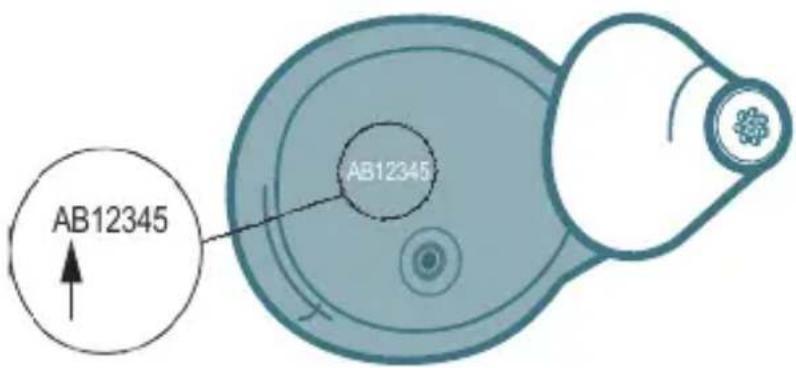
Your hearing aids have a serial number imprinted on them. The location of the serial number will vary according to the style of hearing aid you have chosen. Record the serial number in your user guide for future reference.
The year of manufacture is incorporated into the serial number.
For in-the-ear devices, the year of manufacture is derived from the first two digits.
The month of manufacture is derived from the first digit, the year of manufacture from the second digit:
Code (first digit) Month Code (first digit) Month
A, N Jan G, U Jul B, P Feb H, V Aug C, Q Mar J, W Sep D, R Apr K, X Oct E, S May L, Y Nov F, T Jun M, Z Dec
Code (second digit) Year Code (second digit) Year
B, C 2022 F, G 2024
D, E 2023 H, J 2025
Nearfield Magnetic Induction (NFMI) functionality
The following table shows the main information on NFMI connectivity, some parameters are different from product to product, so the worst case is indicated:
Wireless technology Nearfield Magnetic Induction (NFMI)
Modulation Phase Shift Key
Magnetic field strength 0.14 A/m
Output power (EIRP) 53 μW
Range < 20 cm between hearing aids
Center frequency 3.27 MHz
Channel Single channel radio
Bandwidth 330 kHz (-15 dB)
100
Bluetooth Low Energy (BLE)
The following table shows the main information on BLE, some parameters are different from product to product, so the worst case is indicated:
Wireless Technology Radio frequency – Bluetooth Low Energy (BLE)
Output power (EIRP) 3.9 mW
Range < 10 m between smartphone/accessory and hearing instruments
Frequency 2,400 – 2,480 MHz
Channel 40 channels
Bandwidth 2 MHz per channel, 2 MHz spacing
Modulation Type Gaussian Frequency Shift Keying
EMI/EMC compliance
Wireless hearing aids comply with the following EMC/EMI standards:
Standard Test Type Note
| 47 CFR Part 15, Subpart C | RF emissions U.S. | FCC requirements for intentional radiators. |
| EN 300 330 RF emissions including spurious emission | EMC and radio spectrum matters for short range devices in the frequency range 9 kHz - 25 MHz. | |
Standard Test Type Note
| EN 301 489-1/3/17 | Immunity, RF and ESD | Standard for low power transmitters in the frequency range 9 kHz - 40 GHz. |
| IEC 60118-13 RF immunity International product standard for hearing aids to ensure adequate immunity to radio interference from mobile telephones. | ||
| ANSI C63.19 RF immunity American National Standard method of measurement of compatibility between wireless communication devices and hearing aids. | ||
Standard Test Type Note
| ANSI/AAMI | RF emissions Implantable medical device |
| PC69 | EMC immunity, American National Standard. |
| ISO 14117 RF emissions Implantable medical device | |
| EMC immunity, International Standard. | |
| EN 45502-2-1 RF emissions Particular requirements for pacemakers. | |
| Emissions CISPR 11, Group 1, Class B. | |
| Immunity ESD, Conducted up to +/-8 kV,Air discharge up to +/-15 kVPower frequency magnetic fields:30 A/m, 50/60 Hz | |
| Immunityto RF fields | 80 MHz-2.7 GHz 10 V/m,2.7 GHz-6 GHz 3 V/m |
| Proximity to wirelesscommunication devices | Up to 28 V/m –See IEC 60601-1-2:2014/AMD1:2020,Table 9 |
| Proximity to magneticfields | 8 A/m@30 kHz, 65 A/m@134.2 kHz,7.5 A/m@50 kHz |
Wireless security measures
Wireless signal security is assured through the device system design that includes:
- A built-in pairing table which specifies valid and legitimate pairing among units.
- A proprietary communication protocol which checks the package numbers during each transmission. ● A Cyclic Redundancy Check (CRC) to check data validity.
- A convolutional encoder/decoder (Viterbi) to correct errors.
Quality of Service (QoS) for the ear-to-ear wireless technology
Synchronization/exchange of low data rate ear-to-ear signals Similar QoS as with remote controls in typical households. In typical environment it can happen that electromagnetic noise from appliances (light switch, car ignition) lead to non-valid data. Transmission of unsuccessful command is automatically repeated within approximately 3 seconds. Data transfer is checked via CRC16 checksum.
Exchange of high data rate ear-to-ear signals (microphone signal). Parameter for QoS is the bit error (BER) of the gross data link. This parameter is estimated and monitored during data receive. For BER > 3.5% the channel coding will become less effective thus the transferred microphone signal is automatically muted and not used until the QoS is good enough again. For the used ITU G.722 Audio Codec CRC check is not useful.
It is reasonably foreseeable that no risk/hazard can rise caused by invalid data.
Cybersecurity
Proper set-up and operation of your hearing aids requires a safe, private and secure operating environment.
The U.S. Federal Trade Commission's guidance for online security https://consumer.ftc.gov/online-security
provides examples of best practices for securing your home network and mobile device to ensure your security.
For children with hearing loss
In addition to seeing a physician for a medical evaluation, a child with a hearing loss should be directed to an audiologist for evaluation and rehabilitation since hearing loss may cause problems in language development and the educational and social growth of a child. An audiologist is qualified by training and experience to assist in the evaluation and rehabilitation of a child with a hearing loss.
Country/region specific information
Certification information for hearing aids with wireless functionality: Sony CRE-E10
DBIF1 - FCC ID: 2AXDT-DBIF1
Conformance information for charger
This device complies with EN60601-1-2.
This device complies with Part 18 of the FCC Rules.
Operation is subject to the following conditions:
- This device may not cause harmful interference,
- this device must accept any interference received, including interference that may cause undesired operation, and
- the user shall keep a minimal distance of 20 cm (8 in) during the charging process.
Support
For more detailed information, repair services or replacement:
- Visit our website: sony.net/hearing-support
- Phone: 877-864-7669
- Sony Electronics Inc., 115 West Century Road, Suite 250, Paramus, NJ 07652

Supported systems:
For Apple iOS version 13 or above, Google Android 10 or above. (Supported versions are subject to change.)
Manufactured for:
Sony Electronics Inc.
115 West Century Road
Suite 250
Paramus, NJ 07652 USA
Made for

iPhone | iPad | iPod
Hearing aids:
Charger:
USB cable:
Made in Singapore
Made in China
Made in China
Document No. 05281-99T01-7600 EN
Order/Item No. 210 251 40
Master Rev01, 12.2022
Printed in Singapore.

- WARNING
- WHEN TO SEE A DOCTOR
- NOTICE
- CAUTION
- THIS IS NOT HEARING PROTECTION
- THE SOUND OUTPUT SHOULD NOT BE UNCOMFORTABLE OR PAINFUL
- NOTE: IF YOU REMAIN CONCERNED, CONSULT A PROFESSIONAL
- NOTE: WHAT YOU MIGHT EXPECT WHEN YOU START USING A HEARING AID
- NOTE: TELL FDA ABOUT INJURIES, MALFUNCTIONS, OR OTHER ADVERSE EVENTS
- CONTENT
- YOUR HEARING AIDS
- START HERE
- CHARGING
- DAILY USE
- CLEANING AND MAINTENANCE
- TROUBLESHOOTING FOR HEARING AIDS AND CHARGER
- TECHNICAL INFORMATION
- EXPLANATION OF SYMBOLS
- IMPORTANT INFORMATION
- CONFORMANCE INFORMATION FOR CHARGER
- INTENDED USE
- HOW TO USE QR CODES
- WHAT YOU'LL FIND IN THE BOX
- GET TO KNOW YOUR HEARING AIDS
- GET TO KNOW YOUR CHARGER
- ACTIVATE AND CHARGE BEFORE FIRST USE
- TURNING ON AND OFF
- INSERTING AND REMOVING THE HEARING AIDS
- I
- HOW TO CHANGE CLICK SLEEVES
- REMOVING CLICK SLEEVE
- INSTALLING NEW CLICK SLEEVE
- CHARGE DEVICES WHILE ON THE GO
- CHARGING HEARING AIDS
- CHARGING VIA ELECTRICAL OUTLET
- CHECK CHARGING STATUS
- LOW POWER INDICATION
- CHARGING TIPS
- HOW OFTEN DO I NEED TO CHARGE THE HEARING AIDS
- HOW LONG DOES CHARGING TAKE
- WHAT HAPPENS IF I FORGOT TO CHARGE
- SWITCH OFF THE HEARING AIDS FOR LONG TERM STORAGE
- CHARGING YOUR HEARING AIDS
- SAFETY INFORMATION ON LITHIUM-ION RECHARGEABLE BATTERIES
- REQUIREMENTS FOR THE USB POWER ADAPTER
- SONY | HEARING CONTROL APP
- ADJUSTING THE VOLUME
- AUDIO STREAMING WITH IPHONE
- AIRPLANE MODE FOR HEARING AIDS
- ADJUSTING YOUR HEARING AID
- WHAT TO DO IN LOUD ENVIRONMENTS
- EXPLOSIVE ATMOSPHERES
- POSSIBLE PHYSIOLOGICAL SIDE EFFECTS
- EXPOSURE TO NICKEL
- STORAGE
- CLEANING OF THE CHARGER
- CLINICAL DATA
- HUMAN FACTORS DATA
- DAMAGED DEVICES, UNAUTHORIZED CHANGES
- RESTRICTED AREAS FOR WIRELESS DEVICES
- INTERFERENCE BY STRONG RADIATION
- SYMBOLS ON THE DEVICE OR PACKAGING
- OPERATING, TRANSPORT AND STORAGE CONDITIONS
- HEARING AIDS
- CHARGER
- DISPOSAL INFORMATION
- CONFORMANCE INFORMATION
- NOTICES
- REGULATORY INFORMATION
- FOR HEARING AID USERS
- HEALTH CONSIDERATIONS
- BATTERY TIPS
- IDENTIFICATION INFORMATION
- CODE (FIRST DIGIT) MONTH CODE (FIRST DIGIT) MONTH
- CODE (SECOND DIGIT) YEAR CODE (SECOND DIGIT) YEAR
- NEARFIELD MAGNETIC INDUCTION (NFMI) FUNCTIONALITY
- BLUETOOTH LOW ENERGY (BLE)
- EMI/EMC COMPLIANCE
- WIRELESS SECURITY MEASURES
- QUALITY OF SERVICE (QOS) FOR THE EAR-TO-EAR WIRELESS TECHNOLOGY
- CYBERSECURITY
- FOR CHILDREN WITH HEARING LOSS
- COUNTRY/REGION SPECIFIC INFORMATION
- SUPPORT
Brand : SONY
Model : CRE-E10
Category : Hearing aid