
Riddle - Guitar effect pedal Electro Harmonix - Free user manual and instructions
Find the device manual for free Riddle Electro Harmonix in PDF.


| Type de produit | Guitar Effects Pedal |
| Marque | Electro Harmonix |
| Modèle | Riddle |
| Catégorie | Envelope Filter |
| Dimensions | 4.5 x 2.75 x 2 inches (114 x 70 x 51 mm) |
| Poids | 0.5 lb (227 g) |
| Alimentation | 9V DC, center negative, 100mA |
| Fonctions principales | Envelope filter, Q control, Range, Mode (LP/BP/HP), Expression pedal input |
| Entretien et nettoyage | Wipe with dry cloth; avoid solvents |
| Sécurité | Use only recommended power supply; do not expose to moisture |
| Pièces détachées et réparabilité | Contact authorized service center; no user-serviceable parts |
| Informations générales | Made in USA; designed for electric guitar/bass |
| Contrôles | Q, Range, Mode switch (LP/BP/HP), Effect/Bypass footswitch |
| Entrées/Sorties | 1/4" instrument input, 1/4" output, expression pedal input |
| Consommation de courant | 100 mA |
| Alimentation fournie | Power supply not included |
| Garantie | 1 year limited warranty |
| Accessoires inclus | None |
| Indicateur LED | Effect on/off |
Frequently Asked Questions - Riddle Electro Harmonix
User questions about Riddle Electro Harmonix
0 question about this device. Answer the ones you know or ask your own.
Ask a new question about this device
Download the instructions for your Guitar effect pedal in PDF format for free! Find your manual Riddle - Electro Harmonix and take your electronic device back in hand. On this page are published all the documents necessary for the use of your device. Riddle by Electro Harmonix.
USER MANUAL Riddle Electro Harmonix
Congratulations on your purchase of the Riddle: Q-Balls envelope controlled filter for guitar! This is a very powerful tool for musical expression that opens a new horizon of sonic potential for your guitar. Please take a few minutes to familiarize yourself with the Riddle's controls and how they work.
Envelope controlled filters are a unique type of sound modifier where the intensity of the effect is controlled by the user's playing dynamics. The volume and dynamic of the incoming audio signal is used to control a swept filter. As the volume increases or decreases so does the frequency of the filter.
With 3 selectable filter modes, along with START, STOP, ATTACK, DECAY, Q and SENSITIVITY controls, all of the classic Q sounds are available to the user. Also, many new sounds and vivid textures can be achieved like never before. A new analog distortion circuit was created specifically for the RIDDLE, and adds a dynamic edge to the filters sound. With the addition of an expression pedal input (expression pedal not included), the RIDDLE provides manual control of the filter sweep.
— POWER —
WARNING: Use only the US96DC-200BI AC Adapter that the RIDDLE comes supplied with. Do not use any other AC Adapters. Using other AC adapters, even those made by Electro-Harmonix, could cause harm to the unit, the adapter or you. The RIDDLE does not use batteries.
— CONTROLS —
BLEND – Controls the output mix of the dry and effected signal. Fully CCW is 100% dry with no effect added. Fully CW is 100% wet with no remaining dry signal.
MODE – This is a rotary switch used to select between the 3 filter modes available on the RIDDLE. Select between LP (low pass), BP (band pass), and HP (high pass) modes to emphasize a different frequency band. Selecting between these modes does not change the start and stop frequencies.
ATTACK – This knob controls how quickly the filter will sweep from the frequency set by the “START” knob to the frequency set by the “STOP” knob. Fully CCW will have the fastest attack setting and is good for quick percussive styles of playing. Fully CW will have the slowest attack setting and creates a slower smoother sweep for a bowed sound.
DECAY – This knob controls how sensitive the reset circuit is when falling back from the “STOP” setting to the “START” setting. Fully CCW will have the most sensitive reset. In this setting the sweep will reset the fastest and the easiest. Use this when playing quick staccato notes to make sure every note triggers a new envelope sweep. Fully CW will maximize the decay setting. Use a longer decay setting when you don’t want every note to reset.
START – This knob sets the frequency that the sweep starts at. Fully CCW is the lowest frequency (about 40Hz). Fully CW is the highest setting (about 3Khz). Use this knob along with the “STOP” knob to set the range and direction of the sweep. For example, a low “START” and a high “STOP” will sweep upward. A high “START” and a low “STOP” will sweep downward.
STOP – This knob sets the frequency that the filter sweeps to. Fully CCW is the lowest setting (about 80Hz). Fully CW is the highest setting (about 5KHz).
Q - This knob controls the resonance of the Q. Fully CCW is the widest bandwidth and fully CW is the most resonant for a more dramatic effect.
SENSITIVITY – This knob controls the input sensitivity of the envelope filter circuit. Fully CCW is the least sensitive, and the circuit will be less reactive to the instrument input. Fully CW is the most sensitive and the circuit will be the most reactive to the instrument input.
A NOTE ON INTERACTIVE CONTROLS:
The “ATTACK”, “DECAY”, “START”, “STOP” and “SENSITIVITY” knob are highly interactive. If Attack is set to slow, the Decay is set to fast, or the Sensitivity is set to low, the filter sweep may not reach the stop frequency. The lowest frequency sweeps in the RIDDLE can be difficult to hear. If this causes the attack to sound abrupt, tune the start position so the sweep begins at a more audible frequency. All of the functions depend heavily on how the Sensitivity. Take some time to become familiar with these knobs and functions and learn how they work together to effect different styles of playing.
DISTORTION FOOTSWITCH/STATUS LED – This footswitch engages the analog distortion circuitry in the RIDDLE. When distortion is engaged, the LED will turn on, and when distortion is disengaged the LED will turn off. The intensity of the distortion is controlled by the “SENSITIVITY” knob. Inside the pedal there is a Trim Pot labeled “DISTORTION LEVEL”. This can be adjusted by the user to fine tune the volume of the distortion when engaged. This will not affect the gain or intensity of the distortion. DO NOT adjust any other trim pot on the board as they have been carefully calibrated for optimum performance.
EXPRESSION PEDAL INPUT – An optional expression pedal can be used with the RIDDLE for manual control of the filter. When the pedal is in toe up position, the frequency will be at the “START” position. In the toe down position, the frequency will be at the “STOP” position. Use this along with various “Q” knob setting to get resonant filter sweeps as well as wah-wah sounds with a versatile range.
BYPASS FOOTSWITCH/STATUS LED – The footswitch engages/disengages the effect. If the effect is engaged, the LED will light up. When the effect is disengaged, the LED will turn off, and the pedal will be in true bypass.
INPUT Jack – Connect your instrument’s output to this 14 ” mono jack. The input impedance presented at this jack is 710Kohms
EFFECT OUT Jack – Connect this 14 ” mono jack to your amplifier’s input. The output impedance presented at this jack is 300ohms.
DIRECT OUT Jack - This is a direct out signal from the input. This signal does not go though any of the effects circuitry.
CAUTION: This pedal was designed to give the user the maximum potential for user customizability and there are some setting combinations that are extreme. If the Q setting is maxed, at the peak high and low frequency this pedal can be INCREDIBLY loud.
- WARRANTY INFORMATION -
Please register online at http://www.ehx.com/product-registration or complete and return the enclosed warranty card within 10 days of purchase. Electro-Harmonix will repair or replace, at its discretion, a product that fails to operate due to defects in materials or workmanship for a period of one year from date of purchase. This applies only to original purchasers who have bought their product from an authorized Electro-Harmonix retailer. Repaired or replaced units will then be warranted for the unexpired portion of the original warranty term.
If you should need to return your unit for service within the warranty period, please contact the appropriate office listed below. Customers outside the regions listed below, please contact EHX Customer Service for information on warranty repairs at info@ehx.com or +1-718-937-8300. USA and Canadian customers: please obtain a Return Authorization Number (RA#) from EHX Customer Service before returning your product. Include with your returned unit: a written description of the problem as well as your name, address, telephone number, e-mail address, and RA#; and a copy of your receipt clearly showing the purchase date.
United States & Canada
EHX CUSTOMER SERVICE
ELECTRO-HARMONIX
c/o NEW SENSOR CORP.
47-50 33RD STREET
LONG ISLAND CITY, NY 11101
Tel: 718-937-8300
Email: info@ehx.com
Europe
JOHN WILLIAMS
ELECTRO-HARMONIX UK
13 CWMDONKIN TERRACE
SWANSEA SA2 0RQ
UNITED KINGDOM
Tel: +44 179 247 3258
Email: electroharmonixuk@virginmedia.com
This warranty gives a purchaser specific legal rights. A purchaser may have even greater rights depending upon the laws of the jurisdiction within which the product was purchased.
To hear demos on all EHX pedals visit us on the web at www.ehx.com
Email us at info@ehx.com
- FCC COMPLIANCE -
This device complies with part 15 of the FCC Rules. Operation is subject to the following two conditions: (1) This device may not cause harmful interference, and (2) this device must accept any interference received, including interference that may cause undesired operation. If the device is not installed and used in accordance with the instructions, it may cause harmful interference to radio communications and void the user's authority to guarantee the equipment.
Note: This equipment has been tested and found to comply with the limits for a Class B digital device, pursuant to part 15 of the FCC Rules. These limits are designed to provide reasonable protection against harmful interference in a residential installation. This equipment generates, uses and can radiate radio frequency energy and, if not installed and used in accordance with the instructions, may cause harmful interference to radio communications. However, there is no guarantee that interference will not occur in a particular installation. If this equipment does cause harmful interference to radio or television reception, which can be determined by turning the equipment off and on, the user is encouraged to try to correct the interference by one or more of the following measures:
● Reorient or relocate the receiving antenna.
- Increase the separation between the equipment and receiver.
- Connect the equipment into an outlet on a circuit different from that to which the receiver is connected.
- Consult the dealer or an experienced radio/TV technician for help.
Modifications not expressly approved by the manufacturer could void the user's authority to operate the equipment under FCC rules.


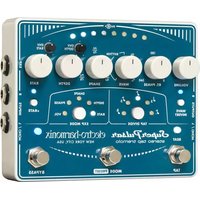
Brand : Electro Harmonix
Model : Riddle
Category : Guitar effect pedal