
BQ90T - Barbecue SMEG - Free user manual and instructions
Find the device manual for free BQ90T SMEG in PDF.


| Product type | Outdoor gas barbecue |
| Brand | SMEG |
| Model | BQ90T |
| Width | 90 cm |
| Body material | Stainless steel |
| Lid material | Tempered glass |
| Number of burners | 4 (3 main + 1 radiant) |
| Main burners power | 4.5 kW each |
| Radiant burner power | 4.5 kW |
| Main gas supply | LPG (butane/propane) - adaptable to natural gas |
| Rotisserie power supply | Electric 230 V ~ 50 Hz |
| Ignition | Electronic by AA 1.5V battery and manual |
| Temperature range | Up to 300 °C (thermometer on lid) |
| Main cooking surface | Stainless steel grids |
| Ceramic briquettes | Yes, self-cleaning |
| Rotisserie function | Yes, with removable electric motor |
| Smoking function | SMOKER drawer for aromatic wood |
| Included accessories | Grids, ceramic briquettes, stainless steel plate, rotisserie spit, drip tray, warming rack |
| Usage | Outdoors only, natural ventilation |
| Safety | Thermocouple on radiant burner; main burners without safety valve - do not leave unattended |
| Cleaning | Non-abrasive stainless steel cleaner; avoid high pressure cleaner |
| Gas cylinder compatibility | Up to 50 cm height with regulator |
| Protection rating | Not specified |
| Warranty | Not specified |
Frequently Asked Questions - BQ90T SMEG
User questions about BQ90T SMEG
0 question about this device. Answer the ones you know or ask your own.
Ask a new question about this device
Download the instructions for your Barbecue in PDF format for free! Find your manual BQ90T - SMEG and take your electronic device back in hand. On this page are published all the documents necessary for the use of your device. BQ90T by SMEG.
USER MANUAL BQ90T SMEG
- PRECAUTIONS FOR USE 27
- DISPOSAL INSTRUCTIONS - OUR ENVIRONMENT POLICY 28
- SAFETY PRECAUTIONS 29
- INTENDED USE OF THE APPLIANCE 31
4.1 Examples of outdoor use 31
5. GETTING TO KNOW YOUR APPLIANCE 32
6. BEFORE INSTALLATION 33
7. INSTALLATION 33
7.1 Free-standing installation 33
7.2 Built-in installation 34
7.3 Connecting the gas cylinder to the appliance 35
7.4 Burner, Nozzle and Gas Consumption Data Tables 36
7.5 Check for any gas leaks 36
7.6 Fixing the gas cylinder to the trolley (optional) 37
7.7 Hose clip 37
- THE CONTROL PANEL 38
- USING THE BARBECUE 40
9.1 Fitting and changing the battery 40
9.2 Fitting and using the rotisserie motor 40
9.3 Grid and plate positions 41
9.4 Switching on 42
9.5 Using the SMOKER tray 42
- STANDARD ACCESSORIES 43
- COOKING ADVICE 44
11.1 Meat 44
11.2 Vegetables 44
11.4 Cooking recommendations 45
11.3 Cooking table 45
- CLEANING AND MAINTENANCE 47
12.1 Cleaning the exterior (stainless steel) 47
12.2 Cleaning the internal barbecue components 47
12.3 Cleaning the dripping pan 48
12.4 Cleaning the glass of the lid. 48

INSTRUCTIONS FOR THE USER: these provide recommendations for use, a description of the controls and the correct procedures for cleaning and maintaining the appliance

INSTRUCTIONS FOR THE INSTALLER: these are intended for the qualified engineer who is to install, commission and test the appliance
1. PRECAUTIONS FOR USE

THIS MANUAL CONSTITUTES AN INTEGRAL PART OF THE APPLIANCE: TAKE GOOD CARE OF IT AND KEEP IT TO HAND THROUGHOUT ITS LIFE CYCLE
WE URGE YOU TO READ THIS MANUAL AND ALL THE INFORMATION IT CONTAINS CAREFULLY BEFORE USING THE PRODUCT. INSTALLATION MUST BE CARRIED OUT BY QUALIFIED STAFF IN COMPLIANCE WITH THE RELEVANT REGULATIONS. THIS APPLIANCE IS INTENDED FOR HOUSEHOLD USE OUTDOORS, AND COMPLIES WITH THE EEC DIRECTIVES CURRENTLY IN FORCE. THE APPLIANCE IS BUILT TO PROVIDE THE FOLLOWING FUNCTION: COOKING AND HEATING FOODS; ALL OTHER USES ARE TO BE CONSIDERED IMPROPER.
THE MANUFACTURER DECLINES ALL LIABILITY FOR USES OTHER THAN THOSE STATED ABOVE.
NEVER USE THIS APPLIANCE FOR HEATING ROOMS.

NEVER LEAVE PACKAGING RESIDUES UNATTENDED IN THE HOME. SEPARATE THE VARIOUS PACKAGING MATERIALS BY TYPE AND CONSIGN THEM TO THE NEAREST SEPARATE DISPOSAL CENTRE.
NEVER OBSTRUCT THE OPENINGS AND SLITS PROVIDED FOR VENTILATION AND HEAT DISPERSAL ON THE SIDES AND REAR OF THE APPLIANCE.
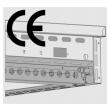
THE NAMEPLATE WITH THE TECHNICAL DATA, SERIAL NUMBER AND MARK IS IN A VISIBLE
POSITION ON THE REAR OF THE APPLIANCE.
THE NAMEPLATE MUST NEVER BE REMOVED.
NEVER LEAVE THE APPLIANCE UNATTENDED DURING USE.
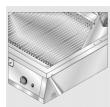
THE INTERNAL BURNERS AND RADIATING GRILL BURNER MUST NEVER BE USED SIMULTANEOUSLY.

NEVER USE METAL SCOURING PADS OR SHARP SCRAPERS ON THE OUTSIDE SURFACES; THEY WILL DAMAGE THEM.
USE ORDINARY NON-ABRASIVE PRODUCTS WITH THE AID OF WOODEN OR PLASTIC UTENSILS IF NECESSARY. RINSE THOROUGHLY AND DRY WITH A SOFT CLOTH OR CHAMOIS LEATHER.


NEVER USE HIGH-PRESSURE JET CLEANERS TO CLEAN THE APPLIANCE; THE POWER OF THE WATER JET MIGHT DAMAGE THE APPLIANCE, REDUCING ITS SAFETY LEVEL AND CAUSING UNSIGHTLY FLAWS.

The manufacturer declines all responsibility for injury or damage caused by failure to comply with the above regulations or deriving from tampering with even just one part of the appliance and the use of non-original spare parts.
2. DISPOSAL INSTRUCTIONS - OUR ENVIRONMENT POLICY
Our products are only packaged using non-pollutant, environment-friendly, recyclable materials. We urge you to cooperate by disposing of the packaging properly. Contact your local dealer or the competent local organisations for the addresses of collection, recycling and disposal facilities.
Never leave all or part of the packaging lying around. Packaging parts, and especially plastic bags, may represent a suffocation hazard for children.
Your old appliance must also be disposed of properly.
Important: deliver the appliance to your local organisation authorised to collect scrapped appliances.
Proper disposal allows the intelligent recovery of valuable materials.
3. SAFETY PRECAUTIONS

REFER TO THE INSTALLATION INSTRUCTIONS FOR THE SAFETY REGULATIONS FOR ELECTRIC OR GAS APPLIANCES AND VENTILATION FUNCTIONS.
IN YOUR INTEREST AND TO ENSURE YOUR SAFETY, BY LAW ALL ELECTRIC APPLIANCES MUST ONLY BE INSTALLED AND SERVICED BY QUALIFIED STAFF, IN ACCORDANCE WITH THE RELEVANT REGULATIONS.
OUR APPROVED INSTALLATION ENGINEERS GUARANTEE YOU A JOB WELL DONE.
GAS OR ELECTRIC APPLIANCES MUST ALWAYS BE DISCONNECTED BY SUITABLY SKILLED PEOPLE.
BEFORE THE APPLIANCE IS PUT INTO OPERATION, THE PROTECTIVE FILMS APPLIED INSIDE OR OUTSIDE MUST BE REMOVED.

IMMEDIATELY AFTER INSTALLATION, CARRY OUT A QUICK TEST ON THE APPLIANCE FOLLOWING THE INSTRUCTIONS PROVIDED LATER IN THIS MANUAL. IF THE APPLIANCE FAILS TO OPERATE, CONTACT YOUR NEAREST SERVICE CENTRE. NEVER ATTEMPT TO REPAIR THE APPLIANCE.

THIS PRODUCT IS SET IN THE FACTORY TO USE LPG GAS SOLD IN SUITABLE CYLINDERS BY AUTHORISED CENTRES. IF USE OF ANOTHER TYPE OF GAS SHOULD BECOME NECESSARY, CONTACT YOUR NEAREST AUTHORISED SERVICE CENTRE.
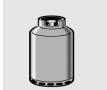
EVEN IF APPARENTLY EMPTY, GAS CYLINDERS MUST ALWAYS BE HANDLED WITH CARE IN ACCORDANCE WITH THE SAFETY REGULATIONS SUPPLIED WITH THE INSTRUCTIONS.
NEVER USE ANY GAS CYLINDER IF DENTED OR RUSTY.
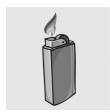
NEVER USE A NAKED LIGHT TO CHECK THAT GAS IS FLOWING FROM THE BURNERS PROPERLY, OR TO LOOK FOR GAS LEAKS IN THE APPLIANCE.

NEVER STORE A SPARE GAS CYLINDER CLOSE TO THE APPLIANCE.
NEVER DISCONNECT THE GAS CYLINDER FROM THE APPLIANCE WHILE IT IS IN OPERATION AND ALWAYS PERFORM ANY PROCEDURE ON THE GAS CYLINDER WELL AWAY FROM THE APPLIANCE.
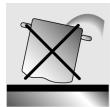
NEVER PLACE PANS WITH BOTTOMS WHICH ARE NOT PERFECTLY FLAT AND SMOOTH ON THE BARBECUE GRIDS.

DURING USE, THE APPLIANCE BECOMES VERY HOT; PROTECTIVE GLOVES SHOULD BE WORN TO PREVENT THE RISK OF BURNS.

NEVER USE PANS OR GRIDDLE PLATES WHICH PROJECT BEYOND THE OUTSIDE EDGE OF THE BARBECUE.

NEVER PLACE FLAMMABLE OBJECTS OR MATERIALS ON THE APPLIANCE: IF IT SHOULD ACCIDENTALLY BE SWITCHED ON, THIS MIGHT CAUSE A FIRE.

THE APPLIANCE BECOMES VERY HOT DURING USE. TAKE CARE NEVER TO TOUCH THE HEATING ELEMENTS INSIDE THE APPLIANCE.
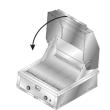
ALWAYS KEEP HOLD OF THE LID WHEN LOWERING IT.
OBSERVE THE THERMOMETER PROVIDED ON THE LID: WHEN THE READING EXCEEDS 300^ (RED ZONE) THE LID MUST BE RAISED TO PREVENT DANGEROUS OVERHEATING.
THE APPLIANCE IS INTENDED FOR USE BY ADULTS. KEEP CHILDREN AT A SAFE DISTANCE AND NEVER ALLOW THEM TO PLAY WITH IT.
WHEN THE APPLIANCE IS IN OPERATION, ACCESSIBLE PARTS MAY BECOME VERY HOT: KEEP CHILDREN AT A SAFE DISTANCE.
AFTER EACH USE, ALWAYS CHECK THAT THE CONTROL KNOBS ARE TURNED TO THE (OFF) POSITION.
NEVER USE THIS APPLIANCE INDOORS OR INSIDE CARS, TRAILERS, CAMPING VANS OR CARAVANS.

WHEN HOOKING UP THE APPLIANCE TO THE CYLINDER, USE ONLY THE FITTINGS AND REGULATORS SUPPLIED WITH THE APPLIANCE. THESE PRODUCTS ARE ALSO AVAILABLE FROM OUR AUTHORISED SERVICE CENTRES. USING ANY OTHER PRODUCTS CAN SERIOUSLY COMPROMISE THE SAFETY OF THE APPLIANCE.
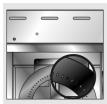
IF THE BARBECUE HAS BEEN OUT OF USE FOR SOME TIME, BEFORE REUSING IT CHECK THAT THE GAS OUTLET HOLES ARE NOT CLOGGED WITH DUST OR SPIDER'S WEBS. FOR THE CORRECT PROCEDURE, SEE POINT "12.2.3 THE BURNERS"

THIS APPLIANCE MAY ONLY BE USED OUTDOORS WITH NATURAL VENTILATION, OUTSIDE ENCLOSED AREAS, WHERE ANY GAS LEAKS AND COMBUSTION PRODUCTS CAN BE RAPIDLY DISPERSED BY THE WIND AND NATURAL AIR CONVECTION.

NEVER USE THE APPLIANCE OUTDOORS IN CASE OF BAD WEATHER. ANY CONTACT WITH WATER MIGHT SERIOUSLY DAMAGE THE APPLIANCE AND PUT ITS SAFETY AT RISK.

TAKE CARE NOT TO ALLOW THE GLASS OF THE BARBECUE LID TO COME INTO CONTACT WITH WATER WHILE IT IS STILL HOT.

CAUTION: DO NOT EXPOSE THE ROTISSERIE MOTOR TO BAD WEATHER AS THIS MIGHT DAMAGE THE DEVICE AND REDUCE ITS SAFETY LEVEL.

ONLY LIGHT THE BURNERS WITH THE LID RAISED.
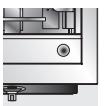
DURING COOKING, TAKE CARE NOT TO OBSTRUCT THE FAT DRAINAGE HOLE IN THE FRONT OF THE APPLIANCE. IF NECESSARY, CLEAN IT THOROUGHLY WITH THE AID OF A WOODEN OR PLASTIC UTENSIL.

THESE INSTRUCTIONS ONLY APPLY TO THE COUNTRIES OF DESTINATION WHOSE IDENTIFICATION SYMBOLS ARE LISTED ON THE COVER OF THIS MANUAL.

The manufacturer declines all responsibility for injury or damage caused by failure to comply with the above regulations or deriving from tampering with even just one part of the appliance and the use of non-original spare parts.
4. INTENDED USE OF THE APPLIANCE
The appliance is specifically constructed for domestic use outdoors and is therefore suitable for cooking and heating foods. The appliance has not been designed or manufactured for professional use. Smeg declines all responsibility for damage deriving from improper use of the appliance.

THIS APPLIANCE MAY ONLY BE USED OUTDOORS WITH NATURAL VENTILATION, OUTSIDE ENCLOSED AREAS, WHERE ANY GAS LEAKS AND COMBUSTION PRODUCTS CAN BE RAPIDLY DISPERSED BY THE WIND AND NATURAL AIR CONVECTION.
4.1 Examples of outdoor use
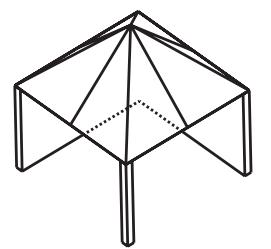
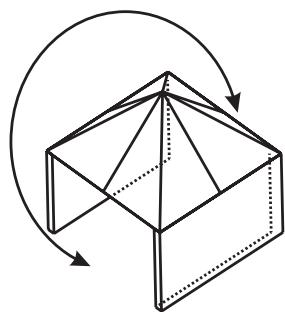
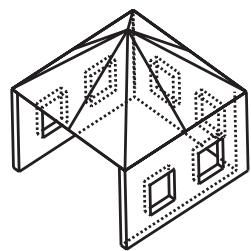
Any enclosed areas in which the appliance is placed must be structured as follows:
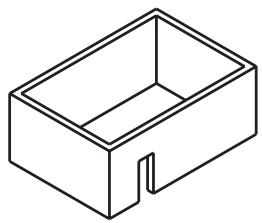
- An area with walls on all sides, but at least one permanent opening at ground level and no roof.
- Inside an enclosed area with a roof but no more than two walls.
- Inside a partially enclosed area with a roof but no more than two walls provided the following conditions are met:
At least 25% of the total wall area must be completely op
At least 30% of the remaining area must be open and unrestricted.
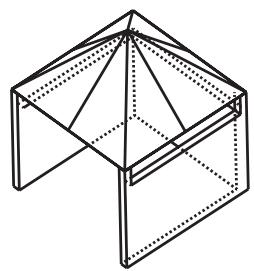
- In the case of patios, at least 20% of the total wall area, front and back, must be open.
5. GETTING TO KNOW YOUR APPLIANCE
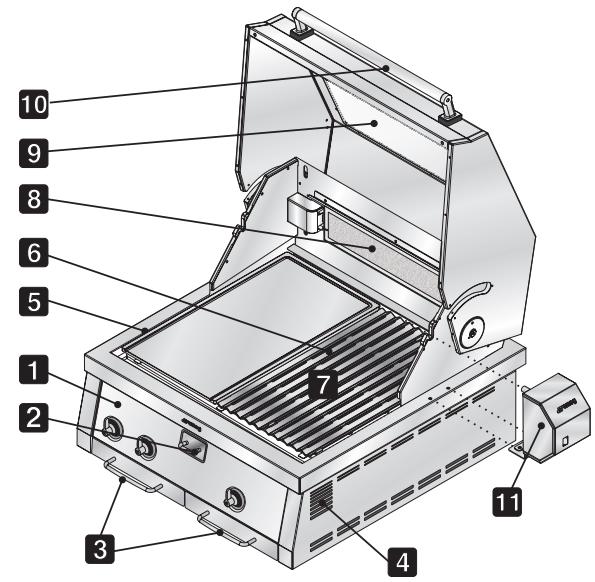
BQ60T
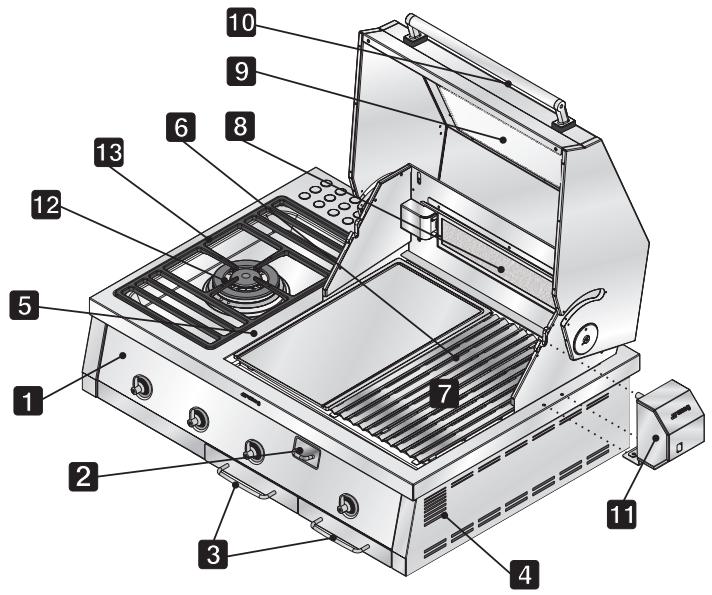
BQ6030T
BQ90T
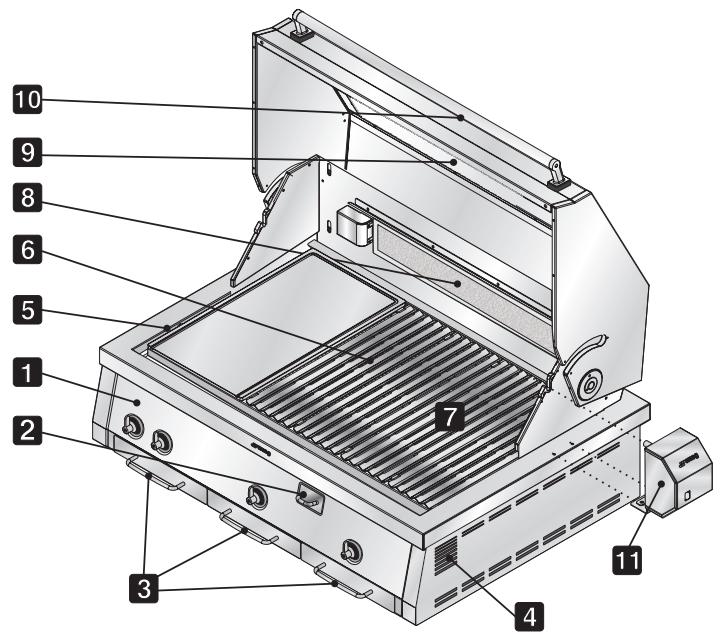
1 CONTROL PANEL
2 SMOKER
3 DRIPPING AND GRAVY PAN
4 HEAT DISpersAL VENTS
5 HOLES FOR LIGHTING THE RIGHT AND LEFT BURNERS BY HAND
GRIDS
7 CERAMIC PLATES (UNDERNEATH THE GRIDS)
8 RADIANT GRILL BURNER
9 GLASS LID
10 THERMOMETER FOR TEMPERATURE WITH LID CLOSED
11 ROTISSERIE MOTOR
12 ULTRARAPID BURNER
12 BURNER GRID
6. BEFORE INSTALLATION
Never leave packaging residues unattended in the home. Separate waste packaging materials by type and consign them to the nearest separate disposal centre.
The inside of the appliance should be cleaned to remove all manufacturing residues. For further information about cleaning, see point 12. CLEANING AND MAINTENANCE.
The product's place of installation should be chosen with care:
1 it must not be too dusty: over time, dust might clog the burners, making the appliance dangerous to use;
2 it must offer some protection against wind: too much wind during use might prevent the appliance from functioning correctly;
3 when the appliance is installed on its trolley, it must be placed on a flat, level surface to ensure it is level and stable.
7. INSTALLATION

This product may be installed in free-standing mode, on a small table or shelf, or built into a masonry or wooden structure. Otherwise, it may be installed on a special trolley available for separate purchase. In all cases, the instructions provided below must be complied with.
7.1 Free-standing installation
The barbecue comes complete with 4 feet to be screwed into its four corners.
After fitting these feet and making sure the appliance is level, simply place it on any flat surface and it is ready for use.
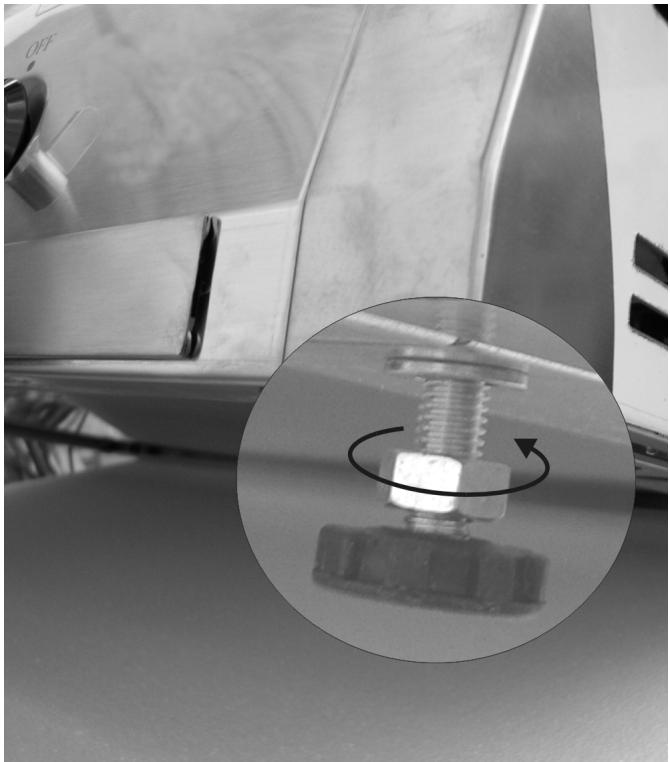

Never use the appliance if the feet supplied are not screwed properly into place.
This would cause an overheating hazard which might put the user's safety at risk and damage the appliance's appearance.

The only circumstances in which the feet provided must not be fitted is when the appliance is installed on its trolley.
7.2 Built-in installation
After screwing the 4 feet supplied into place, the barbecue can be installed in compliance with the dimensions supplied and the instructions below.
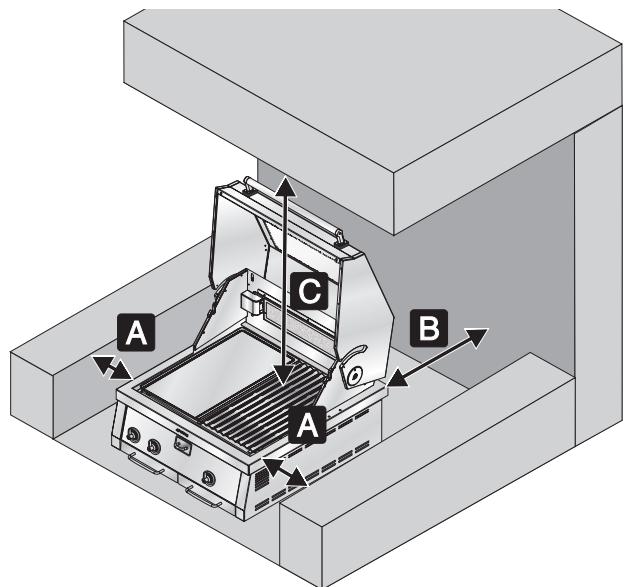
INSTALLATION GUIDELINES
INSTALLATION OPTIONS
BUILT-IN CLOSE TO INFLAMMABLE SURFACES:
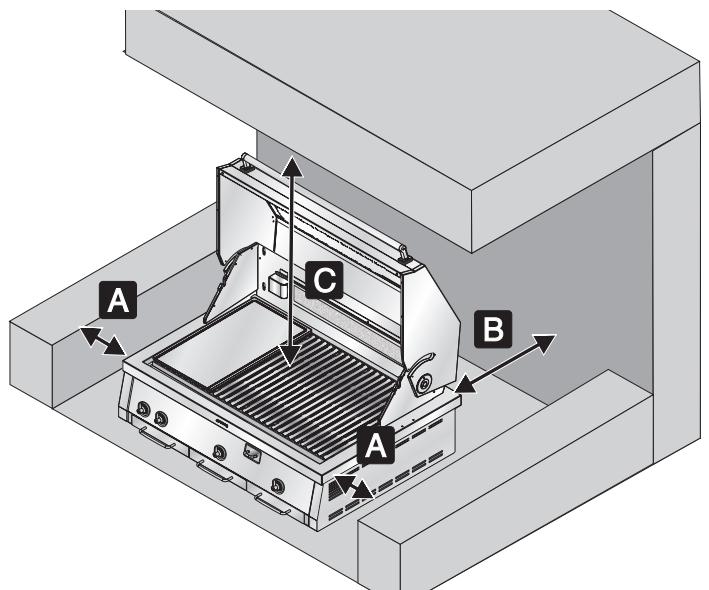
"Inflammable surfaces" refers to wood, plants, etc. For this installation, a gap of 50 mm must be left from the adjacent walls (DISTANCE A) and 250 mm from the back wall, if any (DISTANCE B).
The walls next to the barbecue must not be taller than its work surface. (see diagram).
Any top above the appliance must be at least 1000mm above the height of the grids (DISTANCE C).
BUILT-IN CLOSE TO NON INFLAMMABLE SURFACES
"Non inflammable surfaces" refers to masonry or similar materials. A gap of at least 25 ~mm must be left from any adjacent walls on both sides (DISTANCE A) and 250 ~mm from a rear wall (DISTANCE B).
The walls next to the barbecue must not be taller than its work surface. (see diagram).
Any top above the appliance must be at least 1000mm above the height of the grids (DISTANCE C).
Apart from ventilation requirements, the gap between the appliance and any rear wall is needed for the gas connection and to allow the battery to be changed.
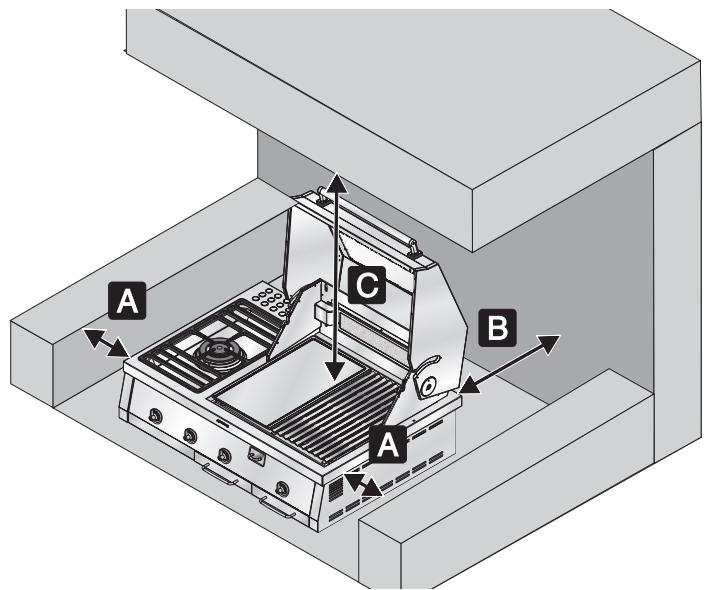

Smaller gaps may put the structure and the user at risk.

The gas cylinder may be accessed through a hole made in the structure (taking care to protect the edge of the hole to avoid damaging the gas connection hose) or by passing the hose around the appliance. In this case, take great care to ensure that the hose does not touch the product at any point and is not suspended from the grids or the lid.
7.3 Connecting the gas cylinder to the appliance

All the adjustments necessary to allow the appliance to function correctly are made in the factory. The only procedure required for correct operation is connection of the hose supplied with the appliance, as described below
This product is designed to use only LPG gas sold in suitable cylinders obtainable from specialist outlets. The appliance comes complete with a rubber hose with pressure regulator and unions. The pressure regulator is preset in the factory to ensure the appliance functions to the highest standards.

The product leaves the factory set to operate on LPG. If it should become necessary to change the type of gas and thus the nozzle diameter, contact your nearest authorised service centre.
The appliance can be set to operate on NATURAL GAS. Contact your nearest authorised service centre.

If the appliance does not function to your satisfaction, DO NOT ATTEMPT TO REPAIR IT YOURSELF; contact your nearest authorised service centre.

The hose must be fitted or replaced (check its expiration date periodically) in compliance with the relevant regulations.
7.4 Burner, Nozzle and Gas Consumption Data Tables
| Burner | Rated heat capacity (kW) | Bottled gas - G30/G31 30/37 mbar | ||||
| Nozzle diameter 1/100 mm | By-pass 1/100 mm | Reduced heat capacity (W) | Capacity g/h G30 | Capacity g/h G31 | ||
| Left | 4.5 | 100 | 85 | 2200 | 327 | 321 |
| Central (BQ90T) | 4.5 | 100 | 85 | 2200 | 327 | 321 |
| Right | 4.5 | 100 | 85 | 2200 | 327 | 321 |
| Radiant grill | 3.8 | 95 | Adj. | 2500 | 276 | 271 |
| Radiant grill (BQ90T) | 4.5 | 105 | Adj. | 2700 | 327 | 321 |
| Ultrarapid (BQ6030T) | 3.5 | 94 | 65 | 1500 | 254 | 250 |
7.5 Check for any gas leaks

This procedure must be carried out the first time the barbecue is connected and whenever the gas supply is disconnected and reconnected.
Once the barbecue hose has been connected to the gas supply (LPG or Natural Gas), proceed as follows:
1) Open the gas valve on the LPG cylinder (or turn on the tap for Natural Gas), BUT DO NOT ATTEMPT TO LIGHT THE BURNERS.
2) While there is gas pressure in the hose, check all the connections for leaks using a soap and water solution. Never look for leaks with a naked light.
3) If there are any leaks, bubbles will appear on the poor connection from which gas is escaping.
4) Turn off the cylinder gas tap, tighten the connection which was leaking and repeat the test.
5) If the gas leaks persist, contact your nearest supplier.

NEVER CHECK FOR LEAKS WITH A NAKED LIGHT.
7.6 Fixing the gas cylinder to the trolley (optional)
To secure the gas cylinder to the trolley, use the chain provided, passing it through the points shown in the diagram.
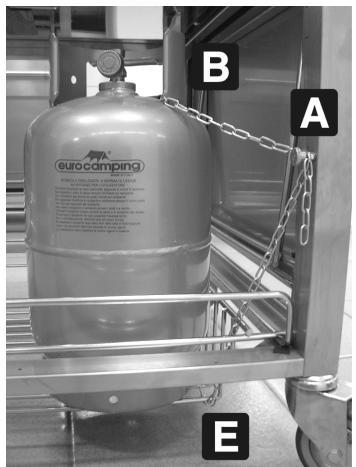
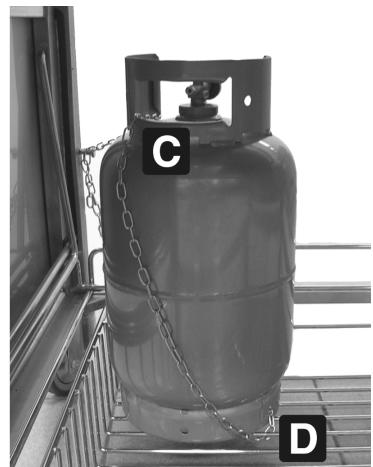
Fit one link of the chain over the pin A, then pass it over points B and C on the top of the cylinder, through the hole D and underneath the frame. Then bring the chain out of the frame in point E, fix it to the pin A again and tighten the ring-nut.
If the pin which secures the chain has to be replaced, refer to the illustrations below which show how to fit and fix the pin.
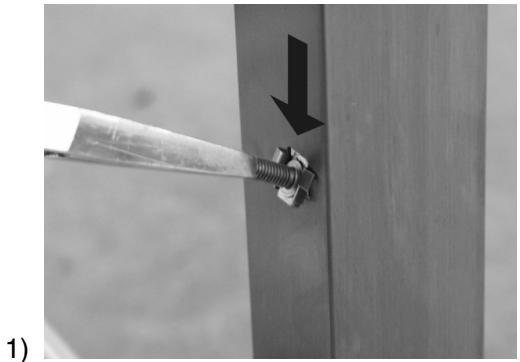
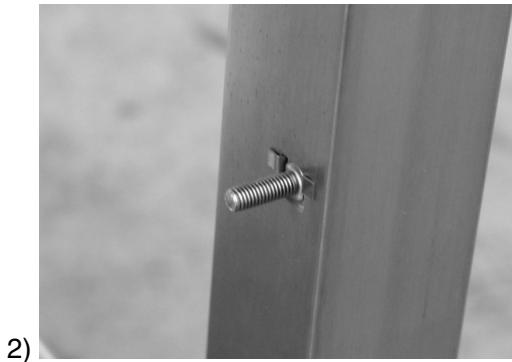
7.7 Hose clip
There is a hose clip on the trolley. It must be used to prevent the hose from touching other surfaces in the section between the appliance's gas connection and the cylinder connection.
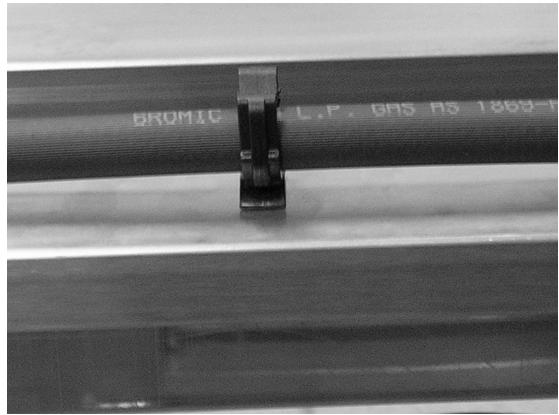

The bottom of the carriage is able to take gas cylinders up to 50 cm tall (with pressure regulator fitted). The pressure regulator outlet should be horizontal.
8. THE CONTROL PANEL
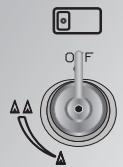
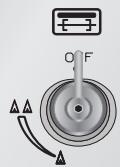
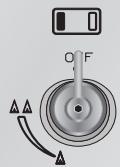
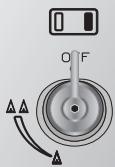
All the appliance's control and monitoring devices are placed together on the front panel. The table below provides the key to the symbols used.
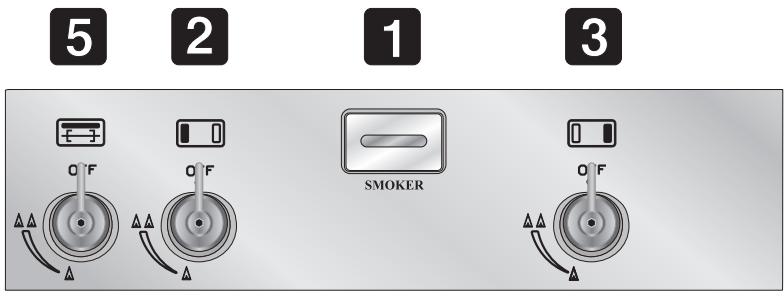
BQ60T



BQ6030T




BQ90T
1 "SMOKER" TRAY
4 CENTRAL BURNER IGNITION KNOB
2 LEFT BURNER IGNITION KNOB
5 RADIANT BURNER IGNITION KNOB
3 RIGHT BURNER IGNITION KNOB
6 ULTRARAPID BURNER IGNITION KNOB
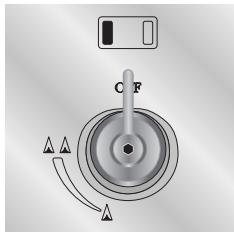
BURNER CONTROL KNOB
These knobs can be used to light the burners inside the barbecue.
To light the flame, proceed as described in point "9.4.1 Electronic burner ignition". Burners can also be lit by hand; see point "9.4.2 Manual burner ignition (for internal burners only)" for further details.
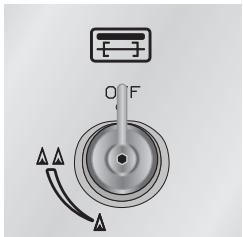
RADIANT BURNER CONTROL KNOB
This knob can be used to light the radiant burner for use when cooking with the rotisserie.
To light the flame, proceed as described in point "9.4.1 Electronic burner ignition".
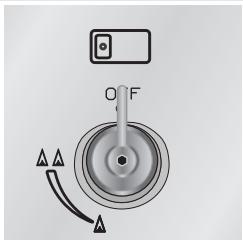
ULTRARAPID BURNER CONTROL KNOB (model BQ6030T only)
This knob can be used to light the UR3 side burner (model BQ6030T only). Useful for conventional cooking or for keeping barbecued food hot.
To light the flame, proceed as described in point "9.4.1 Electronic burner ignition".
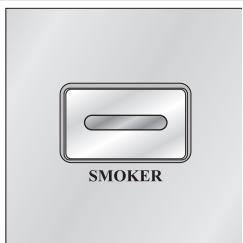
SMOKER TRAY
The SMOKER tray is designed to give the meat special fragrances by using pieces of aromatic wood, available from specialist outlets. When preparing wood for this purpose, always follow the instructions provided on the pack.






This appliance is not fitted with a safety valve. It therefore must never be left unattended when in operation. If you notice that the flames have gone out, turn the knobs to the OFF position AT ONCE and wait a few minutes before attempting to ignite the burners again.
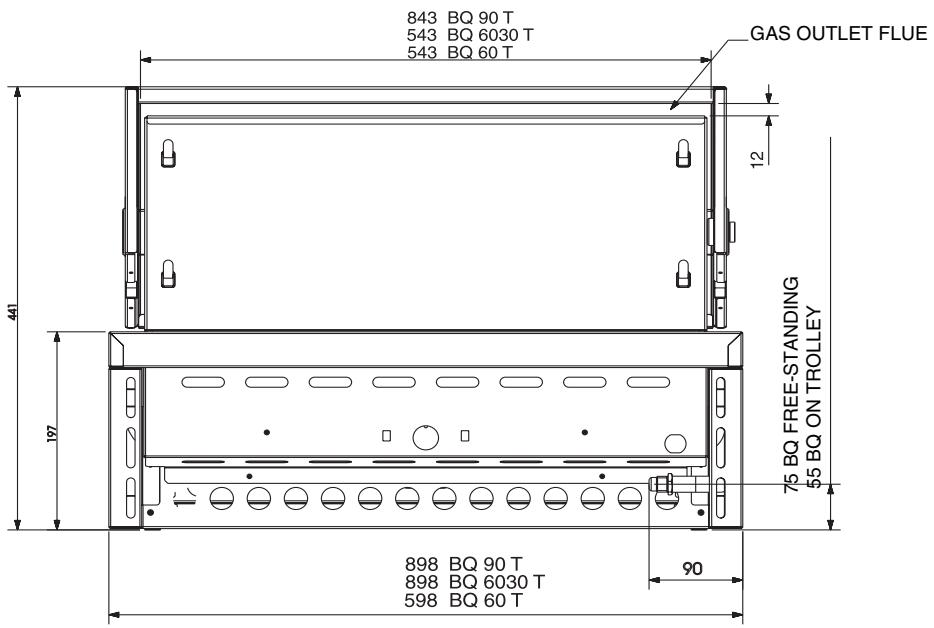
The lid must always be kept open while the burners are being lit. It can be lowered once they have ignited and must be raised as soon as the thermometer fitted on it reaches 300^ . Take care not to obstruct the combustion gas outlet flue in the back of the lid.
When the appliance is used for the first time, operate all the burners for 10 minutes with nothing on them and with the lid open to burn off any oils and manufacturing residues.
WARNING: DO NOT LIGHT THE RADIANT BURNER WHEN THE BURNERS INSIDE THE BARBECUE ARE IN OPERATION.
WARNING: TO PREVENT COMBUSTION OF RESIDUES FROM PREVIOUS USE OF THE BARBECUE, CLEAN THE DRIPPING PAN, BURNER COMPARTMENT, CERAMIC PLATES AND THE BURNERS THEMSELVES BEFORE EACH USE.
WARNING: FOR BQ6030T MODELS, DO NOT EXPOSE THE APPLIANCE TO BAD WEATHER; STORE IT INDOORS. IF ANY WATER REACHES THE BURNER CAVITY, IT MAY SERIOUSLY DAMAGE THE APPLIANCE.
9. USING THE BARBECUE
9.1 Fitting and changing the battery
Some models in this product range have a compartment on the rear to take one 1.5 V AA pencil battery to supply the burner ignition plugs.
To fit or change the battery, follow the instructions provided below, referring to the diagram.
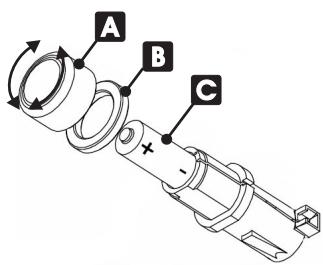
- Unscrew the cap A and remove the seal B;
- replace the battery C with another of the same type;
- take care that the battery poles correspond (see diagram on the right);
- replace the seal B and screw the cap A back on.

Caution: flat batteries must not be dumped at random or disposed of with other waste. They must be collected separately and consigned to your local waste disposal company, or disposed of in the special containers provided for old batteries.
9.2 Fitting and using the rotisserie motor
The rotisserie motor is supplied dismantled. To fit it, simply screw the two screws (supplied) into the holes provided on the right hand side of the barbecue.
Align the holes in the barbecue (A) with the holes in the rotisserie motor (B). Then screw in the two screws to join the two parts together. (See diagram on the right).
To use the rotisserie motor simply connect the plug to the electrical mains and set the switch on I to turn it on. To switch it off, simply return the switch to 0.
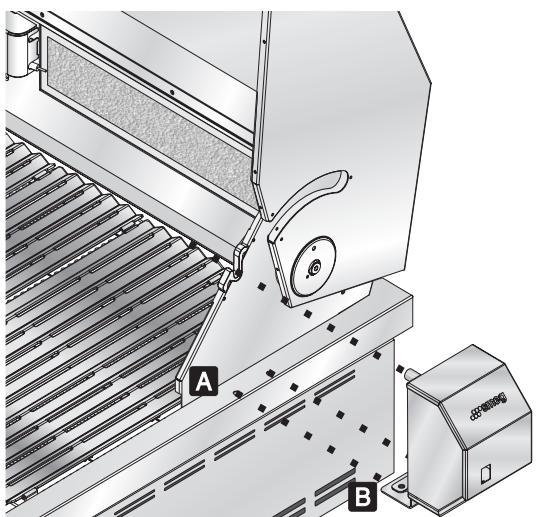

CAUTION: do not expose the rotisserie motor to bad weather as this might damage the device and reduce its safety level. If necessary, remove the device from the barbecue by unscrewing its fixing screws and store it in a place protected from the weather.

CAUTION, in case of damage to the rotisserie motor power supply cable, do not attempt to repair or replace it yourself; contact an authorised service centre immediately.

Warning: disconnect the plug from the electrical mains before cleaning the rotisserie motor. Do not place the rotisserie in water to clean it.
9.3 Grid and plate positions
Before starting to cook, always check that the grids, refractory plates and stainless steel / cast iron plate are correctly positioned. The diagram illustrates the correct positions for the plates A and grids B.
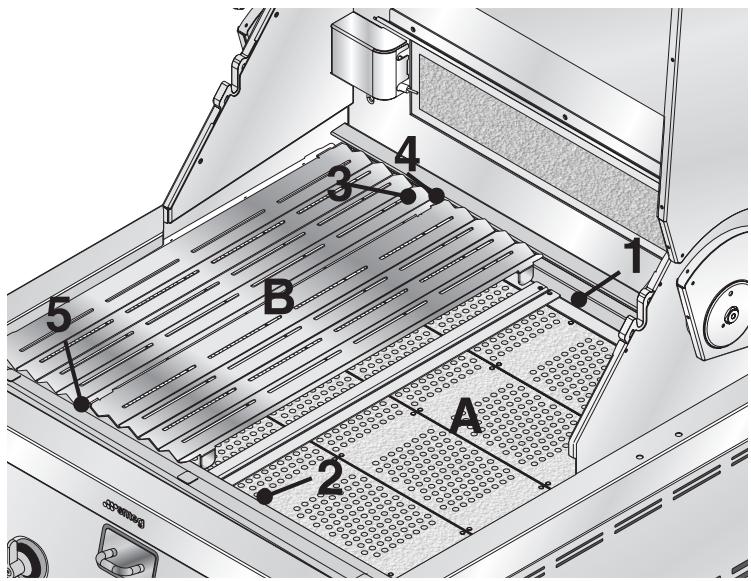
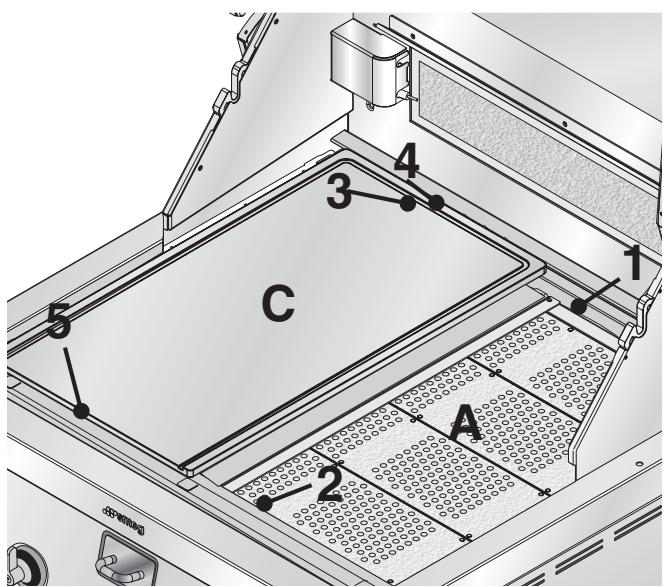
The self-cleaning refractory plates (A) must be fitted on the rests 1 and 2 shown below.
The grids (B) or the stainless steel / cast iron plate (C) have two rests of different heights at the rear (3 and 4) on which they can be placed. This means they can be moved closer to or further from the refractory plates (A) depending on the heat level required, and also to use the fat for cooking by tilting them if so desired.
Only in the configuration shown in the figure, with all the plates and grids correctly installed, can the barbecues be used for cooking: any other configuration is a source of hazard to the user and can compromise the operation of the appliance as well as damaging its exterior.

The refractory plates (A) must only be fitted underneath the grids (B) and not underneath the stainless steel/cast iron plate (C).

Take care not to obstruct the combustion gas outlet flue in the back of the lid.
9.4 Switching on

To check that the burners inside the barbecue have ignited, hold one of your hands about 10cm above the grids: you should feel a gradually increasing amount of heat.

When lighting the radiant grill and ultra-rapid burners, keep the knob pressed down for about 5 seconds to allow the thermocouple to heat up. The burner may go out when the knob is released: this means that the thermocouple has not warmed up enough. Repeat the operation, keeping the knob pressed down for longer.

If the burners have not ignited after several attempts, wait 5 minutes before attempting to light the appliance again. This pause is necessary to allow any gas which has built up inside the appliance to disperse. If no flame is obtained even after numerous attempts, contact your nearest authorised service centre.
9.4.1 Electronic burner ignition
The burner it controls is shown next to each knob (see "The control panel" on page 38). To light the flame, simply press the knob and turn it anti-clockwise to the minimum flame symbol . To adjust the flame, turn the knob to the zone between the maximum ( ) and the minimum () settings. To turn off the burner, turn the knob back to the OFF position.
9.4.2 Manual burner ignition (for internal burners only)
The burner it controls is shown next to each knob (see "The control panel" on page 38).
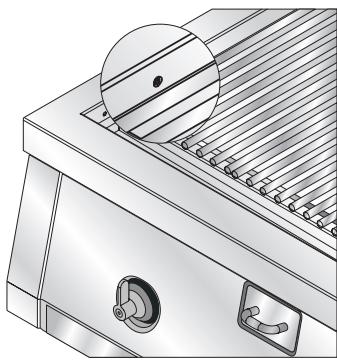
Each model has holes in the side (see right) to allow the burners to be lit by hand.
To ignite the two side burners by hand, turn the knob to the highest setting and place a lit match close to the ignition hole. The central burner can be lit in manual mode from another burner: light the right or left-hand burner and turn the central burner knob to the maximum setting. If the burner does not light within 10/15 seconds, wait a few minutes and repeat the procedure.

If no spark appears when any burner control knob is pressed, the battery on the rear may need changing.
For instructions for this procedure, see point "9.1 Fitting and changing the battery"

If the battery is new and still no spark is produced, do not attempt to use the appliance and contact your nearest authorised service centre.
9.5 Using the SMOKER tray
The SMOKER tray is designed to give the meat special fragrances by using pieces of aromatic wood, available from specialist outlets. When preparing wood for this purpose, always follow the instructions provided on the pack.
It is very easy to use. Pull out the tray, taking care not to drop it, fill it with your chosen aromatic wood (do not overfill to prevent pieces falling out of the tray when it is opened or closed), close it and light the burners as described in points "9.4.1 Electronic burner ignition" and "9.4.2 Manual burner ignition (for internal burners only)". Remember to set the burners at minimum heat and keep the wood damp as long as cooking is in progress.
The wood in the SMOKER tray is heated directly by the heat generated by the burners close to the tray.
The SMOKER tray may become hot during use. Do not touch it with unprotected hands.

9.6 Pan diameters
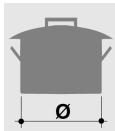
Pans with diameter from 20 cm to 26 cm can be used on the Ultra-rapid burner.
Pans of different sizes might put the user's safety at risk and adversely affect the appliance's performance, as well as damaging its exterior.
10.STANDARD ACCESSORIES
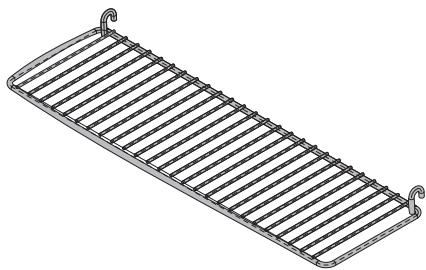
Food warmer shelf: useful for keeping food hot after cooking. Hang this shelf on the back of the barbecue, above the burners.
Rotisserie rod: useful for cooking chicken and all foods which require uniform cooking over their entire surface.
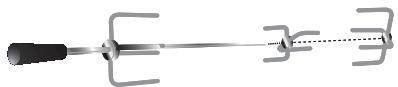
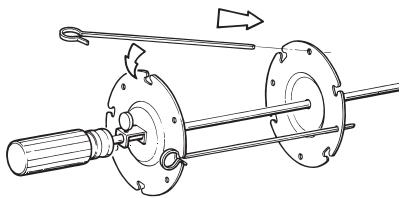
INSTRUCTIONS FOR USE: Prepare the rotisserie rod with the food, tightening the screws A (for both prongs and kebab spits). Set the rotisserie rod on the barbecue so that it fits into the seats provided. Then fit the rod into the rotisserie motor. When the food is cooked, if you wish to remove the rod from its place use the handle provided, screwing it onto the thread. Take care when removing the rod since it might still be hot; wear heat-proof gloves if necessary.
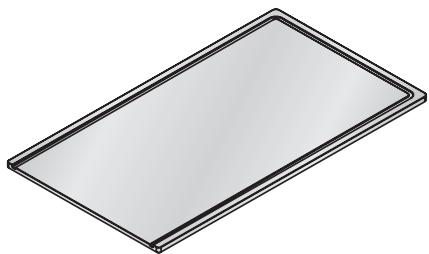
Stainless steel plate: for use during specific cooking processes to eliminate the grilling effect (for more details of cooking procedures, see "11. COOKING ADVICE" on page 44.

Not all accessories are provided on some models.

Additional optional accessories are also available from our authorised service centres.
11.COOKING ADVICE
Some hints and recommendations for getting the best results from your barbecue are provided below. However, remember that cooking times and heat levels have to be modified to suit the user's taste.

Direct cooking: when the meat or vegetables are cooked directly on the grid underneath which the burner is lit.
Indirect cooking: when the meat or vegetables are cooked on the grid next to the lit burner.

During indirect cooking the lid must be left closed and only opened if the temperature exceeds 300^ . Close it again after 5 minutes have passed.

Water should be poured into the dripping pan for more succulent cooking results and to simplify cleaning of the barbecue after use.
11.1 Meat

Before any meat cooking procedures, the grids must be preheated with the burners lit at the maximum setting for at least 5-10 minutes, depending on the thickness of the meat. Quick preheating (about 5 minutes) is recommended for thin pieces of meat (chops, slices of bacon, spare ribs, etc.). Lengthier preheating (about 10 minutes) is recommended for thicker pieces of meat (large, fatty steaks, whole chickens, etc.). In both cases, the lid must be kept closed during preheating.
11.1.1 Direct cooking
In general, when cooking meat over direct heat the burners must be set on the maximum setting, while for fish and vegetables they must be set on medium / minimum power.
The cooking time varies depending on the thickness of the food and personal taste.
For best results when grilling, brown the outside at maximum heat then use the knobs to turn the burners down to a medium / minimum setting to allow the meat to cook right through without burning on the outside.
The appearance of flames, when cooking pork (i.e. fatty foods) in particular, is normal and is caused by fat dripping onto the stones. Do not worry, but move the food being cooked to another part of the grid.
To allow this, it is best not to fill the whole grid with food for cooking.
11.1.2 Indirect cooking
After preheating the grids with the burners at the maximum setting and the lid closed, place the meat on a grid next to the lit burner. On the 90 cm barbecue, for example, the meat can be placed on the central grid after the side burners have been ignited.
The advantage of indirect cooking is that the heat is less fierce. Start cooking with the burners on the minimum setting then gradually increase over time.
Naturally, it takes considerably longer than direct cooking, but excellent results will be assured.
Indirect cooking is suited for large cuts of meat or fish, such as: roasts, whole chickens, lamb or especially thick and/or fatty foods which could result in high flaming if cooked directly due to the fat dripping onto the refractory plates.
11.2 Vegetables

As for meat, when cooking vegetables it is best to preheat the burners at the maximum setting with the lid closed. However, in this case the grids must always be preheated for 5/10 minutes.
11.2.1 Direct cooking
After preheating, turn the burners down to the minimum setting and arrange the vegetables on the grid. Given the type of food, the knobs should be kept turned to the minimum setting.
11.3 Cooking table
| HEAT | TEMPERATURE | BURNER SETTING | BARBECUE PREPARATION | USE |
| High | 230 - 250 °C | Maximum setting (▲▲) | 230 - 250 °C on barbecue thermometer (if fitted). | For preheating before cooking starts. |
| Medium-High | 200 °C | Medium- maximum setting | 200°C on barbecue thermometer (if fitted). | For direct cooking of thin cuts of meat, fish and vegetables. |
| Medium | 160-180 °C | Intermediate setting | 160-180 °C on barbecue thermometer (if fitted). | For direct cooking of medium-sized cuts of meat such as half chickens or chicken joints. Also suitable for indirect cooking |
| Medium-Low | 150 °C | Medium- minimum setting | 150°C on barbecue thermometer (if fitted). | For indirect cooking and smoking, or for keeping food already grilled warm. |
| Low | 110-120 °C | Minimum setting (▲) | 110-120 °C on barbecue thermometer (if fitted). | For smoking and indirect cooking of large pieces of fatty or delicate foods, or for keeping food already grilled warm. |
11.4 Cooking recommendations
Always preheat at the maximum setting.
- When cooking with the plate, preheating lasting 15' is recommended.
- For processes requiring fiercer grilling, preheat the burners for 15' .
- Preheating for indirect cooking is performed by igniting the burner where the food is to be placed for 5' at the minimum setting and the other burners at maximum setting for 10' .
- Keep the lid closed during cooking.
- During direct cooking (meat or fish), if the fierce heat burns the food, turn the burners down using the knob or move the food.
| BARBECUE COOKING | |||||||
| TYPES OF FOOD | Cooking mode | Weight (Kg) / N° | Preheating | Cooking time | Miscellaneous / advice | ||
| MEAT | BEEF | Beef steaks | Direct | 0.5 Kg | 10' | 3 ' / 5 ' | Flame at maximum setting |
| T-bone steaks | Direct | 2.0 Kg = 4 pcs | 15' | 4' per side | Medium / high flame | ||
| Fillet steak | Direct | 1.5 Kg | 10' | 40 ' / 50 ' | Medium / high flame | ||
| CHICKEN | Chicken joints | Direct | 2.0 Kg | 10' | 45 ' | Burners on minimum setting | |
| Grilled whole chicken | Indirect | 3.0 Kg | 10' | 150 ' | Burners on medium / minimum setting | ||
| PORK | Chops | Direct | 1.0 Kg | 10' | 15 ' / 18 ' | Medium / minimum flame | |
| Belly pork | Direct | 0.5 Kg | 10' | 5 ' / 7 ' | Tilt the grids to drain the liquid | ||
| Whole neck of pork | Indirect | 2.5 Kg | 10' | 4 h | Start cooking at min then gradually increase | ||
| Stuffed roast pork | Indirect | 2.5 Kg | 10' | 150 ' | Start cooking at min then gradually increase | ||
| Pork shank | Indirect | 1.0 Kg | 10' | 70 ' | Start cooking at min then gradually increase | ||
| Spare ribs | Direct | 2.0 Kg | 8 ' / 10 ' | 30' / 40 ' | Rotate pieces, and medium / minimum flame | ||
| Sausages | Direct | 1.0 Kg | 10' | 13 ' / 15 ' | Burners on medium / minimum setting | ||
| LAMB | Leg | Indirect | 2.5 Kg | 10' | 150 ' / 180 ' | Cooking procedure requiring stainless steel plate | |
| VEGETABLES | Sliced onion | Direct | 600 g | 15' | 10 ' / 15 ' | Cooking procedure requiring preheated stainless | |
| Sliced aubergine | Direct | 500 g | 10' | 8 ' / 13 ' | Medium flow flame | ||
| Whole potatoes | Indirect | 1.0 Kg | 10' | 90' / 110 ' | Flame at maximum setting | ||
| Potatoes in pieces | Indirect | 1.0 Kg | 10' | 80 ' / 90 ' | Medium flow flame | ||
| Courgettes | Direct | 0.5 Kg | 10' | 15 ' / 18 ' | Medium / minimum flame | ||
| Peppers | Direct | 3 pcs | 10' | 13 ' / 15 ' | Medium flow flame | ||
| FISH | Prawns | Direct | 750 g | 10' | 10 ' / 12 ' | Medium / minimum flame | |
| Trout | Direct | 1.0 Kg | 10' | 18 ' | Minimum flame | ||
| Herring fillets (small fish) | Direct | 0.3 Kg | 15' | 4' per side | Cooking procedure with stainless steel plate and | ||
| Gilthead | Indirect | 3.0 Kg | 10' | 40 ' | Medium / minimum flame | ||
| Salmon slices | Direct | 0.5 Kg | 10' | 15 ' | Minimum flame | ||
| Sea-bass | Direct | 1.0 Kg | 10' | 40 ' | Minimum flame | ||
| FRUIT | Pineapple | Direct | 0.8 Kg | 10' | 8 ' | Minimum flame | |
| PIZZA | Ready-made dough | Direct | 0.4 Kg | 15' | 7 ' | Only burner underneath the stainless steel plate lit | |
| PIZZA | Home-made flour and yeast dough | Direct | 0.4 Kg | 15' | 4 ' / 6 ' | The 2 burners underneath the pizza plate lit at maximum setting | |
| PIZZA | Ready-made canned products | Direct | 0.4 Kg | 15 ' | The 2 burners underneath the pizza plate lit at maximum setting | ||
| BREAD | Home-made flour and yeast dough | Direct | 200 g rolls | 5' | 20 ' / 25 ' | The 2 burners underneath the pizza plate lit at minimum setting | |
| READ-COOKED POLENTA SLICES | Direct | 1.0 Kg | 10' | 4 ' / 5' per side | Burners at maximum setting | ||
| SLICED BREAD FOR TOASTING | Direct | 5' | 6 ' / 8' per side | Medium / minimum flame | |||
| GRILL COOKING PROCEDURES | Spit-roast chicken | Grill | 2 pcs = 2 Kg | - | 80 ' | Medium / minimum flame | |
| Neck of pork | Grill | 2.5 Kg | - | 180 ' | Minimum flame | ||
| Kebabs (with accessory) | Grill | 1.6 Kg | - | 50 ' / 60 ' | Medium / minimum flame | ||
| Chestnuts (with accessory) | Grill | 2.8 Kg | - | 50 ' | Medium / high flame | ||
| Potatoes (with accessory) | Grill | 1.0 Kg | - | 70 ' / 80 ' | Medium / minimum flame | ||
12.CLEANING AND MAINTENANCE

For the best, most thorough cleaning, we recommend the use of fairly mild products; use cream-type stainless steel cleaners. SMEG brand products, which guarantee optimal cleaning of your appliance, are available from authorised service centres.

Protective gloves should be worn when cleaning internal steel parts of the appliance.

12.1 Cleaning the exterior (stainless steel)
To keep the appliance in good condition, the outside and inside parts and accessories should be cleaned regularly after each use, after allowing them to cool.
For optimal, in-depth cleaning of your barbecue, wear protective gloves and use specific degreasing cleaners for stainless steel.
SMEG brand products, which guarantee optimal cleaning of your appliance, are available from authorised service centres. (Puliformo and Crema inox)
12.1.1 Routine cleaning
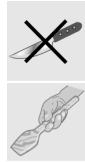
When cleaning and caring for external stainless steel surfaces, always use only specific products which do not contain abrasives or chlorine-based acids.
Never use metal scouring pads or sharp scrapers; they will damage the stainless steel. Use ordinary non-abrasive products, with the aid of wooden or plastic utensils if necessary.
Instructions for use: spray the product straight onto the dirty surfaces several times.
Wipe with a non-abrasive sponge, rinse thoroughly and dry with a soft cloth. For the best results, allow the degreasing detergent to act for some time. To eliminate yellowing, pour Crema inox onto a paper cloth and rub in the direction of the satin-finish.
12.2 Cleaning the internal barbecue components
12.2.1 The ceramic plates
The ceramic plates are made from refractory material and are therefore fragile; handle with care to avoid breakage.
After each use, the burners should be operated with no food present at the maximum power for 10/15 minutes, to allow the plates to eliminate the food and grease residues accumulated during cooking. Following this procedure after each use will keep the plates in peak condition over time.
Important: after prolonged and/or fatty cooking processes, it is best to remove excess fat from the plates with a brush. Finish by cleaning the appliance as indicated above.
To keep the plates always clean and in optimal working order, they should be turned periodically so that a different side faces towards the burners. The heat of the flames burns off the food and grease residues that build up during cooking.

The refractory plates must only be fitted underneath the grids and not underneath the stainless steel/cast iron plate .
12.2.2 The grids
For the best results, clean the grids when still warm. Wearing heat-resistant gloves, dip them in water and then scrub them with a brass-bristle brush to remove any food residues. Complete cleaning by washing the grids with a degreasing detergent and rinse thoroughly.
The continuous contact between the grids and the flame may cause the steel to lose its shine in the areas exposed to heat over time. This is an absolutely natural phenomenon which does not impair this component's operation at all. To reduce the yellowing of the grids, we recommend cleaning with Crema inox and a non-abrasive sponge.

The grids are dishwasher-friendly.

After thorough cleaning, operate the appliance to burn off detergent residues.
12.2.3 The burners
Check regularly that the burners are igniting completely and no gas outlet holes are clogged.
If you notice that a burner is not igniting completely, blowing it with compressed air may be sufficient to clear dust or spiders' webs from the clogged holes. If this is not sufficient, the burners can be dismantled for more thorough cleaning, for example by poking a pin through the clogged holes and blowing compressed air straight into the burner.
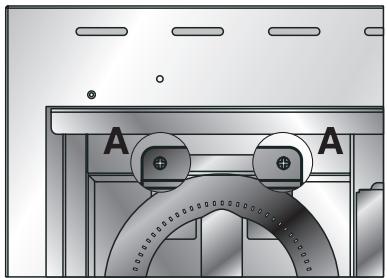
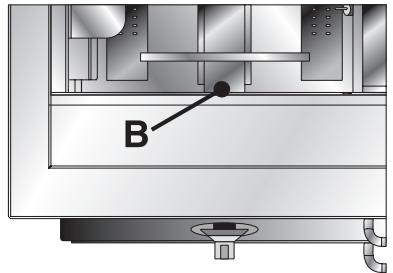
To dismantle the burners, the two fixing screws A must first be removed. The burners can then be removed from their bases in the front of the appliance (Detail B) for more thorough cleaning. To reassemble the burners, fit the front into the hole (detail B) and retighten the screws A.
12.3 Cleaning the dripping pan
After cooking, and after leaving the appliance to cool for at least two hours, extract the dripping pan, into which a thin layer of water may have been poured before cooking started, and pour the fats into a container from which they can then be disposed of appropriately. The oil or fat produced by cooking meat and fish must never be poured down drains or sinks, for example. It must be disposed of correctly in special containers or delivered to the regulation collection points. Clean the dripping pan with suitable non-abrasive products and put it back in place.
12.4 Cleaning the glass of the lid
After cooking, after allowing the appliance to cook for at least two hours after cooking finishes, clean the glass of the lid with kitchen roll. Remove stubborn dirt with a damp sponge and ordinary detergent.

WARNING: BEFORE CLEANING THE GLASS OF THE LID, ALLOW THE APPLIANCE TO COOL FOR AT LEAST TWO HOURS AFTER COOKING FINISHES.

Do not use abrasive or corrosive cleaners for cleaning the glass of the lid.

Do not use rough or abrasive materials or sharp metal scrapers to clean the glass of the lid since they may scratch the surface and cause the glass to shatter.
- PRECAUTIONS FOR USE
- DISPOSAL INSTRUCTIONS - OUR ENVIRONMENT POLICY
- SAFETY PRECAUTIONS
- INTENDED USE OF THE APPLIANCE
- Examples of outdoor use
- GETTING TO KNOW YOUR APPLIANCE
- BEFORE INSTALLATION
- INSTALLATION
- Free-standing installation
- Built-in installation
- INSTALLATION OPTIONS
- BUILT-IN CLOSE TO INFLAMMABLE SURFACES:
- BUILT-IN CLOSE TO NON INFLAMMABLE SURFACES
- Connecting the gas cylinder to the appliance
- Check for any gas leaks
- Fixing the gas cylinder to the trolley (optional)
- Hose clip
- THE CONTROL PANEL
- BURNER CONTROL KNOB
- RADIANT BURNER CONTROL KNOB
- ULTRARAPID BURNER CONTROL KNOB (model BQ6030T only)
- SMOKER TRAY
- USING THE BARBECUE
- Fitting and changing the battery
- Fitting and using the rotisserie motor
- Grid and plate positions
- Switching on
- Electronic burner ignition
- Manual burner ignition (for internal burners only)
- Using the SMOKER tray
- Pan diameters
- 10.STANDARD ACCESSORIES
- 11.COOKING ADVICE
- Meat
- Direct cooking
- Indirect cooking
- Vegetables
- Direct cooking
- Cooking table
- Cooking recommendations
- 12.CLEANING AND MAINTENANCE
- Cleaning the exterior (stainless steel)
- Routine cleaning
- Cleaning the internal barbecue components
- The ceramic plates
- The grids
- The burners
- Cleaning the dripping pan
- Cleaning the glass of the lid
Brand : SMEG
Model : BQ90T
Category : Barbecue