 ManualGo.com
ZWF-1200 - Washing machine ZANUSSI - Free user manual and instructions
Find the device manual for free ZWF-1200 ZANUSSI in PDF.


Download the instructions for your Washing machine in PDF format for free! Find your manual ZWF-1200 - ZANUSSI and take your electronic device back in hand. On this page are published all the documents necessary for the use of your device. ZWF-1200 by ZANUSSI.
USER MANUAL ZWF-1200 ZANUSSI
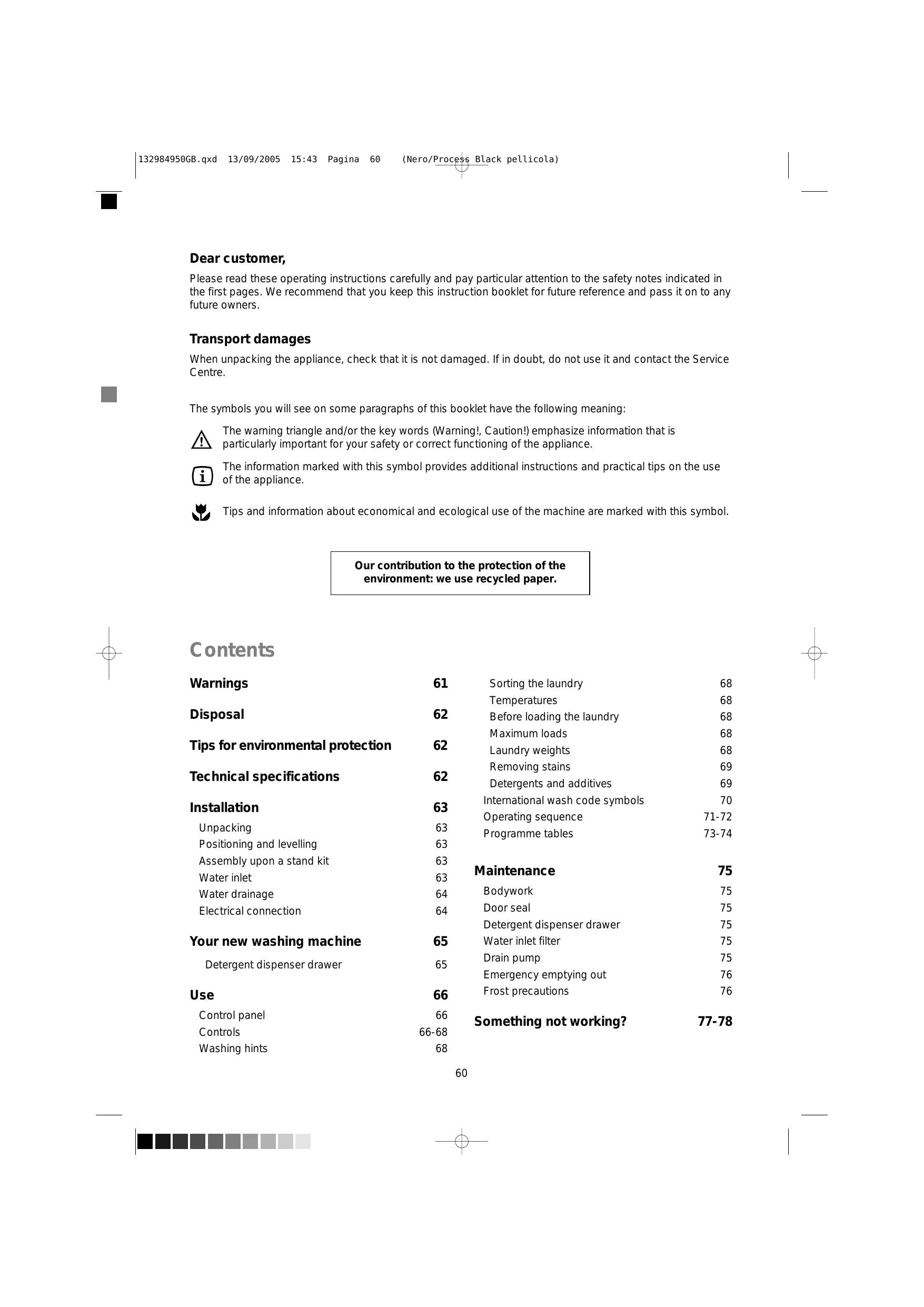
7298255068 13/09/2005 15:43 Pagina 60 (Nero/Process Black pellicola) — D Dear customer, Please read these operating instructions carefully and pay particular attention to the safety notes indicated in the first pages. We recommend that you keep this instruction booklet for future reference and pass it on to any future owners. Transport damages When unpacking the appliance, check that it is not damaged. If in doubt, do not use it and contact the Service Centre. The symbols you will see on some paragraphs of this booklet have the following meaning: The warning triangle and/or the key words (Warning!, Caution!) emphasize information that is VAN particularly important for your safety or correct functioning of the appliance. The information marked with this symbol provides additional instructions and practical tips on the use (F3) of the appliance. Ÿ Tips and information about economical and ecological use of the machine are marked with this symbol. Our contribution to the protection of the environment: we use recycled paper. Contents Warnings 61 Sorting the laundry 68 Temperatures 68 Disposal 62 Before loading the laundry 68 Maximum loads 68 Tips for environmental protection 62 Laundry weights 68 hnical ificati 62 Removing stains 69 Technical specifications Detergents and additives 69 Installation 63 International wash code symbols 70 . Operating sequence 71-72 Unpacking 63 Programme tables 73-74 Positioning and levelling 63 Assembly upon a stand kit 63 . Water inlet 63 Maintenance 75 Water drainage 64 Bodywork 75 Electrical connection 64 Door seal 75 Detergent dispenser drawer 75 Your new washing machine 65 Water inlet filter 75 Detergent dispenser drawer 65 Drain pump 75 Emergency emptying out 76 Use 66 Frost precautions 76 Control panel 66 Something not working? 71-78 Controls 66-68 Washing hints 68
7298255068 13/09/2005 15:43 Pagina 61 (Nero/Process Black pellicola) VAN Warnings The following warnings are provided in the interests of overall safety. You must read them carefully before installing or using the appliance. Installation - Allinternal packing must be removed before using the appliance. Serious damage may be caused to the machine or adjacent furniture if the protective transit devices are not removed or are not completely removed. Refer to the relevant paragraph in the instruction book. Any electrical work required to install this appliance must be carried out by a qualified electrician. Any plumbing work required to install this appliance must be carried out by a qualified plumber. After having installed the machine, check that it is not standing on its electrical supply cable. If the appliance is placed on a carpeted floor, ensure that air can circulate freely between the feet and the floor. Use - This appliance is designed for domestic use. It must not be used for purposes other than those for which it was designed. Only wash fabrics which are designed to be machine washed. Follow the instructions on each garment label. Do not overload the appliance. Follow the instructions in the instruction book. Make sure that all pockets are empty. Objects such as coins, safety pins, pins and screws can cause extensive damage. Do not machine wash garments saturated with petroleum, methylated spirits, trichlorethylene, etc. If such fluids have been used to remove stains prior to washing, wait until they have completely evaporated from the fabric before placing garments in the appliance. Place small items such as socks, belts, etc. in a cloth bag or pillowcase to prevent them getting trapped between the drum and the tub. Use only the recommended quantities of fabric softener. An excessive amount could damage the laundry. Leave the porthole door slightly ajar when the appliance is not in use. This preserves the door seal and prevents the formation of musty smells. Always check that water has emptied out before opening the door. If not, drain the water following the instructions in the instruction book.
- Always unplug the appliance and shut the water tap after use. General safety + Repairs to the machine must be carried out only by qualified personnel. Repairs carried out by inexperienced persons could cause serious danger. Contact your local Service Centre. + Never pull the power supply cable to remove the plug from the socket; always take hold of the plug itself. + During high temperature wash programmes the door glass may get hot. Do not touch it! Child safety + Children are often not aware of how dangerous electrical appliances can be. When the machine is working, children should be carefully supervised and not be allowed to play with the appliance. + The packaging components (e.g. plastic film, polystyrene) can be dangerous to children - danger of suffocation! Keep them out of children's reach. + Keep all detergents in a safe place out of children's reach. + This machine incorporates a special child safety feature to prevent small children from being trapped inside the machine. To activate this device, rotate the button (without pressing it) inside the door clockwise until the groove is horizontal. If necessary use a coin. To disable this device and restore the possibility of closing the door, rotate the button anti-clockwise until the groove is vertical. + When the appliance is to be scrapped, cut off the electrical supply cable and destroy the plug with the remaining cable. Disable the door catch in order to prevent children from becoming trapped inside while playing.
7298255068 13/09/2005 15:43 Pagina 62 Ÿ Disposal Packaging materials The materials marked with the symbol # are recyclable. >PE<=polyethylene >PS<=polystyrene >PP<=polypropylene This means that they can be recycled by disposing of them properly in appropriate collection containers. Machine Use authorised disposal sites for your old appliance. Help to keep your country tidy!
(Nero/Process Black pellicola) The symbol 5 on the product or on its packaging indicates that this product may not be treated as household waste. Instead it shall be handed over to the applicable collection point for the recycling of electrical and electronic equipment. By ensuring this product is disposed of correctly, you will help prevent potential negative consequences for the environment and human health, which could otherwise be caused by inappropriate waste handling of this product. For more detailed information about recycling of this product, please contact your local city office, your household waste disposal service or the shop where you purchased the product. Ÿ Tips for environmental protection To save water, energy and to help protect the environment, we recommend that you follow these tips: + Normally soiled laundry may be washed without prewashing in order to save detergent, water and time (the environment is protected tool). + The machine works more economically if it is fully loaded. Do not overload! Technical specifications + With adequate pre-treatment, stains and limited soiling can be removed; the laundry can then be washed at a lower temperature. + Measure out detergent according to the water hardness, the degree of soiling and the quantity of laundry being washed. ENGLISH DIMENSIONS Height 85 cm Width 60 cm Depth 59 cm MAXIMUM LOAD Cotton 5 kg Synthetics 2.5 kg Delicates 2.5 kg Woollens, handwash 2 kg SPIN SPEED 1200 rpm max. (ZWF 1200) 1400 rpm max. (ZWF 1400)
WATER PRESSURE Minimum 0,05 MPa Maximum 0,8 MPa [é € This appliance complies with the following EEC Directives: 73/23/JEEC of 19/02/73 relating to low voltage
Installation Unpacking A All transit bolts and packing must be removed before using the appliance. You are advised to keep all transit devices so that they can be refitted if the machine ever has to be transported again.
1. Using a spanner, unscrew and remove the two
rear bottom screws. Slide out the two plastic pins. / 2 Go |
2. Lay the machine onits back, taking care not to
squash the hoses. This can be avoided by placing one of the corner packing pieces between the machine and the floor.
3. Remove the polystyrene block from the bottom of
the machine and release the two plastic bags.
4. Very carefully slide out the left polythene bag,
removing it towards the right and then downwards.
5. Very carefully slide out the right polythene bag,
removing it towards the left and then upwards.
6. Set the machine upright and remove the
remaining rear screw. Slide out the relevant pin.
7. Plug all the holes with the plugs which you will
find in the envelope containing the instruction booklet. TEEN Positioning and levelling Install the machine on a flat hard floor. Make sure that air circulation around the machine is not impeded by carpets, rugs etc. Check that the machine does not touch the wall or other kitchen units. Carefully level by screwing the adjustable feet in or out. Never place cardboard, wood or similar materials under the machine to compensate for any unevenness in the floor. pros Assembly upon a stand kit Stand Dimension: Height: 30 cm. Width: 60 cm. Depth: 60 cm. pis. This appliance can be installed upon a steel Stand with Drawer to make the loading and unloading of your laundry easier. Please ask to authorized dealer the suitable stand kit.
7298255068 13/09/2005 15:43 Pagina 64 Water inlet Connect the water inlet hose supplied with the machine to a tap with a 3/4" thread. Do not use already employed hoses for water connection. The other end of the inlet hose which connects to the machine can be turned in any direction. Simply loosen the fitting, rotate the hose and retighten the fitting, making sure there are no water leaks. The inlet hose must not be lengthened. If it is too short and you do not wish to move the tap, you will have to purchase a new, longer hose specially designed for this type of use. Important! Before connecting up the machine to new pipework or to pipework that has not been used for some time, run off a reasonable amount of water to flush out any debris that may have collected in the pipes. Water drainage The end of the drain hose can be positioned in three Ways: Hooked over the edge of a sink using the plastic hose guide supplied with the machine. In this case, make sure the end cannot come unhooked when the machine is emptying. This could be done by tying it to the tap with a piece of string or attaching it to the wall. In a sink drain pipe branch. This branch must be above the trap so that the bend is at least 60 cm above the ground.
(Nero/Process Black pellicola) Directly into a drain pipe at a height of not less than 60 cm and not more than 90 cm. The end of the drain hose must always be ventilated, i.e. the inside diameter of the drain pipe must be larger than the outside diameter of the drain hose. Any extension applied to the drainage hose should not be longer than 200 cm and its diameter must not be smaller than that of the original hose. Use à suitable fitting for the connection. The drain hose must not be kinked. For a correct functioning of the machine the drain hose must remain hooked on the proper support piece situated on the top part of the back D side of the appliance. ) Electrical connection This machine is designed to operate on a 220-230 V, single-phase, 50 Hz supply. Check that your domestic electrical installation can take the maximum load required (2.2 KW), also taking into account any other appliances in use. Connect the machine to an earthed socket. The manufacturer declines any responsibility for damage or injury through failure to comply with the above safety precaution. Should the appliance power supply cable need to be replaced, this should be carried out by our Service Centre. Please ensure that when the appliance is installed the power supply cable is easily accessible.
7298255068 13/09/2005 15:43 Pagina 65 (Nero/Process Black pellicola) — D Your new washing machine This new machine meets all modern requirements for effective treatment of laundry with low water, energy and detergent consumption.
- The programme selector dial combines the function of programme and temperature selection, making it easier to set the programme. + The delay start allows you to delay the programme start by 2 to 12 hours (e.g. to times with a more economical power rate).
- The special wool programme with its new delicate wash system treats your woollens with extreme care. + The automatic cooling of the washing water from 95° to 60°C before draining will prevent old drain pipes from being deformed and will reduce thermal shock to fabrics, helping to prevent creasing. -« The unbalance detection device prevents vibration during spinning. « The ECO valve allows total use of detergent and reduces water consumption so saving energy. 1 Detergent dispenser drawer 1 2 2 Control panel 3 Door handle 4 Drain pump 5 Adjustable feet Detergent dispenser drawer UJ Prewash Main wash & Fabric softener, starch
Programme Option buttons Depending on the programme, different functions can be combined. These must be selected after choosing the desired programme and before depressing the START/PAUSE button. When these buttons are pressed, the corresponding pilot lights come on. When they are pressed again, the pilot lights go out. If an incorrect option is selected, the pilot lights flash for about 2 seconds. 1 QUICK/EXTRA QUICK button LJ/PY By depressing this button you can select two different options: + QUICK PJ: to be used for lightly soiled cotton or synthetic items in order to obtain good washing performance in a short time. + EXTRA QUICK Ÿ: a very short cycle for cotton, synthetic or delicate items that have been used or worn for a short time. The light corresponding to the selected option illuminates. These options cannot be used with the Economy programme 60E and 40E. If an option is chosen that is not allowed with the selected programme, both lights will flash 3 times. The washing time will be reduced according to the type of fabric and the selected temperature. Max. recommended load for cotton 3.5 kg. 2 PREWASH button L1J Select this option if you wish your laundry to be prewashed before the main wash (not available for wool, handwash and miniprogramme &).
The prewash ends with a short spin in programmes for cotton and synthetic fabrics, whereas in the programme for delicate fabrics the water is only drained. 3 HALF LOAD button l Select this button to reduce water consumption on the rinse phase when washing a smaller load of | cottons or linens (maximum load size = 2,5 kg). RUE The machine will perform 2 rinses instead of 3. This function can be used also for synthetic, handwash, wool and delicate programmes, in case of reduced load of laundry (less then the maximum load size). 4 START/PAUSE button © After having selected the programme and the required options press this button to start the machine. The corresponding pilot light stops flashing and remains lit. If you have selected the DELAY START option ©, the machine starts its hourly countdown. To interrupt a programme which is running, depress the START/PAUSE button: the corresponding pilot light starts to flash. To restart the programme from the point at which it was interrupted, press the START/PAUSE button again. 5 DELAY START button This button makes it possible to delay the starting of the washing programme by 12, 8, 4 and 2 hours. The delay you have selected is indicated by the coming on of the corresponding light. You must select this option after you have set the programme and before you press the START PAUSE button.
You can cancel the delay time at any moment, before you press the START/PAUSE button. If you have already pressed the START/PAUSE button, and you wish to cancel the delay time, proceed as follows: - setthe washing machine to PAUSE by pressing the START/PAUSE button; + press the © button once, the light relevant to the selected delay goes off; - press the START/PAUSE button again. Important! - The selected delay can be changed only after selecting the washing programme again. + The door will be locked throughout the delay time . If you need to open the door, you must first set the washing machine to PAUSE by pressing the START/PAUSE button. After closing the door, press the START/PAUSE button again. The delay start cannot be selected with SPIN @) and DRAIN E programmes. 6 Programme progress display When you choose the delayed start, the light relevant to the selected delay lights up. After the machine has started, the remaining time is shown by the corresponding indicator light. O 84 © 4H O©O 2H Ouw O x e WASHING U : when this light comes on this means that the machine is performing the washing programme. e END | : end of programme The 1 pilot light flashes in the event of operating problems: - 4 flashes = the door has not been closed - 2 flashes =the machine does not empty - 1'flash =the machine does not fill To eliminate the problem, see paragraph “Something not working”.
7 Spin speed selector dial This dial allows you to reduce the final and the intermediate spin speeds or to select the NO SPIN © or RINSE HOLD (anti-crease) ÜJ option. The speeds on the dial refer to cotton programmes. Position 1200 or 1400 corresponds to 900 r.p.m. for synthetics, wool and handwash; 700 r.p.m. for delicates and &. Position 500 corresponds to 450 r.p.m. for delicates and Ÿ: 500 r.p.m. for coton, synthetics, wool and handwash. e NO SPIN @: by selecting this option all the spinning phases are suppressed. To be used for extremely delicate items. The machine will add 3 rinses on cotton programmes and 1 rinse on synthetic programmes. © RINSE HOLD (anti-crease) [J: by selecting this option the water of the last rinse is not emptied out to prevent the fabrics from creasing. When the programme has finished the phase light 1 is on to indicate that the water must be emptied out. To do this: e turn the programme selector dial to “O" e select the drain & or spin © programme. Using the spin speed selector dial you can choose the desired spin. If the dial remains on position [J or @jthe machine will perform the spin speed at 400 rpm. e depress START/PAUSE button. 8 Programme selector dial The selector is divided into 6 sections: + Cotton W + Synthetics À + Delicates & and handwash & + Woo! & + Miniprogramme É + Special programmes (rinses ÆJ, drain &7 and spin
7298255068 13/09/2005 15:43 Pagina 68 The selector dial can be turned either clockwise or anticlockwise. Positions E60 and E40 correspond to the ENERGY SAVING programme and position X to “cold wash”. On position & you can wash garments marked with the”handwash” symbol &. Atthe end of the programme the selector dial must be turned to position O. Attention! If during a washing programme the selector dial is turned to another programme, the pilot lights of the programme progress display start to flash. The machine will not perform the new selected programme. © Washing hints Sorting the laundry Follow the wash code symbols on each garment label and the manufacturer’s washing instructions. Sort the laundry as follows: whites, coloureds, synthetics, delicates, woollens. Temperatures 95° for normally soiled white cottons and linen (e.g. tea cloths, towels, tablecloths, sheets...) for normally soiled, colour fast garments (e.g. shirts, night dresses, pyjamas...) in linen, cotton or synthetic fibres and for 60° lightly soiled white cotton (e.g. underwear). x (cold)for delicate items (e.g. net curtains), mixed 30°-40° laundry including synthetic fibres and woollens bearing the label «pure new wool, machine washable, non-shrink». The wool wash cycle of this machine has been approved by Woolmark for the washing of machine washable Woolmark products provided that the garments are washed according to the instructions on
(Nero/Process Black pellicola) the garment label and those issued by the manufacturer of this washing machine. M9604. Other types of wool and laundry marked with the “handwash” symbol té should be washed in programme éà. Before loading the laundry Never wash whites and coloureds together. Whites may lose their “whiteness” in the wash. New coloured items may run in the first wash; they should therefore be washed separately the first time. Make sure that no metal objects are left in the laundry (e.g. hair clips, safety pins, pins). Button up pillowcases, close zip fasteners, hooks and poppers. Tie any belts or long tapes. Remove persistent stains before washing. Rub particularly soiled areas with a special detergent or detergent paste. Treat curtains with special care. Remove hooks or tie them up in a bag or net. Maximum loads —- Recommended loads are indicated in the programme charts. General rules: Cotton, linen: drum full but not too tightly packed; Synthetics: drum no more than half full; Delicate fabrics and woollens: drum no more than one third full. Washing à maximum load makes the most efficient use of water and energy. For heavily soiled laundry, reduce the load size. Laundry weights The following weights are indicative: bathrobe 1200 g napkin 100g quilt cover 700g sheet 500g pillow case 200g tablecloth 250g towelling towel 200g tea cloth 100g night dress 200g ladies' briefs 100g man's work shirt 600 g
7298255068 13/09/2005 15:43 Pagina 69 man's shirt man's pyjamas blouse men's underpants Removing stains
200 g 500 g 100 g 100 g Stubborn stains may not be removed by just water and detergent. It is therefore advisable to treat them prior to washing. Blood: treat fresh stains with cold water. For dried stains, soak overnight in water with a special detergent then rub in the soap and water. Oil based paint: moisten with benzine stain remover, lay the garment on a soft cloth and dab the stain; treat several times. Dried grease stains: moisten with turpentine, lay the garment on a soft surface and dab the stain with the fingertips and a cotton cloth. Rust: oxalic acid dissolved in hot water or a rust removing product used cold. Be careful with rust stains which are not recent since the cellulose structure will already have been damaged and the fabric tends to hole. Mould stains: treat with bleach, rinse well (whites and fast coloureds only). Grass: soap lightly and treat with bleach (whites and fast coloureds only). Ball point pen and glue: moisten with acetone (*) lay the garment on a soft cloth and dab the stain. Lipstick: moisten with acetone as above, then treat stains with methylated spirits. Remove any residual marks from white fabrics with bleach. Red wine: soak in water and detergent, rinse and treat with acetic or citric acid, then rinse. Treat any residual marks with bleach. Ink: depending on the type of ink, moisten the fabric first with acetone (*) then with acetic acid; treat any residual marks on white fabrics with bleach and then rinse thoroughly. Tar stains: first treat with stain remover, methylated spirits or benzine, then rub with detergent paste. (*) do not use acetone on artificial silk. Detergents and additives Good washing results also depend on the choice of detergent and use of the correct quantities to avoid waste and protect the environment. Although biodegradable, detergents contain substances which, in large quantities, can upset the delicate
(Nero/Process Black pellicola) balance of nature. The choice of detergent will depend on the type of fabric (delicates, woollens, cottons, etc.), the colour, washing temperature and degree of soiling. All commonly available washing machine detergents may be used in this appliance: - powder detergents for all types of fabric, - powder detergents for delicate fabrics (60°C max) and woollens, - liquid detergents, preferably for low temperature wash programmes (60°C max) for all types of fabric, or special for woollens only. The detergent and any additives must be placed in the appropriate compartments of the dispenser drawer before starting the wash programme. If using concentrated powder or liquid detergents, a programme without prewash must be selected. Pour liquid detergent into the dispenser drawer compartment marked [I just before starting the programme. Any fabric softener or starching additives must be poured into the compartment marked & before starting the wash programme. Follow the product manufacturer's recommendations on quantities to use and do not exceed the «MAX» mark in the detergent dispenser drawer. Quantity of detergent to be used The type and quantity of detergent will depend on the type of fabric, load size, degree of soiling and hardness of the water used. Water hardness is classified in so-called “degrees” of hardness. Information on hardness of the water in your area can be obtained from the relevant water supply company, or from your local authority. Follow the product manufacturers’ instructions on quantities to use. Use less detergent if: - you are washing a small load, - the laundry is lightly soiled, - large amounts of foam form during washing.
Degrees Level Characteristic German French °dH TH. 1 soft 0- 7 0-15 2 medium 8-14 16-25 3 hard 15-21 26-37 more more 4 veyhard | Han 21 | than 37 (F3) International wash code symbols These symbols appear on fabric labels, in order to help you choose the best way to treat your laundry. (Nero/Proceis Black pellicola) Energetic wash Delicate wash Max. wash Max. wash Max. wash temperature | temperature | temperature 95°C 60°C 40°C Max. wash temperature
Bleaching Bleach in cold water Do not bleach A «a = a x Ironing Hot iron Warm iron Lukewarm iron Do not iron max 200°C max 150°C max 110°C Dry cleaning Dry cleaning Dry cleaning in Dry cleaning Do not in all solvents perchlorethylene, in petrol, dry clean petrol, pure alcohol, pure alcohol R111&R 113 and R 113 PSI high _— Il [ | temperature Lx | © low Drying Flat On the line On clothes Bel temperature Do not hanger Tumble dry tumble dry
7298255068 13/09/2005 15:43 Pagina 71 (E) Operating sequence Before the first wash we recommend that you pour 2 litres of water into the main wash compartment LU of the detergent drawer in order to activate the ECO valve. Then run a cotton cycle at 95°C, with the machine empty, in order to remove any manufacturing residue from the drum and tub. Pour half a measure of detergent into the main wash compartment and start up the machine.
1. Place the laundry in the drum
Open the door. Place the laundry in the drum, one item at a time, shaking them out as much as possible. Close the door.
2. Measure out the detergent
Pull out the dispenser drawer until it stops. Measure out the amount of detergent recommended by the manufacturer in a graduated cup and pour it into the main wash compartment LU. If you have selected the prewash, pour detergent into the appropriate compartment marked (1).
3. Measure out the additive
If required, pour fabric softener into the compartment marked &, without exceeding the «MAX» mark. cons fouoss,
4. Select the desired programme
Turn the programme selector dial to the desired position.
Turn the selector dial to the required position. ZWF 1200 ZWF 1400
The light corresponding to the depressed button illuminates.
To delay starting of a programme, press the DELAY START button, before starting the machine, until the light corresponding to the required delay illuminates. OH OsH DO o4 [eau
Depress START/PAUSE-button, the corresponding pilot light stops flashing. The UM (washing) light illuminates. (e)
If you have selected the ©, the machine starts its hourly countdown.
9. Altering an option or a programme
Before you make any change, you must pause the washing machine by pressing the START/PAUSE button. It is possible to change any phase before the programme carries it out. When the programme has started, you can only reset it by turning the programme selector dial to “oO” and then you can select the new programme. The washing water remains in the tub. Start the new programme by depressing the START/PAUSE button. Note: To drain the water before starting the new cycle, you have to cancel the programme and select the k cycle.
10. Interrupting a programme
Depress the START/PAUSE button to interrupt a programme which is running, the corresponding light starts to flash. Depress the same button again to restart the programme.
11. Cancelling a programme
Turn the selector dial to O to cancel a programme which is running. Now you can select a new programme.
12. Opening the door after the
programme has started First set the machine to PAUSE by pressing the START/PAUSE button. If the door does not open in 2 minutes, this means that the water temperature is above 55°C, that the water level is above the bottom edge of the door or that the drum is turning.
(Nero/Process Black pellicola) If you cannot open the door but you need to open it you have to switch the machine off by turning the programme selector dial to “O”. After about 2 minutes the door can be opened (pay attention to the water level and temperaturel). Select the programme again and depress START/PAUSE to restart it.
13. At the end of the programme
The machine stops automatically. Ifthe anti-crease DJ option has been selected, the —1 light remains lit and the door is blocked to indicate that the water must be emptied out before opening the door. To do this turn the programme selector dial to “O” and then to programme gl (drain) or @) (spin). Select the required spin speed by means of the relevant dial. Release of the lock is also indicated by the coming on ofthe —1 light. Switch the machine off by turning the programme selector dial to “O”. Remove the laundry from the drum and carefully À check that the drum is empty so as to avoid any forgotten items being damaged in a subsequent wash (e.g. shrinking) or their colour running into a load of whites. If you do not intend to carry out another wash, close the water tap. Leave the door open to prevent the formation of mildew and unpleasant smells.
7298255068 13/09/2005 15:43 Pagina 73 (Nero/Process Black pellicola) Programme table WASHING PROGRAMMES dl + Fabrics Temperature/ Type of laundi Additional Wash load Consumptions = Programme ype of'auncry functions max. Energy | Water | Duration kWh H min. (are) 1J;t2 Wie 35 ner tomes sn RuCrON 5k 2.0 53 145 E VW tablecloths @D g ‘ White E60 Slightly soiled sheets, t4 cotton _ household linen, 5kg 0.85 49 140 econom VW underwear SPIN REDUCTION Ÿ (Te) Fast coloured items, for example hand Uy Coloured E40 towels, sheets, H2 cotton = underwear, 5k 0.95 49 140 economy V tablecloths, shirts, SPIN REDUCTION 3 blouses. Normally @O soiled ; [Non-fast coloured LE Coloured 30 items, for example LU;t4 sk 0.37 4 110 cotton (@] underwear, shirts, SPIN REDUCTION q : blouses @D 30°-40°- Shirts, blouses, Te Synthetics 60 underwear, mixed ( 2.5kq 0.9 54 90 & fabrics SPIN REDUCTION Lo (ue) 40° Acrylic, viscose, Lt Delicates olyester items, / a SPIN REDUCTION 25kg 05 5 60 @/0 30° (2) For wool mixtures, Handwash 7 silk SPIN REDUCTION 2 kg 0.25 55 50 [SIT e 40°- Special programme Wool X (cold) |for garments bearing 2 (cold) the “ Pure new wool, | spiy REDUCTION 2kg 0.35 55 55 © non-shrink, machine @tU washable” label ECONOMY PROGRAMME For slightiy/normally soiled cottons you can use the relevant Economy programme: you will obtain good washing results by saving energy. In compliance with EC directive 92/75, the consumption figures indicated on the energy label refer to the E60 wash programme for cotton. *The consumption data shown on this chart is to be considered purely indicative, as it may vary depending on the quantity and type of laundry, on the inlet water temperature and on the ambient temperature. It refers to the highest temperature for each wash programme.
7298255068 13/09/2005 15:43 Pagina 74 (Nero/Process Black pellicola) Programme table SPECIAL PROGRAMMES Consumptions* ris Programme Programme Additional Wash load Pi osition 9 description functions max. Energy | Water | Duration P kWh | It | min. ts For lightly 2 rinses SPIN REDUCTION Mini- |soiled fabrics | Short spin QD 2kg 03 40 30 programme For rinsing 3 rinses with liquid hand washed |additive, if required OU 5kg 0.05 57 30 Rinses items Short spin For emptying out the water ky of the last rinse of Water draining Î - 2 Drain |programmes with option D Separate spin © for cotton, Long spin or short spin with ° synthetics, spin speed 700 rpm and 500 | SPIN REDUCTION 5kg - 10/6 Spin delicates and |rpm wool For cancelling the 0 programme which is 1 - ResetOff running or to switch the machine off. *The consumption data shown on this chart is to be considered purely indicative, as it may vary depending on the quantity and type of laundry, on the inlet water temperature and on the ambient temperature.
Clean the outside of the machine with soap and water only. Rinse with clean water and dry with a soft cloth. Important: do not use methylated spirits, solvents or similar products to clean the bodywork.
Check from time to time the door seal and eliminate eventual possible objects that could be trapped in the fold.
After a while, detergents and fabric softeners leave deposits in the drawer. Clean the drawer from time to time by rinsing it under a running tap. To remove the drawer from the machine, press the button in the rear left-hand corner. To facilitate cleaning, the top part of the additive compartments can be removed.
(Nero/Process Black pellicola) Detergent can also accumulate inside the drawer recess: clean it with an old toothbrush. Refit the drawer after cleaning.
4. Water inlet filter
If you notice that the machine is taking longer to fill, check that the filter in the water inlet hose is not blocked. Turn off the water tap. Unscrew the hose from the tap. Clean the filter with a stiff brush. Screw the hose back onto the tap.
The pump should be inspected regularly and particularly if + the machine does not empty and/or spin + the machine makes an unusual noise during draining due to objects such as safety pins, coins etc. blocking the pump. Proceed as follows: + Disconnect the appliance. + Ifnecessary wait until the water has cooled down. + Open the pump door. Pri14]
7298255068 13/09/2005 15:43 Pagina 76 ur) + Place a bowl on the floor to collect any spillage. + Pull out the emergency emptying hose, place it in the bowl and remove its cap. + When no more water comes out, unscrew the pump cover and remove it. + Remove any objects from the pump impeller by rotating it. + Putthe cap back on the emergency emptying hose and place the latter back in its seat. + Screw the pump cover fully in. + Close the pump door.
6. Emergency emptying out
If the water is not discharged, proceed as follows to empty out the machine: + pull out the plug from the power socket; - close the water tap; + ifnecessary, wait until the water has cooled down; + open the pump door; + place a bowl on the floor and place the end ofthe emergency emptying hose into the bowl. Remove its cap. The water should drain by gravity into the bowl. Whe the bowl is full, put the cap back on the hose. Empty the bowl. Repeat the procedure until water stops flowing out; - clean the pump if necessary as previously described; - replace the emergency emptying hose in its seat after having plugged it; + screw the pump cover again and close the door.
Ifthe machine is installed in a place where the temperature could drop below 0°C, proceed as follows: + Remove the plug from the socket. + Close the water tap and unscrew the water inlet hose from the tap. + Place the end of the emergency emptying hose and that of the inlet hose in a bowl placed on the floor and let water drain out. + Screw the water inlet hose back on and reposition the emergency emptying hose after having put the cap on again. By doing this, any water remaining in the machine is removed, avoiding the formation of ice and, consequently, breakage of the affected parts. When you use the machine again, make sure that the ambient temperature is above 0°C. Important! Every time you drain the water through the emergency emptying hose you must pour 2 litres of water into the main wash compartment of the detergent drawer and then run the drain programme. This will activate the ECO valve avoiding that part of the detergent remains unused at next washing.
Something not working? (Nero/Process Black pellicola) Problems which you can resolve yourself, before calling the After Sales Service. During machine operation it is possible that the —1 light starts to flash: 4 flashes= the door has not been closed 2 flashes=the machine does not empty 1 flash=the machine does not fill. On model ZWF 1400 an acoustic signal will be heard. Once the problem has been eliminated, press the START/PAUSE button to restart the programme. |f after all checks, the problem persists, contact your local Service Centre. Problem Possible cause + The machine does not start up: + The door is not firmly closed. + The machine is not plugged in or there is no power at the socket. + The main fuse has blown. «The © (delay start) option has been selected. + The programme selector dial is not positioned correctly and the START/PAUSE button has not been depressed. + The machine does not fill: + The water tap is closed. + The inlet hose is squashed or kinked. + The filter in the inlet hose is blocked. + The dooris not properly closed. + The machine fills then empties immediately: + The end ofthe drain hose is too low. Refer to relevant paragraph in “water drainage” section. + The machine does not empty and/or does not spin: + The drain hose is squashed or kinked. + A programme with option T3 or@) has been selected. + The drain pump is clogged.
- There is water on the floor: + Too much detergent or unsuitable detergent {creates too much foam) has been used. + Check whether there are any leaks from one of the inlet hose fittings. It is not always easy to see this as the water runs down the hose; check to see if it is damp. + The drain hose is damaged. + The cap on the emergency emptying hose has not been replaced after cleaning the pump. + Unsatisfactory washing results: + Too little or too much detergent has been used. + An unsuitable detergent has been used. + Stubborn stains have not been treated prior to washing. + The correct temperature was not selected. + Excessive laundry load. + The machine vibrates or is noisy: + The transit bolts and packing have not been removed. + The support feet have not been adjusted. + The laundry is not evenly distributed in the drum. + Maybe there is very little laundry in the drum.
(Nero/Proceis Black pellicola) Problem Possible cause + The door will not open: + The programme is still running, the drum is turning. + The door lock has not been released. + The water level is above the bottom edge of the door. + The machine is heating the water. + Water is not visible in the machine: + The machine, which is the result of modern technology, runs in à very economical way with low water consumption. Performance is nevertheless excellent. + Spinning starts late or the machine does not spin: + The electronic unbalance detection device has cut in because the laundry is not evenly distributed in the drum. The laundry is redistributed by reverse rotation of the drum. This may happen several times before the unbalance disappears and normal Spinning can resume. [f, after 10 minutes, the laundry is still not evenly distributed in the drum, the machine will not spin. In this case, redistribute the load manually and select the spin programme. + The machine makes an unusual noise + The machine is fitted with a type of motor which makes an unusual noise compared with other Il traditional motors. This new motor ensures a softer a start and more even distribution of the laundry in the drum when spinning, as well as increased stability of the machine. + Detergent residue is left after the wash cycle + This is most probably due to non soluble components contained in modern detergents. It is not a sign of inadequate rinsing. Brush or shake the garments and, if necessary, wash them again. + Foam remains after the last rinse + Modern detergents can produce foam even after rinsing, but this will not affect the quality of the wash. If you are unable to identify or solve the problem, contact our service centre. Before telephoning, make a note of the model, serial number and purchase date of your machine: the Service Centre will require this information.
7298255068 13/09/2005 15:43 Pagina 79 (Nero/Process Black pellicola) — D A] From the Electrolux Group. The worid's No. 1 choice. The Electrolux Group is the world's largest producer of powered appliances for kitchen, cleaning and outdoor use. More than 55 million Electrolux Group products (such as refrigerators, cookers, washing machines, vacuum cleaners, chain saws and lawn mowers) are sold each year to a value of approx. USD 14 billion in more than 150 countries around the world. CCC o