USER MANUAL ZBA3230 ZANUSSI
PE<=Polyethylene PS<=Polystyrene PP<=Polypropylene
Important warnings 12
CE-73/23 EEC 19/02/73 (Low Voltage) and subsequent amendments;
Notes which are important for your safety or for the proper functioning of the appliance
Supplementary information regarding operation and practical applications of the appliance.
Tips and notes concerning economical and environmentally sound use of the appliance

Safety Instructions
This information has been provided in the interests of your safety. Please read it before installing or using the appliance. Please retain the instruction book for future reference. If ownership is transferred, please leave the user manual for the new owner.
Domestic Use
- The domestic refrigerators and freezers are designed to be used specifically for the storage of edible foodstuffs only.
- Check the appliance for transport damage. Under no circumstances should a damaged appliance be installed. In the event of damage please contact your retailer.
- This appliance is heavy. The edges and projecting parts of the cabinet may be sharp. Be careful when moving the cabinet and always use gloves.
- Any electrical work required to install this appliance should be carried out by a qualified electrician or competent person.
- Make sure that the power plug is not squashed or damaged by the back of the appliance. Make sure that the cable is not trapped underneath the appliance, nor touches the motor.
- Do not remove the power cord by pulling on its lead, particularly when the appliance is being pulled out of its niche. If the power plug socket is loose, do not insert the power plug. Damage to the cord may cause a short-circuit, fire and/or electric shock.
- Do not use electrical appliances inside the appliance.
- Do not keep carbonated drinks or bottles in the freezer compartment. The glass bottles may break.
- Ice lollies can cause 'frost/freezer burns' if consumed straight from the freezer.
- It is dangerous to try and alter the specifications or modify this product in any way.
- Under no circumstances should you attempt to repair the appliance yourself. Refer to your local Service Centre, and always insist on genuine spare parts.
Child Safety
- This appliance is designed to be operated by adults only. Do not allow the children to tamper with the controls or play with the products. There is a risk of suffocation! Keep packaging material away from children!

Environment Protection
- This appliance does not contain gasses which could damage the ozone layer, in either its refrigerant circuit or insulation materials. The appliance shall not be discarded together with the urban refuse and rubbish. Avoid damaging the cooling unit. Information on your local disposal sites may be obtained from your municipal authorities.
Remove the plug and ensure that any locks or catches are removed, to prevent young children being trapped inside.

Disposal
- The materials marked with the symbol are recyclable.
PE< for polyethylene, e.g. sheet wrapping material
PS< for polystyrene, e.g. padding material (always CFC-free)
POM (polyoxymethylene), e.g. plastic clips.
All materials are environmentally sound!
Disposal of old appliances
The symbol on the product or on its packaging indicates that this product may not be treated as household waste. Instead it shall be handed over to the applicable collection point for the recycling of electrical and electronic equipment. By ensuring this product is disposed of correctly, you will help prevent potential negative consequences for the environment and human health, which could otherwise be caused by inappropriate waste handling of this product. For more detailed information about recycling of this product, please contact your local city office, your household waste disposal service or the shop where you purchased the product.
Contents
Safety Instructions 34
Disposal 34
Use and Control Before Use / Starting the appliance / Temperature control 35
Internal parts / Hints 36
Maintenance Defrosting / Cleaning / Changing the light bulb 37
Something not Working / Customer Service and Spare Parts / Technical Specifications 38
Door reversal 39
Installation Positioning 39
Electrical connection 40
Building-in 40
Declaration of guarantee terms 43
Use and Control
Before Use
Wait two hours before connecting the appliance to allow the oil to flow back in the compressor.
- Before using the appliance for the first time, wash the interior and all internal accessories with lukewarm water and some neutral soap so as to remove the typical smell of a brand-new product, then dry thoroughly.
Do not use detergents or abrasive powders, as these will damage the finish.
- Remove safety elements used for transportation.
Starting the appliance
- Insert the plug into the wall socket and turn the thermostat knob clockwise beyond position «O» (OFF).
- The thermostat control situated inside the fridge compartment regulates the temperature of the appliance.
- Turn the thermostat control to the required setting.
Temperature Control
- The following effects are of significance in respect of the interior temperature:
- Ambient temperature
- Quantity and temperature of the food stored;
- Frequency with which the door is opened and how long it is left open
- the location of the appliance.
- The temperature inside the appliance is automatically adjusted.
- Setting 1 = highest temperature, warmest setting
- Setting 6 = lowest temperature, coldest setting.
- Setting 1, * = Off
A medium setting is generally the most suitable.

Internal Parts
Storage shelves
- The shelves can be removed for cleaning.
- To permit storage of food packages of various sizes, the shelves can be placed at different heights.
- To remove the internal shelf, pull it forward until it can be tipped up or down and removed.

- To insert the shelf at a different height, do the same in reverse.
The glass shelf above the vegetable drawers and the bottle shelf should always remain in position to ensure correct air circulation.
Door shelves
- To permit storage of food packages of various sizes, the central door shelf can be adjusted in height. Gradually pull the shelf in the direction of the arrows until it comes free, then reposition as required.

- For more thorough cleaning, the top and bottom door shelves can be easily removed and refitted in position.


Saving Energy
- Pay careful attention to where the cabinet is placed. See the section "Installation". When installed correctly, the cabinet will consume less energy. Try to avoid keeping the doors open for long periods or opening the doors too frequently, as warm air will enter the cabinet and cause the compressor to switch on unnecessarily often.
- If the ambient temperature is high, the thermostat knob is on the coldest setting (higher numbers), and the appliance is fully loaded, the compressor may run continuously, causing frost or ice to form on the evaporator. If this happens, turn the knob to a warmer setting (lower numbers) to allow automatic defrosting and so save electricity consumption.
- Do not place warm foods inside the appliance. Allow warm foods to cool first.
- Keep the heat-emitting condenser, the metal grille on the rear wall of your appliance, always clean.
Hints for refrigeration
- Do not store warm food or evaporating liquids in the refrigerator, and do cover or wrap up the food, particularly if it has a strong smell.
To help you use your refrigerator correctly, here are some useful hints:
- Raw meat (beef, pork, lamb & poultry): wrap in polythene bags and place on top of the salad compartment, this being the coldest spot in the refrigerator. Meat can only be stored safely in this way for one or two days at the most.
- Cooked food, cold cuts, jelly, etc.: these should be well covered and can be stored on any of the glass shelves.
- Fruit & vegetables: these should be thoroughly cleaned and placed in the bottom drawer/s.
- Butter & cheese: these should be placed in special airtight containers or wrapped in aluminium foil or polythene bags to keep out as much air as possible.
- Milk bottles: these should have a top and should be stored in the bottle rack on the door.
Bananas, potatoes, onions and garlic, if not packed, must not be kept in the refrigerator.

Unplug the appliance before carrying out any maintenance operation.

Warning
This appliance contains hydrocarbons in its cooling unit maintenance and recharging must therefore only be carried out by authorised technicians.
Defrosting
- Defrosting the refrigerator compartment is automatic. The defrost water drains out through a trough into a container at the back of the appliance, above the motor compressor, where it evaporates.
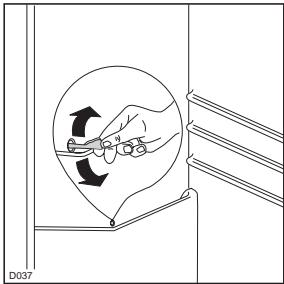
- It is important to periodically clean the defrost water drain hole.
Cleaning

Never use metal objects for cleaning your appliance as it may get damaged.
NEVER use detergents, abrasive powders, highly perfumed cleaning products or wax polishes to clean the interior as these will damage the surface and leave a strong odour.
Clean the inside with warm water and bicarbonate of soda. Rinse and dry thoroughly.
To guarantee safe operation of the fridge, once a year remove the ventilation grill at the base and clean the air channels with a vacuum cleaner.
When the appliance is not in use
Disconnect the appliance from the electricity supply. Empty all foods and clean the appliance, leaving the doors ajar to prevent unpleasant smells.
Changing the light bulb
- Should the interior light fail to work, first switch off the appliance and disconnect from the electricity supply, then replace the bulb as follows:
- Unscrew the light cover securing screws.
- Unhook the moving part by pressing it as shown in the figure.
- Replace the bulb with another of the same characteristics.

Problems may be due to causes which can easily be solved before calling the Technical Service. Please follow these instructions:
| SYMPTOM | SOLUTION |
| Door does not close | Level properly the appliances if it is not well levelled.
Weight surpasses the storage limit of the door shelf so spread weight more evenly or take some products out.
The appliance is not properly installed. Please look in the "Building-in" section. |
| It is too warm inside the refrigerator | Set a lower temperature.
Distribute the food products to allow cold air to circulate around them.
Make sure that the door is completely closed and that the insulating strip is complete and clean.
The temperature where the cabinet is placed is above normal room temperature. |
| It is too cold inside the refrigerator. | Turn the temperature regulator to a warmer setting temporarily. |
| The compressor works continuously. | Turn the thermostat knob to a lower number.
The temperature where the cabinet is placed is above normal room temperature.
Check that the ventilation is sufficient and that the ventilation openings are unobstructed.
The cause could be the introduction of large quantities of food and/or frequent opening/closing of the door. |
| There is water inside/outside the refrigerator. | Sometimes is normal. During automatic defrosting frost thaws on the cooling plate. |
| Water comes out on the floor. | Place the drain hose at the back of the cabinet above the drain bowl. |
| Noises | Sometimes this is normal. Temperature control may cause clicking sounds when the system is connected or disconnected.
The injected cooling gas may produce a gurgling sound while passing through the tubes.
The motor may cause a humming noise and/or slight bumping.
The insulation material used has a tendency to slightly increase noise levels, how ever it allows for much better insulation and a lower energy consumption. |
Customer service and spare parts
If you cannot find the remedy for a malfunction in these operating instructions, please contact your dealer or our customer service department and consult the Guarantee card.
Selective ordering of replacement parts can save unnecessary travel and costs.
For this reason always provide the following appliance information:
- Model Name
- Model Number (PNC)
- Serial Number (S-No.)
This information can be found on the rating plate inside the cabinet on the left hand wall. We recommend that you enter this information here, so that it is handy if needed.
Technical specifications
The technical data is indicated on the rating plate on the left side inside the appliance.
The appliance's door has been locked in position for transport by means of pins on both sides. According to the door opening direction, remove relevant pins at the top and at the bottom.

Warning!
If the ambient temperature is cold (i.e. in Winter), the gasket may not fit perfectly to the cabinet. In that case, wait for the natural fitting of the gasket or accelerate this process by heating up the part involved with a normal hairdrier.
Installation

Take utmost care when handling your appliance so as not to cause any damages to the cooling unit with consequent possible fluid leakages.
- During normal operation, the condenser and compressor at the back of the appliance heat up considerably. Always ensure that there is adequate ventilation as a failure to do this will result in component failure and possible food loss. See installation instructions.
- Important: if the supply cord is damaged, it must be replaced by a special cord or assembly available from the manufacturer or its service agent.
Positioning
- Unpack the cabinet and check that it is in good condition and free of any transport damage.
- The appliance must not be located close to radiators or gas cookers.
- Avoid prolonged exposure of the appliance to direct sunlight.
- For safety reasons, minimum ventilation must be as shown in Fig.
Attention: keep ventilation openings clear of obstruction.
- It is necessary that the niche is provided with a ventilation duct having the following dimensions:
Depth 50 mm
Width 540 mm
The climate classification can be found on the rating plate, which is located inside the cabinet on the left hand wall.
The following table shows which ambient temperature is correct for each climate classification:
| Climate classification | for an ambient temperature of |
| SN | +10 to +32°C |
| N | +16 to +32°C |
| ST | +18 to +38°C |
| T | +18 to +43°C |

Electrical connection
Before plugging in, ensure that the voltage and frequency shown on the serial number plate correspond to your domestic power supply.
Voltage can vary by ±6% of the rated voltage.
For operation with different voltages, a suitably sized auto-transformer must be used.

Important
The appliance must be earthed.
The power supply cable plug is provided with a contact for this purpose.
If the domestic power supply socket is not earthed, connect the appliance to a separate earth in compliance with current regulations, consulting a specialist technician.
The Manufacturer declines all responsibility if the above safety precautions are not observed.
This appliance complies with the following E.E.C. Directives:
CE-87/308 EEC of 2/6/87 relative to radio interference suppression.
- 73/23 EEC of 19.2.73 (Low Voltage Directive) and subsequent modifications.
- 89/336 EEC of 3.5.89 (Electromagnetic Compatibility Directive) and subsequent modifications.

It must be possible to disconnect the appliance from the mains power supply; the plug must therefore be easily accessible after installation.
Building-in
Dimensions of the recess
| ZBA 3160 | ZBA 3230 |
| Height of housing (1) | 880 | 1225 | mm |
| Depth of housing (2) | 550 | 550 | mm |
| Width of housing (3) | 560 | 560 | mm |

It is necessary that the niche is provided with a conduct of ventilation having the following dimensions:
Depth 50 mm
Width 540 mm

For appropriate venting, follow indications in the figure.

- Fit the appliance in the niche by making sure that it stands against the interior surface of the unit on the side where the door hinges of the appliances are fitted. Insert the appliance until the upper strip butts up against the unit (1) and make sure that the lower hinge is in line with the surface of the unit (2).

- Press in the joint covers between the appliance and the kitchen furniture.

- Open the door and push the appliance against the side of kitchen furniture opposite to that of the appliance hinges. Fasten the appliance with 4 screws (I) provided in the kit included with the appliance.

- Snap vent grill (B) and hinge cover (E) into position.
Apply blanking covers (C-D) as indicated.

- Separate parts Ha, Hb, Hc, Hd as shown in the figure.

- Place guide (Ha) on the inside part of the furniture door, up and down as shown in the figure and mark the position of external holes. After having drilled holes, fix the guide with the screws supplied.
7. Fix cover (Hc) on guide (Ha) until it clips into place.
- Place the small square on the guide again and fix it with the screws supplied. Should the alignment of the furniture door be necessary, use the clearance of slots. At the end of this procedure, it is necessary to check if the door of the furniture closes properly.

8. Open the appliance door and the furniture door at 90°. Insert the small square (Hb) into guide (Ha). Put together the appliance door and the furniture door and mark the holes as indicated in the figure.
11. Fix cover (Hd) on the small square (Hb) until it clips into place.
9. Remove the squares and mark a distance of 8 mm from the outer edge of the door where the nail must be fitted (K).
DECLARATION OF GUARANTEE TERMS
(B)
Our appliances are produced with the greatest of care. However, a defect may still occur. Our consumer services department will repair this upon request, either during or after the guarantee period. The service life of the appliance will not, however, be reduced as a result.
This declaration of guarantee terms is based on European Union Directive 99/44/EC and the provisions of the Civil Code. The statutory rights that the consumer has under this legislation are not affected by this declaration of guarantee terms.
This declaration does not affect the vendor's statutory warranty to the end user. The appliance is guaranteed within the context of and in adherence with the following terms:
- In accordance with provisions laid down in paragraphs 2 to 15, we will remedy free of charge any defect that occurs within 24 months from the date the appliance is delivered to the first end user. These guarantee terms do not apply in the event of use for professional or equivalent purposes.
- Performing the guarantee means that the appliance is returned to the condition it was in before the defect occurred. Defective parts are replaced or repaired. Parts replaced free of charge become our property.
- So as to avoid more severe damage, the defect must be brought to our attention immediately.
- Applying the guarantee is subject to the consumer providing proof of purchase showing the purchase and/or delivery date.
- The guarantee will not apply if damage caused to delicate parts, such as glass (vitreous ceramic), synthetic materials and rubber, is the result of inappropriate use.
- The guarantee cannot be called on for minor faults that do not affect the value or the overall reliability of the appliance.
- The statutory warranty does not apply when defects are caused by:
- a chemical or electrochemical reaction caused by water,
- abnormal environmental conditions in general,
- unsuitable operating conditions,
- contact with harsh substances.
- The guarantee does not apply to defects due to transport which have occurred outside of our responsibility. Nor will the guarantee cover those caused by inadequate installation or assembly, lack of maintenance or failure to respect the assembly instructions or directions for use.
- Defects that result from repairs or measures carried out by people who are not qualified or expert or defects that result from the addition of non-original accessories or spare parts are not covered by the guarantee.
- Appliances that are easy to transport may be delivered or sent to the consumer services department. Home repairs are only anticipated for bulky appliances or built-in appliances.
- If the appliances are built-in, built-under, fixed or suspended in such a way that removing and replacing them in the place where they are fitted takes more than half an hour, the costs that result therefrom will be charged for. Connected damage caused by these removal and replacement operations will be the responsibility of the user.
- If, during the guarantee period, repairing the same defect repeatedly is not conclusive, or if the repair costs are considered disproportionate, in agreement with the consumer, the defective appliance may be replaced with another appliance of the same value.
In this event, we reserve the right to ask for a financial contribution calculated according to the length of time it has been used.
- A repair under guarantee does not mean that the normal guarantee period will be extended nor that a new guarantee period begins.
- We give a twelve month guarantee for repairs, limited to the same defect.
- Except in the event where liability is legally imposed, this declaration of guarantee terms excludes any compensation for damage outside the appliance for which the consumer wishes to assert his rights. In the event of legally admitted liability, compensation will not exceed the purchase price paid for the appliance.
These guarantee terms are only valid for appliances purchased and used in Belgium. For exported appliances, the user must first make sure that they satisfy the technical conditions (e.g.: voltage, frequency, installation instructions, type of gas, etc.) for the country concerned and that they can withstand the local climatic and environmental conditions. For appliances purchased abroad, the user must first ensure that they meet the qualifications required in Belgium. Non-essential or requested adjustments are not covered by the guarantee and are not possible in all cases.
Our consumer services department is always at your disposal, even after the guarantee period has expired.
Address for our consumer services department:
ELECTROLUX HOME PRODUCTS BELGIUM
Bergensesteenweg, 719-1502 LEMBEEK
Tel. 02.3630444
From the Electrolux Group. The world's No.1 choice.
From the Electrolux Group. The world's No.1 choice.
From the Electrolux Group. The world's No.1 choice.
The Electrolux Group is the world's largest producer of powered appliances for kitchen, cleaning and outdoor use. More than 55 million Electrolux Group products (such as refrigerators, cookers, washing machines, vacuum cleaners, chain saws and lawn mowers) are sold each year to a value of approx. USD 14 billion in more than 150 countries around the world.