
HCSB 5172 WK/P - Refrigerator HOOVER - Free user manual and instructions
Find the device manual for free HCSB 5172 WK/P HOOVER in PDF.


| Product Type | Freestanding Fridge |
| Brand | Hoover |
| Model | HCSB 5172 WK/P |
| Total Net Capacity | 170 L |
| Energy Efficiency Class | F |
| Annual Energy Consumption | 200 kWh |
| Noise Level | 40 dB |
| Dimensions (W x D x H) | 540 x 600 x 1700 mm |
| Weight | 48 kg |
| Power Supply | 220-240 V, 50 Hz |
| Refrigerant | R600a |
| Number of Shelves | 3 adjustable glass shelves |
| Interior Light | Yes, LED |
| Temperature Control | Mechanical thermostat |
| Door Reversibility | Yes, user reversible |
| Defrost | Manual (fridge compartment) |
| Climate Class | N-ST |
| Warranty | 2 years |
| Cleaning Instructions | Clean with warm water and mild detergent; avoid abrasive cleaners |
| Safety Notes | Keep ventilation openings clear; do not store flammable substances |
Frequently Asked Questions - HCSB 5172 WK/P HOOVER
User questions about HCSB 5172 WK/P HOOVER
0 question about this device. Answer the ones you know or ask your own.
Ask a new question about this device
Download the instructions for your Refrigerator in PDF format for free! Find your manual HCSB 5172 WK/P - HOOVER and take your electronic device back in hand. On this page are published all the documents necessary for the use of your device. HCSB 5172 WK/P by HOOVER.
USER MANUAL HCSB 5172 WK/P HOOVER
Instructions for installation and use
HOOVER DYNAMIC COOL
Frost Free Fridge Freezer
HVBF 5192WHK
HVBF 5192XHK
HVBF 5192BHK

ENGLISH
FEED THE FUTURE
INTRODUCTION
Thank you for purchasing this product.
Before using your refrigerator, please carefully read this instruction manual in order to maximize its performance. Store all documentation for subsequent use or for other owners. This product is intended solely for household use or similar applications such as:
- the kitchen area for personnel in shops, offices and other working environments - on farms, by clientele of hotels, motels and other environments of a residential type - at bed and breakfasts (B & B) - for catering services and similar applications not for retail sale.
This appliance must be used only for purposes of storage of food, any other use is considered dangerous and the manufacturer will not be responsible for any omissions. Also, it is recommended that you take note of the warranty conditions.
SAFETY INFORMATION
The refrigerator contains a refrigerant gas (R600a: isobutane) and insulating gas (cyclopentane), with high compatibility with the environment, that are, however, inflammable.
We recommend that you follow the following regulations so as to avoid situations dangerous to you:
Before performing any operation, unplug the power cord from the power socket.
- The refrigeration system positioned behind and inside the Wine Coolers contains refrigerant. Therefore,
avoid damaging the tubes.
- If in the refrigeration system a leak is noted, do not touch the wall outlet and do not use open flames. Open the window and let air into the room. Then call a service centre to ask for repair.
- Do not scrape with a knife or sharp object to remove frost or ice that occurs. With these, the refrigerant circuit can be damaged, the spill from which can cause a fire or damage your eyes.
- Do not install the appliance in humid, oily or dusty places, nor expose it to direct sunlight and to water.
- Do not install the appliance near
heaters or inflammable materials.
- Do not use extension cords or adapters.
- Do not excessively pull or fold the power cord or touch the plug with wet hands.
- Do not damage the plug and/or the power cord; this could cause electrical shocks or fires.
- It is recommended to keep the plug clean, any excessive dust residues on the plug can be the cause fire.
- Do not use mechanical devices or other equipment to hasten the defrosting process.
- Absolutely avoid the use of open flame or electrical equipment, such as heaters, steam cleaners, candles,
oil lamps and the like in order to speed up the defrosting phase.
- Do not use or store inflammable sprays, such as spray paint, near the Wine Coolers. It could cause an explosion or fire.
- Do not use electrical appliances inside the food storage compartments, unless they are of the type recommended by the manufacturer.
- Do not place or store inflammable and highly volatile materials such as ether, petrol, LPG, propane gas, aerosol spray cans, adhesives, pure alcohol, etc. These materials may cause an explosion.
- Do not store medicine or research
materials in the Wine Coolers. When the material that requires a strict control of storage temperatures is to be stored, it is possible that it will deteriorate or an uncontrolled reaction may occur that can cause risks.
- Maintain the ventilation openings in the appliance enclosure or in the built-in structure, free of obstruction.
- Do not place objects and/or containers filled with water on the top of the appliance.
- Do not perform repairs on this Wine Coolers. All interventions must be performed solely by qualified personnel.
- This appliance can be used by children aged from 8 years and above and by persons with reduced physical, sensory or mental capabilities or with a lack of experience and knowledge; provided that they have been given adequate supervision or instruction concerning how to use the appliance in a safe way and understand the hazards involved.
- Children should not play with the appliance. Cleaning and user maintenance should not be made by children without supervision
SCRAPPING OLD APPLIANCES

This appliance is marked according to the European directive 2012/19/EU on Waste Electrical and Electronic Equipment (WEEE).
WEEE contains both polluting substances (which can cause negative consequences for the environment) and basic components (which can be re-used). It is important to have WEEE subjected to specific treatments, in order to remove and dispose properly all pollutants, and recover and recycle all materials.
Individuals can play an important role in ensuring that WEEE does not become an environmental issue; it is essential to follow some basic rules:
- WEEE should not be treated as household waste;
- WEEE should be handed over to the relevant collection points managed by the municipality or by registered companies. In many countries, for large WEEE, home collection could be present.
In many countries, when you buy a new appliance, the old one may be returned to the retailer who has to collect it free of charge on a one-to-one basis, as long as the equipment is of equivalent type and has the same functions as the supplied equipment.
Conformity
By placing the C€ mark on this product, we are confirming compliance to all relevant European safety, health and environmental requirements which are applicable in legislation for this product.
Energy Saving
For better energy saving we suggest :
Installing the appliance away from heat sources and not exposed to direct sunlight and in a well ventilated room.
Avoid putting hot food into the refrigerator to avoid increasing the internal temperature and therefore causing continuous functioning of the compressor.
Do not excessively stuff foods so as to ensure proper air circulation.
Defrost the appliance in case there is ice to facilitate the transfer of cold.
In case of absence of electrical energy, it is advisable to keep the refrigerator door closed.
Open or keep the doors of the appliance open as little as possible
Avoid adjusting the setting to temperatures too cold.
Remove dust present on the rear of the appliance
This appliance is intended to be used in household and similar applications such as
- staff kitchen areas in shops, offices and other working environments; – farm houses and by clients in hotels, motels and other residential type environments;
- bed and breakfast type environments; – catering and similar non-retail applications
This appliance can be used by children aged from 8 years and above and persons with reduced physical, sensory or mental capabilities or lack of experience and knowledge if they have been given supervision or instruction concerning use of the appliance in a safe way and understand the hazards involved. Children shall not play with the appliance. Cleaning and user maintenance shall not be made by children without supervision.
WARNING
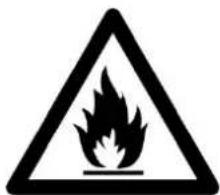
Caution: risk of fire
If the refrigerant circuit should be damaged:
- Avoid opening flames and sources of ignition. • Thoroughly ventilate the room in which the appliance is situated.
- WARNING — Keep ventilation openings, in the appliance enclosure or in the built-in structure, clear of obstruction.
- WARNING — Do not use mechanical devices or other means to accelerate the defrosting process, other than those recommended by the manufacturer.
- WARNING — Do not damage the refrigerant circuit.
- WARNING — Do not use electrical appliances inside the food storage compartments of the appliance, unless they are of the type recommended by the manufacturer.
- WARNING — The refrigerant and insulation blowing gas are flammable. When disposing of the appliance, do so only at an authorized waste disposal centre. Do not expose to flame.
RECOMMENDATIONS
1) The appliance has to be unplugged after use and before carrying out user maintenance on the appliance.
2) This appliance is not intended for use by persons (including children) with reduced physical, sensory or mental capabilities, or lack of experience and knowledge, unless they have been given supervision or instruction concerning use of the appliance by a person responsible for their safety.
3) Children should be supervised to ensure that they do not play with the appliance.
4) If the supply cord is damaged, it must be replaced by the manufacturer, its service agent or similarly qualified persons in order to avoid a hazard.
5) Do not store explosive substances such as aerosol cans with a flammable propellant in this appliance.
WARNING: Keep ventilation openings, in the appliance enclosure or in the built-in structure, clear of obstruction.
WARNING: Do not use mechanical devices or other means to accelerate the defrosting process, other than those recommended by the manufacturer.
WARNING: Do not damage the refrigerant circuit.
WARNING: Do not use electrical appliances inside the food storage compartments of the appliance, unless they are of the type recommended by the manufacturer.
CONTENTS
Safety warnings
Meaning of safety warning symbols 2
Related warnings for use 2
Electricity related warnings 2
Warnings related to placing items 5
Warnings related to disposal 5
Proper use of refrigerators
Names of components 6
Thermostat 7
Illuminating lamp and replacement 7
Placement 7
Start 7
Maintenance of refrigerators
Cleaning 8
Stop using 8
Frequently asked questions
Door install guidelines about swapping left&right
Tips for energy saving
DEAR CUSTOMER:
Thank you for buying this refrigerator-freezer. To ensure that you get the best results from your new refrigerator-freezer, please take time to read through the simple instructions in this booklet.
Please ensure that the packing material is disposed of in accordance with the current environmental requirements.
When disposing of any refrigerator-freezer equipment, please contact your local waste disposal department for advice on safe disposal.
This appliance must only be used for its intended purpose.
This appliance is intended to be used in household and similar applications such as:
- staff kitchen areas in shops, offices and other working environments;
- farm houses and by clients in hotels, motels and other residential type environments;
- bed and breakfast type environments;
- and similar non-retail applications.
▶ Meaning of safety warning symbols

Prohibition symbols
The symbols indicate prohibited matters, and those behaviors are forbidden. Non-compliance with the instructions may result in product damages or endanger the personal safety of users.

Warning symbols
The symbols indicate matters that must be followed, and those behaviors must be strictly executed in line with the operation requirements. Non-compliance with the instructions may result in product damages or endanger the personal safety of users.

Note symbols
The symbols indicate matters to pay attention to, and these behaviors shall be specially noted. Due precautions are needed or minor or moderate injuries or damages of the product will be caused.
CAUTION:
The appliance is not intended for use by young children or infirm persons without supervision.
Young children should be supervised to ensure that they do not play with the appliance.
GENERAL:
This type of refrigerator-freezer is widely used in places such as hotels, offices, student dormitories and houses. It is mostly suitable for refrigerating and preserving foods such as fruits and beverage. It enjoys the advantages of small size, Lightweight, Low electric consumption and easy use.
This manual contains lots of important safety information which shall be observed by the users.
WARNING

Caution: risk of fire
RECOMMENDATIONS
1) The appliance has to be unplugged after use and before carrying out user maintenance on the appliance.
2) This appliance is not intended for use by persons (including children) with reduced physical, sensory or mental capabilities, or lack of experience and knowledge, unless they have been given supervision or instruction concerning use of the appliance by a person responsible for their safety.
3) Children should be supervised to ensure that they do not play with the appliance.
4) If the supply cord is damaged, it must be replaced by the manufacturer, its service agent or similarly qualified persons in order to avoid a hazard.
5) Do not store explosive substances such as aerosol cans with a flammable propellant in this appliance.
WARNING: Keep ventilation openings, in the appliance enclosure or in the built-in structure, clear of obstruction. WARNING: Do not use mechanical devices or other means to accelerate the defrosting process, other than those recommended by the manufacturer.
WARNING: Do not damage the refrigerant circuit.
WARNING: Do not use electrical appliances inside the food storage compartments of the appliance, unless they are of the type recommended by the manufacturer.
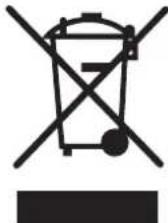
Correct Disposal of this product
This appliance is marked according to the European directive 2012/19/EU on Waste Electrical and Electronic Equipment (WEEE).
WEEE contains both polluting substances (which can cause negative consequences for the environment) and basic components (which can be re-used). It is important to have WEEE subjected to specific treatments, in order to remove and dispose properly all pollutants, and recover and recycle all materials.
Individuals can play an important role in ensuring that WEEE does not become an environmental issue; it is essential to follow some basic rules.
WEEE should not be treated as household waste.
WEEE should be handed over to the relevant collection points managed by the municipality or by registered companies.
In many countries, for large WEEE, home collection could be present.
When you buy a new appliance, the old one may be returned to the retailer who has to collect it free of charge on a one-to-one basis, as long as the equipment is of equivalent type and has the same functions as the supplied equipment.
REQUESTING ASSISTANCE OR SERVICE
If the problem is not due to one of the items listed in Troubleshooting, Contact the dealer or authorized Service Company.
By placing the C6 mark on this product, we are confirming compliance to all relevant European safety, health and environmental requirements which are applicable in legislation for this product.
Tips for energy saving
Try not to open the door too often, especially when the weather is wet and hot. Once you open the door, close it as soon as possible.
Every now and then check if the appliance is sufficiently ventilated (adequate air circulation behind the appliance).
In normal temperature conditions, please set the thermostat to the middle setting.
Before loading the appliance with packages of fresh food, make sure they are cooled to ambient temperature.
Ice and frost layers increase energy consumption, so clean the appliance as soon as the layer is 3-5 mm thick.
The appliance should be located in the coolest area of the room, away from heat-producing appliances or heating ducts, and out of direct sunlight.
Let hot foods cool to room temperature before placing them in the appliance. Overloading the appliance forces the compressor to run longer. Foods that freeze too slowly may lose quality or spoil.
Be sure to wrap foods properly and wipe containers dry before placing them in the appliance. This reduces frost build-up inside the appliance.
The appliance storage bin should not be lined with aluminum foil, wax paper, or paper toweling. Liners interfere with cold air circulation, making the appliance less efficient.
Organize and label food to reduce door openings and extended searches. Remove as many items as needed at one time, and close the door as soon as possible.
▶ Electricity-related warnings


- Do not pull the power cord when pulling the power plug of the refrigerator. Please firmly grasp the plug and pull it out from the socket directly.
- Do not damage the power cord under any condition to ensure safe use. Do not use the appliance if the power cord is damaged or the plug is worn.
- A worn or damaged power cord shall be replaced at manufacturer-authorized maintenance stations.
- Please use a dedicated three-hole power socket rated at 10A or more, and do not share the socket with other electrical appliances.
- The power cord should be firmly connected to the socket, otherwise fires might be caused. Please ensure that the grounding electrode of the power socket is equipped with a reliable grounding line.
- This appliance should be used only with a socket with a minimum rating of 13 amps. Our ready-fitted plug is already equipped with a 13-amp fuse that is BS 1362 ASTA approved. Any replacement should be exactly the same.
- The refrigerator operates on 220-240V/50Hz AC power. Voltage fluctuations outside the range of 187-264V can cause malfunction or even damage. Therefore, a 750W automatic voltage regulator must be installed in conjunction with the AC power supply.
- In case of leakage of gas or other flammable gases, turn off the gas valve and open the doors and windows. Do not unplug the refrigerator or other electrical appliances, as sparks may cause a fire.
For safety, it is not recommended to place appliances such as voltage regulators, rice cookers, and microwave ovens on top of the refrigerator, except those recommended by the manufacturer. Do not use electrical appliances inside the food storage compartment.
Related warnings for use
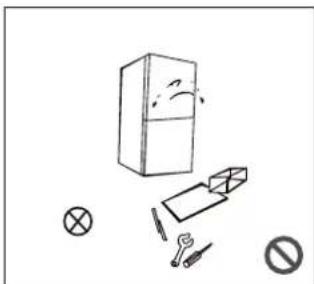

- Unauthorized dismantling or modification of the refrigerator is prohibited. It is forbidden to damage the refrigerant lines. Repair and maintenance must be carried out by qualified professionals.
- A damaged power cord must be replaced by the manufacturer, its service agent, or similarly qualified persons to avoid hazards.
- The surrounding area of the appliance or the built-in structure must not be obstructed, and good ventilation must be maintained.
- The gaps between refrigerator doors and between the doors and the body are small. Be careful not to put your hands in these areas to avoid pinching your fingers. Close the refrigerator door gently to prevent items from falling.
- Do not pick up food or containers from the freezer compartment while the refrigerator is running, especially metal containers, to avoid frostbite.

Do not allow children to enter or climb inside the refrigerator to prevent them from being trapped or injured by the refrigerator falling over.
Do not spray water on or wash the refrigerator. Do not place it in damp areas where it may be splashed with water, as this could affect the electrical insulation properties.

Do not place heavy objects on top of the refrigerator, as they may fall when opening the door and cause accidental injury.
Unplug the refrigerator in case of power failure or during cleaning. Do not reconnect the freezer to the power supply within five minutes to prevent damage to the compressor due to successive starts.
▶ Warnings related to placing items
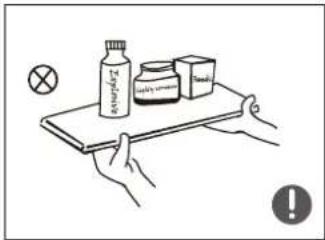
- Do not put flammable, explosive, volatile and highly corrosive items in the refrigerator to prevent damages to the product or fire accidents.
- Do not place flammable items near the refrigerator to avoid fires.
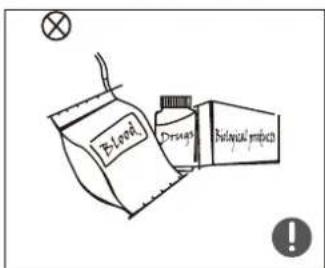
- This product is a household refrigerator and shall be only suitable for the storage of foods. According to national standards, household refrigerators shall not be used for other purposes, such as storage of blood, drugs or biological products.

- Do not place items such as bottled or sealed containers of fluid such as bottled beers and beverages in the freezer to prevent bursts and other losses.
▶ Warnings related to disposal

The refrigerator's R600a refrigerant and cyclopentane foam materials are combustible materials and discarded refrigerators should be isolated from fire sources and cannot be burned. Please transfer the freezer to qualified professional recycling companies for processing to avoid damages to the environment or other hazards.

Please remove the door of the refrigerator and shelves which shall be properly placed to avoid accidents of children entering and playing in the refrigerator.
▶ Names of components

Refrigerating chamber
- The Refrigerating chamber is suitable for storage of a variety of fruits, vegetables, beverages and other food consumed in the short term.
- Cooking foods shall not be put in the refrigerating chamber until cooled to room temperature.
- Foods are recommended to be sealed up before putting into the refrigerator.
- The glass shelves can be adjusted up or down for a reasonable amount of storage space and easy use.
Freezing chamber
- The low temperature freezing chamber may keep food fresh for a long time and it is mainly used to store frozen foods and making ice.
- The freezing chamber is suitable for storage of meat, fish, shrimp, dumplings, rice balls and other foods not to be consumed in short term.
- Chunks of meat are preferably to be divided into small pieces for easy access. Please be noted food shall be consumed within the shelf time.

The features and accessories of the refrigerator you bought may be not entirely consistent with the legend, please refer to the packing list.
▶ Thermostat
- The temperature selector knob is located on the right hand side wall of the refrigerator interior. Setting "Off": UnitOff
Setting "Min": Less Cool Temperature
Setting "Med": Normal Operation (adequate for most situations)
Setting "Max": Coolest Temperature
- When environment temperatures is high (e.g. on hot summer days), if the thermostat setting is Coolest (positioning MAX), the compressor runs continuously.
Reason: when the ambient temperature is high, the compressor runs continuously to maintain the low temperature in the appliance.
- For the first time you install your refrigerator, set the thermostat knob at "Med".
Give your refrigerator time to cool down completely before adding food. It is the best to wait 24 hours before adding food. The thermostat knob controls the temperature. When the thermostat control knob is set to OFF, the refrigerator will not be running.
- The freezing and storage test should be done, according to regulation, removing all drawers except the bottom one.

▶ Illuminating lamp and replacement
- If the refrigerator lamps are damaged, please contact our customer service.
Placement

- Before using the refrigerator, remove all packaging materials, including bottom cushions, foam pads, and tapes inside the refrigerator. Tear off the protective film on the door and the refrigerator body.


- Keep away from heat and avoid direct sunlight. Do not place the freezer in moist or watery places to prevent rust or reduction of insulating effect.

Start
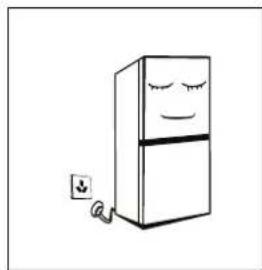
- The refrigerator should stay for half an hour before connecting to a 220-240V/50Hz power supply when it is first started.
- The refrigerator should run for 2 to 3 hours before loading fresh or frozen foods. In summer, considering the high ambient temperature, the refrigerator should run for more than 4 hours in advance.

- The refrigerator should be placed in a well-ventilated indoor area. The ground should be flat and sturdy (rotate left or right to adjust the wheel for leveling if unstable).
- The top space of the refrigerator should be greater than 30 cm, and the distances from both sides and backside should be more than 10 cm to facilitate opening, closing, and heat dissipation.
- Wipe the refrigerator inside and outside with a warm, moist rag (add a small amount of detergent to the warm water and wipe clean finally with clean water).
- Please leave enough space to ensure feasible opening and drawer removal.
- Dimensions shown are for reference only.
Cleaning
- Dust behind the refrigerator and on the ground should be cleaned timely to improve cooling effect and energy saving. The interior of the refrigerator should be cleaned regularly to avoid odor. Soft towels or sponges dipped in water and non-corrosive neutral detergents are suggested for cleaning. The freezer should be finally cleaned with clean water and a dry cloth. Open the door for natural drying before the power is turned on.

- Do not use hard brushes, clean steel balls, wire brushes, abrasives (such as toothpastes), organic solvents (such as alcohol, acetone, banana oil, etc.), boiling water, or acid or alkaline items to clean the refrigerator, as this may damage the fridge surface and interior.
- Do not rinse with water so as not to affect the electrical insulation properties. Please use a dry cloth when cleaning lighting lamps, temperature control knob and electrical components.

Please unplug the refrigerator for defrost and cleaning.
▶ Stop using
Foods can be preserved for a couple of hours even in summer in case of power failure; it is recommended to reduce the frequency of opening door and do not put fresh foods into the freezer.
Please unplug the refrigerator left unused for a long time for cleaning. Keep the door open to avoid the bad odor.
Before moving the refrigerator, please remove all items in the refrigerator and fasten the glass partitions, fruit and vegetable boxes, freezer drawers with taps lest the door opens during displacement; Do not turn upside, horizontally place or vibrate the refrigerator, the carrying angle can not be greater than 45 °C.

Continuous operation is recommended when the refrigerator is started. Please do not move the refrigerator under normal circumstances so as not to affect the refrigerator's service life.
The following simple issues can be handled by the user. Please call the after-sale service department if the issues are not settled.
| Inoperation | Whether the freezer is plugged and connected to power;Low voltage;Failure power or tripping circuit |
| Odor | Odorous foods should closely wrapped;Whether foods are rotten;Whether the interior shall be cleaned. |
| Foods in the refrigerating chamber are frozen | Whether the thermostat is over adjusted;Whether foods containing water is put in inside the glass partition. |
| Long-term operation of compressor | It is normal that refrigerator operates for longer time in summer when the ambient temperature is higher;Do not put too much food in the freezer at one time;Do not put foods until they are cooled;Frequent opening of refrigerator door.Thick frost layer (defrost is needed) |
| Illuminating light does not shine | Whether the refrigerator is connected to power,whether the illuminating light is damaged. |
| The refrigerator door can not be properly closed. | The freezer door is stuck by food packages;Too much food;Tilt refrigerator. |
| Loud noises | Whether the food is leveled, whether the refrigerator is balanced;Whether the refrigerator parts are properly placed. |
Warm tips:
◆The refrigerator enclosure may emit heat during operation specially in summer, this is caused by the radiation of the condenser, and it is a normal phenomenon.
◆Condensation: condensation phenomenon will be detected on the exterior surface and door seals of the freezer when the ambient humidity is large, this is a normal phenomenon, and the condensation can be wiped away with a dry towel.
◆Airflow sound: Refrigerants circulating in the refrigerant lines will produce eruption of sound and grunts which is normal does not affect the cooling effect.
◆Buzz: Buzz will be generated by running compressor specially when starting up or shutting down. ◆Clatter: The solenoid valve or electric switch valve will clatter which is a normal phenomenon and does not affect the operation.
◆The refrigerating chamber will periodically frost and defrost (water drops will be generated on the backside of the refrigerating chamber when defrosting) which are normal.
Door install guidelines about swapping left&right

- Remove the four screw caps and two catches with the even-slot screwdriver. Then disassemble the screws on the fixed roof with the cross-slot screwdriver.

- Remove the screws fixing the top-hinge with a cross-slot screwdriver.
- Replace the top-hinge, the top-door limit block, and the door bearing bush to the other side.

A. Remove the nut with a sleeve. Take off the washer, then remove the axes to the other side and fix them.
B. Remove the top door limit block.


Door installation guidelines for swapping left and right.

C. Please take out another door limit block and mount it to the door with screws.

4. Disassemble the screws fixing the bottom-hinge with a cross-slot screwdriver.
The screws fixing the bottom-hinge.
Note: the refrigerator-freezer incline angle should be less than 45 degrees.

5. Replace the bottom door bearing bush and the limit block.

6. Replace the bottom hinge to the other side, then fix it with screws.

7. Replace the mid-hinge.
8. Set the bottom door to the right position and fix the mid-hinge.
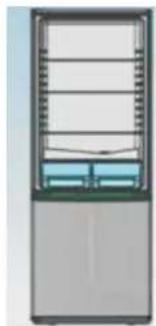

9. Replace the top hinge.
Door installation guidelines for swapping left and right.

10. Set the top door to the right position, fix the top hinge and the cover.
11. Install the four screw caps and two catches to the corresponding positions.
- Ensure the appliance is unplugged and empty.
- Adjust the two leveling feet to their highest position. • We recommend you have someone to assist you.
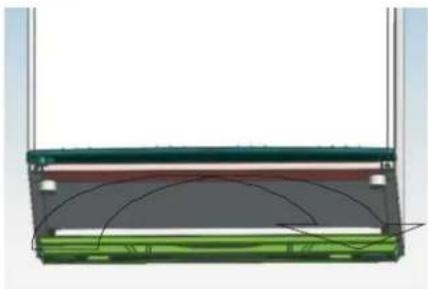
12. Replace the leveler to the other side and adjust it to make sure the cabinet is level.
Attachment:
- Components that can be transferred from one side to the other directly after disassembling are listed below:
Top door top endcap coverslip (2 pcs)
Top cover buckle (1 pc)
Hinge shaft sleeve (1 or 2 pcs)
Screws of top hinge (3 pcs)
Middle hinge assembly (1 pc)
screws of middle hinge (2 pcs)
insert nail (2 pcs)
screw cap (2 pcs)
door stopper (1 pc)
bottom hinge assembly (1 pc)
screws of lower hinge (3 pcs)
- The component that could be swapped over from one side to the other only after reconstruction is listed below:
top hinge assembly
- Components that could be swapped over from one side to the other in pairs are listed below:
adjustable foot with internal thread (used with the lower hinge)
adjustable foot with bolt (fixed at the bottom)
- Components that could not be reused temporarily are listed below:
Ensure the Appliance is unplugged and empty.
Adjust the two leveling feet to their highest position.
We recommend you have someone to assist you.
NOTE:
To take the door off it is necessary to tilt the Appliance backward.
You should rest the Appliance on something solid e.g. a chair just below the top panel.
Do not lay the Appliance completely flat as this may damage the coolant system.
- INTRODUCTION
- SAFETY INFORMATION
- SCRAPPING OLD APPLIANCES
- CONFORMITY
- ENERGY SAVING
- WARNING
- RECOMMENDATIONS
- CONTENTS
- SAFETY WARNINGS
- PROPER USE OF REFRIGERATORS
- MAINTENANCE OF REFRIGERATORS
- FREQUENTLY ASKED QUESTIONS
- DOOR INSTALL GUIDELINES ABOUT SWAPPING LEFT&RIGHT
- TIPS FOR ENERGY SAVING
- DEAR CUSTOMER
- CAUTION
- GENERAL
- ELECTRICITY-RELATED WARNINGS
- RELATED WARNINGS FOR USE
- REFRIGERATING CHAMBER
- FREEZING CHAMBER
- THERMOSTAT
- ILLUMINATING LAMP AND REPLACEMENT
- PLACEMENT
- START
- CLEANING
- STOP USING
- WARM TIPS
- DOOR INSTALLATION GUIDELINES FOR SWAPPING LEFT AND RIGHT
- ATTACHMENT
Brand : HOOVER
Model : HCSB 5172 WK/P
Category : Refrigerator