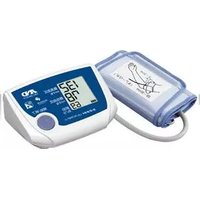
UA-767PBT-C - Sphygmomanometer A&D Médical - Free user manual and instructions
Find the device manual for free UA-767PBT-C A&D Médical in PDF.


| Product Type | Upper Arm Blood Pressure Monitor with Bluetooth Connectivity |
| Model | UA-767PBT-C |
| Brand | A&D Medical |
| Dimensions (approx.) | 105 x 70 x 150 mm (4.1 x 2.8 x 5.9 in) |
| Weight (without batteries) | Approx. 300 g (10.6 oz) |
| Power Supply | 4 AA batteries (not included) or AC adapter (optional) |
| Battery Life | Approx. 300 measurements at 23°C using alkaline batteries |
| Measurement Method | Oscillometric |
| Measurement Range | Pressure: 0-280 mmHg; Pulse: 40-180 beats/min |
| Accuracy | Pressure: ±3 mmHg; Pulse: ±5% |
| Cuff Applicable Arm Circumference | 22-32 cm (standard cuff); optional larger cuff 32-42 cm |
| Memory | Stores 90 measurements per user (2 users) plus guest mode |
| Bluetooth | Bluetooth 4.0 Low Energy for data transmission to smartphone app |
| Display | LCD digital display with date/time, systolic, diastolic, pulse, and irregular heartbeat indicator |
| Clinical Validation | Validated according to ESH and AAMI standards |
| Maintenance | Clean with soft dry cloth; avoid water; do not use chemicals; store in a cool dry place |
| Safety | Automatically deflates if cuff pressure exceeds 300 mmHg; detected arrhythmia flag |
| Compatible Accessories | Optional AC adapter (model TA-30), adult large cuff, child cuff, carrying case |
| Repairability | Contact A&D customer service for spare parts; device not user-serviceable |
| General Information | Intended for home use; operating temperature 10-40°C; storage temperature -20-60°C; humidity 15-85% RH |
Frequently Asked Questions - UA-767PBT-C A&D Médical
User questions about UA-767PBT-C A&D Médical
0 question about this device. Answer the ones you know or ask your own.
Ask a new question about this device
Download the instructions for your Sphygmomanometer in PDF format for free! Find your manual UA-767PBT-C - A&D Médical and take your electronic device back in hand. On this page are published all the documents necessary for the use of your device. UA-767PBT-C by A&D Médical.
USER MANUAL UA-767PBT-C A&D Médical
Digital Blood Pressure Monitor
Model UA-767/BTAC
Instruction Manual
Original
ENGLISH
Dear Customers ....2
Preliminary Remarks....2
Precautions 2
Contraindications ....3
Parts Identification ....4
Symbols 5
Using The Monitor....6
Installing / Changing The Batteries 6
Connecting The Air Hose 6
Connecting The AC Adapter....7
Pairing The PBT-C Series Device With A Continua Manager...7
Selecting The Correct Cuff Size 8
Applying The Arm Cuff 9
How To Take Proper Measurements 9
Measurement....9
After Measurement 9
Measurements....10
Normal Measurement....10
Measurement With The Desired Systolic Pressure .....11
Notes For Proper Measurement ....11
What Is An Irregular Heartbeat....12
Pressure Bar Indicator....12
Transmitting Data To A Continua Manager ....12
About Blood Pressure 13
What Is Blood Pressure? 13
What Is Hypertension And How Is It Controlled? ......13
Why Measure Blood Pressure At Home? 13
WHO Blood Pressure Classification 13
Blood Pressure Variations....13
Troubleshooting....14
Maintenance....15
Technical Data....15
Dear Customers
Congratulations on purchasing a state-of-the-art A&D blood pressure monitor, one of the most advanced monitors available today. Designed for ease of use and accuracy, this monitor will facilitate your daily blood pressure regimen.
We recommend that you read through this manual carefully before using the device for the first time.
Preliminary Remarks
☐ This device conforms to the European Directive 93/42 EEC for Medical Products. This is made evident by the C0123 mark of conformity. (0123: The reference number to the involved notified body)
☐ The WML-40AH is approved in accordance to R&TTE directive transmitter module marked by C€0678, manufactured by MITSUMI incorporated to OEM product.
☐ The device complies with part 15 of the FCC rules and contains the FCC ID POOWML-C40.
☐ Compliance with Industry Canada.
IC: 4250A-WMLC40.
☐ The device is a Continua certified, Bluetooth wireless technology enabled medical device.
☐ The device is designed for use on adults only, not newborns or infants.
□ Environment for use
The device is for use in the home healthcare environment.
☐ This device is designed to measure blood pressure and pulse rate of people for diagnosis.
Precautions
☐ Precision components are used in the construction of this device. Extremes in temperature, humidity, direct sunlight, shock or dust should be avoided.
☐ Clean the device and cuff with a dry, soft cloth or a cloth dampened with water and a neutral detergent. Never use alcohol, benzene, thinner or other harsh chemicals to clean the device or cuff.
☐ Avoid tightly folding the cuff or storing the hose tightly twisted for long periods, as such treatment may shorten the life of the components.
☐ The device and cuff are not water resistant. Prevent rain, sweat and water from soiling the device and cuff.
□ Measurements may be distorted if the device is used close to televisions, microwave ovens, cellular telephones, X-ray or other devices with strong electrical fields.
☐ Used equipment, parts and batteries are not treated as ordinary household waste, and must be disposed of according to the applicable local regulations.
☐ When the AC adapter is used, make sure that the AC adapter can be readily removed from the electrical outlet when necessary.
☐ When reusing the device, confirm that the device is clean.
☐ Do not modify the device. It may cause accidents or damage to the device.
☐ To measure blood pressure, the arm must be squeezed by the cuff hard enough to temporarily stop blood flow through the artery. This may cause pain, numbness or a temporary red mark to the arm. This condition will appear especially when measurement is repeated successively.
Any pain, numbness, or red marks will disappear with time.
Contraindications
The following are precautions for proper use of the device.
☐ Do not apply the cuff to an arm with another medical electrical equipment attached. The equipment may not function properly.
☐ People who have a severe circulatory deficit in the arm must consult a doctor before using the device, to avoid medical problems.
☐ Do not self-diagnose the measurement results and start treatment by yourself. Always consult your doctor for evaluation of the results and treatment.
☐ Do not apply the cuff on an arm with an unhealed wound.
☐ Do not apply the cuff on an arm receiving an intravenous drip or blood transfusion. It may cause injury or accidents.
☐ Do not use the device where flammable gases such as anesthetic gases are present. It may cause an explosion.
☐ Do not use the device in highly concentrated oxygen environments, such as a high-pressure oxygen chamber or an oxygen tent. It may cause a fire or explosion.
Parts Identification


Symbols
| Symbols | Function / Meaning Recommended Action | |
 | Standby and power on. | —— |
 | Battery installation guide | —— |
 | Direct current | —— |
 | Type BF: Device, cuff and tubing are designed to provide special protection against electrical shocks. | —— |
 | The indicator that appears while measurement is in progress. It blinks when the pulse is detected. | Measurement is in progress. Remain as still as possible. |
 | Irregular Heartbeat indicator. (I.H.B.) The indicator that appears when an irregular heartbeat or any excessive body movement is detected during the measurement. | —— |
 | Previous measurements stored in MEMORY. | —— |
 Full Battery Full Battery | The battery power indicator during the measurement. | —— |
 Low Battery Low Battery | The indicator blinks when battery power is low. | Replace all batteries with new ones, when the indicator blinks. |
 | Unstable blood pressure due to movement during the measurement. | Try the measurement again. Remain very still during the measurement. |
| The systolic and diastolic values are within 10 mmHg of each other. | Fasten the cuff correctly, and try the measurement again. | |
| The pressure value did not increase during inflation. | ||
 | The cuff is not fastened correctly. | |
Err | The pulse is not detected correctly. | |
| SYS | Systolic blood pressure in mmHg | —— |
| DIA | Diastolic blood pressure in mmHg. | —— |
| PUL./min | Pulse per minute | —— |
| [BHDW] | EC directive medical device label | —— |
 | R&TTE directive transmitter module label | —— |
| [CA#2] | Manufacturer | —— |
| [OWT4] | EU-representative | —— |
 | Date of manufacture | —— |
| [43CX] | Class II device | —— |
 | WEEE label | —— |
| Symbols | Function / Meaning Recommended Action | |
| Refer to instruction manual/booklet | ______ | |
| SN | Serial number | ______ |
| ⊖⊖⊖ | Polarity of DC jack | |
Using The Monitor
Installing / Changing The Batteries
- Slide the battery cover up to open it.
- Remove the used batteries and insert new batteries into the battery compartment as shown, taking care that the polarities (+) and (-) are correct.
- Slide the battery cover down to close.
Use only LR6, R6P or AA batteries.

CAUTION
☐ Insert the batteries as shown in the battery compartment. If not, the device will not work.
☐ When ☐ (LOW BATTERY mark) blinks in the display, replace all batteries with new ones. Do not mix old and new batteries. It may shorten the battery life, or cause the device to malfunction.
☐ (LOW BATTERY mark) does not appear when the batteries are drained.
☐ Battery life varies with the ambient temperature and may be shorter at low temperatures.
☐ Remove the batteries if the device is not to be used for a long time.
The batteries may leak and cause a malfunction.
☐ Use the specified batteries only. The batteries provided with the device are for testing monitor performance and may have a limited life.
Connecting The Air Hose
Insert the air connector plug into the air socket firmly.
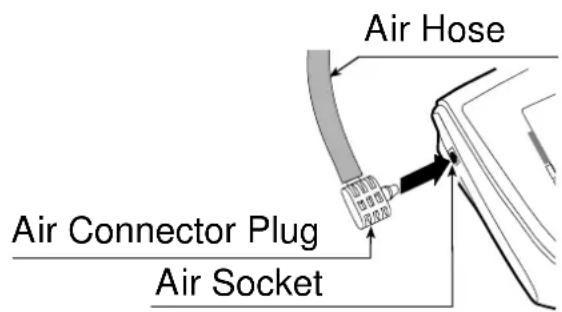
Using The Monitor
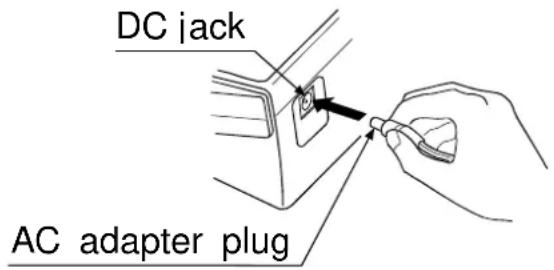
Connecting The AC Adapter
Insert the AC adapter plug into the DC jack.
Next, connect the AC adapter to an electrical outlet.
□ Use the specified AC adapter.
(Refer to page 16.)
Pairing The PBT-C Series Device With A Continua-Compliant Manager
Model UA-767 Plus BT-C is a PBT-C series device. PBT-C series devices are designed to be connected only with Continua Managers.
To pair the device with a Manager, please follow these steps:
- Remove the four batteries from the device.
- Press the START button several times to discharge the device completely.
- Insert the four batteries into the device.
- Refer to the Manager's instruction manual to start a Bluetooth discovery and inquiry process.
The device will stay discoverable for 60 seconds.
If the Manager fails to pair with the device, repeat steps 1 through 3.
- Once the Manager has discovered the device, enter the PIN "123456" as a password to finish the pairing process.
When the Manager supports SSP (Secure Simple Pairing), no password is required for the pairing process.

Continua™
CERTIFIED
A device that has been certified by Continua displays this logo.

Bluetooth®
A Bluetooth device has the logo mark of Bluetooth printed on it.
Using The Monitor
Selecting The Correct Cuff Size
Using the correct cuff size is important for an accurate reading. If the cuff is not the proper size, the reading may yield an incorrect blood pressure value.
☐ The arm size is printed on each cuff.
☐ The index ▲ and proper fit range, on the cuff, tell you if you are applying the correct cuff. (Refer to "Symbols that are printed on the cuff".)
☐ If the index ▲ points outside of the range, contact your local dealer to purchase a replacement cuff.
☐ The arm cuff is a consumable. If it becomes worn, purchase a new one.
| Arm Size Recommended Cuff Size Catalog Number | |
| 32 cm to 45 cm Large adult cuff CUF-D-LA | |
| 22 cm to 32 cm Adult cuff | CUF-D-A |
Arm size: The circumference of the biceps.
Note: Model UA-76Plus BT-C is not designed for using a small adult cuff.
Symbols that are printed on the cuff
| Symbols | Function/Meaning | Recommended Action |
| ● | Artery position mark | Set the ● mark on the artery of the upper arm or in line with the ring finger on the inside of the arm. |
| ▲ | Index | ____ |
| REF | Catalog number | ____ |
| A | Proper fit range for the adult cuff.It's printed on the adult cuff. | ____ |
| L | Range to use the large adult cuff.Over range printed on the adult cuff. | Use the large adult cuff instead of the adult cuff. |
| L | Proper fit range for the large adult cuff.It's printed on the large adult cuff. | ____ |
| S | Under range printed on the adult cuff. | ____ |
| A | Range to use the adult cuff.It's printed on the large adult cuff. | Use the adult cuff instead of the large adult cuff. |
| LOT | Lot number | ____ |

Using The Monitor
Applying The Arm Cuff
- Wrap the cuff around the upper arm, about 1-2 cm above the inside of the elbow, as shown.
Place the cuff directly against the skin, as clothing may cause a faint pulse, and result in a measurement error.
- Constriction of the upper arm, caused by tightly rolling up a shirtsleeve, may prevent accurate readings.
- Confirm that the index ▲ points within the proper fit range.

How To Take Proper Measurements
For the most accurate blood pressure measurement:
Sit comfortably on a chair. Rest your arm on the table. Do not cross your legs. Keep your feet on the floor and straighten your back.
☐ Relax for about five to ten minutes before measurement.
☐ Place the center of the cuff at the same height as your heart.
□ Remain still and keep quiet during measurement.
☐ Do not measure immediately after physical exercise or a bath. Rest for twenty or thirty minutes before taking the measurement.
☐ Try to measure your blood pressure at the same time every day.
Measurement
During measurement, it is normal for the cuff to feel very tight. (Do not be alarmed)
After Measurement
After measurement, press the START button to turn off the power. Remove the cuff and record your data.
Note: The device has an automatic power shut-off function, which turns the power off approximately one minute after measurement.
Allow at least three minutes between measurements on the same person.
Measurements
Model UA-767Plus BT-C is designed to detect the pulse and to inflate the cuff to a systolic pressure level automatically.
If your systolic pressure is expected to exceed 230 mmHg or you use the optional small cuff, read "Measurement with the desired systolic pressure" on the next page.
Normal Measurement
- Place the cuff on the arm (preferably the left arm). Sit quietly during measurement.
- Press the START button.
The last data of systolic and diastolic pressure and pulse rate are displayed briefly. Then the display changes, as indicated in the figure at the right, as the measurement begins. The cuff starts to inflate. It is normal for the cuff to feel very tight. A pressure bar indicator is displayed, as in the figure at the right, during inflation.
Note: If you wish to stop inflation at any time, press the START button again.
- When inflation is complete, deflation starts automatically and the ♥ (heart mark) blinks, indicating that the measurement is in progress. Once the pulse is detected, the mark blinks with each pulse beat.
Note: If an appropriate pressure is not obtained, the device starts to inflate again automatically.
- When the measurement is complete, the systolic and diastolic pressure readings and pulse rate are displayed. The cuff exhausts the remaining air and deflates completely.
- Press the START button again to turn off the power.
Note: Model UA-767 Plus BT-C is provided with an automatic power shut-off function. Allow at least three minutes between measurements on the same person.
![graph TD A["At heart level"] --> B["START button"] B --> C["The last data at initial display"] C --> D["Starts inflation"] D --> E["Pressurizing"] E --> F["Measurement in progress"] F --> G["Systolic pressure"] G --> H["Diastolic pressure"] H --> I["Pulse rate"] I --> J["Exhausts remaining air autom…](/content/2026/06/1278519/images/7ff52b0f96969854e002a30960cc24832b3d659e934a08809495576375dd128c.jpg)
Measurements
Measurement With The Desired Systolic Pressure
If your systolic pressure is expected to exceed 230 mmHg or you use the optional small cuff, use this procedure.
- Place the cuff on the arm (preferably the left arm).
- Press and hold the START button until a number about 30 to 40 mmHg higher than your expected systolic pressure appears.
- Release the START button to start measurement, when the desired number is reached. Then continue to measure your blood pressure as described on the previous page.
At heart level

Press and hold the button
Release the button at the desired systolic pressure

Refer to the previous page for measurement
Notes For Proper Measurement
☐ Sit down in a comfortable position. Place the arm to be used for the measurement on a table or other support so that the center of the cuff will be at the same height as your heart.
☐ Relax for about five or ten minutes before taking a measurement. If you are excited or depressed by emotional stress, the measurement will reflect this stress as a higher (or lower) than normal blood pressure reading and the pulse reading will usually be faster than normal.
An individual's blood pressure varies constantly, depending on what you are doing and what you have eaten. What you drink can have a very strong and rapid effect on your blood pressure.
☐ This device bases its measurements on the heartbeat. If you have a very weak or irregular heartbeat, the device may have difficulty determining your blood pressure.
☐ Should the device detect a condition that is abnormal, it will stop the measurement and display an error symbol. See page 5 for the description of symbols.
☐ This blood pressure monitor is intended for use by adults only. Consult with your physician before using this device on a child. A child should not use this device unattended.
What Is An Irregular Heartbeat
Model UA-762us BT-C blood pressure monitor provides a blood pressure and pulse rate measurement even when an irregular heartbeat occurs. An irregular heartbeat is defined as a heartbeat that varies by 25% from the average of all heartbeats during the blood pressure measurement. It is important that you be relaxed, remain still and do not talk during measurements.
Note: We recommend contacting your physician if you see this (♡) indicator frequently.
Pressure Bar Indicator
The indicator monitors the progress of pressure during measurement.
![graph LR A["Pressurizing"] --> B["Inflation in progress"] B --> C["Measurement in progress"] C --> D["Inflation complete"] E["Releasing air"] --> F["Inflation in progress"] F --> G["Measurement in progress"] G --> H["Inflation complete"]](/content/2026/06/1278519/images/60ffe191c4be6edfb3896f466a3f3b0d000e6e9a92913d893ed269c271647138.jpg)
Transmitting Data To A Continua Manager
Measurement results will be automatically transmitted to the paired Manager at each measurement. In the case of unsuccessful transmission, the device stores the last 25 measurements in memory. The device will send all of the data at the next successful connection and clear memory.
About Blood Pressure
What Is Blood Pressure?
Blood pressure is the force exerted by blood against the walls of the arteries. Systolic pressure occurs when the heart contracts. Diastolic pressure occurs when the heart expands. Blood pressure is measured in millimeters of mercury (mmHg). One's natural blood pressure is represented by the fundamental pressure, which is measured first thing in the morning while one is still at rest and before eating.
What Is Hypertension And How Is It Controlled?
Hypertension, an abnormally high arterial blood pressure, if left unattended, can cause many health problems including stroke and heart attack. Hypertension can be controlled by altering lifestyle, avoiding stress, and with medication under a doctor's supervision.
To prevent hypertension or keep it under control:
☐ Do not smoke Exercise regularly
☐ Reduce salt and fat intake Have regular physical checkups
□ Maintain proper weight
Why Measure Blood Pressure At Home?
Blood pressure measured at a clinic or doctor's office may cause apprehension and can produce an elevated reading, 25 to 30 mmHg higher than that measured at home. Home measurement reduces the effects of outside influences on blood pressure readings, supplements the doctor's readings and provides a more accurate, complete blood pressure history.
WHO Blood Pressure Classification
Standards to assess high blood pressure, without regard to age, have been established by the World Health Organization (WHO), as shown in the chart.
Blood Pressure Variations
An individual's blood pressure varies greatly on a daily and seasonal basis. It may vary by 30 to 50 mmHg due to various conditions during the day. In hypertensive individuals' variations are even more pronounced. Normally, the blood pressure rises while at work or play and falls to its lowest levels during sleep. So, do not be overly concerned by the results of one measurement.
Take measurements at the same time every day using the procedure
Reference Material: Journal of Hypertension 1999, Vol 17 No.2

described in this manual to get to know your normal blood pressure. Regular readings give a more comprehensive blood pressure history. Be sure to note date and time when recording your blood pressure. Consult your doctor to interpret your blood pressure data.

Troubleshooting
| Problem | Possible Reason | Recommended |
| Nothing appears in the display, even when the power is turned on. | Batteries are drained. | Replace all batteries with new ones. |
| Battery terminals are not in the correct position. | Reinstall the batteries with negative and positive terminals matching those indicated on the battery compartment. | |
| The cuff does not inflate. | Battery power is low.(LOW BATTERY mark) blinks. [ If the batteries are drained completely, the mark does not appear.] | Replace all batteries with new ones. |
| The unit does not measure. Readings are too high or too low. | The cuff is not applied properly. | Apply the cuff correctly. |
| You moved your arm or body during the measurement. | Make sure you remain very still and quiet during the measurement. | |
| The cuff position is not correct. | Sit comfortably and still.Raise your hand so that the cuff is at the same level as your heart. | |
| —— | If you have a very weak or irregular heat beat, the device may have difficulty in determining your blood pressure. | |
| Other | The value is different from that measured at a clinic or doctor's office. | See “Why measure blood pressure at home”. |
| —— | Remove the batteries. Place them back properly and try the measurement again. |
Note: If the actions described above do not solve the problem, contact the dealer. Do not attempt to open or repair this product, as any attempt to do so will make your warranty invalid.
Maintenance
Do not open the device. It uses delicate electrical components and an intricate air unit that could be damaged. If you cannot fix the problem using the troubleshooting instructions, request service from your dealer or from the A&D service group. The A&D service group will provide technical information, spare parts and units to authorized dealers.
The device was designed and manufactured for a long service life. However it is generally recommended to have the device inspected every 2 years, to ensure proper functioning and accuracy. This maintenance recommendation is for European customers only, to comply with regulatory requirements. Routine inspection and maintenance is not needed for non-European customers. Please contact either your authorized dealer or A&D for maintenance.
Technical Data
Type
UA-767PBT-C
Measurement method Oscillometric measurement
Measurement range Pressure: 20 - 280 mmHg
Pulse: 40 - 200 beats / minute
Measurement accuracy Pressure: ±3 mmHg
Pulse:
Power supply 4 x 1.5V batteries (LR6, R6P or AA) or
AC adapter (TB-233) (Not included)
Number of measurements
Approx. 450 measurements, when AA Alkaline
batteries are used, with pressure value of 180
mmHg at room temperature of 23°C
Classification
Internally powered ME equipment (Supplied by
batteries) /
Class II (Supplied by adapter)
Continuous operation mode
Clinical test According to ANSI / AAMI SP-10 1987
EMC
IEC 60601-1-2: 2007
Wireless communication
WML-40AH (MITSUMI Electronics Co. Ltd.)
Bluetooth Ver.2.1 Class 1 HDP
Continua certified
Operating conditions
+10°C to +40°C / 15%RH to 85 %RH
800 hPa to 1060 hPa
Transport / Storage conditions
-10°C to +60°C / 15%RH to 85 %RH
Dimensions
Approx. 147 [W] x 64 [H] x 110 [D] mm
Weight
Approx. 300 g, excepting batteries
Applied part
Cuff Type BF

Useful life Device: 5 years (when used six times a day)
Cuff: 2 years (when used six times a day)
Accessory AC adapter The adapter is to connect the blood pressure monitor to a power source at home.
TB-233 Please contact your local A&D dealer for purchasing.
The AC adapter is required to be inspected or replaced periodically.
TB-233C Input: 100-240V
Output: 6V

TB-233BF
Input: 100-240V
Output: 500mV

Accessories sold separately
Cuff
| Catalog Number | Cuff Size | Arm Size |
| CUF-D-LA | Large adult cuff | 32 cm to 45 cm |
| CUF-D-A | Adult cuff | 22 cm to 32 cm |
AC adapter
| Catalog Number | Plug |
| TB-233C | Type C |
| TB-233BF | Type BF |
Note: Specifications are subject to change for improvement without prior notice.
EMC table information is listed on our website:
http://www.aandd.jp/products/manual/medical/emc_acadapter_en.pdf
AND

A&D Company, Limited
1-243 Asahi, Kitamoto-shi, Saitama 364-8585 JAPAN
Telephone: [81] (48) 593-1111 Fax: [81] (48) 593-1119

A&D INSTRUMENTS LIMITED
Unit 24/26 Blacklands Way, Abingdon Business Park, Abingdon, Oxfordshire OX14 1DY United Kingdom
Telephone: [44] (1235) 550420 Fax: [44] (1235) 550485
A&D ENGINEERING, INC.
1756 Automation Parkway, San Jose, California 95131 U.S.A.
Telephone: [1] (408) 263-5333 Fax: [1] (408)263-0119
A&D AUSTRALASIA PTY LTD
32 Dew Street, Thebarton, South Australia 5031 AUSTRALIA
Telephone: [61] (8) 8301-8100 Fax: [61] (8) 8352-7409


- DIGITAL BLOOD PRESSURE MONITOR
- MODEL UA-767/BTAC
- INSTRUCTION MANUAL
- DEAR CUSTOMERS
- PRELIMINARY REMARKS
- PRECAUTIONS
- CONTRAINDICATIONS
- USING THE MONITOR
- INSTALLING / CHANGING THE BATTERIES
- CAUTION
- CONNECTING THE AIR HOSE
- CONNECTING THE AC ADAPTER
- PAIRING THE PBT-C SERIES DEVICE WITH A CONTINUA-COMPLIANT MANAGER
- SELECTING THE CORRECT CUFF SIZE
- APPLYING THE ARM CUFF
- HOW TO TAKE PROPER MEASUREMENTS
- MEASUREMENT
- AFTER MEASUREMENT
- MEASUREMENTS
- NORMAL MEASUREMENT
- MEASUREMENT WITH THE DESIRED SYSTOLIC PRESSURE
- NOTES FOR PROPER MEASUREMENT
- WHAT IS AN IRREGULAR HEARTBEAT
- PRESSURE BAR INDICATOR
- TRANSMITTING DATA TO A CONTINUA MANAGER
- ABOUT BLOOD PRESSURE
- WHAT IS BLOOD PRESSURE
- WHAT IS HYPERTENSION AND HOW IS IT CONTROLLED
- WHY MEASURE BLOOD PRESSURE AT HOME
- WHO BLOOD PRESSURE CLASSIFICATION
- BLOOD PRESSURE VARIATIONS
- MAINTENANCE
- TECHNICAL DATA
- AND
- A&D COMPANY, LIMITED
- A&D INSTRUMENTS LIMITED
- A&D ENGINEERING, INC
- A&D AUSTRALASIA PTY LTD
Brand : A&D Médical
Model : UA-767PBT-C
Category : Sphygmomanometer