
SJ-GC480VSL - Refrigerator SHARP - Free user manual and instructions
Find the device manual for free SJ-GC480VSL SHARP in PDF.


| Product type | French door refrigerator-freezer (Side-by-Side) |
| Dimensions (H x W x D) | 1770 x 910 x 760 mm |
| Net weight | 88 kg |
| Power supply | 220-240 V, 50 Hz, 10 A |
| Energy class | A+ |
| Total net volume | 480 L (refrigerator 320 L, freezer 160 L) |
| Cooling system | Ventilated (No Frost) in refrigerator and freezer |
| Water dispenser | External, with built-in water filter |
| Lighting | Interior LED |
| Thermostat | Electronic with digital display |
| Special functions | Vacation mode, rapid cooling, rapid freezing, open door alarm |
| Maintenance and cleaning | Clean with a soft cloth and warm soapy water; automatic defrost |
| Safety | Child lock, alarm sound, surge protection |
| Spare parts and repairability | Parts available through Sharp service; repairability index estimated at 7.5/10 |
| General information | Brand: Sharp; Model: SJ-GC480VSL; Made in Europe; 2-year warranty |
| Color | Stainless steel |
Frequently Asked Questions - SJ-GC480VSL SHARP
User questions about SJ-GC480VSL SHARP
0 question about this device. Answer the ones you know or ask your own.
Ask a new question about this device
Download the instructions for your Refrigerator in PDF format for free! Find your manual SJ-GC480VSL - SHARP and take your electronic device back in hand. On this page are published all the documents necessary for the use of your device. SJ-GC480VSL by SHARP.
USER MANUAL SJ-GC480VSL SHARP

Device of this mark is a trademark of Sharp Corporation. Plasmacluster is a registered trademark or a trademark of Sharp Corporation.
SJ-GC440V SJ-SC440V SJ-GC480V SJ-SC480V
This refrigerator contains flammable refrigerant (R600a: isobutane) and insulation blowing gas (cyclopentane).
Observe the following rules to prevent ignition and explosion.
The refrigeration system behind and inside the refrigerator contains refrigerant. Do not allow any sharp objects to come into contact with the refrigeration system.
Do not use mechanical devices or other means to accelerate the defrosting process. (This refrigerator has adopted automatic defrosting system.)
Do not use electric appliances inside the refrigerator.
Use only the specified parts for the refrigerator • compartment light.
Do not block the openings on the circumference of the refrigerator.
Do not use flammable sprays, such as spray paint near the refrigerator. It may cause explosion or fire.
If the refrigeration system should get punctured, do not touch the wall outlet and do not use open flames. Open the window and air out the room. Then ask a service agent approved by SHARP for servicing.
This refrigerator should be disposed appropriately. • Take the refrigerator to a recycling plant for flammable refrigerant and insulation blowing gases.
Do not store highly volatile and flammable materials such as ether, petrol, propane gas, aerosol cans, adhesive agents and pure alcohol etc.
These materials are liable to explode.
Dust deposited on the power plug may cause fire. Wipe it off carefully.
Do not attempt to change or modify this refrigerator. This may result in fire, electric shock or injury.
Ensure that the refrigerator presents no danger to children ■ while being stored for disposal. (e.g. remove the magnetic door seals to prevent child entrapment.)
CAUTION
Do not touch the compressor unit or its peripheral parts, as they become extremely hot during operation and the metal edges may cause injury.
Do not touch foods or metal containers in the freezer compartment with your wet hands. This may cause frostbite.
Do not use an extension cord or adapter plug.
Do not place bottled and canned drinks in the freezer as they may crack when frozen.
Make sure that the power cord has not been damaged during installation or moving. If the power plug or cord is loose, do not insert the power plug. There is a risk of electric shock or fire.
Disconnect from the mains electricity supply by removing the mains plug from the electricity supply socket. Do not remove by pulling the mains lead. This may cause electric shock or fire.
■ Should the flexible supply cord be damaged, it must be replaced by service agent approved by SHARP as a special cord is required.
■ In case of gas leak, ventilate the area by opening a window, etc. Do not touch the refrigerator or the power outlet.
Do not place objects containing liquid or unsteady objects on top of refrigerator.
This refrigerator is not intended for use by persons (including children) with reduced physical, sensory or mental capabilities, or lack of experience and knowledge, unless they have been given supervision or instruction concerning use of the refrigerator by a person responsible for their safety. Young children should be supervised to ensure that they do not play with the refrigerator.
Information on Disposal for Users (private households)

Attention:
Your product is marked with this symbol.
It means that used electrical and electronic products should not be mixed with general household waste.
There is a separate collection system for these products.
1. In the European Union
Attention: If you want to dispose of this equipment, please do not use the ordinary dust bin! Used electrical and electronic equipment must be treated separately and in accordance with legislation that requires proper treatment, recovery and recycling of used electrical and electronic equipment.
Following the implementation by member states private households within the EU states may return their used electrical and electronic equipment to designated collection facilities free of charge*. In some countries* your local retailer may also take back your old product free of charge if you purchase a similar new one.
*) Please contact your local authority for further details.
If your used electrical or electronic equipment has batteries or accumulators, please dispose of these separately beforehand according to local requirements.
By disposing of this product correctly you will help ensure that the waste undergoes the necessary treatment, recovery and recycling and thus prevent potential negative effects on the environment and human health which could otherwise arise due to inappropriate waste handling.
2. In other Countries outside the EU
If you wish to discard this product, please contact your local authorities and ask for the correct method of disposal.
For Switzerland: Used electrical or electronic equipment can be returned free of charge to the dealer, even if you don't purchase a new product. Further collection facilities are listed on the homepage of www.swico.ch or www.sens.ch.
INSTALLATION
GB
WARNING
Do not install the refrigerator in a damp or wet location ■ as this may cause damage to the insulation and a leakage. Condensation may also build on the outer cabinet and cause rust.
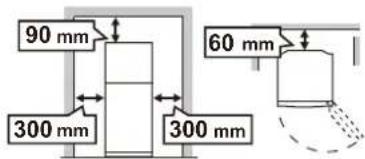
1 Keep adequate ventilation space around the refrigerator.
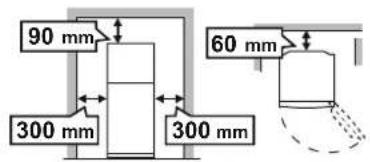
The figure shows the minimum required space for • installing the refrigerator. The measurement condition of power consumption is conducted under a different space dimension.
By keeping greater space, the refrigerator may be operated under a less amount of power consumption.
If using the refrigerator in the smaller space dimension • than the below figure, it may cause the temperature rise in the unit, loud noise and failure.
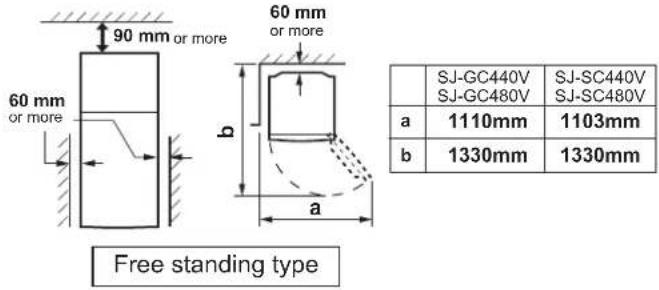
2 Use the two front adjustable feet, to ensure that the refrigerator is positioned firmly and flat on the floor.
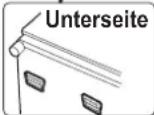
3 Remove the 2 screws of the cabinet lower part, and then set the foot cover (supplied inside the refrigerator compartment) with removed 2 screws.

NOTE
Position your refrigerator so that the plug is accessible. • Keep your refrigerator out of direct sunlight.
Do not place next to heat generating appliance. Do not place directly on the ground.
Provide suitable stand.
When transporting
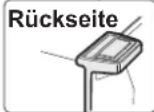
The casters allow the refrigerator to move back and forth. Carry the refrigerator by holding the handles located on the rear and the bottom.

Before using your refrigerator
Clean the inside parts with a cloth soaked in warm water. If soapy water is used, wipe it off thoroughly with water.
INDICATOR OF TEMPERATURE
This refrigerator is provided with an indicator of temperature in the refrigerator compartment to allow you to control the average temperature in the coldest zone.
Coldest zone
The symbol indicates the coldest zone in the refrigerator compartment.
(The door pocket positioned at the same height isn't the coldest zone.)
Symbol

Checking the temperature in the coldest zone
You can carry out regular checks to ensure the temperature in the coldest zone is correct and, if necessary, adjust the refrigerator temp. control.
To maintain a correct temperature inside the appliance, check that the indicator of temperature is always BLUE. If the indicator of temperature turns WHITE, the temperature is too high; in this case, increase the refrigerator temp. control setting and wait for 6 hours before checking the indicator of temperature again.
BLUE

Correct setting
WHITE
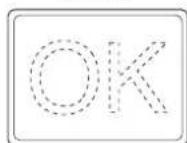
Temperature too high, adjust the refrigerator temp. control.
NOTE
The internal temperature of the refrigerator depends on various factors such as the ambient temperature of the room, the amount of food stored and the frequency of door opening.
When fresh food has been introduced or the door has been • left open for some time, it is normal for the indicator of temperature to turn WHITE.
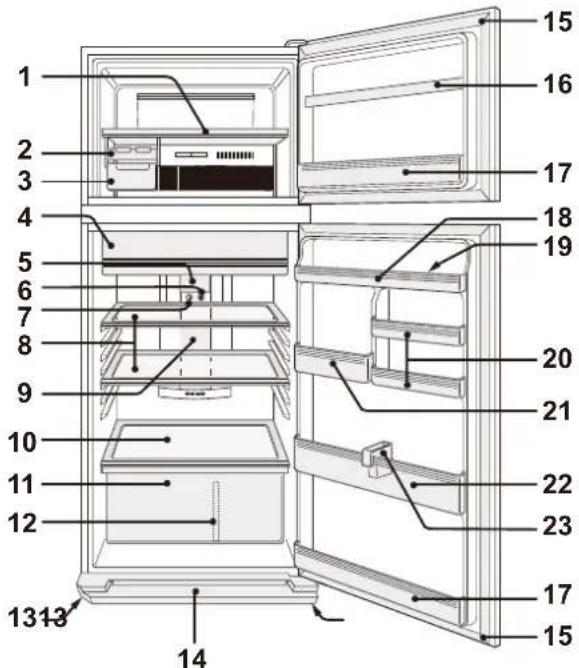
SJ-GC480V,SJ-SC480V
Freezer shelf1.
Ice cube maker2.
Ice cube box3.
Chilled case & door4.
Refrigerator light5.
Freezer temp. control knob6.
Refrigerator temp. control knob7.
Refrigerator shelves & pcs.)
Hybrid cooling panel (Aluminum panel)9.
The panel is cooled from the rear, thus indirectly cools the refrigerator compartment. In this way, food is refrigerated gently, without exposing it to cold air flow.
Fruit and vegetable shelf10.
Fruit and vegetable crisper11.
Divider12.
Adjustable feet13.
Foot cover14.
-
Magnetic door seals (2 pcs.)
-
Freezer bar
Door pockets (27pcs.)
-
Refrigerator pocket
-
Egg holder
-
Utility pockets (2 pcs.)
-
Utility pocket (large)
(Only for SJ-GC480V, SJ-SC480V)
- Do not replace the right and left position of the utility pocket and the utility pocket (large).
-
Bottle pocket
-
Bottle stopper / Tube stand
Prevents bottles etc. from falling.
Stick-type food products stored inside.
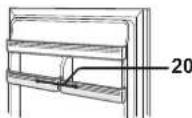
SJ-GC440V, SJ-SC440V
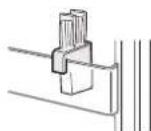
More foods can be stored by removing the following accessories as indicated in the figure below.
[Freezer shelf, Ice cube maker, Ice cube box]
If the refrigerator is operated with these accessories taken out, it works under the most energy-efficient condition.
The amount of power consumption of this model is measured according to the international standard of the refrigerator performance.
- The amount of power consumption of this model is measured with these accessories taken out as indicated above.
- The amount of power consumption of this model is measured under the space dimensions on the right figure.


Tips for saving energy
- Keep the ventilation space as much as possible around the refrigerator.
- Keep your refrigerator out of direct sunlight, and do not place next to heat generating appliance.
■ Open your refrigerator door as briefly as possible.
■ Hot foods should be cooled before storing.
■ Place the food evenly on the shelves to allow the cooling air to circulate efficiently.
OPERATION
Controlling temperature
Adjustable by turning each knob.
![graph TD A["REFRIGERATOR"] --> B["less cold"] A --> C["MIN."] D["FREEZER"] --> E["less cold"] D --> F["MIN."] G["TEMP. CONTROL"] --> H["colder"] G --> I["COLDEST MAX."] J["STOCK"] --> K["MED."] L["COLOST MAX."] --> M["Colder"] N["STOCK"] --> O["MED."] P["COLOST MAX."] --> Q["Colder"] R["STOCK"] -->…](/content/2026/06/1277894/images/3ccc480cbf530121629810b3d1914e107264f91a7edd233959833cc1018069c9.jpg)
Door Alarm
When the refrigerator or freezer door is left open, the door alarm will sound.
The door alarm will sound in 1 minute after opening the • door and again after 1 minute (once in each case). If the door is left open for approx. 3 minutes, the alarm will • sound continuously.
Deodorizing unit
Deodorizing catalyst is installed on the routes of cold air. No operation and cleaning are required.
CARE AND CLEANING
WARNING
Unplug the refrigerator first to prevent electric shock. ■ Do not splash water directly on the outer cabinet or the interior. This may lead to rusting and deterioration of the electrical insulation.
IMPORTANT
To prevent cracking on inside surfaces and plastic components, follow these tips.
Wipe any food oils adhered to plastic components. Some household chemicals may cause damage, so use • only diluted washing-up liquid (soapy water). If undiluted detergent is used or soapy water is not wiped • off thoroughly, cracking of plastic parts can result.
1 Remove the accessories e.g. shelves from the cabinet and door. Wash them in warm soapy dishwashing water; rinse in clean water and dry.
2 Clean the inside with a cloth soaked in warm soapy dishwashing water. Then, use cold water to wipe off soapy water.
3 Wipe the exterior with a soft cloth each time it is soiled.
4 Clean the magnetic door seal with a toothbrush and warm soapy dishwashing water.
Hints when making ice
1 Do not over fill the ice cube trays; otherwise the ice cubes will be joined together when frozen.
2 When the ice cubes are made, turn the lever clockwise to empty the ice into the Ice cube box.
NOTE
To prevent damage to the Ice cube box, do not make ice in the Ice cube box or pour oil into it.
Plasmacluster
The Plasmacluster automatically starts operating when the refrigerator is powered on.
Notes about Plasmacluster operation
The ionizer inside your refrigerator releases clusters of ions, which are collective masses of positive and negative ions, into the refrigerator compartment. These ion clusters inactivate airborne mold fungus.

There may be a slight odor in the refrigerator. This is the smell of ozone generated by the ionizer. The amount of ozone is minimal, and quickly decomposes in the refrigerator.
NOTE
To prevent damage to your refrigerator, do not use heavy duty cleansers or solvents (lacquer, paint, polishing powder, benzine, boiled water, etc.) If the power supply is disconnected, please wait for at least 5 minutes before re-connecting power. The glass shelves weigh approximately 2kg each. Hold firmly when removing from the cabinet or carrying. Do not drop objects inside the refrigerator or strike the inner wall. This may cause the inner surface to crack.
Defrosting
Defrosting is fully automatic due to a unique energy saving system.
When the compartment light is blown
Contact the service agent approved by SHARP to request a replacement compartment light. The compartment light is not to be removed other than by qualified service personnel.
Switching off your refrigerator
If you switch your refrigerator off when you are going away for an extended period, remove all food, clean the interior thoroughly. Remove the power cord plug from the power socket and leave all doors open.
GB
STORING FOOD
Refrigeration reduces the rate of food spoilage. To maximize the shelf life of perishable food products, ensure that the food is the freshest possible quality. The following is a general guide to help promote longer food storage.
Ensure all cooked food is wrapped securely or placed in an airtight container.
To minimize moisture loss, fruit and vegetables should be • loosely enclosed in a plastic material e.g. wrap, bags (do not seal) and place in the fruit and vegetable crisper.
Eggs should be stored in the Egg holder.
Evenly place the food on the shelves to allow the cooling • air to circulate efficiently.
Hot foods should be cooled before storing. Storing hot • foods increases the temperature in the unit and increases the risk of food spoilage
Do not block the outlet and inlet of the cool air circulating circuit with foods or containers; otherwise the foods will not be evenly cooled throughout the refrigerator.
Keep the door securely closed.
For best freezing
• Quality of foods should be fresh.
- Freeze small quantities of food at a time to freeze them quickly.
- Food should be properly sealed, sealed tightly or covered.
• Evenly place the food in the freezer.
- Label bags or containers to keep an inventory of freezing food.

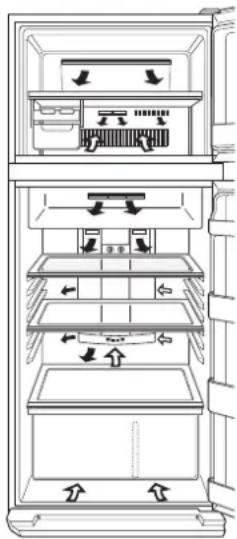
Do not place food directly in front of cold air outlet. This may lead to the food freezing.
BEFORE YOU CALL FOR SERVICE
Before you call for service, check the following points.
| Problem Solution | |
| The outside of the cabinet is hot when touched. | It is normal. The hot pipe is in the cabinet in order to prevent dew generation. |
| When there is refrigerator noise. It is normal for the refrigerator to produce the following sounds.Loud noise produced by the compressor when operation starts --- Sound becomes quieter after a while.Loud noise produced once a day by the compressor --- Operating sound produced immediately after automatic defrost operation.Sound of flowing fluid (gurgling sound, fizzing sound)--- Sound of refrigerant flowing in pipes (sound may become louder from time to time).Cracking or crunching sound, squeaking sound--- Sound produced by expansion and contraction of inner walls and internal parts during cooling. | |
| Frosting or dew generation occurs inside or outside the refrigerator. | This may occur in one of the following cases. Use a wet cloth for wiping frost and a dry cloth for wiping dew.When the ambient humidity is high.When the door is frequently opened and closed.When foods containing plenty of moisture are stored. (Wrapping is required.) |
| The foods in the refrigerator compartment freeze. | Is the refrigerator operated for a long time with temp. control set at MAX?Low ambient temperature may cause placed foods to freeze even if refrigerator temp. control is set to MIN. |
| It smells in the compartment. | Wrapping is required for the foods with strong smell.Deodorizing unit cannot remove all of smell. |
| Door alarm does not stop. | If the door alarm does not stop after closing all doors, it is a defect.Contact the Sharp service center for service.Method of stopping the door alarm temporarily.Adjust both temp.control knobs at the same time as following steps.(Adjust 1~3 within 20 seconds)1 Adjust to MIN2 Adjust to MAX   3 Return to MEDThe door alarm will sound again after approximately 2 days. 3 Return to MEDThe door alarm will sound again after approximately 2 days. |
IF YOU STILL REQUIRE SERVICE
Refer to your nearest service agent approved by SHARP.
Atención:


Attention :

traseira inferior

SJ-GC480V,SJ-SC480V
Προσοχή:

Let op:


PL
Figyelem:


Tipy na úsporu energie
Dèmesio:


Pozor:



Внимание:


Увага:

Federal Republic of Germany
Printed in Thailand
- CAUTION
- INFORMATION ON DISPOSAL FOR USERS (PRIVATE HOUSEHOLDS)
- ATTENTION
- IN THE EUROPEAN UNION
- IN OTHER COUNTRIES OUTSIDE THE EU
- INSTALLATION
- WARNING
- NOTE
- WHEN TRANSPORTING
- BEFORE USING YOUR REFRIGERATOR
- INDICATOR OF TEMPERATURE
- COLDEST ZONE
- CHECKING THE TEMPERATURE IN THE COLDEST ZONE
- MORE FOODS CAN BE STORED BY REMOVING THE FOLLOWING ACCESSORIES AS INDICATED IN THE FIGURE BELOW
- TIPS FOR SAVING ENERGY
- OPERATION
- CONTROLLING TEMPERATURE
- DOOR ALARM
- DEODORIZING UNIT
- CARE AND CLEANING
- IMPORTANT
- HINTS WHEN MAKING ICE
- PLASMACLUSTER
- NOTES ABOUT PLASMACLUSTER OPERATION
- DEFROSTING
- WHEN THE COMPARTMENT LIGHT IS BLOWN
- SWITCHING OFF YOUR REFRIGERATOR
- STORING FOOD
- FOR BEST FREEZING
- BEFORE YOU CALL FOR SERVICE
- ATENCIÓN
- ΠΡΟΣΟΧΉ
- LET OP
- FIGYELEM
- TIPY NA ÚSPORU ENERGIE
- DÈMESIO
- POZOR
- ВНИМАНИЕ
- УВАГА
Brand : SHARP
Model : SJ-GC480VSL
Category : Refrigerator