
SW7800 - Sandwich Maker UFESA - Free user manual and instructions
Find the device manual for free SW7800 UFESA in PDF.


| Product type | Sandwich press |
| Brand | Ufesa |
| Model | SW7800 |
| Dimensions (L x W x H) | 25 x 20 x 10 cm |
| Weight | 1.5 kg |
| Power supply | 220-240 V ~ 50/60 Hz |
| Power | 750 W |
| Plate material | Non-stick coating |
| Number of sandwiches | 2 |
| Power indicator light | Yes |
| Heating indicator light | Yes |
| Adjustable thermostat | No, fixed temperature |
| Grill function | Yes, grooved surfaces |
| Plate locking | Yes |
| Non-slip feet | Yes |
| Cord storage | Yes |
| Cleaning | Removable plates for easy cleaning |
| Maintenance | Wipe with a damp cloth |
| Safety | Automatic shut-off in case of overheating |
| Spare parts available | Replacement plates |
| Repairability | Repairability index not communicated |
| Warranty | 2 years |
Frequently Asked Questions - SW7800 UFESA
User questions about SW7800 UFESA
0 question about this device. Answer the ones you know or ask your own.
Ask a new question about this device
Download the instructions for your Sandwich Maker in PDF format for free! Find your manual SW7800 - UFESA and take your electronic device back in hand. On this page are published all the documents necessary for the use of your device. SW7800 by UFESA.
USER MANUAL SW7800 UFESA
natural_image
Two white and blackUFESA water heaters with warning labels, displayed against a red circular background (no text or symbols on devices)flowchart
graph TD
    A["1: Washing Machine"] --> B["2: Covering Box"]
    B --> C["3: Plug-in Outer Lamp"]
    C --> D["4: Ufesa (with label 'ufesa')"]
    D --> E["5: Covering Plate with Paper"]
    E --> F["6: Stacked Plate with Bread"]
    F --> G["7: Stacked Plate with Paper"]
    G --> H["8: Stacked Plate with Bread"]
    H --> I["9: External Plastic with Plug-in Outer Lamp"]
¡Estimado cliente!
Thank you for purchasing our appliance and welcome among the users of UFESA appliances!
Please carefully read this user manual. Pay special attention to important safety instructions. Keep this manual for future use.
Safety precautions
Read this entire manual carefully before using the appliance.
DANGER! / WARNING!
Risk of injury

• Always use the appliance on a dry and stable work surface.
- Do not operate the appliance, when you find the supplying cord damaged or when the casing or heating plates are visibly damaged. Check the appliance visually before each operation.
- If the supply cord is damaged, it must be replaced by the manufacturer, its service agent or similarly qualified persons in order to avoid a hazard.
The appliance can be repaired by qualified staff only. Incorrectly performed repair may cause serious hazard to the user. In case of any defects, it is advised to return the appliance to an authorised service facility.
Do not touch hot surfaces. Handle with care as the appliance may generate hot steam when operating. Risk of burns!
• Never immerse the sandwich maker (or any part of it), supply
cord and/or plug in water or any other liquid to avoid the risk of electric shock.
This appliance can be used by children aged from 8 years and above and persons with reduced physical, sensory or mental capabilities or lack of experience and knowledge if they have been given supervision or instruction concerning use of the appliance in a safe way and understand the hazards involved. Children shall not play with the appliance. Cleaning and user maintenance shall not be made by children unless they are older than 8 and supervised.
- Keep the appliance and its cord out of reach of children less than 8 years.
- When not in use and/or before cleaning, unplug the appliance from the socket and allow it to cool down.
- Do not cover the sandwich maker with or put into it packaging made of metal foil or other materials, as it involves a risk of electric shock or fire.
The temperature of accessible surfaces may be high when the appliance is operating. Do not touch the surface marked with the
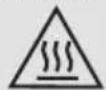
symbol.
WARNING!
Risk of property damage

The appliance must be plugged only to an alternating current socket with power corresponding to the power stated on the name plate of the appliance.
Never unplug or move the appliance by pulling the supply cord.
Do not drag the supply cord over sharp edges.
Do not let it bend.
Never let the supply cord hang over sharp edges of a table or worktop. Do not let it touch hot surfaces or be knotted.
The appliance is not intended to be operated by means of an external timer or separate remote-control system.
Never leave the appliance unattended when in use as bread may burn.
It is best to remove toasted bread with wooden, dull-edged utensils. Metallic objects such as knives, forks, etc. may damage cooking plates.
Never place the appliance on or near gas or electric cookers or in places where it might touch a hot oven or microwave.
Never cover the appliance when it is hot or connected to the mains supply.
TIP
Product information and tips on its use

The appliance is intended solely for household use, indoors.
Technical data
The technical parameters are given on the data plate of the product.
This device complies with Commission Regulation (EC) no. 1275/2008 on eco-design requirements.
Characteristics of the appliance
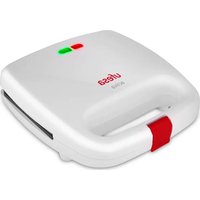
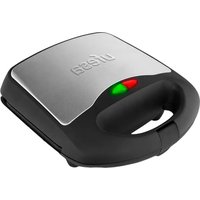
With the sandwich maker you will be able to toast sandwiches with filling quickly. The sandwich maker allows you to cook one or two slices of bread for toasting at the same time. The cooking plates are divided into two square zones and covered with a specially designed layer to prevent the sandwiches from sticking to the cooking plate. The sandwich maker has two indicators:
-red: the red light indicates that the appliance has been connected to the mains supply,
-green: you can use the appliance for toasting now.
Features of your sandwich maker

1 Upper lid
2 Lower lid
3 Cooking plates
4 Catch
5 Red indicator
6 Green indicator
Before using for the first time

- Remove your sandwich maker from the packaging.
- Make sure that the voltage shown on the rating plate of the appliance corresponds to that in the mains supply.
- Clean the inside of the sandwich maker with a slightly damp cloth or paper towel.
- Brush the cooking zones with a small amount of oil or butter.
- Pre-heat the sandwich maker for about 5 minutes with the lid open to remove any remnants originating from the manufacturing process.
When using the sandwich maker for the first time, with the cooking zones getting hotter you may notice a fine smoke haze.

It is not dangerous nor is it a sign that your appliance is defective. The appliance should cease to emit the haze after several cooking cycles.
- Remove the plug from the mains socket, and allow the sandwich maker to cool down fully.
- When the appliance has cooled down, wipe the remnants of oil away from the cooking plates with paper towel.
How to use and how your sandwich maker works


1 Place your sandwich maker on a dry, even surface near the mains socket.
2 Close and latch the toaster.
3 Plug the appliance into the mains socket. The red light will come On.
4 Wait for about 3-4 minutes for the green indicator to illuminate. The green light shows that the cooking plates have reached the correct cooking temperature.
The green indicator will cycle On and Off. This is a sign showing that the correct cooking temperature is maintained.

To get golden brown sandwiches, spread the outside of bread with butter.

5 Unlatch and open the toaster.
6 Place sandwiches on the lower cooking plate.
7 Close the lid carefully. If necessary, use a wooden spatula to hold the sandwiches in place. If you cannot close the lid properly, it means that the sandwiches are overfilled, and you need to remove some of the filling.
Do not force the lid down. This can damage your sandwich maker.

Toasting time depends on your taste and the type of bread. Sandwiches are
usually toasted for ca. 3-8 minutes. You can unlatch and open the lid to decide if you still want to toast your sandwiches.

Be careful. The appliance may generate hot steam when operating. The hot steam may also escape when you open the lid. Risk of burns!

8 Unlatch and open the lid.
- Remove the toasted sandwiches.
Use a wooden spatula to remove sandwiches and remnants from the sandwich maker. Sharp and/or metallic objects may damage the cooking plates.

The cooking plates are hot. Be very careful to avoid burns.

9 When you have finished the toasting, switch the appliance off, and allow it to cool down fully. Remove the plug from the mains socket to switch the appliance off.
Shortly after the toasting, the filling may still be hot. When eating, take special care to avoid the risk of burns.

Cleaning and maintenance of sandwich maker
- Your sandwich maker does not require any specific maintenance.
- Keep and store the sandwich maker clean, as it has contact with food.
- Unplug the appliance from the mains socket before cleaning, and allow it to cool down fully.
- Wipe your sandwich maker with a soft, slightly damp cloth, and then dry it with a soft, clean cloth.
- Do not use cleaners that may scratch or damage external surfaces and a protective layer of the heating plates.
- Remove crumbs and remnants from the plates after each use, and then wipe the plates with paper towel. The paper towel will absorb the grease accumulated during the cooking.
Advice on disposal

Our goods come in optimised packaging. This basically consists in using non-contaminating materials which should be handed over to the local waste disposal service as secondary raw materials.

This product complies with EU Directive 2002/96/EC. The crossed wheelie bin symbol shown on the appliance indicates that when it comes to dispose of the product it must not be included in with household refuse. It must be taken to a special refuse collection point for electric and electronic appliances or returned to the distributor when purchasing a similar appliance. Under current refuse disposal regulations, users who fail to take discarded appliances to special refuse collection points may be penalised. Correct disposal of discarded appliances means that they can be recycled and processed ecologically, helping the environment and allowing materials used in the product to be reused. For more information on available waste disposal schemes contact your local refuse service or the shop where the product was purchased. Manufacturers and importers are responsible for ecological recycling, processing and disposal of products, whether directly or via a public system.
Your local town council can provide you with information about how to dispose of obsolete appliances.
The manufacturer does not accept any liability for any damages resulting from unintended use or inappropriate handling. The manufacturer reserves his right to modify the product any time in order to adjust it to the law, standards, directives, or due to construction, trade, aesthetic or other reasons, without prior notice.

Cher client!



- Safety precautions
- DANGER! / WARNING!
- Risk of injury
- WARNING!
- Risk of property damage
- TIP
- Product information and tips on its use
- Technical data
- Characteristics of the appliance
- Features of your sandwich maker
- Before using for the first time
- How to use and how your sandwich maker works
- Cleaning and maintenance of sandwich maker
- Advice on disposal
Brand : UFESA
Model : SW7800
Category : Sandwich Maker