
FP120 - Food Processor KENWOOD - Free user manual and instructions
Find the device manual for free FP120 KENWOOD in PDF.


| Product Type | Food Processor |
| Model Number | FP120 |
| Brand | Kenwood |
| Power Unit Dimensions (Approx.) | 25 x 20 x 18 cm |
| Weight (Approx.) | 2.3 kg |
| Bowl Capacity | 1.5 L |
| Blender Goblet Capacity (TYPE FP19 only) | 1 L |
| Speed Settings | 1 speed + Pulse |
| Maximum Operating Time | 1 minute (continuous), then 15 min rest |
| Main Functions | Chopping, slicing, grating, blending, mixing, kneading, emulsifying, juicing (with accessory) |
| Attachments Included | Knife blade, emulsifying disc, slicing plate, grating plate, plate carrier, max capacity disc, citrus juicer (if supplied) |
| Safety Features | Safety interlock, non-slip feet, automatic shutoff when overloaded |
| Material | Plastic bowl and lid, stainless steel blades |
| Dishwasher Safe Parts | All attachments except blender base |
| Care Instructions | Wipe power unit with damp cloth; hand wash other parts; do not immerse power unit |
| Cord Storage | Wrap excess cord around bracket at back |
| Guarantee (UK only) | 1 year from date of purchase (subject to conditions) |
| Country of Manufacture | China |
Frequently Asked Questions - FP120 KENWOOD
User questions about FP120 KENWOOD
0 question about this device. Answer the ones you know or ask your own.
Ask a new question about this device
Download the instructions for your Food Processor in PDF format for free! Find your manual FP120 - KENWOOD and take your electronic device back in hand. On this page are published all the documents necessary for the use of your device. FP120 by KENWOOD.
USER MANUAL FP120 KENWOOD
natural_image
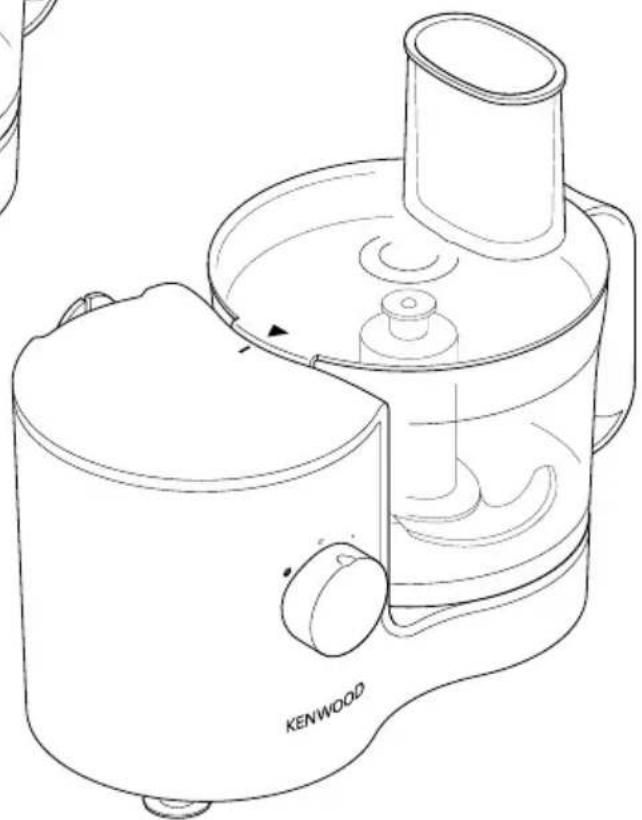
Line drawing of a Kenwood blender with handle and spout (no text or symbols on the device itself)TYPE FP19
natural_image
Line drawing of a Kenwood blender oven with handle and control panel (no text or symbols on the device itself)TYPE FP12
Safety
- Read these instructions carefully and retain for future reference.
- Remove all packaging and any labels.
- If the plug or cord is damaged it must, for safety reasons, be replaced by Kenwood or an authorised Kenwood repairer in order to avoid a hazard.
- Do not operate your appliance for longer than the times specified below without a rest period. Processing continuously for longer periods can damage your appliance.
| Function/Attachment | MaximumOperationTime | Rest Period BetweenOperations |
| Dough Tool 1 | min Unplug the | applianceand allow to cooldown for 15 minutes |
| Blender 1 min |
- The blades and plates are very sharp, handle with care. Always hold by the finger grip at the top, away from the cutting edge, both when handling and cleaning.
- Do not lift or carry the processor by the handle - or the handle may break resulting in injury.
- Always remove the knife blade before pouring contents from the bowl.
- Keep hands and utensils out of the processor bowl and blender goblet whilst connected to the power supply.
-
Switch off and unplug:
-
before fitting or removing parts;
○ when not in use; - before cleaning.
- Never use your fingers to push food down the feed tube. Always use the pusher/s supplied.
- Before removing the lid from the bowl or blender from the power unit:-
○ switch off;
- wait until the attachment/blades have completely stopped.
• DO NOT process hot ingredients.
- SCALD RISK: Hot ingredients should be allowed to cool to room temperature before placing in the bowl or goblet before blending.
- Do not use the lid to operate the processor, always use the on/off speed control.
- This appliance will be damaged and may cause injury if the interlock mechanism is subjected to excessive force.
- Never use an unauthorised attachment.
- Never leave the appliance unattended when it is operating.
- Never use a damaged appliance. Get it checked or repaired: see ‘Service and Customer Care’.
- Never let the power unit, cord or plug get wet.
- Do not let excess cord hang over the edge of a table or worktop or touch hot surfaces.
- Do not exceed the maximum capacities stated in the recommended usage chart.
- Children should be supervised to ensure that they do not play with the appliance.
- This appliance shall not be used by children. Keep the appliance and its cord out of reach of children.
- Appliances can be used by persons with reduced physical, sensory or mental capabilities or lack of experience and knowledge if they have been given supervision or instruction concerning use of the appliance in a safe way and if they understand the hazards involved.
- Only use the appliance for its intended domestic use. Kenwood will not accept any liability if the appliance is subject to improper use, or failure to comply with these instructions.
- Misuse of your processor/blender can result in injury.
Refer to the relevant section under “using the attachments” for additional safety warnings for each individual attachment.
Blender attachment
- SCALD RISK: Hot ingredients should be allowed to cool to room temperature before placing in the goblet before blending.
- Only operate the blender with the lid in place.
- Never run the blender empty.
- To ensure the long life of your blender, do not run it for longer than 60 seconds.
- Smoothie recipes - never blend frozen ingredients that have formed a solid mass during freezing, break it up before adding to the goblet.
Before plugging in
- Make sure your electricity supply is the same as the one shown on the underside of your appliance.
Important - Plug and Fuse Information
- The wires in the cord are coloured as follows: Blue = Neutral, Brown = Live.
- If the plug supplied with your appliance has a fuse fitted it is rated 3A. If the fuse fails it must be replaced with one of the same rating.
Note:
- For non-rewireable plugs the fuse cover MUST be refitted when replacing the fuse. If the fuse cover is lost then the plug must not be used until a replacement can be obtained. The correct fuse cover is identified by colour and a replacement may be obtained from your Kenwood Authorised Repairer (see Service).
- If a non-rewireable plug is cut off it must be DESTROYED IMMEDIATELY. An electric shock hazard may arise if an unwanted non-rewireable plug is inadvertently inserted into a 13A socket outlet.
- This appliance conforms to EC Regulation 1935/2004 on materials and articles intended to come into contact with food.
Before using for the first time
1 Remove the plastic blade covers from the knife blade. Take care the blades are very sharp. These covers should be discarded as they are to protect the blade during manufacture and transit only.
2 Wash the parts see 'Care and Cleaning'.
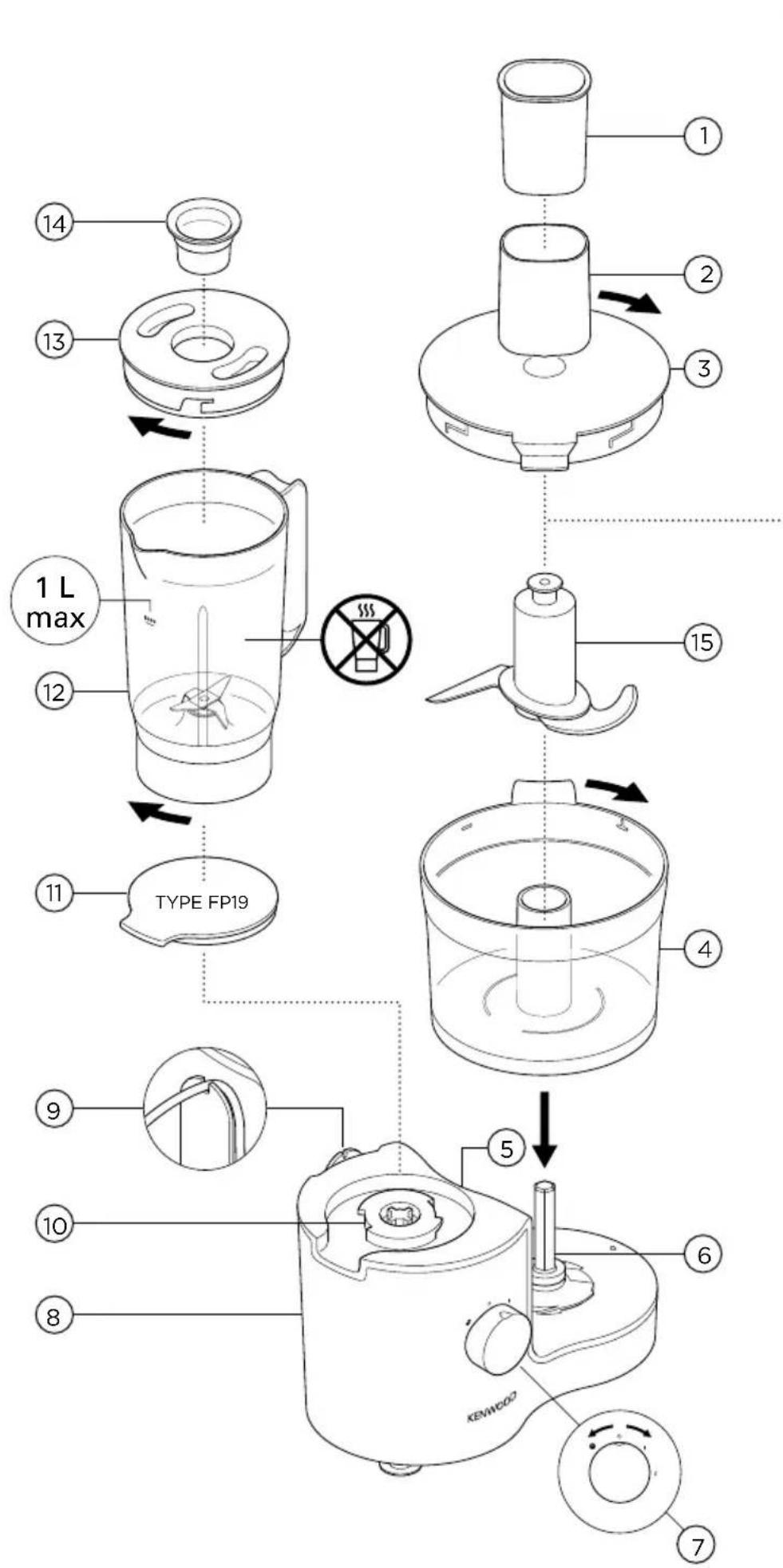
Key
Processor
① Pusher
② Feed tube
③ Lid
④ Bowl
⑤ Safety interlock
⑥ Food processor drive
⑦ Speed/pulse control
FP120 - 1 speed
FP190 - 2 speed
⑧ Power unit
⑨ Cord storage (at back)
Blender (TYPE FP19 only)
⑩ Blender outlet/interlock
⑪ Blender outlet cover
⑫ Goblet
⑬ Lid
⑭ Filler cap
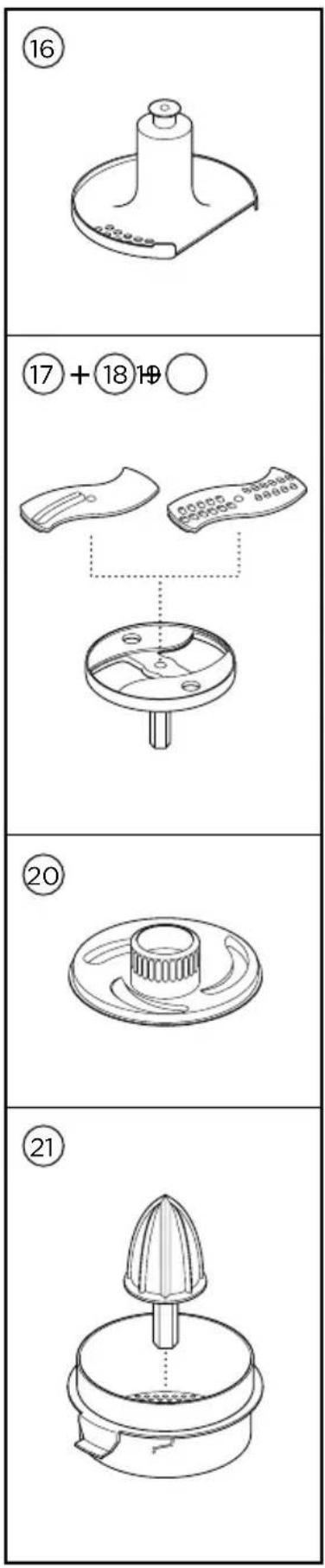
Attachments
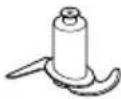
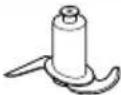
15 Knife blade
⑯ Emulsifying disc
17 Slicing plate
18 Grating plate
19 Plate carrier
20 Max capacity disc
②1 Citrus juicer (if supplied)
To Use Your Food Processor
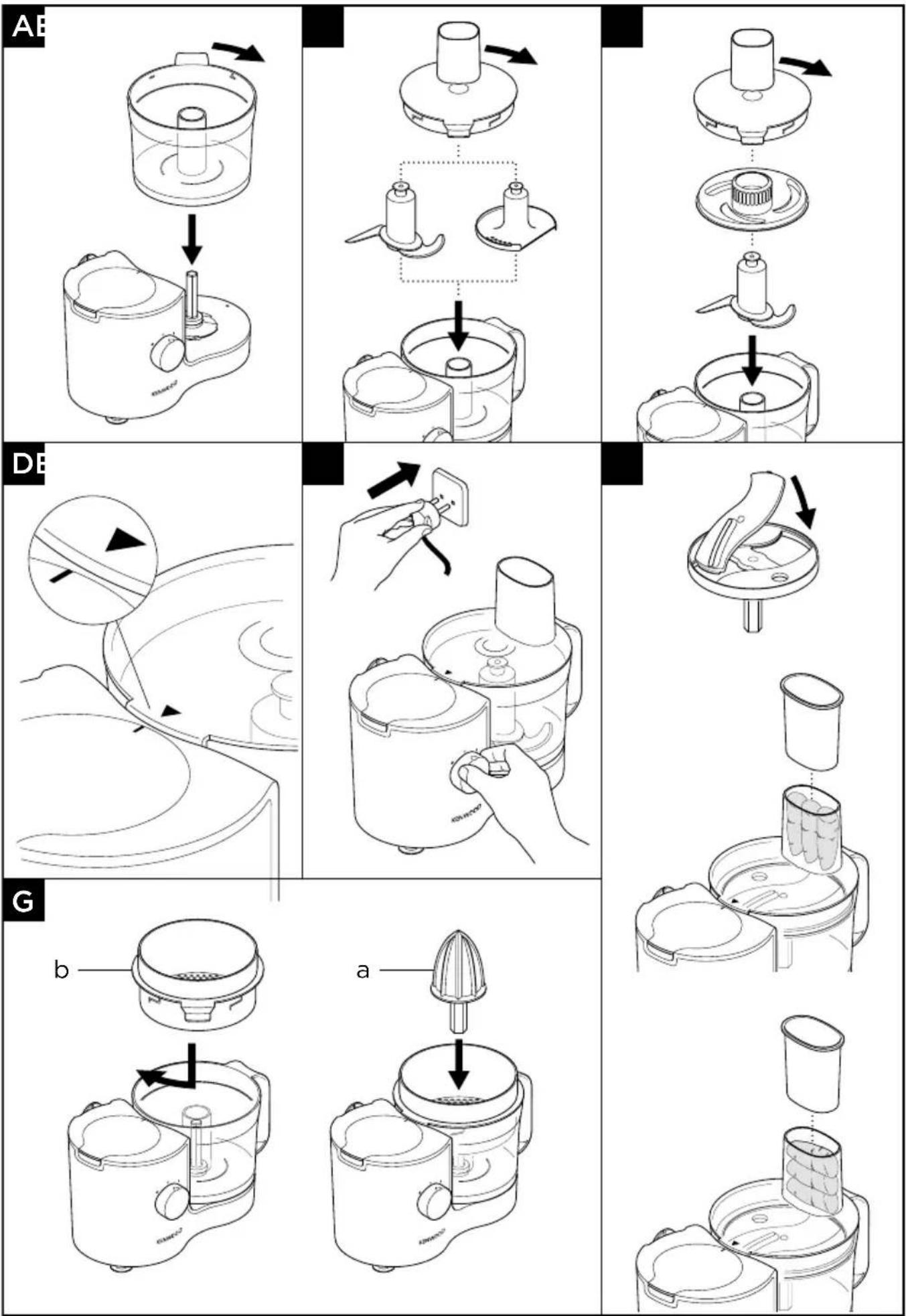
Refer to Illustrations A - E
- Always fit the bowl and attachment onto the processor before adding ingredients.
- The processor will not work if the bowl and lid are fitted incorrectly.
- Plug in, switch on. (Refer to the recommended usage chart).
- Use the pulse (P) for short bursts. The pulse will operate for as long as the control is held in position.
important
- Your processor is not suitable for crushing or grinding coffee beans, or converting granulated sugar to caster sugar.
- When adding almond essence or flavouring to mixtures avoid contact with the plastic as this may result in permanent marking.
To Use Your Blender (TYPE FP19 only)
To assemble and use - refer to the blender illustrations and the recommended usage chart.
important
- The blender attachment will work only with the processor bowl and lid in position.
- When using the blender outlet we recommend that there are no tools in the bowl.
Hints and Tips
- When making mayonnaise, put all the ingredients, except the oil, into the blender. Remove the filler cap. Then, with the appliance running, add the oil slowly through the hole in the lid.
- Thick mixtures, e.g. pâtés and dips, may need scraping down. If the mixture is difficult to process, add more liquid.
- Ice crushing - operate the pulse in short bursts until crushed to the desired consistency.
- The processing of spices is not recommended as they may damage the plastic parts.
- To blend dry ingredients - cut into pieces, remove the filler cap, then with the appliance running, drop the pieces down one by one. Keep your hand over the opening. For best results empty regularly.
- Do not use the blender as a storage container. Keep it empty before and after use.
- Never blend more than 1 litre - less for frothy liquids like milkshakes.
| Recommended Usage ChartDo not operate your appliance for longer than the times specified below without a rest period. Processing continuously for longer periods can damage your appliance.Processing information supplied is for guidance only and will vary depending on the exact recipe and ingredients being processed. Do not process hot ingredients. | ||||
| Tool/Attachment | Function | TYPE FP19 | (Secs) | |
 | All in one cake mixes 2 10 - 20 800g Total | weight | ||
| Pastry - rubbing fat into flour 1 - 2 10 | 250gFlour weight | |||
| Adding water to combine pastry ingredients | 2 20 - 30 | |||
| Chopping/pureeing/pates 2 + P | 15 - 30 300g | Meat weight | ||
| Yeasted mixes 2 45 - 60 340g F | our | weight540g Total weight | ||
| Nuts 2 30 100g | ||||
| Onion (cut into 1⁄4) P - 200g | ||||
  | Soups and milkshakes | 1 - 2 | 30 | 800ml |
 | Whipping cream | 1 | 15 - 30 250ml | |
| Mayonnaise | 2 60 | 4 Egg yolks | ||
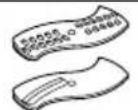 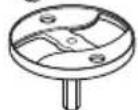 | Slicing - carrots, potato, cabbage, cucumber, courgette, beetroot, onion | 1 - 2 | - | - |
| Grating - cheese, carrot, potato and foods of a similar texture | 2 - | - | ||
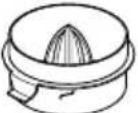 | Citrus fruits | 1 | - | - |
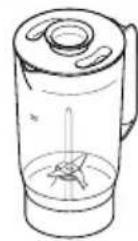 | Cold liquids, Drinks and Smoothies | 2 - 1 litre | ||
| Milk based drinks | 1 - 2 15 - 30 | 800ml | ||
| Ice crushing | P | 30 | 125g6 ice cubes | |
Using The Attachments Refer to recommended usage chart for each attachment.
⑮ Knife Blade
Refer to Illustrations B + C
This blade is the most versatile of all the attachments. The texture you get is determined by the length of processing time. For coarser textures use the 'pulse' feature checking the consistency regularly.
Hints and Tips
- Cut food such as meat, bread, vegetables into cubes approximately 2cm before processing.
- Biscuits and bread should be broken into pieces and added down the feed tube whilst the appliance is running.
- When making pastry use fat straight from the fridge cut into 2cm cubes. Take care not to over-process.
- Cake Making - Sponge type cakes are best made by the 'all in one method'. A 'soft tub' margarine used straight from the refrigerator is recommended. Process until smooth.
- Yeast dough- Place the dry ingredients into the bowl. With the appliance running add the liquid down the feed tube. Process until it becomes smooth in appearance and elastic to touch. Allow the dough to rise then re-knead for 10 seconds.
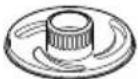
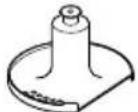
⑯ Emulsifying Disc
Refer to illustration B
Use for light mixtures only e.g. cream, mayonnaise.
Hints and Tips
- Mayonnaise - Place the egg and seasonings into the bowl and mix for a few seconds. With the machine running gradually add the oil down the feed tube in a slow steady stream.
Slicing and Grating Plates ⑰
18 19
Refer to illustration F
To assemble the plate carrier
1 Select the desired plate and fit into the carrier with the cutting side uppermost.
- Locate one end of the plate under the rim and press the other end into position. It will only fit one way round.
Using the cutting plate
1 Put the food into the feed tube.
2 Switch on and push down evenly with the pusher - never put your fingers in the feed tube.
- Do not let the bowl fit up as far as the cutting disc: empty regularly.
- Do not exceed the 'MAX' mark on the bowl.
Hints and Tips
- Use fresh ingredients.
- Do not cut food up too small. Fill the feed tube fairly full, this prevents food from slipping sideways during processing.
- When slicing or grating: food placed upright comes out shorter than food placed horizontally.
- After using a cutting plate there will always be a small amount of waste on the plate or in the food
⑳ Max Capacity Disc
Refer to illustration C
When blending liquids in the bowl, the max capacity disc must be used with the knife blade. It prevents leaking and improves the chopping performance of the blade.
1 Place the disc into the bowl over the knife blade - do not push down.
2 Fit the lid.
⑳ Citrus Juicer (if supplied)
Refer to illustration G
a Cone
b Sieve
- For best results store and juice the fruit at room temperature and hand roll on a worktop before juicing.
- To help with juice extraction move the fruit from side to side when juicing.
- When juicing large quantities, empty the sieve regularly to prevent the build up of pulp and seeds.
- Cut the fruit in half. Switch on and press the fruit onto the cone.
Care and Cleaning
- Always switch off and unplug before cleaning.
- Handle blades and cutting plates with care - they are extremely sharp.
- Some foods may discolour the plastic. This is perfectly normal and will not harm the plastic or affect the flavour of your food. Rub with a cloth dipped in vegetable oil to remove the discolouration.
Power Unit
- Wipe with a damp cloth, then dry. Ensure that the interlock area is clear of food debris.
- Do not immerse the power unit in water.
- Wrap excess cord around the bracket at the back of the appliance.
Blender
1 Fill with warm water, fit the lid and filler cap, then switch on for 20-30 seconds.
2 Empty, then rinse. If it is still dirty, use a brush.
3 Wipe, then leave to air-dry.
- Do not immerse the blender base in water.
All other parts
- Wash by hand, then dry.
- All attachments (except the blender) can be dishwashed.
Service and Customer Care
UK
If you need help with:
• using your appliance or
● servicing, spare parts or repairs (in or out of guarantee)
call Kenwood customer care on 023 9239 2333. Have your model number (e.g. TYPE FP12 or TYPE FP19) and date code (5 digit code e.g. 19C11) ready.
They are on the underside of the power unit.
- Spares and attachments
call 0844 557 3653.
Other countries
- If you experience any problems with the operation of your appliance, before requesting assistance refer to the 'Troubleshooting Guide' section in the manual or visit www.kenwoodworld.com.
- Please note that your product is covered by a warranty, which complies with all legal provisions concerning any existing warranty and consumer rights in the country where the product was purchased.
-
If your Kenwood product malfunctions or you find any defects, please send it or bring it to an authorised KENWOOD Service Centre. To find up to date details of your nearest authorised KENWOOD Service centre visit www.kenwoodworld.com or the website specific to your Country.
-
Designed and engineered by Kenwood in the UK.
- Made in China.

IMPORTANT INFORMATION FOR CORRECT DISPOSAL OF THE PRODUCT IN ACCORDANCE WITH THE EUROPEAN DIRECTIVE ON WASTE ELECTRICAL AND ELECTRONIC EQUIPMENT (WEEE)
At the end of its working life, the product must not be disposed of as urban waste. It must be taken to a special local authority differentiated waste collection centre or to a dealer providing this service.
Guarantee UK only
- If your food processor goes wrong within one year from the date you bought it, we will repair it (or replace it if necessary) free of charge provided:
- it has been used in accordance with these instructions.
- you have not misused, neglected, or damaged it;
- it has not been modified (unless by KENWOOD);
- it is not second hand;
- it has not been used commercially;
- you have not fitted a plug incorrectly; and
- you supply your receipt to show when you bought it.
This guarantee does not affect your statutory rights.
| Troubleshooting Guide | ||
| Problem Cause Solution | ||
| The processor will not operate | No Power Bowl and lid not fitted and locked on correctly. | Check processor is plugged in.Check that lid interlock is located correctly with the arrow on the lid aligning with the line on the power unit. |
| Blender will not operate | Blender not located correctly on outlet. | Check that blender is fitted correctly. |
| Processor stops during processing | Processor overloaded/ maximum capacities and operating times exceeded. Lid unlocked | Refer to recommended usage chart for correct quantities and operating times. |
White Bread
340g strong white plain flour
5ml salt
6g lard
15g fresh yeast or 10ml/2tsp dried active yeast plus 5ml/1tsp sugar
200ml warm water
Dried active yeast
Sprinkle the dried yeast into the warm water, add the sugar and allow to stand for approximately 10 minutes or until the mixture is frothy.
Fresh yeast
Crumble into the bowl with the flour.
Other types of yeast
Follow the manufacturers instructions.
1 With the knife blade in the bowl, add the flour, salt, lard (fresh yeast if used) and process for a few seconds to evenly distribute the ingredients throughout the flour.
2 With the machine operating, quickly pour the water or yeast liquid in a steady stream through the feed tube (this should take about 10 seconds).
3 Continue processing until the mixture forms a dough and becomes smooth in appearance and elastic to the touch, this will take about 45 seconds.
4 Remove the dough into either a greased polythene bag or a lightly floured bowl and cover. Leave this dough in a warm place until doubled in size.
5 Return the risen dough to the processor bowl fitted with the knife blade and re-knead for about 10 seconds.
6 Shape the dough into a loaf or about 15 rolls and place on greased baking trays and leave until double in size.
7 Bake at 230^ C/ 450^ F/gas mark 8 for 20-25 minutes for a loaf or 10-15 minutes for bread rolls.
8 When the loaf or rolls are cooked they should sound hollow when tapped on the base.
Carrot and Coriander Soup
25g butter
1 onion chopped
1 clove garlic crushed
400g carrot cut into 12 cm cubes
Cold chicken stock
10-15ml ground coriander salt and pepper
1 Melt the butter in a pan, add the onion and garlic and fry until soft.
2 Place the carrot into the blender, add the onion and garlic. Add sufficient stock to reach the 1L level marked on the goblet. Fit the lid and filler cap.
3 Blend on maximum speed for 5 seconds for a coarse soup or longer for a finer result.
4 Transfer the mixture to a saucepan, add the coriander and seasoning and simmer the soup for 30 to 35 minutes or until cooked.
5 Adjust the seasoning as necessary and add extra liquid if required.
Kenwood Ltd
New Lane
Havant
Hampshire
PO9 2NH
kenwoodworld.com
- Safety
- Blender attachment
- Before plugging in
- Important - Plug and Fuse Information
- Note:
- Before using for the first time
- Key
- Processor
- Blender (TYPE FP19 only)
- Attachments
- To Use Your Food Processor
- Refer to Illustrations A - E
- important
- To Use Your Blender (TYPE FP19 only)
- Hints and Tips
- Refer to Illustrations B + C
- Refer to illustration B
- Slicing and Grating Plates ⑰
- Refer to illustration F
- To assemble the plate carrier
- Using the cutting plate
- ⑳ Max Capacity Disc
- Refer to illustration C
- ⑳ Citrus Juicer (if supplied)
- Refer to illustration G
- Care and Cleaning
- Power Unit
- Blender
- All other parts
- Service and Customer Care
- UK
- Other countries
- IMPORTANT INFORMATION FOR CORRECT DISPOSAL OF THE PRODUCT IN ACCORDANCE WITH THE EUROPEAN DIRECTIVE ON WASTE ELECTRICAL AND ELECTRONIC EQUIPMENT (WEEE)
- Guarantee UK only
- White Bread
- Dried active yeast
- Fresh yeast
- Other types of yeast
- Carrot and Coriander Soup
- Kenwood Ltd
Brand : KENWOOD
Model : FP120
Category : Food Processor