
PT-E05 - Underwater case OLYMPUS - Free user manual and instructions
Find the device manual for free PT-E05 OLYMPUS in PDF.


| Product type | Underwater housing for digital camera |
| Brand | OLYMPUS |
| Model | PT-E05 |
| Compatible cameras | Olympus E-520 |
| Maximum depth | 40 m (130 ft) |
| Dimensions (W × H × D) | 212.5 × 170.5 × 147.0 mm |
| Weight | 1,370 g (without camera or accessories) |
| Housing material | Polycarbonate |
| O-ring material | Silicone rubber |
| Viewing cap material | NBR rubber |
| Metal parts material | Aluminum, stainless steel |
| Power supply | Rechargeable lithium-ion battery Olympus BLM-1 (not included) |
| Main functions | Control of zoom, focus, shutter release, dials and buttons of the camera |
| Flash connectivity | TTL cable, fiber optic cable for UFL-2 flash |
| Sealing system | O-ring + slide and wheel closure |
| Maintenance and cleaning | Clean with fresh water, dry in the shade, do not use solvents |
| O-ring replacement | At least once a year, use exclusively Olympus silicone grease |
| Recommended consumables | Silica gel (SILCA-5), silicone grease (PSOLG-1/2/3), O-rings POL-E05A/B |
| Optional accessories | Lens underwater housings (PPO-E01 to E05), LCD hood (PFUD-E05), camera tray (PTMO-E05) |
| Safety | Do not exceed 40 m, check sealing before each dive, do not use chemicals |
| Repairability | Do not disassemble yourself, contact an authorized Olympus service center |
| Warranty | Void in case of unauthorized disassembly or misuse |
Frequently Asked Questions - PT-E05 OLYMPUS
User questions about PT-E05 OLYMPUS
0 question about this device. Answer the ones you know or ask your own.
Ask a new question about this device
Download the instructions for your Underwater case in PDF format for free! Find your manual PT-E05 - OLYMPUS and take your electronic device back in hand. On this page are published all the documents necessary for the use of your device. PT-E05 by OLYMPUS.
USER MANUAL PT-E05 OLYMPUS
natural_image
Technical line drawing of a camera lens assembly (no text or symbols)| Jp | 取扱説明書デジタルカメラ €-520 用防水プロテクター | |
| En | Instruction ManualUnderwater Case for digital camera €-520 | |
| Fr | Mode d’emploiCaisson étanche pour l’appareil photo numérique €-520 | |
| De | BedienungsanleitungUnterwassergehäuse für Digitalkamera €-520 | |
| Sp | Manual de instruccionesCaja estanca para la cámara digital €-520 | |
| Cs | 使用说明书数码照相机 €-520 专有防水机壳 | |
| Kr | 사용설명서디지털 카메라 €-520 용 방수 케이스 |
■ Thank you for buying the Underwater Case PT-E05.
■ Please read this instruction manual carefully and use the product safely and correctly. Please keep this instruction manual for reference after reading it.
■ Wrong usage may cause damage to the camera inside the Case due to water leakage, and repair may not be possible.
■ Before use, perform an advance check as described in this manual.
Introduction
- Unauthorized copying of this manual in part or in full, except for private use, is prohibited. Unauthorized reproduction is strictly prohibited.
- OLYMPUS IMAGING CORP. shall not be responsible in any way for lost profits or any claims by third parties in case of any damage occurring from improper use of this product.
- OLYMPUS IMAGING CORP. shall not be responsible for damage, lost profits, etc. caused by loss of image data because of defects, disassembly, repair or modification of this product by people other than third parties specified by OLYMPUS IMAGING CORP. or for other reasons.
Please read the following items before use
- This Case is a precision device designed for use at a water depth within 40 m. Please handle it with sufficient care.
- Please use the Case correctly after sufficient understanding of the contents of this manual in regard to handling of the Case, checks before use, maintenance, and storage after use.
● The Case must be used in combination with the separately available Waterproof Port. - OLYMPUS IMAGING CORP. shall in no way be responsible for accidents involving immersion of a digital camera in water. In addition, expenses incurred for damage of internal materials or loss of recorded contents due to water entering the camera will not be compensated.
- OLYMPUS IMAGING CORP. shall not pay any compensation for accidents (injuries or material damage) at the time of use.
For safe use
This instruction manual uses various pictographs for correct use of the product and to prevent danger to the user and other person, as well as property damage. These pictographs and their meanings are shown below.
| WARNING | This shows the content regarding assumption of possibility of human death or severe injury in case of handling with disregard of this indication. |
| CAUTION | This shows the contents regarding assumption of possibility of injury or damage to property in case of handling with disregard of this indication. |

WARNING
① Keep this product out of the reach of babies, infants, and children. There is the possibility of occurrence of the following types of accidents.
- Injury by dropping onto the body from heights.
- Injury from parts of the body getting caught in parts which open and close.
- Swallowing of small parts. Please consult a physician immediately if any parts have been swallowed.
② Do not store digital camera with batteries inserted in this product.
Storage with a battery inserted may lead to leakage of the battery liquid and fire hazard.
③ The Case must be used in combination with the Waterproof Port available separately. Remember that the Case cannot be used without the Waterproof Port.
④ If leakage of water should occur with a camera installed in this product, quickly remove the battery from the camera. There is the possibility of ignition and explosion from generation of hydrogen gas.
⑤ This product is made of resin. There is the possibility that injuries may be caused when it becomes broken due to strong impact with a rock or other hard objects. Please handle it with sufficient care.
⑥ The silica gel and the silicon grease for this product are inedble.

CAUTION
① Do not disassemble or modify this product. This may cause water leakage or defect. In case of disassembly or modification by any party other than those appointed by OLYMPUS IMAGING CORP. the guarantee shall not apply.
② Do not place this product at locations with abnormally high or low temperatures or at locations with extreme temperature changes. The product may deteriorate.
③ Opening and closing at locations with much sand, dust, or dirt may impair the waterproof characteristic and cause water leakage. This should be avoided.
④ This product has been designed and manufactured for use at a water depth within 40 m. Please note that diving to a depth in excess of 40 m may cause permanent deformation or damage to the Case and the camera inside, or may lead to water leakage.
⑤ Jumping into the water with the Case in your pocket or in your hand, throwing the Case from a boat or ship into the water, and other rough handling may cause water leakage. Please handle with sufficient care, when handing it over from hand to hand etc.
⑥ If the camera on the inside should become wet because of water leakage etc., immediately wipe off all moisture and confirm the operation.
⑦ Please remove the O-ring when traveling by air. Otherwise air pressure may make it impossible to open the Case.
⑧ For safe use of the digital camera in this product, please read the “Instruction Manual” for the digital camera carefully.
⑨ When sealing this product, take sufficient care that no foreign matter gets caught at the O-ring and the contact surfaces.
The camera's built-in flash cannot be used when the Case is combined with an external Olympus flash. Also, the camera's built-in flash cannot be popped up if the hot shoe cable is connected to the camera's hot shoe. If the built-in flash is forcibly popped up, the connected flash will not work properly and the hot shoe cable may be disconnected from the camera's hot shoe. In this case, the camera may also be damaged.
⑪ The camera's built-in flash cannot be used when the camera is in the Case.
Batteries
- Use only with an Olympus lithium-ion rechargeable battery (BLM-1) specially for camera use.
● Take care that the battery electrodes do not get wet. This may cause trouble or accidents. - Carefully read the instruction manual for the camera about other cautions regarding batteries.
For Prevention of Water Leakage Accidents
When water leakage occurs while this product is being used, repair of the camera housed in this product may become impossible. Please use while observing the following cautions.
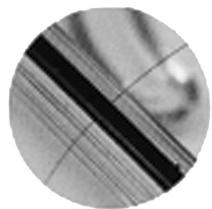
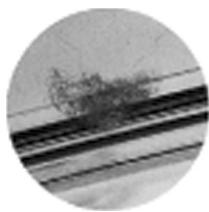
① When sealing this product, make sure that no hair, fiber, sand particle or other foreign matter stick to the O-ring, and also to the contact surface. Even a single strand of hair or a single grain of sand may cause water leakage. Please check with special care.
Examples of foreign matter sticking to the O-ring
natural_image
Close-up of a textured surface with diagonal dark bands and faint linear patterns (no text or symbols)Hair
natural_image
Circular cropped image showing a blurred natural scene with indistinct dark shapes on a striped background (no text or symbols visible)Fibers

natural_image
Circular cropped image showing a dark circular object above a horizontal line with a small rectangular object at the bottom (no text or symbols visible)Grains of sand
② The O-ring is a consumable product. Please replace it at least once a year with a new piece. Before each use, perform the proper maintenance.
③ Deterioration of the O-ring will accelerate according to the usage conditions and the storage conditions. Immediately replace the O-ring with a new piece if it is damaged, cracked, or has lost its elasticity.
④ During maintenance of O-ring, clean the inside of the O-ring groove and confirm the absence of dirt, dust, sand, and other foreign matter.
⑤ Apply the specified silicon grease to the O-ring.
⑥ The waterproof function is not effective if the O-ring is not installed correctly. When installing the O-ring, take care that it does not project from the groove and that it is not twisted. Also, when sealing the Case, close the lid after confirming that the O-ring has not come out of the groove.
⑦ This product is an airtight construction made of plastic (polycarbonate). When it is left for a long time in a car, on a boat, at the beach, or at other places reaching a high temperature, or when it is subjected to uneven external force for a long time, it may be deformed and the waterproof function may be lost. Pay sufficient attention to temperature control. Also do not place heavy objects onto the product during storage or transport, and avoid unreasonable storage.
⑧ When the O-ring contact surface is pressed strongly from the outside of the Case, or when the Case is twisted, the waterproof function may be lost. Take care not to exert excessive force.
⑨ Please use the Case only after performing the advance test and the final check.
⑩ If you detect any signs of leakage, such as water drops or fogging, while photographing, get out of the water immediately after following proper scuba diving procedures and remove any moisture from the camera and the Case. Then perform the leak test described in “Final check”.
Handling the Product
- Use or storage of the product at the following locations may cause defective operation, defects, damage, fire, internal clouding, or water leakage. This should be avoided.
- Places of high temperatures, such as in direct sunlight, in a closed vehicle, etc., and/or where extreme differences in temperatures exist.
- Places with open fire
• Water depths in excess of 40 m - Places with vibrations
- Places with high temperature and humidity or with severe temperature changes
-
Places with volatile substances
-
This product is made of polycarbonate resin with excellent impact resistance, but it may be damaged by rubbing against rocks etc. It also may break when it is hit by hard objects or is dropped.
- This product is not a case to soften impacts to the camera inside the product. When this product with a digital camera inside is subjected to impact or heavy objects are placed onto it, the digital camera may become damaged. Please handle it with sufficient care.
- When the product is not used for a long time, the waterproof performance may drop because of deterioration of the O-ring etc. Before use, always perform the advance test and the final check.
- Be careful not to apply excessive force to the port connector, TTL cable connector, zoom dial or tripod seat.
- Do not push the air vent valve from inside.
- Do not use the following chemicals for cleaning, corrosion prevention, prevention of fogging, repair or other purposes. When these are used for the Case directly or indirectly (with the chemicals in vaporized state), they may cause cracking under high pressure or other problems.
| Chemicals which cannot be used | Explanation |
| Volatile organic solvents, chemical detergents | Do not clean the Case with alcohol, gasoline, thinner or other volatile organic solvents or with chemical detergents etc. Pure water or lukewarm water is sufficient for cleaning. |
| Anticorrosion agent | Do not use anticorrosion agents. Pure water is sufficient when washing the metal parts as stainless steel and brass are used. |
| Commercial defogging agents | Do not use commercial defogging agents. Always use the specified desiccant silica gel. |
| Grease other than specified silicone grease | Use only the specified silicone grease for the silicon O-ring, as otherwise the O-ring surface may deteriorate and water leakage may occur. |
| Adhesive | Do not use adhesive for repairs or other purposes. When repair is required, please contact a dealer or a service station of OLYMPUS IMAGING CORP. |
- Do not perform operations other than specified in this instruction manual, do not remove or modify parts other than specified, and do not use parts other than specified.
Any trouble in taking pictures or with the equipment resulting from the above actions shall not be covered by the guarantee.
- OLYMPUS IMAGING CORP. shall in no way be responsible for accidents involving immersion of a digital camera in water.
- OLYMPUS IMAGING CORP. shall not pay any compensation for accidents (injuries or material damage) at the time of use.
Contents
Introduction 1
Please read the following items before use .... 1
For safe use .... 1
Batteries 3
For Prevention of Water Leakage Accidents.... 3
Handling the Product....4
1.Preparations....7
Check the contents of the package....7
Names of the parts....8
Install the Waterproof Port 9
Attach the hand strap 9
Mastering basic Case operations....10
How to hold the Case.... 10
How to Press the Shutter Lever....10
How to use the mode dial knob.... 10
How to use the zoom dial.... 11
How to control the power switch lever 11
Connecting the underwater optical fiber cable.... 12
Removing the TTL connector cap.... 12
Cleaning the TTL connector.... 13
How to connect the hot shoe cable.... 13
How to attach and detach the camera table 14
2. Advance check of the Case ....15
Advance test before use 15
Check the waterproof parts of the Case 15
Advance test 15
3. Installing the digital camera ....16
Check the digital camera.... 16
Battery Confirmation 16
Check the remaining number of pictures 16
Remove the strap and lens cap from the camera.... 16
Remove the eyecup from the digital camera. 16
Remove the filter from the digital camera 17
Prepare the digital camera 17
Compatible digital camera 17
Checking camera operation....17
Open the Case 17
Attach the zoom and focus gears provided with the optional underwater port to the lens. 18
How to attach the camera table to the digital camera 19
Using the UFL-2 underwater electronic flash with the underwater optical fiber cable...... 19
Using the electronic flash with the TTL cable.... 20
Insert the digital camera in the Case.... 21
Insert the silica gel 24
Check the loading status....24
Seal the Case....25
Check the operation of the loaded camera 26
Perform the final checks.... 26
Visual Inspection.... 26
Final Test 27
4.Underwater Shooting 28
How to use the hand strap 28
Hold the Case carefully 28
Confirm that you can see an image in the pick-up finder or LCD monitor. 28
Gently press the shutter lever....28
5. Handling After Shooting ...... 29
Wipe off any waterdrop 29
Unload the digital camera 30
Wash the Case with pure water 31
Dry the Case 31
6. Maintaining the Waterproof Function....32
Remove the O-ring 32
Procedure 32
Remove any sand, dirt, etc. 32
Install the O-ring 33
How to Apply Grease to the O-ring 33
Replace consumable products 34
Maintenance of the threaded sections on the TTL cable and TTL cable connector.... 34
Maintenance of the TTL Connector Cap 34
7. Appendix ......35
Q & A on use 35
Specifications 39
1. Preparations
Check the contents of the package
Check that all accessories are in the box.
Contact your dealer if accessories are missing or damaged.
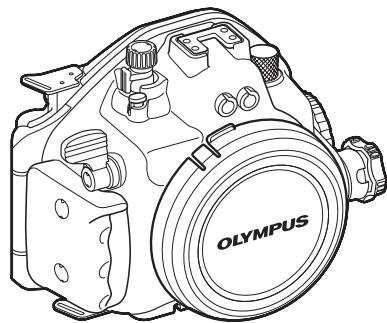
natural_image
Line drawing of a DSLR camera with visible internal components and no text or symbols- Case body (Check that the O-ring is normal.)

natural_image
Pure geometric diagram of intersecting rectangular panels with grid patterns, no text or symbols present- Silica gel
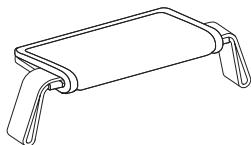
natural_image
Line drawing of a rectangular electronic component with two metal clips (no text or symbols)- Hand strap
natural_image
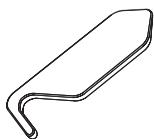
Simple line drawing of a curved, segmented object resembling a handle or bracket (no text or symbols)- O-ring remover
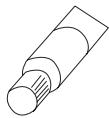
- Silicone grease
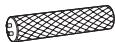
- Maintenance adapter
• Instruction manual (this manual)
- Authorized distributors list/Authorized service centres list
Names of the parts
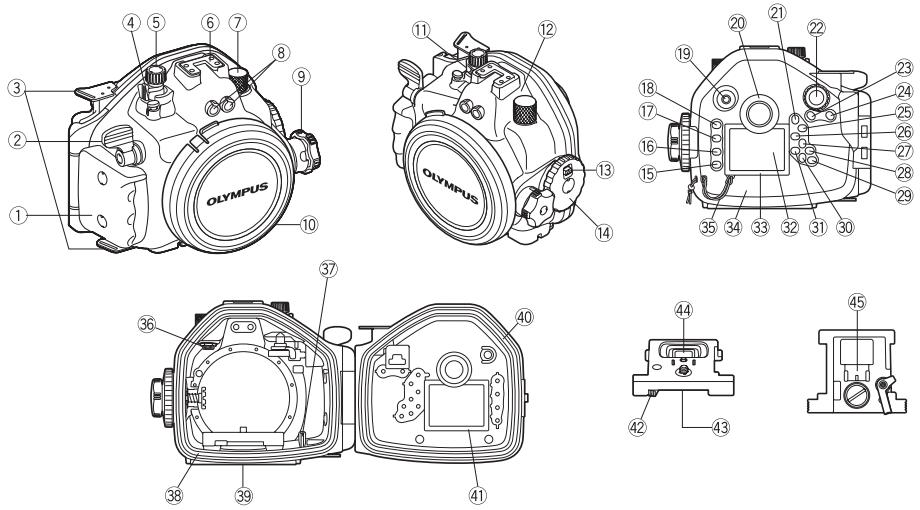
① Palm grip
*② Shutter lever
③ Hand strap ring
*④ ☑ (Exposure correction) button
*⑤ Mode dial knob
⑥ Accessory mount
⑦ TTL cable connector
⑧ Optical fiber cable insertion slot, cap
*⑨ Zoom dial
⑩ Body cap
*⑪ Power switch lever
⑫ Front lid
⑬ Slide lock
⑭ Open/close dial
*⑮ INFO (Info display) button
*⑯ MENU button
*⑰ (Erase) button
*⑱ ▶ (Play) button
⑲ Air vent valve
⑳ Pickup finder
*②1 AEL/AFL button
*⑳ Control dial knob
*②3 Fn button
*⑳ [■■] (AF target) button
*⑳ IS button
*②6 |□| button
*⑳ Cross-cursor button ▲
*⑳ Cross-cursor button ▶
*29 OK button
*③0 Cross-cursor button ▼
*③1 Cross-cursor button ◀
③2 LCD monitor window
③3 LCD hood
③4 Rear lid
③5 LCD hood strap
③6 Hot shoe cable connectors (w/caps)
③7 Loading guide rails
③8 O-ring (POL-E05B)
⑲ Tripod seat
④0 O-ring (POL-E05A)
④1 LCD inner hood
④2 Camera table lock
④3 Camera table
④4 Eyecup storage space
④5 Hot shoe cover storage space
Note:
Case operation parts marked by * corresponds to the operation parts of the digital camera. When the operation parts of the Case are operated, the corresponding functions of the digital camera will operate. For details of the functions, refer to the instruction manual for the digital camera.
Install the Waterproof Port
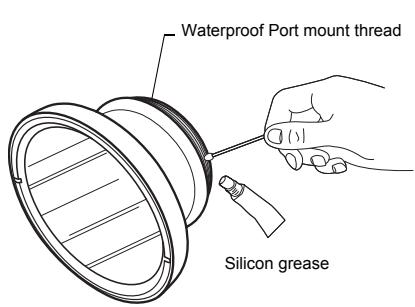
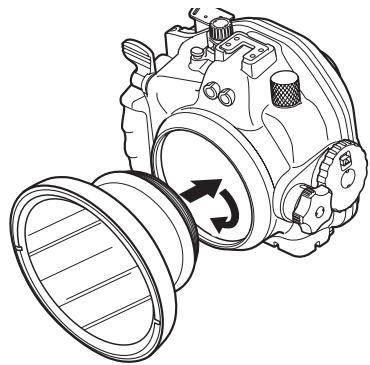
To enable the Case to be used underwater, the separately available Waterproof Port for the camera lens must be installed on the Case. Align the Waterproof Port with the position where the camera lens will be when the camera is loaded in the Case.
- Refer to the instruction manual provided with the Waterproof Port before attaching the Waterproof Port to the Case.
- Apply the provided Silicon grease to the O-ring section of the Waterproof Port and the Waterproof Port mounting thread on the Case.
- Screw the Waterproof Port into the Case by turning it clockwise all the way.
natural_image
Technical line drawing of a mechanical device with a rotating component and fan (no text or symbols)CAUTION:
The Case should not be used underwater at depths that exceed 40 meters. Even when the attached underwater lens port or other equipment is able to withstand depths exceeding 40 meters, the Case itself cannot be used at depths of more than 40 meters.
Attach the hand strap
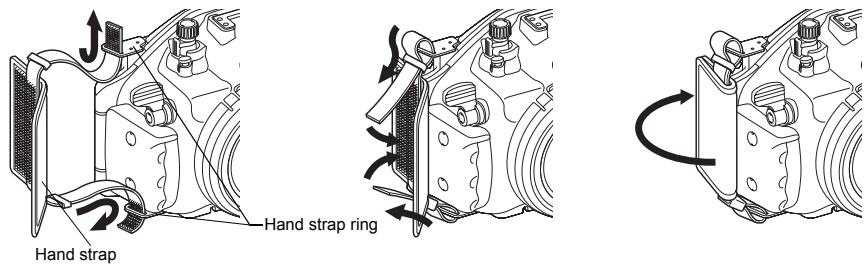
Attach the hand strap to the Case.
CAUTION:
- Be sure to install the hand strap correctly as shown above.
- Two hand strap rings are attached to the side of the Case, at the top and bottom of the palm grip. Before using the Case, be sure to attach the ends of the strap to the two hand strap rings.
- OLYMPUS IMAGING CORP. shall bear no responsibility for damage caused by dropping the Case because of incorrect installation of the hand strap.
Mastering basic Case operations
Before loading the digital camera, be sure you are comfortable with the basic Case operations.
How to hold the Case
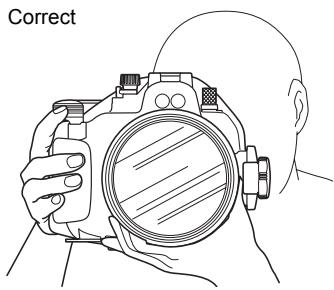
Press your arms against your sides and hold the Case firmly with both hands at a height where you can comfortably view the image through the Case's pickup view finder.
natural_image
Line drawing of a person holding a camera with a circular lens, viewed from the side (no text or symbols)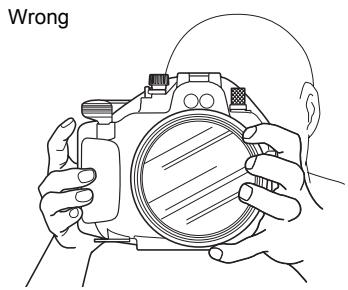

CAUTION:
- Do not apply excessive force to the waterproof port.
- Be careful not to block the waterproof port's lens window.
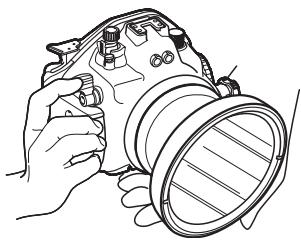
How to Press the Shutter Lever
When pressing the shutter lever, press it gently, so that there will be no movement of the camera.
natural_image
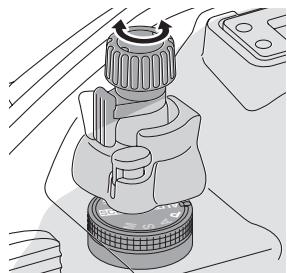
Line drawing of hands holding a camera lens (no text or symbols)How to use the mode dial knob
The Case has a mode dial knob that that functions the same way as the mode dial of the digital camera loaded in the Case. After loading the digital camera in the Case, be sure to check that the mode dial knob functions properly before taking any photographs.
natural_image
Mechanical component diagram showing a cylindrical assembly with a flanged top and base, no visible text or symbols
CAUTION:
Make sure that the Case's mode dial knob is properly positioned on camera's mode dial. Remember that the rotation range of the camera's mode dial is limited. Do not turn the Case's mode dial knob beyond the rotation range of the camera's mode dial.
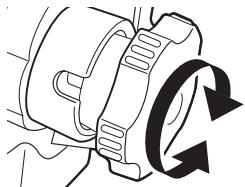
How to use the zoom dial
The Case's zoom dial can be used to control the digital camera's zoom ring or its manual focus ring. Which operation is available depends on the lens being used.
natural_image
Mechanical component diagram showing rotational motion with two curved arrows (no text or symbols)Whether or not the Case's zoom ring can control the camera's zoom ring and focus ring depends on which lens is mounted on the digital camera. For details, refer to the instruction manual of the optional waterproof port.
| Waterproof Port | Applicable Lens | Zoom Ring | Focus Ring | Note |
| PPO-E01 | 14-45 mm | Controllable | Not Controllable | Only autofocusing is possible. |
| 35 mm Macro | Not Controllable | Controllable^*1 | The lens' focus ring can be rotated by 360°. | |
| PPO-E02 | 14-54 mm11-22 mm | Controllable | Not Controllable | Only autofocusing is possible. |
| PPO-E03 | 50 mm Macro | Not Controllable | Controllable^*2 | Manual focusing is possible but the MF ring rotation range is limited to 180°. |
| PPO-E03+PPO-E01 | 50 mm Macro+EC14 | Not Controllable | Not Controllable | Only autofocusing is possible. |
| PPO-E04+PER-E02 | 7-14 mm | Controllable | Not Controllable | Only autofocusing is possible. |
| PPO-E04 | 8 mm Fisheye | Not Controllable | Controllable^*3 | The lens' focus ring can be rotated by 360°. |
| PPO-E05 | 14-42 mm | Controllable | Not Controllable | Only autofocusing is possible. |
*1. The optional PPZR-E04 focusing gear is required.
*2. The focus ring on the lens can be turned 360° by using the optional PPZR-E04.
*3. The optional PPZR-E05 focusing gear is required.
As of June 2008.
How to control the power switch lever
Move the power switch lever of the Case to turn the camera ON and OFF.
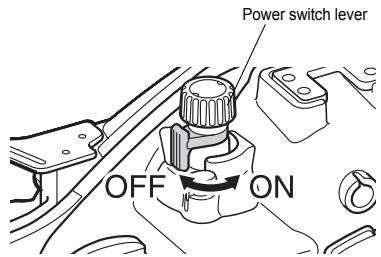
CAUTION:
When the digital camera has not been operated for a certain period of time, the sleep mode (standby status) will be engaged. The duration before the sleep mode is engaged can be set on the digital camera.
To exit the sleep mode (and restore camera functions), press any button (such as the shutter button).
For details, refer to your digital camera's instruction manual.
Connecting the underwater optical fiber cable
To connect the separately available UFL-2 underwater flash to the Case using an underwater optical fiber cable (optional), follow the procedures below.
- Remove the cap of the optical fiber cable insertion slot.
- Put the underwater optical fiber cable plug all the way into the optical fiber cable insertion slot.
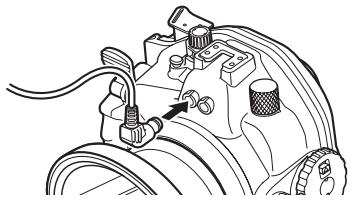
natural_image
Technical line drawing of a mechanical assembly with no visible text or symbolsRemoving the TTL connector cap
To perform TTL flash shooting by connecting the separately available underwater flash or other products to the Case using the underwater TTL cable (optional), remove the TTL connector cap as described below.
① Remove the TTL connector cap from the Case.
② Connect the underwater TTL cable (optional) to the TTL connector on the Case.
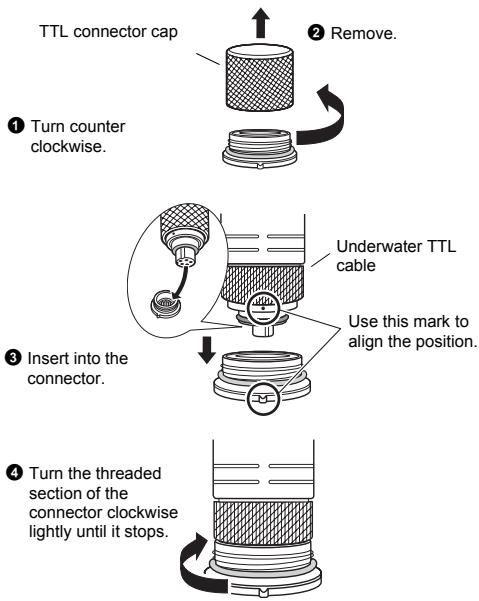
② Connect the underwater TTL cable (optional) to the TTL connector on the Case.
② Connect the underwater TTL cable (optional) to the TTL connector on the Case.
■ How to attach the TTL connector cap to the case
Make sure there is no foreign matter attached to the O-rings inside the cap and on the TTL cable connector. To secure the cap, gently turn it clockwise until it stops.
Check O-rings
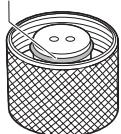
Cap
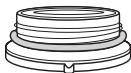
Connector
① Attach the cap to the case.
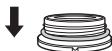
② Gently turn the cap clockwise until it stops.
CAUTION:
If the TTL connector cap is loose, water penetration may result. Be sure to gently turn the cap until it stops to make sure it is firmly secured.
Do not turn or tighten the TTL cable too hard. If it is too tight, it may be difficult to loosen and remove.
Cleaning the TTL connector
If the threaded sections of the TTL cable and TTL cable connector stick to each other, the cable may disconnect from the connector. To prevent this, apply silicone grease, provided with this case to the threaded sections.
For details, see "Maintenance of the TTL Connector Cap" (P. 34) of this manual.

CAUTION:
If you cannot disconnect the TTL cable, do not use force. Contact Olympus for support.
How to connect the hot shoe cable
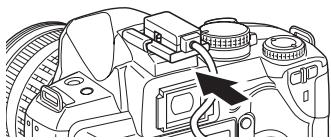
To perform TTL flash shooting using the Case, connect the hot shoe cable (optional) between the connector on the Case and the digital camera's hot shoe.
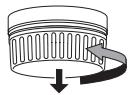
① Turn the hot shoe cable connector cap inside the case counterclockwise to remove it.
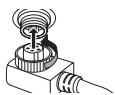
② Insert the connector of the hot shoe cable into the case's connector and turn the connector screws all the way clockwise to connect them firmly.
③ Insert the hot shoe on the hot shoe cable into the hot shoe on the camera.
The hot shoe cover removed from the camera can be stored in the camera table.
For details, see “How to attach the camera table to the digital camera” (P. 19) of this manual.
④ When not using the hot shoe cable, attach the hot shoe cable cap to the hot shoe cable connector inside the case and turn the cap all the way clockwise to attach it firmly.
natural_image
Technical line drawing of a camera body panel with no visible text or symbols

CAUTION:
Be sure to remove the camera from the case when inserting the connector of the hot shoe cable into the case's connector.
How to attach and detach the camera table
The camera table inside the front lid of the Case is used to load the digital camera into the Case.
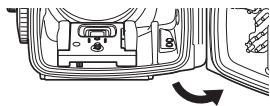
① Slide and hold the Case's slide lock and open the open/close dial, then open the rear lid.
② Slide the camera table lock to the left to unlock the camera table.
Slide the table towards the rear.
③ To prepare the Case for loading, screw the camera table's screw tightly into the camera's tripod screw hole. For details, see "How to attach the camera table to the digital camera" (P. 19) of this manual.
④ Slide the camera table all the way into the camera table loading grooves on the front-lid side of the Case. Slide the camera table lock to the right to lock the camera table.
⑤ Gently close the rear lid of the Case and close the open/close dial firmly.
natural_image
Diagram of a mechanical component with an arrow indicating rotation or movement (no text or symbols present)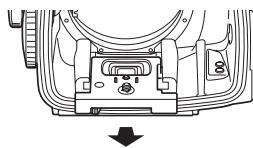
natural_image
Technical diagram of a mechanical component with no visible text or symbols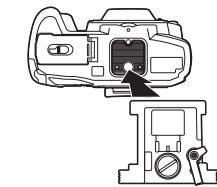
natural_image
Technical line drawing of a camera with a mounted panel and adjustment knob (no text or symbols)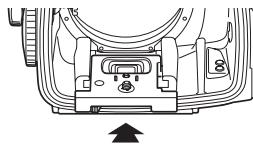
natural_image
Technical diagram of a camera lens assembly with no visible text or symbols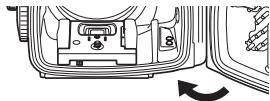
natural_image
Technical line drawing of a mechanical component with an arrow indicating rotation (no text or symbols)CAUTION:
Closing the rear lid of the Case before the camera table is inserted all the way (until it stops), into the camera table loading grooves could damage the Case and the camera.
2. Advance check of the Case
Advance test before use
This Case has been the subject of thorough quality control for the parts during the manufacturing process and thorough function inspections during the assembly. In addition, a water pressure test is performed with a water pressure tester for all products to confirm that the performance conforms to the specifications.
However, depending on the carrying and storage conditions, the maintenance status, etc., the waterproof function may be damaged.
Before diving, always perform the following advance test and the water leakage test after installation of the camera.
Check the waterproof parts of the Case
Check the waterproof parts of the Case as described below.
① Ensure that the Case's O-rings are firmly attached and secured with the slide lock and the open/close dial.
② Ensure that the separately available Waterproof Port is installed correctly, and that the Waterproof Port is attached firmly to the O-ring between the Waterproof Port and Case.
③ Ensure that the O-ring of the TTL connector is attached firmly and that the cap is screwed into the connector without loosening.
Advance test
① Before loading the digital camera in the Case, immerse the empty Case at depth you intend to use it and make sure there is no water leakage.
② Main causes of water leakage are as follows.
- Forgetting to install the O-ring
- Part of an O-ring or an entire O-ring is outside the specified groove.
- O-ring damage, cracks, deterioration or deformation
- Sand, fibers, hair or other foreign matter sticking to the O-ring, the O-ring groove or the O-ring contact surface.
- Damage to an O-ring groove or O-ring contact surface.
- Attached strap or silica gel getting caught when closing the Case.
Perform the test after the above causes have been eliminated.
CAUTION:
- The most suitable method for checking water leakage is to immerse the Case to the intended water depth. When this is difficult, water leakage also can be checked at a shallow depth with no water pressure. Do not feel that this is troublesome, but perform this test.
- If the advance test should show water leakage with normal handling, stop using the Case and contact your dealer or an Olympus service station.
3. Installing the digital camera
Check the digital camera
Check the digital camera before loading it in the Case.
Battery Confirmation
Underwater shooting can reduce battery life because the picture has to be checked on the LCD monitor before and after shooting. Make sure that you have sufficient remaining battery capacity before use.

CAUTION:
In order to avoid missing photo opportunities due to an exhausted battery, you should always have a fully charged battery before each dive.
Check the remaining number of pictures
Check that the image storage medium has enough room for the number of pictures you want to take.
Remove the strap and lens cap from the camera.
Be sure that the strap, and/or lens cap are not attached to the digital camera. If any of these items are attached, be sure to remove them.

CAUTION:
- If the digital camera is loaded without removing the strap and lens cap, the Case cannot be sealed properly and may leak.
- Handle the digital camera carefully when removing the strap and lens cap. Olympus does not assume any liability for damage incurred if the camera is dropped.
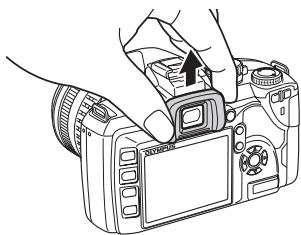
Remove the eyecup from the digital camera.
The Case allows you compose your shots in the pickup viewfinder or the LCD monitor.
To improve the view of the pickup viewfinder, remove the camera's eyecup before loading it in the Case.
The eyecup removed from the camera can be stored in the camera table.
For details, see "How to attach the camera table to the digital camera" (P. 19) of this manual.
natural_image
Line drawing of hands installing or adjusting a DSLR camera module (no text or symbols present)
CAUTION:
In case the digital camera is loaded in the Case without removing the eyecup and the rear lid of the Case is closed, the pickup viewfinder pops out.
Remove the eyecup, then push in the pickup viewfinder.
Remove the filter from the digital camera
If a filter is attached to the lens of the digital camera, remove the filter before loading the digital camera in the Case.

CAUTION:
The digital camera cannot be loaded in the Case while the filter is attached to the lens. Be sure to remove the filter before loading.
Prepare the digital camera
Compatible digital camera
This product (PT-E05) is exclusively for use with the E-520 Digital Camera.
Checking camera operation
Refer to the digital camera's instruction manual for details on how to make sure the camera is operating correctly.
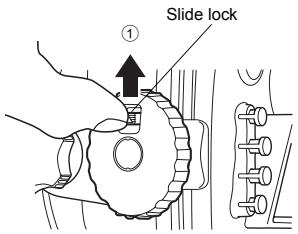
Open the Case
① Slide and hold the slide lock towards the arrow direction (①) and turn the open/close dial counter clockwise (②).
② Turn the open/close dial to the position where it cannot be turned further.
③ Open the rear lid of the Case gently.
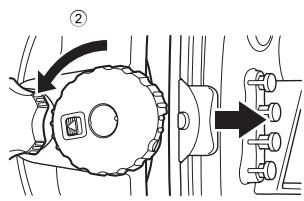

CAUTION:
Do not exert too much force while turning the open/close dial. Doing so may damage the dial.
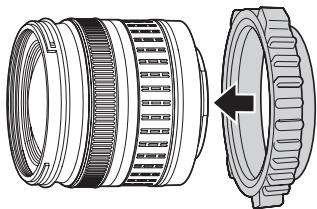
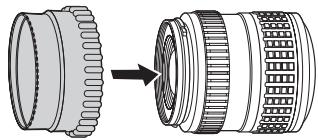
Attach the zoom and focus gears provided with the optional underwater port to the lens.
To control the zooming and manual focusing of the camera's lens, attach the zoom gear and focus gear (provided with the optional underwater port) to the lens' zoom ring and focus ring.
Refer to the optional underwater port's instruction manual for more details on how to attach the gears.
[Example 1] Attaching the 14-42 mm zoom gear provided with the PPO-E05 to the lens
For details, refer to the instruction manual for the PPO-E05.
natural_image
Technical illustration of a mechanical component with two views: top shows cylindrical lens assembly, bottom shows axial gear assembly (no text or symbols)[Example 2] Attaching the optional underwater zoom/focus gears (PPZR-E03/E04/E05) to the lens
For details, refer to the instruction manual for the zoom/focus gears.
natural_image
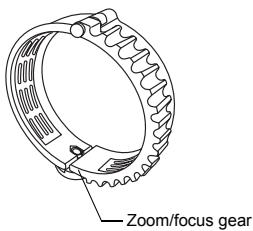
Diagram showing a mechanical component being converted into a larger cylindrical housing (no text or symbols present)[Example 3] Attaching the provided zoom/focus gears to the PPO-E01/E02/E03
natural_image
Line drawing of a DSLR camera with attached strap (no text or symbols)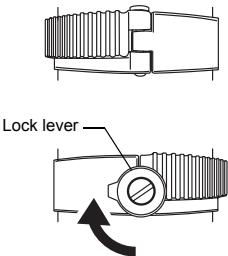
Use the lock gear to clamp the zoom/focus gear.
CAUTION:
- Make sure that the zoom gear is clamped firmly by the lock lever.
- For details on the correct attachment position of the zoom gear on the lens, refer to the instruction manual provided with the optional underwater lens port.
How to attach the camera table to the digital camera
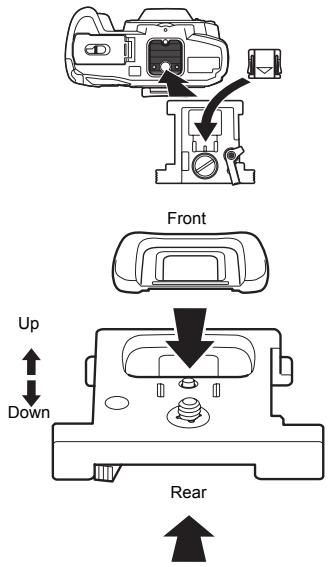
In order to load the camera into the Case, attach the camera table (located on the front-lid side of the Case) to the digital camera.
① The eyecup and the hot shoe cover of the digital camera can be stored in the camera table.
② Attach the camera table to the tripod seat section on the bottom of the digital camera. Use the camera's tripod screw hole for attaching.
③ The camera table has fixed up-down and front-rear orientations. To ensure that it is properly attached, refer to the illustration on the right.
Using the UFL-2 underwater electronic flash with the underwater optical fiber cable
① Set the RC mode of the camera to ON so that the camera's built-in flash is activated.
② Load the camera in the Case with the camera's built-in flash popped up.
Refer to the UFL-2 instruction manual for the UFL-2 operation.
Using the electronic flash with the TTL cable
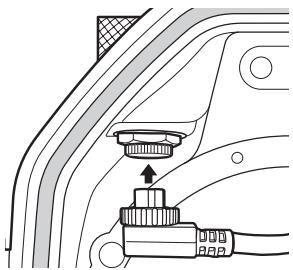
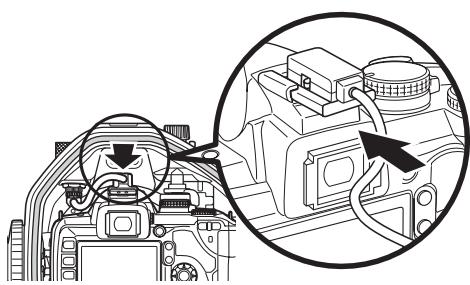
To attach the Electronic Flash to this Case using TTL cable, connect the hot shoe cable to the camera and to the hot shoe cable connector on the front lid side of this Case as described below. Note that the camera's built-in flash cannot be used when an external electronic flash and case are installed. Be sure to set the automatic pop-up setting of the camera to OFF so that the builtin flash will not pop up automatically.
① Before loading the camera in the Case, connect the hot shoe cable's connector to the Case's hot shoe cable connector.
natural_image
Technical diagram of a mechanical component with a threaded fastener and connector (no text or symbols)② Set the automatic pop-up setting of the camera to OFF. The camera's built-in flash is designed to pop up automatically when shooting under low light or against backlight in any scene mode other than the AUTO or underwater modes. This setting change is required to prevent this.
[OFF]: The built-in flash will not pop up automatically.
③ Switch the electronic flash ON before switching the camera ON.
When using the electronic flash, be sure to turn it ON before turning the camera on.
Otherwise, if the automatic pop-up setting of the camera is ON and the camera is set to a scene mode other than the AUTO or underwater modes, turning the camera ON before turning the electronic flash on would cause the camera's built-in flash to pop up automatically. Always be sure to turn the electronic flash ON before turning the camera ON.
④ Load the camera in the Case, and then connect the hot shoe cable to the camera.
natural_image
Technical diagram of a mechanical assembly with an inset close-up showing internal components (no text or symbols)CAUTION:
- For details on camera function setup, refer to the camera's instruction manual.
- If the camera's built-in flash pops up while the hot shoe cable is connected to the camera, it will interfere with the hot shoe cable, either disconnecting it or causing a connection failure.
- When using a slave-type underwater flash from a non-Olympus manufacturer, pop the camera's built-in flash up before loading it in the Case.
- Once the camera has been loaded in the Case and the Case has been sealed by closing the slide lock and open/close dial it is no longer possible to pop up or retract the camera's built-in flash.
- When using an optional electronic flash with underwater case, a bracket is required to attach the electronic flash case to this Case.
Insert the digital camera in the Case
Load the digital camera in the Case after checking the following:
• Is the digital camera turned OFF?
- Is camera media (either xD-Picture Card or CompactFlash) loaded into the camera?
• Is the battery fully charged?
- The strap, lens cap and filter are removed from the digital camera.
- The camera table provided with the Case is attached to the tripod screw hole at the bottom of the digital camera.
- The camera's eyecup is removed from the camera's viewfinder.
- The zoom gear and focus gear are attached to the camera's lens.
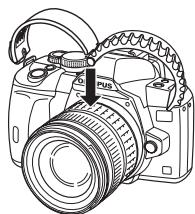
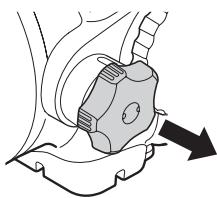
① Pull out the zoom dial and mode dial on the Case (pulling out the mode dial also pulls up the power switch lever) so that they do not get in the way while loading the digital camera.
natural_image
Anatomical illustration of a pelvic device with an arrow indicating a specific area (no text or labels present)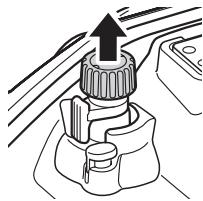
natural_image
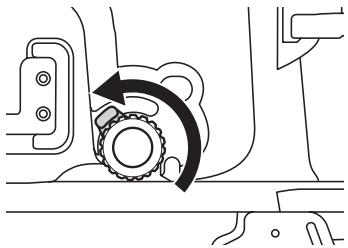
Line drawing of a mechanical component with an upward arrow indicating motion (no text or symbols)At this time, set the orientation of the power switch lever as shown below.
natural_image
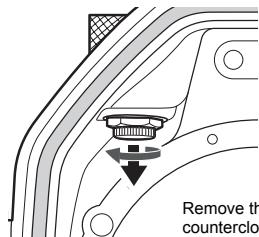
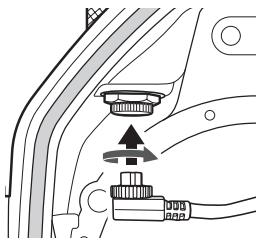
Mechanical diagram showing a gear meshing operation with an arrow indicating rotational motion (no text or symbols)② When using an electronic flash with a TTL cable, remove the TTL cable connector cap on the hot shoe connector, which is located in the top left corner of the inner side of the front lid. and connect the TTL cable to the connector.
natural_image
Diagram of mechanical components with no visible text or symbolsCAUTION:
When screwing in the hot shoe connector clamping screw, place the Case upside down. Be careful not to drop the Case.
③ When using a slave flash from a non-Olympus manufacturer, push the ↓ button on the camera to pop up its built-in flash.
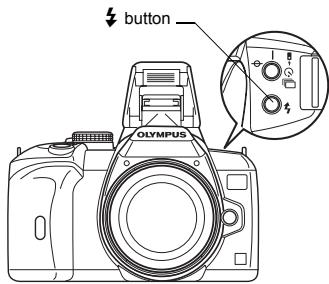

CAUTION:
The built-in flash should be popped up before loading the camera in the Case. Once the case has been sealed, the built-in flash cannot be popped up from outside the Case. To pop up the flash after the case has been sealed, change the camera's automatic pop-up setting to ON, set the camera to a scene mode other than AUTO and underwater modes, point the camera at the subject and half-press the shutter button so that the built-in flash pops up automatically.
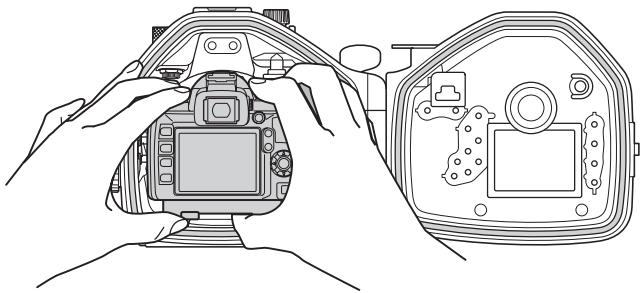
④ After attaching the camera table to the digital camera, slide the camera table into the Case's camera table-loading groove. Do not insert the camera table by force. Slide it in gently while checking that the digital camera does not interfere with the internal parts of the Case.
natural_image
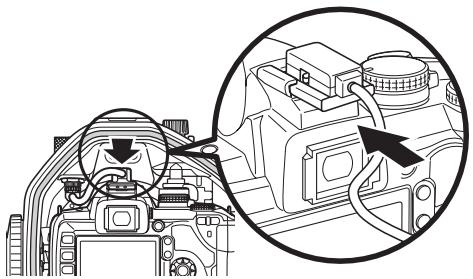
Line drawing of a person adjusting a DSLR camera, showing front and back views (no text or symbols)⑤ When using an external electronic flash with a TTL cable, connect the hot shoe cable to the camera's hot shoe and set the camera's automatic pop-up setting to OFF.
natural_image
Technical diagram of a mechanical assembly with an inset showing a close-up of a component (no text or symbols present)
CAUTION:
After confirming the camera's automatic pop-up setting, be sure to switch the camera OFF.
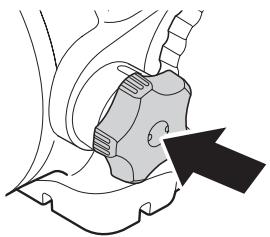
⑥ Gently push the Case's zoom dial and mode dial down and confirm that the zoom dial can smoothly control zooming, the power switch lever can turn the digital camera ON/OFF, and that the mode dial can control the mode dial of the camera.
natural_image
Diagram of a mechanical component with an arrow pointing to it, no text or symbols present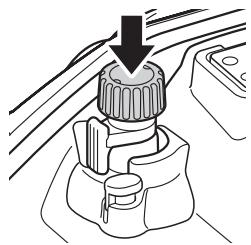
natural_image
Hand holding a mechanical knob with a black arrow pointing to the knob (no text or symbols visible)
CAUTION:
- Before loading the digital camera, attach the zoom and focus gears to the Case's zoom and focus rings. Refer to the instruction manual provided with the optional underwater lens port for details. Adjust the positioning of the zoom and focus rings inside the Case as necessary.
- If the zoom and focus gears on the lens are not properly meshed with the Case's zoom dial gear, zooming and focusing are not possible. Even when the gears are meshed, the zoom and focus control ranges may be limited due to the positioning of the zoom and focus gears in the Case. Be sure to carefully follow the instructions provided with optional underwater lens port to ensure that correctly position the gears.
Insert the silica gel
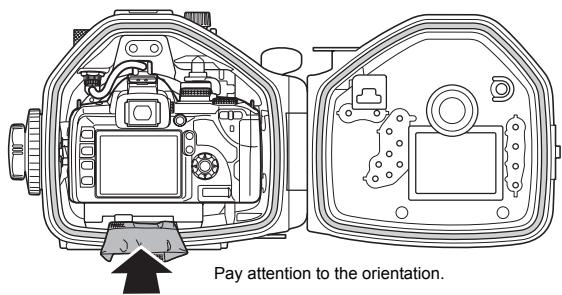
Before sealing the Case, be sure to insert the silica gel bag in the space between the bottom of the camera table and the inner surface of the Case. This will prevent fogging. Inset the silica gel bag laterally with the sides folded down.

CAUTION:
- Insert the silica gel bag as far as it will go at the specified location and with the specified orientation. If the orientation is incorrect, the silica gel bag will get caught when the Case is sealed and water will leak into the Case.
- If the bag is only inserted part of the way, it will get caught by the O-ring when you try to seal the Case and water will leak into the Case.
- Once silica gel has been used, the moisture absorption performance will be impaired. Always change the silica gel when you open or close the Case.
Check the loading status
Always perform the following final checks before sealing the Case.
- Does the zoom dial operate properly?
- Is the silica gel inserted all the way at the specified position?
- Are the O-rings and the O-ring contact surfaces free of dirt and other foreign matter?
- Are the O-rings installed properly?
- Is the Waterproof Port attached correctly?
- Is the TTL connector cap attached properly without loosening?
- Can the camera power be switched ON/OFF?
- Is the mode dial of the camera controllable?
- When using an external electronic flash with a TTL cable, check that the hot shoe cable is connected properly and that the camera's automatic pop-up setting is set to OFF.
- When using the UFL-2 underwater electronic flash with the underwater optical fiber cable, or when using a slave flash from a non-Olympus manufacture, check that the camera's built-in flash is popped up.
Seal the Case
① Close the rear lid gently (so that the O-rings do not slip out of the grooves).
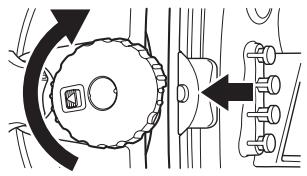
② Turn the open/close dial clockwise.
- The Case is sealed when the position of the slide lock is at the top.
natural_image
Mechanical diagram showing gear and shaft assembly with directional arrows (no text or labels)
CAUTION:
If the open/close dial is not fully turned, the Case will not be sealed airtight and water leakage may occur.
Check the operation of the loaded camera
After sealing the Case, check that the camera functions normally.
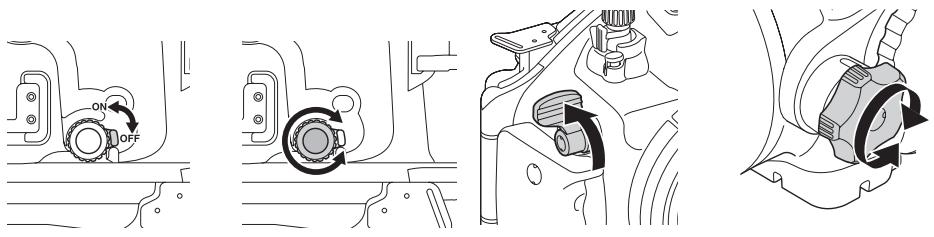
- Operate the power switch lever on the Case and confirm that the camera can be turned ON/OFF.
- Turn the mode dial knob on the Case and confirm that the camera mode switches properly.
- Operate the shutter lever on the Case and confirm that the camera shutter is released.
- Operate the zoom dial on the Case and confirm that the camera's lens is controlled.
- Operate other control buttons on the Case and confirm that the camera functions properly as intended.

CAUTION:
- If the camera does not function properly, remove the camera and reload it, starting from “Check the digital camera” (P. 16) of this manual.
- After loading the camera in the Case, confirm that the Case's mode dial can be rotated. If not, the Case's mode dial may not be positioned properly on the camera's mode dial. Set the mode dials properly.
Perform the final checks
Visual Inspection
After closing the case tightly, check the seal between the front and rear lids and the connection between the port and case to make sure the O-rings are not twisted, that they sit properly in the grooves, and that no foreign matter has been caught between the two parts.

CAUTION:
Hair, fiber, and other narrow items are not very apparent, but they may cause entry of water, therefore special attention is required.
Final Test
The final test after loading the camera is explained below. This is the only way to eliminate worry about possible entry of water! Always perform this test. It can be performed easily in a water tank or a bathtub. The required time is about five minutes.
| Simple water immersion test | Explanatory image | Hints |
| 1 Place the Case slowly into the water. | 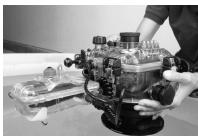 | As the Case is transparent, waterdrops entering into it can be confirmed easily. |
| 2 At first, immerse the Case for only three seconds. | 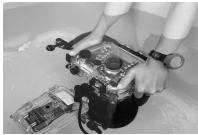 | In case of trouble with the O-ring, three seconds is enough for water to enter. Are there air bubbles coming out between the lids? Please check carefully. |
| 3 Check that no water has entered the Case. | 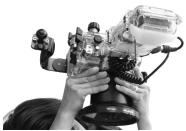 | Remove the Case from the water and check that no water has accumulated at the bottom of the Case.Is there any water trickling down? |
| 4 Next, immerse the Case for 30 seconds. | 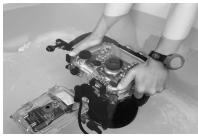 | Check carefully for air bubbles!Do not perform any operation yet, but just observe. |
| 5 Check that no water has entered the Case. | 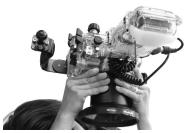 | Remove the Case from the water and check that no water has accumulated at the bottom of the Case.Confirm very carefully. |
| 6 Next, check by immersing for three minutes. | 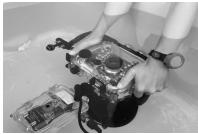 | Check carefully for air bubbles!Try operation of the buttons used frequently.Check carefully for air bubbles!If there is still no entry of water, everything is OK! |
| 7 This is the final check. Has the silica gel become moist? | 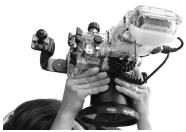 | This is very important!Has the silica gel become moist?Please check carefully!As the interior can be seen, the inspection for entry of water also can be made easily! |
| 8 If there is no water leakage and everything is functioning correctly, you are ready to start shooting underwater. | 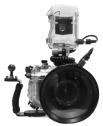 | Now everything is all right!Have a nice dive! |
4. Underwater Shooting
How to use the hand strap
Attach the hand strap to the Case, pass your right hand through the hand strap and hold the Case body with the same hand.
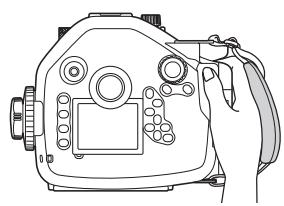
natural_image
Line drawing of a DSLR camera with handle and control panel (no text or symbols)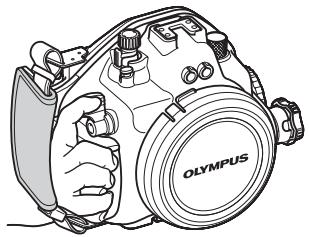
natural_image
Line drawing of a hand holding a Olympus camera case (no text or symbols on the device itself)
CAUTION:
If the settings of underwater shooting designed for E-520 are being used, you can enjoy underwater shooting easily.
Hold the Case carefully
Confirm that you can see an image in the pick-up finder or LCD monitor.
Confirming the image can be done by using the pick up finder or the LCD monitor. When using the LCD monitor to confirm, use the Live View function by pressing the |☐| button.
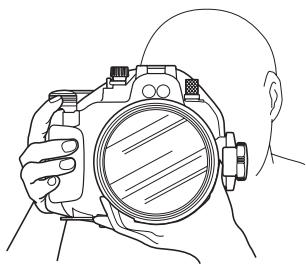
natural_image
Line drawing of a person holding a camera lens, viewed from the side (no text or symbols)Gently press the shutter lever.
When pressing the shutter lever, hold the Case securely with both hands and operate the lever gently to prevent the camera from shaking.
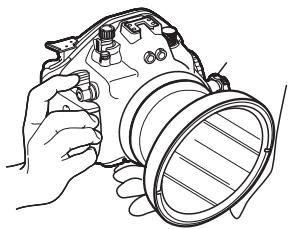
natural_image
Line drawing of a hand holding a camera lens (no text or symbols)
CAUTION:
- When shooting pictures fast moving objects, it is recommended to use the pick up finder.
- The target can be magnified up to 7/10 times when used with the Live View function.
5. Handling After Shooting
Wipe off any waterdrop
After underwater shooting, remove any drops of water from the case. Use pressurized air or a soft, lint-free cloth to carefully wipe away any moisture from the hinge between the front and rear lids, the shutter release lever, the handgrip and the open/close dial.
CAUTION:
- Water left between the front and rear lids or between the case and port can get inside the case once it is opened or the port is detached. Please dry these areas carefully.
- When opening the case or removing the port, make sure no water from outside (e.g. drops from your hair or the diving suit) gets inside the case and/or on the camera!
- Before opening the case or removing the port, ensure that your hands or gloves are completely clean (free of sand, loose fibers, etc.).
- Never open the case or remove the port in areas where water could splash or spray or where sand or dust could be blown in the air. When this cannot be avoided, for example if the battery or memory card needs to be changed, the case and camera should be protected from the wind or spray with a plastic sheet or similar object.)
- Never touch the digital camera and/or battery when your hands are wet with sea water.
CAUTION:
Moisten a cloth or towel with tap water and keep it in a plastic bag. Use this to wipe the salt water or crystals from your hands before you touch the camera.
Unload the digital camera
First, open the open/close dial of the Case and then open the rear lid carefully. Next, pull out the zoom dial and mode dial. Gently remove the loaded digital camera, while holding it with both hands.
To unload the digital camera, reverse the procedure described in “Insert the digital camera in the Case” (P. 21) of this manual.
① Turn the open/close dial on the Case.
② Disconnect the hot shoe cable if it is connected to the camera, then remove the Case's zoom and mode dials so that they do not interfere with removal of the camera, and take out the camera.
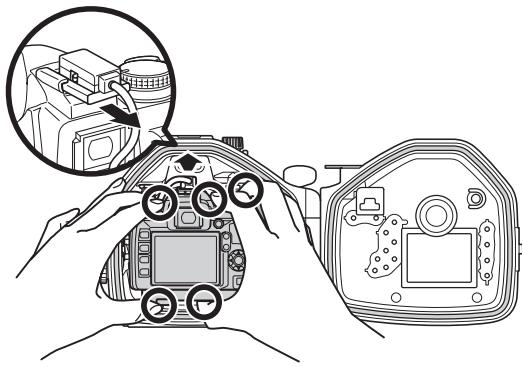
CAUTION:
- After opening the Case, always place it so that the O-ring surface is facing up. If the O-ring surface is faced down, foreign matter and dirt may attach to the O-ring and O-ring contact surface. This may cause the Case to leak the next time it is used underwater.
- For the picture storage and other procedures, refer to the camera's instruction manual.
- Be sure to pull out the zoom dial and mode dial of the Case before taking the digital camera out so that the dials do not get in the way. Otherwise, if the digital camera is removed forcefully, the Case or digital camera may be damaged.
Wash the Case with pure water
After use, seal the Case again after taking out the camera and wash it sufficiently in pure water as soon as possible.
After use in sea water, it is effective to immerse it for a few minutes in pure water to remove any salt.

CAUTION:
- Water leakage may be caused when a high water pressure is applied locally. Before washing the Case with water, remove the digital camera from it.
- Operate the shutter lever and various buttons of this product in pure water to remove salt adhering to the shaft. Do not disassemble for cleaning.
- Letting salt dry on the case may impair the function. Always wash off any salt after use.
Dry the Case
After washing with pure water, use a lint-free soft cloth without any salt on it to wipe off any waterdrop and dry the Case completely at a well ventilated location in the shade.

CAUTION:
Do not use hot air from a hair drier or the like for drying and do not expose the Case to direct sunlight, as this may accelerate deterioration and deformation of the Case and deterioration of the O-ring, leading to leakage of water.
When wiping the Case, take care not to cause scratches.
6. Maintaining the Waterproof Function
The O-ring is a consumable product. Before each use, perform proper maintenance. Neglecting this maintenance may become the cause of water leakage.
Remove the O-ring
Open the Case and remove the O-ring.
Procedure
① Insert the O-ring remover into the gap between the O-ring and O-ring groove wall.
② Bring the tip of the inserted O-ring remover below the O-ring. (Be careful not to damage the groove with the tip of the O-ring remover.)
③ Lift the O-ring, pinch it with your fingertips and pull it out of the Case.
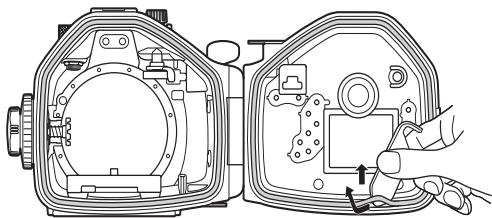
natural_image
Technical line drawing of a camera module showing front and side views with no text or symbolsRemove any sand, dirt, etc.
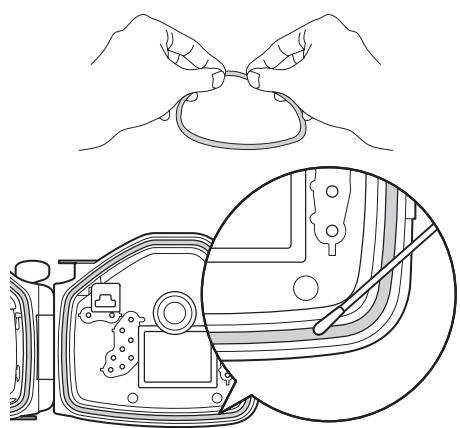
After visually checking that dirt has been removed from the O-ring, check for attached sand and other foreign matter, as well as for damage and cracks by squeezing the entire circumference of the O-ring lightly with your fingertips.
Remove attached foreign matter from the O-ring groove with a clean cloth or a cotton swab. Also remove any sand or dirt attached to any part of the Case that comes into contact with the O-ring.
natural_image
Technical illustration showing hands adjusting a pair of glasses above a camera module, with an inset close-up of the component (no text or symbols)CAUTION:
- When a mechanical pencil or any other sharp object is used to remove the O-ring or to clean the inside of the O-ring groove, the Case and the O-ring may be damaged and water leakage may be caused.
- When the O-ring is checked with the fingertips, take care not to stretch the O-ring.
- Never use alcohol, thinner, benzene or similar solvents or chemicals detergents to clean the O-ring. When such chemicals are used, it is likely that the O-ring will be damaged or that its deterioration will be accelerated.
Install the O-ring
Confirm that no foreign matter is attached, apply a thin coat of the accessory grease to the O-ring, and fit the O-ring into the groove. At this time, confirm that the O-ring does not stick out from the groove.
How to Apply Grease to the O-ring
| 1 Apply only Olympus exclusive lubricant to each O-ring. | 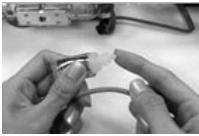 | Make sure that your fingers and the O-ring are free of dirt, and squeeze about 5 mm of lubricant onto a finger. (5 mm is the most appropriate amount.) |
| 2 Spread the lubricant onto the entire circumference of the O-ring. | 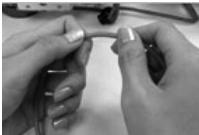 | Spread the grease onto the entire circumference of the O-ring using 3 fingers. Be careful not to use excessive force as this may stretch the O-ring. |
| 3 Check that the O-ring is free of scratches or unevenness. | 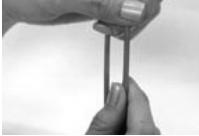 | After spreading the lubricant, check visually and by touch that the O-ring is not scratched and that its surface is flat. If it is damaged in any way, replace it with a brand-new O-ring. |
| 4 Apply lubricant on the O-ring contact surface. | 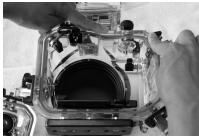 | Use the lubricant remaining on the fingers to clean and lubricate the case's contact surface. |

CAUTION:
- Always perform maintenance of the waterproof function even when the Case has been opened to exchange the battery or the image storage during shooting. Neglecting this maintenance may become the cause of water leakage.
- When the Case is not to be used for a long time, remove the O-ring from the groove to prevent deformation of the O-ring, apply a thin coat of silicone grease, and store it in a clean plastic bag or the like.
- Drying the Case with adhering salt may impair the function. Always wash off any salt after use.
Replace consumable products
- The O-ring is a consumable product. Independent of the number of times the Case is used, it is recommended that the O-ring should be replaced by a new piece at least once a year.
- Deterioration of the O-ring is accelerated by the usage conditions and the storage conditions. Replace the O-ring even before a year has passed if it shows signs of damage, cracking or loss of elasticity.

CAUTION:
Please use original Olympus products for the silicon grease, the silica gel, and the O-ring. These consumable products also can be purchased at an Olympus service station.
Maintenance of the threaded sections on the TTL cable and TTL cable connector
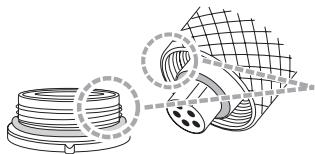
If the threaded sections used to connect the TTL cable to the TTL cable connector are not maintained properly, salt and other seawater residue may adhere to the TTL cable and prevent it from being disconnected.
After use in seawater, clean off any salt, sand, or other residue as soon as possible, then dry the equipment thoroughly. Clean the threaded sections with a cotton swab and apply a thin, uniform layer of silicone grease (provided with this case).
natural_image
Technical illustration of mechanical components with no visible text or symbolsClean and apply silicone grease to these sections.
Maintenance of the TTL Connector Cap
After removing the TTL connector cap from the Underwater Case, be sure to clean and grease the O-ring.
Use the maintenance adapter to remove the O-ring unit from the TTL connector cap.

① Insert the adapter by aligning its pin with the hole on the cap.
② Turn the adapter counterclockwise to remove the O-ring unit.
③ After removing the O-ring attached to the O-ring unit, clean the O-ring groove and apply silicone grease to the O-ring. Then, re-attach the O-ring to the O-ring unit.
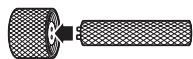
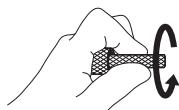
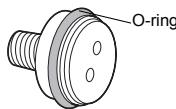
* Reverse the removal procedure to re-attach the O-ring unit to the TTL connector cap.
Q & A on use
Q1: : Which digital cameras can be used?
A1: : This product (PT-E05) is exclusively for use with the E-520 Digital Camera.
Q2: : Is underwater shooting possible with the Case alone?
A2: In addition to the Case, you need the separately available Waterproof Port matching the lens you are using.
Q3: : What precautions must be observed when loading the digital camera into the Case?
A3: : Pay special attention to the following items when loading the camera into the Case.
① Check that the camera's remaining battery capacity is sufficient.
② Check how many pictures can be stored on the image storage medium. Please use a medium with enough space to store all the pictures you want to take. This minimizes the number of times the Case has to be opened and closed.
③ Check that the zooming and focusing gears are attached properly to the lens of the digital camera.
④ When using an external flash with a TTL cable, check that the hot shoe cable is connected to the digital camera.
⑤ Remove the strap, lens cap, filter and eyecup from the digital camera. If they are attached to the digital camera, the Case cannot be sealed and water leakage may occur.
⑥ Confirm that O-rings are attached properly before sealing the Case.
⑦ Confirm that the O-ring contact surfaces are free of foreign objects such as dust or hair.
⑧ Be sure to insert the silica gel for prevention of fogging. Use the exclusive silica gel for Olympus underwater cases.
⑨ Confirm that the open/close dial for use in sealing the Case, the port connector and the TTL connector cap are closed or attached securely.
Q4: : What cautions must be observed when using and storing the Case?
A4: : Pay special attention to the following items.
① When the O-ring contact surface is pressed strongly from the outside of the Case, or when the Case is twisted, the waterproof function may be impaired and water leakage may be caused.
② When the Case is used, left or stored at the following locations, defective operation or trouble may be caused. This should be avoided.
- Places where the Case can reach high temperatures under direct sunlight or in a car, places with extremely low temperatures, and places with extreme temperature variations
- Places with open fire
- Places with volatile substances
- Places with vibrations
③ In case of the following handling with a camera loaded into the Case, trouble or breakage may be caused for the Case and/or the loaded camera. This should be avoided.
- Hitting against other objects
- Dropping
- Placing heavy objects on top of the Case
④ When the Case is not used for a long time, trouble from formation of mold etc. may occur. Before use, confirm the operation of all operation parts and perform the advance test and the final test.
Q5: : What cautions must be observed when opening and closing the Case?
A5: : Pay special attention to the following items.
① Do not open and close the Case at locations with water spray or sand spray.
② Wipe off all waterdrops from the gap between the front lid and the rear lid and around projections and recesses such as the buckles.
When this is not done, entry of water drops could possibly happen at the time of opening and closing.
③ When opening the Case, take care that no water will drip from your hair or body into the Case or onto the camera.
④ When the case is open, examine the O-rings and the O-ring contact surfaces on the front lid for foreign matter such as hair, fiber, and grains of sand. Remove these if present. Also examine the O-rings used for connection of the case and port.
⑤ Do not touch the camera or the image storage if your hands are in contact with seawater.
⑥ If you should detect waterdrops or other signs of water leakage while shooting, immediately end the dive, after following proper scuba diving procedures, perform the water leakage test again, and confirm that there is no leakage. If the camera is wet, wipe off any moisture and check the operation.
Q6: : How should the Case be handled after use?
A6: After use, take out the camera as soon as possible and wash the Case with pure water. When using the Case in the ocean, it is effective to immerse the Case for a certain time in pure water to remove any salt. Operate the buttons and levers under water to turn the shafts and wash off any salt. After washing, use a dry cloth without any salt on it to wipe off any moisture and dry the Case in the shade. Do not use hot air from a hair drier or the like and do not dry the Case under direct sunlight. Exposure to high temperatures or direct sunlight may cause deformation, discoloration or breakage of the Case and deterioration of the O-ring. Wipe the inside of the Case with a lint-free soft cloth. Remove the O-ring, wipe off any salt, sand, dust, etc., and also clean the O-ring groove and the O-ring contact surface in the same way and then dry them. When an object with a sharp tip is used to remove the O-ring from the groove, the O-ring may be damaged and water leakage may be caused. Always use the accessory pick for O-ring removal.
Q7: : How can I check for water leakage?
A7: For confirmation, perform the advance test and the final test after loading the camera. The advance test with immersing the Case without the camera to the intended use depth to check for water leakage is the most accurate test, but when this is difficult, it is safer to perform this test even at a depth of 1 m or in a bathtub. The final test also can be performed in a bathtub or a bucket.
Q8: : What are the causes for entry of water?
A8: : The main causes for the entry of water are shown below. Please check with special care.
① Forgetting to install the O-ring
② The O-ring is partly or completely outside the groove.
③ Damage, deterioration, or deformation of the O-ring
④ Sand, fibers, hair or other foreign matter on the O-ring
⑤ When foreign matter (sand, fiber, hair, etc.) is stuck to the O-ring grooves or O-ring contact surfaces.
⑥ Catching of the strap, the bag of silica gel, etc. at the time of sealing the Case.
⑦ Throwing the Case from a boat into the water, jumping with the Case into the water, or other sudden application of strong forces onto the Case. When entering the water, hand the Case over quietly or avoid impacts in other ways.
Q9: : What are the important points for O-ring maintenance?
A9: : Pay special attention to the following items.
① Never use alcohol, thinner, benzene or similar organic solvents or chemical detergents to clean the O-ring. When such chemicals are used, the O-ring may be damaged or its deterioration may be accelerated.
② Always use genuine Olympus Silicon Grease for (in the tube with a white cap). Other grease may not be suitable for the silicon O-rings on the Case. Using the wrong grease may result in deterioration of the Case's surface finish and interfere with the waterproof capability.
③ In order to avoid deformation of the O-ring when the Case is not used for a long time, remove the O-ring from the Case, apply a thin coat of the special grease, and store the O-ring in a clean plastic bag. For reuse, confirm that the O-ring is free of damage and cracks, that it has sufficient elasticity, that the surface is free of stickiness and other abnormalities, and use it after applying a thin coat of the special grease. Excessive application of grease does not improve the waterproof function or the permissible withstand pressure. However, it may facilitate attachment of sand, dirt, etc. A thin, uniform coat produces the best result.
④ Use the provided silicon grease to apply onto the threaded portions of the Waterproof Port and the port of the Case.
⑤ The O-ring is a consumable product. Replace it at least once a year. Before each use, perform the proper maintenance.
⑥ Deterioration of the O-ring is accelerated by the usage conditions and the storage conditions. Replace the O-ring immediately with a new piece if it shows signs of damage, cracking or loss of elasticity.
Q10: : What precautions need to be taken for proper maintenance of the Case?
A10: : Pay special attention to the following items.
Do not use the following chemicals for cleaning, rust prevention, fogging prevention or repair of the Case.
- Do not use a volatile solvent such as alcohol, lacquer thinner or benzine or a chemical detergent to clean the Case. Fresh or lukewarm water is sufficient.
- Do not use an anti-corrosive agent to clean metallic parts. Metallic parts should be immersed in fresh water and washed thoroughly after use. If you are concerned with the possibility of rust, apply a thin layer of the silicone grease to the metallic parts before use.
- Do not use a commercially available anti-fogging agent. Always use the Olympus-genuine silica gel to prevent fogging.
- Do not use an adhesive agent for repairs, etc. Please contact a service station of our company or your dealer, if repair should be necessary.
Q11: : Please tell me about repairs.
A11 : Please contact a service station of our company or your dealer, if repair should be necessary. Do not try to repair, disassemble or modify the Case yourself. Repair, disassembly or modification by you or third parties not authorized by Olympus invalidates the guarantee.
Q12: : What are the model numbers of the accessories for the PT-E05?
A12 : The following accessories are available:
① O-rings for the PT-E05 body (POL-E05A, POL-E05B): These are silicon rubber O-rings that have to be installed in the PT-E05 body to make it waterproof. There are two types of O-rings. O-rings for other Case models cannot be used.
② The following waterproof ports are available for use with the PT-E05 Choose the one corresponding to the lens you are using.
| Waterproof Port | Withstanding depth | Applicable Lens | Note |
| PPO-E01 | 60 m | 14-45 mm | Packaged with the PPZR-E01 underwater zoom gear for 14-45 mm lens. |
| 35 mm Macro | The provided PPZR-E01 zoom gear cannot be used. The focus ring rotation angle can be increased to 360° by using the optional PPZR-E04 underwater focus gear. The magnification immediately in front of the objective is about x0.6. | ||
| PPO-E02 | 60 m | 14-54 mm | Packaged with the PPZR-E02 underwater zoom gear for 14-54 mm or 11-22 mm lens. |
| 11-22 mm | |||
| PPO-E03 | 60 m | 50 mm Macro | Manual focusing is possible using the provided PPZR-E01, but the focus ring rotation angle is limited to 180°.The focus ring rotation angle can be increased to 360° by using the optional PPZR-E04 underwater focus gear. |
| PER-E01 | 60 m | EC-14 | When using the EC-14, attach it between the underwater lens port and PT-E series case. Zooming of the lens and manual focus cannot be operated when using EC-14. |
| PPO-E04+PER-E02 | 60 m | 7-14 mm | The PPZR-E03 underwater zoom gear for 7-14 mm lens is provided with the PER-E02. |
| PPO-E04 | 60 m | 8 mm Fisheye | The focus ring angle can be rotated by 360° by using the optional PPZR-E05 underwater focus gear. |
| PPO-E05 | 40 m | 14-42 mm | Packaged with the PPZR-E06 underwater zoom gear for 14-42 mm lens.When the PPO-E05 is used in combination with a PT-E series case, the maximum depth that the combination can be used at is 40 m, as specified for the PPO-E05. This is true even when the PT-E series case is specified for use at depths up to 60 m. |
③ Silicon grease (PSOLG-1/2/3): Exclusive grease for maintenance of the silicon O-ring.
④ Silica gel (SILCA-5): This is a desiccant used to prevent fogging of the glass parts of the Case. The quantity is five bags per pack. Only one is needed per use.
⑤ LCD Hood (PFUD-E05): Attach this to the Case's LCD monitor window to improve visibility of the camera's LCD monitor.
⑥ Camera Table (PTMO-E05): Attach this to the tripod hole of the camera before loading it in the Case.
⑦ Hand Strap (PST-E02): Attach to the Case.
⑧ Body cap (PBC-E02): Body cap for this product.
⑨ TTL connector cap (PTAC-E04): TTL connector cap for this product.
* You can order from large consumer electronic retailers.
* Please contact your dealer or a service station of our company when replacement is required. There is a charge for replacement.
Specifications
| Available models | Olympus Digital Camera E-520 |
| Pressure resistance | Depth of down to 40 m (130 feet) |
| Main materials | Main body: Polycarbonate resin.Open/close dial/release lever/power switch dial/mode dial/control dial/zoom dial/camera table: Polycarbonate resin.Port mount/pickup viewfinder frame/optional bracket mount/zoom dial gear/TTL connector cap: Aluminum.Axis of operation buttons/hand strap ring: Stainless steel.Body cap: ABS resin.O-rings/LCD inner hood: Silicone rubber.LCD hood: NBR rubber. |
| Dimensions | Width 212.5 mm x height 170.5 mm x depth 147.0 mm |
| Weight | 1,370 g (camera and accessories not included) |
* We reserve the right to change the external appearance and the specifications without notice.
OLYMPUS IMAGING CORP.
Shinjuku Monolith, 3-1 Nishi-Shinjuku 2-chome, Shinjuku-ku, Tokyo, Japan
OLYMPUS IMAGING AMERICA INC.
3500 Corporate Parkway, P.O. Box 610, Center Valley, PA 18034-0610, U.S.A. Tel. 484-896-5000
Technical Support (USA)
24/7 online automated help: http://www.olympusamerica.com/support
Phone customer support: Tel. 1-888-553-4448 (Toll-free)
Our phone customer support is available from 8 am to 10 pm
(Monday to Friday) ET
E-Mail: distec@olympus.com
Olympus software updates can be obtained at: http://www.olympusamerica.com/digital
OLYMPUS IMAGING EUROPA GMBH
Premises: Wendenstrasse 14-18, 20097 Hamburg, Germany
Tel: +49 40-23 77 3-0 / Fax: +49 40-23 07 61
Goods delivery: Bredowstrasse 20, 22113 Hamburg, Germany
Letters: Postfach 10 49 08, 20034 Hamburg, Germany
European Technical Customer Support:
Please visit our homepage http://www.olympus-europa.com
or call our TOLL FREE NUMBER*: 00800 - 67 10 83 00
for Austria, Belgium, Denmark, Finland, France, Germany, Italy, Luxemburg, Netherlands, Norway, Portugal, Spain, Sweden, Switzerland, United Kingdom
* Please note some (mobile) phone services providers do not permit access or request an additional prefix to +800 numbers.
For all European Countries not listed and in case that you can't get connected
to the above mentioned number, please make use of the following
CHARGED NUMBERS: +49 180 5 - 67 10 83 or +49 40 - 237 73 4899
Our Technical Customer Support is available from 9 am to 6 pm MET (Monday to Friday)
- Introduction
- Please read the following items before use
- For safe use
- WARNING
- CAUTION
- Batteries
- For Prevention of Water Leakage Accidents
- Handling the Product
- Contents
- 1.Preparations....7
- Advance check of the Case ....15
- Installing the digital camera ....16
- 4.Underwater Shooting 28
- Handling After Shooting ...... 29
- Maintaining the Waterproof Function....32
- Appendix ......35
- Preparations
- Check the contents of the package
- Names of the parts
- Note:
- Install the Waterproof Port
- CAUTION:
- Attach the hand strap
- Mastering basic Case operations
- How to hold the Case
- How to Press the Shutter Lever
- How to use the mode dial knob
- How to use the zoom dial
- How to control the power switch lever
- Connecting the underwater optical fiber cable
- Removing the TTL connector cap
- ■ How to attach the TTL connector cap to the case
- Cleaning the TTL connector
- How to connect the hot shoe cable
- How to attach and detach the camera table
- Advance check of the Case
- Advance test before use
- Check the waterproof parts of the Case
- Advance test
- Installing the digital camera
- Check the digital camera
- Battery Confirmation
- Check the remaining number of pictures
- Remove the strap and lens cap from the camera.
- Remove the eyecup from the digital camera.
- Remove the filter from the digital camera
- Prepare the digital camera
- Compatible digital camera
- Checking camera operation
- Open the Case
- How to attach the camera table to the digital camera
- Using the UFL-2 underwater electronic flash with the underwater optical fiber cable
- Using the electronic flash with the TTL cable
- Insert the digital camera in the Case
- Insert the silica gel
- Check the loading status
- Seal the Case
- Check the operation of the loaded camera
- Perform the final checks
- Visual Inspection
- Final Test
- Underwater Shooting
- How to use the hand strap
- Hold the Case carefully
- Handling After Shooting
- Wipe off any waterdrop
- Unload the digital camera
- Wash the Case with pure water
- Dry the Case
- Maintaining the Waterproof Function
- Remove the O-ring
- Procedure
- Remove any sand, dirt, etc.
- Install the O-ring
- How to Apply Grease to the O-ring
- Replace consumable products
- Maintenance of the threaded sections on the TTL cable and TTL cable connector
- Maintenance of the TTL Connector Cap
- Q & A on use
- Specifications
- OLYMPUS IMAGING CORP.
- OLYMPUS IMAGING AMERICA INC.
- Technical Support (USA)
- OLYMPUS IMAGING EUROPA GMBH
- European Technical Customer Support:
Brand : OLYMPUS
Model : PT-E05
Category : Underwater case