KT 1440 Comfort - Fridge LIEBHERR - Free user manual and instructions
Find the device manual for free KT 1440 Comfort LIEBHERR in PDF.


User questions about KT 1440 Comfort LIEBHERR
0 question about this device. Answer the ones you know or ask your own.
Ask a new question about this device
Download the instructions for your Fridge in PDF format for free! Find your manual KT 1440 Comfort - LIEBHERR and take your electronic device back in hand. On this page are published all the documents necessary for the use of your device. KT 1440 Comfort by LIEBHERR.
USER MANUAL KT 1440 Comfort LIEBHERR
Operating Instructions for table-height refrigerators
natural_image
Line drawing of a multi-level refrigerator with doors open, showing internal compartments and storage racks (no text or labels)7081 956-00
KT../KTP14..
5108
text_image
A1 ① ②*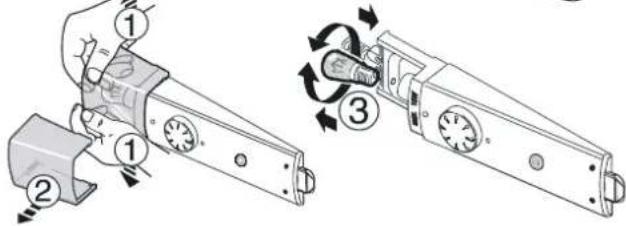
text_image
Technical diagram showing three-step assembly of a mechanical device with labeled parts and directional arrows indicating motion.A1a
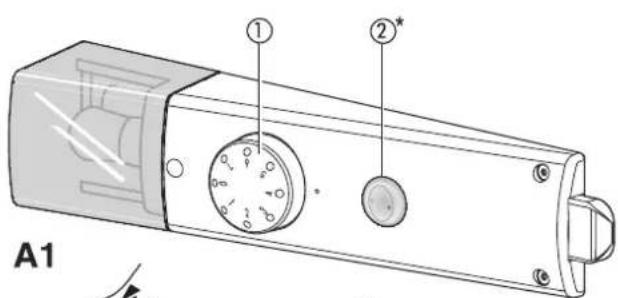
Controls, fig. A1:
① On/off and temperature control
"1" = warm "7" = cold
We recommend a medium setting.
② Cool-Plus switch*. Switch on at low room temperatures of 18°C or below.
Interior light
Bulb data: max. 15 W, voltage and current should agree with the details on the type plate, bulb fitting: E 14. Replacing the bulb, fig. A1a: Switch off the appliance.
● Pull out the plug or switch off/unscrew the fuse.
- By moving the bottle and can holder, you can prevent bottles from tipping over when the door is opened and closed. The holder can be removed for cleaning.
- fig. A2: The holder slides and releases left or right along the door stops.
- You can remove all door racks for cleaning, fig. A2: lift rack and pull forwards.
- Shelves* can be adjusted in height for different height items, figs. A3:
- Lift the shelf, slide forwards and remove.
- Always insert shelves with the raised edge at the back point - ing upwards, otherwise food may freeze onto the rear wall.

natural_image
Three-panel diagram showing a door lock mechanism, a hand holding a tray with arrows indicating flow or movement, and a final panel with arrows indicating flow direction (no text or symbols)A2
A3
Description of appliance and equipment

natural_image
Technical line drawing of an oven or refrigerator interior showing internal compartments and storage areas (no text or labels)A
Adjustable storage shelves
Butterstop
On/off and temperature control, interior light
Freezer compartment*
Adjustable door racks
Adjustable bottle and can holder
Defrost drain
Vegetable, salad and fruit bins
Coldest zone of the refrigerator compartment, for sensi-
tive and perishable foodstuffs
Door rack for large bottles
Adjustable-height feet at front, transport castors at back
Type/Data plate
Congratulations on your purchase. In choosing this appliance you have opted for all the benefits of state-of-the-art refrigeration technology, guaranteeing you top quality, a long life span and excellent reliability.
The features on your appliance have been designed to ensure maximum convenience - day in, day out. This appliance has been manufactured with recyclable materials using an environmentally friendly process, so together you and we are making an active contribution to the preservation of our environment. To get to know all the benefits of your new appliance, please read the information contained in these operating instructions carefully.
We wish you much pleasure with your new appliance.
Keep these operating instructions in a safe place and pass them on to the next owner, where applicable. The operating instructions apply to several models. Differences may therefore occur.
Contents Page
Operating instructions
1 The appliance at a glance 8
Contents 9
Safety regulations 9
Notes on energy saving 9
2 Safety instructions and warnings 10
Disposal notes 10
Technical safety 10
Safety during use 10
Setting up 10
Connecting to the mains 10
3 Refrigerator compartment 11
Setting the temperature 11
Cool-Plus switch* 11
Notes on cooling 11
4 Freezer compartment 11
Freezing fresh food 11
Notes on freezing and storage 11
Making ice-cubes 11
5 Defrosting, cleaning 12
6 Troubleshooting 13
Customer service and type plate 13
7 Instructions for installation and modification ... 13
Changing over door hinges 13
Setup Dimensions 13
Insertion into row of kitchen units 13
Safety regulations
§
- The device is designed exclusively for the cooling foodstuffs. The applicable statutory regulations are to be observed in the event that the device is to be used for commercial cooling of foodstuffs. The device is not suitable for the storage and cooling of drugs, blood plasma, laboratory preparations or similar medicine-related materials and products as detailed in the Medical Devices Directive 2007/47/EC. Improper use of the device can cause the stored products stored in it to be damaged or the items can be spoiled. In addition, the device is not suitable for operation in explosion-prone areas.
- The appliance is set to operate within specific ambient temperature limits according to its climate rating. These temperature limits should not be exceeded. The correct climate rating for your appliance is indicated on the type plate. This is explained as follows:
Climate rating Set for ambient temperatures of
| SN | +10°C to +32°C |
| N | +16°C to +32°C |
| ST | +16°C to +38°C |
| T | +16°C to +43°C |
- The refrigerant circuit has been tested for leaks.
- The appliance complies with current safety regulations and EC directives 2006/95/EC and 2004/108/EC.
Notes on energy saving
● Ensure that the ventilation spaces are free.
● Avoid keeping the door open for too long.
- Store food logically. Do not exceed the storage period specified.
- Keep all food properly packed and covered so as to avoid its frosting up on the outside.
● Always allow hot food to cool to room temperature before placing in the appliance.
● Defrost frozen food in the refrigerator.
- If an ice layer forms in the freezer compartment, you should defrost it. This will improve the cold transfer and reduce energy consumption.
- Keep the appliance door shut in the event of a breakdown. This will delay the cold loss and will help to maintain the quality of the frozen food for longer.
Disposal notes
The packaging is made of recyclable materials.
- Corrugated board/board
- EPS moulded parts
- Polythene sheets
- Polypropylene straps
- Keep packaging materials away from children-polythene sheets and bags can cause suffocation!
- Please return the packaging to an official collection point.
Your old appliance: This contains some reusable materials and should be disposed of properly - not simply with unsorted household refuse.
- Discarded appliances should be disabled: Remove the plug, cut through the connection cable and render the catch unusable so that children cannot become trapped inside.
- Ensure that the refrigerant circuit is not damaged when the appliance that is no longer needed is taken away for disposal.
● Details of the refrigerant can be found on the type plate.
● Appliances which are no longer needed must be disposed of in a professional and appropriate way, in accordance with the current local regulations and laws.
Technical safety
- To prevent injury or damage to the unit, the appliance should only be transported wrapped and set up by two people.
- The refrigerant R 600a is environmentally friendly but flammable.
- Do not damage the refrigerant circuit pipes. Splashes of refrigerant can harm your eyes or ignite.
- If refrigerant escapes, remove all naked flames or sources of ignition in the vicinity of the leak, disconnect the appliance from the mains and ventilate the area well.
- In the event that the appliance is damaged, contact the supplier immediately before connecting to the mains.
● To guarantee safe operation, ensure that the appliance is set up and connected as described in these operating instructions. - Disconnect the appliance from the mains if any fault occurs. Pull out the plug (not by pulling on the mains cable) or switch off or remove the fuse.
- Any repairs and work on the appliance should only be carried out by the customer service department, as unauthorised work could prove highly dangerous for the user. The same applies to changing the mains power cable.
Safety during use
- Do not store explosives or sprays using combustible propellants such as butane, propane, pentane, etc. in the appliance. Electrical components might cause leaking gas to ignite. You can identify such sprays by the printed contents or a flame symbol.
- Only store high-percentage alcohol in tightly sealed, upright containers.
- Do not allow naked flames or ignition sources to enter the appliance.
- Do not use electrical appliances inside the appliance (e.g. steam cleaners, heaters, ice makers, etc.).
- Do not stand on the plinth, drawers or doors or use them to support anything else.
- This appliance is not intended for use by persons (including children) with reduced physical, sensory or mental capabilities or lack of experience and knowledge unless they have been given initial supervision or instruction concerning use of the appliance by a person responsible for their safety. Children should be supervised to ensure that they do not play with the appliance.
- Avoid prolonged skin contact with cold surfaces or chilled/frozen food. This could cause pain, numbness and frostbite. In the case of prolonged skin contact, protective measures should be taken, e.g. gloves should be worn.
- Do not consume food which has been stored for too long, as it could cause food poisoning.


Setting up
- When setting up/fitting ensure that the refrigerant circuit pipes are not damaged.
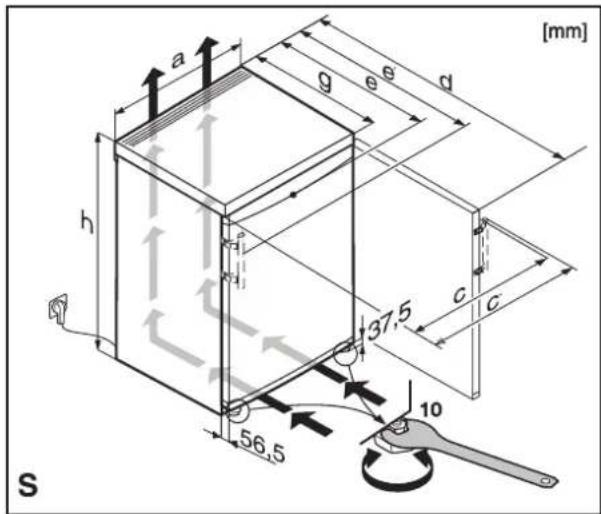
- Once in position, use a 10 spanner to adjust the feet so that the appliance is level and does not wobble.
● Avoid positioning in direct sunlight or next to an oven, radiator or similar, in damp locations or near spraying water. - Standard EN 378 specifies that the room in which you install your appliance must have a volume of 1m^3 per 8g of R 600a refrigerant used in the appliance, so as to avoid the formation of inflammable gas/air mixtures in the room where the appliance is located in the event of a leak in the refrigerant circuit. The quantity of refrigerant used in your appliance is indicated on the type plate on the inside of the appliance.
● Always position the appliance directly up against the wall. - The ventilation grilles should not be obstructed. Always ensure that there is good ventilation and that the outward flowing air is able to escape. Please note the appendix concerning installation instructions.
- Condensation may form on the outside of the refrigerator/freezer during periods of high humidity. Constant ventilation of the installation site is recommend.
- Do not place heat-emitting appliances, e.g. microwave oven, toaster, etc., on top of the refrigerator or freezer.
- In order to avoid the risk of fire, do not place any burning candles, lamps or other objects with open flames on the refrigerator/freezer.
-
Fire hazard due to dampness! If live parts or the mains lead become damp this may cause short circuits.
-
The appliance is designed for use in enclosed areas. Do not operate the appliance outdoors or in areas where it is exposed to splash water or damp conditions.
● Risk of injury and danger of damage as a result of incorrect transport! - Transport the appliance in a packed condition.
- Transport the appliance upright.
- Do not transport the appliance without assistance.
Connecting to the mains
Power supply (AC) and voltage
at the operating point must comply with the details on the type plate, which is located on the inside left of the appliance, next to the vegetable bins.
- Connect the appliance with a properly earthed fused plug and socket only.
- The socket must be fused with a 10 A fuse or higher, it must be away from the rear of the appliance and must be easily accessible.
- Do not connect the appliance to the supply with other equipment using a distribution outlet - risk of overheating.
- When removing the mains cable from the back of the appliance, remove the cable holder as well so as to avoid vibration noise.
The wires in the mains lead are coloured in accord-ance with the following code: green/yellow = earth, blue = neutral, brown = live.
Warning! This appliance must be earthed.
Non-rewireable plugs BS 1363
If this machine or appliance is fitted with a non-rewireable plug, the following information applies: If the socket outlets are not suitable for the plug supplied with this product, it must be cut off and an appropriate plug fitted. The plug cut from the flexible cord should be disposed of and on no account be inserted into a 13 A socket elsewhere in the house (electric shock hazard).
The fuse cover must be re-fitted when changing the fuse, and if the fuse cover is lost the plug must not be used until a suitable replacement is obtained. The colour of the correct replacement cover is that of the coloured insert in the base of the plug, or the colour that is embossed in words on the base of the plug (as applicable to the design of the plug fitted).
The correct rating of the replacement fuses that are ASTA approved to BS 1362 should be fitted. Replacement fuse covers may be purchased from your local electrical suppliers, electricity showroom or approved service agent.


3 Refrigerator compartment
You are advised to clean the appliance before switching it on for the first time (see "Cleaning").
Switching the appliance on and off, setting the temperature
- On: Turn the temperature control ①, fig. A1, clockwise from "0" to "4". The appliance is now switched on and the interior light comes on.
- Off: The appliance is switched off at the "0" setting. The interior light is off.
● The positions of the temperature control indicate the following:
"1" = warm, lowest cooling setting
"7" = cold, highest cooling setting
● We recommend a medium setting.
- At setting "7" it is possible to reach temperatures below "0" in the coldest zone of the fridge section.
- If you are storing frozen food and wish to ensure that the low freezing temperature is maintained, we recommend setting the temperature control to between "4" and "7".
Cool-Plus switch\*
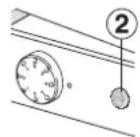
- At low room temperatures of 18°C or below, switch on the Cool-Plus switch ②, fig. A1, on the temperature control housing. This will ensure that the freezer compartment stays at the right temperature.
- At normal room temperatures of above 18°C, it is not necessary to switch on the Cool-Plus switch; it should stay switched off.
NB: Please note that the temperature inside the appliance is affected by the room temperature, the place where the appliance is installed, the frequency with which the door is opened and how full the appliance is.
Notes on cooling
- As a result of the circulation of the air, the temperature in the refrigerator compartment is not uniform. This can have advantages for storing different types of food.
- Just above the vegetable bins and at the back of the refrigerator, the air is colder, ideal for raw meat or cold meats.
- At the top front of the compartment and in the door, the air is warmer, making it ideal for cheese and for spreadable butter (see "Example of food arrangement", fig. A).
- Store food so that the air can circulate freely; do not place items too close together, and keep at least 2 cm away from the interior light.
● Always store food in closed containers or wrapped; high-percentage alcohols should be tightly sealed and stored upright.
● Reusable plastic, metal, aluminium and glass contain-ers or cling-film can be used for wrapping.
● Always store food which gives off or is sensitive to ethylene gases such as fruit, vegetables and salads separately or wrapped in order not to affect their storage life; e.g. do not store tomatoes together with kiwis or cabbage.
4 Freezer compartment
You can store frozen food for several months, prepare ice-cubes and freeze fresh food in the ✦ ✕ ✕ ✕ freezer compartment at temperatures of -18°C and lower (medium temperature setting or lower).
NB: The air temperature in the compartment, measured with a thermometer or other measuring equipment, may fluctuate. However this will have little effect on the frozen food when the compartment is full. The core temperature of the frozen food will be the average of these values.
Making ice-cubes
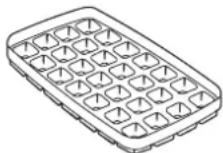
- Fill the ice-cube tray* three-quarters full with water and freeze. The ice-cubes can be removed from the tray by twisting or by holding upside down for a short time under running water.
Freezing fresh food
Fresh food should be frozen to the core as rapidly as possible. This ensures that the nutritional value, vitamins, appearance and flavour of the food remain intact. Larger quantities of fresh food should be frozen as follows:
- Approx. 24 hours before placing the food in the freezer, turn the temperature control to a medium to cold setting (approx. 6).
- Switch on Cool-Plus ②. Frozen food already stored will receive an additional boost.
- Insert the fresh food. The maximum amount of food which can be frozen in 24 hours is shown on the type plate ("Freezing capacity ... kg/24h")*.
Spread out the fresh food on the bottom of the freezer compartment as much as possible and do not allow it to come into contact with frozen food already stored.
- The freshly frozen food will be thoroughly frozen after 24 hours.
- Set the temperature control back to its previous setting. Switch off Cool-Plus ② again. The freezing procedure is complete and the appliance will return to its normal cooling function.
Notes on freezing and storage
- You can put foods that are already frozen and up to 1 kg of fresh foods per day straight into the cold freezer compartment.
- Once food has been thawed it should be prepared and not simply frozen again.
- As a guideline for the storage time, the following applies to various foodstuffs in the freezer compartment:
| Ice cream 2 to 6 months | |
| Sausage, ham 2 to 6 months | |
| Bread, cakes and pastries 2 to 6 months | |
| Game, pork 6 to 10 months | |
| Fish, oily 2 to 6 months | |
| Fish, lean 6 to 12 months | |
| Cheese 2 to 6 months | |
| Poultry, beef 6 to 12 months | |
| Vegetables, fruit 6 to 12 months |
Defrosting
Appliances without freezer compartment defrost automatically. The moisture occurring at the back wall of the refrigerator is carried outside the refrigerator into an evaporating dish through the defrost water channel. The defrost water is evaporated by the compressor heat - water droplets on the rear wall depend on function and are completely normal.
- At least ensure that the defrost water can always flow out of through the outlet hole via the vegetable bin to the rear
wall (arrow in Fig. A) unhindered.
Freezer compartment\*
after being in operation for a long time, forms a layer of frost and ice. It increases energy consumption.
Therefore defrost regularly.
Do not use any electrical heating or steam cleaning appliances, defrosting sprays, open flames or metal objects to remove ice. Risk of injury and damage to the appliance.
To accelerate the defrosting process, put a pan with warm, not boiling water into the compartment. How to defrost:
● Switch off the appliance: Disconnect from the mains or
- Turn the temperature setting to the "0" position.
- Remove frozen goods, put into newspaper or blankets and stored in a cool place.
- Leave the compartment and appliance door open during the defrosting process.
- Collect defrosting water with a sponge or cloth. Then clean the appliance.
Cleaning
- Before cleaning, always switch off the appliance. Disconnect from the mains or un-screw or switch off the fuse.
- Clean the outer walls, inside and appliance by hand with lukewarm water and a little detergent. Because of the risk of injury and damage to the appliance, steam cleaning equipment should not be used.
Never use abrasive or scouring sponges. Do not use concentrated cleaning agents and never use abrasive or acid cleaners or chemical solvents.
- We recommend using a soft cloth and an all-purpose cleaner with a neutral pH value. Only use food safe cleaning materials inside the appliance.
- Ensure that no cleaning water penetrates into the electrical components, drain gulley* or ventilation grilles. Wipe the appliance dry.
- Do not damage or remove the type plate on the inside of the appliance. It is very important for servicing purposes.
- Clean the drain hole on the rear wall above the vegetable bins often Fig. A, arrow.
If necessary, clean with a thin object, e.g. a cotton swab or similar.
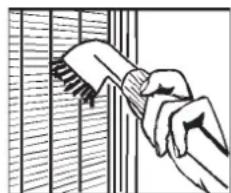
- The dust should be removed from the refrigeration unit and heat ex-changer - metal grid at the back of the appliance - once a year. Dust de-posits increase energy consumption.
- Ensure that none of the wires or other components are dislodged, bent or damaged.
- Then connect/switch on the appliance.
If the appliance is to be left switched off for any length of time, empty the appliance, disconnect from the mains, clean as described above and leave the door open so as to avoid odours.
natural_image
Illustration of a hand using a tool to clean or trim a window (no text or symbols visible)Your appliance is designed and manufactured in such a way as to provide fault.free operation and a long service life. Nevertheless, if a fault should occur during operation, please check whether the fault is due to incorrect operation. In this case we have to charge you for any costs incurred also within the warranty period.
You can eliminate the following faults yourself by checking the possible causes:
Fault possible cause and remedy
Appliance not working, display is unlit
- Is the appliance switched on properly?
- Is the mains plug properly inserted in the socket?
- Is the socket fuse intact?
The interior light does not come on
- Is the refrigerator compartment switched on?
- The bulb is defective. Change the bulb as described in "Interior light".
Loud running noise
- Is the appliance standing firmly on the floor, or does the compressor cause nearby items of furniture or objects to vibrate? If necessary, move the appliance slightly, align by adjusting the adjustable feet, or move bottles and containers apart.
- The following are normal: Flow noises, bubbling or dripping, coming from the coolant in the refrigerating circuit.
A soft clicking sound, this always occurs when the refrigeration unit (the motor) switches on or off automatically.
Motor noise; this will be slightly louder for a brief period when the refrigeration unit switches on. When SuperFrost is switched on, fresh food is inserted, or when the door is open for a long time, the refrigerating capacity increases automatically.
Temperature is not cold enough
- Is the temperature controller set correctly? (Set colder as needed).
- Is the appliance door properly closed?
- Is there sufficient ventilation?
Unblock ventilation grill as needed.
- Is the ambient temperature too hot? (see "Conditions" section)
- Has the appliance been open too often or for too long?
- Wait as needed, whether the required temparture has been set on its own.
Customer service and type plate
If none of the above causes apply and you cannot rectify the fault yourself, please contact your nearest customer service department (see enclosed list for addresses). State the type designation ①, service number ② and appliance number ③ as given on the type plate, so as to ensure rapid, accurate servicing. The type plate is located inside the appliance on the left-hand side.


text_image
Diagram showing a device panel with labeled components and a close-up view of the screen area.7 Instructions for installation and modification
text_image
a g e d h 37,5 c c 56,5 10 [mm] S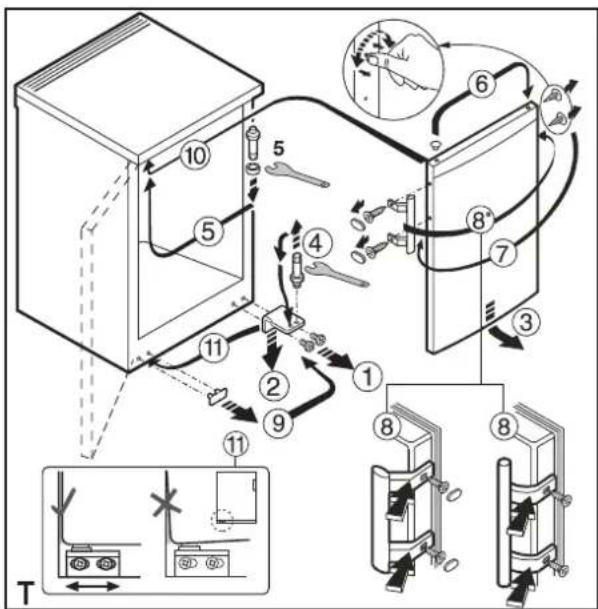
text_image
Technical diagram of a refrigerator interior with numbered components and wiring connections, including hand tools and control panel.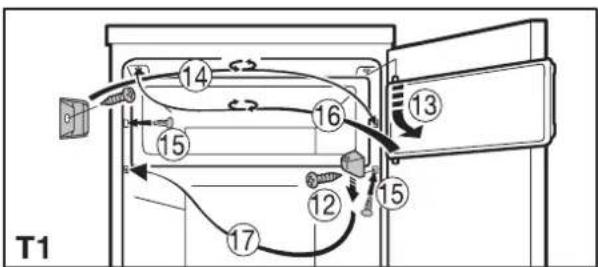
flowchart
graph TD
    A["Top Left Panel"] --> B["Component 14"]
    B --> C["Component 15"]
    C --> D["Component 16"]
    D --> E["Component 13"]
    E --> F["Component 15"]
    F --> G["Component 17"]
    G --> H["Component 12"]
    H --> I["Component 15"]
    I --> J["Component 16"]
    style A fill:#f9f,stroke:#333
    style J fill:#f9f,stroke:#333
text_image
min. 140 cm² max. 10 a-1 80 160 min. 600 599 b ① ② [mm] UGB
Setup Dimensions
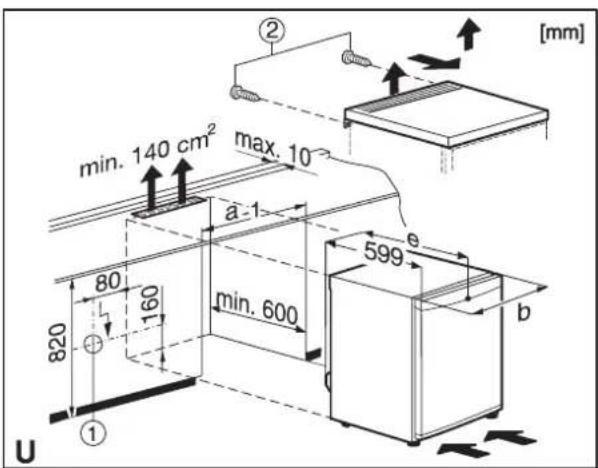
The appliance dimensions can be found on the fig S/U below and in the following table.
| ModelNominalwidth | Appliance dimensions (mm) |
| a b c | c` d e | e` g h | ||||||
| 501 497 | 505 | 534 1 | 072 6 | 20 649 | 610 8 | 50 | ||
| 554 550 | 561 | 590 1 | 125 6 | 23 652 | 610 8 | 50 |
Changing over door hinges
Fig. T: You can change over the door hinges if necessary. Follow the order of the positions illustrated in fig. T/T1.
Installing underneath a worktop\*
Table-height appliances up to 850 mm in height can be fitted underneath an existing worktop.
Fig. U: For under-worktop use, the tabletop of the refrigerator can be removed and the appliance fitted underneath the worktop.
● The socket 1 must be away from the rear of the appliance and must be easily accessible.
● To remove the tabletop, undo screws 2 on the back. Lift the tabletop slightly, slide forwards and remove.
- A ventilation gap in the worktop of at least 140~cm^2 is needed for ventilation at the back of the appliance. The profile along the back of the worktop may not be more than 10~mm deep on 600~mm worktops.