Mini 110-1190eo - Laptop HP - Free user manual and instructions
Find the device manual for free Mini 110-1190eo HP in PDF.


User questions about Mini 110-1190eo HP
0 question about this device. Answer the ones you know or ask your own.
Ask a new question about this device
Download the instructions for your Laptop in PDF format for free! Find your manual Mini 110-1190eo - HP and take your electronic device back in hand. On this page are published all the documents necessary for the use of your device. Mini 110-1190eo by HP.
USER MANUAL Mini 110-1190eo HP
HP Mini 1101 Notebook PC, HP Mini 110, and Compaq Mini 110
Maintenance and Service Guide
© Copyright 2009 Hewlett-Packard Development Company, L.P.
Bluetooth is a trademark owned by its proprietor and used by Hewlett-Packard Company under license. Intel and Atom are trademarks of Intel Corporation in the U.S. and other countries. Microsoft, Windows, and Windows Vista are U.S. registered trademarks of Microsoft Corporation. SD Logo is a trademark of its proprietor.
The information contained herein is subject to change without notice. The only warranties for HP products and services are set forth in the express warranty statements accompanying such products and services. Nothing herein should be construed as constituting an additional warranty. HP shall not be liable for technical or editorial errors or omissions contained herein.
First Edition: May 2009
Document Part Number: 537033-001
Safety warning notice
⚠ WARNING! To reduce the possibility of heat-related injuries or of overheating the device, do not place the device directly on your lap or obstruct the device air vents. Use the device only on a hard, flat surface. Do not allow another hard surface, such as an adjoining optional printer, or a soft surface, such as pillows or rugs or clothing, to block airflow. Also, do not allow the AC adapter to contact the skin or a soft surface, such as pillows or rugs or clothing, during operation. The device and the AC adapter comply with the user-accessible surface temperature limits defined by the International Standard for Safety of Information Technology Equipment (IEC 60950).
Table of contents
1 Product description
2 External component identification
Top components 5
TouchPad 5
Light 6
Keys 7
Front components 9
Right-side components 11
Left-side components 12
Display components 13
Bottom components 14
Wireless antennas 15
3 Illustrated parts catalog
Service tag 16
Device major components 17
Display assembly components 21
Mass storage devices 23
Miscellaneous parts 24
Sequential part number listing 25
4 Removal and replacement procedures
Preliminary replacement requirements 29
Tools required 29
Service considerations 29
Plastic parts 29
Cables and connectors 29
Drive handling 30
Grounding guidelines 31
Electrostatic discharge damage 31
Packaging and transporting guidelines 32
Workstation guidelines 32
Equipment guidelines 33
Component replacement procedures 34
Service tag 34
Device feet 35
Battery 36
SIM 37
Memory module 38
Keyboard 40
RTC battery 44
Mass storage devices 45
Hard drive 46
Solid-state drive 46
Top cover 48
WLAN module 51
WWAN module 53
USB/audio board 55
Power/battery pass-through board 56
Fan 57
Heat sink assembly 59
System board 61
Display assembly 64
5 Setup Utility
Starting the Setup Utility 71
Using the Setup Utility 71
Changing the language of the Setup Utility 71
Navigating and selecting in the Setup Utility 71
Displaying system information 72
Restoring default settings in the Setup Utility 72
Exiting the Setup Utility 72
Setup Utility menus 73
Main menu 73
Security menu 73
System Configuration menu 73
Diagnostics menu 74
6 Specifications
Device specifications 75
10.1-inch, AntiGlare display specifications 76
Hard drive specifications 77
Solid-state drive specifications 78
System DMA specifications 79
System interrupt specifications 80
System I/O address specifications 81
System memory map specifications 83
7 Screw listing
Phillips PM1.5×1.0 screw 84
Phillips PM2.0×3.0 screw 86
Phillips PM2.0×3.0 captive screw 88
Phillips PM2.0×4.0 screw 89
Phillips PM2.0×5.0 screw 90
Phillips PM2.5×5.0 screw 91
Phillips PM2.5×7.0 screw 93
Phillips PM2.5×10.0 captive screw 94
Phillips PM3.0×40.0 screw 95
8 Backup and recovery
Mobile Mi backup and recovery 97
Backing up your information 97
When to back up 97
Restoring your information 97
Using System Restore 98
Using HP Mi Restore Image Creator 98
Restoring using a Windows computer 98
Restoring using a Linux computer 99
Windows Vista backup and recovery 101
Backing up your information 101
Performing a recovery 102
Using the Windows recovery tools 103
Using f11 104
Using a Windows Vista operating system DVD (purchased separately) ..... 104
Windows XP backup and recovery 105
Backing up your information 105
Performing a recovery 106
Recovering your information 106
Recovering the operating system and programs 106
9 Connector pin assignments
Audio-in (microphone) 107
Audio-out (headphone) 108
External monitor 109
RJ-45 (network) 110
Universal Serial Bus 111
10 Power cord set requirements
Requirements for all countries and regions 112
Requirements for specific countries and regions 113
11 Recycling
Battery 114
Display 114
Index 120
1 Product description
| Category Description HP Mini 1101 | NoteBook PC | HP Mini 110 Compaq Mini 110 | |
| Product Name | HP Mini 1101 NoteBook PC | √ | |
| HP Mini 110 √ | |||
| Compaq Mini 110 √ | |||
| Processor Intel® AtomTM N280 1.66-GHzprocessor, 512-KB Level 2 cache,533-MHz front-side bus (FSB) | √√√ | ||
| Intel Atom N270 1.6-GHz processor,512-KB Level 2 cache, 533-MHz front-side bus (FSB) | √√√ | ||
| Chipset Northbridge: 945GSE; 533-MHz bus speed | √√√ | ||
| Southbridge: ICH7M | √√√ | ||
| Graphics | Intel® Graphics Media Accelerator 950 | √ | √ |
| Universal Memory Architecture (UMA)graphics subsystem | √√√ | ||
| Panels | All display assemblies include1 webcam, 1 microphone, 1 speakerbox, and 2 wireless local-area network(WLAN) antenna transceivers/cables;wireless wide-area network (WWAN) is optional | √√√ | |
| Wide aspect 16:9 ratio panels | √√√ | ||
| 10.1-inch standard-definition AntiGlare(1024 × 576) LED | √√√ | ||
| Memory | One customer-accessible/upgradablememory module slot | √√√ | |
| Supports up to 2 GB of system memory | √ | √ | |
| PC2-4200, 533-MHz, DDR2 | √√√ | ||
| Supports the following configurations: | |||
| 512-MB total system memory (512 × 1)NOTE: Supported by computers with Windows® XP Home Edition Service Pack 3 only. | √ √ | ||
| 1024-MB total system memory (1024 × 1) | √ √ √ | ||
| 2048-MB total system memory (2048 × 1)NOTE: Supported by computers with Windows XP Home Professional and HP Mobile Mi only. | √ √ | ||
| Mass storage devices | Solid-state drive (SSD) based on multi-level cell (MLC) technology | √ √ √ | |
| 8-GB √ √ | |||
| 16-GB √ √ | |||
| 32-GB √ √ √ | |||
| 64-GB | √ √ | ||
| NOTE: Available only for HP 1101 NoteBook PCs, and HP Mini 110 models with Mobile Mi installed. | |||
| Hard drive Supports all 9.5-mm, 6.35-cm (2.50-inch) parallel SATA hard drives (optional) | √ √ √ | ||
| 160-GB, 5400-RPM √ √ √ | |||
| 250-GB, 5400-RPM | √ √ √ | ||
| NOTE: Available only for HP 1101 NoteBook PCs, and HP Mini 110s with Mobile Mi installed. | |||
| Optical drive Supports external USB optical drives only | √ √ √ | ||
| Diskette drive Supports external USB diskette drives only | √ √ √ | ||
| Audio/Visual | high-definition (HD) audio | √ | √ |
| Integrated speakers (2) | √ √ √ | ||
| Fixed integrated microphone | √ √ √ | ||
| Fixed integrated VGA webcam, 640 × 480 resolution, up to 30 frames per second | √ √ √ | ||
| Modem | Supports external USB modems only | √ | √ |
| Ethernet | Integrated 10/100 network interface card (NIC) | √ | √ |
| Category Description HP Mini 1101 | NoteBook PC | HP Mini 110 Compaq Mini 110 | ||||||||
| Wireless 2 WLAN antennas built into display assembly | √√√ | |||||||||
| Integrated WLAN by way of 802.11b/gWLAN module | √√√ | |||||||||
| Integrated WWAN by way of HP un2400Mobile Broadband Module (optional)NOTE: Not available in HP Mini 110 models with Mobile Mi installed. | √√√ | |||||||||
| External media cards | Digital Media Slot (consumer models) or Media Card Reader (commercial models) with push-push technology supporting:Memory Stick (MS)Memory Stick Pro (MSP)MultiMediaCard (MMC)Secure Digital (SD) Memory CardxD-Picture Card (XD) | √√√ | ||||||||
| HP Mini Mobile Drive Bay (on models equipped with a solid-state drive) | √√ | |||||||||
| Internal media cards | Two Mini Card slots:Full-size Mini Card slotHalf-size Mini Card slot | √√√ | ||||||||
| Ports Audio-in (stereo microphone) √√√ | ||||||||||
| Audio-in/out (microphone/stereo headphone) | √√√ | |||||||||
| RJ-45 (Ethernet, includes link and activity lights) | √√√ | |||||||||
| USB (2–3) √√√ | ||||||||||
| 3-pin AC power √√√ | ||||||||||
| Keyboard/ pointing device | 92% keyboard √√√ | |||||||||
| TouchPad, with 2 TouchPad buttons and 2-way scrolling (taps enabled as default) | √√√ | |||||||||
| Power requirements | 30-W UMA AC adapter (non-Smart) with localized cable plug support | √√√ | ||||||||
| AC adapter connector on cable √√√ | ||||||||||
| 3-cell lithium-polymer (Li-Pol) battery(2.55-Ah, 28-Wh), 3-hour target life | √√√ | |||||||||
| 6-cell lithium-polymer (Li-Pol) battery(2.55-Ah, 55-Wh), 6-hour target life | √ | √ | ||||||||
| Security Supports HP Kensington Security Lock √ √ √ | ||||||||||
| Operating system Preinstalled: | ||||||||||
| Windows® XP Home SP3, ultra low-costpersonal computer (ULCPC) edition | √ √ | |||||||||
| Windows Vista® Business 32 (with XPPro image) | √ | |||||||||
| HP Mobile Mi √ | ||||||||||
| Serviceability End-user replaceable parts: | ||||||||||
| AC adapter | √ | √ | √ | |||||||
| Battery (system) | √ | √ | √ | |||||||
| Hard drive | √ | √ | √ | |||||||
| Keyboard | √ | √ | √ | |||||||
| Memory module | √ | √ | √ | |||||||
| Solid-state drive | √ | √ | √ | |||||||
2 External component identification
Components included with the device may vary by region and model. The illustrations in this chapter identify the standard features on most device models.
Top components
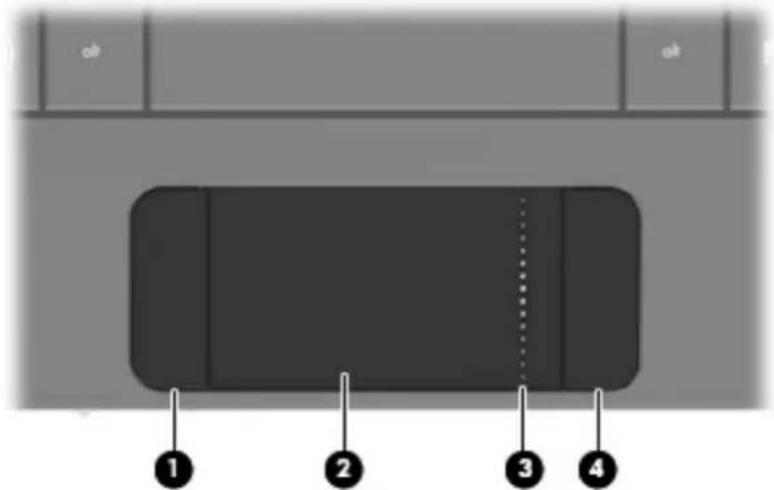
TouchPad
text_image
Diagram of a device panel with labeled buttons and a highlighted rectangular area, marked with numbered callouts.| Component Description | ||
| (1) | Left TouchPad button | Functions like the left button on an external mouse. |
| (2) | TouchPad | Moves the pointer and selects or activates items on the screen. |
| (3) | TouchPad scroll zone | Scrolls up or down. |
| (4) | Right TouchPad button | Functions like the right button on an external mouse. |
Light

text_image
A ESC 1 2 # 3 $4 % 5 tab Q W E R TComponent Description
Caps lock light On: Caps lock is on.

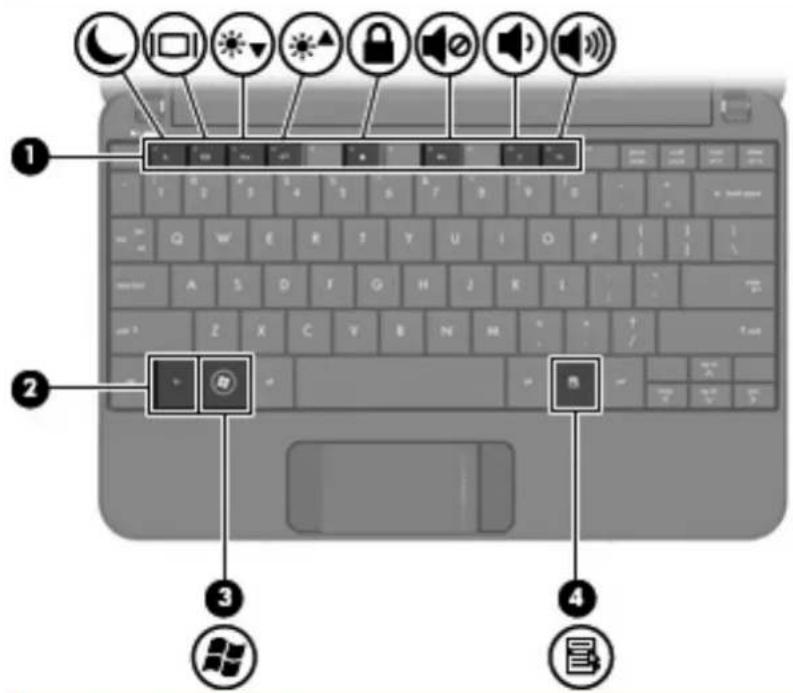
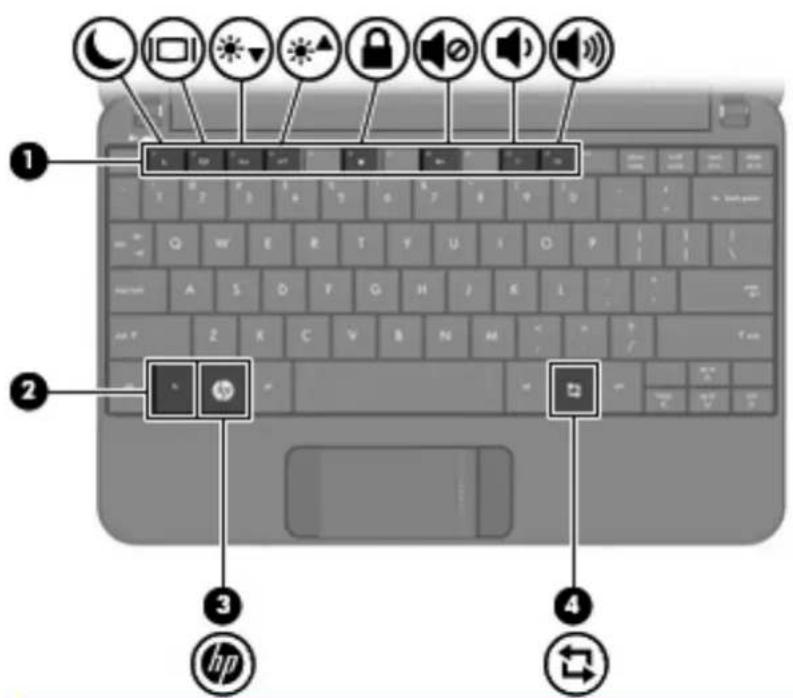
NOTE: Refer to the illustration that most closely matches your computer.
text_image
Laptop keyboard diagram with labeled function keys and icons for function keys, typing keys, and media controlsComponent Description
| (1) | Function keys | Execute frequently used system functions when pressed in combination with the fn key. |
| (2) | fn key | Executes frequently used system functions when pressed in combination with a function key. |
| (3) Windows® logo key Displays the Windows Start menu. | ||
| (4) | Windows applications key | Displays a shortcut menu for items beneath the pointer. |
text_image
Laptop keyboard diagram with labeled function keys and icons for function keys, typing keys, and navigation controlsComponent Description
| (1) | Function keys | Execute frequently used system functions when pressed in combination with the fn key. |
| (2) | fn key | Executes frequently used system functions when pressed in combination with a function key. |
| (3) Home key Returns to the Home Screen. | ||
| (4) Program Switcher key Displays the Start New Program button from anywhere on the device. | ||
Front components
text_image
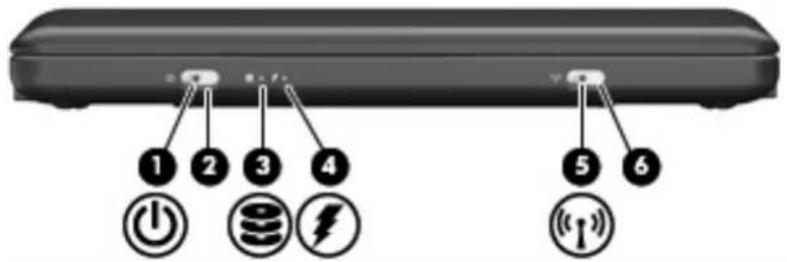
1 2 3 4 5 6| Component Description | ||
| (1) Power light | On: The device is on.Blinking: The device is in the Sleep state (Windows Vista) or Standby (Windows XP or Mobile Mi).Off: The device is off or in Hibernation. | |
| (2) Power switch | When the device is off, slide the switch to turn on the device.When the device is on, briefly slide the switch to initiate Hibernation.When the device is in the Sleep state (Windows Vista) or Standby (Windows XP or Mobile Mi), briefly slide the switch to exit the Sleep state (Windows Vista) or Standby (Windows XP or Mobile Mi).When the device is in Hibernation, briefly slide the switch to exit Hibernation.If the device has stopped responding and operating system shutdown procedures are ineffective, slide and hold the power switch for at least 5 seconds to turn off the device. | |
| (3) | Drive light | Blinking: The hard drive or flash drive is being accessed. |
| (4) Battery light | On: A battery is charging.Blinking: A battery that is the available only power source has reached a low battery level. When the battery reaches a critical battery level, the battery light begins blinking rapidly.Off: If the device is plugged into an external power source, the light turns off when all batteries in the device are fully charged. If the device is not plugged into an external power source, the light stays off until the battery reaches a low battery level. | |
| (5) Wireless light | Blue: An integrated wireless device, such as a wireless local area network (WLAN) device, is on.Amber: All wireless devices are off. | |
| (6) Wireless switch Turns the wireless feature on or off, but does not establish a wireless connection. | ||
Right-side components
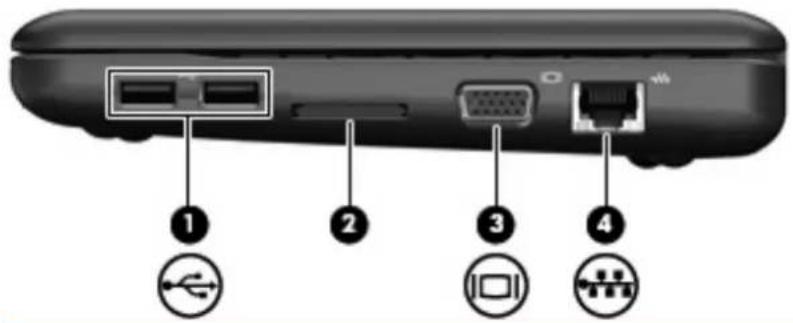
text_image
Diagram of a device rear panel with labeled ports and icons, showing port labels 1 to 4.Component Description
(1) USB ports (2) Connect optional USB devices.
(2) Digital Media Slot (consumer models) or Media Card Reader (commercial models)
Supports the following optional digital card formats:
• Memory Stick (MS)
• Memory Stick Pro (MSP)
• MultiMediaCard (MMC)
• Secure Digital (SD) Memory Card
xD-Picture Card
(3) External monitor port
Connects an optional external display, such as a monitor or projector, to the device.
(4) RJ-45 (network) jack Connects a network cable.
Left-side components

text_image
Diagram of a device rear panel with labeled ports and icons, including lock, power plug, USB, and earphone.Component Description
| (1) | Security cable slot | Attaches an optional security cable to the device. |
| NOTE: The security cable is designed to act as a deterrent, but it may not prevent the device from being mishandled or stolen. | ||
| (2) | Power connector Connects an AC adapter. | |
| (3) | AC adapter light Indicates AC power connection. | |
| (4) | Vent Enables airflow to cool internal components. | NOTE: The device fan starts up automatically to cool internal components and prevent overheating. It is normal for the internal fan to cycle on and off during routine operation. |
| (5) | USB port Connects an optional USB device. | |
| (6) | Audio-out (headphone) jack/Audio-in (microphone) jack | Produces sound when connected to optional powered stereo speakers, headphones, earbuds, a headset, or television audio. Also connects an optional headset microphone.WARNING! To reduce the risk of personal injury, adjust the volume before putting on headphones, earbuds, or a headset. For additional safety information, refer to the Regulatory, Safety and Environmental Notices.NOTE: When an audio component is connected to the jack, the device speakers are disabled.The audio component cable must have a 4-conductor connector. |
Display components

text_image
Laptop screen diagram with numbered labels pointing to the screen areaComponent Description
| (1) Speakers (2) Produce sound. | ||
| (2) Internal display switch | Turns off the display if the display is closed while the power is on. | |
| NOTE: The display switch is not visible from the outside of the device. | ||
| (3) Webcam Captures still photographs and videos. | NOTE: To capture videos, you need to install additional webcam software. | |
| (4) Webcam light On: The webcam is in use. | ||
| (5) Internal microphone Records sound. | ||
Bottom components
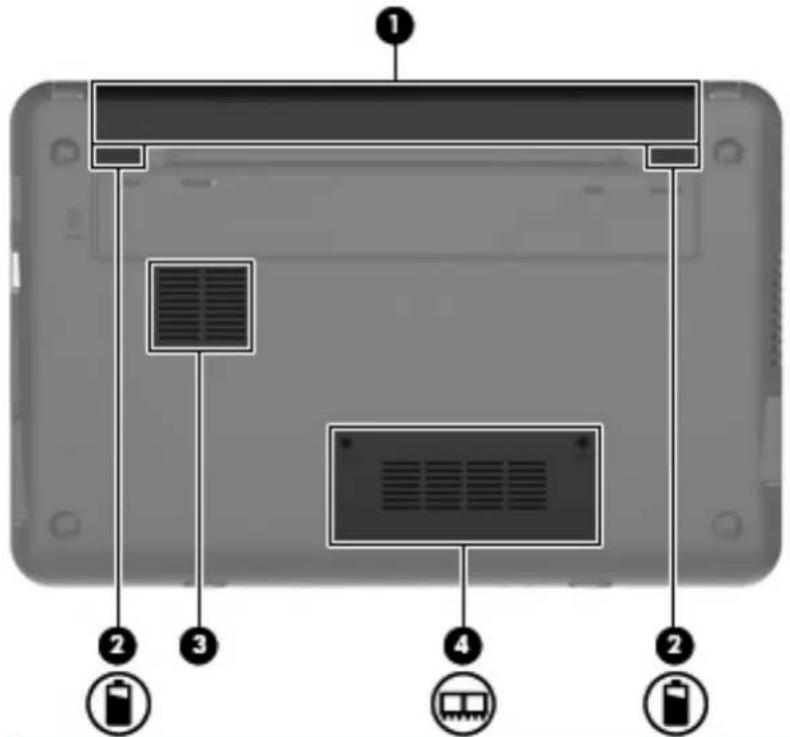
text_image
Diagram of a device rear panel with labeled components including battery, memory, and display areasComponent Description
| (1) Battery bay Holds the battery. | ||
| (2) | Battery release latches (2) | Release the battery from the battery bay. |
| (3) Vent Enables airflow to cool internal components. | ||
| NOTE: The device fan starts up automatically to cool internal components and prevent overheating. It is normal for the internal fan to cycle on and off during routine operation. | ||
| (4) Memory module compartment Contains the memory module slot. | ||
Wireless antennas
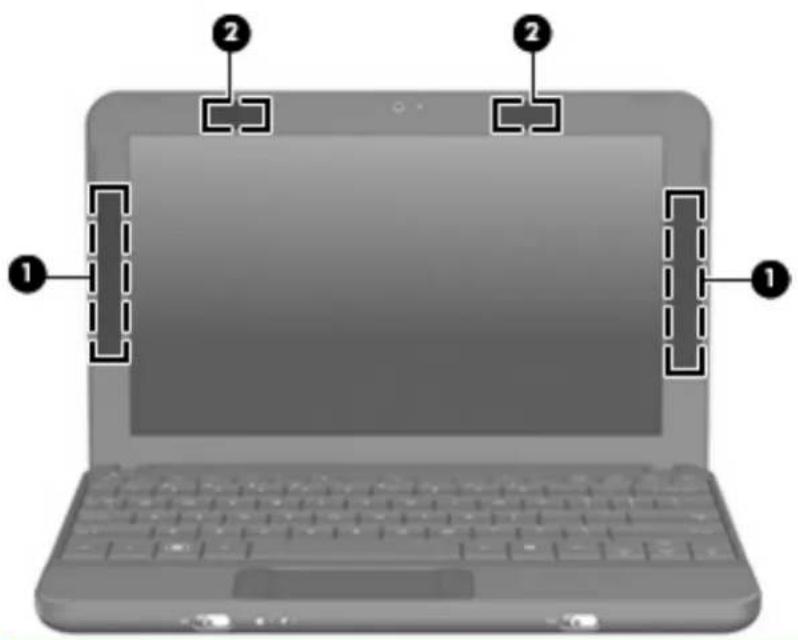
text_image
Laptop screen diagram with labeled parts showing two highlighted sections labeled 1 and 2Component Description
| (1) | WWAN antennas (2) (select models only)* | Send and receive wireless signals to communicate with wireless wide-area networks (WWANs).NOTE: This option is not available on computers with Mobile Mi installed. |
| (2) | WLAN antennas (2)* | Send and receive wireless signals to communicate with wireless local area networks (WLANs). |
*The antennas are not visible from the outside of the device. For optimal transmission, keep the areas immediately around the antennas free from obstructions.
To see wireless regulatory notices, refer to the section of the Regulatory, Safety and Environmental Notices that applies to your country or region.
3 Illustrated parts catalog
Service tag
When ordering parts or requesting information, provide the computer serial number and model description provided on the service tag:
(1) Product name: This is the product name affixed to the front of the device.
(2) Serial number (s/n): This is an alphanumeric identifier that is unique to each product.
(3) Part number/Product number (p/n): This number provides specific information about the product's hardware components. The part number helps a service technician to determine what components and parts are needed.
(4) Model description: This is the alphanumeric identifier used to locate documents, drivers, and support for the device.
(5) Warranty period: This number describes the duration of the warranty period for the device.
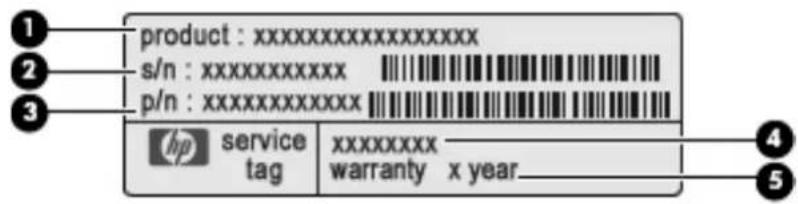
text_image
product : xxxxxxxxxxxxxxxxxxx s/n : xxxxxxxxxxxxxxx p/n : xxxxxxxxxxxxxxx hp service tag xxxxxxxxxxxx warranty x year 4 5Device major components

text_image
Exploded view diagram of a laptop with numbered parts for identificationItem Description Spare part number
(1) Display assembly (includes 1 webcam, 1 microphone, 1 speaker box, and 2 WLAN antenna transceivers/cables; WWAN is optional)
See Display assembly components on page 21 for a comprehensive list of display assembly spare parts.
For use with HP models only
10.1-inch, high-definition, AntiGlare Display Assembly (Includes WWAN) 572407-001
10.1-inch, high-definition, AntiGlare Display Assembly 572406-001
Item Description Spare part number
| 10.1-inch, standard-definition, AntiGlare Display Assembly (includes WWAN) | 571414-001 |
| 10.1-inch, standard-definition, AntiGlare Display Assembly | 537646-001 |
| For use with Compaq models only | |
| 10.1-inch, high-definition, AntiGlare Display Assembly | 572414-001 |
| 10.1-inch, standard-definition, AntiGlare Display Assembly (includes WWAN) | 571417-001 |
| 10.1-inch, standard-definition, AntiGlare Display Assembly | 537643-001 |
(2) Keyboard
| For use only on models with Windows operating system installed | ||
| For use only in Brazil | 535689-201 | |
| For use only in the Czech Republic | 535689-221 | |
| For use only in Europe | 535689-A41 | |
| For use only in France | 535689-051 | |
| For use only in French Canada | 535689-121 | |
| For use only in Finland, Norway, and Sweden | 535689-DH1 | |
| For use only in Germany | 535689-041 | |
| For use only in Greece | 535689-151 | |
| For use only in Hungary | 535689-211 | |
| For use on international models | 535689-B31 | |
| For use only in Israel | 535689-BB1 | |
| For use only in Italy | 535689-061 | |
| For use only in Japan | 535689-291 | |
| For use only in Latin America | 535689-161 | |
| For use only in Portugal | 535689-131 | |
| For use only in Russia | 535689-251 | |
| For use only in Saudi Arabia | 535689-171 | |
| For use only South Korea | 535689-AD1 | |
| For use only in Spain | 535689-071 | |
| For use only in Switzerland | 535689-111 | |
| For use only in Taiwan | 535689-AB1 | |
| For use only in Thailand | 535689-281 | |
| For use only in Turkey | 535689-141 | |
| For use only in the United Kingdom | 535689-031 | |
| For use only in the United States | 535689-001 | |
| For use only on models with Mobile Mi installed | ||
| Item Description Spare part number | ||
| For use only in Brazil | 535690-201 | |
| For use only in French Canada | 535690-121 | |
| For use only in Japan | 535690-291 | |
| For use only in Latin America | 535690-161 | |
| For use only in South Korea | 535690-AD1 | |
| For use only in Taiwan | 535690-AB1 | |
| For use only in Thailand | 535690-281 | |
| For use only in the United States | 535690-001 | |
| (3) | Top cover (includes TouchPad) | 537622-001 |
Mass storage devices
NOTE: Each hard drive spare part kit and solid-state drive spare part kit includes a bracket and screws.
(4a) Hard drive (select models only)
See Mass storage devices on page 23 for a comprehensive list of hard drive spare parts.
(4b) Solid-state drive
See Mass storage devices on page 23 for a comprehensive list of solid-state drive spare parts.
(5) Heat sink assembly (includes replacement thermal material) 537619-001
(6) Fan 537613-001
(7) USB/audio board (includes cable) 537614-001
(8) Power/battery pass-through board 537615-001
Plastics/actuator Kit 537612-001
(9a) Power switch and wireless switch actuators
(9b) Memory module compartment cover
(9c) Bezel for Digital Media Slot (consumer models) or Media Card Reader (commercial models)
Wireless modules
(10) WLAN module
Broadcom 4312 802.11/b/g WLAN module
- For use in Canada, the Cayman Islands, Guam, Puerto Rico, the U.S. Virgin Islands, 504593-003 and the United States
Item Description Spare part number
| For use in Afghanistan, Albania, Algeria, Andorra, Angola, Antigua and Barbuda, Argentina, Armenia, Aruba, Australia, Austria, Azerbaijan, the Bahamas, Bahrain, Bangladesh, Barbados, Belarus, Belgium, Belize, Benin, Bermuda, Bhutan, Bolivia, Bosnia and Herzegovina, Botswana, Brazil, the British Virgin Islands, Brunei, Bulgaria, Burkina Faso, Burundi, Cameroon, Cape Verde, the Central African Republic, Chad, Chile, the People's Republic of China, Colombia, Comoros, the Congo, Costa Rica, Croatia, Cyprus, the Czech Republic, Denmark, Djibouti, Dominica, the Dominican Republic, East Timor, Ecuador, Egypt, El Salvador, Equatorial Guinea, Eritrea, Estonia, Ethiopia, Fiji, Finland, France, French Guiana, Gabon, Gambia, Georgia, Germany, Ghana, Gibraltar, Greece, Grenada, Guadeloupe, Guatemala, Guinea, Guinea-Bissau, Guyana, Haiti, Honduras, Hong Kong, Hungary, Iceland, India, Ireland, Israel, Italy, the Ivory Coast, Jamaica, Jordan, Kazakhstan, Kenya, Kiribati, Kyrgyzstan, Laos, Latvia, Lebanon, Lesotho, Liberia, Liechtenstein, Lithuania, Luxembourg, Macedonia, Madagascar, Malawi, Malaysia, the Maldives, Mali, Malta, the Marshall Islands, Martinique, Mauritania, Mauritius, Mexico, Micronesia, Monaco, Mongolia, Montenegro, Morocco, Mozambique, Namibia, Nauru, Nepal, the Nether Antilles, the Netherlands, New Zealand, Nicaragua, Niger, Nigeria, Norway, Oman, Pakistan, Palau, Panama, Papua New Guinea, Paraguay, Peru, the Philippines, Poland, Portugal, the Republic of Moldova, Romania, Russia, Rwanda, Samoa, San Marino, Sao Tome and Principe, Saudi Arabia, Senegal, Serbia, the Seychelles, Sierra Leone, Singapore, Slovakia, Slovenia, the Solomon Islands, Somalia, South Africa, South Korea, Spain, Sri Lanka, St. Kitts and Nevis, St. Lucia, St. Vincent and the Grenadines, Suriname, Swaziland, Sweden, Switzerland, Taiwan, Tajikistan, Tanzania, Togo, Tonga, Trinidad and Tobago, Tunisia, Turkey, Turkmenistan, Tuvalu, Uganda, Ukraine, the United Arab Emirates, the United Kingdom, Uruguay, Uzbekistan, Vanuatu, Venezuela, Vietnam, Yemen, Zaire, Zambia, and Zimbabwe | 504593-004 |
(11) WWAN module
| NOTE: Not available for computers with Mobile Mi installed. | |
| HP un2400 Mobile Broadband Module (select models only) | 483377-002 |
| HP un2400 Mobile Broadband Module for use only with Verizon Wireless (select models only) | 483377-003 |
| WWAN module for use only in China 571888-001 | |
| (12) RTC battery 537616-001 | |
| (13) System board (includes processor and replacement thermal material) | |
| Includes Intel Atom N280 1.66-GHz processor, 512-KB Level 2 cache, 533-MHz front-side bus (FSB) | 571370-001 |
| Includes Intel Atom N270 1.6-GHz processor, 512-KB Level 2 cache, 533-MHz front-side bus (FSB) | 537662-001 |
| (14) Memory module (PC2-5300, 533-MHz, DDR2) | |
| 512-MB (for use in HP Mini 110 and Compaq Mini 110 models only) | 537663-001 |
| 1024-MB 537664-001 | |
| 2048-MB (for use in HP Mini 1101 Notebook PC, and HP Mini 110 with Mobile Mi installed only) | 537665-001 |
| (15) Base enclosure (includes 4 rubber feet) | 537611-001 |
| (16) Battery | |
| 6-cell lithium-polymer (Li-Pol) battery (2.55-Ah, 55-Wh) | 537627-001 |
| 3-cell lithium-polymer (Li-Pol) battery (2.55-Ah, 28-Wh) | 537626-001 |
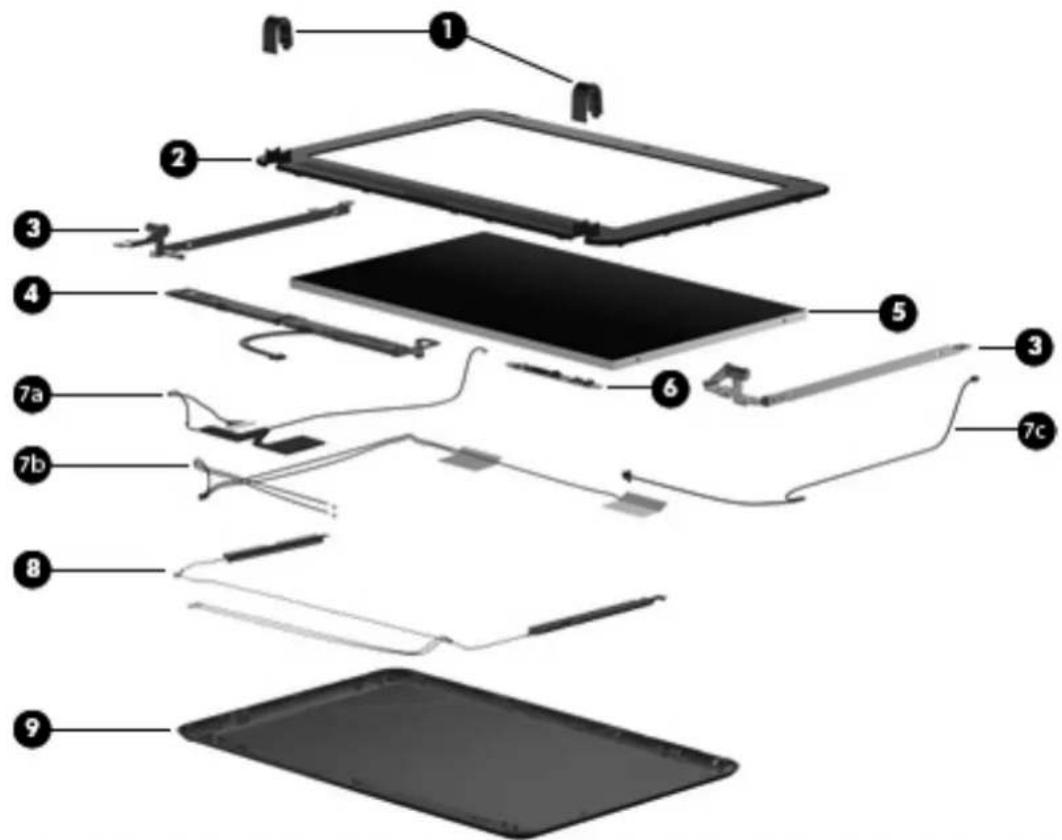
Display assembly components
text_image
Exploded view diagram of a tablet device with numbered parts for identificationItem Description Spare part number
| (1) Hinge covers 537617-001 | ||
| (2) Display bezel | ||
| For use with HP Mini 1101 Notebook PC, and HP Mini 110 only | 537650-001 | |
| For use with Compaq Mini 110 only 537644-001 | ||
| (3) Display Hinge Kit(Includes left and right display panel hinges) | 537658-001 | |
| (4) Speaker assembly (includes left and right cables) | 537621-001 | |
| (5) Display panel | ||
| 10.1-inch high-definition AntiGlare 572405-001 | ||
| 10.1-inch standard-definition AntiGlare 537656-001 | ||
| (6) Webcam module 537660-001 | ||
| Display Cable Kit (Not illustrated, includes microphone assembly display cable, webcam cable, and WLAN antennas) | 537657-001 | |
| (7a) Display panel cable | ||
| (7b) WLAN antennas | ||
| Item Description Spare part number | ||
| (7c) Microphone assembly | ||
| (8) | WWAN antennas (not available on computers with Mobile Mi installed.) | 537655-001 |
| (9) | Display enclosure (includes logo) | |
| For use with the HP Mini 1101 Notebook PC, and HP Mini 110 | 537651-001 | |
| For use with the Compaq Mini 110 537645-001 | ||
| Display Screw Kit (not illustrated) 538510-001 | ||
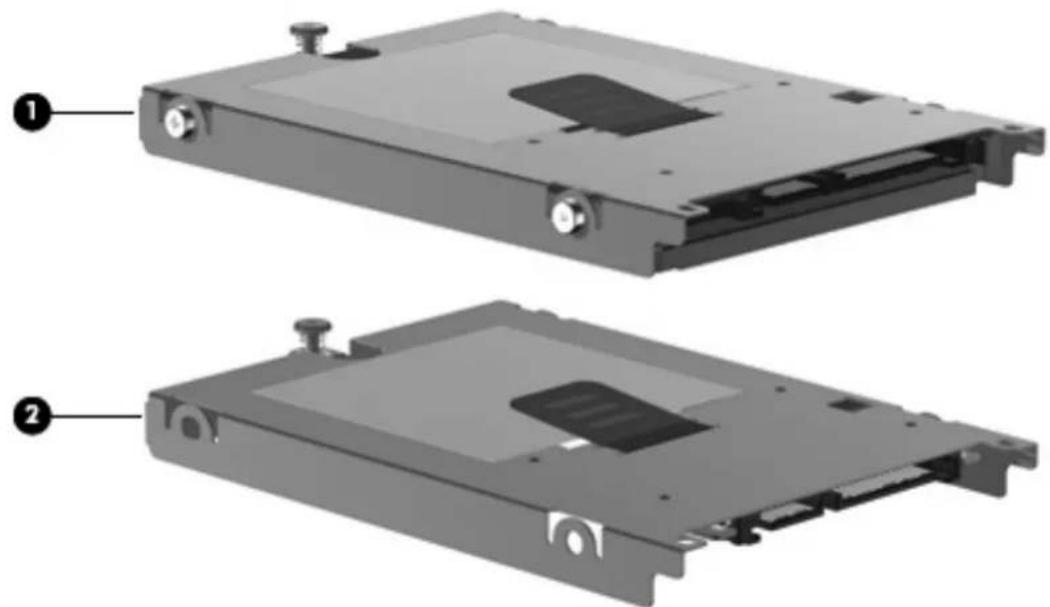
Mass storage devices
natural_image
Two views of a computer floppy disk chassis showing internal components and mounting holes (no text or symbols)
NOTE: Each hard drive spare part kit and solid-state drive spare part kit includes a cable and bracket.
| Item Description Spare part number |
| (1) Hard drive (select models only) |
| 250-GB, 5400-RPM 537635-001 |
| 160-GB, 5400-RPM 537634-001 |
| Hard Drive Hardware Kit (not illustrated) 537641-001 |
| (2) Solid-state drive |
| 64-GB 537640-001 |
| 32-GB 537639-001 |
| 16-GB 537638-001 |
| 8-GB 537637-001 |
| Solid-state Drive Hardware Kit (not illustrated) 537642-001 |
Miscellaneous parts
| Description Spare part number | |
| 30-W UMA AC adapter 496813-001 | |
| Bluetooth® adapter 574670-001 | |
| Power cords | |
| For use in Argentina | 490371-D01 |
| For use in Australia 490371-011 | |
| For use in Brazil 490371-201 | |
| For use in China 490371-AA1 | |
| For use in Denmark 490371-081 | |
| For use in Europe 490371-021 | |
| For use in India 490371-D61 | |
| For use in Israel 490371-BB1 | |
| For use in Italy 490371-061 | |
| For use in Japan 490371-291 | |
| For use in North America 490371-001 | |
| For use in Singapore and the United Kingdom 490371-031 | |
| For use in South Africa 490371-AR1 | |
| For use in South Korea | 490371-AD1 |
| For use in Switzerland | 490371-111 |
| For use in Taiwan 490371-AB1 | |
| Rubber Kit (contains 4 device feet) | 537618-001 |
| Screw Kit | 537620-001 |
Sequential part number listing
| Spare part number | Description |
| 483377-002 | HP un2400 Mobile Broadband Module (select models only) |
| 483377-003 | HP un2400 Mobile Broadband Module for use with Verizon Wireless only (select models only) |
| 490371-001 Power cord for use in North America | |
| 490371-011 Power cord for use in Australia | |
| 490371-021 Power cord for use in Europe | |
| 490371-031 Power cord for use in Singapore and the United Kingdom | |
| 490371-061 Power cord for use in Italy | |
| 490371-081 Power cord for use in Denmark | |
| 490371-111 Power cord for use in Switzerland | |
| 490371-201 Power cord for use in Brazil | |
| 490371-291 Power cord for use in Japan | |
| 490371-AA1 Power cord for use in China | |
| 490371-AB1 Power cord for use in Taiwan | |
| 490371-AD1 Power cord for use in South Korea | |
| 490371-AR1 Power cord for use in South Africa | |
| 490371-BB1 Power cord for use in Israel | |
| 490371-D01 Power cord for use in Argentina | |
| 490371-D61 Power cord for use in India | |
| 496813-001 30-W UMA AC adapter | |
| 504593-003 | Broadcom 4312 802.11/b/g WLAN module for use in Canada, the Cayman Islands, Guam, Puerto Rico, the U.S. Virgin Islands, and the United States |
| 504593-004 | Broadcom 4312 802.11/b/g WLAN module for use in Afghanistan, Albania, Algeria, Andorra, Angola, Antigua and Barbuda, Argentina, Armenia, Aruba, Australia, Austria, Azerbaijan, the Bahamas, Bahrain, Bangladesh, Barbados, Belarus, Belgium, Belize, Benin, Bermuda, Bhutan, Bolivia, Bosnia and Herzegovina, Botswana, Brazil, the British Virgin Islands, Brunei, Bulgaria, Burkina Faso, Burundi, Cameroon, Cape Verde, the Central African Republic, Chad, Chile, the People's Republic of China, Colombia, Comoros, the Congo, Costa Rica, Croatia, Cyprus, the Czech Republic, Denmark, Djibouti, Dominica, the Dominican Republic, East Timor, Ecuador, Egypt, El Salvador, Equatorial Guinea, Eritrea, Estonia, Ethiopia, Fiji, Finland, France, French Guiana, Gabon, Gambia, Georgia, Germany, Ghana, Gibraltar, Greece, Grenada, Guadeloupe, Guatemala, Guinea, Guinea-Bissau, Guyana, Haiti, Honduras, Hong Kong, Hungary, Iceland, India, Ireland, Israel, Italy, the Ivory Coast, Jamaica, Jordan, Kazakhstan, Kenya, Kiribati, Kyrgyzstan, Laos, Latvia, Lebanon, Lesotho, Liberia, Liechtenstein, Lithuania, Luxembourg, Macedonia, Madagascar, Malawi, Malaysia, the Maldives, Mali, Malta, the Marshall Islands, Martinique, Mauritania, Mauritius, Mexico, Micronesia, Monaco, Mongolia, Montenegro, Morocco, Mozambique, Namibia, Nauru, Nepal, the Nether Antilles, the Netherlands, New Zealand, Nicaragua, Niger, Nigeria, Norway, Oman, Pakistan, Palau, Panama, Papua New Guinea, Paraguay, Peru, the Philippines, Poland, Portugal, the Republic of Moldova, Romania, Russia, Rwanda, Samoa, San Marino, Sao Tome and Principe, Saudi Arabia, Senegal, Serbia, the Seychelles, Sierra Leone, Singapore, Slovakia, Slovenia, the Solomon Islands, Somalia, South Africa, South Korea, Spain, Sri Lanka, St. Kitts and Nevis, St. Lucia, St. Vincent and the Grenadines, Suriname, Swaziland, Sweden, Switzerland, Taiwan, Tajikistan, Tanzania, Togo, Tonga, Trinidad and Tobago, Tunisia, Turkey, Turkmenistan, Tuvalu, Uganda, Ukraine, the United Arab Emirates, the United Kingdom, Uruguay, Uzbekistan, Vanuatu, Venezuela, Vietnam, Yemen, Zaire, Zambia, and Zimbabwe |
| 535689-001 | Keyboard for use only in the United States on models with Windows operating system installed |
| 535689-031 | Keyboard for use only in the United Kingdom on models with Windows operating system installed |
| 535689-041 | Keyboard for use only in Germany on models with Windows operating system installed |
| 535689-051 | Keyboard for use only in France on models with Windows operating system installed |
| 535689-061 | Keyboard for use only in Italy on models with Windows operating system installed |
| 535689-071 | Keyboard for use only in Spain on models with Windows operating system installed |
| 535689-121 | Keyboard for use only in French Canada on models with Windows operating system installed |
| 535689-131 | Keyboard for use only in Portugal on models with Windows operating system installed |
| 535689-141 | Keyboard for use only in Turkey on models with Windows operating system installed |
| 535689-161 | Keyboard for use only in Latin America on models with Windows operating system installed |
| 535689-171 | Keyboard for use only in Saudi Arabia on models with Windows operating system installed |
| 535689-201 | Keyboard for use only in Brazil on models with Windows operating system installed |
| 535689-211 | Keyboard for use only in Hungary on models with Windows operating system installed |
| 535689-221 | Keyboard for use only in the Czech Republic on models with Windows operating system installed |
| 535689-251 | Keyboard for use only in Russia on models with Windows operating system installed |
| 535689-281 | Keyboard for use only in Thailand on models with Windows operating system installed |
| 535689-291 | Keyboard for use only in Japan on models with Windows operating system installed |
| 535689-A41 | Keyboard for use only in Europe on models with Windows operating system installed |
| 535689-AB1 | Keyboard for use only in Taiwan on models with Windows operating system installed |
| 535689-AD1 | Keyboard for use only in South Korea on models with Windows operating system installed |
| 535689-B31 | Keyboard for use only in international models with Windows operating system installed |
| 535689-BB1 | Keyboard for use only in Israel on models with Windows operating system installed |
| 535689-DH1 | Keyboard for use only in Finland, Norway and Sweden on models with Windows operating system installed |
| 535690-001 | Keyboard for use only in the United States on models with Mobile Mi installed |
| 535690-121 | Keyboard for use only in French Canada on models with Mobile Mi installed |
| 535690-161 | Keyboard for use only in Latin America on models with Mobile Mi installed |
| 535690-201 | Keyboard for use only in Brazil on models with Mobile Mi installed |
| 535690-281 | Keyboard for use only in Thailand on models with Mobile Mi installed |
| 535690-291 | Keyboard for use only in Japan on models with Mobile Mi installed |
| 535690-AB1 | Keyboard for use only in Taiwan on models with Mobile Mi installed |
| 535690-AD1 | Keyboard for use only in South Korea on models with Mobile Mi installed |
| 537611-001 | Base enclosure (includes 4 rubber feet) |
| 537612-001 | Plastics/actuator kit (includes power switch and wireless switch actuators, memory module compartment cover, and bezel for Digital Media Slot (consumer models) or Media Card Reader (commercial models) |
| 537613-001 Fan | |
| 537614-001 USB/audio board (includes cable) | |
| 537615-001 Power/battery pass-through board | |
| 537616-001 RTC battery | |
| 537617-001 Display assembly hinge covers | |
| 537618-001 Rubber Kit (contains 4 device feet) | |
| 537619-001 Heat sink assembly (includes replacement thermal material) | |
| 537620-001 Screw Kit | |
| 537621-001 Speaker assembly (includes left and right cables) | |
| 537622-001 Top cover (includes TouchPad) | |
| 537626-001 3-cell lithium-polymer (Li-Pol) battery (2.55-Ah, 28-Wh) | |
| 537627-001 6-cell lithium-polymer (Li-Pol) battery (2.55-Ah, 55-Wh) | |
| 537634-001 160-GB hard drive, 5400-RPM | |
| 537635-001 250-GB hard drive, 5400-RPM | |
| 537637-001 8-GB solid-state drive | |
| 537638-001 16-GB solid-state drive | |
| 537639-001 32-GB solid-state drive | |
| 537640-001 64-GB solid-state drive | |
| 537641-001 Hard Drive Hardware Kit | |
| 537642-001 Solid-state Drive Hardware Kit | |
| 537643-001 10.1-inch, standard-definition, AntiGlare Display Assembly for use with Compaq standard models only | |
| 537644-001 Display bezel for use with Compaq Mini 110 only | |
| 537645-001 Display enclosure (includes logo) for use with the Compaq Mini 110 | |
| 537646-001 10.1-inch, standard-definition, AntiGlare Display Assembly for use with HP models only | |
| 537650-001 Display bezel for use with HP Mini 1101 Notebook PC, and HP Mini 110 only | |
| 537651-001 Display enclosure (includes logo) for use with the HP Mini 1101 Notebook PC, and HP Mini 110 | |
| 537655-001 WWAN antennas | |
| 537656-001 10.1-inch standard-definition AntiGlare display panel | |
| 537657-001 Display Cable Kit (includes microphone assembly display cable, webcam cable, and WLAN antennas) | |
| 537658-001 Display Hinge Kit (Includes left and right display panel hinges) | |
| 537660-001 Webcam module | |
| 537662-001 System board (Includes Intel Atom N270 1.6-GHz processor, 512-KB Level 2 cache, 533-MHz front-side bus (FSB), and replacement thermal material) | |
| 537663-001 | 512-MB memory module (PC2-5300, 533-MHz, DDR2 for use in HP Mini 110 and Compaq Mini 110 models only) |
| 537664-001 | 1024-MB memory module (PC2-5300, 533-MHz, DDR2 for use in HP Mini 110 and Compaq Mini 110 models only) |
| 537665-001 | 2048-MB memory module (PC2-5300, 533-MHz, DDR2 for use in HP Mini 110 and Compaq Mini 110 models only) |
| 538510-001 | Display Screw Kit (not illustrated) |
| 571370-001 | System board (Includes Intel Atom N280 1.66-GHz processor, 512-KB Level 2 cache, 533-MHz front-side bus (FSB), and replacement thermal material) |
| 571414-001 | 10.1-inch, standard-definition, AntiGlare Display Assembly (includes WWAN) for use with HP models only |
| 571417-001 | 10.1-inch, standard-definition, AntiGlare Display Assembly (includes WWAN) for use with Compaq standard models only |
| 571888-001 | WWAN module, for use only in China |
| 572405-001 | 10.1-inch high-definition AntiGlare display panel |
| 572406-001 | 10.1-inch, high-definition, AntiGlare Display Assembly for use with HP models only |
| 572407-001 | 10.1-inch, high-definition, AntiGlare Display Assembly (Includes WWAN) for use with HP models only |
| 572414-001 | 10.1-inch, high-definition, AntiGlare Display Assembly for use with Compaq standard models only |
| 574670-001 | Bluetooth adapter |
4 Removal and replacement procedures
Preliminary replacement requirements
Tools required
You will need the following tools to complete the removal and replacement procedures:
• Flat-bladed screwdriver
• Magnetic screwdriver
• Phillips P0 and P1 screwdrivers
Service considerations
The following sections include some of the considerations that you must keep in mind during disassembly and assembly procedures.
NOTE: As you remove each subassembly from the device, place the subassembly (and all accompanying screws) away from the work area to prevent damage.
Plastic parts
△ CAUTION: Using excessive force during disassembly and reassembly can damage plastic parts. Use care when handling the plastic parts. Apply pressure only at the points designated in the maintenance instructions.
Cables and connectors
△ CAUTION: When servicing the device, be sure that cables are placed in their proper locations during the reassembly process. Improper cable placement can damage the device.
Cables must be handled with extreme care to avoid damage. Apply only the tension required to unseat or seat the cables during removal and insertion. Handle cables by the connector whenever possible. In all cases, avoid bending, twisting, or tearing cables. Be sure that cables are routed in such a way that they cannot be caught or snagged by parts being removed or replaced. Handle flex cables with extreme care; these cables tear easily.
Drive handling
△ CAUTION: Drives are fragile components that must be handled with care. To prevent damage to the device, damage to a drive, or loss of information, observe these precautions:
Before removing or inserting a hard drive, shut down the device. If you are unsure whether the device is off or in Hibernation, turn the device on, and then shut it down through the operating system.
Before handling a drive, be sure that you are discharged of static electricity. While handling a drive, avoid touching the connector.
Handle drives on surfaces covered with at least one inch of shock-proof foam.
Avoid dropping drives from any height onto any surface.
After removing a hard drive, an optical drive, or a diskette drive, place it in a static-proof bag.
Avoid exposing a hard drive to products that have magnetic fields, such as monitors or speakers.
Avoid exposing a drive to temperature extremes or liquids.
If a drive must be mailed, place the drive in a bubble pack mailer or other suitable form of protective packaging and label the package "FRAGILE."
Grounding guidelines
Electrostatic discharge damage
Electronic components are sensitive to electrostatic discharge (ESD). Circuitry design and structure determine the degree of sensitivity. Networks built into many integrated circuits provide some protection, but in many cases, ESD contains enough power to alter device parameters or melt silicon junctions.
A discharge of static electricity from a finger or other conductor can destroy static-sensitive devices or microcircuitry. Even if the spark is neither felt nor heard, damage may have occurred.
An electronic device exposed to ESD may not be affected at all and can work perfectly throughout a normal cycle. Or the device may function normally for a while, then degrade in the internal layers, reducing its life expectancy.
△ CAUTION: To prevent damage to the device when you are removing or installing internal components, observe these precautions:
Keep components in their electrostatic-safe containers until you are ready to install them.
Use nonmagnetic tools.
Before touching an electronic component, discharge static electricity by using the guidelines described in this section.
Avoid touching pins, leads, and circuitry. Handle electronic components as little as possible.
If you remove a component, place it in an electrostatic-safe container.
The following table shows how humidity affects the electrostatic voltage levels generated by different activities.
△ CAUTION: A product can be degraded by as little as 700 V.
| Typical electrostatic voltage levels | |||
| Relative humidity | |||
| Event 10% 40% 55% | |||
| Walking across carpet 35,000 V 15,000 V 7,500 V | |||
| Walking across vinyl floor 12,000 V 5,000 V 3,000 V | |||
| Motions of bench worker 6,000 V 800 V 400 V | |||
| Removing DIPS from plastic tube 2,000 V 700 V 400 V | |||
| Removing DIPS from vinyl tray 11,500 V 4,000 V 2,000 V | |||
| Removing DIPS from Styrofoam | 14,500 V | 5,000 V | 3,500 V |
| Removing bubble pack from PCB | 26,500 V | 20,000 V | 7,000 V |
| Packing PCBs in foam-lined box | 21,000 V 11,000 V 5,000 V | ||
Packaging and transporting guidelines
Follow these grounding guidelines when packaging and transporting equipment:
• To avoid hand contact, transport products in static-safe tubes, bags, or boxes.
- Protect ESD-sensitive parts and assemblies with conductive or approved containers or packaging.
- Keep ESD-sensitive parts in their containers until the parts arrive at static-free workstations.
- Place items on a grounded surface before removing items from their containers.
• Always be properly grounded when touching a component or assembly.
- Store reusable ESD-sensitive parts from assemblies in protective packaging or nonconductive foam.
- Use transporters and conveyors made of antistatic belts and roller bushings. Be sure that mechanized equipment used for moving materials is wired to ground and that proper materials are selected to avoid static charging. When grounding is not possible, use an ionizer to dissipate electric charges.
Workstation guidelines
Follow these grounding workstation guidelines:
• Cover the workstation with approved static-shielding material.
- Use a wrist strap connected to a properly grounded work surface and use properly grounded tools and equipment.
• Use conductive field service tools, such as cutters, screwdrivers, and vacuums.
- When fixtures must directly contact dissipative surfaces, use fixtures made only of static-safe materials.
- Keep the work area free of nonconductive materials, such as ordinary plastic assembly aids and Styrofoam.
- Handle ESD-sensitive components, parts, and assemblies by the case or PCM laminate. Handle these items only at static-free workstations.
- Avoid contact with pins, leads, or circuitry.
• Turn off power and input signals before inserting or removing connectors or test equipment.
Equipment guidelines
Grounding equipment must include either a wrist strap or a foot strap at a grounded workstation.
- When seated, wear a wrist strap connected to a grounded system. Wrist straps are flexible straps with a minimum of one megohm ±10% resistance in the ground cords. To provide proper ground, wear a strap snugly against the skin at all times. On grounded mats with banana-plug connectors, use alligator clips to connect a wrist strap.
- When standing, use foot straps and a grounded floor mat. Foot straps (heel, toe, or boot straps) can be used at standing workstations and are compatible with most types of shoes or boots. On conductive floors or dissipative floor mats, use foot straps on both feet with a minimum of one megohm resistance between the operator and ground. To be effective, the conductive strips must be worn in contact with the skin.
The following grounding equipment is recommended to prevent electrostatic damage:
- Antistatic tape
• Antistatic smocks, aprons, and sleeve protectors
• Conductive bins and other assembly or soldering aids
• Nonconductive foam
• Conductive tabletop workstations with ground cords of one megohm resistance
• Static-dissipative tables or floor mats with hard ties to the ground
Field service kits
• Static awareness labels
• Material-handling packages
• Nonconductive plastic bags, tubes, or boxes
• Metal tote boxes
• Electrostatic voltage levels and protective materials
The following table lists the shielding protection provided by antistatic bags and floor mats.
Material Use Voltage protection level
| Antistatic plastic Bags 1,500 V |
| Carbon-loaded plastic Floor mats 7,500 V |
| Metallized laminate Floor mats 5,000 V |
Component replacement procedures
This chapter provides removal and replacement procedures.
There are as many as 65 screws, in 9 different sizes, that must be removed, replaced, or loosened when servicing the device. Make special note of each screw size and location during removal and replacement.
Service tag
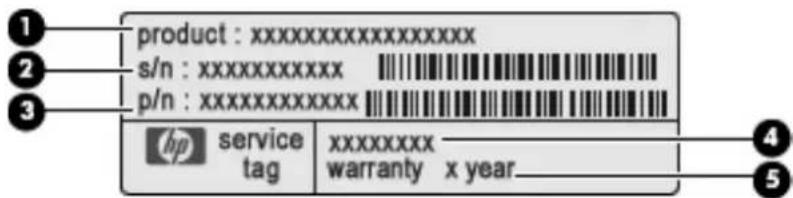
When ordering parts or requesting information, provide the computer serial number and model description provided on the service tag:
(1) Product name: This is the product name affixed to the front of the device.
(2) Serial number (s/n): This is an alphanumeric identifier that is unique to each product.
(3) Part number/Product number (p/n): This number provides specific information about the product's hardware components. The part number helps a service technician to determine what components and parts are needed.
(4) Model description: This is the alphanumeric identifier used to locate documents, drivers, and support for the device.
(5) Warranty period: This number describes the duration of the warranty period for the device.
text_image
product : xxxxxxxxxxxxxxxxxxx s/n : xxxxxxxxxxxxxxx p/n : xxxxxxxxxxxxxxx hp service tag xxxxxxxx _ warranty x year 4 5Device feet
The device feet are adhesive-backed rubber pads, tethered to the base enclosure.
Description Spare part number
Rubber Kit 537618-001

natural_image
Front view of a gray electronic device with mounting points and ventilation slots (no visible text or symbols)Battery
Description Spare part number
6-cell lithium-polymer (Li-Pol) battery (2.55-Ah, 55-Wh) 537627-001
3-cell lithium-polymer (Li-Pol) battery (2.55-Ah, 28-Wh) 537626-001
Before disassembling the device, follow these steps:
- Shut down the device. If you are unsure whether the device is off or in Hibernation, turn the device on, and then shut it down through the operating system.
- Disconnect all external devices connected to the device.
- Disconnect the power from the device by first unplugging the power cord from the AC outlet and then unplugging the AC adapter from the device.
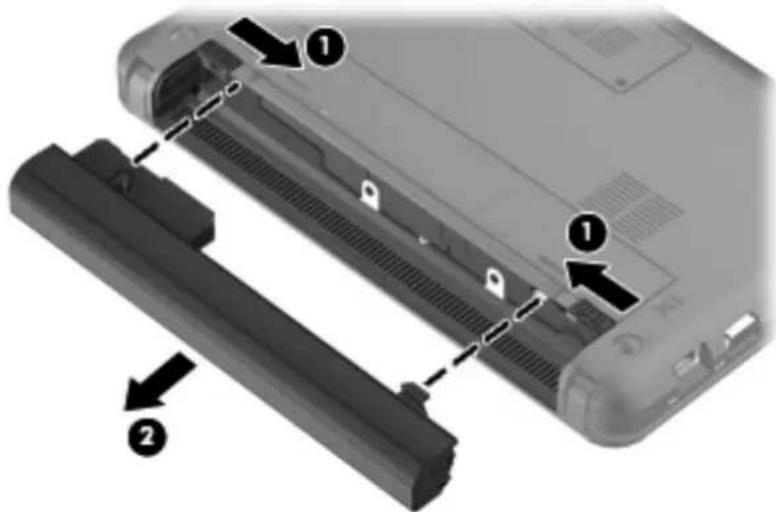
Remove the battery:
- Turn the device upside-down on a flat surface, with the battery bay toward you.
- Slide the battery release latches (1) to release the battery.
- Remove the battery (2).
text_image
Diagram of a device showing two labeled components (1 and 2) with arrows indicating assembly or connection steps.Reverse this procedure to install a battery.
NOTE: This section applies only to device models with WWAN capability.
NOTE: If there is a SIM inserted in the SIM slot, it must be removed before disassembling the computer. Be sure that the SIM is reinserted in the SIM slot after reassembling the computer.
Before removing the SIM, follow these steps:
- Shut down the computer. If you are unsure whether the computer is off or in Hibernation, turn the computer on, and then shut it down through the operating system.
- Disconnect all external devices connected to the computer.
- Disconnect the power from the computer by first unplugging the power cord from the AC outlet and then unplugging the AC adapter from the computer.
- Remove the battery (see Battery on page 36).
Remove the SIM:
- Press in on the SIM (1). (The module is partially ejected from the SIM slot.)
- Remove the SIM (2) from the SIM slot.

text_image
Diagram of a device rear panel with labeled components and directional arrows indicating parts of the lid.Reverse this procedure to insert the SIM.
Memory module
Description Spare part number
| Memory module (PC2-5300, 533-MHz, DDR2) | |
| 512-MB (for use in HP Mini 110 and Compaq Mini 110 only) 537663-001 | |
| 1024-MB 537664-001 | |
| 2048-MB (for use in HP Mini 1101 Notebook PC, and HP Mini 110 with Mobile Mi installed only) | 537665-001 |
Before removing the memory module, follow these steps:
- Shut down the device. If you are unsure whether the device is off or in Hibernation, turn the device on, and then shut it down through the operating system.
- Disconnect all external devices connected to the device.
- Disconnect the power from the device by first unplugging the power cord from the AC outlet and then unplugging the AC adapter from the device.
- Remove the battery (see Battery on page 36).
- If your device has WWAN capability, remove the SIM (see SIM on page 37.
Remove the memory module:
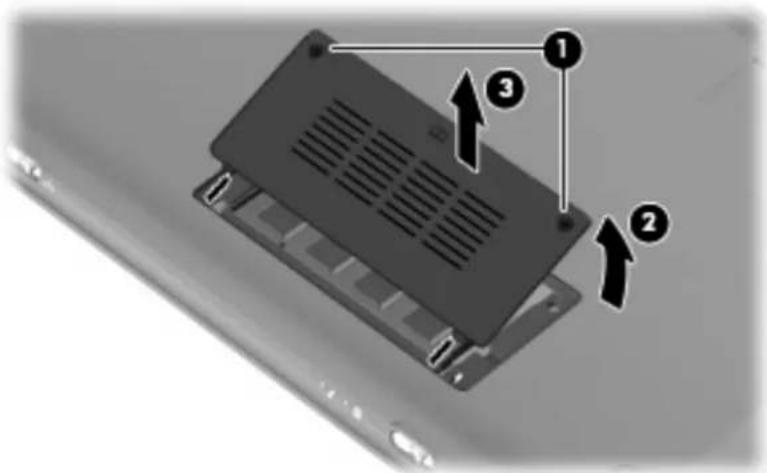
- Loosen the 2 Phillips 2.0×3.0 captive screws (1) that secure the memory module compartment cover to the computer.
- Swing the cover up and away from the inside of the computer (2), and then remove the cover (3).
text_image
Diagram of a device rear panel with numbered components and directional arrows indicating assembly or movement.-
Spread the retaining tabs (1) on each side of the memory module slot to release the memory module. (The edge of the module opposite the slot rises away from the device.)
-
Remove the memory module (2) by pulling the module away from the slot at an angle.

NOTE: Memory modules are designed with a notch (3) to prevent incorrect insertion into the memory module slot.

text_image
Diagram of a device rear panel with labeled components and directional arrows indicating assembly or movement.Reverse this procedure to install a memory module.
Description Spare part number
| For use only on models with Windows operating system installed | |
| For use only in Brazil | 535689-201 |
| For use only in the Czech Republic | 535689-221 |
| For use only in Europe | 535689-021 |
| For use only in Finland, Norway, and Sweden | 535689-DH1 |
| For use only in France | 535689-051 |
| For use only in French Canada | 535689-121 |
| For use only in Germany | 535689-041 |
| For use only in Greece | 535689-151 |
| For use only in Hungary | 535689-211 |
| For use on international models | 535689-B31 |
| For use only in Israel | 535689-BB1 |
| For use only in Italy | 535689-061 |
| For use only in Japan | 535689-291 |
| For use only in Latin America | 535689-161 |
| For use only in Portugal | 535689-131 |
| For use only in Russia | 535689-251 |
| For use only in Saudi Arabia | 535689-171 |
| For use only South Korea | 535689-AD1 |
| For use only in Spain | 535689-071 |
| For use only in Switzerland | 535689-111 |
| For use only in Taiwan | 535689-AB1 |
| For use only in Thailand | 535689-281 |
| For use only in Turkey | 535689-141 |
| For use only in the United Kingdom | 535689-031 |
| For use only in the United States | 535689-001 |
| For use only on models with Mobile Mi installed | |
| For use only in Brazil | 535690-201 |
| For use only in French Canada | 535690-121 |
| For use only in Japan | 535690-291 |
| For use only in Latin America | 535690-161 |
| For use only in South Korea | 535690-AD1 |
| For use only in Taiwan 535690-AB1 | |
Description Spare part number
• For use only in Thailand
535690-281
• For use only in the United States 535690-001
Before removing the keyboard, follow these steps:
- Shut down the device. If you are unsure whether the device is off or in Hibernation, turn the device on, and then shut it down through the operating system.
- Disconnect all external devices connected to the device.
- Disconnect the power from the device by first unplugging the power cord from the AC outlet and then unplugging the AC adapter from the device.
- Remove the battery (see Battery on page 36).
- If your device has WWAN capability, remove the SIM (see SIM on page 37.
Remove the keyboard:
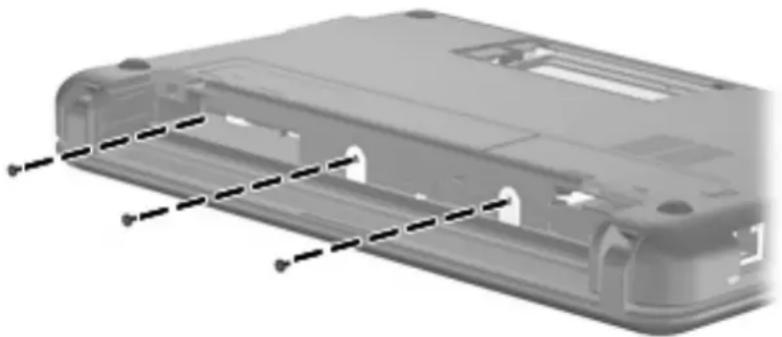
- Remove the 3 Phillips SP2.0×3.0 screws that secure the keyboard to the device.
natural_image
3D diagram of a device casing with internal components and dashed lines indicating alignment (no text or symbols)- Turn the device right-side up, and then open the display as far as possible.
-
Turn the device upside down, and locate the keyboard release access on the bottom of the computer, inside the battery bay.
-
Insert a flexible tool into the opening, and then press inward to release the keyboard.

natural_image
Close-up of a device's cable being inserted into a slot, with a black arrow pointing to the insertion point (no text or symbols visible)-
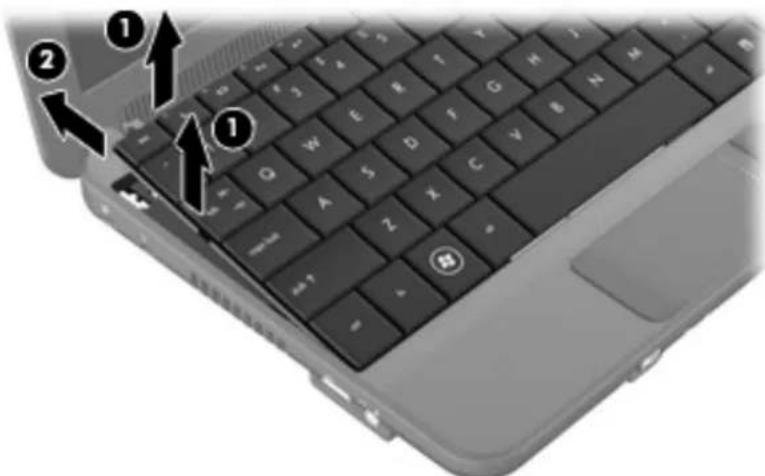
Turn the device right-side up, and then lift up on the top and left edges (1) of the keyboard until the keyboard releases completely.
-
Slide the keyboard back until its top edge rests on the display assembly (2).
text_image
Laptop keyboard diagram with numbered annotations pointing to specific keys and buttons-
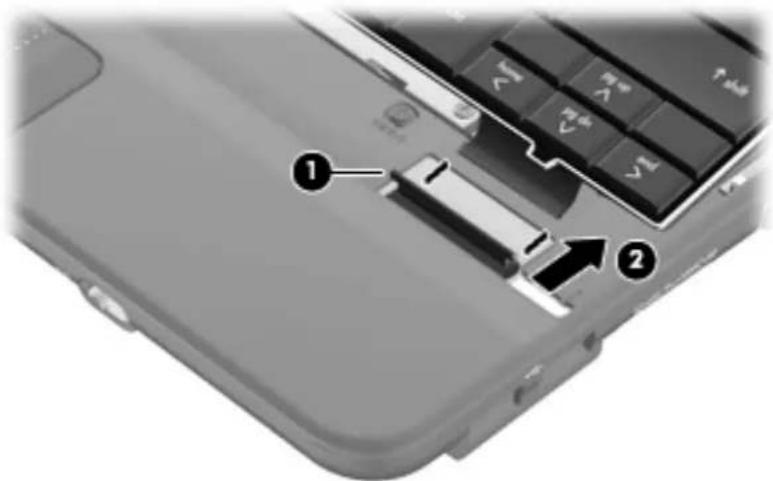
Release the zero insertion force (ZIF) connector (1) to which the keyboard cable is attached.
-
Disconnect the cable (2), and then remove the keyboard.
text_image
Diagram of a smartphone keyboard with labeled parts, showing key keys and a highlighted component.- Remove the keyboard.
Reverse this procedure to install the keyboard.
Description Spare part number
RTC battery 537616-001
Before removing the real-time clock (RTC) battery, follow these steps:
- Shut down the device. If you are unsure whether the device is off or in Hibernation, turn the device on, and then shut it down through the operating system.
- Disconnect all external devices connected to the device.
- Disconnect the power from the device by first unplugging the power cord from the AC outlet and then unplugging the AC adapter from the device.
- Remove the battery (see Battery on page 36).
- If your device has WWAN capability, remove the SIM (see SIM on page 37.
- Remove the Keyboard (see Keyboard on page 40)
Remove the RTC battery:
-
Disconnect the RTC battery cable (1) from the system board.
-
Detach the RTC battery (2) from the system board.

NOTE: The RTC battery is attached to the system board with double-sided tape.
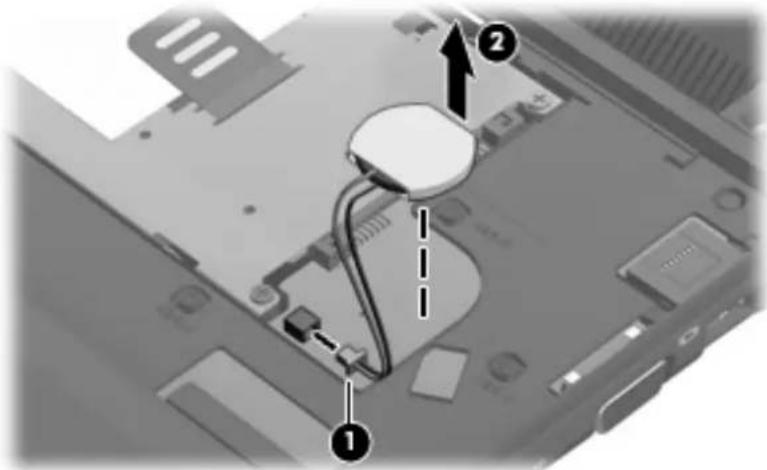
text_image
Diagram of a computer motherboard with labeled parts and directional arrows indicating connection pointsReverse this procedure to install the RTC battery.

NOTE: Each hard drive spare part kit and solid-state drive spare part kit includes a cable and bracket.
| Description Spare part number |
| Hard drive (select models only) |
| 250-GB, 5400-RPM 537635-001 |
| 160-GB, 5400-RPM 537634-001 |
| Hard Drive Hardware Kit 537641-001 |
| Solid-state drive |
| 64-GB 537640-001 |
| 32-GB 537639-001 |
| 16-GB 537638-001 |
| 8-GB 537637-001 |
| Solid-state Drive Hardware Kit 537642-001 |
Before removing the hard drive or solid-state drive, follow these steps:
- Shut down the device. If you are unsure whether the device is off or in Hibernation, turn the device on, and then shut it down through the operating system.
- Disconnect all external devices connected to the device.
- Disconnect the power from the device by first unplugging the power cord from the AC outlet and then unplugging the AC adapter from the device.
-
Remove the battery (see Battery on page 36).
-
If your device has WWAN capability, remove the SIM (see SIM on page 37.
-
Remove the keyboard (see Keyboard on page 40).
To remove the mass storage assembly:
-
Loosen the Phillips SP2.5×10.0 captive screw (1), and remove the two Phillips PM2.0×5.0 screws (2) that secure the assembly to the device.
-
Use the Mylar tab to slide the assembly to the left (3) to disconnect it, and remove the assembly (4).

text_image
Laptop screen with numbered annotations indicating internal components and a highlighted deviceContinue with one of the following sections for hard drive or solid-state drive replacement.
Hard drive
- Remove the 4 Phillips SP3.0×4.0 screws (1) that secure the hard drive bracket to the hard drive.
- Using the Mylar tab, lift the bracket (2) away from the hard drive.
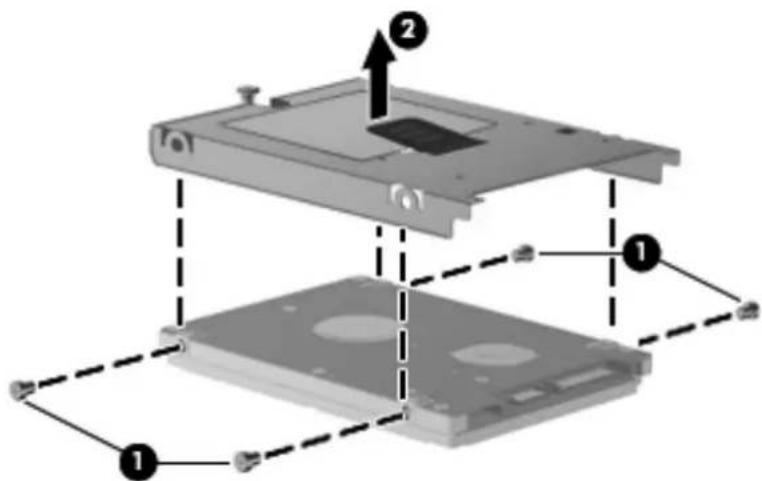
text_image
Diagram of a floppy disk assembly with numbered components and dashed lines indicating hidden edges.Reverse this procedure to install a hard drive.
Solid-state drive
To remove the solid-state drive:
-
Remove the 4 Phillips SP2.0×3.0 screws (1) that secure the solid-state drive bracket to the solid-state drive.
-
Lift the solid-state drive (2) to remove it.
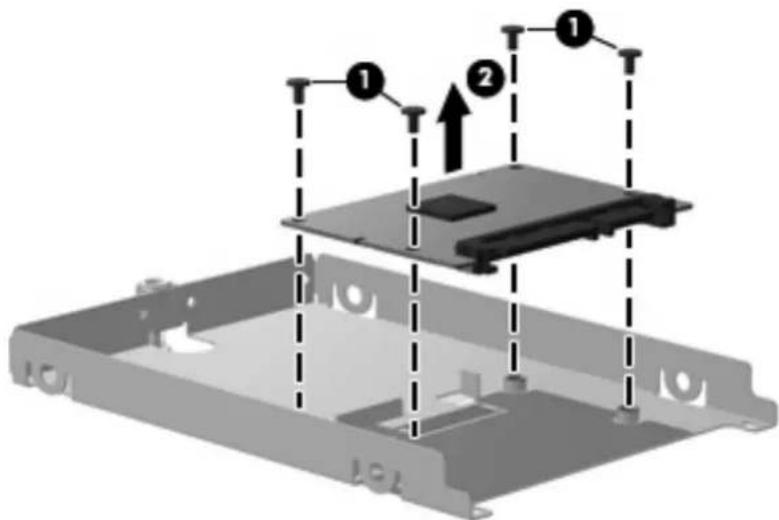
text_image
Diagram of a device assembly with labeled components and directional arrows indicating movement or assembly.Reverse this procedure to install a solid-state drive.
Top cover
Description Spare part number
Top cover (includes TouchPad) 537622-001
Before removing the top cover, follow these steps:
- Shut down the device. If you are unsure whether the device is off or in Hibernation, turn the device on, and then shut it down through the operating system.
- Disconnect all external devices connected to the device.
-
Disconnect the power from the device by first unplugging the power cord from the AC outlet and then unplugging the AC adapter from the device.
-
Remove the battery (see Battery on page 36).
-
If your device has WWAN capability, remove the SIM (see SIM on page 37.
-
Remove the memory module (see Memory module on page 38)
-
Remove the keyboard (see Keyboard on page 40).
-
Remove the hard drive or solid-state drive assembly (see Mass storage devices on page 45).
Remove the top cover.
- Turn the device upside down, with the front toward you.
-
Use a thin, flat tool to release the 4 tethered rubber feet.
-
Remove the four Phillips PM2.5×7.0 screws (1), and the Phillips SP2.0×5.0 screw (2) that secure the top cover to the base enclosure.

text_image
Labeled diagram of a laptop chassis showing three main components with numbered annotations- Turn the device right-side up, with the front toward you.
-
Open the device as far as possible.
-
Remove the 8 Phillips PM2.5×7.0 screws that secure the top cover to the base enclosure.

natural_image
Laptop keyboard with visible expansion and vertical dashed lines indicating measurement or port (no text or symbols)- Lift the inside edge of the top cover (1) and swing it up. Then slide the top cover back slightly to rest against the display assembly (2) at an angle.
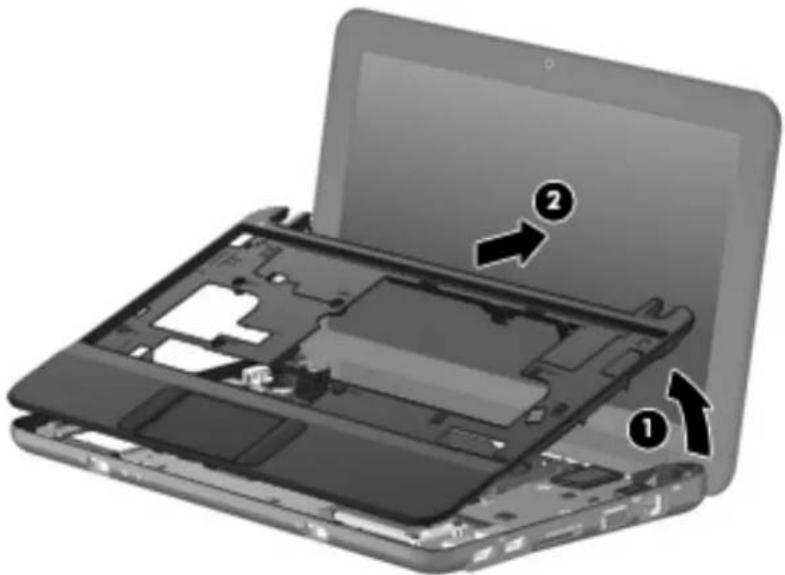
text_image
Laptop interior diagram with labeled components and directional arrows indicating assembly or repair steps-
Release the ZIF connector (1) to which the TouchPad button board cable is connected.
-
Disconnect the TouchPad button board cable (2) from the system board, and then remove the top cover.

natural_image
Close-up of a computer interface showing a component with numbered annotations (1 and 2), no readable text or symbols beyond labels.Reverse this procedure to install the top cover.
Description Spare part number
| Broadcom 4312 802.11/b/g WLAN module | |
| For use in Canada, the Cayman Islands, Guam, Puerto Rico, the U.S. Virgin Islands,and the United States | 504593-003 |
| For use in Afghanistan, Albania, Algeria, Andorra, Angola, Antigua and Barbuda, Argentina, Armenia,Aruba, Australia, Austria, Azerbaijan, the Bahamas, Bahrain, Bangladesh, Barbados, Belarus,Belgium, Belize, Benin, Bermuda, Bhutan, Bolivia, Bosnia and Herzegovina, Botswana, Brazil,the British Virgin Islands, Brunei, Bulgaria, Burkina Faso, Burundi, Cameroon, Cape Verde,the Central African Republic, Chad, Chile, the People's Republic of China, Colombia, Comoros,the Congo, Costa Rica, Croatia, Cyprus, the Czech Republic, Denmark, Djibouti, Dominica,the Dominican Republic, East Timor, Ecuador, Egypt, El Salvador, Equatorial Guinea, Eritrea, Estonia,Ethiopia, Fiji, Finland, France, French Guiana, Gabon, Gambia, Georgia, Germany, Ghana, Gibraltar,Greece, Grenada, Guadeloupe, Guatemala, Guinea, Guinea-Bissau, Guyana, Haiti, Honduras,Hong Kong, Hungary, Iceland, India, Ireland, Israel, Italy, the Ivory Coast, Jamaica, Jordan,Kazakhstan, Kenya, Kiribati, Kyrgyzstan, Laos, Latvia, Lebanon, Lesotho, Liberia, Liechtenstein,Lithuania, Luxembourg, Macedonia, Madagascar, Malawi, Malaysia, the Maldives, Mali, Malta,the Marshall Islands, Martinique, Mauritania, Mauritius, Mexico, Micronesia, Monaco, Mongolia,Montenegro, Morocco, Mozambique, Namibia, Nauru, Nepal, the Nether Antilles, the Netherlands,New Zealand, Nicaragua, Niger, Nigeria, Norway, Oman, Pakistan, Palau, Panama,Papua New Guinea, Paraguay, Peru, the Philippines, Poland, Portugal, the Republic of Moldova,Romania, Russia, Rwanda, Samoa, San Marino, Sao Tome and Principe, Saudi Arabia, Senegal,Serbia, the Seychelles, Sierra Leone, Singapore, Slovakia, Slovenia, the Solomon Islands, Somalia,South Africa, South Korea, Spain, Sri Lanka, St. Kitts and Nevis, St. Lucia,St. Vincent and the Grenadines, Suriname, Swaziland, Sweden, Switzerland, Taiwan, Tajikistan,Tanzania, Togo, Tonga, Trinidad and Tobago, Tunisia, Turkey, Turkmenistan, Tuvalu, Uganda,Ukraine, the United Arab Emirates, the United Kingdom, Uruguay, Uzbekistan, Vanuatu, Venezuela,Vietnam, Yemen, Zaire, Zambia, and Zimbabwe | 504593-004 |
△ CAUTION: The WWAN module and the WLAN module are not interchangeable.
To prevent an unresponsive system, replace the wireless module only with a wireless module authorized for use in the device by the governmental agency that regulates wireless devices in your country or region. If you replace the module and then receive a warning message, remove the module to restore device functionality, and then contact technical support through Help and Support.
Before removing the WLAN module, follow these steps:
- Shut down the device. If you are unsure whether the device is off or in Hibernation, turn the device on, and then shut it down through the operating system.
- Disconnect all external devices connected to the device.
- Disconnect the power from the device by first unplugging the power cord from the AC outlet and then unplugging the AC adapter from the device.
- Remove the battery (see Battery on page 36).
- If your device has WWAN capability, remove the SIM (see SIM on page 37.
- Remove the following components:
a. Keyboard (see Keyboard on page 40)
b. Hard drive or solid-state drive (see Mass storage devices on page 45)
c. Top cover (see Top cover on page 48)
Remove the WLAN module:
-
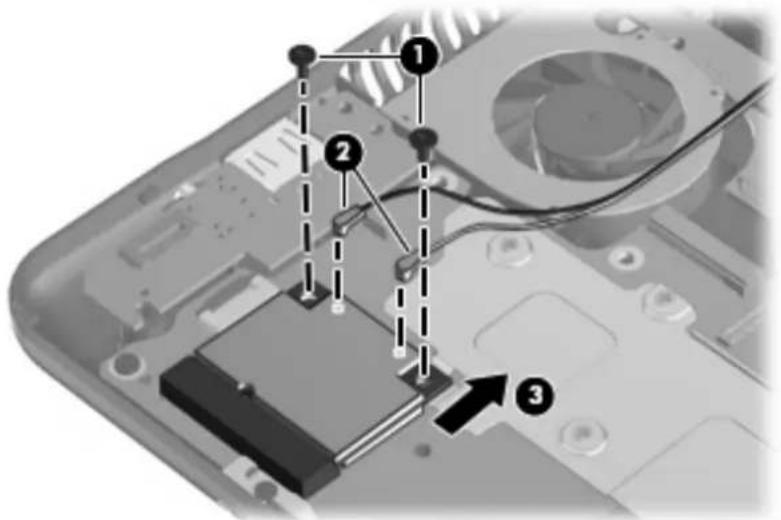
Remove the 2 Phillips PM2.0×4.0 screws (1) that secure the WLAN module to the system board. (The edge of the module opposite the slot rises away from the device.)
-
Disconnect the wireless antenna cables (2) from the terminals on the WLAN module.
-
Remove the WLAN module (3) by pulling the module away from the slot at an angle.
text_image
Diagram of a computer motherboard with numbered components and directional arrows indicating assembly or connection points.Reverse this procedure to install the WLAN module.

NOTE: Not available for computers with Mobile Mi installed.
| Description Spare part number | |
| HP un2400 Mobile Broadband Module (select models only) | 483377-002 |
| HP un2400 Mobile Broadband Module for use only with Verizon Wireless (select models only) | 483377-003 |
| WWAN module for use only in China 571888-001 | |

CAUTION: The WWAN module and the WLAN module are not interchangeable.
To prevent an unresponsive system, replace the wireless module only with a wireless module authorized for use in the device by the governmental agency that regulates wireless devices in your country or region. If you replace the module and then receive a warning message, remove the module to restore device functionality, and then contact technical support.
Before removing the WWAN module, follow these steps:
- Shut down the device. If you are unsure whether the device is off or in Hibernation, turn the device on, and then shut it down through the operating system.
- Disconnect all external devices connected to the device.
- Disconnect the power from the device by first unplugging the power cord from the AC outlet and then unplugging the AC adapter from the device.
- Remove the battery (see Battery on page 36).
- Remove the SIM (see SIM on page 37.
- Remove the following components:
a. Keyboard (see Keyboard on page 40)
b. Hard drive or solid-state drive (see Mass storage devices on page 45)
c. Top cover (see Top cover on page 48)
Remove the WWAN module:
- Remove the 2 Phillips PM2.0×4.0 screws (1) that secure the WWAN connector module (3) to the system board. (The edge of the module opposite the slot rises away from the device.)
- Disconnect the wireless antenna cables (2) from the terminals on the WWAN module.

NOTE: The red WWAN antenna cable is connected to the WWAN module "Main" terminal. The blue WWAN antenna cable is connected to the WWAN module "Aux" terminal.
- Remove the WWAN module (3) by pulling the module away from the slot at an angle.

text_image
Laptop interior diagram with numbered annotations pointing to components like a circuit board and cableReverse this procedure to install the WWAN module.
Description Spare part number
USB/audio board (includes cable) 537614-001
Before removing the USB/audio board, follow these steps:
-
Shut down the computer. If you are unsure whether the computer is off or in Hibernation, turn the computer on, and then shut it down through the operating system.
-
Disconnect all external devices connected to the computer.
-
Disconnect the power from the computer by first unplugging the power cord from the AC outlet and then unplugging the AC Adapter from the computer.
-
Remove the battery (see Battery on page 36).
-
If your device has WWAN capability, remove the SIM (see SIM on page 37.
-
Remove the following components:
a. Keyboard (see Keyboard on page 40).
b. Hard drive or solid-state drive (see Mass storage devices on page 45).
c. Top cover (see Top cover on page 48).
Remove the USB board:
-
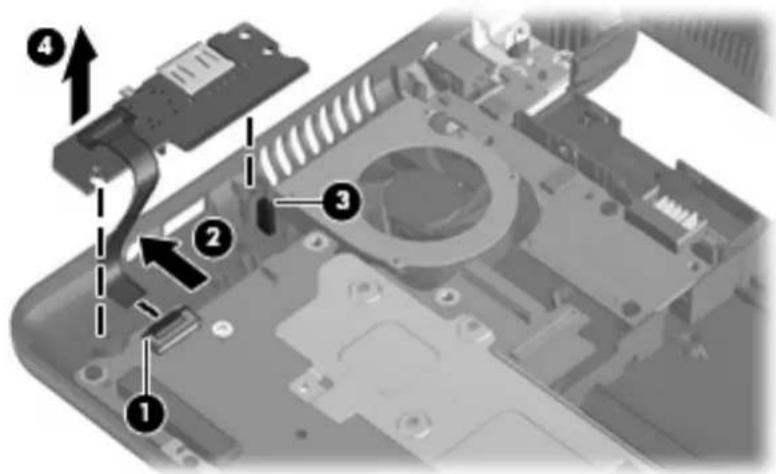
Release the ZIF connector (1) to which the USB/audio board cable is connected, and disconnect the cable (2).
-
Release the USB/audio board from the clip attached to the base enclosure (3), and remove the USB/audio board (4).
text_image
Labeled diagram of a computer motherboard showing numbered components and connectorsReverse this procedure to install the USB/audio board.
Power/battery pass-through board
Description Spare part number
Power/battery passthrough board 537615-001
Before removing the power/battery pass-through board, follow these steps:
- Shut down the device. If you are unsure whether the device is off or in Hibernation, turn the device on, and then shut it down through the operating system.
- Disconnect all external devices connected to the device.
-
Disconnect the power from the device by first unplugging the power cord from the AC outlet and then unplugging the AC adapter from the device.
-
Remove the battery (see Battery on page 36).
-
If your device has WWAN capability, remove the SIM (see SIM on page 37.
-
Remove the following components:
a. Keyboard (see Keyboard on page 40)
b. Hard drive or solid-state drive (see Mass storage devices on page 45)
c. Top cover (see Top cover on page 48)
Remove the power/battery pass-through board:
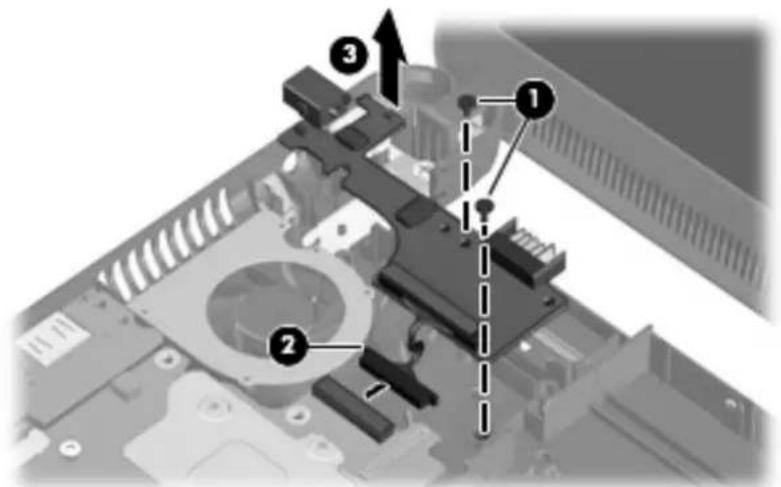
- Disconnect the power cable (1).
- Remove the 2 Phillips BP2.5×5.0 screws (2) that secure the power/battery passthrough board to the base enclosure.
- Remove the power/battery pass-through board (3).
text_image
Diagram of a computer motherboard with numbered components and directional arrows indicating assembly or movement.Reverse this procedure to install the power/battery pass-through board.
Fan
Description Spare part number
Fan 537613-001

NOTE: To properly ventilate the device, allow at least a 7.6-cm (3-inch) clearance on the left side of the device. The device uses an electric fan for ventilation. The fan is controlled by a temperature sensor and is designed to turn on automatically when high temperature conditions exist. These conditions are affected by high external temperatures, system power consumption, power management/battery conservation configurations, battery fast charging, and software requirements. Exhaust air is displaced through the ventilation grill located on the left side of the device.
Before removing the fan, follow these steps:
- Shut down the device. If you are unsure whether the device is off or in Hibernation, turn the device on, and then shut it down through the operating system.
- Disconnect all external devices connected to the device.
- Disconnect the power from the device by first unplugging the power cord from the AC outlet and then unplugging the AC adapter from the device.
- Remove the battery (see Battery on page 36).
- If your device has WWAN capability, remove the SIM (see SIM on page 37.
- Remove the following components:
a. Keyboard (see Keyboard on page 40)
b. Hard drive or solid-state drive (see Mass storage devices on page 45)
c. Top cover (see Top cover on page 48)
Remove the fan:
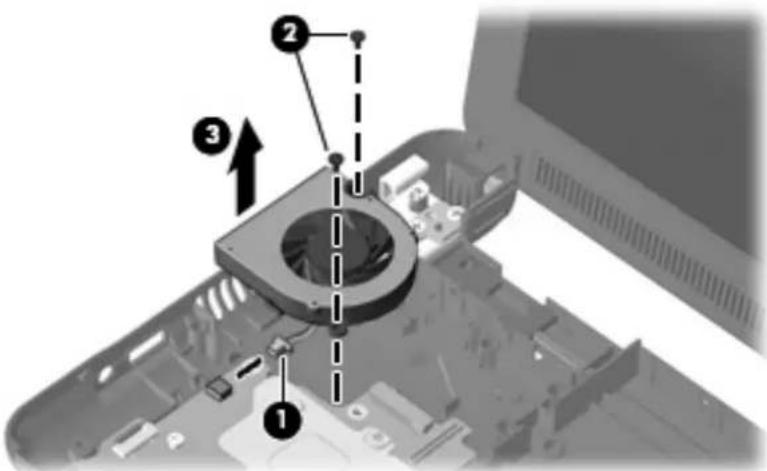
- Disconnect the fan cable (1).
-
Remove the 2 Phillips PM2.5×5.0 screws (2) that secure the fan to the base enclosure.
-
Remove the fan (3).
text_image
Diagram of a device's internal structure with numbered components and directional arrows indicating assembly or repair.Reverse this procedure to install the fan.
Description Spare part number
Heat sink assembly (includes replacement thermal material) 537619-001
Before removing the heat sink assembly, follow these steps:
- Shut down the device. If you are unsure whether the device is off or in Hibernation, turn the device on, and then shut it down through the operating system.
- Disconnect all external devices connected to the device.
-
Disconnect the power from the device by first unplugging the power cord from the AC outlet and then unplugging the AC adapter from the device.
-
Remove the battery (see Battery on page 36).
-
If your device has WWAN capability, remove the SIM (see SIM on page 37.
-
Remove the following components:
a. Keyboard (see Keyboard on page 40)
b. Hard drive or solid-state drive (see Mass storage devices on page 45)
c. Top cover (see Top cover on page 48)
d. WLAN module (see WLAN module on page 51)
e. Fan (see Fan on page 57)
Remove the heat sink assembly:
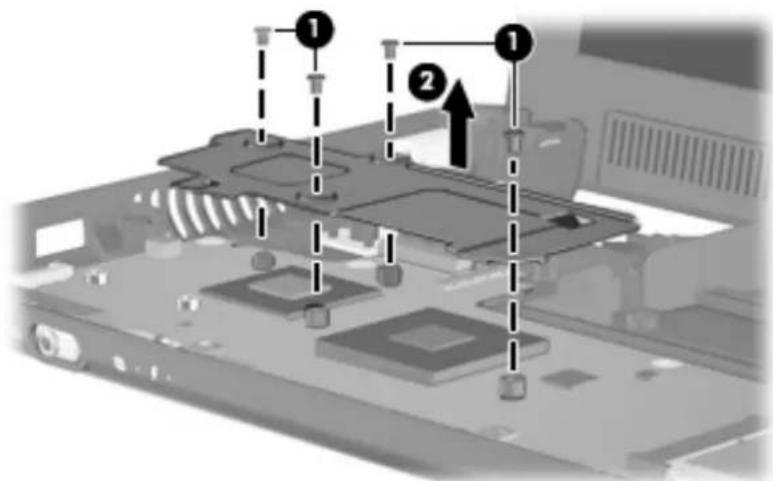
- Remove the 4 Phillips SP1.5×1.05 screws (1) that secure the heat sink assembly to the system board.
NOTE: The screws are numbered 1 through 4. Follow this order when removing the screws.
2. Remove the heat sink assembly (2).

NOTE: Due to the adhesive quality of the thermal material located between the heat sink assembly and system board components, it may be necessary to move the heat sink assembly from side to side to detach the assembly.
text_image
Diagram of a computer motherboard with numbered components and directional arrows indicating assembly or movement.
NOTE: The thermal material must be thoroughly cleaned from the surfaces of the heat sink assembly and the system board each time the heat sink assembly is removed. Thermal paste is used on the processor (1), and thermal tape is used on the Northbridge chip (2). Replacement thermal material is included with all heat sink assembly and system board spare part kits.

text_image
Diagram showing two labeled components (① and ②) on a circuit board with square elements and connectors.Reverse this procedure to install the heat sink assembly.
Description Spare part number
| System board (includes processor and replacement thermal material) | |
| Includes Intel Atom N280 1.66-GHz processor, 512-KB Level 2 cache, 533-MHz front-side bus (FSB) | 571370-001 |
| Includes Intel Atom N270 1.6-GHz processor, 512-KB Level 2 cache, 533-MHz front-side bus (FSB) | 537662-001 |
Before removing the system board, follow these steps:
- Shut down the device. If you are unsure whether the device is off or in Hibernation, turn the device on, and then shut it down through the operating system.
- Disconnect all external devices connected to the device.
-
Disconnect the power from the device by first unplugging the power cord from the AC outlet and then unplugging the AC adapter from the device.
-
Remove the battery (see Battery on page 36).
-
If your device has WWAN capability, remove the SIM (see SIM on page 37.
-
Remove the following components:
a. Keyboard (see Keyboard on page 40)
b. Hard drive or solid-state drive (see Mass storage devices on page 45)
c. Top cover (see Top cover on page 48)
When replacing the system board, be sure that the following components are removed from the defective system board and installed on the replacement system board:
• WLAN module (see WLAN module on page 51)
- WWAN module, if included (see WWAN module on page 53)
• RTC battery (see RTC battery on page 44)
• Heat sink assembly (see Heat sink assembly on page 59)
Remove the system board:
-
Release the tape securing the WWAN antennas(1).
-
Disconnect the following cables from the system board:
(2) Display panel cable
(3) Microphone cable
(4) Speaker cable
(5) WLAN cables
(6) WWAN cables (select models only)

text_image
Laptop interior diagram with numbered annotations pointing to internal components- Remove the 2 Phillips PM1.5×2.0 screws (1) that secure the actuators for the power switch and wireless on/off switch to the system board.
- Remove the actuators (2).

text_image
Diagram of a computer motherboard with labeled components and directional arrows indicating movement or assembly.- Remove the 3 Phillips PM2.5×5.0 screws that secure the system board to the base enclosure.
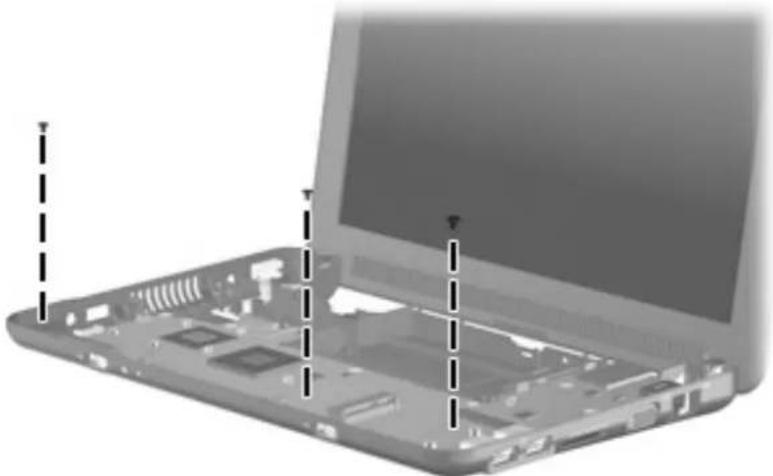
natural_image
Laptop keyboard with visible circuit board and ventilation slots (no text or symbols)-
Grasp the system board at the midpoint of the left side (1), and lift it up.
-
Pull the system board (2) out to the left at an angle to remove it.
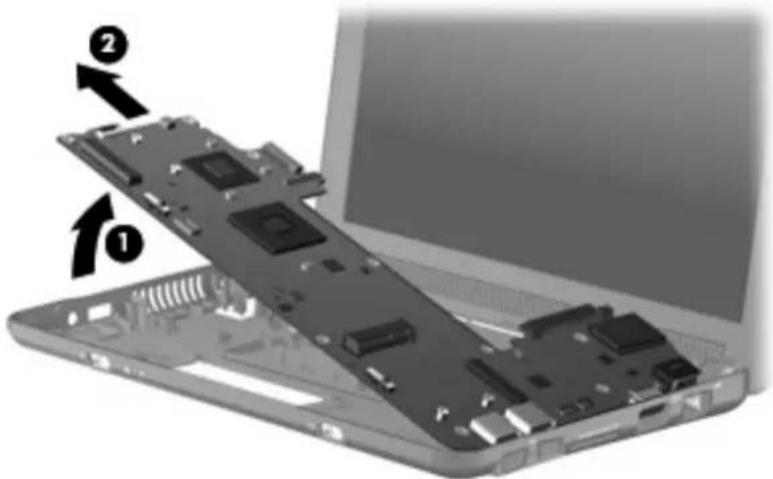
natural_image
Laptop with open circuit board showing two labeled components (1 and 2), no text or symbols present.- Remove the system board.
Reverse the procedure to install the system board.
| Description Spare part number | |
| Display assembly (includes 1 webcam, 1 microphone, 1 speaker box, and 2 WLAN antenna transceivers/cables; WWAN is optional) | |
| See Display assembly components on page 21 for a comprehensive list of display assembly spare parts. | |
| For use with HP models only | |
| 10.1-inch, high-definition, AntiGlare Display Assembly (Includes WWAN) | 572407-001 |
| 10.1-inch, high-definition, AntiGlare Display Assembly | 572406-001 |
| 10.1-inch, standard-definition, AntiGlare Display Assembly (includes WWAN) | 571414-001 |
| 10.1-inch, standard-definition, AntiGlare Display Assembly | 537646-001 |
| For use with Compaq standard models only | |
| 10.1-inch, high-definition, AntiGlare Display Assembly | 572414-001 |
| 10.1-inch, standard-definition, AntiGlare Display Assembly (includes WWAN) | 571417-001 |
| 10.1-inch, standard-definition, AntiGlare Display Assembly | 537643-001 |
| Hinge covers 537617-001 | |
| Display bezel | |
| For use with HP Mini 1101 Notebook PC, and HP Mini 110 only | 537650-001 |
| For use with Compaq Mini 110 only 537644-001 | |
| Display Hinge Kit(Includes left and right display panel hinges) | 537658-001 |
| Speaker assembly (includes left and right cables) | 537621-001 |
| Display panel | |
| 10.1-inch high-definition AntiGlare 572405-001 | |
| 10.1-inch standard-definition AntiGlare 537656-001 | |
| Webcam module 537660-001 | |
| Display Cable Kit (Not illustrated, includes microphone assembly display cable, webcam cable, and WLAN antennas) | 537657-001 |
| Display panel cable | |
| Microphone assembly | |
| WLAN antennas | |
| WWAN antennas | 537655-001 |
| Display enclosure (includes logo) | |
| For use with the HP Mini 1101 Notebook PC, and HP Mini 110 | 537651-001 |
| For use with the Compaq Mini 110 | 537645-001 |
| Display Screw Kit (not illustrated) | 538510-001 |
Before removing the display assembly, follow these steps:
-
Shut down the device. If you are unsure whether the device is off or in Hibernation, turn the device on, and then shut it down through the operating system.
-
Disconnect all external devices connected to the device.
-
Disconnect the power from the device by first unplugging the power cord from the AC outlet and then unplugging the AC adapter from the device.
-
Remove the battery (see Battery on page 36).
-
If your device has WWAN capability, remove the SIM (see SIM on page 37.
-
Remove the following components:
a. Keyboard (see Keyboard on page 40)
b. Hard drive or solid-state drive (see Mass storage devices on page 45)
c. Top cover (see Top cover on page 48)
Remove the display assembly:
-
Release the tape securing the WWAN antennas(1).
-
Disconnect the following cables from the system board:
(2) Display panel cable
(3) Microphone cable
(4) Speaker cable
(5) WLAN cables
(6) WWAN cables (select models only)
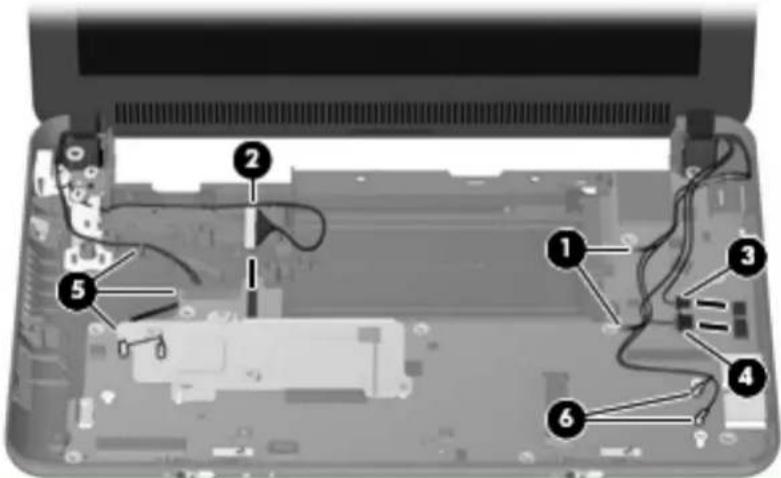
text_image
Laptop interior diagram with numbered annotations pointing to internal components△ CAUTION: Support the display assembly when removing the following screws. Failure to support the display assembly can result in damage to the display assembly and other device components.
- Remove the 4 Phillips PM2.5×5.0 screws (1) that secure the display assembly to the device.

NOTE: One screw on the left hinge (2) also secures the display panel cable ground strap.

text_image
Diagram of a computer monitor with labeled parts and cable connections, showing structural components and wiring.-
Remove the display assembly.
-
If it is necessary to replace the display bezel, perform the following steps:
a. Remove the display hinge covers (1).
b. Flex the inside edges of the top and bottom (2), and then the left and right sides (3) of the display bezel until the bezel disengages from the display enclosure.
c. Remove the display bezel (4).

flowchart
graph TD
    A["Step 1"] --> B["Step 2"]
    B --> C["Step 3"]
    C --> D["Step 4"]
    D --> E["Step 5"]
    E --> F["Step 6"]
    F --> G["Step 7"]
    G --> H["Step 8"]
    H --> I["Step 9"]
    I --> J["Step 10"]
    style A fill:#f9f,stroke:#333
    style B fill:#f9f,stroke:#333
    style C fill:#f9f,stroke:#333
    style D fill:#f9f,stroke:#333
    style E fill:#f9f,stroke:#333
    style F fill:#f9f,stroke:#333
    style G fill:#f9f,stroke:#333
    style H fill:#f9f,stroke:#333
    style I fill:#f9f,stroke:#333
    style J fill:#f9f,stroke:#333
- If it is necessary to replace the display panel, perform the following steps:
a. Remove the 7 Phillips PM2.0×3.0 screws that secure the display panel to the display enclosure.

natural_image
3D diagram of a tablet device with vertical dashed lines and labeled 'T' indicators (no text or symbols on the device itself)b. Lift the display panel up from the display enclosure (1).
c. Disconnect the webcam cable (2) from the system board (2)
d. Remove the display panel (3) from the display enclosure.
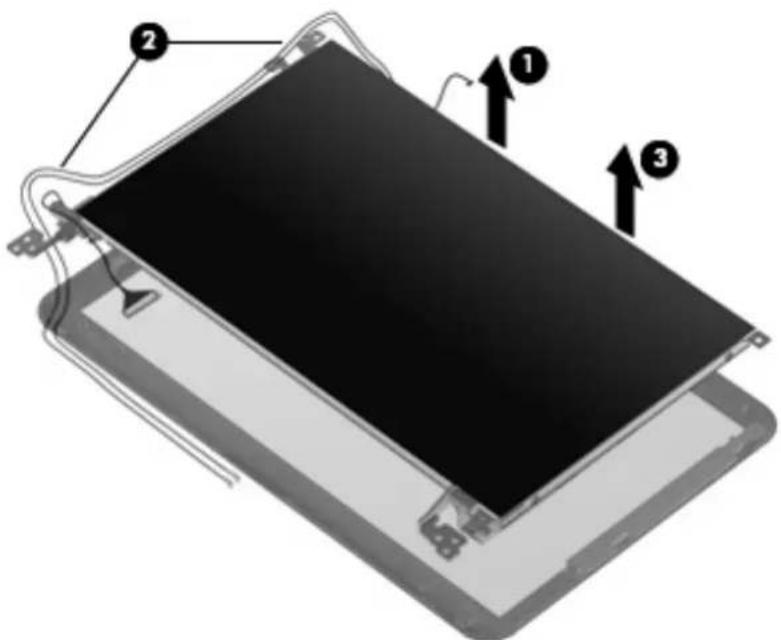
text_image
Diagram of a device with labeled components and directional arrows indicating assembly or movement- If it is necessary to replace the speaker assembly, perform the following steps:
a. Remove the three Phillips PM2.0×3.0 screws (1) that secure the speaker assembly to the display enclosure.
b. Remove the speaker assembly (2).
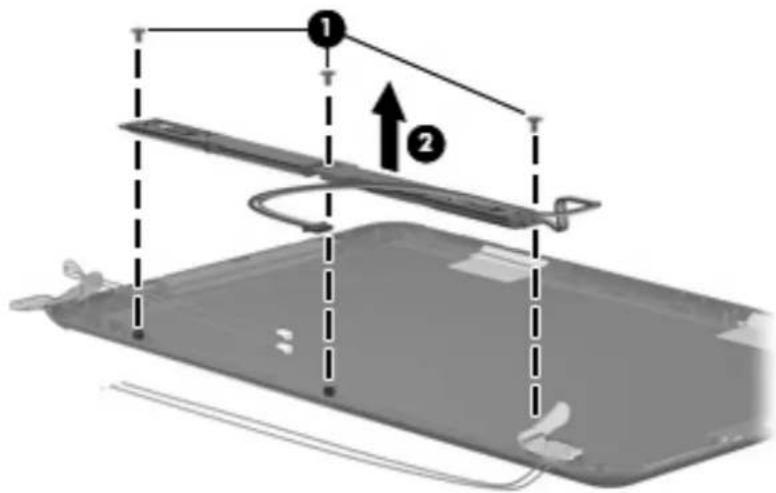
text_image
Diagram showing a mechanical assembly with labeled components and directional arrows, likely illustrating a motion or assembly process.- If it is necessary to replace the display hinges, perform the following steps:
a. Remove the 2 Phillips PM2.0×3.0 screws (1) that secure each hinge to the display enclosure. b. Remove the hinges (2).

text_image
Diagram showing a mechanical or electrical component with labeled parts and directional arrows indicating motion or assembly.- If it is necessary to replace the display panel cable, perform the following steps:
a. Peel back the Mylar protection on the back of the display panel (1).
b. Disconnect the display panel cable (2).

natural_image
Diagram of a mechanical component with two directional arrows indicating movement (no text or symbols)- If it is necessary to replace the webcam module, perform the following steps:
a. Disconnect the webcam cable (1) from the webcam.
b. Remove the webcam (2).
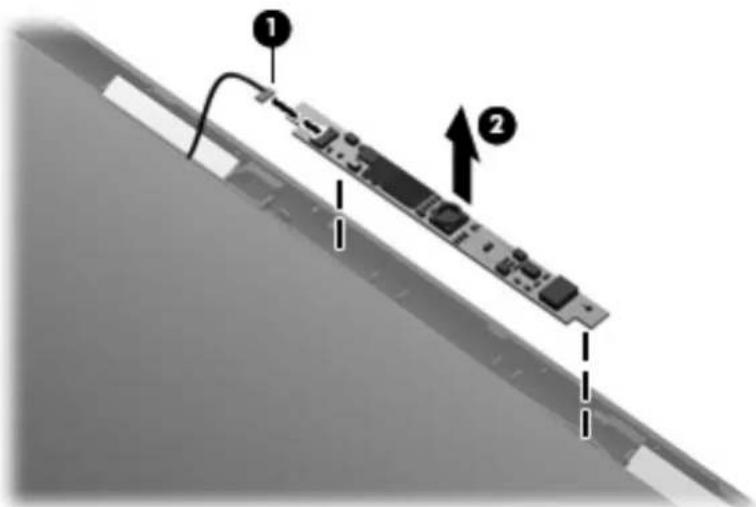
text_image
Diagram showing a cable or connector assembly with labeled parts and directional arrows indicating movement or assembly.- If it is necessary to replace the microphone receiver, perform the following steps:
a. Release the microphone receiver from the clip (1) that secures it to the display enclosure.
b. Pull the receiver through the tabs (2), and remove the microphone receiver (3).
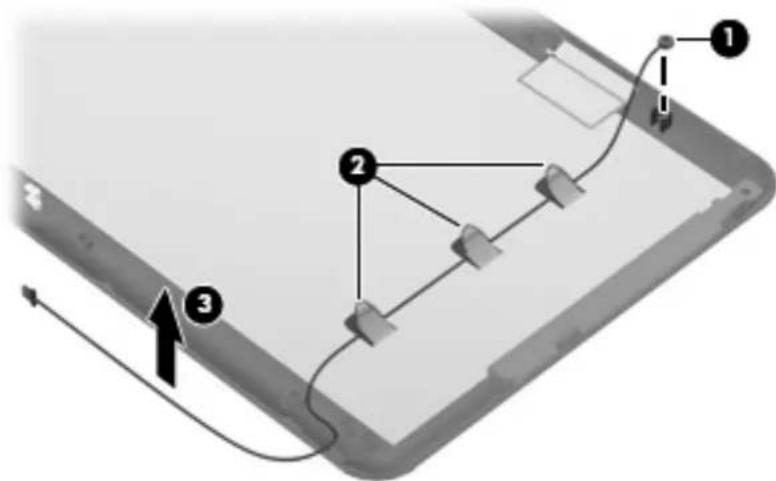
text_image
Diagram of a tablet device with labeled components and connection arrows, showing connections between pins 1, 2, and 3.- If it is necessary to replace the wireless antenna transceivers and cables, detach the cables from the adhesive (1) that secures them to the display enclosure, and then remove the cables (2).
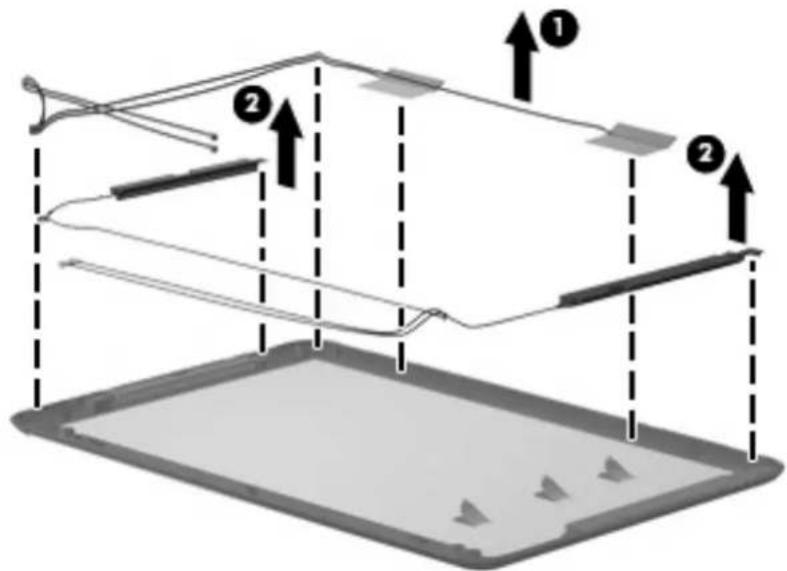
text_image
Diagram of a multi-tiered electrical or mechanical device with labeled components and directional arrows indicating flow or assembly.Reverse this procedure to reassemble and install the display assembly.
5 Setup Utility
Starting the Setup Utility
The Setup Utility is a ROM-based information and customization utility that can be used even when your operating system is not working.
The utility reports information about the device and provides settings for startup, security, and other preferences.
To start the Setup Utility:
Open the Setup Utility by turning on or restarting the device, and then pressing f10 while the "F10 = BIOS Setup Options" message is displayed in the lower-left corner of the screen.
Using the Setup Utility
Changing the language of the Setup Utility
The following procedure explains how to change the language of the Setup Utility. If the Setup Utility is not already running, begin at step 1. If the Setup Utility is already running, begin at step 2.
- Open the Setup Utility by turning on or restarting the device, and then pressing f10 while the "F10 = BIOS Setup Options" message is displayed in the lower-left corner of the screen.
- Use the arrow keys to select System Configuration > Language, and then press enter.
- Use the arrow keys to select a language, and then press enter.
- When a confirmation prompt with your language selected is displayed, press enter.
- To save your change and exit the Setup Utility, use the arrow keys to select Exit > Exit Saving Changes, and then press enter.
Your change goes into effect immediately.
Navigating and selecting in the Setup Utility
Because the Setup Utility is not operating system-based, it does not support the TouchPad. Navigation and selection are by keystroke.
• To choose a menu or a menu item, use the arrow keys.
- To choose an item in a list or to toggle a field, for example an Enable/Disable field, use either the arrow keys or f5 or f6.
• To select an item, press enter.
• To close a text box or return to the menu display, press esc.
- To display additional navigation and selection information while the Setup Utility is open, press f1.
Displaying system information
The following procedure explains how to display system information in the Setup Utility. If the Setup Utility is not open, begin at step 1. If the Setup Utility is open, begin at step 2.
- Open the Setup Utility by turning on or restarting the device, and then pressing f10 while the "F10 = BIOS Setup Options" message is displayed in the lower-left corner of the screen.
- Select the Main menu. System information such as the system time and date, and identification information about the device is displayed.
- To exit the Setup Utility without changing any settings, use the arrow keys to select Exit > Exit Discarding Changes, and then press enter.
Restoring default settings in the Setup Utility
The following procedure explains how to restore the Setup Utility default settings. If the Setup Utility is not already running, begin at step 1. If the Setup Utility is already running, begin at step 2.
- Open the Setup Utility by turning on or restarting the device, and then pressing f10 while the "F10 = BIOS Setup Options" message is displayed in the lower-left corner of the screen.
- Use the arrow keys to select Exit > Load Setup Defaults, and then press enter.
- When the Setup Confirmation is displayed, press enter.
- To save your change and exit the Setup Utility, use the arrow keys to select Exit > Exit Saving Changes, and then press enter.
The Setup Utility default settings go into effect when the device restarts.

NOTE: Your password, security, and language settings are not changed when you restore the factory default settings.
Exiting the Setup Utility
You can exit the Setup Utility with or without saving changes.
• To exit the Setup Utility and save your changes from the current session:
If the Setup Utility menus are not visible, press esc to return to the menu display. Then use the arrow keys to select Exit > Exit Saving Changes, and then press enter.
• To exit the Setup Utility without saving your changes from the current session:
If the Setup Utility menus are not visible, press esc to return to the menu display. Then use the arrow keys to select Exit > Exit Discarding Changes, and then press enter.
After either choice, the device restarts and loads the operating system.
Setup Utility menus
The menu tables in this section provide an overview of Setup Utility options.

NOTE: Some of the Setup Utility menu items listed in this chapter may not be supported by your device.
Main menu
| Select To do this | |
| System information | View and change the system time and date.View identification information about the device.View specification information about the processor, memory size, and system BIOS. |
Security menu
| Select To do this |
| Administrator password Enter, change, or delete an administrator password. |
| Power-On Password Enter, change, or delete a power-on password. |
System Configuration menu
| Select To do this |
| Language Support Change the Setup Utility language. |
| Processor C4 State Enable/disable the processor C4 sleep state. |
| Boot Options Set the following boot options:f10 and f12 Delay (sec.)—Set the delay for the f10 and f12 functions of the Setup Utility in intervals of 5 seconds each (0, 5, 10, 15, 20).Internal Network Adapter boot—Enable/disable boot from Internal Network Adapter.Boot Order—Set the boot order for:Internal hard drive (select models only)USB FloppyUSB CD/DVD ROM DriveUSB flash driveUSB Hard driveUSB Card ReaderNetwork adapterNOTE: Only the devices attached to the system will appear in the boot order menu. |
Diagnostics menu
Select To do this
Hard Disk Self Test (select models only) Run a comprehensive self-test on the hard drive.
Memory Test Run a diagnostic test on the system memory.
6 Specifications
Device specifications
| Metric U.S. | |
| Dimensions | |
| Depth | 16.67 cm 6.56 in |
| Width 26.17 cm 10.30 in | |
| Height 2.52 cm 0.99 in | |
| Weight | |
| 10.1-in. LCD, equipped with a 3-cell battery, hard drive, 1-GB memory, WLAN module, and 2 wireless antennas | 1.11 kg 2.45 lb |
| 10.1-in. LCD, equipped with a 3-cell battery,solid-state drive, 1-GB memory, WLAN module, and 2 wireless antennas | 1.09 kg 2.40 lb |
| Input power | |
| Operating voltage | 19 V dc @ 1.58 A – 30 W |
| Operating current 1.58 A | |
| Temperature | |
| Operating | 5°C to 35°C 41°F to 95°F |
| Nonoperating -20°C to 65°C -4°F to 149°F | |
| Relative humidity (noncondensing) | |
| Operating | 10% to 90% |
| Nonoperating 0% to 95% | |
| Maximum altitude (unpressurized) | |
| Operating | -15 m to 3,048 m -50 ft to 10,000 ft |
| Nonoperating | -15 m to 12,192 m -50 ft to 40,000 ft |
| NOTE: Applicable product safety standards specify thermal limits for plastic surfaces. The device operates well within this range of temperatures. | |
10.1-inch, AntiGlare display specifications
| Metric U.S. | |
| Dimensions | |
| Height | 23.45 cm 9.23 in |
| Width 14.30 cm 5.62 in | |
| Diagonal 25.55 cm 10.05 in | |
| Number of colors 262,144 | |
| Contrast ratio 400:1 (typical) | |
| Brightness 200 nits (typical) | |
| Pixel resolution | |
| Pitch | 0.2175 × 0.2175 mm |
| Format 1024 × 576 | |
| Configuration RGB vertical stripe | |
| Backlight Edge lit | |
| Character display 80 × 25 | |
| Total power consumption 3.2 W | |
| Viewing angle +/-45° horizontal, +15/-35° vertical (typical) | |
Hard drive specifications
| 60-GB * | |
| Dimensions | |
| Height | 9.5 mm |
| Width 70 mm | |
| Weight 101 g | |
| Interface type PATA | |
| Transfer rate 100 MB/sec | |
| Security ATA security | |
| Seek times (typical read, including setting) | |
| Single track | 3 ms |
| Average 13 ms | |
| Maximum 24 ms | |
| Logical blocks 117,210,240 | |
| Disc rotational speed 4200 rpm | |
| Operating temperature | |
| * 1 GB = 1 billion bytes when referring to hard drive storage capacity. Actual accessible capacity is less. Actual drive specifications may differ slightly. | |
| NOTE: Certain restrictions and exclusions apply. Contact technical support for details. | |
Solid-state drive specifications
| Performance | |
| Transfer modes supported | UDMA 0-4, Multiword-DMA 0-2, PIO 0-4 |
| Sustained read 39 MB/sec | |
| Sustained write 17 MB/sec | |
| Characteristics | |
| Interface | Parallel ATA (PATA) |
| MLC NAND flash capacity 8 GB, 16 GB | |
| Electrical specifications | |
| DC supply voltage | 3.3 V +/- 5% |
| Standby current 300 μA (typical) | |
| Active current Read = 130 mA (typical) | |
| Write = 120 mA (typical) | |
| Environmental specifications | |
| Operating temperature | 0°C to +70°C (32°F to 158°F) |
| Storage temperature -25°C to +85°C (-13°F to 185°F) | |
| Operating altitude up to 24,384 m (80,000 feet) | |
| Humidity 5% to 90% non-condensing | |
| Shock 1,000 g | |
| Acoustic noise 0 dB | |
| Vibration 15 g (peak to peak) | |
| Physical specifications | |
| Connector | 40-pin ZIF connector |
| Weight (8-GB model) 5.5 g | |
| Weight (16-GB model) 7.0 g | |
| Dimensions (8-GB model) 54 × 32 × 2.6 mm | |
| Dimensions (16-GB model) | 54 × 32 × 3.75 mm |
| Regulations and compliance | RoHS, China RoHS, SGS ROHS, FCC, CE UL – PCB Only |
System DMA specifications
Hardware DMA System function
DMA0 Not applicable
DMA1 * Not applicable
DMA2 * Not applicable
DMA3 Not applicable
DMA4 Direct memory access controller
System interrupt specifications
| Hardware IRQ System function |
| IRQ0 System timer |
| IRQ1 Standard 101-/102-Key or Microsoft® Natural PS/2 Keyboard |
| IRQ8 System CMOS/real-time clock |
| IRQ9 * Microsoft ACPI-compliant system |
| IRQ12 Synaptics PS/2 TouchPad |
| IRQ13 Numeric data processor |
| IRQ14 Primary IDE channel |
| IRQ15 Intel® 82801G (ICH7 Family) SMBus Controller—27DA |
| IRQ16 Broadcom 802.11b/g WLAN no. 2 |
| Intel 82801G (ICH7 Family) PCI Express Root Port—27D0 |
| Intel 82801G (ICH7 Family) USB Universal Host Controller—27CB |
| Microsoft UAA Bus Driver for High Definition Audio |
| Mobile Intel 945 Express Chipset Family |
| IRQ17 Intel 82801G (ICH7 Family) PCI Express Root Port—27D2 |
| IRQ18 Intel 82801G (ICH7 Family) USB Universal Host Controller—27CA |
| IRQ19 Intel 82801G (ICH7 Family) USB Universal Host Controller—27C9 |
| IRQ23 Intel 82801G (ICH7 Family) USB Universal Host Controller—27C8 |
| Intel 82801G (ICH7 Family) USB2 Enhanced Host Controller—27CC |
| * Default configuration |
System I/O address specifications
| I/O address (hex) System function (shipping configuration) |
| 000 - 00F DMA controller |
| 000 - CF7 PCI bus |
| 010 - 01F Motherboard resources |
| 020 - 021 Programmable interrupt controller |
| 022 - 03F Motherboard resources |
| 040 - 043 System timer |
| 044 - 05F Motherboard resources |
| 060 - 060 Standard 101-/102-Key or Microsoft® Natural PS/2 Keyboard |
| 061 - 061 System speaker |
| 062 - 062 Microsoft ACPI-Compliant Embedded Controller |
| 063- 063 Motherboard resources |
| 064 - 064 Standard 101-/102-Key or Microsoft Natural PS/2 Keyboard |
| 065 - 065 Motherboard resources |
| 066 - 066 Microsoft ACPI-Compliant Embedded Controller |
| 067 - 06F Motherboard resources |
| 070 - 071 System CMOS/real-time clock |
| 072 - 07F Motherboard resources |
| 080 - 080 Motherboard resources |
| 081 - 083 DMA controller |
| 084 - 086 Motherboard resources |
| 087 - 087 DMA controller |
| 088 - 088 Motherboard resources |
| 089 - 08B DMA controller |
| 08C - 08E Motherboard resources |
| 08F - 08F DMA controller |
| 090 - 09F Motherboard resources |
| 0A0 - 0A1 Programmable interrupt controller |
| 0A2 - 0BF Motherboard resources |
| 0C0 - 0DF DMA controller |
| 0E0 - 0EF Motherboard resources |
| 0F0 - 0FF Numeric data processor |
| 1F0 - 1F7 Primary IDE channel |
| 274 - 277 ISAPNP Read Data Port |
| 279 - 279 ISAPNP Read Data Port |
| 3B0 - 3BB Mobile Intel® 945 Express Chipset Family |
| 3C0 - 3DF Mobile Intel 945 Express Chipset Family |
| 3F6 - 3F6 Primary IDE channel |
| 400 - 41F Intel 82801G (ICH7 Family) SMBus Controller—27DA |
| 480 - 4BF Motherboard resources |
| 4D0 - 4D1 Motherboard resources |
| 500 - 501 Motherboard resources |
| 800 - 87F Motherboard resources |
| A79 - A79 ISAPNP Read Data Port |
| 0D00 - FFFF PCI bus |
| D480 - D49F Intel 82801G (ICH7 Family) USB Universal Host Controller—27C8 |
| D800 - D81F Intel 82801G (ICH7 Family) USB Universal Host Controller—27CA |
| D880 - D89F Intel 82801G (ICH7 Family) USB Universal Host Controller—27C9 |
| DC00 - DC1F Intel 82801G (ICH7 Family) USB Universal Host Controller—27C8 |
| DC80 - DC87 Mobile Intel 945 Express Chipset Family |
| E000 - EFFF Intel 82801G (ICH7 Family) PCI Express Root Port—27D2 |
| FFA0 - FFAF Intel 82801G (ICH7 Family) Ultra ATA Storage Controllers—27DF |
System memory map specifications
| Memory address System function |
| 00000000 - 0009FFFF System board |
| 000A0000 - 000BFFFF Mobile Intel® 945 Express Chipset Family |
| 000A0000 - 000BFFFF PCI bus |
| 000C0000 - 000CFFFF System board |
| 000D0000 - 000DFFFF PCI bus |
| 000E0000 - 000FFFFFF System board |
| 00100000 - 3F7FFFFFF System board |
| 3F800000 - DFFFFFFF PCI bus |
| D0000000 - DFFFFFFF Mobile Intel 945 Express Chipset Family |
| E0000000 - E3FFFFFF Motherboard resources |
| E4000000 - FED8FFFF PCI bus |
| FE880000 - FE8FFFFFF Mobile Intel 945 Express Chipset Family |
| FE937C00 - FE937FFF Intel 82801G (ICH7 Family) USB2 Enhanced Host Controller—27CC |
| FE938000 - FE93BFFF Microsoft® UAA Bus Driver for High Definition Audio |
| FE940000 - FE97FFFF Mobile Intel 945 Express Chipset Family |
| FE980000 - FE9FFFFFF Mobile Intel 945 Express Chipset Family |
| FEA00000 - FEAFFFF Intel 82801G (ICH7 Family) PCI Express Root Port—27D0 |
| FEAFC000 - FEAFFFF Broadcom 802.11b/g WLAN |
| FEB00000 - FEBFFFFFF Intel 82801G (ICH7 Family) PCI Express Root Port—27D2 |
| FEC00000 - FEC00FFF Motherboard resources |
| FED13000 - FED19FFF System board |
| FED1C000 - FED1FFFF Motherboard resources |
| FED20000 - FED3FFFF Motherboard resources |
| FED40000 - FED8FFFF Motherboard resources |
| FED90000 - FFFFFFFF System board |
| FEE00000 - FEE00FFF Motherboard resources |
7 Screw listing
This section provides specification and reference information for the screws and screw locks used in the device. All screws listed in this section are available in the Screw Kit, spare part number 537620-001; or in the Display Screw Kit, spare part number 538510-001.
Phillips PM1.5×1.0 screw
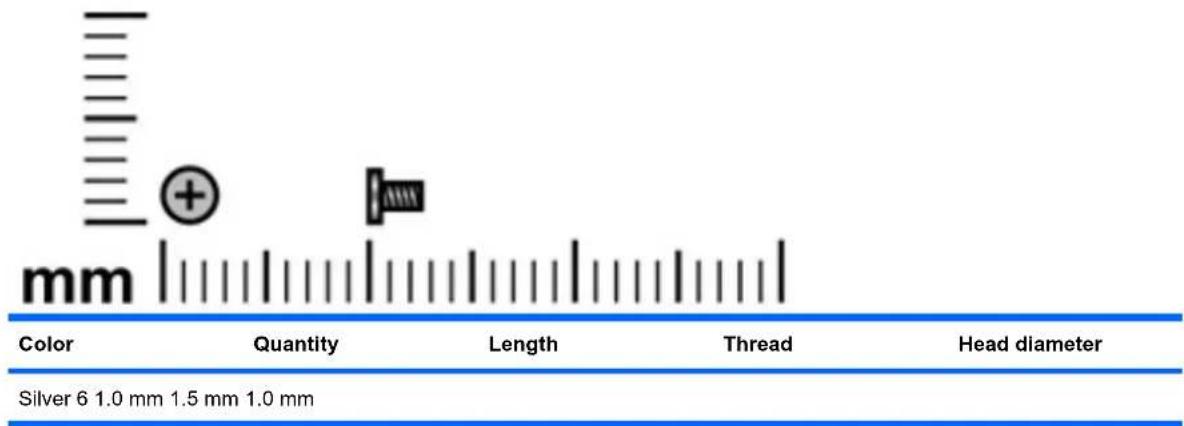
text_image
mm Color Quantity Length Thread Head diameter Silver 6 1.0 mm 1.5 mm 1.0 mm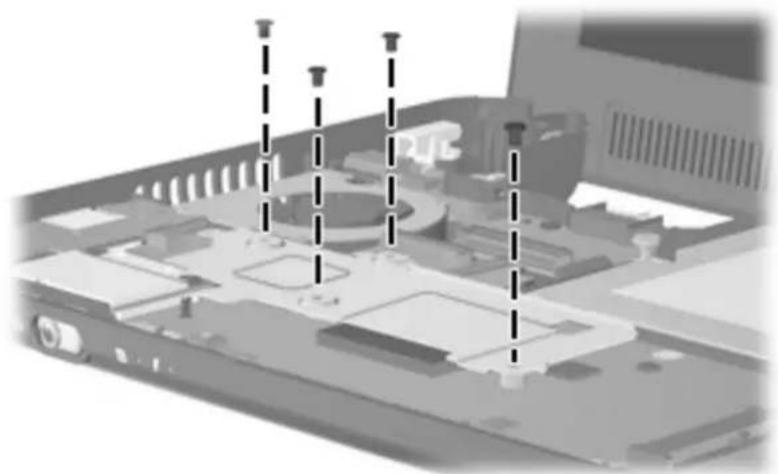
natural_image
3D rendering of a computer motherboard with visible CPU socket and screw holes (no text or symbols)Where used: 4 screws that secure the heat sink to the system board
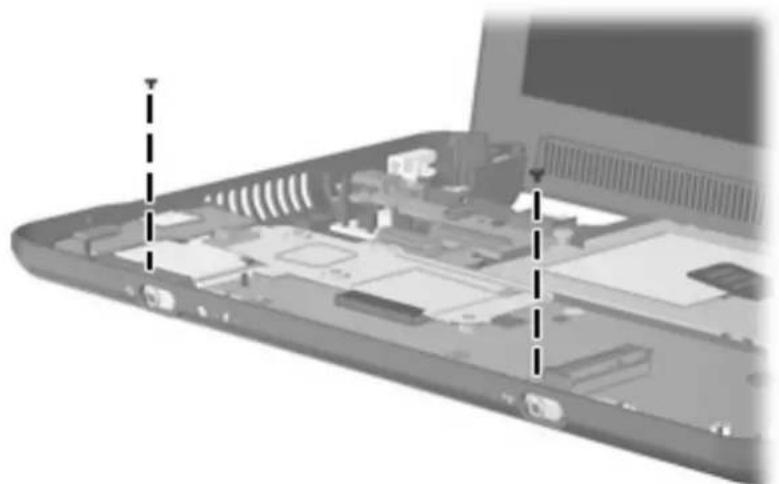
natural_image
Interior view of a laptop chassis showing internal circuitry and ventilation slots (no text or symbols visible)Where used: Two screws that secure the power and wireless switch actuators to the base enclosure
Phillips PM2.0×3.0 screw
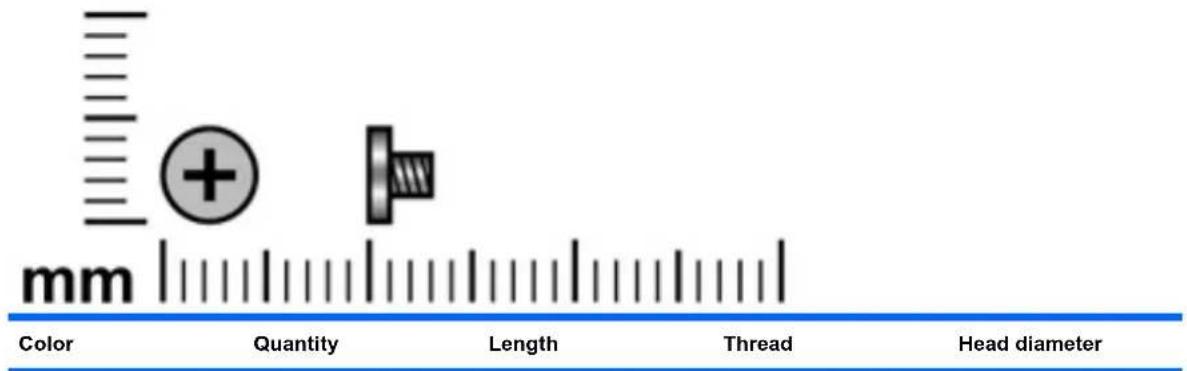
text_image
mm Color Quantity Length Thread Head diameterBlack 20 3.0 mm 2.0 mm 4.0 mm

natural_image
3D diagram of a device casing with internal components and dashed lines indicating alignment (no text or symbols)Where used: 3 screws that secure the keyboard to the device
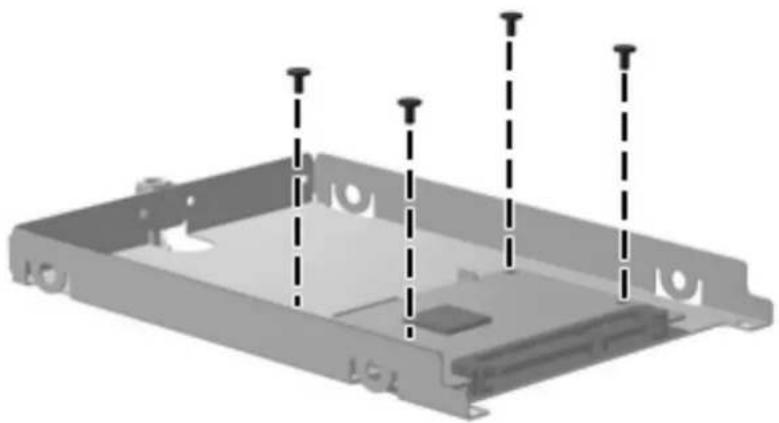
natural_image
3D diagram of a computer chassis with mounting hardware and vertical support posts (no text or symbols)Where used: Four screws that secure the solid-state drive to the bracket
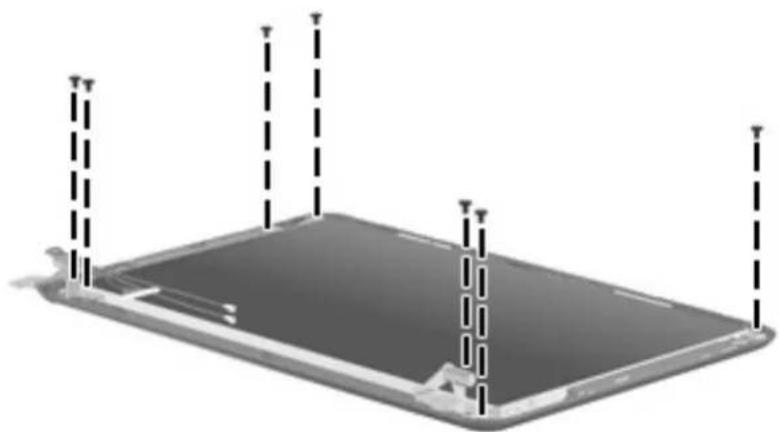
natural_image
3D diagram of a tablet device with vertical dashed lines and mounting feet (no text or symbols)Where used: Seven screws that secure the display panel to the display enclosure
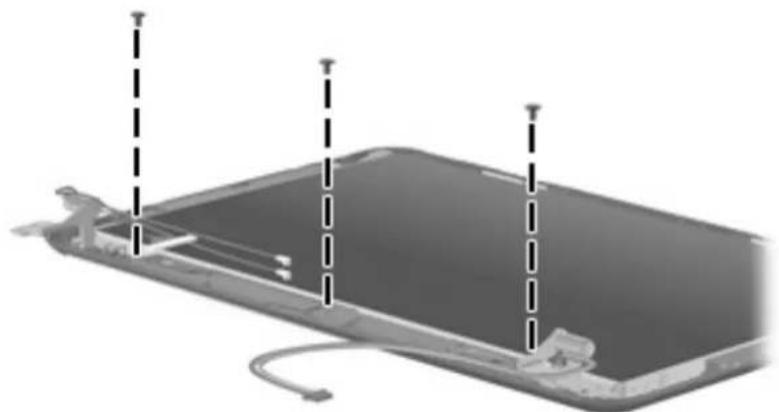
natural_image
Diagram of an open battery with exposed internal structure and three vertical dashed lines indicating measurement or installation points (no text or symbols present)Where used: Three screws that secure the speaker assembly to the display enclosure
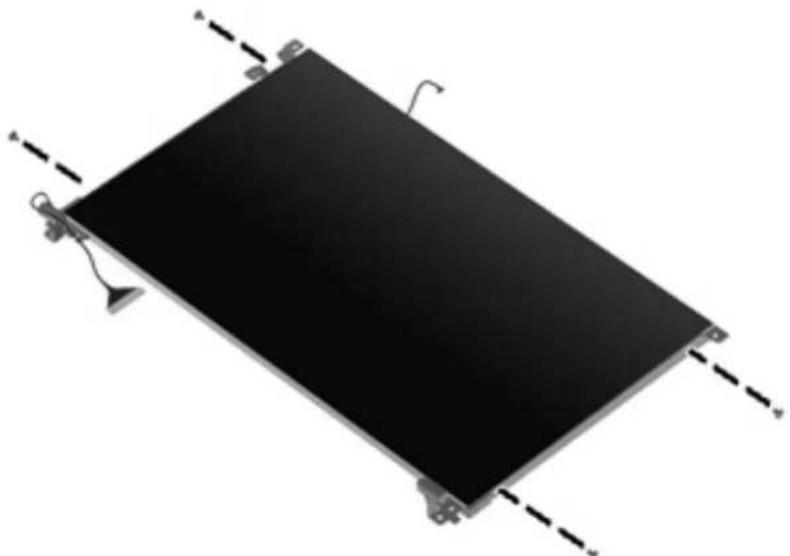
natural_image
Diagram of a rectangular electronic component with mounting flanges and wiring (no text or symbols)Where used: Four screws that secure the hinges to the display panel
Phillips PM2.0×3.0 captive screw
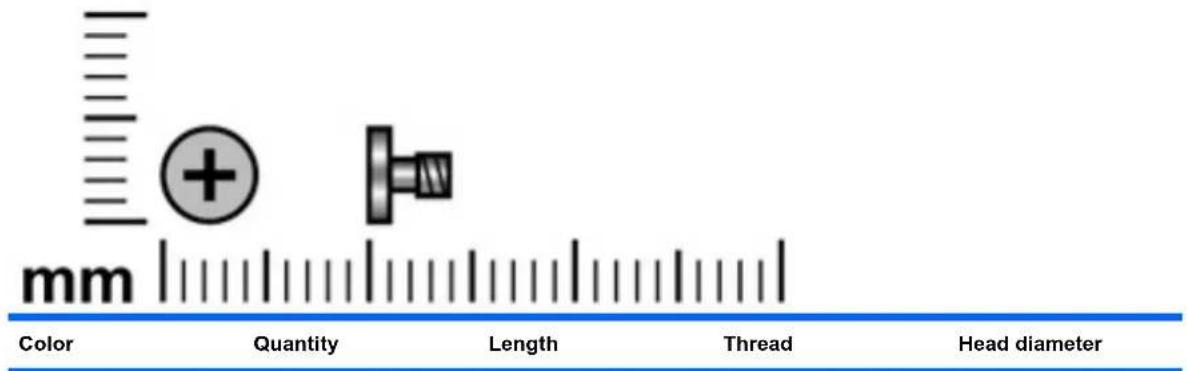
text_image
mm Color Quantity Length Thread Head diameterBlack 2 3.0 mm 2.0 mm 4.0 mm
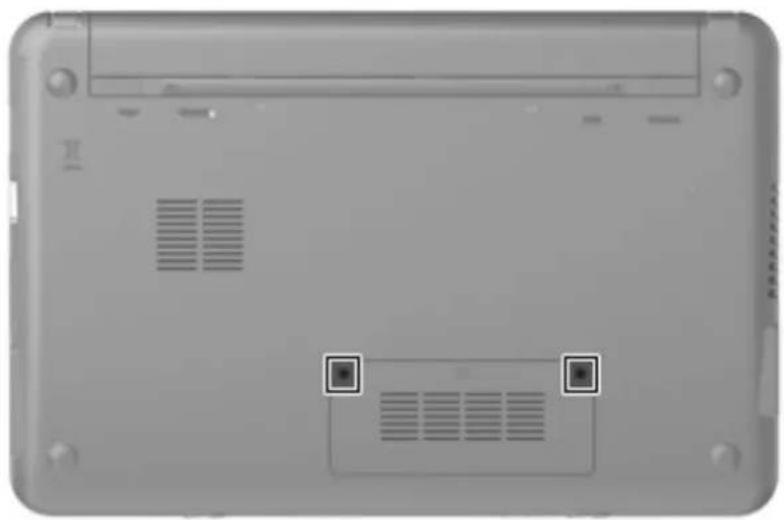
natural_image
Front view of a laptop computer back panel showing ventilation slots and status buttons (no text or symbols visible)Phillips PM2.0×4.0 screw

text_image
mm Color Quantity Length Thread Head diameterSilver 4 4.0 mm 2.0 mm 4.0 mm
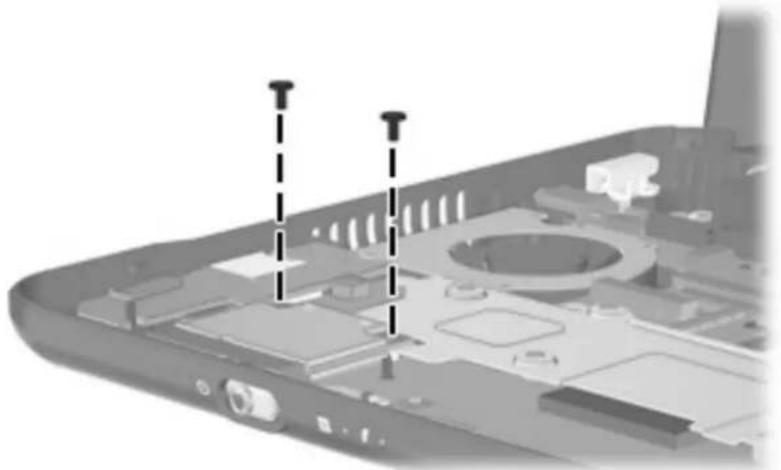
natural_image
3D rendering of a device's internal components with dashed lines indicating alignment or measurement points (no text or symbols present)Where used: Two screws that secure the WLAN module to the system board
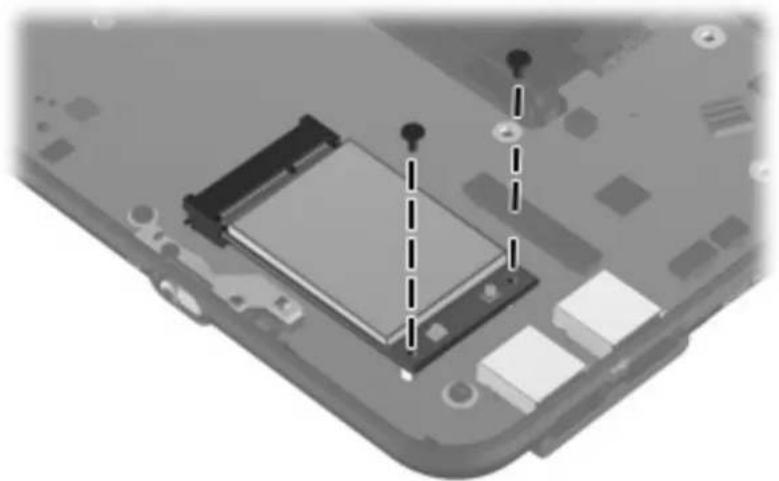
natural_image
3D diagram of a computer motherboard with a central chip and two dashed lines indicating alignment or connection points (no text or symbols present)Where used: Two screws that secure the WWAN to the system board
Phillips PM2.0×5.0 screw
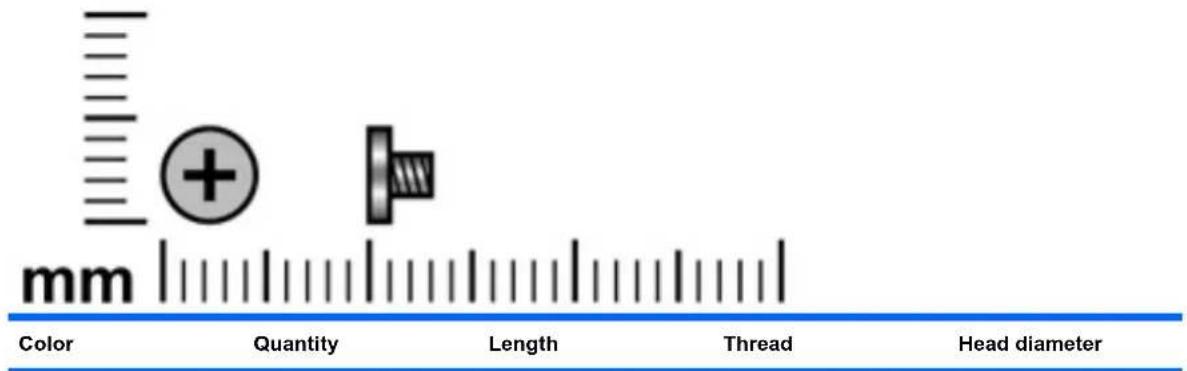
text_image
mm Color Quantity Length Thread Head diameterSilver 3 5.0 mm 2.0 mm 4.5 mm
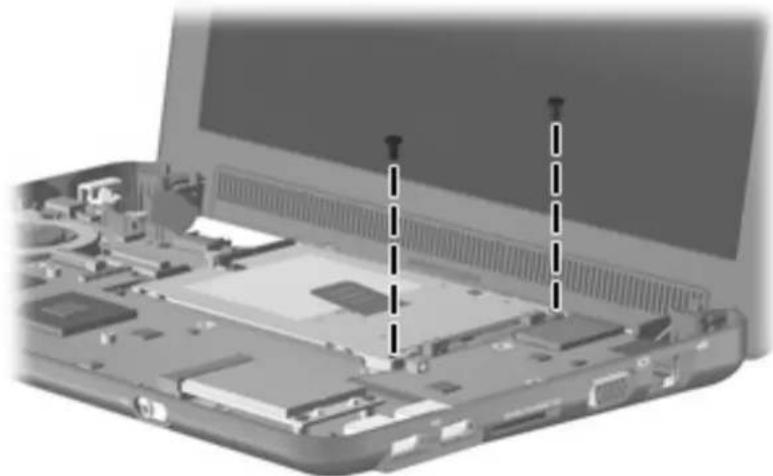
natural_image
Laptop interior showing internal circuit board and ventilation slots (no text or symbols visible)Where used: Two screws that secure the hard drive or solid-state drive to the system board
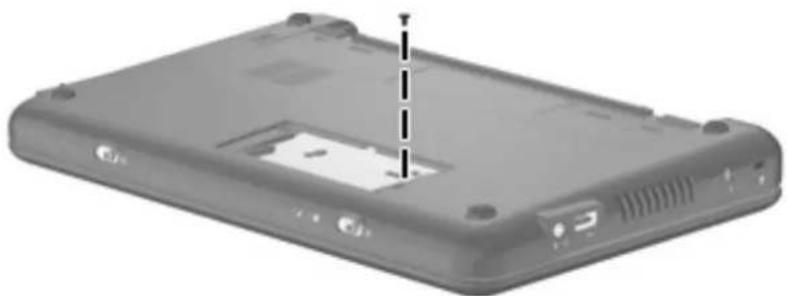
natural_image
Black laptop cover with visible drive bays and a dashed vertical line indicating a measurement or edge (no text or symbols)Where used: One screw that secures the top cover to the base enclosure
Phillips PM2.5×5.0 screw

text_image
mm Color Quantity Length Thread Head diameterSilver 15 5.0 mm 2.5 mm 4.5 mm
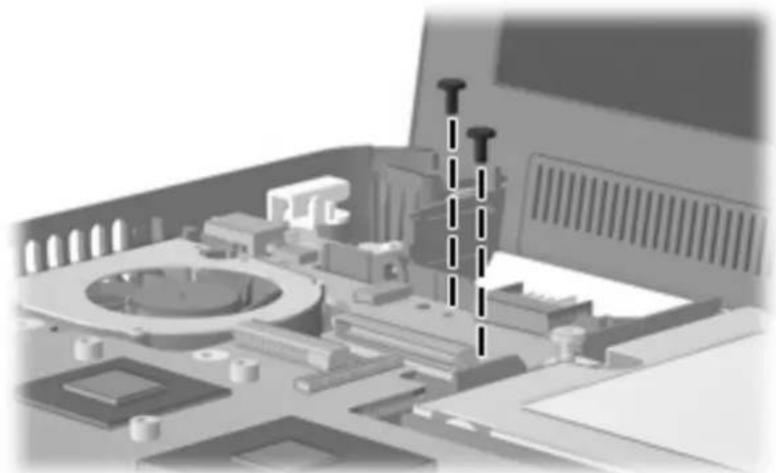
natural_image
3D mechanical assembly diagram showing internal components and a close-up of a computer monitor (no text or symbols visible)Where used: Two screws that secure the power/battery passthrough board to the system board
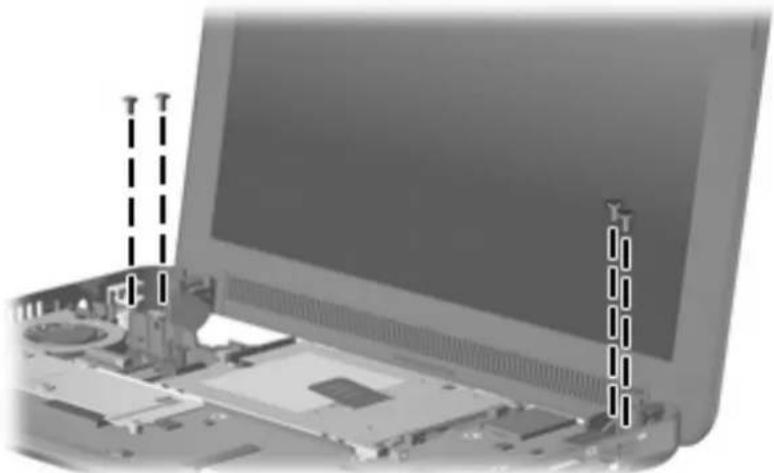
natural_image
Laptop interior view showing front panel and rear panel with visible drive bays and ventilation slots (no text or symbols)Where used: Four screws that secure the display assembly and top cover to the device

natural_image
3D illustration of a computer motherboard with screwdrivers and a central hub (no text or symbols)Where used: Two screws that secure the fan to the system board
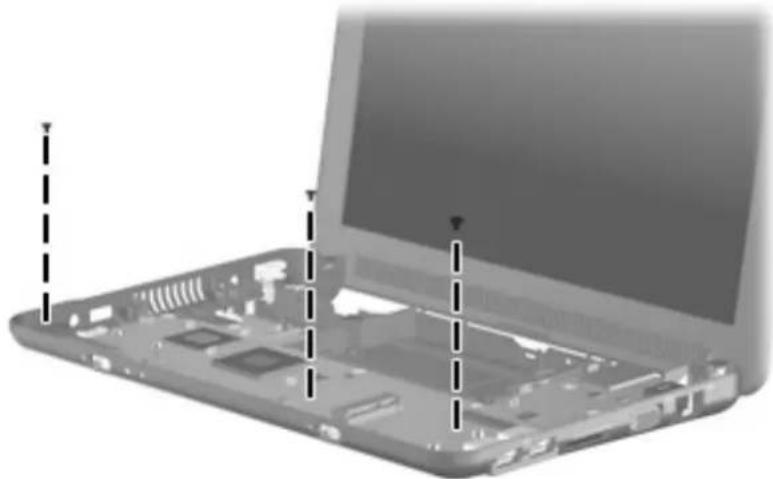
natural_image
Laptop interior view showing exposed circuit board and ventilation duct (no text or symbols)Where used: Three screws that secure the system board to the base enclosure
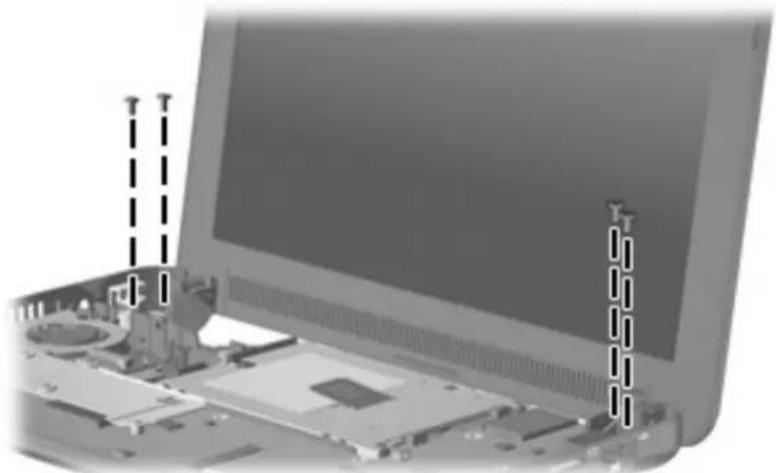
natural_image
Laptop interior view showing front panel and rear panel with visible circuitry and ventilation slots (no text or symbols)Where used: Four screws that secure the display assembly to the base enclosure
Phillips PM2.5×7.0 screw
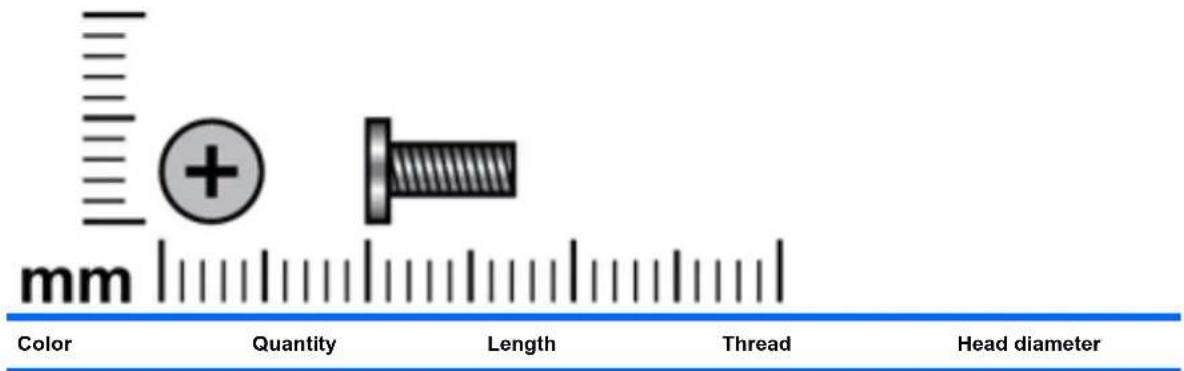
text_image
mm Color Quantity Length Thread Head diameterBlack 12 7.0 mm 2.5 mm 4.0 mm
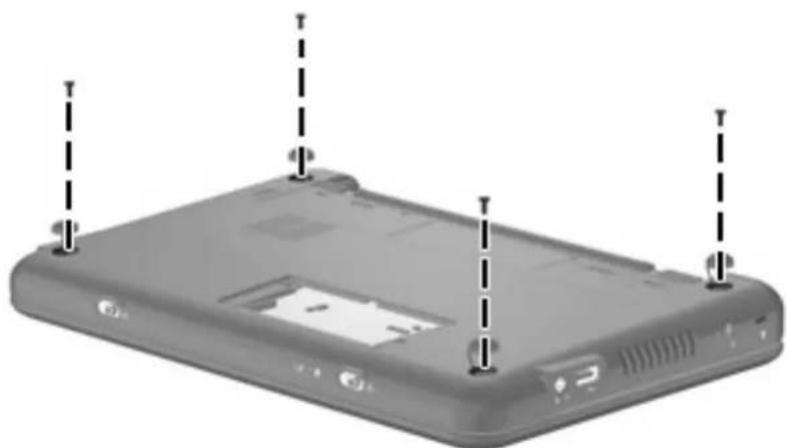
natural_image
Top-down view of a gray electronic device with three vertical dashed lines labeled 'T' pointing to the front panel (no text or symbols on the device itself)Where used: Four screws that secure the top cover to the base enclosure
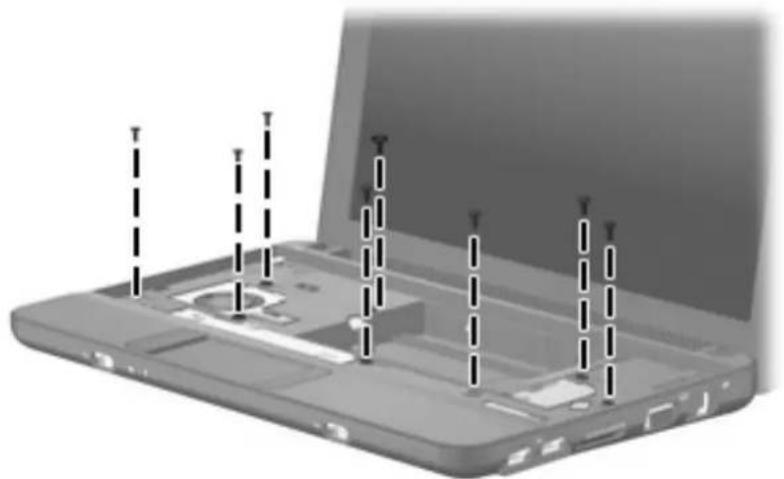
natural_image
Laptop with visible circuit board and vertical measurement markings (no text or symbols)Where used: Eight screws that secure the top cover to the base enclosure
Phillips PM2.5×10.0 captive screw
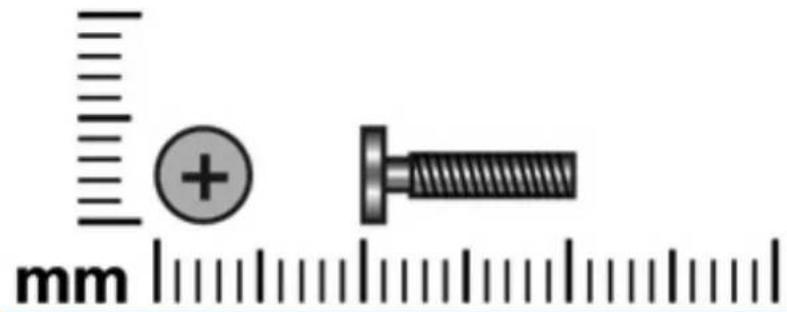
text_image
mm| Color | Quantity | Length | Thread | Head diameter |
Black 1 10.0 mm 2.5 mm 4.0 mm

natural_image
Top-down view of a laptop's front open showing internal circuitry and a central display (no text or symbols visible)Where used: One captive screw, with a C-clip, that secures the hard drive or solid-state drive bracket to the system board
Phillips PM3.0×40.0 screw

text_image
mm Color Quantity Length Thread Head diameterBlack 4 4.0 mm 3.0 mm 4.0 mm

natural_image
3D rendering of a rectangular electronic device with mounting holes and dashed lines indicating alignment (no text or symbols)Where used: Four screws that secure the hard drive bracket to the hard drive
8 Backup and recovery
Select the section in this chapter that applies to the operating system installed on your computer.
Mobile Mi backup and recovery
Use the instructions in this section if Mobile Mi is installed on your computer.
To protect your information, back up your files and folders. Then if the system fails, you can restore your important files from copies. You can also use the options listed in this section to restore the operating system and programs that were installed at the factory.
Backing up your information
Successful recovery after a system failure depends on whether you have completely backed up your files. You should back up your files on a regular basis to maintain up-to-date files.
You can back up important personal files and folders to the Mini Mobile Drive (select models only), to an external hard drive, or to a USB flash drive (purchased separately).
When to back up
- On a regular basis
• Before the system is repaired or restored
• Before you add or modify hardware or software
Restoring your information
In case of system failure or instability, you can restore the operating system and programs installed at the factory.
△ CAUTION: The restore process reformats hard drive, completely erasing all information. All the files you have created and any software installed on the device are permanently removed. The restore process reinstalls the original operating system, software, and drivers. Software, drivers, and updates not installed with the factory image must be reinstalled using Update Manager.
The device provides the following restore options:
- System Restore (installed on the device): You can use the System Restore utility to restore the original operating system and programs.
HP Mi Restore Image Creator (USB flash drive): If you are unable to boot (start up) the device, and if you are unable to use System Restore, you can use another computer to download the HP Mi Restore Image Creator utility and create a bootable USB flash drive (purchased separately). You can then use the USB flash drive to install the HP Mi recovery image and programs on your device.
Note the following before beginning the restore process:
- The device must be connected to AC power during the restore process.
- The restore process may take several hours to complete.
• If possible, all personal files should be backed up.
NOTE: System Restore is the recommended option to restore the original operating system.
To restore the original operating system and programs using the System Restore utility that is installed on the device, follow these steps:
- Turn on or restart the device, and then press the esc key repeatedly while the "F10 = BIOS Setup Options" message is displayed in the lower-left corner of the screen.
The "System Restore" page opens.
-
Use the arrow keys to select System Restore, and then press enter.
-
Follow the on-screen instructions to restore the system.
Using HP Mi Restore Image Creator
NOTE: Use HP Mi Restore Image Creator if you are unable to boot (start up) the device, and if you are unable to use System Restore.
You will need the following before you begin this restore process:
A 2-GB (minimum) USB flash drive (purchased separately)
NOTE: This USB flash drive should have bootable capability. Refer to the USB flash drive manufacturer for additional information.
An additional computer running either a Windows® or Linux operating system
To perform this restore option, you download the HP Mi Restore Image Creator utility and Mini operating system onto another computer and then transfer the necessary files to the USB flash drive. The drive can then be used to reboot your device and restore the system.
Follow the specific operating system instructions in this section to restore your system.
△ CAUTION: The restore process reformats and completely erases the hard drive on the Mini. All the files you have created and any software installed on the device are permanently removed. The restore process reinstalls the original operating system, software, and drivers. Software, drivers, and updates not installed with the factory image must be reinstalled using Update Manager.
Restoring using a Windows computer
To download the files to a computer running a Windows operating system and then restore your device, follow these steps:
-
From your Windows computer, go to http://www.hp.com.
-
Click the Support & Drivers tab.
-
Under "Step 1: Start by selecting a task," select Download drivers and software (and firmware).
-
Under "Step 2: Enter a product name / number," type the part number/product number (p/n) of your Mini, and then click Go.
NOTE: The p/n is located on the service tag affixed to the bottom of your Mini.
-
Under "Which operating system is used with your product?" click HP Mi or click Linux.
-
Click HP Mi Restore Image Creator (for Windows).
- Click Download only.
- Save ImageCreator.msi to the Windows computer.
- Double-click ImageCreator.msi and follow the on-screen instructions to install HP Mi Restore Image Creator.
- Insert the USB flash drive into a USB port on the Windows computer.
△ CAUTION: The restore process reformats and completely erases the USB flash drive. All the files on the USB flash drive are permanently removed.
- Launch HP Mi Restore Image Creator from the Start menu.
- Select Download HP Mini recovery image.
- Select the target USB flash drive, and then click Start to download the latest Mini recovery image from the HP Web site.
The recovery image will be downloaded and saved to the Windows computer and then written to the USB flash drive.
- When the download and write processes are complete, remove the USB flash drive.
- Insert the USB flash drive into a USB port on your Mini.
- Change the boot order by turning on or restarting the device, and then pressing f9 repeatedly while the "F9 = Change Boot Device Order" message is displayed in the lower-left corner of the screen.
- Use the arrow keys to select the USB flash drive, and then press enter.
- Press enter again to begin restoring the device.
- Follow the on-screen instructions to install the operating system and programs.
- After the operating system and programs are installed, remove the USB flash drive.
NOTE: After the operating system and programs are installed, the device automatically restarts. You are then prompted to set up your device.
- Use Update Manager to reinstall any updates not installed with the factory image.
- Restore your personal files.
NOTE: After this process is complete, you can uninstall the HP Mi Restore Image Creator utility from the Windows computer and delete the downloaded recovery image from the USB flash drive. (The image must be deleted manually.)
Restoring using a Linux computer
To download the files to a computer running a Linux operating system and then restore your device, follow these steps:
- From your Linux computer, go to http://www.hp.com.
-
Click the Support & Drivers tab.
-
Under "Step 1: Start by selecting a task," select Download drivers and software (and firmware).
- Under "Step 2: Enter a product name / number," type the part number/product number (p/n) of your Mini, and then click Go.
NOTE: The p/n is located on the service tag affixed to the bottom of your Mini. - Under "Which operating system is used with your product?" click HP Mi or click Linux.
- Click HP Mi Restore Image Creator (for Linux).
- Click Download only.
- Save liveusb-creator-ubuntu_0.3.3netbook0dennis5_all.deb to the Linux computer.
- Install liveusb-creator-ubuntu_0.3.3netbook0dennis5_all.deb on the Linux computer.
- Insert the USB flash drive into a USB port on the Linux computer
△ CAUTION: The restore process reformats and completely erases the USB flash drive. All the files on the USB flash drive are permanently removed.
-
Open a terminal window and type the following command at the command prompt: sudo liveusb-creator
-
Select Download restore image/HP Mi Restore Image.
-
Select the target USB flash drive, and then click Start to download the latest Mini recovery image from the HP Web site. The recovery image will be downloaded and saved to the Linux computer, and then written to the USB flash drive.
-
When the download and write processes are complete, remove the USB flash drive.
-
Insert the USB flash drive into a USB port on your Mini.
-
Change the boot order by turning on or restarting the device, and then pressing f9 repeatedly while the "F9 = Change Boot Device Order" message is displayed in the lower-left corner of the screen.
-
Use the arrow keys to select the USB flash drive, and then press enter.
-
Press enter again to begin restoring the device.
-
Follow the on-screen instructions to install the operating system and programs.
-
After the operating system and programs are installed, remove the USB flash drive.
NOTE: After the operating system and programs are installed, the device automatically restarts. You are then prompted to set up your device.
-
Use Update Manager to reinstall any updates not installed with the factory image.
-
Restore your personal files.
NOTE: After this process is complete, you can uninstall the HP Mi Restore Image Creator utility from the Linux computer and delete the downloaded recovery image from the USB flash drive. (The image must be deleted manually.)
Windows Vista backup and recovery
Use the instructions in this section if Windows Vista is installed on your computer.
Backing up your information
Recovery after a system failure is as complete as your most current backup. You should create your initial backup immediately after software setup. As you add new software and data files, you should continue to back up your system on a regular basis to maintain a reasonably current backup.
You can back up your information to an optional external hard drive, a network drive, or discs.
Note the following when backing up:
- Store personal files in the Documents folder, and back it up regularly.
- Back up templates that are stored in their associated programs.
- Save customized settings that appear in a window, toolbar, or menu bar by taking a screen shot of your settings. The screen shot can be a time-saver if you have to reset your preferences.
To create a screen shot:
- Display the screen you want to save.
- Copy the screen image:
To copy only the active window, press alt+fn+prt sc.
To copy the entire screen, press fn+prt sc.
- Open a word-processing document, and then select Edit > Paste.
The screen image is added to the document.
- Save the document.
- When backing up to discs, use any of the following types of discs (purchased separately): CD-R, CD-RW, DVD+R, DVD+R DL, DVD-R, DVD-R DL, or DVD±RW. The discs you use will depend on the type of optical drive installed in your computer.
NOTE: DVDs and DVDs with double-layer (DL) support store more information than CDs, so using them for backup reduces the number of recovery discs required.
- When backing up to discs, number each disc before inserting it into the optical drive of the computer.
To create a backup using Backup and Restore Center, follow these steps:
NOTE: Be sure that the computer is connected to AC power before you start the backup process.
NOTE: The backup process may take over an hour, depending on file size and the speed of the computer.
- Select Start > All Programs > Maintenance > Backup and Restore Center.
- Follow the on-screen instructions to back up your entire computer (select models only) or your files.
NOTE: Windows® includes the User Account Control feature to improve the security of your computer. You may be prompted for your permission or password for tasks such as installing software, running utilities, or changing Windows settings. Refer to Help and Support for more information.
Performing a recovery
In case of system failure or instability, the computer provides the following tools to recover your files:
- Windows recovery tools: You can use the Backup and Restore Center to recover information you have previously backed up. You can also use Windows Startup Repair to fix problems that might prevent Windows from starting correctly.
- f11 recovery tools: You can use the f11 recovery tools to recover your original hard drive image. The image includes the Windows operating system and software programs installed at the factory.
NOTE: If you are unable to boot (start up) your computer, you must purchase a Windows Vista® operating system DVD to reboot the computer and repair the operating system. For additional information, refer to the "Using a Windows Vista operating system DVD (purchased separately)" section in this guide.
Using the Windows recovery tools
To recover information you previously backed up, follow these steps:
- Click Start > All Programs > Maintenance > Backup and Restore Center.
- Follow the on-screen instructions to recover your entire computer (select models only) or your files.

NOTE: Windows includes the User Account Control feature to improve the security of your computer. You may be prompted for your permission or password for tasks such as installing software, running utilities, or changing Windows settings. Refer to Help and Support for more information.
To recover your information using Startup Repair, follow these steps:

CAUTION: Using Startup Repair completely erases hard drive contents and reformats the hard drive. All files you have created and any software installed on the computer are permanently removed. When reformatting is complete, the recovery process restores the operating system, as well as the drivers, software, and utilities from the backup used for recovery.
- If possible, back up all personal files.
- If possible, check for the presence of the Windows partition and the HP Recovery partition. To find the partitions, select Start > Computer.
NOTE: If the Windows partition and the HP Recovery partition have been deleted, you must recover your operating system and programs using the Windows Vista operating system DVD and the Driver Recovery disc (both purchased separately). For additional information, refer to the “Using a Windows Vista operating system DVD (purchased separately)” section in this guide.
- Restart the computer, and then press f8 before the Windows operating system loads.
- Select Repair your computer.
- Follow the on-screen instructions.

NOTE: For additional information on recovering information using the Windows tools, perform a search for these topics in Help and Support.
Using f11
△ CAUTION: Using f11 completely erases hard drive contents and reformats the hard drive. All files you have created and any software installed on the computer are permanently removed. The f11 recovery tool reinstalls the operating system and HP programs and drivers that were installed at the factory. Software not installed at the factory must be reinstalled.
To recover the original hard drive image using f11, follow these steps:
- If possible, back up all personal files.
- If possible, check for the presence of the HP Recovery partition. To find the partition, select Start > Computer.
NOTE: If the HP Recovery partition has been deleted, you must recover your operating system and programs using the Windows Vista operating system DVD and the Driver Recovery disc (both purchased separately). For additional information, refer to the “Using a Windows Vista operating system DVD (purchased separately)” section in this guide.
-
Turn on or restart the computer, and then press esc while the "Press the ESC key for Startup Menu" message is displayed at the bottom of the screen.
-
Press f11 while the "Press
for recovery" message is displayed on the screen. -
Follow the on-screen instructions.
Using a Windows Vista operating system DVD (purchased separately)
If you are unable to boot (start up) your computer, you must purchase a Windows Vista operating system DVD to reboot the computer and repair the operating system. Make sure that your most recent backup (stored on discs or on an external drive) is easily accessible. To order a Windows Vista operating system DVD, go to http://www.hp.com/support, select your country or region, and follow the on-screen instructions. You can also order the DVD by calling technical support. For contact information, refer to the Worldwide Telephone Numbers booklet included with the computer.
△ CAUTION: Using a Windows Vista operating system DVD completely erases hard drive contents and reformats the hard drive. All files you have created and any software installed on the computer are permanently removed. When reformatting is complete, the recovery process helps you restore the operating system, as well as drivers, software, and utilities.
To initiate recovery using a Windows Vista operating system DVD, follow these steps:
NOTE: This process takes several minutes.
- If possible, back up all personal files.
- Restart the computer, and then insert the Windows Vista operating system DVD into the optical drive before the Windows operating system loads.
- When prompted, press any keyboard key.
- Follow the on-screen instructions.
- Click Next.
- Select Repair your computer.
- Follow the on-screen instructions.
Windows XP backup and recovery
Use the instructions in this section if Windows XP is installed on your computer.
To protect your information, use the Windows® Backup utility (select models only) to back up files and folders or create recovery points. In case of system failure, you can use the backup files to restore your computer.
Windows provides the following options:
• Backing up individual files and folders
• Backing up all files and folders
• Scheduling automatic backups
- Creating recovery points
• Recovering information
NOTE: For detailed instructions, perform a search for these topics in Help and Support.
NOTE: In case of system instability, HP recommends that you print the recovery procedures and save them for later use.
Backing up your information
Recovery after a system failure is as complete as your most current backup. You should create your initial backup immediately after software setup. As you add new software and data files, you should continue to back up your system on a regular basis to maintain a reasonably current backup.
You can back up individual files or folders to an optional external hard drive or to a network drive.
Note the following when backing up:
- Store personal files in the My Documents folder, and back it up periodically.
• Back up templates stored in their associated programs. - Save customized settings that appear in a window, toolbar, or menu bar by taking a screen shot of your settings. The screen shot can be a time saver if you have to reset your preferences.
To copy the screen and paste it into a word-processing document:
a. Display the screen you want to save.
b. Copy the screen image:
To copy only the active window, press alt+fn+prt sc.
To copy the entire screen, press fn+prt sc.
c. Open a word-processing document, click Edit > Paste.
The screen image is added to the document.
d. Save the document.
To create a backup using the Windows Backup utility (select models only), follow these steps:
NOTE: Be sure that the computer is connected to AC power before you start the backup process.
NOTE: The backup process may take over an hour, depending on file size and the speed of the computer.
- Click Start > All Programs > Accessories > System Tools > Backup.
- Follow the on-screen instructions.
Performing a recovery
In case of system failure or instability, the computer provides the following tools to recover your files:
- Windows recovery tools (select models only): You can use the Windows Backup utility to recover information you have previously backed up.
- Operating System and Driver Recovery discs (included with your computer): You can use the discs to recover your operating system and programs installed at the factory.
Recovering your information
To recover information you previously backed up, follow these steps:
- If possible, back up all personal files.
- Click Start > All Programs > Accessories > System Tools > Backup.
The Backup or Restore Wizard opens. - Click Restore files and settings, and then click Next.
- Follow the on-screen instructions.
NOTE: For additional information on initiating a recovery in Windows, perform a search for this topic in Help and Support.
Recovering the operating system and programs
△ CAUTION: The recovery process reformats and completely erases the hard drive. All files you have created and any software installed on the computer are permanently removed. The recovery process reinstalls the original operating system, software, and drivers. Software, drivers, and updates not installed by HP must be manually reinstalled.
To recover your operating system and programs, follow these steps:
- If possible, back up all personal files.
- Insert the Operating System disc into the optical drive.
- Shut down the computer.
- Turn on the computer.
- Follow the on-screen instructions to install the operating system.
- After the operating system is installed, remove the Operating System disc and insert the Driver Recovery disc.
- Follow the on-screen instructions to install the drivers and programs.
9 Connector pin assignments
Audio-in (microphone)

text_image
1 2 3| Pin Signal | |||
| 1 Audio signal in | |||
| 2 Audio signal in | |||
| 3 | G | r | o |
Audio-out (headphone)
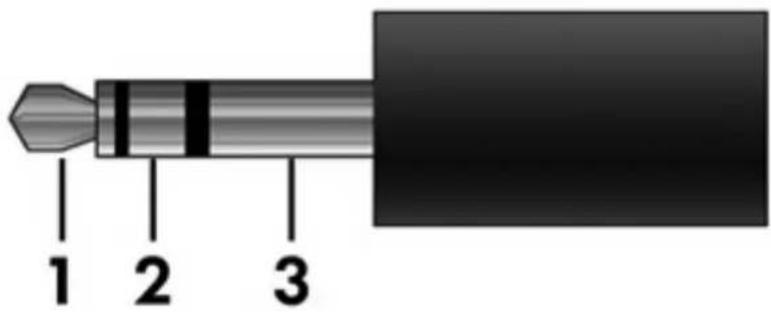
text_image
1 2 3Pin Signal
1 Audio out, left channel
2 Audio out, right channel
3 Ground
External monitor
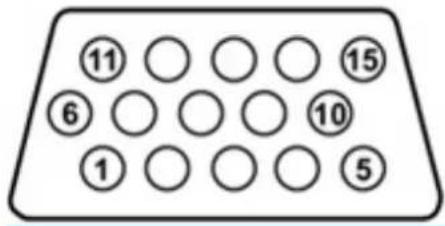
10 Power cord set requirements
The wide range input feature of the device permits it to operate from any line voltage from 100 to 120 volts AC or from 220 to 240 volts AC.
The 3-conductor power cord set included with the device meets the requirements for use in the country or region where the equipment is purchased.
Power cord sets for use in other countries and regions must meet the requirements of the country or region where the device is used.
Requirements for all countries and regions
The requirements listed below are applicable to all countries and regions:
The length of the power cord set must be at least 1.5 m (5.0 ft) and no more than 2.0 m (6.5 ft).
- All power cord sets must be approved by an acceptable accredited agency responsible for evaluation in the country or region where the power cord set will be used.
- The power cord sets must have a minimum current capacity of 10 amps and a nominal voltage rating of 125 or 250 V AC, as required by the power system of each country or region.
- The appliance coupler must meet the mechanical configuration of an EN 60 320/IEC 320 Standard Sheet C13 connector for mating with the appliance inlet on the back of the device.
Requirements for specific countries and regions
| Country/region Accredited agency Applicable note number | ||
| Australia EANSW 1 | ||
| Austria OVE 1 | ||
| Belgium CEBC 1 | ||
| Canada CSA 2 | ||
| Denmark DEMKO 1 | ||
| Finland FIMKO 1 | ||
| France UTE 1 | ||
| Germany | VDE 1 | |
| Italy | IMQ | 1 |
| Japan | METI | 3 |
| The Netherlands | KEMA | 1 |
| Norway | NEMKO 1 | |
| The People's Republic of China | CCC | 5 |
| South Korea | EK | 4 |
| Sweden SEMKO 1 | ||
| Switzerland | SEV 1 | |
| Taiwan | BSMI | 4 |
| The United Kingdom | BSI | 1 |
| The United States | UL | 2 |
-
The flexible cord must be Type HO5VV-F, 3-conductor, 1.0-mm ^2 conductor size. Power cord set fittings (appliance coupler and wall plug) must bear the certification mark of the agency responsible for evaluation in the country or region where it will be used.
-
The flexible cord must be Type SPT-3 or equivalent, No. 18 AWG, 3-conductor. The wall plug must be a two-pole grounding type with a NEMA 5-15P (15 A, 125 V) or NEMA 6-15P (15 A, 250 V) configuration.
-
The appliance coupler, flexible cord, and wall plug must bear a "T" mark and registration number in accordance with the Japanese Dentori Law. The flexible cord must be Type VCT or VCTF, 3-conductor, 1.00-mm^2 conductor size. The wall plug must be a two-pole grounding type with a Japanese Industrial Standard C8303 (7 A, 125 V) configuration.
-
The flexible cord must be Type RVV, 3-conductor, 0.75-mm^2 conductor size. Power cord set fittings (appliance coupler and wall plug) must bear the certification mark of the agency responsible for evaluation in the country or region where it will be used.
-
The flexible cord must be Type VCTF, 3-conductor, 0.75-mm ^2 conductor size. Power cord set fittings (appliance coupler and wall plug) must bear the certification mark of the agency responsible for evaluation in the country or region where it will be used.
11 Recycling
Battery
When a battery has reached the end of its useful life, do not dispose of the battery in general household waste. Follow the local laws and regulations in your area for computer battery disposal.
Display
⚠ WARNING! The backlight contains mercury. Exercise caution when removing and handling the backlight to avoid damaging this component and causing exposure to the mercury.
△ CAUTION: The procedures in this chapter can result in damage to display components. The only components intended for recycling purposes are the liquid crystal display (LCD) panel and the backlight. When you remove these components, handle them carefully.
NOTE: Materials Disposal. This HP product contains mercury in the backlight in the display assembly that might require special handling at end-of-life. Disposal of mercury may be regulated because of environmental considerations. For disposal or recycling information, contact your local authorities, or see the Electronic Industries Alliance (EIA) Web site at http://www.eiae.org.
This section provides disassembly instructions for the display assembly. The display assembly must be disassembled to gain access to the backlight (1) and the liquid crystal display (LCD) panel (2).
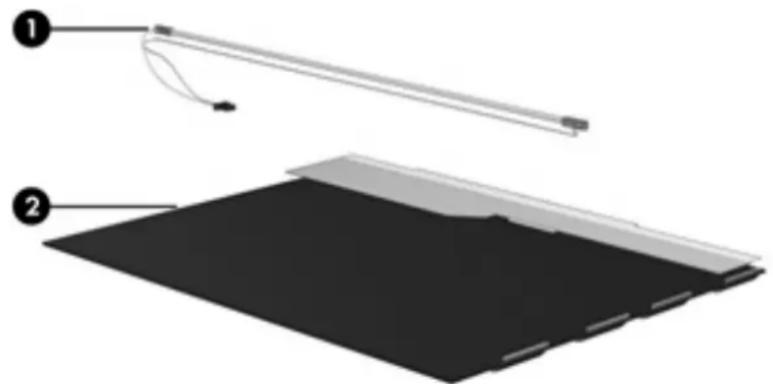
natural_image
Diagram showing two components of a device or panel assembly, labeled 1 and 2, with no visible text or symbols.NOTE: The procedures provided in this chapter are general disassembly instructions. Specific details, such as screw sizes, quantities, and locations, and component shapes and sizes, can vary from one computer model to another.
Perform the following steps to disassemble the display assembly:
- Remove all screw covers (1) and screws (2) that secure the display bezel to the display assembly.
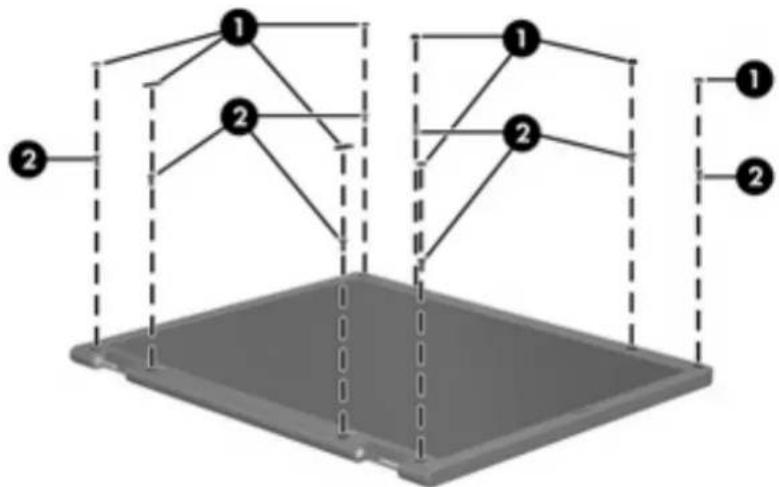
flowchart
graph TD
    A["1"] --> B["2"]
    C["1"] --> D["2"]
    E["1"] --> F["2"]
    G["1"] --> H["2"]
    I["2"] --> J["1"]
    K["2"] --> L["2"]
- Lift up and out on the left and right inside edges (1) and the top and bottom inside edges (2) of the display bezel until the bezel disengages from the display assembly.
- Remove the display bezel (3).
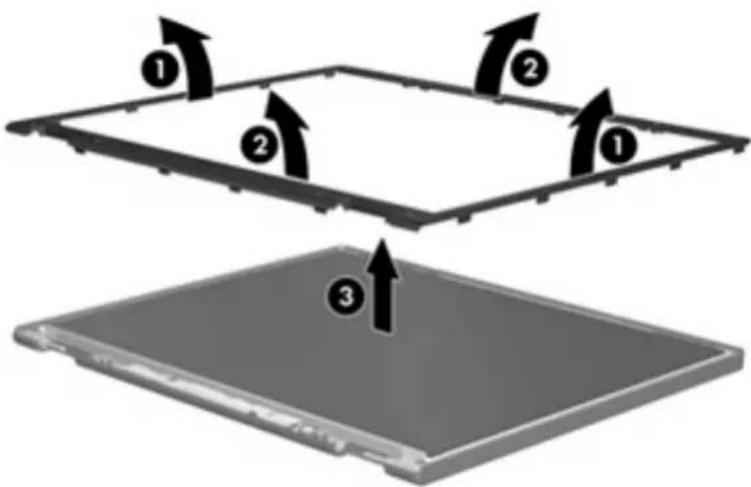
text_image
Diagram showing three labeled components (1, 2, 3) with directional arrows indicating movement or flow between them.- Disconnect all display panel cables (1) from the display inverter and remove the inverter (2).
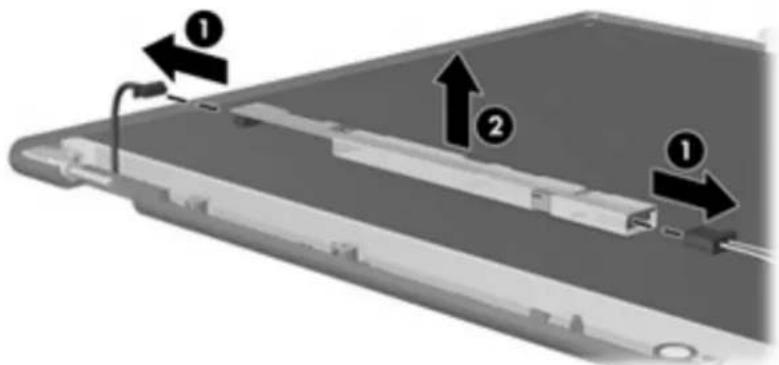
text_image
Diagram showing a mechanical or electronic component with numbered directional arrows and labeled parts 1 and 2.-
Remove all screws (1) that secure the display panel assembly to the display enclosure.
-
Remove the display panel assembly (2) from the display enclosure.
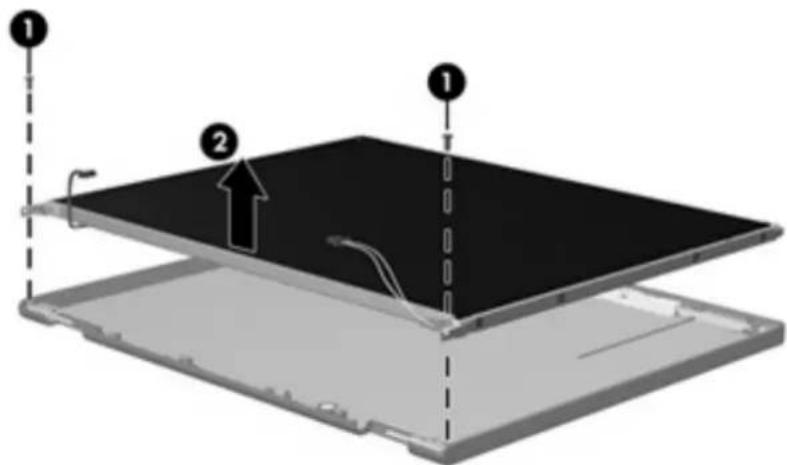
text_image
Diagram of a device with labeled components, showing two numbered parts and directional arrows indicating assembly or movement.-
Turn the display panel assembly upside down.
-
Remove all screws that secure the display panel frame to the display panel.
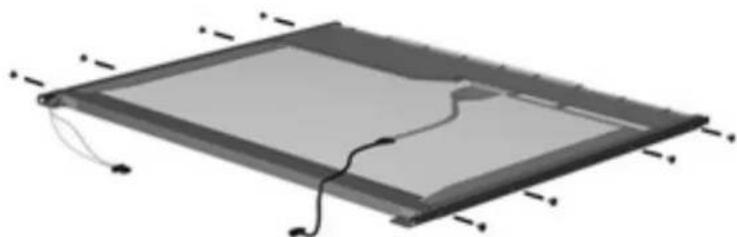
natural_image
Diagram of a rectangular electronic device with internal components and wiring (no text or symbols)-
Use a sharp-edged tool to cut the tape (1) that secures the sides of the display panel to the display panel frame.
-
Remove the display panel frame (2) from the display panel.

text_image
Diagram showing a device with labeled components and directional arrows indicating motion or assembly.-
Remove the screws (1) that secure the backlight cover to the display panel.
-
Lift the top edge of the backlight cover (2) and swing it outward.

text_image
Diagram showing a device with labeled parts and directional arrows, likely illustrating a motion or movement process.-
Remove the backlight cover.
-
Turn the display panel right-side up.
-
Remove the backlight cables (1) from the clip (2) in the display panel.
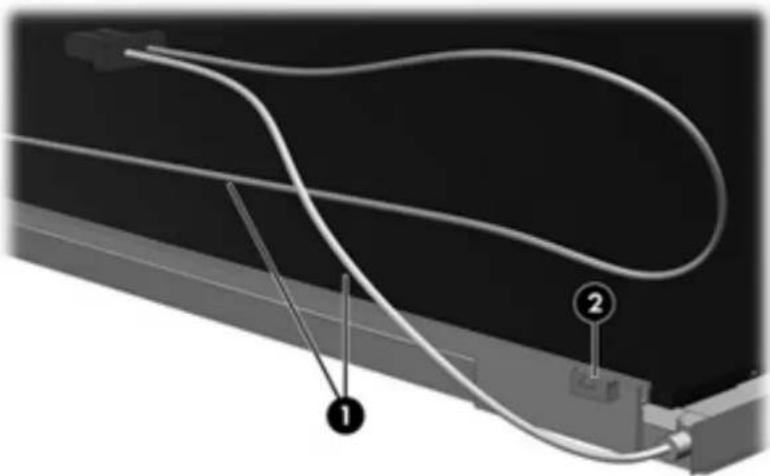
natural_image
Diagram of a cable or wire connection setup with labeled components (1 and 2), no readable text or symbols present.- Turn the display panel upside down.
⚠ WARNING! The backlight contains mercury. Exercise caution when removing and handling the backlight to avoid damaging this component and causing exposure to the mercury.
- Remove the backlight frame from the display panel.
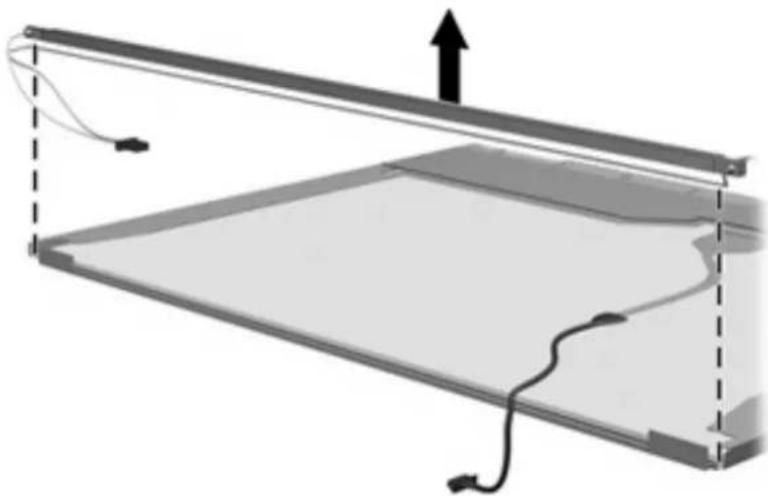
natural_image
Diagram of a mechanical or electrical component with internal structure and upward force arrow (no text or symbols)- Remove the backlight from the backlight frame.

natural_image
Diagram of a mechanical or electrical component with a curved wire and labeled connection point (no text or symbols present)- Disconnect the display panel cable (1) from the LCD panel.
- Remove the screws (2) that secure the LCD panel to the display rear panel.
- Release the LCD panel (3) from the display rear panel.
- Release the tape (4) that secures the LCD panel to the display rear panel.

text_image
Diagram of a device with numbered components and directional arrows indicating motion or movement- Remove the LCD panel.
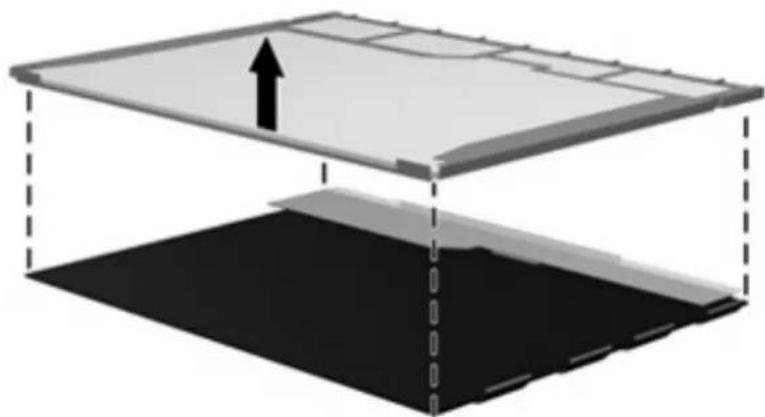
natural_image
Diagram of a layered structure with an upward arrow indicating direction, no text or symbols present- Recycle the LCD panel and backlight.
Index
A
AC adapter, spare part number 24
administrator password 73
antenna
removal 70
spare part number 21, 64
antennas 15
applications key, Windows 7
audio, product description 2
audio-in (microphone) jack 12
audio-out (headphone) jack 12
audio-in jack
pin assignments 107
audio-out jack
pin assignments 108
B
Backup and Restore Center 101
base enclosure, spare part number 20
battery
removal 36
spare part number 20, 36
battery bay, identifying 14
battery light 9
battery release latches 14
bay, battery 14
boot options 73
boot order 73
buttons
left TouchPad 5
right TouchPad 5
C
cables, service considerations 29
caps lock light, identifying 6
changing the Setup Utility language 71
chipset, product description 1
compartments, memory
module 14
components
bottom 14
display 13
front 9
left-side 12
right-side 11
TouchPad 5
connectors
service considerations 29
D
device feet
locations 35
spare part number 35
device specifications 75
Diagnostics menu 74
Digital Media Slot, identifying 11
discs
Driver Recovery 106
Operating System 106
diskette drive
precautions 30
product description 2
display assembly
removal 64
spare part number 17, 64
display bezel
illustrated 21, 64
removal 66
spare part number 21, 64
Display Cable Kit, spare part number 21, 64
display component recycling 114
display enclosure
illustrated 22, 64
spare part number 22, 64
Display Hinge Kit, spare part number 21, 64
display hinge, removal 68
display panel
illustrated 21, 64
removal 67
spare part number 21, 64
Display Screw Kit, spare part number 22, 64
display specifications 76
display switch, identifying 13
displaying system information 72
drive light, identifying 9
Driver Recovery disc 106
drives
preventing damage 30
drives, boot order 73
E
earbuds 12
electrostatic discharge 31
Ethernet, product description 2
exiting the Setup Utility 72
external media cards, product description 3
external monitor port
pin assignments 109
external monitor port, identifying 11
F
f11 recovery 104
fan
removal 57
spare part number 19, 57
feet
locations 35
spare part number 35
flash storage drive, product description 2
fn key 7, 8
function keys 7, 8
G
graphics, product description 1 grounding equipment and methods 33
H
hard drive
precautions 30
product description 2
spare part number 19
specifications 77
hard drive recovery 104
hard drive self test 74
headphone (audio-out) jack 12
headphone jack pin assignments 108
headphones 12
heat sink assembly removal 59
spare part number 59
hinge covers
illustrated 21, 64
spare part number 21, 64
Home key 8
HP Mi Restore Image Creator identifying 97 using 98
|
I/O address specifications 81
internal display switch, identifying 13
internal media cards, product description 3
internal microphone, identifying 13
interrupt specifications 80
J
jacks
audio-in (microphone) 12
audio-out (headphone) 12
RJ-45 (network) 11
K
keyboard
product description 3
removal 40
spare part number 18, 40
keys
fn 7, 8
function 7, 8
Home 8
Program Switcher 8
Windows applications 7
Windows logo 7
L
language support 73
latches, battery release 14
left TouchPad button, identifying 5
lights
battery 9
caps lock 6
drive 9
power 9
webcam 13
wireless 10
M
Main menu 73
mass storage device
product description 2
spare part number 19
mass storage devices
illustrated 45
spare part numbers 45
memory map specifications 83
memory module
product description 1
removal 38
spare part number 20, 38
memory module compartment cover
removal 38
memory module compartment, identifying 14
memory test 74
microphone (audio-in) jack 12
microphone assembly, spare part number 21, 64
microphone jack pin assignments 107
model name 1
modem, product description 2
monitor port
pin assignments 109
N
navigating in the Setup Utility 71
network jack
pin assignments 110
network jack, identifying 11
0
Operating System disc 106
operating system, product description 4
optical drive, product description 2
P
packing guidelines 32
panels, product description 1
passwords 73
pin assignments
audio-in jack 107
audio-out jack 108
external monitor port 109
headphone jack 108
microphone jack 107
monitor port 109
network jack 110
RJ-45 jack 110
Universal Serial Bus (USB)
port 111
plastic parts 29
pointing device
product description 3
ports
product description 3
USB 11, 12
power connector, identifying 12
power cord
set requirements 112
spare part number 24
power light, identifying 9
power requirements, product description 3
power switch, identifying 9
power-on password 73
Processor C4 State 73
processor, product description 1
product description
audio 2
chipset 1
diskette drive 2
Ethernet 2
external media cards 3
flash storage drive 2
graphics 1
hard drive 2
internal media cards 3
keyboard 3
mass storage device 2
memory module 1
modem 2
operating system 4
optical drive 2
panels 1
pointing device 3
ports 3
power requirements 3
processors 1
product name 1
security 4
serviceability 4
solid-state drive 2
wireless 3
product name 1
Program Switcher key 8
R
recovery partition 104
release latches
battery 14
removal/replacement
preliminaries 29
procedures 34
restoring
HP Mi Restore Image
Creator 98
System Restore 98
restoring default settings 72
restoring the hard drive 104
right TouchPad button, identifying 5
RJ-45 (network) jack, identifying 11
RJ-45 jack
pin assignments 110
RTC battery
removal 44
spare part number 20, 44
Rubber Kit, spare part number 24
S
Screw Kit
contents 84
spare part number 24
screw listing 84
security cable slot, identifying 12
Security menu 73
security, cable slot 12
security, product description 4
selecting in the Setup Utility 71
serial number 16, 34
service considerations 29
service tag 16, 34
serviceability, product description 4
SIM
removal 37
solid-state drive
product description 2
solid-state drives
spare part number 19
speaker assembly
illustrated 21, 64
removal 67
spare part number 21, 64
speakers, identifying 13
specifications
device 75
display 76
hard drive 77
I/O addresses 81
interrupts 80
memory map 83
solid-state drive 78
system DMA 79
static-shielding materials 33
switches
power 9
wireless 10
system board
removal 61
spare part number 20, 61
System Configuration menu 73
system DMA 79
system information 73
system memory map 83
System Restore
identifying 97
using 98
T
tools required 29
top cover
removal 48
spare part number 19, 48
TouchPad
buttons 5
identifying 5
TouchPad scroll zone,
identifying 5
transporting guidelines 32
U
USB board
removal 55
spare part number 55
USB board, spare part number 19, 55
USB port
pin assignments 111
USB ports, identifying 11, 12
V
vents, identifying 12, 14
W
webcam light, identifying 13
webcam module
illustrated 21, 64
removal 69
spare part number 21, 64
webcam, identifying 13
Windows applications key, identifying 7
Windows Backup utility 105, 106
Windows logo key, identifying 7
Windows recovery 106
Windows Vista operating system DVD 104
wireless antenna
removal 70
spare part number 21, 64
wireless antennas 15
wireless light, identifying 10
wireless module, product description 3
wireless switch, identifying 10
WLAN antennas, identifying 15
WLAN module
removal 51
spare part number 19, 51
workstation guidelines 32
WWAN antennas, identifying 15
WWAN module
removal 53
spare part number 53