
Cadet 310 Solid - Boat ZODIAC - Free user manual and instructions
Find the device manual for free Cadet 310 Solid ZODIAC in PDF.


| Product Type | Inflatable Boat |
| Brand | Zodiac |
| Model | Cadet 310 Solid |
| Length | 310 cm (10.2 ft) |
| Beam (Width) | Not specified in manual |
| Weight | Not specified in manual |
| Material (Buoyancy Tube) | Reinforced PVC / Hypalon |
| Floor Material | Marine Plywood (3 main sections + 2 bow sections) |
| Inflation Pressure (Buoyancy Tube & Keel) | 240 mb / 3.4 PSI |
| Recommended Pressure Range | 220 – 270 mb (3.10 – 3.85 PSI) |
| Inflation System | Foot pump with hose; standard or semi-recessed valves |
| Number of Independent Air Chambers | Multiple (including main tube and keel) |
| Keel | Inflatable keel (pressure 240 mb) |
| Seat | Removable wooden seat included |
| Oars | 2 reinforced aluminium oars |
| Pump | Foot pump included |
| Repair Kit | Included |
| Carry Bag | Included |
| Stringers | 2 stringers for floor locking |
| Assembly Procedure | Follow specific order: inventory, activate valves, inflate tube partially, assemble floor, install seat, finish inflation, install oars |
| Storage Temperature Before Unfolding | If stored below 0°C/32°F, leave at 20°C/68°F for 12 hours |
| Pressure Adjustment | Check and adjust for temperature changes; under-inflation causes flexing, overpressure can cause break |
| Cleaning | Empty water and sand using self-bailers, dry before folding |
| Safety Warnings | Do not use compressor; never fully inflate one compartment if others deflated; proper inflation critical |
Frequently Asked Questions - Cadet 310 Solid ZODIAC
User questions about Cadet 310 Solid ZODIAC
0 question about this device. Answer the ones you know or ask your own.
Ask a new question about this device
Download the instructions for your Boat in PDF format for free! Find your manual Cadet 310 Solid - ZODIAC and take your electronic device back in hand. On this page are published all the documents necessary for the use of your device. Cadet 310 Solid by ZODIAC.
USER MANUAL Cadet 310 Solid ZODIAC
● CAREFULLY READ THIS MANUAL BEFORE OPERATING YOUR BOAT.
- THIS OWNER'S MANUAL IS IN TWO VOLUMES THAT MUST BE KEPT TOGETHER.
NOTICE:
THE OWNER'S MANUAL IS IN TWO VOLUMES:
- VOLUME 1
DEALS WITH OPERATING PRECAUTIONS AND SAFETY RECOMMENDATIONS THAT MUST BE OBSERVED.
- VOLUME 2
DEALS WITH TECHNICAL SPECIFICATIONS AND ASSEMBLY PROCEDURE OF THE BOAT AND ITS EQUIPMENT.
VOLUME 2
TECHNICAL SPECIFICATIONS - ASSEMBLY PROCEDURE
ZODIAC
CADETS
CADET ROLL UP 200 - 240 - 260
CADET SOLID 260 - 285 - 310 - 340
CONTENTS
| Page | Page | ||
| ⇒Assembly procedure | 2 | ⇒Pressure | 8 |
| ⇒Check on unpacking | 2 | ⇒Assembly of equipment | 9 |
| ⇒Assembly | 3 - 5 | ⇒Deflation - folding the boat | 10 |
| ⇒Inflation system | 6 | ⇒General description | I - IV |
→Inflation 7
ASSEMBLY PROCEDURE
We recommend that you follow the specific order of the assembly procedure. Proceed step by step and refer to the corresponding pages.
| PROCEDURE PAGE SECTION | ||
| 1. inventory the elements composing your boat, 2and learn how to recognise them I - IV | CHECK ON UNPACKING | |
| DESCRIPTION | ||
| 2. activate valves in inflating position 6 | INFLATION SYSTEM | |
| 3. slightly inflate the main buoyancy tube 7 | INFLATION | |
| 4. CADET RU 200 - RU 240 : Insert the wooden slats in their pocketsCADET RU 260 : install the rolling floorCADET SOLID : assemble the floorboard | 3 - 5 | ASSEMBLY |
| 5. Install the seat (except CADET RU 200) | 9 | ASSEMBLY OF EQUIPMENT |
| 6. finish inflation of the boat to the correct pressure 7 - 8 | INFLATION / PRESSURE | |
| 7. Install the oars | 9 | ASSEMBLY OF EQUIPMENT |
CHECK ON UNPACKING

DO NOT USE A SHARP TOOL
The pack must contain: 1 buoyancy tube +
| ZODIAC\Cadet Roll up Cadet Solid | C200RU | C240RU | C260RU | C260S | C285S | C310S | C340S |
| Floorboard | S (1) S | (1) R (1) | PF (1) PF | (1) | PF (1) | PF (1) | |
| inflatable keel | 1 | 1 | 1 | 1 | |||
| Stringer | 2 | 2 | 2 | 2 | |||
| Repair kit | 1 | 1 | 1 | 1 | 1 | 1 | 1 |
| Owner's manual (2) | 1 | 1 | 1 | 1 | 1 | 1 | 1 |
| Equipment standard | |||||||
| Removable wooden seat | 1 | 1 | 1 | 1 | 1 | 1 | |
| Carry bag | 1 | 1 | 1 | 1 | 1 | 1 | 1 |
| Reinforced aluminium oar | 2 | 2 | 2 | 2 | 2 | 2 | 2 |
| Foot-pump | 1 | 1 | 1 | 1 | 1 | 1 | 1 |
(1) S = Slats R = Rolling floor PF = Marine Plywood Floor
(2) 2 volumes
You can equip your boat with many optional accessories (transportation wheels, boarding ladder, lifting rings etc.). Ask your dealer to advise you.
| NOTICE : | IF YOU WISH TO ADD LIFTING RINGS, YOU MUST FIX THEM ON THE BUOYANCY TUBE, NEVER ON THE FLOOR |
ASSEMBLY
Choose a smooth and clean surface

IF THE BUOYANCY TUBE WAS STORED AT A TEMPERATURE BELOW 0°C / 32°F, LEAVE IT AT 20°C / 68°F FOR 12 HOURS BEFORE UNFOLDING.
CADET SOLID : INSTALL THE MARINE PLYWOOD FLOOR:
-
Sprinkle some starch in the angle (joint of the buoyancy tubes to the bottom) to facilitate fitting. CAUTION, NEVER USE TALCUM POWDER.
• Make sure you identify the parts and direction in which they fit: -
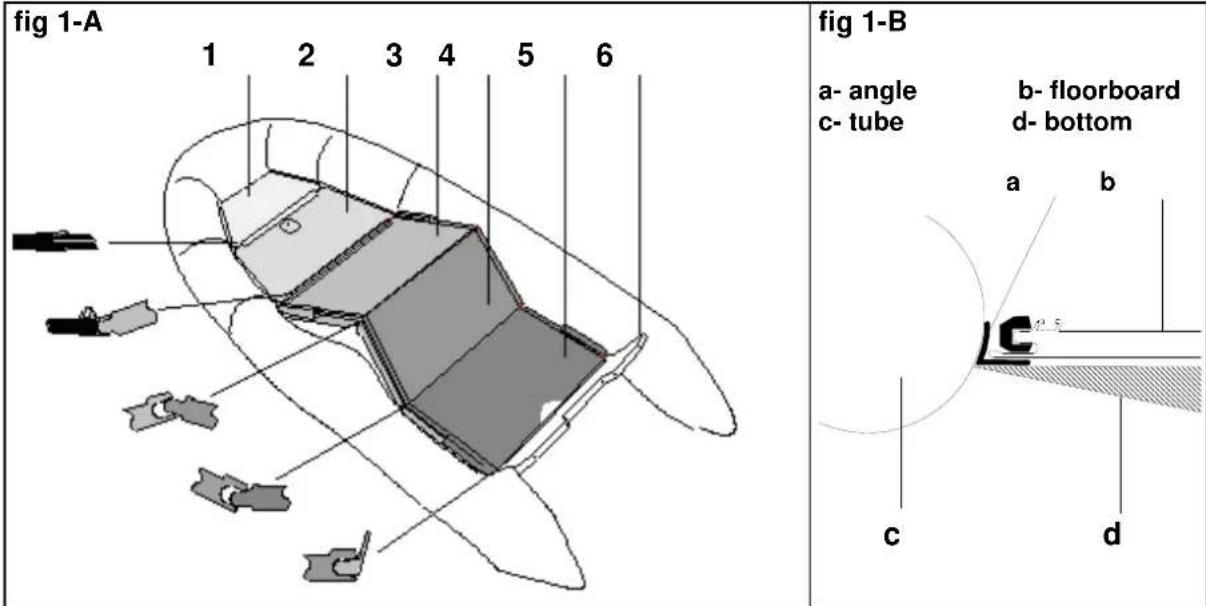
The floorboard consists of 3 main sections and 2 sections in the bow [fig 1 and 4]
-
The bow sections have an upside and a downside.
-
Insert the bow section (1) into the bow angle.
- Insert the rear section (5) against the transom (6) as show on fig 1.
- Fit all sections together [fig.1].
- Position sections 3 and 4 as an apex (in a tent-like position) [fig 1 and 2].
- Check that all sections are correctly aligned [fig 4].
- Check that the floorboard is correctly fitted in the angles.
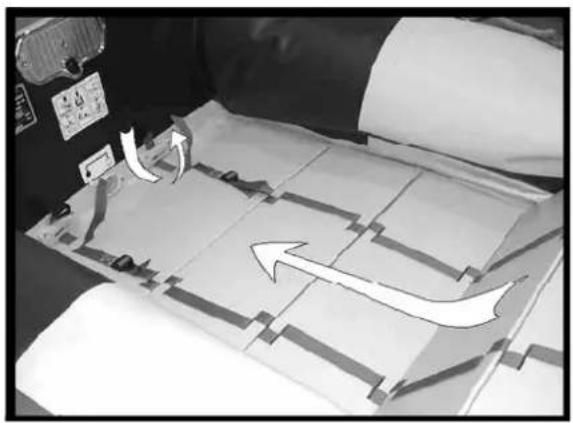
- Flatten the apex by standing on it (in the boat) and pulling the lifelines to prevent the fabric being pinched [fig. 2].
- Assemble the stringers (see instructions bellow).
CADET SOLID : ASSEMBLY OF THE STRINGERS
The stringers are essential to good working of the boat: they lock the floorboard together and stiffen its structure.
- To facilitate the fitting of the first stringer, slide the other stringer under the boat, about 20 cm from the side [fig. 3-a].

DO NOT PUT THE STRINGER IN POSITION UNDER THE BOAT UNTIL THE FLOOR IS FLATTENED.
- Position the stringer on the edge of the floorboard. The reference mark on the stringer (8) must remain on top (the thicker part should be towards the top) [fig. 3].
- Fit the stringers between the two buffers (9) of sections 3 and 5 [fig. 4].
- Rotate the stringer in the angle so as to press them against the bottom [fig. 3-b and 4].
- Because of the self-locking system of the floorboard, the stingers will fit into place once the buoyancy tube is inflated.
ASSEMBLY


ASSEMBLY
CADET ROLL UP 200 - 240: INSTALL THE SLATTED FLOOR:
Boat deflated, slide the slats in their pockets starting by the closest to the transom. If the slats are difficult to insert, lubricate it with liquid soap.
CADET ROLL UP 260 : INSTALL THE ROLLING FLOOR:
natural_image
Diagram of a mechanical assembly with directional arrows indicating motion or movement, no readable text or symbols present.
natural_image
Medical device with attached bandage and arrow indicating compression or insertion (no text or symbols visible)INFLATION SYSTEM
The inflation system is composed of:
THE FOOT PUMP
a. connecting tip
b. hose end piece
c. hose base
d. outlet for inflation

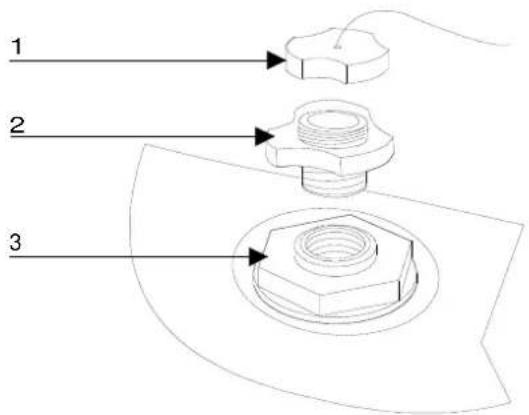
THE STANDARD VALVES
(1) cap (2) valve insert (3) base
To activate the standard valves into INFLATION position:
• Free the valve insert from its protection.
- Unscrew the valve cap.
- Screw the valve support onto its base (screw it tight but without exaggeration, not to deteriorate the screw thread) and check that the valve cap stays accessible.
TO DEFLATE:
Unscrew the valve support from its base
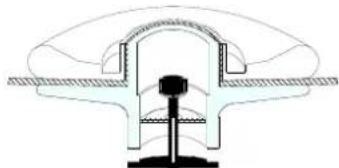
THE SEMI-RECESSED VALVES
To activate the valves:

natural_image
Cross-sectional diagram of a mechanical assembly with no visible text or symbolspress the push-in stem a quarter of a turn
Inflation position

natural_image
Cross-sectional diagram of a mechanical piston assembly (no text or labels)diaphragm closed, the inner button springs upwards
Deflation position
natural_image
Cross-sectional diagram of a mechanical component with no visible text or symbolsdiaphragm open, the inner button goes down
NOTICE:
TO SCREW OR UNSCREW THE VALVE CAPS, TURN WITHOUT PRESSING OR FORCING (THIS COULD UNSCREW THE INNER VALVE SYSTEM).

natural_image
Simple line drawing of a mechanical device with a central shaft and base, no text or symbols present.INFLATION
Activate all valves into inflation position.
Fit the hose to the foot-pump.
To inflate your boat properly, the bottom side of the foot-pump must rest on a flat ground.
Pump evenly to inflate rapidly.
natural_image
Diagram of a curved pipe with circular elements and a downward arrow, no text or symbols present
DO NOT USE A COMPRESSOR OR A BOTTLE OF COMPRESSED AIR
You can use the electrical air pump ACCESS (ask your Dealer).
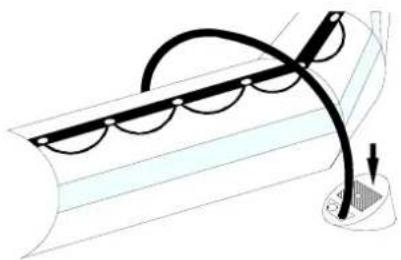
TO INFLATE THE MAIN BUOYANCY TUBE
- Insert the pump hose end piece
- Inflate (pressure = 240 mb, refer to PRESSURE section) making sure that each compartment is equal. When correctly inflated, the internal bulkheads (a) are not visible.

NEVER COMPLETELY INFLATE A COMPARTMENT TO FULL PRESSURE IF OTHER COMPARTMENTS ARE TOTALLY DEFLATED


1


2

CADET SOLID : INFLATE THE KEEL
- Once the floor in assembled, start inflation of the keel (pressure = 240 mb).
Inflation is over: fit the valve caps tight (clockwise).
| NOTICE : | A slight air-leak before screwing the valve caps is normal.ONLY THE VALVE CAPS CAN ENSURE FINAL AIR TIGHTNESS. |
PRESSURE
The correct pressure for the buoyancy tube and the keel is 240 mb / 3,4 PSI (green area of the pressure indicator).
If your boat is not equipped with a ACCESS pressure indicator, we recommend that you purchase one from your Dealer. This will permit a quick and efficient control of the pressure during inflation. Without a pressure indicator, stop inflating when the foot-pump gets difficult to operate, and the boat is « hard » (you should not be able to bend the cone ends).
| Ambient temperature of air and water Ambient have an effect on the boat's internal +1°C / +1,8°F pressure -1°C / -1,8°F -4 mb / 0,06 PSI | int temperature tubes' internal pressure |
Therefore, it is important to anticipate:
Because of temperature variations (especially when this variation is important between the beginning and the end of the day, in hot areas) check and adjust the pressure in the inflated compartments by inflating or deflating. Be sure that pressure remains within the recommended zone, between 220 mb/3,10 PSI and 270 mb/3,85 PSI (green area).
RISK OF UNDERPRESSURE
EXAMPLE: Your boat is in direct sunlight on the beach (temperature =50°C/122°F) at recommended pressure (240 mb/3,4 PSI). after putting it in the colder water (temperature =20°C/68°F), the internal temperature and pressure of the tubes will both drop (up to 120 mb/1,7 PSI) and YOU WILL HAVE TO INFLATE AGAIN until you regain the lost pressure due to the difference in temperatures. Therefore, a loss of pressure at the end of the day when ambient temperature drops is perfectly normal.
NOTICE :
Proper inflation is critical to the performance of the boat. It is the pressure in the tubes that gives your boat the necessary rigidity to perform well. Under-inflation causes improper flexing of the tubes which will result in stress and chafe
RISK OF OVERPRESSURE
EXAMPLE: Your boat is inflated to the recommended pressure (240 mb/3,4 PSI) at the beginning of the day (low ambient temperature =10°C/50°F). Later in the day, your boat is in direct sunlight on the beach or on a yacht's deck (temperature =50°C/122°F). Internal temperature of all inflated compartments can then increase and reach up to 70°C/158°F (especially for dark-coloured tubes). The consequence will be a doubling of previous pressure (480 mb/6,8 PSI). YOU WILL THEN HAVE TO DEFLATE until you reach the recommended pressure.

WHEN YOUR BOAT IS OVER INFLATED, PRESSURE BECOMES TOO STRONG FOR THE INFLATABLE STRUCTURE, AND COULD CAUSE A BREAK IN THE FABRIC ASSEMBLY
IN CASE OF OVERPRESSURE
STANDARD VALVE (A):
Free some air by pushing on the diaphragm (1) with a blunt object.
Beware not to fold down the diaphragm.
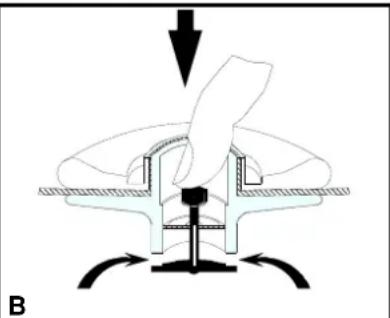
SEMI-RECESSED VALVE (B):
Deflate by pressing the spring loaded button.

natural_image
Diagram of a mechanical or fluidic device with directional arrows indicating flow or movement (no text or symbols)ASSEMBLY OF STANDARD EQUIPMENT
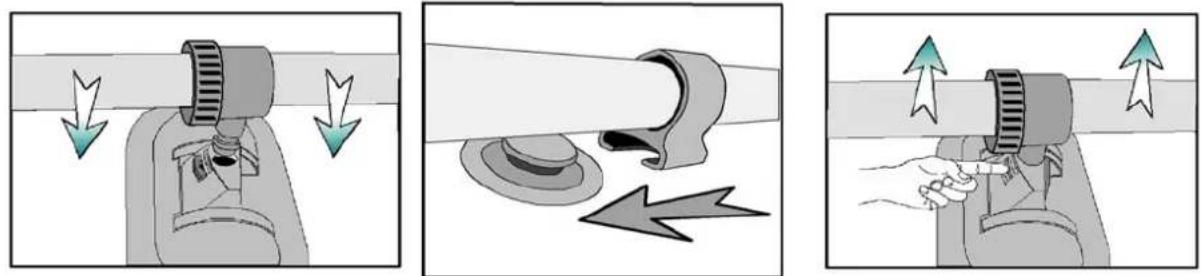
TO ASSEMBLE AND INSTALL THE OARS:


natural_image
Three-panel illustration showing mechanical assembly steps: press, clamping, and hand press (no text or symbols)THE REMOVABLE SEAT (EXCEPT C 200 ROLL UP)
Install the seat before the boat is totally inflated.

DEFLATING / FOLDING THE BOAT
- Deflate the boat.
- Replace the valve protections.
- Remove oars and equipment.
- Remove the floorboard (For Cadets solid only - for cadets Roll up with a slatted floor, It is not necessary to remove the slats to fold the boat).
- Empty the boat of all water and sand by opening the self-bailers, dry it.
- Fold in the 2 sides of the main buoyancy tube (A), fold the cones onto the transom, then roll up the boat around the transom (C). Start again if you feel there is still some air left in the tubes.


natural_image
Three-step diagram showing a folded paper or plastic sheet being folded, with arrows indicating the process (no text or symbols present)Stow the boat in its bag as follows (D):
Stow the boat folded on its bag open (back side of the bag visible).
. Position the floor sections and stringers flat on the boat (Cadet Solid), then the oars dismantled.
. Close the bag and fasten the two front straps.
. Tight the side ropes (make sure that all equipment stays inside).
. To finish, store the foot-pump in the front pocket.

natural_image
Two technical diagrams showing a cylindrical object with internal components and rotational arrows, no text or symbols present.- VOLUME 2
- TECHNICAL SPECIFICATIONS - ASSEMBLY PROCEDURE
- ZODIAC
- ASSEMBLY PROCEDURE
- CHECK ON UNPACKING
- ASSEMBLY
- CADET SOLID : INSTALL THE MARINE PLYWOOD FLOOR:
- CADET SOLID : ASSEMBLY OF THE STRINGERS
- CADET ROLL UP 200 - 240: INSTALL THE SLATTED FLOOR:
- CADET ROLL UP 260 : INSTALL THE ROLLING FLOOR:
- INFLATION SYSTEM
- THE FOOT PUMP
- THE STANDARD VALVES
- To activate the standard valves into INFLATION position:
- TO DEFLATE:
- THE SEMI-RECESSED VALVES
- NOTICE:
- INFLATION
- TO INFLATE THE MAIN BUOYANCY TUBE
- CADET SOLID : INFLATE THE KEEL
- PRESSURE
- Therefore, it is important to anticipate:
- RISK OF UNDERPRESSURE
- NOTICE :
- RISK OF OVERPRESSURE
- IN CASE OF OVERPRESSURE
- STANDARD VALVE (A):
- SEMI-RECESSED VALVE (B):
- ASSEMBLY OF STANDARD EQUIPMENT
- TO ASSEMBLE AND INSTALL THE OARS:
- THE REMOVABLE SEAT (EXCEPT C 200 ROLL UP)
- DEFLATING / FOLDING THE BOAT
Brand : ZODIAC
Model : Cadet 310 Solid
Category : Boat