ES7411WT - Printer OKI - Free user manual and instructions
Find the device manual for free ES7411WT OKI in PDF.


User questions about ES7411WT OKI
0 question about this device. Answer the ones you know or ask your own.
Ask a new question about this device
Download the instructions for your Printer in PDF format for free! Find your manual ES7411WT - OKI and take your electronic device back in hand. On this page are published all the documents necessary for the use of your device. ES7411WT by OKI.
USER MANUAL ES7411WT OKI
natural_image
Exterior view of a white and gray OKI printer with control panel and display screen (no visible text or symbols on body)User'sGuide

natural_image
Exterior view of a white and gray printer (no visible text or labels)PREFACE
Every effort has been made to ensure that the information in this document is complete, accurate, and up-to-date. The manufacturer assumes no responsibility for the results of errors beyond its control. The manufacturer also cannot guarantee that changes in software and equipment made by other manufacturers and referred to in this guide will not affect the applicability of the information in it. Mention of software products manufactured by other companies does not necessarily constitute endorsement by the manufacturer.
While all reasonable efforts have been made to make this document as accurate and helpful as possible, we make no warranty of any kind, expressed or implied, as to the accuracy or completeness of the information contained herein.
The most up-to-date drivers and manuals are available from:
http://www.okiprintingsolutions.com
45095102EE Rev1; Copyright © 2012. All rights reserved.
OKI is a registered trademark of Oki Electric Industry Co., Ltd.
Oki Printing Solutions is a registered trademark of Oki Data Corporation.
Microsoft, MS-DOS and Windows are registered trademarks of Microsoft Corporation.
Apple, Macintosh, Mac and Mac OS are registered trademarks of Apple Inc.
Other product names and brand names are registered trademarks or trademarks of their proprietors.

This product complies with the requirements of the Council Directives 2004/108/EC (EMC), 2006/95/EC (LVD), 1999/5/EC (R&TTE) and 2009/125/EC (ErP), as amended where applicable, on the approximation of the laws of the member states relating to Electromagnetic Compatibility, Low Voltage, Radio & Telecommunications Terminal Equipment and Energy Related Products.
The following cables were used to evaluate this product to achieve EMC directive 2004/108/EC compliance and configurations other than this may affect that compliance.
| CABLE TYPE LENGTH(METRE) | CORE SHIELD | |
| Power 1.8 | × | |
| USB 5.0 | × | |
| Parallel 1.8 | × | |
| LAN 15.0 | × | |
EMERGENCY FIRST AID
Take care with toner powder:
If swallowed, give small amounts of cold water and seek medical attention. DO NOT attempt to induce vomiting.

If inhaled, move the person to an open area for fresh air. Seek medical attention.
If it gets into the eyes, flush with large amounts of water for at least 15 minutes keeping eyelids open. Seek medical attention.
Spillages should be treated with cold water and soap to help reduce risk of staining skin or clothing.
MANUFACTURER
Oki Data Corporation,
4-11-22 Shibaura, Minato-ku,
Tokyo 108-8551,
Japan
IMPORTER TO THE EU/AUTHORISED REPRESENTATIVE
Oki Europe Limited (trading as OKI Printing Solutions)
Blays House
Wick Road
Egham
Surrey, TW20 0HJ
United Kingdom
For all sales, support and general enquiries contact your local distributor.
ENVIRONMENTAL INFORMATION

text_image
www.okiprintingsolutions.com OKICONTENTS
Preface 2
Emergency first aid ....3
Manufacturer....3
Importer to the EU/authorised representative. . . . . . . . . . . . . . . . . . . . . . . . . . . . 3
Environmental information ....3
Contents 4
Notes, cautions and warnings....6
About this guide 7
Documentation suite 7
What this book describes 7
On-line usage 8
Printing pages. 8
Introduction 9
Printer overview ....10
Front view 10
Rear view 11
Changing the display language .....12
Getting started 12
Power saving mode .....12
Switching off....12
Paper recommendations....13
Cassette trays. 13
Multi purpose tray 13
Face down stacker....13
Face up stacker....14
Loading paper....15
Cassette trays. 15
Multi purpose tray 18
How to access the driver screens....19
Printing preferences in Windows applications .....20
Postscript emulation 20
Changing the driver defaults. 21
Changing the application's driver settings. . . . . . . . . . . . . . . . . . . . . . . . . . . . . . . . . . . . . . . . . 21
Setting the driver device options . . . . . . . . . . . . . . . . . . . . . . . . . . . . . . . . . . . . . . . . . . . . . . . . . . . . . . . . . 22
Windows 22
Mac OS X....22
Color setting 23
Color Mode 23
Color Print 23
Gray Scale (White) Print. 25
Print Mode 26
White On 26
White Off 26
Finishing options....28
Collating. 29
Windows 30
Mac OS X 30
Separating queued print jobs . . . . . . . . . . . . . . . . . . . . . . . . . . . . . . . . . . . . . . . . . . . . . . . . . . . . . . . . . . . 31
Windows separator page 31
Mac OS X cover page....31
Cover print 32
Mac OS X....32
Custom page size 33
Windows PostScript 33
Mac OS X....34
Printing multiple pages on one sheet (n-up) .....35
Windows PostScript 35
Mac OS X....36
Scale to page . . . . . . . . . . . . . . . . . . . . . . . . . . . . . . . . . . . . . . . . . . . . . . . . . . . . . . . . . . . 37
Mac OS X 37
Transfer/transparency film printing . . . . . . . . . . . . . . . . . . . . . . . . . . . . . . . . . . . . . . . . . . . . . . . . . . . . . . . . 38
Windows 38
Mac OS X 39
How to print with application setting .....40
Adobe Photoshop 40
Adobe Illustrator 41
Menu functions 42
Operator panel: 42
How to change the settings - user . . . . . . . . . . . . . . . . . . . . . . . . . . . . . . . . . . . . . . . . . . . . . . . . . . . . . . . . . 43
How to change the settings - administrator . . . . . . . . . . . . . . . . . . . . . . . . . . . . . . . . . . . . . . . . . . . 43
Configuration menu 44
Print information menu 45
Shutdown menu 45
Menus 46
Admin setup 49
Calibration 54
Boot menu 55
Maintenance ....57
Replacing consumable items. 57
Toner cartridge replacement. . . . . . . . . . . . . . . . . . . . . . . . . . . . . . . . . . . . . . . . . . . . . . . . . . . . . . . . . . . . . . . 57
Image drum replacement 60
Replacing the transfer belt unit . . . . . . . . . . . . . . . . . . . . . . . . . . . . . . . . . . . . . . . . . . . . . . . . . . . . . . . . . . . . . 63
Fuser replacement. 65
Cleaning. 67
...the unit casing 67
...the LED head....67
...the paper feed rollers . . . . . . . . . . . . . . . . . . . . . . . . . . . . . . . . . . . . . . . . . . . . . . . . . . . . . . . . . . . . . . 68
Installing upgrades....69
Memory upgrade 69
Additional paper tray(s) 72
Setting the driver device options. 73
Windows 73
Mac OS X 73
Storage cabinet. 73
Troubleshooting 74
Major printer components and paper path 74
Paper sensor error codes 75
Clearing paper jams 76
Specifications 82
Index....83
Oki contact details....84
NOTES, CAUTIONS AND WARNINGS
NOTE
A note provides additional information to supplement the main text.
CAUTION!
A caution provides additional information which, if ignored, may result in equipment malfunction or damage.
WARNING!
A warning provides additional information which, if ignored, may result in a risk of personal injury.
For the protection of your product, and in order to ensure that you benefit from its full functionality, this model has been designed to operate only with genuine original toner cartridges. Any other toner cartridge may not operate at all, even if it is described as "compatible", and if it does work, your product's performance and print quality may be degraded.
Use of non-genuine products may invalidate your warranty.
Specifications subject to change without notice. All trademarks acknowledged.
NOTE
Images used in this manual may include optional features that your product does not have installed.
DOCUMENTATION SUITE
This guide is part of a suite of online and printed documentation provided to help you become familiar with your product and to make the best use of its many powerful features. The documentation is summarised below for reference and is found on the software CD unless indicated otherwise:
Installation Safety booklet: provides information for safe use of your product.
This is a paper document that is packaged with the product and should be read before setting up your machine.
Set-up guide: describes how to unpack, connect and turn on your product.
This is a paper document that is packaged with the product.
User's Guide: helps you become familiar with your product and make the best use of its many features. Also included are guidelines for troubleshooting and maintenance to ensure that it performs at its best. Additionally, information is provided for adding optional accessories as your printing needs evolve. And helps you become familiar with the many features of the driver software supplied with your product.
Network Guide: helps you become familiar with the functionality of the built in network interface card.
Installation Guides: accompany consumable items and optional accessories to describe how to install them.
These are paper documents that are packaged with the consumables and optional accessories.
On-line Help: on-line information accessible from the printer driver and utility software.
WHAT THIS BOOK DESCRIBES
This book provides a convenient on-screen reference to the many features of the driver software supplied with your machine.
Where possible the instructions for both Windows and Mac operating systems have been combined, where there is a significant difference these have been split out and described individually.
NOTE
Terminology may vary between operating systems. Windows use tabbed dialogue boxes, whereas Mac OS X uses pop-up menus. For consistency throughout this manual we will refer to tabs.
ON-LINE USAGE
This guide is intended to be read on screen using Adobe Reader. Use the navigation and viewing tools provided in Adobe Reader.
There are many cross-references within this book, each highlighted as blue text. When you click on a cross-reference the display will instantly jump to the part of the manual containing the referenced material.
By using the button in Adobe Reader, you can navigate directly back to where you were before.
You can access specific information in two ways:
In the list of bookmarks down the left hand side of your screen, click on the topic of interest to jump to the required topic. (If the bookmarks are not available, use the "Contents" on page 4.)
In the list of bookmarks, click on Index to jump to the Index. (If the bookmarks are not available, use the "Contents" on page 4.) Find the term of interest in the alphabetically arranged index and click on the associated page number to jump to the page containing the term.
PRINTING PAGES
The whole manual, individual pages, or sections may be printed. The procedure is:
-
From the toolbar, select File > Print (or press the Ctrl + P keys).
-
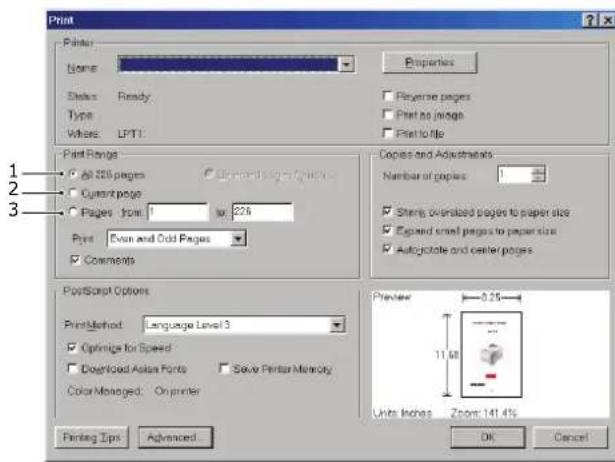
Choose which pages you wish to print:
(a) All pages, (1), for the entire manual.
(b) Current page, (2), for the page at which you are looking.
text_image
Print Print: Name: Properties Status: Ready: Type: White: LPT1: Reverse pages Print as pages Print to file Print Ranges All 50% pages Current page Pages from 1 to 22% Print: Even and Odd Pages Comments Copies and Adjustments Number of copies: Shirts oversized pages to paper size Expanded scroll pages to paper size Autogictole and center pages PostScript Options PrintMethod: Language Level 3 Optimize for Speed Download Action Points Save Printer Memory Color Managed: On printer Preview 8.25 Units Inches Zoom: 141.4% Printing Tips Advanced OK Cancel(c) Pages from and to, (3), for the range of pages you specify by entering their page numbers.
(d) Click OK.
INTRODUCTION
Congratulations on choosing this colour printer.
Your printer includes these features:
ProQ/High Quality, multi-level technology produces subtler tones and smoother gradations of colour to lend photographic quality to your documents.
600 x 600, 1200 x 600 dpi (dots per inch) and ProQ2400 print resolution for high quality image production showing the finest detail.
Internet Protocol version 6 (IPv6).
Single Pass colour Digital LED technology for high speed processing of your printed pages.
PostScript 3 emulations.
10Base-T and 100Base-TX network connection lets you share this valuable resource among users on your office network.
Additionally, the following optional features are also available:
Additional paper tray for loading a further 530 sheets to minimise operator intervention, or different paper stocks for letterhead stationery, alternative paper sizes or other print media.
Additional memory allows printing of more complex pages.
Storage Cabinet.
PRINTER OVERVIEW
FRONT VIEW

text_image
Technical diagram of an HP printer internal structure with numbered components for identification- Output stacker, face down. Standard printed copy delivery point. Holds up to 350 sheets at 80g/m².
- Operator panel. Menu driven operator controls and LCD panel ^4 .
- Paper tray. Standard paper tray. Holds up to 530 sheets of 80g/m² paper.
- Multi purpose tray. Used for feeding heavier paper stocks, transparency and transfer media. Also for manual feeding of single sheets when required.
a. The display language can be changed to show different languages. (See "Changing the display language" on page 12.)
- Paper level indicator.
- Front cover release lever.
- Multi-purpose tray release recess.
- Top cover release button.
- LED heads.
- Fuser release levers.
- Toner cartridges (C,M,Y,W).
- ID units (C,M,Y,W).
REAR VIEW
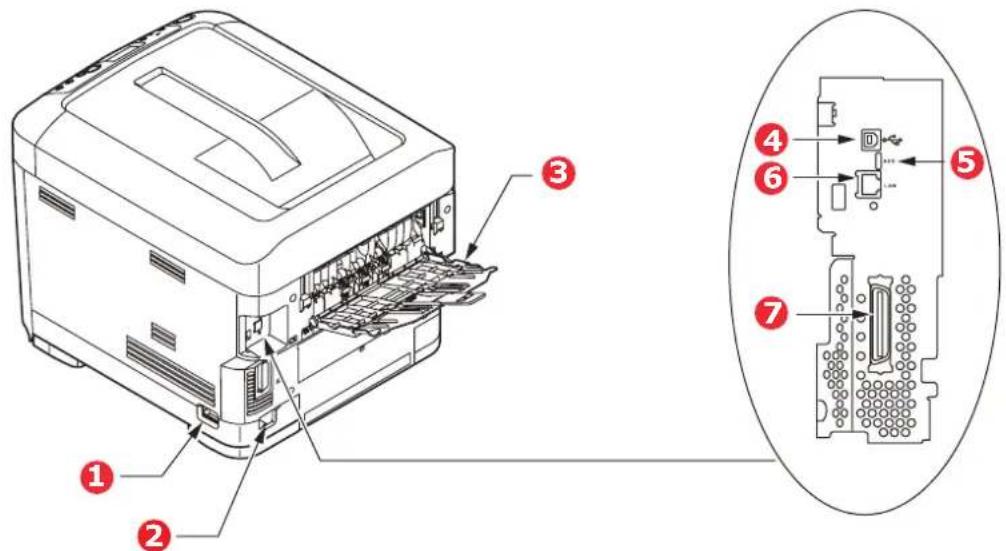
This view shows the connection panel, the rear output stacker.
text_image
Technical diagram of a printer with numbered parts and internal components, including labeled parts 1 through 7.- ON/OFF switch.
- AC power socket.
- Rear, face up stacker.
-
USB interface.
-
ACC interface (host USB).
- Network interface. ^a
- Parallel interface.
a. The Network Interface may have a protective "plug" which must be removed before connection can be made.
When the rear paper stacker is folded down paper exits the printer through the rear of the printer and is stacked here face up. This is mainly used for heavy print media and transparency/transfer media. When used in conjunction with the multi purpose feed tray, the paper path through the printer is essentially straight. This avoids bending the paper around curves in the paper path and enables feeding of up to 250g/m^2 media.
CHANGING THE DISPLAY LANGUAGE
The default language used by your machine for display messages is English. If required, this can be changed using the Panel Language Set-up utility.
GETTING STARTED
POWER SAVING MODE
If you do not use the machine for a while, it will enter the power saving mode to control the power consumption of the device. To cancel or initiate power saving mode, press the Power Save / Wake Up button on the control panel.
NOTE
If your machine is connected locally (via USB or parallel*), when it transitions to Sleep mode its status is viewed as off-line. To use the printer in this state, you must press the Power Save / Wake Up button to exit sleep mode.
SWITCHING OFF
- Press the Enter button on the control panel to enter the menu.
- Press the Menu down button and scroll to the Shutdown menu.
- Press the Enter button.
- Press the Enter button to continue.
- Press the Enter button to execute.
- At the prompt, turn the power switch OFF.
PAPER RECOMMENDATIONS
Your printer will handle a variety of print media, including a range of paper weights and sizes, transparency and transfer media. This section provides general advice on choice of media, and explains how to use each type.
The best performance will be obtained when using standard 75\~90g/m ^2 paper designed for use in copiers and laser printers. Suitable types are:
M-Real Data Copy Everyday 80g/m²
Color Copy by Mondi 90g/m²
Use of heavily embossed or very rough textured paper is not recommended.
CASSETTE TRAYS
SIZE DIMENSIONS WEIGHT (G/M²)
| A6a | 105 x 148mm Light 64 - 74g/m2 | |
| A5 | 148 x 210mm | Medium Light 75 - 82g/m2 |
| B5 | 182 x 257mm | Medium 83 - 104g/m2 |
| Executive | 184.2 x 266.7mm | Heavy 105 - 120g/m2 |
| A4 | 210 x 297mm | Ultra heavy1 121 - 188g/m2 |
| Letter 215.9 x 279.4mm | Ultra heavy2 189 - 220g/m2 | |
| Legal 13in. | 216 x 330mm | Ultra heavy3 221 - 250g/m2 |
| Legal 13.5in. | 216 x 343mm | |
| Legal 14in. | 216 x 356mm | Tray 1/2/3: 64 - 220g/m2MP Tray: 64 - 250g/m2 |
a. A6 printing from the MP Tray only.
If you have identical paper stock loaded in another tray (2nd or 3rd tray if you have one, or multi purpose tray) you can set the printer to automatically switch to the other tray when the current tray runs out of paper. When printing from Windows applications, this function is enabled in the driver settings. When printing from other systems, this function is enabled in the Print Menu. (See "Menu functions" on page 42.)
MULTI PURPOSE TRAY
The multi purpose tray can handle the same sizes as the cassette trays but in weights up to 250g/m^2 . For very heavy paper stock use the face up (rear) paper stacker. This ensures that the paper path through the printer is almost straight.
The multi purpose tray can feed paper widths from 76mm to 215.9mm and lengths from 127.0mm to 356mm.
For paper lengths exceeding 356mm (Legal 14in.) use paper stock between 90g/m ^2 and 128g/m ^2 and the face up (rear) paper stacker.
FACE DOWN STACKER
The face down stacker on the top of the printer can hold up to 350 sheets of 80g/m^2 standard paper, and can handle paper stocks up to 188g/m^2 .
Pages printed in reading order (page 1 first) will be sorted in reading order (last page on top, facing down).
FACE UP STACKER
The face up stacker at the rear of the printer should be opened and the tray extension pulled out when required for use. In this condition paper will exit via this path, regardless of driver settings.
The face up stacker can hold up to 100 sheets of 80g/m^2 standard paper, and can handle stocks up to 250g/m^2 .
Always use this stacker and the multi purpose feeder for paper stocks heavier than 188g/m^2 .
LOADING PAPER
CASSETTE TRAYS
- Remove the paper tray from the printer.

natural_image
Line drawing of a printer with internal components and a red arrow indicating a disassembly or disassembly process (no text or symbols present)- Fan the paper to be loaded at the edges (1) and in the middle (2) to ensure that all sheets are properly separated, then tap the edges of the stack on a flat surface to make it flush again (3).

text_image
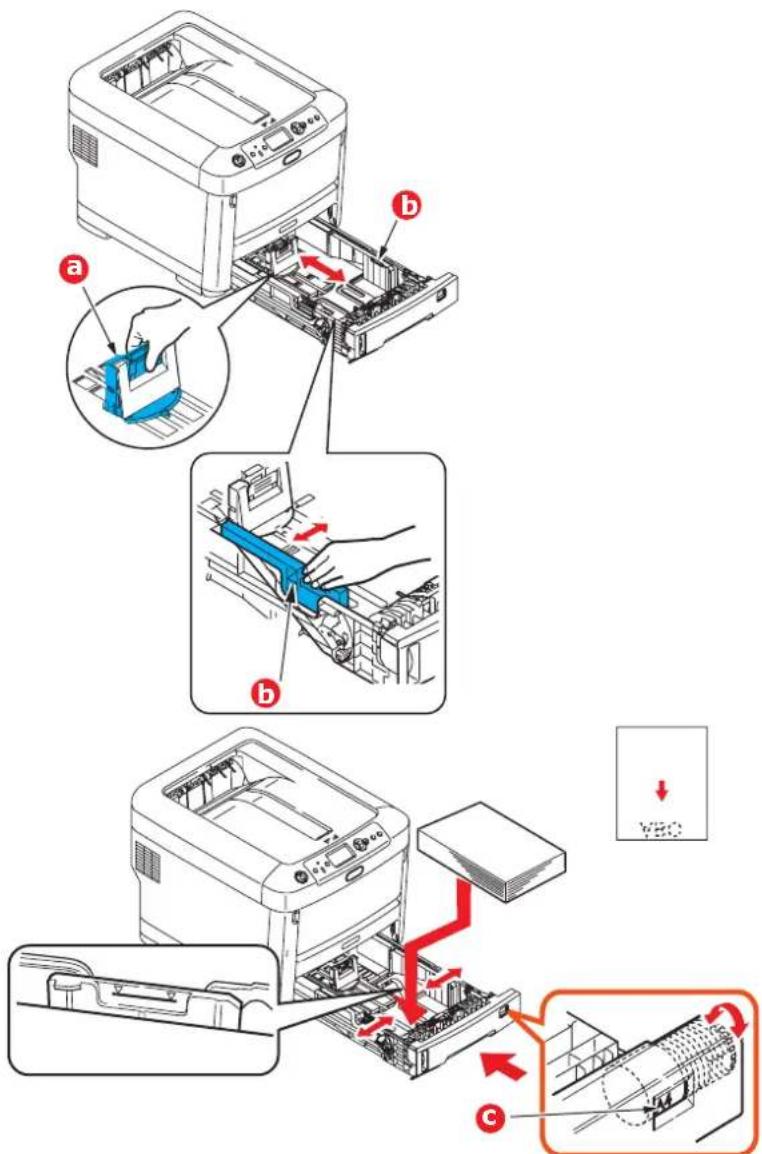
Illustration showing three-step folding process: folding paper, folding paper with red arrows indicating movement, and folding paper with red curved arrow indicating rotation.- Load paper (letter headed paper face down and top edge towards the front of the printer), as shown.
text_image
Technical diagram illustrating the process of printer assembly and internal processing steps, labeled with arrows and numbered components.Adjust the rear stopper (a) and paper guides (b) to the size of paper being used.
CAUTION!
IMPORTANT: Set paper size dial (c) to the size of paper being used (A4 in the above example).
To prevent paper jams:
Do not leave space between the paper and the guides and rear stopper.
Do not overfill the paper tray. Capacity depends on the type of paper stock.
Do not load damaged paper.
Do not load paper of different sizes or types at the same time.
Close the paper tray gently.Do not pull the paper tray out during printing (except as described below for the 2nd tray).
NOTE
If you have two trays and you are printing from the 1st (upper) tray, you can pull out the 2nd (lower) tray during printing to reload it. However, if you are printing from the 2nd (lower) tray, do not pull out the 1st (upper) tray. This will cause a paper jam.
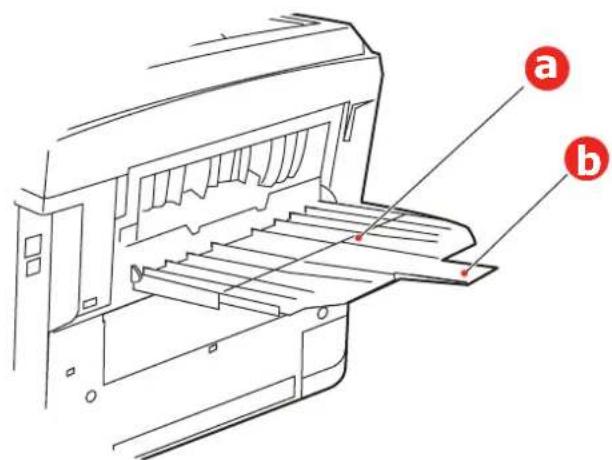
For face down printing, make sure the face up (rear) stacker (a) is closed (the paper exits from the top of the printer). Stacking capacity is approximately 350 sheets, depending on paper weight.
For face up printing, make sure the face up (rear) stacker (a) is open and the paper support (b) is extended. Paper is stacked in reverse order and tray capacity is approximately 100 sheets, depending on paper weight.
Always use the face up (rear) stacker for heavy paper (card stock, etc.).
text_image
Technical diagram of a printer internal structure with labeled parts a and bCAUTION!
Do not open or close the rear paper exit while printing as it may result in a paper jam.
MULTI PURPOSE TRAY
- Open the multi purpose tray (a).
- Fold out the paper supports (b).

text_image
Technical diagram of a printer with labeled parts and red arrows indicating internal components- Press gently down on the paper platform (c) to ensure it is latched down.
- Load the paper and adjust the paper guides (d) to the size of paper being used.
For single-sided printing on headed paper load the paper into the multi purpose tray with pre-printed side up and top edge into the printer.
Transparency and transfer media should be loaded face up into the printer.
Do not exceed the plain paper capacity of about 100 sheets. Maximum stacking depth is 10mm.
-
Press the tray latch button inwards to release the paper platform, so that the paper is lifted and gripped in place.
-
Set the correct paper size for the multi purpose tray in the Media Menu. (See "Menu functions" on page 42.)
HOW TO ACCESS THE DRIVER SCREENS
Most of the features described are accessed via the printer driver screens. How you access them depends on your computer and its operating system.
The driver windows are dialogue boxes offering a wide range of choices about how you want to print your documents. Within Windows these dialogue boxes are tabbed, within Mac the dialogue boxes use pop-up menus.
NOTE
Example driver screenshots are used throughout this manual and as such may not represent the driver screens for your machine. Some of the features shown on the example screenshots may not be available on your machine.
There are two ways to access the driver features from within Windows:
- Directly from the Windows "Printers" folder ("Printers and Faxes" folder in Windows XP and Vista, "Devices and Printers" folder in Windows 7).
If you choose this method any changes you make will become the driver defaults. This means they will remain active for all your applications unless you specifically change them from within the application's Print dialogue.
- From your application's Print dialogue.
If you choose this method any changes you make will usually only last for as long as the particular application is running, or until you change them again. In most cases, once you quit the application the driver defaults will return.
NOTE
Settings made from the printer's own control panel are the printer defaults. They determine how your printer will behave unless you specify otherwise from your computer.
The driver defaults override the printer defaults.
Application Print settings override both the printer defaults and the driver defaults.
PRINTING PREFERENCES IN WINDOWS APPLICATIONS
When you choose to print your document from a Windows application program a print dialogue box appears. This dialogue usually specifies the name of the printer on which you will print your document. Next to the printer name is a Properties button.
When you click Properties a new window opens which contains a short list of the printer settings available in the driver, which you can choose for this document.
The window which opens when you click Properties depends on which printer driver has been installed.

text_image
Print Name: Printer Name Status: Type Type: Where: Comment: Page range □ All □ Correct page □ Complete □ Pages: Enter pages numbers and/or page ranges separated by commas. For example: 1.3.5-12 Pages Number of pages: □ Collage Zone: Pages per object: □ Page Scale to paper size: □ No Scaling Print sheet: Document Page: All pages in range Options... OK ClosePOSTSCRIPT EMULATION
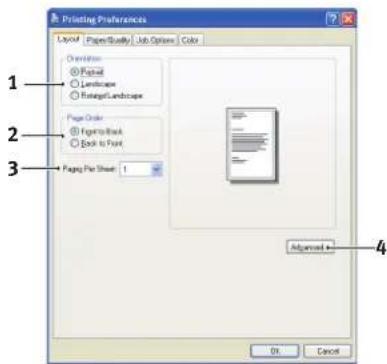
-
Page orientation sets portrait (tall) or landscape (wide) page orientation. The "rotated" rotates the paper through 90 degrees anticlockwise.
-
Pages can be printed in forward or reverse order. If using the face down (top) paper stacker, forward order is usually appropriate to ensure that pages are stacked in numerical order. If using the face up (rear) paper stacker, reverse order would normally stack your pages in numerical order.
-
You can specify how many pages to print on a sheet. Pages will be scaled to fit the number you choose.
text_image
Printing Preferences Layout Paper Quality Job Options Color Orientation ● Platform ○ Landscape ○ Layout/Landscape Page Order ● Page to Back ○ Back to Front Page Per Sheet 1 Advanced → OK Cancel- Advanced options are also available, such as how to download TrueType fonts, and whether advanced options such as booklet printing are available.
The printer driver contains extensive on-line help for these items to help you make the most appropriate choices.
CHANGING THE DRIVER DEFAULTS
Windows XP/2000
- Click Start > Settings > Printers and Faxes to open the Printers and Faxes window.
- In the Printers and Faxes window, right-click on the appropriate printer driver icon, and choose Printing Preferences from the context menu.
Windows Vista
- Click Start > Control Panel > Printers to open the Printers and Faxes window.
- In the Printers and Faxes window, right-click on the appropriate printer driver icon, and choose Printing Preferences from the context menu.
Windows 7
- Click Start > Devices and Printers to open the Devices and Printers window.
- In the Devices and Printers window, right-click on the appropriate printer driver icon, and choose Printing Preferences from the context menu.
CHANGING THE APPLICATION'S DRIVER SETTINGS
Windows
- In your application, open the file you want to print.
- On the File menu, choose Print....
- In the application's Print dialogue, make sure the printer shown is the appropriate one, and click Properties.
Mac
- In your application, open the file you want to print.
- On the File menu, choose Print....
- In the application's Print dialogue, make sure the printer shown is the appropriate one, and click Printer:.
SETTING THE DRIVER DEVICE OPTIONS
This section explains how to ensure that your printer driver can utilize all of the hardware features installed in your printer.
Accessories such as additional paper trays will only be usable if the printer driver on your computer knows they are there.
In some cases the hardware configuration of your printer is automatically detected when the driver is installed. However, it is advisable to at least check whether all of the available hardware features are listed in the driver.
This procedure is essential if you subsequently add extra hardware features to your printer after the drivers have been installed and set up.
Remember that if your machine is shared between users on different computers, the driver must be adjusted on each user's machine.
WINDOWS
- Access the driver's Properties window. (See "Changing the driver defaults" on page 21.)
- Select the Device Options tab.
In the Windows XP PostScript driver the tab may be called "Device Settings". - Set the options for any devices you have installed, including the correct number of paper trays, high capacity feeder, etc.
- Click OK to close the window and save your changes.
MAC OS X
- Open the Printer Setup Utility and ensure that your printer model is selected.
- Choose Printers > Show Info > Installable Options.
- Select all hardware options appropriate to your printer, and click Apply Changes.
COLOR SETTING
COLOR MODE
You can select Color Print or Gray Scale (White) Print for the color mode.
COLOR PRINT
Select this when printing in color.
Windows
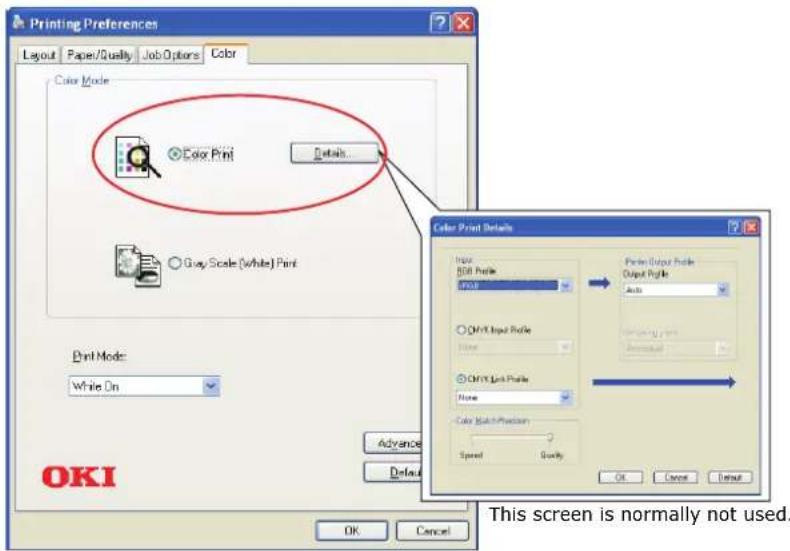
-
On the print dialog box, click the Color tab.
-
Under Color Mode, select Color Print.
text_image
Printing Preferences Layout Paper/Quality Job Options Color Color Mode Color Print Details Gray Scale (White) Print Print Mode: White On Advance Delete OK Cancel Color Print Details Input 800 Profile RGB Output Profile None Output Image Cancaster Color Output Profile Output Profile None Cancaster OK Cancel Cancel This screen is normally not used.Color Print Details
This screen is normally not used.
Your printer performs color matching by using an ICC profile. However, you cannot specify input and output profiles by downloading a specific ICC profile, as your printer uses a special link profile which considers the use of white toner.
Use the built-in color matching function of your application when you need to specify an input profile for color matching.
Mac OS X
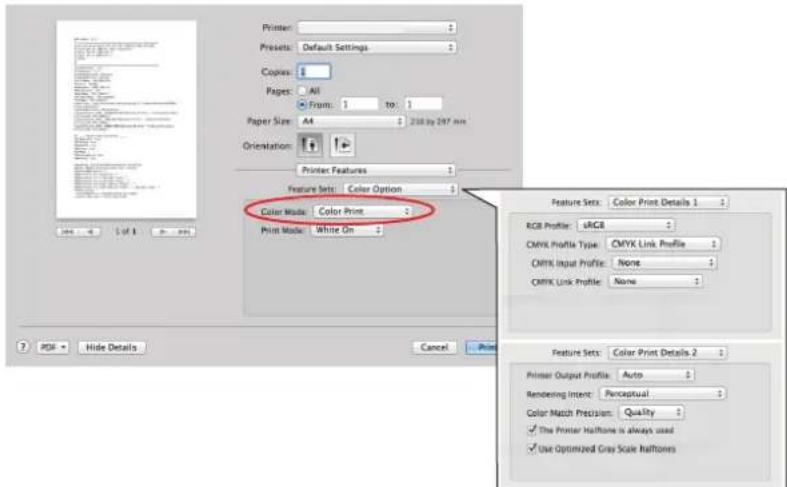
- On the print dialog box, select the Printer Features panel.
- From the Feature Sets menu, select Color Option.
- From Color Mode, select Color Print.
text_image
Printer: Presets: Default Settings Copies: Pages: All From: 1 to: 1 Paper Size: A4 238 by 267 mm Orientation: Printer Features Feature Sets: Color Option Color Mode: Color Print Print Mode: White On Color Print Details 1 RGB Profile: uRGB CMYK Profile Type: CMYK Link Profile CMYK Input Profile: None CMYK Link Profile: None Feature Sets: Color Print Details 2 Primer Output Profile: Auto Rendering Intent: Conceptual Color Match Precision: Quality The Printer Haltone is always used Use Optimized Gray Scale HaltonesThis screen is normally not used.
Color Print Details 1,2 panel
This screen is normally not used.
Your printer performs color matching by using an ICC profile. However, you cannot specify input and output profiles by downloading a specific ICC profile, as your printer uses a special link profile which considers the use of white toner.
Use the built-in color matching function of your application when you need to specify an input profile for color matching.
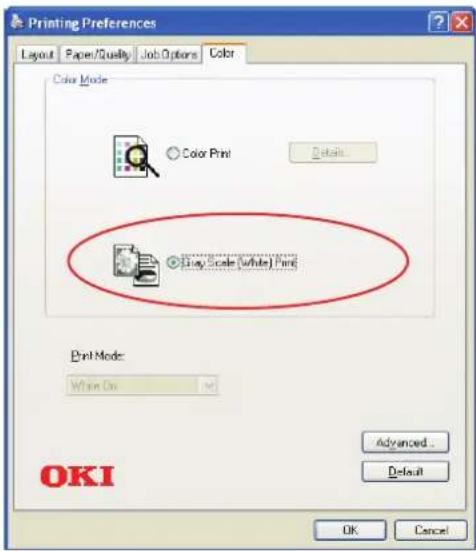
GRAY SCALE (WHITE) PRINT
Select this when printing documents using only white toner without using CMY toner.
NOTE
To use this setting, you need to create data as gray scale data in an application. Save data with the gray scale or monochrome mode. The color data cannot be converted to Gray Scale (White) Print automatically.
Windows
- On the print dialog box, click the Color tab.
- Under Color Mode, select Gray Scale (White) Print.
text_image
Printing Preferences Layout Paper/Quality Job Options Color Color Mode Color Print Details Gray Scale (White) Print Print Mode: White On Advanced OKI Default OK CancelMac OS X
- On the print dialog box, select the Printer Features panel.
- From the Feature Sets menu, select Color Option.
- From Color Mode, select Gray Scale (White) Print.

text_image
Printer: Presets: Standard Copies: 1 Collated Pages: All From: 1 to 1 Paper Size: A4 20.99 by 29.70 cm Orientation: Printer Features Feature Sets: Color Option Color Mode: Gray Scale (White) Print Print Mode: White On PDF 1 of 92 Cancel PrintPRINT MODE
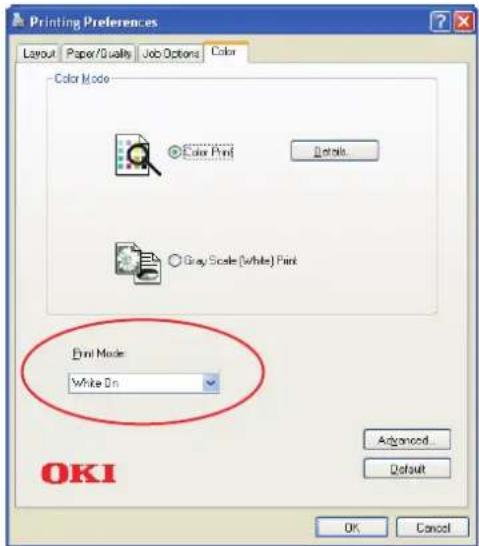
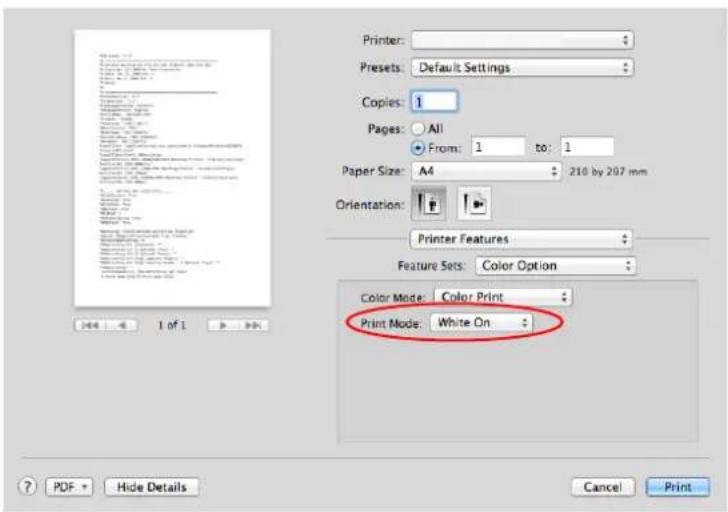
You can specify whether to use white toner for printing when Color Print is selected.
WHITE ON
Selecting this prints documents using white toner. The object whose color is explicitly set to white is printed with white toner. White On is used when the background color of print media is not white.
WHITE OFF
Selecting this prints documents without using white toner. The white toner is not used for the object whose color is explicitly set to white. White Off is used when the background color of print media is white.
NOTE
When Gray Scale (White) Print is selected, white toner is used regardless of the Print Mode setting.
Windows
-
On the print dialog box, click the Color tab.
-
From Print Mode, select your preferred setting.
text_image
Printing Preferences Layout Paper/Quality Job Options Color Color Mode ● Color Print Details ● Gray Scale (White) Print Print Mode Write On Advanced Default OK Cancel OK CancelMac OS X
- On the print dialog box, select the Printer Features panel.
- From the Feature Sets menu, select Color Option.
- From Print Mode, select your preferred setting.
text_image
Printer: Presets: Default Settings Copies: 1 Pages: All From: 1 to: 1 Paper Size: A4 210 by 207 mm Orientation: Printer Features Feature Sets: Color Option Color Mode: Color Print Print Mode: White On PDF Hide Details Cancel PrintFINISHING OPTIONS
Your printer offers a wide selection of document finishing options that help you to control the final form of your printed document.
For detailed information on finishing options see:
"Collating" on page 29
"Separating queued print jobs" on page 31
"Cover print" on page 32
"Custom page size" on page 33
"Printing multiple pages on one sheet (n-up)" on page 35
"Scale to page" on page 37
"Transfer/transparency film printing" on page 38
COLLATING
This feature allows multiple copies of a multipage document to be printed with the pages of each copy in sequence.
Uncollated pages print like this

Collated pages print like this

text_image
Diagram showing three layered document page designs with horizontal lines and numbered sections 1, 2, and 3.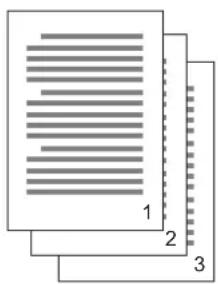
text_image
Diagram showing three layered document page designs with horizontal lines and a vertical ruler for scale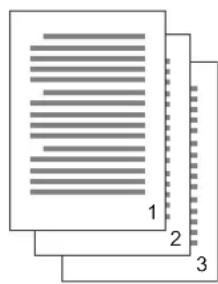
text_image
Diagram showing a document with horizontal lines and numbered sections 1, 2, and 3, likely illustrating a page layout or section numbering system.Application collate—Some application programs have a collate feature in their print options. In this case the application performs the document collation and may send the job multiple times to the printer. Generally, this method is slower but can be more reliable.
Printer collate—This section describes the collate function built into the printer driver. In this case the job is stored temporarily in printer memory, and the printer performs collation. This method is normally faster, but may not work from all applications.
If you experience problems using printer collate, use the collate option in your application's print options instead.
WINDOWS
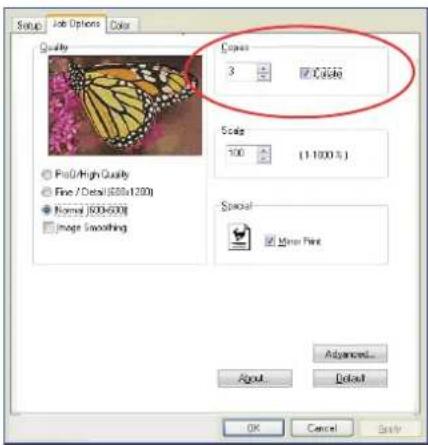
- In the Job Options tab, choose how many copies you want to print from the scrolling list.
text_image
Setup Job Options Color Quality Covers 3 Color Scale 100 (1-1000 %) Special Inner Print Advanced... About... Default OK Cancel Finish- Click the Collate checkbox.
MAC OS X
- Select Printer Features (1).

text_image
Printer: Presets: Standard Printer Features Feature Sets: Job Options Quality: Normal(600x600) Image Smoothing Collate Page Rotate Mirror Print Adjust ultra fine lines PDF Preview Cancel Print- From the Feature Sets menu (2), select Job Options.
- Select the Collate checkbox (3) to enable printer collate.
NOTE
The Collate option in the Copies & Pages dialogue is for application collate. See page 29.
SEPARATING QUEUED PRINT JOBS
When you share a printer with other users it can be useful to print a special page between print jobs to help locate each user's job in a paper stack at the printer. In Windows this page is called a "separator page". On the Mac it is called a "cover page".
NOTE
Do not confuse Cover Page with "Cover Print". Cover Print is when the first page (cover) of a print job is fed from one paper tray, and the remaining pages of the print job are fed from a different tray. See "Cover print" on page 32.
WINDOWS SEPARATOR PAGE
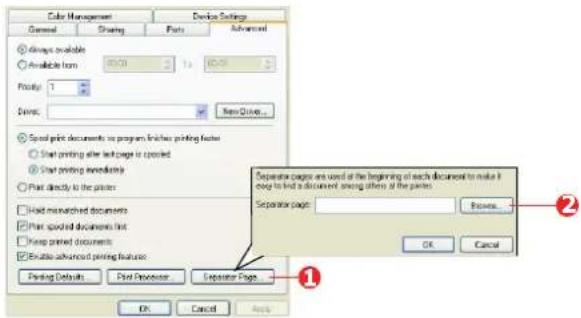
The separator page is set from the printer driver's default properties window. Access to this is directly from Windows, not from within your application program. See "Changing the driver defaults" on page 21.
text_image
Color Management General Sharing Parts Advanced Always available Available from 80 GB 1x 80 GB Priority: Drive: New Drive... Special print documents: no program finishes printing factor Start printing after left page or spaced Start printing immediately Print directly to the printer Hold monarchized documents Print spoted documents list Keep printed documents Enable advanced printing features Separate pages are used at the beginning of each document to make it easy to find a document among others at the printer. Separate page: Browse... OK Cancel Printing Details Print Processor Separator Page OK Cancel Apply-
In the driver's Advanced tab click the Separator Page... button (1).
-
Click Browse (2) and navigate to a file containing an image of the separator page you wish to use, then click OK.
MAC OS X COVER PAGE
The cover page is accessed from your application's print dialogue.

text_image
Printer: Presets: Standard Cover Page Print Cover Page: None Before document After document Cover Page Type: Standard Billing Info:-
Select Cover Page (1).
-
Select the required options for the cover page (2).
COVER PRINT
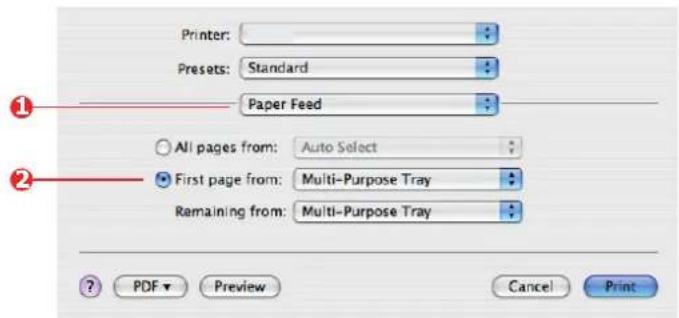
Cover print is when the first page (cover) of a print job is fed from one paper tray, and the remaining pages of the print job are fed from another paper tray.
This feature is not available in the Windows PostScript Drivers.
Do not confuse Cover Print with "Cover Page". A Cover Page is an identification sheet inserted between the print jobs of a network printer. See "Separating queued print jobs" on page 31.
Mac OS X
- Select Paper Feed (1).
text_image
Printer: Presets: Standard Paper Feed All pages from: Auto Select First page from: Multi-Purpose Tray Remaining from: Multi-Purpose Tray ? PDF ▼ Preview Cancel Print- Select the trays or paper types you wish to use for the first page and remaining pages (2).
CUSTOM PAGE SIZE
This feature enables printing on non-standard sized print media.
The multipurpose tray is used for feeding non-standard media sizes. Print media width can be from approximately 64mm to 216mm, and its length can be from 127mm to 355.6mm. Actual limits vary slightly depending on which printer driver you use and your computer's operating system.
Some applications software may not produce the desired results with non-standard print media sizes, and some experimentation may be required to obtain the results you want.
WINDOWS POSTSCRIPT
- In the driver's Layout tab, click Advanced.

text_image
Layout Paper/Quality Job Options Colour Diminiation ● Portrait ○ Landscape ○ Rotated/Landscape Page Order ● Front to Back ○ Back to Front Pages Per Sheet: 1 OK! Printer Advanced Document Settings Paper/Output Paper Size: PrintScript Size Edit Custom Page Size Graphic Image Color Management ECM Method: ECM Disabled ECM Intent: Pictures TrueType Font: Substitute with Device Font Document Options Advanced Printing Features: Enabled PostScript Options Printer Features Page Rotates: Normal Media Checks On Moda Type: Use Paper Settings Custom Page Size Dimensions Width: 210.00 (76.20, 328.08) Height: 257.00 (89.96, 130.15) Unit ● Inch ● Millimeter ● Point Paper Feed Direction: Short Edge First Paper Type: ● Cut Sheet ● Roll Feed: Offsets Relative to Paper Feed Direction Ferrpendicular Direction: 0.00 (0.00, 0.00) Parallel Direction: 0.00 (0.00, 0.00) OK Cancel Restore Defaults-
In the Advanced Options window, under Paper/Output, choose PostScript Custom Page Size from the Paper Size drop-down list.
-
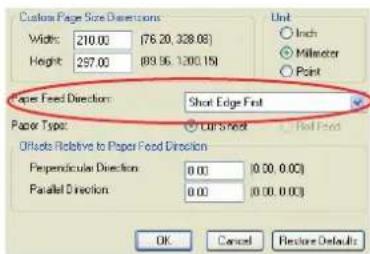
In the PostScript Custom Page Size Definition window, Choose your paper feed direction from the dropdown list.
The available choices are:
Short edge first The page is portrait (tall) format and you will feed the top of the page into the printer.
Long edge first The page is landscape (wide) format and you will feed the top of the page into the printer.
Short edge first flipped The page is portrait (tall) format and you will feed the bottom of the page into the printer.
Long edge first flipped The page is landscape (wide) format and you will feed the bottom of the page into the printer.
text_image
Custom Page Size Dimensions Width: 210.00 (76.20, 328.08) Height: 257.00 (89.56, 1200.18) Unit ○ Inch ● Millimeter ○ Point Paper Feed Direction: Shot Edge First Paper Type: ○ Cut Sheet ○ Roll Feed Offsets Relative to Paper Feed Direction: Appendicule Direction: 0.00 (0.00, 0.00) Parallel Direction: 0.00 (0.00, 0.00) OK Cancel Remove DefaultsNotice that the size ranges available swap places when you change the paper feed direction between a portrait and a landscape choice.
Remember that the width of the multipurpose tray is limited to the width of an A3 sheet (297mm), so if your paper is longer than this you will have to feed it short edge first.
- You can also position the page image on the paper to avoid printing too close to the edge by choosing an Offset.
Offset relative to perpendicular direction adds to your left margin.
Offset relative to parallel direction adds to your top margin (normal feed) or bottom margin (flipped feed).
- Click OK to close the PostScript Custom Page Size Definition window.
- Click OK to close the Advanced Options window.
- In the driver's window, choose the Multi-Purpose Tray as the Paper Source.
Mac OS X
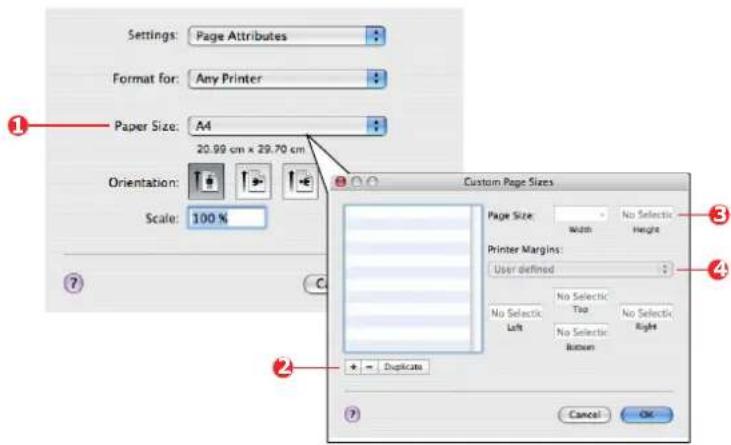
- In your application program, choose File > Page Setup.
text_image
Settings: Page Attributes Format for: Any Printer Paper Size: A4 20.99 cm x 29.70 cm Orientation: Scale: 100 % Custom Page Sizes Page Size: Width No Selectic Height Printer Margins: User defined No Selectic Top No Selectic Right Left No Selectic Bottom Duplicate Cancel OK- Select Manage Custom Sizes (1).
- Click the + button (2) to define a new paper size and enter a name for the paper size.
- Enter the Width and Height (3) of your paper.
- Specify paper margins (4) as required.
- Click OK to save the new paper size.
PRINTING MULTIPLE PAGES ON ONE SHEET (N-UP)
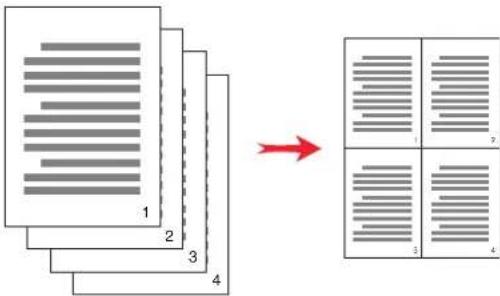
This feature scales the page size of your document for printing and reproduces several pages per sheet.
This is useful when you simply want to proof your page layout, or distribute your document in a more compact format. It saves paper, bulk, weight and cost.
text_image
Diagram illustrating document structure transformation, showing a stack of documents with numbered sections and a red arrow indicating the process.WINDOWS POSTSCRIPT
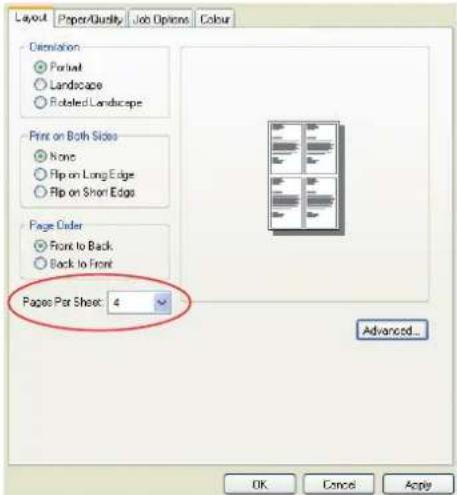
In the driver's Layout tab, choose the number of pages (N-up) you want to print on each sheet. 1-up is normal, 16-up is maximum.
text_image
Layout Paper/Quality Job Options Colour Orientation ● Parval ○ Landscape ○ Rotated Landscape Print on Both Sides ● None ○ Flip on Long Edge ○ Flip on Short Edgs Page Order ● Front to Back ○ Back to Front Pages Per Sheet: 4 Advanced...MAC OS X
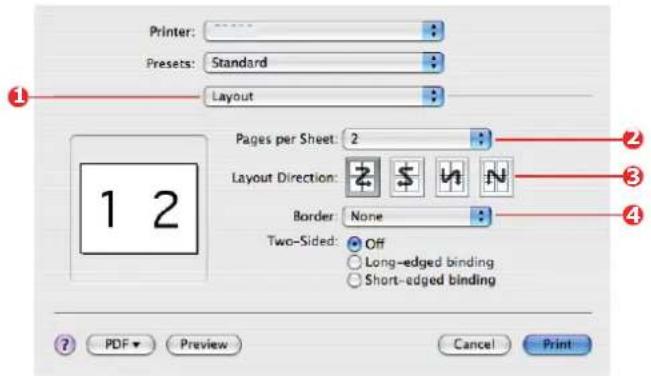
1. Select Layout (1).
text_image
Printer: Presets: Standard Layout Pages per Sheet: 2 Layout Direction: Border: None Two-Sided: Off Long-edged binding Short-edged binding PDF Preview Cancel Print- From the Pages per Sheet menu (2), select the number of pages you want to fit onto a single sheet of paper.
- If required, change the direction (3) the document pages are laid out on each sheet of paper.
- If required, you can surround each page with a border (4).
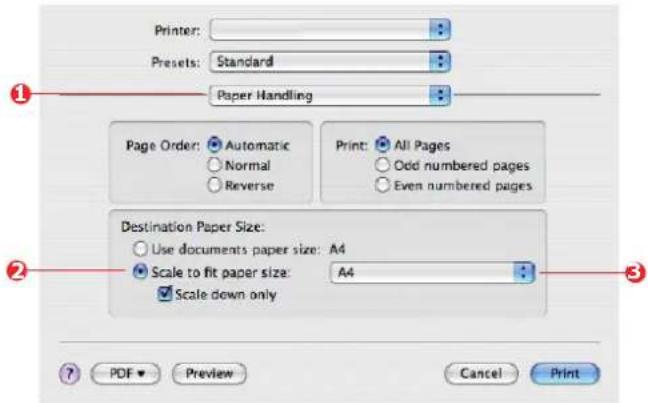
SCALE TO PAGE
Scale to Page allows you to print data formatted for one size page onto a different size page, without modifying the print data.
This feature is not available with the Windows PS driver.
MAC OS X
- Select Paper Handling (1).
text_image
Printer: Presets: Standard Paper Handling Page Order: Automatic Normal Reverse Print: All Pages Odd numbered pages Even numbered pages Destination Paper Size: Use documents paper size: A4 Scale to fit paper size: A4 Scale down only PDF Preview Cancel Print-
Check the Scale to Fit Paper Size checkbox (2).
-
Choose the paper size you need from the drop-down list (3).
TRANSFER/TRANSPARENCY FILM PRINTING
This feature enables printing on transfer or transparency film.
The multipurpose tray is used for feeding film media.
WINDOWS
- In the driver's Paper/Quality tab, click Advanced, and select the required film size from the Paper Size drop-down list.

text_image
OK! Printer Advanced Options OK! Printer Advanced Document Settings Paper Layout Paper Size: PostScript Custom Edit Custom Page Size Graph Image Color Management ICM Method: ICM Enabled ICM Intent: Pictures True Type Font: Substitute with Design Font Document Options Advanced Printing Features: Enabled PostScript Options Printer Features Page Romania General Media Checks On Media Type: Use Printer Settings For image how to be loaded or saved from the OK Cancel-
In the same window, select the Films from the Printer Features - Media Type drop-down list.
-
Click OK to close the Advanced Options window.
-
From the Source drop-down list select Multi-Purpose Tray.
MAC OS X
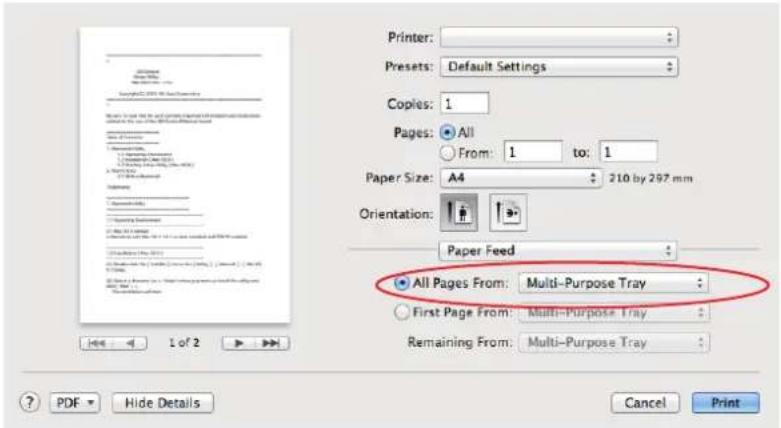
- In the driver's window, select the Multi-Purpose Tray from the All Pages From drop-down list.
text_image
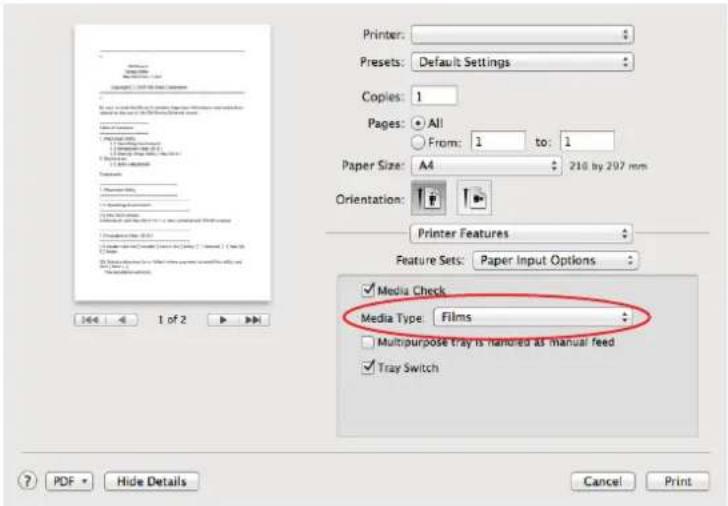
Printer: Presets: Default Settings Copies: 1 Pages: All From: 1 to: 1 Paper Size: A4 210 by 297 mm Orientation: Paper Feed All Pages From: Multi-Purpose Tray First Page From: Multi-Purpose Tray Remaining From: Multi-Purpose Tray PDF Hide Details Cancel Print- Move to the Printer Features window, select the Films from the Media Type drop-down list in the Feature Sets: Paper Input Options.
text_image
Printer: Presets: Default Settings Copies: 1 Pages: All From: 1 to: 1 Paper Size: A4 216 by 297 mm Orientation: Printer Features Feature Sets: Paper Input Options Media Check Media Type: Films Multipurpose tray is handled as manual feed Tray Switch PDF Hide Details Cancel PrintHOW TO PRINT WITH APPLICATION SETTING
To print image data without the white background, you need to configure the application setting. If printing image data without configuring the application setting, white is printed on the whole background of the image.
The following pages explain how to configure the setting in the Adobe applications.
ADOBE PHOTOSHOP
This section describes how to print the image data without white background by Adobe Photoshop CS.
- Load the image data.
- Click the all of background to make a selection area for background by using Magic wand function.
- Perform the Inverse menu to make a selection area for print after selection area for background was made.
- Click the arrow of Paths and perform the Make Work Path menu.
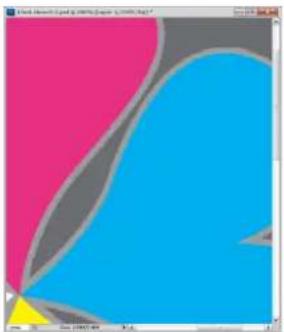
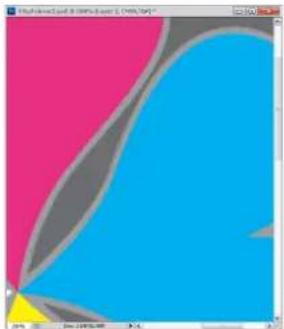
- Input the value of Tolerance.
NOTE
If you want to select only printable image, you should use small value, like 0.5. If you want to select printable image together with the white edge, 2.0 is maybe good value.
Example:
Tolerance is 0.5.
natural_image
Abstract color block design with pink, blue, and gray shapes (no text or symbols)It is minimum edge but not smooth.
Tolerance is 2.0.
natural_image
Abstract graphic with pink, blue, and gray shapes (no text or symbols)It is smooth but you can see white on the edge.
- Click the arrow of Paths and perform the Save Path menu.
Click OK to save Working Path as Path 1.
- Click the arrow of Paths and perform the Clipping Path menu.
Click OK to select Path 1 as Clipping Path.
-
Save the image data by Photoshop format (PSD).
-
Select the Print with Preview menu.
-
Select the No Color Management in Color Handling options then click Print to print the image data.
ADOBE ILLUSTRATOR
This section describes how to print the image data without white background by Adobe Illustrator CS.
- Load the image data.
- Create a path around the area of the placed picture image that you want to mask.
- Select the created path and the picture image, and create a clipping mask.
- Save the image data.
NOTE
Do not apply overprint settings for the object's fill and stroke. Otherwise they may be printed in unexpected color. Be sure to clear the overprint check boxes in the attributes panel.
MENU FUNCTIONS
This section lists the menus accessed via the controls on the printer's operator panel and displayed in the LCD window.
OPERATOR PANEL:

text_image
1 2 3 4 5 6 7 8 9 10 POWER SAVE / WAVE UP READY HELP ATTENTION Ready To Print Toner W M Y C MENU BACK ENTER ON LIME CANCEL| 1. Ready LED ON: | Ready to receive data.BLINKING: Processing data.OFF: Offline. | 2. Display Displays the printer status and any error messages. |
| 3. Menu Scroll Buttons | Enters the Menu mode. In Menu mode, forwards or reverses the menu item displayed.Press for 2 secs. or longer to jump from top to bottom. | 4. On Line Button Switches between ONLINE and OFFLINE.Exits the menu and goes ONLINE when pressed in the Menu mode.Scrolls the HELP screen.Forces printing on the paper currently loaded when pressed with "WRONG PAPER" or "WRONG PAPER SIZE" displayed. |
| 5. Attention LED ON: | A warning occurs.Printing may be possible (e.g low toner).BLINKING: An error occurs.Printing not possible (e.g. toner empty).OFF: Normal condition. | 6. Back Button Returns to the previous higher level menu item.Pressing this button for more than 4 seconds initiates the printer shutdown procedure, select Yes to continue or No to abort. |
| 7. Enter Button | In the ONLINE or OFFLINEmode: enters the Menu mode.In the Menu mode:determines the setting selected. | 8. Cancel Button Deletes the data being printed or received when pressed for two seconds or longer.Deletes the data when pressed for two seconds or longer with WRONG PAPER SIZE, RUN OUT OF PAPER, TRAY 1 IS OPEN, or TRAY 1 IS NOT FOUND is displayed.Exits the menu and goes ONLINE when pressed in the Menu mode. |
| 9. Help Button Provides advice when an error such as incorrect paper size occurs. | 10. Power Save/Wake Up ButtonPressing this button switches the machine into sleep or wake-up mode. Refer to "Power saving mode" on page 12. | |
HOW TO CHANGE THE SETTINGS - USER
It should be noted that many of these settings can be, and often are, overridden by settings in the printer drivers. However, several of the driver settings can be left at "Printer Setting", which will then default to the settings entered in these printer menus.
Where applicable, factory default settings are shown in bold type in the following tables.
In the normal operating condition, known as "standby," the printer's LCD window will show Ready to Print. In this condition, to enter the menu system, press the up and down Menu buttons on the operator panel to move up and down through the list of menus until the menu you wish to view is displayed. Then proceed as follows:
- Press Enter to enter the menu.
- Use the up and down MENU buttons on the control panel to scroll through the menus. When the item you want to change is displayed, press Enter to view the sub-menus for that item.
- Use the up and down MENU buttons to move up and down through the sub-menu items. When the item you want to change is displayed press Enter to display the setting.
-
Use the up and down MENU buttons to move up and down through the available settings for the sub-menu item. When the item you want to change is displayed press Enter to display the setting. An asterisk (*) will appear next to the setting, indicating that this setting is currently in effect.
-
Do one of the following:
Press Back again to move up to the list of menus;
or...
Press On Line or Cancel to exit from the menu system and return to standby.
HOW TO CHANGE THE SETTINGS - ADMINISTRATOR
You can set whether to ENABLE or DISABLE each category in the user menu.
Disabled categories are not displayed in the User's menu. Only a system administrator can change these settings.
-
Turn OFF the printer. Turn ON the printer while pressing the Enter button. When Boot Menu appears, take your finger off the button.
-
Press the Enter button.
-
At the Enter Password prompt, enter the Admin password:
(a) Using the up and down MENU buttons, scroll to the required letter/digit.
(b) Press the Enter button to input and move to the next letter/digit.
(c) Repeat steps (a) and (b) until all letters/digits are entered.
Enter your 4 to 9 digit password.
(The default password is aaaaaa).
- Press the Enter button.
- Press the up or down MENU button until the "category" you want to change is displayed.
- Press the Enter button.
- Press the up or down MENU button until the "item" you want to change is displayed.
-
Press the Enter button.
-
Using the up or down MENU button, identify the parameter as required.
-
Press the Enter button. An asterisk (*) will appear next to the setting, indicating that this setting is currently in effect.
-
Press the On Line button to switch to online. The machine will automatically reboot.
CONFIGURATION MENU
| ITEM ACTION EXPLANATION | ||
| Tray Count Tray1 | Tray 2*Tray 3*MP Tray*Note: Only available when optional trays are present | Select an item to display the total number of pages printed from the relevant tray. |
| Supplies Life Cyan Drum | Magenta DrumYellow DrumWhite DrumBeltFuserCyan TonerMagenta TonerYellow TonerWhite Toner | Select item to display the percentage of a consumable remaining. |
| Network Printer Name | Short Printer NameIPv4 AddressSubnet MaskGateway AddressMAC AddressNetwork FW VersionWeb Remote VersionIPv6 Address(Local)IPv6 Address(Global) | Displays the full printer name.Displays an abbreviated version.Displays the IPv4 Address of the network.Displays the Subnet Mask of the network.Displays the Gateway Address of the network.Displays the MAC Address of the printer.Displays the Network firmware revision.Displays the Web remote version.Displays the IPv6 Address(Local) of the network. ^a Displays the IPv6 Address(Global) of the network. ^a |
| System Serial Number | Asset NumberLot NumberCU VersionPU VersionTotal MemoryFlash MemorySD CardDate and Time | Displays information for these items. |
a. Display condition: IP Version is IP v4+v6 or IP v6.
PRINT INFORMATION MENU
This menu provides a quick method of listing various items stored within the printer.
| ITEM ACTION EXPLANATION | ||
| Configuration Execute Select execute to print out a configuration report. | ||
| Network Execute Scroll down to this parameter and select execute to print out Network information. | ||
| Demo Page DEMO1 Execute Scroll down to this parameter and select execute to print out a demonstration page. | ||
| File List | Execute | Scroll down to this parameter and select execute to print out a list of job files.(displayed only if FileSystem is installed). |
| PS Font List Execute Scroll down to this parameter and select execute to print out a Postscript emulation typeface list. | ||
| Error Log | Execute | Scroll down to this parameter and select execute to print out the error log. |
| Color Profile List | Execute | Scroll down to this parameter and select execute to print out a list of colour profiles. |
SHUTDOWN MENU
This item should always be selected before switching the printer off, to ensure that no data is lost.
| ITEM SETTINGS EXPLANATION | ||
| Shutdown Start | Execute | Performs controlled shutdown of the printer.Only power the printer off when the display indicates that shutdown is complete. |
MENUS
| ITEM ACTION EXPLANATION | ||
| Tray Configuration Paper | FeedDefault: Tray 1 | Select tray. Select by scroll and Enter button. |
| Auto Tray SwitchDefault: On | Switches Auto ON/OFF. Select by scroll and Enter button. | |
| Tray SequenceDefault: Down | Selects Tray sequence Down/Up/Paper feed Tray. Select by scroll and Enter button. | |
| Unit of MeasurementDefault: millimeter | Selects UOM Inches or millimeter. Select by scroll and Enter button. | |
| Tray1 ConfigDefault:Paper Size: Cassette/CustomMedia Type: Plain/Letterhead/Bond/Recycled/CardStock/Rough/Glossy/USERTYPE 1-5Media Weight: Light/MediumLight/Medium/Heavy/UltraHeavy1/UltraHeavy2 | Configure Paper Size/Media Type/Media Weight. Select by scroll and Enter button.USER TYPE 1 to 5 are displayed only if registered in the host PC. | |
| ITEM ACTION EXPLANATION | ||
| Tray Configuration (cont.) | MPTray Config Configure Paper Size/Media Type/MediaWeight/Tray Usage. Select by scroll and Enter button.Paper Size: A4/A5/A6/B5/Legal14/Legal13.5/Legal13/Letter/Executive/Custom/Com-9Envelope/Com-10 Envelope/MonarchEnvelope/DLEnvelope/C5/Index CardMedia Type: Plain/Letterhead/Films/Labels/Bond/Recycled/CardStock/Rough/Glossy/USERTYPE 1-5Media Weight: Light/MediumLight/Medium/Heavy//UltraHeavy1/UltraHeavy2/UltraHeavy3Tray Usage: When Mismatching/Do Not Use | USERTYPE 1 to 5 are displayed only if registered in the host PC.Paper weight 189 250g/m^2 Sets MPTray usage.When Mismatching: if paper mismatch occurs, paper is requested from the MPTray instead of the specified tray.Do Not Use: sets MPTray unavailable both in Auto Tray Select and Auto Tray Switch. |
| Tray 2 Config*Tray 3 Config* | *Note: only present if option installed. | |
| System Adjust Power | Save TimeDefault: 30 | Select from 1/2/3/4/5/10/15/30/60/120 Minutes.Select by scroll and Enter button. |
| Sleep TimeDefault: 10 | Select from 1/2/3/4/5/10/15/30/60/120 Minutes.Select by scroll and Enter button. | |
| Clearable WarningDefault: ONLINE | Select from: ONLINE/Job. Select by scroll and Enter button. PS job only. | |
| Auto ContinueDefault: Off | Select from On/Off. Select by scroll and Enter button. | |
| Manual TimeoutDefault: 60 | Select from Off/30 seconds/60 seconds.Select by scroll and Enter button. | |
| Wait TimeoutDefault: 40 | Select from Off/5/10/20/30/40/50/60/90/120/150/180/210/240/270/300 seconds. Select by scroll and Enter button. | |
| Low TonerDefault: Continue | Select action to take when toner sensor indicates low toner. Select from Continue/Stop. Select by scroll and Enter button. | |
| Jam RecoveryDefault: On | Select from On/Off. Select by scroll and Enter button. | |
| Error ReportDefault: Off | Select from On/Off. Select by scroll and Enter button. | |
| Print Position AdjustDefault: 0.00 | Select from X Adjust/Y Adjust. Select by scroll and Enter button. Define measurement. | |
| Paper Color Setting-2/-1/0/+1/+2Default: 0 | Used for fine adjustment of the colour print on paper. | |
| Films Color Setting-2/-1/0/+1/+2Default: 0 | Used for fine adjustment of the colour print on films. | |
| SMR Setting+3/+2/+1/0/-1/-2/-3/Default: 0 | To correct variations in print results caused by temperature/humidity conditions and difference in print density/frequency.Change the setting when print quality is uneven. | |
| BG Setting+3/+2/+1/0/-1/-2/-3/Default: 0 | To correct variations in print results caused by temperature/humidity conditions and difference in print density/frequency.Change the setting when background is dark. | |
| Drum CleaningDefault: Off | Sets whether to rotate the drum in idle prior to printing in order to reduce horizontal white lines.Be warned that this will shorten the ID life by as much as this rotation. Select by scroll and Enter button. | |
| Hex Dump Execute | Prints out data received from the host PC in the hexadecimal Dump. Turning off the power supply switch restores Normal Mode. | |
ADMIN SETUP
| ITEM SETTINGS EXPLANATION | |||
| Enter Password | xxxxxxxxxx Enter a password to gain entry to the Admin Setup menu.Password should be from 6 to 12 digits of alpha/numeric characters (or mix)The default value is "aaaaaa" | ||
| Network Setup | TCP/IP Enable | Disable | Sets TCP/IP Protocol.Enable: TCP/IP Protocol is available.Disable: TCP/IP Protocol is not available. |
| IP Version IP v4 | IP v4+v6IP v6 | Set up the IP version.Operates with IPv4 for IPv4 (not valid with IPv6).Operates with both IPv4 and IPv6 for IPv4+v6.Operates with IPv6 for IPv6 (not valid with IPv4).There is only IPv4 and IPv4+v6 as normal value.From this stage, if IPv6 only is set from UI, for example Telnet, "IPv6" appears as the value of IP Version on the operation panel. "IPv6" will disappear from the value if "IPv4" or "IP v4+v6" is selected.Display Condition: TCP/IP should be enabled. | |
| NetBEUI Enable | Disable | Sets Enable/Disable of NETBEUI Protocol. | |
| NetBIOS over TCP | EnableDisable | Sets Enable/Disable of NetBIOS over TCP protocol.Display Conditions:> TCP/IP should be enabled.> IP Version is not IPv6. | |
| NetWare Enable | Disable | Sets Enable/Disable of NetWare Protocol. | |
| EtherTalk Enable | Disable | Sets Enable/Disable of EtherTalk Protocol. | |
| Frame Type Auto | 802.2802.3Ethernet IISNAP | Sets the frame type.Display Condition: Netware should be enabled. | |
| IP Address Set | AutoManual | Sets the IP Address setting method.Display Conditions:> TCP/IP should be enabled.> IP Version is not IPv6. | |
| IPv4 Address | xxx.xxx.xxx.xxx Sets the IP Address.Display Conditions:> TCP/IP should be enabled.> IP Version is not IPv6. | ||
| Subnet Mask xxx.xxx.xxx.xxx Sets the Subnet Mask.Display Conditions:> TCP/IP should be enabled.> IP Version is not IPv6. | |||
| ITEM | SETTINGS | EXPLANATION | |
| Network Setup (cont.) | Gateway Address | xxx.xxx.xxx.xxx Sets the Gateway (default router) address.0.0.0 means that there is no router.Display Conditions:> TCP/IP should be enabled.> IP Version is not IPv6. | |
| Web Enable | Disable | Sets Enable/Disable of Web.Enable: Web/IPP is available.Disable: Web/IPP is not available.Display Condition: TCP/IP should be enabled. | |
| Telnet Enable | Disable | Sets Enable/Disable of Telnet.Enable: Telnet is available.Disable: Telnet is not available.Display Condition: TCP/IP should be enabled. | |
| FTP Enable | Disable | Sets Enable/Disable of FTP.Enable: FTP is available.Disable: FTP is not available.Display Condition: TCP/IP should be enabled. | |
| IPSec Enable | Disable | Sets Enable/Disable of IPSec. Enable via the web.Enable: IPSec is available.Disable: IPSec is not available. | |
| SNMP Enable | Disable | Sets Enable/Disable of SNMP.Enable: SNMP is available.Disable: SNMP is not available.Display Condition: TCP/IP or NetWare should be enabled. | |
| Network Scale | NormalSmall | When Normal is selected, the network can work effectively even when it is connected to a HUB that has a spanning tree feature. However, printer start up time gets longer when computers are connected with two or three small LANs.When Small is selected, computers can cover from two or three small LANs to a large LAN, but may not work effectively when the network is connected to a HUB with a spanning tree feature. | |
| Hub Link Setting | Auto Negotiate100Base-TX Full100Base-TX Half10Base-T Full10Base-T Half | Sets a method to link to a HUB. When Auto is set, a connection method to a HUB is selected automatically and attempts to connect.If another method is selected, attempts to connect to a HUB only by the selected connection method. | |
| Factory Defaults? | Execute | Specifies whether to initialize the network factory default settings for the Network. | |
| Print Setup Personality Auto | PostScriptPCL | Selects a printer language. | |
| ITEM SETTINGS EXPLANATION | |||
| Print Setup (cont.) | Resolution 600dpi600x1200dpi600dpi multi-level | Sets default resolution. | |
| X Dimension 64 mm~210 mm~216 mm | Specifies paper width of Custom paper as a default value.Sets a paper size at right angles to the paper run direction. | ||
| Y Dimension 127 mm~297 mm~1321 mm | Specifies paper length of Custom paper as a default value.Sets a paper size in the same direction as the paper run direction. | ||
| PS Setup Network Protocol | ASCII/RAW | Specifies PS communication protocol mode of data from NIC port.(In RAW mode, Ctrl-T is invalid). PS models only. | |
| Parallel Protocol | ASCII/RAW | Specifies PS communication protocol mode of data from Centronics port.(In RAW mode, Ctrl-T is invalid). PS models only. | |
| USB Protocol | ASCII/RAW | Specifies PS communication protocol mode of data from USB port.(In RAW mode, Ctrl-T is invalid). PS models only. | |
| Color Setup CMY 100% Density | Enable/Disable | Enable/Disable 100% output against the CMY100% TRC compensation. Ordinarily, the TRC compensation function holds control for the appropriate print density; thus 100% output is not always possible.Selecting ENABLE will enable 100% output in any individual color. The actual print, including the TRC compensation function is limited to an appropriate area. This function is for special purposes such as specification in CMY color reduction in PS. | |
| Memory Setup | Receive Buffer Size | Auto0.5 megabyte1 megabyte2 megabyte4 megabyte8 megabyte16 megabyte32 megabyte | Sets the size of receive buffer |
| Resource Save | AutoOff0.5 megabyte1 megabyte2 megabyte4 megabyte8 megabyte16 megabyte32 megabyte | Sets the size of resource saving area. | |
| Flash Memory Setup | Initialize Execute | Initializes Resident | FLASH.When theEnterbutton is pressed, the following confirmation message appears.Are You Sure? Yes/NoIfNois selected, the previous menu display resumes.IfYesis selected, the following confirmation message displays.Execute Now? Yes/NoIfNois selected, the previous menu display resumes. At this time, the request to execute FLASH initialization is put into the memory and initialization will be executed at power cycle.IfYesis selected, shutdown takes place, and FLASH is initialized at power Off/On cycle. |
| System setup | Near Life Status | Enable/Disable Set | LCD panel control at the time of near-life warning for drum, fuser and belt.Enable: Display a near-life warning.Disable: Do not display a near-life warning. |
| Near Life LED | Enable/Disable | Controls the settings of theAttention LEDwhen near end of life warning of toner, drum, fuser, or belt occurs.Attention LED is lit when enabled, not lit if disabled.(Displays LCD message.)The temporary recovery by opening and closing of the cover in Life error is not included. | |
| Time Setup Date | Date Format mm/dd/yyyy | Set desired date format. | |
| Time Zone -13:00~0:00~+13:00 | Enter the time zone for your country in relation to GMT.Set in quarter units within the range.Use theMenu up/downbuttons to increment/decrement and press theEnterbutton to set and proceed to the next digit. | ||
| Daylight Saving | OnOff | Enable/disable daylight saving setting. | |
| Time Setting 01/01/200000:00~01/01/200900:00~31/12/209123:59 | Set current date and time.Display format follows the settings selected in Date Format. | ||
| Change Password | New Password | xxxxxxxxxxxxx Sets a new password to enter Admin Setup menuFrom 6 to 12 alpha/numeric digits can be entered. | |
| Verify password | xxxxxxxxxxxxx Forces the User to input the new password to enter Admin Setup.From 6 to 12 alpha/numeric digits can be entered. | ||
| Settings Reset | Settings | Execute Resets EEPROM of CU. Resets User menu to the factory default.If Execute is selected, exits from the menu. | |
| Save Settings | Execute Saves menus currently set. With this function, the menus with which operation was last performed are saved, and overwrites with the menus that were previously saved.When the Enter button is pressed, the following confirmation message appears.Are You Sure? Yes/NoWhen No is selected, the preceding menus are restored.When Yes is selected, the current menu settings are saved and this menu is exited. | ||
| Restore Settings | Execute Changes to the menu setting saved.When the Enter button is pressed, the following confirmation message appears.Are You Sure? Yes/NoIf No is selected, the previous menu display resumes.If Yes is selected, changes to the menu settings are saved and this menu is exited.Display Condition: The menu settings are saved. | ||
CALIBRATION
| ITEM SETTINGS EXPLANATION | |||
| Auto Density Mode | On/Off Selects wh | ether density adjustment and TRC compensation is automatically performed.On: Density adjustment is automatically run under the engine-specified conditions, and reflected in TRC compensation.Off: The printer does not voluntarily run density adjustment. | |
| Adjust Density Execute If Execute is selected, the printer will immediately adjust density and reflect it in TRC compensation.This adjustment must be executed when the printer is idling. It can become invalid if executed in any other state. | |||
| Adjust Registration | Execute When this menu is selected, the printer performs AutoAdjust Registration.This adjustment must be executed when the printer is idling. | ||
| Print Tuning Pattern | Execute Prints the pattern for the user to adjust TRC.Ordinarily, this function is not needed because TRC is automatically adjusted to the recommended levels through density adjustment and TRC compensation.Adjustment results will be reflected as offset values (addition) to the corrections through the Adjust Density/TRC Compensation function. | ||
| Cyan/Magenta/Yellow Tuning | Highlight -3,-2,-1, 0,+1,+2,+3 , | Adjusts HIGHLIGHT (light area) of the TRC.+ = Darker- = Lighter | |
| Mid-Tone -3,-2,-1, 0,+1,+2,+3 , | Adjusts MID-TONE area of the TRC.+ = Darker- = Lighter | ||
| Dark -3,-2,-1, 0,+1,+2,+3 , | Adjusts DARK area of the TRC.+ = Darker- = Lighter | ||
| Cyan/Magenta/Yellow/White Density | -3,-2,-1, 0,+1,+2,+3 , | Adjusts the engine density. | |
BOOT MENU
This menu should only be changed by the System Administrators. In order to gain access to this menu, follow the instructions in "How to change the settings - administrator" on page 43.
This menu is in ENGLISH only (default settings in bold type).
Parallel Setup
This menu controls the operation of the printer's Parallel data interface.
| ITEM SETTINGS EXPLANATION | ||
| Enter Password xxxxxxxxxx Enter a password to | access the Boot menu.Password should be from 6 to 12 digits of alpha/numeric characters (or mix)The default value is "aaaaaa" | |
| Parallel | Enable / Disable | Enables or disables the parallel port. |
| Bi-Direction | Enable / Disable | ENABLE/DISABLE the bi-directional capability of the parallel interface. |
| ECP | Enable / Disable | Extended Capabilities Port, enables/disables this function. |
| Ack Width | Narrow/Medium/Wide | Sets ACK width for compatible reception.= 0.5μs= 1.0μs= 3.0μs |
| Ack / Busy Timing Ack in Busy / Ack while Busy | ACK IN BUSY: BUSY=LOW-> The end of ACK pulse.ACK WHILE BUSY: BUSY=LOW -> The centre of ACK pulse. | |
| I-Prime 3μsec/50μsec | Disable | 3 microseconds: Enabled with the 3μs nInit signal.50 microseconds: Enabled with the 50μs nInit signal. |
| Offline Receive | Enable / Disable | To Enable/disable of this function. When set to Enable, the interface retains a receive possible state even when switching to Offline. Interface sends the BUSY signal only when the receive buffer is full or a service call occurs. |
USB Setup
This menu controls the operation of the printer's USB data interface.
| ITEM SETTINGS EXPLANATION | ||
| USB | Enable / Disable | ENABLES / DISABLES the USB port. |
| Speed | 480 / 12 Mbps | Selects the interface speed. After setting change the menu, the printer restarts on exit. |
| Soft Reset | Enable / Disable | Enables or disables the SOFT RESET command. |
| Offline Receive Enable / | Disable OFFLINE RECEIVE. | |
| Serial Number | Enable / Disable | Specifies whether to ENABLE or DISABLE a USB serial number.The USB serial number is used to identify the USB device connected to your PC. |
When you have changed any settings in the USB menu, turn the printer OFF, then ON again.
Power setup
| ITEM SETTINGS EXPLANATION | ||
| Peak Power Control Normal Low | Sets Peak Power Control level. | |
| Power Save Enable | Disable | Sets Enable/Disable of Power Save Mode.If Power Save is disabled, pressing the Power Save / Wake Up button on the control panel will manually override this setting. |
| Sleep Enable | Disable | Sets Enable/Disable of Sleep Mode. |
| USB Host Power Off | On | Set power supply for USB-HOST of the whole power save mode.When Off, suppress power supply.When On, do normal power supply. |
Language setup
| ITEM SETTINGS EXPLANATION | |
| Language Initialize Execute Initialises the message | file loaded in FLASH.When you press theEnterbutton, the following message, requesting confirmation, will appear,Are You Sure?YesNoIfNOis selected, you will be returned to the source menu.The procedure for clearing the disk will start immediately after the menu and rebooting. |
System setup
| ITEM SETTINGS EXPLANATION | ||
| High Humid Mode Off | On | If moistened paper is curled significantly after printing, change the setting to ON.Note: Moistened paper means paper that has been left in a high-humidity environment. |
| Menu Lockout Off | On | Set On/Off of Menu Lockout function. |
MAINTENANCE
REPLACING CONSUMABLE ITEMS
Only use genuine original consumables to ensure the best quality and performance from your hardware. Non original products may adversely affect your printer's performance and invalidate your warranty.
TONER CARTRIDGE REPLACEMENT
NOTE
When the LCD display indicates TONER LOW, or if print appears faded, first open the top cover and try tapping the cartridge a few times to evenly distribute the toner powder. This will enable you to obtain the best "yield" from your toner cartridge.
CAUTION!
To avoid toner wastage and possible toner sensor errors, do not change the toner cartridge(s) until "TONER EMPTY" is displayed.
The toner used in this printer is a very fine dry powder. It is contained in four cartridges: one each for cyan, magenta, yellow and white.
Have a sheet of paper handy so that you have somewhere to place the used cartridge while you install the new one.
Dispose of the old cartridge responsibly, inside the pack that the new one came in. Follow any regulations, recommendations, etc., which may be in force concerning waste recycling.
If you do spill any toner powder, lightly brush it off. If this is not enough, use a cool, damp cloth to remove any residue.
Do not use hot water, and never use solvents of any kind. They will make stains permanent.
WARNING!
If you inhale any toner or get it in your eyes, drink a little water or bathe your eyes liberally in cold water. Seek medical attention immediately.
- Press the cover release and open the printer's top cover fully.
WARNING
If the printer has been powered on, the fuser will be hot. This area is clearly labelled. Do not touch.
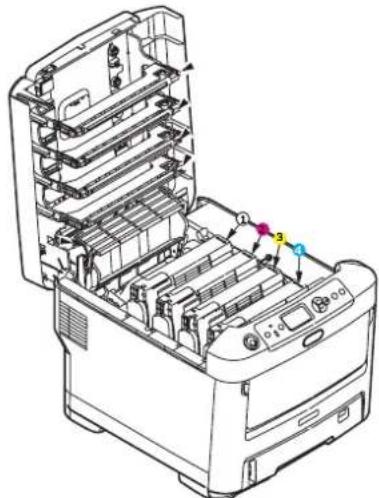
- Note the positions of the four cartridges.
natural_image
Technical line drawing of an open industrial machine with internal components and a color-coded indicator (no text or symbols)- White cartridge 2. Magenta cartridge
- Yellow cartridge 4. Cyan cartridge
(a) Pull the coloured toner release lever on the cartridge to be replaced fully towards the front of the printer.

text_image
Technical diagram showing printer internal components with labeled parts 2b and 2a, including a magnified inset of the main device.(b) Lift the right-hand end of the cartridge and then draw the cartridge to the right to release the left-hand end as shown, and withdraw the toner cartridge out of the printer.
- Put the cartridge down gently onto a piece of paper to prevent toner from marking your furniture.
- Clean the top of the ID unit with a clean, lint free cloth.

natural_image
Illustration of a printer's internal structure with a hand inserting a component, showing no text or symbols.-
Remove the new cartridge from its box but leave its wrapping material in place for the moment.
-
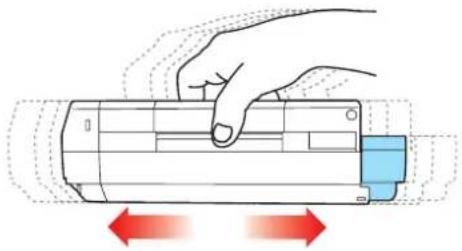
Gently shake the new cartridge from end to end several times to loosen and distribute the toner evenly inside the cartridge.
natural_image
Illustration of a hand pressing down on a cylindrical device with red directional arrows indicating motion (no text or symbols)- Remove the wrapping material and peel off the adhesive tape from the underside of the cartridge.

natural_image
Diagram of a battery pack with blue insulation and red arrow indicating rotation (no text or symbols)-
Holding the cartridge by its top centre with the coloured lever to the right, lower it into the printer over the image drum unit from which the old cartridge was removed.
-
Insert the left end of the cartridge into the top of the image drum unit first, pushing it against the spring on the drum unit, then lower the right end of the cartridge down onto the image drum unit.
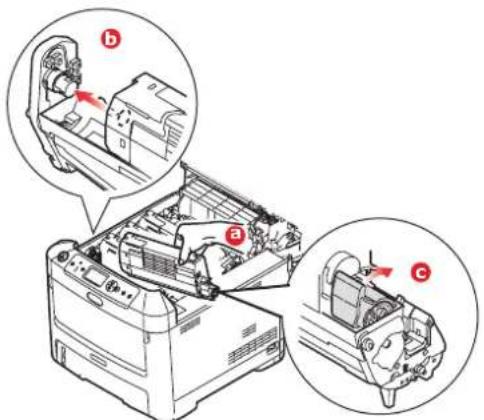
text_image
Technical diagram of a printer with labeled parts (a, b, c) showing internal components and directional arrows indicating assembly or operation.-
Pressing gently down on the cartridge to ensure that it is firmly seated, push the coloured lever towards the rear of the printer. This will lock the cartridge into place and release toner into the image drum unit.
-
Gently wipe the LED head surface with a clean, lint free cloth.
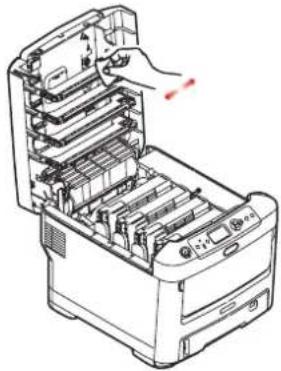
natural_image
Line drawing of a printer's internal structure with a hand pointing to the top panel (no text or symbols present)- Finally, close the top cover and press down firmly at both sides so that the cover latches closed.

natural_image
Line drawing of a printer with a hand operating the top panel and a red arrow indicating a drop or action (no text or symbols present)IMAGE DRUM REPLACEMENT
CAUTION!

Static sensitive devices, handle with care.
The printer contains four image drums: white, magenta, yellow and cyan.
- Press the cover release and open the printer's top cover fully.
WARNING!
If the printer has been powered on, the fuser will be hot. This area is clearly labelled. Do not touch.
- Note the positions of the four toner cartridges (a) and image drums (b). It is essential that they go back in the same order.

text_image
Diagram of a printer internal structure with labeled parts (a) and (b), showing color-coded components and connection points.- Holding it by its top centre, lift the image drum, complete with its toner cartridge, up and out of the printer.
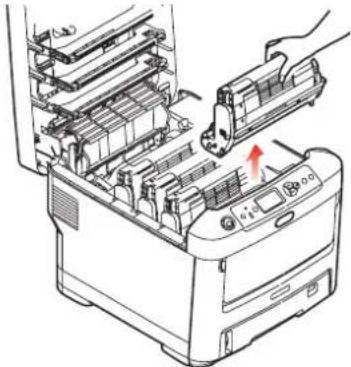
natural_image
Diagram of a printer's internal structure showing internal components and a hand inserting a component (no text or symbols visible)- Put the assembly down gently onto a piece of paper to prevent toner from marking your furniture and to avoid damaging the green drum surface.
CAUTION!
The green image drum surface at the base of the ID unit is very delicate and light sensitive. Do not touch it and do not expose it to normal room light for more than 5 minutes. If the drum unit needs to be out of the printer for longer than this, please wrap the cartridge inside a black plastic bag to keep it away from light. Never expose the drum to direct sunlight or very bright room lighting.
- With the coloured toner release lever (1) to the right, pull the lever towards you. This will release the bond between the toner cartridge and the image drum unit.

text_image
Diagram showing a car interior with a blue component and directional arrows indicating rotation or movement, alongside a 3D model of the vehicle.- Lift the right-hand end of the toner cartridge (1) and then draw the cartridge to the right to release the left-hand end as shown (2), and withdraw the toner cartridge out of the image drum cartridge. Place the cartridge on a piece of paper to avoid marking your furniture.
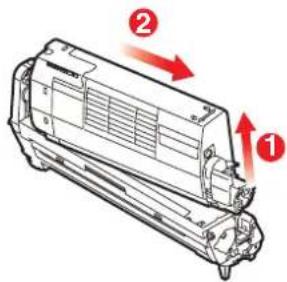
text_image
Technical diagram of a mechanical component with numbered callouts indicating directional movement or assembly.- Take the new image drum cartridge out of its packaging and place it on the piece of paper where the old cartridge was placed. Keep it the same way round as the old unit. Pack the old cartridge inside the packaging material for disposal.
NOTE:
Follow instructions that come with the new image drum for additional information such as the removal of packaging material, etc.
- Place the toner cartridge onto the new image drum cartridge as shown. Push the left end in first, and then lower the right end in. (It is not necessary to fit a new toner cartridge at this time unless the remaining toner level is very low.)
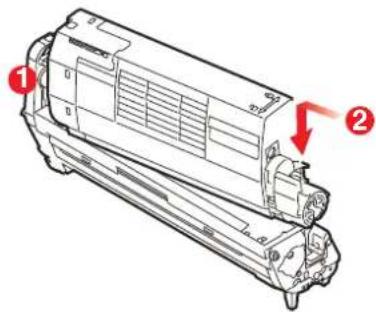
text_image
Technical diagram of a mechanical component with numbered parts and directional arrows indicating assembly or movement.- Push the coloured release lever away from you to lock the toner cartridge onto the new image drum unit and release toner into it.
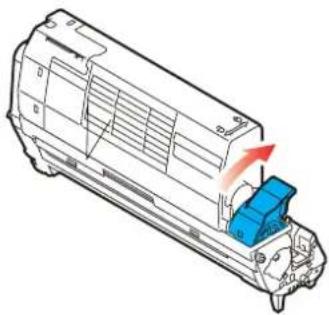
natural_image
Technical line drawing of a mechanical component with a blue component and red arrow indicating direction (no text or symbols)- Holding the complete assembly by its top centre, lower it into place in the printer, locating the pegs at each end into their slots in the sides of the printer cavity.
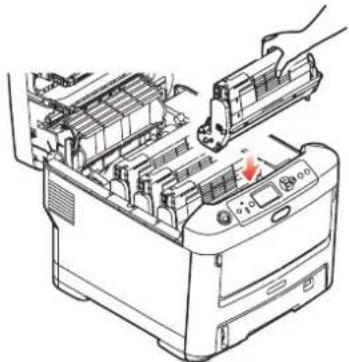
natural_image
Illustration of a printer's internal structure with a hand inserting a component (no text or symbols visible)- Finally, close the top cover and press down firmly at both sides so that the cover latches closed.
NOTE:
If you need to return or transport your printer for any reason, please make sure you remove the image drum unit beforehand and place in the bag provided. This is to avoid toner spillage.
REPLACING THE TRANSFER BELT UNIT
The belt unit is located under the four image drums.
Switch off the printer and allow the fuser to cool for about 10 minutes before opening the cover.
- Press the cover release and open the printer's top cover fully.
WARNING!
If the printer has been powered on, the fuser will be hot. This area is clearly labelled. Do not touch.
- Note the positions of the four toner cartridges (a) and image drums (b). It is essential that they go back in the same order.
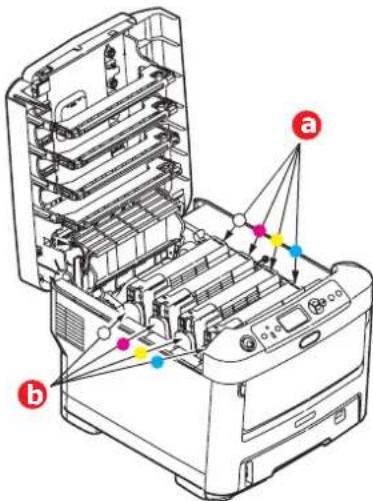
text_image
Technical diagram of a printer internal structure with labeled components and colored connection points- Lift each of the image drum units out of the printer and place them in a safe place away from direct sources of heat and light.

natural_image
Technical illustration of a multi-layered electrical component with no visible text or symbolsCAUTION!
The green image drum surface at the base of each cartridge is very delicate and light sensitive. Do not touch it and do not expose it to normal room light for more than 5 minutes. If the drum unit needs to be out of the printer for longer than this, please wrap the cartridge inside a black plastic bag to keep it away from light. Never expose the drum to direct sunlight or very bright room lighting.
- Locate the two fasteners (a) at each side of the belt and the lifting bar (b) at the front end.

text_image
Technical diagram of a printer with labeled parts (a, b, c) and internal components, showing mechanical assembly and lock mechanism.-
Turn the two fasteners 90^ to the left. This will release the belt from the printer chassis.
-
Pull the lifting bar (b) upwards so that the belt tilts up towards the front, and withdraw the belt unit (c) from the printer.
-
Lower the new belt unit into place, with the lifting bar at the front and the drive gear towards the rear of the printer. Locate the drive gear into the gear inside the printer by the rear left corner of the unit, and lower the belt unit flat inside the printer.
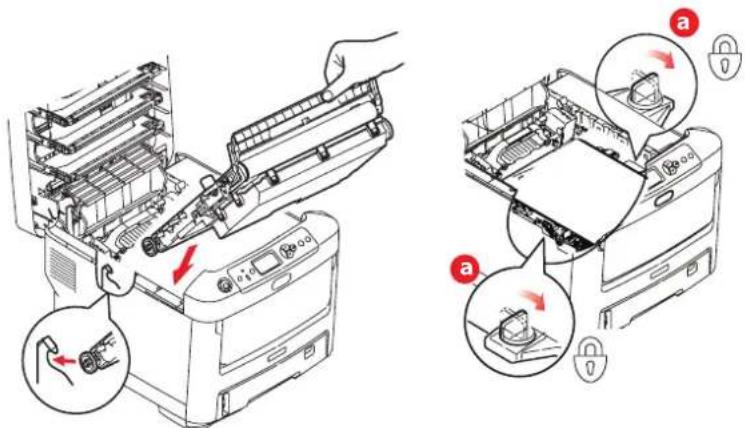
text_image
Technical diagram showing printer assembly process with labeled parts and directional arrows indicating movement or repair steps-
Turn the two fasteners (a) 90^ to the right until they lock. This will secure the belt unit in place.
-
Replace the four image drums, complete with their toner cartridges, into the printer in the same sequence as they came out: white (nearest the rear), magenta, yellow and cyan (nearest the front).
-
Finally, close the top cover and press down firmly at both sides so that the cover latches closed.
FUSER REPLACEMENT
The fuser is located inside the printer just behind the four image drum units.
WARNING
If the printer has recently been powered on, some fuser components will be very hot. Handle the fuser with extreme care, holding it only by its handle, which will only be mildly warm to the touch. A warning label clearly indicates the area. If in doubt, switch the printer off and wait at least 10 minutes for the fuser to cool before opening the printer cover.
-
Press the cover release and open the printer's top cover fully.
-
Identify the fuser handle (a) on the top of the fuser unit.

text_image
Technical diagram of a printer with labeled parts (a, b) and internal structure showing internal components and assembly.-
Pull the two fuser retaining levers (b) towards the front of the printer so that they are fully upright.
-
Holding the fuser by its handle (a), lift the fuser straight up and out of the printer. If the fuser is still warm, place it on a flat surface which will not be damaged by heat.
-
Remove the new fuser from its packaging and remove the transit material.
-
Holding the new fuser by its handle, make sure that it is the correct way round. The retaining levers (b) should be fully upright, and the two locating lugs (c) should be towards you.
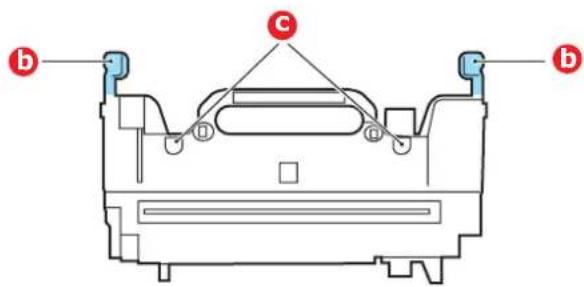
text_image
b c b-
Lower the fuser into the printer, locating the two lugs (c) into their slots in the metal partition which separates the fuser area from the image drums.
-
Push the two retaining levers (b) towards the rear of the printer to lock the fuser in place.

natural_image
Technical diagram showing a mechanical assembly with a magnified inset highlighting a component being inserted (no text or symbols present)- Finally, close the top cover and press down firmly at both sides so that the cover latches closed.
CLEANING
CAUTION!
Use a clean, moist, lint-free cloth for cleaning. Do not use benzine, thinners or alcohol as a cleaning agent.
...THE UNIT CASING
-
Switch the printer off.
-
Wipe the unit surface with a soft cloth moistened sparingly with water or neutral detergent.
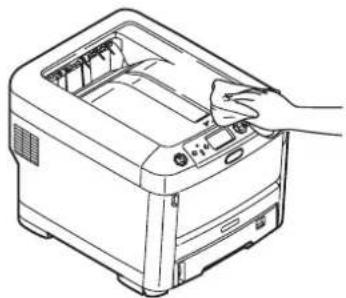
natural_image
Line drawing of a hand operating a computer tower (no text or symbols present)- Use a soft dry cloth to dry the unit surface.
...THE LED HEAD
Clean the LED heads when printing does not come out clearly, has white lines or when text is blurred.
There is no need to switch off the printer to clean the lens.
-
Press the cover release and open the printer's top cover fully.
-
Gently wipe the LED head surface with a clean, lint free cloth.
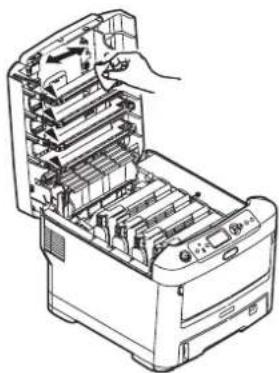
natural_image
Technical line drawing of a printer internal structure showing internal components and a hand holding the top part (no text or symbols present)CAUTION!
Do not use methyl alcohol or other solvents on the LED head as damage to the lens surface will occur.
- Close the top cover and press down firmly at both sides so that the cover latches closed.
Clean the paper feed rollers if paper jams frequently occur.
CAUTION!
Use a clean, moist, lint-free cloth for cleaning. Do not use benzine, thinners or alcohol as a cleaning agent.
- Remove items like a wrist watch or bracelet.
- Switch the printer off.
- Remove the paper tray from the printer.
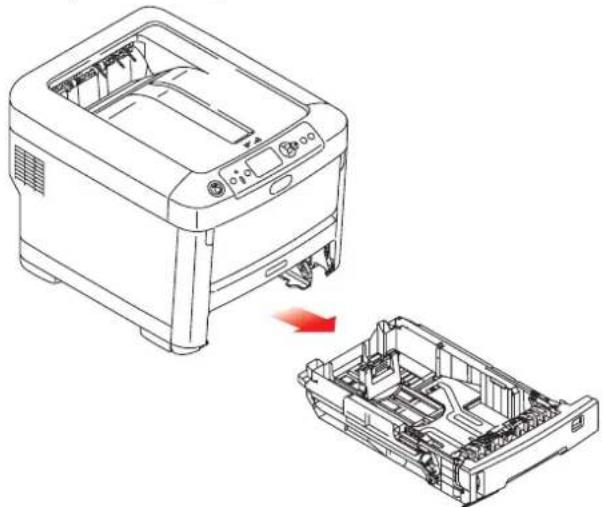
natural_image
Line drawing of a printer with internal components and a red arrow indicating a disassembly or disassembly process (no text or symbols present)- Gaining access through the gap left by paper tray, wipe the paper feed rollers with a clean, lint-free cloth moistened with water.
- Wipe the feed roller on the paper tray.
- Replace the paper tray.
INSTALLING UPGRADES
This section explains how to install optional equipment into your printer. This includes:
additional RAM memory
additional paper tray(s)
cabinet
MEMORY UPGRADE
The basic printer model comes equipped with 256MB of main memory. This can be upgraded with an additional memory board of 256MB or 512MB, giving a maximum total memory capacity of 768MB.
- Switch the printer off and disconnect the AC power cable.
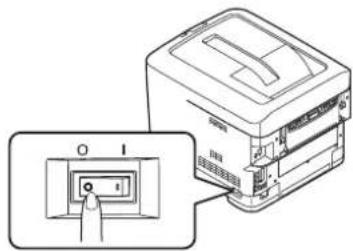
text_image
Diagram showing a device with labeled ports O and I, including a zoomed-in view of the internal component.- Press the cover release and open the printer's top cover fully.
WARNING!
If the printer has been powered on recently, the fuser will be hot. This area is clearly labelled. Do not touch.
- Pull down the MP Tray using the depressions. Lift the front cover release lever and lower the front cover.

natural_image
Technical line drawings of a device with internal components and red directional arrows indicating motion (no text or symbols)-
Loosen the screw (a) securing the right-hand side cover.
-
Lift the edge of the side cover slightly and pull the cover away from the printer at the top. Lift the cover slightly to detach it from the printer. Place it safely to one side.
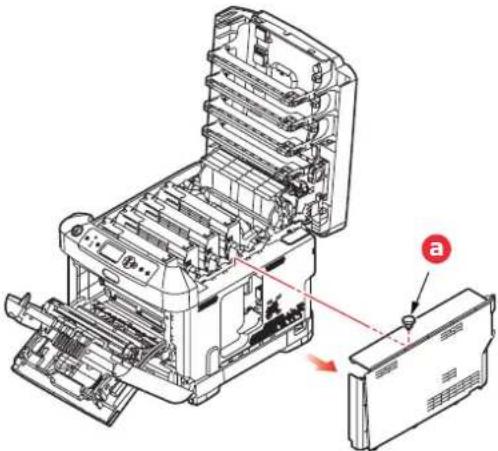
natural_image
Technical line drawing of a printer internal structure with a close-up view of the base panel (no text or symbols)-
Carefully remove the new memory board from its wrapping. Try to handle the board only by its short edges, avoiding contact with any metal parts as far as possible. In particular, avoid touching the edge connector.
-
Notice that the memory board has a small cutout in the edge connector, which is closer to one end than the other.

natural_image
Isometric line drawing of a rectangular electronic component with three square holes and a small rectangular slot (no text or symbols)-
Identify the RAM expansion slot in the printer.
-
If the RAM expansion slot already contains a memory upgrade board, that board will have to be removed before you can install the new one. To remove it, proceed as follows, otherwise skip to step 10.
(a) Release retaining clips and pull the board out of the slot.
(b) Place the removed memory board in the antistatic bag which originally contained the new memory board.
-
Hold the new memory board by its short edges, so that the edge connector faces in towards the RAM expansion slot, and the small cutout is closer to the rear of the printer.
-
Gently push the board into the RAM expansion slot until it latches in and will not go any further.
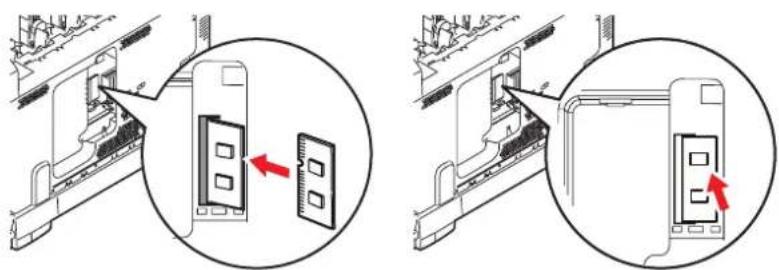
natural_image
Two-step diagram showing a device being inserted into a rack, with red arrows indicating the process (no text or symbols present)-
Locate the retaining clips at the bottom of the side cover into their rectangular holes near the bottom of the printer.
-
Close the top of the side cover up to the printer and refit the securing screw loosened in step 4.

natural_image
Technical line drawing of a mechanical device with internal components and directional arrows indicating motion (no text or symbols)-
Close the front cover, and close the top cover, pressing down firmly at each side to latch it closed.
-
Reconnect the AC power cable and switch the printer on.
-
When the printer is ready, print a menu map as follows:
(a) Press the Enter button.
(b) Press the Menu down button then the Enter button to select the Print Information menu.
(c) Select Configuration with the Enter button.
(d) Press the Enter button once more to execute the Configuration menu.
(e) When the Configuration map is printed, press On Line to exit the menu system.
- Examine the first page of the menu map.
Near the top of the page, between the two horizontal lines, you will see the current printer configuration. This list contains the figure for total memory size.
This should indicate the total memory now installed.
ADDITIONAL PAPER TRAY(S)
- Switch the printer off and disconnect the AC power cable.
- Place additional paper tray(s) on desired location.

natural_image
Technical line drawing of two stacked electronic devices with internal components and red dashed lines indicating assembly or connection points (no text or symbols present)- Observing safety rules for lifting and, using locating guides, place printer on top of the additional paper tray(s).

natural_image
Technical line drawing of a printer with internal components and mounting base (no text or symbols)- Re-connect the AC power cable and switch the printer ON.
All that remains is to adjust the printer driver to make full use of the new features. (See "Setting the driver device options" on page 73.)
SETTING THE DRIVER DEVICE OPTIONS
Once your new upgrade has been installed, you may need to update the printer driver so that the additional features are available to your applications.
Accessories such as additional paper trays will only be usable if the printer driver on your computer knows they are there.
In some cases the hardware configuration of your machine is automatically detected when the driver is installed. However, it is advisable to at least check whether all of the available hardware features are listed in the driver.
This procedure is essential if you subsequently add extra hardware features to your machine after the drivers have been installed and set up.
Remember that if your machine is shared between users on different computers, the driver must be adjusted on each user's machine.
WINDOWS
- Access the driver's Properties window. (See "Changing the driver defaults" on page 21.)
- Select the Device Options tab. In the Windows XP PostScript driver the tab may be called Device Settings.
- Set the options for any devices you have just installed.
- Click OK to close the window and save your changes.
Mac OS X
- Open the Printer Setup Utility and ensure that your printer model is selected.
- Choose Printers > Show Info > Installable Options.
- Select all hardware options appropriate to your printer, and click Apply Changes.
STORAGE CABINET
Instructions for installing the Storage Cabinet are supplied with the cabinet.
TROUBLESHOOTING
Provided that you follow the recommendations in this guide on the use of print media, and you keep the media in good condition prior to use, your printer should give years of reliable service. However, paper jams occasionally do occur, and this section explains how to clear them quickly and simply.
Jams can occur due to paper misfeeding from a paper tray or at any point on the paper path through the printer. When a jam occurs, the printer immediately stops, and the Attention LED on the control panel informs you of the event. If printing multiple pages (or copies), do not assume that, having cleared an obvious sheet, others will not also be stopped somewhere along the path. These must also be removed in order to clear the jam fully and restore normal operation.
MAJOR PRINTER COMPONENTS AND PAPER PATH
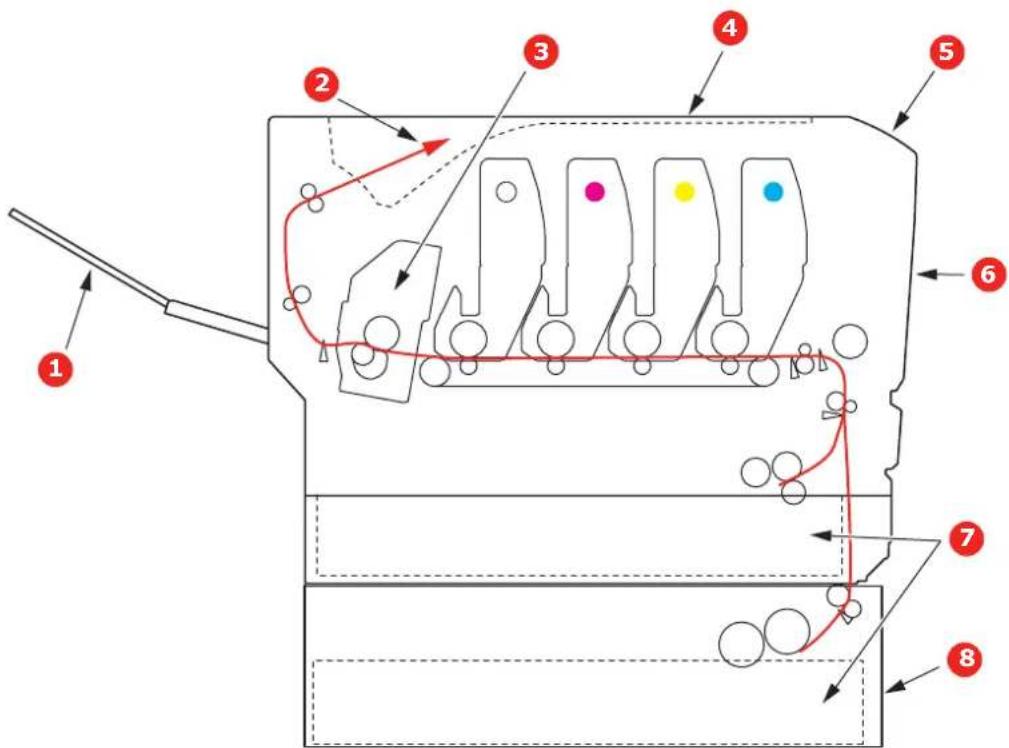
text_image
Technical diagram of a mechanical device with numbered components and directional arrows indicating flow or movement.- Face-up stacker. 5. Operator panel.
- Paper exit. 6. Front cover.
- Fuser unit 7. Paper tray.
- Top cover. 8. Additional paper tray (if fitted)
PAPER SENSOR ERROR CODES
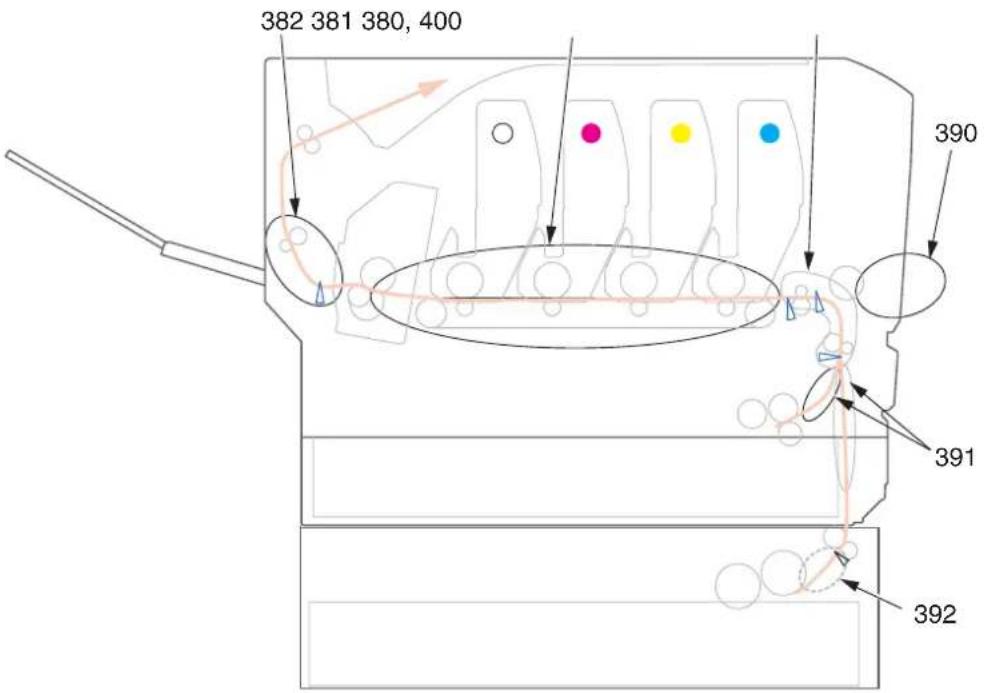
text_image
382 381 380, 400 390 391 392| CODE # LOCATION CODE # LOCATION | ||
| 380 Paper feed 391 Paper Tray | ||
| 381 Paper path 392 | 2^nd Paper tray^a | |
| 382 Paper exit 400 Paper size | ||
| 390 MP Tray | ||
a. If fitted.
CLEARING PAPER JAMS
-
If a sheet is well advanced out of the top of the printer, simply grip it and pull gently to draw it fully out. If it does not remove easily, do not use excessive force. It can be removed from the rear later.
-
Press the cover release and open the printer's top cover fully.
WARNING!
If the printer has been powered on, the fuser will be hot. This area is clearly labelled. Do not touch.
- Note the positions of the four toner cartridges (a) and image drums (b). It is essential that they go back in the same order.
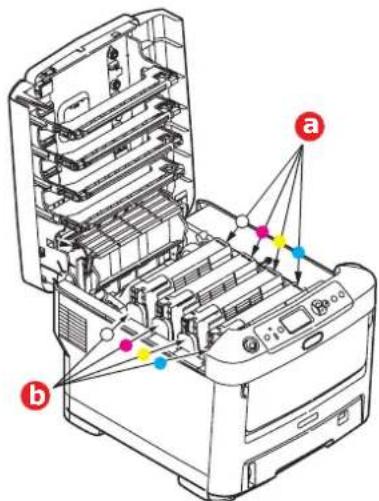
text_image
Technical diagram of a printer internal structure with labeled components (a) and (b), showing color-coded parts and connection points.It will be necessary to remove the four image drums to gain access to the paper path.
- Holding it by its top centre, lift the image drum, complete with its toner cartridge, up and out of the printer.
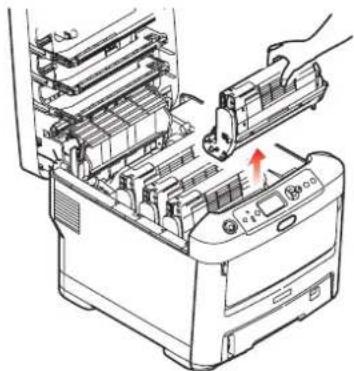
natural_image
Illustration of a printer's internal structure showing internal components and a hand inserting a component (no text or symbols visible)- Put the assembly down gently onto a piece of paper to prevent toner from marking your furniture and to avoid damaging the green drum surface, and cover.
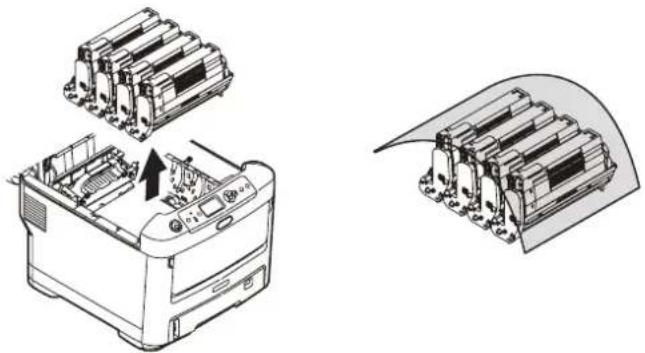
natural_image
Technical line drawing showing a printer assembly with internal components and a separate view of the same device (no text or symbols present)CAUTION!
The green image drum surface at the base of the Image Drum is very delicate and light sensitive. Do not touch it and do not expose it to normal room light for more than 5 minutes. If the drum unit needs to be out of the printer for longer than this, please wrap the cartridge inside a black plastic bag to keep it away from light. Never expose the drum to direct sunlight or very bright room lighting.
-
Repeat this removal procedure for each of the remaining image drum units.
-
Look into the printer to check whether any sheets of paper are visible on any part of the belt unit.
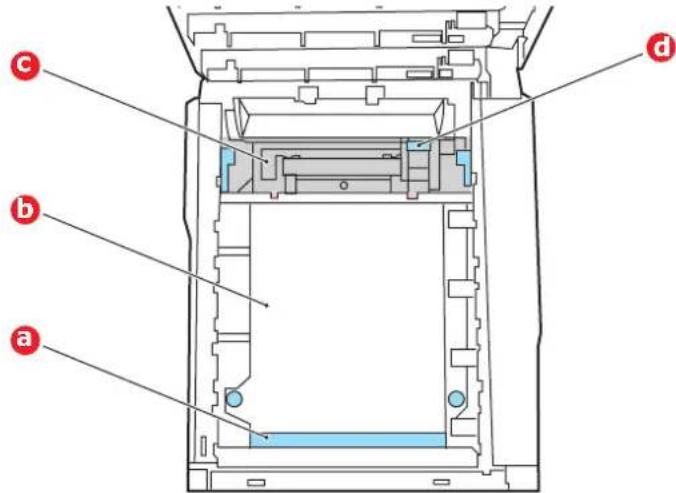
text_image
c b a dCAUTION!
Do not use any sharp or abrasive objects to separate sheets from the belt. This may damage the belt surface.
(a) To remove a sheet with its leading edge at the front of the belt (a), carefully lift the sheet from the belt and pull it forwards into the internal drum cavity and withdraw the sheet.
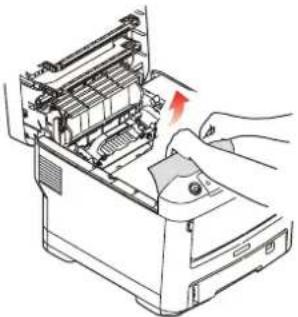
natural_image
Illustration of a hand operating a computer motherboard with a red arrow indicating motion (no text or symbols present)(b) To remove a sheet from the central area of the belt (b), carefully separate the sheet from the belt surface and withdraw the sheet.
(c) To remove a sheet just entering the fuser (c), separate the trailing edge of the sheet from the belt, push the fuser pressure release lever (d) towards the front and down to release the fuser's grip on the sheet, and withdraw the sheet
through the drum cavity area. Then allow the pressure release lever to rise again.
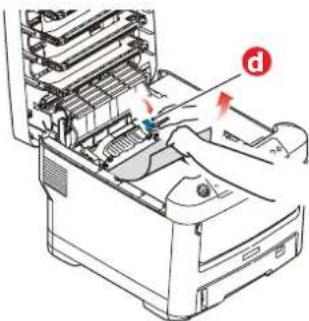
natural_image
Diagram of a printer's internal structure showing internal components and a paperclip (no text or symbols)NOTE
If the sheet is well advanced into the fuser (only a short length is still visible), do not attempt to pull it back.
(d) To remove a sheet in the fuser, push the two retaining levers (e) towards the rear of the printer to release the fuser. Withdraw the fuser unit using the handle (f).
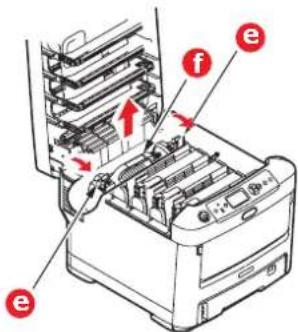
text_image
Diagram of a printer internal structure with labeled parts (e, f) and directional arrows indicating flow or movement.(e) Press release lever (g) and pull the trapped paper from the fuser.

text_image
Diagram showing hands operating a sewing machine with a red arrow indicating downward motion, labeled with number 6.(f) Replace fuser unit into the machine and move locking levers (e) toward the rear of the machine.
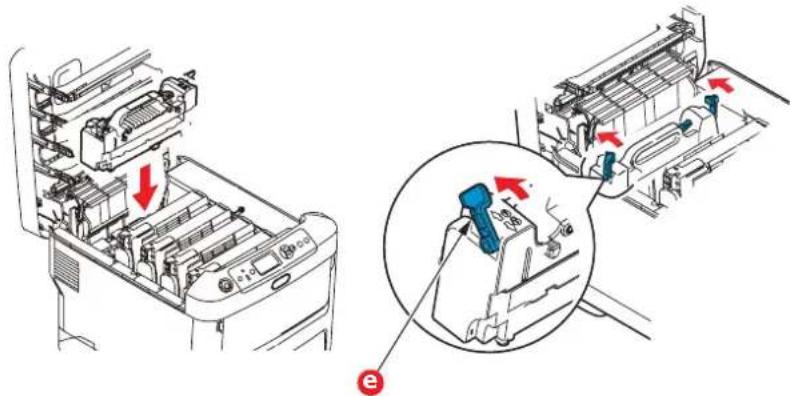
natural_image
Technical diagram showing internal components of a washing machine with red arrows indicating direction, and a magnified inset highlighting a blue tool (no text or symbols present)- Starting with the white image drum unit nearest the fuser, replace the four image drums into the drum cavity, making sure to locate them in the correct order.
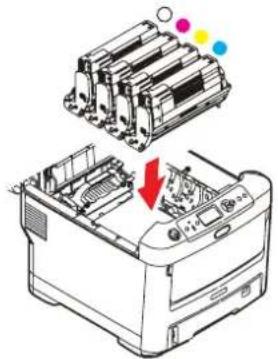
natural_image
Diagram of a printer with internal components and a red arrow indicating a process (no text or symbols present)Holding the complete assembly by its top centre, lower it into place in the printer, locating the pegs at each end into their slots in the sides of the printer cavity.
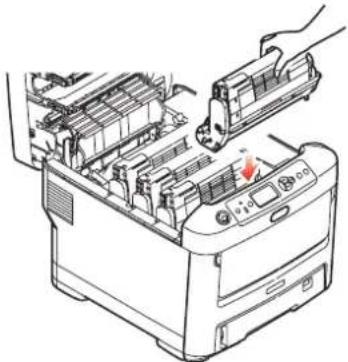
natural_image
Illustration of a printer's internal structure with a hand inserting a component (no text or symbols visible)-
Lower the top cover but do not press down to latch it closed yet. This will protect the drums from excessive exposure to room lighting while you check the remaining areas for jammed sheets.
-
Open the rear exit tray (h) and check for a sheet of paper in the rear path area (i).

text_image
Technical diagram of a mechanical component with labeled parts i and hPull out any sheets found in this area.
If the sheet is low down in this area and difficult to remove, it is probably still gripped by the fuser. In this case raise the top cover, reach around and press down on the fuser pressure release lever (d).

natural_image
Technical diagram of a mechanical assembly with no visible text or symbols-
If you are not using the rear exit tray, close it once any paper has been removed from this area.
-
Pull down the MP Tray using the depressions. Lift the front cover release lever and lower the front cover.
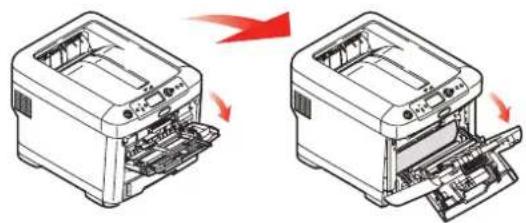
natural_image
Two 3D printer images showing internal structure before and after processing, with red arrows indicating the process (no text or symbols present)- Check inside the cover for sheets in this area and remove any that you find, then close the cover.
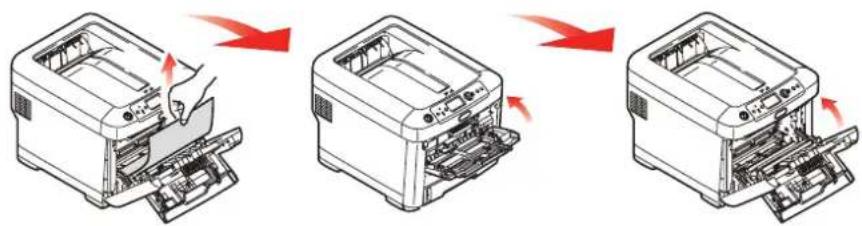
natural_image
Three-step illustration of a printer's internal structure showing disassembly and reassembly (no text or symbols)- Pull out the paper tray and ensure that all paper is stacked properly, is undamaged, and that the paper guides are properly positioned against the edges of the paper stack. When satisfied, replace the tray.
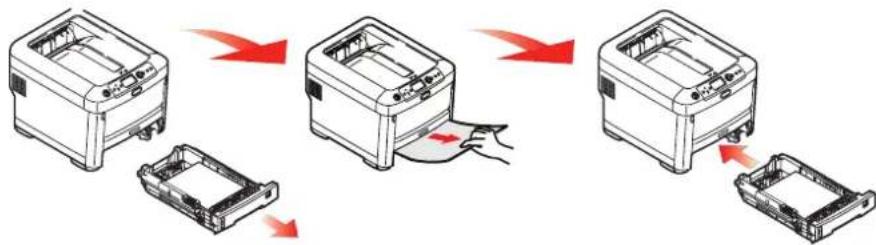
flowchart
graph TD
    A["Printer with two units"] --> B["Disassembly of a small component"]
    B --> C["Assembly of a larger part with a hand pulling a cable"]
    C --> D["Disassembly of a smaller part with a separate box"]
- Finally, close the top cover and press down firmly so that the cover latches closed. When the jam has been cleared, if Jam Recovery is set to ON in the System Adjust Menu, the printer will attempt to reprint any pages lost due to paper jams.
SPECIFICATIONS
N31194B
| ITEM SPECIFICATION | |
| Dimensions 435 x 547 x 389mm (W x D x H) | |
| Weight 27.6Kg approx. | |
| Power supply 220 to 240VAC @ 50/60 Hz ± 2% | |
| Power consumption Operating: 1200 max.; 600 W av. (25°C)Standby: 90 W av. (25°C)Power saving: 15 W max.Sleep: approx. 1W (25°C) | |
| Operating environment | Operating 10 to 32 °C/20 to 80% RH(optimum 25 °C wet, 2 °C dry)Off: 0 to 43 °C/10 to 90% RH(optimum 26.8 °C wet, 2 °C dry) |
| Print environment 30 to 73% RH @ 10 °C; 30 to 54% RH @ 32 °C10 to 32 °C @ 30% RH; 10 to 27 °C @ 80% RHColour 17 to 27 °C @ 50 to 0% RH | |
| Noise(Sound pressure level) | Operating: 68dB(A)Standby: 37dB(A) |
INDEX
A
Application collate.... 29
B
Belt
how to replace.... 63
C
Cleaning
the LED head 67
the paper feed rollers ..... 68
the unit casing...... 67
Collating
application collate.... 29
Mac 30
printer collate 29
Windows 30
Cover page.... 31
Cover print
different cover page ...... 32
Custom page size
general 33
Windows 38
Windows PS.... 33
E
Envelopes
loading 18
F
Fuser
how to replace.... 65
I
Image drum
how to replace.... 60
M
Maintenance menu.... 55
Major printer components and paper path 74
Menu functions...... 42
Menus
factory default settings..... 43
how to use.... 42
USB menu.... 55
Multi purpose tray
how to use.... 18
paper metrics 13
0
Operator Panel.... 42
P
Page size
custom.... 33
Paper
jam clearing 74
jam, error codes.... 75
loading cassette trays ..... 15
loading letterhead ...... 16
recommended types...... 13
supported sheet sizes..... 13
Printer collate.... 29
Printer overview.... 10
S
Separator page 31
Switching off correctly ..... 45
T
Toner
how to replace.... 57
Transfer/transparency film
rinting 38
U
Upgrades
additional paper tray(s).... 72
memory.... 69
storage cabinet.... 73
OKI CONTACT DETAILS
Oki Systems (UK) Limited
550 Dundee Road
Slough Trading Estate
Slough
Berkshire
SL1 4LE
Tel:+44 (0) 1753 819819
Fax:+44 (0) 1753 819899
http://www.oki.co.uk
Oki Systems Ireland Limited
The Square Industrial Complex
Tallaght
Dublin 24
Tel:+353 (0) 1 4049590
Fax:+353 (0)1 4049591
http://www.oki.ie
Oki Systems Ireland Limited -
Northern Ireland
19 Ferndale Avenue
Glengormley
BT36 5AL
Northern Ireland
Tel:+44 (0) 7767 271447
Fax:+44 (0) 1 404 9520
http://www.oki.ie
Technical Support for all Ireland:
Tel:+353 1 4049570
Fax:+353 1 4049555
E-mail: tech.support@oki.ie
OKI Systems (Czech and Slovak),
s.r.o.
IBC – Pobřežní 3
186 00 Praha 8
Czech Republic
Tel: +420 224 890158
Fax:+420 22 232 6621
Website: www.oki.cz, www.oki.sk
www.okiprintingsolutions.de
info@oki.de
OKI Printing Solutions
Platinum Business Park II, 3rd Floor
ul. Domaniewska 42
02-672 Warsaw
Poland
Tel:+48 22 448 65 00
Fax:+48 22 448 65 01
Website: www.oki.com.pl
E-mail: oki@oki.com.pl
Hotline: 0800 120066
E-mail: tech@oki.com.pl
Oki Systems (Ibérica) S.A.
Sucursal Portugal
Edifício Prime -
Av. Quinta Grande 53
7° C Alfragide
2614-521 Amadora
Portugal
Tel:+351 21 470 4200
Fax:+351 21 470 4201
Website:www.oki.pt
E-mail : oki@oki.pt
Oki Service
OKI Europe Ltd. (Russia)
Office 702, Bldg 1
Zagorodnoye shosse
117152, Moscow
Tel: +74 095 258 6065
Fax: +74 095 258 6070
e-mail: info@oki.ru
Website: www.oki.ru
Technical support:
Tel: +7 495 564 8421
e-mail: tech@oki.ru
Raisy Opkinoy Street,8
Building B, 2 ^nd Floor,
Kiev 02002
Ukraine
Tel: +380 44 537 5288
e-mail: info@oki.ua
Website: www.oki.ua
www.okiprintingsolutions.com.tr
Oki Systems (Belgium)
Medialaan 24
1800 Vilvoorde
Helpdesk: 02-2574620
Fax: 02 2531848
Website: www.oki.be
AlphaLink Bulgaria Ltd.
2 Kukush Str.
Building "Antim Tower", fl. 6
1463 Sofia, Bulgaria
tel: +359 2 821 1160
fax: +359 2 821 1193
Website: http://bulgaria.oki.com
OKI Printing Solutions
Herstedøstervej 27
2620 Albertslund
Danmark
Oki Systems (Norway) AS
Tevlingveien 23
N-1081 Oslo
Tel:+47 (0) 63 89 36 00
Telefax:+47 (0) 63 89 36 01
Ordrefax:+47 (0) 63 89 36 02
Website: www.oki.no
General Systems S.R.L.
(Romania)
Sos. Bucuresti-Ploiesti Nr. 135.
Bucharest 1
Romania
Tel: +40 21 303 3138
Fax: +40 21303 3150
Website: http://romania.oki.com
Oki Systems (Sweden) AB
Borgafjordsgatan 7
Box 1191
164 26 Kista
Tel. +46 (0) 8 634 37 00
e-mail:
WWW.OKIPRINTINGSOLUTIONS.COM