G100 - Camera GE - Free user manual and instructions
Find the device manual for free G100 GE in PDF.


User questions about G100 GE
0 question about this device. Answer the ones you know or ask your own.
Ask a new question about this device
Download the instructions for your Camera in PDF format for free! Find your manual G100 - GE and take your electronic device back in hand. On this page are published all the documents necessary for the use of your device. G100 by GE.
USER MANUAL G100 GE
natural_image
Line drawing of a digital camera with no text or symbolsUser Manual
Getting Started
Basic Operation
Camera Function Controls
Playback
Using the Menus
Camera Connectivity
Appendix
WARNING
To prevent fire hazard or electrical shock, do not expose the camera battery pack or other accessories to water or humidity.
For Customers in the U.S.A.
Tested to Comply with FCC Standards FOR HOME OR OFFICE USE
FCC Statement
This device complies with part 15 of the FCC Rules. Operation is subject to the following two conditions:
(1) This device may not cause harmful interference, and (2) this device must accept any interference received, including interference that may cause undesired operation.
For Customers in Europe

"CE" mark indicates that this product complies with the European requirements for safety, health, environment and customer protection. "CE" marked cameras are intended for sales in Europe.

This symbol [crossed-out wheeled bin WEEE Annex IV] indicates separate collection of electrical waste and electronic equipment in the European countries. Please do not throw the equipment into domestic refuse. Please use the return and collection systems available in your country for proper, safe disposal of this product.
Declaration of Conformity
Model Name: G100
Trade Name: GE
Responsible Party: General Imaging Company
Address: 1411 W. 190th Street, Suite 550, Gardena, CA 90248, U.S.A.
Customer Service Telephone Number: +1-800-730-6597
(Outside U.S. & Canada: +1-310-755-6857)
SAFETY PRECAUTIONS
Camera Notes:
Do not store or use the camera in the following types of locations:
• In rain, very humid or dusty places.
- In a place where the camera can be exposed directly to sunlight or subject to high temperatures, e.g. Inside a closed car in summer.
- In a place where the camera is subject to a high magnetic field, e.g. near motors, transformers or magnets.
Do not place the camera on a wet surface or or in places where dripping water or sand may come in contact with the camera; doing so may cause irreparable damage.
! If the camera will not be used for a long period of time, we suggest you remove the batteries and the memory card from the camera and keep them in dry environment.
! Moisture may form inside the camera if the camera is suddenly taken from a cold location to a warm location. Allow moisture to completely dry prior to turning on the camera.
! If water has penetrated the camera housing, turn the camera off and remove the battery and memory card. Allow the camera to air-dry for at least 24 hours before attempting to use again.
If camera overheats, while in use or charging, disconnect the camera and carefully remove batteries.
Battery Notes:
! Incorrect use of the batteries may cause them to leak, become hot, ignite or burst. Always observe the precautions given below:
- Do not expose the batteries to water and take particular care to keep the terminals dry
- Do not heat the batteries or throw them into a fire
- Do not attempt to deform, disassemble or modify the batteries
! Keep the batteries out of reach of babies and small children.
In cold locations, battery performance will deteriorate and the life span of the battery may be compromised.
Memory Card Notes:
When using a new or used SD memory card, or a SD memory card that has been initialized by a PC or a different model camera, be sure to reformat the card with your digital camera before attempting to use it.
When editing image data, copy the image data to your PC's hard disk first.
! Do not change folder or file name in the memory card of the computer. An edited file cannot be displayed on the LCD screen of the camera. To edit image data, please copy the image data to the computer's hard disk drive first.
! The photos taken by this camera are stored in the auto-generated folder on the SD memory card. Do not store photos that are not taken by this model camera, as this may cause a read error to occur when the camera is in playback mode.
Do not remove the memory card without turning the camera off to avoid possible damage of your fiels and memory card.
! Do not switch off the digital camera when the writing process is initiated to avoid incomplete data writing and damage or loss of pictures.
Align the SD memory card correctly before inserting it into the camera's SD memory card slot. Do not force the SD memory card into the camera's SD memory card slot.
BEFORE YOU START
Preface
Thank you for purchasing this GE digital camera. Please read this manual carefully and keep it in a safe place for future reference.
Copyright
© Copyright 2011 General Imaging Company. All rights reserved.
No part of this published manual may be reproduced, transmitted, transcribed, stored in a retrieval system or translated into any language or computer language, in any form, by any means, without the prior written permission of General Imaging Company.
Trademarks
All trademarks mentioned in this manual are used for identification purposes only and are properties of their respective owners.
Safety Information
Please read the following important information carefully before using this product.
- Do not take apart or attempt to service the camera yourself.
- Do not drop or knock the camera. Improper handling may damage the product.
- Turn the camera off before inserting or removing the battery and memory card.
- Avoid directly touching or scratching the camera lens.
- Do not expose the camera to harsh environments such as moisture, chemicals or extreme temperatures, which may shorten the life of your camera or damage the batteries.
- Do not use or store the camera in dusty, dirty or sandy areas, as the camera or components may be damaged.
- Do not expose the lens to direct sunlight for extended periods of time.
- Download all pictures and remove the batteries from the camera if you are going to store the camera for long periods of time.
-
Do not use abrasive cleansers, alcohol-based or solvent-based cleaners to clean the camera. To clean, wipe the camera with a slightly damp, soft cloth.
-
If water has penetrated the camera housing, turn the camera off and remove the battery and SD memory card. Allow camera to air-dry for at least 24 hours before attempting to use again.
- Do not touch the lens.
- Do not place the camera strap around a child or pet's neck.
- When transitioning from a cold environment to warm environment, avoid possible condensation by placing the camera in a cooler area and let it slowly adjust to room temperature.
• Always place the camera on a vibration-free surface.
About this Manual
This manual provides you with instructions on how to use your new GE digital camera. Every effort has been made to ensure that the contents of this manual are accurate, however General Imaging Company reserves the right to make changes without notice.
Symbols used in this manual
Throughout this manual, the following symbols are used to help you locate information quickly and easily:

Indicates useful information.

Indicates precautions to be taken while operating the camera.
CONTENTS
WARNING ....i
SAFETY PRECAUTIONS ......ii
BEFORE YOU START .... 1
Preface ....1
Copyright 1
Trademarks ....1
Safety Information ....1
About this Manual ....2
Symbols used in this Manual 2
CONTENTS 3
GETTING READY 7
Unpacking 7
Installing Shoulder Strap 8
Jog Dial 8
Camera Views....9
Battery Charging 12
Inserting the Battery and
SD/SDHC/SDXC Card (Not included) 13
Turning On and Off 15
Setting Language and Date/Time 15
Set Display Language 15
Set Date/Time 16
About the LCD Screen.... 17
Using the Modes 18
Display Setting 18
LCD Screen Display 19
Still Picture Mode Display 19
Video Shooting Mode Display 21
Playback Mode Display 22
Using the Mode Dial 23
Shooting in Auto Mode 24
Manual Mode 24
Shutter Priority 25
Auto Program Exposure 25
Beautifier Mode 26
Panorama....26
Manual Scene Mode (SCN) 27
Auto Scene 28
Landscape 28
Sport 28
Beach 28
Sunset 28
Fireworks 28
Night Landscape 28
Multi Exposure 28
Snow 28
Children 28
ID 28
Glass 28
Photo Frame....28
Panning Shot 29
Text....29
Portrait 29
Distorting Mirror 29
Party 29
Indoor 29
Leaf 29
Museum 29
Night Portrait 29
Pet Mode-Dog 29
Pet Mode-Cat 29
Fax 29
Auto Scene Mode (ASCN) 30
BASIC OPERATION 32
Shooting in Auto Mode 32
Using the Zoom Function 32
Focus Setting 33
Macro Mode 33
Self-Timer Setting 34
Open Flash 35
White Balance Setting 36
Continuous Capture Setting 37
EV Setting 38
Exposure Compensation 38
ISO 39
Shutter Adjustment 39
Aperture Adjustment 40
Using quick recording 40
i Button Function Menu 41
PLAYBACK 42
Viewing Photos and Videos 42
Thumbnail View 43
Using Zoom in Playback (for still pictures only) 44
Using the Delete Button 45
USING THE MENUS 46
Still Picture Menu 46
Expo Metering (Exposure Metering).... 46
Size 47
OIS 47
Continuous AF......48
HDR 48
Setting Menu 49
Quality. 49
AF-Assist Beam. 50
Digital Zoom 50
Date Imprint 51
Movie Mode Menu 52
Expo Metering (Exposure Metering) 52
Image Pixel 53
OIS 53
Image Color Setting 54
Blink Detection 55
Playback Menu 56
Protect 56
Delete 57
DPOF (Digital Print Order Format).... 58
Trim 59
HDR-High Dynamic Range 59
Red-Eye Reduction....60
Rotate 60
Resize 61
Color Effect 61
Slideshow 62
Continuous Capture Group Playback 62
Setup Menu 63
Beep 63
Power Saver 64
Language 64
Zone 65
Date/Time 65
File and Software 65
Format Memory 65
Copy to Card (Copy internal memory to memory card)....66
File Numbering 66
Reset Settings 66
FW Version (Firmware version) 68
CONNECTIONS 69
Connecting to a PC 68
Setting the USB Mode 68
Transferring Files to your PC 68
Video System 70
Set Eye-Fi SD Card Connection Mode 70
Supported HDMI Connection 71
Connecting to a PictBridge Compatible Printer ....72
Setting the USB Mode 72
Connecting the Camera and Printer 73
Using the PictBridge Menu 74
Print with Date 74
Print without Date 75
Print Index 76
Print DPOF 77
Exit 77
APPENDICES 78
Specifications 78
Error Messages 82
Troubleshooting....84
GETTING READY
Accessories Included
Your camera box should contain the camera model you purchased along with the following accessories. If anything is missing or appears to be damaged, please contact your retailer.

Rechargeable Lithium-Ion Battery

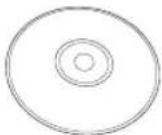
CD-ROMWarranty Card
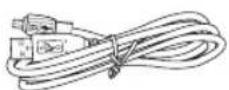
USB Cable
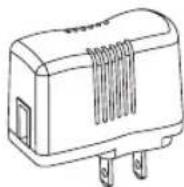
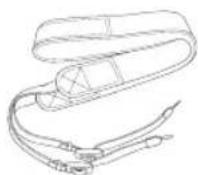
AC Adapter Shoulder Strap
Attaching Shoulder Strap
To attach the provided shoulder strap, follow the directions below:

text_image
Diagram of a digital camera with labeled parts and an arrow indicating the tool's application to switch.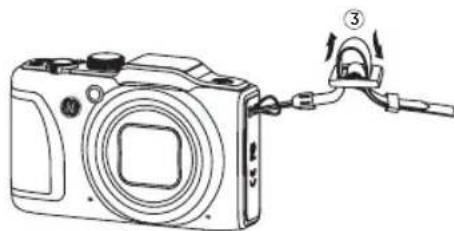
natural_image
Line drawing of a digital camera with a cable and connector, no text or symbols present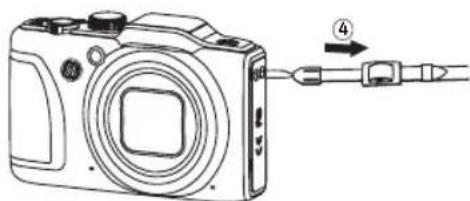
natural_image
Line drawing of a digital camera with a cable inserted, showing no text or symbolsJog Dial
- Between the shooting and setting menus, you can use the jog dial to select additional functions quickly.
- Playing back pictures or movies, you can use the jog dial to select individual files quickly.
- The jog dial can also be used to select basic camera settings.

text_image
AF SET 面心Camera Views
Front View Rear View

text_image
Diagram of a digital camera with numbered parts for identification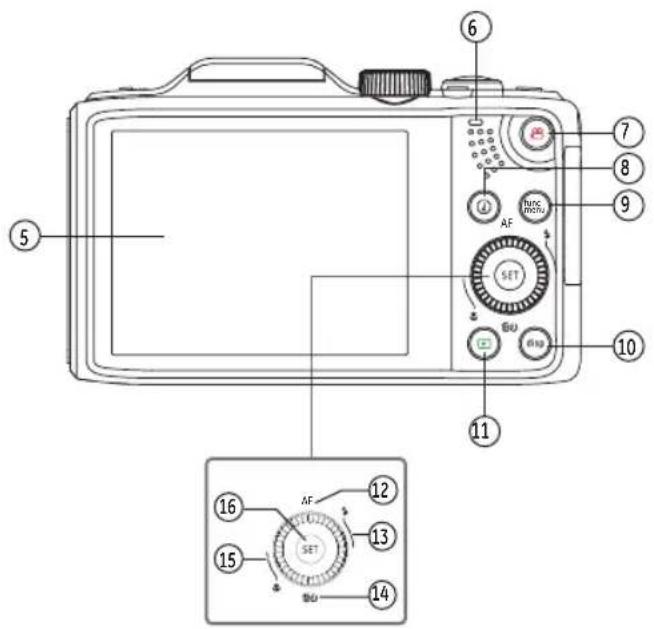
text_image
Diagram of a digital camera with numbered parts and labeled controls, including AF, SET, and control buttons.Left View

text_image
17 18 19Right View
text_image
Technical diagram of a device with labeled parts and numbered annotationTop View
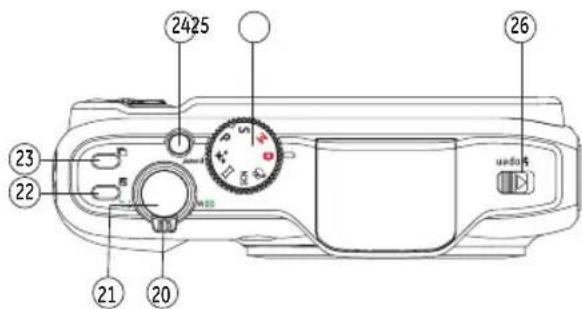
text_image
2425 26 23 22 21 20Bottom View

text_image
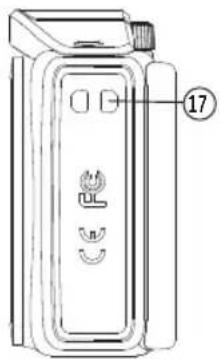
29 28 27| 1 AF Assist/Timer Indicator 11 Playback Button 21 Shutter Button | |||
| 2 Flash Lamp 12 AF Button / Up Button 22 Exposure Compensation Button | |||
| 3 Microphone 13 Flash Button/Right Button 23 Continuous Capture Button | |||
| 4 Lens 14 | Delete Button/Self-Time Button/Down Button | 24 Power Button | |
| 5 LCD Screen 15 Macro Button/Left Button 25 Mode Dial | |||
| 6 Status Indicator 16 SET Button 26 Flash Lamp ON/OFF | |||
| 7 Movie Button 17 Shoulder Strap Mount 27 Card Slot/Battery Compartment | |||
| 8 i key Status Indicator | 18 USB/HDMI Port | 28 Tripod Socket | |
| 9 Menu Button | 19 Handle | 29 Speaker | |
| 10 Display | 20 Zoom Wheel | ||
Battery Charging
- With the camera turned "off", place the batteries into the camera.
- Use the USB cable to connect the camera to the power adapter. (The power supply charger varies with regions, so the charger you received may be different from that in the picture below).
- Insert the power adapter into the power socket.
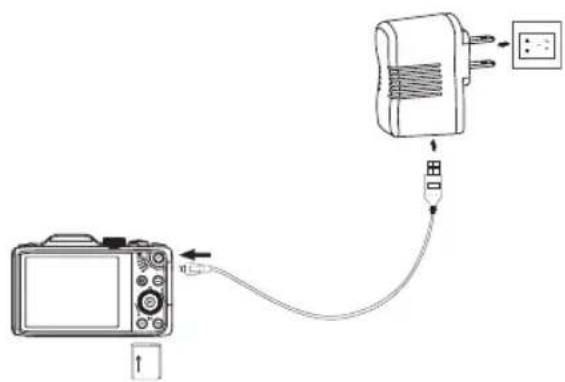
flowchart
graph TD
    A["Camera"] -->|USB cable| B["Device with cable"]
    B --> C["Power outlet"]
    style A fill:#f9f,stroke:#333
    style B fill:#ccf,stroke:#333
    style C fill:#cfc,stroke:#333

When charging, if the camera indicator is red, it means that the battery is not fully charged; when the camera indicator turns green, it indicates that the battery is fully charged and ready to use (to optimize battery life, charge the battery for at least four hours when charging it for the first time).

The charger is for indoor use only.

Charging the battery should only be done with the camera in the "off" position.

Please charge the battery indoors between 0°C and 35°C.

When the battery is not in use for a long time, please use the attached charger to charge the battery.
Insert the Battery and SD/SDHC/SDXC Card (Not included)
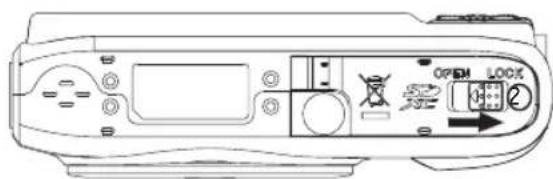
- Open the battery compartment
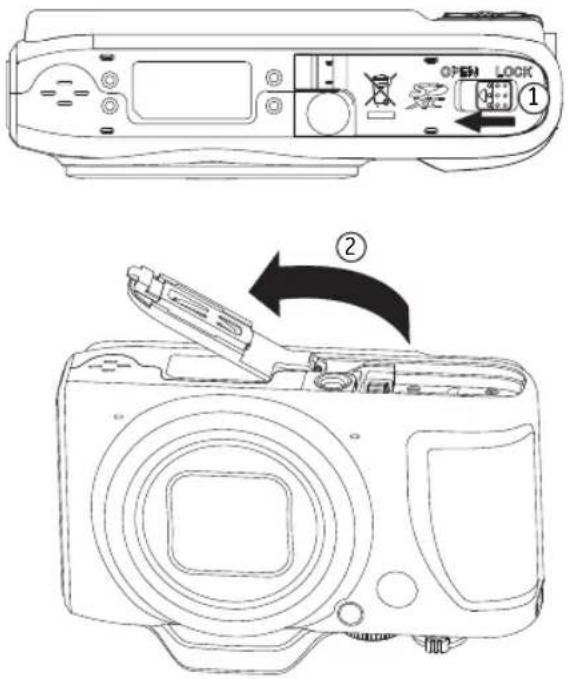
text_image
OPEN LOCK ① ②- Insert the battery into the battery slot in the correct position as shown in the following diagram:
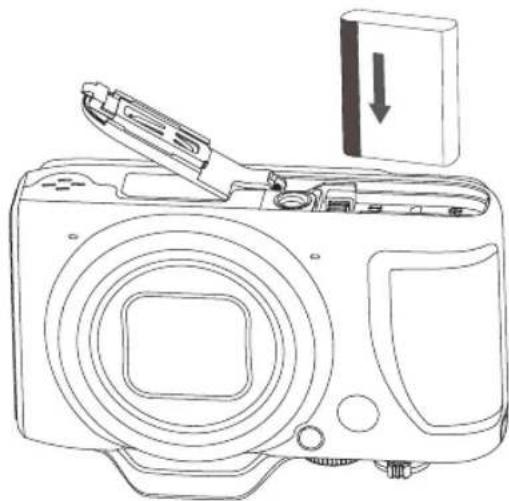
natural_image
Line drawing of a digital camera with an open lid and a downward arrow indicating action (no text or symbols)
Extensive, continuous use of the camera can cause battery to overheat. Please always use caution when removing the battery.
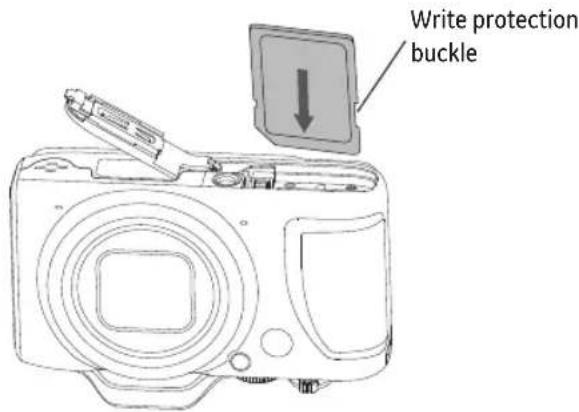
memory card slot as shown
- Close the battery compartment3. Insert an SD/SDHC/SDXC card (not in
text_image
Write protection buckle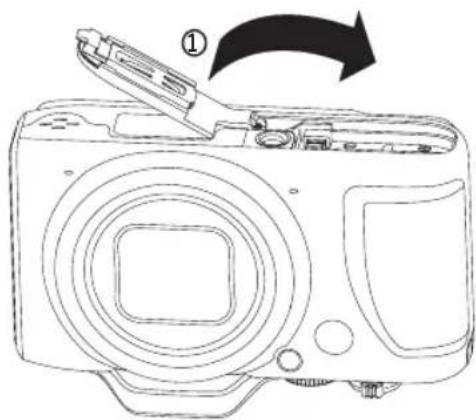
natural_image
Line drawing of a digital camera with an open lid and handle, showing the camera body and casing (no text or symbols)
Optional SD/SDHC/SDXC cards are not included. The use of 64MB to128 GB memory cards from reputable manufacturers are recommended for reliable data storage.

To remove the SD/SDHC/SDXC card, open the battery compartment and gently push the card to release it. Remove the card out carefully.
text_image
OPEN LOCK ②Turning Camera On and Off
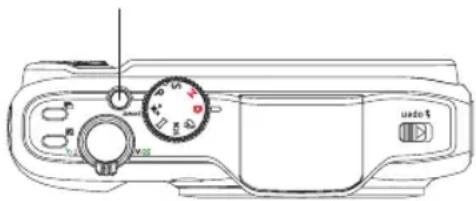
Press the Power button to turn the camera on. To turn off the camera, press the Power button again
Power Button
natural_image
Line drawing of a device control panel with gauges and buttons (no text or symbols)After the camera is powered on, set the camera to Auto mode by turning the Mode Dial at the top of the camera (see page 23).
Setting Language and Date/Time

The Date/Time and Language setup page will automatically appear when the camera is turned on for the first time.
To set the display language and date/time, go to the following setup options in the General Setup menu.
- Language
- Date/Time
To access the General Setup menu, do the following:
- Press the Power button to turn the camera on.
- Press the (lunc) button, press Up/Down button to switch between menus, select General Setup Menu, press SET button to enter Set Menu.
Set Display Language
- In the General Setup Menu, press Up/Down button to select Language, press SET or Right button to enter setting mode.
- Use the Up/Down/Left/Right buttons to select the desired language.
- Press the Ⓗ button to confirm the setting.
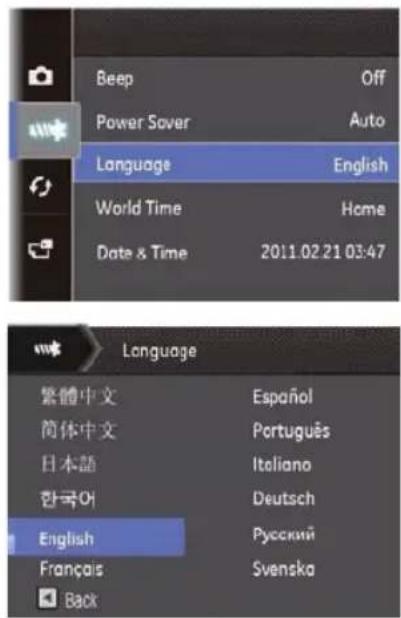
text_image
Beep Power Sover Language World Time Date & Time Off Auto English Home 2011.02.21 03:47 Language 繁體中文 简体中文 日本語 한국어 English Français Back Español Portugues Italiano Deutsch Русский SvenskaSet Date/Time
-
In the General Set Menu, press Up/Down button to select Date/Time, press SET or Right button to enter setting mode.
-
Press Up/Down to select the Date & Time Display Mode, press right button to select the item to be set, press Up/Down button to select the desired value.
-
Press the Ⓗ button to confirm the setting.
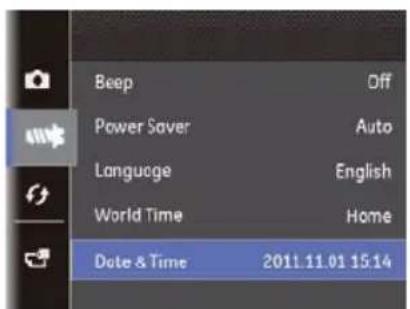
text_image
Beep Power Saver Language World Time Date & Time 2011.11.01 15:14 Off Auto English Home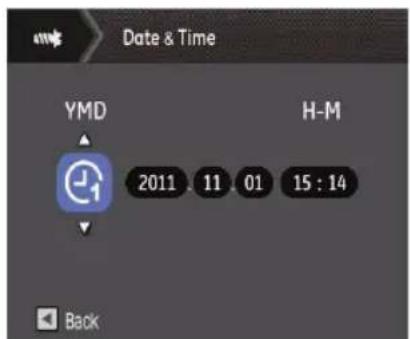
text_image
Date & Time YMD H-M 2011 . 11 . 01 15 : 14 BackLCD Screen
When you turn the camera on, various icons are shown on the LCD screen to indicate the current camera settings and status. To learn more about the displayed icons, see "LCD Screen Display" on page 19.
LCD Screen Notes:
Extremely high-precision technology has been used to manufacture the LCD screen to ensure most of the pixels are operational. On occasion, there may be some minute points (black, white, red, blue or green) that consistently appear on the LCD screen. These points are normal in the manufacturing process and do not affect the recording process in any way.

Avoid exposing the LCD screen to water; remove any moisture on the LCD screen with a soft, dry cleaning cloth.

If the LCD monitor is damaged, take particular care with the liquid crystal in the monitor. If any of the following situations arise, take the recommended, immediate action indicated below:
- If liquid from inside the LCD screen comes in contact with your skin, wipe the area with a clean cloth and then wash thoroughly with soap and running water.
- If liquid from inside the LCD screen gets into your eye, flush the affected eye with clean water for at least 15 minutes and then seek medical assistance immediately.
- If the liquid crystal display or the liquid inside it are swallowed, flush your mouth thoroughly with water. Drink large quantities of water and induce vomiting. Seek medical assistance immediately.
Using the Modes
Display Setting
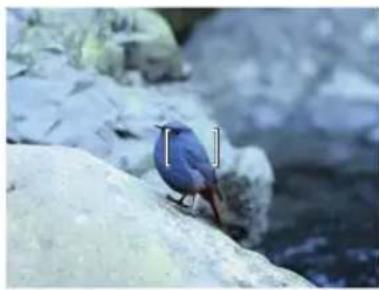
Press dispon to toggle between these modes: Default, Grid, and Clean.
Default mode: Display the camera parameters on screen
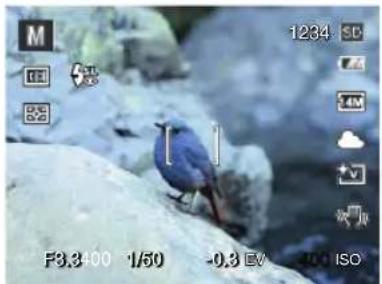
natural_image
Photo of a bird perched on rocks with camera mode controls and ISO settings visible (no readable text or symbols in the main image area)Grid: Camera parameters with Grid and Histogram

natural_image
Close-up photo of a bird perched on rocks with camera settings visible (no readable text or symbols)Clean: Does not display any additional icons
natural_image
A bird standing on rocky terrain with a small inset image showing vertical measurement lines (no text or symbols)LCD Screen Display
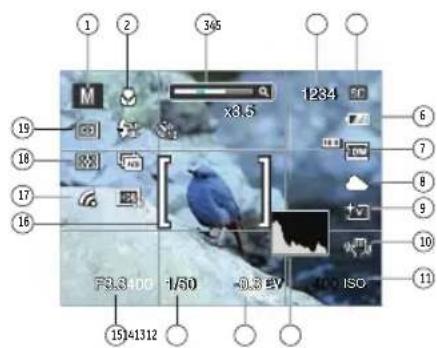
Still Picture Display Mode
Mode:


text_image
1 2 345 M x8.5 1234 6 19 18 17 16 F9.3400 1/50 -0.3 EV 400 ISO 1541312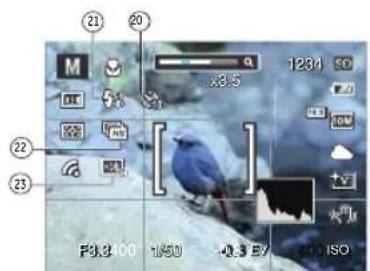
text_image
21 20 M x3.5 1234 SD 22 23 F9.8:00 1/50 -0.3 E7 ISO1 Shooting Mode Icons

Auto Mode

Manual Mode

Shutter Priority
Program AE


Face Beautifier

Panorama Mode

Scene Mode
2 Macro Mode
3 Zoom
4 Remaining number of pictures
5 SD Memory card/built-in Memory
6 Battery Status
7 Image Size
8 White Balance(Adjustable only in M S Pmode)
9 Picture Color(Adjustable only in MS Mode)
10 Stabilization
11 ISO Value (Adjustable only in MP ♦ Mode)
12 Histogram
13 Exposure Compensation (EV value)(Adjustable only in SPMode)
14 Shutter Speed
15 Aperture Value
16 Focus Frame
17 Eye-Fi ON (with signal)
18 Expo Metering

AiAE

Spot

Multi
19 AF Mode

Single-AF

Multi-AF

Object Tracking
20 Self-Timer

2 sec

10 sec

Smile
21 Flash Mode

Force Off

Flash Auto

Force Flash

Slow Sync.

Slow Sync. + Red-Eye

Red-Eye Reduction
22 Continuous Shot

Single

Continuous Shot

Cont. Shot- High Speed (VGA)

Cont. Shot- Fast (4M)

Time-Lapse
23 HDR
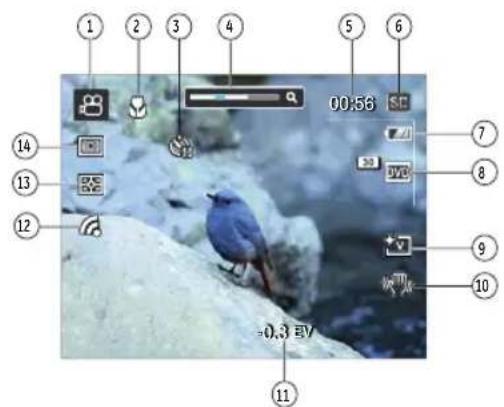
Video Shooting Display Mode
Mode:
text_image
1 2 3 4 5 6 00:56 SC 3D DV 7 8 9 10 =0,3 E/V 111 Video Mode Icon
2 Macro Mode
3 Self-Timer

10 sec
4 Zoom Value Scale (Displayed only when zoom is activated)
5 Remaining time for video recording
6 SD Memory Card/Built-in Memory
7 Battery Status
8 Video Quality
9 Picture Color
10 Image Stabilization
11 Exposure Compensation (EV value)
12 Eye-Fi ON (with signal)
13 Expo Metering

AiAE

Spot

Multi
14 AF Mode

For optimal video shooting, it is recommended that an SD memory card be used. If you shoot video using only the camera's internal memory, the end results may have image jitter, noise and vastly shorter recording times.

Optical Zoom and Digital Zoom can be adjusted. Digital Zoom can be adjusted to 6X (90X in total).
Playback Display Mode
Mode:

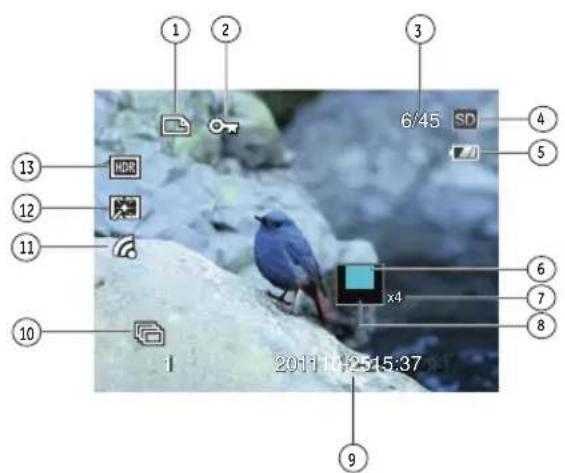
text_image
1 2 3 6/45 SD 4 5 13 HDR x4 6 12 11 7 10 9 2011 10:2-15:371 DPOF File
2 File Protection
3 Memory Space (this picture/total number of pictures)
4 SD Memory Card/Built-in Memory
5 Battery Status
6 Zoom Magnification Area
7 Image Zoom Ratios
8 Image Zoon
9 Shooting Date
10 Continuous Capture Group Playback
11 Eye-Fi ON (with signal)
12 Red-Eye Reduction
13 HDR
Using the Mode Dial
This GE camera provides a convenient mode dial that allows you to manually switch between different modes with ease. All the available modes are listed below:
| Mode Name Icon Description | ||
| Auto Mode |  | Take still pictures in automatic mode |
| Manual Mode |  | Many of the camera settings can be configured manually in this mode |
| Shutter Priority |  | Setting allows you to choose a specific shutter speed so the camera will adjust the aperture automatically to ensure correct exposure |
| Program AE |  | Setting allows you to choose the EV value and the camera will select both the shutter speed and aperture automatically |
| Face Beautifier |  | This mode automatically enhances facial features with skin softening touches and eye brightening capabilities |
| Panorama Mode |  | Capture a sequence of shots that automatically stitch together into a panoramic photo |
| Scene Mode |  | Choose from 25 different pre-set scene types and effects for your photos |
| Movie Mode |  | Record videos |
Shooting in Auto Mode
Auto mode is the easiest mode to take photos. While operating in this mode, the camera automatically optimizes numerous camera settings to adjust your photos and videos for optimum results.
Follow these steps:
- Switch the Mode Dial to Auto Mode (
- Compose your picture in the LCD screen or Electronic View Finder and press the Shutter button halfway down to focus on the subject.
- The L CD screen will show a green focus frame after the subject is in focus.
- Press the Shutter button down fully to capture the image.

Manual Mode
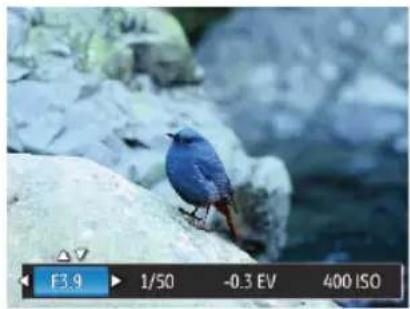
When selecting manual (M) mode, you can set the aperture and shutter speed manually.
- Set the mode dial to M and press the enter the Manual Mode setting menu
natural_image
A bird perched on a rocky shoreline, captured in a video editing interface (no text or symbols on the bird or rocks)- Press the Up/Down button to select the parameter adjustment.
- Press the Ⓗ button to confirm the settings and enter the shooting screen.
When selecting Shutter Priority (S) mode, you can adjust the shutter speed and EV value. Selecting a higher shutter speed will capture faster moving objects clearly. Selecting a slower shutter speed will result in motion blur of moving objects.
- Set the mode dial to S and press the the Shutter Priority settings menu.
button to enter

natural_image
Blue bird perched on rocky shore, captured in a video editing interface (no text or symbols on the bird or rock)-
Press the Up/Down button to select the parameter adjustment.
-
Press the Ⓗ button to confirm the settings and enter the shooting screen.
Auto Program Exposure Shutter Priority
When selecting Auto Program Exposure (P) mode, you can adjust the combined settings of EV value, shutter speed and aperture. The display on the LCD screen is showing these settings in the screen below:

natural_image
Blue bird perched on rocky shore near water, captured in video frame (no text or symbols on bird or rock)-
Set the mode dial at the top of the camera to P and press the 🔔 button to enter the Auto Program Exposure settings menu.
-
Press the Up/Down button to select the parameter adjustment.
-
Press the button to engage the settings and enter the shooting screen.
Beautifier Mode

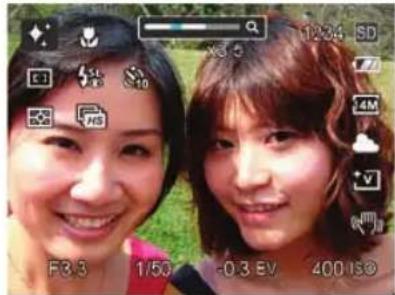
In Portrait Mode, the camera is set to automatically adjust camera exposure for realistic portrayal of skin tones.
- Turn mode dial to select Beautifier Mode (♦).
- After entering Beautifier Mode, you can select other function settings (such as: Stabilization, Smile Detection, etc).
text_image
1234 SD F8.3 1/50 -0.3 EV 400 kΩBeautifier mode has 3 effects:

: Skin Beautifying

: Skin Beautifying + Eye Enlarging

: Skin Beautifying + Eye Enlarging + Eye Brightening
Panorama
Panorama Mode allows you to create a panoramic picture. The camera will automatically compose a panoramic picture using the individual shots that you take.
Follow these easy steps to create a panoramic picture:
- Turn the mode dial to the Panorama setting.
- Press Left/Right button to select shooting direction. After 2 seconds or if you press the shutter button, the camera will enter shooting mode automatically.
- Compose the first view of the panoramic picture on the LCD screen and press the Shutter button to capture the image.
- When you finish shooting the first photo, two target icons will display on the LCD screen at left and right sides. Move the camera to the right until the round target icon is directly positioned over the square box. The box will turn green when they overlap and the camera will automatically take the next picture. Repeat the same steps for additional shots. Up to 4 frames can be stitched together.

natural_image
Scenic coastal landscape with turquoise water, scattered trees, and distant hills under a clear sky (no text or symbols visible)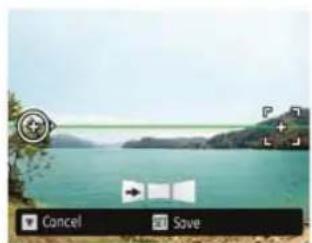
natural_image
Scenic landscape with lake, hills, and camera interface buttons (Cancel, Save) on the right side-
If continuous pictures are less than 4 shots, press the SET button and the camera will stitch the pictures automatically. Press the playback button to enter playback mode to see the effect.
-
If you take 4 pictures, the camera will automatically stitch the pictures. Press the playback button to enter playback mode to see the effect.

Flash Mode, Self-Timer, Macro Mode, and Exposure Compensation are all disabled in Panorama Mode.

In the process of automatic panoramic shooting, "Improper alignment. Please try again." shown on the LCD screen means that the moving angle deviates from the green baseline during camera moving which leads to shooting failure, and you need to shoot again.

In Montage mode, up to 4 photos can be captured when the image size is set at 3MP.

In the Panorama menu, you can set initial shooting direction of left to right or right to left.
Manual Scene Mode (SCN)
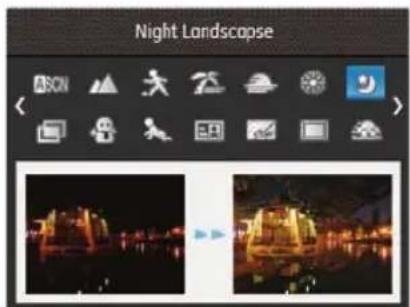
In Manual Scene Mode, you can select from a total of 25 scene types to suit your needs. The camera will automatically adjust to the optimal settings based on the scene type that is chosen.
To enter the Scene Mode, turn the mode dial to Manual Scene mode. The Scene Mode menu will appear.
text_image
Night Landscape ASON A B C D E F G H I J K L M N O P Q R S T U V W X Y Z 3Select a scene using the Up/Down/Left/Right button and press the SET button.
| Mode Name Description | ||
 | Auto Scene | Identifies the scene automatically; Person, Backlighting, Landscape, Macro, Night Scene, Night Scene Person, Auto. |
 | Landscape | For landscapes and outdoor shots. Vivid reproduction of green and blue. |
 | Sport | For fast-moving subjects. Capture sharp, action shots with minimal blur. This mode is not recommended for shooting indoors. |
 | Beach | For taking pictures in areas with strong sunlight. |
 | Sunset | For sunsets. Capture subjects in strong sunlight. |
 | Fireworks | For fireworks at night. Slower shutter speed adjusted for brilliant images. The use of a tripod is recommended. |
 | Night Landscape | For night scenes. The use of tripod is recommended. |
 | Multi Exposure | Take several photos continuously. |
 | Snow | For snow scenes. Reproduce natural, clear white scenes. |
 | Children | Turns off flash automatically. Avoids disturbing subject, suitable for taking photos of children. |
 | ID | For shooting ID size photos. |
 | Glass | For objects behind transparent glass. |
 | Photo Frame | For adding interesting frame effects to the photo. |
 | Panning Shot | Produces background image blur that emphasizes the motion of the main subject. |
 | Text | For taking pictures of text, documents or white boards. |
 | Portrait | The best setting for portraits, enables AE/AF for faces. |
 | Distorting Mirror | Distorts photo and subjects with a mirror effect for interesting special effects. |
 | Party | For taking pictures of large groups or in areas with uneven lighting. |
 | Indoor | For indoor settings. Reduce blur and improve color accuracy. |
 | Leaf | For plants. Capture brilliant shots of greenery and blossoms. |
 | Museum | For museums or flash-free areas. Retain color and reduce blur. |
 | Night Portrait | For portraits against night scenery. |
 | Pet Mode-Dog | Quickly identifies a dog, capturing quick or unexpected movements. |
 | Pet Mode-Cat | Quickly identifies a cat, capturing quick or unexpected movements. |
 | Fax | Creates a black and white fax effect of the image. |
Auto Scene Mode (ASCN)
In the "ASCN" mode, different recording conditions are detected intelligently and the most suitable settings will be automatically selected.
| Icon Mode name Icon Mode name | ||
| Landscape Mode Night Landscape Mode | ||
| Portrait Mode Macro Mode | ||
| Night Portrait Auto Mode | ||
| Backlit Portrait | ||
To use "ASCN":
- Turn mode dial to "SCN" function, then select "ASCN" mode. LCD screen will be shown as follows:

natural_image
A blue bird perched on a rocky stream, with camera control buttons visible in the corner (no readable text or symbols on the bird or rocks)- Hold the camera steadily and aim at the subject. The optimum scene mode will be selected automatically.
- Press the Shutter button halfway down to focus.
- Press the Shutter button all the way down to take the picture.
| Mode name Description | |
 Landscape Mode Landscape Mode | For landscapes, ASCN will automatically adjust the exposure and reproduce vivid green and blue colors. |
 Portrait Mode Portrait Mode | The best mode for shooting portraits at night and enables AE/AF for faces. |
 Night Portrait Night Portrait | When you take portraits at night, or in low light conditions, ASCN will automatically adjust the exposure for people and night scenes. |
 Backlit Portrait Backlit Portrait | When the sun or any other light source is behind you, ASCN will automatically adjust the foreground exposure to produce the best pictures possible. |
 Night Landscape Mode Night Landscape Mode | For night scenes, ASCN will automatically increase the ISO value to compensate for low light. |
 Macro Mode Macro Mode | To produce more detailed close-ups, ASCN will automatically engage the camera's Macro mode and automatically focus the lens. |
 Auto Mode Auto Mode | The camera will automatically adjusts the exposure and focus to ensure the best possible pictures. |
BASIC OPERATION
Shooting in Auto Mode

Auto Mode is the easiest mode to take photos. While operating in this mode, the camera automatically optimizes camera settings to adjust camera settings for the best photos possible.
To start shooting, do the following:
-
Press the Power button to turn the camera on.
-
Swit ch the Mode Dial to Auto Mode (
-
Compose your picture in the LCD screen or Electronic View Finder and press the Shutter button halfway down to focus on the subject.
-
The L CD screen will show a green focus frame after the subject is in focus.
-
Press the Shutter button down fully to capture the image.
Using the Zoom Function
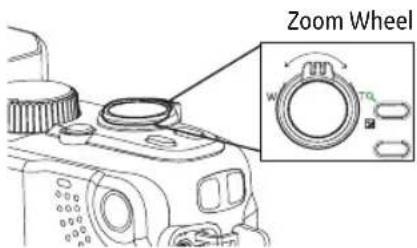
Your camera is equipped with two types of zoom functions: Optical Zoom and Digital Zoom. Press the Zoom button of the camera to zoom in or out of the subject while taking pictures.
text_image
Zoom Wheel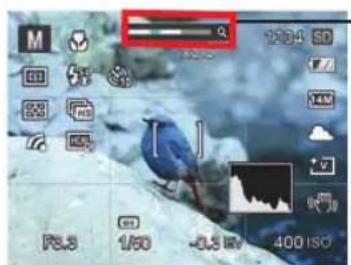
natural_image
Close-up photo of a blue bird perched on a snowy surface, with camera mode and exposure settings visible (no readable text or symbols in the main image area)Zoom indicator (See "Digital Zoom" on page 50)
When the Optical Zoom reaches its maximum value, release the Zoom button and then press it again for the Digital Zoom to begin.
Focus Setting
This setting allows you to select different modes for optimum focus.
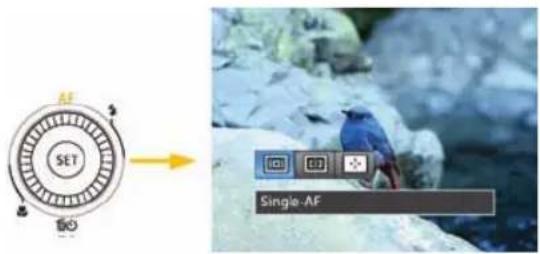
- Press Up button AF to enter setting screen.
text_image
AF SET Single-AF- Press the Left/Right button to select from the following three modes:

Single-AF

Multi-AF

Object Tracking
- Press the Ⓗ button to confirm the settings and exit the menu.

Once enabled, Object Tracking will only work when lens is focused on the object.
Macro Mode
The Macro setting is ideal for shooting small objects or close-up photos. This mode allows you to focus on subjects very close to the camera.
- Press 🖼 button to enter Continuous Macro function menu.

text_image
AF ISO SET Mann Off- Press the Left/Right button to select the following two modes:

Macro Off
Select this option to disable Macro.

Macro On
Select this to focus on subjects 5cm from the lens.
- Press the ⏻ button to confirm the settings and exit the menu.
Self-Timer Setting
Use this function to take pictures at pre-set intervals. The camera shutter speed can be set for 2 seconds, 10 seconds or by smile detection.
- Press Down menu.

button to enter Self-Timer function

text_image
AF SET Go Self-timer Off- Press the Left/Right button to select the following 4 modes:

Self-Timer Off
Disables the Self-Timer.

Self-Timer - 2 sec
A single picture is shot 2 seconds after the Shutter button is pressed.

Self-Timer - 10 sec
A single picture is shot 10 seconds after the Shutter button is pressed.

Self-Timer Smile
Once the Shutter button is pressed a photo is taken as soon as a smile is detected on the LCD screen.
- Press the menu.

button to confirm the settings and exit the
Open Flash
The Flash is used to illuminate a subject in low light or for fill-in lighting to achieve better illumination of a subject with pronounced shadows.
- To turn on the Flash, press the Flash button.
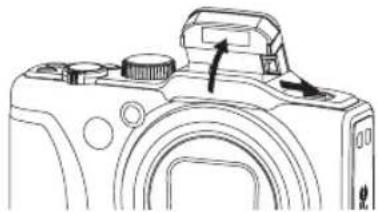
natural_image
Line drawing of a DSLR camera with adjustment knob and scroll wheel (no text or symbols)- Press Right button to enter Flash setting menu.

text_image
AF SET Forced Off- Press the Left/Right button to select from the following 6 modes:
• Force Off Flash is turned off.
• Flash Auto Camera flash goes off automatically based on existing light conditions.
• Force Flash The flash will engage with each shot even if there is enough available light to take the photo without flash.
- Slow Sync. This allows for night scenery photos that include people in the foreground. The use of a tripod is recommended when shooting with this setting.
- Slow Sync. + Red-Eye Using this mode for slow synchro shots with red-eye reduction.
- Red-Eye Reduction The camera emits a brief pre-flash before the picture is taken to reduce red-eye effects.
- Press the SET button to confirm the settings and exit the option.
White Balance Setting
The White Balance setting allows you to adjust the color temperature for different lighting sources to ensure the most accurate color reproduction.
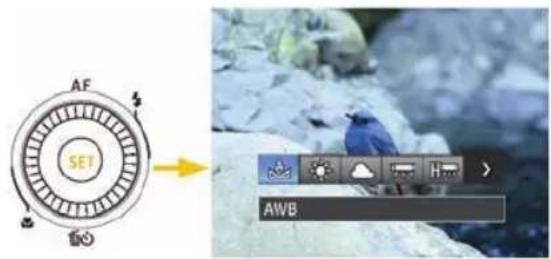
- Press SET button to enter White Balance Menu.
text_image
AF SET AWB- Press Left/Right button to select the following 8 modes:
• AWB
Daylight
Cloudy
- Fluorescent
- Fluorescent CFW
- Incandescent
• Manual WB(Press the Shutter button to detect WB)
• K Color Temp. (1900K\~10000K)
Press Up button to adjust K value; press Down button to exit K value.
- Press the ⏻ button to confirm the settings and exit the menu.
Continuous Capture Setting
Use this setting to perform continuous shooting. After entering this mode, you can shoot multiple images by continuously holding the shutter button down.
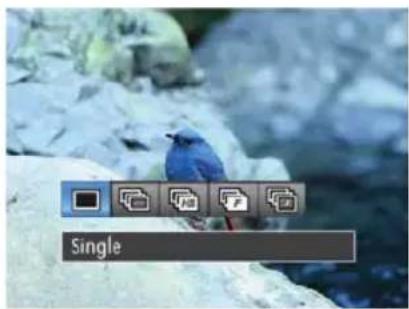
- Press top button to enter Continuous Capture Menu.
text_image
Single- Press the Left/Right button to select the following 5 modes:

Single
Capture a single shot only.

Continuous Shot
Shoot at the rate of 10 pictures per second with the maximum pixel setting. (Slow down starting from No. 8)

Cont.Shot-High Speed (VGA)
Continuously capture using VGA pixel, up to 75pix/sec with a maximum of 120 images.

Cont. Shot- Fast (4M)
Continuously capture 4MP images, up to 25pix/sec with a maximum of 40 images.

Time-Lapse
Automatically capture pictures at pre-defined intervals.
- Press the Ⓗ button to confirm the settings and exit the menu.

The flash is disabled in this mode in order to achieve quick succession of shots.
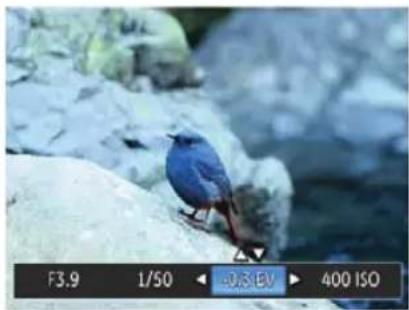
EV Setting
The EV function menu of the camera includes functions, such as EV adjustment, shutter, aperture, etc. Using the appropriate function settings can improve your pictures.
To select the best setting for optimum photos, follow these steps:
- Press ☐ button to enter setting screen.
- Press Left/Right button to select the required functions.
natural_image
Blue bird perched on rocky surface near water, captured in video editing interface (no text or symbols on bird or rock)- Press Up/Down button to adjust image value.
- Press SET button to complete the setting and enter shooting mode.
Exposure Compensation
The exposure compensation feature allows you to adjust the light exposure value to control the brightness of the image.

natural_image
Blue bird perched on rocky shore near water, captured with ISO 400 (no text or symbols on bird or rock)The adjustable range of exposure value is from EV -3.0 to EV+3.0.
ISO
The ISO function allows you to set the sensitivity of the camera's light sensor based on the brightness of the scene. To improve the camera's sensor performance in darker environments, a higher ISO value is required. A lower ISO value is needed when shooting in brighter conditions.
Pictures taken at higher ISO settings will generally have more noise than those taken at lower ISO settings.

natural_image
Blue bird perched on rocky shore near water, captured in video frame with ISO settings (no text or symbols on the bird or background)The camera's ISO settings include: automatic, 100, 200, 400, 800, 1600 and 3200.
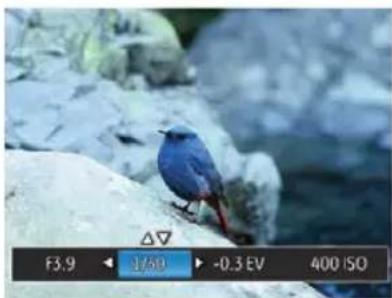
Shutter Adjustment
You can adjust the shutter speed value. Selecting a higher shutter speed will capture fast moving objects more clearly. Selecting a slower shutter speed will result in some motion blur of moving objects.
natural_image
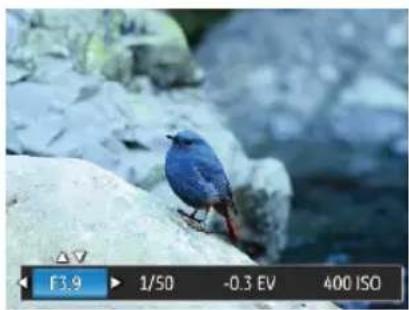
Blue bird perched on rocky shore near water, captured via LCD screen (no text or symbols on bird or rock)Aperture Adjustment
You can adjust the aperture size value. Selecting a large aperture opening will emphasize the point of focus and show a blurry background and foreground. A small aperture opening will keep both the background and main object in clear focus.
natural_image
Blue bird perched on rocks near a riverbank, captured in a video editing interface (no text or symbols on the bird or rock)Using Quick Recording
In shooting mode, press the Recording shortcut button to begin recording video.

natural_image
Blue bird perched on a rocky surface with blurred water and rocks, no visible text or symbolsAfter finishing, press the Recording shortcut button or the Shutter button to stop and store the video. The camera will return to shooting mode automatically.
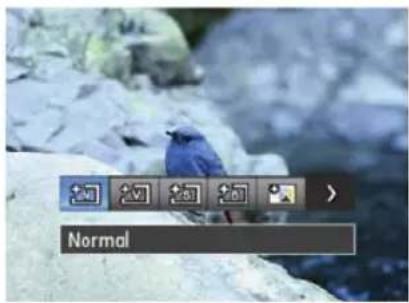
i Button Function Menu
The Image color setting allows you to select different color effects.
- Press the menu.

button to select the image color setting
text_image
Normal- Press Left/Right button to select image color setting.
- Press the Ⓗ button to confirm the settings and exit the menu.
Image color setting effect has the following 8 options:
• Normal
• Vivid
• Retro
- Black and White
- Negative
• 70's Flim
• Pop Art
• Rock
PLAYBACK
Viewing Photos and Videos
To view the captured photos and video clips on the LCD screen:
- After pressing the 📄 button, the last photo or video clip taken will be displayed on the LCD screen.
- Use the Left/Right navigation buttons to scroll through the photos or video clips stored in the internal memory or on the SD memory card.
- To play a selected video clip, press the Ⓗ button to enter the movie playback mode.
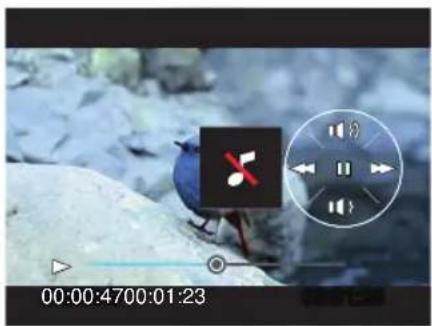
During video playback, the operating instructions will appear on the screen. Press the Left/Right button, and press the button to engage the following actions.
The operating instruction icons are as follows.
1 Increase Volume 4 Decrease Volume
2 Pause 5 Rewind
3 Fast Forward

natural_image
Blue bird perched on rocky ground with a play button overlay (no readable text or symbols)When playing a movie, press the Up/Down arrow button to raise or lower the volume, to mute the volume press the down arrow until the mute icon 📁 appears.
text_image
00:00:4700:01:23Thumbnail View
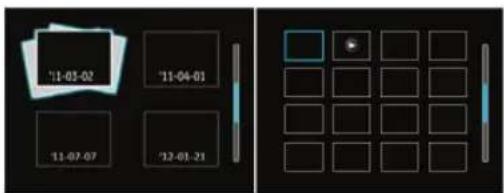
When in Playback mode, rotate the zoom wheel counter clockwise to the position to display thumbnail images of the photos and videos on the screen.

text_image
W Zoom out T Zoom in power- Use the Zoom button to switch between 3x3, 4x4 and Date Folder thumbnail display.
- When displaying 3x3 and 4x4, use Up/Down/Left/Right button to select a picture or video clip for viewing; when displaying the Date Folder, use Up/Down button to select the Date Folder.

natural_image
Two grid panels with blue square outlines and a vertical line, no text or symbols present3 Press button to select continuous shooting playback and date playback.
text_image
'11-03-02 '11-04-01 '11-07-07 '12-01-21- Press Up/Down/Left/Right button to select a picture or a group of photos or a video with continuous capture, press button to return to the original size.

The Date Folder is displayed in date order based on camera's date/time settings.

When icon appears, this indicates a continuous capture group file.

If the ▶ indicator appears on the LCD, then a movie file is currently being displayed.

Press the button to restore a preview icon to its original image size.
Using Zoom Playback (for still pictures only)
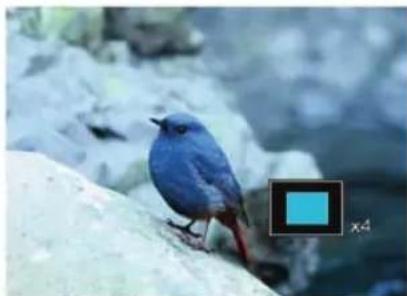
The zoom buttons can also be used during playback. This allows you to magnify photos between 2x to 8x.
- Press the 📋 button to switch to playback mode.
- Use the Left/Right navigation buttons to select a photo to magnify.
- Rotate the zoom wheel clockwise to (T) to zoom in.
- Use the Zoom wheel to zoom in and out. The zoom magnification area frame and the frame of the whole photo will display on the screen.
natural_image
Blue bird perched on rocky ground with a small inset square showing a cyan color (no text or symbols)-
Use the navigation buttons to pan across the image.
-
Press the Ⓗ button to return the image to its original scale.

Movie images cannot be magnified.
Using the Delete Button
In Playback Mode, you can press the Down/Delete button to delete an unwanted photo or video.
To delete photos or videos:
- Press the 📄 button to switch to playback mode.
- Select a picture or video clip you want to delete with the Left/Right button.
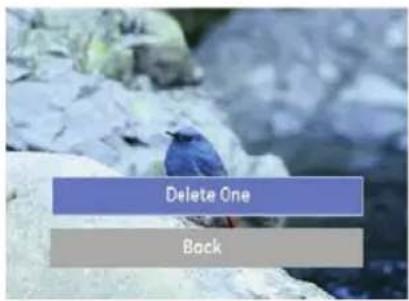
- After pressing the Down/Delete button, the delete screen will display on the screen.
text_image
Delete One Back- Select Delete One or Back with the Up/Down button and press the button for confirmation.

Erased photos/video clips cannot be recovered.

Please refer to page 57 for instructions on deleting more than one image at a time.
USING THE MENUS
Photo Setup Menu
Mode:


In any of the above Photo Modes, press the 📁 button to go to the Photo Setup Menu.
To adjust each setting:
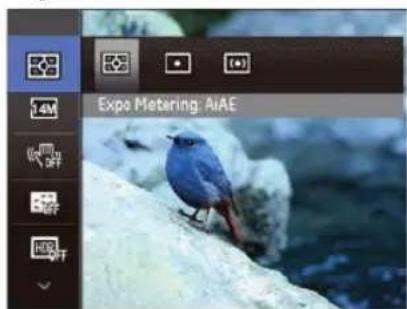
Press Up/Down button to switch between shooting menu and camera setting menu. Press Left/Right to enter and change function settings.
text_image
Expo Metering: AiAE
After selecting a function, you can press the Up button to return to the Still Picture menu for other Photo Setup or Camera Setup pages. Or you can press the Down button several times to move to the next setup menu page.

Refer to the following pages for more details about each setting.
Expo Metering (Exposure Metering)
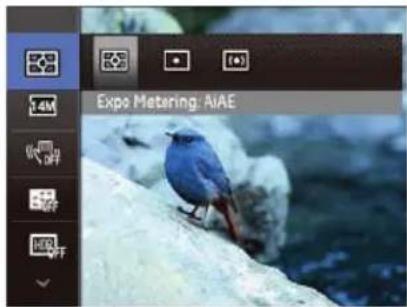
Use this setting to select the "target" size of the camera's field of view to be metered.
text_image
Expo Metering: AiAEThree metering "target" sizes are available to choose from:
- AiAE (Artificial Intelligence AE) targets the camera's entire field of view.
- Spot metering targets a small area in the center of the camera's field of view.
- Multi metering targets a slightly larger area in the center of the cameras field of view.
Size
The size setting refers to the image resolution in pixels. A higher image resolution allows you to print that image in larger sizes without degrading the image quality.

text_image
1.4M 1.4M 12M 10M LM 5M > Size: High quality Printing OFF HDF OFF
The bigger the number of recorded pixels is, the better the image quality becomes. As the number of recorded pixels lessen, you will be able to record more images on a memory card.
OIS
This mode can help reduce photo blur caused by unintentional hand shake, low light or slow shutter speed.

text_image
14M OFF OIS: Off
Use Stabilization Mode in dark environments or when using a slower shutter speed.

Shooting in a windy or unstable environment (such as a moving vehicle) may cause blurred images.
Continuous AF
When Continuous AF is turned on, the camera will continually adjust focus automatically in response to any camera or subject movement.

text_image
Cont.AF: OffThere are two options:
- Off
- On
HDR
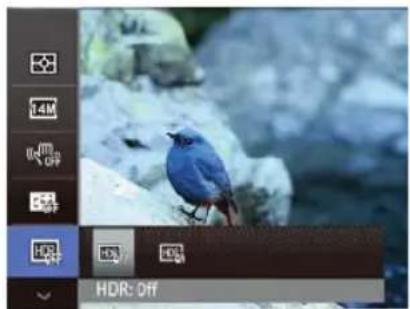
Use this setting to control wide dynamic image range when taking static pictures. Photos with extreme contrast of bright and dark areas will still maintain distinguishable detail and depth. (Use of tripod is recommended)
natural_image
Photo of a blue bird perched on rocks, with HDR adjustment panel visible (no readable text or symbols)There are two options:
- Off
• On
Setting Menu
Mode:

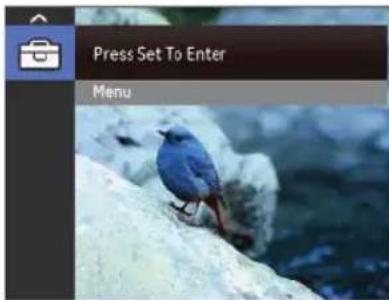
Press func button to enter shooting menu.
- Press Up/Down button to choose setting menu.
text_image
Press Set To Enter Menu- Press or Right button to set menu.
Quality
The camera's quality setting adjusts the compression ratio of the images. Higher quality settings produce better quality photos, but will take up more memory and card space.

text_image
Quality Best Fine NormalThere are three options for picture quality:
- Best
- Fine
- Normal
AF-Assist Beam
This setting can turn on or turn off AF assist lamp. The AF assist beam is useful for focusing in the dark or in low lighting conditions on a particular subject.

text_image
Off AF Assist Bed OnDigital Zoom
Use this setting to enable or disable the Digital Zoom function. When Digital Zoom is turned off, only the Optical Zoom is functional.

text_image
Digital Zoom Off OnDate Imprint
Include a Date/Time stamp on the photo image.

text_image
Off Date Date/Time Dcte imprint- Off
- Date
- Date / Time
Movie Mode Menu
Mode:

Press Mode Dial to select mode.
- Press func menu button to enter menu.
text_image
Expo Metering: AiAE- Press Up/Down button to select the menu options to be set.
- Press Left/Right button to select functions.
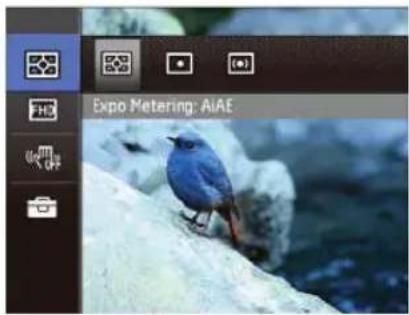
Expo Metering (Exposure Metering)
Use this setting to select the "target" size of the camera's field of view to be metered.

text_image
Expo Metaring: AiAEThree metering "target" sizes are available to choose from:
- AiAE (Artificial Intelligence AE) targets the camera's entire field of view.
- Spot metering targets a small area in the center of the camera's field of view.
- Multi metering targets a slightly larger area in the center of the cameras field of view.
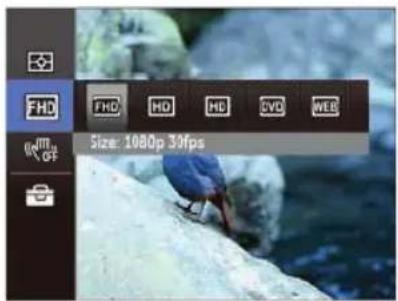
Image Pixel
The quality of the images can be changed by selecting image resolution ratio.
text_image
FHD FHD HO HO GVD WEB Size: 1080p 30fpsThe speed requirements for reading and writing high image pixel images to SD card are as follows:
| No. | Image Pixel | Frame Requirement Recommendation |
| 1 | 1280x720 30 Class 2 Class 4 | |
| 2 | 1280x720 60 Class 4 Class 6 | |
| 3 | 1920x1080 30 Class 6 Class 10 |

Recording time limit above 1280x720 29 fps format is under 29 minutes.

When recording in higher pixel resolutions for extended periods of time, this can cause the camera to generate heat. This is not a camera malfunction.
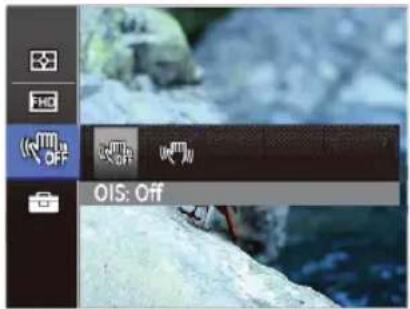
OIS
This mode can help reduce photo blur caused by hand shake, low light and slow shutter speed.
text_image
ON OFF OIS: Off
Use Stabilization Mode in dark environments or when using a slower shutter speed.

Shooting in a windy or unstable environment (such as a moving vehicle) may cause blurred images.
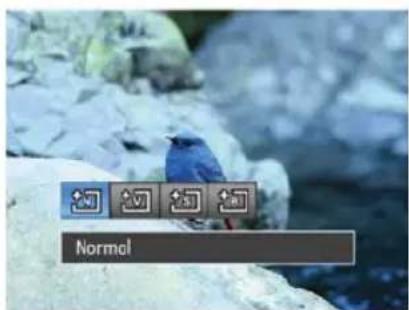
Image Color Setting
Image color setting allows you to select different color effects.
- Pressing Ⓐ button can select image color setting.
- Press Left/Right button to select image color setting.
text_image
NormalImage color setting effect has the following 4 options:
• Normal
• Vivid
• Retro
- Black and White
Blink Detection
Blink Detection is enabled by default unless disabled by the user. When shooting, if a subject is detected with its eyes closed, the Blink Detection icon 🤕 will appear on the screen to show that a blink was detected.

natural_image
Close-up of a smiling baby with curly hair and red lipstick, hands clasped (no text or symbols visible)Playback Menu
Mode:
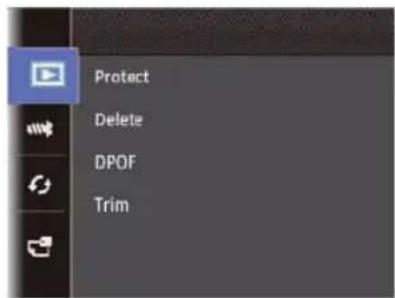
In Playback mode, press the ⏰ button to enter the Playback Menu.
- Press Up/Down button to switch between playback menus.
- Press ⏻ or Right button to enter playback setting menu.
text_image
Protect Delete DPOF TrimThe following section provides detailed instructions on the various menu options.
Protect
To prevent any pictures or videos from being accidentally erased, use this setting to lock one or all of the files.

text_image
Protect One All ResetTo protect/unprotect a picture or video:
-
Use Up/Down arrow button to select Protection, press the ⏚ or Right button to enter the submenu.
-
Press Up/Down button to select between protection options:
-
Single, to protect a single selected photo or video
-
All, to protect all photos and videos stored in built-in memory and/or SD card
Press button to confirm and enter photo/video protection interface. -
Select Protect to lock displayed photos or videos, or select Unprotect to unlock, then press 📋 and select "Back" to return to the playback menu.
Delete
There are 2 ways to delete files.
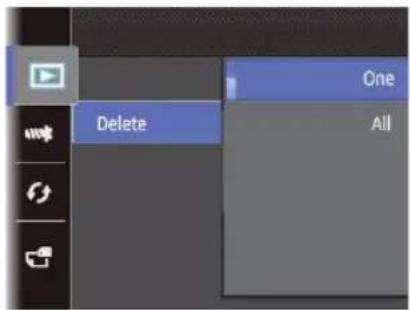
text_image
One Delete All-
Delete One:
-
In the Delete Option, select Delete One and then press the Ⓗ or Right button.
- Press the Left/Right button to locate the photo or video to be deleted. Press the Up/Down button and select Delete One and press the Ⓤ7 button to delete the item or select "Back" to return to the previous menu.
- Delete All:
- In the Delete option, select All and then press the button.
- Use Up/Down button and select Delete All to delete all files, or select Exit to return to the menu.


The "○" indicator means a file is protected. File protection must be removed first before a file can be deleted.

Deleting files will cause DPOF settings to be reset.
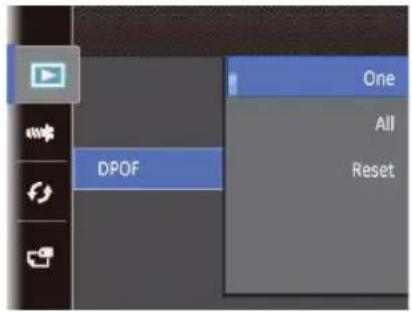
DPOF (Digital Print Order Format)
The DPOF feature allows you to compile and select a group of pictures that you would like to print and will save your selection on the memory card so that you can use the SD memory card to print without having to individually specify the photos you want to print.
text_image
One All Reset DPOFTrim
The Trim Setting allows you to crop photos and save them as new pictures.
To trim a picture:
- Select Cutting function.
- Select "Yes" to confirm cutting. Use direction buttons to select desired photo. Use zoom lever and direction buttons to select portion to be cut.

natural_image
Close-up of a yellow sunflower against a blue sky, with a small icon panel at the bottom (no readable text or symbols)- Press the button and the 'Save Change?' prompt will appear. Select "√" to confirm the changes and save the new image, or select "" to cancel the changes and return to the previous menu.

The image cannot be clipped/trimmed again once it has been clipped to 640X480.
HDR-High Dynamic Range
With the HDR function, pictures that are overexposed may be corrected to optimize the highlights and lowlights captured to more accurately represent the actual scene.
- In the playback mode, press setting screen.
HDR to set, press to enter
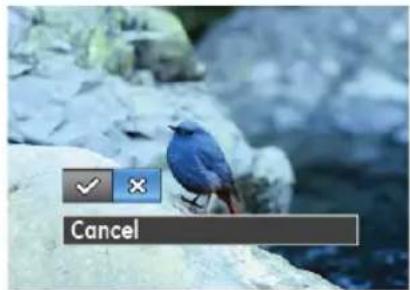
- Press the Left and Right button to find the picture you want to optimize and then select Confirm to perform HDR optimization or select Cancel to go back to Playback menu.
text_image
Cancel
: HDR

: Cancel
- After using the HDR function, the image will be saved as a new file, and the original file is still stored in the memory.
Red-Eye Reduction
Use this setting to remove red-eye effects in your photos.
- In the playback mode, press Left/Right button to select the photo which needs red-eye reduction.
- In the menu, select set, press to enter setting screen.
- Press Left/Right button to select corresponding menu, or cancel and return to playback menu.

text_image
Cancel
: Red-Eye Reduction

: Skin Soften

: Eye Brightening

: Eye Enlargement

: Cancel
- Press the Ⓗ button to confirm the setting.

For best results, the face of the subject should be relatively large in the LCD screen, the subject should be facing the camera and the red-eye effect should be clearly visible.
Rotate
You can use this setting to change the orientation of the picture.
- In the playback mode, press Left/Right button to select the photo which needs rotation.
- In the func menu, select to set, press to enter setting screen.
- Press Left/Right button to select rotation direction, or cancel and return to play menu.
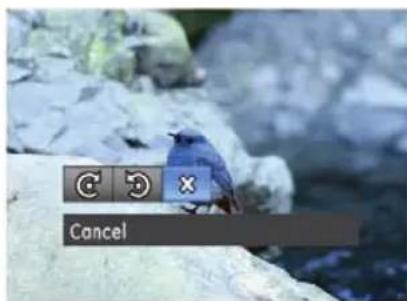
text_image
Cancel
: Turn Right

: Turn Left

: Cancel
- Press the ⏻ button to confirm the setting.

Videos and panoramic pictures cannot be rotated.

The rotated picture file will replace the original photo.
Resize
This setting allows you to resize a picture to a particular resolution, and saves it as a new picture.
- In the playback mode, press Left/Right button to select the photo which you would like to resize.
- In the menu, select to set, press to enter setting screen.
- Press Left/Right button to select a resolution (1024X768 or 640X480), or cancel to return to the play menu.
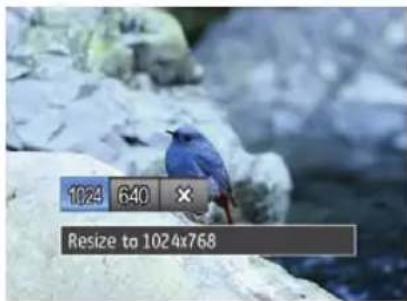
text_image
1024 640 × Resize to 1024x768- Press the button to confirm the setting.

Resizing an image creates a new file that contains the image in the size you desire. The file with the original image also remains in the memory.
Color Effect
This setting allows you to change the picture color effect. The file is saved as a new photo and stored in memory together with the original photo.
- In the playback mode, press Left/Right button to select the photo which needs color effect process.
- In the menu, select to set, press to enter setting screen.
- Press Left/Right button to select a color effect for image or cancel to return to the playback menu.

text_image
Cancel
: Cancel
: Vivid

: Retro

: Black and White

Negative

70's Flim

Pop Art

Rock
- Press the button to confirm the setting.
Slideshow
This setting allows you to view all the stored pictures as a slideshow.
- Press 📄 button to enter playback screen.
- Press SET button to enter slide option.
- Press Left/Right button to select slide playing, or cancel and return to play menu.
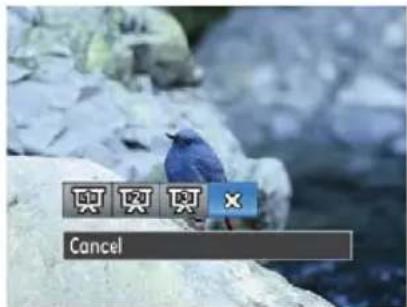
text_image
Cancel• Effect 1: interval 1sec, Melodious music
• Effect 2: interval 1sec, Enthusiastic music
• Effect 3: interval 1sec, Peaceful music
- Press the Ⓗ button to confirm the setting.

The continuous capture group playback may be displayed by slideshow.
Continuous Capture Group Playback
You can use this menu setting to playback a slideshow of a group of photos with continuous capture.
- Press 📄 button to enter playback screen.
- Press Left/Right button to select continuous capture group of photos.
- Press SET to start playback.

natural_image
Photo of a blue bird perched on rocky terrain, captured in a photo editing interface (no readable text or symbols)Setup Menu
Mode :

MSP ♦ SCN
You can enter the Setup menu from any mode, just press button, press Up/Down button to switch, select settings menu, press button to enter, then press Up/Down button to select basic settings menu.
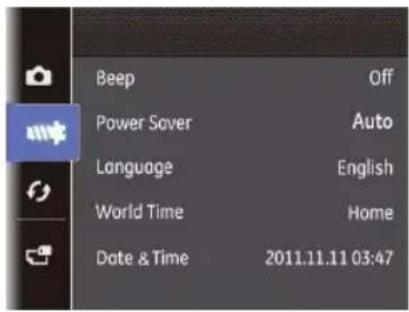
text_image
Beep Power Saver Language World Time Date & Time Off Auto English Home 2011.11.11 03:47To adjust the settings:
-
Select the setting menu for the options you want to set, and press SET or Right button to enter the appropriate menu.
-
Switch between different functions with the Up/Down button.
- Press the Right button to enter the sub-menu.

After selecting a function option, you can press the Up button to return to the menu for other Camera Setup pages. Or you can press the Down button to switch to the next menu page.
Refer to the following pages for more details about each setting.
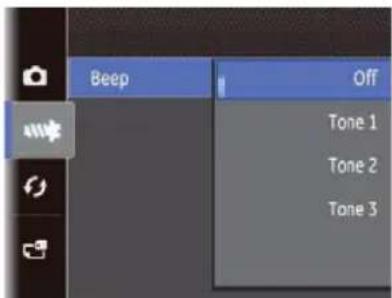
Beep
You can change the tones used for button presses, time lapse and sound effects during power on/off.
To change this setting:
-
Select the Beep setting from the Setup Menu as described previously.
-
Press Up/Down button to select volume control:
-
Tone 1: Low
- Tone 2: Medium
- Tone 3: High
text_image
Beep Off Tone 1 Tone 2 Tone 3- Press Right button to enter, and press Up/Down button to select sound type, then press ⏻ button to confirm setting.

After selecting a sound type, the following functions can be adjusted together: alarm setting, shutter, button tone, and time lapse.
Power Saver
This setting allows you to save power and get the maximum possible running time for your camera's batteries. Follow the steps below to turn the LCD screen and camera off automatically after a consecutive period of inactivity.
- Select the Power Save setting from the Setup menu as described previously.
- Press the Up/Down button to select the power items for the screen and camera and press the Right button.

text_image
Power Saver Auto Normal Best- Press the Up/Down button to adjust the selected item. Both items have the following options.
- Press the Ⓜ button to confirm.
Language
See "Setting the Language" section on page 15.
Zone
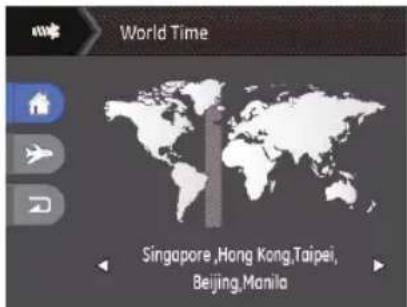
The Zone setting is a useful function for your overseas trips. This feature enables you to display the local time on the LCD screen while you are abroad.
- Select the Zone setting from the Setup menu as described previously. The world time screen will appear.
- Use the Up/Down navigation buttons to switch between the hometown ( ) and travel destination ( ) fields.
- Use the Left/Right navigation buttons to select a city close to the desired time zone. Then press the SET button to confirm.
text_image
World Time Singapore ,Hong Kong,Taipei, Beijing,ManilaDate/Time
See "Setting the Date and Time" section on page 16.
File / Software
Format Memory
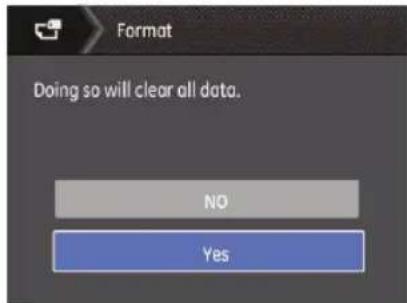
Please note: formatting enables you to delete all contents in the memory card and built-in memory, including protected photo and movie files.
To use this setting:
- Select Format Memory in the File and Software menu.
- Use the Up/Down navigation button to select Yes or No. Then press the Ⓗ button to confirm the setting.
text_image
Format Doing so will clear all data. NO Yes- Select Yes, the camera will format the selected media.

Note that when you perform the Format Memory function, it only formats the active memory. If an SD memory card is inserted, the SD memory card is active and will be formatted. If there is no SD memory card, the internal memory is active and the internal memory will be formatted. Formatting the SD memory card will not automatically format the internal memory.
Copy to Card (Copy internal memory to SD memory card)
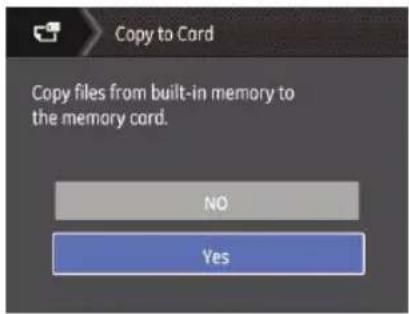
Use this setting to copy the files stored in the internal memory to an SD memory card.
- Select Copy t o Card in the File/Software menu, then press Right.
- Use the Up/Down navigation buttons to select Yes or No. Then press the SET button to confirm the setting.
text_image
Copy to Card Copy files from built-in memory to the memory card. NO Yes
If there is no card available in the camera, this function will not be displayed.
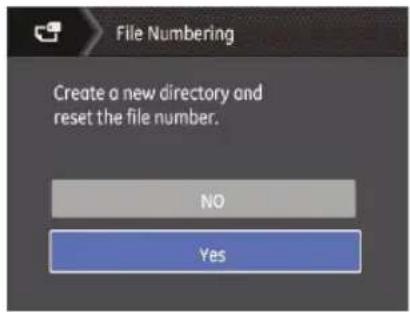
File Numbering
After you take a picture or video clip, the camera will save it with a sequential number. You can use this to reset the file numbering to 1. (When the files in the memory card exceed 999, and the photos in the last file exceed 999, a warning will indicate that the memory card is full).
- Select File Numbering in the File/Software menu, then press Right.
- Select the option with the Up/Down button and press the Ⓗ button for confirmation.
text_image
File Numbering Create a new directory and reset the file number. NO YesReset Settings
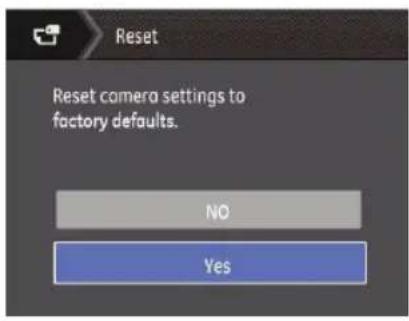
Use this setting to restore the camera to its original factory default settings.
- Select R eset Settings in the File/Software menu, then press Right.
- Use the Up/Down navigation buttons to select Yes or No. Then press the Ⓜ button to confirm the setting.
text_image
Reset Reset camera settings to factory defaults. NO YesFW Version (Firmware Version)
Use this setting to view the current camera firmware version.
Select FW Version in the File/Software menu, then press Right.

text_image
FW Version Current Ver: V2011.09.19.17 New Ver: V2011.10.19.17 Update Firmware? Yes Cancel
To update to the latest firmware version, you can go to the following website:
www.ge.com/digitalcameras and look under Support.
CONNECTIONS
Connecting to a Computer
You can use a USB cable to connect the camera and copy (transmit) photos to a computer, printer or other device.
Setting the USB mode
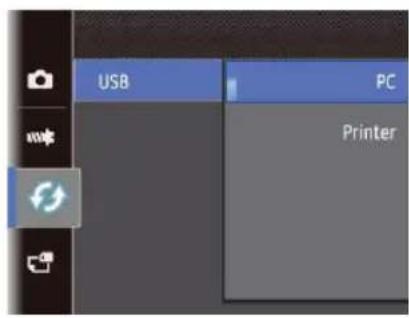
The camera's USB port can be set to connect with either a computer or a Printer, the following steps will allow you to ensure that the camera is correctly configured to connect with a PC.
- Go to the Transmission menu, then select USB connection with the Up/Down button, and press the Right button.
- Use the Up/Down navigation buttons to select PC.
- Press the Ⓗ button to confirm the setting.
text_image
USB PC PrinterTransferring files to your PC
The computer will automatically detect the camera as a removable drive. Double-click the My Computer icon on the desktop to locate the removable drive and to copy folders and files in the drive to a directory on your PC as you would copy any typical folder or file.
Follow the steps below to connect the camera to a PC.
- Make sure both the camera and PC are turned on.
- Connect one end of the supplied USB cable to the USB/AV OUT port on your camera.
- Connect the other end of the cable to an available USB port on your PC.

natural_image
Diagram showing a DSLR camera connected to a server via cable, with an inset close-up of the device (no text or symbols present)- Disconnect the camera once transfer is complete.
If the USB option is set to [PC]:
Turn the camera off and disconnect the USB cable.
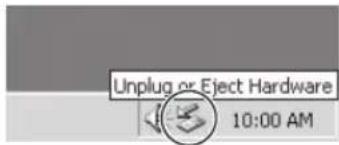
Windows operating system (Windows 2000, Windows XP, Windows Vista, Windows 7).
Click the [Safely remove the hardware] icon and remove the USB connector according to the appeared menu.
text_image
Unplug or Eject Hardware 10:00 AMMacintosh
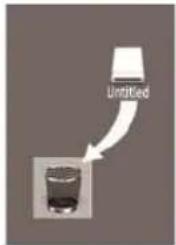
Drag the untitled icon to the Trash. ("Untitled")
text_image
UnattifiedVideo System
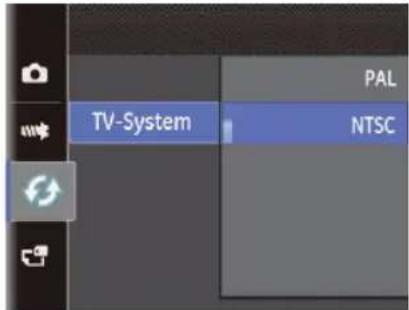
Use this feature to switch the video system from either NTSC or PAL.
- Select Video System in the Transmission menu, then press Right.
- Use the Up/Down navigation buttons to select NTSC or PAL. Then press the Ⓗ button to confirm.
text_image
TV-System PAL NTSCThe video output signal can be switched to NTSC or PAL to accommodate different regional TV standards. The appropriate setting will vary between regions.
NTSC: USA, Canada, Taiwan, Japan, etc.
PAL: Europe, Asia (excluding Taiwan), Oceania, etc.
Note: The TV output will not display properly if an incorrect video system is selected.
Set Eye-Fi SD Card Connection Mode
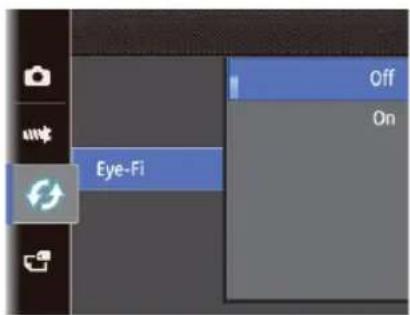
This camera supports wireless connection of an Eye-Fi SD Card. Upload the photos from the camera to the Internet using the following steps:
- Press √ function button to select set menu, then enter connection menu to select Eye-Fi, select ON.
text_image
Off On Eye-Fi- Photos taken after this setting is enabled will be automatically uploaded to the internet. Please refer to the Eye-Fi SD card instructions and settings for further details.
Supported HDMI Connection
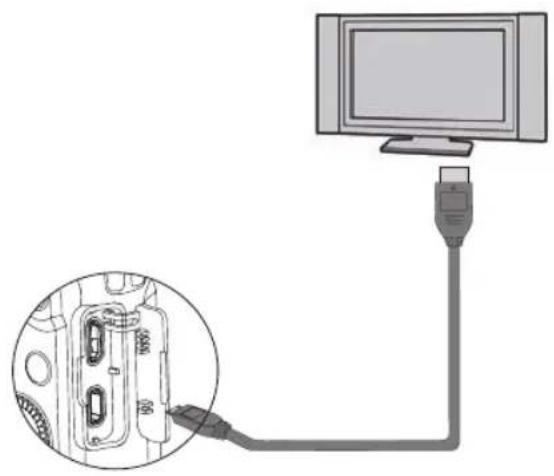
HDMI (High Definition Multimedia Interface), is a fully digital audio/video transmission interface, through which uncompressed audio and video signals are transmitted.
Direct transmission of digital video signals to your TV reduces conversion loss and improves image quality.
natural_image
Diagram showing a cable being inserted into a device via a TV, with an inset close-up of the connector (no text or symbols present)Connecting the camera to an HDMI TV
- Use a high-definition output terminal cable (optional) to connect your camera to an HDMI compliant TV.
- The camera will be automatically detected by the TV.
- After connecting via HDMI, the camera enters Play back mode.

Make sure the camera and the TV are both turned on before connecting.

Refer to your TV instruction manual for information on what resolution sizes it will support. The resolution and output formats that are not supported will be grayed out on the camera's LCD screen.
Connecting to a PictBridge Compatible Printer

PictBridge allows printing of images from an SD memory card in a digital camera directly to a printer, regardless of brand. To find out if a printer is PictBridge compatible, simply look for the PictBridge logo on the packaging or check
the owner's manual for specifications. With the PictBridge function on your camera, you can print the captured photos directly to a PictBridge compatible printer using the supplied USB cable, without the need for a PC.
Setting the USB mode
The camera's USB port can be set to connect with either a PC or a Printer, the following steps will ensure that the camera is correctly configured to connect with a Printer.
- Go to the camera's Transmission menu and, select USB connection with the Up/Down button, then press the Right button.
-
Use the Up/Down button and select Printer.
-
Press the Ⓗ button to confirm the setting.
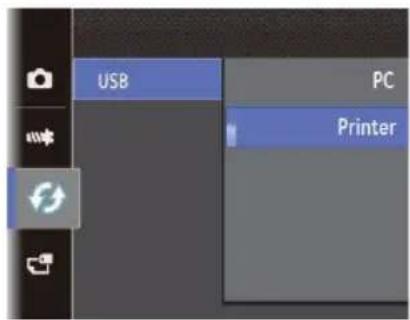
text_image
USB PC PrinterAfter the camera is reset, it will switch to PC mode automatically from USB mode.
Connecting the Camera and Printer.
- Make sure both the camera and printer are turned on.
- Connect one end of the supplied USB cable to the USB port on your camera.
- Connect the other end of the cable to the USB port on the printer.

natural_image
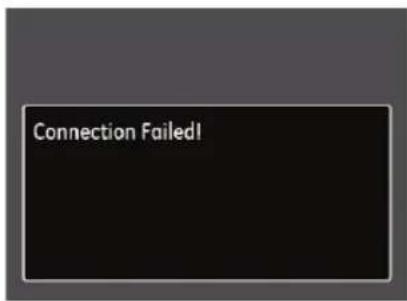
Diagram showing a DSLR camera connected to a handheld device via cable, with an inset close-up of the device (no text or symbols present)If the camera is not connected to a PictBridge compatible printer, the following error message will appear on the LCD screen.
text_image
Connection Failed!
The error message above will also appear if the USB mode is set incorrectly, in which case you should disconnect the USB cable, check the USB mode settings, ensure that the Printer is turned on, and then try connecting the USB cable again.
Using the PictBridge Menu
After setting the USB mode to Printer, the PictBridge Menu will appear.
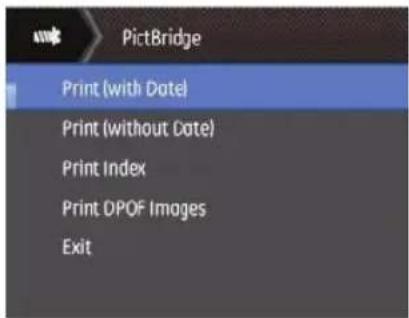
text_image
PictBridge Print (with Date) Print (without Date) Print Index Print DPOF Images ExitSelect the menu item with the Up/Down button and press the Right button or button to enter the item.
Refer to the following sections for more detailed information on each setting.
Print with Date
If you have set the date and time on your camera, the date and time will be recorded and saved with each photo you take.
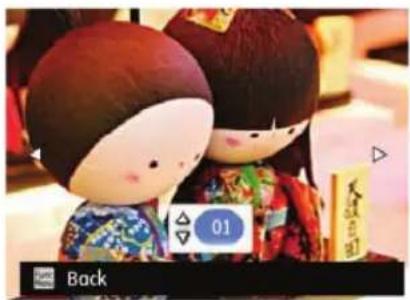
- Select Print with Date from the PictBridge Menu. The following screen will appear:

natural_image
Two plush dolls dressed in traditional attire, one holding a card with '01' and the other with Chinese characters (no readable text or symbols on the doll or background)-
Use the Left/Right navigation buttons to scroll through the photos.
-
Use the Up/Down navigation buttons to select the number of prints for the displayed photo.
-
Press the Ⓗ button and the following screen will appear.
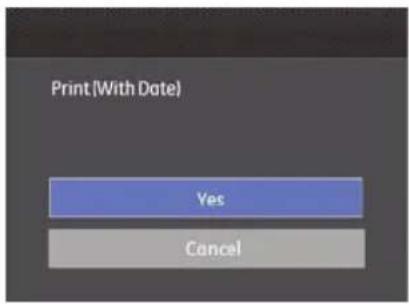
text_image
Print (With Date) Yes Cancel- Select "Yes", then press button: confirm print. Select "Cancel", then press button: cancel print.
Print without Date
Use this setting to print the photos without dates on them.
- Select Print without Date from the PictBridge Menu. The following screen appears:
natural_image
Two plush dolls with brown hair and patterned skirts, displayed indoors (no visible text or symbols)-
Use the Left/Right navigation buttons to scroll through the images.
-
Use the Up/Down navigation buttons to select the number of prints for the current displayed image.
-
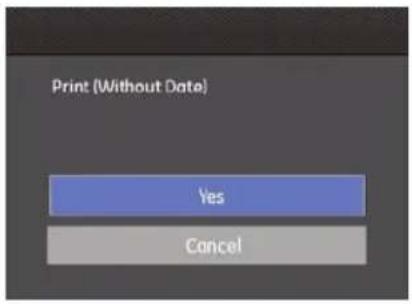
Press the Ⓗ button and the following screen will appear.
text_image
Print (Without Date) Yes Cancel- Select "Yes", then press button: confirm print. Select "Cancel", then press button: cancel print.
text_image
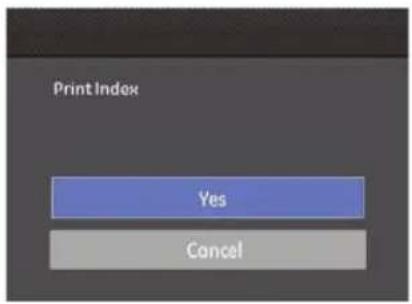
Print Index Yes Cancel- Select "Yes", then press button: confirm print. Select "Cancel", then press SET button: cancel print.
Print Index
You can use this setting to print an index of all the photos currently in your camera's memory.
- Select Print index from the PictBridge Menu. The following screen will appear:
Print DPOF (Digital Print Order Format)
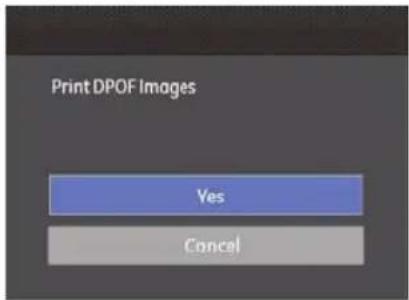
To use DPOF printing, you must select your photos for printing using the DPOF settings beforehand. See "DPOF" section on page 58.
- Select Print DPOF from the PictBridge Menu. The following screen will appear:
text_image
Print DPOF Images Yes Cancel- Select "Yes", then press button: confirm print. Select "Cancel", then press button: cancel print.
Exit
To exit the PictBridge Menu, select Exit. The "Remove USB cable" message will be displayed.

text_image
Remove USB Cable!Disconnect the USB cable from the camera and printer.
APPENDICES
Specifications

Design and specifications are subject to change without notice.
| Active Image Sensor Pixels 14.41 Megapixels | ||
| Total Image Sensor Pixels 15.40 Megapixels [1/2.3"CMOS] | ||
| Lens | Focal Length 5.0mm (Wide) — 75.0mm (Tele) | |
| [35mm film equivalent] [28mm (Wide) — 420mm (Tele)] | ||
| F number F3.9 (Wide) — F5.6 (Tele) | ||
| Lens Construction 8 groups 11 elements | ||
| Optical Zoom 15x | ||
| Focusing Range | Normal: (Wide) 23.6in. ~∞ / 60cm ~∞(Tele) 59.0in. ~∞ / 150cm ~∞Macro: 1.9in. ~∞ / 5cm ~∞ (Wide Only) | |
| Anti-Handshake Optical Image Stabilization | ||
| Digital Zoom 6x Digital Zoom (Combined Zoom: 90x) | ||
| Number of Recording Pixels | Still Image | 14MP: 4320×3240, (3:2)12MP: 4320×2880, (16:9)10MP:4320×2432, 8MP: 3264×2448, 5MP: 2592×1944, 3MP: 2048×1536, (16:9)2MP: 1920×1080, 0.3MP: 640×480 | |
| Movie 1080p30, 720p60, 720p30, VGA, QVGA | |||
| Image Compression Best, Fine, Normal | |||
| DCF, DPOF (Ver1.1) Support Yes | |||
| File Format | Still Image Exif 2.2 (JPEG) | ||
| Movie Movie Format: MOV (H.264), Audio: AAC [Stereo] | |||
| Shooting Modes | Auto, Program AE, Shutter Priority, Manual, Face Beautifier, Panorama, Movie, Scene [Auto Scene, Landscape, Sport, Beach, Sunset, Fireworks, Night Landscape, Multi Exposure, Snow, Children, ID, Glass, Photo Frame, Panning Shot, Text, Portrait, Distorting Mirror, Party, Indoor, Leaf, Museum, Night Portrait, Pet Mode-Dog, Pet Mode-Cat, Fax] | ||
| Detection Features Face, Smile, Blink, Pet (Cat), Pet (Dog) | |||
| Photo Touch-up Red-Eye Reduction, Skin Soften, Eye Brightening, Eye Enlargement | |||
| HDR Yes | |||
| Panorama Capture | Still Image Yes (Horizontal) | ||
| View Angle 0°~180° | |||
| LCD Display 3.0inch (460k Pixels) | |||
| ISO Sensitivity Auto, ISO100/200/400/800/1600/3200 | |||
| AF Method | Single AF, Multi-AF (TTL 9-point), Object Tracking, Face-Detection, AF Assist Light (On/Off) | ||
| Exposure Metering Method | Artificial Intelligence AE (AiAE), Center-Weighted Average, Spot (Fixed to Center of Frame), Face AE | ||
| Exposure Control Method Program AE (AE-Lock Available), Shutter Priority | |||
| Exposure Compensation ±3EV in 1/3 Step Increments | |||
| Shutter Speed 1/2000 ~ 4 Seconds (M/S: 8 Seconds) | |||
| Continuous Shooting Approx. 10fps (Large/Fine Mode) | |||
| Playback Modes | Single Photo, Index (9/16 Thumbnails), Slide Show, Movie, Date, Burst Shooting | ||
| Zoom (Approx. 2x ~ 8x), Histogram Display | |||
| White Balance Control | Auto (AWB), Daylight, Cloudy, Fluorescent, Fluorescent CWF, Incandescent, Manual, Color Temperature Setting (1900K ~ 10000K) | ||
| Flash | Flash Method Pop-up | |
| Flash Modes | Auto, Red-Eye Reduction, Forced Flash, No Flash, Slow Synchro, Red-Eye Reduction + Slow Synchro | |
| Shooting Range | (Wide) Approx. 19.6 ~ 161.4in. / 0.5m ~ 4.1m (ISO 800)(Tele) Approx. 39.3 ~ 110.2in. / 1.0m ~ 2.8m (ISO 800) | |
| Recording Media | Internal Memory: Approx. 15MB | |
| SD/SDHC/SDXC Card (Up to 128GB Support) [Nonsupport MMC Card] | ||
| Other Features PictBridge, ExifPrint Support, Multi-Language Support (26 Languages) | ||
| Jacks AV-OUT/USB 2.0 (Micro 5 pin USB), HDMI (Type D) | ||
| Power Rechargeable Li-ion Battery GB-50A, 3.7V | 880mAh, In-Camera Charging | |
| Shooting Capability (Battery Performance) Approx. 170 Shots (Based on CIPA Standards) | ||
| Operation Environment Temperature: 32 ~ 104 | °F / 0 ~ 40°C, Humidity: 0 ~ 90% | |
| Dimensions (W×H×D) Approx. 4.3×2.7×1.3in. / 107.2×68.2×32.6mm (Based on CIPA Standards) | ||
| Mass Approx. 7.1oz / 204g (Body only) | ||
| Supplied Accessories (May Differ Depending On Country or Area) | Rechargeable Li-ion Battery, AC Adaptor, USB Cable | |
| Shoulder Strap, CD-ROM, User Manual | ||
| Quick Start Guide, Warranty Card | ||
Error Messages
Messages Explanation
| Card Error • The SD memory card is not formatted. | |
| Card Full • The SD memory card is full and cannot store any new images. | |
| Picture Error • The picture was not captured correctly.• The picture is damaged. | |
| No Picture • There are no images on the SD memory card or in the internal memory. | |
| Lens Error • The lens could be stuck and the camera will power off automatically. | |
| System Error • Unexpected error encountered. | |
| Write Protect | • The write protection switch in the SD memory card is set to the “LOCKED” position. |
| Out of the Range • | When pictures were taken in Panorama mode, the direction of movement was incorrect or the angle was outside the range of the internal settings. |
Messages Explanation
| Card is not formatted, format? | Confirm whether the SD memory card should be formatted. |
| This image cannot be deleted • The picture or video you are trying to delete is protected. | |
| Warning!! Camera recording, please wait | No other actions are allowed during video/audio recording. |
| Warning!! Battery exhausted • The batteries are depleted. | |
| This file cannot be played back | The picture format is not recognized by the camera. |
| No connection • The camera is not connected to the printer correctly. | |
| Print error • There is a problem with camera or printer. | |
| Cannot print • Check to see if the printer is out of paper or ink. | |
| Check to see if the printer has a paper jam. | |
Troubleshooting
| Problem Possible causes Solution | ||
| Camera does not turn on • The batteries have been depleted.• The batteries are not inserted correctly. | • Replace the dead batteries with new ones. | |
| Camera turns off suddenly during operation | • The batteries have been depleted. • R | eplace the dead batteries with new ones. |
| The picture is blurred • The lens is dirty.• [IMAGE]ars when taking pictures. | • Use a soft cloth to clean the lens on your camera.• Use the Image Stabilization mode. | |
| Images and video files cannot be saved | • The SD memory card is full. | • Replace the SD memory card with a new one.• Delete unwanted images.• Unlock the memory card. |
| No picture can be taken when pressing the Shutter button | • The SD memory card is full.• No available space to store the files.• The mode dial is in Playback mode. | • Replace the SD memory card with a new one or format the current SD memory card.• Delete unwanted images.• The SD memory card is locked. |
Problem Possible Causes Solution
| Images will not print from the connected printer | The camera is not connected to the printer correctly.The printer is not PictBridge compatible.The printer is out of paper or ink.The printer paper is jammed. | Check the connection between the camera and printer.Use a PictBridge compatible printer.Reload more paper in the printer.Replace the ink cartridge in the printer.Remove the jammed paper. |
| Write to memory card is slow Using a memory car d below Class 4 may result in slower recording times. | Use an SDHC card and shoot after formatting the card. | |
| Cannot write to the memory card The SD memory car d has been locked.The camera may experience trouble recording HD movies to SD cards with a rating lower than class 4. | Remove the SD memory card and unlock it.Use an SDHC card and shoot after formatting the card. | |
| Too many movies to process The number of pictur es or folders in the SD memory card exceed the specifications, so the playback of data folder can not be displayed. | Delete unwanted files.Transfer the files on the SD memory card to another storage medium. | |
http://www.ge.com/digitalcameras

natural_image
Circular logo with stylized white 'g' symbol inside a black ring (no text or symbols)imagination at work
Printed in China
© 2011 General Imaging Company
Follow us on

