KM 520 - Cooker MIELE - Free user manual and instructions
Find the device manual for free KM 520 MIELE in PDF.


User questions about KM 520 MIELE
0 question about this device. Answer the ones you know or ask your own.
Ask a new question about this device
Download the instructions for your Cooker in PDF format for free! Find your manual KM 520 - MIELE and take your electronic device back in hand. On this page are published all the documents necessary for the use of your device. KM 520 by MIELE.
USER MANUAL KM 520 MIELE
Operating and Installation instructions
natural_image
Illustration of a cooking scene with a pot, a bowl of food, a ladle, and a cooking pot (no text or symbols)Ceramic cooktops KM 520
To avoid the risk of accidents or damage to the appliance it is
essential to read these
instructions before it is installed
or used for the first time.
en - AU, NZ
M.-Nr. 06 464 860
Contents
Description of the appliance 3
Warning and Safety instructions 5
Caring for the environment....11
Before using for the first time....12
Operation 13
Switching on and off 13
Residual heat indicators 13
Settings 14
Switching on an extended area....15
Pans 16
Tips on saving energy 17
Overheating protection 18
Cleaning and care 19
Problem solving guide 21
Optional accessories....22
Installation 23
Safety instructions for installation 23
Safety clearances 24
Building-in dimensions 26
Preparing the worktop 27
Fixing the spring clamps 28
Installing the cooktop....29
Sealant 30
Tiled worktop 30
Electrical connection 31
Connection diagram 32
After sales service, data plate 33
KM 520
text_image
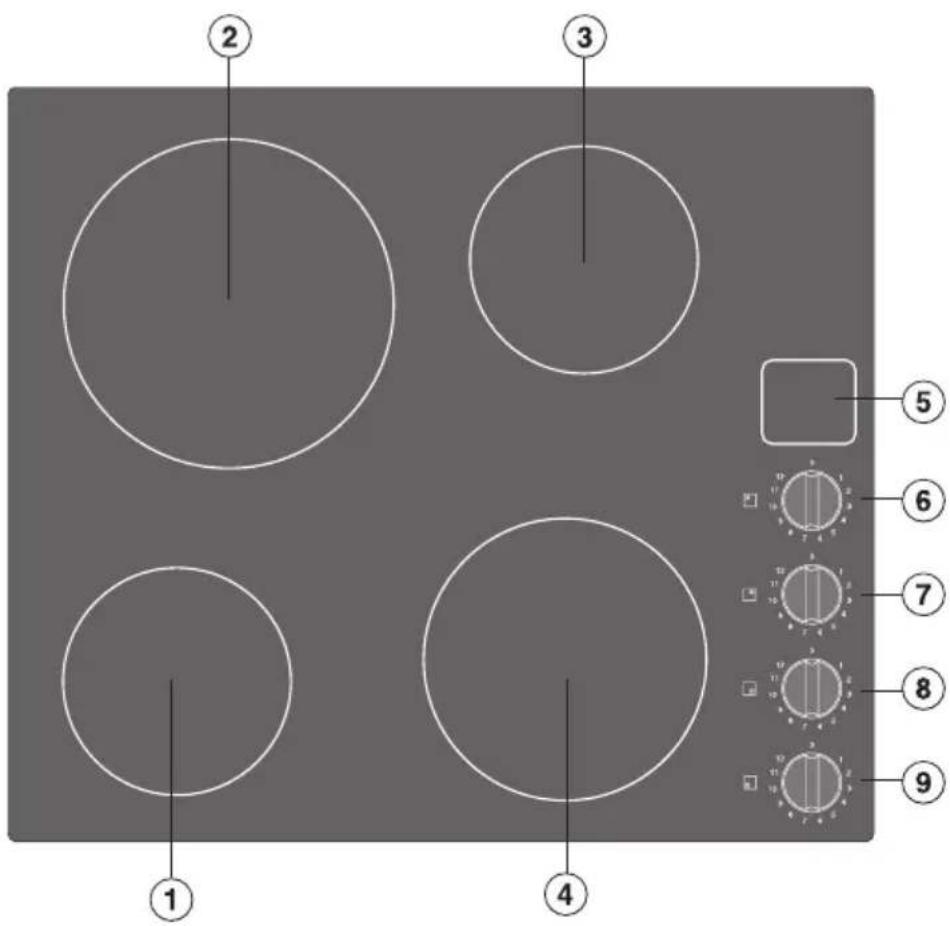
① ② ③ ④ ⑤ ⑥ ⑦ ⑧ ⑨①②③④ Single circle zones
⑤ Residual heat indicators
Control knob for cooking zone
⑥ Rear left
⑦ Rear right
⑧ Front right
⑨ Front left
Cooking zones
| Cooking zones KM 520 | ||
| ∅ in cm | Rating in watts (230 V) | |
| ☐ 14.5 1200☐ 21.0 2300☐ 14.5 1200☐ 18.0 1800 | ||
| Total: 6500 | ||
This appliance complies with all relevant local and national safety requirements. Improper use of the appliance can, however, present a risk of both personal injury and material damage.
To avoid the risk of accidents and damage to the appliance, please read these instructions carefully before installation and before using it for the first time.
They contain important notes on the installation, safety, operation and care of the appliance.
Keep these instructions in a safe place and ensure that new users are familiar with the content. Pass them on to any future owner.
Correct application
This appliance is intended for domestic use for the preparation of food only.
Any other usage is at the owner's risk and could be dangerous. The manufacturer cannot be held liable for damage resulting from incorrect or improper use of the appliance.
This appliance is not intended for use by persons (including children) with reduced physical, sensory or mental capabilities, or lack of experience and knowledge, unless they have been given supervision or instruction concerning use of the appliance by a person responsible for their safety.
Safety with children
Children should be supervised to ensure that they do not play with the appliance.
▶ Older children may use the appliance only when its operation has been clearly explained to them and they are able to use it safely, recognising the dangers of misuse. They must be aware of the potential dangers caused by incorrect operation.
The appliance gets hot when in use and remains hot for quite a while after being switched off. To safeguard against burning, keep children well away from the appliance at all times.
Do not store anything which might arouse a child's interest in storage areas above or next to the appliance. Otherwise they could be tempted into climbing onto the appliance with the risk of burning themselves.
Keep all pans out of reach of children. Turn pan handles inwards away from the edge of the cooktop. Danger of burning or scalding. Special cooktop guards are available from good retail outlets.
Packaging, e.g. cling film, polystyrene and plastic wrappings, must be kept out of the reach of babies and young children. Danger of suffocation. Dispose of or recycle all packaging safely as soon as possible.
Technical safety
Before installation, check the appliance for visible signs of damage. Do not install and use a damaged appliance. A damaged appliance is dangerous.
The electrical safety of this appliance can only be guaranteed when continuity is complete between it and an effective earthing system which complies with local and national safety regulations. It is most important that this basic safety requirement is present and regularly tested, and where there is any doubt, the household wiring system should be inspected by a qualified electrician. The manufacturer cannot be held liable for the consequences of an inadequate earthing system (e.g. electric shock).
Before connecting the appliance, make sure that the connection data on the data plate (voltage and connected load) match the mains electricity supply.
This data must correspond in order to avoid the risk of damage to the appliance. Consult a qualified electrician if in any doubt.
For safety reasons, this appliance may only be used after it has been built in.
▶ Never open the housing of the appliance.
Tampering with electrical connections or components and mechanical parts is highly dangerous to the user and can cause operational faults.
▶ Installation, maintenance and repairs may only be carried out by a suitably qualified and competent person in strict accordance with current national and local safety regulations. Repairs and other work by unqualified persons could be dangerous. The manufacturer cannot be held liable for unauthorised work.
During installation, maintenance and repair work, the appliance must be disconnected from the mains electricity supply. It is only completely isolated from the electricity supply when:
- the mains fuse is disconnected,
- the screw-out fuse is removed (in countries where this is applicable),
- it is switched off at the wall socket and the plug is withdrawn from the socket, or it is switched off at the isolator.
While the appliance is under guarantee, repairs should only be undertaken by a service technician authorised by the manufacturer. Otherwise the guarantee is invalidated.
▶ Faulty components must only be replaced by genuine Miele original spare parts. The manufacturer can only guarantee the safety of the appliance when Miele replacement parts are used.
If the connection cable is damaged, it must be replaced by a suitably qualified electrician with a specialist connection cable of type H 05 VV-F (pvc insulated), available from the Miele Spare Parts Department.
Do not connect the appliance to the mains electricity supply by a multi-socket unit or an extension lead. These do not guarantee the required safety of the appliance (e.g. danger of overheating).
This appliance is not intended to be operated by means of an external timer or separate remote control-system.
Do not use the cooktop if it is faulty, or if the ceramic surface is cracked, chipped or damaged in any way. Switch it off immediately, and disconnect it from the mains electricity supply. Danger of electric shock.
In areas which may be subject to infestation by cockroaches or other vermin, pay particular attention to keeping the appliance and its surroundings in a clean condition at all times. Any damage caused by cockroaches or other vermin will not be covered by the guarantee.
Correct use
The appliance gets hot when in use and remains hot for quite a while after being switched off. There is a danger of burning until the residual heat indicators go out.
Do not leave the appliance unattended whilst it is in use. Pans that have boiled dry can cause damage to the ceramic surface for which the manufacturer cannot be held liable.
Boiling fat or oil could ignite and cause a fire.
If oil or fat does catch fire, do not attempt to put out the flames with water. Use a suitable fire blanket, saucepan lid, damp towel or similar to smother the flames.
Do not use the appliance to heat up the room. Due to the high temperatures radiated, objects near the appliance could catch fire. The life of the appliance could also be reduced.
During prolonged or intensive use of the appliance, the frame gets hot and the control panel can also become quite warm. This is quite normal and does not indicate a fault.
For added protection, it is advisable to use heat-resistant pot holders or gloves when using the appliance. Do not let them get damp or wet, as this causes heat to transfer through the material more quickly with the risk of scalding or burning yourself.
Do not flambé under a rangehood. The flames could set the rangehood on fire.
Do not use the appliance as a resting place for anything else. When the appliance is switched on either deliberately or by mistake, or when there is residual heat present, there is the risk of metal objects heating up, with a danger of burning.
Depending on the material, other objects left on the cooktop could also melt or catch fire.
Damp pan lids might adhere to the ceramic surface and be difficult to dislodge.
Switch the cooking zones off after use.
Do not cover the appliance, e.g. with a cloth, kitchen foil, etc. This could be a fire hazard if the appliance is switched on by mistake.
Do not use plastic or aluminium foil containers. These melt at high temperatures, and could catch fire.
Do not heat up unopened tins of food on the cooktop, as pressure will build up in the tin, causing it to explode. This could result in injury and scalding or damage.
Do not use pots and pans on the ceramic cooktop with bases with pronounced edges or or ridges, e.g. cast iron pans. These could scratch or scour the cooktop surface permanently.
Do not use cookware with an exposed copper or aluminium base as they may leave permanent visual marks on the ceramic surface.
▶ Never heat an empty pan unless the manufacturer of the pan expressly states that you can do so. This could damage the appliance.
▶ Keep the cooktop clean. Grains of salt, sugar and sand (e.g. from cleaning vegetables) can cause scratches.
▶ Never place hot pans near or on the residual heat indicators. This could damage the electronic unit underneath.
▶ Do not drop anything on the ceramic surface. Even a light object could cause damage in certain circumstances.
To prevent the risk of spillages etc. burning on, remove any soiling as quickly as possible and ensure that pan bases are clean, dry and free of grease.
Do not allow either solid or liquid sugar, or pieces of plastic or aluminium foil to get onto the cooking zones when they are hot. If this should occur, switch off the appliance, and carefully scrape off all the sugar, plastic or aluminium residues from the cooktop whilst they are still hot, using a shielded scaper blade. Take care not to burn yourself. If residues are allowed to cool before being removed, the ceramic surface will be susceptible to pitting or even cracking.
Once the residues have been removed, allow the appliance to cool down, and then clean with a suitable proprietary ceramic cooktop cleaner.
When using an electric socket near the cooktop, care should be taken that the cable of the electrical appliance does not come into contact with a hot cooking zone. The insulation on the cable could become damaged, giving rise to an electric shock hazard.
Spray canisters, aerosols and other inflammable substances must not be stored in a drawer under the cooktop. Cutlery inserts must be heat-resistant.
▶ Always ensure that food is sufficiently cooked or reheated. Some foods may contain micro-organisms which are only destroyed by thorough cooking at a sufficiently high temperature for long enough. Therefore, when cooking or reheating food such as poultry, it is particularly important that the food is completely cooked through. If in doubt, select a longer cooking or reheating time.
The manufacturer cannot be held liable for damage caused by non-compliance with these Warning and Safety instructions.
Disposal of the packing material
The transport and protective packing has been selected from materials which are environmentally friendly for disposal and can normally be recycled.
Ensure that any plastic wrappings, bags, etc. are disposed of safely and kept out of the reach of babies and young children. Danger of suffocation.
Rather than just throwing these materials away, please ensure they are offered for recycling.
Disposal of your old appliance or machine
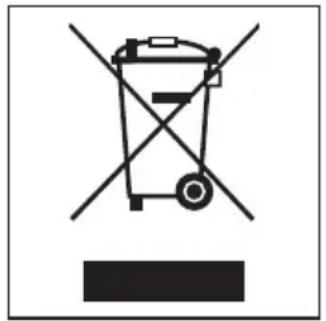
Electrical and electronic appliances / machines often contain materials which, if handled or disposed of incorrectly, could be potentially hazardous to human health and to the environment. They are, however, essential for the correct functioning of your appliance or machine. Therefore, please do not dispose of your old machine or appliance with your household waste.
natural_image
Symbol of a trash bin crossed with two crossed lines and a solid black rectangle below (no text or labels)Please dispose of it at your local community waste collection / recycling centre and ensure that it presents no danger to children while being stored for disposal.
It should be unplugged or disconnected from the mains electricity supply by a competent person.
The plug must be rendered useless and the cable cut off directly behind the appliance or the machine to prevent misuse.
Please stick the extra data plate for the appliance supplied with this documentation in the space provided in the "After sales service" section of this booklet.
Cleaning for the first time
Remove any protective wrapping and stickers.
Before using for the first time, clean the appliance with a damp cloth only and then wipe dry.
Do not use washing up liquid to clean the ceramic surface as it can leave a blue sheen which may be difficult to remove.
On cooktops with bevelled glass edges, a small gap may be visible between the cooktop and the worktop during the first few days after installation. This gap will reduce with time as the appliance is used and will not affect the electrical safety of your appliance.
Metal components have a protective coating which may give off a slight smell when heated up for the first time.
The smell and any fumes given off do not mean that the appliance is defective or has been wrongly installed, and they are not harmful to health.
Switching on and off
Do not leave the appliance unattended whilst it is being used.
Controls on cooking zones without extended areas can be turned through 360°. These cooking zones are switched on by turning the appropriate control clockwise or anti-clockwise to the required setting, and switched off by turning the control clockwise or anti-clockwise back to "0".
Controls for cooking zones with extended areas have a resistance on them. These cooking zones are switched on by turning the appropriate control clockwise to the required setting, and switched off by turning the control anti-clockwise back to "0".
Do not force the control past the point of resistance to "0", as this will damage it.
Residual heat indicators
When a cooking zone is switched on, e.g. front left, the appropriate residual heat indicator lights up in the display when the zone has reached a certain temperature.

natural_image
Simple geometric shape: a white rounded rectangle with a small circle inside, on a gray background (no text or symbols)The residual heat indicator will go out after the cooking zone has been switched off once the temperature has dropped to a safe level.
Do not touch the cooking zones or place any heat-sensitive items on them whilst they are still hot. Danger of burning, and fire hazard.
Settings
| Cooking process Setting | |
| Melting butter, chocolate etc. Dissolving gelatine Preparing yoghurt | 1 - 2 |
| Thickening sauces containing egg yolk and butter Warming small quantities of food/liquid Keeping warm food which sticks easily Cooking rice | 1 - 3 |
| Warming liquid and semi-solid foods Thickening sauces, e.g. hollandaise Making porridge Preparing omelettes, lightly fried eggs Steaming fruit | 3 - 5 |
| Defrosting deep frozen food Steaming vegetables, fish Cooking dumplings, potatoes, pulses Cooking broths, pulse soups | 4 - 6 |
| Bringing to the boil and continued cooking of large quantities of food | 7 |
| Gentle braising (without overheating the fat) of meat, fish, vegetables, fried eggs etc. | 8 - 9 |
| Frying pancakes etc. 9 - 11 | |
| Boiling large quantities of water Bringing to the boil | 11 - 12 |
These settings, which envisage approx. 4 helpings, should only be taken as a guide. With deep pans, large quantities or when cooking without a lid, a higher setting is needed. For smaller quantities, select a lower setting.
Switching on an extended area
Depending on model, the outer circle of a double circle zone or the extended cooking zone can be switched on to provide an extended cooking area when cooking with larger pans.
Proceed as follows:
■ Turn the cooking zone control clockwise past "12" as far as it will go.
■ Then turn the control anti-clockwise back to the required setting.
Switch the extended cooking zone off by turning the control back to the "0" position.
Pans
- Pans made from any material can be used on a ceramic cooktop. However, Miele recommends to refrain from using cookware with an exposed copper or aluminium base as they may leave permanent visual marks on the ceramic surface.
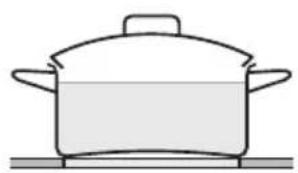
- The best pans are those with a thick base which is very slightly concave when cold. When heated, the base flattens to rest evenly on the cooktop, optimising the conduction of the heat.
natural_image
Simple line drawing of a cooking pot on a stove (no text or symbols)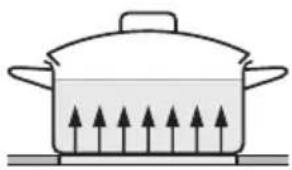
natural_image
Simple line drawing of a cooking pot with upward arrows indicating heating or pressure (no text or symbols)Cold Hot
- Pans made of glass, ceramic or stoneware are less suitable, as they do not conduct the heat so well.
-
Do not use pots and pans on the ceramic cooktop with bases with pronounced edges or or ridges, e.g. cast iron pans. These could scratch or scour the cooktop surface permanently.
-
Lift pans into position on the cooktop. Sliding them into place will cause scuffs and scratches.
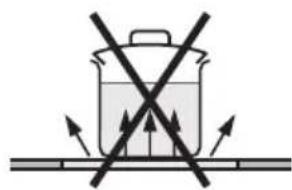
- Check that the diameter of the pan base is wide enough for the cooking zone so that heat is not lost unnecessarily. Please note that the maximum diameter quoted by manufacturers often refers to the diameter of the top rim of the pot or pan. The diameter of the base (generally smaller) is more important.
natural_image
Simple line drawing of a cooking pot with crossed arrows indicating pressure or heat (no text or symbols)
natural_image
Simple line drawing of a cooking pot with upward arrows indicating heating or pressure (no text or symbols)Too small Suitable
Tips on saving energy
- Use a pan lid whenever possible to minimise heat loss.

natural_image
Two cooking pots: one with a crossed-out steam and the other with a pan (no text or symbols)Uncovered Covered
- Select a smaller pan when cooking small quantities. A small pan on a small cooking zone uses less energy than a large, partially filled pan on a large cooking zone.
- Use as little water as possible to cook with, and reduce the power setting once the water has come to the boil or the oil is hot enough to fry in.
- When cooking for a long time, switch the cooking zone off about 5 to 10 minutes before the end of the cooking time. In this way, use is made of the residual heat.
Overheating protection
Each cooking zone is equipped with overheating protection. An internal temperature limiter switches off the heating elements in the cooking zone before the ceramic surface overheats.
Once the ceramic has cooled down to a safe level the heating will automatically switch back on again.
Overheating can be caused by:
- switching on a cooking zone without a pan on it.
- heating up an empty pan.
- the base of a pan not sitting evenly on the cooking zone.
– the pan not conducting the heat properly.
You can tell that the overheating protection has activated because the heating switches on and off even when the highest setting is selected.
For Miele branded cleaning and conditioning products see "Optional accessories".
Do not use a steam cleaner to clean this appliance. The steam could reach electrical components and cause a short circuit.
Only use proprietary cleaning products which are suitable for cleaning ceramic cooktops. Never use cleaners containing sand, soda, alkalis, acids or chlorides, oven sprays, dishwasher detergents, nor steel wool, abrasive cleaning agents, hard brushes, scouring pads and cloths. You should also avoid using sponges etc. which have previously been used with abrasive cleaning agents, as this will damage the surface.
Do not use washing up liquid to clean the ceramic surface, as it can leave a blue sheen which may be difficult to remove.
Do not use sharp objects which may damage the seals between the ceramic surface and the frame or between the frame and the worktop.
To prevent the risk of spillages burning on, remove any soiling as soon as possible, and ensure that pan bases are clean, dry and free of grease.
The appliance should be cleaned after each use. Allow the cooktop to cool down before cleaning.
Wipe all coarse soiling off using a damp cloth. Stubborn soiling may need to be removed with a shielded scraper blade.
Finally, clean the cooktop with a suitable proprietary ceramic cooktop cleaner (see "Optional accessories") applied with kitchen paper or a clean cloth. Do not apply cleaner whilst the cooktop is still hot, as this could result in marking. Please follow the manufacturer's instructions.
Finally wipe the appliance with a damp cloth, and then dry it with a clean, soft cloth. Ensure that all cleaning agent residues are removed. Residues can burn onto the cooktop the next time it is used, and cause damage to the ceramic surface.
Spots caused by limescale deposits, water and aluminium residues (which have a metallic appearance) can be removed using the ceramic cooktop cleaner.
Should any sugar, plastic or aluminium foil spill or fall on to a hot cooking zone, first switch off the appliance. Then carefully scrape off all the sugar, plastic or aluminium residues from the cooktop whilst they are still hot using a shielded scraper blade. Take care not to burn yourself.
Allow the cooking zone to cool down, and then clean as described above with a suitable proprietary ceramic cooktop cleaner.
Appliances with aluminium frames (see data plate) are prone to scratching, alkali and acid damage. Take great care when cleaning the aluminium frame. Do not use cleaning agents for stainless steel or descaling agents on aluminium surfaces. Soiling should be wiped off as soon as possible after using the appliance. If the soiling is left for a long time it can have a damaging effect on the aluminium surfaces. Intensive cleaning with proprietary ceramic cooktop cleaners can cause the frame to take on a shiny appearance.
If you are unsure about a particular product or need further advice please contact your nearest Miele Customer Contact Centre. See back page for address.
Repairs to electrical appliances must only be carried out by a suitably qualified and competent person in accordance with local and national safety regulations. Repairs and other work by unqualified persons could be dangerous. The manufacturer cannot be held liable for unauthorised work.
Ensure that current is not supplied to the appliance until after maintenance or repair work has been carried out.
... the food in the pan hardly heats up or does not heat up at all
This could be because:
- the pan is not conducting heat properly.
- the pan is too large in relation to the cooking zone and an extended zone has not been switched on.
What to do if ...
... the appliance does not heat up when switched on
Check whether the mains fuse has blown. If the fuse has blown, contact an electrician or the Miele Customer Contact Centre.
... the heating switches on and off at the highest setting on one of the ceramic cooking zones
The overheating protection mechanism has been triggered (see "Overheating protection").
Miele branded cleaning and conditioning products are available for your appliance. These can be ordered via the internet at www.miele-shop.com (depending on country) or from your Miele Spare Parts Department (see back cover).
Ceramic and stainless steel cooktop cleaner 250 ml

Removes heavy soiling, limescale deposits and aluminium residues
Safety instructions for installation
Fit the wall units and rangehood before fitting the cooktop to avoid damaging the appliance.
The veneer or laminate coatings of worktops (or adjacent kitchen units) must be treated with 100 °C heat-resistant adhesive which will not dissolve or distort. Any backmoulds must be of heat-resistant material.
This equipment is not designed for maritime use or for use in mobile installations such as caravans, aircraft etc. However it may be suitable for such usage subject to a risk assessment of the installation being carried out by a suitably qualified engineer.
This appliance must not be installed over a dishwasher, washing machine, tumble dryer, refrigerator, freezer or fridge-freezer. The high temperatures radiated by it could damage the appliance below.
▶ After installing the cooktop, ensure that the connection cable cannot come into contact with the underside of the appliance. Make sure that there is no mechanical obstruction, such as a drawer, which could damage it.
▶ Observe carefully the safety distances given on the following pages.
Do not use any sealant except where expressly instructed to do so. The sealing strip under the edge of the top part of the cooktop provides a sufficient seal for the worktop (see "Sealant").
All dimensions in this instruction booklet are given in mm.
This appliance must be installed and connected to services in accordance with local and national safety and building regulations.
Safety clearances
Safety clearance above the cooktop
natural_image
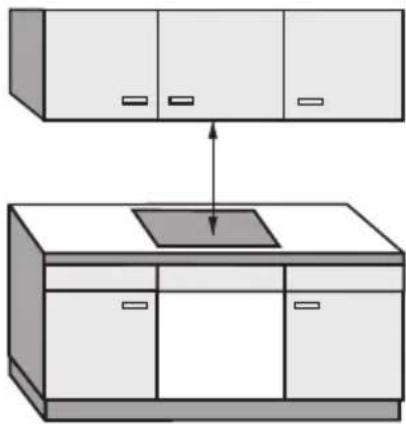
Diagram showing two kitchen cabinets with one cabinet above and one below, no text or symbols present.A minimum safety clearance must be maintained between the appliance and the rangehood above it. See the rangehood manufacturer's operating and installation instructions for details.
If the manufacturer's instructions are not available for the rangehood, a minimum safety clearance of at least 760 mm must be maintained. For any flammable objects, e.g. utensil rails, wall units etc. a minimum clearance of at least 760 mm must be maintained between them and the appliance below.
When two or more appliances are installed together below a rangehood, e.g. an electric cooktop and a gas wok combiset, which have different safety clearances given in their installation instructions you should select the greater distance of the two.
Side / rear clearances to the cooktop
Ideally the cooktop should be installed with plenty of space on either side.
There may be a wall at the rear and a tall unit or wall at one side. On the other side, however, no unit or divider should stand higher than the cooktop (see illustrations).

natural_image
Architectural diagram of a kitchen cabinet with diagonal cross-bracing and no visible text or symbolsNot allowed

natural_image
Simple line drawing of a kitchen cabinet with no text or symbols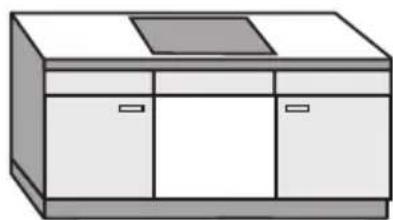
natural_image
Simple line drawing of a cabinet with three doors and a top shelf (no text or symbols)Recommended
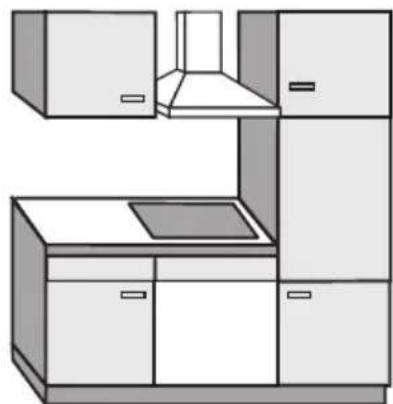
natural_image
Line drawing of a kitchen interior with cabinets and a chimney (no text or symbols)Not recommended
Before installing the appliance check that the location provides the required clearances from combustible material and if necessary provide protection to adjacent surfaces as required by regulations.
The minimum side clearance from a cooktop to a combustible surface* shall be a 300 mm horizontal distance from the periphery of any electric burner.
The minimum rear clearance from a cooktop to a
- combustible surface* shall be a 200 mm horizontal distance from the periphery of any electric burner.
- non-combustible surface or splashback shall be a 50 mm horizontal distance from the rear edge of the cooktop.
If the clearance between the periphery of any electric burner and
- the side wall is less than 300 mm - the rear wall is less than 200 mm, the walls must be protected with a non combustible material.
The protection must be extended a minimum distance of 150 mm above the burner. The shown area indicates the protected surface, which may be ceramic tiles or other approved material.

text_image
150* Combustible surface: The surface of a material that is capable of catching fire and burning at temperature exceeding 50 K above ambient.
Building-in dimensions
KM 520
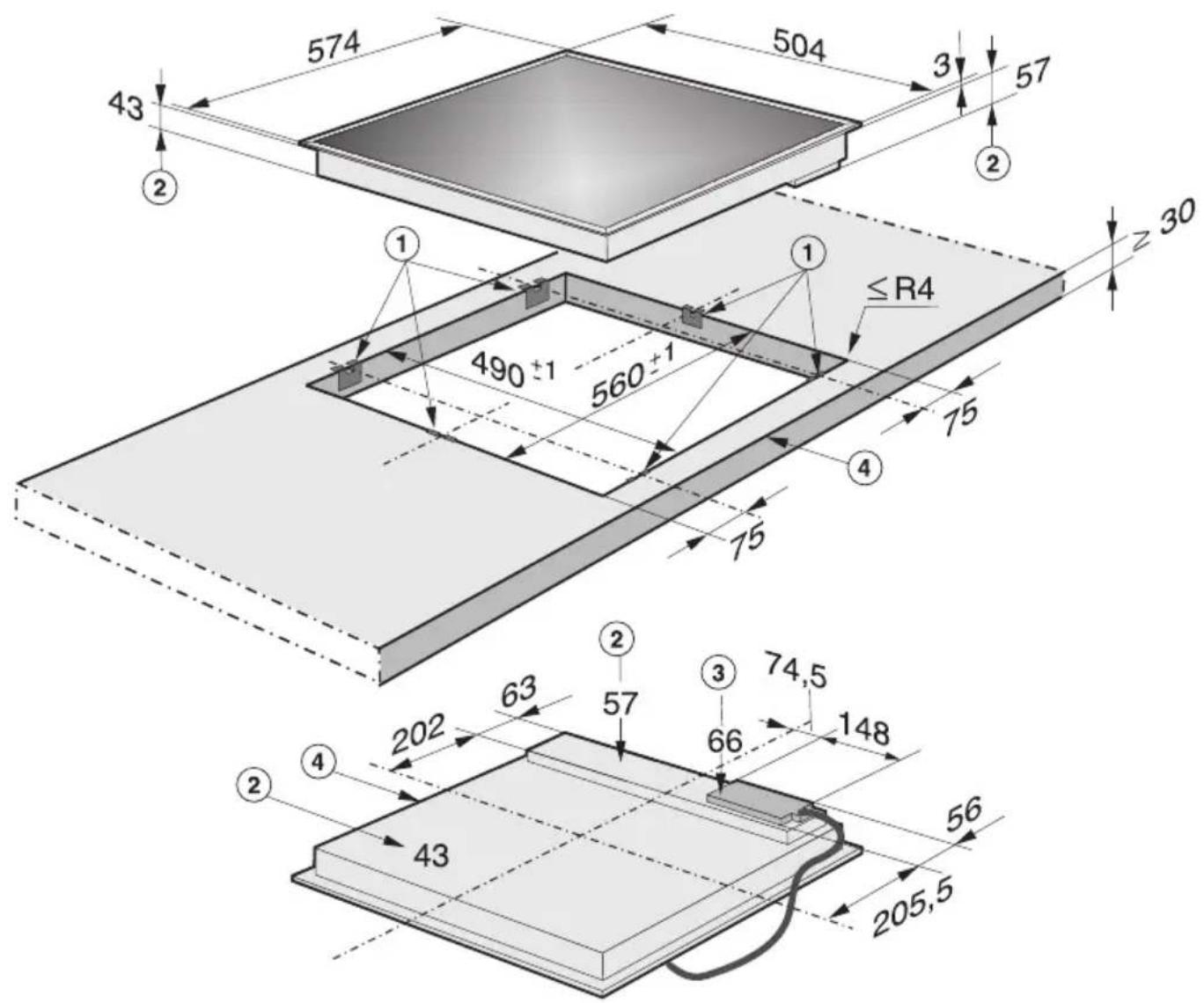
text_image
574 504 3 57 43 ② 1 ≤R4 z 30 490±1 560±1 75 ④ 75 202 63 ② 57 ③ 74,5 66 148 ② ④ 43 205,5 56① Spring clamps
② Building-in depth
③ Building-in depth for mains connection box
④ Front
Preparing the worktop
■ Make the worktop cut-out following the dimensions applicable. Remember to maintain a minimum safety distance from the back wall, as well as from any tall unit or side wall to the right or left of the cooktop. See "Safety clearances".
■ Seal the cut surfaces with a suitable heat-resistant sealant to avoid swelling caused by moisture.
If during installation the corners of the frame are not flush with the worktop surface, the corner radius ( ≤ R4) can be carefully scribed to fit.
Fixing the spring clamps
Wooden Worktops
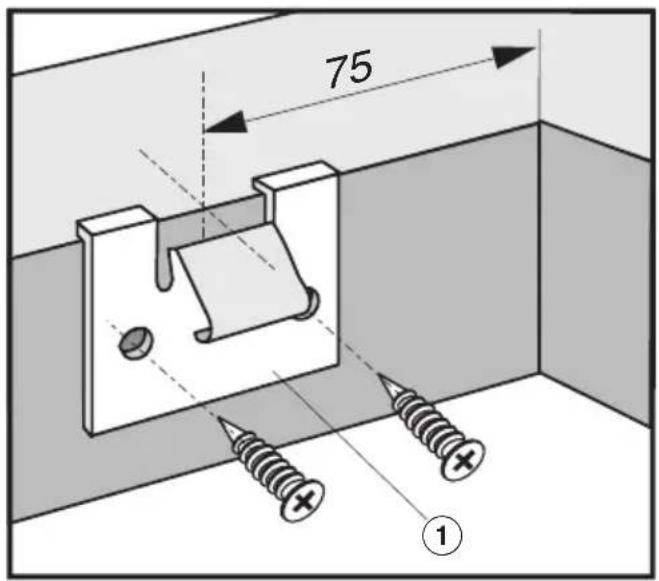
text_image
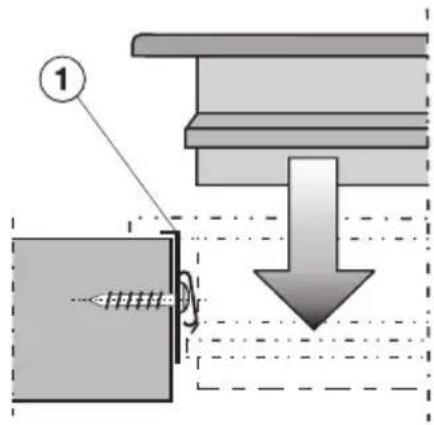
75 ①■ Position the spring clamps (supplied) ① in the positions shown (see "Building-in dimensions") so that they are flush with the top edge of the cut-out, and secure with the 3.5 x 25 mm screws supplied.
Granite and marble worktops
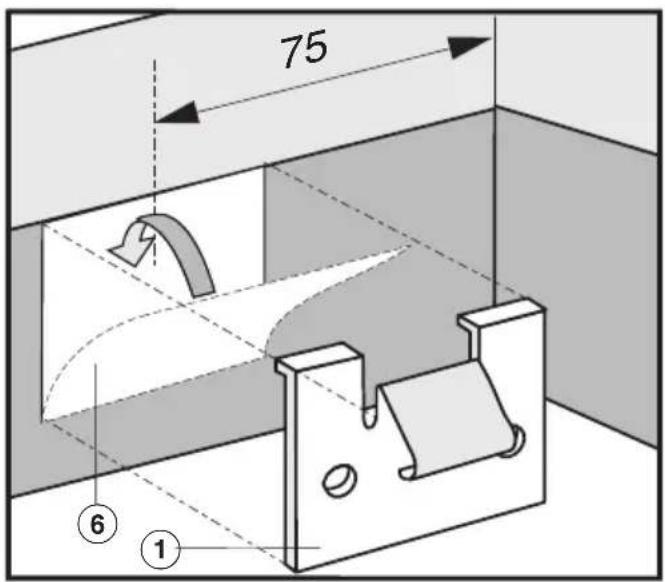
text_image
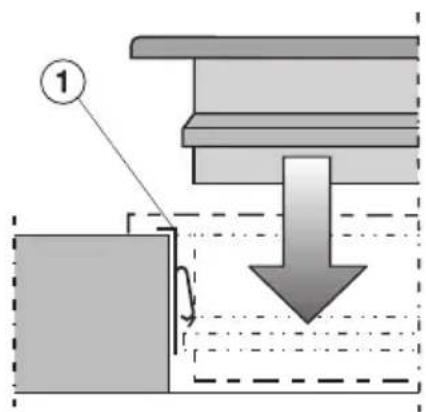
75 ⑥ ①■ Position the spring clamps ①, and secure using double-sided tape ⑥.

text_image
Technical diagram showing a tool applying material to a mechanical component with numbered parts labeled 1, 6, and 7.■ Apply silicone ⑦ to the side edges and lower edge of the spring clamps.
The screws are not required for granite or marble worktops.
Installing the cooktop
■ Feed the cooktop connection cable down through the cut-out.
■ Lightly position the cooktop on the spring clamps ①.
■ Using both hands, press down evenly on the sides of the cooktop until it clicks into position. When doing this make sure that the seal under the cooktop sits flush with the worktop on all sides. This is important to ensure an effective seal all round. Do not use sealant.
■ Connect the cooktop to the mains.
■ Check that the cooktop works.
The cooktop can now only be removed with a special tool.
Wooden worktops
text_image
①Granite and marble worktops
text_image
①Sealant
natural_image
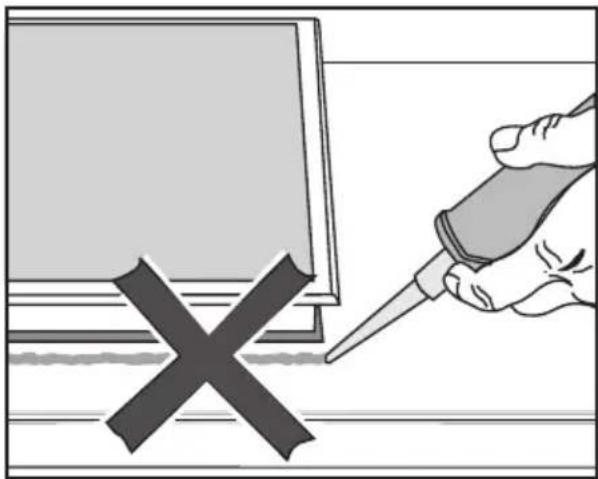
Illustration of a hand using a pipette to mark a cross symbol (no text or symbols present)Do not use any sealant unless expressly instructed to do so. The sealing strip under the edge of the top part of the cooktop provides a sufficient seal for the worktop.
Do not use sealant between the frame of the top part of the cooktop and the worktop.
This could cause difficulties if the cooktop ever needs to be taken out for servicing and possibly result in damage to the frame or the worktop.
Tiled worktop
text_image
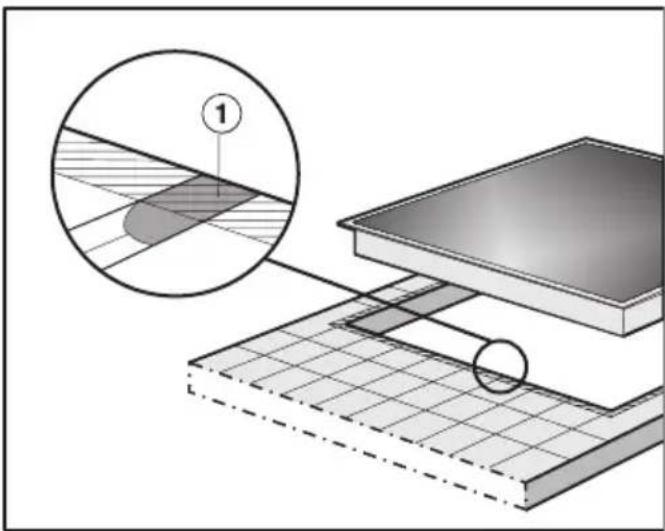
Technical diagram showing layered structure with labeled component 1, including a magnified inset of a cross-section view.The grouting ① and the shaded area underneath the cooktop frame must be smooth and even so that the frame sits evenly and the sealing strip underneath the top part of the cooktop provides a sufficient seal for the worktop.
Tiled worktops must be a minimum 5 mm thick to ensure the surface temperatures of the combustible surfaces underneath the tiles do not exceed 50 K above ambient.
Electrical connection
All electrical work should be carried out by a suitably qualified and competent person, in strict accordance with national and local safety regulations.
Installation, repairs and other work by unqualified persons could be dangerous. The manufacturer cannot be held liable for unauthorised work.
Ensure power is not supplied to the appliance while installation work is being carried out.
The appliance must only be operated when built-in. This is to ensure that all electrical parts are shielded. Live parts must not be exposed.
After the appliance has been built in, a check must be made that all electrical parts are shielded.
The voltage and connected load are given on the data plate. Ensure that these match the household mains supply.
Connection should be made via a suitable isolator, which complies with national and local safety regulations and which is easily accessible after the appliance has been built in.
For extra safety it is advisable to install a residual current device (RCD), with a trip current of 30 mA.
Test marks Electrical safety,
C-Tick Mark
Electrically suppressed according to AS/NZS 1044
Important
The appliance is supplied for connection to an a.c. single phase 230-240 V, 50 Hz supply with a 3-core cable.
The wires in the mains lead are coloured in accordance with the following code:
Green/yellow = earth
Blue = neutral
Brown = live
WARNING
THIS APPLIANCE MUST BE EARTHED
The electrical safety of this appliance can only be guaranteed when continuity is complete between the appliance and an effective earthing system, which complies with local and national regulations. It is most important that this basic safety requirement is regularly tested and if there is any doubt, the electrical wiring in the home should be inspected by a qualified electrician. The manufacturer cannot be held liable for the consequences of an inadequate earthing system such as an electric shock.
The manufacturer cannot be held liable for damage which is the direct or indirect result of incorrect installation or connection.
Connection diagram

text_image
L1 1 2 3 4 5 L2 L3 200 - 240V~ 200 - 240V~ 200 - 240V~ PE L1 1 2 3 4 5 L2 L2 200 - 240V~ 200 - 240V~ PE L1 1 2 3 4 5 N L1 L2 200 - 240V~ 200 - 240V~ PE L1 1 2 3 4 5 L2 L3 200 - 240V~ 200 - 240V~ PEWarning
This appliance must only be connected to a 230 V or 240 V supply using the connection cable supplied in the accessory pack.
Connection must be made in accordance with the connection diagram. The earth lead must be connected.
The address of the nearest Miele Customer Contact Centre is given on the back page.
The voltage and rated load are given on the data plate. Please quote these data, together with the model description and serial number when contacting the Miele Customer Contact Centre.
Space in which to adhere the extra data plate supplied with the appliance. Ensure that the model number is the same as the one on the front of these operating instructions.
Miele Australia Pty. Ltd.
ABN 96 005 635 398
Melbourne:
1 Gilbert Park Drive
Knoxfield, VIC 3180
Telephone: (03) 9764 7130
Fax: (03) 9764 7149
Sydney:
3 Skyline Place
French Forest, NSW 2086
Telephone: (02) 8977 4230
Fax: (02) 8977 4249
Brisbane:
39 Harvey Street North
Eagle Farm, QLD 4009
Telephone: 1800 798 578
Fax: 1800 799 578
Adelaide:
79-81 Sir Donald Bradman Drive
Hilton, SA 5033
Telephone: 1800 018 770
Fax: 1800 799 578
Perth:
205-207 Stirling Highway
Claremont, WA 6010
Telephone: 1800 094 872
Fax: 1800 799 578
www.miele.com.au
Miele New Zealand Limited
Unit L, 10-20 Sylvia Park Road
Mt. Wellington, 1060, Auckland
New Zealand
Telephone: 0800 264 353
Fax: 0800 463 453
www.miele.co.nz