
FI4091AW - Freezer GORENJE - Free user manual and instructions
Find the device manual for free FI4091AW GORENJE in PDF.


| Product Type | Upright Freezer |
| Brand | Gorenje |
| Model | FI4091AW |
| Climate Class | SN, N, ST, T (ambient +10°C to +43°C) |
| Voltage | 220-240 V |
| Frequency | 50 Hz |
| Power Plug | 13 amp 3-pin with BS1362 fuse |
| Defrosting | Manual |
| Super Freeze Function | Yes, with yellow indicator light |
| High Temperature Alarm | Yes, red flashing light |
| Control Type | Mechanical thermostat knob |
| Door Hinge | Reversible (left/right) |
| Installation | Free-standing or built-in |
| Condenser | Rear wall, requires periodic cleaning |
| Refrigerant | Not specified in manual |
| Energy Saving Tips | Provided in manual |
| Accessories Included | Defrost water pipe, installation squares and sponges |
| Noise Level | Not specified |
| Dimensions | See mounting instructions |
| Weight | Not specified |
Frequently Asked Questions - FI4091AW GORENJE
User questions about FI4091AW GORENJE
0 question about this device. Answer the ones you know or ask your own.
Ask a new question about this device
Download the instructions for your Freezer in PDF format for free! Find your manual FI4091AW - GORENJE and take your electronic device back in hand. On this page are published all the documents necessary for the use of your device. FI4091AW by GORENJE.
USER MANUAL FI4091AW GORENJE
Thank you for your trust and for buying this appliance. We hope it will successfully serve the purpose for many years.
The upright freezer for domestic use is intended for freezing fresh food and for long-
Before Putting Into Use ...... 2
Mounting Instructions
We Care for the Environment
Tips for Energy Saving
Important 3
Storing Time During Power Supply
Interruption
Disposing of the Worn Out Appliance
Placing and Installation 4
Choosing the Right Place
Connection to Power Supply
Electrical connection
Description of the Appliance...... 5
Operating the appliance .... 6
Switching on the appliance
Switching off the appliance
Selecting the temperature in the appliance
term storing of frozen food (up to one year, depending on the kind of food).
Freezing and storing frozen food ...... 7
Storing Frozen Foods
Defrosting of Frozen Food
Maintenance and Cleaning...... 8
Freezer Defrosting
Cleaning the Appliance
Switch Off the Appliance When Not in Use
Trouble Shooting Guide .... 10
Mounting Instructions 12
Mounting Dimensions and Required
Air Circulation.... 12
Changing the Direction of Opening
the Door.... 13
Mounting the Appliance 14
Before Putting Into Use
- Before connecting the appliance to the mains supply, leave it stand for about 2 hours which will reduce the possibility of malfunctions in the cooling system that might have occurred due to transport handling.
- Clean the appliance thoroughly, especially the interior (see Cleaning and Maintenance).
Instructions for Use
These instructions for use were prepared for the user. They describe the appliance and its correct and safe use. They were prepared for various types/models of appliances therefore you might find in it description of some functions and accessories that do not apply to your appliance.
Mounting Instructions
Integrated appliances are equipped with instructions for mounting the appliance into the kitchen unit. The appliance should be
professionally mounted by qualified technician and instructions are for his use only.
We Care for the Environment
- Our products use environmentally friendly packaging, which can be either recycled or disposed of in an environmentally friendly manner. To this end, individual packaging materials are clearly marked.
- These instructions are printed either on recycled paper or chlorine free bleached paper.
- When your appliance finally wears out, please try not to burden the environment with it; call your nearest authorised service agent. (See Disposing of the Worn Out Appliance).
Tips for Energy Saving
- Try not to open the door too often, especially when the weather is wet and hot. Once you open the door, mind to close it as soon as
possible. This is especially important if you have an upright model.
- Every now and then check if the appliance is sufficiently ventilated (adequate air circulation behind the appliance).
- Turn the thermostat knob from higher to lower setting as soon as possible (depends on how loaded the appliance is, ambient temperature...)
- Never use continuous operation unless unnecessarily required; switch the operation mode selection switch to the setting for automatic operation as soon as possible.
-
Before freezing packages of fresh foods, make sure they are cooled to ambient temperature.
-
Ice and frost layer increase energy consumption, so do clean the appliance as soon as the layer is 3-5 mm thick.
- If the gasket is damaged or if it turns out that the sealing is poor, the energy consumption is substantially higher. To restore efficiency, replace the gasket.
- The condenser on the rear wall should be always clean, free of dust or any impurities.
- Always consider instructions stated in sections Positioning and Energy Saving Tips, otherwise the energy consumption is substantially higher.
⚠️ Important
- If you've bought this appliance to replace an old one equipped with a lock that cannot be opened from inside (lock, bolt), make sure that the lock is broken. This will make it impossible for the children to lock themselves in the appliance and suffocate.
- Mind to connect the appliance correctly to the mains supply (see Connection to the Mains Supply).
- Do not touch the cooled surfaces while the appliance operates, especially not with wet hands, because the skin might stick to the cold surfaces.
- Do not freeze bottled drinks, especially not fizzy ones such as mineral water, sparkling wine, beer, cola etc., because liquid expands during freezing and the glass bottle is very likely to blow up.
- Never try to eat frozen food (bread, fruit, vegetables), because you may get frostbites.
- Carefully check the foods for color and smell and if you are in doubt about their quality, throw them away because they may be spoiled and therefore dangerous to eat.
- Shear-type hinge (only on some models) enables automatic door closing at the opening angle of 20° . On account of strong springs take care when handling the door.
-
The bag with instructions also contains squares and sponges, intended for installation of integrated appliance with shear-type hinge, as well as plastic caps for covering of hollow spots on walls inside the appliance.
-
Disconnect the appliance from the mains before repairing (only a qualified technician should repair it) and before cleaning.
- Do not defrost the appliance with other electric devices (hair dryer etc.) and never scrape the ice or frost layer with sharp tools. Use only enclosed tools or tools recommended by the manufacturer.
- For the sake of environment protection - be careful not to damage the rear wall of the appliance (the condenser unit or the tubes - for example when moving the appliance) or any part of the refrigerating system inside the appliance.
- The refrigerating system of the appliance is filled with refrigerant and oil, so when the appliance is damaged, handle it with care and dispose it of in compliance with environmental protecting precautions. (See We Care for the Environment).
- Heating element incorporated in the appliance, all around the rim, is controlled by the operation of the compressor and it prevents the door gasket to freeze on to the freezer compartment.
- If the supply cord is damaged, it must be replaced by the manufacturer or his service agent or a qualified person in order to avoid hazard.
- The rating plate is in the interior or on the rear wall of the appliance.

The symbol on the product or on its packaging indicates that this product may not be treated as household waste. Instead it shall be handed over
to the applicable collection point for the recycling of electrical and electronic equipment. By ensuring this product is disposed of correctly, you will help prevent potential negative consequences for the environment and human health, which could otherwise be caused by inappropriate waste handling of this product. For more detailed information about recycling of this product, please contact your local city office, your household waste disposal service or the shop where you purchased the product.
Storing Time During Power Supply Interruption
Avoid opening the freezer in case of failure or power supply interruption! In case the interruption is extended over longer period of time (16 hours for ZOI 0721/6, 10/21 hours for ZOI 1221/6 ZODI 1121/6, 15 hours for ZODI 1121/6 depending of appliances with or without a chill storage battery), take food out of the freezer and use it, or make sure it remains well cooled (perhaps you have an extra appliance).
Disposing of the Worn Out Appliance
- When your appliance finally wears out, dispose it of. If the appliance has a lock, break it, in order to prevent eventual accidents (danger of children get locked inside the appliance).
- The refrigerating system of the appliance is filled with refrigerant and insulating substances which should be separately treated and processed. Call your nearest authorised service agent or specialised servicing centre. If you don't find one, contact your local authorities or your distributor. Be careful not to damage the tubes on the rear wall of the appliance (danger of pollution).
Placing and Installation
Choosing the Right Place
Place the appliance in a dry and regularly ventilated room. Allowed ambient temperature depends on the model (class) of the appliance and is stated on the rating plate of the appliance. Never place the appliance near heat emitting devices (e.g. cooker, radiator, water heater and similar devices) and do not expose it to direct sunlight. The appliance should be positioned at least 3 cm away from the electric or gas cooker and at least 30 cm away from the oil or coal stove. If this is not possible, use an appropriate insulation. Behind the appliance there should be free space at least 200 cm² wide and above the appliance the high kitchen units should be at least 5 cm away from the appliance in order to assure adequate ventilation of the condenser unit. See separate installation instructions for correct siting of the appliance.
| Class Ambient temperature |
| SN (sub-normal) from + 10°C to + 32°C |
| N (normal) from + 16°C to + 32°C |
| ST (sub-tropical) from + 16°C to + 38°C |
| T (tropical) from + 16°C to + 43°C |
Connection to Power Supply
Connect the appliance with the cable and plug to the power supply socket outlet with a ground terminal (safety socket). Required nominal voltage and frequency are indicated in the rating plate. The connection to the mains supply and earthing have to be made according to current standards and regulations. The appliance resists temporary voltage tolerance up to -6 to +6%.
Electrical connection
For your safety please read the following information
Warning: This appliance must be earthed.
The appliance must be connected to a 220-240 volts 50 cycle AC supply by means of a three pin socket, suitably earthed and should be protected by a 13 amp fuse in the plug or a15 amp fuse in the consumer unit. The appliance is supplied with a moulded 13 amp 3 pin mains plug fitted with a 13 amp fuse. Should the fuse require replacement, it must be replaced with a fuse rated at 13 amp and approved to BS1362.
The plug contains a removable fuse cover that must be refitted when the fuse is replaced. In the event of the fuse cover being lost or
damaged, the plug must not be used until a replacement cover has been obtained. If the moulded mains plug is unsuitable for the socket outlet in your home or is removed for any other reason, then the fuse should be removed and the cut off plug disposed of safely to prevent the hazard of electric shock. There is a danger of electric shock if the cut off plug is inserted into any 13 amp socket outlet.
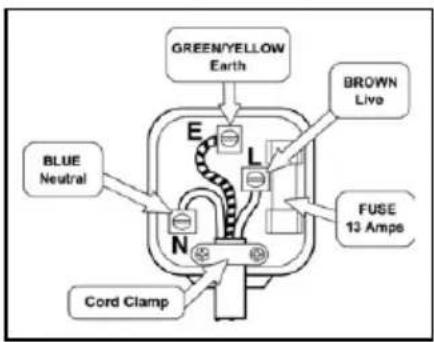
How to wire a 13 amp plug.
Important
The wires in the mains lead on this appliance are coloured in accordance with the following code:
Green and Yellow - Earth
Blue - Neutral
Brown – Live
As the colours may not correspond with the markings identifying the terminals in your plug proceed as follows.
The green and yellow wire must be connected to the terminal in the plug which is marked with the letter E or with the earth symbol 1/2 or coloured green and yellow.
The blue wire must be connected to the terminal marked N or coloured black.
The brown wire must be connected to the terminal marked L or coloured red.
Description of the Appliance
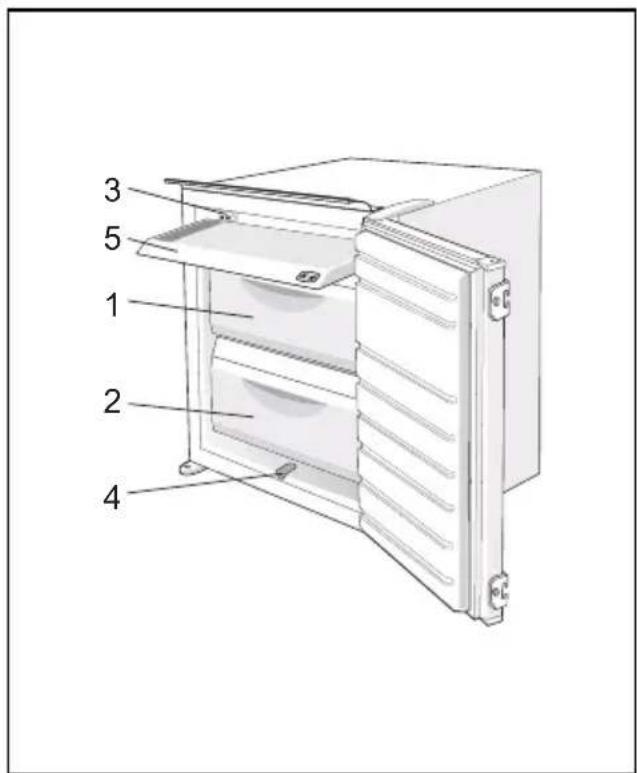
Freezing Compartment (1)
is used for freezing fresh foods.
Storing Compartment (2)
is used for storing packages of frozen foods.
Control Panel (3)
See Operating the appliance
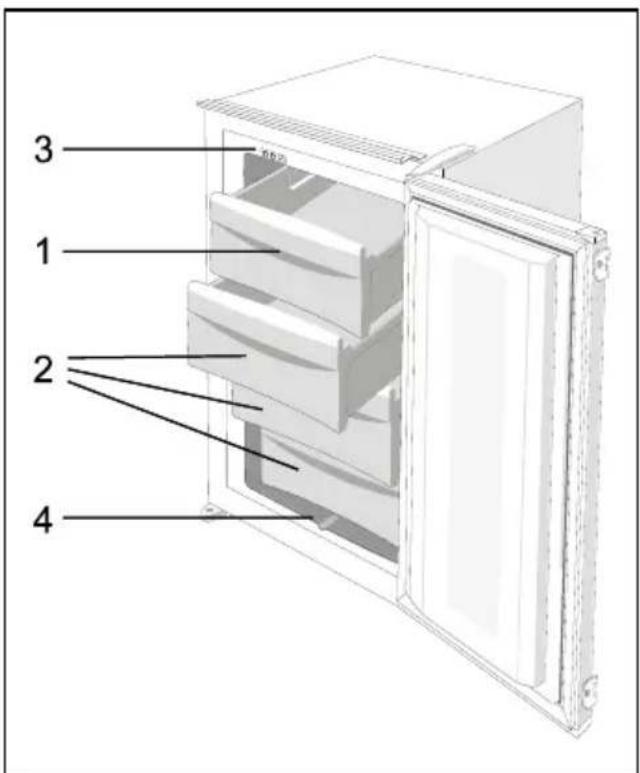
Defrost Water Outlet (4)
(See Cleaning and Maintenance).
NOTE:
The appliance can be equipped with various accessories, depending on the model of the appliance.
Operating the appliance
Switching on the appliance
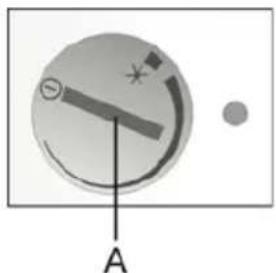
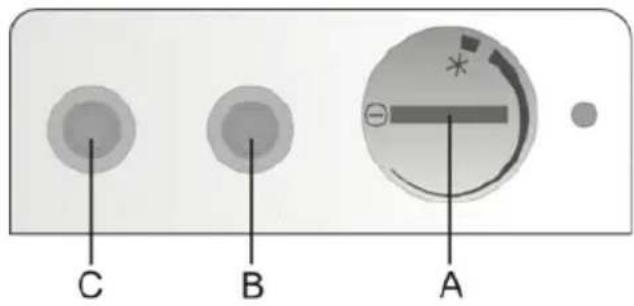
Rotate the thermostat knob A clockwise towards the thicker end of the sign.
When the appliance is switched on for the first time, there is a 24-hour delay in temperature alarm operation since the appliance will not have reached the adequate temperature. Thus, unnecessary activation of alarm is prevented.
Switching off the appliance
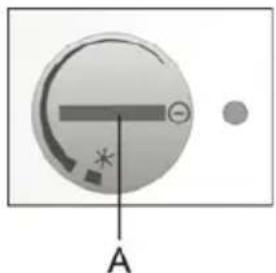
Rotate the A knob back to the position in which the arrow is aligned with the symbol
(%) (appliance will remain powered, i.e. there will still be electric current in the appliance).
A Temperature settings knob – Switching the appliance on/off – Activating the super freeze function
B Yellow signal light on: Super freeze function is activated
C Red signal light flashing: High temperature alarm
Selecting the temperature in the appliance

Recommended setting for the thermostat knob A is half way between the thinner and the thicker end of the sign.
A change in the environment temperature will affect the temperature in the appliance.
The thermostat knob setting should be adjusted accordingly.
Positions towards the thicker part of the sign mean a lower temperature in the appliance (cooler). Settings towards the thinner part of the marking mean a higher temperature (warmer).

Signal light C will flash when the temperature in the freezer rises to a level that is too high, and goes off when the temperature drops back to a level that no longer represents food spoilage hazard (see section »Troubleshooting«).
Freezing and storing frozen food
Freezing process
Maximum quantity of fresh food that can be introduced into the appliance at a time is indicated on the label with basic information on the appliance. If this quantity is exceeded, freezing quality will deteriorate, as will the quality of the already frozen food.

- Activate the super freeze function 24 hours before freezing fresh food:
- rotate the A button to the * (signal light B will light up).
After 24 hours, place the fresh food in the freezing compartment. Make sure the fresh food is not in contact with the food that is already frozen.
- When freezing smaller quantities of food (1-2 kilograms), activating the super freeze function is not required.
- After 24 hours, the food can be moved to other parts of the freezer and the freezing process can be repeated as required:
- rotate the A button back to the middle position and then after 5 seconds to the position * (signal light B will light up).
- After the end of the freezing process, rotate the A dial back to the desired setting, even if the B signal light is not on (this means that sufficiently low temperature has already been reached).
- If the freezer boost is not deactivated manually, it will be automatically switched off after approximately 2 days. Then the temperature of the freezer compartment returns to the most recently set value
(knob position remains at * ).
Important warnings on freezing fresh food
- The freezer should only be used for freezing food that is appropriate for freezing. The food should always be fresh and of adequate quality.
- Choose an appropriate packaging for the food and package it correctly.
- The packaging should be airtight and watertight to prevent loss of humidity or vitamins from the food.
- Indicate the type of food, quantity, and freezing date on each food package.
- It is important that the food is frozen as quickly as possible; therefore, smaller packages should be preferred. Before freezing, the food should be cooled.
Storing Frozen Foods
Packages of frozen foods are stored in baskets. If you remove the baskets, you can store frozen packages directly on the cooling shelves.
Storing Commercially Frozen Foods
The storage time and recommended temperature for storing commercially frozen foods is indicated on the packaging. For storing and use consider manufacturer's instruction. When shopping, be careful and choose only packages of foods which are adequately packed and provided with complete data and stored in freezers where the temperature is not higher than -18°C. Do not buy packages of food wrapped with frost. This indicates that the package was thawed before at least once. Take care that packages don't start to thaw. Temperature rise shortens the storage time of commercially frozen foods.
Approximate Storage Time of Frozen Foods
| Food Storage time (in months) | ||||||||||||
| 1 | 2 | 3 | 4 | 5 | 6 | 7 | 8 | 9 | 1 | ρ1 | 12 | |
| Vegetable + + + | ||||||||||||
| Fruit + | + | + | ||||||||||
| Braed, Pastries + | ||||||||||||
| Milk + | ||||||||||||
| Redy-made meals + | ||||||||||||
| Meat: Beef + | + | + | ||||||||||
| Veal + + + | ||||||||||||
| Pork + + + | ||||||||||||
| Poultry + + + | ||||||||||||
| Game + + + | ||||||||||||
| Min c e d + | ||||||||||||
| Smoked | + | |||||||||||
| Fish: lean fat | + | |||||||||||
| + | ||||||||||||
| Offal | + | |||||||||||
Defrosting of Frozen Food
Partially thawed or defrosted foods should be used as soon as possible. Cold air preserves the food but it does not destroy microorganisms which rapidly activate
themselves after defrosting and make foods perishable.
Partial defrosting reduces the nutritional value of foods, especially of fruits, vegetables and ready-made meals.
Maintenance and Cleaning
Freezer Defrosting
Frost and ice layer, depositing on the inner walls of the freezer should be defrosted when 3-5 mm thick.
- 24 hours before defrosting, activate the freezer power boost to additionally cool the food (see chapter "Freezing process").
- After 24 hours, remove the frozen food from the freezer and protect them from thawing.
- Disconnect the appliance – rotate the
thermostat knob A to the ⏻ position and unplug the power cord from the wall outlet.
- Insert the enclosed pipe into the groove in the bottom of the appliance and place a vessel underneath to collect the defrost water. Defrosting is accelerated if the door is left open.

- Avoid using defrosting sprays, as they may cause damage to the plastic parts and may be hazardous to health.
Cleaning the Appliance
Before cleaning the appliance disconnect the cable from the mains supply. Do not use abrasive cleaning agents. Be careful to remove any cleanser agent remaining after cleaning.
- Clean the exterior of the appliances with water and liquid detergent. Varnished surfaces are cleaned with soft cloth and an alcohol based cleaning agent (for example glass cleaners). You may also
use alcohol (ethanol or isoprophylic alcohol). The application of abrasive and specially aggressive cleaners, such as the stainless steel cleaners, is not appropriate for the cleaning of plastic and coated parts.
- Wash the interior with lukewarm water and some vinegar.
- From time to time wipe the condenser on the rear wall with a soft non-metal brush or vacuum cleaner.
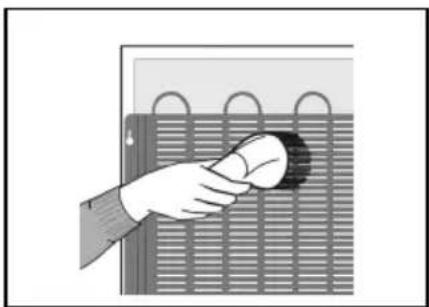
After you have cleaned the appliance, reconnect it to the mains supply and put the food packages back to their place.
Switch Off the Appliance When Not in Use
If you do not intend to use the appliance for a longer period of time, disconnect the power supply, empty the appliance, defrost it and clean it. Leave the door slightly open.

Trouble Shooting Guide
| Problem: Cause or remedy | |
| After connecting to the power mains, the appliance does not operate: | Make sure the wall outlet is powered and that the appliance is plugged in. |
| Cooling system has been working continuously for a long period of time: • Door is | Too high environment temperature. Door is open too often or it is left open too long. not closed appropriately (there may be dirt between the door and the refrigerator, the door may be tilted, the seal should be checked, etc.).Too much fresh food was inserted.Insufficient compressor and condenser cooling. Check the air circulation behind the appliance and clean the condenser. |
| Ice accumulation in the freezer interior is a result of: • Door is opened | Poor door sealing. If the seal is dirty or damaged, clean or replace it.too often or left open too long.Placing warm food into the freezer. |
| Signal light C is flashing: • Frequent opening of the door, door open too long. • Door not closed properly (particle between door gasket, sagged door, damaged gasket, etc...).• Excessively long power failure.• Excessive quantity of fresh food inserted at once. | |
| Door won't open easily: • If you wish to open freezer door immediately or shortly after closing it, you may feel rather strong resistance. When the freezer door is opened, some cool air escapes from the freezer compartment and it is replaced by warm air from the environment. When this air is cooled, a sub-pressure builds up, causing resistance to door opening. After a few minutes, the condition is normalized and the door can be easily opened again. | |
| Occurrence of murmur after closing the door: | After closing the door, some murmur can occur. This phenomenon is normal and is due to pressure equalisation. |
If none of the above reasons seems to match your problem, please contact the nearest service center and state the type, model and serial number as indicated on the label with basic information attached in the appliance interior.
Noise
Cooling in refrigerating-freezing appliances is enabled by the cooling system with compressor, which produces noise. How noisy the appliance is depends on where it is placed, how it is used and how old the appliance is.
- During the operation of the compressor the noise of liquid is heard and when the compressor is not operating, the refrigerant flow is heard. This is a normal condition and it has no influence whatsoever on the lifetime of the appliance.
- After starting the appliance, the operation of the compressor and the refrigerant flow may be louder, which does not mean that something is wrong with the appliance and it has no influence on the lifetime of the appliance. Gradually the noise is reduced.
- Sometimes unusual and stronger noise is heard, which is rather unusual for the appliance. This noise is often a consequence of inadequate placing. (The appliance shall be placed and levelled firmly on solid base and it should not touch the wall or kitchen units standing next to it.).
Mounting Instructions
Mounting instructions for refrigerating and freezing appliances are for qualified technicians only.
Appliance should be mounted and installed in compliance with these instructions, current
standards and regulations.
Mounting instructions were prepared for various types/models of appliances, therefore they may describe some procedures that do not apply to your appliance.
Mounting Dimensions and Required Air Circulation
The rear wall of the appliance is getting warm during the operation of the appliance (and water is evaporating from the drain pan on the compressor). You must therefore provide for adequate air circulation on the rear of the appliance.
- At the base of the kitchen unit intended for building in the integrated appliance, there should be at least 200 cm 2 free space, for adequate air circulation.
- On the upper part of the appliance the air is coming out, so try not to cover the opening for the outflow air.
| A (mm) B (mm) | |
| 575 575-580 | |
| 875 875-880 | |
| 1025 1025-1030 | |
| 1225 1225-1230 |


Changing the Direction of Opening the Door
If you find the direction of opening the door on your appliance inconvenient, you can change it. Holes on the opposite side have already been prepared in the factory and are now plugged.
- Remove the cover of the upper hinge, unscrew the hinge and take off the door (the door is not fixed on the lower hinge).
- Unscrew the upper rail, replace it to the opposite side of the appliance and fix it.
- Remove the washer from the lower hinge and unscrew (rotate it in clockwise) the fastener on the lower hinge.
- Replace the fastener and the washer in reverse order into the opening of the lower hinge on the opposite side of the appliance.
- Take off all door corners and interchange them (instead of the corner with a hole insert the one without the hole and vice versa).
- Put the door of the appliance on the lower hinge.

• Fix the upper hinge and cover it.
- Replace the slide guides to the opposite side of the door.
- Plug the remaining holes with decorative caps.
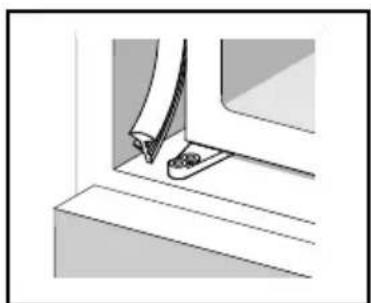
- Check the gasket, it shouldn't be creased and it should seal well. In case it does not fit perfectly, pull it out and rotate for 180°.
- In certain models it is not possible to replace the door gasket.
- Should the seal not adhere to the casing of the appliance perfectly, it will have to be heated from a suitable distance (by means of hair drier, for example) and lightly stretched to the required height.
1 Cover for the upper hinge
2 Upper hinge
3 Upper rail
4 Slide guide
5 Lower hinge washer
6 Lower hinge fastener
7 Lower hinge
8 Corner without a hole
9 Corner with a hole
10 Low temperature compartment
11 Blocking element
12 Door hinge
Mounting the Appliance
- Push the appliance for some 38 mm into the kitchen unit and allow at least 4 mm free space on both sides between the appliance and the side walls of the kitchen unit (Fig. 1).
-
Widely open the door and put it together with the kitchen unit door. The procedure is as follows.
-
Fix the slide guides (attached in a plastic bag along with the screws ST 4,2 x 9,5) to the edge of the door. Cover the open holes with the attached cap.
- Put together the appliance door and the door of the kitchen unit (Fig. 2).
- Insert the slides into the guides and fix them on the kitchen unit door some 15 mm from the edge, using the A 4 x 12 screws (Fig. 3).
- Remove the slide guides and separate the appliance door from the door of the kitchen unit.
- Fix the slides and be careful not to move them while fixing (Fig. 4).
- Fix the slide guides to the original position.

- Close the door and check the gasket (it should not be creased). The door should open and close smoothly.
NOTE:
Appliance with the height of 575 mm have only one slide and one slide guide.
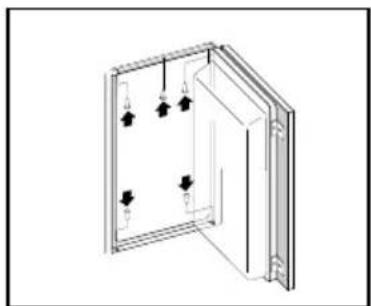
- Fix the appliance into the kitchen unit. On the upper side, fix the three screws A 4 x 12 through the rail and on the lower side with two screws A 4 x 16, through the lower hinges. Drill holes, ø 3 x 5 (Fig. 5).
- Seal the gap on the opposite side of the hinge with the enclosed seal (Fig. 6).
WARNING
Before mounting the appliance into the kitchen unit, disconnect the power supply and set the thermostat knob to STOP (0) position or switch off the ON/OFF switch.
WE RESERVE THE RIGHT TO ALTER THE SPECIFICATIONS WITH NO INFLUENCE ON THE OPERATION OF THE APPLIANCE.

- THANK YOU FOR YOUR TRUST AND FOR BUYING THIS APPLIANCE. WE HOPE IT WILL SUCCESSFULLY SERVE THE PURPOSE FOR MANY YEARS
- BEFORE PUTTING INTO USE
- IMPORTANT
- PLACING AND INSTALLATION
- DESCRIPTION OF THE APPLIANCE
- OPERATING THE APPLIANCE
- FREEZING AND STORING FROZEN FOOD
- MAINTENANCE AND CLEANING
- TROUBLE SHOOTING GUIDE
- MOUNTING INSTRUCTIONS
- MOUNTING DIMENSIONS AND REQUIRED
- AIR CIRCULATION
- CHANGING THE DIRECTION OF OPENING
- THE DOOR
- MOUNTING THE APPLIANCE
- INSTRUCTIONS FOR USE
- WE CARE FOR THE ENVIRONMENT
- TIPS FOR ENERGY SAVING
- ⚠️ IMPORTANT
- STORING TIME DURING POWER SUPPLY INTERRUPTION
- DISPOSING OF THE WORN OUT APPLIANCE
- CHOOSING THE RIGHT PLACE
- CONNECTION TO POWER SUPPLY
- ELECTRICAL CONNECTION
- WARNING: THIS APPLIANCE MUST BE EARTHED
- NOTE
- SWITCHING ON THE APPLIANCE
- SWITCHING OFF THE APPLIANCE
- SELECTING THE TEMPERATURE IN THE APPLIANCE
- FREEZING PROCESS
- IMPORTANT WARNINGS ON FREEZING FRESH FOOD
- STORING FROZEN FOODS
- STORING COMMERCIALLY FROZEN FOODS
- DEFROSTING OF FROZEN FOOD
- FREEZER DEFROSTING
- CLEANING THE APPLIANCE
- SWITCH OFF THE APPLIANCE WHEN NOT IN USE
- NOISE
- MOUNTING DIMENSIONS AND REQUIRED AIR CIRCULATION
- CHANGING THE DIRECTION OF OPENING THE DOOR
- WARNING
Brand : GORENJE
Model : FI4091AW
Category : Freezer