
DF300AP - Outboard motor SUZUKI - Free user manual and instructions
Find the device manual for free DF300AP SUZUKI in PDF.


| Product Type | Outboard Motor |
| Brand | Suzuki |
| Model | DF300AP |
| Engine Type | 4-Stroke |
| Number of Cylinders | 6 |
| Displacement | 4,028 cm³ (245.7 cu. in.) |
| Maximum Output | 220.7 kW (300 PS) |
| Full Throttle Operating Range | 5,700 – 6,300 r/min |
| Ignition System | Full-transistor |
| Engine Lubrication | Trochoid pump pressure lubrication |
| Engine Oil Capacity | 8.0 L (8.5/7.0 US/Imp. qt.) |
| Gear Oil Capacity | 1.1 L (1.2/1.0 US/Imp. qt.) |
| Fuel Type | Alcohol-free unleaded gasoline |
| Minimum Fuel Octane Rating | 94 (Research method) |
| Spark Plug | NGK BKR6E (gap 0.7–0.8 mm) |
| Valve Clearance (IN/EX) | 0.23–0.27 mm / 0.33–0.37 mm |
| Battery Requirement (Minimum) | 1000 MCA / 800 CCA / 180 RC / 12V 130 AH |
| Starting System | Electric (Keyless Start System optional) |
| Trim and Tilt | Power Trim and Tilt with manual release |
| Multi-Function Gauge | Optional (displays RPM, speed, fuel, etc.) |
| Caution Systems | Over-revolution, oil pressure, oil temperature, overheat, battery voltage, etc. |
| Lower Unit Rotation | Selectable (regular or counter) |
| Propeller Type | Right or left hand rotation matching lower unit |
| Oil Change Reminder | Yes (based on total operating hours) |
| Water in Fuel Alert | Yes |
Frequently Asked Questions - DF300AP SUZUKI
User questions about DF300AP SUZUKI
0 question about this device. Answer the ones you know or ask your own.
Ask a new question about this device
Download the instructions for your Outboard motor in PDF format for free! Find your manual DF300AP - SUZUKI and take your electronic device back in hand. On this page are published all the documents necessary for the use of your device. DF300AP by SUZUKI.
USER MANUAL DF300AP SUZUKI
Please read this manual and follow its instructions carefully. To emphasize special information, the symbol ▲ and the words WARNING, CAUTION, NOTICE and NOTE have special meanings. Pay special attention to the messages highlighted by these signal words.
WARNING
Indicates a potential hazard that could result in death or serious injury.
CAUTION
Indicates a potential hazard that could result in minor or moderate injury.
NOTICE
Indicates a potential hazard that could result in damage to the motor or boat.
NOTE:
Indicates special information to make maintenance easier or instructions clearer.

This symbol appears in various locations on your Suzuki product to refer you to important information in the owner's manual.
IMPORTANT NOTICE TO OWNERS
WARNING
Failure to take the proper precautions may increase the risk of death or severe injury to you and your passengers.
- Prior to first-time use of your outboard motor, familiarize yourself thoroughly with the contents of this owner's manual. Be aware of all outboard motor features and all safety and maintenance requirements.
-
Inspect the boat and motor before each trip. See the INSPECTION BEFORE BOATING section for important items.
-
Become thoroughly familiar with all operating and handling characteristics of your boat and motor. Practice at low and moderate speeds until you are competent at handling the boat and motor. Do not attempt to operate at maximum performance until you are completely familiar with all of these characteristics.
- Carry boating safety and emergency equipment. This important equipment includes; flotation aids for each person (plus one throwable buoyant cushion in any boat 16 feet or longer), fire extinguisher, sound signaling device, visual distress signals, anchor, bilge pump, bucket, compass, emergency starter rope, extra fuel and oil, first aid kit, flashlight, food and water, mirror, paddles, tool kit, and transistor radio. Be sure you are carrying the equipment appropriate for your trip before launching.
- Never start the engine or let it run indoors or where there is little or no ventilation. Exhaust gas contains carbon monoxide, a gas that is colorless and odorless and can cause death or severe injury.
- Instruct your passengers on how to operate the boat, how to deal with emergencies, and how to operate safety and emergency equipment.
- Do not hold onto the motor cover or any other parts of your outboard motor while getting on or off your boat.
- Ensure that everyone wears a PFD (Personal Flotation Device) on board.
- Never operate the boat while under the influence of alcohol or other drugs.
- Distribute all weight load evenly in the boat.
- Have all scheduled maintenance performed. Consult your authorized Suzuki marine dealer as required.
- Do not modify or remove any outboard motor standard equipment. To do so may make the motor unsafe to use.
- Learn and obey all applicable navigation rules.
- Pay attention to all weather forecasts. Do not set out if weather is unsettled.
- Use extreme caution when purchasing replacement parts or accessories. Suzuki strongly recommends that you use only genuine Suzuki replacement parts/accessories or their equivalent. Inappropriate or poor quality replacement parts or accessories can create unsafe operating conditions.
- Never remove the flywheel cover (except for when emergency starting).
NOTE:
Mounting radio transceiver or navigational equipment antennae too close to the engine cowling can cause electrical noise interference. Suzuki recommends that antennae be mounted at least one meter (40 inches) away from the engine cowling.
This manual should be considered a permanent part of the outboard motor and should remain with the outboard motor when resold or otherwise transferred to a new owner or operator. Please read this manual carefully before operating your new Suzuki and review the manual from time to time. It contains important information on safety, operation, and maintenance.
FOREWORD
Thank you for choosing a Suzuki outboard motor. Please read this manual carefully and review it from time to time. It contains important information on safety, operation, and maintenance. A thorough understanding of the information presented in this manual will help you experience safe, enjoyable boating.
All information in this manual is based on the latest product information available at the time of publication. Due to improvements or other changes, there may be discrepancies between this manual and your outboard motor. Suzuki reserves the right to make changes at any time without notice.
TABLE OF CONTENTS
IDENTIFICATION NUMBER LOCATION.... 5
FUEL AND OIL...... 5
LOCATION OF SAFETY LABELS ..... 8
LOCATION OF PARTS...... 9
MOTOR MOUNTING...... 10
BATTERY INSTALLATION ...... 11
USE OF ELECTRICAL ACCESSORIES 13
SUZUKI KEYLESS START SYSTEM (IF EQUIPPED WITH KEYLESS START SYSTEM) 14
PROPELLER SELECTION AND INSTALLATION.... 21
ADJUSTMENT.... 23
METER (OPTION) MULTI-FUNCTION GAUGE ...... 26
CAUTION SYSTEM 36
ELECTRONIC THROTTLE AND SHIFT CONTROL CAUTION SYSTEM.... 40
KEYLESS START SYSTEM CAUTION SYSTEM (IF EQUIPPED WITH KEYLESS START SYSTEM).... 44
DIAGNOSTIC SYSTEM 45
OIL CHANGE REMINDER SYSTEM.... 46
ENGINE STALLING CAUTION SYSTEM.... 47
WATER IN FUEL ALERT SYSTEM. 47 OPERATION OF TILTING SYSTEMS.... 48
INSPECTION BEFORE BOATING ... 51
BREAK-IN 52
OPERATION 53
MOTOR REMOVAL AND TRANSPORTING 71
TRAILERING.... 73
INSPECTION AND MAINTENANCE.... 74
FLUSHING THE WATER PASSAGES.... 86
SUBMERGED MOTOR 88
STORAGE PROCEDURE 89
AFTER STORAGE 90
TROUBLESHOOTING 91
SPECIFICATIONS 94
INFORMATION REGARDING EC - DIRECTIVE .... 94
FLOWCHART OF OIL CHANGE REMINDER SYSTEM...... 95
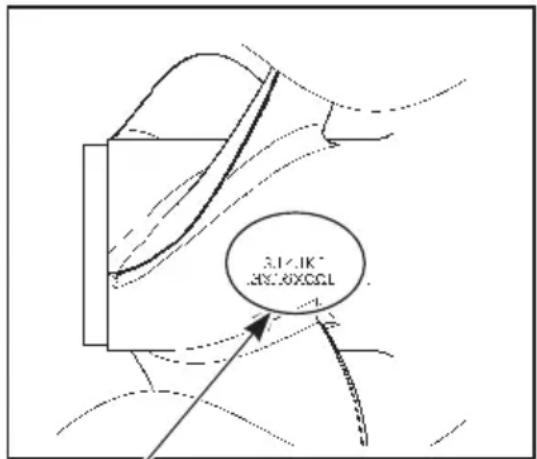
IDENTIFICATION NUMBER LOCATION
The model and identification numbers of your outboard motor are stamped on a plate attached to the clamp bracket. It is important to know these numbers when you place a parts order or if your motor is stolen.

natural_image
Technical line drawing of a mechanical component with no visible text or symbolsFUEL AND OIL
GASOLINE
Suzuki highly recommends that you use alcohol-free unleaded gasoline whenever possible, with a minimum octane rating of 94 (Research method). However, blends of unleaded gasoline and alcohol with equivalent octane content may be used, provided the guidelines that follow are met.
NOTICE
Use of leaded gasoline can cause engine damage. Use of improper or poor quality fuel can affect performance and may damage your motor and fuel system.
Use only unleaded gasoline. Do not use fuel having lower than the recommended octane, or fuel that may be stale or contaminated by dirt/water etc.
NOTE:
Oxygenated fuels are fuels which contain oxygen-carrying additives such as alcohol.
Suzuki recommends that you install a water-separating fuel filter assembly between your boat's fuel tank(s) and outboard motor(s). Fuel filtration systems of this type will help prevent water that may be present in your boat's fuel tank(s) from contaminating your motor's electronic fuel injection system. Water contamination can cause poor engine performance and can also cause damage to the electronic fuel injection system components.
Your Authorized Suzuki Marine Dealer can provide you advice about water-separating fuel filter systems and installation.
Gasoline/Ethanol Blends
Blends of unleaded gasoline and ethanol (grain alcohol), also known as “GASOHOL”, are commercially available in some areas. Blends of this type may be used in your outboard motor if they are no more than 10% ethanol. Make sure this gasoline-ethanol blend has octane ratings no lower than those recommended for gasoline.
Use the recommended gasoline which conforms to the following labels.

78RB0900
Pump Labeling for Gasoline/Alcohol Blends
In some states, pumps that dispense gasoline/ alcohol blends are required to be labeled for the type and percentage of alcohol content, and whether important additives are present. Such labels may provide enough information for you to determine if a particular blend of fuel meets the requirements listed above. In other states, pumps may not be clearly labeled as to the content or type of alcohol and additives. If you are not sure that the fuel you intend to use meets these requirements, check with the service station operator or the fuel suppliers.
NOTE:
If you are not satisfied with the operation or fuel economy of your outboard motor when you are using gasoline/alcohol blends, you should switch back to unleaded gasoline containing no alcohol.
Be sure that any gasoline/alcohol blend you use has octane ratings of at least 94 octane (Research method).
If engine pinging is experienced, substitute another brand as there are differences between brands.
Unleaded gasoline will extend spark plug life.
WARNING
Gasoline is extremely flammable and toxic. It can cause a fire and can be hazardous to people and pets.
Always take the following precautions when refueling:
- Never permit anyone other than an adult to refill the fuel tank.
- If you use a portable fuel tank, always stop the motor and remove the fuel tank from the boat to refill it.
- Do not fill the fuel tank all the way to the top or fuel may overflow when it expands due to heating by the sun.
- Be careful not to spill fuel. If you do, wipe it up immediately.
- Do not smoke, and keep away from open flames and sparks.
NOTICE
Gasoline kept in the fuel tank for long periods of time will produce varnish and gum, which can damage the engine.
Always use fresh gasoline.
NOTICE
Fuels containing alcohol can cause paint damage, which is not covered under the New Outboard Motor Limited Warranty.
Be careful not to spill fuel containing alcohol while refueling. If fuel is spilled, wipe it up immediately.
ENGINE OIL
NOTICE
Use of poor quality engine oil can adversely affect engine performance and life.
Suzuki recommends that you use Suzuki Marine 4-Cycle Engine Oil or its equivalent.
Oil quality is a major contributor to your engine's performance and life. Always select good quality engine oil.
Suzuki recommends the use of SAE 10W-40 or 10W-30 SUZUKI MARINE 4-CYCLE ENGINE OIL. If SUZUKI MARINE 4-CYCLE ENGINE OIL is not available, select a NMMA certified FC-W oil or good quality 4-cycle motor oil from the following chart according to the average temperatures in your area.

other
API Classification | API Classification | SAE Viscosity Grade | | :--- | :--- | | SG | 10W-40 | | SH | 10W-30 | | SJ | 10W-30 | | SL | 10W-30 | | SM | 10W-30 | | TEMP. °C | -20 -10 0 10 20 30 | | TEMP. °F | -4 14 32 50 68 86 | | TEMP. 40 | 104 |NOTE:
In very cold weather (below 5^ C ( 41^ F)), use SAE (or NMMA FC-W) 5W-30 for easier starting and smooth operation.
GEAR OIL

Suzuki recommends the use of SUZUKI OUTBOARD MOTOR GEAR OIL. If it is not available, use SAE 90 hypoid gear oil which is rated GL-5 under the API classification system.
Read and follow all of the labels on your outboard motor or fuel tank. Make sure you understand all of the labels.
Keep the labels on your outboard motor or fuel tank. Do not remove them for any reason.
natural_image
Line drawing of a device rear panel with a black arrow pointing to a button (no text or symbols)WARNING AVERTISSEMENT



natural_image
Technical line drawing of a mechanical component with no visible text or symbolsLabel symbol meanings These symbols mean as follows;
: General warning symbol (Caution or Warning)
: Read owner's manual carefully
: Remote control lever/gear shift lever operation-two direction; Forward/Neutral/Reverse
Engine start
Hazard caused by fire
Hazard caused by laying the motor on its side
LOCATION OF PARTS


MOTOR MOUNTING
WARNING
Overpowering your boat can be hazardous. Excessive horsepower will have an adverse effect on hull safety and may cause operating/handling difficulties. The boat may also sustain stress and hull damage.
Never install an outboard motor with horsepower exceeding the manufacturer's recommended maximum horsepower listed on the boat's "Certification Plate". Contact your authorized Suzuki marine dealer if you are unable to locate the hull "Certificate Plate".
Suzuki strongly recommends that you have your outboard motor, controls and gauges installed by an authorized Suzuki Marine Dealer. He has the tools, the facilities and the know-how.
WARNING
Failure to have your outboard motor and associated controls and gauges properly installed can result in personal injury or damage.
Suzuki strongly recommends that you have your outboard motor, controls and gauges installed by your authorized Suzuki marine dealer. He has the tools, the facilities, and the know-how to do the job correctly.
SELECTION OF LOWER UNIT ROTATION
Lower unit of this product can be used for both regular rotation or counter rotation without changing itself.
The motor will be shipped as regular rotation specification from the factory.
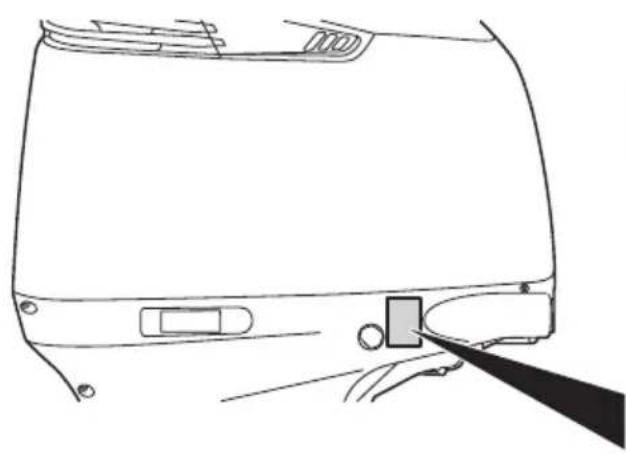
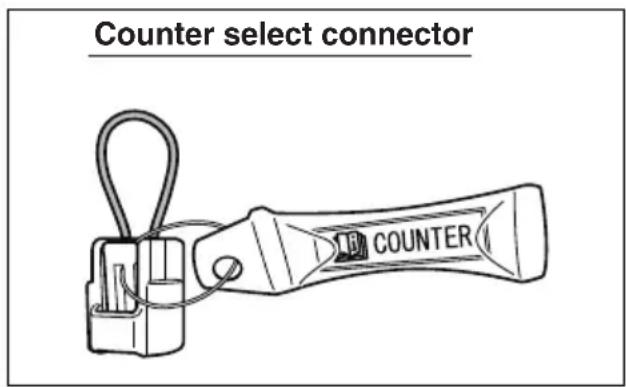
To change the rotation from regular rotation to counter, the rotation select connector located near the engine oil filter should be changed from the original one to the optional counter select one.
To return it to regular rotation, use the original connector again.
Please contact your authorized Suzuki Marine Dealer for details.
NOTE:
- The selection of lower unit rotation closely relates to the selection of the propeller type. Confirm the lower unit rotation of the motor before installing the propeller.
For propeller type selection, refer to the section of "IDENTIFICATION OF LOWER UNIT ROTATION AND PROPELLER TYPE SELECTION".
- When the rotation select connector ① is replaced, fix it onto the wiring harness ③ using the clamp ② as shown in the figure.


NOTE:
Turn the main switch OFF before connecting or disconnecting the rotation select connector.
BATTERY INSTALLATION
BATTERY REQUIREMENT
1000 Marine Cranking Amps (MCA)/ABYC, or 800 Cold Cranking Amps (CCA)/SAE or 180 Reserve Capacity (RC) Minutes/SAE or 12 Volt, 130 AH
NOTE:
- The specifications listed above are the minimum battery rating requirements for starting the engine.
- If your boat application requires additional battery loads, it is recommended that an auxiliary battery or batteries be installed. Consult your Suzuki dealer for proper battery installation information.
- Dual-purpose (Cranking/Deep-cycle) batteries can be used if they meet the minimum specifications listed above (MCA, CCA, or RC).
- Do not use a Deep Cycle battery for the main cranking battery.
- When connecting batteries in parallel, they must be of the same type, capacity, manufacturer, and of similar age. When replacement is necessary, they should be replaced as a set. Consult your Suzuki dealer for proper battery installation information.
BATTERY INSTALLATION
Secure the battery in a dry area of the boat, away from vibration.
NOTE:
- It is recommended that the battery be installed in an enclosed battery case.
- When connecting batteries, hexagon-nuts must be used to secure battery leads to battery posts.
To hook up the battery, first connect the red lead from the motor to the positive battery terminal, then connect the black lead to the negative battery terminal.


To remove the battery, first disconnect the black lead from the negative terminal, then disconnect the red lead from the positive terminal.
Suzuki recommends that you install the terminal cap on the positive battery terminal to prevent an accidental short circuit of battery terminals.
If a terminal cap is required, contact your authorized Suzuki marine dealer.

WARNING
If you place the battery near the fuel tank, a spark from the battery may ignite the gasoline, causing a fire and/or an explosion.
Do not place the fuel tank in the same compartment/area as the battery.

WARNING
Batteries produce flammable hydrogen gas and may explode if they are near flames or sparks.
Never smoke or cause sparks when working near the battery. Keep the battery away from open flames. To avoid creating a spark when charging the battery, connect the battery charger cables to the proper terminals before turning the charger on.

WARNING
Battery acid is poisonous and corrosive. It can cause severe injury and can damage painted surfaces.
Avoid contact with eyes, skin, clothing, and painted surfaces. If battery acid comes in contact with any of these, flush immediately with large amounts of water. If acid contacts the eyes or skin, get immediate medical attention.
NOTICE
The electrical system or its components may be damaged if proper battery precautions are not followed.
- Be sure to attach battery leads correctly.
- Do not disconnect battery leads from the battery while the engine is running.
SUB BATTERY CABLE
The sub battery cable ① is used to supply voltage to the engine control system. In the midst of the cable, a 30 A fuse ② is provided to protect the control circuit.
If the sub battery cable is not correctly connected to the battery, engine cannot be started.

DUAL BATTERY CHARGING SYSTEM (OPTION)
If installing the battery isolator lead assembly, available as optional parts, and changing the position of 40 A fuse from standard to option, dual battery charging system will be effective.
Be sure to check if the optional 40 A fuse in OPT position is blown, when the second battery for accessories will not be charged.
Please ask your authorized Suzuki Marine Dealer for installation of the isolator lead assembly.
USE OF ELECTRICAL ACCESSORIES
The amount of power (DC12V) available for accessories, however, depends on the operating condition of the motor. For getting a detailed information, please inquire of your authorized Suzuki Marine Dealer.
NOTE:
Use of too much power for electrical accessories under certain operating conditions can cause the battery to discharge.
SUZUKI KEYLESS START SYSTEM (IF EQUIPPED WITH KEYLESS START SYSTEM)
This system allows you to start the engine by means of communication between the key-fob and the keyless control unit when you have the key-fob with you, instead of using the mechanical key.
The engine can be started when the distance between the key-fob and the keyless control unit is within the communication range of 1 m (39.4 in.).
In addition, this system is equipped with immobilizer feature.

NOTE:
Please consult with a Suzuki Marine Dealer for the installation of the Keyless Start System.
Also refer to the "Keyless Start System Instruction Manual" supplied with the product for detailed operating instructions.
IMMOBILIZER SYSTEM
In this system, the key-fob and the keyless control unit uses radio communication to check if the key-fob ID is registered in the Keyless Start System.
If the key-fob ID is not registered, the system prevents the engine from starting using the key-fob.
WARNING
Radio waves from the keyless control unit may interfere with the operation of electrical medical equipment such as pacemakers. Failure to take the precautions listed below can increase the risk of severe injury or death due to radio wave interference.
Anyone who uses electrical medical equipment such as a pacemaker should consult the medical equipment supplier to inquire if radio waves from the keyless control unit can interfere with the medical equipment.
KEY-FOB
Two (2) key-fobs are supplied with the Keyless Start System.

natural_image
Line drawing of a mobile phone with a key and logo (no text or symbols)
natural_image
Line drawing of a mobile phone key with a lock and handle (no text or symbols)WARNING
The key-fob emits radio waves that may interfere with aircraft operations.
Do NOT operate the buttons on the key-fob while you are in flight. When putting the key-fob in a bag, etc., protect the buttons from accidentally being pressed.
NOTE:
The key-fob falls under the category of restricted electronic devices for use in flight.
NOTICE
The radio waves emitted from the key-fob may cause interference with other wireless communication devices such as mobile phones and remoter controllers.
Do not operate the buttons on the key-fob more than necessary.
CAUTION
Attempting to disassemble (except for battery replacement), repair, or modify the key-fob may cause ignition, electric shock, or injury.
Do NOT attempt to disassemble (except for battery replacement), repair, or modify the key-fob.
NOTICE
The key-fob is comprised of sophisticated electronic components that can become damaged and may fail to function properly if you do not take proper precaution.
- Do NOT leave it in places that may reach a high temperature.
- Do NOT apply a strong impact, such as dropping it.
- Do NOT bring it close to any magnetic objects.
- Do NOT place it near any electro-magnetic devices such as a television or audio equipment.
- Do NOT place it near any electric medical equipment (microwave therapy equipment, low frequency therapy equipment, etc.), or receive medical treatment with the key-fob in your pocket, etc.
NOTE:
- Do NOT erase or tamper with the conformance certification mark.
- A maximum of six (6) key-fobs can be registered in one keyless control unit.
- The battery life of the key-fob is about two (2) years, which can vary depending on use.
- The key-fob is always in transmission mode in order to communicate with the keyless control unit. For this reason, the battery may run down quickly if it receives strong radio waves from televisions or personal computers, etc.
NOTE:
- The emergency key should be carried separately from the key-fob to avoid losing both of them at the same time.
- If the key-fob and the emergency key are lost, immediately contact your authorized Suzuki Marine Dealer.
- The key-fob uses a weak radio wave that is susceptible to external influences when it communicates with the keyless control unit. For this reason, it may not operate properly under the following use environment.
- There is a nearby facility that emits strong radio waves such as a television tower, electric power plant, or broadcasting station, etc.
- The key-fob is held close to other wireless communication devices such as mobile phone, radio equipment or a laptop personal computer.
- The key-fob is in contact with or covered with a metallic object.
NOTE:
One (1) emergency key is included in the main switch panel for the Keyless Start System.
Switching the communication mode of the key-fob
Press and hold the lock button ① on the key-fob for more than one second to switch between ON mode and OFF mode.
NOTE:
If the lock button is pressed briefly while in communication ON mode, the LED ② on the key-fob briefly flashes once.

KEY-FOB BATTERY REPLACEMENT
WARNING
This product contains a coin/button cell battery. If swallowed, the coin/button cell battery can cause severe internal burns in just 2 hours and may lead to death.
- THE BATTERY IS A CHEMICAL BURN HAZ-ARD. DO NOT INGEST THE BATTERY. If you think batteries might have been swallowed or placed inside any part of the body, seek immediate medical attention.
- Keep new and used batteries away from children. If the battery compartment cannot be closed securely, stop using this product and keep it away from children.
CAUTION
There is a danger of explosion if the battery is replaced with an incorrect type.
Only replace the battery with the same or equivalent type.
CAUTION
Do not expose Hand Unit to excessive heat such as from sunlight or fire.
NOTICE
To prevent damage to the key-fob, be careful when replacing the battery.
• Install the lithium disc-type battery with the electrodes facing the proper direction.
- Do NOT touch the internal circuit of the key-fob when replacing the battery.
If the key-fob battery runs low, "Remote Key Battery Low" appears on the gauge, which indicates the battery should be replaced.

To replace the key-fob battery:
- Insert a flat blade screwdriver in the slot of the key-fob and remove the cover.

natural_image
Line drawing of a handheld electronic device with a handle and label (no text or symbols on the device itself)- Remove the O-ring ①.

NOTE:
The O-ring may be fitted on the cover side.
NOTICE
If the O-ring is damaged, the waterproof performance deteriorates, which can cause the key-fob to malfunction.
Be careful not to damage the O-ring when removing it.
- Insert a flat blade screwdriver into the slot at the △mark on the cover to remove the battery.

natural_image
Line drawing of a mechanical component with a central shaft and circular base (no text or symbols)- Replace the battery so its terminal faces the cover side as shown in the illustration.
Lithium disc type battery: CR2025 or equivalent.
Confirm that the O-ring is placed in position on the body side.

natural_image
Line drawing of a remote control casing with a circular dial and handle (no text or symbols)- Reinstall the cover.
SETTING AND/OR CHANGING THE PASS-CODE
By setting a 4-digit passcode, the engine can be started by entering the passcode even if the key-fob battery has run down or the key-fob is lost.
The same method is used to set and change the passcode.
NOTE:
Carry the passcode with the emergency key in case the key-fob battery runs down or the key-fob is lost.
NOTE:
When the passcode has been updated or changed, the previous passcode is deleted and updated to the new passcode.
Use the following procedure to set or change the passcode:
- Confirm the engine is stopped.
- Make sure the emergency switch lock plate is in place.
-
Confirm the key-fob is within the communication range of the Keyless Start System.
-
Confirm that the key-fob is in communication ON mode. (Refer to "Switching the communication mode of the key-fob" section.)
-
Turn the main switch to the “” position and then release it. The main switch automatically returns to the “” position.
The buzzer on the engine control side emits one (1) long sound while the buzzer on the keyless control unit side emits two (2) short sounds simultaneously.

- Pull out the emergency stop switch lock plate.

natural_image
Diagram showing a mechanical component being lifted by a tool, with no visible text or symbols.- Within eight (8) seconds after performing Step 5, start the following operation.
(1)Turn the main switch to the “” position and hold it for about five (5) seconds then release it to the “” position.
Repeat this operation for two more times. The buzzer sounds once and the system enters stand-by mode for passcode input.
NOTE:
The buzzer will not sound if the operation in Step (1) is not performed within eight (8) seconds or the operation fails.

(2)Within 60 seconds after performing Step (1), turn the main switch to the “” position and then release it. The main switch automatically returns to the “” position.
The buzzer starts emitting short sounds. Briefly turn the switch after the number of sounds that is the same as the first passcode digit. For example, if the first passcode digit is seven, turn the switch after the seventh sound.
To set or select zero (0), turn the switch after the 10th sound.
NOTE:
If the operation in Step (2) is not performed within 60 seconds after performing Step (1), the passcode input operation will be cancelled and the buzzer will sound three (3) times.
Example: When entering 7

After the buzzer emits 10 sounds, it emits one long sound before to returning to stand-by mode for the second passcode digit.
(3) Repeat Step 2 to enter the second, third and fourth passcode digits.
(4)After entering the fourth pass code digit, the buzzer emits one continuous sound – within 60 seconds, turn the switch ON and hold it for five (5) seconds until the buzzer stops, then release it.
NOTE:
The buzzer emits one (1) short sound for the 1st digit, two (2) short sounds for the 2nd digit, three (3) short sounds for the 3rd digit, and four (4) short sounds for the 4th digit.
Buzzer sound

NOTE:
- If a passcode is not entered during the 10 sounds, the process will start over again after briefly turning the switch.
- If the main switch is not turned to select a passcode number after repeating the passcode input operation three (3) times, the input operation is cancelled.
In this case, the buzzer emits short beeps for five (5) seconds to notify that the input operation has been cancelled. - If the passcode input operation has been performed multiple times, the last passcode entered will become effective.
- To interrupt passcode input, install the lock plate on the emergency stop switch.

NOTE:
When performing the passcode input operation again after the operation has been cancelled due to passcode input failure or after having interrupted the operation;
1) Install the emergency switch lock plate.
2) Turn the main switch to the “○” position and then release it to the “●” position.
3) Perform the procedure described above from Step 5.
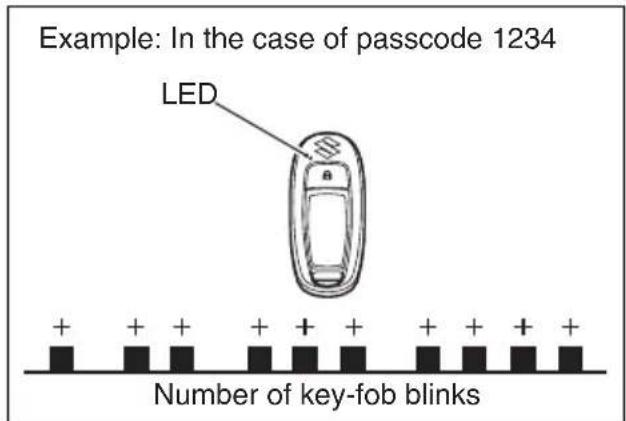
(5)After the buzzer has sounded once, the key-fob LED will blink the entered passcode.
(6) Install the lock plate on the emergency stop switch.
(7)Turn the main switch to the “” position and then release it to the “” position to turn the Keyless Start System OFF.
After that, do not perform any operation for at least 30 seconds, while the system performs passcode update.
PASSCODE CONFIRMATION
- Confirm that the engine is stopped.
- Make sure the emergency switch lock plate is in place.
- Confirm the key-fob is within the communication range of the Keyless Start System.
- Confirm the key-fob is in ON mode. (Refer to "Switching the communication mode of the key-fob" section.)
- Turn the main switch to the “position and then release it. The main switch automatically returns to the “position.
The buzzer on the engine control side emits one (1) long sound while the buzzer on the keyless control unit side emits two (2) short sounds simultaneously.

- Within eight (8) seconds after performing Step 5, start the following operation.
(1)Turn the main switch to the “” position and hold it for five (5) seconds or longer, then release it to the “” position.
Repeat this operation for two more times.

(2)The LED on the key-fob blinks once and the buzzer sounds once.
After that, the LED on the key-fob blinks to indicate the passcode by the number of blinks, as shown in the illustration.
This is indicated repeatedly.
NOTE:
The passcode indication will not start if Step (1) is not performed within eight (8) seconds or the operation fails.
In this case, turn the main switch to the “☐” position and then release it to the “●” position to turn the Keyless Start System OFF. After that, retry the procedure from Step 5.

- After the passcode confirmation is completed, turn the main switch to the “” position and then release it. The main switch automatically returns to the “●” position.
The Keyless Start System turns OFF and the passcode indication stops.
PROPELLER SELECTION AND INSTALLATION
IDENTIFICATION OF LOWER UNIT ROTATION AND PROPELLER TYPE SELECTION
WARNING
If a right hand rotation propeller is installed on a counter rotation lower unit, or a left hand rotation propeller on a regular rotation lower unit, the boat could go in the opposite direction expected, which could lead to an accident.
Do not use a right hand rotation propeller with a counter rotation lower unit or a left hand rotation propeller with a regular rotation lower unit.
The lower unit rotation of this product can be chosen between regular rotation and counter rotation.
When shift into forward gear, the propeller shaft of regular rotation lower unit rotates clockwise, while the counter rotation lower unit rotates counterclockwise as viewed from behind.
Before installing the propeller, confirm the lower unit rotation type.
It is necessary to match the installed propeller type to the lower unit type.
Install a right hand rotation propeller with regular rotation lower unit, or left hand rotation propeller with counter rotation lower unit.
Please contact your authorized Suzuki Marine Dealer for more detail.
To identify the lower unit rotation type:
-
Remove the motor cover.
-
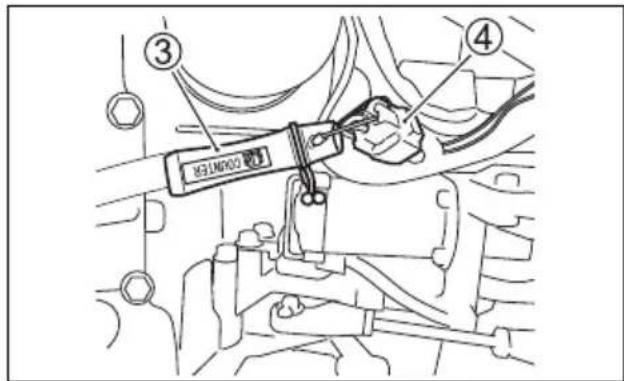
Confirm the rotation select connector located near the engine oil filter as shown in figure.
In regular rotation lower unit and counter rotation lower unit, rotation select connector differ from the other as follow:
- For Regular rotation lower unit:
A blue rotation select connector ② will be found and there is a label "REGULAR" ① on the connector.
- For Counter rotation lower unit:
A white rotation select connector ④ will be found and there is a label "COUNTER" ③ on the connector.

Regular rotation lower unit
Counter rotation lower unit
- The propeller type suitable for the lower unit type should be selected and installed.
NOTE:
- Right hand rotation propellers are identified with the letter "R" after the propeller size indication on the propeller.
- Left hand rotation propellers are identified with the letter "L" after the propeller size indication on the propeller.
Right hand propeller:
$$ \mathbf {3} \times \mathbf {1 6} \times \bigcirc \bigcirc \times \mathbf {R} $$
Left hand propeller:
$$ \mathbf {3} \times \mathbf {1 6} \times \bigcirc \bigcirc \times \mathbf {L} $$
PROPELLER SELECTION
It is essential to use a propeller on your outboard motor that is properly matched to your boat's operating characteristics. The speed of the engine when you operate your boat at full throttle depends on the propeller you use.
Excessive engine speed can seriously damage the motor, while low engine speed at full throttle will adversely affect the performance. Your operating load will also affect propeller selection. Smaller loads generally require larger-pitch propellers; larger loads generally require smaller-pitch propellers. Your authorized Suzuki Marine Dealer will assist you in selecting a suitable propeller for your boat.
NOTICE
Installing a propeller with either too much or too little pitch will cause incorrect maximum engine speed, which may result in severe damage to the motor.
Ask your authorized Suzuki marine dealer to assist you in selecting a suitable propeller for your boat.
You can determine if your propeller is appropriate for use with your boat by using a tachometer to measure engine speed when operating your boat at full throttle, under minimum load conditions. If you are using an appropriate propeller, the engine speed will be within the following range:
| Full throttle operating range | DF250AP | 5500 – 6100 r/min. (min ^-1 ) |
| DF300AP | 5700 – 6300 r/min. (min ^-1 ) |
If the engine speed is not within this range, consult your authorized Suzuki Marine Dealer to determine which propeller size is best for you.
PROPELLER INSTALLATION
WARNING
Failure to take proper precautions when installing or removing the propeller can result in severe personal injury.
When installing or removing the propeller:
- Always shift into "Neutral" and remove the emergency stop switch lock plate so that the motor cannot be started accidentally.
- Wear gloves to protect hands, and "lock" the propeller by placing a block of wood between the blades and the anti-cavitation plate.
To install a propeller on your outboard motor, use the following procedure:

- Coat the propeller shaft splines ① liberally with Suzuki water resistant grease to help prevent corrosion.
- Place the stopper ② on the shaft.
- Align the propeller ③ with the propeller shaft splines and slide the propeller onto the shaft.
- Place the spacer ④ and washer ⑤ on the shaft.
- Install the propeller nut ⑥ and tighten it with a torque wrench to 50 - 60 N·m (5.0 - 6.0 kg·m/36.0 - 43.5 lb·ft).
- Insert the cotter pin ⑦ and bend it so that it can't come off.
To remove the propeller, reverse the above procedure.
ADJUSTMENT
TRIM ANGLE ADJUSTMENT
To help maintain steering stability and good performance, always maintain the proper trim angle as shown in the illustration. The appropriate trim angle varies depending on the combination of the boat, engine, and propeller, as well as operating conditions.


WARNING
Trim angle greatly affects steering stability. If the trim angle is too small, the boat may "plow" or "bow steer". If the trim angle is too large, the boat may "chine walk" from side to side or "porpoise" up and down. These conditions, which result in loss of steering control, can cause occupants to be thrown overboard.
Always maintain proper trim angle based on the combination of your boat, engine, and propeller, as well as operating conditions.

WARNING
When the motor is tilted beyond the maximum trim position, the swivel bracket will not have side support from the clamp bracket and the tilt system will be unable to cushion the engine if the lower unit strikes an obstruction. This could lead to occupant injury.
Do not operate the engine above 1500 r/min or operate the boat in a planing attitude with the motor tilted beyond the maximum trim position.
NOTICE
If you operate the boat with the motor trimmed beyond the maximum trim position, the water intake holes may be above the water line, causing severe engine damage due to overheating.
Never operate the boat with the motor trimmed beyond the maximum trim position.
Make a test run in the boat to determine if the trim angle needs to be adjusted. Adjust the trim angle using the Power Trim and Tilt system. Refer to the POWER TRIM AND TILT section.
If you still cannot achieve good performance, there may be a problem with engine mounting height. Consult your dealer for assistance.
TRIM TAB ADJUSTMENT
This adjustment is used to compensate for the possible tendency of your boat to veer slightly to port or starboard. This tendency could be due to such things as propeller torque, motor mounting position, etc.
To adjust the trim tab:
- Loosen the bolt Ⓐ that holds the trim tab in place.

- If the boat tends to veer to port, move the rear end of the trim tab toward the port side. If the boat tends to veer to starboard, move the starboard side.

natural_image
Two identical line drawings of a propeller with directional arrows, no text or symbols present.- Tighten the bolt that holds the trim tab in place.
After adjusting the trim tab, check to see if the boat still tends to veer to one side. If necessary, readjust the trim tab.
CONTROL HANDLE ADJUSTMENT
The control handle friction and control handle detent force can be adjusted to suit operator's preference. The control handle friction adjustment will change the overall effort to move the control handle. This will help prevent undesired movement of the control handle in rough water conditions. Consult your authorized Suzuki marine dealer to adjust the control handle friction and detent force.

natural_image
Line drawing of two types of automotive seat covers (Type A), no text or symbols present
| Type Adjustable item | |
| A Friction and detent force | |
| B | F r |
IDLE SPEED ADJUSTMENT
The idle speed has been factory adjusted between 600 – 700 r/min in neutral.
NOTE:
If idle speed cannot be set within the specified range, contact your authorized Suzuki Marine Dealer.
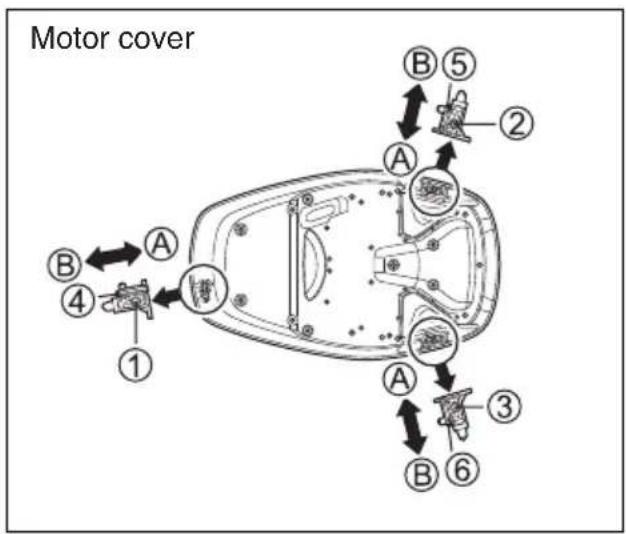
MOTOR COVER FASTENING ADJUSTMENT
If you feel motor cover fastening is loose or too tight when locking the levers, adjust as follows:
- Loosen the bolts ①, ② and ③.
- Adjust the position of fasteners ④, ⑤ and ⑥. To increase the fastening, move the fasteners to the direction A. To decrease the fastening, move the fasteners to the direction B.
- Tighten the bolts.
METER (OPTION) MULTI-FUNCTION GAUGE
This gauge is multifunctional gauge that displays the various information through digital communication with the engine. Information displayed are engine speed, shift position, fuel level, fuel consumption, etc.

NOTE:
There is information that cannot be displayed depending on the model and equipment.
NOTE:
Consult your authorized Suzuki marine dealer for setting up the multi-function gauge.
NOTE:
For details the proper handling of the multifunction gauge, refer to "OPERATION INSTRUCTION MANUAL" packed in the gauge.
NOTE:
The navigation data on this gauge should be used only for your reference. When exact navigation information is required, use nautical charts and/or accurate navigation instruments together with the multi-function gauge.
BUTTON FUNCTIONS
The multi-function gauge has four buttons: [MENU], [√], [ ], and [SET].

The function of each button is as follows.
The [MENU] button gives you access to the menu screen.
NOTE:
Pressing and holding the [MENU] button can transfer the mode to the TROLL mode.
Use the [√] and [ ] buttons to move the selection cursor, select sub information, and adjust information input.
NOTE:
Press and hold either the [ ] or [ ] button to reset the trip time, trip distance, average fuel consumption, and total fuel consumption in the sub information simultaneously.
The [SET] button is used to decide the selectable item.
NOTE:
Pressing and holding the [SET] button, can change the illumination for the gauge screen to that for the daytime or nighttime.

SCREEN SELECTION
The multi-function gauge can select the display screen from the following choices.
- Engine Speed
• Ground Speed/Fuel Information - Fuel Information
• All Items Display Screen (Full Item)
To select the display screen:
Press the [SET] button and select the desired display screen.
Every time the [SET] button is pressed, the display screen switches in the following sequence.
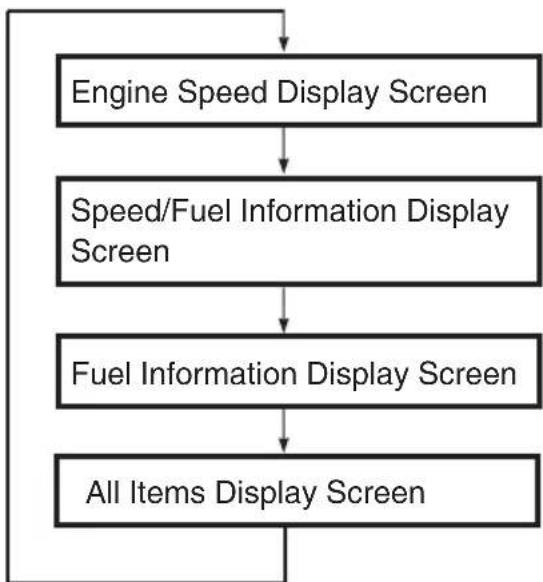
flowchart
graph TD
    A["Engine Speed Display Screen"] --> B["Speed/Fuel Information Display Screen"]
    B --> C["Fuel Information Display Screen"]
    C --> D["All Items Display Screen"]
NOTE:
Screens that had been set to "OFF" in the display setting are not displayed and the display skips to the next screen. (Refer to the MENU INFORMATION SELECTION section)
1. Engine Speed Display Screen
The engine speed ①, shift position ②, trim position ③, time ④, engine position ⑤ and sub information ⑥ are displayed.
The sub information display can be switched by pressing the [] or [] buttons.
This screen can be selected between digital and analog display. (Refer to the MENU INFORMATION SELECTION section)

2. Speed/Fuel Information Display Screen
The speed ①, fuel level ②, sub information ③ and time ④ are displayed.
The sub information display can be switched by pressing the [] or [] buttons.
This screen can be selected between digital and analog display. (Refer to the MENU INFORMATION SELECTION section)

3. Fuel Information Display Screen
This screen indicates the remaining fuel levels of each tank installed, along with sub information.
The sub information display can be switched by pressing the [] or [] buttons.
This screen indicates only in digital mode.

bar
| Category | Flow (GPH) | |---|---| | No.1 | E | | No.2 | 1/2 | | No.2 | F | FLOW 123.4 GPH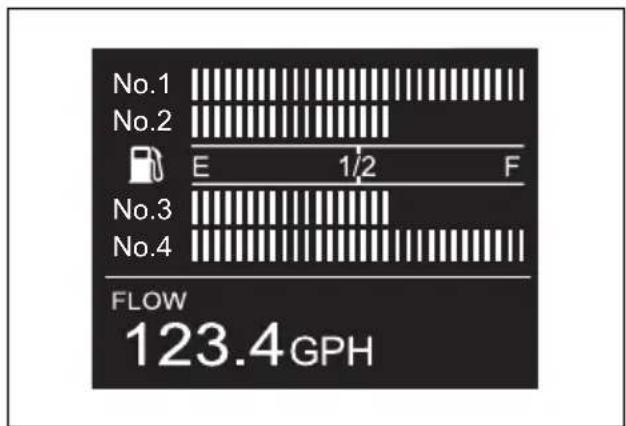
bar
| Category | Flow (GPH) | |---|---| | No.1 | 100 | | No.2 | 80 | | E | 1/2 | | F | 50 | | No.3 | 90 | | No.4 | 110 | FLOW 123.4 GPH4. All Items Display Screen
This screen displays all the general indication items for this gauge.
This screen can be selected between digital, analog1 and analog2 display. (Refer to the MENU INFORMATION SELECTION section)
Digital
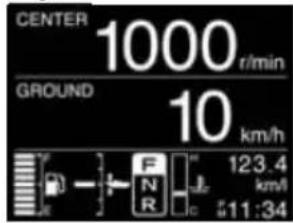
Analog1 Analog2


SUB INFORMATION SELECTION
When the Engine Speed, Ground Speed/Fuel Information or Fuel Information screen is displayed, press the [ ] or [ ] button to switch the sub Information display in the following sequence.
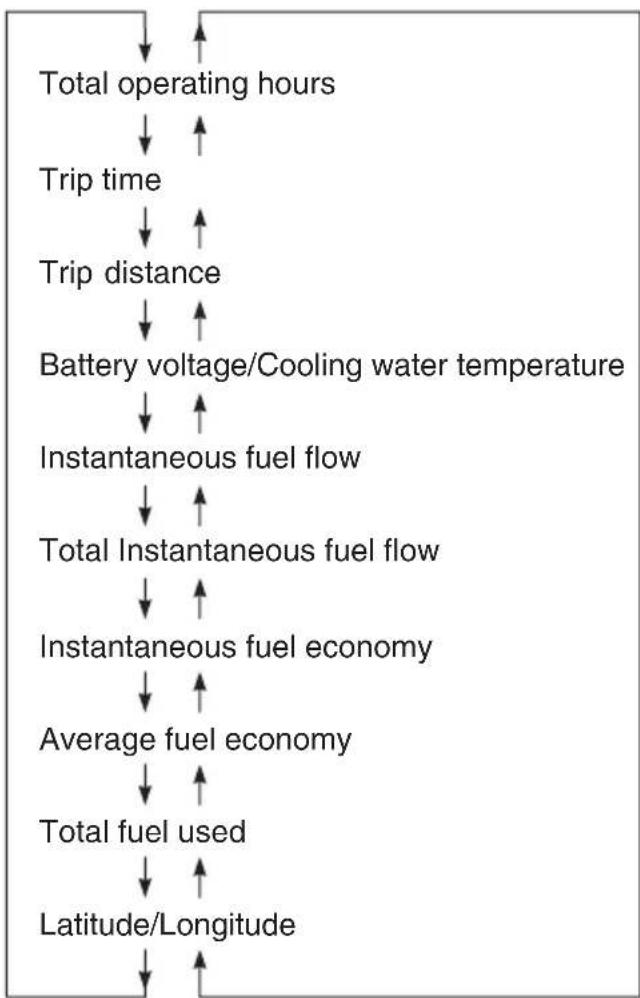
flowchart
graph TD
    A["Total operating hours"] --> B["Trip time"]
    B --> C["Trip distance"]
    C --> D["Battery voltage/Cooling water temperature"]
    D --> E["Instantaneous fuel flow"]
    E --> F["Total Instantaneous fuel flow"]
    F --> G["Instantaneous fuel economy"]
    G --> H["Average fuel economy"]
    H --> I["Total fuel used"]
    I --> J["Latitude/Longitude"]
NOTE:
Press and hold either the [√] or [ ] button to reset the trip time, trip distance, average fuel consumption, and total fuel consumption in the sub information simultaneously. All other items are also reset simultaneously, in addition to the displayed item.
1. Total Operating Hours
The total operating hours from brand-new engine are displayed.

2. Trip Time
This screen indicates the trip time since it was reset last time.

3. Trip Distance
This screen indicates the trip distance since it was reset last time.

4. Battery Voltage/Cooling Water Temperature
The cooling water temperature and battery voltage are displayed.

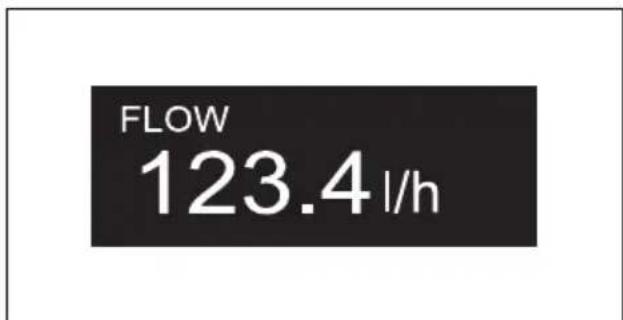
5. Instantaneous fuel flow
This screen indicates the instantaneous fuel flow of each outboard motor.
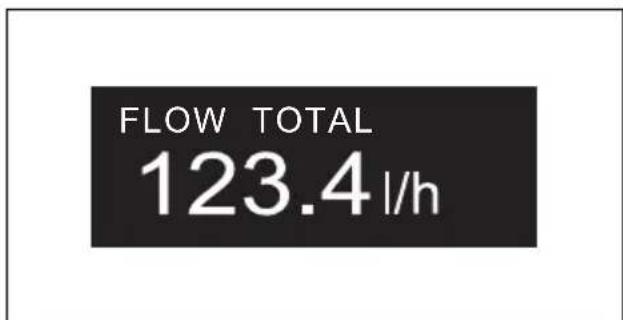
6. Total Instantaneous fuel flow
This screen indicates the total instantaneous fuel flow of all outboard motors installed.
7. Instantaneous fuel economy
This screen indicates the total instantaneous fuel economy of all outboard motors installed.

8. Average fuel economy
This screen indicates the total average fuel economy of all outboard motors installed.
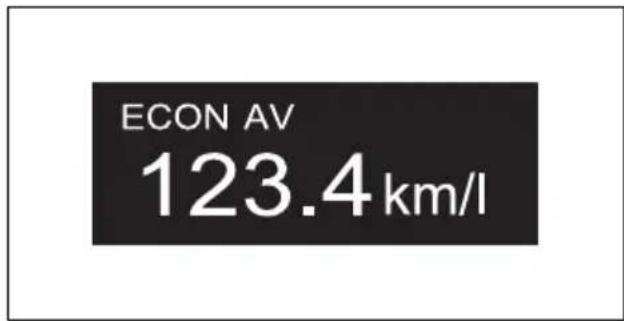
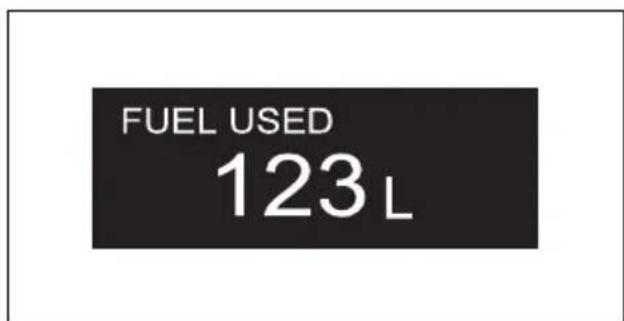
9. Total fuel used
This screen indicates the total fuel used of all outboard motors installed.
10. Latitude/Longitude
The latitude and longitude of current boat position are displayed.

NOTE:
If the "Latitude/Longitude" are not displayed, confirm the connection of the GPS receiver and confirm the radio wave receiving condition.
MENU INFORMATION SELECTION
The menu screen is displayed when the MENU button is pressed while any screen is displayed. While the menu screen is displayed, press the MENU button to return to the previous screen. The MENU has four items of [Illumination], [Diagnosis], [Display], and [Initial Setting].
Press the [√] or [ ] button to select a menu item.
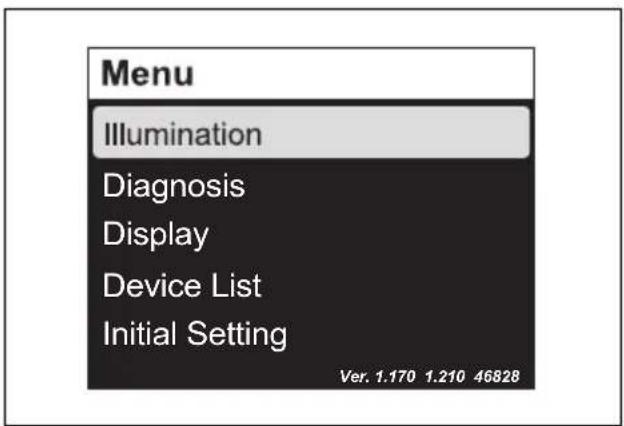
1. Illumination
Press the [√] or [ ] button to select "Illumination" and then press the [SET] button to display the Illumination selection menu.
Brightness
The screen brightness can be adjusted in 10 steps.
Press the [ ] or [ ] button to select "Brightness" and press the [SET] button. Next, adjust the brightness using the [ ] or [ ] button and then press the [SET] button.

Day or Night
Press the [√] or [ ] button to select "Day or Night" and press the [SET] button. Next, select "Day" or "Night" using the [√] or [ ] button and then press the [SET] button.


Sync
The "Brightness" setting is synchronized with the "Day or Night" setting for the two or more gauges where "ON" has been selected in the "Sync" setting.
Press the [√] or [ ] button to select "Sync" and press the [SET] button. Next, select "ON" (synchronous) or "OFF" (asynchronous) using the [√] or [ ] button and then press the [SET] button.

2. Diagnosis
NOTE:
For details the proper handling of the multifunction gauge, refer to "OPERATION INSTRUCTION MANUAL" packed in the gauge.
Press the [ ] or [ ] button to select "Diagnosis" and then press the [SET] button to display the Diagnosis selection menu.

Current Code
Press the [ ] or [ ] button to select "Current Code" and, then press the [SET] button to display the diagnostic code and/or caution message that are currently activated.

(Refer to the CAUTION SYSTEM and DIAGNOSTIC SYSTEM section)
Data Output
Press the [√] or [ ] button to select "Data Output" and then press the [SET] button to display the Data Output selection menu.

Create Data:
Press the [ ] or [ ] button to select "Create Data" and then press the [SET] button to display the QR code.
By means of reading this QR code, the "Create Data" items (engine oil change frequency, total operation hours, etc.) can be checked.

Log:
Press the [√] or [ ] button to select "Log" and then press the [SET] button to display the log file name.

Next, press the [ ] or [ ] button to select log file name and then press the [SET] button to display the QR code. By means of reading this QR code, the “Create Data” items (engine oil change frequency, total operation hours, etc.) obtained and saved before, can be checked.

3. Display
While [Display] is selected, press the [SET] button to display the selection menu for Digital indication, Analog indication, and indication OFF.
Select the display item using the [√] or [ ]^ button. Then, press the [SET] button to select "Analog1", "Analog2", "Digital" or "OFF".
As the "Fuel" screen displays only in digital mode, the available selection is either "ON" or "OFF."

When the indication is set to "OFF", the display screen for that item is skipped and the next screen is displayed. (Refer to the SCREEN SELECTION section)
NOTE:
It is not possible to set all the display items to OFF (hidden). Please set at least one (1) display item to be displayed.
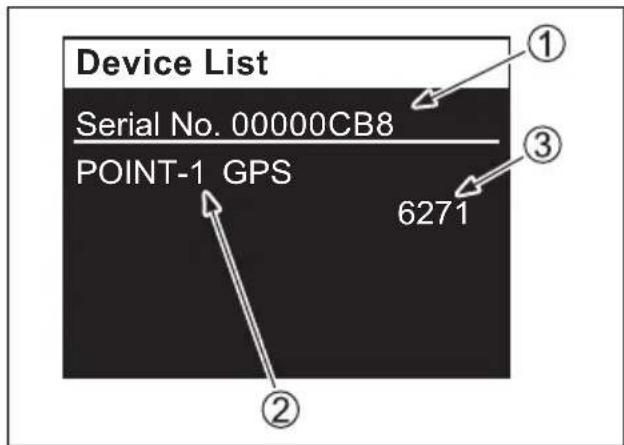
4. Device list
The serial number ① of the connected multifunction gauge, the name ② of the connected device(s) and its serial number ③ are displayed.
Press the [√] or [ ]^button to select "Device List" and press the [SET] button.
5. Initial Setting
Items in the Initial Setting include important items for initial setting. Therefore, the confirmation screen "Revise initial setting?" is displayed when you select "Initial Setting" in the menu screen and press the [SET] button. To change the Initial Setting, select "Yes" using the [] or [] button and press the [SET] button to display the Initial Setting menu screen.

"Initial Setting" contains five (5) menus.
Select the Initial Setting menu using the [] or [] button, and then press the [SET] button to display the setting screen.

Unit
Setting for the following units.
Distance: set the unit for distance.
Press the [SET] button to select the unit.

Quantity: set the unit for fuel quantity.
Press the [SET] button to select the unit.

Speed Scale: setting for the speed scale.
The setting of Speed Scale is reflected only on the analog screen display.
Press the [SET] button to select the scale to be indicated.

Econ: set the unit for fuel economy.
Press the [SET] button to select the unit.

Time
Setting for the time indication.
Clock: setting for display/non-display of the clock.
Press the [SET] button to select "ON" or "OFF."
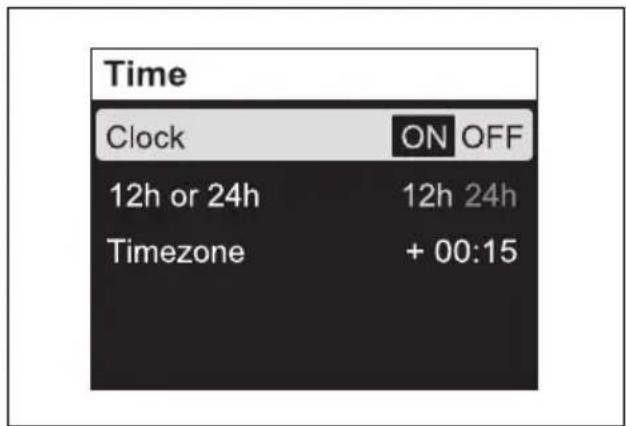
12h or 24h: select 12-hour or 24-hour display. Press the [SET] button to select "12h" or "24h."

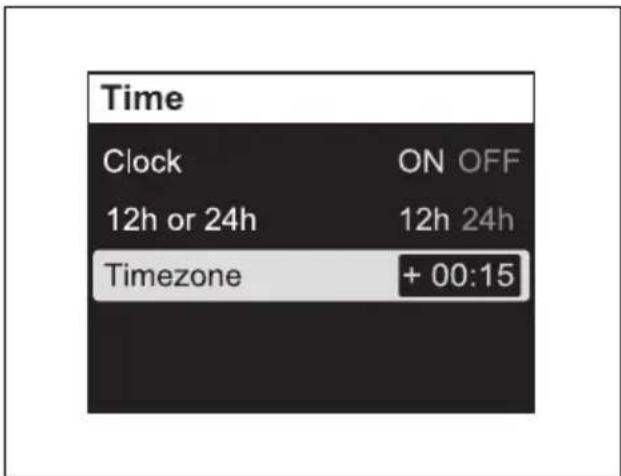
Timezone: set the time zone.
This gauge can be set the time by entering the time difference from the standard time (Greenwich time). After the time difference is entered, it is not required to enter it again.
Time can be set in the range of +14:00 from -12:00.
Press the [SET] button to activate the input position, and adjust the time difference using the [1 or [] button.
Press the [] or [] button briefly to change the time in 15-minute increment. Press and hold the button to change the time continuously by 15 minutes.
NOTE:
If the "Timezone" is not displayed, confirm the connection of the GPS receiver.
If a GPS receiver is not installed, the screen displays "--:-".
Position
Setting for the gauge and engine position.
Consult your authorized Suzuki marine dealer for setting change of "Position".
Sensor Setting
Settings for various sensors.
Consult your authorized Suzuki marine dealer for setting change of "Sensor Setting".
Tank
Setting for fuel tanks.
Consult your authorized Suzuki marine dealer for setting change of "Tank".
ALARM
Alarms alert the user of an operating condition that requires action. If an alarm occurs, the gauge screen will display the caution message and the caution alarm icon immediately.
The caution message clears when any of the buttons are pressed on the gauge. However, the caution alarm icon is displayed until eliminating the cause. The buzzer sound also stops when the cause is eliminated.

CAUTION SYSTEM
The caution systems are designed to alert you to certain situations which may cause damage to your outboard motor.
NOTICE
Your outboard motor may become damaged if you rely on the Caution System to alert you to any malfunction that may occur or to give you an indication of the need for maintenance.
To avoid damage to your outboard motor, regularly inspect and maintain it.
NOTICE
Continuing to operate your outboard motor with the Caution System activated can result in severe damage to your outboard motor.
If the Caution System activates while you are operating your outboard motor, stop the motor as soon as possible and correct the problem or consult your authorized Suzuki marine dealer for assistance.
INDICATOR CHECK
If equipped with Keyless Start System:
Each time when the Keyless Start System is turned to ON state by turning the main switch to the “” position and then turning it back to the “” position, the alarm buzzer will sound for three seconds.
NOTICE
If the Caution System is not working properly, you may not be alerted to a condition that can cause damage to your outboard motor.
If the buzzer does not sound when the Keyless Start System has been turned to ON state by operating the main switch, the buzzer may be broken or a failure may exist in the system circuit. Consult your authorized Suzuki marine dealer.
If not equipped with Keyless Start System: Each time the main switch is turned to the "ON" position, the alarm buzzer will sound for three seconds.
NOTICE
If the Caution System is not working properly, you may not be alerted to a condition that can cause damage to your outboard motor.
If the buzzer does not sound when the main switch is turned to the "ON" position, the buzzer may be broken or a failure may exist in the system circuit. Consult your authorized Suzuki marine dealer.
OVER-REVOLUTION CAUTION SYSTEM
This system is activated when engine speed exceeds maximum recommended speed for more than 10 seconds. In addition, “Rev Limit” is displayed on screen.

If you continue to run, engine speed will automatically be reduced to approximately 3000 r/min, simultaneously the buzzer sounds. Then the display will be changed into “Over Revolution”.

The "Over Revolution" indication clears when any of the button is pressed in the gauge.
This system must be reset by moving the throttle to the idle position for about one second to restore full engine operation.
NOTICE
If the Over-Revolution Caution System activates at recommended maximum throttle and you are sure that the propeller pitch is sufficient and there are no factors like "over-trimming" or "ventilation", there may be a problem with the Over-Revolution Caution System.
Consult your authorized Suzuki marine dealer if the Over-Revolution Caution System activates for no apparent reason.
OIL PRESSURE CAUTION SYSTEM
This system operates when the engine lubricating oil pressure drops below the correct level.
If this system activates, the "Low Oil Pressure" and caution alarm icon are displayed on screen, and the buzzer sounds. In addition, when this system is activated at 1000 r/min. or higher, engine speed will automatically be reduced to approximately 1000 r/min.
If you continue to run, the engine will automatically stop 3 minutes after beginning of the above CAUTION system activation.
NOTE:
In case that the engine is automatically stopped due to the CAUTION system, the engine can be started again.
However the CAUTION system will repeatedly activate until eliminating the cause.
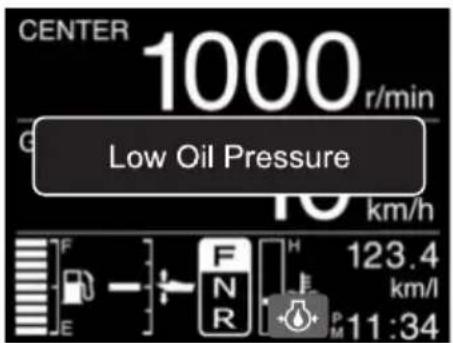
The "Low Oil Pressure" indication clears when any of the button is pressed in the gauge. However, the caution alarm icon is displayed until eliminating the cause.
If this system activates, stop the engine immediately, if wind and water conditions make it safe to do so.
Check the oil level and add oil if necessary. If the oil level is correct, consult your authorized Suzuki Marine Dealer.
NOTICE
Your engine may become severely damaged if you rely on the Oil Pressure Caution System to indicate the need to add engine oil.
Check the engine oil level periodically and add oil as necessary.
NOTICE
Operating the engine with the Oil Pressure Caution System activated can result in severe engine damage.
If the Oil Pressure Caution System activates, stop the engine as soon as possible and add engine oil, if necessary, or otherwise correct the problem.
OIL TEMPERATURE CAUTION SYSTEM
This system is activated when the engine oil temperature is too high due to insufficient oil cooling or deterioration in quality of engine oil.
If this system activates, the “High Oil Temp” and caution alarm icon are displayed on screen, and the buzzer sounds. In addition, when this system is activated at 3000 r/min. or higher, engine speed will automatically be reduced to approximately 3000 r/min.
If you continue to run, the engine will automatically stop 3 minutes after beginning of the above CAUTION system activation.
NOTE:
In case that the engine is automatically stopped due to the CAUTION system, the engine can be started again.
However the CAUTION system will repeatedly activate until eliminating the cause.

The “High Oil Temp” indication clears when any of the button is pressed in the gauge. However, the caution alarm icon is displayed until eliminating the cause.
If the oil temperature caution system activates when operating, stop the engine immediately, if wind and water conditions make it to do so. Check the engine oil condition.
If the oil condition is fine, consult your authorized Suzuki Marine Dealer.
NOTICE
If this system activates for no apparent reason, there may be a problem with the system.
Consult your authorized Suzuki marine dealer.
OVERHEAT CAUTION SYSTEM
This system is activated when the cylinder wall temperature is too high due to insufficient water cooling.
NOTE:
The overheat caution system will not detect high combustion chamber temperature caused by, for example, an oil system malfunction, poor quality fuel, or spark plugs with an incorrect heat range.
If this system activates, the “Overheat” and caution alarm icon are displayed on screen, and the buzzer sounds. In addition, when this system is activated at 3000 r/min. or higher, engine speed will automatically be reduced to approximately 3000 r/min.
If you continue to run, the engine will automatically stop 3 minutes after beginning of the above CAUTION system activation.
NOTE:
In case that the engine is automatically stopped due to the CAUTION system, the engine can be started again.
However the CAUTION system will repeatedly activate until eliminating the cause.

The "Overheat" indication clears when any of the button is pressed in the gauge. However, the caution alarm icon is displayed until eliminating the cause.
If the overheat caution system activates when operating, reduce engine speed immediately and check if water is being discharged from the pilot water hole. If no water is seen, follow the procedures outlined below.
Water and wind conditions permitting, stop the engine, tilt it out of the water and remove any debris like seaweed, plastic bags or sand that may have blocked the water intakes.
Lower the engine into the water, being sure that water intakes are immersed, and restart it.
Check (A) that water discharges from the pilot hole and (B) that “Over Heat (Overheat)” is not displayed on screen.
Be aware that “Over Heat (Overheat)” is displayed on screen again if engine temperature rises abnormally. If either of the above situations arises, your authorized Suzuki Marine Dealer must be consulted as soon as possible.
NOTE:
If pilot hole water discharge is sufficient, buzzer and display on screen may still operate until engine temperature decreases. Run engine in NEUTRAL only until the caution systems are cancelled.
NOTICE
Operating the engine with the Overheat Caution System activated can result in severe engine damage.
If the Overheat Caution System activates, stop the engine as soon as possible, wind and water conditions permitting, and inspect the engine according to the above instructions. Consult your authorized Suzuki marine dealer if you cannot correct the problem.
NOTE:
Remember that the overheat caution system cannot detect overheating caused by, for example, an oil system malfunction, poor quality fuel, or incorrect spark plugs.
NOTE:
If the engine is operated beyond the maximum trim position, the water intake holes may be above the water line. In this situation, the overheat caution system may activate.
BATTERY VOLTAGE CAUTION SYSTEM
This system is activated when the battery voltage deficiency which could impair your motor's performance occurs.
If this system activates, the "Low Battery Voltage" and alarm icon are indicated on screen and the buzzer sounds.

The “Low Battery Voltage” indication cleares when any of the button is pressed in the gauge. However, the caution alarm icon is displayed until eliminating the cause.
This system will be canceled automatically when the battery voltage restores to the proper voltage level. Refrain from using any electrical equipment such as P.T.T. system, hydraulic trim tabs, hydraulic jack plate, etc.
WARNING
Failure to take proper precautions when inspecting or servicing the battery can be hazardous.
Do not attempt to inspect or service the battery without first reading the warnings, cautions, and instructions in the "BATTERY INSTALLATION" section of this manual.
NOTE:
- A marginal battery may have enough power to start your engine, yet may still cause this caution system to activate whenever engine or boat accessory use places a high current demand on the battery.
- If equipped with Keyless Start System: If a message "Low Battery Voltage" is displayed and the engine stops while the Keyless Start System is in ON state, check the following:
If not equipped with Keyless Start System: If a message, "Low Battery Voltage" is displayed while the main switch is at the "ON" position and the engine stops, check followings.
- The battery switch is "ON" position.
- The battery is connected correctly.
– The battery is sound condition.
- If this caution system activates continuously, even after you have stopped using engine or boat accessories, contact your authorized Suzuki Marine Dealer.
ELECTRONIC THROTTLE AND SHIFT CONTROL CAUTION SYSTEM
CONTROL UNIT COMMUNICATION CAUTION SYSTEM
This system is activated in the event of an error in the control system of the electronic throttle and shift systems.
If this system activates, the "Check Control Unit C." and caution alarm icon are displayed on screen, and the buzzer sounds. In addition, the red lamp ① on the control panel lights up.


For single engine

For dual, triple or quadruple engine
Control panel
The "Check Control Unit C." indication clears when any of the button is pressed in the gauge. However, the caution alarm icon is displayed until eliminating the cause.
NOTICE
If this system activates for no apparent reason, there may be a problem with the system.
Consult your authorized Suzuki marine dealer.
2ND STATION CAUTION SYSTEM
This system is activated in the event of an error in the control system of the 2nd station.
If this system activates, the "Check 2nd Station" and caution alarm icon are displayed on screen, and the buzzer sounds. In addition, the red lamp ① on the control panel lights up. If this system is activated, the engine cannot be controlled any more from the 2nd station but can be controlled from the 1st station.


The "Check 2nd Station" indication clears when any of the button is pressed in the gauge. However, the caution alarm icon is displayed until eliminating the cause.
NOTICE
If this system activates for no apparent reason, there may be a problem with the system.
Consult your authorized Suzuki marine dealer.
THROTTLE SYSTEM CAUTION SYSTEM
This system is activated in the event of an error of the control system of the electronic throttle. If this system activates, the "Check Throttle System" and caution alarm icon are displayed on screen, and the buzzer sounds. In addition, the engine highest rpm is restricted to 2000 r/min.

The "Check Throttle System" indication clears when any of the button is pressed in the gauge. However, the caution alarm icon is displayed until eliminating the cause.
NOTICE
If this system activates for no apparent reason, there may be a problem with the system.
Consult your authorized Suzuki marine dealer.
This system is activated in the event of an error of the control system of the electronic shift.
If this system activates, the "Check Shift Control" and caution alarm icon are displayed on screen and the buzzer sounds.

If this system is activated, the engine speed or shift cannot be controlled by operating the remote control lever but the engine can be operated at the idle speed.
By shifting the remote control lever to the neutral position and pressing the throttle only switch, the engine speed can be adjusted from the idle speed to approximately 2000 r/min. with the remote control lever.

NOTE:
While the message, "Check Shift Control", is displayed, the clutch cannot be shifted to the Forward, Neutral or Reverse position.
The "Check Shift Control" indication clears when any of the button is pressed in the gauge. However, the caution alarm icon is displayed until eliminating the cause.
NOTICE
If this system activates for no apparent reason, there may be a problem with the system.
Consult your authorized Suzuki marine dealer.
This system activates when there is a communication error of the gauge.
If this system activates, the "Check Gauge C." is indicated on the screen.

The "Check Gauge C." indication clears when any of the buttons are pressed on the gauge.
NOTICE
If this system activates for no apparent reason, there may be a problem with the system.
Consult your authorized Suzuki marine dealer.
STATION SETTING TROLL MODE CAUTION SYSTEM
This system is activated when the TROLL mode operation is started on the gauge screen of the cockpit, where the TROLL Mode operation is not available.
If this system activates, the "Check Station Setting" is displayed on screen.
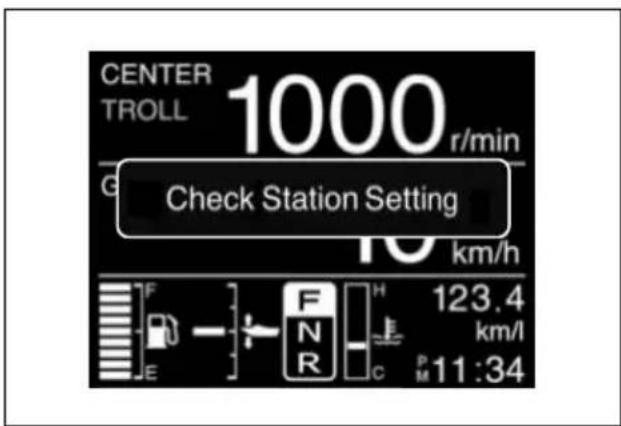
Identify the cockpit where the SELECT LED on the control panel is turned ON and perform the TROLL Mode operation from the gauge screen of that cockpit where the SELECT LED is turned ON.

On the gauge screen where the TROLL Mode operation is available, is displayed.
The "Check Station Setting" indication clears when any of the button is pressed in the gauge.
This system activates when the mode cannot be transferred to the TROLL Mode.
If this system activates, the "Check Troll Condition" is displayed on screen.

Make sure that the remote control lever has been shifted into forward or reverse and the engine throttle has been fully closed.
Refer to the Setting the Troll Mode section.
The "Check Troll Condition" indication clears when any of the button is pressed in the gauge.
The current ECM and BCM of your outboard motor does not applicable to the troll mode system.
If this system activates, the "Check Troll System" is displayed on screen.

The “Check Troll System” indication clears when any of the button is pressed in the gauge. If this system activates, consult your authorized Suzuki Maine Dealer.
KEYLESS START SYSTEM CAUTION SYSTEM (IF EQUIPPED WITH KEYLESS START SYSTEM)
KEY-FOB CAUTION SYSTEM
The caution system is activated when key-fob identification error.
If this system activates, the "Check Remote Key" and caution alarm icon are indicated on the screen.
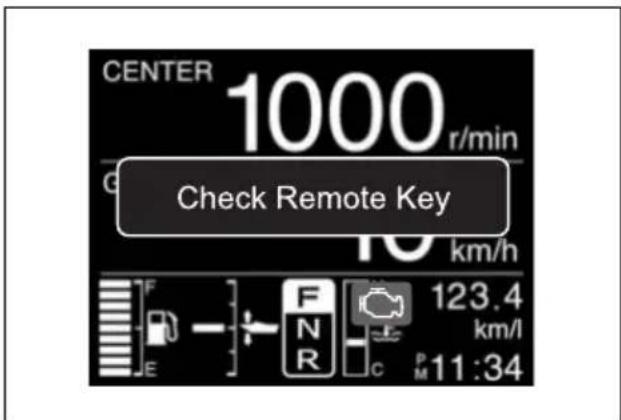
The "Check Remote Key" is cleared when any of the buttons are pressed on the gauge. However, the caution alarm icon is displayed until the cause is addressed.
NOTE:
- If the message "Check Remote Key" is displayed, check the following:
- The key-fob is within the communication range of the keyless control unit.
- The key-fob is in communication mode. (Refer to "Switching the communication mode of the key-fob" section.)
- There is no object interfering with the radio wave between the key-fob and the keyless control unit.
- The key-fob battery has sufficient capacity.
- The correct key-fob has been authenticated by the Keyless Start System.
- If this caution system activates continuously, contact your authorized Suzuki Maine Dealer.
KEY-FOB BATTERY CAUTION SYSTEM
The caution system is activated when key-fob battery voltage drops to a point which could impair key-fob performance.
If this system activates, the "Remote Key Battery Low" and caution alarm icon are indicated on the screen.

The "Remote Key Battery Low" is cleared when any of the buttons are pressed on the gauge. However, the caution alarm icon is displayed until the cause is addressed.
NOTE:
If this system activates, replace the battery of key-fob. (Refer to KEY-FOB BATTERY REPLACEMENT section.)
KEYLESS CONTROL UNIT CAUTION SYSTEM
This system is activated when the 12 volt battery voltage to the keyless control unit drops to a point which could impair the keyless control unit performance.
If this system activates, the "Keyless Unit Battery Low" and caution alarm icon are indicated on the screen.

The "Keyless Unit Battery Low" is cleared when any of the buttons are pressed on the gauge. However, the caution alarm icon is displayed until the cause is addressed.
NOTE:
- If the message "Keyless Unit Battery Low" is displayed, check the following:
- The 12 volt battery is in sound condition. - Contact failure of the battery terminal.
- If this caution system activates continuously, consult your authorized Suzuki Maine Dealer.
DIAGNOSTIC SYSTEM
If abnormal conditions exist in any sensor signal being input to the control unit, the self-diagnostic system warns of the abnormal condition.
If this system activates, the "Check Engine X – X" and check engine icon are displayed on screen, and the buzzer sounds.

The "Check Engine X - X" is cleared when any of the buttons are pressed in the gauge. However, the check engine icon is displayed until the cause is addressed.
Also incorporated is a fail-safe provision that allows the operation at a restricted speed even under such a failure condition.
NOTE:
- If equipped with Keyless Start System: This diagnostic code is designed to appear while the Keyless Start System is in ON state.
If not equipped with Keyless Start System: This diagnostic code is designed to appear while the main switch is turned on.
- The buzzer sound with diagnostic system activating will be canceled by pushing the main switch in.
NOTICE
If the diagnostic system activates while you are operating your outboard motor, there is an abnormal condition in one of the sensor signals of the control system.
Consult your authorized Suzuki marine dealer for repair of the control system.
OIL CHANGE REMINDER SYSTEM
This system informs the operator of the time for replacing engine oil on the basis of the maintenance schedule.
The system is designed to register the total operating hours of the outboard motor and function its operation when the preprogrammed hours have reached.
(Refer to the INSPECTION AND MAINTENANCE section and the last page.)
SYSTEM ACTIVATION
When the total operating hours have reached the preprogrammed hours, the "Change Oil" is displayed on screen, and the buzzer sounds. This indication will repeat until you cancel the system activation.

CANCELLATION
- If equipped with Keyless Start System: Turn the Keyless Start System to ON state by turn the main switch to the “” position and then release it. The main switch automatically returns to the “” position.

If not equipped with Keyless Start System: Turn the main switch to the "ON" position.
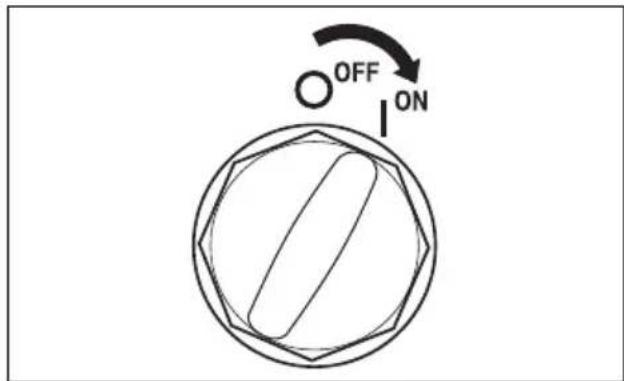
-
Pull out the emergency stop switch lock plate ①.
-
Push the start & stop switch ② three times in 10 seconds. A short beep will be heard if the cancellation is successfully finished.

- If equipped with Keyless Start System: Turn the main switch to the “” position and then release it to the “” position to turn the Keyless Start System to OFF state.
NOTE:
The Keyless Start System can also be turned to OFF state by pressing the lock button on the key-fob.

If not equipped with Keyless Start System: Turn the main switch to the "OFF" position.
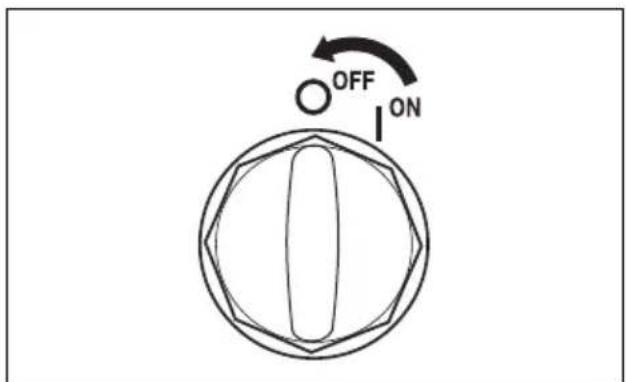
- Set the plate ① in the original position.
NOTE:
- Canceling of the system activation is possible regardless of whether or not the engine oil has been replaced. Once the system has operated, however, Suzuki strongly recommends that the engine oil be replaced before canceling the system activation.
- Even if the engine oil has been replaced with the system not operating, it is still necessary to perform the cancellation.
ENGINE STALLING CAUTION SYSTEM
This system informs the operator when the motor stalls while it is operating.
When the engine stalls for any reason, the caution buzzer sounds three times.
WATER IN FUEL ALERT SYSTEM
This engine is equipped with an integral fuel filter/water separator and associated alert system.
The alert system will activate if water separated from the fuel exceeds a specific volume.
If this system activates, the "Water in Fuel" and caution alarm icon will display at all the time and a buzzer will sound when the engine is in neutral only.

The "Water in Fuel" indication clears when any of the button is pressed in the gauge. However, the caution alarm icon is displayed until the eliminating the cause.
If this system activates, stop the engine immediately, if wind and water conditions are safe to do so, and check the fuel filter/water separator for water. Or consult your authorized Suzuki marine dealer.
For inspection and cleaning of the fuel filter, refer to the LOW PRESSURE FUEL FILTER in the INSPECTION AND MAINTENANCE section.
The "Power Trim and Tilt" is operated by pressing the switch. To tilt the motor up, press the upper part of the switch. To tilt the motor down, press the lower part of the switch.


If equipped with Keyless Start System:
WARNING
The power trim and tilt (PTT) switch on the side cover can be accidentally activated when the Keyless Start System is in OFF state, resulting in injury.
Keep all persons away from the outboard motor to help prevent accidental activation of the PTT system.
If not equipped with Keyless Start System:
WARNING
The power trim and tilt (PTT) switch on the side cover can be accidentally activated when the main switch is off, resulting in injury.
Keep all persons away from the outboard motor to help prevent accidental activation of the PTT system.
NOTE:
If equipped with Keyless Start System:
The PTT switch on the remote control lever cannot be activated when the keyless start system is in OFF state.
If not equipped with Keyless Start System:
The PTT switch on the remote control lever can not be activated when the main switch is off.
TILT LIMITER CAM
If the outboard motor contacts the motor well of the boat while tilting, adjust the tilt limiter cam to limit maximum tilt position.
- Place the motor in the normal running position.
- Rotate the tilt limiter cam:
To reduce the amount of tilt, move the tab Ⓐ of cam upward.
To increase the amount of tilt, move the tab Ⓐ of cam downward.
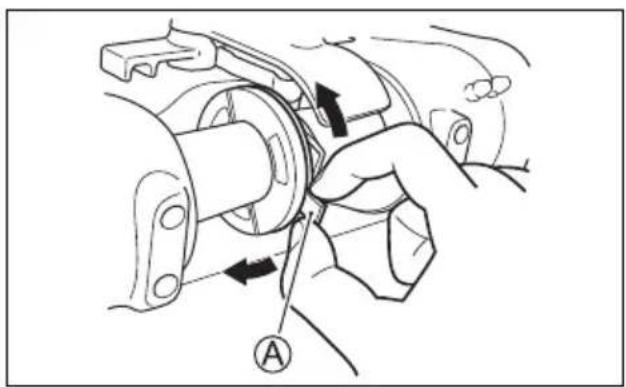
natural_image
Mechanical assembly diagram showing a hand operating a rotating component with directional arrows indicating motion (no text or symbols present)- To check your adjustment, tilt the motor fully up to check for motor contact.
Adjust further if necessary.
Return the motor to the normal running position for each adjustment, and repeat your check after each adjustment.
WARNING
Adjusting the tilt limiter cam will not prevent the outboard motor from tilting fully up and contacting the motor well if the motor's lower unit hits an object at high speed. Such tilting could damage your motor and boat and injure boat occupants.
Keep all occupants away from the motor when operating at high speed.
MANUAL TILTING
If you are unable to tilt the motor using the "Power Trim and Tilt" because of an electrical problem or some other problem, you can move the motor manually. To tilt the motor up or down, turn the manual release valve Ⓐ two turns counterclockwise, move the motor to the desired position, then retighten the release screw.

CAUTION
The motor is very heavy. When you tilt it manually, you could injure your back or slip and fall causing injury.
When you tilt the motor manually, ensure that your grip and footing are secure and that you are able to support the weight of the engine.
TILT BRACKET
The Tilt Bracket is provided so you can support the motor in a tilted position for non-moving engine support.
To set the Tilt Bracket:
- Tilt the motor all the way up by pressing the Power Trim and Tilt "UP" switch.
- Pull down the Tilt Bracket as shown in the illustration.
- Lower the motor by pressing the Power Trim and Tilt "DOWN" switch, until the motor is supported by the Tilt Bracket.

natural_image
Technical line drawing of a mechanical component with a tool inserted, showing no text or symbols- Continue to operate the Power Trim and Tilt "DOWN" switch until the trim rods are completely retracted.
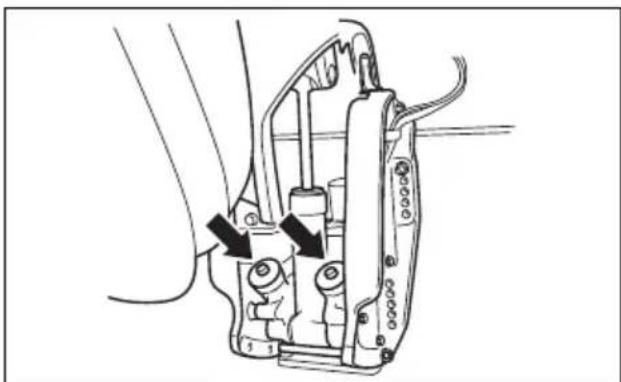
natural_image
Mechanical assembly diagram showing a valve mechanism with black arrows indicating direction (no text or labels)NOTICE
If you do not retract the trim rams completely when mooring, they may become deteriorated or corroded.
Be sure to retract the trim rams completely when mooring.
To release the Tilt Bracket, tilt the motor all the way up using the Power Trim and Tilt "UP" switch, and pull up the Tilt Bracket.
If equipped with Keyless Start System:
CAUTION
The remote Power Trim and Tilt switch will work when the Keyless start system is off. If someone activates the switch while you are moving the tilt bracket, your hand could be injured.
Keep all persons away from the remote Power Trim and Tilt switch while you are moving the tilt bracket.
NOTICE
Damage can occur if you use the tilt bracket other than when the boat is moored or is otherwise stationary.
The tilt bracket relieves pressure from the power trim and tilt and should only be used when the boat is stationary. Do not use the tilt bracket when trailering your boat and motor. Refer to the TRAILERING section of this manual.
If not equipped with Keyless Start System:
CAUTION
The remote Power Trim and Tilt switch will work when the main switch is off. If someone activates the switch while you are moving the tilt bracket, your hand could be injured.
Keep all persons away from the remote Power Trim and Tilt switch while you are moving the tilt bracket.
NOTICE
Damage can occur if you use the tilt bracket other than when the boat is moored or is otherwise stationary.
The tilt bracket relieves pressure from the power trim and tilt and should only be used when the boat is stationary. Do not use the tilt bracket when trailering your boat and motor. Refer to the TRAILERING section of this manual.
INSPECTION BEFORE BOATING
WARNING
Failure to inspect your boat and motor before beginning a trip can be hazardous.
Before boating, always perform the inspections described in this section.
It is important to make sure that your boat and motor are in good condition and that you are properly prepared for an emergency.
Always perform the following checks before you begin boating:
• Make sure that you have enough fuel for the intended run.
- Check the level of engine oil in the sump.
NOTICE
Running the engine with an insufficient amount of oil can cause serious engine damage.
Always check the oil level before each trip and add oil if necessary.
To check the oil level:
NOTE:
To avoid an incorrect assessment of engine oil level, check the level only when the engine has cooled.
- Place the motor in a vertical position, then remove the motor cover by unlocking the lever ①, ② and ③.

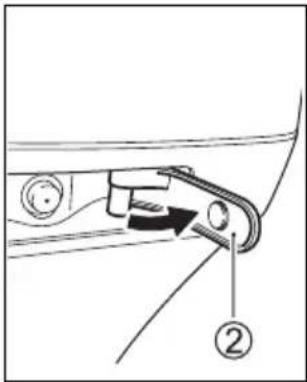
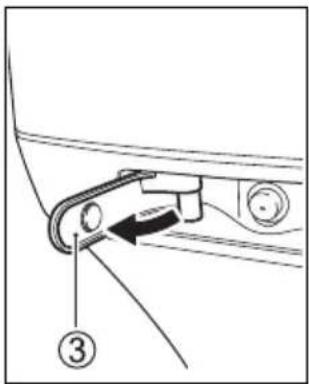
- Pull out the oil dipstick ④ and wipe oil off with a clean cloth.

NOTE:
If the engine oil is contaminated or discolored, replace with fresh engine oil (Refer to Inspection and maintenance/engine oil section).
- Insert the dipstick all the way into the engine, then remove it again.

The oil on the dipstick should be between the upper and lower limits shown on the dipstick. If the oil level indication is near the lower limit, add enough oil to raise the level to the upper limit.
To fill the engine oil:
- Remove the oil filler cap.
- Fill the recommended engine oil to the upper level.

natural_image
Diagram of a car engine intake being poured into the engine compartment, showing fluid flow direction (no text or labels)NOTICE
Running the engine with an excessive amount of oil can damage the engine.
Do not overfill the engine with oil.
-
Tighten the oil filler cap securely.
-
Check the battery solution level. The level should be kept between the MAX and the MIN level lines at all times. If the level drops below the MIN level line, refer to MAINTENANCE section.
- Make sure that the battery leads are securely connected to the battery terminals.
- Visually check the propeller to make sure it is not damaged.
• Make sure that the motor is securely mounted to the transom. - Check for proper operation of the Power Trim and Tilt.
- Make sure that the tilt pin is securely installed in the proper position.
• Make sure you have the boating safety and emergency equipment on board. - Make sure that the emergency stop switch operates properly.
- Make sure the obstacle is not attached to water intake hole.
BREAK-IN
Proper operation during this break-in period will help ensure maximum life and performance from your engine. The following guidelines will explain proper break-in procedures.
NOTICE
Failure to follow the break-in procedures described below can result in severe engine damage.
Be sure to follow the engine break-in procedures described below.
Break-in period: 10 hours
Break-in procedure
- For the initial 2 hours:
Allow sufficient idling time (about 5 minutes) for the engine to warm up after cold engine starting.
NOTICE
Running at high speed without sufficient warm-up may cause severe engine damage such as piston seizure.
Always allow sufficient idling time (5 minutes) for the engine to warm-up before running at high speed.
After warming up, run the engine at idling speed or the lowest in-gear speed for about 15 minutes.
During the remaining 1 hour and 45 minutes, if safe boating conditions permit, operate the engine in gear at less than 1/2 (half) throttle (3000 r/min.).
NOTE:
You may throttle up beyond the recommended operating range to plane your boat, then immediately reduce the throttle to the recommended operating range.
- For the next 1 hour:
Safe boating conditions permitting, operate the engine in gear at 4000 r/min. or at three-quarter throttle. Avoid running the engine at full throttle.
- Remaining 7 hours:
Safe boating conditions permitting, operate the engine in gear at desired engine speed.
You may occasionally use full throttle; however do not operate the engine continuously at full throttle for more than 5 minutes at any time.
NOTICE
Running continuously at full throttle for more than 5 minutes at a time during the last 7 hours of break-in operation may cause severe engine damage such as seizure.
During the last 7 hours of break-in operation, do not operate at wide open throttle for more than 5 minutes at a time.
OPERATION
MAIN SWITCH (OPTION)
If equipped with Keyless Start System:
Turn the Keyless Start System to ON or OFF state by as follows.
(1) Make sure that the key-fob is within the communication range of the keyless control unit.
(2)Turn the main switch to the “” position and then release it. The main switch automatically returns to the “” position.
When the Keyless Start System has been turned to ON state by operating the main switch, all LEDs on the control panel will light and the buzzer sounds.

natural_image
Simple circular diagram with a vertical bar and a power button, no text or symbols present.NOTE:
If the operation in the above step (2) is performed continuously, it is regarded as a theft or tampering and the main switch operation will not be accepted until a certain period has elapsed.
If not equipped with Keyless Start System:
The main switch on the panel turns power of the engine on and off.
When the main switch is turned ON, all LEDs on the control panel will light and the buzzer sounds.
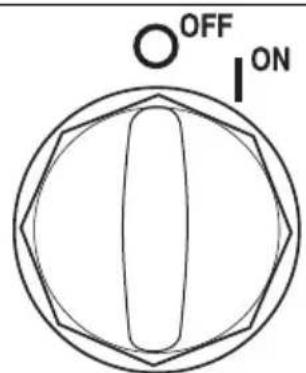
CONTROL PANEL (OPTION)

For single engine

flowchart
graph TD
    A["PORT"] --> B["START & STOP"]
    A --> C["UP"]
    A --> D["DN"]
    E["STBD"] --> F["START & STOP"]
    E --> G["UP"]
    E --> H["DN"]
    I["SELECT"] --> J["THROTTLE ONLY"]
    I --> K["SYNC"]
For dual engine For quadruple engine

For triple engine
NOTE:
On a boat equipped with quadruple engines, use two control panels which are for dual engine. When operating the SELECT, THROTTLE ONLY and SYNC function, all four engines are controlled by either control panel switch.
Start & Stop Switch
This is a switch to start and stop the engine.
The engine can be started with the remote control handle at the neutral position.
Station Select Switch
Switches control between driving stations on boats equipped with more than one driving station.
When pushing the select switch to select station, SELECT LED on the control panel at the driving station selected comes on, and the SELECT LED at the driving station not selected goes out.
This switch is enabled only when the remote control handle at the 1st and 2nd driving stations are at the neutral position.
NOTE:
If equipped with Keyless Start System:
When the Keyless Start System has been turned to ON state by operating the main switch, the 1st driving station is automatically selected. By operating this switch with the remote control handle in positions other than the neutral, the SELECT LED blinks and the buzzer sounds at the same time.
If not equipped with Keyless Start System:
When the main switch is turned ON, the 1st driving station is automatically selected. By operating this switch with the remote control handle in positions other than the neutral, the SELECT LED blinks and the buzzer sounds at the same time.
NOTE:
- When pushing the SELECT switch to select station, continue to push SELECT switch until the buzzer sounds one short beep.
- If equipped with Keyless Start System: If failed to switch from the 2nd station to the 1st station, operate the main switch to turn the Keyless Start System to OFF state and wait for 20 seconds, and then turn it back to ON state again.
If not equipped with Keyless Start System: If selecting the 1st station returning from the 2nd station is failed, turn OFF the main switch then turn ON it after 20 seconds past.
- Consult your authorized Suzuki marine dealer if the station can not be selected.

Throttle Only Switch
This is a switch to fix or release the shift position to the neutral, thereby allowing to operate the throttle without changing the shift position. When the shift position is fixed to the neutral, the THROTTLE ONLY LED comes on and when released, the THROTTLE ONLY LED goes out. Only when the remote control handle is at the neutral position, the throttle only switch is enabled.
NOTE:
If this switch is operated with the remote control handle at a position other than neutral, the THROTTLE ONLY LED blinks and the buzzer sounds at the same time.
NOTE:
- When selecting the THROTTLE ONLY mode, continue to push the THROTTLE ONLY switch until the buzzer sounds one short beep.
- If equipped with Keyless Start System:
If the THROTTLE ONLY mode cannot be selected, operate the main switch to turn the Keyless Start System to OFF state and wait for 20 seconds, and then turn it back to ON state again.
If not equipped with Keyless Start System: If it is not possible to out the THROTTLE ONLY mode, turn OFF the main switch then turn ON it after 20 seconds past.
- Consult your authorized Suzuki marine dealer if the THROTTLE ONLY mode can not be selected.

Engine Synchronize Switch
On dual or triple engine installation, this is a switch to synchronize or unsynchronize the engine speed with the port side engine.
On quadruple engine installation, this is a switch to synchronize or unsynchronize the engine speed with the port side engine on two engine groups. Two engine groups don't synchronize each other.
Engine speed is synchronized in forward cruising. When the engine speed is synchronized, the SYNC LED comes on and, when the engine speed is unsynchronized, the SYNC LED goes out.
Synchronization does not take place in idle speed and full throttle operation.
NOTE:
- If equipped with Keyless Start System: When the Keyless Start System has been turned to ON state, synchronization is automatically selected.
If not equipped with Keyless Start System: When the main switch is turned ON, synchronization is automatically selected.
- While the engines are synchronous with each other, difference of their engine speed is automatically reduced. On the dual or triple engine installation, this function is not effective when positions of the right and left remote control levers are remarkably different.

Center Engine Control Switch
This is a switch to link or unlink the center engine with the port engine.
When the link is selected, the CENTER CTRL LED comes on.
To switch between link and unlink modes, set the remote control handle to the neutral position and operate the center engine control switch.
When the engines are unlinked, the center engine is at the neutral position and the engine speed is kept at idling.
When unlinking is selected, the CENTER CTRL LED goes out.
Only when all the remote control handles are at the neutral position, this switch is enabled.
NOTE:
- If equipped with Keyless Start System:
When the Keyless Start System has been turned to ON state by operating the main switch, link is automatically selected.
If not equipped with Keyless Start System: When the main switch is turned ON, link is automatically selected. - If this switch is operated with the remote control handle at a position other than neutral, the CENTER CTRL LED blinks and the buzzer sounds at the same time.

Tilt Up & Down Switch
The "Power Trim and Tilt" is operated by pressing the switch. To tilt the motor up, press the up switch. To tilt the motor down, press the DN switch.
NOTE:
If equipped with Keyless Start System:
The tilt up and tilt down switches cannot be activated when the Keyless Start System is in OFF state.
If not equipped with Keyless Start System:
The tilt up and tilt down switches can not be activated when the main switch is off.

BEFORE ATTEMPTING TO START THE ENGINE
- The motor has been lowered into the water.
- Make sure that the motor fuel hose and the hose from the boat's fuel tank are securely attached and clamped.
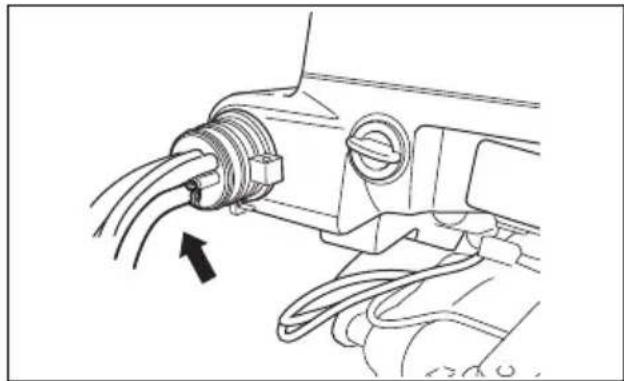
natural_image
Technical line drawing of a mechanical assembly with wires and connectors (no text or symbols)- Ensure that the boat fuel tank is correctly vented and that any in-line filters are free of dirt etc. If fuel tank filler cap has a manual vent, be sure that it is fully open.

natural_image
Line drawing of a mechanical component with a central knob and a black arrow pointing to it (no text or symbols)- Make sure that the motor is in "NEUTRAL".

natural_image
Technical line drawing of a mechanical component with directional arrows indicating motion (no text or symbols)- Make sure the lock plate is in place and attach the emergency stop switch cord to a part of your body.

natural_image
Line drawing of a mechanical pulley or hook component (no text or symbols)
natural_image
Line drawing of a worker in uniform holding a coiled spring (no text or symbols)WARNING
Failure to properly attach the emergency stop switch cord or to take proper precautions to help ensure that the emergency stop switch works as intended may result in serious injury or death to the operator or passengers.
Always take the following precautions:
- Make sure that the emergency stop switch cord is fastened securely to the operator's wrist or to an appropriate clothing area (belt etc.).
- Ensure that no obstructions impede or restrict emergency stop switch operation.
- Be careful not to pull the stop switch cord or knock out the lock plate during normal operation. The motor will stop abruptly, and the loss of forward motion may unexpectedly throw occupants forward.
NOTE:
A spare plastic lock plate is provided for temporary use only. Remove it from the cord and place it in a safe place on board your boat. If you lose or break the emergency stop switch cord/lock plate assembly, replace it as soon as possible so that you can resume normal use of the emergency stop switch.
STARTING THE ENGINE
WARNING
Exhaust gas contains carbon monoxide, a dangerous gas that is difficult to detect because it is colorless and odorless. Breathing carbon monoxide can cause death or severe injury.
Never start the engine or let it run indoors or where there is little or no ventilation.
NOTE:
If the emergency stop switch lock plate is not in position, the starter motor cannot operate.
- Squeeze the fuel line priming bulb several times until you feel resistance.

natural_image
Illustration of a hand holding a cable with a textured grip (no text or symbols)- If equipped with Keyless Start System:
(1) Confirm that the key-fob is in communication ON mode (Refer to the "Switching the Communication mode of the key-fob" section.)
(2)While the key-fob is within the communication range of the keyless control unit, turn the main switch to the “” position and then release it. The main switch automatically returns to the “” position.
The buzzer sounds twice to notify that the Keyless Start System has been turned ON.

If not equipped with Keyless Start System: Turn the main switch to the "ON" position.

NOTE:
If equipped with Keyless Start System:
The communication range is a distance of 1 m (39.4) between the key-fob and the keyless control unit.
If the Keyless Start System fails to turn ON, the buzzer emits one (1) long sound and five (5) short sounds.
In this case, repeat the procedure again.
- Push the start & stop switch to start the engine.
NOTE:
By pressing the Start & Stop switch once, the starter motor turns for 3 seconds continuously until the engine starts.

NOTICE
If you hold in the START & STOP switch to start the engine, the starter system can be damaged.
Push the START & STOP switch and release it to start the engine. The engine will crank continuously for 3 seconds or until the engine starts.
NOTE:
The continuous operating time of the starter motor is set at five seconds.
When this time is exceeded, the starter motor will automatically stop.
If the motor stops, wait about ten seconds for the motor to cool down and try again.
NOTICE
If "Low Oil Pressure" is displayed on the screen of the meter while operating the outboard, the oil level may be low enough to damage the engine.
Stop the engine and check the oil level.
- Warm up the engine for about 5 minutes.
NOTICE
Do not proceed to full throttle operation immediately after the engine starts, when the engine is not warmed up enough. Disregarding of this warning may cause the engine failure.
Do not carry out a full throttle operation immediately after starting the engine.
Cooling water check
As soon as the engine starts, water should spray out of the pilot water hole ①, indicating that the water pump and cooling system are working properly. If you notice that water does not spray out of the pilot water hole, stop the engine as soon as possible and consult your Suzuki Marine Dealer.

NOTICE
Never operate your outboard motor when there is no water coming out of the pilot water hole, or severe damage can result.
After starting the engine, check to make sure that there is water coming out of the pilot water hole.
WARNING
Operating the boat when the emergency stop switch is not operating properly can be hazardous.
Before starting off, check to make sure that the emergency stop switch operates properly.
If equipped with Keyless Start System:
EMERGENCY START
NOTE:
One (1) emergency key is included in the main switch panel for the Keyless Start System.
If the key-fob is lost or the key-fob battery has run low, the Keyless Start System OFF (locked) state can be released by using the emergency key and entering the 4-digit passcode.
- Turn the main switch ① to the right about 15^ and pull it out.
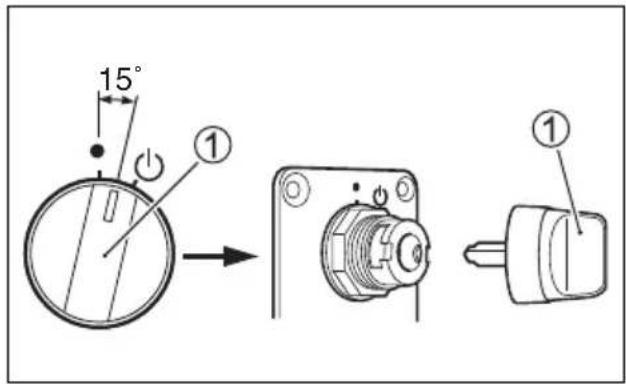
- Insert the emergency key ② into the key cylinder.

- Make sure lock plate ③ is in position.

- Turn the emergency key to “|” position, and then release it to the “●” position. The buzzer emits one (1) long sound and five (5) short sounds.

- Pull out the emergency stop switch lock plate.

natural_image
Diagram showing a mechanical component being lifted by a tool, with no visible text or symbols.- Turn the emergency key to the “” position and hold it until the buzzer sounds. Turn the emergency key back to the “” position. The system turns to stand-by state for passcode input.

- Take the following steps to enter the pass-code.
(1)Turn the main switch to the “” position and then release it. The main switch automatically returns to the “” position.

(2)The buzzer starts emitting short sounds. When the buzzer sounds for the same number of times as the 1st digit of the passcode, immediately turn the emergency key to the “” position, and release it to the “” position. To enter “0” in the passcode, turn the switch after the buzzer sounds 10 times.

(3) After an 11th long sound, repeat steps 1 and 2 to enter the second, third and fourth pass-code digits.
NOTE:
The buzzer emits one (1) short sound for the 1st digit, two (2) short sounds for the 2nd digit, three (3) short sounds for the 3rd digit, and four (4) short sounds for the 4th digit.
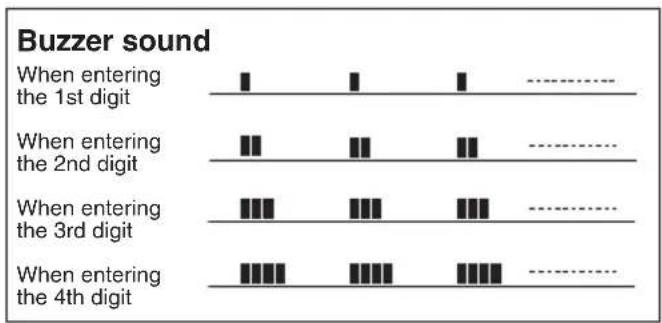
bar
Buzzer sound | Category | When entering the 1st digit | When entering the 2nd digit | When entering the 3rd digit | When entering the 4th digit | |---|---|---|---|---| | Buzzer sound | ■ | ■ | ■ | - - - - - - - - - - - - - - - - - - - - - - - - - - - - - - - - - - - - - - - - - - - - - - - - - - - - - - - - - - - - - - - - - - - - - - - - - - - - - - - - - - - - - - - - - - - - - - - - - - - - - | Buzzer sound | ■ | ■ | ■ | ■ | | Buzzer sound | ■ | ■ | ■ | ■ | | Buzzer sound | ■ | ■ | ■ | ■ | | Buzzer sound | ■ | ■ | ■ | ■ | | Buzzer sound | ■ | ■ | ■ | ■ | | Buzzer sound | ■ | ■ | ■ | ■ | | Buzzer sound | ■ | ■ | ■ | ■ | | Buzzer sound | ■ | ■ | ■ | ■ | | Buzzer sound | ■ | ■ (■) | ■ (■) | ■ (■) | The image contains a single bar chart with no explicit numerical values or units. The labels 'When entering the 1st digit', 'When entering the 2nd digit', 'When entering the 3rd digit', and 'When entering the 4th digit' are visible above the bars.NOTE:
If a wrong passcode is entered or the input operation fails, the buzzer emits a long sound after entering the 4th digit followed by three additional beeps, and the operation is cancelled.
NOTE:
- If the passcode input has not been performed, passcode input for the same digit will start again after the main switch is operated.
- The input operation is cancelled if no entry is made after repeating the passcode input operation three (3) times.
The buzzer then sounds three (3) times to notify that the input operation has been cancelled.
• To enter the passcode again after the input operation has been cancelled; repeat the procedure from Step 2.
- The passcode input can be interrupted by installing the lock plate on the emergency stop switch.
(4)Turn the emergency key to the counterclockwise within 10 seconds after entering the 4th digit of the passcode. The buzzer emits two (2) short sounds when the passcode input is successful, and the engine can then be started.
If the emergency key is not operated within 10 seconds, the buzzer sounds five (5) times followed by another beep, and the input operation is cancelled. In this case, repeat the procedure beginning at Step 2.

To start the engine:
(5)Install the lock plate ③ on the emergency stop switch.

(6)Make sure the motor is in "NEUTRAL".

(7)Push the START & STOP switch to start the engine.

To stop the engine:
- Shift into "NEUTRAL".
- After operating at full throttle, cool off the engine a few minutes by allowing it to idle or troll at low speed.
- Push the START & STOP switch to stop the engine.
- Turn the emergency key to the “” position and then release it to the “” position to turn the Keyless Start System to OFF state. And then, pull out the emergency key from the key cylinder.
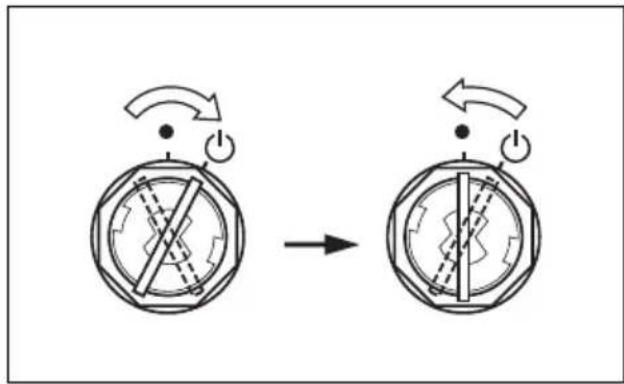
NOTE:
The passcode authentication state is maintained for 15 seconds after turning the emergency key to the “position. In this state, the engine can be started by turning the emergency key to the left and pressing the START & STOP switch. To restart the engine when the 15-second period has elapsed after turning the emergency key to the “position, repeat the emergency key operation from the beginning.
SHIFTING AND SPEED CONTROL
NOTICE
Severe engine damage may occur if (a) engine speed is not allowed to return to idle and boat speed is not reduced when shifting from "FORWARD" to "REVERSE" or from "REVERSE" to "FORWARD", or (b) care is not taken when operating the boat in reverse.
Always allow the engine speed to return to idle before shifting. Exercise caution and use minimal speed when operating the boat in reverse. Be sure the handle/shift lever is in the desired position before accelerating.
NOTE:
- On a boat equipped with triple engines, the center engine and port engine are started with port shift lever ① to link the center engine with the port engine.
- On a boat equipped with quadruple engines, the two engines on port side are started with shift lever ① and the two engines on starboard side are started with shift lever ②.
- When the engine stops, the clutch moves to the neutral position irrespective of the position of the remote control lever.
- The clutch cannot be changed over either to Forward or Reverse by operating the remote control lever while the engine stops.

Shifting
NOTE:
Type B remote control box
The type B remote control box has a lock mechanism to help prevent accidental moving from neutral to forward or reverse. To release the lock, push in the shift lock button before changing.

To shift into "FORWARD", move handle forward to approximately position Ⓐ, as shown in the illustration.
To shift into "REVERSE", move the control handle rearward to approximately position Ⓑ, as shown in the illustration.

Speed Control
To increase speed after you have shifted into gear, continue moving the control lever forward or rearward.
WARNING
Since the same handle is used for shifting and speed control it is possible to move the handle past the detent and engage the throttle. This can cause the boat to move suddenly resulting in personal injury or property damage.
You must be careful not to move the control handle too far forward or rearward when shifting.
STOPPING THE ENGINE
NOTE:
When it is necessary to stop the engine in an emergency, pull the emergency stop switch lock plate by pulling the emergency stop switch cord.
If equipped with Keyless Start System:
To stop the engine:
- Shift into "NEUTRAL".
- After operating at full throttle, cool off the engine a few minutes by allowing it to idle or troll at low speed.
- Push the "START & STOP" switch to stop the engine.
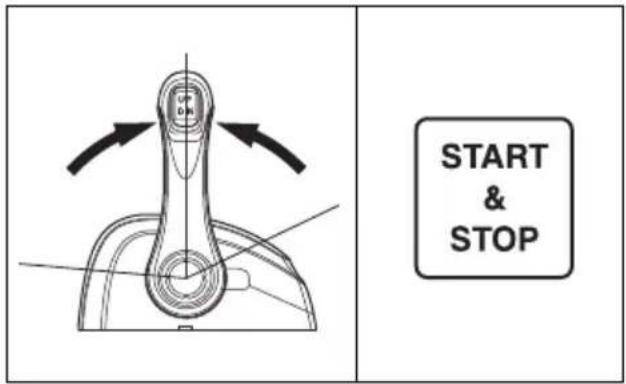
- Turn the Keyless Start System to OFF (locked) status by one of the following methods.
- Make sure that the key-fob is within the communication range of the keyless control unit. Turn the main switch to the “position and then release it. The main switch automatically returns to the “position.
The buzzer sounds once to notify that the Keyless Start System has been turned to OFF (locked) state.
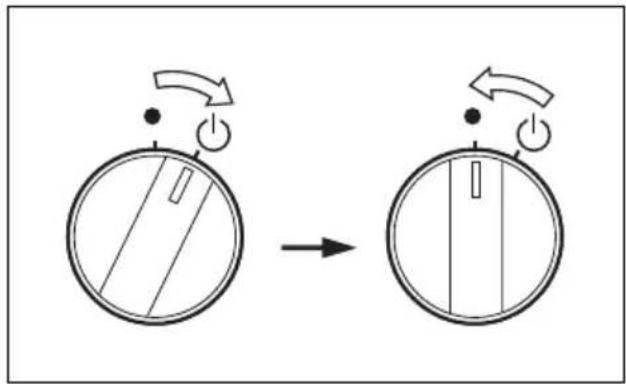
- While the key-fob is within the communication range of the keyless control unit, press the lock button ① on the key-fob. The buzzer sounds once to notify that the Keyless Start System has been turned OFF (locked).
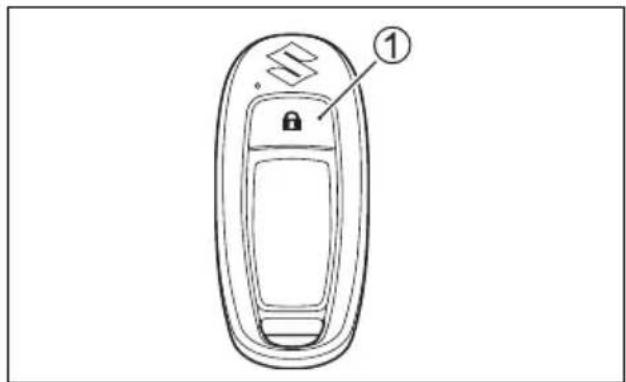
NOTICE
If the Keyless Start System is in ON state while the engine is not running, the battery will be discharged.
Always turn the Keyless Start System to OFF state when the engine is not running.

WARNING
Unauthorized use of your boat could lead to an accident or damage to your boat.
To prevent unauthorized use of your boat, be sure to remove the key and emergency stop switch lock plate when the boat is unattended.
- After stopping the engine, disconnect the fuel line from the outboard motor if there is a fuel connector.

WARNING
If you leave the motor stopped for a long period of time with the fuel line connected, fuel can leak out.
Disconnect the fuel line from fuel tank, if there is a fuel connector, whenever you leave the motor stopped for a long period of time.
- Turn the air-vent screw on the fuel tank cap clockwise to shut the vent (if equipped).
NOTE:
To make sure that the emergency stop switch operates properly, stop the engine occasionally by pulling out the lock plate, while operating the engine at idling speed.
If not equipped with Keyless Start System:
To stop the engine:
- Shift into "NEUTRAL".
- After operating at full throttle, cool off the engine a few minutes by allowing it to idle or troll at low speed.
- Push the "START & STOP" switch.

- Turn the main switch to the "OFF" position. Always leave the main switch in the "OFF" position when the motor is not running, or the battery can discharge.
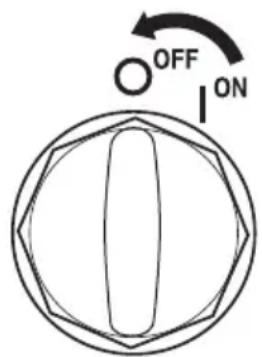
NOTICE
If the main switch is left ON when the engine is not running, the battery will discharge.
Always turn the main switch OFF when the engine is not running.

WARNING
Unauthorized use of your boat could lead to an accident or damage to your boat.
To prevent unauthorized use of your boat, be sure to remove the key and emergency stop switch lock plate when the boat is unattended.
- After stopping the engine, disconnect the fuel line from the outboard motor if there is a fuel connector.

WARNING
If you leave the motor stopped for a long period of time with the fuel line connected, fuel can leak out.
Disconnect the fuel line from fuel tank, if there is a fuel connector, whenever you leave the motor stopped for a long period of time.
- Turn the air-vent screw on the fuel tank cap clockwise to shut the vent (if equipped).
NOTE:
To make sure that the emergency stop switch operates properly, stop the engine occasionally by pulling out the lock plate, while operating the engine at idling speed.
MOORING
The motor should be tilted up out of the water when you moor the boat in shallow water or if the motor will not be used for some time, to protect it from damage by underwater obstacles at low tide or corrosion from salt water.
Refer to the TILT BRACKET section for details on how to tilt up the motor.
NOTICE
Improperly securing your boat may cause damage to your boat or motor, or other property damage.
Do not allow your motor to rub against quay walls, piers or other boats when the boat is tied up.
OPERATION IN SHALLOW WATER
When operating your boat in shallow water, it may be necessary to tilt the motor higher than the normal trim angle. When you tilt the motor beyond the normal trim angle, however, you should only operate the boat at slow speeds. After returning to deep water, be sure to lower the motor to the normal trim angle.
WARNING
When the motor is beyond the maximum trim position, the swivel bracket will not have side support from the clamp bracket and the tilt system will be unable to cushion the engine if the lower unit strikes an obstruction. This could lead to occupant injury. In addition, beyond the maximum trim position, the water intake holes may be above the water line, which can result in severe engine damage from overheating.
Do not operate the engine above 1500 r/min or operate the boat in a planning attitude with the engine beyond the maximum trim position.
NOTICE
If the motor hits bottom, serious damage can occur.
Do not allow the motor to hit bottom. If the motor does strike bottom, inspect it immediately for damage.
Switching to TROLL Mode
Press and hold the [MENU] button during cruising operation at Trolling Speed (minimum speed), and this will switch the operation to TROLL Mode.
For the Trolling Speed, the desired engine speed can be set and maintained within the range from 650 r/min to 1200 r/min using the [ ] or [ ] button.
NOTE:
Please contact your authorized Suzuki Marine Dealer for more information.
Setting the Troll Mode
- Shift into forward or reverse gear and make sure that the throttle is fully closed (in-gear idle speed).
- When the [MENU] button is pressed and held in the Multi-Function Gauge screen, the confirmation message "Start Troll Mode?" is displayed.

3. When "YES" is selected:
When "YES" is selected and the [SET] button is pressed, one beep sounds to show that it is now in TROLL Mode. At the same time, the screen will change and display the specific TROLL Mode screen, and TROLL is displayed on the gauge screen. When the gauge screen displays "Engine Speed Screen" or "All Items Screen", the engine speed screen automatically changes from an analog to a digital display.
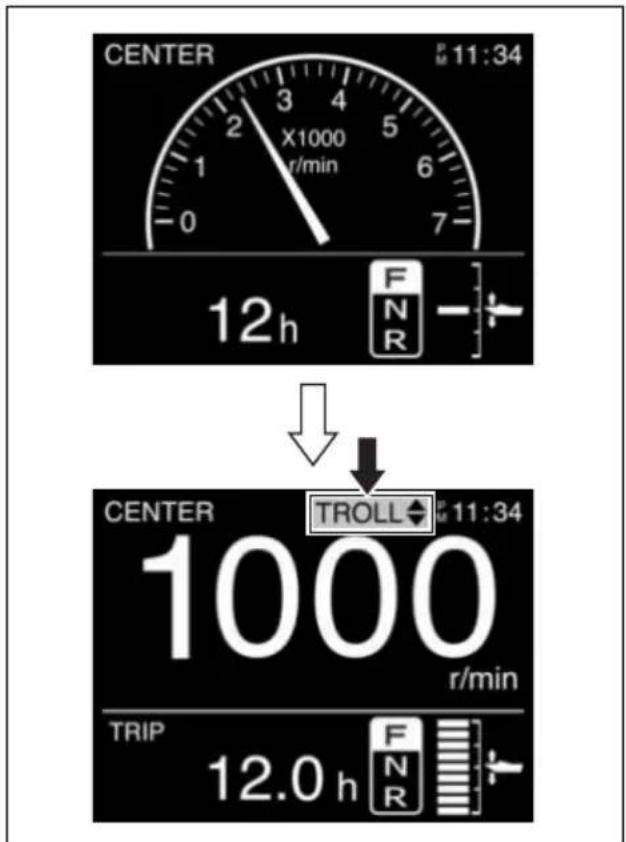
- This icon appears on the screen of the Multi-Function Gauge that was operated to get into the troll mode, and shows operatable Multi-Function Gauge of the troll mode.

- This icon appears on the screen of the Multi-Function Gauge(s) that did not be operated to get into the troll mode. This icon appears on the screen of the Multi-Function Gauge(s) that cannot operate the troll mode.
Example of the troll mode display on the Multi-Function Gauge that can operate the troll mode.

Example of the troll mode display on the Multi-Function Gauge that cannot operate the troll mode.

NOTE:
- This system will not function properly until engine is at normal operating temperature.
- If the [MENU] button is pressed and held while the remote control lever is in neutral, the mode will not switch to TROLL Mode.
- For the multiple engines:
- If the throttle of all engines are fully closed and one of engines is in-gear, it shifts to the troll mode when the [MENU] button is pressed.
- In-gear idle speed of all engines is controlled at the same time.
When "No" is selected:
When "No" is selected and the [SET] button is pressed, the display will return to the original gauge screen.
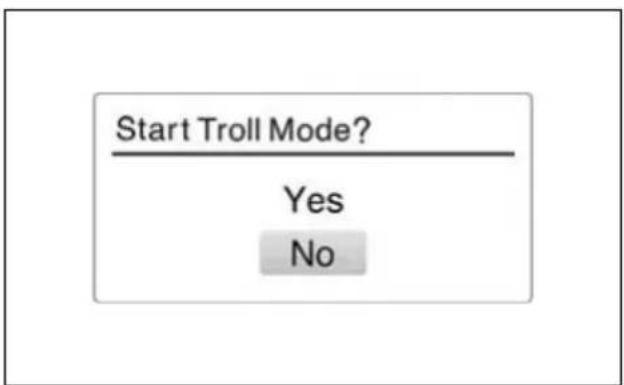
Adjusting Trolling Speed
- When pressing the [▲] button, one short beep sounds and the engine speed increases by 50 r/min.
- When pressing the [√] button, one short beep sounds and the engine speed decreases by 50 r/min.
NOTE:
- When pressing the [ ] button at the lower limit of trolling speed of all engines, the engine speed will not change and three long beeps will sound.
- When pressing the [ ] button at the upper limit of trolling speed of all engines, the engine speed will not change and three long beeps will sound.
• For the multiple engines:
If the button is operated when one engine has reached the adjustment limit of trolling speed, while any other engine has not, one short beep sounds and the rpm of engine which has not reached the adjustment limit changes.
- Shift operation and throttle control remain operational, even in troll mode.
Cancelling the Troll Mode
The troll mode can be cancelled by shifting the all remote control levers to the neutral position, or by increasing the engine speed to 3000 r/min or more. In both cases, two short beeps sound when cancelling the troll mode.
TROLL MODE SWITCH (Optional Item) Switching to TROLL Mode
Pressing and holding the "UP" or "DN" switch while cruising at Trolling Speed (minimum speed), will switch the mode to TROLL Mode.
For the Trolling Speed, the desired engine speed can be set and maintained within the range from 650 r/min to 1200 r/min using the [UP] button or [DN] switch.

NOTE:
Please contact your authorized Suzuki Marine Dealer for more information.
Setting the Troll Mode
-
Shift into forward or reverse gear and make sure that the throttle is fully closed (in-gearidle speed).
-
Press the "UP" or "DN" position of the troll mode switch, until you hear one beep. At the same time, the Multi-Function Screen switches over to the TROLL Mode specific screen and TROLL displayed on the gauge screen. When the gauge screen displays "Engine Speed Screen" or "All Items Screen", the engine speed screen automatically changes from an analog to a digital display.

NOTE:
- This system will not function properly until engine is at normal operating temperature.
- If the switch is pressed and held while the remote control lever is set to neutral, the mode will not switch to TROLL Mode.
• For the multiple engines:
- When the switch is pressed and held while all the engine throttles are fully closed and the clutch is engaged in only one of the engines, the mode will switch to TROLL mode.
- In-gear idle speed of all engines is controlled at the same time.
Adjusting Trolling Speed
- When pressing the "UP" switch, one short beep sounds and the engine speed increases by 50 r/min. - When pressing the "DN" switch, one short beep sounds and the engine speed decreases by 50 r/min.
NOTE:
- When pressing the "DN" switch at the lower limit of trolling speed of all engines, the engine speed will not change and three long beeps will sound.
- When pressing the "UP" switch at the upper limit of trolling speed of all engines, the engine speed will not change and three long beeps will sound.
- For the multiple engines:
If the switch is operated when one engine has reached the adjustment limit of trolling speed, while any other engine has not, one short beep sounds and the rpm of engine which has not reached the adjustment limit changes.
- Shift operation and throttle control remain operational, even in troll mode.
Cancelling the Troll mode:
The troll mode can be cancelled by shifting the all remote control levers to the neutral position, or by increasing the engine speed to 3000 r/min or more. In both cases, two short beeps sound when cancelling the troll mode.
OPERATION IN SALT WATER
After operating the motor in salt water, you should flush the water passages with clean, fresh water as outlined in the FLUSHING THE WATER PASSAGES section. If you do not flush the water passages, salt can corrode the motor and shorten its life.
When operating your outboard motor in freezing temperatures, you should keep the lower unit submerged in the water at all times.
When taking motor out of the water, stand it up in a vertical position until the cooling system drains completely.
NOTICE
If you leave your outboard motor out of the water in freezing temperatures with water still in the cooling system, the water can freeze and expand, causing severe damage to the motor.
When your outboard is in the water in freezing temperatures, keep the lower unit submerged in the water at all times. When the motor is stored out of the water in freezing temperatures stand it up in the vertical position so that the cooling system drains completely.
MOTOR REMOVAL AND TRANSPORTING
MOTOR REMOVAL
If it is necessary to remove the outboard motor from your boat, we recommend that you ask your authorized Suzuki Marine Dealer to do the work for you.
MOTOR TRANSPORTING
When transporting the motor, place the motor either vertically or horizontally.
Vertical transport:
Attach the motor to the carrier by securing clamp bracket with two sets of transom bolt and nut.
Never use display stand for transportation of the motor.

natural_image
Technical line drawing of a right-hand electric motor with mounting feet (no text or symbols)Horizontal transport:
-
Drain the engine oil. Refer to the ENGINE OIL section.
-
Drain the gasoline from the vapor separator ① as follows:
(1)Remove the motor cover.
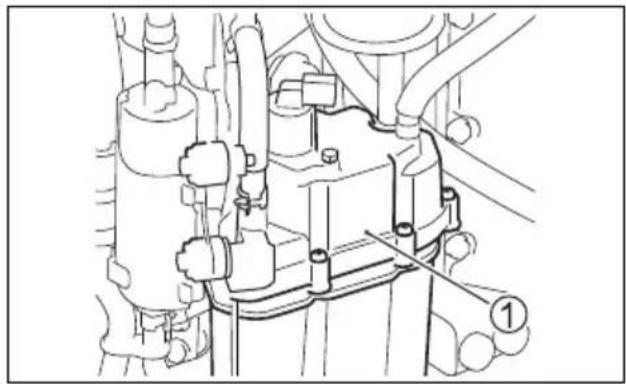
natural_image
Technical line drawing of a mechanical assembly with no visible text or symbols(2)Loosen the vapor separator drain screw ② and drain the gasoline into a suitable container.

natural_image
Technical line drawing of a mechanical assembly with no visible text or symbols
natural_image
Technical line drawing of a mechanical assembly with no visible text or symbolsWARNING
Gasoline is extremely flammable and toxic. It can cause a fire and can be hazardous to people and pets.
Use a proper, safe container to store any gasoline drained from the outboard motor. Keep gasoline away from sparks, flames, people, and pets.
NOTICE
If spilled gasoline is just left on painted surface, it may cause a stain or discoloration of the surface coating.
Wipe off any spilled gasoline immediately with a soft cloth etc.
(3)After draining, retighten the vapor separator drain screw ②.
- Rest the motor on a case protector with the port side downwards as shown.

natural_image
Technical line drawing of a mechanical component with internal parts and a propeller (no text or symbols)WARNING
Spilled fuel or fuel vapor can cause a fire and is hazardous to health.
Always take the following precautions:
- Drain the fuel from the fuel line and fuel vapor separator before transporting the boat/outboard motor and before removing the motor from the boat.
- DO NOT lay motor on its side without draining fuel.
- Keep the motor away from open flames or sparks.
- Wipe up spilled fuel immediately.
NOTICE
If you are not careful when resting the outboard on its side and do not take proper precautions such as first draining the engine oil and cooling water completely, damage can occur. Engine oil may enter the cylinder from the sump, water may enter the cylinder through the exhaust port, or the outer casings may be damaged.
Always drain the engine oil and cooling water completely before laying the motor on its side, and be careful laying the motor down.
NOTICE
If you let the lower unit of your outboard sit higher than the power head during transporting or storing, water may trickle into the power head, causing damage to the engine.
Never let the lower unit sit higher than the power head when transporting or storing your outboard.
TRAILERING
When trailering your boat with the motor attached, keep the motor in the normal operating position unless there is not enough ground clearance. If you need more ground clearance, trailer the motor in a tilted position using a trans-som saver bar or similar device to support the weight of the motor.

natural_image
Line drawing of a boat's side-mounted motor with a lever and load, showing no text or symbolsNOTICE
If you use the tilt bracket to hold the motor in the fully tilted up position when trailering the boat, towing motion or poor road surfaces may cause unexpected tilt lock release, resulting in damage to the motor and the tilt lock mechanism.
Never use the tilt bracket to hold the motor in the fully tilted up position when trailering the boat. Use a transom saver bar or similar device to support the weight of the motor.
INSPECTION AND MAINTENANCE
MAINTENANCE SCHEDULE
It is important to inspect and maintain your outboard motor regularly. Follow the chart below. At each interval, be sure to perform the indicated service. Maintenance intervals should be judged by number of hours or number of months, whichever comes first.
WARNING
Exhaust gas contains carbon monoxide, a dangerous gas that is difficult to detect because it is colorless and odorless. Breathing carbon monoxide can cause death or severe injury.
Never start the engine or let it run indoors or where there is little or no ventilation.
| Item to be serviced\Interval | Initial 20 hrs. or 1 month | Every 100 hrs. or every 12 months | Every 200 hrs. or every 12 months | Every 300 hrs. or every 36 months |
| Spark plug I | ||||
| Breather & Fuel line II | ||||
| Engine oil R R | ||||
| Gear oil R R | ||||
| Lubrication II | ||||
| Anodes (external) II | ||||
| * Anodes (internal cylinder block/cylinder head) | I | |||
| Bonding wire II | ||||
| Battery II | ||||
| Low pressure fuel filter | I | I | ||
| Replace every 400 hours or every 2 years. | ||||
| * Low pressure fuel pump filter | Replace every 1000 hours. | |||
| * Engine oil filter R R | ||||
| * High pressure fuel filter | Replace every 1000 hours. | |||
| * Idle speed I | I | |||
| * Valve clearance (lash) | I | |||
| * Water pump | I | |||
| * Water pump impeller | I | R | ||
| * Propeller nut & pin | II | |||
| * Bolts & Nuts | T | T | ||
| * Pinion/gear set | Inspection every 200 hours.(This item is applicable only for commercial motors.) | |||
| * Thermostat | I | |||
I: Inspect and clean, adjust, lubricate, or replace, if necessary T: Tighten R: Replace
NOTE:
Water-separating fuel filter
Replace the filter element every 12-months (or more frequently if recommended by the filter manufacturer).

WARNING
Improper maintenance or failure to perform recommended maintenance can be hazardous. Poor maintenance or lack of maintenance increases the chance of an accident or equipment damage.
Be sure to have maintenance performed according to the schedule in the above chart. Suzuki recommends that only your authorized Suzuki marine dealer or a qualified service mechanic perform maintenance on those items in the chart above which are marked with an asterisk (*). You may perform maintenance on the unmarked items by referring to the instructions in this section if you have mechanical experience. If you are not sure whether you can successfully complete any of the unmarked maintenance jobs, ask your authorized Suzuki marine dealer to do the maintenance for you.

WARNING
The safety of you and your passengers depends on how well you maintain your outboard motor.
Follow all inspection and maintenance instructions carefully. If you do not have prior mechanical experience, do not attempt to perform maintenance on your outboard motor. You could be injured or may damage the motor.
NOTICE
The maintenance intervals in the chart are designed for normal usage of your outboard motor. If your outboard motor is used under severe conditions as outlined below, you may need to perform maintenance more often than indicated in the chart.
• Frequent full throttle operation
- Prolonged continuous operation at the maximum speed
- Prolonged continuous operation at idling speed or trolling speed
- Frequent operation in muddy, silty, sandy, acidic or shallow water
• Operation without appropriate warmup
- Frequent abrupt acceleration and deceleration
- Frequent shift operation
Failure to perform maintenance more frequently could result in damage.
Consult your authorized Suzuki marine dealer regarding appropriate maintenance intervals for your usage conditions. When replacing parts on your outboard motor, Suzuki strongly recommends that you use genuine Suzuki parts or their equivalent.
TOOL KIT
A tool kit is provided with your outboard motor. Keep the kit on board your boat and make sure that all of the items provided remain in the kit.
The tool kit contains the following items:
① Tool bag
② 8 mm Box wrench
③ 8 × 10 mm Box wrench
④ 16 mm Box wrench
⑤ 8 × 10 mm Spanner
⑥ Combination screw driver
⑦ Screwdriver handle
⑧ Pliers
⑨ Hexagon wrench 4 mm
⑩ Hexagon wrench 8 mm
⑪ Engine oil drain plug gasket (spare)
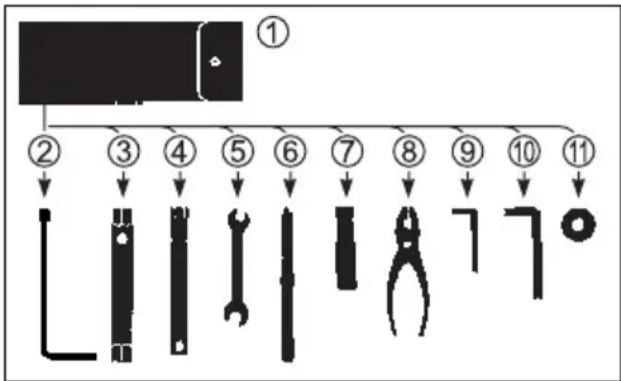
SPARK PLUG
Remove the spark plugs as follows:
- Remove the bolts ① securing the air duct guard.

- Remove the air duct guard ②.

natural_image
Technical line drawing of a mechanical assembly with no visible text or symbols- Remove the bolt securing the ignition coil.
- Pull out the ignition coil.
- Loosen and remove the spark plug using the box wrench in the tool bag.

natural_image
Technical line drawing of a mechanical assembly with no visible text or symbols
natural_image
Mechanical assembly diagram showing a lever mechanism with arrows indicating motion (no text or labels)Your outboard motor comes equipped with the following "standard" spark plug for normal usage.
| NGK BKR6E Standard |
NOTICE
Non-resistor types of spark plugs will interfere with the function of the electronic ignition, causing misfiring, or causing problems with other electronic boat equipment and accessories.
Use ONLY resistor type spark plugs in your outboard motor.
A normally operating spark plug is very light-brown in color. If the standard plug is not suitable for your operating, consult your authorized Suzuki Marine Dealer.

natural_image
Technical illustration of two different spark plug designs, one showing threaded end and the other showing internal structure (no text or symbols)NOTICE
Use of improper spark plugs or improperly tightening spark plugs can cause severe engine damage.
- Do not experiment with other spark plug brands unless you can determine that they are directly equivalent to the specified brand, or you may experience engine damage which will not be covered under warranty. Note that aftermarket cross-reference charts may not be accurate.
- To install a spark plug; seat it as far as possible by hand, then use a wrench to tighten it to either the recommended torque setting or the specified rotation angle.
| Tightening torque | |
| 25 – 29 N·m(2.5 – 2.9 kg·m, 18.0 – 21.0 lb·ft) | |
| Rotation angle | |
| New plug 1/2 – | 3/4 of a turn |
| Re-use plug 1/1 | 12 – 1/8 of a turn |
- Do not overtighten or cross-thread a spark plug, as this will damage the aluminum threads of the cylinder head.
To maintain a strong spark, you should clean and adjust the plugs at the intervals shown in the maintenance chart. Remove carbon deposits from the spark plugs using a small wire brush or spark plug cleaner, and adjust the gap according to the following chart:
| Spark plug gap | 0.7 – 0.8 mm(0.028 – 0.031 in.) |
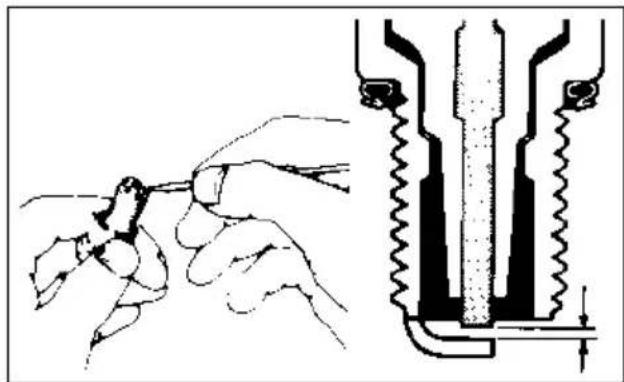
natural_image
Technical illustration showing a hand using a tool to adjust a mechanical component, with no visible text or symbols.1

2

3

4

5

6
- Excessive wear 2. Breakage 3. Melting
- Erosion 5. Yellow deposits 6. Oxidation
NOTE:
If the spark plug condition is found as shown in the illustration above, ensure it is replaced with new one. Otherwise, it will cause difficulty in starting the engine, increase fuel consumption, and result in engine troubles.
BREATHER AND FUEL LINE
Inspect the breather and fuel line for leaks, cracks, swelling, or other damage. If the breather and fuel line is damaged in any way, it must be replaced. Consult your authorized Suzuki Marine Dealer if it is necessary to replace them.
Breather line

Fuel line

natural_image
Technical diagram of a mechanical assembly with no visible text or symbols
WARNING
Fuel leakage can contribute to an explosion or fire, resulting in serious personal injury.
Have your authorized Suzuki Marine Dealer replace the fuel line if there is any evidence of leaking, cracking or swelling.
ENGINE OIL

WARNING
Never perform any ENGINE OIL procedure with the motor running, as serious injury can occur.
The motor must be shut off before any ENGINE OIL procedures are performed.
NOTICE
Extended trolling can reduce oil life. Your engine may be damaged if you do not change engine oil more frequently under this type of use.
Change your engine oil more frequently if your engine is used for extended trolling.
Engine oil change
The engine oil should be changed when engine is warm so that the oil will drain thoroughly from the engine.
To change the engine oil:
- Place the motor in a vertical position and remove the motor cover.
- Remove the oil filler cap.

natural_image
Technical line drawing of a mechanical component with no visible text or symbols- Place a drain pan under the engine oil drain screw.

CAUTION
The engine oil temperature may be high enough to burn your fingers when the drain plug is loosened.
Wait until the drain plug is cool enough to touch with bare hands before removing it.
- Remove the engine oil drain screw ① and gasket ②, then let the engine oil drain.

- After draining, secure the engine oil drain screw with a new gasket.
NOTICE
A previously-used gasket may leak, resulting in engine damage.
Do not re-use gaskets. Be sure to always use new gaskets.
NOTE:
There are spare gaskets in the tool bag.
- Fill with recommended engine oil to the upper level.
Oil capacity: 8.0 L
- Check the engine oil level.

NOTE:
To avoid incorrect measurement of engine oil level, check oil level only when the engine has cooled.
- Reinstall the oil filler cap.

WARNING
Engine oil can cause injury to people or pets. Repeated, prolonged contact with used engine oil may cause skin cancer. Even brief contact with used oil may irritate skin.
- Keep new and used oil away from children and pets.
- Wear a long-sleeve shirt and waterproof gloves when handling oil.
- Wash with soap if oil contacts your skin.
- Launder any clothing or rags that are wet with oil.
NOTE:
Recycle of properly dispose of used engine oil. Do not throw it in the trash, pour it on the ground, down a drain, or into the water.
GEAR OIL
To check the gear oil level, remove the gear oil level plug ① and look into the hole. The oil level should be at the bottom edge of the hole. If the oil level is low, add the specified gear oil until the level reaches the bottom edge of the hole. Then, reinstall and tighten the plug.

To change the gear oil:
- Make sure the motor is in an upright position. Place a drain pan under the lower casing.
- Remove the gear oil drain plug ②, then remove the gear oil level plug ①.

- After the oil has drained completely, inject the specified gear oil into the gear oil drain hole ② until it just starts to come out of the gear oil level hole ①. Approximately 1.1 L (1.2/1.0 US/lmp qt.) will be required.
NOTE:
The oil level plug and the oil drain plug are now different.
The magnet is installed in the drain plug.
Clean the magnet if there is a metal powder on it.
Do not make a mistake in their positions when install them.
- Reinstall and tighten the gear oil level plug ①, then quickly reinstall and tighten the gear oil drain plug ②.
NOTE:
To avoid insufficient injection of gear oil, check the gear oil level 10 minutes after doing the procedure in the step 4. If the oil level is low, slowly inject the gear oil into the gear oil level hole ① up to the correct level.
WARNING
Gear oil can cause injury to people or pets. Repeated, prolonged contact with used gear oil may cause skin cancer. Even brief contact with used oil may irritate skin.
- Keep new and used oil away from children and pets.
- Wear a long-sleeve shirt and waterproof gloves when handling oil.
- Wash with soap if oil contacts your skin.
- Launder any clothing or rags that are wet with oil.
NOTE:
Recycle or properly dispose of used gear oil. Do not throw it in the trash, or pour it on the ground, down a drain, or into the water.
NOTICE
If fishing line wraps around the rotating propeller shaft, the propeller shaft oil seal can become damaged and can allow water to enter the gear case causing severe damage.
If the gear oil has a milky color, it is contaminated with water. Immediately contact your authorized Suzuki marine dealer for advice. Do not operate your outboard until the oil is changed and the cause of the contamination is corrected.
LOW PRESSURE FUEL FILTER
The low pressure fuel filter must be replaced by an authorized Suzuki Marine Dealer periodically.
Replace low pressure fuel filter at every 400 hours (2 years).

WARNING
Gasoline is extremely flammable and toxic. It can cause a fire and can be hazardous to people and pets.
Always take the following precautions when servicing the fuel filter:
- Stop the motor before cleaning the fuel filter.
- Be careful not to spill fuel. If you do, wipe it up immediately.
- Do not smoke, and keep away from open flames and sparks.

WARNING
Cleaning solvent is toxic and an irritant, and can cause injury to people and pets.
Keep solvent away from children and pets. Dispose of solvent properly when you are finished.
Inspect and clean the fuel filter as follows:
- Turn the engine off and allow it to cool.
- If equipped with Keyless Start System:
Make sure that the keyless start system is in OFF stage.
If not equipped with Keyless Start System: Make sure that the main switch is in the OFF position.
- Remove the bolts ① securing the fuel filter cap ② in place.

NOTICE
Improperly loosening the filter cup can cause sensor lead wire damage.
- Be careful not to twist the sensor lead wire when removing the filter cup.
-
Disconnect the lead wire connector before removing the filter cup.
-
Push the connector lock tab "a", then disconnect the water sensor lead wire connector ③.

- Place a rag under the filter before removal to catch any spilled fuel.
- Separate the filter cup ④ from the cap ② by turning the filter cup counterclockwise.

natural_image
Line drawing of a hand using a tool to adjust or install a component, with no visible text or symbols.- Drain the fuel and water in the filter cup into a suitable container.
| NOTICE |
| If spilled gasoline is just left on painted surface, it may cause a stain or discoloration of the surface coating.Wipe off any spilled gasoline immediately with a soft cloth etc. |
- Pull out the filter element ⑤. Inspect the filter element ⑤, O-ring ⑥ and seal ring ⑦ for damage. If they are damaged, replace them.

- Wash the filter element with clean solvent and dry it.
- Reinstall the seal ring and filter element in their original positions.
- Verify that the O-ring is in place in the top of the filter cup and screw the filter cup back into place.
-
Connect the water sensor lead wire connector ③.
-
Reinstall the fuel filter with the attaching bolts.
- Restart the engine and check that there are no leaks around the fuel filter.
NOTE:
If any water exists in the fuel filter cup, remove the cup and drain the water. Always dispose of excess fuel safely. For questions, consult your authorized Suzuki Marine Dealer.
LUBRICATION
Proper lubrication is important for the safe, smooth operation and long life of each working part of your outboard motor. The following chart shows the lubrication points of your motor and the recommended lubricant:
| LOCATION LUBRICANT | |
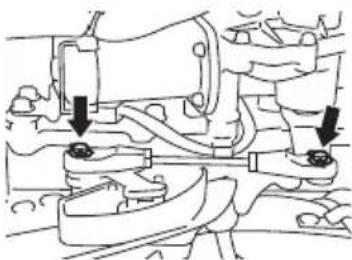 Shift link Shift link | Marine-grade water resistant grease |
 Propeller shaft Propeller shaft | |
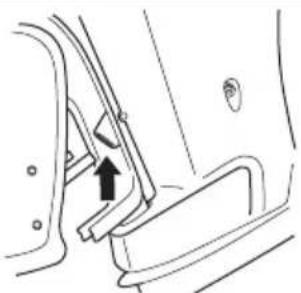 Trim ram pad Trim ram pad | |
 | Marine-grade water resistant grease (Grease Gun) |
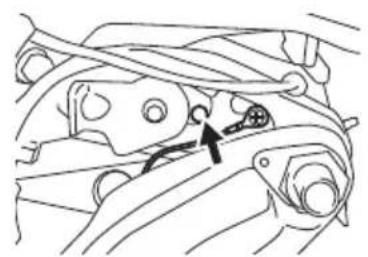 | |
| Swivel bracket | |
 | |
| Steering bracket | |
 | |
| Mount oil seal cover | |
NOTE:
Before applying grease through the steering bracket grease nipple, lock the motor in the fully tilted up position.
Grease injection into the grease nipple Ⓐ is carried out by using a manually-operated grease gun by taking up the following procedure.
- Remove the motor cover.
- Remove the STBD side cover.
- Inject approximately 10 grams of grease at initial 20 hours.
Inject approximately 5 grams of grease at every 100 hours (12 months).

NOTICE
When a hydraulically-operated grease gun is used, the use of such gun may cause damage to the oil seal.
Do not use hydraulic grease guns.
NOTE:
If it is difficult to inject the grease in correct volume, consult your Authorized Suzuki Marine Dealer.
ANODES AND BONDING WIRES
Anodes
The motor is protected from exterior corrosion by anodes. These pieces of anodes control electrolysis and prevent corrosion. The anodes will corrode in place of the parts they are protecting. You should periodically inspect each of the anodes and replace them when 2/3 of the metal has corroded away.

natural_image
Line drawing of a car interior showing fan blades and control panel (no text or symbols)
natural_image
Technical line drawing of a mechanical component with no visible text or symbols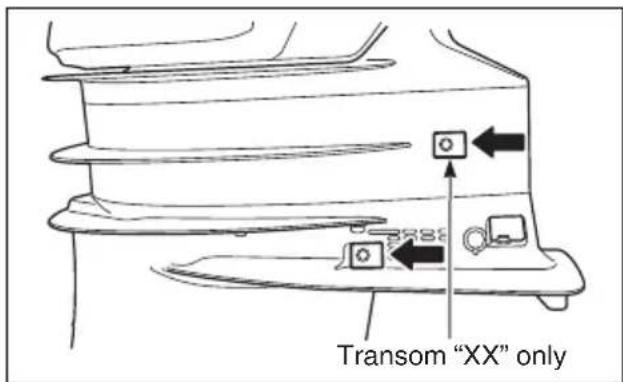

natural_image
Mechanical assembly diagram showing a bracket with two springs and a directional arrow (no text or labels)- Remove the PORT/STBD front water filters ①.

- Inspect the anode Ⓐ.

- Reinstall the front water filters.
NOTICE
If anodes are not properly maintained, underwater aluminum surfaces (such as the lower unit) will suffer galvanic corrosion damage.
• Periodically inspect anodes to make sure they have not become detached.
- Do not paint anodes, as this will render them ineffective.
- Periodically clean anodes with a wire brush to remove any coating which might decrease their protective ability.
NOTE:
Consult your authorized Suzuki Marine Dealer for inspection and replacement of internal anodes attached to the cylinder block/cylinder head.
Bonding wires
Bonding wires are used to electrically connect the engine components so they exist in a common ground circuit. This allows them to be protected against electrolysis by the anodes. These wires and their terminals should be checked periodically to be sure they have not been damaged.

natural_image
Technical line drawing of a mechanical assembly with no visible text or symbols
natural_image
Mechanical assembly diagram showing mechanical components and directional arrows (no text or labels)
natural_image
Mechanical assembly diagram showing a bracket with springs and housing (no text or labels)BATTERY
The battery solution level must be kept between the MAX and the MIN level lines at all times. If the level drops below the MIN level line, add DISTILLED WATER ONLY until the battery solution level reaches the MAX level line.
WARNING
Battery acid is poisonous and corrosive, and can cause severe injury.
Avoid contact with eyes, skin, clothing, and painted surfaces. If battery acid comes in contact with any of these, flush immediately with large amounts of water. If acid contacts the eyes or skin, get immediate medical attention.
WARNING
If you are not careful when checking or servicing the battery, you can cause a short circuit, which could result in an explosion, fire, or circuit damage.
Disconnect the negative (black) cable when checking or servicing the battery. Be careful not to allow a metal tool or other metal object to touch the battery's positive terminal and the motor at the same time.
WARNING
Battery posts, terminals, and related accessories contain lead and lead compounds that may be hazardous.
Wash hands after handling.
NOTICE
If you add diluted sulphuric acid to the battery after it has been initially serviced, you will damage the battery.
NEVER add diluted sulphuric acid to the battery after it has been initially serviced. Follow the battery manufacturer's instructions for specific maintenance procedures.
ENGINE OIL FILTER
The engine oil filter must be changed by authorized Suzuki Marine Dealer periodically. Replace engine oil filter with a new one at initial 20 hours (1 month).
Replace engine oil filter with a new one at every 200 hours (12 months).
FLUSHING THE WATER PASSAGES
After operation in muddy, brackish, or salt water, you should flush the water passages and motor surface with clean, fresh water.
If you do not flush the water passages, salt can corrode the motor and shorten its life. Flush the water passages as follows.
ENGINE RUNNING – Vertical position –
Suzuki recommends that you flush the water passages by using this method.
To flush the water passages, you must obtain a commercially available engine flush device.

WARNING
Exhaust gas contains carbon monoxide, a dangerous gas that is difficult to detect because it is colorless and odorless. Breathing carbon monoxide can cause death or severe injury.
Never start the engine or let it run indoors or where there is little or no ventilation.

WARNING
Failure to take proper precautions when flushing the water passages can be hazardous.
When flushing the water passages, always take the following precautions:
- Make sure that the engine remains in NEU-TRAL. If shifted into gear, the propeller shaft will turn and could cause severe personal injury.
- Make sure the motor is properly clamped to a secure stand or boat, and remain in attendance until flushing is completed.
- Keep children and pets away from the area, and stay clear of all moving parts.
NOTICE
Severe engine damage can occur in as little as 15 seconds if the engine is started without supplying water to the cooling system.
Never start the motor without supplying water to the cooling system.
- Make sure that the motor is stopped.
- Cover the STBD/PORT auxiliary water intake holes ① with a piece of duct tape.
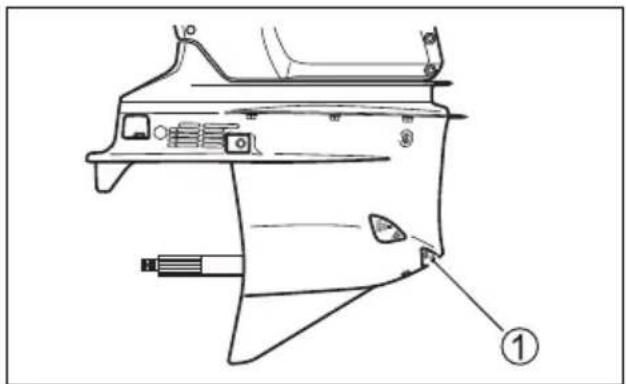
- Install the flushing attachment ② so that the water intake holes are covered by the rubber cups on the attachment.
- Connect a garden hose to the flushing attachment and turn on the water to obtain enough flow so that plenty of excess water is flowing out from around the rubber cups on the attachment.

- Place the remote control lever in the "NEU-TRAL" position with the propeller removed, start the motor and allow it to run at idle.
- Readjust the water flow, if necessary, so that there is still plenty of excess water flowing out from around the rubber cups.
- Allow the water to continue circulating for a few minutes.
- Stop the motor, then turn off the water.
- Remove the flushing attachment and remove the duct tape from the water intake holes.
- Clean the motor surface and apply a coat of automotive wax on the external finish of the motor.
ENGINE NOT RUNNING
- Vertical position -
- Make sure that the motor is stopped.
- Remove one of the plug Ⓐ or Ⓒ from the two flushing ports.

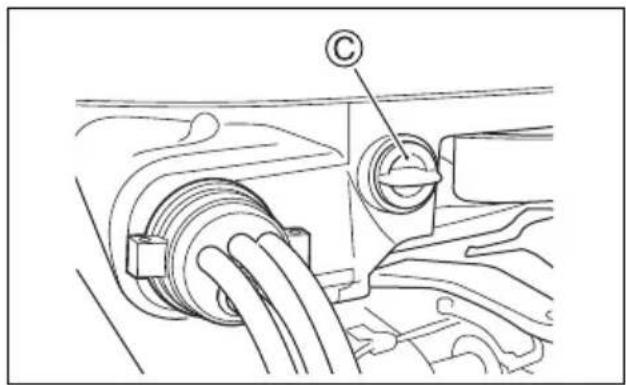
natural_image
Technical line drawing of a mechanical component with hoses and a labeled section (no text or symbols present)- Install garden hose by using a hose connector matched to flushing port thread Ⓑ.
Thread Ⓑ: 0.75 – 11.5 NHR (American standard hose coupling threads for garden hose applications.)
NOTE:
The hose connector (flushing attachment) matched to the flushing point thread Ⓑ is included in the crate parts.

- Turn on the water to obtain a good water flow. Flush the engine for about five minutes.
- Turn off the water.
- Remove the hose and connector (if used) then reinstall the plug into the flushing port.
- Leave the motor in a vertical position until the engine is drained completely.
ENGINE NOT RUNNING
- Full tilt up position -
- Raise the engine to the full tilt up position.
- Follow the "ENGINE NOT RUNNING Vertical position" instructions.
DO NOT RUN ENGINE IN THE FULL TILT UP POSITION.
- Lower the motor to a vertical position until the engine is drained completely.
SUBMERGED MOTOR
A motor that has been accidentally submerged in water must be overhauled as soon as possible to prevent corrosion. In the event that your motor is accidentally submerged, take the following steps:
- Get the motor out of the water as soon as possible.
- Wash it thoroughly with fresh water to completely remove all salt, mud, and seaweed.
- Remove the spark plugs. Drain the water from the cylinders through the spark plug holes by manually turning the flywheel several times.
- Check if any water is evident in the engine oil. If water is seen, remove the oil drain plug and drain the oil. After draining, tighten the oil drain plug.
- Drain the fuel line.
WARNING
Gasoline is extremely flammable and toxic. It can cause a fire and can be hazardous to people and pets.
Keep flames and sparks away from gasoline. Dispose of unwanted fuel properly.
- Pour engine oil into the engine through the spark plug holes. Coat the engine inner parts with oil by manually turning the flywheel several times.
NOTICE
Severe engine damage may occur if you continue cranking the engine when you encounter friction or resistance.
If you encounter friction or resistance while cranking the engine, stop at once and do not attempt to start the engine until you find and correct the problem.
- Take the motor to your authorized Suzuki Marine Dealer as soon as possible to be overhauled.
NOTICE
If the fuel supply is contaminated with water, engine damage may occur.
If the boat's fuel tank filler and vent were submerged, inspect the fuel supply to make sure it is not contaminated with water.
STORAGE PROCEDURE
MOTOR STORAGE
When storing your motor for a long period of time (for example, at the end of the boating season), it is recommended that you take your motor to your authorized Suzuki Marine Dealer. However, if you choose to prepare the motor for storage yourself, follow the procedure outlined below:
- Change the gear oil as outlined in the GEAR OIL section.
- Change the engine oil as outlined in the ENGINE OIL section.
- Fill a fuel stabilizer to the fuel tank according to the instructions on the stabilizer can.
- Flush the water passages in the motor thoroughly. Refer to the FLUSHING THE WATER PASSAGES (Engine running) section.
- Readjust the water flow, run the engine at about 1500 r/min in neutral for five minutes to distribute the stabilized fuel through the engine.
- Stop the engine. Then turn off the water and disconnect the flushing attachment.
- Lubricate all other specified parts. Refer to the LUBRICATION section.
- Apply a coat of automotive wax on the external finish of the motor. If paint damage is evident, apply touch up paint before waxing.
- Store the motor in an upright position in a dry, well-ventilated area.
WARNING
When the engine is running, there are many moving parts that could cause severe personal injury.
When the engine is running, keep your hands, hair, clothing, etc., away from the engine.
NOTICE
Severe engine damage can occur in as little as 15 seconds if the engine is started without supplying water to the cooling system.
Never start the motor without supplying water to the cooling system.
BATTERY STORAGE
-
When the outboard motor will not be used for a month or longer, remove the battery and store it in a cool, dark place. Completely recharge the battery before reusing it.
-
If the battery will be stored for a long period of time, check the specific gravity of the battery solution at least once a month and recharge the battery when low.

WARNING
Failure to take proper precautions when charging the battery can be hazardous. Batteries produce explosive vapors that can ignite. Battery acid is poisonous and corrosive, and can cause severe injury.
- Do not smoke and keep battery away from open flames and sparks.
- To avoid creating a spark when charging the battery, connect the battery charger cables to the proper terminals before turning the charger on.
- Handle the battery with extreme care and avoid skin contact with battery acid.
- Wear proper protective clothing (Safety glasses, gloves, etc.)
AFTER STORAGE
When taking your motor out of storage, follow the procedure below to return it to operating condition:
- Thoroughly clean the spark plugs. Replace them if necessary.
- Check the gear-case oil level and if necessary, add gear oil according to the procedure outlined in the GEAR OIL section.
- Lubricate all moving parts according to the LUBRICATION section.
- Check the engine oil level.
- Clean the motor and wax the painted surfaces.
- Recharge the battery before installing it.
TROUBLESHOOTING
This troubleshooting guide is provided to help you find the cause of common complaints.
NOTICE
Failure to troubleshoot a problem correctly can damage your outboard motor. Improper repairs or adjustments may damage the outboard motor instead or fixing it. Such damage may not be covered under warranty.
If you are not sure about the proper action to correct a problem, consult your Suzuki marine dealer.
Starter motor will not operate:
- Emergency stop switch lock plate is not in position.
- Starter relay fuse is blown out.
- Sub battery cable fuse is blown out.
• Control handle is not in NEUTRAL. - Battery terminal connection is corroded or lost.
- Battery power is lost.
- Starter motor is failed.
- Main switch or start & stop switch is failed.
• Electric wiring connection is loose.
Engine will not start (hard to start):
- Fuel tank is empty.
- Fuel is deteriorated.
• Engine starting procedure is mistaken. - Fuel tank air vent is not opened.
- Fuel hose is not properly connected to engine.
- Fuel hose is kinked or pinched.
- Fuel filter is clogged.
- Fuel pump is failed.
- Fuel tank filter is clogged.
- Spark plug is fouled.
- Ignition system is fouled.
• Electric wiring connection is loose.
Engine idles unstably or stalls:
- Spark plug is fouled.
- Fuel hose is kinked or pinched.
- Fuel hose is not properly connected to engine.
- Fuel is deteriorated.
- Fuel filter is clogged.
- Fuel pump is failed.
- Ignition system is fouled.
- Incorrect engine oil is used.
- Thermostat is failed.
• Electric wiring connection is loose.
Caution system is activated (Caution buzzer sounds. Caution LEDs lights.):
- Cooling water passage is clogged.
- Thermostat is failed.
• Water pump is failed. - Oil change reminder system is activated.
• Engine oil is not enough or deteriorated.
• Engine oil filter is clogged. - Oil pump is failed.
- Propeller is damaged.
- Battery power is lost.
• Engine control sensor is failed.
• Electric wiring connection is loose.
Shift operation will not be activated:
• Electronic shift control system is failed.
Propeller is not rotated:
- Propeller bush is worn or damaged.
- Drive shaft is damaged.
- Propeller shaft is damaged.
Engine speed will not increase:
- Propeller is damaged.
- Propeller is not clean.
- Propeller is not properly selected.
- Outboard motor is not correctly installed.
- Trim angle is not properly adjusted.
- Spark plug is fouled or incorrectly selected.
- Fuel hose is kinked or pinched.
- Fuel filter is clogged.
- Fuel is deteriorated.
- Fuel pump is failed.
- Ignition system is failed.
• Electronic throttle system is failed.
• Heavy cargo is on the boat.
• Water is entered into the boat. - Bottom of boat is not clean or damaged.
Engine vibrates excessively:
- Propeller is damaged.
- Engine mounting bolts or clamp screws are loose.
The Keyless Start System does not turn ON even when the main switch is operated. The error sound (five short buzzer beeps) is NOT heard:
(If equipped with Keyless Start System)
- Emergency stop switch lock plate is not in position.
- The main switch has been operated continuously while the communication with the key-fob is disabled.
- Battery terminal connection is corroded or lost.
- Battery power is lost.
• Keyless control unit failure.
• Electric wiring connection is loose. - Main panel failure.
The Keyless Start System does not turn ON even when the main switch is operated. The error sound (five short buzzer beeps) IS heard:
(If equipped with Keyless Start System)
• Key-fob is outside the operating range.
• Key-fob battery is dead.
• Key-fob is in OFF mode.
• The key-fob is not authenticated.
- Communication failure due to strong radio wave or noise.
• Electric wiring connection failure between the keyless control unit and outboard motor.
- Authentication error between the keyless control unit and outboard motor.
- Abnormality exists in the electronic control system of the engine.
The Keyless Start System does not turn OFF even when the main switch is operated:
• Electric wiring connection is loose.
- Main panel failure.
FUSE
-
If equipped with Keyless Start System: Turn the Keyless Start System OFF.
If not equipped with Keyless Start System: Turn the main switch to the "off" position. -
Remove the motor cover.
-
Remove the fuse box cover and pull off the fuse.
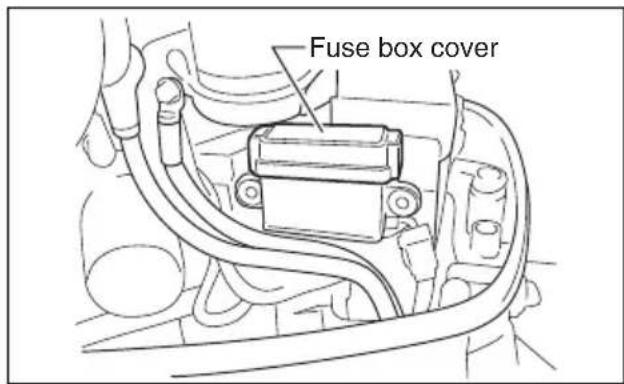

natural_image
Technical line drawing of a mechanical component with internal compartments and a handle (no text or symbols)NOTE:
Use the fuse puller at the back of fuse box cover, when the fuse is pulled off and installed.
4. Remove the sub battery cable fuse.

- Inspect the fuse and replace with new fuse if needed.
Main fuse (60 A)/Isolator fuse (40 A)
Normal fuse

Blown fuse
Blade type fuse

natural_image
Line drawing of a mechanical component with no visible text or symbolsNormal fuse

natural_image
Line drawing of a mechanical component with no visible text or symbolsBlown fuse
NOTE:
If a fuse is blown, try to determine the root cause and correct it.
If the cause is not corrected, the fuse may be blown again.

WARNING
If you replace a blown fuse with a fuse having a different amperage rating or with a substitute such as aluminum foil or a wire, extensive electrical system damage and a fire may result.
Always replace a blown fuse with a fuse of the same type and rating.
NOTICE
If a new fuse blows in a short time after installation, you may have a major electrical system problem.
Consult your SUZUKI marine dealer.

① Starter motor relay fuse: 30 A
② Ignition coil/Injector/Engine control module/ High pressure fuel pump fuse: 30 A
③ Throttle valve fuse: 15 A
④ Shift actuator fuse: 15 A
⑤ PTT switch fuse: 10 A
⑥ Low pressure fuel pump fuse: 15 A
① Main fuse: 60 A
⑥ Isolator select fuse: 40 A
© Spare fuse: 60 A
(d) Spare fuse: 30 A
(e) Sub battery cable fuse: 30 A
SPECIFICATIONS
| Item DF250AP DF300AP | ||
| Engine Type 4 Stroke | ||
| Number of Cylinders 6 | ||
| Bore and Stroke 98.0 × 89.0 mm (3.86 × 3.50 in.) | ||
| Piston Displacement 4 028 cm | ^3 (245.7 cu. in.) | |
| Maximum output 183.9 kW (250PS) | 220.7 kW (300PS) | |
| Full Throttle Operating Range 5 5 | 00 – 6 100 r/min. (min ^-1 ) 5 | 700 – 6 300 r/min. (min ^-1 ) |
| Ignition System Full-transistor | ||
| Engine Lubrication Trochoid pump pressure lubrication | ||
| Engine Oil Capacity 8.0 L (8.5/7.0 US/Imp. qt.) | ||
| Gear Oil Capacity 1.1 L (1.2/1.0 US/Imp. qt.) | ||
| Spark Plug | NGK BKR6E | |
| Spark Plug Gap | 0.7 – 0.8 mm (0.028 – 0.031 in.) | |
| Valve Clearance (Lash) | IN.: 0.23 – 0.27 mm (0.009 – 0.011 in.)EX.: 0.33 – 0.37 mm (0.013 – 0.015 in.) | |
| Fuel Type | Alcohol-free unleaded gasoline | |
| Minimum Fuel Octane Rating | 94 (Research method) | |
INFORMATION REGARDING EC - DIRECTIVE
(For European countries)
Sound Pressure Level
| Regulation | Sound pressure level limit |
| 2013 / 53 / EU | 75 dB(A) |
Sound pressure level is measured according to ISO 14509-1:2008.
FLOWCHART OF OIL CHANGE REMINDER SYSTEM

flowchart
graph TD
    A["Starting operation"] --> B{(*1) (*4)}
    B --> C["CancellationIndication"]
    C --> D{(*2) (*4)}
    D --> E["CancellationIndication"]
    E --> F{(*3) (*4)}
    F --> G["CancellationIndication"]
    G --> H{(*3) (*4)}
    H --> I["CancellationIndication"]
    I --> J["..."]
    J --> K["Repeat"]

    style A fill:#f9f,stroke:#333
    style K fill:#f9f,stroke:#333

    note right of A
        *1: Lapse of initial 20 hour's operation
        *2: Lapse of 80 hour's operation
        *3: Lapse of 100 hour's operation
        *4: When performing cancellation before system activation
    end
WIRING DIAGRAM
DF250AP/300AP

flowchart
graph TD
    subgraph Top
        A["O2 SENSOR"] --> B["Ex MANI TEMP SENSOR #1"]
        C["IAT SENSOR"] --> D["Cylinder Temp Sensor"]
        E["CMLINDER TEMP Sensor"] --> F["Throttle Motor"]
        G["CMP SENSOR #2"] --> H["Throttle Motor"]
        I["THROTTLE SENSOR"] --> J["Throttle Motor"]
        K["MAP SENSOR"] --> L["FUEL INJECTOR #2"]
        M["FUEL INJECTOR #4"] --> N["FUEL INJECTOR #4"]
        O["FUEL INJECTOR #6"] --> P["IGNITION COIL #2"]
        Q["IGNITION COIL #4"] --> R["IGNITION COIL #6"]
        S["OCV SOLENOID #2"] --> T["Joint CONNECTOR"]
    end

    subgraph Bottom
        U["EX MANI TEMP SENSOR #1"] --> V["CMP SENSOR #3"]
        W["FUEL INJECTOR #1"] --> X["FUEL INJECTOR #3"]
        Y["FUEL INJECTOR #5"] --> Z["FUEL INJECTOR #5"]
        AA["IGNITION COIL #1"] --> AB["IGNITION COIL #3"]
        AC["IGNITION COIL #4"] --> AD["IGNITION COIL #6"]
        AE["OCV SOLENOID #1"] --> AF["OCV SOLENOID #1"]

    subgraph Top
        AG["CKP SENSOR"] --> AH["ALTERNATOR"]
        AI["RECIFIER & REGULATOR"] --> AJ["STARTER MOTOR"]
        AK["RECTIFIER & REGULATOR"] --> AL["OIL TEMPSensor"]
        AM["OIL PRESSURE SENSOR"] --> AN["ENGINE CONTROL MODULE"]
        AO["THROTTLE RELAY"] --> AP["FUEL PUMP (L)"]
        AQ["SHIFT RELAY"] --> AR["FUEL PUMP (H)"]

    end

    subgraph Bottom
        AS["JOINT CONNECTOR"] --> AT["JOINT CONNECTOR"]
        AU["JOINT CONNECTOR"] --> AV["JOINT CONNECTOR"]

    end

    AG --> AH
    AH --> AI
    AI --> AJ
    AJ --> AK
    AK --> AL
    AL --> AM
    AM --> AN
    AN --> AO
    AO --> AP
    AP --> AQ
    AQ --> AR
    AR --> AS
    AS --> AT
    AT --> AU
    AU --> AV
    AV --> AU
    AV --> AV

    style Top fill:#f9f,stroke:#333
    style Bottom fill:#ccf,stroke:#333

flowchart
graph TD
    A["BATTERY"] --> B["BOAT CONTROL MODULE"]
    B --> C["PTT SWITCH"]
    C --> D["TROLL MODE SWITCH"]
    D --> E["MAIN SWITCH"]
    E --> F["EMERGENCY STOP SWITCH"]
    F --> G["KEYLESS CONTROL UNIT"]
    G --> H["PANEL SWITCH"]
    H --> I["VIEW A"]
    I --> J["COLOR GAUGE"]
    J --> K["TERMINATOR"]
    K --> L["FUEL LEVEL 1"]
    K --> M["FUEL LEVEL 2"]
    K --> N["BONDER WIP POINT CONNECTOR #1"]
    style A fill:#f9f,stroke:#333
    style B fill:#ccf,stroke:#333
    style C fill:#cfc,stroke:#333
    style D fill:#fcc,stroke:#333
    style E fill:#cff,stroke:#333
    style F fill:#ffc,stroke:#333
    style G fill:#cfc,stroke:#333
    style H fill:#fcc,stroke:#333
    style I fill:#ffc,stroke:#333
    style J fill:#cfc,stroke:#333
    style K fill:#fcc,stroke:#333
    style L fill:#cfc,stroke:#333
    style M fill:#fcc,stroke:#333
    style N fill:#cfc,stroke:#333
| WIRE COLOR | |
| B | : Black |
| BI | : Blue |
| Br | : Brown |
| G | : Green |
| Gr | : Gray |
| Lbl | : Light blue |
| Lg | : Light green |
| O | : Orange |
| P | : Pink |
| R | : Red |
| V | : Violet |
| W | : White |
| Y | : Yellow |
| B/Br | : Black with Brown tracer |
| B/G | : Black with Green tracer |
| B/Lg | : Black with Light green tracer |
| B/O | : Black with Orange tracer |
| B/R | : Black with Red tracer |
| B/W | : Black with White tracer |
| B/Y | : Black with Yellow tracer |
| Bl/B | : Blue with Black tracer |
| Bl/R | : Blue with Red tracer |
| Bl/W | : Blue with White tracer |
| Bl/Y | : Blue with Yellow tracer |
| Br/B | : Brown with Black tracer |
| Br/R | : Brown with Red tracer |
| Br/W | : Brown with White tracer |
| Br/Y | : Brown with Yellow tracer |
| G/B | : Green with Black tracer |
| G/BI | : Green with Blue tracer |
| G/R | : Green with Red tracer |
| G/W | : Green with White tracer |
| Gr/R | : Gray with Red tracer |
| Gr/Y | : Gray with Yellow tracer |
| Lbl/W | : Light blue with White tracer |

flowchart
graph TD
    A["KEYLESS START SYSTEM"] --> B["PANEL SWITCH"]
    B --> C["WARNING BUZZER"]
    C --> D["EMERGENCY STOP SWITCH"]
    D --> E["TROLL MODE SWITCH"]
    E --> F["TERMINATOR TERMINATOR"]
    F --> G["FUEL LEVEL 1"]
    F --> H["FUEL LEVEL 2"]
    F --> I["CONNECTOR #1"]
    F --> J["BONDER WP #1"]
    F --> K["GPS ANNTENA"]
    F --> L["PTT SWITCH"]
    L --> M["BOAT CONTROL MODULE"]
    M --> N["LEPS"]
    M --> O["LPS"]
    M --> P["WD"]
    M --> Q["SW"]
    M --> R["WP"]
    M --> S["WD"]
    M --> T["SW"]
    M --> U["WD"]
    M --> V["WD"]
    M --> W["WD"]
    M --> X["WD"]
    M --> Y["WD"]
    M --> Z["WD"]
    M --> AA["WD"]
    M --> AB["WD"]
    M --> AC["WD"]
    M --> AD["WD"]
    M --> AE["WD"]
    M --> AF["WD"]
    M --> AG["WD"]
    M --> AH["WD"]
    M --> AI["WD"]
    M --> AJ["WD"]
    M --> AK["WD"]
    M --> AL["WD"]
    M --> AM["WD"]
    M --> AN["WD"]
    M --> AO["WD"]
| WIRE COLOR | |
| B | : Black |
| BI | : Blue |
| Br | : Brown |
| G | : Green |
| Gr | : Gray |
| Lbl | : Light blue |
| Lg | : Light green |
| O | : Orange |
| P | : Pink |
| R | : Red |
| V | : Violet |
| W | : White |
| Y | : Yellow |
| B/Br | : Black with Brown tracer |
| B/G | : Black with Green tracer |
| B/Lg | : Black with Light green tracer |
| B/O | : Black with Orange tracer |
| B/R | : Black with Red tracer |
| B/W | : Black with White tracer |
| B/Y | : Black with Yellow tracer |
| BI/B | : Blue with Black tracer |
| BI/R | : Blue with Red tracer |
| BI/W | : Blue with White tracer |
| BI/Y | : Blue with Yellow tracer |
| Br/B | : Brown with Black tracer |
| Br/R | : Brown with Red tracer |
| Br/W | : Brown with White tracer |
| Br/Y | : Brown with Yellow tracer |
| G/B | : Green with Black tracer |
| G/BI | : Green with Blue tracer |
| G/R | : Green with Red tracer |
| G/W | : Green with White tracer |
| Gr/R | : Gray with Red tracer |
| Gr/Y | : Gray with Yellow tracer |
| Lbl/W | : Light blue with White tracer |
Prepared by
SUZUKI MOTOR CORPORATION
July, 2018
Part No. 99011-98J80-054
Printed in Japan
© COPYRIGHT SUZUKI MOTOR CORPORATION 2018

- WARNING
- CAUTION
- NOTICE
- NOTE:
- IMPORTANT NOTICE TO OWNERS
- FOREWORD
- TABLE OF CONTENTS
- IDENTIFICATION NUMBER LOCATION
- FUEL AND OIL
- GASOLINE
- Gasoline/Ethanol Blends
- Pump Labeling for Gasoline/Alcohol Blends
- ENGINE OIL
- GEAR OIL
- MOTOR MOUNTING
- SELECTION OF LOWER UNIT ROTATION
- BATTERY INSTALLATION
- BATTERY REQUIREMENT
- SUB BATTERY CABLE
- DUAL BATTERY CHARGING SYSTEM (OPTION)
- USE OF ELECTRICAL ACCESSORIES
- SUZUKI KEYLESS START SYSTEM (IF EQUIPPED WITH KEYLESS START SYSTEM)
- IMMOBILIZER SYSTEM
- KEY-FOB
- Switching the communication mode of the key-fob
- KEY-FOB BATTERY REPLACEMENT
- SETTING AND/OR CHANGING THE PASS-CODE
- PASSCODE CONFIRMATION
- PROPELLER SELECTION AND INSTALLATION
- IDENTIFICATION OF LOWER UNIT ROTATION AND PROPELLER TYPE SELECTION
- To identify the lower unit rotation type:
- PROPELLER SELECTION
- PROPELLER INSTALLATION
- ADJUSTMENT
- TRIM ANGLE ADJUSTMENT
- TRIM TAB ADJUSTMENT
- CONTROL HANDLE ADJUSTMENT
- IDLE SPEED ADJUSTMENT
- MOTOR COVER FASTENING ADJUSTMENT
- METER (OPTION) MULTI-FUNCTION GAUGE
- BUTTON FUNCTIONS
- SCREEN SELECTION
- To select the display screen:
- Engine Speed Display Screen
- Speed/Fuel Information Display Screen
- Fuel Information Display Screen
- All Items Display Screen
- SUB INFORMATION SELECTION
- Total Operating Hours
- Trip Time
- Trip Distance
- Battery Voltage/Cooling Water Temperature
- Instantaneous fuel flow
- Total Instantaneous fuel flow
- Instantaneous fuel economy
- Average fuel economy
- Total fuel used
- Latitude/Longitude
- MENU INFORMATION SELECTION
- Illumination
- Brightness
- Day or Night
- Sync
- Diagnosis
- Current Code
- Data Output
- Create Data:
- Log:
- Display
- Device list
- Initial Setting
- Unit
- Time
- Position
- Sensor Setting
- Tank
- ALARM
- CAUTION SYSTEM
- INDICATOR CHECK
- OVER-REVOLUTION CAUTION SYSTEM
- OIL PRESSURE CAUTION SYSTEM
- OIL TEMPERATURE CAUTION SYSTEM
- OVERHEAT CAUTION SYSTEM
- BATTERY VOLTAGE CAUTION SYSTEM
- ELECTRONIC THROTTLE AND SHIFT CONTROL CAUTION SYSTEM
- CONTROL UNIT COMMUNICATION CAUTION SYSTEM
- 2ND STATION CAUTION SYSTEM
- THROTTLE SYSTEM CAUTION SYSTEM
- STATION SETTING TROLL MODE CAUTION SYSTEM
- KEYLESS START SYSTEM CAUTION SYSTEM (IF EQUIPPED WITH KEYLESS START SYSTEM)
- KEY-FOB CAUTION SYSTEM
- KEY-FOB BATTERY CAUTION SYSTEM
- KEYLESS CONTROL UNIT CAUTION SYSTEM
- DIAGNOSTIC SYSTEM
- OIL CHANGE REMINDER SYSTEM
- SYSTEM ACTIVATION
- CANCELLATION
- ENGINE STALLING CAUTION SYSTEM
- WATER IN FUEL ALERT SYSTEM
- TILT LIMITER CAM
- MANUAL TILTING
- TILT BRACKET
- INSPECTION BEFORE BOATING
- To fill the engine oil:
- BREAK-IN
- Break-in procedure
- OPERATION
- MAIN SWITCH (OPTION)
- CONTROL PANEL (OPTION)
- Start & Stop Switch
- Station Select Switch
- Throttle Only Switch
- Engine Synchronize Switch
- Center Engine Control Switch
- Tilt Up & Down Switch
- BEFORE ATTEMPTING TO START THE ENGINE
- STARTING THE ENGINE
- Cooling water check
- If equipped with Keyless Start System:
- EMERGENCY START
- To start the engine:
- To stop the engine:
- SHIFTING AND SPEED CONTROL
- Shifting
- Type B remote control box
- Speed Control
- STOPPING THE ENGINE
- MOORING
- OPERATION IN SHALLOW WATER
- Switching to TROLL Mode
- Setting the Troll Mode
- When "YES" is selected:
- When "No" is selected:
- Adjusting Trolling Speed
- Cancelling the Troll Mode
- TROLL MODE SWITCH (Optional Item) Switching to TROLL Mode
- Cancelling the Troll mode:
- OPERATION IN SALT WATER
- MOTOR REMOVAL AND TRANSPORTING
- MOTOR REMOVAL
- MOTOR TRANSPORTING
- Vertical transport:
- Horizontal transport:
- TRAILERING
- INSPECTION AND MAINTENANCE
- MAINTENANCE SCHEDULE
- TOOL KIT
- SPARK PLUG
- BREATHER AND FUEL LINE
- Engine oil change
- LOW PRESSURE FUEL FILTER
- LUBRICATION
- ANODES AND BONDING WIRES
- Anodes
- Bonding wires
- BATTERY
- ENGINE OIL FILTER
- FLUSHING THE WATER PASSAGES
- ENGINE RUNNING – Vertical position –
- ENGINE NOT RUNNING
- - Vertical position -
- - Full tilt up position -
- SUBMERGED MOTOR
- STORAGE PROCEDURE
- MOTOR STORAGE
- BATTERY STORAGE
- AFTER STORAGE
- TROUBLESHOOTING
- Starter motor will not operate:
- Engine will not start (hard to start):
- Engine idles unstably or stalls:
- Caution system is activated (Caution buzzer sounds. Caution LEDs lights.):
- Shift operation will not be activated:
- Propeller is not rotated:
- Engine speed will not increase:
- Engine vibrates excessively:
- The Keyless Start System does not turn ON even when the main switch is operated. The error sound (five short buzzer beeps) is NOT heard:
- (If equipped with Keyless Start System)
- The Keyless Start System does not turn ON even when the main switch is operated. The error sound (five short buzzer beeps) IS heard:
- The Keyless Start System does not turn OFF even when the main switch is operated:
- FUSE
- Remove the sub battery cable fuse.
- INFORMATION REGARDING EC - DIRECTIVE
- FLOWCHART OF OIL CHANGE REMINDER SYSTEM
- WIRING DIAGRAM
- DF250AP/300AP
- SUZUKI MOTOR CORPORATION
Brand : SUZUKI
Model : DF300AP
Category : Outboard motor