SR4600 - Receiver MARANTZ - Free user manual and instructions
Find the device manual for free SR4600 MARANTZ in PDF.


User questions about SR4600 MARANTZ
0 question about this device. Answer the ones you know or ask your own.
Ask a new question about this device
Download the instructions for your Receiver in PDF format for free! Find your manual SR4600 - MARANTZ and take your electronic device back in hand. On this page are published all the documents necessary for the use of your device. SR4600 by MARANTZ.
USER MANUAL SR4600 MARANTZ
AV Surround Receiver
ENGLISH
WARRANTY
For warranty information, contact your local Marantz distributor.
RETAIN YOUR PURCHASE RECEIPT
Your purchase receipt is your permanent record of a valuable purchase. It should be kept in a safe place to be referred to as necessary for insurance purposes or when corresponding with Marantz.
IMPORTANT
When seeking warranty service, it is the responsibility of the consumer to establish proof and date of purchase. Your purchase receipt or invoice is adequate for such proof.
FOR U.K. ONLY
This undertaking is in addition to a consumer's statutory rights and does not affect those rights in any way.
FRANÇAIS
GARANTIE
The SR4600 is in conformity with the EMC directive and low-voltage directive.
Français
- Do not expose the equipment to rain or moisture.
- Do not remove the cover from the equipment.
- Do not insert anything into the equipment through the ventilation holes.
- Do not handle the mains lead with wet hands.
- Do not cover the ventilation with any items such as tablecloths, newspapers, curtains, etc.
- No naked flame sources, such as lighted candles, should be placed on the equipment.
- When disposing of used batteries, please comply with governmental regulations or environmental public instruction's rules that apply in your country or area.
- Do not place anything about 0.2 meter above the top panel.
Make a space of about 0.2 meter around the unit.
- No objects filled with liquids, such as vases, shall be placed on the apparatus.
- When the switch is in the OFF position, the equipment is not completely switched off from MAINS.
Français
AVERTISSEMENTS
A NOTE ABOUT RECYCLING ...... 1
DESCRIPTION.... 2
FEATURES 3
ACCESSORIES 3
FRONT PANEL 4
FL DISPLAY 5
REAR PANEL 6
GENERAL INFORMATION OF RC5500SR TO SR4600 ...9
CONNECTIONS.... 11
SPEAKER PLACEMENT 11
CONNECTING SPEAKERS 11
CONNECTING AUDIO COMPONENTS 12
CONNECTING VIDEO COMPONENTS 13
ADVANCED CONNECTING 14
CONNECTING THE REMOTE CONTROL JACKS ..... 14
CONNECTING THE ANTENNA TERMINALS .... 15
SETUP 16
SETUP MENU SYSTEM 16
ENTER THE DESIRED MENU ITEM
OF THE SETUP MENU 16
SIMPLE SETUP 17
-
INPUT SETUP (ASSIGNABLE DIGITAL INPUT) ..... 17
-
SPEAKER SETUP 18
-
PREFERENCE 21
-
SURROUND 21
-
PL II (DOLBY PRO LOGIC II) MUSIC PARAMETER .. 22
-
CS II (CIRCLE SURROUND II) 22
ADJUSTING THE MAIN VOLUME 23
ADJUSTING THE TONE (BASS & TREBLE) CONTROL ... 23
TEMPORARILY TURNING OFF THE SOUND ..... 23
USING THE SLEEP TIMER 23
NIGHT MODE 23
SURROUND MODE.... 24
OTHER FUNCTION 27
ATTENUATION TO ANALOG INPUT SIGNAL ..... 27
LISTENING THROUGH HEADPHONES 27
VIDEO ON/OFF 27
DISPLAY MODE 27
SELECTING ANALOG AUDIO INPUT OR DIGITAL
AUDIO INPUT 27
RECORDING AN ANALOG SOURCE 28
HT-EQ 28
7.1 CH INPUT 28
7.1 CH INPUT LEVEL 29
BASIC OPERATION (TUNER) ...... 30
LISTENING TO THE TUNER 30
PRESET MEMORY 30
RDS OPERATION 32
This section must be read before any connection is made to the mains supply.
EQUIPMENT MAINS WORKING SETTING
Your Marantz product has been prepared to comply with the household power and safety requirements that exist in your area.
SR4600 can be powered by 230V AC only.
COPYRIGHT
Recording and playback of any material may require consent. For further information refer to the following:
Copyright Act 1956
— Dramatic and Musical Performers Act 1958
— Performers Protection Acts 1963 and 1972
— any subsequent statutory enactments and
orders
INTRODUCTION
Thank you for purchasing the Marantz SR4600 Surround receiver.
This remarkable component has been engineered to provide you with many years of home theater enjoyment. Please take a few minutes to read this manual thoroughly before you connect and operate the SR4600.
As there are a number of connection and configuration options, you are encouraged to discuss your own particular home theater setup with your Marantz A/V specialist dealer.
PRECAUTIONS
CAUTIONS ON INSTALLATION
For heat dispersal, leave at least 20 cm/8 inch of space between the top, back and sides of this unit and the wall or other components.
- Do not obstruct the ventilation holes.

text_image
20 cm (8 ins.)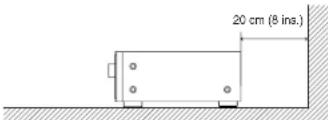
A NOTE ABOUT RECYCLING
This product's packaging materials are recyclable and can be reused. This product and the accessories packed together are the applicable product to the WEEE directive except batteries.
Please dispose of any materials in accordance with your local recycling regulations.
When discarding the unit, comply with your local rules or regulations.
Batteries should never be thrown away or incinerated but disposed of in accordance with your local regulations concerning chemical wastes.


DESCRIPTION

DTS was introduced in 1994 to provide 5.1 channels of discrete digital audio into home theater systems. DTS brings you premium quality discrete multichannel digital sound to both movies and music.
DTS is a multichannel sound system designed to create full range digital sound reproduction.
The no compromise DTS digital process sets the standard of quality for cinema sound by delivering an exact copy of the studio master recordings to neighborhood and home theaters.
Now, every moviegoer can hear the sound exactly as the moviemaker intended.
DTS can be enjoyed in the home for either movies or music on of DVD's, LD's, and CD's.
"DTS" and "DTS Digital Surround" are registered trademarks of Digital Theater Systems, Inc.

The advantages of discrete multichannel systems over matrix are well known.
But even in homes equipped for discrete multichannel, there remains a need for high-quality matrix decoding. This is because of the large library of matrix surround motion pictures available on disc and on VHS tape; and analog television broadcasts.
The typical matrix decoder of today derives a center channel and a mono surround channel from two-channel matrix stereo material. It is better than a simple matrix in that it includes steering logic to improve separation, but because of its mono, band-limited surround it can be disappointing to users accustomed to discrete multichannel.
Neo:6 offers several important improvements as follow.
- Neo:6 provides up to six full-band channels of matrix decoding from stereo matrix material. Users with 6.1 and 5.1 systems will derive six and five separate channels, respectively, corresponding to the standard home-theater speaker layouts.
- Neo:6 technology allows various sound elements within a channel or channels to be steered separately, and in a way which follows naturally from the original presentation.
- Neo:6 offers a music mode to expand stereo nonmatrix recordings into the five- or six-channel layout, in a way which does not diminish the subtlety and integrity of the original stereo recording.

DTS-ES Extended Surround is a new multichannel digital signal format developed by Digital Theater Systems Inc. While offering high compatibility with the conventional DTS Digital Surround format, DTS-ES Extended Surround greatly improves the 360-degree surround impression and space expression thanks to further expanded surround signals. This format has been used professionally in movie theaters since 1999.
In addition to the 5.1 surround channels (FL, FR, C, SL, SR and LFE), DTS-ES Extended Surround also offers the SB (Surround Back) channel for surround playback with a total of 6.1 channels. DTS-ES Extended Surround includes two signal formats with different surround signal recording methods, as DTS-ES Discrete 6.1 and DTS-ES Matrix 6.1.
"DTS", "DTS-ES" and "Neo:6" are trademarks of Digital Theater Systems, Inc.

The stereo CD is a 16-bit medium with sampling at 44.1kHz . Professional audio has been 20- or 24-bit for some time, and there is increasing interest in higher sampling rates both for recording and for delivery into the home. Greater bit depths provide extended dynamic range. Higher sampling rates allow wider frequency response and the use of anti-alias and reconstruction filters with more favorable aural characteristics.
DTS 96/24 allows for 5.1 channel sound tracks to be encoded at a rate of 96kHz/24bits on DVD-Video titles.
When DVD-video appeared, it became possible to deliver 24-bit, 96 kHz audio into the home, but only in two channels, and with serious limitations on picture. This capability has had little use. DVD-audio allows 96/24 in six channels, but a new player is needed, and only analog outputs are provided, necessitating the use of the D/A converters and analog electronics provided in the player.
DTS 96/24 offers the following:
-
Sound quality transparent to the original 96/24 master.
-
Full backward compatibility with all existing decoders. (Existing decoders will output a 48 kHz signal)
-
No new player required: DTS 96/24 can be carried on DVD-video, or in the video zone of DVD-audio, accessible to all DVD players.
-
96/24 5.1-channel sound with full-quality full-motion video, for music programs and motion picture soundtracks on DVD-video.
"DTS" and "DTS 96/24" are trademarks of Digital Theater Systems, Inc.
DOLBY DIGITAL·EX PROLOGIC IIx
Dolby Digital identifies the use of Dolby Digital audio coding for such consumer formats as DVD and DTV. As with film sound, Dolby Digital can provide up to five full-range channels for left, center, and right screen channels, independent left and right surround channels, and a sixth (".1") channel for low-frequency effects.
Dolby Surround Pro Logic II is an improved matrix decoding technology that provides better spatiality and directionality on Dolby Surround program material; provides a convincing three-dimensional soundfield on conventional stereo music recordings; and is ideally suited to bring the surround experience to automotive sound. While conventional surround programming is fully compatible with Dolby Surround Pro Logic II decoders, soundtracks will be able to be encoded specifically to take full advantage of Pro Logic II playback, including separate left and right surround channels. (Such material is also compatible with conventional Pro Logic decoders.)
Dolby Digital EX creates six full-bandwidth output channels from 5.1-channel sources. This is done using a matrix decoder that derives three surround channels from the two in the original recording. For best results, Dolby Digital EX should be used with movies soundtracks recorded with Dolby Digital Surround EX.
About Dolby Pro Logic IIx
Dolby Pro Logic IIx technology delivers a natural and immersling 7.1-channel listening experience to the home theater environment. A product of Dolby's expertise in surround sound and matrix decoding technologies, Dolby Pro Logic IIx is a complete surround sound solution that maximizes the entertainment experience from stereo as well as 5.1-channel encoded sources.
Dolby Pro Logic IIx is fully compatible with Dolby Surround Pro Logic technology and can optimally decode the thousands of commercially available Dolby Surround encoded video cassettes and television programs with enhanced depth and spatiality. It can also process any high-quality stereo or Advanced Resolution 5.1-channel music content into a seamless 6.1- or 7.1-channel listening experience.
Manufactured under license from Dolby Laboratories. "Dolby", "Pro Logic", and the double-D symbol are trademarks of Dolby Laboratories.

Circle Surround II (CS-II) is a powerful and versatile multichannel technology. CS-II is designed to enable up to 6.1 multichannel surround sound playback from mono, stereo, CS encoded sources and other matrix encoded sources. In all cases the decoder extends it into 6 channels of surround audio and a LFE/subwoofer signal. The CS-II decoder creates a listening environment that places the listener "inside" music performances and dramatically improves both hi-fi audio conventional surround-encoded video material. CS-II provides composite stereo rear channels to greatly improve separation and image positioning – adding a heightened sense of realism to both audio and A/V productions.
CS-II is packed with other useful feature like dialog clarity (SRS Dialog) for movies and cinema-like bass enrichment (TruBass). CS-II can enable the dialog to become clearer and more discernable in movies and it enables the bass frequencies contained in the original programming to more closely achieve low frequencies – overcoming the low frequency limitations of the speakers by full octave.
Circle Surround II, Dialog Clarity, TruBass, SRS and Cpool are trademarks of SRS Labs, Inc. Circle Surround II, Dialog Clarity and TruBass technology are incorporated under license from SRS Labs, Inc.
Microsoft
HDCD ^® (High Definition Compatible Digital ^® ) is a patented process for delivering on Compact Disc the full richness and details of the original microphone feed.
HDCD encoded CDs sound better because they are encoded with 20-bits of real musical information as compared to 16-bits for all other CDs.
HDCD overcomes the limitation of the 16-bit CD format by using a sophisticated system to encode the additional four bits onto the CD while remaining completely compatible with the CD format.
When listening to HDCD recordings, you hear more dynamic range, a focused 3-D sound stage, and extremely natural vocal and musical timbre. With HDCD, you get the body, depth and emotion of the original performance not a flat, digital imitation.
HDCD system manufactured under license from Microsoft. This product is covered by one or more of the following: In the United States 5,479,168 5,638,074 5,640,161 5,808,574 5,838,274 5,854,600 5,864,311 5,872,531 and in Australia 669,114 with other patents pending.
FEATURES
The SR4600 Incorporates the latest generation of digital surround sound decoding technology such as Dolby Digital EX, Dolby Digital, DTS ES (Discrete 6.1 and Matrix 6.1), DTS Neo:6 (Cinema, Music), Dolby Pro-Logic IIx (Movie, Music and Game), Circle Surround II (Cinema and Music). In addition, Marantz has focused on the future. By utilizing pre-out jacks, 7.1 direct inputs the SR4600 is tomorrow's technology, today!
The SR4600 features a fully discrete 7 channel amplifier section capable of delivering 80 watts of high-current amplification, for continuously clean and stable power into each of the seven channels. It employs a massive EI power transformer in combination with oversized filter capacitors. This design configuration is capable of a clear and powerful reproduction of the most demanding action movie soundtracks and full range (multichannel) music discs. Through its ability to generate very high output voltages, the SR4600 can easily drive the most demanding speakers with optimum results.
The SR4600 incorporates the most advanced Digital Signal Processing circuitry, along with a Crystal® 192 kHz/24 bit D/A converter in each of the 7 channels. Independent power supply circuits are incorporated for the FL display, audio and video sections for maximum separation, clarity and dynamic range. Together with hand-selected customized components, all elements work in harmony to recreate the emotion, exactly as the artist had intended.
The SR4600 is designed and engineered with extensive feedback from dealers and consumers. It features a heavy duty speaker binding posts and an extensive array of both analog and digital inputs / outputs. With 4 assignable digital inputs, 2 component inputs and SACD Multi Channel (7.1 channel) direct inputs is taken to a stunning new level.
An easy-to-use universal remote control allows full access to all of the operating functions and can be used for system operation as well.
This unit has Simple Setup function for easy setup. You can setup all speaker settings by just selecting your room size and the number of your speakers with Simple Setup function. You can also setup customized settings just like conventional AV amplifiers.
The TruSurround Headphone technology provides a surround sound listening experience over headphones.
When listening to multichannel content such as DVD movies over headphones, the listening experience is fundamentally different than listening to speakers. Since the headphone speaker drivers are covering the pinna of the ear, the listening experience differs greatly from traditional speaker playback. TruSurround utilizes patented headphone perspective curves to solve this problem and provides a non-fatiguing, immersive, home theater listening experience. TruSurround Headphone also delivers exceptional 3D audio from mono and stereo material.
• Dolby Digital EX, Dolby Digital,
DTS ES (Discrete 6.1, Matrix 6.1, Neo: 6)
• Dolby Pro Logic IIx (Movie, Music, Game
• Circle Surround π (Movie, Music, Mono)
• HDCD decoding
• 7 x 80 Watts (8 Ohm). Discrete Amplifiers
• Massive Energy Power Supply, Huge El
Transformer, Large ELCO's.
• 192 kHz/24 bit Crystal ^6 DAC for all 7 Channels
• 32 bit Digital Surround Processing Chipsets
• Video Off Mode
• Large Heavy Duty Speaker Terminals for all
Channels
• Auto Input Signal Detection
• Improved Station Name Input Method, 50
Presets
• Auto Adjust Function for Speaker Distance
Settings (Delay Time)
• Universal remote control
• Simple Setup Function
• Simple Video Conversion (Video ↔ S-Video)
ACCESSORIES
Remote Controller RC5500SR
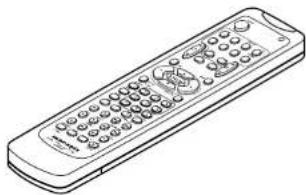
natural_image
Line drawing of a remote control device with keypad and scroll (no text or symbols)AAA-size batteries X 2
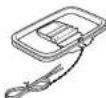
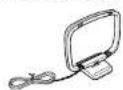
AM Loop Antenna
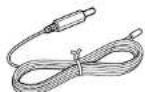
FM Antenna
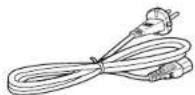
AC Power Cord
Registration Card
User Guide
FRONT PANEL
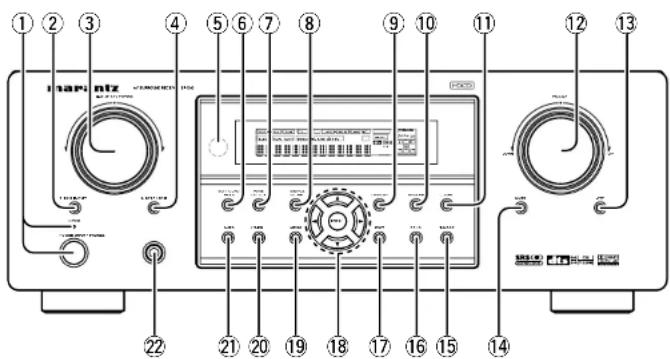
text_image
HAPI/NTZ 1 2 3 4 5 6 7 8 9 10 11 12 13 HAPI/NTZ 22 21 20 19 18 17 16 15 14① POWER switch and STANDBY indicator
Press the button to turn the power ON, and press again to turn it OFF. If the POWER switch is in the ON position, the power of this unit can be turned ON/OFF by pressing the POWER button on the remote control unit.
When this unit is in the standby mode with the POWER switch set to the ON position, pressing the ENTER button also allows to turn the power on.
The STANDBY indicator lights up when this unit is the standby mode (power OFF) by the remote control unit.
② 7.1CH INPUT button
Press this button to select the output of an external multichannel player.
③ INPUT SELECTOR knob (AUDIO/VIDEO)
This knob is used to select the input sources. The video function selector, such as TV, DVD, VCR1 and DSS, selects video and audio simultaneously. Audio function sources such as CD, TAPE, CDR/MD, and TUNER may be selected in conjunction with a Video source.
This feature (Sound Injection) combines a sound from one source with a picture from another. Choose the video source first, and then choose a different audio source to activate this function.
④ S.(Surround) SPEAKER B button
Press this button to activate the Surround Speaker B system. "SPKR B" indicator will be illuminated in the display. (See page 33)
⑤ INFRARED receiving sensor window
This window receives infrared signals for the remote control.
⑥ SURROUND MODE button
You can select the surround mode by pressing this button.
⑦ PURE DIRECT button
When this button is pressed, the tone control circuitry is bypassed as well as Bass Management. DIRECT indicator will be illuminated in the display.
Notes:
• The surround mode is automatically switched to AUTO when the pure direct function is turned on.
• Additionally, Speaker Configurations are fixed automatically as follows.
Front SPKR = Large, Center SPKR = Large, Surround SPKR = Large, Sub woofer = On
- This function is unavailable when the surround speaker B system is activated. While this function is activated, this function will be canceled if the S. SPEAKER B button is pressed.
⑧ SIMPLE SETUP button
Press this button to enter the simple setup mode. You can setup the speaker conditions (speaker sizes, number of speakers, speaker delay times) quickly by pressing the cursor buttons.
⑨ DISPLAY button
When this button is pressed, the FL display mode is changed as Surround Mode → Auto-display Off → Display Off → Input Function and the display off indicator(DISP) lights up in condition of DISPLAY OFF.
⑩ MEMORY button
Press this button to enter the tuner preset memory numbers or station names. (See page 30)
⑪ CLEAR button
Press this button to cancel the station-memory setting mode or preset scan tuning. (See page 31)
⑫ VOLUME control knob
Adjusts the overall sound level. Turning the control clockwise increases the sound level.
⑬ ATT (Attenuate) button
If the selected analog audio input signal is greater than the capable level of internal processing, the PEAK indicator will illuminate. If this happens, you should press the ATT button. "ATT" is displayed when this function is activated.
The signal-input level is reduced by about half. Attenuation will not work with the output signal of ^ REC OUT ^® (TAPE, CD-R/MD, VCR1 and VCR2 output). This function is memorized for each input function.
⑭ MUTE button
Press this button to mute the output to the speakers. Press it again to return to the previous volume level.
⑮ T-MODE button
Press this button to select the auto stereo mode or mono mode when the FM band is selected. The "AUTO" indicator lights in the auto stereo mode. (See page 30)
⑯ BAND button
Press this button to switch between FM and AM in the TUNER mode.
⑰ EXIT button
This button is used to exit from the SETUP MAIN MENU.
⑱ Cursor (◀,▶) ▼ ENTER button
Use these buttons when operating the SETUP MAIN MENU and TUNER function.
⑲ MENU button
This button is used to enter the SETUP MAIN MANU.
20 HT-EQ button
Used to turn on or off HT(Home Theater)-EQ mode. This mode compensates for the audio portion of a movie sounding "bright". When this button is pressed, "EQ" indicator lights up.
②1 AUTO (Auto surround) button
Press this button to select the AUTO mode from the surround modes. When this mode is selected, the receiver determines the surround mode corresponding to a digital input signal automatically.
22 HEADPHONE jack for stereo headphones This jack may be used to listen to the SR4600's output through a pair of headphones. Be certain that the headphones have a standard 1 / 4^* stereo phono plug. Note that the main room speakers will automatically be turned off when the headphone jack is in use.
Notes:
- When using headphones, the surround mode will change to STEREO and TruSurround (TS) headphones by SURROUND MODE button.
- The surround mode returns to the previous setting as soon as the headphone plug is removed from the jack.
FL DISPLAY

flowchart
graph TD
    A["DISP AUTO TUNED ST V"] --> B["SLEEP"]
    C["AUTO SURR"] --> D["DIRECT DISC 6.1 MTX 6.1 EQ"]
    E["OFF NIGHT PEAK ANAL"] --> F["SPKR B"]
    G["Digital"] --> H["PCM"]
    H --> I["BL SR"]
    J["Surround"] --> K["L C R"]
    L["Digital EX"] --> M["L"]
    N["Digital EX"] --> O["L"]
    P["Digital EX"] --> Q["L"]
    R["Digital EX"] --> S["L"]
    T["Digital EX"] --> U["L"]
    V["Digital EX"] --> W["L"]
    X["Digital EX"] --> Y["L"]
    Z["Digital EX"] --> AA["L"]
(1) DISP (Display Off) indicator
This indicator is illuminated when the SR4600 is in the display off condition.
(2) SLEEP timer indicator
This indicator is illuminated when the sleep timer function is active.
(3) AUTO SURR (Auto Surround mode) indicator
This indicator is illuminated to show that the AUTO SURROUND mode is in use.
(4) TUNER's indicators
AUTO : This indicator illuminates when the tuner's Auto mode is in use.
TUNED : This Indicator illuminates when a station is being received with sufficient signal strength to provide acceptable listening quality.
ST(Stereo): This indicator illuminates when an FM station is being tuned into stereo condition.
(5) DTS-ES mode indicators (DISC6.1, MTX6.1)
These indicators will illuminate to show the DTS-ES decoding mode (Discrete 6.1 or Matrix 6.1).
(6) V (video)-OFF mode indicator
This indicator is illuminated when the Video-OFF function is active.
(7) NIGHT mode indicator
This indicator is illuminated when the SR4600 is in the Night mode, which reduces the dynamic range of digital program material at low volume levels.
(8) SPKR (Speaker) B indicator
This indicator is illuminated when the S(Surround) speaker B system is active.
(9) PEAK Indicator
This indicator is a monitor for an analog audio input signal. If the selected analog audio input signal is greater than the capable level of internal processing, this will illuminate. If this happens, you should press the ATT button on the front panel or the remote.
(10) EQ mode indicator
This indicator is illuminated when the HT-EQ function is active.
(11) ATT (Attenuation) indicator
This indicator is illuminated when the attenuation function is active.
(12) DIGITAL Input Indicator
This indicator lights when a digital input has been selected.
(13) ANALOG input indicator
This indicator is illuminated when an analog input source has been selected.
(14) SIGNAL FORMAT indicators
☐ DIGITAL, EX, ☐ SURROUND, dts, ES, 96/24, PCM
When the selected input is a digital source, some of these indicators will be illuminated to display the specific type of signal in use.
(15) ENCODED CHANNEL STATUS
indicators
These indicators display the channels that are encoded with a digital
input signal. If the selected digital input signal is Dolby Digital 5.1ch or DTS 5.1ch, "L", "C", "R", "SL", "SR" and "LFE" will be illuminated. If the digital input signal is 2 channel PCM audio, "L" and "R" will be displayed.
If Dolby Digital 5.1ch signal with Surround EX flag or DTS-ES signal comes in, "L", "C", "R", "SL", "S", "SR" and "LFE" will be illuminated.
(16) Main Information Display
This display shows messages relating to the status, input source, surround mode, tuner, volume level or other aspects of unit's operation.
(17) DIRECT (Pure direct) indicator
This indicator is illuminated when the SR4600 is in the PURE DIRECT mode.
(18) HDCD indicator
When HDCD signal is decoded from digital input, this indicator will light up.
REAR PANEL
text_image
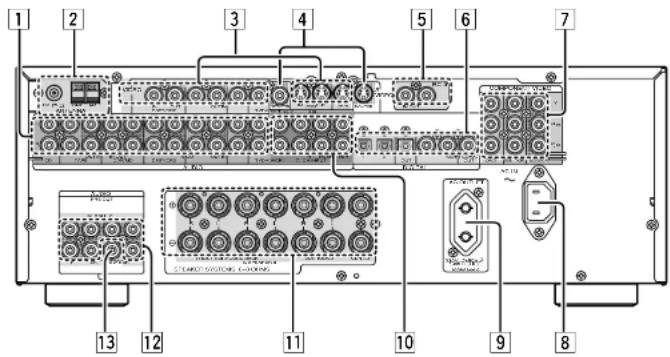
Diagram of an electronic device rack with numbered components and labeled connectors1 AUDIO IN/OUT (CD, TAPE, CD-R/MD, TV, DVD, VCR1, DSS/VCR2)
These are the analog audio inputs and outputs. There are 7 audio inputs (4 of which are linked to video inputs) and 4 audio outputs (2 of which are linked to video outputs). The audio jacks are nominally labeled for cassette tape decks, compact disc players, DVD players and etc.... The audio inputs and outputs require RCA-type connectors.
2 FM antenna terminal (75 ohms)
Connect an external FM antenna with a coaxial cable, or a cable network FM source.
AM antenna and ground terminals
Connect the supplied AM loop antenna. Use the terminals marked "AM" and "GND". The supplied AM loop antenna will provide good AM reception in most areas. Position the loop antenna until you hear the best reception.
3 VIDEO IN/OUT (TV, DVD, VCR1, DSS/VCR2)
These are the video inputs and outputs. There are 4 video inputs and 2 video outputs and each one includes both composite video and S-video configurations. Connect VCRs, DVD players, and other video components to the video inputs.
The 2 video output channels can be used to be connected to video tape recorders for making recordings.
The input signals of video and S-video are converted each other, and each of the converted video signals can be output.
4 MONITOR OUT
This is a monitor output and each one includes both composite video and S-video configurations.
5 REMOTE CONT. IN/OUT terminals
Connect to a Marantz component equipped with remote control (RC-5) terminals.
6 DIGITAL INPUT (Dig.1 - 4) / OUTPUT (coaxial, optical)
These are the digital audio inputs and outputs. There are 2 digital inputs with coaxial jacks, 2 with optical jacks.
The inputs accept digital audio signals from a compact disc, LD, DVD, or other digital source component.
For digital output, there is 1 coaxial output and 1 optical output.
The digital outputs can be connected to MD recorders, CD recorders, DAT decks, or other similar components.
COMPONENT VIDEO INPUT/OUTPUT
If your DVD player or other device has component video connectors, be sure to connect them to these component video connectors on the SR4600. The SR4600 has two component video input connectors to obtain the color information (Y, Cs, C=) directly from the recorded DVD signal or other video component and one component video output connector to output it directly into the matrix decoder of the display device.
By sending the pure DVD component video signal directly, the DVD signal forgoes the extra processing that normally would degrade the image. The result is vastly increased image quality, with incredibly life like colors and crisp detail.
| 8 | AC IN
Connect to supplied an AC cable, and connect to an AC power outlet.
SR4600 has to be powered by 230V AC only.
9 AC OUTLET
Connect the AC power cable of component such as a DVD or CD player to this outlet.
The marked SWITCHED provides power only when the SR4600 is turned on and is useful for components which you use every time you play your system.
Caution:
• In order to avoid potential turn-off thumps, anything plugged into these outlets should be powered up before the SR4600 is turned on.
- The capacity of this AC outlet is 100W. Do not connect devices that consume electricity more than the capacity of these AC outlet. If the total power consumption of the connected devices exceeds the capacity, the protection circuit shuts down the power supply.
10 7.1 CHANNEL INPUT
By connecting a DVD Audio player, SACD multichannel player, or other components that has a multichannel port, you can playback the audio with 5.1 channel or 7.1 channel outputs.
11 Speaker outputs terminals
Seven terminals are provided for the front left, front right, front center, surround left, surround right, surround back left and surround back right speakers.
Note:
- You can use surround back speaker terminals as S(Surround) SPEAKER B terminals, when you use no surround back speaker.
12 Preamp Outputs
(L, R, ŠL, SR, SBL, SBR, C)
Jacks for L(front left), R (front right), C (Center), SL (surround left), SR (surround right), SBL (surround back left) and SBR (surround back right). Use these jacks for connection to external power amplifiers.
13 Subwoofer Output
Connect this jack to the line level input of a powered subwoofer. If an external subwoofer amplifier is used, connect this jack to the subwoofer amplifier input. If you are using two subwoofers, either powered or with a 2 channel subwoofer amplifier, connect a "v" connector to the subwoofer output jack and run one cable from it to each subwoofer amplifier.
The provided remote control unit is a universal remote controller. The POWER button, numeric buttons and control buttons are used in common across different input source components.
The input source controlled with the remote control unit changes when one of the input selector buttons is pressed.

text_image
1 2 3 4 5 6 7 8 9 10 11 12 13 14 marantz RANTER RANTER RANTER RANTER ENTER1 Transmitting indicator
Lights up during a button is pressed and an infrared signal is sending.
2 (Main) POWER buttons
(when AMP mode is selected)
Press to switch the power of the SR4600 ON or OFF after pressing the AMP button.
3 Input selector buttons/ FUNCTION SELECTOR buttons (AUDIO/VIDEO INPUT)
These buttons are used to select a Audio or Video source component. Press one of these buttons once to change the function of the remote control. Press same button within 2 seconds, the input function of the SR4600 is changed.
Audio function sources such as CD, TAPE, CDR/MD, and TUNER may be selected in conjunction with a Video source.
This feature (Sound Injection) combines a sound from one source with a picture from another. Choose the video source first, and then choose a different audio source to activate this function.
Notes:
- CDR/MD button is set CDR function at initial. To switch MD function, press and hold down CDR/MD button and press 2 button.
- To return CDR function, press and hold down CDR/MD button and press 1 button.
4 MAIN VOLUME UP (▲/DOWN ( ) Buttons
Main volume control of the SR4600. The front, surround, center and subwoofer channel volumes controlled by these buttons simultaneously.
5 MUTE button
Muting button of the SR4600. Press this button decrease the sound temporarily. Press this button again to return to the previous sound. When this button is pressed, "MUTE" indicator lights up.
6 MENU button
(when AMP mode is selected)
This button is used to enter the SETUP MAIN MENU.
7 Cursor (◀,▶) ▼ OK buttons
(when AMP mode is selected)
Use these button when operating the SETUP MAIN MENU.
8 MENU OFF button
(when AMP mode is selected)
This button is used to exit from the SETUP MAIN MENU.
9 Numeric buttons 1 to 9 / Surround mode buttons
Numeric buttons
These buttons are used to enter figures in the selection of a tuner preset station and station name preset or to set select a CD track number, etc. The functions of these buttons are dependent on the function button selected.
Surround mode buttons
(when AMP mode is selected)
These buttons are used to select the surround mode.
10 P.SCAN (Preset scan) / V(Video)-OFF button
(when TUNER mode is selected)
This button is used to start preset scan when SR4600 is selected TUNER mode.
(when AMP mode is selected)
This is used when switching the video signals from the various monitor outputs to Video-Off mode.
11 0 / A/D button
0 button
This button is used to enter the number "0"
A/D button (when AMP mode is selected)
This is used to switch between the analog and digital inputs.
12 CONTROL buttons
These buttons are used when operating the CD player, TAPE deck, etc.
The function of these buttons are dependent on the function button selected.
For the controllable functions of each input function, please refer to controllable function table on the page 10.
13 SUB-T (Title) / ATT (attenuator) button When the input signal is too high and the voice distorts even while adjusting the SR4600 VOLUME control, turn on this function. "ATT" is illuminated when this function is activated.
The input level is reduced. Attenuator is invalid for the output signal of "REC OUT".
Note:
- This function is unavailable while the digital input is selected.
14 INPUT/DISC+/CH.SEL buttons
This button is used to enter the input level setup menu.
15 TREBLE UP (▲/DOWN ( ) buttons
These buttons are used to adjust the tone control of high frequency sound for left and right speaker.
16 BASS UP (▲/DOWN ( )buttons
These buttons are used to adjust the tone control of low frequency sound for left, right and subwoofer speaker.
17 MEMO button
Memory enable button for various preset functions.
18 CLEAR button
This button is used to cancel for certain memory or programming operations.
19 DISPLAY button
Selects the display mode for the front display of the SR4600.
20 NIGHT button
Pressing this button prevents the Dolby Digital signal from playback at a loud voice. This function reduces the voice by 1/3 to 1/4 at maximum. Thus, it eliminates the occurrence of an abruptly loud voice at night. However, the function is valid only in the case when the Dolby Digital signal is entered into OPTICAL or COAXIAL and data to compress the voice exists in the signal to be played back.
When this button is pressed, the "NIGHT" indicator is illuminated.
21 PURE DIRECT button
When this button is pressed, the tone control circuit is bypassed.
22 SETUP / T.TONE button
(when AMP mode is selected) Used to enter the test tone menu
23 OSD button
Note:
• This button is unavailable for SR4600.
24 SLEEP (sleep timer) button
This button is used for setting the sleep timer. It can be operated the same way as the button on the unit.
25 TV VOLUME UP (▲/DOWN ( )▼buttons
These buttons increase or decrease TV's volume.
PROGRAMMING THE REMOTE CONTROLLER
The remote controller RC5500SR must be programmed to use the codes for your appliances of different brands. This is done by keying in a 4-digit code or by scanning the codes until the correct one is found. We recommend to using the 4-digit code. This mode is faster and more reliable. The code scanning method should be used only if you cannot find the code for one of your appliances. The codes are listed at the end of this book.
Important:
- Use the remote control buttons for programming, not the buttons of the receiver or other appliances.
- Some codes may be not match your equipment. In this case, your equipment cannot be controlled with this remote controller.
PROGRAMMING WITH THE 4-DIGIT CODE
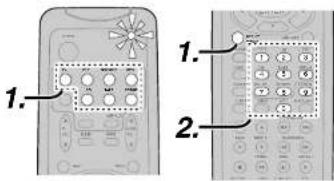
text_image
Diagram showing two views of a mobile phone control panel with labeled buttons and a starburst icon, likely illustrating a device interface or status.- Press and hold down the Function Selector button for the appliance which should be controlled and press SETUP button until the indicator blinks twice.
- Press the 4-digit code for appliance (code table at the end of this book)
- When the procedure is successful, the indicator will blink twice.
Note:
- If the indicator did not blink twice, then repeat steps 1 through 2 and try entering the same code again.
SCANNING THE CODE TABLE
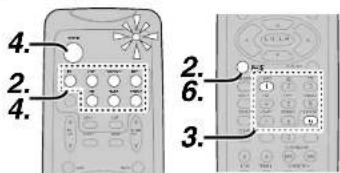
text_image
4. 2. 4. 2. 6. 3.- Switch on the appliance which should be controlled.
- Press and hold down the Function Selector button for appliance which should be controlled and press SETUP button until the indicator blinking twice.
- Press the code 9 - 9 - 1. The indicator will blink twice.
- Aim the remote control at the appliance and slowly alternate between pressing POWER button and the Function Selector button for the appliance.
- Stop when the appliance turns off.
- Press SETUP button once to lock in the code.
CHECKING THE CODE
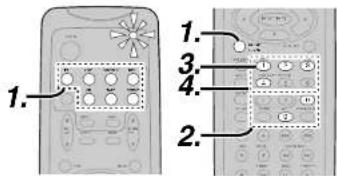
text_image
Diagram showing two views of a mobile phone with numbered labels pointing to the screen layout.- Press and hold down the Function Selector button for appliance which should be controlled and press SETUP button until the indicator blinking twice.
- Press the code 9 - 9 - 0. The indicator will blink twice.
- To view the code for first digit, press 1 once. Wait 3 seconds, count the indicator blinks (e.g. 3 blinks = 3) and write down the number. Note:
If a code digit is "0", the indicator will not blink. Repeat step 3 three more times for remaining digits. Use 2 for the second digit, 3 for the third digit, and 4 for the fourth digit.
RESETTING THE ALL CODE
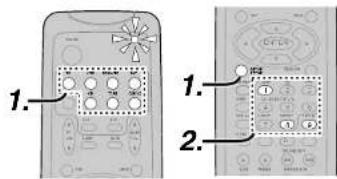
text_image
Diagram showing two labeled electronic devices with control panels and buttons, numbered 1 and 2.- Press and hold down the any Function Selector button and press SETUP button until the indicator blinking twice.
- Press the code 9 - 8 - 1. The indicator will blink twice. Then, RC5500SR will return to the factory preset code.
Note:
• After this procedure, the selected function button is set initial code and other function buttons are set initial code too.
Once you have found and the codes for your various appliances, you may want to write them down here.
TV
VCR
DSS
DVD
CD
TAPE
CDR
MD
The distance between the transmitter of the remote control and the IR SENSOR of the SR4600 should be less than 5 meters. If the remote control is pointed in a direction other than the IR SENSOR or if there is an obstacle between them, use of the remote control may not be possible.
Remote-controllable range
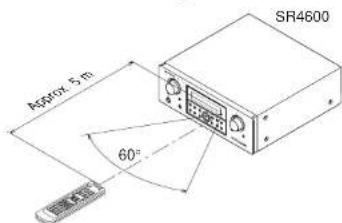
text_image
SR4600 Approx. 5 m 60°Remote control unit (RC5500SR)
LOADING BATTERIES
The life of the batteries used with the remote control is about 4 months with normal use. Also be sure to replace batteries earlier when you notice that they are getting weak.
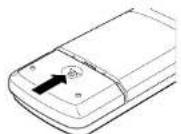
- Remove the back cover.

- Insert the new batteries (AAA type) with correct ⊕ and ⊕ polarity.
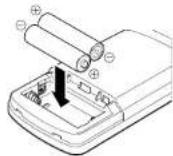
- Close the cover until it clicks.
GENERAL INFORMATION OF RC5500SR TO SR4600
To control the SR4600 by your RC5500SR, you have to select the device AMP or TUNER by pressing the function selector button. Please refer below for the details in AMP and TUNER mode.
AMP MODE

text_image
Front panel of a remote control with labeled buttons and ports in ChineseTUNER MODE

text_image
Front panel of a remote control with labeled buttons and display screen showing numeric keypad| POWER Tums the SR4600 on and off | |
| Function selector * Selects a particular source component | |
| SLEEP * Sets the sleep timer function | |
| MUTE * Decreases the sound temporarily | |
| VOL ▲▼* Adjusts the over all sound level | |
| MENU Enters the SETUP MENU | |
| Cursor Moves the cursor for settings in the SETUP MENU | |
| ENTER • Enters the SETUP MENU• Confirms the settings in SETUP MENU | |
| SETUP/T.TONE Enters the test tone mode for setting the Speaker Level Setup | |
| MENU OFF Exits from the SETUP MENU | |
| PURE DIRECT * Selects the Pure Direct mode | |
| NIGHT * Turns or off the NIGHT mode | |
| DISPLAY * Change the front display mode | |
| Surround mode ['8] Selects the surround mode | |
| 7.1CH-IN (9) Selects the 7.1CH IN | |
| A/D (0) Switches between the analog and digital Inputs | |
| BASS ▲▼* Adjusts the tone control of low frequency sound | |
| TREBLE ▲▼* Adjusts the tone control of high frequency sound | |
| SUB-T/ATT Reduces the input level | |
| P.SCAN/V-OFF Turns on or off the Video output | |
| CH. SEL Adjusts the input level | |
| LIP.SYNC Selects the LIP. SYNC mode |
* These buttons are used to control SR4600 in any function mode.
| TUNER | Selects a frequency band |
| 0-9 | Inputs the numeric its |
| CLEAR | Clears the inputting |
| MEMO | Enters the tuner preset memory numbers |
| P.SCAN/V-OFF | Starts preset scan |
| CHANNEL/SKIP4 /4 | • Selects a preset station• Changes a PTY type * |
| TUNE/SEARCH◀/▶ | Tunes a station |
| T-MODE ◀ ▶ | Selects the auto stereo mode or mono mode |
| RDS ■ | Selects the display mode in RDS * |
| F.DIRECT ▶ | Selects the “Frequency direct input” |
| PTY ■ | Displays the programmed information of the current station * |
* : European model only
THE CONTRABLE FUNCTION TABLE

text_image
Front panel of a remote control with labeled buttons and dials, showing function keys and status indicators.| TV VCF | DVD DSS CD | TAPE CDR | MD | |||||
| POWER POWER POWER POWER POWER POWER | ||||||||
| MENU | CALL UP MENU | CALL UP CALL MENU | UP CALL U MENU | UP SWITCH MENU | SWITCH DISPLAY | SWITCH SWITCH DISPLAY | DISPLAY | DISPLAY |
| Cursor | Cursor | Cursor | Cursor | Cursor | - | - | - | - |
| ENTER | OK | OK | OK | OK | - | - | - | - |
| SETUP/T.TONE - | - | SETUP MENU | - | - | - | - | - | |
| MENU OFF | - | CANCEL MENU | - | CANCEL MENU | - | - | - | - |
| 0 - 9 | INPUT NUMERIC | INPUT NUMERIC | INPUT NUMERIC | INPUT NUMERIC | INPUT NUMERIC | INPUT NUMERIC | INPUT NUMERIC | INPUT NUMERIC |
| CLEAR | INPUT CLEAR | TAPE SPEED | INPUT CLEAR | INPUT CLEAR | INPUT CLEAR | INPUT CLEAR | INPUT CLEAR | INPUT CLEAR |
| MEMO | - | - | CALL PROGRAM | - | CALL PROGRAM | CALL PROGRAM | CALL PROGRAM | CALL PROGRAM |
| CHANNEL/SKIP ↔ | CH- | PREV | PREV | CH- | PREV | PREV | PREV | PREV |
| CHANNEL/SKIP ↔ | CH- | NEXT | NEXT | CH+ | NEXT | NEXT | NEXT | NEXT |
| TUNE/SEARCH ↔ | - | REWIND | REWIND | - | REWIND | REWIND | REWIND | REWIND |
| TUNE/SEARCH ↔ | - | FF | FF | - | FF | FF | FF | FF |
| ● (REC) | - | REC | - | - | - | REC | REC | REC |
| T-MODE ◀▶ | - | - | - | - | - | DIRECTION | - | - |
| RDS ■ | - | PAUSE | PAUSE | - | PAUSE | PAUSE | PAUSE | PAUSE |
| F.DIRECT ▶ | - | PLAY | PLAY | - | PLAY | PLAY | PLAY | PLAY |
| INPUT/DISC+ | INPUT SEL. | TV/VCR | DISC+ | TV/DSS | DISC+ | - | DISC+ | - |
| AUDIO | - | AUDIO | AUDIO | AUDIO | - | - | - | - |
| PTY ■ | - | STOP | STOP | - | STOP | STOP | STOP | STOP |
| SUB-T/ATT | - | - | SUBTITLE | - | - | - | - | - |
CONNECTIONS
SPEAKER PLACEMENT
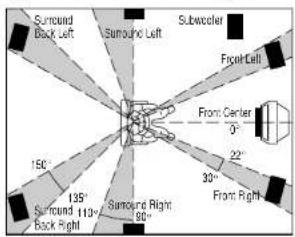
The ideal surround speaker system for this unit is 7-speaker systems, using front left and right speakers, a center speaker, surround left and right speakers, surround back left and right speakers, and a subwoofer.
For best results we recommend that all front speakers be of the same type, with identical or similar driver units. This will deliver smooth pans across the front sound stage as the action moves from side to side. Your center channel speaker is very important as over 80 % of the dialog from a typical motion picture emanates from the center channel.
It should possess similar sonic characteristics to the main speakers. Surround channel speakers need not be identical to the front channel speakers, but they should be of high quality.
The surround center speaker is useful for playback of Dolby Digital Surround EX or DTS-ES. One of the benefits of both Dolby Digital and DTS is that surround channels are discrete full range, while they were frequency limited in earlier "Pro Logic" type systems.
Bass effects are an important part of home theater. For optimal enjoyment a subwoofer should be used as it is optimized for low frequency reproduction. If you have full range front speakers, however, they may be used in place of a subwoofer with proper setting of the switches in the menu system.
text_image
Sunround Back Left Sunround Left Subwoofer Front Call 150° 135° Sunround Right 113° Back Right 150° 22° 30° Front Center 0° Sunround Right 90°Front left and right speakers
We recommend to set the front L and R speakers with 45-60 degrees from the listening position.
Center speaker
Align the front line of the center speaker with the front L/R speakers. Or place the center speaker a little backward from the line.
Surround left and right speakers
When the SR4600 is used in surround operation, the preferred location for surround speakers is on the side walls of the room, at or slightly behind the listening position.
The center of the speaker should face into the room.
Surround back left and right speakers
Surround back speakers are required when a full 7.1-channel system is installed.
Speakers should be placed on a rear wall, behind the listening position.
The center of the speaker should face into the room.
Subwoofer
We recommend using a subwoofer to have maximum bass effect. Subwoofer bears only low frequency range so you can place it any where in the room.
HEIGHT OF THE SPEAKER UNITS
Front left and right speakers, and a center speaker Align the tweeters and mid-range drivers on the three front speakers at the same height, as best as possible.
Surround left and right speakers, and surround back speaker
Place the surround left, right and surround back speakers higher than your ears by about 70cm – 1m. Also place the speakers at the same height, as best as possible.
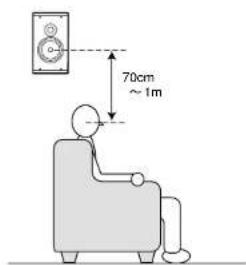
text_image
70cm ~1mNote:
Use magnetically-shielded speakers for front left, right and the center speakers when the speakers are installed near the TV and the TV is a monitor type.
CONNECTING SPEAKERS
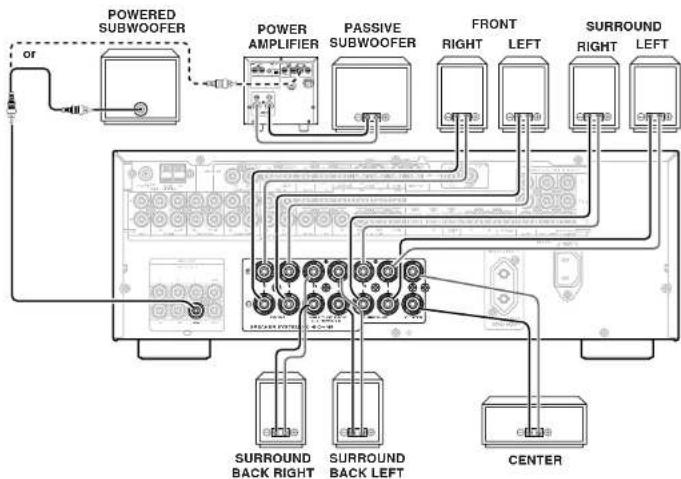
flowchart
graph TD
    A["POWERED SUBWOOFER"] --> B["POWER AMPLIFIER"]
    B --> C["PASSIVE SUBWOOFER"]
    C --> D["FRONT"]
    D --> E["RIGHT"]
    D --> F["LEFT"]
    D --> G["SURROUND RIGHT"]
    D --> H["LEFT"]
    I["OR"] --> A
    J["SURROUND BACK RIGHT"] --> K["SURROUND BACK LEFT"]
    L["CENTER"] --> M["Central"]
CONNECTING SPEAKER WIRE
- Strip away approx. 10 mm of wire insulation.
- Twist the bared wire ends tight, to prevent short circuits.
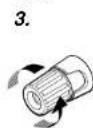
- Loosen the knob by turning it counterclockwise.
- Insert the bare part of the wire into the hole in side of each terminal.
- Tighten the knob by turning it clockwise to secure the wire.


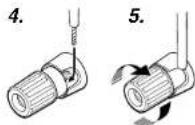
Caution:
- Be sure to use speakers with the specified impedance as shown on the rear panel of this unit.
• To prevent damage to circuitry, do not let the bare speaker wires touch
each other and do not let them touch any metal part of this unit.
- Do not touch the speaker terminals when the power is on. It may cause you to receive an electric shocks.
- Do not connect more than one speaker cable to one speaker terminal. Doing so may damage this unit.
Note:
- Be sure to connect the positive and negative cables for the speaker properly. If they are miss-connected, the signal phase will be reversed and the signal quality will be corrupted.
CONNECTING A SUBWOOFER
Use the PRE OUT SUBWOOFER jack to connect a powered subwoofer (power amplifier built in). If your subwoofer is a passive type (power amplifier is not built in), connect a monaural power amplifier to the PRE OUT SUBWOOFER jack and connect the subwoofer to the amplifier.
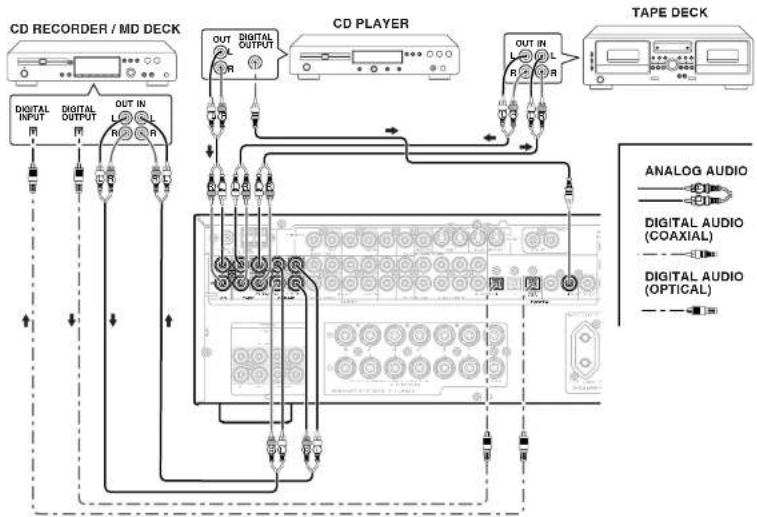
CONNECTING AUDIO COMPONENTS

flowchart
graph TD
    A["CD RECORDER / MD DECK"] --> B["CD PLAYER"]
    B --> C["TAPE DECK"]
    subgraph Digital Audio System
        D1["ANALOG AUDIO"] --> E1["DIGITAL AUDIO (COAXIAL)"]
        D2["DIGITAL AUDIO (OPTICAL)"] --> E2["DIGITAL AUDIO (COAXIAL)"]
        D3["DIGITAL AUDIO (OPTICAL)"] --> E3["DIGITAL AUDIO (COAXIAL)"]
        D4["DIGITAL AUDIO (OPTICAL)"] --> E4["DIGITAL AUDIO (COAXIAL)"]
        D5["DIGITAL AUDIO (OPTICAL)"] --> E5["DIGITAL AUDIO (COAXIAL)"]
        D6["DIGITAL AUDIO (OPTICAL)"] --> E6["DIGITAL AUDIO (COAXIAL)"]
        D7["DIGITAL AUDIO (OPTICAL)"] --> E7["DIGITAL AUDIO (COAXIAL)"]
        D8["DIGITAL AUDIO (OPTICAL)"] --> E8["DIGITAL AUDIO (COAXIAL)"]
        D9["DIGITAL AUDIO (OPTICAL)"] --> E9["DIGITAL AUDIO (COAXIAL)"]
        D10["DIGITAL AUDIO (OPTICAL)"] --> E10["DIGITAL AUDIO (COAXIAL)"]
        D11["DIGITAL AUDIO (OPTICAL)"] --> E11["DIGITAL AUDIO (COAXIAL)"]
        D12["DIGITAL AUDIO (OPTICAL)"] --> E12["DIGITAL AUDIO (COAXIAL)"]
        D13["DIGITAL AUDIO (OPTICAL)"] --> E13["DIGITAL AUDIO (COAXIAL)"]
        D14["DIGITAL AUDIO (OPTICAL)"] --> E14["DIGITAL AUDIO (COAXIAL)"]
        D15["DIGITAL AUDIO (OPTICAL)"] --> E15["DIGITAL AUDIO (COAXIAL)"]
        D16["DIGITAL AUDIO (OPTICAL)"] --> E16["DIGITAL AUDIO (COAXIAL)"]
        D17["DIGITAL AUDIO (OPTICAL)"] --> E17["DIGITAL AUDIO (COAXIAL)"]
        D18["DIGITAL AUDIO (OPTICAL)"] --> E18["DIGITAL AUDIO (COAXIAL)"]
        D19["DIGITAL AUDIO (OPTICAL)"] --> E19["DIGITAL AUDIO (COAXIAL)"]
        D20["DIGITAL AUDIO (OPTICAL)"] --> E20["DIGITAL AUDIO (COAXIAL)"]
        D21["DIGITAL AUDIO (OPTICAL)"] --> E21["DIGITAL AUDIO (COAXIAL)"]
        D22["DIGITAL AUDIO (OPTICAL)"] --> E22["DIGITAL AUDIO (COAXIAL)"]
        D23["DIGITAL AUDIO (OPTICAL)"] --> E23["DIGITAL AUDIO (COAXIAL)"]
        D24["DIGITAL AUDIO (OPTICAL)"] --> E24["DIGITAL AUDIO (COAXIAL)"]
        D25["DIGITAL AUDIO (OPTICAL)"] --> E25["DIGITAL AUDIO (COAXIAL)"]
        D26["DIGITAL AUDIO (OPTICAL)"] --> E26["DIGITAL AUDIO (COAXIAL)"]
        D27["DIGITAL AUDIO (OPTICAL)"] --> E27["DIGITAL AUDIO (COAXIAL)"]
        D28["DIGITAL AUDIO (OPTICAL)"] --> E28["DIGITAL AUDIO (COAXIAL)"]
        D29["DIGITAL AUDIO (OPTICAL)"] --> E29["DIGITAL AUDIO (COAXIAL)"]
        D30["DIGITAL AUDIO (OPTICAL)"] --> E30["DIGITAL AUDIO (COAXIAL)"]
        D31["DIGITAL AUDIO (OPTICAL)"] --> E31["DIGITAL AUDIO (COAXIAL)"]
        D32["DIGITAL AUDIO (OPTICAL)"] --> E32["DIGITAL AUDIO (COAXIAL)"]
        D33["DIGITAL AUDIO (OPTICAL)"] --> E33["DIGITAL AUDIO (COAXIAL)"]
        D34["DIGITAL AUDIO (OPTICAL)"] --> E34["DIGITAL AUDIO (COAXIAL)"]
        D35["DIGITAL AUDIO (OPTICAL)"] --> E35["DIGITAL AUDIO (COAXIAL)"]
        D36["DIGITAL AUDIO (OPTICAL)"] --> E36["DIGITAL AUDIO (COAXIAL)"]
        D37["DIGITAL AUDIO (OPTICAL)"] --> E37["DIGITAL AUDIO (COAXIAL)"]
        D38["DIGITAL AUDIO (OPTICAL)"] --> E38["DIGITAL AUDIO (COAXIAL)"]
        D39["DIGITAL AUDIO (OPTICAL)"] --> E39["DIGITAL AUDIO (COAXIAL)"]
        D40["DIGITAL AUDIO (OPTICAL)"] --> E40["DIGITAL AUDIO (COAXIAL)"]
        D41["DIGITAL AUDIO (OPTICAL)"] --> E41["DIGITAL AUDIO (COAXIAL)"]
        D42["DIGITAL AUDIO (OPTICAL)"] --> E42["DIGITAL AUDIO (COAXIAL)"]
        D43["DIGITAL AUDIO (OPTICAL)"] --> E43["DIGITAL AUDIO (COAXIAL)"]
        D44["DIGITAL AUDIO (OPTICAL)"] --> E44["DIGITAL AUDIO (COAXIAL)"]
        D45["DIGITAL AUDIO (OPTICAL)"] --> E45["DIGITAL AUDIO (COAXIAL)"]
        D46["DIGITAL AUDIO (OPTICAL)"] --> E46["DIGITAL AUDIO (COAXIAL)"]
        D47["DIGITAL AUDIO (OPTICAL)"] --> E47["DIGITAL AUDIO (COAXIAL)"]
        D48["DIGITAL AUDIO (OPTICAL)"] --> E48["DIGITAL AUDIO (COAXIAL)"]
        D49["DIGITAL AUDIO (OPTICAL)"] --> E49["DIGITAL AUDIO (COAXIAL)"]
        D50["DIGITAL AUDIO (OPTICAL)"] --> E50["DIGITAL AUDIO (COAXIAL)"]
        D51["DIGITAL AUDIO (OPTICAL)"] --> E51["DIGITAL AUDIO (COAXIAL)"]
        D52["DIGITAL AUDIO (OPTICAL)"] --> E52["DIGITAL AUDIO (COAXIAL)"]
        D53["DIGITAL AUDIO (OPTICAL)"] --> E53["DIGITAL AUDIO (COAXIAL)"]
        D54["DIGITAL AUDIO (OPTICAL)"] --> E54["DIGITAL AUDIO (COAXIAL)"]
        D55["DIGITAL AUDIO (OPTICAL)"] --> E55["DIGITAL AUDIO (COAXIAL)"]
        D56["DIGITAL AUDIO (OPTICAL)"] --> E56["DIGITAL AUDIO (COAXIAL)"]
        D57["DIGITAL AUDIO (OPTICAL)"] --> E57["DIGITAL AUDIO (COAXIAL)"]
        D58["DIGITAL AUDIO (OPTICAL)"] --> E58["DIGITAL AUDIO (COAXIAL)"]
        D59["DIGITAL AUDIO (OPTICAL)"] --> E59["DIGITAL AUDIO (COAXIAL)"]
        D60["DIGITAL AUDIO (OPTICAL)"] --> E60["DIGITAL AUDIO (COAXIAL)"]
        D61["DIGITAL AUDIO (OPTICAL)"] --> E61["DIGITAL AUDIO (COAXIAL)"]
        D62["DIGITAL AUDIO (OPTICAL)"] --> E62["DIGITAL AUDIO (COAXIAL)"]
        D63["DIGITAL AUDIO (OPTICAL)"] --> E63["DIGITAL AUDIO (COAXIAL)"]
        D64["DIGITAL AUDIO (OPTICAL)"] --> E64["DIGITAL AUDIO (COAXIAL)"]
        D65["DIGITAL AUDIO (OPTICAL)"] --> E65["DIGITAL AUDIO (COAXIAL)"]
        D66["DIGITAL AUDIO (OPTICAL)"] --> E66["DIGITAL AUDIO (COAXIAL)"]
        D67["DIGITAL AUDIO (OPTICAL)"] --> E67["DIGITAL AUDIO (COAXIAL)"]
        D68["DIGITAL AUDIO (OPTICAL)"] --> E68["DIGITAL AUDIO (COAXIAL)"]
        D69["DIGITAL AUDIO (OPTICAL)"] --> E69["DIGITAL AUDIO (COAXIAL)"]
        D70["DIGITAL AUDIO (OPTICAL)"] --> E70["DIGITAL AUDIO (COAXIAL)"]
        D71["DIGITAL AUDIO (OPTICAL)"] --> E71["DIGITAL AUDIO (COAXIAL)"]
        D72["DIGITAL AUDIO (OPTICAL)"] --> E72["DIGITAL AUDIO (COAXIAL)"]
        D73["DIGITAL AUDIO (OPTICAL)"] --> E73["DIGITAL AUDIO (COAXIAL)"]
        D74["DIGITAL AUDIO (OPTICAL)"] --> E74["DIGITAL AUDIO (COAXIAL)"]
        D75["DIGITAL AUDIO (OPTICAL)"] --> E75["DIGITAL AUDIO (COAXIAL)"]
        D76["DIGITAL AUDIO (OPTICAL)"] --> E76["DIGITAL AUDIO (COAXIAL)"]
        D77["DIGITAL AUDIO (OPTICAL)"] --> E77["DIGITAL AUDIO (COAXIAL)"]
        D78["DIGITAL AUDIO (OPTICAL)"] --> E78["DIGITAL AUDIO (COAXIAL)"]
        D79["DIGITAL AUDIO (OPTICAL)"] --> E79["DIGITAL AUDIO (COAXIAL)"]
        D80["DIGITAL AUDIO (OPTICAL)"] --> E80["DIGITAL AUDIO (COAXIAL)"]
        D81["DIGITAL AUDIO (OPTICAL)"] --> E81["DIGITAL AUDIO (COAXIAL)"]
        D82["DIGITAL AUDIO (OPTICAL)"] --> E82["DIGITAL AUDIO (COAXIAL)"]
        D83["DIGITAL AUDIO (OPTICAL)"] --> E83["DIGITAL AUDIO (COAXIAL)"]
        D84["DIGITAL AUDIO (OPTICAL)"] --> E84["DIGITAL AUDIO (COAXIAL)"]
        D85["DIGITAL AUDIO (OPTICAL)"] --> E85["DIGITAL AUDIO (COAXIAL)"]
        D86["DIGITAL AUDIO (OPTICAL)"] --> E86["Digonal Audio"]
    end
The output audio signal from the TAPE OUT jack and the CD-R/MD OUT jack is the same signal which is currently selected.
Caution:
- Do not connect this unit and other components to mains power until all connections between components have been completed.
Notes:
- Insert all plugs and connectors securely. Incomplete connections may make noise.
- Be sure to connect the left and right channels properly.
Red connectors are for the R (right) channel, and white connectors are for the L (left) channel.
- Be sure to connect input and output properly.
- Refer to the instructions for each component that is connected to this unit.
- Do not bind audio/video connection cables with power cords and speaker cables this will result in generating a hum or other noise.
CONNECTING DIGITAL AUDIO COMPONENTS
• There are 4 digital inputs, 2 coaxial jacks and 2 optical jacks, on the rear panel. You can use these jacks to input PCM, Dolby Digital and DTS bitstream signals from a CD, DVD, or other digital source components.
- There is one digital output coaxial jack and one optical output jack on the rear panel. These jacks can be connected to a CD recorder-, or a MD deck inputs, respectively.
- Refer to the instructions for each component. To setup the digital audio format of DVD player, or other digital source's connected to digital input jacks.
- Use fiber optical cables (optical) for DIG-1,2 input jacks. Use 75 ohms coaxial cables (for digital audio or video) for DIG-3, 4 input jacks.
- You can designate the input for each digital input/output jacks according to your component. See page 17.
Notes:
- There is no Dolby Digital RF input jack. Please use an external RF demodulator Dolby Digital decoder when connecting the Dolby Digital RF output jack of the video disc player to the digital input jack.
- The digital signal jacks on this unit conform to the EIA standard. If you use a cable that does not conform to this standard, this unit may not function properly.
• Each type of audio jack works independently. Signals input through the digital and analog jacks are output through the corresponding digital and analog jacks, respectively.
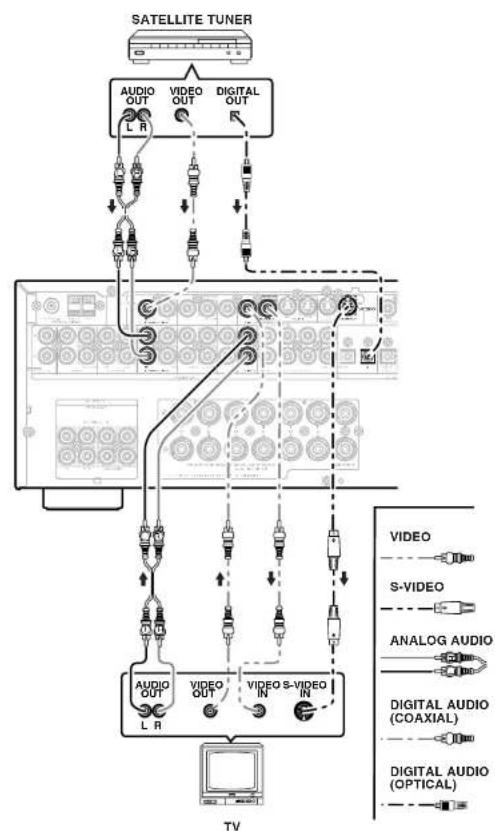
CONNECTING VIDEO COMPONENTS

flowchart
graph TD
    subgraph DVD_PLAYER
        A["VIDEO OUT"] --> B["L R"]
        C["AUDIO OUT"] --> B
        D["S-VIDEO OUT"] --> E["Digital OUT"]
        F["COMPONENT VIDEO OUT"] --> G["Video OUT"]
    end

    subgraph VIDEO_PROJECT
        H["S-VIDEO IN"] --> I["Component VIDEO IN"]
        J["VIDEO PROJECTOR"] --> K["Video ProjectOR"]
    end

    B --> L["VIDEO OUT IN"]
    E --> M["AUDIO OUT IN"]
    G --> N["S-VIDEO OUT IN"]
    I --> O["VIDEO PROJECTOR"]
    K --> P["VIDEO PROJECTOR"]

    L --> Q["VIDEO OUT IN"]
    M --> R["AUDIO OUT IN"]
    N --> S["S-VIDEO OUT IN"]
    Q --> T["VCR"]
    R --> T
    S --> T
    style DVD_PLAYER fill:#f9f,stroke:#333
    style VIDEO_PROJECT fill:#ccf,stroke:#333
flowchart
graph TD
    A["SATELLITE TUNER"] --> B["TV"]
    B --> C["VIDEO OUT"]
    B --> D["VIDEO OUT"]
    B --> E["VIDEO OUT"]
    B --> F["VIDEO OUT"]
    B --> G["VIDEO OUT"]
    B --> H["VIDEO OUT"]
    B --> I["VIDEO OUT"]
    B --> J["VIDEO OUT"]
    B --> K["VIDEO OUT"]
    B --> L["VIDEO OUT"]
    B --> M["VIDEO OUT"]
    B --> N["VIDEO OUT"]
    B --> O["VIDEO OUT"]
    B --> P["VIDEO OUT"]
    B --> Q["VIDEO OUT"]
    B --> R["VIDEO OUT"]
    B --> S["VIDEO OUT"]
    B --> T["VIDEO OUT"]
    B --> U["VIDEO OUT"]
    B --> V["VIDEO OUT"]
    B --> W["VIDEO OUT"]
    B --> X["VIDEO OUT"]
    B --> Y["VIDEO OUT"]
    B --> Z["VIDEO OUT"]
    B --> AA["VIDEO OUT"]
    B --> AB["VIDEO OUT"]
    B --> AC["VIDEO OUT"]
    B --> AD["VIDEO OUT"]
    B --> AE["VIDEO OUT"]
    B --> AF["VIDEO OUT"]
    B --> AG["VIDEO OUT"]
    B --> AH["VIDEO OUT"]
    B --> AI["VIDEO OUT"]
    B --> AJ["VIDEO OUT"]
    B --> AK["VIDEO OUT"]
    B --> AL["VIDEO OUT"]
    B --> AM["VIDEO OUT"]
    B --> AN["VIDEO OUT"]
    B --> AO["VIDEO OUT"]
    B --> AP["VIDEO OUT"]
    B --> AQ["VIDEO OUT"]
    B --> AR["VIDEO OUT"]
    B --> AS["VIDEO OUT"]
    B --> AT["VIDEO OUT"]
    B --> AU["VIDEO OUT"]
    B --> AV["VIDEO OUT"]
    B --> AW["VIDEO OUT"]
    B --> AX["VIDEO OUT"]
    B --> AY["VIDEO OUT"]
    B --> AZ["VIDEO OUT"]
    B --> BA["VIDEO OUT"]
    B --> BB["VIDEO OUT"]
    B --> BC["VIDEO OUT"]
    B --> BD["VIDEO OUT"]
    B --> BE["VIDEO OUT"]
    B --> BF["VIDEO OUT"]
    B --> BG["VIDEO OUT"]
    B --> BH["VIDEO OUT"]
    B --> BI["VIDEO OUT"]
    B --> BJ["VIDEO OUT"]
    B --> BK["VIDEO OUT"]
    B --> BL["VIDEO OUT"]
    B --> BM["VIDEO OUT"]
    B --> BN["VIDEO OUT"]
    B --> BO["VIDEO OUT"]
    B --> BP["VIDEO OUT"]
    B --> BQ["VIDEO OUT"]
    B --> BR["VIDEO OUT"]
    B --> BS["VIDEO OUT"]
    B --> BT["VIDEO OUT"]
    B --> BU["VIDEO OUT"]
    B --> BV["VIDEO OUT"]
    B --> BW["VIDEO OUT"]
    B --> BX["VIDEO OUT"]
    B --> BY["VIDEO OUT"]
    B --> CZ["VIDEO OUT"]
    B --> CA["VIDEO OUT"]
    B --> CB["VIDEO OUT"]
    B --> CC["VIDEO OUT"]
    B --> CD["VIDEO OUT"]
    B --> CE["VIDEO OUT"]
    B --> CF["VIDEO OUT"]
    B --> CG["VIDEO OUT"]
    B --> CH["VIDEO OUT"]
    B --> CI["VIDEO OUT"]
    B --> CJ["VIDEO OUT"]
    B --> CK["VIDEO OUT"]
There are 3 types of video jacks on the rear panel.
VIDEO jack
The video signal for the VIDEO jacks is the conventional composite video signal.
S-VIDEO jack
The video signal is separated into luminance (Y) and color (C) signals for the S-VIDEO Jack. The S-VIDEO signals enables high-quality color reproduction. If your video component has an S-VIDEO output, we recommend to use it. Connect the S-VIDEO output jack on your video component to the S-VIDEO input jack on this unit.
Component jack
Make component video connections to a TV or monitor with component inputs to produce higher quality video images. Use a component video cable or 3 video cords to connect the component video out jacks on the SR4600 to the monitor.
Video convert
The input signals of video and S-video are converted each other, and each of the converted video signals can be output.
For example, the video input signal from the VIDEO jack can be output to the monitor jack of S-VIDEO. Moreover, the contrary is also possible. Priority is given to S-VIDEO jack when having input by VIDEO and S-VIDEO jack from the same source.
Notes:
- Be sure to connect the left and right audio channels properly.
Red connectors are for the R (right) channel, and white connectors are the for L (left) channel. - Be sure to connect the inputs and outputs of the video signals properly.
- If you connect the S-VIDEO or component signal to the S-VIDEO or component jack on this unit, it is not necessary to connect the conventional video signal to the VIDEO (composite) jack. If you use both video inputs, this unit gives priority to the S-VIDEO signal.
• Each type of video jack works independently. Signals input to the VIDEO (composite) and S-VIDEO jacks or component are output to the corresponding VIDEO (composite) and S-VIDEO or component jacks, respectively. - You may need to setup the digital audio output format of your DVD player, or other digital source components. Refer to the instructions of the each component connected to the digital input jacks.
- There is no Dolby Digital RF input jack. Please use an external RF demodulator with a Dolby Digital decoder to connect a video disc player which has a Dolby Digital RF output jack to the digital input jack on this unit.
ADVANCED CONNECTING

flowchart
graph TD
    A["Power Amplifier"] --> B["Subwoofer"]
    B --> C["Front Left"]
    B --> D["Center"]
    B --> E["Front Right"]
    B --> F["Surround Left"]
    B --> G["Surround Right"]
    B --> H["Surround Back Left"]
    B --> I["Surround Back Right"]
    J["DVD AUDIO PLAYER or SACD MULTI CHANNEL PLAYER"] --> K["Subwoofer"]
    K --> L["Front Surr."]
    K --> M["Central WOOFER"]
    K --> N["Back"]
    L --> O["Subwoofer"]
    M --> P["Central WOOFER"]
    N --> Q["Back"]
    style A fill:#f9f,stroke:#333
    style J fill:#ccf,stroke:#333
CONNECTING MULTI CHANNEL AUDIO SOURCE
The 7.1CH INPUT jacks are for multichannel audio source such as a SACD multichannel player, DVD audio player or external decoder. If you use these jacks, switch on the 7.1CH INPUT and set the 7.1CH INPUT level by using the 7.1 channel input level menu. See page 29.
CONNECTING AN EXTERNAL POWER AMPLIFIER
The PREOUT Jacks are for connecting external power amplifiers. Be sure to connect each speaker to the corresponding external power amplifier.
CONNECTING THE REMOTE CONTROL JACKS

flowchart
graph TD
    A["CD RECORDER"] --> B["MD DECK"]
    B --> C["CD PLAYER"]
    A --> D["RFMCY CONTROLS OUT"]
    B --> E["RFMCY CONTROLS IN"]
    C --> F["RFMCY CONTROLS OUT"]
    D --> G["RFMCY CONTROLS IN"]
    E --> H["RFMCY CONTROLS IN"]
    F --> I["RFMCY CONTROLS IN"]
    G --> J["RFMCY CONTROLS IN"]
    H --> K["RFMCY CONTROLS IN"]
    I --> L["RFMCY CONTROLS IN"]
    J --> M["RFMCY CONTROLS IN"]
    K --> N["RFMCY CONTROLS IN"]
    L --> O["RFMCY CONTROLS IN"]
    M --> P["RFMCY CONTROLS IN"]
    N --> Q["RFMCY CONTROLS IN"]
    O --> R["RFMCY CONTROLS IN"]
    P --> S["RFMCY CONTROLS IN"]
    Q --> T["RFMCY CONTROLS IN"]
    R --> U["OPTION"]
①
You can control other Marantz products through this unit with the remote control by connecting the REMOTE CONTROL terminals on each unit. The signal transmitted from the remote control is received by the remote sensor on this unit. Then the signal is sent to the connected device through this terminal. Therefore you only need to aim the remote at one unit. Also, if a Marantz power amplifier (some models excluded) is connected to one of these terminals, the power amplifier's, power switch is synchronized with this unit's power switch.
Set the REMOTE CONTROL SWITCH on the units, other than the main unit to EXT.(EXTERNAL) for this feature.
②
Whenever external infrared sensors or similar devices are connected to RC-5 IN of the SR4600, be sure to always disable operation of the infrared sensor on the main unit by using the following procedure.
- Hold down the 7.1CH INPUT button and MENU button on the front panel at the same time for five seconds.
- The setting "IR=ENABLE" is shown on the FL DISPLAY.
- Press the ◀ or ▶ cursor button to change this to "IR=DISABLE".
- Press the ENTER button. Once this setting is made, the infrared sensor on the main unit is disabled.
Note:
Be sure to set to "IR=ENABLE" when external infrared sensors or similar devices are not connected. Otherwise, the main unit will be unable to receive remote control commands.
- To restore the original setting, perform steps 1 to 4 to set to "IR=ENABLE".
CONNECTING THE ANTENNA TERMINALS
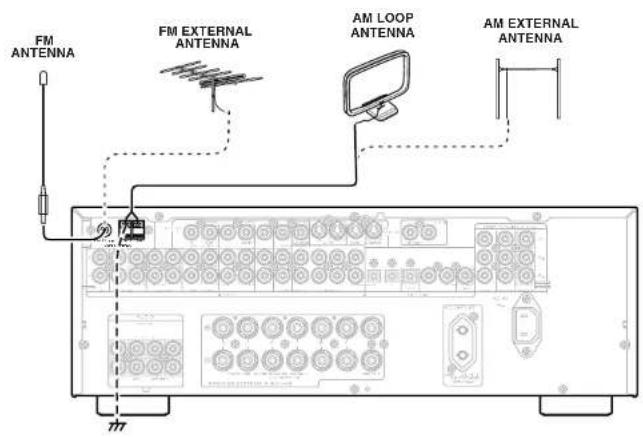
text_image
FM ANTENNA FM EXTERNAL ANTENNA AM LOOP ANTENNA AM EXTERNAL ANTENNAASSEMBLING THE AM LOOP ANTENNA
- Release the vinyl tie and take out the connection line.

- Place the antenna on stable surface.
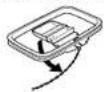
- Bend the base part in the reverse direction.
- Insert the hook at the bottom of the loop part into the slot at the base part.
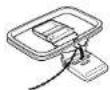
CONNECTING THE SUPPLIED ANTENNAS
Connecting the supplied FM antenna
The supplied FM antenna is for indoor use only. During use, extend the antenna and move it in various directions until the clearest signal is received. Fix it with push pins or similar implements in the position that will cause the least amount of distortion. If you experience poor reception quality, an outdoor antenna may improve the quality.
Connecting the supplied AM loop antenna
The supplied AM loop antenna is for indoor use only. Set it in the direction and position it to where you receive the clearest sound. Put it as far away as possible from the unit, televisions, speaker cables, and power cords.
If you experience poor reception quality, an outdoor antenna may improve the quality.
-
Press and hold down the lever of the AM antenna terminal.
-
Insert the bare wire into the antenna terminal.
- Release the lever.
CONNECTING AN FM OUTDOOR ANTENNA
Notes:
- Keep the antenna away from noise sources (neon signs, busy roads, etc.).
- Do not put the antenna close to power lines. Keep it well away from power lines, transformers, etc.
• To avoid the risk of lightning and electrical shock, grounding is necessary.
CONNECTING AN AM OUTDOOR ANTENNA
An outdoor antenna will be more effective if it is stretched horizontally above a window or outside.
Notes:
- Do not remove the AM loop antenna.
• To avoid the risk of lightning and electrical shock, grounding is necessary.
SETUP
After all components are connected, initial setup must be performed.
SETUP MENU SYSTEM
The SR4600 incorporates an menu on the front display, which makes various operations possible by using the cursor (▲, ▼, ◀, ▶) and ENTER buttons.
ENTER THE DESIRED MENU ITEM OF THE SETUP MENU
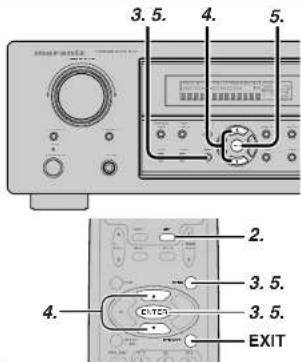
text_image
3.5. 4. 5. 2. 3.5. 3.5. EXIT 4.-
Tum on the unit.
-
Press the AMP button of the remote control.
- Press the MENU button or the ENTER button of the remote control to enter the SETUP MENU
- Press the ▲or Cursor button to select the SETUP MENU item.
- Press the ENTER button or the MENU button to enter the desired menu item.
After finishing all setup, press the MENU OFF button to exit the SETUP MENU.
MENU STRUCTURE
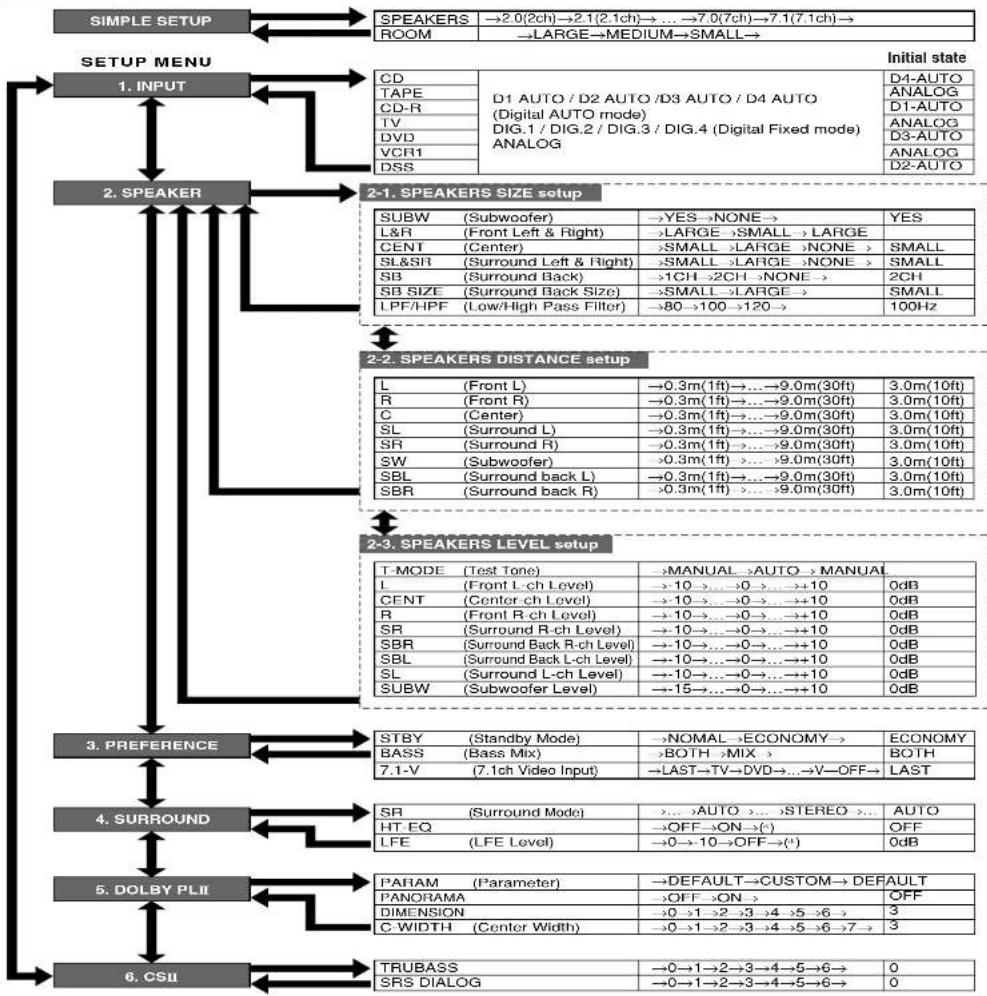
flowchart
graph TD
    A["SIMPLE SETUP"] --> B["1. INPUT"]
    B --> C["2. SPEAKER"]
    C --> D["2-1. SPEAKERS SIZE SETUP"]
    D --> E["2-2. SPEAKERS DISTANCE SETUP"]
    E --> F["2-3. SPEAKERS LEVEL SETUP"]
    F --> G["3. PREFERENCE"]
    G --> H["4. SURROUND"]
    H --> I["5. DOLBY PLII"]
    I --> J["6. CSII"]

    subgraph Initial state
        K["CD"] --> L["D1 AUTO / D2 AUTO /D3 AUTO / D4 AUTO (Digital AUTO mode)"]
        M["TAPE"] --> N["Dig.1 / Dig.2 / Dig.3 / Dig.4 (Digital Fixed mode)"]
        O["CD-R"] --> P["ANALOG"]
        Q["TV"] --> R["ANALOG"]
        S["DVD"] --> T["ANALOG"]
        U["VCR1"] --> V["ANALOG"]
        W["DSS"] --> X["ANALOG"]
        Y["LPR/HPF"] --> Z["Low/High Pass Filter"]
        AA["LPR/HPF"] --> AB["Low/High Pass Filter"]
        AC["LPR/HPF"] --> AD["Low/High Pass Filter"]
        AE["LPR/HPF"] --> AF["Low/High Pass Filter"]
        AG["LPR/HPF"] --> AH["Low/High Pass Filter"]
        AI["LPR/HPF"] --> AJ["Low/High Pass Filter"]
        AK["LPR/HPF"] --> AL["Low/High Pass Filter"]
        AM["LPR/HPF"] --> AN["Low/High Pass Filter"]
        AO["LPR/HPF"] --> AP["Low/High Pass Filter"]
        AQ["LPR/HPF"] --> AR["Low/High Pass Filter"]
        AS["LPR/HPF"] --> AT["Low/High Pass Filter"]
        AU["LPR/HPF"] --> AV["Low/High Pass Filter"]
        AW["LPR/HPF"] --> AX["Low/High Pass Filter"]
        AY["LPR/HPF"] --> AZ["Low/High Pass Filter"]
        BA["LPR/HPF"] --> BB["Low/High Pass Filter"]
        BC["LPR/HPF"] --> BD["Low/High Pass Filter"]
        BE["LPR/HPF"] --> BF["Low/High Pass Filter"]
        BG["LPR/HPF"] --> BH["Low/High Pass Filter"]
        BI["LPR/HPF"] --> BJ["Low/High Pass Filter"]
        BK["LPR/HPF"] --> BL["Low/High Pass Filter"]
        BM["LPR/HPF"] --> BN["Low/High Pass Filter"]
        BO["LPR/HPF"] --> BP["Low/High Pass Filter"]
        BQ["LPR/HPF"] --> BR["Low/High Pass Filter"]
        BS["LPR/HPF"] --> BT["Low/High Pass Filter"]
        BU["LPR/HPF"] --> BV["Low/High Pass Filter"]
        BW["LPR/HPF"] --> BX["Low/High Pass Filter"]
        BY["LPR/HPF"] --> BZ["Low/High Pass Filter"]
        CA["LPR/HPF"] --> CB["Low/High Pass Filter"]
        CC["LPR/HPF"] --> CD["Low/High Pass Filter"]
        CE["LPR/HPF"] --> CF["Low/High Pass Filter"]
        CG["LPR/HPF"] --> CH["Low/High Pass Filter"]
        CI["LPR/HPF"] --> CJ["Low/High Pass Filter"]
        CK["LPR/HPF"] --> CL["Low/High Pass Filter"]
        CM["LPR/HPF"] --> CN["Low/High Pass Filter"]
        CO["LPR/HPF"] --> CP["Low/High Pass Filter"]
        COB["LPR/HPF"] --> CPB["Low/High Pass Filter"]
        CX["LPR/HPF"] --> CY["Low/High Pass Filter"]
        CXB["LPR/HPF"] --> CYB["Low/High Pass Filter"]
        CXC["LPR/HPF"] --> CYC["Low/High Pass Filter"]
        CXD["LPR/HPF"] --> CYD["Low/High Pass Filter"]
        CXE["LPR/HPF"] --> CYE["Low/High Pass Filter"]
        CXG["LPR/HPF"] --> CYG["Low/High Pass Filter"]
        CXH["LPR/HPF"] --> CYH["Low/High Pass Filter"]
        CXI["LPR/HPF"] --> CYI["Low/High Pass Filter"]
    end

    subgraph 2-2. SPEAKERS DISTANCE setup
        L["FROM"] --> M["FROM"]
        N["FRA"] --> O["FRA"]
        P["CENT"] --> Q["CENT"]
        R["SLSR"] --> S["SLSR"]
        TSB["SBR"] --> U["SBR"]
    end

    subgraph 2-3. SPEAKERS LEVEL setup
        V["FROM"] --> W["FROM"]
        X["FRA"] --> Y["FRA"]
        Z["CENT"] --> AA["CENT"]
        AB["SLSR"] --> AC["SLSR"]
        AD["SBR"] --> AE["SBR"]
    end

    subgraph 2-3. SPEAKERS SIZE setup
        X["FROM"] --> Y["FROM"]
        Z["FRA"] --> AA["FRA"]
    end

    subgraph 2-3. SPEAKERS LEVEL Setup
        W["FROM"] --> X["FROM"]
        Y["FRA"] --> AA["YAFUO"]
        Z["CENT"] --> AA["CENT"]
        AB["SLSR"] --> AC["SLSR"]
    end

    subgraph 2-3. SPEAKERS SIZE Setup
        W["FROM"] --> X["FROM"]
        Y["FRA"] --> AA["YAFUO"]
        Z["CENT"] --> AA["YAFUO"]

    subgraph 2-3. SPEAKERS SIZE Setup
        X["FROM"] --> Y["FROM"]
        Z["CENT"] --> AA["YAFUO"]

    subgraph 2-3. SPEAKERS SIZE Setup
        Y["FROM"]

    subgraph 2-3. SPEAKERS SIZE Setup
        Z["CENT"] --> AA["YAFUO"]

    subgraph 2-3. SPEAKERS SIZE Setup
        Z["CENT"] --> AA["YAFUO"]

    subgraph 2-3. SPEAKERS SIZE Setup
        Z["CENT"] --> AA["YAFUO"]

    subgraph 2-3. SPEAKERS SIZE Setup
        Z["CENT"] --> AA["YAFUO"]

    subgraph 2-3. SPEAKERS SIZE Setup
        Z["CENT"] --> AB["YAFUO"]

    subgraph 2-3. SPEAKERS SIZE Setup
        Z["CENT"] --> AB["YAFUO"]

    subgraph 2-3. SPEAKERS SIZE Setup
        Z["CENT"] --> AB["YAFUO"]

    subgraph 2-3. SPEAKERS SIZE Setup
        Z["CENT"] --> AB["YAFUO"]

    subgraph 2-3. SPEAKERS SIZE Setup
        ZC["CERT"] --> AB["YAFUO"]

    subgraph 2-3. SPEAKERS SIZE Setup
        X["CERT"] --> AB["YAFUO"]

    subgraph 2-3. SPEAKERS SIZE Setup
        Y["CERT"] --> AB["YAFUO"]

    subgraph 2-3. SPEAKERS SIZE Setup
        Z["CERT"] --> AB["YAFUO"]

    subgraph 2-3. SPEAKERS SIZE Setup
        ZC["CERT"] --> AB["YAFUO"]

    subgraph 2-3. SPEAKERS SIZE Setup
        X["CERT"] --> AB["YAFUO"]

    subgraph 2-3. SPEAKERS SIZE Setup
        Y["CERT"] --> AB["YAFUO"]

    subgraph 2-3. SPEAKERS SIZE setup
        ZC["CERT"] --> AB["YAFUO"]

    subgraph 2-3. SPEAKERS SIZE Setup
        X["CERT"] --> AB["YAFUO"]

    subgraph 2-3. SPEAKERS SIZE Setup
        Y["CERT"] --> AB["YAFUO"]

    subgraph 2-3. SPEAKERS SIZE Setup
        ZC["CERT"] --> AB["YAFUO"]

    subgraph 2-3. SPEAKERS SIZE Setup
        X["CERT"] --> AB["YAFUO"]

    subgraph 2-3. SPEAKERS SIZE Setup
        Y["CERT"] --> AB["YAFUO"]

    subgraph 2-3. SPEAKER Level Setup
        W["CERT"] --> AB["YAFUO"]

    subgraph 2-3. SPEAKER Level Setup
        X["CERT"] --> AB["YAFUO"]

    subgraph 2-3. SPEAKER Level Setup
        Y["CERT"] --> AB["YAFUO"]

    subgraph 2-3. SPEAKER Level Setup
        ZC["CERT"] --> AB["YAFUO"]

    subgraph 2-3. SPEAKER Level Setup
        X["CERT"] --> AB["YAFUO"]

    subgraph 2-3. SPEAKER Level Setup
        Y["CERT"] --> AB["YAFUO"]

    subgraph 2-3. SPEAKER Level Setup
        ZC["CERT"] --> AB["YAFUO"]

    subgraph 2-3. SPEAKERO Level Setup
        W["CERT"] --> AB["YAFUO"]

    subgraph 2-3. SPEAKERO Level Setup
        X["CERT"] --> AB["YAFUO"]

    subgraph 2-3. SPEAKERO Level Setup
        Y["CERT"] --> AB["YAFUO"]

    subgraph 2-3. SPEAKERO Level Setup
        ZC["CERT"] --> AB["YAFUO"]

    subgraph 2-3. CONJUNCTION
        W["CERT"] --> AB["YAFUO"]

    subgraph 2-3. CONJUNCTION
        X["CERT"] --> AB["YAFUO"]

    subgraph 2-3. CONJUNCTION
        Y["CERT"] --> AB["YAFUO"]

    subgraph 2-3. CONJUNCTION
        ZC["CERT"] --> AB["YAFUO"]

    subgraph 2-3. CONJUNCTION
        X["CERT"] --> AB["YAFUO"]

    subgraph 2-3. CONJUNCTION
        Y["CERT"] --> AB["YAFUO"]

    subgraph 2-3. CONJUNCTION
        ZC["CERT"] --> AB["YAFUO"]

    end

    subgraph 2-3. CONJUNCTION Level Setup
        W["CERT"] --> AB["YAFUO"]

    subgraph 2-3. CONJUNCTION Level Setup
        X["CERT"] --> AB["YAFUO"]

    subgraph 2-3. CONJUNCTION Level Setup
        Y["CERT"] --> AB["YAFUO"]

    subgraph 2-3. CONJUNCTION Level Setup
        ZC["CERT"] --> AB["YAFUO"]

    subgraph 2-3. CONJUNCTION Level Setup
        X["CERT"] --> AB["YAFUO"]

    end

    subgraph 2-3. CONJUNCTION Level Setup
        W["CERT"] --> AB["YAFUO"]

    subgraph 2-3. CONJUNCTION Level Setup
        X["CERT"] --> AB["YAFUO"]

    subgraph 2-3. CONJUNCTION Level Setup
        Y["CERT"] --> AB["YAFUO"]

    end

    subgraph 2-3. CONJUNCTION Level Setup
        W["CERT"] --> AB["YAFUO"]

    subgraph 2-3. CONJUNCTION Level Setup
        X["CERT"] --> AB["YAFUO"]

    subgraph 2-3. CONJUNCTION Level Setup
        Y["CERT"] --> AB["YAFUO"]

    end

    subgraph 2 -4. CONJUNCTION Level Setup
        W["CERT"] --> AB["YAFUO"]

    end

    subgraph 2 -4. CONJUNCTION Level Setup
        X["CERT"] --> AB["YAFUO"]

    end

    subgraph 2 -4. CONJUNCTION Level Setup
        Y["CERT"] --> AB["YAFUO"]

    end

    subgraph 2 -4. CONJUNCTION Level Setup
        ZC["CERT"] --> AB["YAFUO"]

    end

    subgraph 2 -4. CONJUNCTION Level Setup
        X["CERT"] --> AB["YAFUO"]

    end

    subgraph 2 -4. CONJUNCTION Level Setup
        Y["CERT"] --> AB["YAFUO"]

    end

    subgraph 2 -4. CONJUNCTION Level Setup
        ZC["CERT"] --> AB["YAFUO"]

    subgraph 2 -4. CONJUNCTION Level Setup
        X["CERT"] --> AB["YAFUO"]

    end

    subgraph 2 -4. CONJUNCTION Level Setup
        W["CERT"] --> AB["YAFUO"]

    end

    subgraph 2 -4. CONJUNCTION Level Setup
        X["CERT"] --> AB["YAFUO"]

    end

    subgraph 2 -4. CONJUNCTION Level Setup
        Y["CERT"] --> AB["YAFUO"]

    end
SIMPLE SETUP
You can setup the speaker conditions quickly with SIMPLE SETUP menu. In this menu, the number of speakers and speaker delay time can be set. These settings can be changed more detail in '2. SPEAKER' setup menu.
Press the SIMPLE SETUP button on the unit to enter this menu.
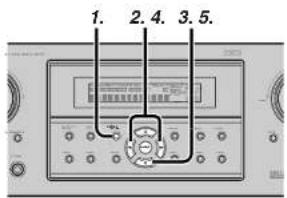
text_image
1. 2. 4. 3. 5.- Press the SIMPLE SETUP button on the unit to enter the "SPEAKERS" menu.
- Press <or cursor button to select the speaker number.
- Press the cursor button to enter the "ROOM" menu.
- Press ◀ or ▶ cursor button to select the room size.
- After finishing all setup, press the ▼ cursor button to exit the SIMPLE SETUP menu.
Note
- All Simple Setup menu is reset when the speaker setting is changed with Speaker Setup menu.
MENU STRUCTURE of Simple Setup

flowchart
graph TD
    A["SIMPLE SETUP"] --> B["SPEAKERS"]
    B --> C["ROOM"]
    C --> D["LARGE"]
    D --> E["MEDIUM"]
    E --> F["SMALL"]
    C --> G["2.0 (ch)"]
    C --> H["2.1 (ch)"]
    C --> I["3.0 (ch)"]
    C --> J["3.1 (ch)"]
    C --> K["4.0 (ch)"]
    C --> L["4.1 (ch)"]
    C --> M["5.0 (ch)"]
    C --> N["5.1 (ch)"]
    C --> O["6.0 (ch)"]
    C --> P["6.1 (ch)"]
    C --> Q["7.0 (ch)"]
    C --> R["7.1 (ch)"]
The relation of the speakers number and connected speaker
| CHANNEL | Front L/R Center(F) (C) | Front L/R Back (S) (SB) | Surround L/R wooler (S) (SW) | Sub | |
| 7.1 ch | LARGE | SMALL | SMALL | 2ch | YES |
| 7.0 ch | LARGE | SMALL | SMALL | 2ch NONE | |
| 8.1 ch | LARGE | SMALL | SMALL | 1ch | YES |
| 8.0 ch | LARGE | SMALL | SMALL | 1ch NONE | |
| 5.1 ch | LARGE | SMALL | SMALL | NONE | YES |
| 5.0 ch | LARGE | SMALL | SMALL | NONE | NONE |
| 4.1 ch | LARGE | NONE | SMALL | NONE | YES |
| 4.0 ch | LARGE | NONE | SMALL | NONE | NONE |
| 3.1 ch | LARGE | SMALL | NONE | NONE | YES |
| 3.0 ch | LARGE | SMALL | NONE | NONE | NONE |
| 2.1 ch | LARGE | NONE | NONE | NONE | YES |
| 2.0 ch | LARGE | NONE | NONE | NONE | NONE |
The relation of the room size and floor space
| SIZE | Floor space (W) | Width Depth (D) | Imaging Distance | ||
| SMALL | 10 m2 | 2.7 m | 3.5 m Surround | Front (F) | 6 ft. (1.8 m) |
| Center (C) | 5 ft. (1.5 m) | ||||
| and (S) 4 ft. (1.2 m) | |||||
| Surr. Back (SB) | 5 ft. (1.5 m) | ||||
| Sub Wroder (SW) | 5 ft. (1.5 m) | ||||
| MEDIUM | 16 m2 | 3.8 m | 4.5 m Surround | Front (F) | 7 ft. (2.1 m) |
| Center (C) | 6 ft. (1.9 m) | ||||
| and (S) 5 ft. (1.5 m) | |||||
| Surr. Back (SB) | 7 ft. (2.1 m) | ||||
| Sub Wroder (SW) | 6 ft. (1.8 m) | ||||
| LARGE | 24 m2 | 4.5 m | 4 m Surround | Front (F) | 9 ft. (2.7 m) |
| Center (C) | 8 ft. (2.4 m) | ||||
| and (S) 7 ft. (2.1 m) | |||||
| Surr. Back (SB) | 9 ft. (2.4 m) | ||||
| Sub Wroder (SW) | 6 ft. (2.4 m) | ||||
The relation of the room size and floor space is a roughly standard.
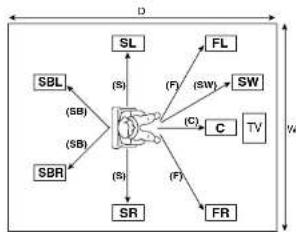
flowchart
graph TD
    D["Dimension D"] --> SL["SL"]
    D --> FL["FL"]
    D --> SW["SW"]
    D --> C["C"]
    D --> TV["TV"]
    D --> FR["FR"]
    SBL["SBL"] -->|(SB)| Center((Center))
    SBR["SBR"] -->|(SB)| Center
    Center -->|(S)| SL
    Center -->|(S)| FL
    Center -->|(S)| SW
    Center -->|(S)| C
    Center -->|(S)| TV
    Center -->|(S)| FR
    Center -->|(S)| SR
    Center -->|(S)| SL
    Center -->|(S)| FL
    Center -->|(S)| SW
    Center -->|(S)| C
    Center -->|(S)| TV
    Center -->|(S)| FR
1. INPUT SETUP (ASSIGNABLE DIGITAL INPUT)
Four digital Inputs can be assigned as the desired source.
Use this menu to select the digital input jack to be assigned to the input source.
The Input Setup consists of 6 Items, which are as below.
• D1AUTO to D4AUTO : Digital AUTO mode
If the input signal from the selected source is digital signal, this unit chooses a digital input automatically.
• DIG.1 to DIG.4 : Digital FIXED mode
The SR4600 chooses a digital input regardless of a input signal from the selected source.
• ANA : Analog mode
Use this menu to select the digital input jack to be assigned to the input source.

text_image
1.3.5. 4.5. 2.5.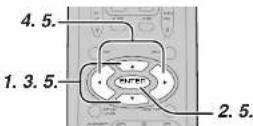
- Select "1.INPUT" In SETUP MENU with the ▲ or ▼cursor button.
- Press the ENTER button to enter the menu.
- Press the ▲ or ▶ cursor button to select the input source.
-
Press ← or cursor button to select the input function. Select "DxAUTO", "DIG.x" or "ANA" for input sources.
-
If you finish these setup, press the ▲ or ▼ cursor button to select "TO MAIN MENU" then press the ENTER button to return the SETUP MENU. Or press the ◀ or ▶ cursor button to select "EXIT" then press the ENTER button to exit the SETUP MENU.
Notes:
- When a DTS-LD or DTS-CD is playing, this setup is not available. This is to avoid noise being generated from the analog input.
- If "Dx-AUTO" is selected and a DVD, compact disc or LD is fast forwarded during playback, decoded signals may produce a skipping sound. In such cases, change the setting to DIGITAL.
- Same digital input function cannot be set. In this case, the previous setting is set to ANALOG. Same digital input number cannot be set in Digital AUTO mode and Digital Fixed mode. For example, D1AUTO and DIG.I are not set at same time.
- The TUNER is fixed to the analog input, and can not be selected for any digital input.
2. SPEAKER SETUP
After you have installed the SR4600, connected all the components, and determined the speaker layout, it is now time to perform the settings in the Speaker Setup menu for the optimum sound acoustics for your environment and speaker layout. Before you perform the following settings, it is important that you first determine the following characteristics:
2-1. SPEAKERS SIZE
When settling the speaker size in the SPEAKER SIZE sub-menu, use the guidelines given below.
Large:
The complete frequency range for the channel you are setting will be output from the speaker. Small:
Frequencies of the channel you are setting lower than approx. 100Hz will be output from the subwoofer.
If the Subwoofer is set to 'NONE' and the front speakers are set to 'Large,' then the sound may be output from both the left and right speakers.

text_image
1.3.5. 4.5. 2.5.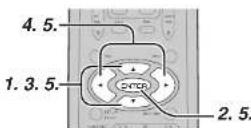
- Select '2.SPEAKER' in SETUP MENU with ▲ or ▼cursor button,
- Press the ENTER button to enter the menu. The first sub-menu item is '2-1.Speakers Size' setup.
- Press ▲ or ▼ cursor button to select the each speaker.
- Press or cursor button to select the setting of size to each speaker.
- If you finish these setup, press the ▲or ▼ cursor button to select "NEXT".
- Press the ENTER button to enter the next "2-2. Speakers Distance" setup. Or press the ◀or ▶cursor button to select "EXIT" then press the ENTER button to exit the SETUP MENU.
Or press the ◄ or ▶ursor button to select 'TO MAIN MENU' then press the ENTER button to return the SETUP MENU.
MENU STRUCTURE of Speakers Size setup

flowchart
graph TD
    A["2-1. SPEAKERS SIZE setup"] --> B["SUBW"]
    B --> C["L & R"]
    C --> D["CENTER"]
    D --> E["SL & SR"]
    E --> F["SB"]
    F --> G["SB SIZE"]
    G --> H["LPF/HPF"]
    H --> I["NEXT"]
    I --> J["EXIT"]
    J --> K["TO MAIN MENU"]

    B --> L["YES"]
    L --> M["NONE"]
    M --> N["LARGE"]
    N --> O["SMALL"]
    O --> P["SMALL"]
    P --> Q["LARGE"]
    Q --> R["SMALL"]
    R --> S["LARGE"]
    S --> T["SMALL"]
    T --> U["LARGE"]
    U --> V["SMALL"]
    V --> W["LARGE"]
    W --> X["SMALL"]

    L --> Y["Select when a subwoofer is connected."]
    M --> Z["Select when a subwoofer is not connected."]
    N --> AA["Select if the front speakers are large sized."]
    O --> AB["Select if the front speakers are small sized."]

    P --> AC["Select if the center speaker is small sized."]
    Q --> AD["Select if the center speaker is large sized."]
    R --> AE["Select if no center speaker is connected."]

    S --> AF["Select if the surround left and right speakers are small sized."]
    T --> AG["Select if the surround left and right speakers are large sized."]

    U --> AH["Select if no surround left and right speakers are connected."]

    F --> AI["1CH"]
    F --> AJ["2CH"]
    AI --> AK["Select if the surround back speaker is connected In this case, the audio signal is emitted form the Surround back L output terminal."]
    AJ --> AL["Select if the surround back left and right speakers are connected"]

    G --> AM["SMALL"]
    AM --> AN["LARGE"]
    AN --> AO["SMALL"]
    AO --> AP["SMALL"]
    AP --> AQ["LARGE"]
    AQ --> AR["SMALL"]

    H --> AS["Select if the surround back speaker(s) is small sized"]
    H --> AT["Select if the surround back speaker(s) is large sized"]

    I --> AU["This menu (SB SIZE) will not be displayed, if SB is set "NONE"."]

    J --> AV["80 Select this when the bass speaker is about 12cm(4 3/4inches)"]
    J --> AW["100 Select this when the bass speaker is about 10cm(3 15x16inches)"]
    J --> AX["120 Select this when the bass speaker is about 8cm(3 3/16inches)"]

    K --> AY[" exit SETUP MENU "]
    K --> AZ[" MAIN MENU "]

    style A fill:#f9f,stroke:#333
    style B fill:#ccf,stroke:#333
    style C fill:#cfc,stroke:#333
    style D fill:#fcc,stroke:#333
    style E fill:#cff,stroke:#333
    style F fill:#ffc,stroke:#333
    style G fill:#fcc,stroke:#333
    style H fill:#cff,stroke:#333
    style I fill:#ffc,stroke:#333
    style J fill:#fcc,stroke:#333
    style K fill:#ffc,stroke:#333
2-2. SPEAKERS DISTANCE
Use this parameter to specify the distance of each speaker's position from the listening position. The delay time is automatically calculated according to these distances.
Begin by determining the ideal or most commonly used seating position in the room.
This is important for the timing of the acoustics to create the proper sound space that the SR4600 and today's sound systems are able to produce. Note that the speakers that you selected "None" for in the Speaker Config sub-menu will not appear here.

text_image
1.3.5. 4.5. 2.5. 4.5. 1.3.5. C-120 2.5.- Enter to the "2-2. Speakers Distance" from the previous "2-1. Speakers Size".
- Press ▲ or ▼ cursor button to select the each speaker.
- Press ◄ or ▶ cursor button to set the distance from your listening position for each speaker.
- After finishing the Speaker Distance setup, press the ▲ or ▼cursor button to select 'NEXT'.
- Press the ENTER button to enter the next "Speaker Level" setup.
Or press the ◀ or ▶cursor button to select 'EXIT' then press the ENTER button to exit the SETUP MENU.
Or press the ◀ or ▶ cursor button to select "TO MAIN MENU" then press the ENTER button to return the SETUP MENU.
Or press the ◀ or ▶cursor button to select 'RETURN' then press the ENTER button to return the previous '2-2. Speakers Distance' setup.
L&R:
Set the distance from the front left and right speakers to your normal listening position between 1 and 30 feet in 1.0 foot interval (0.3 to 9 meters in 0.3-meter intervals).
C
Set the distance from the center speaker to your normal listening position between 1 and 30 feet in 1.0 foot interval
(0.3 to 9 meters in 0.3-meter intervals).
SL&SR:
Set the distance from the surround left and right speaker to your normal listening position between 1 and 30 feet in 1.0 foot interval (0.3 to 9 meters in 0.3-meter intervals).
SW :
Set the distance from the subwoofer to your normal listening position between 1 and 30 feet in 1.0-foot intervals (0.3 to 9 meters in 0.3-meter intervals).
SB:
Set the distance from a surround back speaker to your normal listening position between 1 and 30 feet in 1.0-foot intervals (0.3 to 9 meters in 0.3-meter intervals).
Note:
- Speakers that you selected "No" or "None" for in the Speaker Size menu will not appear.
MENU STRUCTURE of Speakers Distance setup

flowchart
graph TD
    A["Speakers Size setup"] --> B["L&R"]
    B --> C["C"]
    C --> D["SL&SR"]
    D --> E["SW"]
    E --> F["SB"]
    F --> G["NEXT"]
    G --> H["EXIT"]
    H --> I["RETURNTO MAIN MENU"]
    I --> J["Speakers Size setup"]
    K["Speaker Distance setup"] --> B
    K --> D
    K --> E
    K --> F
    L["Distance"] --> M["Maximum"]
    L --> N["1 ft interval (1 ft = 0.3 m)"]
    L --> O["Minimum"]
    P["Speaker Level setup"] --> G
    Q["exit SETUP MENU"] --> H
    R["MAIN MENU"] --> I
    S["RETURNTO MAIN MENU"] --> I
    T["2 ft (0.6m)"] --> I
    U["30 ft (9.0m)"] --> V
    W["29 ft (8.7m)"] --> V
    X["button"] --> L
    Y["button"] --> O
2-3. SPEAKERS LEVEL SETTING WITH TEST TONE
Here you will set the volume for each speaker so that they are all heard by the listener at the same level. Moreover, if the T.TONE button is pressed, unit can enter into this menu directly.
Note:
- The speaker level settings are not available in 7.1 Channel Input mode, CS mode and Multi Channel Stereo mode.
T(TEST) MODE
Selects "MANUAL" or "AUTO" for generating mode of test tone or cursor button.
If you select "AUTO" by pressing the ▼ button, the test tone will be cycled through in a circular pattern which is L (Left) → C (Center) → R (Right) → SR (Surround Right) → SBR (Surround Back Right) → SBL (Surround Back Left) → SL (Surround Left) → SW (Subwoofer) → L →.. increments of 2 seconds for each channel.
Using the ◀ and ▶ cursor buttons, adjust the volume level of the noise from the speaker so that it is the same level for all speaker.
Press the ENTER button, you can stop the test tone mode. Or press the <or cursor button to select 'EXIT' then press the ENTER button to exit the SETUP MENU.
Or press the ◀or ▶cursor button to select 'RETURN' then press the ENTER button to return the previous '2-2. Speakers Distance' setup.
If you select 'MANUAL', adjust the output level of each speaker as follow.
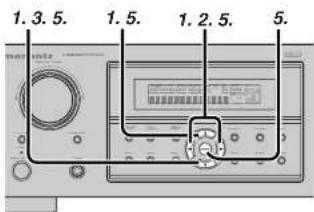
text_image
1.3.5. 1.5. 1.2.5. 5.
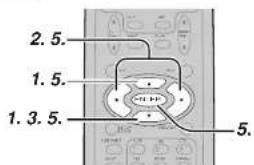
text_image
2.5. 1.5. 1.3.5. 5.-
When you select "MANUAL" in T-MODE menu by pressing the ▼ button, this unit will emit a pink noise from the front left speaker. At this time, adjust the desired level of the master volume. Remember the level of this noise and then press the ▼ button. This unit will emit the pink noise from the center speaker.
-
Using the ◀ and ▶ursor buttons, adjust the volume level of the noise from the center speaker so that it is the same level as the front left speaker (Note that this can be adjusted to any level between -10 and +10 dB in 1dB intervals).

flowchart
graph TD
    A["+10dB"] --> B["+9dB"]
    B --> C["..."]
    C --> D["0dB"]
    D --> E["..."]
    E --> F["-9dB"]
    F --> G["-10dB (SW -15 dB)"]
    H["1 dB interval"] --> I["Reference"]
    J["1 dB interval"] --> K["Minimum"]
    L["Button"] --> M["-> button"]
    N["Button"] --> O["-> button"]
    P["Maximum"] --> Q["1 dB interval"]
-
Press the ▼cursor button again. This unit will now emit the pink noise from the front right speaker.
-
Repeat steps 2 and 3 above for the front right and other speakers until all speakers are adjusted to the same volume level.
-
Press the ENTER button, you can stop the test tone mode. Or press the <or cursor button to select 'EXIT' then press the ENTER button to exit the SETUP MENU.
Or press the ◀ or ▶ button to select "RETURN" then press the ENTER button to return the previous "2-2. Speakers Distance" setup.
Notes:
- Speakers that you selected "None" for in the Speaker Size Setup menu will not appear.
- The setup level for each channel is memorized for reproduction in all surround mode by this method exclude CS mode, Multi channel stereo mode and 7.1 ch input mode.
• To adjust the speaker levels for 7.1-channel input sources, you will need to use the 7.1CH Level Input setup menu.
MENU STRUCTURE of Speaker Level setup

flowchart
graph TD
    A["Direct select by remote control"] --> B["Speaker's Distance setup"]
    B --> C["MANU A1"]
    C --> D["(Auto)"]
    D --> E["Speaker"]
    E --> F["SW"]
    F --> G["L"]
    G --> H["C"]
    H --> I["R"]
    I --> J["SBR"]
    J --> K["EXITRETURNTO M"]
    K --> L["MAN MENU"]
    L --> M["Speaker's Distance setup"]
    M --> N["SL"]
    N --> O["SBL"]
    O --> P["Listening Position"]
    P --> Q["SBR"]
    Q --> R["Exit SETUP MENU"]
    R --> S["Speaker's Distance setup"]
    S --> T["MAN MENU"]
    T --> U["Speaker's Distance setup"]
    U --> V["MAN MENU"]
    V --> W["Speaker's Distance setup"]
    W --> X["MAN MENU"]
    X --> Y["Speaker's Distance setup"]
    Y --> Z["MAN MENU"]
    Z --> AA["Speaker's Distance setup"]
    AA --> AB["MAN MENU"]
    AB --> AC["Speaker's Distance setup"]
    AC --> AD["MAN MENU"]
    AD --> AE["Speaker's Distance setup"]
    AE --> AF["MAN MENU"]
    AF --> AG["Speaker's Distance setup"]
    AG --> AH["MAN MENU"]
    AH --> AI["Speaker's Distance setup"]
    AI --> AJ["MAN MENU"]
    AJ --> AK["Speaker's Distance setup"]
    AK --> AL["MAN MENU"]
    AL --> AM["Speaker's Distance setup"]
    AM --> AN["MAN MENU"]
    AN --> AO["Speaker's Distance setup"]
    AO --> AP["MAN MENU"]
    AP --> AQ["Speaker's Distance setup"]
    AQ --> AR["MAN MENU"]
    AR --> AS["Speaker's Distance setup"]
    AS --> AT["MAN MENU"]
    AT --> AU["Speaker's Distance setup"]
    AU --> AV["MAN MENU"]
    AV --> AW["Speaker's Distance setup"]
    AW --> AX["MAN MENU"]
    AX --> AY["Speaker's Distance setup"]
    AY --> AZ["MAN MENU"]
    AZ --> BA["Speaker's Distance setup"]
    BA --> BB["MAN MENU"]
    BB --> BC["Speaker's Distance setup"]
    BC --> BD["MAN MENU"]
    BD --> BE["Speaker's Distance setup"]
    BE --> BF["MAN MENU"]
    BF --> BG["Speaker's Distance setup"]
    BG --> BH["MAN MENU"]
    BH --> BI["Speaker's Distance setup"]
    BI --> BJ["MAN MENU"]
    BJ --> BK["Speaker's Distance setup"]
    BK --> BL["MAN MENU"]
    BL --> BM["Speaker's Distance setup"]
    BM --> BN["MAN MENU"]
    BN --> BO["Speaker's Distance setup"]
    BO --> BP["MAN MENU"]
    BP --> BQ["Speaker's Distance setup"]
    BQ --> BR["MAN MENU"]
    BR --> BS["Speaker's Distance setup"]
    BS --> BT["MAN MENU"]
    BT --> BU["Speaker's Distance setup"]
    BU --> BV["MAN MENU"]
    BV --> BW["Speaker's Distance setup"]
    BW --> BX["MAN MENU"]
    BX --> BY["Speaker's Distance setup"]
    BY --> BZ["MAN MENU"]
    BZ --> CA["Speaker's Distance setup"]
    CA --> CB["MAN MENU"]
    CB --> CC["Speaker's Distance setup"]
    CC --> CD["MAN MENU"]
    CD --> CE["Speaker's Distance setup"]
    CE --> CF["MAN MENU"]
    CF --> CG["Speaker's Distance setup"]
    CG --> CH["MAN MENU"]
    CH --> CI["Speaker's Distance setup"]
    CI --> CJ["MAN MENU"]
    CJ --> CK["Speaker's Distance setup"]
    CK --> CR["MAN MENU"]
    CR --> CS["Speaker's Distance setup"]
    CS --> CT["MAN MENU"]
    CT --> CU["Speaker's Distance setup"]
    CU --> CV["MAN MENU"]
    CV --> CW["Speaker's Distance setup"]
    CW --> CX["MAN MENU"]
    CX --> CY["Speaker's Distance setup"]
    CY --> CZ["MAN MENU"]
    CZ --> DA["Speaker's Distance setup"]
    DA --> DB["MAN MENU"]
    DB --> DC["Speaker's Distance setup"]
    DC --> DD["MAN MENU"]
    DD --> DE["Speaker's Distance setup"]
    DE --> DF["MAN MENU"]
    DF --> DG["Speaker's Distance setup"]
    DG --> DH["MAN MENU"]
    DH --> DI["Speaker's Distance setup"]
    DI --> DJ["MAN MENU"]
    DJ --> DK["Speaker's Distance setup"]
    DK --> DL["MAN MENU"]
    DL --> DV["Speaker's Distance setup"]
    DV --> DW["MAN MENU"]
    DW --> DX["Speaker's Distance setup"]
    DX --> DXB["MAN MENU"]
2-4. SPEAKERS LEVEL SETTING WITHOUT TEST TONE
Channel level (speaker level) can be adjusted without using test tone.
Note:
- Four channel level settings can be memorized for reproduction: the 7.1 ch input mode, CS mode, Multi channel stereo mode, and all other surround modes, respectively.
- Set the surround mode or 7.1 ch input mode which you want to adjust the channel level.
- Press the CH.SEL button on the remote.
- Select the desired channel (speaker) with the ◀ or ▶cursor buttons.
- Adjust the level with the ▲ or ▼ cursor buttons.
-
After completing the setup, press the CH.SEL button again.
-
PREFERENCE
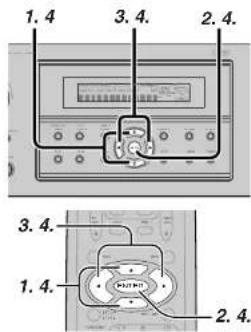
text_image
1. 4 3. 4. 2. 4. 3. 4. 1. 4. 2. 4.- Select "3. PREFERENCE" in SETUP MENU with ▲ or ▼ cursor button.
- Press the ENTER button.
- Press ▲ or ▼ cursor button to select desired item.
-
Press ← or cursor button to set the mode.
-
When you select 'TO MAIN MENU' by pressing the ▲or button, you can return the SETUP MENU by pressing the ENTER button. Or press the ◀or cursor button to select "EXIT" then press the ENTER button to exit the SETUP MENU.
BASS MIX
- The bass mix setting is only valid when 'LARGE' is set for the front speakers and 'YES' is set for the subwoofer at stereo playback.
- When the "BOTH" is selected, the low frequency signal range of "LARGE" are produced simultaneously from those channels and the subwoofer channel.
When actual low frequency sound volume is weak depending on room size, use this function to fill low frequency sound equally in the room.
- When "Mix" is selected, subwoofer output is determined depending on the speaker sizes for each channels. If the front speaker size is set to "Large", subwoofer output is only the LFE signal contained in Dolby Digital or DTS processed signals.
Note:
- When Front speaker is set "SMALL", then BASS MIX is set "MIX". (The display appears "BASS MIX = ***".)
MENU STRUCTURE of PREFERENCE setup
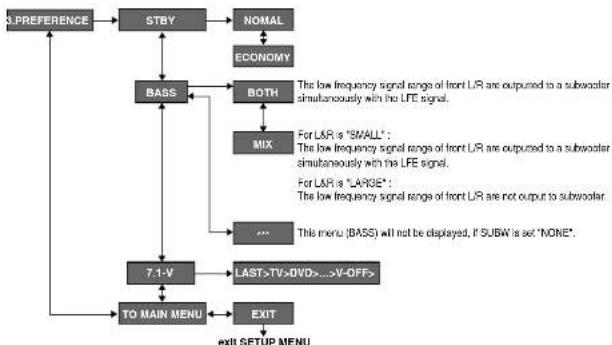
flowchart
graph TD
    A["3-PREFERENCE"] --> B["STBY"]
    B --> C["NOMAL"]
    C --> D["ECONOMY"]
    D --> E["BASS"]
    E --> F["7.1-V"]
    F --> G["TO MAIN MENU"]
    G --> H["EXIT"]
    H --> I["exit SETUP MENU"]
    E --> J["BOTH"]
    J --> K["MIX"]
    K --> L["..."]
    L --> M["LAST-TV>DVD...>V-OFF>"]
    M --> N["For L&R is "SMALL": The low frequency signal range of front L/R are output to a subwoofer simultaneously with the LFE signal. For L&R is "LARGE": The low frequency signal range of front L/R are output to a subwoofer simultaneously with the LFE signal. This menu (BASS) will not be displayed, if SUBW is set "NONE"."]
STANDBY MODE:
When this function is set to "ECONOMY", you can reduce the power consumption when the unit is in the standby mode.
4. SURROUND
This sub menu is to adjust channel levels for each surround setting groups. There are three surround setting groups shown below. Therefore if settings for a surround mode are changed, settings for all other surround modes in the same group are also changed.
Surround setting group
1: AUTO, DOLBY. DTS. EX/ES, VIRTUAL,
STEREO
2: Multi-ch stereo
3:CS II
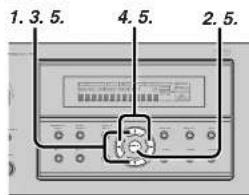
text_image
1.3.5. 4.5. 2.5.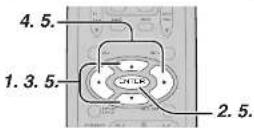
- Select '4. SURROUND' in SETUP MENU with ▲ or ▼ cursor button.
- Press the ENTER button.
- To select a desired item, press ▲ or ▼ cursor button.
- Using the ◀ or ▶ursor button to select the mode or adjust the volume level of each speaker.
- When you select 'TO MAIN MENU' by pressing the ▲ or ▼ button, you can return the SETUP MENU by pressing the ENTER button. Or press the ◄ or ▶ cursor button to select 'EXIT' then press the ENTER button to exit the SETUP MENU.
SR(SURR-MODE) :
Select the desired surround mode with ◀ or ▶ cursor button.
- If one of the following modes is selected, all other modes are also set to the same. AUTO, DOLBY, DTS, EX/ES, VIRTUAL, STEREO.
HT-EQ :
Select to active the HT-EQ with the <or cursor buttons.
The tonal balance of a film soundtrack will be excessively bright and harsh when played back over audio equipment in the home. This is because film soundtracks were designed to be played back in large movie theater environments. Activating the HT-EQ feature when watching a film made for movie theaters corrects this and restores the correct tonal balance.
The HT-EQ feature can be activated only while in Dolby Pro Logic Mode, or while decoding Dolby Digital or DTS encoded material.
LFE LEVEL
Select the output level of the LFE signal included in the Dolby Digital signal or the DTS signal. Select 0 dB, -10 dB or OFF with the ◄or ▶ursor buttons.
When you select 'TO MAIN MENU' by pressing the ▲ or ▼ button, you can return the SETUP MAIN MENU by pressing the ENTER button.
MENU STRUCTURE of SURROUND setup

flowchart
graph TD
    A["4.SURROUND"] --> B["SURROUND MODE"]
    B --> C["HT-EQ"]
    C --> D["LFE"]
    D --> E["EXIT TO MAIN I"]
    E --> F["exit SETUP MENU"]
    F --> A
5. PL II (DOLBY PRO LOGIC II) MUSIC PARAMETER
Pro Logic II-Music mode creates a rich and enveloping surround ambience from stereo sources such as CDs.
In this mode, SR4600 includes three controls to fine-tune the soundfield as follows.
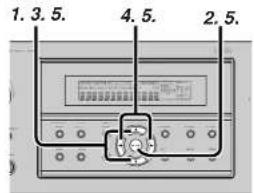
text_image
1.3.5. 4.5. 2.5.
- Select '5.PLII MUSIC PARAMETER' in SETUP MENU with ▲ or ▼ cursor button.
- Press the ENTER button to enter the menu.
- Press ▲or ▼cursor button to select a desired item.
- Press <or cursor button to select the mode or set the level.
- When you select 'TO MAIN MENU' by pressing the ▲ or ▼ button, you can return the SETUP MENU by pressing the ENTER button. Or press the ◀ or ▶ cursor button to select 'EXIT' then press the ENTER button to exit the SETUP MENU.
PANORAMA:
Select the Panorama mode On or Off with ◀ or ▶ cursor button.
Panorama wraps the sound of the front left and right speakers around you for an exciting perspective.
DIMENSION
Set the Dimension level between 0 and 6 level in 1 level interval with or cursor button
Adjust the soundfield either towards the front or towards the rear.
This can be useful to help achieve a more suitable balance from all the speakers with certain recordings.
C WIDTH:
Set the Center width level between 0 and 7 level in 1 level interval with ▶ or ▶ cursor button.
Center Width allows you to gradually spread the center channel sound into the front left and right speakers.
At its widest setting, all the sound from the center is mixed into the left and right.
This control may help achieve a more spacious sound or a better blend of the front image.
If "NONE" was selected for the Center speaker setting in the Speaker size, then this setting will not appear.
MENU STRUCTURE of PRO LOGIC II setup
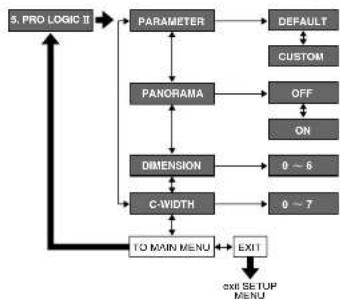
flowchart
graph TD
    A["5. PRO LOGIC II"] --> B["PARAMETER"]
    B --> C["DEFAULT"]
    C --> D["CUSTOM"]
    B --> E["PANORAMA"]
    E --> F["OFF"]
    F --> G["ON"]
    E --> H["DIMENSION"]
    H --> I["0 ~ 6"]
    H --> J["C-WIDTH"]
    J --> K["0 ~ 7"]
    J --> L["TO MAIN MENU"]
    L --> M["EXIT"]
    M --> N["EXIT SETUP MENU"]
- Select "6. CS II" in SETUP MENU with ▲ or ▼ cursor button.
- Press the ENTER button to enter this menu.
- Press ▲ or ▼ cursor button to select desired item.
- Press or cursor button to set the level.
- When you select 'TO MAIN MENU' by pressing the ▲ or ▼button, you can return the SETUP MENU by pressing the ENTER button. Or press the ◀or ▶cursor button to select 'EXIT' then press the ENTER button to exit the SETUP MENU.
TRUBASS:
Set the TRUBASS level between 0 and 6 level in 1 level interval with ◀ or ▶cursor button.
TRUBASS produced by the speakers to be an octave below the actual physical capabilities of the speakers adding exciting, deeper bass effects.
SRS DIALOG:
Set the SRS DIALOG level between 0 and 6 level in 1 level interval with ◀ or ▶ cursor button. This can be popped out of the surround audio effects allowing the listener to easily discern what the actors say.
If "NONE" was selected for the Center speaker setting in the Speaker size, then this setting will not appear.
MENU STRUCTURE of CS II setup

flowchart
graph TD
    A["8.0S II setup"] --> B["TRUBASS"]
    B --> C["D -6"]
    A --> D["SRS DIALOG"]
    D --> E["D -6"]
    A --> F["EXIT TO MAIN MEY"]
    F --> G["EXIT SETUP MENU"]
    G --> H["Control Signals"]
SELECTING AN INPUT SOURCE
Before you can listen to any input media, you must first select the input source on the SR4600.
Example : DVD

To select DVD, turn the INPUT FUNCTION SELECTOR knob on the front panel or simply press the DVD button on the remote. After you have selected DVD, simply turn on the DVD player and play the DVD.
- The input name will appear in the display on the front panel.
- As the input is changed, the SR4600 will automatically switch to the digital input, surround mode, attenuation, and night mode status which were entered during the configuration process for that source.
- When an audio source is selected, the last video input used remains routed to the VCR1 & DSS/VCR2 Outputs and Monitor Outputs. This permits simultaneous viewing and listening to different sources.
- When a Video source is selected, the video signal for that input will be routed to the Monitor Outputs jacks and will be viewable on a TV monitor connected to the SR4600. If a component video input is connected to the DVD or DSS component inputs, it will be routed to the Component Video Output. Make certain that your TV is set to the proper input to view the signal.
To select the surround mode during playback, press the SURROUND MODE button on the front panel or the Surround mode buttons on the remote.
ADJUSTING THE MAIN VOLUME

Adjust the volume to a comfortable level using the VOLUME control knob on the front panel or VOL ▲ /▼ buttons on the remote.
To increase the volume, turn the VOLUME knob clockwise or press VOL ▲ button on the remote, to decrease the volume, turn counterclockwise or press VOL ▼ button on the remote.
Notes:
- The volume can be adjusted within the range of to 18 dB, in steps of 1 dB.
• However, when the channel level is set as described on page 20, if the volume for any channel is set at +1 dB or greater, the volume cannot be adjusted up to 18 dB.
(In this case the maximum volume adjustment range is "18 dB - Maximum value of channel level)
ADJUSTING THE TONE (BASS & TREBLE) CONTROL

During a listening session you may wish to adjust the Bass and Treble Control to suit your listening tastes or room acoustics.
(Using the remote control unit)
To adjust the bass effect, press BASS or BASS ▼ on the remote.
To adjust the treble effect, press TREBLE or TREBLE on the remote.
Note:
• The tone control function can work in the AUTO Surround, Stereo, Dolby PLJix, DTS, DTS-ES, and Multi Ch. Stereo mode.
TEMPORARILY TURNING OFF THE SOUND
To temporarily silence all speaker outputs such as when interrupted by a phone call, press the MUTE button on the front panel or MUTE button on the remote.
This will interrupt the output to all speakers and the head-phone jack, but it will not affect any recording or dubbing that may be in progress.
When the system is muted, the display will show "MUTE".
Press the MUTE button again to return to normal operation.
USING THE SLEEP TIMER
To program the SR4600 for automatic standby, press the SLEEP button on the remote.
Each press of the button will increase the time before shut down in the following sequence.

The sleep time will be shown for a few seconds in the display on the front panel, and it will count down until the time has elapsed.
When the programmed sleep time has elapsed, the unit will automatically turn off.
Note that the SLEEP indicator on the display will illuminate when the Sleep function is programmed. To cancel the Sleep function, press the SLEEP button until the display shows "SLEEP OFF" and the SLEEP indicator will disappear.
NIGHT MODE
Press the NIGHT button on the remote to turn on the NIGHT mode.
Selecting the Night Mode ON is effective in Dolby Digital only, and it compresses the dynamic range. This softens loud passages such as sudden explosions, to help prevent disturbing others late at night.
To turn off the Night mode, press the NIGHT button again.
SURROUND MODE
The SR4600 is equipped with many surround modes. These are provided to reproduce a variety of surround sound effects, according to the content of the source to be played.
The available surround modes may be restricted depending on the input signal and speaker setup.
AUTO
When this mode is selected, the receiver determines whether the digital input signal is Dolby Digital, Dolby Digital Surround EX, DTS, DTS-ES, DTS 96/24 or PCM-audio.
Surround EX & DTS-ES will operate for multichannel source that has a Dolby Digital Surround EX or DTS-ES auto trigger flag in the digital signal.
When a Dolby Digital or DTS signal is input, the number of channels for which the corresponding signal is encoded will be played.
Inputting a Dolby Digital two channel signal with Dolby surround status automatically subjects that signal to Pro Logic IIx movie processing before play. PCM 96 kHz source material can be played in this mode.
Notes:
- When you use this mode with certain DVD and CD players, performing operations such as "Skip" or "Stop" may momentarily interrupt the output.
- When the signal is not decoded, the mode is changed to AUTO mode automatically. Refer to page 26 to confirm the available decoding mode.
MODE
(Dolby Digital, Pro Logic II x MOVIE, Pro Logic II x MUSIC, Pro Logic II x GAME, Pro Logic) This mode is used with source materials encoded in Dolby Digital and Dolby Surround.
DÓLBY DIGITAL
This mode is enabled when playing source materials encoded in Dolby Digital.
Playing multichannel encoded 6.1 or 7.1-channel Dolby Digital sources provides five main audio channels (left, center, right, surround left and surround right) and Low Frequency Effect channel. Dolby Digital EX decoding is not available in this mode.
Dolby Pro Logic Ilx brings the excitement of surround sound to any stereo mix, while making existing Dolby Surround mixes sound more like discrete 6.1 or 7.1-channel Surround sound.
Dolby Pro Logic IIx has 3 modes. Please see below. Pro Logic IIx MOVIE
This mode provides 6.1 or 7.1 channel surround sound from Dolby Surround encoded stereo movie sound tracks.
Pro Logic IIx MUSIC
This mode provides 6.1 or 7.1 channel surround sound from conventional stereo sources, analog or digital, such as CD, Tape, FM, TV, Stereo VCR, etc. Pro Logic IIx GAME
Game mode restores the impact low-frequency surround effects by routing them to the system's subwoofer.
Pro Logic
This mode emulated original Dolby Pro Logic decoding (3/1 surround) suit for Dolby Surround encoded stereo movie soundtracks.
Notes:
- Pro Logic IIx mode will decode as Pro Logic II mode when the SURROUND BACK SPEAKER is set NONE in SPEAKER SETUP menu. (See SPEAKER SETUP, page 18)
- Pro Logic IIx mode is available for a 2ch input signal which is encoded in Dolby Digital or PCM format.
- PCM-audio signals can be subjected to Pro Logic processing when the sampling frequency is 32 kHz, 44.1 kHz or 48 kHz.
EX/ES
This mode provides 6.1 channel surround for DOLBY DIGITAL EX, DTS-ES encoded source material such as DVD.
This mode cannot be used when an analog input has been selected.
Dolby Digital EX
In a movie theater, film soundtracks that have been encoded with Dolby Digital surround EX technology are able to reproduce an extra channel which has been added during the mixing of the program.
This channel, called Surround Back, places sounds behind the listener in addition to the currently available front left, front center, front right, surround right, surround left and subwoofer channels.
This additional channel provides the opportunity for more detailed imaging behind the listener and brings more depth, spacious ambience and sound localization than ever before.
Dolby Digital EX is not available in the system without surround back speaker(s).
DTS-ES (Discrete 6.1, Matrix 6.1)
DTS-ES adds the surround center channel audio to the DTS 5.1-channel format to improve the acoustic positioning and makes acoustic image movement more natural with the 6.1-channel reproduction.
This receiver incorporates a DTS-ES decoder, which can handle DTS-ES Discrete-encoded and DTS-ES Matrix-encoded program sources from DVD, etc..
DTS-ES Discrete 6.1 features digital discrete recording of all channels including the surround back channel(s) and higher quality of audio reproduction. DTS-ES is not available in the system without a surround back speaker.
dts MODE
(dts, Neo:6 Cinema, Neo:6 Music)
This mode is for DTS encoded source materials such as LASER DISC, CD, and DVD. Neo:6 is for some 2 channel sources.
dts : This mode is enabled when playing source materials encoded in dts multichannel.
Playing multichannel encoded 5.1-channel dts sources provides five main audio channels (left, center, right, surround left and surround right) and Low Frequency Effect channel.
dts-ES decoding is not available in this mode.
The DTS mode cannot be used when an analog input has been selected.
Neo:6 Cinema, Neo:6 Music
This mode decodes 2-channel signals into 6-channel signals using high-accuracy digital matrix technology.
The DTS NEO:6 decoder has near-discrete properties in the frequency characteristics of the channels as well as in channel separation.
According to the signals to be played back, DTS NEO:6 uses either the NEO:6 CINEMA mode optimized for movie playback or the NEO:6 MUSIC mode optimized for music playback.
Notes:
- Neo:6 mode is available to 2ch input signals which are encoded in Dolby Digital or PCM format.
- PCM-audio signals can be subjected to Pro Logic processing when the sampling frequency is 32 kHz, 44.1 kHz or 48 kHz.
MULTI CH. ST
This mode is used to create a wider, deeper and more natural soundstage from two channel source material. This is done by feeding the left channel signal to both left front and left surround speaker and the right channel signal to both right front and right surround speaker. Additionally, the center channel reproduces a mix of the right and left channel.
CIRCLE SURROUND II
(CSII-CINEMA, CSII-MUSIC, CSII-MONO)
Circle Surround is designed to enable multichannel surround sound playback of non-encoded and multichannel encoded material.
Backward compatibility provides listeners with up to 6.1 channels of surround performance from entire collection of music and film, including broadcast, videotape and stereo recorded music.
Depending on source material, you can select CSII-Cinema mode, CSII-Music mode or CSII-Mono mode.
Notes:
- CS II mode is available for 2ch input signals which are encoded in Dolby Digital or PCM format.
- PCM-audio signals can be subjected to Pro Logic processing when the sampling frequency is 32 kHz, 44.1 kHz or 48 kHz.
VIRTUAL
This mode creates a virtualized surround sound experience from a two-speaker (front L and R) playback system playing any multichannel audio source (such as found on DVDs and digital broadcasts), including Dolby Digital, Dolby Pro Logic or DTS.
STEREO
This mode bypasses all surround processing. In stereo program sources, the left and right channels play normally when PCM-audio or analog stereo is input.
With Dolby Digital and DTS sources, the 5.1 multichannels are converted to two channel stereo. 96 kHz PCM source material can be played back in stereo mode.
PURE - DIRECT
In the Pure Direct mode, the tone control circuit and bass management configuration are bypassed for full range frequency response and the purist audio reproduction. 96 kHz PCM source material can be played back in this mode.
Notes:
- Internal speaker size is setup to front L/R = LARGE, Center = LARGE, Surround L/R = LARGE and Subwoofer = YES automatically. Tone controls and additional processing are also defeated.
- When you use this mode with certain DVD and CD players, performing operations such as "Skip" or "Stop" may momentarily interrupt the output.
CAUTION
NOTE for DTS signal
* Connected DVD-player, laser-disc player or CD-player needs to support DTS-digital output. You may not be able to play some DTS source signals from certain CD players and LD players even if you connect the player to the SR4600 digitally. This is because the digital signal has been processed (such as the output level, sampling frequency, or frequency response) and the SR4600 cannot recognize the signal as DTS data.
* Depending on the player used, DTS play may produce a short noise. This is not a malfunction.
* While signals from DTS-laser disc or CD are playing in another Surround mode, you cannot switch to digital input or from digital input to analog input by INPUT SETUP in SETUP MAIN MENU or the A/D button.
* The outputs for the VCR 1 OUT, DSS/VCR 2 OUT, TAPE OUT, and CD-R OUT output analog audio signals. Do not record from CDs or LDs that support DTS using these outputs. If you do, the DTS-encoded signal will be recorded as noise.
NOTE for Dolby Digital Surround EX signal
* When playing Dolby Digital Surround EX-encoded software in 6.1 channels, it is required to set the EX/ES mode.
* Note that some of Dolby Digital Surround EX-encoded software does not contain the identification signal. In this case, set the EX/ES mode manually.
NOTE for 96kHz PCM audio
AUTO, Pure- DIRECT, and STEREO modes can be used when playing PCM signals with a sampling frequency of 96 kHz (such as from DVD-Video discs that contain 24 bit, 96 kHz audio). If such signals are input during playback in one of the other surround modes, output from SR4600 will be muted.
* Certain DVD player models inhibit digital output. For details, refer to the player's operation manual.
* Some DVD formatted discs feature copy protection. When using such disc, 96 kHz PCM signal is not output from the DVD player. For details, refer to the player's operation manual.
NOTE for HDCD signal
* HDCD is effective only at the time of digital input.
* AUTO, PURE DIRECT, and STEREO modes can be used when playing HDCD signals (such as from CD discs that contain HDCD).
* You may not be able to play some HDCD source signals from certain CD players if you connect the player to the SR4600 digitally. This is because the digital signal has been processed (such as the output level, sampling frequency, or frequency response) and the SR4600 cannot recognize the signal as HDCD data.
The relation between the selected surround mode and the input signal
The surround mode is selected with the surround mode selector on SR4600 or the remote control unit. However, the sound you hear is subject to the relationship between the selected surround mode and input signal. That relationship is as follows;
| Surround Mode | Input Signal Decoding | Output Channel Front Information display | |||||||
| L/R | SL SR | SBR | Sub | Signal normal indicators Channel status | |||||
| AUTO Dolby Sun | EX Dolby Digital EX | ○ | ○ | ○ | ○ | □□□□□□□□□□□□□□□□□□□□□□□□□□□□□□□□□□□□□□□□□□□□□□□□□□□□□□□□□□□□□□□□□□□□□□□□□□□□□□□□□□□□□□□□□□□□□□□□□□□□ □□□□□□□□□□□□□□□□□□□□□□□□□□□□□□□□□□□□□□□□□□□□□□□□□□□□□□□□□□□□□□□□□□□□□□□□□□□□□□□□□□□□□□□□□□□□□□□□□□□□☐□□□□□□□□□□□□□□□□□□□□□□□□□□□□□□□□□□□□□□□□□□□□□□□□□□□□□□□□□□□□□□□□□□□□□□□□□□□□□□□□□□□□□□□□□□□□□□□□□□□○ | |||
| Dolby D (5.1ch) Dolby Digital 5.1 | ○ | ○ | ○ | - | ○ | □□□□□□□□□□□□□□□□□□□□□□□□□□□□□□□□□□□□□□□□□□□□□□□□□□□□□□□□□□□□□□□□□□□□□□□□□□□□□□□□□□□□□□□□□□□□□□□□ □□ □□ □□ □□ □□ □□ □□ □□ □□ □□ □□ □□ □□ □□ □□ □□ □□ □□ □□ □□ □□ □□ □□ □□ □□ □□ □□ □□ □□ □□ □□ □□ □□ □ □ □ □ □ □ □ □ □ □ □ □ □ □ □ □ □ □ □ □ □ □ □ □ □ □ □ □ □ □ □ □ □ □ □ □ □ □ □ □ □ □ □ □ □ □ □ □ □ □ ▢ | |||
| Dolby D(2ch) Dolby Digital 2.0 | ○ | - | - | - | ○ | □□□□□□□□□□□□□□□□□□□□□□□□□□□□□□□□□□□□□□□□□□□□□□□□□□□□□□□□□□□□□□□□□□□□□□□□□□□□□□□□□□□□□□□□□□□□□□ □□ □ □ □ □ □ □ □ □ □ □ □ □ □ □ □ □ □ □ □ □ □ □ □ □ □ □ □ □ □ □ □ □ □ □ □ □ □ □ □ □ □ □ □ □ □ □ □ ▢ | |||
| PURE-DIRECT | Dolby D Surr. EX Dolby Digital EX Digital 5.1 | ○ | ○ | ○ | ○ | ○ | □□□□□□□□□□□□□□□□□□□□□□□□□□□□□□□□□□□□□□□□□□□□□□□□□□□□□□□□□□□□□□□□□□□□□□□□□□□□□□□□□□□□□□□□□□ □□ □ □ □ ○ | ||
| Dolby D (5.1ch) Dolby Digital 5.1 | ○ | ○ | ○ | - | ○ | ○ □□ □□ □□ □□ □□ □□ □□ □□ □□ □□ □□ □□ □□ □□ □□ □□ □□ □□ □□ □□ □□ □□ □□ □□ □□ □□ □□ □□ □□ □□ □□ □□ □□ | |||
| Dolby D (2ch) Dolby Digital 2.0 | ○ | - | - | - | ○ | ○ □□ □□ □□ □□ □□ □□ □□ □□ □□ □□ □□ □□ □□ □□ □□ □□ □□ □□ □□ □□ □□ □□ □□ □□ □□ □□ □□ □□ □□ □□ □□ | |||
| Dol by D (2ch Surr) Pro Logic IBox movie | ○ | ○ | ○ | ○ | ○ | ○ □□ □□ □□ □□ □□ □□ □□ □□ □□ □□ □□ □□ □□ □□ □□ □□ □□ □□ □□ □□ □□ □□ □□ □□ □□ □□ □□ □□ □□ □□ □□ □ □ □ ○ | |||
| DTS ES DPS ES | ○ | ○ | ○ | ○ | ○ | ○ □□ □□ □□ □□ □□ □□ □□ □□ □□ □□ □□ □□ □□ □□ □□ □□ □□ □□ □□ □□ □□ □□ □□ □□ □□ □□ □□ □□ □ □ □ ○ | |||
| DTS 96/24 DTS 96/24 | ○ | ○ | ○ | - | ○ | ○ □□ □□ □□ □□ □□ □□ □□ □□ □□ □□ □□ □□ □□ □□ □□ □□ □□ □□ □□ □□ □□ □ □ □ ○ | |||
| DTS (5.1ch) DTS 5.1 | ○ | ○ | ○ | - | ○ | ○ □□ □□ □□ □□ □□ □□ □□ □□ □□ □□ □□ □□ □□ □□ □ □ □ ○ | |||
| PCM (Audio) PCM (Stereo) | ○ | - | - | - | ○ | ○ □□ □□ □□ □□ □□ □□ □□ □□ □□ □□ □□ □ □ □ ○ | |||
| PCM 96kHz PCM (96Hz Stereo) | ○ | - | - | - | ○ | ○ □□ □□ □□ □□ □□ □□ □□ □□ □ □ □ ○ | |||
| HDCD PCM (Stereo) | ○ | - | - | - | ○ | ○ □□ □□ □□ □□ □□ □□ □ □ □ ○ | |||
| Analog Stereo | ○ | - | - | - | ○ | ○ □□ □□ □□ □□ □□ □□ □ □ □ ○ | |||
| EX/ES Dolby D Surr. EX Dolby Digital EX Dolby Digital EX Dolby Digital EX Dolby Digital EX Dolby Digital EX Dolby Digital EX Dolby Digital EX Dolby Digital EX Dolby Digital EX Dolby Digital EX Dolby Digital EX Dolby Digital EX Dolby Digital EX Dolby Digital EX Dolby Digital EX Dolby Digital EX Dolby Digital EX Dolby Digital EX Dolby Digital EX Dolby Digital EX Dolby Digital EX Dolby Digital EX Dolby Digital EX Dolby Digital EX Dolby Digital EX DolbyDigital Ex Dolby Digital Ex Dolby Digital Ex Dolby Digital Ex Dolby Digital Ex Dolby Digital Ex Dolby Digital Ex Dolby Digital Ex Dolby Digital Ex Dolby Digital Ex Dolby Digital Ex Dolby Digital Ex Dolby Digital Ex Dolby Digital Ex Dolby Digital Ex Dolby Digital Ex Dolby Digital Ex Dolby Digital Ex Dolby Digital Ex Dolby Digital Ex Dolby Digital Ex Dolby Digital Ex Dolby Digital Ex Dolby Digital Ex Dolby Digital Ex Dolby Digital Ex DolbyDigital Ex Dolby Digital Ex Dolby Digital Ex Dolby Digital Ex Dolby Digital Ex Dolby Digital Ex Dolby Digital Ex Dolby Digital Ex Dolby Digital Ex Dolby Digital Ex Dolby Digital Ex Dolby Digital Ex Dolby Digital Ex Dolby Digital Ex Dolby Digital Ex Dolby Digital Ex Dolby Digital Ex Dolby Digital Ex Dolby Digital Ex Dolby Digital Ex Dolby Digital Ex Dolby Digital Ex Dolby Digital Ex Dolby Digital Ex Dolby DigitalEx Dolby Digital Ex Dolby Digital Ex Dolby Digital Ex Dolby Digital Ex Dolby Digital Ex Dolby Digital Ex Dolby Digital Ex Dolby Digital Ex Dolby Digital Ex Dolby Digital Ex Dolby Digital Ex Dolby Digital Ex Dolby Digital Ex Dolby Digital Ex Dolby Digital Ex Dolby Digital Ex Dolby Digital Ex Dolby Digital Ex Dolby Digital Ex Dolby Digital Ex Dolby Digital Ex Dolby Digital Ex Dolby Digital Ex Dolby Digital Ex Dolby DigitalEx DolbyDigital Ex Dolby Digital Ex Dolby Digital Ex Dolby Digital Ex Dolby Digital Ex Dolby Digital Ex Dolby Digital Ex Dolby Digital Ex Dolby Digital Ex Dolby Digital Ex Dolby Digital Ex Dolby Digital Ex Dolby Digital Ex Dolby Digital Ex Dolby Digital Ex Dolby Digital Ex Dolby Digital Ex Dolby Digital Ex Dolby Digital Ex Dolby Digital Ex Dolby Digital Ex Dolby Digital Ex Dolby Digital Ex Dolby Digital Ex Dolby Digital EX Dolby Digital Ex Dolby Digital Ex Dolby Digital Ex Dolby Digital Ex Dolby Digital Ex Dolby Digital Ex Dolby Digital Ex Dolby Digital Ex Dolby Digital Ex Dolby Digital Ex Dolby Digital Ex Dolby Digital Ex Dolby Digital Ex Dolby Digital Ex Dolby Digital Ex Dolby Digital Ex Dolby Digital Ex Dolby Digital Ex Dolby Digital Ex Dolby Digital Ex Dolby Digital Ex Dolby Digital Ex Dolby Digital Ex Dolby Digital Ex Dolby Digitalex Dolby Digital Ex Dolby Digital Ex Dolby Digital Ex Dolby Digital Ex Dolby Digital Ex Dolby Digital Ex Dolby Digital Ex Dolby Digital Ex Dolby Digital Ex Dolby Digital Ex Dolby Digital Ex Dolby Digital Ex Dolby Digital Ex Dolby Digital Ex Dolby Digital Ex Dolby Digital Ex Dolby Digital Ex Dolby Digital Ex Dolby Digital Ex Dolby Digital Ex Dolby Digital Ex Dolby Digital Ex Dolby Digital Ex Dolby Digital Ex Dolby Digital EX DolbyDigital Ex Dolby Digital Ex Dolby Digital Ex Dolby Digital Ex Dolby Digital Ex Dolby Digital Ex Dolby Digital Ex Dolby Digital Ex Dolby Digital Ex Dolby Digital Ex Dolby Digital Ex Dolby Digital Ex Dolby Digital Ex Dolby Digital Ex Dolby Digital Ex Dolby Digital Ex Dolby Digital Ex Dolby Digital Ex Dolby Digital Ex Dolby Digital Ex Dolby Digital Ex Dolby Digital Ex Dolby Digital Ex Dolby DigitalEx Dolby Digital Ex DolbyDigital Ex Dolby Digital Ex Dolby Digital Ex Dolby Digital Ex Dolby Digital Ex Dolby Digital Ex Dolby Digital Ex Dolby Digital Ex Dolby Digital Ex Dolby Digital Ex Dolby Digital Ex Dolby Digital Ex Dolby Digital Ex Dolby Digital Ex Dolby Digital Ex Dolby Digital Ex Dolby Digital Ex Dolby Digital Ex Dolby Digital Ex Dolby Digital Ex Dolby Digital Ex Dolby Digital Ex Dolby Digital Ex Dolby DigitalEx Dolby DigitalEx Dolby DigitalEx Dolby DigitalEx Dolby DigitalEx Dolby DigitalEx Dolby DigitalEx Dolby DigitalEx Dolby DigitalEx Dolby DigitalEx Dolby DigitalEx Dolby DigitalEx Dolby DigitalEx Dolby DigitalEx Dolby DigitalEx Dolby DigitalEx Dolby DigitalEx Dolby DigitalEx Dolby DigitalEx Dolby DigitalEx Dolby DigitalEx Dolby DigitalEx Dolby DigitalEx Dolby DigitalEx Dolby DigitalEx Dolby DigitalEX Dolby DigitalEx Dolby DigitalEx Dolby DigitalEx Dolby DigitalEx Dolby DigitalEx Dolby DigitalEx Dolby DigitalEx Dolby DigitalEx Dolby DigitalEx Dolby DigitalEx Dolby DigitalEx Dolby DigitalEx Dolby DigitalEx Dolby DigitalEx Dolby DigitalEx Dolby DigitalEx Dolby DigitalEx Dolby DigitalEx Dolby DigitalEx Dolby DigitalEx Dolby DigitalEx Dolby DigitalEx Dolby DigitalEx Dolby DigitalEx Dolby DigitalExt Dolby DigitalEx Dolby DigitalEx Dolby DigitalEx Dolby DigitalEx Dolby DigitalEx Dolby DigitalEx Dolby DigitalEx Dolby DigitalEx Dolby DigitalEx Dolby DigitalEx Dolby DigitalEx Dolby DigitalEx Dolby DigitalEx Dolby DigitalEx Dolby DigitalEx Dolby DigitalEx Dolby DigitalEx Dolby DigitalEx Dolby DigitalEx Dolby DigitalEx Dolby DigitalEx Dolby DigitalEx Dolby DigitalEx Dolby DigitalEx Dolby DigitalEra | |||||||||
Notes:
- Dolby Digital (2 ch: Lt/Rt): signal with Dolby Surround flag Speakers are full set.
- No sound outputs from the surround speaker, center speaker and subwoofer if the DVD disc has no surround data.
Abbreviations
L/R : Front speakers
C : Center speaker
SL/SR : Surround speakers
SBL/SBR: Surround Back speakers
SubW : Sub woofer speaker
OTHER FUNCTION
ATTENUATION TO ANALOG INPUT SIGNAL

If the selected analog audio input signal is greater than the capable level of internal processing, the 'PEAK' indicator will light up on the front display. If this happens, you should press the ATT button on the front panel or on the remote.
'ATT' Indicator will be illuminated when this function is activated. The signal-input level is reduced by about half. Attenuation will not work with the output signal of TAPE-OUT, CD-R/MD-OUT, VCR1-OUT and DSS/VCR2-OUT.
This function is memorized for each individual input source.
LISTENING THROUGH HEADPHONES
This jack may be used to listen to the SR4600's output through a pair of headphones. Be certain that the headphones have a standard 1/4" stereo phono plug. (Note that the speakers will automatically be turned off when the headphone jack is in use.)

natural_image
Illustration of a headset connected to a digital audio workstation (no text or symbols visible)Notes:
- When using headphones, the surround mode will change to STEREO and TruSurround (TS) headphones by SURROUND MODE button.
- The surround mode returns to the previous setting as soon as the plug is removed from the jack.
VIDEO ON/OFF
When no video signal is connected to the SR4600 or a DVD, etc., is connected directly to your TV, the unnecessary video circuit can be turned off by selecting the "VIDEO OFF" setting.
To select video off, press the V-OFF button on the remote.
DISPLAY MODE
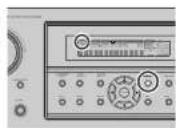
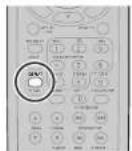
You can select the display mode for the front display of the SR4600.
To select this mode, press the DISPLAY on the front panel or on the remote.
When this button is pressed, the display mode is switched in the following sequence.
→ Surround Mode → Auto-display Off → Display Off → Input Function → Surround Mode...
In Auto display off mode, the display is off. But, if you make a change to the unit such as Input or surround mode, the display will show that change, then go back to off after about 3 seconds. When changing the volume, it is not displayed.
In Display off mode, the display is off completely. Note:
- Only the DISP indicator will be illuminated on the front display, in display off condition
SELECTING ANALOG AUDIO INPUT OR DIGITAL AUDIO INPUT

If you have already assigned the digital inputs, you can temporarily select the audio input mode for each input source with the A/D button on the remote controller.
When this button is pressed, the input mode is switched in the following sequence.
→ Digital Auto → Digital → Analog → Digital Auto... In Digital Auto mode, the types of signals being input to the digital and analog input jacks for the selected input source are detected automatically. If no digital signal is being input, the analog input jacks are selected automatically.
In Digital mode, input is fixed to an assigned digital input terminal.
In analog mode, the analog input jacks are selected. This selecting is temporary, so the result will not be stored in memory.
If you need to change the input mode completely, use INPUT setup in SETUP MENU system. (see page 17)

RECORDING AN ANALOG SOURCE
In normal operation, the audio or video source selected for listening through the SR4600 is sent to the record outputs.
This means that any program you are watching or listening to may be recorded simply by placing machines connected to the outputs for TAPE OUT, CD-R/MD OUT, VCR1 OUT, and DSS/VCR2 OUT in the record mode.
To record the input source signal you are currently watching or listening to

text_image
Diagram showing two electronic measurement devices with labeled parts, one displaying a display and the other showing a grid of control buttons.- Select the input source to record by turning the INPUT FUNCTION SELECTOR knob on the front panel or simply press the Input selector buttons on the remote. The input source is now selected and you may watch or listen to it as desired.
- The currently selected input source signal is output to the TAPE OUT, CD-R/MD OUT, VCR1 OUT, and DSS/VCR2 OUT outputs for recording.
- Start recording to the recording component as desired.
Recording the video from one source and the audio from another
You can add the sound from one source to the video of another source to make your own video recordings.
Below is an example of recording the sound from a compact disc player connected to CD IN and the video from a video camera connected to VCR1 to video cassette recorder connected to the DSS/VCR2 OUT jack.
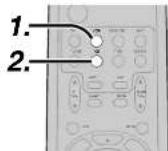
- Switch the video output source to VCR1 by simply pressing the Input selector buttons on the remote.
- Switch the audio input source to CD by simply pressing the input selector buttons on the remote.
- Now "CD" has been selected as the audio input source and "VCR1" as the video input source.
Notes:
- If you change the input source during recording, you will record the signals from the newly selected input source.
- You cannot record the surround effects.
- Digital input signals are only output to the digital outputs. There is no conversion from digital to analog.
When connecting CD players and other digital components, do not connect only the digital terminals, but the analog ones as well.
HT-EQ

text_image
Front panel of a digital measurement device with labeled buttons and display screenPress the HT-EQ button on the front panel to turn on the HT-EQ mode.
The tonal balance of a film soundtrack will be excessively bright and harsh when played back over audio equipment in the home. This is because film soundtracks were designed to be played back in large movie theater environments.
Activating the HT-EQ feature when watching a film made for movie theaters corrects this and restores the correct tonal balance.
The HT-EQ feature can be activated only while in Dolby Pro Logic Mode, or while decoding Dolby Digital or DTS encoded material.
7.1 CH INPUT
The SR4600 is equipped for future expansion through the use of Multi channel SACD multichannel player or DVD-Audio player.
When this is selected, the input signals connected to the L(front left), R (front right), CENTER, SL (surround left), SR (surround right) and SBL (surround back left) and SBR (surround back right) channels of the 7.1 CH. In jacks are output directly to the front (left and right), center, surround (left and right) and surround back speaker systems as well as the pre-out jacks without passing through the surround circuitry.
In addition, the signal input to the SW (subwoofer) jack is output to the PRE OUT SW (subwoofer) jack.
When 7.1 CH. INPUT is selected, the last video input used remains routed to the Monitor Outputs.
This permits simultaneous viewing with video sources
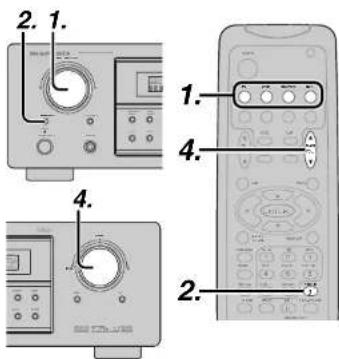
text_image
1. 2. 3. 4. 5. 6. 7. 8. 9. 10. 11. 12. 13. 14. 15. 16. 17. 18. 19. 20. 21. 22. 23. 24. 25. 26. 27. 28. 29. 30. 31. 32. 33. 34. 35. 36. 37. 38. 39. 40. 41. 42. 43. 44. 45. 46. 47. 48. 49. 50. 51. 52. 53. 54. 55. 56. 57. 58. 59. 60. 61. 62. 63. 64. 65. 66. 67. 68. 69. 70. 71. 72. 73. 74. 75. 76. 77. 78. 79. 80. 81. 82. 83. 84. 85. 86. 87. 88. 89. 90. 91. 92. 93. 94. 95. 96. 97. 98. 99. 100.- Select a desired Video source to decide the routed video signal to the Monitor Outputs.
-
Press the 7.1 CH INPUT button on the front panel or press 7.1 CH IN on the remote to switch the 7.1 channel input.
-
If it is necessary to adjust the output level of each channel, press the CH.SEL button on the remote.
Adjust the speaker output levels so that you can hear the same sound level from each speaker at the listening position. For the front left, front right, center, surround left, surround right and surround back speakers, the output levels can be adjusted between -10 to +10 dB. The subwoofer can be adjusted between -15 and +10 dB.
These adjustments result will be stored to 7.1 CH. INPUT memory.
- Adjust the main volume with the MAIN VOLUME knob or the VOL buttons on the remote.
To cancel the 7.1 CH. INPUT setting, press the 7.1 CH INPUT button on the front panel or press 7.1 CH IN on the remote.
Notes:
- When the 7.1 CH. Input is in use, you may not select a surround mode, as the external decoder determines processing.
- In addition, there is no signal at the record outputs when the 7.1 CH. Input is in use.
7.1 CH INPUT LEVEL
This menu is to adjust the speaker levels for 7.1-channel input sources.
Here you will adjust the volume for each channel so that they are all heard by the listener at the same level.
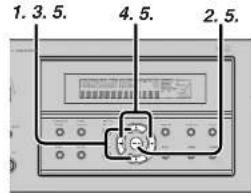
text_image
1. 3. 5. 4. 5. 2. 5.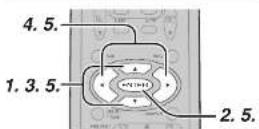
- Press the CH.SEL button on the remote to enter this menu.
- Press ▲ or ▼ cursor button to select desired channel.
- Using the ◀or ▶cursor button, adjust the volume level of each channel.
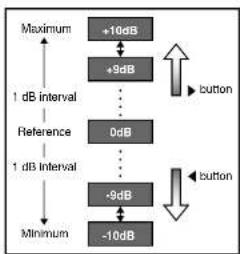
flowchart
graph TD
    A["+10dB"] --> B["+9dB"]
    B --> C["..."]
    C --> D["0dB"]
    D --> E["..."]
    E --> F["-9dB"]
    F --> G["-10dB"]
    H["Maximum"] --> A
    I["1 dB Interval"] --> J["Reference"]
    J --> K["1 dB Interval"]
    L["Minimum"] --> M["Minimum"]
    N["button"] --> O["button"]
Notes:
- When no operation is taken for 5 seconds, the level setup mode will be cancelled.
- The condition of these setup will be memorized to 7.1CH INPUT source.
MENU STRUCTURE of 7.1CH INPUT LEVEL setup
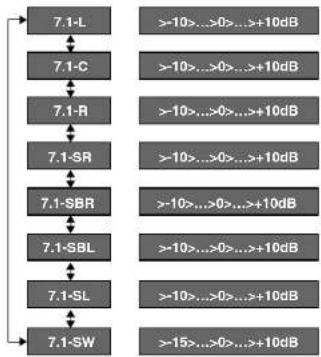
flowchart
graph TD
    A["7.1-L"] --> B["7.1-C"]
    B --> C["7.1-R"]
    C --> D["7.1-SR"]
    D --> E["7.1-SBR"]
    E --> F["7.1-SBL"]
    F --> G["7.1-SL"]
    G --> H["7.1-SW"]
    style A fill:#f9f,stroke:#333
    style H fill:#f9f,stroke:#333
    note right of A: >=10,...>0...>>+10dB
    note right of B: >=10,...>0...>>+10dB
    note right of C: >=10,...>0...>>+10dB
    note right of D: >=10,...>0...>>+10dB
    note right of E: >=10,...>0...>>+10dB
    note right of F: >=10,...>0...>>+10dB
    note right of G: >=10,...>0...>>+10dB
    note right of H: >=15,...>0...>>+10dB
Frequency scan step for AM is selectable. Default setup is 9 kHz step, if your country's standard is 10 kHz step. Press TUNER button on the remote more than 6 seconds. Scan step will change.
Note:
- Preset memory for the tuner will clear by changing this setup.
AUTO TUNING
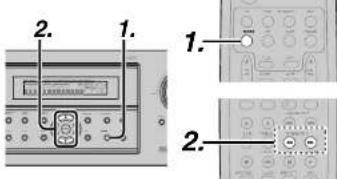
text_image
1. 2. 1. 2.(Using the SR4600)
- To select tuner and desired band (FM or AM), press the BAND button on the front panel.
- Press the ▲ or ▼cursor buttons on the front panel for more than 1 second to start the auto tuning function.
- Automatic searching begins then stops when a station is tuned in.
(Using the remote control unit)
- To select tuner and desired band (FM or AM), press the TUNER button twice within in two seconds on the remote.
- Press the or for more than 1 second on the remote.
- Automatic searching begins then stops when a station is tuned in.
If tuning does not stop at the desired station, use to the "Manual tuning" operation.
MANUAL TUNING

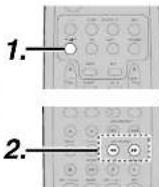
(Using the SR4600)
- To select tuner and desired band (FM or AM), press the BAND button on the front panel
- Press the ▲ or ▼cursor buttons on the front panel to select the desired station.
(Using the remote control unit)
-
To select tuner and desired band (FM or AM), press the TUNER button twice within in two seconds on the remote.
-
Press the ◀ or ▶ on the remote to tune in the desired station.
DIRECT FREQUENCY CALL

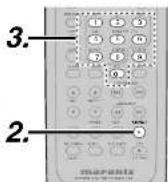
- To select tuner and desired band (FM or AM), press the TUNER button twice within two seconds on the remote.
- Press the F.DIRECT on the remote, display will show "FREQ----".
- Input your desired station's frequency with the numeric buttons on the remote.
- The desired station will automatically be tuned.
(FM) TUNING MODE (AUTO STEREO OR MONO)
When in the auto stereo mode, AUTO indicator will be illuminated on the display.
The 'ST' indicator is illuminated when a stereo broadcast is tuned in.
At open frequencies, the noise is muted and the "TUNED" and "ST" indicators are not illuminated. If the signal is weak, it may be difficult to tune into the station in stereo. In such a case, press the T-MODE button on the front panel or remote.
"AUTO" indicator is not illuminated, if FM stereo broadcasts are received in monaural and the "ST" indicator is not illuminated.
To return to auto stereo mode, press the T-MODE button or press T-MODE button on the remote again. AUTO indicator is illuminated on the display.
PRESET MEMORY
With this unit you can preset up to 50 FM/AM stations in any order. For each station, you can memorize the frequency and reception mode if desired.
AUTO PRESET MEMORY
This function automatically scans the FM and AM band and enters all stations with proper signal strength into the memory.

text_image
2. 4. 2. 5. 1. 3.- To select FM, press the BAND button on the front panel.
- While pressing the MEMO button, press the ▶ cursor button.
'AUTO PRESET' will appear on the display, and scanning starts from the lowest frequency. - Each time the tuner finds a station, scanning will pause and the station will be played for five seconds.
During this time, the following operations are possible. - The band can be changed by the BAND button. If no button is pressed during this period, the current station is memorized in location Preset 02.
If you wish to skip the current station, press the ▲ cursor button during this period, this station is skipped and auto presetting continues. - Operation stops automatically when all 50 preset memory positions are filled or when auto scanning attains the highest end of all bands. If you desire to stop the auto preset memory at anytime, press the CLEAR button.
MANUAL PRESET MEMORY
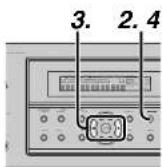
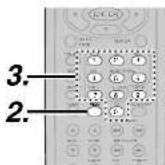
(Using the SR4600)
- Tune into the radio station you desire (Refer to the "MANUAL TUNING" or "AUTO TUNING" section).
- Press the MEMO button on the front panel. '-' (press numbers) starts blinking on the display.
- Select the preset number by pressing the ▲ or ▼ cursor buttons, while this is still blinking (approx. 5 seconds)
- Press the MEMO button again to enter. The display stops blinking. The station is now stored in the specified preset memory location.
(Using the remote control unit)
- Tune into the radio station you desire (Refer to the "MANUAL TUNING" or "AUTO TUNING" section).
- Press the MEMO button on the remote. “—” (preset number) starts blinking on the display.
- Enter the desired preset number by pressing the numeric buttons.
Note:
- When entering a single digit number (2 for example), either input "02" or just input "2" and wait for a few seconds.
RECALLING A PRESET STATION

text_image
Diagram showing two electronic control panels with labeled buttons and a display screen, likely illustrating a device interface or control system.(Using the SR4600)
- Select the desired preset station by pressing the ◀ or ▶ cursor buttons on the front panel
(Using the remote control unit)
- Press the ← or → buttons to select the desired preset station, or input your desired preset channel with the numeric buttons on the remote.
PRESET SCAN
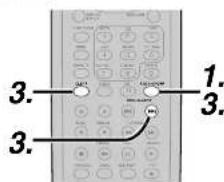
text_image
3. 3. 1. 3.(Using the remote control unit)
- Press the P.SCAN on the remote.
"PRESET SCAN" appears on the display and then the preset station with the lowest preset number is recalled first. - Preset stations are recalled in sequence (No.1 → No.2 → etc.) for 5 seconds each. No stored preset number will be skipped.
- You can fast forward the preset stations by pressing the ▶ continuously. When the desired preset station is received, cancel the preset scan operation by pressing the CLEAR button or P.SCAN on the remote.
CLEARING STORED PRESET STATIONS
You can remove preset stations from the memory using the following procedure.

text_image
2. 3. 2. 3.- Recall the preset number to be cleared with the method described in "Recalling" a preset station.
- Press the MEMO button on the front panel or press the MEMO button on the remote.
- The stored preset number blinks in the display for 5 seconds. While blinking, press the CLEAR button on the front panel or the remote.
- "xx CLEAR" appears on the display to indicate that the specified preset number has been cleared.
Note:
• To clear all stored preset stations, press and hold the CLEAR and the ENTER buttons for two seconds.
SORTING PRESET STATIONS
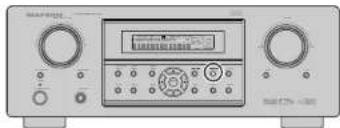
text_image
Front panel of a digital audio recording device with control knobs and display screen showing '50Hz' and '30Hz' settingsIf you have stations memorized, and there is a gap in the sequential order:
i.e. the stations are stored as follows
(notice there is no stations programmed for pre sets for 4-9), you can have pre set 10 become pre set 5:
To sort the numbers, press and hold the MEMO and the ▼ cursor buttons.
"PRESET SORT" will appear on the display and sorting will be done.
NAME INPUT OF THE PRESET STATION.
This function allows the name of each preset channel to be entered using alphanumeric characters. Before name inputting, you need to store preset stations with the preset memory operation.
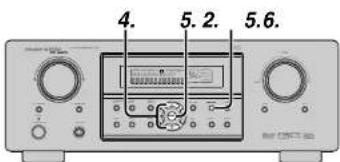
text_image
4. 5.2. 5.6.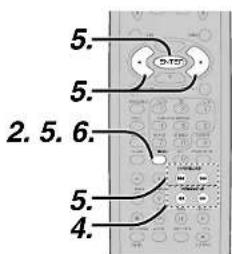
- Recall the preset number to be inputted name with the method described in "Recalling" a preset station.
- Press the MEMO button on the front panel or press the MEMO button on the remote for more than 3 seconds.
- The left most column of the station name indicator flashes, indicating the character entry ready status.
- When you press the ▲ or ▼ cursor buttons on the front panel or the ◀/▶ buttons on the remote, alphabetic and numeric characters will be displayed in the following order:
A → B → C ... Z → 1 → 2 → 3 ..... 0 → - → + → I → (Blank) → A
UP
← DOWN
- After selecting the first character to be entered, press the MEMO or ENTER buttons, press the MEMO button on the remote.
The entry in this column is fixed and the next column starts to flash. Fill the next column the same way.
To move back and forth between the characters, press the ◀/▶ cursor buttons or press ◀◀ or ▶◀ buttons on the remote.
Note:
• Unused columns should be filled by entering blanks.
6. To save the name, press the MEMO button on the front panel or remote for more than 2 seconds.
| Ten keypad | Press, press again, press again, etc. |
| 1 | A B C 1 A |
| 2 | D E F 2 D |
| 3 | G H 1 3 G |
| 4 | J K L 4 J |
| 5 | M N 0 5 M |
| 6 | P Q R 6 P |
| 7 | S T U 7 S |
| 8 | V W X 8 V |
| 9 | Y Z space 3 Y |
| 0 | - + i 0 |
RDS OPERATION
Now in use in many countries, RDS (Radio Data System) is a description of the station's programming hidden space in the FM signal.
Your new receiver is equipped with RDS to assist in the selection of FM stations using station and network names, rather than broadcast frequencies. Additional RDS functions include the ability to search for programme types.
RADIO TEXT
Some RDS stations broadcast RADIO TEXT, which is additional information on the station and programme being broadcast.
RADIO TEXT information appears as 'running' text in the display. RADIO TEXT is transmitted character by the radio station. As a result of that it may take some time until the entire text has been completely received.
RDS DISPLAY
When a receiver is tuned to an FM station that is transmitting RDS data, the Front Panel Information Display will automatically show the station name or RADIO TEXT in place of the typical display of the station's broadcast frequency.
To change the display, press the RDS button on the remote.
PS (Program Service Name) → RT (RADIO TEXT) → Frequency
PROGRAMME TYPE (PTY) DISPLAY
The RDS system categorizes programmes according to their genre into different programme type (PTY) groups. To display the programme type information of the current station, press the PTY button in the TUNER MODE on the remote.

PTY AUTO SEARCH
Your receiver is equipped to automatically search for stations transmitting any of 29 different programme types. To search for a PTY, follow these procedures:

text_image
Diagram showing two connected remote control panels with labeled buttons and a digital display, likely illustrating a home control or navigation system.- Press the PTY button in the TUNER MODE on the remote controller. The current station's PTY will be displayed, or the currently selected PTY group will be displayed in blinking if no station or PDS data is present.
-
To change to a new PTY type, press the ▲ or ▼ cursor button on the front panel or numeric buttons on the remote until the desired PTY is shown in the display.
-
Once the desired PTY group or type has been selected, press the PTY button while the display blink (approx. 5 seconds). The PTY Auto search will start, and the tuner will pause at each station broadcasting RDS PTY information corresponding to the selected choice.
- To advance to the next RDS station with the desired PTY, press the PTY button again within 5 seconds.
| NUMBER | DISPLAY PROGRAMME TYPE | |
| 1 | POP | Pop Music |
| 2 | ROCK | Rock Music |
| 3 | MOR | M. O. R. Music |
| 4 | LIGHT | Light classical |
| 5 | CLASSIC | Serious classical |
| 6 | NEWS | News |
| 7 | AFFAIR | Current Affairs |
| 8 | INFO | Information |
| 9 | SPORT | Sport |
| 10 | EDUCATE | Education |
| 11 | DRAMA | Drama |
| 12 | CULTURE | Culture |
| 13 | SCIENCE | Science |
| 14 | OTHERS | Varied |
| 15 | OTHER | Other Music |
| 16 | WEATHER | Weather |
| 17 | FINANCE | Finance |
| 18 | CHILDREN | Children's programmes |
| 19 | SOCIAL | Social Affairs |
| 20 | RELIGION | Religion |
| 21 | PHONE IN | Phone In |
| 22 | TRAVEL | Travel |
| 23 | HOBBIES | Hobbies |
| 24 | JAZZ | Jazz Music |
| 25 | COUNTRY | Country Music |
| 26 | NATION | National Music |
| 27 | OLDIES | Oldies Music |
| 28 | FOLK | Folk Music |
| 29 | DOCUMENT | Documentary |
The Surround Speaker B system is a function which allows you to listen to the same source in a room other than the room in which the SR4600 is located. The operations possible with the Surround speaker function are explained briefly below.
The SR4600 allows you to connect another set of speakers and place them in a another room or separated area for listening to music. The SURROUND SPEAKER B system can not be operated with the supplied remote controller.
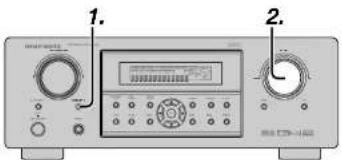
text_image
Front panel of a digital oscilloscope with labeled buttons and display screen- Press the S(Surround) SPEAKER B button. The unit enters surround speaker B mode and the "SPKR B" will appear on the display.
- The volume of S. SPEAKER B is interlocked with the main volume.
- SURROUND SPEAKER B On/ Off is available in main room only.
- SURROUND SPEAKER B output terminals can be used when the SURROUND BACK SPEAKER is set NONE in SPEAKER SETUP menu. (See SPEAKER SETUP, page 18)
- "The Surr. Back Speakers are in use" is displayed by pressing the S. SPEAKER B button when the SURROUND BACK SPEAKER is set except NONE in SPEAKER SETUP menu. (See SPEAKER SETUP, page 18)
- Surround Speaker B function is unavailable, while the unit is 7.1 CH input mode.
TROUBLESHOOTING
In case of trouble, check the following before calling for service:
-
Are the connections made properly?
-
Are you operating the unit properly following the user's guide?
-
Are the power amplifiers and speaker working properly?
If the unit does not operate properly, check items shown in the following table.
If your trouble cannot be recovered with the remedy actions listed in the following table, malfunction of the internal circuitry is suspected; immediately unplug the power cable and contact your dealer, nearest Marantz authorized dealer or the Marantz Service Center in your country.
| SYMPTOM | CAUSE | REMEDY |
| SR4600 cannot be turned up. | The power plug is not connected. | Connect the power plug to the outlet. |
| No sound and picture are output even when power is on. | Mute is on. | Cancel mute using the remote control unit. |
| The input cable is not connected correctly. | See the connection diagram and connect the cables correctly. | |
| The master volume control is turned all the way down. | Adjust the master volume. | |
| The function selector position is wrong. | Select correct position. | |
| No speaker output. | The headphones are connected to the headphone jack. | Disconnect the headphones. (Speakers will not output sound when headphones are connected.) |
| Incorrect Audio or Video for selected source. | Input cable connected incorrectly. | Connect the cable correctly by referring to the connection diagram. |
| Incorrect Audio from a channel. | Speaker cable connected incorrectly. | Connect the cable correctly by referring to the connection diagram. |
| No Audio output from the center channel speaker. | The center speaker cable connection is incomplete. | Connect the cable correctly. |
| STEREO has been selected for Surround mode. | When STEREO is selected for Surround mode, no sound will be output from the center speaker. Set another Surround mode. | |
| Center = NONE has been selected in SETUP mode. | Make the correct setting. | |
| No Audio output from the surround speakers. | The surround speaker cable connection is incomplete. | Connect the cable correctly. |
| STEREO has been selected for Surround mode. | When STEREO has been selected for Surround mode, no sound will be output from the surround speaker. Set another Surround mode. | |
| Surround = NONE has been selected in SETUP mode. | Make the correct setting. | |
| No Audio output from the surround back speakers. | The surround back speaker cable connection is incomplete. | Connect the cable correctly. |
| Surround mode is not EX/ES mode. | Set surround mode EX/ES. | |
| Surround back = NONE has been selected in SPEAKERS SIZE SETUP | Make the correct setting. |
| SYMPTOM | CAUSE | REMEDY |
| Can not select EX/ES mode. | Surround center= NONE has been selected in SPEAKERS SIZE SETUP | Make the correct setting. |
| Input signal is incompatible. | Use 5.1channel source. | |
| Can not select Pro Logic TIX mode. | Input signal is incompatible. | Use 2 channel Dolby Digital input signal, PCM Input signal or analog input signal. |
| Can not select Noc:6 mode. | Input signal is incompatible. | Use 2 channel Dolby Digital input signal, PCM input signal or analog input signal. |
| Can not select CSII mode. | Input signal is incompatible. | Use 2 channel Dolby Digital input signal, PCM input signal or analog input signal. |
| No output to Sub Woofer Out. | Sub-woofer = NONE has been selected in SETUP mode. | Select Sub-woofer = YES. |
| Noise is produced during DTS-encoded CD or laser disc play. | Analog has been selected for input. | Be sure to perform digital connection, select digital input, then play. |
| A specific channel does not produce output. | Nothing recorded on source. | Check the encoded channel on the source side. |
| FM or AM reception fails. | Antenna connection is incomplete. | Correctly connect the indoor FM and AM antennas to FM and AM antenna outlets. |
| Noise is heard during AM reception. | Reception is affected by other electrical fields. | Try changing location where the AM indoor antenna is set up. |
| Noise is heard during FM reception. | The radio waves from the broadcasting station are weak. | Install an FM outdoor antenna. |
| Cannot get programmed station when the PRESET button is pressed. | Preset data has been erased. | Disconnecting power plug for long periods of time will erase preset data. If that happens, input the preset data again. |
| Control with the remote control unit fails. | Batteries are consumed. | Replace all the batteries with new ones. |
| Remote controller's function-key setting is wrong. | Select different position from which equipment will be controlled. | |
| The distance between this SR4600 and the remote commander is too far. | Move closer to this SR4600. | |
| Something is blocking SR4600 and the remote commander. | Remove offending object. |
GENERAL MALFUNCTION
If the equipment malfunctions, this may be because an electrostatic discharge or AC line interference has corrupted the information in the equipment memory circuits. Therefore:
- disconnect the plug from the AC line supply
- after waiting at least three minutes, reconnect the plug to the AC line supply
- re-attempt to operate the equipment
Memory backup
• In case a power outage occurs or the power cord is accidentally unplugged, the SR4600 is equipped with a backup function to prevent memory data such as the preset memory from being erased.
HOW TO RESET THE UNIT

natural_image
Front view of a vintage electronic device with control knobs and a digital display (no visible text or symbols)Should the operation or display seem to be abnormal, reset the unit with the following procedure.
The SR4600 is turned on, press and hold the 7.1CH INPUT and ATT buttons simultaneously for 3 seconds or more.
Remember that the procedure will reset the settings of the function selector, Surround mode, delay time, TUNER PRESET etc., to their initial settings.
TECHNICAL SPECIFICATIONS
FM TUNER SECTION
| Frequency Range | 87.5 - 108.0 MHz |
| Usable Sensitivity | IHF 1.8 μV/16.4 dB |
| Signal to Noise Ratio | Mono/Stereo 75/70 dB |
| Distortion | Mono/Stereo 0.2/0.3 % |
| Stereo Separation | 1 kHz 45 dB |
| Alternate Channel Selectivity | ± 300 kHz 60 dB |
| Image Rejection | 98 MHz 70 dB |
| Tuner Output Level | 1 kHz, ± 75 kHz Dev 800 mV |
AM TUNER SECTION
| Frequency Range | 531 - 1602 kHz |
| Signal to Noise Ratio | 50 dB |
| Usable Sensitivity | Loop 400mV/m |
| Distortion | 400Hz, 30 % Mod. 0.5 % |
| Selectivity | ±18 kHz 70 dB |
AUDIO SECTION
| Power Output (20 Hz - 20 kHz; THD=0.08%) | |
| Front L&R | 8 ohms 80 W / Ch |
| Center | 8 ohms 80 W / Ch |
| Surround L&R | 8 ohms 80 W / Ch |
| Surround Back L&R | 8 ohms 80 W / Ch |
| Front L&R | 6 ohms 105 W / Ch |
| Center | 6 ohms 105 W / Ch |
| Surround L&R | 6 ohms 105 W / Ch |
| Surround Back L&R | 6 ohms 105 W / Ch |
Input Sensitivity/Impedance ..... 168 mV/ 47 Kohms Signal to Noise Ratio/Analog Input : Pure Direct) ..... 105 dB Frequency Response
| (Analog Input / Pure Direct) | 8 Hz - 100 kHz (±3 dB) |
| (Digital Input / 96 kHz PCM) | 8 Hz - 45 kHz (±3 dB) |
VIDEO
| Television Format | PAL |
| Input Level/Impedance | 1 Vp-p/75 ohms |
| Output Level/Impedance | 1 Vp-p/75 ohms |
| Video Frequency Response | 5 Hz to 8 MHz (-1 dB) |
| Video Frequency (Component) | 5 Hz to 80 MHz (-1 dB) |
| S/N | 60 dB |
GENERAL
| Power Requirement | AC 230 V 50 Hz |
| Power Consumption | 388 W |
| Weight | 12.0 Kg |
ACCESSORIES
| Remote Control Unit RC5500SR | 1 |
| AAA-size batteries | 2 |
| FM Antenna | 1 |
| AM Loop Antenna | 1 |
| AC Power Cord | 1 |
Specifications subject to change without prior notice.
DIMENSIONS

text_image
25 mm 342.5 mm 387.5 mm 20 mm
text_image
440 mm 162.3 mm 16.3 mm 106 mm
SETUP CODES
CD
Aiwa 0184 Burmester 0447
California Audio Labs 0056
Carver 0184, 0206
Classic....0324
Denoh....0030
DKK 0027 DMY Electronics 0184
DMA Electronics.... 0184 Emerson.... 0232
Erferson 0352 Fisher 0352 0206
Garrard 0447
Genexxa 0059.0332
GPX 0323
Harman/Kardon 0184, 0200, 0229
Hitachi 0059
Integra 0128
JVC 0099, 0321
Kenwood 0055, 0064, 0217
KLH 0345 Koss 0344
Krell 0184
Linn 0184
Luxman 0120
LXI 0332
Magnavox.... 0184, 0332
Marantz 0999, 0056, 0184
MCS 0056
Miro 0027
Mission 0184
MTC 0447 NON 0191
NSM 0184 Onkyo 0128
Optimus 0027 0059 0064 0332 0206
0495.0172.0447.0102
Panasonic 0056
Parasound 0447
Philips....0999, 0184
Pioneer 0059, 0332, 0495
Polk Audio 0184
Proton 0184
QED 0184
Quad 0184
Quasar 0056 RadioShock 9182
RadioSnack 0102 RCA 0089, 0059, 0447, 0080
0332 0206 0495
Realistic 0447, 0206
Rotel 0184, 0447
SAE 0184
Sansui 0184, 0332
Sanyo 0206
Scott 0332
Sears 0352 Sharp 0064
Sonic Frontiers 0184
Sony 0027 0127 0391
Soundesign 0172
Symphonic 0332
TAG McLaren 0184
Tascam 0447
TDK 0235
Teac 0447
Technics 0056
Victor 0099
Wards 0184, 0080 Yamaha 0063, 0319
Yamana 0005, 0515 Zenda 0184
Zonda 0184
CDR
Classic....0324
Fisher 0352
Harman/Kardon 0229
JVC 0321
Kenwood 0999
Marantz 0999
Philips....0999
Pioneer 0089, 0114
Sony 0391, 0127
TDK 0235 Tess 0447
Yamake 0319
MD PLAYERS
Denon....1900
Kenwood 1708, 1853
Marantz 1207
Onkyo 1895
Optimus 1090
Pioneer 1090 Shawn 1888
Sharp 1888 Sherwood 1094
Sherwood 1634 Sony 1517
Yamaha 1915
TAPE
Aiwa 0056, 0227, 0224
Akai 0310
Carver 0056
Denon 0103
Fisher 0101
Garrard 0466, 0335
Harman/Kardon 0209, 0056
JVC 0271, 0300
Kenwood 0097 Magney 0256
Magnavox.... 0056 Marantz.... 0056, 0036
Marantz 0050, 0050 Mitsubishi 0310
NAD 0171
Onkyo 0309.0163.0162
Optimus 0054, 0247, 0466, 0364
Panasonic 0256
Philips....0056
Pioneer 0054, 0247, 0126
Polk Audio 0056
RCA 0054, 0247
Revox 0217
Sansul 0056, 0036
Sherwood 0364 Sany 0270 0197 0218
Sony 0270, 0197, 0318 Toco 0335
Teac 0355 Technics 0256
Victor 0300
Wards 0054
Yamaha 0124, 0121
SAT (DSS)
AlphaStar 0799
Chaparral 0243
Crossdigital 1136
DirecTV 0419, 0593, 0666, 1666,
1169, 0274, 0776, 1776,
0751, 0846, 1883, 1103,
1136, 0126, 1470, 1469
Dish Network System ..... 1032, 0802, 1197
Dishpro 1032, 0802
Echostar 1032, 0802, 1197
Expressvu 0802
GE 0593 General Instrument 0806
general instrument 0896 QOL 0899
Goi....0802 Hitachi....0846
Hitachi 0848 HTS 0802
Hughes Network Systems
1169, 0776, 1776, 1470, 1469
JVC 0802,1197
Magnavox.... 0751, 0749
Memorex 0751
Mitsubishi 0776
Motorola 0896
Next Level 0896
Panasonic 0274, 0728 Reyost 0751
Paysat 0751 Philino 1169, 0776, 1776, 0751
1103, 0749, 0126, 1469
Proscan 0419 0593
RadioShack 0896
RCA 0419, 0593, 0882, 0170
Samsung 1303, 1136
SKY 0883
Sony 0666,1666
Star Choice 0896
Tivo 1169, 1470, 1469
Toshiba 0776, 1776, 0817, 1312 Uniden 0751, 0749
Children 0751, 0749 Zenith 0882, 1883
Zenith 0883, 1883
TV
Admiral 0120, 0490
Advent 0788, 0869
Aiko 0119
Akai 0729, 0057, 0699
Albatron 0870
America Action 0207
Ahafl 0207 AGG 0057
AOC 0657 Anex Digital 0775 0792 0806
ApoX Digital 0778, 0762, 0555 Audiovox 0478, 0307, 0119
Bell & Howell 0181
Bradford 0207
Broksonic 0263, 0490
Candle 0057
Carnivale 0057
Carver 0081
Celebrity 0027
Celera....0792
Changhong....0792
Citizen 0087, 0057, 0119 Clarien 0207
Carter 0207
Craig 0207
Crosley 0081
| Crown | 0207 |
| Curtis Mathes | 0074, 0081, 0181, 0478,0120, 0087, 0729, 0057,0172, 0193, 1174, 1374 |
| CXC | 0207 |
| Daewoo | 0478, 1688, 0119, 0699 |
| Denon | 0172 |
| Dumont | 0044 |
| Durabrand | 0207, 0205 |
| Electroband | 0027 |
| Elektra | 0044, 1688 |
| Emerson | 0181, 0263, 0490,0207, 0205, 0198 |
| Envision | 0057 |
| Fisher | 0181 |
| Fujitsu | 0710, 0880, 0836 |
| Funai | 0207, 0198 |
| Futuretech | 0207 |
| Gateway | 1782, 1783 |
| GE | 0074, 0078, 0478, 0205,1474, 1374, 1174 |
| Gibraltar | 0044, 0057 |
| GoldStar | 0057, 0205 |
| Grunpy | 0207 |
| Hallmark | 0205 |
| Harman/Kardon | 0081 |
| Harvard | 0207 |
| Havermy | 0120 |
| Hello Kitty | 0478 |
| Himitsu | 0207 |
| Hisense | 0775 |
| Hitachi | 1172, 0172 |
| Infinity | 0081 |
| Inteq | 0044 |
| JBL | 0081 |
| JCB | 0027 |
| Jensen | 0788 |
| JVC | 0080 |
| KEC | 0207 |
| Kenwood | 0057 |
| KLH | 0792 |
| KTV | 0207, 0057 |
| LG | 1205, 0883, 0469 |
| LXI | 0074, 0081, 0181, 0183, 0205 |
| Magnavox | 0081, 0057, 1481, 0733, 1281 |
| Marantz | 0081, 0057, 1581, 0731 |
| Matsushita | 0277, 0677 |
| Megatron | 0205, 0172 |
| Memorex | 0181, 0490, 0177, 0205 |
| MGA | 0177, 0057, 0205 |
| Midland | 0074, 0044, 0078 |
| Mitsubishi ..... 0120, 0177, 1277, 0205, 0863 |
| Monivision ..... 0870 |
| Motorola ..... 0120 |
| MTC ..... 0087, 0057 |
| Multitech ..... 0207 |
| NAD ..... 0183, 0205 |
| NEC ..... 0057, 1731 |
| Nikko ..... 0057, 0205, 0119 |
| Norcent ..... 0775, 0851 |
| NTC ..... 0119 |
| Onwa ..... 0207 |
| Optimus ..... 0181, 0277, 0193, 0677 |
| Optonica ..... 0120 |
| Orion ..... 0263, 0490 |
| Panasonic ..... 0277, 0078, 0677 |
| Penney ..... 0074, 0183, 0078, 0087, 0057, 0205, 1374 |
| Philco ..... 0081, 0057 |
| Philips ..... 0081, 1481, 0717 |
| Pilot ..... 0057 |
| Pioneer ..... 0193, 0706 |
| Portland ..... 0119 |
| Prima ..... 0788 |
| Prism ..... 0078 |
| Proscan ..... 0074, 1474, 1374 |
| Proton ..... 0205 |
| Pulsar ..... 0044 |
| Quasar ..... 0277, 0078, 0677 |
| RadioShack .. 0074, 0181, 0207, 0057, 0205 |
| RCA ..... 0074, 1474, 1274, 1574, 0117, 1174, 1074, 1374, 0706 |
| Realistic ..... 0181, 0207, 0057, 0205 |
| Runco ..... 0044, 0057 |
| Sampo ..... 0057, 1782 |
| Samsung ..... 0087, 0729, 0057, 0205 |
| Sansui ..... 0490 |
| Sanyo ..... 0181 |
| Scotch ..... 0205 |
| Scott ..... 0263, 0207, 0205 |
| Sears .. 0074, 0081, 0181, 0183, 0205, 0198 |
| Sharp ..... 0120 |
| Sheng Chia ..... 0120 |
| Sony ..... 0027 |
| Soundesign ..... 0207, 0205 |
| Squareview ..... 0198 |
| SSS ..... 0207 |
| Starlite ..... 0207 |
| Studio Experience ..... 0870 |
| Supreme ..... 0027 |
| SVA ..... 0775, 0892 |
| Sylvania ..... 0081, 0057, 0198 |
| Symphonic | 0207, 0198 |
| Tandy | 0120 |
| Tatung | 1783 |
| Technics | 0277, 0078 |
| Techwood | 0078 |
| Teknika | 0081, 0207, 0177, 0087, 0119 |
| Telefunken | 0729 |
| TMK | 0205 |
| TNCi | 0044 |
| Toshiba | 0181, 0183, 0087, 1283, 1383, 1183, 1731, 0677 |
| TVS | 0490 |
| Vector Research | 0057 |
| Victor | 0080 |
| Vidikron | 0081 |
| Vidtech | 0205 |
| Viewsonic | 1782 |
| Wards | 0081, 0057, 0205, 1183 |
| Waycon | 0183 |
| White Westinghouse | 0490 |
| Yamaha | 0057 |
| Zenith | 0044, 0490, 0205, 0119 |
VCR
| Admiral | 0075, 0236 |
| Adventura | 0027 |
| Aiwa | 0064, 0027 |
| American High | 0062 |
| Asha | 0267 |
| Audiovox | 0064 |
| Beaumark | 0267 |
| Bell & Howell | 0131 |
| Broksonic | 0211, 0148, 0236, 1506 |
| Calix | 0064 |
| Canon | 0062 |
| Carver | 0108 |
| Citizen | 0064, 1305 |
| Craig | 0064, 0074, 0267 |
| Curtis Mathes | 0087, 0062, 0189, 1062 |
| Cybernex | 0267 |
| Daewoo | 0072, 1305 |
| Denon | 0069 |
| Durabrand | 0066 |
| Dynatech | 0027 |
| Electrohome | 0064 |
| Electrophonic | 0064 |
| Emerex | 0059 |
| Emerson | 0064, 0211, 0027, 0148, |
| 0070, 0236, 1305, 1506 | |
| Fisher | 0074, 0131 |
| Fuji | 0062, 0060 |
| Funai | 0027 |
| Garrard | 0027 |
| GE | 0087, 0062, 0267, 1087, 1062, 0834 |
| GoldStar | 0064, 1264 |
| Gradiente | 0027 |
| Harley Davidson | 0027 |
| Harman/Kardon | 0108 |
| HI-Q | 0074 |
| Hitachi | 0027, 0069 |
| Hughes Network Systems | 0069 |
| JVC | 0094 |
| KEC | 0064 |
| Kenwood | 0094 |
| Kodak | 0062, 0064 |
| Lloyd's | 0027 |
| LXI | 0064 |
| Magnasonic | 1305 |
| Magnavox | 0062, 0066, 0108, 0027, 1808 |
| Magnin | 0267 |
| Marantz | 0062, 0108, 1408 |
| Marta | 0064 |
| Matsushita | 0062, 0189 |
| MEI | 0062 |
| Memorex | 0062, 0189, 0064, 0075, 0066, 0074, 0267, 0027, 0131, 0236, 1264 |
| MGA | 0267, 0070 |
| MGN Technology | 0267 |
| Minolta | 0069 |
| Mitsubishi | 0094, 0070, 0834 |
| Motorola | 0062, 0075 |
| MTC | 0267, 0027 |
| Multitech | 0027 |
| NAD | 0085 |
| NEC | 0131, 0094 |
| Nikko | 0064 |
| Noblex | 0267 |
| Olympus | 0062 |
| Optimus | 1089, 0189, 0064, 0075, 0131, 0085 |
| Orion | 0211, 0236, 1506 |
| Panasonic | 1089, 0062, 0189, 0252, 1062, 0643 |
| Penney | 0062, 0064, 0267, 0069, 1264, 1062 |
| Pentax | 0069 |
| Philco | 0062 |
| Philips | 0062, 0108, 0645 |
| Pilot | 0064 |
| Pioneer | 0094, 0085 |
| Polk Audio | 0108 |
| Profitronic | 0267 |
| Proscan | 0087, 1087 |
| Pulsar | 0066 |
| Quasar | 0062, 0189, 1062 |
| RadioShack | 0027 |
| Radix | 0064 |
| Randex | 0064 |
| RCA | 0087, 0267, 0069, 1062, 0907, 0085, 0834, 1087 |
| Realistic | 0062, 0064, 0075, 0074, 0027, 0131 |
| ReplayTV | 0643 |
| Runco | 0066 |
| Samsung | 0267, 0072, 1041 |
| Sanky | 0075, 0066 |
| Sansui | 0027, 0094, 0236, 1506 |
| Sanyo | 0074, 0267, 0131 |
| Scott | 0211, 0072, 0148, 0070 |
| Sears | 0062, 0064, 0074, 0027, 0069, 0131, 1264 |
| Sharp | 0075, 0834 |
| Shogun | 0267 |
| Sonic Blue | 0643 |
| Sony | 0062, 0059, 0060, 0027, 1259, 0663 |
| STS | 0069 |
| Sylvania | 0062, 0108, 0027, 0070, 1808 |
| Symphonic | 0027 |
| Teac | 0027 |
| Technics | 0062, 0189 |
| Teknika | 0062, 0064, 0027 |
| Thomas | 0027 |
| Tivo | 1530, 0663, 0645 |
| TMK | 0267 |
| Toshiba | 0072, 0070, 1530, 1172, 0872 |
| Totevision | 0064, 0267 |
| Unitech | 0267 |
| Vector | 0072 |
| Video Concepts | 0072 |
| Videomagic | 0064 |
| Videosonic | 0267 |
| Villain | 0027 |
| Wards | 0087, 0062, 0075, 0074, 0108, 0267, 0027, 0069 |
| White Westinghouse | 0236 |
| XR-1000 | 0062, 0027 |
| Zenith | 0066, 0060, 0027, 0236, 1506 |
DVD
| Aiwa | 0668 |
| Allegro | 0896 |
| Apex Digital | 0699, 0823, 1031, 1127, 0821, 0857, 1088, 0824, 1047 |
| Blue Parade | 0598 |
| Broksonic | 0722 |
| CineVision | 0903, 0896 |
| Curtis Mathes | 1114 |
| CyberHome | 1050, 0843, 1051 |
| Daewoo | 0896, 0860 |
| Denon | 0517 |
| DVD2000 | 0548 |
| Emerson | 0618, 0848 |
| Enterprise | 0618 |
| GE | 0549, 0842 |
| Go Video | 0860, 0742, 0896 |
| Harman/Kardon | 0729, 0609 |
| Hitachi | 0600 |
| Hiteker | 0699 |
| JBL | 0729 |
| JVC | 0585, 0650, 0894 |
| Kenwood | 0517, 0561 |
| KLH | 1047 |
| Koss | 0678 |
| Magnavox | 0530, 0848 |
| Marantz | 0566 |
| Memorex | 0722 |
| Microsoft | 0549 |
| Mintek | 0866 |
| Mitsubishi | 1548, 0548 |
| Onkyo | 0530 |
| Oritron | 0678 |
| Panasonic | 0517, 1789, 1389 |
| Philips | 0530, 0566, 0673, 0881 |
| Pioneer | 0552, 0598 |
| Polaroid | 1088 |
| Polk Audio | 0566 |
| Proscan | 0549 |
| Qwestar | 0678 |
| RCA | 0549, 0598, 0849, 1049 |
| Rio | 0896 |
| Rotel | 0650 |
| Sampo | 0779 |
| Samsung | 0517, 0600, 0847 |
| Sansui | 0722 |
| Sanyo | 0722 |
| Sharp | 0657, 0779 |
| Shinsonic | 0560, 0866 |
| Sonic Blue | 0896 |
| Sony | 0560, 0891, 1060 |
| Superscan | 0848 |
| Sylvania | 0848 |
| Technics | 0517 |
| Theta Digital | 0598 |
| Toshiba | 0530, 1072, 0722 |
| Tredex | 0826 |
| Urban Concepts | 0530 |
| US Logic | 0866 |
| Xbox | 0549 |
| Yamaha | 0517, 0566, 0572 |
| Zenith | 0530, 0618, 0896 |
www.marantz.com
You can find your nearest authorized distributor or dealer on our website.
U.S.A. Marantz America, Inc. 1100 Maplewood Drive, Itasca, IL 60143, U.S.A.
EUROPE Marantz Europe B.V. P.O. Box 8744, 5605 LS Eindhoven. The Netherlands
Manufactured under license from Dolby Laboratories. "Dolby", "Pro Logic" and the double-D symbol are trademarks of Dolby Laboratories. Confidential Unpublished Works. Copyright 1992-1997 Dolby Laboratories, Inc. All rights reserved.
marantz ^® is a registered trademark.

05/2005 00M42BW851310 mzh-ePrinted in