
AZC 6571 - Tumble dryer WHIRLPOOL - Free user manual and instructions
Find the device manual for free AZC 6571 WHIRLPOOL in PDF.


| Brand | Whirlpool |
| Model | AZC 6571 |
| Product Type | Tumble Dryer |
| Capacity | 6 kg |
| Drum Material | Stainless steel (assumed) |
| Dimensions (H x W x D) | Approx. 85 x 60 x 60 cm |
| Weight | Approx. 40 kg |
| Voltage | 220-240 V |
| Fuse Rating | 13 A (UK plug) |
| Energy Consumption (per cycle) | Approx. 5.5 kWh (cotton full load) |
| Programs | Cotton (Extra dry, Cupboard dry, Iron dry), Easy Care (Extra dry, Cupboard dry, Iron dry), Mixed Load, Airing, Timed Drying (10-90 min) |
| Options | Gentle, Dry Plus, Start Delay (3/6/9 hours) |
| Drying System | Condenser (heat exchanger) |
| Lint Filter | Clean after each cycle |
| Water Container | Empty after each cycle; can be connected to drain |
| Heat Exchanger Cleaning | Monthly |
| Anti-Crease | Up to 15 minutes at end of cycle |
| Door Reversibility | Yes (with tools) |
| Stackable | Yes (kit available) |
| Safety Features | Door lock, overheating protection, child safety (no lock specified) |
| Failure Codes | F01-F07, F10-F22 displayed via LED blinking |
| Power Cord Length | Approx. 1.5 m |
| Noise Level | Approx. 65 dB (typical) |
| Spare Parts Availability | Contact After-Sales Service |
Frequently Asked Questions - AZC 6571 WHIRLPOOL
User questions about AZC 6571 WHIRLPOOL
0 question about this device. Answer the ones you know or ask your own.
Ask a new question about this device
Download the instructions for your Tumble dryer in PDF format for free! Find your manual AZC 6571 - WHIRLPOOL and take your electronic device back in hand. On this page are published all the documents necessary for the use of your device. AZC 6571 by WHIRLPOOL.
USER MANUAL AZC 6571 WHIRLPOOL
Additional information (including troubleshooting and service) can be found in the individual sections of the Instructions For Use.
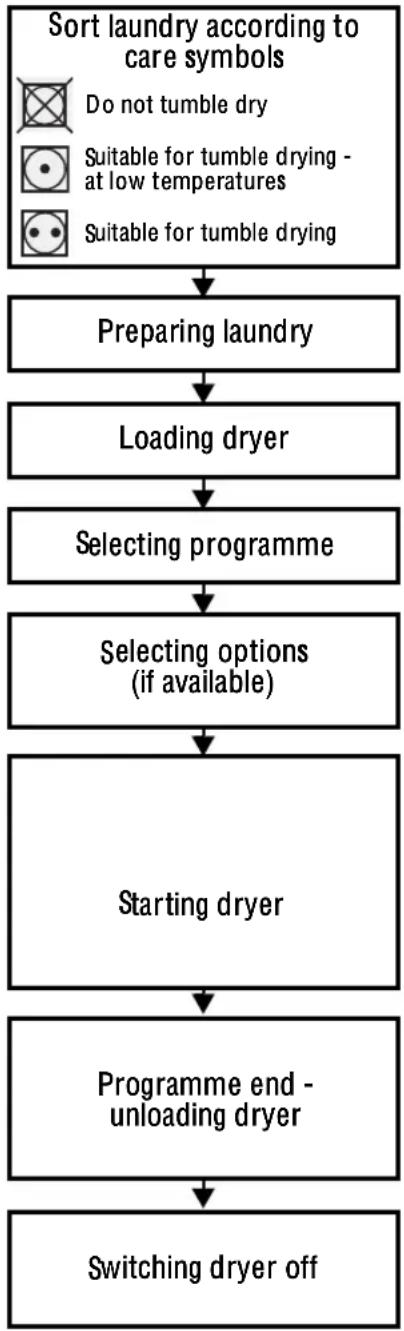
flowchart
graph TD
    A["Sort laundry according to care symbols\nDo not tumble dry\nSuitable for tumble drying - at low temperatures\nSuitable for tumble drying"] --> B["Preparing laundry"]
    B --> C["Loading dryer"]
    C --> D["Selecting programme"]
    D --> E["Selecting options (if available)"]
    E --> F["Starting dryer"]
    F --> G["Programme end - unloading dryer"]
    G --> H["Switching dryer off"]
Sort laundry by:
Material thickness: Whenever there is greater load than the dryer can handle, separate laundry according to weight (e.g. dry towels and thin underwear separately).
Type of material: Cotton (linen); synthetic textiles (easy care).
Degree of drying: Cupboard dry, iron dry etc.
Do not tumble dry: Woolens, silk, nylon stockings, delicate embroidery, fabrics with metallic decorations, bulky items such as sleeping bags or pillows.
Check that all fastenings are closed and that pockets are empty. Ensure that there are no cigarette lighters in the wash. Turn laundry inside out.
Place laundry loosely in the drum to achieve equal drying throughout. Then close the door.
Select the drying programme required by turning the programme selector knob (for information, refer to programme table).
Select a time programme for drying small loads.
Select the option required by pressing the corresponding button.
The indicator lamp above the relevant button lights up to confirm your selection. A fast blinking lamp indicates that a wrong selection is made (incompatible option). Press the button again to cancel the option.
The drying programme in started by pressing the "Start" button. The relevant indicator lamp lights up. A fast blinking "Start"-lamp indicates that the door is not well closed or the heat-exchanger is not well inserted.
Changing programme selection: If the programme selected is changed during drying, the dryer stops. The "Start" indicator lamp flashes.
To operate the new programme, press the "Start" button again.
Warning: Never stop a tumble dryer before the end of the drying cycle, unless all items are quickly removed and spread out so that the heat is dissipated.
The final part of a drying cycle occurs without heat (cool-down cycle) to ensure that the items reach a lower temperature to avoid wrinkling.
Anti-Crease: If the laundry is not removed at the end of the drying cycle, an automatic anti-crease cycle will operate for maximum 15 min. The drum rotates to prevent the laundry from creasing.
End: Take the laundry out of the dryer. The drying process is complete and the anti-crease phase has been reached (active).
Set the programme selector knob to "Off" ("O").
Cleaning the lint filter: Open door, pull lint filter up and out of machine and open it. Brush lint using a soft brush or your fingertips. Close lint filter and push firmly back into place (more detailed informations are given in the Instructions For Use). Emptying the water container: Pull container out by the handle and empty. Replace the container when empty by pushing it completely back into place.
Empty the water container after each drying process, because a full water container will stop the drying process before the laundry is dry.
Please note: Only use additives/plastic items specified as dryer safe and rinse items that have been treated with stain remover thoroughly in plenty of water before drying. Never dry rubber objects or objects stained with vegetable oils in the dryer.
The Manufacturer is not liable for any damage to laundry resulting from inadequate or incorrect fabric care instructions which have been provided with the garment or article.
Interrupting and restarting of the drying process prolongs the drying time significantly and can lead to overdrying.
| Overview of programmes | Options | Approximate drying times (in minutes) | ||||||||
| Type of textile Programmes / Drying levels | Fabrics | Volume of load kg* | Gentle | Dry plus | start delay | Very wet load | Wet load | |||
| Cotton | [1603] | Extra dry | Multi-layered, thick laundry such as: terry towels, terry towelling bath robes. | Cotton or linen hot wash/ coloured laundryMax. 6 kg | 3.06.0 | X X X | 115'170' | 100'150' | ||
 | Cupboard dry** | Similar types of laundry which do not require ironing such as: dry towels, bed linen, underwear, baby clothes, T-shirts, cotton socks. | 3.06.0 | X X X | 100'145' | 85'125' | ||||
 | 6Kg Iron dry** | Laundry which requires ironing such as: bed and table linen, dry towels, T-shirts, polo shirts, work clothes. | 3.06.0 | X X X | 70'110' | 60'95' | ||||
| Easy care |  | Extra dry | Laundry with thick, multi-layered areas such as: bed and table linen, track suits, anoraks, blankets. | Synthetic, mixed fibre or cotton easy care (ironing not required) laundryMax. 3 kg | 1.03.0 | X X X | 55'75' | 45'60 | ||
| [WRWH] | Cupboard dry** | Laundry which does not require ironing such as: shirts, blouses, T-shirts, sportswear. | 1.03.0 | X X X | 50'65' | 40'50' | ||||
 | 6Kg Iron dry | Laundry which requires ironing such as: trousers, dresses, skirts, shirts, blouses. | 1.03.0 | X X X | 35'50' | 25'40' | ||||
| Special programmes | [14447] | Mixed load | T-shirts, blouses, towels, underwear, sportswear. | Cotton - Synthetic blend Max. 3 kg Max. 3 kg | 3.0 X —X 110'95' | |||||
| Airing | Laundry is aired, refreshed and loosen up for 30 minutes without heating. | All textiles. | [8624] | ——X—— | ||||||
| Drying times | 10' 20' 30' 40' 60' 90' | Additional drying time for textiles that are not suitable for other programmes, for finalization of the drying process and for small loads (<1,0kg). | All fabrics[1WOKT] | —X —X | 10' 20' 30'40' 60' 90' | |||||
• Weight of average and maximum load.
** Test programmes according to EN 61121, tested with maximum rated load capacity.
How to proceed if...
...you want to check the dryer yourself first: (If your machine is not functioning correctly, please check the following points before calling the Customer Service department - also refer to relevant section in the Instructions for use).
| Drying takes too long/Laundry is not dry enough | → | Has the cycle been interrupted (door opening, full water container)?Was the inserted laundry too wet (washing machine spin speed less than 1000 rpm)?Is the lint filter dirty (filter indicator light on)?Is the heat exchanger dirty (for more information, refer to the Instructions For Use)?Is the room temperature too high?Is the “End” indicator lamps lighting up? The drying cycle is complete and the laundry can be taken out.If the drying result does not meet your expectation, select a more dry programme or use the “dry plus” option (if available).Is thin and thick load mixed? Are different types of materials mixed? Sort the laundry after thickness and material and dry again. |
| The dryer does not operate (after a power failure, always press the Start” button) | → | Is the plug properly inserted into the mains electricity socket?Is there a power failure?Has the fuse blown?Is the door properly closed?Has a drying programme been selected?Has the “Start” button been pressed?Has the start delay option been selected?Is the dryer overloaded?→ Please remove some of the load.Is the heat exchanger inserted correctly? |
| Lint filter, water container indicator lamp on | → | Is the lint filter clean?Is the water container empty?Has the water container been inserted correctly?Is the heat exchanger clean and inserted correctly? |
| Water droplets underneath the dryer | → | Has the heat exchanger been inserted correctly?Has all fluffs on the heat exchanger seal and the door seal been wiped away?Has the water container been inserted correctly?If the direct drain connection is used, is it tight?Is the dryer levelled? |
...you want to care for and clean your dryer:
| Clean the filter at the end of every cycle | → | Brush lint using a soft brush or your fingertips.Close the filter.Push the filter back into place. |
| Empty the water container at the end of every drying cycle | Pull the handle to remove the water container.Empty the water container.Replace the water container when empty by pushing it completely back into place. | |
| Clean the heat exchanger at least once a month | Clean the heat exchanger under running water.Remove all lint from the seals.Clean the heat exchanger housing (for further information see section “Heat Exchanger” in the Instructions for use). |
Failure codes
In case the appliance control unit detects a defective component or a malfunction of the dryer, it will stop the running programme and will make red lamps blinking.
The programme flow lamps will indicate the failure code, as in the table below:
| Failure code | Lamp failure code | Check needed by customer before Service call |
| F01 |  | Turn the programme selector to the "off" position.Wait 1 minute.Turn the programme selector to the desired programme.Push the Start button.If the appliance will go again into Failure Mode.Call the After-Sales-Service.Check the programme flow lights and communicate the failure code. |
| F02 |  | |
| F04 |  | |
| F07 |  | |
| F05 |  | Turn programme selector to the "off" position.Assure that the ambient temperature is between 5°C and 35°C.Wait for 1 hour.Turn the programme selector to the desired programme.Push the Start button.If the appliance will go again into Failure Mode.Call the After-Sales-Service.Check the programme flow lights and communicate the failure code. |
| F06 |  |


AZ C 6571
Quick Reference Guide

Indicator lamps and options
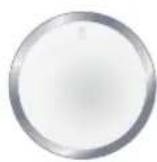
Programme selector knob
The drying programme is selected by turning this knob. The "Start" indicator lamp flashes.

"Start" button
The drying programme is started by pressing this button. The indicator lamp lights up.


Filter
The indicator lamp lights up when the filter and/or the heat exchanger including housing needs to be cleaned.
Clean the filter at the end of every drying cycle.


Water container
The indicator lamp lights up when the water container needs to be emptied. The drying cycle is automatically interrupted. Empty the container and restart the drying programme.
Empty the water container after every drying cycle.


End
The drying programme is finished. The anticrease has been reached. Please unload the dryer.
Overdry protection
The indicator lights up when a humidity controlled programme is selected, to indicate the activated protection function.

Gentle
Selecting this option will reduce the drying temperature.
Dry plus
By selecting this option you can increase the dryness level of the laundry.

Start delay

Delays the start of the drying cycle by 3, 6 or 9 hours. Each time the button is pressed the delay is increased by 3 hours. Press the "Start" button to confirm the final selection and to start the dryer. During the countdown, the drum will turn from time to time to redistribute the laundry and the pump will start to pump water in the water container. To cancel or change the previously set time delay, set the index of the programme selector knob to the "off" position, or open the door.
Gebrauchsanweisung
Instructions for use
Mode d'emploi
Gebruiksaanwijzing
natural_image
Close-up of white plastic cloths with metal clips and a coiled spring (no text or symbols visible)Brugsanvisning
Bruksanvisning
Käyttöohje
natural_image
Black and white photo of multiple glass bottles with black caps, arranged in a row (no visible text or symbols)
natural_image
Black and white close-up of multiple glasses with blurred background (no text or symbols)Οδηγίες χρήσης
natural_image
Close-up of a metallic industrial device with perforated ventilation slots and a handle (no visible text or symbols)Návod k použití
Návod na použitie
SELECTING A PROGRAMME AND OPTIONS
STARTING AND COMPLETING A PROGRAMME
CHANGING A PROGRAMME
INTERRUPTING A PROGRAMME
DAILY MAINTENANCE AND CLEANING
INSTRUCTIONS FOR USE
BOOKLET
BEFORE USING THE DRYER Page 3
PRECAUTIONS AND GENERAL RECOMMENDATIONS Page 5
ELECTRICAL CONNECTION Page 7
DESCRIPTION OF THE DRYER Page 8
REMINDER - MAINTENANCE AND CLEANING Page 8
CLEANING THE LINT FILTER Page 8
CLEANING THE HEAT EXCHANGER Page 9
DRAINAGE SYSTEM Page 10
DOOR REVERSIBILITY Page II
TROUBLESHOOTING GUIDE/ AFTER-SALES SERVICE Page 12
BEFORE USING THE DRYER
- This dryer is exclusively designed to dry machine dryable laundry in quantities which are usual for private households.
- Observe the instructions given in these Instructions For Use and the Programme Chart before using the dryer.
- Keep the Instructions For Use and the Programme Chart handy for reference. If you pass on the dryer to others, make sure that the Instructions For Use and the Programme Chart go with it.
- The manufacturer declines all liability for damage to property or injury to persons or animals due to non-compliance with the directions given in these Instructions For Use.
I. Removing the packaging and inspection
- After unpacking, make sure that the dryer is undamaged. If in doubt, do not use it. Contact the After-Sales Service or your local retailer.
- If the appliance was exposed to the cold prior to delivery, keep it at room temperature for a few hours before operating.
- Do not operate the dryer if it has been damaged during transport. Contact one of our After-Sales Service technicians.
2. Electrical Connections
- Electrical connections must be carried out by a qualified technician in compliance with the manufacturer's instructions and current standard safety regulations.
- Electrical connections must comply with local Electricity Board regulations.
- Data regarding voltage, power consumption and the required fuse protection is shown on the rating plate mounted at the rear of the dryer.
• The dryer must be earthed as prescribed by law. - Before carrying out any maintenance on the dryer disconnect it from the mains supply.
- Mains cable replacement must only be carried out by the After-Sales Service.
- After installation, access to the mains plug or to an all-pole disconnection switch must be ensured at all times.
- Light bulb replacement must only be carried out by the After-Sales Service.
3. Installation
- Do not install your dryer where it may be exposed to extreme conditions, such as: poor ventilation, temperature below 5°C or above 35°C.
-
The appliance must not be installed behind a lockable door, a sliding door or a door with hinges on the opposite side to that of the tumble dryer, in such a way as to prevent the tumble dryer door from being fully opened.
-
Small indoor located storage rooms, bathrooms, toilets, shower rooms and enclosed areas without ventilation are not suitable locations for installation of the dryer. If it must be installed in such a location, adequate ventilation must be ensured (open doors, ventilation grid or slot larger than 500 cm ^2 ).
- Before running the first cycle, ensure that the water container is fully pushed inside and that the heat exchanger is correctly positioned.

natural_image
Line drawing of a washing machine with control panel and door (no text or symbols)
natural_image
Diagram of a heat exchanger or vent with internal cooling fins and mounting brackets (no text or symbols)- Before running the first cycle, ensure that all of the drainage system hoses are connected (as shown in the picture below).
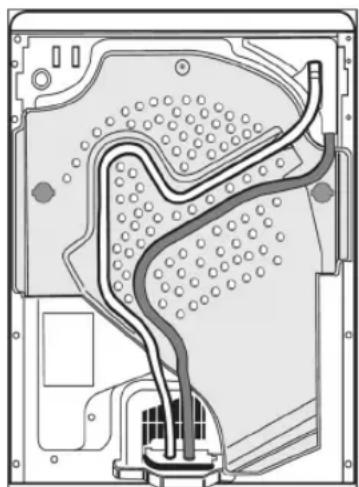
natural_image
Cross-sectional diagram of an electronic device showing internal circuitry and components (no text or labels)- If possible use a hose to drain the water directly into the domestic plumbing system. This will avoid having to empty the water container at the end of each drying cycle, since the condensation water can be directly drained away. Also see section entitled "Drainage System".
• Take care not to install the dryer on a deep-pile carpet.
• Take care not to trap the mains cable between the dryer and the wall. - When installing the dryer make sure that the four feet are stable and resting on the floor, adjusting them as required, and check that the machine is perfectly level using a spirit level.
- If, due to lack of space, the dryer must be installed directly next to a gas or coal stove, a heat insulating plate (85 x 57cm) must be installed in between and the side of the plate facing the stove must be covered with aluminium foil.
4. Assembly of distance holders
To ensure that the appliance is positioned at a correct distance from the wall at the rear side and to allow sufficient ventilation, distance holders must be mounted on the rear side of the dryer before starting the first drying cycle.
A. Remove the two distance holders from the packaging.
B. The distance holders must be inserted on the rear side of the dryer in the protective cover.

natural_image
Cross-sectional diagram of a computer case with internal circuitry and ventilation ducts (no text or labels)B
C. Insert the distance holders in the holes provided on both sides.

natural_image
Illustration of a hand holding a flashlight interacting with a textured surface (no text or symbols visible)C
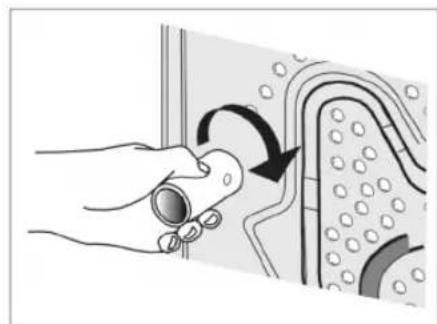
D. Secure both distance holders by turning them in a clockwise direction as far as the stop position.
natural_image
Illustration of a hand holding a tool interacting with a mechanical component, showing a curved arrow indicating rotation (no text or symbols present)D
5. User and child protection
• Children must not be allowed to play with the dryer.
- Ensure that children and small animals cannot get into the drum.
- Keep the packaging materials (plastic bags, polystyrene parts, etc.) out of reach of children, as they are potentially dangerous.
- The appliance is not intended for use by persons (including children) with reduced physical, sensory or mental capabilities, or lack of experience and knowledge, unless they have been given supervision or instruction concerning use of the appliance by a person responsible for their safety. Children should be supervised to ensure that they do not play with the appliance.
Stacking kit
- Depending on the model, your dryer can be stacked on top of your front loading washing machine. For further information please contact the After-Sales Service.

natural_image
Line drawing of two large front-loading washing machines with circular gauges and control knobs (no text or symbols)PRECAUTIONS AND GENERAL RECOMMENDATIONS

To minimise the risk of fire in the tumble dryer, following precautions should be observed:
- Oil-soaked items ignite spontaneously, especially when exposed to heat sources such as in a tumble dryer. The items become warm, causing an oxidation reaction in the oil. Oxidation creates heat. If the heat cannot escape, the item can become hot enough to catch fire. Piling, stacking or storing oil-soaked items can prevent heat from escaping and so create a fire hazard.
- Do not dry unwashed items in the tumble dryer.
- Ensure that the appliance is maintained as shown in the section "Maintenance and cleaning".
- Ensure that the appliance is installed as per the instructions above.
- Items that have been soiled with substances such as cooking oil, acetone, alcohol, petrol, kerosene, spot removers, turpentine, waxes and wax removers must be washed in hot water with an extra amount of detergent before being dried in the tumble dryer.
• Do not use flammable cleaning agents.
- Do not use the tumble dryer if chemicals have been used for cleaning.
- Items such as foam rubber (latex foam), shower caps, waterproof textiles, rubber backed articles and clothes or pillows fitted with foam rubber pads must not be dried in the tumble dryer.
- Fabric softeners or similar products should be used as specified in the fabric softener instructions.
- Remove all objects from pockets, such as lighters and matches.
- Never use or store flammable materials near to the dryer.
- Never stop a tumble dryer before the end of the drying cycle, unless all items are quickly removed and spread out so that the heat is dissipated.

Warning: rear panel may be hot.
• The dryer is suitable for indoor use only.
• Do not use extension leads or multiple adaptors.
- Always set the programme/time selector knob to the "0" position after use. This prevents the dryer from being switched on accidentally.
- Before cleaning or carrying out maintenance, switch off the dryer and disconnect it from the mains supply.
- To clean the outside of the dryer, use a neutral detergent and a damp cloth.
• Do not use abrasive detergents. - The final phase of a drying cycle always occurs without heat (cool-down phase) so that the items are left at a temperature which ensures that they will not be damaged.
- Wipe away any lint from the door seal and the door using a damp cloth.
- If the lint filter mesh is clogged, clean it with water and a soft brush.
- Since lint can penetrate through the filter, it is necessary to clean the entire filter area (including below the filter) from time to time using a brush, a damp cloth or a vacuum cleaner.
EC Declaration of Conformity
- This dryer has been designed, constructed and distributed in compliance with the safety requirements of EC Directives:
• 2006/95/EC Low Voltage Directive
• 2004/108/EC Electromagnetic Compatibility Directive
CE
- This appliance is marked according to the European directive 2002/96/EC on Waste Electrical and Electronic Equipment (WEEE).
- By ensuring that this product is disposed of correctly, you will help prevent potential negative consequences for the environment and human health, which could otherwise be caused by inappropriate waste handling of this product.


Packaging
- The packaging box is 100% recyclable, as confirmed by the recycling symbol.
Disposing of packaging and old appliances
- The dryer is built from reusable materials. The dryer must be disposed of in compliance with local waste disposal regulations.
- Before scrapping cut off the power cable so that the dryer cannot be connected to the mains.

- The symbol the product or on the documents accompanying the product indicates that this appliance must not be treated as household waste. Instead it should be handed over to the applicable collection point for the recycling of electrical and electronic equipment. Disposal must be carried out in accordance with local environmental regulations for waste disposal.
- For more detailed information about treatment, recovery and recycling of this product please contact your local city council office, your household waste disposal service or the shop where you purchased the product.
Energy saving tips
- Always dry a full load, depending on the type of laundry and the programme/drying time. For more detailed information, see the programme chart.
- By preference use the maximum spin speed allowed by your washing machine, since draining the water mechanically requires less energy. You will save time and energy when running your drying cycle.
• Do not overdry the laundry. - Clean the lint filter after every drying cycle.
• Clean the heat exchanger every month. - Place your dryer in a room with a temperature between 15°C and 20°C. If the temperature is higher then ventilate the room, e.g. by opening the window.
• Always select the correct programme/drying time for the load in order to obtain the desired drying results. - Select the 'Gentle' option only in case of drying small loads.
- When drying cotton, for example, dry Iron Dry and Cupboard Dry loads together. Start with the Iron Dry programme/drying time setting, remove the laundry to be ironed at the end of that cycle and dry the remainder of the load on the Cupboard Dry setting.
- Always set the program selector knob to the "0" position after the end of the cycle.
ELECTRICAL CONNECTION
I) For United Kingdom only
Warning - this appliance must be earthed
Fuse replacement
If the mains lead of this appliance is fitted with a BS 1363A 13amp fused plug, to change a fuse in this type of plug use an ASTA marked fuse, approved to BS 1362 and proceed as follows:
I. Remove the fuse cover (A) and fuse (B).
2. Fit replacement 13A fuse into fuse cover.
3. Refit both into plug.
Important:
The fuse cover must be refitted when changing a fuse. If the fuse cover is lost, the plug must not be used until a correct replacement is fitted.
Correct replacements are identified by the colour insert or by the colour embossed in words on the base of the plug.
Replacement fuse covers are available from your local electrical store.
2) For the Republic of Ireland only
The information given in respect of United Kingdom will frequently apply, but a third type of plug and socket is also used, the 2-pin type with side earth terminal.
3) Socket outlet / plug (valid for both countries)
If the fitted plug is not suitable for your socket outlet, please contact Whirlpool Service for further instructions. Please do not attempt to change the plug yourself. This procedure must be carried out by a qualified Whirlpool technician in compliance with the manufacturer's instructions and current safety regulations.

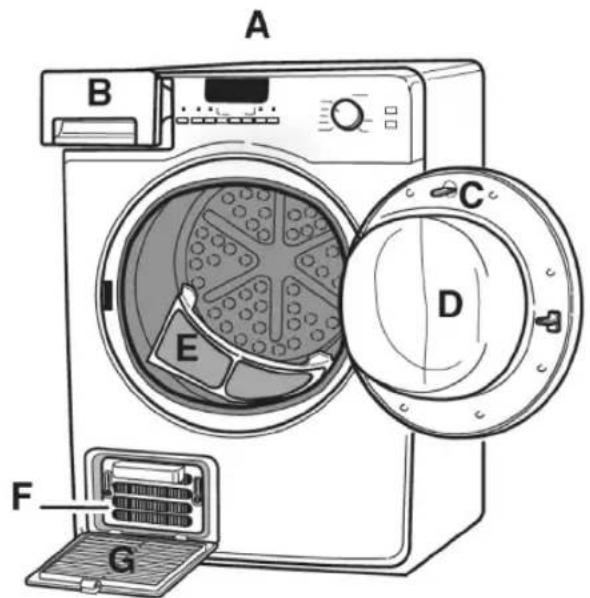
DESCRIPTION OF THE DRYER
A. Work top
B. Water container
C. Contact pin
D. Door:
To open the door, pull the handle.
To do set the door, push gently until closed.
E. Filter
F. Heat exchanger
G. Heat exchanger flap
REMINDER - MAINTENANCE AND CLEANING
Before cleaning or carrying out maintenance, switch off the dryer.
AFTER EACH DRYING CYCLE
- Clean the lint filter at the end of every drying cycle.
• Empty the water container at the end of each drying cycle.
EACH MONTH
- Clean the heat exchanger at least every month (see "Cleaning the heat exchanger" on the next page).
CLEANING THE LINT FILTER
Depending on the model of your dryer, the lint filter can have different shapes.
Clean the lint filter after every drying cycle, or when the lint filter indicator lamp lights up, proceeding as follows:
A. Take the lint filter out of the dryer and carefully open the filter.
B. Carefully remove the complete lint from the lint screen.
When the lint filter is clean, put it back into the dryer. Make sure that the lint filter is correctly positioned before starting the next drying cycle.

natural_image
Illustration of hands holding a flexible electronic device with a grid-patterned cover (no text or symbols visible)

natural_image
Illustration of a hand holding a device with a curved panel and a black arrow indicating rotation (no text or symbols)CLEANING THE HEAT EXCHANGER
Before cleaning or carrying out maintenance, switch off the dryer.
Clean the heat exchanger at least every month, or whenever the heat exchanger indicator lamp lights up (optional feature, depending on the model of your dryer), proceeding as follows.
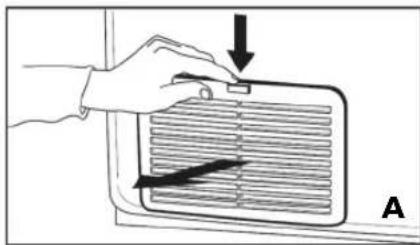
A. Open the heat exchanger flap and put it to one side.
natural_image
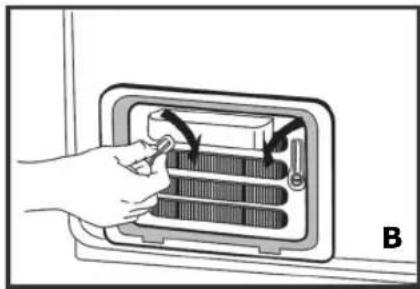
Hand placing a component into a grid-like device with arrows indicating direction (no text or symbols)B. Turn the two locking bars at the side of the heat exchanger towards the middle, to the horizontal position, and pull the heat exchanger out.
natural_image
Illustration of a hand inserting a spring into a wall-mounted air conditioner unit (no text or symbols visible)C. Hold the heat exchanger as shown in the picture. Clean it under running water by turning it around to reach all sides, especially in front and behind. Wipe away dust and lint from the heat exchanger seals and plates. Clean the inside of the heat exchanger plates under running water, from the front side to the back.

natural_image
Illustration of two hands using a handheld device to spray particles from a device (no text or symbols present)D. Remove the lint from the heat exchanger housing by hand or with a damp cloth. Clean the entire housing from the back to the front side, ensuring that all lint is removed.

natural_image
Hand cleaning a wall-mounted electrical socket (no text or symbols visible)- Fully insert the heat exchanger back into the housing (TOP or HAUT mark upwards) and lock it again by turning the locking bars back to their original position.
• The heat exchanger does not need to be dry when it is reinserted after cleaning. - Insert and latch the flap again. The flap can only be closed if the heat exchanger is correctly positioned.
- The heat exchanger indicator lamp will switch off automatically when you start the next drying cycle.
The heat exchanger aluminium plates may become discoloured over time, depending on the model of your dryer.
DRAINAGE SYSTEM
For your convenience:
The dryer can be connected directly to the sewage system of the house to avoid having to empty the water container after each drying cycle.
Place an absorbent cloth underneath to collect water spillage.
A. Unplug the hose located at the upper rear part of the dryer.

natural_image
Illustration of a hand using a tool to adjust or install a component, with no visible text or symbols.A
B. Remove the hose from the rear protective cover.

natural_image
Diagram of a mechanical device interior showing hands operating a tool with arrows indicating motion or movement (no text or symbols present)B
C. Connect the hose to the sewage system. The height difference between the floor where the dryer is positioned and the sewage system connection should not exceed 1 m.

Notice: To prevent water siphoning back into the appliance, the end of the hose must not be immersed in the drain water. Avoid bending and twisting the hose.
DOOR REVERSIBILITY
For your convenience:
In case you want to stack the dryer on a washing machine, you can reverse the door opening direction, to lower the position of the door handle.
Unplug the dryer.
A. Open the door.
B. Using a spanner, turn the contact pin (B) in the top part of the door through 90° and pull it out.
C. Remove the door lock:
Unscrew the 2 screws above and below the door lock system.
D. Press the small knob above the door lock system with a small screwdriver, move the door lock slightly upwards and pull the door lock towards you with your finger.
E. Reverse the door:
Remove the two screws of the door fixing plate. Fasten the door again on the desired side with the 2 screws. Take care to tighten the screws horizontally to avoid pinching off the door seal.
Reposition the door lock:
Insert the door lock on the opposite side of the door fixing plate. Press it fully into the hole and move it downward slightly, until the small knob of the door lock system latches in position. Fasten the two screws above and below the door lock system.
Now reinsert the contact pin on the inside of the door, at the top, by inserting it and turning it again through 90°.
NOTE: Ideally you should use a Torx T20 type screwdriver to undo and tighten the screws.

natural_image
Line drawing of a washing machine with lid and side panel (no text or symbols)
natural_image
Line drawing of a hand using a pliers to lift a tool, showing motion and rotation (no text or symbols)
natural_image
Diagram of a washing machine with a cylindrical component and its open lid, showing mechanical components (no text or symbols)
natural_image
Illustration of a hand using a tool to clean or adjust a washing machine (no text or symbols visible)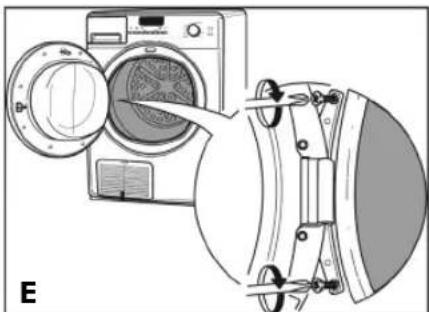
natural_image
Diagram showing a washing machine with lid removed and a close-up of its side panel (no text or symbols present)TROUBLESHOOTING GUIDE/ AFTER-SALES SERVICE
In the event that the dryer malfunctions, one of the following failure codes may be displayed. Depending on the model of your dryer, the failure may be displayed in letters or by different blinking LEDs.
| Failure code | LED failure code | Check to be carried out by customer before service call |
| F01 | Please call the After-Sales Service. | |
| F02 | Please call the After-Sales Service. | |
| F03 | Please call the After-Sales Service. | |
| F04 | Please call the After-Sales Service. | |
| F05 | Turn the dryer OFF and unplug it. Make sure that the ambient temperature is between 5°C and 35°C. Wait for 1 hour. Plug the dryer back in and restart it. If the failure reoccurs, please call the After-Sales Service. | |
| F06 | Turn the dryer OFF and unplug it. Make sure that the ambient temperature is between 5°C and 35°C. Wait for 1 hour. Plug the dryer back in and restart it. If the failure reoccurs, please call the After-Sales Service. | |
| F07 | Please call the After-Sales Service. | |
| F10 - 15 | Turn the dryer OFF and unplug it. Wait for 5 minutes. Plug the dryer back in and restart it. If the failure reoccurs, please call the After-Sales Service. | |
| F18 | Turn the dryer OFF and unplug it. Wait for 1 hour. Plug the dryer back in and restart it. If the failure reoccurs, please call the After-Sales Service. | |
| F19 | Turn the dryer OFF and unplug it. Wait for 5 minutes. Plug the dryer back in and restart it. If the failure reoccurs, please call the After-Sales Service. | |
| F20 | Turn the dryer OFF and unplug it. Wait for 1 hour. Plug the dryer back in and restart it. If the failure reoccurs, please call the After-Sales Service. | |
| F21 | Turn the dryer OFF and unplug it. Wait for 5 minutes. Plug the dryer back in and restart it. If the failure reoccurs, please call the After-Sales Service. | |
| F22 | Turn the dryer OFF and unplug it. Wait for 5 minutes. Plug the dryer back in and restart it. If the failure reoccurs, please call the After-Sales Service. | |
| Start LED blinks 2 times per second when pressed | Make sure that the door is correctly closed and the heat exchanger correctly positioned. If the failure reoccurs, please call the After-Sales Service. | |
| Heat exchanger LED blinks 2 times when Start button is pressed | Make sure that the heat exchanger is correctly positioned. If the failure reoccurs, please call the After-Sales Service. | |


LED not blinking LED blinking


TROUBLESHOOTING GUIDE/ AFTER-SALES SERVICE
If a fault occurs, before contacting our After-Sales Service, perform the following checks to try to remedy the problem:
Drying takes too long / laundry is not dry enough:
• Correct programme selected?
- Laundry too wet (Washing machine spin speed less than 1000 rpm? When the spin speed is less than 1000 rpm a water container fault may occur during the drying cycle).
• Lint filter clogged (filter indicator lamp on?)
- Heat exchanger clogged? (refer to the sections "CLEANING THE LINT FILTER/CLEANING THE HEAT EXCHANGER").
• Is the ambient temperature too high?
• END indicator lamps on? The drying cycle is complete and the laundry can be taken out.
- 'Gentle' option selected? The 'Gentle' option should only be selected with small loads.
- Mixed laundry load (for example cotton and synthetics).
The dryer does not operate:
(after a power failure and/or interruption to the mains supply, always press the "Start (Pause)" button).
- Plug connector properly inserted into the mains electricity socket?
• Power failure? - Fuse blown?
• Door properly closed?
• Drying programme selected?
• Start delay option selected? - “ S t a r button(activated? u s e ) ”
• Indicator lamps are lighting up?
Lint filter, water container or heat exchanger indicator lamp on:
- Lint filter clean?
• Water container empty?
• Water container correctly positioned?
• Heat exchanger clean and correctly positioned?
Water droplets underneath the dryer:
• Heat exchanger correctly positioned?
• All lint on the heat exchanger seal removed?
• All lint on the door seal removed?
• Water container positioned correctly?
- Dryer levelled?
After-Sales Service
If, after carrying out the above checks, the malfunction persists or reoccurs, turn the dryer off and call the After-Sales Service (refer to warranty).
Please specify:
• The nature of the fault.
• The dryer type and model.
- The service code (the number after the word Service on the adhesive rating plate) on the lower side of the door opening.
- Your full address and phone number.
SERVICE
0000 000 00000

INHOUD
BEKNOPTE HANDLEIDING
natural_image
Line drawing of a washing machine with control panel and door (no text or symbols)
natural_image
Diagram of a heat exchanger or vent with internal cooling fins and mounting brackets (no text or symbols)natural_image
Cross-sectional diagram of a mechanical or electronic component with internal channels and mounting holes (no text or symbols)natural_image
Line drawing of a washing machine with airflow indicators and ventilation ducts (no text or symbols)natural_image
Cross-sectional diagram of a device casing showing internal circuitry and ventilation ducts (no text or labels)B
natural_image
Illustration of a hand using a tool to inspect or inspect a textured surface with circular patterns (no text or symbols)C
natural_image
Illustration of a hand holding a tool interacting with a mechanical component, showing motion arrows (no text or symbols)natural_image
Line drawing of two large front-loading washing machines with circular gauges and control knobs (no text or symbols)ALGEMENE VOORZORGSMAATREGELEN EN ADVIEZEN

GEHEUGENSTEUNTJE - ONDERHOUD EN REINIGING
natural_image
Illustration of hands holding a flexible electronic device with a grid-patterned cover (no text or symbols visible)

natural_image
Illustration of hands performing a medical or therapeutic procedure on a curved device (no text or symbols visible)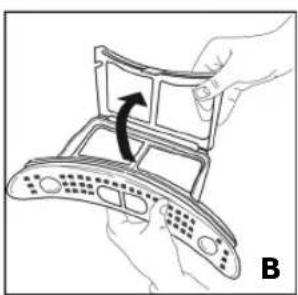
natural_image
Illustration of a hand holding a device with a curved panel and a black arrow indicating rotation (no text or symbols)DE WARMTEWISSELAAR REINIGEN
natural_image
Hand placing a component into a grid-like device with arrows indicating direction (no text or symbols)natural_image
Hand inserting a component into a rack-mounted air conditioner unit (no text or symbols visible)natural_image
Illustration of a person using a handheld device to spray or spray a small object (no text or symbols visible)natural_image
Hand cleaning a wall-mounted electrical outlet (no text or symbols visible)natural_image
Illustration of a hand using a tool to adjust or install a component, with no visible text or symbols.A
natural_image
Diagram of a mechanical device interior showing hands operating a tool with arrows indicating motion or flow (no text or symbols present)B
natural_image
Line drawing of a washing machine with lid and side panel (no text or symbols)
natural_image
Line drawing of a hand using a pliers to lift a tool, showing motion and rotation (no text or symbols)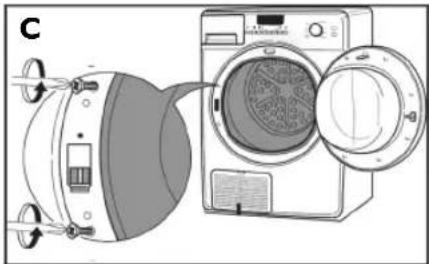
natural_image
Diagram of a washing machine with a cylindrical component and its open lid, showing mechanical components (no text or symbols)
natural_image
Illustration of a hand using a tool to clean or adjust a washing machine (no text or symbols visible)
natural_image
Diagram showing a washing machine with a close-up view of its side panel (no text or symbols present)OPSPOREN VAN STORINGEN/KLANTENSERVICE
- How to proceed if...
- Failure codes
- AZ C 6571
- Quick Reference Guide
- Indicator lamps and options
- Programme selector knob
- "Start" button
- Filter
- Water container
- End
- Overdry protection
- Gentle
- Dry plus
- Start delay
- Gebrauchsanweisung
- Mode d'emploi
- Brugsanvisning
- Käyttöohje
- Návod k použití
- INSTRUCTIONS FOR USE
- BOOKLET
- BEFORE USING THE DRYER
- Removing the packaging and inspection
- Electrical Connections
- Installation
- Assembly of distance holders
- User and child protection
- Stacking kit
- PRECAUTIONS AND GENERAL RECOMMENDATIONS
- To minimise the risk of fire in the tumble dryer, following precautions should be observed:
- EC Declaration of Conformity
- CE
- Packaging
- Disposing of packaging and old appliances
- Energy saving tips
- ELECTRICAL CONNECTION
- I) For United Kingdom only
- Warning - this appliance must be earthed
- Fuse replacement
- Important:
- 2) For the Republic of Ireland only
- 3) Socket outlet / plug (valid for both countries)
- DESCRIPTION OF THE DRYER
- REMINDER - MAINTENANCE AND CLEANING
- AFTER EACH DRYING CYCLE
- EACH MONTH
- CLEANING THE LINT FILTER
- CLEANING THE HEAT EXCHANGER
- DRAINAGE SYSTEM
- For your convenience:
- DOOR REVERSIBILITY
- TROUBLESHOOTING GUIDE/ AFTER-SALES SERVICE
- Drying takes too long / laundry is not dry enough:
- The dryer does not operate:
- Lint filter, water container or heat exchanger indicator lamp on:
- Water droplets underneath the dryer:
- After-Sales Service
- Please specify:
- INHOUD
- BEKNOPTE HANDLEIDING
- ALGEMENE VOORZORGSMAATREGELEN EN ADVIEZEN
- GEHEUGENSTEUNTJE - ONDERHOUD EN REINIGING
- DE WARMTEWISSELAAR REINIGEN
- OPSPOREN VAN STORINGEN/KLANTENSERVICE
Brand : WHIRLPOOL
Model : AZC 6571
Category : Tumble dryer