JP720 - Sewing machine JANOME - Free user manual and instructions
Find the device manual for free JP720 JANOME in PDF.


User questions about JP720 JANOME
0 question about this device. Answer the ones you know or ask your own.
Ask a new question about this device
Download the instructions for your Sewing machine in PDF format for free! Find your manual JP720 - JANOME and take your electronic device back in hand. On this page are published all the documents necessary for the use of your device. JP720 by JANOME.
USER MANUAL JP720 JANOME
natural_image
Line drawing of a sewing machine with no visible text or symbolsModel JP720
IMPORTANT SAFETY INSTRUCTIONS
When using an electrical appliance, basic safety precautions should always be followed, including the followings:
Read all instructions before using this appliance.
DANGER—
To reduce the risk of electric shock:
- An appliance should never be left unattended when plugged in. Always unplug this sewing machine from the electric outlet immediately after using and before cleaning.
WARNING—
To reduce the risk of burns, fire, electric shock, or injury to persons:
-
Do not allow children to play with the machine. The machine is not intended for use by children or infirmed persons without proper supervision. Do not allow to be used as a toy. Close attention is necessary when this sewing machine is used by or near children.
-
Use this appliance only for its intended use as described in this owner's manual. Use only attachments recommended by the manufacturer as contained in this instruction book.
-
Never operate this sewing machine if it has a damaged cord or plug, if it is not working properly, if it has been dropped or damaged, or dropped into water. Return this sewing machine to the nearest authorized dealer or service center for examination, repair, electrical or mechanical adjustment.
-
Never operate the appliance with any air opening blocked. Keep ventilation openings of this sewing machine and foot controller free from accumulation of lint, dust and loose cloth.
-
Never drop or insert any object into any opening.
-
Do not use outdoors.
-
Do not operate where aerosol (spray) products are being used or where oxygen is being administered.
-
To disconnect, turn all controls to the off ("O") position, then remove plug from outlet.
-
Do not unplug by pulling on cord. To unplug, grasp the plug, not the cord.
-
Keep fingers away from all moving parts. Special care is required around the sewing machine needle.
-
Always use the proper needle plate. The wrong plate can cause the needle to break.
-
Do not use bent needles.
-
Do not pull or push fabric while stitching. It may deflect the needle causing it to break.
-
Switch this sewing machine off ("O") when making any adjustment in the needle area, such as threading the needle, changing the needle, threading the bobbin or changing the presser foot, and the like.
-
Always unplug this sewing machine from the electrical outlet when removing covers, lubricating, or when making any other adjustments mentioned in this owner's manual.
SAVE THESE INSTRUCTIONS
The design and specifications are subject to change without a prior notice.
KNOW YOUR MACHINE
Name of Parts 2
Setting the Spool Pin.... 2
Standard Accessories 3
Extension Table 3
GETTING READY TO SEW
Connecting the Power Supply 4
Using the start/stop button.... 4
Using the foot control....4
Controlling Sewing Speed 5
Speed control slider 5
Foot control 5
Function Buttons 6
Start/stop button.... 6
Reverse button 6
Auto-lock button 6
Needle up/down button....6
Stitch width adjusting button....7
Stitch length adjusting button 7
Direct pattern selection buttons 7
Dropping the Feed Dog 8
Changing the Presser Foot.... 8
Detaching and Attaching the Foot Holder...... 8
Raising and Lowering the Presser Foot 9
Balancing Thread Tension 9
Changing Needles 10
Needle and Thread Chart.... 10
Winding the Bobbin.... 11
Removing the bobbin.... 11
Setting the spool 11
Threading for bobbin winding 12
Additional spool pin 12
Inserting the bobbin 13
Threading the Machine 14
Needle Threader 15
Drawing Up the Bobbin Thread 16
BASIC STITCHES
Straight Stitch 17
Changing sewing direction 17
Securing a seam 17
Altering the stitch length 18
Altering the needle drop position 18
Variety of Straight Stitches
and Recommended Feet 20
Zigzag Stitch 21
Altering the stitch width.... 21
Altering the stitch length 21
UTILITY STITCHES
Overcasting with Zigzag Stitch 22
Multiple Zigzag Stitch (Tricot Stitch) 22
Buttonholes 23
Square buttonhole 23
Altering the buttonhole width 26
Altering the buttonhole stitch density.... 26
Double layer buttonhole.... 26
Corded buttonhole 27
Auto buttonhole.... 28
Button Sewing.... 29
Zipper Sewing 30
Blind Hemming.... 32
DECORATIVE SEWING
Applique 33
Patchwork 33
Smocking 34
Correcting Distorted Stretch Patterns.... 35
CARE AND MAINTENANCE
Cleaning the Hook Race and Feed Dogs 36
Replacing the Bobbin Holder 36
Problems and Warning Signals 37
Troubleshooting 38
text_image
Technical diagram of a sewing machine with numbered parts and labeled control buttons
text_image
Technical diagram showing a hand operating a tool with labeled parts ① and ②, indicating assembly or installation steps.KNOW YOUR MACHINE
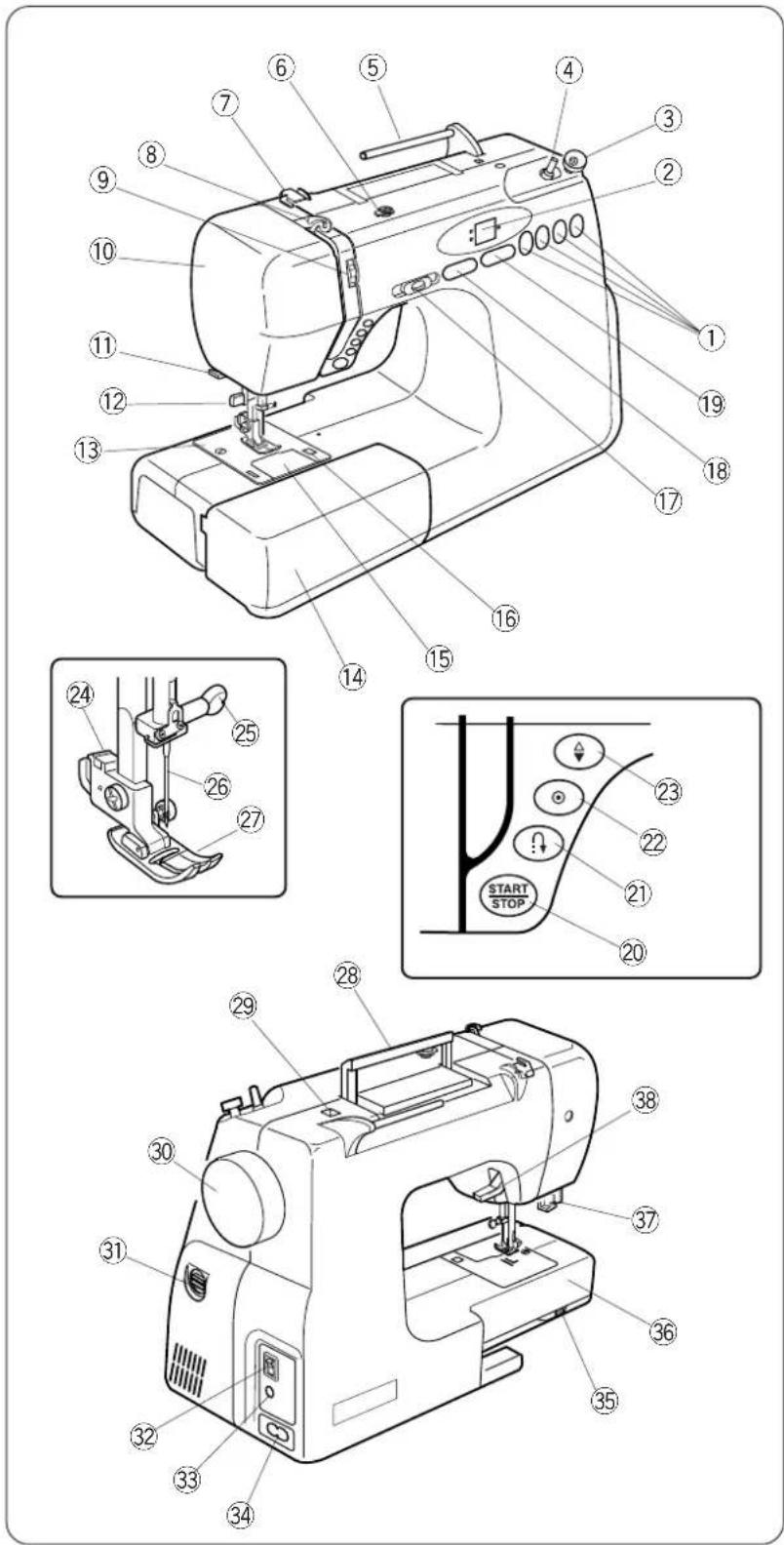
Name of Parts
① Direct pattern selection buttons
② Indicator window
③ Bobbin winder stopper
④ Bobbin winder spindle
⑤ Spool pin (included in accessory bag)
⑥ Bobbin winding thread guide
⑦ Thread guide
⑧ Thread take-up lever
⑨ Tension regulating dial
⑩ Face plate
⑪ Thread cutter
⑫ Needle threader
⑬ Needle plate
⑭ Extension table (accessory storage)
⑮ Hook cover plate
⑯ Hook cover plate release button
⑰ Speed control slider
⑱ Stitch width adjusting button
⑲ Stitch length adjusting button
⑳ Start/stop button
②1 Reverse button
②2 Auto-lock button
②3 Needle up/down button
⑳ Foot holder
⑲ Needle clamp screw
26 Needle
⑳ Zigzag foot A
⑳ Carrying handle
⑲ Hole for additional spool pin
③0 Hand wheel
③1 Stitch balance adjusting dial
③2 Power switch
③3 Machine socket
③4 Power inlet
③5 Drop-feed lever
③6 Free arm
③7 Buttonhole lever
③8 Presser foot lifter
Setting the Spool Pin
Insert the spool pin into the hole as shown.
(The spool pin is in the accessory bag.)
① Spool pin
② Setting hole
text_image
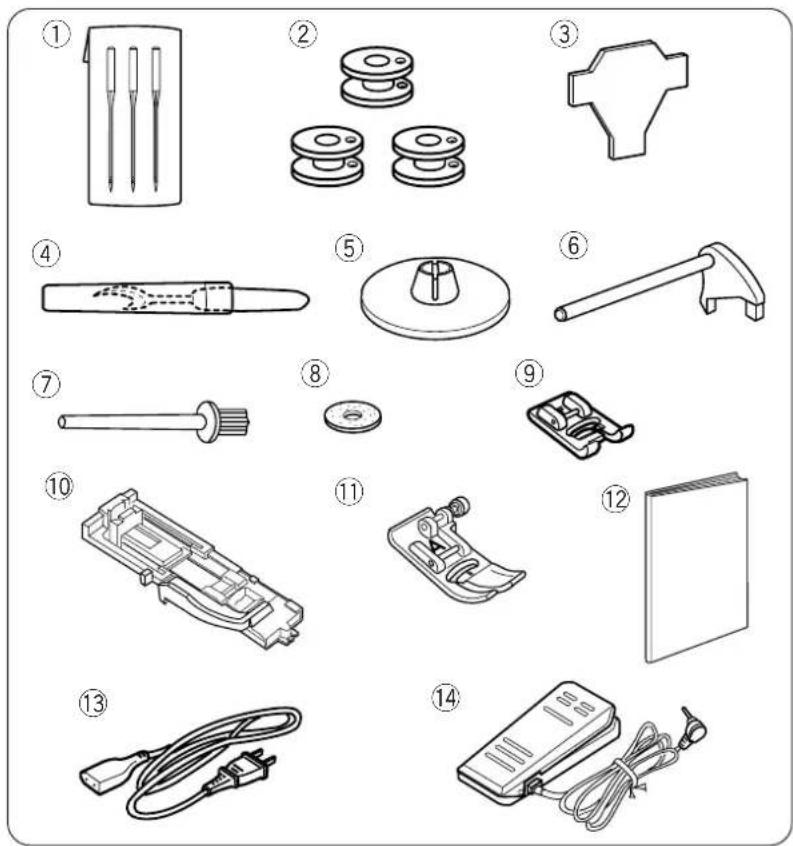
Exploded view diagram of 14 common electrical switch components with numbered labelsStandard Accessories
① Needles
② Bobbin
③ Screwdriver
④ Seam ripper
⑤ Spool holder
⑥ Spool pin
⑦ Additional spool pin
⑧ Felt
⑨ Satin stitch foot
⑩ Automatic buttonhole foot
⑪ Zigzag foot A (set on the machine)
⑫ Instruction book
⑬ Power supply cord
⑭ Foot control
text_image
Technical diagram showing a sewing machine operation with labeled parts including base, handle, and workpiece
natural_image
Line drawing of a sewing machine needle stitching fabric (no text or symbols)Extension Table
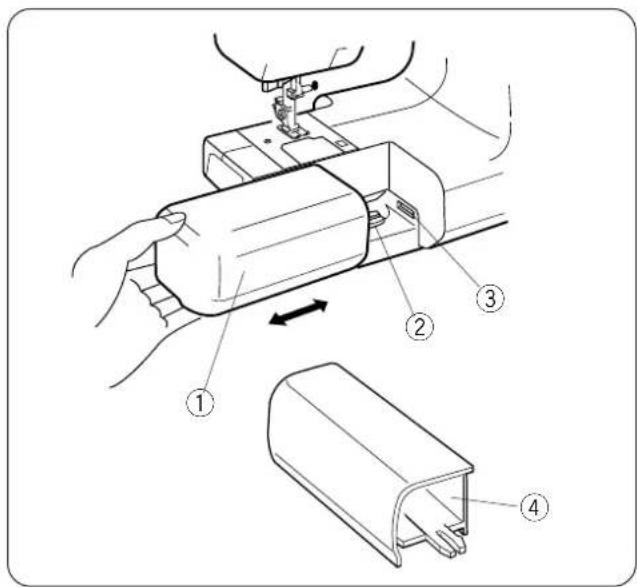
The extension table provides an extended sewing area and can be easily removed for free arm sewing.
The accessories can be stored in the table.
Detaching the table:
Pull the table away from the machine, as illustrated.
Attaching the table:
Push the extension table, inserting the tab into the slot until the table snaps into the machine.
① Extension table
② Tab
③ Slot
④ Accessory storage
Free arm sewing
Free arm sewing is useful for darning socks or mending knees, elbows or areas of wear in children's clothes.
GETTING READY TO SEW
Connecting the Power Supply
NOTE:
Before connecting to the power supply, make sure the voltage shown on the machine conforms to your electrical power.

text_image
ON OFF ② START STOP ① ③ ④ ⑤ ⑥Using the start/stop button
Turn off the power switch.
Insert the machine plug into the power inlet.
Insert the power supply plug into the wall outlet.
Turn on the power switch.
① Start/stop button
② Power switch
③ Machine plug
④ Power inlet
⑤ Power supply plug
⑥ Wall outlet
text_image
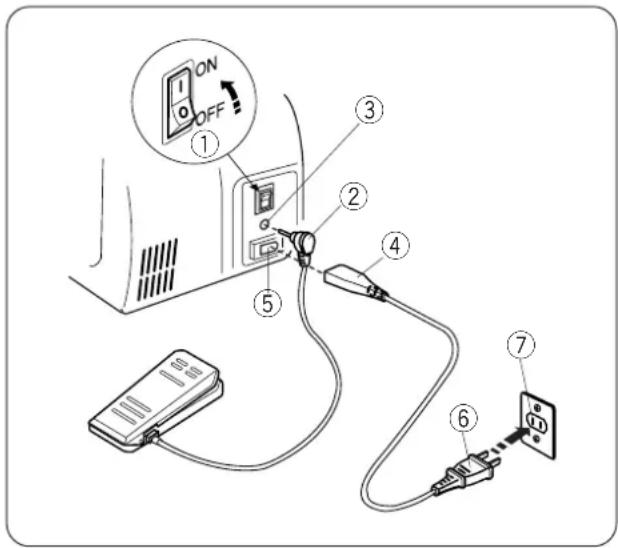
Diagram showing a device connected to an electrical outlet with labeled components and a switch icon indicating ON/OFF status.Using the foot control
Turn off the power switch.
Insert the foot control plug into the machine socket.
Insert the machine plug into the machine socket.
Insert the power supply plug into the wall outlet.
Turn on the power switch.
① Power switch
② Foot control plug
③ Machine socket
④ Machine plug
⑤ Power inlet
⑥ Power supply plug
⑦ Wall outlet
NOTE:
The start/stop button does not work when the foot control is connected.

text_image
88 → 01When the power is turned on, the indicator window will show a test pattern then will indicate 01.
NOTE:
After turning off the power, wait for 3 seconds to turn it on again.

WARNING:
While in operation, always keep your eyes on the sewing area, and do not touch any moving parts such as the thread take-up lever, handwheel or needle.
Always turn off the power switch and unplug from the power supply:
- when leaving the machine unattended.
- when attaching or removing parts.
- when cleaning the machine.
Do not place anything on the foot control, otherwise the machine will run intermittently.
Operating Instructions:
The symbol "O" of a switch indicates the "off" position of a switch.
For appliances with a polarized plug (one blade wider than the other). To reduce the risk of electric shock, this plug is intended to fit in a polarized outlet only one way. If it does not fit fully in the outlet, reverse the plug. If it still does not fit, contact a qualified electrician to install the proper outlet. Do not modify the plug in any way.
natural_image
Diagram showing finger pressing a button on a rounded rectangular object with directional arrows indicating movement (no text or symbols)
natural_image
Line drawing of a flatbed ramp with an arrow indicating upward motion (no text or symbols)Controlling Sewing Speed
Speed control slider
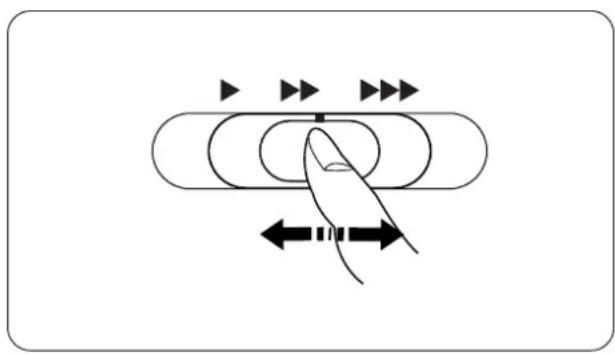
You can limit the maximum sewing speed with the speed control slider according to your sewing needs.
To increase sewing speed, slide it to the right.
To decrease sewing speed, slide it to the left.
Foot control
Pressing on the foot control can vary sewing speed. The harder you press the foot control, the faster the machine runs.
NOTES:
The machine runs at the maximum speed set by the speed control slider when the foot control is fully depressed.
Keep the foot control free from accumulation of lint, dust and loose cloth.
Do not place anything on the foot control.
Operating Instructions:
Foot controller Model 21249 is for use with sewing machine model JP720.

text_image
START / STOPFunction Buttons
① Start/stop button
Press this button to start or to stop the machine.
The machine will run slowly as long as this button is pressed, and will start running at the speed set by the speed control lever, or stop when the button is released.
NOTE:
The start/stop button does not work when the foot control is connected.
② Reverse button

When sewing the stitch pattern #01, #05 or #09. the machine will sew in reverse as long as the reverse button is pressed.
If you press the reverse button when sewing any other stitch, the machine will immediately sew locking stitches and automatically stop.
If you press the reverse button when stitch pattern #01, #05 or #09 has been selected and the foot control is not connected, the machine will start sewing in reverse as long as the button is pressed and the machine will stop when the button is released.
③ Auto-lock button
When stitch pattern #01, #05 or #09 has been selected, the machine will immediately sew locking stitches and automatically stop when the auto-lock button is pressed.
When sewing any other stitches, the machine will sew locking stitch at the end of the pattern being sewn and automatically stop.
④ Needle up/down button
Press this button to bring the needle up or down.
The machine will stop with the needle up or down depending on the needle position determined by this button.
text_image
~W 2.5 #
text_image
~W + - - - - ⑤⑤ Stitch width adjusting button
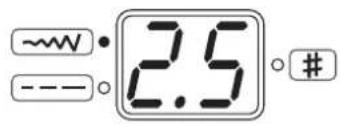
When pressing this button, the stitch width of the selected pattern will be indicated and the green light on the top left will light up.
To alter the stitch width, press on the "+" or "-" sign.
The stitch width can be altered while stitching

text_image
~W ---• 2.2 #
chemical
Diagram showing electron configuration with + and - charges, labeled as figure 6⑥ Stitch length adjusting button
When pressing this button, the stitch length of the selected pattern will be indicated and the green light on the bottom left will light up.
To alter the stitch length, press on the "+" or "-" sign. The stitch length can be altered while stitching.
text_image
01 06 11 16⑦

⑧
⑨

10

text_image
~~~○ ---○ 01 •#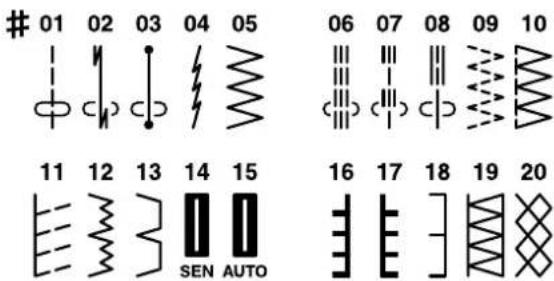
text_image
01 02 03 04 05
11 12 13 14 15 SEN AUTO 16 17 18 19 20Direct pattern selection buttons
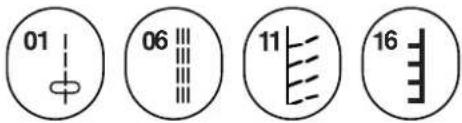
There are 4 buttons for selecting stitch patterns. Press one of the buttons until the pattern number of the desired stitch pattern is indicated.
⑦ Button 01 will select the patterns #01 to #05.
⑧ Button 06 will select the patterns #06 to #10.
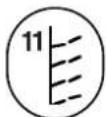
⑨ Button 11 will select the patterns #11 to #15.
⑩ Button 16 will select the patterns #16 to #20.
NOTE:
When selecting the pattern, raise the needle to its highest position.

text_image
Technical diagram illustrating sewing process steps with numbered instructions and a magnified view of the hand holding a button.
text_image
Diagram illustrating four steps of a sewing machine operation: no stop, lifting a component, lifting a sewing machine, and adjusting the base.
text_image
Technical diagram showing four-step assembly steps of a mechanical clamp or bracket with labeled parts 1 to 4.Dropping the Feed Dog
The feed dog can be lowered with the drop-feed lever for sewing on buttons etc.
Shift the drop-feed lever to the right to lower the feed dog.
Shift the lever to the left to raise the feed dog, it will return to the up position when the machine is started.
① Up position
② Down position
③ Feed dog
④ Hand wheel
NOTE:
The feed dog should be in the up position for regular sewing. Turn the handwheel toward you to check if the feed dog comes up after setting the lever in the up position.
Changing the Presser Foot

CAUTION:
Turn OFF the power switch before changing the foot. Always use the proper foot for the selected pattern. The wrong foot can cause the needle to break. Do not push the lever down to prevent it from being broken.
To snap off:
Raise the needle and presser foot. Press the lever on the back of the foot holder and the foot will drop. ① Lever
To snap on:
Place the presser foot so the pin on the foot lies just under the groove of the foot holder. Lower the foot holder to lock the foot in place.
② Groove
③ Pin
Each foot is marked with a letter for identification. ④ Identification Letter
Detaching and Attaching the Foot Holder

WARNING:
Turn OFF the power switch before detaching or attaching the foot holder.
To detach:
Raise the presser bar and turn the setscrew counterclockwise to remove the foot holder.
① Setscrew
② Foot holder
To attach:
Align the hole in the foot holder with the threaded hole in the presser bar and insert the setscrew through the hole.
Tighten the setscrew by turning it clockwise.
③ Hole
④ Threaded hole

text_image
Technical diagram of a sewing machine with numbered components and directional arrow indicating motion or movementRaising and Lowering the Presser Foot
The presser foot lifter raises and lowers the presser foot.
You can raise the presser foot about 1/4" (0.6 cm) higher than the normal up position by exerting more pressure when lifting the presser foot lifter. This allows for easy removal of the presser foot and helps you to place thick fabric under the foot.
① Presser foot lifter
② Normal up position
③ Extra lift
text_image
Technical diagram showing six-step assembly steps for a mechanical device, labeled with numbered components and directional arrows.Balancing Thread Tension
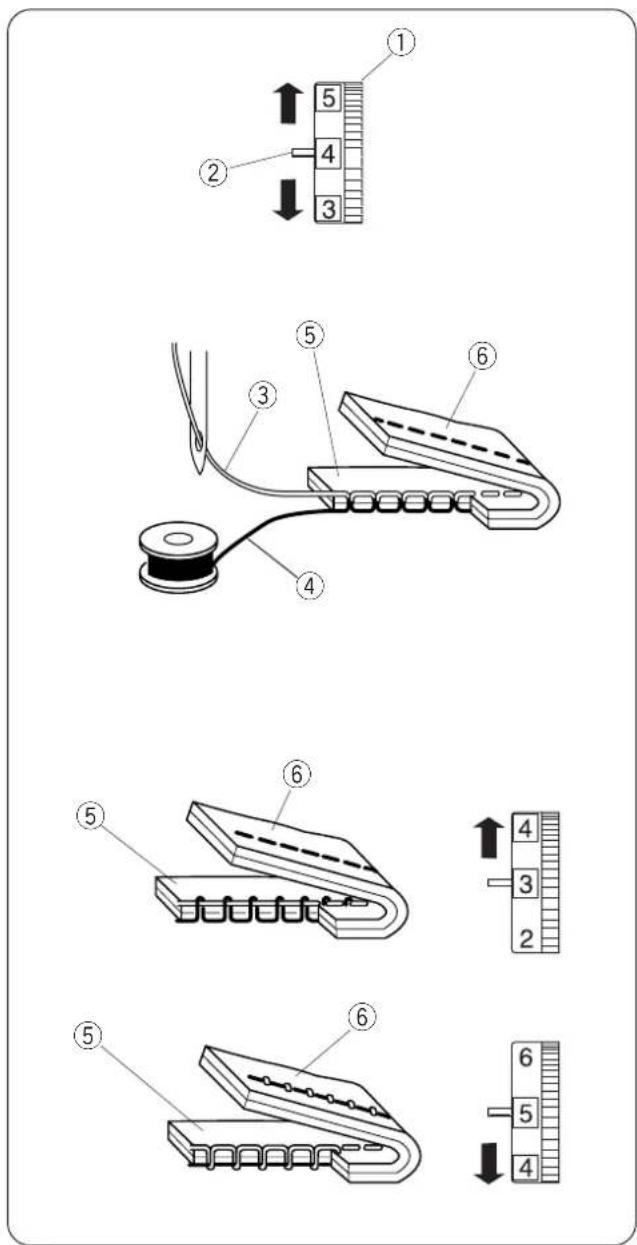
The thread tension should be adjusted depending on the sewing materials, layers of fabric and sewing method.
To adjust the thread tension, turn the tension dial.
① Tension regulating dial
② Setting mark
Balanced tension:
The ideal straight stitch has threads locked between two layers of fabric. For an ideal zigzag stitch, the bobbin thread does not show on the right side of the fabric, and the needle thread shows slightly on the wrong side of the fabric.
③ Needle thread
④ Bobbin thread
⑤ Right side of the fabric
⑥ Wrong side of the fabric
Needle thread tension is too tight:
-if the bobbin thread appears on the right side of the fabric.
Loosen the needle thread tension by moving the dial to a lower number.
Needle thread tension is too loose:
-if the needle thread appears on the wrong side of the fabric. Tighten the needle thread tension by moving the dial to a higher number.
Changing Needles
text_image
Technical diagram showing four-step assembly steps of a mechanical tool, with numbered instructions and directional arrows indicating motion.
WARNING:
Always make sure to turn the power switch off and disconnect the machine from power supply before changing the needle.
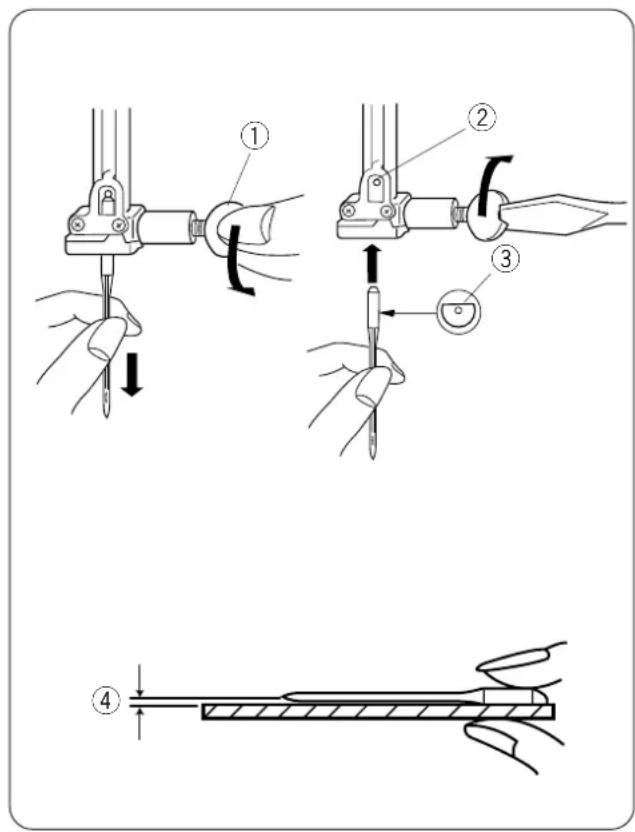
Raise the needle by turning the handwheel and lower the presser foot. Turn off the power switch.
1 Loosen the needle clamp screw by turning it counterclockwise.
Remove the needle from the clamp.
① Needle clamp screw
2 Insert a new needle into the needle clamp with the flat side of the needle to the rear.
When inserting the needle into the needle clamp, push it up against the stopper pin and tighten the needle clamp screw firmly.
② Stopper pin
③ Flat side
To check needle straightness, place the flat side of the needle onto something flat (a needle plate, glass etc.) The gap between the needle and the flat surface should be consistent.
Never use a blunt needle.
④ Gap
Needle and Thread Chart
| WEIGHT | FABRIC | TYPE of NEEDLE | NEEDLE SIZE |
| Very Light | Chiffon, Georgette, Fine Lace, OrgandyNet, Tulle | UniversalBall Point | 9 (65)9 (65) |
| Light | Batiste, Voile, Lawn, Pure Silk, Crepe de Chine, Sheer Crepe, Chambray, Handkerchief Linen, Gingham, Challis, Percale, Wool Crepe, Peau de Soie, Taffeta, Satin, Silk Surah, Satin-backed Crepe, Qiana | Blue Tipped NeedleUniversal | 11 (75)11 (75)12 (80) |
| Single Knits, Jersey, Swimwear, and Tricot | Blue Tipped NeedleBall Point | 11 (75)11 (75) | |
| Leather, Suede | Wedge PointLeather Needle | 11 (75) | |
| Medium | Flannel, Velour, Velvet, Muslin, Velveteen, Poplin, Corduroy, Broadcloth, Linen, Chintz, Gabardine, Felt, Terry, Burlap, Quilted Fabrics | Universal | 14 (90) |
| Double Knits, (synthetic and natural) Stretch Velour, Stretch Terry, Sweater Knits | Ball Point | 14 (90) | |
| Leather, Vinyl, Suede | Wedge PointLeather Needle | 14 (90) | |
| Heavy | Denim, Sailcloth, Ticking | Denim Needle | 16 (100) |
| Double Faced Wool, Heavy Coating, Fake Fur, Drapery Fabrics | Universal | 16 (100) | |
| Leather, Suede | Wedge PointLeather Needle | 16 (100)18 (110) | |
| Very Heavy | Canvas, Duck, Upholstery Fabrics | Universal | 16 (100) |
| Topstitching for Special Finishes | Topstitching Needle | 14 (90) | |

text_image
Technical diagram showing sewing machine operation with labeled steps 1, 2, and 3 for fabric or sewing.Winding the Bobbin
Removing the bobbin
Push the hook cover plate release button to the right and remove the cover plate.
① Hook cover plate release button
② Hook cover plate
Lift out the bobbin.
③ Bobbin
text_image
Technical diagram of a mechanical assembly with numbered components and directional arrows indicating motion or movement.Setting the spool
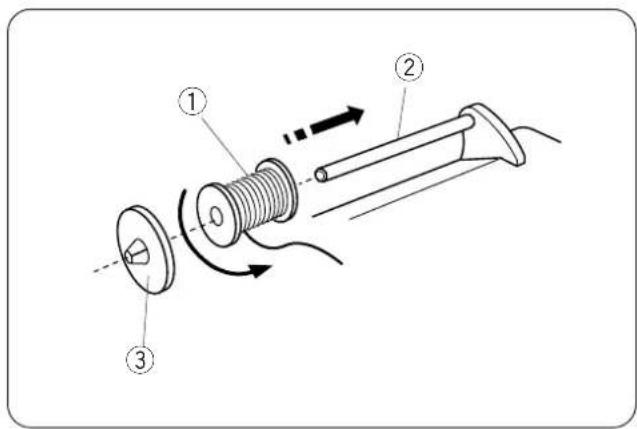
Place a spool of thread on the spool pin with the thread coming off the spool as illustrated.
① Spool of thread
② Spool pin
Press the spool holder firmly against the spool of thread.
③ Spool holder
natural_image
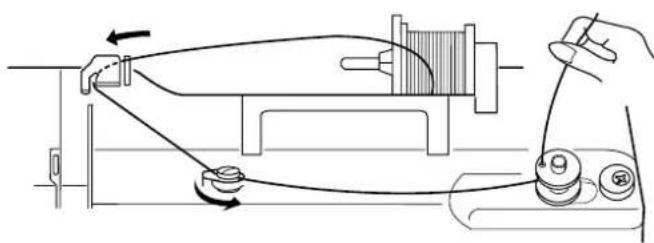
Technical line drawing of a sewing machine with hands operating it (no text or symbols)Threading for bobbin winding
Set the speed control lever at ▶▶▶.
1

text_image
Diagram showing a hand holding a tool with an arrow indicating rotation or movement, labeled with number ①2
natural_image
Diagram of a mechanical device with a cylindrical component and a base, no text or symbols present
natural_image
Mechanical component diagram showing a pulley and base with an arrow indicating direction (no text or symbols)5
natural_image
Illustration of a sewing machine needle being cut with scissors, no text or symbols present6
text_image
Diagram illustrating a sewing process with scissors cutting a spool, showing mechanical setup and directional arrows.1 Hold the thread with both hands and pass the thread under the thread guide.
① Thread guide
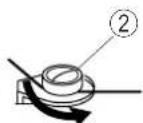
2 Draw the thread toward you and guide the thread around the bobbin winding thread guide.
② Bobbin winding thread guide
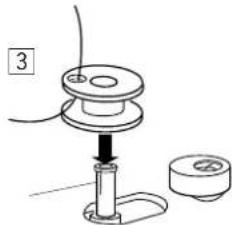
3 Pass the thread through the hole in the bobbin from the inside to the outside. Put the bobbin on the bobbin winder spindle.
4 Push the bobbin winder spindle to the right.
The indicator will show SP
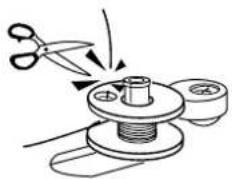
5 Hold the free end of the thread in your hand and start the machine.
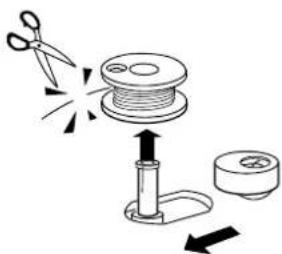
Stop the machine when the bobbin has been wound a few layers, and cut the thread close to the bobbin.
6 Start the machine again. When the bobbin is fully wound, it will stop automatically.
Stop the machine and return the bobbin winder spindle to its original position by moving it to the left, and cut the thread with a pair of scissors. Remove the bobbin from the bobbin winder spindle.
NOTE:
The machine will not sew until the spindle has been returned to the left.

text_image
Technical diagram showing mechanical assembly with numbered components and a magnified view of the thread being inserted.Additional spool pin
The additional spool pin is for bobbin winding without unthreading the machine.
Insert the additional spool pin into the hole.
Place the felt and a spool on the pin.
① Additional spool pin
② Spool pin felt
③ Spool pin hole
Inserting the bobbin
1
text_image
Technical diagram showing a mechanical assembly with labeled parts and directional arrows indicating motion or force.2

natural_image
Technical diagram of a mechanical component with no visible text or symbols3

text_image
Technical diagram showing a mechanical component with labeled parts and directional arrows indicating motion or movement.4
text_image
Diagram showing a mechanical device with labeled parts and directional arrows, including a numbered label (⑤) pointing to a component.5
text_image
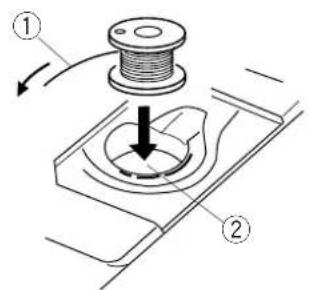
Diagram showing sewing machine operation with magnified view of measurement scale and component labels1 Place the bobbin in the bobbin holder with the thread running off counterclockwise.
① Thread
② Bobbin holder
2 Guide the thread into the notch on the front of the bobbin holder.
③ Notch on the front
3 Draw the thread to the left, sliding it between the tension spring blades.
④ Spring blades
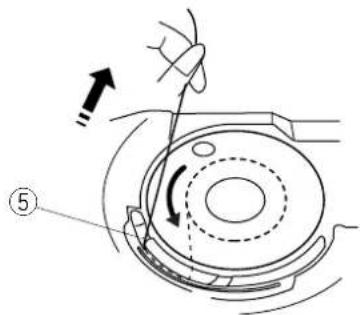
4 Continue to draw the thread lightly until the thread slips into the notch on the side.
⑤ Notch on the side
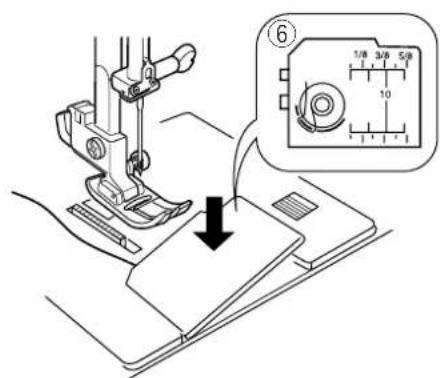
5 Pull out about 4" (10 cm) of thread to the rear. Reattach the hook cover plate.
NOTE:
A threading chart is shown on the hook cover plate for your reference.
⑥ Threading chart

text_image
Technical diagram illustrating seven steps of sewing machine tooling, labeled 1 to 7.Threading the Machine

natural_image
Pure mechanical diagram showing a piston-cranked valve mechanism without any text, numbers, or symbolsRaise the presser foot. Press the needle up/down button to raise the thread take-up lever to its highest position.
WARNING:
Turn OFF the power switch before threading the machine.
1 Draw the thread from the spool and pass it under the thread guide.
① Thread guide
2 Draw the thread down along the right channel and pull it up around the bottom of the thread guide plate.
Pull the thread up along the left channel.
② Right channel
③ Thread guide plate
④ Left channel
3 Firmly draw the thread from right to left over the thread take-up lever and down into the take-up lever eye.
⑤ Thread take-up lever
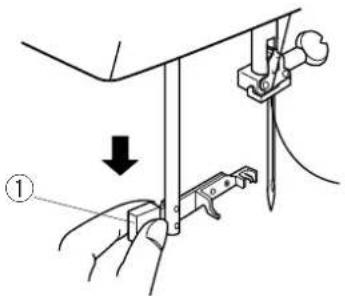
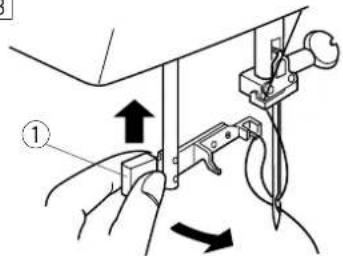
4 Draw the thread down along the left channel and slip the thread behind the needle bar thread guide from the left.
⑥ Needle bar thread guide
5 Pass the thread through the needle eye from the front.
⑦ Needle eye
1
text_image
Diagram showing a sewing machine needle stitching with a downward arrow indicating the process, labeled with number ①.2

text_image
Technical diagram showing mechanical assembly with numbered parts and directional arrows indicating motion or movement3
text_image
Diagram showing a sewing machine needle insertion mechanism with labeled parts and directional arrows4

natural_image
Line drawing of a hand holding a sewing machine tool, no text or symbols presentNeedle Threader
① Raise the needle to its highest position. Pull down the needle threader knob as far as it will go.
① Threader knob
② Turn the knob in the direction of the arrow in the illustration, then insert hook into the needle eye. Lead the thread around guide and under hook.
② Hook
③ Guide
3 Turn the knob in the direction of the arrow in the illustration, drawing the thread loop through the needle. Gently let the needle threader go up to pull the thread loop up.
4 Pull the thread through the needle eye.
NOTE:
The needle threader can be used with a #11 to #16 needle or a blue tipped needle. Thread size 50 to 90 should also work well.
text_image
Technical diagram illustrating sewing machine tool path and start/stop buttons with numbered annotationsDrawing Up the Bobbin Thread
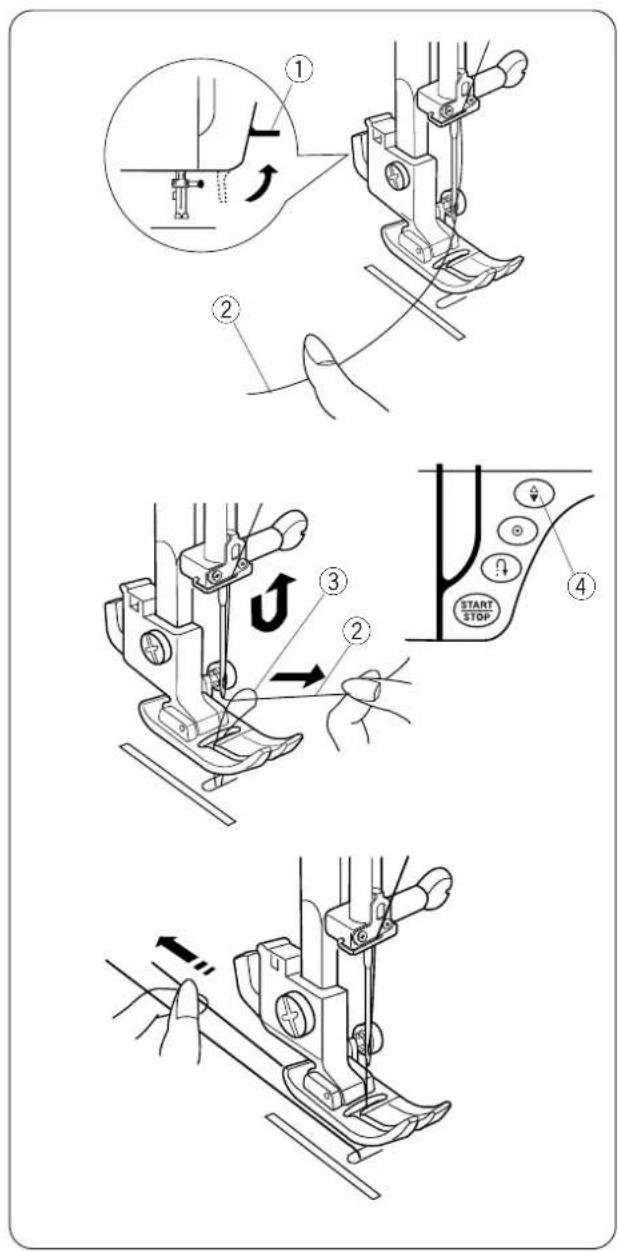
1 Raise the presser foot lifter.
Turn the power switch on.
Hold the needle thread with your finger
① Presser foot lifter
② Needle thread
2 Press the needle up/down button twice to pick up the bobbin thread. Draw up the needle thread to bring up a loop of the bobbin thread.
③ Bobbin thread
④ Needle up/down button
3 Slide 4" (10 cm) of both threads to the back under the presser foot.

text_image
01 ① 01 ② ③ 5 4 3
natural_image
Line drawing of a sewing machine needle stitching fabric (no text or symbols)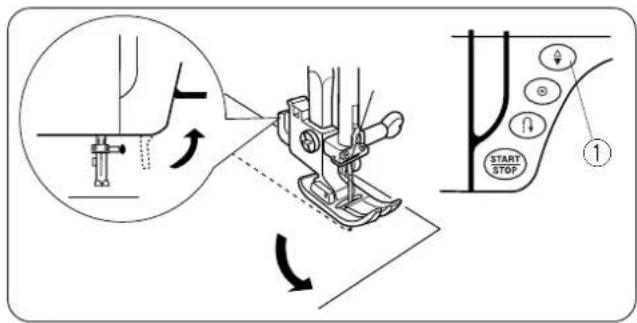
text_image
Technical diagram illustrating sewing machine operation with labeled start/stop buttons and directional arrows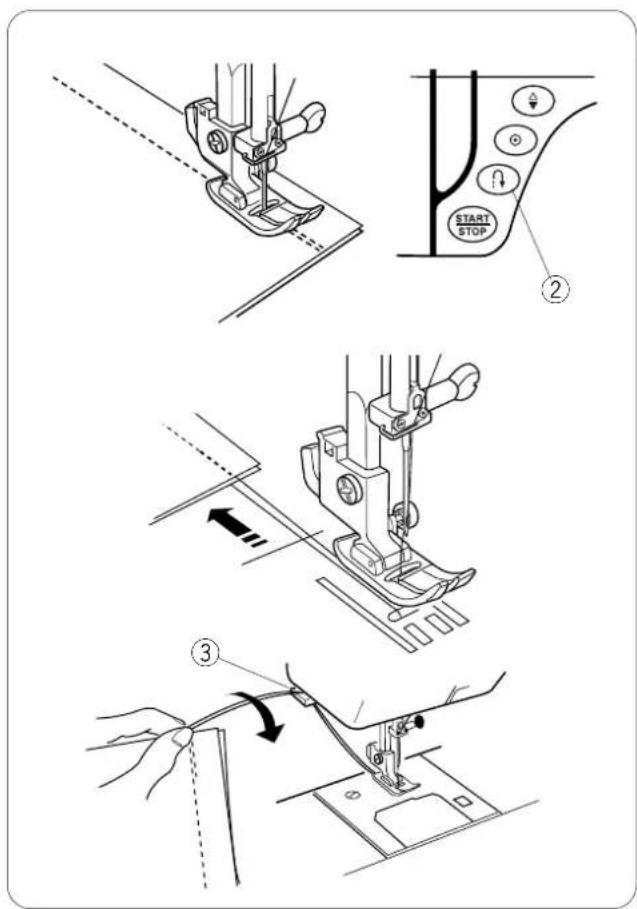
text_image
Technical diagram illustrating sewing machine stitching steps with labeled instructions and directional arrowsBASIC STITCHES
Straight Stitch
Machine settings
① Pattern: #01
② Presser foot: Zigzag foot A
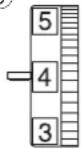
③ Thread tension: 2 - 6
To sew
Raise the presser foot and position the fabric next to a seam guide line on the needle plate. Lower the needle into the fabric where you wish to start.
Pull the needle and bobbin threads to the back. Lower the presser foot.
Depress the foot control or press the start/stop button to start sewing. Gently guide the fabric along the seam guide line.
Changing sewing direction
Stop the machine a few stitches before the end of a seam. Press the needle up/down button a few times until the needle falls on the end of the seam.
① Needle up/down button
Raise the presser foot.
Pivot the fabric around the needle to change the sewing direction as desired.
Lower the presser foot and start sewing in a new direction.
Securing a seam
For fastening the beginning of a seam, press the reverse button and sew several reverse stitches. Release the reverse button to sew forward.
② Reverse button
For fastening the ends of a seam, press the reverse button at the end of the seam.
Sew a few stitches in reverse to fasten the seam.
Raise the presser foot and pull the fabric to the back to remove it.
To cut the threads, pull the fabric to draw the threads up to the thread cutter as shown.
The threads are cut a proper length to start the next seam.
③ Thread cutter
When pattern #02 (lock-a-matic stitch) is selected:
The machine will sew reverse stitches at the beginning of a seam automatically, and at the end of the seam by pressing the reverse button once.
other
| Value | Label | |---|---| | 2.2 | ~W | | 2.2 | - | | 1.0 | - ~W + | | 1.0 | 4.0 | | 2.2 | - | | 4.0 | - |(Note: # is unique to the displayed display). The numbers in the table below are explicitly labeled as '1.0' and '2.2'.
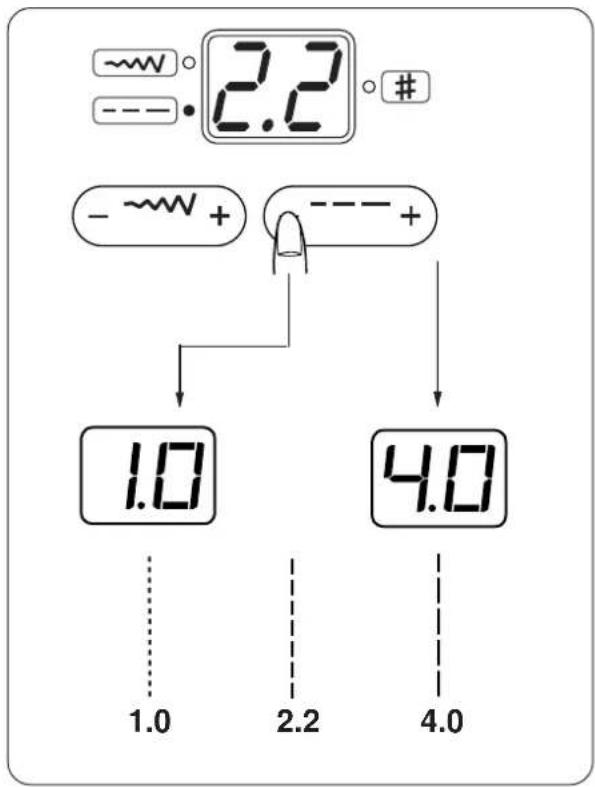
Altering the stitch length
The stitch length can be altered between 0.0 and 4.0.
Press the stitch length adjusting button to alter the stitch length. The bottom green light will light up and the preset value "2.2" will be indicated.
Press the "+" sign to increase the stitch length.
Press the "-" sign to decrease the stitch length.

text_image
~W 2.5 #- ---○ ~ + W - --- + ↓ 0.0 5.0 0.0 ① 2.5 ② 5.0 ③Altering the needle drop position
The needle drop position of the following stitches can be altered: 01 02 03 06 07 08
Press the stitch width adjusting button to change the needle drop position. The top green light will light up and the preset value "2.5" (center needle position) will be indicated.
Press the "+" sign to move the needle drop to the right.
Press the "-" sign to move the needle drop to the left.
① Left needle drop position
② Center needle drop position
③ Right needle drop position
text_image
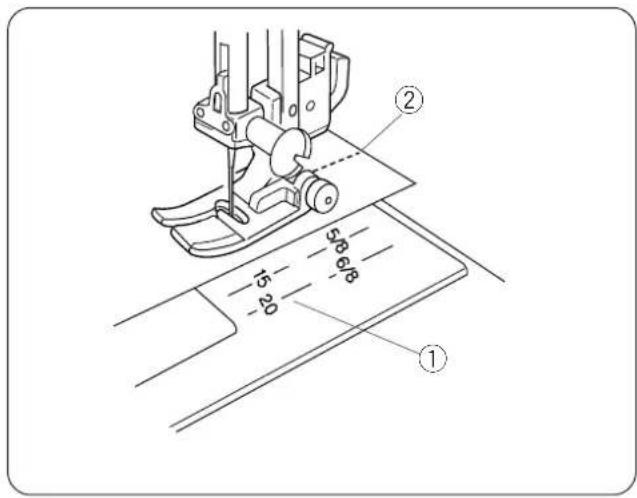
① -15 -20 58 68 ②Using the seam guide lines
The seam guides on the needle plate help you to measure seam allowances.
NOTE:
The number indicates the distance from the center needle position.
① Guide lines
② Center needle position
| Number | 15 20 | 4/8 5/8 | 6/8 | ||
| Distance (cm) | 1.5 2 | 0 | 1.3 1 | 6 | 1.9 |
| Distance (inch) | — | — | 1/2 5 | 8 3/4 |
natural_image
Technical line drawing of a sewing machine needle stitching fabric, showing angle and cutting path (no text or symbols)Turning square corners
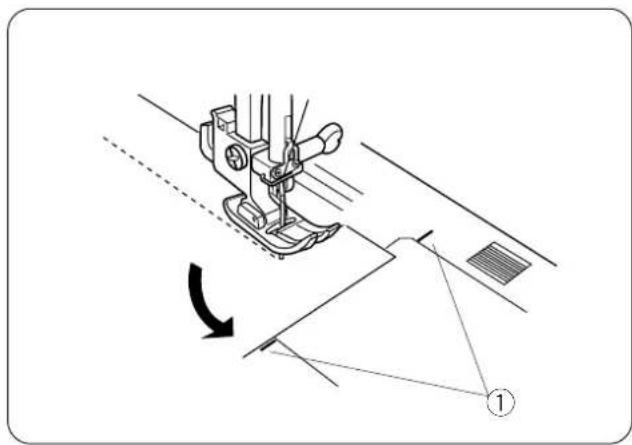
To turn a square corner 5/8" (1.6 cm) from the fabric edge:
When the fabric edge facing you lines up with the cornering guide as illustrated, stop stitching and lower the needle by turning the handwheel towards you.
Raise the presser foot and turn the fabric to line the edge with the 5/8" (1.6 cm) seam guide.
Lower the presser foot and begin stitching in the new direction.
① Cornering guides
text_image
Technical diagram showing three-step sewing machine tool path with labeled parts and directional arrowsSewing from the edge of thick fabric
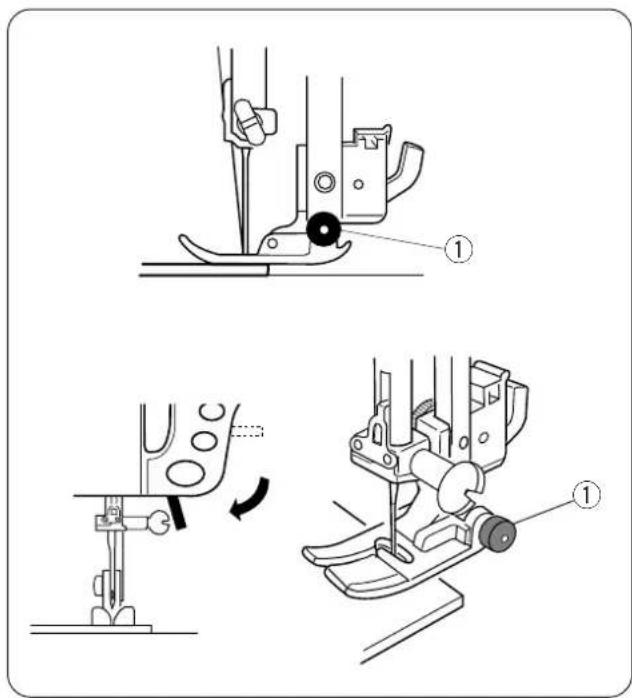
The black button on the zigzag foot locks the foot in the horizontal position.
This is helpful when starting sewing from the extreme edge of thick fabrics or sewing across a hem.
Lower the needle into the fabric at the point where you wish to start sewing.
Lower the foot while pushing in the black button. The foot will be locked in the horizontal position to avoid slipping.
The foot will be unlocked after sewing a few stitches.
① Black button
Variety of Straight Stitches and Recommended Feet

text_image
01 4 5 4 3#01 Straight stitch
Presser foot: Zigzag foot A
Thread tension: 2 - 6
Use this stitch for seaming and for zipper sewing.

text_image
02 C 5 4 3#02 Lock-a-matic stitch
Presser foot: Zigzag foot A
Thread tension: 2 - 6
Use this stitch to secure the beginning and the end of a seam with backstitching.
When you reach the end of the seam, press the reverse button once. The machine will sew four reverse stitches, four forward stitches, and then stop sewing automatically.

text_image
03 1 5 4 3#03 Locking stitch
Presser foot: Zigzag foot A
Thread tension: 2 - 6
This unique stitch is used where an invisible locking stitch is needed. Lower the needle close to the front edge of the fabric.
The machine will sew several locking stitches in place and continue sewing forward.
When you press the reverse button at the end of the seam, the machine will sew several locking stitches in place, then stop sewing automatically.

text_image
04 5 4 3#04 Stretch stitch
Presser foot: Zigzag foot A
Thread tension: 3 - 6
This is a narrow stretch stitch designed to eliminate puckering on knit fabrics and bias seams, while allowing the seam to be pressed completely open flat.
text_image
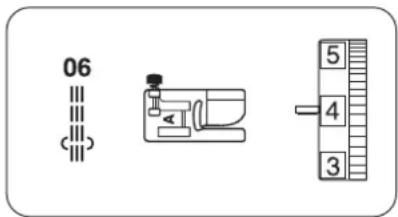
06 (≡) A 5 4 3#06 Triple stretch stitch
Presser foot: Zigzag foot A
Thread tension: 2 - 6
This strong, durable stitch is recommended for areas where both elasticity and strength are needed to ensure comfort and durability.
Use it to reinforce areas such as crotch and armhole seams.
Also use it when constructing items such as backpacks for extra strength.

text_image
07 ≡ (≡) 1 2 3 4 5#07 New sculpture stitch
Presser foot: Zigzag foot A
Thread tension: 3 - 6
This stitch is used for topstitching and outline-stitches enhancing the design appearance.
text_image
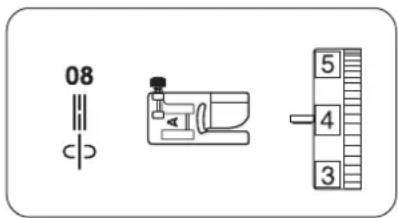
08 5 4 3#08 Sculpture stitch
Presser foot: Satin stitch foot F
Thread tension: 3 - 6
The stitch is used for topstitching and outline-stitches enhancing the design appearance.

text_image
① 05 05 ② ③ 5 4 3
natural_image
Line drawing of a sewing machine needle stitching a piece of thread (no text or symbols)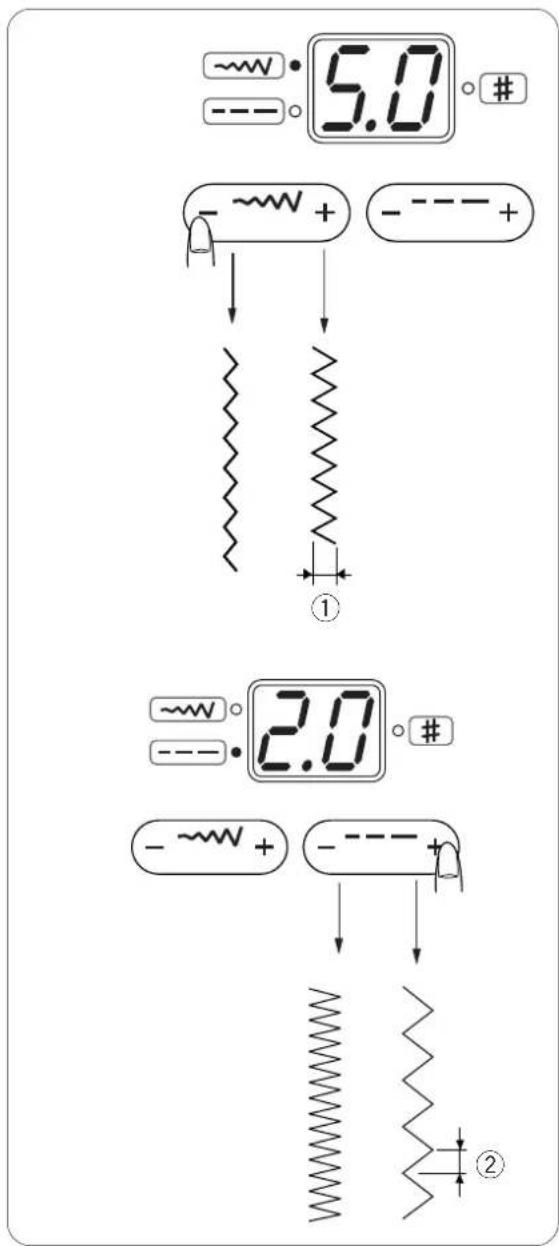
text_image
~W 5.0 #- ~-W + -- ① ~-W + 2.0 #- ~-W + -- ②Zigzag Stitch
Machine settings
① Pattern: #05
② Presser foot: Zigzag foot A
③ Thread tension: 3 - 7
The zigzag stitch is used for various sewing needs including overcasting. It can be used on most woven fabrics.
A dense zigzag stitch can also be used for appliqué.
Altering the stitch width
The stitch width can be altered between 0.0 and 5.0.
Press the stitch width adjusting button to alter the stitch width. The top green light will light up and the preset value "5.0" will be indicated.
Press the "+" sign to increase the stitch width.
Press the "-" sign to decrease the stitch width.
① Stitch width
Altering the stitch length
The stitch length can be altered between 0.0 and 4.0.
Press the stitch length adjusting button to alter the stitch length. The bottom green light will light up and the preset value "2.0" will be indicated.
Press the "+" sign to increase the stitch length.
Press the "-" sign to decrease the stitch length.
② Stitch length
NOTE:
The stitch length and width can be altered while stitching.
UTILITY STITCHES
Overcasting with Zigzag Stitch
Machine settings
① Pattern: #05
② Presser foot: Zigzag foot A
③ Thread tension: 3 - 7

text_image
① 05 05 ② ③ 5 4 3
natural_image
Technical line drawing of a sewing machine tool and its side view showing spring mechanism (no text or symbols)Place the fabric edge next to the right side of the clear window of the foot and carefully guide the fabric so the needle falls off the edge when it swings to the right.
① Clear window
text_image
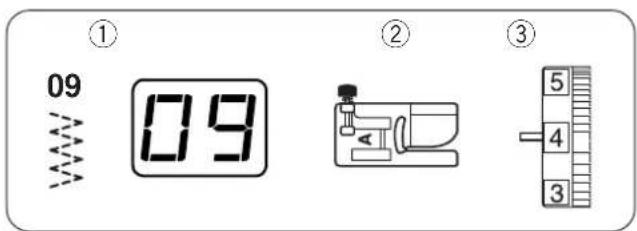
① 09 09 ② ③ 5 4 3
natural_image
Technical illustration of a sewing machine and a sewing tool with scissors cutting through it (no text or symbols)Multiple Zigzag Stitch (Tricot Stitch)
Machine settings
① Pattern: #09
② Presser foot: Zigzag foot A
③ Thread tension: 3 - 6
This stitch is used to finish a raw edge of synthetics and other stretch fabrics that tend to pucker. Sew along the fabric edge leaving an adequate seam allowance.
After sewing, trim the seam allowance close to the stitches.

text_image
14 SEN ~~~○ ---○ 14•# #
text_image
15 AUTO ~W 15 #Buttonholes
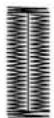
#14 Square buttonhole (sensor buttonhole)
This buttonhole is widely used on medium to heavy weight fabrics.
The buttonhole size is automatically determined by placing a button in the rear of the foot.
#15 Auto buttonhole
This is also a square buttonhole similar to the Sensor Square Buttonhole, but you can manually set the buttonhole size and you can memorize the size to sew buttonholes of the same size.
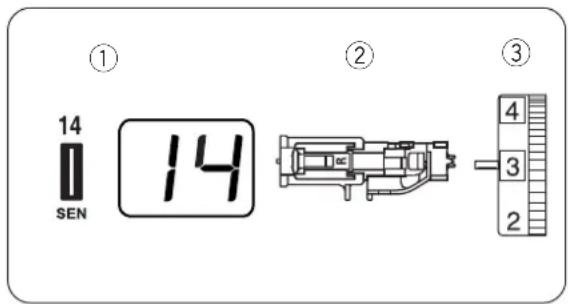
text_image
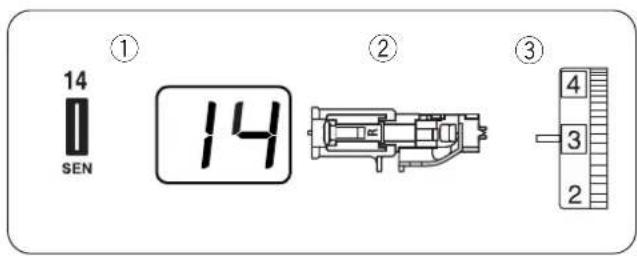
① 14 SEN ② 4 3 2Square buttonhole
Machine Settings
① Stitch pattern: #14
② Foot: Automatic buttonhole foot R
③ Thread tension: 1 - 5
NOTES:
- The size of a buttonhole is automatically set by placing a button in the rear of automatic buttonhole foot R.
- The button holder of the foot takes a button size of 3/8" (1 cm) to 1" (2.5 cm) in diameter.
- It is sometimes necessary to change the buttonhole size to match certain heavy or specific fabrics and threads.
- Make a test buttonhole on an extra piece of the fabric to check your settings.
- The preset width of the buttonhole is suitable for ordinary buttons.
- Apply an interfacing to stretch or fine fabrics.
1
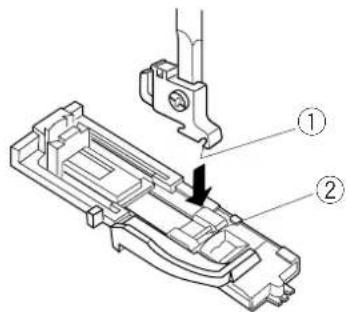
text_image
Technical diagram of a mechanical assembly with labeled parts ① and ②, showing internal components and directional arrow.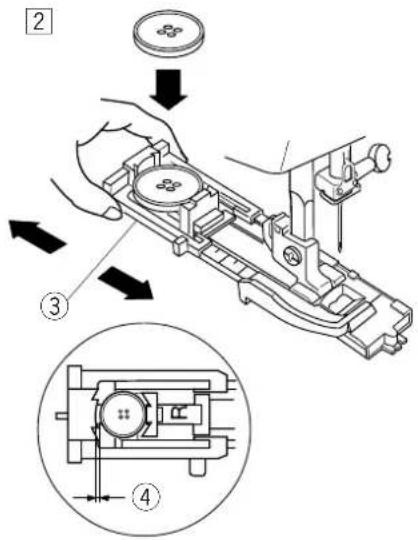
text_image
Technical diagram showing mechanical assembly with labeled parts and directional arrows indicating motion or assembly steps3

text_image
Technical diagram of a mechanical device with labeled component ⑤ and directional arrow indicating motion or movement.
text_image
Technical diagram of a sewing machine with numbered parts and an inset close-up view highlighting internal components.To sew
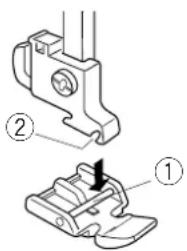
1 Press the needle up/down button to raise the needle. Attach the automatic buttonhole foot R snapping the pin into the groove of the foot holder.
① Groove
② Pin
2 Pull the button holder to the back, and place the button in it. Push it together tightly to the button.
NOTE:
If the button is extremely thick, make a test buttonhole on an extra piece of the fabric. If it is difficult to fit the button through the test buttonhole, you can lengthen the buttonhole by pulling the button holder back a little. The length of the buttonhole will be increased.
③ Button Holder
④ Extra gap
③ Pull the buttonhole lever down as far as it will go. ⑤ Buttonhole Lever
4 Insert the corner of the fabric under the foot. Press the needle up/down button twice. Remove the fabric to the left to draw the needle thread through the hole of the foot. Place the garment under the foot, and lower the needle at the starting point of the buttonhole mark.
Then lower the automatic buttonhole foot R.
⑥ Buttonhole Mark
⑦ Starting Point
NOTE:
Make sure there is no gap between the slider and stopper, otherwise the left and right lengths will be different.
⑧ Slider
⑨ Stopper
⑩ No gap
⑪ Sewing gap
5
Step
Step

Step
Step

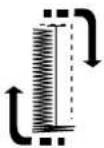
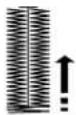
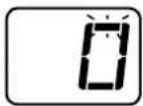
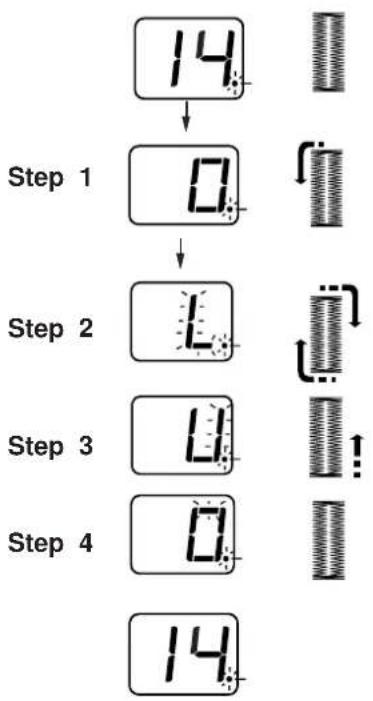
5 Start the machine to sew the buttonhole. The buttonhole will be automatically sewn.
Step 1: The machine will sew the front bartack and the left row first. Then it goes back to the starting point with straight stitch.
Step 2: The machine will sew the right row.
Step 3: The machine will sew the back bartack.
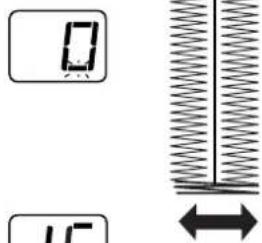
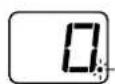
Step 4: The machine will stop automatically and a dot will blink.
⑫ Blinking dot
To sew another buttonhole, raise the presser foot. Move the fabric to where the next buttonhole is to be sewn, then lower the foot and start the machine.

NOTE:
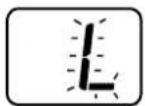
If you start sewing the buttonhole without lowering the buttonhole lever, the indicator will show a warning sign.
Lower the buttonhole lever, then restart the machine.

NOTE:
If you select another pattern without raising the buttonhole lever after buttonhole sewing, the indicator will show a warning sign.
Raise the buttonhole lever, then select the pattern.
6
text_image
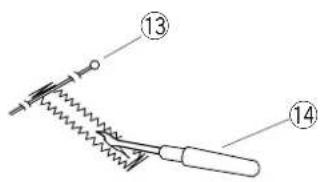
Diagram of a mechanical tool with labeled parts 13 and 14, showing spring and handle mechanisms.6 Remove the fabric and place a pin just below the bartack at each end to prevent accidentally cutting stitches. Cut the opening with the seam ripper. Use an eyelet punch to open a keyhole buttonhole.
⑬ Pin
⑭ Seam ripper
7 When buttonhole sewing is finished, push the buttonhole lever upward as far as it will go.
⑤ Buttonhole lever
7

natural_image
Technical line drawing of a sewing machine with a hand operating the base (no text or symbols present)
text_image
~W 5.0 #- --- ~ + ~ - + ① ② ~ W 0.4 #- --- ~ - ~W + - - - ↓Altering the buttonhole width
Press the stitch width adjusting button to change the buttonhole width.
Press the "+" sign to increase the buttonhole width. Press the "-" sign to decrease the buttonhole width.
① Narrower buttonhole
② Wider buttonhole
* The width can be altered between 2.5 and 7.0.
Altering the buttonhole stitch density
Press the stitch length adjusting button to change the buttonhole stitch density.
Press the "+" sign to make the stitches sparser.
Press the "-" sign to make the stitches denser.
* The stitch density can be altered between 0.2 and 0.8.
NOTE:
The indicator shows the stitch width or density while sewing. When the buttonhole is completed, the indicator will show the pattern number 14.
flowchart
graph TD
    A["14"] --> B["0"]
    B --> C["Step 2"]
    C --> D["1"]
    D --> E["Step 3"]
    E --> F["0"]
    F --> G["Step 4"]
Double layer buttonhole
To make a solid and sturdy buttonhole, sew another layer of buttonhole over the previous stitches.
After the buttonhole is finished, simply start the machine again.
Do not raise the foot or buttonhole lever.
The machine will sew another buttonhole in the following order and stop automatically when it is completed:
Step 1: Straight stitching in reverse to go back to the starting point
Step 2: Front bartack and left row, then straight stitching in reverse to go back to the starting point
Step 3: Right row
Step 4: Back bartack and locking stitches at the end The machine will stop automatically.
NOTE:
A double layer buttonhole can be sewn when the dot is blinking.
text_image
14 SEN 14 2 3 4 3 2Corded buttonhole
Machine Settings
① Pattern: #14
② Presser foot: Automatic buttonhole foot R
③ Thread tension: 1 - 5
To sew a corded buttonhole, follow the same procedure as for a square buttonhole (sensor buttonhole).
text_image
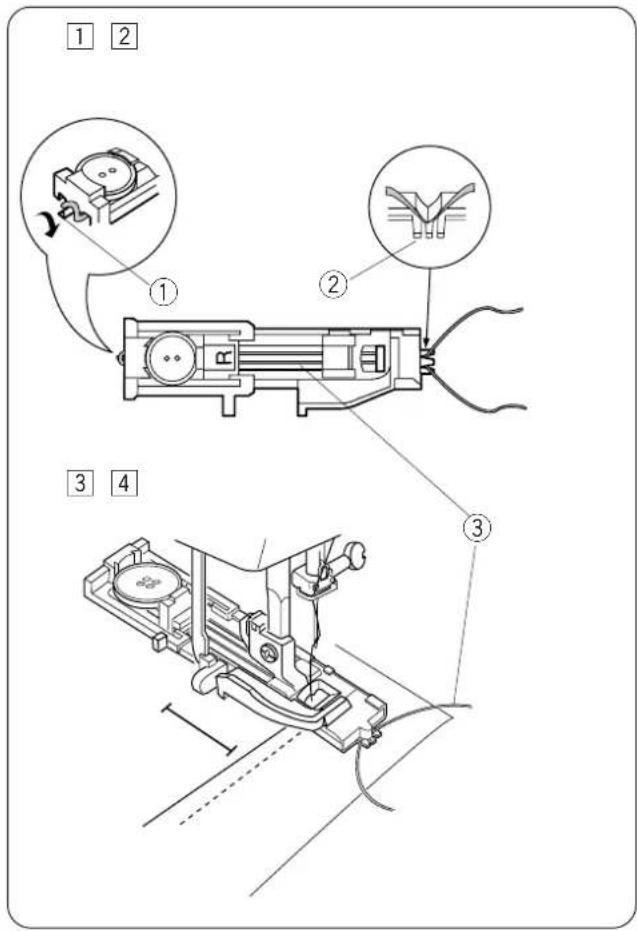
Technical diagram showing four labeled mechanical assembly steps with numbered annotations① With the automatic buttonhole foot R raised, hook the filler cord on the spur on the back of the buttonhole foot.
2 Bring the ends of cord toward you under the buttonhole foot clearing the front end.
Hook the ends of the filler cord into the forks on the front of the buttonhole foot to hold them tight.
① Spur
② Forks
③ Cord
3 Lower the needle into the garment where the buttonhole will start and lower the foot.
4 Lower the buttonhole lever and buttonhole foot. Start the machine and sew the buttonhole over the filler cord. The machine stops automatically when finished.
NOTES:
Set the stitch width in accordance with the thickness of the filler cord used.
To cut the buttonhole opening, refer to page 25.

text_image
5 65 Remove the fabric from the machine and cut the sewing threads.
6 Pull the left end of the filler cord to tighten it. Thread the end of the cord through a darning needle and draw it to the wrong side of the fabric and cut.
text_image
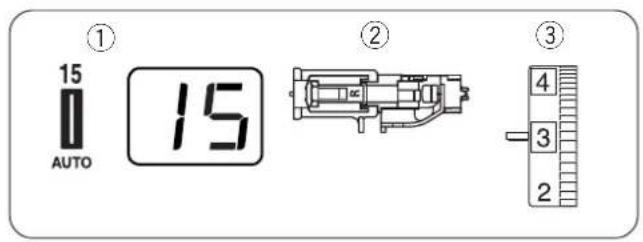
① 15 AUTO ② ③ 4 3 2Auto buttonhole
Machine Settings
① Pattern: #15
② Presser foot: Automatic buttonhole foot R
③ Thread tension: 1 - 5
1 2

text_image
Technical diagram of a sewing machine with labeled parts and directional arrow indicating movement3
text_image
Diagram illustrating a mechanical or fluid system with spring, piston, and stop button labeled 'START STOP' and directional arrows.4
text_image
Diagram showing a digital display and a spring with directional arrows indicating movement or force.5
natural_image
Pure electrical circuit lines without any symbols1
1 Pull the Button Holder all the way out.
Insert the fabric under the foot. Press the up/down needle button twice. Remove the fabric to the left to draw the needle thread through the hole of the foot.
2 Insert the garment under the foot, and lower the needle at the starting point. Then lower the Automatic buttonhole foot R.
① Button Holder
NOTE:
You do not need to pull down the buttonhole lever.
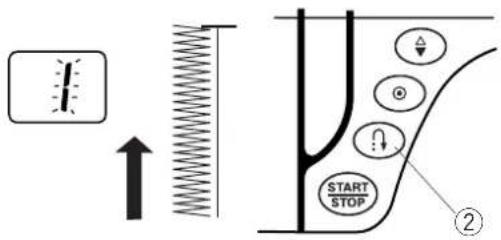
③ Sew the left row up to the required length. Then stop the machine and press the reverse button. ② Reverse button
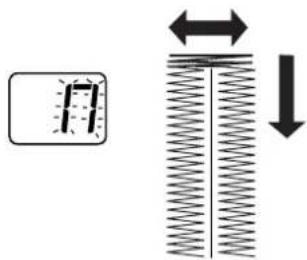
4 Start the machine again to sew the back bartack and the right row of the buttonhole. Stop the machine when you are directly opposite the starting point. Press the reverse button.
5 Start the machine again. The machine will sew the front bartack, lock the stitches and automatically stop when the buttonhole is completed.
NOTE:
You can sew another buttonhole identical to the first one by simply restarting the machine. The buttonhole width and stitch density cannot be altered after the buttonhole is finished.
To cut the buttonhole opening, refer to page 25.

text_image
① 05 ② ③ 5 4 3 ④Button Sewing
Machine Settings
① Pattern: #05
② Presser foot: Satin stitch foot F
③ Thread tension: 3 - 7
③ Feed dog: Lowered

natural_image
Technical line drawings of two sewing machine components (no text or symbols)Unthread the needle thread.
Place a button on the fabric and lower the needle by turning the handwheel, so that the needle enters into the left hole in the button.
Align the holes in the button with the slot on the foot and lower it to hold the button in place.
Turn the handwheel several times until the needle bar swings to the right.
Adjust the stitch width so the needle enters into the right hole in the button.
Rethread the machine and sew about 10 stitches at a slow speed.
Raise the presser foot and remove the fabric.
Trim both needle and bobbin threads at the beginning.
Cut both threads leaving 8" (20 cm) tails.
Pull the bobbin thread to bring the needle thread to the wrong side of the fabric then knot the threads.
After sewing is finished, raise the feed dog.
①


②

③
text_image
Technical diagram showing two mechanical components with numbered labels (① and ②) indicating parts of a device.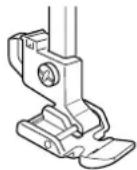
(A)
(B)
1
text_image
1 ① ② ③ ④ ⑤ ⑥ ⑦ ⑧ ⑨2
text_image
Technical diagram with numbered annotations and dimension lines, likely from an engineering or mechanical drawing.1

text_image
Technical diagram of a mechanical or electrical component with numbered parts and dimension annotationsZipper Sewing
Machine Settings
① Pattern: #01
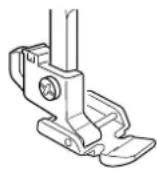
② Presser foot: Zipper foot E (optional item)
③ Thread tension: 2 - 6

CAUTION:
When sewing with the zipper foot, make sure to use pattern #01 (straight stitch with the center needle position). Otherwise the needle may hit the foot and possibly break.
Attaching the zipper foot (optional item)
(A) Attach zipper foot E with the pin on the right-hand side to the groove to sew the left side of the zipper.
(B) Attach zipper foot E with the pin on the left-hand side to the groove to sew the right side of the zipper.
① Pin
② Groove
NOTE:
The zipper foot is available as an optional item.
Fabric preparation
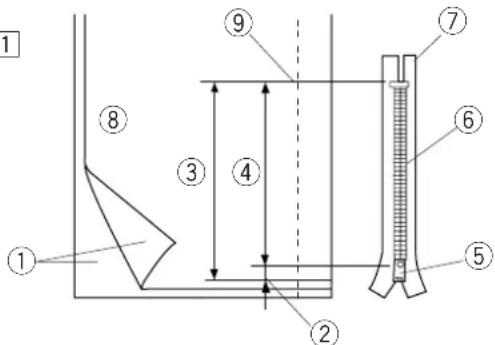
1 Add 3/8" (1 cm) to the zipper size. This is the overall opening size.
① Right side of the fabric
② 3/8" (1 cm)
③ Opening size
④ Zipper size
⑤ Slider
⑥ Zipper teeth
⑦ Zipper tape
⑧ Wrong side of the fabric
⑨ End of the opening
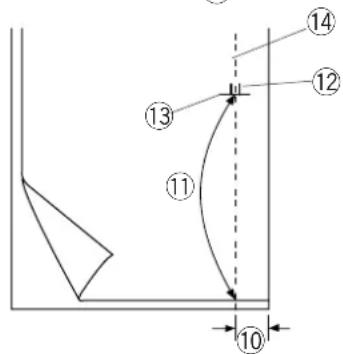
[2] Place the right (top) sides of the fabric together. Sew a bottom seam 5/8" (2 cm) from the right edge to the zipper bottom stop position. Sew a few stitches in reverse to lock. Increase the stitch length to "4", set needle thread tension to "1", and baste the remaining length of the fabric.
⑩ 5/8" (2 cm)
⑪ Basting
⑫ Reverse stitch
⑬ End of the opening
⑭ Bottom seam
To sew
1 Attach zipper foot with the right side pin. Fold back the upper layer seam allowance. Fold back the lower layer seam allowance to leave a 1/8" (0.4 cm) margin of fabric.
① Lower layer
② End of the opening
③ Zipper teeth
④ 1/8" (0.4 cm) margin
⑤ Upper layer
⑥ Opening size
⑦ Folded edge

natural_image
Line drawing of a sewing machine needle with a spring, shown without any text or symbols[2] Place zipper teeth next to margin edge and baste the zipper tape to the lower fabric layer. Align zipper foot with margin edge. Return thread tension and stitch length to original settings. Sew a seam the entire length of zipper tape.
NOTE:
To secure the beginning of a seam, sew several reverse stitches.

text_image
3 ⑧ ⑨3 Stop the machine 2" (5 cm) before reaching the slider, with needle in the fabric and raise the foot, then unzip a few inches to clear a path for stitching. ⑧ Slider ⑨ 2" (5 cm)
NOTE:
To secure the beginning of a seam, sew several reverse stitches.

text_image
4 ⑪ ⑩4 Remove fabric and close zipper. Take the upper fabric layer and lay it flat over the zipper. Baste the zipper tape to the upper fabric layer. ⑩ Basting ⑪ Zipper tape
text_image
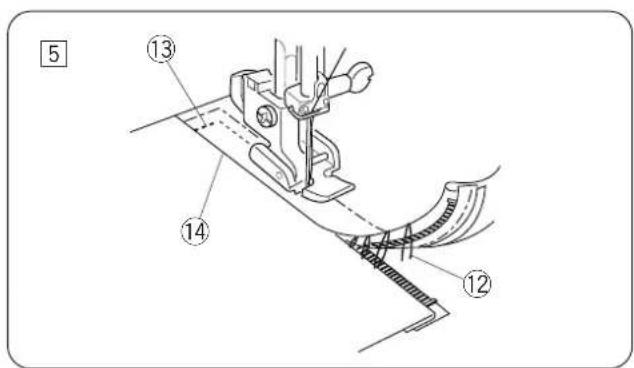
5 ⑬ ⑭ ⑮5 Raise and release the foot, and re-attach it with the left side pin. Starting just below zipper bottom stop, sew across the fabric to about 3/8" (1 cm) distance from the basting line. Turn fabric 90 degrees and sew a seam the entire length of the zipper tape. Before reaching the slider, stop the machine with needle in fabric and raise the foot. Use seam ripper to open a few inches of basting stitch. ⑫ Unstitch basting ⑬ 3/8" (1 cm) ⑭ Basting line
text_image
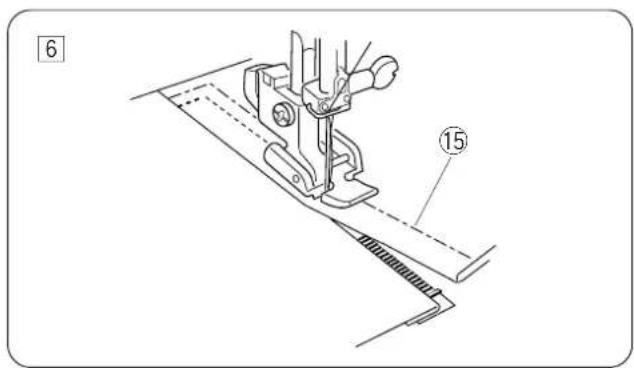
6 156 Unzip a few inches to clear a pathfor stitching. At end of seam, sew a few stitches in reverse to lock. Once both sides of zipper are sewn, use the seam ripper to open the rest of basting stitch. ⑮ Basting

text_image
① 13 13 ② ③ 5 4 3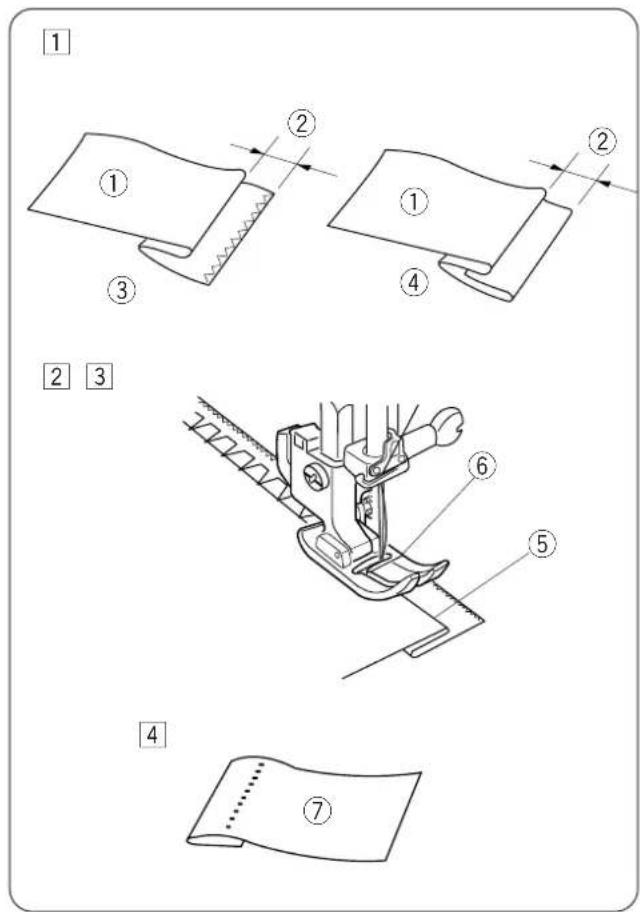
text_image
Technical diagram illustrating garment sewing process with numbered steps and labeled parts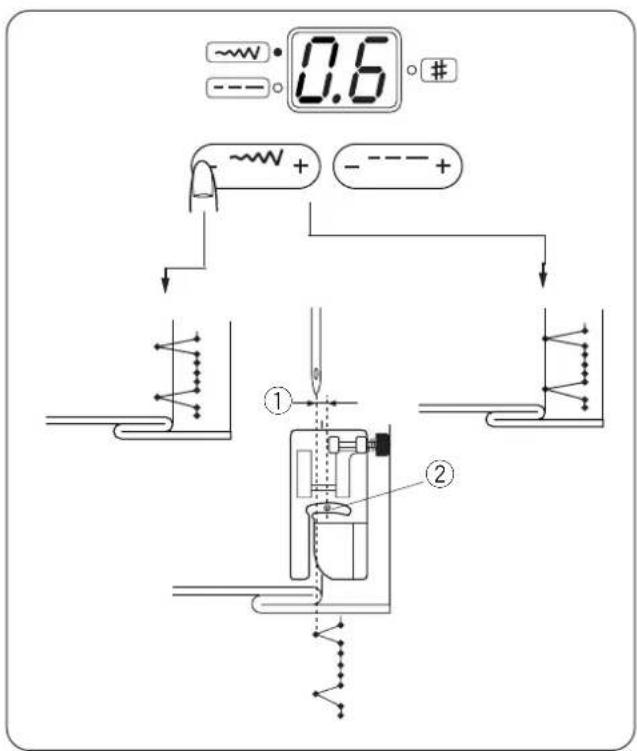
text_image
0.6 ~W #+ ~W + - + ① ②Blind Hemming
Machine setting

① Stitch pattern: #13 or #12
② Presser foot: Zigzag foot A
③ Thread tension: 3 - 6
1 On heavy weight fabrics that ravel, the raw edge should be overcast first.
Fold the hem under the fabric as illustrated for fine or medium fabrics.
Fold a hem with the wrong side up forming a 3/16" (0.5 cm) allowance.
① Wrong side of the fabric
② 3/16" (0.5 cm)
③ Heavy weight fabric
④ Fine and medium weight fabric
2 Place the fabric so that the needle just pierces the folded edge when the needle comes over the extreme left side.
Lower the presser foot.
Adjust the needle drop position with the stitch width adjusting button if necessary.
3 Sew slowly while guiding the folded edge along the left side of the clear window of the foot.
⑤ Folded edge
⑥ Clear window
4 Open and press the fabric after sewing is finished.
⑦ Right side of the fabric
NOTE:
If the needle drops too far left, the stitches will be apparent on the right side of the fabric.
Adjusting the needle drop position
Press the stitch width adjusting button to adjust the needle drop position. The top green light will light up and the preset value "0.6" will be indicated.
The value indicates a distance from the center needle drop position in millimeter.
① Distance
② Center needle drop position
Press the "+" sign to move the needle drop position to the right.
Press the "-" sign to move the needle drop position to the left.
text_image
① 16 ② ③ 4 3 2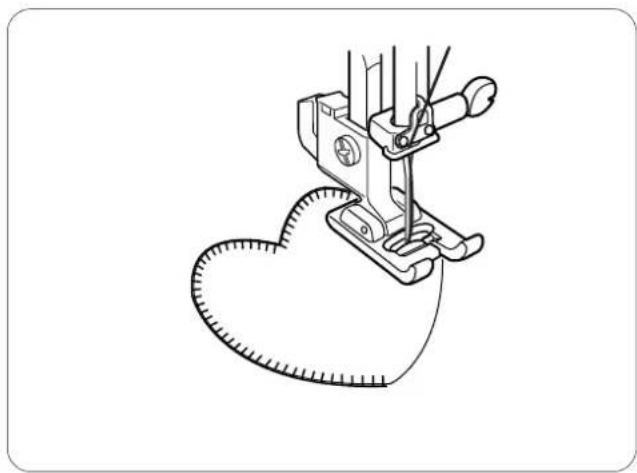
natural_image
Line drawing of a sewing machine with a heart-shaped base, no text or symbols presentDECORATIVE SEWING
Applique
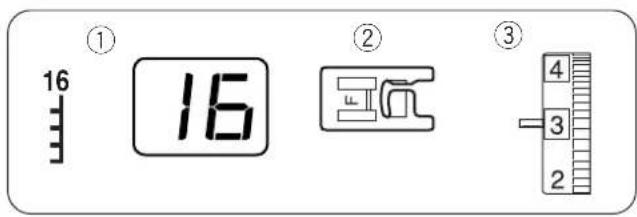
Machine setting
① Stitch pattern: #16, #17, #18
② Presser foot: Satin stitch foot F
③ Thread tension: 1 - 4
16:17 18

Place the applique on the fabric and baste it in place. Sew, guiding the edge of the applique along the slit on the foot, so that the needle falls off the edge of the applique when it swings to the right.
NOTE:
When changing the sewing direction at a corner or curve, lower the needle into the applique at the left swing and turn the fabric to a new direction.
text_image
09 ① 09 ② ③ 4 3 2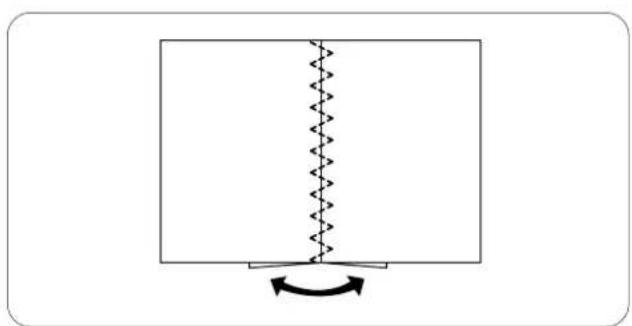
natural_image
Simple diagram showing a spring-loaded structure with an arrow indicating rotation (no text or symbols)Patchwork
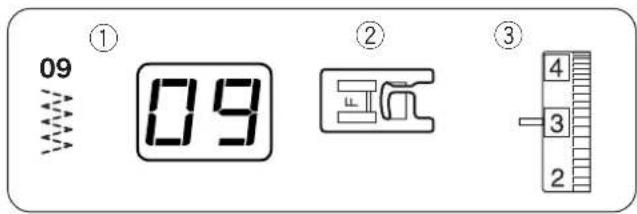
Machine setting
① Stitch pattern: #09
② Presser foot: Satin stitch foot F
③ Thread tension: 1 - 4
Seam the patchwork pieces with straight stitch and press seam allowance open. Sew pattern #09 on the right side of garment centering over the seam line.
text_image
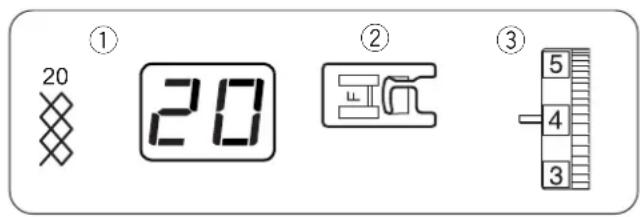
① 20 20 ② ③ 5 4 3
text_image
Diagram illustrating fiber optic cable installation with labeled components and directional arrows
natural_image
Diagram of a fabric or meshing process with layered patterns and directional arrows (no text or symbols)Smocking
Machine setting
① Stitch pattern: #20
② Presser foot: Satin stitch foot F
③ Thread tension: 3 - 6
Smocking is a delicate, decorative treatment on children's clothes or women's blouses.
Choose a soft, lightweight fabric such as batiste, gingham or challis. Cut the fabric three times the projected width. Set the stitch length at 4.0 and sew straight lines 3/8"(1cm) apart across the area to be smocked.
① 3/8"(1cm)
A looser needle thread tension will make gathering easier.
Knot the threads along one edge. From the other end, pull the bobbin threads to distribute the gathers evenly. Secure the threads at the other end.
Sew the smocking stitches between the straight seams.
Remove the straight stitches by pulling them out.

text_image
Diagram showing a device connected to a control panel with labeled components and two schematic diagrams (A) and (B) illustrating electrical or mechanical switching.Correcting Distorted Stretch Patterns
The sewing results of the stretch patterns may vary depending upon the sewing conditions, such as sewing speed, type of the fabric, number of layers etc.
Always test sew on a scrap piece of the fabric that you wish to use.
If stretch stitch patterns are distorted, correct it with the feed balancing dial.
① Feed balancing dial
② Neutral position
③ Setting mark
Example: Pattern #10
(A) If the pattern is compressed, turn the feed balancing dial in the direction of "+".
(B) If the pattern is drawn out, turn the feed balancing dial in the direction of “—”.
1

natural_image
Hand using a tool to press or install a component on a flat surface (no text or symbols visible)2

natural_image
Hand inserting a component into a device panel (no text or symbols visible)3
natural_image
Diagram of a mechanical component with labeled parts (no text or symbols present)4

text_image
Technical diagram of a device with numbered components, likely for assembly or maintenance instructions.5

natural_image
Line drawing of a hand pressing down on a mechanical component (no text or symbols)
natural_image
Hand inserting a component into a computer motherboard (no text or symbols visible)2

text_image
Technical diagram showing a mechanical assembly with labeled parts ① and ②, likely illustrating a component or assembly.3

text_image
Diagram showing a hand using a tool to press or install a device, labeled with numbered parts ③, ④, and ③.CARE AND MAINTENANCE

WARNING:
Turn the power switch off and unplug the machine before cleaning.
NOTE:
Do not dismantle the machine in any way other than what is explained in this section.
Clean the outside of the machine with a soft cloth and mild soap.
Cleaning the Hook Race and Feed Dogs
1 Remove the presser foot and needle. Remove screw on the needle plate with the screwdriver.
Remove the needle plate and take out the bobbin.
① Screw
2 Lift up the bobbin holder and remove it.
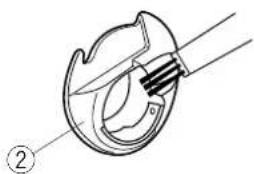
② Bobbin holder
3 Brush out dust and lint. Wipe the bobbin holder with a soft, dry cloth.
4 Clean the feed dogs and hook race with the lint brush.
③ Lint brush
④ Feed dog
⑤ Wipe the hook race with a soft, dry cloth.
⑤ Hook race
NOTE:
You may also use a vacuum cleaner.
Replacing the Bobbin Holder
1 Insert the bobbin holder into the hook race.
2 Make sure the knob of the bobbin holder fits next to the stopper on the race.
① Knob
② Stopper
3 Replace the bobbin.
Attach the needle plate, inserting the two guide pins into the holes in the needle plate. Tighten the screw firmly with the screwdriver.
③ Guide holes
④ Screw
Problems and Warning Signals
If a buzzer sounds and the indicator shows a warning sign, follow the guidance below.
| Warning signal | Problem | Try this |
 | The start/stop button is pressed with the foot control being connected.The foot control is connected or disconnected while sewing. | Disconnect the foot control.Turn the power switch off when connecting or disconnecting the foot control. |
 | The machine is re-started too soon after it has halted due to the overload. | Wait for at least 15 seconds to restart.If threads are jamming, remove jammed threads. |
 | The buttonhole is sewn without lowering the buttonhole lever. | Lower the buttonhole lever and restart the machine. |
 | Selecting a pattern after buttonhole is completed with the buttonhole lever still lowered. | Raise the buttonhole lever and re-select the pattern.Do not sew other pattern with the buttonhole foot. |
 | The bobbin winder spindle is shifted to the right for bobbin winding. | Return the bobbin winder spindle to the left. |
 to to | The machine is malfunctioning due to a problem in the electronic components. | Contact the service center or the store from where the machine was purchased. |
NOTE:
The safety device will shut the power down when the machine is locked. If the threads are jamming, remove the jammed threads and turn the power on again after 3 minutes.
| Audible signal The buzzer sounds when: |
| Pip Normal operation |
| Pip-pip-pip Invalid operation |
| Pip-pip-peep Buttonhole sewing completed |
| Peep Malfunciton |
It is not abnormal that a faint humming sound is coming from the internal motors.
This machine equipped with LED sewing light, which will not burn out and does not need to be replaced.
Troubleshooting
| Condition | Cause | Reference |
| The needle thread breaks. | 1. The needle thread is not threaded properly.2. The needle thread tension is too tight.3. The needle is bent or blunt.4. The needle is incorrectly inserted.5. The needle thread and the bobbin thread are not set properly under (drawn to the rear of) the presser foot when sewing is starting.6. The fabric is not drawn to the rear when sewing is finished.7. The thread is too heavy or too fine for the needle. | Page 14,15Page 9Page 10Page 10Page 17Page 17Page 10 |
| The bobbin thread breaks. | 1. The bobbin thread is not threaded properly in the bobbin holder.2. Lint has collected in the bobbin holder.3. The bobbin is damaged and doesn't turn smoothly.4. The thread is wound loosely on the bobbin. | Page 13Page 36Replace the bobbinRe-wind the bobbin. |
| The needle breaks. | 1. Needle is incorrectly inserted.2. The needle is bent or blunt.3. The needle clamp screw is too loose.4. A proper foot is not used.5. The fabric is not drawn to the rear when sewing is finished.6. The needle is too fine for the fabric being sewn. | Page 10Page 10Page 10Use proper foot.Page 17Page 10 |
| The needle thread loops. | 1. The needle thread tension is too loose.2. The needle size is not suitable for the thread. | Page 9Page 10 |
| Skipped stitches | 1. The needle is incorrectly inserted.2. The needle is bent or blunt.3. The needle and/or thread are not suitable for the fabric being sewn.4. A blue needle is not being used for sewing stretch, very fine fabrics and synthetics.5. The needle thread is not threaded properly.6. A poor quality needle is used. | Page 10Page 10Page 10Page 10Page 14,15Replace the needle |
| Seam puckering | 1. The needle thread tension is too tight.2. The needle thread is not threaded properly.3. The needle is too heavy for the fabric being sewn.4. The stitch length is too long for the fabric.* Use a stabilizer for very fine fabrics. | Page 9Page 14,15Page 10Make stitch shorter |
| The cloth is not fed smoothly. | 1. The feed dog is packed with lint.2. The stitches are too fine.3. The feed dog was not raised after being lowered. | Page 36Make stitch longerPage 8 |
| The machine does not work. | 1. The machine is not plugged in.2. Thread is caught in the hook race.3. The bobbin winder spindle is still in the winding position. | Page 4Page 36Page 12 |
| Patterns are distorted. | 1. The stitch is not balanced. | Page 35 |
| The buttonhole is not sewn well. | 1. The stitch density is not suitable for the fabric being sewn.2. Interfacing is not being used with stretch fabrics. | Page 26Page 23 |
| Noisy operation | 1. The feed dog is packed with lint.2. Lint has collected in the bobbin holder. | Page 36Page 36 |