MC-250 - Receiver MCINTOSH - Free user manual and instructions
Find the device manual for free MC-250 MCINTOSH in PDF.


User questions about MC-250 MCINTOSH
0 question about this device. Answer the ones you know or ask your own.
Ask a new question about this device
Download the instructions for your Receiver in PDF format for free! Find your manual MC-250 - MCINTOSH and take your electronic device back in hand. On this page are published all the documents necessary for the use of your device. MC-250 by MCINTOSH.
USER MANUAL MC-250 MCINTOSH
natural_image
Vintage McIntosh 250 electronic device with control knobs and cylindrical components (no readable text or symbols beyond branding)Your MC 250 Stereo Amplifier will give you many years of pleasant and satisfactory performance. If you have any questions, please contact:
CUSTOMER SERVICE
McIntosh Laboratory Inc.
2 Chambers Street
Binghamton New York 13903
Phone: 607-723-3512
WARNING: TO PREVENT FIRE OR SHOCK HAZARD, DO NOT EXPOSE THIS UNIT TO RAIN OR MOISTURE.
Take Advantage of 3 years of FREE Service ... Fill in the Application NOW.
CONTENTS
SERVICE CONTRACT 1
INSTALLATION 2
HOW TO CONNECT 2,3
CONTROL PANEL INFORMATION 4
THREE YEAR SERVICE CONTRACT
An application for a FREE THREE YEAR SERVICE CONTRACT is included with this manual.
The terms of the contract are:
- McIntosh will provide all parts, materials and labor needed to return the measured performance of the instrument to the original performance limits free of any charge. The SERVICE CONTRACT does not cover any shipping costs to and from the authorized service agency or the factory.
- Any McIntosh authorized service agency will repair all McIntosh instruments at normal service rates. To receive the free service under the terms of the SERVICE CONTRACT, the SERVICE CONTRACT CERTIFICATE must accompany the instrument when taken to the service agency.
- Always have service done by a McIntosh authorized service agency. If the instrument is modified or damaged, as a result of unauthorized repair the SERVICE CONTRACT will be cancelled. Damage by improper use
or mishandling is not covered by the SERVICE CONTRACT.
- The SERVICE CONTRACT is issued to you as the original purchaser. To protect you from misrepresentation this contract cannot be transferred to a second owner.
- For your protection McIntosh selects only dealers who have technical competence to guide purchasers fairly, and provide service when necessary. To receive the SERVICE CONTRACT your purchase must be made from a McIntosh franchised dealer.
- Your completely filled in application for a SERVICE CONTRACT must be postmarked within 30 days of the date of purchase of the instrument.
- To receive the SERVICE CONTRACT all information on the application must be filled in. The SERVICE CONTRACT will be issued when the completely filled in application is received at McIntosh Laboratory Incorporated in Binghamton, New York.
Installation
Adequate ventilation extends the trouble-free life of electrical instruments. It is generally found that each 10^ centigrade ( 18^ F) rise in temperature reduces the life of electrical insulation by one half. Adequate ventilation is an inexpensive and effective means of preventing insulation breakdown that results from unnecessarily high operating temperatures. The direct benefit of adequate ventilation is longer, trouble-free life.
The suggested minimum space for mounting the MC 250 is 18 inches long X 8 inches wide X 11½ inches high. Always allow for air flow by either ventilation holes or space next to the bottom of the amplifier and a means for the warm air to escape at the top.
It is recommended that the MC 250 be mounted in a normal or horizontal position. However with adequate ventilation, the amplifier can be mounted in any position except upside down. If the amplifier is to be installed on a vertical surface it is recommended that the autoformers be on the down side. This position permit greater air flow around the transistors and component parts thereby extending the trouble-free life of the amplifier.
HOW to Connect
INPUT—STEREO
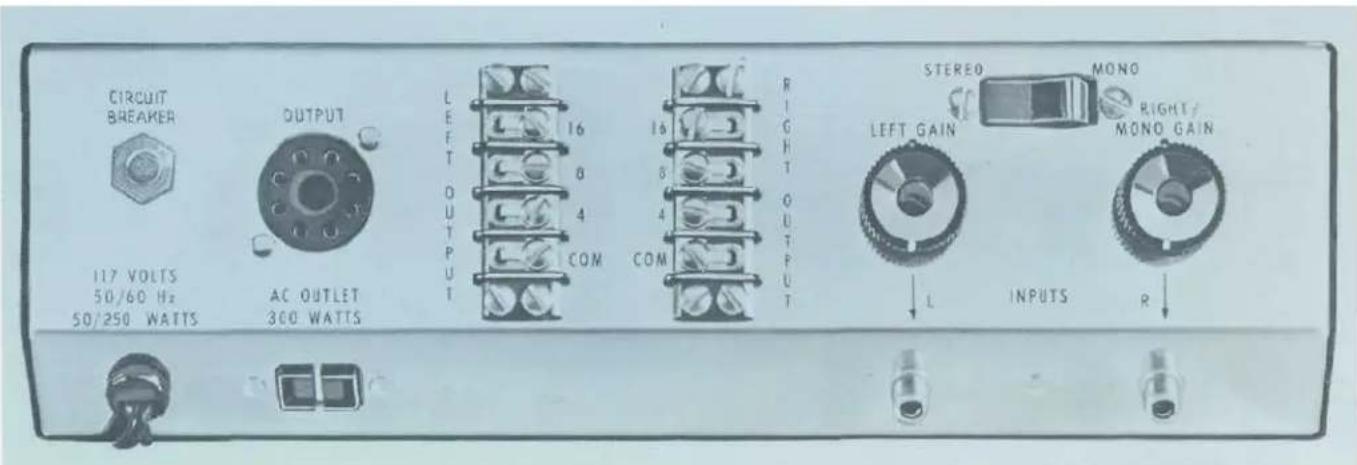
The shielded cable from the left output of the McIntosh preamplifier is plugged into the left jack. The shielded cable from the right output of the McIntosh preamplifier is plugged into the right jack. The INPUT switch must be in the STEREO position and the OUTPUT properly connected to the stereo loudspeakers or distortion and loss of power may result.
INPUT—MONO
The shielded cable from the program source is plugged into the right jack. The INPUT switch must be in the MONO position and the OUTPUT properly connected for mono loudspeaker operation or distortion and loss of power may result.
INPUT—STEREO OR TWIN AMPLIFIERS
For stereo or twin channel operation it is not necessary to use the same impedance loudspeaker on each output. Simply connect each channel for the impedance desired.
SPEAKERS
Speakers are connected at the barrier strips marked OUTPUT on the sloped panel of the amplifier. Use lamp cord, bell wire, or wire with similar type of insulation to connect the speakers to the amplifier. For the normally short distances of under 50 feet between the amplifier and speaker, #18 wire or larger can be used. For distances over 50 feet between the amplifier and speaker use larger wire.
The loudspeaker impedance is usually identified on the loudspeaker itself. Connect one of the leads from the left loudspeaker to the screw marked COM on the LEFT OUTPUT barrier strip. Connect the other lead from the left loudspeaker to the screw marked with the number corresponding to the speaker impedance on the LEFT OUTPUT barrier strip. Connect one of the leads from the right loudspeaker to the screw marked COM on the RIGHT OUTPUT barrier strip. Connect the other lead from the right loudspeaker to the screw marked with the number corresponding to the speaker impedance on the RIGHT OUTPUT barrier strip.
The only adverse effect on the operation of a McIntosh amplifier when it is improperly matched is a reduction in the amount of distortion-free power available to the loudspeaker. Close impedance matching is desirable for maximum distortion-free power.
SPEAKER CONNECTIONS
| Use this table to determine proper speaker connection: | |
| Connect the | |
| If the speaker impedance is between: | speaker leads between COM and: |
| 3.2 to 6.5 ohms | 4 ohms |
| 6.5 to 13 ohms | 8 ohms |
| 13 to 26 ohms | 16 ohms |
STEREO OUTPUT—CONNECTING TO BARRIERSTRIPS
Use this table for stereo connections using the barrier strips: Connect ore
| Connect one left speaker to screw | Connect one right speaker lead to the screw marked | |
| If the speaker impedance is: | LEFT-COM and other to: | RIGHT-COMand the other to: |
| 4 ohms | LEFT-4 | RIGHT-4 |
| 8 ohms | LEFT-8 | RIGHT-8 |
| 16 ohms | LEFT-16 | RIGHT-16 |
For 25 volt line operation connect one of the left leads to the screw marked COM on the LEFT OUTPUT barrier strip. The other left lead is connected to the screw marked 16 on the LEFT OUTPUT barrier
strip. Connect the right leads in the same manner on the RIGHT OUTPUT barrier strip.
When connected as above the MC 250 operates as a 50 watt per channel stereo amplifier.
MONOPHONIC OUTPUT— CONNECTING TO BARRIER STRIPS
When the MC 250 is to operate as a monophonic amplifier, the two channels are combined to produce a single 100 watt output. This chart lists the proper connections and interconnections for monophonic operation.
| Connect one speaker to the | ||
| If the speaker impedance is: | screw marked LEFT-COM and the other to: | Connect a wire between: |
| 2 ohms | LEFT-4 | LEFT-4 and RIGHT-4 |
| 4 ohms | LEFT-8 | LEFT-8 and RIGHT-8 |
| 8 ohms | LEFT-16 | LEFT-16 and RIGHT-16 |
| For constant voltage | ||
| 25 volts | LEFT-16 | LEFT-16 and RIGHT-16 |
When connected as above the MC 250 operates as a 100 watt per channel monophonic amplifier.
STEREO OUTPUT — CONNECTING TO THE OCTAL SOCKET
The octal socket marked OUTPUT can be used
for all of the output impedances and voltages. Connections are made in the following fashion:
| Solder the left channel leads between: | Solder the right channel leads between: | |
| If the impedance is:4 ohms8 ohms16 ohms | Pin 1 and 2Pin 1 and 3Pin 1 and 4 | Pin 5 and 6Pin 5 and 7Pin 5 and 8 |
| For constant voltage | ||
| 25 volts | Pin 1 and 4 | Pin 5 and 8 |
When connected as outlined the MC 250 operates as a 50 watt per channel stereo amplifier.
MONOPHONIC OUTPUT - CONNECTING TO THE OCTAL SOCKET
| If the impedance is: | CONNECT | Solder the leads to: |
| 2 ohms | 2 and 6 | 1 and 2 |
| 4 ohms | 3 and 7 | 1 and 3 |
| 8 ohms | 4 and 8 | 1 and 4 |
| 25 volts | 4 and 8 | 1 and 4 |
When connected as outlined the MC 250 operates as a 100 watt monophonic amplifier.
AC POWER:
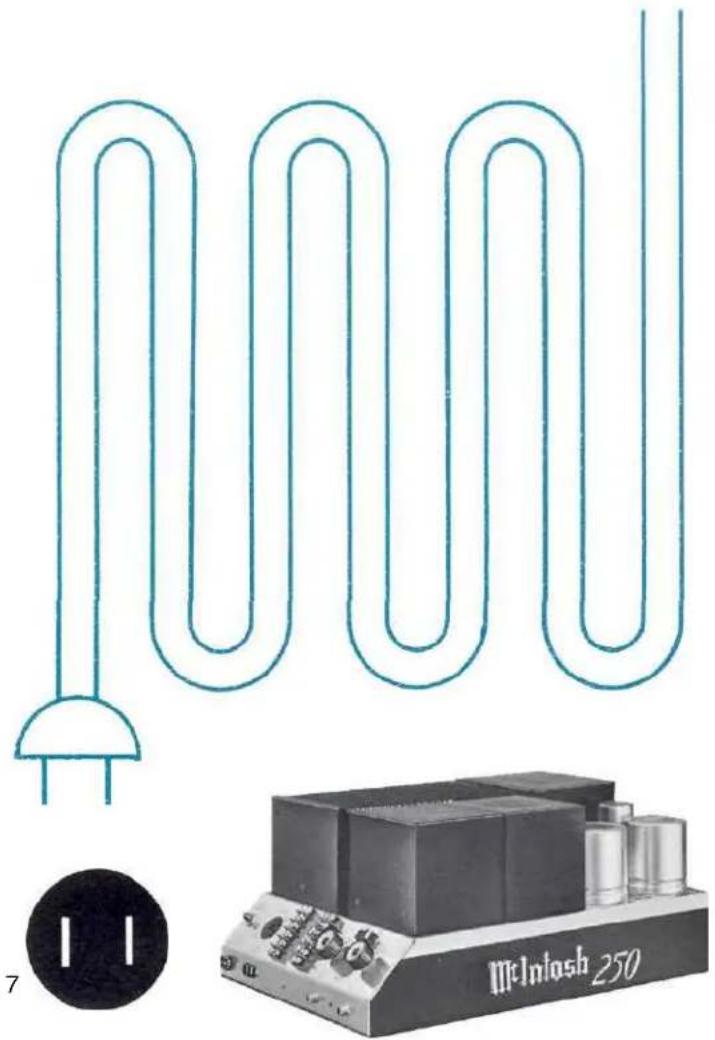
The MC 250 operates on 117 to 130 volt, 50/60 Hz. The amplifier will be turned on and off if its power cord is plugged in one of the auxiliary AC outlets on the program source.

flowchart
graph TD
    A["Power AMP"] --> B["Switched"]
    B --> C["Inductors"]
    C --> D["Main Output 1"]
    C --> E["Main Output 2"]
    D --> F["Line 1"]
    E --> G["Line 2"]
    F --> H["AC Line"]
    G --> I["AC Line"]
    J["Power Line"] --> K["AC Line"]
    L["Switch"] --> M["AC Line"]
    N["Inductors"] --> O["Main Output 1"]
    P["Main Output 2"] --> Q["Main Output 3"]
    R["Line 1"] --> S["Line 2"]
    T["Line 2"] --> U["Line 3"]
    V["Line 3"] --> W["Line 4"]
control Panel Information
INPUT
The input of the MC 250 has a two position switch to permit the amplifier to be used in any one of three ways:
(1) As a monophonic 100 watt amplifier.
(2) As twin 50 watt amplifiers used with an electronic crossover network, or as two completely separate amplifiers.
(3) As a stereo amplifier used with a McIntosh preamplifier or other high output stereo program sources.
In either position of the input switch the input sensitivity is 0.5 volts for full rated output. The input impedance is 200,000 ohms.
In the STEREO position each input is controlled by a GAIN control. The GAIN control allows signal sources of 0.5 volt up to 30 volts to be connected without overloading the input to the amplifier.
The MONO position of the input switch parallels the inputs of both amplifiers. When the outputs are properly connected the MC 250 becomes a 100 watt monophonic amplifier. The RIGHT/MONO GAIN control permits connecting signal sources up to 30 volts without overloading the amplifier's input. To operate the MC 250 as a 100 watt monophonic amplifier the INPUT switch must be in the MONO position and the
OUTPUT must be properly connected for monophonic operation.
OUTPUT
The two barrier terminal strips marked LEFT OUTPUT and RIGHT OUTPUT provide stereo connections for the normal speaker impedances of 4 ohms, 8 ohms, and 16 ohms, or monophonic operation connections for 2 ohms, 4 ohms, and 8 ohms. The terminal strips may also be connected for a constant voltage output of 25 volts in either stereo or mono.
OUTPUT (Octal Socket)
The octal socket marked OUTPUT has stereo connections for 4 ohms, 8 ohms, 16 ohms, and 25 volts. For monophonic operation the octal socket provides connections for 2 ohms, 4 ohms, 8 ohms, and 25 volts.
AC OUTLET
The auxiliary AC outlet can be used to supply power to other equipment in the system. The outlet will provide a maximum of 300 watts of power. The AC outlet is not fused.
LINE VOLTAGE
The MC 250 operates on any line voltages between 117 volts and 130 volts, 50/60 Hz
Listening to Your stereo System
SETTING THE GAIN CONTROLS:
To set the GAIN controls for a stereo system use a monophonic signal from the program source. A monophonic signal supplies the same voltage to both channels. Turn the volume control on the source equipment to the 12 o'clock position (half rotation).
Turn up the LEFT GAIN control until the loudness
in the room is about as loud as you like to listen. Then turn the GAIN control on the RIGHT INPUT until it is equally as loud as the left channel. The system is now balanced for loudness and provides the greatest range of operation and loudness change when using the volume control on the source equipment. NOW SIT BACK AND ENJOY YOUR MCINTOSH.
text_image
CIRCUIT BREAKER OUTPUT 117 VOLTS 50/60 Hz 50/250 WATTS AC OUTLET 300 WATTS LEFT OUTPUT COM 16 8 4 16 8 4 COM RIGHT OUTPUT STEREO LEFT GAIN INPUTS R MONO RIGHT/ MONO GAINPerformance Limits and Ratings
PERFORMANCE GUARANTEE
Performance Limits are the maximum deviation from perfection permitted for a McIntosh instrument. We promise you that the MC 250 you buy must be capable of performance at or exceeding these limits or you get your money back. McIntosh is the only manufacturer that makes this guarantee.
PERFORMANCE
McIntosh audio power ratings are in accordance with the Federal Trade Commission Regulation of November 4, 1974 concerning power output claims for amplifiers used in home entertainment products.
POWER OUTPUT
STEREO
50 watts minimum sine wave continuous average power output, per channel, both channels operating into 4 ohms, 8 ohms, or 16 ohms load impedance, which is:
14.1 volts RMS across 4 ohms
20.0 volts RMS across 8 ohms
28.3 volts RMS across 16 ohms
MONO
100 watts minimum sine wave continuous average power output, operating into 2 ohms, 4 ohms, or 8 ohms load impedance, which is:
14.1 volts RMS across 2 ohms
20.0 volts RMS across 4 ohms
28.3 volts RMS across 8 ohms
OUTPUT LOAD IMPEDANCE
STEREO
4 ohms, 8 ohms, or 16 ohms; separate terminals are provided for each output
MONO
2 ohms, 4 ohms, or 8 ohms; separate terminals are provided for each output
RATED POWER BAND
20 Hz to 20,000 Hz
TOTAL HARMONIC DISTORTION
STEREO
0.25% maximum harmonic distortion at any power level from 250 milliwatts to 50 watts per channel from 20 Hz to 20,000 Hz, both channels operating
MONO
0.25% maximum harmonic distortion at any power level from 250 milliwatts to 100 watts from 20 Hz to 20,000 Hz
INTERMODULATION DISTORTION
STEREO
0.25% if instantaneous peak power output is 100 watts or less per channel with both channels operating for any combination of frequencies 20 Hz to 20,000 Hz
MONO
0.25% if instantaneous peak power output is 200 watts or less for any combination of frequencies 20 Hz to 20,000 Hz
FREQUENCY RESPONSE (at 1 watt output)
20 Hz to 20,000 Hz +0 -0.25 dB
10 Hz to 100,000 Hz +0 -3.0 dB
NOISE AND HUM
90 dB below rated output
RATINGS
OUTPUT VOLTAGES
Stereo and Mono
25 volts for distribution lines
DAMPING FACTOR
15 at 3 ohms output
38 at 8 ohms output
17 at 16 ohms output
INPUT IMPEDANCE
200,00 Ohms
INPUT SENSITIVITY
0.5 volt. Level control provided for higher input voltage
GENERAL INFORMATION
POWER REQUIREMENTS
120 volts, 50/60 Hz, 50 watts at zero signal output, 250 watts at rated output
SEMICONDUCTOR COMPLEMENT
24 silicon transistors
18 silicon rectifiers and diodes
MECHANICAL INFORMATION
SIZE
7 1/16 inches high (17.94 cm), 10^5/8 inches wide (26.99 cm), 15^5/8 inches deep (39.69 cm)
CHASSIS
Chrome and black
WEIGHT
36 pounds (16.33 kg) net, 40 pounds (18.14 kg) in shipping carton
Technical Description
A two stage preamplifier with three transistors in each channel increases the input voltage 16 dB.
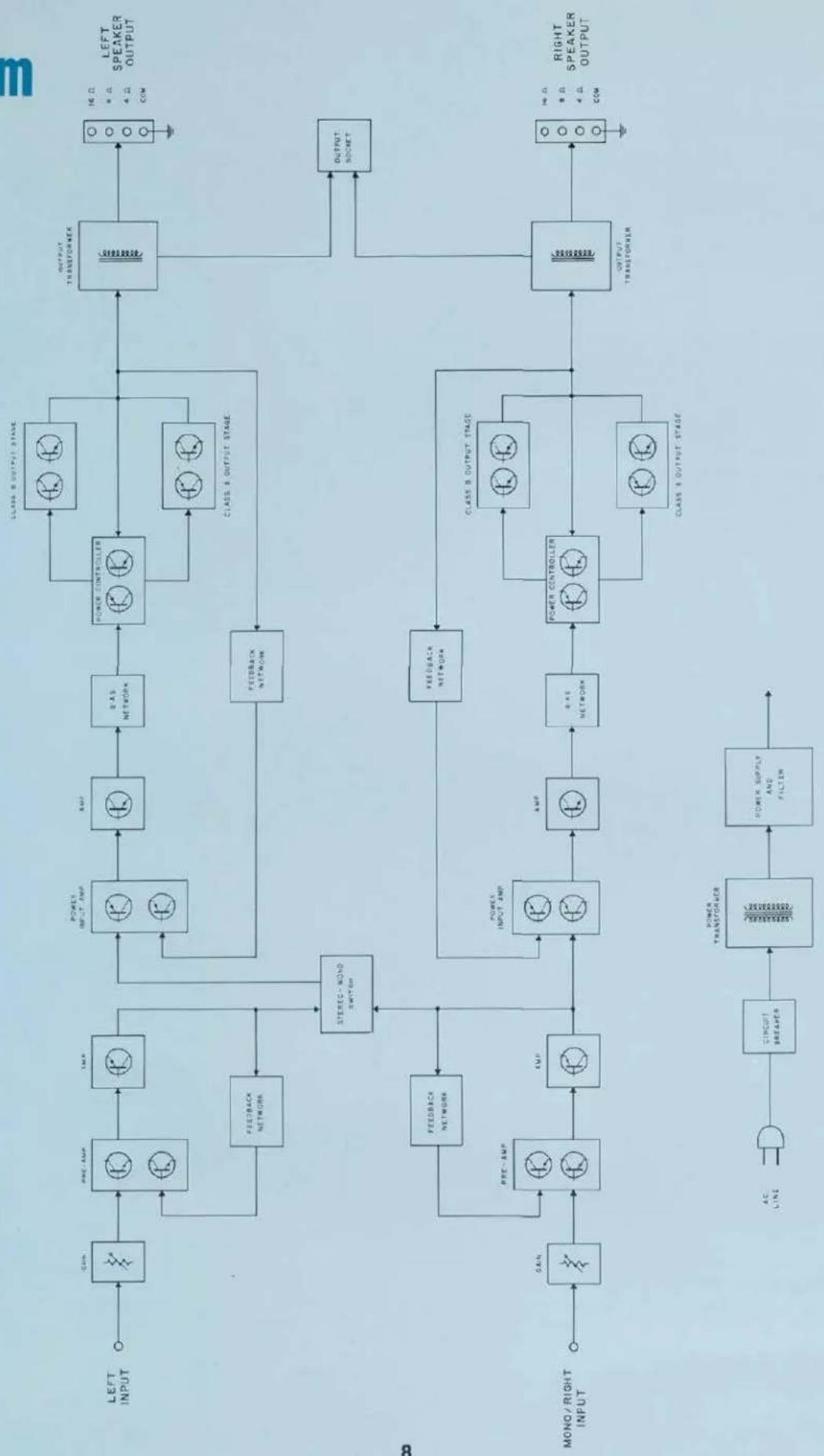
There are 13 transistors in each power amplifier section. The two stage preamplifier is fed to a pair of matched transistors arranged as an emitter coupled amplifier with two inputs and one output. The signal from the preamplifier section connects to one of these inputs. Both AC and DC negative feedback are applied to the other input. This large quantity of feedback is used to reduce noise and distortion. The signal is then fed to a voltage amplifier. The voltage amplifier is followed by two driver transistors.
The output section is arranged as a series push-pull amplifier. The power transistors used in the output section of your MC 250 are selected for their high power dissipation capability, wide frequency response, and large "safe operating area." In addition, each power transistor is given four separate tests before it is put in your MC 250. This additional testing makes sure your MC 250 will deliver its rated power from 20 Hz to 20,000 Hz with low distortion and complete reliability.
The power transistors are mounted on oversized anodized heat sinks. The heat sinks assure that under normal operation the transistors will operate at a low temperature. If temperatures increase due to a shorted speaker, or restricted ventilation, an automatic temperature sensing device turns off the MC 250. The device operates automatically at a preset temperature. The MC 250 will turn on again when the temperature has returned to normal limits. This additional feature gives your MC 250 complete reliability under the most extreme operating conditions.
The output stages are matched to the load by the McIntosh autoformer. The McIntosh autoformer is carefully wound using McIntosh trifilar winding and interleaving techniques. Trifilar winding and interleaving gives the autoformers exceptional bandwidth. The autoformers properly match the power transistors to 4, 8, and 16 ohm loads at all audio frequencies.
The use of the McIntosh designed trifilar autoformer makes the McIntosh solid state amplifiers the only amplifiers that deliver FULL POWER AT ALL SPEAKER IMPEDANCES. You have not been power penalized for your choice of loudspeakers when using the McIntosh MC 250.
Another of the advantages of the autoformers is the 25 volt output for a constant voltage distribution system. With the MC 250 several sets of speakers can be operated independently throughout your home.
To further insure reliability a special power output SENTRY MONITORING CIRCUIT prevents failure of the power output transistors due to excessive mismatch of the output. When your MC 250 operates normally the SENTRY MONITORING CIRCUIT has no effect on signals passing through the power amplifier. If the power dissipation should rise above normal operation, the SENTRY MONITORING CIRCUIT restricts the drive to the output transistors. The SENTRY MONITORING CIRCUIT acts instantaneously for any input signal or load combination. This arrangement assures complete circuit reliability. Only McIntosh gives you this degree of protection.
There are three separate power supply sections, One positive and one negative high current supply is used for the output stages. The other positive supply is used for the driving amplifier stages. All supplies are full wave and use silicon rectifiers. Adequate filtering is used to assure an absolute minimum of hum. The power output stage filter capacitors have very high capacity, which allows full power output below 20 Hz. The power transformer is generous in size and runs cool, even under heavy use.
text_image
7 McIntash 250Block
Diagram
flowchart
graph TD
    A["LEFT INPUT"] --> B["CON"]
    B --> C["PREF-AMP"]
    C --> D["TMP"]
    D --> E["STEREG-WOND SWITCH"]
    E --> F["POWER INPUT AMP"]
    F --> G["AMP"]
    G --> H["SAS NETWORK"]
    H --> I["PUMER CONTROLLER"]
    I --> J["OUTPUT TRANSFORMER"]
    J --> K["OUTPUT SOCKET"]
    K --> L["RIGHT SPEAKER OUTPUT"]

    M["MONO/RIGHT INPUT"] --> N["GAN"]
    N --> O["PREF-AMP"]
    O --> P["TMP"]
    P --> Q["POWER INPUT AMP"]
    Q --> R["AMP"]
    R --> S["SAS NETWORK"]
    S --> T["PUMER CONTROLLER"]
    T --> U["OUTPUT TRANSFORMER"]
    U --> V["RIGHT SPEAKER OUTPUT"]

    W["AC LINE"] --> X["CIRCUIT BREAKER"]
    X --> Y["POWER TRANSFORMER"]
    Y --> Z["POWER SUPPLY AND FILTER"]

    style A fill:#f9f,stroke:#333
    style M fill:#f9f,stroke:#333
    style W fill:#f9f,stroke:#333
McIntosh
MCINTOSH LABORATORY INC.
2 CHAMBERS ST., BINGHAMTON, N. Y. 13903
607-723-3512
Design subject to change without notice.
Printed in U.S.A.
038-918