9-3 (2004) - Car SAAB - Free user manual and instructions
Find the device manual for free 9-3 (2004) SAAB in PDF.


User questions about 9-3 (2004) SAAB
0 question about this device. Answer the ones you know or ask your own.
Ask a new question about this device
Download the instructions for your Car in PDF format for free! Find your manual 9-3 (2004) - SAAB and take your electronic device back in hand. On this page are published all the documents necessary for the use of your device. 9-3 (2004) by SAAB.
USER MANUAL 9-3 (2004) SAAB
93 US MY09.book Page 1 Tuesday, April 15, 2008 10:30 AM
1
Owner's Manual
Saab 9-3 Model Year 2009
Safety 11
Security 47
9-3 Convertible 61
Instruments and controls 81
Interior equipment 117
Starting and driving 149
Car care 201
Customer Assistance and Information 277
Technical data 283
Index 297


93 US MY09.book Page 2 Tuesday, April 15, 2008 10:30 AM
2
Introduction
This manual provides practical guidance on driving and caring for your Saab.
Although this manual describes the most important differences between model variants, it does not specify the equipment or features Included on Individual models.
Importation and distribution of Saab automobiles, spare parts and accessories are handled exclusively by Saab Cars USA, Inc. in the United States and by General Motors of Canada Limited in Canada.
We recommend that you read through the manual before taking the car out for the first time and keep it in the car for future reference.
To find a specific item, use the overviews given at the start of the manual. A list of content is given at the beginning of each section of the manual, and there is also a comprehensive index at the back of the book.
Supplied with the car is a Warranty and Service Record booklet which contains important warranty information and specifies the regular maintenance to be carried out. Also included is a Quick Reference Guide, an Infotainment System manual, tire warranties and (U.S. customers), a dealer directory with Roadside Assistance Program information.
WARNING
Failure to heed warnings may cause personal injury.
NOTICE
NOTICE texts warns of potential damage to the car if the recommendations are not followed.
Since the policy at Saab is one of continual improvement, we retain the right to incorporate modifications and to alter specifications during production without prior notice.
* Asterisk means: equipment not fitted in all cars (can depend on model variant, engine variant, market specification, options or accessories).
If you have any questions concerning your car, its equipment, the warranty conditions, etc., your Saab dealer will be pleased to help, or you may call the Saab Customer Assistance Center in the U.S. at 1-800-955-9007 or email them at saab-crm@saabusa.com. In Canada, please contact the Saab Customer Assistance Center at 1-800-263-1999.
Enjoy the road ahead! Saab Automobile AB
Saab Automobile AB does not accept liability for any damage caused by the fitting of spare parts, exchange parts or accessories that are not approved by Saab Automobile AB.


text_image
93_US_MY09.book Page 3 Tuesday, April 15, 2008 10:30 AM Instrument panel Fuel gauge_89 Odometer and trip meter_90 Speedometer_87 Tachometer_87 Temperature gauge_88 Turbo gauge_88 Warning and indicator lights_82 Saab Information Display (SID)_89 Cruise Control_169 Direction indicators_101 High/Low beam switch_99 Changing bulbs_218 Front fog lights_100 Headlight levelling_98 High/low beam_99 Parking lights_98 Rear fog light_101 Washers and wipers_103 Washer fluid_217 Replacing wiper blades_216 Automatic climate control_107 Hazard warning lights_102 Seat heating, ACC_114 Car care and maintenance_273 Power Outlet_134 Cigarette lighter_13493 US MY09.book Page 4 Tuesday, April 15, 2008 10:30 AM
4
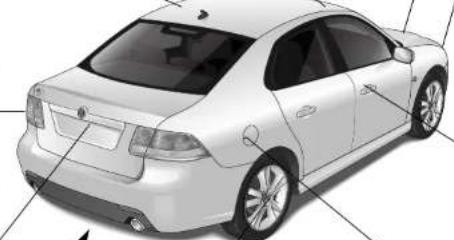
Exterior
| Moonroof | 128 |
| Touching up paintwork | 270 |
| Washing | 267 |
| Waxing and polishing | 270 |
| Anti-corrosion treatment | 271 |
| Service program | 278 |
| Body | 270 |
| Brake lights | 225 |
| Light switches | 97 |
| Taillights | 225 |
| Changing bulbs | 218 |
| Folding down the rear seat_136 | |
| Lighting_225 | |
| Load-through hatch_138 | |
| Spare wheel_140 | |
| Tools_140 | |
| Trunk_136 |
| Towing | 193 |
| Towing hook eyes | 193 |
| Towing a trailer | 188 |
natural_image
Side view of a silver sedan car with visible headlights and grille (no text or symbols)| Maximum loads | 284 |
| Mounting holes for roof carriers | 192 |
| Roof load | 192 |
| Braking | 170 |
| Changing wheels | 258 |
| Spare wheel | 256 |
| Tire pressure | 291 |
| Tiros | 240 |
| Wheels | 288 |
| Winter driving | 185 |
| Hood | 202 |
| Washing the engine bay | 267 |
| High/Low beam switch | 97 |
| Direction indicators | 101 |
| Front lights | 220 |
| Headlight levelling (xenon) | 98 |
| Headlight switches | 97 |
| Headlight washers | 217 |
| Changing bulbs | 218 |
| Central locking | 48 |
| Child safety locks | 52 |
| Lock buttons | 48 |
| Trunk lock | 51 |
| Economical motoring | 183 |
| Fuel filler door | 156 |
| Fuel gauge | 89 |
| Fuel grade | 287 |
| Refueling | 156 |


text_image
93_US_MY09.book Page 5 Tuesday, April 15, 2008 10:30 AM Interior Interior rear view mirror _ 123 Vanity mirror _ 132 Door mirrors _ 122 Interior light switches _ 131 Moonroof _ 128 Interior lighting: changing bulbs _ 231 Airbag _ 32 Steering wheel adjustment _ 118 Fuses _ 233 Electric windows _ 119 Safety belts _ 12 Airbag _ 32 Child safety locks _ 52 Child seats _ 24 Safety belt care _ 266 Glove box _ 134 Storage compartments _ 134 Automatic transmission _ 162 Changing gears _ 161 Manual transmission _ 161 Safety belts _ 12 Child seats _ 24 Folding down the rear seat _ 136 Rear seat _ 136 Seat adjustment _ 18 Seat heating _ 114 Upholstery care _ 266 Ignition switch _ 150 Starting the engine _ 152 Power Outlet _ 134 Break-In Period _ 160 Driving in hot/cold climates _ 185 Parking brake _ 177 Parking _ 17793 US MY09.book Page 6 Tuesday, April 15, 2008 10:30 AM
6
Engine bay, 4-cyl
Color code 292
Engine number 292
Gearbox number 292
Warning labels 8
Vehicle identification number 292
Ignition system 287 Alternator 215 Drive belt 215 Exhaust emission control 154 Simple troubleshooting (ACC) 273 Spark plugs 287 Turbo gauge 88
Engine oil: checking level _ 208
Automatic transmission 162 Manual transmission 161
Oil grade and viscosity 286
Engine: description 203
Engine: technical data 286
Important considerations for driving 153
Coolant: checking/topping-up 210 Driving in hot climates 187 Radiator 286 Temperature gauge 88

text_image
Technical diagram of a car engine bay with labeled components and directional arrows indicating assembly or movement.ABS brakes 170 Brake pads 212 Brake system 287 Brake fluid 212
Fuse table 238
Changing a fuse 233
Fuses 233
Relays 238
Wash/wipe stalk switch 103
Washer fluid 217
Washer Jets 217
Topping-up fluid 217
Power steering 213 Fluid: checking/topping up 213
Battery 214
Jump starting 197
Battery charge 214


Engine bay, 2.8 V6
| Oil grade and viscosity | 286 |
| Engine: description | 20 |
| Engine oil: topping up | 20 |
| Engine: technical data | 286 |
| Important considerations for driving | 153 |
| Cooling system, coolant capacity | 286 |
| Coolant: checking/topping-up | 210 |
| Driving in hot climates | 187 |
| Temperature gauge | 88 |
| Power steering____ | 213 |
| Fluid: checking/topping up__ | 213 |
| Vehicle identification number | 292 |
| Color code | 292 |
| Engine number | 292 |
| Warning labels | 8 |
| Gearbox number | 292 |
| Ignition system | 287 |
| Exhaust emission control | 154 |
| Drive belt | 215 |
| Simple troubleshooting (ACC) | 273 |
| Alternator | 215 |
| Turbo gauge | 88 |
| Spark plugs | 287 |

natural_image
Line drawing of a car engine bay with internal components and no visible text or symbols| ABS brakes | 171 |
| Brake pads | 287 |
| Brake system | 170 |
| Brake fluid | 212 |
| Fuse table | 235 |
| Changing a fuse | 235 |
| Fuses | 233 |
| Relays | 238 |
| Automatic transmission | 162 |
| Manual transmission | 161 |
| Engine oil: checking level | 208 |
| Wash/wipe stalk switch____ | 103 | |
| Topping-up fluid____ | 217 | |
| Washer jets____ | 217 | |
| Washer fluid____ | 217 |


7


| Automatic transmission | 162 |
| Manual transmission | 161 |
| Battery | 214 |
| Jump starting | 197 |
| Battery charge | 214 |
text_image
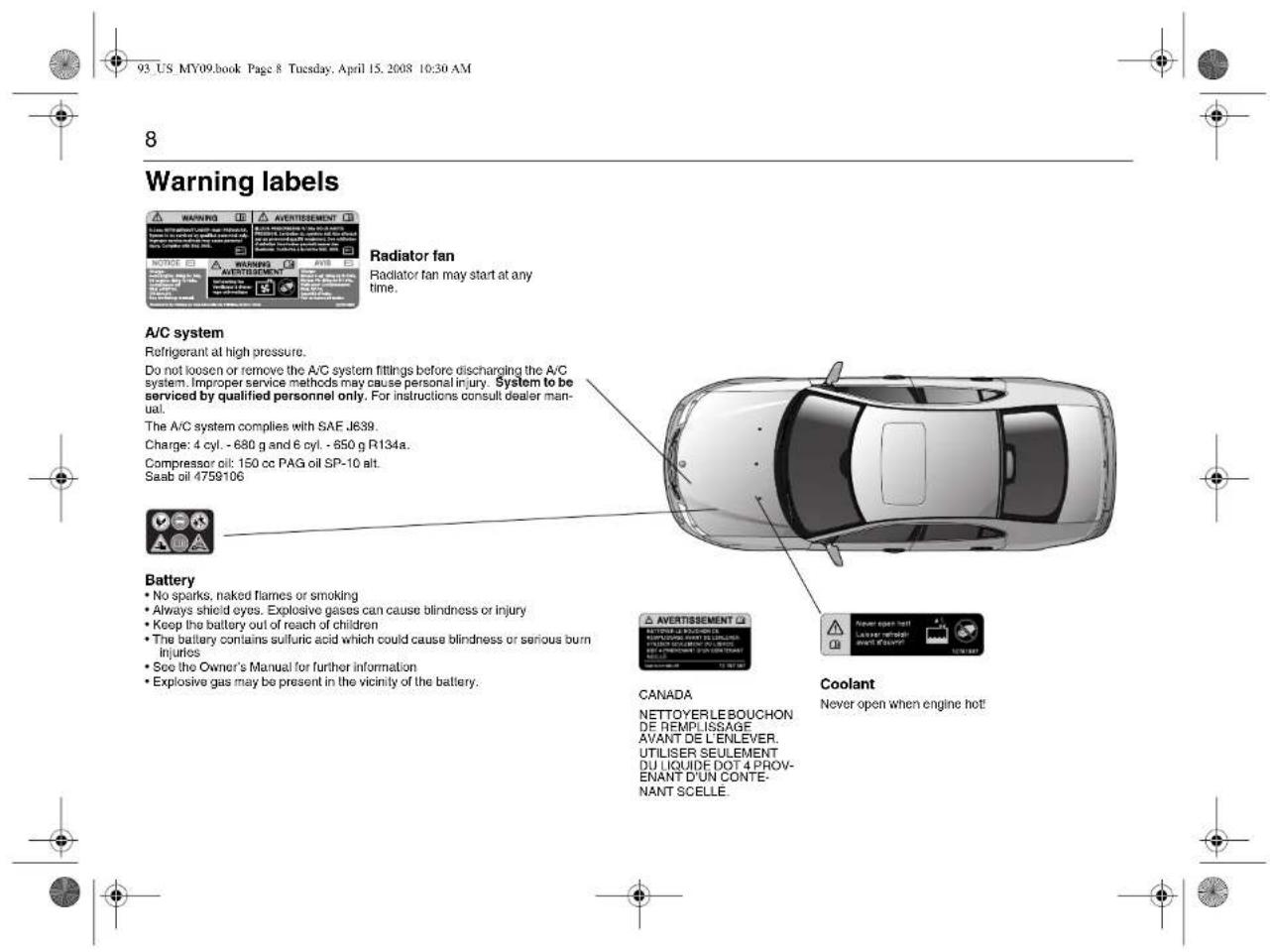
93_US_MY09.book Page 8 Tuesday, April 15, 2008 10:30 AM 8 Warning labels Radiator fan Radiator fan may start at any time. A/C system Refrigerant at high pressure. Do not loosen or remove the A/C system fittings before discharging the A/C system. Improper service methods may cause personal injury. System to be serviced by qualified personnel only. For instructions consult dealer manual. The A/C system complies with SAF J639. Charge: 4 cyl. - 680 g and 6 cyl. - 650 g R134a. Compressor oil: 150 cc PAG oil SP-10 alt. Saab oil 4759106 Battery • No sparks, naked flames or smoking • Always shield eyes. Explosive gases can cause blindness or injury • Keep the battery out of reach of children • The battery contains sulfuric acid which could cause blindness or serious burn injuries • See the Owner's Manual for further information • Explosive gas may be present in the vicinity of the battery. CANADA NETTOYERLEBOUCHON DE REMPLISSAGE AVANT DE L'ENLEVER. UTILISER SEULEMENT DU LIQUIDE DOT 4 PROV-ENANT D'UN CONTE-NANT SCELLE. Coolant Never open when engine hot!
text_image
93_US_MY09.book_Page_9_Tuesday_April 15_2008_10:30_AM 9 AVERTISSEMENT ▲WARNING EVEN WITH ADVANCED AIR BAGS • Children can be killed or seriously injured by the air bag. • The back seat is the safest place for children. • Never put a rear-facing child seat in the front. • Always use road belts and child restraints. • Two people's owners [ ] for more information about air bags. MÈME AVEC DES SACS COMPLABLES INTELLIGENTS • Use vehicle protected this car to prevent driver(s) to use portable cars. • Use bridge and road to play on cars via vehicles. • Use passenger driver or forward to displace the protection pace which toward them in vehicles. • Ensure their best conditions do vehicle of the environment or reverse about vehicles. • Not be loaded on promotional ( ) your plan if information a proper car has available. Contact a Saab dealer if a xenon headlight requires replacement. This label is only found on cars with xenon headlights. EVEN WITH ADVANCED AIR BAGS • Children can be killed or seriously injured by the air bag. • The back seat is the safest place for children. • Never put a rear-facing child seat in the front. • Always use seat belts and child restraints. Changing wheels • Use only on specified vehicle. • Safe working load 2425 lbs. (1 100 kg). • Use on level firm ground only. • Do not get under a vehicle that is supported only by a jack, use vehicle support stands. All-wheel drive cars * Do not test this vehicle on a 2-wheel dynamometer.
93 US MY09.book Page 10 Tuesday, April 15, 2008 10:30 AM


10
Example of symbols that can be found in your car

No sparks, flames or
smoking

Refer to the Owner's

Shield eyes

Keep out of reach of children

Battery acid contains sulfuric acid

Risk of explosive gas

Buckle up

Airbag

Never place a rear-facing child seat in this seat

Electric

Deactivating of rear window switches

Central locking, lock

Central locking, unlock


Headlights

Direction indicators

Parking lights

Hazard warning lights

Front fog lights

Rear fog light

Windshield wipers

Windshield washers

[Non-Text]

Rear window heating


Coolant temperature

No charge to battery

Foot brake

Coolant level

Engine oil pressure

ABS brakes

TCS/ESP®

Radiator tan

Fuel

Automatic Tire Pressure Monitoring System


93 US MY09.book Page 11 Tuesday, April 15, 2008 10:30 AM
11 Safety
Safety
natural_image
Illustration of a pregnant woman in a car, seated with medical equipment and a speedometer (no text or symbols)Safety belts 12
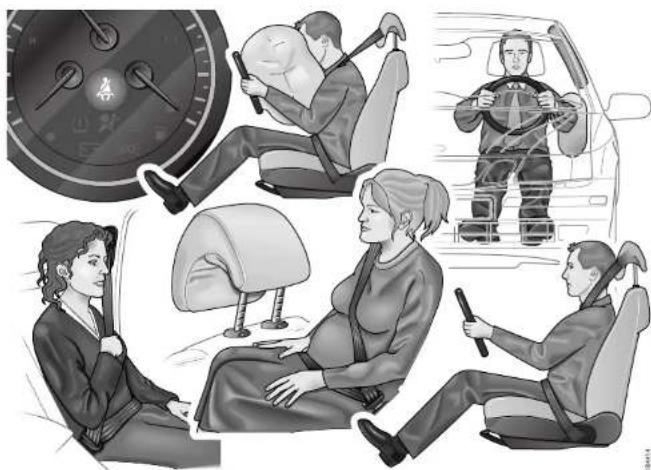
Seats 18
Head restraints 23
Child safety 24
Airbag 32
* Asterisk means: equipment not fitted in all cars (can depend on model variant, engine variant, market specification, options or accessories).


93 US MY09.book Page 12 Tuesday, April 15, 2008 10:30 AM
12 Safety
Safety belts

WARNING
- Buckle up and adjust your safety belt before driving off so that you can pay full attention to the traffic.
- Safety belts must be worn at all times by all occupants.
• Child safety, see page 24. - Check that the locking tongue is properly locked in the belt lock.
- In the event of a crash, a rear-seat passenger not wearing a safety belt will be thrown forward against the front-seat backrests. The stresses imposed on the front seat passengers and belts are multiplied and can result in needless injury or even death for all car occupants.
Three-point inertia-reel safety belts are provided for all seats.
The results of studies show that it is equally important to wear safety belts in the rear seat as in the front seats.
Safety belt reminder
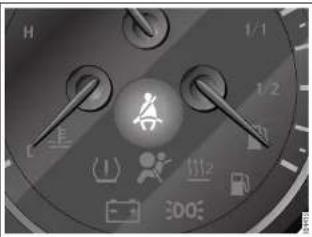
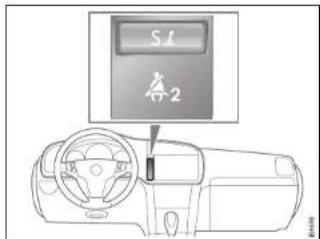
When the ignition is switched on, the safety belt reminder will come on if the driver or/and the front seat passenger has not buckled up.
The reminder for the driver is in the main instrument and for the front seat passenger on the instrument panel.
The reminder for the driver has an additional audible signal which sounds for 6 seconds, or until the driver fastens his belt.
The following applies to the both front seats: If the belt is not fastened before the car starts to move there will be an additional reminder when the speed exceeds 15 mph. The text Use your seat belt, is lit on the Saab Information Display (SID) and the symbol will flash.
If the belt is not fastened then an audible signal will come on after 30 seconds.
The text in the SID can be turned off by the CLR-button on the steering wheel.
natural_image
Close-up of a circular device dial with control buttons and icons (no readable text or symbols)Driver seat safety belt reminder
Passenger seat safety belt reminder
text_image
S1 S2


93 US MY09.book Page 13 Tuesday, April 15, 2008 10:30 AM
natural_image
Line drawing of a person sitting in a car, holding a steering wheel (no text or symbols)Correct seating position
Correct position for safety belt
WARNING
Proper positioning of the safety belt is extremely important.
- An out of position safety belt can result in the wearer sliding underneath the belt in a crash (submarining) and injury can result from the lap portion cutting into the abdomen.
- Never fasten the safety belt with the shoulder belt behind the body or pull the belt off the shoulder and under the arm.
- Two people must never share one safety belt. In the event of a crash those sharing a belt risk being crushed together and injured.
Consider this:
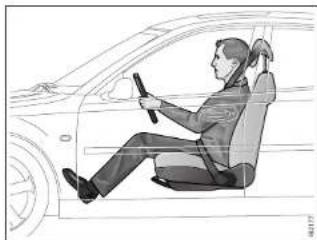
- Position the lap strap snugly and low across the hips so that it just touches the thighs. The shoulder strap must be as far in on the shoulder as possible.
- Check to ensure that the belt is not twisted or rubbing against any sharp edges.
- There should not be any slack in the belt. Pull the belt tight – particularly important when thick outer clothing is worn. It is advisable to remove thick items of clothing.
- Refrain from tilting the backrest more than necessary, as the safety belt provides better protection when the seat is in the more upright position.
- Only one person per safety belt!
- For most of the time a safety belt is worn, the retractor will allow the wearer freedom of movement. The retractor locks up automatically if the belt is jerked or withdrawn sharply, the car tilts, the brakes are applied hard or a crash occurs.
• Children up to 6 years of age must always be seated in a child seat. Saab recommends the use of a child seat for children up to the age of 10. - Children who have grown out of a child seat should be restrained by the car's standard three-point belts. Make sure that the shoulder belt is not in contact with the neck or throat. If it is, a booster seat/cushlon may be necessary.
13Safety







93 US MY09.book Page 14 Tuesday, April 15, 2008 10:30 AM
14 Safety

natural_image
Illustration showing a person using a seatbelt to lift a vehicle, with no visible text or symbols.To fasten the belt

natural_image
Illustration of a woman sitting at a desk with a large upward arrow and a downward arrow, no text or symbols present.Press the red button to release the belt

natural_image
Illustration of a woman seated in a car, with an inset showing airflow or pressure changes around a vehicle (no text or symbols)The belt guide on door pillar, SportSedan and SportCombi
Front safety belts
Fasten the belt by pulling the belt and inserting the tongue in the buckle. Check that it is securely fastened.
Position the lap part low across the hips.
Grasp the shoulder belt close to the buckle and pull the belt towards the shoulder to tighten the lap belt part.
The belt must be as far in on the shoulder as possible.
Press the red button on the belt buckle to release the belt.
The front safety belts have their lower anchorage points on the seats. The safety belts follow the seats when the legroom is adjusted.
Refer to page 266 for how to check the function of the safety belts, cleaning, etc.
Belt height adjustment, SportSedan and SportCombi
The belt guide on the door pillar for the front safety belts can be set at different heights. The front belt guide in the Convertible is not adjustable due to the belt being incorporated into the seat.


93 US MY09.book Page 15 Tuesday, April 15, 2008 10:30 AM
15Safety
Adjust the belt so that it is as high up as possible without rubbing against the neck. To avoid chafing in the case of a short person, the guide can be lowered until the belt comes about an inch (a few centimeters) from the throat but still provides safe restraint.
Raise the belt guide by pushing it upward to the desired position. To lower it, depress the catch release button while lowering the guide. Check that the guide locks in its new position.

natural_image
Illustration of a pregnant woman seated in a chair with arrows indicating motion or pressure direction (no text or symbols)
Safety belt use during pregnancy
Pregnant women must always wear a safety belt to protect both themselves and the unborn child.
The lap belt should be placed low, across the hips and over the upper thighs.




93 US MY09.book Page 16 Tuesday, April 15, 2008 10:30 AM
16 Safety
Safety belt pretensioners
WARNING
If the car is involved in a crash, the safety belts, belt pretensioners and other components must be inspected and replaced as necessary. We recommend that you contact a Saab dealer.
Never make any alterations or repairs to the safety belt yourself. We recommend that you contact a Saab dealer for any necessary repairs.
SportSedan and SportCombl: The front safety belts are equipped with pretensioners and force limiters. The pretensioners are activated in the event of a violent frontal or side-on crash. The safety belt pretensioners are only activated if the safety belt in question is in use but not activated should the car roll over.
The safety belt pretensioners serve to reduce the forward movement of the body by tensioning the belt. The force limiters reduce belt loads on the body by "slackening" the safety belt slightly to absorb the body's kinetic energy as gradually as possible.
Convertible: The front and rear safety belts are equipped with pretensioners and force limiters. The pretensioners are activated in the event of a violent frontal or side-on crash. The front safety belt pretensioners are only activated if the safety belt in question is in use.
The safety belt pretensioners serve to reduce the movement of the body by tensioning the belt, including in a roll over crash. The force limiters reduce belt loads on the body by "slackening" the safety belt slightly to absorb the body's kinetic energy as gradually as possible.


93 US MY09.book Page 17 Tuesday, April 15, 2008 10:30 AM
Safety belts, rear seat, SportSedan and SportCombi
Safety belts rear seat, Convertible, see page 75.

WARNING
• Make sure that the belt does not become trapped when the backrest is folded down or raised (see page 136).
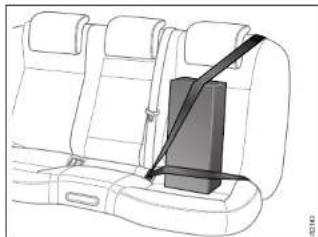
- If cargo has to be placed on a seat, it must be properly secured with the safety belt. This reduces the risk of the cargo being thrown about during hard braking or a crash, which could cause personal injury.
- Check that the belt is not twisted or lying against sharp edges.
• Make sure you use the correct safety belt buckle. The buckles for the center and left-hand rear seats are close together.
The three rear seats all have three-point safety belts with inertia reels.
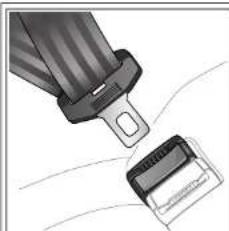
Fasten the belts by pulling the belt across you and inserting the tongue into the buckle. Check that it is securely fastened.
Grasp the shoulder belt close to the buckle and pull the belt towards the shoulder to tighten the lap belt part.
natural_image
Illustration of a belt buckle being inserted into a clip (no text or symbols)
natural_image
Line drawing of a car seatbelt with three black straps (no text or symbols)Rear safety belts, SportSedan and SportCombi
The belt must be as far in on the shoulder as possible.
Press the red button on the buckle to release the belt.
See page 266 for the checking of belt function, cleaning, etc.
Securing an item on the rear seat
natural_image
Line drawing of a car seatbelt with a black strap, no text or symbols present
The three rear seats all have three-point safety belts with inertia reels.
93 US MY09.book Page 18 Tuesday, April 15, 2008 10:30 AM
18 Safety
Seats
WARNING
Never adjust the driver's seat except when the car is stationary.
Manually adjusted front seats \*
The following front seat adjustments can be made to achieve a comfortable driving position:
• Height *
• Legroom
- Backrest rake angle
• Lumbar support firmness *
• Head restraint height
We recommend that adjustments to the driver's seat be performed in the following order:
1 Height
2 Legroom
3 Backrest rake angle
4 Head restraint height
Lastly, adjust the position of the steering wheel (see page 118).
Electrically adjustable front seats \*
See page 20.
Electric heating, front seats \*
See pages 114.
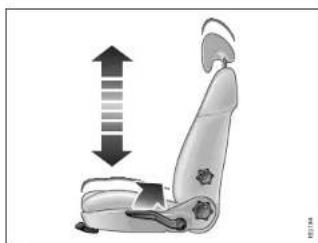
natural_image
Side view of a car seat with a vertical arrow indicating upward motion (no text or symbols)Height adjustment \*
Lift the lever to raise the seat. The lever is spring-loaded to return to its neutral position. Repeated lifting of the lever will increase the height in steps.
Press down the lever to lower the seat. Repeated downward presses of the lever will lower the seat in steps.


93 US MY09.book Page 19 Tuesday, April 15, 2008 10:30 AM

natural_image
Diagram of a car seat with foot highlighted and directional arrows indicating movement (no text or symbols)Adjusting the legroom

natural_image
Illustration of a seated human figure in profile, viewed from the side (no text or symbols present)Adjusting the backrest

natural_image
Side profile illustration of a car seat with adjustable seat and neck (no text or symbols)Adjusting the lumbar support
Legroom adjustment
Lift the lever under the front of the seat and slide the seat to the desired position.
WARNING
Check that the seat is locked in the new position. If not, it may move while the car is being driven and it could result in injury to the occupant in the event of a crash.
Backrest rake angle
WARNING
The backrest should be upright during driving, so that the safety belt, airbag and backrest can provide optimum protection in the event of emergency braking or a crash, in particular a rear-end crash.
To find the most comfortable position, turn the knob to provide stepless adjustment of the backrest.
Lumbar support \*
Adjust the firmness of the lumbar support by turning the knob.


text_image
3.1 | A L Lil sli C p is t
[Non-Text]
3 L
[Non-Text]
[Non-Text]
[Non-Text]
二
|
||
||
||
L
|
|
m = 311
1
L
A
[Non-Text]
[Non-Text]
Le
Lif
sli
□
|
C
93 US MY09.book Page 20 Tuesday, April 15, 2008 10:30 AM
20 Safety
Electrically adjustable front seats \*
WARNING
- The seats are actuated by powerful motors. Bear this in mind when adjusting the seat, and make sure that nothing gets caught and damaged. Ensure that nothing can be trapped behind the seat when adjusting it.
- Bear in mind that children can be injured if they play with the electrically-operated seats.
- Always remove the remote control when you leave the car to prevent personal injury caused by the electrically adjustable seats, for example, due to children playing. Electrically adjustable front seats with memory function, see page 21.
With the doors closed the seats can only be adjusted when the ignition is ON.
• To facilitate getting into the car, both seats can be adjusted when either of the front doors is open.
• The seats can be adjusted up to 2 minutes after both doors have been closed (applicable only to cars without window and sunroof pinch protection).
• To facilitate getting into the car, both seats can be adjusted when either of the front doors is open.
• The seats can be adjusted up to 2 minutes after both doors have been closed (applicable only to cars without window and sunroof pinch protection).

text_image
Diagram illustrating car seat positioning and movement, with arrows indicating direction of movement and a magnified inset showing a vehicle interior.Adjusting the height and angle Adjusting the legroom
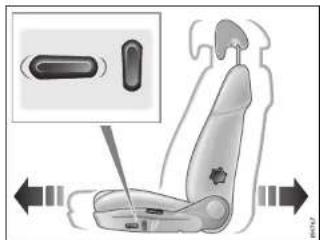
text_image
Diagram showing car seat assembly with labeled components and directional arrows indicating movement or positioningLegroom adjustment
Adjust the legroom with the front lever.
Height adjustment and seat angle
Adjust the height of the seat with the rear section of the front lever.
Adjust the angle of the seat with the front section of the front lever.
[Non-Text]
[Non-Text]
[Non-Text]
[Non-Text]
[Non-Text]
[Non-Text]
[Non-Text]
[Non-Text]
[Non-Text]
[Non-Text]
[Non-Text]
[Non-Text]
[Non-Text]
[Non-Text]
[Non-Text]
However, there are two exceptions:
However, there are two exceptions:
[Non-Text]
[Non-Text]
[Non-Text]
[Non-Text]
[Non-Text]
[Non-Text]
[Non-Text]
[Non-Text]
[Non-Text]
[Non-Text]
[Non-Text]
[Non-Text]
[Non-Text]
[Non-Text]
[Non-Text]
[Non-Text]
[Non-Text]
(一) AD = BD = 1
(二)
一
广力云智慧零售收银系统
[Non-Text]
[Non-Text]
[Non-Text]
[Non-Text]
[Non-Text]
[Non-Text]
[Non-Text]
[Non-Text]
[Non-Text]
[Non-Text]
[Non-Text]
[Non-Text]
[Non-Text]
[Non-Text]
[Non-Text]
[Non-Text]
[Non-Text]
[Non-Text]
[Non-Text]
[Non-Text]
[Non-Text]
[Non-Text]
[Non-Text]
[Non-Text]
[Non-Text]
[Non-Text]
[Non-Text]
[Non-Text]
[Non-Text]
[Non-Text]
[Non-Text]
[Non-Text]
[Non-Text]
[Non-Text]
[Non-Text]
[Non-Text]
[Non-Text]
[Non-Text]
[Non-Text]
[Non-Text]
[Non-Text]
[Non-Text]
[Non-Text]
[Non-Text]
[Non-Text]
[Non-Text]
[Non-Text]
[Non-Text]
[Non-Text]
[Non-Text]
[Non-Text]
[Non-Text]
[Non-Text]
[Non-Text]
[Non-Text]
[Non-Text]
[Non-Text]
[Non-Text]
[Non-Text]
[Non-Text]
[Non-Text]
[Non-Text]
[Non-Text]
[Non-Text]
[Non-Text]
[Non-Text]
[Non-Text]
[Non-Text]
[Non-Text]
[Non-Text]
[Non-Text]
[Non-Text]
[Non-Text]
[Non-Text]
[Non-Text]
[Non-Text]
[Non-Text]
[Non-Text]
[Non-Text]
[Non-Text]
[Non-Text]
[Non-Text]
[Non-Text]
[Non-Text]
[Non-Text]
[Non-Text]
[Non-Text]
[Non-Text]
[Non-Text]
[Non-Text]
[Non-Text]
[Non-Text]
[Non-Text]
[Non-Text]
[Non-Text]
[Non-Text]
[Non-Text]
[Non-Text]
[Non-Text]
[Non-Text]
[Non-Text]
[Non-Text]
[Non-Text]
[Non-Text]
[Non-Text]
[Non-Text]
[Non-Text]
[Non-Text]
[Non-Text]
[Non-Text]
[Non-Text]
[Non-Text]
[Non-Text]
[Non-Text]
[Non-Text]
[Non-Text]
[Non-Text]
[Non-Text]
[Non-Text]
[Non-Text]
[Non-Text]
[Non-Text]
[Non-Text]
[Non-Text]
[Non-Text]
[Non-Text]
[Non-Text]
[Non-Text]
[Non-Text]
[Non-Text]
[Non-Text]
[Non-Text]
[Non-Text]
[Non-Text]
[Non-Text]
[Non-Text]
[Non-Text]
[Non-Text]
[Non-Text]
[Non-Text]
[Non-Text]
[Non-Text]
[Non-Text]
[Non-Text]
[Non-Text]
[Non-Text]
[Non-Text]
[Non-Text]
[Non-Text]
[Non-Text]
[Non-Text]
[Non-Text]
[Non-Text]
[Non-Text]
[Non-Text]
[Non-Text]
[Non-Text]
[Non-Text]
[Non-Text]
[Non-Text]
[Non-Text]
[Non-Text]
[Non-Text]
[Non-Text]
[Non-Text]
[Non-Text]
[Non-Text]
[Non-Text]
[Non-Text]
[Non-Text]
[Non-Text]
[Non-Text]
[Non-Text]
[Non-Text]
[Non-Text]
[Non-Text]
[Non-Text]
[Non-Text]
[Non-Text]
[Non-Text]
[Non-Text]
[Non-Text]
[Non-Text]
[Non-Text]
[Non-Text]
[Non-Text]
[Non-Text]
[Non-Text]
[Non-Text]
[Non-Text]
[Non-Text]
[Non-Text]
[Non-Text]
[Non-Text]
[Non-Text]
[Non-Text]
[Non-Text]
[Non-Text]
[Non-Text]
[Non-Text]
[Non-Text]
[Non-Text]
[Non-Text]
[Non-Text]
[Non-Text]
[Non-Text]
[Non-Text]
[Non-Text]
[Non-Text]
[Non-Text]
[Non-Text]
[Non-Text]
[Non-Text]
[Non-Text]
93 US MY09.book Page 21 Tuesday, April 15, 2008 10:30 AM

text_image
Diagram illustrating car seat positioning and movement, with labeled arrows and directional arrows indicating movement direction.Adjusting the rake angle Adjusting the lumbar support
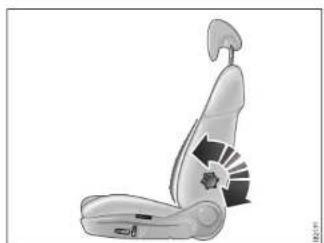
natural_image
Illustration of a car seat with a highlighted interior area (no text or symbols)support Driver's seat in SportSedan and Sport- Combi
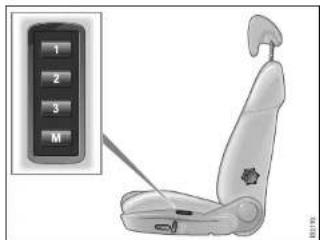
text_image
1 2 3 MMemory function buttons
Backrest rake angle
WARNING
Lumbar support \*
Adjust the firmness of the lumbar support by turning the knob.
Memory function \*
WARNING
The legroom of the electrically operated driver's seat can always be adjusted, whether or not a front door is open and irrespective of the position of the ignition switch.


The backrest should be upright during driving, so that the safety belt, airbag and backrest can provide optimum protection in the event of emergency braking or a crash, in particular a rear-end crash.
WARNING
The backrest should be upright during driving, so that the safety belt, airbag and backrest can provide optimum protection in the event of emergency braking or a crash, in particular a rear-end crash.
WARNING
The backrest should be upright during driving, so that the safety belt, airbag and backrest can provide optimum protection in the event of emergency braking or a crash, in particular a rear-end crash.

Adjust the rake angle of the backrest with the rear lever.
Adjust the rake angle of the backrest with the rear lever.
Adjust the rake angle of the backrest with the rear lever.
Adjust the rake angle of the backrest with the rear lever.
Adjust the rake angle of the backrest with the rear lever.
Adjust the rake angle of the backrest with the rear lever.
Adjust the rake angle of the backrest with the rear lever.
Adjust the rake angle of the backrest with the rear lever.
Adjust the rake angle of the backrest with the rear lever.
Adjust the rake angle of the backrest with the rear lever.
Adjust the rake angle of the backrest with the rear lever.
Adjust the rake angle of the backrest with the rear lever.
Adjust the rake angle of the backrest with the rear lever.
Adjust the rake angle of the backrest with the rear lever.
Adjust the rake angle of the backrest with the rear lever.
Adjust the rake angle of the backrest with the rear lever.
Adjust the rake angle of the backrest with the rear lever.
Adjust the rake angle of the backrest with the rear lever.
Adjust the rake angle of the backrest with the rear lever.
Adjust the rake angle of the backrest with the rear lever.
Adjust the rake angle of the backrest with the rear lever.
Adjust the rake angle of the backrest with the rear lever.
Adjust the rake angle of the backrest with the rear lever.
Adjust the rake angle of the backrest with the rear lever.
Adjust the rake angle of the backrest with the rear lever.
Adjust the rake angle of the backrest with the rear lever.
Adjust the rake angle of the backrest with the rear lever.
Adjust the rake angle of the backrest with the rear lever.
Adjust the rake angle of the backrest with the rear lever.
Adjust the rake angle of the backrest with the rear lever.
Adjust the rake angle of the backrest with the rear lever.
Adjust the rake angle of the backrest with the rear lever.
Adjust the rake angle of the backrest with the rear lever.
Adjust the rake angle of the backrest with the rear lever.
Adjust the rake angle of the backrest with the rear lever.
Adjust the rake angle of the backrest with the rear lever.
Adjust the rake angle of the backrest with the rear lever.
Adjust the rake angle of the backrest with the rear lever.
Adjust the rake angle of the backrest with the rear lever.
Adjust the rake angle of the backrest with the rear lever.
Adjust the rake angle of the backrest with the rear lever.


93 US MY09.book Page 22 Tuesday, April 15, 2008 10:30 AM
22 Safety
When the ignition is ON, all seat settings can be adjusted. When the door is open and before the remote control has been inserted into the ignition switch, all seat settings can be adjusted for up to 20 minutes.
The memory also includes the door mirror settings.
Storing and restoring settings
1 Adjust the seat and the door mirrors. The lumbar support is not included by the memory function.
2 Press and hold the M-button and then press one of the preselect buttons (1, 2 or 3). A chime will sound to confirm that the settings have been saved.
To recall programmed settings, press and hold the desired memory button until the seat and door mirrors adopt their programmed positions. The memory function also includes the door mirror settings.
To facilitate reversing, the passenger-side door mirror can be angled down, refer to page 122.




93 US MY09.book Page 23 Tuesday, April 15, 2008 10:30 AM
Head restraints
SportSedan and SportCombl
Head restraint, Convertible, see page 74.

WARNING
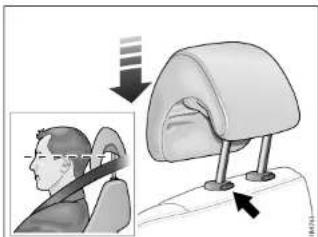
- Adjust the head restraint so that the head is optimally supported and the center of the head restraint is at ear height, thus reducing the likelihood of neck injury in a crash.
- Raise the head restraints in the seats that are occupied.
The front seats are equipped with Saab Active Head Restraints (SAHRs). These are designed to reduce the risk of neck injury if the car is hit from behind.
The SAHR is a mechanical system, actuated by body weight. The mechanism is built into the top of the backrest, where it is connected to the head restraint.
In the event of a rear-end crash, the body is forced back against the backrest. This, in turn, causes the mechanism to press the head restraint forward and upward, thus limiting the backward movement of the head.
Therefore, the SAHR does not normally need to be replaced or repaired after a rear-end crash.
natural_image
Illustration of a car seat with a head-mounted device and a side view showing the front view of the seat (no text or symbols present)The front and rear head restraints can be raised and lowered to a number of positions
- Raising: grasp the head restraint on both sides and pull it straight up.
- Lowering the front head restraints: press in the left catch and press the head restraint down.

natural_image
Diagram of a car interior showing a seatbelt mechanism with directional arrows (no text or labels)- Lowering the rear head restraints: press the head restraint forward and downward.
The rear head restraints can be fully lowered to improve rearward vision when the rear seats are unoccupied.

natural_image
Pure geometric lines and symbols without any text, numbers, or labels
natural_image
Pure geometric lines and symbols without any text, numbers, or labels24 Safety
Child safety

WARNING

• Children can be killed or seriously injured by the airbag
• The BACK SEAT is the SAFEST place for children 12 and under or shorter than 55 inches (140 cm)
• ALWAYS use SAFETY BELTS and CHILD RESTRAINTS
- NEVER put a rear-facing child seat in the front
- Sit as far back as possible from the airbag
Car safety tips

WARNING
- Never leave children unattended in a car, even for a short time.
- Children can suffer heat stroke, perhaps die, in a matter of minutes.
- Children can put the car into gear and hurt themselves or others.
- At gas stations, take the remote control out of the car while filling the tank.
- Never allow children to climb on top of or under motor vehicles.
• Always look for children before backing your car out of a garage or driveway.
• To avoid carbon monoxide poisoning, never let a car idle in an enclosed garage.
• Supervise young children around buckets of water while washing your car. Small children can drown in a short time in less than an inch of water.

WARNING
Protect children from getting trapped in the trunk of your car
- Teach children not to play in or around cars.
- Watch children when loading or unloading the car so they don't get locked in by mistake.
• Always lock the doors and trunk of your car, and keep the keys out of children's sight and reach. - Keep the rear fold-down seat closed to help prevent children from getting into the trunk from inside the car.
For Trunk Release Handle information see page 53 and 139.


93 US MY09.book Page 25 Tuesday, April 15, 2008 10:30 AM
25Safety
General information on child safety
The same attention must be given to child safety in the car as is given to adults.
Children travel most safely when properly restrained. However, the type of restraint must be appropriate for the size of the child. We recommend that you always consult your Saab dealer before fitting a child seat, child restraint or booster cushion.
The backseat is the safest place for children.
Make sure you are acquainted with the legal requirements for seating children in the car.
When fitting child restraints in cars you must always read the instructions supplied by the child restraint manufacturer.
Make sure that it is possible to fit a child restraint in accordance with the manufacturer's child restraint instructions.
Saab recommends the use of a rear-facing child seat for as long as this is possible - for all children under 18 kg (40 lbs.) as a minimum. Use a child seat approved for the weight of the child.
Saab recommends the use of a booster seat for children up to the length of 140 cm (55 in.) or the weight of 36 kg (80 lbs.).
LATCH
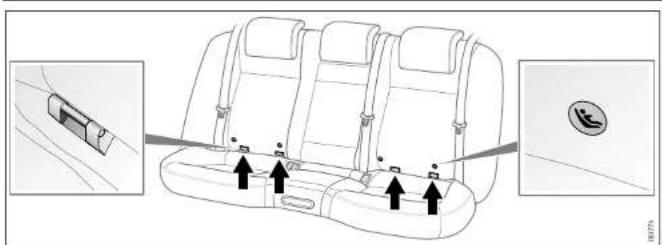
LATCH (Lower Anchorages & Top tethers for CHildren) is a US/Canadian safety standard for a uniform method of fitting child restraints without using the standard safety belts. Only certain child restraints are equipped to utilize the LATCH system.
The LATCH system is installed in the car to facilitate proper fitting of child restraints designed for and equipped with LATCH attachments.
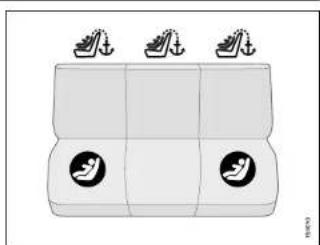
The LATCH system consists of top tether and lower anchorages. In this vehicle, LATCH is installed at the two outboard seating positions in the rear seat, and there is a top tether on the rear center position (not Convertible).
The top tethers are located on top of the parcel shelf (SportSedan), see page 28, on the back of the rear seat (SportCombi), see page 29 and behind the head restraints (Convertible) see page 30.
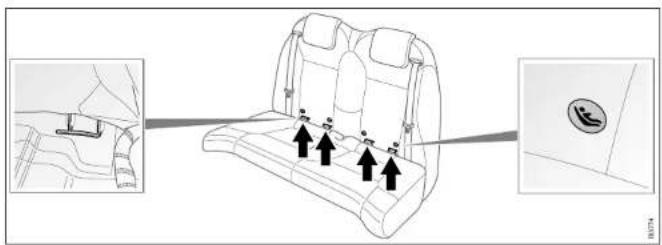
The lower anchorages are located where the seat cushion and seat back come together. There is a label above the anchorages, see picture on next page. Label consists of a symbol of a child restrained in a seat inside a circle.
When fitting child restraints in cars you must always read the instructions supplied by the child restraint manufacturer.
If you have any questions regarding LATCH please contact your Saab dealer.
WARNING
If a LATCH-type child restraint is not attached to its anchor points, the restraint will not be able to protect the child correctly. In a crash, the child could be seriously injured or killed. Make sure that a LATCH-type child restraint is properly installed using the anchor points, or use the vehicle's safety belts to secure the restraint, following the instructions that came with that restraint, and also the instructions in this manual.
! WARNING
Child top tether anchorages are designed to withstand only those loads imposed by correctly fitted child restraints.
Under no circumstances are they to be used for adult safety belts.


93 US MY09.book Page 26 Tuesday, April 15, 2008 10:30 AM
26 Safety
text_image
Diagram showing car seat assembly with labeled connectors and a warning symbolLower anchorages in the rear seat, SportSedan and SportCombi
natural_image
Diagram of a car backseat with three shoe icons on top (no text or labels)Lower anchor and top tether anchor locations, SportSedan and SportCombi. Convertible has two top tether anchors, one behind each head restraint
Lower anchorages in the rear seat, Convertible
text_image
Diagram illustrating car seat assembly with directional arrows and a circular symbol, showing structural details and component placement.(Lower Anchor): Seating positions with two lower anchors.
(Top Tether Anchor): Seating positions with top tether anchors.
The right side and left side rear passenger seating positions have exposed metal anchors located in the crease between the seatback and the seat cushion.



93 US MY09.book Page 27 Tuesday, April 15, 2008 10:30 AM
27Safety
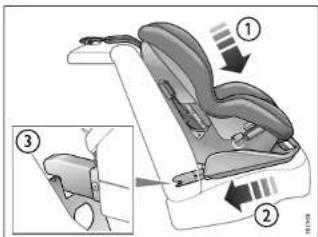
LATCH child seat installation
Before starting the installation, please read through this instruction, and the child seat installation instruction.
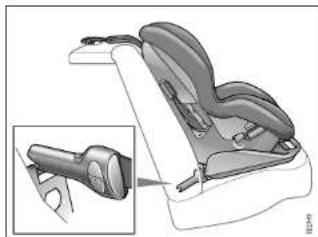
1 Place the child restraint on one of the designated outboard rear seat cushions.
2 Slide the attachment on the child restraint in between the seat cushion and backrest.
3 Press the child restraint down on the seat, 1 in illustration.
4 Press the child restraint rearward, lining up the inner restraint attachment arm with the label, 2 in Illustration.
5 Connect the restraint attachment arms to the anchorages 3 in illustration.
6 Follow the child restraint instructions to confirm that both restraint attachment arms are properly attached to the bars.
7 Attach the top tether strap to the in-car anchorage and tighten according to the restraint instructions, see page 28 and 30.
8 Pull the child restraint to make a second check that the restraint is securely attached at both the lower anchorage bars and the top tether strap.
For the top tether, only use the strap supplied with the child restraint.
text_image
Diagram of a car seat assembly with numbered parts and directional arrows indicating motion or movement.Rigid 2-point lower anchorage with top tether
natural_image
Illustration of a car seat assembly with an inset showing the connector detail (no text or symbols)Semi-rigid 2-point lower anchorage with top tether
When fitting child restraints in cars you must always read the instructions supplied by the child restraint manufacturer.
Use the integrated harness to restraint the child, according to the child restraint manufacturers instructions.
The availability of LATCH child restraints is limited.


93 US MY09.book Page 28 Tuesday, April 15, 2008 10:30 AM
28 Safety
Child top tether anchorages for forward facing child seats
SportSedan

WARNING
Child top tether anchorages are designed to withstand only those loads imposed by correctly fitted child restraints.
Under no circumstances are they to be used for adult safety belts.
Child restraints with a tether strap must be attached according to Canadian and U.S. safety standards.
If you have any questions regarding child anchorages please contact your Saab dealer.
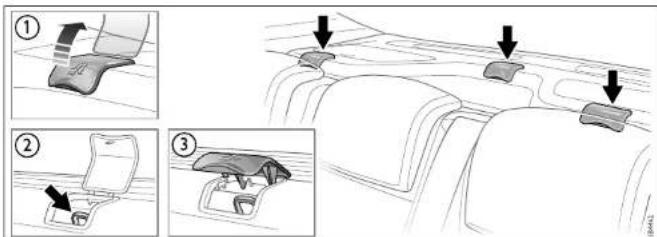
The car is provided with three top tether anchorages. Use the one that is right behind the seating position in which the child restraint is to be installed and attach the restraint as follows:
1 Open the cover that is right behind the child restraint, 1 in illustration.
2 Place the child restraint in the rear seat.
3 Secure the lower part of the child restraint by means of the lower anchor-
text_image
Diagram illustrating three steps of car seat mounting: opening, opening with a seatbelt, and closing with a seatbelt.Child top tether anchorages in parcel shelf, SportSedan
ages or the safety belts as described in the child restraint installation instruction.
4 Lower the headrest and route the tether over it.
5 Attach the tether to the anchorage, 2 in illustration.
6 Close the cover to the middle position, 3 in Illustration.
7 Tighten the tether so that the back of the child restraint is pressed hard against the backrest.
8 Pull the child restraint to make a second check that the restraint is securely attached at both the lower anchorages bars on the safety belts and the top tether strap.

text_image
restraint by means of the lower anchor- tether strap.93 US MY09.book Page 29 Tuesday, April 15, 2008 10:30 AM
Child top tether anchorages for forward facing child seats
SportCombl

WARNING
Child top tether anchorages are designed to withstand only those loads imposed by correctly fitted child restraints.
Under no circumstances are they to be used for adult safety belts.
If a cargo net is fitted, do not pull the top tether strap through the cargo net in such a way that there is slack in the strap to the child seat.
Child restraints with a tether strap must be attached according to Canadian and U.S. safety standards.
If you have any questions regarding child anchorages please contact your Saab dealer.
The top tether anchors are located on the back of the rear seat frame above the floor for each rear seating position.

text_image
Diagram showing car interior and seatbelt positioning with a close-up of the seatbelt mechanismChild top tether anchorages, SportCombi
The car is provided with three top tether anchorages. Use the one that is right behind the seating position in which the child restraint is to be installed and attach the restraint as follows:
1 If the anchor for the desired seating position is not in the upright position then fold down the rear seatback(s) to access the anchor(s).
2 Fold the backrest back upright.
3 Place the child restraint in the rear seat.
4 Secure the lower part of the child restraint by means of the lower anchorages or the safety belts as described in the child restraint installation instruction.
5 Lower the headrest and route the tether over it.
6 Attach the tether to the anchorage.
7 Tighten the tether so that the back of the child restraint is pressed hard against the backrest.
8 Pull the child restraint to make a second check that the restraint is securely attached at both the lower anchorages bars on the safety belts and the top tether strap.

29Safety




93 US MY09.book Page 30 Tuesday, April 15, 2008 10:30 AM
30 Safety
Child top tether anchorages for forward facing child seats
Convertible

WARNING
Child top tether anchorages are designed to withstand only those loads imposed by correctly fitted child restraints.
Under no circumstances are they to be used for adult safety belts.
Child restraints with a tether strap must be attached according to Canadian and U.S. safety standards.
If you have any questions regarding child anchorages please contact your Saab dealer.
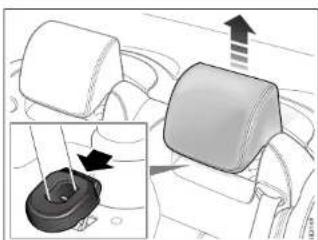
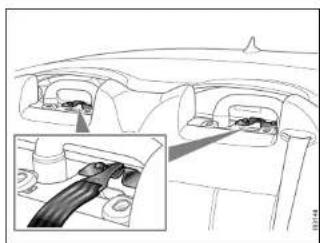
The car is provided with two top tether anchorages. Use the one that is right behind the seating position in which the child restraint is to be installed and attach the restraint as follows:
1 Remove the head restraint on the seating position where the child restraint shall be fitted.
2 Place the child restraint in the rear seat.
natural_image
Diagram showing a car seatbelt mechanism with an inset view of the wheel (no text or symbols present)How to take away the head restraint
1 Raise the head restraint 2 Push the catch forward and pull the head restraint straight upward
3 Secure the lower part of the child restraint by means of the lower anchorages or the safety belts as described in the child restraint installation instruction.
4 Attach the tether to the anchorage.
5 Tighten the tether so that the back of the child restraint is pressed hard against the backrest.
6 Pull the child restraint to make a second check that the restraint is securely attached at both the lower anchorages bars on the safety belts and the top tether strap.
natural_image
Diagram of car interior showing dashboard and seatbelt mechanism (no text or labels)Top tether anchorages in the rear seat
7 Put the head restraint back on and make sure it is securely mounted. Adjust it in its highest position.
WARNING
If the size of the child restraint makes it impossible to put the head restraint back on, place it in the trunk.


93 US MY09.book Page 31 Tuesday, April 15, 2008 10:30 AM
31Safety
Installation of child restraint using the standard safety belt
WARNING
Failure to follow all the manufacturer's instructions on the use of child restraint systems can cause your child to strike the vehicle's interior during a sudden stop or crash.
Child restraints that are approved for rear-ward facing installation in the rear seat can be positioned in any of the three rear places. Make sure that it is possible to fit it in accordance with the manufacturer's instructions.
When fitting child restraints in cars you must always read the instructions supplied by the child restraint manufacturer.
If fitting a child restraint that is intended to be secured in position by the standard safety belt, make use of the locking function of the belt.
Locking the belt lessens the risk that the seat will work loose while the car is in motion.
1 Position the child restraint in the back seat.
2 Route the belt in the restraint according to the installation instruction of the restraint.
3 Pull out the belt completely until it stops. Then let the belt slowly pull in the slack. Clicking sound indicates that the lock function is in work.
4 Pull the shoulder belt tight to secure the child restraint in position.
5 Check for correct locking function by pulling on the belt. The belt must not unreel.
The safety belt locking function will be deactivated when the safety belt is retracted.
1 Disengage the safety belt latch from the buckle.
2 Disengage the safety belt from the child restraint, according to the instructions from the child restraint manufacturer.
3 Let the safety belt retract until the clicking sound ceases.


32 Safety
Airbag

WARNING
To reduce risk of death or serious injury:
• Always wear your safety belt.
• Always adjust your seat so that you are as far back as possible but still able to operate the pedals and reach the steering wheel and controls comfortably.
• Passengers 12 and under or shorter than 59 inches (150 cm) must always travel in the rear seat as the car is fitted with a passenger airbag.
- Never fit a child seat in front of the passenger airbag.
Airbag system components
• Airbag in steering wheel
• Airbag in instrument panel in front of passenger seat
- Side airbags in front seat backrests
Convertible: The side airbags help protect the head also
- Inflatable curtains along length of headlin-
ing (from front to rear roof pillars)
(SportSedan and SportCombl only)
- Safety belt pretensioners for front seats
Convertible: and outer rear seats.
The airbag system supplements the protection provided by the safety belts to further enhance the safety of occupants taller than 59 in. (150 cm).
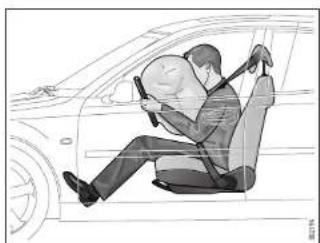
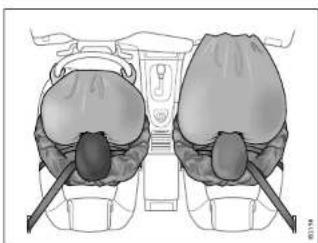
When the system is activated at the moment of impact, the airbag inflates and then deflates through holes in the back. The whole operation takes roughly 0.1 second, quicker than the blink of an eye.
The steering wheel and passenger airbags are so-called smart airbags. The driver and passenger airbag system compensates for safety belt usage and the force of the crash at the moment of impact.
There are two impact sensors on the front bumper, under the lacquered shell. Very soon after the moment of impact, these register that the car is involved in a crash. Using this information and data from the central sensor in the control module, the control module determines whether or not to inflate the airbags. The control module also controls whether other components of the airbag system are to be deployed: safety belt pretensioners, inflatable curtains (SportSedan and SportCombl) and roll over bars (Convertible).
Which airbag system components are deployed depends on a number of factors, such as the force of the crash and the angle of impact.
If the airbag system registers forces equivalent to a high-speed crash (airbags inflated to Stage II), the inflatable curtains will also be activated (SportSedan and SportCombi) see page 42.
If a fault arises in the airbag system during a journey, the airbag warning lamp on the main instrument panel will come on and the Saab Information Display (SID) will display:

Airbag malfunction. Contact service.





93 US MY09.book Page 33 Tuesday, April 15, 2008 10:30 AM
natural_image
Illustration of a person sitting on a car seat with a helmet, no text or symbols presentInflation and deflation of airbag takes approx. 0.1 s
natural_image
Diagram of two identical gear heads with a central gear, shown from front and side views (no text or labels)Both front airbags inflated Inflated airbag (driver's side).
Note
If only Stage I is activated at the moment of impact, Stage II will automatically be activated later to neutralize the gas generator in the airbag.
33Safety
When the airbag system is activated all of the doors are unlocked while the interior/exterior lighting and the hazard warning lights are illuminated at the same time.

The driver and passenger front airbags are triggered by violent front-end crashes. They are not activated by minor front-end impacts, if the car overturns or by rear- and side-impacts.
The car is equipped as standard with a passenger airbag.
The driver and passenger front airbags are triggered by violent front-end crashes. They are not activated by minor front-end impacts, if the car overturns or by rear- and side-impacts.
The car is equipped as standard with a passenger airbag.
The driver and passenger front airbags are triggered by violent front-end crashes. They are not activated by minor front-end impacts, if the car overturns or by rear- and side-impacts.
The car is equipped as standard with a passenger airbag.
The driver and passenger front airbags are triggered by violent front-end crashes. They are not activated by minor front-end impacts, if the car overturns or by rear- and side-impacts.
The car is equipped as standard with a passenger airbag.
The driver and passenger front airbags are triggered by violent front-end crashes. They are not activated by minor front-end impacts, if the car overturns or by rear- and side-impacts.
The car is equipped as standard with a passenger airbag.
The driver and passenger front airbags are triggered by violent front-end crashes. They are not activated by minor front-end impacts, if the car overturns or by rear- and side-impacts.
The car is equipped as standard with a passenger airbag.
The driver and passenger front airbags are triggered by violent front-end crashes. They are not activated by minor front-end impacts, if the car overturns or by rear- and side-impacts.
The car is equipped as standard with a passenger airbag.
The driver and passenger front airbags are triggered by violent front-end crashes. They are not activated by minor front-end impacts, if the car overturns or by rear- and side-impacts.
The car is equipped as standard with a passenger airbag.
The driver and passenger front airbags are triggered by violent front-end crashes. They are not activated by minor front-end impacts, if the car overturns or by rear- and side-impacts.
The car is equipped as standard with a passenger airbag.
The driver and passenger front airbags are triggered by violent front-end crashes. They are not activated by minor front-end impacts, if the car overturns or by rear- and side-impacts.
The car is equipped as standard with a passenger airbag.
The driver and passenger front airbags are triggered by violent front-end crashes. They are not activated by minor front-end impacts, if the car overturns or by rear- and side-impacts.
The car is equipped as standard with a passenger airbag.
The driver and passenger front airbags are triggered by violent front-end crashes. They are not activated by minor front-end impacts, if the car overturns or by rear- and side-impacts.
The car is equipped as standard with a passenger airbag.
The driver and passenger front airbags are triggered by violent front-end crashes. They are not activated by minor front-end impacts, if the car overturns or by rear- and side-impacts.
The car is equipped as standard with a passenger airbag.
The driver and passenger front airbags are triggered by violent front-end crashes. They are not activated by minor front-end impacts, if the car overturns or by rear- and side-impacts.
The car is equipped as standard with a passenger airbag.
The driver and passenger front airbags are triggered by violent front-end crashes. They are not activated by minor front-end impacts, if the car overturns or by rear- and side-impacts.
The car is equipped as standard with a passenger airbag.
The driver and passenger front airbags are triggered by violent front-end crashes. They are not activated by minor front-end impacts, if the car overturns or by rear- and side-impacts.
The car is equipped as standard with a passenger airbag.
The driver and passenger front airbags are triggered by violent front-end crashes. They are not activated by minor front-end impacts, if the car overturns or by rear- and side-impacts.
The car is equipped as standard with a passenger airbag.
The driver and passenger front airbags are triggered by violent front-end crashes. They are not activated by minor front-end impacts, if the car overturns or by rear- and side-impacts.
The car is equipped as standard with a passenger airbag.
The driver and passenger front airbags are triggered by violent front-end crashes. They are not activated by minor front-end impacts, if the car overturns or by rear- and side-impacts.
The car is equipped as standard with a passenger airbag.
The driver and passenger front airbags are triggered by violent front-end crashes. They are not activated by minor front-end impacts, if the car overturns or by rear- and side-impacts.
The car is equipped as standard with a passenger airbag.
The driver and passenger front airbags are triggered by violent front-end crashes. They are not activated by minor front-end impacts, if the car overturns or by rear- and side-impacts.
The car is equipped as standard with a passenger airbag.
The driver and passenger front airbags are triggered by violent front-end crashes. They are not activated by minor front-end impacts, if the car overturns or by rear- and side-impacts.
The car is equipped as standard with a passenger airbag.

Note
Impact sensors react differently on whether or not the front s the driver's and passenger s Situations can therefore arise one of the airbags inflates. It is for only the safety belt prete activated and for the airbags isolated.
Note
Impact sensors react differently on whether or not the front s the driver's and passenger s Situations can therefore arise one of the airbags inflates. It is for only the safety belt prete activated and for the airbags isolated.
Note
Impact sensors react differently on whether or not the front s the driver's and passenger s Situations can therefore arise one of the airbags inflates. It is for only the safety belt prete activated and for the airbags isolated.
Note
Impact sensors react differently on whether or not the front s the driver's and passenger s Situations can therefore arise one of the airbags inflates. It is for only the safety belt prete activated and for the airbags isolated.
Note
Impact sensors react differently on whether or not the front s the driver's and passenger s Situations can therefore arise one of the airbags inflates. It is for only the safety belt prete activated and for the airbags isolated.
Note
Impact sensors react differently on whether or not the front s the driver's and passenger s Situations can therefore arise one of the airbags inflates. It is for only the safety belt prete activated and for the airbags isolated.
Note
Impact sensors react differently on whether or not the front s the driver's and passenger s Situations can therefore arise one of the airbags inflates. It is for only the safety belt prete activated and for the airbags isolated.
Note
Impact sensors react differently on whether or not the front s the driver's and passenger s Situations can therefore arise one of the airbags inflates. It is for only the safety belt prete activated and for the airbags isolated.
Note
Impact sensors react differently on whether or not the front side of the driver's and passenger safety situations can therefore arise on one of the airbags inflates. It is for only the safety belt protected by activated and for the airbags isolated.
Note
Impact sensors react differently on whether or not the front s the driver's and passenger s Situations can therefore arise one of the airbags inflates. It is for only the safety belt prete activated and for the airbags isolated.
Note
Impact sensors react differently on whether or not the front s the driver's and passenger s Situations can therefore arise one of the airbags inflates. It is for only the safety belt prete activated and for the airbags isolated.
Note
Impact sensors react differently on whether or not the front s the driver's and passenger s Situations can therefore arise one of the airbags inflates. It is for only the safety belt prete activated and for the airbags isolated.
Impact sensors react differently depending on whether or not the front safety belts on the driver's and passenger sides are used. Situations can therefore arise where only one of the airbags inflates. It is also possible for only the safety belt pretensioners to be activated and for the airbags to remain unflated.
Note
Impact sensors react differently depending on whether or not the front safety belts on the driver's and passenger sides are used. Situations can therefore arise where only one of the airbags inflates. It is also possible for only the safety belt pretensioners to be activated and for the airbags to remain unin-lated.
Note
Impact sensors react differently depending on whether or not the front safety belts on the driver's and passenger sides are used. Situations can therefore arise where only one of the airbags inflates. It is also possible for only the safety belt pretensioners to be activated and for the airbags to remain unin-lated.
Note
Impact sensors react differently depending on whether or not the front safety belts on the driver's and passenger sides are used. Situations can therefore arise where only one of the airbags inflates. It is also possible for only the safety belt pretensioners to be activated and for the airbags to remain unin-lated.
Note
Impact sensors react differently depending on whether or not the front safety belts on the driver's and passenger sides are used. Situations can therefore arise where only one of the airbags inflates. It is also possible for only the safety belt pretensioners to be activated and for the airbags to remain unin-lated.
Note
Impact sensors react differently depending on whether or not the front safety belts on the driver's and passenger sides are used. Situations can therefore arise where only one of the airbags inflates. It is also possible for only the safety belt pretensioners to be activated and for the airbags to remain unin-lated.
Note
Impact sensors react differently depending on whether or not the front safety belts on the driver's and passenger sides are used. Situations can therefore arise where only one of the airbags inflates. It is also possible for only the safety belt pretensioners to be activated and for the airbags to remain unin-lated.
Note
Impact sensors react differently depending on whether or not the front safety belts on the driver's and passenger sides are used. Situations can therefore arise where only one of the airbags inflates. It is also possible for only the safety belt pretensioners to be activated and for the airbags to remain unin-lated.
Note
Impact sensors react differently depending on whether or not the front safety belts on the driver's and passenger sides are used. Situations can therefore arise where only one of the airbags inflates. It is also possible for only the safety belt pretensioners to be activated and for the airbags to remain unin-lated.
Note
Impact sensors react differently depending on whether or not the front safety belts on the driver's and passenger sides are used. Situations can therefore arise where only one of the airbags inflates. It is also possible for only the safety belt pretensioners to be activated and for the airbags to remain uninflated.
Note
Impact sensors react differently depending on whether or not the front safety belts on the driver's and passenger sides are used. Situations can therefore arise where only one of the airbags inflates. It is also possible for only the safety belt pretensioners to be activated and for the airbags to remain uninflated.
Note
Impact sensors react differently depending on whether or not the front safety belts on the driver's and passenger sides are used. Situations can therefore arise where only one of the airbags inflates. It is also possible for only the safety belt pretensioners to be activated and for the airbags to remain uninflated.
Note
Impact sensors react differently depending on whether or not the front safety belts on the driver's and passenger sides are used. Situations can therefore arise where only one of the airbags inflates. It is also possible for only the safety belt pretensioners to be activated and for the airbags to remain uninflated.
Note
Impact sensors react differently depending on whether or not the front safety belts on the driver's and passenger sides are used. Situations can therefore arise where only one of the airbags inflates. It is also possible for only the safety belt pretensioners to be activated and for the airbags to remain uninflated.
Note
Impact sensors react differently depending on whether or not the front safety belts on the driver's and passenger sides are used. Situations can therefore arise where only one of the airbags inflates. It is also possible for only the safety belt pretensioners to be activated and for the airbags to remain uninflated.
Note
Impact sensors react differently depending on whether or not the front safety belts on the driver's and passenger sides are used. Situations can therefore arise where only one of the airbags inflates. It is also possible for only the safety belt pretensioners to be activated and for the airbags to remain uninflated.
Note
Impact sensors react differently depending on whether or not the front safety belts on the driver's and passenger sides are used. Situations can therefore arise where only one of the airbags inflates. It is also possible for only the safety belt pretensioners to be activated and for the airbags to remain uninflated.
Note
Impact sensors react differently depending on whether or not the front safety belts on the driver's and passenger sides are used. Situations can therefore arise where only one of the airbags inflates. It is also possible for only the safety belt pretensioners to be activated and for the airbags to remain uninflated.
Note
Impact sensors react differently depending on whether or not the front safety belts on the driver's and passenger sides are used. Situations can therefore arise where only one of the airbags inflates. It is also possible for only the safety belt pretensioners to be activated and for the airbags to remain uninflated.
Note
Impact sensors react differently depending on whether or not the front safety belts on the driver's and passenger sides are used. Situations can therefore arise where only one of the airbags inflates. It is also possible for only the safety belt pretensioners to be activated and for the airbags to remain uninflated.
Note
Impact sensors react differently depending on whether or not the front safety belts on the driver's and passenger sides are used. Situations can therefore arise where only one of the airbags inflates. It is also possible for only the safety belt pretensioners to be activated and for the airbags to remain unin-lated.
Note
Impact sensors react differently depending on whether or not the front safety belts on the driver's and passenger sides are used. Situations can therefore arise where only one of the airbags inflates. It is also possible for only the safety belt pretensioners to be activated and for the airbags to remain unin-lated.
Note
Impact sensors react differently depending on whether or not the front safety belts on the driver's and passenger sides are used. Situations can therefore arise where only one of the airbags inflates. It is also possible for only the safety belt pretensioners to be activated and for the airbags to remain unin-lated.
Note
Impact sensors react differently depending on whether or not the front safety belts on the driver's and passenger sides are used. Situations can therefore arise where only one of the airbags inflates. It is also possible for only the safety belt pretensioners to be activated and for the airbags to remain unin-lated.
Note
Impact sensors react differently depending on whether or not the front safety belts on the driver's and passenger sides are used. Situations can therefore arise where only one of the airbags inflates. It is also possible for only the safety belt pretensioners to be activated and for the airbags to remain unin-lated.
Note
Impact sensors react differently depending on whether or not the front safety belts on the driver's and passenger sides are used. Situations can therefore arise where only one of the airbags inflates. It is also possible for only the safety belt pretensioners to be activated and for the airbags to remain unin-lated.
Note
Impact sensors react differently depending on whether or not the front safety belts on the driver's and passenger sides are used. Situations can therefore arise where only one of the airbags inflates. It is also possible for only the safety belt pretensioners to be activated and for the airbags to remain unin-lated.
Note
Impact sensors react differently depending on whether or not the front safety belts on the driver's and passenger sides are used. Situations can therefore arise where only one of the airbags inflates. It is also possible for only the safety belt pretensioners to be activated and for the airbags to remain unin-lated.
Note
Impact sensors react differently depending on whether or not the front safety belts on the driver's and passenger sides are used. Situations can therefore arise where only one of the airbags inflates. It is also possible for only the safety belt pretensioners to be activated and for the airbags to remain unin-lated.
Note
Impact sensors react differently depending on whether or not the front safety belts on the driver's and passenger sides are used. Situations can therefore arise where only one of the airbags inflates. It is also possible for only the safety belt pretensioners to be activated and for the airbags to remain uninflated.
Note
Impact sensors react differently depending on whether or not the front safety belts on the driver's and passenger sides are used. Situations can therefore arise where only one of the airbags inflates. It is also possible for only the safety belt pretensioners to be activated and for the airbags to remain unin-lated.
Note
Impact sensors react differently depending on whether or not the front safety belts on the driver's and passenger sides are used. Situations can therefore arise where only one of the airbags inflates. It is also possible for only the safety belt pretensioners to be activated and for the airbags to remain unin-lated.
Note
Impact sensors react differently depending on whether or not the front safety belts on the driver's and passenger sides are used. Situations can therefore arise where only one of the airbags inflates. It is also possible for only the safety belt pretensioners to be activated and for the airbags to remain unin-lated.
Note
Impact sensors react differently depending on whether or not the front safety belts on the driver's and passenger sides are used. Situations can therefore arise where only one of the airbags inflates. It is also possible for only the safety belt pretensioners to be activated and for the airbags to remain unin-lated.
Note
Impact sensors react differently depending on whether or not the front safety belts on the driver's and passenger sides are used. Situations can therefore arise where only one of the airbags inflates. It is also possible for only the safety belt pretensioners to be activated and for the airbags to remain unin-lated.
Note
Impact sensors react differently depending on whether or not the front safety belts on the driver's and passenger sides are used. Situations can therefore arise where only one of the airbags inflates. It is also possible for only the safety belt pretensioners to be activated and for the airbags to remain unin-lated.
Note
Impact sensors react differently depending on whether or not the front safety belts on the driver's and passenger sides are used. Situations can therefore arise where only one of the airbags inflates. It is also possible for only the safety belt pretensioners to be activated and for the airbags to remain unin-lated.
Note
Impact sensors react differently depending on whether or not the front safety belts on the driver's and passenger sides are used. Situations can therefore arise where only one of the airbags inflates. It is also possible for only the safety belt pretensioners to be activated and for the airbags to remain unin-lated.
Note
Impact sensors react differently depending on whether or not the front safety belts on the driver's and passenger sides are used. Situations can therefore arise where only one of the airbags inflates. It is also possible for only the safety belt pretensioners to be activated and for the airbags to remain unin-lated.
Note
Impact sensors react differently depending on whether or not the front safety belts on the driver's and passenger sides are used. Situations can therefore arise where only one of the airbags inflates. It is also possible for only the safety belt pretensioners to be activated and for the airbags to remain unin-lated.
Note
Impact sensors react differently depending on whether or not the front safety belts on the driver's and passenger sides are used. Situations can therefore arise where only one of the airbags inflates. It is also possible for only the safety belt pretensioners to be activated and for the airbags to remain unin-lated.
Note
Impact sensors react differently depending on whether or not the front safety belts on the driver's and passenger sides are used. Situations can therefore arise where only one of the airbags inflates. It is also possible for only the safety belt pretensioners to be activated and for the airbags to remain unin-lated.
Note
Impact sensors react differently depending on whether or not the front safety belts on the driver's and passenger sides are used. Situations can therefore arise where only one of the airbags inflates. It is also possible for only the safety belt pretensioners to be activated and for the airbags to remain unin-lated.
Note
Impact sensors react differently depending on whether or not the front safety belts on the driver's and passenger sides are used. Situations can therefore arise where only one of the airbags inflates. It is also possible for only the safety belt pretensioners to be activated and for the airbags to remain unin-lated.
Note
Impact sensors react differently depending on whether or not the front safety belts on the driver's and passenger sides are used. Situations can therefore arise where only one of the airbags inflates. It is also possible for only the safety belt pretensioners to be activated and for the airbags to remain unin-lated.
Note
Impact sensors react differently depending on whether or not the front safety belts on the driver's and passenger sides are used. Situations can therefore arise where only one of the airbags inflates. It is also possible for only the safety belt pretensioners to be activated and for the airbags to remain unin-lated.
Note
Impact sensors react differently depending on whether or not the front safety belts on the driver's and passenger sides are used. Situations can therefore arise where only one of the airbags inflates. It is also possible for only the safety belt pretensioners to be activated and for the airbags to remain unin-lated.
Note
Impact sensors react differently depending on whether or not the front safety belts on the driver's and passenger sides are used. Situations can therefore arise where only one of the airbags inflates. It is also possible for only the safety belt pretensioners to be activated and for the airbags to remain unin-lated.
Note
Impact sensors react differently depending on whether or not the front safety belts on the driver's and passenger sides are used. Situations can therefore arise where only one of the airbags inflates. It is also possible for only the safety belt pretensioners to be activated and for the airbags to remain unin-lated.
Note
Impact sensors react differently depending on whether or not the front safety belts on the driver's and passenger sides are used. Situations can therefore arise where only one of the airbags inflates. It is also possible for only the safety belt pretensioners to be activated and for the airbags to remain unin-lated.
Note
Impact sensors react differently depending on whether or not the front safety belts on the driver's and passenger sides are used. Situations can therefore arise where only one of the airbags inflates. It is also possible for only the safety belt pretensioners to be activated and for the airbags to remain unin-lated.
Note
Impact sensors react differently depending on whether or not the front safety belts on the driver's and passenger sides are used. Situations can therefore arise where only one of the airbags inflates. It is also possible for only the safety belt pretensioners to be activated and for the airbags to remain unin-lated.
Note
Impact sensors react differently depending on whether or not the front safety belts on the driver's and passenger sides are used. Situations can therefore arise where only one of the airbags inflates. It is also possible for only the safety belt pretensioners to be activated and for the airbags to remain unin-lated.
Note
Impact sensors react differently depending on whether or not the front safety belts on the driver's and passenger sides are used. Situations can therefore arise where only one of the airbags inflates. It is also possible for only the safety belt pretensioners to be activated and for the airbags to remain unin-lated.
Note
Impact sensors react differently depending on whether or not the front safety belts on the driver's and passenger sides are used. Situations can therefore arise where only one of the airbags inflates. It is also possible for only the safety belt pretensioners to be activated and for the airbags to remain unin-lated.
Note
Impact sensors react differently depending on whether or not the front safety belts on the driver's and passenger sides are used. Situations can therefore arise where only one of the airbags inflates. It is also possible for only the safety belt pretensioners to be activated and for the airbags to remain unin-lated.
Note
Impact sensors react differently depending on whether or not the front safety belts on the driver's and passenger sides are used. Situations can therefore arise where only one of the airbags inflates. It is also possible for only the safety belt pretensioners to be activated and for the airbags to remain unin-lated.
Note
Impact sensors react differently depending on whether or not the front safety belts on the driver's and passenger sides are used. Situations can therefore arise where only one of the airbags inflates. It is also possible for only the safety belt pretensioners to be activated and for the airbags to remain unin-lated.
Note
Impact sensors react differently depending on whether or not the front safety belts on the driver's and passenger sides are used. Situations can therefore arise where only one of the airbags inflates. It is also possible for only the safety belt pretensioners to be activated and for the airbags to remain unin-lated.
Note
Impact sensors react differently depending on whether or not the front safety belts on the driver's and passenger sides are used. Situations can therefore arise where only one of the airbags inflates. It is also possible for only the safety belt pretensioners to be activated and for the airbags to remain unin-lated.
93 US MY09.book Page 34 Tuesday, April 15, 2008 10:30 AM
34 Safety
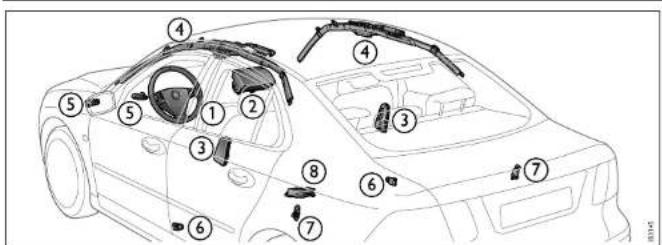
text_image
Diagram of a car interior with numbered parts for identification and assembly reference.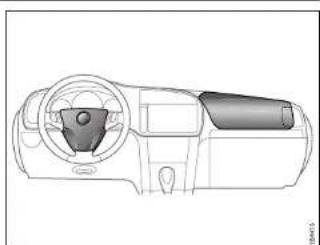
natural_image
Line drawing of a car interior view showing dashboard, steering wheel, and dashboard (no text or symbols)Airbag system
1 Steering wheel with integral airbag
2 Passenger airbag
3 Side airbag
4 Inflatable curtain (SportSedan and SportCombi)
5 Sensors in front bumper
6 Sensor, side-impact protection
7 Sensor, side-impact protection (SportSedan and SportCombi)
8 Electronic control module and central sensor (SDM)
Accessories and other equipment must not be fitted to the surfaces marked as these are where the airbags inflate in the event of a crash.








93 US MY09.book Page 35 Tuesday, April 15, 2008 10:30 AM
35Safety

WARNING
• Even if the car is equipped with AIR-BAGS, safety belts must still always be worn by all occupants.
- Note that because an airbag inflates and deflates extremely rapidly, it will not provide protection against a second impact occurring in the same incident. Always use your safety belt.
• Always sit with the whole of your back in contact with the backrest of the seat, and with your seat as far back as is practical. Otherwise you will be thrown back against the backrest when the airbag inflates which could cause you injury or death. The airbag needs room in which to inflate.
- Never attach anything to the steering wheel or passenger side of the instrument panel, as this could result in injury if the airbag should inflate. The same applies to anything you might have in your mouth, such as a pipe, for instance.
- Some components of the airbag will be warm for a short time. In some circumstances the airbag can cause minor burns or abrasions to the body when the airbag inflates/deflates.
-
Never rest your hands or forearms on the steering-wheel center padding.
-
If the airbag warning light remains on after the car has been started or comes on while you are driving, have the car checked immediately. We recommend that you contact a Saab dealer. The warning light could signify that the airbags may not inflate in a crash, or they could even inflate without a crash. See page 85.
- Fumes are generated by the chemical reaction that inflates the airbag. Skin surfaces that show signs of irritation should be washed with clean water and a mild soap as soon as possible.
In the event of eye irritation, flush the eyes thoroughly with clean water for at least 20 minutes. In case of persistent irritation, consult a doctor.


36 Safety
Operation of the steering wheel airbag in a front-end crash
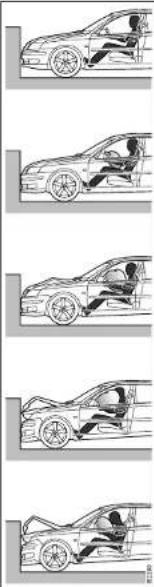
Moment of impact.
Sensors detect a deceleration and send a signal via the control module to a gas generator that initates the airbag.
The inflating airbag cushions the driver.
Airbag now fully inflated.
The airbag starts to deflate.
Front passenger seat

WARNING
Never secure a rear-facing child seat in the right front seat of a car equipped with a passenger airbag. Inflation of the airbag in the event of a crash could seriously injure or kill a child.
The system is the same as that used on the driver's side.
The airbag systems are interconnected and have a common warning light. The passenger airbag module is housed in the fascia above the glove box and is marked "AIRBAG".
Both airbags will be inflated in the event of a moderate to severe frontal, or near-frontal crash, even if the passenger seat is unoccupied.
The car is equipped as standard with a passenger airbag.
WARNING

•Children can be killed or seriously injured by the airbag
• The BACK SEAT is the SAFEST place for children 12 and under or shorter than 55 inches (140 cm)
• ALWAYS use SAFETY BELTS and CHILD RESTRAINTS
• NEVER put a rear-facing child seat in the front
- Sit as far back as possible from the airbag
- Never allow a child to stand in front of the seat or to sit on the lap of a front seat passenger. Serious injury or death could result if the airbag is inflated in a crash.
• The glove box must be closed while travelling. An open glove box door could cause leg injuries in the event of a crash.
- Never place anything on the dash or in front of the seat as, in addition to being a hazard to passengers, this could interfere with the function of the airbag in the event of a crash. The same applies to the mounting of accessories on the dash.


93 US MY09.book Page 37 Tuesday, April 15, 2008 10:30 AM
37Safety
- Keep feet on the floor – never put feet up on the dash, on the seat or out of the window.
• Do not carry anything in your lap.
Passenger Sensing System
Vehicles with a passenger sensing system have indicator LEDs on the facia. The indicators will be lit during the system check when you turn the ignition switch to ST or ON. When the system check is complete, either the ON or the OFF LED, will be lit. See Airbag warning light on page 85.
The passenger sensing system will turn off the right front passenger's frontal airbag and side airbag under certain conditions.
The driver's airbags is not part of the passenger sensing system.
The passenger sensing system works with sensors that are part of the right front passenger's seat and safety belt. The sensors are designed to detect the presence of a properly-seated occupant and determine if the passenger's frontal airbag should be enabled (may inflate) or not.
Accident statistics show that children are safer if they are restrained in the rear rather than the front seat.
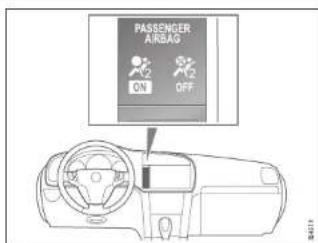
text_image
PASSENGER AIRBAG ON OFFPassenger Airbag Status Indicator, U.S.

Passenger Airbag Status Indicator, Canada
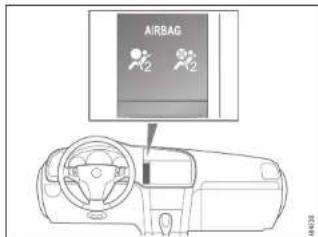
text_image
AIRBAG 2 2


93 US MY09.book Page 38 Tuesday, April 15, 2008 10:30 AM
38 Safety
Saab recommends that child restraints be secured in a rear seat, including an infant riding in a rear-facing infant seat, a child riding in a forward-facing child seat and an older child riding in a booster seat.
Your vehicle has a rear seat that will accommodate a rear-facing child restraint. A label on your sun visor says, "Never put a rear-facing child seat in the front." This is because the risk to the rear-facing child is so great, if the airbag deploys.
WARNING
A child in a rear-facing child restraint can be seriously injured or killed if the right front passenger's airbag inflates. This is because the back of the rear-facing child restraint would be very close to the inflating airbag.
Even though the passenger sensing system is designed to turn off the passenger's frontal airbag if the system detects a rear-facing child restraint, no system is fail-safe, and no one can guarantee that an airbag will not deploy under some unusual circumstance, even though it is turned off. Saab recommends that rear-facing child restraints be secured in the rear seat, even if the airbag is off.
The passenger sensing system is designed to turn off the right front passenger's frontal airbag if:
- the right front passenger seat is unoccupied
• the system determines that an infant is present in a rear-facing infant seat
- the system determines that a small child is present in a forward-facing child restraint
• the system determines that a small child is present in a booster seat
- a right front passenger takes his/her weight off of the seat for a period of time
• the right front passenger seat is occupied by a smaller person, such as a child who has outgrown child restraints
• or if there is a critical problem with the airbag system or the passenger sensing system.
When the passenger sensing system has turned off the passenger's frontal airbag, the off indicator will light and stay lit to remind you that the airbag is off.
Saab recommends that child restraints be secured in a rear seat, but if a child restraint has been installed and the on indicator is lit, turn the vehicle off. Remove the child restraint from the vehicle and reinstall the child restraint following the child restraint manufacturer's directions and refer to Installation of child restraint using the standard safety belt on page 31.
If after reinstalling the child restraint and restarting the vehicle, the on indicator is still lit, check to make sure that the vehicle's seatback is not pressing the child restraint into the seat cushion. If this happens, slightly recline the vehicle's seatback and adjust the seat cushion if possible. Also make sure the child restraint is not trapped under the vehicle head restraint. If this happens, adjust the head restraint.
If the on indicator is still lit, secure the child in the child restraint in a rear seat position in the vehicle and check with your dealer.

natural_image
Pure geometric diagram with crosshair and circular shapes, no text or symbols present
93 US MY09.book Page 39 Tuesday, April 15, 2008 10:30 AM
39Safety
The passenger sensing system is designed to enable (may inflate) the right front passenger's frontal airbag anytime the system senses that a person of adult size is sitting properly in the right front passenger's seat. When the passenger sensing system has allowed the airbag to be enabled, the on indicator will light and stay lit to remind you that the airbag is active.
For some children who have outgrown child restraints and for very small adults, the passenger sensing system may or may not turn off the right front passenger's frontal airbag, depending upon the person's seating posture and body build. Everyone in your vehicle who has outgrown child restraints should wear a safety belt properly — whether or not there is an airbag for that person.
If a person of adult-size is sitting in the right front passenger's seat, but the off indicator is lit, it could be because that person is not sitting properly in the seat. If this happens, turn the vehicle off and ask the person to place the seatback in the fully upright position, then sit upright in the seat, centered on the seat cushion, with the person's legs comfortably extended. Restart the vehicle and have the person remain in this position for about two minutes. This will allow the system to detect that person and then enable the passenger's airbag.

WARNING
If the airbag readiness light in the instrument panel cluster ever comes on and stays on, it means that something may be wrong with the airbag system. If this ever happens, have the vehicle serviced promptly, because an adult-size person sitting in the right front passenger's seat may not have the protection of the frontal airbag. See Airbag warning lamp on page 43 for more on this, including important safety information.
Aftermarket equipment, such as seat covers, can affect how well the passenger sensing system operates. You may want to consider not using seat covers or other aftermarket equipment if your vehicle has the passenger sensing system. See Adding Equipment to Your Airbag-Equipped Vehicle for more information about modifications that can affect how the system operates.

WARNING
Stowing of articles under the passenger's seat or between the passenger's seat cushion and seatback may interfere with the proper operation of the passenger sensing system.


93 US MY09.book Page 40 Tuesday, April 15, 2008 10:30 AM
40 Safety
Head protection
The pillar trim and headlining (not Convertible soft top) are designed to absorb energy, softening possible blows to the head. After a crash, these items must be changed in the seat positions that were occupied. Never fit accessories to the pillar trim or headlining as these could reduce the effectiveness of the head protection and inflatable curtain (SportSedan and SportCombi).
Side-impact protection

WARNING
• This car is equipped with side airbags and no extra seat cover should be fitted. Failure to observe this warning could result in the side airbags not inflating as intended and thus not providing the intended protection either
- Never place any object in the area that would be occupied by the inflated air bag.
- For optimum protection, sit upright in the seat, with your safety belt correctly fastened.
- The side-impact protection will only be activated in the event of a side-on crash and not in the event of a rear-end crash or the car rolling over. For the Convertible's Roll-over protection see page 76.
- Damage or wear to the seat cover, or the seat seam, in the area of the side airbag must be repaired immediately. We recommend that you contact a Saab dealer.
The side airbags, which help protect the upper body (head also in Convertible), are integrated in the outside edges of the front seat backrests. The side impact protection of the SportSedan and SportCombi also includes inflatable curtains (see page 42).
The side impact protection will be activated if certain predetermined conditions are met such as the force and angle of the impact, the speed of the car on impact, and at which point on the car's side the impact occurs.




93 US MY09.book Page 41 Tuesday, April 15, 2008 10:30 AM


41 Safety
The side-impact protection is only activated on the side of impact, while the safety belt pretensioners on both sides are deployed. The front seats and outer rear seats have safety belt pretensioners.
There are two sensors on each side of the car, one at the rear of each door sill and one in the lower part of each C-pillar.
Convertible: The Convertible has two side impact protection sensors, one on each side of the car. These are located at the rear of the sills.
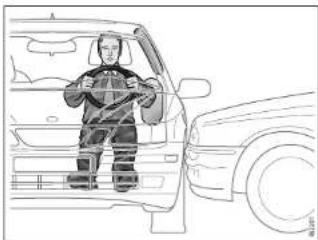
natural_image
Line drawing of a person standing beside a car, no text or symbols presentInflated side airbag and inflatable curtain, SportSedan and SportCombi

natural_image
Line drawing of a person standing inside a car, holding a steering wheel (no text or symbols)Inflated side airbag with head protection, Convertible



93 US MY09.book Page 42 Tuesday, April 15, 2008 10:30 AM
42 Safety
Inflatable curtains, SportSedan and SportCombi
WARNING
- Do not sit with your head resting against the side window. The inflatable curtain is designed to inflate between the window and the head. Resting the head against the window could prevent the inflatable curtain from providing the intended protection.
-
Hang only light clothes from the hooks on the rear seat courtesy handles. The items of clothing must not contain heavy or sharp objects. Do not use wire coat hangers.
-
Do not position a sun visor or similar item in the area that would be filled by the inflatable curtain.
- To reduce the risk of head injuries in the event of a crash, the roof pillars and headlining incorporate cushioning material. Do not attach anything to the car's headlining, roof pillars or side panels as this could prevent the side-Impact protection from providing the intended protection.
- Do not stack loads so high that they could encumber the inflatable curtain in the event of a crash.
The inflatable curtains, which protect the head, are concealed along the lengths of the headlining (all the way from front to rear roof pillars).
The inflatable curtains inflate at the same time as the side airbags in the front seats in case of a side-on impact.
The inflatable curtains reduce the risk of head injuries to the occupants of the car's outer seats. The inflatable curtains deploys into the window area between the front and rear roof pillars.
If the airbag system registers forces equivalent to a high-speed frontal crash (Stage II for the steering wheel and passenger airbags), the inflatable curtains will also be deployed.
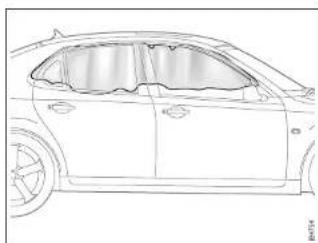
natural_image
Side profile sketch of a car showing front and rear panels with no text or symbolsInflated inflatable curtain, SportSedan


93 US MY09.book Page 43 Tuesday, April 15, 2008 10:30 AM
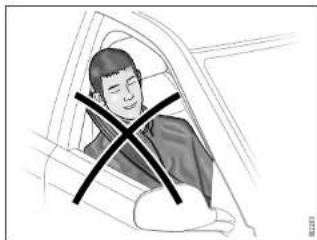
natural_image
Illustration of a person inside a car with a handbag and a cross mark (no text or symbols)Prohibited seating position
For optimal protection, do not sit too close to the door. Bear this in mind, for example, if someone is sleeping in the car. The inflatable curtain comes down from the headlining and covers a large portion of the side windows.
Airbag warning lamp What Will You See After an
WARNING
- If the airbag readiness light stays on after you start your vehicle, it means the airbag system may not be working properly. See page 85.
• The airbags in your vehicle may not inflate in a crash, or they could even inflate without a crash.
• To help avoid injury to yourself or others, have your vehicle serviced right away if the airbag readiness light stays on after you start your vehicle.
Airbag Inflates?
After an airbag inflates, it quickly deflates, so quickly that some people may not even realize the airbag inflated. Some components of the airbag module - the steering wheel hub for the driver's frontal airbag, the instrument panel for the right front passenger's frontal airbag or the ceiling of your vehicle near the side windows - will be hot for a short time. The parts of the bag that come into contact with you may be warm, but not too hot to touch. There will be some smoke and dust coming from the vents in the deflated airbags. Airbag inflation does not prevent the driver from seeing or being able to steer the vehicle, nor does it stop people from leaving the vehicle.
43Safety

93 US MY09.book Page 44 Tuesday, April 15, 2008 10:30 AM
44 Safety
WARNING
When an airbag inflates, there is dust in the air. This dust could cause breathing problems for people with a history of asthma or other breathing trouble. To avoid this, everyone in the vehicle should get out as soon as it is safe to do so. If you have breathing problems but can not get out of the vehicle after an airbag inflates, then get fresh air by opening a window or a door. If you experience breathing problems following an airbag deployment, you should seek medical attention.
In many crashes severe enough to inflate an airbag, windshields are broken by vehicle deformation. Additional windshield breakage may also occur from the right front passenger airbag.
- Airbags are designed to inflate only once. After an airbag inflates, you will need some new parts for your airbag system. If you do not get them, the airbag system will not be there to help protect you in another crash. A new system will include airbag modules and possibly other parts. The service manual for your vehicle covers the need to replace other parts.
- Your vehicle is equipped with a crash sensing and diagnostic module which records information after a crash. See Vehicle Data Collection and Event Data Recorders on page 282. - Let only qualified technicians work on your airbag system. Improper service can mean that your airbag system will not work properly. See your dealer for service.
Notice: If you damage the covering for the driver's or the right front passenger's airbag, or the side impact airbag covering on the ceiling near the side windows, the bag may not work properly. You may have to replace the airbag module in the steering wheel, both the airbag module and the instrument panel for the right front passenger's airbag, or side impact airbag module and ceiling covering for the roof-mounted side impact airbag. Do not open or break the airbag coverings.
Servicing the airbag system
The airbag system must be inspected as part of the normal service program but otherwise may be regarded as maintenance-free.
Scrapping or working on airbag and belt pretensioners
WARNING
- Under no circumstances should any modifications be made that affect the steering wheel or the airbag's electrical circuitry.
- During any welding, both battery cables must be disconnected and covered.
- Before quick drying paint in the vicinity of the electronic control module, the module's grounding points and wiring must be covered.
- Airbags and safety belt pretensioners must be deployed under controlled conditions before the car is scrapped or any of the system's components are removed. Airbags or belt pretensioners that have been deployed as a result of a crash must be replaced by new ones.

natural_image
Pure geometric diagram with crosshair and target symbols (no text or labels)

93 US MY09.book Page 45 Tuesday, April 15, 2008 10:30 AM
45Safety

- The car's impact protection consists of several different safety features including the airbags, safety belts, steering wheel, seats and dashboard. These parts are co-ordinated with each other to provide optimum protection in the event of a collision, so never install an airbag from one car into another.
There is no guarantee that it would then work satisfactorily in the event of a collision.
- All work involving the scrapping or replacement of airbags or belt pretensioners must be carried out by authorized personnel only.
Frequently asked questions on function of the airbag
Do you still need to wear a safety belt if airbags are fitted?
Yes, always! The airbag system components merely supplement the car's normal safety system. Moreover, the front airbags will only be actuated in a moderate to severe frontal, or near-frontal crash, which means, of course, that they provide no protection in minor frontal crashes, major rear- or side-crashes or if the car rolls over.
The safety belts help to reduce the sideway movement of the body in a crash.
But they also ensure that, if a crash occurs in which the airbags are inflated, the airbag will make the optimum contact with the occupant, i.e. square on from the front. If the occupant meets the airbag in an offset position, the protection afforded will be reduced.
In addition, airbags provide no protection against a secondary impact occurring in the same incident. So there is no doubt about the benefit of wearing safety belts at all times.
Do not sit too close to the airbag: it needs room to inflate.
The airbag inflates very quickly and powerfully in order to protect an adult, before they are thrown forward, in a serious frontal crash.
How do I position the seat to leave room for the airbag to inflate?
Don't have your seat too far forward.
Recline the seat back to increase the distance between you and the airbag. For short drivers, special accessory pedal extensions are available through your Saab dealer.
Airbags Inflate extremely rapidly and with great force – to be fast enough to protect an adult in the seat.
When do the airbags in the steering wheel and passenger side of the dash board inflate?
The airbag will only be inflated under certain predetermined conditions in a moderate to severe frontal, or near-frontal crash, depending on such factors as the force and angle of the impact, the speed of the car on impact, and the resistance to deformation of the impacting object.
The airbag can only be activated once in the same incident.
Do not attempt to drive the car after an airbag has been inflated, even if it is possible.
What won't trigger the airbag?
The airbag will not be activated in all frontal crashes. For instance, if the car has hit something relatively soft and yielding (e.g. a




93 US MY09.book Page 46 Tuesday, April 15, 2008 10:30 AM
46 Safety
snow drift or a hedge) or a solid object at a low impact speed, the airbag will not necessarily be triggered.
How loud is the inflation?
The noise of the inflation is certainly loud, but it is of an very short duration and will not damage your hearing. For a short time afterwards you could experience a buzzing noise in your ears.
Most people who have experienced it cannot remember the noise of the inflation at all – all they remember is the noise of the crash.
Can you still use a child seat in the front if a passenger airbag is installed?
Definitely not!
Children 12 and under or shorter than 55 inches (140 cm) can be killed by the air bag.
The back seat is the safest place for children.
Never put a rear-facing child seat in the front.
Sit as far back as possible from the airbag.
Always use seat belts and child restraints.
What should I do if the AIR-BAG warning light comes on?
If the warning light is on, it means that a fault has been detected in the system. The airbag cannot be relied on to operate as intended and it might even be activated erroneously. You should therefore take the car to a workshop. We recommend that you contact a Saab dealer as soon as possible.
Are the dust and fumes given off when the airbag operates at all harmful?
Most people who have remained in a car with little or no ventilation for several minutes complained only of minor irritation of the throat and eyes. Avoid as much as possible getting dust on your skin as there is a risk of skin irritation.
If you suffer from asthma, the incident may bring on an attack, in which case you should follow the normal procedure advised by your doctor. It is advisable to consult a doctor afterwards.
Adding Equipment to Your Airbag-Equipped Vehicle
Is there anything I might add to the front or sides of the vehicle that could keep the airbags from working properly?
Yes. If you add things that change your vehicle's frame, bumper system, front end or side sheet metal or height, they may keep the airbag system from working properly. Also, the airbag system may not work properly if you receive any of the airbag sensors. If you have any questions about this, you should contact Saab Customer Assistance before you modify your vehicle. The phone numbers and addresses for Customer Assistance can be found on page 280.
Because I have a disability, I have to get my vehicle modified. How can I find out whether this will affect my advanced airbag system?
Changing or moving any parts of the front seats, safety belts, the airbag sensing and diagnostic module or the inside rearview mirror can affect the operation of the advanced airbag system. If you have questions, call Customer Assistance. The phone numbers and addresses for Customer Assistance can be found on page 280.


text_image
93_US_MY09.book_Page_47_Tuesday,APRIL 15,2008 10:30 AM 47Security Security Doors 48 Central locking 48 Car alarm 56 * Asterisk means: equipment not fitted in all cars (can depend on model variant, engine variant, market specification, options or accessories).
text_image
93_US_MY09.book_Page_47_Tuesday,APRIL 15,2008 10:30 AM 47Security Security Doors 48 Central locking 48 Car alarm 56 * Asterisk means: equipment not fitted in all cars (can depend on model variant, engine variant, market specification, options or accessories).93 US MY09.book Page 48 Tuesday, April 15, 2008 10:30 AM
48 Security
Doors
Open the door by lifting the door handle.
The following message appears on the Saab Information Display (SID) if a door is not closed (text displayed first when vehicle speed exceeds 15 mph (25 km/h) and the door has still not been closed):

Close doors.
Central locking
WARNING
Leaving children or pets unattended in a locked car is dangerous. It is also dangerous to leave children in a vehicle with the ignition key. A child or others could be badly injured or even killed.
Remote control
The remote control and ignition key are integrated in one unit, and referred to in this manual as the remote control.
The remote control contains a mechanical key, referred to in this manual as the traditional key. This traditional key can be used in an emergency to lock or unlock the driver's door from outside (see page 50). This key does not fit the ignition switch.
A key code number is supplied with your car. This number needs to be quoted for ordering a new traditional key (contained in the remote control). Therefore, keep this number in a safe place.
The remote control contains an electronic code that is unique to your car. When the remote control is inserted into the ignition switch, this code is checked. If the code is incorrect, the car will not start.
The car is supplied with two remote controls. It is possible to have up to five remote controls programmed for the car at any one time. If one is lost, a replacement should be obtained as soon as possible. We recommend that you contact a Saab dealer. When a new key is programmed into the car, the lost key will be deprogrammed automatically.
Note
If a new remote control has to be ordered and programmed, at least one old one is required for the locking system's electronic unit to recognize the new (ordered) remote control.
Once the new remote control has been programmed, the old unit that is lost will not work. Therefore you should carry two remote controls separately, especially on long journeys.



93 US MY09.book Page 49 Tuesday, April 15, 2008 10:30 AM

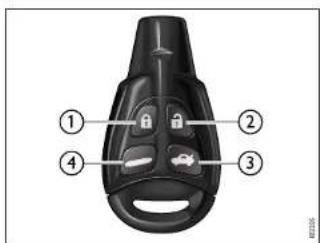
text_image
Diagram of a car key with numbered parts labeled ① to ④ for identification.Remote control
1 Locks car
2 Unlocks car and turns on cabin lighting
3 Unlocks and opens trunk lid.
4 Tums on exterior and cabin lighting.
Activates panic function
NOTICE
The remote control contains delicate electronics.
- Do not expose it to water.
- Avoid rough handling.
- Do not place the remote control where it may be subjected to high temperatures, e.g. on the instrument panel.
- Warm the remote control in your hands for a couple of minutes if it has become very cold to prevent malfunction.
- For details on changing the battery, refer to page 54.
Remote control functions
| Button | Pressed once | Pressed twice | Hold and press the button more than 2 seconds |
 | Locks all doors. | _ | |
| Unlocks driver's door. | SportSedan: The other doors are unlocked.SportCombi: The other doors and tail-gate are unlocked. | Comfort opening, see page 119. | |
| [ST4W] | SportSedan: Unlocks and slightly opens the trunk lid.SportCombi: Unlocks the tail-gate.Checks number of remote controls, see page 53. | ||
 | Turns on exterior and cabin lighting *) (for 30 seconds) or turns off lighting and deactivates panic alarm. | _Panic alarm | (activates alarm manually), see page 58. |
*) parking lights, side direction indicators, tail-lights and license plate lighting.


93 US MY09.book Page 50 Tuesday, April 15, 2008 10:30 AM
50 Security
Locking/unlocking the car
! WARNING
Leaving children or pets unattended in a locked car is dangerous. It is also dangerous to leave children in a vehicle with the ignition key. A child or others could be badly injured or even killed.
Never lock anyone in the car.
Remote locking and unlocking also control the car alarm.
Remote locking
Press the 🔍 ton once:
SportSedan: all doors locked.
SportCombi: all doors and tailgate locked. The hazard warning lights will flash once to confirm.
Remote unlocking
Pressing the 3 ton once: the driver's door is unlocked.
Pressing a second time:
SportSedan: the rest of the doors are unlocked.
SportCombi: the rest of the doors and tailgate are unlocked.
The hazard warning lights will flash twice to confirm.
Saab Information Display (SID), see page 89.
Intermittent malfunctioning
Equipment in the vicinity of the car that uses the same frequency as the remote control may cause interference to the remote control signal. In this case, retry from another angle and aim at the receiver located by the steering wheel.

text_image
Diagram illustrating a key inserted into a car with directional arrows and labeled parts, likely illustrating a mechanical or electrical component.Locking/unlocking the front left-hand door with the traditional key
1 Lock
2 Unlock
If remote unlocking should fall to work
1 Remove the traditional key from the remote control by pressing the emblem on the reverse of the remote control. (This key only fits the front left-hand door.)
2 Unlock the door with the key.
The car alarm will be tripped. To silence the alarm, Insert the remote control into the ignition switch.




93 US MY09.book Page 51 Tuesday, April 15, 2008 10:30 AM
51Security
Locking a car with dead battery
The steering wheel lock requires sufficient battery voltage to lock and unlock. If the battery voltage drops below a certain level while the remote control is in the ignition switch, you will not be able to remove the remote control.
If you must leave the car, proceed as follows:
1 Lock the car by pressing down the lock buttons on the doors.
2 Lock the front left door from outside with the traditional key (see page 50). The car is now locked but the car alarm will remain inactive.
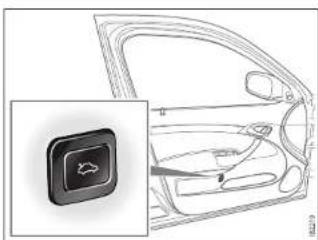
natural_image
Line drawing of a car interior showing the dashboard and steering wheel (no text or symbols)Opening button on driver's door
Trunk lid/Tailgate
Opening
SportSedan: The trunk lid is unlocked and slightly opened when the 📄 button on the remote control or on the inside of the driver's door is pressed once.
SportCombi: The tailgate is unlocked (not opened) when the 📂 on on the remote control or on the inside of the driver's door is pressed once.
The hazard warning lights will flash three times to confirm.
Closing
SportSedan: The trunk lid is locked when closed.
If you unlock and/or open the trunk lid from outside the car with the 150 ton on the remote control, you must lock the car with
the 8 ton to arm the car alarm
SportCombi: The tailgate is not locked when closed. It is locked together with the doors when button on the remote control is pressed once.

the traditional key (see page 50). The car is now locked but the car alarm will remain inactive.


93 US MY09.book Page 52 Tuesday, April 15, 2008 10:30 AM
52 Security
Switches on front doors
The central locking can also be operated from inside the car using the button by each front door handle.
Locking the car with the remote control renders these buttons inoperative.
SportSedan
If you are sitting in the car and pressing the
button on the driver's door, the driver's door will unlock. Pressing the button a second time will unlock the remaining doors.
SportCombl
If you are sitting in the car and pressing the button on the driver's door, the driver's door will unlock. Pressing the button a second time will unlock the remaining doors and the tailgate.
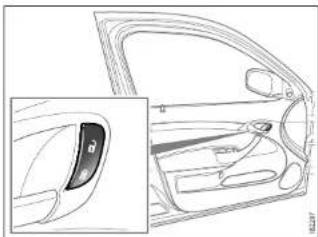
natural_image
Line drawing of a car interior showing the dashboard and steering wheel (no text or symbols)Central locking switch Child safety locks
The button on the passenger door works in the same way except that this first unlocks the passenger door. During this operation the rear doors remain locked.
If the car is left with one or more doors open, the Interior lighting will be switched off automatically after 20 minutes. This is to prevent the battery from running flat. Also, if the car has electrically adjustable seats, these will cease to operate.

natural_image
Line drawing of a car interior showing the door and side panel, with an inset close-up highlighting a small circular feature (no text or symbols)Child safety locks
WARNING
If small children are carried in the rear seat, the safety locks on the rear doors should be activated to prevent unintentional opening from the inside.
SportCombl





93 US MY09.book Page 53 Tuesday, April 15, 2008 10:30 AM

The rear doors are equipped with child safety locks that are activated by means of a catch next to the door latch.
Insert a screwdriver or the traditional key (enclosed in the remote control) and turn it 45°.
When the child safety lock is in the locked position, the door can only be opened from outside the car.
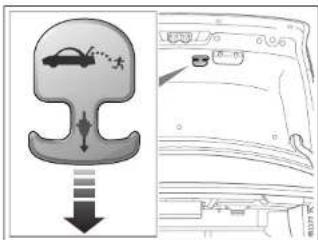
text_image
Diagram illustrating car exhaust behavior with labeled components and directional arrowsTrunk Release Handle
Reprogramming lock system functions
Certain lock system functions can be reprogrammed. We recommend that you contact a Saab dealer (see page 293).
Checking the number of remote controls
To check the number of remote controls that are programmed for the car:
1 Insert the remote control into the ignition switch and turn it to ON.
2 Press and hold the 📄 on for more than 2 seconds within 30 seconds after the ignition switch has been turned to the ON position.
3 The Saab Information Display (SID) will now display the number of remote controls that are programmed for your car, and which of these (1–5) is in the ignition switch.
Example of SID message:
Trunk Release Handle
There is a glow-in-the-dark trunk release handle located inside the trunk on the latch. This handle will glow following exposure to light. Pull the release handle down to open the trunk from inside.
NOTICE
The trunk release handle was not designed to be used to tie down the trunk lid or as an anchor point when securing items in the trunk. Improper use of the trunk release could damage it

Number of keys: Active key number:


93 US MY09.book Page 54 Tuesday, April 15, 2008 10:30 AM
54 Security
Changing the key battery
WARNING
Keep the battery and other small components of the remote control out of reach of children.
NOTICE
The electronics of the remote control are sensitive to electrostatic discharge. Incorrect handling when changing the battery can damage the remote control. Avoid touching electronic components of the remote control with your hands.
When the voltage of the remote control battery drops below a certain level, the Saab Information Display (SID) will display:

Remote control battery low. Replace battery.
Change the battery as soon as possible to avoid malfunctioning.
Battery type: For optimum performance in all temperatures and good service life, Saab recommends the use of a Sony or Panasonic CR2032, 3V lithium battery.
The battery should last for about 4 years of normal use.
The battery type is marked on the inside of the remote control. Avoid leaving fingerprints on the faces of the battery.
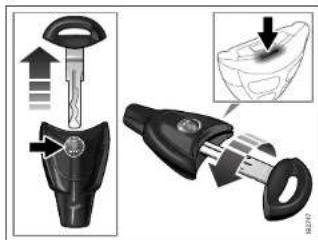
text_image
Diagram illustrating a mechanical device with labeled parts and an inset showing the internal structure of a container or component.Press the emblem to remove the traditional key
1 Press the emblem on the reverse of the remote control to remove the traditional key.
2 Insert the tip of the key into the small slot and turn the key to split the remote control.



93 US MY09.book Page 55 Tuesday, April 15, 2008 10:30 AM

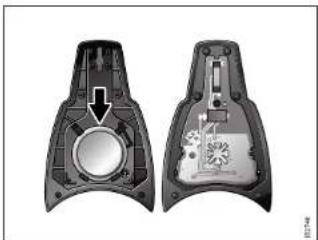
natural_image
Two views of a device showing internal components with no visible text or symbolsChange the battery and fit together the two halves of the remote control
3 Change the battery. Fit the new battery so that it is positioned in the same way as the old battery, with the positive (+) side facing down.
4 Fit the two halves of the remote control together and press them together until you hear several clicks. Avoid pressing the buttons. Reinsert the traditional key into the remote control.
5 After changing the battery in the remote control, it is only possible to use the remote control a limited number of times before synchronization with the car is lost. Therefore, do not press the buttons on the remote control repeatedly directly after changing the battery. Unlock the car and insert the remote control into the ignition switch to synchronize the remote control and car.
If the central locking system does not work after changing the battery and the car is locked, proceed as follows:
1 Unlock the front left door with the traditional key. If the car has a car alarm, this will be tripped.
2 Open the door and insert the remote control into the ignition switch. If the car has a car alarm, this will be silenced. The remote control and receiver unit are now synchronized.
Immobilizer
The remote control contains an electronic code that is unique to your car. When the remote control is inserted into the ignition switch, this code is checked and the LED on the dashboard double-flashes for 3 seconds. If the code is correct, the car can be started.
Each time you remove the remote control from the ignition, the electronic starting interlock is activated, the LED double-flashes for 3 seconds and the car becomes immobilized. If an incorrect remote control is now inserted into the ignition switch (e.g. the remote control of another car), the immobilizer will remain operative (the LED will not flash for 3 seconds) and it will not be possible to start the car.
If, when inserted into the ignition switch, there is a problem checking the electronic code of the remote control, the following message will appear on the SID:

Key not accepted. Contact service.
Visit a Saab dealer to have the problem checked and rectified.


93 US MY09.book Page 56 Tuesday, April 15, 2008 10:30 AM
56 Security
Car alarm

WARNING
Leaving children or pets unattended in a locked car is dangerous. It is also dangerous to leave children in a vehicle with the ignition key. A child or others could be badly injured or even killed.
The car alarm is armed when the car is locked with the remote control.
The car alarm will not be armed if you lock the car with the traditional key (see page 50).
All the doors, the hood and the trunk lid are monitored by the alarm.
The alarm is armed 11 seconds after the car has been locked by remote control.
During the delay period, the LED shines constantly. It will then start to flash once every 3 seconds. The LED is located on the dashboard.
If a door or the trunk lid is open when the car is locked with the remote control, the LED will flash 3 times per second for 11 seconds. Check that the doors, hood and trunk lid are closed.
If the signal persists, contact a Saab dealer to have the problem checked and rectified.
Locking the trunk lid
SportSedan
If you open the trunk lid from outside the car
with the 5 ton on the remote control,
you must lock the car with the 📞 ton to arm the car alarm.
SportCombi
If you unlock and/or open the trunk lid from
outside the car with the on the remote control, you must lock the car with
the 🔍 ton to arm the car alarm.





93 US MY09.book Page 57 Tuesday, April 15, 2008 10:30 AM
57Security
To avoid any inconvenience, make sure that anyone using the car is familiar with how the car alarm and the locking system work.
If the alarm has been tripped since the car was last locked, the Saab Information Display (SID) will display:

Alarm tripped during last arming period.
If a fault arises in the car alarm system, the Saab Information Display (SID) will display:

Theft protection failure. Contact service.
Arming the car alarm
The alarm is armed when all doors, the hood and the trunk lid are closed and you lock the car with the remote control.
What trips the alarm?
The alarm will be tripped if:
- a door, the hood or the trunk lid is opened
• somebody tries to hot-wire the car
Signals when the alarm is tripped
If the alarm is triggered, the following alarm signals will be set off:
- all direction indicators flash for 5 minutes.
• the horn sounds for 30-second intervals with 10-second breaks (max. 10 cycles).
The signals can vary between markets and due to legal and insurance requirements.
Switching off the alarm if tripped
If the alarm has been triggered (direction indicators flashing and horn sounding) it can be turned off by pressing one of the buttons on the remote control or, if you are sitting in the car, by turning the ignition to ON (see below).

Turns off lights and horn. Unlocks car.

Turns off lights and horn. Car remains locked.

Turns off lights and horn. Unlocks trunk.

Turns off lights and horn. Turns on exterior and cabin lighting. Car remains locked.
If sitting in the car: Turn the ignition switch to ON in the ignition switch
NOTICE
- It is possible to inadvertently deactivate the car alarm and at the same time unlock the car, if the button on the key is pressed by mistake when the car is still within its range.
- When locking the car by remote control in extremely cold weather, it is advisable to check that the lock system has operated properly. To do so, check that the interior locking buttons are all down. If not, unlock and re lock the car again.


Turns off lights and horn. Unlocks car.
Turns off lights and horn. Car remains locked.
Turns off lights and horn. Unlocks trunk.
Turns off lights and horn. Turns on exterior and cabin lighting. Car remains locked.


93 US MY09.book Page 58 Tuesday, April 15, 2008 10:30 AM
58 Security
Panic function
The car alarm includes a panic function. This function allows the alarm to be started manually, for example, to attract attention.
The panic alarm can only be activated while the car is stationary. The alarm is silenced if the car is driven off.
When the alarm is tripped, the lights and horn come on for 3 minutes or until you press one of the remote control buttons.
To start the alarm manually proceed as follows:
Overview of functions
| Locking/arming Direction indicators flash once. | |
| Unlocking/disarming | Direction indicators flash twice. |
| Unlocking/disarming trunk lid | Direction indicators flash three times. |
| Alarm triggered Direction indicators flash for 5 min.The horn sounds for 30-second intervals with 10-second breaks (max. 10 cycles) or until you press one of the remote control buttons or turn the ignition switch to the ON position. | |
| Remote control Normal range: 5-16 yds. (5-15 metres).In favorable conditions the range can be significantly greater. | |
| Remote control battery | Normal life: approx. 4 years.Change the battery when the SID displays:Remote control batterylow. Replace battery.See Changing the key battery, page 54. |
Some car alarm functions and indications can be reprogrammed. Contact a Saab dealer for details of the possibilities and refer to page 293.
- Press and hold the button on the remote control for more than 2 seconds, or if you are sitting in the car...
- Press and hold the button in one of the front doors for more than 2 seconds.
To switch off the alarm: - Press one of the remote control buttons or, if you are sitting in the car, the 📋 but 🏠 is on one of the front doors.
- Press and hold the button on the remote control for more than 2 seconds, or if you are sitting in the car...
- Press and hold the button in one of the front doors for more than 2 seconds.
To switch off the alarm: - Press one of the remote control buttons or, if you are sitting in the car, the 📋 but 🌘 is on one of the front doors.
- Press and hold the button on the remote control for more than 2 seconds, or if you are sitting in the car...
- Press and hold the button in one of the front doors for more than 2 seconds.
To switch off the alarm: - Press one of the remote control buttons or, if you are sitting in the car, the 📋 but 🌘 is on one of the front doors.
- Press and hold the button on the remote control for more than 2 seconds, or if you are sitting in the car...
- Press and hold the button in one of the front doors for more than 2 seconds.
To switch off the alarm: - Press one of the remote control buttons or, if you are sitting in the car, the 📋 but 🌘 is on one of the front doors.
- Press and hold the button on the remote control for more than 2 seconds, or if you are sitting in the car...
- Press and hold the button in one of the front doors for more than 2 seconds.
To switch off the alarm: - Press one of the remote control buttons or, if you are sitting in the car, the 📋 but 🌘 is on one of the front doors.
- Press and hold the button on the remote control for more than 2 seconds, or if you are sitting in the car...
- Press and hold the button in one of the front doors for more than 2 seconds.
To switch off the alarm: - Press one of the remote control buttons or, if you are sitting in the car, the 📋 but 🏠 is on one of the front doors.
- Press and hold the button on the remote control for more than 2 seconds, or if you are sitting in the car...
- Press and hold the button in one of the front doors for more than 2 seconds.
To switch off the alarm:
To switch off the alarm:
To switch off the alarm: - Press one of the remote control buttons or, if you are sitting in the car, the 📋 but 🏠 is on one of the front doors.
- Press and hold the button on the remote control for more than 2 seconds, or if you are sitting in the car...
- Press and hold the button in one of the front doors for more than 2 seconds.
To switch off the alarm: - Press one of the remote control buttons or, if you are sitting in the car, the 📋 but 🏠 is on one of the front doors.
- Press and hold the button on the remote control for more than 2 seconds, or if you are sitting in the car...
- Press and hold the button in one of the front doors for more than 2 seconds.
To switch off the alarm: - Press one of the remote control buttons or, if you are sitting in the car, the 📋 but 🏠 is on one of the front doors.
- Press and hold the button on the remote control for more than 2 seconds, or if you are sitting in the car...
- Press and hold the button in one of the front doors for more than 2 seconds.
To switch off the alarm: - Press one of the remote control buttons or, if you are sitting in the car, the 📋 but 🏠 is on one of the front doors.
- Press and hold the button on the remote control for more than 2 seconds, or if you are sitting in the car...
- Press and hold the button in one of the front doors for more than 2 seconds.
To switch off the alarm: - Press one of the remote control buttons or, if you are sitting in the car, the 📋 but 🏠 is on one of the front doors.
- Press and hold the button on the remote control for more than 2 seconds, or if you are sitting in the car...
- Press and hold the button on one of the front doors for more than 2 seconds. To switch off the alarm:
- Press one of the remote control buttons or, if you are sitting in the car, the button is on one of the front doors.
- Press and hold the button on the remote control for more than 2 seconds, or if you are sitting in the car...
- Press and hold the button on one of the front doors for more than 2 seconds. To switch off the alarm:
- Press one of the remote control buttons or, if you are sitting in the car, the button is on one of the front doors.
- Press and hold the button on the remote control for more than 2 seconds, or if you are sitting in the car...
- Press and hold the button on one of the front doors for more than 2 seconds. To switch off the alarm:
- Press one of the remote control buttons or, if you are sitting in the car, the button is on one of the front doors.
- Press and hold the button on the remote control for more than 2 seconds, or if you are sitting in the car...
- Press and hold the button on one of the front doors for more than 2 seconds. To switch off the alarm:
- Press one of the remote control buttons or, if you are sitting in the car, the button is on one of the front doors.
- Press and hold the button on the remote control for more than 2 seconds, or if you are sitting in the car...
- Press and hold the button on one of the front doors for more than 2 seconds. To switch off the alarm:
- Press one of the remote control buttons or, if you are sitting in the car, the button is on one of the front doors.
[Non-Text]
[Non-Text]
[Non-Text]
[Non-Text]
[Non-Text]
[Non-Text]
[Non-Text]
[Non-Text]
[Non-Text]
[Non-Text]
[Non-Text]
[Non-Text]
[Non-Text]
[Non-Text]
[Non-Text]
[Non-Text]
[Non-Text]


93 US MY09.book Page 59 Tuesday, April 15, 2008 10:30 AM
59Security
Quick guide, LED and Saab Information Display (SID) messages
| Activity LED signal | |
| Arming (delay period) Illuminates for 11 seconds. | |
| Alarm armed Flashes once every 3 seconds. | |
| Disarming Extinguishes. | |
| Alarm not armed Off. | |
| A door, the hood or the tailgate is open or opened during the delay period. | Flashes for 11 s then flashes once every 3 seconds. |
| Car immobilized but not locked. Off. | |
| Change of status of immobilizer system, valid remote control inserted or removed from ignition switch. | Double-flashes for 3 seconds. |
| SID message Reason/action | |
| Key not accepted.Contact service. | Error when remote control inserted into ignition switch. |
| Remote control battery low. Replace battery. | Battery needs replacing.S e e p a g e 54 . |
| Number of keys:Active key number: | Check of the number of remote controls programmed for your car. See page 53. |
| Alarm tripped during last arming period. | The alarm has been tripped since the car was last locked. |


text_image
93_US_MY09.book_Page_60_Tuesday, April 15, 2008 10:30 AM 60 Security (This page has been left blank.)
text_image
93 US MY09.book Page 61 Tuesday, April 15, 2008 10.30 AM
9-3 Convertible

natural_image
Interior view of a car showing the rearview seat and dashboard (no text or symbols visible)Advice on soft top operation 62
Operating the soft top_ 63
Raising the soft top manually 68
SID warnings and messages 71
"Easy entry" 73
Head restraints 74
Safety belts, rear seat, Convertible 75
Rollover Pop-up Bars ____ 76
Electric windows 77
Interior lighting ____ 79
Unlocking the trunk lid manually 80
* Asterisk means: equipment not fitted in all cars (can depend on model variant, engine variant, market specification, options or accessories).


93 US MY09.book Page 62 Tuesday, April 15, 2008 10:30 AM
62 9-3 Convertible
Advice on soft top operation
- Once you have raised the soft top and before driving off, always check that the soft top is properly engaged with the wind-shield rail, see page 66.
- Once you have folded the soft top and before driving off, check that the soft top cover is locked, see page 64.
-
Do not operate the soft top in temperatures below 23^ (-5^) .
• Note that certain automatic car washes can damage the soft top. This applies to car washes that use mechanical feelers bearing against the body. Saab advises against washing the Convertible in an automatic car wash.
• After rain or washing the car, allow the soft top to dry completely before folding it. Folding a wet or damp soft top can cause water damage in the car and mildew to form on the soft top. -
Roof racks and ski holders must not be mounted on the soft top.
• Under no circumstances should anything be put into the stowage space of the soft top (under the soft top cover) since this could cause an obstruction when the soft top is being folded away. - Do not place any objects on the covers over the roll bars as this can hamper their function.
- When operating the soft top, raise or fold it fully until notified that operation is complete by the SID. Do not leave the soft top partially open/closed. If the soft top is left in an intermediate position it will collapse progressively after 20 seconds to prevent overloading the drive system.
- Washing the soft top, see page 267.
WARNING
- Never touch the hinges and struts of the soft top nor the upper rail of the windshield while operating the soft top.
- Do not operate the soft top while there are bystanders close to the car.




93 US MY09.book Page 63 Tuesday, April 15, 2008 10:30 AM
Operating the soft top
! WARNING
- Do not touch the hinges or struts of the soft top during opening due to the pinch hazard.
- Keep children out of reach.
- Do not operate the soft top while there are bystanders close to the car.
• Make sure that the soft top cover has locked properly after folding the soft top. - Check that the soft top engages properly with the upper edge of the windshield after raising.
Read the "Advice on soft top operation" section on page 62 before operating the soft top.
The soft top is operated with the switch on the instrument panel. Hold the switch in the desired position until the soft top is fully folded or raised.
The completion of folding or raising the soft top is indicated by a chime.
Error messages that can appear on the SID are shown on page 71.

text_image
a bSwitch for operating the soft top
a Raising
b Folding

NOTICE
If you drive off while raising or folding the soft top, operation is halted when the speed of the car exceeds 20 mph (30 km/h). This speed can be programmed (0–20 mph/0–30 km/h). We recommend that you contact a Saab dealer. The movement of the car and force of the wind can seriously damage the components of the soft top system.


639-3 Convertible


93 US MY09.book Page 64 Tuesday, April 15, 2008 10:30 AM
64 9-3 Convertible
Opening
The following conditions must be fulfilled for the soft top to be folded:
- Vehicle speed must not exceed 20 mph (30 km/h).
- Battery voltage must exceed 10 V.
- Outside temperature must exceed 23 °F (-5 °C).
• The trunk lid must be locked. - There must be sufficient space in the trunk for the soft top.
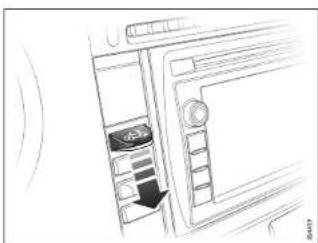
natural_image
Line drawing of a microwave oven with a digital display showing the front panel and door (no text or symbols)Folding
2 Press and hold the soft top button until the soft top is fully folded and the soft top cover raised. Completed folding is indicated by a chime. If there is a malfunction a text message will be shown on the SID. Refer to page 71.
Do not press any of the buttons on the same section of the instrument panel as the soft top switch while folding the soft top. This will cause the soft top to stop and then sink after about 20 seconds.
Remote opening \*
You can fold the soft top when outside the car by pressing and holding the (unlock) button on the remote control. See also page 119.


1 Start the engine and let it idle. Clearance for soft top operation: height, min. 7.2 ft (2.2 m); behind car, min. 2" (5 cm).
natural_image
Pure geometric diagram with crosshair and circular pattern (no text or symbols)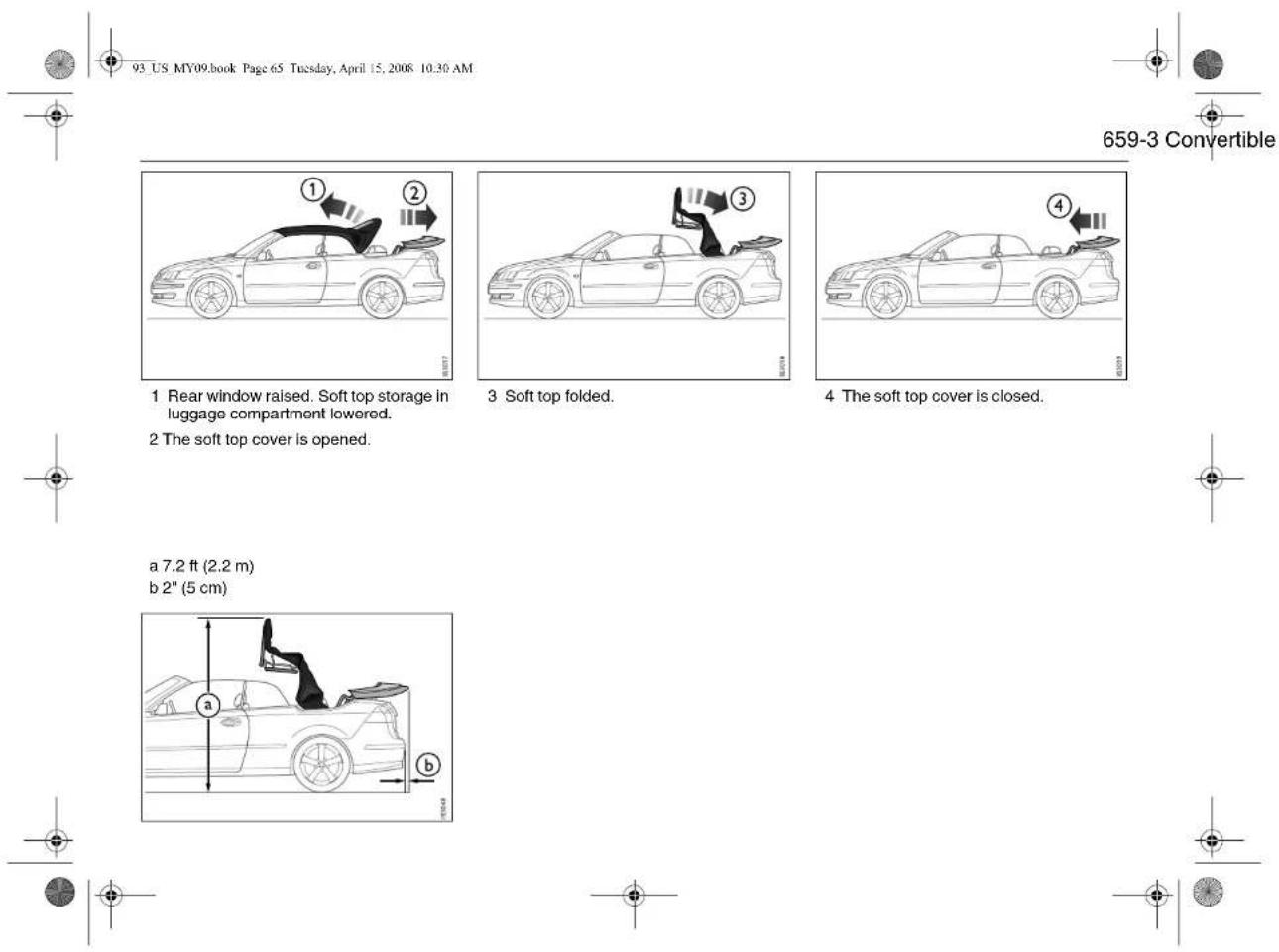
93 US MY09.book Page 65 Tuesday, April 15, 2008 10:30 AM
1 Rear window raised. Soft top storage in luggage compartment lowered.
2 The soft top cover is opened.
3 Soft top folded.
4 The soft top cover is closed.
a 7.2 ft (2.2 m)
b 2" (5 cm)
93 US MY09.book Page 66 Tuesday, April 15, 2008 10:30 AM
66 9-3 Convertible
Raising
The following conditions must be fulfilled for raising the soft top:
• Vehicle speed must not exceed 20 mph (30 km/h).
- Battery voltage must exceed 10 V.
• The trunk lid must be locked.

natural_image
Line drawing of a microwave oven with a door and control panel, showing airflow direction (no text or symbols)Raising
2 Press and hold the soft top button until the soft top is fully raised and the soft top cover closed. Completed raising is indicated by a chime. If there is a malfunction a text message will be shown on the SID. Refer to page 71.
Do not press any of the buttons on the same section of the instrument panel as the soft top switch while raising the soft top. This will cause the soft top to stop and then sink after about 20 seconds.
Check that the hooks in the soft top hold it securely to the upper edge of the wind-shield.


1 Start the engine and let it idle. Clearance for soft top operation: height, min. 7.2 ft (2.2 m); behind car, min. 2" (5 cm).




93 US MY09.book Page 67 Tuesday, April 15, 2008 10:30 AM
1 The soft top cover is opened. 2 The soft top is raised. 3 The soft top cover is closed.
4 The rear window is lowered.
a 7.2 ft (2.2 m) b 2" (5 c m)
93 US MY09.book Page 68 Tuesday, April 15, 2008 10:30 AM
68 9-3 Convertible
Raising the soft top manually

WARNING
Only raise the soft top manually in an emergency (e.g. due to an electrical fault).
Do not touch the soft top button on the instrument panel while closing the soft top manually. This could cause personal injury and damage the soft top mechanism.
Do not fold the soft top having closed it manually. This can damage the soft top mechanism.
If the soft top has been folded mechanically there will be a delay of 20 seconds before it is possible to raise it manually (the pressure must be released from the hydraulic system).
If the car is without electrical power, the trunk must be unlocked manually. Refer to page 80.
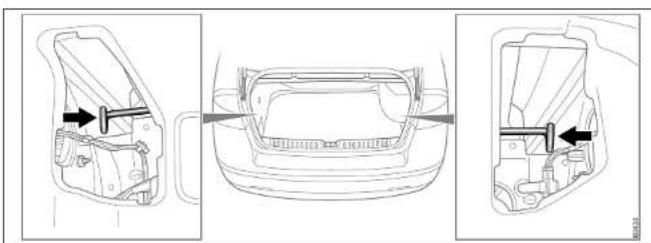
natural_image
Three-step diagram showing a vehicle interior with open door, internal compartments, and a hand inserting a component (no text or symbols)Wire catch for unlocking soft top cover
1 Find the lug wrench, Allen key and screwdriver located under the luggage compartment floor.
2 Remove the two covers from the side trim in the trunk, one from either side.
If there are two of you, it is easiest if you stand on either side of the car and perform steps 3-6 and 9-10 together.
3 Unlock the soft top cover by pressing forward the two wire catches, one on the left and one on right-hand side.
4 Close the trunk lid fully as otherwise it will obstruct the soft top cover.
Tools under luggage compartment floor
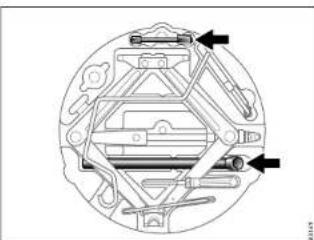
natural_image
Technical diagram of a mechanical assembly with no visible text or symbols


93 US MY09.book Page 69 Tuesday, April 15, 2008 10:30 AM
699-3 Convertible
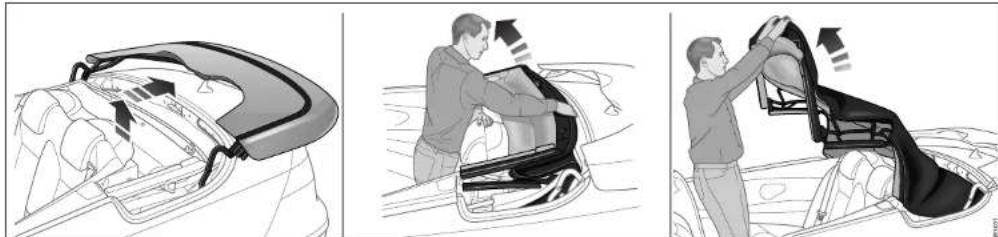
Soft top cover opened Manual closing started Soft top pulled towards windshield
5 Open the soft top cover, upward and backward.
6 Tip forward the front seat backrests.
WARNING
- Do not touch the hinges and struts of the soft top during raising.
- Keep your hands clear of the front windshield rail.
- Pinch hazard may cause personal injury.
7 Before raising the soft top, the two catches in the leading edge of the soft top must be opened. Stand in the rear seat and pry off the cover with the screwdriver (the cover is fitted on the covering in between the catches). Using the tool (the lug wrench and the Allen key), turn clockwise to open the catches. Stand in the rear seat and raise the soft top. Pull it towards the windshield. This operation requires 7.2 ft (2.2 m) of vertical clearance.


93 US MY09.book Page 70 Tuesday, April 15, 2008 10:30 AM
70 9-3 Convertible
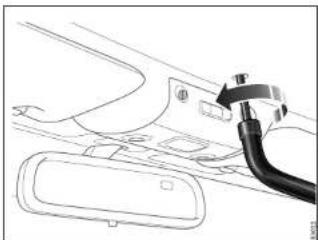
natural_image
Line drawing of a car interior panel with a black cable inserted, showing no text or symbolsSoft top locked to windshield rail

natural_image
Line drawing of a car's side panel with a knife and blade, showing motion (no text or symbols)Closing the soft top cover

natural_image
Diagram of a car seatbelt with an inset showing a clamp securing the seat (no text or symbols present)Rear window locked to soft top cover
8 Sit in one of the front seats and lock the soft top to the windshield rail. Use the lug wrench and the Allen key. Turn roughly 1/4 turn counterclockwise. Check that the soft top is properly locked in place by pressing up the front edge. The soft top must not move upward.
9 Lift up the rear window fully and hold it there. Close the soft top cover. It is not possible to lock the soft top cover after manual raising.
NOTICE
To avoid damaging the paintwork on the soft top cover and the trunk lid, take care when closing the soft top cover.
10 Press down the rear edge of the soft top as far as possible towards the soft top cover.
11 Now lock the rear window to the soft top cover. Sit in the rear seat and insert the tool (the same tool as used to lock the soft top to the windshield rail) into the hexagonal hole in the soft top mechanism. Turn roughly 1/4 turn, counterclockwise on the right had side of the soft top and clockwise on the left-hand side. Look at the soft top cover when locking the rear window. The rear window must make a tight seal against the soft top cover.
The soft top system must be checked and rectified without delay. We recommend that you contact a Saab dealer.


93 US MY09.book Page 71 Tuesday, April 15, 2008 10:30 AM
719-3 Convertible
SID warnings and messages
The following messages associated with the soft top system and can be displayed on the SID together with a chime:
| Cause Suitable action | |||
 | Soft top front not locked. | Failure of the soft top to lock automatically to the windshield. | • Move the car so that it is standing level if on a steep slope.• Press the soft top button to fold the soft top slightly. Fold the soft top again. |
| Soft top power pack overheated. | This message appears if the soft top is operated continuously for more than 3 minutes. | Wait 6 minutes to allow the hydraulic pump to cool down. | |
 | Move goods away from soft top storage area. | Move the object hindering soft top operation. | |
 | Operation at low temp. may damage soft top. | Displayed if the soft top is folded at temperatures below 23 °F (-5 °C). | |
 | Only manual operation possible. | ||
 | Soft top cover not locked. Try again. |
[Non-Text]
[Non-Text]
[Non-Text]
[Non-Text]
[Non-Text]
[Non-Text]
[Non-Text]
[Non-Text]
[Non-Text]
[Non-Text]
[Non-Text]
[Non-Text]
[Non-Text]
93 US MY09.book Page 72 Tuesday, April 15, 2008 10:30 AM
72 9-3 Convertible
| Battery low. | The voltage of the car battery is too low to allow soft top operation. | ||
 | Soft top obstructed.Clear obstacles. | ||
 | Complete soft top operation to open trunk. | Complete soft top operation. | |
| [DKA71TT8W] | Complete soft top operation before driving | Complete soft top operation. | |
 | Close trunk. | Close the trunk lid. | |
 | Driver seat unlocked. | The backrest is not locked. Raise the backrest fully to locked position, see page 73. | |
 | Passenger front seat unlocked. | The backrest is not locked. Raise the backrest fully to locked position, see page 73. | |

 |


72 9-3 Convertible
| Battery low. | The voltage of the car battery is too low to allow soft top operation. | ||
| Soft top obstructed.Clear obstacles. | |||
| Complete soft top operation to open trunk. | Complete soft top operation. | ||
| Complete soft top operation before driving | Complete soft top operation. | ||
| Close trunk. | Close the trunk lid. | ||
| Driver seat unlocked. | The backrest is not locked. Raise the backrest fully to locked position, see page 73. | ||
| Passenger front seat unlocked. | The backrest is not locked. Raise the backrest fully to locked position, see page 73. | ||




93 US MY09.book Page 73 Tuesday, April 15, 2008 10:30 AM
739-3 Convertible
"Easy entry"
! WARNING
• Always check that the backrest locks properly when returned to normal position.
- Check that the fore-and-aft position of the seat is properly locked. The backrest and the entire belt-in seat must be locked in position; otherwise the occupant of the seat is at risk of injury during braking or in the event of a crash, especially if a rear-facing child seat is fitted behind the backrest.
To facilitate getting in and out of the rear seat, the front seats can be slid forward.
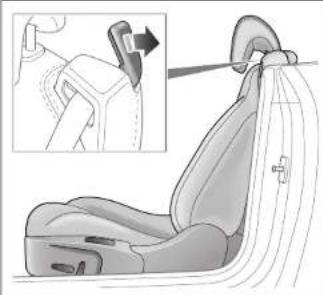
natural_image
Illustration of a car seatbelt with a pull-up inset showing the seatbelt being lifted (no text or symbols present)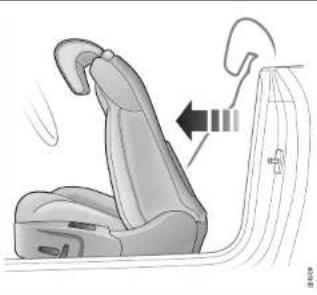
natural_image
Illustration of a car seatbelt with motion arrows indicating movement (no text or symbols)"Easy entry" function. Illustration shows an electrically adjustable seat *
Manually adjusted passenger seats \*
1 Raise the handle by the head restraint on the seat.
2 Tip the backrest and slide the seat forward.
Repositioning
1 Tip back the backrest.
2 Slide the seat back to the desired position.
Make sure the backrest and seat are properly locked in position. Correct locking is indicated by a clear clicking noise.
Electrically adjustable front seats \*
1 Raise the handle by the head restraint on the seat.
2 Tip the backrest forward.
3 The seat now moves to its foremost position.
Repositioning
1 Tip the backrest back to its normal position.
2 Raise and hold the handle while the seat is moved back. Release the handle when the seat has been moved to the
1 Tip the backrest back to its normal position.
1 Tip the backrest back to its normal position.
2 Raise and hold the handle while the seat is moved back. Release the handle when the seat has been moved to the


93 US MY09.book Page 74 Tuesday, April 15, 2008 10:30 AM
74 9-3 Convertible
required position. Correct locking is indicated by a clear clicking noise.
Repositioning (seats without memory)
1 Tip the backrest back but not to its normal position.
2 Raise and hold the handle until the seat has returned to its previous position.
3 Release the handle and move the back-rest to locked position. Correct locking is indicated by a clear clicking noise.
Head restraints
WARNING
- Adjust the head restraint so that the head is optimally supported and the center of the head restraint is at ear height, thus reducing the likelihood of neck injury in a crash.
- Raise the head restraints in the seats that are occupied.
The front seats are equipped with Saab Active Head Restraints (SAHRs). These are designed to reduce the risk of neck injury if the car is hit from behind.
The SAHR is a mechanical system, actuated by body weight. The mechanism is built into the top of the backrest, where it is connected to the head restraint.
In the event of a rear-end crash, the body is forced back against the backrest. This, in turn, causes the mechanism to press the head restraint forward and upward, thus limiting the backward movement of the head.
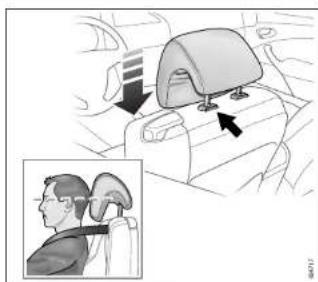
text_image
Diagram illustrating car seatbelt usage with directional arrows and a close-up of the person's seatbelt attachment.Front head restraint
The front head restraints can be raised and lowered to a number of positions, the rear has two positions.
- Raising: grasp the head restraint on both sides and pull it straight up.
- Lowering the front head restraints: press in the left catch and press the head restraint down.


93 US MY09.book Page 75 Tuesday, April 15, 2008 10:30 AM

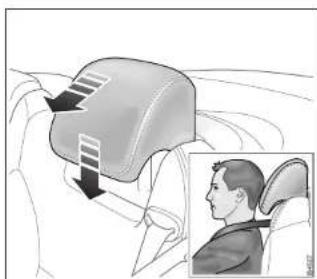
natural_image
Diagram of a car headrest with directional arrows indicating movement, inset shows close-up of a person (no text or symbols)Rear head restraint
The rear head restraints can be fully lowered to improve rearward vision when the rear seats are unoccupied.
Safety belts, rear seat, Convertible
The two rear seats have three-point safety belts with inertia reels.
Fasten the belt by pulling the belt and inserting the tongue in the buckle. Check that it is securely fastened.
Position the lap part low across the hips.
Grasp the shoulder belt close to the buckle and pull the belt towards the shoulder to tighten the lap belt part.
The belt must be as far in on the shoulder as possible.
Press the red button on the belt buckle to release the belt.
Refer to page 266 for how to check the function of the safety belts, cleaning, etc.
WARNING
- If cargo has to be placed on a seat, it must be properly secured with the safety belt. This reduces the risk of the cargo being thrown about during hard braking or a crash, which could cause personal injury.
- Check that the belt is not twisted or lying against sharp edges.
- Make sure you use the correct safety belt buckle.
For how to secure loads on the rear seat, refer to page 17.



93 US MY09.book Page 76 Tuesday, April 15, 2008 10:30 AM
76 9-3 Convertible

natural_image
Technical illustration of a car seat assembly showing a belt buckle being inserted into a seatbelt (no text or symbols present)Safety belts, rear seat, Convertible
Rollover Pop-up Bars
The Rollover Pop Up Bars, which are located behind each rear seat head restraint, are designed to deploy in the event of a crash or rollover.
WARNING
You can be severely injured or killed in a crash if you are not wearing your safety belt - even if you have airbags and Roll-over Pop Up Bars. Wearing your safety belt during a crash helps reduce your chance of hitting things inside the vehicle or being ejected from it.
- The Rollover Pop Up Bars have powerful springs that rapidly extend the bars in rollover crashes, as well as in moderate to severe crashes in which the airbags deploy. Rollover Pop Up Bars are supplemental to the safety belts. They are designed to work with safety belts but do not replace them.




93 US MY09.book Page 77 Tuesday, April 15, 2008 10:30 AM


- Rollover Pop Up Bars deploy with great force, and you could be injured if your arm or other body part, or if an object is covering the bars when they deploy. Don't put anything on the cover of the Rollover Pop Up Bars. The path of the Rollover Pop Up Bars must be kept clear.
• The Rollover Pop Up Bars are designed to deploy only once. If they deploy, take your vehicle to a workshop immediately to have the Rollover Pop Up Bars repaired so that they operate properly in the event of a crash or rollover. We recommend that you contact a Saab dealer.
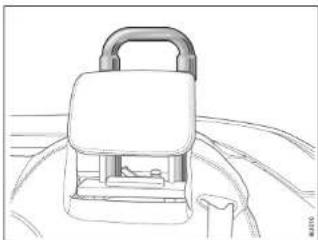
natural_image
Line drawing of a mechanical lock mechanism with no text or symbolsRollover Pop-up Bars
Electric windows

WARNING
Bear in mind the pinch hazard when closing the side windows. May cause serious or fatal injuries!
• Always remove the remote control from the ignition switch when you leave the car to prevent personal injury caused by the activation of the electric windows, for example, due to children playing.
- The person operating the electric window is responsible for ensuring that no one, especially a child, has their head, hands or fingers in the window openings, before raising the window.
- Do not stick any part of the body or the head out through an open window while the car is moving.

NOTICE
To avoid the risk of damage to the soft top do not operated the soft top while the bars are extended.


93 US MY09.book Page 78 Tuesday, April 15, 2008 10:30 AM
78 9-3 Convertible
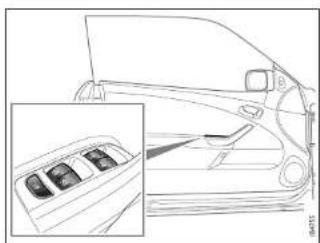
natural_image
Line drawing of a car interior showing the front panel and side window, with an inset close-up of three windows (no text or symbols)Window switches
To open
Soft top raised – The windows open individually.
Soft top folded – The button for the front window opens both side windows.
Automatic opening
Press the button all the way down and release it. If the soft top is folded, the rear side window is also lowered.
To close
Soft top raised – The windows are operated individually.
Soft top folded – The button for the front window closes both side windows.
Automatic closing of a front side window
Raise the button all the way and release it. The rear side window must be fully closed. Pinch protection ✦ is available for the front side windows.
For further information on the electric windows, refer to page 119.
Deactivating the passenger door window button
With the 📄 button on the driver's door, you can deactivate the window button on the passenger door.
The illuminated switch will change color from green to amber (deactivated).
Calibrating front electric windows with pinch protection \*
The window lifts should be calibrated if automatic closing does not work or if the battery has been disconnected. The pinch protection will not work if the windows are not calibrated.
Perform calibration as follows:
1 Make sure the soft top is raised.
2 Make sure the doors are closed.
3 Let the engine idle.
4 Make sure the rear side windows are closed, then operate each front window switch for moving the corresponding window fully down and fully up, repeat up to 3 times depending on conditions. Keep switch pressed a few seconds in fully up position after each "up" movement. When a chime is heard, the calibration is completed.
If calibration fails twice in a row, have the car checked and rectified. We recommend that you contact a Saab dealer.


93 US MY09.book Page 79 Tuesday, April 15, 2008 10:30 AM
Interior lighting
The interior lighting consists of a front roof light, two front reading lights, footfall lighting and courtesy lighting in the doors. The light switches are located in the roof console.
The cabin lighting comes on
- When a door is opened and the ignition is OFF.
- When the remote control is removed from the ignition switch.
The lighting goes out
- When the car is locked.
- When the ignition is turned on.
- Approx. 20 seconds after closing all doors.
The lights are dimmed out gradually. If a door is left open with the ignition OFF, the interior lighting goes out automatically after 5 minutes so as not to drain the battery.
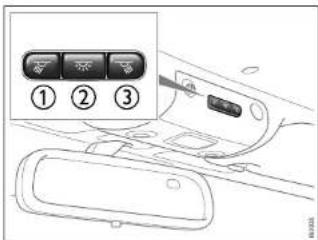
text_image
Diagram showing car interior control panel with three labeled buttons and a handleFront interior lighting - Convertible
1 Left-hand reading light
2 Cabin light
2 Cabin light
3 Right-hand reading light
The interior lighting can be switched off completely.
1 Open the driver's door.
2 Turn off the cabin lighting with the center button, see illustration.
This is canceled when the ignition switch is turned to position ON or when the car is locked with the remote control.
799-3 Convertible
Glove box
The glove box lighting comes on when the compartment is opened and goes out when it is closed.
For changing bulbs, refer to page 228.
Sun visor
An illuminated vanity mirror is provided on the inside of the sun visors. The lighting comes on when the cover is raised and goes out when it is closed.
Trunk lighting
The trunk lighting comes on and goes out when the trunk lid is opened and closed.
If the trunk lid is left open, the lighting will be switched off automatically after 20 minutes to prevent the battery from running flat.
For changing bulbs, refer to page 230.

natural_image
Pure geometric diagram with crosshair and circular shapes, no text or symbols present93 US MY09.book Page 80 Tuesday, April 15, 2008 10:30 AM
80 9-3 Convertible
Unlocking the trunk lid manually
If the trunk lid is not unlocked by the central locking system, it can be unlocked manually.
1 Take the traditional key out of the remote control by pressing the emblem on the reverse (see page 54).
2 Carefully prise off the round cover using your nails, a credit card or similar so as not to damage the paintwork.
3 Unlock the trunk lid using the traditional key.
We recommend that you contact a Saab dealer to have the central locking system checked.
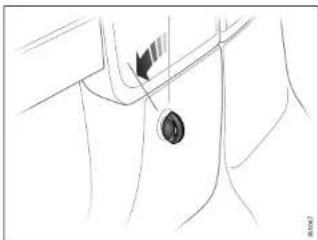
natural_image
Medical illustration showing a surgical instrument inserted into a patient's lower abdomen (no text or labels)Unlocking the trunk lid manually
Spoiler on trunklid \*
WARNING
Some models have a spoiler on the trunk-lid. Avoid getting fingers and hands trapped between the spoiler and rear fender when closing the trunklid.
Wind deflector \*
A wind deflector is available as an accessory. Follow the fitting instructions supplied with the wind deflector carefully.


[NO TEXT]
[NO TEXT]
[NO TEXT]
[NO TEXT]
[NO TEXT]
text_image
93 US MY09.book Page 81 Tuesday, April 15, 2008 10.30 AM
text_image
81Instruments and controlsInstruments and controls

text_image
Automotive dashboard and control panel with Chinese labels, showing speedometer, air conditioner, and fan controls| Warning and indicator lights | 82 |
| Instruments | 87 |
| Saab Information Display (SID) | 89 |
| Switches | 97 |
| Wipers and washers | 103 |
| Automatic climate-control system (ACC) | 107 |
* Asterisk means: equipment not fitted in all cars (can depend on model variant, engine variant, market specification, options or accessories).


93 US MY09.book Page 82 Tuesday, April 15, 2008 10:30 AM
82 Instruments and controls
Main instrument panel

text_image
① ② ③ ④ ⑤ ⑥ ⑦ ⑧ ⑨ mpb 60 70 80 90 100 110 120 130 140 150 160 170 180 190 200 210 220 230 240 245 250 255 260 265 270 275 280 285 290 295 300 310 320 330 340 345 350 355 360 365 370 375 380 385 390 395 400 405 410 415 420 425 430 435 440 445 450 455 460 465 470 475 480 485 490 495 500 510 515 515 520 525 525 530 535 535 540 540 545 545 550 550 555 555 560 560 565 565 570 570 575 575 580 580 585 585 590 590 595 595 600 610 615 615 620 620 625 625 630 630 635 635 640 640 645 645 650 650 655 655 660 660 665 665 670 670 675 675 680 680 685 685 690 690 695 695 700 710 715 715 720 720 725 725 730 730 735 735 740 740 745 745 750 750 755 755 760 760 765 765 770 770 775 775 780 780 785 785 790 790 795 795 800U.S. shown, Canada similar
Main instrument panel
1 Tachometer
2 Speedometer
3 Turbo gauge
4 Fuel gauge
5 Engine temperature gauge
6 Information display
7 Trip meter reset button
Warning and indicator lights
The warnings and indications that can be shown depend on the engine variant and equipment level.

Antilock braking warning
This warning light illuminates when a fault arises in the antilock brake system.
The following message is shown on the Saab Information Display (SID):

Antilock brake malfunc. Contact service.
The brake system will continue to function but without ABS modulation. See also page 170.





93 US MY09.book Page 83 Tuesday, April 15, 2008 10:30 AM


Charge warning light
This light comes on when the battery is not being charged by the alternator. If the light comes on during driving, stop as soon as possible and switch off the engine.
The following message is shown on the Saab Information Display (SID):

Battery not charging. Make a safe stop.
Check the drive belt, see page 215.

Warning, tire pressure
The light illuminates if the tire pressure in one or more tires is too low or if a fault has arisen in the system, see page 253.
Below is an example of the message simultaneously shown on the SID:

Tire pressure low, rear left. Check tires.

Warning, oil pressure (engine oil)
This light will come on if the engine oil pressure is too low. If the warning light flashes or comes on while you are driving, stop immediately in a safe place, switch off the engine and check the oil level (see page 208).
NOTICE
Never drive the car when the oil pressure warning lamp is on. Low oil pressure can cause serious engine damage.
The following message is shown on the Saab Information Display (SID):

Oil pressure low. Make a safe stop.

Service Engine Light also known as CHECK ENGINE
WARNING
An illuminated Service Engine Light also known as CHECK ENGINE Indicator light indicates an engine-related problem. While your car may be able to be driven with the "Service Engine Light also known as CHECK ENGINE" Indicator light illuminated (llimp-home mode), you are advised to have your car serviced at an authorized Saab dealer as soon as possible.
Continued driving without this problem being corrected might cause serious further damage to your car and create unsafe driving conditions. The operator should be prepared to take action if such unsafe conditions arise (e.g. brake smoothly, engage neutral, stop in a suitable place, switch off the engine, etc.)
This light indicates a malfunction in the fuel or ignition system.
Did you recently put fuel into your vehicle? If so, reinstall the fuel cap, making sure to fully install the cap. See Fuel cap on page 157. The diagnostic system can determine if the fuel cap has been left off or improperly installed. A loose or missing fuel


93 US MY09.book Page 84 Tuesday, April 15, 2008 10:30 AM
84 Instruments and controls
cap will allow fuel to evaporate into the atmosphere. A few driving trips with the cap properly installed should turn the light off.
The following message is shown on the Saab Information Display (SID):

Tighten fuel filler cap.
If the light is still on the car may still be driven with care but the performance of the engine will be somewhat diminished (see page 153).
The following message is shown on the Saab Information Display (SID):

Reduced engine power. Contact service.
NOTICE
The car should be checked immediately at a Saab dealer to prevent more serious faults from arising.

Front fog lights \*
This light indicates when the front fog lights are on (see page 100).
The front fog lights are switched off automatically when the engine is switched off. When the fog lights are next needed, they will have to be switched on manually.

Brake warning light
This light should come on briefly when you turn the ignition key to ON. If it doesn't come on, have it fixed so it will be ready to warn you if there is a problem. This light indicates when the brake fluid level is too low (see page 212).
The following message is shown on the Saab Information Display (SID):

Brake fluid level low. Make a safe stop.

WARNING
- Never drive the car if these two lights are on at the same time. Danger of brake failure!
- If the level of brake fluid in the reservoir is below the MIN mark, the vehicle should be transported on a recovery vehicle.
- Have the brake system checked immediately at a Saab dealer.
For safety reasons, stop the car and check the level of the brake fluid (see page 212).
If the level is normal, depress the brake pedal firmly two or three times. Now check the level again. If the level is still normal, you may drive the car, with considerable caution, to the nearest workshop to have the brake system checked. We recommend that you contact a Saab dealer.

High beam Indicator
This light shows when the high beam is on (see page 99).


93 US MY09.book Page 85 Tuesday, April 15, 2008 10:30 AM
The brake system provides Electronic Brakeforce Distribution (EBD). This distributes the brake pressure between the front and rear wheels, in such a way as to achieve optimum braking performance irrespective of the car's load.
If a fault arises in the EBD function, the
and lights will come on. Also, the following message will appear on the Saab Information Display (SID):

Brake malfunction. Make a safe stop.
If this is the case, drive carefully and contact a workshop as soon as possible. We recommend that you contact a Saab dealer. Refer to Brake warning light on page 84, Antilock braking warning on page 82 and ESP® OFF indicator on page 86.

Safety belt reminder
This light reminds the driver to buckle up, see page 12.

Parking brake warning light
This light comes on when the parking brake is applied (see page 177).
The parking brake is mechanical and operates on the rear wheels.
If the parking brake is applied when the car starts off, the following message will appear on the Saab Information Display (SID):

Release park brake.

WARNING
• Always apply the parking brake when parking, see page 177.
• Always apply the parking brake before removing the remote control.
- Do not apply the parking brake while the car is moving.

Airbag warning light
This light comes on if a potentially serious fault has occurred in the airbag system, see also page 32.
The following message is shown on the Saab Information Display (SID):

Airbag malfunction. Contact service.

WARNING
- If the airbag readiness light stays on after you start your vehicle, it means the airbag system may not be working properly. One or more of the following conditions may occur:
– Non-deployment of the airbags in the event of a crash.
- Deployment of the airbags without a crash.
- Deployment of the airbags in crashes less severe than intended.
• To help avoid injury to yourself or others, have your vehicle serviced right away if the airbag readiness light stays on after you start your vehicle.
This light will come on for about four seconds when the ignition switch is turned to the Start or Drive position.


93 US MY09.book Page 86 Tuesday, April 15, 2008 10:30 AM


86 Instruments and controls

Indicator, fuel
This light comes on when there is less than about 2.5 gallons (10 liter) of fuel left in the tank.
NOTICE
If the car runs out of fuel, air can be drawn in with the fuel, which, in turn, can cause the catalytic converter to be damaged by overheating.

ESP® indicator
This symbol lights up when the system is operative.
Operation of the ESP ^® indicates reduced cohesion between the tires and the road, and that extra care should be taken by the driver.

ESP® OFF Indicator
This symbol lights up when the system is disengaged, see page 176.
If there is a malfunction, the symbol cannot be turned off by pressing the ESP® button.
The following message is shown on the Saab Information Display (SID):

Stability control failure. Contact service.
If so, have the system checked at a Saab dealer.
See also Electronic Stability Program ESP® on page 175.


Headlight and parking light indicator
This light indicates that the headlights or parking lights are on.

Cruise control indicator light
This light comes on when the system is engaged.

WARNING
The system improves stability and maneuverability under slippery road and extreme driving conditions. It must however not be regarded as a system to enable the driver to maintain higher speeds. The same precautions as normal for safe cornering and driving on slippery roads must be adopted (see pages 173/ 175).


93 US MY09.book Page 87 Tuesday, April 15, 2008 10:30 AM
87Instruments and controls

text_image
(! (ABS) (P) (100000000000000000000000000000000000000000000000000000000000000000000000000000000000 #A#
text_image
1 min x 1000
text_image
mph 10 20 30 40 50 60 70 80 90 100 110 120 130 140 150 160 170 180 190 200 210 220 230Autochecking of lights, main instrument panel
The warning and indicator lights shown above should come on when the ignition switch is turned to ON. They should go out after about 4 seconds once the engine has started or after the fault-free self-diagnosis of each system or function.
Instruments
Tachometer
The tachometer displays the engine speed in thousands of revolutions per minute.
A protective function (interruption of the fuel supply) limits the engine speed within the red zone.
Speedometer
(U.S. speedometer shown)
Cars sold In U.S.: The speedometer displays the speed of the car in miles per hour (mph).
Cars sold in Canada: The speedometer displays the speed of the car in kilometres per hour (km/h).
It receives information about vehicle speed from the ABS's wheel sensors.


93 US MY09.book Page 88 Tuesday, April 15, 2008 10:30 AM
88 Instruments and controls
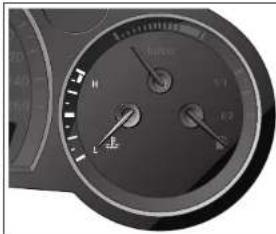
natural_image
Close-up of a mechanical gauge or dial with no visible text or symbols (pure technical drawing)Temperature gauge
The temperature gauge shows the temperature of the coolant. The needle should be in the middle of the scale when the engine is at normal operating temperature.
If the needle goes into the red zone (which can occur at high outside air temperatures or under heavy engine loads), choose the highest possible gear ratio and the lowest possible engine speed, and avoid shifting down.
NOTICE
If the needle, despite the above action, enters the red zone, stop the car in a suitable place and allow the engine to idle. If the needle continues to rise, switch off the engine.
If the needle repeatedly enters the red zone, stop the car as soon as it is safe to do so and check the coolant level (see page 210).
WARNING
Never open the cap of the expansion tank completely when the engine is hot, open with care. The pressure in the cooling-system can cause hot coolant and steam to be released. Failure to heed this warning may result in personal injury.

natural_image
Close-up of a car dashboard with a 'turbo' dial and two gauges (no visible text or symbols beyond the label)Turbo gauge
The turbo gauge indicates the air volume used for combustion, which is equivalent to the engine load.
At low loads and when the engine is used for braking, the needle will move within the white zone.
Under certain barometric conditions the needle may enter the first part of the red zone without necessarily indicating that a fault has arisen.





93 US MY09.book Page 89 Tuesday, April 15, 2008 10:30 AM
89Instruments and controls
If the needle repeatedly enters the red zone and the engine at the same time loses power, because the monitoring system is limiting the boost pressure, you should contact a Saab dealer as soon as possible.
If the speed of the car exceeds 143 mph (230 km/h) (this speed varies between different engine variants), acceleration is limited by reducing the boost pressure. The pressure gauge then moves towards the middle of the white field, indicating a drop in engine power and consequently the car's speed.
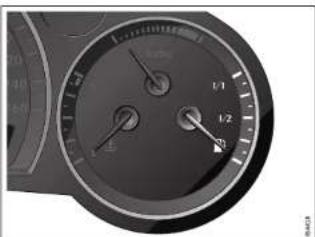
natural_image
Close-up of a mechanical gauge or dial with two valves and a pointer, no visible text or symbols.Fuel gauge
When less than about 2.5 gallons (10 liter) of fuel is left in the tank, a warning light on the main instrument panel comes on.
Because of the fuel remaining in the tank, the amount of fuel required to fill the tank may be less than the specified tank capacity.
Refueling, see page 156.
Saab Information Display (SID)
- Various types of information are shown on the SID: warnings, indications, trip computer information and information from the car's Infotainment System.
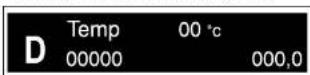
- Selected gear is shown on the left-hand side of the display. When gears are selected manually, the letter M (manual) and the selected gear are displayed (see page 168) (cars with automatic transmission).
- In the first row trip computer information is displayed and in the second row odometer and tripmeter is displayed.


93 US MY09.book Page 90 Tuesday, April 15, 2008 10:30 AM
90 Instruments and controls
When a message is displayed
The odometer and tripmeter is temporarily turned off when a two row message is displayed. The icon is displayed in the left part of the display.
The warnings and indications that can be shown on the SID are listed on page 294.
If there is more than one message on the SID, a plus sign will be displayed to the left of the first message. Each message will be displayed for 10 seconds.
Press the CLR button to acknowledge a SID message. If you acknowledge a message but do nothing about it, the message will be displayed again the next time you start the car.
When the engine is switched off the warning/indicator lights still active are displayed, this is to remind the driver. At this point the warning/indicator lights previously acknowledged with the CLR button are also displayed.
You can adjust the settings of several of the car's systems, such as the alarm *, rain sensor * and climate control system. These are known as Settings se page 94.

text_image
Diagram showing car dashboard control panel and steering wheel with speedometer, alongside a close-up of the dashboard's dial.SID, control unit and display
Odometer and trip meter
The odometer records the distance travelled in miles on U.S. vehicles and on Canadian vehicles the distance indicated is in kilometres, and the trip meter in miles and tenths (kilometres and tenths of kilometres on Canadian vehicles).
Reset button
The reset button is positioned immediately to the left of the speedometer.
Press once to resets the trip meter, the ignition shall be in position ON.
Trip computer function of the SID
| WARNING |
| It is strongly recommended that the SID settings be changed only when the car is stationary. The driver's attention can otherwise easily be distracted from the road. |
SID contains the following functions:
| Temp Outdoor temperature |
| D.T.E. Estimated range (distance to empty fuel tank).When the possible range is less than 18 miles (30 km)then the text Refill fuel now is displayed. |
| Fuel ∅ Average fuel consumption since function last reset |
| Dist Distance to destinations.Function can also be used as a trip meter |
| Speed ∅ Average speed since function last reset |
| Speed W Speed warning (chime) |
| Settings Settings of features such as alarm clock, language and rain sensor * |





93 US MY09.book Page 91 Tuesday, April 15, 2008 10:30 AM
91 Instruments and controls
When the engine is started, the function that was selected when the engine was switched off is displayed, with the following exceptions:
- Temp is displayed if the outside temperature is between 26 and 38^ (-3 and +3^ ).
• D.T.E. is displayed if less than or equal to 30 miles (50 km).
Outdoor temperature

WARNING
Remember that roads can be icy even at temperatures of above 38^ F (+3°C), especially on bridges and stretches of road that are sheltered from the sun.
The Temp function is always activated (even in NIGHTPANEL mode) if the outdoor temperature rises or falls to between 26 and 38 °F (-3 and +3 °C).
If the temperature sensor, located under the front bumper, is covered by snow or ice, temperature readings will be unreliable.
Setting values
1 Select one of the functions using the steering wheel controls, or .
- Dist (preset to 100 miles (100 km) if not previously set)
• Speed ∅
• Speed W (preset to 55 mph (90 km/h).
2 Press and hold the SET button until given audible confirmation.
3 Use the steering wheel controls to select the value. (Press CLR to reset the value.)
4 Press the SET button to finish setup.
Using DIST as a trip meter
1 Select Dist using the steering wheel

Id the CLR button for cond.
An arrow will now appear on the right-hand side of the display, indicating that the trip meter is running.
Resetting a single function
1 Select the function you wish to reset using the steering wheel controls,

• Fuel∅
• Speed ∅
- Trip (Dist used as trip meter).
2 Press and hold the CLR button for approx. 1 second.
The selected function will now be reset.



93 US MY09.book Page 92 Tuesday, April 15, 2008 10:30 AM
92 Instruments and controls
Resetting the trip computer
Press and hold the CLR button (approx 3 seconds) until audible confirmation is given.
The following functions will be rest:
• Fuel∅
• Speed ∅
• D.T.E. (the value is reset to the distance possible on the remaining fuel if fuel consumption is 10l/100 km, lower consumption means a longer possible distance)
- Trip (Dist used as trip meter).
Speed warning
This value is preset to 55 mph (90 km/h). The value can be set to between 0 and 150 mph (0 and 250 km/h).
1 Select Speed W using the steering wheel controls, 📋.
2 Press and hold the SET button until given audible confirmation.
3 Adjust the speed using the steering wheel controls.
4 Confirm the setting by pressing the SET button.
Go back/modify using the CLR-button.
The word ON on the right-hand side of the display indicates when the speed warning function is active.
An audible alarm will sound if the set speed is exceeded.
Disengage the function with the CLR button. Re-engage the function using the SET button.
Calculating the arrival time
(When will I arrive if I know how far I have to drive?)
This function should be used before starting out a journey.
To calculate the arrival time, the distance must first be given.
1 Select Dist using the steering wheel controls, ▶ or .
2 Press and hold the SET button until given audible confirmation.
3 Set the distance to the destination using the steering wheel controls.
4 Confirm the setting by pressing the SET button.
The calculated arrival time will now appear on the right-hand side of the display.
If you take a break, this time will be added to the previously calculated arrival time.





93 US MY09.book Page 93 Tuesday, April 15, 2008 10:30 AM
You can check the distance left by selecting Dist. At the same time you can check the calculated time of arrival.
After the distance to destination has decreased to zero, Dist will function as a trip meter (see Using DIST as a trip meter). The starting value for the trip meter will be the last distance set for the Dist function.
Example: The Dist function is set to 100 miles. After the count-down has reached 0 miles, Dist will act as a trip meter beginning at 100 miles.
Calculating the arrival time if a specified average speed is maintained
(When will I arrive if I know how far I have to drive and know what my average speed will be?)
This function should be used before starting out a journey.
First, set the distance under Dist.
1 Then select Speed ∅ function.
2 Press and hold the SET button until given audible confirmation.
3 Set the estimated average speed using the steering wheel controls.
4 Confirm the setting by pressing the SET button.
The distance and the calculated time of arrival is now displayed.
The time of arrival is updated during the journey based on the average speed since Dist was set. The speed of the car must exceed 12 mph (20 km/h).
By selecting Dist during the journey, you can see how much distance is left to travel.
When Dist reaches zero it acts as a trip meter. The trip meter starts from the distance that was set previously.
93Instruments and controls
NIGHTPANEL
To improve night-driving conditions inside the car, the Night Panel mode can be selected. In this mode, the amount of information displayed is reduced, and only the most important instruments and displays will be illuminated.
When the NIGHTPANEL button is pressed, only the speedometer will be illuminated.
All other instrument lighting will be switched off and the needles drop to zero.
Note: All Indicator and warning lights and messages will operate normally if required.
Temp (when the outside temperature falls or rises to between 26 and 38 °F (-3 and +3 °C)) and D.T.E. (when the remaining fuel is only sufficient for approx. 80 miles (50 km) of driving) are even shown in Night Panel model.

93 US MY09.book Page 94 Tuesday, April 15, 2008 10:30 AM
94 Instruments and controls
Under Settings you can choose whether the entire speedometer scale (0–160 mph) or only part of the scale (0–90 mph) should be illuminated in NIGHTPANEL mode.
1 Select Settings using the steering wheel controls, or .
2 Press and hold the SET button until given audible confirmation.
3 Select Speed Scale Illum.
4 Press the SET button.
5 Select 0–160 mph or 0–90 mph.
6 Confirm the setting by pressing the SET button.
Settings
Speed Scale Illum.
0–160 mph
0–90 mph
Alarm
1 Select Settings using the steering Under this heading you can select for example language and units.
2 Press and hold the SET button until given audible confirmation.
3 Select Alarm Clock using the steering press and hold the SET button until wheel controls. given audible confirmation.
ON or OFF is displayed.
@Press and hold the SET button until given audible confirmation.
- I f OFF is shown and the alarm time is to be set, press SET button (do not keep held in) and wait for the audible signal. The previously time set is now shown. Press SET button.
- I f ON is shown and the alarm time is to be activated, press SET button once, OFF is shown in the display. Press SET button again to activate the function.
4 Select alarm time using the steering wheel controls.
5 Confirm the setting by pressing the SET button.
Go back/modify using the CLR-button.
When the alarm sounds push one of the left steering wheel controls.
Settings
Under this heading you can select for example language and units.
1 Select Settings using the steering wheel controls, or .
3 Select heading using the steering wheel controls.
4 Press the SET button.
5 Select using the steering wheel controls.
6 Confirm the setting by pressing the SET button.
Select EXIT once you have made the desired settings.
The number of systems that are displayed on the SID depends on the car's equipment level. The list shown below includes the systems that can be found in your car.
Rain Sensor, page 103.
| HIGH |
| MEDIUM |
| LOW |
Theft Alarm, page 56.
| FULL ALARM |
| DOOR ONLY |



93 US MY09.book Page 95 Tuesday, April 15, 2008 10:30 AM
95Instruments and controls
Park Assistance, page 180.
ON
OFF
Alarm Clock, page 94.
ON
OFF
Language
ENGLISH UK
ENGLISH US
FRANCAIS
DEUTSCH
ITALIANO
ESPANOL
SVENSKA
Speed Scale Illum.
0–160 mph
0–90 mph
Speed Scale Sel.
BOTH SCALES
ONLY MPH SCALE
Unit
METRIC
US
IMPERIAL
Climate System, page 115.
Next Service: xx%.
INTERMEDIATE
MAIN
Time for Service.
INTERMEDIATE
MAIN
MAIN & INTERMED
Reset Service Ind?
YES NO
TCS, page 173.
ON
OFF
ESP, page 175.
ON
OFF
Explanation of the various selections under Settings.
Rain Sensor
The sensitivity has three levels.
Park Assistance
The Park Assistance can be shut off by choosing OFF.
Alarm Clock
Setting of alarm clock is possible.
Language
Select the desired language. The number of languages can vary between markets.
Speed Scale Illum.
Select the proportion of the speedometer to be illuminated in NIGHT-PANEL mode.
Speed Scale Sel.
Select if both scales or just mph-scale shall be illuminated in NIGHTPANEL mode.



93 US MY09.book Page 96 Tuesday, April 15, 2008 10:30 AM
96 Instruments and controls
Unit
Select the desired group of units.
Next Service: xx%
The SID includes two mutually independent counters, one for the main service and one for the intermediate service. When a service is carried out, e.g. intermediate service, the counter is roset for the intermediate service. The counter for the other service type, main service, continues unaffected. This means that once a service has been carried out, the counter may show e.g. 47% even though a service has just been carried out. The percentage refers, then, to the other service type.
MAIN
Main services are carried out at specific meter settings. This interval varies depending on market and engine variant. Contact a workshop for more information. We recommend that you contact an authorised Saab workshop.
INTERMEDIATE
The intermediate service, on the other hand, is carried out depending on the number of cold starts and the climate conditions in which the car is driven, for example. This is why the interval for this type of service varies.
MAIN & INTERMED
A combined service is carried out when the counters of both service types are close to one another.
Time for Service.
A service indication must only be reset after the service has been performed.
TCS/ESP
Select whether the system shall be on or off. The car has either TCS or ESP.
Resetting the service Indication
Reset the service indication in accordance with the following:
1 Turn the ignition switch to the ON position, the engine must be switched off.
2 Select Settings using the steering wheel controls, or.
3 Press and hold the SET button until given audible confirmation.
4 Select Time for Service.
5 Press the SET button.
6 To the question Reset Service Ind?
select YES (Press CLR button to undo).
Clock
Adjustments can be made in the Infotainment system.
See separate Manual.


93 US MY09.book Page 97 Tuesday, April 15, 2008 10:30 AM
97Instruments and controls
Switches
AUTO
Daytime Running Lights (DRL)
When the switch is in the AUTO position, there is an automatic switch between low-beam and Daytime Running Lights (DRL) based on the amount of daylight. Two sensors located at the top of the windshield detect upward and forward light intensity. This makes it possible for the system to automatically perform functions such as activating low beam when you drive into a tunnel on a sunny day.
Parking lights are turned off.

natural_image
Line drawing of a car dashboard and steering wheel (no text or symbols)Light switch
Cars with xenon lights: The bulbs for DRL are in the inner of the two bulb holders in the bulb housing. The bulb is visible from the outside.
Cars with halogen lights: These cars do not have a separate DRL bulb. Low beam instead shines with reduced output.
A fault in the system will produce the following message on the Saab Information Display (SID):
When the engine is started and the switch is in the AUTO position
Cars with automatic transmission: DRL or low beam (which depends on the amount of daylight) comes on when the gear selector is moved out of the P position. The light goes out when the ignition switch is turned to the OFF position (engine is turned off).
Cars with manual transmission: If the parking brake is applied when the engine is started, DRL or low beam (which depends on the amount of daylight) comes on when the parking brake is released. Otherwise, the light comes on when the ignition switch is turned to the ON position. The light goes out when the ignition switch is turned to the OFF position (engine is turned off).
High beam cannot be activated in the DRL mode but headlight flasher can.
In cold and damp weather, the Inside of the headlamp lens may temporarily mist up. This misting does not affect the function or service life of the light flitting. When the lamps are on, the mist will eventually disappear.

Automatic light control malfunction.


93 US MY09.book Page 98 Tuesday, April 15, 2008 10:30 AM
98 Instruments and controls
00
Parking lights
The parking lights can be turned on irrespective of the position of the ignition switch. If the parking lights are on and the driver's door is opened, a reminder to turn them off will sound.
Do not use the parking lights alone while driving.
When the switch is in the location, there is no automatic shift between low beam and DRL.
When it is time to turn on low beam the following message appears in SID:

Turn on the lights.
D
Headlights
Low beam headlights are turned on when the ignition switch is turned to ON and turned off when the switch is turned back to LOCK.
If the switch is in the ID position, there is no automatic switch between DRL and low beam. Low beam comes on when the ignition switch is in the ON position.
Headlight levelling \*
Cars with xenon headlights are equipped with an automatic headlight levelling system, which self-calibrates each time the vehicle is started.
If a fault arises in the automatic headlight levelling system, the headlights will be angled down to avoid dazzling drivers in oncoming traffic. Adjust your speed accordingly as the range of the headlights will be reduced. Check fuse 20 in the engine bay fuse box (see page 238).
A fault in the system will produce the following message on the Saab Information Display (SID):

Headlight levelling malfunction.
Special equipment is required for adjusting the basic headlight alignment.


93 US MY09.book Page 99 Tuesday, April 15, 2008 10:30 AM

99Instruments and controls
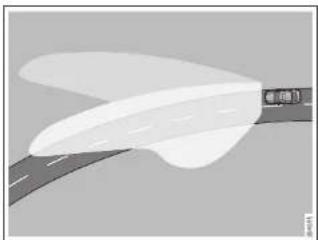
natural_image
Abstract grayscale illustration of a curved road with motion lines, no text or symbols presentXenon cornering headlights \*
When the car speed exceeds approx. 6 mph (10 km/h), the main headlight will be angled when the steering wheel is turned. The beam can be angled maximum 15° to the right or left compared to a car without cornering headlights.
If a fault occurs in the cornering headlights, there is no angling when the steering wheel is turned. The beam continues to shine straight ahead and the following message appears in SID:

Cornering headlights malfunction

text_image
① ② SETI+ SETI- OFF PIN ROUTEDimmer switch
1 Headlight flasher 2 High/low beam
High/low beam
To switch between high and low beam, pull the control stalk all the way towards the steering wheel. (Headlight switch must be ON.)
The symbol on the main instrument panel shows when the high beam is on.
Headlight flasher
To flash your headlights, pull the control stalk half-way towards the steering wheel. The high beam will remain on until you release the stalk.
Courtesy Headlamp Feature
A delay function allows the low beam headlights and back-up lights to remain on for about 30 seconds after the driver's door has been closed.
To activate this function:
1 After turning off the engine, remove the remote control.
2 Open the driver's door.
3 Pull the control stalk all the way towards the steering wheel.
The low beam headlights and reversing lights will come on and remain on for 30 seconds when the door is closed.


93 US MY09.book Page 100 Tuesday, April 15, 2008 10.30 AM
100 Instruments and controls

text_image
- 01 + NIGHT PANEL BENEFYFront fog lights \*
The front fog lights should be used in poor visibility.
These are automatically turned off when the engine is switched off. When the car is next started, the fog lights will have to be switched back on manually by pressing the fog light switch. If the engine is restarted within 30 seconds, the front fog lights will remain on but not if the light switch is in position AUTO.
Acquaint yourself with the legal provisions governing the use of front fog lights.
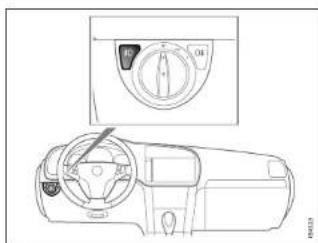
natural_image
Line drawing of a car dashboard with control panel and side view (no text or symbols)Front fog light switchAdjusting instrument illumination
Instrument lighting
The brightness of the instrument lighting can be adjusted by pressing the button (+ or - signs on the button above the NIGHT-PANEL button).


93 US MY09.book Page 101 Tuesday, April 15, 2008 10.30 AM

natural_image
Line drawing of a car dashboard with control panel and side view (no text or symbols)Rear fog light switch
Rear fog light
To turn on the rear fog light, press the rear fog light button on the instrument panel. The headlights or front fog lights must be on.
The rear fog light is automatically turned off when the engine is switched off. When the car is next started, the rear fog light will have to be switched back on manually by pressing the rear fog light switch. If the engine is restarted within 30 seconds, the rear fog light will remain on but not if the light switch is in position AUTO.
Rear fog light consists of one bulb.
Acquaint yourself with the legal provisions governing the use of rear fog light.
Turn signal & lane change indicators
The stalk switch has an intermediate, spring-loaded position that is useful for signalling when changing lanes or passing. The stalk switch also has fixed positions for indicating a right or left turn, that are cancelled automatically when the steering wheel is centered.
If an indicator bulb breaks, the frequency with which the indicators flash will be doubled.
This frequency is also doubled if a trailer is being towed and one of its indicator bulbs breaks.

text_image
① SETI+ ②Tum signal & lane change indicators 1 Right 2 Left
101Instruments and controls
















93 US MY09.book Page 102 Tuesday, April 15, 2008 10.30 AM
102 Instruments and controls
Hazard warning lights
! WARNING
Switch on the hazard flashers if the car has to be left at the roadside on account of a crash, engine trouble or a flat tire.
If you carry a warning triangle or flares, they should be set up along the side of the road 50–110 yds. (50–100 metres) behind your vehicle. If the car is not clearly visible (e.g. over the brow of a hill or bridge), place the triangle/flare even further back.
The button for the hazard warning lights is located on the climate control panel.
When the button is pressed, all the direction indicators and the symbol in the button flash simultaneously.
If an indicator bulb breaks, the frequency with which the indicators flash will be doubled.
Hazard warning lights should only be used if, because of an accident or breakdown, the car constitutes a hazard to other road users.

natural_image
Line drawing of a car dashboard with steering wheel and dashboard (no text or symbols)Hazard warning light switch

text_image
NIGHT PANEL —Button for accessory \*
This button can be used for accessories, such as extra lights.
Back-Up
The back-up lights come on automatically when reverse gear is engaged or selected with the ignition switched on.





93 US MY09.book Page 103 Tuesday, April 15, 2008 10.30 AM


103Instruments and controls
Priority of audible information
If two or more functions are active simultaneously, the most important function at that time will be prioritized.
If, for example, the direction indicators are active when you engage reverse, the parking assistance (if fitted) will be heard instead of the direction indicators. When reverse is disengaged, the direction indicators will be heard, if they are still active.
Wipers and washers
Windshield wipers
Position 1 is a spring-loaded position that will produce a single sweep of the wipers.
The wipers always return to their home position when the ignition is turned off.
To leave the wipers positioned vertically on the windshield, proceed as follows:
1 Switch off the engine and remove the remote control.
2 Activate the wipers within the next 16 seconds by pressing the stalk switch down.
When the ignition is next switched on the wipers will return to their home position.
Changing wipers blades, see page 216.
Rain sensor

WARNING
Turn the rain sensor off if the ignition is ON to avoid personal injury when clearing snow and ice from the windshield.
NOTICE
Turn the rain sensor off before washing the car in an automatic carwash, to avoid damaging the windshield wipers.
When the rain sensor is activated the following symbol is displayed in SID
The rain sensor automatically controls the windshield wipers. The sensor is located on the windshield beside the rearview mirror.
The system varies the frequency of wiping between single sweeps and continuous wiping, depending on the amount of precipitation.





93 US MY09.book Page 104 Tuesday, April 15, 2008 10.30 AM
104 Instruments and controls

text_image
2 1/1 0 ① ② ③ ④Windshield wipers with rain sensor
0 OFF
1 Single sweep
2 AUTO - rain sensor engaged
3 Low speed
4 High speed
5 Windshield and headlight washing *
Activate the rain sensor by lifting the stalk switch to the AUTO position. The wipers make one sweep for reference to see how much water is on the windshield. Thereafter the sensor compares the amount of water on the windshield with this reference value.
If the stalk switch is left in the AUTO position when the engine is switched off, when the engine is next started it must first be moved to the 0 or 3 position and then back to AUTO to reactivate the sensor.
If the system malfunctions, the wipers will operate at low speed when the stalk switch is set to the AUTO position and SID will show:

Rain sensor malfunc. Contact service.
Washers
Activate the washers by pulling the stalk switch towards the steering wheel.
When the washers are operated, the wipers will make 3, 4 or 5 sweeps, depending on how long the washers were kept on. If the speed of the car is less than 12 mph (20 km/h), the wipers will make an additional sweep after roughly 8 seconds.
When the washer fluid level drops below 1 quart (1 liter), the headlight washers (If equipped) are deactivated. This is in order to prioritize the windshield. The following message is displayed on the SID:

Washer fluid level low. Refill.





93 US MY09.book Page 105 Tuesday, April 15, 2008 10.30 AM


105Instruments and controls
Headlight washers \*
The headlights are washed at the same time as the windshield if the headlights are on.
The headlights are washed every fifth time the windshield washers are used or if two (2) minutes have elapsed since the windshield was last washed.
The headlight washers are not activated at speeds in excess of 125 mph (200 km/h).
Adjusting sensitivity
The sensitivity of the rain sensor can be adjusted under Settings.
1 Select Settings using the steering wheel controls, or .
2 Press and hold the SET button until given audible confirmation.
3 Select Rain Sensor.
4 Press the SET button.
5 Select the sensitivity.
6 Confirm this selection by pressing the SET button.
Go back/modify using the CLR-button.
| Rain Sensor | |
| HIGH | |
| MEDIUM | |
| LOW | |
The sensitivity of the sensor is also affected by the amount of daylight. The sensor is somewhat more sensitive at night. This adjustment is automatic.
Explanation of sensor sensitivity.
HIGH
The sensor is set to high sensitivity. The wipers start when there is only a small amount of water on the windshield.
MEDIUM
The sensor is set to normal sensitivity. This is one of the Default Settings.
LOW
The sensor is set to low sensitivity (wipers operate only with a large amount of water on the windshield, i.e., downpour).



93 US MY09.book Page 106 Tuesday, April 15, 2008 10.30 AM
106 Instruments and controls
Rear window wiper, SportCombi
To obtain:
- a single sweep: move the control to position 2, the control springs back to the home position.
- intermittent wiping, 6 seconds: move the control to position 2. If the windshield wipers are activated then the rear window wiper will automatically changeover to intermittent wiping when reverse gear is engaged and the engine is running.
- washing and wiping: move the control to position 3. The control returns to the home position. The wiper makes 3 sweeps after the washing has finished. If the speed of the car is below 25mph (40km/h) when the washing has finished the wiper makes an extra sweep after 5 seconds to wipe off any washer fluid residue.
The washer jet is not adjustable.
Changing wiper blade, see page 216.
When the washer fluid level drops below 1 liter, the rear window washer is deactivated. This is in order to prioritize the windshield. The following message is displayed on the Saab Information Display (SID):

Washer fluid level low.
Refill.
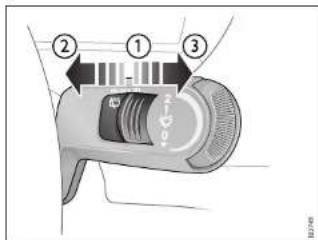
text_image
Diagram of a car interior with numbered parts and labeled features, likely illustrating a vehicle or engine component.Rear window wiper, SportCombi
1 OFF
2 Intermittent wiping
3 Washing and wiping





93 US MY09.book Page 107 Tuesday, April 15, 2008 10.30 AM
Automatic climate-control system (ACC)
Fresh air for the cabin is drawn in through an inlet at the bottom edge of the windshield. It passes through an effective filter before reaching the climate control system and delivery into the cabin. The air is evacuated via openings in the parcel shelf. It is then led through outlets on either side of the car behind the rear bumper.
The Automatic Climate-Control system (ACC) automatically maintains the desired cabin temperature, regardless of the weather outside.
The system will achieve the desired temperature in the quickest possible way.
Note that heating or cooling is not more rapid by setting the temperature higher or lower than the final temperature you desire.
To optimize the performance of the air conditioning system, all windows and the moonroof * should be shut. The air vents in the fascia must be open.

text_image
① ② 65 75 80 AUTO ③ ④ OFF ⑤ ⑥ 85 75 80 AC OFF ⑧ ⑨ ⑩ ⑦ACC panel
1 Temperature setting: left-hand side
2 AUTO (automatic regulation)
4 Manual setting of air distribution
5 Temperature setting: right-hand side
The incoming air is treated in three stages: first it passes through a filter; it is then dehumidified and cooled; and finally, if required, it is heated.
The filter is a combined particle and charcoal filter. It is so efficient that levels of noxious substances such as benzene and toluene are also reduced.
6 Recirculation
7 Seat heating, front right seat
8 Rear window and door mirror heating
9A/CUFF
10 Seat heating, front left seat *
To reduce potential misting on the insides of the windows, the glass should be cleaned with a quality glass cleaner. How often this will need to be done depends on how clean the air is - if there are smokers in the car, the windows will need to be cleaned more frequently.
[Non-Text]
[Non-Text]
[Non-Text]
[Non-Text]
[Non-Text]
[Non-Text]
[Non-Text]
[Non-Text]
(1)
[Non-Text]
[Non-Text]
[Non-Text]
[Non-Text]
[Non-Text]
[Non-Text]
[Non-Text]
[Non-Text]
[Non-Text]
[Non-Text]
[Non-Text]
[Non-Text]
[Non-Text]
[Non-Text]
[Non-Text]
[Non-Text]
(1)
[Non-Text]
[Non-Text]
[Non-Text]
[Non-Text]
[Non-Text]
[Non-Text]
[Non-Text]
[Non-Text]
[Non-Text]
[Non-Text]
[Non-Text]
[Non-Text]
[Non-Text]
[Non-Text]
[Non-Text]
[Non-Text]
[Non-Text]
[Non-Text]
[Non-Text]
[Non-Text]
[Non-Text]
[Non-Text]
[Non-Text]
[Non-Text]
[Non-Text]
[Non-Text]
[Non-Text]
[Non-Text]
[Non-Text]
[Non-Text]
[Non-Text]
[Non-Text]
[Non-Text]
[Non-Text]
[Non-Text]
[Non-Text]
[Non-Text]
[Non-Text]
[Non-Text]
[Non-Text]
[Non-Text]
[Non-Text]
[Non-Text]
[Non-Text]
[Non-Text]
[Non-Text]
[Non-Text]
[Non-Text]
[Non-Text]
[Non-Text]
[Non-Text]
[Non-Text]
[Non-Text]
[Non-Text]
[Non-Text]
[Non-Text]
[Non-Text]
[Non-Text]
[Non-Text]
[Non-Text]
[Non-Text]
[Non-Text]
[Non-Text]
[Non-Text]
[Non-Text]
[Non-Text]
[Non-Text]
[Non-Text]
[Non-Text]
[Non-Text]
[Non-Text]
[Non-Text]
[Non-Text]



93 US MY09.book Page 108 Tuesday, April 15, 2008 10.30 AM
108 Instruments and controls
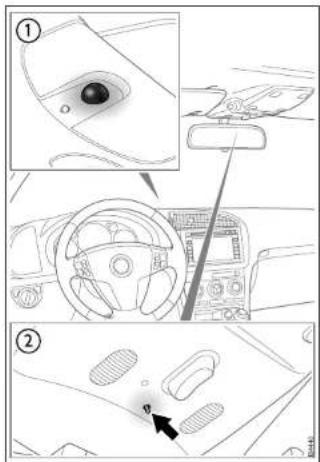
text_image
Diagram showing car interior and dashboard views with numbered annotations indicating key componentsSun- and cabin sensor, SportSedan and SportCombi
1 Sun sensor
2 Cabin temperature sensor
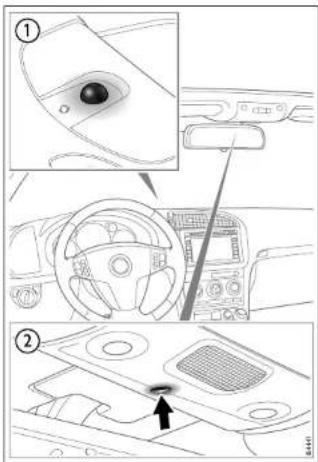
text_image
Diagram showing car interior and dashboard components with numbered annotations indicating parts of the dashboard and steering wheel.Sun- and cabin sensor, Convertible
1 Sun sensor
2 Cabin temperature sensor
The system uses seven sensors:
• Outside air temperature sensor
- Cabin air temperature sensor (by the interior rearveiw mirror)
• Sun sensor (on the facia)
- Blended air temperature sensors 2 (located in the front floor vents).
- Blended air temperature sensors 2 (located in the outer panel vents).
Note
If the sun sensor is covered, the ACC system will not be able to regulate the cabin climate as intended.


93 US MY09.book Page 109 Tuesday, April 15, 2008 10.30 AM
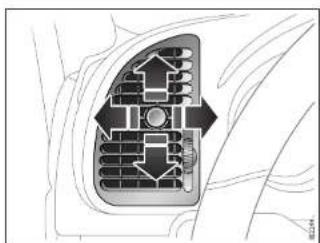
natural_image
Architectural floor plan diagram showing room layout and structural elements (no text or labels)Panel vent
Air vents
The air vents swivel universally, so that air can be directed as desired. In winter, for instance, the outer vents can be directed onto the door windows for enhanced demisting.
The amount of air can be individually controlled by the regulator on each vent. If you wish to reduce the airflow, start by half-shutting the vent in question.
Certain variants have an air vent on the rear of the floor console.
Temperature control
The cabin is divided into two temperature zones:
1 Driver's zone.
2 Passenger zone.
The temperature in the rear seat will be a mixture of the two zones.
The cabin temperature can be set to between 61–79 °F (16–26 °C).
The selected temperature is not the actual air temperature but corresponds to the comfort level normally experienced at that temperature after allowance has been made for the airflow, relative humidity, solar radiation, and so on, currently prevailing inside the car.
109Instruments and controls
- The most usual temperature setting is between 64–75 °F (18–24 °C), depending on personal preference and what clothing is worn.
- Change the temperature setting in 2^ (1 °C) steps.
Make sure the air vents are open when cooling the cabin in warm weather.
When the ignition is switched off, only the temperature control affects the system the next time the engine is started. The system will warm up/cool down to the temperature to which the control is set.

93 US MY09.book Page 110 Tuesday, April 15, 2008 10.30 AM
110 Instruments and controls
MAX heat (red indicator):
MAX heating is obtained when the temperature knob is turned to the first position past 79 (to the red LED).
The driver's side selection controls air distribution and the recirculation status. The temperature can be adjusted on the passenger side.
MAX heating produces:
- Max heat
• Air distribution to windscreen and floor - Recirculation OFF
- High fan speed.
MAX cooling (blue indicator):
MAX cooling is obtained when the temperature knob is turned to the first position past 61 (to the blue LED).
The driver's side selection controls air distribution and the recirculation status. The temperature can be adjusted on the passenger side.
MAX cooling produces:
- Max cooling effect (A/C compressor will run even if AC OFF has been selected)
• Air distribution through panel vents - Max fan speed
- Recirculation ON.
Condensation water
When the A/C compressor is on, the incoming air is dehumidified. The resulting condensation water is drained away through an outlet under the car.
It is therefore perfectly normal for water to be seen dripping from this outlet when the car is parked. The warmer the ambient air and the higher the humidity, the more condensation will form.


93 US MY09.book Page 111 Tuesday, April 15, 2008 10.30 AM


111 Instruments and controls
Functions
Pressing AUTO will cancel all manual settings.
If a manual function is selected, it will be locked in but other functions will be controlled automatically.
The selected temperature is always maintained automatically.

Temperature, air distribution, fan speed and recirculation will be controlled automatically. Pressing AUTO once will cancel all previous manual air distribution selections. When the engine is started, the ACC system will be in AUTO mode.

The A/C-compressor is turned off. The incoming air is not cooled or dehumidified. Temperature, air distribution, fan speed and recirculation will be controlled automatically.

Turn the fan control counterclockwise until "OFF" lights up. ACC-system OFF. Fan OFF. A/C-compressor OFF. Air distribution selections locked in current settings. Recirculation can be selected manually. Heating * of the front seats is deactivated. Pressing AUTO-button will put the system into automatic mode. Reactivation by turning the fan control clockwise one click causes the system to resume any manual selections.

The rear window and door mirror heating is controlled manually. Deactivate the heating as soon as the rear window is clear of ice and misting to avoid imposing a heavy load on the battery longer than necessary. Note, however, that heating will deactivate automatically after a set time.

Turn the fan control to increase fan speed. If fan speed 0 is selected, the A/C-compressor will be disengaged and the indicator on the AC OFF button will illuminate.

The recirculation is controlled automatically for optimum cooling. If necessary, recirculation can also be switched on manually for shorter times to avoid unpleasant air from entering the cabin for example. Poor air quality in the cabin could lead to tiredness. For this reason you should only drive in the recirculation position temporarily. If recirculation is switched on when the outside temperature is lower than about +37 °F (+3 °C) (A/C compressor disengaged) then the air humidity in the cabin increases which could cause misting on the windows.





93 US MY09.book Page 112 Tuesday, April 15, 2008 10.30 AM
112 Instruments and controls
Air distribution

text_image
Diagram illustrating vehicle airflow direction with arrows and icons, showing directional flow from top-left to bottom-right car interior.One press: When the defroster is chosen manually, all the windows (except the rear side windows, where the air flow is off) are demisted by:
• High fan speed.
• The air is directed to the defroster vents.
• Temperature increases somewhat.
- Recirculation OFF.
- Activation of rear window/door mirror heating.
The defroster function remains engaged until another selection is made. Heating of the rear window/door mirrors will, however, deactivate after a set time period.
Two presses: Air is directed to the windscreen without the fan speed being increase or the rear window heating being switched on.
To revert to a previous setting, press the AUTO button.
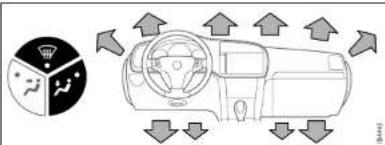
flowchart
graph TD
    A["Car Top"] --> B["Stealth Indicator"]
    B --> C["Exhaust Air Pollution"]
    C --> D["Top"]
    D --> E["Steen Wheel"]
    E --> F["Lower Air Pollution"]
    F --> G["Top"]
    G --> H["Steen Wheel"]
    H --> I["Lower Air Pollution"]
    I --> J["Top"]
Defroster and floor vents
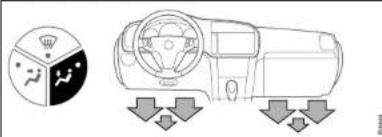
text_image
Diagram showing car interior and directional arrows indicating flow or movement, with icons for exhaust, parking, and parking.Floor vents

text_image
Diagram illustrating car safety perception with directional arrows and a circular gauge showing vehicle statusFloor and panel vents





93 US MY09.book Page 113 Tuesday, April 15, 2008 10.30 AM
113Instruments and controls
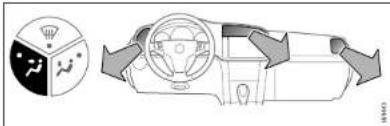
text_image
Diagram showing car interior and directional arrows indicating traffic flow or movement, with icons for lighting, parking, and parking.Panel

flowchart
graph TD
    A["Top Wheel"] --> B["Speedometer"]
    B --> C["Car with Top"]
    C --> D["Downward Arrow to Car"]
    D --> E["Downward Arrow to Car"]
    E --> F["Downward Arrow to Car"]
    F --> G["Downward Arrow to Car"]
Defroster, panel and floor
Start in cold weather
To start with, the system will automatically select the defroster setting, maximum heat and low fan speed.
As the engine warms up, air will also be distributed through the floor vents and the fan speed will be increased.
As the temperature inside the car nears the selected value, both the fan speed and the heat will be decreased to a level determined by the system.
Start in warm weather
The system will automatically distribute air through the panel vents at high fan speed and will activate the A/C compressor (unless the AC OFF switch has been pressed).
If the ambient air temperature is over 77 °F (25 °C), the recirculation cuts in after 0-15 seconds, if this is required in order to reach the desired temperature.
As the temperature inside the car nears the selected value, the fan speed will be decreased to a value determined by the system.


93 US MY09.book Page 114 Tuesday, April 15, 2008 10.30 AM
114 Instruments and controls
Formation of ice and mist in extreme weather conditions
It is only in the most extreme conditions that icing and misting of window glass are likely to be a problem, such as in torrential rain or severe cold coupled with high relative humidity, or when passengers are perspiring heavily or wearing wet clothes. The following measures are recommended if such problems should occur:
1 Select AUTO and set the temperature to 70 °F (21 °C)
2 Push one time on the defroster button. If this is not enough...
3 Increase the fan speed. If this is not enough...
4 Select a higher temperature.

Electric heating, front seats \*
The seat cushions and backrests of the front seats are heated.
Heating is thermostatically controlled.
The heating has two effect steps.
We do not recommend prolonged use of the higher level for people with sensitive skin.
Heating is controlled manually but can also be automatic. Refer to Settings on page 115.
Calibration
Calibration is performed automatically every 40:th time the car is started after having been switched off for more than 2 hours or if the battery has been disconnected.
Programming
A number of functions can be customized under Settings (see page 115).
Tips
(before contacting a dealer. We recommend that you contact a Saab dealer)
- If you feel that the ACC system is not functioning satisfactorily, select "Default Settings" under Settings, see page 115.
ACC- Convertible
When the soft top is folded, several functions in the ACC-system is effected. The system adjusts itself as follows:
• the sensitivity of the temperature knob changes
• air distribution and fan speed can only be adjusted manually
- Recirculation and rear window heating are cut out
- The A/C compressor is switched off (manual activation is possible by pressing the AC OFF button).
All manual selections are possible with the exception of rear window heating and defroster function.
When the soft top is raised, the system reverts to the AUTO mode and the set temperature.
Note: When the soft top or all the windows are open in a hot, humid climate, turning the air conditioning on manually can cause condensation to form on cold surfaces, such as the air ducts.


93 US MY09.book Page 115 Tuesday, April 15, 2008 10.30 AM


115Instruments and controls
Settings
Some of the functions of the ACC system can be customized.
1 Select Settings using the steering wheel controls, 📄.
2 Press and hold the SET button until given audible confirmation.
3 Select Climate System.
4 Press the SET button.
5 Select the Rear Defroster, Heated Seats, Fan Settings, A/C Mode or Default Settings.
6 Press the SET button.
7 Make your selection.
8 Confirm your selection by pressing the SET button.
Settings
Climate System
Rear Defroster
AUTO
MANUAL
Heated Seats
AUTO
MANUAL
Fan Settings
HIGH SPEED
MEDIUM SPEED
LOW SPEED
A/C Mode
AUTO
OFF
Default Settings
Are you sure?
YES NO
Explanation of how the ACC system can be customized under Settings.
Rear Defroster
AUTO
The rear window and door mirror heating is controlled automatically. This is one of the Default Settings.
MANUAL
The rear window and door mirror heating is switched on with the button on ACC panel.
Convertible: The rear window heating cannot be turned on when the soft top is folded.
Heated Seats
AUTO
The front seat heating is controlled automatically. Select the level by repeatedly pressing the appropriate button on the ACC panel.
MANUAL
See Electric heating, front seats * on page 114. This is one of the Default Settings.
Fan Settings
HIGH SPEED
This selection give a slightly higher fan speed than MEDIUM SPEED though with continued automatic regulation.
MEDIUM SPEED


93 US MY09.book Page 116 Tuesday, April 15, 2008 10.30 AM
116 Instruments and controls
Normal automatic fan speed. This is one of the Default Settings.
LOW SPEED
This selection give a slightly lower fan speed than MEDIUM SPEED though with continued automatic regulation.
Convertible: Fan speed is not regulated automatically when the soft top is open.
A/C Mode
Auto
Automatic engagement and disengagement of the A/C. This is one of the Default Settings.
A/C off
A/C compressor OFF (see also page 111). The A/C compressor can be activated temporarily by pressing the AC or AUTO button while on the road and if the outside temperature is above 41°F (+5°C). The A/C will be off the next time the engine is started, if the engine has been switched off for more than 2 hours.
Convertible: The A/C compressor is switched off when the soft top is folded down.
Further customizations to this function can be made at a workshop. We recommend that you contact a Saab dealer.
• The A/C compressor can be on even when the soft top is folded down.
- The A/C compressor can be set to operate as when the soft top was last folded down.


93 US MY09.book Page 117 Tuesday, April 15, 2008 10.30 AM
117Interior equipment


Interior equipment
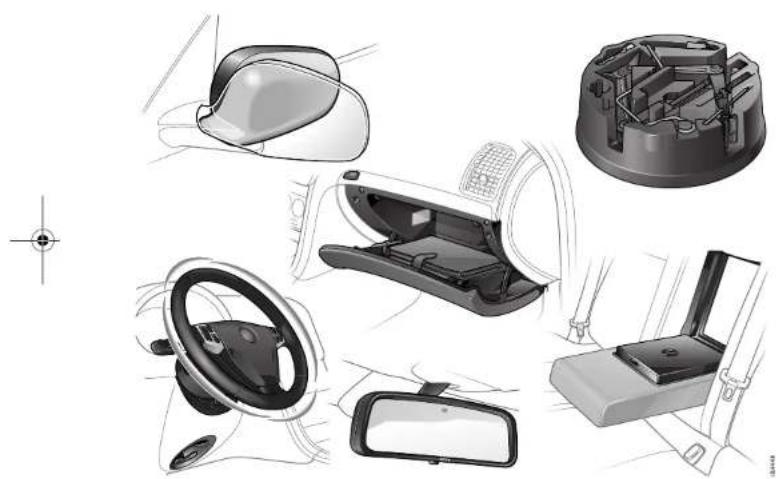
natural_image
Technical illustration of automotive components including steering wheel, dashboard, and rear-mounted device (no text or symbols)Steering wheel adjustment 118
Electric windows 119
Rear view mirrors 122
Moonroof * 128
Interior lighting 131
Cup holder * 133
Power Outlet * 134
Storage compartments 134
Trunk 136
* Asterisk means: equipment not fitted in all cars (can depend on model variant, engine variant, market specification, options or accessories).


93 US MY09.book Page 118 Tuesday, April 15, 2008 10.30 AM
118 Interior equipment
Steering wheel adjustment
WARNING
Only adjust the steering wheel while the car is stationary so that you are not distracted from the traffic.
The height and reach of the steering wheel can be adjusted.
There is a release lever under the steering column.
1 Pull down the lever to release the steering wheel.
2 Adjust the position of the steering wheel. 3 Raise the lever to the locked position to lock the steering wheel in position.
When returning the release lever to its locked position, you may need to adjust the position of the steering wheel slightly to allow the lock mechanism to engage correctly.
Steering wheel lock, see page 151.
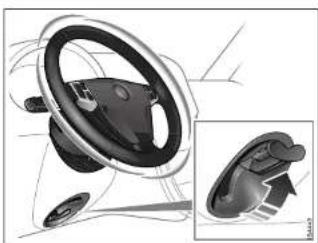
natural_image
Interior view of a car showing steering wheel and dashboard (no text or symbols visible)Lever for steering wheel adjustment

natural_image
Top-down diagram of a car steering wheel with labeled steering wheel (no text or symbols)Horn signal
Activate the horn by pressing one of the three areas shown above on the steering wheel pad.

93 US MY09.book Page 119 Tuesday, April 15, 2008 10.30 AM
119Interior equipment
Electric windows

WARNING
Bear in mind the pinch hazard when closing the side windows. May cause serious or fatal injuries!
• Always remove the remote control from the ignition switch when you leave the car. This will prevent personal injury caused by the activation of the electric windows, for example, due to children playing.
- The person operating the electric window is responsible for ensuring that no one, especially a child, has their head, hands or fingers in the window openings, before raising the window.
- Do not stick any part of the body or the head out through an open window while the car is moving.
The electric windows are operated by means of switches in the door armrests.
For the electric windows to work, the ignition switch must be in the ON position.
At the end of a journey and having removed the remote control, you can still operate the windows, so long as neither of the front doors has been opened.
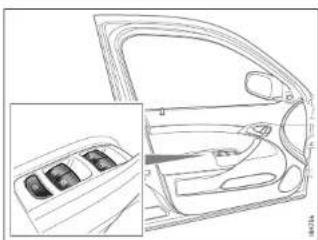
natural_image
Line drawing of a car interior showing the dashboard and side view with three compartments (no text or symbols)Window switches Window switch in rear door
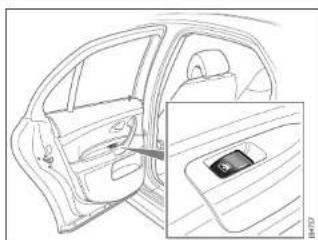
natural_image
Line drawing of a car interior showing the door, side view, and dashboard display (no text or symbols)Comfort opening \*
Comfort opening is the remote opening of windows and the moonroof.
Press and hold the unlocking button on the remote control until the windows and optional moonroof start to open (approx. 2 seconds).
During comfort opening of the windows, moonroof ✦ and soft top (Convertible), the range is reduced by approximately half.
Convertible: For the remote opening * of the soft top, refer to page 64.



93 US MY09.book Page 120 Tuesday, April 15, 2008 10.30 AM
120 Interior equipment
To close
WARNING
Take care when closing a window to ensure that no one gets caught.
Raise the front edge of the button one step. The window will stop when it is fully closed or when the button is released.
Automatic closing*: Raise the button all the way and release it. If the window does not close automatically, refer to Calibration on page 121.
Pinch protection \*
On certain model variants, the front electric windows are equipped with pinch protection. This is activated if something gets trapped between the window pane and door frame when the window is closed. The window will stop and lower slightly.
Temporary overriding the pinch protection
WARNING
Make sure nothing obstructs the window when it is closed without pinch protection.
If dirt, ice or similar create so much resistance that the pinch protection cuts in (the window cannot be closed), the pinch protection can be temporarily disengaged and the window closed.
1 Make sure the ignition is ON.
2 Press and hold the ☐ on the driver's door while operating the window in question.
3 Close the window in question.
The pinch protection will be active the next time a window is operated.

natural_image
Line drawing of a car interior showing the dashboard and side panel (no text or symbols)Button for temporary deactivation of rear door window switches and temporary override of window pinch protection


93 US MY09.book Page 121 Tuesday, April 15, 2008 10.30 AM
121Interior equipment
Calibration
! WARNING
The pinch protection will not be engaged after a power break until the electric windows have been calibrated.
The front electric windows should be calibrated if automatic closing does not work or if the battery has been disconnected. The pinch protection * will not work if the windows are not calibrated.
Calibration is performed as follows:
1 Close the doors.
2 The car must be running at idling speed. A battery charger must not be connected to the car's battery during calibration.
3 Open the window fully, the button must be kept depressed the whole time.
4 Close the window fully, the button must be kept raised the whole time and for approx. 1 second after the window has closed.
5 Open the window fully, the button must be kept depressed the whole time and for approx. 1 second after the window has fully opened.
6 Close the window fully, and keep the button raised until the calibration is confirmed with a "chime".
Repeat steps 3–6 for the windows which require calibration.
Deactivating the rear window switches
The driver's door deactivates the window switches in the rear doors.
The illuminated switch will change color from green to orange (deactivated).


93 US MY09.book Page 122 Tuesday, April 15, 2008 10.30 AM
122 Interior equipment
Rear view mirrors
Door mirrors
To adjust
The door mirrors are electrically adjustable and heated. The controls for adjusting the mirrors are on the driver's door:
1 Select a door mirror with the upper button.
2 Adjust the mirror using the touch pad.
The mirror glass can also be adjusted manually by gently pressing the glass in the desired direction.
The mirror heating is turned on together with the rear window heating.
If the car has an electrically adjustable driver's seat with memory, the mirror settings are stored in the memory (see page 20).
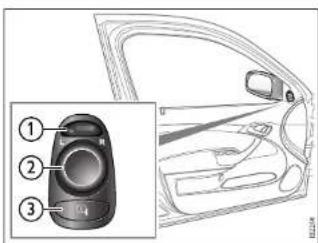
text_image
Diagram of a car interior with labeled parts, showing a hand cursor and dashboard layout1 Selection of mirror
2 Touch pad for adjustment
3 Reversing position *
Manual retraction
The door mirrors are designed to fold back if knocked. The mirrors can also be retracted manually. This can be useful when parking in tight spaces, such as on the car deck of a ferry. Remember to return the door mirrors to their normal positions before driving off.

natural_image
Diagram of a car body with a curved arrow indicating motion or force (no text or symbols)Retracting a door mirror
Reversing position \*
On certain model variants, the passenger-side mirror glass can be angled down to
facilitate reversing. Press the button shown in the illustration. This is located under the touch pad. Return the mirror to its normal position by pressing the button again. The mirror will also return to its normal position if you drive forward approximately 22 yds. (20 meters).


93 US MY09.book Page 123 Tuesday, April 15, 2008 10.30 AM

text_image
Diagram showing car rearview mirror with labeled parts and directional arrows indicating rotation or movement.Mirror position lever 1 Normal position 2 Anti dazzle position
Interior rear view mirror
The interior rear view mirror is of the auto dimming type and can be deflected with the lever on its underside. Certain variants have an auto dimming rear view mirror.
The lever should be in the normal position when you adjust the mirror.
Interior rear view mirror with garage opener, auto dimming function and compass \*
WARNING
Make sure that people and objects are out of the way of moving door or gate to prevent potential harm or damage.
When programming the garage opener, you may be operating a garage door or gate operator. Therefore it is advised to park outside of the garage.
Do not use the garage opener with any garage door opener that lacks the safety stop and reverse feature as required by federal safety standards. (This includes any garage door opener model manufactured before April 1, 1982.). A garage door opener which cannot detect an object, signaling the door to stop and reverse, does not meet current federal safety standards. Using a garage door opener without these features increases risk of serious injury or death.
123Interior equipment
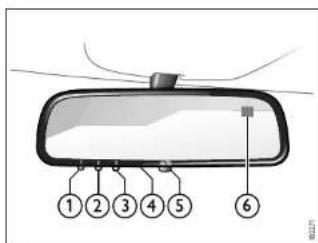
text_image
①②③④⑤⑥Buttons for garage opener, auto dimming and compass
1-3 Garage opener
4 LED
5 Auto dimming/compass ON/OFF
6 Compass bearing
Retain your original garage door opener (transmitter) for future programming procedures (i.e., new vehicle purchase). It is also suggested that upon the sale of the vehicle, the programmed garage opener buttons be erased for security purposes, see page 126.


93 US MY09.book Page 124 Tuesday, April 15, 2008 10.30 AM
124 Interior equipment
Preparations for first-time programming Before programming the garage opener for the first time, you must delete any factory codes.
Press and hold the two outer buttons until the indicator light begins to flash-after 20 seconds. Release both buttons. Do not hold for longer that 30 seconds. The garage opener is now in the train (or learning) mode and can be programmed at any time beginning with "Programming" - step 2.
Programming
The garage opener can record and store the frequencies of three different remote controls.
The battery in the remote control should be fairly new for programming to work well.
Do not repeat "Programming" - step two to train additional devices to a second or third button. Begin with "Programming" - step three.
1 Turn the ignition ON.
2 Press and hold the two outer buttons (buttons one and three) - releasing only when the indicator light begins to flash (after 20 seconds). Do not hold the buttons for longer than 30 seconds and do not repeat step two to program a second and/or third hand-held transmitter to the remaining two buttons.
3 Position the end of your hand-held transmitter 1-3 inches (5-14 cm) away from the button you wish to program while keeping the indicator light in view. The transmitter should face the mirror from below or left side of the mirror.
4 Simultaneously press and hold both the chosen and hand-held transmitter buttons. Do not release the buttons until step 5 has been completed.
Note: Some gate operators and garage door openers may require you to replace this Programming Step 4 with procedures noted in the "Gate Operator / Canadian Programming" section.
5 After the indicator light changes from a slow to a rapidly blinking light, release both the mirror and hand-held transmitter buttons.
6 Press and hold the just-trained button and observe the indicator light. If the indicator light stays on constantly, programming is complete and your device should activate when the button is pressed and released.
Note: To program the remaining two buttons, begin with "Programming" - step three. Do not repeat step two.


93 US MY09.book Page 125 Tuesday, April 15, 2008 10.30 AM
125Interior equipment
If the indicator light blinks rapidly for two seconds and then turns to a constant light continue with "Programming" steps 7-9 to complete the programming of a rolling code equipped device (most commonly a garage door opener).
7 At the garage door opener receiver (motor-head unit) in the garage, locate the "learn" or "smart" button. This can usually be found where the hanging antenna wire is attached to the motor-head unit.
8 Firmly press and release the "learn" or "smart" button. (The name and color of the button may vary by manufacturer.)
Note: There are 30 seconds in which to initiate step nine.
9 Return to the vehicle and firmly press, hold for two seconds and release the programmed button. Repeat the "press/hold/release" sequence a second time, and, depending on the brand of the garage door opener (or other rolling code equipped device), repeat this sequence a third time to complete the programming process. The garage opener should now activate your rolling code equipped device.
Note: To program the remaining two buttons, begin with "Programming" - step three. Do not repeat step two.
Gate Operator / Canadian Programming
Canadian radio-frequency laws require transmitter signals to "time-out" (or quit) after several seconds of transmission - which may not be long enough for the garage opener to pick up the signal during programming. Similar to this Canadian law, some U.S. gate operators are designed to "time-out" in the same manner.
If you live in Canada or you are having difficulties programming a gate operator by using the "Programming" procedures (regardless of where you live), replace "Programming" step 4 with the following:
Note: If programming a garage door opener or gate operator, it is advised to unplug the device during the "cycling" process to prevent possible overheating.
Continue to press and hold the button while you press and release - every two seconds ("cycle") your hand-held transmitter until the frequency signal has successfully been accepted by the garage opener. (The indicator light will flash slowly and then rapidly.)
Proceed with "Programming" step five to complete.
NOTICE
Switch off the power supply to the garage door or gate (or park the car beyond the range of the remote control) while programming using the "cycling" method to prevent damaging the electrical motor.
Reprogramming a single button
To program a device to the garage opener using a button previously trained, follow these steps:
1 Press and hold the desired button. DO NOT release the button.
2 The indicator light will begin to flash after 20 seconds. Without releasing the button, proceed with "Programming" - step 3.











93 US MY09.book Page 126 Tuesday, April 15, 2008 10.30 AM
126 Interior equipment
Erasing the three buttons
To erase programming from the three buttons (individual buttons cannot be erased but can be "reprogrammed" as outlined below), follow the step noted:
Press and hold the two outer buttons until the indicator light begins to flash-after 20 seconds. Release both buttons. Do not hold for longer that 30 seconds. The garage opener is now in the train (or learning) mode and can be programmed at any time beginning with "Programming" - step 3.
Opening a garage door
To operate, simply press and release the programmed button. Activation will now occur for the trained device (i.e. garage door opener, gate operator, security system, entry door lock, home/office lighting, etc.). For convenience, the hand-held transmitter of the device may also be used at any time.
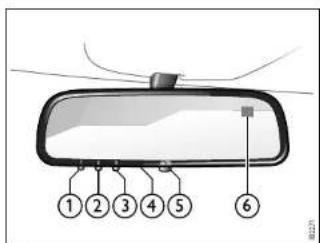
text_image
① ② ③ ④ ⑤ ⑥Buttons for garage opener, auto dimming and compass
1-3 Garage opener
4 LED
5 Auto dimming/compass ON/OFF
6 Compass bearing
Auto dimming
Press button 5 briefly to switch auto dimming on or off. When auto dimming is switched on, a 1 is displayed briefly in the compass window. A 0 indicates that auto dimming is switched off.



93 US MY09.book Page 127 Tuesday, April 15, 2008 10.30 AM
127Interior equipment
Compass
The compass is built into the rear view mirror. The compass bearing is displayed in the top right-hand corner of the mirror and is updated every other second. The compass displays the car's direction of travel: N, NE, E, etc.
Switch the compass display on and off by pressing button 5 for 3 seconds, see illustration on page 126.
Changing zones
The earth's magnetic field varies depending on one's position on the globe. If you drive your car from one magnetic zone to another the compass setting will need to be changed to ensure a correct bearing.
1 Study the illustrations to determine the correct zone.
2 Press and hold button 5 until "ZONE" is shown in the display on the mirror (6 s). The zone number is now also shown.
3 Press button 5 repeatedly to change the zone number. There are 15 zones from which to choose. Once the correct zone is selected, release the button and wait 4 seconds. The compass will now display the bearing.
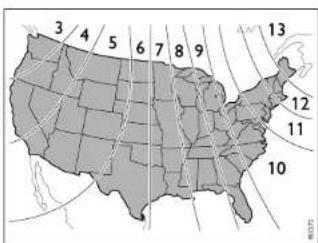
text_image
3 4 5 6 7 8 9 10 11 12 13 11 12Compass zones in USA Compass zones in Canada

text_image
1 2 3 4 5 6 7 8 9 10 11 12 13 14 15Calibration
Calibration is performed automatically during travel.
If, for any reason, a manual calibration is needed perform as follows:
1 Press and hold button 5 until "CAL" and the compass bearing are displayed (approx. 9 s).
2 Drive in circles (max. 5 mph/8 km/h) or drive as normal until "CAL" is no longer displayed.





93 US MY09.book Page 128 Tuesday, April 15, 2008 10.30 AM
128 Interior equipment
Moonroof \*

WARNING
Bear in mind the pinch hazard when closing the electric moonroof. Risk of serious or fatal injuries!
• Always remove the remote control from the ignition switch when you leave the car. This will prevent personal injury caused by the activation of the electric moonroof, for example, due to children playing.
• The person operating the electric moonroof is responsible for ensuring that no one, especially a child, has their head, hands or fingers in the opening, before closing the moonroof.
- Do not stick any part of the body or the head out through an open window while the car is moving.
The moonroof is operated by the control in the roof console. For the moonroof to work, the ignition switch must be in the ON position.
If the car is equipped with windows having the automatic closing function, the moon-roof can be opened and closed so long as the car is unlocked until 20 minutes has passed since the remote control was removed from the ignition switch.
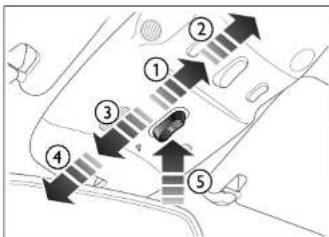
flowchart
graph TD
    A["Step 1"] --> B["Step 2"]
    B --> C["Step 3"]
    C --> D["Step 4"]
    D --> E["Step 5"]
    E --> F["End"]
Moonroof control
1 Manually controlled opening
2 Automatic opening
To open
Manually controlled opening
Slide the control rearward to its first position. The moonroof will halt when you release the control. If you do not release the control, the moonroof will open to the comfort position. To open the moonroof further, release the control and then once again press it rearward.
Automatic opening
Slide the control rearward to the second position and release it. The moonroof will open to the comfort position. To open the moonroof further, slide the control rearward a second time.

natural_image
Diagram showing two identical rectangular objects with arrows indicating movement or force, no text or symbols present.3 Manually controlled closing
4 Automatic closing
5 Ventilation position
Moonroof without automatic opening
Slide the control rearward to position 1 (see illustration). The moonroof will stop when you release the control or once it is fully open.


93 US MY09.book Page 129 Tuesday, April 15, 2008 10.30 AM
129Interior equipment
To close
! WARNING
Exercise great care when closing the moonroof to ensure that nothing gets trapped.
Manually controlled closing
Slide the control forward to its first position. The moonroof will halt when you release the control.
Automatic closing \*
Slide the control forward to its second position and release it. The moonroof will close fully.
The moonroof pinch protection halts closing and opens the moonroof slightly if something obstructs closing.
Moonroof without automatic closing \*
Slide the control forward to position 3 (see illustration). The moonroof will stop when you release the control or once it is fully closed.
Ventilation position (rear edge of moon-roof open)
- To open – press in the control.
- To close – slide the control forward to the second position.
It is also possible to select the ventilation position when the moonroof is open by pressing in the control. The moonroof will then close automatically. Press the control once more to open the moonroof to its ventilation position.
If you wish to open the moonroof fully from the ventilation position, you must first close it (slide the control forward). You can then slide the control rearward to open the moonroof.
The moonroof incorporates an interior, manual, sliding sun blind.
Moonroof without automatic closing \*
- To open – press the control up.
- To close – slide the control forward to position 3.
Comfort opening \*
Comfort opening is the remote opening of windows and the moonroof.
Press and hold the unlocking button on the remote control until the windows and optional moonroof start to open (approx. 2 seconds).
During comfort opening of the windows, moonroof (option) and soft top, the range is reduced by approximately half.
If the moonroof is in the ventilation position, it will not open.
Convertible: For the remote opening of the soft top, refer to page 64.


93 US MY09.book Page 130 Tuesday, April 15, 2008 10.30 AM
130 Interior equipment
Pinch protection \*
WARNING
Make sure nothing obstructs the moon-roof when it is closed without pinch protection.
The moonroof is equipped with pinch protection. This is activated if something gets trapped when the moonroof is being closed. The moonroof will stop and open slightly.
Temporary overriding the pinch protection
If dirt, ice or similar create so much resistance that the pinch protection cuts in (moonroof cannot be closed), the pinch protection can be temporarily disengaged.
1 Make sure the ignition is ON.
2 Press and hold the ☐tion on the driver's door while operating the window in question.
3 Close the moonroof with the button on the roof console.
The pinch protection will be operative the next time the moonroof is operated.
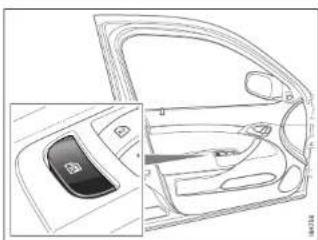
natural_image
Interior view of a car showing the dashboard and steering wheel (no text or symbols visible)Button for overriding the moonroof pinch protection

text_image
Diagram showing car interior and gear shift mechanism with labeled parts and directional arrowsEmergency operation of the moonroof
In an emergency, such as if there is an electrical failure, the moonroof can be operated with a screwdriver.
Remove the lens from the roof console. Use a screwdriver to press in the pin in the slot in the center of the motor shaft and turn the screwdriver.
Turn clockwise to close the moonroof when in ventilation position.
Turn counter-clockwise to close when in open position.



















93 US MY09.book Page 131 Tuesday, April 15, 2008 10.30 AM
131Interior equipment
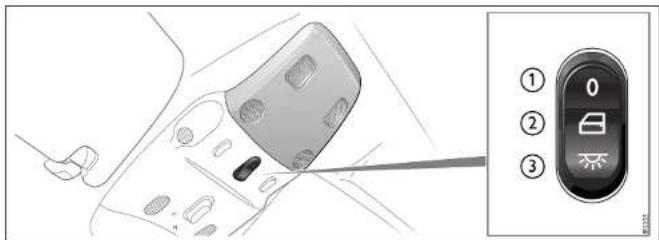
text_image
Diagram showing a hand pressing a device on a car interior, with three labeled buttons (①, ②, ③) and a control panel.
natural_image
3D diagram of a device casing with labeled components (no text or symbols present)1 Interior lighting always off
2 Interior lighting controlled by the doors
3 Interior lighting on continuously
Interior lighting
The interior lighting consists of one front and one rear roof light, floor lighting, and courtesy lights in the doors (certain variants only). The light switch for the interior lighting is located on the roof console by the rear view mirror.
When the switch is in the mid-position (door-activated), the interior lighting will come on:
- When the car is unlocked
- When a door is opened and the ignition is OFF
- When the remote control is removed from the ignition switch.
The lighting goes out:
- When the car is locked
- When the ignition is turned on
- Approx. 20 seconds after closing all doors.
The lights are dimmed out gradually.
Rear lighting
1 Reading lights
2 Roof light
If a door is left open and the light switch is in position 2 or 3 and the ignition is OFF, the interior lighting will be switched off automatically after 20 minutes to save the battery.
The glove box lighting is switched on and off automatically when the glove box is opened and closed.


93 US MY09.book Page 132 Tuesday, April 15, 2008 10.30 AM
132 Interior equipment

natural_image
Diagram of a car interior showing a vehicle backrest with an upward arrow indicating direction (no text or symbols)Trunk lighting
The trunk lighting is switched on and off when the trunk lid is opened and closed. If the trunk lid is left open, the lighting will be switched off automatically after 20 minutes to prevent the battery from running flat.

natural_image
Diagram showing a mechanical component with a close-up view of its internal structure and a directional arrow indicating motion (no text or symbols present)Sun visor with vanity mirror Fastening the floor mat
Sun visor
Illuminated vanity mirrors are provided on the sun visors. The lighting comes on when the cover is raised.
Floor mats
WARNING
Secure the loose floor mats into the floor, otherwise they could slide forward. This is particularly important on the driver's side as the mat could otherwise slide under the pedals and interfere with driving.
Press the loose mat down over the two floor brackets. Then check that the mat is firmly secured.


93 US MY09.book Page 133 Tuesday, April 15, 2008 10.30 AM
133Interior equipment
Cup holder \*
WARNING
• The cup holder should not be used to hold cups made of china or glass as these can cause personal injury in the event of a crash.
- Use only paper mugs, plastic bottles or aluminium cans.
- Avoid spillage, particularly of hot drinks.
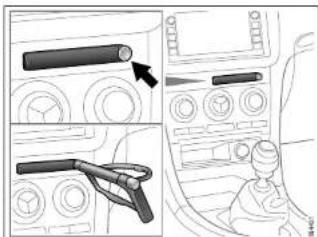
text_image
Diagram showing car interior control panel with battery, mode selector, and fan interface, plus a hand tool for navigation.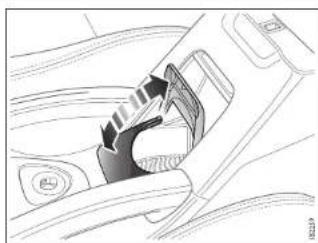
natural_image
Diagram of a car interior showing steering wheel and dashboard (no text or symbols)Cup holder in fascia Cup holder in center console compartment between front seats
NOTICE
Take care not to spill any liquid on the audio system, the ignition switch or the like when using the cup holders. Soft drinks in particular can cause malfunctions.
Cup holders are provided in the fascia, in the center console compartment between the front seats and rear seat cushion (Sport-Sedan and SportCombi). The cup holder between the seats can be raised if you wish to use the compartment for storage.
Cup holder in rear seat cushion ✦, Sport-Sedan and SportCombi
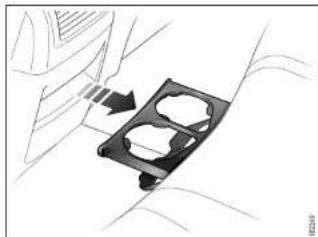
natural_image
Diagram of a mechanical component with directional arrow indicating motion (no text or symbols)


93 US MY09.book Page 134 Tuesday, April 15, 2008 10.30 AM
134 Interior equipment
Power Outlet \*
WARNING
The maximum output of the cigarette lighter socket is 240 W (20 A). The rating of the socket in the compartment between the seats is the same. Overloading can result in melting or even fire.
You can use the electrical socket in the storage compartment under the armrest between the front seats to charge a mobile phone, for example. There is a recess on each side of the compartment which will accept a lead so that you can close the lid without damaging the charger lead.
Storage compartments
WARNING
The glove box must be closed while travelling. An open glove box door could cause personal injury in the event of a crash.
There are additional storage compartments below the front ashtray and in the doors (cars with Bose® Centerpoint® Surround Sound System do not have storage compartments in the rear doors).

natural_image
Interior view of a car showing the rear compartment with a handle and seat, no text or symbols visibleOpen the glove box with the button on the left of the moulding. Convertible has lockable glove box. Use the traditionally key, see page 54.



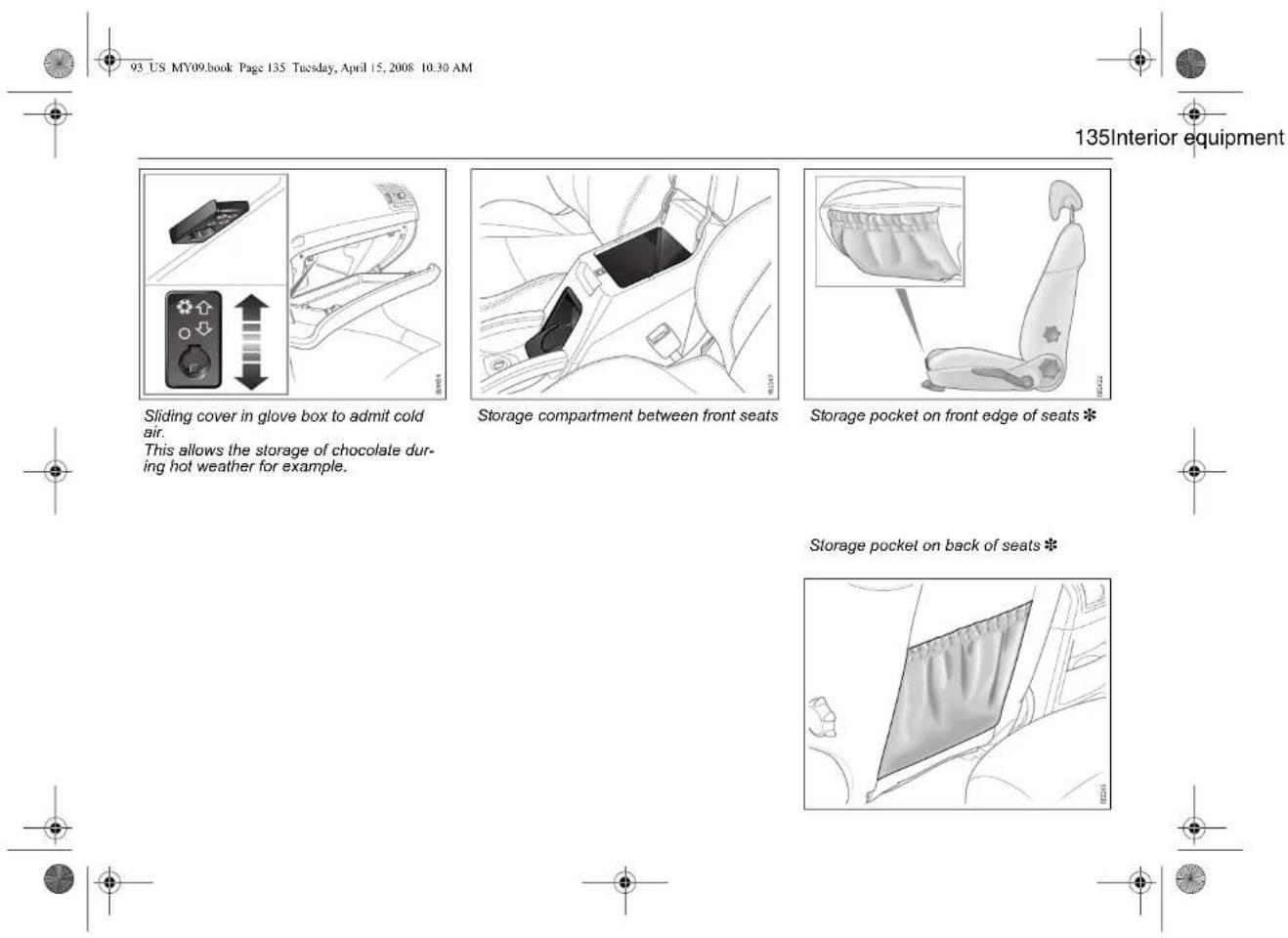
93 US MY09.book Page 135 Tuesday, April 15, 2008 10.30 AM
135Interior equipment
Sliding cover in glove box to admit cold air.
This allows the storage of chocolate during hot weather for example.
Storage compartment between front seats
Storage pocket on front edge of seats *

The image contains no text.
The image contains no text.
The image contains no text.
The image contains no text.
The image contains no text.
The image contains no text.
Storage pocket on back of seats *
93 US MY09.book Page 136 Tuesday, April 15, 2008 10.30 AM
136 Interior equipment
Trunk
Folding down the rear seat, SportSedan
Convertible: The rear seat cannot be folded.

WARNING
- Never drive the car if the backrest is not correctly locked into position as this increases the risk of personal injury in the event of heavy braking or a crash.
- Never leave a child or animal unattended in the car. During sunny weather the temperature in the passenger and trunk can climb to 160–180 °F (70–80 °C). Small children are very susceptible to heat stroke.
- Keep hands well clear of all moving parts.
- Never place heavy objects on the parcel shelf. There is always a danger of loose objects being thrown forward and causing injury if the car should brake suddenly or be involved in a crash. See also page 192.
- When folding the backrest back upright, make sure that it is locked correctly on both sides. This is imperative since the center safety belt is mounted in the backrest.

natural_image
Interior view of a car showing the seatbelt and dashboard compartment (no text or symbols visible)- When folding the backrest back upright, make sure that it is locked correctly on both sides. This is imperative since otherwise objects in the trunk could force their way into the cabin during heavy breaking or a crash.
- Adjust the head restraints for the rear seats to be occupied to a suitable height before riding in the car.
The tall pipe of the exhaust system can become very hot during driving. Bear in mind when loading and unloading the cat so that children, for example, do not burn themselves.





93 US MY09.book Page 137 Tuesday, April 15, 2008 10.30 AM


137Interior equipment
For greater flexibility, the rear seat is split so that the narrow and the wide part can be folded down separately.
Next to the hinges in the trunk are handles for unlocking the rear seat backrests.
The operation is easier if the front seats are not too far back and the rear seat head restraints are fully lowered.
1 Unlock the backrest by pulling the appropriate handle in the trunk.
2 Fold the backrest forward.
Note: When returning the backrest to its upright position, make sure that it locks properly in place and that the safety belt does not get caught.
If the left-hand backrest is not properly locked in position, the following message is displayed on the SID (equivalent message displayed for right-hand backrest):

Rear left seat
backrest unlocked.
Trunk Release Handle, see page 139.
Emergency opening of the narrow backrest, SportSedan, see page 140.





93 US MY09.book Page 138 Tuesday, April 15, 2008 10.30 AM
138 Interior equipment
Load-through hatch, SportSedan
Convertible: There is no load-through hatch.

WARNING
• Always secure the load firmly, for example using the middle safety belt. This reduces the danger of personal injury resulting from the displacement of the load on hard braking or in the event of a crash.
- Do not exceed the load capacity of the car, as this will alter its handling characteristics (see page 284).
• Always secure the load firmly, for example using the middle safety belt. This reduces the danger of personal injury resulting from the displacement of the load on hard braking or in the event of a crash.
- Do not exceed the load capacity of the car, as this will alter its handling characteristics (see page 284).
- Always secure the load firmly, for example using the middle safety belt. This reduces the danger of personal injury resulting from the displacement of the load on hard braking or in the event of a crash.
- Do not exceed the load capacity of the car, as this will alter its handling characteristics (see page 284).
- Always secure the load firmly, for example using the middle safety belt. This reduces the danger of personal injury resulting from the displacement of the load on hard braking or in the event of a crash.
- Do not exceed the load capacity of the car, as this will alter its handling characteristics (see page 284).
- Always secure the load firmly, for example using the middle safety belt. This reduces the danger of personal injury resulting from the displacement of the load on hard braking or in the event of a crash.
- Do not exceed the load capacity of the car, as this will alter its handling characteristics (see page 284).
- Always secure the load firmly, for example using the middle safety belt. This reduces the danger of personal injury resulting from the displacement of the load on hard braking or in the event of a crash.
- Do not exceed the load capacity of the car, as this will alter its handling characteristics (see page 284).
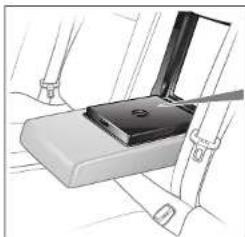
natural_image
Line drawing of a car seatbelt with hands and a black clasp (no text or symbols)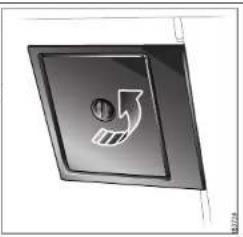
natural_image
Pure electrical circuit lines without any symbolsA load-through hatch is incorporated in the rear seat backrest to enable long, narrow items to be carried inside the car.
Before loading or unloading long items, switch off the engine and apply the parking brake. This avoids the danger of the car moving off if a long item were to knock the gear or selector lever into gear.
- Fold down the armrest and open the hatch by lifting the handle.
There is a lock on the rear side of the hatch. Use this to lock or unlock the hatch.
To lock: Open the hatch and lock the lock. Close the hatch. The hatch is now locked.
To unlock: Fold down the wide section of the backrest and unlock the lock. Alternatively, you can unlock the hatch from the trunk.
To unlock: Fold down the wide section of the backrest and unlock the lock. Alternatively, you can unlock the hatch from the trunk.
A load-through hatch is incorporated in the rear seat backrest to enable long, narrow items to be carried inside the car.
Before loading or unloading long items, switch off the engine and apply the parking brake. This avoids the danger of the car moving off if a long item were to knock the gear or selector lever into gear.
- Fold down the armrest and open the hatch by lifting the handle.
There is a lock on the rear side of the hatch. Use this to lock or unlock the hatch.
To lock: Open the hatch and lock the lock. Close the hatch. The hatch is now locked.
To unlock: Fold down the wide section of the backrest and unlock the lock. Alternatively, you can unlock the hatch from the trunk.
Before loading or unloading long items, switch off the engine and apply the parking brake. This avoids the danger of the car moving off if a long item were to knock the gear or selector lever into gear.
- Fold down the armrest and open the hatch by lifting the handle. There is a lock on the rear side of the hatch. Use this to lock or unlock the hatch.
To lock: Open the hatch and lock the lock. Close the hatch. The hatch is now locked.
To unlock: Fold down the wide section of the backrest and unlock the lock. Alternatively, you can unlock the hatch from the trunk.
A load-through hatch is Incorporated In the rear seat backrest to enable long, narrow items to be carried inside the car. Before loading or unloading long items, switch off the engine and apply the parking brake. This avoids the danger of the car moving off if a long item were to knock the gear or selector lever into gear. Fold down the armrest and open the hatch by lifting the handle. There is a lock on the rear side of the hatch. Use this to lock or unlock the hatch. To lock: Open the hatch and lock the lock. Close the hatch. The hatch is now locked. To unlock: Fold down the wide section of the backrest and unlock the lock. Alternatively, you can unlock the hatch from the trunk.
A load-through hatch is Incorporated In the rear seat backrest to enable long, narrow items to be carried inside the car. Before loading or unloading long items, switch off the engine and apply the parking brake. This avoids the danger of the car moving off if a long item were to knock the gear or selector lever into gear. Fold down the armrest and open the hatch by lifting the handle. There is a lock on the rear side of the hatch. Use this to lock or unlock the hatch. To lock: Open the hatch and lock the lock. Close the hatch. The hatch is now locked. To unlock: Fold down the wide section of the backrest and unlock the lock. Alternatively, you can unlock the hatch from the trunk.
A load-through hatch is Incorporated In the rear seat backrest to enable long, narrow items to be carried inside the car. Before loading or unloading long items, switch off the engine and apply the parking brake. This avoids the danger of the car moving off if a long item were to knock the gear or selector lever into gear. Fold down the armrest and open the hatch by lifting the handle. There is a lock on the rear side of the hatch. Use this to lock or unlock the hatch. To lock: Open the hatch and lock the lock. Close the hatch. The hatch is now locked. To unlock: Fold down the wide section of the backrest and unlock the lock. Alternatively, you can unlock the hatch from the trunk.
A load-through hatch is Incorporated In the rear seat backrest to enable long, narrow items to be carried inside the car. Before loading or unloading long items, switch off the engine and apply the parking brake. This avoids the danger of the car moving off if a long item were to knock the gear or selector lever into gear. Fold down the armrest and open the hatch by lifting the handle. There is a lock on the rear side of the hatch. Use this to lock or unlock the hatch. To lock: Open the hatch and lock the lock. Close the hatch. The hatch is now locked. To unlock: Fold down the wide section of the backrest and unlock the lock. Alternatively, you can unlock the hatch from the trunk.
A load-through hatch is Incorporated in the rear seat backrest to enable long, narrow items to be carried inside the car. Before loading or unloading long items, switch off the engine and apply the parking brake. This avoids the danger of the car moving off if a long item were to knock the gear or selector lever into gear. • Fold down the armrest and open the hatch by lifting the handle. There is a lock on the rear side of the hatch. Use this to lock or unlock the hatch. To lock: Open the hatch and lock the lock. Close the hatch. The hatch is now locked. To unlock: Fold down the wide section of the backrest and unlock the lock. Alternatively, you can unlock the hatch from the trunk.
A load-through hatch is Incorporated in the rear seat backrest to enable long, narrow items to be carried inside the car. Before loading or unloading long items, switch off the engine and apply the parking brake. This avoids the danger of the car moving off if a long item were to knock the gear or selector lever into gear. • Fold down the armrest and open the hatch by lifting the handle. There is a lock on the rear side of the hatch. Use this to lock or unlock the hatch. To lock: Open the hatch and lock the lock. Close the hatch. The hatch is now locked. To unlock: Fold down the wide section of the backrest and unlock the lock. Alternatively, you can unlock the hatch from the trunk.
A load-through hatch is Incorporated in the rear seat backrest to enable long, narrow items to be carried inside the car. Before loading or unloading long items, switch off the engine and apply the parking brake. This avoids the danger of the car moving off if a long item were to knock the gear or selector lever into gear. • Fold down the armrest and open the hatch by lifting the handle. There is a lock on the rear side of the hatch. Use this to lock or unlock the hatch. To lock: Open the hatch and lock the lock. Close the hatch. The hatch is now locked. To unlock: Fold down the wide section of the backrest and unlock the lock. Alternatively, you can unlock the hatch from the trunk.
A load-through hatch is Incorporated in the rear seat backrest to enable long, narrow items to be carried inside the car. Before loading or unloading long items, switch off the engine and apply the parking brake. This avoids the danger of the car moving off if a long item were to knock the gear or selector lever into gear. • Fold down the armrest and open the hatch by lifting the handle. There is a lock on the rear side of the hatch. Use this to lock or unlock the hatch. To lock: Open the hatch and lock the lock. Close the hatch. The hatch is now locked. To unlock: Fold down the wide section of the backrest and unlock the lock. Alternatively, you can unlock the hatch from the trunk.
A load-through hatch is Incorporated in the rear seat backrest to enable long, narrow items to be carried inside the car. Before loading or unloading long items, switch off the engine and apply the parking brake. This avoids the danger of the car moving off if a long item were to knock the gear or selector lever into gear. • Fold down the armrest and open the hatch by lifting the handle. There is a lock on the rear side of the hatch. Use this to lock or unlock the hatch. To lock: Open the hatch and lock the lock. Close the hatch. The hatch is now locked. To unlock: Fold down the wide section of the backrest and unlock the lock. Alternatively, you can unlock the hatch from the trunk.
- Always secure the load firmly, for example using the middle safety belt. This reduces the danger of personal injury resulting from the displacement of the load on hard braking or in the event of a crash.
- Do not exceed the load capacity of the car, as this will alter its handling characteristics (see page 284).
A load-through hatch is incorporated in the rear seat backrest to enable long, narrow items to be carried inside the car.
Before loading or unloading long items, switch off the engine and apply the parking brake. This avoids the danger of the car moving off if a long item were to knock the gear or selector lever into gear.
- Fold down the armrest and open the hatch by lifting the handle.
There is a lock on the rear side of the hatch. Use this to lock or unlock the hatch.
To lock: Open the hatch and lock the lock. Close the hatch. The hatch is now locked.
To unlock: Fold down the wide section of the backrest and unlock the lock. Alternatively, you can unlock the hatch from the trunk.
- Always secure the load firmly, for example using the middle safety belt. This reduces the danger of personal injury resulting from the displacement of the load on hard braking or in the event of a crash.
- Do not exceed the load capacity of the car, as this will alter its handling characteristics (see page 284).
A load-through hatch is incorporated in the rear seat backrest to enable long, narrow items to be carried inside the car.
Before loading or unloading long items, switch off the engine and apply the parking brake. This avoids the danger of the car moving off if a long item were to knock the gear or selector lever into gear.
- Fold down the armrest and open the hatch by lifting the handle.
There is a lock on the rear side of the hatch. Use this to lock or unlock the hatch.
To lock: Open the hatch and lock the lock. Close the hatch. The hatch is now locked.
To unlock: Fold down the wide section of the backrest and unlock the lock. Alternatively, you can unlock the hatch from the trunk.
- Always secure the load firmly, for example using the middle safety belt. This reduces the danger of personal injury resulting from the displacement of the load on hard braking or in the event of a crash.
- Do not exceed the load capacity of the car, as this will alter its handling characteristics (see page 284).
A load-through hatch is incorporated in the rear seat backrest to enable long, narrow items to be carried inside the car.
Before loading or unloading long items, switch off the engine and apply the parking brake. This avoids the danger of the car moving off if a long item were to knock the gear or selector lever into gear.
- Fold down the armrest and open the hatch by lifting the handle.
There is a lock on the rear side of the hatch. Use this to lock or unlock the hatch.
To lock: Open the hatch and lock the lock. Close the hatch. The hatch is now locked.
To unlock: Fold down the wide section of the backrest and unlock the lock. Alternatively, you can unlock the hatch from the trunk.
- Always secure the load firmly, for example using the middle safety belt. This reduces the danger of personal injury resulting from the displacement of the load on hard braking or in the event of a crash.
- Do not exceed the load capacity of the car, as this will alter its handling characteristics (see page 284).
A load-through hatch is incorporated in the rear seat backrest to enable long, narrow items to be carried inside the car. Before loading or unloading long items, switch off the engine and apply the parking brake. This avoids the danger of the car moving off if a long item were to knock the gear or selector lever into gear. - Fold down the armrest and open the hatch by lifting the handle. There is a lock on the rear side of the hatch. Use this to lock or unlock the hatch. To lock: Open the hatch and lock the lock. Close the hatch. The hatch is now locked. To unlock: Fold down the wide section of the backrest and unlock the lock. Alternatively, you can unlock the hatch from the trunk.
93 US MY09.book Page 139 Tuesday, April 15, 2008 10.30 AM

text_image
Diagram illustrating car exhaust system with labeled components and directional arrows, alongside a vehicle interior view.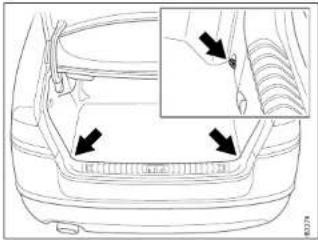
natural_image
Line drawing of a car's front bumper with arrows indicating parts, no text or symbols presentTie down eyes in the trunk Trunk Release Han
Trunk Release Handle
There is a glow-in-the-dark trunk release handle located inside the trunk on the latch. This handle will glow following exposure to light. Pull the release handle down to open the trunk from inside.
Tie down eyes, SportSedan
There are tie down eyes in the trunk that should be used to secure loads. In general, loads should be placed as far forward and as low down as possible in the trunk.
NOTICE
The trunk release handle was not designed to be used to tie down the trunk lid or as an anchor point when securing items in the trunk. Improper use of the trunk release could damage it.
WARNING
- Lay heavy bags on the floor. Place smaller and lighter bags on top.
- Secure heavy and bulky items using the lashing eyes provided in the trunk. This will avert the danger of luggage flying around if the car should brake suddenly or be involved in a crash.
- Secure small items if the backrest is folded down. Small items can also be dethrown around inside the car and cause personal injury.
- The elastic cargo net is only designed for light objects that are to be kept in place while driving
- Elastic cargo net*: WARNING. Avoid eye injury. DO NOT overstretch. ALWAYS keep face and body out of recoil path. DO NOT use when strap has visible signs of wear or damage.
- The rear seat must be in the upright position to protect against load displacement in the event of a crash.




139Interior equipment
93 US MY09.book Page 140 Tuesday, April 15, 2008 10.30 AM
140 Interior equipment
- Do not exceed the load capacity of the car, as this will alter its handling characteristics (see page 284).
- Match your speed and driving style to how the car is loaded. The handling characteristics of the car can be affected since a load in the trunk will alter the car's center of gravity.
Trunk lighting
On the underside of the parcel shelf is a light that is switched on and off when the trunk is opened and closed.
If the trunk lid is left open, the lighting will be switched off automatically after 20 minutes to prevent the battery from running flat.
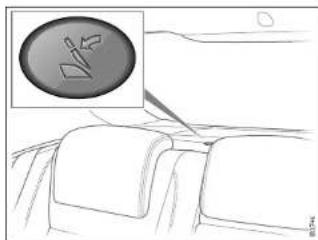
natural_image
Line drawing of a car's seat with a circular inset showing a logo (no text or symbols present)Cover over emergency opening lever, on parcel shelf

Emergency opening of the narrow backrest, SportSedan
The narrow section of the backrest can be opened in an emergency if the car is without electricity (not possible to open trunk lid) and you need to access the trunk for a warning triangle, for example.
- Remove the cover and depress the yellow lever forward.
Tools and spare wheel, see page 256.





93 US MY09.book Page 141 Tuesday, April 15, 2008 10.30 AM
141 Interior equipment
Folding down the rear seat backrest, SportCombi

WARNING
- Never drive the car if the backrest is not correctly locked into position as this increases the risk of personal injury in the event of heavy braking or a crash.
- Never leave a child or animal unattended in the car. During sunny weather the temperature in the passenger and trunk can climb to 160–180 °F (70–80 °C). Small children are very susceptible to heat stroke.
- Keep hands well clear of all moving parts.
- When folding the backrest back upright, make sure that it is locked correctly on both sides. This is imperative since the center safety belt is mounted in the backrest.
- Adjust the head restraints for the rear seats to be occupied to a suitable height before riding in the car.
The tail pipe of the exhaust system can become very hot during driving. Bear in mind when loading and unloading the cat so that children, for example, do not burn themselves.
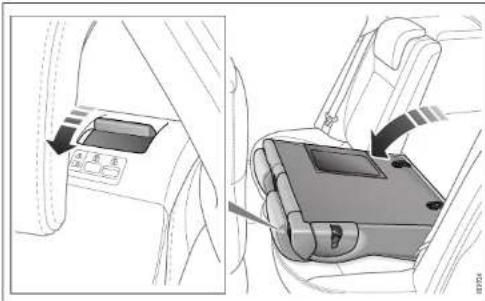
text_image
Diagram showing car seatbelt device placement with Chinese labels and directional arrows indicating movement or positioning.When returning the backrest to its upright position, make sure that it locks properly in place. The red indicator by the handle must not be visible. Also make sure that the safety belt does not get caught. If the left-hand backrest is not properly locked in position, the following message is displayed on the SID (equivalent message displayed for right-hand backrest):
For greater flexibility, the rear seat is split so that the narrow and the wide part can be folded down separately.
It is easiest to fold down the rear seat backrests if the front seats are slid forward.
1 Unlock the backrest by pulling the appropriate handle forward. An unlocked backrest has a red indicator by the handle.
2 Fold the backrest forward.

Rear left seat backrest unlocked.

natural_image
Pure geometric diagram with crosshair and circular shapes, no text or symbols present93 US MY09.book Page 142 Tuesday, April 15, 2008 10.30 AM
142 Interior equipment

WARNING
- Lay heavy bags on the floor. Place smaller and lighter bags on top.
- Elastic cargo net*: WARNING. Avoid eye injury. DO NOT overstretch. ALWAYS keep face and body out of recoil path. DO NOT use when strap has visible signs of wear or damage.
- Secure heavy and bulky items using the lashing eyes provided in the trunk. This will avert the danger of luggage flying around if the car should brake suddenly or be involved in a crash.
- Secure small items if the backrest is folded down. Small items can also be thrown around inside the car and cause personal injury.
- Do not exceed the load capacity of the car, as this will alter its handling characteristics (see page 284).




93 US MY09.book Page 143 Tuesday, April 15, 2008 10.30 AM


143Interior equipment
Load-through hatch, SportCombi

WARNING
• Always secure the load firmly, for example using the middle safety belt. This reduces the danger of personal injury resulting from the displacement of the load on hard braking or in the event of a crash.
- Do not exceed the load capacity of the car, as this will alter its handling characteristics (see page 284).
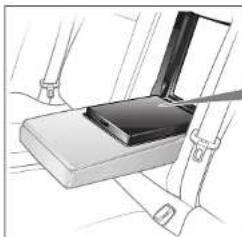
natural_image
Line drawing of a car seatbelt with hands and a black seat cover (no text or symbols)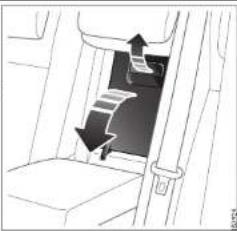
natural_image
Diagram of a vehicle interior showing stairs and directional arrows (no text or symbols)A load-through hatch is incorporated in the rear seat backrest to enable long, narrow items to be carried inside the car.
Before loading or unloading long items, switch off the engine and apply the parking brake. This avoids the danger of the car moving off if a long item were to knock the gear or selector lever into gear.
- Fold down the armrest and open the hatch by lifting the handle.
- Fold down the armrest and open the hatch by lifting the handle.





93 US MY09.book Page 144 Tuesday, April 15, 2008 10.30 AM
144 Interior equipment
Tie down eyes, SportCombi
There are tie down eyes in the trunk that should be used to secure loads. In general, loads should be placed as far forward and as low down as possible in the trunk.
Driving with the trunk lld open, see page 193.
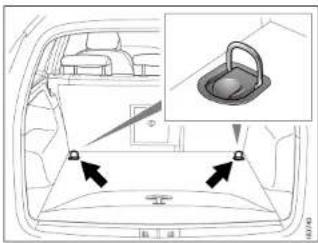
natural_image
Interior view of a car backrest with a sink and seatbelt, showing no text or symbols
WARNING
- Put heavy loads as low down and as far forward as possible in the luggage compartment, i.e. against the back of the rear seat.
- Never stack cargo so high that any part of the cargo lies above the edge of the backrest, if a cargo guard is not being used.
• Always tie down the cargo so that it cannot be thrown forward during heavy braking or in the event of a crash. - Unsecured and heavy cargo can increase the risk of injury during hard braking, sudden avoidance manoeuvres and in the event of a crash.
- Use the lashing eyes and suitable anchorage straps * for optimum securing of loads.
- Provide protection on sharp edges to prevent damage to the cargo straps.




93 US MY09.book Page 145 Tuesday, April 15, 2008 10.30 AM


145Interior equipment

- If possible, avoid having the rear seat folded down when driving with a heavy load, because the anchoring possibilities are restricted when the rear seat is in this position. That the rear seat is in the upright is a basic requirement for protection against cargo displacement in the event of a crash.
- Improve safety by fastening the outer safety belts. Check that the red "indicator-flag" next to the opening handles is not visible. If the red "indicator-flag" is visible the backrest is not locked.
- Match your speed and driving style to how the car is loaded. The handling characteristics of the car can be affected since a load in the trunk will alter the car's center of gravity.
• An object weighing 55 lbs. (25 kg) corresponds to a weight of 2200 lbs. (1,000 kg) in a front-end collision at 32 mph (50 km/h). - Adjust the car's load (passengers and luggage) so that the gross vehicle weight and the axle weight are not exceeded, see page 284.
Cargo net \*

WARNING
- Never overload the cargo net *. If the elastic breaks this may cause personal injury. Do not use a cargo net that shows signs of wear.
- Never use the elastic floor net and elastic side net when the rear seat is folded down. These nets are only intended to keep light objects tidy, not for the anchoring of loads.
- Secure the load in the luggage compartment firmly. Using a cargo net is not considered as load securing.
• The only purpose of a cargo net is to prevent light objects from being thrown forward into the cabin during heavy breaking.


93 US MY09.book Page 146 Tuesday, April 15, 2008 10.30 AM
146 Interior equipment
Cargo net, vertical \*, SportCombl
Fit the net behind the rear seat backrest.
1 Remove the rear cover panels in the roof.
2 Fit the net's upper fasteners into the two rear attachment points in the roof.
3 Secure the net's hooks in the two anchorage eyes closest to the rear seat. Tension the straps.
The cargo net can also be fitted behind the front seats when the whole rear seat is folded.
1 Remove the front cover panels in the roof.
2 Snap the net's upper fasteners into the two front attachment points in the roof.
3 Lengthen the straps with the enclosed extra straps. Secure the hooks in the two outer eyes furthest back on the front seats' rails down by the floor. Tension the straps.

natural_image
Diagram of a mechanical component with arrows indicating motion or force direction (no text or symbols)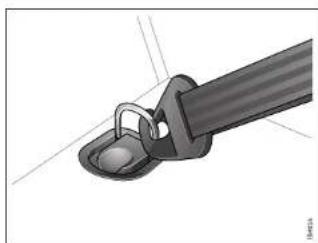
natural_image
Illustration of a mechanical clip or bracket with a metallic clip and handle (no text or symbols)Attaching the cargo net to the roof Cargo net fitted in front anchorage eye
Storing the cargo net
Storage
When the cargo net is not in use it should be stored in the bag supplied. Position the bag on the floor in the luggage compartment, closest to the backrest and secure it in the front anchorage eyes using the Velcro fasteners.

natural_image
Technical line drawing of a mechanical component with a cylindrical rod and mounting bracket (no text or symbols)


93 US MY09.book Page 147 Tuesday, April 15, 2008 10.30 AM
147Interior equipment
Cargo net, floor mounted \*, SportCombl
1 Fold up the floor. Position the edges of the floor in the slots in the side pieces.
2 Fit the bag/carrier on the lower floor and secure the net's hooks in the folded-up floor.
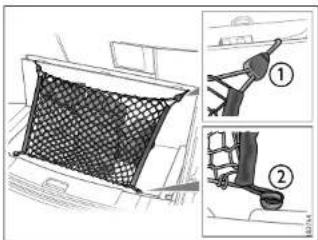
text_image
Technical diagram showing a mesh net installation with labeled parts ① and ②, likely illustrating vehicle safety or mechanical assembly.Cargo net, floor mounted, SportCombi
1 Upper bracket. Make sure that the rubber bands are not twisted
2 Lower anchorage point

text_image
Technical diagram showing a mesh fence installation with labeled parts ① and ②, likely illustrating a mechanical or architectural design.Cargo net, floor mounted, SportCombi with subwoofer*
1 Upper bracket. Make sure that the rubber bands are not twisted
2 Lower anchorage point



93 US MY09.book Page 148 Tuesday, April 15, 2008 10.30 AM
148 Interior equipment
Cargo guard \*, SportCombl
NOTICE
Do not place any objects on the extended cargo guard. It is designed to shield against view and not for storage.
To fit
1 Hold the cartridge so that the extendible part faces backward.
2 Position the cartridge over the pin (1) on the left and right-hand sides. Press the cartridge down and rotate it slightly forward until a click is heard.
3 Check the fitting by pulling the cartridge up, it should now be fitted firmly.

WARNING
A cassette that is Incorrectly fitted can detach and cause personal injury in the event of a collision, heavy breaking or similar.
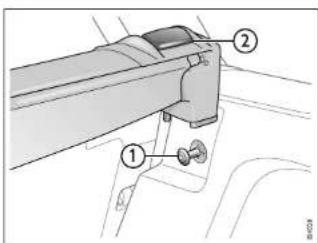
text_image
Technical diagram showing a mechanical assembly with labeled parts ① and ②, likely illustrating a component or assembly.Fitting the cargo guard 1 Pin on which the cargo guard is fitted 2 Handle for removing the cargo guard
To remove
1 Retract the cargo guard into the cartridge. 2 Pull the handle (2) back and lift up the cartridge. Repeat this on the other side.
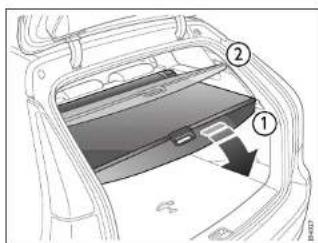
text_image
Diagram of a car rear door showing internal compartments with labeled parts ① and ②, and a directional arrow indicating movement.Opening the cargo guard
Opening the cargo guard
The cargo guard can be opened halfway in order to facilitate loading objects into the luggage compartment (and to avoid stretching in over the luggage compartment to reach the cargo guard).
1 Open the tailgate.
2 Press the rear lip of the cargo guard down, e.g. with an elbow. The cargo guard now opens halfway so that objects can be more easily loaded into the luggage compartment.
3 Pull the cargo guard down to the lower position



[Non-Text]
[Non-Text]
[Non-Text]
[Non-Text]
[Non-Text]
93 US MY09.book Page 149 Tuesday, April 15, 2008 10.30 AM
149Starting and driving
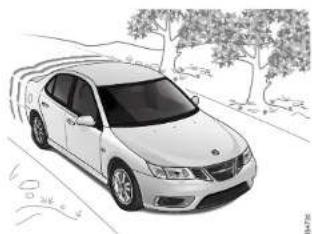
natural_image
Sketch of a sedan parked on a road with trees and hills in the background (no text or symbols)Starting and driving
Ignition switch 150
Steering wheel lock 151
Starting the engine ____ 152
Important considerations for driving ____ 153
Refueling 156
Engine Break-in Period_160
Manual transmission____ 161
Automatic transmission * ____ 162
Cruise Control 169
Braking 170
All-wheel drive (XWD) * 173
Traction Control System (TCS) 173
Electronic Stability Program ESP® 175
Parking brake 177
Parking 177
Saab Parking Assistance * 180
Economical driving 183
Driving in cold weather__ 185
Driving in hot climates _ 187
Towing a trailer * ____ 188
Driving with a roof rack load 192
Driving with a load ____ 192
Driving with the trunk lid open 193
Driving in deep water ____ 193
Towing the car 193
Jump starting ____ 197
For long trips 199
* Asterisk means: equipment not filled in all cars (can depend on model variant, engine variant, market specification, options or accessories).


93 US MY09.book Page 150 Tuesday, April 15, 2008 10.30 AM
150 Starting and driving
Ignition switch
The ignition switch is located on the center console between the front seats. In cars with automatic transmission, the remote control can only be removed when the selector lever is in position P.
NOTICE
Take care not to spill drinks or to drop crumbs over the ignition switch. If dirt or liquid gets into it, the switch may not operate properly.
If snow from clothing falls into the ignition switch and melts, the ignition switch can seize (freeze). Brush snow off clothing before getting into the car.
WARNING
• Always remove the remote control before leaving children unattended in the car.
- Apply the parking brake before removing the remote control.
- Never remove the remote control while the car is moving. This will activate the steering wheel lock and make it impossible to steer the car.
To allow the various systems in the car time to register that the remote control has been inserted into the ignition switch, do not turn the remote control for roughly half a second.

LOCK position
The parking lights, hazard warning lights and interior lighting can be turned on.
Cars with automatic transmission: Move the gear lever to P.
The gear lever is locked in position. This is the only position in which the remote control can be removed.
Cars with manual transmission: The remote control can be removed regardless of the position of the gear lever.
OFF position
Parts of the electrical system are operative.
Do not leave the remote control in the OFF position with the engine not running as this could cause the battery to run flat in a matter of hours.
Cars with automatic transmission: The gear lever is not locked. See also page 163.
If the ignition switch is turned from ON to OFF before the car is stationary then turning to LOCK may not be possible. In which case turn the ignition switch to the ON position until the ABS lamp goes out,

natural_image
Pure geometric diagram with crosshair and circular shapes, no text or symbols present93 US MY09.book Page 151 Tuesday, April 15, 2008 10.30 AM
151Starting and driving
approx. 2 seconds. Following which, turn it back to OFF.
ON position
The entire electrical system is operative. Do not leave the remote control in the ON position when the engine is not running. Turn the ignition switch to the OFF position to disconnect the electrical system.
When you turn the ignition switch to ON, some indicator and warning lights will come on in the main instrument panel. These should go out after about 3 seconds.
ST - starter position
The starter motor operates (automatic transmission: selector lever must be in P or N) when the ignition switch is turned to this position. When released, the ignition switch will spring back to the ON position.
The car has an electronic restart lock. If the engine fails to start, the ignition switch must first be turned back to a position between OFF and LOCK before the starter motor can be operated again.
Steering wheel lock
The steering wheel lock is electronic. The lock engages when the remote control is removed from the ignition and unlocks when the remote control is inserted. A click can be heard when the steering wheel lock locks and unlocks.
If the car is parked with one front wheel touching the curb, for example, you may need to turn the steering wheel slightly when you insert the remote control to allow the steering wheel lock to unlock. If you do not succeed on first attempt you must remove the remote control before trying again. Turn the steering wheel and insert the remote control into the ignition switch.
If the steering wheel lock does not disengage it will not be possible to turn the remote control in the ignition switch.
The following message is shown on the SID:

Pull out key, turn steering wheel. Restart.
If a fault arises affecting the steering wheel lock, the following message will be displayed on the SID:

Steering lock malfunc. Make a safe stop.
If the steering wheel lock malfunctions while the remote control is in the ignition switch, this may prevent the removal of the remote control or prevent the car from being restarted once the engine has been switched off.
If you have to leave the car, lock the car by pressing down the lock buttons on the doors. Lock the front left door from outside with the traditional key (see page 50). The car is now locked but the alarm is inactive.


152 Starting and driving
Starting the engine
WARNING
- When starting the engine:
- Sit down in the driver's seat.
- Depress the clutch pedal fully (M/T). If the gear lever is not in the neutral position, the clutch pedal must be fully depressed or the car will jump forwards or backwards, which may cause a crash.
- Never start the car from outside the vehicle, e.g. through a window that is down. This could lead to serious personal injury.
• Cars with automatic transmission: select position P to remove the ignition key. The key can only be removed in this gear position. - Carbon monoxide (CO) is a colorless, odorless, poisonous gas. Be alert to the danger of CO – always open the garage doors before starting the engine in the garage.
- Do not rest or sleep in the car when parked with the engine running. There is a risk of depressing the accelerator which could lead to engine damage.
- There is also a danger of CO poisoning if the exhaust system is leaking.
Starting the engine
Avoid racing the engine or loading it heavily before it has warmed up. Do not drive away before the warning and indicator lights have gone out.
The engine has an automatic choke and should be started as follows:
Cars with manual transmission
To start the engine the clutch pedal must be fully depressed.
1 Make sure the parking brake is applied.
2 Depress the clutch pedal but do not touch the accelerator.
3 Start the engine. Let the ignition switch spring back as soon as the engine has started and is running smoothly.
Allow the engine to idle for about 10 seconds. Do not apply full throttle for at least 3 minutes after starting.
Cars with automatic transmission
The selector lever must be in the P or N position.
1 The selector lever must be in the P or N position.
2 Keep your foot on the brake pedal.
Note! Once the engine has started, the brake pedal will sink. This is perfectly normal.
3 Start the engine. Let the ignition switch spring back as soon as the engine has started and is running smoothly.
Allow the engine to idle for about 10 seconds. Do not apply full throttle for at least 3 minutes after starting.




93 US MY09.book Page 153 Tuesday, April 15, 2008 10.30 AM
153Starting and driving
Useful tips on starting the engine
If the engine has failed to start after several attempts in very cold weather, proceed as follows:
1 Turn the ignition switch to ON (it is essential that you turn the ignition to ON before depressing the accelerator).
2 Press the accelerator to the floor and run the starter motor for 5-10 seconds. This will prevent the engine being flooded (fully depressed accelerator cuts off the fuel supply).
3 Now start the engine in the normal way - do not touch the accelerator.
If the engine stalls immediately after starting (e.g. if the clutch was released too quickly), do not touch the accelerator when restarting the engine.
Important considerations for driving
1 Starting and driving
- Do not use full throttle until the engine is warm, so as to avoid unnecessary wear. If the needle of the turbo gauge repeatedly enters the red zone, the engine may suddenly lose power, due to the initiation of a monitoring system that limits the boost pressure. We recommend that you contact a Saab dealer as soon as possible.
• Under certain barometric conditions (high outside temperature and/or high altitude) the needle may enter the first part of the red zone without necessarily indicating that a fault has arisen.
• A protective function (interruption of the fuel supply) limits the engine speed.
2 Stopping the engine
- Do not rev the engine immediately before switching it off - stop the engine when it is idling.
3 Regulating the boost pressure
- One of the advantages of boost pressure regulation is that the engine can also be run safely on gasoline with a lower octane rating, although not lower than AON 87. However, engine performance will fall slightly and heavy loading and laboring should be avoided. For optimum performance, use the recommended grade of fuel.
- The maximum boost pressure is regulated according to the tendency of the engine to knock. Short-lived knocking is perfectly normal. This can occur when the engine is running at about 3,000 rpm under a heavy load. The extent of this knocking will depend on the grade of fuel in the tank.
- Isolated instances of knocking can occur with low-octane fuel. This controlled form of knocking, followed by a reduction in the boost pressure, is a sign that the control system is working normally, and is perfectly safe for the engine.


93 US MY09.book Page 154 Tuesday, April 15, 2008 10.30 AM
154 Starting and driving
NOTICE
- If the engine sounds strange there is a malfunction. We recommend that you contact a Saab dealer immediately.
- The use of fuel with too low an octane rating can cause serious engine damage.

Limited performance.
The light comes on in the event of an engine or gearbox fault (cars with automatic gearbox), which may cause driveability problems but that does not affect exhaust emission. The car can still be driven but perhaps with limited performance.
Contact a dealer whenever an opportunity occurs. We recommend that you contact a Saab dealer.
Limp-home
The engine management system has a diagnostic feature that checks a number of internal functions. If a fault is detected in the throttle valve, the engine management system will set the throttle system to the limp-home mode. This means:
- idling control will be poor (uneven idling since regulated by ignition and fuel supply)
• engine performance will be reduced
• the cruise control will not function
• the capacity of the A/C compressor will be limited.
If the diagnosis function detects a fault in the
engine management system, the Light "Service Engine Light also known as CHECK ENGINE" indicator light in the instrument panel will come on (see page 83). Have the car checked at a workshop as soon as possible. We recommend that you contact a Saab dealer.
NOTICE
If Service Engine Light also known as CHECK ENGINE" indicator light warning light starts to flash (indicating that the engine is misfiring and the catalytic converter can be damaged), ease off the accelerator slightly. The light should go out or start to shine constantly. If the light continues to flash despite easing off the accelerator, you may continue to drive the car but at the minimum throttle permitted by the current traffic situation. Have the car checked as soon as possible. We recommend that you contact a Saab dealer.
Important considerations with catalytic converters
The catalytic converter is an emission control device incorporated in the car's exhaust system. It consists of a metal canister with a honeycomb insert, the cells of which have walls coated in a catalytic layer (precious metal alloy).
NOTICE
Use only unleaded gasoline. Leaded gasoline is detrimental to the catalyst and oxygen sensor and will seriously impair the function of the catalytic converter.

natural_image
Pure geometric diagram with crosshair and circular shapes, no text or symbols present

93 US MY09.book Page 155 Tuesday, April 15, 2008 10.30 AM


155Starting and driving
To ensure that the catalytic converter continues to function properly, and also to avoid damage to the converter and its associated components, the following points must be observed:
- Have the car serviced regularly in accordance with the service program.
• Always be alert to any misfiring of the engine (not running on all cylinders) and any loss of power or performance. At the first sign of a malfunction, reduce speed and take the car to a workshop. We recommend that you contact a Saab dealer.
- If the engine fails to start (in severe cold or if the battery is flat), the car can be bump started (manual transmission only) or started using jump leads to a donor battery. However, as soon as you have started the engine, it is important that it runs on all cylinders. If it is misfiring, allow it to idle for up to 5 minutes to give it time to settle and run smoothly. If, after this time, the engine still fails to run properly, switch off the engine to avoid serious damage to the catalytic converter. We recommend that you contact a Saab dealer for advice.
- Never park the car on dry grass or other combustible material. The catalytic converter gets very hot and could therefore start a fire.
- Never drive off if the engine is misfiring.
- If you bump start the car when the engine is already at normal working temperature, the engine must start to run on all cylinders. Abort bump starting if the engine fails to start immediately.
Failure to strictly follow these instructions can result in damage to the catalytic converter and associated components, and could represent a breach of the warranty conditions.
NOTICE
If the car runs out of gas, air may be drawn in with the fuel, which, in turn, can cause the catalytic converter to be damaged by overheating.

WARNING
If the engine is being run with the car on a rolling road or dynamometer, to ensure adequate cooling, air must be blown into the engine compartment and under the car at a rate equivalent to the ram-air effect that would obtain at the corresponding road speed.


93 US MY09.book Page 156 Tuesday, April 15, 2008 10.30 AM
156 Starting and driving
Refueling
WARNING
If you spill fuel and then something ignites it, you could be badly burned. Fuel can spray out on you if you open the fuel cap too quickly. This spray can happen if your tank is nearly full, and is more likely in hot weather. Open the fuel cap slowly and wait for any "hlss" noise to stop. Then unscrew the cap all the way.
Gasoline fumes are highly explosive. Therefore:
- never smoke while refueling.
- never use gasoline for any purpose other than as engine fuel.
• gasoline is extremely flammable and can cause severe bums. No open or exposed flames near gasoline. - do not use a mobile phone at the same time as refueling.
If a fire starts while you are refueling, do not remove the nozzle. Shut off the flow of fuel by shutting off the pump or by notifying the station attendant. Leave the area immediately.
NOTICE
- Do not overfill. Fuel should not come right up the filler pipe as room for expansion is needed for when the temperature rises.
- The use of fuel with too low an octane rating can cause serious engine damage.
- Clean fuel from painted surfaces as soon as possible.
- Do not use additives with E85-fuel.
NOTICE
The engine control module (ECM) monitoring the engine parameters also stores fault codes.
Under certain circumstances, this may cause constant illumination of the "Service Engine Light also known as CHECK
ENGINE" indicator light is indicating a fault that must be checked by your Saab dealer, see page 83.
NOTE: always observe the following two measures:
• Make sure that the fuel filler cap is screwed on correctly before the engine is started. Screw on the fuel filler cap until you hear 3 clicks.
- Avoid driving with the fuel low level indicator illuminated. The symbol illuminates when less than approximately 2.5 gallons (10 liters) of fuel remains in the tank.






93 US MY09.book Page 157 Tuesday, April 15, 2008 10.30 AM
157Starting and driving
Refueling
WARNING
If a fire starts while you are refueling, do not remove the nozzle. Shut off the flow of fuel by shutting off the pump or by notifying the station attendant. Leave the area immediately.
1 Switch off the engine.
2 Open the fuel cap, located in the right-hand rear fender.
3 Insert the fuel pump nozzle beyond the flange on the filler pipe and let the first mark (a ring, a pimple or the first spring-coil) rest on the flange. Do not withdraw the nozzle while filling is in progress.
4 Cease refueling the first time the pump stops, and wait a few seconds after you've finished pumping before you remove the nozzle.
NOTICE
Do not overfill. Fuel should not come right up the filler pipe as expansion room is needed when the temperature rises.
- Fill to maximum filling capacity.
- Stop filling after the first time that the nozzle trips to shut off the flow of fuel.
- Filling capacity can differ between different fuel stations and outside temperature. Fuel tank volume when nozzle trips to shut off, may vary by 0.5 gal. (2 liters).
- Do not fill fuel all the way up the filler pipe. The gasoline must be allowed room for expansion especially during hot weather.
Fuel cap
To remove the fuel cap, turn it slowly to the left (counterclockwise). The fuel cap has a spring in it; if you let go of the cap too soon, it will spring back to the right.
When you put the fuel cap back on, turn it to the right (clockwise) until you hear 3 clicks. Make sure the cap is fully installed.
The diagnostic system can determine if the fuel cap has been left off or is improperly installed. See "Service Engine Light also known as CHECK ENGINE" on page 83.
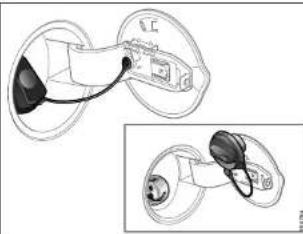
natural_image
Diagram of a device with two circular components connected by wires, shown in two views (no text or symbols)When refueling, hang the fuel cap inside the fuel door
If the fuel cap has been left off or is improperly installed the following message is shown on the Saab Information Display (SID):

Tighten fuel filler cap.


93 US MY09.book Page 158 Tuesday, April 15, 2008 10.30 AM
158 Starting and driving
The most effective way to prevent condensation forming in the tank (and thus avoid possible running problems) is to keep the tank full.
Refer to page 185 for information regarding gasoline anti-freeze.
The fuel door has a built in filler cap holder slot located on the fuel door. Slide the white ring on the cap into the slot.
Notice: If you need a new fuel cap, be sure to get the right type. Your dealer can get one for you. If you get the wrong type, it may not fit properly.
Filling a portable fuel container Fuel (Gasoline Engine)
WARNING
Never fill a portable fuel container while it is in your vehicle. Static electricity discharge from the container can ignite the gasoline vapor. You can be badly burned and your vehicle damaged if this occurs.
To help avoid injury to you and others:
- Dispense gasoline only into approved containers.
- Do not fill a container while it is inside a vehicle, in a vehicle's trunk, pickup bed or on any surface other than the ground.
- Bring the fill nozzle in contact with the inside of the fill opening before operating the nozzle. Contact should be maintained until the filling is complete.
- Do not smoke while pumping gaso- line.
Fuel
Use of the recommended fuel is an important part of the proper maintenance of your vehicle.
Gasoline Octane
Use regular unleaded gasoline with a posted octane of 87 or higher.
If the octane is less than 87, you may get a heavy knocking noise when you drive. If this occurs, use a gasoline rated at 87 octane or higher as soon as possible. Otherwise, you might damage your engine. A little pinging noise when you accelerate or drive uphill is considered normal. This does not indicate a problem exists or that a higher-octane fuel is necessary. If you are using 87 octane or higher-octane fuel and hear heavy knocking, your engine needs service. Although not required, use higher octane fuel for optimum performance- 90 octane for the 2.0T engine and 93 octane for the 2.8 V6.


93 US MY09.book Page 159 Tuesday, April 15, 2008 10.30 AM
159Starting and driving
Gasoline Specifications
It is recommended that gasoline meet specifications which were developed by automobile manufacturers around the world and contained in the World-Wide Fuel Charter which is available from the Alliance of Automobile Manufacturers at www.autoalliance.org/fuel_charter.htm. Gasoline meeting these specifications could provide improved driveability and emission control system performance compared to other gasoline.
NOTICE
Gasolines containing oxygenates, such as ethers and ethanol, and reformulated gasolines may be available in your area. We recommend that you use these gaso-lines, if they comply with the specifications described earlier. However, E85 (85% ethanol) and other fuels containing more than 10% ethanol must not be used in vehicles that were not designed for those fuels.
California Fuel
If your vehicle is certified to meet California Emission Standards (see the under hood emission control label), it is designed to operate on fuels that meet California specifications. If this fuel is not available in states adopting California emissions standards, your vehicle will operate satisfactorily on fuels meeting federal specifications, but emission control system performance may be affected. The malfunction indicator lamp may turn on and your vehicle may fall a emission system inspection. See Service Engine Light also known as CHECK ENGINE on page 83. If this occurs, return to your authorized Saab dealer for diagnosis. If it is determined that the condition is caused by the type of fuel used, repairs may not be covered by your warranty.
Additives
To provide cleaner air, all gasolines in the United States are now required to contain additives that will help prevent engine and fuel system deposits from forming, allowing your emission control system to work properly. You should not have to add anything to your fuel. However, some gasolines contain only the minimum amount of additive required to meet U.S. Environmental Protection Agency regulations. Saab recommends that you buy gasolines that are advertised to help keep fuel injectors and intake valves clean. If your vehicle experiences problems due to dirty injectors or valves, try a different brand of gasoline.
Gasolines containing oxygenates, such as ethers and ethanol, and reformulated gaso-lines may be available in your area to con-tribute to clean air. Saab recommends that you use these gasolines, particularly if they comply with the specifications described earlier.
Notice: Your vehicle was not designed for fuel that contains methanol. Do not use fuel containing methanol. It can corrode metal parts in your fuel system and also damage the plastic and rubber parts. That damage would not be covered under your warranty.
Some gasolines that are not reformulated for low emissions may contain an octane-enhancing additive called methylcyclopentadienyl manganese tricarbonyl (MMT); ask the attendant where you buy

93 US MY09.book Page 160 Tuesday, April 15, 2008 10.30 AM
160 Starting and driving
gasoline whether the fuel contains MMT. Saab does not recommend the use of such gasolines.
Fuels containing MMT can reduce the life of spark plugs and the performance of the emission control system may be affected. The malfunction indicator lamp may turn on. If this occurs, return to your authorized Saab dealer for service.
Fuels in Foreign Countries
If you plan on driving in another country outside the United States or Canada, the proper fuel may be hard to find. Never use leaded gasoline or any other fuel not recommended in the previous text on fuel. Costly repairs caused by use of improper fuel would not be covered by your warranty.
To check the fuel availability, ask an auto club, or contact a major oil company that does business in the country where you will be driving.
Engine Break-in Period
Pistons, cylinder bores and bearings need time to obtain uniform, wear-resistant surfaces.
If a new engine is driven too hard, this gradual process of bedding-in will not be possible and the life of the engine will be shortened.
During the first 1,200 miles (2,000 km), do not exceed 5,000 rpm.
In addition, refrain from driving the car at full throttle, other than for brief instances, during the first 1,800 miles (3,000 km).
Wearing in new brake pads
New brake pads take time to bed in, about 90 miles (150 km) if the car is driven largely under stop-and-go conditions or about 300 miles (500 km) of highway driving.
To extend the useful life of the pads, avoid hard braking as much as possible.


93 US MY09.book Page 161 Tuesday, April 15, 2008 10.30 AM


161Starting and driving
Manual transmission
Clutch interlock
To start the car, the clutch pedal must be depressed.
When changing gear, fully depress the clutch pedal and then release it smoothly. It is inadvisable to drive with your hand resting on the gear lever, as this can increase the wear on the gearbox.
Before reverse (R) can be engaged, you must lift the ring underneath the gear knob.
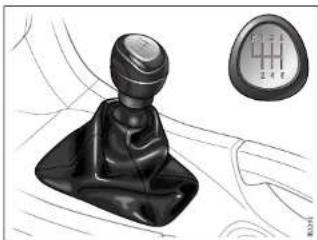
natural_image
Black-and-white illustration of a mechanical gear shift with a circular gauge showing internal components (no text or symbols)Gear positions

NOTICE
When reverse gear is to be engaged, the car must be at a standstill with the accelerator fully released.


93 US MY09.book Page 162 Tuesday, April 15, 2008 10.30 AM
162 Starting and driving
Automatic transmission \*
WARNING
- Depress the brake pedal when shifting the selector lever from P or N.
- The car must be at a standstill before P, R or N is selected. You have to have your foot on the brake pedal to move the lever out of P. If the car is still moving when a drive position is subsequently selected, this could cause a crash or damage the automatic transmission.
- Never park the car with the selector lever in a drive position, even if the parking brake is on.
- If you want to leave the car with the engine running, move the selector lever to P or N and apply the parking brake.
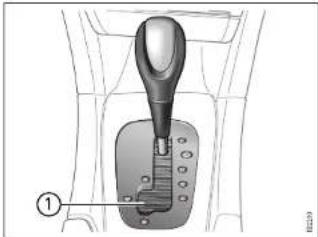
natural_image
Mechanical gear shift assembly diagram showing lever and shaft components (no text or labels)Selector lever
1 Position for manual gear selection
The automatic transmission has an electronic control module. The control module receives information including accelerator position and road speed. Using this and other information, it controls the hydraulic pressure of the transmission to ensure that gear changing is as smooth as possible.
The remote control can only be removed when the selector lever is in the P position.

Temp
00000
00 °C
000.0
Indication of gear position on main instrument panel
The engine can only be started when the selector lever is in the P or N position.
When the car is stationary, the engine must be idling when you move the selector lever from one position to another. If not, the transmission could be damaged.
NOTICE
After selecting a drive position, pause briefly to allow the gear to engage (the car starts to pull a little) before you accelerate.


93 US MY09.book Page 163 Tuesday, April 15, 2008 10.30 AM
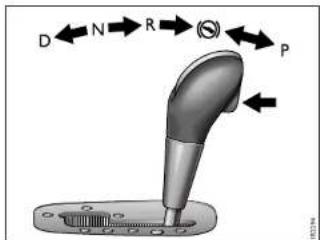
text_image
D ← N → R → ⊙ P ←Selector lever detent
Adaptive gear change patterns
The adaptive gear change pattern function adapts gear changing to the prevailing driving conditions. The transmission control module senses the engine load, vehicle speed and temperature of the transmission. A suitable gear change pattern is then selected automatically to avoid unnecessary gear changes and undesired increases in transmission temperature.
Certain variants use a special change pattern for the first few minutes after a cold start so that the catalytic converter reaches its working temperature more quickly.
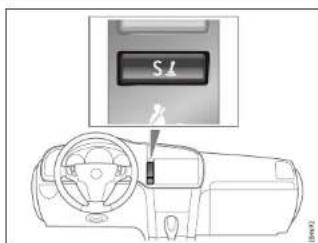
text_image
S1Sport mode
Sport mode is selected using the \$1 button, while the word SPORT illuminates
on the SID SIRTinging up occurs later and changing down occurs earlier at the same accelerator pedal position.
Sport mode will deselected if:
• The Sport button is depressed again
• The engine is switched off.
Park Brake Shift Lock
The transmission has a security function known as Park Brake Shift Lock. To move the gear selector lever out of the P or N position, the gear selector lever detent (catch) must be pressed in at the same time as the brake pedal is held depressed.
The detent button on the selector lever has to be pressed in before the lever can be moved between certain positions.
Temporary override of Park Brake Shift Lock, see page 166.
(五) 2017年1月1日
[Non-Text]
[Non-Text]
[Non-Text]
[Non-Text]
[Non-Text]
[Non-Text]
[Non-Text]
[Non-Text]
[Non-Text]
[Non-Text]
[Non-Text]
[Non-Text]
[Non-Text]
(二)
-
[Non-Text]
[Non-Text]
[Non-Text]
[Non-Text]
[Non-Text]
[Non-Text]
[Non-Text]
[Non-Text]
[Non-Text]
[Non-Text]
[Non-Text]
[Non-Text]
[Non-Text]
[Non-Text]
[Non-Text]
[Non-Text]
[Non-Text]
[Non-Text]
[Non-Text]
[Non-Text]
[Non-Text]
[Non-Text]
[Non-Text]
[Non-Text]
[Non-Text]
[Non-Text]
[Non-Text]
[Non-Text]
[Non-Text]
[Non-Text]
[Non-Text]
[Non-Text]
[Non-Text]
[Non-Text]
[Non-Text]
[Non-Text]
[Non-Text]
[Non-Text]
[Non-Text]
[Non-Text]
[Non-Text]
[Non-Text]
[Non-Text]
[Non-Text]
[Non-Text]
[Non-Text]
[Non-Text]
[Non-Text]
[Non-Text]
[Non-Text]
[Non-Text]
[Non-Text]
[Non-Text]
[Non-Text]
[Non-Text]
[Non-Text]
[Non-Text]
[Non-Text]
[Non-Text]
[Non-Text]
[Non-Text]
[Non-Text]
[Non-Text]

[Non-Text]
[Non-Text]
93 US MY09.book Page 164 Tuesday, April 15, 2008 10.30 AM
164 Starting and driving
Thermal transmission protection
The transmission has built-in protection against overheating. If the temperature of the transmission fluid exceeds 302 °F (150 °C), engine torque will be limited to 147 ft.lbs. (200 Nm).
The following message is shown on the SID:

Gearbox too hot. Make a safe stop. Open hood.
If this message appears, stop the car as soon as it is safe to do so and allow the engine to idle until the message has gone out. The selector lever should be in position P.
Lock-up
The transmission's torque converter has a lock-up function. This can lock the torque converter, thus reducing the engine speed and fuel consumption.
Kick-down
When the accelerator is pressed down fully, a down change is made to optimize acceleration, e.g. for overtaking.
Following this, the next higher gear will be selected at the optimum engine speed, unless you ease off the accelerator before reaching this.
Driving in hilly country with a heavy load
The transmission fluid can overheat when the gearbox is strained, for example, when driving with a trailer on hilly roads. To avoid the transmission fluid overheating, always drive with the selector lever in the D position. The adaptive gear change patterns are then active.
High air temperatures or a faulty oil cooler can also cause the transmission fluid to overheat. Overheating reduces the service life of the fluid.

WARNING
Remember to use the braking effect of the engine (1st, 2nd or 3rd gear) when you are descending long or steep hills to spare the brakes.
Overheating can cause the brakes to fade!


93 US MY09.book Page 165 Tuesday, April 15, 2008 10.30 AM
165Starting and driving
Towing
Towing of cars with automatic transmission, see page 193.
Descending hills
If the speed of the car increases while descending a steep hill, despite the accelerator being released, the control module will change down. If you desire more powerful engine braking, manually select a lower gear (see page 168).
Limp-home
NOTICE
Do not tow a trailer if limp-home mode is engaged.
If the transmission malfunctions, the control module will activate limp-home mode. Driveability will be affected to varying degrees.
Cars with 5-speed transmission \*
In this mode, only 2nd and 5th gears are available. Select 2nd gear when driving at low speeds and 5th gear at higher speeds. 2nd gear must be selected manually. Select 5th gear manually or move the selector lever to D, see page 168.
Cars with 6-speed transmission \*
• The car may be totally powerless. If this is case, have the car transported to a workshop to have the problem rectified.
• The car may feel weak but can be driven carefully to a workshop to have the problem rectified.
- Driveability may barely be affected.
Irrespective of the driveability of the car, the car must be taken to a workshop to have the problem checked and rectified.


93 US MY09.book Page 166 Tuesday, April 15, 2008 10.30 AM
166 Starting and driving
Temporary override of Park Brake Shift Lock
NOTICE
Due to electrical problems it may not be possible to move the selector lever out of the park position, even if the ignition is ON. If for some reason the selector lever has to be moved out of the park position (i.e. to tow the car a short distance) do as described below.
1 Apply the parking brake.
2 Lift up the rubber mat in the storage compartment ahead of the selector lever.
3 Under the floor of the storage compartment is a yellow plastic lever. Use a thin tool, such as a screwdriver, to press and hold the plastic lever while moving the selector lever from P to N.
4 Remove the tool.
5 Release the parking brake if the car is to be moved immediately, otherwise it should remain on.
Check fuse 6 in the engine bay fuse box. If the fuse is OK the battery may be dead. Contact a workshop to have the problem checked and rectified. We recommend that you contact a Saab dealer.

text_image
Diagram showing car interior and dashboard components with labeled parts and directional arrows indicating movement or assembly.Temporary override of Park Brake Shift Lock

natural_image
Pure geometric diagram with crosshair and circular shapes, no text or symbols present

93 US MY09.book Page 167 Tuesday, April 15, 2008 10.30 AM


167Starting and driving
Selector lever positions
| PThe selector lever is locked and the transmission is mechanically blocked.The engine can be started.To move the selector lever out of the P position, depress the brake pedal and press in the detent (catch) on the selector lever.Only select the park position (P) when the car is stationary. | |
| ROnly select the reverse position (R) when the car stationary. The detent release button must be pressed before the selector lever can be moved to R.Wait until reverse gear has engaged before touching the accelerator. |
N
You must press the brake pedal to move
the selector lever from the neutral position (N).
In neutral, the transmission is disengaged from the
engine. The engine can be started but make su the parking broke in an to prevent unexpected
the parking brake is on to prevent unexpected movement.
To prevent the engine and transmission becoming
hotter than necessary, select N for long stops with
the engine running, e.g. when stuck in a traffic jam.
At traffic lights, leave the selector lever in the drive position (D)
position (D).
D
The drive position (D) is the normal one for forward
driving. The transmission shifts automatically
between all gears from 1st to 5th or 6th, the timing
of which depends on factors such as the current accelerator position and the speed of the car.
accelerator position and the speed of the car.
Pause for a moment before applying the accelerator, to allow the gears to engage.





93 US MY09.book Page 168 Tuesday, April 15, 2008 10.30 AM
168 Starting and driving

Sentronic, manual gear selection
Move the selector lever to the manual position (M) (to the left position D) to select gear manually.
Select a higher gear by pressing the selector lever forward or a lower gear by pulling it back. The selector lever will return to a position adjacent to the letter M after each gear change.

An example of when you may wish to make manual gear changes is when overtaking, to enable you to remain in a low gear for an extended period of time.
If the road surface is slippery, you may wish to start off in 2nd or 3rd to reduce the risk of wheel spin.
When descending steep hills you should select a low gear to increase the braking effect of the engine and thus spare the brakes.
Manual gear selections are displayed on the main instrument panel. The letter M and the current gear are displayed.
When the selector lever is in the M position, as opposed to the D position, the engine is much more responsive to changes in accelerator position. The accelerator has a different feel.
When changing down, the desired gear can be selected but the transmission will not change down until the engine speed is low enough to avoid overrevving.

natural_image
Diagram of a car steering wheel with three side-view angles showing head, front, and rear views (no text or labels)Steering wheel controls for manual gear selection *
Certain variants also have steering wheel controls for manual gear selection. On these models, it is possible to change gear manually using the selector lever and the steering wheel controls. The steering wheel controls are only active when the selector lever is in the M position.
Select a higher gear by pressing the right-hand button and a lower gear by pressing the left-hand button.


93 US MY09.book Page 169 Tuesday, April 15, 2008 10.30 AM
169Starting and driving
Cruise Control
(Cruise control system)
WARNING
Do not use the cruise control system in wet or icy conditions, in dense traffic or on winding roads.
For safety reasons (brake system function), the brakes must be applied once when the engine has started, before the cruise control system can be activated.
The following message is shown on the SID:

Tap brakes lightly before using cruise ctrl.
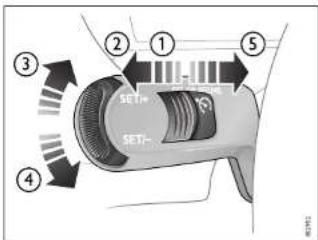
text_image
① ② ③ ④ ⑤ SETI+ SETI-Cruise control switches
The system has the following functions:
1 ON: engaged
2 OFF: disengaged
3 SET/+: sets the speed and increases the set speed
4 SET/—: sets the speed and decreases the set speed
5 RESUME: re-engages the system at the set speed
The CRUISE indicator light in the main instrument panel comes on when the switch is slid to ON. If you switch off the engine while the cruise control is ON, the system will be ON the next time the engine is started.
To set the desired speed
1 Slide the switch to ON.
2 Move the thumb wheel up to SET/+ or SET/− when the car has reached the desired speed (above 15 mph (25 km/h).
To increase the preset speed
You can increase the speed in any of the following ways:
- Accelerate to the desired speed. Jog the control to SET/+ or SET/-.
- Jog the control to SET/+ to increase the speed by 1 mph (1.6 km/h) (when cruise control already engaged).
- Hold the control in the SET/+ position until the desired speed is reached (when cruise control already engaged).


93 US MY09.book Page 170 Tuesday, April 15, 2008 10.30 AM
170 Starting and driving
To reduce the preset speed
You can reduce speed in any of the following ways:
- Brake to the desired speed. Jog the control to SET/+ or SET/-.
- Jog the control to SET/– to reduce the speed by 1 mph (1.6 km/h).
- Hold the control in the SET/—position until the desired speed is reached.
Temporary increase in speed
Accelerate, without shifting down (manual transmission), to exceed the set speed such as for overtaking. When you release the accelerator, the car will return to the set speed.
To disengage the system temporarily
Slide the switch to the left towards OFF, but only as far as to disengage the cruise control. Allow the switch to spring back.
To re-engage the system
Slide the switch to RESUME. The car will return to the previously set speed. Vehicle speed must exceed 15 mph (25 km/h).
To disengage the system
The system will be disengaged:
- As soon as the brake or clutch pedal is depressed (cars with manual transmission).
- When the switch is slid towards OFF. See also heading "To disengage the system temporarily".
- When the switch is slid to OFF.
- When the TCS/ESP ^ system is operative.
- When position N is selected (cars with automatic transmission).
Braking
It is good practice to try your brakes periodically while driving. This is particularly important when driving in heavy rain, on roads with a lot of surface water, in snow or in salty slush. In such conditions a slight delay in the braking effect may be noticed.
To minimize this delay, dry the brakes by applying them lightly now and again. This should also be done after the car has been washed, and in extremely damp weather.
To avoid the brakes becoming overheated, such as when negotiating long descents with a drop of several hundred yards (hundred metres), select a low gear to utilize the braking effect of the engine. If the car has automatic transmission, select 1st or 2nd gear.
You can help to prolong the life of the brakes by thinking ahead and braking harder over short periods, rather than braking more moderately over long stretches.





93 US MY09.book Page 171 Tuesday, April 15, 2008 10.30 AM


171Starting and driving

WARNING
- It is prudent to try your brakes from time to time, especially when driving in heavy rain, through water collected on the road, in snow, on a wet road surface or in salty slush. In such conditions, the brakes may take longer than normal to take effect. To rectify this, touch the brake pedal periodically to dry the brakes out.
• The same applies after the car has been washed or when the weather is very humid. - Avoid parking the car with wet brakes. Before parking, and if the traffic conditions allow, brake quite heavily so that the brake discs and pads warm up and dry.
- The brakes are power assisted and it should be kept in mind that the servo unit only provides the power assistance when the engine is running.
• The brake pressure required when the engine is off, (e.g. when the car is being towed) is roughly four times the normal pedal force required. The pedal also feels hard and unresponsive.
• Overheating can cause the brakes to fade!
ABS brakes

WARNING
• The additional safety afforded by the ABS system is not designed to allow drivers to drive faster but to make normal driving safer.
• To stop as quickly as possible, without loss of directional stability, whether the road surface is dry, wet or slippery, press the brake pedal down hard without letting up (do not pump the pedal), declutching simultaneously, and steer the car to safety.
The Antilock Braking System (ABS) modulates the brake pressure to each wheel. The pressure is automatically reduced just before the wheel locks up and then increases again to the point at which the wheel is just about to lock. The wheel sensors send information to the brake system's electronic control module for every 4 or so inches (decimeter) that the car rolls. This information is processed continuously to ensure that the adjustment of the brake pressure will be as exact as possible. Adjustment takes place up to 12 times per second.
The brake system provides Electronic Brakeforce Distribution (EBD). This distributes the brake pressure between the front and rear wheels, in such a way as to achieve optimum braking performance irrespective of the car's speed or load.
The ABS has a built-in diagnostics function which will switch on the ABS warning light if a fault is detected in the system (see page 82).
Note. The following message will appear on the SID (and corresponding symbol on main instrument unit) if a fault is detected:

Antilock brake malfunc. Contact service.


93 US MY09.book Page 172 Tuesday, April 15, 2008 10.30 AM
172 Starting and driving
The ABS system will not reduce the braking distance on loose gravel, snow or ice but, because the wheels cannot lock up, steering control is retained.
When the ABS system operates you will feel the brake pedal pulsate and hear a ticking noise, both of which are perfectly normal.
Apply the brake pedal with full force (you cannot press too hard), declutch and if necessary steer to safety.
Do not release the brake pedal before the car has come to a halt or the danger is past!
The above is critical.
If the road is slippery, the ABS system will operate even when only light pressure is applied to the brake pedal. This means that the driver can brake gently to test the condition of the road and adapt their driving accordingly.
It is well worth practising the use of ABS brakes on a skid pad or other suitable facility.
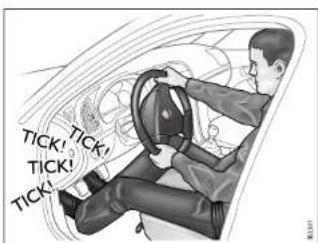
text_image
TICK! TICK! TICK!Indication that the system is operating: pulsating brake pedal and ticking noise
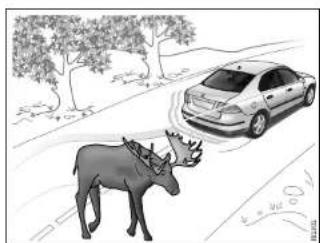
natural_image
Illustration of a deer crossing a road with a car driving nearby (no text or symbols)Braking with ABS - evasive steeringBraking with ABS brakes.

93 US MY09.book Page 173 Tuesday, April 15, 2008 10.30 AM
173Starting and driving
All-wheel drive (XWD) \*
Essentially, the system consists of a PTU (Power Take off Unit), propeller shaft, RDM (Rear Drive Module which contains an electronically controlled plate clutch, final drive gear and differential) and driveshafts. This system enhances driving characteristics and stability. The system is always active and cannot be deactivated. It works together with the ESP system and the engine and transmission control modules.
When driving at a constant speed, approx. 95% of the torque is distributed to the front wheels and approx. 5% to the rear wheels. The torque is distributed steplessly and instantaneously between the front and rear wheels, depending on the driving conditions. If the car is fitted with eLSD (electronically controlled plate clutch between the rear wheels), the torque can also be distributed individually to the relevant rear wheel.
For optimum system function, the car's tires should not have varying degrees of wear. When the XWD system requires service, the following message is shown on the SID:

Service XWD.
When the service message is displayed, the XWD system may have limited functionality (or be completely disabled in some cases, i.e. the car switches to front-wheel drive). Contact a workshop for Information. We recommend that you contact an authorised Saab dealer.
Traction Control System (TCS)
Anti-spin system
WARNING
When driving normally, the TCS system helps to improve the car's stability, and driveability under slippery road and extreme driving conditions. The TCS must not be regarded as a system to enable the driver to maintain higher speeds. The same precautions must be adopted as normal for safe cornering and driving on slippery roads.
How the system works
The Traction Control System (TCS) is designed to prevent wheelspin. This enables the car to achieve the best possible grip and, hence, maximum tractive effort, together with greater stability.
The TCS system uses information from the ABS system's wheel speed sensors to determine whether any wheel is spinning. If any wheel is spinning, this is reduced on all-wheel drive cars initially by changing the torque distribution, secondly by reducing the engine torque, and thirdly with the aid of the wheel brakes. On front-wheel drive cars, wheelspin is reduced initially by reducing the engine torque, and secondly with the aid of the wheel brakes.


93 US MY09.book Page 174 Tuesday, April 15, 2008 10.30 AM
174 Starting and driving
The advantages of the TCS system are most apparent when road surface friction is so low that a lot of wheelspin can occur rapidly:
- When the car is pulling away or accelerating with the front wheels on different surfaces (e.g. one slippery and one dry), the TCS functions like an electronic differential lock, making sure that both wheels rotate at the same speed. The system also functions when the car is reversing.
- When cornering, if the inside front wheel rotates faster than the other wheels.
TCS OFF
lights up if:
- The system has been switched off manually. It cannot be switched off if the car is travelling faster than 35 mph (60 km/h).
• There is a fault in the ABS system - A fault has been detected and the system has therefore been switched off and at the same time the following message is shown on the SID:

Traction control failure. Contact service.
TCS indicator
When the ignition switch is turned to the ON position, the lamp is lit for about 4 seconds while the system performs self-diagnosis.
The 📄 it comes on when the TCS is operative, that is when one of the wheels has lost its grip.
The fact that the TCS is operative indicates that the limit for grip has been exceeded and that the driver must exercise greater care.
Temporarily turning the TCS off
The TCS is switched on automatically when the engine is started.
It may be necessary to switch off the system if the car has become bogged down, for instance.
If a fault is detected in the ABS, the TCS will be switched off automatically.
The cruise control system (if active) will automatically be disengaged if the TCS is operative.
Disengage the system in Settings.
1 Select Settings using the steering wheel buttons or .
2 Hold the SET button depressed until a chime sounds.
3 Select TCS.
4 Press the SET button.
5 Select ON or OFF.
End by pressing the SET-button.
Go back/undo using the CLR-button.


93 US MY09.book Page 175 Tuesday, April 15, 2008 10.30 AM
175Starting and driving
Electronic Stability Program ESP®
Anti-skid system
WARNING
When driving normally, the ESP ^® system helps to improve the car's stability and maneuverability under slippery road and extreme driving conditions. The ESP ^® system must not be regarded as a system to enable the driver to maintain higher speeds. The same precautions must be adopted as normal for safe cornering and driving on slippery roads must be adopted.
The ESP® system employs both the antilock braking system (ABS) and the traction control system (TCS). It is a system that helps the driver to stabilize the car in unusual circumstances that can otherwise be more difficult to handle.

natural_image
Diagram of three cars on a curved track with directional arrows indicating motion (no text or symbols)The illustration shows how the system brakes one or more wheels (and with varying braking force for each wheel) in order to increase the car's chances of following the direction in which the driver wants to drive.
How the ESP® system works
The ESP ^® system can help to prevent the car from skidding by braking one or several wheels independently of the driver. The engine output is then also reduced to prevent the driving wheels from spinning. The car has sensors that measure wheel speed, yaw rate, lateral acceleration, steering wheel position and braking pressure. The values provided by these sensors are used to calculate the actual direction of the car, the intentions of the driver and whether the ESP ^® system should be engaged.
If this direction does not agree with that intended by the driver, calculated from the steering wheel position, the ESP ^® system is engaged.
The ESP® system improves the driver's chances of retaining control over the car in a critical situation.


93 US MY09.book Page 176 Tuesday, April 15, 2008 10.30 AM
176 Starting and driving
ESP® system OFF
lights up if:
• The system is turned off manually. The car must be travelling slower than 35 mph (60 km/h). The TCS is also disengaged.
• A fault is detected in the ABS-system.
- A fault has been detected in the system and the system has therefore been switched off. The following message will be displayed on the SID:

Stability control failure. Contact service.
ESP® system indicator light
When the ignition switch is turned to the ON position, the lamp is lit for about 4 seconds while the system performs self-diagnosis.
The ⚡️ it comes on for a short period of time when the ESP® system is operative.
Operation of the ESP ^® system indicates reduced cohesion between the tires and the road, and that extra care should be taken by the driver during continued driving.
Temporarily turning ESP® system off
The ESP ^ is switched on automatically when the engine is started. It may be necessary to switch off the system if the car has become bogged down, for instance.
The ESP ^® system is always engaged during braking, even if it has been switched off manually with the ESP ^® button.
The cruise control system (if active) will automatically be disengaged if the ESP® system is operative.
NOTICE
Changes to the chassis, such as a change of wheels, shock absorbers or springs, could affect the function of the ESP® system.
Always consult a workshop before changing any chassis components. We recommend that you contact a Saab dealer.
Disengage the system in Settings.
1 Select Settings using the steering wheel buttons. or .
2 Hold the SET button depressed until a chime sounds.
3 Select ESP
4 Press the SET button.
5 Select ON or OFF.
End by pressing the SET-button.
Go back/modify using the CLR-button.


93 US MY09.book Page 177 Tuesday, April 15, 2008 10.30 AM
177Starting and driving
Parking brake
WARNING
• Always apply the parking brake when you park the car. If the car is to be left parked for a long time, refer to page 179.
• Always apply the parking brake before removing the remote control.
- Do not use the parking brake while driving.
- Grasp the parking brake lever in such a way that no fingers get trapped when you release the parking brake.
The parking brake lever is situated between the front seats. The brake acts on the rear wheels. When the parking brake is applied,
the 📄 Indicator light on the main instrument panel will come on.
To release the parking brake, lift the lever slightly, pull the release button on the underside of the lever and lower the lever.
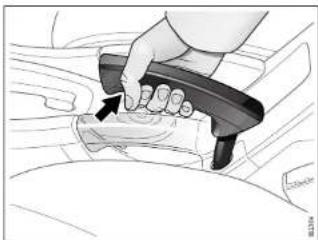
natural_image
Illustration of a hand using a black belt switch to press down a car seatbelt (no text or symbols present)Correct hold
If conditions allow, it is best if the brake pedal is not depressed, or only depressed as little as necessary so as to stop the car from rolling, when the parking brake is applied.
To facilitate releasing the parking brake, depress the brake pedal. This is especially appropriate if the car is standing on a hill.
If the parking brake is applied when the car starts off, the following message will appear on the SID:
Parking
WARNING
- Never leave children or pets unattended in the car. In warm, sunny weather, the temperature inside the car can reach 160–180 °F (70–80 °C).
- Park where the vehicle will not create an obstruction or a hazard to other road users.
- Do not park on dry grass or other combustible material. The catalytic converter gets very hot and could start a fire.
- Apply the parking brake, remove the remote control and lock the car.

Release park brake.


93 US MY09.book Page 178 Tuesday, April 15, 2008 10.30 AM
178 Starting and driving
NOTICE
Empty the car yourself and bear in mind:
- Never leave a mobile phone, camera, computer or similar object visible in the car.
• Clothing, packages and bags attract thieves. - Do not leave small objects such as CDs, sunglasses and coins visible.
- If possible, park in a well-lit, conspicuous parking space.
• Thieves strike whenever and wherever they are given the opportunity.
Parking on a hill
When parking on a steep hill, turn the front wheels so that they will be blocked by the curb if the car should move.
If the car is parked with one front wheel touching the curb, for example, you may need to turn the steering wheel slightly when you insert the remote control to allow the steering wheel lock to unlock.

1 Downhill with curb.
Turn the wheels toward the curb and edge the car forwards until the wheel lightly touches the curb.
2 Uphill with curb. Turn the wheels away from the curb and edge the car backward until the wheel lightly touches the curb.
3 Uphill or downhill without curb. Turn the wheel towards the edge of the road so that the car, should it move, will not roll towards the middle of the road.

natural_image
Pure geometric diagram with crosshair and circular shapes, no text or symbols present179Starting and driving
Long-term parking
If the car is not going to be used for some time, e.g. three to four months, the following steps are recommended:
- Drain the washer fluid reservoir and hoses.
- Wash and wax the car. Clean the rubber seals on the hood, trunk lid and doors, and lubricate them with glycerol (glycerine).
• After washing the car, dry the brake discs to avoid corrosion by taking the car out on the road and applying the brakes a few times. - Fill the fuel tank to prevent condensation forming in it.
-
Top up the coolant and check the anti-freeze before the onset of winter.
-
Park the car in a dry, covered and well-ventilated building. Leave the parking brake OFF!
- Convertible: If the car is stored, the soft top should be closed.
- If necessary, use wheel chocks and leave the parking brake off.
- Disconnect the negative (−) battery lead. If frost is likely to occur during the storage period, remove the battery and store it in a frost-free place.
- If it is not possible to stand the car on axle stands, increase the tire pressure to 43 psi (3 bar).
Leave all the door windows open a crack and cover the car with a non-plastic tarpaulin—not one made of plastic which will not breath.
93 US MY09.book Page 180 Tuesday, April 15, 2008 10.30 AM
180 Starting and driving
Saab Parking Assistance \*
Saab Parking Assistance
WARNING
Responsibility always lies with the driver when reversing.
- The parking assistance system can facilitate parking and reversing.
- Bear in mind that small objects, such as a child lying on the ground, and narrow objects cannot always be detected by the system.
Saab Parking Assistance facilitates parking and reversing. There are four sensors in the rear bumper that detect objects up to 6 ft (1.8 meters) behind the car.
If the car is heavily laden, the system may falsely indicate that there is an object within the detection range. This is since the sensors are angled towards the ground when the car is tall-heavy.

natural_image
Line drawing of a car emitting a spray bottle onto a surface (no text or symbols)Area monitored by the sensors seen from the side
The system uses four sensors in the rear bumper. These emit ultrasound signals that bounce back to the sensors off any objects behind the car. The system, however, cannot always detect small or narrow objects, such as a post, since the surface area presented to the car is too small.

natural_image
Top-down diagram of a car showing the rear wheel, side seats, and dashboard (no text or symbols)Area monitored by the sensors seen from above
The system is activated automatically when reverse is engaged or selected. Audible confirmation is given and the following text is shown on the SID:
Parking Assistance active
If a warning message, such as the safety belt reminder, is shown on the SID when reverse is engaged, the audible signals from the parking assistance system will not be heard since the warning message has priority.
When the sensors detect an object within the monitored area, pulses of sound (----) will be heard. The frequency of these pulses

natural_image
Pure geometric diagram with crosshair and circular shapes, no text or symbols present

93 US MY09.book Page 181 Tuesday, April 15, 2008 10.30 AM


181 Starting and driving

increases as the car comes closer to the object.
If you stop the car with reverse gear engaged, the sound pulse will stop after 2 seconds. The sound pulses will return if you continue to reverse. If the car rolls forward while reverse is engaged, the system is silenced.
When the distance to the object is less than 1 ft. (30 cm), a continuous tone will be heard.
When an object is approximately 3 ft. (90 cm) from the car, the sound pulses change character markedly (frequency increases). A distance of about 3 ft. (90 cm) is suitable if you wish to load or unload the trunk.
If the distance between an object and a corner sensor does not change for 3 seconds, for example if you are reversing alongside a wall, the system will switch to monitoring straight back. The system indicates if the distance to the wall decreases again.
If a trailer is hitched up and correctly connected to the trailer contact by the towbar, the system is automatically deactivated.
NOTICE
The sensors must be kept clean to function well. Ice, snow and dirt can affect their sensitivity.
Large quantities of snow or dirt covering the sensors can prevent the parking assistance system from detecting any objects.
Do not spray the sensors with a pressure washer, as this can damage them.
Reversing alongside a wall
If the distance between an object and a corner sensor does not change for 2 seconds, for example if you are reversing alongside a wall, the system will switch to monitoring straight back. The system indicates if the distance to the wall decreases again.
Cars with traller hitch
If the car has a trailer hitch and its wiring is correctly connected to the car's electrical system, the Saab Parking Assistance automatically compensates for the protrusion of the towbar.
If a camper or trailer is hitched up and the trailer hitch wiring is correctly connected to the car's electrics, the system is automatically deactivated.
You can temporarily deactivate the Saab Parking Assistance as follows:
Engage reverse and press the CLR button on the steering wheel.
The system will be reactivated the next time you engage reverse.


93 US MY09.book Page 182 Tuesday, April 15, 2008 10.30 AM
182 Starting and driving
Error messages
If the system malfunctions, the following message will appear on the SID:

Parking assistance malfunction. Service.
If the system is subject to interference, the following message will be shown on the SID:

Parking assistance sensor Interference.
If this message appears, clean the sensors. The sensors are located in the black trim on the rear bumper
The system can be switched off using Settings.
1 Select Settings using the steering wheel controls, or .
2 Press and hold the SET button until given audible confirmation.
3 Select Park Assistance.
4 Press the SET button.
5 Select ON or OFF.
6 Confirm the setting by pressing the SET button.
Park Assistance
| ON |
| OFF |
Explanation of ON and OFF.
ON
Saab Parking Assistance is activated automatically when reverse is engaged. The system warns of objects behind the car. If a trailer is hitched up and correctly connected to the trailer connector, the system will be deactivated automatically. You can also deactivate the system temporarily with the CLR button if reverse has been engaged and the system is active.
OFF
Saab Parking Assistance deactivated.


93 US MY09.book Page 183 Tuesday, April 15, 2008 10.30 AM
Economical driving
Factors affecting fuel consumption
The fuel consumption of a car is greatly affected by driving conditions, climate, road conditions, speed, driving technique, etc.
Breaking-in
Fuel consumption may be somewhat higher during the break-in period (the first 3,000–4,000 miles (5,000–7,000 km)).
Weather conditions
Summer temperatures give better fuel economy than winter ones. The difference can be as much as about 10%. Consumption increases in cold weather because the engine takes longer to reach its normal operating temperature. The transmission and wheel bearings also take longer to warm up. Even distance affects consumption: short journeys of 3–5 miles (5–8 km) do not give the engine enough time to reach its optimum temperature. Wind conditions also have a marked effect on fuel consumption.
How to read the diagram:
If fuel consumption with the engine at normal temperature is 28 mpg (10 l/100 km), the actual fuel consumption 3 miles (5 km) after the engine has started from cold will be:
- 23.5 mpg (12 l/100 km) at outside temp. of 68 °F (+20 °C) (Increase of 20 %).
- 17.7 mpg (16 l/100 km) at outside temp. of 32 °F (0 °C) (increase of 60 %).
- 14 mpg (20 l/100 km) at outside temp. of -4 °F (-20 °C) (increase of 100 %).
It is clear from the diagram that both distance driven and outside temperature have a significant impact on fuel consumption, after a cold start.
If the car is normally driven on short journeys, 3–5 miles (5–8 km), for example to and from work, the average consumption will be 60–80% above the normal level.
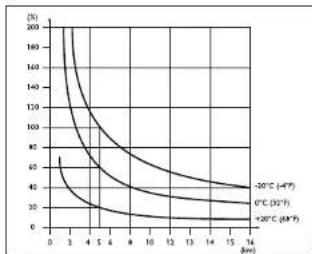
line
| Temperature | Value (%) | |---|---| | -20°C (-47°) | 200 | | -10°C (-32°) | 180 | | +10°C (+69°) | 150 | | +20°C (-47°) | 120 | | +30°C (-32°) | 100 | | +40°C (+69°) | 80 | | +50°C (-47°) | 60 | | +60°C (-32°) | 40 | | +70°C (+69°) | 30 | | +80°C (-47°) | 20 | | +90°C (-32°) | 15 | | +100°C (+69°) | 10 |Percentage increase in fuel consumption of engine starting from cold compared to engine at normal temperature.
Driving techniques
• To obtain the best running economy, with regard to fuel consumption and general wear, the car must be serviced regularly.
• High speed, unnecessary acceleration, frequent braking and much changing down all give higher fuel consumption.
- Frequent gear changing in traffic, starting in cold weather, the use of studded tires and roof racks, and towing a camper all increase fuel consumption.
- Do not warm up the engine while the car is stationary.
If idling, the engine will take much longer


183Starting and driving


93 US MY09.book Page 184 Tuesday, April 15, 2008 10.30 AM
184 Starting and driving
to reach its optimum temperature, and engine wear is at its greatest during this period. Drive off as soon as possible after starting the engine and avoid high engine speeds.
- Drive as smoothly and thoughtfully as possible. Match your driving to the prevailing traffic conditions.
- Driving in a low gear glves rise to higher fuel consumption than driving in a high gear because of the higher engine speed for any given road speed. Always shift up as soon as traffic conditions allow and drive in the highest gear as much as possible.
- Check the tire pressure once a month. Incorrect tire pressure increases tire wear. It is preferable for the tire pressure to be slightly high than too low. Under-pressure increases fuel consumption.
- Check the fuel consumption regularly. Increased fuel consumption can indicate that something is wrong and that the car needs to be checked. We recommend that you contact a Saab dealer.
Practical road tests have demonstrated that substantial savings in fuel consumption can be made if the above advice is followed.
WARNING
Never switch off the engine while driving as the effect of the brakes and power steering will be greatly reduced.
Road conditions
Wet roads increase fuel consumption, as do unpaved roads and driving in hilly country (the amount of fuel saved driving downhill is less than the additional amount required to climb the hill).
Engine block heater \*
If block heater is installed the cord can be found coiled in the engine compartment.
The following are just some of the benefits to the car and the environment of using an engine block heater:
- Lower fuel consumption
- Reduced wear on the engine
• Inside of car warms up faster - Exhaust emissions substantially reduced over short runs.
The engine heater is effective at outside temperatures up to 60–70 °F (+15 – +20 °C). The warmer it is outside, the shorter the time the engine heater needs to be connected.
- If the outside temperature is -22 °F (-30 °C) the heater needs to be connected at least 3 h.
-
If the outside temperature is -14 °F (-10 °C) the heater needs to be connected at least 2 h.
-
If the outside temperature is 32 °F (-0 °C) the heater needs to be connected at least 1.5 h.
To have the heater connected less than 0.5 h is no use but can lead to driveability problems.
If the car is equipped with a removable, electric cabin heater that is not in use, store this in the trunk.


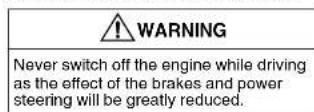
Practical road tests have demonstrated that substantial savings in fuel consumption can be made if the above advice is followed.


93 US MY09.book Page 185 Tuesday, April 15, 2008 10.30 AM
185Starting and driving
Driving in cold weather
In cold weather, special attention should be paid to the following:
- Before driving off, make sure that the wiper blades have not frozen to the windshield.
- Remove any snow from the heating system air intakes between the hood and the windshield.
- If necessary, inject oil into the locks to prevent them from freezing. Use molybdenum-sulfide oil (MoS _2 ). If the locks freeze, exercise care when unlocking the car (manual unlocking) to avoid breaking the key. Warm up the key or use a de-icer
- It is particularly important when the roads are slippery that the brakes and tires are in good condition.
-
For how to check the level of antifreeze in the engine coolant, see page 210.
-
Add gasoline anti-freeze when refueling several times before the onset of winter. This will prevent condensation water in the fuel tank from freezing and causing interruptions in the fuel supply. The likelihood of condensation is lowest when the fuel tank is full.
If the car is parked outside and the temperature is below zero, gasoline anti-freeze is of little use as it cannot remove water that has already frozen. Park the car in a warm place so that any ice that may have built up melts, then add gasoline anti-freeze when refueling. Condensation is caused by temperature fluctuations, either in the outside temperature alone or when the car is alternately parked outdoors and in a garage. - Convertible: Avoid operating the soft top at temperatures below 23^ (-5^) .
- The car is equipped with tires designed to provide optimum grip on both wet and dry roads, although this has been achieved at the expense of somewhat reduced grip on snow and ice. For regular driving on snow and ice, we therefore recommend that winter tires be fitted. However, winter tires achieve this extra grip at the expense of grip on bare road surfaces.
Winter tires, particularly studded tires, generally make driving safer on snow and ice.
Acquaint yourself with the legal provisions governing the use of different types of winter tires and snow chains. Studded tires are not allowed in some countries. If winter tires are fitted, the same type must be fitted to all four wheels. Your Saab dealer will be pleased to advise you on the best tires for your car.

natural_image
Pure geometric diagram with crosshair and circular shapes, no text or symbols present93 US MY09.book Page 186 Tuesday, April 15, 2008 10.30 AM
186 Starting and driving
Remember that tires age: it may therefore be necessary to change winter tires before they reach the legal wear limit, as they gradually lose their friction properties with age.
If you get into a front wheel skid and the car has a manual transmission, the best response is to freewheel, which means declutching so that the wheels neither drive nor brake, and to cautiously steer in the desired direction.
If the car has automatic transmission, ease off the accelerator slightly and steer cautiously in the desired direction.
If you get into a rear wheel skid, steer in the same direction as the movement of the rear of the car.
Driving with tire chains \*
Snow chains must only be fitted to the wheel and tire dimensions that Saab recommends in "Technical data" on page 283.
We recommend that you contact a Saab dealer regarding approved tire chains. See also page 247.
! WARNING
- Do not drive at speeds above 30 mph (50 km/h) when tire chains are fitted.
- Tire chains can reduce directional stability.
- Do not fit tire chains to the car's rear wheels.
NOTICE
- Check the links frequently for wear.
- Check that the chains do not foul the wheel arch liner at full lock.
- Refer to the "Technical data" section on page 283, for information on wheel and tire dimensions approved for the fitting of tire chains.




93 US MY09.book Page 187 Tuesday, April 15, 2008 10.30 AM
Driving in hot climates
Always check the coolant level before starting a journey. When the engine is cold, the coolant shall lie on or just above the KALT/COLD mark on the expansion tank (boundary between the upper and lower sections of the tank).
At the end of a journey, allow the engine to idle for 2–3 minutes before switching it off.
If the needle on the temperature gauge enters the red zone, the following message will be shown on the SID:

Hot engine. Make a safe stop. Idle engine.
1 Stop the car but do not switch off the engine. Do not remove the cap on the cooling system expansion tank, even if the tank is empty. The engine temperature should decrease. If the temperature continues to rise with the engine idling, the engine must be switched off.
2 If the engine is idling and the needle on the temperature gauge falls, wait until a normal temperature is shown (about in the middle of the scale) before switching off the engine. If the coolant needs to be topped up, carefully unscrew the expansion tank cap. Fill as required with a mixture of 50% antifreeze and 50% clean water. Use an antifreeze approved by Saab.

WARNING
• Exercise care when opening the hood if the engine is overheated. Never remove the expansion tank cap completely when the engine is hot.
- The cooling system is pressurized - hot coolant and vapor can escape. These can cause injury to your eyes and burns. Open the cap slowly to release the pressure before removing it.
3 Have the car's cooling system checked. We recommend that you contact a Saab dealer.
187Starting and driving


93 US MY09.book Page 188 Tuesday, April 15, 2008 10.30 AM
188 Starting and driving
Towing a trailer ✱
WARNING
- Do not drive with a trailer on inclines steeper than 15 %. The load on the drive (front) wheels will be so low that the wheels can start to spin and prevent further progress.
- In addition, the car's parking brake may not always be sufficient to hold the car and trailer securely, as the wheels may start to slide.
• Always apply the trailer's parking brake when unhitching it. There is otherwise a risk of personal injury or damage to the bumper should the trailer start to roll. - When you hitch up the trailer be sure to attach its safety chains to the holes by the hitch.
Make sure you are familiar with the legal requirements regarding speed limits for towing, maximum trailer weights, trailer braking requirements, and also any special driving licence provisions.
Trailer hitch attachment \*
Trailer hitch attachments are available as accessories. These are designed for a maximum trailer weight of 3500 lbs (1588 kg), with trailer brakes.
The towbar must not be installed on certain models. Contact an authorised Saab dealer for information.
An electrical connection * for the towbar and an electrical unit are provided in the electrical center on the left-hand side of the luggage compartment.
If the car has a 13-pin Saab genuine electrical socket then it is possible to supply a trailer/caravan with rear fog lights and reversing lights. The caravan can also have interior and exterior lighting even when the car's ignition is switched off. In which case, remember not to load the battery for too long so that It is discharged and prevents the car from starting.
There is also access to power in the caravan during a journey, the caravan battery can be charged for example.
Also, if the car has SPA, this is deactivated automatically if a trailer is hitched up and correctly connected to the Saab genuine trailer socket.
Saab recommendations:
- Use a genuine Saab trailer hitch that is designed and tested for your Saab.
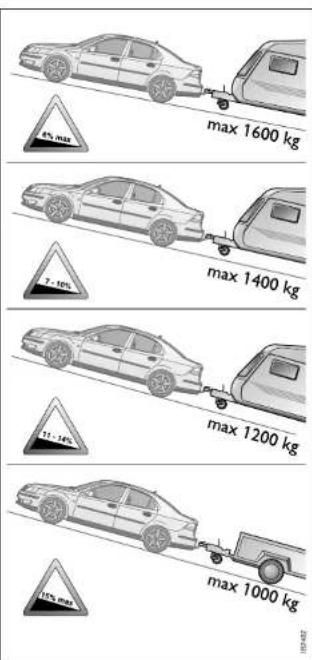




93 US MY09.book Page 189 Tuesday, April 15, 2008 10.30 AM
- Contact your Saab dealer for advice on which trailer hitch is designed for your car.
NOTICE
- Only use a towbar that has been approved for your car. We recommend that you entrust towbar installation to an authorized Saab dealer, which can also provide important information such as trailer weight. Your authorized Saab dealer has Information on how the towbar is to be installed and whether other measures must be undertaken that could affect the cooling system or other equipment
• We recommend that you contact a Saab dealer for guidance on how to connect a trailer hitch. - Exercise care when driving on uneven roads or against the curb if the car is heavily laden. This particularly applies to cars with 17" and 18" wheels.
Recommendations for cars with automatic transmission
The following driving time limits are based on the capacity of the cooling system in hot weather, i.e. approximately 86°F (+30°C).
| Gradient of hill, % | Max. trailer weight, lbs.(kg) | Time limit, minutes |
| 6-8 3330 (1500) unlimited | ||
| 9-11 3080 (1400) max 15 | ||
| 12-14 2645 (1200) max 15 | ||
| max 15 2200 (1000) max 15 |
The following driving time limits are based on the capacity of the cooling system in hot weather, i.e. approximately 104°F (+40°C).
| Gradient of hill, % | Max. trailer weight, lbs. (kg) | Time limit, minutes |
| 6-8 2200 (1000) unlimited | ||
| 9-11 1760 | (800) max | 15 |
| 12-14 1100 | (500) max | 15 |
| max 15 880 | (400) max 15 |
When negotiating long hills, bear the following important considerations in mind.
Rises in coolant temperature are indicated by the temperature gauge in the main instrument panel.
The following steps are taken in order as the temperature of the transmission increases:
• Gear change pattern is altered
• A/C compressor is switched off
• Max. engine torque is reduced
The following message will be displayed on the SID if the transmission fluid becomes too hot:

Gearbox too hot. Make a safe stop. Open hood.
If this message appears, stop the car as soon as it is safe to do so and allow the engine to idle until the message has gone out. The selector lever should be in position P.
189Starting and driving

natural_image
Pure geometric diagram with crosshair and circular shapes, no text or symbols present93 US MY09.book Page 190 Tuesday, April 15, 2008 10.30 AM
190 Starting and driving
When continuing your journey, manually select a low gear in which the engine speed is about 3,500 rpm until the incline eases (see page 168).
WARNING
Remember to use engine-braking (selector position M1, M2, or M3) to spare the brakes when you are driving on a long or steep downhill slope.
Overheating can cause the brakes to fade!
Recommendations for cars with manual transmission
Rises in coolant temperature are indicated by the temperature gauge in the main instrument panel.
When the needle is just outside the red zone, the A/C compressor will be switched off and, on certain engine variants, the maximum engine torque will be limited.
When continuing your journey, select a low gear in which the engine speed is about 3.500 rpm until the incline eases.
WARNING
Remember to use engine-braking (selector position 1, 2, or 3) to spare the brakes when you are driving on a long or steep downhill slope.
Overheating can cause the brakes to fade!
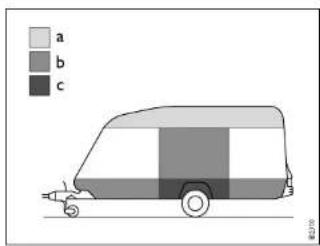
text_image
a b cDistribution of load in trailer
a Light
b Moderate
c Heavy
Trailer hitch load
The weight distribution on the trailer makes a lot of difference to the handling properties of the car and trailer combination. With a two-wheel trailer, concentrate the load over the wheels and keep it as low as possible.
The trailer should be loaded so that the load on the towball is 110–165 lbs. (50–75 kg). Note that this load must be included in the total load for the car. If this now exceeds the specified load capacity, the load in the trunk may have to be reduced by the corresponding amount.

natural_image
Pure geometric diagram with crosshair and circular shapes, no text or symbols present93 US MY09.book Page 191 Tuesday, April 15, 2008 10.30 AM
191Starting and driving
Checks before driving
Make sure that the car and trailer are in good working order. This is essential since towing a trailer increases the strain on the car.
- Check and if necessary adjust the tire pressure of the car and trailer.
- Make sure all wheel bolts are properly tightened.
- Make sure that the equipment joining the car and trailer is properly secured and adjusted.
- Make sure the trailer's electrical cable is properly connected and is not so long that it drags along the ground. Also, make sure the cable is not too short and risks breaking when turning a corner.
- Check all bulbs.
- Check the car and trailer brakes.
- Make sure that all items on or in the camper or trailer are properly secured.
- Make sure that the trailer's jockey wheel is raised and locked.
- Check the distribution of the load so that the car and trailer are well balanced.
- Check that the rear view mirrors provide the best possible rearward vision.
- Make sure the trailer's safety cable is correctly attached.
Driving considerations
Always take extra care when towing a trailer, as the car's handling will be different and its braking performance reduced. The trailer's braking system and suspension also have a considerable effect on these characteristics. See also "Driving with a load" on page 192.
Drive carefully:
• Descending hills
- On uneven roads
• Over railway crossings
- When meeting large vehicles.
If the car has automatic transmission, select gear M1 when ascending or descending steep hills.
Reversing
Get someone to help you keep an eye out behind the trailer as the door mirrors do not always provide sufficient rearward vision when reversing.


93 US MY09.book Page 192 Tuesday, April 15, 2008 10.30 AM
192 Starting and driving
Driving with a roof rack load
WARNING
- A roof load will affect the car's center of gravity and aerodynamics. Be aware of this when cornering and driving in crosswinds.
- Adjust your speed to the prevailing conditions.
- Due to higher aerodynamics drag, fuel economy may suffer when driving with a roof rack.
The maximum permissible roof load is 220 lbs. (100 kg). Note that the roof load must be included in the car's maximum permissible payload and axle load.
Strong, sturdy roof carriers designed specially for your car are available from your Saab dealer. Always secure roof loads securely.
Driving with a load
The handling characteristics are affected by how the car is loaded.
NOTICE
- Place the heaviest load as far forward and as low as possible in the trunk.
- Secure the load to the lashing eyes (see page 139).
- Heavy loads mean that the car's center of gravity is further back. As a result, the car will sway more during evasive steering.
- Never exceed the permissible load of the roof box, even if there is room for more.
- Ensure that the tire pressure is correct – slight overinflation is preferable to underinflation.
• The braking distance of a loaded car is always greater. Keep your distance from the vehicle in front.
- Do not exceed the car's permissible gross vehicle weight or axle load (see page 284).
- Roof loads can negatively affect telecommunication.
For further information on tires see page 240.


93 US MY09.book Page 193 Tuesday, April 15, 2008 10.30 AM
193Starting and driving
Driving with the trunk lid open
WARNING
Avoid driving with the trunk lid partly or fully open, since exhaust fumes can be drawn into the cabin.
If you must drive with the trunk lid open, close all windows and the moonroof (if equipped) and set the cabin fan to its highest speed setting.
Driving in deep water
NOTICE
Do not drive in puddles or water deeper than 7 in. (20 cm) and do not drive faster than 3–4 mph. Water can otherwise be sucked into the engine. The engine will be seriously damaged if water enters the intake system.
Towing the car
WARNING
- Remember that the brake servo does not operate when the engine is off. Much greater pressure than normal will therefore be required to operate the brake pedal.
- Nor does the steering servo operate when the engine is off. The steering will therefore be much heavier than usual.
• The towing vehicle should always be heavier than the vehicle on tow. - Never allow passengers to ride in the car when it is on tow.
• Always seek professional help if the car needs to be recovered.
- The ignition switch must be in the ON position if the car is moved with the engine not running.
- The steering wheel lock must be disengaged before towing the car.
- The steering wheel lock disengages when the remote control is inserted into the ignition switch, if the battery has sufficient charge.


93 US MY09.book Page 194 Tuesday, April 15, 2008 10.30 AM
194 Starting and driving
Front towing eye
WARNING
• Make sure that the towing eye is screwed in tightly. It has a left-hand thread!
- The towing eye is only designed for towing the car on roads. It must not be used to pull the car out of a ditch, for example.
• Make sure that all bystanders keep a suitable distance, in case the towing eye or tow rope should snap. The towing eye or tow rope could catapult off and cause seriously injury.
- Never drive with the towing eye fitted to the front bumper. Return it to its designated storage space.
The front towing eye is stowed by the spare wheel. On the left-hand side of the bumper is a cover concealing the attachment point (tapped hole) for the towing eye.
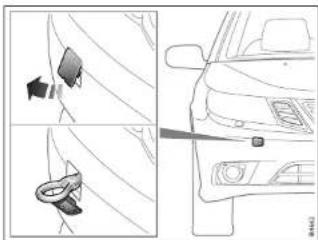
text_image
Diagram showing car seatbelt adjustment with magnified views and directional arrows indicating alignment or movement.The towing eye has a left-hand thread!
1 Open the cover first at the lower edge with a screwdriver for example. Watch out for the paintwork.
2 Screw in the towing eye. The towing eye has a left-hand thread!
3 Insert the wheel wrench into the eye to tighten it properly.
To refit the cover: Start by inserting the top edge of the cover. Then click in the lower edge.

natural_image
Top-down line drawing of a car's rearview and side profile with an inset showing a curved pipe component (no text or symbols)Rear towing eyeFront towing eye fitted.
Rear towing eye
The car has a permanent towing eye at the rear under the bumper.
If the car is equipped with a towbar, this can be used instead of the towing eye.

natural_image
Pure geometric diagram with crosshair and circular shapes, no text or symbols present93 US MY09.book Page 195 Tuesday, April 15, 2008 10.30 AM
195Starting and driving
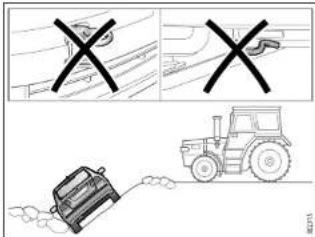
text_image
Diagram showing three scenarios: cross symbol, road sign, and tractor with a bucket, likely illustrating vehicle safety or hazard.Never use the towing eyes to pull the car unstuck.
Towing the car
Cars with manual transmission
NOTICE
- Never use the towing eyes to pull the car unstuck.
- If the car is to be towed with the front wheels off the ground, make sure the parking brake is off, as this acts on the rear wheels.
Saab 9-3 XWD with manual transmission: If the car is towed with all four wheels on the ground then there are no technical limitations for speed and distance. If both front wheels or both rear wheels have been raised, and if the law permits, the maximum towing speed is 30 mph (50 km/h). There are no limitations as to the distance over which the car can be towed.
Engage neutral. Turn on the parking lights. Drive carefully and do not exceed the speed limit for vehicles on tow.
Always try to keep the towrope taut by gently applying the brake of the car on tow, as necessary. This will avoid the towrope being jerked violently.
Cars with automatic transmission
NOTICE
- Never use the towing eyes to pull the car unstuck.
• The car must be towed front first. - If the car is to be towed with the front wheels off the ground, make sure the parking brake is off, as this acts on the rear wheels.
Saab 9-3 XWD with automatic transmission:
If the car is towed with all four wheels on the ground then it may be towed at a maximum speed of 30 mph (50 km/h) and for a maximum of 30 miles (50 km). If both front wheels have been raised, and if the law permits, the car may be towed at a maximum speed of 30 mph (50 km/h). There are no technical limitations as to the distance over which the car can be towed.
Move the selector lever to N. Turn on the parking lights.
Drive carefully and do not exceed the speed limit for vehicles on tow.
Always try to keep the towrope taut by gently applying the brake of the car on tow, as necessary. This will avoid the towrope being jerked violently.

93 US MY09.book Page 196 Tuesday, April 15, 2008 10.30 AM
196 Starting and driving
Whatever the speed limit, the car must not be towed at speeds exceeding 30 mph (50 km/h) nor for a distance of more than 30 miles (50 km). If the car needs to be transported over a longer distance, a tow truck or flatbed truck must be called out.
The engine cannot be started by towing or pushing the car. In an emergency, the engine can be started as described under "Jump starting" on page 197.
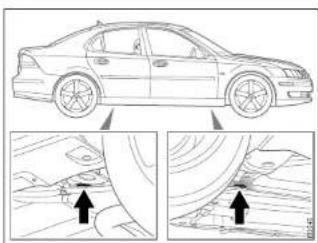
natural_image
Line drawing of a sedan car with three views showing interior details (no text or symbols)Attachment points for anchorage straps
Transporting the car
NOTICE
If a car with sports (lowered) chassis is transported, for example on a flat bed truck, take extra care not to damage the spoiler and/or underbody.
Vehicle recovery
If the car has to be transported on a flatbed truck, or similar, it must be securely strapped down. There are attachment points for this purpose on the underside of the car. The attachment points are oblong hole that have been reinforced to cope with the stresses that arise during this type of transport.



93 US MY09.book Page 197 Tuesday, April 15, 2008 10.30 AM
197Starting and driving
Jump starting
WARNING
- When working on the battery, highly explosive gas can build up. A spark could ignite this gas that collects around the battery. Therefore, always avoid sparks and open flames in the vicinity of the battery.
• The battery contains corrosive sulfuric acid. Always wear a face mask or goggles when working on the battery. - If battery acid gets into the eyes or splashes onto skin or clothing, wash the affected area liberally with water. If acid gets into the eyes or a large quantity makes contact with the skin, seek medical help.
NOTICE
Ignoring these steps could result in costly damage to your vehicle that would not be covered by your warranty.
Trying to start your car by pushing or pulling it could damage your vehicle, even if you have a manual transmission. If you have an automatic transmission, your vehicle cannot be started by pushing or pulling it.
It is essential when a donor battery is to be used to jump start the car that the jump leads be connected correctly to prevent arcing.
To jump start your vehicle
1 Check the other vehicle. It must have a 12-volt battery with a negative ground system.
NOTICE
If the other system is not a 12-volt system with a negative ground, both vehicles can be damaged.
2 Get the vehicles close enough so the jumper cables can reach, but be sure the vehicles are not touching each other. If a poor connection on the negative jumper cable should exist, it is possible for damage to be caused to electrical systems/components of either vehicle should inadvertent contact be made. You would not be able to start your car and bad grounding could damage the electrical systems.
WARNING
You could be injured if the vehicles roll. Set the parking brake firmly on each vehicle. Put an automatic transmission in P (Park) or a manual transmission in Neutral.
3 Turn off the ignition on both vehicles. Turn off lights that are not needed, and radios. This will avoid sparks and help save both batteries and it could save your radio.


93 US MY09.book Page 198 Tuesday, April 15, 2008 10.30 AM
198 Starting and driving

text_image
Diagram showing two battery cells connected in a circuit with polarity indicators and grounding symbolsJump starting
NOTICE
If you leave your radio on, it could be badly damaged. The repairs would not be covered by your warranty.
4 Open the hood and locate the battery.
Find the positive (+) and negative (−) terminals on the battery.

WARNING
An electric fan can start up even when the engine is not running and can injure you. Keep hands, clothing and tools away from any under hood electric fan.

WARNING
Using a match or flame of any kind near a battery can cause battery gas to explode. You can suffer burns or be blinded. Use a flashlight if you need more light.
Be sure the electrolyte in the battery is not frozen. Discharged batteries will freeze. When connecting jumper cables to a frozen battery, gas from the chemical reaction inside the battery can build up under the ice and cause an explosion.
Battery fluid contains acid that can burn you. Do not get it on you. If you accidentally get it in your eyes or on your skin, flush the area with water and get medical help immediately.
5 Check that the jumper cables do not have loose or missing insulation. If they do, you could get a shock and also the vehicles could be damaged. Before you connect the cables, here are some basic things you should know. Positive (+) will go to positive (+) and negative (−) will go to negative (−). Do not connect (+) to (−) or you will get a short that could injure you or would damage the battery and maybe other parts as well.
6 Connect the red positive (+) cable to the positive (+) terminal of the vehicle with the discharged battery.
7 Do not let the other end touch metal. Connect it to the positive (+) terminal of the good battery. Use a remote positive (+) terminal if the vehicle has one.
8 Now connect the negative (−) cable to the good battery's negative terminal.
9 Attach the cable to the discharged battery's negative terminal.
10 Start the vehicle with the good battery and run the engine for a while.
11 Try to start the vehicle with the discharged battery. If it does not start after a few tries, it probably needs service.
Note. If the current in the low battery is too low it might be necessary to wait several minutes with the cables connected before you can start the engine with the low battery.
12 Remove the cables in reverse order to prevent electrical shorting. Take care that they do not touch each other or any other metal.


一
一
一
一
一
93 US MY09.book Page 199 Tuesday, April 15, 2008 10.30 AM
199Starting and driving
Using a battery charger \*/starter unit
For long trips
To avoid damaging the car's electrical system and electronics, the following rules must be followed when charging the battery or jump starting the car.
- If the charger or starter unit can be set to different voltages (6 V/12 V/18 V/24 V), 12V must be selected.
- Follow the manufacturer's instructions supplied with the charger or starter unit.
- No other apparatus that are grounded or connected to the mains must be connected to the car during charging or jump starting.
- The charger or starter unit must under no conditions produce a voltage greater than:
- 16 V continuous
- 18 V for 60 minutes.
If you are unsure about the charge rating of the unit, disconnect the battery clamp from the positive terminal before connecting the unit to the battery.
Before starting off on a long journey, it is advisable to have your car inspected by your Saab dealer.
Obtain a few important items to take along on your journey, such as spare bulbs, wiper blades, fuses, a drive belt (poly-V-belt) and the like.
You can check some points yourself beforehand:
- Check that no oil or fuel leaks out of the engine or gearbox/transmission.
- Check the coolant and power steering fluid levels. Check also for leaks.
- Inspect the drive belt (poly-V-belt) and replace if it shows any signs of wear.
- Check the battery charge.
- Check the tires for tread pattern and air pressure, including the compact spare tire.
• Take an extra remote control and keep it separate.
- Check the brakes.
- Check all bulbs.
- Check for the presence of the tool kit and jack in the car.





text_image
93_US_MY09.book_Page_200_Tuesday, April 15, 2008 10:30 AM 200 Starting and driving (This page has been left blank.)93 US 7carcare MY09.fm Page 201 Tuesday, April 15, 2008 11:26 AM
201Car care

natural_image
Illustration of a person cleaning a sedan (no text or symbols visible)Car care
Hood 202
Engine 203
Engine bay, 4-cyl engine 206
Engine bay, V6 engine _ 207
Engine oil 208
Air filter 209
Transmission fluid 210
Coolant 210
Brake/clutch fluid and brake pads 212
Power steering 213
Battery 214
Drive belt 215
Wipers and washers _ 216
Wiper blades 216
Changing bulbs 218
Fuses 233
Tires 240
Automatic tire pressure monitoring system 253
Compact spare ____ 256
Changing a tire 258
Safety belts 266
Upholstery and trim 266
Textile carpeting ____ 267
Engine bay 267
Washing 267
Waxing and polishing 270
Touching up the paint__ 270
Anti-corrosion treatment 271
Recovery and/or recycling of automotive materials 272
Air conditioning (A/C) 273
* Asterisk means: equipment not fitted in all cars (can depend on model variant, engine variant, market specification, options or accessories).


93 US 7carecare MY09.fm Page 202 Tuesday, April 15, 2008 11:26 AM
202 Car care
Hood
The hood release handle is located on the left under the instrument panel. Open the hood in the following way:
1 Pull the release handle.
2 The hood moves to the half-locked position and is stopped by a safety catch at the front edge.
3 Press the lever of the catch upwards and raise the hood.
When you close the hood you should drop it from a height of about 12 inches (30 cm), without slamming it.
natural_image
Line drawing of a mechanical component with a curved handle and circular end (no text or symbols)
natural_image
Diagram of a car's frontview showing the engine shift lever and its side profile (no text or symbols present)Hood release catch plate Hood release handle
。
[Non-Text]
[Non-Text]
[Non-Text]
[Non-Text]
[Non-Text]
[Non-Text]
[Non-Text]
[Non-Text]
[Non-Text]
[Non-Text]
[Non-Text]
[Non-Text]
[Non-Text]
[Non-Text]
[Non-Text]
[Non-Text]
[Non-Text]
[Non-Text]
[Non-Text]
[Non-Text]
[Non-Text]
[Non-Text]
[Non-Text]
[Non-Text]
[Non-Text]
[Non-Text]
[Non-Text]
[Non-Text]
[Non-Text]
(一)
一
[Non-Text]
[Non-Text]
[Non-Text]
[Non-Text]
[Non-Text]
[Non-Text]
[Non-Text]
[Non-Text]
[Non-Text]
[Non-Text]
[Non-Text]
[Non-Text]
[Non-Text]
[Non-Text]
[Non-Text]
[Non-Text]
[Non-Text]
[Non-Text]
[Non-Text]
[Non-Text]
[Non-Text]
[Non-Text]
[Non-Text]
[Non-Text]
[Non-Text]
[Non-Text]
[Non-Text]
[Non-Text]
[Non-Text]
[Non-Text]
[Non-Text]
[Non-Text]
[Non-Text]
[Non-Text]
[Non-Text]
[Non-Text]
[Non-Text]
[Non-Text]
[Non-Text]
[Non-Text]
[Non-Text]
[Non-Text]
[Non-Text]
[Non-Text]
[Non-Text]
[Non-Text]
[Non-Text]
[Non-Text]
[Non-Text]
[Non-Text]
[Non-Text]
[Non-Text]
[Non-Text]
[Non-Text]
[Non-Text]
[Non-Text]
[Non-Text]
[Non-Text]
[Non-Text]
[Non-Text]
[Non-Text]
[Non-Text]
[Non-Text]
[Non-Text]
[Non-Text]
[Non-Text]
[Non-Text]
[Non-Text]
[Non-Text]
[Non-Text]
[Non-Text]
[Non-Text]
[Non-Text]
[Non-Text]
[Non-Text]
[Non-Text]
[Non-Text]
[Non-Text]
[Non-Text]
[Non-Text]
[Non-Text]
[Non-Text]
[Non-Text]
[Non-Text]
[Non-Text]
[Non-Text]
[Non-Text]
[Non-Text]
[Non-Text]
[Non-Text]
[Non-Text]
[Non-Text]
[Non-Text]
[Non-Text]
[Non-Text]
[Non-Text]
[Non-Text]
[Non-Text]
[Non-Text]
[Non-Text]
[Non-Text]
[Non-Text]
[Non-Text]
[Non-Text]
[Non-Text]
[Non-Text]
[Non-Text]
[Non-Text]
[Non-Text]
[Non-Text]
[Non-Text]
[Non-Text]
[Non-Text]
[Non-Text]
[Non-Text]
[Non-Text]
[Non-Text]
[Non-Text]
93 US 7carcare MY09.fm Page 203 Tuesday, April 15, 2008 11:26 AM
203Car care
Engine
Turbo 4-cylinder engine
The engine is a transverse four-cylinder in-line engine with twin overhead camshafts and 16 valves.
The engine is equipped with two balance-shafts that reduce engine vibrations to a minimum.
The balance shafts are chain-driven and rotate at twice the speed of the crankshaft. They produce forces and torques that are opposed to those generated by the pistons and connecting rods. The effect occurs twice in each revolution of the engine, counteracting the vibration from its moving parts, and at the same time reducing unwanted engine noise.
The gearbox, located on the right (viewed from the front), is integrated with the engine.
Turbo V6 engine
The V6 engine is a turbocharged V6 engine produced completely of aluminium with 60° between the cylinder banks, 4 valves per cylinder, 2 camshafts per bank.
The camshafts are driven via a chain transmission. The engine is equipped with a turbo whose turbine collects exhaust pressure from both banks of cylinders.
To obtain optimum performance, fuel consumption and low emission levels the engine is equipped with CVCP (Continuous Variable Cam Phasing). This means that the engine's intake camshafts can be adjusted to achieve optimum functionality. The switches are hydraulic.
Engine families
Saab cars imported into the United States and Canada meet all applicable emission control standards. The engine family and appropriate tune-up specifications are identified on a label in the engine bay.
These engine families meet applicable EPA Federal Standards, California State Standards and Canadian Federal Standards and are equipped with the following systems:
- Sequential multiport fuel injection system
• Three way catalytic converter
• Crankcase emissions control system
• Evaporative emission system.


93 US 7carecare MY09.fm Page 204 Tuesday, April 15, 2008 11:26 AM
204 Car care
Emission control systems
The systems for controlling emissions to the atmosphere require regular checking and adjustment at the intervals specified in the service program.
In addition to meeting the exhaust emission regulations and thereby helping to keep the environment clean, a correctly tuned engine will also give maximum fuel economy.

WARNING
Engine exhaust, some of its constituents, and certain vehicle components contain or emit chemicals known to the State of California to cause cancer and birth defects and reproductive harm. In addition, certain fluids contained in vehicles and certain products of component wear contain or emit chemicals known to the State of California to cause cancer and birth defects or other reproductive harm.
Saab Trionic engine management system, 4-cyl engine
The Saab Trionic engine management system is a unique Saab development that combines sequential multiport fuel injection, electronic distributorless ignition and turbocharger boost pressure control into one system.
The Trionic engine control module (ECM) monitors many different engine parameters such as:
- Intake manifold pressure
- Intake air temperature
- Crankshaft position
• Engine coolant temperature
- Throttle position
• The oxygen content of the exhaust gases.
The ECM receives information regarding engine knocking from a sophisticated feedback function in the ignition discharge unit.
By processing all of this Information, the Trionic system can control fuel injector opening duration, ignition timing and turbocharger boost pressure to provide excellent engine performance while maintaining low emissions and fuel consumption.
NOTICE
The Trionic engine management system continuously monitors the operation of these systems and has on-board diagnostic capabilities (OBD II). If the Service Engine Light also known as CHECK ENGINE light in the main instrument illuminates, the Trionic ECM has detected a problem. The car will continue to operate, but performance may be diminished. You should have your car checked by a workshop as soon as possible. We recommend that you contact a Saab dealer.


93 US 7carcare MY09.fm Page 205 Tuesday, April 15, 2008 11:26 AM
205Car care
Bosch ME9 engine management system, V6 engine
The Bosch ME9 engine management system is a system that combines sequential multiport fuel injection, electronic distributorless ignition and turbocharger boost pressure control into one system and intake camshaft phasing control.
The ME9 engine control module (ECM) monitors many different engine parameters such as:
- Charge air pressure
- Intake air temperature
- Crankshaft position
• Engine coolant temperature - Throttle position
• The oxygen content of the exhaust gases.
By processing all of this information, the ME9 system can control fuel injector opening duration, ignition timing, intake camshaft phasing and turbocharger boost pressure to provide excellent engine performance while maintaining low emissions and fuel consumption.
NOTICE
The ME9 engine management system continuously monitors the operation of these systems and has on-board diagnostic capabilities (OBD II). If the Service Engine Light also known as CHECK ENGINE light in the main instrument illuminates, the ME9 ECM has detected a problem. The car will continue to operate, but performance may be diminished. You should have your car checked by a workshop as soon as possible. We recommend that you contact a Saab dealer.
ORVR (Onboard Refueling Vapor Recovery)
All hydrocarbons formed when refueling will be recovered by the car and not released into the atmosphere. The hydrocarbons are absorbed in an evaporative emission canister. When the engine is subsequently started, the evaporative emission canister is gradually purged as air is sucked into it through a shut-off valve. The hydrocarbon/air mixture passes through the evap canister purge valve and into the engine where it is burned. "Refueling", see page 156.
When refueling, make sure you screw the filler cap on and keep turning until it has clicked 3 times.


93 US 7carecare MY09.fm Page 206 Tuesday, April 15, 2008 11:26 AM
206 Car care
Engine bay, 4-cyl engine

text_image
Diagram of car engine compartment with numbered parts for identification1 Oil filler cap
2 Coolant reservoir
3 Brake and clutch fluid reservoir
4 Battery
5 Fuse box
6 Washer-fluid reservoir
7 Power-steering fluid reservoir
8 Engine-oil dipstick
93 US 7carecare MY09.fm Page 207 Tuesday, April 15, 2008 11:26 AM
207Car care
Engine bay, V6 engine

text_image
Diagram of a car engine bay with numbered components for identification1 Power-steering fluid reservoir
2 Coolant reservoir
3 Brake and clutch fluid reservoir
4 Battery
5 Fuse box
6 Washer-fluid reservoir
7 Oil filler cap
8 Engine-oil dipstick


93 US 7carecare MY09.fm Page 208 Tuesday, April 15, 2008 11:26 AM
208 Car care
Engine oil
Checking the oil level
Check the engine oil level regularly.
1 Park the car on a level ground.
2 Switch off the engine and wait for 2–5 minutes. The engine should be at normal operating temperature.
3 Take the dipstick out and wipe it off with a clean rag before carrying out the check.
The level must not be below the MIN mark on the dipstick, but nor should it be above the MAX mark. Excess engine oil could result in abnormal oil consumption.
The distance between the MIN and MAX marks is equivalent to 1.0 qt (1.0 l).
NOTICE
Too high oil level can damage the engine.
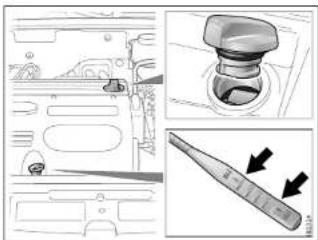
natural_image
Technical illustration of a mechanical component with a knob and a close-up of a tool tip (no text or symbols)
text_image
Diagram showing mechanical components with labeled parts and directional arrows indicating motion or force vectorsOil filler cap and dipstick, 4-cyl engine Oil filler cap and dipstick, V6 engine
4-cyl engine: The engine oil level is checked each time the engine is started. If the oil level is low, the following message appears on the SID:

Low engine oil level.
If this occurs the oil level must be checked first. If the level is too low then it must be topped up.
V6 engine: The engine has an oil level sensor that checks the oil level when the engine is running. If the oil level drops too low, the following message appears on the SID:

Low engine oil level.
If this occurs the oil level must be checked first. If the level is too low then it must be topped up.

93 US 7carecare MY09.fm Page 209 Tuesday, April 15, 2008 11:26 AM
Make sure you screw on the oil filler cap properly after topping up the oil to avoid running problems.
It is normal for an engine to consume a certain amount of oil. It is therefore often necessary to top up the oil between services. Check the engine oil level regularly.
During the Break-In Period (approx. 3,000 miles or 5,000 km) and when driving at high speeds or with a trailer, the oil consumption may be higher than normal.
NOTICE
Change of engine oil and oil filter may be required more frequently if the car is being used under certain conditions, see page 279.
WARNING
-
Prolonged and repeated exposure of the skin to engine oil can cause serious skin disorders. Avoid prolonged skin contact whenever possible.
• Used engine oil contains chemicals that have caused cancer in laboratory animals. Always protect your skin by washing thoroughly with soap and water. -
Keep oil out of reach of children.
- Do not touch the turbocharger or exhaust manifold. These get very hot when the engine has been running.
- Do not spill oil on hot parts of the engine as this could cause a fire. Used engine oil is particularly flammable.
- Protect the environment. Do not dispose of oil into the ground or down a drain. Dispose of all used oil and oil filters at an appropriate disposal facility.
209Car care
NOTICE
- Do not run the engine with the oil level too low.
- Change engine oil and oil filter in accordance with the service programme.
- Only use the recommended type of oil.
Observe the above three points to avoid serious damage to the engine.
For oil volumes and grades, refer to page 286.
Air filter
WARNING
To ensure reliable operation, only use an air filter recommended by Saab Automobile AB.


93 US 7carecare MY09.fm Page 210 Tuesday, April 15, 2008 11:26 AM
210 Car care
Transmission fluid
Manual transmission
Check and top up the oil in accordance with the service program.
Automatic transmission
Check and top up the oil in accordance with the service program.
Coolant
WARNING
- Proceed with caution if the radiator is boiling when you open the hood. Never remove the expansion-tank filler cap when the radiator is boiling.
- The cooling system is pressurized – hot coolant and vapor can escape when the filler cap is released. These can cause injury to your eyes and burns. Loosen the cap carefully, and let the engine cool before removing the cap.
• Exercise care when adding coolant. Coolant on hot surfaces constitutes a fire risk.
There is an overpressure in the cooling system. Coolant temperatures can sometimes exceed 212^ F ( 100^ C).
If the coolant level drops too low, the following message appears on the SID:

Coolant level low. Refill.
The properties of the coolant are retained for the entire service life of the car. Therefore, it is not necessary to change the coolant.
The coolant contains 45 % antifreeze and anti-corrosion fluid. This ratio gives the best cooling effect. Lower concentrations should be avoided, in view of the corrosion risk.
Coolants of a different brand could damage the engine or cooling system. We therefore recommend strict use of coolants that have been approved by Saab.
NOTICE
If the cooling system needs topping up, mix the antifreeze with the appropriate quantity of drinking water or distilled water before adding it to the system.
If undiluted antifreeze is added, the engine could still freeze and be damaged. This is because the antifreeze will not mix properly with the coolant before the thermostat has opened to allow full circulation.
Note
If incorrect coolant is used or added, the life-time properties will be affected. Even if the coolant is flushed from the system and replaced with life-time coolant, life-time properties are no longer retained and the coolant must then be drained and replaced at regular intervals.

natural_image
Pure geometric diagram with crosshair and circular shapes, no text or symbols present93 US 7carcare MY09.fm Page 211 Tuesday, April 15, 2008 11:26 AM
211Car care

natural_image
Mechanical component diagram showing engine and hose assembly (no text or labels)Coolant expansion tank, 4-cyl engine
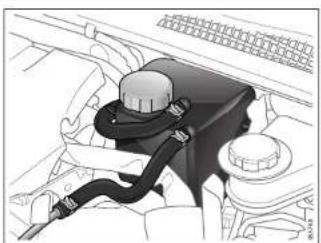
natural_image
Diagram of a car interior showing a seatbelt and dashboard (no text or symbols)Coolant expansion tank, V6 engine Level markings, V6 engine
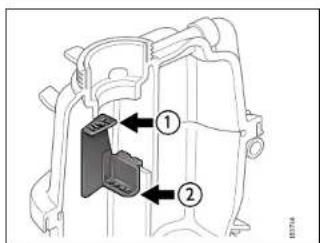
text_image
Technical diagram of a mechanical component with numbered parts and directional arrows indicating assembly or flow.1 HOT 2 COLD
4-cyl engine: The expansion tank is transparent to facilitate checking the coolant level.
When the engine is cold, the coolant shall lie on or just above the KALT/COLD mark on the expansion tank (boundary between the upper and lower sections of the tank, see illustration).
Top up with a mixture of equal parts of Saab-approved concentrated coolant and clean water. We recommend that you contact an authorized Saab dealer.
If the expansion tank is empty when coolant is added, run the engine until warm so that the thermostat opens. Top up the tank again, as necessary.
V6 engine: The expansion tank is not transparent. The cap must be unscrewed so that the coolant level can be checked. When the cap is screwed off there are two level markings, HOT and COLD.
When the engine is cold, the coolant shall lie on or just above the COLD mark in the expansion tank.




93 US 7carecare MY09.fm Page 212 Tuesday, April 15, 2008 11:26 AM
212 Car care
Brake/clutch fluid and brake pads
WARNING
Brake fluid deteriorates as it becomes old. Because it is hygroscopic, it absorbs water from the air and, in time, could allow vapor to form in the brake system, thus reducing its performance. It is therefore important that brake fluid be changed regularly, as specified in the service program.
Checking
Brake fluid should be changed according to the service program. Refer to the Warranty and Service Book.
The brake and clutch fluid reservoir is transparent to facilitate checking of the fluid level. The fluid level should lie between the MAX and MIN marks.
If the level drops too low, the following message appears on the SID:

Brake fluid level low. Make a safe stop.
Top up as necessary with DOT 4 brake fluid. Do not use DOT 5 fluid.
Use only new brake fluid from a sealed container.
The brake fluid level will fall somewhat as the brake pads wear. The MAX level in the reservoir corresponds to the amount of brake fluid required with new brake pads. If the fall in fluid level is moderate, due to normal brake pad wear, topping up is not necessary.
If the brake fluid should require changing, this must be carried out at a Saab dealer. We recommend that you contact a Saab dealer.
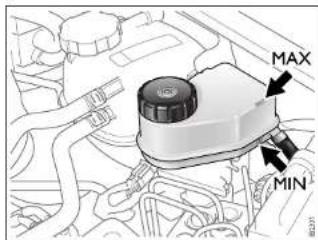
text_image
MAX MINBrake fluid reservoir
The foot brake and parking brake are self-adjusting.
It is not possible to detect, through abnormal pedal or parking brake lever travel, whether the brake pads are worn and need replacing. It is therefore essential that brake pads be checked regularly, as specified in the service program.


93 US 7carecare MY09.fm Page 213 Tuesday, April 15, 2008 11:26 AM


213Car care
NOTICE
Avoid spilling brake fluid onto paintwork, since it can cause the paint to bubble and lift. If any brake fluid is spilled, the area should be flushed with large quantities of water as quickly as possible.
Brake pads should only be changed at a workshop. We recommend that you contact a Saab dealer.
Power steering

WARNING
Power steering fluid on hot engine components constitutes a fire risk.
Check the level of the power steering fluid in the reservoir regularly, in accordance with the service program.
The wheels should point directly forwards during this check.
Clean round the cap before unscrewing it. Wipe the dipstick. To check the level, screw down the cap completely and then remove it again.
The oil level should lie between the MAX and MIN marks when the oil temperature is about 68^ F (+20°C). If the oil is colder, the level will be lower, and at a higher temperatures the level will be higher.
Top up with CHF 11S or CHF 202 power steering fluid.
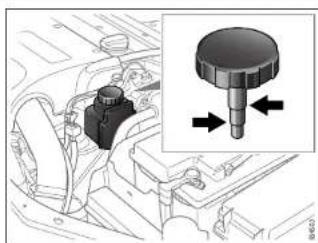
natural_image
Diagram of a car engine component with an inset showing a circular component inserted into the engine (no text or symbols present)Power steering fluid reservoir, 4-cyl engine
Power steering fluid reservoir, V6 engine

natural_image
Mechanical assembly diagram showing a component with a close-up inset of a cylindrical component (no text or symbols)


93 US 7carecare MY09.fm Page 214 Tuesday, April 15, 2008 11:26 AM
214 Car care
Battery

WARNING
- When working on the battery, highly explosive gas can build up. A spark could ignite this gas that collects around the battery.
Therefore, always avoid sparks and open flames in the vicinity of the battery.
• The battery contains corrosive sulfuric acid. Always wear a face mask or goggles when working on the battery. - If battery acid gets into the eyes or splashes onto skin or clothing, wash the affected area liberally with water. If acid gets into the eyes or a large quantity makes contact with the skin, seek medical help.
- Battery posts, terminals and related accessories contain lead and lead compounds. Wash your hands after handling
NOTICE
A discharged battery can freeze and fracture. Batteries should therefore always be stored away from sub-zero temperatures.
The battery is maintenance free.
If frequent short journeys are made, the battery may need extra charging. This can be done with a battery charger or by taking the car for a long run.
If the battery is not being charged while the engine is running, the following message will appear on the SID:

Battery not charging. Make a safe stop.
Check the drive belt (see page 215). If the belt is damaged, the engine may overheat, the battery may not be charged and the A/C compressor may not work.

natural_image
Technical diagram of a car's internal structure showing a vehicle chassis and dashboard (no text or labels)Turn the two retainers a quarter turn to unlock the battery cover.
Always connect the positive (red) cable to the battery's positive (+) terminal, and the negative (black) cable to the negative (-) terminal of the battery. Always disconnect both battery leads when boost charging the battery.
A car with standard equipment specifications and a fully charged battery can be left for up to 40 days and still have a sufficient charge for starting. If extra equipment is fitted, such as a mobile phone, the charge may only be sufficient for about 15 days.


93 US 7carcare MY09.fm Page 215 Tuesday, April 15, 2008 11:26 AM
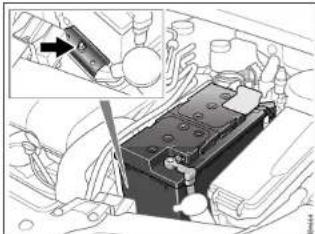
natural_image
Mechanical assembly diagram showing a component inserted into a vehicle's engine compartment, with no visible text or symbols.Battery bracket
Drive belt
WARNING
- Keep hands and clothing clear of drive belts when engine is running.
• Always stop the engine before inspecting the drive belt. - The radiator fan is electric and can start even when the engine is switched off.
The alternator is situated on the right-hand side of the engine. It is driven by a poly-V-belt from the crankshaft pulley.
A slipping or broken poly-V-belt can result in:
• No charge to the battery
- No A/C compressor function.
The belt tension is critical and is adjusted automatically by the belt tensioner.
NOTICE
Serious damage can be done to the car's electrical system if an alternator lead is disconnected while the engine is running.
NOTICE
- If boost charging never use anything but a 12-volt charger, see page 197.
- Do not connect the battery terminals, + and -, incorrectly.
- Serious damage can occur to the car's electrical system if a battery or alternator lead is disconnected while the engine is running.
• Exercise special care when removing and fitting the positive (+) cable so as not to damage the battery disconnect switch.


93 US 7carcare MY09.fm Page 216 Tuesday, April 15, 2008 11:26 AM
216 Car care
Wipers and washers
Wiper blades
Check and clean all wiper blades regularly. If poor wiper performance is experienced, clean the windshield with washer fluid. This is particularly important if the car has been through an automatic car wash, as these sometimes leave a wax coating on the windshield.
If wiper performance is still unsatisfactory, fit new blades.
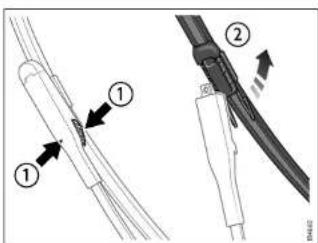
text_image
Technical diagram showing two cable connector assemblies with labeled parts and directional arrows indicating assembly steps.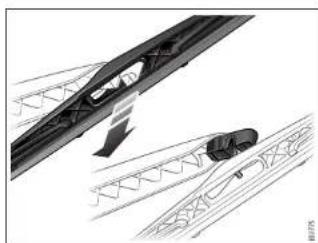
natural_image
Illustration of a high-speed train on tracks with overhead tracks and a speedometer (no text or symbols)Change of wiper blades, windshield Change of wiper blades, rear window, SportCombi
Windshield
1 Press in the two catches (1) together.
2 Hold the wiper arm and move the wiper blade out and diagonally up.
Fitting the wiper blade
1 Align the wiper arm's guide lug in the blade's corresponding slot.
2 Move the blade in towards the wiper arm until the two catches grip the blade. Check that the blade is fitted firmly.
Rear window, SportCombi
1 Detach the blade from the arm by pressing on the mounting for the blade from below.
2 Fit the new blade by pressing the shaft of the blade into the arm's mounting.
The washer jet, which is located next to the high-mounted brake light, is not adjustable.

93 US 7carcare MY09.fm Page 217 Tuesday, April 15, 2008 11:26 AM

natural_image
Line drawing of a car interior showing dashboard and steering wheel (no text or symbols)Washer fluid reservoir
The reservoir capacity is approx. 6 qts. (5.8 liters).
When the washer fluid level drops below 1 quart (1 liter), the headlight washers (if equipped) are deactivated. This is in order to prioritize the windshield. The following message is displayed on the SID:

Washer fluid level low.
Refill.
Headlight washers are only available on certain markets.
Fill with a mixture of washer fluid and water as recommended by the table on the packaging to reduce the risk of freezing and to ensure effective cleaning (see also page 104).
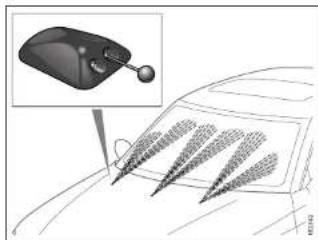
natural_image
Diagram of a car's roof panel with a magnified inset showing a device interacting with the panel (no text or symbols present)Washer jets
The washer jets, which are adjustable, can be cleaned with a pin if necessary.
Washers
WARNING
Take care not to spill washer fluid concentrate onto hot surfaces. Washer fluid concentrate can contain flammable ingredients such as alcohol.




217Car care
93 US 7carecare MY09.fm Page 218 Tuesday, April 15, 2008 11:26 AM
218 Car care
Changing bulbs

WARNING
Before changing a bulb in the engine bay, switch off the engine to avoid the danger of fingers and hands being injured by moving parts.
The radiator fan can cut in even when the engine is switched off.
Auto checking of lights
The bulbs that are most important from the point of view of traffic safety are monitored by the car's electrical system. If one of these bulbs should fail, a message will be displayed on the SID.
Example of SID message:

Left low beam failure.
The following bulbs are not checked: parking lights, front fog lights, reversing lights, license plate lighting, side marker lights and side direction indicators.
SportCombl
The tail lights and brake lights consist of LEDs. If approx. 3/4 of the LEDs on one side are broken then this is indicated in the SID.
If a stop light bulb falls
SportSedan: If a stop light bulb fails, the adjacent taillight will act as a stop light to ensure traffic safety. Change the broken bulb when possible.
All rear light bulbs are of the same type and rated 21 W, with the exception of the license plate lighting which is rated 5 W.


93 US 7carecare MY09.fm Page 219 Tuesday, April 15, 2008 11:26 AM
Wrong bulb fitted
If a low or main beam bulb of too high a rating is fitted, a bulb failure message will be shown on the SID (a too high wattage bulb can damage the reflector).
If the following message is displayed but the bulb shines, it is most likely that an incorrect bulb has been fitted.

Right high beam failure.
Note
When changing bulbs, fit the same type of bulb (e.g. Long-Life) as that removed.
Headlight alming, page 274.
Xenon headlights \*
WARNING
Xenon headlights are high tension. All work on xenon headlights, including changing bulbs, must be carried out by dealer personnel.
Xenon headlights produce roughly two times as much light as halogen bulbs and have a significantly longer service life.
The lamp units consist of a gas discharge lamp containing xenon. When the lights are switched on a very high voltage activates the xenon gas. The lamps soon reach full intensity.
Cars with xenon headlights have automatic levelling. The levelling system is comprised of two sensors, one on the front suspension and one on the rear suspension, and a control unit by the engine bay fuse box. Headlight alignment is adjusted automatically to the car's load to prevent dazzling drivers in oncoming traffic.
If a fault is detected in the system, the following message will be displayed on the SID:
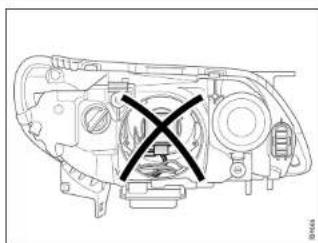
natural_image
Technical line drawing of a mechanical component with a black X mark indicating a defect or inspection (no text or symbols present)We recommend you to contact a Saab dealer to have a xenon headlight changed

Headlight levelling malfunction.




219Car care
93 US 7carcare MY09.fm Page 220 Tuesday, April 15, 2008 11:26 AM
220 Car care

natural_image
Technical diagram of a vehicle chassis with two arrows indicating parts of the chassis (no text or labels present)Retainers on the battery cover Changing the low beam bulb
Low beam, halogen
Left-hand side
1 Lift aside the hose ✦ running along the side of the battery cover.
2 Release the two retainers (a quarter of a turn counterclockwise) in the leading edge of the cover and remove the cover.
3 Pull up the washer fluid filler pipe.
4 Remove the air pipe from the front edge of the battery box.
5 Pull up the fuse panel * in front of the battery, see page 239.
Both sides
1 Remove the cover from the rear of the headlight.
2 Twist the bulb holder counterclockwise and withdraw the holder from the reflector.
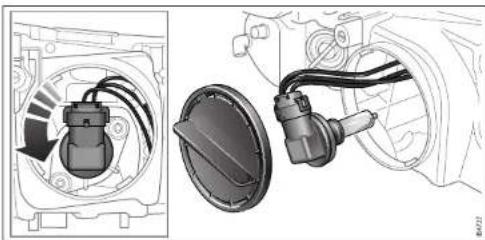
natural_image
Technical diagram showing engine components with no visible text or symbols3 Change the bulb without touching the glass with your fingers. Insert the bulb holder into the reflector and twist it clockwise until it locks.
4 Refit the cover over the rear of the headlight.
Left-hand side
5 Refit the air pipe to the front of the battery box.
6 Refit the washer fluid filler pipe.
7 Refit the battery cover.
8 Refit the hose * running along the side of the battery cover.
NOTICE
Do not fit bulbs with a higher rating than 55 W as this could damage the headlight reflector. Furthermore, the car's wiring is not designed to cope with higher wattages.

93 US 7carcare MY09.fm Page 221 Tuesday, April 15, 2008 11:26 AM
221Car care
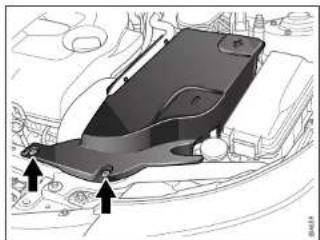
natural_image
Technical diagram of a car's internal structure with two arrows indicating components (no text or labels present)Retainers on the battery cover Changing the high beam bulb
High beam, halogen
Left-hand side
1 Lift aside the hose * running along the side of the battery cover.
2 Release the two retainers (a quarter of a turn counterclockwise) in the leading edge of the cover and remove the cover.
3 Pull up the washer fluid filler pipe.
4 Remove the air pipe from the front edge of the battery box.
5 Pull up the fuse panel * in front of the battery, see page 239.
Both sides
1 Remove the cover from the rear of the headlight.
2 Twist the bulb holder counterclockwise and withdraw the holder from the reflector.
3 Change the bulb without touching the glass with your fingers. Insert the bulb holder into the reflector and twist it clockwise until it locks.

natural_image
Technical illustration of a mechanical assembly with a circular component and a close-up view showing internal components (no text or symbols)4 Refit the cover over the rear of the headlight.
Left-hand side
5 Refit the air pipe to the front of the battery box.
6 Refit the washer fluid filler pipe.
7 Refit the battery cover.
8 Refit the hose * running along the side of the battery cover.
NOTICE
Do not fit bulbs with a higher rating than 55 W as this could damage the headlight reflector. Furthermore, the car's wiring is not designed to cope with higher wattages.


93 US 7carcare MY09.fm Page 222 Tuesday, April 15, 2008 11:26 AM
222 Car care

natural_image
Technical diagram of a mechanical component with two arrows indicating parts of a housing (no text or symbols present)Retainers on the battery cover
Daytime Running Light
Left-hand side
1 Lift aside the hose ✦ running along the side of the battery cover.
2 Release the two retainers (a quarter of a turn counterclockwise) in the leading edge of the cover and remove the cover.
3 Pull up the washer fluid filler pipe.
4 Remove the air pipe from the front edge of the battery box.
5 Pull up the fuse panel * in front of the battery, see page 239.

natural_image
Technical diagram of a mechanical device showing internal components and wiring (no text or symbols)it locks. To facilitate fitting, look in through the headlight lens when fitting the bulb. Check that the new bulb is firmly seated. 4 Refit the cover over the rear of the headlight.
Left-hand side
5 Refit the air pipe to the front of the battery box.
6 Refit the washer fluid filler pipe.
7 Refit the battery cover.
8 Refit the hose * running along the side of the battery cover.
Both sides
1 Remove the cover from the rear of the headlight.
2 Twist the bulb holder counterclockwise and withdraw the holder from the reflector.
3 Change the bulb without touching the glass with your fingers. Insert the bulb holder into the reflector and twist it clockwise until



93 US 7carcare MY09.fm Page 223 Tuesday, April 15, 2008 11:26 AM
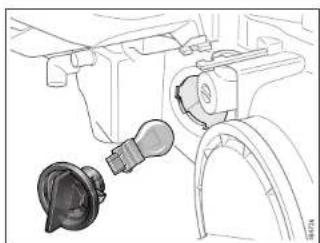
natural_image
Technical line drawing of a mechanical assembly with a bulb and plug (no text or symbols)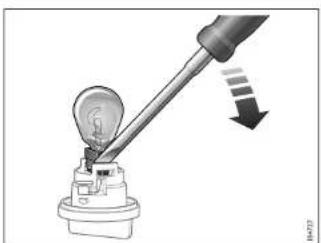
natural_image
Illustration of a light bulb being inserted into a terminal block with a downward arrow indicating compression (no text or symbols)
natural_image
Mechanical assembly diagram showing a gear and adjustment mechanism (no text or labels)Front turn signal bulbs
Left-hand side
1 Lift aside the hose ✦ running along the side of the battery cover.
2 Release the two retainers on the battery cover and remove the cover.
3 Pull up the washer fluid filler pipe.
4 Remove the air pipe from the front edge of the battery box.
Both sides
1 The bulb holder has a bayonet fitting. Turn the bulb holder counterclockwise and withdraw it.
2 Hold the bulb holder with a firm grip. Use a screwdriver to pry the bulb from the holder.
3 Fit the new bulb
4 To facilitate fitting, look in through the headlight lens when fitting the bulb. Check that the new bulb is firmly seated.
Left-hand side
5 Refit the air pipe to the front edge of the battery box.
6 Refit the washer fluid filler pipe.
7 Refit the battery cover and hose *.
Side-mounted turn signal bulbs
1 Slide the lamp fitting forward so that its rear end can be pulled out.
2 Turn the bulb holder counterclockwise and withdraw it from the lamp fitting. Change the bulb.
3 To fit, engage the two catches on the rear edge of the lamp fitting with the edge of the opening. Then press in the front edge of the lamp fitting so that the groove in the spring engages the plastic edge.

93 US 7carcare MY09.fm Page 224 Tuesday, April 15, 2008 11:26 AM
224 Car care
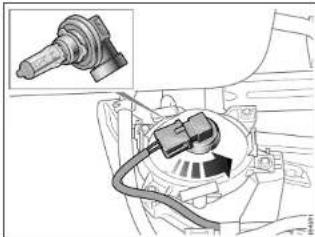
natural_image
Technical line drawing of a mechanical component with a magnified inset showing a pin inserted into a housing (no text or symbols)Front fog lights \*
WARNING
- Never crawl under a car that is supported only by a jack. Always use axle stands.
• Refer to the information on jacks on pages 258 and 259.
1 Undo one screw in the wheel housing. Lower the air shield.
2 Remove the protective cover. Release the two spring clips securing the bulb.
3 Unplug the connector.
4 Change the bulb. Try not to touch the glass part of the bulb with your fingers.
The height of the beam can be adjusted using a screwdriver inserted through the hole in the lower grille adjacent to the lens.
Side marker lights and parking lights
Side marker lights and parking lights consists of LEDs. We recommend that you contact a Saab dealer if they need changing.

text_image
Diagram of a car front view with numbered parts for identificationTaillights, SportSedan
1 Turn signals
2 Taillights/stop lights
3 Reversing lights
4 Rear fog light (left-hand side)
5 High-mounted stop light
SportSedan: If a stop light bulb fails, the adjacent taillight will act as a stop light to ensure traffic safety. Change the broken bulb when possible.



93 US 7carecare MY09.fm Page 225 Tuesday, April 15, 2008 11:26 AM


225Car care

text_image
①③⑤③① ②④②Taillights, Convertible
1 Tum signals
2 Taillights/stop lights
3 Reversing lights
4 Rear fog light (left-hand side)
5 High-mounted stop light
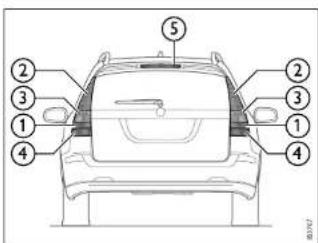
text_image
Technical diagram of a car front view with numbered component labels for identificationTaillights, SportCombi
1 Tum signals
2 Taillights/stop lights
3 Reversing lights
4 Rear fog light (left-hand side)
5 High-mounted stop light

text_image
Diagram showing car interior components with arrows indicating movement, including a hand holding a device and a close-up of the internal wiring.Stop lights, taillights and turn signal bulbs, SportSedan
1 Lower the cover in the trim behind the lights.
Right-hand side: Unlock the plastic river by depressing the center no more than 0.1 in. (3 mm). Take hold of the collar of the rivet and pull it out. Refer also to page 226.
2 Lift the plastic lug on the lamp housing that secures the bulb holder.
3 Carefully remove the entire bulb holder unit from the lamp housing. Change the bulb.
4 Refit the bulb holder. Press the bulb holder home so that the plastic lug snaps into place.


93 US 7carcare MY09.fm Page 226 Tuesday, April 15, 2008 11:26 AM
226 Car care

natural_image
Mechanical component diagram showing internal parts and a close-up inset of a housing (no text or symbols)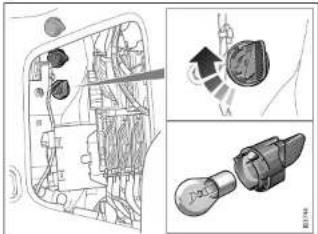
natural_image
Technical diagram showing internal components and a close-up of a light bulb (no text or labels)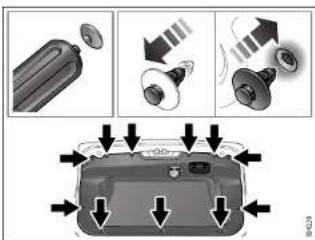
text_image
Diagram illustrating car door seat mounting process with arrows indicating movement and repair stepsStop lights, taillights and turn signal bulbs, Convertible
1 Remove the cover.
2 Carefully remove the bulb holder with the broken bulb. The bulb holder has a bayonet fitting.
3 Change the bulb.
4 Refit the bulb holder and cover.
1 Remove the cover.
2 Carefully remove the bulb holder with the broken bulb. The bulb holder has a bayonet fitting.
3 Change the bulb.
4 Refit the bulb holder and cover.
Turn signals, reversing light and rear fog light, SportCombi
1 Remove the cover.
2 Remove the bulb holder with the broken bulb. The bulb holder has a bayonet fitting.
3 Fit the new bulb.
4 Refit the bulb holder and the cover.
Reversing lights and rear fog light, SportSedan
Removing the trunk lid trim
1 Remove the two screws securing the grab handle to the inside of the trunk lid.
2 Unlock the plastic rivets by pressing in the center of each rivet. Pull out the rivets by taking hold of the rivet's collar.
You can use the button on the handle of the screwdriver supplied with the car to unlock the rivets.
Stop lights, taillights and turn signal bulbs, Convertible






93 US 7carcare MY09.fm Page 227 Tuesday, April 15, 2008 11:26 AM


227Car care

text_image
Technical diagram showing car interior components with labeled parts and a close-up of the device's cable connection.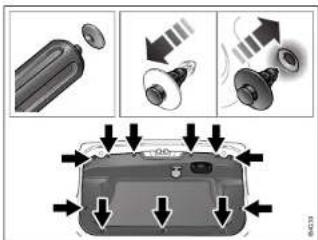
text_image
Diagram illustrating vehicle door lock mechanism with labeled components and directional arrows indicating motion or movement.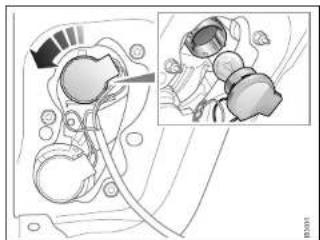
natural_image
Diagram of a car interior showing engine, airbags, and exhaust pipe connections (no text or labels)Changing bulbs
1 Press down the plastic lug on the bulb holder.
2 Carefully remove the entire bulb holder unit from the lamp housing. Change the bulb.
3 Refit the bulb holder. Press the lug so that it snaps into place.
To refit the trunk lid trim
1 Withdraw the center of the rivets.
2 Fit the trim in place on the trunk lid.
3 Fit the rivets. Lock the rivets in place by pressing the center buttons in until flush with the collar.
Reversing lights and rear fog lights, Convertible
Removing the trunk lid trim
1 Unlock the plastic rivets by pressing in the center of each rivet no more than 3 mm. Pull out the rivets by taking hold of the rivet's collar.
You can use the button on the handle of the screwdriver supplied with the car to unlock the rivets.
Changing bulbs
1 Carefully remove the bulb holder with the broken bulb. The bulb holder has a bayonet fitting.
2 Fit the new bulb.
3 Refit the bulb holder.
To refit the trunk lid trim
1 Withdraw the center of the rivets.
2 Fit the trim in place on the trunk lid.
3 Fit the rivets. Lock the rivets in place by pressing the center buttons in until flush with the collar.


93 US 7carecare MY09.fm Page 228 Tuesday, April 15, 2008 11:26 AM
228 Car care

natural_image
Diagram of a vehicle interior layout with a highlighted section showing a blade and wheel (no text or labels)
natural_image
Technical line drawing of a mechanical assembly with internal components (no text or symbols)
natural_image
Diagram of a car interior showing a door handle and seat with a directional arrow (no text or symbols)Dome light, front, SportSedan and SportCombi
1 Pull down the rear edge of the lens.
2 Fit the new bulb.
3 Insert the guide lugs on the front edge of the lens and press the lens home.
1 Pull down the rear edge of the lens.
2 Fit the new bulb.
3 Insert the guide lugs on the front edge of the lens and press the lens home.
1 Pull down the rear edge of the lens.
2 Fit the new bulb.
3 Insert the guide lugs on the front edge of the lens and press the lens home.
1 Pull down the rear edge of the lens.
2 Fit the new bulb.
3 Insert the guide lugs on the front edge of the lens and press the lens home.
Dome light, rear, SportSedan and SportCombi
1 Remove the entire overhead panel: ease out the trailing end first, and then both sides of the front edge.
2 Fit the new bulb.
1 Remove the entire overhead panel: ease out the trailing end first, and then both sides of the front edge.
2 Fit the new bulb.
1 Remove the entire overhead panel: ease out the trailing end first, and then both sides of the front edge.
2 Fit the new bulb.
1 Remove the entire overhead panel: ease out the trailing end first, and then both sides of the front edge.
2 Fit the new bulb.
Dome light, Convertible
1 Pull down the rear edge of the light fitting.
2 If the center bulb needs replacing, open the hatch over the bulbs. Pull the bulb out of the bulb holder.
If one of the outer bulbs needs replacing, turn the light fitting round. Change the bulb from the reverse of the lighting fitting. The bulb has a bayonet fitting.
3 Position the front edge of the light fitting and press the fitting up towards the windscreen rail.
fitting.
2 If the center bulb needs replacing, open the hatch over the bulbs. Pull the bulb out of the bulb holder.
If one of the outer bulbs needs replacing, turn the light fitting round. Change the bulb from the reverse of the lighting fitting. The bulb has a bayonet fitting.
3 Position the front edge of the light fitting and press the fitting up towards the windscreen rail.
fitting.
2 If the center bulb needs replacing, open the hatch over the bulbs. Pull the bulb out of the bulb holder.
If one of the outer bulbs needs replacing, turn the light fitting round. Change the bulb from the reverse of the lighting fitting. The bulb has a bayonet fitting.
3 Position the front edge of the light fitting and press the fitting up towards the windscreen rail.
Dome light, front, SportSedan and SportCombi
Dome light, front, SportSedan and SportCombi
Dome light, Convertible


93 US 7carcare MY09 fm Page 229 Tuesday, April 15, 2008 11:26 AM

natural_image
Diagram of a car door handle with a downward arrow indicating direction (no text or symbols)Hatch opened for replacement of center bulb
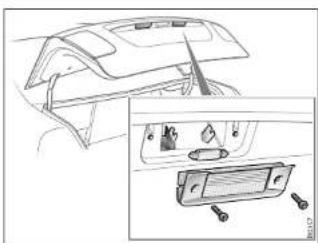
natural_image
Line drawing of a car rear intake manifold with a close-up inset showing internal components (no text or symbols)License plate lighting
1 Undo the two screws and remove the lens.
2 Fit the new bulb.
3 Make sure the seal on the lens is correctly seated.
4 Refit the lens and tighten the two screws.
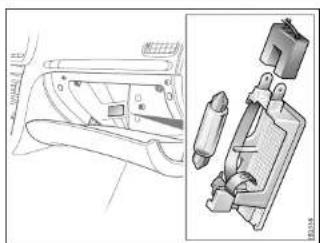
natural_image
Technical line drawing of a car interior and rear seat assembly (no text or symbols)Glove box lighting \*
1 Remove the lamp housing using a short screwdriver.
2 Fit the new bulb.
3 Insert the connector side first when refitting the lamp.
Reverse side of the light fitting. The arrows mark the outer bulbs
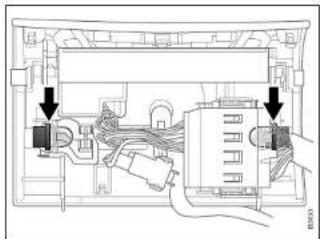
natural_image
Diagram of a device interior showing internal components and connections (no text or symbols)

229Car care


93 US 7carcare MY09.fm Page 230 Tuesday, April 15, 2008 11:26 AM


230 Car care
Trunk lighting, SportSedan
The lamp fitting is located under the parcel shelf.
1 Remove the lamp fitting by pulling down one end.
2 The baffle must be removed before the bulb can be replaced. Point the baffle's tab up with a small screwdriver.
3 Fit the new bulb.
4 Refit the baffle by first fitting its tab in its bracket between the contact plates. Hold it in place and move the other side down.
5 Insert the connector side first when refitting the lamp.
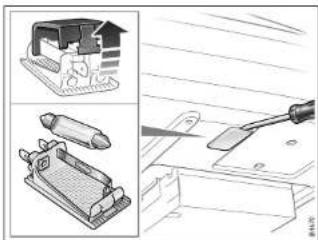
natural_image
Technical illustration of a mechanical device with three views: top shows a component, middle shows a tool, and bottom shows a flat surface (no text or symbols)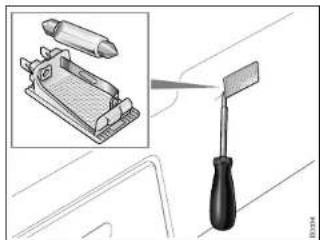
natural_image
Technical illustration of a screwdriver tool applying material to a mechanical component (no text or symbols present)Trunk lighting, Convertible
1 Remove the lamp in the rear end first.
2 Change the bulb.
3 Insert the connector side first when refitting the lamp.


93 US 7carcare MY09.fm Page 231 Tuesday, April 15, 2008 11:26 AM
231Car care

natural_image
Diagram of a car interior showing a clip attached to a door panel (no text or symbols visible)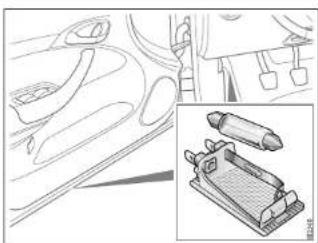
natural_image
Technical line drawing of a car interior and dashboard components, including a zoomed-in view of the dashboard (no text or symbols present)Other bulbs
If any other bulbs need changing, we recommend that you visit a Saab dealer.
Trunk lighting, SportCombi
1 Pull the lamp housing forward slightly and lift it out at the rear. Use a thin and wide tool.
2 Fit the new bulb. The bulb is secured in the holder.
3 Start by inserting in the front edge of the lamp housing and then pressing in the rear edge.
Courtesy/floor lighting \*
1 Release one edge of the lamp fitting using a screwdriver.
2 Fit the new bulb.
3 Insert the connector side first when refitting the lamp.


93 US 7carcare MY09.fm Page 232 Tuesday, April 15, 2008 11:26 AM
232 Car care
1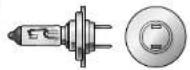 | 7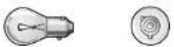 |
 | 8 |
 | 9 |
4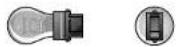 | 10 |
5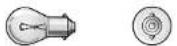 | 11 |
6 | 12 |
Bulb table
| No. | Designation Watt-age | |
| 1 | H7 55 High beam (cars with halogen light) | |
| 2 | H8 35 Front fog lights * | |
| 3 | H11 55 Low beam (cars with halogen light) | |
| 4 | 3457 A/AK (yellow) | 30 cp Direction indicator, front |
| 5 | P21W 21 Reversing lights | |
| 6 | PR21W(red) | 21 Rear fog light; taillights (SportSedan);brake lights (SportSedan) |
| 7 | PY21W(yellow) | 21 Drection indicator, rear |
| 8 | 4157 K 32 cp Daytime Running Light (cars with xenon light) | |
| 9 | R10W 10 Rear dome lighting; courtesy lighting; glove box lighting; trunk lighting, Convertible | |
| 10 | R5W 5 License plate lighting; trunk lighting,SportSedan | |
| 11 | T4W 4 Reading light, rear | |
| 12 | WY5W/W5W 5 Side-mounted turn signal (yellow);front dome lighting | |
NOTICE
Only fit lamps of the specified rating. Lamps of the wrong wattage could damage the wiring harness and electronics.
| 1 | 7 | ||
| 2 | 8 | ||
| 3 | 9 | ||
| 4 | 10 | ||
| 5 | 11 | ||
| 6 | 12 |
| 1 | 7 | ||
| 2 | 8 | ||
| 3 | 9 | ||
| 4 | 10 | ||
| 5 | 11 | ||
| 6 | 12 |
| 1 | 7 | ||
| 2 | 8 | ||
| 3 | 9 | ||
| 4 | 10 | ||
| 5 | 11 | ||
| 6 | 12 |
| 1 | 7 | ||
| 2 | 8 | ||
| 3 | 9 | ||
| 4 | 10 | ||
| 5 | 11 | ||
| 6 | 12 |
| 1 | 7 | ||
| 2 | 8 | ||
| 3 | 9 | ||
| 4 | 10 | ||
| 5 | 11 | ||
| 6 | 12 |
| 1 | 7 | ||
| 2 | 8 | ||
| 3 | 9 | ||
| 4 | 10 | ||
| 5 | 11 | ||
| 6 | 12 |
| 1 | 7 | ||
| 2 | 8 | ||
| 3 | 9 | ||
| 4 | 10 | ||
| 5 | 11 | ||
| 6 | 12 |
| 1 | 7 | ||
| 2 | 8 | ||
| 3 | 9 | ||
| 4 | 10 | ||
| 5 | 11 | ||
| 6 | 12 |
| 1 | 7 | ||
| 2 | 8 | ||
| 3 | 9 | ||
| 4 | 10 | ||
| 5 | 11 | ||
| 6 | 12 |
| 1 | 7 | ||
| 2 | 8 | ||
| 3 | 9 | ||
| 4 | 10 | ||
| 5 | 11 | ||
| 6 | 12 |
| 1 | 7 | ||
| 2 | 8 | ||
| 3 | 9 | ||
| 4 | 10 | ||
| 5 | 11 | ||
| 6 | 12 |
| 1 | 7 | ||
| 2 | 8 | ||
| 3 | 9 | ||
| 4 | 10 | ||
| 5 | 11 | ||
| 6 | 12 |

| 1 | 7 | ||
| 2 | 8 | ||
| 3 | 9 | ||
| 4 | 10 | ||
| 5 | 11 | ||
| 6 | 12 |
| 1 | 7 | ||
| 2 | 8 | ||
| 3 | 9 | ||
| 4 | 10 | ||
| 5 | 11 | ||
| 6 | 12 |


93 US 7carecare MY09.fm Page 233 Tuesday, April 15, 2008 11:26 AM


233Car care
Fuses

WARNING
To avoid the risk of short-circuiting and/or fire breaking out in the electrical system, the following should be heeded:
• We recommend that you always consult an Saab dealer before modifying or adding any electrical equipment. Failure to do so can result in the electrical system being damaged.
- Never replace a fuse with one having a higher rating than specified (see page 235). The color of the fuse indicates its amperage.
- If the same fuse blows repeatedly, have the electrical system checked by a workshop. We recommend that you contact a Saab dealer.
- If a MAXI fuse blows, it means that there is a major fault in the electrical system. Have the car checked without delay. We recommend that you contact a Saab dealer.
The fuses are housed in three fuse panels: one behind a hatch on the left-hand end of the dash, one in the engine bay (additional small unit in front of battery) and one on the left-hand side of the trunk. There is space for spare fuses in the hatch on the left-hand end of the dash.

Sound fuse / Blown fuse
To check if a fuse has blown, first remove it from the panel. If the filament is broken, the fuse has blown.


93 US 7carcare MY09.fm Page 234 Tuesday, April 15, 2008 11:26 AM
234 Car care
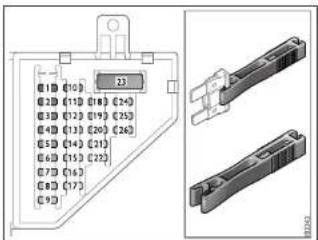
text_image
Technical diagram showing labeled components and two views of a mechanical component with numbered partsFuse panel in end of dash
A special tool for removing fuses is provided on the hatch on the left-hand end of the dash. Simply push the tool onto the fuse, squeeze and remove the fuse.
Some fuses and relays may be fitted but not connected to the car's electrical system.
MAXI fuses
The car also has a number of large fuses known as MAXI fuses. These are designed to protect the car's electrical system from being damaged. Each MAXI fuse protects a number of electrical circuits and functions and therefore has a higher rating (amper-age) than the standard fuses. No spare MAXI fuses are supplied with the car.
NOTICE
If a MAXI fuse blows, there is a major fault in the electrical system. Have the car checked. We recommend that you contact a Saab dealer.




93 US 7carecare MY09.fm Page 235 Tuesday, April 15, 2008 11:26 AM


235Car care
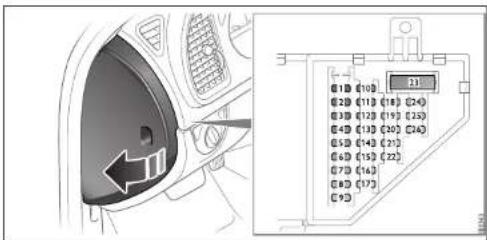
text_image
Diagram showing car interior and internal component with numbered labels, including a directional arrow and a 21-pin connector panel.Fuse panel in end of fascia
No. Amp. Function
1 15 Steering wheel lock
25 Steering column unit; ignition switch
3 10 Hands-free *
10 Main instrument unit; automatic climate control (ACC) *
4
7.5 Control module in front doors; Park Brake Shift Lock (automatic transmission)
6 7.5 Brake light switch
7 20 Dash fuse panel; fuel filler door
8 30 Control module in passenger front door
9 10 Dash fuse panel
30 Trailer socket ^ ; electrical socket in storage compartment between seats
11 10 Data link connection (diagnostics)
12 15 Interior lighting incl. glove box
13 10 Accessories
14 20 Amplifier 2, Sound System 3
15 30 Control module in driver's door
16 5 Passenger Sensing System
17--
18--
19--
20 7.5 Headlight levelling switch *
21 7.5 Hands-free *; brake light switch; clutch pedal switch
22 30 Cigarette lighter *
23 40 Cabin fan
24 7.5 Airbag control module
25--
26 5 Yaw sensor (cars with ESP®)
27--






93 US 7carecare MY09.fm Page 236 Tuesday, April 15, 2008 11:26 AM
236 Car care
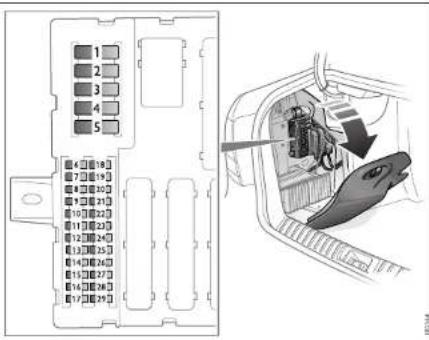
text_image
1 2 3 4 5 6 7 8 9 10 11 12 13 14 15 16 17 18 19 20 21 22 23 24 25 26 27 28 29 30 31 32 33 34 35 36 37 38 39 40 41 42 43 44 45 46 47 48 49 50 51 52 53 54 55 56 57 58 59 60 61 62 63 64 65 66 67 68 69 70 71 72 73 74 75 76 77 78 79 80 81 82 83 84 85 86 87 88 89 90 91 92 93 94 95 96 97 98 99 ①②③④⑤⑥⑦⑧⑨⑪⑫⑬⑭⑮⑯⑰⑱⑲⑳⑴⑵⑶⑷⑧⑨⑩⑪⑫⑬⑭⑮⑯⑰⑰⑱⑲⑳⑴⑵⑶⑷⑧⑨⑩⑪⑫⑬⑬⑭⑮⑯⑰⑱⑲⑳⑴⑵⑶⑷⑧⑨⑩⑪⑫⑬⑬⑭⑮⑯⑰⑱⑲⑳⑴⑵⑥⑦⑧⑨⑩Trunk fuse panel, SportSedan
Trunk fuse panel, left-hand side
No. Amp. Function
1-5 MAXI -
6 30 Control module in left rear door
7 30 Control module in right rear door
8 2 0 T r a l l e r *
9 - -
30 Left-hand brake light; rear right turn signal; right tail-light; right reversing light; high-mounted brake light; trailer lights
11 10 XWD
12--
13--
14 - -
15 15 Seat heating, left seat *
16 15 Seat heating, right seat *
17 7.5 Auto dimming rear view mirror *; rain sensor *
18 15 Moonroof *
19
7.5 XM-radio *, TMC-tuner *
7.5 Saab Parking Assistance (SPA) *; control module in rear doors; dome light (Convertible)
22 30 Radio *; navigation *
23 7,5 TPMS (automatic tire pressure monitoring system)
10 Movement sensor *, tilt sensor *, dome light (Convertible)
25 30 Electrically adjustable driver's seat with memory *




93 US 7carecare MY09.fm Page 237 Tuesday, April 15, 2008 11:26 AM


237Car care
| 26 | 30 Right-hand stop light; rear left turn signal; left taillight; rear fog light; left reversing light; license plate lighting; trunk lighting; trailer lights |
| 27 | 10 Convertible: Lumbar support, electrically adjustable front seat * |
| 28 | 15 Telematics * |
| 29 -- |
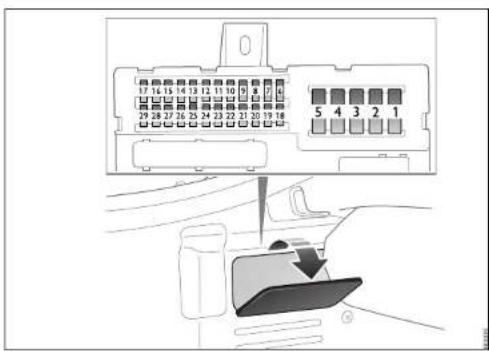
text_image
Diagram showing car rear panel layout with numbered compartments and a hand holding a vehicle componentTrunk fuse panel, Convertible

| Year Ended December 31, | ||
| 2018 | 2017 | |
| (in millions) | ||
| Revenues | 1,465 | 1,395 |
| Costs and expenses | (1,038) | (1,038) |
| Net income | 1,465 | 1,395 |


| Year Ended December 31, | ||
| 2018 | 2017 | |
| (in millions) | ||
| Revenues | 1,465 | 1,394 |
| Costs and expenses | (1,038) | (1,038) |
| Net income | 1,465 | 1,394 |


| 一 | 一 |
| - | - |
| - | - |
The Ground Truth image displays a single, solid horizontal line. According to Rule 2 (UNDERSCORE & LINE RULES), if the GT contains lines used for stylistic emphasis or as background (like ruled paper), the OCR result must ignore them. The provided OCR content is "____", which consists of four underscores. This is incorrect because underscores are not equivalent to a solid line and are not permitted under the “Stylistic/Background Lines (Ignore)” rule. Outputting underscores for a stylistic line violates the rule and constitutes an error. Therefore, the OCR result is inconsistent with the Ground Truth.
| - | - |
| - | - |
| - | - |
| - | - |
| - | - |
| - | - |
| - | - |
The Ground Truth image displays a single, solid horizontal line. According to Rule 2 (UNDERSCORE & LINE RULES), if the GT contains lines used for stylistic emphasis or as background (like ruled paper), the OCR result must ignore them. The provided OCR content is "____", which consists of four underscores. This is incorrect because underscores are not equivalent to a solid line and are not permitted under the “Stylistic/Background Lines (Ignore)” rule. Outputting underscores for a stylistic line violates the rule and constitutes an error. Therefore, the OCR result is inconsistent with the Ground Truth.
The Ground Truth image displays a single, solid horizontal line. According to Rule 2 (UNDERSCORE & LINE RULES), if the GT contains lines used for stylistic emphasis or as background (like ruled paper), the OCR result must ignore them. The provided OCR content is "____", which consists of four underscores. This is incorrect because underscores are not equivalent to a solid line and are not permitted under the “Stylistic/Background Lines (Ignore)” rule. Outputting underscores for a stylistic line violates the rule and constitutes an error. Therefore, the OCR result is inconsistent with the Ground Truth.
The Ground Truth image displays a single, solid horizontal line. According to Rule 2 (UNDERSCORE & LINE RULES), if the GT contains lines used for stylistic emphasis or as background (like ruled paper), the OCR result must ignore them. The provided OCR content is "____", which consists of four underscores. This is incorrect because underscores are not equivalent to a solid line and are not permitted under the “Stylistic/Background Lines (Ignore)” rule. Outputting underscores for a stylistic line violates the rule and constitutes an error. Therefore, the OCR result is inconsistent with the Ground Truth.
The Ground Truth image displays a single, solid horizontal line. According to Rule 2 (UNDERSCORE & LINE RULES), if the GT contains lines used for stylistic emphasis or as background (like ruled paper), the OCR result must ignore them. The provided OCR content is "____", which consists of four underscores. This is incorrect because underscores are not equivalent to a solid line and are not permitted under the “Stylistic/Background Lines (Ignore)” rule. Outputting underscores for a stylistic line violates the rule and constitutes an error. Therefore, the OCR result is inconsistent with the Ground Truth.
The Ground Truth image displays a single, solid horizontal line. According to Rule 2 (UNDERSCORE & LINE RULES), if the GT contains lines used for stylistic emphasis or as background (like ruled paper), the OCR result must ignore them. The provided OCR content is "____", which consists of four underscores. This is incorrect because underscores are not equivalent to a solid line and are not permitted under the “Stylistic/Background Lines (Ignore)” rule. The OCR has hallucinated underscores where none should exist in the GT, violating the “Stylistic/Background Lines (Ignore)” rule. Therefore, the OCR result is inconsistent with the Ground Truth.
The Ground Truth image displays a single, solid horizontal line. According to Rule 2 (UNDERSCORE & LINE RULES), if the GT contains lines used for stylistic emphasis or as background (like ruled paper), the OCR result must ignore them. The provided OCR content is "____", which consists of four underscores. This is incorrect because underscores are not equivalent to a solid line and are not permitted under the “Stylistic/Background Lines (Ignore)” rule. Outputting underscores for a stylistic line violates the rule and constitutes an error. Therefore, the OCR result is inconsistent with the Ground Truth.
The Ground Truth image displays a single, solid horizontal line. According to Rule 2 (UNDERSCORE & LINE RULES), if the GT contains lines used for stylistic emphasis or as background (like ruled paper), the OCR result must ignore them. The provided OCR content is "____", which consists of four underscores. This is incorrect because underscores are not equivalent to a solid line and are not permitted under the “Stylistic/Background Lines (Ignore)” rule. Outputting underscores for a stylistic line violates the rule and constitutes an error. Therefore, the OCR result is inconsistent with the Ground Truth.
| - | - |
| - | - |
| - | - |
| - | - |
The Ground Truth image displays a single, solid horizontal line. According to Rule 2 (UNDERSCORE & LINE RULES), if the GT contains lines used for stylistic emphasis or as background (like ruled paper), the OCR result must ignore them. The provided OCR content is "____", which consists of four underscores. This is incorrect because underscores are not equivalent to a solid line and are not permitted under the “Stylistic/Background Lines (Ignore)” rule. Outputting underscores for a stylistic line violates the rule and constitutes an error. Therefore, the OCR result is inconsistent with the Ground Truth.
| - | - |
| - | - |
| - | - |
| - | - |
| - | - |
| - | - |
| - | - |
| - | - |
| - | - |
| - | - |
| - | - |
The Ground Truth image displays a single, solid horizontal line. According to Rule 2 (UNDERSCORE & LINE RULES), if the GT contains lines used for stylistic emphasis or as background (like ruled paper), the OCR result must ignore them. The provided OCR content is "____", which consists of four underscores. This is incorrect because underscores are not equivalent to a solid line and are not permitted under the “Stylistic/Background Lines (Ignore)” rule. Outputting underscores for a stylistic line violates the rule and constitutes an error. Therefore, the OCR result is inconsistent with the Ground Truth.
| - | - |
| - | - |
| - | - |
| - | - |
The image contains no text.
| - | - |
| - | - |
| - | - |
| - | - |
| - | - |
| - | - |
238 Car care

text_image
Technical diagram showing a car chassis with labeled buttons and a control panel layout with numeric keypad and function keys.Fuse panel in engine bay
No. Amp. Function
1
10 Engine control module; automatic transmission control module *
3
20 Horn
4
10 Engine control module; battery disconnect switch *
5
- -
m = 311
10 Selector lever, automatic transmission *; clutch pedal switch
7
0 Xenon Cornering Headlights, left *
8
Relay for vacuum pump (brake system) *
9
0 --
1 --
2 10 Washer fluid pump, rear window *
13 - -
14 - -
15 30 Washer fluid pump, headlights *
30 Front right parking light; front right turn signal; left and right side turn signal; right high beam; left low beam; front left fog light *
17 30 Windshield wiper motor, low speed
18 30 Windshield wiper motor, high speed
19 20 Parking heater; auxiliary heater *
10 Headlight levelling * xenon cornering headlights, right *
21--
22 30 Washer fluid pump, windshield
23--
20 Flash-to-pass; high beam, right and left (cars with Daytime Running Lights only)
25 20 Amplifier, sound system II *
30 Front left turn signal; front left parking light; front right fog light *; right low beam; left high beam
27 MAXI
37


93 US 7carecare MY09.fm Page 239 Tuesday, April 15, 2008 11:26 AM


239Car care

Relays
R 1 Washer fluid pump, windshield
B2-
B3.
B4-
R 5 Flash-to-pass
R6 Horn
B7-
R8 Starter motor
R 9 Windshield wipers ON/OFF
R10 Washer fluid pump, rear window *
R11 Ignition +15
R12 Windshield wipers, high/low speed
R13 -
R14 Washer fluid pump, headlights *
R15 -
R16 -

text_image
Diagram of a vehicle dashboard with labeled buttons and a highlighted seat area, likely for safety or emergency control.Fuse panel in front of battery \*
No. Amp. Function
1 - Air pump, secondary air *
20 Fuel pump; preheated oxygen sensors (lambda probe)
3 10 A/C compressor
4 3 0 Main relay
Relays
1 -
2 A/C-compressor
3 Preheated oxygen sensors (lambda probe)
4 Main relay, engine (ECM/EVAP/injectors)





93 US 7carecare MY09.fm Page 240 Tuesday, April 15, 2008 11:26 AM
240 Car care
Tires
Your new vehicle comes with high-quality tires made by a leading tire manufacturer. If you ever have questions about your tire warranty and where to obtain service, see your Saab Warranty and Service Record Booklet for details.
WARNING
Poor maintained and improperly used tires are dangerous.
• Overloading your tires can cause overheating as a result of too much friction. You could have an blow-out and a serious accident. See "Loading Your Vehicle" on page 250.
- Underinflated tires pose the same danger as overloaded tires. The resulting accident could cause serious injury. Check all tires frequently to maintain the recommended pressure. Tire pressure should be checked when your tires are cold.
• Overinflated tires are more likely to be cut, punctured or broken by a sudden impact – such as when you hit a pot-hole. Keep tires at the recommended pressure.
- Wom, old tires can cause accidents. If your tread is badly worn, or if your tires have been damaged, replace them.
Inflation - Tire Pressure
The Tire-Loading Information label shows the correct inflation pressures for your tires when they're cold. "Cold" means your vehicle has been sitting for at least three hours or driven no more than 1 mile (1.6 km).
Notice: Don't let anyone tell you that underinflation or overinflation is all right. It's not. If your tires don't have enough air (underinflation), you can get the following:
- Too much flexing
- Too much heat
- Tire overloading
- Bad wear
- Bad handling
- Bad fuel economy.
If your tires have too much air (overinflation), you can get the following:
- Unusual wear
- Bad handling
- Rough ride
- Needless damage from road hazards.
Adjust the tire pressure to match the current load and speed of the car (see page 291). The stated tire pressures apply to cold tires, i.e. tires that are the same temperature as the outside air temperature. Tire pressure increases as the tires become warm (e.g. during highway driving) by approximately 4 psi (28 kPa). When the temperature of the tires changes by 50°F (10°C), the tire pressure will change 2 psi (14 kPa).
Never reduce the pressure of a hot tire. If the tires are hot when you check them, only increase the pressure, if necessary.



93 US 7carecare MY09.fm Page 241 Tuesday, April 15, 2008 11:26 AM
High speed operation
WARNING
Driving at high speeds, 100 mph (160 km/h) or higher, puts an additional strain on tires.
Sustained high-speed driving causes excessive heat build up and can cause sudden tire failure. You could have a crash and you or others could be killed. Some high-speed rated tires require inflation pressure adjustment for high speed operation. When speed limits and road conditions are such that a vehicle can be driven at high speeds, make sure the tires are rated for high speed operation, in excellent condition, and set to the correct cold tire inflation pressure for the vehicle load.
If you'll be driving at high speeds, speeds of 100mph (160km / h) or higher, where it is legal, set the cold inflation pressure to the maximum inflation pressure shown on the tire sidewall, or to 35 psi (244 kPa), whichever is lower. See the example below. When you end this high-speed driving, return to the cold inflation pressure shown on the Tire and Loading Information label. See on page 250.
Example
You'll find maximum load and inflation pressure molded on the tire's sidewall, in small letters near the rim flange. It will read something like this: Maximum load 690 kg (1521 lbs) 300 kPa (44 psi) Max. Press
For this example, you would set the inflation pressure for high-speed driving at 35 psi (244 kPa).
When to check
Check your tires once a month or more.
Don't forget your compact spare tire. It should be at 60 psi (420 kPa).
241Car care
How to Check
Use a good quality pocket-type gage to check tire pressure. You can't tell if your tires are properly inflated simply by looking at them. Radial tires may look properly inflated even when they're underinflated.
Be sure to put the valve caps back on the valve stems. They help prevent leaks by keeping out dirt and moisture.
Tire Inspection and Rotation
Tires should be rotated every 10,000 miles (16 000 km).
Any time you notice unusual wear, rotate your tires as soon as possible and check wheel alignment. Also check for damaged tires or wheels. See "When It Is Time for New Tires" on page 242 and "Wheel Replacement" on page 246 for more information.
The purpose of regular rotation is to achieve more uniform wear for all tires on the vehicle. The first rotation is the most important.
When rotating your tires, always use the correct rotation pattern. Left front tire to left rear. Left rear tire to right front. Right front to right rear. Right rear to left front.
Don't include the compact spare tire in your tire rotation.
After the tires have been rotated, adjust the front and rear inflation pressures as shown on the Tire-Loading Information label. Make
93 US 7carecare MY09.fm Page 242 Tuesday, April 15, 2008 11:26 AM
242 Car care
certain that all wheel nuts are properly tightened. See page 261.
WARNING
Rust or dirt on a wheel, or on the parts to which it is fastened, can make wheel nuts become loose after a time. The wheel could come off and cause an accident. When you change a wheel, remove any rust or dirt from places where the wheel attaches to the vehicle. In an emergency, you can use a cloth or a paper towel to do this; but be sure to use a scraper or wire brush later, if you need to, to get all the rust or dirt off. See "Changing a tire" on page 258.
Flat spotting
All tires get hot, especially on long journeys or when the car is driven hard. After the car has been parked with hot tires and the tires have cooled down, a flat spot can form in the tire, where it is in contact with the ground. The same can occur if the car has not been moved for a long time.
Flat spots can cause vibration that can be felt through the steering wheel, similar to that experienced when the wheels need balancing.
Flat spots of this type disappear once the tires get hot again, usually after 10–15 miles (20–25 km) of driving at cruising speed. If the outdoor temperature is low it takes a longer distance.
When It Is Time for New Tires
One way to tell when it's time for new tires is to check the treadwear indicators, which will appear when your tires have only 1/16 inch (1.6 mm) or less of tread remaining.
You need a new tire if any of the following statements are true:
- You can see the indicators at three or more places around the tire.
- You can see cord or fabric showing through the tire's rubber.
- The tread or sidewall is cracked, cut or snagged deep enough to show cord or fabric.
• The tire has a bump, bulge or split. - The tire has a puncture, cut or other damage that can't be repaired well because of the size or location of the damage.



93 US 7carcare MY09.fm Page 243 Tuesday, April 15, 2008 11:26 AM


243Car care
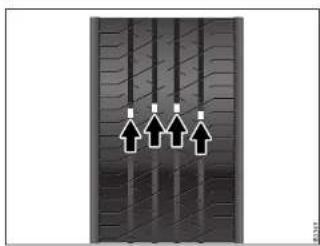
natural_image
Diagram showing four upward-pointing arrows inside a grid-like structure (no text or symbols)Treadwear indicator
Buying New Tires
To find out what kind and size of tires you need, look at the Tire-Loading Information label.
Before changing to wheels/tires of another size, we recommend that you contact an authorized Saab workshop regarding acceptable options. See also page 288
Wheels/tires combinations that are not approved by Saab can negatively affect the car's directional stability, steering and braking in both wet and dry conditions.
The wheels and tires have been carefully matched to the characteristics of the car and play a key role in its outstanding road holding and handling.
Do not take it for granted that a wheel/tire combination will work in the best possible way, just because it can be fitted to the car.
To ensure that the speedometer is as accurate as possible it should be reprogrammed if wheels of a different dimension are fitted. Contact a Saab dealer.
Because of front wheel drive, the front tires tend to wear faster than the rear ones. New tires should always be fitted in pairs, so that tires on the same axle have the same amount of tread.
Store wheels lying flat or hanging – never standing upright.
Treadwear indicators
The tires incorporate wear indicators in the form of smooth, treadless strips across the width, which become visible when only 2/32" (1.6 mm) of tread remains. As soon as the indicators become visible, new tires should be fitted without delay.
Make sure you are familiar with the legal limit for minimum tread depth in your country and also any regulations governing the use of winter (snow) tires.


93 US 7carecare MY09.fm Page 244 Tuesday, April 15, 2008 11:26 AM
244 Car care
NOTICE
Wide wheels and tires with side walls that are too low can:
- Be damaged in potholes, etc.
- Cause springs, shock absorbers and wheel bearings and body mountings to be overloaded
- Affect the function of the ESP ^ .
The speed and load limits of the tires must not be exceeded; see page 249.
Wheels larger than 18" must not be fitted on the Saab 9-3 for reasons above. The permissible offset is 1.61 inch (41 mm).

WARNING
Mixing tires could cause you to lose control while driving. If you mix tires of different sizes or types (radial and bias-belted tires), the vehicle may not handle properly, and you could have a crash. Using tires of different sizes may also cause damage to your vehicle. Be sure to use the same size and type tires on all wheels. It's all right to drive with your compact spare temporarily, it was developed for use on your vehicle. See "Compact spare" on page 256.

WARNING
If you use bias-ply tires on your vehicle, the wheel rim flanges could develop cracks after many miles of driving. A tire and/or wheel could fall suddenly, causing a crash. Use only radial-ply tires with the wheels on your vehicle.
Uniform Tire Quality Grading
Quality grades can be found where applicable on the tire sidewall between tread shoulder and maximum section width. For example:
Treadwear 200 Traction AA Temperature A
The following information relates to the system developed by the United States National Highway Traffic Safety Administration, which grades tires by treadwear, traction and temperature performance. (This applies only to vehicles sold in the United States.) The grades are molded on the sidewalls of most passenger car tires. The Uniform Tire Quality Grading system does not apply to deep tread, winter-type snow tires, space-saver or temporary use spare tires, tires with nominal rim diameters of 10 to 12 inches (25 to 30cm ), or to some limited-production tires.
While the tires available on General Motors passenger cars and light trucks may vary with respect to these grades, they must also conform to federal safety requirements and additional General Motors Tire Performance Criteria (TPC) standards.





93 US 7carecare MY09.fm Page 245 Tuesday, April 15, 2008 11:26 AM
245Car care
Treadwear
The treadwear grade is a comparative rating based on the wear rate of the tire when tested under controlled conditions on a specified government test course. For example, a tire graded 150 would wear one and a half (1.5) times as well on the government course as a tire graded 100. The relative performance of tires depends upon the actual conditions of their use, however, and may depart significantly from the norm due to variations in driving habits, service practices and differences in road characteristics and climate.
Traction - AA, A, B, C
The traction grades, from highest to lowest, are AA, A, B, and C. Those grades represent the tire's ability to stop on wet pavement as measured under controlled conditions on specified government test surfaces of asphalt and concrete. A tire marked C may have poor traction performance. Warning: The traction grade assigned to this tire is based on straight-ahead braking traction tests, and does not include acceleration, cornering, hydroplaning, or peak traction characteristics.
Temperature - A, B, C
The temperature grades are A (the highest), B, and C, representing the tire's resistance to the generation of heat and its ability to dissipate heat when tested under controlled conditions on a specified indoor laboratory test wheel. Sustained high temperature can cause the material of the tire to degenerate and reduce tire life, and excessive temperature can lead to sudden tire failure. The grade C corresponds to a level of performance which all passenger car tires must meet under the Federal Motor Vehicle Safety Standard No. 109. Grades B and A represent higher levels of performance on the laboratory test wheel than the minimum required by law.
Warning: The temperature grade for this tire is established for a tire that is properly inflated and not overloaded. Excessive speed, underinflation, or excessive loading, either separately or in combination, can cause heat buildup and possible tire failure.
Wheel Alignment and Tire Balance
The wheels on your vehicle were aligned and balanced carefully at the factory to give you the longest tire life and best overall performance.
Scheduled wheel alignment and wheel balancing are not needed. However, if you notice unusual tire wear or your vehicle pulling one way or the other, the alignment may need to be reset. If you notice your vehicle vibrating when driving on a smooth road, your wheels may need to be rebalanced.

natural_image
Pure geometric diagram with crosshair and circular shapes, no text or symbols present

93 US 7carecare MY09.fm Page 246 Tuesday, April 15, 2008 11:26 AM
246 Car care
Wheel Replacement
Replace any wheel that is bent, cracked or badly rusted or corroded. If wheel nuts keep coming loose, the wheel, wheel bolts and wheel nuts should be replaced. If the wheel leaks air, replace it (except some aluminum wheels, which can sometimes be repaired). See your dealer if any of these conditions exist.
Your dealer will know the kind of wheel you need.
Each new wheel should have the same load-carrying capacity, diameter, width, offset and be mounted the same way as the one it replaces.
If you need to replace any of your wheels, wheel bolts or wheel nuts, replace them only with new Saab original equipment parts. This way, you will be sure to have the right wheel, wheel bolts and wheel nuts for your vehicle.
Notice: The wrong wheel can also cause problems with bearing life, brake cooling, speedometer or odometer calibration, headlamp alm, bumper height, vehicle ground clearance and tire or tire chain clearance to the body and chassis.
See "Changing a tire" on page 258.

WARNING
When fitting just one new pair of tires, these should be fitted to the rear wheels, as these are more critical to the directional stability of the car (e.g. on braking or in a skid). The existing rear wheels should therefore be moved to the front.
Used Replacement Wheels

WARNING
Putting a used wheel on your vehicle is dangerous. You can't know how it's been used or how far it's been driven. It could fall suddenly and cause a crash. If you have to replace a wheel, use a new GM original equipment wheel.

WARNING
Using the wrong replacement wheels, wheel bolts or wheel nuts on your vehicle can be dangerous. It could affect the braking and handling of your vehicle, make your tires lose air and make you lose control. You could have a collision in which you or others could be injured. Always use the correct wheel, wheel bolts and wheel nuts for replacement.


93 US 7carecare MY09.fm Page 247 Tuesday, April 15, 2008 11:26 AM
247Car care
Tire Chains
WARNING
If your vehicle has 235/45 R17 size tires, don't use tire chains, there's not enough clearance.
Tire chains used on a vehicle without the proper amount of clearance can cause damage to the brakes, suspension or other vehicle parts. The area damaged by the tire chains could cause you to lose control of your vehicle and you or others may be injured in a crash.
Use another type of traction device only if its manufacturer recommends it for use on your vehicle and tire size combination and road conditions. Follow that manufacturer's instructions. To help avoid damage to your vehicle, drive slowly, readjust or remove the device if it's contacting your vehicle, and don't spin your wheels.
If you do find traction devices that will fit, install them on the front tires.
Notice: If your vehicle does not have 235/45R17 size tires, use tire chains only where legal and only when you must. Contact your Saab dealer regarding suitable snow chains. Install them on the front tires and tighten them as slightly as possible with the ends securely fastened. Drive slowly and follow the chain manufacturer's instructions. If you can hear the chains contacting your vehicle, stop and retighten them. If the contact continues, slow down until it stops. Driving too fast or spinning the wheels with chains on will damage your vehicle.
If a Tire Goes Flat
It's unusual for a tire to "blowout" while you're driving, especially if you maintain your tires properly. If air goes out of a tire, it's much more likely to leak out slowly. But if you should ever have a "blowout", here are a few tips about what to expect and what to do:
If a front tire fails, the flat tire will create a drag that pulls the vehicle toward that side. Take your foot off the accelerator pedal and grip the steering wheel firmly. Steer to maintain lane position, and then gently brake to a stop well out of the traffic lane.
A rear blowout, particularly on a curve, acts much like a skid and may require the same correction you'd use in a skid. In any rear blowout, remove your foot from the accelerator pedal. Get the vehicle under control by steering the way you want the vehicle to go. It may be very bumpy and noisy, but you can still steer. Gently brake to a stop – well off the road if possible.
If a tire goes flat, the next part shows how to use your jacking equipment to change a flat tire safely.

natural_image
Pure geometric diagram with crosshair and circular shapes, no text or symbols present93 US 7carecare MY09.fm Page 248 Tuesday, April 15, 2008 11:26 AM
248 Car care
Tire Sidewall Labeling
Useful information about a tire is molded into it's sidewall.
Tire size: The tire size is a combination of letters and numbers used to define a particular tire's width, height, aspect ratio, construction type and service description.
Department of Transportation (DOT):
The Department of Transportation (DOT) code indicates that the tire is in compliance with the U.S. Department of Transportation Motor Vehicle Safety standards.
Tire Identification Number (TIN): The letters and numbers following DOT code are the Tire Identification Number (TIN). The TIN shows the manufacturer and plant code, tire size, and date the tire was manufactured. The TIN is molded onto both sides of the tire.
Tire Ply Material: The type of cord and number of plies in the sidewall and under the tread.
Uniform Tire Quality Grading (UTQG): Tire manufacturers are required to grade tires based on the performance factors: treadwear, traction and temperature resistance. For more information see "Uniform Tire Quality Grading" on page 244.
Maximum Cold Inflation Load Limit: Maximum load that can be carried and the maximum pressure needed to support that load. For information on recommended tire pressure see "Recommended lowest tire pressure, cold tires" on page 291 and "Loading Your Vehicle" on page 250.
Tire Size
The following illustration shows an example of a typical passenger car tire size.
| 215 / 55 R 16 93 H | |||||
| I | I | I | I | I | I |
| a | b | c | d | e | f |
a Tire Width
b Aspect Ratio
c Belt Rating
d Rim diameter
e Load range
f Speed rating
Tire Width: The three-digit number indicates the tire section width in millimeters from sidewall to sidewall.




93 US 7carecare MY09.fm Page 249 Tuesday, April 15, 2008 11:26 AM
249Car care
Aspect ratio: A two-digit number that indicates the tire height-to-width measurements. For example, if the tire size aspect ratio is "55", as shown in item "C" of the illustration, it would mean that the tire's sidewall is 55% as high as it is wide.
Belt Rating: A letter code is used to indicate the type of ply construction in the tire. The letter "R" means radial ply construction; the letter "D" means diagonal or bias ply construction; and the letter "B" means belted-bias ply construction.
Rim Diameter: Diameter of the wheel in inches.
Load range: The load range represents the load carry capacity a tire is certified to carry.
Speed Rating: The maximum speed that a tire is certified to carry a load. Speed ratings range from "A" to "Z".
Tire markings
An example of the meaning of the different markings in a tire size is given below for a tire size of 225/45 R17 94H:
225 Tire section width, mm
Aspect ratio, i.e. the section height
as a percentage of the section
45 width
R Radial ply
Wheel rim diameter 17 in at bead
17 seats
94 Tire load index
H Speed rating
Tire load Indices
Tire approved for max. 1355 lbs.
91 (615 kg)
93 Max. 1433 lbs. (650 kg)
94 Max. 1477 lbs. (670 kg)
95 Max. 1521 lbs. (690 kg)
97 Max. 1609 lbs. (730 kg)
98 Max. 1653 lbs. (750 kg)
Speed ratings
Tire approved for speeds up to
Q 100 mph (160 km/h)
S Max. 112 mph (180 km/h)
T Max. 118 mph (190 km/h)
H Max. 130 mph (210 km/h)
V Max. 149 mph (240 km/h)
W Max. 168 mph (270 km/h)
Y Max. 186 mph (300 km/h)


93 US 7carcare MY09.fm Page 250 Tuesday, April 15, 2008 11:26 AM
250 Car care
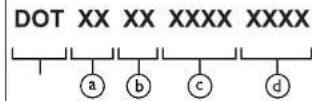
TIN-code
a Manufacturer's Identification Mark
b Tire Size
c Tire Type Code
d Date of Manufacture
Loading Your Vehicle

text_image
TIRE AND LOADING INFORMATION SEATING CAPACITY TOTAL 0 FRONT 0 REAR 0 The combined weight of accounts and cargo should never exceed 600 kg or 1000 kg. TIME SIZE COLD TIME PRESSURE SEE OWNER'S MANUAL FOR ADDITIONAL INFORMATION FRONT 000/30000 000 000 kPa, 50 PSI BEAR 000/30000 000 000 kPa, 50 PSI SPACE 000/30000 30 000 kPa, 50 PSIThis label can only be found on vehicles sold in the U.S.
Vehicles sold in Canada have the tire information label in the glove box, see page 292.
This is an example of what your vehicle's Tire-Loading Information/Certification label might look like. It is located on the B-pillar and shows how much weight your vehicle may properly carry. The label tells you the proper size, and recommended inflation pressures for the tires on your vehicle. It also gives you important information about the number of people that can be in your vehicle and the total weight that you can carry. This weight is called the Vehicle Capacity Weight, and includes the weight of all occupants, cargo and all nonfactory-installed options.
Tire Terminology and Definitions
Air Pressure: The amount of air inside the tire pressing outward on each square inch of the tire. Air pressure is expressed in pounds per square inch (psi) or kilo pascal (kPa).
Accessory Weight: This means the combined weight of optional accessories, for example, automatic transmission, power steering, power brakes, power windows, power seats, radio and air conditioning.
Aspect Ratio: The relationship of a tire's height to its width.
Belt: A rubber coated layer of cords that is located between the plies and the tread. Cords may be made from steel or other reinforcing materials.
Bias Ply Tire: A pneumatic tire in which the ply cords that extend to the beads are laid at alternate angles substantially less than 90 degrees to the centerline of the tread.
Cold Inflation Pressure: The amount of air pressure in a tire, measured in pounds per square inch (psi) or kilo pascal (kPa), before a tire has built up heat from driving. See "Inflation - Tire Pressure" on page 240.
Curb weight: This means the weight of a motor vehicle with standard and optional equipment including the maximum capacity of fuel, oil and coolant, without passengers and cargo.
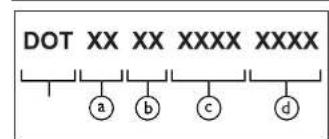
text_image
DOT XX XX XXXX XXXX a b c d



93 US 7carecare MY09.fm Page 251 Tuesday, April 15, 2008 11:26 AM
251Car care
DOT Markings: A code molded into the sidewall of a tire signifying that the tire is in compliance with the U.S. Department of Transportation motor vehicle safety standards. The DOT code includes the Tire Identification Number (TIN), an alphanumeric designator which can also identify the tire manufacturer, production plant, brand and date of production.
GVWR: Gross Vehicle Weight Rating see page 285.
GAWR FRT: Gross Axle Weight Rating for the front axle, see page 285.
GAWR RR: Gross Axle Weight Rating for the rear axle, see page 285.
Intended Outboard Sidewall: The side of an asymmetrical tire that must always face outward when mounted on a vehicle.
Kilo pascal (kPa): The metric unit for air pressure. There are 6.9 kPa to one psi.
Light Truck (LT-Metric) Tire: A tire used on light duty trucks and some multipurpose passenger vehicles.
Load Index: An assigned number ranging from 1 to 279 that corresponds to the load carrying capacity of a tire.
Maximum Load rating: The load rating for a tire at the maximum permissible inflation pressure for that tire.
Maximum Loaded Vehicle Weight: The sum of curb weight; accessory weight; vehicle capacity weight; and production options weight.
Maximum Permissible Inflation Pressure: The maximum cold Inflation pressure to which a tire may be inflated.
Normal occupant weight: The number of occupants a vehicle is designed to seat multiplied by 150 pounds (68 kg). See "Loading Your Vehicle" on page 250.
Occupant Distribution: Designated seating positions.
Outward Facing Sidewall: The side of a asymmetrical tire that has a particular side that faces outward when mounted on a vehicle. The side of the tire that contains a whitewall bears white lettering or bears manufacturer, brand and or model name molding on the other sidewall of the tire.
Passenger (P-Metric) Tire: A tire used on passenger cars and some light duty trucks and multipurpose vehicles.
Recommended Inflation Pressure: Vehicle manufacturer's recommended tire inflation pressure shown on the tire placard, see "Inflation - Tire Pressure" on page 240 and "Loading Your Vehicle" on page 250.
Radlal Ply Tire: A pneumatic tire in which the ply cords that extend to the beads are laid at substantially 90 degrees to the centerline of the tread.
Rim: A metal support for a tire or a tire and tube assembly upon which the tire beads are seated.
Sidewall: The portion of a tire between the tread and the bead.
Speed rating: An alphanumeric code assigned to a tire indicating the maximum speed at which a tire can operate.
Traction: The friction between the tire and the road surface. The amount of grip provided.
Treadwear Indicators: Narrow bands, sometimes called "wear bars", that show across the tread of a tire when only 2/32 inch of tread remains. See "When It Is Time for New Tires" on page 242.


93 US 7carecare MY09.fm Page 252 Tuesday, April 15, 2008 11:26 AM
252 Car care
Tread Width: The width of the tire's tread.
UTQGS: Uniform Tire Quality Grade Standards, a tire information system that provides consumers with ratings for a tire's traction, temperature and treadwear. Ratings are determined by tire manufacturers using government testing procedures. The rating are molded into the sidewall of the tire. See "Uniform Tire Quality Grading" on page 244.
Vehicle Capacity Weight: Is the number of designated seating positions multiplied by 150 pounds (68 kg) plus the rated cargo load. See "Loading Your Vehicle" on page 250.
Vehicle Maximum Load on the Tire: Load on an individual tire due to curb weight, accessory weight, occupant weight and cargo weight.
Vehicle Placard: A label permanently attached to a vehicle showing original equipment tire size and the recommended cold inflation pressure. See "Loading Your Vehicle" on page 250.
Steps for Determining Correct Load Limit
1 Locate the statement "The combined weight of occupants and cargo should never exceed XXX pounds" on your vehicle's placard.
2 Determine the combined weight of the driver and passengers that will be riding in your vehicle.
3 Subtract the combined weight of the driver and passengers from XXX kilograms or XXX pounds.
4 The resulting figure equals the available amount of cargo and luggage load capacity. For example, if the "XXX" amount equals 1400 lbs. and there will be five 150 lb. passengers in your vehicle, the amount of available cargo and luggage load capacity is 650 lbs. (1400–750 (5x150) = 650 lbs.).
5 Determine the combined weight of luggage and cargo being loaded on the vehicle. That weight may not safely exceed the available cargo and luggage load capacity calculated in Step 4.
6 If your vehicle will be towing a trailer, load from your trailer will be transferred to your vehicle. Consult this manual to determine how this reduces the available cargo and luggage load capacity of your vehicle.



93 US 7carecare MY09.fm Page 253 Tuesday, April 15, 2008 11:26 AM
Winter tires
Winter (snow) tires are recommended for winter climates where the majority of your driving will be done on snow and ice. Winter tires should be fitted to all four wheels to maintain a proper balance. Your Saab dealer can advise you of to the correct size tire for your car (if different from the original size) and also supply Saab approved winter tires pre-mounted on steel or alloy rims.
Winter tires normally use a different speed rating compared to summer/all season tires. Make sure not to exceed the stated speed rating on the tires you use.
Make sure that wheels with sensors for tire pressure monitoring are fitted during replacement if the car has automatic tire pressure monitoring.
Tire date code
Tires should be regarded as perishable goods. As the tires age, the rubber becomes progressively harder, and the road holding ability of the tires diminishes. This is particularly true on winter tires.
Tires have a code that specifies their date of manufacture. The first two digits denote the week number and the last two digits the year followed by a filled triangle.
Automatic tire pressure monitoring system
WARNING
The system is an aid to the driver. The driver always has the responsibility that the tires have the correct air pressure.
For optimum safety, economy and comfort tire pressures should be checked regularly even if the automatic tire pressure monitoring has not alarmed.
The system consists of a sensor in each wheel and a common receiver. The sensors are located inside the tire in direct connection with the air pressure valves.
Make sure that wheels with sensors for tire pressure monitoring are fitted during replacement if the car has automatic tire pressure monitoring.
The system will trigger a warning/alam if the spare wheel is fitted because it has no sensor.
253Car care
NOTICE
Tire replacement must take place with great care to avoid damaging the sensors that are built together with the valves.
- Remove the rear side first, see page 255.
- Start to remove the tire opposite the valve.
- During removal the tire machine must not come closer than ± 10^ from the valve.
- During fitting, start 20^ after the valve and finish 20^ before the valve.
- Do not inflate the tire with pressure higher than 102 psi (700 kPa).
Tire pressure information is transmitted wireless to the receiver.
The system checks the tire pressures when speed exceeds 19 mph (30 km/h).
The system is self-programming which means that the wheels can be shifted around without any need for adjustment.
The sensor batteries last for 10 years or around 160 000 km. The battery cannot be replaced. The whole sensor must be replaced.

natural_image
Pure geometric diagram with crosshair and circular shapes, no text or symbols present93 US 7carecare MY09.fm Page 254 Tuesday, April 15, 2008 11:26 AM
254 Car care
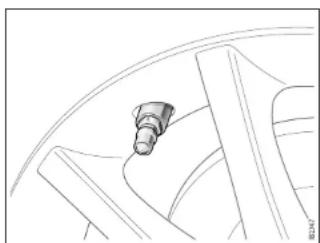
natural_image
Technical line drawing of a mechanical component or bracket (no text or symbols)Valve with sensor Valve without sensor
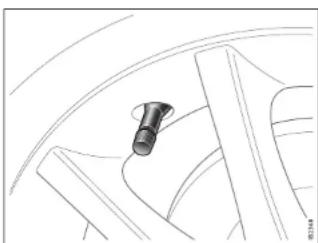
natural_image
Line drawing of a mechanical component or tool interacting with a curved surface (no text or symbols)The system does not warn if the tire pressure is too high.
If the system has warned or triggered an alarm due to inadequate pressure then the pressure must be reset to the recommended pressure so that the warning/alarm is cleared.
If the tire pressure decreases
If the tire pressure decreases to 6 psi (40 kPa) below the recommended pressure then a warning is shown on the SID as to which tires are affected.

Tire pressure low, front right. Check tires.
Adjust the pressure as soon as possible.
If the tire pressure continues to decrease then an alarm is shown on the SID when the pressure has decreased to 23 psi (160 kPa) which is the lowest permitted pressure for the tire.
An alarm is also received when leakage is greater than 3 psi/min. (20 kPa/min.).

Low tire pressure rear left. Make a safe stop.
Reduce speed (avoid heavy braking and significant steering wheel movement) and stop the car as soon as possible at a suitable location. Replace the defective wheel. The fault message can remain for up to 10 minutes after restarting the car. Then it disappears if the tire pressure is correct.
Check/adjust the pressure in the other tires when a fault message is shown.
Note that the tire pressure can decrease without a puncture. The pressure could decrease around 3 psi (20 kPa) during a three month period.
The outside temperature could also affect tire pressure.
The temperature in the tire also affects the tire pressure. The specified tyre pressures are valid for cold tyres. The increased tyre pressure resulting from extensive driving must not be reduced. For further information on tire air pressure, see page 240.
Allow 10 minutes for the system to recognize the wheel/sensors positions after fitting a new set of tires. During this period no low pressure warning or alarm can be triggered.




93 US 7carcare MY09.fm Page 255 Tuesday, April 15, 2008 11:26 AM


255Car care
Malfunctions

Tire pressure system failure. Contact service.
The above message is shown on the SID if:
- Wheel without pressure sensor has been fitted (e.g. spare wheel)
• One or more pressure sensors are broken or missing
• A fault has arisen in the receiver
• A system error has arisen.
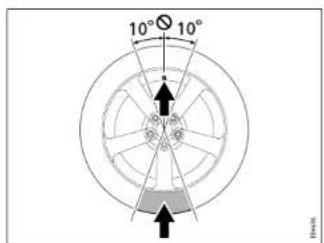
text_image
10° 10° Bathin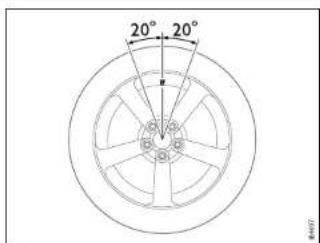
text_image
20° 20° ©2017Removing a tire
Remove the tire with a tire machine. It is important to follow the instructions for the tire machine as well.
- Do not fit the tire tool in an area ± 10^ from Start to fit about 20^ after the valve the valve
- Finish fitting before an area 20^ free
- Start removing opposite the valve
- Remove the rear side first.
→ Start to fit about 20° after the valve - Finish fitting before an area 20^ from the valve
Fitting a tire
Fit the tire with a tire machine. It is important to follow the instructions for the tire machine as well.
- Do not inflate the tire to a pressure higher than 102 psi (700 kPa).



93 US 7carecare MY09.fm Page 256 Tuesday, April 15, 2008 11:26 AM
256 Car care
Compact spare

WARNING
The spare tire or punctured tire must be stowed under the trunk floor, and secured in place with the retaining nut.
The compact spare is light and easy to handle when changing the tire. Its use is only permitted when a standard tire has sustained a puncture. The maximum life of the tire is only just over 2,000 miles (3,500 km).
Do not exceed 50 mph (80 km/h) with the compact spare fitted.
The tire pressure should be 60 psi (420 kPa). Put the punctured tire in the spare wheel well under the trunk floor.
Have the standard tire repaired and refitted as soon as possible.
NOTICE
To avoid damaging a alloy wheel of a punctured tire, this can be temporarily placed outside up in the spare wheel well but only while driving to the closest workshop.
As a general rule, all heavy loads must be well secured in the trunk (see page 139).

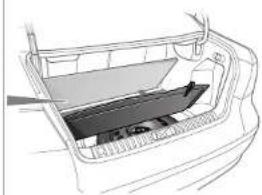
natural_image
Line drawing of a car trunk with internal compartments and a vehicle chassis (no text or symbols)
The spare tire, the tools and the jack with its crank are carried under a panel in the trunk.
Fold the carpeting forward to ease access to the tools and spare tire.
The screwdriver handle has a "button" for removing plastic rivets. This type of rivet must be removed when changing the light bulb in the trunk lid (see page 226).
Your Saab is equipped with a trip computer and you can use its "Speed warning" function, to monitor driving speed since you must not exceed 50 mph (80 km/h), see page 92.


93 US 7carcare MY09.fm Page 257 Tuesday, April 15, 2008 11:26 AM
257Car care
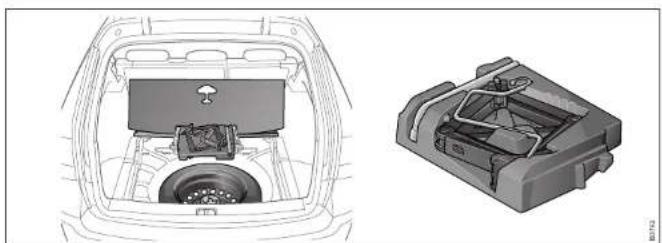
natural_image
Technical line drawing of a car front compartment showing internal components and external housing (no text or labels)SportCombi
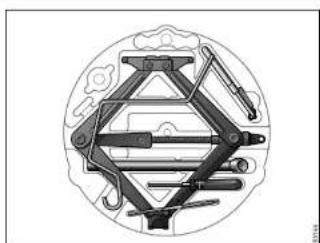
natural_image
Circular mechanical diagram with multiple tools and components, no visible text or symbolsTools under a panel in the trunk, SportSedan
SportCombi with subwoofer
Position the loudspeaker on the left-hand side before the spare wheel is removed. The arrow on the loudspeaker must point forwards when the loudspeaker is fitted in the spare wheel.

text_image
Technical diagram showing car interior components with labeled parts and directional arrows indicating assembly or installation.
258 Car care
Driving with a compact wheel fitted
WARNING
- Do not exceed 50 mph (80 km/h). The tire can overheat affecting the car's road holding.
• Tire pressure: refer to page 291.
• The spare tire or punctured tire must be stowed under the trunk floor, and secured in place with the retaining nut
Observe the following when the compact spare tire is fitted:
- The compact spare is light and easy to handle when changing a tire.
- Do not drive further than necessary with the compact spare fitted - the maximum life of the tire is only just over 2,000 miles (approx. 3,500 km).
- Refit the standard tire as soon as possible.
- Fitting a spare tire/wheel without pressure sensor will trigger a malfunction message, see page 255.
Important considerations when driving with a compact spare tire:
• The car's ground clearance is reduced.
• The car must not be driven with more than one compact spare tire at a time.
- Avoid driving against the curb.
- Do not use snow chains.
- Do not fit the wheel cover - this would conceal the warning text.
Changing a tire
WARNING
Lifting a vehicle and getting under it to do maintenance or repairs is dangerous without the appropriate safety equipment and training. The jack provided with your vehicle is designed only for changing a flat tire. If it is used for anything else, you or others could be badly injured or killed if the vehicle slips off the jack. Use the jack provided with your vehicle only for changing a flat tire.
Changing a tire can be dangerous. The vehicle can slip off the jack and roll over or fall on you or other people. You and they could be badly injured or even killed. Find a level place to change your tire. To help prevent the vehicle from moving:
1 Set the parking brake firmly.
2 If you have an automatic transmission, put the shift lever in PARK (P). For a manual transmission, leave the car in gear (1st or REVERSE (R)).
3 Turn off the engine and do not restart while the vehicle is raised.
4 Do not allow passengers to remain in the vehicle.





93 US 7carecare MY09.fm Page 259 Tuesday, April 15, 2008 11:26 AM


259Car care
To be even more certain the vehicle won't move, you should put blocks at the front and rear of the tire farthest away from the one being changed. That would be the tire, on the other side, at the opposite end of the vehicle.
• The car jack is designed solely for use in changing a tire or fitting snow chains. It must not be used to support the car during repair work or servicing.
- Never crawl under a car that is supported only by a jack. Always use axle stands.
- Raising your vehicle too high or with the jack improperly positioned can damage the vehicle and even make the vehicle fall. To help avoid personal injury and vehicle damage, be sure to fit the jack lift head into the proper location before raising the vehicle, and raise the vehicle only far enough off the ground so there is enough room for the spare tire to fit (no more than 25 mm or 1 inch clearance between the ground and the bottom of the tire).
- Switch on the hazard warning lights if the car is on a road.
• The jack should be stored correctly under the carpeting in the trunk. If it lies loose in the car, it could thrown forward and cause personal injury in the event of a crash or if the car rolls over.
- Grit, salt and rust can clog the inner threads of the wheel bolts if the car has been driven for several years exclusively with alloy wheels. If steel wheels are being installed, the bolt hole threads in the brake hubs should be cleaned before the thinner steel wheels are fitted. It may otherwise not be possible to achieve the correct clamping force, despite tightening the wheel bolts to the correct torque.
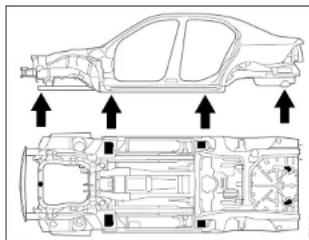
natural_image
Technical line drawing of a car chassis with structural components and directional arrows indicating assembly or movement (no text or symbols present)Jacking points for floor jack
When the car has to be lifted, the jack must be positioned at one of the four jacking points (front or rear) under the sill members. If a floor jack is used, the lifting plate must be positioned under the normal jacking points, see illustration. If the car is equipped with a towbar, the jack can also be placed under this.
NOTICE
Apply the jack only to the jacking points indicated on the body.


93 US 7carcare MY09.fm Page 260 Tuesday, April 15, 2008 11:26 AM
260 Car care

natural_image
Line drawing of a sedan with a magnified inset showing a vehicle interior (no text or symbols)
natural_image
Line drawing of a sedan car with three close-up views showing internal components (no text or symbols)Jacking pointsMarking of jacking points
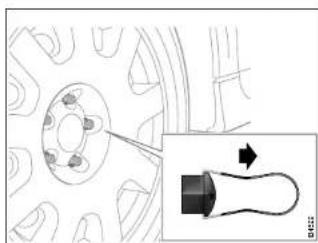
natural_image
Technical diagram showing a mechanical component with a close-up inset of a cylindrical component (no text or symbols)Removing the plastic wheel bolt covers
1 Wind the jack up to a suitable height before placing it under the jacking point. Each jacking point is indicated by an arrow on the sill (see illustration). Make sure that the jack fully engages the jacking point in the underside of the sill member and that the entire foot of the jack is steady and flat on the ground. The jack must not stand on snow, ice or similar. Wind up the jack until it just begins to lift the car.
2 It is not necessary to remove the wheel cover.
If, none the less, you wish to remove the wheel cover, take hold of the outer edge and pull it straight out.
Remove the plastic wheel bolt covers.
Loosen the wheel bolts half a turn.
3 Wind the jack to raise the wheel clear of the ground. Remove the wheel bolts and lift off the wheel.



93 US 7carecare MY09.fm Page 261 Tuesday, April 15, 2008 11:26 AM

natural_image
Technical line drawing of a brake assembly with a circular component and mounting bracket (no text or symbols)Clean any rust or dirt from the contact surfaces between the wheel and brake disc.

natural_image
Technical line drawing of a brake assembly with a brake caliper and housing (no text or symbols)Do not wipe away the grease in the wheel hub.

natural_image
Technical line drawing of a bolt and nut assembly (no text or symbols)Grease the surfaces indicated with a thin layer of grease
Tightening torque
Lubricate the heads of the wheel studs with a small amount of Vaseline or similar and refit the plastic covers on the wheel studs. The Vaseline makes it easier to remove them later on.
NOTICE
- Do not overtighten the bolts using a impact wrench: not only can this damage the wheels but it can also make it impossible to undo the bolts using the wheel wrench in the car's toolkit.
- When refitting a wheel cover, make sure that the valve protrudes through the marked recess in the wheel cover.
7 Retouching the wheel bolts after twenty or so miles.
Tightening torque
Light-alloy wheels: 80 ft.lb. (110 Nm). Steel wheels: 80 ft.lb. (110 Nm).
We advise against using wheels with large ventilation slots in winter, as the brake components are then more exposed to slush, road salt and grit.
If you fit wheels of a different dimension, the speedometer can be reprogrammed to ensure it is as accurate as possible. We recommend that you contact a Saab dealer.
Driving with tire chains *, see page 186


4 Clean any rust or dirt from the contact surfaces between the wheel and brake disc. Do not wipe away the grease in the wheel hub.
5 Add a thin layer of grease on the bolts before fitting, see page 261. Fit the wheel and screw in the bolts in the sequence shown on page 262 (opposite pairs).
Tighten the bolts enough for the bolts and wheel to be seated correctly.
6 Lower the car and tighten the wheel bolts to torque in sequence as shown on page 262.
Light-alloy wheels: 80 ft.lb. (110 Nm). Steel wheels: 80 ft.lb. (110 Nm).
4 Clean any rust or dirt from the contact surfaces between the wheel and brake disc. Do not wipe away the grease in the wheel hub.
5 Add a thin layer of grease on the bolts before fitting, see page 261. Fit the wheel and screw in the bolts in the sequence shown on page 262 (opposite pairs).
Tighten the bolts enough for the bolts and wheel to be seated correctly.
6 Lower the car and tighten the wheel bolts to torque in sequence as shown on page 262.
Light-alloy wheels: 80 ft.lb. (110 Nm). Steel wheels: 80 ft.lb. (110 Nm).
4 Clean any rust or dirt from the contact surfaces between the wheel and brake disc. Do not wipe away the grease in the wheel hub.
5 Add a thin layer of grease on the bolts before fitting, see page 261. Fit the wheel and screw in the bolts in the sequence shown on page 262 (opposite pairs).
Tighten the bolts enough for the bolts and wheel to be seated correctly.
6 Lower the car and tighten the wheel bolts to torque in sequence as shown on page 262.
Light-alloy wheels: 80 ft.lb. (110 Nm). Steel wheels: 80 ft.lb. (110 Nm).
4 Clean any rust or dirt from the contact surfaces between the wheel and brake disc. Do not wipe away the grease in the wheel hub.
5 Add a thin layer of grease on the bolts before fitting, see page 261. Fit the wheel and screw in the bolts in the sequence shown on page 262 (opposite pairs).
Tighten the bolts enough for the bolts and wheel to be seated correctly.
6 Lower the car and tighten the wheel bolts to torque in sequence as shown on page 262.
4 Clean any rust or dirt from the contact surfaces between the wheel and brake disc. Do not wipe away the grease in the wheel hub.
5 Add a thin layer of grease on the bolts before fitting, see page 261. Fit the wheel and screw in the bolts in the sequence shown on page 262 (opposite pairs).
Tighten the bolts enough for the bolts and wheel to be seated correctly.
Lower the car and tighten the wheel bolts to torque in sequence as shown on page 262.
Light-alloy wheels: 80 ft.lb. (110 Nm). Steel wheels: 80 ft.lb. (110 Nm).
4 Clean any rust or dirt from the contact surfaces between the wheel and brake disc. Do not wipe away the grease in the wheel hub.
5 Add a thin layer of grease on the bolts before fitting, see page 261. Fit the wheel and screw in the bolts in the sequence shown on page 262 (opposite pairs).
Tighten the bolts enough for the bolts and wheel to be seated correctly.
6 Lower the car and tighten the wheel bolts to torque in sequence as shown on page 262.
Tightening torque


Tightening torque
Tightening torque


Tightening torque

93 US 7carcare MY09.fm Page 262 Tuesday, April 15, 2008 11:26 AM
262 Car care
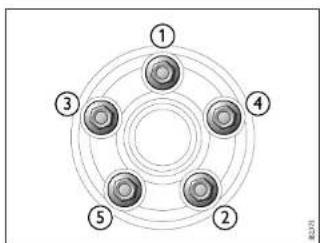
text_image
① ③ ④ ⑤ ② ④Tightening sequence, wheel bolts
Tire repair kit \*
WARNING
Make sure no one can jog the gear lever, for example, as the engine must be idling when the tire is repaired. There is otherwise a risk of personal injury.
Do not use the repair kit if:
- the damage to the tire is larger than 0.16 in. (4 mm).
- the wheel is damaged. Do not exceed 50 mph (80 km/h) after repairing one of the car tires with the repair kit.
WARNING
Change the punctured tire as soon as possible.
Replenish the repair kit at a workshop. We recommend that you contact an authorized Saab workshop. The canister of sealant must be changed once every four years. See the date on the canister.
The handling characteristics of the car may be impaired.
Driving with a tire that is underinflated or has a puncture can damage the tire in such a way that it is not possible to repair it with the sealant.
The tire repair kit replaces the spare wheel. The repair kit allows a punctured tire to be temporarily repaired and reinflated without needing to remove the wheel.
Minor damage to the tire, such as a foreign object that has penetrated the tread, can be temporarily repaired with the repair kit. Do not remove the foreign object. Damage larger than 0.16 in. (4 mm) and damage to the sidewalls cannot be repaired with the repair kit.
Follow the instructions supplied with the repair kit carefully.
If the compressor sounds strange or becomes abnormally hot, leave it switched off for at least 30 minutes.



93 US 7carcare MY09.fm Page 263 Tuesday, April 15, 2008 11:26 AM


263Car care

Prevent the compressor getting wet.
The canister of sealant can only be used once. Replace a used canister at a workshop. We recommend that you contact an authorised Saab workshop.
The tire repair kit can be used at temperatures down to -22^ ( -30^ ). At low temperatures the sealant is more viscous and so is less able to seal slightly larger damage.
If a punctured tire is to be repaired:
- Allow the engine to idle. The compressor will consume some energy.
- Apply the handbrake.
• Tum on the hazard warning light.
- Position the warning triangle to warn other drivers.
The repair kit is stowed under the luggage compartment floor.
The repair kit is stowed under the luggage compartment floor.
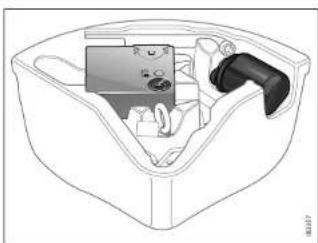
natural_image
Diagram of a car interior showing dashboard, seatbelt, and camera (no text or labels)1 Allow the engine to idle.
2 Remove the repair kit from the luggage compartment.

natural_image
Illustration of a handheld electronic device with a cable and connector (no text or symbols visible)3 Remove the electric cable and the air hose from the compartment on the bottom of the compressor.




93 US 7carecare MY09.fm Page 264 Tuesday, April 15, 2008 11:26 AM
264 Car care

natural_image
Diagram of a device with cable and connector, showing wiring and a magnified inset of a mechanical component (no text or symbols)4 Connect the air hose from the compressor to the connection on the canister.
5 Insert the canister into the recess in the compressor.
6 Unscrew the valve cap from the punctured wheel.
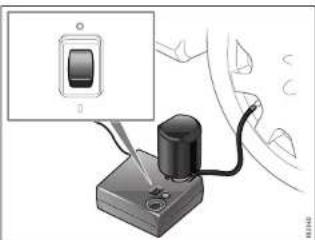
natural_image
Illustration of a switch connected to a power outlet with a magnified inset showing the switch (no text or symbols present)7 Connect the air hose from the canister to the valve on the wheel.
8 The switch on the compressor must be in the 0 position.
9 Connect the compressor's electric cable to the 12 volt socket (cigarette lighter) in the car.

text_image
Diagram showing a pressure gauge measurement setup with a magnified view of the gauge and wiring connections.10 Start the compressor.
11 While the canister of sealant empties (approx. 30 seconds), the gauge on the compressor will briefly show a pressure of up to 87 psi (6 bar). The pressure will then drop.
12 Once the canister is empty, pump the tire to the recommended tire pressure (see page 291). It is not necessary to remove the canister.
13 The tire should be inflated to the recommended pressure within 10 minutes. Switch off the compressor once the correct pressure is reached.




93 US 7carecare MY09.fm Page 265 Tuesday, April 15, 2008 11:26 AM


265Car care
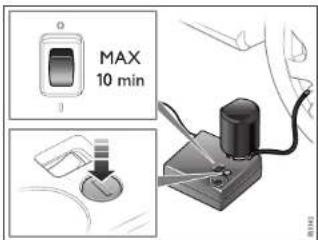
text_image
MAX 10 minIf the correct pressure is not reached within 10 minutes, the damage to the tire is too large to be repaired with the sealant. Park the car in a suitable place and call for assistance.
If the tire pressure becomes too high, it can be reduced by pressing the button by the pressure gauge on the compressor.
Do not run the compressor for more than 10 minutes.
14 Assemble the repair kit and return it to its designated place in the luggage compartment.
15 Wipe away any sealant that may have leaked out with a rag.
16 Put back the warning triangle.
17 Affix the label in the kit showing the maximum permitted speed so that it is clearly visible to the driver.
14 Assemble the repair kit and return it to its designated place in the luggage compartment.
15 Wipe away any sealant that may have leaked out with a rag.
16 Put back the warning triangle.
17 Affix the label in the kit showing the maximum permitted speed so that it is clearly visible to the driver.
18 Drive off immediately so that the sealant is distributed evenly around the tire.
19 Stop after approximately 6 miles (10 km) or 10 minutes (whichever occurs first) and check the tire pressure. To do so, connect the air hose on the compressor directly to the valve on the tire.
If the pressure is greater than 19 psi (1.3 bar), adjust it to the recommended value, see page 291. It may be necessary to check the pressure a number of times on the way to a workshop.
If the pressure falls below 19 psi (1.3 bar), do not drive the car any further but call for assistance.
The most likely reason for a drop in pressure is probably that the damage to the tire is too extensive to be repaired with the repair kit.
20 Return the repair kit to its designated place.
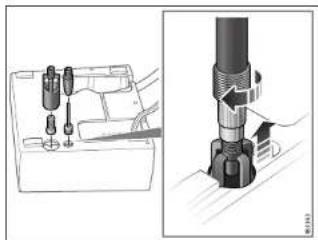
natural_image
Technical illustration of a mechanical assembly with tool holders and a close-up view of a bolted joint (no text or symbols)There are four adapters on the underside of the compressor which allow the compressor to be used to inflate other items such as bicycle tires, air mattresses and footballs.

Do not run the compressor for more than 10 minutes.


93 US 7carecare MY09.fm Page 266 Tuesday, April 15, 2008 11:26 AM
266 Car care
Safety belts

WARNING
If the car is involved in a crash, the safety belts, belt pretensioners and other associated components must be inspected. We recommend that you contact a Saab dealer.
Never make any alterations or repairs to the safety belts yourself. We recommend that you contact a Saab dealer.
Check the function of the safety belts regularly as follows:
- Hold the diagonal strap and pull it sharply. The safety belt should lock and it should not be possible to withdraw it further.
Check the anchorage points in the floor. They must not have suffered rust damage. If a belt is worn or has any fraying edges, it should be replaced.
Safety belts must not come into contact with substances such as polishes, oil or chemicals. If the belts get dirty, wash them with warm water and a detergent or have them replaced.
Upholstery and trim
To remove fluff and hairs from the seats, door armrests and headlining, use a vacuum cleaner, a moist lint-free cloth, or a clothes brush. Remove spots and dirt using a cloth moistened with lukewarm soapy water.
When using a stain remover, always work from the outside towards the center to avoid leaving a ring. If a soiled ring or spot should remain, it can usually be removed using lukewarm soapy water or water alone.
Spots left by liquids, such as soft drinks or thin oil, must be removed at once with an absorbent material, such as kitchen towelling. Then clean with a stain remover.
White spirit is recommended for removing grease and oil stains. A medium stiff brush may also be used.
Cleaning and caring for leather upholstery
The principal reason for treating leather upholstery is to maintain its elegant appearance and to provide it with a protective film. Discolor at ion caused by dust and wear mainly affects the lighter shades, although this is not detrimental to the leather, Indeed, the patina resulting from use is often considered desirable in leather. But if the leather is allowed to become too grubby, it can start to look shabby. Vacuum the leather regularly with a soft brush attachment to remove loose dirt and dust.
The leather upholstery should be cleaned and reconditioned twice a year in conjunction with spring and autumn inspections. In very warm, dry climates the leather may need more regular reconditioning. Use conventional leather care products. Follow the instructions on the packaging.
Do not use harsh polishing agents, cleaning agents, sprays, coarse soap or hot water. Semi-Anilin is a leather that is colored throughout which only has a thin protective finish and is accordingly more sensitive than a surface colored leather and therefore need more care to keep the protection and ageing properties.



93 US 7carecare MY09.fm Page 267 Tuesday, April 15, 2008 11:26 AM
Textile carpeting
Textile carpeting should be vacuum cleaned regularly. Carpeting can also be cleaned using a brush or sponge and carpet shampoo.
For safety reasons, vacuum cleaners that are not earthed (grounded) must not be used out of doors.
Engine bay
The engine bay should be cleaned with an engine decreasing and rinsed with hot water. The headlights must be covered over. Do not use a pressure washer. Avoid spraying electrical components and connectors.
Do not use petrol as a cleaning agent or solvent when carrying out repairs or maintenance. Saab recommends the use of environmentally-friendly cleaning solutions.
Washing
The bodywork must be washed frequently. When the car is new, the body should be washed by hand using plain cold water and a clean, soft brush through which the water flows. Automatic carwashes should be avoided when the car is new.
After 5–6 months the paintwork will have hardened. To facilitate cleaning, a suitable detergent can be added to the water, which should be lukewarm.
Remove any bird droppings without delay, as these can discolor the paintwork and prove difficult to polish out. Lay a wad of wet paper on the patch of dirt and leave it for a minute or so. It will then be easy to wash off the dirt.
Use a soft cloth moistened with white spirit to remove splashes of tar or asphalt. Do not use strong cleaners, as these can dry out the paintwork.
267Car care
NOTICE
Only use liquid detergent when cleaning the plastic lenses of the front and rear lights. Do not use mechanical cleaning. Rinse off the detergent immediately, otherwise cracks may form in the plastic lenses.
The door mirrors should be folded in before the car enters an automatic car wash.
SportCombi: To avoid the wiper arm to break tape it down to the window when using a drive-through car wash.
Try your brakes on leaving a car wash. Wet brake discs reduce the performance of the brakes.
Fixed antennae, such as for a mobile phone, must be removed if the car goes through an automatic car wash.
Cars with Saab Parking Assistance: Do not spray the sensors or closer than 8 in (20 cm) to the sensors with a pressure washer, as this can damage them.

93 US 7carecare MY09.fm Page 268 Tuesday, April 15, 2008 11:26 AM
268 Car care
The underside of the car also needs washing regularly, and this should be done extra thoroughly at the end of winter. Clean the underside of the car by hand if the car is usually washed in an automatic car wash without special facilities for underbody cleaning.
Never wash or leave the car to dry in the sun, but wipe it dry with a chamols leather immediately after washing to avoid smears and streaks.
Clean the Inside of window glass using a proprietary window cleaner. This is particularly important when the car is new, as upholstery and trim have a tendency to sweat a little at first.
Keep the glass well polished, as this helps to prevent misting.
Clean the outside of the windows with Saab washer fluid. This is especially important if the car has been washed in an automatic car wash, as sometimes a wax treatment is used that can contaminate the windshield and impair the performance of the wipers.
Saab offers a full complement of car care products. See your dealer or visit us at our website.
Convertible
- If a pressure washer is used be heedful of the following recommendations:
- On the lower part of the car (not higher than the door handles): max pressure of 100 bar and not closer than 8 in. (20 cm).
- On the upper part of the car: tax pressure of 100 bar and not closer than 32 in. (80 cm).
- Do not use any drying chemicals or waterproofing agents.
- Avoid automatic car washes.
WARNING
- Read and follow the instructions on the packaging of the recommended cleaning agents and waterproofing agents. We recommend that you contact an authorized Saab dealer regarding recommended cleaning agents and waterproofing agents.
-
Never treat the soft top with hot wax or similar.
-
Never use petrochemical based solvents for cleaning. Only use water with a recommended cleaning agent. Petrochemical based solvents can cause irreparable damage to the soft top.
- Never use a pressure washer to clean the soft top. Only use normal household water pressure.
- Never use petrochemical based solvents for cleaning. Only use water with a recommended cleaning agent. Petrochemical based solvents can cause irreparable damage to the soft top.
- Never use a pressure washer to clean the soft top. Only use normal household water pressure.
NOTICE
- Only operate the soft top when it is clean and dry.
- Do not lower the soft top when it is damp. This can cause folds and pressure marks. If the soft top is heavily soiled, the dirt may cause irreparable visible chafe marks.
- Only use water, recommended cleaning agents and a microfibre cloth if the soft top is already damaged, otherwise the damage can become worse.
- At creases, seams and window edges the cleaning motion should be away from the crease, seam or window edge in to the soft top.
The underside of the car also needs washing regularly, and this should be done extra thoroughly at the end of winter. Clean the underside of the car by hand if the car is usually washed in an automatic car wash without special facilities for underbody cleaning.
Never wash or leave the car to dry in the sun, but wipe it dry with a chamols leather immediately after washing to avoid smears and streaks.
Clean the Inside of window glass using a proprietary window cleaner. This is particularly important when the car is new, as upholstery and trim have a tendency to sweat a little at first.
Keep the glass well polished, as this helps to prevent misting.
Clean the outside of the windows with Saab washer fluid. This is especially important if the car has been washed in an automatic car wash, as sometimes a wax treatment is used that can contaminate the windshield and impair the performance of the wipers.
Saab offers a full complement of car care products. See your dealer or visit us at our website.




93 US 7carecare MY09.fm Page 269 Tuesday, April 15, 2008 11:26 AM


269Car care
When the soft top is only slightly soiled, follow the directions on the cleaning agent packaging. No brushing is necessary.
Check the soft top for water penetration from time to time by spraying a small amount of water on it. If water does not form droplets but disappear into the material, it is recommended to wash normally and then waterproof.
If the soft top is heavily soiled and normal recommended cleaning does not produce a noticeable improvement, carry out the following.
The following cleaning method must be only used if the soft top is heavily soiled and must not be carried out more than twice a year.
1 Stop normal cleaning.
2 Rinse off the thick dirt thoroughly with water.
3 Spray the newly rinsed soft top with the recommended cleaning agent and allow it to work in for 15-20 minutes.
4 Move the washing brush backwards and forwards, not diagonally, from side to side or in circles. Use a soft brush, like a clothes brush or a micro fibre cloth so that the cleaning agent foams. Never use a wire brush.
5 Then rinse the soft top with warm water and brush using a soft brush in the direction of the vehicle until all foam has disappeared. Brush carefully to prevent damaging the material.
WARNING
Water hotter than 37^ C can burn the skin, cause skin irritation and/or cause injuries. Use suitable protection.
6 Dry the soft top using a clean chamois leather or a cloth that does not leave lint on the soft top.
7 Allow the soft top to dry fully. Touch with a hand after a while, if the material feels damp, allow it to dry for longer.
8 If spots are still visible, repeat the treatment on these spots as before. Press lightly with the brush to prevent damaging the material. Do not use the brush excessively. This can irreparably damage the material. Do not repeat the treatment more than twice.
9 When the soft top has fully dried, it must be waterproofed immediately. Only use the recommended waterproofing agent. Follow the instructions on the packaging.
10 To obtain even and optimum waterproofing, the car must be closed for 24 hours after treatment. Do not touch the material and do not place any objects on it.

WARNING


93 US 7carcare MY09.fm Page 270 Tuesday, April 15, 2008 11:26 AM
270 Car care
Waxing and polishing
Do not wax a new car during the first three or four months. In fact, there is no need to polish the car before the paintwork has started to dull through oxidation. Other than in exceptional cases, do not use abrasive polishes containing a cutting agent on a new car. Always wash the car thoroughly before waxing or polishing.
Touching up the paint
Damaged paintwork should be treated as soon as it is discovered: the longer it is left, the greater the risk of corrosion. The anti-corrosion warranty does not cover corrosion resulting from untreated defects.
Paintwork damage sustained in a crash is usually extensive and can only be properly restored by professionals.
However, you can repair small scratches and stone chip damage yourself. The necessary tools and materials, such as primer, touch-up paint and brushes, are available from a workshop. We recommend that you contact a Saab dealer.
In the case of minor flaws in the paintwork, where the metal has not been exposed and an undamaged layer of paint remains, touch-up paint can usually be applied directly, after any dirt has been scraped away using a pointed knife.
If corrosion has already set in, such as the result of stone-chip damage, use a pointed knife to scrape off all surface rust. If possible, the damaged area should be taken back to the bare metal. The metal should then be primed with two thin coats of primer applied by brush.
After the primer has dried, apply several thin layers of topcoat until the surface of the repaired area is flush with the surrounding paintwork.
Stir both primer and touch-up paint thoroughly before use and allow each coat to dry before applying the next.
Two-coat enamel
As the name implies, two-coat enamel is applied in two operations. The first coat, the base color, contains the pigment, metal flakes and binder. The second coat consists of a clear enamel, which provides the final gloss for the paintwork and protects the base from moisture and environmental contaminants.
Touch-up stone-chip damage as follows:
1 Thoroughly clean the damaged area.
2 Then apply the primer, base color and finally, the clear enamel. To achieve the best finish, apply two or three coats of primer.

text_image
⑦⑥⑤④③②①Surface treatment composition
1 Body panel
2 Zinc (certain components only) 7.5 um
3 Phosphate coating 3-5 um
4 Cathodic ED 23 um
5 Intermediate coat 35 um
6. Metallic base/solid base 11 μm
7 Clear enamel 45 μm

natural_image
Pure geometric diagram with crosshair and target symbols (no text or labels)93 US 7carcare MY09.fm Page 271 Tuesday, April 15, 2008 11:26 AM
Anti-corrosion treatment
The entire car undergoes a series of anti-corrosion processes during production. These include electrophoretic priming, PVC-based coating to protect against stone chip damage and corrosion, and treatment of body cavities and members with thin, penetrating rust-proofing oil.
In addition, most body panels, such as the hood, doors and floor pan are galvanized.
The anti-corrosion treatment on some parts of the car is constantly exposed to wear and prone to damage. This applies particularly to the underside of the car and inside the wheel arches, where grit, road salt and the like that are thrown up can give rise to corrosion where the underseal has worn away. The extent of this obviously depends on the conditions in which the car is used.
Accordingly, make it a habit to hose the underside of the car often and to inspect the condition of the underseal. The anti-corrosion warranty does not relieve the car owner of the need to carry out normal maintenance to the rust-proofing and to make good any damage.
Use a hose to clean the underside of the car thoroughly. After it has dried, use a brush or spray to apply a viscous anti-corrosion agent to any worn or damaged areas, to prevent the onset of corrosion.
Even after the anti-corrosion warranty has expired, it makes good sense to continue to maintain the rust-proofing.
Seams in the body, especially those in the doors and trunk lid, are particularly vulnerable to corrosion from the outside, caused by grit and salt thrown up from the road, and to corrosion from the inside, largely as a result of condensation. Keep the seams clean and at the first sign of any rust, apply a thin, penetrating, anti-corrosion oil. Your Saab dealer will be pleased to give you further advice.
What causes rust?
Steel body panels of automobiles are subject to rusting whenever air and moisture manage to penetrate the protective finish. Body panels may rust through if the process is unchecked. Rusting can occur wherever water is trapped or where the car's panels are continuously damp.
Damage to paint and undercoating by stones, gravel and minor crashes immediately exposes metal to air and moisture. Road salts used for de-icing will collect on the bottom of the car and promote rusting. Areas of the country with high humidity have a greater potential for rust problems, especially where salt is used on roads or there is moist sea air. Industrial pollution (fallout) may also damage paint and promote rusting.
Preventive maintenance
The following procedures are necessary to help protect against rusting. Refer also to the terms and conditions of the Performance Limited Warranty described in the warranty booklet.
1 Wash the car frequently, and wax at least twice a year. Under adverse conditions, where there is a rapid buildup of dirt, sand or road salt, wash your car at least once a week. After extreme exposure to salted snow or slush, evidenced by a white film on the car, wash the car immediately. Frequent
271Car care


text_image
car, wash the car immediately. Frequent93 US 7carecare MY09.fm Page 272 Tuesday, April 15, 2008 11:26 AM
272 Car care
washing will prevent paint damage from acid rain and other airborne contaminants such as tree sap and bird droppings. If any of these contaminants are noticed on the car the finish should be washed immediately.
- Begin washing by rinsing the entire car with water to loosen and flush off heavy concentrations of dirt (Include the underbody).
- Sponge the car with a solution of either a good quality car soap or mild general purpose (dish washing) detergent and water.
- Rinse car thoroughly with clean water
• After washing, check and clear all drains in doors and body panels - Wipe the car dry, preferably using a chamois.
2 Clean the underside of the car during the winter. Use high pressure water to clean the car's underside (floor panels, wheel wells) at least at mid-winter and in the spring.
3 Inspect the car frequently for leaks or damage, and arrange for needed repairs promptly. After washing or after heavy rain, check for leaks. When washing the car inspect body surfaces for paint damage. While checking for leaks, lift the floor mats and check underneath them. Water can collect in these areas and remain for prolonged periods. Dry any wet areas including the floor mats. Have leaks repaired as soon as possible.
Use touch-up paint to repair small scratches or minor finish damage. Areas where metal is exposed will rust quickly and MUST be repaired immediately by touch-up or professional repainting. Rust must be removed, the bare metal primed and painted. Major body damage should be repaired immediately and new panels or exposed areas should be undercoated with anti-corrosion material.
Repairs of this type are the owner's responsibility and are not covered under warranty.
Inspect the undercoating and touch up if necessary. Pay particular attention to the fenders and wheel housings, which are exposed to abrasion by flying gravel, etc. If the composition has worn or flaked off, the steel must be thoroughly cleaned and dried before a fresh coat is applied. The cleaning is best done with a scraper and a steel wire brush, followed by washing with solvent. Apply the new coating thinly, otherwise it may run off or fall off when dry.
Recovery and/or recycling of automotive materials
Information on the scrapping and recycling of car materials is available on www.saab.com.

Air conditioning (A/C)

WARNING
- All repairs and adjustments to the A/C system must be carried out at a Saab dealer authorized for this kind of work.
- The A/C system is pressurized. Do not break any connections or undo A/C system components.
- Escaping gas can cause eye injury or other personal injury.
NOTICE
• The A/C system is designed for use with R134a refrigerant.
• Refrigerant handling requires special equipment and special procedures for charging and draining the system.
- Never mix R 134a with other refrigerants.
Troubleshooting
If a fault occurs in the A/C system, there are a number of checks you can perform yourself. If the fault persists, however, have the system checked at a workshop. We recommend that you contact a Saab dealer.
Note
When the A/C system is running, the intake air is dehumidified. The resultant condensation that forms on the evaporator is drained off under the car. When the car is parked, this may result in a small puddle forming on the ground. The warmer the air and the higher the relative humidity, the more condensation will be produced.
Inadequate cooling
1 Check that the condenser (in front of the radiator) has not become clogged with dirt and insects.
2 Make sure that the compressor drive belt does not slip (see page 215).
3 Check the fuses for the ventilation fans and compressor (see page 235).
Maintenance
NOTICE
Do not use a pressure washer when cleaning the condenser or radiator due to the risk of damage.
- The compressor drive belt should be inspected under the regular service program.
- Clean away dirt and insects from the condenser and radiator to prevent clogging. When washing the car, use the hose to spray the radiator and condenser (located in front of the radiator) from both sides (both from the front of the car and from inside the engine bay). Do not use a pressure washer.
Caution: Do not hose down the radiator and condenser while the engine is hot.
Other than in extremely cold weather, do not screen the radiator, e.g. with netting, as this will greatly diminish its cooling capacity.
- Applicable to the manual climate control system - During cold months the air conditioning should be switched on once or twice a month and run for 5–10 minutes during highway driving once the engine is warm. This action saves the gaskets in the compressor from being spoiled. The


273Car care
93 US 7carecare MY09.fm Page 274 Tuesday, April 15, 2008 11:26 AM
274 Car care
compressor uses a lubricant that circulates with the coolant.
Note
The A/C system cannot be switched on when the outside temperature is below 32^ F ( 0^ C). Turn on the A/C system when the car is standing in a warm place. Simplest is to always have the A/C button pressed in. The A/C system will then cut in automatically when the outside temperature is high enough.
Headlight aiming
WARNING
Before checking/adjusting the headlight aiming, switch off the engine to avoid danger of fingers and hands being injured by moving parts.
The radiator fan can start up even when the engine is switched off.
The vehicle has a visual optical headlight aiming system equipped with vertical aiming device. The aim has been preset at the factory and should normally not need further adjustments.
If your headlights are damaged in a crash, the headlight aim may be affected. If you believe your headlights need to be re-aimed, we recommend that you take it to your Saab dealer for service. However, it is possible for you to re-alm your headlights as described in the following procedure.
NOTICE
To make sure that your headlights are aimed properly read all instructions before beginning. Failure to follow these instructions could cause damage to headlight parts or a not correctly aimed headlight.
To check the aim, the vehicle should be properly prepared as follows:
- The vehicle shall be placed so that the headlights are 25 ft (7.6 m) from a light colored wall or other flat surface. The aiming area should be darkened, this will improve your ability to see the beam of the low beam headlight being aimed. An optical headlamp aimer can also be used and will than replace the wall.
- The vehicle must have all four wheels on a perfectly level surface which is level all the way to the wall or other flat surface.
- The vehicle should be placed so it is perpendicular to the wall or other flat surface.
• The vehicle should be unloaded and fuel tank full, and one person or 160 lbs. (75 kg) on the drivers seat.
• The vehicle should be fully assembled and all other work stopped while headlight aiming is being done. - The vehicle should not have any snow, ice or mud attached to it.
- Tires should be inflated to the prescribed pressure.
- Close all doors.
- Rock the vehicle to stabilize the suspension.
Headlight aiming is done with the vehicle low beam lamps. The high beam lamps will


93 US 7carecare MY09.fm Page 275 Tuesday, April 15, 2008 11:26 AM


275Car care
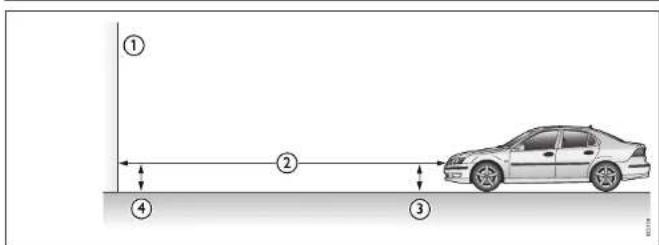
text_image
Diagram showing a car on a horizontal surface with four numbered positions and distance markers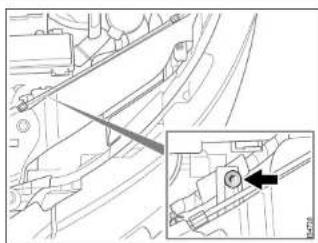
natural_image
Technical line drawing of mechanical components with an inset magnified view showing a component detail (no text or symbols)Vertical aiming device
1 Wall or garage door.
2 25 ft (7.6 m) between wall and headlight lens.
3 Measurement from the ground to the low beam aiming marker on the headlight lens.
4 Same measurement as (3) but subtract 2 inches.
be correctly aimed if the low beam lamps are aimed properly.
If you find that the headlight needs adjustment follow these steps:
1 Open the hood and locate the vertical aiming devices.
2 Locate the marker on the lens.
3 Measure the distance from the ground to the aim marker No.1 (see illustration) on each lens.
Subtract 2 inches
4 At the wall or other flat surface, measure from the ground to the recorded distance (see point 4) and draw a horizontal line the width of the vehicle.
5 Cars with xenon lights:
Xenon lights with automatic headlight levelling system must first do a reference run before aiming: Start the engine and let the headlights do a reference run. Turn off the engine but leave the low beam on.
Cars with halogen lights:
Turn on the low beam headlights.
Both variants:
Place a piece of cardboard or equivalent (although not directly on the lens) in front of the headlight not being aimed. This should allow the beam cut-off of the headlight being aimed to be seen on the flat surface.
1 Aiming marker on headlight lens

natural_image
Line drawing of a vehicle head with a circular vent and a numbered marker (no text or symbols)


93 US 7carecare MY09.fm Page 276 Tuesday, April 15, 2008 11:26 AM
276 Car care
NOTICE
Do not cover a headlight directly on the lens to improve beam cut-off when aiming. Covering a headlight may cause excessive heat build-up that may cause damage to the headlight.
6 Turn the vertical aiming screw until the horizontal cut-off of the headlight is aligned with the horizontal line on the wall.
7 If an optical headlight aimer device is used follow point 1 and 2 and center the lens of the optical headlight aimer device at the intersection of the two markers on the headlight lens. Then follow the instructions in the optical headlight aimer instruction manual and point 1, 2, 5, and 6 in this instruction.

natural_image
Rear view of a silver sedan car on a plain background (no text or symbols visible)
natural_image
Abstract geometric composition with gray and white shapes (no text or symbols)Horizontal line on wall or other flat surface Correctly adjusted low beam


text_image
93 US MY09.book Page 277 Tuesday, April 15, 2008 10.30 AM277Customer Assistance and Inl
Customer Assistance and Information
Maintenance schedule _ 278
Owner assistance 280
Reporting Safety Defects (USA) 281
Reporting Safety Defects to the Canadian government 281
Vehicle Data Collection and Event Data Recorders ____ 282

* Asterisk means: equipment not fitted in all cars (can depend on model variant, engine variant, market specification, options or accessories).

93 US MY09.book Page 278 Tuesday, April 15, 2008 10.30 AM
278 Customer Assistance and Information
Maintenance schedule
The Maintenance Schedule prescribes a service program to the purchaser/operator of a Saab that is reasonable and necessary to ensure the proper emission control systems function, safety and reliability of the Saab automobile in normal use. Additional maintenance is recommended for specific components when the car is operated under certain severe conditions. Proper maintenance is always a good practice!
Authorized Saab dealers are equipped and trained to meet your Saab's service needs. They regularly receive up-to-date Saab service manuals and parts and technical service bulletins from Saab and are able, through their franchise agreement, to attend Saab service schools, obtain Saab special tools and technical assistance and purchase original equipment service and replacement parts.
Today's complex automobiles should only be entrusted to the most knowledgeable service professionals. A Saab dealer is your best choice.
SERVICE INTERVALS
A time for service message will illuminate on the Saab Instrument Display (SID) when the car is due for regular maintenance.

Time for service.
There are three different service types:
MAIN SERVICE
Main service is performed at fixed odometer intervals. These intervals vary between markets and engine variants. Contact a workshop for more information. We recommend that you contact an authorized Saab dealer.
Failure to perform scheduled maintenance in a timely manner may result in serious damage to key components or systems.
INTERMEDIATE SERVICE
The intermediate service on the other hand, is performed depending on e.g. number of cold starts and the climate conditions which the car is in. Therefore the interval can vary for this service type.
MAIN AND INTERMEDIATE SERVICE
When the counter for these two service types is close enough, a combined service is performed.


93 US MY09.book Page 279 Tuesday, April 15, 2008 10.30 AM
279Customer Assistance and InI
Engine oil and filter changes
Changing the engine oil and filter is required at every service point. Use only a Saab approved long-life oil filter and engine oils meeting the classifications stated in the Warranty and Service Record Booklet. The use of extra additives in the oil is not necessary and is not recommended, and may be harmful to turbochargers.
More frequent oil changes are recommended if your vehicle is operated under any of the following conditions:
- Most trips are less than 5–10 miles (8–16 km). This is particularly important when outside temperatures are below freezing.
- Most trips include extensive idling (frequent stop-and-go traffic).
- Most trips are through dusty areas (such as construction zones).
- If the vehicle is used for delivery service, police, taxi or other commercial applications.
If your driving habits match this description, have the engine oil and filter changed in-between normal services. These conditions cause the engine oil to break down faster. The Warranties and Service Record Booklet has provisions to record extra oil changes.
Service record retention
It is the owner's responsibility to retain service records. If possible, you should keep copies of all shop work orders for all service and repairs, whenever performed. As indicated in the new car and emission control system warranties, it is important to document that all necessary maintenance has been done.
HOW THE SERVICE RECORD IS ORGANIZED
The service record is comprised of a series of coupons on which to record services as they are performed. There are additional coupons for documenting extra engine oil and filter changes, extra automatic transmission fluid services necessary for severe service conditions, and brake fluid changes.
HOW TO USE THE SERVICE RECORD COUPONS
When the car is brought to a Saab dealer for scheduled maintenance, present the Warranties & Service Record Booklet to the service manager. When the technician has completed the service, the technician will sign the maintenance record. The person responsible for quality assurance at the dealership will also sign and stamp the record with the dealer identification stamp.
Service costs
Dealer pricing practices and labor for service work vary. Saab's recommended service times for each service point do not include the labor required to replace wear items, such as wiper blades, brake pads or tires. Nor is labor to perform other service or repairs found to be necessary as a result of the inspections included in these times. Additional labor and parts will be charged for such work when necessary, except as covered under an applicable Saab warranty or any optional extended service contract. Transmission fluid changes or suspension alignment, when necessary, are also additional.
Dealer charges for general shop material, regulated hazardous waste removal, recycling expenses or other operation costs may also be applied to service and repair invoices and are apt to vary by dealer and location.





natural_image
Pure geometric lines and symbols without any text, numbers, or labels
natural_image
Pure geometric lines and symbols without any text, numbers, or labels
natural_image
Pure geometric lines and symbols without any text, numbers, or labels
natural_image
Pure geometric lines and symbols without any text, numbers, or labels
natural_image
Pure geometric lines and symbols without any text, numbers, or labels
natural_image
Pure geometric lines and symbols without any text, numbers, or labels
natural_image
Pure geometric lines and symbols without any text, numbers, or labels
natural_image
Pure geometric lines and symbols without any text, numbers, or labels
natural_image
Pure geometric lines and symbols without any text, numbers, or labels
natural_image
Pure geometric lines and symbols without any text, numbers, or labels
natural_image
Pure geometric lines and symbols without any text, numbers, or labels
natural_image
Pure geometric lines and symbols without any text, numbers, or labels
natural_image
Pure geometric lines and symbols without any text, numbers, or labels
natural_image
Pure geometric lines and symbols without any text, numbers, or labels
natural_image
Pure geometric lines and symbols without any text, numbers, or labels
natural_image
Pure geometric lines and symbols without any text, numbers, or labels
natural_image
Pure geometric lines and symbols without any text, numbers, or labels
natural_image
Pure geometric lines and symbols without any text, numbers, or labels
natural_image
Pure geometric lines and symbols without any text, numbers, or symbols
natural_image
Pure geometric lines and symbols without any text, numbers, or symbols
natural_image
Pure geometric lines and symbols without any text, numbers, or symbols
[NO TEXT]


[NO TEXT]
[NO TEXT]
[Figure]
[Figure]

[Figure]
93 US MY09.book Page 280 Tuesday, April 15, 2008 10.30 AM
280 Customer Assistance and Information
Owner assistance
Warranties and service problem assistance
For complete information about all applicable warranties, including the New Car Warranty, Perforation Warranty, Vehicle Emission Warranty and Emission Perforation Warranty, consult the Warrantles and Service Record Booklet which accompanies this Owner's Manual. It also contains owner assistance information including Saab Roadside Assistance. If the booklet is lost or misplaced, a new one may be ordered through a Saab dealer or by contacting Saab.
In the U.S. there is a national Customer Assistance Center at Saab Automobile USA, Inc. The toll-free number to call from all 50 states is 1-800-955-9007.
In Canada, please call the Saab Customer Assistance Center at 1-800-263-1999.
A list of authorized Saab sales and service dealers is available for those planning to travel in the United States and Canada.
Canadian or U.S. travelers may call the Customer Assistance Center in the country in which they are traveling.
Change of Address Notification (U.S. and Canada)
Two change of address cards are provided at the end of the Warranties and Service Record Booklet. Knowing your current address allows Saab to contact you in the event of a recall or service campaign. Please help us keep our records up to date for your own peace of mind.
Service information
Factory Service Manuals for the Saab 9-3 and 9-5 car lines can be ordered through your dealer. These are comprehensive manuals on CD ROM, geared to use by professional technicians. Consult your Saab dealer for prices for your model.


93 US MY09.book Page 281 Tuesday, April 15, 2008 10.30 AM
281Customer Assistance and Inl
Reporting Safety Defects (USA)
If you believe that your vehicle has a defect which could cause a crash or could cause injury or death, you should immediately inform the National Highway Traffic Safety Administration (NHTSA) in addition to notifying Saab Cars USA, Inc.
If NHTSA receives similar complaints, it may open an investigation, and if it finds that a safety defect exists in a group of vehicles, it may order a recall and remedy campaign. However, NHTSA cannot become involved in individual problems between you, your dealer, or Saab Cars USA, Inc.
To contact NHTSA, you may call the toll-free Vehicle Safety Hotline at 1-888-327-4236 (TTY: 1-800-424-9153; go to http://www.safercar.gov; or write to: Administrator, NHTSA, 400 Seventh Street, SW., Washington D.C. 20590. You can also obtain other information about motor vehicle safety from http://www.safercar.gov.
Reporting Safety Defects to the Canadian government
If you live in Canada, and believe that your vehicle has a safety defect, you should immediately notify Transport Canada, in addition to notifying General Motors of Canada Limited.
You may write to Transport Canada at Box 8880, Ottawa, Ontario, K1G 3J2.
In addition to notifying Transport Canada in a situation like this, we certainly hope you will notify us. In Canada, please call our Saab Customer Assistance Center at 1-800-263-1999.
Or write:
General Motors of Canada Limited
Customer Assistance Center,
1908 Colonel Sam Drive,
Oshawa, Ontario, L1H 8P7.

93 US MY09.book Page 282 Tuesday, April 15, 2008 10.30 AM
282 Customer Assistance and Information
Vehicle Data Collection and Event Data Recorders
Your vehicle, like other modern motor vehicles, has a number of sophisticated computer systems that monitor and control several aspects of the vehicle's performance. Your vehicle uses on-board vehicle computers to monitor emission control components to optimize fuel economy, to monitor conditions for air bag deployment and, if so equipped, to provide anti-lock braking and to help the driver control the vehicle in difficult driving situations. Some information may be stored during regular operations to facilitate repair of detected malfunctions; other information is stored only in a crash event by computer systems commonly called event data recorders (EDR).
In a crash event, computer systems, such as the Air Bag Sensing and Diagnostic Module (SDM) in your vehicle may record information about the condition of the vehicle and how it was operated, such as data related to engine speed, brake application, throttle position, vehicle speed, steering wheel angle, lateral acceleration, safety belt usage, air bag readiness, air bag performance, and the severity of a collision. This Information has been used to improve vehicle crash performance and may be used to improve crash performance of future vehicles and driving safety. Unlike the data recorders on many airplanes, these on-board systems do not record sounds, such as conversation of vehicle occupants, To read this information, special equipment is needed and access to the vehicle or the SDM is required.
Saab will not access information about a crash event or share it with others other than
- With the consent of the vehicle owner or, if the vehicle is leased, with the consent of the lessee,
• In response to an official request of police or similar government office,
• As part of Saab's defense of litigation through the discovery process, or
• As required by law.
In addition, once Saab collects or receives data, Saab may
- Use the data for Saab research needs.
- Make it available for research where appropriate confidentiality is to be maintained and need is shown, or
- Share summary data which is not tied to a specific vehicle with non-Saab organizations for research purposes.
Others, such as law enforcement, may have access to the special equipment that can read the information if they have access to the vehicle or SDM.
If your vehicle is equipped with OnStar ^® , please check the OnStar ^® subscription service agreement or manual for information on its operations and data collection.



text_image
93_US_MY09.book Page 283 Tuesday, April 15, 2008 10:30 AM 283Technical dataTechnical data

text_image
General data___284 Engine___286 Engine oil___286 Fuel___287 Engines___287 Electrical system___287 Brake system___287 Wheels and tires___288 Plates and labels___292* Asterisk means: equipment not fitted in all cars (can depend on model variant, engine variant, market specification, options or accessories).

natural_image
Pure geometric diagram with crosshair and circular shapes, no text or symbols present
93 US MY09.book Page 284 Tuesday, April 15, 2008 10.30 AM
284 Technical data
General data
Overall length, including bumpers:
SportSedan and Convertible ____ 182.9" (4647 mm)
SportCombi 183.8" (4670 mm)
Overall width, including door mirrors ____ 80.2" (2038 mm)
Maximum height incl roof antenna:
SportSedan front wheel drive, standard chassis 57.9" (1473 mm)
SportCombi, front wheel drive, standard chassis 60.7" (1543 mm)
SportSedan, all-wheel-drive models ____ 58.5" (1488 mm)
SportCombi, all-wheel-drive models 61.4" (1530 mm)
Wheelbase 105.3" (2675 mm)
Track:
Front ____ 59.8" (1524 mm) Re ar ____ 59.3" (1506 mm)
Ground clearance at GVW:
front wheel drive models approx. 4.7" (120 mm)
all-wheel-drive models ____ approx. 4.8" (122 mm)

V.I.N. label on vehicles sold in U.S.A.

V.I.N. label on vehicles sold in Canada
Permissible load (in addition to the driver) = GVW minus curb weight. The maximum permissible axle load, front or rear, must not be exceeded.
The precise curb weight of the vehicle and load capacity are specified in the vehicle registration documents.
Number of seats (incl. driver):
SportSedan and SportCombi 5 Convertible 4
Turning circle measured at vehicle extremi-
all-wheel-drive models ____ 40.0 ft. (12.2 m) other ____ 39.0 ft. (11.9 m)
Trunk length, SportSedan:
Rear seat raised ____ 40.8" (1036 mm) Rear seat lowered ____ 69.8" (1774 mm)
Trunk length, Convertible 29.1" (740 mm)
Trunk length, SportCombi:
Rear seat raised 39.9" (1013 mm) Rear seat lowered 70.0" (1777 mm)




93 US MY09.book Page 285 Tuesday, April 15, 2008 10.30 AM


285Technical data
Curb weight
(i.e. with full fuel tank, full washer fluid res-
ervoir, standard tools and spare wheel):
| SportSedan | 3220-3880 lbs.(1460-1760 kg) |
| Convertible | 3520-3870 lbs.(1595-1755 kg) |
| SportCombi | 3310-4010 lbs.(1500-1820 kg) |
Gross vehicle weight (GVW):
| SportSedan | 4160-4820 lbs.(1885-2185 kg) |
| Convertible | 4420-4650 lbs.(2005-2110 kg) |
| SportCombi | 4240-4950 lbs.(1925-2245 kg) |
Maximum axle load, front wheel drive:
| SportSedan, front | 2540 lbs. (1150 kg) |
| SportSedan, rear | 2230 lbs. (1010 kg) |
| Convertible, front | 2560 lbs. (1160 kg) |
| Convertible, rear | 2310 lbs. (1050 kg) |
| SportCombl, front | 2340 lbs. (1150 kg) |
| SportCombl, rear | 2430 lbs. (1100 kg) |
Maximum axle load, all-wheel-drive models:
| SportSedan, front | 2600 lbs. (1180 kg) |
| SportSedan, rear | 2380 lbs. (1080 kg) |
| SportCombi, front | 2600 lbs. (1180 kg) |
| SportCombi, rear | 2520 lbs. (1140 kg) |
Weight distribution:
| Curb weight + driver (150 lbs. (68 kg)),front/rear, SportSedan and SportCombi_ approx. 60/40 % |
| GVW, front/rear, SportSedan andSportCombi _ approx. 50/50 % |
| Maximum roof load, SportSedan and SportCombi | 220 lbs. (100 kg) |
| Maximum load in trunk, SportSedan, Convertible and SportCombi 175 lbs. (80 kg) |
| The combined weight of occupants and cargo should never exceed: | |
| SportSedan and SportCombi | 926 lbs. (420 kg) |
| Convertible | 776 lbs. (352 kg) |
| Maximum combined weight of driver and passengers ____ | |
| SportSedan and SportCombi (5x150 lbs.) | 750 lbs. (340 kg) |
| Convertible (4x150 lbs.) | 600 lbs. (272 kg) |


93 US MY09.book Page 286 Tuesday, April 15, 2008 10.30 AM
286 Technical data

WARNING
- The GVW and maximum axle loads must not be exceeded. Note that if some accessories (e.g. towbar, CD changer) are fitted, the available load capacity is reduced by the weight of these.
- When carrying a load in the trunk, make sure that it is lashed down securely, particularly when part or all of the rear seat is folded down.
Trailer
| Trailer with brakes | Max. 3500 lbs.(1588 kg) |
| Trailer without brakes | Max. 1000 lbs.(450 kg) |
| Recommended towball load | 110–165 lbs.(50–75 kg)See also page 190. |
Note that the towbar must not be installed on certain models. Contact a Saab dealer for Information.
Maximum theoretical towing speed, trailer with brakes 60 mph (100 km/h)
Maximum theoretical towing speed, trailer without brakes ____ National restrictions apply
When towing a trailer, increase the pressure of the rear tires by 20 kPa (3 psi).
The above speed and weight restrictions are those specified by Saab Automobile AB.
Note that national restrictions may apply to trailer speeds and weights (see page 188).
Engine
Type:
4-cyl engine Four cylinders, double overhead camshafts, 16 valves, two balancer shafts
V6 engine ____ Six cylinders, 4 overhead camshafts, 24 valves, the angle between the cylinder rows is 60°
Swept volume:
4-cyl engine 122 cu.in. (1.998 l)
V6 engine 170 cu.in. (2.792 l)
Engine oil
Information regarding suitable engine oils can be found in Warranty and Service Record Booklet.
Oil capacity, including filter (oil change)
4-cyl engine 6.3 qts. (6.0 l)
V6 engine 6.3 qts. (6.0 l)

93 US MY09.book Page 287 Tuesday, April 15, 2008 10.30 AM
287Technical data
Fuel
Fuel tank capacity 16.05 U.S. gal. (61 l)
Gasoline Octane
Use regular unleaded gasoline with a posted octane of 87 or higher.
Although not required, use higher octane fuel for optimum performance - 90 octane for the 2.0T engine and 93 octane for the 2.8 V6.
Gasoline with a lower octane rating can be used, although not lower than 87 octane. However, engine performance will fall slightly and heavy loading and laboring should be avoided. For further information on fuel, see page 158.
Engines
2.0T
Rating, SAE at 5300 rpm ____ 210 hp (155 kW)
Maximum torque, SAE at 2500-4000 rpm 221 ft.lb. (300 Nm)
2.8 V6
Rating, SAEat 5500 rpm 280 hp (206 kW)
Maximum torque, front-wheel drive, SAE
at 1800-5000 rpm ____ 262 ft.lb. (355 Nm)
Maximum torque, all-wheel-drive models,
SAE at 1900-4500 rpm ____ 295 ft.lb. (400 Nm)
Electrical system
Voltage 12 V
Battery capacity 60 Ah
Brake system
Foot brake (ABS) ____ Hydraulic disc brakes with vacuum servo unit. Diagonally split circuits; ventilated discs on front wheels (some variants also have ventilated rear discs). EBD function (see page 171).
Park brake ____ Acts on rear wheels
Brake fluid To DOT 4. Do not use DOT 5.
Hydraulic unit for soft top, Convertible
Oil capacity 0.6 qt. (0.6 l)
Oil type CHF 11S




93 US MY09.book Page 288 Tuesday, April 15, 2008 10.30 AM
288 Technical data
Wheels and tires
All season tires
| 6.5x16" | 215/55 R16 93 H |
| 7x17" | 225/50 R17 94 V |
| 7.5x17" | 235/45 R17 94 V |
Summer tires
| 7.5x18" | 235/45 R18 94 Y |
Before changing to wheels/tires of another size, we recommend that you contact an authorized Saab dealer regarding acceptable options.
Winter (snow) tires
| 6.5x16" | 215/55 R16 93 Q |
| M+S | |
| 215/60 R16 95 Q | |
| M+S | |
| 225/55 R16 95 Q | |
| M+S |
| 7x17" | 215/50 R17 95 Q |
| RF/XL M+S | |
| 225/50 R17 94 Q | |
| M+S |
Spare wheel
| Compact spare * | |
| Wheel | 4x16" |
| Tire | 125/85 R16 99 M |
| Pressure | 420 kPa (60 psi) |
| Maximum life | 2200 miles(3500 km) |
| Maximum speed | 50 mph (80 km/h) |
Full size spare ✱
| Wheel | 6.5x16* |
| Tire | 215/55 R16 |
| Pressure | 250 kPa (36 psi) |
| Maximum life | 2200 miles(3500 km) |
| Maximum speed | 50 mph (80 km/h) |
Full size spare *
| Wheel | 7x17" |
| Tire | 215/50 R17 95 W RF/XL |
| Pressure | 290 kPa (42 psi) |
| Maximum life | 2200 miles (3500 km) |
| Maximum speed | 50 mph (80 km/h) |


93 US MY09.book Page 289 Tuesday, April 15, 2008 10.30 AM


289Technical data

NOTICE
Snow chains
Snow chains must not be fitted to the rear wheels, and may only be used with the following wheel-tire combinations:
Wheels Tires
6.5x16"____215/55 R16 M+S or 215/55 R16
Before you purchase winter wheels we recommend that you obtain information on the sizes suitable for your car. We therefore recommend that you contact an authorised Saab dealer.
Contact your Saab dealer regarding suitable snow chains.
Snow chains must not protrude more than 0.35 in. (9 mm) from the tire's tread and its inside.
Snow chains must not be fitted to wheels larger than 16".
Snow chains must be tensioned after a short distance.
Max. permissible speed with snow chains fitted is 30 mph (50 km/h).
Snow chains must not be fitted to wheels larger than 16".
NOTICE
Snow chains
For all-wheel-drive models:
Wheel Tires
6.5x16 225/55 R16 M+S
7x17 215/50 R17 95 RF/XL M+S
Cars with the bigger brake discs (front brake disc diameter 13.58 in. (345 mm), must use 17"-wheels.
Before you purchase winter wheels we recommend that you obtain information on the sizes suitable for your car. We therefore recommend that you contact an authorised Saab dealer.
Contact your Saab dealer regarding suitable snow chains.
Snow chains must not protrude more than 0.35 in. (9 mm) from the tire's tread and its inside.
Snow chains must be tensioned after a short distance.
Max. permissible speed with snow chains fitted is 30 mph (50 km/h).
Snow chains must not be fitted to the rear wheels, and may only be used with the following wheel-tire combinations:
NOTICE
Wheels larger than 18" must not be fitted for reasons stated on page 244.
Exercise care when driving on uneven roads or against the curb if the car is heavily laden. This particularly applies to cars with 17" and 18" wheels.
Permitted wheel offset is 41 mm.





93 US MY09.book Page 290 Tuesday, April 15, 2008 10.30 AM
290 Technical data
Recommended tire/engine combinations
| 2.0 Turbo V6 engine all-wheel-drive models |
All season tires
| 215/55 R16 93 H | √ | - | - |
| 225/50 R17 94 V -- | √ | ||
| 235/45 R17 94 V | √ | √ | - |
Summer tires
| 235/45 R18 94 Y - | √*) | √ |
Winter (snow) tires
| 215/55 R16 93 Q | √ | √ | - |
| 215/60 R16 95 Q - | √*) | √ | |
| 225/55 R16 95 Q | √ | √ | - |
| 215/50 R17 95 Q RF/XL | - | - | √**) |
| 225/50 R17 94 Q -- | √***) |
Wheel sizes
| 6.5x16" | √ | √ | - |
| 7.5x17" | √ | √ | - |
| 7x17-- | √ | ||
| 7.5x18-- | √ |
RF/XL = Reinforced (or Extra Load) tire.
*) with XWD
**) with snow chains
***) no snow chains
The Ground Truth image displays a single, solid horizontal line. According to Rule 2 (UNDERSCORE & LINE RULES), this is a stylistic or background line, not a placeholder underscore. Therefore, the OCR result must ignore it. The provided OCR content is "____", which consists of four underscores. This is an incorrect interpretation of the line as a placeholder, violating the rule that stylistic lines must be ignored. The OCR has hallucinated text (underscores) where none should exist. Hence, the result is inconsistent with the Ground Truth.
[Non-Text]
[Non-Text]






93 US MY09.book Page 291 Tuesday, April 15, 2008 10.30 AM
291Technical data
Recommended lowest tire pressure, cold tires
| Tire size Load/speed | mph (km/h) * | Front psi/kPa | Rear psi/kPa |
| Tire size Load/speed | mph (km/h) * | Front psi/kPa | Rear psi/kPa |
All season tires
| 215/55 R16 93 H 1-3 | pers./0-100 (0-160)4-5 pers./0-100 (0-160)1-5 pers./100-(160-) | 35/24035/24041/280 | 35/24035/24041/280 |
| 235/45 R17 94 V 1-3 | pers./0-100 (0-160)4-5 pers./0-100 (0-160)1-5 pers./100-(160-) | 35/24036/25041/280 | 35/24036/25041/280 |
| 225/50 R17 94 V 1-3 | pers./0-100 (0-160)4-5 pers./0-100 (0-160)1-5 pers./100-(160-) | 35/24036/25041/280 | 35/24036/25041/280 |
Compact spare
| 125/85 R16 99 M* | Max 50 (80) | 60/420 | 60/420 |
Summer tires
| 235/45 R18 94 Y 1-3 | pers./0-120 (0-190) | 36/250 | 36/250 |
| 4-5 pers./0-120 (0-190) | 36/250 | 36/250 | |
| 1-5 pers./120-(190-) | 41/280 | 41/280 |
Full size spare *
| 215/55 R16 93V When the car has the same tire size, the same load/speed information applies as for the original tires. | |||
| 215/50 R17 95 W RF/XL, all-wheel-drive models only Max 50 (80) 42/290 42/290 | |||
Winter tires
| 215/55 R16 93 Q 1-3 | pers./0-100 (0-160)4-5 pers./0-100 (0-160) | 35/24041/280 | 35/24041/280 |
| 215/60 R16 95 Q 1-3 | pers./0-100 (0-160)4-5 pers./0-100 (0-160) | 35/24041/280 | 35/24041/280 |
| 225/55 R16 95 Q 1-3 | pers./0-100 (0-160)4-5 pers./0-100 (0-160) | 35/24041/280 | 35/24041/280 |
| 215/50 R17 95 Q RF/XL | 1-3 pers./0-100 (0-160)4-5 pers./0-100 (0-160) | 42/29042/290 | 42/29042/290 |
| 225/50 R17 94 Q 1-3 | pers./0-100 (0-160)4-5 pers./0-100 (0-160) | 36/25042/290 | 36/25042/290 |
By cold tires is meant tires that are the same temperature as the surrounding air temperature.
The values for tire pressure in table above are for tires at 68°F (20°C).
The tire pressure will increase as the tires become warm (e.g. during highway driving), and decrease as they cool.
When the temperature of the tires increases or decreases by 10 degrees the tire pressure will correspondingly increase or decrease by 2 psi/10 kPa.


93 US MY09.book Page 292 Tuesday, April 15, 2008 10.30 AM
292 Technical data
Plates and labels
When contacting your Saab dealer it may sometimes be necessary to quote the car's vehicle identification, engine and gearbox numbers.
1 V.I.N. number and barcode, inside wind-shield
2 Gearbox number
3 Engine number
4 USA: Tire information label can be found on the B-pillar. See also page 250.
Canada: Label for tire pressure and color codes (trim and body)
5 V.I.N. label and certification label.
USA: V.I.N. label also includes color codes for trim and body
6 Chassis number (stamped on body).

text_image
000000000000000000 ① ④ THE INFLATION PRESSURE BAS AT 12.5 GHz SAR AUTOMOBILE AS BAS AT 12.5 GHz SAR AUTOMOBILE AS BAS AT 12.5 GHz SAR AUTOMOBILE AS BAS AT 12.5 GHz SAR AUTOMOBILE AS BAS AT 12.5 GHz SAR AUTOMOBILE AS BAS AT 12.5 GHz SAR AUTOMOBILE AS BAS AT 12.5GHz SAR AUTOMOBILE AS BAS AT 12.5GHz SAR AUTOMOBILE AS BAS AT 12.5GHz SAR AUTOMOBILE AS BAS AT 12.5GHz SAR AUTOMOBILE AS BAS AT 12.5GHz SAR AUTOMOBILE AS BAS AT 12.5GHz SAR AUTOMOBILE AS SAR AUTOMOBILE AS SAR AUTOMOBILE AS SAR AUTOMOBILE AS SAR AUTOMOBILE AS SAR AUTOMOBILE AS SAR AUTOMOBILE AS SAR AUTOMOBILE AS SAR AUTOMOBILE AS SAR AUTOMOBILE AS SAR AUTOMOBILE AS SAR AUTOMOBILE AS SAR AUTOMOBILE AS SAR AVIANCE FOR BANANAIS (7) ⑥ ONION OF BEANSER (7) ③ ② ⑤ ⑥


93 US MY09.book Page 293 Tuesday, April 15, 2008 10.30 AM


293Technical data
Customized systems
Several of the systems in your Saab can be customized to better suit your individual needs. Contact your Saab dealer
Courtesy Headlamp Feature
• The length of time the lights are on
- Whether the reversing light or tail lights should come on as well as the dipped beam.
Central locking system
Some functions are governed by legal requirements and cannot therefore be reprogrammed.
Automatic Climate System (ACC)
- Convertible: A/C compressor not switched off when the soft top is open.
We recommend that you consult a Saab dealer for further information.
Listed below are a number of examples of programmable functions.
• Audible confirmation of arming/disarming the car alarm
• Automatic unlocking when car stopped and remote control removed from the ignition switch
- Trunk lid locked when car driven off or 30 seconds after being shut.



294 Technical data
Warning and indications that can be shown on the SID
Which warnings and indications that can be shown depends on engine variant and car specification.
The warnings/indications that contain an exclamation mark are shown together with a warning or check light in the main instrument panel.
| Symbol | +text |
| Antilock brake malfunc.Contact service. | |
| Brake malfunction.Make a safe stop. | |
| Brake fluid level low.Make a safe stop. | |
| Release park brake. | |
| Oil pressure low.Make a safe stop. | |
| Low engine oil level.Fill oil now. | |
| Reduced engine power.Contact service. |
| Tighten fuel filler cap. | |
| Limited performance. | |
| Coolant level low. Refill. | |
| Hot engine. Make a safe stop. Idle engine. | |
| Airbag malfunction. Contact service. | |
| Gearbox too hot. Make a safe stop. Open hood. | |
| Battery not charging. Make a safe stop. | |
| Headlight levelling malfunction. | |
| Cornering headlights malfunction | |
| Tap brakes lightiy before using cruise ctrl. | |
| Traction control failure. Contact service. |
| Stability control failure.Contact service. | |
| Turn on the lights. | |
| Washer fluid level low.Refill. | |
| Rain sensor malfunc.Contact service. | |
| Key not accepted.Contact service. | |
| Remote control batterylow. Replace battery. | |
| Number of keys:Active key number: | |
| Steering lock malfunc.Make a safe stop. | |
| Pull out key, turnsteering wheel. Restart. | |
| Theft protection failure.Contact service. | |
| Alarm tripped duringlast arming period. |

295Technical data
 | Rear left seat backrest unlocked. | [2x00] | Right low beam failure. | [K3S] | Right front fog light failure. |
 | Rear right seat backrest unlocked. | — | High mounted stop light failure. | — | Left reversing light failure. |
 | Parking assistance malfunction. Service. | — | Left front turn signal failure. | — | Right reversing light failure. |
 | Parking assistance sensor Interference. | — | Left rear turn signal failure. | — | License plate light failure. |
 | Close doors. |  | Right front turn signal failure. |  | Left rear taillight failure. |
 | Left brake light failure |  | Right rear turn signal failure. |  | Right rear taillight failure. |
 | Left high beam failure. |  | Right side-mounted turn signal failure. |  | Right side day-time running light failure. |
 | Left low beam failure. |  | Left side-mounted turn signal failure. |  | Left side day-time running light failure. |
 | Rear fog light failure. |  | Left front position light failure. |  | Tire pressure low, rear left. Check tires. |
 | Right brake light failure. |  | Right front position light failure. |  | Tire pressure low, rear right. Check tires. |
 | Right high beam failure. |  | Left front fog light failure. |  | Tire pressure low, front right. Check tires. |
Rear left seat backrest unlocked.
Rear right seat backrest unlocked.
Parking assistance malfunction. Service.
Parking assistance sensor interference.
Close doors.
Left brake light failure
Left high beam failure.
Left low beam failure.
Rear fog light failure.
Right brake light failure.
Right high beam failure.
Rear left seat backrest unlocked.
Rear right seat backrest unlocked.
Parking assistance malfunction. Service.
Parking assistance sensor interference.
Close doors.
Left brake light failure
Left high beam failure.
Left low beam failure.
Rear fog light failure.
Right brake light failure.
Right high beam failure.
Rear left seat backrest unlocked.
Rear right seat backrest unlocked.
Parking assistance malfunction. Service.
Parking assistance sensor interference.
Close doors.
Left brake light failure
Left high beam failure.
Left low beam failure.
Rear fog light failure.
Right brake light failure.
Right high beam failure.
Rear left seat backrest unlocked.
Rear right seat backrest unlocked.
Parking assistance malfunction. Service.
Parking assistance sensor interference.
Close doors.
Left brake light failure
Left high beam failure.
Left low beam failure.
Rear fog light failure.
Right brake light failure.
Right high beam failure.
Rear left seat backrest unlocked.
Rear right seat backrest unlocked.
Parking assistance malfunction. Service.
Parking assistance sensor interference.
Close doors.
Left brake light failure
Left high beam failure.
Left low beam failure.
Rear fog light failure.
Right brake light failure.
Right high beam failure.
Rear left seat backrest unlocked.
Rear right seat backrest unlocked.
Parking assistance malfunction. Service.
Parking assistance sensor interference.
Close doors.
Left brake light failure
Left high beam failure.
Left low beam failure.
Rear fog light failure.
Right brake light failure.
Right high beam failure.
Rear left seat backrest unlocked.
Rear right seat backrest unlocked.
Parking assistance malfunction. Service.
Parking assistance sensor interference.
Close doors.
Left brake light failure
Left high beam failure.
Left low beam failure.
Rear fog light failure.
Right brake light failure.
Right high beam failure.
Rear left seat backrest unlocked.
Rear right seat backrest unlocked.
Parking assistance malfunction. Service.
Parking assistance sensor interference.
Close doors.
Left brake light failure
Left high beam failure.
Left low beam failure.
Rear fog light failure.
Right brake light failure.
Right high beam failure.
Rear left seat backrest unlocked.
Rear right seat backrest unlocked.
Parking assistance malfunction. Service.
Parking assistance sensor interference.
Close doors.
Left brake light failure
Left high beam failure.
Left low beam failure.
Rear fog light failure.
Right brake light failure.
Right high beam failure.
Rear left seat backrest unlocked.
Rear right seat backrest unlocked.
Parking assistance malfunction. Service.
Parking assistance sensor interference.
Close doors.
Left brake light failure
Left high beam failure.
Left low beam failure.
Rear fog light failure.
Right brake light failure.
Right high beam failure.
Rear left seat backrest unlocked.
Rear right seat backrest unlocked.
Parking assistance malfunction. Service.
Parking assistance sensor interference.
Close doors.
Left brake light failure
Left high beam failure.
Left low beam failure.
Rear fog light failure.
Right brake light failure.
Right high beam failure.
Rear left seat backrest unlocked.
Rear right seat backrest unlocked.
Parking assistance malfunction. Service.
Parking assistance sensor interference.
Close doors.
Left brake light failure
Left high beam failure.
Left low beam failure.
Rear fog light failure.
Right brake light failure.
Right high beam failure.
Rear left seat backrest unlocked.
Rear right seat backrest unlocked.
Parking assistance malfunction. Service.
Parking assistance sensor interference.
Close doors.
Left brake light failure
Left high beam failure.
Left low beam failure.
Rear fog light failure.
Right brake light failure.
Right high beam failure.
Rear left seat backrest unlocked.
Rear right seat backrest unlocked.
Parking assistance malfunction. Service.
Parking assistance sensor interference.
Close doors.
Left brake light failure
Left high beam failure.
Left low beam failure.
Rear fog light failure.
Right brake light failure.
Right high beam failure.
Rear left seat backrest unlocked.
Rear right seat backrest unlocked.
Parking assistance malfunction. Service.
Parking assistance sensor interference.
Close doors.
Left brake light failure
Left high beam failure.
Left low beam failure.
Rear fog light failure.
Right brake light failure.
Right high beam failure.
Rear left seat backrest unlocked.
Rear right seat backrest unlocked.
Parking assistance malfunction. Service.
Parking assistance sensor interference.
Close doors.
Left brake light failure
Left high beam failure.
Left low beam failure.
Rear fog light failure.
Right brake light failure.
Right high beam failure.
Rear left seat backrest unlocked.
Rear right seat backrest unlocked.
Parking assistance malfunction. Service.
Parking assistance sensor interference.
Close doors.
Left brake light failure
Left high beam failure.
Left low beam failure.
Rear fog light failure.
Right brake light failure.
Right high beam failure.
Rear left seat backrest unlocked.
Rear right seat backrest unlocked.
Parking assistance malfunction. Service.
Parking assistance sensor interference.
Close doors.
Left brake light failure
Left high beam failure.
Left low beam failure.
Rear fog light failure.
Right brake light failure.
Right high beam failure.
Rear left seat backrest unlocked.
Rear right seat backrest unlocked.
Parking assistance malfunction. Service.
Parking assistance sensor interference.
Close doors.
Left brake light failure
Left high beam failure.
Left low beam failure.
Rear fog light failure.
Right brake light failure.
Right high beam failure.
Rear left seat backrest unlocked.
Rear right seat backrest unlocked.
Parking assistance malfunction. Service.
Parking assistance sensor interference.
Close doors.
Left brake light failure
Left high beam failure.
Left low beam failure.
Rear fog light failure.
Right brake light failure.
Right high beam failure.
Rear left seat backrest unlocked.
Rear right seat backrest unlocked.
Parking assistance malfunction. Service.
Parking assistance sensor interference.
Close doors.
Left brake light failure
Left high beam failure.
Left low beam failure.
Rear fog light failure.
Right brake light failure.
Right high beam failure.
Rear left seat backrest unlocked.
Rear right seat backrest unlocked.
Parking assistance malfunction. Service.
Parking assistance sensor interference.
Close doors.
Left brake light failure
Left high beam failure.
Left low beam failure.
Rear fog light failure.
Right brake light failure.
Right high beam failure.
Rear left seat backrest unlocked.
Rear right seat backrest unlocked.
Parking assistance malfunction. Service.
Parking assistance sensor interference.
Close doors.
Left brake light failure
Left high beam failure.
Left low beam failure.
Rear fog light failure.
Right brake light failure.
Right high beam failure.
Rear left seat backrest unlocked.
Rear right seat backrest unlocked.
Parking assistance malfunction. Service.
Parking assistance sensor interference.
Close doors.
Left brake light failure
Left high beam failure.
Left low beam failure.
Rear fog light failure.
Right brake light failure.
Right high beam failure.
Rear left seat backrest unlocked.
Rear right seat backrest unlocked.
Parking assistance malfunction. Service.
Parking assistance sensor interference.
Close doors.
Left brake light failure
Left high beam failure.
Left low beam failure.
Rear fog light failure.
Right brake light failure.
Right high beam failure.
Rear left seat backrest unlocked.
Rear right seat backrest unlocked.
Parking assistance malfunction. Service.
Parking assistance sensor interference.
Close doors.
Left brake light failure
Left high beam failure.
Left low beam failure.
Rear fog light failure.
Right brake light failure.
Right high beam failure.
Rear left seat backrest unlocked.
Rear right seat backrest unlocked.
Parking assistance malfunction. Service.
Parking assistance sensor interference.
Close doors.
Left brake light failure
Left high beam failure.
Left low beam failure.
Rear fog light failure.
Right brake light failure.
Right high beam failure.
Rear left seat backrest unlocked.
Rear right seat backrest unlocked.
Parking assistance malfunction. Service.
Parking assistance sensor interference.
Close doors.
Left brake light failure
Left high beam failure.
Left low beam failure.
Rear fog light failure.
Right brake light failure.
Right high beam failure.
Rear left seat backrest unlocked.
Rear right seat backrest unlocked.
Parking assistance malfunction. Service.
Parking assistance sensor interference.
Close doors.
Left brake light failure
Left high beam failure.
Left low beam failure.
Rear fog light failure.
Right brake light failure.
Right high beam failure.
Rear left seat backrest unlocked.
Rear right seat backrest unlocked.
Parking assistance malfunction. Service.
Parking assistance sensor interference.
Close doors.
Left brake light failure
Left high beam failure.
Left low beam failure.
Rear fog light failure.
Right brake light failure.
Right high beam failure.
Rear left seat backrest unlocked.
Rear right seat backrest unlocked.
Parking assistance malfunction. Service.
Parking assistance sensor interference.
Close doors.
Left brake light failure
Left high beam failure.
Left low beam failure.
Rear fog light failure.
Right brake light failure.
Right high beam failure.
Rear left seat backrest unlocked.
Rear right seat backrest unlocked.
Parking assistance malfunction. Service.
Parking assistance sensor interference.
Close doors.
Left brake light failure
Left high beam failure.
Left low beam failure.
Rear fog light failure.
Right brake light failure.
Right high beam failure.
Rear left seat backrest unlocked.
Rear right seat backrest unlocked.
Parking assistance malfunction. Service.
Parking assistance sensor interference.
Close doors.
Left brake light failure
Left high beam failure.
Left low beam failure.
Rear fog light failure.
Right brake light failure.
Right high beam failure.
Rear left seat backrest unlocked.
Rear right seat backrest unlocked.
Parking assistance malfunction. Service.
Parking assistance sensor interference.
Close doors.
Left brake light failure
Left high beam failure.
Left low beam failure.
Rear fog light failure.
Right brake light failure.
Right high beam failure.
Rear left seat backrest unlocked.
Rear right seat backrest unlocked.
Parking assistance malfunction. Service.
Parking assistance sensor interference.
Close doors.
Left brake light failure
Left high beam failure.
Left low beam failure.
Rear fog light failure.
Right brake light failure.
Right high beam failure.
Rear left seat backrest unlocked.
Rear right seat backrest unlocked.
Parking assistance malfunction. Service.
Parking assistance sensor interference.
Close doors.
Left brake light failure
Left high beam failure.
Left low beam failure.
Rear fog light failure.
Right brake light failure.
Right high beam failure.
Rear left seat backrest unlocked.
Rear right seat backrest unlocked.
Parking assistance malfunction. Service.
Parking assistance sensor interference.
Close doors.
Left brake light failure
Left high beam failure.
Left low beam failure.
Rear fog light failure.
Right brake light failure.
Right high beam failure.
Rear left seat backrest unlocked.
Rear right seat backrest unlocked.
Parking assistance malfunction. Service.
Parking assistance sensor interference.
Close doors.
Left brake light failure
Left high beam failure.
Left low beam failure.
Rear fog light failure.
Right brake light failure.
Right high beam failure.
Rear left seat backrest unlocked.
Rear right seat backrest unlocked.
Parking assistance malfunction. Service.
Parking assistance sensor interference.
Close doors.
Left brake light failure
Left high beam failure.
Left low beam failure.
Rear fog light failure.
Right brake light failure.
Right high beam failure.
Rear left seat backrest unlocked.
Rear right seat backrest unlocked.
Parking assistance malfunction. Service.
Parking assistance sensor interference.
Close doors.
Left brake light failure
Left high beam failure.
Left low beam failure.
Rear fog light failure.
Right brake light failure.
Right high beam failure.
Rear left seat backrest unlocked.
Rear right seat backrest unlocked.
Parking assistance malfunction. Service.
Parking assistance sensor interference.
Close doors.
Left brake light failure
Left high beam failure.
Left low beam failure.
Rear fog light failure.
Right brake light failure.
Right high beam failure.
Rear left seat backrest unlocked.
Rear right seat backrest unlocked.
Parking assistance malfunction. Service.
Parking assistance sensor interference.
Close doors.
Left brake light failure
Left high beam failure.
Left low beam failure.
Rear fog light failure.
Right brake light failure.
Right high beam failure.
Rear left seat backrest unlocked.
Rear right seat backrest unlocked.
Parking assistance malfunction. Service.
Parking assistance sensor interference.
Close doors.
Left brake light failure
Left high beam failure.
Left low beam failure.
Rear fog light failure.
Right brake light failure.
Right high beam failure.
Rear left seat backrest unlocked.
Rear right seat backrest unlocked.
Parking assistance malfunction. Service.
Parking assistance sensor interference.
Close doors.
Left brake light failure
Left high beam failure.
Left low beam failure.
Rear fog light failure.
Right brake light failure.
Right high beam failure.
Rear left seat backrest unlocked.
Rear right seat backrest unlocked.
Parking assistance malfunction. Service.
Parking assistance sensor interference.
Close doors.
Left brake light failure
Left high beam failure.
Left low beam failure.
Rear fog light failure.
Right brake light failure.
Right high beam failure.
Rear left seat backrest unlocked.
Rear right seat backrest unlocked.
Parking assistance malfunction. Service.
Parking assistance sensor interference.
Close doors.
Left brake light failure
Left high beam failure.
Left low beam failure.
Rear fog light failure.
Right brake light failure.
Right high beam failure.
Rear left seat backrest unlocked.
Rear right seat backrest unlocked.
Parking assistance malfunction. Service.
Parking assistance sensor interference.
Close doors.
Left brake light failure
Left high beam failure.
Left low beam failure.
Rear fog light failure.
Right brake light failure.
Right high beam failure.
Rear left seat backrest unlocked.
Rear right seat backrest unlocked.
Parking assistance malfunction. Service.
Parking assistance sensor interference.
Close doors.
Left brake light failure
Left high beam failure.
Left low beam failure.
Rear fog light failure.
Right brake light failure.
Right high beam failure.
Rear left seat backrest unlocked.
Rear right seat backrest unlocked.
Parking assistance malfunction. Service.
Parking assistance sensor interference.
Close doors.
Left brake light failure
Left high beam failure.
Left low beam failure.
Rear fog light failure.
Right brake light failure.
Right high beam failure.
Rear left seat backrest unlocked.
Rear right seat backrest unlocked.
Parking assistance malfunction. Service.
Parking assistance sensor interference.
Close doors.
Left brake light failure
Left high beam failure.
Left low beam failure.
Rear fog light failure.
Right brake light failure.
Right high beam failure.
Rear left seat backrest unlocked.
Rear right seat backrest unlocked.
Parking assistance malfunction. Service.
Parking assistance sensor interference.
Close doors.
Left brake light failure
Left high beam failure.
Left low beam failure.
Rear fog light failure.
Right brake light failure.
Right high beam failure.
Rear left seat backrest unlocked.
Rear right seat backrest unlocked.
Parking assistance malfunction. Service.
Parking assistance sensor interference.
Close doors.
Left brake light failure
Left high beam failure.
Left low beam failure.
Rear fog light failure.
Right brake light failure.
Right high beam failure.
Rear left seat backrest unlocked.
Rear right seat backrest unlocked.
Parking assistance malfunction. Service.
Parking assistance sensor interference.
Close doors.
Left brake light failure
Left high beam failure.
Left low beam failure.
Rear fog light failure.
Right brake light failure.
Right high beam failure.
Rear left seat backrest unlocked.
Rear right seat backrest unlocked.
Parking assistance malfunction. Service.
Parking assistance sensor interference.
Close doors.
Left brake light failure
Left high beam failure.
Left low beam failure.
Rear fog light failure.
Right brake light failure.
Right high beam failure.
Rear left seat backrest unlocked.
Rear right seat backrest unlocked.
Parking assistance malfunction. Service.
Parking assistance sensor interference.
Close doors.
Left brake light failure
Left high beam failure.
Left low beam failure.
Rear fog light failure.
Right brake light failure.
Right high beam failure.
Rear left seat backrest unlocked.
Rear right seat backrest unlocked.
Parking assistance malfunction. Service.
Parking assistance sensor interference.
Close doors.
Left brake light failure
Left high beam failure.
Left low beam failure.
Rear fog light failure.
Right brake light failure.
Right high beam failure.
Rear left seat backrest unlocked.
Rear right seat backrest unlocked.
Parking assistance malfunction. Service.
Parking assistance sensor interference.
Close doors.
Left brake light failure
Left high beam failure.
Left low beam failure.
Rear fog light failure.
Right brake light failure.
Right high beam failure.
Rear left seat backrest unlocked.
Rear right seat backrest unlocked.
Parking assistance malfunction. Service.
Parking assistance sensor interference.
Close doors.
Left brake light failure
Left high beam failure.
Left low beam failure.
Rear fog light failure.
Right brake light failure.
Right high beam failure.
Rear left seat backrest unlocked.
Rear right seat backrest unlocked.
Parking assistance malfunction. Service.
Parking assistance sensor interference.
Close doors.
Left brake light failure
Left high beam failure.
Left low beam failure.
Rear fog light failure.
Right brake light failure.
Right high beam failure.
Rear left seat backrest unlocked.
Rear right seat backrest unlocked.
Parking assistance malfunction. Service.
Parking assistance sensor interference.
Close doors.
Left brake light failure
Left high beam failure.
Left low beam failure.
Rear fog light failure.
Right brake light failure.
Right high beam failure.
Rear left seat backrest unlocked.
Rear right seat backrest unlocked.
Parking assistance malfunction. Service.
Parking assistance sensor interference.
Close doors.
Left brake light failure
Left high beam failure.
Left low beam failure.
Rear fog light failure.
Right brake light failure.
Right high beam failure.
Rear left seat backrest unlocked.
Rear right seat backrest unlocked.
Parking assistance malfunction. Service.
Parking assistance sensor interference.
Close doors.
Left brake light failure
Left high beam failure.
Left low beam failure.
Rear fog light failure.
Right brake light failure.
Right high beam failure.
Rear left seat backrest unlocked.
Rear right seat backrest unlocked.
Parking assistance malfunction. Service.
Parking assistance sensor interference.
Close doors.
Left brake light failure
Left high beam failure.
Left low beam failure.
Rear fog light failure.
Right brake light failure.
Right high beam failure.
Rear left seat backrest unlocked.
Rear right seat backrest unlocked.
Parking assistance malfunction. Service.
Parking assistance sensor interference.
Close doors.
Left brake light failure
Left high beam failure.
Left low beam failure.
Rear fog light failure.
Right brake light failure.
Right high beam failure.
Rear left seat backrest unlocked.
Rear right seat backrest unlocked.
Parking assistance malfunction. Service.
Parking assistance sensor interference.
Close doors.
Left brake light failure
Left high beam failure.
Left low beam failure.
Rear fog light failure.
Right brake light failure.
Right high beam failure.
Rear left seat backrest unlocked.
Rear right seat backrest unlocked.
Parking assistance malfunction. Service.
Parking assistance sensor interference.
Close doors.
Left brake light failure
Left high beam failure.
Left low beam failure.
Rear fog light failure.
Right brake light failure.
Right high beam failure.
Rear left seat backrest unlocked.
Rear right seat backrest unlocked.
Parking assistance malfunction. Service.
Parking assistance sensor interference.
Close doors.
Left brake light failure
Left high beam failure.
Left low beam failure.
Rear fog light failure.
Right brake light failure.
Right high beam failure.
Rear left seat backrest unlocked.
Rear right seat backrest unlocked.
Parking assistance malfunction. Service.
Parking assistance sensor interference.
Close doors.
Left brake light failure
Left high beam failure.
Left low beam failure.
Rear fog light failure.
Right brake light failure.
Right high beam failure.
Rear left seat backrest unlocked.
Rear right seat backrest unlocked.
Parking assistance malfunction. Service.
Parking assistance sensor interference.
Close doors.
Left brake light failure
Left high beam failure.
Left low beam failure.
Rear fog light failure.
Right brake light failure.
Right high beam failure.
Rear left seat backrest unlocked.
Rear right seat backrest unlocked.
Parking assistance malfunction. Service.
Parking assistance sensor interference.
Close doors.
Left brake light failure
Left high beam failure.
Left low beam failure.
Rear fog light failure.
Right brake light failure.
Right high beam failure.
Rear left seat backrest unlocked.
Rear right seat backrest unlocked.
Parking assistance malfunction. Service.
Parking assistance sensor interference.
Close doors.
Left brake light failure
Left high beam failure.
Left low beam failure.
Rear fog light failure.
Right brake light failure.
Right high beam failure.
Rear left seat backrest unlocked.
Rear right seat backrest unlocked.
Parking assistance malfunction. Service.
Parking assistance sensor interference.
Close doors.
Left brake light failure
Left high beam failure.
Left low beam failure.
Rear fog light failure.
Right brake light failure.
Right high beam failure.
Rear left seat backrest unlocked.
Rear right seat backrest unlocked.
Parking assistance malfunction. Service.
Parking assistance sensor interference.
Close doors.
Left brake light failure
Left high beam failure.
Left low beam failure.
Rear fog light failure.
Right brake light failure.
Right high beam failure.
Rear left seat backrest unlocked.
Rear right seat backrest unlocked.
Parking assistance malfunction. Service.
Parking assistance sensor interference.
Close doors.
Left brake light failure
Left high beam failure.
Left low beam failure.
Rear fog light failure.
Right brake light failure.
Right high beam failure.
Rear left seat backrest unlocked.
Rear right seat backrest unlocked.
Parking assistance malfunction. Service.
Parking assistance sensor interference.
Close doors.
Left brake light failure
Left high beam failure.
Left low beam failure.
Rear fog light failure.
Right brake light failure.
Right high beam failure.
Rear left seat backrest unlocked.
Rear right seat backrest unlocked.
Parking assistance malfunction. Service.
Parking assistance sensor interference.
Close doors.
Left brake light failure
Left high beam failure.
Left low beam failure.
Rear fog light failure.
Right brake light failure.
Right high beam failure.
Rear left seat backrest unlocked.
Rear right seat backrest unlocked.
Parking assistance malfunction. Service.
Parking assistance sensor interference.
Close doors.
Left brake light failure
Left high beam failure.
Left low beam failure.
Rear fog light failure.
Right brake light failure.
Right high beam failure.

√ √

93 US MY09.book Page 296 Tuesday, April 15, 2008 10.30 AM
296 Technical data
| Tire pressure low, front left. Check tires. | |
| Low tire pressure rear left. Make a safe stop. | |
| Low tire pressure rear right. Make a safe stop. | |
| Low tire pressure front right. Make a safe stop. | |
| Low tire pressure front left. Make a safe stop. | |
| Tire pressure system failure. Contact service. | |
| Time for service. | |
| Service XWD. |
| 296 Technical data | |
| Tire pressure low, front left. Check tires. | |
| Low tire pressure rear left. Make a safe stop. | |
| Low tire pressure rear right. Make a safe stop. | |
| Low tire pressure front right. Make a safe stop. | |
| Low tire pressure front left. Make a safe stop. | |
| ! Tire pressure system failure. Contact service. | |
| Time for service. | |
| Service XWD. |
297Index
Index
A
ABS brakes 171 ACC 107
Adjustment, steering wheel 118
Air filter 209 Airbag 32
All-wheel drive (XWD) 173
Anchorage eyes, SportSedan 139
Anti-corrosion treatment 271
Antilock braking system 171
Anti-spin 173 Ashtrays 134
Autochecking of lights, warning and indicator lights 87
Autodimming 123
Automatic climate control (ACC) ____ 107
Automatic closing of moonroof ____ 129
Automatic closing of windows,
SportSedan and SportCombi ____ 120
Automatic transmission 162
Automatic transmission, Sport mode 163
B
Battery 214
Bedding-in of new brake pads ____ 160
Before towing a trailer 191
Belt height, SportSedan and
SportCombi 14
Brake fluid, grade 287
Brakes 170
Braking 170
Bulb changing 218
Bulb table 232
Buying new tires 243
C
Cabin lighting, Convertible 79
Cabin lighting, SportSedan and SportCombi 131
Calibrating front electric windows with
pinch protection 78
Calibration of windows, SportSedan
and SportCombi 121
Car alarm 56
Car transport 196
Care of air conditioning 273
Cargo guard 148
Cargo guard, SportWagon 148
Cargo net, SportCombi 145
CHECK ENGINE light 83
Change of address notification ____ 280
Changing a tire 258
Changing bulbs 218
Changing the battery, remote control _ 5 4
Changing wiper blades 216
Checking the number of remote
controls 53
Checks before towing a trailer ____ 191
Child safety 24
Child safety locks, rear doors 52
Child seats 24
Cigarette lighter 134
Cleaning the engine bay 267
Cleaning upholstery 266
Closing the soft top manually, Convertible 68
Closing the soft top, Convertible ____ 64
Clutch interlock 161
Comfort opening of moonroof 129
Comfort opening of windows,
SportSedan and SportCombi 119
Compact spare 256
Compact spare wheel fitted, driving
with 258
Compass 127
Convertible 61
Convertible, washing 268
Coolant 210
Cornering headlights ____ 99
Crash memory, see EDR 282
Cruise control 169
Cup holder 133
D
Date codes, tires 253
Deactivating rear windows,
SportSedan and SportCombi 121
Deactivating the passenger door
window button, Convertible 78



93 US MY09.book Page 298 Tuesday, April 15, 2008 10.30 AM
298 Index
| Deactivating the rear window switches | 121 |
| Deep water, driving through | 193 |
| Definitions and terminology, tire | 250 |
| Determining correct load, tires | 252 |
| Direction indicator stalk switch | 101 |
| Direction indicators | 101 |
| Dome light, Convertible | 228 |
| Dome light, SportSedan | 228 |
| Donor battery, boost starting | 197 |
| Door handles | 48 |
| Door mirrors | 122 |
| Drive belt | 215 |
| Driver's seat with memory | 21 |
| Driving in cold climates | 185 |
| Driving in deep water | 193 |
| Driving in hot climates | 187 |
| Driving techniques | 183 |
| Driving with a compact wheel fitted | 2 5 |
| Driving with a heavy load on hilly roads | 164 |
| Driving with a load | 192 |
| Driving with a roof load | 192 |
| Driving with the trunk lid open | 193 |
E
| EDR (Event Data Recorders) | 282 |
| ESP® | 175 |
| Easy entry, Convertible | 73 |
| Economical motoring | 183 |
| Electrical system, technical data | 287 |
| Electrically adjustable seats | 20 |
| Electric engine heater | 184 |
| Electric heating, front seats | 114 |
| Electric windows | 119 |
| Electric windows, Convertible | 77 |
| Electronic Stability Program | 175 |
| Electronic steering wheel lock | 151 |
| Emergency opening of the narrow backrest, SportSedan | 140 |
| Emergency operation of the moonroof | 130 |
| Engine bay, cleaning | 267 |
| Engine heater | 184 |
| Engine immobilizer | 55 |
| Engine management system | 204 |
| Engine number | 292 |
| Engine oil, checking | 208 |
| Engine oil, grade | 286 |
| Engine temperature gauge | 88 |
| Engine, description | 203 |
| Engine, technical data | 286 |
| Engines | 287 |
| Event Data Recorders (EDR) | 282 |
| Extra electrical socket | 134 |
F
| Facilitating entry to rear seat, Convertible | 73 |
| Factors affecting fuel consumption | 183 |
| Filler cap | 157 |
| Filling a portable fuel container | 158 |
| Filling up | 156 |
| Flat spots, tires | 242 |
| Floor jack | 259 |
| Folding down the rear seat backrest,SportCombi | 141 |
| Folding down the rear seat,SportSedan | 136 |
| Front fog lights | 100 |
| Front towing eye | 194 |
| Fuel cap | 157 |
| Fuel container | 158 |
| Fuel gauge | 89 |
| Fuel grade | 287 |
| Fuel information | 158 |
| Functions, car alarm | 58 |
| Fuse panel in luggage compartment | 236 |
| Fuse table | 235 |
| Fuses | 233 |
G
| GDO, garage door opener | 123 |
| Gearbox number | 292 |
| General safety instructions, Convertible | 62 |
| Glove box | 134 |
| Glovebox lighting | 229 |
H
| Handbrake | 177 |
| Hazard warning lights | 102 |
| Head restraint, Convertible | 74 |
| Head restraints | 23 |



93 US MY09.book Page 299 Tuesday, April 15, 2008 10.30 AM


299Index
Headlight flasher 99
Headlight levelling 98
Headlights 98
Hood 202
Hom 118
Horn button 118
|
If a tire goes flat ____ 247
Ignition switch 150
Immobilizer 55
Important considerations for driving _ 1 5 3
Important information, petrol-engined
cars with catalytic converters 154
Indicator lights 82
Inflation, tires 240
Information about fuel 158
Instrument illumination, adjusting ____ 100
Interior lighting, Convertible 79
Interior lighting, SportSedan and
SportCombl 131
Interior rearview mirror ____ 123
Intermittent malfunctioning, central
locking 50
J
Jump starting 197
K
Key 48
Kick-down 164
L
Labeling, tire sidewall 248
Labels and plates, location ____ 292
Lashing eyes, SportCombi 144
Lashing eyes, SportSedan 139
Laying the car up ____ 179
LATCH (child safety) ____ 25
Leather upholstery, cleaning 266
Lighting in luggage compartment,
Convertible 79
Limp-home 154
Limp-home, automatic transmission _ 165
Load carriers, roof 192
Load indices, tires ____ 249
Loading your vehicle ____ 250
Load-through hatch, SportCombi ____ 143
Load-through hatch, SportSedan ____ 138
Locking a car with flat battery 51
Locks 48
Long-term parking 179
Luggage compartment 136
Luggage compartment lighting,
Convertible 79
Luggage compartment lighting,
SportSedan 132, 140
Luggage compartment lighting,
changing 230
M
Main instrument panel 82
Main/dipped beam 99
Maintenance schedule 278
Malfunction Indicator Lamp 83
Manual gear selection ____ 168
Manual gearbox 161
Manual tripping of car alarm 58
Materials used in the car, reclamation 272
MAXI fuses 234
Memory, driver's seat 21
Messages on SID, Convertible 71
Milometer 90
Moonroof 128
Mug holder 133
N
New tires, buying 243
Number plate lighting, changing ____ 229
0
ORVR 205
Opening handles 48
Opening the soft top, Convertible ____ 64
Outside mirrors 122
Owner assistance 280


93 US MY09.book Page 300 Tuesday, April 15, 2008 10:30 AM
300 Index
P
Panic function, car alarm 58
Park Brake Shift Lock 163
Park Brake Shift Lock, temporary override ____ 166
Parking 177
Parking aid 180
Parking brake 177
Parking on a hill 178
Pinch protection, electric windows,
SportSedan and SportCombi 120
Pinch protection, moonroof 130
Plates and labels, location ____ 292
Polishing and waxing 270
Poly-V-belt 215
Portable fuel container 158
Position lights 98
Power steering fluid, checking ____ 213
Pressure gauge 88
Pressure, tires ____ 240
Profiles, customized settings ____ 94
Q
Quality grading, tires ____ 244
Quick guide, remote control 49
R
Rain sensor 103
Raising the soft top manually,
Convertible 68
Reading lights, Convertible 79
Rear fog light 101
Rear seat, folding down, SportCombi 141
Rear seat, safety belts 17
Rear seats, folding down, SportSedan 136
Rear towing eye 194
Rear windows, deactivating,
SportSedan and SportCombi ____ 121
Rearview mirrors 122
Recommendations for automatic
transmission, towing a trailer ____ 189
Recommendations for manual gearbox,
towing a trailer 190
Recommended snow chains 288
Refueling 156
Reinstalling the fuel cap ____ 157
Remote control 48
Remote locking malfunction ____ 50
Replacement, wheel ____ 246
Reporting safety defects 281
Rev counter 87
Reversing lights 102
Rollover Pop-up Bars, Convertible ____ 76
Roof lighting, SportSedan and
SportCombi 131
Roof lighting, changing 228
Running-in 160
S
Saab Information Display 89
Saab Parking Assistance ____ 180
Safety belts 12
Safety belts, rear seat, SportSedan
and SportCombi 17
SAHR, head restraint 23
SDM 282
SID 89
SPA 180
Seat belts 12
Seat belts in rear seat, Convertible ____ 75
Seat belts, care 266
Seat belts, checking ____ 266
Seats 18
Securing a load 139
Sentronic, manual gear selection 168
Service Engine Lamp 83
Service costs 279
Service Information 280
Service intervals 278
Service record retention ____ 279
Signalling, horn ____ 118
Ski hatch, SportCombi 143
Ski hatch, SportSedan 138
Spare wheel ____ 256
Speed ratings, tires ____ 249
Speedometer 87
Sport mode, automatic transmission _ 163
Starting the engine 152
Steering wheel adjustment 118
Steering wheel lock ____ 151
Steps for determining correct load
limit 252
Storage compartments 134


93 US MY09.book Page 301 Tuesday, April 15, 2008 10.30 AM


301Index
Sun visor 132 Switches 97
T
TCS 173
Technical data 284
Textile carpeting, cleaning ____ 267
Tie down eyes, SportCombi ____ 144
Tie down eyes, SportSedan 139
Tightening torque, wheels 261
Tire Repals Kit 262
Tire chains 247
Tire date code 253
Tire inspection and rotation 241
Tire markings 249
Tire sidewall labeling 248
Tire sizes 288
Tire terminology and definitions 250
Tire, changing 258
Tire, spare 256
Tires 240
Tools and spare wheel 256
Touching up paintwork 270
Towbar 188
Towbar load 190
Towing 193
Towing a trailer 188
Towing the car 195
Traction Control System (TCS) 173
Transmission oil, checking 210
Transmission, automatic 162
Transmission, manual 161 Transporting the car 196 Treadwear indicators 243 Trip computer 90 Trip meter 90 Troubleshooting, A/C and ACC 273 Trunk lid, driving when open 193 Trunk lid, opening 51 Turbo gauge 88
U
Uniform tire quality grading 244
Upholstery care 266
Upholstery, cleaning 266
Useful tips on starting 153
V
Vanity mirror 132 Vehicle Data Collection 282 Vehicle identification number 292 Vehicle recovery 196
W
Warning labels 8
Warning lights 82
Warning triangle 102
Warnings and messages on SID, Convertible 71
Washer fluid 217
Washer jets 217
Washers 103
Washing 267
Washing a Convertible 268
Waxing and polishing 270
Wear indicators, tires 243
What Will You See After an Airbag Inflates? 43
Wheel replacement 246
Wheels and tires, sizes 288
When It is time for new tires 242
Windshield washers 103
Windshield wipers 103
Wing mirrors 122
Winter driving 185
Winter tires 253
Wiper blades 216
Wipers 103
X
XWD, All-wheel drive ____ 173 Xenon cornering headlights ____ 99 Xenon headlights ____ 219 Xenon headlights, headlight levelling ____ 98



text_image
93 US MY09.book Page 302 Tuesday, April 15, 2008 10:30 AM 302 Notes Notes
text_image
93_US_MY09.book Page 303 Tuesday, April 15, 2008 10.30 AM 303Notes