CX510de - Printer LEXMARK - Free user manual and instructions
Find the device manual for free CX510de LEXMARK in PDF.


User questions about CX510de LEXMARK
0 question about this device. Answer the ones you know or ask your own.
Ask a new question about this device
Download the instructions for your Printer in PDF format for free! Find your manual CX510de - LEXMARK and take your electronic device back in hand. On this page are published all the documents necessary for the use of your device. CX510de by LEXMARK.
USER MANUAL CX510de LEXMARK
September 2014 www.lexmark.com
Machine type(s):
7527
Model(s):
636, 637
Contents
Safety information....7
Learning about the printer....9
Finding information about the printer....9
Selecting a location for the printer....10
Printer configurations....11
Understanding the basic functions of the scanner....12
Using the ADF and scanner glass....13
Understanding the printer control panel....14
Using the printer control panel....14
Understanding the home screen....14
Understanding the colors of the Sleep button and indicator lights....16
Using the touch-screen buttons....17
Setting up and using the home screen applications....19
Finding the IP address of the computer....19
Finding the IP address of the printer....19
Accessing the Embedded Web Server....19
Customizing the home screen....20
Understanding the different applications....20
Activating the home screen applications....21
Finding information about the home screen applications....21
Setting up Forms and Favorites 21
Setting up Card Copy 22
Using MyShortcut 22
Setting up Multi Send 23
Setting up Scan to Network 23
Setting up Remote Operator Panel....24
Exporting and importing a configuration....25
Additional printer setup....26
Installing internal options....26
Installing hardware options....32
Attaching cables....35
Setting up the printer software....36
Networking....37
Verifying printer setup....41
Loading paper and specialty media....42
Setting the paper size and type....42
Configuring Universal paper settings....42
Loading the 250- and 550-sheet tray....42
Loading the manual feeder....45
Loading the 650-sheet duo tray....46
Loading the multipurpose feeder....47
Linking and unlinking trays....49
Paper and specialty media guide....52
Using specialty media....52
Paper guidelines....55
Supported paper sizes, types, and weights....58
Printing....62
Printing forms....62
Printing a document....62
Printing from a flash drive or mobile device....64
Printing confidential and other held jobs....66
Printing information pages....68
Canceling a print job....68
Copying....69
Making copies....69
Copying photos....70
Copying on specialty media....70
Creating a copy shortcut using the printer control panel....71
Customizing copy settings....72
Placing information on copies....77
Canceling a copy job....78
Understanding the copy options....78
E-mailing....82
Setting up the printer to e-mail....82
Creating an e-mail shortcut....83
E-mailing a document....84
Customizing e-mail settings....85
Canceling an e-mail....86
Understanding the e-mail options....86
Faxing....89
Setting up the printer to fax....89
Sending a fax....103
Creating shortcuts....106
Customizing fax settings....106
Canceling an outgoing fax....108
Holding and forwarding faxes....108
Understanding the fax options....109
Scanning....112
Using Scan to Network....112
Scanning to an FTP address....112
Scanning to a computer or flash drive....114
Understanding the scan options....116
Understanding the printer menus....119
Menus list....119
Supplies menu....120
Paper menu....120
Reports menu....130
Network/Ports....131
Security menu....139
Settings menu....145
Saving money and the environment....195
Saving paper and toner....195
Saving energy....196
Recycling....199
Securing the printer....201
Using the security lock feature....201
Statement of Volatility....201
Erasing volatile memory....202
Erasing non-volatile memory....202
Erasing printer hard disk memory....203
Configuring printer hard disk encryption....203
Finding printer security information....204
Maintaining the printer....205
Cleaning printer parts....205
Checking the status of parts and supplies....207
Estimated number of remaining pages....207
Ordering supplies....208
Storing supplies....210
Replacing supplies....211
Moving the printer....230
Managing the printer....232
Finding advanced networking and administrator information....232
Checking the virtual display....232
Setting up e-mail alerts....232
Viewing reports....232
Configuring supply notifications from the Embedded Web Server....233
Copying printer settings to other printers....234
Restoring factory default settings....234
Clearing jams....235
Avoiding jams....235
Understanding jam messages and locations....236
[x]-page jam, clear standard bin [203.xx]....237
[x]-page jam, open front door to clear fuser [20y.xx]....240
[x]-page jam, open front door [20y.xx]....243
[x]-page jam, open front door to clear duplex [23y.xx]....244
[x]-page jam, open tray [x] [24y.xx]....245
[x]-page jam, clear manual feeder [251.xx]....246
[x]-page jam, clear multipurpose feeder [250.xx]....247
[x]-page jam, open automatic feeder top cover [28y.xx]....249
Troubleshooting....250
Understanding the printer messages....250
Solving printer problems....264
Solving print problems....270
Solving copy problems....297
Solving fax problems....300
Solving scanner problems....307
Solving home screen application problems....311
Embedded Web Server does not open....311
Contacting customer support....313
Notices....314
Product information....314
Edition notice....314
Power consumption....318
Index....331
Safety information
Connect the power cord directly to an appropriately rated and properly grounded electrical outlet that is near the product and easily accessible.

CAUTION—POTENTIAL INJURY: Do not use this product with extension cords, multioutlet power strips, multioutlet extenders, or other types of surge or UPS devices. The power rating capacity of these types of accessories can be easily overloaded by a laser printer and may result in poor printer performance, property damage, or potential fire.
Do not place or use this product near water or wet locations.

CAUTION—POTENTIAL INJURY: This product uses a laser. Use of controls or adjustments or performance of procedures other than those specified herein may result in hazardous radiation exposure.
This product uses a printing process that heats the print media, and the heat may cause the media to release emissions. You must understand the section in your operating instructions that discusses the guidelines for selecting print media to avoid the possibility of harmful emissions.

CAUTION—HOT SURFACE: The inside of the printer might be hot. To reduce the risk of injury from a hot component, allow the surface to cool before touching.

CAUTION—POTENTIAL INJURY: The lithium battery in this product is not intended to be replaced. There is a danger of explosion if a lithium battery is incorrectly replaced. Do not recharge, disassemble, or incinerate a lithium battery. Discard used lithium batteries according to the manufacturer's instructions and local regulations.

CAUTION—POTENTIAL INJURY: The printer weight is greater than 18 kg (40 lb) and requires two or more trained personnel to lift it safely.

CAUTION—POTENTIAL INJURY: Before moving the printer, follow these guidelines to avoid personal injury or a printer damage:
- Turn the printer off using the power switch, and then unplug the power cord from the electrical outlet.
- Disconnect all cords and cables from the printer before moving it.
- Lift the printer off the optional tray, and then set it aside instead of trying to lift the tray and printer at the same time.
Note: Use the handholds located on both sides of the printer to lift it.
Use only the power cord provided with this product or the manufacturer's authorized replacement.
Use only the telecommunications (RJ-11) cord provided with this product or a 26 AWG or larger replacement when connecting this product to the public switched telephone network.

CAUTION—SHOCK HAZARD: If you are accessing the controller board or installing optional hardware or memory devices sometime after setting up the printer, then turn the printer off, and unplug the power cord from the electrical outlet before continuing. If you have any other devices attached to the printer, then turn them off as well, and unplug any cables going into the printer.

CAUTION—SHOCK HAZARD: Make sure that all external connections (such as Ethernet and telephone system connections) are properly installed in their marked plug-in ports.
This product is designed, tested, and approved to meet strict global safety standards with the use of specific manufacturer's components. The safety features of some parts may not always be obvious. The manufacturer is not responsible for the use of other replacement parts.
CAUTION—POTENTIAL INJURY: Do not cut, twist, bind, crush, or place heavy objects on the power cord. Do not subject the power cord to abrasion or stress. Do not pinch the power cord between objects such as furniture and walls. If any of these things happen, a risk of fire or electrical shock results. Inspect the power cord regularly for signs of such problems. Remove the power cord from the electrical outlet before inspecting it.
Refer service or repairs, other than those described in the user documentation, to a service representative.
CAUTION—SHOCK HAZARD: To avoid the risk of electrical shock when cleaning the exterior of the printer, unplug the power cord from the electrical outlet and disconnect all cables from the printer before proceeding.
CAUTION—SHOCK HAZARD: Do not use the fax feature during a lightning storm. Do not set up this product or make any electrical or cabling connections, such as the fax feature, power cord, or telephone, during a lightning storm.
CAUTION—TIPPING HAZARD: Floor-mounted configurations require additional furniture for stability. You must use either a printer stand or printer base if you are using multiple input options. If you purchased a multifunction printer (MFP) that scans, copies, and faxes, then you may need additional furniture. For more information, see www.lexmark.com/multifunctionprinters.
CAUTION—POTENTIAL INJURY: To reduce the risk of equipment instability, load each tray separately. Keep all other trays closed until needed.
SAVE THESE INSTRUCTIONS.
Learning about the printer
Finding information about the printer
| What are you looking for? Find it here | |
| Initial setup instructions:•Connecting the printer•Installing the printer software | Setup documentation—The setup documentation came with the printer and is also available athttp://support.lexmark.com. |
| Additional setup and instructions for using the printer:•Selecting and storing paper and specialty media•Loading paper•Configuring printer settings•Viewing and printing documents and photos•Setting up and using the printer software•Configuring the printer on a network•Caring for and maintaining the printer•Troubleshooting and solving problems | User's Guide and Quick Reference Guide—The guides are available athttp://support.lexmark.com.Note:These guides are also available in other languages. |
| Information on setting up and configuring the accessibility features of your printer | Lexmark Accessibility Guide—This guide is available athttp://support.lexmark.com. |
| Help using the printer software Windows or Mac Help—Open a printer software programor application, and then click Help.Click [IMAGE] to view context-sensitive information.Notes:•Help is automatically installed with the printer software.•The printer software is located in the printer program folder or on the desktop, depending on your operating system. | |
| The latest supplemental information, updates, and customer support:•Documentation•Driver downloads•Live chat support•E-mail support•Voice support | Lexmark support Web site—http://support.lexmark.comNote:Select your country or region, and then select your product to view the appropriate support site.Support telephone numbers and hours of operation for your country or region can be found on the support Web site or on the printed warranty that came with your printer.Record the following information (located on the store receipt and at the back of the printer), and have it ready when you contact customer support so that they may serve you faster:•Machine Type number•Serial number•Date purchased•Store where purchased |
| Warranty information Warranty information varies by country or | region:•In the U.S.—See the Statement of Limited Warranty included with this printer, or go to http://support.lexmark.com.•In other countries and regions—See the printed warranty that came with this printer. |
Selecting a location for the printer

CAUTION—POTENTIAL INJURY: The printer weight is greater than 18 kg (40 lb) and requires two or more trained personnel to lift it safely.
When selecting a location for the printer, leave enough room to open trays, covers, and doors. If you plan to install any options, then leave enough room for them also. It is important to:
- Set up the printer near a properly grounded and easily accessible electrical outlet.
- Make sure airflow in the room meets the latest revision of the ASHRAE 62 standard or the CEN Technical Committee 156 standard.
- Provide a flat, sturdy, and stable surface.
- Keep the printer:
—Clean, dry, and free of dust.
—Away from stray staples and paper clips.
—Away from the direct airflow of air conditioners, heaters, or ventilators.
—Free from direct sunlight and humidity extremes.
- Observe the recommended temperatures and avoid fluctuations:
| Ambient temperature | 15.6 to 32.2°C (60 to 90°F) |
| Storage temperature | -40 to 43°C (-40 to 110°F) |
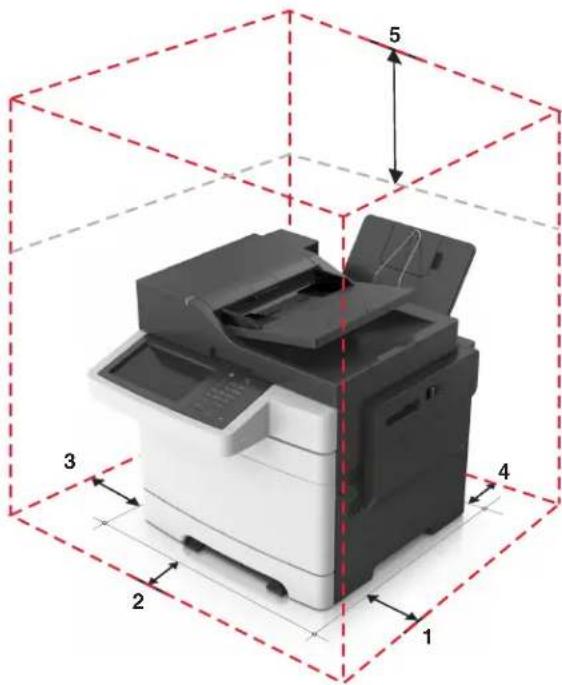
- Allow the following recommended amount of space around the printer for proper ventilation:
text_image
1 2 3 4 5| 1 Right side 304.8 mm (12 in.) |
| 2 Front 508 mm (20 in.) |
| 3 Left side 76.2 mm (3 in.) |
| 4 Rear 101.6 mm (4 in.) |
| 5 Top 291.7 mm (11.5 in.) |
Printer configurations

CAUTION—TIPPING HAZARD: Floor-mounted configurations require additional furniture for stability. You must use either a printer stand or printer base if you are using multiple input options. If you purchased a multifunction printer (MFP) that scans, copies, and faxes, then you may need additional furniture. For more information, see www.lexmark.com/multifunctionprinters.
Basic models

text_image
Labeled diagram of a printer with numbered parts for identification
natural_image
Exterior view of a multi-tiered printer with labeled parts (no text or symbols visible)| 1 Printer control panel |
| 2 Automatic document feeder (ADF) |
| 3 Standard bin |
| 4 Top door latch |
| 5 Right side cover |
| 6 Standard 250-sheet tray (Tray 1) |
| 7 Manual feeder |
| 8 Opt onal 650-sheet duo tray with integrated multipurpose feeder (Tray 2) |
| 9 Opt onal 550-sheet tray (Tray 3) |
Understanding the basic functions of the scanner
- Make quick copies or set the printer to perform specific copy jobs.
- Send a fax using the printer control panel.
- Send a fax to multiple fax destinations at the same time.
- Scan documents and send them to your computer, an e-mail address, or an FTP destination.
- Scan documents and send them to another printer (PDF through an FTP).
Using the ADF and scanner glass
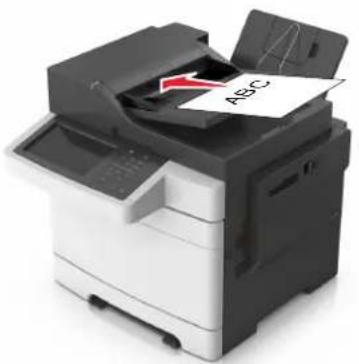
Automatic document feeder (ADF) Scanner glass
natural_image
Illustration of a printer with paper and a red arrow labeled ABC, no visible text or symbols on the device itself.Use the ADF for multiple-page documents including two-sided (duplex) pages.

natural_image
Open image of a printer with paper feed and paperclip, no visible text or symbolsUse the scanner glass for single-page documents, book pages, small items (such as postcards or photos), transparencies, photo paper, or thin media (such as magazine clippings).
Using the ADF
When using the ADF:
- Load the document into the ADF tray faceup, short edge first.
- Load up to 50 sheets of plain paper into the ADF tray.
- Scan sizes from 105 x 148 mm (4.1 x 5.8 inches) wide to 216 x 355 mm (8.5 x 14 inches) long.
- Scan media weights from 52 to 120g / m^2 (14 to 32 lb).
- Do not load postcards, photos, small items, transparencies, photo paper, or thin media (such as magazine clippings) into the ADF tray. Place these items on the scanner glass.
Using the scanner glass
When using the scanner glass:
- Place a document facedown on the scanner glass in the corner with the green arrow.
- Scan or copy documents from 216 x 296.9 mm (8.5 x 11.69 inches) dimension.
•Copy books up to 12.7 mm (0.5 inch) thick.
Understanding the printer control panel
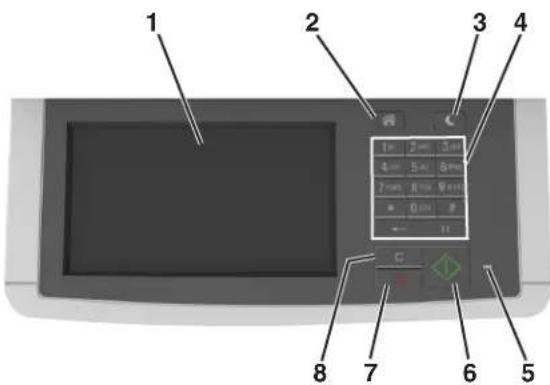
Using the printer control panel
text_image
1 2 3 4 1= 2= 3= 4= 5= 6= 7= 8= 9= = 0= 1= ← 11 C 8 7 6 5| Use the To | ||
| 1 Display | •View printing, copying, e-mailing, faxing, and scanning options.•View printer status and error messages. | |
| 2 Home button Go to the home screen. | ||
| 3 Sleep button Enable Sleep mode or Hibernate mode. | ||
| 4 Keypad Enter numbers, letters, or symbols. | ||
| 5 Indicator light Check the status of the printer. | ||
| 6 Start button Start a job, depending on which mode is selected. | ||
| 7 Stop or cancel button Cancel all printer activity. | ||
| 8 | Clear all / Reset button | Reset the default settings of a function, such as printing, copying, or e-mailing. |
Understanding the home screen
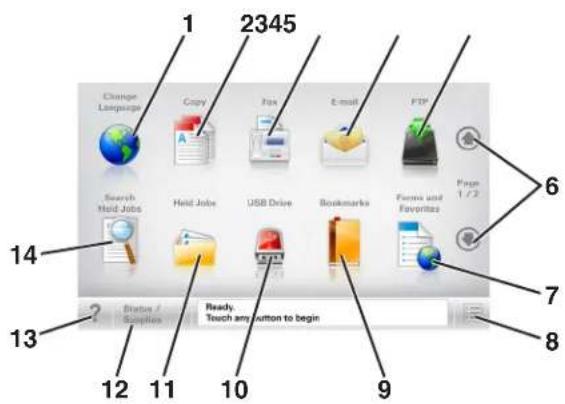
When the printer is turned on, the display shows a basic screen, referred to as the home screen. Touch the home screen buttons and icons to initiate an action such as copying, faxing, or scanning; to open the menu screen; or to respond to messages.
Note: Your home screen may vary depending on your home screen customization settings, administrative setup, and active embedded solutions.
text_image
1 2345 Change Language Copy Fax E-mail FTP Search Hold Jobs Held Jobs USB Drive Bookmarks Forms and Favorites Page 1 / 2 6 7 8 9 10 11 12 13 14 Ready. Touch any button to begin| Touch To | ||
| 1 | Change Language | Launch the Change Language pop-up window that lets you change the primary language of the printer. |
| 2 Copy Access the Copy menus and make copies. | ||
| 3 Fax Access the Fax menus and send fax. | ||
| 4 | Access the E-mail menus and send e-mails. | |
| 5 | FTP | Access the File Transfer Protocol (FTP) menus and scan documents directly to an FTP server. |
| 6 Arrows Scroll up or down. | ||
| 7 Forms and Favorites Quickly find and print frequently used online forms. | ||
| 8 Menu icon Access the printer menus. Note: The menus are available only when the printer is in Ready state. | ||
| 9 | Bookmarks | Create, organize, and save a set of bookmarks (URL) into a tree view of folders and file links. Note: The tree view supports only bookmarks created from this function, and not from any other application. |
| 10 | USB Drive | View, select, print, scan, or e-mail photos and documents from a flash drive. Note: This icon appears only when you return to the home screen while a memory card or flash drive is connected to the printer. |
| 11 | Held Jobs | Display all current held jobs. |
| 12 | Status/Supplies | Show a warning or error message whenever the printer requires intervention to continue processing.Access the messages screen for more information on the message, and how to clear it. |
| 13 | Tips | Open a context-sensitive Help dialog. |
| 14 | Search Held Jobs | Search for one or more of the following items:User name for held or confidential print jobsJob names for held jobs, excluding confidential print jobsProfile namesBookmark container or print job namesUSB container or print job names for supported file types |
Features
| Feature Description | |
| Menu trail lineExample:Menus > Settings > Copy Settings >Number of Copies | A menu trail line is located at the top of each menu screen. This feature shows the path taken to arrive at the current menu.Touch any of the underlined words to return to that menu.Number of Copies is not underlined because it is the current screen. If you touch an underlined word on the “Number of Copies” screen before the number of copies is set and saved, then the selection is not saved, and it does not become the default setting. |
Attendance message alert | If an attendance message affects a function, then this icon appears and the red indicator light blinks. |
Warning | If an error condition occurs, then this icon appears. |
| Status message bar | Show the current printer status such as Ready or Busy.Show printer conditions such as Toner Low or Cartridge Low.Show intervention messages so the printer can continue processing. |
| Printer IP addressExample:123.123.123.123 | The IP address of your network printer is located at the upper left corner of the home screen and appears as four sets of numbers separated by periods. You can use the IP address when accessing the Embedded Web Server so you can view and remotely configure printer settings even when you are not physically near the printer. |
Understanding the colors of the Sleep button and indicator lights
The colors of the Sleep button and indicator lights on the printer control panel signify a certain printer status or condition.
| Indicator light Printer status | |
| Off The printer is off or in Hibernate mode. | |
| Blinking green The printer is warming up, processing data, or printing. | |
| Solid green The printer is on, but idle. | |
| Blinking red The printer requires user intervention. | |
| Sleep button light Printer status | |
| Off The printer is off, idle or in Ready state. | |
| Solid amber The printer is in Sleep mode. | |
| Blinking amber The printer is entering or waking from Hibernate mode. | |
| Blinking amber for 0.1 second, then goes completely off for 1.9 seconds in a slow, pulsing pattern | The printer is in Hibernate mode. |
Using the touch-screen buttons
Note: Your home screen, icons, and buttons may vary, depending on your home screen customization settings, administrative setup, and active embedded solutions.
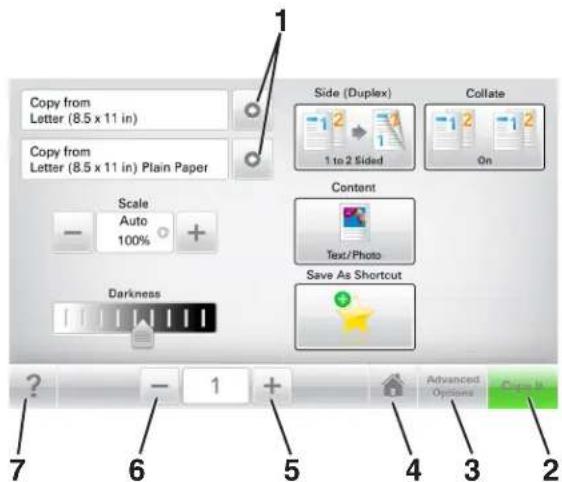
text_image
Copy from Letter (8.5 x 11 in) Copy from Letter (8.5 x 11 in) Plain Paper Scale Auto 100% Darkness Side (Duplex) 1 to 2 Sided Collate On Content Text/Photo Save As Shortcut Advanced Options Create| Touch To | ||
| 1 | Arrows View a list of options. | |
| 2 | Copy It Print a copy. | |
| 3 | Advanced Options Select a copy option. | |
| 4 | Home Go to the home screen. | |
| 5 | Increase Select a higher value. | |
| 6 | Decrease Select a lower value. | |
| 7 | Tips Open a context-sensitive Help dialog. |
Other touch-screen buttons
| Touch To | |
| Accept | Save a setting. |
 | |
Cancel | Cancel an action or a selection.Exit a screen and return to the previous screen without saving changes. |
Reset | Reset values on the screen. |
Setting up and using the home screen applications
Notes:
- Your home screen may vary depending on your home screen customization settings, administrative setup, and active embedded applications. Some applications are supported only in some printer models.
- There may be additional solutions and applications available for purchase. For more information, go to www.lexmark.com or contact the place where you purchased the printer.
Finding the IP address of the computer
For Windows users
1 In the Run dialog box, type cmd to open the command prompt.
2 Type ipconfig, and then look for the IP address.
For Macintosh users
1 From System Preferences in the Apple menu, select Network.
2 Select your connection type, and then click Advanced > TCP/IP.
3 Look for the IP address.
Finding the IP address of the printer
Note: Make sure your printer is connected to a network or to a print server.
You can find the printer IP address:
- From the top left corner of the printer home screen.
- From the TCP/IP section in the Network/Ports menu.
- By printing a network setup page or menu settings page, and then finding the TCP/IP section.
Note: An IP address appears as four sets of numbers separated by periods, such as 123.123.123.123.
Accessing the Embedded Web Server
The Embedded Web Server is the printer Web page that lets you view and remotely configure printer settings even when you are not physically near the printer.
1 Obtain the printer IP address:
•From the printer control panel home screen
•From the TCP/IP section in the Network/Ports menu
- By printing a network setup page or menu settings page, and then finding the TCP/IP section
Note: An IP address appears as four sets of numbers separated by periods, such as 123.123.123.123.
2 Open a Web browser, and then type the printer IP address in the address field.
3 Press Enter.
Note: If you are using a proxy server, then temporarily disable it to load the Web page correctly.
Customizing the home screen
1 Open a Web browser, and then type the printer IP address in the address field.
Note: View the printer IP address on the printer home screen. The IP address appears as four sets of numbers separated by periods, such as 123.123.123.123.
2 Do one or more of the following:
•Show or hide the icons of basic printer functions.
a Click Settings > General Settings > Home screen customization.
b Select the check boxes to specify which icons appear on the home screen.
Note: If you clear a check box beside an icon, then the icon does not appear on the home screen.
c Click Submit.
- Customize the icon for an application. For more information, see "Finding information about the home screen applications" on page 21 or see the documentation that came with the application.
Understanding the different applications
| Use To | |
| Card Copy | Scan and print both sides of a card on a single page. For more information, see “Setting up Card Copy” on page 22. |
| Fax Scan a document | and then send it to a fax number. For more information, see “Faxing” on page 89. |
| Forms and Favorites | Quickly find and print frequently used online forms directly from the printer home screen. For more information, see “Setting up Forms and Favorites” on page 21. |
| Multi Send | Scan a document, and then send it to multiple destinations. For more information, see “Setting up Multi Send” on page 23. |
| MyShortcut | Create shortcuts directly on the printer home screen. For more information, see “Using MyShortcut” on page 22. |
| Scan to E-mail | Scan a document, and then send it to an e-mail address. For more information, see “E-mailing” on page 82. |
| Scan to Computer | Scan a document, and then save it to a predefined folder on a host computer. For more information, see “Setting up Scan to Computer” on page 116. |
| Scan to FTP | Scan documents directly to a File Transfer Protocol (FTP) server. For more information, see “Scanning to an FTP address” on page 112. |
| Scan to Network | Scan a document, and then send it to a network shared folder. For more information, see “Setting up Scan to Network” on page 23. |
Activating the home screen applications
Finding information about the home screen applications
Your printer comes with preinstalled home screen applications. Before you can use these applications, you must first activate and set up these applications using the Embedded Web Server. For more information on accessing the Embedded Web Server, see "Accessing the Embedded Web Server" on page 19.
For more information on configuring and using the home screen applications, do the following:
1 Go to http://support.lexmark.com.
2 Click Software Solutions, and then select either of the following:
- Scan to Network—This lets you find information about the Scan to Network application.
- Other Applications—This lets you find information about the other applications.
3 Click the Manuals tab, and then select the document for the home screen application.
Setting up Forms and Favorites
Note: A later version of this User's Guide may contain a direct link to the Administrator's Guide of this application. To check for updates of this User's Guide, go to http://support.lexmark.com.
Use To

Streamline work processes by letting you quickly find and print frequently used online forms directly from the printer home screen.
Note: The printer must have permission to access the network folder, FTP site, or Web site where the bookmark is stored. From the computer where the bookmark is stored, use sharing, security, and firewall settings to allow the printer at least a read access. For help, see the documentation that came with your operating system.
1 Open a Web browser, and then type the printer IP address in the address field.
Note: View the printer IP address on the printer home screen. The IP address appears as four sets of numbers separated by periods, such as 123.123.123.123.
2 Click Settings > Apps > Apps Management > Forms and Favorites.
3 Click Add, and then customize the settings.
Notes:
• See the mouse-over help beside each field for a description of the setting.
- To make sure the location settings of the bookmark are correct, type the correct IP address of the host computer where the bookmark is located. For more information on obtaining the IP address of the host computer, see "Finding the IP address of the computer" on page 19.
- Make sure the printer has access rights to the folder where the bookmark is located.
4 Click Apply.
To use the application, touch Forms and Favorites on the printer home screen, and then navigate through form categories, or search for forms based on a form number, name, or description.
Setting up Card Copy
Note: A later version of this User's Guide may contain a direct link to the Administrator's Guide of this application. To check for updates of this User's Guide, go to http://support.lexmark.com.
| Use To | |
 | Quickly and easily copy insurance, identification, and other wallet-size cards.You can scan and print both sides of a card on a single page, saving paper and showing the information on the card in a more convenient manner. |
1 Open a Web browser, and then type the printer IP address in the address field.
Note: View the printer IP address on the printer home screen. The IP address appears as four sets of numbers separated by periods, such as 123.123.123.123.
2 Click Settings > Apps > Apps Management > Card Copy.
3 Change the default scanning options, if necessary.
- Default tray—Select the default tray to be used for printing scan images.
- Default number of copies—Specify the number of copies that should automatically print when the application is used.
- Default contrast setting—Specify a setting to increase or decrease the level of contrast when a copy of the scanned card is printed. Select Best for Content if you want the printer to adjust the contrast automatically.
- Default scale setting—Set the size of the scanned card when printed. The default setting is 100% (full size).
- Color Output—Select the check box to print the scanned card in color, or clear it to scan in black and white.
- Resolution setting—Adjust the quality of the scanned card.
Notes:
- When scanning a card, make sure the scan resolution is not more than 200 dpi for color, and 400 dpi for black and white.
- When scanning multiple cards, make sure the scan resolution is not more than 150 dpi for color, and 300 dpi for black and white.
- Print Borders—Select the check box to print the scan image with a border around it.
4 Click Apply.
To use the application, touch Card Copy on the printer home screen, and then follow the instructions.
Using MyShortcut
Note: A later version of this User's Guide may contain a direct link to the Administrator's Guide of this application. To check for updates of this User's Guide, go to http://support.lexmark.com.
| Use To | |
 | Create shortcuts on the printer home screen, with settings for up to 25 frequently used copy, fax, or e-mail jobs. |
To use the application, touch MyShortcut, and then follow the instructions on the printer display.
Setting up Multi Send
Note: A later version of this User's Guide may contain a direct link to the Administrator's Guide of this application. To check for updates of this User's Guide, go to http://support.lexmark.com.
| Use To | |
 | Scan a document, and then send the scanned document to multiple destinations.Note: Make sure there is enough space in the printer hard disk. |
1 Open a Web browser, and then type the printer IP address in the address field.
Note: View the printer IP address on the printer home screen. The printer IP address appears as four sets of numbers separated by periods, such as 123.123.123.123.
2 Click Settings > Apps > Apps Management > Multi Send.
3 From the Profiles section, click Add, and then customize the settings.
Notes:
• See the mouse-over help beside each field for a description of the setting.
- If you select FTP or Share Folder as a destination, then make sure the location settings of the destination are correct. Type the correct IP address of the host computer where the specified destination is located. For more information on obtaining the IP address of the host computer, see "Finding the IP address of the computer" on page 19.
4 Click Apply.
To use the application, touch Multi Send on the printer home screen, and then follow the instructions on the printer display.
Setting up Scan to Network
Note: A later version of this User's Guide may contain a direct link to the Administrator's Guide of this application. To check for updates of this User's Guide, go to http://support.lexmark.com.
Use To

Scan a document and send it to a shared network folder. You can define up to 30 unique folder destinations.
Notes:
- The printer must have permission to write to the destinations. From the computer where the destination is specified, use sharing, security, and firewall settings to allow the printer at least a write access. For help, see the documentation that came with your operating system.
- The Scan to Network icon appears only when one or more destinations are defined.
1 Open a Web browser, and then type the printer IP address in the address field.
Note: View the printer IP address on the printer home screen. The IP address appears as four sets of numbers separated by periods, such as 123.123.123.123.
2 Do either of the following:
- Click Set up Scan to Network > Click here.
- Click Settings > Apps > Apps Management > Scan to Network.
3 Specify the destinations, and then customize the settings.
Notes:
• See the mouse-over help beside some of the fields for a description of the setting.
- To make sure the location settings of the destination are correct, type the correct IP address of the host computer where the specified destination is located. For more information on obtaining the IP address of the host computer, see "Finding the IP address of the computer" on page 19.
- Make sure the printer has access rights to the folder where the specified destination is located.
4 Click Apply.
To use the application, touch Scan to Network on the printer home screen, and then follow the instructions on the printer display.
Setting up Remote Operator Panel
This application enables you to interact with the printer control panel even when you are not physically near the network printer. From your computer, you can view the printer status, release held print jobs, create bookmarks, and do other print-related tasks.
1 Open a Web browser, and then type the printer IP address in the address field.
Note: View the printer IP address on the printer home screen. The IP address appears as four sets of numbers separated by periods, such as 123.123.123.123.
2 Click Settings > Remote Operator Panel Settings.
3 Select the Enable check box, and then customize the settings.
4 Click Submit.
To use the application, click Remote Operator Panel > Launch VNC Applet.
Exporting and importing a configuration
You can export configuration settings into a text file, and then import the file to apply the settings to other printers.
1 Open a Web browser, and then type the printer IP address in the address field.
Note: View the printer IP address on the printer home screen. The IP address appears as four sets of numbers separated by periods, such as 123.123.123.123.
2 To export or import a configuration for one application, do the following:
a Click Settings > Apps > Apps Management.
b From the list of installed applications, click the name of the application you want to configure.
c Click Configure, and then do either of the following:
- To export a configuration to a file, click Export, and then follow the instructions on the computer screen to save the configuration file.
Notes:
- When saving the configuration file, you can type a unique file name or use the default name.
- If a "JVM Out of Memory" error occurs, then repeat the export process until the configuration file is saved.
- To import a configuration from a file, click Import, and then browse to the saved configuration file that was exported from a previously configured printer.
Notes:
- Before importing the configuration file, you can choose to preview it first or load it directly.
- If a timeout occurs and a blank screen appears, then refresh the Web browser, and then click Apply.
3 To export or import a configuration for multiple applications, do the following:
a Click Settings > Import/Export.
b Do either of the following:
- To export a configuration file, click Export Embedded Solutions Settings File, and then follow the instructions on the computer screen to save the configuration file.
•To import a configuration file, do the following:
1 Click Import Embedded Solutions Settings File > Choose File, and then browse to the saved configuration file that was exported from a previously configured printer.
2 Click Submit.
Additional printer setup
Installing internal options

CAUTION—SHOCK HAZARD: If you are accessing the controller board or installing optional hardware or memory devices sometime after setting up the printer, then turn the printer off, and unplug the power cord from the electrical outlet before continuing. If you have any other devices attached to the printer, then turn them off as well, and unplug any cables going into the printer.
Warning—Potential Damage: Controller board electronic components are easily damaged by static electricity. Touch a metal surface on the printer before touching any controller board electronic components or connectors.
Available internal options
- Memory card
-DDR3 DIMM
- Flash memory
-Fonts
—Firmware
- Forms and Barcode
•Prescribe
•IPDS
- Printer hard disk
Note: To install a printer hard disk, contact customer support at http://support.lexmark.com or your service representative.
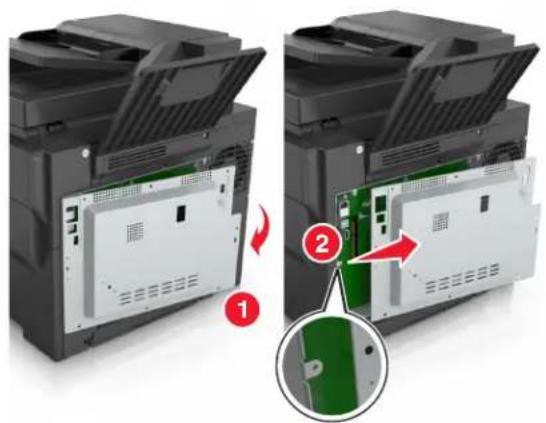
Accessing the controller board

CAUTION—SHOCK HAZARD: If you are accessing the controller board or installing optional hardware or memory devices sometime after setting up the printer, then turn the printer off, and unplug the power cord from the electrical outlet before continuing. If you have any other devices attached to the printer, then turn them off as well, and unplug any cables going into the printer.
Note: This task requires a flat-head screwdriver.
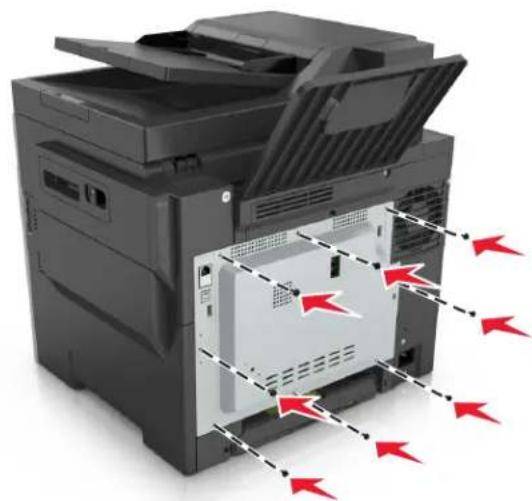
1 At the back of the printer, turn the screws counterclockwise to remove them.

natural_image
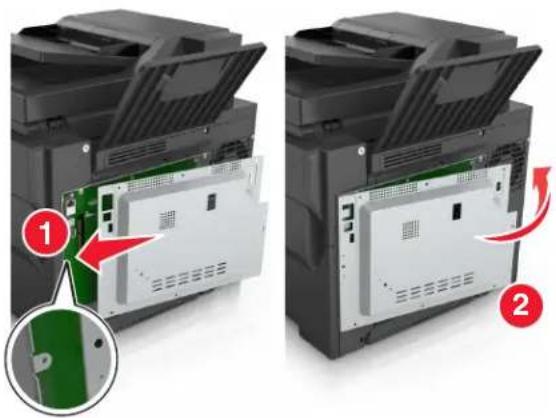
Diagram of a printer with internal components and red arrows indicating flow or movement (no text or symbols present)2 Slightly open the controller board access cover, and then shift to the right to remove it.
natural_image
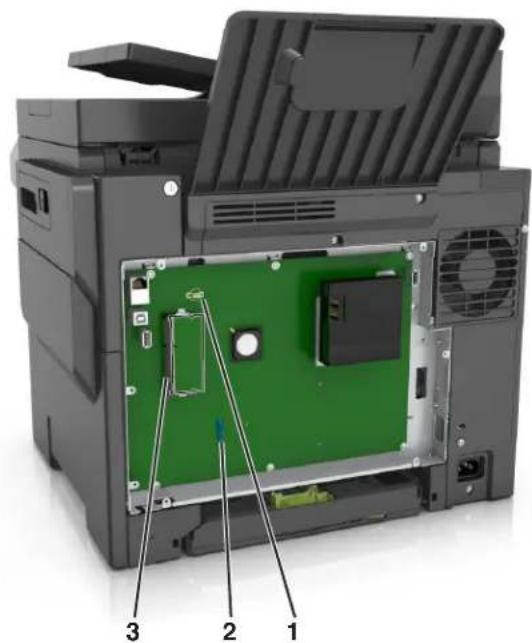
Two views of an open printer case showing internal components and a magnified inset highlighting a green component (no text or symbols present)3 Locate the appropriate connector on the controller board.
Warning—Potential Damage: Controller board electronic components are easily damaged by static electricity. Touch a metal surface on the printer before touching any controller board electronic components or connectors.
natural_image
Interior view of a printer showing internal components with numbered labels (1, 2, 3) pointing to different parts (no text or symbols on the diagram itself)| 1 Flash memory or font card connector |
| 2 Printer hard disk connector |
| 3 Memory card connector |
4 Reattach the cover.
text_image
Diagram showing two views of a printer's internal structure with labeled parts and green circuit board, highlighting component 1 and component 2.5 Turn the screws clockwise to lock the cover.
natural_image
Diagram of an open printer with red arrows indicating internal components (no text or symbols present)Installing a memory card

CAUTION—SHOCK HAZARD: If you are accessing the controller board or installing optional hardware or memory devices sometime after setting up the printer, then turn the printer off, and unplug the power cord from the electrical outlet before continuing. If you have any other devices attached to the printer, then turn them off as well, and unplug any cables going into the printer.
1 Access the controller board.
For more information, see "Accessing the controller board" on page 26.
2 Unpack the memory card.
Warning—Potential Damage: Do not touch the connection points along the edge of the card. Doing so may cause damage.
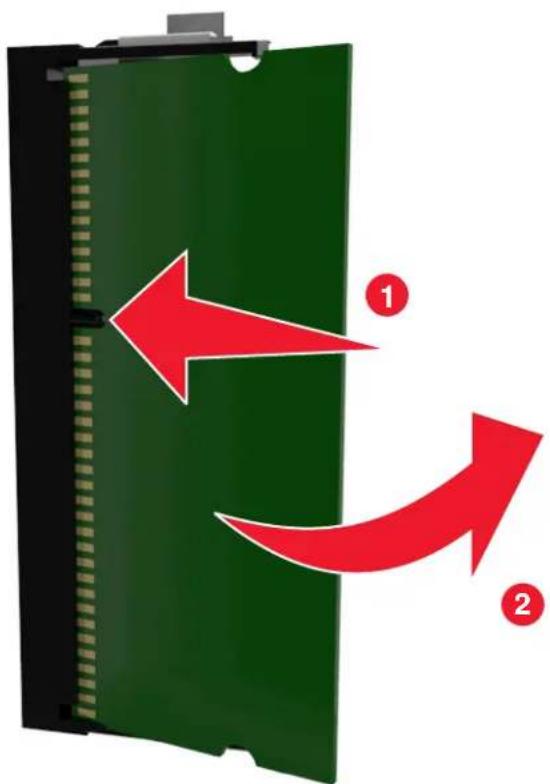
3 Align the notch (1) on the memory card with the ridge (2) on the connector.

natural_image
Diagram of a heat exchanger or cooling device with two labeled components (1 and 2), showing internal structure and green panel cover (no text or symbols beyond labels)4 Push the memory card straight into the connector, and then push the card toward the controller board wall until it clicks into place.
text_image
Diagram showing two red arrows labeled 1 and 2 pointing to a green panel or component, indicating directional movement or flow.5 Close the controller board access cover.
Installing an optional card

CAUTION—SHOCK HAZARD: If you are accessing the controller board or installing optional hardware or memory devices sometime after setting up the printer, then turn the printer off, and unplug the power cord from the electrical outlet before continuing. If you have other devices attached to the printer, then turn them off as well, and unplug any cables going into the printer.
Warning—Potential Damage: Controller board electronic components are easily damaged by static electricity. Touch a metal surface on the printer before touching any controller board electronic components or connectors.
1 Access the controller board.
For more information, see "Accessing the controller board" on page 26.
2 Unpack the optional card.
Warning—Potential Damage: Avoid touching the connection points along the edge of the card.
3 Holding the card by its sides, align the plastic pins (1) on the card with the holes (2) on the controller board.
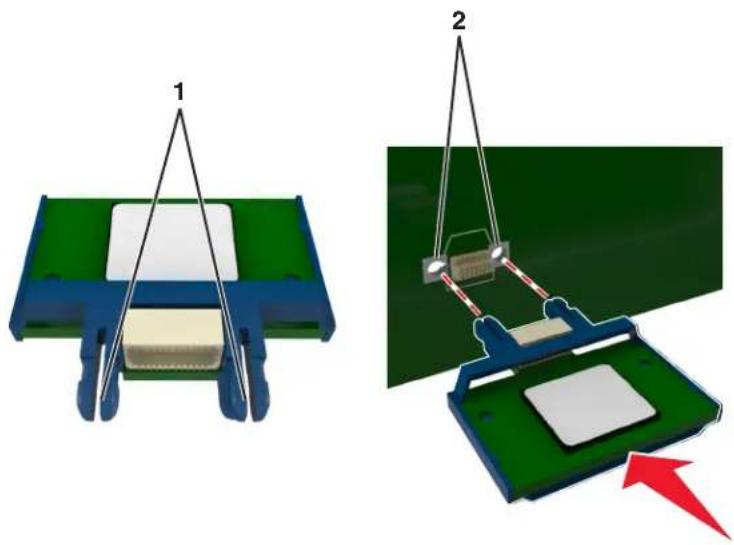
natural_image
Two diagrams showing a device with labeled components, one with a blue frame and green base, the other with a green circuit board and red arrow indicating direction (no text or symbols present)4 Push the card firmly into place as shown in the illustration.
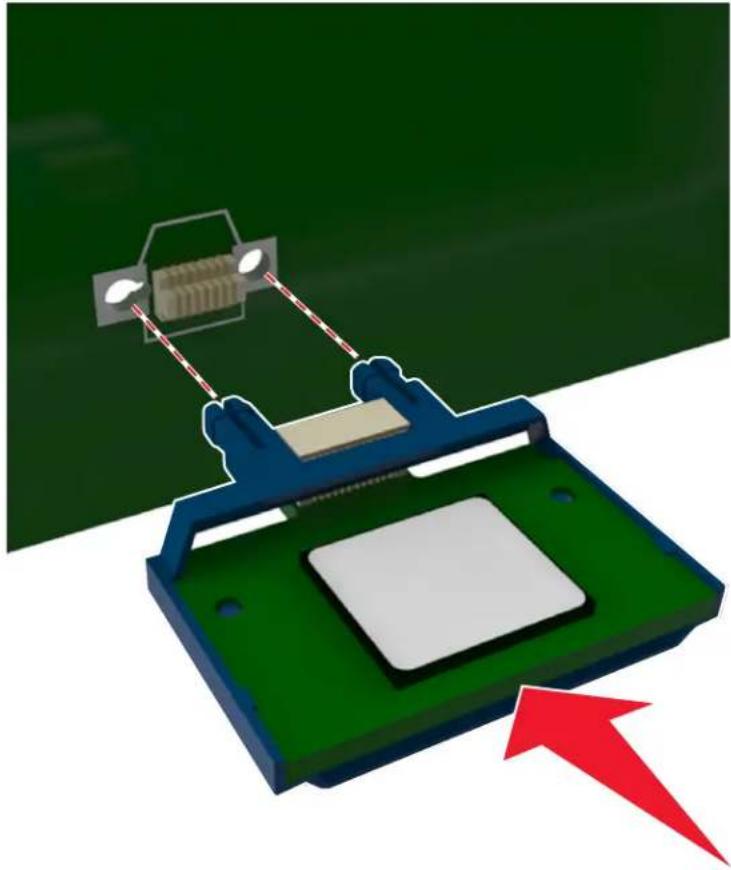
natural_image
3D illustration of a microchip with a green base and red arrow indicating direction (no text or symbols)Warning—Potential Damage: Improper installation of the card may cause damage to the card and the controller board.
Note: The entire length of the connector on the card must touch and be flushed against the controller board.
5 Close the controller board access door.
Note: When the printer software and any hardware options are installed, it may be necessary to manually add the options in the printer driver to make them available for print jobs. For more information, see "Adding available options in the print driver" on page 37.
Installing hardware options
Order of installation

CAUTION—POTENTIAL INJURY: The printer weight is greater than 18 kg (40 lb) and requires two or more trained personnel to lift it safely.

CAUTION—SHOCK HAZARD: If you are accessing the controller board or installing optional hardware or memory devices sometime after setting up the printer, then turn the printer off, and unplug the power cord from the electrical outlet before continuing. If you have any other devices attached to the printer, then turn them off as well, and unplug any cables going into the printer.
Install the printer and any optional tray in the following order:
• Optional 550-sheet tray (Tray 3)
- Optional 650-sheet duo tray with integrated multipurpose feeder (Tray 2)
•Printer
Installing optional trays
The printer supports two optional input sources: a 550-sheet tray (Tray 3) and a 650-sheet duo tray (Tray 2) with an integrated multipurpose feeder.

CAUTION—POTENTIAL INJURY: The printer weight is greater than 18 kg (40 lb) and requires two or more trained personnel to lift it safely.

CAUTION—SHOCK HAZARD: If you are accessing the controller board or installing optional hardware or memory devices sometime after setting up the printer, then turn the printer off, and unplug the power cord from the electrical outlet before continuing. If you have any other devices attached to the printer, then turn them off as well, and unplug any cables going into the printer.
1 Unpack the optional tray and the dust cover, and then remove all packing material.
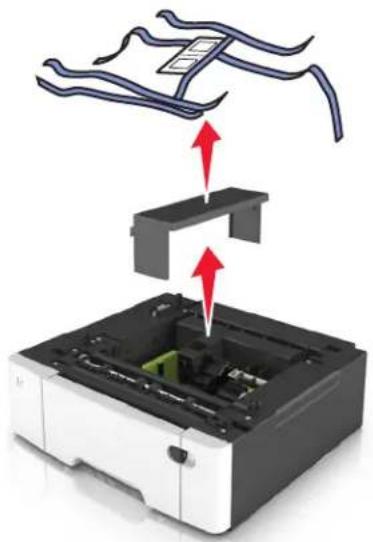
natural_image
Diagram of a printer with a stack of paper sheets and a paper strip being inserted, showing red arrows indicating process flow (no text or symbols present)2 Place the tray near the printer.
3 Align the 650-sheet duo tray with the 550-sheet tray, and then lower it into place.
Notes:
- If you are installing both the optional trays, then the 550-sheet tray (Tray 3) must always be below the 650-sheet tray (Tray 2).
- The standard 250-sheet tray can be labeled as Tray 1 by using the tray number label that came with the optional tray.
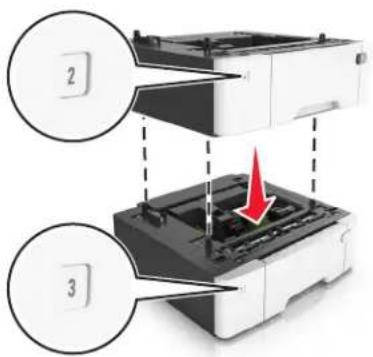
text_image
Diagram showing two stacked printer units with numbered annotations and a red arrow indicating a process or operation.4 Align the printer with the 650-sheet duo tray, and then lower the printer into place.
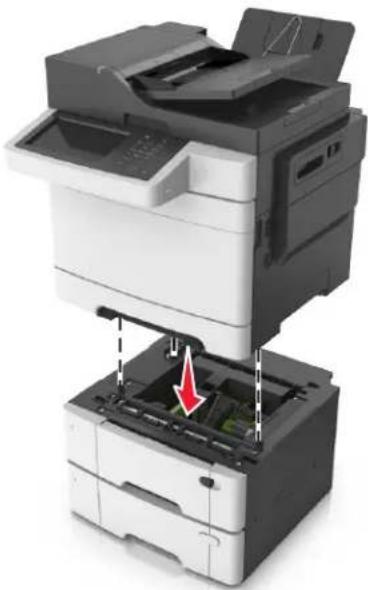
natural_image
Stacked printer with internal components and a red arrow indicating a location or operation (no text or symbols visible)5 Install the dust covers.
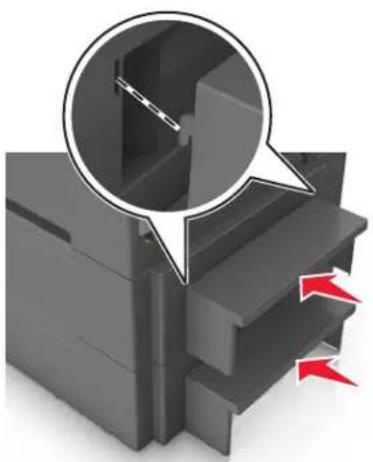
natural_image
3D diagram of a mechanical component with highlighted internal structure and red directional arrows indicating flow or force (no text or symbols)Note: When the printer software and any hardware options are installed, you may need to manually add the options in the printer driver to make them available for print jobs. For more information, see "Adding available options in the print driver" on page 37.
Attaching cables

CAUTION—POTENTIAL INJURY: Do not use the fax feature during a lightning storm. Do not set up this product or make any electrical or cabling connections, such as the fax feature, power cord, or telephone, during a lightning storm.
Connect the printer to the computer using a USB cable or to the network using an Ethernet cable.
Make sure to match the following:
•The USB symbol on the cable with the USB symbol on the printer
•The appropriate Ethernet cable to the Ethernet port
Warning—Potential Damage: Do not touch the USB cable, any network adapter, or the printer in the area shown while actively printing. Loss of data or a malfunction can occur.

text_image
Diagram of an open printer with numbered parts labeled for identification| Use the To | ||
| 1 USB wireless port Attach an optional wireless network adapter. | ||
| 2 Security lock port Lock the controller board. | ||
| 3 Printer power cord socket | Connect the printer to a properly grounded electrical outlet. | |
| 4 | LINE port | Connect the printer to an active telephone line through a standard wall jack (RJ-11), DSL filter, or VoIP adapter, or any other adapter that allows you to access the telephone line to send and receive faxes. |
| 5 | EXT port | Connect additional devices (telephone or answering machine) to the printer and the telephone line. Use this port if you do not have a dedicated fax line for the printer and if this connection method is supported in your country or region.Note: Remove the adapter plug to access the port. |
| 6 Rear USB port Attach a keyboard. | ||
| 7 USB printer port Connect the printer to a computer using a USB cable. | ||
| 8 Ethernet port Connect the printer to an Ethernet network. | ||
Setting up the printer software
Installing the printer
1 Obtain a copy of the software installer package.
2 Run the installer, and then follow the instructions on the computer screen.
3 For Macintosh users, add the printer.
Note: Obtain the printer IP address from the TCP/IP section in the Network/Ports menu.
Adding available options in the print driver
For Windows users
1 Open the printers folder.
In Windows 8
From the Search charm, type run, and then navigate to:
Run > type control printers > OK
In Windows 7 or earlier
a Click 📄, or click Start and then click Run.
b Type control printers.
c Press Enter, or click OK.
2 Select the printer you want to update, and then do either of the following:
- For Windows 7 or later, select Printer properties.
- For earlier versions, select Properties.
3 Navigate to the Configuration tab, and then select Update Now - Ask Printer.
4 Apply the changes.
For Macintosh users
1 From System Preferences in the Apple menu, navigate to your printer, and then select Options & Supplies.
2 Navigate to the list of hardware options, and then add any installed options.
3 Apply the changes.
Networking
Notes:
•Purchase a MarkNet ^TM N8352 wireless network adapter before setting up the printer on a wireless network. For information on installing the wireless network adapter, see the instruction sheet that came with the adapter.
- A Service Set Identifier (SSID) is a name assigned to a wireless network. Wired Equivalent Privacy (WEP), Wi-Fi Protected Access (WPA), WPA2, and 802.1X - RADIUS are types of security used on a network.
Preparing to set up the printer on an Ethernet network
To configure your printer to connect to an Ethernet network, organize the following information before you begin:
Note: If your network automatically assigns IP addresses to computers and printers, continue on to installing the printer.
- A valid, unique IP address for the printer to use on the network
•The network gateway
•The network mask
•A nickname for the printer (optional)
Note: A printer nickname can make it easier for you to identify your printer on the network. You can choose to use the default printer nickname, or assign a name that is easier for you to remember.
You will need an Ethernet cable to connect the printer to the network and an available port where the printer can physically connect to the network. Use a new network cable when possible to avoid potential problems caused by a damaged cable.
Preparing to set up the printer on a wireless network
Notes:
- Make sure your wireless network adapter is installed in your printer and working properly. For more information, see the instruction sheet that came with the wireless network adapter.
- Make sure your access point (wireless router) is turned on and is working properly.
Make sure you have the following information before setting up the printer on a wireless network:
- SSID—The SSID is also referred to as the network name.
- Wireless Mode (or Network Mode)—The mode is either infrastructure or ad hoc.
- Channel (for ad hoc networks)—The channel defaults to automatic for infrastructure networks.
Some ad hoc networks will also require the automatic setting. Check with your system support person if you are not sure which channel to select.
• Security Method—There are four basic options for Security Method:
—WEP key
If your network uses more than one WEP key, then enter up to four in the provided spaces. Select the key currently in use on the network by selecting the default WEP transmit key.
—WPA or WPA2 preshared key or passphrase
WPA includes encryption as an additional layer of security. The choices are AES or TKIP. Encryption must be set for the same type on the router and on the printer, or the printer will not be able to communicate on the network.
-802.1X-RADIUS
If you are installing the printer on an 802.1X network, then you may need the following:
- Authentication type
•Inner authentication type
•802.1X user name and password
•Certificates
—No security
If your wireless network does not use any type of security, then you will not have any security information.
Note: We do not recommend using an unsecured wireless network.
Notes:
- If you do not know the SSID of the network that your computer is connected to, then launch the wireless utility of the computer network adapter, and then look for the network name. If you cannot find the SSID or the security information for your network, then see the documentation that came with the access point, or contact your system support person.
- To find the WPA/WPA2 preshared key or passphrase for the wireless network, see the documentation that came with the access point, see the Embedded Web Server associated with the access point, or consult your system support person.
Connecting the printer using the Wireless Setup Wizard
Before you begin, make sure that:
- A wireless network adapter is installed in the printer and is working properly. For more information, see the instruction sheet that came with the wireless network adapter.
- An Ethernet cable is disconnected from the printer.
- Active NIC is set to Auto. To set this to Auto, navigate to:

Network/Ports > Active NIC > Auto > Submit
Note: Make sure to turn off the printer, then wait for at least five seconds, and then turn the printer back on.
1 From the printer control panel, navigate to:

Network/Ports > Network [x] > Network [x] Setup > Wireless > Wireless Connection Setup
2 Select a wireless connection setup.
| Use To | |
| Search for networks Show available wireless connections. Note: This menu item shows all broadcast secured or unsecured SSIDs. | |
| Enter a network name Manually type the SSID. Note: Make sure to type the correct SSID. | |
| Wi-Fi Protected Setup Connect the printer to a wireless network using Wi-Fi Protected Setup. | |
3 Follow the instructions on the printer display.
Connecting the printer to a wireless network using Wi-Fi Protected Setup
Before you begin, make sure that:
- The access point (wireless router) is Wi-Fi Protected Setup (WPS) certified or WPS-compatible. For more information, see the documentation that came with your access point.
- A wireless network adapter installed in your printer is attached and working properly. For more information, see the instruction sheet that came with the wireless network adapter.
Using the Push Button Configuration method
1 From the printer control panel, navigate to:
Network/Ports > Network [x] > Network [x] Setup > Wireless > Wireless Connection Setup > Wi-Fi Protected Setup > Start Push Button Method
2 Follow the instructions on the printer display.
Using the Personal Identification Number (PIN) method
1 From the printer control panel, navigate to:
Network/Ports > Network [x] > Network [x] Setup > Wireless > Wireless Connection Setup > Wi-Fi Protected Setup > Start PIN Method
2 Copy the eight-digit WPS PIN.
3 Open a Web browser, and then type the IP address of your access point in the address field.
Notes:
- The IP address appears as four sets of numbers separated by periods, such as 123.123.123.123.
- If you are using a proxy server, then temporarily disable it to load the Web page correctly.
4 Access the WPS settings. For more information, see the documentation that came with your access point.
5 Enter the eight-digit PIN, and then save the setting.
Connecting the printer to a wireless network using the Embedded Web Server
Before you begin, make sure that:
- Your printer is connected temporarily to an Ethernet network.
- A wireless network adapter is installed in your printer and working properly. For more information, see the instruction sheet that came with the wireless network adapter.
1 Open a Web browser, and then type the printer IP address in the address field.
Notes:
- View the printer IP address on the printer control panel. The IP address appears as four sets of numbers separated by periods, such as 123.123.123.123.
- If you are using a proxy server, then temporarily disable it to load the Web page correctly.
2 Click Settings > Network/Ports > Wireless.
3 Modify the settings to match the settings of your access point (wireless router).
Note: Make sure to enter the correct SSID, security method, preshared key or passphrase, network mode, and channel.
4 Click Submit.
5 Turn off the printer, and then disconnect the Ethernet cable. Then wait for at least five seconds, and then turn the printer back on.
6 To verify if your printer is connected to the network, print a network setup page. Then in the Network Card [x] section, see if the status is Connected.
Verifying printer setup
When all hardware and software options are installed and the printer is turned on, verify that the printer is set up correctly by printing the following:
- Menu settings page—Use this page to verify that all printer options are installed correctly. A list of installed options appears toward the bottom of the page. If an option you installed is not listed, then it is not installed correctly. Remove the option, and then install it again.
- Network setup page—If your printer has Ethernet or wireless capability and is attached to a network, then print a network setup page to verify the network connection. This page also provides important information that aids network printing configuration.
Printing a menu settings page
From the home screen, navigate to:

Reports > Menu Settings Page
Printing a network setup page
If the printer is attached to a network, then print a network setup page to verify the network connection. This page also provides important information that aids network printing configuration.
1 From the home screen, navigate to:

Reports > Network Setup Page
2 Check the first section of the network setup page, and confirm that the status is Connected.
If the status is Not Connected, then the LAN drop may not be active, or the network cable may be malfunctioning. Consult a system support person for a solution, and then print another network setup page.
Loading paper and specialty media
Proper selection and loading of media can improve how reliably documents print. For more information, see "Avoiding jams" on page 235 and "Storing paper" on page 58.
Setting the paper size and type
From the home screen navigate to:

Paper Menu > Paper Size/Type > select a tray > select the paper size or type > Submit
Configuring Universal paper settings
The Universal paper size is a user-defined setting that lets you print on paper sizes that are not preset in the printer menus.
Notes:
- The smallest supported Universal size is 76 x 127 mm (3 x 5 inches) and is loaded only in the multipurpose feeder and manual feeder.
- The largest supported Universal size is 215.9 x 359.9 mm (8.5 x 14.17 inches) and is loaded only in the multipurpose feeder and manual feeder.
1 From the home screen, navigate to:

Paper Menu > Universal Setup > Units of Measure > select a unit of measure
2 Touch Portrait Width or Portrait Height.
3 Select the width or height, and then touch Submit.
Loading the 250- and 550-sheet tray
The printer has one 250-sheet tray (Tray 1) with an integrated manual feeder. The 250-sheet tray, the 650-sheet duo tray, and the 550-sheet tray support the same paper sizes and types and are loaded in the same way.

CAUTION—POTENTIAL INJURY: To reduce the risk of equipment instability, load each tray separately. Keep all other trays closed until needed.
1 Pull out the tray completely.
Note: Do not remove trays while a job is printing or while Busy appears on the display. Doing so may cause a jam.
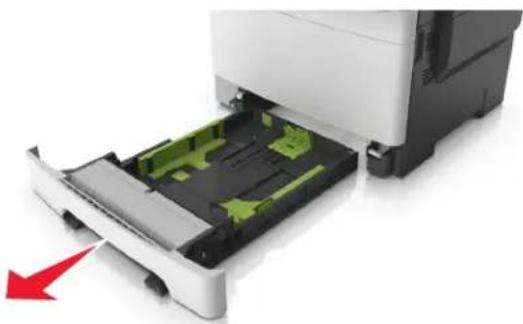
natural_image
Close-up of a printer's internal structure with green plastic components, showing no text or symbols2 If the paper is longer than letter-size paper, then squeeze and then slide the length guide at the back of the tray to extend it.
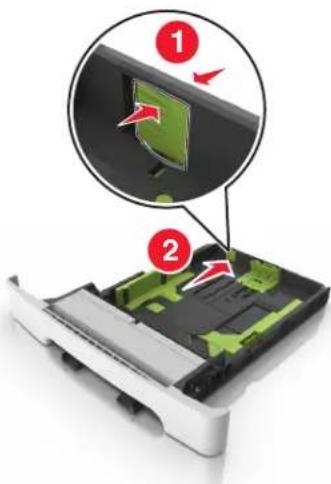
text_image
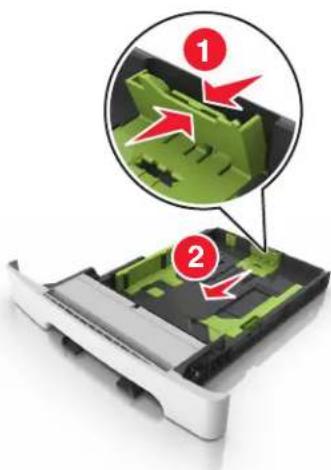
Diagram showing two labeled views of a device's internal structure, with numbered annotations pointing to green screen panels.3 Squeeze, and then slide the length guide tab to the correct position for the size of the paper being loaded.
text_image
Diagram showing a green plastic component being inserted into a device, with numbered annotations highlighting the process.Note: Use the paper size indicators on the bottom of the tray to help position the guide.
4 Squeeze, and then slide the width guide tab to the correct position for the size of the paper being loaded.

natural_image
3D printer image showing internal components with arrows pointing to a green circuit board (no text or symbols)Note: Use the paper size indicators on the bottom of the tray to help position the guides.
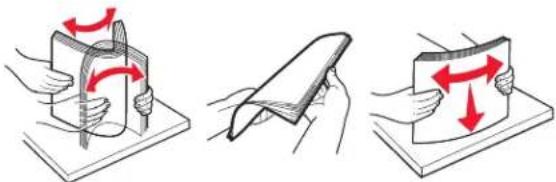
5 Flex the sheets back and forth to loosen them, and then fan them. Do not fold or crease the paper. Straighten the edges on a level surface.
text_image
Diagram illustrating three-step folding or retraction process with red arrows indicating direction of movement6 Load the paper stack with the recommended printable side faceup.

natural_image
3D illustration of a device's internal structure with a red downward arrow indicating compression or disassembly (no text or symbols present)7 Place the paper guides securely against the edges of the paper.
8 Insert the tray.

natural_image
Close-up of a printer's internal structure with a red arrow pointing to it, no visible text or symbols.9 From the printer control panel, set the paper size and paper type in the Paper menu to match the paper loaded in the tray.
Note: Mixing paper sizes or paper types in a tray may cause jams.
Loading the manual feeder
The standard 250-sheet tray has an integrated manual feeder that can be used to print on different types of paper one sheet at a time.
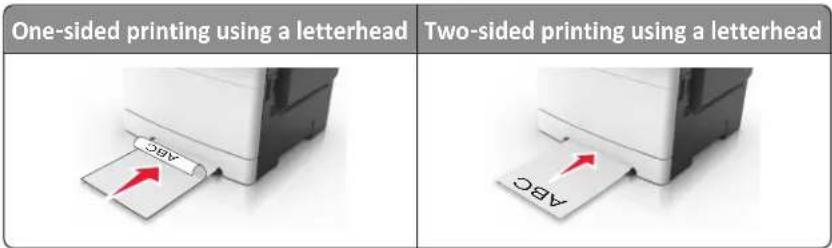
1 Load a sheet of paper into the manual feeder:
- Printable side facedown for one-sided printing
- Printable side faceup for two-sided (duplex) printing
Note: There are different ways for loading letterhead depending on the mode of printing.
text_image
One-sided printing using a letterhead Two-sided printing using a letterhead ABC ABC- Load envelope with the flap side up and against the right side of the paper guide.

natural_image
Close-up of a printer emitting a white envelope with red arrows indicating direction (no text or symbols)2 Feed paper into the manual feeder only to the point where its leading edge can contact the paper guides.
Note: To achieve the best possible print quality, use only high-quality media designed for laser printers.
3 Adjust the paper guides to the width of the paper loaded.
Warning—Potential Damage: Do not force the paper into the feeder. Forcing the paper may cause jams.

natural_image
Diagram showing a printer with paper being inserted, highlighted by red arrows (no text or symbols present)Loading the 650-sheet duo tray
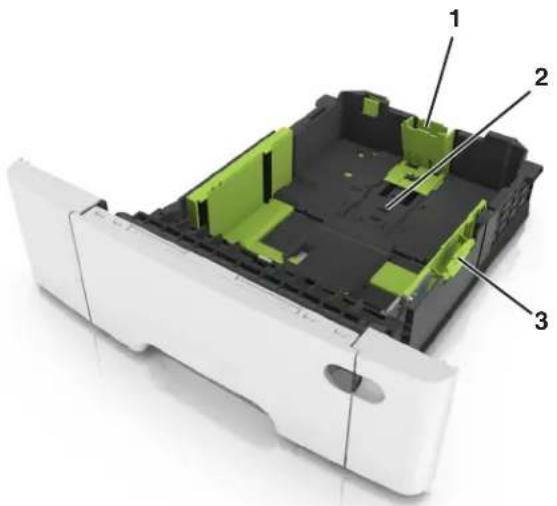
The 650-sheet duo tray (Tray 2) consists of a 550-sheet tray and an integrated 100-sheet multipurpose feeder. The tray is loaded in the same way as the 250-sheet tray and the optional 550-sheet tray, and supports the same paper types and sizes. The only differences are the look of the guide tabs and the location of the paper size indicators.

CAUTION—POTENTIAL INJURY: To reduce the risk of equipment instability, load each tray separately. Keep all other trays closed until needed.
natural_image
3D cutaway view of a white electronic device showing internal components with green and black sections (no text or symbols)| 1 Length guide tab |
| 2 Paper size indicator |
| 3 Width guide tab |
Loading the multipurpose feeder
1 Push the multipurpose feeder latch to the left.
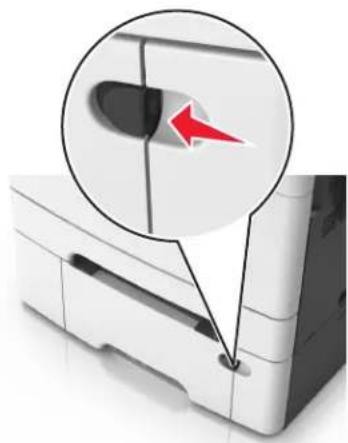
natural_image
Close-up of a printer's front panel with a magnified inset showing a red arrow pointing to the button (no text or symbols visible)2 Open the multipurpose feeder.
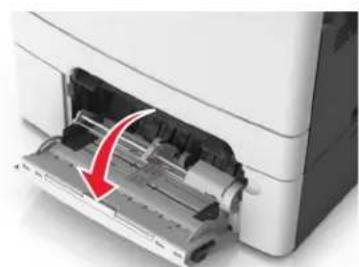
natural_image
Close-up of a printer's internal structure with a red arrow indicating the paper's edge (no text or symbols visible)3 Pull the multipurpose feeder extender.
Note: Guide the extender gently so that the multipurpose feeder is fully extended and open.
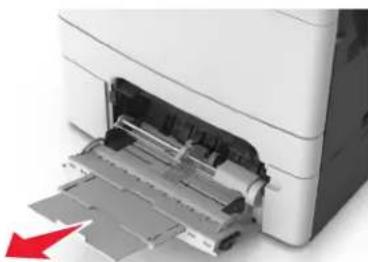
natural_image
Close-up of a printer's internal structure with paper sheets being inserted, showing no visible text or symbols.4 Prepare the paper for loading.
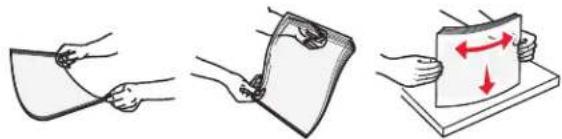
- Flex the sheets of paper back and forth to loosen them, and then fan them. Do not fold or crease the paper. Straighten the edges on a level surface.
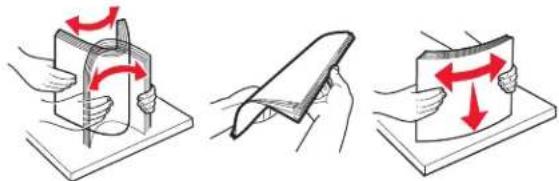
text_image
Diagram illustrating three-step folding or retraction process of a device, showing blade deformation and downward rotation arrows.- Hold transparencies by the edges, and then fan them. Straighten the edges on a level surface.
Note: Avoid touching the printable side of transparencies. Be careful not to scratch them.
natural_image
Three-step illustration showing hands holding a document and interacting with a card (no text or symbols present)- Flex a stack of envelopes back and forth to loosen them, and then fan them. Straighten the edges on a level surface.
Warning—Potential Damage: Never use envelopes with stamps, clasps, snaps, windows, coated linings, or self-stick adhesives. These envelopes may severely damage the printer.

natural_image
Three-step illustration showing hand positioning and lifting a piece, with no text or symbols present.5 Locate the maximum paper fill indicator and tab.
Note: Make sure the paper or specialty media is below the maximum paper fill indicator located on the paper guides.

text_image
Diagram of a printer with numbered parts labeled 1 to 5, showing internal structure and paper feed path.| 1 Width guide tab |
| 2 Maximum paper fill indicator |
| 3 Width guide |
| 4 Feeder extender |
5 Paper size indicator
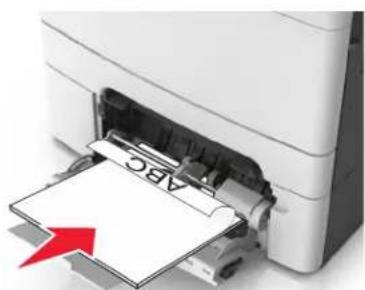
6 Load the paper, and then adjust the width guide to lightly touch the edge of the paper stack.
- Load paper, card stock, and transparencies with the recommended printable side facedown and the top edge entering the printer first.
natural_image
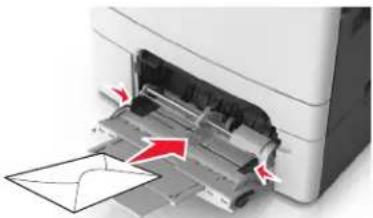
Close-up of a printer's paper being inserted into a paper holder, with a red arrow indicating the paper's direction (no text or symbols visible)- Load envelopes with the flap side up and against the right side of the paper guide.
natural_image
Close-up of a printer's internal structure with arrows indicating process, showing paper feeding into an envelope (no text or symbols visible)Notes:
- Do not load or close the multipurpose feeder while a job is printing.
- Load only one size and type of paper at a time.
- Paper should lie flat in the multipurpose feeder. Make sure the paper fits loosely in the multipurpose feeder and is not bent or wrinkled.
7 From the printer control panel, set the paper size and type in the Paper menu to match the paper loaded in the tray.
Linking and unlinking trays
The printer links trays when the specified paper size and type are the same. When a linked tray becomes empty, paper feeds from the next linked tray. To prevent trays from linking, assign a unique custom paper type name.
Linking and unlinking trays
1 Open a Web browser, and then type the printer IP address in the address field.
Notes:
- View the printer IP address on the printer home screen. The IP address appears as four sets of numbers separated by periods, such as 123.123.123.123.
- If you are using a proxy server, then temporarily disable it to load the Web page correctly.
2 Click Settings > Paper Menu.
3 Change the paper size and type settings for the trays you are linking.
- To link trays, make sure the paper size and type for the tray match that of the other tray.
- To unlink trays, make sure the paper size or type for the tray does not match that of the other tray.
4 Click Submit.
Note: You can also change the paper size and type settings using the printer control panel. For more information, see "Setting the paper size and type" on page 42.
Warning—Potential Damage: Paper loaded in the tray should match the paper type name assigned in the printer. The temperature of the fuser varies according to the specified paper type. Printing issues may occur if settings are not properly configured.
Creating a custom name for a paper type
Using the Embedded Web Server
1 Open a Web browser, and then type the printer IP address in the address field.
Notes:
- View the printer IP address on the printer home screen. The IP address appears as four sets of numbers separated by periods, such as 123.123.123.123.
- If you are using a proxy server, then temporarily disable it to load the Web page correctly.
2 Click Settings > Paper Menu > Custom Names.
3 Select a custom name, and then type a custom paper type name.
4 Click Submit.
5 Click Custom Types, and then verify if the new custom paper type name has replaced the custom name.
Using the printer control panel
1 From the home screen, navigate to:

Paper Menu > Custom Names
2 Select a custom name, and then type a custom paper type name.
3 Touch Submit.
4 Touch Custom Types, and then verify if the new custom paper type name has replaced the custom name.
Assigning a custom paper type
Using the Embedded Web Server
Assign a custom paper type name to a tray when linking or unlinking trays.
1 Open a Web browser, and then type the printer IP address in the address field.
Notes:
- View the printer IP address on the printer home screen. The IP address appears as four sets of numbers separated by periods, such as 123.123.123.123.
- If you are using a proxy server, then temporarily disable it to load the Web page correctly.
2 Click Settings > Paper Menu > Custom Types.
3 Select a custom paper type name, and then select a paper type.
Note: Paper is the factory default paper type for all user-defined custom names.
4 Click Submit.
Using the printer control panel
1 From the home screen, navigate to:

Paper Menu > Custom Types
2 Select a custom paper type name, and then select a paper type.
Note: Paper is the factory default paper type for all user-defined custom names.
3 Touch Submit.
Configuring a custom name
Using the Embedded Web Server
1 Open a Web browser, and then type the printer IP address in the address field.
Notes:
- View the printer IP address on the printer home screen. The IP address appears as four sets of numbers separated by periods, such as 123.123.123.123.
- If you are using a proxy server, then temporarily disable it to load the Web page correctly.
2 Click Settings > Paper Menu > Custom Types.
3 Select a custom name you want to configure, then select a paper or specialty media type, and then click Submit.
Using the printer control panel
1 From the home screen, navigate to:

Paper Menu > Custom Types
2 Select a custom name you want to configure, and then touch Submit.
Paper and specialty media guide
Notes:
• Make sure that the paper size, type, and weight are set correctly on the computer or on the control panel.
•Flex, fan, and straighten specialty media before loading them.
- The printer may print at a reduced speed to prevent damage to the fuser.
- For more information on card stock and labels, see the Card Stock & Label Guide on the Lexmark support Web site at http://support.lexmark.com.
Using specialty media
Tips on using letterhead
- Use letterhead designed specifically for laser printers.
- Print a test page on the letterhead being considered for use before buying large quantities.
- Before loading letterhead, flex, fan, and straighten the stacks to prevent sheets from sticking together.
•Page orientation is important when printing on letterhead.
| Source | Printing | Printable side | Paper orientation |
Trays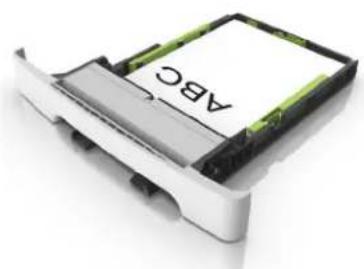 | One-sided Faceup | Load the sheet | with the top edge entering the printer first. |
Trays | Two-sided Faced | down Load the sheet | with the bottom edge entering the printer first. |
| Note: Check with the manufacturer or vendor to determine whether or not the preprinted letterhead is acceptable for laser printers. | |||
Manual feeder | One-sided Faced | down Load the sheet | with the top edge entering the printer first. |
Manual feeder | Two-sided Faceup | Load the sheet | with the bottom edge entering the printer first. |
Multipurpose feeder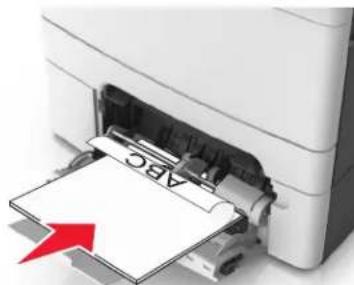 | One-sided Faced | down Load the sheet | with the top edge entering the printer first. |
Multipurpose feeder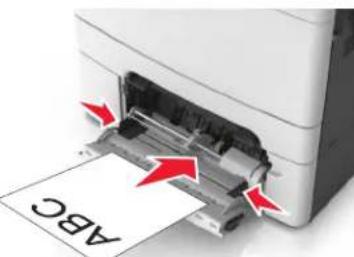 | Two-sided Faceup | Load the sheet | with the bottom edge entering the printer first. |
| Note: Check with the manufacturer or vendor to determine whether or not the preprinted letterhead is acceptable for laser printers. | |||
Tips on using transparencies
Print a test page on the transparencies being considered for use before buying large quantities.
- From the printer control panel, set the paper size, type, texture, and weight in the Paper menu to match the transparencies loaded in the tray.
- Print a test page on the transparencies being considered for use before buying large quantities.
- Feed transparencies from the 250-sheet tray, manual feeder, or multipurpose feeder.
- Use transparencies designed specifically for laser printers.
- Avoid getting fingerprints on the transparencies to prevent print quality problems.
- Before loading transparencies, flex, fan, and straighten the stacks to prevent sheets from sticking together.
Tips on using envelopes
- From the printer control panel, set the paper size, type, texture, and weight in the Paper menu to match the envelopes loaded in the tray.
- Print samples on the envelopes being considered for use before buying large quantities.
- Use envelopes designed specifically for laser printers.
- For best performance, use envelopes made from 90-g/m ^2 (24-lb) paper or 25% cotton.
- Use only new envelopes from undamaged packages.
- To optimize performance and minimize jams, do not use envelopes that:
– Have excessive curl or twist.
- Are stuck together or damaged in any way.
- Have windows, holes, perforations, cutouts, or embossing.
– Have metal clasps, string ties, or folding bars.
– Have an interlocking design.
– Have postage stamps attached.
- Have any exposed adhesive when the flap is in the sealed or closed position.
– Have bent corners.
– Have rough, cockle, or laid finishes.
- Adjust the width guides to fit the width of the envelopes.
- Before loading the envelopes on the tray, flex and fan the envelopes to loosen them. Straighten the edges on a level surface.
Note: A combination of high humidity (over 60%) and high printing temperature may wrinkle or seal envelopes.
Tips on using labels
- From the printer control panel, set the paper size, type, texture, and weight in the Paper menu to match the labels loaded in the tray.
- Print samples on labels being considered for use before buying large quantities.
- For more information on label printing, characteristics, and design, see the Card Stock & Label Guide at http://support.lexmark.com.
- Use labels designed specifically for laser printers.
-
Do not use labels with slick backing material.
-
Use full label sheets. Partial sheets may cause labels to peel off during printing, resulting in a jam. Partial sheets also contaminate the printer and the cartridge with adhesive, and could void the printer and toner cartridge warranties.
- Do not use labels with exposed adhesive.
- Before loading labels on the tray, flex and fan labels to loosen them. Straighten the edges on a level surface.
Tips on using card stock
Card stock is heavy, single-ply specialty media. Many of its variable characteristics, such as moisture content, thickness, and texture, can significantly affect print quality.
- From the printer control panel, set the paper size, type, texture, and weight in the Paper menu to match the card stock loaded in the tray.
- Print samples on the card stock being considered for use before buying large quantities.
- Specify the paper texture and weight from the tray settings to match the paper loaded in the tray.
- Preprinting, perforation, and creasing may significantly affect the print quality and cause jams or other paper feed problems.
- Before loading the card stock on the tray, flex and fan the card stock to loosen them. Straighten the edges on a level surface.
Paper guidelines
Select the correct paper or specialty media to reduce printing problems. For the best print quality, try a sample of the paper or specialty media before buying large quantities.
Paper characteristics
The following paper characteristics affect print quality and reliability. Consider these characteristics when evaluating new paper stock.
Weight
The printer trays can automatically feed paper weights up to 176-g/m^2 (47-lb) bond grain long paper. The multipurpose feeder can automatically feed paper weights up to 176-g/m^2 (47-lb) bond grain long paper. Paper lighter than 60 g/m^2 (16 lb) might not be stiff enough to feed properly, causing jams. For best performance, use 75-g/m^2 (20-lb) bond grain long paper. For paper smaller than 182 × 257 mm (7.2 x 10.1 inches), we recommend 90 g/m^2 (24 lb) or heavier paper.
Note: Duplex printing is supported from 60–105-g/m ^2 (16–28-lb) bond grain long paper.
Curl
Curl is the tendency for paper to curl at its edges. Excessive curl can cause paper feeding problems. Curl can occur after the paper passes through the printer, where it is exposed to high temperatures. Storing paper unwrapped in hot, humid, cold, or dry conditions, even in the trays, can contribute to paper curling prior to printing and can cause feeding problems.
Smoothness
Paper smoothness directly affects print quality. If paper is too rough, then toner cannot fuse to it properly. If paper is too smooth, then it can cause paper feeding or print quality issues. Always use paper between 100 and 300 Sheffield points; smoothness between 150 and 250 Sheffield points produces the best print quality.
Moisture content
The amount of moisture in paper affects both print quality and the ability of the printer to feed the paper correctly. Leave paper in its original wrapper until it is time to use it. This limits the exposure of paper to moisture changes that can degrade its performance.
Store paper in its original wrapper in the same environment as the printer for 24 to 48 hours before printing. Extend the time to several days if the storage or transportation environment is very different from the printer environment. Thick paper may also require a longer conditioning period.
Grain direction
Grain refers to the alignment of the paper fibers in a sheet of paper. Grain is either grain long, running the length of the paper, or grain short, running the width of the paper.
For 60–90-g/m ^2 (16–24-lb) bond paper, grain long paper is recommended.
Fiber content
Most high-quality xerographic paper is made from 100% chemically treated pulped wood. This content provides the paper with a high degree of stability resulting in fewer paper feeding problems and better print quality. Paper containing fibers such as cotton can negatively affect paper handling.
Unacceptable paper
The following paper types are not recommended for use with the printer:
- Chemically treated papers used to make copies without carbon paper, also known as carbonless papers, carbonless copy paper (CCP), or no carbon required (NCR) paper
- Preprinted papers with chemicals that may contaminate the printer
- Preprinted papers that can be affected by the temperature in the printer fuser
- Preprinted papers that require a registration (the precise print location on the page) greater than ± 2.3 mm ( ± 0.9 in.), such as optical character recognition (OCR) forms In some cases, registration can be adjusted with a software application to successfully print on these forms.
•Coated papers (erasable bond), synthetic papers, thermal papers
- Rough-edged, rough or heavily textured surface papers, or curled papers
•Recycled papers that fail EN12281:2002 (European)
•Paper weighing less than 60 g/m ^2 (16 lb)
• Multiple-part forms or documents
Selecting paper
Using the appropriate paper prevents jams and helps ensure trouble-free printing.
To help avoid paper jams and poor print quality:
•Always use new, undamaged paper.
- Before loading paper, know the recommended printable side of the paper. This information is usually indicated on the paper package.
- Do not use paper that has been cut or trimmed by hand.
- Do not mix paper sizes, types, or weights in the same tray; mixing results in jams.
- Do not use coated papers unless they are specifically designed for electrophotographic printing.
Selecting preprinted forms and letterhead
Use these guidelines when selecting preprinted forms and letterhead:
- Use grain long for 60–90-g/m ^2 (16–24-lb) paper.
- Use only forms and letterhead printed using an offset lithographic or engraved printing process.
- Avoid paper with rough or heavily textured surfaces.
Use inks that are not affected by the resin in toner. Inks that are oxidation-set or oil-based generally meet these requirements; latex inks might not.
When in doubt, contact your paper supplier.
Using recycled paper and other office papers
As an environmentally conscious company, Lexmark supports the use of recycled office paper produced specifically for use in laser (electrophotographic) printers. In 1998, Lexmark presented to the US government a study demonstrating that recycled paper produced by major mills in the US fed as well as non-recycled paper. However, no blanket statement can be made that all recycled paper will feed well.
Lexmark consistently tests its printers with recycled paper (20–100% post-consumer waste) and a variety of test paper from around the world, using chamber tests for different temperature and humidity conditions. Lexmark has found no reason to discourage the use of today's recycled office papers, but generally the following property guidelines apply to recycled paper.
•Low moisture content (4–5%)
- Suitable smoothness (100–200 Sheffield units, or 140–350 Bendtsen units, European)
Note: Some much smoother papers (such as premium 24 lb laser papers, 50–90 Sheffield units) and much rougher papers (such as premium cotton papers, 200–300 Sheffield units) have been engineered to work very well in laser printers, despite surface texture. Before using these types of paper, consult your paper supplier.
- Suitable sheet-to-sheet coefficient of friction (0.4–0.6)
- Sufficient bending resistance in the direction of feed
Recycled paper, paper of lower weight (<60 g/m ^2 [16 lb bond]) and/or lower caliper (<3.8 mils [0.1 mm]), and paper that is cut grain-short for portrait (or short-edge) fed printers may have lower bending resistance than is required for reliable paper feeding. Before using these types of paper for laser (electrophotographic) printing, consult your paper supplier. Remember that these are general guidelines only and that paper meeting these guidelines may still cause paper feeding problems in any laser printer (for example, if the paper curls excessively under normal printing conditions).
Storing paper
Use these paper storage guidelines to help avoid jams and uneven print quality:
- For best results, store paper where the temperature is 21^ C ( 70^ F) and the relative humidity is 40 percent. Most label manufacturers recommend printing in a temperature range of 18–24^ C ( 65–75^ F) with relative humidity between 40 and 60 percent.
- Store paper in cartons, on a pallet or shelf, rather than on the floor.
•Store individual packages on a flat surface. - Do not store anything on top of individual paper packages.
• Take paper out of the carton or wrapper only when you are ready to load it in the printer. The carton and wrapper help keep the paper clean, dry, and flat.
Supported paper sizes, types, and weights
The following tables provide information on standard and optional paper sources and the sizes, types, and weights of paper they support.
Note: For an unlisted paper size, select the closest larger listed size.
Supported paper sizes
Note: Your printer model may have a 650-sheet duo tray, which consists of a 550-sheet tray and an integrated 100-sheet multipurpose feeder. The 550-sheet tray of the 650-sheet duo tray supports the same paper sizes as the optional 550-sheet tray. The integrated multipurpose feeder supports different paper sizes, types, and weights.
| Paper size and dimension | Standard 250-sheet tray | Manual feeder | 650-sheet duo tray | 550-sheet tray | ADF Scanner glass | Duplex mode | |
| 550-sheet tray | Multipurpose feeder | ||||||
| A4210 x 297 mm(8.3 x 11.7 in.) | ^1111 | √ | √ | √ | √ | √ | √ |
| A5148 x 210 mm(5.83 x 8.3 in.) | ^1212 | √ | √ | √ | √ | √ | X |
| A6105 x 148 mm(4.1 x 5.8 in.) | X | √ | X | ^1 | X | X | √ |
| ^1 The paper source supports paper size without size sensing. ^2 Universal is supported in the standard 250- and optional 550-sheet trays only if the paper size is from 148 x 215.9 mm (5.83 x 8.5 in.) to 215.9 x 355.6 mm (8.5 x 14 in.). ^3 Universal is supported in the multipurpose feeder and manual feeder only if the paper size is from 76.2 x 127 mm (3 x 5 in.) to 215.9 x 359.9 mm (8.5 x 14.17 in.). ^4 Universal is supported in duplex mode only if the width is from 210 mm (8.27 in.) to 215.9 mm (8.5 in.), and the length is from 279.4 mm (11 in.) to 355.6 mm (14 in.). | |||||||
| Paper size and dimension | Standard 250-sheet tray | Manual feeder | 650-sheet duo tray | 550-sheet tray | ADF Scanner glass | Duplex mode | ||
| 550-sheet tray | Multipurpose feeder | |||||||
| JIS B5182 x 257 mm(7.2 x 10.1 in.) | ^1111 | √ | √ | √ | √ | √ | √ | X |
| Letter216 x 279 mm(8.5 x 11 in.) | ^1111 | √ | √ | √ | √ | √ | √ | √ |
| Legal216 x 356 mm(8.5 x 14 in.) | ^1111 | √ | √ | √ | √ | √ | X | √ |
| Executive184 x 267 mm(7.3 x 10.5 in.) | ^1111 | √ | √ | √ | √ | √ | √ | X |
| Oficio (Mexico)216 x 340 mm(8.5 x 13.4 in.) | ^1111 | √ | √ | √ | √ | √ | X | √ |
| Folio216 x 330 mm(8.5 x 13 in.) | ^1111 | √ | √ | √ | √ | √ | X | √ |
| Statement140 x 216 mm(5.5 x 8.5 in.) | X | √ | X | ^1 | X | √ | √ | X |
| Universal76 x 127 mm(3 x 5 in.) to216 x 356 mm(8.5 x 14 in.) | X | ^1,3 | X | ^1,3 | X | √ | √ | X |
| Universal148 x 210 mm(5.8 x 8.3 in) to216 x 356 mm(8.5 x 14 in). | ^1,21,21,2 | √ | √ | √ | √ | X | X | ^4 |
| ^1 The paper source supports paper size without size sensing. ^2 Universal is supported in the standard 250- and optional 550-sheet trays only if the paper size is from 148 x 215.9 mm(5.83 x 8.5 in.) to 215.9 x 355.6 mm (8.5 x 14 in.). ^3 Universal is supported in the multipurpose feeder and manual feeder only if the paper size is from 76.2 x 127 mm (3 x 5 in.) to 215.9 x 359.9 mm (8.5 x 14.17 in.). ^4 Universal is supported in duplex mode only if the width is from 210 mm (8.27 in.) to 215.9 mm (8.5 in.), and the length is from 279.4 mm (11 in.) to 355.6 mm (14 in.). | ||||||||
| Paper size and dimension | Standard 250-sheet tray | Manual feeder | 650-sheet duo tray | 550-sheet tray | ADF Scanner glass | Duplex mode | |
| 550-sheet tray | Multipurpose feeder | ||||||
| 7 3/4 Envelope (Monarch)98 x 191 mm(3.9 x 7.5 in.) | X | ✓ | X | ^1 | X | X | |
| 9 Envelope98 x 225 mm(3.9 x 8.9 in.) | X | ✓ | X | ^1 | X | X | |
| 10 Envelope105 x 241 mm(4.1 x 9.5 in.) | X | ✓ | X | ^1 | X | X | |
| DL Envelope110 x 220 mm(4.3 x 8.7 in.) | X | ✓ | X | ^1 | X | X | |
| C5 Envelope162 x 229 mm(6.4 x 9 in.) | X | ✓ | X | ^1 | X | X | |
| B5 Envelope176 x 250 mm(6.9 x 9.8 in.) | X | ✓ | X | ^1 | X | X | |
| Other Envelope98 x 162 mm(3.9 x 6.3 in.) up to176 x 250 mm(6.9 x 9.8 in.) | X | ✓ | X | ^1 | X | X | |
| ^1 The paper source supports paper size without size sensing. ^2 Universal is supported in the standard 250- and optional 550-sheet trays only if the paper size is from 148 x 215.9 mm(5.83 x 8.5 in.) to 215.9 x 355.6 mm (8.5 x 14 in.). ^3 Universal is supported in the multipurpose feeder and manual feeder only if the paper size is from 76.2 x 127 mm (3 x 5 in.)to 215.9 x 359.9 mm (8.5 x 14.17 in.). ^4 Universal is supported in duplex mode only if the width is from 210 mm (8.27 in.) to 215.9 mm (8.5 in.), and the length isfrom 279.4 mm (11 in.) to 355.6 mm (14 in.). | |||||||
Supported paper types and weights
Notes:
- Your printer model may have a 650-sheet duo tray, which consists of a 550-sheet tray and an integrated 100-sheet multipurpose feeder. The 550-sheet tray of the 650-sheet duo tray supports the same paper as the 550-sheet tray. The integrated multipurpose feeder supports different paper sizes, types, and weights.
- Labels, envelopes, and card stock always print at reduced speed.
| Paper type 250-sheet tray | Manual feeder | 650-sheet duo tray | 550-sheet tray | ADF Scanner glass | Two-sided printing | |
| 550-sheet tray | Multipurpose feeder | |||||
| Paper•Plain•Recycled•Glossy•Bond•Letterhead•Preprinted•Colored•Light•Heavy•Custom Type [x] | √ | √ | √ | √ | √ | √ |
| Card stock X | √ | √ | √ | √ | √ | √ |
| Labels•Paper | √ | √ | √ | √ | √ | √ |
| Envelope X | √ | XXX | √ | √ | ||
Printing
Printing forms
Use Forms and Favorites to quickly and easily access frequently used forms or other information that is regularly printed. Before you can use this application, first set it up on the printer. For more information, see “Setting up Forms and Favorites” on page 21.
1 From the home screen, navigate to:
Forms and Favorites > select the form from the list > enter the number of copies > adjust other settings
2 Apply the changes.
Printing a document
Printing a document
1 From the printer control panel, set the paper type and size to match the paper loaded.
2 Send the print job:
For Windows users
a With a document open, click File > Print.
b Click Properties, Preferences, Options, or Setup.
c Adjust the settings, if necessary.
d Click OK > Print.
For Macintosh users
a Customize the settings in the Page Setup dialog:
1 With a document open, choose File > Page Setup.
2 Choose a paper size or create a custom size to match the paper loaded.
3 Click OK.
b Customize the settings in the Print dialog:
1 With a document open, choose File > Print.
If necessary, click the disclosure triangle to see more options.
2 From the print options pop-up menus, adjust the settings, if necessary.
Note: To print on a specific paper type, adjust the paper type setting to match the paper loaded, or select the appropriate tray or feeder.
3 Click Print.
Printing in black and white
From the home screen, navigate to:

Settings > Print Settings > Quality Menu > Print Mode > Black Only > Submit
Adjusting toner darkness
1 Open a Web browser, and then type the printer IP address in the address field.
Notes:
- View the printer IP address on the printer home screen. The IP address appears as four sets of numbers separated by periods, such as 123.123.123.123.
- If you are using a proxy server, then temporarily disable it to load the Web page correctly.
2 Click Settings > Print Settings > Quality Menu > Toner Darkness.
3 Adjust the toner darkness, and then click Submit.
Using the printer control panel
1 From the home screen, navigate to:

Settings > Print Settings > Quality Menu > Toner Darkness
2 Adjust the setting, and then touch Submit.
Using Max Speed and Max Yield
Max Speed and Max Yield let you choose between a faster print speed or a higher toner yield. Max Yield is the factory default setting.
- Max Speed—This lets you print in either black or color depending on what is set in the printer driver. The printer prints in color unless Black Only is selected in the printer driver.
- Max Yield—This lets you switch from black to color based on the color content found on each page. Frequent color mode switching can result to slower printing if the content of pages is mixed.
Using the Embedded Web Server
1 Open a Web browser, and then type the printer IP address in the address field.
Notes:
- View the printer IP address on the printer home screen. The IP address appears as four sets of numbers separated by periods, such as 123.123.123.123.
- If you are using a proxy server, then temporarily disable it to load the Web page correctly.
2 Click Settings > Print Settings > Setup Menu.
3 From the Printer Usage list, select Max Speed or Max Yield.
4 Click Submit.
Using the printer control panel
1 From the home screen, navigate to:

Settings > Print Settings > Setup Menu
2 From the Printer Usage list, select Max Speed or Max Yield.
3 Touch Submit.
Printing from a flash drive or mobile device
Printing from a flash drive
Notes:
- Before printing an encrypted PDF file, you will be prompted to type the file password from the printer control panel.
- You cannot print files for which you do not have printing permissions.
1 Insert a flash drive into the USB port.

natural_image
Close-up of a printer's internal component with a USB flash drive and a red arrow pointing to it (no text or symbols visible)Notes:
- A flash drive icon appears on the printer home screen when a flash drive is inserted.
- If you insert the flash drive when the printer requires attention, such as when a jam has occurred, then the printer ignores the flash drive.
- If you insert the flash drive while the printer is processing other print jobs, then Busy appears on the printer display. After these print jobs are processed, you may need to view the held jobs list to print documents from the flash drive.
Warning—Potential Damage: Do not touch the USB cable, any wireless network adapter, any connector, the memory device, or the printer in the areas shown while actively printing, reading, or writing from the memory device. Loss of data can occur.

text_image
Image showing a printer with a red prohibition symbol and a button labeled 'USB'.2 From the printer control panel, touch the document you want to print.
3 Touch the arrows to get a preview of the document.
4 Use + or - to specify the number of copies to be printed, and then touch Print.
Notes:
- Do not remove the flash drive from the USB port until the document has finished printing.
- If you leave the flash drive in the printer after leaving the initial USB menu screen, then touch Held Jobs on the home screen to print files from the flash drive.
Supported flash drives and file types
Notes:
- High-speed USB flash drives must support the full-speed standard. Low-speed USB devices are not supported.
- USB flash drives must support the File Allocation Table (FAT) system. Devices formatted with New Technology File System (NTFS) or any other file system are not supported.
Recommended flash drives File type
| Lexar JumpDrive FireFly (512MB and 1GB) |
| SanDisk Cruzer Micro (512MB and 1GB) |
| Sony Micro Vault Classic (512MB and 1GB) |
Documents:
.pdf
•.xps
Images:
. dcx
•.gif
- .jpeg or .jpg
•.bmp
.pcx
- .tiff or .tif
•.png
•.fls
Printing from a mobile device
To download a compatible mobile printing application, visit www.lexmark.com/mobile.
Note: Mobile printing applications may also be available from your mobile device manufacturer.
Printing confidential and other held jobs
Storing print jobs in the printer
1 From the printer control panel, navigate to:

Security > Confidential Print > select the print job type
| Use To | |
| Max Invalid PIN Limit the number of times | as an invalid PIN can be entered. |
| Note: When the limit is reached, the print jobs for that user name and PIN are deleted. | |
| Confidential Job Expiration Hold print jobs | bs in the computer until you enter the PIN from the printer control panel. |
| Note: The PIN is set from the computer. It must be four digits, using the numbers 1–9. | |
| Repeat Job Expiration Print and store print jobs in the printer memory. | |
| Verify Job Expiration Print one copy of a print job and hold the remaining copies. It allows you to examine if the first copy is satisfactory. The print job is automatically deleted from the printer memory when all copies are printed. | |
| Reserve Job Expiration Store print jobs for printing at a later time. | |
| Note: The print jobs are held until deleted from the Held Jobs menu. | |
| Notes:Confidential, Verify, Reserve, and Repeat print jobs may be deleted if the printer requires extra memory to process additional held jobs.You can set the printer to store print jobs in the printer memory until you start the print job from the printer control panel.All print jobs that can be initiated by the user at the printer are calledheld jobs. | |
2 Touch Submit.
Printing confidential and other held jobs
Note: Confidential and Verify print jobs are automatically deleted from memory after printing. Repeat and Reserve jobs are held in the printer until you delete them.
For Windows users
1 With a document open, click File > Print.
2 Click Properties, Preferences, Options, or Setup.
3 Click Print and Hold.
4 Select the print job type (Confidential, Repeat, Reserve, or Verify), and then assign a user name. For a confidential print job, also enter a four-digit PIN.
5 Click OK or Print.
6 From the printer home screen, release the print job.
- For confidential print jobs, navigate to: Held jobs > select your user name > Confidential Jobs > enter the PIN > Print
- For other print jobs, navigate to: Held jobs > select your user name > select the print job > specify the number of copies > Print
For Macintosh users
1 With a document open, choose File > Print.
If necessary, click the disclosure triangle to see more options.
2 From the print options or Copies & Pages pop-up menu, choose Job Routing.
3 Select the print job type (Confidential, Repeat, Reserve, or Verify), and then assign a user name. For a confidential print job, also enter a four-digit PIN.
4 Click OK or Print.
5 From the printer home screen, release the print job.
- For confidential print jobs, navigate to: Held jobs > select your user name > Confidential Jobs > enter the PIN > Print
- For other print jobs, navigate to: Held jobs > select your user name > select the print job > specify the number of copies > Print
Modifying confidential print settings
1 Open a Web browser, and then type the printer IP address in the address field.
Notes:
- View the printer IP address on the printer home screen. The IP address appears as four sets of numbers separated by periods, such as 123.123.123.123.
- If you are using a proxy server, then temporarily disable it to load the Web page correctly.
2 Click Settings > Security > Confidential Print Setup.
3 Modify the settings:
- Set a maximum number of PIN entry attempts. When a user exceeds that number, all of the jobs for that user are deleted.
- Set an expiration time for confidential print jobs. When a user has not printed the jobs within that time, all of the jobs for that user are deleted.
4 Click Submit to save the modified settings.
Printing information pages
Printing a font sample list
1 From the home screen, navigate to:

Reports > Print Fonts
2 Touch PCL Fonts or PostScript Fonts.
Printing a directory list
A directory list shows the resources stored in a flash memory or in the printer hard disk.
From the home screen, navigate to:

Reports > Print Directory
Canceling a print job
Canceling a print job from the printer control panel
1 From the printer control panel, touch Cancel Job or press ✗ on the keypad.
2 Touch the print job you want to cancel, and then touch Delete Selected Jobs.
Note: If you press ✗ on the keypad, then touch Resume to return to the home screen.
Canceling a print job from the computer
For Windows users
1 Open the printers folder, and then select your printer.
2 From the print queue, select the print job you want to cancel, and then delete it.
For Macintosh users
1 From System Preferences in the Apple menu, navigate to your printer.
2 From the print queue, select the print job you want to cancel, and then delete it.
Copying
Automatic document feeder (ADF) Scanner glass

natural_image
Illustration of a printer with paper labeled ABC, showing no readable text or symbols on the device itself.Use the ADF for multiple-page documents including two-sided pages.

natural_image
3D rendering of an open printer with visible internal components and a red ribbon cable (no text or symbols)Use the scanner glass for single-page documents, book pages, small items (such as postcards or photos), transparencies, photo paper, or thin media (such as magazine clippings).
Making copies
Making a quick copy
1 Load an original document faceup, short edge first into the ADF tray or facedown on the scanner glass.
Notes:
- Do not load postcards, photos, small items, transparencies, photo paper, or thin media (such as magazine clippings) into the ADF tray. Place these items on the scanner glass.
•The ADF indicator light comes on when the paper is loaded properly.
2 If you are loading a document into the ADF tray, then adjust the paper guides.
Note: To avoid a cropped image, make sure the size of the original document and the size of the copy paper are the same.
3 From the printer control panel, press

Copying using the ADF
1 Load an original document faceup, short edge first into the ADF tray.
Notes:
- Do not load postcards, photos, small items, transparencies, photo paper, or thin media (such as magazine clippings) into the ADF tray. Place these items on the scanner glass.
•The ADF indicator light comes on when the paper is loaded properly.
2 Adjust the paper guides.
3 From the home screen, navigate to:
Copy > specify the copy settings > Copy It
Copying using the scanner glass
1 Place an original document facedown on the scanner glass in the upper left corner.
2 From the home screen, navigate to:
Copy > specify the copy settings > Copy It
If you have more pages to scan, then place the next document on the scanner glass, and then touch Scan the next page.
3 Touch Finish the Job.
Copying photos
1 Place a photo facedown on the scanner glass in the upper left corner.
2 From the home screen, navigate to:
Copy > Content > Photo >
3 From the Content Source menu, select the appropriate setting that best matches the original photo.
4 Touch > Copy It
Note: If you have more photos to copy, then place the next photo on the scanner glass, and then touch Scan the next page.
5 Touch Finish the Job.
Copying on specialty media
Copying on transparencies
1 Load an original document faceup, short edge first into the ADF tray or facedown on the scanner glass.
Notes:
- Do not load postcards, photos, small items, transparencies, photo paper, or thin media (such as magazine clippings) into the ADF tray. Place these items on the scanner glass.
- The ADF indicator light comes on when the paper is loaded properly.
2 From the home screen, navigate to:
Copy > Copy from > select the size of the original document >

3 Navigate to:
Copy to > select the tray that contains transparencies > Copy It
If there are no trays that contain transparencies, then navigate to:
Manual Feeder > √ > select the size of the transparencies > √ > Transparency > √
4 Load transparencies into the multipurpose feeder, and then touch Copy It.
Copying on letterhead
1 Load an original document faceup, short edge first into the ADF tray or facedown on the scanner glass.
Notes:
- Do not load postcards, photos, small items, transparencies, photo paper, or thin media (such as magazine clippings) into the ADF tray. Place these items on the scanner glass.
- The ADF indicator light comes on when the paper is loaded properly.
2 If you are loading a document into the ADF tray, then adjust the paper guides.
3 From the home screen, navigate to:
Copy > Copy from > select the size of the original document >
4 Navigate to:
Copy to > select the tray containing the letterhead > Copy It
5 If there are no trays that support letterhead, then navigate to:
Manual Feeder > select the size of the letterhead > Letterhead
6 Load the letterhead faceup, top edge first into the multipurpose feeder, and then touch Copy It.
Creating a copy shortcut using the printer control panel
1 From the home screen, touch Copy.
2 Adjust the copy settings, and then touch Save as Shortcut.
Note: If you change the settings after the copy shortcut has been created, then the settings are not saved.
3 Type a unique name for the shortcut, and then touch Done.
4 Verify that the shortcut name is correct, and then touch OK.
If the shortcut name is incorrect, then touch Cancel, and then reenter the information.
Notes:
- The shortcut name appears in the Copy Shortcuts icon on the printer home screen.
- You can use the shortcut when copying another document using the same settings.
Customizing copy settings
Copying to a different size
1 Load an original document faceup, short edge first into the ADF tray or facedown on the scanner glass.
Notes:
- Do not load postcards, photos, small items, transparencies, photo paper, or thin media (such as magazine clippings) into the ADF tray. Place these items on the scanner glass.
- The ADF indicator light comes on when the paper is loaded properly.
2 If you are loading a document into the ADF tray, then adjust the paper guides.
3 From the home screen, navigate to:
Copy > Copy from > select the size of the original document >
4 Navigate to:
Copy to > select a new size for the copy > √ > Copy It
Making copies using paper from a selected tray
1 Load an original document faceup, short edge first into the ADF tray or facedown on the scanner glass.
Notes:
- Do not load postcards, photos, small items, transparencies, photo paper, or thin media (such as magazine clippings) into the ADF tray. Place these items on the scanner glass.
- The ADF indicator light comes on when the paper is loaded properly.
2 If you are loading a document into the ADF tray, then adjust the paper guides.
3 From the home screen, navigate to:
Copy > Copy from > select the size of the original document >
4 Navigate to:
Copy to > select the tray containing the paper type you want to use >
5 Touch Copy It.
Copying different paper sizes
Use the ADF to copy original documents with different paper sizes. Depending on the paper sizes loaded and the "Copy to" and "Copy from" settings, each copy is either printed on mixed paper sizes (Example 1) or scaled to fit a single paper size (Example 2).
Example 1: Copying on mixed paper sizes
1 Load an original document faceup, short edge first into the ADF tray or facedown on the scanner glass.
Notes:
- Do not load postcards, photos, small items, transparencies, photo paper, or thin media (such as magazine clippings) into the ADF tray. Place these items on the scanner glass.
- The ADF indicator light comes on when the paper is loaded properly.
2 If you are loading a document into the ADF tray, then adjust the paper guides.
3 From the home screen, navigate to:
Copy > Copy from > Mixed Sizes > √
4 Navigate to:
Copy to > Auto Size Match > ✓ > Copy It
The scanner identifies the different paper sizes as they are scanned. Copies are printed on mixed paper sizes corresponding to the paper sizes of the original document.
Example 2: Copying on a single paper size
1 Load an original document faceup, short edge first into the ADF tray or facedown on the scanner glass.
Notes:
- Do not load postcards, photos, small items, transparencies, photo paper, or thin media (such as magazine clippings) into the ADF tray. Place these items on the scanner glass.
- The ADF indicator light comes on when the paper is loaded properly.
2 If you are loading a document into the ADF tray, then adjust the paper guides.
3 From the home screen, navigate to:
Copy > Copy from > Mixed Sizes >
4 Navigate to:
Copy to > Letter > √ > Copy It
The scanner identifies the different paper sizes as they are scanned, and then scales the mixed paper sizes to fit on the paper size selected.
Copying on both sides of the paper (duplexing)
1 Load an original document faceup, short edge first into the ADF tray or facedown on the scanner glass.
Notes:
- Do not load postcards, photos, small items, transparencies, photo paper, or thin media (such as magazine clippings) into the ADF tray. Place these items on the scanner glass.
- The ADF indicator light comes on when the paper is loaded properly.
2 If you are loading a document into the ADF tray, then adjust the paper guides.
3 From the home screen, navigate to:
Copy > Sides (Duplex) > select the preferred duplexing method
Note: For the preferred duplexing method, the first number represents sides of the original documents while the second number represents sides of the copy. For example, select "2 sided to 2 sided" if you have two-sided original documents and you want two-sided copies.
4 Touch √ > Copy It.
Reducing or enlarging copies
Copies can be scaled from 25% to 400% of the original document size.
1 Load an original document faceup, short edge first into the ADF tray or facedown on the scanner glass.
Notes:
- Do not load postcards, photos, small items, transparencies, photo paper, or thin media (such as magazine clippings) into the ADF tray. Place these items on the scanner glass.
- The ADF indicator light comes on when the paper is loaded properly.
2 If you are loading a document into the ADF tray, then adjust the paper guides.
3 From the home screen, touch Copy.
4 From the Scale area, touch - or + to decrease or increase the value by 1%.
Touching "Copy to" or "Copy from" after setting Scale manually changes the scale value back to Auto.
Note: Auto is the factory default setting. This automatically adjusts the scan image of the original document to fit the size of the paper onto which you are copying.
5 Touch Copy It.
Adjusting copy quality
1 Load an original document faceup, short edge first into the ADF tray or facedown on the scanner glass.
Notes:
- Do not load postcards, photos, small items, transparencies, photo paper, or thin media (such as magazine clippings) into the ADF tray. Place these items on the scanner glass.
- The ADF indicator light comes on when the paper is loaded properly.
2 If you are loading a document into the ADF tray, then adjust the paper guides.
3 From the home screen, navigate to:
Copy > Content
4 Touch the button that best represents the content type of the document you are copying.
- Text—The content of the original document is mostly text or line art.
- Text/Photo—The original document is a mixture of text, graphics, and photos.
- Photo—The original document is mostly a photo or an image.
- Graphics—The original document is mostly business-type graphics, such as pie charts, bar charts, and animations.
5 Touch

6 Touch the button that best represents the content source of the document you are copying.
• Color Laser—The original document was printed using a color laser printer.
- Inkjet—The original document was printed using an inkjet printer.
•Magazine—The original document is from a magazine.
- Press—The original document was printed using a printing press.
- Black/White Laser—The original document was printed using a mono laser printer.
- Photo/Film—The original document is a photo from a film.
- Newspaper—The original document is from a newspaper.
- Other—The original document was printed using an alternate or unknown printer.
7 Touch √ > Copy It.
Collating copies
If you print multiple copies of a document, then you can choose to print the copies as a set (collated) or to print the copies as groups of pages (not collated).
| Collated Not collated | |
 |  |
1 Load an original document faceup, short edge first into the ADF tray or facedown on the scanner glass.
Notes:
- Do not load postcards, photos, small items, transparencies, photo paper, or thin media (such as magazine clippings) into the ADF tray. Place these items on the scanner glass.
- The ADF indicator light comes on when the paper is loaded properly.
2 If you are loading a document into the ADF tray, then adjust the paper guides.
3 From the home screen, navigate to:
Copy > enter the number of copies > Collate > select the preferred order of pages > √ > Copy It
Placing separator sheets between copies
1 Load an original document faceup, short edge first into the ADF tray or facedown on the scanner glass.
Notes:
- Do not load postcards, photos, small items, transparencies, photo paper, or thin media (such as magazine clippings) into the ADF tray. Place these items on the scanner glass.
- The ADF indicator light comes on when the paper is loaded properly.
2 If you are loading a document into the ADF tray, then adjust the paper guides.
3 From the home screen, navigate to:
Copy > Advanced Options > Separator Sheets
Note: Set Collate to "1,2,3 - 1,2,3" to place separator sheets between copies. If Collate is set to "1,1,1 - 2,2,2," then the separator sheets are added to the end of the copy job. For more information, see "Collating copies" on page 75.
4 Select one of the following:
- Between Copies
- Between Jobs
- Between Pages
•Off
5 Touch √ > Copy It.
Copying multiple pages onto a single sheet
In order to save paper, you can copy either two or four consecutive pages of a multiple-page document onto a single sheet of paper.
Notes:
- Make sure to set the paper size to letter, legal, A4, or JIS B5.
•Make sure to set the copy size to 100%.
1 Load an original document faceup, short edge first into the ADF tray or facedown on the scanner glass.
Notes:
- Do not load postcards, photos, small items, transparencies, photo paper, or thin media (such as magazine clippings) into the ADF tray. Place these items on the scanner glass.
- The ADF indicator light comes on when the paper is loaded properly.
2 If you are loading a document into the ADF tray, then adjust the paper guides.
3 From the home screen, navigate to:
Copy > Advanced Options > Paper Saver > select the output you want > √ > Copy It
Note: If Paper Saver is set to Off, then the Print Page Borders option is unavailable.
Creating a custom copy job
The custom copy job or job build is used to combine one or more sets of original documents into a single copy job. Each set may be scanned using different job parameters. When a copy job is submitted and Custom Job is enabled, the scanner scans the first set of original documents using the specified settings, and then it scans the next set with the same or different settings.
The definition of a set depends on the scan source:
- If you scan a document on the scanner glass, then a set consists of one page.
- If you scan multiple pages using the ADF, then a set consists of all scanned pages until the ADF tray becomes empty.
- If you scan one page using the ADF, then a set consists of one page.
For example:
1 Load an original document faceup, short edge first into the ADF tray or facedown on the scanner glass.
Notes:
- Do not load postcards, photos, small items, transparencies, photo paper, or thin media (such as magazine clippings) into the ADF tray. Place these items on the scanner glass. - The ADF indicator light comes on when the paper is loaded properly.
2 If you are loading a document into the ADF tray, then adjust the paper guides.
3 From the home screen, navigate to:
Copy > Advanced Options > Custom Job > On > ✓ > Copy It
Note: When the end of a set is reached, the scan screen appears.
4 Load the next document faceup, short edge first into the ADF tray or facedown on the scanner glass, and then touch Scan from automatic feeder or Scan from flatbed.
Note: Change the scan job settings, if necessary.
5 If you have another document to scan, then repeat the previous step. Otherwise, touch Finish the job.
Placing information on copies
Placing a header or footer on pages
1 Load an original document faceup, short edge first into the ADF tray or facedown on the scanner glass.
Notes:
- Do not load postcards, photos, small items, transparencies, photo paper, or thin media (such as magazine clippings) into the ADF tray. Place these items on the scanner glass.
- The ADF indicator light comes on when the paper is loaded properly.
2 If you are loading a document into the ADF, then adjust the paper guides.
3 From the home screen, navigate to:
Copy > Advanced Options > Header/Footer > select where you want to place the header or footer > select the type of header or footer you want
4 Enter the required information depending on the header or footer you selected, and then touch Done.
5 Touch, and then press.

Placing an overlay message on each page
An overlay message can be placed on each page. The message choices are Urgent, Confidential, Copy, Custom, and Draft.
1 Load an original document faceup, short edge first into the ADF tray or facedown on the scanner glass.
Notes:
- Do not load postcards, photos, small items, transparencies, photo paper, or thin media (such as magazine clippings) into the ADF tray. Place these items on the scanner glass.
- The ADF indicator light comes on when the paper is loaded properly.
2 If you are loading a document into the ADF tray, then adjust the paper guides.
3 From the home screen, navigate to:
Copy > Advanced Options > Overlay > select overlay message > Done > Copy It
Canceling a copy job
Canceling a copy job while the original document is in the ADF
When the ADF begins processing a document, touch Cancel Job on the printer control panel.
Canceling a copy job while copying pages using the scanner glass
From the home screen, touch Cancel Job.
Canceling appears on the display. When the job is canceled, the Copy screen appears.
Canceling a copy job while pages are being printed
1 From the printer control panel, touch Cancel Job or press ✗ on the keypad.
2 Touch the job you want to cancel, and then touch Delete Selected Jobs.
Note: If you press ✗ on the keypad, then touch Resume to return to the home screen.
Understanding the copy options
Copy from
This option lets you select the paper size of the original document.
- Touch the paper size that matches the original document.
- To copy an original document that contains mixed paper sizes with the same width, touch Mixed Sizes.
Copy to
This option lets you select the size and type of paper on which your copies will be printed.
- Touch the paper size and type that matches the paper loaded.
-
If the settings for "Copy from" and "Copy to" are different, then the printer automatically adjusts the Scale setting to accommodate the difference.
-
If the type or size of paper you want to use is not loaded in one of the trays, then touch Manual Feeder, and manually load the paper in the manual feeder or multipurpose feeder.
- When "Copy to" is set to Auto Size Match, each copy matches the paper size of the original document. If a matching paper size is not in one of the trays, then Paper size not found appears and prompts to load a paper in a tray, manual feeder, or multipurpose feeder.
Scale
This option lets you scale the document from 25% to 400% of the original document size. You can also set automatic scaling.
- When copying to a different paper size, such as from legal-size to letter-size paper, set the "Copy from" and "Copy to" paper sizes automatically to scale the scan image to fit the size of the paper onto which you are copying.
- To decrease or increase the value by 1%, touch - or + on the printer control panel. To make a continuous decrease or increase in value, hold the button for two seconds or more.
Darkness
This option lets you adjust how light or dark the copies are in relation to the original document.
Copies
This option lets you set the number of copies to be printed.
Sides (Duplex)
This option lets you make one- or two-sided copies from one- or two-sided original documents.
Collate
This option keeps the pages of a print job stacked in sequence when printing multiple copies of the document.
Content
This option lets you set the original document type and source.
Select from the following content types:
- Graphics—The original document is mostly business-type graphics such as pie charts, bar charts, and animations.
- Photo—The original document is mostly a photo or an image.
- Text—The content of the original document is mostly text or line art.
- Text/Photo—The original document is a mixture of text, graphics, and photos.
Select from the following content sources:
- Black/White Laser—The original document was printed using a mono laser printer.
• Color Laser—The original document was printed using a color laser printer. - Inkjet—The original document was printed using an inkjet printer.
- Magazine—The original document is from a magazine.
- Newspaper—The original document is from a newspaper.
- Other—The original document was printed using an alternate or unknown printer.
- Photo/Film—The original document is a photo from film.
- Press—The original document was printed using a printing press.
Color
This option lets you set the output to either color or monochrome for the scanned image.
Save As Shortcut
This option lets you save the current settings by assigning a shortcut name.
Note: Selecting this option automatically assigns the next available shortcut number.
Using the advanced options
Select from the following settings:
- Adjust ADF Skew—This straightens scanned images that are slightly skewed when received from the ADF tray.
- Advanced Duplex—This specifies the document orientation, whether documents are one-sided or two-sided, and how documents are bound.
- Advanced Imaging—This adjusts the Auto Center, Background Removal, Color Balance, Color Dropout, Contrast, Mirror Image, Negative Image, Scan Edge to Edge, Shadow Detail, Sharpness, and Temperature settings before you copy the document.
- Create Booklet—This creates a booklet. You can choose between one-sided and two-sided.
Note: This option appears only when a formatted, working printer hard disk is installed.
- Cover Page Setup—This sets up the cover page of copies and booklets.
- Custom Job—This combines multiple scanning jobs into a single job.
Note: This option appears only when a formatted, working printer hard disk is installed.
- Edge Erase—This removes smudges or marks around the edges of a document. You can choose to remove an equal area around all four sides of the paper, or pick a particular edge. Edge Erase will erase whatever is within the area selected, leaving nothing on that portion of the scan. - Header/Footer—This inserts Date/Time, Page number, Bates number, or Custom text, and then prints them in the specified header or footer location.
- Margin Shift—This increases or decreases the page margin by shifting the scanned image. Touch + or - to set the margin you want. If the additional margin is too large, then the copy will be cropped.
- Overlay—This creates a watermark (or message) that overlays the content of your copy. You can choose from Confidential, Copy, Draft, and Urgent, or you can enter a custom message in the "Enter custom text" field. The word you pick will appear, faintly, in large print across each page.
- Paper Saver—This prints two or more pages of an original document on the same page. Paper Saver is also called N-up printing, where N stands for the number of pages. For example, 2-up would print two pages of your document on a single page, and 4-up would print four pages of your document on a single page.
- Separator Sheets—This places a blank sheet of paper between copies, pages, or print jobs. The separator sheets can be drawn from a tray that contains a type or color of paper that is different from the paper your copies are printed on.
E-mailing
Automatic document feeder (ADF) Scanner glass

natural_image
Illustration of a printer with paper labeled ABC, showing no readable text or symbols on the device itself.Use the ADF for multiple-page documents including two-sided pages.
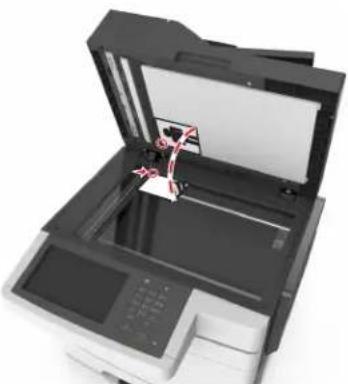
natural_image
Open image of a printer with visible internal components and no text or symbolsUse the scanner glass for single-page documents, book pages, small items (such as postcards or photos), transparencies, photo paper, or thin media (such as magazine clippings).
Setting up the printer to e-mail
Setting up the e-mail function
1 Open a Web browser, and then type the printer IP address in the address field.
Notes:
- View the printer IP address on the printer home screen. The IP address appears as four sets of numbers separated by periods, such as 123.123.123.123.
- If you are using a proxy server, then temporarily disable it to load the Web page correctly.
2 Click Settings > E-mail/FTP Settings > E-mail Settings.
3 Enter the appropriate information, and then click Submit.
Configuring e-mail settings
1 Open a Web browser, and then type the printer IP address in the address field.
Notes:
- View the printer IP address on the printer home screen. The IP address appears as four sets of numbers separated by periods, such as 123.123.123.123.
- If you are using a proxy server, then temporarily disable it to load the Web page correctly.
2 Click Settings > E-mail/FTP Settings > E-mail Settings.
3 Enter the appropriate information, and then click Submit.
Creating an e-mail shortcut
Creating an e-mail shortcut using the Embedded Web Server
1 Open a Web browser, and then type the printer IP address in the address field.
Notes:
- View the printer IP address on the printer home screen. The IP address appears as four sets of numbers separated by periods, such as 123.123.123.123.
- If you are using a proxy server, then temporarily disable it to load the Web page correctly.
2 Click Settings.
3 From the Other Settings column, click Manage Shortcuts > E-mail Shortcut Setup.
4 Type a unique name for the e-mail recipient, and then type the e-mail address. If you are entering multiple addresses, then separate each address with a comma.
5 Click Add.
Creating an e-mail shortcut using the printer control panel
1 From the home screen, navigate to:
E-mail > Recipient > type an e-mail address
To create a group of recipients, touch Next address, and then type the next recipient's e-mail address.
2 Touch Subject, then type the e-mail subject, and then touch Done.
3 Touch Message, then type your message, and then touch Done.
4 Adjust the e-mail settings.
Note: If you change the settings after the e-mail shortcut has been created, then the settings are not saved.
5 Touch

6 Type a unique name for the shortcut, and then touch Done.
7 Verify that the shortcut name is correct, and then touch OK.
If the shortcut name is incorrect, then touch Cancel, and then reenter the information.
Notes:
- The shortcut name appears in the E-mail Shortcuts icon on the printer home screen.
- You can use the shortcut when e-mailing another document using the same settings.
E-mailing a document
Note: You can also send an e-mail by using the Multi Send or MyShortcut application from the home screen. For more information, see "Activating the home screen applications" on page 21.
Sending an e-mail using the printer control panel
1 Load an original document faceup, short edge first into the ADF tray or facedown on the scanner glass.
Notes:
- Do not load postcards, photos, small items, transparencies, photo paper, or thin media (such as magazine clippings) into the ADF tray. Place these items on the scanner glass.
- The ADF indicator light comes on when the paper is loaded properly.
2 If you are loading a document into the ADF tray, then adjust the paper guides.
Note: To avoid a cropped image, make sure that the size of the original document and the copy paper size are the same.
3 From the home screen, navigate to:
E-mail > Recipient(s)
4 Type the e-mail address, or press # using the keypad, and then enter the shortcut number.
Notes:
- To enter additional recipients, touch Next address, and then enter the address or shortcut number you want to add.
- You can also enter an e-mail address using the address book.
5 Touch Done > Send It.
Sending an e-mail using a shortcut number
1 Load an original document faceup, short edge first into the ADF tray or facedown on the scanner glass.
Notes:
- Do not load postcards, photos, small items, transparencies, photo paper, or thin media (such as magazine clippings) into the ADF tray. Place these items on the scanner glass.
- The ADF indicator light comes on when the paper is loaded properly.
2 If you are loading a document into the ADF tray, then adjust the paper guides.
3 Press #, then enter the shortcut number using the keypad, and then touch √.
Note: To enter additional recipients, touch Next address, and then enter the address or shortcut number that you want to add.
4 Touch Send It.
Sending an e-mail using the address book
1 Load an original document faceup, short edge first into the ADF tray or facedown on the scanner glass.
Notes:
- Do not load postcards, photos, small items, transparencies, photo paper, or thin media (such as magazine clippings) into the ADF tray. Place these items on the scanner glass.
- The ADF indicator light comes on when the paper is loaded properly.
2 If you are loading a document into the ADF tray, then adjust the paper guides.
3 From the home screen, navigate to:
E-mail > Recipient(s) > type the name of the recipient > Search
4 Touch the name of the recipient.
Note: To enter additional recipients, touch Next address, and then enter the address or shortcut number that you want to add, or search the address book.
5 Touch Done.
Customizing e-mail settings
Adding e-mail subject and message information
1 Load an original document faceup, short edge first into the ADF tray or facedown on the scanner glass.
Notes:
- Do not load postcards, photos, small items, transparencies, photo paper, or thin media (such as magazine clippings) into the ADF tray. Place these items on the scanner glass.
- The ADF indicator light comes on when the paper is loaded properly.
2 If you are loading a document into the ADF tray, then adjust the paper guides.
3 From the home screen, navigate to:
E-mail > Recipient(s) > type the e-mail address > Done
4 Touch Subject, then type the e-mail subject, and then touch Done.
5 Touch Message, then type your message, and then touch Done.
Changing the output file type
1 Load an original document into the ADF tray or on the scanner glass.
2 From the home screen, navigate to:
E-mail > Recipient(s) > type the e-mail address > Done > Send as
3 Select the file type you want to send.
Note: If you select Secure PDF, then you will be prompted to enter your password twice.
4 Touch √ > Send It.
Canceling an e-mail
- When using the ADF, touch Cancel Job while Scanning appears.
- When using the scanner glass, touch Cancel Job while Scanning appears, or while Scan the Next Page/Finish the Job appears.
Understanding the e-mail options
Recipient(s)
This option lets you enter the recipient of your e-mail. You may enter multiple e-mail addresses.
Subject
This option lets you type a subject line for your e-mail.
Message
This option lets you type a message that will be sent with your scanned attachment.
File Name
This option lets you customize the attachment file name.
Original Size
This option lets you set the paper size of the documents you are going to e-mail. When Original Size is set to Mixed Sizes, you can scan an original document that contains mixed paper sizes (letter- and legal-size pages).
Resolution
This option lets you adjust the output quality of your e-mail. Increasing the image resolution increases the e-mail file size and the time needed to scan your original document. Decreasing the image resolution reduces the file size.
Color
This option lets you set the output to either color or monochrome for the scanned image.
Content
This option lets you set the original document type and source.
Select from the following content types:
- Graphics—The original document is mostly business-type graphics, such as pie charts, bar charts, and animations.
-
Photo—The original document is mostly a photo or an image.
-
Text—The content of the original document is mostly text or line art.
- Text/Photo—The original document is a mixture of text, graphics, and photos.
Select from the following content sources:
- Black/White Laser—The original document was printed using a mono laser printer.
• Color Laser—The original document was printed using a color laser printer. - Inkjet—The original document was printed using an inkjet printer.
- Magazine—The original document is from a magazine.
- Newspaper—The original document is from a newspaper.
- Other—The original document was printed using an alternate or unknown printer.
- Photo/Film—The original document is a photo from film.
- Press—The original document was printed using a printing press.
Darkness
This option lets you adjust how light or dark your scanned documents are in relation to the original document.
Send As
This option lets you set the output type for the scan image.
Select one of the following:
- PDF—Use this to create a single file with multiple pages. This can be sent as a secured or compressed file.
- TIFF—Use this to create multiple files or a single file. If Multi-page TIFF is turned off in the Settings menu of the Embedded Web Server, then TIFF saves one page in each file. The file size is usually larger than an equivalent JPEG.
- JPEG—Use this to create and attach a separate file for each page of your original document.
- XPS—Use this to create a single XPS file with multiple pages.
- RTF—Use this to create a file in editable format.
- TXT—Use this to create an ASCII text file with no formatting.
Page Setup
This option lets you change the following settings:
- Sides (Duplex)—This specifies if the original document is printed on only one side or on both sides of the paper. This also identifies what needs to be scanned for inclusion in the e-mail.
- Orientation—This specifies the orientation of the original document, and then changes the Sides (Duplex) and Binding settings to match the orientation.
- Binding—This specifies if the original document is bound on the long-edge or short-edge side.
Scan Preview
This option lets you view the first page of the image before it is included in the e-mail. When the first page is scanned, the scanning is paused and a preview image appears.
Note: This option appears only when a working printer hard disk is installed.
Save As Shortcut
This option lets you save the current settings as a shortcut by assigning a shortcut name.
Note: Selecting this option automatically assigns the next available shortcut number.
Using the advanced options
Select from the following settings:
- Adjust ADF Skew—This straightens scanned images that are slightly skewed when received from the ADF tray.
- Advanced Imaging—This adjusts the Background Removal, Color Balance, Color Dropout, Contrast, JPEG Quality, Mirror Image, Negative Image, Scan Edge to Edge, Shadow Detail, Sharpness, and Temperature settings before you e-mail the document.
- Custom Job—This combines multiple scanning jobs into a single job.
Note: This option appears only when a formatted, working printer hard disk is installed.
- Edge Erase—This removes smudges or marks around the edges of a document. You can choose to remove an equal area around all four sides of the paper, or pick a particular edge. Edge Erase will erase whatever is within the area selected, leaving nothing on that portion of the scan.
- Transmission Log—This prints the transmission log or transmission error log.
Faxing
Automatic document feeder (ADF) Scanner glass

natural_image
Illustration of a printer with paper labeled ABC, showing no readable text or symbols on the device itself.Use the ADF for multiple-page documents including two-sided pages.
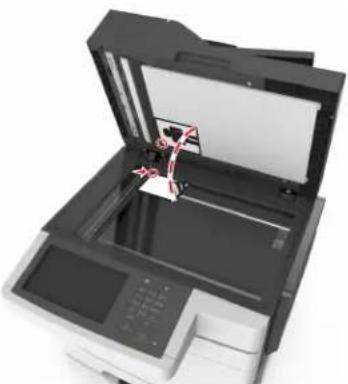
natural_image
Open image of a printer with visible internal components and no text or symbolsUse the scanner glass for single-page documents, book pages, small items (such as postcards or photos), transparencies, photo paper, or thin media (such as magazine clippings).
Setting up the printer to fax

CAUTION—SHOCK HAZARD: Do not use the fax feature during a lightning storm. Do not set up this product or make any electrical or cabling connections, such as the fax feature, power cord, or telephone, during a lightning storm.
Notes:
- The following connection methods are applicable only in some countries or regions.
- During the initial printer setup, clear the fax function check box and any other function you plan to set up later, and then touch Continue.
- The indicator light may blink red if the fax function is enabled and not fully set up.
Warning—Potential Damage: Do not touch cables or the printer in the area shown while actively sending or receiving a fax.

text_image
Image showing a printer with a prohibition symbol and a crossed-out document, indicating no restrictions on the device.Initial fax setup
Many countries and regions require outgoing faxes to contain the following information in a margin at the top or bottom of each transmitted page, or on the first page of the transmission: fax name (identification of the business, other entity, or individual sending the message) and fax number (telephone number of the sending fax machine, business, other entity, or individual). For more information, see “Regulatory notices for telecommunication terminal equipment” on page 321.
To enter your fax setup information, use the printer control panel, or use your browser to access the Embedded Web Server and then enter the Settings menu.
Note: If you do not have a TCP/IP environment, then you must use the printer control panel to enter your fax setup information.
Using the printer control panel for fax setup
When the printer is turned on for the first time, a series of start-up screens appear. If the printer has fax capabilities, then the Fax Name and Fax Number screens appear.
1 When the Fax Name screen appears, do the following:
a Enter the name to be printed on all outgoing faxes.
b Enter the fax name, and then touch Submit.
2 When the Fax Number screen appears, enter the fax number, and then touch Submit.
Using the Embedded Web Server for fax setup
1 Open a Web browser, and then type the printer IP address in the address field.
Notes:
- View the printer IP address on the printer home screen. The IP address appears as four sets of numbers separated by periods, such as 123.123.123.123.
- If you are using a proxy server, then temporarily disable it to load the Web page correctly.
2 Click Settings > Fax Settings > Analog Fax Setup.
3 In the Fax Name field, type the name to be printed on all outgoing faxes.
4 In the Fax Number field, enter the printer fax number.
5 Click Submit.
Choosing a fax connection
Scenario 1: Standard telephone line
Setup 1: Printer is connected to a dedicated fax line
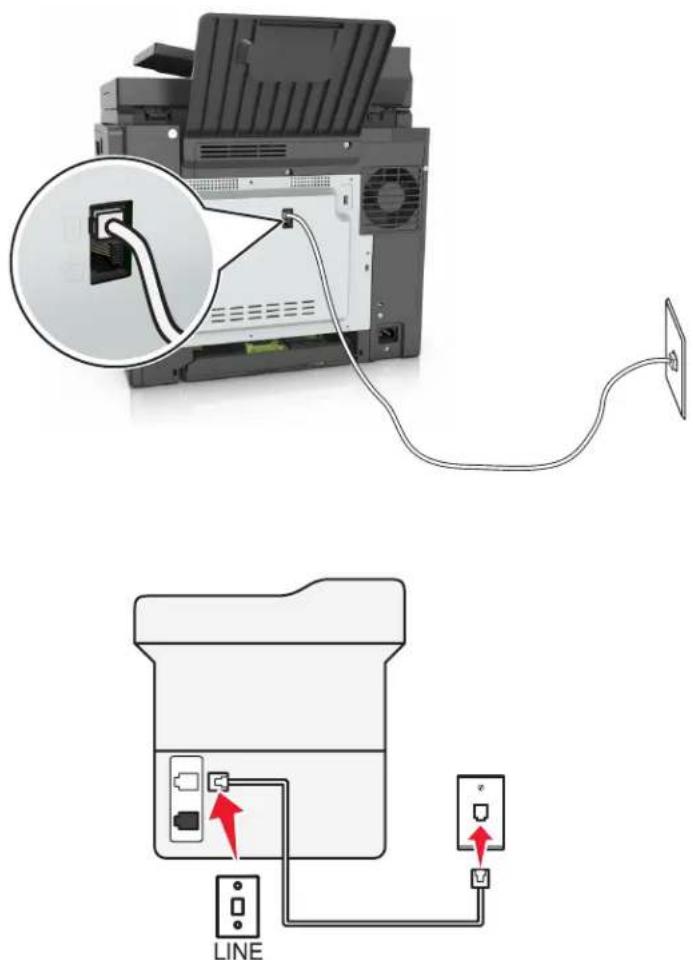
text_image
Diagram showing printer connection to a device with cable and wiring, including a magnified view of the cable being inserted into a socket.To connect:
1 Connect one end of the telephone cable that came with the printer to the port of the printer.
2 Connect the other end of the telephone cable to an active analog wall jack.
Tips for this setup:
- You can set the printer to receive faxes automatically (Auto Answer On) or manually (Auto Answer Off).
- If you want to receive faxes automatically (Auto Answer On), then set the printer to pick up on any number of rings that you want.
Setup 2: Printer is sharing the line with an answering machine
Connected to the same telephone wall jack

text_image
Diagram illustrating the connection between a printer, telephone devices, and a file folder with labeled ports (EXT, LINE) and cable routing.To connect:
1 Connect one end of the telephone cable that came with the printer to the port of the printer.
2 Connect the other end of the telephone cable to an active analog wall jack.
3 Connect the answering machine to the 📊 port of the printer.
Connected to different wall jacks

text_image
Diagram showing connection between a printer, telephone, and connected devices with labeled ports and wiring connections.To connect:
1 Connect one end of the telephone cable that came with the printer to the port of the printer.
2 Connect the other end of the telephone cable to an active analog wall jack.
Tips for this setup:
- If you have only one telephone number on your line, then you need to set the printer to receive faxes automatically (Auto Answer On).
- Set the printer to pick up calls two rings after the answering machine. For example, if the answering machine picks up calls after four rings, then set the printer to pick up after six rings. This way, the answering machine picks up calls first and your voice calls are received. If the call is a fax, then the printer detects the fax signal on the line and takes over the call.
- If you subscribe to a distinctive ring service provided by your telephone company, then make sure that you set the correct ring pattern for the printer. Otherwise, the printer does not receive faxes even if you have set it to receive faxes automatically.
Setup 3: Printer is sharing the line with a telephone subscribed to voice mail service
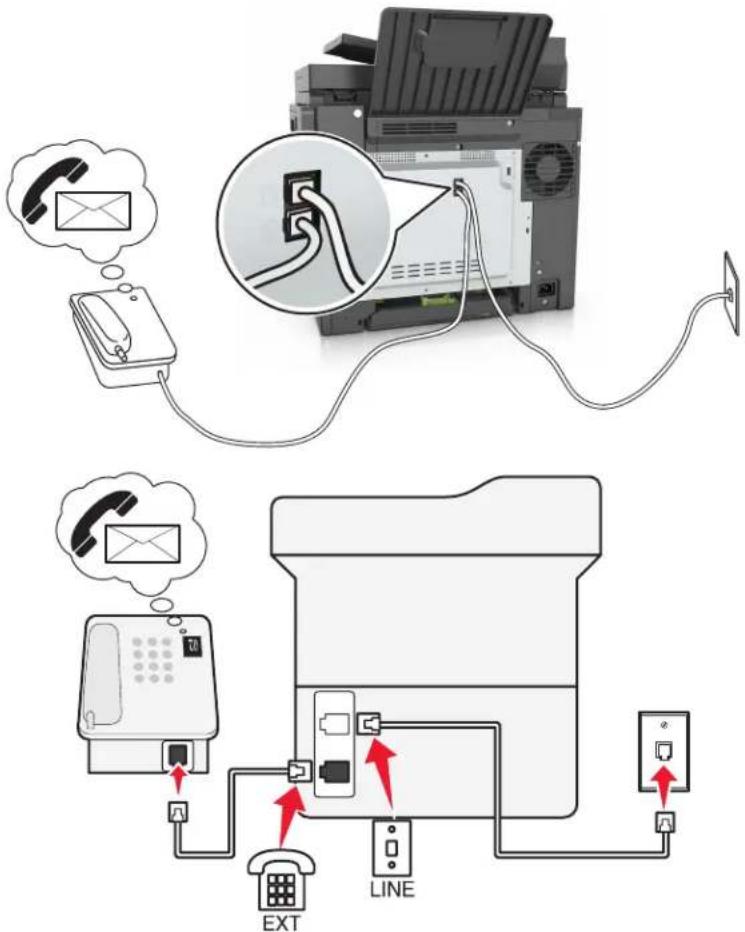
text_image
Diagram illustrating the connection between a printer, telephone, and external devices with labeled ports and connections.To connect:
1 Connect one end of the telephone cable that came with the printer to the port of the printer.
2 Connect the other end of the telephone cable to an active analog wall jack.
3 Connect the telephone to the port of the printer.
Tips for this setup:
- This setup works best if you subscribe to a distinctive ring service. If you have distinctive ring service, then make sure that you set the correct ring pattern for the printer. Otherwise, the printer does not receive faxes even if you have set it to receive faxes automatically.
- If you have only one telephone number on your line, then you need to set the printer to receive faxes manually (Auto Answer Off).
When you answer the telephone and you hear fax tones, press *9* or the manual answer code on the telephone to receive the fax.
- You can also set the printer to receive faxes automatically (Auto Answer On), but you need to turn off the voice mail service when you are expecting a fax. This setting works best if you are using voice mail more often than fax.
Scenario 2: Digital Subscriber Line (DSL)
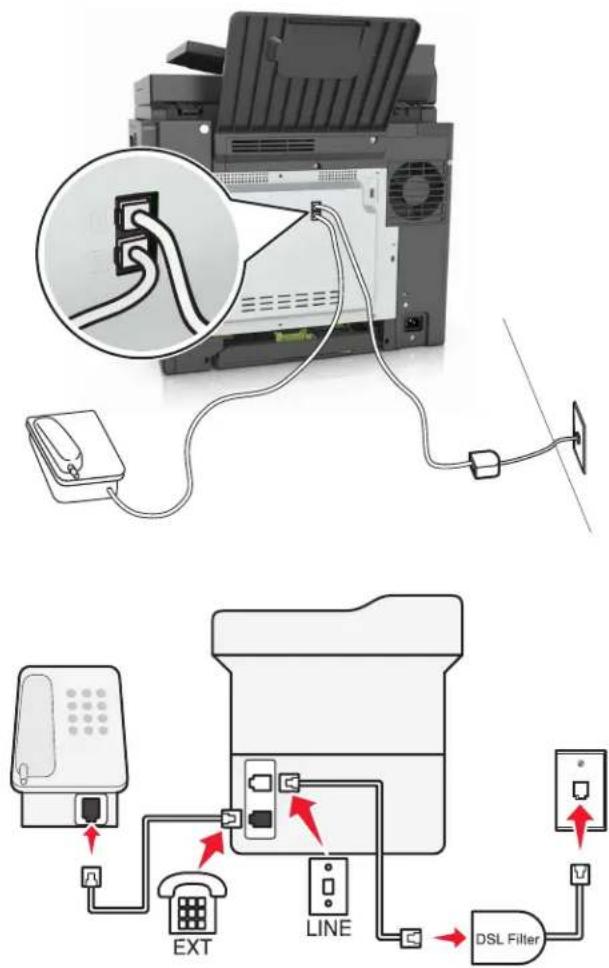
text_image
Diagram illustrating the connection between a printer, external device, and DSL filter with labeled components.A Digital Subscriber Line splits your regular telephone line into two channels: voice and Internet. Telephone and fax signals travel through the voice channel, and Internet signals pass through the other channel. This way, you can use the same line for analog voice calls (including faxes) and digital Internet access.
To minimize interference between the two channels and ensure a quality connection, you need to install a DSL filter for the analog devices (fax machine, telephone, answering machine) in your network. Interference causes noise and static on the telephone, failed and poor quality faxes for the printer, and slow Internet connection on your computer.
To install a filter for the printer:
1 Connect the line port of the DSL filter to the wall jack.
2 Connect one end of the telephone cable that came with your printer to the port of the printer. Connect the other end to the phone port on the DSL filter.
3 To continue using a computer for Internet access, connect the computer to the DSL HPN port on the DSL filter.
4 To connect a telephone to the printer, remove any installed adapter plug from the 📞 port of the printer, and then connect the telephone to the port.
Scenario 3: VoIP telephone service

text_image
Diagram illustrating network connection and port layout with labeled components including printer, server, phone, and router connections.To connect:
1 Connect one end of the telephone cable that came with the printer to the port of the printer.
2 Connect the other end of the cable to the port labeled Phone Line 1 or Phone Port on the VoIP adapter.
Note: The port labeled Phone Line 2 or Fax Port is not always active. VoIP providers may charge additional cost for activation of the second phone port.
3 Connect the telephone to the 📊 port of the printer.
Tips for this setup:
- To make sure that the phone port on the VoIP adapter is active, plug an analog telephone into the phone port, and then listen for a dial tone. If you hear a dial tone, then the port is active.
- If you need two phone ports for your devices, but do not want to pay additional cost, then do not plug the printer into the second phone port. You can use a phone splitter. Plug the phone splitter into the port labeled Phone Line 1 or Phone Port, and then plug the printer and telephone into the splitter.
Note: Make sure you use a phone splitter, not a line splitter. To make sure that you are using the correct splitter, plug an analog telephone into the splitter and then listen for a dial tone.
Scenario 4: Digital telephone service through a cable provider
Setup 1: Printer is connected directly to a cable modem
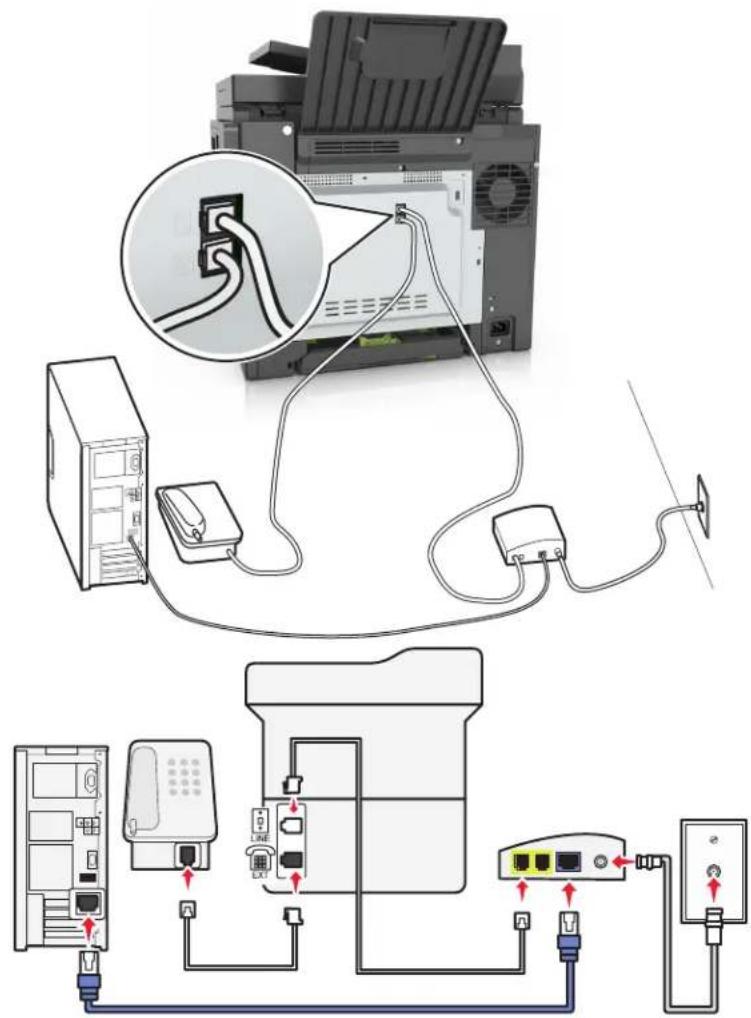
text_image
Diagram illustrating network connection between a printer, server, and device with labeled ports and cable connections1 Connect one end of the telephone cable that came with your printer to the port of the printer.
2 Connect the other end of the cable to the port labeled Phone Line 1 or Phone Port on the cable modem.
Note: The port labeled Phone Line 2 or Fax Port is not always active. VoIP providers may charge additional cost for activation of the second phone port.
3 Connect your analog telephone phone to the 📞 port of the printer.
Notes:
- To make sure that the telephone port on the cable modem is active, plug an analog telephone into the telephone port, and then listen for a dial tone. If you hear a dial tone, then the port is active.
- If you need two telephone ports for your devices, but do not want to pay additional cost, then do not plug the printer into the second telephone port. You can use a phone splitter. Plug the phone splitter into the Phone Line 1 or Phone Port, and then plug the printer and telephone into the splitter.
- Make sure you use a phone splitter, not a line splitter. To make sure that you are using the correct splitter, plug an analog telephone into the splitter and then listen for a dial tone.
Setup 2: Printer is connected to a wall jack; cable modem is installed elsewhere in the facility
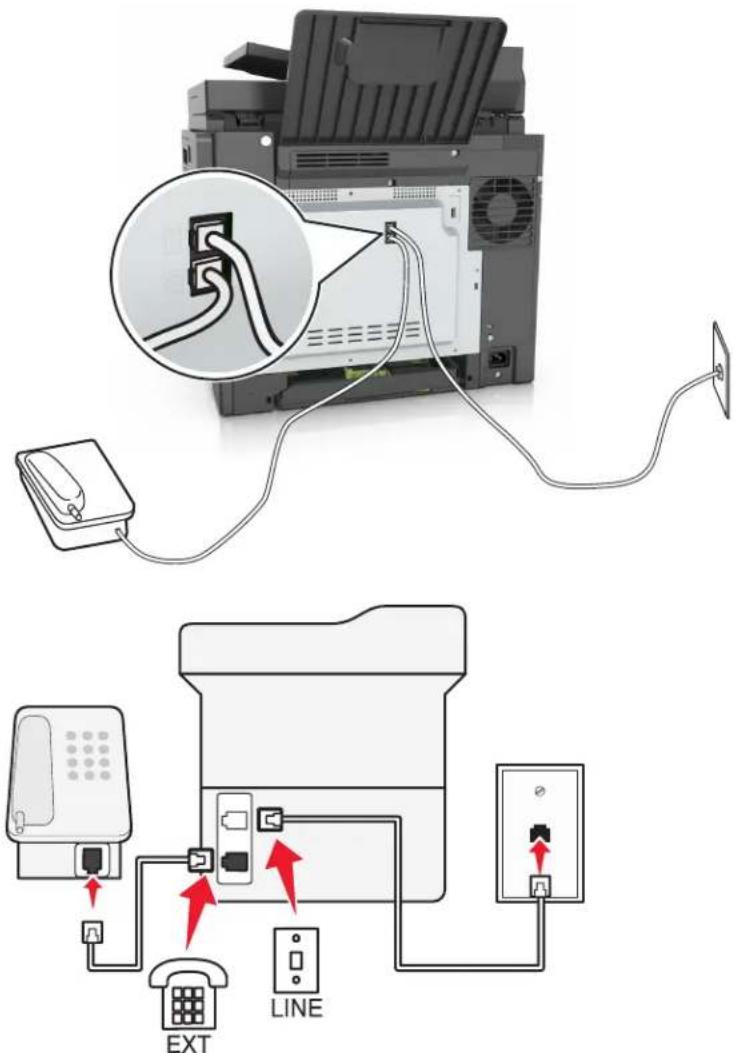
text_image
Diagram illustrating the connection between a printer and a file folder, showing cable routing and port connections.1 Connect one end of the telephone cable that came with your printer to the port of the printer.
2 Connect the other end of the telephone cable to an active analog telephone wall jack.
3 Connect your analog telephone to the 📞 port of the printer.
Scenario 5: Countries or regions with different telephone wall jacks and plugs
Some countries or regions may have different types of telephone wall jack connectors than those that came with the printer. The standard wall jack adopted by most countries or regions is RJ-11. Your printer comes with the RJ-11 jack and a telephone cable with the RJ-11 plug.
If the wall jack or equipment in your facility is not compatible with this type of connection, then you need to use a telephone adapter. An adapter for your country or region may not come with your printer, and you may need to purchase it separately.

There may be an adapter plug installed in the 📋 port of the printer. If you are using a telephone adapter or a facility that has a cascaded or serial wiring scheme, then do not remove the adapter plug from the 📋 port of the printer.
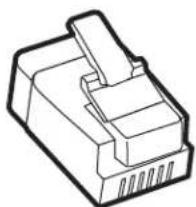
natural_image
Line drawing of a 3D electrical connector or socket (no text or symbols)| Part name Part number | |
| Lexmark adapter plug 40X8519 |
Connecting the printer to a non-RJ-11 wall jack
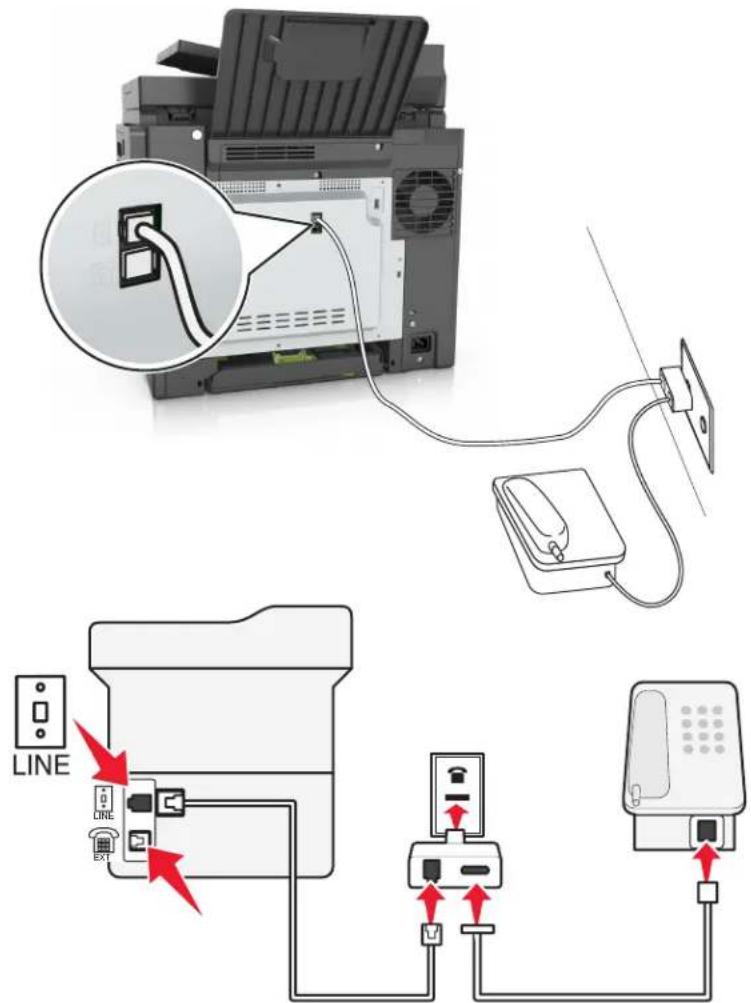
text_image
Diagram illustrating the connection between a printer and a mobile phone, showing cable routing and connection points with labeled interfaces.1 Connect one end of the telephone cable that came with printer to the port of the printer.
2 Connect the other end of the cable to the RJ-11 adapter, and then connect the adapter to the wall jack.
3 If you want to connect another device (telephone or answering machine) to the same wall jack, and if the device has a non-RJ-11 connector, then connect it directly to the telephone adapter.
Notes:
- The 📞 port of the printer may have an adapter plug for use with the adapter. Do not remove the plug from the 📞 port of the printer.
- In some countries or regions, the printer may not come with a telephone adapter or an adapter plug.
Connecting the printer to a wall jack in Germany
The German wall jack has two kinds of ports. The N ports are for fax machines, modems, and answering machines. The F port is for telephones.

text_image
N F NConnect the printer to any of the N ports.
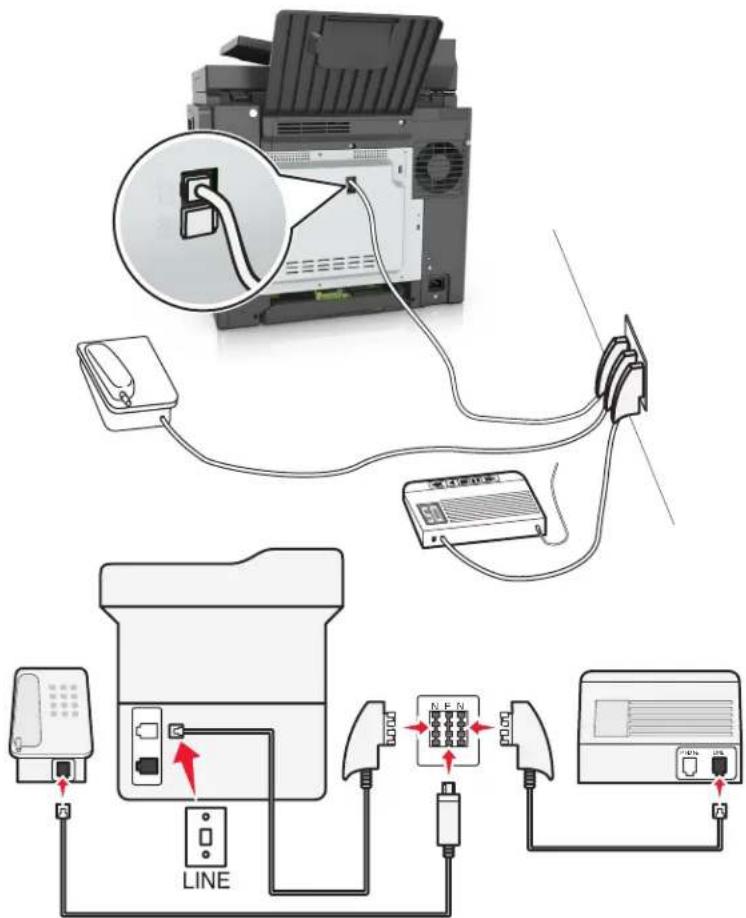
text_image
Diagram showing connection between printer, network device, and computer via cable, with labeled wiring and connection points.1 Connect one end of the telephone cable that came the printer to the port of the printer.
2 Connect the other end of the telephone cable to the RJ-11 adapter, and then connect the adapter to an N port.
3 If you want to connect a telephone and answering machine to the same wall jack, then connect the devices as shown.
Note: Do not remove the adapter plug from the 📞 port of the printer if you are connecting to a serial or cascaded telephone system.
Connecting to a distinctive ring service
A distinctive ring service may be available from your telephone company. This service lets you have multiple telephone numbers on one telephone line, with each telephone number having a different ring pattern. This may be useful for distinguishing between fax and voice calls. If you subscribe to a distinctive ring service, then follow these steps to connect the equipment:
1 Connect one end of the telephone cable that came with the printer to the printer LINE port ☐.
2 Connect the other end of the telephone cable to an active analog telephone wall jack.

natural_image
Close-up of a computer setup with a cable, plug, and socket connected to an external panel (no visible text or symbols)3 Change the distinctive rings setting to match the setting you want for the printer to answer.
Note: The factory default setting for distinctive rings is On. This sets the printer to answer single, double, and triple ring patterns.
a From the home screen, navigate to:

Settings > Fax Settings > Analog Fax Setup > Answer On
b Select the pattern setting you want to change, and then touch Submit.
Setting the outgoing fax name and number
1 Open a Web browser, and then type the printer IP address in the address field.
Notes:
• View the printer IP address on the printer home screen. The IP address appears as four sets of numbers separated by periods, such as 123.123.123.123.
- If you are using a proxy server, then temporarily disable it to load the Web page correctly.
2 Click Settings > Fax Settings > Analog Fax Setup.
3 In the Fax Name field, type the name to be printed on all outgoing faxes.
4 In the Fax Number field, enter the printer fax number.
5 Click Submit.
Setting the date and time
You can set the date and time so that they are printed on every fax you send.
1 Open a Web browser, and then type the printer IP address in the address field.
Notes:
- View the printer IP address on the printer home screen. The IP address appears as four sets of numbers separated by periods, such as 123.123.123.123.
- If you are using a proxy server, then temporarily disable it to load the Web page correctly.
2 Click Security > Set Date and Time.
3 In the Manually Set Date & Time field, enter the current date and time.
4 Click Submit.
Note: It is recommended to use the network time.
Configuring the printer to observe daylight saving time
The printer can be set to automatically adjust for daylight saving time:
1 Open a Web browser, and then type the printer IP address in the address field.
Notes:
- View the printer IP address on the printer home screen. The IP address appears as four sets of numbers separated by periods, such as 123.123.123.123.
- If you are using a proxy server, then temporarily disable it to load the Web page correctly.
2 Click Security > Set Date and Time.
3 Select the Automatically Observe DST check box, and then enter the DST start and end dates in the Custom Time Zone Setup section.
4 Click Submit.
Sending a fax
Sending a fax using the printer control panel
1 Load an original document faceup, short edge first into the ADF tray or facedown on the scanner glass.
Notes:
- Do not load postcards, photos, small items, transparencies, photo paper, or thin media (such as magazine clippings) into the ADF tray. Place these items on the scanner glass.
- The ADF indicator light comes on when the paper is loaded properly.
2 If you are loading a document into the ADF tray, then adjust the paper guides.
3 From the home screen, touch Fax.
4 Enter the fax number or a shortcut.
Note: To add recipients, touch Next number, and then enter the recipient's telephone number or shortcut number, or search the address book.
5 Touch Fax It.
Sending a fax using the computer
For Windows users
1 With a document open, click File > Print.
2 Select the printer, and then click Properties, Preferences, Options, or Setup.
3 Click Fax > Enable fax, and then enter the recipient fax number or numbers.
4 If necessary, configure other fax settings.
5 Apply the changes, and then send the fax job.
Notes:
- The fax option is available only with the PostScript driver or the Universal Fax Driver. For more information, go to http://support.lexmark.com.
- To use the fax option with the PostScript driver, configure and enable it in the Configuration tab.
For Macintosh users
1 With a document open, choose File > Print.
2 Select the printer.
4 Send the fax job.
3 Enter the recipient fax number, and then configure other fax settings, if necessary.
Sending a fax using a shortcut number
Fax shortcuts are like the speed dial numbers on a telephone or a fax machine. A shortcut number (1–999) can contain a single recipient or multiple recipients.
1 Load an original document faceup, short edge first into the ADF tray or facedown on the scanner glass.
Notes:
- Do not load postcards, photos, small items, transparencies, photo paper, or thin media (such as magazine clippings) into the ADF tray. Place these items on the scanner glass.
- The ADF indicator light comes on when the paper is loaded properly.
2 If you are loading a document into the ADF tray, then adjust the paper guides.
3 From the printer control panel, press #, and then enter the shortcut number using the keypad.
4 Touch Fax It.
Sending a fax using the address book
The address book lets you search for bookmarks and network directory servers. For more information on enabling the address book feature, contact your system support person.
1 Load an original document faceup, short edge first into the ADF tray or facedown on the scanner glass.
Notes:
- Do not load postcards, photos, small items, transparencies, photo paper, or thin media (such as magazine clippings) into the ADF tray. Place these items on the scanner glass.
- The ADF indicator light comes on when the paper is loaded properly.
2 If you are loading a document into the ADF tray, then adjust the paper guides.
3 From the home screen, navigate to:
Fax > type the name of the recipient > Search
Note: You can search only for one name at a time.
4 Touch the name of the recipient, and then touch Fax It.
Sending a fax at a scheduled time
1 Load an original document faceup, short edge first into the ADF tray or facedown on the scanner glass.
Notes:
- Do not load postcards, photos, small items, transparencies, photo paper, or thin media (such as magazine clippings) into the ADF tray. Place these items on the scanner glass.
- The ADF indicator light comes on when the paper is loaded properly.
2 If you are loading a document into the ADF tray, then adjust the paper guides.
3 From the home screen, navigate to:
Fax > enter the fax number > Options > Delayed Send
Note: If Fax Mode is set to Fax Server, then the Delayed Send button does not appear. Faxes waiting for transmission are listed in the fax queue.
4 Specify the time the fax will be transmitted, and then touch √.
5 Touch Fax It.
Note: The document is scanned, and then faxed at the scheduled time.
Creating shortcuts
Creating a fax destination shortcut using the Embedded Web Server
Assign a shortcut number to a single fax number or a group of fax numbers.
1 Open a Web browser, and then type the printer IP address in the address field.
Notes:
- View the printer IP address on the printer home screen. The IP address appears as four sets of numbers separated by periods, such as 123.123.123.123.
- If you are using a proxy server, then temporarily disable it to load the Web page correctly.
2 Click Settings > Manage Shortcuts > Fax Shortcut Setup.
Note: A password may be required. If you do not have an ID and password, then contact your system support person.
3 Type a name for the shortcut, and then enter the fax number.
Notes:
- To create a multiple-number shortcut, enter the fax numbers for the group.
- Separate each fax number in the group with a semicolon (;).
4 Assign a shortcut number.
Note: If you enter a number that is already in use, then you are prompted to select another number.
5 Click Add.
Creating a fax destination shortcut using the printer control panel
1 From the home screen, touch Fax, and then enter the fax number.
Note: To create a group of fax numbers, touch Next number, and then enter the next fax number.
2 Touch

3 Type a unique name for the shortcut, and then touch Done.
4 Verify that the shortcut name and number are correct, and then touch OK.
Note: If the name or number is incorrect, then touch Cancel, and then reenter the information.
Customizing fax settings
Changing the fax resolution
1 Load an original document faceup, short edge first into the ADF tray or facedown on the scanner glass.
Notes:
- Do not load postcards, photos, small items, transparencies, photo paper, or thin media (such as magazine clippings) into the ADF tray. Place these items on the scanner glass.
- The ADF indicator light comes on when the paper is loaded properly.
2 If you are loading a document into the ADF tray, then adjust the paper guides.
3 From the home screen, navigate to:
Fax > enter the fax number > Options
4 From the Resolution area, touch the arrows to select the resolution you want.
Note: Select a resolution from Standard (fastest speed) to Ultra Fine (best quality at a reduced speed).
5 Touch Fax It.
Making a fax lighter or darker
1 Load an original document faceup, short edge first into the ADF tray or facedown on the scanner glass.
Notes:
- Do not load postcards, photos, small items, transparencies, photo paper, or thin media (such as magazine clippings) into the ADF tray. Place these items on the scanner glass.
- The ADF indicator light comes on when the paper is loaded properly.
2 If you are loading a document into the ADF tray, then adjust the paper guides.
3 From the home screen, navigate to:
Fax > enter the fax number > Options
4 Adjust the fax darkness, and then touch Fax It.
Viewing a fax log
1 Open a Web browser, and then type the printer IP address in the address field.
Notes:
- View the printer IP address on the printer home screen. The IP address appears as four sets of numbers separated by periods, such as 123.123.123.123.
- If you are using a proxy server, then temporarily disable it to load the Web page correctly.
2 Click Settings > Reports.
3 Click Fax Job Log or Fax Call Log.
Blocking junk faxes
1 Open a Web browser, and then type the printer IP address in the address field.
Notes:
- View the printer IP address on the printer home screen. The IP address appears as four sets of numbers separated by periods, such as 123.123.123.123.
- If you are using a proxy server, then temporarily disable it to load the Web page correctly.
2 Click Settings > Fax Settings > Analog Fax Setup > Block No Name Fax.
Notes:
- This option blocks all incoming faxes that have a private caller ID or have no fax name.
- In the Banned Fax List field, enter the phone numbers or type the fax names of specific fax callers you want to block.
Canceling an outgoing fax
Canceling a fax while the original documents are still scanning
- When using the ADF, touch Cancel Job on the printer control panel while Scanning appears.
- When using the scanner glass, touch Cancel Job on the printer control panel while Scanning appears or while Scan the Next Page and Finish the Job appear.
Canceling a fax after the original documents have been scanned to memory
1 On the home screen, touch Cancel Jobs.
The Cancel Jobs screen appears.
2 Touch the job or jobs you want to cancel.
Only three jobs appear on the screen; touch the down arrow until the job you want appears, and then touch the job you want to cancel.
3 Touch Delete Selected Jobs.
The Deleting Selected Jobs screen appears, the selected jobs are deleted, and then the home screen appears.
Holding and forwarding faxes
Holding faxes
This option lets you hold received faxes from printing until they are released. Held faxes can be released manually or at a scheduled day or time.
1 Open a Web browser, and then type the printer IP address in the address field.
Notes:
- View the printer IP address on the printer home screen. The IP address appears as four sets of numbers separated by periods, such as 123.123.123.123.
- If you are using a proxy server, then temporarily disable it to load the Web page correctly.
2 Click Settings > Fax Settings > Analog Fax Setup > Holding Faxes.
3 From the Held Fax Mode menu, select one of the following:
•Off
•Always On
•Manual
•Scheduled
4 If you selected Scheduled, then continue with the following steps:
a Click Fax Holding Schedule.
b From the Action menu, select Hold faxes.
c From the Time menu, select the time you want the held faxes released.
d From the Day(s) menu, select the day you want the held faxes released.
5 Click Add.
Forwarding a fax
This option lets you print and forward received faxes to a fax number, e-mail address, FTP site, or LDSS.
1 Open a Web browser, and then type the printer IP address in the address field.
Notes:
- View the printer IP address on the printer home screen. The IP address appears as four sets of numbers separated by periods, such as 123.123.123.123.
- If you are using a proxy server, then temporarily disable it to load the Web page correctly.
2 Click Settings > Fax Settings.
3 From the Fax Forwarding menu, select Print, Print and Forward, or Forward.
4 From the "Forward to" menu, select Fax, E-mail, FTP, LDSS, or eSF.
5 In the "Forward to Shortcut" field, enter the shortcut number where you want the fax forwarded.
Note: The shortcut number must be valid for the setting selected in the "Forward to" menu.
6 Click Submit.
Understanding the fax options
Resolution
This option lets you adjust the quality of the fax output. Increasing the image resolution increases the file size and the time needed to scan your original document. Decreasing the image resolution reduces the file size.
Select from the following values:
- Standard—Use this when faxing most documents.
- Fine 200 dpi—Use this when faxing documents with small prints.
- Super Fine 300 dpi—Use this when faxing documents with fine details.
Darkness
This option lets you adjust how light or dark the faxes are in relation to the original document.
Page Setup
This option lets you change the following settings:
- Sides (Duplex)—This specifies if the original document is printed on one side or on both sides of the page (duplex). This also identifies what needs to be scanned for inclusion in the fax.
- Orientation—This specifies the orientation of the original document, and then changes the Sides (Duplex) and Binding settings to match the orientation.
- Binding—This specifies if the original document is bound on the long-edge or short-edge side.
Content
This option lets you specify the content type and source of the original document.
Select from the following content types:
- Graphics—The original document is mostly business-type graphics, such as pie charts, bar charts, and animations.
- Photo—The original document is mostly a photo or an image.
- Text—The content of the original document is mostly text or line art.
- Text/Photo—The original document is a mixture of text, graphics, and photos.
Select from the following content sources:
- Black/White Laser—The original document was printed using a mono laser printer.
• Color Laser—The original document was printed using a color laser printer. - Inkjet—The original document was printed using an inkjet printer.
- Magazine—The original document is from a magazine.
- Newspaper—The original document is from a newspaper.
- Other—The original document was printed using an alternate or unknown printer.
- Photo/Film—The original document is a photo from film.
- Press—The original document was printed using a printing press.
Color
This option lets you set the output to either color or monochrome for the scanned image.
Delayed Send
This option lets you send a fax at a later time or date.
Scan Preview
This option lets you view the first page of the image before it is included in the fax. When the first page is scanned, the scanning is paused and a preview image appears.
Note: This option appears only when a working printer hard disk is installed.
Using the advanced options
Select from the following settings:
- Adjust ADF Skew—This option lets you straighten scanned images that are slightly skewed when received from the ADF tray.
- Advanced Imaging—This adjusts the Background Removal, Color Balance, Color Dropout, Contrast, Mirror Image, Negative Image, Scan Edge to Edge, Shadow Detail, Sharpness, and Temperature settings before you fax the document.
- Custom Job—This combines multiple scanning jobs into a single job.
Note: This option appears only when a formatted, working printer hard disk is installed.
- Edge Erase—This removes smudges or marks around the edges of a document. You can choose to remove an equal area around all four sides of the paper, or pick a particular edge. Edge Erase erases whatever is within the area selected, leaving nothing on that portion of the scan.
- Transmission Log—This prints the transmission log or transmission error log.
Scanning
Using Scan to Network
Scan to Network lets you scan your documents to network destinations specified by your system support person. After the destinations (shared network folders) have been established on the network, the setup process for the application involves installing and configuring the application on the appropriate printer using its Embedded Web Server. For more information, see "Setting up Scan to Network" on page 23.
Scanning to an FTP address
| Automatic document feeder (ADF) Scanner glass | |
 |  |
| Use the ADF for multiple-page documents including two-sided pages. | Use the scanner glass for single-page documents, book pages, small items (such as postcards or photos), transparencies, photo paper, or thin media (such as magazine clippings). |
The scanner lets you scan documents directly to a File Transfer Protocol (FTP) server. Only one FTP address may be sent to the server at a time.
When an FTP destination has been configured by your system support person, the name of the destination becomes available as a shortcut number, or it is listed as a profile under the Held Jobs icon. An FTP destination could also be another PostScript printer.
Creating shortcuts
Instead of entering the entire FTP site address on the printer control panel each time you want to send a document to an FTP server, you can create a permanent FTP destination and assign a shortcut number. There are two methods for creating shortcut numbers: using the Embedded Web Server and using the printer control panel.
Creating an FTP shortcut using the Embedded Web Server
1 Open a Web browser, and then type the printer IP address in the address field.
Notes:
- View the printer IP address on the printer home screen. The IP address appears as four sets of numbers separated by periods, such as 123.123.123.123.
- If you are using a proxy server, then temporarily disable it to load the Web page correctly.
2 Navigate to:
Settings > Other Settings area > Manage Shortcuts > FTP Shortcut Setup
3 Enter the appropriate information.
Note: A password may be required. If you do not have an ID and password, then contact your system support person.
4 Enter a shortcut number.
Note: If you enter a number that is already in use, then you are prompted to select another number.
5 Click Add.
Creating an FTP shortcut using the printer control panel
1 From the home screen, navigate to:
FTP > FTP > type the FTP address > [icon: star] > type a name for the shortcut > Done
2 Verify that the shortcut name and number are correct, and then touch OK.
Notes:
- If the name or number is incorrect, then touch Cancel, and then reenter the information.
- If you enter a number that is already in use, then you are prompted to select another number.
Scanning to an FTP address
Scanning to an FTP address using the printer control panel
1 Load an original document faceup, short edge first into the ADF tray or facedown on the scanner glass.
Notes:
- Do not load postcards, photos, small items, transparencies, photo paper, or thin media (such as magazine clippings) into the ADF tray. Place these items on the scanner glass.
- The ADF indicator light comes on when the paper is loaded properly.
2 If you are loading a document into the ADF tray, then adjust the paper guides.
3 From the printer control panel, navigate to:
FTP > FTP > type the FTP address > Done > Send It
Scanning to an FTP address using a shortcut number
1 Load an original document faceup, short edge first into the ADF tray or facedown on the scanner glass.
Notes:
- Do not load postcards, photos, small items, transparencies, photo paper, or thin media (such as magazine clippings) into the ADF tray. Place these items on the scanner glass.
•The ADF indicator light comes on when the paper is loaded properly.
2 If you are loading a document into the ADF tray, then adjust the paper guides.
3 From the printer control panel, press # on the keypad, and then enter the FTP shortcut number.
4 Touch > Send It.
Scanning an FTP using the address book
1 Load an original document faceup, short edge first into the ADF tray or facedown on the scanner glass.
Notes:
- Do not load postcards, photos, small items, transparencies, photo paper, or thin media (such as magazine clippings) into the ADF tray. Place these items on the scanner glass.
•The ADF indicator light comes on when the paper is loaded properly.
2 If you are loading a document into the ADF tray, then adjust the paper guides.
3 From the home screen, navigate to:
FTP > FTP > type the name of the recipient > Search
4 Touch the name of the recipient.
Note: To search for additional recipients, touch New Search, and then type the name of the next recipient.
5 Touch > Send It.
Scanning to a computer or flash drive
Automatic document feeder (ADF) Scanner glass
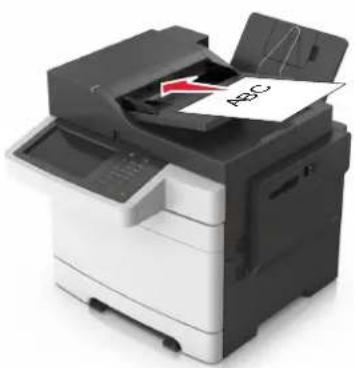
natural_image
Illustration of a printer with paper being inserted (no visible text or symbols)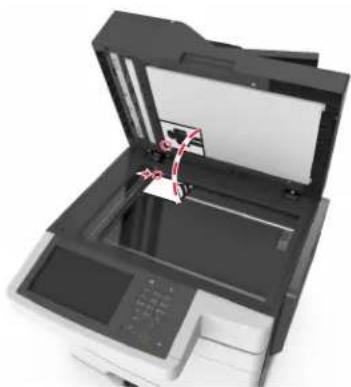
natural_image
3D rendering of an open printer with a red ribbon cable inserted (no visible text or symbols)| Automatic document feeder (ADF) Scanner glass | |
| Use the ADF for multiple-page documents. | Use the scanner glass for single-page documents, small items (such as postcards or photos), transparencies, photo paper, or thin media (such as magazine clippings). |
The scanner lets you scan documents directly to a computer or a flash drive. The computer does not have to be directly connected to the printer for you to receive images using Scan to Computer. You can scan the document back to the computer over the network by creating a scan profile on the computer and then downloading the profile to the printer.
Scanning to a computer using the Embedded Web Server
1 Open a Web browser, and then type the printer IP address in the address field.
Notes:
- View the printer IP address on the printer home screen. The IP address appears as four sets of numbers separated by periods, such as 123.123.123.123.
- If you are using a proxy server, then temporarily disable it to load the Web page correctly.
2 Click Scan Profile > Create Scan Profile.
3 Select your scan settings, and then click Next.
4 Select a location on your computer where you want to save the scan image.
5 Type a scan name, and then a user name.
Note: The scan name is the name that appears in the Scan Profile list on the display.
6 Click Submit.
Note: Clicking Submit automatically assigns a shortcut number. You can use this shortcut number when you are ready to scan your documents.
7 Review the instructions on the Scan Profile screen.
a Load an original document faceup, short edge first into the ADF tray or facedown on the scanner glass.
Notes:
- Do not load postcards, photos, small items, transparencies, photo paper, or thin media (such as magazine clippings) into the ADF tray. Place these items on the scanner glass.
•The ADF indicator light comes on when the paper is loaded properly.
b If you are loading a document into the ADF tray, then adjust the paper guides.
c Do either of the following:
- Press #, and then enter the shortcut number using the keypad.
•From the home screen, navigate to: Held Jobs > Profiles > select your shortcut on the list
Note: The scanner scans and sends the document to the directory you specified.
8 View the file from the computer.
Note: The output file is saved in the location or launched in the program you specified.
Setting up Scan to Computer
Notes:
- This feature is supported only in Windows Vista or later.
- Make sure your computer and printer are connected to the same network.
1 Open the printers folder, and then select your printer.
Note: If your printer is not in the list, then add your printer.
2 Open the printer properties, and then adjust the settings as necessary.
3 From the control panel, touch Scan to Computer > select the appropriate scan setting > Send It.
Scanning to a flash drive
1 Load an original document faceup, short edge first into the ADF tray or facedown on the scanner glass.
Notes:
- Do not load postcards, photos, small items, transparencies, photo paper, or thin media (such as magazine clippings) into the ADF tray. Place these items on the scanner glass.
- The ADF indicator light comes on when the paper is loaded properly.
2 If you are loading a document into the ADF tray, then adjust the paper guides.
3 Insert the flash drive into the USB port on the front of the printer.
Note: The USB Drive home screen appears.
4 Select the destination folder, and then touch Scan to USB drive.
Note: The printer goes back to the home screen after 30 seconds of inactivity.
5 Adjust the scan settings, and then touch Scan It.
Understanding the scan options
FTP
This option lets you enter the IP address for the FTP destination.
Note: An IP address appears as four sets of numbers separated by periods, such as 123.123.123.123.
File Name
This option lets you type a file name for the scan image.
Original Size
This option lets you set the paper size of the documents you are going to scan. When Original Size is set to Mixed Sizes, you can scan an original document that contains mixed paper sizes (letter- and legal-size pages).
Resolution
This option lets you adjust the output quality of your file. Increasing the image resolution increases the file size and the time needed to scan your original document. Decreasing the image resolution reduces the file size.
Color
This option lets you set the output to either color or monochrome for the scanned image.
Content
This option lets you set the original document type and source.
Select from the following content types:
- Graphics—The original document is mostly business-type graphics, such as pie charts, bar charts, and animations.
- Photo—The original document is mostly a photo or an image.
- Text—The content of the original document is mostly text or line art.
- Text/Photo—The original document is a mixture of text, graphics, and photos.
Select from the following content sources:
- Black/White Laser—The original document was printed using a mono laser printer.
• Color Laser—The original document was printed using a color laser printer. - Inkjet—The original document was printed using an inkjet printer.
•Magazine—The original document is from a magazine.
- Newspaper—The original document is from a newspaper.
- Other—The original document was printed using an alternate or unknown printer.
- Photo/Film—The original document is a photo from film.
- Press—The original document was printed using a printing press.
Darkness
This option lets you adjust how light or dark the scanned documents are in relation to the original document.
Send As
This option lets you set the output type for the scan image.
Select one of the following:
- PDF—Use to create a single file with multiple pages. The PDF can be sent as a secured or compressed file.
- TIFF—Use to create multiple files or a single file. If Multi-page TIFF is turned off in the Settings menu, then TIFF saves one page in each file. The file size is usually larger than an equivalent JPEG.
- JPEG—Use to create and attach a separate file for each page of the original document.
- XPS—Use to create a single XPS file with multiple pages.
- RTF—Use to create a file in editable format.
- TXT—Use to create ASCII text file with no formatting.
Page Setup
This option lets you change the following settings:
- Sides (Duplex)—This specifies if the original document is printed on only one side or on both sides of the paper.
- Orientation—This specifies the orientation of the original document, and then changes the Sides (Duplex) and Binding settings to match the orientation.
- Binding—This specifies if the original document is bound on the long-edge or short-edge side.
Scan Preview
This option lets you view the first page of the image before it is included in the file. When the first page is scanned, the scanning is paused and a preview image appears.
Note: This option appears only when a formatted, working printer hard disk is installed.
Save As Shortcut
This option lets you save the current settings as a shortcut by assigning a shortcut name.
Note: Selecting this option automatically assigns the next available shortcut number.
Using the advanced options
Select from the following settings:
- Adjust ADF Skew—This straightens scanned images that are slightly skewed when received from the ADF tray.
- Advanced Imaging—This adjusts the Background Removal, Color Balance, Color Dropout, Contrast, JPEG Quality, Mirror Image, Negative Image, Scan Edge to Edge, Shadow Detail, Sharpness, and Temperature settings before you scan the document.
- Custom Job—This combines multiple scanning jobs into a single job.
Note: This option appears only when a formatted, working printer hard disk is installed.
- Edge Erase—This removes smudges or marks around the edges of a document. You can choose to remove an equal area around all four sides of the paper, or pick a particular edge. Edge Erase erases whatever is within the area selected, leaving nothing on that portion of the scan.
- Transmission Log—This prints the transmission log or transmission error log.
Understanding the printer menus
Menus list
Supplies Menu Paper Menu Reports Network/Ports Security
| Cyan Cartridge | Default Source | Menu Settings Page | Active NIC | Edit Security Setups |
| Magenta Cartridge | Paper Size/Type | Device Statistics | Standard Network ^1 | Miscellaneous Security Settings |
| Yellow Cartridge | Substitute Size | Network Setup Page | Standard USB | Confidential Print |
| Black Cartridge | Paper Texture | Network [x] Setup Page | SMTP Setup | Erase Temporary Data Files |
| Waste Toner Bottle | Paper Weight | Shortcut List | Security Audit Log | |
| Imaging Kit | Paper Loading | Fax Job Log | Set Date and Time | |
| Maintenance Kit | Custom Types | Fax Call Log | ||
| Custom Names | Copy Shortcuts | |||
| Custom Scan Sizes | E-mail Shortcuts | |||
| Universal Setup | Fax Shortcuts | |||
| FTP Shortcuts | ||||
| Profiles List | ||||
| Print Fonts | ||||
| Print Directory | ||||
| Print Demo | ||||
| Asset Report | ||||
| Event Log Summary |
Settings Help Manage Shortcuts
| General Settings | Print All Guides | Fax Shortcuts | [index of each installed DLE] |
| Copy Settings | Copy Guide | E-mail Shortcuts | |
| Fax Settings | E-mail Guide | FTP Shortcuts | |
| E-mail Settings | Fax Guide | Copy Shortcuts | |
| FTP Settings | FTP Guide | Profile Shortcuts | |
| Flash Drive Menu | Color Quality | ||
| OCR Settings | Print Defects Guide | ||
| Print Settings | Information Guide | ||
| Supplies Guide |
^1 Depending on the printer setup, this menu item appears as Standard Network or Network [x].
^2 This menu appears only when one or more DLEs are installed.
Supplies menu
| Use To | |
| Cyan Cartridge View the status of the toner cartridges, which | can be any of the following:Early WarningLowInvalidNear End of LifeReplaceMissingDefectiveOKUnsupported |
| Magenta Cartridge | |
| Yellow Cartridge | |
| Black Cartridge | |
| Waste Toner BottleNear FullReplaceMissingOK | View the status of the waste toner bottle. |
| Imaging KitOKReplace Black Imaging KitReplace Color Imaging Kit | View the status of the imaging kit. |
| Maintenance KitOKReplace | View the status of the maintenance kit. |
Paper menu
Default Source menu
| Use To | |
| Default SourceTray [x]Multipurpose FeederManual PaperManual Envelope | Set a default paper source for all print jobs.Notes:The 650-sheet duo tray must be installed in order for Multipurpose Feeder to appear as a menu setting in the Paper menu.Tray 1 (standard tray) is the factory default setting.Only installed paper sources will appear as menu settings.If two trays contain paper of the same size and type, and the trays have the same settings, then the trays are automatically linked. When one tray is empty, the print job continues using the linked tray. |
Paper Size/Type menu
| Use To | |
| Tray [x] SizeA4A5JIS-B5LetterLegalExecutiveOficio (Mexico)FolioUniversal | Specify the paper size loaded in each tray.Notes:Letter is the U.S. factory default setting. A4 is the international factory default setting.If two trays contain paper of the same size and type, and the trays have the same settings, then the trays are automatically linked. When one tray is empty, the print job continues using the linked tray. |
| Tray [x] TypePlain PaperCard StockTransparencyRecycledLabelsGlossyBondLetterheadPreprintedColored PaperLight PaperHeavy PaperRough/CottonCustom Type [x] | Specify the type of paper loaded in each tray.Notes:Plain Paper is the factory default setting for Tray 1. Custom Type [x] is the factory default setting for all other trays.If available, a user-defined name appears instead of Custom Type [x].Use this menu to configure automatic tray linking.Transparency is supported only in the 250-sheet tray. |
| Note: Only installed trays and feeders are listed in this menu. | |
| MP Feeder SizeA4A5A6JIS B5LetterLegalExecutiveOficio (Mexico)FolioStatementUniversal7 3/4 Envelope9 Envelope10 EnvelopeDL EnvelopeC5 EnvelopeB5 EnvelopeOther Envelope | Specify the paper size loaded in the multipurpose feeder.Notes:Letter is the U.S. factory default setting. A4 is the international factory default setting.The menu item applies only when the multipurpose feeder (MP Feeder) is installed.The multipurpose feeder does not automatically detect paper size. The paper size value must be set. |
| MP Feeder TypePlain PaperCard StockTransparencyRecycledGlossyLabelsBondEnvelopeLetterheadPreprintedColored PaperLight PaperHeavy PaperRough/CottonCustom Type [x] | Specify the paper type loaded in the multipurpose feeder.Note: Custom Type [x] is the factory default setting. |
| Note: Only installed trays and feeders are listed in this menu. | |
| Manual Paper SizeA4A5A6JIS B5LetterLegalExecutiveOficio (Mexico)FolioStatementUniversal | Specify the size of the paper being manually loaded.Note:Letter is the U.S. factory default setting. A4 is the international factory default setting. |
| Manual Paper TypePlain PaperCard StockTransparencyRecycledGlossyLabelsBondLetterheadPreprintedColored PaperLight PaperHeavy PaperRough/CottonCustom Type [x] | Specify the paper type being manually loaded.Note:Plain Paper is the factory default setting. |
| Manual Envelope Size7 3/4 Envelope9 Envelope10 EnvelopeDL EnvelopeC5 EnvelopeB5 EnvelopeOther Envelope | Specify the envelope size being manually loaded.Note:10 Envelope is the U.S. factory default setting. DL Envelope is the international factory default setting. |
| Manual Envelope TypeEnvelopeCustom Type [x] | Specify the envelope type being manually loaded.Note:Envelope is the factory default setting. |
| Note:Only installed trays and feeders are listed in this menu. | |
Substitute Size menu
| Use To | |
| Substitute SizeOffStatement/A5Letter/A4All Listed | Substitute a specified paper size if the requested paper size is not available.Notes:All Listed is the factory default setting. All available substitutions are allowed.Off indicates that no size substitutions are allowed.Setting a size substitution lets the print job continue without Change Paper appearing. |
Paper Texture menu
| Use To | |
| Plain TextureSmoothNormalRough | Specify the relative texture of the plain paper loaded.Note: Normal is the factory default setting. |
| Card Stock TextureSmoothNormalRough | Specify the relative texture of the card stock loaded.Notes:•Normal is the factory default setting.•The options appear only if card stock is supported. |
| Transparency TextureSmoothNormalRough | Specify the relative texture of the transparencies loaded.Note: Normal is the factory default setting. |
| Recycled TextureSmoothNormalRough | Specify the relative texture of the recycled paper loaded.Note: Normal is the factory default setting. |
| Glossy TextureSmoothNormalRough | Specify the relative texture of the glossy paper loaded.Note: Normal is the factory default setting. |
| Labels TextureSmoothNormalRough | Specify the relative texture of the labels loaded.Note: Normal is the factory default setting. |
| Bond TextureSmoothNormalRough | Specify the relative texture of the bond paper loaded.Note: Rough is the factory default setting. |
| Envelope TextureSmoothNormalRough | Specify the relative texture of the envelopes loaded.Note: Normal is the factory default setting. |
| Letterhead TextureSmoothNormalRough | Specify the relative texture of the letterhead loaded.Note: Normal is the factory default setting. |
| Preprinted TextureSmoothNormalRough | Specify the relative texture of the preprinted paper loaded.Note: Normal is the factory default setting. |
| Colored TextureSmoothNormalRough | Specify the relative texture of the colored paper loaded.Note: Normal is the factory default setting. |
| Light TextureSmoothNormalRough | Specify the relative texture of the light paper loaded.Note: Normal is the factory default setting. |
| Heavy TextureSmoothNormalRough | Specify the relative texture of the heavy paper loaded.Note: Normal is the factory default setting. |
| Rough/Cotton TextureRough | Specify the relative texture of the cotton paper loaded. |
| Custom [x] TextureSmoothNormalRough | Specify the relative texture of the custom paper loaded.Notes:Normal is the factory default setting.The options appear only if custom type is supported. |
Paper Weight menu
| Use To | |
| Plain Weight | Specify the relative weight of the plain paper loaded. |
| Light | Note: Normal is the factory default setting. |
| Normal | |
| Heavy | |
| Card Stock WeightLightNormalHeavy | Specify the relative weight of the card stock loaded.Note: Normal is the factory default setting. |
| Transparency WeightLightNormalHeavy | Specify the relative weight of the transparencies loaded.Note: Normal is the factory default setting. |
| Recycled WeightLightNormalHeavy | Specify the relative weight of the recycled paper loaded.Note: Normal is the factory default setting. |
| Glossy WeightLightNormalHeavy | Specify the relative weight of the glossy paper loaded.Note: Normal is the factory default setting. |
| Labels WeightLightNormalHeavy | Specify the relative weight of the labels loaded.Note: Normal is the factory default setting. |
| Bond WeightLightNormalHeavy | Specify the relative weight of the bond paper loaded.Note: Normal is the factory default setting. |
| Envelope WeightLightNormalHeavy | Specify the relative weight of the envelope loaded.Note: Normal is the factory default setting. |
| Letterhead WeightLightNormalHeavy | Specify the relative weight of the letterhead loaded.Note: Normal is the factory default setting. |
| Preprinted WeightLightNormalHeavy | Specify the relative weight of the preprinted paper loaded.Note: Normal is the factory default setting. |
| Colored WeightLightNormalHeavy | Specify the relative weight of the colored paper loaded.Note: Normal is the factory default setting. |
| Light WeightLight | Specify that the relative weight of the paper loaded is light. |
| Heavy WeightHeavy | Specify that the relative weight of the paper loaded is heavy. |
| Rough/Cotton WeightLightNormalHeavy | Specify the relative weight of the rough or cotton paper loaded.Note: Normal is the factory default setting. |
| Custom [x] WeightLightNormalHeavy | Specify the relative weight of the custom paper loaded.Notes:Normal is the factory default setting.The options appear only when the custom type is supported. |
Paper Loading menu
| Use To | |
| Recycled LoadingDuplexOff | Determine and set two-sided printing for all print jobs that specify Recycled as the paper type. |
| Glossy LoadingDuplexOff | Determine and set two-sided printing for all print jobs that specify Glossy as the paper type. |
| Bond LoadingDuplexOff | Determine and set two-sided printing for all print jobs that specify Bond as the paper type. |
| Letterhead LoadingDuplexOff | Determine and set two-sided printing for all print jobs that specify Letterhead as the paper type. |
| Preprinted LoadingDuplexOff | Determine and set two-sided printing for all print jobs that specify Preprinted as the paper type. |
| Colored LoadingDuplexOff | Determine and set two-sided printing for all print jobs that specify Colored as the paper type. |
| Light LoadingDuplexOff | Determine and set two-sided printing for all print jobs that specify Light as the paper type. |
| Notes:Duplex sets the printer default to two-sided printing for every print job unless one-sided printing is selected from Printing Preferences or the Print dialog.Off is the factory default setting for all the menus. | |
| Heavy LoadingDuplexOff | Determine and set two-sided printing for all print jobs that specify Heavy as the paper type. |
| Custom [x] LoadingDuplexOff | Determine and set two-sided printing for all print jobs that specify Custom [x] as the paper type.Note:Custom [x] Loading is available only when the custom type is supported. |
| Notes:Duplex sets the printer default to two-sided printing for every print job unless one-sided printing is selected from Printing Preferences or the Print dialog.Off is the factory default setting for all the menus. | |
Custom Types menu
| Use To | |
| Custom Type [x]PaperCard StockTransparencyGlossyRough/CottonLabelsEnvelope | Associate a paper or specialty media type with a factory default Custom Type [x] name or a user-defined custom name created in the Embedded Web Server or MarkVisionTM Professional.Notes:•Paper is the factory default setting for Custom Type [x].• The custom media type must be supported in the selected tray or feeder in order to print from that source. |
| RecycledPaperCard StockTransparencyGlossyRough/CottonLabelsEnvelope | Specify a paper type when Recycled is selected.Notes:•Paper is the factory default setting.•The Recycled paper type must be supported in the selected tray or feeder in order to print from that source. |
Custom Names menu
| Use To | |
| Custom Name [x] | Specify a custom name for a paper type. This name replaces Custom Type [x] in the printer menus. |
Custom Scan Sizes menu
| Use To | |
| Custom Scan Size [x]Scan Size NameWidthHeightOrientation2 scans per sideOffOn | Specify a custom scan size name, size, and page orientation.Notes:8.5 inches is the U.S. factory default setting for Width. 216 mm is the international factory default setting for Width.14 inches is the U.S. factory default setting for Height. 356 mm is the international factory default setting for Height.Portrait is the factory default setting for Orientation.Off is the factory default setting for 2 scans per side. |
Universal Setup menu
| Use To | |
| Units of MeasureInchesMillimeters | Identify the units of measure.Notes:Inches is the US factory default setting.Millimeters is the international factory default setting. |
| Portrait Width3-8.5 inches76-216 mm | Set the portrait width.Notes:If the width exceeds the maximum, then the printer uses the maximum width allowed.8.5 inches is the US factory default setting. You can increase the width in 0.01-inch increments.216 mm is the international factory default setting. You can increase the width in 1-mm increments. |
| Portrait Height3-14.17 inches76-360 mm | Set the portrait height.Notes:If the height exceeds the maximum, then the printer uses the maximum height allowed.14 inches is the US factory default setting. You can increase the height in 0.01-inch increments.356 mm is the international factory default setting. You can increase the height in 1-mm increments. |
| Feed DirectionShort EdgeLong Edge | Specify the feed direction if the paper can be loaded in either direction.Notes:Short Edge is the factory default setting.Long Edge appears only when the longest edge is shorter than the maximum width supported in the tray. |
Reports menu
| Use To | |
| Menu Settings Page | Print a report on the current printer menu settings. The report also contains information about the status of the supplies and a list of hardware options that are successfully installed. |
| Device Statistics | Print a report containing printer statistics, such as supply information and number of printed pages. |
| Network Setup Page | Print a report containing information about the network settings of the printer.Note: This menu item appears only in network printers or printers connected to print servers. |
| Network [x] Setup Page | Print a report containing information about the network settings of the printer.Note: This menu item appears only in network printers or printers connected to print servers, and when there is more than one network option installed. |
| Shortcut List Print a report containing information about configured shortcuts. | |
| Fax Job Log Print a report containing information about the last 200 completed faxes.Notes:This menu item appears only when Enable Job Log is set to On in the Fax Settings menu.This menu is supported only in some printer models. | |
| Fax Call Log | Print a report containing information about the last 100 attempted, received, and blocked calls.Notes:This menu item appears only when Enable Job Log is set to On in the Fax Settings menu.This menu is supported only in some printer models. |
| Copy Shortcuts Print a report containing information about copy shortcuts. | |
| E-mail Shortcuts | Print a report containing information about e-mail shortcuts. |
| Fax Shortcuts Print a report containing information about fax shortcuts. | |
| FTP Shortcuts Print a report containing information about FTP shortcuts. | |
| Profiles List Print a list of profiles stored in the printer. | |
| Print Fonts | Print a report of all the fonts available for the printer language currently set in the printer. |
| Print Directory | Print a list of all the resources stored in an optional flash memory card or printer hard disk.Notes:Job Buffer Size must be set to 100%.Make sure that the memory card or hard disk is installed and working properly. |
| Print DemoDemo Page[list of available demo pages] | Print demo files that are available in the firmware, the flash option, and the disk option. |
| Asset Report | Print a report containing printer asset information, such as serial number and model name. |
| Event Log Summary Print a summary of logged events. | |
Network/Ports
Active NIC menu
| Use To | |
| Active NICAuto[list of available network cards] | Allow the printer to connect to a network.Notes:•Auto is the factory default setting.•This menu item appears only if an optional network adapter is installed. |
Standard Network or Network [x] menu
Note: Only active ports appear in this menu.
| Use To | |
| Energy Efficient EthernetEnableDisable | Reduce power consumption when the printer receives no data from the Ethernet network.Note: Enable is the factory default setting. |
| PCL SmartSwitchOnOff | Set the printer to automatically switch to PCL emulation when a print job requires it, regardless of the default printer language.Notes:On is the factory default setting.If PCL SmartSwitch is disabled, then the printer does not examine incoming data and it uses the default printer language specified in the Setup menu. |
| PS SmartSwitchOnOff | Set the printer to automatically switch to PS emulation when a print job requires it, regardless of the default printer language.Notes:On is the factory default setting.If PS SmartSwitch is disabled, then the printer does not examine incoming data and it uses the default printer language specified in the Setup menu. |
| NPA ModeOffAuto | Set the printer to perform the special processing required for bidirectional communication following the conventions defined by the NPA protocol.Notes:•Auto is the factory default setting.•The printer automatically restarts when the setting is changed from the control panel. |
| Network BufferAuto3KB to [maximum size allowed] | Set the size of the network input buffer.Notes:•Auto is the factory default setting.• The maximum size allowed depends on the amount of memory in the printer, the size of the other link buffers, and whether Resource Save is set to On or Off.•To increase the maximum size range for the Network Buffer, disable or reduce the size of the parallel, serial, and USB buffers.•The printer automatically restarts when the setting is changed from the control panel. |
| Job BufferingOffOnAuto | Temporarily store print jobs in the printer hard disk before printing. This menu only appears when a formatted disk is installed.Notes:•Off is the factory default setting.•The printer automatically restarts when the setting is changed from the control panel. The menu selection is then updated. |
| Mac Binary PSOnOffAuto | Set the printer to process Macintosh binary PostScript print jobs.Note: Auto is the factory default setting. |
| Standard Network Setup OR Network [x] SetupReportsNetwork CardTCP/IPIPv6WirelessAppleTalk | Show and set the printer network settings.Note: The Wireless menu appears only when the printer is connected to a wireless network. |
Reports menu
To access the menu, navigate to either of the following:
• Network/Ports > Standard Network > Standard Network Setup > Reports
• Network/Ports > Network [x] > Network [x] Setup > Reports
| Use To | |
| Print Setup Page | Print a report containing information about the network printer settings, such as the TCP/IP address. |
Network Card menu
To access the menu, navigate to either of the following:
• Network/Ports > Standard Network > Standard Network Setup > Network Card
• Network/Ports > Network [x] > Network [x] Setup > Network Card
| Use To | |
| View Card StatusConnectedDisconnected | View the connection status of the wireless network adapter. |
| View Card Speed View the speed of an active wireless network adapter. | |
| Network AddressUAA LAA | View the network addresses. |
| Job Timeout0, 10–225 seconds | Set the amount of time it takes for a network print job to be canceled.Notes:“90 seconds” is the factory default setting.A setting value of 0 disables the timeout.If a value between 1 and 9 is selected, then Invalid appears on the display, and the value is not saved. |
| Banner PageOffOn | Allow the printer to print a banner page.Note: Off is the factory default setting. |
TCP/IP menu
To access the menu, navigate to either of the following:
• Network/Ports > Standard Network > Standard Network Setup > TCP/IP
• Network/Ports > Network [x] > Network [x] Setup > TCP/IP
Note: This menu is available only in network printers or printers that are attached to print servers.
| Use To | |
| Set Hostname Set the current TCP/IP hostname. | |
| IP Address View or change the current TCP/IP address. | |
| Netmask View or change the current TCP/IP netmask. | |
| Gateway View or change the current TCP/IP gateway. | |
| Enable DHCPOnOff | Specify the DHCP address and parameter assignment.Note: On is the factory default setting. |
| Enable RARPOnOff | Specify the RARP address assignment setting.Note: Off is the factory default setting. |
| Enable BOOTPOnOff | Specify the BOOTP address assignment setting.Note: On is the factory default setting. |
| Enable AutoIPYesNo | Specify the Zero Configuration Networking setting.Note: Yes is the factory default setting. |
| Enable FTP/TFTPYesNo | Send files to the printer using the built-in FTP server.Note: Yes is the factory default setting. |
| Enable HTTP ServerYesNo | Enable the built-in Web server (Embedded Web Server) which lets you monitor and manage the printer remotely using a Web browser.Note: Yes is the factory default setting. |
| WINS Server Address View or change | the current WINS server address. |
| Enable DDNSYesNo | View or change the current DDNS setting.Note: Yes is the factory default setting. |
| Enable mDNSYesNo | View or change the current mDNS setting.Note: Yes is the factory default setting. |
| DNS Server Address View or change | the current DNS server address. |
| Backup DNS Server Address [x] View | or change the current DNS server address. |
| Enable HTTPSYesNo | View or change the current HTTPS setting.Note: Yes is the factory default setting. |
IPv6 menu
To access the menu, navigate to any of the following:
- Network/Ports menu > Standard Network > Standard Network Setup > IPv6
• Network/Ports menu > Network [x] > Network [x] Setup > IPv6
Note: This menu is available only in network printers or printers that are attached to print servers.
| Use To | |
| Enable IPv6OnOff | Enable IPv6 in the printer.Note: On is the factory default setting. |
| Auto ConfigurationOnOff | Specify whether or not the network adapter accepts the automatic IPv6 address configuration entries provided by a router.Note: On is the factory default setting. |
| Set Hostname Set the host name. | Note: These settings can be changed only from the Embedded Web Server. |
| View Address | |
| View Router Address | |
| Enable DHCPv6OnOff | Enable DHCPv6 in the printer.Note: On is the factory default setting. |
Wireless menu
Note: This menu is available only in printers connected to a wireless network or printer models that have a wireless network adapter.
To access the menu, navigate to:
Network/Ports > Network [x] > Network [x] Setup > Wireless
| Use To | |
| Wi-Fi Protected SetupStart Push Button MethodStart PIN Method | Establish a wireless network and enable network security.Notes:•Start Push Button Method connects the printer to a wireless network when buttons on both the printer and the access point (wireless router) are pressed within a given period of time.•Start PIN Method connects the printer to a wireless network when a PIN on the printer is entered into the wireless settings of the access point. |
| Enable/Disable WPS Auto-detectionEnableDisable | Automatically detect the connection method that an access point with WPS uses—Start Push Button Method or Start PIN Method.Note: Disable is the factory default setting. |
| Network ModeBSS TypeInfrastructureAd hoc | Specify the network mode.Notes:• Infrastructure is the factory default setting. This lets the printer access a network using an access point.• Ad hoc configures wireless connection directly between the printer and a computer. |
| Compatibility802.11b/g802.11b/g/n | Specify the wireless standard for the wireless network.Note: 802.11b/g/n is the factory default setting. |
| Choose Network Select an available network for the printer to use. | |
| View Signal Quality View the quality of the wireless connection. | |
| View Security Mode View the encryption method for the wireless network. | |
AppleTalk menu
To access the menu, navigate to either of the following:
• Network/Ports > Standard Network > Standard Network Setup > AppleTalk
• Network/Ports > Network [x] > Network [x] Setup > AppleTalk
| Use To | |
| ActivateYesNo | Enable or disable AppleTalk support.Note: No is the factory default setting. |
| View Name Show the assigned AppleTalk name. | Note: The AppleTalk name can be changed only from the Embedded Web Server. |
| View Address Show the assigned AppleTalk address. | Note: The AppleTalk address can be changed only from the Embedded Web Server. |
| Set Zone[list of zones available on the network] | Provide a list of AppleTalk zones available on the network.Note: The default zone for the network is the factory default setting. |
Standard USB menu
| Use To | |
| PCL SmartSwitchOnOff | Set the printer to automatically switch to PCL emulation when a print job received through a USB port requires it, regardless of the default printer language.Notes:On is the factory default setting.When set to Off, the printer does not examine incoming data. The printer uses PostScript emulation if the PS SmartSwitch is set to On. It uses the default printer language specified in the Setup menu if the PS SmartSwitch is set to Off. |
| PS SmartSwitchOnOff | Set the printer to automatically switch to PS emulation when a print job received through a USB port requires it, regardless of the default printer language.Notes:On is the factory default setting.When set to Off, the printer does not examine incoming data. The printer uses PCL emulation if the PCL SmartSwitch is set to On. It uses the default printer language specified in the Setup menu if the PCL SmartSwitch is set to Off. |
| NPA ModeOnOffAuto | Set the printer to perform the special processing required for bidirectional communication following the conventions defined by the NPA protocol.Notes:Auto is the factory default setting. Auto sets the printer to examine data, determine the format, and then process it appropriately.The printer automatically restarts when changing the setting from the printer control panel. The menu selection is then updated. |
| USB BufferDisabledAuto3K to [maximum size allowed] | Set the size of the USB input buffer.Notes:Auto is the factory default setting.Disabled turns off job buffering. Any jobs already buffered on the printer hard disk are printed before normal processing resumes.The USB buffer size value can be changed in 1-K increments.The maximum size allowed depends on the amount of memory in the printer, the size of the other link buffers, and whether Resource Save is set to On or Off.To increase the maximum size range for the USB Buffer, disable or reduce the size of the parallel, serial, and network buffers.The printer automatically restarts when the setting is changed from the printer control panel. The menu selection is then updated. |
| Job BufferingOffOnAuto | Temporarily store print jobs in the printer hard disk before printing.Notes:Off is the factory default setting.On buffers jobs on the printer hard disk.Auto buffers print jobs only if the printer is busy processing data from another input port.Changing this setting from the printer control panel and then exiting the menus causes the printer to restart. The menu selection is then updated. |
| Mac Binary PSOnOffAuto | Set the printer to process Macintosh binary PostScript print jobs.Notes:Auto is the factory default setting.On processes raw binary PostScript print jobs.Off filters print jobs using the standard protocol. |
| ENA AddressYYY.YYY.YYY.YYY | Set the network address information for an external print server.Note: This menu is available only when the printer is attached to an external print server through the USB port. |
| ENA NetmaskYYY.YYY.YYY.YYY | Set the netmask information for an external print server.Note: This menu is available only when the printer is attached to an external print server through the USB port. |
| ENA GatewayYYY.YYY.YYY.YYY | Set the gateway information for an external print server.Note: This menu is available only when the printer is attached to an external print server through the USB port. |
SMTP Setup menu
| Use To | |
| Primary SMTP Gateway Specify SMTP server gateway and port information. | |
| Primary SMTP Gateway Port | Note: 25 is the default SMTP gateway port. |
| Secondary SMTP Gateway | |
| Secondary SMTP Gateway Port | |
| SMTP Timeout5-30 | Specify the amount of time in seconds before the server stops trying to send an e-mail.Note: 30 is the factory default setting. |
| Reply Address Specify a reply address of up to 128 characters in the e-mail sent by the printer. | |
| Use SSLDisabledNegotiateRequired | Set the printer to use SSL for increased security when connecting to the SMTP server.Notes:Disabled is the factory default setting.When the Negotiate setting is used, the SMTP server determines if SSL will be used. |
| SMTP Server AuthenticationNo authentication requiredLogin/PlainCRAM-MD5Digest-MD5NTLMKerberos 5 | Specify the type of user authentication required for scan to e-mail privileges.Note: “No authentication required” is the factory default setting. |
| Device-Initiated E-mailNoneUse Device SMTP Credentials | Specify what credentials will be used when communicating to the SMTP server.Notes:None is the factory default setting for Device-Initiated E-mail and User-Initiated E-mail."Device UserID" and "Device password" are used to log in to the SMTP server when Use Device SMTP Credentials is selected. |
| User-Initiated E-mailNoneUse Device SMTP CredentialsUse Session User ID and PasswordUse Session E-mail address and PasswordPrompt user | |
| Device UserID | |
| Device password | |
| Kerberos 5 Realm | |
| NTLM Domain | |
Security menu
Edit Security Setups menu
| Use To | |
| Edit Backup Password Create a backup password. Note: This menu item appears only when a backup password exists. | |
| Edit Building Blocks | Edit the internal accounts, NTLM, various setups, password, and PIN. |
| Edit Security Templates Add or edit a security template. | |
| Edit Access Controls | Control access to printer menus, firmware updates, held jobs, and other access points. |
Miscellaneous Security Settings menu
| Use To | |
| Login RestrictionsLogin failuresFailure time frameLockout timePanel Login TimeoutRemote Login Timeout | Limit the number and time frames of failed login attempts from the printer control panel before all users are locked out.Notes:“Login failures” specifies the number of failed login attempts before users are locked out. Settings range from 1 to 10 attempts. “3 attempts” is the factory default setting.“Failure time frame” specifies the time frame during which failed login attempts can be made before users are locked out. Settings range from 1 to 60 minutes. “5 minutes” is the factory default setting.“Lockout time” specifies how long users are locked out after exceeding the login failures limit. Settings range from 1 to 60 minutes. “5 minutes” is the factory default setting. 1 indicates that the printer does not impose a lockout time.Panel Login Timeout specifies how long the printer remains idle on the home screen before automatically logging off the user. Settings range from 1 to 900 seconds. “30 seconds” is the factory default setting.Remote Login Timeout specifies how long a remote interface remains idle before automatically logging off the user. Settings range from 1 to 120 minutes. “10 minutes” is the factory default setting. |
| Security Reset JumperNo EffectAccess controls=“No Security”Reset factory security defaults | Adjust the security settings.Notes:No Effect means the reset has no effect on the printer security configuration.Access controls=‘No Security’ retains all the security information that the user has defined. No Security is the factory default setting.“Reset factory security defaults” deletes all security information that the user has defined, and restores the factory default settings in the Miscellaneous Security menu. |
| LDAP Certificate VerificationDemandTryAllowNever | Allow the user to request a server certificate.Notes:“Demand” is the factory default setting. This means a server certificate is requested. If a bad certificate is provided or if no certificate is provided, then the session is terminated immediately.“Try” means a server certificate is requested. If no certificate is provided, then the session proceeds normally. If a bad certificate is provided, then the session is terminated immediately.“Allow” means a server certificate is requested. If no certificate is provided, then the session proceeds normally. If a bad certificate is provided, then it will be ignored and the session proceeds normally.“Never” means no server certificate is requested. |
| Minimum PIN Length1–16 | Limit the digit length of the personal identification number (PIN).Note:4 is the factory default setting. |
Confidential Print menu
| Use To | |
| Max Invalid PINOff2-10 | Set a limit on the number of times an invalid PIN can be entered.Notes:This menu item appears only when a formatted, working printer hard disk is installed.When the limit is reached, the print jobs for that user name and PIN are deleted. |
| Confidential Job ExpirationOff1 hour4 hours24 hours1 week | Set a limit on how long the printer stores confidential print jobs.Notes:If the “Confidential Job Expiration” setting is changed while confidential print jobs reside in the printer memory or printer hard disk, then the expiration time for those print jobs does not change to the new default value.If the printer is turned off, then all confidential jobs held in the printer memory are deleted. |
| Repeat Job ExpirationOff1 hour4 hours24 hours1 week | Set a limit on how long the printer stores print jobs. |
| Verify Job ExpirationOff1 hour4 hours24 hours1 week | Set a limit on how long the printer stores print jobs needing verification. |
| Reserve Job ExpirationOff1 hour4 hours24 hours1 week | Set a limit on how long the printer stores print jobs for printing at a later time. |
| Note: Off is the factory default setting. | |
Erase Temporary Data Files menu
Erase Temporary Data Files deletes only print job data on the printer hard disk that are not currently in use by the file system. All permanent data on the printer hard disk are preserved, such as downloaded fonts, macros, and held jobs.
Note: This menu appears only when a formatted, working printer hard disk is installed.
| Use To | |
| Wiping ModeAuto | Specify the mode for erasing temporary data files. |
| Automatic MethodSingle passMultiple pass | Mark all disk space used by a previous print job. This method does not permit the file system to reuse this space until it has been cleared.Notes:“Single pass” is the factory default setting.Only automatic wiping enables users to erase temporary data files without having to turn off the printer for an extended amount of time.Highly confidential information should be erased using only the Multiple pass method. |
Security Audit Log menu
| Use To | |
| Export Log Enable an authorized user | to export the security log.Notes:To export the log from the printer control panel, attach a flash drive to the printer.To export the log from the Embedded Web Server, download the log to a computer. |
| Delete LogYesNo | Specify whether audit logs are deleted. |
| Configure LogEnable AuditYesNoEnable Remote SyslogNoYesRemote Syslog Server[256 character string]Remote Syslog Port1-65535Remote Syslog MethodNormal UDPStunnelRemote Syslog Facility0-23Log full behaviorWrap over oldest entriesE-mail log then delete all entries | Specify how audit logs are configured.Notes:Enable Audit determines if events are recorded in the secure audit log and remote syslog. No is the factory default setting.Enable Remote Syslog determines if logs are sent to a remote server. No is the factory default setting.Remote Syslog Server determines the value used to send logs to the remote syslog server.Remote Syslog Port identifies the port over which the printer transmits logged events to a remote server.Remote Syslog Method identifies the protocol used by the printer to transmit logged events to a remote server. Normal UDP is the factory default setting.Remote Syslog Facility determines the Facility value that the printer uses when sending events to the remote syslog server. 4 is the factory default setting."Log full behavior" determines how the printer resolves if the log entirely fills its allotted memory. "Wrap over oldest entries" is the factory default setting. |
| Configure Log (continued)Admin's e-mail address[256 character string]Digitally sign exportsOffOnSeverity of events to log0-7Remote Syslog non-logged eventsNoYesE-mail log cleared alertNoYesE-mail log wrapped alertNoYesE-mail % full alertNoYes% full alert level1-99E-mail log exported alertNoYesE-mail log settings changed alertNoYesLog line endingsLF (\n)CR (\r)CRLF (\r\n) | Specify how audit logs are configured.Notes:“Admin's e-mail address" determines if administrators are automatically notified of certain log events. This setting can have one or more e-mail addresses (separated by commas).“Digitally sign exports" determines if the printer automatically signs each exported security log. Off is the factory default setting.“Severity of events to log” records the severity value of each event. 4 is the factory default setting.“Remote Syslog non-logged events” determines if the printer sends events to the remote server that have a severity level greater than the value of the “Severity of events to log” setting. No is the factory default setting.“E-mail log cleared alert” determines if the printer sends an e-mail to the administrator every time a log is deleted through the printer control panel or EWS. No is the factory default setting.“E-mail log wrapped alert” determines if the printer sends the administrator an e-mail when log entries are wrapping. No is the factory default setting.“E-mail % full alert” determines if the printer sends the administrator an e-mail when the log fills a certain amount of its allotted space. No is the factory default setting.“% full alert level” determines if the space occupied by log equals or exceeds the value of the full alert level. 90 is the factory default setting.“E-mail log exported alert” determines if the printer sends the administrator an e-mail when there is a log exported. No is the factory default setting.“E-mail log settings changed alert” determines if the printer sends the administrator an e-mail when the value of the Enable Audit Log setting is toggled. No is the factory default setting.“Log line endings” specifies how line endings will be handled in the log file, depending on the operating system in which the file will be parsed or viewed. “LF (\n)” is the factory default setting. |
Set Date/Time menu
| Use To | |
| Current Date and Time View the current date and time settings for the printer. | |
| Manually Set Date and Time Enter the date and time.Note: Date/Time is set in YYYY-MM-DD HH:MM:SS format. | |
| Time Zone Select the time zone. | Note: GMT is the factory default setting. |
| Automatically Observe DSTOnOff | Set the printer to use the applicable daylight saving time (DST) start and end times associated with the printer Time Zone setting.Note: On is the factory default setting and uses the applicable Daylight Saving Time associated with the Time Zone setting. |
| Custom Time Zone SetupDST Start WeekDST Start DayDST Start MonthDST Start TimeDST End WeekDST End DayDST End MonthDST End TimeDST Offset | Enable the user to set up the time zone. |
| Enable NTPOnOff | Enable Network Time Protocol, which synchronizes the clocks of devices on a network.Note: On is the factory default setting. |
| NTP Server View the NTP server address. | |
| Enable AuthenticationOnOff | Change the authentication setting to On or Off.Note: Off is the factory default setting. |
Settings menu
General Settings menu
| Use To | |
| Display LanguageEnglishFrancaisDeutschItalianoEspanolDanskNorskNederlandsSvenskaPortuguesSuomiRussianPolskiGreekMagyarTurkceCeskySimplified ChineseTraditional ChineseKoreanJapanese | Set the language of the text appearing on the display.Note: Not all languages are available for all models. You may need to install a special hardware for some languages. |
| Show Supply EstimatesShow estimatesDo not show estimates | View the estimates of the supplies on the control panel, Embedded Web Server, menu settings, and device statistics reports.Note: Show estimates is the factory default setting. |
| Eco-ModeOffEnergyEnergy/PaperPaper | Minimize the use of energy, paper, or specialty media.Notes:Off is the factory default setting. This resets the printer to its factory default settings.When setting Eco-Mode to Energy or Paper, performance may be affected, but print quality is not. |
| ADF Loaded BeepEnabledDisabled | Specify whether the ADF sounds a beep when paper is loaded.Note: Enabled is the factory default setting. |
| Quiet ModeOffOn | Minimize the printer noise.Note: Off is the factory default setting. |
| Run Initial setupYesNo | Run the setup wizard. |
| KeyboardKeyboard TypeEnglishFrancaisFrancais CanadienDeutschItalianoEspanolGreekDanskNorskNederlandsSvenskaSuomiPortuguesRussianPolskiSwiss GermanSwiss FrenchKoreanMagyarTurkceCeskySimplified ChineseTraditional ChineseJapaneseCustom Key [x] | Specify a language and custom key information for the display keyboard. |
| Paper SizesU.S.Metric | Specify the unit of measurement for paper sizes.Notes:•U.S. is the factory default setting.•The initial setting is determined by your country or region selection in the initial setup wizard. |
| Scan to PC Port Range[port range] | Specify a valid port range for printers behind a port blocking firewall.Note:9751:12000 is the factory default setting. |
| Displayed InformationLeft sideRight sideCustom Text [x] | Specify what is displayed in the upper corners of the home screen.For Left side and Right side, select from the following options:NoneIP AddressHostnameContact NameLocationDate/Time mDNS/DDNS Service NameZero Configuration NameCustom Text [x]Model NameNotes:IP Address is the factory default setting for Left side.Date/Time is the factory default setting for Right side. |
| Displayed Information (continued)Black TonerCyan TonerMagenta TonerYellow TonerFuserTransfer Module | Customize the displayed information for supplies.Select from the following options:When to displayDo not displayDisplayMessage to displayDefaultAlternateDefault[text entry]Alternate[text entry]Note: Do not display is the factory default setting for When to display. |
| Displayed Information (continued)Waste Toner BottlePaper JamLoad PaperService Errors | Customize the displayed information for certain menus.Select from the following options:DisplayYesNoMessage to displayDefaultAlternateDefault[text entry]Alternate[text entry]Note: No is the factory default setting for Display. |
| Home screen customizationChange LanguageCopyCopy ShortcutsFaxFax ShortcutsE-mailE-mail ShortcutsFTPFTP ShortcutsSearch Held JobsHeld JobsUSB DriveProfiles and AppsBookmarksJobs by UserForms and FavoritesCard CopyScan to NetworkMyShortcutMulti Send | Change the icons that appear on the home screen.For each icon, select from the following options:DisplayDo not display |
| Date FormatMM-DD-YYYYDD-MM-YYYYYYYY-MM-DD | Format the date.Note: MM-DD-YYYY is the U.S. factory default setting. DD-MM-YYYY is the international factory default setting. |
| Time Format12 hour A.M./P.M.24 hour clock | Format the time.Note: 12 hour A.M./P.M. is the factory default setting. |
| Screen Brightness20–100 | Specify the brightness of the display.Note: 100 is the factory default setting. |
| One Page CopyOffOn | Set copies from the scanner glass to only one page at a time.Note: Off is the factory default setting. |
| Audio FeedbackButton FeedbackOnOffVolume1–10 | Set the audio volume for the buttons.Notes:•On is the factory default setting for Button Feedback.•5 is the factory default setting for Volume. |
| Show BookmarksYesNo | Specify whether bookmarks are displayed from the Held Jobs area.Note: Yes is the factory default setting. |
| Allow Background RemovalOnOff | Specify whether image background removal is allowed.Note: On is the factory default setting. |
| Allow Custom Job ScansOnOff | Scan multiple jobs to one file.Note: On is the factory default setting. If On is selected, then the Allow Custom Job Scans setting can be enabled for specific jobs. |
| Scanner Jam RecoveryJob levelPage level | Specify how a scanned job should be reloaded if a paper jam occurs in the ADF.Notes:Job level is the factory default setting. If Job level is selected, then rescan the entire job.If Page level is selected, then rescan from the jammed page forward. |
| Web Page Refresh Rate30-300 | Specify the number of seconds between Embedded Web Server refreshes.Note: 120 is the factory default setting. |
| Contact Name Specify a contact name. | Note: The contact name is stored on the Embedded Web Server. |
| Location Specify the location. | Note: The location is stored on the Embedded Web Server. |
| AlarmsAlarm ControlCartridge Alarm | Set an alarm when the printer requires user intervention.For each alarm type, select from the following options:OffSingleContinuousNotes:Single is the factory default setting for Alarm Control and Cartridge Alarm. This sounds several quick beeps.Continuous repeats several quick beeps in a regular interval. |
| TimeoutsStandby ModeDisabled1-240 | Set the amount of time before the printer enters a lower power state.Note: 15 minutes is the factory default setting. |
| TimeoutsSleep ModeDisabled1-120 | Set the amount of time the printer waits after a job is printed before it goes into a reduced power state.Notes:20 minutes is the factory default setting.Lower settings conserve more energy, but may require longer warm-up times.Select the lowest setting if the printer shares an electrical circuit with room lighting or you notice lights flickering in the room.Select a high setting if the printer is in constant use. Under most circumstances, this keeps the printer ready to print with minimum warm-up time.Disabled appears only if Energy Conserve is set to Off. |
| TimeoutsPrint with Display OffAllow printing with display offDisplay on when printing | Print a job with the display off.Note: Display on when printing is the factory default setting. |
| TimeoutsHibernate TimeoutDisabled20 minutes1-3 hours6 hours1-3 days1-2 weeks1 month | Set the amount of time before the printer enters Hibernate mode.Note: 3 days is the factory default setting. |
| TimeoutsHibernate Timeout on ConnectionHibernateDo Not Hibernate | Set the printer to Hibernate mode even if there is an active Ethernet connection.Note: Do Not Hibernate is the factory default setting. |
| TimeoutsScreen Timeout15-300 | Set the amount of time the printer waits before returning the display to Ready state.Note: 30 seconds is the factory default setting. |
| TimeoutsProlong Screen TimeoutOnOff | Continue a specified job without returning to the home screen when the screen timeout timer expires.Note: Off is the factory default setting. |
| TimeoutsPrint TimeoutDisabled1-255 | Set the amount of time the printer waits to receive an end-of-job message before canceling the rest of the job.Notes:90 seconds is the factory default setting.When the timer expires, any partially printed page still in the printer is printed.Print Timeout is available only when using PCL emulation. |
| TimeoutsWait TimeoutDisabled15-65535 | Set the amount of time the printer waits for additional data before canceling a print job.Notes:40 seconds is the factory default setting.Wait Timeout is available only when the printer is using PostScript emulation. |
| TimeoutsJob Hold Timeout5-255 | Set the amount of time the printer waits for user intervention before it holds jobs that require unavailable resources and continues to print other jobs in the print queue.Notes:30 is the factory default setting.This menu item appears only when a hard disk is installed. |
| Error RecoveryAuto RebootReboot when idleReboot alwaysReboot never | Set the printer to restart when an error occurs.Note:Reboot always is the factory default setting. |
| Error RecoveryMax Auto Reboots1-20 | Determine the number of automatic reboots the printer can perform.Notes:2 is the factory default setting.When the number of reboots equals the specified value, then the error message appears. |
| Print RecoveryAuto ContinueDisabled5-255 | Let the printer automatically continue printing from certain offline situations when not resolved within the specified time period.Note:Disabled is the factory default setting. |
| Print RecoveryJam RecoveryOnOffAuto | Specify whether the printer reprints jammed pages.Notes:•Auto is the factory default setting. The printer reprints jammed pages unless the memory required to hold the pages is needed for other printer tasks.•On sets the printer to always reprint jammed pages.•Off sets the printer to never reprint jammed pages. |
| Print RecoveryPage ProtectOffOn | Successfully print a page that may not have printed otherwise.Notes:•Off is the factory default setting. Off prints a partial page when there is not enough memory to print the whole page.•On sets the printer to print the entire page. |
| Press Sleep ButtonDo NothingSleepHibernate | Determine how the printer, while in idle state, reacts to a short press of the Sleep button.Note:Sleep is the factory default setting. |
| Press and Hold Sleep ButtonDo NothingSleepHibernate | Determine how the printer, while in idle state, reacts to a long press of the Sleep button.Note:Do Nothing is the factory default setting. |
| Factory DefaultsDo Not RestoreRestore Now | Use the printer factory default settings.Notes:•Do Not Restore is the factory default setting.•Restore Now returns all printer settings to the factory default settings except Network/Ports menu settings. All downloads stored in the RAM are deleted. Downloads stored in the flash memory or in a hard disk are not affected. |
| Export Configuration FileExport | Export configuration files to a flash drive. |
Copy Settings menu
| Use To | |
| Content TypeTextGraphicsText/PhotoPhoto | Specify the content of the original document.Note: Text/Photo is the factory default setting. |
| Content SourceBlack/White LaserColor LaserInkjetPhoto/FilmMagazineNewspaperPressOther | Specify how the original document was produced.Note: Color Laser is the factory default setting. |
| ColorAutoOnOff | Specify whether copies are printed in color.Note: On is the factory default setting. |
| Auto Color DetectColor Sensitivity1-9Area Sensitivity1-9 | Set the amount of color the printer can detect from the original document.Note: This menu item is applicable only when Color is set to Auto. |
| Allow color copiesOnOff | Enable color in copies.Notes:•On is the factory default setting.• Setting this to Off hides all color-specific menus.•This setting overrides the Color setting. |
| Sides (Duplex)1 sided to 1 sided1 sided to 2 sided2 sided to 1 sided2 sided to 2 sided | Specify whether an original document is two-sided or one-sided, and then specify whether the copy should be two-sided or one-sided.Note: 1 sided to 1 sided is the factory default setting. This setting is selected when using a one-sided original document for a one-sided copy job. |
| Paper SaverOff2-up Portrait2-up Landscape4-up Portrait4-up Landscape | Copy two or four sheets of a document on one page.Note: Off is the factory default setting. |
| Print Page BordersOnOff | Specify whether a border is printed.Note: Off is the factory default setting. |
| Collate(1,1,1) (2,2,2)(1,2,3) (1,2,3) | Stack the pages of a print job in sequence when printing multiple copies.Note: (1,2,3) (1,2,3) is the factory default setting. |
| Original SizeLetterLegalExecutiveFolioStatementOficio (Mexico)UniversalAuto Size SenseMixed SizesA4A5A6JIS B5Custom Scan Size [x]Book OriginalBusiness Card3 x 5 in.4 x 6 in.ID Card | Specify the size of the original document.Notes:Letter is the U.S. factory default setting. A4 is the international factory default setting.Legal, Folio, and Oficio (Mexico) paper sizes are supported only in the ADF. |
| Copy To SourceTray [x]Manual FeederMultipurpose Feeder | Specify the paper source for copy jobs.Note: Tray 1 is the factory default setting. |
| Transparency SeparatorsOnOff | Place a sheet of paper between transparencies.Note: On is the factory default setting. |
| Separator SheetsOffBetween CopiesBetween JobsBetween Pages | Place a sheet of paper between pages, copies, or jobs.Note: Off is the factory default setting. |
| Separator Sheet SourceTray [x]Multipurpose Feeder | Specify the paper source for the separator sheet.Note: Tray 1 is the factory default setting. |
| Darkness1-9 | Lighten or darken the output.Note: 5 is the factory default setting. |
| Number of Copies1-9999 | Specify the number of copies for the copy job.Note: 1 is the factory default setting. |
| Header/Footer[Location]OffDate/TimePage numberCustom textPrint onAll pagesFirst page onlyAll but first pageCustom text | Specify header and footer information and its location on the page.Select from the following location options:Top leftTop middleTop rightBottom leftBottom middleBottom rightNotes:Off is the factory default setting for the location.All pages is the factory default setting for Print on. |
| OverlayConfidentialCopyDraftUrgentCustomOff | Specify the overlay text printed on each page of the copy job.Note: Off is the factory default setting. |
| Custom Overlay Specify the custom overlay text. | |
| Allow priority copiesOnOff | Allow interruption of a print job to copy a page or document.Note: On is the factory default setting. |
| Custom Job scanningOnOff | Scan a document that contains mixed paper sizes into a single copy job.Notes:Off is the factory default setting.This menu item appears only when a formatted, working hard disk is installed. |
| Allow Save as ShortcutOnOff | Save custom copy settings as shortcuts.Note: On is the factory default setting. |
| Background Removal-4 to 4 | Adjust the amount of background visible on a copy.Note: 0 is the factory default setting. |
| Auto CenterOffOn | Automatically align the content at the center of the page.Note: Off is the factory default setting. |
| Color BalanceCyan - RedMagenta - GreenYellow - Blue | Enable an equal balance of colors in the output. |
| Color DropoutColor DropoutNoneRedGreenBlueDefault Red Threshold0-255Default Green Threshold0-255Default Blue Threshold0-255 | Specify which color to drop and to adjust the dropout setting for each color threshold.Notes:None is the factory default setting for Color Dropout.128 is the factory default setting for each color threshold. |
| Contrast0-5Best for content | Specify the contrast of the output.Note: Best for content is the factory default setting. |
| Mirror ImageOffOn | Create a mirror image of the original document.Note: Off is the factory default setting. |
| Negative ImageOffOn | Create a negative image of the original document.Note: Off is the factory default setting. |
| Shadow Detail-4 to 4 | Adjust the amount of shadow detail visible on a copy.Note: 0 is the factory default setting. |
| Adjust ADF SkewAutoOffOn | Correct the slight skew in the scanned image.Note: Auto is the factory default setting. |
| Scan edge to edgeOffOn | Specify if the original document is scanned edge-to-edge.Note: Off is the factory default setting. |
| Sharpness1-5 | Adjust the amount of sharpness of a copy.Note: 3 is the factory default setting. |
| Temperature-4 to 4 | Specify warm or cool outputs. Cool values generate a bluer output than the default while warm values generate a redder output than the default.Note: 0 is the factory default setting. |
| Sample CopyOffOn | Create a sample copy of the original document.Note: Off is the factory default setting. |
Fax Settings menu
Fax Mode (Analog Fax Setup) menu
Analog Fax Setup mode sends the fax job through a telephone line.
General Fax Settings
| Use To | |
| Restore Factory Defaults Restore the factory defaults of all fax settings. | |
| Optimize Fax Compatibility Optimize fax compatibility with other fax machines. | |
| Fax Name Specify the name of the fax in the printer. | |
| Fax Number Specify the telephone number assigned to the fax. | |
| Fax IDFax NameFax Number | Specify how the fax is identified.Note: Fax Number is the factory default setting. |
| Enable Manual FaxOnOff | Set the printer to fax manually, which requires a line splitter and a telephone handset.Notes:Off is the factory default setting.Use a regular telephone to answer an incoming fax job and to dial a fax number.Press # 0 on the numeric keypad to go directly to the Manual Fax function. |
| Memory UseAll receiveMostly receiveEqualMostly sendAll send | Define the allocation of non-volatile memory between sending and receiving fax jobs.Note: Equal is the factory default setting. |
| Cancel FaxesAllowDon't Allow | Specify whether canceling of fax jobs is allowed.Note: Allow is the factory default setting. |
| Caller IDOffPrimaryAlternate | Specify the type of caller ID being used. |
| Fax number maskingOffFrom leftFrom right | Specify the direction from where digits are masked in an outgoing fax number.Notes:Off is the factory default setting.The number of characters masked is determined by the Digits to Mask setting. |
| Digits to Mask0-58 | Specify the number of digits to mask in an outgoing fax number.Note: 0 is the factory default setting. |
| Fax Cover Page | Configure the fax cover page. |
| Fax Cover Page | Notes: |
| Off by default | •Off by default is the factory default setting for Fax Cover Page. |
| On by default | |
| Never use | •Off is the factory default setting for all other menu items. |
| Always use | |
| Include to Field | |
| On | |
| Off | |
| Include from Field | |
| On | |
| Off | |
| From | |
| Include Message Field | |
| On | |
| Off | |
| Message | |
| Include Logo | |
| On | |
| Off | |
| Include Footer [x] | |
| On | |
| Off | |
| Footer [x] | |
Fax Send Settings
| Use To | |
| ResolutionStandardFine 200 dpiSuper Fine 300 dpiUltra Fine 600 dpi | Specify quality in dots per inch (dpi). A higher resolution gives better print quality, but increases the fax transmission time for outgoing faxes.Note: Standard is the factory default setting. |
| Original SizeLetterLegalExecutiveFolioStatementOficio (Mexico)UniversalAuto Size SenseMixed SizesA4A5A6JIS B5Custom Scan Size [x]Book OriginalBusiness Card3 x 5 in.4 x 6 in. | Specify the size of the original document.Note: Mixed Sizes is the U.S. factory default setting. A4 is the international factory default setting. |
| Sides (Duplex)OffLong edgeShort edge | Specify the orientation of the original documents loaded in the ADF for two-sided scanning.Note: Off is the factory default setting. |
| Content TypeTextGraphicsText/PhotoPhoto | Specify the content of the original document.Note: Text is the factory default setting. |
| Content SourceBlack/White LaserColor LaserInkjetPhoto/FilmMagazineNewspaperPressOther | Specify how the original document was produced.Note: Color Laser is the factory default setting. |
| Darkness1-9 | Lighten or darken the output.Note: 5 is the factory default setting. |
| Dial Prefix Enter a dialing prefix, such as 99. A numeric entry field is provided. | |
| Dialing Prefix RulesPrefix Rule [x] | Establish a dialing prefix rule. |
| Automatic Redial0-9 | Specify the number of times the printer tries to send the fax to a specified number.Note: 5 is the factory default setting. |
| Redial frequency1-200 | Specify the number of minutes between redials.Note: 3 is the factory default setting. |
| Behind a PABXYesNo | Enable or disable switchboard blind dialing without a dial tone.Note: No is the factory default setting. |
| Enable ECMYesNo | Enable or disable Error Correction Mode for fax jobs.Note: Yes is the factory default setting. |
| Enable Fax ScansOnOff | Fax files that are scanned at the printer.Note: On is the factory default setting. |
| Driver to faxYesNo | Allow the print driver to send fax jobs.Note: Yes is the factory default setting. |
| Allow Save as ShortcutOnOff | Save fax numbers as shortcuts in the printer.Note: On is the factory default setting. |
| Dial ModeTonePulse | Specify the dialing sound.Note: Tone is the factory default setting. |
| Max Speed2400480096001440033600 | Specify the maximum speed in baud at which faxes are sent.Note: 33600 is the factory default setting. |
| Custom Job scanningOnOff | Scan a document that contains mixed paper sizes into a single file.Notes:•Off is the factory default setting.• This menu item appears only when a formatted, working printer hard disk is installed. |
| Scan PreviewOnOff | Show whether a preview appears on the display for scan jobs.Notes:•Off is the factory default setting.• This menu item appears only when a formatted, working printer hard disk is installed. |
| Background Removal-4 to 4 | Adjust the amount of background visible on a scanned image.Note: 0 is the factory default setting. |
| Color BalanceCyan - RedMagenta - GreenYellow - Blue | Enable an equal balance of colors in the scanned image. |
| Color DropoutColor DropoutNoneRedGreenBlueDefault Red Threshold0-255Default Green Threshold0-255Default Blue Threshold0-255 | Specify which color to drop and to adjust the dropout setting for each color threshold.Notes:None is the factory default setting for Color Dropout.128 is the factory default setting for each color threshold. |
| Contrast0-5Best for content | Specify the contrast in the scanned image.Note: Best for content is the factory default setting. |
| Mirror ImageOffOn | Create a mirror image of the original document.Note: Off is the factory default setting. |
| Negative ImageOffOn | Create a negative image of the original document.Note: Off is the factory default setting. |
| Shadow Detail-4 to 4 | Adjust the amount of shadow detail visible.Note: 0 is the factory default setting. |
| Adjust ADF SkewAutoOffOn | Correct slight skew in the scanned image.Note: Auto is the factory default setting. |
| Scan edge to edgeOffOn | Specify whether the original document is scanned edge-to-edge.Note: Off is the factory default setting. |
| Sharpness1-5 | Adjust the sharpness of a fax.Note: 3 is the factory default setting. |
| Temperature-4 to 4 | Specify warm or cool outputs. Cool values generate a bluer output than the default while warm values generate a redder output than the default.Note: 0 is the factory default setting. |
| Enable Color Fax ScansOff by defaultOn by defaultNever useAlways use | Enable color faxing.Note: Off by default is the factory default setting. |
| Auto Convert Color Faxes to Mono FaxesOnOff | Convert all outgoing faxes to black and white.Note: On is the factory default setting. |
Fax Receive Settings
| Use To | |
| Enable Fax ReceiveOnOff | Allow the printer to receive fax jobs.Note: On is the factory default setting. |
| Caller IDOnOff | Display the caller ID information of an incoming fax.Note: On is the factory default setting. |
| Fax Job WaitingNoneTonerToner and Supplies | Remove fax jobs from the print queue when the job requires specific unavailable resources.Note: None is the factory default setting. |
| Rings to Answer1-25 | Specify the number of rings before answering an incoming fax job.Note: 3 is the factory default setting. |
| Auto AnswerYesNo | Set the printer to receive faxes automatically.Note: Yes is the factory default setting. |
| Manual Answer Code0-9 | Manually enter a code on the telephone number pad to begin receiving a fax.Notes:9 is the factory default setting.This menu item is used when the printer shares a line with a telephone. |
| Auto ReductionOnOff | Scale an incoming fax job so that it fits the size of the paper loaded in the designated fax source.Note: On is the factory default setting. |
| Paper SourceAutoTray [x]Multipurpose FeederManual Feeder | Specify the paper source for printing incoming fax jobs.Note: Auto is the factory default setting. |
| Sides (Duplex)OffOn | Enable two-sided printing for incoming fax jobs.Note: Off is the factory default setting. |
| Separator SheetsOffBefore JobAfter Job | Enable the printer to include separator sheets for incoming fax jobs.Note: Off is the factory default setting. |
| Separator Sheet SourceTray [x]Multipurpose Feeder | Specify the paper source for the separator sheet.Note: Tray 1 is the factory default setting. |
| Fax FooterOnOff | Print the transmission information at the bottom of each page from a received fax.Note: Off is the factory default setting. |
| Max Speed2400480096001440033600 | Specify the maximum speed in baud at which faxes are received.Note: 33600 is the factory default setting. |
| Fax ForwardingPrintPrint and ForwardForward | Enable forwarding of received faxes to another recipient.Note: Print is the factory default setting. |
| Forward toFaxE-mailFTPLDSSeSF | Specify the type of recipient to which faxes are forwarded.Notes:Fax is the factory default setting.This menu item is available only from the printer Embedded Web Server. |
| Forward to Shortcut | Enter the shortcut number which matches the recipient type (Fax, E-mail, FTP, LDSS, or eSF). |
| Block No Name FaxOffOn | Enable blocking of incoming faxes sent from devices with no station ID or fax ID specified.Note: Off is the factory default setting. |
| Banned Fax List Enable the list of blocked fax numbers stored in the printer. | |
| Holding FaxesHeld Fax ModeOffAlways OnManualScheduledFax Holding Schedule | Enable the printer to hold received faxes from printing until they are released. Held faxes can be released manually or at a scheduled day or time.Note: Off is the factory default setting. |
| Enable Color Fax ReceiveOnOff | Enable the printer to receive fax in color and print it in grayscale.Note: On is the factory default setting. |
Fax Log Settings
| Use To | |
| Transmission LogPrint logDo not print logPrint only for error | Enable printing of a transmission log after each fax job.Note: Print log is the factory default setting. |
| Receive Error LogPrint NeverPrint on Error | Enable printing of a receive error log.Note: Print Never is the factory default setting. |
| Auto Print LogsOnOff | Enable automatic printing of fax logs.Notes:•On is the factory default setting.•Logs print after every 200 fax jobs. |
| Log Paper SourceTray [x]Multipurpose Feeder | Specify the source of the paper used for printing logs.Note: Tray 1 is the factory default setting. |
| Logs DisplayRemote Station NameDialed Number | Specify whether printed logs display the dialed number or the station name or fax name returned.Note: Remote Station Name is the factory default setting. |
| Enable Job LogOnOff | Enable access to the Fax Job log.Note: On is the factory default setting. |
| Enable Call LogOnOff | Enable access to the Fax Call log.Note: On is the factory default setting. |
Speaker Settings
| Use To | |
| Speaker ModeAlways OffOn until ConnectedAlways On | Specify the mode of the speaker.Note: On until Connected is the factory default setting. A sound is issued until the fax connection is made. |
| Speaker VolumeHighLow | Set the speaker volume to high or low.Note: High is the factory default setting. |
| Ringer VolumeOffOn | Enable or disable the ringer volume.Note: On is the factory default setting. |
Answer On
| Use To | |
| All RingsSingle Ring OnlyDouble Ring OnlyTriple Ring OnlySingle or Double Rings OnlySingle or Triple Rings OnlyDouble or Triple Rings Only | Specify ring patterns when the printer is answering calls.Note: All Rings is the factory default setting. |
Fax Mode (Fax Server Setup) menu
Fax Mode sends the fax job to a fax server for transmission.
| Use To | |
| To Format Enter specific fax information | ion using the control panel. |
| Reply Address | |
| Subject | |
| Message | |
| SMTP Setup Specify SMTP setup information. | |
| Primary SMTP Gateway Specify SMTP | server port information. |
| Secondary SMTP Gateway | |
| Image FormatPDF (.pdf)XPS (.xps)TIFF (.tif) | Specify the image format.Note: PDF (.pdf) is the factory default setting. |
| Content TypeTextGraphicsText/PhotoPhoto | Specify the content of the original document.Note: Text/Photo is the factory default setting. |
| Content SourceBlack/White LaserColor LaserInkjetPhoto/FilmMagazineNewspaperPressOther | Specify how the content was originally produced.Note: Color Laser is the factory default setting. |
| Fax ResolutionStandardFine 200 dpiSuper Fine 300 dpiUltra Fine 600 dpi | Specify quality in dots per inch (dpi).Note: Standard is the factory default setting. |
| Darkness1-9 | Lighten or darken the output.Note: 5 is the factory default setting. |
| OrientationPortraitLandscape | Specify the orientation of the scanned image.Note: Portrait is the factory default setting. |
| Original SizeLetterLegalExecutiveFolioStatementOficio (Mexico)UniversalAuto Size SenseMixed SizesA4A5A6JIS B5Custom Scan Size [x]Book OriginalBusiness Card4 x 6 in.3 x 5 in. | Specify the size of the original document.Note: Mixed Sizes is the U.S. factory default setting. A4 is the international factory default setting. |
| Use Multi-Page TIFFOnOff | Provide a choice between single-page TIFF files and multiple-page TIFF files. For a multiple-page scan-to-fax job, either one TIFF file is created containing all the pages, or multiple TIFF files are created with one file for each page of the scan job.Note: On is the factory default setting. |
| Enable Analog ReceiveOffOn | Enable receiving of analog faxes.Note: Off is the factory default setting. |
E-mail Settings menu
| Use To | |
| E-mail Server SetupSubjectMessageFile Name | Specify e-mail server information. |
| E-mail Server SetupSend me a copyNever appearsOn by defaultOff by defaultAlways On | Send a copy of the e-mail to the sender.Note: Never appears is the factory default setting. |
| E-mail Server SetupMax E-mail size0-65535 KB | Specify the maximum e-mail size.Note: E-mails bigger than the specified maximum size are not sent. |
| E-mail Server SetupSize Error Message | Send a message when an e-mail is greater than the configured size limit. |
| E-mail Server SetupLimit destinations | Specify a domain name, such as a company domain name, and then limit e-mail destinations only to that domain name.Notes:•E-mail can be sent only to the specified domain.•The limit is one domain. |
| E-mail Server SetupWeb Link SetupServerLoginPasswordPathFile NameWeb Link | Define the e-mail server Web link settings.Note: The characters * : ? < > | are invalid entries for a path name. |
| FormatPDF (.pdf)TIFF (.tif)JPEG (.jpg)XPS (.xps)RTF (.rtf)TXT (.txt) | Specify the file format.Note: PDF (.pdf) is the factory default setting. |
| PDF SettingsPDF Version1.2-1.7A-1aA-1bPDF CompressionNormalHighSecure PDFOffOnSearchable PDFOffOn | Configure the PDF settings.Notes:1.5 is the factory default setting for PDF Version.Normal is the factory default setting for PDF Compression. This menu item appears only when a formatted, working hard disk is installed.Off is the factory default setting for Secure PDF and Searchable PDF. Secure PDF requires you to enter your password twice. |
| Content TypeTextGraphicsText/PhotoPhoto | Specify the content of the original document.Note: Text/Photo is the factory default setting. |
| Content SourceBlack/White LaserColor LaserInkjetPhoto/FilmMagazineNewspaperPressOther | Specify how the original document was produced.Note: Color Laser is the factory default setting. |
| ColorOffOn | Specify whether the printer captures and transmits content in color.Note: On is the factory default setting. |
| Resolution75 dpi150 dpi200 dpi300 dpi400 dpi600 dpi | Specify the resolution of the scan in dots per inch.Note: 150 dpi is the factory default setting. |
| Darkness1-9 | Lighten or darken the output.Note: 5 is the factory default setting. |
| OrientationPortraitLandscape | Specify the orientation of the scanned image.Note: Portrait is the factory default setting. |
| Original SizeLetterLegalExecutiveFolioStatementOficio (Mexico)UniversalAuto Size SenseMixed SizesA4A5A6JIS B5Custom Scan Size [x]Book OriginalBusiness Card3 x 5 in.4 x 6 in. | Specify the size of the original document.Note: Letter is the U.S. factory default setting. A4 is the international factory default setting. |
| Sides (Duplex)OffLong EdgeShort Edge | Specify the orientation of the original document loaded in the ADF for two-sided scanning.Note: Off is the factory default setting. |
| JPEG QualityBest for content5-90 | Set the quality of a JPEG photo image in relation to file size and quality of the image.Note: Best for content is the factory default setting. |
| Text Default5-90 | Set the quality of a text image in relation to file size and quality of the image.Note: 75 is the factory default setting. |
| Text/Photo Default5-90 | Set the quality of a text or photo image in relation to file size and the quality of the image.Note: 75 is the factory default setting. |
| Photo Default5-90 | Set the quality of a photo image in relation to file size and the quality of the image.Note: 50 is the factory default setting. |
| E-mail images sent asAttachmentWeb Link | Specify how the images are sent.Note: Attachment is the factory default setting. |
| Use Multi-Page TIFFOnOff | Provide a choice between single-page TIFF files and multiple-page TIFF files. For a multiple-page scan-to-e-mail job, either one TIFF file is created containing all the pages, or multiple TIFF files are created with one file for each page of the job.Note: On is the factory default setting. |
| TIFF CompressionLZWJPEG | Specify the format used in compressing TIFF files.Note:LZW is the factory default setting. |
| Transmission LogPrint logDo not print logPrint only for error | Specify whether to print the transmission log.Note:Print log is the factory default setting. |
| Log Paper SourceTray [x]Multipurpose Feeder | Specify the paper source for printing e-mail logs.Note:Tray 1 is the factory default setting. |
| E-mail Bit Depth1 bit8 bit | Enable the Text/Photo mode to produce smaller file sizes by using 1-bit images when Color is set to Off.Note:8 bit is the factory default setting. |
| Custom Job scanningOnOff | Copy a document that contains mixed paper sizes.Notes:Off is the factory default setting.This menu item appears only when a formatted, working printer hard disk is installed. |
| Scan PreviewOnOff | Specify whether a preview appears on the display for scan jobs.Notes:Off is the factory default setting.This menu item appears only when a formatted, working printer hard disk is installed. |
| Allow Save as ShortcutOnOff | Save e-mail addresses as shortcuts.Notes:On is the factory default setting.When set to Off, the Save As Shortcut button does not appear on the e-mail Destination screen. |
| Background Removal-4 to 4 | Adjust the amount of background visible on a scanned image.Note:0 is the factory default setting. |
| Color BalanceCyan - RedMagenta - GreenYellow - Blue | Enable an equal balance of colors in the output. |
| Color DropoutColor DropoutNoneRedGreenBlueDefault Red Threshold0-255Default Green Threshold0-255Default Blue Threshold0-255 | Specify which color to drop and to adjust the dropout setting for each color threshold.Notes:None is the factory default setting for Color Dropout.128 is the factory default setting for each color threshold. |
| Contrast0-5Best for content | Specify the contrast of the output.Note: Best for content is the factory default setting. |
| Mirror ImageOffOn | Create a mirror image of the original document.Note: Off is the factory default setting. |
| Negative ImageOffOn | Create a negative image of the original document.Note: Off is the factory default setting. |
| Shadow Detail-4 to 4 | Adjust the amount of shadow detail visible on a scanned image.Note: 0 is the factory default setting. |
| Adjust ADF SkewAutoOffOn | Correct slight skew in the scanned image.Note: Auto is the factory default setting. |
| Scan edge to edgeOffOn | Specify whether the original document is scanned edge-to-edge.Note: Off is the factory default setting. |
| Sharpness1-5 | Adjust the amount of sharpness on a scanned image.Note: 3 is the factory default setting. |
| Temperature-4 to 4 | Specify warm or cool outputs. Cool values generate a bluer output than the default while warm values generate a redder output than the default.Note: 0 is the factory default setting. |
| Use cc:/bcc:OffOn | Enable the use of the cc: and bcc: fields.Note: Off is the factory default setting. |
FTP Settings menu
| Use To | |
| FormatPDF (.pdf)TIFF (.tif)JPEG (.jpg)XPS (.xps)RTF (.rtf)TXT (.txt) | Specify the file format.Note: PDF (.pdf) is the factory default setting. |
| PDF SettingsPDF Version1.2-1.7A-1aA-1bPDF CompressionNormalHighSecure PDFOffOnSearchable PDFOffOn | Configure the PDF settings.Notes:1.5 is the factory default setting for PDF Version.Normal is the factory default setting for PDF Compression. This menu item appears only when a formatted, working hard disk is installed.Off is the factory default setting for Secure PDF and Searchable PDF. Secure PDF requires you to enter your password twice. |
| Content TypeTextGraphicsText/PhotoPhoto | Specify the content of the original document.Note: Text/Photo is the factory default setting. |
| Content SourceBlack/White LaserColor LaserInkjetPhoto/FilmMagazineNewspaperPressOther | Specify how the original document was produced.Note: Color Laser is the factory default setting. |
| ColorOffOn | Specify whether the printer captures and transmits content in color.Note: On is the factory default setting. |
| Resolution75 dpi150 dpi200 dpi300 dpi400 dpi600 dpi | Specify the quality of the scan in dots per inch (dpi).Note: 150 dpi is the factory default setting. |
| Darkness1-9 | Lighten or darken the output.Note: 5 is the factory default setting. |
| OrientationPortraitLandscape | Specify the orientation of the scanned image.Note: Portrait is the factory default setting. |
| Original SizeLetterLegalExecutiveFolioStatementOficio (Mexico)UniversalAuto Size SenseMixed SizesA4A5A6JIS B5Custom Scan Size [x]Book OriginalBusiness Card3 x 5 in.4 x 6 in. | Specify the size of the original document.Note: Letter is the U.S. factory default setting. A4 is the international factory default setting. |
| Sides (Duplex)OffLong edgeShort edge | Specify the orientation of the original documents loaded in the ADF for two-sided scanning.Note: Off is the factory default setting. |
| JPEG QualityBest for content5-90 | Set the quality of a JPEG photo image in relation to the file size and quality of the image.Notes:Best for content is the factory default setting.5 reduces the file size, but the quality of the image is lessened.90 provides the best image quality, but the file size is very large. |
| Text Default5-90 | Set the quality of the text in relation to the file size and quality of the image.Note: 75 is the factory default setting. |
| Text/Photo Default5-90 | Set the quality of a text/photo image in relation to the file size and quality of the image.Note: 75 is the factory default setting. |
| Photo Default5-90 | Set the quality of a photo image in relation to the file size and quality of the image.Note: 50 is the factory default setting. |
| Use Multi-Page TIFFOnOff | Provide a choice between single-page TIFF files and multiple-page TIFF files. For a multiple-page scan-to-FTP job, either one TIFF file is created containing all the pages, or multiple TIFF files are created with one file for each page of the job.Note: On is the factory default setting. |
| TIFF CompressionLZWJPEG | Specify the format used in compressing TIFF files.Note: LZW is the factory default setting. |
| Transmission LogPrint logDo not print logPrint only for error | Specify whether to print the transmission log.Note: Print log is the factory default setting. |
| Log Paper SourceTray [x]Multipurpose Feeder | Specify a paper source when printing FTP logs.Note: Tray 1 is the factory default setting. |
| FTP bit Depth1 bit8 bit | Enable the Text/Photo mode to have smaller file sizes by using 1-bit images.Note: 8 bit is the factory default setting. |
| File Name Type a base file name. | |
| Custom Job ScanningOnOff | Copy a document that contains mixed paper sizes into a single scan job.Note: Off is the factory default setting. |
| Scan PreviewOnOff | Specify whether a preview appears on the display for scan jobs.Notes:•Off is the factory default setting.•This menu item appears only when a formatted, working printer hard disk is installed. |
| Allow Save as ShortcutOnOff | Enable shortcut creation for FTP addresses.Note: On is the factory default setting. |
| Background Removal-4 to 4 | Adjust the amount of background visible on a copy.Note: 0 is the factory default setting. |
| Color BalanceCyan-RedMagenta-GreenYellow-Blue | Enable an equal balance of colors in the output. |
| Color DropoutColor DropoutNoneRedGreenBlueDefault Red Threshold0–255Default Green Threshold0–255Default Blue Threshold0–255 | Specify which color to drop and to adjust the dropout setting for each color threshold.Notes:None is the factory default setting for Color Dropout.128 is the factory default setting for each color threshold. |
| Contrast0–5Best for content | Specify the contrast of the output.Note: Best for content is the factory default setting. |
| Mirror ImageOffOn | Create a mirror image of the original document.Note: Off is the factory default setting. |
| Negative ImageOffOn | Create a negative image of the original document.Note: Off is the factory default setting. |
| Shadow Detail-4 to 4 | Adjust the amount of shadow detail visible on a scanned image.Note: 0 is the factory default setting. |
| Adjust ADF SkewAutoOffOn | Correct slight skew in the scanned image.Notes:Auto is the factory default setting.This menu item is supported only in some printer models. |
| Scan edge to edgeOffOn | Specify whether the original document is scanned edge-to-edge.Note: Off is the factory default setting. |
| Sharpness1–5 | Adjust the amount of sharpness of the scanned image.Note: 3 is the factory default setting. |
| Temperature-4 to 4 | Enable the user to specify warm or cool outputs. Cool values generate a bluer output than the default while warm values generate a redder output than the default.Note: 0 is the factory default setting. |
Flash Drive menu
Scan Settings
| Use To | |
| FormatPDF (.pdf)TIFF (.tif)JPEG (.jpg)XPS (.xps)RTF (.rtf)TXT (.txt) | Specify the file format.Note: PDF (.pdf) is the factory default setting. |
| PDF SettingsPDF Version1.2-1.7A-1aA-1bPDF CompressionNormalHighSecure PDFOffOnSearchable PDFOffOn | Configure the PDF settings.Notes:1.5 is the factory default setting for PDF Version.Normal is the factory default setting for PDF Compression.Off is the factory default setting for Secure PDF and Searchable PDF. Secure PDF requires you to enter your password twice. |
| Content TypeTextGraphicsText/PhotoPhoto | Specify the content of the original document.Note: Text/Photo is the factory default setting. |
| Content SourceBlack/White LaserColor LaserInkjetPhoto/FilmMagazineNewspaperPressOther | Specify how the original document was produced.Note: Color Laser is the factory default setting. |
| ColorOnOff | Specify whether the printer captures and transmits content in color.Note: On is the factory default setting. |
| Resolution75 dpi150 dpi200 dpi300 dpi400 dpi600 dpi | Specify the resolution of the scan in dots per inch (dpi).Note: 150 dpi is the factory default setting. |
| Darkness1-9 | Lighten or darken the output.Note: 5 is the factory default setting. |
| OrientationPortraitLandscape | Specify the orientation of the scanned image.Note: Portrait is the factory default setting. |
| Original SizeLetterLegalExecutiveFolioStatementOficio (Mexico)UniversalAuto Size SenseMixed SizesA4A5A6JIS B5Custom Scan Size [x]Book OriginalBusiness Card3 x 5 in.4 x 6 in. | Specify the size of the original document.Note: Letter is the U.S. factory default setting. A4 is the international factory default setting. |
| Sides (Duplex)OffLong edgeShort edge | Specify the orientation of the original documents loaded in the ADF for two-sided scanning.Note: Off is the factory default setting. |
| JPEG QualityBest for content5-90 | Set the quality of a JPEG photo image in relation to file size and quality.Notes:Best for content is the factory default setting.5 reduces the file size, but the quality of the image is lessened.90 provides the best image quality, but the file size is very large. |
| Text Default5-90 | Set the quality of the text in relation to file size and the quality of the image.Note: 75 is the factory default setting. |
| Text/Photo Default5-90 | Set the quality of a text/photo image in relation to file size and quality.Note: 75 is the factory default setting. |
| Photo Default5-90 | Set the quality of a photo image in relation to file size and quality.Note: 50 is the factory default setting. |
| Use Multi-Page TIFFOnOff | Provide a choice between single-page TIFF files and multiple-page TIFF files. For a multiple-page scan-to-FTP job, either one TIFF file is created containing all the pages, or multiple TIFF files are created with one file for each page.Note: On is the factory default setting. |
| Scan Bit Depth1 bit8 bit | Enable the Text/Photo mode to produce smaller file sizes by using 1-bit images.Note: 8 bit is the factory default setting. |
| File Name Type a base file name. | |
| Custom Job ScanningOnOff | Copy a document that contains mixed paper sizes.Note: Off is the factory default setting. |
| Scan PreviewOnOff | Specify whether a preview appears on the display for scan jobs.Notes:•Off is the factory default setting.•This menu item appears only when a formatted, working printer hard disk is installed. |
| Background Removal-4 to 4 | Adjust the amount of background visible on a copy.Note: 0 is the factory default setting. |
| Color BalanceCyan - RedMagenta - GreenYellow - Blue | Enable an equal balance of colors in the output. |
| Color DropoutColor DropoutNoneRedGreenBlueDefault Red Threshold0-255Default Green Threshold0-255Default Blue Threshold0-255 | Specify which color to drop and to adjust the dropout setting for each color threshold.Notes:•None is the factory default setting for Color Dropout.•128 is the factory default setting for each color threshold. |
| Contrast0-5Best for content | Specify the contrast of the scanned image.Note: Best for content is the factory default setting. |
| Mirror ImageOffOn | Create a mirror image of the original document.Note: Off is the factory default setting. |
| Negative ImageOffOn | Create a negative image of the original document.Note: Off is the factory default setting. |
| Shadow Detail-4 to 4 | Adjust the amount of shadow detail visible on a scanned image.Note: 0 is the factory default setting. |
| Adjust ADF SkewAutoOffOn | Correct slight skew in the scanned image.Note: Auto is the factory default setting. |
| Scan edge to edgeOffOn | Specify whether the original document is scanned edge-to-edge.Note: Off is the factory default setting. |
| Sharpness1–5 | Adjust the amount of sharpness on a scanned image.Note: 3 is the factory default setting. |
| Temperature-4 to 4 | Specify warm or cool outputs. Cool values generate a bluer output than the default while warm values generate a redder output than the default.Note: 0 is the factory default setting. |
Print Settings
| Copies1–999 | Specify a default number of copies for each print job.Note: 1 is the factory default setting. |
| Paper SourceTray [x]Multipurpose FeederManual PaperManual Envelope | Set a default paper source for all print jobs.Note: Tray 1 is the factory default setting. |
| ColorColorBlack only | Specify whether to print the document in color.Note: Color is the factory default setting. |
| Collate(1,1,1) (2,2,2)(1,2,3) (1,2,3) | Stack the pages of a print job in sequence when printing multiple copies.Note: (1,2,3) (1,2,3) is the factory default setting. |
| Sides (Duplex)1 sided2 sided | Enable two-sided printing for incoming print jobs.Note: 1 sided is the factory default setting. |
| Duplex BindingLong EdgeShort Edge | Define binding for two-sided pages in relation to page orientation.Notes:• Long Edge is the factory default setting. This assumes binding along the long edge of the page (left edge for portrait and top edge for landscape).• Short Edge assumes binding along the short edge of the page (top edge for portrait and left edge for landscape). |
| Paper Saver OrientationAutoLandscapePortrait | Specify the orientation of a multiple-page document.Note: Auto is the factory default setting. |
| Paper SaverOff2-Up3-Up4-Up6-Up9-Up12-Up16-Up | Print multiple-page images on one side of the paper.Note: Off is the factory default setting. |
| Paper Saver BorderNoneSolid | Print a border on each page image.Note: None is the factory default setting. |
| Paper Saver OrderingHorizontalReverse HorizontalReverse VerticalVertical | Specify the positioning of multiple-page images.Notes:• Horizontal is the factory default setting.• Positioning depends on the number of page images and whether they are in portrait or in landscape orientation. |
| Separator SheetsOffBetween CopiesBetween JobsBetween Pages | Specify whether to insert blank separator sheets.Note: Off is the factory default setting. |
| Separator Sheet SourceTray [x]Multipurpose Feeder | Specify the paper source for separator sheets.Note: Tray 1 is the factory default setting. |
| Blank PagesDo Not PrintPrint | Specify whether to insert blank pages in a print job.Note: Do Not Print is the factory default setting. |
OCR Settings menu
| Use To | |
| Auto RotateOnOff | Automatically rotate scanned documents for proper orientation.Note: On is the factory default setting. |
| DespeckleOffOn | Remove specks from a scanned image.Note: Off is the factory default setting. |
| Inverse DetectionOnOff | Recognize and make the white text on a black background editable.Note: On is the factory default setting. |
| Auto Contrast EnhanceOffOn | Automatically adjust the contrast to improve OCR quality.Note: Off is the factory default setting. |
| Recognized LanguagesEnglishFrenchGermanSpanishItalianPortuguesDanishDutchNorwegianSwedishFinnishHungarianPolish | Set the language or languages that the OCR can recognize.For each language, select from the following options:OffOnNote: The language is enabled by default. If it is set to a value that is not in the list of recognized languages, English is enabled by default. |
Print Settings
Setup menu
| Use To | |
| Printer LanguagePCL EmulationPS Emulation | Set the default printer language.Notes:PS Emulation is the factory default printer language.Setting a printer language as the default does not prevent a software program from sending print jobs that use another printer language. |
| Job WaitingOnOff | Specify that print jobs be removed from the print queue if they require unavailable printer options or custom settings. They are stored in a separate print queue, so other jobs print normally. When the missing information or options are obtained, the stored jobs print.Notes:Off is the factory default setting.This menu item appears only when a formatted, working printer hard disk is installed. This requirement ensures that stored jobs are not deleted if the printer loses power. |
| Print AreaNormalFit to PageWhole Page | Set the logical and physical printable area.Notes:Normal is the factory default setting. When attempting to print data in the non-printable area defined by the Normal setting, the printer clips the image at the boundary.Whole Page allows the image to be moved into the non-printable area defined by the Normal setting. Whole Page only affects pages printed using a PCL 5e interpreter. This setting has no effect on pages printed using the PCL XL or PostScript interpreter. |
| Printer UsageMax YieldMax Speed | Set the printer for a faster print speed or for a higher toner yield.Note: Max Yield is the factory default setting. |
| Black Only ModeOnOff | Set the printer to print text and graphics using only the black toner cartridge.Note: Off is the factory default setting. |
| Download TargetRAMFlashDisk | Set the storage location for downloads.Notes:RAM is the factory default setting. Storing downloads in the RAM is temporary.Storing downloads in flash memory or on a printer hard disk places them in permanent storage. Downloads remain in flash memory or on the printer hard disk even when the printer is turned off.This menu item appears only when a flash drive or a formatted, working printer hard disk is installed. |
| Resource SaveOnOff | Specify how the printer handles temporary downloads, such as fonts and macros stored in the RAM, when the printer receives a job that requires more memory than is available.Notes:Off is the factory default setting. This sets the printer to retain the downloads only until memory is needed. Downloads are deleted in order to process print jobs.On retains the downloads during language changes and printer resets. If the printer runs out of memory, then Memory Full [38] appears, and downloads are not deleted. |
| Print All OrderAlphabeticalOldest FirstNewest First | Specify the order in which held and confidential jobs are printed when Print All is selected.Note: Alphabetical is the factory default setting. Print jobs always appear in alphabetical order on the printer control panel. |
Finishing menu
| Use To | |
| Sides (Duplex)1 sided2 sided | Specify whether two-sided (duplex) printing is set as the default for all print jobs.Notes:“1 sided” is the factory default setting.You can set two-sided printing from the printer software.For Windows users:Click File > Print, and then click Properties, Preferences, Options, or Setup.For Macintosh users:Choose File > Print, and then adjust the settings from the Print dialog and pop-up menus. |
| Duplex BindingLong EdgeShort Edge | Define binding for duplexed pages in relation to page orientation.Notes:Long Edge is the factory default setting. This assumes binding along the long edge of the page (left edge for portrait and top edge for landscape).Short Edge assumes binding along the short edge of the page (top edge for portrait and left edge for landscape). |
| Copies1–999 | Specify the default number of copies for each print job.Note: 1 is the factory default setting. |
| Blank PagesDo Not PrintPrint | Specify whether blank pages are inserted in a print job.Note: Do Not Print is the factory default setting. |
| Collate(1,1,1) (2,2,2)(1,2,3) (1,2,3) | Stack the pages of a print job in sequence when printing multiple copies.Note: “(1,2,3) (1,2,3)” is the factory default setting. |
| Separator SheetsOffBetween CopiesBetween JobsBetween Pages | Specify whether blank separator sheets are inserted.Notes:Off is the factory default setting.Between Copies inserts a blank sheet between each copy of a print job if Collate is set to “(1,2,3) (1,2,3).” If Collate is set to “(1,1,1) (2,2,2),” then a blank page is inserted between each set of printed pages, such as after all page 1's and after all page 2's.Between Jobs inserts a blank sheet between print jobs.Between Pages inserts a blank sheet between each page of a print job. This setting is useful when printing transparencies or when inserting blank pages in a document. |
| Separator SourceTray [x]Multipurpose Feeder | Specify the paper source for the separator sheet.Note: Tray 1 (standard tray) is the factory default setting. |
| Paper SaverOff2-Up3-Up4-Up6-Up9-Up12-Up16-Up | Print multiple pages on a single sheet of paper.Notes:Off is the factory default setting.When the number of pages per sheet is selected, each page is scaled so that the number of pages you want can be displayed on the sheet. |
| Paper Saver OrderingHorizontalReverse HorizontalReverse VerticalVertical | Specify the order in which pages are printed on a single sheet when using Paper Saver.Notes:Horizontal is the factory default setting.Positioning depends on the number of page images and whether they are in portrait or in landscape orientation. |
| Paper Saver OrientationAutoLandscapePortrait | Specify the orientation in which pages are printed on a single sheet.Note: Auto is the factory default setting. The printer chooses between portrait and landscape. |
| Paper Saver BorderNoneSolid | Print a border when using Paper Saver.Note: None is the factory default setting. |
Quality menu
| Use To | |
| Print ModeColorBlack Only | Specify whether to print images in color.Note: Color is the factory default setting. |
| Color CorrectionAutoOffManual | Adjust the color output on the printed page.Note: Auto is the factory default setting. |
| Print Resolution1200 dpi4800 CQ | Specify the output resolution in dots per inch (dpi) or in color quality (CQ).Note: 4800 CQ is the factory default setting. |
| Toner Darkness1-5 | Lighten or darken the output.Note: 4 is the factory default setting. |
| Enhance Fine LinesOnOff | Enable a print mode preferable for files such as architectural drawings, maps, electrical circuit diagrams, and flow charts.Note: Off is the factory default setting. |
| Color SaverOnOff | Reduce the amount of toner used for graphics and images.Notes:•Off is the factory default setting.•On overrides the Toner Darkness setting. |
| RGB Brightness-6 to 6 | Adjust the brightness of the output.Note: 0 is the factory default setting. |
| RGB Contrast0-5 | Adjust the contrast of the output.Note: 0 is the factory default setting. |
| RGB Saturation0-5 | Adjust saturation in color outputs.Note: 0 is the factory default setting. |
| Color BalanceCyan-5 to 5Magenta-5 to 5Yellow-5 to 5Black-5 to 5Reset Defaults | Enable an equal balance of colors in the output.Note: 0 is the factory default setting. |
| Color SamplessRGB DisplaysRGB VividDisplay—True BlackVividOff—RGBUS CMYKEuro CMYKVivid CMYKOff—CMYK | Print sample pages for each of the RGB and CMYK color conversion tables used in the printer. |
| Manual ColorRGB ImageRGB TextRGB Graphics | Customize the RGB color conversions.Select from the following options:VividsRGB DisplayDisplay—True BlacksRGB VividOffNotes:sRGB Display is the factory default setting for RGB Image.sRGB Vivid is the factory default setting for RGB Text and RGB Graphics. |
| Manual Color (continued)CMYK ImageCMYK TextCMYK Graphics | Customize the CMYK color conversions.Select from the following options:US CMYKEuro CMYKVivid CMYKOffNote:US CMYK is the U.S. factory default setting. Euro CMYK is the international factory default setting. |
| Color Adjust | Initiate a recalibration of color conversion tables and allow the printer to make adjustments for color variations in output. |
| Spot Color Replacement Assign spec | specific CMYK values to named spot colors.Note:This menu is available only on the Embedded Web Server. |
| RGB Replacement Match the colors | of the output with that of the original document.Note:This menu is available only on the Embedded Web Server. |
Job Accounting menu
Note: This menu item appears only when a formatted, working printer hard disk is installed.
| Use To | |
| Job Accounting LogOffOn | Determine and set if the printer creates a log of the print jobs it receives.Note: Off is the factory default setting. |
| Job Accounting Utilities Print and delete log files or export them to a flash drive. | |
| Accounting Log FrequencyDailyWeeklyMonthly | Determine and set how often a log file is created.Note: Monthly is the factory default setting. |
| Log Action at End of FrequencyNoneE-mail Current LogE-mail & Delete Current LogPost Current LogPost & Delete Current Log | Determine and set how the printer responds when the frequency threshold expires.Note: None is the factory default setting. |
| Log Near Full LevelOff1-99 | Specify the maximum size of the log file before the printer executes the Log Action at Near Full.Note: 5 is the factory default setting. |
| Log Action at Near FullNoneE-mail Current LogE-mail & Delete Current LogE-mail & Delete Oldest LogPost Current LogPost & Delete Current LogPost & Delete Oldest LogDelete Current LogDelete Oldest LogDelete All LogsDelete All But Current | Determine and set how the printer responds when the hard disk is nearly full.Notes:None is the factory default setting.The value defined in Log Near Full Level determines when this action is triggered. |
| Log Action at FullNoneE-mail & Delete Current LogE-mail & Delete Oldest LogPost & Delete Current LogPost & Delete Oldest LogDelete Current LogDelete Oldest LogDelete All LogsDelete All But Current | Determine and set how the printer responds when disk usage reaches the maximum limit (100MB).Note: None is the factory default setting. |
| URL to Post Logs Determine and set w | where the printer posts job accounting logs. |
| E-mail Address to Send Logs | Specify the e-mail address to which the printer sends job accounting logs. |
| Log File Prefix Specify the prefix you want for the log file name.Note: The current host name defined in the TCP/IP menu is used as the default log file prefix. | |
Utilities menu
| Use To | |
| Remove Held JobsConfidentialHeldNot RestoredAll | Delete confidential and held jobs from the printer hard disk.Notes:Selecting a setting affects only print jobs that are resident in the printer.Bookmarks, print jobs on flash drives, and other types of held jobs are not affected.Not Restored removes all Print and Hold jobs that arenotrestored from the printer hard disk or memory. |
| Format FlashYesNo | Format the flash memory.Warning—Potential Damage:Do not turn off the printer while the flash memory is being formatted.Notes:Yes deletes all data stored in flash memory.No cancels the format request.Flash memory refers to the memory added by installing a flash memory card in the printer.The flash memory option card must not be read/write- or write-protected.This menu item appears only when a non-defective flash memory card is installed. |
| Delete Downloads on DiskDelete NowDo Not Delete | Delete downloads from the printer hard disk, including all held jobs, buffered jobs, and parked jobs.Notes:Delete Now sets the printer to delete the downloads and allows the display to return to the originating screen after the deletion.Do Not Delete sets the printer display to return to the main Utilities menu for touch-screen printer models. When selected in non-touch-screen printer models, Do Not Delete sets the printer to return to the originating screen after the deletion. |
| Activate Hex Trace Assist in isolating | the source of a print job problem.Notes:When activated, all data sent to the printer is printed in hexadecimal and character representation, and control codes are not executed.To exit or deactivate Hex Trace, turn off or reset the printer. |
| Coverage EstimatorOffOn | Provide an estimate of the percentage coverage of toner on a page. The estimate is printed on a separate page at the end of each print job.Note:Off is the factory default setting. |
XPS menu
| Use To | |
| Print Error PagesOffOn | Print a page containing information on errors, including XML markup errors.Note: Off is the factory default setting. |
PDF menu
| Use To | |
| Scale to FitYesNo | Scale page content to fit the selected paper size.Note: No is the factory default setting. |
| AnnotationsDo Not PrintPrint | Print annotations in a PDF.Note: Do Not Print is the factory default setting. |
PostScript menu
| Use To | |
| Print PS ErrorOnOff | Print a page containing the PostScript error.Note: Off is the factory default setting. |
| Lock PS Startup ModeOnOff | Enable users to disable the SysStart file.Note: Off is the factory default setting. |
| Font PriorityResidentFlash/Disk | Establish the font search order.Notes:•Resident is the factory default setting.• This menu item appears only when a formatted, non-defective flash memory option card or printer hard disk is installed.• Make sure the flash memory option or printer hard disk is not read/write-, write-, or password-protected.•Job Buffer Size must not be set to 100%. |
| Image SmoothingOnOff | Enhance the contrast and sharpness of low-resolution images and smoothen their color transitions.Notes:•Off is the factory default setting.•Image Smoothing has no effect on images that are 300 dpi or higher in resolution. |
PCL Emul menu
| Use To | |
| Font SourceResidentDiskDownloadFlashAll | Specify the set of fonts used by the Font Name menu.Notes:“Resident” is the factory default setting. Resident shows the factory default set of fonts downloaded in the RAM.“Flash” and “Disk” settings show all fonts resident in that option.The flash option must be properly formatted and cannot be read/write-, write-, or password-protected.“Download” shows all the fonts downloaded in the RAM.“All” shows all fonts available to any option. |
| Font NameCourier 10 | Identify a specific font and the option where it is stored.Note: Courier 10 is the factory default setting. Courier 10 shows the font name, font ID, and the storage location in the printer. The font source abbreviation is R for Resident, F for Flash, K for Disk, and D for Download. |
| Symbol Set10U PC-812U PC-850 | Specify the symbol set for each font name.Notes:10U PC-8 is the US factory default setting. 12U PC-850 is the international factory default setting.A symbol set is a set of alphabetic and numeric characters, punctuation, and special symbols. Symbol sets support the different languages or specific programs such as math symbols for scientific text. Only the supported symbol sets are shown. |
| PCL Emulation SettingsPoint Size1.00–1008.00 | Change the point size for scalable typographic fonts.Notes:12 is the factory default setting.Point size refers to the height of the characters in the font. One point equals approximately 0.014 inch.Point sizes can be increased or decreased in 0.25-point increments. |
| PCL Emulation SettingsPitch0.08–100 | Specify the font pitch for scalable monospaced fonts.Notes:10 is the factory default setting.Pitch refers to the number of fixed-space characters per inch (cpi).Pitch can be increased or decreased in 0.01-cpi increments.For nonscalable monospaced fonts, the pitch appears on the display but it cannot be changed. |
| PCL Emulation SettingsOrientationPortraitLandscape | Specify the orientation of text and graphics on the page.Notes:Portrait is the factory default setting. Portrait prints text and graphics parallel to the short edge of the page.Landscape prints text and graphics parallel to the long edge of the page. |
| PCL Emulation SettingsLines per Page1-255 | Specify the number of lines that print on each page.Notes:60 is the US factory default setting. 64 is the international default setting.The printer sets the amount of space between each line based on the Lines per Page, Paper Size, and Orientation settings. Select the Paper Size and Orientation you want before setting Lines per Page. |
| PCL Emulation SettingsA4 Width198 mm203 mm | Set the printer to print on A4-size paper.Notes:"198 mm" is the factory default setting.The 203-mm setting sets the width of the page to allow printing of eighty 10-pitch characters. |
| PCL Emulation SettingsAuto CR after LFOnOff | Specify whether the printer automatically performs a carriage return (CR) after a line feed (LF) control command.Note: Off is the factory default setting. |
| PCL Emulation SettingsAuto LF after CROnOff | Specify whether the printer automatically performs a line feed (LF) after a carriage return (CR) control command.Note: Off is the factory default setting. |
| Tray RenumberAssign MP FeederOffNone0-199Assign Tray [x]OffNone0-199Assign Manual PaperOffNone0-199Assign Manual EnvOffNone0-199 | Configure the printer to work with printer software or programs that use different source assignments for trays and feeders.Notes:"Off" is the factory default setting."None" ignores the Select Paper Feed command. This option appears only when it is selected by the PCL 5 interpreter."0-199" allows a custom setting to be assigned. |
| Tray RenumberView Factory DefaultsMPF Default = 8T1 Default = 1T1 Default = 4T1 Default = 5T1 Default = 20T1 Default = 21Env Default = 6MPaper Default = 2MEnv Default = 3 | Display the factory default setting assigned to each tray or feeder. |
| Tray RenumberRestore DefaultsYesNo | Restore all tray and feeder assignments to the factory default settings. |
HTML menu
| Use To | ||
| Font Name | Joanna MT | Set the default font for HTML documents. |
| Albertus MT | Letter Gothic | Note: The Times font is used in HTML documents that do not specify a font. |
| Antique Olive | Lubalin Graph | |
| Apple Chancery | Marigold | |
| Arial MT | MonaLisa Recut | |
| Avant Garde | Monaco | |
| Bodoni | New CenturySbk | |
| Bookman | New York | |
| Chicago | Optima | |
| Clarendon | Oxford | |
| Cooper Black | Palatino | |
| Copperplate | StempelGaramond | |
| Coronet | Taffy | |
| Courier | Times | |
| Eurostile | TimesNewRoman | |
| Garamond | Univers | |
| Geneva | Zapf Chancery | |
| Gill Sans | NewSansMTCS | |
| Goudy | NewSansMTCT | |
| Helvetica | New SansMTJA | |
| Hoefler Text | NewSansMTKO | |
| Intl CG Times | ||
| Intl Courier | ||
| Intl Univers | ||
| Font Size1–255 pt | Set the default font size for HTML documents.Notes:•12 pt is the factory default setting.• Font size can be increased in 1-point increments. | |
| Scale1–400% | Scale the default font for HTML documents.Notes:•100% is the factory default setting.• Scaling can be increased in 1% increments. | |
| OrientationPortraitLandscape | Set the page orientation for HTML documents.Note: Portrait is the factory default setting. | |
| Margin Size8–255 mm | Set the page margin for HTML documents.Notes:•19 mm is the factory default setting.• Margin size can be increased in 1-mm increments. | |
| BackgroundsDo Not PrintPrint | Specify whether to print backgrounds on HTML documents.Note: Print is the factory default setting. | |
Image menu
| Use To | |
| Auto FitOnOff | Select the optimal paper size, scaling, and orientation.Note: On is the factory default setting. It overrides scaling and orientation settings for some images. |
| InvertOnOff | Invert bitonal monochrome images.Notes:•Off is the factory default setting.•This setting does not apply to GIF or JPEG images. |
| ScalingAnchor Top LeftBest FitAnchor CenterFit Height/WidthFit HeightFit Width | Scale the image to fit the selected paper size.Notes:•Best Fit is the factory default setting.•When Auto Fit is set to On, Scaling is automatically set to Best Fit. |
| Orientation | Set the image orientation. |
| Portrait | Note: Portrait is the factory default setting. |
| Landscape | |
| Reverse Portrait | |
| Reverse Landscape |
Help menu
| Menu item Description | |
| Print All Guides Prints all the guides | |
| Copy Guide Provides information about | making copies and configuring the settings |
| E-mail Guide | Provides information about sending e-mails and configuring the settings |
| Fax Guide Provides information about | sending faxes and configuring the settings |
| FTP Guide Provides information about | scanning documents and configuring the settings |
| Color Quality Provides information about | solving color quality issues |
| Print Defects Guide Provides help in resolving repeating defects in copies or prints | |
| Information Guide Provides help in locating additional information | |
| Supplies Guide Provides information about ordering supplies | |
Saving money and the environment
Lexmark is committed to environmental sustainability and is continually improving its printers to reduce their impact on the environment. We design with the environment in mind, engineer our packaging to reduce materials, and provide collection and recycling programs. For more information, see:
•The Notices chapter
• The Environmental Sustainability section of the Lexmark Web site at www.lexmark.com/environment
- The Lexmark recycling program at www.lexmark.com/recycle
By selecting certain printer settings or tasks, you may be able to reduce your printer's impact even further. This chapter outlines the settings and tasks that may yield a greater environmental benefit.
Saving paper and toner
Studies show that as much as 80% of the carbon footprint of a printer is related to paper usage. You can significantly reduce your carbon footprint by using recycled paper and the following printing suggestions, such as printing on both sides of the paper and printing multiple pages on one side of a single sheet of paper.
For more information on how you can quickly save paper and energy using one printer setting, see "Using Eco-Mode" on page 196.
Using recycled paper
As an environmentally conscious company, Lexmark supports the use of recycled office paper produced specifically for use in laser printers. For more information on recycled papers that work well with your printer, see "Using recycled paper and other office papers" on page 57.
Conserving supplies
Use both sides of the paper
If your printer model supports two-sided printing, then you can control whether print appears on one or two sides of the paper.
Notes:
- Two-sided printing is the default setting in the print driver.
- For a complete list of supported products and countries, go to http://support.lexmark.com.
Place multiple pages on one sheet of paper
You can print up to 16 consecutive pages of a multiple-page document onto one side of a single sheet of paper by setting multiple page printing (N-Up) for the print job.
Check your first draft for accuracy
Before printing or making multiple copies of a document:
- Use the preview feature to see how the document looks like before you print it.
- Print one copy of the document to check its content and format for accuracy.
Avoid paper jams
Correctly set the paper type and size to avoid paper jams. For more information, see "Avoiding jams" on page 235.
Saving energy
Using Eco-Mode
1 Open a Web browser, and then type the printer IP address in the address field.
Notes:
- View the printer IP address on the printer home screen. The IP address appears as four sets of numbers separated by periods, such as 123.123.123.123.
- If you are using a proxy server, then temporarily disable it to load the Web page correctly.
2 Click Settings > General Settings > Eco-Mode > select a setting
| Use To | |
| Off | Use the factory default settings for all settings associated with Eco-Mode. Off supports the performance specifications of the printer. |
| Energy Reduce | energy use, especially when the printer is idle.Printer engine motors do not start until it is ready to print. You may notice a short delay before the first page is printed.The printer enters Sleep mode after one minute of inactivity. |
| Energy/Paper | Use all the settings associated with Energy and Paper modes. |
| Plain Paper | Enable the automatic two-sided (duplex) feature.Turn off print log features. |
3 Click Submit.
Reducing printer noise
Enable Quiet Mode to reduce printer noise.
1 Open a Web browser, and then type the printer IP address in the address field.
Notes:
- View the printer IP address on the printer home screen. The IP address appears as four sets of numbers separated by periods, such as 123.123.123.123.
- If you are using a proxy server, then temporarily disable it to load the Web page correctly.
2 Click Settings > General Settings > Quiet Mode > select a setting
| Use To | |
| On Reduce printer noise. | Notes:•Print jobs are processed at a reduced speed.•Printer engine motors do not start until a document is ready to print. There will be a short delay before the first page is printed. |
| Off Use factory default settings. | Note: This setting supports the performance specifications of the printer. |
3 Click Submit.
Adjusting Sleep mode
1 From the home screen, navigate to:

Settings > General Settings > Timeouts > Sleep Mode
2 In the Sleep Mode field, select the number of minutes the printer is idle before it enters Sleep mode.
3 Apply the changes.
Using Hibernate mode
Hibernate is an ultra-low-power operating mode.
Notes:
- Three days is the default amount of time before the printer enters Hibernate mode.
- Make sure to wake the printer from Hibernate mode before sending a print job. A hard reset or a long press of the Sleep button wakes the printer from Hibernate mode.
- If the printer is in Hibernate mode, then the Embedded Web Server is disabled.
1 From the home screen, navigate to:

Settings > General Settings
2 From the "Press Sleep Button" or "Press and Hold Sleep Button" menu, select Hibernate, and then touch Submit.
Setting Hibernate Timeout
Hibernate Timeout lets you set the amount of time the printer waits after a print job is processed before it goes into a reduced power state.
Using the Embedded Web Server
1 Open a Web browser, and then type the printer IP address in the address field.
Notes:
- View the printer IP address on the printer home screen. The IP address appears as four sets of numbers separated by periods, such as 123.123.123.123.
- If you are using a proxy server, then temporarily disable it to load the Web page correctly.
2 Click Settings > General Settings > Timeouts.
3 From the Hibernate Timeout menu, select the number of hours, days, weeks, or months you want for the printer to wait before it goes into a reduced power state.
4 Click Submit.
Using the printer control panel
1 From the printer control panel, navigate to:

Settings > General Settings > Timeouts > Hibernate Timeout
2 Select the amount of time the printer waits after a print job is processed before it enters Hibernate mode.
3 Touch Submit.
Using Schedule Power Modes
Schedule Power Modes lets you schedule when the printer goes into a reduced power state or into Ready state.
Note: This feature is available only in network printers or printers connected to print servers.
Using the Embedded Web Server
1 Open a Web browser, and then type the printer IP address in the address field.
Notes:
- View the printer IP address on the printer home screen. The IP address appears as four sets of numbers separated by periods, such as 123.123.123.123.
- If you are using a proxy server, then temporarily disable it to load the Web page correctly.
2 Click Settings > General Settings > Schedule Power Modes.
3 From the Action menu, select the power mode.
4 From the Time menu, select the time.
5 From the Day(s) menu, select the day or days.
6 Click Add.
Adjusting the brightness of the printer display
To save energy, or if you have trouble reading the display, adjust its brightness settings.
Using the Embedded Web Server
1 Open a Web browser, and then type the printer IP address in the address field.
Notes:
- View the printer IP address in the TCP/IP section in the Network/Ports menu. The IP address appears as four sets of numbers separated by periods, such as 123.123.123.123.
- If you are using a proxy server, then temporarily disable it to load the Web page correctly.
2 Click Settings > General Settings.
3 In the Screen Brightness field, enter the brightness percentage you want for the display.
4 Click Submit.
Recycling
Lexmark provides collection programs and environmentally progressive approaches to recycling. For more information, see:
•The Notices chapter
- The Environmental Sustainability section of the Lexmark Web site at www.lexmark.com/environment
- The Lexmark recycling program at www.lexmark.com/recycle
Recycling Lexmark products
To return Lexmark products for recycling:
1 Go to www.lexmark.com/recycle.
2 Find the product type you want to recycle, and then select your country or region from the list.
3 Follow the instructions on the computer screen.
Note: Printer supplies and hardware not listed in the Lexmark collection program may be recycled through your local recycling center. Contact your local recycling center to determine the items they accept.
Recycling Lexmark packaging
Lexmark continually strives to minimize packaging. Less packaging helps to ensure that Lexmark printers are transported in the most efficient and environmentally sensitive manner and that there is less packaging to dispose of. These efficiencies result in fewer greenhouse emissions, energy savings, and natural resource savings.
Lexmark cartons are 100% recyclable where corrugated recycling facilities exist. Facilities may not exist in your area.
The foam used in Lexmark packaging is recyclable where foam recycling facilities exist. Facilities may not exist in your area.
When you return a cartridge to Lexmark, you can reuse the box that the cartridge came in. Lexmark will recycle the box.
Returning Lexmark cartridges for reuse or recycling
Lexmark Cartridge Collection Program diverts millions of Lexmark cartridges from landfills annually by making it both easy and free for Lexmark customers to return used cartridges to Lexmark for reuse or recycling. One hundred percent of the empty cartridges returned to Lexmark are either reused or demanufactured for recycling. Boxes used to return the cartridges are also recycled.
To return Lexmark cartridges for reuse or recycling, follow the instructions that came with your printer or cartridge and use the prepaid shipping label. You can also do the following:
1 Go to www.lexmark.com/recycle.
2 From the Toner Cartridges section, select your country or region.
3 Follow the instructions on the computer screen.
Securing the printer
Using the security lock feature
The printer is equipped with a security lock feature. Attach a security lock compatible with most laptop computers in the location shown to secure the printer in place.

natural_image
Close-up of a printer's internal structure with a magnified inset showing a paperclip (no text or symbols visible)Statement of Volatility
Your printer contains various types of memory that can store device and network settings, and user data.
| Type of memory Description | |
| Volatile memory | Your printer uses standard random access memory (RAM) to temporarily buffer user data during simple print jobs. |
| Non-volatile memory Your printer may use two forms of non-volatile memory:EEPROM and NAND (flash memory). Both types are used to store the operating system, device settings, network information and bookmark settings, and embedded solutions. | |
| Hard disk memory Some printers have a hard disk drive instaled. The printerhard disk is designed for printer-specific functionality. This lets the printer retain buffered user data from complex print jobs, as well as form data, and font data. | |
Erase the content of any installed printer memory in the following circumstances:
•The printer is being decommissioned.
•The printer hard disk is being replaced.
•The printer is being moved to a different department or location.
- The printer is being serviced by someone from outside your organization.
- The printer is being removed from your premises for service.
•The printer is being sold to another organization.
Disposing of a printer hard disk
Note: Some printer models may not have a printer hard disk installed.
In high-security environments, it may be necessary to take additional steps to make sure that confidential data stored in the printer hard disk cannot be accessed when the printer—or its hard disk—is removed from your premises.
- Degaussing—Flushes the hard disk with a magnetic field that erases stored data
- Crushing—Physically compresses the hard disk to break component parts and render them unreadable
- Milling—Physically shreds the hard disk into small metal bits
Note: Most data can be erased electronically, but the only way to guarantee that all data are completely erased is to physically destroy each hard disk where data is stored.
Erasing volatile memory
The volatile memory (RAM) installed in your printer requires a power source to retain information. To erase the buffered data, simply turn off the printer.
Erasing non-volatile memory
Erase individual settings, device and network settings, security settings, and embedded solutions by following these steps:
1 Turn off the printer.
2 Hold down 2 and 6 while turning the printer on. Release the buttons only when the screen with the progress bar appears.
The printer performs a power-on sequence, and then the Configuration menu appears. When the printer is fully turned on, a list of functions appears on the printer display, instead of the standard home screen icons.
3 Touch Wipe All Settings.
The printer restarts several times during this process.
Note: Wipe All Settings securely removes device settings, solutions, jobs, and passwords from the printer memory.
4 Touch Back > Exit Config Menu.
The printer will perform a power-on reset, and then return to normal operating mode.
Erasing printer hard disk memory
Notes:
- Some printer models may not have a printer hard disk installed.
- Configuring Erase Temporary Data Files in the printer menus lets you remove residual confidential material left by print jobs by securely overwriting files that have been marked for deletion.
Using the printer control panel
1 Turn off the printer.
2 Hold down 2 and 6 while turning the printer on. Release the buttons only when the screen with the progress bar appears.
The printer performs a power-on sequence, and then the Configuration menu appears. When the printer is fully turned on, the touch screen displays a list of functions.
3 Touch Wipe Disk, and then touch one of the following:
- Wipe disk (fast)—This lets you overwrite the disk with all zeroes in a single pass.
- Wipe disk (secure)—This lets you overwrite the disk with random bit patterns several times, followed by a verification pass. A secure overwrite is compliant with the DoD 5220.22-M standard for securely erasing data from a hard disk. Highly confidential information should be wiped using this method.
4 Touch Yes to proceed with disk wiping.
Notes:
- A status bar will indicate the progress of the disk wiping task.
- Disk wiping can take from several minutes to more than an hour, during which the printer will be unavailable for other user tasks.
5 Touch Back > Exit Config Menu.
The printer will perform a power-on reset, and then return to normal operating mode.
Configuring printer hard disk encryption
Enable hard disk encryption to prevent loss of sensitive data in the event the printer or its hard disk is stolen.
Note: Some printer models may not have a printer hard disk installed.
Using the Embedded Web Server
1 Open a Web browser, and then type the printer IP address in the address field.
Notes:
- View the printer IP address on the printer home screen. The IP address appears as four sets of numbers separated by periods, such as 123.123.123.123.
- If you are using a proxy server, then temporarily disable it to load the Web page correctly.
2 Click Settings > Security > Disk Encryption.
Note: Disk Encryption appears in the Security Menu only when a formatted, non-defective printer hard disk is installed.
3 From the Disk encryption menu, select Enable.
Notes:
- Enabling disk encryption will erase the contents of the printer hard disk.
- Disk encryption can take from several minutes to more than an hour, during which the printer will be unavailable for other user tasks.
4 Click Submit.
Using the printer control panel
1 Turn off the printer.
2 Hold down 2 and 6 while turning the printer on. Release the buttons only when the screen with the progress bar appears.
The printer performs a power-on sequence, and then the Configuration menu appears. When the printer is fully turned on, a list of functions appears on the printer display.
3 Touch Disk Encryption > Enable.
Note: Enabling disk encryption will erase the contents of the printer hard disk.
4 Touch Yes to proceed with disk wiping.
Notes:
- Do not turn off the printer during the encryption process. Doing so may result in loss of data.
- Disk encryption can take from several minutes to more than an hour, during which the printer will be unavailable for other user tasks.
- A status bar will indicate the progress of the disk wiping task. After the disk has been encrypted, the printer will return to the Enable/Disable screen.
5 Touch Back > Exit Config Menu.
The printer will perform a power-on reset, and then return to normal operating mode.
Finding printer security information
In high-security environments, it may be necessary to take additional steps to make sure that confidential data stored in the printer cannot be accessed by unauthorized persons. For more information, go to the Lexmark security Web page or see the Embedded Web Server—Security: Administrator's Guide at http://support.lexmark.com.
Maintaining the printer
Warning—Potential Damage: Failure to maintain optimum printer performance, or to replace parts and supplies, may cause damage to your printer.
Cleaning printer parts
Cleaning the printer
Note: You may need to perform this task after every few months.
Warning—Potential Damage: Damage to the printer caused by improper handling is not covered by the printer warranty.
1 Make sure that the printer is turned off and unplugged from the electrical outlet.

CAUTION—SHOCK HAZARD: To avoid the risk of electrical shock when cleaning the exterior of the printer, unplug the power cord from the electrical outlet and disconnect all cables from the printer before proceeding.
2 Remove paper from the standard bin, multipurpose feeder, and manual feeder.
3 Remove any dust, lint, and pieces of paper around the printer using a soft brush or vacuum.
4 Dampen a clean, lint-free cloth with water, and use it to wipe the outside of the printer.
Warning—Potential Damage: Do not use household cleaners or detergents, as they may damage the finish of the printer.
5 Make sure all areas of the printer are dry before sending a new print job.
Cleaning the scanner glass
Clean the scanner glass if you encounter print quality problems, such as streaks on copied or scanned images.
1 Slightly dampen a soft, lint-free cloth or paper towel with water.
2 Open the scanner cover.

natural_image
Illustration of a printer with an open lid and a red arrow pointing to the lid area (no text or symbols present)3 Clean all the areas shown, and then let them dry.

text_image
Diagram of an open file organizer with numbered parts labeled 1 to 4| 1 White underside of the ADF cover |
| 2 White underside of the scanner cover |
| 3 Scanner glass |
| 4 ADF glass |
4 Close the scanner cover.
Checking the status of parts and supplies
Checking the status of parts and supplies on the printer control panel
From the home screen, navigate to:
Status/Supplies > View Supplies
Checking the status of parts and supplies from the Embedded Web Server
Note: Make sure the computer and the printer are connected to the same network.
1 Open a Web browser, and then type the printer IP address in the address field.
Notes:
- View the printer IP address on the home screen. The IP address appears as four sets of numbers separated by periods, such as 123.123.123.123.
- If you are using a proxy server, then temporarily disable it to load the Web page correctly.
2 Click Device Status > More Details.
Estimated number of remaining pages
The estimated number of remaining pages is based on the recent printing history of the printer. Its accuracy may vary significantly and is dependent on many factors, such as actual document content, print quality settings, and other printer settings.
The accuracy of the estimated number of remaining pages may decrease when the actual printing consumption is different from the historical printing consumption. Consider the variable level of accuracy before purchasing or replacing supplies based on the estimate. Until an adequate print history is obtained on the printer, initial estimates assume future supplies consumption based on the International Organization for Standardization* test methods and page content.
* Average continuous black or composite CMY declared cartridge yield in accordance with ISO/IEC 19798.
Ordering supplies
To order supplies in the U.S., contact Lexmark at 1-800-539-6275 for information about Lexmark authorized supplies dealers in your area. In other countries or regions, go to the Lexmark Web site at www.lexmark.com or contact the place where you purchased the printer.
Note: All life estimates for printer supplies assume printing on letter- or A4-size plain paper.
Using genuine Lexmark parts and supplies
Your Lexmark printer is designed to function best with genuine Lexmark supplies and parts. Use of third-party supplies or parts may affect the performance, reliability, or life of the printer and its imaging components. Use of third-party supplies or parts can affect warranty coverage. Damage caused by the use of third-party supplies or parts is not covered by the warranty. All life indicators are designed to function with Lexmark supplies and parts, and may deliver unpredictable results if third-party supplies or parts are used. Imaging component usage beyond the intended life may damage your Lexmark printer or its associated components.
Ordering toner cartridges
Notes:
•The estimated cartridge yield is based on the ISO/IEC 19798 standard.
- Extremely low print coverage for extended periods of time may negatively affect actual yield and may cause cartridge parts to fail prior to exhaustion of toner.
Return Program cartridges
| Item United States and Canada European Union (EU), European Economic Area (EEA), and Switzerland | Rest of the world | ||
| Return Program toner cartridges | |||
| Black 801K 802K 808K | |||
| Cyan 801C 802C 808C | |||
| Magenta 801M 802M 808M | |||
| Yellow 801Y 802Y 808Y | |||
| Standard Yield Return Program toner cartridges | |||
| Black 801SK 802SK 808SK | |||
| Cyan 801SC 802SC 808SC | |||
| Magenta 801SM | 802SM | 808SM | |
| Yellow 801SY | 802SY | 808SY | |
| High Yield Return Program toner cartridges | |||
| Black 801HK | 802HK | 808HK | |
| Cyan 801HC | 802HC | 808HC | |
| For more information on countries located in a region, visit www.lexmark.com/regions. | |||
| Item United States and Canada European Union (EU), European Economic Area (EEA), and Switzerland | Rest of the world |
| Magenta 801HM 802HM 808HM | |
| Yellow 801HY 802HY 808HY | |
| Extra High Yield Return Program toner cartridges | |
| Black 801XK 802XK 808XK | |
| Cyan 801XC 802XC 808XC | |
| Magenta 801XM 802XM 808XM | |
| Yellow 801XY 802XY 808XY | |
| For more information on countries located in a region, visitwww.lexmark.com/regions. | |
| Item Worldwide | |
| Standard Yield regular toner cartridges | |
| Black 800S1 | |
| Cyan | 800S2 |
| Magenta | 800S3 |
| Yellow | 800S4 |
| High Yield regular toner cartridges | |
| Black 800H1 | |
| Cyan | 800H2 |
| Magenta | 800H3 |
| Yellow | 800H4 |
| Extra High Yield regular toner cartridges | |
| Black 800X1 | |
| Cyan | 800X2 |
| Magenta | 800X3 |
| Yellow | 800X4 |
| For more information on countries located in a region, visit www.lexmark.com/regions. | |
Ordering imaging kits
| Item | All countries and regions |
| Black imaging kit | 700Z1 |
| Color imaging kit | 700Z5 |
Ordering a maintenance kit
Notes:
- Using certain types of paper may require more frequent replacement of the maintenance kit.
- The fuser and transfer module are included in the maintenance kit and can also be individually ordered and replaced, if necessary.
- To replace the maintenance kit, contact customer support at http://support.lexmark.com or your service representative.
| Part name Type Supply number | ||
| Maintenance kit 115 V | 220 V | 40X7615 |
| 40X7616 | ||
| 100 V | 40X7617 |
Ordering a waste toner bottle
| Item All countries and regions | |
| Waste toner bottle C540X75G |
Storing supplies
Choose a cool, clean storage area for the printer supplies. Store supplies right side up in their original packing until you are ready to use them.
Do not expose supplies to:
- Direct sunlight
•Temperatures above 35°C (95°F)
•High humidity above 80%
• Salty air
•Corrosive gases
•Heavy dust
Replacing supplies
Replacing the waste toner bottle

text_image
Exploded view diagram of a printer showing internal components with numbered labels| 1 Top door |
| 2 Waste toner bottle |
| 3 Right side cover |
| 4 Front door |
1 Unpack the replacement waste toner bottle.
2 Open the front door.

CAUTION—HOT SURFACE: The inside of the printer might be hot. To reduce the risk of injury from a hot component, allow the surface to cool before touching.
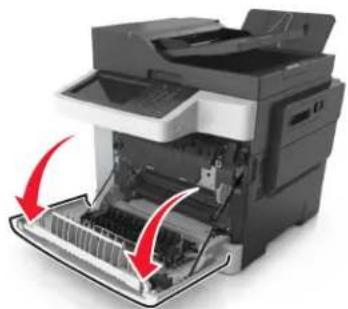
natural_image
Diagram of a printer with red arrows indicating internal structure (no text or symbols)3 Open the top door.

natural_image
Diagram of a printer with internal components and a magnified view showing a device emitting red laser beams (no text or symbols present)4 Remove the right side cover.

text_image
Diagram showing a printer's internal structure with numbered annotations and directional arrows indicating process flow.5 Press the green levers on each side of the waste toner bottle, and then remove the waste toner bottle.

text_image
Diagram showing mechanical assembly with labeled parts and directional arrows indicating process flow6 Seal the used waste toner bottle in the enclosed packaging.
For more information, see "Recycling Lexmark products" on page 199.
7 Insert the replacement waste toner bottle.

natural_image
Diagram showing engine components with a magnified view of internal components (no text or symbols)8 Insert the right side cover.

natural_image
Illustration of a computer monitor with two circular insets showing a person's face and a red arrow, no text or symbols present.9 Slide and hold the release latch on the right side of the printer, and then slowly close the top door.
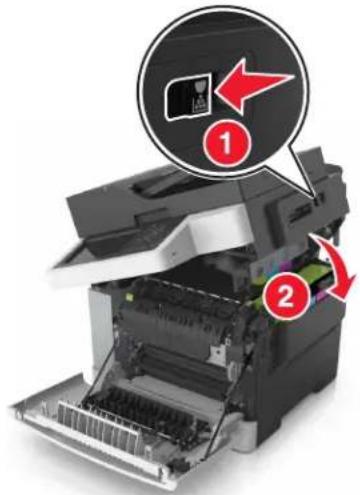
text_image
Diagram of a printer with labeled parts and directional arrows indicating process flow or movement10 Close the front door.
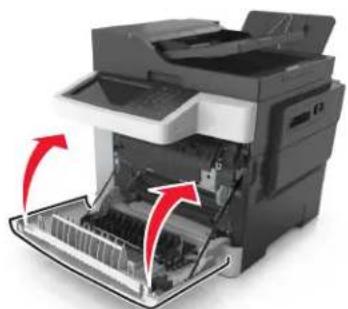
natural_image
Diagram of a printer with red arrows indicating internal components (no text or symbols present)Replacing a black and color imaging kit
1 Open the front door.

CAUTION—HOT SURFACE: The inside of the printer might be hot. To reduce the risk of injury from a hot component, allow the surface to cool before touching.
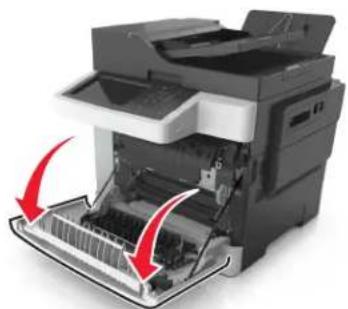
natural_image
Diagram of a printer with red arrows indicating process flow, showing internal structure and no readable text or symbols.2 Open the top door.

natural_image
Diagram of a printer with internal components and a magnified view showing a device emitting red laser beams (no text or symbols present)3 Remove the toner cartridges by lifting the handles, and then gently pulling them away from the imaging kit.

text_image
Diagram showing a printer's internal structure with numbered annotations and color-coded components, highlighting a process step.4 Remove the right side cover.

text_image
Diagram showing a printer's internal structure with labeled parts and red arrows indicating process flow or movement.5 Press the green levers on each side of the waste toner bottle, and then remove the waste toner bottle.
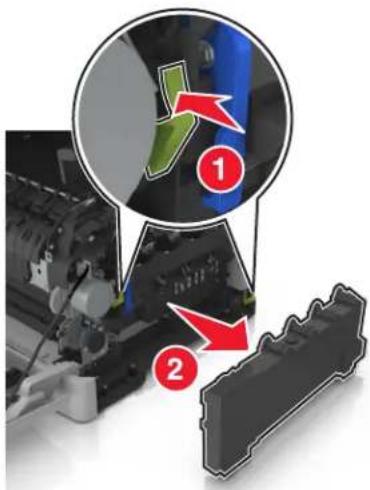
text_image
Diagram showing engine components with numbered annotations highlighting specific parts of the engine.6 Lift the blue levers on the imaging kit, and then pull the imaging kit until it stops.

text_image
Technical diagram showing mechanical assembly with numbered components and directional arrows indicating motion or movement7 Press down the blue lever, and then grasp the green handles on the sides to pull out the imaging kit.
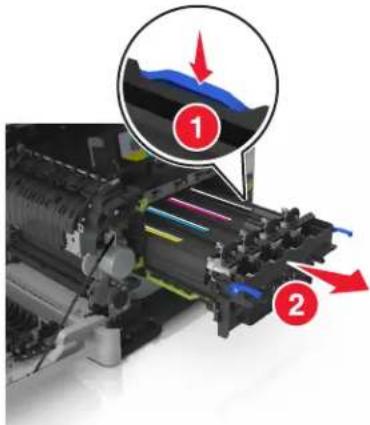
text_image
Technical diagram of a printer internal structure with numbered annotations highlighting components8 Unpack the replacement black and color imaging kit.
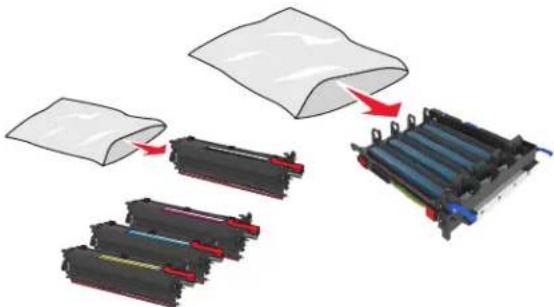
text_image
Diagram illustrating the process of printing or packaging from a paper sheet to a rolled roller, with arrows indicating the process.Notes:
- The color imaging kit includes the imaging kit and the cyan, magenta, yellow, and black developer units.
•The black imaging kit includes the imaging kit and the black developer unit.
9 Seal the used imaging kit in the bag that the replacement imaging kit came in.
For more information, see "Recycling Lexmark products" on page 199.

natural_image
Illustration of a printer with a paper roll and color strip being placed into a stack of colored ink (no text or symbols)Note: When replacing the black imaging kit, save the cyan, magenta, and yellow developer units. Dispose only the black developer unit.
10 Gently shake the yellow, cyan, magenta, and black developer units side-to-side.
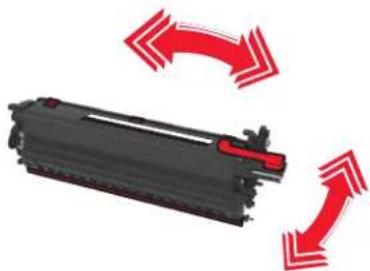
natural_image
Diagram of a black cylindrical object with red arrows indicating rotational or directional movement (no text or symbols)11 Remove the red packing strip and the attached fabric from the developer units.

natural_image
Diagram of a mechanical assembly with red and black components, no visible text or symbols12 Gently insert the yellow, cyan, magenta, and black developer units.
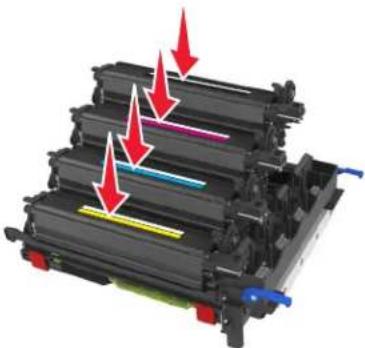
natural_image
Stacked black inkjet rollers with red arrows indicating compression or disassembly (no text or symbols visible)Note: Make sure each developer unit is inserted into the matching color slot.
13 Remove the red packing strip from the imaging kit.
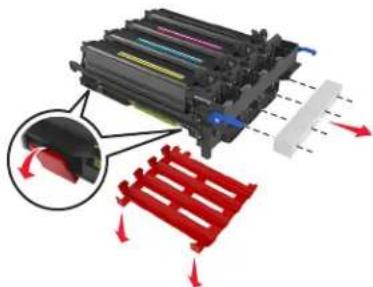
natural_image
Diagram of a black ink mill machine with red components and airflow arrows, showing internal structure (no text or symbols)Warning—Potential Damage: Do not touch the shiny photoconductor drum under the imaging kit. Doing so may affect the quality of future print jobs.

text_image
Diagram showing a battery pack with a prohibition symbol and a crossed-out tool, indicating no protection or disapproval.14 Align and then insert the imaging kit.
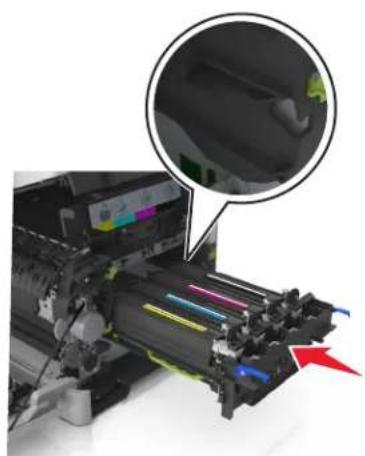
natural_image
Close-up of a printer's internal structure showing color-coded components and a magnified view of the interior (no text or symbols visible)15 Gently but firmly push the blue levers down until the imaging kit fits into place.

text_image
Diagram showing mechanical assembly steps with numbered annotations indicating sequence of componentsNote: Make sure that the imaging kit is fully seated.
16 Insert the waste toner bottle.

natural_image
Mechanical assembly diagram showing a component with highlighted parts and directional arrows (no text or symbols)17 Insert the right side cover.
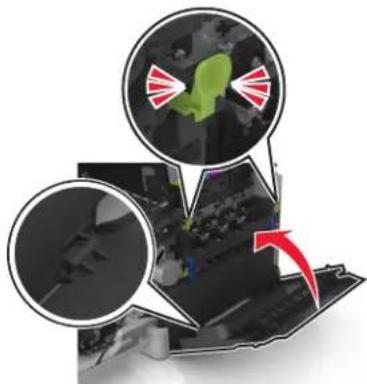
natural_image
Diagram showing two circular views of a device with green and red annotations, no readable text or symbols present.18 Insert the toner cartridges.
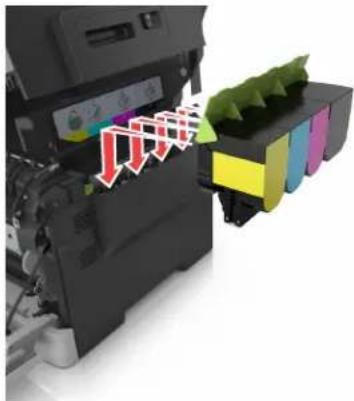
natural_image
3D rendering of a printer with colorful modules and a green leaf on top (no text or symbols visible)19 Slide and hold the release latch on the right side of the printer, and then slowly close the top door.

text_image
Diagram of a printer with labeled parts and directional arrows indicating process steps20 Close the front door.
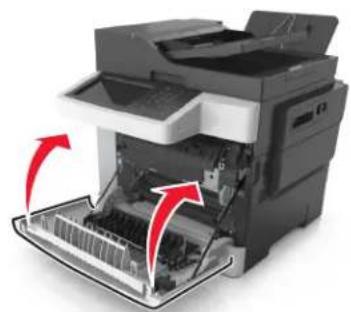
natural_image
Diagram of a printer with red arrows indicating internal components (no text or symbols present)Replacing toner cartridges
Warning—Potential Damage: Damage caused by use of a non-Lexmark toner cartridge is not covered under warranty.
Note: A reduced print quality may result from using non-Lexmark toner cartridges.
1 Open the top door.
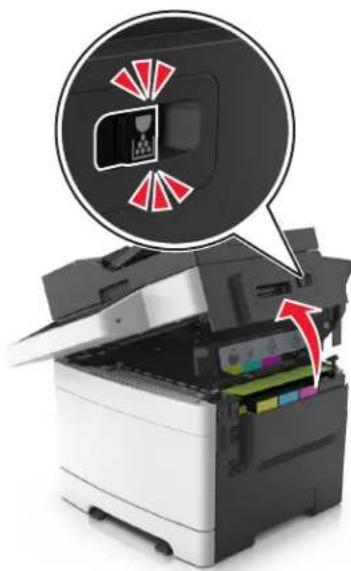
natural_image
Illustration of a printer with an open lid and red arrows indicating process flow (no text or symbols)2 Remove the toner cartridge by lifting the handle, and then gently pulling it away from the imaging kit.
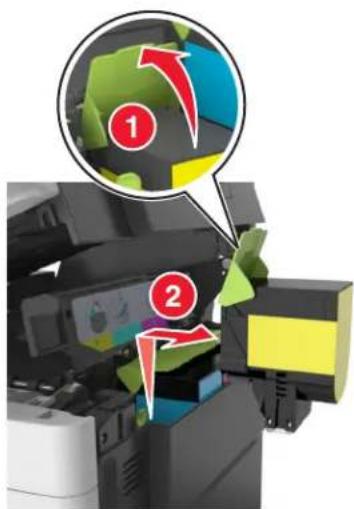
text_image
Diagram showing printer operation steps with numbered annotations highlighting green and yellow components3 Unpack the new toner cartridge, and then remove its packaging.

natural_image
Diagram showing a yellow and black component being processed by a curved paper-like structure with a red arrow indicating motion (no text or symbols present)4 Align the new toner cartridge, and then press the cartridge down until it fits into place.

natural_image
3D printer internal structure showing color-coded paper and paper sheets (no text or symbols visible)5 Slide and hold the release latch on the right side of the printer, and then slowly close the top door.

text_image
Diagram showing a printer with labeled parts and a red arrow indicating action, highlighting the first section as component 1.6 Seal the used toner cartridge in the bag that the replacement toner cartridge came in. For more information, see "Recycling Lexmark products" on page 199.
Replacing a developer unit
Replace the developer unit when a print quality defect occurs or when damage occurs to the printer.
1 Open the front door.

CAUTION—HOT SURFACE: The inside of the printer might be hot. To reduce the risk of injury from a hot component, allow the surface to cool before touching.

natural_image
Diagram of a printer with red arrows indicating internal structure, showing paper feed and print output (no text or symbols present)2 Open the top door.
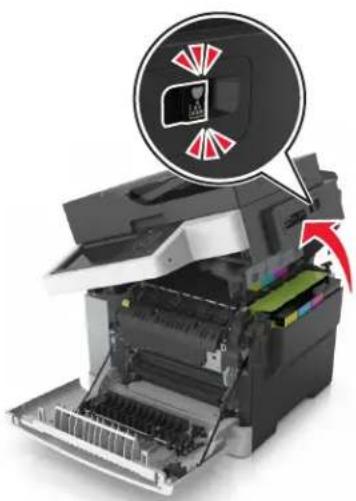
natural_image
Disassembled printer with internal components and a magnified inset showing a circular component (no text or symbols visible)3 Lift the toner cartridge handle, and then gently pull it from the imaging kit.

text_image
Diagram showing a printer's internal structure with numbered annotations and color-coded components, highlighting a process step.4 Remove the right side cover.

text_image
Diagram showing a printer's internal structure with labeled parts and red arrows indicating process flow or transformation.5 Press the green levers on each side of the waste toner bottle, and then remove the waste toner bottle.
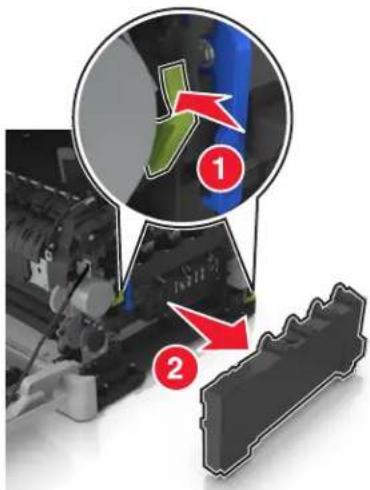
text_image
Diagram showing engine components with numbered annotations highlighting specific parts of the engine.6 Lift the blue levers on the imaging kit, and then pull the imaging kit until it stops.

text_image
Diagram showing mechanical assembly with numbered annotations indicating components and directional arrows7 Press down the blue lever, and then grasp the green handles on the sides to pull out the imaging kit.
Warning—Potential Damage: Do not touch the underside of the imaging kit. Doing so could damage the imaging kit.
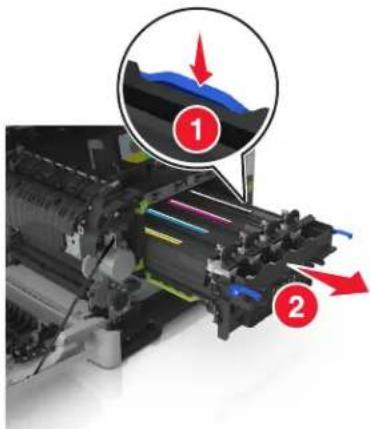
text_image
Technical diagram of a mechanical assembly with numbered components and directional arrows indicating flow or movement.8 Remove the used developer unit.
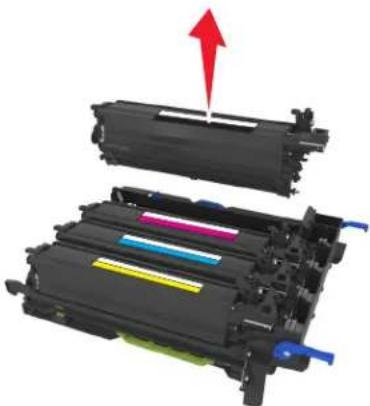
natural_image
Two stacked black ink打印机 with colored bands and a red arrow indicating compression (no text or symbols)9 Gently shake the replacement developer unit side-to-side before removing it from its packaging.

natural_image
3D rendering of a black rectangular object with red arrows indicating rotational or directional movement (no text or symbols)10 Remove the red shipping cover from the developer unit.

natural_image
Diagram of a mechanical assembly with red arrows indicating motion or force direction (no text or symbols)11 Insert the developer unit.
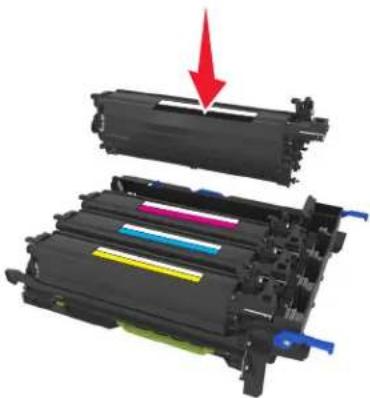
natural_image
Two stacked black inkjet collectors with colored tubes, one highlighted by a red arrow (no text or symbols visible)12 Align and then insert the imaging kit.

natural_image
Close-up of a printer's internal structure with color-coded modules and a magnified inset showing internal components (no text or symbols visible)13 Gently but firmly push the blue levers down until the imaging kit fits into place.
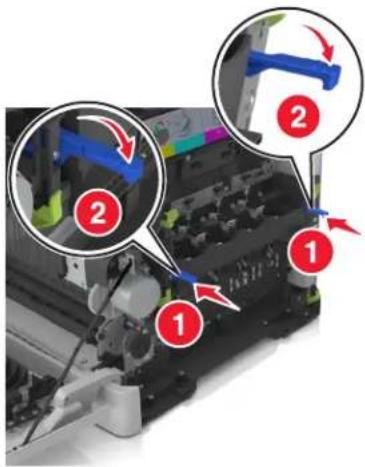
text_image
Diagram showing mechanical assembly steps with numbered annotations indicating process flowNote: Make sure that the imaging kit is fully seated.
14 Replace the waste toner bottle.
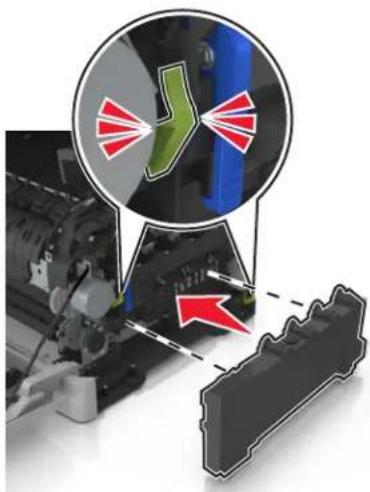
natural_image
Mechanical assembly diagram showing a component with highlighted parts and directional arrows (no text or symbols)15 Insert the right side cover.
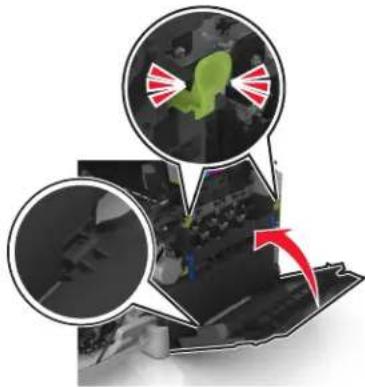
natural_image
Close-up of a car dashboard with two circular insets showing a green vehicle and red warning symbols (no text or labels)16 Insert the toner cartridges.
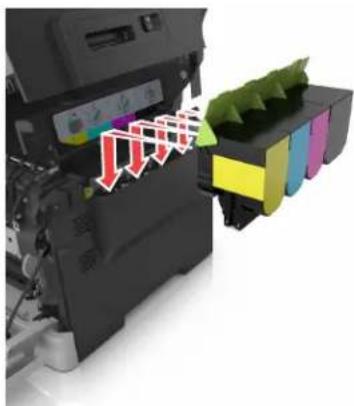
natural_image
3D rendering of a printer emitting a colorful block with a green leaf, no visible text or symbols17 Slide and hold the release latch on the right side of the printer, and then slowly close the top door.
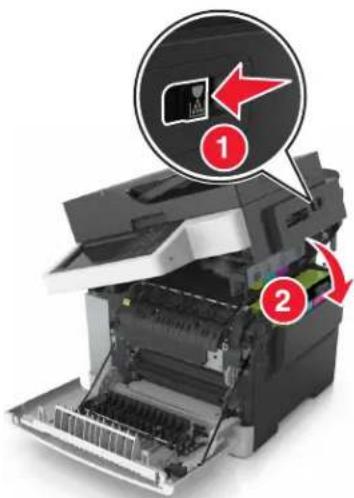
text_image
Diagram of an HP printer with numbered callouts highlighting internal components and directional arrows indicating process flow.18 Close the front door.
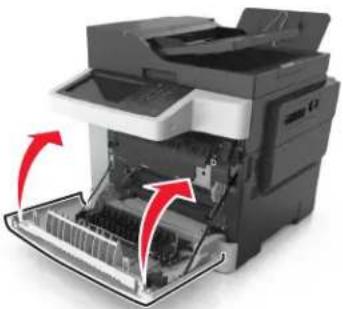
natural_image
Diagram of a printer with red arrows indicating internal components (no text or symbols present)19 Seal the used developer unit in the bag that the replacement developer unit came in. For more information, see "Recycling Lexmark products" on page 199.
Moving the printer
Before moving the printer

CAUTION—POTENTIAL INJURY: The printer weight is greater than 18 kg (40 lb) and requires two or more trained personnel to lift it safely.

CAUTION—POTENTIAL INJURY: Before moving the printer, follow these guidelines to avoid personal injury or printer damage:
- Turn the printer off using the power switch, and then unplug the power cord from the electrical outlet.
- Disconnect all cords and cables from the printer before moving it.
- Lift the printer off the optional tray, and then set it aside instead of trying to lift the tray and printer at the same time.
Note: Use the handholds located on both sides of the printer to lift it.
Warning—Potential Damage: Damage to the printer caused by improper moving is not covered by the printer warranty.
Moving the printer to another location
The printer and its hardware options can be safely moved to another location by following these precautions:
- Any cart used to move the printer must have a surface able to support the full footprint of the printer.
- Any cart used to move the hardware options must have a surface able to support the dimensions of the hardware options.
- Keep the printer in an upright position.
- Avoid severe jarring movements.
Shipping the printer
When shipping the printer, use the original packaging.
Managing the printer
Finding advanced networking and administrator information
This chapter covers basic administrative support tasks using the Embedded Web Server. For more advanced system support tasks, see the Networking Guide on the Software and Documentation CD or the Embedded Web Server — Security: Administrator's Guide on the Lexmark support Web site athttp://support.lexmark.com.
Checking the virtual display
1 Open a Web browser, and then type the printer IP address in the address field.
Notes:
- View the printer IP address in the TCP/IP section in the Network/Ports menu. The IP address appears as four sets of numbers separated by periods, such as 123.123.123.123.
- If you are using a proxy server, then temporarily disable it to load the Web page correctly.
2 Check the virtual display that appears at the top left corner of the screen.
The virtual display works as an actual display would work on a printer control panel.
Setting up e-mail alerts
Configure the printer to send you e-mail alerts when the supplies are getting low or when the paper needs to be changed or added, or when there is a paper jam.
1 Open a Web browser, and then type the printer IP address in the address field.
Notes:
- View the printer IP address on the printer home screen. The IP address appears as four sets of numbers separated by periods, such as 123.123.123.123.
- If you are using a proxy server, then temporarily disable it to load the Web page correctly.
2 Click Settings.
3 From the Other Settings menu, click E-mail Alert Setup.
4 Select the items you want to be notified on, and then type the e-mail addresses.
5 Click Submit.
Note: For information on setting up the e-mail server, contact your system support person.
Viewing reports
You can view some reports from the Embedded Web Server. These reports are useful for assessing the status of the printer, network, and supplies.
1 Open a Web browser, and then type the printer IP address in the address field.
Notes:
- View the printer IP address on the printer home screen. The IP address appears as four sets of numbers separated by periods, such as 123.123.123.123.
- If you are using a proxy server, then temporarily disable it to load the Web page correctly.
2 Click Reports, and then click the type of report you want to view.
Configuring supply notifications from the Embedded Web Server
You can determine how you would like to be notified when supplies run nearly low, low, very low, or reach their end-of-life by setting the selectable alerts.
Notes:
- You can select alerts for toner cartridges, imaging kit, maintenance kit, and waste toner bottle.
- All alerts can be set for nearly low, low, and very low supply conditions. Not all alerts can be set for the end-of-life supply condition. E-mail alert is available for all supply conditions.
- The percentage of estimated remaining supply that prompts the alert can be set on some supplies for some supply conditions.
1 Open a Web browser, and then type the printer IP address in the address field.
Notes:
- View the printer IP address in the TCP/IP section in the Network/Ports menu. The IP address appears as four sets of numbers separated by periods, such as 123.123.123.123.
- If you are using a proxy server, then temporarily disable it to load the Web page correctly.
2 Click Settings > Print Settings > Supply Notifications.
3 From the drop-down menu for each supply, select one of the following notification options:
| Notification Description | |
| Off The normal printer behavior for all supplies occurs. | |
| E-mail Only | The printer generates an e-mail when the supply condition is reached. The status of the supply appears on the menus page and status page. |
| Warning The printer shows | the warning message and generates an email about the status of the supply. The printer does not stop when the supply condition is reached. |
| Continuable Stop^1 | The printer stops processing jobs when the supply condition is reached. The user needs to press a button to continue printing. |
| Non Continuable Stop^1,2 | The printer stops when the supply condition is reached. The supply must be replaced to continue printing. |
| ^1 The printer generates an e-mail about the status of the supply when supply notification is enabled. ^2 The printer stops when some supplies become empty to prevent damage. | |
4 Click Submit.
Copying printer settings to other printers
Note: This feature is available only in network printers.
1 Open a Web browser, and then type the printer IP address in the address field.
Notes:
- View the printer IP address in the TCP/IP section in the Network/Ports menu. The IP address appears as four sets of numbers separated by periods, such as 123.123.123.123.
- If you are using a proxy server, then temporarily disable it to load the Web page correctly.
2 Click the Copy Printer Settings.
3 To change the language, select a language from the drop-down menu, and then click Click here to submit language.
4 Click Printer Settings.
5 Type the IP addresses of the source and target printers in their appropriate fields.
Note: If you want to add or remove a target printer, then click Add Target IP or Remove Target IP.
6 Click Copy Printer Settings.
Restoring factory default settings
If you want to keep a list of the current menu settings for reference, then print a menu settings page before restoring the factory default settings. For more information, see "Printing a menu settings page" on page 41.
If you want a more comprehensive method of restoring the printer factory default settings, then perform the Wipe All Settings option. For more information, see "Erasing non-volatile memory" on page 202.
Warning—Potential Damage: Restoring factory defaults returns most printer settings to the original factory default settings. Exceptions include the display language, custom sizes and messages, and network/port menu settings. All downloads stored in the RAM are deleted. Downloads stored in the flash memory or in a printer hard disk are not affected.
From the home screen, navigate to:

Settings > General Settings > Factory Defaults > Restore Now > Submit
Clearing jams
Avoiding jams
Load paper properly
•Make sure paper lies flat in the tray.

text_image
Correct loading of paper Incorrect loading of paper- Do not remove a tray while the printer is printing.
- Do not load a tray while the printer is printing. Load it before printing, or wait for a prompt to load it.
- Do not load too much paper. Make sure the stack height is below the maximum paper fill indicator.
- Do not slide the paper into the tray. Load paper as shown in the illustration.

natural_image
3D illustration of a printer with green internal compartments and a red downward arrow indicating compression or disassembly (no text or symbols)- Make sure the guides in the tray or the multipurpose feeder are properly positioned and are not pressing tightly against the paper or envelopes.
- Push the tray firmly into the printer after loading paper.
Use recommended paper
- Use only recommended paper or specialty media.
- Do not load wrinkled, creased, damp, bent, or curled paper.
•Flex, fan, and straighten paper before loading it.

text_image
Diagram illustrating three-step folding or cutting process with red arrows indicating direction of movement- Do not use paper that has been cut or trimmed by hand.
- Do not mix paper sizes, weights, or types in the same tray.
- Make sure the paper size and type are set correctly on the computer or printer control panel.
- Store paper per manufacturer recommendations.
Understanding jam messages and locations
When a jam occurs, a message indicating the jam location and information to clear the jam appears on the printer display. Open the doors, covers, and trays indicated on the display to remove the jam.
Note: When Jam Recovery is set to On or Auto, the printer reprints jammed pages. However, Auto does not guarantee that the page will print.
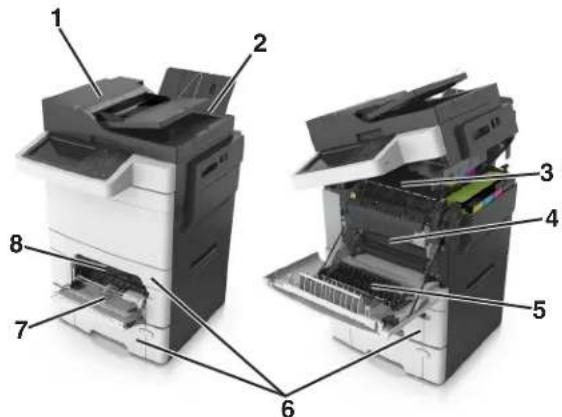
text_image
Exploded view diagram of a printer showing internal components with numbered labels| Jam location Message | on the display What to do | ||
| 1 | Automatic document feeder (ADF) | [x]-page jam, open automatic feeder top cover [28y.xx] | Remove all paper from the ADF tray, and then remove the jammed paper. |
| 2 | Standard bin | [x]-page jam, clear standard bin [203.xx] | Remove the jammed paper. |
| 3 | Fuser | [x]-page jam, open front door to clear fuser [202.xx] | Open the front door, then pull the tab and hold the fuser cover down, and then remove the jammed paper. |
| 4 | Front door | [x]-page jam, open front door [20y.xx] | Open the front door, and then remove the jammed paper. |
| 5 | Duplex area | [x]-page jam, open front door to clear duplex [23y.xx] | Open the front door, and then remove the jammed paper. |
| 6 | Tray [x] | [x]-page jam, open tray [x] [24y.xx] | Pull out the indicated tray, and then remove the jammed paper. |
| 7 | Multipurpose feeder | [x]-page jam, clear multipurpose feeder [250.xx] | Push the paper release lever to lift the paper rollers, and then remove the jammed paper. |
| 8 | Manual feeder | [x]-page jam, clear manual feeder [251.xx] | Remove the jammed paper. |
[x]-page jam, clear standard bin [203.xx]
1 Open the top door.
![LEXMARK CX510de - [x]-page jam, clear standard bin [203.xx] - 1](/content/2026/06/1238831/images/a134409d3d924e4e28b5add26e6b6dfeb901e76f849e753a5cc37b8dfa114c80.jpg)
natural_image
Illustration of an open HP printer with a close-up view showing internal components and a magnified inset highlighting a device (no text or symbols present)2 Firmly grasp the jammed paper on each side, and then gently pull it out.
Note: Make sure all paper fragments are removed.
![LEXMARK CX510de - [x]-page jam, clear standard bin [203.xx] - 2](/content/2026/06/1238831/images/70fdd0ed5a34c587c55f93e2d82ff911f377ceb87a6ef2781bec5ed832b9c9fa.jpg)
natural_image
Office printer with open lid and colored paper clip, showing internal structure (no visible text or symbols)3 Open the front door.
![LEXMARK CX510de - [x]-page jam, clear standard bin [203.xx] - 3](/content/2026/06/1238831/images/cbaf159b3daba4e9aa88fd50e6d3b16f2260159f1efc96080c359acf3f52fa9e.jpg)
CAUTION—HOT SURFACE: The inside of the printer might be hot. To reduce the risk of injury from a hot component, allow the surface to cool before touching.
![LEXMARK CX510de - [x]-page jam, clear standard bin [203.xx] - 4](/content/2026/06/1238831/images/62d08803b58674d5b6c8399d8acd84083a1dee42bed30131c5245b5c6a0049c8.jpg)
natural_image
Close-up of a computer printer's internal structure with red arrows indicating process flow (no text or symbols visible)a If there is a jammed paper under the fuser, then firmly grasp the paper on each side, and then gently pull it out. Note: Make sure all paper fragments are removed.
![LEXMARK CX510de - [x]-page jam, clear standard bin [203.xx] - 5](/content/2026/06/1238831/images/2e4ee945dea0819b954493986695a96fdf1f4b3a007462f69d3ea2a8a6a06e73.jpg)
natural_image
Close-up of a printer's internal structure showing a paper feeding into a rack with red arrows indicating motion (no text or symbols visible)b Pull the green lever to open the fuser cover.
![LEXMARK CX510de - [x]-page jam, clear standard bin [203.xx] - 6](/content/2026/06/1238831/images/e4577dbf9c2a280b6c001af6185a56dd24a9f63fb68c2a12c548919d50eda478.jpg)
natural_image
Close-up of an open printer's internal structure with red arrows indicating process flow (no text or symbols visible)c If there is a jammed paper in the fuser, then hold down the fuser cover, and then remove the paper.
Note: Make sure all paper fragments are removed.
![LEXMARK CX510de - [x]-page jam, clear standard bin [203.xx] - 7](/content/2026/06/1238831/images/834cd76365bf3c9cbcafbcb33b56019a8af393c993c804719b66578e15f1eb32.jpg)
natural_image
Interior view of a printer's internal structure showing paper feed, print tray, and ventilation slots (no text or symbols visible)4 Slide and hold the release latch on the right side of the printer, and then slowly close the top door.
![LEXMARK CX510de - [x]-page jam, clear standard bin [203.xx] - 8](/content/2026/06/1238831/images/6221a43eae794e99720402fdffb5227bcdb745aae4bdc3a20516137f8acbe0ca.jpg)
text_image
Diagram of a printer with labeled parts and directional arrows indicating process flow or movement5 Close the front door.
![LEXMARK CX510de - [x]-page jam, clear standard bin [203.xx] - 9](/content/2026/06/1238831/images/d700e5fe5b1eb87831850df7f75b60fe6e35a87c0656907b1282cbb9c52aa5fa.jpg)
natural_image
Diagram of a printer with red arrows indicating internal components (no text or symbols present)6 From the printer control panel, touch Done to clear the message and continue printing.
[x]-page jam, open front door to clear fuser [20y.xx]
1 Open the front door.
![LEXMARK CX510de - [x]-page jam, open front door to clear fuser [20y.xx] - 1](/content/2026/06/1238831/images/e1f77d66cf6827e28b7d1adcc60777e1c2371eb7568f37a3f4d58e35ea9d4537.jpg)
CAUTION—HOT SURFACE: The inside of the printer might be hot. To reduce the risk of injury from a hot component, allow the surface to cool before touching.
![LEXMARK CX510de - [x]-page jam, open front door to clear fuser [20y.xx] - 2](/content/2026/06/1238831/images/628e094168515dc3902bbcd48f66ff27864810326de02b1bd017278bff01b27c.jpg)
natural_image
Diagram of a printer with red arrows indicating internal structure, showing paper feed and paper processing (no text or symbols present)2 Open the top door.
![LEXMARK CX510de - [x]-page jam, open front door to clear fuser [20y.xx] - 3](/content/2026/06/1238831/images/3bc0b135d4f7655c0e2391c12f71fe1a3d8f627b986129fb06cf8eec4e0dd81b.jpg)
natural_image
Diagram of a printer with internal components and a magnified view showing a device with red arrows indicating motion (no text or symbols present)3 Pull the green lever to open the fuser cover.
![LEXMARK CX510de - [x]-page jam, open front door to clear fuser [20y.xx] - 4](/content/2026/06/1238831/images/df61a9ba3fd40d6d4dd408fc65cf3050015ee222d024bed7402898c1c509b394.jpg)
natural_image
Close-up of an open printer with red arrows indicating process flow, showing internal components and a green label (no text or symbols present)4 Hold down the fuser cover, and then remove the jammed paper.
Note: Make sure all paper fragments are removed.
![LEXMARK CX510de - [x]-page jam, open front door to clear fuser [20y.xx] - 5](/content/2026/06/1238831/images/d680dcde5dbc3d846a432da735984eb96a7b6b15cdf1b02c914b9f8aec99444c.jpg)
natural_image
Close-up of a printer's internal structure showing paper feed, paper holder, and cooling fins (no text or symbols visible)5 Slide and hold the release latch on the right side of the printer, and then slowly close the top door.
![LEXMARK CX510de - [x]-page jam, open front door to clear fuser [20y.xx] - 6](/content/2026/06/1238831/images/78178dcd7388e1fcee2791c18c35d2a205d6b2c0d03b8c7043e1939bd4bf34a0.jpg)
text_image
Diagram of a printer with labeled parts and directional arrows indicating process steps6 Close the front door.
![LEXMARK CX510de - [x]-page jam, open front door to clear fuser [20y.xx] - 7](/content/2026/06/1238831/images/5fd335e8fcd8ea586278b585733456051e11aa6be7f35a624fcd5b1d831459bc.jpg)
natural_image
Diagram of a printer with red arrows indicating internal components (no text or symbols present)7 From the printer control panel, touch Done to clear the message and continue printing.
[x]-page jam, open front door [20y.xx]
1 Open the front door.
![LEXMARK CX510de - [x]-page jam, open front door [20y.xx] - 1](/content/2026/06/1238831/images/b685456d70d2b882432fc7cf2c053c48b159857eb15152d535b649a4b3d1bbb3.jpg)
CAUTION—HOT SURFACE: The inside of the printer might be hot. To reduce the risk of injury from a hot component, allow the surface to cool before touching.
![LEXMARK CX510de - [x]-page jam, open front door [20y.xx] - 2](/content/2026/06/1238831/images/25d164ae782b292c5572547fec25a6003ee6f0c56319215e87ece5c783cd382f.jpg)
natural_image
Close-up of a printer's internal structure with red arrows indicating process flow (no text or symbols visible)2 Firmly grasp the jammed paper on each side, and then gently pull it out.
Note: Make sure all paper fragments are removed.
![LEXMARK CX510de - [x]-page jam, open front door [20y.xx] - 3](/content/2026/06/1238831/images/c28cd779400722f3d62bb29d237cfee775eeaa0a26e04f6b2e00d29f5bb4d610.jpg)
natural_image
Close-up of a computer printer's internal structure showing a rack with cooling fins and a paper clip (no text or symbols visible)3 Close the front door.
![LEXMARK CX510de - [x]-page jam, open front door [20y.xx] - 4](/content/2026/06/1238831/images/830525166c8dfd27ce1652777ae67769a415bb9ca1d393f91eceeab24d8e2e25.jpg)
natural_image
Diagram of a printer with red arrows indicating internal components (no text or symbols present)4 From the printer control panel, touch Done to clear the message and continue printing.
[x]-page jam, open front door to clear duplex [23y.xx]
1 Open the front door.
![LEXMARK CX510de - [x]-page jam, open front door to clear duplex [23y.xx] - 1](/content/2026/06/1238831/images/3a89d4d0f5e22257ea14225d2a5db3cbd25ab2604ef32c690e6fc313b4c05e0b.jpg)
CAUTION—HOT SURFACE: The inside of the printer might be hot. To reduce the risk of injury from a hot component, allow the surface to cool before touching.
![LEXMARK CX510de - [x]-page jam, open front door to clear duplex [23y.xx] - 2](/content/2026/06/1238831/images/b63137579b687b2ea26ae4637787acca17ddc30f4ea9e26141170de905d4ba58.jpg)
natural_image
Close-up of a printer's internal structure with red arrows indicating compression or disassembly (no text or symbols visible)2 Firmly grasp the jammed paper on each side, and then gently pull it out.
Note: Make sure all paper fragments are removed.
![LEXMARK CX510de - [x]-page jam, open front door to clear duplex [23y.xx] - 3](/content/2026/06/1238831/images/7c261932aaca35e257653bbf3ccd64befe821ad221bc0db9cbaba93d056d77fa.jpg)
natural_image
Close-up of a printer's internal structure showing a tray with rollers and a paper holder (no text or symbols visible)3 Close the front door.
![LEXMARK CX510de - [x]-page jam, open front door to clear duplex [23y.xx] - 4](/content/2026/06/1238831/images/56d2f33068819f1f9fa572c9111a17324436c45f98318d62848bd385e6755f1d.jpg)
natural_image
Diagram of a printer with red arrows indicating internal components (no text or symbols present)4 From the printer control panel, touch Done to clear the message and continue printing.
[x]-page jam, open tray [x] [24y.xx]
1 Pull out the tray completely.
Note: The message on the printer display determines in which tray the paper jam is located.
![LEXMARK CX510de - [x]-page jam, open tray [x] [24y.xx] - 1](/content/2026/06/1238831/images/81f3a11aff1e6966b5c1b755149ba30783058fbdfc3567f8ccea1cc4f511d54a.jpg)
natural_image
Three-step illustration of a printer's internal structure showing paper feeding, with red arrows indicating motion (no text or symbols)2 Firmly grasp the jammed paper on each side, and then gently pull it out.
Note: Make sure all paper fragments are removed.
![LEXMARK CX510de - [x]-page jam, open tray [x] [24y.xx] - 2](/content/2026/06/1238831/images/f5242bd1010cd8ff6e319799664230873eca2feaf776d63b79c6cd71e0c81dca.jpg)
3 Insert the tray.
4 From the printer control panel, touch Done to clear the message and continue printing.
[x]-page jam, clear manual feeder [251.xx]
1 Pull out the standard 250-sheet tray (Tray 1) and manual feeder.
![LEXMARK CX510de - [x]-page jam, clear manual feeder [251.xx] - 1](/content/2026/06/1238831/images/22b5edef6315c03c2a96101292e26ab592159893c3076f4fd87cab197f0d7e7c.jpg)
natural_image
Close-up of a printer's internal structure with green and gray components, showing paper feed and paper sheet (no text or symbols visible)2 Firmly grasp the jammed paper on each side, and then gently pull it out.
Note: Make sure all paper fragments are removed.
![LEXMARK CX510de - [x]-page jam, clear manual feeder [251.xx] - 2](/content/2026/06/1238831/images/47b030f04cb060ae33ab5723a72fbbc86a199c5aba200ca17e568a237e171932.jpg)
natural_image
Close-up of a printer emitting paper strips with red arrows indicating compression or disassembly (no text or symbols present)3 Insert the tray.
4 From the printer control panel, touch Done to clear the message and continue printing.
[x]-page jam, clear multipurpose feeder [250.xx]
1 Push the paper release lever in the multipurpose feeder to access the jammed paper, and then gently pull out the paper.
Note: Make sure all paper fragments are removed.
![LEXMARK CX510de - [x]-page jam, clear multipurpose feeder [250.xx] - 1](/content/2026/06/1238831/images/d2abf4deeda41dec51b567af06a039fcdff44b073995305196cae2cace60b2dc.jpg)
text_image
Diagram showing printer printing process with numbered callouts highlighting key steps2 Flex the sheets of paper back and forth to loosen them, and then fan them. Do not fold or crease the paper. Straighten the edges on a level surface.
![LEXMARK CX510de - [x]-page jam, clear multipurpose feeder [250.xx] - 2](/content/2026/06/1238831/images/f3464cab79a9f3c77a762a05cbc5c70721e3dcf6effb7616c77cad9d07157019.jpg)
text_image
Diagram illustrating three-step folding or cutting process with red arrows indicating direction of movement3 Reload paper into the multipurpose feeder.
![LEXMARK CX510de - [x]-page jam, clear multipurpose feeder [250.xx] - 3](/content/2026/06/1238831/images/e7be23f29bfe9df4f86bf18b83caa406ae34a4e3b7995f4caee7b7c174d9adb3.jpg)
natural_image
Close-up of a printer printer with paper being inserted, showing paper sheet and printer outline (no text or symbols visible)4 Slide the paper guide until it lightly rests against the edge of the paper stack.
![LEXMARK CX510de - [x]-page jam, clear multipurpose feeder [250.xx] - 4](/content/2026/06/1238831/images/807561a6c0fbf05cc4acce8ff64ffe51fa3e8d07f5c8cbf00ad3bb12d77a1ce7.jpg)
text_image
Diagram showing printer printing process with numbered annotations highlighting key components5 From the printer control panel, touch Done to clear the message and continue printing.
[x]-page jam, open automatic feeder top cover [28y.xx]
1 Remove all original documents from the ADF tray.
Note: The message is cleared when the pages are removed from the ADF tray.
2 Open the ADF cover.
![LEXMARK CX510de - [x]-page jam, open automatic feeder top cover [28y.xx] - 1](/content/2026/06/1238831/images/fc112ef61bb6a91b96af86b2a2b8e49973c81f1078cf36ca2a559b1aa4790303.jpg)
natural_image
Interior view of a printer showing internal components and a red arrow indicating a process (no text or symbols present)3 Firmly grasp the jammed paper on each side, and then gently pull it out.
Note: Make sure all paper fragments are removed.
![LEXMARK CX510de - [x]-page jam, open automatic feeder top cover [28y.xx] - 2](/content/2026/06/1238831/images/d5ed1ce5c652e11b6ff54b57bf8ce65dc53d845a7b2a44e2c3a43231b7886908.jpg)
natural_image
Interior view of a printer showing internal components and a paper airplane (no text or symbols visible)4 Close the ADF cover.
5 Straighten the edges of the original documents, then load the documents into the ADF, and then adjust the paper guide.
6 From the printer control panel, touch Done to clear the message and continue printing.
Troubleshooting
Understanding the printer messages
Adjusting color
Wait for the process to complete.
Change [paper source] to [custom string]
Try one or more of the following:
- Load the correct size and type of paper in the tray, and then touch Finished changing paper on the printer control panel.
Note: Make sure the paper size and type are specified in the Paper menu on the printer control panel.
- Cancel the print job.
Change [paper source] to [custom type name]
Try one or more of the following:
- Load the correct size and type of paper in the tray or feeder, and then touch Finished changing paper on the printer control panel.
Note: Make sure the paper size and type are specified in the Paper menu on the printer control panel.
- Cancel the print job.
Change [paper source] to [paper type] [paper size]
Try one or more of the following:
- Load the correct size and type of paper in the tray or feeder, and then touch Finished changing paper on the printer control panel.
Note: Make sure the paper size and type are specified in the Paper menu on the printer control panel.
- Cancel the print job.
Close door
Make sure the right side cover is installed, and then close the front and top doors to clear the message.
Close flatbed cover and load originals if restarting job [2yy.xx]
Try one or more of the following:
- Touch Scan from automatic feeder to continue scanning from the ADF immediately after the last successful scan job.
- Touch Scan from flatbed to continue scanning from the scanner glass immediately after the last successful scan job.
- Touch Finish job without further scanning to end the last successful scan job.
Note: This does not cancel the scan job. All successfully scanned pages will be processed further for copying, faxing, or e-mailing.
- Touch Cancel job to clear the message and cancel the scan job.
[Color] cartridge low [88.xy]
You may need to order a toner cartridge. If necessary, touch Continue on the printer control panel to clear the message and continue printing.
[Color] cartridge nearly low [88.xy]
If necessary, touch Continue on the printer control panel to clear the message and continue printing.
[Color] cartridge very low, [x] estimated pages remain [88.xy]
You may need to replace the toner cartridge very soon. For more information, see the “Replacing supplies” section of the User’s Guide.
If necessary, touch Continue on the printer control panel to clear the message and continue printing.
Complex page, some data may not have printed [39]
Try one or more of the following:
- From the printer control panel, touch Continue to ignore the message and continue printing.
- Cancel current print job.
•Install additional printer memory.
Configuration change, some held jobs were not restored [57]
Held jobs are invalidated because of the following possible changes in the printer:
•The printer firmware has been updated.
•The tray for the print job has been removed.
- The print job is sent from a flash drive that is no longer attached to the USB port.
- The printer hard disk contains print jobs that were stored when the hard disk was installed in a different printer model.
From the printer control panel, touch Continue to clear the message.
Defective flash detected [51]
Try one or more of the following:
-Replace the defective flash memory card.
- From the printer control panel, touch Continue to ignore the message and continue printing.
- Cancel the current print job.
Disk full [62]
Try one or more of the following:
- From the printer control panel, touch Continue to clear the message and continue processing.
- Delete fonts, macros, and other data stored in the printer hard disk.
• Install a printer hard disk with larger capacity.
Note: To install a printer hard disk, contact customer support at http://support.lexmark.com or your service representative.
Disk must be formatted for use in this device
From the printer control panel, touch Format disk to format the printer hard disk and clear the message.
Note: Formatting deletes all the files stored in the printer hard disk.
Error reading USB drive. Remove USB.
An unsupported USB device is inserted. Remove the USB device, and then insert a supported one.
Error reading USB hub. Remove hub.
An unsupported USB hub has been inserted. Remove the USB hub, and then install a supported one.
Fax partition inoperative. Contact system administrator.
Try one or more of the following:
- From the printer control panel, touch Continue to clear the message.
- Turn off the printer, and then turn it back on. If the message appears again, then contact your system support person.
Fax server 'To Format' not set up. Contact system administrator.
Try one or more of the following:
- From the printer control panel, touch Continue to clear the message.
- Complete the Fax Server setup. If the message appears again, then contact your system support person.
Fax Station Name not set up. Contact system administrator.
Try either of the following:
- From the printer control panel, touch Continue to clear the message.
- Complete the Analog Fax setup. If the message appears again after completing the setup, then contact your system support person.
Fax Station Number not set up. Contact system administrator.
Try one or more of the following:
- From the printer control panel, touch Continue to clear the message.
- Complete the Analog Fax setup. If the message appears again after completing the setup, then contact your system support person.
Incompatible tray [x] [59]
Remove, and then reinstall the indicated tray to clear the message.
Incorrect paper size, open [paper source] [34]
Try one or more of the following:
- Load the correct size and type of paper in the tray, and then specify the paper size and type in the Paper menu on the printer control panel.
- Make sure the correct paper size and type are specified in Print Properties or the Print dialog settings.
- Check if the paper size is correctly set. For example, if MP Feeder Size is set to Universal, then make sure the paper is large enough for the data being printed.
- Check the length and width guides and make sure the paper is loaded properly in the tray.
- From the printer control panel, touch Continue to clear the message and print using a different tray.
- Cancel the print job.
Insert Tray [x]
Insert the indicated tray into the printer.
Insufficient memory for Flash Memory Defragment operation [37]
Try one or more of the following:
- From the printer control panel, touch Continue to stop the defragmentation and continue printing.
- Delete fonts, macros, and other data in the printer memory.
•Install additional printer memory.
Insufficient memory, some Held Jobs were deleted [37]
From the printer control panel, touch Continue to clear the message.
Insufficient memory to collate job [37]
Try one or more of the following:
- From the printer control panel, touch Continue to print the part of the job already stored and begin collating the rest of the print job.
- Cancel the current print job.
Insufficient memory to support Resource Save feature [35]
Install additional printer memory or touch Continue to disable Resource Save, clear the message, and continue printing.
Insufficient memory, some held jobs will not be restored [37]
Try one or more of the following:
- From the printer control panel, touch Continue to clear the message.
- Delete other held jobs to free up additional printer memory.
Load [paper source] with [custom string]
Try one or more of the following:
- Load the tray or feeder with the correct size and type of paper.
- To use the tray or feeder with the correct size and type of paper, touch Finished loading paper on the printer control panel.
Note: If the printer finds a tray or feeder that has the correct size and type of paper, then it feeds from that tray or feeder. If the printer cannot find a tray or feeder with the correct size and type of paper, then it prints from the default paper source.
- Cancel the current job.
Load [paper source] with [custom type name]
Try one or more of the following:
- Load the tray or feeder with the correct size and type of paper.
- To use the tray or feeder with the correct size and type of paper, touch Finished loading paper on the printer control panel.
Note: If the printer detects a tray or feeder that has the correct size and type of paper, then it feeds from that tray or feeder. If the printer cannot detect a tray or feeder that has the correct size and type of paper, then it prints from the default paper source.
- Cancel the current job.
Load [paper source] with [paper size]
Try one or more of the following:
- Load the tray or feeder with the correct size of paper.
- To use the tray or feeder with the correct size of paper, touch Finished loading paper on the printer control panel.
Note: If the printer finds a tray or feeder that has the correct size of paper, then it feeds from that tray or feeder. If the printer cannot find a tray or feeder with the correct size of paper, then it prints from the default paper source.
- Cancel the current job.
Load [paper source] with [paper type] [paper size]
Try one or more of the following:
- Load the tray or feeder with the correct size and type of paper.
- To use the tray or feeder with the correct size and type of paper, touch Finished loading paper on the printer control panel.
Note: If the printer finds a tray or feeder that has the correct size and type of paper, then it feeds from that tray or feeder. If the printer cannot find a tray or feeder with the correct size and type of paper, then it prints from the default paper source.
- Cancel the current job.
Load Manual Feeder with [custom string]
Try one or more of the following:
- Load the feeder with the correct size and type of paper.
- From the printer control panel, touch Prompt each page, paper loaded or Do not prompt, paper loaded to clear the message and continue printing.
- From the printer control panel, touch Automatically select paper to use the paper loaded in the tray.
- Cancel the print job.
Load Manual Feeder with [custom type name]
Try one or more of the following:
- Load the feeder with the correct size and type of paper.
- From the printer control panel, touch Prompt each page, paper loaded or Do not prompt, paper loaded to clear the message and continue printing.
- From the printer control panel, touch Automatically select paper to use the paper loaded in the tray.
- Cancel the print job.
Load Manual Feeder with [paper size]
Try one or more of the following:
- Load the feeder with the correct size of paper.
- From the printer control panel, touch Prompt each page, paper loaded or Do not prompt, paper loaded to clear the message and continue printing.
- From the printer control panel, touch Automatically select paper to use the paper loaded in the tray.
- Cancel the print job.
Load Manual Feeder with [paper type] [paper size]
Try one or more of the following:
- Load the feeder with the correct size and type of paper.
- From the printer control panel, touch Prompt each page, paper loaded or Do not prompt, paper loaded to clear the message and continue printing.
- From the printer control panel, touch Automatically select paper to use the paper loaded in the tray.
- Cancel the print job.
Maintenance kit low [80.xy]
You may need to order a maintenance kit. For more information, visit the Lexmark support Web site at http://support.lexmark.com or contact customer support, and then report the message.
If necessary, touch Continue to clear the message and continue printing.
Maintenance kit nearly low [80.xy]
For more information, visit the Lexmark support Web site at http://support.lexmark.com or contact customer support, and then report the message.
If necessary, touch Continue to clear the message and continue printing.
Maintenance kit very low, [x] estimated pages remain [80.xy]
You may need to replace the maintenance kit very soon. For more information, visit the Lexmark support Web site at http://support.lexmark.com or contact customer support, and then report the message.
If necessary, touch Continue to clear the message and continue printing.
Memory full [38]
Try one or more of the following:
- From the printer control panel, touch Cancel job to clear the message.
•Install additional printer memory.
Memory full, cannot print faxes
From the printer control panel, touch Continue to clear the message without printing. Held faxes attempt to print after the printer is restarted.
Memory full, cannot send faxes
1 From the printer control panel, touch Continue to clear the message and cancel the fax job.
2 Try one or more of the following:
- Reduce the fax resolution, and then resend the fax job.
- Reduce the number of pages in the fax, and then resend the fax job.
Network [x] software error [54]
Try one or more of the following:
- From the printer control panel, touch Continue to continue printing.
- Turn off the printer, wait for about 10 seconds, and then turn the printer back on.
- Update the network firmware in the printer or print server. For more information, visit the Lexmark support Web site at http://support.lexmark.com.
No analog phone line connected to modem, fax is disabled.
Connect the printer to an analog phone line.
Non-Lexmark [color] [supply type], see User's Guide [33.xy]
Note: The supply type can be a toner cartridge or the imaging kit.
The printer has detected a non-Lexmark supply or part installed in the printer.
Your Lexmark printer is designed to function best with genuine Lexmark supplies and parts. Use of third-party supplies or parts may affect the performance, reliability, or life of the printer and its imaging components.
All life indicators are designed to function with Lexmark supplies and parts, and may deliver unpredictable results if third-party supplies or parts are used. Imaging component usage beyond the intended life may damage your Lexmark printer or its associated components.
Warning—Potential Damage: Use of third-party supplies or parts can affect warranty coverage. Damage caused by the use of third-party supplies or parts may not be covered by the warranty.
To accept any and all of these risks, and to proceed with the use of non-genuine supplies or parts in your printer, press
and hold ✗ and the # button on the printer control panel simultaneously for 15 seconds.
If you do not wish to accept these risks, then remove the third-party supply or part from your printer, and then install a genuine Lexmark supply or part.
Note: For the list of supported supplies, see the “Ordering supplies” section of the User's Guide or visit www.lexmark.com.
Not enough free space in flash memory for resources [52]
Try one or more of the following:
- From the printer control panel, touch Continue to clear the message and continue printing.
- Delete fonts, macros, and other data stored in the flash memory.
• Install a flash memory card with larger capacity.
Note: Downloaded fonts and macros not previously stored in the flash memory are deleted.
Printer had to restart. Last job may be incomplete.
From the printer control panel, touch Continue to clear the message and continue printing.
For more information, visit http://support.lexmark.com or contact customer support.
Reinstall missing or unresponsive [color] cartridge [31.xy]
Try one or more of the following:
- Install the missing toner cartridge. For more information, see the "Replacing supplies" section of the User's Guide.
- Remove the unresponsive cartridge, and then reinstall it.
Note: If the message appears after reinstalling the supply, then the cartridge may be defective. Replace the cartridge.
Reinstall missing or unresponsive [type] imaging kit [31.xy]
Note: The type can be a black imaging kit, or a black and color imaging kit.
Try one or more of the following:
- Install the missing imaging kit. For more information, see the "Replacing supplies" section of the User's Guide.
- Remove the unresponsive imaging kit, and then reinstall it.
Note: If the message appears after reinstalling the supply, then the imaging kit may be defective. Replace the imaging kit.
Reload printed pages in Tray [x]
Try any of the following:
- From the printer control panel, touch Continue to clear the message and continue printing the second side of the sheet.
- Cancel the print job.
Remove defective disk [61]
Remove and replace the defective printer hard disk.
Note: To replace the printer hard disk, contact customer support at http://support.lexmark.com or your service representative.
Remove packaging material, [area name]
1 Remove any remaining packing material from the indicated location.
2 From the printer control panel, touch Continue to clear the message.
Remove paper from standard output bin
Remove the paper stack from the standard bin.
Replace all originals if restarting job.
Try one or more of the following:
- Touch Cancel job to clear the message and cancel the scan job.
- Touch Scan from automatic feeder to continue scanning from the ADF immediately after the last successful scan job.
- Touch Scan from flatbed to continue scanning from the scanner immediately after the last successful scan job.
- Touch Finish job without further scanning to end the last successful scan job.
- Touch Restart job to restart the scan job with the same settings from the previous scan job.
Replace [color] cartridge, 0 estimated pages remain [88.xy]
Replace the indicated toner cartridge to clear the message and continue printing. For more information, see the instruction sheet that came with the supply.
Note: If you do not have a replacement cartridge, then see the “Ordering supplies” section of the User’s Guide or visit www.lexmark.com.
Replace [color] cartridge, printer region mismatch [42.xy]
Install a toner cartridge that matches the region number of the printer. x indicates the value of the printer region. y indicates the value of the cartridge region. x and y can have the following values:
| Region number Region | ||||||
| 0 | G | I | o | b | a | I |
| 1 United States, Canada | ||||||
| 2 European Union (EU), European Economic Area (EEA), Switzerland | ||||||
| 8 Rest of the world | ||||||
| 9 | I | n | v | a | I | i d |
Notes:
- The x and y values represent .xy in the error code that appears on the printer control panel.
•The x and y values must match for printing to continue.
Replace defective [type] imaging kit [31.xy]
Note: The type can be a black imaging kit, or a black and color imaging kit.
Replace the defective imaging kit to clear the message and continue printing. For more information, see the instruction sheet that came with the supply.
Note: If you do not have a replacement imaging kit, then see the “Ordering supplies” section of the User’s Guide or visit www.lexmark.com.
Replace jammed originals if restarting job.
Try one or more of the following:
- Touch Cancel job to clear the message and cancel the scan job.
- Touch Scan from automatic feeder to continue scanning from the ADF immediately after the last successful scan job.
- Touch Scan from flatbed to continue scanning from the scanner immediately after the last successful scan job.
- Touch Finish job without further scanning to end the last successful scan job.
- Touch Restart job to restart the scan job with the same settings from the previous scan job.
Replace maintenance kit, 0 estimated pages remain [80.xy]
The printer is scheduled for maintenance. For more information, visit the Lexmark support Web site at http://support.lexmark.com or contact your service representative, and then report the message.
Replace missing [type] imaging kit [31.xy]
Note: The type can be a black imaging kit, or a black and color imaging kit.
Install the indicated imaging kit to clear the message. For more information, see the "Replacing supplies" section of the User's Guide.
Replace missing waste toner bottle [82.xy]
Install the missing waste toner bottle to clear the message. For more information, see the instruction sheet that came with the supply.
Replace [type] imaging kit, 0 estimated pages remain [84.xy]
Note: The type can be a black imaging kit, or a black and color imaging kit.
Replace the indicated imaging kit to clear the message and continue printing. For more information, see the instruction sheet that came with the supply.
Note: If you do not have a replacement imaging kit, then see the “Ordering supplies” section of the User’s Guide or visit www.lexmark.com.
Replace unsupported [color] cartridge [32.xy]
Remove the toner cartridge, and then install a supported one to clear the message.
Note: If you do not have a replacement cartridge, then see the "Ordering supplies" section of the User's Guide or visit www.lexmark.com.
Replace unsupported [type] imaging kit [32.xy]
Note: The type can be a black imaging kit, or a black and color imaging kit.
Remove the indicated imaging kit, and then install a supported one to clear the message.
Note: If you do not have a replacement imaging kit, then see the “Ordering supplies” section of the User’s Guide or visit www.lexmark.com.
Replace waste toner bottle [82.xy]
Replace the waste toner bottle to clear the message.
Restore held jobs?
Try one or more of the following:
- From the printer control panel, touch Restore to restore all held jobs stored in the printer hard disk.
- From the printer control panel, touch Do not restore if you do not want to restore any of the print jobs.
Scanner automatic feeder cover open
Close the ADF cover.
Scanner disabled by admin [840.01]
Print without the scanner, or contact your system support person.
Scanner disabled. Contact system administrator if problem persists. [840.02]
Try one or more of the following:
- Touch Continue with scanner disabled to return to the home screen, and then contact your system support person.
- Touch Reboot and automatically enable scanner to cancel the job.
Note: This attempts to enable the scanner.
Scanner jam, remove all originals from the scanner [2yy.xx]
Remove the jammed paper from the scanner.
Scanner jam, remove jammed originals from the scanner [2yy.xx]
Remove the jammed paper from the scanner.
SMTP server not set up. Contact system administrator.
From the printer control panel, touch Continue to clear the message.
Note: If the message appears again, then contact your system support person.
Some held jobs were not restored
From the printer control panel, touch Continue to delete the indicated job.
Note: Held jobs that are not restored remain in the printer hard disk and are inaccessible.
Standard network software error [54]
Try one or more of the following:
- From the printer control panel, touch Continue to continue printing.
- Turn off the printer, and then turn it back on.
- Update the network firmware in the printer or print server. For more information, visit the Lexmark support Web site at http://support.lexmark.com or contact customer support, and then report the message.
Standard USB port disabled [56]
Try one or more of the following:
- From the printer control panel, touch Continue to clear the message.
- Enable the USB port. From the printer control panel, navigate to:
Network/Ports > USB Buffer > Auto
Note: The printer discards any data received through the USB port.
Supply needed to complete job
Try one or more of the following:
- From the printer control panel, touch Prompt for supplies to view all error messages that indicate what supplies are needed to continue processing the current job.
1 Order the missing supply immediately.
2 Install the supply. For more information, see the instruction sheet that came with the supply.
- Cancel the print job, then install the missing supply, and then resend the print job.
Too many flash options installed [58]
1 Turn off the printer.
2 Unplug the power cord from the electrical outlet.
3 Remove the extra flash memory.
4 Connect the power cord to a properly grounded electrical outlet.
5 Turn the printer back on.
Too many trays attached [58]
1 Turn off the printer.
2 Unplug the power cord from the electrical outlet.
3 Remove the extra trays.
4 Connect the power cord to a properly grounded electrical outlet.
5 Turn the printer back on.
[Type] imaging kit low [84.xy]
Note: The type can be a black imaging kit, or a black and color imaging kit.
You may need to replace the imaging kit. If necessary, touch Continue on the printer control panel to clear the message and continue printing.
[Type] imaging kit nearly low [84.xy]
Note: The type can be a black imaging kit, or a black and color imaging kit.
If necessary, touch Continue on the printer control panel to clear the message and continue printing.
[Type] imaging kit very low, [x] estimated pages remain [84.xy]
Note: The type can be a black imaging kit, or a black and color imaging kit.
You may need to replace the imaging kit very soon. For more information, see the "Replacing supplies" section of the User's Guide.
If necessary, touch Continue on the printer control panel to clear the message and continue printing.
Unformatted flash detected [53]
Try one or more of the following:
- From the printer control panel, touch Continue to stop the defragmentation and continue printing.
- Format the flash memory.
Note: If the error message remains, then the flash memory may be defective and needs to be replaced.
Waste toner bottle nearly full [82.xy]
You may need to order a waste toner bottle. If necessary, touch Continue on the printer control panel to clear the message and continue printing.
Weblink server not set up. Contact system administrator.
An error occurred on the Weblink server, or the server is not configured properly. Touch Continue to clear the message. If the message appears again, contact your system support person.
Solving printer problems
Basic printer problems
Printer display is blank
| Action Yes No | ||
| Step 1Press the Sleep button on the printer control panel.Does Ready appear on the printer display? | The problem is solved. | Go to step 2. |
| Step 2Turn off the printer, then wait for about 10 seconds, and then turn the printer back on.Do Please wait and Ready appear on the printer display? | The problem is solved. | Turn off the printer, and then contact customer support. |
The printer is not responding
| Action Yes No | ||
| Step 1Make sure the printer is turned on.Is the printer turned on? | Go to step 2. Turn on the printer. | |
| Step 2Check if the printer is in Sleep mode or Hibernate mode.Is the printer in Sleep mode or Hibernate mode? | Press the Sleep button to wake the printer from Sleep mode or Hibernate mode. | Go to step 3. |
| Step 3Check if one end of the power cord is plugged into the printer and the other to a properly grounded electrical outlet.Is the power cord plugged into the printer and a properly grounded electrical outlet? | Go to step 4. Plug one end of the power cord into the printer and the other to a properly grounded electrical outlet. | |
| Step 4Check other electrical equipment plugged into the electrical outlet.Does other electrical equipment work? | Unplug the other electrical equipment, and then turn on the printer. If the printer does not work, then reconnect the other electrical equipment. | Go to step 5. |
| Step 5Check if the cables connecting the printer and the computer are inserted in the correct ports.Are the cables inserted in the correct ports? | Go to step 6. Make sure to match the following:•The USB symbol on the cable with the USB symbol on the printer•The appropriate Ethernet cable with the Ethernet port | |
| Step 6Make sure the electrical outlet is not turned off by a switch or breaker.Is the electrical outlet turned off by a switch or breaker? | Turn on the switch or reset the breaker. | Go to step 7. |
| Step 7Check if the printer is plugged into any surge protectors, uninterruptible power supplies, or extension cords.Is the printer plugged into any surge protectors, uninterruptible power supplies, or extension cords? | Connect the printer power cord directly to a properly grounded electrical outlet. | Go to step 8. |
| Step 8Check if one end of the printer cable is plugged into a port on the printer and the other to the computer, print server, option, or other network device.Is the printer cable securely attached to the printer and the computer, print server, option, or other network device? | Go to step 9. Connect the printer cable securely to the printer and the computer, print server, option, or other network device. | |
| Step 9Make sure to install all hardware options properly and remove any packing material.Are all hardware options properly installed and all packing material removed? | Go to step 10. Turn off the printer, remove all packing materials, then reinstall the hardware options, and then turn on the printer. | |
| Step 10Check if you have selected the correct port settings in the printer driver.Are the port settings correct? | Go to step 11. Use correct printer driver settings. | |
| Step 11Check the installed printer driver.Is the correct printer driver installed? | Go to step 12. Install the correct printer driver. | |
| Step 12Turn off the printer, then wait for about 10 seconds, and then turn the printer back on.Is the printer working? | The problem is solved. | Contact customer support. |
Option problems
Cannot detect internal option
| Action Yes No | ||
| Step 1Turn off the printer, then wait for about 10 seconds, and then turn on the printer.Does the internal option operate correctly? | The problem is solved. | Go to step 2. |
| Step 2Check if the internal option is properly installed in the controller board.a Turn off the printer using the power switch, and then unplug the power cord from the electrical outlet.b Make sure the internal option is installed in the appropriate connector in the controller board.c Connect the power cord to the printer, then to a properly grounded electrical outlet, and then turn on the printer.Is the internal option properly installed in the controller board? | Go to step 3. Connect the internal option to the controller board. | |
| Step 3Print a menu settings page, and then check to see if the internal option is listed in the Installed Features list.Is the internal option listed in the menu settings page? | Go to step 4. Reinstall the internal option. | |
| Step 4a Check if the internal option is selected.It may be necessary to manually add the internal option in the printer driver to make it available for print jobs. For more information, see “Adding available options in the print driver” on page 37.b Resend the print job.Does the internal option operate correctly? | The problem is solved. | Contact customer support. |
Cannot detect memory card
| Action Yes No | ||
| Make sure the memory card is installed.a Install the memory card. For more information, see “Installing a memory card” on page 29.Note:Check if the memory card is securely connected to the printer controller board.b Print a menu settings page, and then check if the card is listed in the Installed Options list.Is the card listed in the Installed Options list? | The problem is solved. | Contact customer support. |
Tray problems
| Action Yes No | ||
| Step 1a Pull out the tray, and then do one or more of the following:Check for paper jams or misfeeds.Check if the paper size indicators on the paper guides are aligned with the paper size indicators on the tray.If you are printing on custom-size paper, then make sure that the paper guides rest against the edges of the paper.Make sure the paper is below the maximum paper fill indicator.Make sure paper lies flat in the tray.b Check if the tray closes properly.Is the tray working? | The problem is solved. | Go to step 2. |
| Step 2a Turn off the printer, then wait about 10 seconds, and then turn the printer back on.b Resend the print job.Is the tray working? | The problem is solved. | Go to step 3. |
| Step 3Check if the tray is installed and recognized by the printer.Print a menu settings page, and then check if the tray is listed in the Installed Features list.Is the tray listed in the menu settings page? | Go to step 4. Reinstall the tray. For more information, see the setup documentation that came with the tray. | |
| Step 4Check if the tray is available in the printer driver.Note:If necessary, manually add the tray in the printer driver to make it available for print jobs. For more information, see “Adding available options in the print driver” on page 37.Is the tray available in the printer driver? | The problem is solved. Contact customer support. | |
Paper feed problems
Jammed pages are not reprinted
| Action Yes No | ||
Turn on Jam Recovery.aFrom the home screen, navigate to: >Settings>General Settings>Print RecoverybFrom the Jam Recovery menu, touch the arrows to scroll to On or Auto.cTouch Submit.Do pages reprint after a jam? >Settings>General Settings>Print RecoverybFrom the Jam Recovery menu, touch the arrows to scroll to On or Auto.cTouch Submit.Do pages reprint after a jam? | The problem is solved. | Contact customer support. |
Paper frequently jams
| Action Yes No | ||
| Step 1a Pull out the tray, and then do one or more of the following:Make sure paper lies flat in the tray.Check if the paper size indicators on the paper guides are aligned with the paper size indicators on the tray.Check if the paper guides are aligned against the edges of the paper.Make sure the paper is below the maximum paper fill indicator.Check if you are printing on a recommended paper size and type.b Insert the tray properly.If jam recovery is enabled, then the print jobs will reprint automatically.Do paper jams still occur frequently? | Go to step 2. The problem is solved. | |
| Step 2a Load paper from a fresh package.Note: Paper absorbs moisture due to high humidity. Store paper in its original wrapper until you use it.b Resend the print job.Do paper jams still occur frequently? | Go to step 3. The problem is solved. | |
| Step 3a Review the tips on avoiding jams. For more information, see “Avoiding jams” on page 235.b Follow the recommendations, and then resend the print job.Do paper jams still occur frequently? | Contact customer support. | The problem is solved. |
Paper jam message remains after jam is cleared
| Action Yes No | ||
| Check the entire paper path for jammed paper.a Remove any jammed paper.b From the printer control panel, touchContinueto clear the message.Does the paper jam message remain? | Contactcustomer support. | The problem is solved. |
Solving print problems
Printing problems
Confidential and other held jobs do not print
Note: Confidential, Verify, Reserve, and Repeat print jobs may be deleted if the printer requires extra memory to process additional held jobs.
| Action Yes No | ||
| Step 1Open the held jobs folder on the printer display, and then verify that your print job is listed.Is your print job listed in the held jobs folder? | Go to step 2. Select one | of the Print and Hold options, and then resend the print job. For more information, see “Printing confidential and other held jobs” on page 66. |
| Step 2The print job may contain a formatting error or invalid data.•Delete the print job, and then send it again.•For PDF files, generate a new PDF, and then print it again.If you are printing from the Internet, then the printer may be reading multiple job titles as duplicates and deleting all jobs except the first one.For Windows usersa Open the Print Properties folder.b From the Print and Hold dialog, select the “Keep duplicate documents” check box.c Enter a PIN number.For Macintosh usersSave each print job, name each job differently, and then send the individual jobs to the printer.Does the job print? | The problem is solved. | Go to step 3. |
| Step 3Free up additional printer memory by deleting some of the held jobs.Does the job print? | The problem is solved. | Add additional printer memory. |
Error message about reading the flash drive appears
| Action Yes No | ||
| Step 1Check if the flash drive is inserted into the front USB port.Note: The flash drive will not work if it is inserted into the rear USB port.Is the flash drive inserted into the front USB port? | Go to step 2. Insert the | flash driveinto the front USB port. |
| Step 2Check if the indicator light on the printer control panel is blinking green.Note: A green blinking light indicates that the printer is busy.Is the indicator light blinking green? | Wait until the printer is ready, then view the held jobs list, and then print the documents. | Go to step 3. |
| Step 3a Check for an error message on the display.b Clear the message.Does the error message still appear? | Go to step 4. The problem is solved. | |
| Step 4Check if the flash drive is supported.For more information on tested and approved USB flash drives, see “Supported flash drives and file types” on page 65.Does the error message still appear? | Go to step 5. The problem is solved. | |
| Step 5Check if the USB port is disabled by the system support person.Does the error message still appear? | Contact customer support. | The problem is solved. |
Incorrect characters print
| Action Yes No | ||
| Step 1Make sure the printer is not in Hex Trace mode.Note: If Ready Hex appears on the printer display, then turn off the printer, and then turn it back on to deactivate Hex Trace mode.Is the printer in Hex Trace mode? | Deactivate Hex Trace mode. | Go to step 2. |
| Step 2a From the printer control panel, select Standard Network or Network [x], and then set SmartSwitch to On.b Resend the print job.Do incorrect characters print? | Contact customer support. | The problem is solved. |
Job prints from the wrong tray or on the wrong paper
| Action Yes No | ||
| Step 1a Check if you are printing on paper that is supported by the tray.b Resend the print job.Did the job print from the correct tray or on the correct paper? | The problem is solved. | Go to step 2. |
| Step 2a From the Paper menu on the printer control panel, set the paper size and type to match the paper loaded in the tray.b Resend the print job.Did the job print from the correct tray or on the correct paper? | The problem is solved. | Go to step 3. |
| Step 3a Depending on your operating system, open Printing Preferences or the Print dialog, and then specify the paper type.b Resend the print job.Did the job print from the correct tray or on the correct paper? | The problem is solved. | Go to step 4. |
| Step 4a Check if the trays are not linked.b Resend the print job.Did the job print from the correct tray or on the correct paper? | The problem is solved. | Contact customer support. |
Large jobs do not collate
| Action Yes No | ||
| Step 1a From the Finishing menu on the printer control panel, set Collate to (1,2,3) (1,2,3).b Resend the print job.Did the job print and collate correctly? | The problem is solved. | Go to step 2. |
| Step 2a From the printer software, set Collate to (1,2,3) (1,2,3).Note: Setting Collate to (1,1,1) (2,2,2) in the software overrides the setting in the Finishing menu.b Resend the print job.Did the job print and collate correctly? | The problem is solved. | Go to step 3. |
| Step 3Reduce the complexity of the print job by eliminating the number and size of fonts, the number and complexity of images, and the number of pages in the job.Did the job print and collate correctly? | The problem is solved. | Contact customer support. |
Multiple-language PDF files do not print
| Action Yes No | ||
| Step 1a Check if the print options for the PDF output are set to embed all fonts.For more information, see the documentation that came with Adobe Acrobat.b Generate a new PDF file, and then resend the print job.Do the files print? | The problem is solved. | Go to step 2. |
| Step 2a Open the document you want to print in Adobe Acrobat.b Click File > Print > Advanced > Print As Image > OK > OK.Do the files print? | The problem is solved. | Contact customer support. |
Printing slows down
Notes:
- When printing using narrow paper, the printer prints at a reduced speed to prevent damage to the fuser.
- The printer speed may be reduced if printing for long periods of time, or printing at elevated temperatures.
| Action Yes No | ||
| Place letter- or A4-size paper in the tray, and then resend the print job.Does the print speed increase? | The problem is solved. | Contact customer support. |
Print jobs do not print
| Action Yes No | ||
| Step 1a From the document you are trying to print, open the Print dialog and check if you have selected the correct printer.Note: If the printer is not the default printer, then you must select the printer for each document that you want to print.b Resend the print job.Do the jobs print? | The problem is solved. | Go to step 2. |
| Step 2a Check if the printer is plugged in and turned on, and if Ready appears on the printer display.b Resend the print job.Do the jobs print? | The problem is solved. | Go to step 3. |
| Step 3If an error message appears on the printer display, then clear the message.Note: The printer continues to print after clearing the message.Do the jobs print? | The problem is solved. | Go to step 4. |
| Step 4a Check if the ports (USB, serial, or Ethernet) are working and if the cables are securely connected to the computer and the printer.Note: For more information, see the setup documentation that came with the printer.b Resend the print job.Do the jobs print? | The problem is solved. | Go to step 5. |
| Step 5a Turn off the printer, then wait for about 10 seconds, and then turn the printer back on.b Resend the print job.Do the jobs print? | The problem is solved. | Go to step 6. |
| Step 6a Remove, and then reinstall the printer software. For more information, see “Installing the printer” on page 36.Note: The printer software is available athttp://support.lexmark.com.b Resend the print job.Do the jobs print? | The problem is solved. | Contact customer support. |
Print job takes longer than expected
| Action Yes No | ||
| Step 1Change the environmental settings of the printer.a From the printer control panel, navigate to:Settings > General Settingsb Select Eco-Mode or Quiet Mode, and then select Off.Note: Disabling Eco-Mode or Quiet Mode may increase the consumption of energy or supplies, or both.Did the job print? | The problem is solved. | Go to step 2. |
| Step 2Reduce the number and size of fonts, the number and complexity of images, and the number of pages in the print job, and then resend the jobDid the job print? | The problem is solved. | Go to step 3. |
| Step 3a Remove held jobs stored in the printer memory.b Resend the print job.Did the job print? | The problem is solved. | Go to step 4. |
| Step 4a Disable the Page Protect feature.From the printer control panel, navigate to:Settings > General Settings > Print Recovery > Page Protect > Offb Resend the print job.Did the job print? | The problem is solved. | Go to step 5. |
| Step 5a Check if the cable connections to the printer and print server are secure. For more information, see the setup documentation that came with the printer.b Resend the print job.Did the job print? | The problem is solved. | Go to step 6. |
| Step 6Install additional printer memory, and then resend the print job.Did the job print? | The problem is solved. | Contact customer support. |
Tray linking does not work
Notes:
•The trays can detect paper length.
- The multipurpose feeder does not automatically detect the paper size. You must set the size from the Paper Size/Type menu.
| Action Yes No | ||
| Step 1a Open the trays, and then check if they contain paper of the same size and type.Check if the paper guides are in the correct positions for the size of the paper loaded in each tray.Check if the paper size indicators on the paper guides are aligned with the paper size indicators on the tray.b Resend the print job.Do the trays link correctly? | The problem is solved. | Go to step 2. |
| Step 2a From the printer control panel, set the paper size and type in the Paper menu to match the paper loaded in the trays to be linked.Note: The paper size and type must match for trays to be linked.b Resend the print job.Do the trays link correctly? | The problem is solved. | Contact customer support. |
Unexpected page breaks occur
| Action Yes No | ||
| Increase the printing timeout.a From the home screen, navigate to: [IMAGE] > Settings > General Settings > Timeoutsb Increase the Print Timeout setting, and then touchSubmit.c Resend the print job.Did the file print correctly? | The problem is solved. | Check the original file for manual page breaks. |
Print quality problems
Characters have jagged or uneven edges

text_image
ABC DEF| Action Yes No | ||
| Step 1a Print a font sample list to check if the fonts you are using are supported by the printer.1 From the printer control panel, navigate to:Menus > Reports > Print Fonts2 Select PCL Fonts or PostScript Fonts.b Resend the print job.Are you using fonts that are supported by the printer? | Go to step 2. Select a font that is supported by the printer. | |
| Step 2Check if the fonts installed on the computer are supported by the printer.Are the fonts installed on the computer supported by the printer? | The problem is solved. Contact customer support. |
Clipped pages or images

text_image
ABCD ABCD ABCD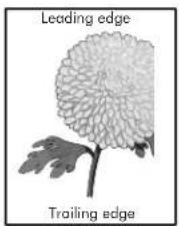
text_image
Leading edge Trailing edge| Action Yes No | ||
| Step 1a Move the width and length guides in the tray to the correct positions for the paper loaded.b Resend the print job.Is the page or image clipped? | Go to step 2. The problem is solved. | |
| Step 2From the printer control panel, set the paper size and type in the Paper menu to match the paper loaded in the tray.Does the paper size match the paper loaded in the tray? | Go to step 3. Do one or | more of the following:•From the printer control panel, change the paper size to match the paper loaded in the tray.•From the printer control panel, change the paper type to match the paper loaded in the tray. |
| Step 3a Depending on your operating system, specify the paper size from Printing Preferences or from the Print dialog.b Resend the print job.Is the page or image clipped? | Go to step 4. The problem is solved. | |
| Step 4a Remove, and then reinstall the imaging kit.Warning—Potential Damage: Do not expose the imaging kit to direct light for more than 10 minutes. Extended exposure to light may cause print quality problems.Warning—Potential Damage: Do not touch the underside of the imaging kit. This could damage the imaging kit.b Resend the print job.Is the page or image clipped? | Contact customer support. | The problem is solved. |
Gray background on prints
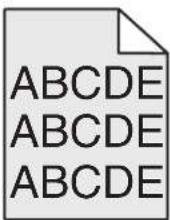

| Action Yes No | ||
| Step 1Reduce the toner darkness.aFrom the Quality menu on the printer control panel, reduce the toner density.Note:4 is the factory default setting.bResend the print job.Did the gray background disappear? | The problem is solved. | Go to step 2. |
| Step 2aRemove, and then reinstall the imaging kit.Warning—Potential Damage:Do not expose the imaging kit to direct light for more than 10 minutes. Extended exposure to light may cause print quality problems.Warning—Potential Damage:Do not touch the underside of the imaging kit. This could damage the imaging kit.bResend the print job.Did the gray background disappear? | The problem is solved. | Contact customer support. |
Horizontal voids appear on prints
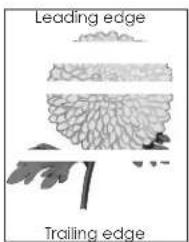
text_image
Leading edge Trailing edge| Action Yes No | ||
| Step 1a Make sure your software program is using a correct fill pattern.b Resend the print job.Do horizontal voids appear on prints? | Go to step 2. The problem is solved. | |
| Step 2a Load the specified tray or feeder with a recommended type of paper.b Resend the print job.Do horizontal voids appear on prints? | Go to step 3. The problem is solved. | |
| Step 3a Remove, and then reinstall the imaging kit.Warning—Potential Damage: Do not expose the imaging kit to direct light for more than 10 minutes. Extended exposure to light may cause print quality problems.Warning—Potential Damage: Do not touch the underside of the imaging kit. This could damage the imaging kit.b Resend the print job.Do horizontal voids appear on prints? | Go to step 4. The problem is solved. | |
| Step 4Replace the imaging kit, and then resend the print job.Do horizontal voids appear on prints? | Contact customer support. | The problem is solved. |
Incorrect margins on prints

text_image
ABCD ABCD ABCD| Action Yes No | ||
| Step 1a Move the width and length guides in the tray to the correct positions for the paper size loaded.b Resend the print job.Are the margins correct? | The problem is solved. | Go to step 2. |
| Step 2From the printer control panel, set the paper size in the Paper menu to match the paper loaded in the tray.Does the paper size match the paper loaded in the tray? | Go to step 3. Do one or more of the following:Specify the paper size from the tray settings to match the paper loaded in the tray.Change the paper loaded in the tray to match the paper size specified in the tray settings. | |
| Step 3a Depending on your operating system, specify the paper size from Printing Preferences or from the Print dialog.b Resend the print job.Are the margins correct? | The problem is solved. | Contact customer support. |
Paper curl
| Action Yes No | ||
| Step 1Move the width and length guides in the tray to the correct positions for the size of the paper loaded.Are the width and length guides positioned correctly? | Go to step 2. Adjust the | width and length guides. |
| Step 2From the printer control panel, set the paper type and weight in the Paper menu to match the paper loaded in the tray.Do the paper type and weight match the type and weight of the paper in the tray? | Go to step 3. Specify the | paper type and weight from the tray settings to match the paper loaded in the tray. |
| Step 3a Depending on your operating system, specify the paper type and weight from Printing Preferences or from the Print dialog.b Resend the print job.Is the paper still curled? | Go to step 4. The problem is solved. | |
| Step 4a Remove the paper from the tray, and then turn it over.b Resend the print job.Is the paper still curled? | Go to step 5. The problem is solved. | |
| Step 5a Load paper from a fresh package.Note:Paper absorbs moisture due to high humidity. Store paper in its original wrapper until you use it.b Resend the print job.Is the paper still curled? | Contact customer support. | The problem is solved. |
Print irregularities

text_image
ABCDE ABCDE ABCDE
text_image
Leading edge Trailing edge| Action Yes No | ||
| Step 1a Move the width and length guides in the tray to the correct positions for the size of the paper loaded in the tray.b Resend the print job.Do print irregularities still appear? | Go to step 2. The problem is solved. | |
| Step 2From the printer control panel, set the paper size and type in the Paper menu to match the paper loaded in the tray.Is the tray set to the size and type of the paper loaded in the tray? | Go to step 3. Do one or more of the following:Specify the paper size from the tray settings to match the paper loaded in the tray.Change the paper loaded in the tray to match the paper size specified in the tray settings. | |
| Step 3a Depending on your operating system, specify the paper type and weight from Printing Preferences or from the Print dialog.b Resend the print job.Do print irregularities still appear? | Go to step 4. The problem is solved. | |
| Step 4Check if the paper loaded in the tray has texture or rough finishes.Are you printing on textured or rough paper? | From the printer control panel, set the paper texture in the Paper menu to match the paper loaded in the tray. | Go to step 5. |
| Step 5a Load paper from a fresh package.Note:Paper absorbs moisture due to high humidity. Store paper in its original wrapper until you use it.b Resend the print job.Do print irregularities still appear? | Go to step 6. The problem is solved. | |
| Step 6Replace the imaging kit, and then resend the print job.Do print irregularities still appear? | Contact customer support. | The problem is solved. |
Print is too dark
ABC DEF
| Action Yes No | ||
| Step 1a From the Quality menu on the printer control panel, select Color Adjust.b Resend the print job.Is the print still too dark? | Go to step 2. The problem is solved. | |
| Step 2a From the Quality menu on the printer control panel, reduce the toner darkness.Note: 4 is the factory default setting.b Resend the print job.Is the print still too dark? | Go to step 3. The problem is solved. | |
| Step 3a From the printer control panel, set the paper type, texture, and weight in the Paper menu to match the paper loaded in the tray.b Resend the print job.Is the tray set to the type, texture, and weight of the paper loaded? | Go to step 4. Change the paper loaded in the tray to match the paper type, texture, and weight specified in the tray settings. | |
| Step 4a Depending on your operating system, specify the paper type, texture and weight from Printing Preferences or from the Print dialog.b Resend the print job.Is the print still too dark? | Go to step 5. The problem is solved. | |
| Step 5Check if the paper loaded in the tray has texture or rough finishes.Are you printing on textured or rough paper? | From the printer control panel, set the paper texture in the Paper menu to match the paper loaded on the tray. | Go to step 6. |
| Step 6a Load paper from a fresh package.Note:Paper absorbs moisture due to high humidity. Store paper in its original wrapper until you use it.b Resend the print job.Is the print still too dark? | Go to step 7. The problem is solved. | |
| Step 7Replace the imaging kit, and then resend the print job.Is the print still too dark? | Contact customer support. | The problem is solved. |
Print is too light

text_image
ABC DEF| Action Yes No | ||
| Step 1a From the Quality menu on the printer control panel, selectColorAdjust.b Resend the print job.Is the print still too light? | Go to step 2. The problem is solved. | |
| Step 2a From the Quality menu on the printer control panel, increase the toner darkness.Note:4 is the factory default setting.b Resend the print job.Is the print still too light? | Go to step 3. The problem is solved. | |
| Step 3From the printer control panel, set the paper type, texture, and weight in the Paper menu to match the paper loaded in the tray.Is the tray set to the type, texture, and weight of the paper loaded? | Go to step 4. Specify the paper type, texture, and weight from the tray settings to match the paper loaded in the tray. | |
| Step 4a Depending on your operating system, specify the paper type, texture, and weight from Printing Preferences or from the Print dialog.b Resend the print job.Is the print still too light? | Go to step 5. The problem is solved. | |
| Step 5Make sure that the paper has no texture or rough finishes.Are you printing on textured or rough paper? | From the printer control panel, set the paper texture in the Paper menu to match the paper loaded in the tray | Go to step 5. |
| Step 6a Load paper from a fresh package.Note:Paper absorbs moisture due to high humidity. Store paper in its original wrapper until you use it.b Resend the print job.Is the print still too light? | Go to step 7. The problem is solved. | |
| Step 7Replace the imaging kit, and then resend the print job.Is the print still too light? | Contact customer support. | The problem is solved. |
Printer is printing blank pages

natural_image
Blank white document page with a small corner detail (no text or symbols)| Action Yes No | ||
| Step 1a Check if there is packing material left on the imaging kit.1 Remove the imaging kit.2 Check if the packing material is properly removed from the imaging kit.Warning—Potential Damage: Do not expose the imaging kit to direct light for more than 10 minutes. Extended exposure to light may cause print quality problems.Warning—Potential Damage: Do not touch the underside of the imaging kit. This could damage the imaging kit.3 Reinstall the imaging kit.b Resend the print job.Is the printer still printing blank pages? | Go to step 2. The problem is solved. | |
| Step 2Replace the imaging kit, and then resend the print job.Is the printer still printing blank pages? | Contact customer support. | The problem is solved. |
Printer is printing solid black pages

natural_image
Solid black document page with a small corner detail (no text or symbols)| Action Yes No | ||
| Step 1a Remove, and then reinstall the imaging kit.Warning—Potential Damage: Do not expose the imaging kit to direct light for more than 10 minutes. Extended exposure to light may cause print quality problems.Warning—Potential Damage: Do not touch the underside of the imaging kit. This could damage the imaging kit.b Resend the print job.Is the printer printing solid black pages? | Go to step 2. The problem is solved. | |
| Step 2Replace the imaging kit, and then resend the print job.Is the printer printing solid black pages? | Contact customer support. | The problem is solved. |
Repeating defects appear on prints
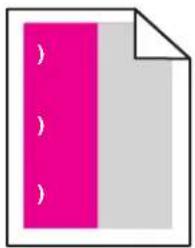
text_image
) ) ) )| Action Yes No | ||
| a Check if the distance between the defects is equal to one of the following:25.1 mm (0.98 in.)29.8 mm (1.17 in.)43.9 mm (1.72 in.)45.5 mm (1.79 in.)94.2 mm (3.70 in.)b If the distance between the defects equals 25.1 mm (0.98 in.), 29.8 mm (1.17 in.), or 94.2 mm (3.70 in.), then replace the photoconductor unit.c If the distance between the defects equals 43.9 mm (1.72 in.) or 45.5 mm (1.79 in.), then replace the developer unit.Do the repeating defects still appear? | 1 Check if the distance between the defects is equal to one of the following:37.7 mm (1.48 in.)78.5 mm (3.09 in.)95 mm (3.74 in.)2 Take note of the distance, and then contact customer support or your service representative. | The problem is solved. |
Shadow images appear on prints

text_image
ABCD ABCD
| Action Yes No | ||
| Step 1Check if the paper loaded in the tray has the correct paper type and weight.Is paper with the correct paper type and weight loaded in the tray? | Go to step 2. Load paper | with the correct paper type and weight in the tray. |
| Step 2From the printer control panel, set the paper type and weight in the Paper menu to match the paper loaded in the tray.Do the printer settings match the type and weight of the paper loaded? | Go to step 3. Change the paper typeand weight to match the paper loaded in the tray. | |
| Step 3a Depending on your operating system, specify the paper type and weight from Printing Preferences or from the Print dialog.b Resend the print job.Do shadow images still appear on prints? | Go to step 4. The problem is solved. | |
| Step 4Replace the imaging kit, and then resend the print job.Do shadow images still appear on prints? | Contact customer support. | The problem is solved. |
Skewed print

text_image
ABCDE ABCDE ABCDE| Action Yes No | ||
| Step 1a Move the width and length guides in the tray to the correct positions for the size of the paper loaded.b Resend the print job.Is the print still skewed? | Go to step 2. The problem is solved. | |
| Step 2a Check if you are printing on a paper that is supported by the tray.b Resend the print job.Is the print still skewed? | Contact customer support. | The problem is solved. |
Streaked horizontal lines appear on prints
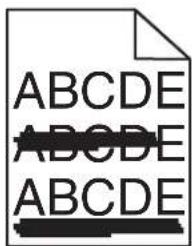
text_image
ABCDE ABCDE ABCDE| Action Yes No | ||
| Step 1a Depending on your operating system, specify the tray or feeder from Printing Preferences or the Print dialog.b Resend the print job.Do streaked horizontal lines appear on prints? | Go to step 2. The problem is solved. | |
| Step 2From the printer control panel, set the paper type and weight in the Paper menu to match the paper loaded in the tray.Do the paper type and weight match the paper in the tray? | Go to step 3. Do one or more of the following:Specify the papertype and weight from the tray settings to match the paper loaded in the tray.Change the paper loaded in the tray to match the papertype and weight specified in the tray settings. | |
| Step 3a Load paper from a fresh package.Note:Paper absorbs moisture due to high humidity. Store paper in its original wrapper until you use it.b Resend the print job.Do streaked horizontal lines appear on prints? | Go to step 4. The problem is solved. | |
| Step 4a Remove, and then reinstall the imaging kit.Warning—Potential Damage:Do not expose the imaging kit to direct light for more than 10 minutes. Extended exposure to light may cause print quality problems.Warning—Potential Damage:Do not touch the underside of the imaging kit. This could damage the imaging kit.b Resend the print job.Do streaked horizontal lines appear on prints? | Go to step 5. The problem is solved. | |
| Step 5Replace the imaging kit, and then resend the print job.Do streaked horizontal lines appear on prints? | Contact customer support. | The problem is solved. |
Streaked vertical lines appear on prints
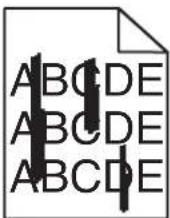

| Action Yes No | ||
| Step 1a Depending on your operating system, specify the paper type, texture, and weight from Printing Preferences or from the Print dialog.b Resend the print job.Do streaked vertical lines appear on prints? | Go to step 2. The problem is solved. | |
| Step 2From the printer control panel, set the paper texture, type, and weight in the Paper menu to match the paper loaded in the tray.Do the paper texture, type, and weight match the paper in the tray? | Go to step 3. Do one or more of the following:Specify the paper texture, type, and weight from the tray settings to match the paper loaded in the tray.Change the paper loaded in the tray to match the paper size specified in the tray settings. | |
| Step 3a Load paper from a fresh package.Note:Paper absorbs moisture due to high humidity. Store paper in its original wrapper until you use it.b Resend the print job.Do streaked vertical lines appear on prints? | Go to step 4. The problem is solved. | |
| Step 4a Remove, and then reinstall the imaging kit.Warning—Potential Damage:Do not expose the imaging kit to direct light for more than 10 minutes. Extended exposure to light may cause print quality problems.Warning—Potential Damage:Do not touch the underside of the imaging kit. This could damage the imaging kit.b Resend the print job.Do streaked vertical lines appear on prints? | Go to step 5. The problem is solved. | |
| Step 5Replace the imaging kit, and then resend the print job.Do streaked vertical lines appear on prints? | Contact customer support. | The problem is solved. |
Toner fog or background shading appears on prints
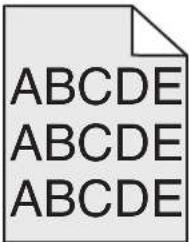
text_image
ABCDE ABCDE ABCDE| Action Yes No | ||
| Step 1a Remove, and then reinstall the imaging kit.Warning—Potential Damage: Do not expose the imaging kit to direct light for more than 10 minutes. Extended exposure to light may cause print quality problems.Warning—Potential Damage: Do not touch the underside of the imaging kit. This could damage the imaging kit.b Resend the print job.Does fog or shading disappear from the prints? | The problem is solved. | Go to step 2. |
| Step 2Replace the imaging kit, and then resend the print job.Does fog or shading disappear from the prints? | The problem is solved. | Contact customer support. |
Toner rubs off

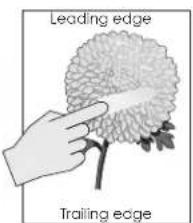
text_image
Leading edge Trailing edge| Action Yes No | ||
| Step 1From the Paper menu on the printer control panel, check the paper type, texture, and weight.Do the paper type, texture, and weight match the paper loaded in the tray? | Go to step 2. Specify the paper type, texture, and weight from the tray settings to match the paper loaded in the tray. | |
| Step 2Resend the print job.Does the toner still rub off? | Contact customer support. | The problem is solved. |
Toner specks appear on prints
| Action Yes No | ||
| Replace the imaging kit, and then resend the print job.Do toner specks appear on prints? | Contact customer support. | The problem is solved. |
Transparency print quality is poor
| Action Yes No | ||
| Step 1From the printer control panel, set the paper type in the Paper menu to match the paper loaded in the tray.Is the paper type for the tray set to Transparency? | Go to step 2. Set the paper type to Transparency. | |
| Step 2a Check if you are using a recommended type of transparency.b Resend the print job.Is the print quality still poor? | Contact customer support. | The problem is solved. |
Uneven print density

text_image
ABCDE ABCDE| Action Yes No | ||
| Replace the imaging kit, and then resend the print job.Is the print density uneven? | Contact customer support. | The problem is solved. |
Vertical voids appear on prints
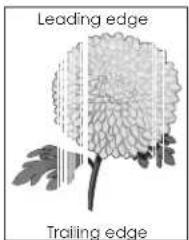
text_image
Leading edge Trailing edge| Action Yes No | ||
| Step 1a Check if your software program is using a correct fill pattern.b Resend the print job.Do vertical voids appear on prints? | Go to step 2. The problem is solved. | |
| Step 2a From the Paper Menu on the printer control panel, check the paper type and paper weight.b Resend the print job.Do vertical voids appear on prints? | Go to step 3. The problem is solved. | |
| Step 3Check if you are using a recommended type of paper.a Load paper source with a recommended type of paper.b Resend the print job.Do vertical voids appear on prints? | Go to step 4. The problem is solved. | |
| Step 4a Remove, and then reinstall the imaging kit.Warning—Potential Damage: Do not expose the imaging kit to direct light for more than 10 minutes. Extended exposure to light may cause print quality problems.Warning—Potential Damage: Do not touch the underside of the imaging kit. This could damage the imaging kit.b Resend the print job.Do vertical voids appear on prints? | Go to step 5. The problem is solved. | |
| Step 5Replace the imaging kit, and then resend the print job.Do vertical voids appear on prints? | Contact customer support. | The problem is solved. |
Color quality problems
FAQ about color printing
What is RGB color?
Red, green, and blue light can be added together in various amounts to produce a large range of colors observed in nature. For example, red and green can be combined to create yellow. Televisions and computer monitors create colors in this manner. RGB color is a method of describing colors by indicating the amount of red, green, or blue needed to produce a certain color.
What is CMYK color?
Cyan, magenta, yellow, and black inks or toners can be printed in various amounts to produce a large range of colors observed in nature. For example, cyan and yellow can be combined to create green. Printing presses, inkjet printers, and color laser printers create colors in this manner. CMYK color is a method of describing colors by indicating the amount of cyan, magenta, yellow, and black needed to reproduce a particular color.
How is color specified in a document to be printed?
Software programs typically specify the document color using RGB or CMYK color combinations. Additionally, they let users modify the color of each object in a document. For more information, see the help information of your operating system.
How does the printer know what color to print?
When a user prints a document, information describing the type and color of each object is sent to the printer. The color information is passed through color conversion tables that translate the color into the appropriate amounts of cyan, magenta, yellow, and black toner needed to produce the color you want. The object information determines the application of color conversion tables. For example, it is possible to apply one type of color conversion table to text while applying a different color conversion table to photographic images.
What is manual color correction?
When manual color correction is enabled, the printer employs user-selected color conversion tables to process objects. However, Color Correction must be set to Manual, or no user-defined color conversion will be implemented. Manual color correction settings are specific to the type of object being printed (text, graphics, or images), and how the color of the object is specified in the software program (RGB or CMYK combinations).
Notes:
- Manual color correction is not useful if the software program does not specify colors with RGB or CMYK combinations. It is also not effective in situations in which the software program or the computer operating system controls the adjustment of colors.
- When Auto Color Correction is selected, the color conversion tables will generate preferred colors used for the majority of the documents.
To manually apply a different color conversion table, do the following:
1 From the Quality menu on the printer control panel, select Color Correction, and then select Manual.
2 From the Quality menu on the printer control panel, select Manual Color, and then select the appropriate color conversion table for the affected object type.
| Object type Color conversion tables | |
| RGB ImageRGB TextRGB Graphics | Vivid—Produces brighter, more saturated colors and may be applied to all incoming color formats.sRGB Display—Produces an output that approximates the colors displayed on a computer monitor.Note: Black toner usage is optimized for printing photographs.Display—True Black—Produces an output that approximates the colors displayed on a computer monitor. This uses only black toner to create all levels of neutral gray.sRGB Vivid—Provides an increased color saturation for the sRGB Display color correction.Note: Black toner usage is optimized for printing business graphics.Off—No color correction is implemented. |
| CMYK ImageCMYK TextCMYK Graphics | US CMYK—Applies color correction to approximate the SWOP (Specifications for Web Offset Publishing) color output.Euro CMYK—Applies color correction to approximate Euroscale color output.Vivid CMYK—Increases the color saturation of the US CMYK color correction setting.Off—No color correction is implemented. |
How can I match a particular color (such as a corporate logo)?
Nine types of Color Samples sets are available from the Quality menu on the printer control panel. These are also available from the Color Samples page of the Embedded Web Server. Selecting any sample set generates a multiple-page printout consisting of hundreds of colored boxes. Either a CMYK or RGB combination is located on each box, depending on the table selected. The observed color of each box is obtained by passing the CMYK or RGB combination labeled on the box through the selected color conversion table.
By examining Color Samples sets, you can identify the box whose color is the closest to the color you want. The color combination labeled on the box can then be used for modifying the color of the object in a software program. For more information, see the help information of your operating system.
Note: Manual color correction may be necessary to utilize the selected color conversion table for the particular object.
Selecting which Color Samples set to use for a particular color-matching problem depends on the Color Correction setting being used, the type of object being printed, and how the color of the object is specified in the software program. When Color Correction is set to Off, the color is based on the print job information, and no color conversion is implemented.
Note: The Color Samples pages are not useful if the software program does not specify colors with RGB or CMYK combinations. Additionally, certain situations exist in which the software program or the computer operating system adjusts the RGB or CMYK combinations specified in the program through color management. The resulting printed color may not be an exact match of the Color Samples pages.
Prints on color transparencies appear dark when projected
Note: This problem occurs when projecting transparencies with reflective overhead projectors. To obtain the highest projected color quality, transmissive overhead projectors are recommended.
| Action Yes No | ||
| Step 1From the printer control panel, make sure the paper type setting is set to Transparency.Is the paper type setting correct? | Go to step 2. Set the paper type to Transparency. | |
| Step 2Reduce the toner darkness, and then resend the print job.Does the print on the color transparency look lighter? | The problem is solved. | Go to step 3. |
| Step 3Make sure you are using a recommended type of color transparency, and then resend the print job.Does the print on the color transparency look lighter? | The problem is solved. | Contact customer support. |
The color of the print does not match the color of the original file
Note: The color conversion tables used in Auto Color Correction mode generally approximate the colors of a standard computer monitor. However, because of technology differences that exist between printers and monitors, there are many colors that can also be affected by monitor variations and lighting conditions.
| Action Yes No | ||
| Step 1a Set Color Correction to Off.Note:When the printer color correction is disabled, the color is based on the print job information, and no color conversion is implemented.b Resend the print job.Does the color of the print match the color of the file on the computer screen? | The problem is solved. | Go to step 2. |
| Step 2From the Quality menu on the printer control panel, do the following:a Select Color Correction, and then select Manual.b Select Manual Color, and then select the appropriate color conversion table for the affected object type.c Resend the print job.Does the color of the print match the color of the file on the computer screen? | The problem is solved. | Contact customer support. |
The print appears tinted
| Action Yes No | ||
| Adjust the color balance.aFrom the Color Balance menu on the printer control panel, increase or decrease the values for cyan, magenta, yellow, and black.bResend the print job.Does the print still appear tinted? | The problem is solved. | Contact customer support. |
Solving copy problems
Copier does not respond
| Action Yes No | ||
| Step 1Check if an error or status message appears on the display.Does an error or status message appear? | Clear the error or status message. | Go to step 2. |
| Step 2Check if the power cord is plugged into the printer and a properly grounded electrical outlet.Is the power cord plugged into the printer and a properly grounded electrical outlet? | Go to step 3. Connect the power cord to the printer and a properly grounded electrical outlet. | |
| Step 3Turn off the printer, then wait for about 10 seconds, and then turn it back on.Did Performing Self Test and Ready appear? | The problem is solved. | Contact customer support. |
Partial document or photo copies
| Action Yes No | ||
| Step 1Check the placement of the document or photo.Make sure the document or photo is loaded facedown on the scanner glass in the upper left corner.Is the document or photo loaded correctly? | Go to step 2. Place the document or photo facedown on the scanner glass in the upper left corner. | |
| Step 2Check if the paper size setting matches the size of the paper loaded in the tray.From the Paper menu on the printer control panel, check the Paper Size setting.Does the paper size setting match the size of the paper loaded in the tray. | Go to step 3. Change the paper size setting to match the paper loaded in the tray, or load the tray with paper that matches the paper size setting. | |
| Step 3a Specify the paper size. Depending on your operating system, specify the paper size in Printing Preferences or the Print dialog.b Resend the print job.Do copies print properly? | The problem is solved. | Contact customer support. |
Scanner unit does not close
| Action Yes No | ||
| Check if there are no obstructions between the scanner unit and the printer.a Lift the scanner unit.b Remove any obstruction that keeps the scanner unit open.c Lower the scanner unit.Did the scanner unit close properly? | The problem is solved. | Contact customer support. |
Poor copy quality
| Action Yes No | ||
| Step 1Check if an error or status message appears on the display.Does an error or status message appear? | Clear the error or status message. | Go to step 2. |
| Step 2Check the quality of the original document.Is the quality of the original document satisfactory? | Go to step 3. Increase the scan resolution setting for a higher-quality output. | |
| Step 3If dark marks appear on prints, then clean the scanner glass and the ADF glass using a clean, lint-free cloth dampened with water.Is the scanner glass clean? | Go to step 4. See | “Cleaning the scanner glass” on page 206. |
| Step 4Send a print job, and then check for print quality problems.a From the General Settings menu, adjust the Eco-Mode settings.b From the Copy menu, adjust the Darkness setting.c If the print remains faded, then replace the toner cartridge.Is the print quality satisfactory? | Go to step 5. See | “Print quality problems” on page 277. |
| Step 5Check the placement of the document or photo.Make sure the document or photo is loaded facedown on the scanner glass in the upper left corner.Is the document or photo loaded correctly? | Go to step 6. Place the document or photo facedown on the scanner glass in the upper left corner. | |
| Step 6Check the copy settings.From the Copy screen, check if the Content Type and Content Source settings are correct for the document being scanned.Are the Content Type and Content Source settings correct for the document being scanned? | Go to step 7. Change the Content Type and Content Source settings to match the document being scanned. | |
| Step 7Check for patterns on prints.a From the Copy screen, navigate to:Advanced Options > Advanced Imaging > Sharpness > select a lower settingNote: Make sure no scaling is being selected.b Resend the copy job.Do patterns appear on prints? | Go to step 8. The problem is solved. | |
| Step 8Check for missing or faded text on prints.a From the Copy screen, navigate to:Advanced Options > Advanced Imagingb Adjust the settings:Sharpness—Increase the current setting.Contrast—Increase the current setting.c Resend the copy job.Do prints have missing or faded text? | Go to step 9. The problem is solved. | |
| Step 9Check for washed-out or overexposed output.a From the Copy screen, navigate to: Advanced Options > Advanced Imagingb Adjust the settings of the following:•Background Removal—Reduce the current setting.•Shadow Detail—Reduce the current setting.c Resend the copy job.Do pages show washed-out or overexposed prints? | Contact customer support. | The problem is solved. |
Solving fax problems
Caller ID is not shown
| Action Yes No | ||
| Contact your telephone company to check if your telephone line is subscribed to the caller ID service.Notes:If your region supports multiple caller ID patterns, then you may have to change the default setting. There are two settings available: FSK (pattern 1) and DTMF (pattern 2).The availability of these settings in the Fax menu depends on whether your country or region supports multiple caller ID patterns.Contact your telephone company to determine which pattern or switch setting to use.Does the caller ID appear? | The problem is solved. | Contact customer support. |
Cannot send or receive a fax
| Action Yes No | ||
| Step 1Check if an error or status message appears on the display.Is there an error or status message on the display? | Clear the error or status message. | Go to step 2. |
| Step 2Check if the power cord is plugged into the printer and a properly grounded electrical outlet.Is the power cord plugged into the printer and a properly grounded electrical outlet? | Go to step 3. Connect the power cord to the printer and a properly grounded electrical outlet. | |
| Step 3Check the power.Check if the printer is plugged in and turned on, and if Ready appears on the display.Is the printer turned on, and does Ready appear on the display? | Go to step 4. Turn on the printer, and then wait until Ready appears on the display. | |
| Step 4Check the printer connections.If applicable, check if the cable connections for the following equipment are secure:TelephoneHandsetAnswering machineAre the cable connections secure? | Go to step 5. Securely connect the cables. | |
| Step 5a Check the telephone wall jack.1 Plug the telephone cable into the wall jack.2 Listen for a dial tone.3 If you do not hear a dial tone, then plug a different telephone cable into the wall jack.4 If you still do not hear a dial tone, then plug the telephone cable into a different wall jack.5 If you hear a dial tone, then connect the printer to that wall jack.b Try sending or receiving a fax.Can you send or receive a fax? | The problem is solved. | Go to step 6. |
| Step 6Check if the printer is connected to an analog phone service or the correct digital connector.The fax modem is an analog device. Certain devices can be connected to the printer so that digital telephone services can be used.If you are using an ISDN telephone service, then connect the printer to an analog telephone port (an R-interface port) on an ISDN terminal adapter. For more information and to request an R-interface port, contact your ISDN provider.If you are using DSL, then connect to a DSL filter or router that will support analog use. For more information, contact your DSL provider.If you are using a PBX telephone service, then make sure you are connecting to an analog connection on the PBX. If none exists, then consider installing an analog telephone line for the fax machine.Is the printer connected to an analog phone service or the correct digital connector? | Go to step 7. Connect the printer to an analog phone service or the correct digital connector. | |
| Step 7Check for a dial tone.Did you hear a dial tone? | Go to step 8. | Try calling the fax number to make sure that it is working properly.If the telephone line is being used by another device, then wait until the other device is finished before sending a fax.If you are using the On Hook Dial feature, then turn up the volume to check if you hear a dial tone. |
| Step 8Temporarily disconnect other equipment (such as answering machines, computers with modems, or telephone line splitters) between the printer and the telephone line, and then try sending or receiving a fax.Can you send or receive a fax? | The problem is solved. | Go to step 9. |
| Step 9a Temporarily disable call waiting. Contact your telephone company to obtain the keypad sequence for temporarily disabling call waiting.b Try sending or receiving a fax.Can you send or receive a fax? | The problem is solved. | Go to step 10. |
| Step 10a Temporarily disable voice mail service. For more information, contact your telephone company.Note: If you want to use both voice mail and the printer, then consider adding a second telephone line for the printer.b Try sending or receiving a fax.Can you send or receive a fax? | The problem is solved. | Go to step 11. |
| Step 11Scan the original document one page at a time.a Dial the fax number.b Scan the document one page at a time.Can you send or receive a fax? | The problem is solved. | Contact customer support. |
Can send but not receive faxes
| Action Yes No | ||
| Step 1Check the tray or feeder.If empty, then load paper in the tray or feeder.Can you receive faxes? | The problem is solved. | Go to step 2. |
| Step 2Check the ring count delay settings.a Open a Web browser, and then type the printer IP address in the address field.Notes:View the printer IP address on the printer home screen. The IP address appears as four sets of numbers separated by periods, such as 123.123.123.123.If you are using a proxy server, then temporarily disable it to load the Web page correctly.b Click Settings > Fax Settings > Analog Fax Setup.c In the “Rings to Answer” field, enter the number of times you want the phone to ring before the printer answers.d Click Submit.Can you receive faxes? | The problem is solved. | Go to step 3. |
| Step 3Replace the toner cartridge. For more information, see the instruction sheet that came with the supply.Can you receive faxes? | The problem is solved. | Contact customer support. |
Can receive but not send faxes
| Action Yes No | ||
| Step 1Check if the printer is in Fax mode.From the home screen, touchFaxto put the printer in Fax mode, and then send the fax.Note:The Multi Send application does not support the XPS output type. To use XPS, use the regular faxing method.Can you send faxes? | The problem is solved. | Go to step 2. |
| Step 2Load the original document properly.Load the original document faceup, short edge first into the ADF tray or facedown on the scanner glass in the upper left corner.Note:Do not load postcards, photos, small items, transparencies, photo paper, or thin media (such as magazine clippings) into the ADF tray. Place these items on the scanner glass.Can you send faxes? | The problem is solved. | Go to step 3. |
| Step 3Set up the shortcut number properly.•Check if the shortcut number has been set for the telephone number that you want to dial.•Dial the telephone number manually.Can you send faxes? | The problem is solved. | Contactcustomersupport. |
Fax and e-mail functions are not set up
Notes:
- Before you troubleshoot, check if the fax cables are connected.
- The indicator light is blinking red until you set up fax and e-mail.
| Action Yes No | ||
| a From the home screen, navigate to: [IMAGE] > Settings > General Settings > Run initial setup > Yes > Submitb Turn off the printer, and then turn it back on.The “Select your language” screen appears on the printer display.c Select a language, and then touch .d Select a country or region, and then touch Next.e Select a time zone, and then touch Next.f Select Fax and E-mail, and then touch Next.Are fax and e-mail functions set up? | The problem is solved. | Contact customer support. |
Received fax has poor print quality
| Action Yes No | ||
| Step 1Ask the person who sent you the fax to:a Check if the quality of the original document is satisfactory.b Increase the fax scan resolution, if possible.c Resend the fax.Is the fax print quality satisfactory? | The problem is solved. | Go to step 2. |
| Step 2Decrease the incoming fax transmission speed.a Open a Web browser, and then type the printer IP address in the address field.Notes:View the printer IP address on the printer home screen. The IP address appears as four sets of numbers separated by periods, such as 123.123.123.123.If you are using a proxy server, then temporarily disable it to load the Web page correctly.Print a network setup page or menu settings page, and then locate the IP address in the TCP/IP section.b Click Settings > Fax Settings > Analog Fax Setup.c In the Max Speed menu, click one of the following:2400480096001440033600d Click Submit, and then resend the fax.Is the fax print quality satisfactory? | The problem is solved. | Go to step 3. |
| Step 3Replace the toner cartridge.When Cartridge low [88.xy] appears, replace the cartridge, and then resend the fax.Is the fax print quality satisfactory? | The problem is solved. | Contact customer support. |
Solving scanner problems
Cannot scan from a computer
| Action Yes No | ||
| Step 1Make sure the printer is turned on and that Ready appears on the printer display before scanning a job.Does Ready appear before scanning the job? | Go to step 3. Go to step 2. | |
| Step 2Turn off the printer, then wait for about 10 seconds, and then turn the printer back on.Is there an error message on the printer display? | Clear the error message. | Go to step 3. |
| Step 3Check the cable connections between the printer and the print server to make sure they are secure.For more information, see the setup documentation that came with the printer.Are the cable connections between the printer and the print server secure? | Contact customer support. | Tighten the cable connections. |
Scan job was not successful
| Action Yes No | ||
| Step 1Check the cable connections.Make sure the Ethernet or USB cable is securely connected to the computer and the printer.Are the cables securely connected? | Go to step 2. Connect the cables properly. | |
| Step 2Check if the file name is already in use.Is the file name already in use? | Change the file name. Go to step 3. | |
| Step 3Check if the document or photo you want to scan is open in another application or being used by another user.Is the file you want to scan open by another application or user? | Close the file you are scanning. | Go to step 4. |
| Step 4Check if either the Append time stamp or the Overwrite existing file check box is selected in the destination configuration settings.Is the Append time stamp or Overwrite existing file check box selected in the destination configuration settings? | Contact customer support. | Select the Append time stamp or Overwrite existing file check box in the destination configuration settings. |
Scanner unit does not close
| Action Yes No | ||
| Check if there are obstructions in the scanner unit.a Lift the scanner unit.b Remove any obstruction keeping the scanner unit open.c Lower the scanner unit.Did the scanner unit close correctly? | The problem is solved. | Contact customer support. |
Scanning takes too long or freezes the computer
| Action Yes No | ||
| Step 1Check if other applications are interfering with the scan.Close all applications that are not being used.Does scanning still take too long or freeze the computer? | Go to step 2. The problem is solved. | |
| Step 2Select a lower scan resolution.Does scanning still take too long or freeze the computer? | Contact customer support. | The problem is solved. |
Poor scanned image quality
| Action Yes No | ||
| Step 1Check if an error message appears on the display.Is there an error message on the printer display? | Clear the error message. | Go to step 2. |
| Step 2Check the quality of the original document.Is the quality of the original document satisfactory? | Go to step 3. Increase the scan resolution settings for a higher-quality output. | |
| Step 3Clean the scanner glass and the ADF glass using a clean, lint-free cloth dampened with water.Is the scanner glass clean? | Go to step 4. See | “Cleaning the scanner glass” on page 206. |
| Step 4Check the placement of the document or photo.Make sure the document or photo is loaded facedown on the scanner glass in the upper left corner.Is the document or photo loaded correctly? | Go to step 5. Place the document or photo facedown on the scanner glass in the upper left corner. | |
| Step 5Send a print job, and then check for print quality problems.From the General Settings menu, adjust the Eco-Mode settings.From the Copy menu, adjust the Darkness setting.When the print becomes faded, replace the toner cartridge.Is the print quality satisfactory? | Go to step 6. See | “Print quality problems” on page 277. |
| Step 6Check the scan settings.From the Scan screen, make sure the Content Type and Content Source settings are correct for the document being scanned.Are the Content Type and Content Source settings correct for the document being scanned? | Go to step 7. Change the Content Type and Content Source settings to match the document being scanned. | |
| Step 7Increase the scan resolution settings for a higher-quality output.Did the increased resolution produce a higher-quality output? | Problem solved. Contact customer support. | |
Partial document or photo scans
| Action Yes No | ||
| Check the placement of the document or photo.Make sure the document or photo is loaded facedown on the scanner glass in the upper left corner.Is the document or photo loaded correctly? | Contact customer support. | Load the document or photo facedown on the scanner glass in the upper left corner. |
The scanner does not respond
| Action Yes No | ||
| Step 1Check if the printer is turned on.Is the printer turned on? | Go to step 2. Turn on the printer. | |
| Step 2Check if the printer cable is securely attached to the printer and the computer, print server, option, or other network device.Is the printer cable securely attached to the printer and the computer, print server, option, or other network device? | Go to step 3. Connect the printer cable securely to the printer and the computer, print server, option, or other network device. | |
| Step 3Check if the power cord is plugged into the printer and a properly grounded electrical outlet.Is the power cord plugged into the printer and a properly grounded electrical outlet? | Go to step 4. Connect the power cord to the printer and a properly grounded electrical outlet. | |
| Step 4Check if the electrical outlet is turned off by a switch or breaker.Is the electrical outlet turned off by a switch or breaker? | Turn on the switch or reset the breaker. | Go to step 5. |
| Step 5Check if the printer is plugged into any surge protectors, uninterruptible power supplies, or extension cords.Is the printer plugged into any surge protectors, uninterruptible power supplies, or extension cords? | Connect the printer power cord directly to a properly grounded electrical outlet. | Go to step 6. |
| Step 6Check other electrical equipment plugged into the outlet.Are the other electrical equipment working? | Unplug the other electrical equipment and turn on the printer. If the printer does not work, then reconnect the other electrical equipment and then go to step 6. | Go to step 7. |
| Step 7Turn off the printer, then wait for about 10 seconds, and then turn the printer back on.Are the printer and scanner working? | The problem is solved. Contact customer support. | |
Solving home screen application problems
An application error has occurred
| Action Yes No | ||
| Step 1Check the system log for relevant details.a Open a Web browser, and then type the printer IP address in the address field.If you do not know the IP address of the printer, then you can:•View the IP address on the printer home screen.• Print a network setup page or the menu settings pages, and then locate the IP address in the TCP/IP section.Note: An IP address appears as four sets of numbers separated by periods, such as 123.123.123.123.b Click Settings > Apps > Apps Management > System tab > Log.c From the Filter menu, select an application status.d From the Application menu, select an application, and then click Submit.Does an error message appear in the log? | Go to step 2. Contact | customersupport. |
| Step 2Resolve the error.Is the application working now? | The problem is solved. | Contact customersupport. |
Embedded Web Server does not open
| Action Yes No | ||
| Step 1a Turn on the printer.b Open a Web browser, and then type the printer IP address.c Press Enter.Does the Embedded Web Server open? | The problem is solved. | Go to step 2. |
| Step 2Make sure the printer IP address is correct.a View the printer IP address:From the TCP/IP section in the Network/Ports menuBy printing a network setup page or menu settings page, and then finding the TCP/IP sectionNote: An IP address appears as four sets of numbers separated by periods, such as 123.123.123.123.b Open a Web browser, and then type the IP address.Note: Depending on the network settings, you may need to type "https://" instead of "http://" before the printer IP address to access the Embedded Web Server.c Press Enter.Does the Embedded Web Server open? | The problem is solved. | Go to step 3. |
| Step 3Check if the network is working.a Print a network setup page.b Check the first section of the network setup page and confirm that the status is Connected.Note: If the status is Not Connected, then the connection may be intermittent, or the network cable may be defective. Contact your system support person for a solution, and then print another network setup page.c Open a Web browser, and then type the printer IP address.d Press Enter.Does the Embedded Web Server open? | The problem is solved. | Go to step 4. |
| Step 4Check if the cable connections to the printer and print server are secure.a Connect the cables properly. For more information, see the setup documentation that came with the printer.b Open a Web browser, and then type the printer IP address.c Press Enter.Does the Embedded Web Server open? | The problem is solved. | Go to step 5. |
| Step 5Temporarily disable the Web proxy servers.Proxy servers may block or restrict you from accessing certain Web sites including the Embedded Web Server.Does the Embedded Web Server open? | The problem is solved. | Contact your system support person. |
Contacting customer support
When you contact customer support, you will need to be able to describe the problem you are experiencing, the message on the printer display, and the troubleshooting steps you have already taken to find a solution.
You need to know your printer model type and serial number. For more information, see the label at the back of the printer. The serial number is also listed on the menu settings page.
Lexmark has various ways to help you solve your printing problem. Visit the Lexmark Web site at http://support.lexmark.com, and then select one of the following:
| Tech Library | You can browse our library of manuals, support documentation, drivers, and other downloads to help you solve common problems. |
| You can send an e-mail to the Lexmark team, describing your problem. A service representative will respond and provide you with information to solve your problem. | |
| Live chat | You can chat directly with a service representative. They can work with you to solve your printer problem or provide assistance through Assisted Service where the service representative can remotely connect to your computer through the Internet to troubleshoot problems, install updates, or complete other tasks to help you successfully use your Lexmark product. |
Telephone support is also available. In the U.S. or Canada, call 1-800-539-6275. For other countries or regions, visit http://support.lexmark.com.
Notices
Product information
Product name:
Lexmark CX510de and CX510dthe
Machine type:
7527
Model(s):
636, 637
Edition notice
September 2014
The following paragraph does not apply to any country where such provisions are inconsistent with local law: LEXMARK INTERNATIONAL, INC., PROVIDES THIS PUBLICATION “AS IS” WITHOUT WARRANTY OF ANY KIND, EITHER EXPRESS OR IMPLIED, INCLUDING, BUT NOT LIMITED TO, THE IMPLIED WARRANTIES OF MERCHANTABILITY OR FITNESS FOR A PARTICULAR PURPOSE. Some states do not allow disclaimer of express or implied warranties in certain transactions; therefore, this statement may not apply to you.
This publication could include technical inaccuracies or typographical errors. Changes are periodically made to the information herein; these changes will be incorporated in later editions. Improvements or changes in the products or the programs described may be made at any time.
References in this publication to products, programs, or services do not imply that the manufacturer intends to make these available in all countries in which it operates. Any reference to a product, program, or service is not intended to state or imply that only that product, program, or service may be used. Any functionally equivalent product, program, or service that does not infringe any existing intellectual property right may be used instead. Evaluation and verification of operation in conjunction with other products, programs, or services, except those expressly designated by the manufacturer, are the user's responsibility.
For Lexmark technical support, visit http://support.lexmark.com.
For information on supplies and downloads, visit www.lexmark.com.
© 2014 Lexmark International, Inc.
All rights reserved.
GOVERNMENT END USERS
The Software Program and any related documentation are "Commercial Items," as that term is defined in 48 C.F.R. 2.101, "Computer Software" and "Commercial Computer Software Documentation," as such terms are used in 48 C.F.R. 12.212 or 48 C.F.R. 227.7202, as applicable. Consistent with 48 C.F.R. 12.212 or 48 C.F.R. 227.7202-1 through 227.7207-4, as applicable, the Commercial Computer Software and Commercial Software Documentation are licensed to the U.S. Government end users (a) only as Commercial Items and (b) with only those rights as are granted to all other end users pursuant to the terms and conditions herein.
Licensing notices
All licensing notices associated with this product can be viewed from the root directory of the installation software CD.
Trademarks
Lexmark, Lexmark with diamond design, MarkNet, and MarkVision are trademarks of Lexmark International, Inc., registered in the United States and/or other countries.
Mac and the Mac logo are trademarks of Apple Inc., registered in the U.S. and other countries.
PCL® is a registered trademark of the Hewlett-Packard Company. PCL is Hewlett-Packard Company's designation of a set of printer commands (language) and functions included in its printer products. This printer is intended to be compatible with the PCL language. This means the printer recognizes PCL commands used in various application programs, and that the printer emulates the functions corresponding to the commands.
The following terms are trademarks or registered trademarks of these companies:
| Albertus The Monotype | Corporation plc |
| Antique Olive Monsieur | Marcel OLIVE |
| Apple-Chancery Apple Computer, Inc. | |
| Arial The Monotype Corporation plc | |
| CG Times | Based on Times New Roman under license from The Monotype Corporation plc, is a product of Agfa Corporation |
| Chicago Apple Computer, Inc. | |
| Clarendon Linotype-Hell AG and/or its subsidiaries | |
| Eurostile Nebiolo | |
| Geneva Apple Computer, Inc. | |
| GillSans The Monotype Corporation plc | |
| Helvetica Linotype-Hell AG and/or its subsidiaries | |
| Hoefler Jonathan Hoefler Type Foundry | |
| ITC Avant Garde Gothic International Typeface Corporation | |
| ITC Bookman International Typeface Corporation | |
| ITC Mona Lisa International Typeface Corporation | |
| ITC Zapf Chancery | International Typeface Corporation |
| Joanna | The Monotype Corporation plc |
| Marigold | Arthur Baker |
| Monaco | Apple Computer, Inc. |
| New York | Apple Computer, Inc. |
| Oxford | Arthur Baker |
| Palatino | Linotype-Hell AG and/or its subsidiaries |
| Stempel Garamond | Linotype-Hell AG and/or its subsidiaries |
| Taffy Agfa Corporation | |
| Times New Roman The Monotype Corporation plc | |
| Univers Linotype-Hell AG and/or its subsidiaries | |
All other trademarks are the property of their respective owners.
AirPrint and the AirPrint logo are trademarks of Apple, Inc.
Noise emission levels
The following measurements were made in accordance with ISO 7779 and reported in conformance with ISO 9296.
Note: Some modes may not apply to your product.
| 1-meter average sound pressure, dBA | |
| Printing 52 | |
| Scanning 49 | |
| Copying 50 | |
| Ready 16 | |
Values are subject to change. See www.lexmark.com for current values.
Waste from Electrical and Electronic Equipment (WEEE) directive

text_image
Prohibition sign for a trash bin with red X marks and a black horizontal bar belowThe WEEE logo signifies specific recycling programs and procedures for electronic products in countries of the European Union. We encourage the recycling of our products.
If you have further questions about recycling options, visit the Lexmark Web site at www.lexmark.com for your local sales office phone number.
India E-Waste notice
This product complies with the India E-Waste (Management and Handling) Rules, 2011, which prohibit use of lead, mercury, hexavalent chromium, polybrominated biphenyls, or polybrominated diphenyl ethers in concentrations exceeding 0.1% by weight and 0.01% by weight for cadmium, except for the exemption set in Schedule II of the Rules.
Product disposal
Do not dispose of the printer or supplies in the same manner as normal household waste. Consult your local authorities for disposal and recycling options.
Static sensitivity notice

This symbol identifies static-sensitive parts. Do not touch in the areas near these symbols without first touching the metal frame of the printer.
ENERGY STAR
Any Lexmark product bearing the ENERGY STAR emblem on the product or on a start-up screen is certified to comply with Environmental Protection Agency (EPA) ENERGY STAR requirements as configured when shipped by Lexmark.

Temperature information
| Ambient operating temperature 15.6 to 32.2°C (60 to 90°F) | |
| Shipping temperature -40 to 43.3°C (-40 to 110°F) | |
| Storage temperature and relative humidity 1 to 35°C (34 to 95°F) | 8 to 80% RH |
Laser notice
The printer is certified in the U.S. to conform to the requirements of DHHS 21 CFR, Chapter I, Subchapter J for Class I (1) laser products, and elsewhere is certified as a Class I laser product conforming to the requirements of IEC 60825-1.
Class I laser products are not considered to be hazardous. The printer contains internally a Class IIIb (3b) laser that is nominally a 7 milliwatt gallium arsenide laser operating in the wavelength of 655-675 nanometers. The laser system and printer are designed so there is never any human access to laser radiation above a Class I level during normal operation, user maintenance, or prescribed service condition.
Laser advisory label
A laser notice label may be affixed to this printer as shown:
| DANGER - Invisible laser radiation when cartridges are removed and interlock defeated. Avoid exposure to laser beam. |
| PERIGO - Radiação a laser invisivel será liberada se os cartuchos forem removidos e o lacre rompido. Evite a exposição aos feixes de laser. |
| Opasnost - Nevidljivo lasersko zračenje kada su kasete uklonjene i poništena sigurnosna veza. Izbjegavati izlaganje zracima. |
| NEBEZPEČÍ - Když jsou vyjmuty kazety a je odblokována poljstka, ze zařízení je vysíláno neviditelné laserové záření. Nevystavujte se působení laserového paprsku. |
| FARE - Usynlig laserstråling, när patroner fjernes, og spærreanordningen er sláet fra. Undgå at blive udsat for laserstrålen. |
| GEVAAR - Onzichtbare laserstraling wanneer cartridges worden verwijderd en een vergrendeling wordt genegeerd. Voorkom blootstelling aan de laser. |
| DANGER - Rayonnements laser invisibles lors du retrait des cartouches et du déverrouillage des loquets. Eviter toute exposition au rayon laser. |
| VAARA - Nákymätöntä lasersäteilyä on varottava, kun värikasetit on poistettu ja lukitus on auki. Vältä lasersäteelle altistumista. |
| GEFAHR - Unsichtbare Laserstrahlung beim Herausnehmen von Druckkassetten und offener Sicherheitssperre. Laserstrahl meiden. |
| KINDYNOŠ - Έκλυση αόρατης ακτινοβολίας laser κατά την αφαίρεση των κασετών και την απασφάλιση της μανδάλωσης. Αποφεύγετε την έκθεση στην ακτινοβολία laser. |
| VESZÉLY - Nem látható lézersugárzás fordulhat elő a patronok eltávolításakor és a zárószerkezet felbontásakor. Kerülje a lézersugárnak való kitettséget. |
| PERICOLO - Emissione di radiazioni laser invisibili durante la rimozione delle cartucce e del blocco. Evitare l’esposizione al raggio laser. |
| FARE - Usynlig laserstråling när kassettene tas ut og sperren er satt ut av spill. Unngå eksponering for laserstrålen. |
| NIEBEZPIECZEŃSTWO - niewidzialne promieniowanie laserowe podczas usuwania kaset i blokady. Należy unikać naświetlenia promieniem lasera. |
| ОПАСНО! Невидимое лазерное излучение при извлеченных картриджах и снятии блокировки. Избегайте воздействия лазерных лучей. |
| Pozor - Nebezpečenstvo neviditelného laserového žiarenia pri odobratých kazetách a odblokovanje poistke. Nevystavujte sa lúčom. |
| PELIGRO: Se producen radiaciones láser invisibles al extraer los cartuchos con el interbloqueo desactivado. Evite la exposición al haz de láser. |
| FARA - Osynlig laserstrålning när patroner tas ur och spärmekanismen är upphävd. Undvik exponering för laserstrålen. |
| 危険 - 当移除碳粉盒及互锁失效时会产生看不见的激光辐射, 请避免暴露在激光光束下。 |
| 危険 - 移除碳粉匣與安全連続開關失效時會產生看不见的雷射辐射。請避免曝露在雷射光束下。 |
| 危険 - カートリッジが取り外され、内部ロックが無効になると、見えないレーザー光が放射されます。このレーザー光に当たらないようにしてください。 |
Power consumption
Product power consumption
The following table documents the power consumption characteristics of the product.
Note: Some modes may not apply to your product.
| Mode Description Power consumption | (Watts) | |
| Printing | The product is generating hard-copy output from electronic inputs. | 600 |
| Copy | The product is generating hard-copy output from hard-copy original documents. | 640 |
| Scan The product is scanning hard-copy documents. 65 | ||
| Ready The product is waiting for a print job. 35 | ||
| Sleep Mode | The product is in a high-level energy-saving mode. | 3.7 |
| Hibernate | The product is in a low-level energy-saving mode. | 0.5 |
| Off | The product is plugged into an electrical outlet, but the power switch is turned off. | 0 |
The power consumption levels listed in the previous table represent time-averaged measurements. Instantaneous power draws may be substantially higher than the average.
Values are subject to change. See www.lexmark.com for current values.
Sleep Mode
This product is designed with an energy-saving mode called Sleep Mode. The Sleep Mode saves energy by lowering power consumption during extended periods of inactivity. The Sleep Mode is automatically engaged after this product is not used for a specified period of time, called the Sleep Mode Timeout.
Factory default Sleep Mode Timeout for this product (in minutes): 20
By using the configuration menus, the Sleep Mode Timeout can be modified between 1 minute and 120 minutes. Setting the Sleep Mode Timeout to a low value reduces energy consumption, but may increase the response time of the product. Setting the Sleep Mode Timeout to a high value maintains a fast response, but uses more energy.
Hibernate Mode
This product is designed with an ultra-low power operating mode called Hibernate mode. When operating in Hibernate Mode, all other systems and devices are powered down safely.
The Hibernate mode can be entered in any of the following methods:
•Using the Hibernate Timeout
•Using the Schedule Power modes
•Using the Sleep/Hibernate button
Factory default Hibernate Timeout for this product in all countries or regions 3 days
The amount of time the printer waits after a job is printed before it enters Hibernate mode can be modified between one hour and one month.
Off mode
If this product has an off mode which still consumes a small amount of power, then to completely stop product power consumption, disconnect the power supply cord from the electrical outlet.
Total energy usage
It is sometimes helpful to calculate the total product energy usage. Since power consumption claims are provided in power units of Watts, the power consumption should be multiplied by the time the product spends in each mode in order to calculate energy usage. The total product energy usage is the sum of each mode's energy usage.
Regulatory notices for electromagnetic compatibility
This section contains regulatory information pertaining to electromagnetic compatibility.
Federal Communications Commission (FCC) compliance information statement
This product has been tested and found to comply with the limits for a Class B digital device, pursuant to Part 15 of the FCC Rules. Operation is subject to the following two conditions: (1) this device may not cause harmful interference, and (2) this device must accept any interference received, including interference that may cause undesired operation.
The FCC Class B limits are designed to provide reasonable protection against harmful interference when the equipment is operated in a residential installation. This equipment generates, uses, and can radiate radio frequency energy and, if not installed and used in accordance with the instructions, may cause harmful interference to radio communications. However, there is no guarantee that interference will not occur in a particular installation. If this equipment does cause harmful interference to radio or television reception, which can be determined by turning the equipment off and on, the user is encouraged to try to correct the interference by one or more of the following measures:
•Reorient or relocate the receiving antenna.
- Increase the separation between the equipment and receiver.
- Connect the equipment into an outlet on a circuit different from that to which the receiver is connected.
- Consult your point of purchase or service representative for additional suggestions.
The manufacturer is not responsible for radio or television interference caused by using other than recommended cables or by unauthorized changes or modifications to this equipment. Unauthorized changes or modifications could void the user's authority to operate this equipment.
Note: To assure compliance with FCC regulations on electromagnetic interference for a Class B computing device, use a properly shielded and grounded cable such as Lexmark part number 1021231 for parallel attach or 1021294 for USB attach. Use of a substitute cable not properly shielded and grounded may result in a violation of FCC regulations.
Any questions regarding this compliance information statement should be directed to:
Director of Lexmark Technology & Services
Lexmark International, Inc.
740 West New Circle Road
Lexington, KY 40550
(859) 232-3000
Industry Canada compliance statement
This Class B digital apparatus meets all requirements of the Canadian Interference-Causing Equipment Standard ICES-003.
European Community (EC) directives conformity
This product is in conformity with the protection requirements of EC Council directives 2004/108/EC, 2006/95/EC, 2009/125/EC, and 2011/65/EU on the approximation and harmonization of the laws of the Member States relating to electromagnetic compatibility, safety of electrical equipment designed for use within certain voltage limits, the ecodesign of energy-related products, and on the restrictions of use of certain hazardous substances in electrical and electronic equipment.
The manufacturer of this product is: Lexmark International, Inc., 740 West New Circle Road, Lexington, KY, 40550 USA. The authorized representative is: Lexmark International Technology Hungária Kft., 8 Lechner Ödön fasor, Millennium Tower III, 1095 Budapest HUNGARY. A declaration of conformity to the requirements of the Directives is available upon request from the Authorized Representative.
This product satisfies the Class B limits of EN 55022 and safety requirements of EN 60950-1.
Regulatory notices for telecommunication terminal equipment
This section contains regulatory information pertaining to products that contain telecommunication terminal equipment such as facsimile.
Notice to users of the US telephone network: FCC requirements
This equipment complies with Part 68 of the FCC rules and the requirements adopted by the Administrative Council for Terminal Attachments (ACTA). On the back of this equipment is a label that contains, among other information, a product identifier in the format US:AAAEQ##TXXXX. If requested, this number must be provided to your telephone company.
This equipment uses the RJ-11C Universal Service Order Code (USOC) jack.
A plug and jack used to connect this equipment to the premises' wiring and telephone network must comply with the applicable FCC Part 68 rules and requirements adopted by the ACTA. A compliant telephone cord and modular plug is provided with this product. It is designed to be connected to a compatible modular jack that is also compliant. See your setup documentation for more information.
The Ringer Equivalence Number (REN) is used to determine the number of devices that may be connected to a telephone line. Excessive RENs on a telephone line may result in the devices not ringing in response to an incoming call. In most but not all areas, the sum of RENs should not exceed five (5.0). To be certain of the number of devices that may be connected to a line, as determined by the total RENs, contact your local telephone company. For products approved after July 23, 2001, the REN for this product is part of the product identifier that has the format US:AAAEQ##TXXXX. The digits represented by ## are the REN without a decimal point (for example, 03 is a REN of 0.3). For earlier products, the REN is shown separately on the label.
If this equipment causes harm to the telephone network, the telephone company will notify you in advance that temporary discontinuance of service may be required. If advance notice is not practical, the telephone company will notify the customer as soon as possible. You will also be advised of your right to file a complaint with the FCC.
The telephone company may make changes in its facilities, equipment, operations or procedures that could affect the operation of this equipment. If this happens, the telephone company will provide advance notice in order for you to make necessary modifications to maintain uninterrupted service.
If you experience trouble with this equipment, for repair or warranty information, contact Lexmark International, Inc. at www.lexmark.com or your Lexmark representative. If the equipment is causing harm to the telephone network, the telephone company may request that you disconnect the equipment until the problem is resolved.
This equipment contains no user serviceable parts. For repair and warranty information, contact Lexmark International, Inc. See the previous paragraph for contact information.
Connection to party line service is subject to state tariffs. Contact the state public utility commission, public service commission, or corporation commission for information.
If your home has specially wired alarm equipment connected to the telephone line, ensure the installation of this equipment does not disable your alarm equipment. If you have questions about what will disable alarm equipment, consult your telephone company or a qualified installer.
Telephone companies report that electrical surges, typically lightning transients, are very destructive to customer terminal equipment connected to AC power sources. This has been identified as a major nationwide problem. It is recommended that the customer install an appropriate AC surge arrestor in the AC outlet to which this device is connected. An appropriate AC surge arrestor is defined as one that is suitably rated, and certified by UL (Underwriter's Laboratories), another NRTL (Nationally Recognized Testing Laboratory), or a recognized safety certification body in the country/region of use. This is to avoid damage to the equipment caused by local lightning strikes and other electrical surges.
The Telephone Consumer Protection Act of 1991 makes it unlawful for any person to use a computer or other electronic device, including fax machines, to send any message unless said message clearly contains in a margin at the top or bottom of each transmitted page or on the first page of the transmission, the date and time it is sent and an identification of the business or other entity, or other individual sending the message, and the telephone number of the sending machine or such business, other entity, or individual. (The telephone number provided may not be a 900 number or any other number for which charges exceed local or long-distance transmission charges.)
See your user documentation in order to program this information into your fax machine.
Notice to users of the Canadian telephone network
This product meets the applicable Industry Canada technical specifications. The Ringer Equivalence Number (REN) is an indication of the maximum number of terminals allowed to be connected to a telephone interface. The terminus of an interface may consist of any combination of devices, subject only to the requirement that the sum of the RENs of all the devices does not exceed five. The modem REN is located on the rear of the equipment on the product labeling.
Telephone companies report that electrical surges, typically lightning transients, are very destructive to customer terminal equipment connected to AC power sources. This has been identified as a major nationwide problem. It is recommended that the customer install an appropriate AC surge arrestor in the AC outlet to which this device is connected. An appropriate AC surge arrestor is defined as one that is suitably rated, and certified by UL (Underwriter's Laboratories), another NRTL (Nationally Recognized Testing Laboratory), or a recognized safety certification body in the country/region of use. This is to avoid damage to the equipment caused by local lightning strikes and other electrical surges.
This equipment uses CA11A telephone jacks.
Industry Canada (Canada)
Under Industry Canada regulations, this radio transmitter may only operate using an antenna of a type and maximum (or lesser) gain approved for the transmitter by Industry Canada. To reduce potential radio interference to other users, the antenna type and its gain should be so chosen that the equivalent isotropically radiated power (EIRP) is not more than that necessary for successful communication.
This device complies with Industry Canada license-exempt RSS standards. Operation is subject to the following two conditions: (1) this device may not cause interference, and (2) this device must accept any interference, including interference that may cause undesired operation of the device.
To prevent radio interference to the licensed service, this device is intended to be operated indoors and away from windows to provide maximum shielding.
Industrie Canada (Canada)
Notice to users of the New Zealand telephone network
The following are special conditions for the Facsimile User Instructions. The grant of a telepermit for any item of terminal equipment indicates only that Telecom has accepted that the item complies with minimum conditions for connection to its network. It indicates no endorsement of the product by Telecom, nor does it provide any sort of warranty. Above all, it provides no assurance that any item will work correctly in all respects with another item of telepermitted equipment of a different make or model, nor does it imply that any product is compatible with all of Telecom's network services.
This equipment shall not be set up to make automatic calls to the Telecom's 111 Emergency Service.
This equipment may not provide for the effective hand-over of a call to another device connected to the same line.
This equipment should not be used under any circumstances that may constitute a nuisance to other Telecom customers.
Some parameters required for compliance with Telecom's telepermit requirements are dependent on the equipment associated with this device. The associated equipment shall be set to operate within the following limits for compliance to Telecom's specifications:
- There shall be no more than 10 call attempts to the same number within any 30 minute period for any single manual call initiation, and
- The equipment shall go on-hook for a period of not less than 30 seconds between the end of one attempt and the beginning of the next call attempt.
- The equipment shall be set to ensure that automatic calls to different numbers are spaced such that there is not less than 5 seconds between the end of one call attempt and the beginning of another.
Japanese telecom notice
The installed optional modem is in compliance with Japanese Telecommunication Law and has been Certified by JATE, with Certification Number A11-0160001.

natural_image
Abstract geometric logo with circular and rectangular elements, no text or symbols presentLexmark International, Inc.
LEX-M03-002
A11-0160001JP
Using this product in Switzerland
This product requires a Swiss billing tone filter (Lexmark part number 80D1877) to be installed on any line which receives metering pulses in Switzerland. The filter must be used, as metering pulses are present on all analog telephone lines in Switzerland.
Notice to Users in the European Union
Products bearing the CE mark are in conformity with the protection requirements of EC Council directives 2004/108/EC, 2006/95/EC, 1999/5/EC, and 2009/125/EC on the approximation and harmonization of the laws of the Member States relating to electromagnetic compatibility, safety of electrical equipment designed for use within certain voltage limits, radio equipment and telecommunications terminal equipment and on the ecodesign of energy-related products.
Compliance is indicated by the CE marking.

The manufacturer of this product is: Lexmark International, Inc., 740 West New Circle Road, Lexington, KY, 40550 USA. The authorized representative is: Lexmark International Technology Hungária Kft., 8 Lechner Ödön fasor, Millennium Tower III, 1095 Budapest HUNGARY, A declaration of conformity to the requirements of the Directives is available upon request from the Authorized Representative.
This product satisfies the Class B limits of EN 55022 and safety requirements of EN 60950-1.
Refer to the table at the end of the Notices section for further compliance information.
Regulatory notices for wireless products
This section contains the following regulatory information pertaining to wireless products that contain transmitters, for example, but not limited to, wireless network cards or proximity card readers.
Modular component notice
This product may contain the following modular component(s):
Lexmark Regulatory Type/Model LEX-M01-005, FCC ID: IYLLEXM01005; IC:2376A-M01005
Exposure to radio frequency radiation
The radiated output power of this device is far below the radio frequency exposure limits of the FCC and other regulatory agencies. A minimum separation of 20 cm (8 inches) must be maintained between the antenna and any persons for this device to satisfy the RF exposure requirements of the FCC and other regulatory agencies.
Notice to users in the European Union
This product is in conformity with the protection requirements of EC Council directives 2004/108/EC, 2006/95/EC, 1999/5/EC, 2009/125/EC, and 2011/65/EU on the approximation and harmonization of the laws of the Member States
relating to electromagnetic compatibility, safety of electrical equipment designed for use within certain voltage limits, radio equipment and telecommunications terminal equipment, the ecodesign of energy-related products, and on the restrictions of use of certain hazardous substances in electrical and electronic equipment.
Compliance is indicated by the CE marking.
CE
The manufacturer of this product is: Lexmark International, Inc., 740 West New Circle Road, Lexington, KY, 40550 USA. The authorized representative is: Lexmark International Technology Hungária Kft., 8 Lechner Ödön fasor, Millennium Tower III, 1095 Budapest HUNGARY. A declaration of conformity to the requirements of the Directives is available upon request from the Authorized Representative.
This product satisfies the Class B limits of EN 55022 and safety requirements of EN 60950-1.
Products equipped with 2.4GHz Wireless LAN option are in conformity with the protection requirements of EC Council directives 2004/108/EC, 2006/95/EC, 1999/5/EC, 2009/125/EC, and 2011/65/EU on the approximation and harmonization of the laws of the Member States relating to electromagnetic compatibility, safety of electrical equipment designed for use within certain voltage limits, radio equipment and telecommunications terminal equipment, the ecodesign of energy-related products, and on the restrictions of use of certain hazardous substances in electrical and electronic equipment.
Compliance is indicated by the CE marking.
CE!
Operation is allowed in all EU and EFTA countries, but is restricted to indoor use only.
The manufacturer of this product is: Lexmark International, Inc., 740 West New Circle Road, Lexington, KY, 40550 USA. The authorized representative is: Lexmark International Technology Hungária Kft., 8 Lechner Ödön fasor, Millennium Tower III, 1095 Budapest HUNGARY. A declaration of conformity to the requirements of the Directives is available upon request from the Authorized Representative.
This product may be used in the countries indicated in the table below.
| AT BE BG CH | CY CZ DE DK | EE | ||||||
| EL ES FI FR HR | HU IE IS IT | |||||||
| LI | LT | LU | LV | MT | NL | NO | PL | PT |
| RO | SE SI SK TR | UK |
| Česky | Společnost Lexmark International, Inc. tímto prohlašuje, že výrobek tento výrobek je ve shodě se základními požadavky a dalšími příslušnými ustanoveními směrnice 1999/5/ES. |
| Dansk | Lexmark International, Inc. erklærer herved, at dette produkt overholder de væsentlige krav og øvrige relevante krav i direktiv 1999/5/EF. |
| Deutsch | Hiermit erklärt Lexmark International, Inc., dass sich das Gerät dieses Gerät in Übereinstimmung mit den grundlegenden Anforderungen und den übrigen einschlägigen Bestimmungen der Richtlinie 1999/5/EG befindet. |
| Ελληνική | ΜΕ ΤΗΝ ΠΑΡΟΥΣΑ Η ΣΧΜΑΚΚ ΙΤΕΝΤΩΝΑΙΛ, ΑΝΟ. ΔΗΛΩΝΕΙ ΟΤΙ ΑΥΤΟ ΤΟ ΠΡΟΪΟΝ ΣΥΜΜΟΡΦΩΝΕΤΑΙ ΠΡΟΣ ΤΙΣ ΟΥΣΙΩΔΕΙΣ ΑΠΑΙΤΗΣΕΙΣ ΚΑΙ ΤΙΣ ΛΟΙΠΕΣ ΣΧΕΤΙΚΕΣ ΔΙΑΤΑΞΕΙΣ ΤΗΣ ΟΔΗΓΙΑΣ 1999/5/ΕΚ. |
| English | Hereby, Lexmark International, Inc., declares that this type of equipment is in compliance with the essential requirements and other relevant provisions of Directive 1999/5/ΕC. |
| Español | Por medio de la presente, Lexmark International, Inc. declara que este producto cumple con los requisitos esenciales y cualesquiera otras disposiciones aplicables o exigibles de la Directiva 1999/5/Ε. |
| Eesti Käesolevaga kinnitab Lexmark International, Inc., et seade see toode vastab direktiivi 1999/5/EÜ põhinõuetele ja nimetatud direktiivist tulenevatele muudele asjakohastele sätetele. | |
| Suomi Lexmark International, Inc. vakuuttaa täten, että tämä tuote on direktiivin 1999/5/EY oleellisten vaatimusten ja muiden sitä koskevien direktiivin ehtojen mukainen. | |
| Français | Par la présente, Lexmark International, Inc. déclare que l'appareil ce produit est conforme aux exigences fondamentales et autres dispositions pertinentes de la directive 1999/5/Ε. |
| Magyar Alulrott, Lexmark International, Inc. nyilatkozom, hogy a termék megfelel a vonatkozó alapvetõ követelményeknek és az 1999/5/ΕC irányelv egyéb előírásainak. | |
| Íslenska | Hér með lýsir Lexmark International, Inc. yfir því að þessi vara er í samræmi við grunnkröfur og aðrar kröfur, sem gerðar eru í tilskipun 1999/5/ΕC. |
| Italiano | Con la presente Lexmark International, Inc. dichiara che questo questo prodotto è conforme ai requisiti essenziali ed alle altre disposizioni pertinenti stabilite dalla direttiva 1999/5/Ε. |
| Latviski | Ar šo Lexmark International, Inc. deklarē, ka šis izstrādājums atbilst Direktīvas 1999/5/EK būtiskajām prasībām un citiem ar to saistītajiem noteikumiem. |
| Lietuvių | Šiuo Lexmark International, Inc. deklaruoja, kad šis produktas atitinka esminius reikalavimus ir kitas 1999/5/EB direktyvos nuostatas. |
| Malti | Bil-preženti, Lexmark International, Inc., jiddikjara li dan il-prodott huwa konformi mal-ħtiġijiet essenzjali u ma dispożizzjonijiet oħrajn relevanti li jinsabu fid-Direttiva 1999/5/Ε. |
| Nederlands | Hierbij verklaart Lexmark International, Inc. dat het toestel dit product in overeenstemming is met de essentiële eisen en de andere relevante bepalingen van richtlijn 1999/5/ΕG. |
| Norsk | Lexmark International, Inc. erklærer herved at dette produktet er i samsvar med de grunnleggende krav og øvrige relevante krav i direktiv 1999/5/ΕF. |
| Polski | Niniejszym Lexmark International, Inc. oświadcza, że niniejszy produkt jest zgodny z zasadniczymi wymogami oraz pozostałymi stosownymi postanowieniami Dyrektywy 1999/5/ΕC. |
| Português | A Lexmark International Inc. declara que este este produto está conforme com os requisitos essenciais e outras disposições da Diretiva 1999/5/Ε. |
| Slovensky | Lexmark International, Inc. týmto vyhlasuje, že tento produkt spíňa základné požiadavky a všetky príslušné ustanovenia smernice 1999/5/ΕS. |
| Slovensko | Lexmark International, Inc. izjavlja, da je ta izdelek v skladu z bistvenimi zahtevami in ostalimi relevantnimi določili direktive 1999/5/ΕS. |
| Svenska | Härmed intygar Lexmark International, Inc. att denna produkt står i överensstämmelse med de väsentliga egenskapskrav och övriga relevanta bestämmelser som framgår av direktiv 1999/5/ΕG. |
STATEMENT OF LIMITED WARRANTY FOR LEXMARK LASER PRINTERS, LEXMARK LED PRINTERS, AND LEXMARK MULTIFUNCTION LASER PRINTERS
Lexmark International, Inc., Lexington, KY
This limited warranty applies to the United States and Canada. For customers outside the U.S., refer to the country-specific warranty information that came with your product.
This limited warranty applies to this product only if it was originally purchased for your use, and not for resale, from Lexmark or a Lexmark Remarketer, referred to in this statement as “Remarketer.”
Limited warranty
Lexmark warrants that this product:
—Is manufactured from new parts, or new and serviceable used parts, which perform like new parts
—Is, during normal use, free from defects in material and workmanship
If this product does not function as warranted during the warranty period, contact a Remarketer or Lexmark for repair or replacement (at Lexmark's option).
If this product is a feature or option, this statement applies only when that feature or option is used with the product for which it was intended. To obtain warranty service, you may be required to present the feature or option with the product.
If you transfer this product to another user, warranty service under the terms of this statement is available to that user for the remainder of the warranty period. You should transfer proof of original purchase and this statement to that user.
Limited warranty service
The warranty period starts on the date of original purchase as shown on the purchase receipt and ends 12 months later provided that the warranty period for any supplies and for any maintenance items included with the printer shall end earlier if it, or its original contents, are substantially used up, depleted, or consumed. Fuser Units, Transfer/Transport Units, Paper Feed items, if any, and any other items for which a Maintenance Kit is available are substantially consumed when the printer displays a “Life Warning” or “Scheduled Maintenance” message for such item.
To obtain warranty service you may be required to present proof of original purchase. You may be required to deliver your product to the Remarketer or Lexmark, or ship it prepaid and suitably packaged to a Lexmark designated location. You are responsible for loss of, or damage to, a product in transit to the Remarketer or the Lexmark designated location.
When warranty service involves the exchange of a product or part, the item replaced becomes the property of the Remarketer or Lexmark. The replacement may be a new or repaired item.
The replacement item assumes the remaining warranty period of the original product.
Replacement is not available to you if the product you present for exchange is defaced, altered, in need of a repair not included in warranty service, damaged beyond repair, or if the product is not free of all legal obligations, restrictions, liens, and encumbrances.
As part of your warranty service and/or replacement, Lexmark may update the firmware in your printer to the latest version. Firmware updates may modify printer settings and cause counterfeit and/or unauthorized products, supplies, parts, materials (such as toners and inks), software, or interfaces to stop working. Authorized use of genuine Lexmark products will not be impacted.
Before you present this product for warranty service, remove all print cartridges, programs, data, and removable storage media (unless directed otherwise by Lexmark).
For further explanation of your warranty alternatives and the nearest Lexmark authorized servicer in your area contact Lexmark on the World Wide Web.
Remote technical support is provided for this product throughout its warranty period. For products no longer covered by a Lexmark warranty, technical support may not be available or only be available for a fee.
Extent of limited warranty
Lexmark does not warrant uninterrupted or error-free operation of any product or the durability or longevity of prints produced by any product.
Warranty service does not include repair of failures caused by:
—Modification or unauthorized attachments
—Accidents, misuse, abuse or use inconsistent with Lexmark user's guides, manuals, instructions or guidance
—Unsuitable physical or operating environment
—Maintenance by anyone other than Lexmark or a Lexmark authorized servicer
—Operation of a product beyond the limit of its duty cycle
—Use of printing media outside of Lexmark specifications
—Refurbishment, repair, refilling or remanufacture by a third party of products, supplies or parts
—Products, supplies, parts, materials (such as toners and inks), software, or interfaces not furnished by Lexmark
TO THE EXTENT PERMITTED BY APPLICABLE LAW, NEITHER LEXMARK NOR ITS THIRD PARTY SUPPLIERS OR REMARKETERS MAKE ANY OTHER WARRANTY OR CONDITION OF ANY KIND, WHETHER EXPRESS OR IMPLIED, WITH RESPECT TO THIS PRODUCT, AND SPECIFICALLY DISCLAIM THE IMPLIED WARRANTIES OR CONDITIONS OF MERCHANTABILITY, FITNESS FOR A PARTICULAR PURPOSE, AND SATISFACTORY QUALITY. ANY WARRANTIES THAT MAY NOT BE DISCLAIMED UNDER APPLICABLE LAW ARE LIMITED IN DURATION TO THE WARRANTY PERIOD. NO WARRANTIES, EXPRESS OR IMPLIED, WILL APPLY AFTER THIS PERIOD. ALL INFORMATION, SPECIFICATIONS, PRICES, AND SERVICES ARE SUBJECT TO CHANGE AT ANY TIME WITHOUT NOTICE.
Limitation of liability
Your sole remedy under this limited warranty is set forth in this document. For any claim concerning performance or nonperformance of Lexmark or a Remarketer for this product under this limited warranty, you may recover actual damages up to the limit set forth in the following paragraph.
Lexmark's liability for actual damages from any cause whatsoever will be limited to the amount you paid for the product that caused the damages. This limitation of liability will not apply to claims by you for bodily injury or damage to real property or tangible personal property for which Lexmark is legally liable. IN NO EVENT WILL LEXMARK BE LIABLE FOR ANY LOST PROFITS, LOST SAVINGS, INCIDENTAL DAMAGE, OR OTHER ECONOMIC OR CONSEQUENTIAL DAMAGES. This is true even if you advise Lexmark or a Remarketer of the possibility of such damages. Lexmark is not liable for any claim by you based on a third party claim.
This limitation of remedies also applies to claims against any Suppliers and Remarketers of Lexmark. Lexmark's and its Suppliers' and Remarketers' limitations of remedies are not cumulative. Such Suppliers and Remarketers are intended beneficiaries of this limitation.
Additional rights
Some states do not allow limitations on how long an implied warranty lasts, or do not allow the exclusion or limitation of incidental or consequential damages, so the limitations or exclusions contained above may not apply to you.
This limited warranty gives you specific legal rights. You may also have other rights that vary from state to state.
Patent acknowledgment
The use of this product or service is subject to the reasonable, non-discriminatory terms in the Intellectual Property Rights (IPR) Disclosure of Certicom Corp. at the IETF for Elliptic Curve Cryptography (ECC) Cipher Suites for Transport Layer Security (TLS) implemented in the product or service.
The use of this product or service is subject to the reasonable, non-discriminatory terms in the Intellectual Property Rights (IPR) Disclosure of Certicom Corp. at the IETF for TLS Elliptic Curve Cipher Suites with SHA-256/382 and AES Galois Counter Mode (GCM) implemented in the product or service.
The use of this product or service is subject to the reasonable, non-discriminatory terms in the Intellectual Property Rights (IPR) Disclosure of Certicom Corp. at the IETF for TLS Suite B Profile for Transport Layer Security (TLS) implemented in the product or service.
The use of this product or service is subject to the reasonable, non-discriminatory terms in the Intellectual Property Rights (IPR) Disclosure of Certicom Corp. at the IETF for Addition of the Camellia Cipher Suites to Transport Layer Security (TLS) implemented in the product or service.
The use of certain patents in this product or service is subject to the reasonable, non-discriminatory terms in the Intellectual Property Rights (IPR) Disclosure of Certicom Corp. at the IETF for AES-CCM ECC Cipher Suites for TLS implemented in the product or service.
The use of this product or service is subject to the reasonable, non-discriminatory terms in the Intellectual Property Rights (IPR) Disclosure of Certicom Corp. at the IETF for IKE and IKEv2 Authentication Using the Eliptic Curve Digital Signature Algorithm (ECDSA) implemented in the product or service.
The use of this product or service is subject to the reasonable, non-discriminatory terms in the Intellectual Property Rights (IPR) Disclosure of Certicom Corp. at the IETF for Suite B Cryptographic Suites for IPSec implemented in the product or service.
The use of this product or service is subject to the reasonable, non-discriminatory terms in the Intellectual Property Rights (IPR) Disclosure of Certicom Corp. at the IETF for Algorithms for Internet Key Exchange version 1 (IKEv1) implemented in the product or service.
Index
Numerics
250-sheet tray loading 42
550-sheet tray installing 33 loading 42
650-sheet duo tray installing 33 loading 42, 46
Symbols
[Color] cartridge low [88.xy] 251
[Color] cartridge nearly low [88.xy] 251
[Color] cartridge very low, [x] estimated pages remain [88.xy] 251
[Type] imaging kit low [84.xy] 263
[Type] imaging kit nearly low [84.xy] 263
[Type] imaging kit very low, [x] estimated pages remain [84.xy] 263
[x]-page jam, clear manual feeder [251.xx] 246
[x]-page jam, clear multipurpose feeder [250.xx] 247
[x]-page jam, clear standard bin [203.xx] 237
[x]-page jam, open automatic feeder top cover [28y.xx] 249
[x]-page jam, open front door [20y.xx] 243
[x]-page jam, open front door to clear duplex [23y.xx] 244
[x]-page jam, open front door to clear fuser [20y.xx] 240
[x]-page jam, open tray [x] [24y.xx] 245
A
accessing the Embedded Web Server 19
Active NIC menu 131 adapter plug 98
adding hardware options print driver 37
ADF
copying using 69
Adjusting color 250
adjusting copy quality 74
adjusting printer display brightness 198
adjusting Sleep mode 197
adjusting toner darkness 63
administrator settings Embedded Web Server 232
advanced options, touch-screen copy 80
e-mail 88
fax 111
FTP 118
answering machine setting up 91
AppleTalk menu 136
applications
home screen 21
understanding 20
attaching cables 35
available internal options 26
avoiding jams 58
avoiding paper jams 235
B
black-and-white printing 62
blocking junk faxes 107
buttons, printer control panel 14
buttons, touch screen using 17
C
cables
Ethernet 35
USB 35
canceling a print job
from a computer 68
from the printer control panel 68
canceling an e-mail 86
cannot open Embedded Web
Server 311
Card Copy
setting up 22
card stock
loading 47
tips 55
Change [paper source] to [custom string] 250
Change [paper source] to [custom type name] 250
Change [paper source] to [paper type] [paper size] 250
changing output file type e-mailing 85
checking an unresponsive printer 264
checking status of parts and supplies 207
checking the status of parts and
supplies 207
checking the virtual display using the Embedded Web Server 232
cleaning
exterior of the printer 205
interior of the printer 205
scanner glass 206
cleaning the printer 205
Close door 250
Close flatbed cover and load originals if restarting job [2yy.xx] 251
collate
copy options 79
collating copies 75
color quality troubleshooting color of print and color on computer screen do not match 296
prints on color transparencies appear dark when projected 296
color quality, troubleshooting print appears tinted 297
Complex page, some data may not have printed [39] 251
confidential data
information on securing 204
confidential jobs
modifying print settings 67
confidential print jobs 66 printing from a Macinto computer 66
printing from Windows 66
Confidential Print menu 141
Configuration change, some held
jobs were not restored [57] 251
configuration information
wireless network 38
configurations
printer 11
configuring
multiple printers 234
supply notifications, imaging kit 233
supply notifications, maintenance kit 233
supply notifications, toner cartridge 233
supply notifications, waste toner bottle 233
configuring e-mail settings 82
configuring supply notifications
from the Embedded Web
Server 233
connecting printer to distinctive
ring service 102
connecting to a wireless network
using PIN (Personal Identification Number) method 39
using Push Button Configuration method 39
using the Embedded Web Server 40
using wireless setup wizard 39
conservation settings
brightness, adjusting 198
conserving supplies 195
Eco-Mode 196
Hibernate mode 197
Hibernate Timeout 197
Quiet Mode 196
Schedule Power Modes 198
Sleep Mode 197
conserving supplies 195
contacting customer support 313
content
e-mail settings 86
content source
e-mail settings 86
fax options 110
content type
e-mail settings 86
fax options 110
control panel, printer
indicator light 16
Sleep button light 16
controller board
accessing 26
copies
copy options 79
copy job, canceling
using the ADF 78
using the scanner glass 78
copy options
collate 79
copies 79
darkness 79
Save As Shortcut 80
sides (duplex) 79
copy quality
adjusting 74
copy screen
advanced options 80
content source 79
content type 79
options 78, 79, 80
Copy Settings menu 152
copy troubleshooting
copier does not respond 297
partial document or photo copies 297
poor copy quality 298
poor scanned image quality 308
scanner unit does not close 298, 308
copying
adding an overlay message 77
adjusting quality 74
canceling a copy job 78
collating copies 75
creating shortcuts using the printer control panel 71
custom job 76
different paper sizes 72
enlarging 74
inserting a header or footer 77
multiple pages on one sheet 76
on both sides of the paper (duplexing) 73
on letterhead 71
on transparencies 70
photos 70
placing separator sheets between copies 75
quick copy 69
reducing 74
selecting a tray 72
to a different size 72
using the ADF 69
using the scanner glass 70
copying different paper sizes 72
copying multiple pages on one sheet 76
copying on both sides of the paper (duplexing) 73
copying on transparencies 70
creating a fax destination shortcut using the Embedded Web Server 106
creating an FTP shortcut using the Embedded Web Server 112
custom name configuring 51
Custom Names menu 128
custom paper type assigning 50
custom paper type name creating 50
Custom Scan Sizes menu 129
Custom Type [x] changing name 50
changing paper type 51
Custom Types menu 128
customer support contacting 313
D
darkness
copy options 79
e-mail options 87
fax options 110
scan options 117
date and time, fax setting 103
daylight saving time, setting 103
Default Source menu 120
Defective flash detected [51] 252
delayed send fax options 110
developer unit replacing 214, 224
device and network settings
information erasing 202
different paper sizes, copying 72
Digital Subscriber Line (DSL) fax setup 95
digital telephone service fax setup 97
directory list printing 68
Disk full [62] 252
Disk must be formatted for use in
this device 252
disk wiping 203
display troubleshooting printer display is blank 264
display, printer control panel 14 adjusting brightness 198
disposing of printer hard disk 201
distinctive ring service, fax connecting to 102
documents, printing from Macintosh 62 from Windows 62
DSL filter 95
duplexing 73
E
Eco-Mode setting 196
Edit Security Setups menu 139
embedded solutions information erasing 202
Embedded Web Server 233 accessing 19
adjusting brightness 198
administrator settings 232
checking the status of parts 207
checking the status of supplies 207
copying settings to other printers 234
creating a fax destination shortcut 106
creating an FTP shortcut 112
creating e-mail shortcuts 83
initial fax setup 90
modifying confidential print settings 67
networking settings 232
problem accessing 311
scanning to a computer using 115
setting up e-mail alerts 232
Embedded Web Server — Security:
Administrator's Guide where to find 232
Embedded Web Server—Security:
Administrator's Guide where to find 204
emission
notices 316, 319, 320, 321, 325
encrypting the printer hard disk 203
enlarging a copy 74
envelopes
loading 45, 47
tips on using 54
environmental settings
conserving supplies 195
Eco-Mode 196
Hibernate mode 197
Hibernate Timeout 197
printer display brightness, adjusting 198
Quiet Mode 196
Schedule Power Modes 198
Sleep Mode 197
Erase Temporary Data Files menu 141
erasing hard disk memory 203
erasing non-volatile memory 202
erasing volatile memory 202
Error reading USB drive. Remove USB. 252
Error reading USB hub. Remove hub. 252
Ethernet network
preparing to set up for Ethernet printing 37
Ethernet port 35
Ethernet setup preparing for an 37
exporting a configuration using the Embedded Web Server 25
EXT port 35
exterior of the printer cleaning 205
e-mail canceling 86
e-mail alerts
low supply levels 232
paper jam 232
setting up 232
e-mail function setting up 82
e-mail options darkness 87
message 86
original size 86
page setup 87
recipient(s) 86
resolution 86
Save As Shortcut 88
Send As 87
subject 86
e-mail screen
advanced options 88
options 86, 87
E-mail Settings menu 167
e-mail shortcuts, creating using the Embedded Web Server 83
e-mail, sending
using a shortcut number 84
using the address book 84
e-mailing
adding message line 85
adding subject line 85
configuring e-mail settings 82
creating shortcuts using the Embedded Web Server 83
creating shortcuts using the printer control panel 83
setting up e-mail function 82
using a shortcut number 84
using the address book 84
using the printer control panel 84
F
factory defaults restoring 234
FAQ about color printing 294
fax
sending 105
sending at a scheduled time 105
fax and e-mail functions setting up 304
fax and e-mail functions are not set up 304
fax log
viewing 107
Fax Mode (Analog Fax Setup)
menu 157
Fax Mode (Fax Server Setup) menu 165
fax name, setting 102
fax number, setting 102
fax options
content source 110
content type 110
darkness 110
delayed send 110
page setup 110
resolution 109
scan preview 110
Fax partition inoperative. Contact system administrator. 252
fax screen
advanced options 111
options 110
Fax server 'To Format' not set up.
Contact system administrator. 252
fax setup
country- or region-specific 98
digital telephone service 97
DSL connection 95
standard telephone line connection 91
VoIP 96
Fax Station Name not set up.
Contact system administrator. 253
Fax Station Number not set up.
Contact system administrator. 253
fax troubleshooting
caller ID is not shown 300
can receive but not send faxes 304
can send but not receive faxes 303
cannot send or receive a fax 301
received fax has poor print quality 305
faxing
blocking junk faxes 107
canceling a fax job 108
changing resolution 106
configuring the printer to observe daylight saving time 103
creating shortcuts using the Embedded Web Server 106
creating shortcuts using the printer control panel 106
distinctive ring service 102
fax setup 90
forwarding faxes 109
holding faxes 108
making a fax lighter or darker 107
sending a fax at a scheduled time 105
sending using the printer control panel 103
setting the date and time 103
setting the fax number 102
setting the outgoing fax name 102
viewing a fax log 107
FCC notices 319, 321, 325
file name
scan options 116
finding more information about the printer 9
finding printer IP address 19
Finishing menu 183
firmware card 26
flash drive
printing from 64
Flash Drive menu 176
flash drives
supported file types 65
font sample list
printing 68
Forms and Favorites setting up 21
forwarding faxes 109
FTP
FTP options 116
FTP address
creating shortcuts using the printer control panel 113
FTP address, scanning to using a shortcut number 113 using the printer control panel 113
FTP options FTP 116
FTP screen advanced options 118 options 117
FTP Settings menu 172
G
General Settings menu 145
green settings
Eco-Mode 196
Hibernate mode 197
Hibernate Timeout 197
Quiet Mode 196
Schedule Power Modes 198
H
hardware options, adding print driver 37
held jobs 66
printing from a Macintosh computer 66
printing from Windows 66
Help menu 194
Hibernate mode using 197
Hibernate Timeout setting 197
hiding icons on the home screen 20
holding faxes 108
home screen
customizing 20
hiding icons 20
showing icons 20
home screen applications configuring 21
finding information 21
home screen buttons and icons description 14
HTML menu 192
|
icons on the home screen hiding 20
showing 20
Image menu 193
imaging kit
replacing 214
imaging kits ordering 209
importing a configuration using the Embedded Web Server 25
Incompatible tray [x] [59] 253
Incorrect paper size, open [paper source] [34] 253
indicator light
printer control panel 14
individual settings information erasing 202
initial fax setup 90
using the Embedded Web Server 90
Insert Tray [x] 253
inserting a header or footer 77
installing an optional card 31
installing options order of installation 32
installing printer 36
Insufficient memory for Flash
Memory Defragment operation [37] 253
Insufficient memory to collate job [37] 254
Insufficient memory to support
Resource Save feature [35] 254
Insufficient memory, some Held
Jobs were deleted [37] 253
Insufficient memory, some held
jobs will not be restored [37] 254
interior of the printer
cleaning 205
internal options 26
IP address of computer
finding 19
IP address, printer
finding 19
IPv6 menu 134
J
jams
avoiding 235
locating doors and trays 236
locations 236
messages 236
jams, clearing
duplex 244
front door 243
fuser 240
in automatic document feeder top cover 249
in manual feeder 246
in standard bin 237
in the multipurpose feeder 247
Tray 1 245
Tray 2 245
Job Accounting menu 186
K
keypad
printer control panel 14
L
labels, paper
tips 54
letterhead
copying on 71
loading, multipurpose feeder 52
loading, trays 52
line filter 95
LINE port 35
linking trays 49, 50
Load [paper source] with [custom
string] 254
Load [paper source] with [custom
type name] 254
Load [paper source] with [paper size] 255
Load [paper source] with [paper
type] [paper size] 255
Load Manual Feeder with [custom
string] 255
Load Manual Feeder with [custom
type name] 255
Load Manual Feeder with [paper
size] 256
Load manual feeder with [paper
type] [paper size] 256
loading
250-sheet tray 42
550-sheet tray 42
650-sheet duo tray 42, 46
card stock 47
envelopes 45, 47
manual feeder 45
multipurpose feeder 47
transparencies 47
loading letterhead
paper orientation 52
lock, security 201
M
maintenance kit
ordering 210
Maintenance kit low [80.xy] 256
Maintenance kit nearly low
[80.xy] 256
Maintenance kit very low, [x]
estimated pages remain
[80.xy] 256
making copies using paper from
selected tray 72
manual feeder
loading 45
Max Speed and Max Yield
using 63
memory
types installed on printer 201
memory card 26
installing 29
troubleshooting 267
Memory full [38] 256
Memory full, cannot print
faxes 257
Memory full, cannot send
faxes 257
menu settings
loading on multiple printers 234
menu settings page
printing 41
menus
Active NIC 131
AppleTalk 136
Confidential Print 141
Copy Settings 152
Custom Names 128
Custom Scan Sizes 129
Custom Types 128
Default Source 120
Edit Security Setups 139
Erase Temporary Data Files 141
E-mail Settings 167
Fax Mode (Analog Fax Setup) 157
Fax Mode (Fax Server Setup) 165
Finishing 183
Flash Drive 176
FTP Settings 172
General Settings 145
Help 194
HTML 192
Image 193
IPv6 134
Job Accounting 186
list of 119
Miscellaneous Security
Settings 140
Network [x] 131
Network Card 133
Network Reports 132
OCR Settings 181
Paper Loading 127
Paper Size/Type 121
Paper Texture 124
Paper Weight 125
PCL Emul 190
PDF 189
PostScript 189
Quality 184
Reports 130
Security Audit Log 142
Set Date/Time 143
Setup 181
SMTP Setup menu 138
Standard Network 131
Standard USB 136
Substitute Size 124
Supplies 120
TCP/IP 133
Universal Setup 129
Utilities 188
Wireless 135
XPS 189
message
e-mail options 86
Miscellaneous Security Settings
menu 140
mobile device
printing from 66
moving the printer 10, 230
Multi Send
adding a profile 23
setting up 23
multipurpose feeder
loading 47
MyShortcut
about 22
N
Network [x] menu 131
Network [x] software error
[54] 257
Network Card menu 133
Network Reports menu 132
network settings
Embedded Web Server 232
network setup page
printing 41
Networking Guide
where to find 232
No analog phone line connected to
modem, fax is disabled. 257
noise emission levels 316
Non-Lexmark [color] [supply type],
see User's Guide [33.xy] 257
non-volatile memory 201
erasing 202
Not enough free space in flash
memory for resources [52] 258
notices 315, 316, 317, 318, 319,
320, 321, 322, 323, 324, 325, 326
number of remaining pages
estimate 207
0
OCR Settings menu 181
optional card
installing 31
options
550-sheet tray 33
650-sheet duo tray 33
firmware cards 26
memory card 29
memory cards 26
options, copy screen
copy from 78
scale 79
options, touch-screen
copy 78, 80
e-mail 86, 87
fax 110
FTP 117
ordering
imaging kits 209
maintenance kit 210
toner cartridges 208
waste toner bottle 210
original size
e-mail options 86
scan options 116
output file type
changing 85
scan image 117
P
page setup
e-mail options 87
fax options 110
scan options 118
paper
characteristics 55
different sizes, copying 72
letterhead 57
preprinted forms 57
recycled 57
saving 76
selecting 56
storing 58
unacceptable 56
Universal size setting 42
using recycled 195
paper feed troubleshooting
message remains after jam is
cleared 269
paper jams
avoiding 235
paper jams, clearing
duplex 244
front door 243
fuser 240
in automatic document feeder top
cover 249
in manual feeder 246
in standard bin 237
in the multipurpose feeder 247
Tray 1 245
Tray 2 245
Paper Loading menu 127
paper size
setting 42
Paper Size/Type menu 121
paper sizes
supported by the printer 58
Paper Texture menu 124
paper type
setting 42
paper types
supported by printer 60
Paper Weight menu 125
paper weights
supported by printer 60
parts
checking status 207
checking, on the printer control
panel 207
checking, using the Embedded
Web Server 207
using genuine Lexmark 208
PCL Emul menu 190
PDF menu 189
Personal Identification Number
method
using 39
phone splitter 96
photos
copying 70
placing separator sheets between
copies 75
PostScript menu 189
power cord socket 35
preparing to set up the printer on
an Ethernet network 37
print driver
hardware options, adding 37
print irregularities 282
print job
canceling, from computer 68
print quality
cleaning the scanner glass 206
replacing a developer unit 224
replacing imaging kit 214
replacing the waste toner
bottle 211
print quality troubleshooting
blank pages 285
characters have jagged edges 277
clipped pages or images 277
gray background on prints 278
horizontal voids appear on prints 279
print irregularities 282
print is too dark 283
print is too light 284
printer is printing solid black pages 286
repeating print defects 287
shadow images appear on prints 287
skewed print 288
streaked horizontal lines appear on prints 288
streaked vertical lines appear on prints 290
toner fog or background shading appears on prints 291
toner rubs off 291
toner specks appear on prints 292
transparency print quality is poor 292
uneven print density 292
vertical voids appear on prints 293
print troubleshooting
error reading flash drive 271
held jobs do not print 270
incorrect characters print 271
incorrect margins on prints 280
jammed pages are not reprinted 268
job prints from wrong tray 272
job prints on wrong paper 272
jobs do not print 274
Large jobs do not collate 272
multiple-language PDF files do not print 273
paper curl 281
paper frequently jams 268
print job takes longer than expected 275
printing slows down 273
tray linking does not work 276
unexpected page breaks occur 276
printer 36
configurations 11
minimum clearances 10
models 11
moving 10, 230
selecting a location 10
shipping 231
printer control panel
adjusting brightness 198
factory defaults, restoring 234
indicator light 16
parts 14
Sleep button light 16
using 14
printer control panel, virtual
display
using the Embedded Web Server 232
Printer had to restart. Last job may
be incomplete. 258
printer hard disk
disposing of 201
encrypting 203
wiping 203
printer hard disk encryption 203
printer hard disk memory erasing 203
printer information
where to find 9
printer IP address
finding 19
printer is printing blank pages 285
printer message
[x]-page jam, open front door to clear duplex [23y.xx] 244
printer messages
[Color] cartridge low [88.xy] 251
[Color] cartridge nearly low [88.xy] 251
[Color] cartridge very low, [x] estimated pages remain [88.xy] 251
[Type] imaging kit low [84.xy] 263
[Type] imaging kit nearly low [84.xy] 263
[Type] imaging kit very low, [x] estimated pages remain [84.xy] 263
[x]-page jam, clear manual feeder [251.xx] 246
[x]-page jam, clear multipurpose feeder [250.xx] 247
[x]-page jam, clear standard bin [203.xx] 237
[x]-page jam, open automatic feeder top cover [28y.xx] 249
[x]-page jam, open front door [20y.xx] 243
[x]-page jam, open front door to clear fuser [20y.xx] 240
[x]-page jam, open tray [x] [24y.xx] 245
Adjusting color 250
Change [paper source] to [custom string] 250
Change [paper source] to [custom type name] 250
Change [paper source] to [paper type] [paper size] 250
Close door 250
Close flatbed cover and load originals if restarting job [2yy.xx] 251
Complex page, some data may not have printed [39] 251
Configuration change, some held jobs were not restored [57] 251
Defective flash detected [51] 252
Disk full [62] 252
Disk must be formatted for use in this device 252
Error reading USB drive. Remove USB. 252
Error reading USB hub. Remove hub. 252
Fax partition inoperative. Contact system administrator. 252
Fax server 'To Format' not set up. Contact system administrator. 252
Fax Station Name not set up. Contact system administrator. 253
Fax Station Number not set up. Contact system administrator. 253
Incompatible tray [x] [59] 253
Incorrect paper size, open [paper source] [34] 253
Insert Tray [x] 253
Insufficient memory for Flash Memory Defragment operation [37] 253
Insufficient memory to collate job [37] 254
Insufficient memory to support Resource Save feature [35] 254
Insufficient memory, some Held Jobs were deleted [37] 253
Insufficient memory, some held jobs will not be restored [37] 254
Load [paper source] with [custom string] 254
Load [paper source] with [custom type name] 254
Load [paper source] with [paper size] 255
Load [paper source] with [paper type] [paper size] 255
Load Manual Feeder with [custom string] 255
Load Manual Feeder with [custom type name] 255
Load Manual Feeder with [paper size] 256
Load manual feeder with [paper type] [paper size] 256
Maintenance kit low [80.xy] 256
Maintenance kit nearly low [80.xy] 256
Maintenance kit very low, [x] estimated pages remain [80.xy] 256
Memory full [38] 256
Memory full, cannot print faxes 257
Memory full, cannot send faxes 257
Network [x] software error [54] 257
No analog phone line connected to modem, fax is disabled. 257
Non-Lexmark [color] [supply type], see User's Guide [33.xy] 257
Not enough free space in flash memory for resources [52] 258
Printer had to restart. Last job may be incomplete. 258
Reinstall missing or unresponsive [color] cartridge [31.xy] 258
Reload printed pages in Tray [x] 258
Remove defective disk [61] 258
Remove packaging material, [area name] 259
Remove paper from standard output bin 259
Replace [color] cartridge, 0 estimated pages remain [88.xy] 259
Replace [color] cartridge, printer region mismatch [42.xy] 259
Replace [type] imaging kit, 0 estimated pages remain [84.xy] 260
Replace all originals if restarting job. 259
Replace defective [type] imaging kit [31.xy] 260
Replace jammed originals if restarting job. 260
Replace maintenance kit, 0 estimated pages remain [80.xy] 260
Replace missing [type] imaging kit [31.xy] 260
Replace missing or unresponsive [type] imaging kit [31.xy] 258
Replace missing waste toner bottle [82.xy] 260
Replace unsupported [color] cartridge [32.xy] 261
Replace unsupported [type] imaging kit [32.xy] 261
Replace waste toner bottle [82.xy] 261
Restore held jobs? 261
Scanner automatic feeder cover open 261
Scanner disabled by admin [840.01] 261
Scanner disabled. Contact system administrator if problem persists. [840.02] 261
Scanner jam, remove all originals from the scanner [2yy.xx] 261
Scanner jam, remove jammed originals from the scanner [2yy.xx] 262
SMTP server not set up. Contact system administrator. 262, 264
Some held jobs were not restored 262
Standard network software error [54] 262
Standard USB port disabled [56] 262
Supply needed to complete job 262
Too many flash options installed [58] 262
Too many trays attached [58] 263
Unformatted flash detected [53] 263
Unsupported USB hub, please remove 252
Waste toner bottle nearly full [82.xy] 263
printer options troubleshooting internal option is not detected 266
memory card 267
tray problems 267
printer problems, solving basic 264
printer security
information on 204
printing
black-and-white 62
canceling, from the printer control panel 68
directory list 68
font sample list 68
forms 62
from a mobile device 66
from flash drive 64
from Macintosh 62
from Windows 62
Max Speed and Max Yield 63
menu settings page 41
network setup page 41
printing a directory list 68
printing a document 62
printing a font sample list 68
printing a menu settings page 41
printing a network setup page 41
printing confidential and other held jobs
from a Macintosh computer 66
from Windows 66
printing forms 62
printing from a flash drive 64
printing from a mobile device 66
printing in black and white 62
publications
where to find 9
Push Button Configuration method using 39
Q
Quality menu 184
Quiet Mode 196
R
recipient(s)
e-mail options 86
recycled paper
using 57, 195
recycling
Lexmark packaging 199
Lexmark products 199
toner cartridges 199
reducing a copy 74
reducing noise 196
Reinstall missing or unresponsive
[color] cartridge [31.xy] 258
Reload printed pages in Tray
[x] 258
remaining pages, number of estimate 207
Remote Operator Panel setting up 24
Remove defective disk [61] 258
Remove packaging material, [area name] 259
Remove paper from standard output bin 259
repeat print jobs 66
printing from a Macintosh computer 66
printing from Windows 66
repeating print defects 287
Replace [color] cartridge, 0
estimated pages remain [88.xy] 259
Replace [color] cartridge, printer
region mismatch [42.xy] 259
Replace [type] imaging kit, 0
estimated pages remain [84.xy] 260
Replace all originals if restarting job. 259
Replace defective [type] imaging kit [31.xy] 260
Replace jammed originals if restarting job. 260
Replace maintenance kit, 0 estimated pages remain [80.xy] 260
Replace missing [type] imaging kit [31.xy] 260
Replace missing or unresponsive [type] imaging kit [31.xy] 258
Replace missing waste toner bottle [82.xy] 260
Replace unsupported [color] cartridge [32.xy] 261
Replace unsupported [type]
imaging kit [32.xy] 261
Replace waste toner bottle [82.xy] 261
reports viewing 232
Reports menu 130
reserve print jobs 66
printing from a Macintosh computer 66
printing from Windows 66
resolution
e-mail options 86
scan options 117
resolution, fax changing 106
Restore held jobs? 261
restoring factory default
settings 234
RJ-11 adapter 98
S
safety information 7, 8
Save As Shortcut copy options 80
e-mail options 88
scan options 118
saving paper 76
scan image
output file type 117
scan options
darkness 117
file name 116
original size 116
page setup 118
resolution 117
Save As Shortcut 118
Scan Preview 118
Send As 117
Scan Preview
scan options 118
scan preview
fax options 110
scan screen
content source 117
content type 117
Scan to Computer
setting up 116
Scan to Network
setting up 23
using 112
scan troubleshooting
cannot scan from a computer 307
partial document or photo scans 309
scan job was not successful 307
scanner unit does not close 298, 308
scanning takes too long or freezes the computer 308
scanner
automatic document feeder (ADF) 13
functions 12
scanner glass 13
Scanner automatic feeder cover open 261
Scanner disabled by admin [840.01] 261
Scanner disabled. Contact system administrator if problem persists.
[840.02] 261
scanner glass
cleaning 206
copying using 70
Scanner jam, remove all originals from the scanner [2yy.xx] 261
Scanner jam, remove jammed originals from the scanner [2yy.xx] 262
scanning
from a flash drive 116
quick copy 69
to a computer using the
Embedded Web Server 115
to an FTP address 113, 114
scanning to a computer 116 using the Embedded Web Server 115
scanning to a flash drive 116
scanning to an FTP address creating shortcuts using the computer 112
using a shortcut number 113
using the address book 114
using the printer control panel 113
scanning to network
destinations 112
Schedule Power Modes using 198
security
modifying confidential print settings 67
Security Audit Log menu 142
security lock 201
security lock port 35
security settings information erasing 202
security Web page
printer security information 204
selecting a location for the
printer 10
selecting paper 56
Send As
e-mail options 87
scan options 117
sending a fax using the
computer 104
sending a fax using the printer
control panel 103
sending an e-mail using the printer
control panel 84
sending fax
using shortcuts 104
using the address book 105
sending fax at a scheduled
time 105
sending fax using the address
book 105
Set Date/Time menu 143
setting
paper size 42
paper type 42
TCP/IP address 133
setting Hibernate Timeout 197
setting the fax number 102
setting the outgoing fax name 102
setting the Universal paper size 42
setting up e-mail alerts 232
setting up fax
country- or region-specific 98
digital telephone service 97
DSL connection 95
standard telephone line connection 91
VoIP connection 96
setting up fax and e-mail
functions 304
Setup menu 181
shipping the printer 231
shortcuts, creating
copy screen 71
e-mail 83
fax destination 106
FTP address 113
FTP destination 112
showing icons on the home
screen 20
sides (duplex)
copy options 79
Sleep Mode
adjusting 197
SMTP server not set up. Contact
system administrator. 262, 264
SMTP Setup menu 138
Some held jobs were not
restored 262
Standard Network menu 131
Standard network software error
54] 262
standard tray
loading 42
Standard USB menu 136
Standard USB port disabled
[56] 262
statement of volatility 201
status of parts
checking 207
status of supplies
checking 207
storing
paper 58
supplies 210
storing print jobs 66
streaked horizontal lines appear on
prints 288
streaked vertical lines appear on
prints 290
subject and message information
adding to e-mail 85
Substitute Size menu 124
supplies
checking status 207
checking, on the printer control
panel 207
checking, using the Embedded
Web Server 207
conserving 195
storing 210
using genuine Lexmark 208
using recycled paper 195
Supplies menu 120
supplies, ordering
imaging kits 209
maintenance kit 210
toner cartridges 208
waste toner bottle 210
Supply needed to complete job 262
supply notifications
configuring 233
supported flash drives 65
supported paper types 60
supported paper weights 60
T
TCP/IP menu 133
telecommunication
notices 321, 322, 323, 324, 325
the scanner does not respond 310
tips
card stock 55
labels, paper 54
on using envelopes 54
on using letterhead 52
transparencies 54
tips on using envelopes 54
tips on using letterhead 52
toner cartridges
ordering 208
recycling 199
replacing 222
toner darkness
adjusting 63
Too many flash options installed
[58] 262
Too many trays attached [58] 263
touch screen
buttons 17
transparencies
copying on 70
loading 47
tips on using 54
trays
linking 49, 50
unlinking 49, 50
troubleshooting
an application error has
occurred 311
cannot open Embedded Web
Server 311
checking an unresponsive
printer 264
contacting customer support 313
FAQ about color printing 294
fax and e-mail functions are not set up 304
solving basic printer problems 264
the scanner does not respond 310
troubleshooting, color quality color of print and color on computer screen do not match 296
print appears tinted 297
prints on color transparencies appear dark when projected 296
troubleshooting, copy
copier does not respond 297
partial document or photo copies 297
poor copy quality 298
poor scanned image quality 308
scanner unit does not close 298, 308
troubleshooting, display
printer display is blank 264
troubleshooting, fax
caller ID is not shown 300
can receive but not send faxes 304
can send but not receive faxes 303
cannot send or receive a fax 301
received fax has poor print quality 305
troubleshooting, paper feed
message remains after jam is cleared 269
troubleshooting, print
error reading flash drive 271
held jobs do not print 270
incorrect characters print 271
incorrect margins on prints 280
jammed pages are not reprinted 268
job prints from wrong tray 272
job prints on wrong paper 272
jobs do not print 274
Large jobs do not collate 272
multiple-language PDF files do not print 273
paper curl 281
paper frequently jams 268
print job takes longer than expected 275
printing slows down 273
tray linking does not work 276
unexpected page breaks occur 276
troubleshooting, print quality blank pages 285
characters have jagged edges 277
clipped pages or images 277
gray background on prints 278
horizontal voids appear on prints 279
print irregularities 282
print is too dark 283
print is too light 284
printer is printing solid black pages 286
repeating print defects 287
shadow images appear on prints 287
skewed print 288
streaked horizontal lines appear on prints 288
streaked vertical lines appear on prints 290
toner fog or background shading appears on prints 291
toner rubs off 291
toner specks appear on prints 292
transparency print quality is poor 292
uneven print density 292
vertical voids appear on prints 293
troubleshooting, printer options
internal option is not detected 266
memory card 267
tray problems 267
troubleshooting, scan
cannot scan from a computer 307
partial document or photo scans 309
scan job was not successful 307
scanner unit does not close 298, 308
scanning takes too long or freezes the computer 308
U
understanding the home screen
buttons and icons 14
uneven print density 292
Unformatted flash detected [53] 263
Universal paper size setting 42
Universal Setup menu 129
unlinking trays 49, 50
Unsupported USB hub, please remove 252
USB port 35
using a shortcut number scanning to an FTP address 113
using Forms and Favorites 62
using Hibernate mode 197
using Max Speed and Max Yield 63
using recycled paper 195
using Schedule Power Modes 198
using shortcuts sending fax 104
using the address book 84 sending fax 105
using the printer control panel 14
using the touch-screen buttons 17
Utilities menu 188
V
verify print jobs 66
printing from a Macintosh computer 66
printing from Windows 66
vertical voids appear on prints 293
viewing
reports 232
viewing a fax log 107
virtual display
checking, using Embedded Web Server 232
voice mail
setting up 91
Voice over Internet Protocol (VoIP) fax setup 96
VoIP adapter 96
volatile memory 201 erasing 202
volatility
statement of 201
W
waste toner bottle
ordering 210
replacing 211
Waste toner bottle nearly full
[82.xy] 263
wiping the printer hard disk 203
Wireless menu 135
wireless network
configuration information 38
wireless network setup
using the Embedded Web
Server 40
wireless setup wizard
using 39
x
XPS menu 189