GVT5H 5 - Guitar amplifier AMPEG - Free user manual and instructions
Find the device manual for free GVT5H 5 AMPEG in PDF.


User questions about GVT5H 5 AMPEG
0 question about this device. Answer the ones you know or ask your own.
Ask a new question about this device
Download the instructions for your Guitar amplifier in PDF format for free! Find your manual GVT5H 5 - AMPEG and take your electronic device back in hand. On this page are published all the documents necessary for the use of your device. GVT5H 5 by AMPEG.
USER MANUAL GVT5H 5 AMPEG
Important Safety Instructions ....2
Introduction / Special Features ....4
The Front Panel ....5
The Rear Panel 6
Important Information about Tubes 7
Block Diagram 10
Technical Specifications / Service Information 11
IMPORTANT SAFETY INSTRUCTIONS
- Read these instructions.
- Keep these instructions.
- Heed all warnings.
- Follow all instructions.
- Do not use this apparatus near water.
- Clean only with a dry cloth.
- Do not block any ventilation openings. Install in accordance with the manufacturer's instructions.
- Do not install near any heat sources such as radiators, heat registers, stoves, or other apparatus (including amplifiers) that produce heat.
- Do not defeat the safety purpose of the polarized or grounding-type plug. A polarized plug has two blades with one wider than the other. A grounding-type plug has two blades and a third grounding prong. The wide blade or the third prong are provided for your safety. If the provided plug does not fit into your outlet, consult an electrician for replacement of the obsolete outlet.
- Protect the power cord from being walked on or pinched particularly at plugs, convenience receptacles, and the point where they exit from the apparatus.
-
Only use attachments/accessories specified by the manufacturer.
-
Use only with a cart, stand, tripod, bracket, or table specified by the manufacturer, or sold with the apparatus. When a cart is used, use caution when moving the cart/ apparatus combination to avoid injury from tip-over.

-
Unplug this apparatus during lightning storms or when unused for long periods of time.
-
Refer all servicing to qualified service personnel. Servicing is required when the apparatus has been damaged in any way, such as
power-supply cord or plug is damaged, liquid has been spilled or objects have fallen into the apparatus, the apparatus has been exposed to rain or moisture, does not operate normally, or has been dropped.
-
Do not overload wall outlets and extension cords as this can result in a risk of fire or electric shock.
-
This apparatus shall not be exposed to dripping or splashing, and no object filled with liquids, such as vases or beer glasses, shall be placed on the apparatus.
-
This apparatus has been designed with Class-I construction and must be connected to a mains socket outlet with a protective earthing connection (the third grounding prong).
-
The MAINS plug or an appliance coupler is used as the disconnect device, so the disconnect device shall remain readily operable.
-
For the terminals marked with symbol of “” may be of sufficient magnitude to constitute a risk of electric shock. The external wiring connected to the terminals requires installation by an instructed person or the use of ready-made leads or cords.
text_image
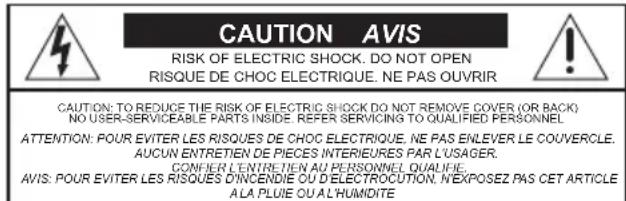
CAUTION AVIS RISK OF ELECTRIC SHOCK. DO NOT OPEN RISQUE DE CHOC ELECTRIQUE. NE PAS OUVRIR CAUTION: TO REDUCE THE RISK OF ELECTRIC SHOCK DO NOT REMOVE COVER (OR BACK) NO USER-SERVICEABLE PARTS INSIDE. REFER SERVICING TO QUALIFIED PERSONNEL ATTENTION: POUR EVITER LES RISQUES DE CHOC ELECTRIQUE. NE PAS ENLEVER LE COUVERCLE. AUCUN ENTRETIEN DE PIECES INTERIEURES PAR L'USAGER. CONFER L'ENTRETIEN AU PERSONNEL QUALIFE. AVIS: POUR EVITER LES RISQUES D'INCENDIE OU D'ÉLECTROCUTION. N'EXPOSEZ PAS CET ARTICLE ALA PLUIE OU AL'HUMIDITE
WARNING — To reduce the risk of fire or electric shock, do not expose this apparatus to rain or moisture.
NOTE: This equipment has been tested and found to comply with the limits for a Class B digital device, pursuant to part 15 of the FCC Rules. These limits are designed to provide reasonable protection against harmful interference in a residential installation. This equipment generates, uses, and can radiate radio frequency energy and, if not installed and used in accordance with the instructions, may cause harmful interference to radio communications. However, there is no guarantee that interference will not occur in a particular installation. If this equipment does cause harmful interference to radio or television reception, which can be determined by turning the equipment off and on, the user is encouraged to try to correct the interference by one or more of the following measures:
• Reorient or relocate the receiving antenna.
- Increase the separation between the equipment and the receiver.
- Connect the equipment into an outlet on a circuit different from that to which the receiver is connected.
- Consult the dealer or an experienced radio/TV technician for help.
CAUTION: Changes or modifications to this device not expressly approved by LOUD Technologies Inc. could void the user's authority to operate the equipment under FCC rules.
This apparatus does not exceed the Class A/Class B (whichever is applicable) limits for radio noise emissions from digital apparatus as set out in the radio interference regulations of the Canadian Department of Communications.
CONSIGNES DE SECURITE IMPORTANTES
- LIRE, SUIVRE TOUTES LES INSTRUCTIONS ET LES PRECAUTIONS D'UTILISATION
- NE PAS UTILISER PROCHE D'UNE SOURCE DE CHALEUR ET NE PAS BLOQUER OU OBSTRUER LE SYSTEME DE VENTILATION SUR CET APPAREIL, POUR UNE UTILISATION CONFORME, CET APPAREIL NECESSITE ENVIRON 7CM D'ESPACE BIEN VENTILE AUTOUR DE SON SYSTEME DE REFROIDISSEMENT, AINSI QU'UN COURANT D'AIR FRAIS CONSTANT
- NE PAS UTILISER CET APPAREIL PROCHE D'UNE SOURCE LIQUIDE
- NETTOYER SEULEMENT A L'AIDE D'UN CHIFFON DOUX ET SEC ET NE PAS UTILISER DE PRODUITS MENAGERS
- CONNECTER UNIQUEMENT LE CABLE D'ALIMENTATION FOURNI SUR UNE PRISE AVEC MISE A LA TERRE, ET COMPATIBLE AVEC LA TENSION, L'INTENSITE ET LA FREQUENCE REQUISES INDIQUEES SUR LA FACE ARRIERE DE L'APPAREIL
- S'ASSURER DE NE PAS MARCHER, PLIER OU TIRER SUR LE CABLE D'ALIMENTATION
- DEBRANCHER L'APPAREIL LORS D'UNE TEMPETE OU LORS D'UNE TRES LONGUE PERIODE DE NON UTILISATION
- UTILISER UNIQUEMENT DES ACCESSOIRES SPECIFIES PAR LE FABRICANT POUR UNE UTILISATION EN TOUTE SECURITE ET POUR EVITER DES BLESSURES
- ATTENTION: AFIN DE PREVENIR TOUT RISQUE DE CHOCS ELECTRIQUES OU DE DEBUT D'INCENDIE, NE PAS EXPOSER CET APPAREIL A LA PLUIE ET A L'HUMIDITE
- TOUT ENTRETIEN DOIT ETRE FAIT PAR UN TECHNICIEN QUALIFIE
- NOS AMPLIFICATEURS PEUVENT PRODUIRE DE TRES HAUTES PRESSIONS ACOUSTIQUES QUI PEUVENT CAUSER DES DOMMAGES AUDITIFS PERMANENTS OU DEFINITIFS. L'UTILISER AVEC UNE GRANDE PRECAUTION EST CONSEILLE ET DES PROTECTIONS AUDITIVES SONT RECOMMANDEES POUR UNE UTILISATION A FORT VOLUME.
- ATTENTION: CET APPAREIL REQUIERT UNE PRISE MURALE AVEC MISE A LA TERRE, AUX NORMES ACTUELLES ET COMPATIBLE AVEC LES SPECIFICATIONS ELECTRIQUES SE TROUVANT EN FACE ARRIERE DE L'APPAREIL. LA PRISE ELECTRIQUE DOIT RESTER ACCESSIBLE POUR DEBRANCHER L'APPAREIL EN CAS DE DEFAULT PENDANT L'UTILISATION
- CET APPAREIL DOIT ETRE DEBRANCHE SI IL N'EST PAS UTILISE
Correct disposal of this product: This symbol indicates that this product should not be disposed of with your household waste, according to the WEEE directive (2002/96/EC) and your national law. This product should be handed over to an authorized collection site for recycling waste electrical and electronic equipment (EEE). Improper handling of this type of waste could have a possible negative impact on the environment and human health due to potentially hazardous substances that are generally associated with EEE. At the same time, your cooperation in the correct disposal of this product will contribute to the effective usage of natural resources. For more information about where you can drop off your waste equipment for recycling, please contact your local city office, waste authority, or your household waste disposal service.
Exposure to extremely high noise levels may cause permanent hearing loss. Individuals vary considerably in susceptibility to noise-induced hearing loss, but nearly everyone will lose some hearing if exposed to sufficiently intense noise for a period of time. The U.S. Government's Occupational Safety and Health Administration (OSHA) has specified the permissible noise level exposures shown in the following chart.
According to OSHA, any exposure in excess of these permissible limits could result in some hearing loss. To ensure against potentially dangerous exposure to high sound pressure levels, it is recommended that all persons exposed to equipment capable of producing high sound pressure levels use hearing protectors while the equipment is in operation. Ear plugs or protectors in the ear canals or over the ears must be worn when operating the equipment in order to prevent permanent hearing loss if exposure is in excess of the limits set forth here:
| Duration, per day in hours | Sound Level dBA, Slow Response | Typical Example |
| 8 90 Duo in small club | ||
| 6 | 92 | |
| 4 95 Subway Train | ||
| 3 | 97 | |
| 2 100 Very loud classical music | ||
| 1.5 102 | ||
| 1 105 The boss screaming at the minions about manual deadlines | ||
| 0.5 110 | ||
| 0.25 or less 115 Loudest parts at a rock concert | ||
Introduction
Ampeg has a history of delivering pure all-tube tone for over 60 years. During that time we've made great friends and damaged some ear drums. We've seen it all, lived it all and lived to talk about it. The backbone of American Rock is back. Become a part of the American tone invasion with the all-new Ampeg GVT Series that delivers all-tube tone force that will set you apart from the rest. Are you ready to experience the taste, smell and tone that is American Rock? Buckle your seat belt, plug in, turn on and turn up. It's time to make history!
On a personal note, the team at Ampeg would sincerely like to thank you for your support and dedication to our mission in bringing you some of the best amps and cabs the world has known. Best of luck in all of your musical endeavors!
Sincerely,
The dedicated team at Ampeg
Special Features
• Single Channel, All-Tube Circuit Path, Single-Ended, Class A
• Power Output: 5W Full Power / 2.5W Half Power
• Preamp Tubes: 1 x 12AX7 / ECC83 / 7025
• Power Tubes: 1 x 6V6GT
- Rectifier: Solid State
• Controls: Volume, Treble and Bass
• Full Power (5W – Tetrode), Standby, Half Power (2.5W – Triode) Switch
- Baxandall EQ
• DC power to filament supply for super quiet operation
• Heritage trim: black-line face plate, black sparkle grille cloth and black Tolex
- Premium Tubes
• Dual Color Indicator Light
• Speaker Outputs: 1 x 16 Ω, 2 x 8 Ω and 2 x 4 Ω
• Cabinet Construction: Void-Free 15 mm thick plywood
- Cabinet Dimensions: 9.1 in / 230 mm (with feet) x 15.5 in / 394 mm x 9.1 in / 230 mm : handle adds 0.75 in / 19 mm to H
• Handling Weight: 20 lb / 9.1 kg (approximately)
flowchart
graph LR
    A["input"] --> B["volumetreblebass"]
    B --> C["open"]
    C --> D["full"]
    D --> E["standby"]
    E --> F["on"]
    style A fill:#f9f,stroke:#333
    style B fill:#ccf,stroke:#333
    style C fill:#ccf,stroke:#333
    style D fill:#cfc,stroke:#333
    style E fill:#fcc,stroke:#333
    style F fill:#fcc,stroke:#333
-
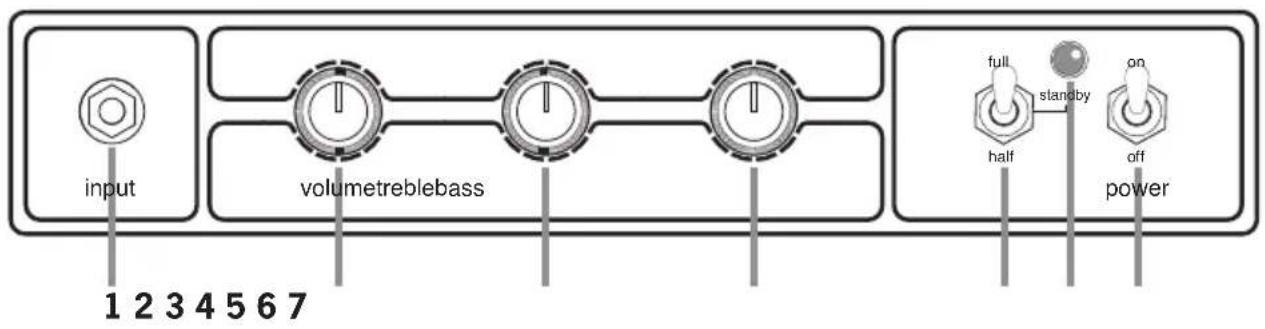
INPUT: Connect a guitar to this 1/4" input using a high-quality shielded instrument cable.
-
VOLUME: This control adjusts the output level.
-
TREBLE: Use this to adjust the high frequency level of the amplifier. This provides up to 12 dB of boost or 12 dB of cut at 5 kHz. The high frequency output is flat at the center position.
-
BASS: Use this to adjust the low frequency level of the amplifier. This provides up to 12 dB of boost or 12 dB of cut at 80 Hz. The low frequency output is flat at the center position.
-
FULL/STANDBY/HALF: The amplifier may be utilized in two distinct modes of operation and output power rating. Tetrode is the aggressive setting that delivers full output power of 5 watts rms [setting at FULL]. Triode is a gentler setting with more headroom that reduces the output power to 2.5 watts rms [setting at HALF].
Always make sure this switch is in STANDBY mode [middle position] when powering the GVT5H ON or OFF [7]. Allow at least 30 seconds before moving this switch to FULL or HALF.
During short breaks, this switch should be set to STANDBY to help prolong the life of the amplifier's tubes.
-
STANDBY/POWER LED: This is a multi-function LED. In STANDBY mode, it glows red. In the ON mode (when the high voltage kicks in) it glows green. If it does not turn green in the ON mode, there is no high voltage present and the unit needs to be serviced.
-
POWER SWITCH: Use this switch to turn the overall system power on or off.
Always turn this switch ON first and OFF last! Turn the Full/Standby/Half switch [5] on at least 30 seconds after turning on the On/Off switch.

text_image
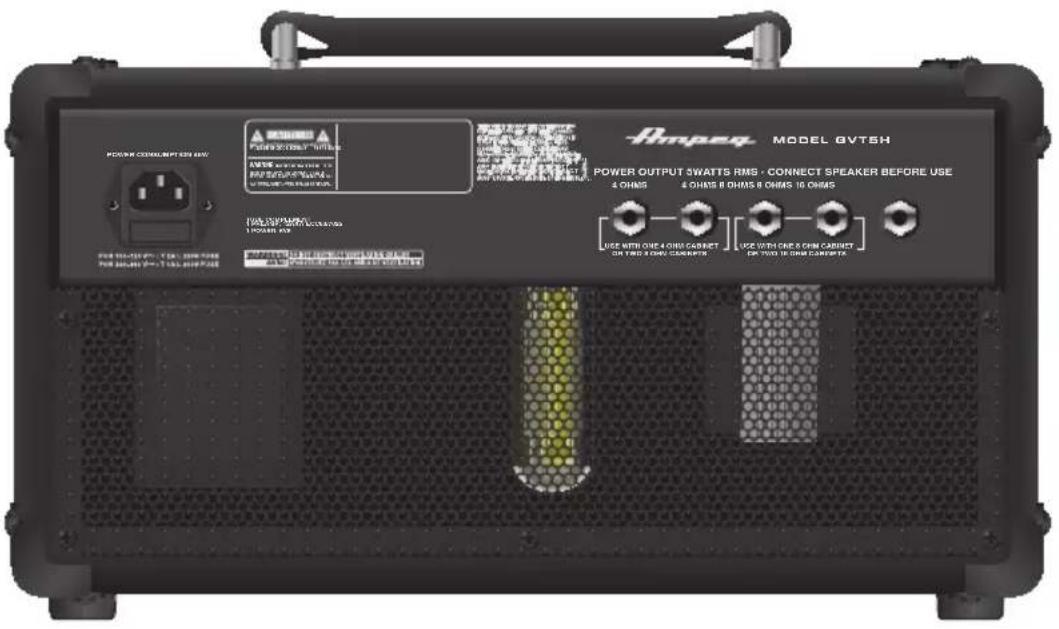
POWER CONSUMPTION ASW POWER 10k-130 V~ T4 L. 26W PUS POWER 280-340 V~ T4 L. 26W PUS TUBE COMPLEMENT 1 PRAMP-TAXCH ECO307026 1 POWER: 6V WARNING: TO SET DISTRICT INTELLATION GAS LEC AUTO: MAXIMUM AIR LED OR & OR SUNT LATS Ampeq MODEL GVTSH POWER OUTPUT 5WATTS RMS - CONNECT SPEAKER BEFORE USE 4 OHMS 4 OHMS 6 OHMS 8 OHMS 16 OHMS USE WITH ONE 4 OHM CABINET OR TWO 8 OHM CABINET 15 USE WITH ONE 5 OHM CABINET OR TWO 18 OHM CABINET 15 8 9 10 11WARNING! Never turn on or use the amplifier without a load or speaker connected to the amplifier.
ALWAYS use a good quality (non-shielded) speaker cable. Never use (shielded) instrument cable.
ALWAYS match the amplifier's speaker output impedance to the impedance of the speaker that is being used. Use only one type impedance output at a time. If more than one speaker is connected at the same time, make sure they all have the same impedance rating. Never use two or more cabinets with different impedance ratings. This will create an unbalanced load. When using multiple speaker cabinets (with the same impedance rating), match the total load impedance of the speaker cabinets to the speaker output of the amplifier.
SPEAKER CABINET IMPEDANCE divided by NUMBER OF CABINETS = TOTAL LOAD
16 Ω cabs with parallel inputs / 4 cabs = 4 Ω load. For this application use 4 Ω output jacks.
16 Ω cabs / 2 cabs = 8 Ω load. For this application use the 8 Ω speaker jacks.
16 Ω cab / 1 cab = 16 Ω load. For this application use the 16 Ω speaker jack.
8 Ω cabs / 2 cabs = 4 Ω load. For this application use the 4 Ω output jacks.
8 Ω cab / 1 cab = 8 Ω load. For this application use the 8 Ω speaker jack.
4 Ω cab / 1 cab = 4 Ω load. For this application use the 4 Ω speaker jack.
8. AC POWER INPUT WITH MAINS FUSE
ASSEMBLY: The amplifier is equipped with a detachable power cable that plugs into the IEC Mains socket on the back of the amplifier. The AC power cord should only be plugged into a grounded power outlet that meets all applicable electrical codes and is compatible with the voltage, power, and frequency requirements stated on the rear panel of the amplifier.

Do not attempt to defeat the safety ground connection.
The AC Mains fuse is located in the IEC Mains socket and is used to protect the amplifier from electrical faults. If the fuse needs to be replaced, please refer to the correct fuse specifications located on the back panel of the amplifier.
-
4 OHMS: The two 4 Ω speaker output jacks are wired in parallel. Use a single jack when using one 4 Ω speaker cabinet. Use both speaker jacks when using two 8 Ω speaker cabinets. If you have four 16 Ω cabinets with parallel speaker jacks, you can link all four 16 Ω cabinets in a parallel wiring configuration, totaling a 4 Ω load.
-
8 OHMS: The two 8 Ω speaker output jacks are wired in parallel. Use a single jack when using one 8 Ω speaker cabinet. Use both speaker jacks when using two 16 Ω speaker cabinets.
-
16 OHMS: The 16 Ω speaker output jack is designated for 16 Ω speaker cabinets only.

Never bypass the fuse or replace it with a wrong type or value.
GVT5H
Ampug
GVT
Guitar Amplifier
The Nature Of Tubes — Why (And When To) Replace Them:
Tubes are made up of a number of fragile mechanical components that are vacuum-sealed in a glass envelope or bubble. The tube's longevity is based on a number of factors which include how hard and often the amplifier is played, vibration from the speakers, road travel, repeated set up and tear down, etc.
Any time you notice a change in the amplifier's performance, check the tubes first.
If it's been awhile since the tubes were replaced and the amplifier lacks punch, fades in and out, loses highs or lows or produces unusual sounds, the power tubes probably need to be replaced. If the amplifier squeals, makes noise, loses gain, starts to hum, lacks "sensitivity", or feels as if it is working against you, the preamplifier tubes may need to be replaced.
The power tubes are subjected to considerably more stress than the preamplifier tubes. Consequently, they almost always fail/degrade first. If deteriorating power tubes aren't replaced, they will ultimately fail. Depending on the failure mode, they may even cause severe damage to the audio output transformer and/or other components in the amplifier. Replacing the tubes before they fail completely has the potential to save time, money and other unwanted trouble. Since power tubes work together in an amplifier, it is crucial that they (if there is more than one) be replaced by a matched set. If you're on the road a lot, we recommend that you carry a spare matched set of replacement power tubes and their associated driver tubes.
After turning off the power and disconnecting the amplifier from the power source, carefully check the tubes (in bright light) for cracks or white spots inside the glass or any other apparent damage. Then, with the power on, view the tubes in a dark room. Look for preamplifier tubes that do not glow at all or power tubes that glow excessively red.
Changing the Tubes:
To get to the power tubes, the rear screen must be removed and the tube retainer(s) must be moved out of the way. Qualified service persons may follow these steps to change the tubes:
- Turn the amp off, unplug it and let it cool for at least 5 minutes.
- Remove the screws which hold the perforated metal screen to the rear of the cabinet.
- Set the perforated metal screen aside.
- Remove the tube retainer(s) by pulling them off the tube(s) and moving them to one side.
- Grasp the tube at its top and gently work it out of its socket by rocking it slightly back and forth as you pull down on it.
- When inserting new output tubes, align the tab in the tube's plastic base with the slot in the socket and press the tube gently but firmly into place by pushing up on its top.
- Replace the perforated metal screen and tighten its screws.
Important Information About Tubes (continued):
Whenever you replace the power tube(s):
Check the preamplifier tubes for microphonics by turning the amplifier on, turning up the gain and tapping lightly on each tube with the end of a pencil or a chopstick (my favorite). You will be able to hear the tapping through the speakers, which is normal. It is not normal for a tube to ring like a bell after it's tapped. If it does ring, then it's microphonic and should be replaced. Remember to use only high-quality, low microphonic tubes in the preamplifier section.
Even though power tubes are rarely microphonic, they should be checked, anyway. Power tubes may be checked for microphonics in the same fashion as the preamp tubes.
The amount of noise generated in very high gain amps may be reduced simply by swapping the preamp tubes around.
Survival Tips for Tube Amplifiers:
To prolong tube life, observe the following tips and recommendations:
- Match the impedance of the speaker cabinet(s) to the amplifier. Improper impedance matching will contribute to early tube degradation and may cause premature tube failure.
• Make sure the speaker(s) are properly connected prior to turning on the amplifier. - Allow sufficient time for the amplifier to properly cool down prior to moving it. A properly cooled amplifier prolongs tube life due to the internal components being less susceptible to the damage caused by vibration.
- Allow the amplifier to warm up to room temperature before turning it on. The heat generated by the tube elements can crack a cold glass housing.
- Replace the output tube(s) before the performance degrades or the tubes fail completely. Replace the tube(s) at least once per year or as often as every 4 to 6 months if you play long and hard every day.
- If the locating notch on the base of a power tube breaks off, replace the tube. This significantly reduces the risk of damaging the amplifier by incorrectly inserting the tube.
- Protect the amplifier from dust and moisture. If liquid gets into the amplifier proper, or if the amplifier is dropped or otherwise mechanically abused, have it checked out at an authorized service center before using it.
- Proper maintenance and cleaning in combination with routine checkups by an authorized service center will ensure the best performance and longest life from the amplifier.

CAUTION: Tube replacement should be performed only by qualified service personnel who are familiar with the dangers of hazardous voltages that are typically present in tube circuitry.
text_image
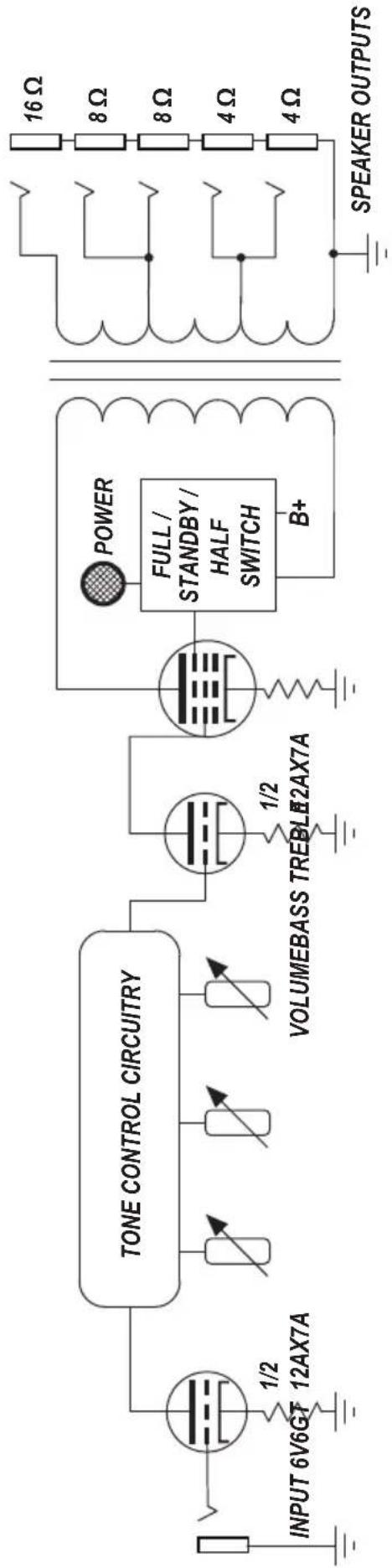
TONE CONTROL CIRCUITRY INPUT 6V6GT 1/2 12AX7A VOLUMEBASS TREBLE 1/2 12AX7A POWER FULL / STANDBY / HALF SWITCH B+ 16 Ω 8 Ω 8 Ω 4 Ω 4 Ω SPEAKER OUTPUTSAmpug
GVT
Guitar AmplifierGVT!
Preamp Tube Premium 1 x 12AX7 / ECC83 / 7025
Power Amp Tube Premium 1 x 6V6GT
Output Power Rating 5 watts rms ("full" tetrode mode) / 2.5 watts rms ("half" triode mode) into 4, 8 or 16 Ω
Signal-to-Noise Ratio 75 dB (20 Hz – 20 kHz, unweighted)
Maximum Gain 50 dB @ 1 kHz, volume max, tones centered, 16 Ω out
Tone Controls Bass: +12 / -12 dB @ 80 Hz
Treble: +12 / -12 dB @ 5 kHz
Power Requirements 100–120 V\~ : T 2A L 250V fuse, 50–60Hz, 45W 220–240 V\~ : T 1A L 250V fuse, 50–60Hz, 45W
Size (H x W x D) 9.1 in / 230 mm (with feet) x 15.5 in / 394 mm
x 9.1 in / 230 mm
Handle adds 0.75 in / 19 mm to H
Weight 20 lb / 9.1 kg (approximately)
The GVT5H is covered with a durable fabric-backed vinyl material. Clean with a dry lint-free cloth. Never spray cleaning agents on the GVT5H. Avoid abrasive cleansers which would damage the finish.
Ampeg continually develops new products and improves upon existing ones. For this reason, the specifications and information in this manual are subject to change without notice.
"Ampeg" is a registered trademark of LOUD Technologies Inc. All other brand names mentioned are trademarks or registered trademarks of their respective holders and are hereby acknowledged.
Service Information
f there is a problem with the GVT5H amplifier, please visit our website (www.ampeg.com) and click on Support for service information, or call Technical Support at 1-800-898-3211 Monday – Friday during normal business hours, Pacific Time, to receive assistance. GVT5H owners outside of the U.S., contact the local distributor for technical support and service.
www.ampeg.com
©2011 LOUD Technologies Inc.
16220 Wood-Red Road NE • Woodinville, WA 98072
Part No. SW0903 Rev. A 06/11

text_image
pargnHàTVO
Gritar A Wpile