DS8100A-3020 - Barcode Reader DATALOGIC - Free user manual and instructions
Find the device manual for free DS8100A-3020 DATALOGIC in PDF.


User questions about DS8100A-3020 DATALOGIC
0 question about this device. Answer the ones you know or ask your own.
Ask a new question about this device
Download the instructions for your Barcode Reader in PDF format for free! Find your manual DS8100A-3020 - DATALOGIC and take your electronic device back in hand. On this page are published all the documents necessary for the use of your device. DS8100A-3020 by DATALOGIC.
USER MANUAL DS8100A-3020 DATALOGIC
natural_image
Exterior view of a white and black industrial optical device with visible internal components and ventilation grilles (no text or symbols)Reference Manual
DATALOGIC
Datalogic Automation Srl
Via Lavino, 265
40050 - Monte S. Pietro
Bologna - Italy
DS8100A Reference Manual
Ed.: 10/2012
© 2005 – 2012 Datalogic Automation S.r.l. ♦ ALL RIGHTS RESERVED. ♦ Protected to the fullest extent under U.S. and international laws. Copying, or altering of this document is prohibited without express written consent from Datalogic Automation S.r.l.
Datalogic and the Datalogic logo are registered trademarks of Datalogic S.p.A. in many countries, including the U.S.A. and the E.U.
Genius, PackTrack, ACR, ASTRA, CD SQUARE and ID-NET are trademarks of Datalogic Automation S.r.l. All other brand and product names mentioned herein are for identification purposes only and may be trademarks or registered trademarks of their respective owners.
Datalogic shall not be liable for technical or editorial errors or omissions contained herein, nor for incidental or consequential damages resulting from the use of this material.
REFERENCES ...... vi
Reference Documentation......vi
Services and Support ...... vi
Patents......vi
COMPLIANCE......vii
Electrical Safety....vii
Laser Safety......vii
Power Supply......viii
CE Compliance......viii
FCC Compliance ix
GENERAL VIEW....x
GUIDE TO INSTALLATION....xii
Point-to-Point Installation....xii
Master/Slave Lonworks Installation ....xiii
1 INTRODUCTION .... 1
1.1 Product Description .... 1
1.2 Applications .... 1
1.3 Model Description....3
1.4 Oscillating Mirror Models 3
1.5 Indicators 4
1.6 Keypad and Display....5
1.6.1 Internal Net 5
1.6.2 Test Mode....5
1.6.3 PackTrack (Auto)....6
1.7 Auto PackTrack™ Calibration for Reading Station Using Scanner Menu .... 7
1.7.1 Auto PackTrack Conditions and Limits 7
1.7.2 Auto PackTrack Parameter Descriptions....8
1.7.3 Auto PackTrack Setup....9
1.8 Accessories 12
2 INSTALLATION 14
2.1 Package Contents 14
2.2 Mechanical Mounting....15
2.2.1 Mounting the Scanner....15
2.2.2 Mounting the Scanner with Accessories....16
2.3 Positioning the Scanner....18
3 CBX ELECTRICAL CONNECTIONS....19
3.1 Power Supply....21
3.2 Main Serial Interface....21
3.2.1 RS232 Interface....22
3.2.2 RS485 Full-Duplex Interface....23
3.2.3 RS485 Half-Duplex Interface 24
3.3 Auxiliary RS232 Interface 26
3.4 Inputs....27
3.4.1 Code Verifier....31
3.5 Outputs 31
3.6 User Interface - Host....34
4 CUSTOM CABLE ELECTRICAL CONNECTIONS 35
4.1 Power Supply....37
4.2 Main Serial Interface....37
4.2.1 RS232 Interface 38
4.2.2 RS485 Full-Duplex Interface....39
4.2.3 RS485 Half-Duplex Interface 40
4.3 Auxiliary Interface 42
4.4 Inputs....42
4.4.1 Code Verifier....45
4.5 Outputs 45
4.6 User Interface 47
5 LONWORKS CONNECTIONS....48
5.1 Network Termination....49
5.2 Lonworks Interface .... 50
6 FIELDBUS CONNECTIONS 52
6.1 Ethernet Interface 52
6.2 Ethernet Interface (older models) 53
7 TYPICAL LAYOUTS 55
7.1 Local Lonworks Network....55
7.1.1 Small Synchronized Network....56
7.1.2 Large Synchronized Network....58
7.1.3 Redundant System 60
7.1.4 Multidata Network 62
7.1.5 Fieldbus Networks 63
8 SOFTWARE CONFIGURATION......65
8.1 Genius™ Installation....65
8.2 Guide to Rapid Configuration 65
8.2.1 Wizard for Quick Reader Setup....65
8.2.2 Genius™ Network Setup Through Master....68
8.2.3 Alternative Slave Address Assignment....73
8.3 Advanced Genius™ Configuration 73
8.3.1 Genius™ Shortcuts for Network Configuration....74
8.4 Parameter Default Values....76
9 READING FEATURES....81
9.1 Advanced Code Reconstruction (ACR ^TM 4)......81
9.1.1 Tilt Angle for Advanced Code Reconstruction....81
9.2 PackTrack™ 82
9.2.1 Auto PackTrack™ Calibration for Reading Station Using DLAPC 84
9.2.2 Manual PackTrack™ Calibration for DS8100A Scanner Using SPY....91
9.2.3 PackTrack™ Calibration for DS8100A Oscillating Mirror Models 94
9.3 Performance 95
9.3.1 Reading Conditions 95
9.4 Reading Diagrams....97
10 MAINTENANCE....107
10.1 Cleaning....107
10.2 External Memory Backup & Restore....107
10.3 Automatic Scanner Replacement (ASR) 107
10.3.1 ASR Network Configuration....108
10.3.2 Scanner Replacement Procedure.... 108
11 TROUBLESHOOTING 109
12 TECHNICAL FEATURES....112
A ALTERNATIVE LAYOUTS 114
Point-to-Point 114
ID-NET™ Gateway 116
Pass Through 117
RS232 Master/Slave 118
Multiplexer 120
GLOSSARY....121
INDEX....124
REFERENCE DOCUMENTATION
The documentation related to the DS8100A management is listed below:
- PWR series power supply unit Installation Manuals
• SC6000 Controller Reference Manual - PWO power supply unit Installation Manual
• GFC-80 90° Deflecting Mirror
• GFC-800A Adjustable Mirror for Close Distance Reading
• CBX100/500 Installation Manuals - Document about the Ethernet connectivity
• ID-NET™ Fixed Baudrate Application Note
• Help On-Line in PDF format
SERVICES AND SUPPORT
Datalogic provides several services as well as technical support through its website. Log on to www.automation.datalogic.com and click on the links indicated for further information:
- PRODUCTS
Search through the links to arrive at your product page which describes specific Info, Features, Applications, Models, Accessories, and Downloads including the Genius™ utility program, which allows device configuration using a PC. It provides RS232 and Ethernet interface configuration.
- SERVICE
- Overview - Warranty Extensions and Maintenance Agreements
- Sales Network Listing of Subsidiaries, Repair Centers, Partners
- Helpdesk
- Material Return Authorization
PATENTS
This product is covered by one or more of the following patents:
U.S. patents: Re. 36,251; 5,992,740; 6,347,740 B1; 6,177,979 B1; 6,394,352 B1; 6,443,360 B1; 6,527,184 B1; 6,629,639 B2; 6,742,710 B2; 7,161,685 B1.
European patents: 652,530 B1; 789,315 B1; 851,376 B1; 926,615 B1; 959,426 B9; 1,217,571 B1; 1,363,228 B1; 1,607,901 B1.
Japanese patents: 3,793,585 B2; 4,033,958 B2; 4,376,353 B2.
ELECTRICAL SAFETY
This product conforms to the applicable requirements contained in the European Standard for electrical safety EN-60950 at the date of manufacture.

WARNING
This symbol refers to operations that must be performed by qualified personnel only. Example: opening the device.

WARNING
This symbol refers to operations where there is danger of electrical shock. Before opening the device make sure the power cable is disconnected to avoid electric shock.
LASER SAFETY
The following information is provided to comply with the rules imposed by international authorities and refers to the correct use of the DS8100A scanner.
Standard Regulations
This scanner utilizes up to 4 low-power laser diodes. Although staring directly at the laser beam momentarily causes no known biological damage, avoid staring at the beam as one would with any very strong light source, such as the sun.
Avoid that the laser beam hits the eye of an observer, even through reflective surfaces such as mirrors, etc.
This product conforms to the applicable requirements of both EN60825-1 and CDRH 21 CFR1040 at the date of manufacture. The reader is classified as a Class 2 laser product according to EN60825-1 regulations and as a Class II laser product according to CDRH regulations.
There is a safety device which allows the laser to be switched on only if the motor is rotating above the threshold for its correct scanning speed.

WARNING
Use of controls or adjustments or performance of procedures other than those specified herein may result in exposure to hazardous visible laser light.
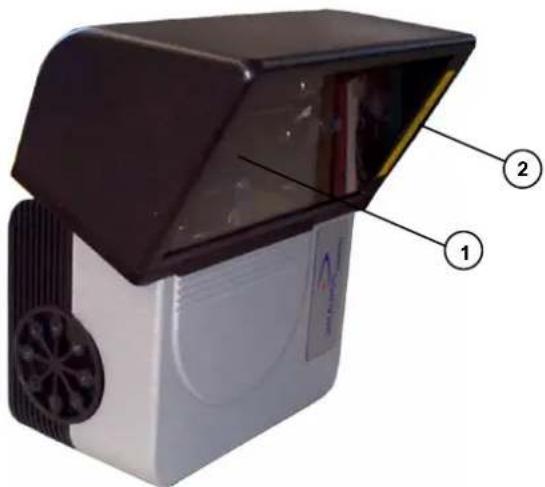
The laser light is visible to the human eye and is emitted from the window on the side of the scanner (Figure A).
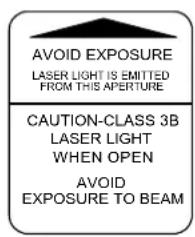
Warning labels indicating exposure to laser light and the device classification are applied onto the body of the scanner (Figure A):
text_image
AVOID EXPOSURE LASER LIGHT IS EMITTED FROM THIS APERTURE CAUTION-CLASS 3B LASER LIGHT WHEN OPEN AVOID EXPOSURE TO BEAM
text_image
DATALOGIC AU TOMATIO N S.r.l. - Via Lavino 265 40050 Monte San Pietro - Bologna - Italy Manufactured Volt Model No. Amp. Serial No. © N2468 This product conforms to the applicable requirements of 21CFR1040 at the date of manufacture. CE
text_image
LASER LIGHT DO NOT STARE INTO BEAM CLASS 2 LASE R PRODUCT MAXIMUM OUTPUT UT RA DIATION 1 mW EMIT ED WAVELE NGB H030-600 nm TO EN 8M025-1:2001Warning and Device Class Labels
Disconnect the power supply when opening the device during maintenance or installation to avoid exposure to hazardous laser light.
The laser diodes used in this device are classified as Class 3B laser products according to EN 60825-1 regulations and as Class IIIb laser products according to CDRH regulations. Any violation of the optic parts in particular can cause radiation up to the maximum level of the laser diode (30 mW at 630\~680 nm).
POWER SUPPLY
This product is intended to be installed by Qualified Personnel only.
- This scanner is intended to be supplied by either a UL Listed power supply marked 'Class 2' or 'LPS', output rated 20 – 30 V dc, minimum 1.3 A or by a UL Listed computer with LPS outputs.
- This scanner must be supplied by a Class II Power Supply Unit conforming to the EN 60950 safety regulation.
CE COMPLIANCE
Warning:
This is a Class A product. In a domestic environment this product may cause radio interference in which case the user may be required to take adequate measures.
FCC COMPLIANCE
Modifications or changes to this equipment without the expressed written approval of Datalogic could void the authority to use the equipment.
This device complies with PART 15 of the FCC Rules. Operation is subject to the following two conditions: (1) This device may not cause harmful interference, and (2) this device must accept any interference received, including interference which may cause undesired operation.
This equipment has been tested and found to comply with the limits for a Class A digital device, pursuant to part 15 of the FCC Rules. These limits are designed to provide reasonable protection against harmful interference when the equipment is operated in a commercial environment. This equipment generates, uses, and can radiate radio frequency energy and, if not installed and used in accordance with the instruction manual, may cause harmful interference to radio communications. Operation of this equipment in a residential area is likely to cause harmful interference in which case the user will be required to correct the interference at his own expense.

text_image
DS8100A-XXX0 ① ② ③ ④ ⑤ ⑥ ⑦ ⑧Figure A - DS8100A
① Laser Beam Output Window
② Laser Safety Label
③ Product Label
④ Warning and Device Class Label
⑤ Connector Panel
⑥ Display
⑦ Service Access Cap
⑧ Mounting Holes
DS8100A-XXX5
text_image
Diagram of a refrigerant air conditioner unit with labeled parts 1 and 2Figure B - DS8100A Oscillating Mirror Models
① Laser Beam Output Window
② Laser Safety Label
text_image
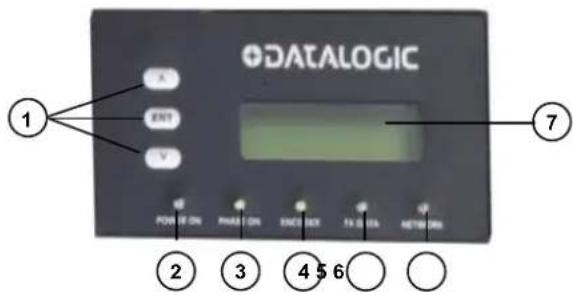
DATALOGIC ① ⑦ ② ③ ④ ⑤ ⑥ ○ A ENT V POWER ON PHASE ON ENCO SET TX & UA NETW INFigure C – Display and Keypad Panel
① Programming Keypad
② Power On LED (Green)
③ Phase On LED (Yellow)
④ Encoder LED (Yellow)
⑤ TX Data LED (Green)
⑥ Network LED (Red)
⑦ LCD Display

natural_image
Back panel of an electronic device showing two connected VGA connectors with labeled pins (no text or symbols beyond labels)Figure D - Connector Panel for Standard Models
① Lonworks 17-pin male connector
③ Serial interface and I/O 26-pin connector
② Lonworks 17-pin female connector
text_image
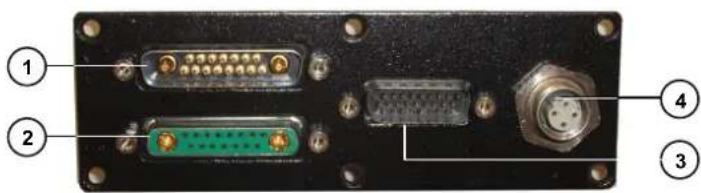
Labeled diagram of an electronic device rear panel showing ports, connectors, and a central connector with pins 1, 2, 3, and 4.Figure E – Connector Panel for Ethernet Models
① Lonworks 17-pin male connector
② Lonworks 17-pin female connector
③ Serial interface and I/O 26-pin connector
④ Ethernet M12 4-pin female connector
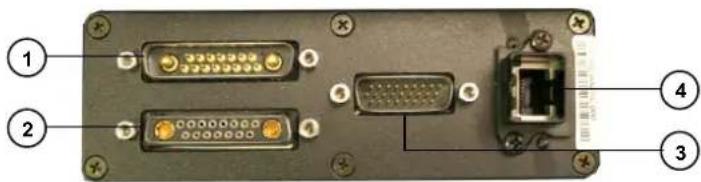
text_image
Labeled diagram of an electronic device rear panel showing ports, connectors, and internal componentsFigure F – Connector Panel for (older) Ethernet Models
① Lonworks 17-pin male connector
② Lonworks 17-pin female connector
③ Serial interface and I/O 26-pin connector
④ Harting RJ industrial connector
POINT-TO-POINT INSTALLATION
The following can be used as a checklist to verify all the necessary steps to complete installation of the DS8100A scanner.
1) Read all information in the section "Safety Regulations" at the beginning of this manual.
2) Correctly mount the scanner according to the information in par. 2.2 and position it at the correct reading distance as shown in par. 2.3 and par. 9.4.
3) Make electrical connections to your DS8100A scanner by:
a) Connecting the DS8100A scanner to the CBX connection box by means of one of the CAB-F0x cables provided as accessory (see par. 1.8).
b) Providing correct and complete system cabling through the CBX connection box according to the signals necessary for the layout of your application (trigger, inputs, outputs).
- Cabling: Power, Interface, Inputs, Outputs, etc. For further details, see chapter 3 (chapter 4 for custom cabling).
- Alternative Layouts: Point-to-Point, Pass Through, RS232 Master/Slave, Mutliplexer. See appendix A for layout references.
4) Configure the DS8100A scanner by installing and running the Genius™ configuration program from the CD-ROM provided. See chapter 8 and the Help On-Line for details. The main steps are:
- Select the codes to be read
- Set-up the communication parameters
- When PackTrack™ is required, perform PackTrack™ calibration
- Define data formatting parameters

NOTE
Fine tuning of the scanner position for barcode reading can be accomplished by performing a test through the SPY configuration tool in Genius™.
5) Exit the configuration program and run your application.
The installation is now complete.
MASTER/SLAVE LONWORKS INSTALLATION
The following can be used as a checklist to verify all the steps necessary to complete installation of the DS8100A scanner in a Master/Slave Lonworks network.
1) Read all information in the section "Safety Regulations" at the beginning of this manual.
2) Correctly mount the scanner according to the information in par. 2.2 and position it at the correct reading distance as shown in par. 2.3 and par. 9.4.
3) Make electrical connections to your DS8100A scanner by:
a) Connecting the DS8100A Master scanner to the CBX100 by means of one of the CAB-F0x cables provided as accessory (see par. 1.8).
b) Correctly terminating the DS8100A Master reader according to the information given in par. 5.1 and par. 7.1.
c) Completing the system wiring adding as many slave scanners as required by your system layout (refer to par. 7.1).
d) Correctly providing bus return to the last DS8100A Slave reader of the network according to the information given in par. 5.1 and par. 7.1.
4) Install and run the Genius™ configuration program from the CD-ROM provided. Configure the Local Lonworks Network using one of the procedures given below:
- Configure the entire network through the Master as described in par. 8.2.2;
- Configure the Master as described in par. 8.2.2 and locally define each slave scanner address as described in par. 8.2.3.
- Define each scanner, master and slaves (with their addresses), by using the scanner keypad according to the information given in par. 1.6.1.
5) Configure the Master scanner through the Genius™ program. See chapter 8 and the Help On-Line for details. The main steps are:
- Select the codes to be read
- Set-up the communication parameters
- When PackTrack™ is required, perform PackTrack™ calibration, see par. 9.2.1.
- Define data formatting parameters
6) Configure each Slave scanner through the Master scanner using Genius™. See chapter 8 and the Help On-Line for details. The main steps are:
- Select the codes to be read
- When PackTrack™ is required, perform PackTrack™ calibration, see par. 9.2.1.

NOTE
Fine tuning of the scanner position for barcode reading can be accomplished by performing a test through the SPY configuration tool in Genius™.
7) Send the configuration to the Master.
8) Perform the External Memory Backup procedure for system backup purposes (see par. 10.2). For backward compatibility you can perform the ASR Network Configuration procedure for system backup purposes (see par. 10.3.1).
9) Exit the configuration program and run your application.
The installation is now complete.
1 INTRODUCTION
1.1 PRODUCT DESCRIPTION
The DS8100A scanner is a barcode reader complete with decoder designed to provide an innovative and high performance solution in omnidirectional reading applications by combining the following advanced technologies with Datalogic solid experience in the material handling sector.
Some of the main features of DS8100A are listed below:
• scanning speed 1000 scans/sec.
- reads all popular codes.
• supply voltage from 20 to 30 Vdc.
- test mode to verify the reading features and exact positioning of the scanner without the need for external tools.
- programmable in several different operating modes to suit the most various barcode reading system requirements.
- light source: solid state laser diodes; the light emitted has a wave length between 630\~680 nm. For laser safety precautions refer to the “Compliance” section at the beginning of this manual.
1.2 APPLICATIONS
The DS8100A barcode reader is specifically designed for industrial applications and for all cases requiring high reading performance such as:
- code reconstruction
- reading of codes covered by plastic film
- reading of codes with a wide depth of field
- reading of high resolution codes positioned at long distances from the reader
• code reading on fast moving objects.
DS8100A is designed for both single-reader layouts and multi-reader layouts. For typical layouts see chapter 7 and appendix A.
| Feature | Benefit |
| ACRTM | Advanced Code Reconstruction technology allows the reading of low aspect ratio labels placed anywhere on a parcel and enhances the readability of poorly printed or damaged codes. |
| CD SQUARETM | CD SQUARETM provides useful information on label position and object shape elaborated during the barcode reading phase. This innovative technology identifies the area in which the code is located and measures the code distance from the scanner. |
| PACKTRACKTM | PackTrackTM is a Datalogic patented parcel tracking system which improves the reading features in omnidirectional stations. In particular, PackTrackTM manages 6-sided reading systems when it is impossible to detect the real position of the code on the parcel, thus overcoming the need for external accessories essential in traditional tracking systems. |
| ASTRA ^TM | Automatically SwiTched Reading Area ^TM is the new Datalogic technology based on a multi-laser architecture and a fixed mounted optic system which concentrates the multiple laser emissions in a single laser beam. As each laser emitter is focused on a specific range of the reading area, a sophisticated electronic controller selects the best focused laser emitter with respect to the code to read. This allows the reading of medium-high density codes in a large reading area on very fast conveyors. |
| Flexibility | The high frequency laser diode modulation system guarantees complete immunity to ambient light and allows installation of the DS8100A in any working area. |
| Reading parcels on conveyors | As a result of the ASTRATM multiple laser technology, DS8100A gives a great real time DOF even on high speed conveyors. Furthermore, DS8100A implements the PacktrackTM functionality which leads to an increase of the plant production as a result of the augmented system throughput. |
| Master working as a Multiplexer on high speed Lonworks bus | Great competitiveness of the offer, since the cost of an external multiplexer is saved;High data transfer on an industrial, reliable bus running at 1.25 Mbit/sec. |
| GeniusTM Configurator SW | Reduced learning time, with an easy wizard approach;Multilanguage platform;All the configuration parameters stored in the scanner;Not dependent on the Physical interface. |
| Energy Saving | A software parameter group which allows management of the energy saving feature. In particular, it allows turning on/off the motor and laser of all network scanners according to the selected digital input, encoder, or communication channel.The time required to restart the system is less than 1 minute independently from the number of scanners connected.It is suggested to use this parameter for example when the conveyor is stopped for a lengthy period. |
1.3 MODEL DESCRIPTION
The DS8100A scanner is available in versions that differ depending on the interface connection, the optical resolution and on the optic version:
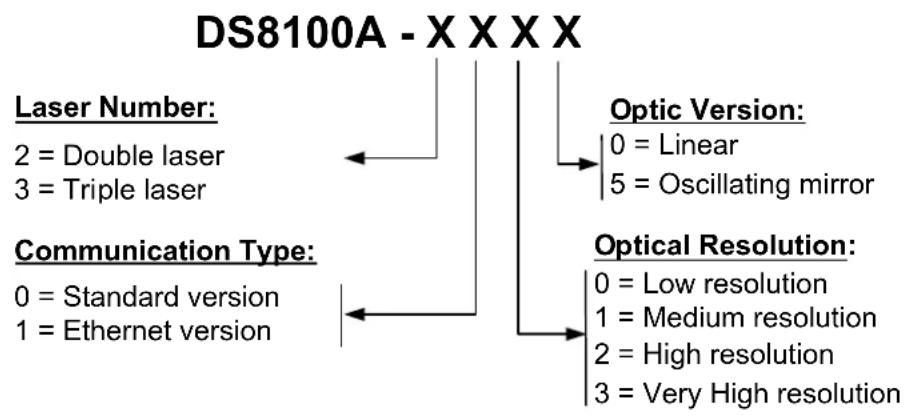
flowchart
graph TD
    A["DS8100A - X X X X"] --> B["Laser Number: 2 = Double laser, 3 = Triple laser"]
    A --> C["Optic Version: 0 = Linear, 5 = Oscillating mirror"]
    A --> D["Optical Resolution: 0 = Low resolution, 1 = Medium resolution, 2 = High resolution, 3 = Very High resolution"]
    E["Communication Type: 0 = Standard version, 1 = Ethernet version"] --> C
1.4 OSCILLATING MIRROR MODELS
Oscillating mirror models are used when coverage of a large reading area is required, mainly in picket fence applications.
The oscillating mirror is placed in front of the reading aperture of the DS8100A scanner to deflect the laser beam. As the mirror moves, this sweeping function of the laser beam allows the coverage of a larger area to locate the barcodes. The code can also be reconstructed as the beam sweeps over it.
The aperture angle is symmetrical and the scan line perpendicular to the scanner is at 0^ as shown in the figure below.

text_image
+25° 0° -25°Figure 1- Oscillating Mirror Reference Angle
By configuring the oscillating speed up to the maximum value of 19 Hz, raster emulation can be performed for reading fast moving objects.
| Hz | Max. | Aperture |
| 0-5 | 50^ | |
| 6-10 | 30^ | |
| 11-15 | 20^ | |
| 16-19 | 10^ |

NOTE
By limiting the raster width to the minimum necessary, the number of scans on the reading surface is increased.
The oscillating mirror is completely controlled by software commands and therefore avoids complex mechanical calibrations. For details of the software configuration parameters see the Genius™ Help On Line.
1.5 INDICATORS
The DS8100A has five LEDs on the rear panel. The indicators have the following functions:
POWER ON (green) Indicates the scanner is turned on.
PHASE ON (yellow) Indicates the external presence sensor is active.
ENCODER (yellow) Indicates the external encoder signal is active.
TX DATA (green) Indicates data transmission both on the main and on the auxiliary interface.
NETWORK (red) Indicates the Lonworks network is functioning correctly. This LED is normally ON.
1.6 KEYPAD AND DISPLAY
The DS8100A keypad allows entering a menu for selection of one of the following functions:
- Welcome: shows the current software release and operating mode;
- Autolearn: starts the procedure making it possible to obtain an automatic, accurate and fast configuration of DS8100A without the necessity of directly checking/modifying the relevant parameters;
- Internal Net: defines scanner function within the network (see below);
- Ethernet Mode: allows setting the scanner IP address to be used within the network;
• LCD Contrast: sets the LCD contrast ; - Bus: not used for DS8100A scanners;
- Test Mode: allows verifying the scanner reading position and features (see below).
- PackTrack: allows setting the Auto PackTrack Calibration procedure (see below).
The same settings may be performed by using the Genius™ program (see chapter 8 for details).
1.6.1 Internal Net
This submenu can be used as an alternative to configuration through Genius ^™ , to assign the DS8100A scanner within a master/slave network.
It allows defining the scanner function (slave/master) within the network and, if configured as Slave, its address.
To enter the Internal Net submenu and configure the scanner follow the given procedure:
1) Press and hold both the ▲ (up arrow) and ▼ (down arrow) keys for about 2 seconds to enter the Main menu;
2) Use the ▲ (up arrow) or ▼ (down arrow) key to select the "Internal Net" item, then press the ENT (enter) key to confirm;
3) Use the ▲ (up arrow) or ▼ (down arrow) key to select the "LonWAddrSel"" item, then press the ENT (enter) key to confirm;
4) Use the ▲ (up arrow) or ▼ (down arrow) key to select your scanner function among "Master", "Slave n", "Slave jolly", "Disabled"; then, press the ENT (enter) key to confirm;
5) Use the ▲ (up arrow) or ▼ (down arrow) key to select the "Exit" item, then press the ENT (enter) key to confirm. Repeat this step again to exit the Main Menu and return to the scanner current operating mode.
1.6.2 Test Mode
Test Mode is particularly advised during the installation phase, since it causes the reader to be continuously activated allowing verification of its reading features and its reading position with respect to the barcode.
To enter the Test Mode submenu and configure the scanner follow the given procedure:
1) Press and hold both the ▲ (up arrow) and ▼ (down arrow) keys for about 2 seconds to enter the Main menu.
2) Use the ▲ (up arrow) or ▼ (down arrow) key to select the "Test Mode" item, then press the ENT (enter) key to confirm. The reader enters Test Mode.
3) Press the ▲ (up arrow) key to exit the Test Mode.
4) Use the ▲ (up arrow) and ▼ (down arrow) key to select the "Exit" item, then press the ENT (enter) key to confirm. The scanner exits the Main Menu and returns to its current operating mode.
1.6.3 PackTrack (Auto)
This submenu can be used to execute the Automatic PackTrack Calibration procedure for the Reading Station when the Master scanner is in PackTrack or Continuous Operating Modes. Performing this procedure through the Keypad/Display Menu is an alternative to Automatic PackTrack Calibration through the DLAPC tool in Genius ^™ , see Help On-Line.

NOTE
This scanner must first be configured as Master of the master/slave network (see par. 1.6.1, "Internal Net" procedure).
To enter the PackTrack submenu and configure the scanner follow the given procedure:
1) Read Par 1.7.1 regarding Auto PackTrack Conditions and Limits.
2) Press and hold both the ▲ (up arrow) and ▼ (down arrow) keys for about 2 seconds to enter the Main menu;
3) Use the ▲ (up arrow) or ▼ (down arrow) key to select the "PackTrack" item, then press the ENT (enter) key to confirm;
4) Use the ▲ (up arrow) or ▼ (down arrow) key and the ENT (enter) key to select the items in the following table and set them according to your application. See par. 1.7.2 for details;
5) After all items are set, use the ▲ (up arrow) or ▼ (down arrow) key to select "Start"; then, press the ENT (enter) key to confirm. Follow the Procedure described in par. 1.7.3.
1.7.1 Auto PackTrack Conditions and Limits
The Conditions and Limits for Auto PackTrack Calibration are summarized here for convenience and are also integrated into the following procedure descriptions:
- The following scanners are supported by Auto PackTrack Calibration: DS6400 (*see note below), DX6400 (*see note below), DS8100A, DX8200A.
- Before performing the Auto PackTrack Calibration procedure, if a system reset or power reset is performed, wait for all the scanners to be available (up to 60 sec.) before proceeding.
- Operating Mode of the Master must be either PackTrack or Continuous.
- Code 128 codes must be enabled on the Master with Label Length set to variable.
- If the system Presence Sensor and Encoder are used, the correct Encoder Step value must be set on the Master and the Presence Sensor must be connected to the CBX100/500 Input 1.
- If instead the PPA-8000 Photocell Array is used, it must be connected to the CBX100/500 I1 and I2 inputs, the following parameters must be disabled on the Master: Physical Encoder for PackTrack or Use Encoder for Continuous, and the Encoder, if present, must be physically disconnected.
- DX scanners which are calibrated automatically cannot be automatically replaced by DX scanners with a previous sw version (earlier than 6.80). You must either update the old scanner software prior to substitution, or complete the calibration manually, after installation, by setting the PSOffset and Direction parameters.

NOTE
The autofocus feature of DS6400 and DX6400 scanners makes Auto PackTrack Calibration difficult, therefore to assure that the procedure can correctly calibrate these scanners, it is necessary to set a fixed focus value which allows the scanner to read all the label positions useful for its calibration.
1.7.2 Auto PackTrack Parameter Descriptions
| Menu | Branch | Default | Note |
| PackTrack | Automatic Packtrack Calibration procedure for the Reading Station | ||
| Version | 2 | Select the version number of the PCT-8000 pack | |
| Cal | XY7pe | XYZ calibration is forced. | |
| X | Absolute | Absolute X position is forced. | |
| X | Offset | Set the zero point of the X-axis (4 digits in mm) | |
| Sensor | 0 | Set the distance (3 digits in mm) between the photocells in the photocell array.If the system Presence Sensor and Encoder are used, set this parameter to 0. | |
| Start | Start the Auto PackTrack procedure | ||
| Z | Offset | Set a correction factor for the pack height (3 digits in mm) | |
The Auto PackTrack procedure when run from the scanner keypad, requires a system reset before the calibration is recognized. See the Auto PackTrack Setup procedure.
Version: the version of the PCT-8000 being used for calibration. This value can be read from the barcode labels on the PCT-8000. Each label has the value vnnn where v is the version number.
Cal Type: the XYZ calibration is forced. The coordinates for the three axes are calibrated.

NOTE
For Oscillating Mirror models the scan line must be parallel to the conveyor direction and only the Y calibration will be performed, (the X and Z axes will automatically be set to zero).
X Cal: the Absolute X position is forced. The X coordinate for all scanners is relative to the precise point (PackTrack Reference Point X, Y, Z = 0).
X Offset: the X Offset moves the Absolute X coordinate (X, Y, Z=0) for all the scanners to the desired point along the X axis which will be measured in step 7 in par. 1.7.3.
Sensor: calibration will be performed either using the system Presence Sensor and Encoder (most cases), or the PPA-8000 Photocell Array, for systems where the Presence Sensor or Encoder are not present (typically Tilt-Tray or Cross-Belt applications).

NOTE
The Auto PackTrack procedure requires using the PPA-8000 Photocell Array for all systems where either the Presence Sensor or the Encoder are absent (including Continuous Operating Mode and Cargoscan applications).
If using the Presence Sensor and Encoder, the presence sensor must be connected to the CBX100/500 Input 1 and in this menu Sensor is set to 0. The scanners Encoder Step parameter must also be set correctly.
If using the PPA-8000, in this menu you must set Sensor (the Photocell distance) to 165 mm. The Photocell Array must be connected to the CBX100/500 I1 and I2 inputs (see the relative installation manual), and the Encoder, if present, must be disconnected.
Z Offset (if necessary): for packs that are elevated above the conveyor surface (for example on tilt trays), this parameter sets an offset for the height of a pack so that Z = 0 corresponds to the bottom of the pack.
1.7.3 Auto PackTrack Setup
After setting the initial parameters in the PackTrack menu the Auto PackTrack setup procedure can be started:
- Press the ENT (enter) key at the Start item in the PackTrack menu.
- Press the ENT (enter) key to confirm the action. The Master scanner sends the message to the Slave scanners and the Display shows the Wait message.
After receiving the answer from all of the Slaves, the Master scanner shows the status of each node (of each scanner of the cluster) as in the example below.

The slave scanners are listed on the second line as letters (A, B, C, etc.).
On the first line above each scanner position a symbol indicates the scanner status according to the following convention:
U cannot be calibrated because not supported by scanner software version
U can be calibrated but the calibration procedure fails either barcode reading or verification
L Lost scanner stops responding during the procedure
I Initial State scanner ready to be calibrated
N Not Verified scanner calibrated but not verified
C Calibrated scanner is calibrated

NOTE
If the network is made up of more than 16 slaves, you can use the ▲ (up arrow) key to toggle between the lines.
- At this point the Master scanner display allows to Continue or to Stop the procedure. You can switch between the previous display windows using the ▲ (up arrow) key.
If there are any nodes that show as U or L, then you should Stop the procedure and correct the problem.
If the nodes respond with I, N, or C then you can Continue with the procedure.
- Press the ENT (enter) key to Continue the procedure. The Master scanner shows message Let the parcel run.
- Place the PCT-8000 onto the moving conveyor, before the PS Line (reference point) and parallel to a conveyor edge (i.e. right-hand edge) with its arrow in the same direction as the conveyor movement. Let it pass through the reading station. The Master scanner shows the Wait message.
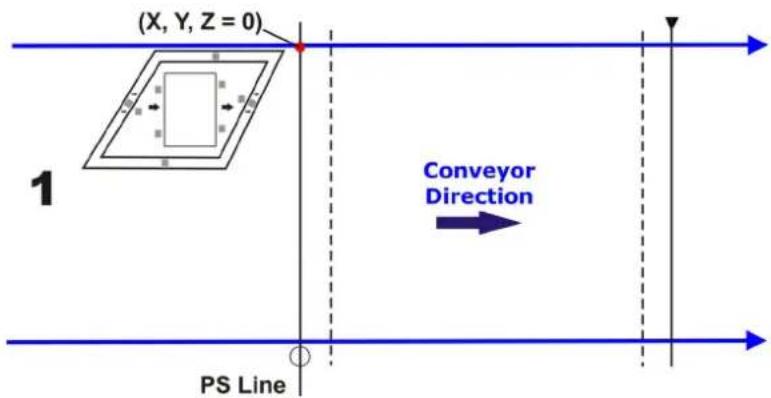
text_image
(X, Y, Z = 0) 1 PS Line Conveyor DirectionFigure 2 - PCT-8000 First Run
After elaborating the passage of the parcel, the Master scanner again shows the status of each node (of each scanner of the cluster) and then the Continue or Stop screen.
- Repeat steps 3 - 5 changing the PCT-8000 X position (i.e. always before the PS Line (reference point) and parallel to a conveyor edge but changing to the left-hand edge and/or to the center of the conveyor), until the procedure terminates.

text_image
(X, Y, Z = 0) 2 PS Line Conveyor Direction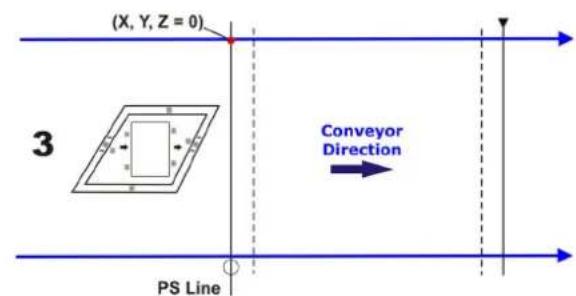
text_image
(X, Y, Z = 0) 3 PS Line Conveyor DirectionFigure 3 - PCT-8000 Second and Third Runs
Typically 3 passes are necessary.
- At the last step in the sequence the display prompts to place a barcode label centered onto the physical X position (X Offset) on the conveyor. Press the ENT (enter) key to Continue. You have 2 minutes to read the code before the procedure ends automatically. Be careful that the barcode is not accidentally read in the act of placing it at the desired X Offset position, and assure that it is read by only one scanner (see the figure below). After placing the barcode label on the X coordinate, you may have to pass your hand or other opaque object over it to end this step.

text_image
(X, Y, Z = 0) desired X Offset read here do not read here Conveyor Direction PS LineFigure 4 - X Offset Selection
Pressing the ▼ (down arrow) key at any point will terminate the procedure without saving the Absolute X position alignment.

NOTE
Before resetting the Master scanner, if desired, you can download the Auto PackTrack Report file from the Master scanner RAM by connecting it to Genius™ and using the Tools>File transfer... menu. See Help On-Line.
- Manually reset the Master scanner.
1.8 ACCESSORIES
The following accessories are available on request for DS8100A:
| Name | Description | Part | |
| Power Supplies | |||
| PWR-120 J-box power unit 1 | 10/230 VAC 24 V 120 W 93ACC1530 | ||
| PWR-240 J-box power unit 1 | 10/230 VAC 24 V 240 W 93ACC1070 | ||
| PWR-480A J-box power unit | 110/230 VAC 24 V 480 W 93ACC1850 | ||
| Cables and Terminators | |||
| BTK-8100 Bus terminator kit | (5 pcs) 93ACC1090 | ||
| BTK-8102 Double terminator | kit (2 pcs) 93A051287 | ||
| CAB-8100 10 wire shielded cable | D 9.5 mm - 50 m 93ACC1120 | ||
| CAB-8101 17-pin scanner/scanner connection cable | 1.2 m 93A051020 | ||
| CAB-8102 17-pin scanner/scanner connection cable | 2.5 m 93A051030 | ||
| CAB-8105 17-pin scanner/scanner connection cable | 5 m 93A051040 | ||
| CAB-8305 Power and bus return cable (last Slave) | 5 m 93A051268 | ||
| CAB-8310 Power and bus return cable (last Slave) | 10 m 93A051336 | ||
| CAB-8402 No power cable | 5 m 93ACC1758 | ||
| CAB-8405 No power cable | m 93ACC1759 | ||
| CAB-F01 | 6K-8K FBUS cable to CBX 1 m | 93A051355 | |
| CAB-F02 | 6K-8K FBUS cable to CBX 2 m | 93A051356 | |
| CAB-F05 | 6K-8K FBUS cable to CBX 5 m | 93A051357 | |
| CAB-6502 Fam 6K-8K cross | cable 2.5 m 93A051288 | ||
| CAB-6505 Fam 6K-8K cross | cable 5 m 93A051289 | ||
| CAB-8605 | Power and Lonworks termination cable (Master) | 93A051290 | |
| CAB-ETH-M01 | M12-IP67 Ethernet Cable (1 m) | 93A051346 | |
| CAB-ETH-M03 | M12-IP67 Ethernet Cable (3 m) | 93A051347 | |
| CAB-ETH-M05 | M12-IP67 Ethernet Cable (5 m) | 93A051348 | |
| CBL-1534-0.2 | Ethernet Adapter Cable (M12 4-pin male to RJ45 female) | 93A050057 | |
| Software Management | |||
| Datalogic WebSentinel-005 | Supervisor (up to 5 arrays) | 93A101014 | |
| Datalogic WebSentinel-010 | Supervisor (up to 10 arrays) | 93A101015 | |
| Datalogic WebSentinel-020 | Supervisor (up to 20 arrays) | 93A101016 | |
| Datalogic WebSentinel-032 | Supervisor (up to 32 arrays) | 93A101017 | |
| Datalogic WebSentinel-064 | Supervisor (up to 64 arrays) | 93A101018 | |
| Datalogic WebSentinel-128 | Supervisor (up to 128 arrays) | 93A101019 | |
| Datalogic WebSentinel-256 | Supervisor (up to 256 arrays) | 93A101020 | |
| Mirrors | |||
| GFC-80 | 90° | mirror | |
| GFC-800 90° mirror close distance 93A201103 | |||
| * Connection Boxes | |||
| CBX100 Compact Connection Box 93A301067 | |||
| CBX500 Modular Connection Box 93A301068 | |||
| CBX800 Gateway Connection Box 93A301077 | |||
| BM100 | Backup | Module | |
| BA100 DIN Rail Adapters for CBX | 93ACC1821 | ||
| BA200 Bosch Adapters for CBX | 93ACC1822 | ||
| BA900 Two Cable Glands Panel | 93ACC1847 | ||
| Sensors | |||
| MEP-593 | Photocell kit – PNP (PH-1) | 93ACC1791 | |
| MEP-543 | Photocell kit – NPN | 93ACC1728 | |
| OEK-2 Optical encoder (10 m cable + spring) | 93ACC1770 | ||
| OEK-1 Optical encoder kit + 10 m cable | 93ACC1600 | ||
| Brackets | |||
| FBK-8100 | Fast bracket kit (2 pcs) | 93ACC1130 | |
| US-8100 | Bracket kit (10 pcs) | 93ACC1140 | |
| FS-1 | Frame shaper (8 pcs) | 93ACC1750 | |
| Miscellaneous | |||
| PLL-8000 | Optocoupled PLL device | 93ACC1280 | |
| ACS-81 | Air cleaning system | 93ACC1430 | |
* DS8100A application software does not support any of the CBX500 Host Interface Module accessories nor the BM150 Display accessory. Use the CBX800 Gateway for Host Interface Applications, (Fieldbus and non Fieldbus).
2 INSTALLATION
To install the system follow the given procedure:
- Select the mounting location for DS8100A;
- Mount the DS8100A scanner;
- Position the scanner with respect to the barcode;
- Proceed with system electrical connection;
- Install the Genius ^TM program on the PC and configure the scanner.

When installing several scanners, take care to position them correctly so that no laser beam enters the reading window perpendicularly and at the same level of the output beam of the other scanners. This condition could occur more frequently for side mounted applications. If these precautions are not followed, it may occur that the laser of the blinded scanner starts blinking due to an internal circuit which temporarily turns the laser off when detecting a power anomaly. To resolve this problem, it is sufficient to slightly change the inclination and position of one of the two scanners involved.

NOTE
Refer to the Reference Documentation for details on connecting your DS8100A reader to other devices in the system (i.e. CBX100 etc.).
2.1 PACKAGE CONTENTS
Verify that the DS8100A reader and all the parts supplied with the equipment are present and intact when opening the packaging; the list of parts includes:
- DS8100A reader
• Installation Quick Reference + barcode test chart
• DS8100A configuration CD-ROM - Mounting bracket and screws

natural_image
Illustration of a CD or DVD device with its front panel, base case, and accessories (no text or symbols)Figure 5 - DS8100A Package Contents
2.2 MECHANICAL MOUNTING
2.2.1 Mounting the Scanner
DS8100A can be installed to operate in any position. There are 16 screw holes (M6 X 8) on the sides of the scanner for mounting. The diagram below can be used for installation; refer to par. 4.6 and par. 9.4 for correct positioning of the scanner with respect to the reading zone and scanner orientation.
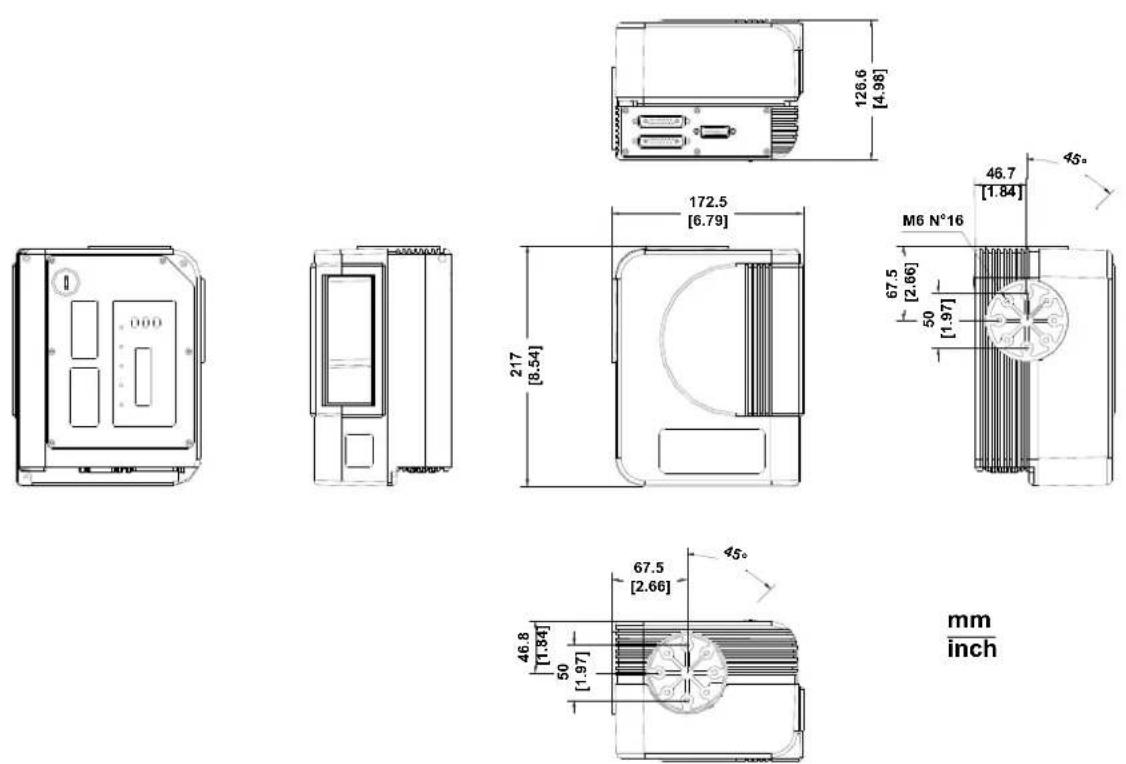
Figure 6- DS8100A Overall Dimensions
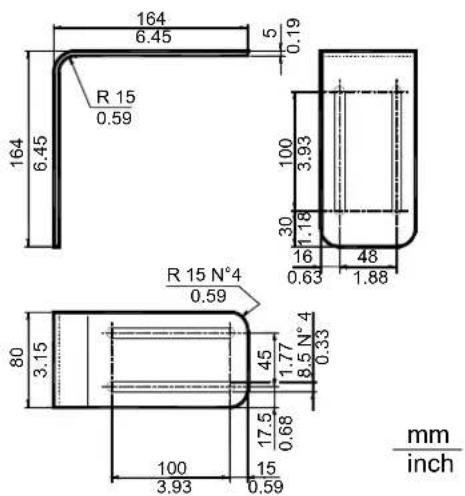
text_image
164 6.45 5 0.19 R 15 0.59 164 6.45 100 3.93 30 1.18 16 48 0.63 1.88 R 15 N°4 0.59 80 3.15 45 1.77 8.5 N°4 0.33 17.5 0.68 100 3.93 15 0.59 mm inchFigure 7- ST-163 Mounting Bracket Overall Dimensions
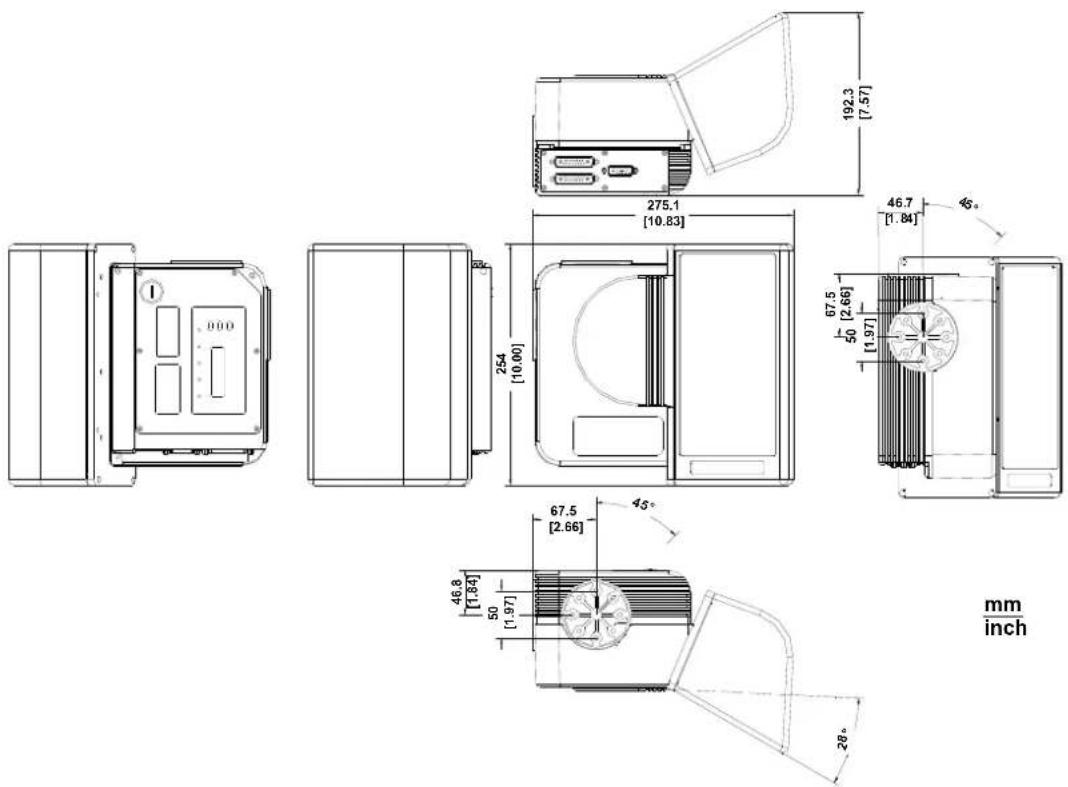
text_image
192.3 [7.57] 275.1 [10.83] 46.7 [1.84] 67.5 [2.66] 50 [1.97] mm inch 254 [10.00] 67.5 [2.66] 46.8 [1.84] 50 [1.97] 28°Figure 8 - DS8100A Oscillating Mirror Model Overall Dimensions
2.2.2 Mounting the Scanner with Accessories
The following accessories allow installing the DS8100A reader in the most suitable position for your network layout:
- ST-163 mounting bracket;
- FBK-8100 fast bracket.
The ST-163 is a 90° mounting bracket to be mounted on the reader as displayed in the image below:
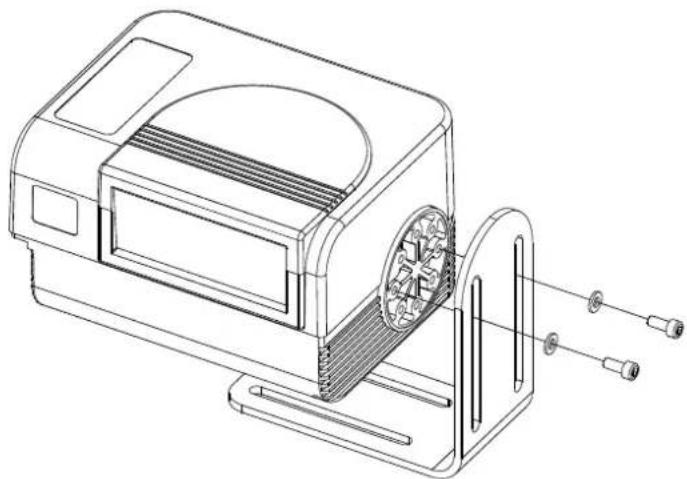
natural_image
Technical line drawing of a mechanical device with internal components and external connectors (no text or symbols)Figure 9 – Mounting the ST-163 Mounting Bracket
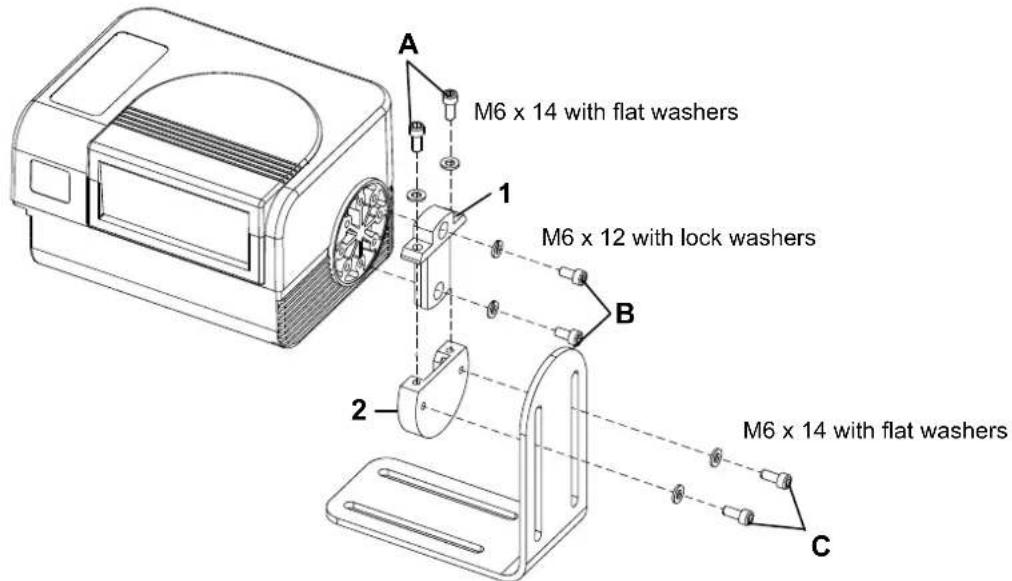
The FBK-8100 is a fast bracket kit allowing quick and easy mounting of the scanner on the ST-163 bracket. It is particularly useful when performing a scanner automatic replacement (see par. 10.2), since the scanner can be simply substituted with a new one while maintaining its physical position within the network.
First, it is necessary to fix the FBK-8100 round piece (2) to the ST-163 bracket (already mounted to the reading station frame) by means of the two screws (C). Then, give the scanner the correct orientation and fix it to the FBK-8100 cross piece (1) through the two screws (B). Finally, attach the assembly to the ST-163 bracket by making the FBK-8100 cross piece (1) slide into the round piece (2) and fix it by tightening the screws (A).
text_image
A M6 x 14 with flat washers 1 M6 x 12 with lock washers B 2 C M6 x 14 with flat washersFigure 10 - Mounting the FBK-8100 and ST-163 Brackets on the Scanner
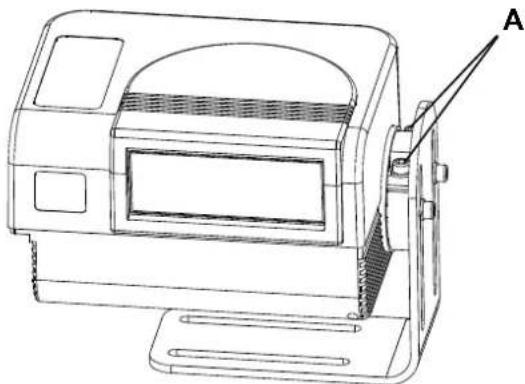
Thanks to the FBK-8100 it always possible to substitute a mounted scanner with a new one by simply:
- unscrewing the two screws (A) fixing the FBK-8100 cross piece to the FBK-8100 round piece;
– sliding the cross piece (still mounted on the scanner to be substituted) out of the round piece; - remounting the cross piece onto the new scanner with the correct orientation;
- inserting and tightening the two screws (A).
natural_image
Technical line drawing of a mechanical device with labeled component A (no text or symbols beyond label)Figure 11 – Substituting a Scanner
2.3 POSITIONING THE SCANNER
The DS8100A scanner is able to decode barcode labels at a variety of angles, however significant angular distortion may degrade reading performance.
When mounting the DS8100A take into consideration these three ideal label position angles: Pitch 0°, Skew 0° to 45° and Tilt 0°.
Follow the suggestions for the best orientation:
The Pitch angle is represented by the value P in Figure 12. Position the reader in order to minimize the Pitch angle.

natural_image
Diagram of a conveyor belt system with a moving cart and a labeled component (no text or symbols present)Figure 12 - "Pitch" angle
The Skew angle is represented by the value S in Figure 13.

natural_image
Diagram of a conveyor belt system with a box and a cube, showing motion direction (no text or symbols)Figure 13 - "Skew" angle
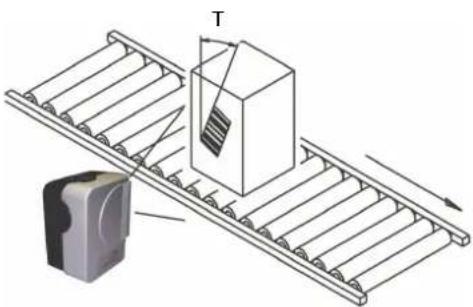
The Tilt angle is represented by the value T in Figure 14. For code reconstruction see par. 9.1.
natural_image
Diagram of a conveyor belt system with a box and a labeled component (no text or symbols present)Figure 14 - "Tilt" angle
3 CBX ELECTRICAL CONNECTIONS
Each scanner model has the following connectors:
| Scanner Model Connectors | |
| Standard 26-pin male serial | interface and I/O connector17-pin male Lonworks connector17-pin female Lonworks connector |
| Ethernet 26-pin male serial | interface and I/O connector17-pin male Lonworks connector17-pin female Lonworks connectorM12 4-pin D-coded connector for Ethernet * |
* older models have RJ45 Industrial modular connector
All DS8100A models can connect their 26-pin male D-sub connector for connection to the power supply, serial interface and input/output signals to a CBX connection box by using the dedicated cables (CAB-F0x).
We recommend making system connections through one of the CBX connection boxes since they offer the advantages of easy connection, easy device replacement and filtered reference signals.

NOTE
If you require direct wiring to the scanner the details of the connector pins and relative connections are indicated in Chapter 4.
For Lonworks network connections see chapters 5 and 7.
For Fieldbus connections see chapters 6 and 7.
For ID-NET™ Fixed Baudrate connections see the Application Note on the CD-ROM.
The table below gives the pinout of the CBX100/500 terminal block connectors. Use this pinout when the DS8100A reader is connected by means of the CBX100/500:
| CBX100/500 Terminal Block Connectors | ||||
| Group | Name | Function | ||
| Input Power | Vdc Power Supply Input Voltage + | |||
| GND Power Supply Input Voltage - | ||||
| Earth Protection Earth Ground | ||||
| External Trigger (PS) Input | +V Power Source – External Trigger | |||
| I1A External Trigger A (polarity insensitive) for PS | ||||
| I1B External Trigger B (polarity insensitive) for PS | ||||
| -V Power Reference – External Trigger | ||||
| Encoder or Generic Input | +V Power Source – Inputs | |||
| I2A Input 2A (polarity insensitive) for Encoder | ||||
| I2B Input 2B (polarity insensitive) for Encoder | ||||
| -V Power Reference – Inputs | ||||
| Outputs | +V Power Source – Outputs | |||
| -V Power Reference – Outputs | ||||
| O1+ | Output 1+ | |||
| O1- | Output 1- | |||
| O2+ | Output 2+ | |||
| O2- | Output 2- | |||
| Other I/O (CBX500 only) | O3A Output 3A (polarity insensitive) | |||
| O3B Output 3B (polarity insensitive) | ||||
| +V Power Source – Other I/O | ||||
| I3A Input 3A (polarity insensitive) | ||||
| I4A Input 4A (polarity insensitive) | ||||
| -V Power Reference – Other I/O | ||||
| I34B Input 3B and 4B (common) (polarity insensitive) | ||||
| I34B Input 3B and 4B (common) (polarity insensitive) | ||||
| Auxiliary Interface | TX Auxiliary Interface TX | |||
| RX | Auxiliary Interface RX | |||
| SGND | Auxiliary Interface Reference | |||
| ID-NETTM | REF Reserved | |||
| ID+ | Reserved | |||
| ID- | Reserved | |||
| Network | Shield | Network Cable Shield | ||
| RS232 | RS485FD | RS485HD | ||
| Main Interface | TX | TX+ | RTX+ | |
| RTS | TX- | RTX- | ||
| RX | *RX+ | |||
| CTS | *RX- | |||
| SGND | SGND | SGND | ||
* Do not leave floating, see par. 3.2.2 for connection details.

CAUTION
Do not connect GND and SGND to different (external) ground references. GND and SGND are internally connected through filtering circuitry which can be permanently damaged if subjected to voltage drops over 0.8 Vdc.

CAUTION
DS8100A scanners do not support Host Interface Modules with the CBX500. Use the CBX800 Gateway for Host Interface Applications, (Fieldbus and non Fieldbus).

NOTE
To avoid electromagnetic interference when the scanner is connected to a CBX connection box, verify the jumper positions in the CBX as indicated in its Installation Manual.
3.1 POWER SUPPLY
Power can be supplied to the scanner through the CBX100/500 spring clamp terminal pins as shown in Figure 15:

text_image
Power Supply VGND V+ in Earth Ground Vdc GND Earth REF ID+ ID- Shield SGND TX RTS RX CTS 1 POWER ID-NET MAIN (R)TX+ (R)TX- RX+ RX- RX-Figure 15 - Power Supply Connections
The power must be between 20 and 30 Vdc only. The max. power consumption is 30 W including startup current.
Several accessory power supplies are available to power the DS8100A(s) and reading station components. See par. 1.8.
A security system allows the laser to activate only once the motor has reached the correct rotational speed; consequently, the laser beam is generated after a slight delay from the power on of the scanner.
It is recommended to connect the device CHASSIS to earth ground (Earth) by setting the appropriate jumper in the CBX connection box. See the CBX Installation Manual for details.
3.2 MAIN SERIAL INTERFACE
The main serial interface is compatible with the following electrical standards and the relative signals are available on the CBX spring clamp terminal blocks:
RS232
RS485 full-duplex
RS485 half-duplex
The main interface type and the relative parameters (baud rate, data bits, etc.) can be set using the Genius™ utility program or the Genius™ based Host Mode Programming procedure. For more details refer to the section "Main Serial Port" in the Genius™ Help On Line.
3.2.1 RS232 Interface
The main serial interface is used in this case for point-to-point connections; it handles communication with the host computer and allows both transmission of code data and configuring the scanner. This is the default setting.
The following pins are used for RS232 interface connection:
| CBX100/500 Function | ||
| TX | Transmit | Data |
| RX | Receive | Data |
| RTS Request To Send | ||
| CTS Clear To Send | ||
| SGND | Signal | Ground |
It is always advisable to use shielded cables. If the shield is tied to ground at the Host, then leave it floating at the CBX. If it is floating at the Host then tie it to Shield at the CBX. The overall maximum cable length must be less than 15 m (50 ft).

text_image
USER INTERFACE SGND RXD TXD CTS RTS Vdc GND POWER Cath REF ID+ ID- ID-NET Shield SGND TX RTS RX CTS MAIN (R)TX+ (R)TX- RX+ RX- 1 SCANNER SGND TX RX RTS CTSFigure 16 – RS232 Main Interface Connections Using Hardware Handshaking
flowchart
graph TD
    A["START OF TRANSMISSION"] --> B["DATA TRANSMISSION"]
    B --> C["C1 C2"]
    B --> D["C3 C4 C5"]
    E["END OF TRANSMISSION"] --> F["DATA TRANSMISSION"]
    F --> G["C3 C4 C5"]
    H["TRANSMISSION STOPPED"] --> I["ENABLED"]
    J["IDLE"] --> K["DISABLED"]
    L["+ V RTS - V"] --> M["IDLE"]
    N["+ V TX DATA - V"] --> O["IDLE"]
    P["+ V CTS - V"] --> Q["IDLE"]
    style A fill:#f9f,stroke:#333
    style E fill:#f9f,stroke:#333
    style H fill:#f9f,stroke:#333
    style P fill:#f9f,stroke:#333
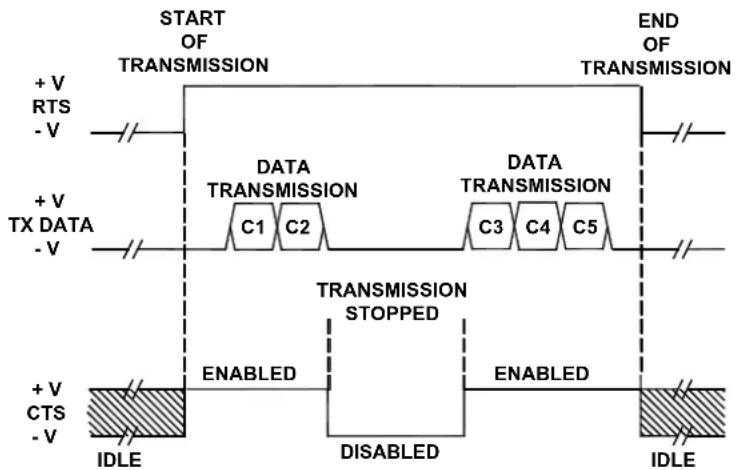
Figure 17 - RS232 Control Signals
The RTS and CTS signals control data transmission and synchronize the connected devices.
If the RTS/CTS handshaking protocol is enabled, the DS8100A activates the RTS output to indicate a message is to be transmitted. The receiving unit activates the CTS input to enable the transmission.
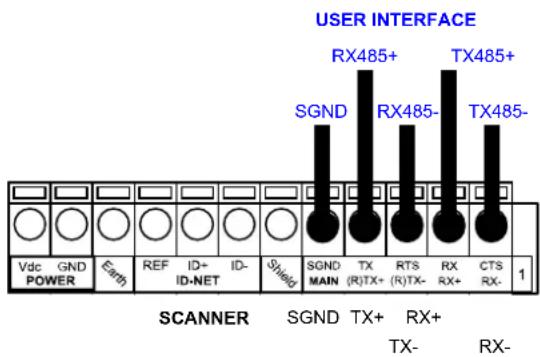
3.2.2 RS485 Full-Duplex Interface
The RS485 full-duplex (5 wires + shield) interface is used for non-polled communication protocols in point-to-point connections over longer distances (max 1200 m / 3940 ft) than those acceptable for RS232 communications or in electrically noisy environments.
If the shield is tied to ground at the Host, then leave it floating at the CBX. If it is floating at the Host then tie it to Shield at the CBX.
The CBX pinout follows:
| CBX100/500 Function | ||
| TX+ RS485 Transmit Data +RX+ RS485 Receive Data +TX- RS485 Transmit Data -RX- RS485 Receive Data -SGND | Signal | Ground |
text_image
USER INTERFACE RX485+ TX485+ SGND RX485- TX485- Vdc GND RX485- POWER Form REF ID- ID- ID-NET Shield SGND TX RTS RX MAIN (R)TX+ (R)TX- RX+ CTS 1 SCANNER SGND TX+ RX+ TX- RX-Figure 18 - RS485 Full-duplex Connections

NOTE
For applications that do not use RX485 signals, do not leave these lines floating but connect them to SGND as shown below.

text_image
USER INTERFACE RX485+ SGND RX485- Use CNC POWER S### ID-NET Scaner SGND TX R75 RX CTS VAN E5 X 10 X- FX SCANNER SGND TX+ TX-Figure 19 - RS485 Full-duplex Connections using Only TX Signals
3.2.3 RS485 Half-Duplex Interface

NOTE
This interface is provided for backward compatibility. We recommend using the more efficient Lonworks network for Master/Slave or Multiplexer layouts.
The RS485 half-duplex (3 wires + shield) interface is used for polled communication protocols.
It can be used for Multidrop connections with a Datalogic Multiplexer, (see par. "Multiplexer" in Appendix A) exploiting a proprietary protocol based on polled mode called MUX32 protocol, where a master device polls slave devices to collect data. The overall maximum cable length should not exceed 1200 m (3940 ft).
If the shield is tied to ground at the Host, then leave it floating at the CBX. If it is floating at the Host then tie it to Shield at the CBX.
CBX100/500 Function
RTX+ RS485 Receive/Transmit Data +
RTX- RS485 Receive/Transmit Data -
SGND Signal Ground

text_image
USER INTERFACE RTX485+ SGND RTX485- Vdc GND REF ID+ ID- POWER ID-NET Shield SGND TX RTS RX CTS MAIN (R)TX+ (R)TX- RX+ RX- 1 SCANNER SGND RTX+ RTX-Figure 20 - RS485 Half-duplex Connections
This interface is forced by software when the protocol selected is MUX32 protocol.
In a Multiplexer layout, the Multidrop address must also be set via serial channel by the Genius ^™ utility or by the Host Programming Mode.
Figure 21 shows a multidrop configuration with DS8100A scanners connected to a Multiplexer.

CAUTION
This is an example of multidrop wiring. Consult the multiplexer manual for complete wiring instructions.

flowchart
graph TD
    A["HOST RS232/RS485"] --> B["MULTIPLEXER"]
    B --> C["Main Interface"]
    C --> D["120 Ohm"]
    D --> E["Shield to Earth"]
    E --> F["V-"]
    F --> G["V+"]
    G --> H["PG-6000"]
    H --> I["Scanner Slave #0"]
    I --> J["CBX100/500"]
    J --> K["RS485 HD Termination Resistor. OFF"]
    K --> L["PG-6000"]
    L --> M["Earth GND Vdc"]
    M --> N["RTX- RTX+ SGND Shield"]
    N --> O["Shield floating"]
    O --> P["RS485 HD Termination Resistor. OFF"]
    P --> Q["PG-6000"]
    Q --> R["Earth GND Vdc"]
    R --> S["RTX- RTX+ SGND Shield"]
    S --> T["Shield floating"]
    T --> U["RS485 HD Termination Resistor. ON"]
    U --> V["PG-6000"]
    V --> W["Earth GND Vdc"]
    W --> X["RTX- RTX+ SGND Shield"]
    X --> Y["Shield floating"]
    Y --> Z["RS485 HD Termination Resistor. ON"]
    Z --> AA["PG-6000"]
    AA --> AB["Earth GND Vdc"]
    AB --> AC["RTX- RTX+ SGND Shield"]
    AC --> AD["Shield floating"]
    AD --> AE["RS485 HD Termination Resistor. ON"]
    AE --> AF["PG-6000"]
    AF --> AG["Earth GND Vdc"]
    AG --> AH["RTX- RTX+ SGND Shield"]
    AH --> AI["Shield floating"]
    AI --> AJ["RS485 HD Termination Resistor. ON"]
    AJ --> AK["PG-6000"]
    AK --> AL["Earth GND Vdc"]
    AL --> AM["RTX- RTX+ SGND Shield"]
    AM --> AN["Shield floating"]
    AN --> AO["RS485 HD Termination Resistor. ON"]
    AO --> AP["PG-6000"]
    AP --> AQ["Earth GND Vdc"]
    AQ --> AR["RTX- RTX+ SGND Shield"]
    AR --> AS["Shield floating"]
    AS --> AT["RS485 HD Termination Resistor. ON"]
    AT --> AU["PG-6000"]
Figure 21 - DS8100A Multidrop Connection to a Multiplexer
* When using CBX500, the Main interface multidrop network signals: Shield, SGND, RTX+and RTX- are repeated on terminal connector row 4 to facilitate system cabling.
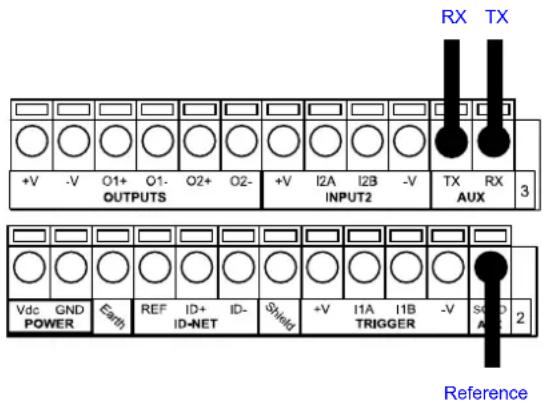
3.3 AUXILIARY RS232 INTERFACE
The auxiliary serial interface is used exclusively for RS232 point-to-point connections. It is principally used for scanner configuration from a laptop PC but is also available for LOCAL ECHO to a monitoring PC or for Pass through layouts. This interface is active when the Data Tx parameter is enabled.
The parameters relative to the aux interface (baud rate, data bits, etc.) can be defined using the Genius ^™ utility program or Genius ^™ based Host Mode Programming installed from the CD-ROM.
The 9-pin female Auxiliary Interface connector inside the CBX is the preferred connector for device configuration or temporary communication monitoring.

Figure 22 - 9-pin female connector
If permanent system wiring is required, the following pins are used to connect the RS232 auxiliary interface. The overall maximum cable length should not exceed 15 m (50 ft). In this case it is advisable to use shielded cables. If the shield is tied to ground at the Host, then leave it floating at the CBX. If it is floating at the Host then tie it to Shield at the CBX.
CBX100/500 Function
RX Auxiliary Interface Receive Data
TX Auxiliary Interface Transmit Data
SGND Auxiliary Interface Reference
USER INTERFACE
text_image
+V -V O1+ O1- O2+ O2- +V I2A I2B -V TX RX OUTPUTS INPUT2 AUX 3 Vdc GND Power Earth REF ID+ ID- ID-NET Shield +V I1A I1B -V set D A 2 ReferenceFigure 23 - RS232 Auxiliary Interface Connections

NOTE
Do not connect the Aux Interface to the CBX spring clamp connectors and the 9-pin connector simultaneously.
3.4 INPUTS
There are four optocoupled polarity insensitive inputs available on the scanner: Input 1 (External Trigger/PS), Input 2 (Encoder), Input 3 and 4 generic inputs.
The electrical features of the inputs are:
Maximum voltage: 30 Vdc
Maximum current Input 1 and 2: 12 mA (scanner) + 12 mA (CBX)
Maximum current Input 3 and 4: 12 mA (scanner)
CBX100/500 Function
| +V Power Source - External Trigger | |
| I1A External Trigger A (polarity insensitive) for PS | |
| I1B External Trigger B (polarity insensitive) for PS | |
| I2A Input 2 A (polarity insensitive) for Encoder | |
| I2B Input 2 B (polarity insensitive) for Encoder | |
| I3A (CBX500 only) Input 3 A (polarity insensitive) | |
| I4A (CBX500 only) Input 4 A (polarity insensitive) | |
| I34B (CBX500 only) | Common Reference for Inputs 3 and 4 (polarity insensitive) |
| -V Power Reference - External Trigger | |
The active state of all the inputs is selected in software (open or closed). Refer to the Genius™ Help On Line.
All inputs are optocoupled, polarity insensitive, and driven by a constant current generator; the command signal is filtered through an anti-disturbance circuit which generates a debouncing delay which can be set to 5 ms or 500 s. In particular, I1 for PS, I3 and I4 share the same value which usually corresponds to 5 ms when using a photoelectric sensor, while I2 is set to 500 s when this input is used for the Encoder. The maximum Encoder frequency is 2 kHz.
Input 1 (External Trigger/PS) is used in the On-Line and PackTrack™ operating Modes and tells the scanner to scan for a code. The yellow Phase On LED (Figure C, 3) which refers to Input 1 is on only when current flows through the input circuit and therefore when the active state of this input is set to "active open", the LED lights up when the input corresponds to OFF.
Input 2 is normally used for the Encoder input. In PackTrack ^™ mode, it detects the conveyor speed.
Inputs 3 and 4 can be used as the stop signal for the reading phase.
The debouncing delay value can be changed through the software parameter Debouncing for Input x, see the "6-8 K Software Configuration Parameter Guide" or Help file.
Powering Inputs
Input devices can be supplied by either scanner power (V+ and V-) or external power supplies (Vext).
Electrical isolation between the input command logic and the scanner is maintained when powering the input devices from an external supply voltage (Vext).
The driving logic of the input signals may be powered, for convenience, with the voltage supply at the CBX terminal block spring clamps (V+) and (V-). In this case, however, the device is no longer electrically isolated. The voltage available on pins V+ and V-, is physically the same as the input power for the scanner (Vdc and GND).
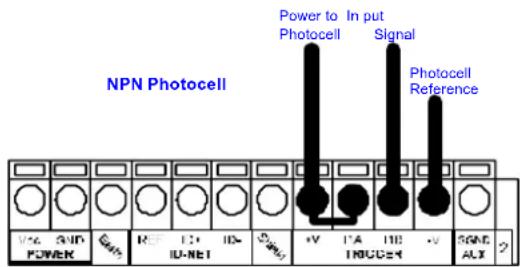
INPUT 1 (EXTERNAL TRIGGER/PS) CONNECTIONS USING DS8100A POWER

text_image
MEP-593 PH-1 Photocell (PNP) (brown) (b lack) (b blue) Vsc DVD POWER E/W1 REF ID+ ID- ID-NET -R###o +V PA HE V 8CAN TRIGGER ALX 2Figure 24 – MEP-593 PH-1 (PNP) External Trigger/PS Using DS8100A Power
text_image
NPN Photocell Power to In put Photocell Signal Photocell Reference Vdc SVD POWER REF ID- ID- ID-NET Signal +V +A +B +C +D +E +F +G +H +I +J +K +L +M +N +O +P +Q +R +S +T +U +V +W +X +Y +Z +A +B +C +D +E +F +G +H +I +J +K +L +M +N +O +P +Q +R +S +T +U +V +W +X +Y +ZFigure 25 - NPN External Trigger/PS Using DS8100A Power
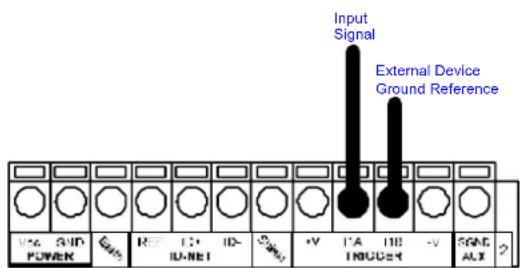
INPUT 1 (EXTERNAL TRIGGER/PS) CONNECTIONS USING EXTERNAL POWER
text_image
Input Signal External Device Ground Reference VAC SVD POWER REF ID- ID-NET Signal +V I'A IIB -V INQUES STAG ALXFigure 26 - PNP External Trigger/PS Using External Power (i.e. PLC signal)
text_image
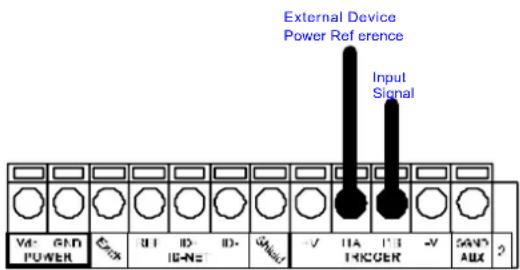
External Device Power Reference Input Signal Vd: GND POWER Eck U1 ID- ID- ID-N= 3Aout - V I1A I1B -V SAND IHKCER AUX ?Figure 27 - NPN External Trigger/PS Using External Power (i.e. PLC signal)
INPUT 2 (ENCODER) CONNECTIONS USING DS8100A POWER
text_image
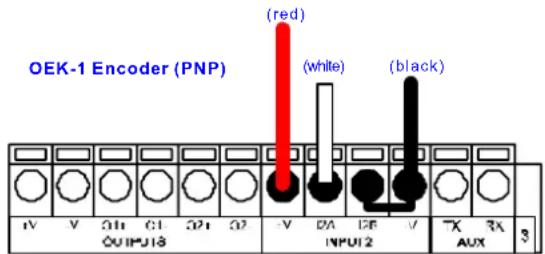
OEK-1 Encoder (PNP) (red) (white) (black) IV V 311 C1 321 C2 V 2A DE V OUTPUT13 INPUT2 AUX 3Figure 28 - OEK-1 Encoder PNP Using DS8100A Power

text_image
In put De vi ce (Enc ode r) Power to Input Input Device Signal Input Device Reference V V 011 01 021 02 V 2A 12B V OUTPUT13 INPUT12 AUX 3Figure 29 - Encoder NPN Using DS8100A Power
INPUT 2 (ENCODER) CONNECTIONS USING EXTERNAL POWER
text_image
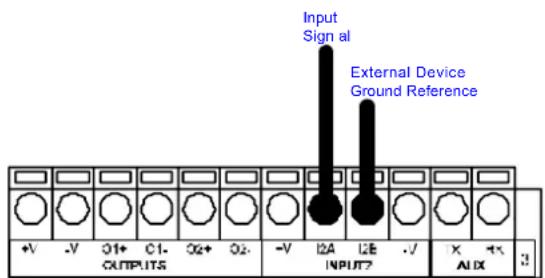
Input Signal External Device Ground Reference +V -V 01+ 01- 02+ 02- -V 12A 12B -J X +X OUTPUTS INPUT? AIXFigure 30 - PNP Encoder Using External Power (i.e. PLC signal)

text_image
External Device Power Refer ence Input Signal +V -V 31+ C1- 52+ 52- -V 12A 12B -J X +X OUTPUTS INPUT7 AUX 3Figure 31 - NPN Encoder Using External Power (i.e. PLC signal)

NOTE
Terminal pins I34B are common to both inputs 3 and 4 and therefore these inputs cannot be driven by opposite polarity devices.
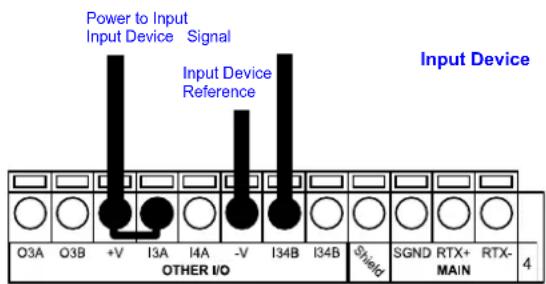
INPUT 3 - 4 CONNECTIONS USING DS8100A POWER (CBX500 Only)
text_image
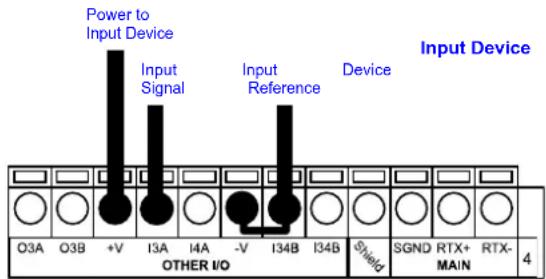
Power to Input Device Input Signal Input Reference Device Input Device O3A O3B +V I3A I4A -V I34B I34B OTHER I/O Shield SGND RTX+ MAIN RTX- 4Figure 32 - PNP Input 3 - 4 Using DS8100A Power
text_image
Power to Input Input Device Signal Input Device Reference O3A O3B +V I3A I4A -V I34B I34B OTHER I/O Shield SGND RTX+ RTX- MAIN 4Figure 33 - NPN Input 3 - 4 Using DS8100A Power
INPUT 3 - 4 CONNECTIONS USING EXTERNAL POWER (CBX500 Only)
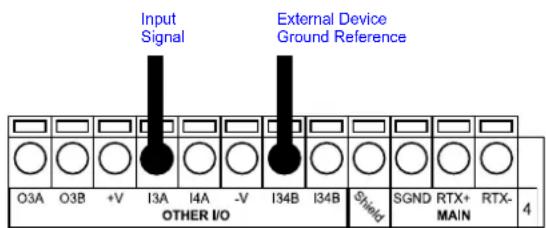
text_image
Input Signal External Device Ground Reference O3A O3B +V I3A I4A -V I34B I34B Shield SGND RTX+ MAIN 4 OTHER I/OFigure 34 - PNP Input 3 - 4 Using External Power (i.e. PLC signal)
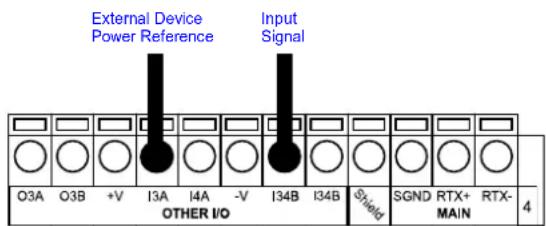
text_image
External Device Power Reference Input Signal O3A O3B +V I3A I4A -V I34B I34B Shield SGND RTX+ MAIN 4 OTHER I/OFigure 35 - NPN Input 3 - 4 Using External Power (i.e. PLC signal)
3.4.1 Code Verifier
If the DS8100A is used as a Code Verifier, the verifier code can be configured in software through the Genius™ configuration program. However it is also possible to use one of the inputs to trigger when the scanner should store a code read as the verifier code.
The Code Verifier parameter must be enabled, and the configuration parameters to allow correct Code Type reading must be saved to the scanner in order to read the verifier code.
When the selected input is activated, the next read code will be stored as the verifier code in the scanner's non-volatile (Flash) memory.
For more details see the Verifier Parameters in the "6-8 K Software Configuration Parameter Guide" or Help file.
3.5 OUTPUTS
Three general purpose outputs are available. The electrical features are given below:
| Outputs 1 and 2 | |
| Maximum Voltage 30 V | |
| Collector Current (pulse) 130 mA | Max. |
| Collector Current (continuous) 40 mA Max. | |
| Saturation Voltage (VCE) 1 V at 10 mA Max. | |
| Maximum Power Dissipation 90 mW at 50°C (Ambient temperature) | |
Output 3 has different electrical features. It is a bi-directional solid state relay with built-in current limit protection.
| Output 3 | |
| Maximum Voltage ± 100 V (Vext only) | |
| Collector Current (pulse) 300 mA | Max. at 25°C (Ambient temperature)240 mA Max. at 50°C (Ambient temperature) |
| Collector Current (continuous) 200 mA Max. at 25°C (Ambient temperature)150 mA Max. at 50°C (Ambient temperature) | |
| R on | 6 – 15 Ω |
| R off | >500 Ω |
| Off-State Leakage Current < 1 μA | |
| Maximum Power Dissipation 550 | mW at 50°C (Ambient temperature) |
| CBX100/500 Function |
| +V Power Source - Outputs |
| O1+ Output 1 + |
| O1- Output 1 - |
| O2+ Output 2 + |
| O2- Output 2 - |
| O3A (CBX500 only) Output 3 A (polarity insensitive) |
| O3B (CBX500 only) Output 3 B (polarity insensitive) |
| -V Power Reference Outputs |
The function of each output can be defined by the user (No Read, Right, Wrong, etc.). Refer to the Genius™ Help On Line.
The output signals are fully programmable being determined by the configured Activation/Deactivation events, Deactivation Timeout or a combination of the two.
By default, Output 1 is associated with the Complete Read event, which activates when all the selected codes are correctly decoded, and Output 2 is associated with the No Read event, which activates when the code signaled by the external trigger/PS is not decoded.
Output 3 can be assigned to the same events and it has the advantage of being polarity insensitive. By default it is not assigned to any event. The CBX500 must be used to connect this output.
OUTPUT 1 and 2 CONNECTIONS USING DS8100A POWER
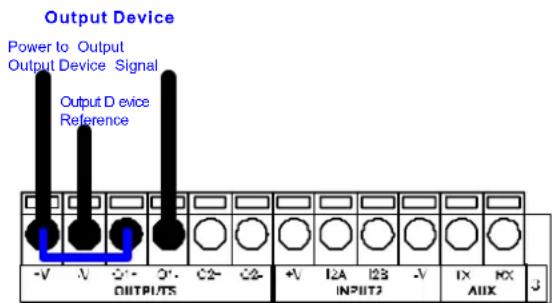
text_image
Output Device Power to Output Output Device Signal Output Device Reference -V -V 0'- 0'- C2- C2- +V I2A I2B -V IX RX OUTPUTS INPUTS AUXFigure 36 - Open Emitter Output Using DS8100A Power

text_image
Output Device Power to Output t Device Output D evice Reference Output Signal -V -V Q+ Q- C2- C4- OUTPUTS +V I2A I2B -V IX NO INPUT3 AUX JFigure 37 - Open Collector Output Using DS8100A Power
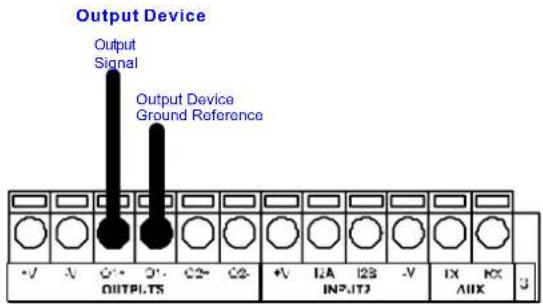
OUTPUT 1 and 2 CONNECTIONS USING EXTERNAL POWER
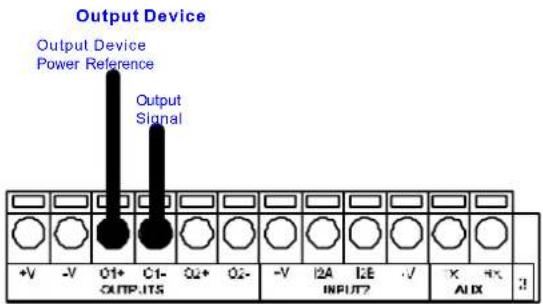
text_image
Output Device Output Device Power Reference Output Signal +V -V 01+ C1- OUTPUTS 02+ 02- -V 12A I2E -J X +X INPUT? AUXFigure 38 - Open Emitter Output Using External Power
text_image
Output Device Output Signal Output Device Ground Reference +V -V 0~ 0~ 0~ 0~ 0~ 0~ 0~ 0~ 0~ 0~ 0~ 0~ 0~ 0~ 0~ 0~ 0~ 0~ 0~ 0~ OUTPUTS +V I2A I2B -V IX RX INPUTS AUXFigure 39 - Open Collector Output Using External Power
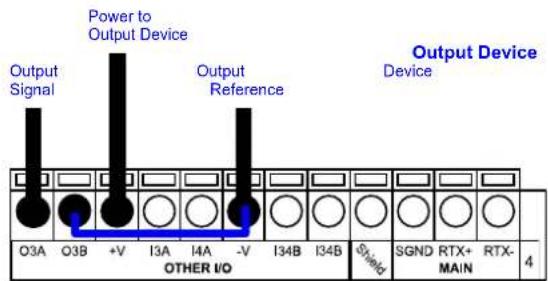
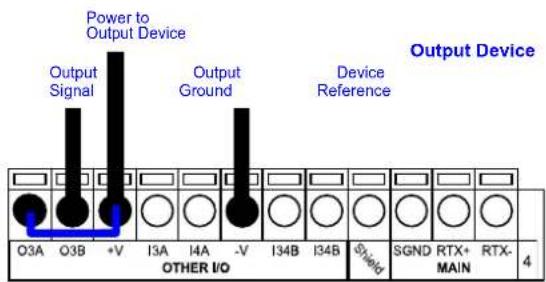
OUTPUT 3 CONNECTIONS USING DS8100A POWER (CBX500 Only)
text_image
Output Signal Power to Output Device Output Reference Output Device Device O3A O3B +V I3A I4A -V I34B I34B OTHER I/O Shield SGND RTX+ MAIN RTX- 4Figure 40 - Output 3 Using DS8100A Power
text_image
Power to Output Device Output Signal Output Ground Device Reference Output Device O3A O3B +V I3A I4A -V I34B I34B OTHER I/O $500d SGND RTX+ MAIN RTX- 4Figure 41 - Output 3 Using DS8100A Power
OUTPUT 3 CONNECTIONS USING EXTERNAL POWER (CBX500 Only)
Output
Signal
External Device
Power or Ground Reference
Figure 42 - Output 3 Using External Power
The command signals are filtered and generate a delay of about 50 s for Output 1 and 2 and 1 ms for Output 3.
3.6 USER INTERFACE - HOST
The following table contains the pinout for standard RS232 PC Host interface. For other user interface types please refer to their own manual.
RS232 PC-side connections
| 1 | 5 | 1 | 13 |
| 6 | 9 | 14 | 25 |
9-pin male connector
| Pin | Name | Pin | Name |
| 2 | RX | 3 | RX |
| 3 | TX | 2 | TX |
| 5 | GND | 7 | GND |
| 7 | RTS | 4 | RTS |
| 8 | CTS | 5 | CTS |
4 CUSTOM CABLE ELECTRICAL CONNECTIONS
Each scanner model has the following connectors:
| Scanner Model Connectors | |
| Standard 26-pin male serial | interface and I/O connector17-pin male Lonworks connector17-pin female Lonworks connector |
| Ethernet 26-pin male serial | interface and I/O connector17-pin male Lonworks connector17-pin female Lonworks connectorM12 4-pin D-coded connector for Ethernet * |
* older models have RJ45 Industrial modular connector
All DS8100A models are equipped with a 26-pin male D-sub connector for connection to the host computer, power supply and input/output signals. These signals can be wired using a custom cable according to the application needs.
The paragraphs in this chapter detail the individual signal connections.
For Lonworks network connections see chapters 5 and 7.
For Fieldbus connections see chapters 6 and 7.
For ID-NET ^™ Fixed Baudrate connections see the Application Note on the CD-ROM.
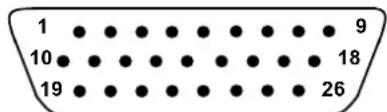
The details of the connector pins are indicated in the following table:
text_image
1 10 19 9 18 26Figure 43 - 26-pin Connector
| DS8100A 26-pin D-sub Connector Pinout | |||
| Pin | Name | Function | |
| 1 | CHASSIS | Chassis - internally connected to GNDCable shield connected to chassis | |
| 20 RX | Receive Data of Auxiliary RS232 (referred to GND) | ||
| 21 TX | Transmit Data of Auxiliary RS232 (referred to GND) | ||
| 8 O1+ | Configurable Digital Output 1 - positive pin | ||
| 22 O1- | Configurable Digital Output 1 - negative pin | ||
| 11 O2+ | Configurable Digital Output 2 - positive pin | ||
| 12 O2- | Configurable Digital Output 2 - negative pin | ||
| 16 O3A | Configurable Digital Output 3 - polarity insensitive | ||
| 17 O3B | Configurable Digital Output 3 - polarity insensitive | ||
| 18 I1A | External Trigger (polarity insensitive) for PS | ||
| 19 I1B | External Trigger (polarity insensitive) for PS | ||
| 6 I2A | Input Signal 2 (polarity insensitive) for Encoder | ||
| 10 I2B | Input Signal 2 (polarity insensitive) for Encoder | ||
| 14 I3A | Input Signal 3 (polarity insensitive) | ||
| 15 I4A | Input Signal 4 (polarity insensitive) | ||
| 24 I34B | Common reference of Input 3 and Input 4 (polarity insensitive) | ||
| 9,13 Vdc | Power Supply Input Voltage + | ||
| 23,25,26 GND Power Supply Input Voltage - | |||
| Main Interface Connector Pinout | |||
| Pin | RS232 | RS485Full Duplex | |
| 2 | TX | TX+ | |
| 3 | RX | *RX+ | |
| 4 | RTS | TX- | |
| 5 | CTS | *RX- | |
| 7 | GND_ISO | GND_ISO | |
RTX+
* Do not leave floating, see par. 4.2.2 for connection details.
4.1 POWER SUPPLY
The supply voltage for correct operation of the scanner must be between 20 and 30 Vdc. The max. power consumption is 30 W including startup current.
Several accessory power supplies are available to power the DS8100A(s) and reading station components. See par. 1.8.
A security system allows the laser to activate only once the motor has reached the correct rotational speed; consequently, the laser beam is generated after a slight delay from the power on of the scanner.
Note that GND is internally connected to chassis. The cable shield is also connected to pin 1 - CHASSIS.

text_image
DS8100A 9/13 VS 23/25 GND CHASSIS 1 Chassis V+ (20 - 30 Vdc) V- (Ground) Earth Ground USER INTERFACEFigure 44 – Power Supply Using the 26-pin Connector
4.2 MAIN SERIAL INTERFACE
The main serial interface is compatible with the following electrical standards:
RS232
RS485 full-duplex
RS485 half-duplex
The main interface type and the relative parameters (baud rate, data bits, etc.) can be set using the Genius™ utility program or the Genius™ based Host Mode Programming procedure. For more details refer to the section "Main Serial Port" in the Genius™ Help On Line.
4.2.1 RS232 Interface
The main serial interface is used for communication with the Host computer and allows both transmission of code data and configuring the scanner. The overall maximum cable length should not exceed 15 m (50 ft).
The following pins of the 26-pin connector are used for RS232 interface connection:
| Pin | Name | Function | |||
| 2 | TX | Transmit | |||
| 3 | RX | Receive | |||
| 4 | RTS | Request to send | |||
| 5 | CTS | Clear to send | |||
| 7 | GND_ISO | Main | signal | ground | |

text_image
DS8100A USER INTERFACE TX RXD TXD RTS CTS GND_ISO CHASSIS SGND Main Isolated Earth Ground 2 3 4 5 7 1 2 3 4 5 7 1Figure 45 - RS232 Connections
flowchart
graph TD
    A["START OF TRANSMISSION"] --> B["DATA TRANSMISSION"]
    B --> C["C1 C2"]
    B --> D["C3 C4 C5"]
    E["END OF TRANSMISSION"] --> F["DATA TRANSMISSION"]
    F --> G["C3 C4 C5"]
    H["+ V RTS - V"] --> I["+ V TX DATA - V"]
    J["+ V CTS - V"] --> K["IDLE"]
    L["TRANSMISSION STOPPED"] --> M["ENABLED"]
    N["DISABLED"] --> O["ENABLED"]
    P["IDLE"] --> Q["IDLE"]
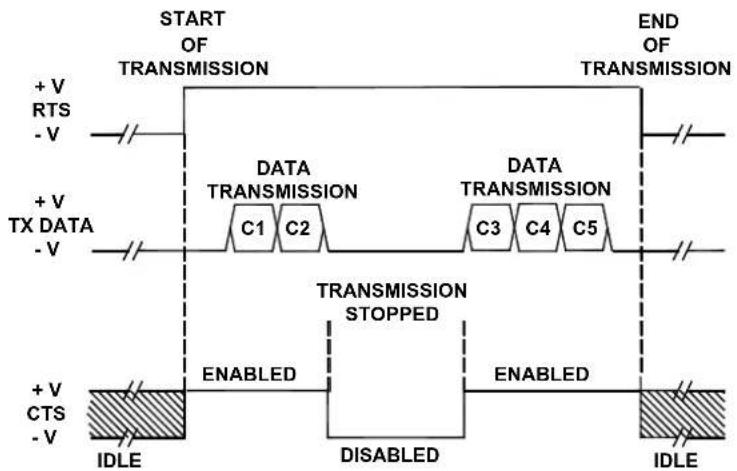
Figure 46 - RS232 Control Signals
The RTS and CTS signals control data transmission and synchronize the connected devices.
If the RTS/CTS hardware protocol is enabled, the DS8100A activates the RTS output to indicate a message can be transmitted. The receiving unit must activate the CTS input to enable the transmission.
4.2.2 RS485 Full-Duplex Interface
The RS485 full-duplex (5 wires + shield) interface is used for non-polled communication protocols in point-to-point connections over longer distances than those acceptable for RS232 communications or in electrically noisy environments. The overall maximum cable length should not exceed 1200 m (3940 ft).
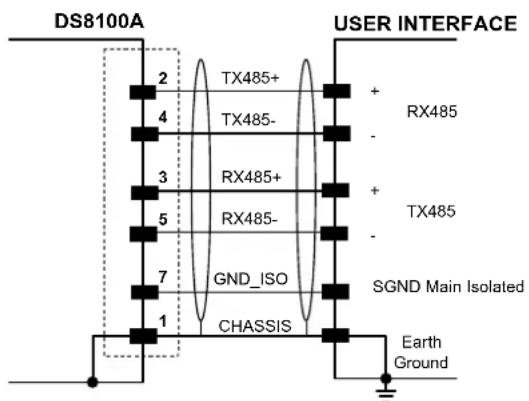
The following pins of the 26-pin connector are used for RS485 full-duplex interface connection:
| Pin | Name | Function | ||
| 2 | TX+ | RS485 output (+) | ||
| 3 | RX+ | RS485 input (+) | ||
| 4 | TX- | RS485 output (-) | ||
| 5 | RX- | RS485 input (-) | ||
| 7 | GND_ISO | Main | signal ground | |
text_image
DS8100A USER INTERFACE 2 TX485+ 4 TX485- 3 RX485+ 5 RX485- 7 GND_ISO 1 CHASSIS + RX485 - + + TX485 - + SGND Main Isolated Earth GroundFigure 47 - RS485 Full-Duplex Interface Connections

NOTE
For applications that do not use RX485 signals, do not leave these lines floating but connect them to GND_ISO as shown below.

text_image
DS8100A USER INTERFACE TX485+ TX485- RX485 RX485+ RX485- GND_ISO CHASSIS SGND Main Isolated Earth GroundFigure 48 - RS485 Full-duplex Connections using Only TX Signals
4.2.3 RS485 Half-Duplex Interface

NOTE
This interface is provided for backward compatibility. We recommend using the more efficient Lonworks network for Master/Slave or Multiplexer layouts.
The RS485 half-duplex (3 wires + shield) interface can be used for polled communication protocols.
It can be used for Multidrop connections with a Datalogic Multiplexer, (see par. "Multiplexer" in Appendix A) exploiting a proprietary protocol based on polled mode called MUX32 protocol, where a master device polls slave devices to collect data. The overall maximum cable length should not exceed 1200 m (3940 ft).
The following pins of the 26-pin connector are used for RS485 half-duplex interface connection:
| Pin | Name | Function | ||
| 2 | RTX+ | RS485 input/output (+) | ||
| 4 | RTX- | RS485 input/output (-) | ||
| 7 | GND_ISO | Main | signal ground | |
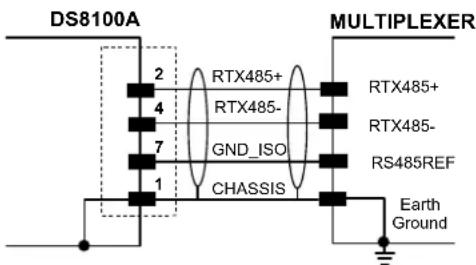
text_image
DS8100A 2 4 7 1 RTX485+ RTX485- GND_ISO CHASSIS MULTIPLEXER RTX485+ RTX485- RS485REF Earth GroundFigure 49 – RS485 Half-Duplex Interface Connections
This interface is forced by software when the protocol selected is MUX32 protocol.
In a Multiplexer layout, the Multidrop address must also be set via serial channel by the Genius ^™ utility or by the Host Programming Mode.
Figure 50 shows a multidrop configuration with DS8100A scanners connected to a Multiplexer.

CAUTION
This is an example of multidrop wiring. Consult the multiplexer manual for complete wiring instructions.
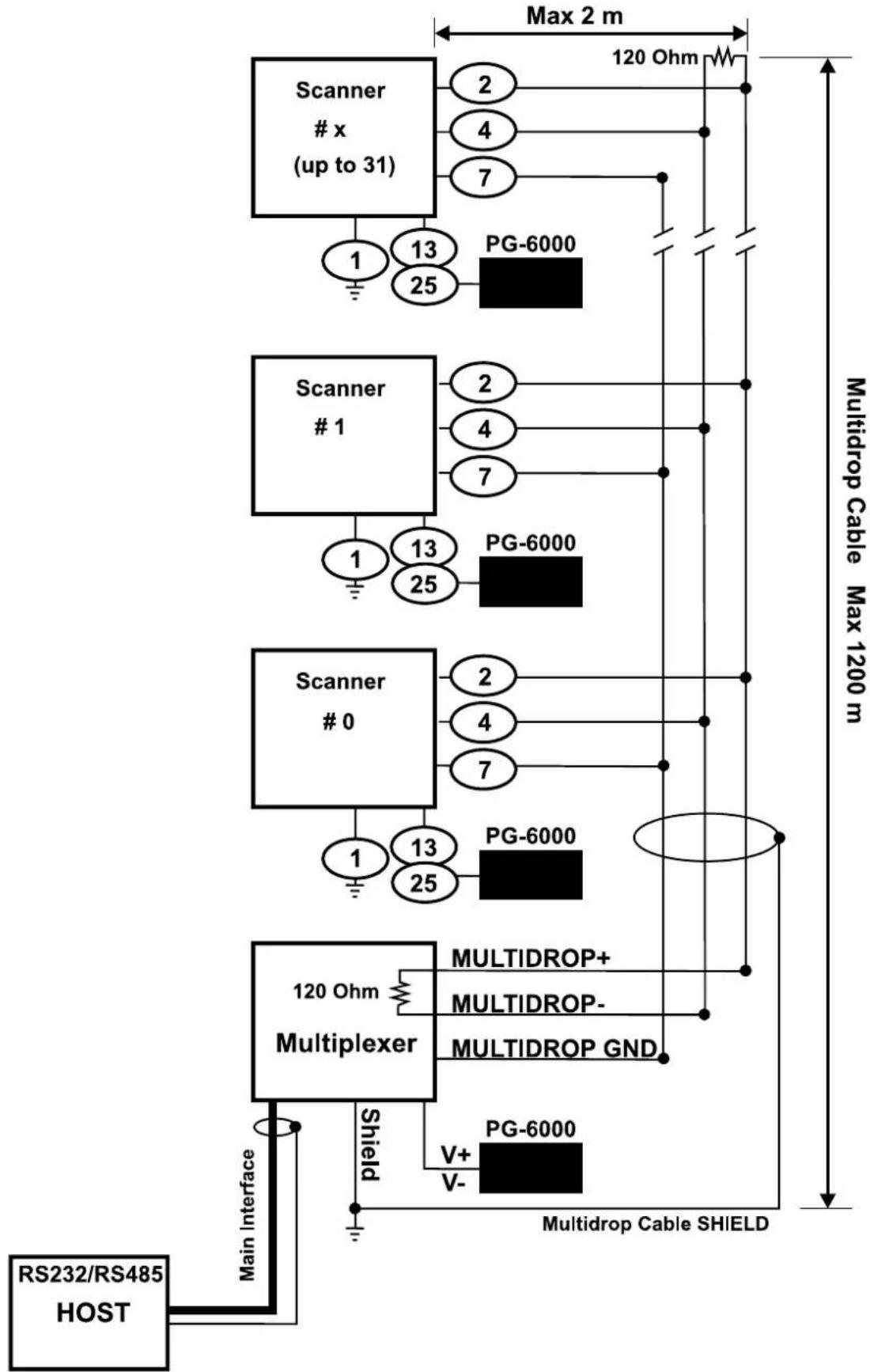
flowchart
graph TD
    A["RS232/RS485 HOST"] -->|Main Interface| B["Multiplexer"]
    B --> C["120 Ohm Multidrop GND"]
    B --> D["MULTIDROP+ MULTIDROP+"]
    B --> E["PG-6000 V+"]
    B --> F["PG-6000"]
    B --> G["13 25"]
    B --> H["13 13"]
    B --> I["7 4"]
    B --> J["2"]
    B --> K["Scanner #0"]
    B --> L["Scanner #1"]
    B --> M["Scanner #x (up to 31)"]
    B --> N["PG-6000 PG-6000"]
    B --> O["PG-6000"]
    B --> P["13 25"]
    B --> Q["13 13"]
    B --> R["7 4"]
    B --> S["2"]
    B --> T["120 Ohm Max 120 m"]
    B --> U["Max 2 m"]
    style A fill:#f9f,stroke:#333
    style B fill:#ccf,stroke:#333
    style C fill:#cfc,stroke:#333
    style D fill:#cfc,stroke:#333
    style E fill:#cfc,stroke:#333
    style F fill:#cfc,stroke:#333
    style G fill:#cfc,stroke:#333
    style H fill:#cfc,stroke:#333
    style I fill:#cfc,stroke:#333
    style J fill:#cfc,stroke:#333
    style K fill:#cfc,stroke:#333
    style L fill:#cfc,stroke:#333
    style M fill:#cfc,stroke:#333
    style N fill:#cfc,stroke:#333
    style O fill:#cfc,stroke:#333
    style P fill:#cfc,stroke:#333
    style Q fill:#cfc,stroke:#333
    style R fill:#cfc,stroke:#333
Figure 50 – DS8100A Multidrop Connection to a Multiplexer
4.3 AUXILIARY INTERFACE
The auxiliary serial interface is used exclusively for RS232 point-to-point connections. It is principally used for scanner configuration from a laptop PC but is also available for LOCAL ECHO to a monitoring PC or for Pass through layouts. This interface is active when the Data Tx parameter is enabled. The overall maximum cable length should not exceed 15 m (50 ft).
The following pins of the 26-pin connector are used for RS232 full-duplex interface connection:
| Pin | Name | Function | |
| 20 | RX | Receive data | |
| 21 | TX | Transmit data | |
| 23 | GND | Common Ground | |
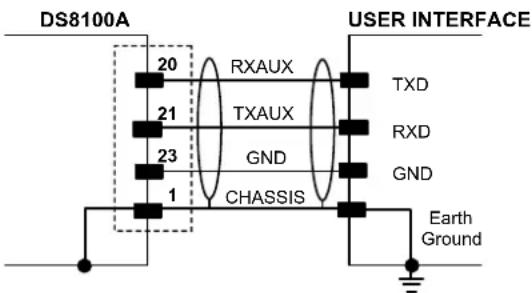
text_image
DS8100A 20 RXAUX TXD 21 TXAUX RXD 23 GND CHASSIS GND 1 USER INTERFACE Earth GroundFigure 51 - RS232 Auxiliary Interface Connections
4.4 INPUTS
There are four optocoupled polarity insensitive inputs available on the 26-pin connector of the DS8100A scanner: Input 1 (External Trigger/PS), Input 2 (Encoder), Input 3 and 4 generic inputs:
The electrical features of these inputs are:
Maximum voltage 30 Vdc
Maximum current all Inputs: 12 mA
| Pin | Name | Function |
| 18 I1 | A External | Trigger (polarity insensitive) for PS |
| 19 I1 | B External | Trigger (polarity insensitive) for PS |
| 6 I2 | A Input Signal 2 (polarity insensitive) for Encoder | |
| 10 I2 | B Input Signal 2 (polarity insensitive) for Encoder | |
| 14 I3 | A Input Signal 3 (polarity insensitive) | |
| 15 I4 | A Input Signal 4 (polarity insensitive) | |
| 24 I3 | 4B Common Reference of Input 3 and Input 4 (polarity insensitive) | |
The active state of all the inputs is selected in software (open or closed). Refer to the Genius™ Help On Line.
All inputs are optocoupled, polarity insensitive, and driven by a constant current generator; the command signal is filtered through an anti-disturbance circuit which generates a debouncing delay which can be set to 5 ms or 500 s. In particular, I1 for PS, I3 and I4 share
the same value which usually corresponds to 5 ms when using a photoelectric sensor, while I2 is set to 500 s when this input is used for the Encoder. The maximum Encoder frequency is 2 kHz.
Input 1 (External Trigger/PS) is used in the On-Line and PackTrack™ operating Modes and tells the scanner to scan for a code. The yellow Phase On LED (Figure C, 3) which refers to Input 1 is on only when current flows through the input circuit and therefore when the active state of this input is set to "active open", the LED lights up when the input corresponds to OFF.
Input 2 is normally used for the Encoder input. In PackTrack ^™ mode, it detects the conveyor speed.
Inputs 3 and 4 can be used as the stop signal for the reading phase.
The debouncing delay value can be changed through the software parameter Debouncing for Input x, see the "6-8 K Software Configuration Parameter Guide" or Help file.
Powering Inputs
Input devices can be supplied by either scanner power (Vdc and GND) or external power supplies (Vext).
Electrical isolation between the input command logic and the scanner is maintained when powering the input devices from an external supply voltage (Vext).
The driving logic of the input signals may be powered, for convenience, with the voltage supply between pins 9 (Vdc) and 23 (GND) of the 26-pin I/O connector. In this case, however, the device is no longer electrically isolated. The voltage available on the 26-pin I/O connector, is physically the same as used to power the scanner.
INPUT 1 - 2 CONNECTIONS USING DS8100A POWER

text_image
DS8100A + 5V VS A/B B/A GND EXTERNAL TRIGGER/ENCODER V GroundFigure 52 - PNP Command Input Connection Using Scanner Power
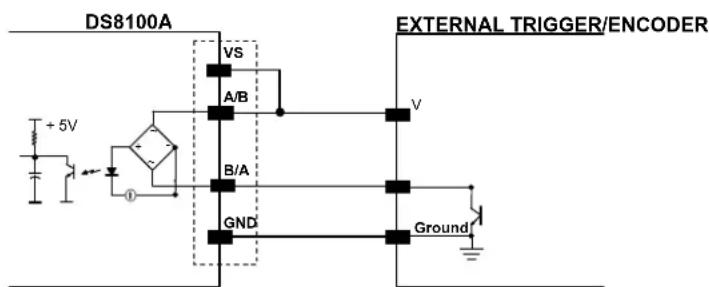
text_image
DS8100A +5V VS A/B B/A GND V External TRIGGER/ENCODER GroundFigure 53 - NPN Command Input Connection Using Scanner Power
INPUT 1 - 2 CONNECTIONS USING EXTERNAL POWER

text_image
DS8100A Vext EXTERNAL TRIGGER/ENCODER A/B B/A GroundFigure 54 – PNP Command Input Connection Using External Power

text_image
DS8100A + 5V A/B B/A Vext V Ground EXTERNAL TRIGGER/ENCODERFigure 55 - NPN Command Input Connection Using External Power

NOTE
Terminal pins I34B are common to both inputs 3 and 4 and therefore these inputs cannot be driven by opposite polarity devices.
INPUT 3 - 4 CONNECTIONS USING DS8100A POWER

text_image
DS8100A VS I34B V I3A Ground + 5V + 5V I4A GND EXTERNAL DEVICE EXTERNAL DEVICE V GroundFigure 56 - I3/I4 NPN Input Command using Scanner Power
INPUT 3 - 4 CONNECTIONS USING EXTERNAL POWER
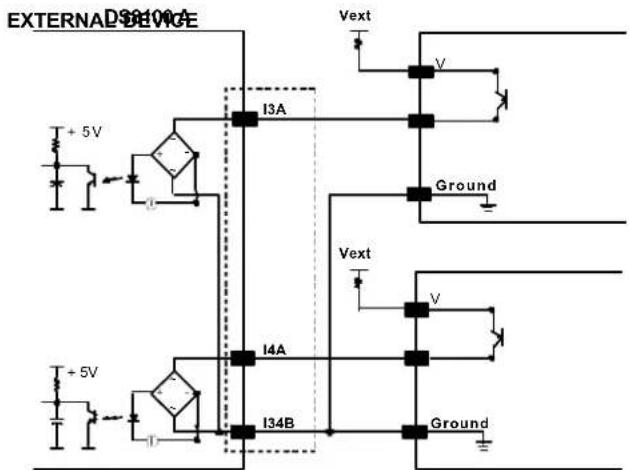
text_image
EXTERNAL DEVICE + 5V I3A Vext V Ground I4A Vext V I34B Ground + 5VFigure 57 - I3/I4 PNP Input Command using External Power
4.4.1 Code Verifier
If the DS8100A is used as a Code Verifier, the verifier code can be configured in software through the Genius™ configuration program. However it is also possible to use one of the inputs to trigger when the scanner should store a code read as the verifier code.
The Code Verifier parameter must be enabled, and the configuration parameters to allow correct Code Type reading must be saved to the scanner in order to read the verifier code. When the selected input is activated, the next read code will be stored as the verifier code in the scanner's non-volatile (Flash) memory.
For more details see the Verifier Parameters in the "6-8 K Software Configuration Parameter Guide" or Help file.
4.5 OUTPUTS
Three general purpose outputs are available. The electrical features are given below:
| Outputs 1 and 2 | |
| Maximum Voltage 30 V | |
| Collector Current (pulse) 130 mA | Max. |
| Collector Current (continuous) 40 mA | Max. |
| Saturation Voltage (VCE) 1 V at 10 mA | Max. |
| Maximum Power Dissipation 90 mW at 50°C (Ambient temperature) | |
Output 3 has different electrical features. It is a bi-directional solid state relay with built-in current limit protection.
| Output 3 | |
| Maximum Voltage ± 100 V (Vext only) | |
| Collector Current (pulse) 300 mA | Max. at 25°C (Ambient temperature)240 mA Max. at 50°C (Ambient temperature) |
| Collector Current (continuous) 200 mA | Max. at 25°C (Ambient temperature)150 mA Max. at 50°C (Ambient temperature) |
| R on | 6 – 15 Ω |
| R off | >500 Ω |
| Off-State Leakage Current < 1 μA | |
| Maximum Power Dissipation 550 | mW at 50°C (Ambient temperature) |
| Pin | Name | Function |
| 8 O1+ | Configurable digital output 1 – positive pin | |
| 22 O1- | Configurable digital output 1 – negative pin | |
| 11 O2+ | Configurable digital output 2 – positive pin | |
| 12 O2- | Configurable digital output 2 – negative pin | |
| 16 O3A | Configurable digital output 3 – polarity insensitive | |
| 17 O3B | Configurable digital output 3 – polarity insensitive |
The function of each output can be defined by the user (No Read, Right, Wrong, etc.). Refer to the Genius™ Help On-Line for further details.
The output signals are fully programmable being determined by the configured Activation/Deactivation events, Deactivation Timeout or a combination of the two.
By default, Output 1 is associated with the Complete Read event, which activates when all the selected codes are correctly decoded, and Output 2 is associated with the No Read event, which activates when the code signaled by the external trigger/PS is not decoded.
Output 3 can be assigned to the same events and it has the advantage of being polarity insensitive. By default it is not assigned to any event.

text_image
DS8100A USER INTERFACE Vext 30 Vdc maxFigure 58 – Output 1 and Output 2 Interface
When the load is powered by an external power supply, the voltage must be less than 30 V.
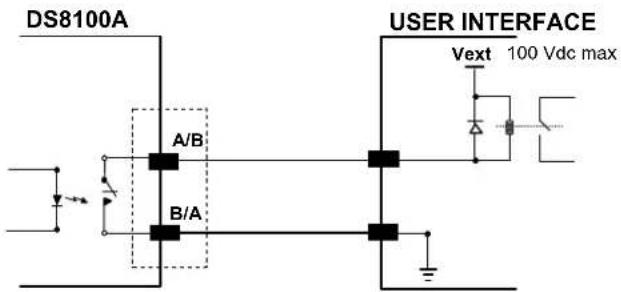
text_image
DS8100A A/B B/A USER INTERFACE Vext 100 Vdc maxFigure 59 – Output 3 Interface
The command signals are filtered and generate a delay of about 50 s for Output 1 and 2 and 1 ms for Output 3.
4.6 USER INTERFACE
How To Build A Simple Interface Test Cable:
The following wiring diagram shows a simple test cable including power, external (push-button) trigger and PC RS232 COM port connections.
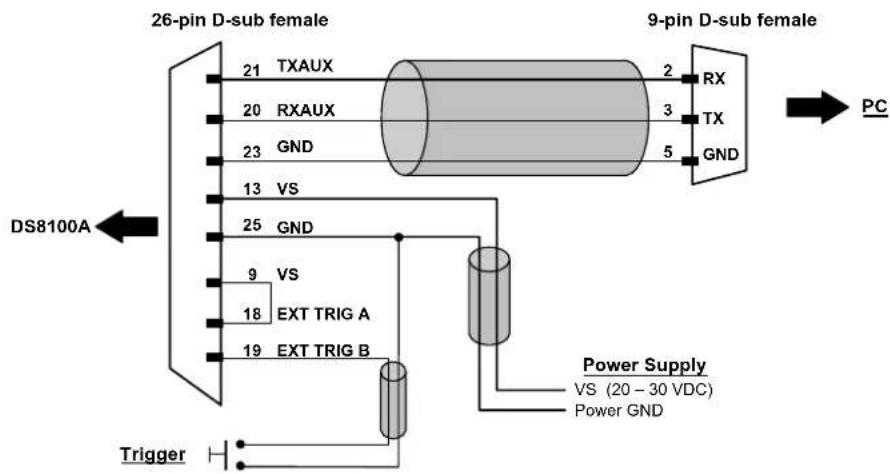
flowchart
graph TD
    A["26-pin D-sub female"] -->|TX AUX| B["9-pin D-sub female"]
    A -->|RX AUX| B
    A -->|GND| B
    A -->|VS| B
    A -->|GND| B
    B --> C["PC"]
    D["DS8100A"] --> A
    E["Trigger"] --> F["19 EXT TRIG B"]
    F --> G["18 EXT TRIG A"]
    G --> H["9 VS"]
    H --> I["25 GND"]
    I --> J["23 GND"]
    J --> K["20 RX"]
    K --> L["21 TX"]
    L --> M["2"]
    M --> N["RX"]
    N --> O["GND"]
    P["Power Supply"] --> Q["VS (20 - 30 VDC)"]
    P --> R["Power GND"]
Test Cable for DS8100A
5 LONWORKS CONNECTIONS
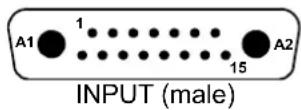
scanner side external view
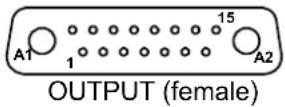
Figure 60 - Lonworks INPUT/OUTPUT Connectors
The following pinout is valid for the INPUT connector as well as for the OUTPUT connector.
| Lonworks INPUT/OUTPUT 17-pin Connector Pinout | ||
| Pin | Name | Function |
| A1 | GND | supply voltage (negative pin) |
| A2 | VS | supply voltage 20 to 30 vdc (positive pin) |
| 1 CHASSIS Cable shield A – internally connected by capacitor to chassis | ||
| 2 | n.c. Not connected | |
| 3 | CHASSIS | Cable shield B – internally connected by capacitor to chassis |
| 4 | n.c. Not connected | |
| 5 | n.c. Not connected | |
| 6 | n.c. Not connected | |
| 7 VS_I/O Supply voltage of I/O circuit | ||
| 8 Lon A+ Lonworks a line (positive pin) | ||
| 9 | Lon A- | Lonworks a line (negative pin) |
| 10 Lon B+ Lonworks b line (positive pin) | ||
| 11 | Lon B- | Lonworks b line (negative pin) |
| 12 | SYS_I/O | System signal |
| 13 | SYS_ENC_I/O | System signal |
| 14 | Reserved | Internally connected |
| 15 | Ref_I/O | Reference voltage of I/O circuit |
5.1 NETWORK TERMINATION
When building a Lonworks system the network must be properly terminated by positioning the BTK-8102 Lonworks terminator in the DS8100A master reader and the BTK-8100 Lonworks bus return in the last DS8100A slave reader.
The BTK-8100 bus return provides a connector to be inserted in the Lonworks 17-pin female connector of the last slave reader in the network; while the BTK-8102 Lonworks terminator provides a different connector to be inserted in the Lonworks 17-pin male connector of the master reader:
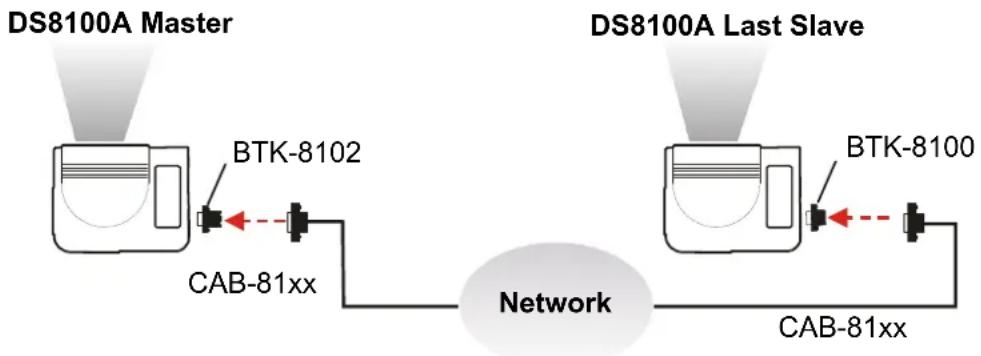
flowchart
graph LR
    A["DS8100A Master"] -->|BTK-8102| B["CAB-81xx"]
    B --> C["Network"]
    D["DS8100A Last Slave"] -->|BTK-8100| E["CAB-81xx"]
    E --> C
Figure 61 - BTK-8102 and BTK-8100
Two cables are also provided as accessories to terminate and power the network: CAB-8605 and CAB-8305.
CAB-8605 is a power and Lonworks termination cable to be used for connecting the DS8100A master to an external power unit within the network; while CAB-8305 is a power and bus return cable to be used for connecting the last DS8100A slave to an external power unit.
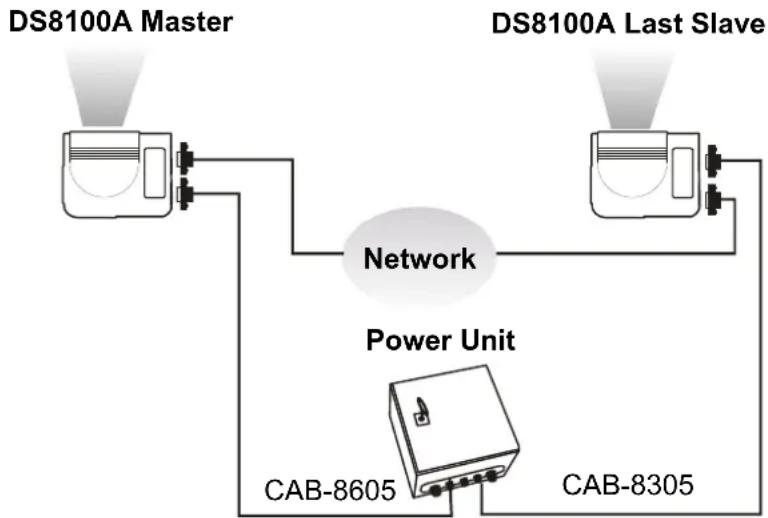
flowchart
graph TD
    A["DS8100A Master"] --> B["Network"]
    C["DS8100A Last Slave"] --> D["Network"]
    B --> E["Power Unit"]
    D --> E
    E --> F["CAB-8605"]
    E --> G["CAB-8305"]
Figure 62 - CAB-8605 and CAB-8305
5.2 LONWORKS INTERFACE
The Lonworks network is used for both input and output connection to build a multi-sided or omni-station system connecting several readers.
The DS8100A master usually employs the 17-pin female connector for output connection to the first slave, while the 17-pin male connector is terminated by inserting the BTK-8102 terminator (see Figure 61 for details).
Both connectors are always employed when connecting together the slave readers. In particular, the 17-pin female connector is used for output connection and the male one for input connection. The female connector in the last slave reader is terminated by the BTK-8100 bus return to close the system network.
The following diagram represents the connection between a DS8100A working as master and a DS8100A working as a slave reader.
The cable shields for LON A/B are connected to pin1 and pin 3 - CHASSIS.
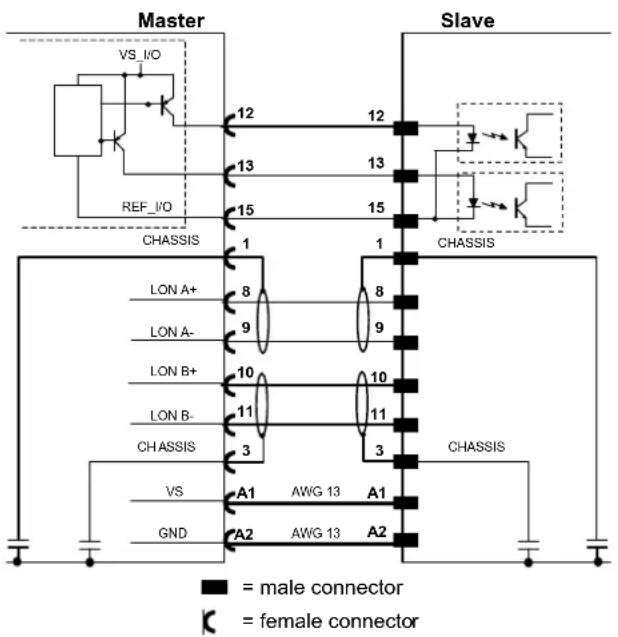
flowchart
graph TD
    subgraph Master
        VS_I/O["VS_I/O"] --> REF_I/O["REF_I/O"]
        REF_I/O --> CHASSIS1["CHASSIS"]
        REF_I/O --> CHASSIS2["CHASSIS"]
        REF_I/O --> CHASSIS3["CHASSIS"]
        REF_I/O --> CHASSIS4["CHASSIS"]
        REF_I/O --> CHASSIS5["CHASSIS"]
        REF_I/O --> CHASSIS6["CHASSIS"]
        REF_I/O --> CHASSIS7["CHASSIS"]
    end

    subgraph Slave
        CHASSIS1 --> LON_A+[LON A+]
        CHASSIS2 --> LON_A-["LON A-"]
        CHASSIS3 --> LON_B+[LON B+]
        CHASSIS4 --> LON_B-["LON B-"]
        CHASSIS5 --> LON_B-
        CHASSIS6 --> LON_B-
        CHASSIS7 --> LON_B-
        CHASSIS8 --> VS["VS"]
        CHASSIS9 --> GND["GND"]

    subgraph Master
        VS --> A1["A1"]
        GND --> A2["A2"]
        A1 --> AWG13["AWG 13"]
        A2 --> AWG13
    end

    subgraph Slave
        CHASSIS1 --> CHASSIS2
        CHASSIS2 --> CHASSIS3
        CHASSIS3 --> CHASSIS4
        CHASSIS4 --> CHASSIS5
        CHASSIS5 --> CHASSIS6
        CHASSIS6 --> CHASSIS7
        CHASSIS7 --> CHASSIS8
        CHASSIS8 --> CHASSIS9
        CHASSIS9 --> CHASSIS10
    end

    VS --> A1
    GND --> A2
    A1 --> AWG13
    A2 --> AWG13
    style Master fill:#f9f,stroke:#333
    style Slave fill:#ccf,stroke:#333
Figure 63 – DS8100A Master/Slave Lonworks Connection
The following diagrams represent different network terminations using either the BTK-8102 Lonworks terminator or the BTK-8100 bus return. In Figure 65 the BTK-8102 terminator is indicated by the T element, while the figure below shows its electrical circuit in details:

text_image
102 R5 1% 10R 1% R4 330R 1% R3 12 R2 47R 1% R1 330n | 25V C2 150n | 25V C1Figure 64 – BTK-8102 Electrical Circuit
The diagram below represents the termination of the double Lonworks line of a DS8100A working as master by means of the BTK-8102.
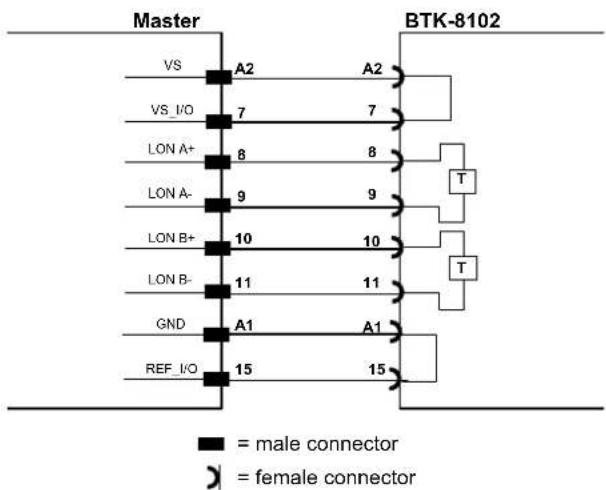
flowchart
graph TD
    subgraph Master
        VS["VS"] --> A2["A2"]
        VS_I/O["VS_I/O"] --> 7["7"]
        LON_A+[LON A+] --> 8["8"]
        LON_A-["LON A-"] --> 9["9"]
        LON_B+[LON B+] --> 10["10"]
        LON_B-["LON B-"] --> 11["11"]
        GND["GND"] --> A1["A1"]
        REF_I/O["REF_I/O"] --> 15["15"]
    end
    subgraph BTK-8102
        A2 --> T["T"]
        7 --> T
        8 --> T
        9 --> T
        10 --> T
        11 --> T
        A1 --> T
        15 --> T
    end
    style Master fill:#f9f,stroke:#333
    style BTK-8102 fill:#ccf,stroke:#333
    note right of T: Female connector
    note left of T: Male connector
Figure 65 - DS8100A Master Termination
The diagram below represents the Lonworks bus return of a DS8100A working as slave by means of the BTK-8100.
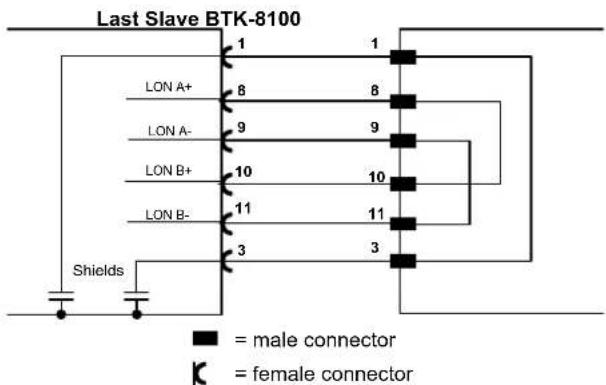
text_image
Last Slave BTK-8100 LON A+ LON A- LON B+ LON B- Shields 1 8 9 10 11 3 1 8 9 10 11 3 ■ = male connector K = female connectorFigure 66 - DS8100A Lonworks Bus Return
6 FIELDBUS CONNECTIONS
6.1 ETHERNET INTERFACE
This connector is only available for DS8100A Ethernet models and allows the Ethernet connection between the host and the reader.
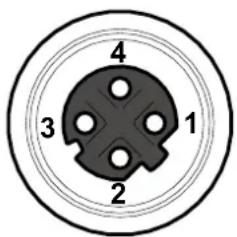
text_image
4 3 1 2Figure 67 – DS8100A M12 4-pin D-Coded Female Ethernet Connector
This interface and the connector pinout (see the following table) are IEEE 802.3 10 BaseT and IEEE 802.3u 100 Base Tx compliant.
| M12 4-pin D-coded Female Pinout | ||
| Pin | Name | Function |
| 1 TX + Transmitted data (+) | ||
| 2 RX + Received data (+) | ||
| 3 TX - Transmitted data (-) | ||
| 4 RX - Received data (-) | ||
In order to meet EMC requirements use Ethernet shielded cable.
The Ethernet interface can be used for TCP/IP communication with a remote or local host computer by connecting the scanner to either a LAN or directly to a host PC. There is no need to use a crossover adapter since the scanner incorporates an auto-cross function.
The following is an example of a connection to a LAN using a CAB-ETH-M0x straight through cable:
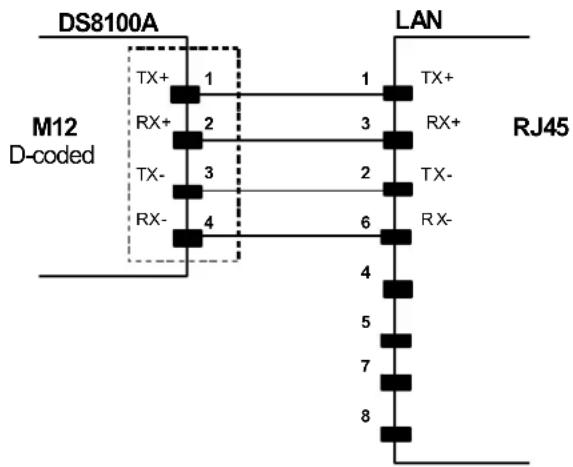
flowchart
graph TD
    A["DS8100A"] --> B["M12 D-coded"]
    B --> C["TX+"] 1
    B --> D["RX+"] 2
    B --> E["TX- 3"]
    B --> F["RX- 4"]
    C --> G["LAN"]
    D --> G
    E --> G
    F --> G
    G --> H["TX+"]
    G --> I["RX+"]
    G --> J["TX-"]
    G --> K["RX-"]
    H --> L["4"]
    I --> M["5"]
    J --> N["7"]
    K --> O["8"]
    L --> P["RJ45"]
Figure 68 – Straight Through Cable
For further details refer to the “Ethernet Service Guide” document provided as reference documentation.
6.2 ETHERNET INTERFACE (OLDER MODELS)
The RJ Industrial modular connector is only available for older DS8100A Ethernet models and allows the Ethernet connection between the host and the reader.


Figure 69 – DS8100A Harting RJ Industrial® Female Connector

NOTE
For this Ethernet connection, always use the Harting RJ Industrial® Push Pull Ethernet connector (included in the package). This connector assures a robust connection and full IP rated protection.
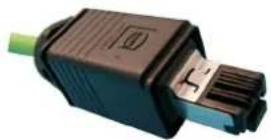
Figure 70 – Harting RJ Industrial® Push Pull Male Connector
This interface and the connector pinout (see the following table) are IEEE 802.3 10 BaseT and IEEE 802.3u 100 Base Tx compliant.
| RJ45 Modular Jack Pinout | ||
| Pin | Name | Function |
| 1 TX + Transmitted data (+)2 TX - Transmitted data (-)3 RX + Received data (+)6 RX - Received data (-)4, 5, 7, 8 N.C. Not connected | ||
In order to meet EMC requirements:
• use Ethernet shielded cable
- connect the Ethernet interface cable shield to the plant earth ground

NOTE
A ferrite (type Stewart 28A2029-0A0) must be applied on the scanner side of the Ethernet cable to reduce electrical noise. The cable shield must also be connected to the chassis of both connectors.
The Ethernet interface can be used for TCP/IP communication with a remote or local host computer by connecting the scanner to a LAN. It can also be connected directly to a host PC.
The following is an example of a connection to a LAN through a Hub using a straight through cable:
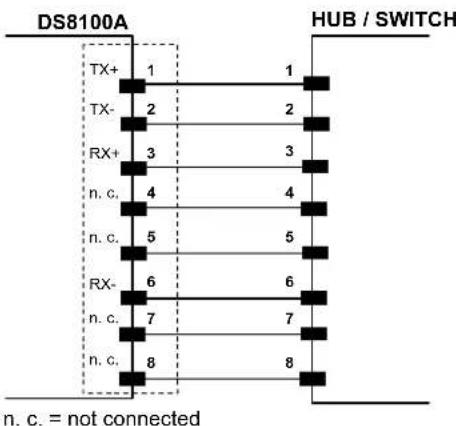
flowchart
graph TD
    A["DS8100A"] --> B["TX+ 1"]
    A --> C["TX- 2"]
    A --> D["RX+ 3"]
    A --> E["n. c. 4"]
    A --> F["n. c. 5"]
    A --> G["RX- 6"]
    A --> H["n. c. 7"]
    A --> I["n. c. 8"]
    J["HUB / SWITCH"] --> K["1"]
    J --> L["2"]
    J --> M["3"]
    J --> N["4"]
    J --> O["5"]
    J --> P["6"]
    J --> Q["7"]
    J --> R["8"]
    style A fill:#f9f,stroke:#333
    style J fill:#ccf,stroke:#333
    note right of A: n. c. = not connected
Figure 71 – Straight Through Cable
The following is an example of direct connection to a PC using an inverted cable:

flowchart
graph TD
    A["DS8100A"] --> B["TX+ 1"]
    A --> C["TX- 2"]
    A --> D["RX+ 3"]
    A --> E["n. c. 4"]
    A --> F["n. c. 5"]
    A --> G["RX- 6"]
    A --> H["n. c. 7"]
    A --> I["n. c. 8"]
    J["HOST PC"] --> K["3"]
    J --> L["6"]
    J --> M["1"]
    J --> N["4"]
    J --> O["5"]
    J --> P["2"]
    J --> Q["7"]
    J --> R["8"]
    style A fill:#f9f,stroke:#333
    style J fill:#ccf,stroke:#333
    note bottom of A: n. c. = not connected
Figure 72 – Inverted Cable
For further details refer to the “Ethernet Service Guide” document provided as reference documentation.
7 TYPICAL LAYOUTS
DS8100A scanners are mainly designed to work together on a high performance Lonworks sub-network to create multi-sided and omnidirectional reading stations that can interface with Serial or Fieldbus Host networks. This chapter covers the most common Lonworks layouts.
DS8100A scanners can however, be connected in a variety of layouts depending on the number of scanners used and the required complexity of the reading station. Layouts range from single Stand Alone to complex alternative networks when Lonworks is not available for all readers (mixed reader networks). For alternative layouts see appendix A.
Several power supplies are available to power the reading stations.
Photoelectric sensors used as code presence sensors and optical encoders to signal conveyor speed are also available accessories.
The following typical layouts refer to the system hardware configurations, but they also require the correct setup of the software configuration parameters (see par. 8.2 for details).
The accessories and cables indicated in the following figures are Datalogic products. We suggest their use to guarantee the correct system functioning.
7.1 LOCAL LONWORKS NETWORK
A local Lonworks network allows logically connecting a DS8100A master reader with up to 31 DS8100A slaves. Actually, the maximum number of readers to be employed in the network depends on the system operating conditions, that is adopted operating mode and amount of data stream.
When creating your network, always keep in mind the following guidelines:
- the Lonworks network logically supports a maximum number of 32 devices (master + slaves);
- it is recommended to adhere to the 8-in-16 rule (not more than 8 devices in any 16 meter bus segment (branch);
- for DS8100A scanners the total bus length may extend up to 65 m (213 ft);
- the maximum number of DS8100A readers supported also depends on the type of power propagation adopted by the system (see the specific power supply installation manual for details).
Typically the layouts can be divided into Synchronized (single P.S.) or Multidata (multi P.S.) networks. They can be small (up to 10 scanners) or large (more than 10 scanners).
Contact Datalogic Automation S.r.l., if your network requires a higher number of readers or in case the application throughput is very high.
For further information on Lonworks network cabling and connections see the “LonWorks® TPT Twisted Pair Transceiver Module User’s Guide”, available from the website: www.echelon.com.

CAUTION
For DS8100A Lonworks Network layouts, power is always propagated through the 17-pin scanner connectors. A specific jumper setting is required in CBXs to pass scanner power to the presence sensor, encoder, etc.
7.1.1 Small Synchronized Network
When building a small local Lonworks network (less than 10 scanners), the DS8100A master reader must be connected to a local host computer or a CBX connection box by means of a cable connected to the 26-pin D-sub male connector.
The master reader connects to the first slave reader of the system through the local Lonworks 17-pin female connector. The local Lonworks 17-pin male connector must be properly terminated by inserting the BTK-8102 Lonworks terminator or be powered by the CAB-86xx cable.
The slave readers are connected together through the local Lonworks connectors. Only the 17-pin female connector of the last slave reader must be terminated by the BTK-8100 bus return or be powered by the CAB-83xx cable.
The presence sensor is connected and powered through the CBX by the scanner and is unique to the system. There is only a single reading phase and a single message from the master reader to the Local Host. The On-Line operating mode is used for this layout.

flowchart
graph TD
    A["Slave 1"] -->|CAB-83xx| B["PWR-120"]
    C["Master"] -->|CAB-F0x| D["CBX100**"]
    E["BTK-8102"] -->|CAB-81xx| C
    F["P.S.*"] --> D
    G["Local Host"] --> H["Computer"]
* P.S. (Presence Sensor) connected to Input 1 (External Trigger/PS) input.
** CBX100 jumper set to accept scanner power.
Figure 73 – Small Synchronized Network with 2 Readers
The following image shows a system consisting of five readers where the external signals (trigger, encoder, serial to host, etc.) are connected to the master through the CBX100.
The system is powered by the PWR-240 where:
- the master is connected through CAB-86xx, which also provides bus termination
- the last slave is connected through CAB-83xx, which also provides bus return.
- the master and all slaves are connected together through the CAB-81xx cables

flowchart
graph TD
    A["CAB-81xx"] --> B["Slave 3"]
    C["CAB-81xx"] --> D["Slave 4"]
    E["Master"] --> F["PWR-240"]
    G["Local Host"] --> H["Encoder***"]
    I["CAB-81xx"] --> J["Slave 2"]
    K["CAB-81xx"] --> L["Slave 1"]
    M["CAB-81xx"] --> N["Master"]
    O["CAB-F0x"] --> P["CBX100**"]
    Q["P.S.*"] --> P
    style A fill:#f9f,stroke:#333
    style C fill:#f9f,stroke:#333
    style E fill:#f9f,stroke:#333
    style G fill:#f9f,stroke:#333
    style M fill:#f9f,stroke:#333
    style N fill:#f9f,stroke:#333
    style O fill:#f9f,stroke:#333
    style Q fill:#f9f,stroke:#333
    style P fill:#ccf,stroke:#333
* P.S. (Presence Sensor) connected to Input 1 (External Trigger/PS) input.
** CBX100 jumper set to accept scanner power.
*** Encoder connected to Input 2 (Encoder) input.
Figure 74 – Small Synchronized Network with more than 2 Readers and Single Power Unit
7.1.2 Large Synchronized Network
When building a large local Lonworks network (more than 10 scanners), an SC6000 Controller must be used together with a PWO power supply/junction box unit. In this case the SC6000 unit acts as the system master and is connected to the host through one of its interfaces.
All scanners act as slaves and are connected to the SC6000 through the PWO power supply/junction box. For DS8100A scanners, 4 branch connectors provide Lonworks communications between the scanners and the SC6000 unit. The last scanner on the line requires a Termination connector as well as any unused branches in the PWO unit.
The allowed maximum bus length is 65 m.
External devices such as a presence sensor and an encoder are all connected to the PWO.

flowchart
graph TD
    Host["Host"] --> HUB["HUB"]
    HUB --> SC6000["SC6000"]
    SC6000 -->|ETHERNET| EHERNET
    SC6000 -->|AUX| CAB-SC6103["Cable"]
    CAB-SC6103 -->|VAC INPUT| PWO["PWO"]
    PWO --> ENCODER["ENCODER"]
    PWO --> PS_PS_Aux["PS PS Aux"]
    SC6000 -->|CAB-SC6003 Extended I/O| LONWORKS["LONWORKS"]
    LONWORKS -->|CAB-81xx| DX8200A["A"]
    LONWORKS -->|CAB-81xx| DS8100A["DS8100A"]
    LONWORKS -->|CAB-81xx| CX8200A_B["DX8200A"]
    LONWORKS -->|CAB-81xx| D["DS8100A"]
    LONWORKS -->|CAB-81xx| F["DX8200A_F"]
    LONWORKS -->|CAB-81xx| H["DX8200A_H"]
    CX8200A --> BTK-8100BusReturn["BTK-8100 Bus Return"]
    CS6000 -->|CAB-SC6103 Cable| CAB-SC6103
    CAB-SC6103 --> PowerNet["CAB-SC6013"]
DS8100A
Figure 75 – Large Synchronized Network with DX8200A and DS8100A Scanners

text_image
E D C B F G H A SC6000 Conveyor PWOFigure 76 – Example Large Synchronized Network Reading Station
Here are a few helpful hints which can improve station performance and reduce installation time:
- Scanner distribution should alternate between odd and even branches so that the station guarantees 50% reading on all sides. See also Figure 75.
- For OEK Encoders set the parameter Operating Mode>Encoder Step = 252.

OFF ON
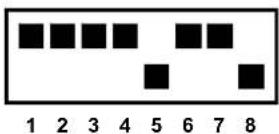
- For Top Front and Top Back scanners (C and D in Figure 76), set the parameter Reading Parameters>Reading Condition = Skew 45°.
- For applications having regular shaped packs the default settings are sufficient, but for Airport applications, irregular shaped packs can cause PS signal glitches resulting in false "packs too short" or "packs too close" errors.
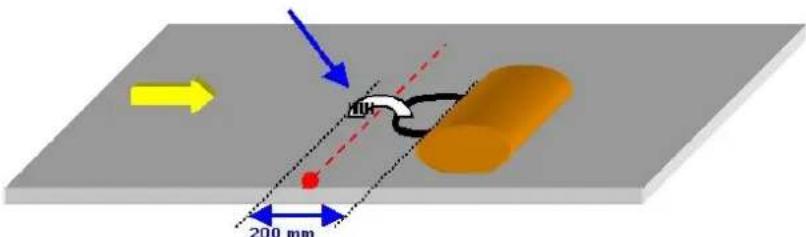
text_image
200 mmTo correct this, set the following Operating Modes parameters: Minimum Distance Between Packs = 200 mm, Minimum Pack Length = 200 mm, Window Dimension = 200 mm.
7.1.3 Redundant System
For large local Lonworks networks, a redundant system can per configured in which two SC6000 Controllers are used together with their respective PWO power supply/junction box units. The scanners are distributed equally between the PWO units. In this case one of the SC6000 Controllers is dedicated as the working or active unit while the other functions as a dedicated protecting or backup unit.

flowchart
graph TD
    subgraph_Working_Controller["Working Controller"]
        direction TB
        A["ETHERNET"] --> B["SC6000"]
        B --> C["AUX"]
        C --> D["CAB-SC6003 Extended I/O"]
        D --> E["LONWORKS"]
        E --> F["CAB-81xx"]
        F --> G["DX8200A"]
        F --> H["DS8100A"]
        F --> I["DX8200A"]
        I --> J["CAB-81xx"]
        J --> K["E"]
        K --> L["BTK-8100"]
        L --> M["G"]
        M --> N["DS8100A"]
        O["ENCODER"] --> P["PWO"]
        Q["PS PS Aux"] --> R["ENCODER"]
        S["VAC INPUT"] --> T["PWO"]
    end

    subgraph_Protecting_Controller["Protecting Controller"]
        direction TB
        U["ETHERNET"] --> V["SC6000"]
        V --> W["AUX"]
        W --> X["CAB-SC6003 Extended I/O"]
        X --> Y["LONWORKS"]
        Y --> Z["CAB-81xx"]
        Z --> AA["DX8200A"]
        Z --> AB["DS8100A"]
        Z --> AC["DX8200A"]
        Z --> AD["F"]
        AD --> AE["DS8100A"]
        AF["VAC INPUT"] --> AG["PWO"]
        AH["ENCODER"] --> AI["DS8100A"]
        AJ["PS PS Aux"] --> AK["DXTK-8100"]
    end

    style Working_Controller fill:#f9f,stroke:#333
    style Protecting_Controller fill:#ccf,stroke:#333
Figure 77 - Redundant Reading Station Layout with DX8200A and DS8100A Scanners

text_image
E D B C F G H Conveyor SC6000 Working A SC6000 Protecting PWO PWOFigure 78 – Example Redundant Reading Station
7.1.4 Multidata Network
In this layout, one master and up to 7 DS8100A slave readers have their own P.S. and therefore multiple reading phases. Each P.S. is connected through a CBX100, which in turn is connected to its relative scanner through a CAB-F0x cable.
The master sends all the individual messages collected from the Lonworks interface as well as its own to the Local Host through its CBX100.
The following image shows a system consisting of four readers, which are all connected together using CAB-81xx cables and the system is powered by a PWR-240 power supply.
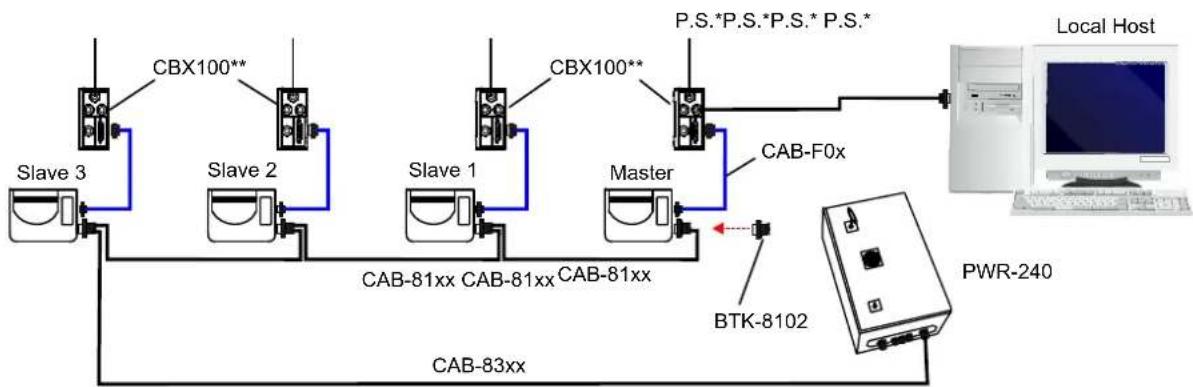
flowchart
graph TD
    subgraph_Slave_3["Slave 3"]
        A["CBX100**"] --> B["Slave 2"]
        B --> C["Master"]
        C --> D["CAB-81xx CAB-81xx CAB-81xx"]
        D --> E["Local Host"]
    end

    subgraph_Slave_1["Slave 1"]
        F["CBX100**"] --> G["Master"]
        G --> H["BTK-8102"]
        H --> I["PWR-240"]
    end

    subgraph_Master["Master"]
        J["CAB-F0x"] --> K["Local Host"]
    end

    style Slave_3 fill:#f9f,stroke:#333
    style Slave_1 fill:#f9f,stroke:#333
    style Master fill:#f9f,stroke:#333
    style Master fill:#f9f,stroke:#333
    style Master fill:#f9f,stroke:#333
    style Master fill:#f9f,stroke:#333
    style Master fill:#f9f,stroke:#333
    style Master fill:#f9f,stroke:#333
    style Master fill:#f9f,stroke:#366
    style Master fill:#f9f,stroke:#366
    style Master fill:#f9f,stroke:#366
    style Master fill:#f9f,stroke:#366
    style Master fill:#f9f,stroke:#366
    style Master fill:#f9f,stroke:#366
    style Master fill:#f9f,stroke:#366
    style Master fill:#f9f
    style Master fill:#f9f,stroke:#366
    style Master fill:#f9f,stroke:#366
    style Master fill:#f9f,stroke:#366
    style Master fill:#f9f,stroke:#366
    style Master fill:#f9f,stroke:#366
    style Master fill:#f9f,stroke:#366
    style Master fill:#f9f,
    style Master fill:#f9f,stroke:#366
    style Master fill:#f9f,stroke:#366
    style Master fill:#f9f,stroke:#366
    style Master fill:#f9f,stroke:#366
    style Master fill:#f9f,stroke:#366
    style Master fill:#f9f,stroke:#366
    style Master fill:#f9f, stroke:#333
    note right of Master: CAB-81xx CAB-81xx CAB-81xx
    note right of Master: CAB-F0x
    note right of Master: PWR-240
* P.S. (Presence Sensor) connected to Input 1 (External Trigger/PS) input.
** all CBX100s have jumper set to accept scanner power
Figure 79 – Multidata Network
7.1.5 Fieldbus Networks
The Fieldbus model (Ethernet) offers connectivity without any converter or adapter needed.
The DS8100A Lonworks master communicates as a Fieldbus slave to a remote host (i.e. remote PC connected via Internet) by means of a cable connected to the Fieldbus (Ethernet) connector provided. It can be activated by a signal generated by the remote Host or by a physical presence sensor.
The external signals (trigger, encoder) are connected to the master through the CBX100.
The system is powered by the PWR-240 where:
- the Lonworks master is connected through CAB-86xx, which also provides bus termination
- the last Lonworks slave is connected through CAB-83xx, which also provides bus return.
- the Lonworks master and all Lonworks slaves are connected together through the CAB-81xx cables
The same network layouts are available as for the DS8100A Standard model.
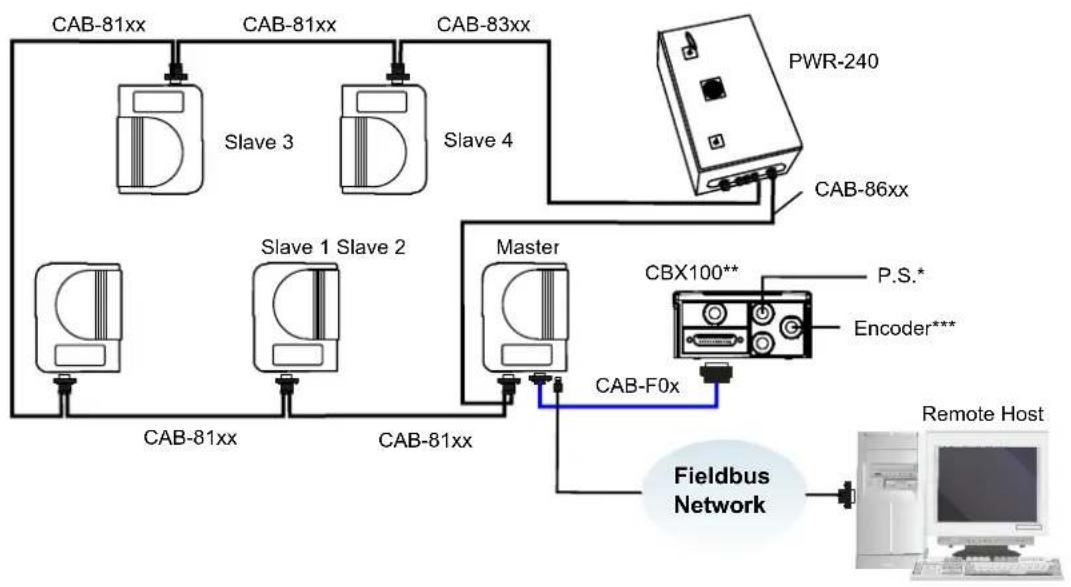
flowchart
graph TD
    A["CAB-81xx"] --> B["Slave 3"]
    C["CAB-81xx"] --> D["Slave 4"]
    E["CAB-83xx"] --> F["Master"]
    G["Slave 1 Slave 2"] --> H["Master"]
    I["CAB-81xx"] --> J["Fieldbus Network"]
    K["CAB-81xx"] --> L["Fieldbus Network"]
    M["PWR-240"] --> N["Master"]
    O["CAB-86xx"] --> P["Master"]
    Q["CBX100**"] --> R["Encoder***"]
    S["CAB-F0x"] --> T["Master"]
    U["P.S.*"] --> V["Master"]
    W["Remote Host"] --> X["Computer"]
* P.S. (Presence Sensor) connected to Input 1 (External Trigger/PS) input.
** CBX100 jumper set to accept scanner power.
*** Encoder connected to Input 2 (Encoder) input.
Figure 80 – Fieldbus Small Synchronized Network

NOTE
To interface DS8100A scanners to other Host types (Fieldbus and non-Fieldbus), use the CBX800 Gateway with Host Interface Modules.
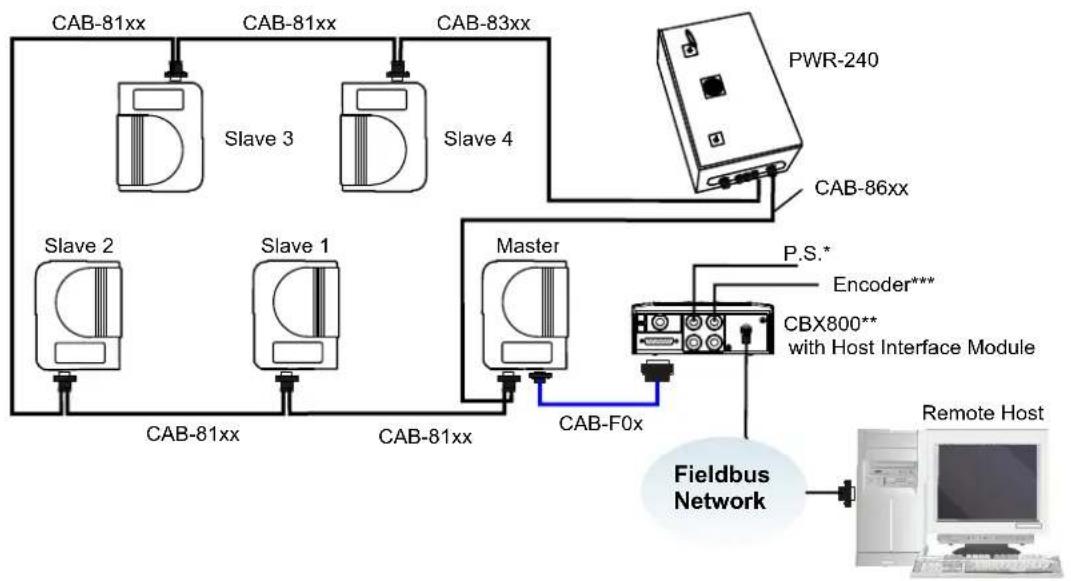
flowchart
graph TD
    A["Fieldbus Network"] --> B["Remote Host"]
    B --> C["Master"]
    C --> D["Slave 1"]
    C --> E["Slave 2"]
    C --> F["Slave 3"]
    C --> G["Master"]
    G --> H["Slave 4"]
    G --> I["PWR-240"]
    I --> J["CAB-86xx"]
    J --> K["Fieldbus Network"]
    style A fill:#f9f,stroke:#333
    style B fill:#ccf,stroke:#333
    style C fill:#cfc,stroke:#333
    style D fill:#fcc,stroke:#333
    style E fill:#cff,stroke:#333
    style F fill:#ffc,stroke:#333
    style G fill:#cfc,stroke:#333
    style H fill:#fcc,stroke:#333
    style I fill:#ffc,stroke:#333
    style J fill:#fcc,stroke:#333
    style K fill:#fcc,stroke:#333
    style_L["PWR-240"] --> M["Fieldbus Network"]
    M --> N["Remote Host"]
* P.S. (Presence Sensor) connected to Input 1 (External Trigger/PS) input.
** CBX800 jumper set to accept scanner power.
*** Encoder connected to Input 2 (Encoder) input.
Figure 81 – Fieldbus Small Synchronized Network
The following Host Interface Module accessories are available for the CBX800 Gateway:
| Name | Description | Part | Number |
| BM200/210 Ethernet | TCP/IP Module STD/IP65 93ACC1851, 93ACC1852 | ||
| BM300/310 Profibus | us Module STD/IP65 93ACC1810, 93ACC1811 | ||
| BM400 | DeviceNet Module | IP65 | 93ACC1814 |
| BM500/510/520 | ethernet/IP Module STD/IP65/IP54 | 93ACC1812, 93ACC1813, 93ACC1840 | |
| BM600 | CANopen Module | STD | 93ACC1815 |
| BM700/710 Profinet | Module STD/IP65 93ACC1816, 93ACC1886 | ||
| BM1100 CC-Link | Module STD 93ACC1845 | ||
| BM1200/1210 | Modbus TCP STD/IP65 | 93ACC1848, 93ACC1849 |
8 SOFTWARE CONFIGURATION
8.1 GENIUS™ INSTALLATION
Genius ^™ is a Datalogic scanner configuration tool providing several important advantages:
- Wizard approach for new users;
• Multi-language version; - Defined configuration directly stored in the reader;
- Communication protocol independent from the physical interface allowing the reader to be considered as a remote object to be configured and monitored.
To install Genius™, proceed as follows:
1) Turn on the PC that will be used for configuration, running either Windows 98, 2000/NT, XP, Vista or 7;
2) Insert the Genius™ CD-ROM;
3) Wait for the CD to autorun and follow the installation procedure.
8.2 GUIDE TO RAPID CONFIGURATION
8.2.1 Wizard for Quick Reader Setup
After installing the Genius™ software program (see above), and running it, the following window appears asking the user to choose the desired configuration level:
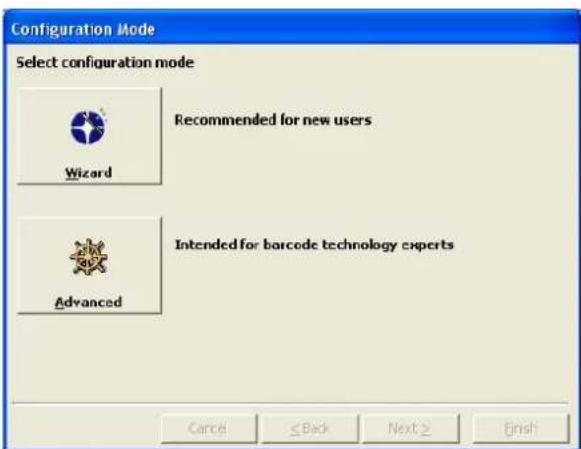
text_image
Configuration Mode Select configuration mode Wizard Recommended for new users Advanced Intended for barcode technology experts Cancel ≤ Back Next ≥ FinishFigure 82 - Genius™ Wizard Opening Window
The Wizard option is advised for new users, since it provides a step-by-step scanner configuration procedure. The parameters to be defined are the following:
- Barcode selection and definition;
- Operating mode selection and definition (see sub-paragraphs for further details);
- Digital Inputs/Outputs configuration;
- Hardware interface selection;
- Output data format configuration.
After defining the parameter values the following window appears allowing to complete the reader configuration as follows:
- Saving the configuration to disk;
- Switching to Advanced mode;
- Sending the configuration to the scanner.

text_image
Configuration Wizard - Final choices What do you want to do with the newly created configuration? Save it to disk Save to Disk Switch to Advanced Mode to refine it Send it to connected device Send Cancel ≤ Back Next ≥ FinishFigure 83 - Genius™ Wizard Closing Window
Test Operating Mode

NOTE
This operating mode is not available when DS8100A works as slave.

text_image
Configuration Wizard - Operating Modes Select one of the following operating modes 100% Test On Line Automatic Cancel < Back Next > FinishFigure 84 - Test Mode Selection
This operating mode causes the reader to be continuously activated allowing to verify its reading features and its reading position with respect to the barcode. For this reason, it is particularly advised during the installation phase of the reader.
After 100 scans, the values relative to an internal counter and the decoded code are displayed and transmitted on the serial interface. The counter reports the percentage of good reads of the label.
On Line Operating Mode
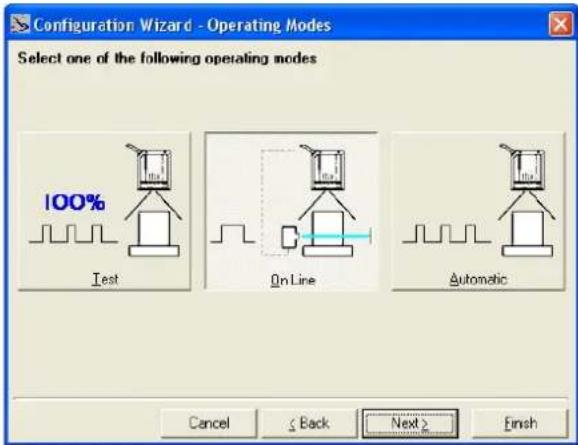
text_image
Configuration Wizard - Operating Modes Select one of the following operating modes 100% Test On Line Automatic Cancel Back Next > FinishFigure 85 - On Line Mode Selection
This operating mode causes the reader to be connected to an external Presence Sensor using I1A and I1B (External Trigger/PS) inputs.
During the active phase of the presence sensor, the DS8100A reader tries to acquire and correctly decode the code.
In case the decoding phase is successful, the barcode characters are transmitted on the serial interface. Otherwise, a no read message is sent.
Automatic Operating Mode
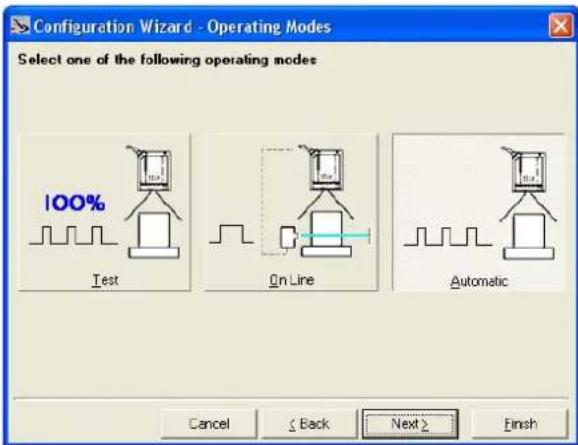
text_image
Configuration Wizard - Operating Modes Select one of the following operating modes 100% Test On Line Automatic Cancel Back Next ≥ FinishFigure 86 - Automatic Mode Selection
This operating mode does not require the connection to an external Presence Sensor. When working in this mode the reader is continuously scanning. The reading phase is activated each time a barcode enters the reading zone. The reader stops reading after an N number of scans without a code. Barcode characters are transmitted on the serial interface. In case of a failed reading phase no message is sent to the host computer.
8.2.2 Genius™ Network Setup Through Master
The Network Setup allows configuring your Local Lonworks Network through the Master using Genius™.
Three different procedures are available to define the number of network slave scanners, their label and address according to two main conditions:
| Condition | Available | Procedure | Feature |
| Unknown Slave Addresses | Net-Autoset | automatically assigns random addresses to slave or Stand Alone scanners. | |
| Known Slave Addresses | Network Wizard | customizes the network (slave label and address definition and physical identification of a specific slave within network), updates configuration to a file and makes it ready to be sent to the Master. | |
| Express Network Setup | automatically performs all the operations of the Network Wizard apart from the physical identification of a specific slave scanner. | ||

NOTE
The Network Setup procedure as described requires Genius™ software version 1.06 or later. In addition, the Net-Autoset procedure requires scanner software version 6.40 or later.
- The first operation to perform is the configuration of your scanner as "Master" from the Local Device Network Settings item in the Device Menu, see figure below:
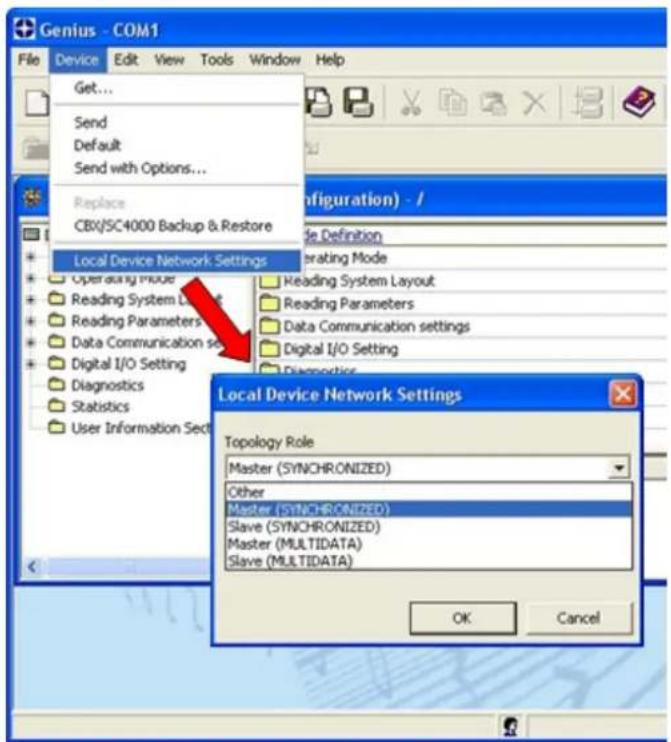
text_image
Genius - COM1 File Device Edit View Tools Window Help Get... Send Default Send with Options... Replace CBX/SC4000 Backup & Restore Configuration) / Mode Definition Local Device Network Settings Operating Mode Reading System Layout Reading Parameters Data Communication settings Digital I/O Setting Diagnostics Statistics User Information Sect Local Device Network Settings Topology Role Master (SYNCHRONIZED) Other Master (SYNCHRONIZED) Slave (SYNCHRONIZED) Master (MULTIDATA) Slave (MULTIDATA) OK CancelFigure 87 – Local Device Network Settings
The following dialog box appears asking whether to send the configuration to the Local Device or not:

text_image
Local Device Network Settings Do you want to send updated Network configuration to Local Device? Yes No- Click the "Yes" button, then click on the icon available on the Toolbar to make the "Devices" area appear next to the Parameter Explorer window. By repeatedly clicking the icon this area will be displayed or hidden.

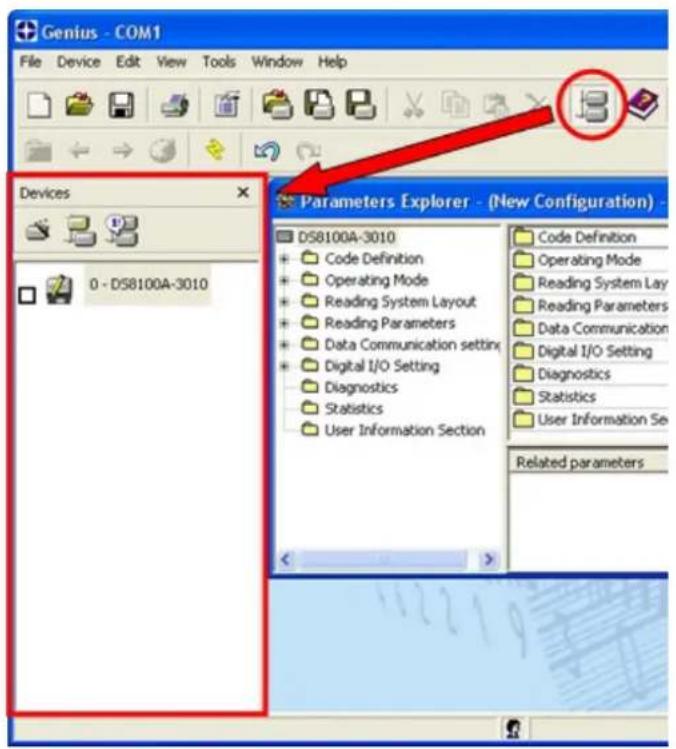
text_image
Genius - COM1 File Device Edit View Tools Window Help Devices 0 - DSB100A-3010 Parameters Explorer - (New Configuration) DS8100A-3010 Code Definition Operating Mode Reading System Layout Reading Parameters Data Communication setting Digital I/O Setting Diagnostics Statistics User Information Section Code Definition Operating Mode Reading System Lay Reading Parameters Data Communication Digital I/O Setting Diagnostics Statistics User Information Se Related parametersFigure 88 – Cluster Configuration
Each scanner of the cluster is indicated by the following graphical objects:
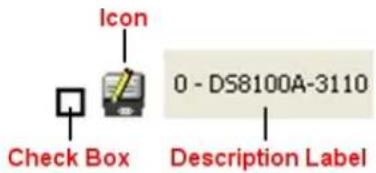
text_image
Icon Check Box 0 - DS8100A-3110 Description Label- check box allowing to select/deselect a specific scanner to perform the desired operations (i.e. program downloading);
- icon representing the scanner status;
-
a label reporting information transmitted by the scanner when connected (the scanner address, generated errors, scanner description).
-
Then, proceed with the network setup by using one of the icons available on the Tool Bar according to the procedure to follow:
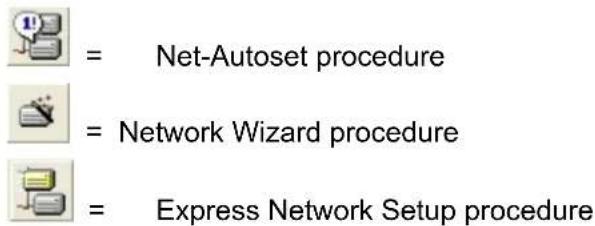
text_image
1) = Net-Autoset procedure = Network Wizard procedure = Express Network Setup procedureNet-Autoset
This procedure is to be used when all scanner addresses and labels are unknown (typically when configuring the network for the first time or whenever a network reconfiguration is required).
By clicking the icon or selecting the "Net_Autoset" option from the right-click menu, the Net-Autoset procedure is started allowing automatic assignment of random addresses to all slave or Stand Alone scanners connected within the network.
Once the procedure has been completed, it is possible to:
• define customized addresses and labels through the Network Wizard;
• display the scanner default labels through the Express Network Setup.
Express Network Setup
Before performing this procedure, a Lonworks address must be assigned to each slave scanner. The most practical method is through the Net-Autoset procedure. See par. 8.2.3 for alternative address assignment methods.
Once all addresses have been assigned, the Express Network Setup is to be used when all scanner addresses and labels do not need to be modified.
By clicking on the icon or by choosing the related option from the right-click menu, the procedure is started which automatically performs the following operations:
- opening the wizard;
- polling the network to discover connected scanners;
- transferring all scanners found to the "Requested Devices" area of the wizard where your network customization is defined;
- saving the new network configuration;
Once the procedure has been completed, a dialog box will appear asking whether to send the configuration to the Master. Choose the "Yes" option to start this procedure.
Network Wizard
Before performing this procedure, a Lonworks address must be assigned to each slave scanner. The most practical method is through the Net-Autoset procedure. See par. 8.2.3 for alternative address assignment methods.
Once all addresses have been assigned, the Network Wizard is to be used when one or more scanner addresses and labels need to be modified.
1. Click on the

button to open the Network Wizard dialog box:

text_image
Network Wizard Requested Devices Current Devices 0 - DS6400-100-011 0 - DS6400-100-011 1 - DS6500-105-010 Autodetect OK Cancela. if the slave scanners have already been configured and wired to the network, click on the Autodetect button to start a polling procedure of the current network. All slave scanners found will be represented in the "Current Devices" area. Then, select the
desired slave scanner from the "Current Devices" area and click on the icon (or drag and drop) to transfer it to the "Requested Devices" area where your network customization is defined. The following dialog box will appear allowing (if necessary) to change the slave address ("Available Device" field) and label ("Description" field):

text_image
New Device Available Devices #1 Description DS6500-105-010 OK Cancelb. if the slave scanners have not been configured and wired to the network, click on the

icon to add a new device defining its address and model. The added slave user will be then displayed in the "Requested Devices" area. This option in any requires that all slave scanners have their address set before the network can on.
- If desired, select a slave scanner within the "Current Devices" area and click on the

icon (or select the "Show Device" option from the right-click menu) to make the g box appear as follows:

text_image
Network Wizard Requested Devices 0 - DS6400-100-011 1 - DS6500-105-010 Current Devices 0 - DS6400-100-011 1 - DS6500-105-010 Autodetect OK CancelThe "Show Device" option is particularly useful after the Net-Autoset procedure or whenever it is necessary to know which address is assigned to a specific slave scanner. Indeed, it activates the following signals which physically indicate the scanner corresponding to the one selected, in particular:
- in Network Wizard the icon corresponding to the selected slave scanner starts blinking red;
-
in the Physical Network all slave scanner lasers turn off except the one of the selected scanner which turns on.
-
If desired, select the transferred/added slave scanner within the "Requested Devices"
area and click on the
- Once your network has been customized, close the network wizard. Before closure, the program will show a dialog box asking whether to send the new configuration to the Master. Choose the "Yes" option to start this procedure.
8.2.3 Alternative Slave Address Assignment
As alternatives to Network Setup through the Master, each Slave scanner can be assigned an address through the following methods:
- address setting through the Local Device Network Settings item in the Device Menu with the slave scanner connected to Genius™

text_image
Local Device Network Settings Topology Role Slave (SYNCHRONIZED) Lonworks Slave Address Slave1 Slave1 Slave2 Slave3 Slave4 Slave5 Slave6 OK Cancel- manual address setting through slave scanner keyboard (see par. 1.6.1 for details)
The ADVANCED selection available when starting the Genius™ program is addressed to expert users being able to complete a detailed scanner configuration. By choosing this option it is possible either to start a new scanner configuration or to open and modify an old one. The desired parameters can be defined in the following window, similar to the MS Explorer:

text_image
Genius - COM1 File Device Edit View Tools Window Help Parameters Explorer - (New Configuration) - / DS8100A-3010 Code Definition Operating Mode Reading System Layout Reading Parameters Data Communication settings Digital I/O Setting Diagnostics Statistics User Information Section Code Definition Operating Mode Reading System Layout Reading Parameters Data Communication settings Digital I/O Setting Diagnostics Statistics User Information Section Related parametersFigure 89 - Genius™ Parameter Explorer Window
The procedure for setting the scanner parameters is supported by a Help On-Line, which is displayed in an HTML browser. It can be selected from the Configuration Help option available in the Help menu. In addition, a context-sensitive help can be enabled by pressing the
8.3.1 Genius™ Shortcuts for Network Configuration
Once the Network Setup is structured in Genius and the Master is configured, there are a few shortcuts that Genius offers to quickly configure the slaves.
By right-clicking on a device in the "Devices" area a shortcut menu appears which allows you to:
- Copy the device configuration
- Paste a previously copied configuration
- Copy the Master device configuration parameters to all Slaves (only common parameters relative to Slave functioning, i.e. Code Definition, Diagnostics, etc.)
• Show Device to physically locate a scanner in the station
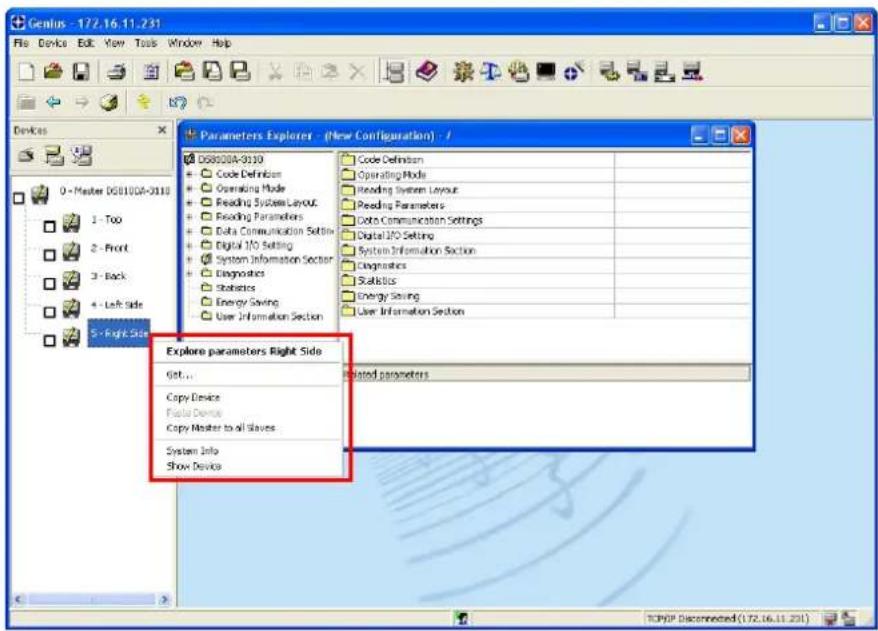
text_image
Genius - 172.16.11.231 File Devices Edit View Tools Window Help Devices 0 - Master DGB100A-0310 1 - Too 2 - Front 3 - Back 4 - Left Side 5 - Right Side Parameters Explorer - (New Configuration) / DS8800A-0310 Code Definition Operating Mode Reading System Layout Reading Parameters Data Communication Settings Digital I/O Setting System Information Sector Diagnostics Statistics Energy Saving User Information Section Code Definition Operating Mode Reading System Layout Reading Parameters Data Communication Settings Digital I/O Setting System Information Section Diagnostics Statistics Energy Saving User Information Section Explore parameters Right Side Get... Copy Device Field Device Copy Master to all Slaves System Info Show Device Created parameters TCP/IP Disconnected (172.16.11.231)These shortcuts are made only in Genius ^™ and require sending the configurations to the scanners to be saved.
It is possible to Paste, Send or Load configurations simultaneously ^1 to a selected number of devices by clicking the relative device check box and executing the desired command.
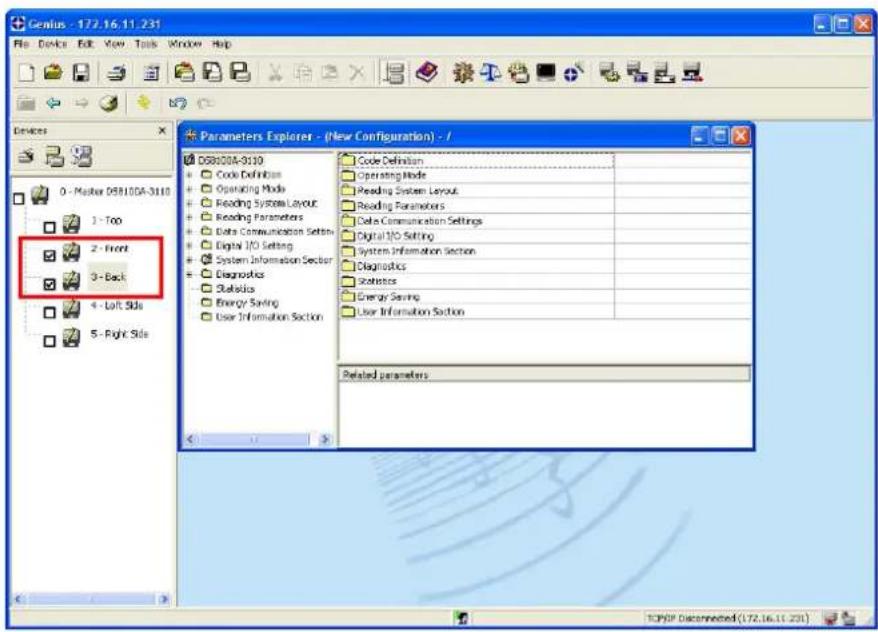
text_image
Cenius - 172.16.11.231 File Device Edit View Tools Window Help Devices 0 - Master DBR100A-3110 1 - Too 2 - Front 3 - Back 4 - Left Side 5 - Right Side Parameters Explorer - (New Configuration) - / DBR100A-3110 Code Definition Operating Mode Reading System Layout Reading Parameters Data Communication Settings Digital I/O Setting System Information Sector Diagnostics Statistics Energy Saving User Information Section Code Definition Operating Mode Reading System Layout Reading Parameters Data Communication Settings Digital I/O Setting System Information Section Diagnostics Statistics Energy Saving User Information Section Related parameters TCP/IP Disconnected (172.16.11.231)These same functions ^2 can be selected from the Edit menu as well.
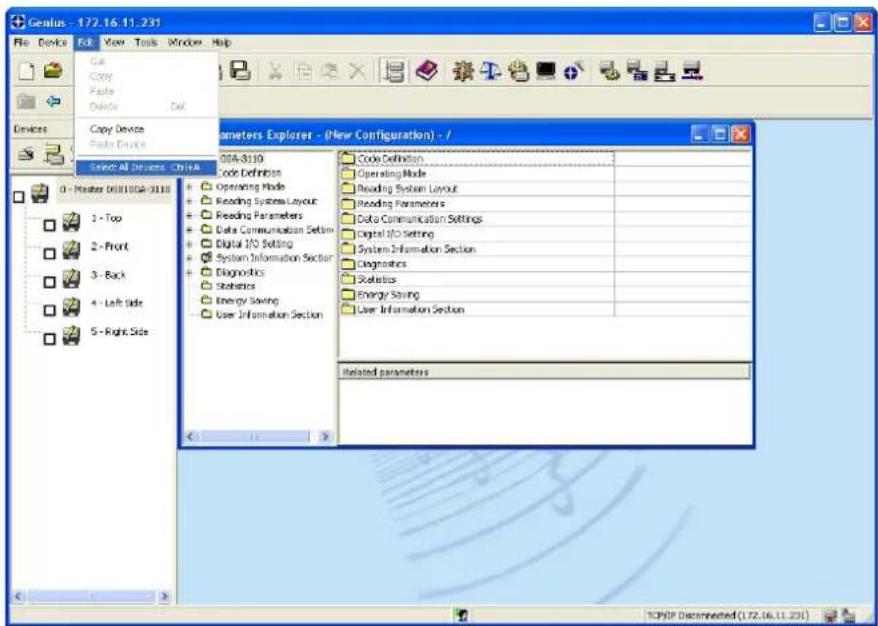
text_image
GEALUS - 172.16.11.231 File Devices Edit View Tools Window Help C++ Copy Paste Delete DW Devices Copy Device Paste Device Parameters Explorer - (New Configuration) - / Select All Devices ChinaA 01- Master 06/11/04-31/10 1 - Top 2 - Front 3 - Back 4 - Left Side 5 - Right Side 09A-3110 Code Definition Operating Mode Reading System Layout Reading Parameters Data Communication Settings Digital I/O Setting System Information Section Diagnostics Statistics Energy Saving User Information Section Code Definition Operating Mode Reading System Layout Reading Parameters Data Communication Settings Digital I/O Setting System Information Section Diagnostics Statistics Energy Saving User Information Section Related parameters TCPSP Disconnected (172.16.11.231)8.4 PARAMETER DEFAULT VALUES
The following table contains the list of the factory default settings for the DS8100A. Genius™ also allows checking the parameter default values by selecting the "Compare parameters" option available in the Tools menu and comparing the current scanner configuration to the default one.
| Parameter | Default | Setting |
| Code Definition | ||
| Code Combination Single Label | ||
| No Read Message | Global No Read Message | |
| No Read String | ||
| Multi Filters Disabled (unchecked) | ||
| Code Label Settings #1 | ||
| Code Symbology Interleaved 2 of 5 | ||
| Label Length 8 | ||
| Min Code Position 0 | ||
| Max Code Position | 255 | |
| Check Digit Disabled (unchecked) | ||
| Decoding Safety | 1 | |
| Decoding Severity | 3 | |
| Match String Rule | Match | |
| Pattern Match String | Empty | |
| Match Direction Rule | Disable | |
| Code Label Settings #2 | ||
| Code Symbology Code 39 | ||
| Label Length | Variable | |
| Minimum Label Length | 1 | |
| Maximum Label Length | 60 | |
| Min Code Position 0 | ||
| Max Code Position | 255 | |
| Check Digit Disabled (unchecked) | ||
| Decoding Safety | 1 | |
| Match String Rule | Match | |
| Decoding Severity | 3 | |
| Pattern Match String | Empty | |
| Match Direction Rule | Disable | |
| Operating Mode | ||
| Operating Mode Selection | On Line | |
| On Line Options | On Line 1 Input | |
| Start Input Number | 1 | |
| Start Input Active Level | Active Closed | |
| Reading Phase Timeout | Disabled (unchecked) | |
| Start Input from Bus | Disabled (unchecked) | |
| Protocol Index | Disabled (unchecked) | |
| Verifier | Disabled (unchecked) | |
| Reading System LayoutDevice Assignment AloneModify&Backup Lon Slave Configuration Disabled (unchecked)Enable A.S.R. Disabled (unchecked) | ||
| Reading ParametersBeam Shutter DisabledOverflow Start Ratio 5Overflow Stop Ratio 5Reading Mode ReconstructionReading Condition StandardReconstruction ParametersEnabled Stacked Code Disabled (unchecked)ExtendedMin Match 0Position Tolerance 50Duration Tolerance 50Min Start/Stop Number 2Inter Char Gap 8Addon Start/Stop Overflow Ratio 2Max distance between EAN/UPC and Addon (in modules)Scan Line AmplitudeAmplitude Settings Enable 2PackTrack CalibrationDirection 0 (Forward)PS Offset 0 | ||
| Data Communication SettingsHost Application Protocol Type Data FormatHeader Tx Start Termination After No Read Message Message Tx Selection Format Type Max. Tx Delay After Phase Off Code Identifier Disabled Standard Parameters Header String Code Position Tx Disabled (unchecked) Code Direction Identifier Enable Disabled (unchecked) Termination String <CR><LF>Data Packet Separators <CR><LF>Code Field Length Setting Variable LengthMain Serial PortMain Serial Interface Dedicated to ID-NET Data Tx Heartbeat Disabled (unchecked) Enabled (checked) Disable | ||
| Main Serial Port Parameters | ||
| Main Port Communication Mode Standard | ||
| Main Port Electrical Interface RS232 | ||
| Handshake None | ||
| Baud Rate 9600 | ||
| Parity None | ||
| Data Bits 8 | ||
| Stop Bits 1 | ||
| Auxiliary Serial Port | ||
| Search for CBX BM100 at Device Startup Enabled (checked) | ||
| Data Tx Enabled (checked) | ||
| Heartbeat | Disable | |
| Pass Through Disabled (unchecked) | ||
| Auxiliary Serial Port Parameters | ||
| Baud Rate 115200 | ||
| Parity None | ||
| Data Bits 8 | ||
| Stop Bits 1 | ||
| Digital I/O Setting | ||
| Digital Input Lines Setting | ||
| Debouncing For Input 1, 3 and 4 5ms | ||
| Debouncing For Input 2 | 500 μs | |
| Input 1 Active Level Overridden by Op. Mode | Active Closed | |
| Input 2 Active Level Overridden by Op. Mode | Active Closed | |
| Input 3 Active Level Overridden by Op. Mode | Active Closed | |
| Input 4 Active Level Overridden by Op. Mode | Active Closed | |
| Output 1 | ||
| Line State | Normally Open | |
| Activation Event | Complete Read | |
| Alternative Activation Event | Wrong | |
| Deactivation Event | Timeout | |
| Alternative Deactivation Event | None | |
| Activate on any Diagnostic Error | Disabled (unchecked) | |
| Deactivate when all Diagnostic Errors Recovered | Disabled (unchecked) | |
| Deactivation Timeout (ms) | 50 | |
| Output 2 | ||
| Line State | Normally Open | |
| Activation Event | No Read | |
| Alternative Activation Event | Partial Read | |
| Deactivation Event | Timeout | |
| Alternative Deactivation Event | None | |
| Activate on any Diagnostic Error | Disabled (unchecked) | |
| Deactivate when all Diagnostic Errors Recovered | Disabled (unchecked) | |
| Deactivation Timeout (ms) | 50 | |
| Output 3Line State Normally OpenActivation Event NoneAlternative Activation Event NoneDeactivation Event NoneAlternative Deactivation Event NoneActivate on any Diagnostic Error Disabled (unchecked)Deactivate when all Diagnostic Errors Recovered | CheckedDisabled (unchecked) | |
| DiagnosticsPackTrack Debug Message Tx Disabled (unchecked)Enable Conveyor Info Not AvailableRefresh Time 2 secLocal Network Failure Enabled (checked)No Scan Enabled (checked)No Sync Enabled (checked)No Phase Timeout DisableDIGITIZER: Motor WarningDIGITIZER: Motor FailureDIGITIZER: Motor Life EndDIGITIZER: Laser FailureDIGITIZER: Laser Life EndActionsTx ModeTx RefreshAuxMainFormatHeader StringTerminator StringError Message Type | EnabledEnabled (checked)Enabled (checked)Enabled (checked)Enabled (checked)On Timeout2 secDisabled (unchecked)Disabled (unchecked)<STX><CR><LF>Numeric | |
| StatisticsEnableSeparatorTime (hh mm) Disabled (unchecked)Phase CounterGood Read CounterPartial Read CounterNo Read CounterMultiple Read Counter | Enabled | |
| Disabled (unchecked)Disabled (unchecked)Disabled (unchecked)Disabled (unchecked)Disabled (unchecked) | ||
| Energy SavingEnergy Saving Configuration | Disabled (unchecked) | |
| User Information Section | ||
| End User Name Empty | ||
| Device Name Empty | ||
| Line Name Empty | ||
9 READING FEATURES
9.1 ADVANCED CODE RECONSTRUCTION (ACR™ 4)
The traditional way of barcode reading could be called “Linear Reading”. In this case, the laser beam crosses the barcode symbol from its beginning to its end as shown in the following figure:

text_image
Laser BeamFigure 90 – Linear Reading
In Advanced Code Reconstruction mode it is no longer necessary for the laser beam to cross the label from the start to the end. With just a set of partial scans on the label (obtained using the motion of the label itself), the DS8100A is able to “reconstruct” the barcode. A typical set of partial scans is shown in the figure below:
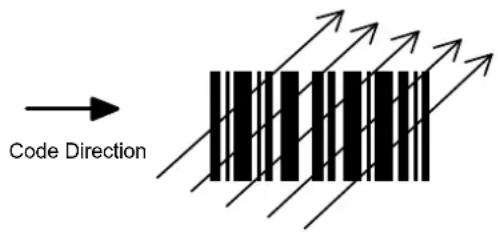
text_image
Code DirectionFigure 91 – Partial Scans
None of the partial scans contains the whole label. The decoder aligns each partial scan correctly and combines them in order to obtain the entire code.
The alignment is performed by calculating the time difference from one partial scan to another using a reference code element.
9.1.1 Tilt Angle for Advanced Code Reconstruction
The most important parameter in Advanced Code Reconstruction is the value of the maximum tilt angle ( maximum) under which the code reconstruction process is still possible.

text_image
Laser Beam 0° to α max α = tilt angleFigure 92 – Tilt Angle
The decoder will be able to read the label with a tilt angle between +α max and -α max as shown in the following figure:

text_image
0° OK OK - α + α No Read No Read Conveyor OK OK Laser BeamFigure 93 – Reading Zones with α Max
The formulas to calculate maximum depend on various parameters such as: label height, number of scans per second, code motion speed, etc. Minimum label heights at different conveyor speeds are given in the tables in par. 9.3.1, depending on standard values of 45^ and 30^ .
9.2 PACKTRACK™
PackTrack™ is a patented operating mode for Datalogic Omni-Directional Reading Stations used to read and correctly assign codes read on different packs when placed in the scanner Reading Area at the same time.
In fact, in the following example, the codes of two or more consecutive packs are found at the same time in the scanner reading area. Therefore, the condition occurs where, in the sequence of the two packs, the code of the second pack is read first, just before the code of the previous pack. A system without PackTrack™ would assign the code of the second pack to first pack and vice versa, thus causing a gross error in sortation.
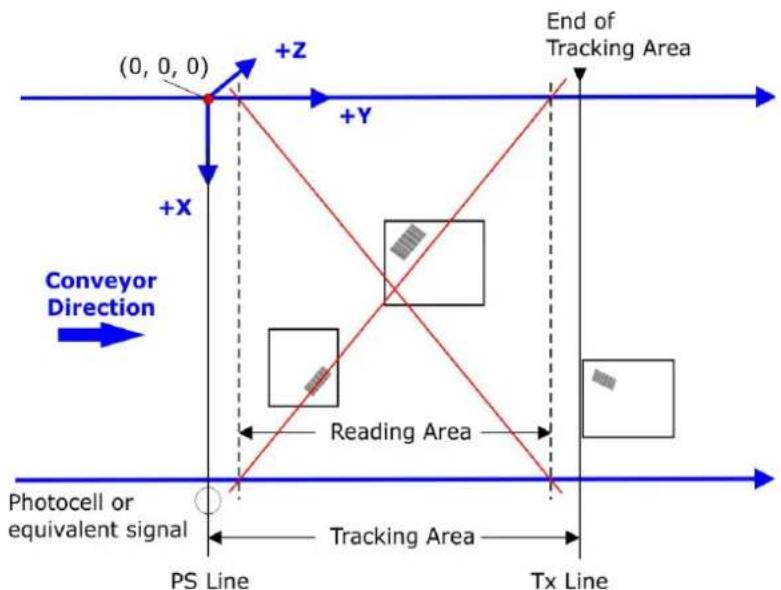
text_image
(0, 0, 0) +Z +Y End of Tracking Area +X Conveyor Direction Reading Area Photocell or equivalent signal PS Line Tracking Area Tx LineFigure 94 – PackTrack™ System Layout
Working in PackTrack ^™ mode requires an encoder and a presence sensor (or equivalent signals) to track the moving packs.
For correct functioning, the PackTrack ^™ operating mode requires a calibration just after the installation of the scanners. This operation is absolutely necessary to accurately locate barcodes on a fixed reference system.
PackTrack™ uses a right-handed reference system (right hand with thumb = X axis; forefinger = Y axis; middle finger = Z axis) where the axis X coincides with the PS line, the Y axis coincides with the conveyor direction and the Z axis is oriented upwards from the conveyor (see figure below).
PackTrack™ Reference System
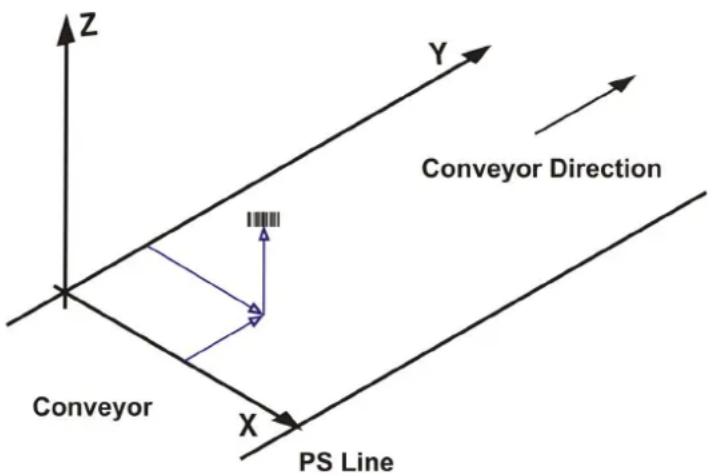
text_image
Z Y Conveyor Direction Conveyor X PS LineFigure 95 – PackTrack™ Reference System
This coordinate system is absolute for the reading station, i.e. is valid for all the scanners independently from their position or orientation with respect to the conveyor. For this reason, after the PackTrack™ calibration (and configuration) has been correctly performed, when a barcode is under the beam to be read by the scanners, its position is defined by the coordinates of its central point, independently from which scanner is reading it. This can be verified using the Test mode in the SPY PackTrack Calibration dialog box (see par. 9.2.2).
Both Auto PackTrack Calibration using the DLAPC tool and Manual PackTrack™ Calibration using the SPY tool can be performed in Genius™ (refer to the following paragraphs and the Genius™ Help On-Line for details).
9.2.1 Auto PackTrack™ Calibration for Reading Station Using DLAPC
In a Master /Slave Reading Station working in PackTrack™ or Continuous operating mode, the entire Reading Station can be automatically calibrated using the DLAPC tool in Genius™. The following paragraphs detail the Conditions and Limits, Parameters, and Procedure to follow. This information is also given in the Help On-Line.
Auto PackTrack Conditions and Limits
The Conditions and Limits for Auto PackTrack Calibration are summarized here for convenience and are also integrated into the following procedure descriptions:
- The following scanners are supported by Auto PackTrack Calibration: DS6400 (*see note below), DX6400 (*see note below), DS8100A, DX8200A.
- Before performing the Auto PackTrack Calibration procedure, if a system reset or power reset is performed, wait for all the scanners to be available (up to 60 sec.) before proceeding.
- Operating Mode of the Master must be either PackTrack or Continuous.
- Code 128 codes must be enabled on the Master with Label Length set to variable.
- If the system Presence Sensor and Encoder are used, the correct Encoder Step value must be set on the Master and the Presence Sensor must be connected to the CBX100/500 Input 1.
- If instead the PPA-8000 Photocell Array is used, it must be connected to the CBX100/500 I1 and I2 inputs, the following parameters must be disabled on the Master: Physical Encoder for PackTrack or Use Encoder for Continuous, and the Encoder, if present, must be physically disconnected.
- DX scanners which are calibrated automatically cannot be automatically replaced by DX scanners with a previous sw version (earlier than 6.80). You must either update the old scanner software prior to substitution, or complete the calibration manually, after installation, by setting the PSOffset and Direction parameters.

NOTE
The autofocus feature of DS6400 and DX6400 scanners makes Auto PackTrack Calibration difficult, therefore to assure that the procedure can correctly calibrate these scanners, it is necessary to set a fixed focus value which allows the scanner to read all the label positions useful for its calibration.
Auto PackTrack Parameter Descriptions
By means of the software tool DLAPC, it is possible to perform the Auto PackTrack setup procedure for PackTrack™ and Continuous Operating Mode applications.
Select the "DLAPC" option from the Tools menu or click on the related icon on the Tool Bar to open the following dialog box:

text_image
AutoPackTrackCalibration AddOn Sensors Type: ● Configured PS & Encoder ○ Photocell Array Photocell Distance [mm] 165 Pack Version 2 Calibration Type: ● XYZ ☑ Absolute X × Offset [mm] 0 Z Offset [mm] 0 Please click Start to activate AutoPackTrack procedure with selected parameters. Start >> CancelOnce the DLAPC window has been opened, set the following parameters according to the application requirements:
Sensor Type: whether calibration will be performed using the system Presence Sensor and Encoder (most cases), or the PPA-8000 Photocell Array.

NOTE
The Auto PackTrack procedure requires using the PPA-8000 Photocell Array for all systems where either the Presence Sensor or the Encoder are absent (including Continuous Operating Mode and Cargoscan applications).
If using the Presence Sensor and Encoder, the presence sensor must be connected to the CBX100/500 I1 input. The Encoder Step parameter must also be set correctly.
If using the PPA-8000 you must set the Photocell distance (165 mm default). The Photocell Array must be connected to the CBX100/500 I1 and I2 inputs (see the relative installation manual), and the Encoder, if present, must be disconnected.
Pack Version: the version of the PCT-8000 being used for calibration. This value can be read from the barcode labels on the PCT-8000. Each label has the value vnnn where v is the version number.
Calibration Type: XYZ calibration with Absolute X position is forced. The coordinates for the three axes are calibrated. The X coordinate for all slaves is relative to a precise point (reference point). This requires that the X Offset be set which will be used to harmonize the X=0 coordinate of all of the individual slaves.

NOTE
For Oscillating Mirror models the scan line must be parallel to the conveyor direction and only the Y calibration will be performed, (the X and Z axes will automatically be set to zero).
Z Offset (if necessary): for packs that are elevated above the conveyor surface (for example on tilt trays), this parameter sets an offset for the height of a pack so that Z = 0 corresponds to the bottom of the pack.
Auto PackTrack Setup
- Click on the Start button and follow the instructions given in the Auto PackTrack procedure window.
The first message is sent to the slaves and their status is shown in the synoptic buttons at the top of the window.

text_image
Scanner: 01-1 02-N 03-C 04-I 05-U Scanner 01 can be calibrated - Lost during the procedure Scanner 02 can be calibrated - Calibrated but Not Verified Scanner 03 calibrated - Calibrated and Verified Scanner 04 can be calibrated - Initialized Scanner 05 cannot be calibrated Next StopThe scanner status indicated by each synoptic button has the following convention:
| Color | Symbol | Meaning |
| Grey | xx-U | slave xx cannot be calibrated - calibration is not supported by scanner software version |
| Red | xx-U | slave xx can be calibrated but the calibration procedure fails either barcode reading or verification |
| Red | xx-L | slave xx can be calibrated - is Lost stops responding during the procedure |
| Aqua | xx-I | slave xx can be calibrated - is in the Initial state ready to be calibrated |
| Yellow | xx-N | slave xx can be calibrated - is calibrated but Not verified |
| Green | xx-C | slave xx calibrated - is calibrated and verified |
The symbol xx is the number of the slave scanner 01, 02, 03 etc.
- Follow each step given in the Auto PackTrack procedure window. The instructions and summary of each step are written in the terminal area of the window. The Synoptic buttons report the slave scanner status throughout the procedure.
Basically, place the PCT-8000 onto the moving conveyor, before the PS Line (reference point) and parallel to a conveyor edge (i.e. right-hand edge) with its arrow in the same direction as the conveyor movement. Let it pass through the reading station.

NOTE
If there are any nodes that show as U or L, then you should Stop the procedure and correct the problem. If the nodes respond with I, N, or C then you can Continue with the procedure.
To run each instruction press the Next button. The procedure repeats the steps asking to change the PCT-8000 X position (i.e. always before the PS Line (reference point) and parallel to a conveyor edge but changing to the left-hand edge and/or to the center of the conveyor), until the procedure terminates. At the end of the procedure, only the Stop button is active. Typically 3 passes are necessary.

flowchart
graph TD
    A["1: (X, Y, Z = 0)"] --> B["PS Line"]
    B --> C["Conveyor Direction"]
    D["2: (X, Y, Z = 0)"] --> E["PS Line"]
    E --> F["Conveyor Direction"]
    G["3: (X, Y, Z = 0)"] --> H["PS Line"]
    H --> I["Conveyor Direction"]
- The Absolute X coordinate requires placing the barcode label centered onto the physical X position (X Offset) on the conveyor (previously set in the dialog box), you have 2 minutes to read the code before the procedure ends automatically.

NOTE
Be careful that the barcode is not accidentally read in the act of placing it at the desired X Offset position, and assure that it is read by only one scanner (see the figure below). You may have to pass your hand or other opaque object over it in order to end this step.
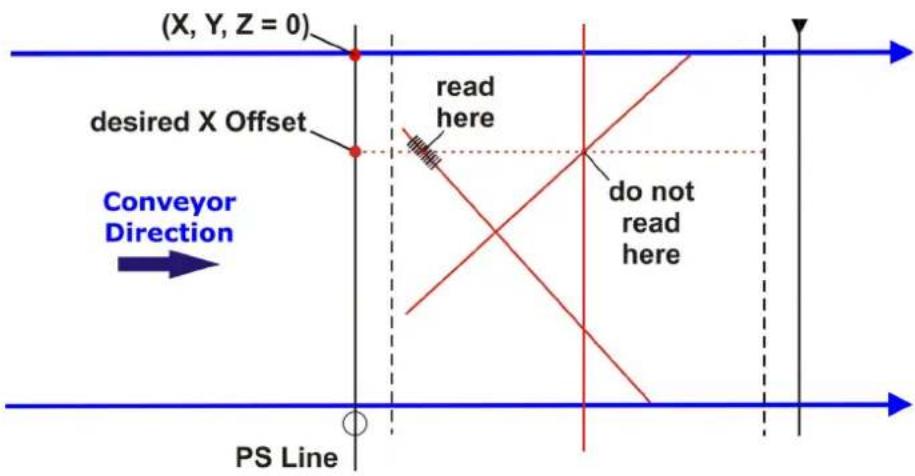
text_image
(X, Y, Z = 0) desired X Offset read here do not read here Conveyor Direction PS Line- When you have successfully completed the procedure, (all scanners are green), press the Stop button to end the procedure and return to the Auto PackTrack setup window.

NOTE
The Stop button is always present and can be used at any time to end the procedure and return to the Auto PackTrack setup window.

NOTE
At this point you can download the Auto PackTrack Report file saved in the Master scanner RAM. This can only be done by connecting the Master to another instance of Genius™ on a different communication channel. Select the Tools>File transfer... menu from this new Genius™ connection.
- From the original Genius™ connection, press the Exit button to exit the Addon.
The calibrated values for the reading station will be sent to the Master scanner and the Master scanner will reset the reading station which is now calibrated and ready.
Auto PackTrack Report
The Auto PackTrack Report file can be downloaded from the Master scanner RAM by using the Tools>File transfer... menu in Genius™. The report is divided into three sections.
The first section contains the general calibration parameters:
PARAMETERS
Calibration type XYZ X Absolute (X Offset 550)
Sensor type configured
Pack version 2 (Z Offset 0)
The second section contains for each node, the calibration table, and the final calibration state.
PACKTRACK GLOBAL CALIBRATION TABLE DX node 5
P1: X(mm) 36
P1: Y(mm) 1077
P1: Z(mm) 10
P1: Distance(mm) 36
P1: Position 1077
P2: X(mm) 715
P2: Y(mm) 1096
P2: Z(mm) 10
P2: Distance(mm) 10
P2: Position 715
P3: X(mm) 518
P3: Y(mm) 1304
P3: Z(mm) 650
P3: Distance(mm) 1096
P3: Position 10
XP1: X(mm) 36
XP1: Y(mm) 1077
XP1: Z(mm) 10
XP1: Distance(mm) 36
XP1: Position 1077
XP2: X(mm) 715
XP2: Y(mm) 1096
XP2: Z(mm) 10
XP2: Distance(mm) 10
XP2: Position 715
XP3: X(mm) 518
XP3: Y(mm) 1304
XP3: Z(mm) 650
XP3: Distance(mm) 1096
XP3: Position 10
Calibration State VERIFIED
PACKTRACK CALIBRATION TABLE DS node 6
P1: X(mm) 36
P1: Y(mm) 1077
P1: Z(mm) 10
P1: Distance(mm) 36
P1: Position 1077
P2: X(mm) 715
P2: Y(mm) 1096
P2: Z(mm) 10
P2: Distance(mm) 10
P2: Position 715
P3: X(mm) 518
P3: Y(mm) 1304
P3: Z(mm) 650
P3: Distance(mm) 1096
P3: Position 10
Calibration State VERIFIED
The last section summarizes the calibration status of each scanner.
SCANNERS STATE SUMMARY
| Scanner E | Calibrated and verified |
| Scanner F | Calibrated and verified |
| Scanner J | Calibrated and verified |
| Scanner K | Calibrated and verified |
| Scanner L | Calibrated and verified |
| Scanner M | Calibrated and verified |
| Scanner N | Calibrated and verified |
| Scanner O | Calibrated and verified |
| Scanner Q | Calibrated and verified |
| Scanner R | Calibrated and verified |
| Scanner S | Calibrated and verified |
9.2.2 Manual PackTrack™ Calibration for DS8100A Scanner Using SPY
In a Master /Slave Reading Station working in PackTrack™ or Continuous operating mode, the individual scanners can be calibrated using the SPY tool in Genius™.
PackTrack™ Reference System

text_image
Z Y Conveyor Direction Conveyor X PS LineFigure 96 – PackTrack™ Reference System
Independently from the scanner position in the reading station (top, side, bottom, etc), the general procedure is to place three barcodes along the scanline of the scanner as indicated in the figure below. The order is not important but the relative position to the scanner reading area is: one barcode in the center near position and two barcodes at the outer edges of the reading area.

natural_image
Top-down diagram of a device emitting beams to a target, enclosed in an octagonal frame (no text or symbols)Figure 97 – Manual PackTrack™ Calibration Relative Code Positioning
- Select the "SPY" option from the Tools menu or click on the related icon on the Genius™ toolbar to open the following dialog box:

NOTE
When selecting a slave scanner through the Master, click on the slave in the Devices window, then click the SPY icon.

text_image
Genius - COM1 File Device Edit View Tools Window Help Devices SPY 1.09.0010 - [1 - DS8100A-3010] Refresh! Reading Parameters Service Tools About Focus position ... Temperature 36 (°C) Test 1 - DS8100A-3010 Laser on (h) 19346 Reset Motor run (h) @ 125 RPS 19564 Reset Subsystem Version FW Name Digitizer 1.5 8XSD Oscillating Mirror Not found! Flash*** Not found! Motor Control 1.1 8XLC Serial number: C04A00111 SPY ICON COM1 11S200 N 8 1Figure 98 – Opening the Spy Window
- Once the Spy window has been opened, select the "PackTrack™ Calibration" option from the Tools menu:
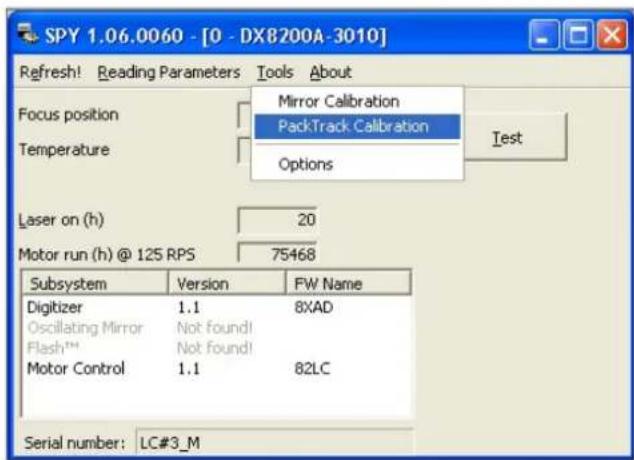
text_image
SPY 1.06.0060 - [0 - DX8200A-3010] Refresh! Reading Parameters Tools About Focus position Mirror Calibration Temperature PackTrack Calibration Options Laser on (h) 20 Motor run (h) @ 125 RPS 75468 Subsystem Version FW Name Digitizer 1.1 8XAD Oscillating Mirror Not found! Flash™ Not found! Motor Control 1.1 82LC Serial number: LC#3_MFigure 99 – Selecting PackTrack™ Calibration Option
- By selecting the "PackTrack Calibration" option a further dialog box appears allowing to start calibration:

text_image
PackTrack Calibration Run Test Close Position 1 1 0 (mm) Y coord. 0 (mm) Z coord. 0 (mm) Status 2 Calibrate 0 (cm) Position 2 2 0 (mm) Y coord. 0 (mm) Z coord. 0 (mm) Calibrate 0 (cm) Position 3 3 0 (mm) Y coord. 0 (mm) Z coord. 0 (mm) Calibrate 0 (cm) Validate calibrationFigure 100 – Performing the PackTrack™ Calibration
- Place the code at one of the desired positions on the scan line (i.e. Position 1).
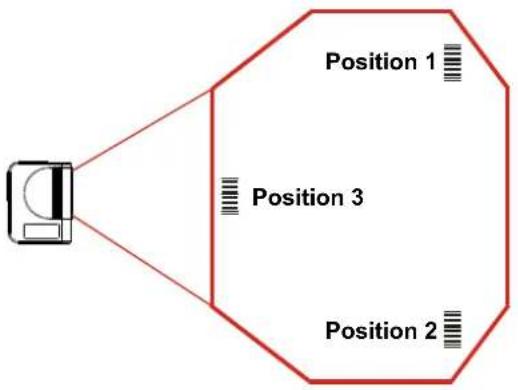
flowchart
graph TD
    A["Device Icon"] --> B["Position 1"]
    A --> C["Position 2"]
    A --> D["Position 3"]
    B --> E["Octagon Frame"]
    C --> E
    D --> E
- Measure the X, Y and Z coordinates relative to the center of the code and enter them into the corresponding edit boxes.

NOTE
In the vast majority of systems the x and z data are not necessary. For these cases set x = 0, z = 0 during the calibration procedure.
-
Press the Calibrate button for Position 1 to start the calibration.
-
Repeat the same procedure for Position 2 and Position 3.
- After calibrating the 3 positions, press the "Validate Calibration" button to validate the calibration settings.
Before closing the dialog box, press the Run Test button to test the calibration results and efficiency. See the following figure.

text_image
Run Test Code 123456 Percent 100% X coord. 213 Y coord. -183 Z coord. -911 (mm) Active Laser Laser 3 Code distance 81 A/D Value Code position 191 53609Figure 101 – Testing PackTrack™ Calibration
Repeat the entire procedure for each scanner in the Reading Station.
9.2.3 PackTrack™ Calibration for DS8100A Oscillating Mirror Models
The DS8100A oscillating mirror models can be used in PackTrack™ operating mode only when the scanner is mounted so that the scan line is parallel to the conveyor direction as shown in the following figure:
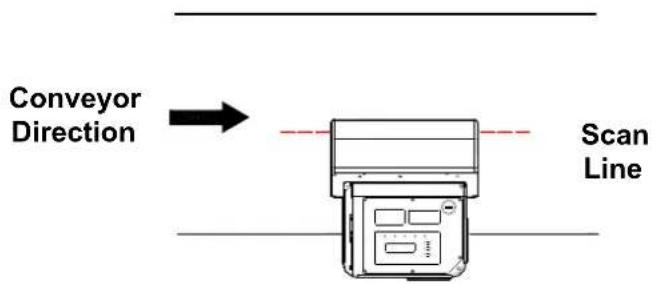
text_image
Conveyor Direction Scan LineFigure 102 – Oscillating Mirror Models in PackTrack™ Mode
PackTrack™ Calibration must be made while the scanning plane is perpendicular to the conveyor plane and fixed (not oscillating).
9.3 PERFORMANCE
The scan rate is 1000 scans/sec.
Refer to the diagrams in par. 9.4 for further details on the reading features. These diagrams are taken on various resolution sample codes at a 25 °C ambient temperature depending on the conditions listed under each diagram.
9.3.1 Reading Conditions
• ANSI Grade B minimum
• 1000 scans/sec
The following tables describe the requirements for standard applications.
| Minimum Code Height for ACR Reading (mm) | |||||||||||||
| 45^ | 30^ | ||||||||||||
| Conveyor Speed (m/s) | 0.5 | 1 | 1.5 | 2 | 2.5 | 3 | 0.5 | 1 | 1.5 | 2 | 2.5 | 3 | |
| 2/5 Interleaved Code Resolution (mm) | 0.25 | 10 | 11 | 13 | 14 | 16 | 17 | 7 | 8 | 9 | 10 | 12 | |
| 0.30 | 12 | 13 | 14 | 16 | 17 | 19 | 8 | 9 | 10 | 1 | 1 | 2 | |
| 0.33 | 12 | 14 | 15 | 17 | 18 | 20 | 8 | 9 | 10 | 1 | 2 | 13 | |
| 0.38 | 14 | 15 | 16 | 18 | 19 | 21 | 9 | 10 | 11 | 12 | 14 | 15 | |
| 0.50 | 18 | 18 | 20 | 21 | 23 | 24 | 11 | 12 | 13 | 14 | 15 | 17 | |
| 0.72 | 24 | 25 | 26 | 27 | 28 | 30 | 15 | 16 | 16 | 18 | 19 | 20 | |
| 1.00 | 33 | 33 | 34 | 35 | 36 | 37 | 20 | 20 | 21 | 22 | 23 | 24 | |
Ratio 3:1
Table 1
| Minimum Code Height for ACR Reading (mm) | |||||||||||||
| 45^ | 30^ | ||||||||||||
| Conveyor Speed (m/s) | 0.5 | 1 | 1.5 | 2 | 2.5 | 3 | 0.5 | 1 | 1.5 | 2 | 2.5 | 3 | |
| Code Resolution (mm) | 0.25 | 9 | 9 | 11 | 12 | 14 | 15 | 6 | 7 | 8 | 9 | 10 | |
| 0.30 | 10 | 11 | 12 | 13 | 15 | 16 | 7 | 7 | 8 | 10 | 11 | ||
| 0.33 | 11 | 11 | 12 | 14 | 15 | 17 | 7 | 8 | 9 | 10 | 11 | ||
| 0.38 | 12 | 13 | 13 | 15 | 16 | 18 | 8 | 8 | 9 | 10 | 12 | ||
| 0.50 | 15 | 16 | 16 | 17 | 18 | 20 | 9 | 10 | 11 | 12 | 13 | 14 | |
| 0.72 | 20 | 21 | 22 | 22 | 23 | 24 | 13 | 13 | 14 | 14 | 15 | 16 | |
| 1.00 | 27 | 28 | 29 | 29 | 30 | 31 | 17 | 17 | 18 | 18 | 19 | 20 | |
| Minimum Code Height for ACR Reading (mm) | |||||||||||||
| 45° | 30° | ||||||||||||
| Conveyor Speed (m/s) | 0.5 | 1 | 1.5 | 2 | 2.5 | 3 | 0.5 | 1 | 1.5 | 2 | 2.5 | 3 | |
| Code 128 – GS1-128 | 0.25 | 7 | 9 | 10 | 12 | 13 | 15 | 6 | 6 | 8 | 9 | 10 | |
| 0.30 | 8 | 9 | 11 | 12 | 14 | 15 | 6 | 7 | 8 | 9 | 10 | ||
| 0.33 | 9 | 10 | 11 | 13 | 14 | 16 | 6 | 7 | 8 | 9 | 11 | ||
| Code Resolution (mm) | 0.38 | 10 | 11 | 12 | 14 | 15 | 17 | 6 | 8 | 9 | 10 | 11 | |
| 0.50 | 12 | 13 | 14 | 16 | 17 | 19 | 8 | 9 | 10 | 11 | 12 | 13 | |
| 0.72 | 16 | 17 | 18 | 19 | 21 | 22 | 10 | 11 | 12 | 13 | 14 | 15 | |
| 1.00 | 21 | 22 | 23 | 24 | 25 | 26 | 13 | 14 | 15 | 16 | 17 | 18 | |
Ratio 3:1; Interdigit = Module Size
Table 2
Table 3
| Minimum Code Height for ACR Reading (mm) | |||||||||||||
| 45° | 30° | ||||||||||||
| Conveyor Speed (m/s) | 0.5 | 1 | 1.5 | 2 | 2.5 | 3 | 0.5 | 1 | 1.5 | 2 | 2.5 | 3 | |
| CodabarCode Resolution(mm) | 0.25 | 8 | 9 | 10 | 12 | 13 | 15 | 5 | 6 | 8 | 9 | 10 | |
| 0.30 | 9 | 9 | 11 | 12 | 14 | 15 | 6 | 7 | 8 | 9 | 10 | ||
| 0.33 | 9 | 10 | 11 | 13 | 14 | 16 | 6 | 7 | 8 | 9 | 11 | ||
| 0.38 | 10 | 11 | 12 | 14 | 15 | 17 | 7 | 8 | 9 | 10 | 11 | ||
| 0.50 | 13 | 13 | 14 | 16 | 17 | 19 | 8 | 9 | 10 | 11 | 12 | 13 | |
| 0.72 | 17 | 18 | 18 | 19 | 21 | 22 | 11 | 11 | 12 | 13 | 14 | 15 | |
| 1.00 | 23 | 23 | 24 | 25 | 26 | 26 | 14 | 15 | 15 | 16 | 17 | 18 | |
Ratio 3:1; Interdigit = Module Size
Table 4
| Minimum Code Height for ACR Reading (mm) | |||||||||||||
| 45° | 30° | ||||||||||||
| Conveyor Speed (m/s) | 0.5 | 1 | 1.5 | 2 | 2.5 | 3 | 0.5 | 1 | 1.5 | 2 | 2.5 | 3 | |
| EAN 8-13, UPC-ACode Resolution(mm) | 0.25 | 7 | 8 | 9 | 11 | 12 | 1 | 4 | 5 | 6 | 7 | 8 | 9 |
| 0.30 | 8 | 9 | 10 | 11 | 13 | 1 | 14 | 6 | 6 | 7 | 9 | 10 | |
| 0.33 | 9 | 10 | 10 | 12 | 13 | 15 | 6 | 7 | 8 | 9 | 10 | 11 | |
| 0.38 | 10 | 11 | 11 | 12 | 14 | 15 | 6 | 7 | 8 | 9 | 10 | 12 | |
| 0.50 | 12 | 13 | 14 | 14 | 15 | 17 | 8 | 8 | 9 | 10 | 11 | 12 | |
| 0.72 | 16 | 17 | 18 | 18 | 19 | 20 | 10 | 11 | 11 | 12 | 13 | 14 | |
| 1.00 | 21 | 22 | 23 | 24 | 24 | 25 | 13 | 14 | 15 | 15 | 16 | 16 | |
Table 5
9.4 READING DIAGRAMS
DS8100A-2X10 (0.50 mm/20 mils)
The diagram shows an average reading area obtained considering different barcode types of variable quality.
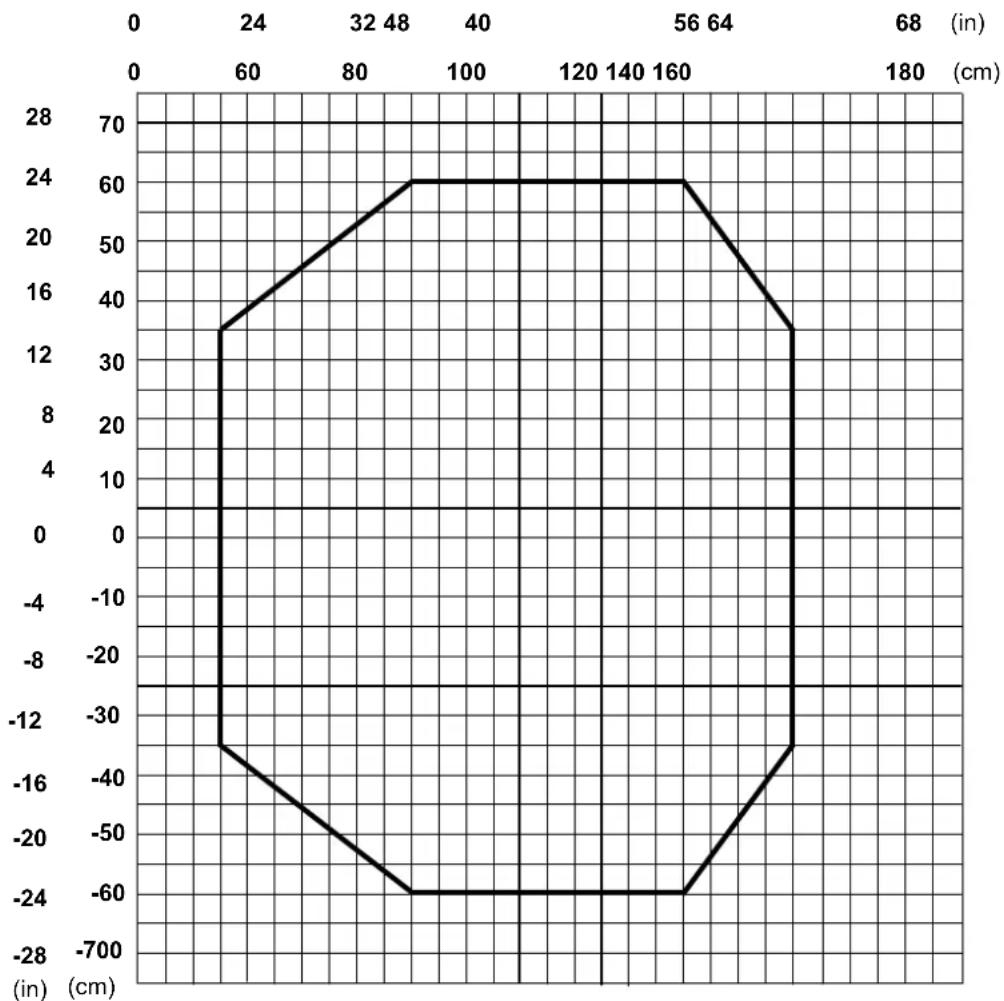
line
| x (in) | y (cm) | | ------ | ------ | | 0 | 0 | | 24 | 24 | | 32 | 48 | | 40 | 60 | | 56 | 64 | | 68 | 180 |Note: (0,0) is the center of the laser beam output window.
CONDITIONS
Code = Interleaved 2/5 or Code 39
PCS = 0.90
"Pitch" angle = 0°
"Skew" angle = 10°
"Tilt" angle = 0°
Reading mode = Linear
DS8100A-2X10 (0.38 mm/15 mils)
The diagram shows an average reading area obtained considering different barcode types of variable quality.

Note: (0,0) is the center of the laser beam output window.
CONDITIONS
Code = Interleaved 2/5 or Code 39
PCS = 0.90
"Pitch" angle = 0°
"Skew" angle = 10°
"Tilt" angle = 0°
Reading mode = Linear
DS8100A-3X00 (0.50 mm/20 mils)
The diagram shows an average reading area obtained considering different barcode types of variable quality.

line
| x (in) | y (cm) | | ------ | ------ | | 0 | 0 | | 60 | 24 | | 80 | 32 | | 100 | 48 | | 120 | 64 | | 140 | 80 | | 160 | 96 | | 180 | 112 | | 200 | 128 | | 220 | 144 | | 240 | 160 | | 260 | 176 | | 280 | 192 | | 300 | 208 | | 320 | 224 | | 340 | 240 | | 360 | 256 | | 380 | 272 | | 400 | 288 | | 420 | 304 | | 440 | 320 | | 460 | 336 | | 480 | 352 | | 500 | 368 | | 520 | 384 | | 540 | 400 | | 560 | 416 | | 580 | 432 | | 600 | 448 | | 620 | 464 | | 640 | 480 | | 660 | 496 | | 680 | 512 | | 700 | 528 | | 720 | 544 | | 740 | 560 | | 760 | 576 | | 780 | 592 | | 800 | 608 | | 820 | 624 | | 840 | 640 | | 860 | 656 | | 880 | 672 | | 900 | 688 | | 920 | 704 | | 940 | 720 | | 960 | 736 | | 980 | 752 | | 1000 | 768 | | 1020 | 784 | | 1040 | 800 | | 1060 | 816 | | 1080 | 832 | | 1100 | 848 | | 1120 | 864 | | 1140 | 880 | | 1160 | 896 | | 1180 | 912 | | 1200 | 928 | | 1220 | 944 | | 1240 | 960 | | 1260 | 976 | | 1280 | 992 | | 1300 | 1010 | | 1320 | 1028 | | 1340 | 1046 | | 1360 | 1064 | | 1380 | 1082 | | 1400 | 1100 | | 1420 | 1118 | | 1440 | 1136 | | 1460 | 1154 | | 1480 | 1172 | | 1500 | 1190 | | 1520 | 1218 | | 1540 | 1246 | | 1560 | 1274 | | 1580 | 1302 | | 1600 | 1330 | | 1620 | 1358 | | 1640 | 1386 | | 1660 | 1414 | | 1680 | 1442 | | 1700 | 1470 | | 1720 | 1508 | | 1740 | 1546 | | 1760 | 1584 | | 1780 | 1622 | | 1800 | 1660 | | | |Note: (0,0) is the center of the laser beam output window.
CONDITIONS
Code = Interleaved 2/5 or Code 39
PCS = 0.90
"Pitch" angle = 0°
"Skew" angle = 10°
"Tilt" angle = 0°
Reading mode = Linear
DS8100A-3X10 (0.38 mm/15 mils)
The diagram shows an average reading area obtained considering different barcode types of variable quality.
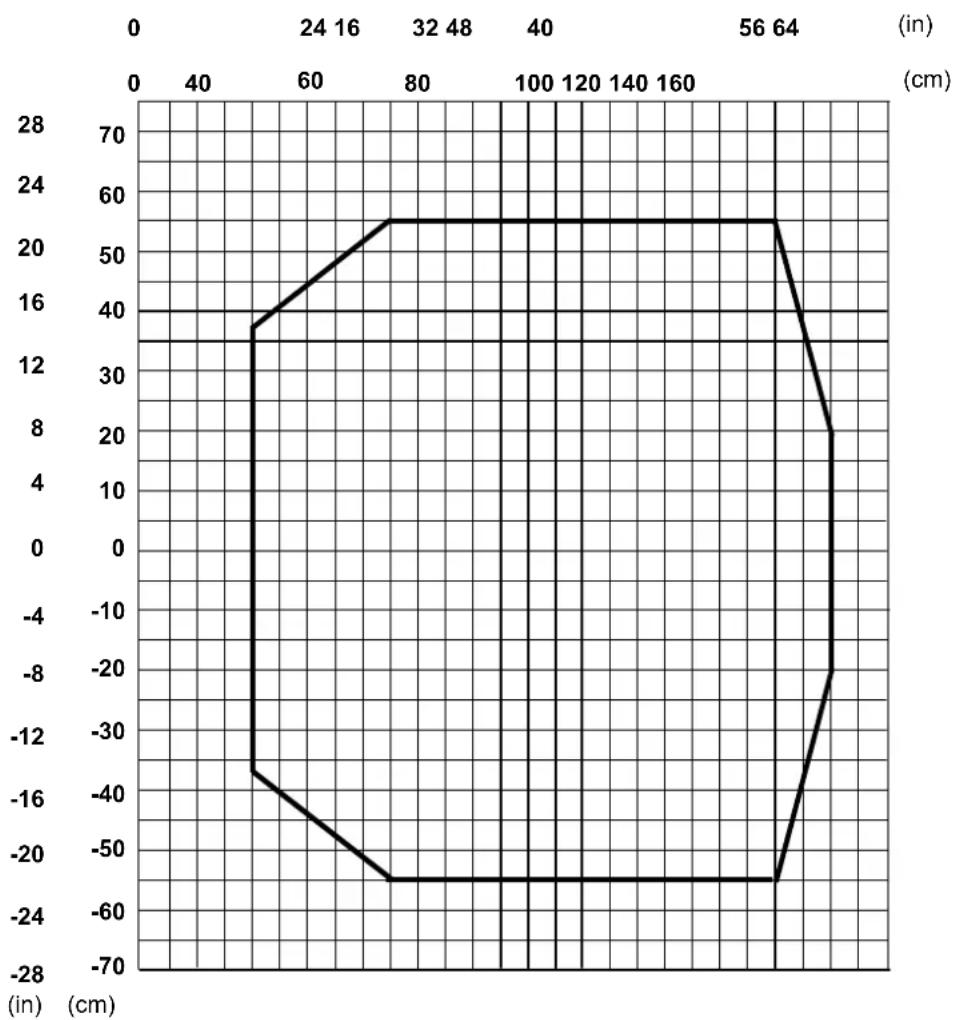
line
| x (cm) | y (cm) | | ------ | ------ | | 0 | 0 | | 24 | 16 | | 32 | 48 | | 40 | 64 | | 56 | 64 | | 64 | 64 | | 72 | 64 | | 80 | 64 | | 96 | 64 | | 104 | 64 | | 112 | 64 | | 120 | 64 | | 136 | 64 | | 144 | 64 | | 152 | 64 | | 160 | 64 | | 176 | 64 | | 184 | 64 | | 192 | 64 | | 200 | 64 | | 216 | 64 | | 232 | 64 | | 240 | 64 | | 256 | 64 | | 272 | 64 | | 280 | 64 | | 296 | 64 | | 312 | 64 | | 320 | 64 | | 336 | 64 | | 352 | 64 | | 368 | 64 | | 384 | 64 | | 400 | 64 | | 416 | 64 | | 432 | 64 | | 448 | 64 | | 464 | 64 | | 480 | 64 | | 496 | 64 | | 512 | 64 | | 528 | 64 | | 544 | 64 | | 560 | 64 | | 576 | 64 | | 592 | 64 | | 608 | 64 | | 624 | 64 | | 640 | 64 | | 656 | 64 | | 672 | 64 | | 688 | 64 | | 704 | 64 | | 720 | 64 | | 736 | 64 | | 752 | 64 | | 768 | 64 | | 784 | 64 | | 800 | 64 | | 816 | 64 | | 832 | 64 | | 848 | 64 | | 864 | 64 | | 880 | 64 | | 896 | 64 | | 912 | 64 | | 928 | 64 | | 944 | 64 | | 960 | 64 | | 976 | 64 | | 992 | 64 | | Note: The data is in cm format for each segment of the polygon. The values are explicitly labeled as (in). The x-axis is labeled 'x' and the y-axis is labeled '(x') in cm. There is no label for the data series. The labels are explicitly provided in the code.Note: (0,0) is the center of the laser beam output window.
CONDITIONS
Code = Interleaved 2/5 or Code 39
$$ \mathrm{PCS} = 0. 9 0 $$
"Pitch" angle = 0°
"Skew" angle = 10°
"Tilt" angle = 0°
Reading mode = Linear
DS8100A-3X20 (0.30 mm/12 mils)
The diagram shows an average reading area obtained considering different barcode types of variable quality.
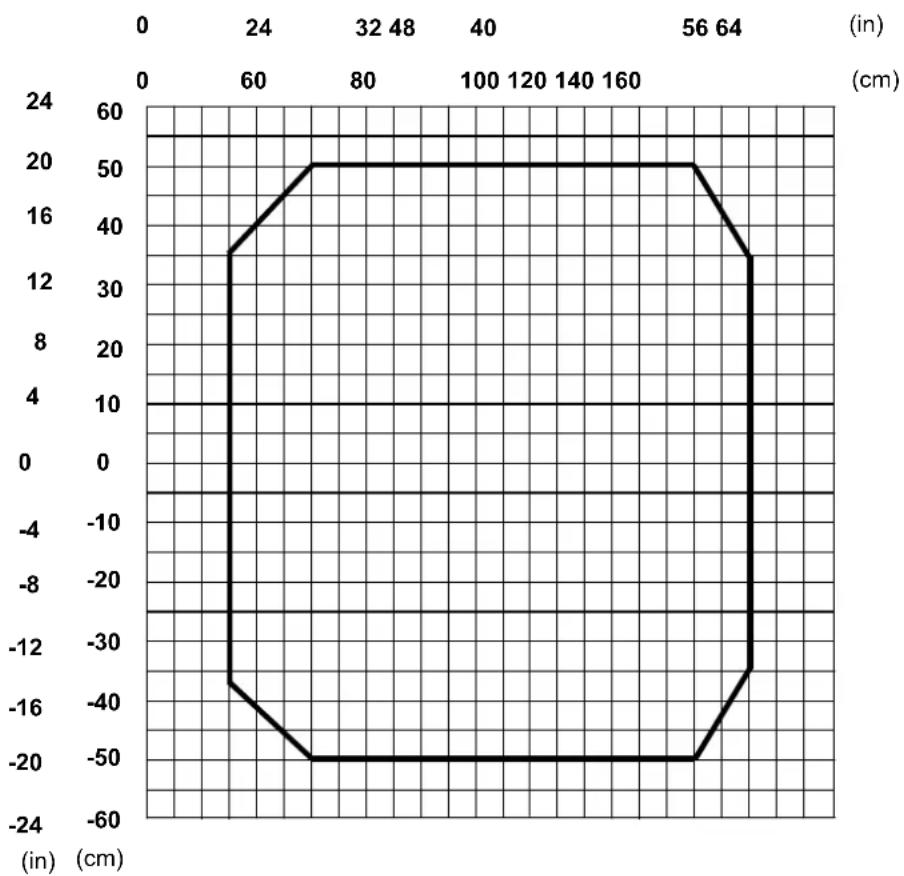
line
| x (in) | y (cm) | | ------ | ------ | | 0 | 0 | | 24 | 24 | | 32 | 48 | | 40 | 60 | | 56 | 64 | | 64 | 64 | | 80 | 64 | | 100 | 64 | | 120 | 64 | | 140 | 64 | | 160 | 64 | | 160 | -50 | | 160 | -20 | | 160 | -50 | | 160 | -20 | | 160 | 0 | | 160 | 12 | | 160 | 20 | | 160 | 32 | | 160 | 40 | | 160 | 50 | | 160 | 60 | | 160 | 72 | | 160 | 80 | | 160 | 90 | | 160 | 100 | | 160 | 112 | | 160 | 120 | | 160 | 132 | | 160 | 140 | | 160 | 150 | | 160 | 160 | | 160 | 172 | | 160 | 180 | | 160 | 192 | | 160 | 200 | | 160 | 212 | | 160 | 220 | | 160 | 232 | | 160 | 240 | | 160 | 250 | | 160 | 260 | | 160 | 272 | | 160 | 280 | | 160 | 292 | | 160 | 300 | | 160 | 312 | | 160 | 320 | | 160 | 332 | | 160 | 340 | | 160 | 352 | | 160 | 360 | | 160 | 372 | | 160 | 380 | | 160 | 392 | | 160 | 400 | | 160 | 412 | | 160 | 420 | | 160 | 432 | | 160 | 440 | | 160 | 452 | | 160 | 460 | | 160 | 472 | | 160 | 480 | | 160 | 492 | | 160 | 500 | | 160 | 512 | | 160 | 520 | | 160 | 532 | | 160 | 540 | | 160 | 552 | | 160 | 560 | | 160 | 572 | | 160 | 580 | | 160 | 592 | | 160 | 600 | | -12 | -33 | | -14 | -33 | | -16 | -33 | | -18 | -33 | | -20 | -33 | | -22 | -33 | | -24 | -33 | | -24 | -55 | | -24 | -55 | | -24 | -55 | | -24 | -55 | | -24 | -55 | | -24 | -55 | | -24 | -55 | | -24 | -55 | | -24 | -55 | | -24 | -55.5 | | -24 | -55.5 | | -24 | -55.5 | | -24 | -55.5 | | -24 | -55.5 | | -24 | -55.5 | | -24 | -55.5 | | -24 | -55.5 | | -24 | -24.5 | | -24 | -24.5 | | -24 | -24.5 | | -24 | -24.5 | | -24 | -24.5 | | -24 | -24.5 | | -24 | -24.5 | | -24 | -24.5 | | -24,5 | -33 | | -24,7 | -33 | | -24,9 | -33 | | -24,7 | -33 | | -24,9 | -33 | | -24,7 | -33 | | -24,9 | -33 | | -24,7 | -33 | | -24,9 | -33 | | -24,7 | -33 | | ... | ... | | ... | ... | | ... | ... | | ... | ... | | ... | ... | | ... | ... | | ... | ... | | ... | ... | | ... | ... | | ... | ... | | ... | ... | | ... | ... | | ... | ... | | ... | ... | | ... | ... | | | ... | ... | | | ... | ... | | | | | | | | | | | | | | | | | | | | | | | | | | | | | | | | | | | | | | | | | | | | | | | | | | | | | | | | | | | | | | | | | | | | | | | | | | | | | | | | | | | | | | | | | | | | | | | | | | | | | |\( \text{in} \) (cm) |\( \text{out} \) (cm) |\( \text{out} \) (cm) |\( \text{out} \) (cm) |\( \text{out} \) (cm) |\( \text{out} \) (cm) |\( \text{out} \) (cm) |\( \text{out} \) (cm) |\( \text{out} \) (cm) |\( \text{out} \)Note: (0,0) is the center of the laser beam output window.
CONDITIONS
Code = Interleaved 2/5 or Code 39
PCS = 0.90
"Pitch" angle = 0°
"Skew" angle = 10°
"Tilt" angle = 0°
Reading mode = Linear
DS8100A-3X30 (0.25 mm/10 mils)
The diagram shows an average reading area obtained considering different barcode types of variable quality.

line
| x (in) | y (cm) | | ------ | ------ | | 60 | 40 | | 70 | 40 | | 110 | 40 | | -12 | -30 | | -16 | -40 | | -16 | -40 | | -12 | -30 | | 12 | 30 |Note: (0,0) is the center of the laser beam output window.
CONDITIONS
Code = Interleaved 2/5 or Code 39
$$ \mathrm{PCS} = 0. 9 0 $$
"Pitch" angle = 0°
"Skew" angle = 10°
"Tilt" angle = 0°
Reading mode = Linear
DS8100A-3X05 (0.50 mm/20 mils)
The diagram shows an average reading area obtained considering different barcode types of variable quality.
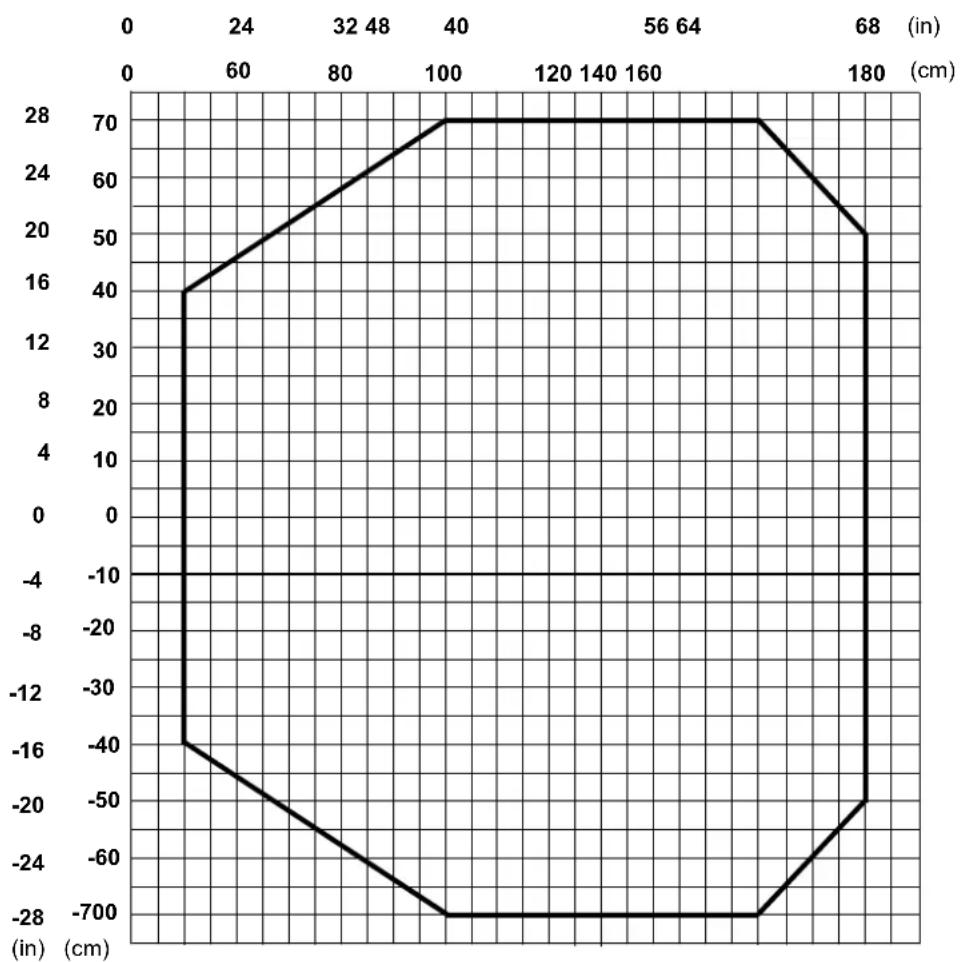
line
| x (in) | y (cm) | | ------ | ------ | | 0 | 0 | | 24 | 24 | | 32 | 48 | | 40 | 64 | | 56 | 80 | | 68 | 100 | | 180 | 120 | | 160 | 140 | | 120 | 160 | | 80 | 180 | | 40 | 200 | | 20 | 220 | | 0 | 240 | | -20 | 260 | | -40 | 280 | | -60 | 300 | | -80 | 320 | | -100 | 340 | | -120 | 360 | | -140 | 380 | | -160 | 400 | | -180 | 420 | | -200 | 440 | | -220 | 460 | | -240 | 480 | | -260 | 500 | | -280 | 520 | | -300 | 540 | | -320 | 560 | | -340 | 580 | | -360 | 600 | | -380 | 620 | | -400 | 640 | | -420 | 660 | | -440 | 680 | | -460 | 700 | | -480 | 720 | | -500 | 740 | | -520 | 760 | | -540 | 780 | | -560 | 800 | | -580 | 820 | | -600 | 840 | | -620 | 860 | | -640 | 880 | | -660 | 900 | | -680 | 920 | | -700 | 940 | | -720 | 960 | | -740 | 980 | | -760 | 1000 | | -780 | 1020 | | -800 | 1040 | | -820 | 1060 | | -840 | 1080 | | -860 | 1100 | | -880 | 1120 | | -900 | 1140 | | -920 | 1160 | | -940 | 1180 | | -960 | 1200 | | -980 | 1220 | | -1000 | 1240 | | -1120 | 1260 | | -1140 | 1280 | | -1160 | 1300 | | -1180 | 1320 | | -1200 | 1340 | | -1220 | 1360 | | -1240 | 1380 | | -1260 | 1400 | | -1280 | 1420 | | -1300 | 1440 | | -1320 | 1460 | | -1340 | 1480 | | -1360 | 1500 | | -1380 | 1520 | | -1400 | 1540 | | -1420 | 1560 | | -1440 | 1580 | | -1460 | 1600 | | -1480 | 1620 | | -1500 | 1640 | | -1520 | 1660 | | -1540 | 1680 | | -1560 | 1700 | | -1580 | 1720 | | -1600 | 1740 | | -1620 | 1760 | | -1640 | 1780 | | -1660 | 1800 | | -1680 | 1820 | | -1700 | 1840 | | -1720 | 1860 | | -1740 | 1880 | | -1760 | 1900 | | -1780 | 1920 | | -1800 | 1940 | | -1820 | 1960 | | -1840 | 1980 | | -1860 | 2000 | | -1880 | 2020 | | -1900 | 2040 | | -1920 | 2060 | | -1940 | 2080 | | -1960 | 2100 | | -1980 | 2120 | | -2000 | 2140 | | -2120 | 216 |Note: (0,0) is the center of the laser beam output window.
CONDITIONS
Code = Interleaved 2/5 or Code 39
PCS = 0.90
"Pitch" angle = 0°
"Skew" angle = 10°
"Tilt" angle = 0°
Reading mode = Linear
DS8100A-3X15 (0.38 mm/15 mils)
The diagram shows an average reading area obtained considering different barcode types of variable quality.

line
| x (cm) | y (cm) | | ------ | ------ | | 0 | 35 | | 80 | 55 | | 140 | 55 | | 20 | -60 | | 28 | -70 |Note: (0,0) is the center of the laser beam output window.
CONDITIONS
Code = Interleaved 2/5 or Code 39
$$ \mathrm{PCS} = 0. 9 0 $$
"Pitch" angle = 0°
"Skew" angle = 10°
"Tilt" angle = 0°
Reading mode = Linear
DS8100A-3X25 (0.30 mm/12 mils)
The diagram shows an average reading area obtained considering different barcode types of variable quality.
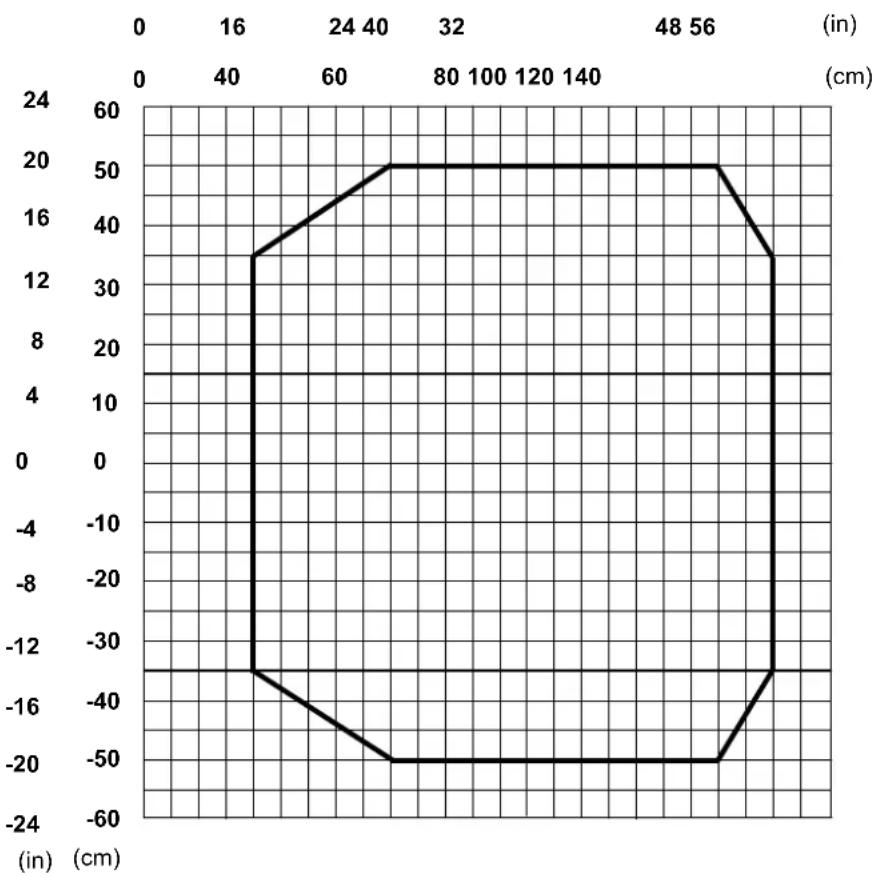
line
| x (in) | y (cm) | | ------ | ------ | | 0 | 0 | | 16 | 16 | | 32 | 32 | | 48 | 48 | | 60 | 60 | | 80 | 80 | | 100 | 100 | | 120 | 120 | | 140 | 140 | | 160 | 160 | | 180 | 180 | | 200 | 200 | | 220 | 220 | | 240 | 240 | | 260 | 260 | | 280 | 280 | | 300 | 300 | | 320 | 320 | | 340 | 340 | | 360 | 360 | | 380 | 380 | | 400 | 400 | | 420 | 420 | | 440 | 440 | | 460 | 460 | | 480 | 480 | | 500 | 500 | | 520 | 520 | | 540 | 540 | | 560 | 560 | | 580 | 580 | | 600 | 600 | | 620 | 620 | | 640 | 640 | | 660 | 660 | | 680 | 680 | | 700 | 700 | | 720 | 720 | | 740 | 740 | | 760 | 760 | | 780 | 780 | | 800 | 800 | | 820 | 820 | | 840 | 840 | | 860 | 860 | | 880 | 880 | | 900 | 900 | | 920 | 920 | | 940 | 940 | | 960 | 960 | | 980 | 980 | | 1000 | 1000 | | 1120 | 1120 | | 1240 | 1240 | | 1360 | 1360 | | 1480 | 1480 | | 1600 | 1600 | | 1720 | 1720 | | 1840 | 1840 | | 1960 | 1960 | | 2180 | 2180 | | 2300 | 2300 | | 2420 | 2420 | | 2540 | 2540 | | 2660 | 2660 | | 2780 | 2780 | | 3920 | -599 | | -192 | -599 | | -192 | -599 | | -192 | -599 | | -192 | -599 | | -192 | -599 | | -192 | -599 | | -192 | -599 | | -192 | -599 | | | -192 | -599 | | -192 | -599 | | -192 | -599 | | -192 | -599 | | -192 | -599 | | -192 | -599 | | -192 | -599 | | -192 | -699 | | | -192 | -699 | | | -192 | -699 | | | -192 | -699 | | | -192 | -699 | | | -192 | -699 | | | -192 | -699 | | | -192 | -699 | | | <1 | <5 | | <5 | <16.5%| | <5 | <33.3%| | <5 | <48.7%| | <5 | <63.3%| | <5 | <78.7%| | <5 | <93.3%| | <5 | <11 | | <5 | <13.3%| | <5 | <15.7%| | <5 | <18.7%| | <5 | <21.7%| | <5 | <24.7%| | <5 | <27.7%| | <5 | <3 | | <5 | <3.3%| | <5 | <3.3%| | <5 | <3.3%| | <5 | <3.3%| | <5 | <3.3%| | <5 | <3.3%| | <5 | <3.3%| | <5 | <3.3%| | <5 | <3.3%| | <5 | <3.3%| | <5 | <3.3%| | <5 | <3.3%| | <5 | <3.3%| | <5 | <3.3%| | <5 | <3.3%| | <5 | <3.3%| | <5 | <3.3%| | <5 | <3.3%| | <5 | <3.3%| | <7 | <- | | <7 | < | | <7 | < | | <7 | < | | | <7 | < | | <7 | < | | <7 | < | | <7 | < | | <7 | < | | <7 | < | | <7 | < | | <7 | < | | <7 | < | | <7 | < | | <7 | < | | <7 | < | | <7 | < | | <7 | < | | <7 | < | | <7 | < | | <7 | < | | <7 | < | | <7 | < | | <7 | < | | <7 | < | | <7 | < | | <7 | < | | <7 | < | | <7 | < | | <7 | < | | <7 | < | | <7 | < | | >1 | < | | >1 | < | | >1 | < | | >1 | < | | >1 | < | | >1 | < | | >1 | < | | >1 | < | | >1 | < | | >1 | < | | >1 | < | | >1 | < | | >1 | < | | >1 | < | | >1 | < | | >1 | < | | >1 | < | | >1 | < | | >1 | < | | >1 | < | | >1 | < | | >1 | < | | >1 | < | | >1 | < | | >1 | < | | >1 | <Note: (0,0) is the center of the laser beam output window.
CONDITIONS
Code = Interleaved 2/5 or Code 39
PCS = 0.90
"Pitch" angle = 0°
"Skew" angle = 10°
"Tilt" angle = 0°
Reading mode = Linear
DS8100A-3X35 (0.25 mm/10 mils)
The diagram shows an average reading area obtained considering different barcode types of variable quality.
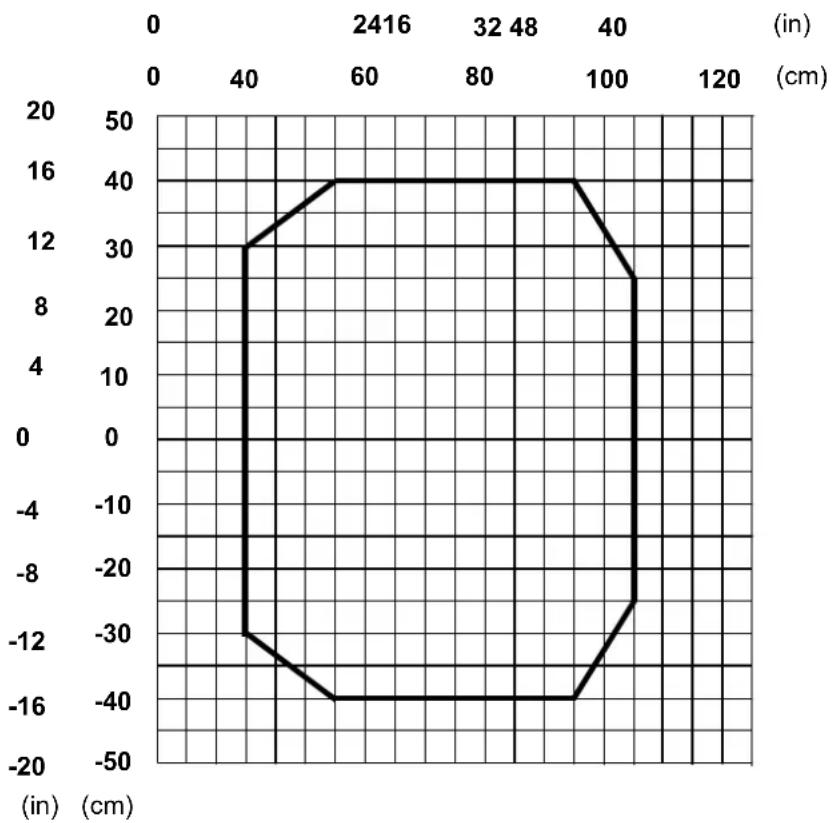
line
| x (cm) | y (cm) | | ------ | ------ | | 0 | 0 | | 40 | 30 | | 60 | 40 | | 80 | 40 | | 100 | 30 | | 120 | -30 | | 120 | -40 | | 120 | -50 |Note: (0,0) is the center of the laser beam output window.
CONDITIONS
Code = Interleaved 2/5 or Code 39
$$ \mathrm{PCS} = 0. 9 0 $$
"Pitch" angle = 0°
"Skew" angle = 10°
"Tilt" angle = 0°
Reading mode = Linear
10 MAINTENANCE
10.1 CLEANING
Clean the laser beam output window periodically for correct operation of the scanner (see Figure A and Figure B in chapter "General View").
Dust, dirt, etc. on the window may alter the reading performance.
Repeat the operation frequently in particularly dirty environments.
Use soft material and alcohol to clean the window and avoid any abrasive substances.

WARNING
Clean the window of the DS8100A when the scanner is turned off or at least when the laser beam is not active.
10.2 EXTERNAL MEMORY BACKUP & RESTORE
Backup and Restore is vital to all applications in that it provides a method to quickly replace a reader and return the station to full capacity in the event of a failure. The External Memory Backup and Restore procedure is the preferred method since it always provides complete backup and restore functions (Configuration and Environmental parameters).
When the DS8100A scanner is connected through CBX series connection boxes, Backup and Restore is provided through the BM100 accessory module installed inside the CBX100 or CBX500 connection box.
If the DS8100A scanner is integrated into an ID-NET ^™ network having an SC4000 ID-NET ^™ controller as Master, then the SC4000 also provides the Backup and Restore procedure.
This procedure can be performed directly from the Genius™ Device menu.
To manually perform the Backup and Restore procedure see the relative BM100 or SC4000 manual for details.
10.3 AUTOMATIC SCANNER REPLACEMENT (ASR)

NOTE
The ASR procedure is available for backward compatibility or for applications that do not use the CBX/SC4000, however it is not the preferred method.
The Datalogic Automatic Scanner Replacement (ASR) procedure allows restoring system functioning automatically after one or more scanners are replaced in a Master/Slave Lonworks network.
The ASR procedure is principally used for PackTrack™ configurations, but it restores only a part of the system parameters: common slave parameters (Code Selection and Reconstruction) plus each single slave PackTrack™ calibration.
The Master must be prepared at the time of installation in order for this procedure to work correctly.
10.3.1 ASR Network Configuration
- On the Master scanner, check the Modify & Backup Lon Slave Scanner Configuration parameter in Genius™ and configure the Lonworks Slave Scanner Common Parameters (Code and Reconstruction Parameters).
- Enable the ASR procedure through the Enable A.S.R. parameter in the Master configuration.
- Send the configuration to the Master EEPROM to force the Slave Operating Mode, Code Reading Symbologies and Reconstruction parameters and store all the Slave PackTrack™ calibration tables.
Now the Slave scanners are configured through the Master (ASR parameters stored in the Master) and the ASR procedure is implemented.
- Save this configuration to file (.ddc).
10.3.2 Scanner Replacement Procedure

NOTE
The ASR procedure requires replacing one scanner at a time.
Slave
- Power down the entire system.
- Replace the Slave scanner with a new one (default settings).
- Power up the system and wait for initialization.
Master
- Load the saved configuration from file (.ddc) to a new Master scanner.
- Power down the entire system.
- Replace the old Master scanner with the new one.
- Power up the system and wait for initialization.

NOTE
The ASR works only if both the Master and Slave devices have software 6.40 or later.
11 TROUBLESHOOTING

NOTE
Before contacting your local Datalogic office or Datalogic Partner or ARC, it is suggested to save the device configuration to a *.ddc file by means of the Genius™ software configuration program and check the device exact model and serial number.
| TROUBLESHOOTING GUIDE | |
| Problem | Suggestion |
| Power On:the “Power On” LED is not lit. | Is power connected?If using an external power supply (like PWR-120), is it connected to the AC source?If using rail power, does rail have power?If using CBX100, does it have power (check switch and LED)?Measure voltage either at pin 13 and 25 (for 26-pin connector) or at spring clamp Vdc and GND (for CBX). |
| On Line Mode:the Master’s “Phase On” LED is not lit (when external trigger activates). | Is sensor connected to I1A, I1B spring clamps (for CBX) or to pins 18 and 19 (for 26-pin connector)?Is power supplied to photo sensor?Are the photo sensor LEDs (if any) working correctly?Is the sensor/reflector system aligned? |
| On Line Mode:the Master’s “Phase On” LED is correctly lit but nothing happens (no reading results). | Is the software configuration consistent with the application condition (operating mode, etc.)?In the GeniusTM software configuration program select the OPERATING MODES folder and check for related parameters. |
| Serial On Line Mode:the reader is not triggered (no reading results). | In the GeniusTM program select the OPERATING MODE folder and check if serial on line is enabled as “On Line options” parameter value.Are the Start-Stop strings correctly assigned?Is the serial trigger source correctly connected and configured? |
| On Line Mode and Serial On Line Mode:the reader does not respond correctly to the expected external signal end. | In the GeniusTM software configuration program select the OPERATING MODES folder and check the “Reading Phase Timeout” parameterization. |
| Reading:it is not possible to read the target barcode (always returns No Read) | Check synchronization of reading pulse with object to read.Is the scan line correctly positioned?Place barcode in the center of scan line and run TEST MODE (selectable by GeniusTM as Operating Modes).If you still have troubles, check the following:Is the reading distance within that allowed (see reading diagrams)?Is the Tilt angle too large?Is the Skew angle less than 10° (direct reflection)?Choose the CODE tab and enable different code types (except Pharmacode). LENGTH = Variable.Is the barcode quality sufficient?If you had no success, try to perform the test using the BARCODE TEST CHART included with the product.If working in PackTrackTM mode, verify that the coordinates (in particular the Y axis) are correct. |
| Communication:the device is not transmitting anything to the host. | Is serial cable connected?Is correct wiring respected?If using MAIN RS232 or RS485 interface, is the reference ground connected to proper SGND Main Isolated (also referred to as GND_ISO)? Be careful that it is not completely different from GND power ground.If using CBX, be sure the RS485 termination switch is positioned to OFF.Are serial host settings equivalent to serial device setting? |
| Communication:data do not appear on the terminal. | In the GeniusTM program enable the Data Communication Settings/Main-Auxiliary Port\Data Tx parameter. |
| Communication:data transferred to the host are incorrect, corrupted or incomplete. | In the GeniusTM program select the Data Communication Settings/Data Format folder and check for HEADER, TERMINATOR, SEPARATOR and FILL CHAR values.Check the CODE FIELD LENGTH value, too.Are the COM port parameters correctly assigned? |
| Communication:the scanner “Network” LED is not lit. | If the LED is OFF, check the connections between the DS8100A slaves and the SC6000 or DS8100A master. If the error persists, contact your Datalogic distributor. |
| How do I obtain my units’ serial numbers? | The device serial number is printed on a label that is affixed above the connector panel of the reader.The serial number is also displayed when connecting the device through the GeniusTM program.Serial numbers consist of 9 characters: one letter, 2 numbers, another letter followed by 5 numbers. |
12 TECHNICAL FEATURES
| ELECTRICAL FEATURES | ||
| Supply Voltage 20 to 30 Vdc | ||
| Power Consumption 20 W typical | 1.3 - 0.9 A max. (including startup current) | |
| Common Communication Interfaces | Main | Baud |
| RS232 | 1200 to 115200 | |
| RS485 full-duplex | ||
| RS485 half-duplex | ||
| Auxiliary | ||
| RS232 | 1200 to 115200 | |
| Other | ||
| Lonworks | 1.25 Mb/s | |
| Model-Dependent Communication Interfaces | Ethernet | 100 |
| InputsExt. Trigger 1, Encoder2 aux. digital inputs | (optocoupled NPN or PNP) | |
| Outputs3 software programmable digital Outputs | (optocoupled) | |
| OPTICAL FEATURES | ||
| Light Receiver Avalanche photodiode | ||
| Wavelength 630 to 680 nm | ||
| Safety Class Class 2 - EN60825-1; Class II - CDRH | ||
| Light Source Up to 4 semiconductor laser diodes | ||
| Laser Control Security system to turn laser off in case of motor slow down | ||
| READING FEATURES | ||
| Scan Rate | ≤ 1000 scans/s | |
| Maximum ResolutionMax. Reading DistanceMax. Reading WidthMax. Depth of FieldAperture Angle | (see reading diagrams in par. 9.4) | |
| USER INTERFACE | ||
| LCD Display 2 lines by 20 characters LCD | ||
| Keypad | 3 | |
| LED Indicators Power On (green) | TX Data (green)Phase On (yellow) Network (red)Encoder (yellow) | |
| SOFTWARE FEATURES | ||
| Readable Codes Interleaved 2/5 | Code 39 StandardCodabarCode 128GS1-128 (ex EAN 128)Code 93 (standard and full ASCII)EAN/UPC (including Add-on 2 and Add-on 5)GS1 DataBar (including Limited and Expanded) | |
| Code Selection Up to 10 codes during one reading phase | ||
| Headers and Terminators Up to 128-byte headers and 128-byte terminators | ||
| Operating Modes On Line, Serial On Line, Automatic, Test, PackTrackTM, Continuous | ||
| Configuration Modes GeniusTM utility program | ||
| Parameter Storage Non-volatile internal FLASH | ||
| ENVIRONMENTAL FEATURES | ||
| Operating Temperature 0° to +50 °C (+32° to +122 °F)Storage Temperature -20° to +70 °C (-4° to +158 °F)Humidity 90% non condensing | ||
| Ambient light immunity 36000 lux | ||
| Vibration ResistanceEN 60068-2-62 hours on each axis | Linear Models Oscillating Mirror Models14 mm @ 2 to 10 Hz1.5 mm @ 13 to 55 Hz2 g @ 70 to 200 Hz | 1.5 mm @ 5 to 9.1 Hz0.5 g @ 9.1 to 150 Hz |
| Shock Resistance:EN 60068-2-273 shocks on each axis | 30 g; 11 ms 15 g; 11 ms | |
| Protection ClassEN 60529 | IP64* | |
| PHYSICAL FEATURES | Linear Models | Oscillating Mirror Models |
| Mechanical Dimensions | 217 x 172.5 x 126.6 mm(8.54 x 6.79 x 4.98 in) | 275.1 x 192.3 x 254 mm(10.83 x 7.57 x 10 in) |
| Weight | 5 kg (11 lbs.) 6.4 kg | (14 lbs.) |
* sealed connectors required; including the Harting RJ Industrial® Push Pull Ethernet connector for older Ethernet models.
A ALTERNATIVE LAYOUTS
POINT-TO-POINT
Using a Point-to-Point layout, the data is transmitted on the Main interface as well as on the Auxiliary interface. The Main interface can be selected for RS232 or RS485 full-duplex communications. Two different layouts are available according to the DS8100A reader model used for the connection.
Standard Models
When On-Line operating mode is used, the reader is activated by an External Trigger (photoelectric sensor) when the object enters its reading zone. In the following case, the signal is passed to the DS8100A by the CBX100, which also supplies the system.

flowchart
graph TD
    A["DS8100A"] --> B["CAB-F0x"]
    B --> C["PWR-120"]
    C --> D["CBX"]
    D --> E["Terminal"]
    E --> F["Host"]
    style A fill:#f9f,stroke:#333
    style B fill:#ccf,stroke:#333
    style C fill:#cfc,stroke:#333
    style D fill:#fcc,stroke:#333
    style E fill:#cff,stroke:#333
    style F fill:#ffc,stroke:#333
    note1["① Main Serial Interface (RS232 or RS485 Full-Duplex)"]
    note2["② Auxiliary Serial Interface (Data Tx to Terminal Local Echo) (RS232)"]
    note3["③ Input 1 (External Trigger/PS for On-Line Mode)"]
Figure 103 – Point-to-Point for Standard Models
Ethernet Models
In this example no External Trigger is used and the CBX100 only supplies the reader. The DS8100A (Ethernet model) is connected to a remote Host. It can be activated by a signal generated by the remote Host or always be active if working in Automatic operating mode.
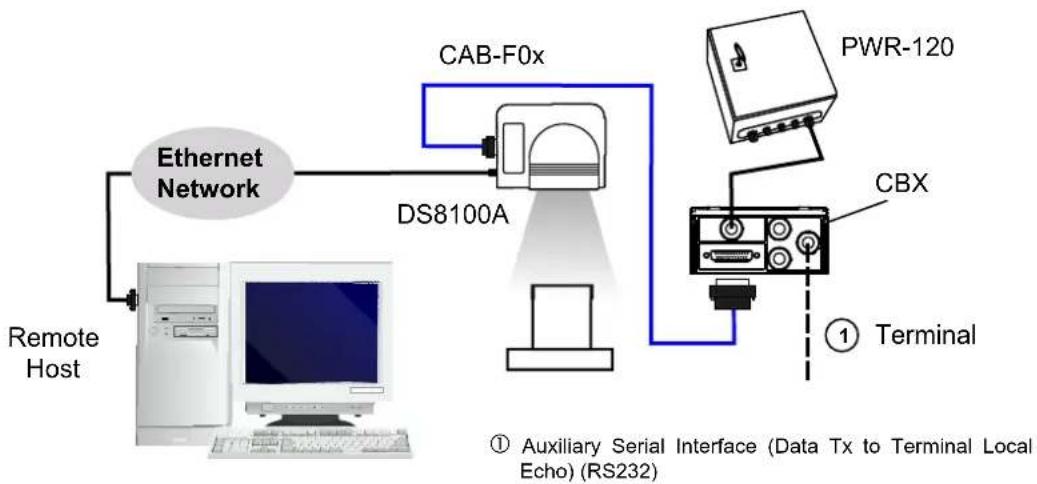
flowchart
graph TD
    A["Remote Host"] --> B["Ethernet Network"]
    B --> C["DS8100A"]
    C --> D["CAB-F0x"]
    D --> E["PWR-120"]
    E --> F["CBX"]
    F --> G["Terminal"]
    style A fill:#f9f,stroke:#333
    style B fill:#ccf,stroke:#333
    style C fill:#cfc,stroke:#333
    style D fill:#fcc,stroke:#333
    style E fill:#cff,stroke:#333
    style F fill:#ffc,stroke:#333
    style G fill:#fcc,stroke:#333
    note right of F
        ① Auxiliary Serial Interface (Data Tx to Terminal Local Echo) (RS232)
    end
Figure 104 – Point-to-Point for Ethernet Models
ID-NET™ GATEWAY
The CBX800 Gateway can be used to integrate a DS8100A reader into a high speed ID-NET™ network consisting of different scanners not provided with a Lonworks interface.
In this case the DS8100A uses its main RS232/RS485 interface to communicate with the CBX800.
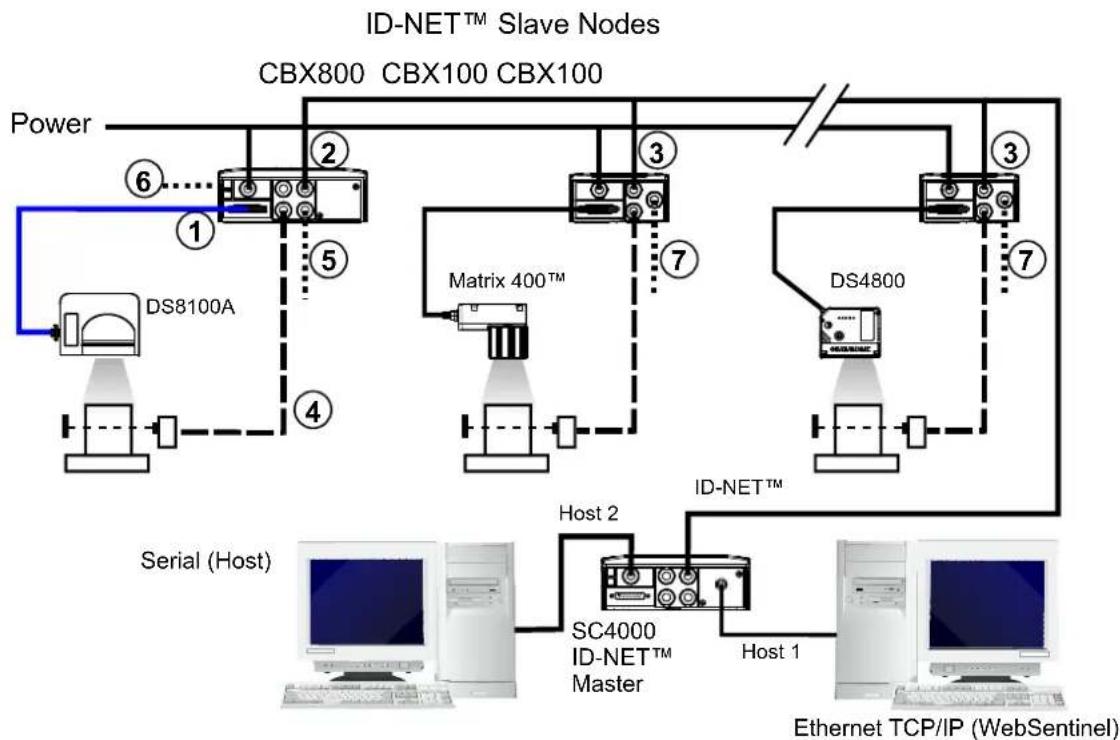
flowchart
graph TD
    A["Power"] --> B["1"]
    B --> C["DS8100A"]
    C --> D["2"]
    D --> E["Matrix 400™"]
    E --> F["3"]
    F --> G["DS4800"]
    G --> H["7"]
    H --> I["3"]
    I --> J["ID-NET™ Slave Nodes CBX800 CBX100 CBX100"]
    J --> K["ID-NET™ Master SC4000 ID-NET™"]
    K --> L["Serial (Host)"]
    K --> M["Host 1"]
    K --> N["Ethernet TCP/IP (WebSentinel)"]
① CBX800 Source Interface
② CBX800 ID-NET™ Interface
③ Reader ID-NET™ Interface
④ External Trigger (for On-Line Mode)
⑤ Host Aux for CBX800 Configuration
⑥ Source Aux for Source Reader Configuration
⑦ Reader Auxiliary Interface for Reader Configuration
Figure 105 – DS8100A Slave/CBX800 Gateway in an ID-NET™ High Speed Network

NOTE
For 8/K family scanners having software version 6.80 or later, an alternative fixed speed (57600 baud) ID-NET™ layout can be made without the use of CBX800. See the ID-NET™ Application Note for details.
PASS THROUGH
When Pass Through is activated on the Auxiliary interface, the DS8100A reader can be integrated in a network consisting of different scanners not provided with a Lonworks interface.
This connection mode allows two or more devices to be connected to a single external serial interface. The DS8100A transmits the messages received by its auxiliary interface onto its main interface. The received data is transmitted "as is", (passed-through), and therefore any data formatting requirements must be made at each individual reader.
In this configuration a series of scanners can be connected together using RS232 on the main interface and all messages will be passed through this chain to the host. The reading phase of each scanner is independent from the others. In Pass Through connections each scanner is provided with its relative External Trigger (multi P.S.).
Applications can be implemented to connect a device such as a hand-held reader to the Auxiliary port for manual code reading capability.
For the RS232 connections the maximum cable length is 15 m (50 ft).
The scanners represented in the following figures are configured in Pass Through mode.
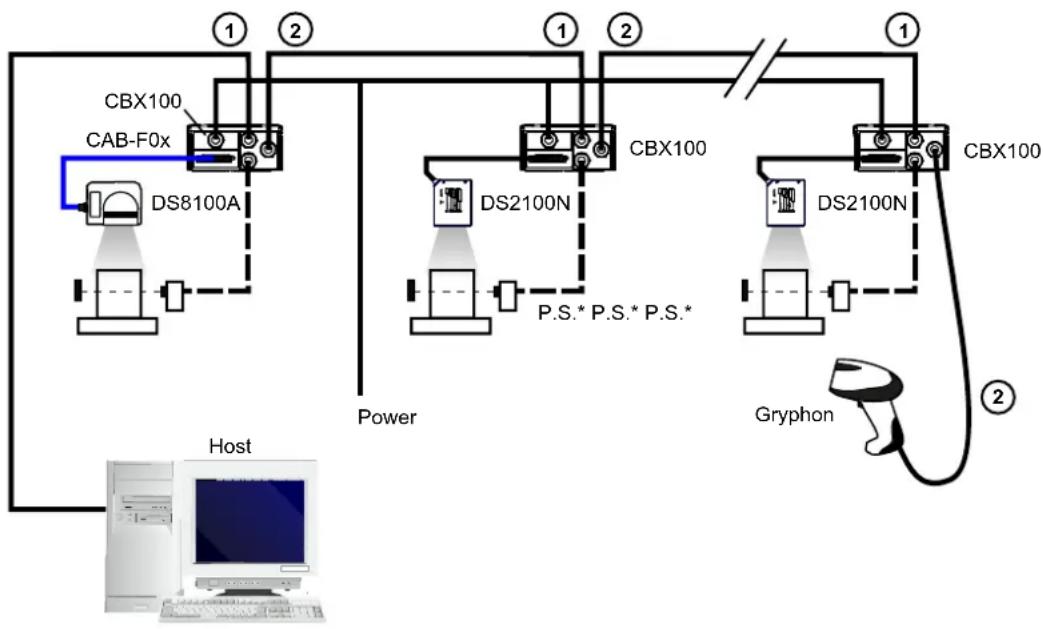
flowchart
graph TD
    Host["Host"] -->|①| A["CBX100 CAB-F0x"]
    A --> B["DS8100A"]
    B --> C["Power"]
    C --> D["CS2100N"]
    D --> E["P.S.* P.S.* P.S.*"]
    E --> F["CBX100"]
    F --> G["DS2100N"]
    G --> H["Gryphon"]
    H --> I["②"]
    style Host fill:#f9f,stroke:#333
    style G stroke-dasharray: 5 5
    style H stroke-dasharray: 5 5
    style I stroke-dasharray: 5 5
① Main Serial Interface
② Auxiliary Serial Interface
* P.S. (Presence Sensor) connected to Input 1 (External Trigger/PS) input.
Figure 106 – Pass Through Connection for DS8100A Standard Models

flowchart
graph TD
    A["Ethernet Network"] --> B["Remote Host"]
    B --> C["CBX100"]
    C --> D["CAB-F0x"]
    D --> E["DS8100A"]
    E --> F["Power"]
    F --> G["CBX100"]
    G --> H["DS2100N"]
    H --> I["P.S.* P.S.* P.S.*"]
    I --> J["CBX100"]
    J --> K["DS2100N"]
    K --> L["Gryphon"]
    L --> M["②"]
    M --> N["① 212"]
    style A fill:#f9f,stroke:#333
    style B fill:#ccf,stroke:#333
    style C fill:#cfc,stroke:#333
    style D fill:#fcc,stroke:#333
    style E fill:#cff,stroke:#333
    style F fill:#ffc,stroke:#333
    style G fill:#cfc,stroke:#333
    style H fill:#cfc,stroke:#333
    style I fill:#cfc,stroke:#333
    style J fill:#cfc,stroke:#333
    style K fill:#cfc,stroke:#333
    style L fill:#cfc,stroke:#333
    style M fill:#fcc,stroke:#333
① Main Serial Interface
② Auxiliary Serial Interface
* P.S. (Presence Sensor) connected to Input 1 (External Trigger/PS) input.
Figure 107 – Pass Through Connection for Ethernet Models
RS232 MASTER/SLAVE
The RS232 master/slave connection is used to integrate a DS8100A reader in a network consisting of different scanners not provided with a Lonworks interface.
The Slave scanners use RS232 only on the main and auxiliary interfaces. Each slave scanner transmits the messages received by the auxiliary interface onto the main interface. All messages will be transferred towards the master.
The master scanner is connected to the Host PC on the main RS232 serial interface through the CBX connection box.
In RS232 Master/Slave connections the External Trigger signal is unique to the system (single P.S.).

The DS8100A Standard model, working as Master in an RS232 network, may be simultaneously connected to a Lonworks network consisting of DS8100A slave scanners. Be careful when assigning the slave address, since the number of the first Lonworks slave must be a progressive number with respect to the address number defined for the last slave scanner of the RS232 network. For example, if the RS232 network consists of Slave 1 and Slave 2, the address to be assigned to the first Lonworks slave scanner will be Slave 3 (not Slave 1).

flowchart
graph TD
    A["Power"] --> B["Local Host"]
    B --> C["Master"]
    C --> D["Slave#1"]
    D --> E["Slave#n"]
    E --> F["CBX100 Cable"]
    F --> G["CAB-F0x"]
    G --> H["Main Serial Interface (RS232 only)"]
    G --> I["Auxiliary Serial Interface (RS232)"]
    G --> J["Input 1 (External Trigger/PS for On-Line Mode)"]
Figure 108 – RS232 Master/Slave for DS8100A Standard Models
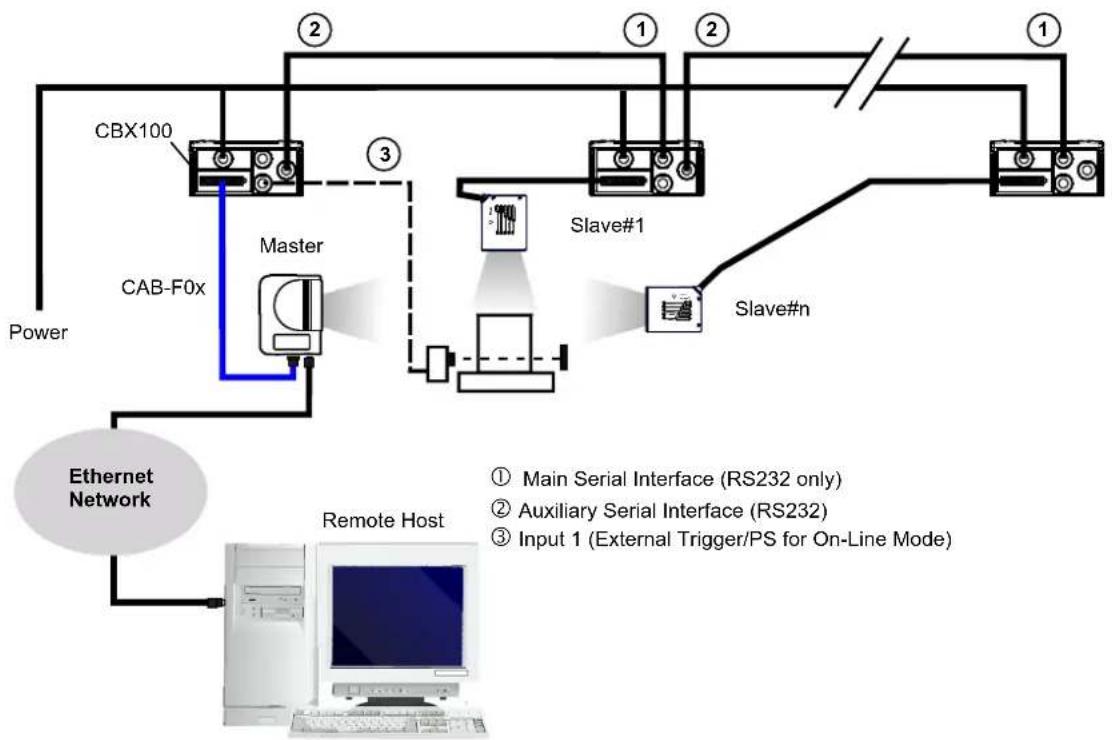
flowchart
graph TD
    A["Power"] --> B["Master"]
    B --> C["CAB-F0x"]
    C --> D["CBX100"]
    D --> E["Slave#1"]
    E --> F["Slave#n"]
    F --> G["Remote Host"]
    G --> H["Ethernet Network"]
    I["Slave#1"] --> J["Slave#n"]
    K["Main Serial Interface (RS232 only)"] --> L["Master"]
    M["Auxiliary Serial Interface (RS232)"] --> N["Master"]
    O["Input 1 (External Trigger/PS for On-Line Mode)"] --> P["Master"]
    Q["① Main Serial Interface (RS232 only)"] --> R["Master"]
    S["② Auxiliary Serial Interface (RS232)"] --> T["Master"]
    U["③ Input 1 (External Trigger/PS for On-Line Mode)"] --> V["Master"]
Figure 109 – RS232 Master/Slave for DS8100A Ethernet Models
MULTIPLEXER
The Multiplexer connection is used to integrate a DS8100A slave reader in a Multidrop network consisting of different scanners not provided with a Lonworks interface.
Each scanner is connected to a Multiplexer (MX4000) with the RS485 half-duplex main interface.
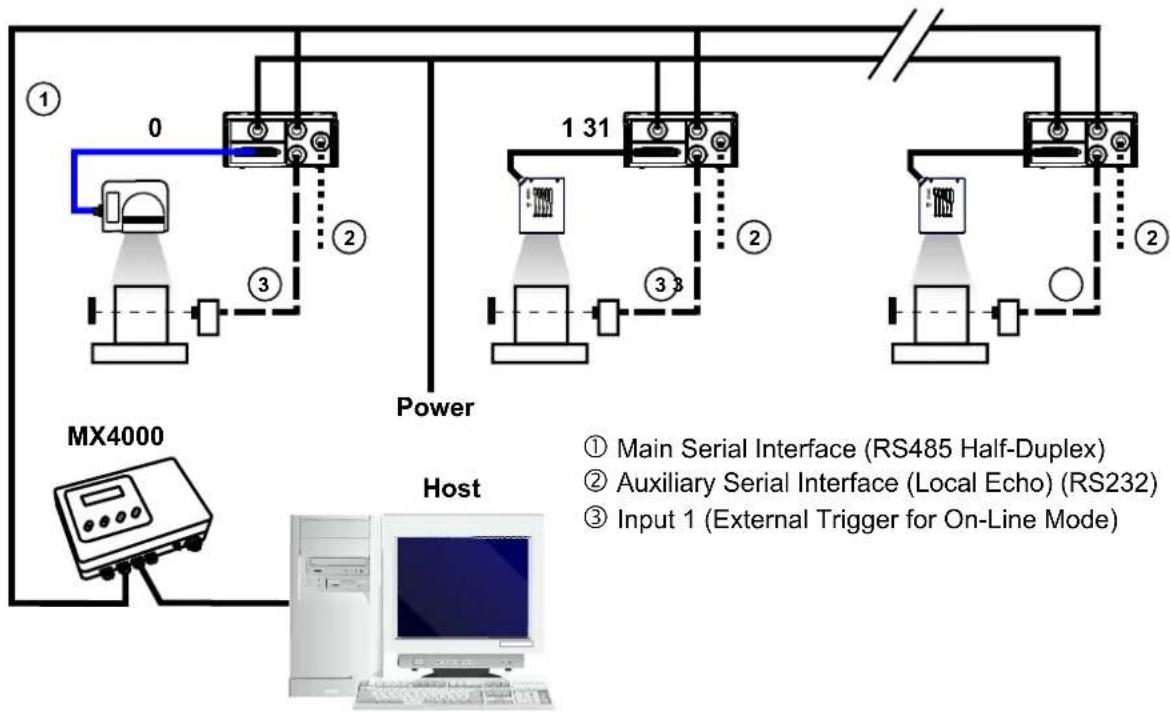
flowchart
graph TD
    A["MX4000 Device"] -->|① Main Serial Interface (RS485 Half-Duplex)| B["Power Module 1"]
    A -->|② Auxiliary Serial Interface (Local Echo) (RS232)| C["Power Module 2"]
    A -->|③ Input 1 (External Trigger for On-Line Mode)| D["Power Module 3"]
    B --> E["Component 0"]
    C --> F["Component 131"]
    D --> G["Component 2"]
    style A fill:#f9f,stroke:#333
    style B fill:#ccf,stroke:#333
    style C fill:#cfc,stroke:#333
    style D fill:#fcc,stroke:#333
Figure 110 - Multiplexer for DS8100A Standard Models
The auxiliary serial interface of the slave scanners can be used to visualize collected data or to configure it using the Genius™ utility.
When On-Line operating mode is used, the scanner is activated by an External Trigger when the object enters its reading zone.
ACR ^TM 4
Each version of the base has the powerful code reconstruction technology (ACR ^™ 4). The new fourth generation ACR ^™ considerably increases the code reconstruction reading capability in the case of damaged or very tilted barcodes.
Aperture
Term used on the required CDRH warning labels to describe the laser exit window.
Barcode
A pattern of variable-width bars and spaces which represents numeric or alphanumeric data in machine-readable form. The general format of a barcode symbol consists of a leading margin, start character, data or message character, check character (if any), stop character, and trailing margin. Within this framework, each recognizable symbology uses its own unique format.
Barcode Label
A label that carries a barcode and can be affixed to an article.
Baud Rate
A unit used to measure communications speed or data transfer rate.
CDRH (Center for Devices and Radiological Health)
This organization (a service of the Food and Drug Administration) is responsible for the safety regulations governing acceptable limitations on electronic radiation from laser devices. Datalogic devices are in compliance with the CDRH regulations.
CD SQUARE™
CD SQUARE ^™ provides useful information on label position and object shape elaborated during the barcode reading phase. This innovative technology identifies the area in which the code is located and measures the code distance from the scanner.
Code Positioning
Variation in code placement that affects the ability of a scanner to read a code. The terms Pitch, Skew, and Tilt deal with the angular variations of code positioning in the X, Y and Z axes. See pars. 2.3. Variations in code placement affect the pulse width and therefore the decoding of the code. Pulse width is defined as a change from the leading edge of a bar or space to the trailing edge of a bar or space over time. Pulse width is also referred to as a transition. Tilt, pitch, and skew impact the pulse width of the code.
EEPROM
Electrically Erasable Programmable Read-Only Memory. An on-board non-volatile memory chip.
Full Duplex
Simultaneous, two-way, independent transmission in both directions.
Half Duplex
Transmission in either direction, but not simultaneously.
Host
A computer that serves other terminals in a network, providing services such as network control, database access, special programs, supervisory programs, or programming languages.
Interface
A shared boundary defined by common physical interconnection characteristics, signal characteristics and meanings of interchanged signals.
LED (Light Emitting Diode)
A low power electronic device that can serve as a visible or near infrared light source when voltage is applied continuously or in pulses. It is commonly used as an indicator light and uses less power than an incandescent light bulb but more than a Liquid Crystal Display (LCD). LEDs have extremely long lifetimes when properly operated.
Multidrop Line
A single communications circuit that interconnects many stations, each of which contains terminal devices. See RS485.
PackTrack™
PackTrack ^™ is a Datalogic patented parcel tracking system which improves the reading features in omnidirectional stations. In particular, PackTrack ^™ manages 6-sided reading systems when it is impossible to detect the real position of the code on the parcel, thus overcoming the need for external accessories essential in traditional tracking systems.
Parameter
A value that you specify to a program. Typically parameters are set to configure a device to have particular operating characteristics.
Pitch
Rotation of a code pattern about the X-axis. The normal distance between center line or adjacent characters. See par. 2.3.
Position
The position of a scanner or light source in relation to the target of a receiving element.
Protocol
A formal set of conventions governing the formatting and relative timing of message exchange between two communicating systems.
Resolution
The narrowest element dimension which can be distinguished by a particular reading device or printed with a particular device or method.
RS232
Interface between data terminal equipment and data communication equipment employing serial binary data interchange.
RS485
Interface that specifies the electrical characteristics of generators and receivers for use in balanced digital multipoint systems such as on a Multidrop line.
Scanner
A device that examines a printed pattern (barcode) and either passes the uninterpreted data to a decoder or decodes the data and passes it onto the Host system.
Serial Port
An I/O port used to connect a scanner to your computer.
Signal
An impulse or fluctuating electrical quantity (i.e.: a voltage or current) the variations of which represent changes in information.
Skew
Rotation about the Y-axis. Rotational deviation from correct horizontal and vertical orientation; may apply to single character, line or entire encoded item. See par. 2.3.
Symbol
A combination of characters including start/stop and checksum characters, as required, that form a complete scannable barcode.
Tilt
Rotation around the Z axis. Used to describe the position of the barcode with respect to the laser scan line. See par. 2.3.
Trigger Signal
A signal, typically provided by a photoelectric sensor or proximity switch, which informs the scanner of the presence of an object within its reading zone.
UPC
Acronym for Universal Product Code. The standard barcode type for retail food packaging in the United States.
Visible Laser Diode
A light source used in scanners to illuminate the barcode symbol. Generates visible red light at wavelengths between 630 and 680 nm.
A
Accessories, 12
ACR ^TM 4, 81
Alternative Layouts, 114
Auto PackTrack™
Calibration using DLAPC, 84
Calibration using Keypad, 6
Conditions and Limits, 84
Parameter Descriptions, 85
Report, 90
Setup Procedure, 87
Auxiliary RS232 Interface, 26, 42
C
CBX Electrical Connections, 19
CE Compliance, viii
Cleaning, 107
Code Verifier, 31, 45
Compliance, vii
Custom Cable Electrical Connections, 35
D
Default Values, 76
E
Electrical Safety, vii
Ethernet Interface, 52
Ethernet Interface (older models), 53
F
FCC Compliance, ix
Fieldbus Connections, 52
G
General View, x
Genius™
Advanced Configuration, 73
Installation, 65
Wizard for Quick Reader Setup, 65
Glossary, 121
Guide to Installation, xii
|
Indicators, 4
Inputs, 27, 42
Installation, 14
K
Keypad and Display, 5
L
Laser Safety, vii
LEDs, 4
Local Lonworks Network Layouts, 55
Lonworks Connections, 48
Lonworks Interface, 50
M
Main Serial Interface, 21, 37
Manual PackTrack™
Calibration using SPY, 91
Model Descriptions, 3
Mounting the Scanner, 15
Mounting with Accessories, 16
N
Network Setup, 68
Network Termination, 49
0
Operating Mode
Automatic, 67
On Line, 67
Test, 66
Oscillating Mirror Models, 3
Outputs, 31, 45
P
Package Contents, 14
PackTrack™, 82
Calibration for Oscillating Mirror Models, 94
Parameter Explorer Window, 73
Patents, vi
Performance, 95
Positioning, 18
Power Supply, viii, 21, 37
R
Reading Diagrams, 97
Reading Features, 81
Reference Documentation, vi
RS232 Interface, 22, 38
RS485 Full-Duplex, 23, 39
RS485 Half-Duplex, 24, 40
s
Scanner Assignment using Keypad, 5
Scanner Replacement, 107
Services and Support, vi
Software Configuration, 65
T
Technical Features, 112
Terminators, 49
Test Mode using Keypad, 5
Troubleshooting, 109
Typical Layouts, 55
| DATALOGICTM | DECLARATION OF CONFORMITY | EC-026Rev.: 6Pag.: 1 di 1 |

Datalogic Automation S.r.l.
Via Lavino 265
40050 Monte San Pietro
Bologna - Italy
www.automation.datalogic.com
declares that the
DS8100A; Laser Scanner
and all its models
are in conformity with the requirements of the European Council Directives listed below:
2004 / 108 / EC EMC Directive 2006/95/EC Low Voltage Directive
This Declaration is based upon compliance of the products to the following standards:
EN 55022 (CLASS AITE), DECEMBER 2010:
INFORMATION TECHNOLOGY EQUIPMENT
RADIO DISTURBANCE CHARACTERISTICS
LIMITS AND METHODS OF MEASUREMENTS
ELECTROMAGNETIC COMPATIBILITY (EMC)
PART 6-2: GENERIC STANDARDS - IMMUNITY FOR INDUSTRIAL
ENVIRONMENTS
EN 61000-6-2, SEPTEMBER 2005:
EN 60950-1, APRIL 2006 :
EN 60950-1/A11, MARCH 2009 :
EN 60825-1, OCTOBER 2007
INFORMATION TECHNOLOGY EQUIPMENT - SAFETY -
PART 1: GENERAL REQUIREMENTS
SAFETY OF LASER PRODUCTS - PART 1 :EQUIPMENT
CLASSIFICATION, REQUIREMENTS AND USER'S GUIDE
Monte San Pietro, January 26th, 2012
Paolo Morselli
Quality Manager
Moulli Rods

UNI EN ISO 9001

UNI EN ISO 14001