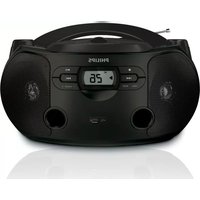
AZ1048 - Cd player/recorder PHILIPS - Free user manual and instructions
Find the device manual for free AZ1048 PHILIPS in PDF.


| Product Type | CD Player/Recorder with Radio and USB |
| Brand | Philips |
| Model | AZ1048 |
| Dimensions (Main Unit) | 320 x 275 x 175 mm (W x H x D) |
| Weight (Main Unit) | 1.7 kg |
| Power Supply | AC 110-127V/220-240V, 50/60Hz; DC 9V 1.5A (6 x C batteries) |
| Power Output | 1W x 2 RMS |
| Disc Support | CD-DA, CD-R, CD-RW, MP3-CD, WMA-CD |
| Tuner Bands | FM (87.5-108 MHz), MW (530-1600 kHz) |
| Frequency Response | 60Hz - 16kHz |
| Signal-to-Noise Ratio | >62 dBA (CD), >50 dB (Tuner) |
| Total Harmonic Distortion | <1% (CD), <3% (Tuner) |
| USB Compatibility | USB 2.0/1.1 flash memory or players; FAT12/16/32, MP3/WMA up to 999 tracks |
| Supported MP3 Formats | ISO9660, Joliet; sampling rates 32, 44.1, 48 kHz; bit rates 32-256 kbps |
| Play Modes | Repeat (track/album/program), Shuffle |
| Program Tracks | Up to 30 tracks in desired sequence |
| Audio Enhancements | Dynamic Bass Boost (DBB) |
| Connectivity | Headphone jack (3.5mm) |
| Antenna | Telescopic antenna for FM |
| Battery Life | Approx. 10 hours (depending on use) |
| Safety | Laser Class 1; do not open casing; use only specified accessories |
| Maintenance | Clean with dry cloth; avoid liquids; no lubrication |
| Warranty | Standard manufacturer warranty |
Frequently Asked Questions - AZ1048 PHILIPS
User questions about AZ1048 PHILIPS
0 question about this device. Answer the ones you know or ask your own.
Ask a new question about this device
Download the instructions for your Cd player/recorder in PDF format for free! Find your manual AZ1048 - PHILIPS and take your electronic device back in hand. On this page are published all the documents necessary for the use of your device. AZ1048 by PHILIPS.
USER MANUAL AZ1048 PHILIPS
natural_image
Black Philips portable radio with digital display showing 26 o'clock (no visible text or symbols beyond brand and time)EN User manual
Contents
1 Important 4
Safety 4
Notice 5
2 Your CD Soundmachine 6
Introduction 6
What's in the box 6
Overview of the main unit 7
3 Get started 9
Install batteries 9
Connect AC power 9
4 Play 11
Play a CD 11
Play from USB 11
Listen to radio 11
5 Play options 12
Program play sequence 12
Select play modes 12
Select a track 13
Select an album 13
Find a passage within a track 13
6 Product information 14
Specifications 14
Supported MP3 disc formats 14
USB playability information 14
7 Troubleshooting 16
1 Important
Safety
① Read these instructions.
② Keep these instructions.
③ Heed all warnings.
④ Follow all instructions.
⑤ Do not use this apparatus near water.
⑥ Clean only with dry cloth.
⑦ Do not block any ventilation openings. Install in accordance with the manufacturer's instructions.
⑧ Do not install near any heat sources such as radiators, heat registers, stoves, or other apparatus (including amplifiers) that produce heat.
⑨ Protect the power cord from being walked on or pinched, particularly at plugs, convenience receptacles, and the point where they exit from the apparatus.
⑩ Only use attachments/accessories specified by the manufacturer.
⑪ Unplug this apparatus during lightning storms or when unused for long periods of time.
⑫ Refer all servicing to qualified service personnel. Servicing is required when the apparatus has been damaged in any way, such as power-supply cord or plug is damaged, liquid has been spilled or objects have fallen into the apparatus, the apparatus has been exposed to rain or moisture, does not operate normally, or has been dropped.
⑬ Battery usage CAUTION – To prevent battery leakage which may result in bodily injury, property damage, or damage to the unit: Install all batteries correctly, + and - • as marked on the unit. Do not mix batteries (old and new • or carbon and alkaline, etc.). Remove batteries when the unit is • not used for a long time.
⑭ Apparatus shall not be exposed to dripping or splashing.
⑮ Do not place any sources of danger on the apparatus (e.g. liquid filled objects, lighted candles).
⑯ Where the MAINS plug or an appliance coupler is used as the disconnect device, the disconnect device shall remain readily operable.

Warning
Never remove the casing of this apparatus. • Never lubricate any part of this apparatus. • Never place this apparatus on other electrical equipment.
- Keep this apparatus away from direct sunlight, naked flames or heat.
- Never look into the laser beam inside this apparatus.
- Ensure that you always have easy access to the power cord, plug or adaptor to disconnect this apparatus from the power.

Caution
Use of controls or adjustments or performance of procedures other than herein may result in hazardous radiation exposure or other unsafe operation.
Notice
Any changes or modifications made to this device that are not expressly approved by Philips Consumer Lifestyle may void the user's authority to operate the equipment.
Recording and playback of material might require consent. See Copyright Act 1956 and The Performer's Protection Acts 1958 to 1972.
Recycling

Your product is designed and manufactured with high quality materials and components, which can be recycled and reused.
When you see the crossed-out wheel bin symbol attached to a product, it means the product is covered by the European Directive 2002/96/EC:
Never dispose of your product with other household waste. Please inform yourself about the local rules on the separate collection of electrical and electronic products. The correct disposal of your old product helps prevent potentially negative consequences on the environment and human health.
Your product contains batteries covered by the European Directive 2006/66/EC, which cannot be disposed of with normal household waste.
When you see the crossed-out wheel bin symbol with the chemical symbol 'Pb', it means that the batteries comply with the requirement set by the directive for lead:

Please inform yourself about the local rules on separate collection of batteries. The correct disposal of batteries helps prevent potentially negative consequences on the environment and human health.
Environmental information
All unnecessary packaging has been omitted. We have tried to make the packaging easy to separate into three materials: cardboard (box), polystyrene foam (buffer) and polyethylene (bags, protective foam sheet.)
Your system consists of materials which can be recycled and reused if disassembled by a specialized company. Please observe the local regulations regarding the disposal of packaging materials, exhausted batteries and old equipment.
This apparatus includes this label:
2 Your CD Soundmachine
Congratulations on your purchase, and welcome to Philips! To fully benefit from the support that Philips offers, register your product at www.philips.com/welcome.
Introduction
With this unit, you can enjoy audio from discs, USB devices, or radio stations. You can also program the play sequence of tracks, and you can enhance the sound with the Dynamic Bass Boost feature.
What's in the box
Check and identify the contents of the package:
CD Soundmachine•
AC power cord•
Power adaptor•
User Manual•
Overview of the main unit
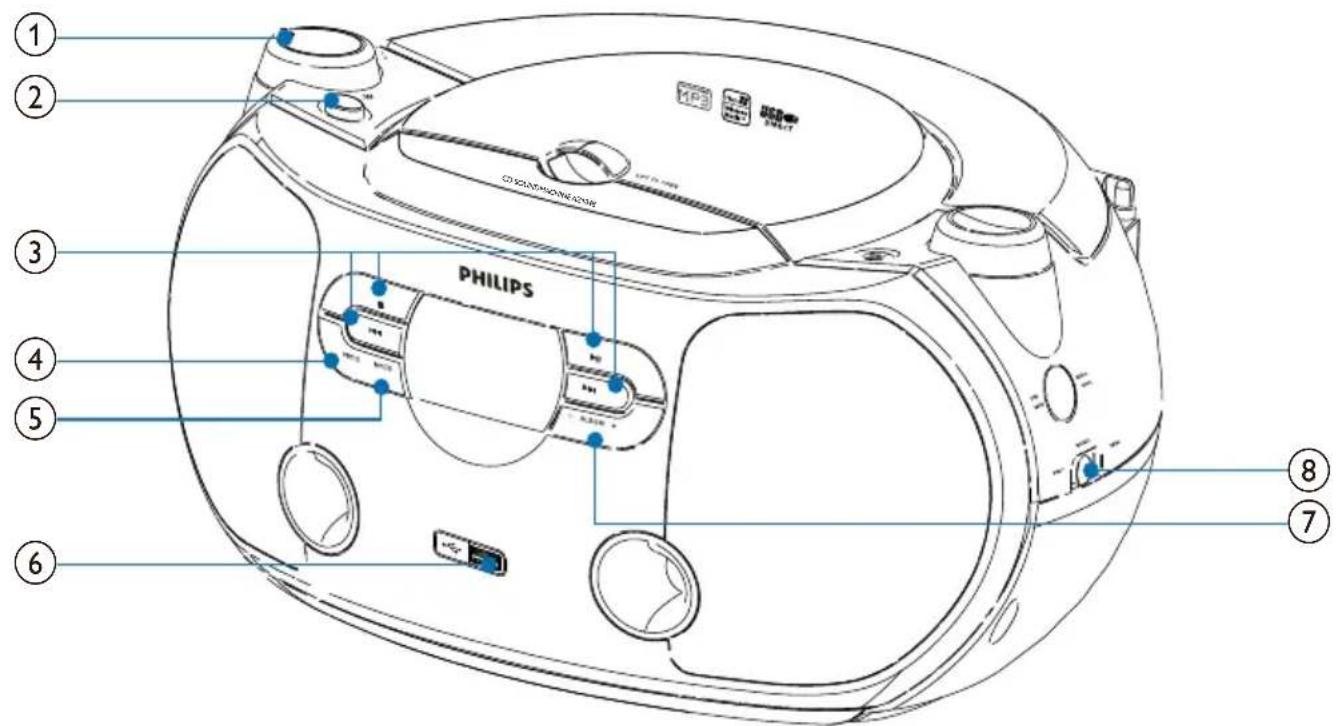
① VOLUME
Adjust volume level.
② DBB
Turn the bass enhancement on/off.
③
Stop CD play. •
Erase a CD program.
Start or pause CD play.
/
Select the previous/next track.
Fast search backwards/forwards •
within the current track.
④ PROG
Program tracks and browse the program.
⑤ MODE
Select a play mode: REPEAT or • SHUFFLE.
⑥
- USB socket.
⑦ ALBUM +/-
Skip to the next/previous album in • an MP3-CD.
⑧ BAND
Select a wave band.
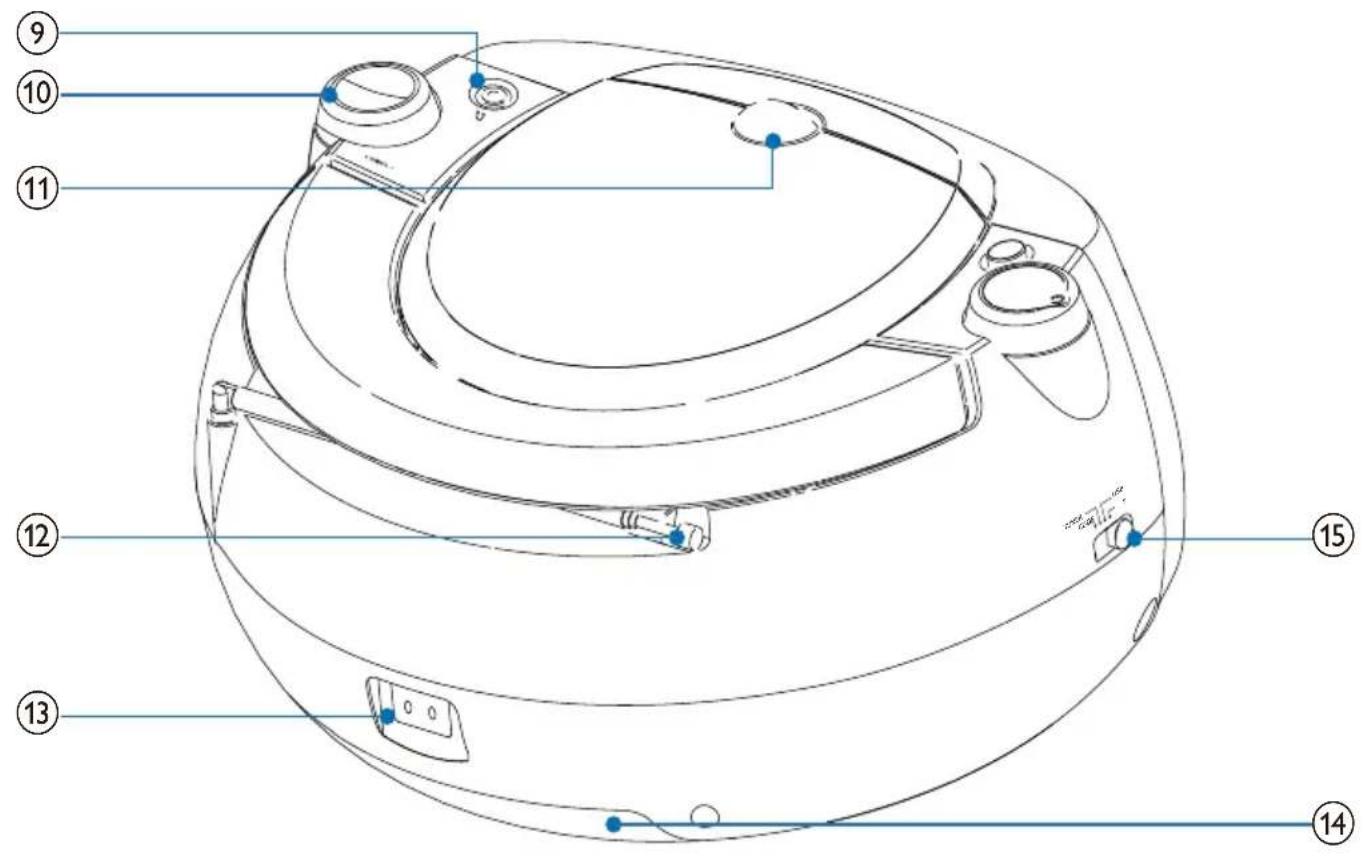
⑨ Jack for headphone. •
⑩ TUNING +/- Tune to radio stations. •
⑪ LIFT TO OPEN
Open/Close the CD compartment. •
⑫ Telescopic antenna
Improve FM reception. •
⑬ AC MAINS\~
Socket for the power cord. •
⑭ Battery compartment
⑮ Source selector: CD, USB, TUNER, OFF
Select CD, USB, radio, or MP3 • source.
Switch to standby mode. •
3 Get started

Caution
Use the controls only as stated in this user • manual.
• Always follow the instructions in this chapter in sequence.
If you contact Philips, you will be asked for the model and serial number of your player. The model number and serial number are on the bottom of your player. Write the numbers here: Model No. ____ Serial No. ____
Install batteries
1 Open the battery compartment.
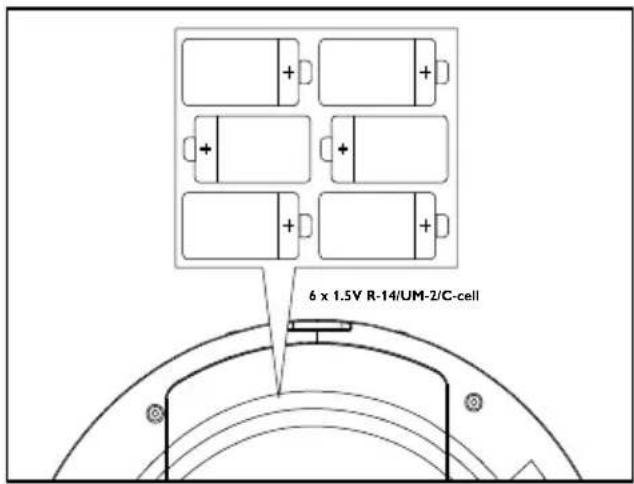
2 Insert 6 × 1.5V R14/UM-2/C-cell batteries with correct polarity (+/-) as indicated.
3 Close the battery compartment.

Tip
If you want to save battery life, use the supplied power cord.
Connect AC power

Warning
Risk of product damage! Ensure that the power supply voltage corresponds to the voltage printed on the back or the underside of the product.
- Risk of electric shock! When you unplug the AC adaptor, always pull the plug from the socket. Never pull the cord.

Note
Install the unit near the power supply socket and where the AC power plug can be easily reached.
1 Switch the voltage selector at the bottom of the unit to the local power line voltage.
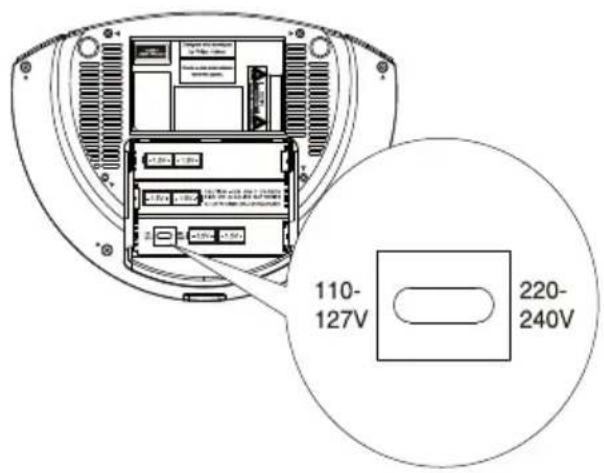
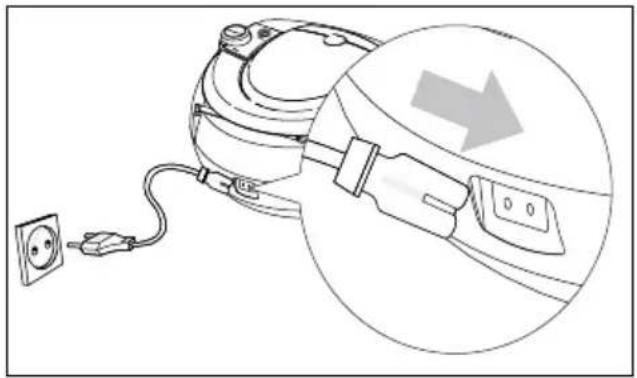
2 Connect the power cord to the AC MAINS\~ socket on the main unit and to the power supply socket.
natural_image
Line drawing of a device with an attached power outlet and cable, showing a circular arrow indicating direction (no text or symbols)
Tip
To save energy: After use, set the source • selector to OFF. To turn off the CD Soundmachine, disconnect the plug from the power supply socket.
4 Play
Play a CD

Note
You cannot play CDs encoded with copyright protection technologies.
You can play commercially available audio CDs: CD-Recordables (CD-R)• CD-Rewritables (CD-RW)• MP3-CDs•
1 Push the source selector to CD.
2 Lift the lid of the CD compartment.
3 Insert a CD with the printed side facing up.
4 Close the CD lid gently.
→ The total number of tracks is displayed.
5 Press ▶ II to start play. → [▶] is displayed.
• To pause CD play, press ▶II.
• To resume CD play, press ▶II again.
• To stop CD play, press ■.
Play from USB

Note
- Ensure that the USB device contains playable audio contents for supported formats. (See "USB playability information")
1 Flip the USB socket cover.
2 Plug the USB device into the ✉ socket.
3 Push the source selector to USB.
4 Press ▶II to start play.
• To pause/resume play, press ▶II.
• To stop play, press ■.
To search within an audio file, press • and hold ◀◀◀/▶, then release to resume normal play.
Listen to radio
1 Switch the source selector to TUNER.
2 Switch BAND to FM or MW.
3 Turn TUNING +/- to find a station.

Tip
To improve FM reception, you can extend, • incline or turn the telescopic antenna for best reception. • To improve MW reception, turn the CD Soundmachine to face a different direction.
5 Play options
Program play sequence
You can store up to 30 tracks in the desired sequence.
For MP3 and WMA-discs:
1 In stop mode, press PROG to start to program play sequence.
→ [PROG] and [P01] are displayed.
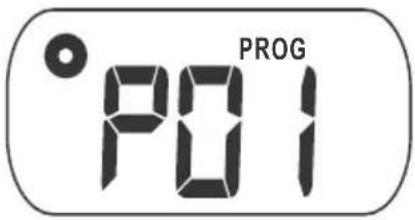
2 Press ALBUM +/- to select an album.
3 Press ◀◀/▶▶ to select a track.
4 Press PROG to store the track.
→ [PROG] and [P02] are displayed.
5 Repeat steps 2 to 4 to select and store all tracks.
When all 30 tracks are stored, no → more tracks can be selected and the display shows [PROG] and [FUL].
For CDs,
1 In stop mode, press PROG to start to program play sequence.
→ [PROG] and [P01] are displayed.
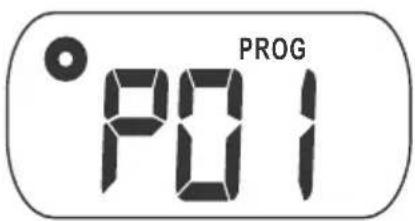
2 Press ◀◀/▶▶ to select a track.
3 Press to store the track.
→ [PROG] and [P02] are displayed.
4 Repeat steps 2 to 4 to select and store all tracks.
When all 30 tracks are stored, no → more tracks can be selected and the display shows [PROG] and [FUL].
5 To play program, press .▶II
In stop mode, press • PROG repeatedly to browse stored tracks. To cancel program, press • ■ twice.

Tip
When program play stops, the CD • Soundmachine returns to normal play. To play program again, repeat steps 1 to 6.
Select play modes
Repeat play
You can repeat a track, an MP3 album, a disc, or a program.
• [ ➕] – plays the current track continuously
• [ Ⓧ ALL] – repeats the entire CD/program
1 During play, press MODE repeatedly until the display shows the repeat icon. Repeat one track.

Repeat a program.

To stop repeat play, press • repeatedly until the repeat icon is no longer displayed.
Shuffle play
You can play all tracks in random order.
1 During play, press MODE repeatedly until the display shows the shuffle icon.
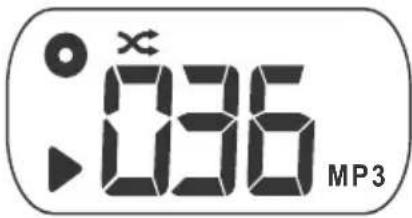
• To stop shuffle play, press MODE again.
Select a track
1 During play, press /▶▶▶ select a track.
Select an album
For MP3-CDs only.
1 During play, press ALBUM +/- to select an album.
Find a passage within a track
1 During play, press and hold / ◀◀◀▶▶ The CD is played at high speed and ↩ with reduced volume.
2 Release ◀◀/▶▶ to resume normal play.

Tip
When search reaches the end of the last track, • the CD stops.
6 Product information

Note
- Product information is subject to change without prior notice.
Specifications
Disc
| Laser Type Semiconductor | |
| Disc Diameter | 12cm/8cm |
| Support Disc | CD-DA, CD-R, CD-RW, MP3-CD, WMA-CD |
| Audio DAC | 24Bits / 44.1kHz |
| Total Harmonic Distortion | <1% |
| Frequency Response | 60Hz -16kHz |
| S/N Ratio | >62dBA |
Tuner
| Tuning Range | FM: 87.5 - 108MHz;MW: 530 - 1600kHz |
| Total Harmonic Distortion | <3% |
| Signal to Noise Ratio | >50 dB |
Tape deck
| Frequency response- Normal tape (type I) | 125 - 8000Hz (8 dB) |
| Signal-to-noise ratio- Normal tape (type I) | 40 dBA |
| Wow and flutter | <0.4% JIS |
General
| Dimensions (main unit) | |
| (W × H × D) 320 × 275 × 175 mm | |
| Weight (main unit) 1.7 kg | |
| Power supply DC: 9V 1.5A | |
| AC: 110 - 127V/220- 240V, 50Hz/60Hz | |
| Power consumption | |
| - Active | <12 W |
| - Standby | 0.7W |
| Power output 1W × 2 RMS | |
| Operating | - 10 °C - +50 °C |
| temperature range | 14 °F - 122 °F |
Supported MP3 disc formats
ISO9660, Joliet•
Maximum title number: 512 (depending • on file name length)
Maximum album number: 255•
Supported sampling frequencies: 32 kHz, • 44.1kHz, 48 kHz
Supported Bit-rates: 32\~256 (kbps), •
variable bit rates
USB playability information
Compatible USB devices:
USB flash memory (USB 2.0 or USB1.1) • USB flash players (USB 2.0 or USB1.1) •
• memory cards (requires an additional card reader to work with this apparatus)
Supported formats:
• USB or memory file format FAT12, FAT16, FAT32 (sector size: 512 bytes)
• MP3 bit rate (data rate): 32-320 Kbps and variable bit rate
• WMA v9 or earlier
• Directory nesting up to a maximum of 8 levels
• Number of albums/ folders: maximum 99
• Number of tracks/titles: maximum 999
ID3 tag v2.0 or later•
File name in Unicode UTF8 (maximum •
length: 128 bytes)
Unsupported formats:
Empty albums: an empty album is an •
album that does not contain MP3/WMA
files, and is not be shown in the display.
Unsupported file formats are skipped. For •
example, Word documents (.doc) or MP3
files with extension .dlf are ignored and
not played.
AAC, WAV, PCM audio files•
DRM protected WMA files (.wav, .m4a, •
.m4p, .mp4, .aac)
WMA files in Lossless format•
7 Troubleshooting

Warning
Risk of electric shock. Never remove the casing of the player.
To keep the warranty valid, never try to repair the system yourself.
If you encounter problems when using the player, check the following points before requesting service. If the problem remains unsolved, register your player and get support at www.philips.com/welcome.
No power
- Ensure that the power cord is connected securely.
- Ensure that there is power at the power supply socket.
- Ensure that the batteries are installed correctly.
No sound
- Adjust the volume.
- Ensure that the track played is of a compatible format.
Display does not function properly./No reaction to operation of any of the controls.
1 Disconnect the AC power cord.
2 Connect the AC power cord after a few seconds.
Cannot play disc
- Ensure that the disc label is inserted with the printed side facing up.
- Wipe the disc with fibre cleaning cloth from the centre to the edge in a straight line.
- This disc may be defective. Play another disc.
- Ensure that the CD is a finalised CD/CD-R/CD-RW.
• Ensure that the laser lens is clean.
Ensure that the CD is not encoded with copyright protection technologies.
The CD skips tracks
Ensure that the CD is not damaged or • dirty. Ensure that program/shuffle mode is • deactivated.
USB device not supported
The USB device is incompatible with the • apparatus. Try another one.
Poor radio reception
Increase the distance between the unit • and your TV or VCR. Fully extend the FM antenna. • Connect an outdoor FM antenna instead. •



- Contents
- Important 4
- Your CD Soundmachine 6
- Get started 9
- Play 11
- Play options 12
- Product information 14
- Troubleshooting 16
- Important
- Safety
- Warning
- Caution
- Notice
- Recycling
- Environmental information
- Your CD Soundmachine
- Introduction
- What's in the box
- Overview of the main unit
- Get started
- Install batteries
- Tip
- Connect AC power
- Note
- Play
- Play a CD
- Play from USB
- Listen to radio
- Play options
- Program play sequence
- For MP3 and WMA-discs:
- For CDs,
- Select play modes
- Repeat play
- Shuffle play
- Select a track
- Select an album
- Find a passage within a track
- Product information
- Specifications
- Supported MP3 disc formats
- USB playability information
- Compatible USB devices:
- Supported formats:
- Unsupported formats:
- Troubleshooting
- No power
- No sound
- Display does not function properly./No reaction to operation of any of the controls.
- Cannot play disc
- The CD skips tracks
- USB device not supported
- Poor radio reception
Brand : PHILIPS
Model : AZ1048
Category : Cd player/recorder