fi-6010N - To scan FUJITSU - Free user manual and instructions
Find the device manual for free fi-6010N FUJITSU in PDF.


User questions about fi-6010N FUJITSU
0 question about this device. Answer the ones you know or ask your own.
Ask a new question about this device
Download the instructions for your To scan in PDF format for free! Find your manual fi-6010N - FUJITSU and take your electronic device back in hand. On this page are published all the documents necessary for the use of your device. fi-6010N by FUJITSU.
USER MANUAL fi-6010N FUJITSU
fi-6010N Network Scanner
iScanner
Operator's Guide

natural_image
Line drawing of a printer with front panel and internal grid (no text or symbols)Contents
Copyright ...... xvii
Introduction ...... xxiii
■ Manuals xxiii
■ Regulatory Information ....xxiv
■ Trademarks ....xxvi
■ Notice of Liability ...... xxviii
■ Safety Precautions ....XXX
Chapter 1 Scanner Overview ...... 1
1.1 Scanner Features ...... 2
■ Basic uses for scanned documents ...... 2
■ Configure and manage with ease 3
■ Advanced security measures .... 3
1.2 Part Names and Functions .... 4
1.2.1 External Parts 4
1.2.2 Internal Parts 6
1.3 User Types and Operations 7
1.4 System Requirements 12
1.4.1 Requirements for Admin Tool.... 12
■ Software (English Versions) 12
■ Hardware 12
1.4.2 Requirements for Central Admin Console 13
■ Software (English Versions) 13
■ Hardware 13
1.4.3 Requirements for Central Admin Server.... 14
■ Software (English Versions) 14
■ Hardware 14
1.4.4 Requirements for Related Servers 15
■ LDAP Server 17
■ SMTP Server 17
■ File Server 17
■ SharePoint Server 17
■ FTP Server 17
■ Print Server 18
■ DNS Server 18
■ WINS Server 18
■ DHCP Server 18
■ NTP Server 18
■ Fax Server .... 18
1.4.5 Network Requirements.... 19
1.4.6 Scanner Requirements for iScanner Central Admin...... 19
1.4.7 Port Number List....20
Chapter 2 Basic Scanner Operations ...... 23
2.1 Turning the Power On/Off 24
■ Turning the Power On 24
■ Turning the Power Off 25
2.2 Using the Scanner Buttons 26
2.2.1 Using the Startup Button 26
2.2.2 Using the Top Cover [SCAN] Button 27
2.3 Using the LCD Touch Panel 28
2.4 Using the Keyboard 29
2.4.1 Using the Keyboard: Administrator....29
2.4.2 Using the Keyboard: Regular Users 30
Chapter 3 Administrator Operations (Overview) ...... 31
3.1 Operating and Managing Scanners .... 32
3.2 Required Scanner Function Settings 33
Chapter 4 Administrator Operations (Touch Panel and Admin Tool) 37
4.1 Administrator Screens via the Touch Panel 38
4.2 Administrator Screens via the Admin Tool .... 40
4.3 iScanner Administrator Login: via the Touch Panel 42
4.4 Setting up for Administrator Access via the Admin Tool 44
4.4.1 Checking the Internet Explorer Cache Settings...... 44
4.4.2 Setting the Internet Explorer Trusted Sites.... 45
4.4.3 Installing the Admin Tool 47
4.4.4 Uninstalling the Admin Tool....52
4.5 iScanner Administrator Login: via the Admin Tool ... 53
4.6 Using the System Settings Menus 56
4.6.1 Calibrating the Touch Panel 56
4.6.2 Setting the Scanner Name 59
4.6.3 Setting the Language 62
4.6.4 Setting the Region/Timezone 63
4.6.5 Setting the Date/Time 64
4.6.6 Setting the Time to Standby Mode 66
4.6.7 Setting the Login Method 68
4.6.8 Changing the Admin Password 71
4.6.9 Setting a File Name Format for When Saving Scanned Data 72
4.6.10 Setting a File Name Format for When Attaching Scanned Data to e-Mail 76
4.6.11 Setting the Multifeed Detection Method 78
4.6.12 Setting Scanning Performance 81
■ Offset Settings 82
■ Length Magnification Setting 82
4.6.13 Setting General Scanner Settings 83
4.6.14 Managing Certificates....84
■ Importing a Certificate File 84
■ Deleting a Certificate File 85
4.7 Using the Network Settings Menus 86
4.7.1 Giving the Scanner an IP Address 86
4.7.2 Setting the Admin Network 88
4.7.3 Setting a Central Admin Server 90
4.7.4 Setting the DNS Server 93
4.7.5 Setting the WINS Server 95
4.7.6 Setting the NTP Server 96
4.7.7 Setting the Proxy Server 98
4.7.8 Setting the Login LDAP Server 100
■ LDAP Search Target 104
4.7.9 Setting the e-Mail LDAP Server 108
4.7.10 Setting the LDAP Search Parameters 111
4.7.11 Setting the e-Mail Server (SMTP Server) 116
4.7.12 Setting the Fax Server 118
4.7.13 Setting the Network Printers 119
■ Checking the Printer Drivers 120
■ Setting the Printer Properties 121
■ Registering a Network Printer (Network Tree) ...... 124
■ Registering a Network Printer (Network Path) ...... 127
■ Renaming a Network Printer 129
■ Removing a Network Printer 130
■ Viewing the Printer Details 131
4.7.14 Setting the Network Folders 132
■ Registering a Network Folder (Network Tree) ...... 133
■ Registering a Network Folder (Network Path) ...... 136
■ Registering a Network Folder (FTP Path) 138
■ Renaming a Network Folder .... 141
■ Removing a Network Folder .... 143
■ Viewing the Network Folder Details ...... 144
4.7.15 Setting the SharePoint Folders 145
■ Renaming a SharePoint Folder (Display Name) ..... 147
■ Removing a SharePoint Folder .... 148
4.7.16 Setting the Destination for Alert Notifications 149
4.7.17 Checking the Network Connection with a Ping Test ..... 150
4.7.18 Checking the Network Operating Status 152
■ Checking the Network Status .... 152
■ Setting the Link Speed/Duplex Mode 153
4.8 Using the Device Status Menus 154
4.8.1 Viewing the System Status 154
4.8.2 Viewing the Status of Installed Options 155
4.8.3 Viewing the Usage Status 156
■ Viewing the Status of Consumable Parts .... 156
■ Resetting the Usage Counter 157
4.8.4 Viewing the Add-in Status 158
4.9 Using the Operation Logs Menus 159
4.9.1 Managing the User Log 159
■ Viewing the User Log Details 159
■ Downloading the User Logs in CSV Format .... 161
■ Clearing the User Logs 161
4.9.2 Managing the System Log....162
■ Viewing the System Log Details 162
■ Downloading the System Log in CSV Format ...... 164
■ Clearing the System Log 164
4.10 Using the Maintenance Menus 165
4.10.1 Maintaining the User Data Store 165
■ Backing up the User Data Store 167
■ Restoring the User Data Store 169
■ Clearing the User Data Store 170
4.10.2 Maintaining the System Settings 171
■ Downloading the System Settings in CSV Format ..... 171
■ Backing up System Settings 172
■ Restoring System Settings 173
■ Resetting Factory Defaults .... 174
4.10.3 Updating the Scanner's System Software 175
4.10.4 Installing/Uninstalling an Add-in Module 177
■ Installing an Add-in Module 177
■ Uninstalling an Add-in Module 178
4.10.5 Setting the Information Output Level 179
4.10.6 Obtaining Technical Support 180
4.11 Setting Job Features 181
4.11.1 Job Setting Quick User Guide 183
4.11.2 Setting a Job Sequence 185
■ Adding a job sequence .... 185
■ Cloning a job sequence .... 197
■ Editing a job sequence .... 197
■ Deleting a job sequence .... 198
■ Filtering job sequences .... 198
■ Filtering the LDAP List .... 199
4.11.3 Setting a Job Menu 203
■ Adding a job menu 203
■ Cloning a job menu 208
■ Editing a job menu 208
■ Deleting a job menu 209
■ Viewing the detailed settings for a job menu ...... 209
4.11.4 Setting a Job Group 210
■ Adding a job group 210
■ Editing a job group 215
■ Deleting a job group 215
■ Viewing the detailed settings for a job group ..... 216
■ Assigning job menus to users not included in a job group 216
■ Filtering the LDAP List .... 218
Chapter 5 Administrator Operations (Central Admin Console) 223
5.1 Function List 224
5.2 Using Central Admin Console Window 227
5.3 Central Admin Console Quick Guide 229
5.4 Pre-settings for Using Central Admin Console ...... 231
5.4.1 Installing the Central Admin Server Software....231
■ Importing the Certificate 235
5.4.2 Installing the Central Admin Console 236
5.4.3 Setting up a Firewall for the Central Admin Server ...... 239
5.4.4 Configuring the Scanner Settings for Central Admin Management....239
5.4.5 Uninstalling the Central Admin Server Software/Console 240
■ Uninstalling the Central Admin Server Software ..... 240
■ Uninstalling the Central Admin Console ....240
5.5 Central Admin Server Login: via the Central Admin Console 241
5.6 Setting the Central Admin Server 244
■ [Change Administrator Password] button 245
■ [User Roaming Data (Select & Clear)] button ..... 245
■ Scanner Registration 246
■ Network Connection .... 246
■ Screen Settings 247
■ LDAP Server 247
■ SharePoint Server Connection Settings .... 250
■ Software Update Time-Period Restrictions ...... 251
■ Operation Monitoring 252
■ Error Notification Settings 252
■ Data Import/Export 252
■ Log Retention 252
■ Audit Log Settings 253
■ [OK] button 253
■ [Cancel] button 253
5.7 Setting Scanner Configuration 254
■ [Import Config] button 257
■ [Export Config] button 258
■ Filter Conditions 258
■ [New] button 259
■ [Clone] button 260
■ [Edit] button 260
■ [Delete] button 260
■ [Select All] button 260
■ [Deselect All] button 260
■ Scanner information list 261
5.8 Monitoring and Maintaining the iScanner Network 263
■ iScanner Network 263
■ iScanner Updates .... 264
■ iScanner Events 265
5.9 Updating the System 266
■ Registered System Update 266
■ Upload & Release a New System Update .... 266
■ [Back] button 267
5.10 Installing an Add-in 268
■ Add-in Groups 268
■ Registered Add-in Module 268
■ Upload & Release a New Add-in 269
■ [Back] button 270
5.11 Updating the Scanner System Settings 271
■ Settings Groups 271
■ Registered Scanner Settings 272
■ Upload & Release a New Set of Scanner Settings ..... 272
■ [Back] button 274
5.12 Setting the Job Mode 275
■ Registered Job Mode Settings 275
■ Create & Release a New Set of Job Mode Settings ..... 276
■ [Back] button 277
5.13 Viewing the Update Status Lists 278
■ Filter Conditions 278
■ [Call Now] button 279
■ [Clear Update Failures] button 279
■ [Select All] button 279
■ [Deselect All] button 279
■ Scanner list 279
■ [Back] button 280
5.14 Viewing the Scanners Operating Status 281
■ Scanner Operating Status 282
■ Filter Conditions 283
■ [Clear All Errors] Button 283
5.15 Viewing Event Log 284
■ [Download] button 284
■ [Clear Log] button 284
■ Filter Conditions 284
■ Event Log 285
5.16 Collecting and Exporting Audit Logs 286
5.16.1 Collecting Audit Logs.... 287
5.16.2 Exporting Audit Logs 287
5.16.3 File Format of Audit Logs 289
5.17 Maintaining Central Admin Settings 291
5.17.1 Backing Up Central Admin Settings 291
5.17.2 Restoring Central Admin Settings 293
5.17.3 Obtaining Technical Support on the Central Admin Server 294
5.17.4 Migrating Data to an Updated Version of the Central Admin Server Software.... 295
Chapter 6 Regular User Operations ...... 297
6.1 Loading Documents 298
6.1.1 How to Load Documents 298
6.1.2 Loading Documents Using a Carrier Sheet 301
6.2 Using Touch Panel Screens: Regular User 304
6.2.1 Common Buttons and Indicators 304
6.2.2 Regular User Settings Overview 305
6.2.3 Main Menu Screen 306
6.2.4 Job Menu Screen 308
6.3 Logging in: Regular User Mode 311
6.4 Sending the Scanned Data by e-Mail 314
6.4.1 Selecting an e-Mail Target from the e-Mail Address Book 319
6.4.2 Adding an e-Mail Target to the e-Mail Address Book ..... 324
6.4.3 Editing an e-Mail Target in the e-Mail Address Book ..... 327
6.4.4 Deleting an e-Mail Target from the e-Mail Address Book 329
6.5 Sending the Scanned Data by Fax 330
6.5.1 Selecting a Fax Number from the Fax Number List ...... 332
6.5.2 Adding a Contact to the Fax Number List.... 335
6.5.3 Editing a Contact in the Fax Number List.... 337
6.5.4 Deleting a Contact from the Fax Number List .... 338
6.6 Printing the Scanned Data 339
6.6.1 Scaling....344
6.6.2 Positioning....349
6.6.3 Simplex/Duplex.... 351
6.7 Saving the Scanned Data to a Network Folder ..... 352
6.8 Saving the Scanned Data in a SharePoint Folder .... 357
6.9 Setting the Scan Options 365
6.9.1 Carrier Sheet 372
6.9.2 Color Mode 373
6.9.3 Paper Size 374
■ Long Page Mode 376
6.9.4 Resolution....378
6.9.5 Scan Mode 379
6.9.6 File Format 380
6.9.7 Searchable PDF 382
6.9.8 PDF Password....385
6.9.9 Compression 387
6.9.10 Brightness....390
6.9.11 Contrast....391
6.9.12 Sharpness 392
6.9.13 Dropout Color 393
6.9.14 Background Removal 394
6.9.15 Blank Page Skip 395
6.9.16 Page Orientation....396
6.9.17 Multifeed Detection (Layer and Length) 399
6.9.18 Edge Cropping....400
6.10 Enabling/Disabling the Scan Viewer 402
6.11 Editing the Scanned Data in the Scan Viewer ..... 405
6.11.1 Viewing a Scanned Page 406
6.11.2 Rotating a Scanned Page....407
6.11.3 Adding a Scanned Page 408
6.11.4 Deleting a Scanned Page 409
6.12 Checking the User Log 410
6.13 Maintenance 412
6.14 Processing a Job 413
6.14.1 Enabling/Disabling the Message Screen.... 417
6.14.2 Changing a File Name (for Save/e-Mail Attachment)...... 419
6.14.3 Checking the Number of Sheets to Be Scanned 420
Chapter 7 Scanner Care 423
7.1 Cleaning 424
7.1.1 Cleaning Materials....424
7.1.2 Which Parts and When....425
7.2 Cleaning the ADF 426
7.2.1 Cleaning the ADF 427
7.3 Cleaning the LCD Touch Panel 433
7.4 Cleaning the Keyboard/Keyboard Cover 434
7.5 Cleaning the Carrier Sheet 435
7.6 Replacing Parts 436
7.6.1 Part Numbers and Replacement Cycles 436
■ Part numbers and replacement cycle for consumable parts 436
■ Part numbers and replacement cycle for Carrier Sheet 437
7.6.2 Checking the Consumable Alert Status....438
7.6.3 Replacing the Pad Assy 439
7.6.4 Replacing the Pick Roller 440
7.6.5 Purchasing the Carrier Sheet 444
7.7 Changing the Keyboard Cover 445
7.8 Performing a Scan Test 447
Chapter 8 Troubleshooting 451
8.1 Removing Jammed Documents 452
8.2 Dealing with Detached Keycaps 456
8.3 Network Connection Troubleshooting 458
8.3.1 Basic Network Operation Tests 458
- Checking basic network operation with a Ping test ..... 458
- Checking the network operating status .... 460
- Checking the NTP server settings by synchronizing the system time 461
- Checking the mail server by sending a test mail ...... 462
8.3.2 Other Network Connection Troubleshooting 463
■ Failure to connect to a server using its IP address ..... 463
■ Failure to connect to a server using its host name or FQDN 465
■ Failure to add a network printer .... 466
■ Failure to print on a network printer 466
8.3.3 Failure to Access the Scanner using a Web Browser, Admin Tool, or Central Admin Server....467
8.4 Other Troubleshooting 470
8.5 Points to Check before Contacting Your FUJITSU Scanner Dealer 474
8.5.1 General Details....474
8.5.2 Error Status 475
■ Problem when connecting to the scanner via computer ....475
■ Document feed trouble .... 475
■ Problem with Central Admin 476
■ Other problems .... 476
8.6 Checking the Scanner Labels 477
8.7 Pre-Maintenance Preparations 478
Appendix A ADF Paper Specifications 479
A.1 Paper Size 480
A.2 Paper Requirements 481
A.2.1 Paper Type 481
A.2.2 Paper Weight....481
A.2.3 Precautions....481
A.3 Maximum Document Loading Capacity 484
A.4 Area not to be Perforated 485
A.5 Multifeed Detection Conditions 486
A.5.1 Detection by Layer....486
A.5.2 Detection by Length....486
A.5.3 Detection by both Layer and Length....487
Appendix B Management Settings and Files 489
B.1 e-Mail Address Setting Values 490
B.2 Scanner Configuration File Format 491
B.2.1 Scanner Configuration File Format (for Importing)....491
B.2.2 Scanner Configuration File Format (for Exporting)...... 492
Appendix C Root Certification Authority 495
C.1 Root Certification Authority List 496
Appendix D Scanner Specifications 499
D.1 Device Specifications .... 500
D.2 Scanner Specifications .... 501
D.3 Languages Supported By and Keyboard Covers Provided With 502
Appendix E Operation Messages 503
E.1 Administrator Messages 504
E.1.1 Administrator Screen Messages....505
E.1.2 System Log Messages 518
■ Information 518
■ Error 521
■ Warning 523
E.1.3 Alert Monitor System Log Messages....524
■ Information 524
■ Error 525
■ Warning 527
E.2 Regular User Messages 528
E.2.1 Regular User Screen Messages....528
E.2.2 System Log Messages 551
■ Information .... 551
■ Warning 553
■ Error 553
E.2.3 User Log 573
E.3 Central Admin Messages 586
E.3.1 Central Admin Console Messages 586
E.3.2 System Log Messages 590
■ Information 590
■ Warning 590
■ Error 592
E.3.3 Event Log 597
■ System Event Log 597
■ Central Admin Console Event Log 599
E.3.4 Backup/Restore Command Messages 603
■ Information 603
■ Error 603
E.3.5 Audit Log Export Command Messages 607
Appendix F Compatibility with Different Versions ...... 609
F.1 Backing Up/Restoring User Data and Scanner Settings 610
F.2 Updating System Settings from the Central Admin Server 611
F.3 Functional Compatibility between the Scanner and Central Admin Server 612
F.4 Backing Up/Restoring Data between Different Versions of the Central Admin Server Software ..... 613
Appendix G Glossary 615
Index 621
NetAdvantage 2007
Copyright 2000-2007 Infragistics, Inc.
LEADTOOLS for .NET
Copyright© 2005 LEAD Technologies, Inc.
WinPcap3.1
Copyright© 1999 - 2005 NetGroup, Politecnico di Torino (Italy). Copyright© 2005 - 2006 CACE Technologies, Davis (California). All rights reserved.
Redistribution and use in source and binary forms, with or without modification, are permitted provided that the following conditions are met:
- Redistributions of source code must retain the above copyright notice, this list of conditions and the following disclaimer.
- Redistributions in binary form must reproduce the above copyright notice, this list of conditions and the following disclaimer in the documentation and/or other materials provided with the distribution.
- Neither the name of the Politecnico di Torino, CACE Technologies nor the names of its contributors may be used to endorse or promote products derived from this software without specific prior written permission.
THIS SOFTWARE IS PROVIDED BY THE COPYRIGHT HOLDERS AND CONTRIBUTORS "AS IS" AND ANY EXPRESS OR IMPLIED WARRANTIES, INCLUDING, BUT NOT LIMITED TO, THE IMPLIED WARRANTIES OF MERCHANTABILITY AND FITNESS FOR A PARTICULAR PURPOSE ARE DISCLAIMED. IN NO EVENT SHALL THE COPYRIGHT OWNER OR CONTRIBUTORS BE LIABLE FOR ANY DIRECT, INDIRECT, INCIDENTAL, SPECIAL, EXEMPLARY, OR CONSEQUENTIAL DAMAGES (INCLUDING, BUT NOT LIMITED TO, PROCUREMENT OF SUBSTITUTE GOODS OR SERVICES; LOSS OF USE, DATA, OR PROFITS; OR BUSINESS INTERRUPTION) HOWEVER CAUSED AND ON ANY THEORY OF LIABILITY, WHETHER IN CONTRACT, STRICT LIABILITY, OR TORT (INCLUDING NEGLIGENCE OR OTHERWISE) ARISING IN ANY WAY OUT OF THE USE OF THIS SOFTWARE, EVEN IF ADVISED OF THE POSSIBILITY OF SUCH DAMAGE.
This product includes software developed by the University of California, Lawrence Berkeley Laboratory and its contributors. This product includes software developed by the Kungliga Tekniska Hogskolan and its contributors. This product includes software developed by Yen Yen Lim and North Dakota State University.
Portions Copyright© 1990, 1991, 1992, 1993, 1994, 1995, 1996, 1997 The Regents of the University of California.
All rights reserved.
Redistribution and use in source and binary forms, with or without modification, are permitted provided that the following conditions are met:
- Redistributions of source code must retain the above copyright notice, this list of conditions and the following disclaimer.
- Redistributions in binary form must reproduce the above copyright notice, this list of conditions and the following disclaimer in the documentation and/or other materials provided with the distribution.
- All advertising materials mentioning features or use of this software must display the following acknowledgement: "This product includes software developed by the University of California, Berkeley and its contributors."
- Neither the name of the University nor the names of its contributors may be used to endorse or promote products derived from this software without specific prior written permission.
THIS SOFTWARE IS PROVIDED BY THE INSTITUTE AND CONTRIBUTORS "AS IS" AND ANY EXPRESS OR IMPLIED WARRANTIES, INCLUDING, BUT NOT LIMITED TO, THE IMPLIED WARRANTIES OF MERCHANTABILITY AND FITNESS FOR A PARTICULAR PURPOSE ARE DISCLAIMED. IN NO EVENT SHALL THE REGENTS OR CONTRIBUTORS BE LIABLE FOR ANY DIRECT, INDIRECT, INCIDENTAL, SPECIAL, EXEMPLARY, OR CONSEQUENTIAL DAMAGES (INCLUDING, BUT NOT LIMITED TO, PROCUREMENT OF SUBSTITUTE GOODS OR SERVICES; LOSS OF USE, DATA, OR PROFITS; OR BUSINESS INTERRUPTION) HOWEVER CAUSED AND ON ANY THEORY OF LIABILITY, WHETHER IN CONTRACT, STRICT LIABILITY, OR TORT (INCLUDING NEGLIGENCE OR OTHERWISE) ARISING IN ANY WAY OUT OF THE USE OF THIS SOFTWARE, EVEN IF ADVISED OF THE POSSIBILITY OF SUCH DAMAGE.
Portions Copyright© 1983 Regents of the University of California.
All rights reserved.
Redistribution and use in source and binary forms are permitted provided that the above copyright notice and this paragraph are duplicated in all such forms and that any documentation, advertising materials, and other materials related to such distribution and use acknowledge that the software was developed by the University of California, Berkeley. The name of the University may not be used to endorse or promote products derived from this software without specific prior written permission.
THIS SOFTWARE IS PROVIDED "AS IS" AND WITHOUT ANY EXPRESS OR IMPLIED WARRANTIES, INCLUDING, WITHOUT LIMITATION, THE IMPLIED WARRANTIES OF MERCHANTABILITY AND FITNESS FOR A PARTICULAR PURPOSE.
Portions Copyright© 1995, 1996, 1997 Kungliga Tekniska Hogskolan (Royal Institute of Technology, Stockholm, Sweden).
All rights reserved.
Redistribution and use in source and binary forms, with or without modification, are permitted provided that the following conditions are met:
- Redistributions of source code must retain the above copyright notice, this list of conditions and the following disclaimer.
- Redistributions in binary form must reproduce the above copyright notice, this list of conditions and the following disclaimer in the documentation and/or other materials provided with the distribution.
- All advertising materials mentioning features or use of this software must display the following acknowledgement: "This product includes software developed by the Kungliga Tekniska Hogskolan and its contributors."
- Neither the name of the University nor the names of its contributors may be used to endorse or promote products derived from this software without specific prior written permission.
THIS SOFTWARE IS PROVIDED BY THE INSTITUTE AND CONTRIBUTORS "AS IS" AND ANY EXPRESS OR IMPLIED WARRANTIES, INCLUDING, BUT NOT LIMITED TO, THE IMPLIED WARRANTIES OF MERCHANTABILITY AND FITNESS FOR A PARTICULAR PURPOSE ARE DISCLAIMED. IN NO EVENT SHALL THE INSTITUTE OR CONTRIBUTORS BE LIABLE FOR ANY DIRECT, INDIRECT, INCIDENTAL, SPECIAL, EXEMPLARY, OR CONSEQUENTIAL DAMAGES (INCLUDING, BUT NOT LIMITED TO, PROCUREMENT OF SUBSTITUTE GOODS OR SERVICES; LOSS OF USE, DATA, OR PROFITS; OR BUSINESS INTERRUPTION) HOWEVER CAUSED AND ON ANY THEORY OF LIABILITY, WHETHER IN CONTRACT, STRICT LIABILITY, OR TORT (INCLUDING NEGLIGENCE OR OTHERWISE) ARISING IN ANY WAY OUT OF THE USE OF THIS SOFTWARE, EVEN IF ADVISED OF THE POSSIBILITY OF SUCH DAMAGE.
Portions Copyright© 1997 Yen Yen Lim and North Dakota State University.
All rights reserved.
Redistribution and use in source and binary forms, with or without modification, are permitted provided that the following conditions are met:
- Redistributions of source code must retain the above copyright notice, this list of conditions and the following disclaimer.
- Redistributions in binary form must reproduce the above copyright notice, this list of conditions and the following disclaimer in the documentation and/or other materials provided with the distribution.
- All advertising materials mentioning features or use of this software must display the following acknowledgement: "This product includes software developed by Yen Yen Lim and North Dakota State University"
- The name of the author may not be used to endorse or promote products derived from this software without specific prior written permission.
THIS SOFTWARE IS PROVIDED BY THE AUTHOR "AS IS" AND ANY EXPRESS OR IMPLIED WARRANTIES, INCLUDING, BUT NOT LIMITED TO, THE IMPLIED WARRANTIES OF MERCHANTABILITY AND FITNESS FOR A PARTICULAR PURPOSE ARE DISCLAIMED. IN NO EVENT SHALL THE AUTHOR BE LIABLE FOR ANY DIRECT, INDIRECT,
INCIDENTAL, SPECIAL, EXEMPLARY, OR CONSEQUENTIAL DAMAGES (INCLUDING, BUT NOT LIMITED TO, PROCUREMENT OF SUBSTITUTE GOODS OR SERVICES; LOSS OF USE, DATA, OR PROFITS; OR BUSINESS INTERRUPTION) HOWEVER CAUSED AND ON ANY THEORY OF LIABILITY, WHETHER IN CONTRACT, STRICT LIABILITY, OR TORT (INCLUDING NEGLIGENCE OR OTHERWISE) ARISING IN ANY WAY OUT OF THE USE OF THIS SOFTWARE, EVEN IF ADVISED OF THE POSSIBILITY OF SUCH DAMAGE.
Portions Copyright© 1993 by Digital Equipment Corporation.
Permission to use, copy, modify, and distribute this software for any purpose with or without fee is hereby granted, provided that the above copyright notice and this permission notice appear in all copies, and that the name of Digital Equipment Corporation not be used in advertising or publicity pertaining to distribution of the document or software without specific, written prior permission.
THE SOFTWARE IS PROVIDED "AS IS" AND DIGITAL EQUIPMENT CORP. DISCLAIMS ALL WARRANTIES WITH REGARD TO THIS SOFTWARE, INCLUDING ALL IMPLIED WARRANTIES OF MERCHANTABILITY AND FITNESS. IN NO EVENT SHALL DIGITAL EQUIPMENT CORPORATION BE LIABLE FOR ANY SPECIAL, DIRECT, INDIRECT, OR CONSEQUENTIAL DAMAGES OR ANY DAMAGES WHATSOEVER RESULTING FROM LOSS OF USE, DATA OR PROFITS, WHETHER IN AN ACTION OF CONTRACT, NEGLIGENCE OR OTHER TORTIOUS ACTION, ARISING OUT OF OR IN CONNECTION WITH THE USE OR PERFORMANCE OF THIS SOFTWARE.
Portions Copyright© 1995, 1996, 1997, 1998, and 1999 WIDE Project. All rights reserved.
Redistribution and use in source and binary forms, with or without modification, are permitted provided that the following conditions are met:
- Redistributions of source code must retain the above copyright notice, this list of conditions and the following disclaimer.
- Redistributions in binary form must reproduce the above copyright notice, this list of conditions and the following disclaimer in the documentation and/or other materials provided with the distribution.
- Neither the name of the project nor the names of its contributors may be used to endorse or promote products derived from this software without specific prior written permission.
THIS SOFTWARE IS PROVIDED BY THE PROJECT AND CONTRIBUTORS "AS IS" AND ANY EXPRESS OR IMPLIED WARRANTIES, INCLUDING, BUT NOT LIMITED TO, THE IMPLIED WARRANTIES OF MERCHANTABILITY AND FITNESS FOR A PARTICULAR PURPOSE ARE DISCLAIMED. IN NO EVENT SHALL THE PROJECT OR CONTRIBUTORS BE LIABLE FOR ANY DIRECT, INDIRECT, INCIDENTAL, SPECIAL, EXEMPLARY, OR CONSEQUENTIAL DAMAGES (INCLUDING, BUT NOT LIMITED TO, PROCUREMENT OF SUBSTITUTE GOODS OR SERVICES; LOSS OF USE, DATA, OR PROFITS; OR BUSINESS INTERRUPTION) HOWEVER CAUSED AND ON ANY THEORY OF LIABILITY, WHETHER IN CONTRACT, STRICT LIABILITY, OR TORT (INCLUDING NEGLIGENCE OR OTHERWISE) ARISING IN ANY WAY OUT OF THE USE OF THIS SOFTWARE, EVEN IF ADVISED OF THE POSSIBILITY OF SUCH DAMAGE.
Portions Copyright© 1996 Juniper Networks, Inc. All rights reserved.
Redistribution and use in source and binary forms, with or without modification, are permitted provided that: (1) source code distributions retain the above copyright notice and this paragraph in its entirety, (2) distributions including binary code include the above copyright notice and this paragraph in its entirety in the documentation or other materials provided with the distribution.
The name of Juniper Networks may not be used to endorse or promote products derived from this software without specific prior written permission.
THIS SOFTWARE IS PROVIDED "AS IS" AND WITHOUT ANY EXPRESS OR IMPLIED WARRANTIES, INCLUDING, WITHOUT LIMITATION, THE IMPLIED WARRANTIES OF MERCHANTABILITY AND FITNESS FOR A PARTICULAR PURPOSE.
Portions Copyright© 2001 Daniel Hartmeier All rights reserved.
Redistribution and use in source and binary forms, with or without modification, are permitted provided that the following conditions are met:
- Redistributions of source code must retain the above copyright notice, this list of conditions and the following disclaimer.
- Redistributions in binary form must reproduce the above copyright notice, this list of conditions and the following disclaimer in the documentation and/or other materials provided with the distribution.
THIS SOFTWARE IS PROVIDED BY THE COPYRIGHT HOLDERS AND CONTRIBUTOR "AS IS" AND ANY EXPRESS OR IMPLIED WARRANTIES, INCLUDING, BUT NOT LIMITED TO, THE IMPLIED WARRANTIES OF MERCHANTABILITY AND FITNESS FOR A PARTICULAR PURPOSE ARE DISCLAIMED. IN NO EVENT SHALL THE COPYRIGHT HOLDERS OR CONTRIBUTORS BE LIABLE FOR ANY DIRECT, INDIRECT, INCIDENTAL, SPECIAL, EXEMPLARY, OR CONSEQUENTIAL DAMAGES (INCLUDING, BUT NOT LIMITED TO, PROCUREMENT OF SUBSTITUTE GOODS OR SERVICES; LOSS OF USE, DATA, OR PROFITS; OR BUSINESS INTERRUPTION) HOWEVER CAUSED AND ON ANY THEORY OF LIABILITY, WHETHER IN CONTRACT, STRICT LIABILITY, OR TORT (INCLUDING NEGLIGENCE OR OTHERWISE) ARISING IN ANY WAY OUT OF THE USE OF THIS SOFTWARE, EVEN IF ADVISED OF THE POSSIBILITY OF SUCH DAMAGE.
Portions Copyright 1989 by Carnegie Mellon.
Permission to use, copy, modify, and distribute this program for any purpose and without fee is hereby granted, provided that this copyright and permission notice appear on all copies and supporting documentation, the name of Carnegie Mellon not be used in advertising or publicity pertaining to distribution of the program without specific prior permission, and notice be given in supporting documentation that copying and distribution is by permission of Carnegie Mellon and Stanford University. Carnegie Mellon makes no representations about the suitability of this software for any purpose. It is provided "as is" without express or implied warranty.
WinDump3.9.5
Copyright© 1999 - 2005 NetGroup, Politecnico di Torino (Italy). Copyright© 2005 - 2006 CACE Technologies, Davis (California). All rights reserved.
Redistribution and use in source and binary forms, with or without modification, are permitted provided that the following conditions are met:
- Redistributions of source code must retain the above copyright notice, this list of conditions and the following disclaimer.
- Redistributions in binary form must reproduce the above copyright notice, this list of conditions and the following disclaimer in the documentation and/or other materials provided with the distribution.
- Neither the name of the Politecnico di Torino, CACE Technologies nor the names of its contributors may be used to endorse or promote products derived from this software without specific prior written permission.
THIS SOFTWARE IS PROVIDED BY THE COPYRIGHT HOLDERS AND CONTRIBUTORS "AS IS" AND ANY EXPRESS OR IMPLIED WARRANTIES, INCLUDING, BUT NOT LIMITED TO, THE IMPLIED WARRANTIES OF MERCHANTABILITY AND FITNESS FOR A PARTICULAR PURPOSE ARE DISCLAIMED. IN NO EVENT SHALL THE COPYRIGHT OWNER OR CONTRIBUTORS BE LIABLE FOR ANY DIRECT, INDIRECT, INCIDENTAL, SPECIAL, EXEMPLARY, OR CONSEQUENTIAL DAMAGES (INCLUDING, BUT NOT LIMITED TO, PROCUREMENT OF SUBSTITUTE GOODS OR SERVICES; LOSS OF USE, DATA, OR PROFITS; OR BUSINESS INTERRUPTION) HOWEVER CAUSED AND ON ANY THEORY OF LIABILITY, WHETHER IN CONTRACT, STRICT LIABILITY, OR TORT (INCLUDING NEGLIGENCE OR OTHERWISE) ARISING IN ANY WAY OUT OF THE USE OF THIS SOFTWARE, EVEN IF ADVISED OF THE POSSIBILITY OF SUCH DAMAGE.
This product includes software developed by the University of California, Lawrence Berkeley Laboratory and its contributors.
Secure iNetSuite 2.0J
Copyright© 2007 Dart Communications
Introduction
Thank you for purchasing the fi-6010N Network Scanner.
This easy-to-use image scanner is designed to be connected to a computer network system and is primarily for office use.
■Manuals
The following manuals are prepared for the scanner. Read them as needed.
| Manual Description | |
| fi-6010N Network Scanner Getting Started (paper) | Provides useful and detailed information on setting up, connecting, and caring for your scanner.Read this manual first.In this guide, it is indicated as "Getting Started". |
| fi-6010N Network Scanner Operator's Guide (This Manual) (PDF) | Contains further information about scanner settings, scanner administration, and scanner operations, and may be used as a general reference.To read the manual, download it from the scanner. For more details about how to download the manual, refer to the "Getting Started". |
■Regulatory Information
FCC Declaration
This equipment has been tested and found to comply with the limits for a Class B digital device, pursuant to Part 15 of the FCC Rules. These limits are designed to provide reasonable protection against harmful interference in a residential installation. This equipment generates, uses, and can radiate radio frequency energy and, if not installed and used in accordance with the instruction manual, may cause harmful interference to radio communications. However, there is no guarantee that interference will not occur in a particular installation. If this equipment does cause harmful interference to radio or television reception, which can be determined by turning the equipment off and on, the user is encouraged to try to correct the interference by one or more of the following measures:
●Reorient or relocate the receiving antenna.
- Increase the separation between the equipment and receiver.
- Connect the equipment into an outlet on a circuit different from that to which the receiver is located.
- Consult your dealer or an experienced radio/TV technician.
FCC warning: Changes or modifications not expressly approved by the party responsible for compliance could void the user's authority to operate the equipment.
| NOTICE | The use of a shielded interface cable is required to comply with the Class B limits of Part 15 of FCC rules. The length of the AC cable must be 2 meters (6.6 feet) or less. |
Canadian DOC Regulations
This digital apparatus does not exceed the Class B limit for radio noise emissions from digital apparatus set out in the Radio interference Regulations of the Canadian Department of Communications.
This Class B digital apparatus complies with Canadian ICES-003.
Use in High-safety Applications
This product has been designed and manufactured on the assumption that it will be used in office, personal, domestic, regular industrial, and general-purpose applications. It has not been designed and manufactured for use in applications (simply called "high-safety applications" from here on) that directly involve danger to life and health when a high degree of safety is required, for example, in the control of nuclear reactions at nuclear power facilities, automatic flight control of aircraft, air traffic control, operation control in mass-transport systems, medical equipment for sustaining life, and missile firing control in weapons systems, and when provisionally the safety in question is not ensured. The user should use this product with adopting measures for ensuring safety in such high-safety applications. PFU LIMITED assumes no liability whatsoever for damages arising from use of this product by the user in high-safety applications, and for any claims or compensation for damages by the user or a third party.
About the Use of Mercury

Lamp(s) inside this product contain mercury and must be recycled or disposed of according to local, state, or federal laws.
To avoid unexpected injury, read the following carefully.
Doing the following actions may result in serious personal injuries:
- Do not lick or consume the substance contained in the lamp.
- Do not incinerate, crush, or shred the lamps or scanner parts.
- Do not breathe the chemical liquid contained in the scanner lamps.
LCD Peculiarities
●The LCD backlight is a fluorescent tube that contains some mercury.
- Be aware that neither of the following is considered a fault.
- Despite the fact that the latest advanced technology has been used to produce the scanner's TFT color LCD's, the large number of pixels involved means that an occasional (always-on) bright dot or (always-off) dark dot may be visible.
- The characteristics of the LCD mean that there may be some variation in hue and intensity of colors across the screen.
Replacing Batteries
In order to retain data such as BIOS information, this product has a battery (CMOS RAM battery) on board.
WARNING
- Do not replace the battery yourself, as there is a risk of explosion if the wrong type is used. Please contact your maintenance engineer in charge when the battery runs low.
- Do not touch the battery. Never install or remove the battery by yourself. Doing so may cause electric shock or static electricity which can damage the device.
About Maintenance
The user must not perform repairs on this scanner.
Contact your FUJITSU scanner dealer or an authorized FUJITSU scanner service provider for repairs to this product.
Trademarks
Microsoft, Windows, Windows Vista, Windows Server, and SharePoint are either registered trademarks or trademarks of Microsoft Corporation in the United States and/or other countries.
Adobe, the Adobe logo, Acrobat, and Acrobat Reader are either registered trademarks or trademarks of Adobe Systems Incorporated in the United States and/or other countries.
Intel, Pentium, and Intel Core are trademarks or registered trademarks of Intel Corporation in the United States and other countries.
ABBYY, FineReader are trademarks of ABBYY.
Other company names and product names are the trademarks or registered trademarks of the respective companies.
How Trademarks are Indicated in This Manual
References to operating systems (OS) and applications are indicated as follows:
| Windows | Microsoft ^ Windows ^ operating system |
| Windows XP | Microsoft ^ Windows ^ XP Professional operating systemMicrosoft ^ Windows ^ XP Home Edition operating system |
| Windows Vista | Microsoft ^ Windows Vista ^ Home Basic operating systemMicrosoft ^ Windows Vista ^ Home Premium operating systemMicrosoft ^ Windows Vista ^ Business operating systemMicrosoft ^ Windows Vista ^ Enterprise operating systemMicrosoft ^ Windows Vista ^ Ultimate operating system |
| Windows 7 | Microsoft ^ Windows ^ 7 Home Premium operating systemMicrosoft ^ Windows ^ 7 Professional operating systemMicrosoft ^ Windows ^ 7 Enterprise operating systemMicrosoft ^ Windows ^ 7 Ultimate operating system |
| Windows 2000 Server | Microsoft ^ Windows ^ 2000 ServerMicrosoft ^ Small Business Server 2000Microsoft ^ Windows ^ 2000 Advanced Server |
| Windows Server 2003 | Microsoft ^ Windows Server ^ 2003, Standard EditionMicrosoft ^ Windows Server ^ 2003, Enterprise EditionMicrosoft ^ Windows Server ^ 2003, Datacenter Edition |
| Windows Server 2008 | Microsoft ^ Windows Server ^ 2008 Standard Microsoft ^ Windows Server ^ 2008 Enterprise Microsoft ^ Windows Server ^ 2008 Datacenter |
| Exchange | Microsoft ^ Exchange 2000 Server Microsoft ^ Exchange Server 2003 Microsoft ^ Exchange Server 2007 (supported by 64-bit operating systems only) |
| .NET Framework | Microsoft ^ .NET Framework |
| SharePoint | Microsoft ^ Office SharePoint ^ Server 2007 |
| Internet Explorer | Microsoft ^ Internet Explorer ^ |
| Internet Information | Microsoft ^ Internet Information Services |
| SQL Server 2005 Express Edition | Microsoft ^ SQL Server ^ 2005 Express Edition |
| Adobe Acrobat | Adobe ^ Acrobat ^ |
| Adobe Reader | Adobe ^ Reader ^ |
| RightFax | RightFax Business Server (Version 9.3) |
| Intel Pentium III Processor | Intel ^ Pentium ^ III Processor |
Manufacturer
PFU LIMITED
International Sales Dept., Imaging Business Division, Products Group
Solid Square East Tower
580 Horikawa-cho, Saiwai-ku, Kawasaki-shi Kanagawa 212-8563, Japan
Phone: (81-44) 540-4538
All Rights Reserved, Copyright© PFU LIMITED 2010
■Notice of Liability
BEFORE USING THIS PRODUCT, PLEASE READ THIS MANUAL CAREFULLY. IF THIS PRODUCT IS NOT USED CORRECTLY, UNEXPECTED INJURY CAN OCCUR TO USERS OR BYSTANDERS.
Keep this manual in a safe place so that it can be easily referred to during use of this product.
While all efforts have been made to ensure the accuracy of all information in this manual, PFU assumes no liability to any party for any damage caused by errors or omissions or by statements of any kind in this manual, its updates or supplements, whether such errors are omissions or statements resulting from negligence, accidents, or any other cause. PFU further assumes no liability arising from the application or use of any product or system described herein; nor any liability for incidental or consequential damages arising from the use of this manual. PFU disclaims all warranties regarding the information contained herein, whether expressed, implied, or statutory.
Warning Indications Used in This Manual

This indication alerts operators to an operation that, if not strictly observed, may result in severe injury or death.

This indication alerts operators to an operation that, if not strictly observed, may result in safety hazards to personnel or damage to equipment.
Symbols Used in This Manual
This manual uses the following symbols in the explanations in addition to the warning indications.


This symbol alerts operators to particularly important information. Be sure to read this information.



This symbol alerts operators to helpful advice regarding operation.

A TRIANGLE symbol indicates that special care and attention is required. The drawing inside the triangle shows the specific caution.

A CIRCLE with a diagonal line inside shows action which users may not perform. The drawing inside or under the circle shows the specific action that is not allowed.

Outline characters on a colored background show instructions users should follow. It may also include the drawing that shows the specific instruction.
This symbol is used to indicate information about administrator operations. In Chapter 4, operations that can be performed by either or both of the administrator login modes one indicated by the following symbols:
Touch Panel : Administrator operating via the touch panel.
Admin Tool : Administrator operating via the network interface using the fi Network Scanner Admin Tool.
Central Admin : Administrator operating via the network interface using the iScanner Central Admin Console.
This symbol is used to indicate information about regular user operations.

Warning Label

High Temperature
The glass scanner windows surface inside the ADF becomes hot when the scanner is used. Be careful not to touch the surface of the glass scanner windows.

Do NOT remove from the scanner, stain or scratch the warning labels.
Screen Examples in This Manual
The screen examples in this manual are subject to change without notice in the interest of product improvement. If the actual displayed screen differs from the screen examples in this manual, operate by following the actual displayed screen while referring to the User's Manual of the scanner application you are using.
The screen examples in this manual are of Windows Vista.
■Safety Precautions
This manual describes important details for ensuring the safe and correct use of this product.
Thoroughly read this manual before you start to use this product. In particular, be sure to read and fully understand the Safety Precautions described in this manual before you use this product.
Also, store this manual in a safe place so that it can be easily referred to during use of this product.

Do not damage the AC cable.

A damaged AC cable may cause fire or electric shock. Do not place heavy objects on AC cables, or pull, bend, twist, heat, damage or modify AC cables.
Do not use damaged AC cables or power plugs, or install any cables or power plugs to loose wall sockets.
Use only specified AC cables and connector cables.

Use only specified AC cables and connector cables. Failure to use the correct cables might cause electric shock and/or equipment failure.
Please do not use the AC cable provided with this scanner for other devices, since this might cause equipment failure and other troubles or an electric shock.
Use this scanner only at the indicated power voltage. Do not connect to multiple-power strips.

Use this scanner only at the indicated power voltage and current. Improper power voltage and current might cause fire or electric shock. Do not connect to multiple-power strips.
Do not touch the AC cable with wet hands.

Do not touch the power plug with wet hands. Doing so can cause electric shock.
Wipe any dust from the power plug.

Wipe off any dust from metal parts on the power plug or metal fittings with a soft, dry cloth. Accumulated dust can cause fire or electric shock.
Do not install the device in locations that has oil smoke, steam, humidity, and dust.

Do not install the scanner in locations subject to oil smoke, steam, humidity, and dust. Doing so might cause a fire or electric shock.
Turn the scanner OFF if it is damaged.

If the scanner is damaged for any reason, turn the scanner off and unplug the power cable. Contact your FUJITSU scanner dealer or an authorized FUJITSU scanner service provider.
Do not use the scanner if there is a strange odor.

If you detect heat coming from the device or detect other problems such as smoke, strange smells or noises, immediately turn off the scanner and disconnect its power plug. Make sure that any smoke coming from it has stopped, before contacting your FUJITSU scanner dealer or an authorized FUJITSU scanner service provider.
Do not put liquids inside the scanner.

Do not insert or drop metal objects in to the scanner. Do not scan wet documents or documents with paper clips or staples. Do not splash or allow the scanner to get wet.

If foreign objects (water, small metal objects, liquids, etc.) get inside the scanner, immediately turn off the scanner and disconnect the power plug from the power outlet. Then, contact your FUJITSU scanner dealer or an authorized FUJITSU scanner service provider. Pay particular attention to this warning in households where there are small children.

Do not touch the inside of the scanner unless necessary.

Do not take apart or modify the scanner. The inside of the scanner contains high-voltage components. Touching these components might cause electric shock or fire.
Do not use aerosol sprays near the scanner.

Do not use any aerosol sprays or alcohol based sprays to clean the scanner. Dust blown up by strong air from the spray may enter the inside of the scanner. This may cause the scanner to fail or malfunction. Sparks, caused by static electricity, generated when blowing off dust and dirt from the outside of the scanner may cause a fire.
Do not place the scanner within the reach of small children.

To avoid injuries, do not place the scanner in an area where small children may be able to reach.
Do not touch the heated section for a long time.

Do not touch the heated section such as the bottom of the scanner for a long time. Doing so may cause a low-temperature burn on your skin.
Do not cover the scanner with something during its operation.

Do not use the scanner while covered with a blanket, etc. Doing so may raise the temperature inside and cause a fire.
Do not use the scanner where it gets wet.

Do not use the scanner at a place such as a bathroom, shower room, or swimming pool where it may easily get wet. Doing so might cause electric shock or fire.

CAUTION
Do not install the scanner on unstable surfaces.

Make sure that the scanner is installed on a flat, level surface and that none of its parts extend beyond the surface top, such as a desk or table. Do not install the scanner on unstable surfaces. Install the scanner on a level surface that is free of vibration to prevent it from falling.

Install the scanner on a strong surface that will support the weight of the scanner and other devices.
Firmly insert the power plug.

Firmly insert the power plug as far it can go into the power outlet.
Do not block the ventilation ports.

Do not block the ventilation ports. Blocking the ventilation ports generates heat inside of scanner, which may result in fire or scanner failure.
Do not place heavy objects or stand on top of the scanner.

Do not place heavy objects on the scanner or use the scanner's surface top to perform other work. Improper installation might cause injuries and equipment failure.
Do not use the scanner immediately after moving it from a cold place into a warm room.

Do not use the device immediately after moving it from a cold place into a warm room. Condensation may occur, which might lead to scanning errors. Let the device dry about one or two hours before you use it.
Before moving the scanner, disconnect the power plug from the power outlet.

Do not move the scanner with the power and interface cables connected as this can damage the cables, which can later cause fire, electric shock as well as injury. Before moving the scanner, be sure to disconnect the power plug from the power outlet, and all other data cables. Make sure that the floor is free of any obstructions.
Protect the scanner from static electricity.

Install the scanner away from strong magnetic fields and other sources of electronic noise. Also, protect the scanner against any static electricity, which can cause the scanner to malfunction.
Avoid any contact when scanner is in use.

Avoid touching any scanner mechanism during scanning since this may cause injuries.
Disconnect the power plug from the power outlet when the scanner is not used for a long period of time.

When the scanner is not going to be used for a long period of time, be sure to disconnect the power plug from the power outlet.
Do not install the scanner in direct sunlight.

Do not install the scanner under direct sunlight or near heating apparatus. Doing so might cause excessive heat to build up inside the scanner, which can cause scanner trouble or even fire. Install the scanner in a well-ventilated location.
Handle documents carefully.

When handling documents, be careful not to cut your fingers with them.
Do not make the scanner wet while carrying it outside.

When carrying the scanner outside while it is raining or snowing, pay special attention so the scanner does not get wet.
Do not place the scanner in areas, which are subject to high levels of shock or vibration.

Do not place the scanner in areas, which are subject to high levels of shock or vibration. Doing so may cause the scanner to malfunction.
Be aware of the pick spring.

When you perform cleaning, make sure that the inside of the scanner is free of any foreign object, and be careful not to get your hand or the cloth caught on the pick spring (metal part) as a deformed pick spring (metal part) may cause injury.
Scanner Overview
Admin
User
1.1 Scanner Features ....2
1.2 Part Names and Functions....4
1.3 User Types and Operations....7
1.4 System Requirements....12
1.1 Scanner Features
■ Basic uses for scanned documents
This easy-to-operate network scanner is used to scan documents for further use:
- Scanned document files can be sent as an e-mail attachment.
- Scanned document files can be sent by fax.
- Scanned document files can be printed on a network printer.
- Scanned document files can be saved in a network folder.
- Scanned document files can be saved in a SharePoint folder(*).
(*): In this manual, a folder on the SharePoint server in which scanned document files are saved, is referred to as "SharePoint folder".

flowchart
graph TD
    A["Original Document"] --> B["Scanner"]
    B --> C["Scanned Data"]
    C --> D["LDAP Server"]
    D --> E["User Authentication"]
    E --> B
    C --> F["SMTP Server"]
    F --> G["Send e-mail"]
    G --> H["Internet"]
    C --> I["Fax Server"]
    I --> J["Send Fax"]
    J --> K["Print"]
    K --> L["Print Server"]
    L --> M["File Server or FTP Server"]
    M --> N["Save"]
    N --> O["Network Folder"]
    O --> P["Save"]
    P --> Q["SharePoint Folder"]
    Q --> R["SharePoint Server"]
    R --> S["LDAP Server"]
    S --> B
    style A fill:#cce5ff,stroke:#333
    style B fill:#ffcccc,stroke:#333
    style C fill:#ffcccc,stroke:#333
    style D fill:#ffcccc,stroke:#333
    style E fill:#ffcccc,stroke:#333
    style F fill:#ffcccc,stroke:#333
    style G fill:#ffcccc,stroke:#333
    style H fill:#ccffcc,stroke:#333
    style I fill:#ccffcc,stroke:#333
    style J fill:#ccffcc,stroke:#333
    style K fill:#ccffcc,stroke:#333
    style L fill:#ccffcc,stroke:#333
    style M fill:#ccffcc,stroke:#333
    style N fill:#ccffcc,stroke:#333
    style O fill:#ccffcc,stroke:#333
    style P fill:#ccffcc,stroke:#333
    style Q fill:#ccffcc,stroke:#333
    style R fill:#ccffcc,stroke:#333
    style S fill:#ccffcc,stroke:#333
    style T fill:#ccffcc,stroke:#333
    style U fill:#ccffcc,stroke:#333
    style V fill:#ccffcc,stroke:#333
    style W fill:#ccffcc,stroke:#333
    style X fill:#ccffcc,stroke:#333
■ Configure and manage with ease
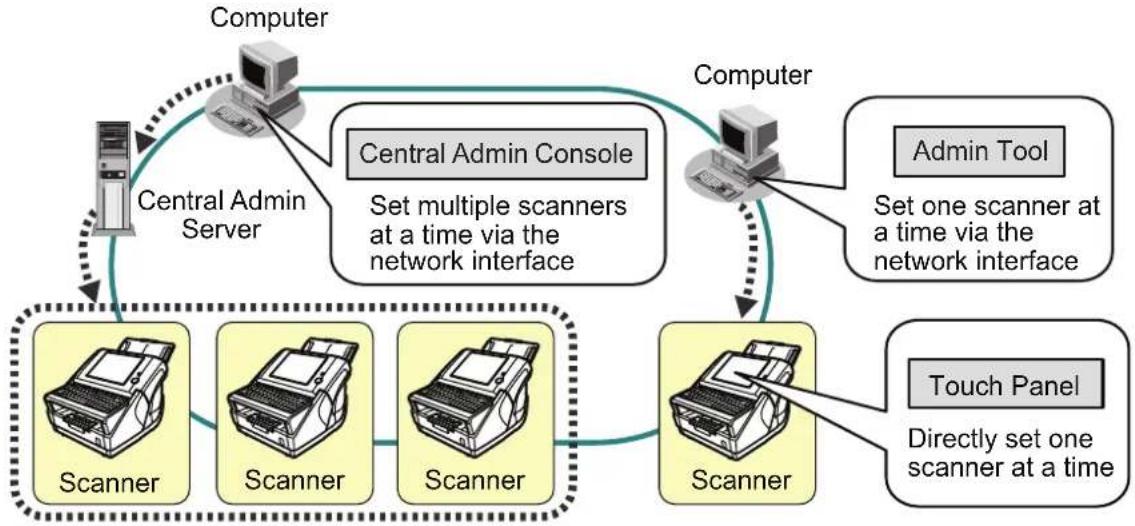
Configuration and management of the scanner can be easily performed via the touch panel, or via the fi Network Scanner Admin Tool (hereinafter referred to as Admin Tool) or the iScanner Central Admin Console (hereinafter referred to as Central Admin Console), installed on a computer.
■ Advanced security measures
The following security functions are provided for the scanner.
- Login authentication can restrict user access.
- Scans can be converted to password protected PDF files.
● Scanned data can be protected.
Since the scanner is intended to be shared by multiple users, data privacy is an important factor. The following security measures are used to protect the data against untoward access:
- Encryption While it may be temporarily stored in the scanner before being e-mailed, faxed, printed, or saved, the scanned data is always kept in an encrypted form, in order to prevent exposure of data via analysis of the disk contents.
- Scanned data deletion After the scanned data has been e-mailed, faxed, printed or saved, the temporary data is deleted. Even if an error interrupts this process, leaving some scanned data in the scanner, this will automatically be deleted at the next start up.
● Key regeneration When the user data store is cleared from the scanner, the old cipher key is deleted and a new cipher key is generated. This totally eliminates the possibility of access to any user data remaining in the freed disk space.
In addition, input of files from external media or networks is not possible.
Therefore, the scanner is protected against virus infection.
1.2 Part Names and Functions
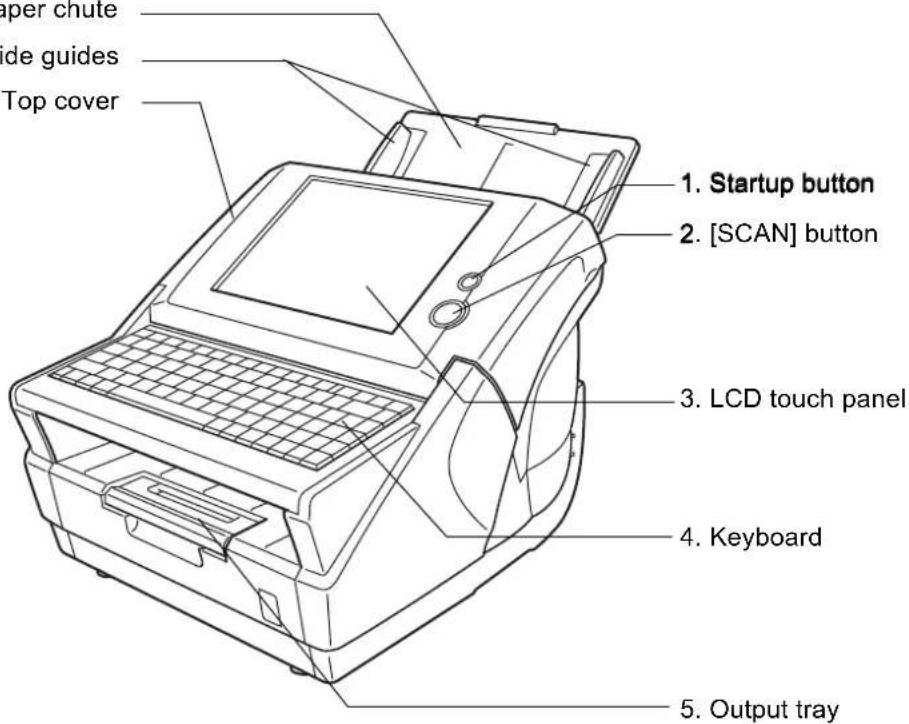
1.2.1 External Parts
- Front view
-
ADF paper chute
-
Side guides
-
Top cover
text_image
per chute de guides Top cover 1. Startup button 2. [SCAN] button 3. LCD touch panel 4. Keyboard 5. Output tray- Rear view

text_image
9. ADF release button 10. Back cover Inside the back cover 11. Security cable slot 12. AC adaptor connector 13. LAN connector| No. | Part name Function | |
| 1 | Startup button Turns on | scanner or brings up the "Login" screen from standby mode. For details, refer to "2.2.1 Using the Startup Button" (page 26). |
| 2 | [SCAN] button Starts the scan process.For details, refer to "2.2.2 Using the Top Cover [SCAN] Button" (page 27). | |
| 3 | LCD touch panel Accepts user input and displays the scanner control screens.The LCD touch panel buttons are used to setup scans. For details, refer to "2.3 Using the LCD Touch Panel" (page 28). | |
| 4 | Keyboard Used to enter text in the control screen input fields.May also be used instead of the touch panel to operate the control screens. For details, refer to "2.4 Using the Keyboard" (page 29). | |
| 5 | Output tray Scanned documents are ejected from the ADF onto this tray.Small documents may be retrieved by lifting up the keyboard after scanning has completed. | |
| 6 | ADF paper chute Holds the documents waiting to be scanned (scan side down). | |
| 7 | Side guides Adjust to the width of the paper, to prevent skewing of the scanned pages. | |
| 8 | Top cover Frames the LCD touch panel, and covers the upper scanner/ADF mechanism. Must be opened to clean inside the scanner, or when replacing consumable parts. | |
| 9 | ADF release button Push to unlock the top cover. | |
| 10 | Back cover When connecting cables, press the tabs on both sides of the back cover to unlock it, and pull it out from the scanner. | |
| 11 | Security cable slot Slot for commercially available security cable to prevent against theft.The following security cable is recommended.Type: Right angleCylindrical part: diameter 25mm (max), length 50mm (max) (includes bent part if a straight cable is used) | |
| 12 | AC adaptor connector Connects the scanner to the AC adaptor. | |
| 13 | LAN connector Connects the scanner to the network. | |
1.2.2 Internal Parts

text_image
1. Pad assy 2. Pick roller 3. Sheet guide 5. ADF Separate shaft and roller- Glass scanner windows
| No. | Part name Function | |
| 1 | Pad assy Help to guide | documents from the ADF paper chute to the glass scanner windows. |
| 2 | Pick roller | |
| 3 | Sheet guide | |
| 4 | Glass scanner windows | Place where the documents are scanned. |
| 5 | ADF (Automatic Document Feeder) | Drives the documents from the ADF paper chute, past the glass scanner windows, to the output tray. |
1.3 User Types and Operations
The scanner functions available after login vary in the following ways for different types of user:
- Administrator
Can setup and manage the scanner. The administrator can operate via the scanner's touch panel, or via the network interface by using the Admin Tool, or Central Admin Console installed in a computer. With the Central Admin Console, settings pre-defined on the Central Admin Server can be applied to multiple scanners at a time.
- Regular User
Can scan documents and then send, print, or save the resulting data.
| Top Menu Tab /Side Menu Tab | Used to ... | Administrator | Regular User | See ... | ||
| Touch Panel | Admin Tool | Central Admin | ||||
| System Settings | ||||||
| Import Scanner Settings | Import scanner settings | — | — | A | page 272 | |
| Screen Calibration | Calibrate the touch panel | A | — | — | page 56 | |
| Scanner Name Set the scanner name | A | A | — | page 59 | ||
| Language/Keyboard Board Selection | Set the language | A | A | — | page 62 | |
| Region/Timezone Set the region/timezone | A | A | A | page 63 — | ||
| Date/Time Set the date/time | A | A | A | ( | page 64 1 | |
| Standby Mode Set the standby mode and/or automatic logout | A | A | A | page 66 — | ||
| Login Settings Set the login settings | A | A | A | page 68 — | ||
| Admin Password Change the admin password | A | A | — | page 71 | ||
| File Names (Save) | Set the file name format used for when saving scanned data | A | A | A | page 72 — | |
| File Names (e-Mail) | Set the file name format used for when attaching scanned data to e-mails | A | A | A | page 76 — | |
| Multifeed Settings | Set the multifeed detection method | A | A | A | page 78 — | |
| Scanner Adjustment | Set the offset and magnification settings | A | A | — | page 81 | |
| General Scanner Settings | Set general scanner settings | A | A | A | page 83 — | |
| Certificate Management | Manage certificates | A (*2) | A | A | — | page 84 |
| Network Settings | ||||||
| IP Address Set the IP address | A | A | — | page 86 | ||
| Admin Network Set the admin network | A | A | A | ( | page 88 3 | |
| Central Admin Server | Set the Central Admin Server | A | A | A | ( | page 90 4 |
| DNS Server Set the DNS server | A | A | A | page 93 — | ||
| WINS Server Set the WINS server | A | A | A | page 95 — | ||
| NTP Server Set the NTP server | A | A | A | ( | page 96 5 | |
| Proxy Server Set the proxy server | A | A | A | page 98 — | ||
| Login LDAP Server | Set the login LDAP server | A | A | A | page 100— | |
| e-Mail LDAP Server | Set the e-Mail LDAP server | A | A | A | page 108— | |
| Customize LDAP Search | Customize the LDAP search parameters | A | A | A | page 111— | |
| SMTP Server Set the e-mail server (SMTP server) | A | A | A | page 116— | ||
| Fax Server | Set the fax server | A | A | A | page 118— | |
| Network Printer | Set the network printers | A | A | A | ( | page 119 6 |
| Network Folder | Set the network folders | A | A | A | ( | page 132 6 |
| SharePoint Folder | Set the SharePoint folders | — | A | A (*6) | — | page 145 |
| Alert Notification | Set the destination for alert notifications | A | A | A | page 149— | |
| Ping | Check the network connection with a Ping test | A | A | — | page 150 | |
| Network Status | Check the network operating status | A | A | — | page 152 | |
| Device Status | ||||||
| System Status View | the system status | A | A | A | ( | page 154 7 |
| Installed Options View | the installation status of available options | A | A | A | ( | page 155 7 |
| Usage Status View | the usage status | A | A | A | ( | page 156 7 |
| Add-in Status View | the Add-in status | A | A | A | ( | page 158 7 |
| Operation Logs | ||||||
| User Log Manage user logs | A (*8) A | — — | page 159 | |||
| System Log Manage the system log | A (*8) A | — — | page 162 | |||
| Maintenance | ||||||
| User Data Store Maintain the user data store | — | A | — | page 165- | ||
| System Settings File | Maintain the system settings | — | A | — | page 174- | |
| System Update | Update the scanner system software | — | A | A (*9) | — | page 175 |
| Add-in Manager | Install/uninstall an Add-in module | — | A | A (*9) | — | page 177 |
| Technical Support | Set the information output level | A | A | — | — | page 179 |
| Obtain technical support | — | A | — | page 180- | ||
| Job Mode Settings | ||||||
| Job Sequences | Set a job sequence | — | A | A | — | page 185 |
| Job Menus | Set a job menu | — | A | A | — | page 203 |
| Job Groups | Set a job group | — | A | A | — | page 210 |
| Send the scanned data by e-mail | — | — | — | Page 314 | ||
| Fax | Send the scanned data by fax | — | — | — | Page 330 | |
| Print the scanned data | — | — | — | Page 339 | ||
| Save | Save the scanned data to a network folder | — | — | — | Page 352 | |
| Scan to SharePoint | Save the scanned data to a SharePoint folder | — | — | — | Page 357 | |
| Scan Settings Set the scan options | — | — | — | page 3A5 | ||
| Scan Viewer Enable/disable the scan viewer | — | — | — | page 4A2 | ||
| Maintenance | ||||||
| Edit e-Mail Addresses | Edit e-mail targets in the e-mail address book | — | — | — | page 3A7 | |
| Edit Fax Numbers Edit contacts in the fax number list | — | — | — | page 3A7 | ||
| Roller Cleaning Clean the ADF | — | — | — | page 4A6 | ||
| Scan Test Perform a scan test | — | — | — | page 4A7 | ||
| Consumable Alert Indicate when parts need replacing | — | — | — | page 4A6 | ||
| User Log Check user operations | — | — | — | page 4A0 | ||
| Job Menu Process a job | — | — | — | page 4A3 | ||
A: available —: not available
(*1): The "Date/Time" input field and [Get Time] button cannot be used.
(*2): Certificates cannot be imported.
(*3): Contents of the SSL Certificate are not shown.
(*4): Address or port number cannot be set.
(*5): Synchronization not possible.
(*6): Printers, folders and SharePoint folders that can be accessed from the Central Admin Server can be set.
(*7): Operations cannot be performed from the "Edit Scanner Settings" screen, but can be viewed on the Central Admin Console "Scanner Details" window.
(*8): The [Download] button is not displayed.
(*9): Operations cannot be performed from the "Edit Scanner Settings" screen, but can be performed from the Central Admin Console "Scanner Admin Operations" window.
1.4 System Requirements
1.4.1 Requirements for Admin Tool
For use of the Admin Tool, the following requirements apply:
■ Software (English Versions)
- Operating System
● Windows XP SP2 or later - Windows Vista
- Windows 7
● Windows Server 2003 SP2 or later
● Windows Server 2008 - .NET Framework 2.0 SP1 or later, or .NET Framework 3.0 SP1 or later (*1)
- Internet Explorer 6 SP2 or later (*2)
(*1): If .NET Framework is not installed, it will be notified. Download .NET Framework from the Microsoft Web site and install it into the computer. When installing .NET Framework, check that there is enough free disk space. For .NET Framework 2.0, at least 280MB of additional free disk space is required.
(*2): Confirm that the latest security patch has been applied. If the latest patch has not been applied, downloading operations (such as manual download) may not be possible. For Windows XP, "KB933566" must be applied to Internet Explorer.
Hardware
- Any computer which runs the supported software 32MB or more of free memory space 64MB or more of free disk space
● XGA monitor or better - LAN cable
- Pointing device (e.g. mouse)
1.4.2 Requirements for Central Admin Console
For use of the Central Admin Console, the following requirements apply:
■ Software (English Versions)
- Operating System
● Windows XP SP2 or later
- Windows Vista
- Windows 7
● Windows Server 2003 SP2 or later
● Windows Server 2008
- Admin Tool
- .NET Framework 2.0 SP1 or later, or .NET Framework 3.0 SP1 or later (*1)
- Internet Explorer 6 SP2 or later (*2)
(*1): If .NET Framework is not installed, it will be notified. Download .NET Framework from the Microsoft Web site and install it into the computer. When installing .NET Framework, check that there is enough free disk space. For .NET Framework 2.0, at least 280MB of additional free disk space is required.
(*2): Confirm that the latest security patch has been applied. If not applied, problems with the screen display may arise. MS08-024 (KB947864) and subsequent security update programs are required.
Hardware
- Any computer which runs the supported software 32MB or more of free memory space 64MB or more of free disk space
● XGA monitor or better - LAN cable
- Pointing device (e.g. mouse)
1.4.3 Requirements for Central Admin Server
For use of the Central Admin Server, the following requirements apply:
■ Software (English Versions)
- Operating System
● Windows 2000 Server SP4 or later
● Windows Server 2003 SP2 or later
● Windows Server 2008 (*1)
- .NET Framework 2.0 SP1 or later, or .NET Framework 3.0 SP1 or later
- Internet Explorer 6 SP2 or later (*2)
- Internet Information Services 5.0 or later (*3)
- SQL Server 2005 Express Edition (*4)
(*1): To use HTTPS, CAPICOM must be previously installed. If CAPICOM is not installed, the self-signed certificate is not imported for communicating with HTTPS.
(*2): Confirm that the latest security patch has been applied. If the latest patch has not been applied, downloading operations (such as manual download) may not be possible.
(*3): A Web server function of Internet Information Services 5.0 or later must be installed.
(*4): If SQL Server 2005 Express Edition is not already installed, install it at the same time as the Central Admin Sever installation.
For Windows 2000 Server, Microsoft Data Access Components (MDAC) 2.8 SP1 or later, must also be installed.
Hardware
- Any computer which runs the supported software
Intel Pentium III Processor, 1GHz and above, or equally interchangeable processor
512MB or more of free memory space
700MB or more of free disk space
● XGA monitor or better - LAN cable
1.4.4 Requirements for Related Servers
For related servers, the following requirements apply:
| Server Operating System Required Function | ||
| LDAP Server Windows | 2000 Server Active Directory | |
| Windows Server 2003 | ||
| Windows Server 2008 | ||
| Solaris OpenLDAP | ||
| SMTP Server Windows | 2000 Server SMTP, Exchange | |
| Windows Server 2003 | ||
| Windows Server 2008 | ||
| File Server Windows | 2000 Server Windows Shared Folder | |
| Windows Server 2003 | ||
| Windows Server 2008 | ||
| SharePoint Server Windows | 2000 Server Windows Shared Printer ( *1 ) | |
| Windows Server 2003 | ||
| Windows Server 2008 | ||
| FTP Server Windows | 2000 Server FTP | |
| Windows Server 2003 | ||
| Windows Server 2008 | ||
| Print Server Windows | 2000 Server Windows Shared Printer ( *1 ) | |
| Windows Server 2003 | ||
| Windows Server 2008 | ||
| DNS Server Windows | 2000 Server DNS | |
| Windows Server 2003 | ||
| Windows Server 2008 | ||
| WINS Server Windows | 2000 Server WINS | |
| Windows Server 2003 | ||
| Windows Server 2008 | ||
| DHCP Server | 2000 Server DHCP | |
| Windows Server 2003 | ||
| Windows Server 2008 | ||
| Server Operating system Required Function | ||
| NTP Server Windows | 2000 Server NTP | |
| Windows Server 2003 | ||
| Windows Server 2008 | ||
| Red Hat Enterprise Linux | ||
| Fax Server Windows 2000 Server RightFax | ||
(*1): To use as network printer, Windows XP compatible printer driver must be installed.
■ LDAP Server
LDAP (Lightweight Directory Access Protocol) is a protocol for accessing a directory databases over a TCP/IP network. It can be used to administrator networked users e-mail addresses and operating environments.
When connected using encryption (SSL), this is called the "LDAPS Server".
The LDAP server can be used to perform the following:
- User authentication at login
● Finding or entering e-mail addresses in an address book
■ SMTP Server
SMTP (Simple Mail Transfer Protocol) is a protocol for sending e-mail.
The SMTP server can be used to perform the following:
- Sending the scanned data as an e-mail
- Sending the scanned data by fax
■ File Server
The file server shares the disk on a server with other computers on a network, and enables use of the disk from an external computer.
Using this file server enables a scanned image to be saved to a file server network folder.
■ SharePoint Server
SharePoint is the collective name for the elements of an Internet Explorer based document management platform provided by Microsoft.
Using a SharePoint server enables scanned images to be saved to a SharePoint folder on the SharePoint server.
■ FTP Server
The FTP (File Transfer Protocol) is a protocol for transmitting files.
An FTP server which connects with SSL encryption is called an "FTPS Server".
Using this FTP server enables a scanned image to be saved to an FTP server network folder.
■ Print Server
The print server is used to print the scanned data. Printers to be used are set on the print server.


● Windows XP compatible printer drivers must be registered.
- Printer must be able to spool print jobs (to hard disk or memory). Contact your printer dealer if uncertain whether your printer has a spool function.
- Printers that allow the status of print errors to be easily checked (via an LCD control panel, or similar) are recommended.


For printing, use only printers connected to the print server.
DNS Server
A DNS server provides name-resolution which determines IP address corresponding to host name or FQDN.
WINS Server
The WINS server handles name registration requests from WINS clients, register their names and IP addresses, and responds to NetBIOS name queries submitted by clients, returning the IP address of a queried name if it is listed in the server database.
In addition, when a DNS name resolution fails, the query can be transferred to the WINS server.
DHCP Server
The DHCP server automatically assigns an IP address for this scanner and other client computers.
■ NTP Server
The NTP server is used when a client makes a time query through network.
Fax Server
The fax server is used for sending faxes.
This scanner supports the following fax servers:
● RightFax Business Server (Version 9.3)
This fax server can be used to send the scanned data by fax.
1.4.5 Network Requirements
This section describes the required network conditions for Central Admin. For Central Admin, the following network conditions are required.
- HTTP/HTTPS communication is possible from the Central Admin Server to the scanner
- HTTP/HTTPS communication is possible from the scanner to the Central Admin Server
- HTTP/HTTPS communication is possible from the Central Admin Console to the Central Admin Server.
- Wake-On-LAN Magic Packet routing is possible from the Central Admin Server to the scanner (when Wake-On-LAN is used)


The connection between a scanner and Central Admin Server has the following limitations.
● Communication via an HTTP proxy is not supported.
● Networks where IP addresses using NAT/NAPT are not supported.
1.4.6 Scanner Requirements for iScanner Central Admin
Up to 1,000 scanners can be managed with iScanner Central Admin. If 1,000 scanners are registered on the server, no more scanners can be registered as targets for central admin. If the number of scanners exceeds 1,000, multiple Central Admin Servers will be prepared. The target scanners for each server should not exceed 1,000.
1.4.7 Port Number List
| Function From/To | Port Number | Protocol Number | |
| Admin Tool Connection | Admin Tool ⇔ Scanner | 80 (HTTP) (*1) | 6 (TCP) |
| 443 (HTTPS) (*1) 6 (TCP) | |||
| Central Admin Server Connection | Central Admin Server ⇔ Scanner | 80 (HTTP) (*1) 6 (TCP) | |
| 443 (HTTPS) (*1) 6 (TCP) | |||
| Scanner ⇔ Central Admin Server | 20444 (HTTP/HTTPS) (*1) 6 (TCP) | ||
| Central Admin Console ⇔ Central Admin Server | 10444 (HTTP/HTTPS) (*1) 6 (TCP) | ||
| Central Admin Server ⇔ LDAP server | 389 (LDAP) 6 (TCP) | ||
| 636 (LDAPS) 6 (TCP) | |||
| 3268 (Active Directory Global Catalog) | 6 (TCP) | ||
| 3269 (Active Directory Global Catalog over SSL) | 6 (TCP) | ||
| Central Admin Server ⇔ Print server | 137,138,139,445 (SMB) 6 (TCP) | 17 (UDP) | |
| Central Admin Server ⇔ File server | 137,138,139,445 (SMB) 6 (TCP) | 17 (UDP) | |
| Central Admin Server ⇔ FTP server | 20,21 (FTP) (*1) 6 (TCP) | ||
| Central Admin Server ⇔ FTPS server | 989,990 (FTPS) (*1) 6 (TCP) | ||
| Central Admin Server ⇔ SMTP server | 25 (SMTP) (*1) 6 (TCP) | ||
| Central Admin Server ⇔ Proxy server | Free 6 (TCP) | ||
| Central Admin Server SharePoint link | 30444 (HTTP/HTTPS) (*1) 6 (TCP) | ||
| DHCP Server | Scanner ⇔ DHCP server | 67 (DHCP) | 17 (UDP) |
| DNS Server | Scanner ⇔ DNS server | 53 (DNS) | 17 (UDP) |
| WINS Server | Scanner ⇔ WINS server | 1512 (WINS) | 17 (UDP) |
| Function | From/To | Port Number | Protocol Number |
| Synchronization Scanner | SNTP server 123 (SNTP) | 17 (UDP) | |
| Proxy Server Scanner Proxy server Free 6 (TCP) | |||
| Authentication/e-Mail Address Search | Scanner LDAP server 3 | 89 (LDAP) (*1) 6 (TCP) | |
| 636 (LDAPS) (*1) 6 (TCP) | |||
| 3268 (Active Directory Global Catalog) (*1) | 6 (TCP) | ||
| 3269 (Active Directory Global Catalog over SSL) (*1) | 6 (TCP) | ||
| Sending e-Mail Scanner SMTP server 25 (SMTP) (*1) 6 (TCP) | |||
| Sending Fax Scanner SMTP server 25 (SMTP) (*1) 6 (TCP) | |||
| Scanner Print server | 137,138,139,445 (SMB) | 6 (TCP)17 (UDP) | |
| SharePoint Server | Scanner SharePoint server | 80 (HTTP) (*1) | 6 (TCP) |
| 443 (HTTPS) (*1) | 6 (TCP) | ||
| FTP Server | Scanner FTP server | 20,21 (FTP) (*1) | 6 (TCP) |
| FTPS Server | Scanner FTPS server | 989,990 (FTPS) (*1) | 6 (TCP) |
| Saving to a Folder | Scanner File server | 137,138,139,445 (SMB) | 6 (TCP)17 (UDP) |
| Ping | Scanner Another computer or server | — | 1 (ICMP) |
(*1): Changing the Port Number is possible
Basic Scanner Operations
Admin
User
2.1 Turning the Power On/Off 24
2.2 Using the Scanner Buttons.... 26
2.3 Using the LCD Touch Panel.... 28
2.4 Using the Keyboard 29
2.1 Turning the Power On/Off
■ Turning the Power On

Do not move or shake the scanner when it is turned on. This can damage the rotating hard disk drive and cause data to be lost.

- Press the startup button.

text_image
Startup button→ After the system starts up, the "Login" screen appears.

After turning the power off, wait for at least 10 seconds before turning the power back on again.
■ Turning the Power Off

Do not turn off the power of the scanner off by pressing and holding down the startup button, as this may cause the scanner to operate abnormally.
- Press the [Shutdown] button on the "Login" screen.
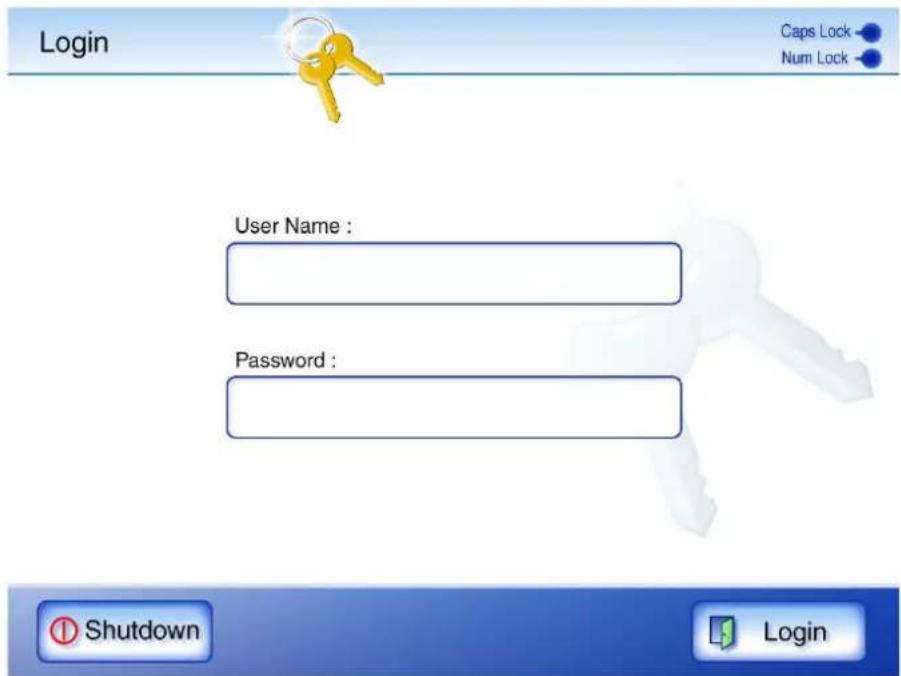
text_image
Login Caps Lock Num Lock User Name : Password : ① Shutdown LoginA confirmation screen appears.
- Press the [OK] button.
→ The scanner power is turned off.
2.2 Using the Scanner Buttons
2.2.1 Using the Startup Button
When the scanner is off or in standby mode, pressing the startup button will start the scanner up and display the login screen.
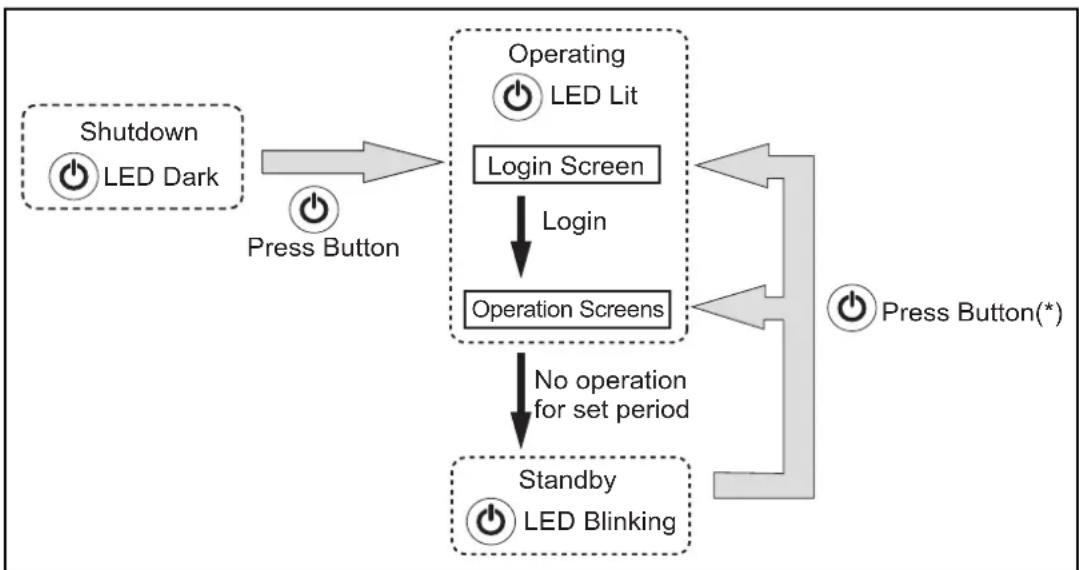
flowchart
graph TD
    A["Shutdown LED Dark"] --> B["Press Button"]
    B --> C["Operating LED Lit"]
    C --> D["Login Screen"]
    D --> E["Operation Screens"]
    E --> F["Standby LED Blinking"]
    G["Press Button()"] --> C
    G --> F
    H["No operation for set period"] --> E
* Other than pressing the startup button, any of the following operations will startup the scanner from standby mode.
- Loading the document in the ADF paper chute.
- Closing the top cover.
- Pressing a keyboard key.
The screen displayed after a re-startup varies according automatic login settings in the following way:
- If automatic login is enabled, the operation screen is displayed.
However, if "Never" is specified for "Standby after", and automatic login is disabled for the currently logged in user, the login screen is displayed.
- If automatic login is disabled, the login screen in displayed.
The idle time before standby mode entered can be changed. For details, refer to "4.6.6 Setting the Time to Standby Mode" (page 66).

When the scanner is starting up or in standby mode, be careful to never hold the startup button down for 4 seconds, as this will cause the scanner to shutdown. If this happens, saved scanned data may become unusable.
If the startup button is accidentally held down too long, causing the scanner to shutdown, temporally detach the AC adaptor to ensure that the power is completely off.
After turning the power off, wait for at least 10 seconds before turning the power back on again. To shutdown the scanner correctly, press the [Shutdown] button on the "Login" screen.

Automatic login without displaying the "Login" screen is possible. For more details about how to set automatic login, refer to "4.6.7 Setting the Login Method" (page 68).
2.2.2 Using the Top Cover [SCAN] Button
When the icon is displayed in a [Scan] button on the touch panel, either the touch panel [Scan] button or top cover [SCAN] button may be pressed to start the scan.
![FUJITSU fi-6010N - Using the Top Cover [SCAN] Button - 1](/content/2026/06/1236812/images/73abc5ef7a8422866f6302ae6e1eb82f3310949705722ee3c7117752fd196eb3.jpg)
text_image
[SCAN] button (top cover)The touch panel [Scan] button may appear as follows:
• [Scan]
- [Scan & Send]
- [Scan & Print]
- [Scan & Save]
- [Scan More]
2.3 Using the LCD Touch Panel
When using the LCD touch panel, buttons only need to be lightly pressed to select them.
For details how to operate the touch panel, refer to "4.1 Administrator Screens via the Touch Panel" (page 38) or "6.2 Using Touch Panel Screens: Regular User" (page 304).

- Do not use a pen or other hard object on the LCD touch panel. The LCD touch panel may be damaged.
- If the screen is dirty, this may cause the LCD touch panel to malfunction. Clean the screen if it is visibly dirty.
For details, refer to "7.3 Cleaning the LCD Touch Panel" (page 433).
2.4 Using the Keyboard
Selecting buttons or entering text can also be done on the keyboard.
The keyboard can be used in the following ways:
2.4.1 Using the Keyboard: Administrator
| Key Used to ... | |
| Tab Switch focus to the next field or button. | |
| Space Select | the button in focus.However, this cannot be used for the [Download], [Get CSV], and [Backup] buttons. |
| Enter Set the | contents of the current screen.(Used instead of the [OK] button or [Login] button.) |
| ↑↓ | Change the value of the numerical input for the field in focus. |
| Page Up | Scroll up or down the contents on the screen. |
| Page Down | (Used instead of the scroll buttons.) |

The keyboard cannot be used to select a top or left side menu button.
Select buttons in the top menu by pressing the touch panel, or by using the mouse via the network interface.
2.4.2 Using the Keyboard: Regular Users
| Key Used to ... | |
| Tab Switch focus to the next field or button. | |
| Space Select | the button in focus. |
| Enter Set the contents of the current screen.(Used instead of the [OK] button or [Login] button.) (On Search screens, may be used instead of the [Find] button.) | |
| Esc Return to the previous screen.(On the "Main Menu" screen, may be used instead of the [Logout] button.) | |
| Alt+F4 Shutdown the scanner.(Used instead of the [Shutdown] button on the "Login" screen.) | |
| ↑↓ Scroll up or down between items. | |
| Page Up Page Down | Scroll up or down the page on the screen. |
Administrator Operations (Overview)
Admin
User
3.1 Operating and Managing Scanners.... 32
3.2 Required Scanner Function Settings.... 33
3.1 Operating and Managing Scanners
Scanner settings management can be implemented in the following ways.
- LCD Touch Panel Scanner settings management can be implemented directly via the scanner's touch panel.
- Admin Tool Scanner settings management, and updates can be implemented via the network interface by using the Admin Tool installed on a computer. Settings can be performed for one scanner at a time.
- Central Admin Console Scanner settings management, and updates can be implemented via the network interface by using the Central Admin Console installed on a computer.
Settings can be performed for multiple scanners at a time. In this case, settings made with the Central Admin Console are applied to scanners via a Central Admin Server.

3.2 Required Scanner Function Settings
Which scanner settings are required differs according to scanner functions to be used.
The function buttons are displayed on the "Main Menu" screen, in accordance with the specified settings.

text_image
Main Menu Maintenance Consumable Alert User Log e-Mail Fax Print Save Scan to SharePoint Logout| Top Menu | ||||||
| Left Side Menu e-Mail Fax Print Save | Scan to Share Point | See ... | ||||
| System Settings | ||||||
| Import Scanner Settings | — | — | — | — | page 272 | |
| Screen Calibration | — | — | — | — | page 56 | |
| Scanner Name | N | N | N | N | page 59 | |
| Language/Keyboard Selection | — | — | — | — | page 62 | |
| Region/Timezone | A | A | A | A | page 63 | |
| Date/Time | A | A | A | A | page 64 | |
| Standby Mode | — | — | — | — | page 66 | |
| Login Settings | — | — | — | — | page 68 | |
| Admin Password | A | A | A | A | page 71 | |
| File Names (Save) | — | — | — | page 72 | ||
| File Names (e-Mail) | A | — | — | page 76 | ||
| Multifeed Settings | — | — | — | — | page 78 | |
| Scanner Adjustment | — | — | — | — | page 81 | |
| General Scanner Settings | — | — | — | — | page 83 | |
| Certificate Management | — | — | — | — | page 84 | |
| Network Settings | ||||||
| IP Address | N | N | N | N | page 86 | |
| Admin Network | — | — | — | — | page 88 | |
| Central Admin Server | — | — | — | — | page 90 | |
| DNS Server | A | A | A | A | page 93 | |
| WINS Server | A | A | A | A | page 95 | |
| NTP Server | A | A | A | A | page 96 | |
| Proxy Server | — | — | — | — | page 98 | |
| Login LDAP Server | A (*1) A | (*1) A (*1) A | (*1) A (*1) | page 100 | ||
| e-Mail LDAP Server | — | — | — | — | page 108 | |
| Customize LDAP Search | — | — | — | — | page 111 | |
| SMTP Server | N | N | — | — | page 116 | |
| Fax Server | — N — | — | — | page 118 | ||
| Network Printer | — | — | N — | page 119 | ||
| Network Folder | — | — | — | N — | ||
| SharePoint Folder | — | — | — | — | N | |
| Alert Notification | A | A | A | A | A | |
| Ping | — | — | — | — | — | |
| Network Status | — | — | — | — | page 152 | |
N: Necessary A: Advisable —: Not required
(*1): Only necessary if connecting to an LDAP server.
Administrator Operations (Touch Panel and Admin Tool) Admin
This chapter provides an explanation of administrator operations (setting up and managing the scanner) via the scanner's touch panel, or via the network interface using the Admin Tool. The same operations may also be performed via the Central Admin Console "Edit Scanner Settings" and "Job Mode Settings" screens. For more details about the Central Admin Console screens, refer to "Chapter 5 Administrator Operations (Central Admin Console)" (page 223). Messages may appear while performing operations described in this chapter. For more details about these messages and actions to take, refer to "E.1.2 System Log Messages" (page 518).
Symbols used in this chapter:
Touch Panel
: Administrator operating via the touch panel.
Admin Tool
: Administrator operating via the network interface using the Admin Tool.
Central Admin
: Administrator operating via the network interface using the Central Admin Console.
4.1 Administrator Screens via the Touch Panel.... 38
4.2 Administrator Screens via the Admin Tool 40
4.3 iScanner Administrator Login: via the Touch Panel.... 42
4.4 Setting up for Administrator Access via the Admin Tool 44
4.5 iScanner Administrator Login: via the Admin Tool 53
4.6 Using the System Settings Menus 56
4.7 Using the Network Settings Menus.... 86
4.8 Using the Device Status Menus.... 154
4.9 Using the Operation Logs Menus.... 159
4.10 Using the Maintenance Menus.... 165
4.11 Setting Job Features.... 181
4.1 Administrator Screens via the Touch Panel
On the touch panel screens (administrator), when one of the top menu tabs is selected, the related function tabs are displayed on the left side menu.
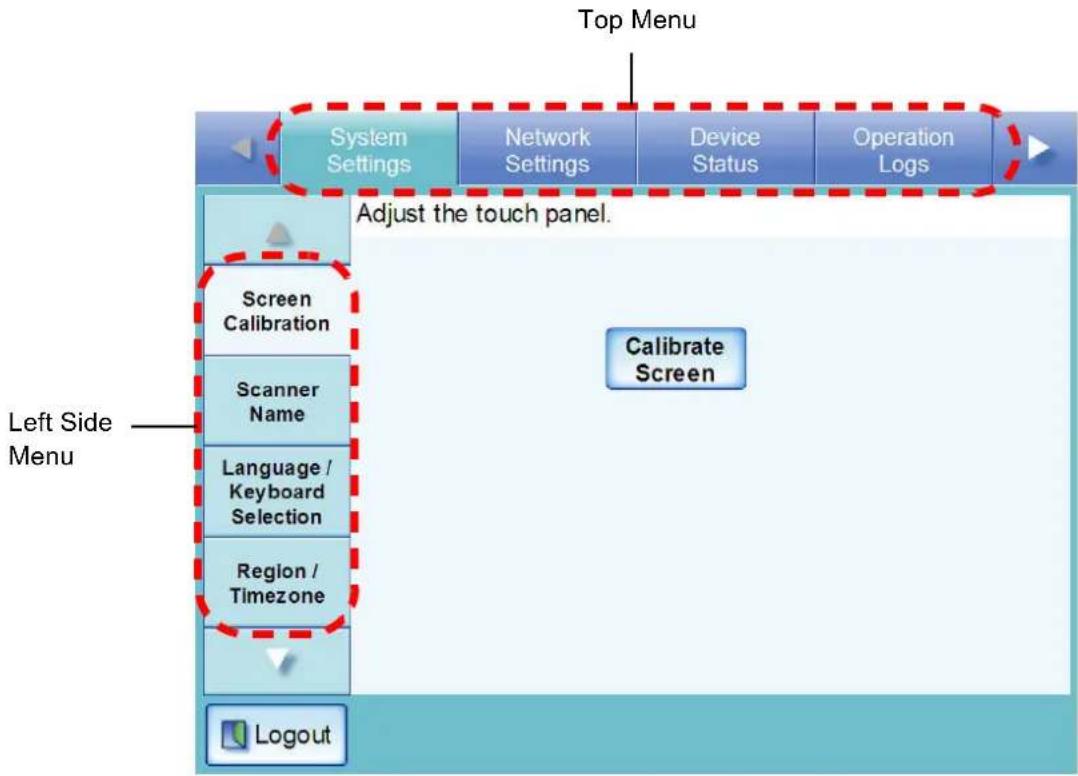
text_image
Top Menu System Settings Network Settings Device Status Operation Logs Adjust the touch panel. Screen Calibration Scanner Name Language / Keyboard Selection Region / Timezone Calibrate Screen Left Side Menu Logout| Actual icon Shown in manual as... Used to ... | ||
 | [Left] button, [Right] button Switch between top menu tabs (scrolling the top menu as necessary). | |
 | [Up] button, [Down] button Switch between side menu tabs (scrolling the left side menu as necessary). | |
 | ||
 | ||
 | [List] button Display a list of possible selections. | |
 | [Logout] button Log the current user out. | |
 | [OK] button Accept any changes to the current screen settings. | |
 | [Cancel] button Abandon any input to the current screen, and keep present settings and/or return to the previous screen. | |
 | [On] button If the button color is yellow, it means that the button is selected. | |
 | [Off] button If the button color is blue, it means that the button is not selected. | |
4.2 Administrator Screens via the Admin Tool
When using the Admin Tool to access the scanner via its network interface, pressing one of the function buttons at the top of the Admin Tool window causes the related function screen to be displayed in the window.
- When the [Scanner Settings] button is pressed
On the Admin Tool scanner settings screens, when one of the top menu tabs is selected, the related function tabs are displayed on the left side menu.
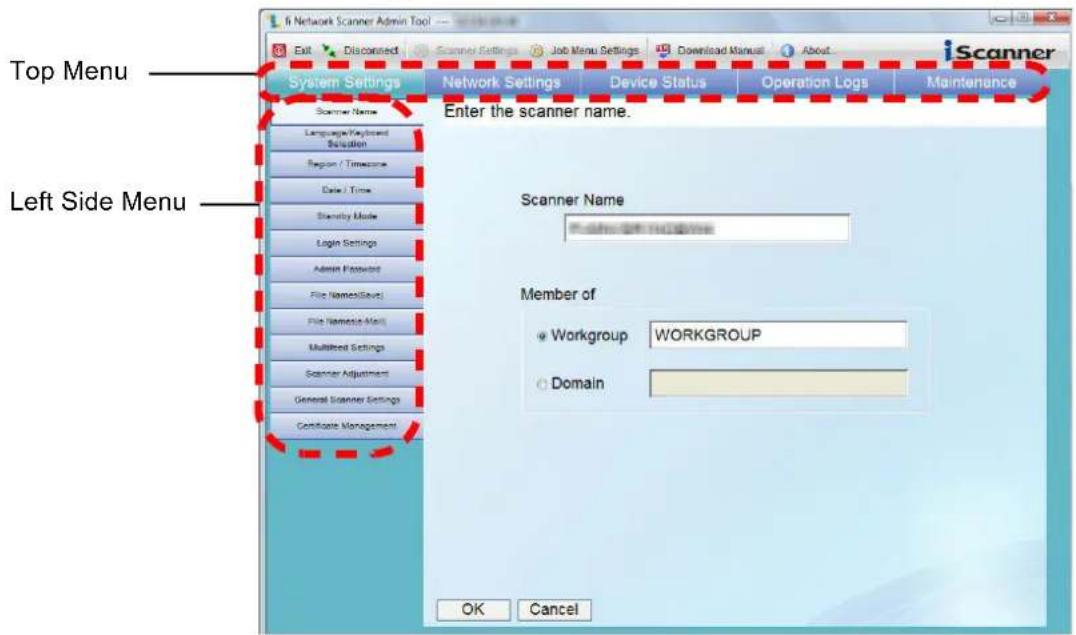
text_image
iNetwork Scanner Admin Tool Exit Disconnect Scanner Settings Job Menu Settings Download Manual About Top Menu System Settings Network Settings Device Status Operation Logs Maintenance Enter the scanner name. Scanner Name Language/Keyboard Evaluation Region / Timeframe Date / Time Slarity Mode Login Settings Admin Password File Names/Level File Names/Mail Multilined Settings Scanner Adjustment General Scanner Settings Certificate Management Member of Workgroup WORKGROUP Domain OK Cancel- When the [Job Menu Settings] button is pressed
On the Admin Tool job mode settings screens, when one of the Job Settings Menu tabs is selected, the associated settings screen is displayed.
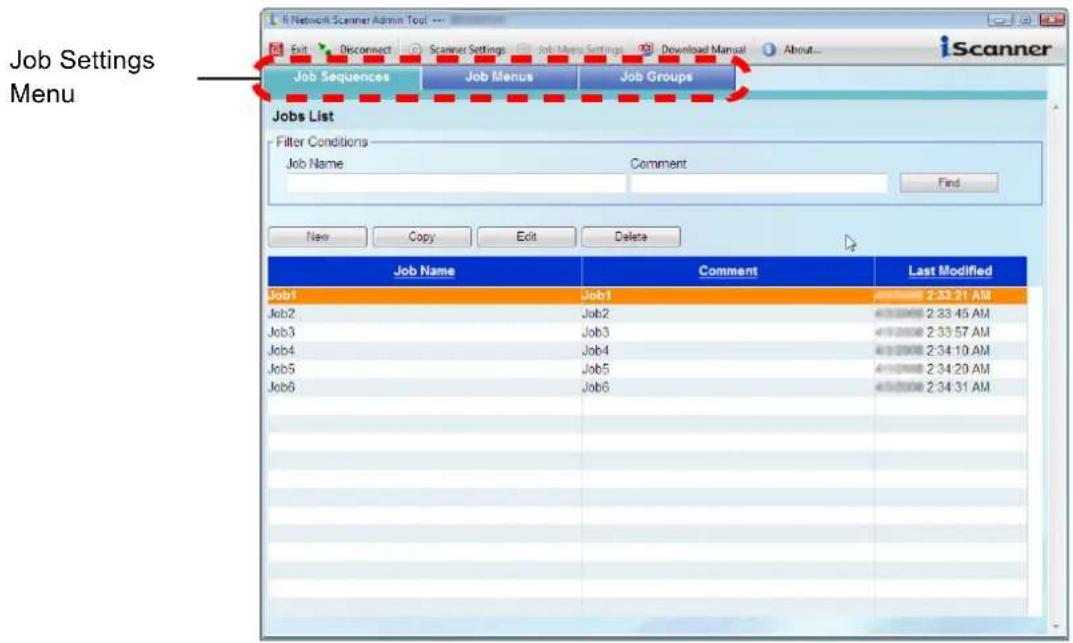
text_image
Job Settings Menu Exit Disconnect Scanner Settings Job Menu Settings Download Manual About... iScanner Job Sequences Job Menus Job Groups Jobs List Filter Conditions Job Name Comment Find New Copy Edit Delete Job Name Comment Last Modified Job1 Job1 comment 2:33:21 AM Job2 Job2 €0300€ 2:33:45 AM Job3 Job3 €0300€ 2:33:57 AM Job4 Job4 €0300€ 2:34:10 AM Job5 Job5 €0300€ 2:34:20 AM Job6 Job6 €0300€ 2:34:31 AM| Function button Shown in manual as... Used to ... | |
| [Exit] button Close the Admin Tool. | |
| [Disconnect] button Disconnect the connection to a scanner. | |
| [Scanner Settings] button Access the scanner settings top menu. | |
| [Job Menu Settings] button Access the job menu settings window. | |
| [Download Manual] button Download the manual. | |
| [About] button Show the version of the Admin Tool installed. | |
| [OK] button Accept any changes to the current screen settings. | |
| [Cancel] button Abandon any input to the current screen, and keep present settings and/or return to the previous screen. |
4.3 iScanner Administrator Login: via the Touch
Panel
Touch Panel

- If the normal screen display does not appear (for example: an "X" mark appears), wait for a few minutes and try again. If the problem still occurs, contact your FUJITSU scanner dealer or an authorized FUJITSU scanner service provider.
- If a button is rapidly pressed many times in succession, a "The page cannot be displayed" message may appear. Selecting another tab or reloading the page will refresh the screen.

- The user name and initial password for the administrator are as follows:
User Name: admin
Password: password
● The scanner setup can be configured by one user.
- Session timeout time is 20 minutes (fixed). The session timeout time is extended by a further 20 minutes for the following:
- when a tab on the top menu or left side menu is pressed
- when the [OK] button is pressed
1. Enter a "User Name" and "Password".
Enter "admin" for the user name.
Passwords must be between 7 and 127 characters long.
Alphanumeric characters (case sensitive) and symbols may be entered.
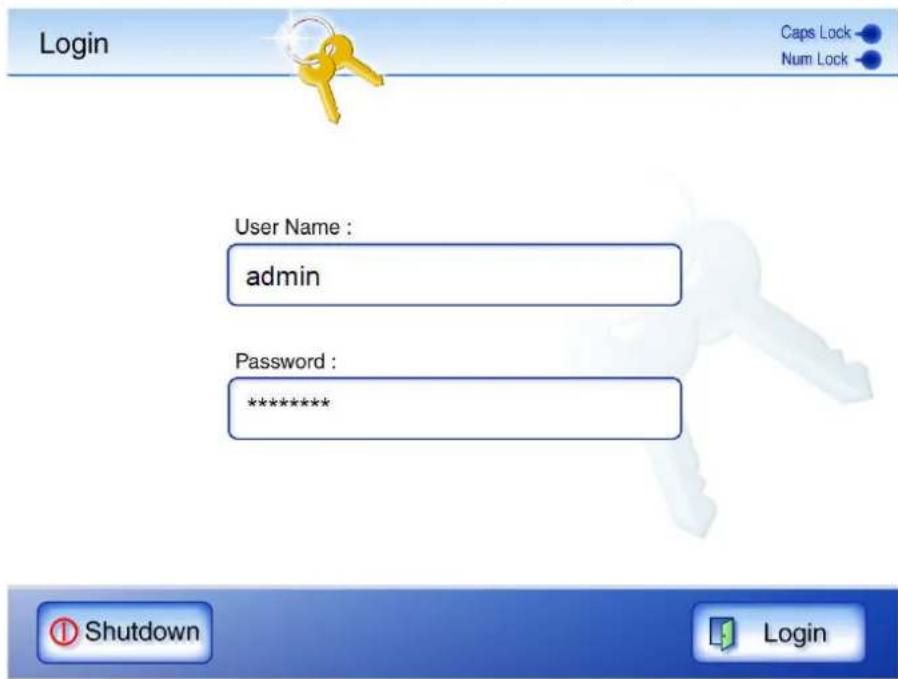
text_image
Login Caps Lock Num Lock User Name : admin Password : ******** ① Shutdown Login
text_image
The "Caps Lock" indicator is on if the keyboard's Caps Lock is set. The "Num Lock" indicator is on if the keyboard's Num Lock is set. If "Global Catalog" is selected for the login LDAP server, the "UPN Suffix" input field is displayed.A UPN suffix is not required when logging in as an administrator. Even if entered, it will be ignored.
2. Press the [Login] button.
⇒ If the user name and password are valid, the "System Settings" screen appears.
4.4 Setting up for Administrator Access via the Admin Tool
This section describes the required settings for logging in via the Admin Tool.

The following are required for administrator login via the Admin Tool:
- "4.6.2 Setting the Scanner Name" (page 59)
- "4.6.8 Changing the Admin Password" (page 71)
● "4.7.1 Giving the Scanner an IP Address" (page 86)
● "4.7.2 Setting the Admin Network" (page 88)
● "4.7.4 Setting the DNS Server" (page 93)
● "4.7.5 Setting the WINS Server" (page 95)
4.4.1 Checking the Internet Explorer Cache Settings
Check the Internet Explorer cache settings.
- From the Internet Explorer [Tools] menu, select [Internet Options].
→ The "Internet Options" dialog box appears.
- On the [General] tab, press the [Settings] button on the "Browsing history".
⇒ The "Temporary Internet Files and History Settings" dialog box appears.
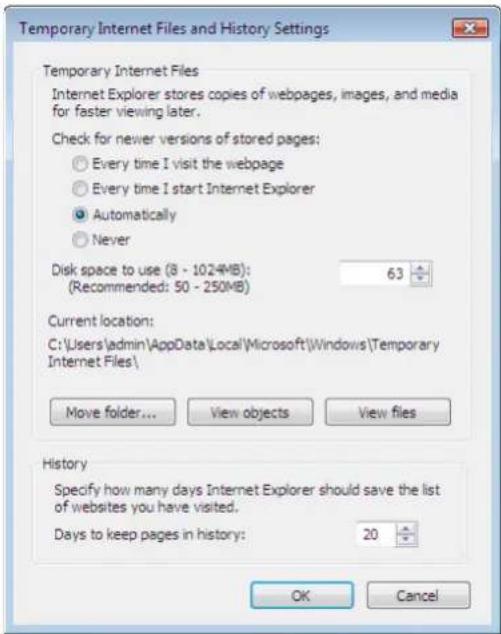
text_image
Temporary Internet Files and History Settings Temporary Internet Files Internet Explorer stores copies of webpages, images, and media for faster viewing later. Check for newer versions of stored pages: Every time I visit the webpage Every time I start Internet Explorer Automatically Never Disk space to use (8 - 1024MB): (Recommended: 50 - 250MB) 63 Current location: C:\Users\admin\AppData\Local\Microsoft\Windows\Temporary Internet Files\ Move folder... View objects View files History Specify how many days Internet Explorer should save the list of websites you have visited. Days to keep pages in history: 20 OK Cancel- For "Check for newer versions of stored pages", select "Automatically".
- For "Disk space to use", specify 63MB or above.
5. Press the [OK] button.
![FUJITSU fi-6010N - Press the [OK] button. - 1](/content/2026/06/1236812/images/01395423fc535114af84a93d4495be974a7a6b3e2d2d7367db86bfd2231ca220.jpg)
- Different browser versions may require a different set up procedure. - Do not use a proxy server setting.
![FUJITSU fi-6010N - Press the [OK] button. - 2](/content/2026/06/1236812/images/72ea9e4d70316138ce0f1e847fdd4db6e05badfdb2ba5246dadeb84cc72ea88d.jpg)
If any updates or service packs are available for Internet Explorer, make sure they are applied.
4.4.2 Setting the Internet Explorer Trusted Sites
Enter the target scanner URL as Internet Explorer trusted sites.
If not set, connection to a scanner is blocked, and certification cannot be installed.
- From the Internet Explorer [Tools] menu, select [Internet Options].
→ The "Internet Options" dialog box appears.
- On the [Security] tab, select [Trusted sites] and press the [Sites] button.
→ The "Trusted sites" dialog box appears.

text_image
Trusted sites You can add and remove websites from this zone. All websites in this zone will use the zone's security settings. Add this website to the zone: Add Websites: Remove Require server verification (https:) for all sites in this zone Close-
Clear the [Require server verification (https:) for all sites in this zone] checkbox.
-
Enter the URL of the scanner in the "Add this website to the zone" field, and press the [Add] button.
Example: http://IP_address or scanner_name/

Different browser versions may require a different set up procedure.

If any updates or service packs are available for Internet Explorer, make sure they are applied.
4.4.3 Installing the Admin Tool
To setup the scanner via the network interface, install the Admin Tool to your computer.
-
According to the settings described in "4.7.2 Setting the Admin Network" (page 88), specify the URL in the following way.
-
SSL is [Off], no port number change http://scanner_name or IP_address/
- SSL is [Off], port number change http://scanner_name or IP_address:port_number/ For port_number, enter the changed port number.
- SSL is [On], no port number change https://scanner_name or IP_address/
- SSL is [On], port number change https://scanner_name or IP_address:port_number/ For port_number, enter the changed port number.
For SSL, the "Security Alert" window is displayed when connecting.
Press the [Yes] button on the "Security Alert" window.
⇒The login screen appears.
- Enter a "User Name" and "Password".
Enter "admin" for the user name.
Passwords must be between 7 and 127 characters long.
Alphanumeric characters (case sensitive) and symbols may be entered.

text_image
Getting Started Operator's Guide User Name admin Password Login- Press the [Login] button.
→ The download screen appears.
- Press the [Next] button for the fi Network Scanner Admin Tool download.

text_image
fi Network Scanner Admin Tool Next iScanner Central Admin Server Next iScanner Central Admin Console Next Logout→ The fi Network Scanner Admin Tool download screen appears.
- Press the [Download] button.
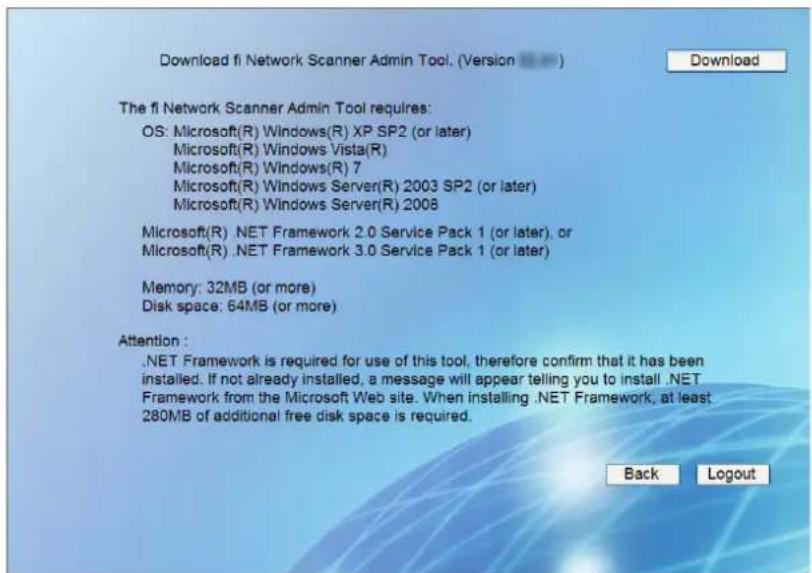
text_image
Download fi Network Scanner Admin Tool. (Version 📁) The fi Network Scanner Admin Tool requires: OS: Microsoft(R) Windows(R) XP SP2 (or later) Microsoft(R) Windows Vista(R) Microsoft(R) Windows(R) 7 Microsoft(R) Windows Server(R) 2003 SP2 (or later) Microsoft(R) Windows Server(R) 2008 Microsoft(R).NET Framework 2.0 Service Pack 1 (or later), or Microsoft(R).NET Framework 3.0 Service Pack 1 (or later) Memory: 32MB (or more) Disk space: 64MB (or more) Attention : .NET Framework is required for use of this tool, therefore confirm that it has been installed. If not already installed, a message will appear telling you to install .NET Framework from the Microsoft Web site. When installing .NET Framework, at least 280MB of additional free disk space is required. Back Logout
ATTENTION

Downloading is not possible while an administrator or user operation is being processed.
→ The "File Download - Security Warning" dialog box appears.
- Press the [Run] button.

text_image
File Download - Security Warning Do you want to run or save this file? Name: fi-AdminTool.msi Type: Windows Installer Package, MB From: Run Save Cancel While files from the Internet can be useful, this file type can potentially harm your computer. If you do not trust the source, do not run or save this software. What's the risk?→ The fi Network Scanner Admin Tool Setup Wizard appears.


Do not close the Web browser or logout until installation is complete.

If .NET Framework is not installed, the Microsoft Website is accessed when installing the Admin Tool. After installing .NET Framework, try again from Step 1.
- Press the [Next] button.

text_image
fi Network Scanner Admin Tool Welcome to the fi Network Scanner Admin Tool Setup Wizard The installer will guide you through the steps required to install fi Network Scanner Admin Tool on your computer. WARNING: This computer program is protected by copyright law and international treaties. Unauthorized duplication or distribution of this program, or any portion of it, may result in severe civil or criminal penalties, and will be prosecuted to the maximum extent possible under the law. Cancel < Back Next >→ The "Select Installation Folder" window appears.
- Specify an installation folder for the Admin Tool.
To select a different folder, press the [Browse] button.
To check the free space available for the currently selected folder, press the [Disk Cost] button.

Installation will fail if the length of any installation path (folder path plus installation file name) exceeds 259 characters. Select an installation folder that respects this limit.
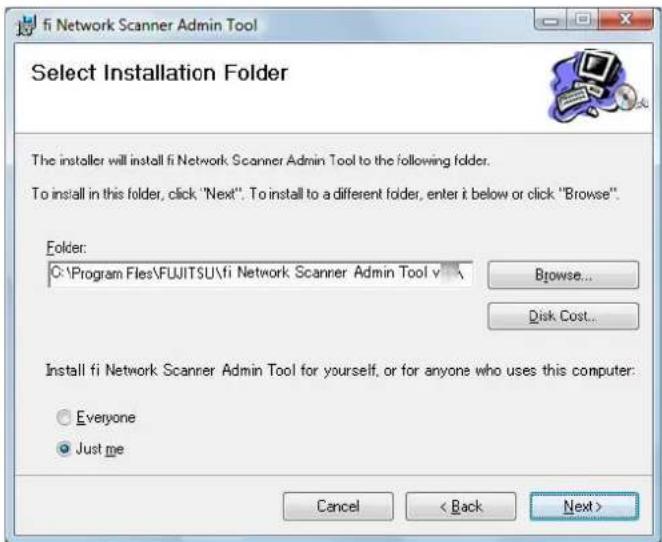
text_image
fi Network Scanner Admin Tool Select Installation Folder The installer will install fi Network Scanner Admin Tool to the following folder. To install in this folder, click "Next". To install to a different folder, enter it below or click "Browse". Folder: C:\Program Files\FUJITSU\fi Network Scanner Admin Tool v Browse... Disk Cost... Install fi Network Scanner Admin Tool for yourself, or for anyone who uses this computer: Everyone Just me Cancel < Back Next >- Select the target user(s), and press the [Next] button.

text_image
fi Network Scanner Admin Tool Select Installation Folder The installer will install fi Network Scanner Admin Tool to the following folder. To install in this folder, click "Next". To install to a different folder, enter it below or click "Browse". Folder: C:\Program Files\FUJITSU\fi Network Scanner Admin Tool v Browse... Disk Cost... Install fi Network Scanner Admin Tool for yourself, or for anyone who uses this computer: Everyone Just me Cancel < Back Next >Follow the prompts of the install wizard windows until a "fi Network Scanner Admin Tool has been successfully installed" message indicates that the installation has completed. Press the [Close] button.
When the installation is completed, logout of the scanner, and close the Web browser.
⇒ The Admin Tool should now be usable.
Select the [Start] button, select the [All Programs] - [fi-scanner V2] sub-menu, and then select on the [fi Network Scanner Admin Tool].

- If this tool has already been installed, skip to section "4.5 iScanner Administrator Login: via the Admin Tool" (page 53) for details about Admin Tool operations.
- From the Web browser [Tools] menu, select [Internet Options], and note the following points about the settings shown on the "Internet Options" dialog box.
- In the [Accessibility] dialog box shown when selecting the [Accessibility] button on the [General] tab, do not change the formatting and user style sheet settings. If these settings are changed, the displayed style of the Admin Tool may be corrupted.
- In the "Language Preference" dialog box shown when selecting the [Languages] button on the [General] tab, move the same language as for the Central Admin Server operation system to the top. If a different language is specified, a problem may occur with the input or displays for the Admin Tool.
- On the [Security] tab, if "Security level for this zone" is set to "High", part of the Admin Tool screen may not be correctly displayed. In this case, on the [Security] tab, add the scanner or Central Admin Server to the trusted site zone and select the [Default Level] button. Or select the [Custom Level] button and set [Binary and script behaviors] to "Enable".
- When the font size is large, part of the dialog box may not be shown correctly. In this case, use a smaller font size.
4.4.4 Uninstalling the Admin Tool
This description uses Windows Vista as an example.
Uninstall the Admin Tool from [Control Panel] - [Programs] - [Programs and Features] in the computer in which it is installed.

Close the Admin Tool before uninstalling. If the Admin Tool is uninstalled while still open, normal operation of the open Admin Tool is not guaranteed.
4.5 iScanner Administrator Login: via the Admin Tool
Admin Tool
The Admin Tool can be set up to manage the scanner via a computer.
This section explains how to login using the Admin Tool.

- If the normal screen display does not appear (for example: an "X" mark appears), wait for a few minutes and try again. If the problem still occurs, contact your FUJITSU scanner dealer or an authorized FUJITSU scanner service provider.
- If a button is rapidly pressed many times in succession, a "The page cannot be displayed" message may appear. Selecting another tab or reloading the page will refresh the screen.

- For details about setting up to manage the scanner via a computer, refer to "1.4.1 Requirements for Admin Tool" (page 12).
- The user name and initial password for the administrator are as follows:
User Name: admin
Password: password
● The scanner setup can be configured by one user. -
Session timeout time is 20 minutes (fixed). The session timeout time is extended by a further 20 minutes for the following:
-
when a tab on the top menu or left side menu is pressed
-
when the [OK] button is pressed
-
From the [Start] menu, point to [All Programs]-[fi-scanner V2], and then select [fi Network Scanner Admin Tool].
→ The Admin Tool is started.
- Specify the "Connect to" (of the scanner).
Enter the IP address, scanner name, or FQDN for the scanner to be setup or managed.
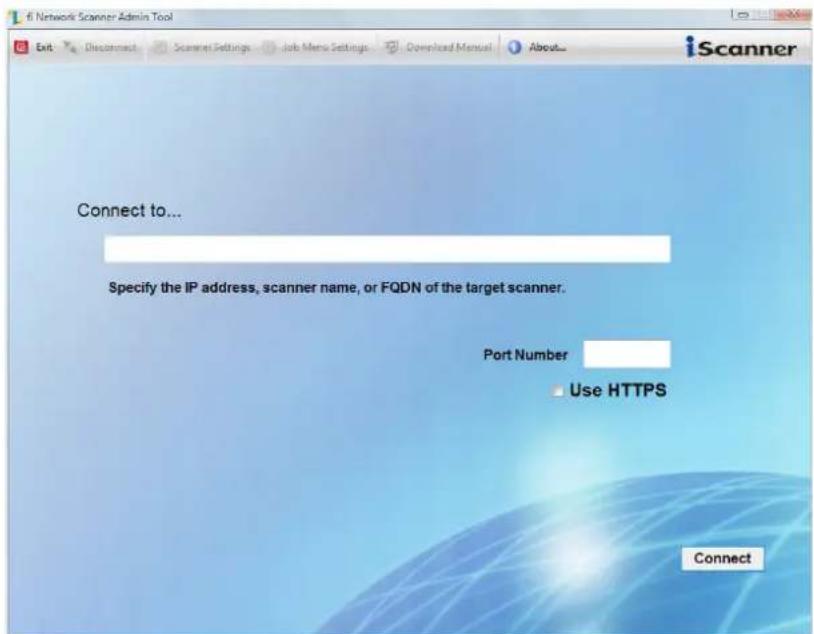
text_image
Connect to... Specify the IP address, scanner name, or FQDN of the target scanner. Port Number Use HTTPS Connect
- If the port number was changed in "4.7.2 Setting the Admin Network" (page 88), enter the port number changed for Port Number.
- When trying to connect with a port number other than the specified number, it will take up to 20 seconds before a connection error occurs.
● To use SSL, select the [Use HTTPS] checkbox. -
If the Admin Tool is started while there is insufficient free memory, a script error may occur. Try again after ensuring that there is enough free memory.
-
Press the [Connect] button.
→ The login screen appears.
4. Enter a "User Name" and "Password".
Enter "admin" for the user name.
Passwords must be between 7 and 127 characters long.
Alphanumeric characters (case sensitive) and symbols may be entered.
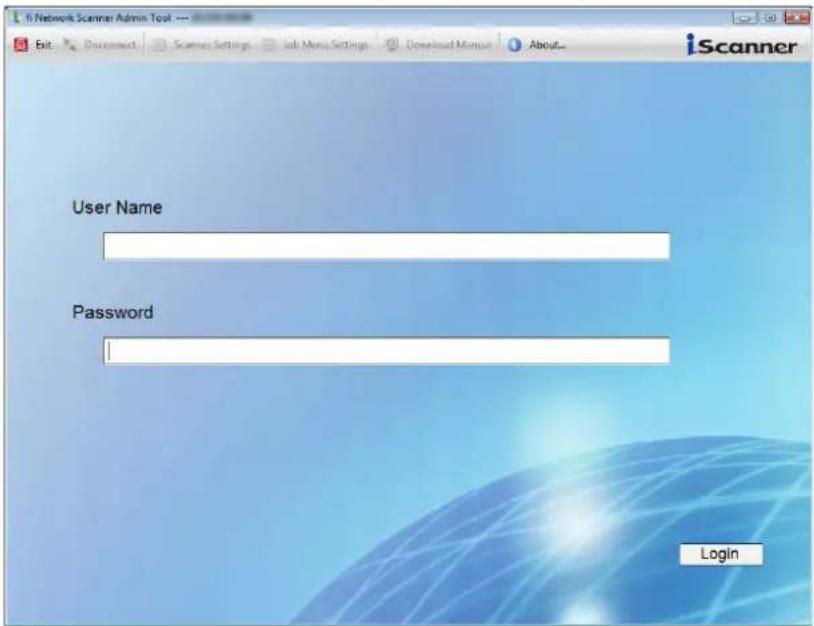
text_image
iNetwork Scanner Admin.10 User Name Password Login5. Press the [Login] button.
If the user name and password are valid, the "System Settings" screen appears.
4.6 Using the System Settings Menus
4.6.1 Calibrating the Touch Panel

This should be done when the touch panel responses seem out of alignment with the positions of objects on the LCD screen.
- Select the [System Settings] tab on the top menu.
- Select the [Screen Calibration] tab on the left side menu.
→ The "Screen Calibration" screen appears.
- Press the [Calibrate Screen] button.
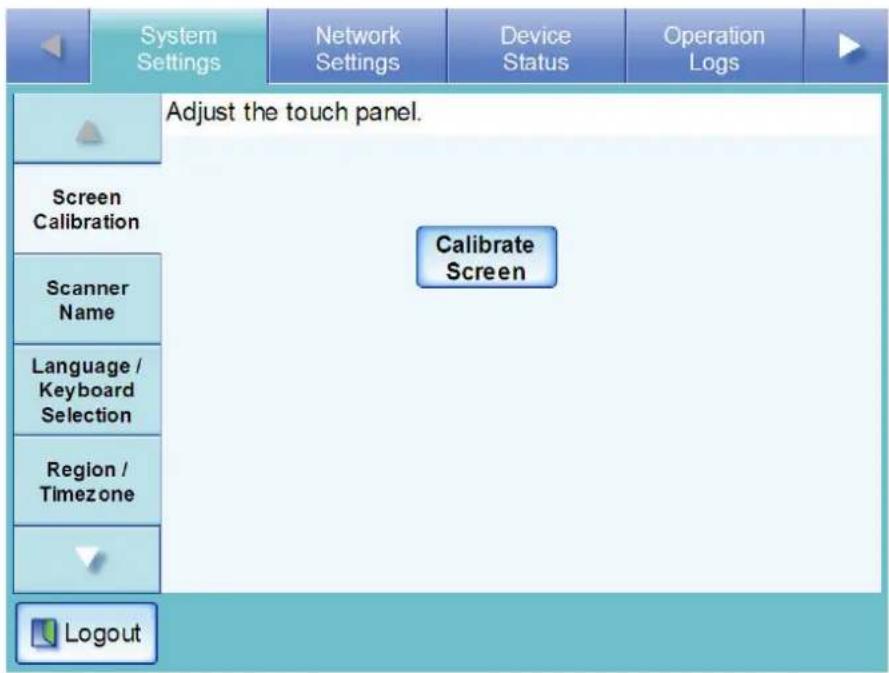
text_image
System Settings Network Settings Device Status Operation Logs Adjust the touch panel. Screen Calibration Calibrate Screen Scanner Name Language / Keyboard Selection Region / Timezone LogoutA blank calibration screen appears, with a red "+" (adjustment mark) in the top-left corner.
- Touch the "+" with your fingertip.
After being touched, the "+" will move to the next calibration position. Each time it stops, touch it again.
Please touch the point in the screen.
[Home]:Test Screen [Arrow Keys]:Move red '+' mark [Esc]:Cancel [Enter]:Next Screen

The keyboard may also be used on the calibration screen:
- Press the [Home] key to jump straight to the post-calibration test screen.
- Use the [] [][][] to move the "+" to a different calibration point. This allows a bad touch to be redone.
- Press the [Esc] key to stop the calibration process and return to the "Screen Calibration" screen.
- Press the [Enter] key to close the error dialog. (Not normally needed.)
Repeat until the test screen appears, with the following "Calibration" dialog box:

text_image
Calibration Calib screen Cursor on/off CLR screen Update- Trace a line on the screen with your fingertip.
A corresponding line will appear on-screen.
If the line does not appear correctly, press the [Calib screen] button to return to Step 4. If the screen becomes cluttered, press the [CLR screen] button to remove all the lines. The [Cursor on/off] button cannot be used.
- When you are satisfied with the touch screen response, press the [Update] button.
This saves the current calibration data, completing the calibration process, and returns you to the "Screen Calibration" screen.

If the calibration is not performed carefully, or the [Enter] key is pressed before all the calibration points have been touched, the following error message may appear:
Parameter Error. Please input, again Press the [Enter] key to dismiss the error dialog, and perform the calibration from Step 4 again, being careful to touch each calibration point accurately.
4.6.2 Setting the Scanner Name

A scanner name may be set to provide a network alias for the device.

text_image
Do not use a name already being used in the network. Name duplication will cause a network connection error. For more details about how to deal with such errors, refer to "E.1.1 Administrator Screen Messages" (page 505).- Select the [System Settings] tab on the top menu.
- Select the [Scanner Name] tab on the left side menu.
⇒ The "Scanner Name" screen appears.
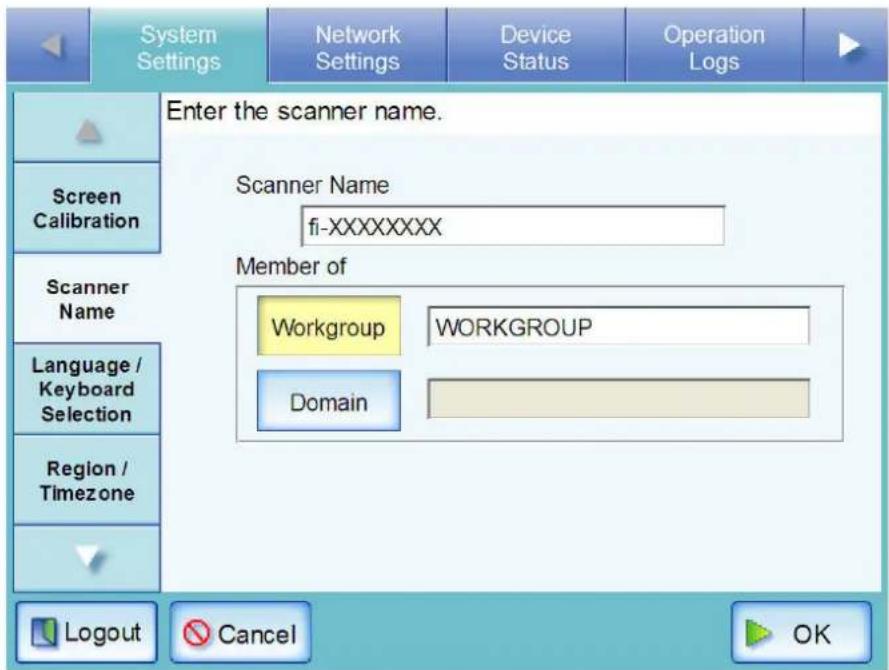
text_image
System Settings Network Settings Device Status Operation Logs Enter the scanner name. Scanner Name fi-XXXXXXXXX Member of Workgroup WORKGROUP Domain Language / Keyboard Selection Region / Timezone Logout Cancel OK- Enter a Scanner Name.
Scanner names may be up to 15 characters long.
Alphanumeric characters (case sensitive) and hyphens may be entered.
Scanner names cannot consist of numerical characters only.
A hyphen cannot be used as the first character of a scanner name.
-
Specify the scanner as a workgroup or domain member.
-
For a workgroup
Press the [Workgroup] button, and enter a workgroup name.
Workgroup names may be up to 15 characters long.
The default name is "WORKGROUP".
- For a domain
Press the [Domain] button and enter a domain name.
Domain names may be up to 155 characters long.
- Press the [OK] button.
→ The restart confirmation screen appears.

In the following case, the authentication screen appears.
- When specifying the scanner as a domain member
- When changing the name of a scanner that is a member of a domain
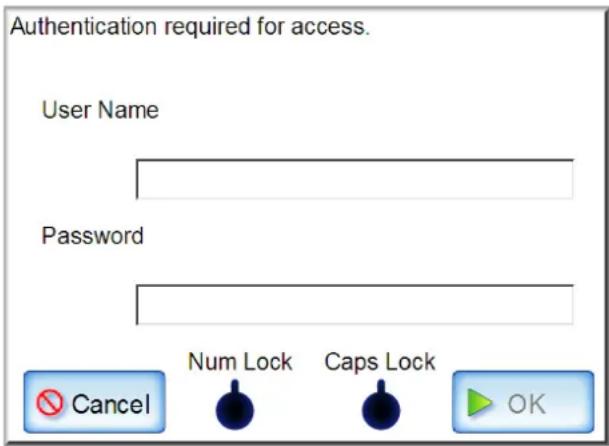
text_image
Authentication required for access. User Name Password Cancel Num Lock Caps Lock OK- Enter a user name.
User names may be up to 256 characters long. Check the required authentication information when adding to a domain, and enter a user name which can be added to the domain.
- Enter a password.
Passwords may be up to 256 characters long (case sensitive).
- Press the [OK] button.
If the user name and password are valid, the restart confirmation screen appears.
6. Press the [Now] button.
→ The system is restarted.
![FUJITSU fi-6010N - Press the [Now] button. - 1](/content/2026/06/1236812/images/2dfca76290a4d572c212767e5f89b689e0aa0680b342c3d8d26ce82f0e17bfad.jpg)
- If the new scanner name is the same as another device name already in use on the network, communication problems will occur. In this case, try the following steps:
- Disconnect the LAN cable, and press the [Shutdown] button on the touch panel to turn the scanner off.
- Reboot the scanner with the LAN cable disconnected, and enter a non-duplicate scanner name.
- Reboot the scanner again.
- Re-connect the LAN cable to the scanner.
- The connection will be lost if the scanner name is changed via the network interface. To continue with other settings, wait a short time for the device to restart, then login to the network interface again.
4.6.3 Setting the Language

- Select the [System Settings] tab on the top menu.
- Select the [Language/Keyboard Selection] tab on the left side menu.
⇒ The "Language/Keyboard Selection" screen appears.
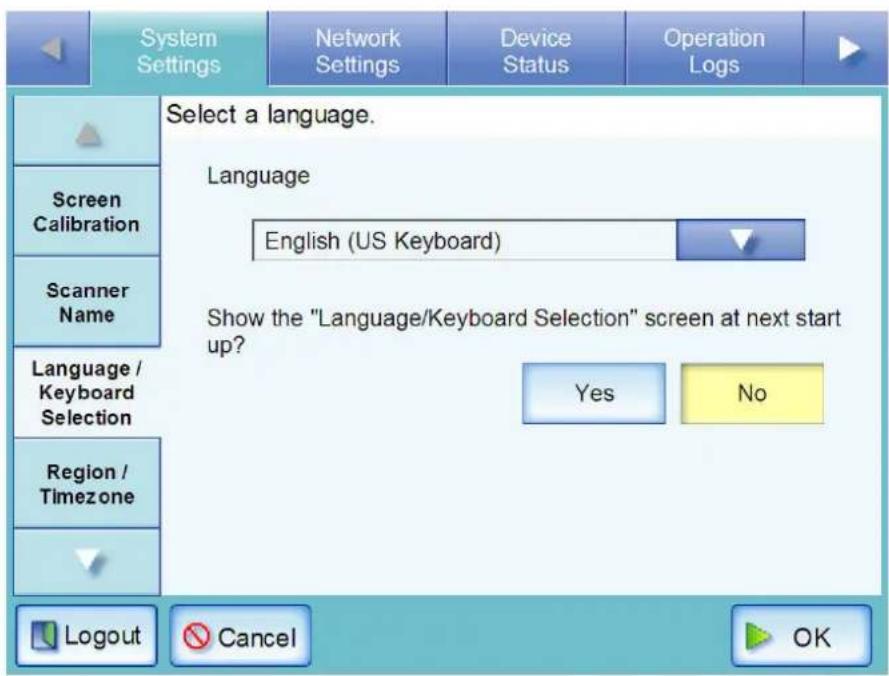
text_image
System Settings Network Settings Device Status Operation Logs Select a language. Language English (US Keyboard) Show the "Language/Keyboard Selection" screen at next start up? Yes No Screen Calibration Scanner Name Language / Keyboard Selection Region / Timezone Logout Cancel OK
You can select whether or not to display this screen again at the next scanner startup. To display the screen again, for "Show the "Language/Keyboard Selection" screen at next start up?", press the [Yes] button. To not display this screen at next start up, press the [No] button.
- Press the [List] button for the "Language" input field.
A list of languages appears.
- Select a language.
Select the desired language for the operating environment.
→ This returns to the "Language/Keyboard Selection" screen.
- Press the [OK] button.
A language setting confirmation message appears in the selected language.
- Press the [OK] button.
→ The system is restarted.
4.6.4 Setting the Region/Timezone

- Select the [System Settings] tab on the top menu.
- Select the [Region/Timezone] tab on the left side menu.
→ The "Region/Timezone" screen appears.

text_image
System Settings Network Settings Device Status Operation Logs Select a region/timezone. Timezone (GMT+09:00) Osaka, Sapporo, Tokyo Scanner Name Language / Keyboard Selection Region / Timezone Logout Cancel OK- Press the [List] button for the "Timezone" input field.
The default timezone is "(GMT+09:00) Osaka, Sapporo, Tokyo".
A list of timezones appears.
- Select a timezone.
- Select whether "Daylight Savings Time" should be on or off.
This option is not shown for timezones where daylight savings time is not used.
- Press the [OK] button.
→ The Region/Timezone is set.
4.6.5 Setting the Date/Time

- Select the [System Settings] tab on the top menu.
- Select the [Date/Time] tab on the left side menu.
⇒ The "Date/Time" screen appears, with the date/time of the screen display shown in [Date/Time].
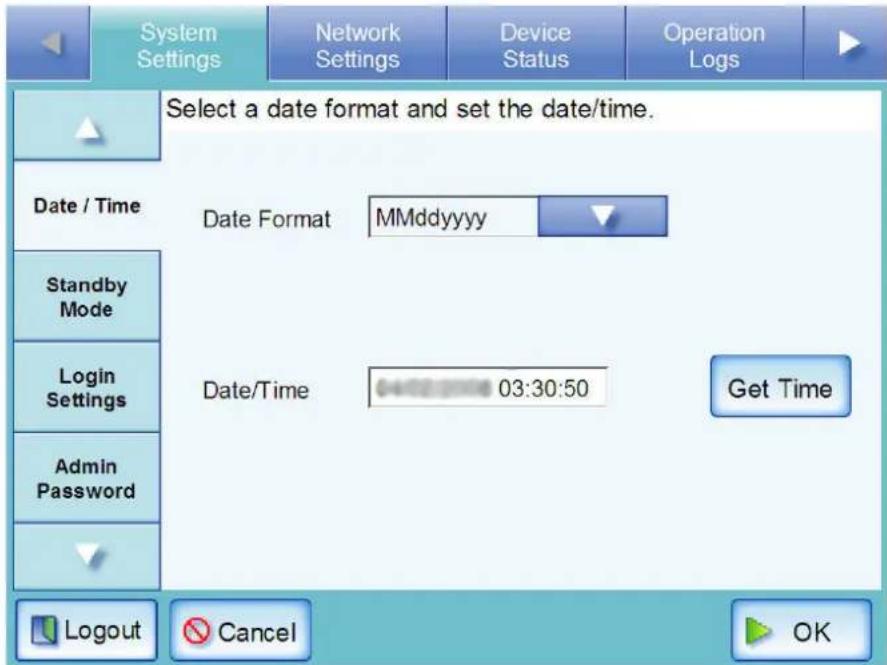
text_image
System Settings Network Settings Device Status Operation Logs Select a date format and set the date/time. Date / Time Date Format MMddyyyy Standby Mode Login Settings Date/Time 03:30:50 Get Time Admin Password Logout Cancel OKFor Central Admin Console, the "Date/Time" input field and [Get Time] button cannot be used.
- Press the Date Format [List] button.
A date format list appears.
- Select a date format.
This date format is applied to the date/time when it is used to name scan data files and the date shown on screens.
- Enter the current date and time in the "Date/Time" input field.
The date and time shown are those current for when the "Date/Time" tab on the left side menu was selected.
The date/time range that may be entered is from "April 1st 2008, 00:00:00" to "December 31st 2037, 23:59:59".
When entering a one digit number for date and time, such as for January, prepend "0" and enter "01" in the input field.
6. Press the [OK] button.
The date and time are set.
![FUJITSU fi-6010N - Press the [OK] button. - 1](/content/2026/06/1236812/images/bec3dd3a33a5c0643f0b6e61efea7c6837c487e92d0e9edfd3b10e4e49681891.jpg)
- Pressing the [Get Time] button refreshes the current value of the internal system date/time.
- An adjustment that advances the system time by 20 minutes or more results in a session timeout and causes the scanner to logout. However, the specified time adjustment will be made.
4.6.6 Setting the Time to Standby Mode

The scanner can be set to automatically log out and then enter a standby state after specified periods of non-use.
For any screen after regular user login, if no operations have been performed for the specified "Logout after" period of time, the scanner automatically logs the user out.

The scanner will not logout while the following operations are ongoing:
- Scanning documents
- e-Mailing a scan
- Faxing a scan
- Printing a scan
- Saving a scan
When logged in as a regular user, if no operations are performed for the specified "Standby after" period of time, the scanner enters standby mode. The touch panel is switched off when the scanner enters standby mode.
When the startup button is pressed, the scanners will startup from standby mode.
The screen displayed after a re-startup varies according automatic login settings in the following way:
- If automatic login is enabled, the operation screen is displayed.
However, if "Never" is specified for "Standby after", and automatic login is disabled for the currently logged in user, the login screen is displayed. - If automatic login is disabled, the login screen in displayed.
For screen transmissions, refer to "2.2.1 Using the Startup Button" (page 26).
- Select the [System Settings] tab on the top menu.
- Select the [Standby Mode] tab on the left side menu.
⇒ The "Standby Mode" screen appears.

text_image
System Settings Network Settings Device Status Operation Logs Set the standby and logout wait times. Date / Time Logout after 5 min Standby Mode Login Settings Admin Password Standby after 15 min Logout Cancel OK- Press the [List] button for the "Logout after" input field.
A list of "Logout after" times appears.
- Select the desired time before automatic log out.
The default time is "5min".
- Press the [List] button for the "Standby after" input field.
A list of "Standby after" times appears.
- Select the desired time before standby mode.
The default time is "15min".


If the [Never] button is selected for "Logout after", the selected time for "Standby after" is used as the wait time before switching to standby mode.
If a button other than [Never] is selected, set a "Standby after" time that is longer than the "Logout after" time.

- Press the [OK] button.
→ The scanner is set to first standby and then automatically log out after the specified times.
4.6.7 Setting the Login Method

The login settings are as follows.
● Automatic login settings
Set the scanner to automatically login without displaying the "Login" screen, when the scanner power is switched on or restarted.
For automatic login, the user name and password specified in the "Login Settings" screen is used. However, if the scanner automatically logs out, or the [Logout] button is pressed, the "Login" screen is displayed.
- guest account validity
Set whether or not to enable login with the guest account.
-
Select the [System Settings] tab on the top menu.
-
Select the [Login Settings] tab on the left side menu.
→ The "Login Settings" screen appears.

text_image
System Settings Network Settings Device Status Operation Logs Enter the user login settings. Date / Time Standby Mode Login Settings Admin Password Auto Login On Off User Name Password Num Lock Caps Lock Guest Account On Off Logout Cancel OK- Select whether or not to enable automatic login.
The default setting is [Off].
Select the [On] button to enable automatic login.
Select the [Off] button to disable automatic login.

- The automatic login setting is applied after the scanner is restarted or resumed from standby mode.
- If Central Admin is enabled in a scanner for which automatic login is enabled, when the scanner is started or resumed from standby mode, preference is given to checking for available scanner settings, add-in installs and system settings in the Central Admin Server, over automatic login. If scanner settings, add-in installs or system settings are available, they are applied to the scanner. However, if the number of scanners connecting to the Central Admin Server exceeds the maximum number possible, the processes is skipped, and automatic login is performed. Updates will be applied when a scanner is logged out, or when next started or resumed from standby mode.
4. Enter a user name and password.
User name and password can only be set if the [On] button was selected in Step 3.
| Field Name Description | |
| User Name User names may be up to 64 characters long.All alphanumerics (case sensitive) and some symbols are allowed.User names may not start with a "@" or ".".The following symbols cannot be used:/[ ] : ; |= , + * ? <> " | |
| Password | Passwords may be up to 256 characters long, and all alphanumerics (case sensitive) and symbols are allowed. |

Even if the system environment allows the use of other characters in an LDAP password, only those specified above may be used in an automatic login password.
The scanner follows the Active Directory user name format when authenticating the user login.
- When the "Server Type" of the LDAP server is "Active Directory" or "Active Directory Global Catalog"
| User Name Format Authentication Process | |
| SAM Account Name Does not contain a "@" | Authenticate the user login name (sAMAccountName).Example: user |
| User Principal Name Contains a "@" | Authenticate the user login name (userPrincipalName).Example: user@example.com |
- When the "Server Type" of the LDAP server is "Other LDAP Server"
| User Name Format Authentication Process | |
| uid Authenticate the user login name (uid).Example: user | |
| cn Authenticate the user login name (cn).Example: user |

- When an administrator is logging in via the scanner's touch panel, [Caps Lock] or [Num Lock] is displayed. The "Caps Lock" indicator is on if the keyboard's Caps Lock is set. The "Num Lock" indicator is on if the keyboard's Num Lock is set.
- If a UPN suffix is entered for a user name for automatic login, it is ignored.
- Select whether or not logging with the guest account is possible.
The default setting is [On].
Select the [On] button to enable login with the guest account.
Select the [Off] button to disable login with the guest account.
- Press the [OK] button.
→ The selected contents are set.
4.6.8 Changing the Admin Password


Login is not possible without a password.
If a password has been lost or forgotten, contact your FUJITSU scanner dealer or an authorized FUJITSU scanner service provider. This may incur a cost to reset the scanner.
- Select the [System Settings] tab on the top menu.
- Select the [Admin Password] tab on the left side menu.
→ The "Admin Password" screen appears.

text_image
System Settings Network Settings Device Status Operation Logs Date / Time Standby Mode Login Settings Admin Password Change the administrator password. If the password is lost you will not be able to login. Keep a record of the new password in a safe location. Current Password New Password Confirm New Password Num Lock Caps Lock Logout Cancel OK- Enter the "Current Password", "New Password", and "Confirm New Password".
A password may be between 7 and 127 characters long. Alphanumeric characters (case sensitive) and symbols may be entered.

The "Caps Lock" and "Num Lock" indicators are shown when the administrator logs in via the scanner's touch panel.
The "Caps Lock" indicator is on if the keyboard's Caps Lock is set.
The "Num Lock" indicator is on if the keyboard's Num Lock is set.
- Press the [OK] button.
→ The new admin password is set.
4.6.9 Setting a File Name Format for When Saving Scanned Data

Set a file name format when saving scanned data in a folder.
The "Save as" entered on the "Save" or "Scan to SharePoint" screen is displayed as the default value for this setting.

The following file names cannot be used:
CON
PRN
- AUX
- CLOCK\$
NUL
- COM0 to COM9
- LPT0 to LPT9
- Select the [System Settings] tab on the top menu.
- Select the [File Names (Save)] tab on the left side menu.
⇒ The "File Names (Save)" screen appears.

text_image
System Settings Network Settings Device Status Operation Logs Specify the file name format used when saving scan data. Preview [Scanner Name]MMddyyyyhhmmss001 File Names (Save) Sub-Folder Scanner Name User Name Date File Names (e-Mail) Name Format Prefix Scanner Name User Name Date Time Seq. Number Min 3 digit Seq. Number Multifeed Settings Scanner Adjustment Date Format MMddyyyy Delimiter None Logout Cancel OK-
If desired, set a sub-folder in which to save the scanned data.
-
If none of the Sub-Folder buttons is selected, the scanned data will be saved in the designated network or SharePoint folder.
-
If a Sub-Folder button is selected, the scanned data will be saved in a sub-folder of the network folder or SharePoint folder, with this sub-folder being created if it does not already exist.
-
If the [Scanner Name] button is selected
The sub-folder will be named after the scanner used for the scan.
- If the [User Name] button is selected
The sub-folder will be named after the user who is logged in when the scan is performed.
- If the [Date] button is selected
The sub-folder will be named after the date of the scan, using the naming format selected in the Date Format list.

If multiple buttons are selected, folder names are created in the following order.
- Scanner Name
- User Name
Date
Select the Delimiter [List] button to change the delimiter.
For example, for scanner name "Scanner", user name "user", date "12312009", delimiterward", the folder name is "Scanner_user_12312009".
4. Select a file name format.
By default, "Scanner Name" + "Date" + "Time" + "3 digit Seq. Number" is entered.
- If the [Prefix] button is selected
The character string entered in the input field is used as the file name.
This may be up to 128 characters long, excluding the following symbols.
For "Scan to SharePoint", the following symbols cannot be used.
$$ \backslash : *? ^ {\prime \prime} < > | $$
$$ \sim # \% \& *: < >? {\mid } $$
- If the [Scanner Name] button is selected
The scanner name is used as the file name.
- If the [User Name] button is selected
The name of the currently logged in user is used as the file name.
- If the [Date] button is selected
The date of the scan is used as the file name. Select the Date Format [List] button to change the date format.
- If the [Time] button is selected
The start time of the scan is used as the file name.

If multiple buttons are selected, file names are created in the following order.
- Prefix
- Scanner Name
- User Name
Date - Time
Select the Delimiter [List] button to change the delimiter.
For example, for prefix "file", scanner name "Scanner", user name "user", date "12312009", time "12:00:30", delimiterward", the file name is "file_Scanner_user_12312009_120030".
- Press the Seq. Number [List] button.
→ The sequence number list appears.
- Select a sequence number.
The sequence number is added to the end of a file name.
The default value is "Min 3 digit Seq. Number".
If "No Sequence Number" is selected, a sequence number is not added.

If the file name which exceeds the maximum sequence number possible already exists in the target folder for saving, the sequence numbers are not added correctly.

The following explains the way in which sequence numbers are added.
- Sequence numbers start from 1, and file names are assigned using the largest value that exists. For example, if "A" is entered in the "Prefix" input filed, "Min 3 digit Seq. Number" is selected for the Seq. Number [List] button, and "A001.pdf", "A002.pdf", and "A004.pdf" already exist, subsequent file names are assigned in the following order.
"A005.pdf", "A006.pdf", "A007.pdf", "A008.pdf"...
File name "A003.pdf" is skipped.
- If the selected number of columns for the Seq. Number [List] button is exceeded, subsequent file names are assigned using the next digit. For example, if "A" is entered in the "Prefix" input filed, "Min 3 digit Seq. Number" is selected for the Seq. Number [List] button, and "A001.pdf" to "A998.pdf" already exist, subsequent file names are assigned in the following order. "A999.pdf", "A1000.pdf", "A1001.pdf", "A1002.pdf"...
- The maximum sequence number is "4294967295". If it is exceeded, the skipped minimum number is used for the file name. For example, if "A" is entered in the "Prefix" input filed, "Min 3 digit Seq. Number" is selected for the Seq. Number [List] button, and if "A001.pdf", "A003.pdf", and "A4294967295.pdf" already exist, subsequent file names are assigned in the following order. "A002.pdf", "A004.pdf", "A005.pdf", "A006.pdf"...
- Press the Date Format [List] button.
⇒ The date format list appears.
- Select a date format.
The date format is used for the file or folder name when saving scanned data.
- Press the Delimiter [List] button.
The delimiter list appears.
- Select a delimiter.
The delimiter is used for the file or folder name when saving scanned data. If "None" is selected, a delimiter is not added.
- Press the [Preview] button.
⇒ The specified file name format is displayed to the right of the [Preview] button.
-
Check the file name format.
-
Press the [OK] button.
⇒ The file name format is set.
4.6.10 Setting a File Name Format for When Attaching Scanned Data to

Set a file name format for when attaching scanned data to an e-mail.
The "File Name" entered on the "Send e-Mail" screen is displayed as the default value for this setting.


The following file names cannot be used:
CON
PRN
- AUX
- CLOCK\$
NUL
- COM0 to COM9
- LPT0 to LPT9
- Select the [System Settings] tab on the top menu.
- Select the [File Names (e-Mail)] tab on the left side menu.
⇒ The "File Names (e-Mail)" screen appears.

text_image
System Settings Network Settings Device Status Operation Logs Specify the file name format used when attaching scan data to e-mails. Preview [Scanner Name]MMddyyyyhhmmss File Names (Save) File Names (e-Mail) Name Format Prefix Scanner Name User Name Date Time Multifeed Settings Scanner Adjustment Date Format MMddyyyy Delimiter None Logout Cancel OK3. Select a file name format.
By default, "Scanner Name" + "Date" + "Time" is entered.
- If the [Prefix] button is selected
The character string entered in the input field is used as the file name.
This may be up to 128 characters long, excluding the following symbols.
$$ \backslash : *? ^ {\prime \prime} < > | $$
- If the [Scanner Name] button is selected
The scanner name is used as the file name.
- If the [User Name] button is selected
The name of the currently logged in user is used as the file name.
- If the [Date] button is selected
The date of the scan is used as the file name. Select the Date Format [List] button to change the date format.
- If the [Time] button is selected
The start time of the scan is used as the file name.

If multiple buttons are selected, file names are created in the following order.
- Prefix
- Scanner Name
- User Name
Date
• Time
Select the Date Format [List] button to change the date format. Select the Delimiter [List] button to change the delimiter.
For example, for prefix "file", scanner name "Scanner", user name "user", date "12312009", time "12:00:30", delimiterward", the file name is
"file_Scanner_user_12312009_120030".
4. Press the Date Format [List] button.
→ The date format list appears.
5. Select a date format.
The date format is used for the file name when attaching scanned data to an e-mail.
6. Press the Delimiter [List] button.
→ The delimiter list appears.
7. Select a delimiter.
The delimiter is used for the file name when attaching scanned data to an e-mail.
If "None" is selected, a delimiter is not added.
8. Press the [Preview] button.
⇒ The specified file name format is displayed to the right of the [Preview] button.
9. Check the file name format.
10. Press the [OK] button.
→ The file name format is set.
4.6.11 Setting the Multifeed Detection Method

By default, multifeed detection will monitor for paper overlaps in the central column (17.5mm either side from the center of the document) of the document being scanned. However, any photos or attachments in this area will also be detected as a multifeed.
When scanning documents, multifeed detection area may be adjusted to ignore the area (excluding the photograph or attachments) and prevent mis-detections.
For document requirements for multifeed detection, refer to "A.5 Multifeed Detection Conditions" (page 486).
- Select the [System Settings] tab on the top menu.
- Select the [Multifeed Settings] tab on the left side menu.
→ The "Multifeed Settings" screen appears.
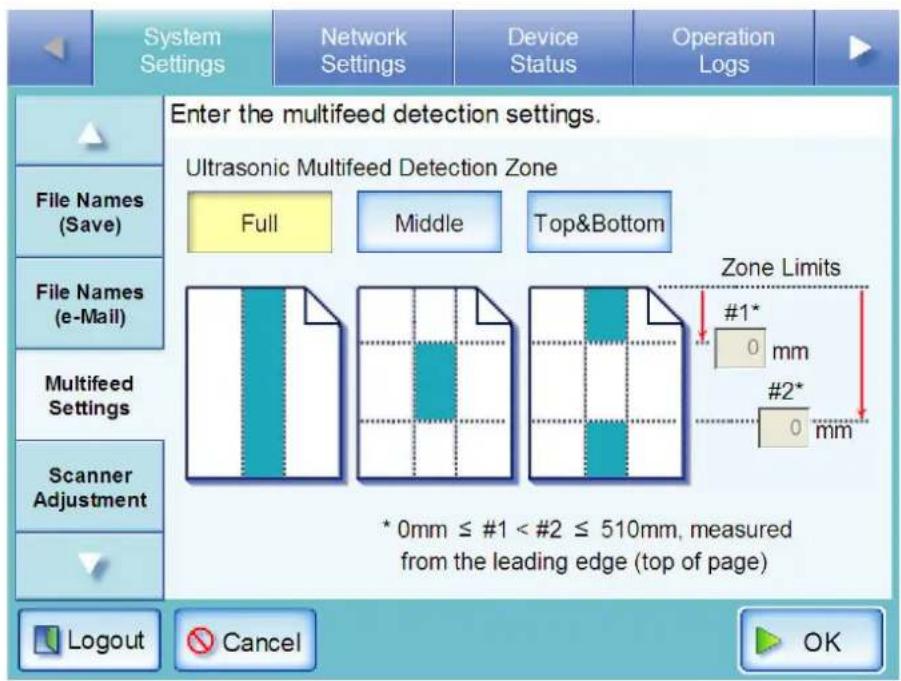
text_image
System Settings Network Settings Device Status Operation Logs Enter the multifeed detection settings. Ultrasonic Multifeed Detection Zone File Names (Save) File Names (e-Mail) Multifeed Settings Scanner Adjustment Zone Limits #1* 0 mm #2* 0 mm * 0mm ≤ #1 < #2 ≤ 510mm, measured from the leading edge (top of page) Logout Cancel OK3. Set the area for multifeed detection in the "Multifeed Detection" section.
Starting from the top edge of a document sheet, set the area to be checked for multifeeds.
| Full | Multifeeds will be detected within 17.5mm from either side of the center of paper. |
| Middle | Multifeeds will be detected within "#1" (upper limit) and "#2" (lower limit) set. (a)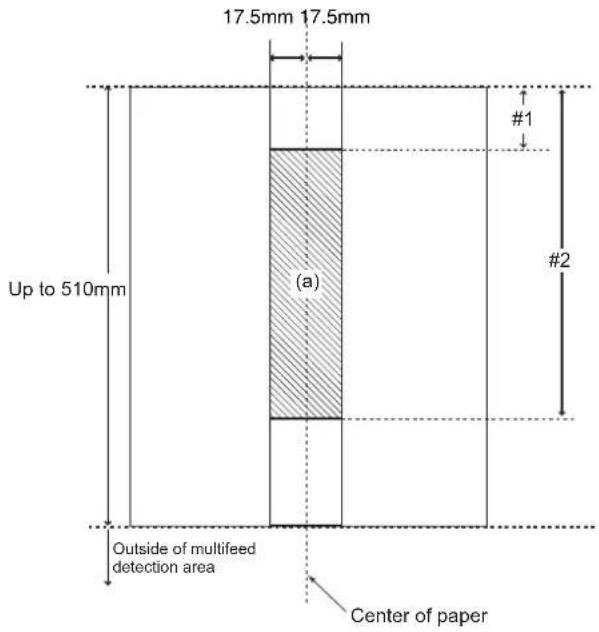 |
| Top & Bottom | Multifeeds will be detected from the top of the page to "#1" (upper limit), and from #2 (lower limit) to the bottom of the page. (b)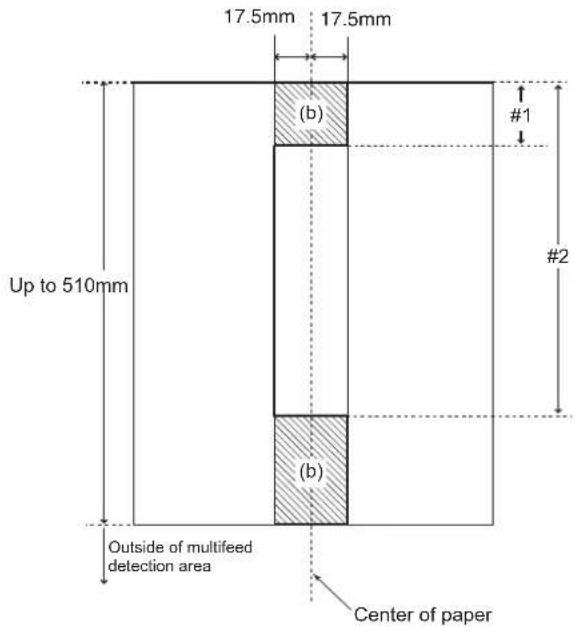 |

Multifeed may not be detected for the top and bottom 25mm of a document.
- In Step 3, if [Middle] or [Top & Bottom] is selected, enter both "#1" (upper limit) and "#2" (lower limit).
1: Even numbers from 0 to 508mm can be entered. Odd numbers will be made even by adding one.
2: Even numbers from 0 to 510mm can be entered. Odd numbers will be made even by adding one.

- For multifeed detection, a length of at least 5mm is required. Specify a value for #2 that is at least 6mm greater than that for #1.
- "#2" can have a maximum value of 510mm. If the paper size setting is long page mode but the length of the document is longer than 510mm, multifeed cannot be detected by length.
- When [Middle] is selected, if the document is shorter than "#1", multifeed will not be detected. When [Top & Bottom] is selected, if the document is shorter than "#2", multifeed will not be detected for the bottom part.
- If the values specified for "#1" and "#2" exceed the actual paper size, multifeeds will not be detected.
- Press the [OK] button.
→ The document area to be monitored for multifeeds is set.
4.6.12 Setting Scanning Performance

Usually, it is not necessary to make any setting changes.
- Select the [System Settings] tab on the top menu.
- Select the [Scanner Adjustment] tab on the left side menu.
→ The "Scanner Adjustment" screen appears.
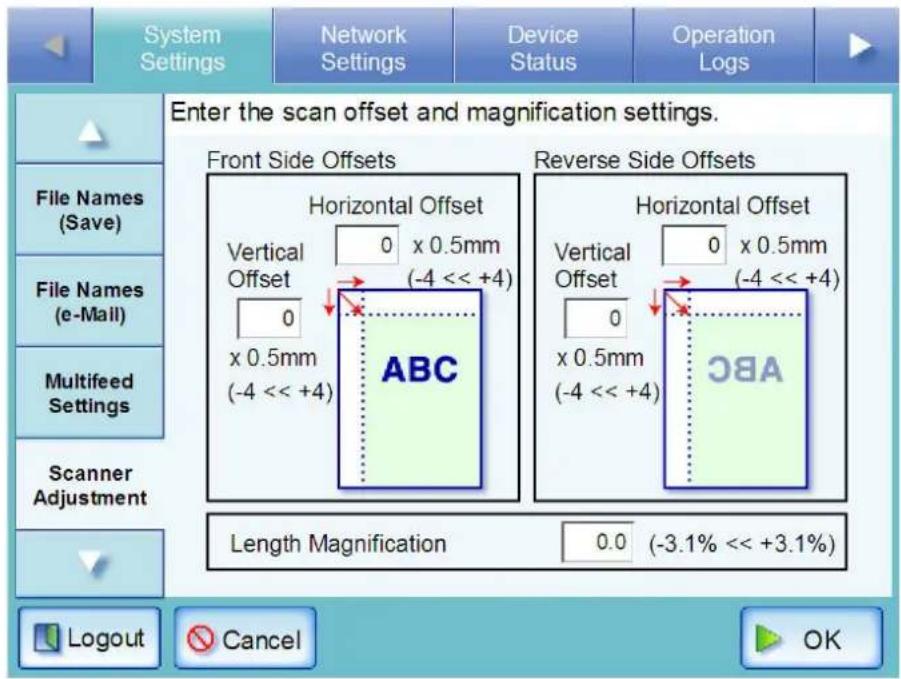
text_image
System Settings Network Settings Device Status Operation Logs Enter the scan offset and magnification settings. Front Side Offsets Horizontal Offset Vertical Offset 0 x 0.5mm (-4 << +4) 0 x 0.5mm (-4 << +4) ABC Reverse Side Offsets Horizontal Offset Vertical Offset 0 x 0.5mm (-4 << +4) 0 x 0.5mm (-4 << +4) CBA Length Magnification 0.0 (-3.1% << +3.1%) File Names (Save) File Names (e-Mail) Multifeed Settings Scanner Adjustment Logout Cancel OK■ Offset Settings
If the scanned output is found to be displaced relative to the actual documents being scanned, the scan offsets can be adjusted.
- On the "Scanner Adjustment" screen, under [Front Side Offsets]/[Reverse Side Offsets], enter values for the "Horizontal Offset" and "Vertical Offset" input fields.
Offset lengths are measured in units of 0.5mm and may be set to between -4 (-2mm) and +4 (+2mm).
- Press the [OK] button.
→ The offset settings are set.
■ Length Magnification Setting
If the scanned output is found to be vertically distorted (stretched or squashed) relative to the actual documents being scanned, the length magnification can be adjusted.
- On the "Scanner Adjustment" screen, enter the value for the "Length Magnification" input field.
This changes the length magnification correction value of the vertical scan. Using the factory default setting as a starting point, the length of the scan can be magnified or reduced to between -3.1 and 3.1%.
- Press the [OK] button.
→ The length magnification setting is set.
4.6.13 Setting General Scanner Settings

Usually, it is not necessary to make any setting changes.
The operating mode for scanning can be set.
- Select the [System Settings] tab on the top menu.
- Select the [General Scanner Settings] tab on the left side menu.
→ The "General Scanner Settings" screen appears.

text_image
System Settings Network Settings Device Status Operation Logs Enter other scanner-related settings. Multifeed Settings Scanner Adjustment General Scanner Settings Certificate Management Operating Mode Performance Image Quality Image Quality mode is designed to produce high resolution images, but has the following drawbacks: * Image file sizes increase and scan speeds decrease. * At a resolution of 600dpi, a maximum of 100 pages may be scanned. * The Background Removal option cannot be used. Logout Cancel OK- Select an operating mode for scanning a document.
Press the [Performance] button to prioritize the performance speed.
Press the [Image Quality] button to prioritize the image quality.

Image Quality mode is designed to produce high resolution images, but has the following drawbacks:
● Image file sizes increase and scan speeds decrease.
- At a resolution of 600dpi, a maximum of 100 pages may be scanned.
● The Background Removal option cannot be used.
- Press the [OK] button.
→ The operating mode is set.
4.6.14 Managing Certificates
Certificates to be used for server authentication in SSL communication can be imported or removed.
■ Importing a Certificate File Admin Tool Central Admin
X.509 certificate files (*.cer, *.crt) can be imported. Up to 100 certificate files can be imported.
-
Select the [System Settings] tab on the top menu.
-
Select the [Certificate Management] tab on the left side menu.
→ The "Certificate Management" screen appears.

text_image
System Settings Network Settings Device Status Operation Logs Maintenance Manage network authentication certificates. Trusted Root Certificate Authorities Issued by Valid from name username - 100000000000000000000000000000000000000000000000000000000000000000000000000000000000 Specify an authentication certificate file. Browse Import Delete- Specify an authentication certificate file.
→ Press the [Browse] button to specify a certificate file.
- Press the [Import] button.
The certificate file is imported. The imported file is saved in the Trusted Root Certificate Authority store.

When a certificate file is distributed from the Central Admin Server, any previously imported certificates will be deleted, and replaced by the contents of the new file.
■ Deleting a Certificate File Touch Panel Admin Tool Central Admin
- Select the [System Settings] tab on the top menu.
- Select the [Certificate Management] tab on the left side menu.
→ The [Certificate Management] screen appears.
- Select a certificate file to be deleted, and press the [Delete] button.
→ The confirmation window appears. - Select the [Yes] button.
⇒ The certificate file is deleted.
4.7 Using the Network Settings Menus
4.7.1 Giving the Scanner an IP Address

An IP address must be set in order to connect the scanner to a network.
- Select the [Network Settings] tab on the top menu.
- Select the [IP Address] tab on the left side menu.
⇒ The DHCP or IP address setting screen appears.
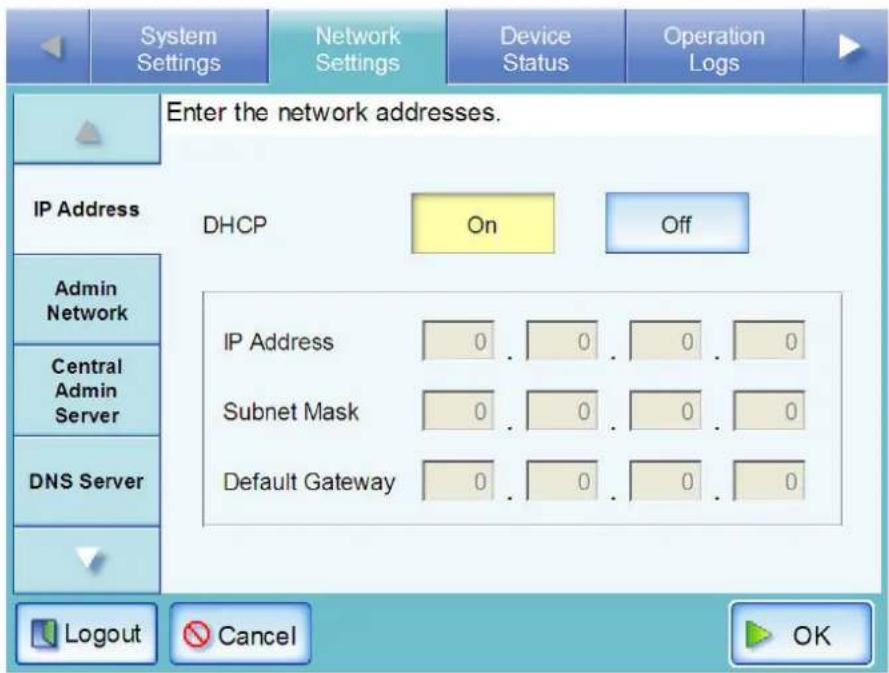
text_image
System Settings Network Settings Device Status Operation Logs Enter the network addresses. IP Address DHCP On Off Admin Network IP Address 0 . 0 . 0 . 0 Central Admin Server Subnet Mask 0 . 0 . 0 . 0 DNS Server Default Gateway 0 . 0 . 0 . 0 Logout Cancel OK- Select whether or not a DHCP is required.
Set the scanner's IP address. This may be done automatically, by pressing the DHCP [On] button. By default, this is set as [On].
The IP address may also be set manually, by pressing the DHCP [Off] button and entering the following numerical addresses:
- IP Address
- Subnet Mask
- Default Gateway
4. Press the [OK] button.
⇒ The information entered is set.
![FUJITSU fi-6010N - Press the [OK] button. - 1](/content/2026/06/1236812/images/256e953859804426a532df8ab25ea0fa7c1a176022757c67093430d6d1cf502e.jpg)
- If the IP address is the same as one already in use, network communication problems will occur. In this case, try the following steps:
- Disconnect the LAN cable, and press the [Shutdown] button on the touch panel to turn the scanner off.
- Reboot the scanner with the LAN cable disconnected, and enter a nonduplicate IP address.
- Re-connect the LAN cable to the scanner.
- When DHCP is set to "On", the following scanner settings are assigned by the DHCP server:
IP Address
- Subnet Mask
- Default Gateway
- DNS Server
- WINS Server
- Domain Suffix
Even if DNS or WINS server is set, priority is given to the scanner settings over the DHCP settings.
- The connection will be lost if the scanner's IP address is changed via the network interface. If connecting via an IP address, to continue with other settings, login to the network interface again using the new IP address.
4.7.2 Setting the Admin Network

To use the Admin Tool or Central Admin Server for the scanner, perform the connection settings.
- Select the [Network Settings] tab on the top menu.
- Select the [Admin Network] tab on the left side menu.
→ The "Admin Network" screen appears.
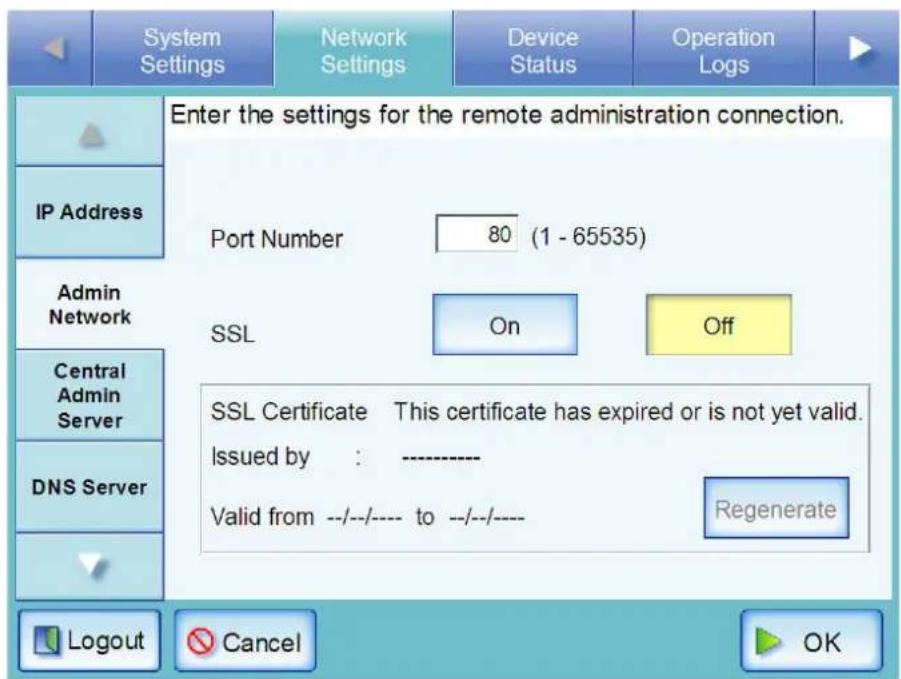
text_image
System Settings Network Settings Device Status Operation Logs Enter the settings for the remote administration connection. Port Number 80 (1 - 65535) SSL On Off Admin Network Central Admin Server DNS Server SSL Certificate This certificate has expired or is not yet valid. Issued by : ---- Valid from --/--/---- to --/--/---- Regenerate Logout Cancel OKFor Central Admin Console, contents of the SSL Certificate are not shown.
- Enter a port number from 1 to 65535, to be used by the scanner to communicate with the Admin Tool or Central Admin Server.
The default setting is 80.

- Port numbers 135, 139, 445, and numbers from 1025 to 1124, cannot be specified as they are already reserved in the scanner.
- If port numbers other than HTTP: 80, HTTPS: 443 are to be specified, it is recommended that numbers over 5000 are used. If a port number lower than 5000 is specified, verify the Admin Tool connectivity with the port number first.
4. Select whether or not to enable SSL (Transport Layer Security).
Select the [On] button enables SSL. If SSL is enabled, press the [Regenerate] button to create another SSL Certificate. When a new SSL Certificate is created, the contents of the certificate are changed. The contents of the SSL Certificate are as follows.
- Issued by Shows the SSL Certificate issuer.
- Valid from
Shows the SSL Certificate expiration date. The expiration date is five years from the date on which the certificate was created. This is shown in date form.
Selecting the [Off] button disables SSL.
5. Press the [OK] button.
→The communication settings are set.
![FUJITSU fi-6010N - Press the [OK] button. - 1](/content/2026/06/1236812/images/3ce90d0ac8ee5860ea3005cebdf63113f346c12fb8a29d2769b233823ea1df26.jpg)
- If the Admin Network settings are changed using the Admin Tool, the Admin Tool is disconnected from the scanner. If any further actions are required, the Admin Tool will need to be reconnected to the scanner.
- If SSL is enabled, SSL is also used for communication between the Central Admin Server and the scanner. When Central Admin is enabled, change the settings on the Central Admin Console "Central Admin Server Settings" screen.
● The following settings combinations are not possible.
● Port Number "80" and SSL "On"
● Port Number "443" and SSL "Off"
4.7.3 Setting a Central Admin Server

If "On" is selected for "Central Admin", scanners can be targeted for Central Admin.
- Select the [Network Settings] tab on the top menu.
- Select the [Central Admin Server] tab on the left side menu.
→ The "Central Admin Server" screen appears.
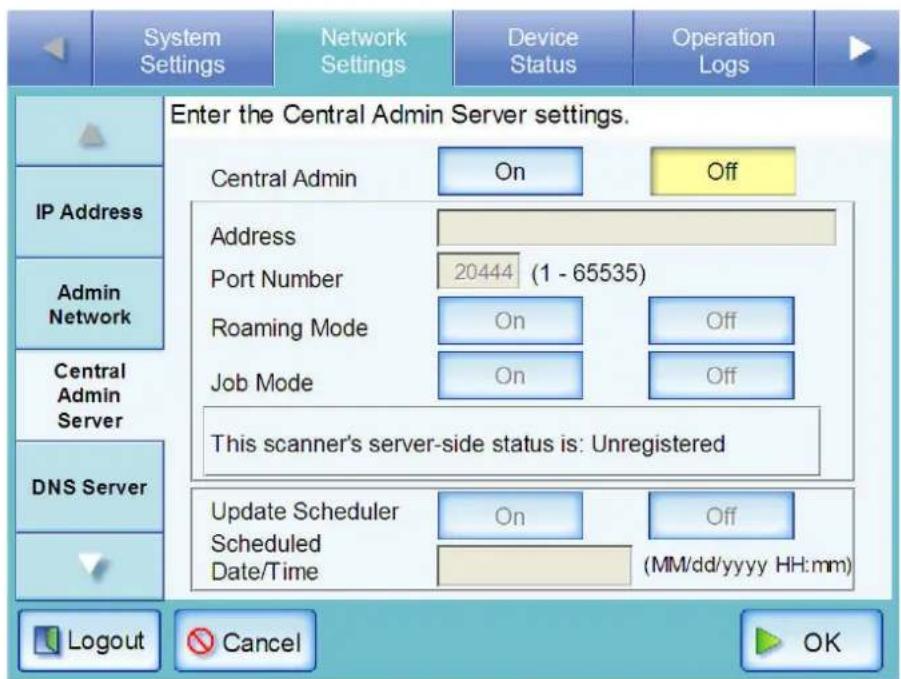
text_image
System Settings Network Settings Device Status Operation Logs Enter the Central Admin Server settings. Central Admin On Off Address Port Number 20444 (1 - 65535) Roaming Mode On Off Job Mode On Off This scanner's server-side status is: Unregistered Update Scheduler On Off Scheduled Date/Time (MM/dd/yyyy HH:mm) Logout Cancel OKFor Central Admin Console, Address and Port Number cannot be set.
- Select whether or not to enable Central Admin Server.
The default setting is [Off].
For the Central Admin Console, the default value is [On] so that scanners for which Central Admin is enabled will become targets.
Select the [On] button to enable Central Admin Server.
Select the [Off] button to disable Central Admin Server. If [Off] is selected, no other settings can be entered. Press the [OK] button to set the selected contents.

If registration with the Central Admin Server is successful, the text will change to "This scanner's server-side status is: Registered".
Even when setting values are correct, if the network is disconnected or the Central Admin Server is in a suspended state, registration will fail. In either case, if the Central Admin Server is [On], the process will be run again the next time the scanner is turned on or resumed from the standby mode.
-
Enter the Central Admin Server IP address, host name, or FQDN in the "Address" input field.
-
For an IP address
The following format should be used xxx.xxx.xxx.xxx (xxx is a value from 0 to 255). -
For a host name or FQDN
Up to 255 characters may be entered. -
Enter a port number from 1 to 65535, to be used by the scanner to communicate with the Central Admin Server.
The default setting is 20444.
- Select whether or not to enable roaming mode.
The default setting is [Off].
Select the [On] button to enable roaming mode. If roaming mode is enabled, a regular user can login on different scanners while retaining their user data.
The following user data can be used in roaming mode.
● "My List" e-Mail Address Books
- Scan Settings
- Name of the last network printer used
- Name of the last network folder used
- Name of the last SharePoint folder used
If the same network printer/folder or SharePoint folder is not set for each scanner, the name of the latest one used is not shown.
Select the [Off] button to disable roaming mode.
- Select whether or not to enable job mode.
The default setting is [Off].
Select the [On] button to enable job mode. If job mode is enabled, even if logging on via a different scanner, the job buttons of regular users can be used. However, if the job modes on the Central Admin Server have not been released, the job modes set with the Admin Tool are used.
Select the [Off] button to disable job mode.
- Set whether to enable automatic update for the scanner systems (including security, installed options), scanner settings, and Add-ins.
The default value is [Off].
Select the [On] button to enable automatic updates for the specified date and time. Enter the date and time for automatic updates in the "Scheduled Date/Time" field.

- Automatic updates start when the scanner is in a standby mode or when no user is logged in while it is turned on.
Even if notifications from the Central Admin Server or Wake-On-LAN cannot be used, an update can be performed according to the specified date and time. - If a user is logged in at the scheduled date and time, updates start after the user has logged out.
- It takes approximately 10 minutes to enable this setting. Therefore, make sure that the scheduled date and time starts at least 10 minutes after the setting is made.
- When the setting for an automatic update from the Central Admin Server is distributed to the scanners, if the update is scheduled to start within ten minutes after the setting was distributed, the setting will not be applied.
To enable new system settings in an environment where update calls cannot be issued, scanners must be restarted or logged out.
In order to prevent software updates from running at the same time, enable software update time-period restrictions ("5.6 Setting the Central Admin Server" (page 244)). System settings can be updated even when software updates are restricted. - If the scheduled automatic update time is set in both the Central Admin Console and with the Admin Tool, the most recent settings will be enabled.
Select the [Off] button to disable automatic updates.
9. Press the [OK] button.
→ The Central Admin Server settings are set.
→ The scanner information is transmitted to the Central Admin Server.
If the process is successful, the text will change to "This scanner's server-side status is: Registered".
![FUJITSU fi-6010N - Press the [OK] button. - 1](/content/2026/06/1236812/images/d0959ba2101bcfc19f8b9d34f983f9ef6473bbf669ad7f70b6187d0fa195b066.jpg)
- For details about the settings required to use SSL for communication between the Central Admin Server and scanner, refer to "4.7.2 Setting the Admin Network" (page 88).
- When user roaming or job settings enabled, if communication with the Central Admin Server is not possible a confirmation message will appear at login. If [OK] is selected, the settings information saved in the scanner are used. Selecting the [Cancel] button returns to the login screen.
4.7.4 Setting the DNS Server

A primary DNS and secondary DNS can be set.
- Select the [Network Settings] tab on the top menu.
- Select the [DNS Server] tab on the left side menu.
→ The "DNS Server" screen appears.
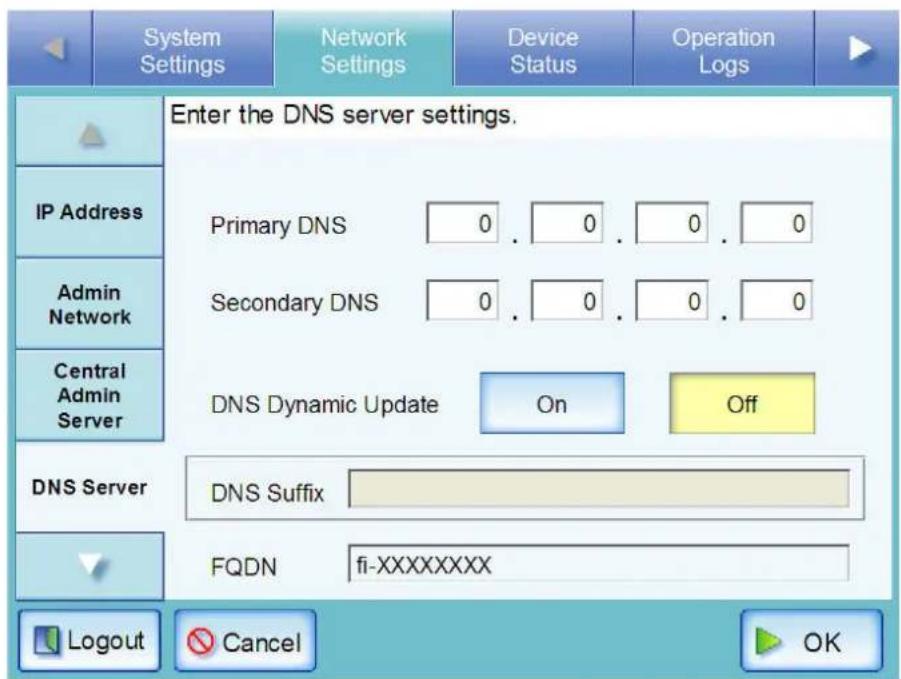
text_image
System Settings Network Settings Device Status Operation Logs Enter the DNS server settings. Primary DNS 0.0.0.0 Secondary DNS 0.0.0.0 DNS Dynamic Update On Off DNS Server DNS Suffix FQDN fi-XXXXXXXX Logout Cancel OK-
Enter the following numerical addresses:
-
Primary DNS
- Secondary DNS
If a DNS server setting is not required, enter "0.0.0.0".
- Select whether or not to dynamically update the DNS.
The default setting is [Off].
Select the [On] button to enable DNS dynamic update.
Select the [Off] button to disable DNS dynamic update.
5. Enter a "DNS Suffix".
This can only be set if the [On] button was pressed in Step 4.
The scanner_name + DNS_suffix, may be up to 255 characters long. Alphanumeric characters and the following symbols may be used.
A "." (dot) is added in between the scanner_name and DNS_suffix.
For example, if a scanner name is 9 characters long, because a "." dot will be added to the scanner_name, the DNS suffix may be up to 245 long.
According to the settings, a FQDN is named in the following order.
- Scanner name + DNS suffix entered here.
- Scanner_name + domain_suffix acquired from DHCP server.
- Scanner_name + domain input on the "Scanner Name" screen.

The current FQDN is shown for the FQDN.
However, if the scanner is not connected to the network, the FQDN may not be displayed correctly.
6. Press the [OK] button.
⇒ The information entered is set.
4.7.5 Setting the WINS Server

A primary WINS and secondary WINS can be set.
- Select the [Network Settings] tab on the top menu.
- Select the [WINS Server] tab on the left side menu.
→ The "WINS Server" screen appears.

text_image
System Settings Network Settings Device Status Operation Logs Enter the WINS server settings. WINS Server Primary WINS 0. 0. 0. 0 NTP Server Secondary WINS 0. 0. 0. 0 Proxy Server Login LDAP Server Logout Cancel OK-
Enter the following numerical addresses:
-
Primary WINS
-
Secondary WINS
If a WINS server setting is not required, enter "0.0.0.0". -
Press the [OK] button.
→ The information entered is set.
4.7.6 Setting the NTP Server

- Select the [Network Settings] tab on the top menu.
- Select the [NTP Server] tab on the left side menu.
→ The "NTP Server" screen appears.
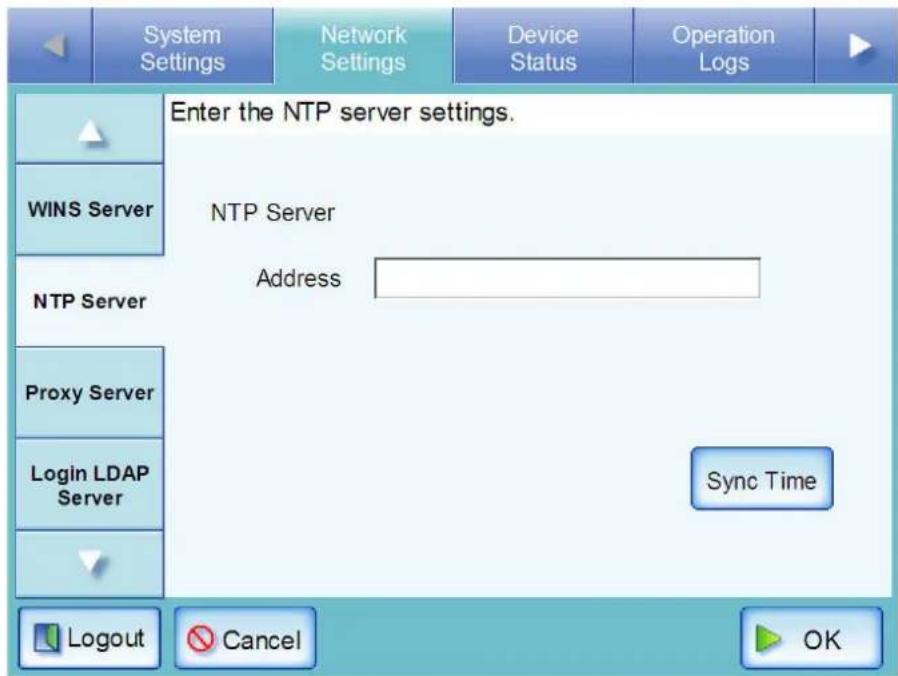
text_image
System Settings Network Settings Device Status Operation Logs Enter the NTP server settings. WINS Server NTP Server NTP Server Address Proxy Server Login LDAP Server Sync Time Logout Cancel OKFor Central Admin Console, can only set the NTP server address.
-
Enter the NTP server IP address, host name, or FQDN in the "Address" input field.
-
For an IP address
The following format should be used xxx.xxx.xxx.xxx (xxx is a value from 0 to 255).
● For a host name or FQDN
Up to 255 characters may be entered.
If an NTP server is not required, leave this field blank. -
Press the [Sync Time] button.
⇒ The result of the time synchronization for the specified NTP server is shown.
If no error message appears, the NTP server setting is valid.
If an error message appears, refer to "E.1.1 Administrator Screen Messages" (page 505).
- Press the [OK] button on the confirmation message screen.
6. Press the [OK] button.
⇒ The NTP server is set.
![FUJITSU fi-6010N - Press the [OK] button. - 1](/content/2026/06/1236812/images/7fcb7afd8efb408a6c50e51ebd62f45176d3b149c82e3f3d30e5aa6e792fd21f.jpg)
- The system time is automatically synchronized every 6 hours to that supplied by the NTP server.
- When the NTP server settings are changed, the system time is synchronized immediately.
- An adjustment that advances the system time by 20 minutes or more results in a session timeout and causes the scanner to logout.
4.7.7 Setting the Proxy Server

ATTENTION

Set whether a proxy server is used when connecting to SharePoint server via the Admin Tool or Central Admin Console. This cannot be set from the LCD touch panel.
In this section, the Admin Tool screen is used as an example.
- Select the [Network Settings] tab on the top menu.
- Select the [Proxy Server] tab on the left side menu.
⇒ The "Proxy Server" screen appears.
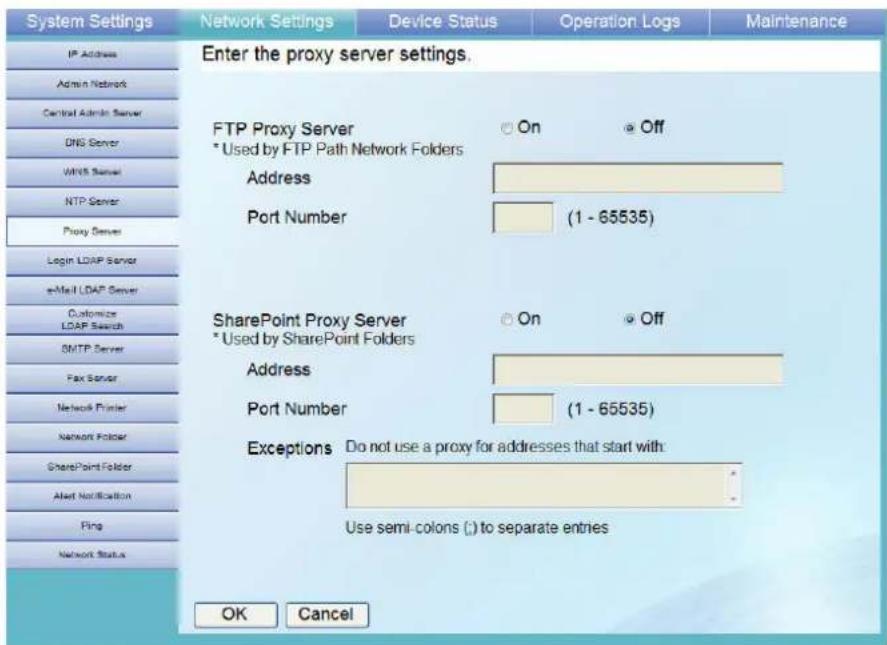
text_image
System Settings Network Settings Device Status Operation Logs Maintenance Enter the proxy server settings. FTP Proxy Server * Used by FTP Path Network Folders Address Port Number On Off (1 - 65535) SharePoint Proxy Server * Used by SharePoint Folders Address Port Number On Off (1 - 65535) Exceptions Do not use a proxy for addresses that start with Use semi-colons ( ) to separate entries OK Cancel- Use the "FTP Proxy Server" option to set whether or not a proxy server is used for FTP server connection.
The default setting is [Off].
Select [On] to enable FTP connection via a proxy server.
1 Enter the proxy server IP address, host name, or FQDN in the "Address" input field.
- For an IP address
The following format should be used xxx.xxx.xxx.xxx (xxx is a value from 0 to 255).
- For a host name or FQDN
Up to 255 characters may be entered.
2 Enter a port number for the proxy server, from 1 to 65535, in the "Port Number" field.
Select [Off] to enable direct FTP connection (not via a proxy server).

This "FTP Proxy Server" setting must be set to [On] if the "Proxy" setting for any FTP server network folder is set to [On]. If the "FTP Proxy Server" setting is set to [Off], FTP server network folders cannot be used.
For details of how to set an FTP server folder as a proxied network folder, refer to "4.7.14 Setting the Network Folders" (page 132).
- Use the "SharePoint Proxy Server" option to set whether or not a proxy server is used for SharePoint server connection.
The default setting is [Off].
Select [On] to enable SharePoint connection via a proxy server.
1 Enter the Central Admin Server IP address, host name, or FQDN in the "Address" input field.
- For an IP address
The following format should be used xxx.xxx.xxx.xxx (xxx is a value from 0 to 255).
- For a host name or FQDN
Up to 255 characters may be entered.
2 Enter a port number from 1 to 65535, to be used by the scanner to communicate with the Central Admin Server.
3 Any IP addresses, host names, or FQDN that are to accessed directly (not via the proxy server) should be entered in the "Exceptions" field.
● Multiple addresses must be separated using semi-colons (";").
● "*" may be used as a wildcard character.
- An IP address may be followed by a "/" and then a subnet mask.
Select [Off] to enable direct SharePoint connection (not via a proxy server).
- Press the [OK] button.
→ The proxy server is set.
4.7.8 Setting the Login LDAP Server

If a login LDAP server is set, user authentication will be checked.
-
Select the [Network Settings] tab on the top menu.
-
Select the [Login LDAP Server] tab on the left side menu.
→ The "Login LDAP Server" screen appears.
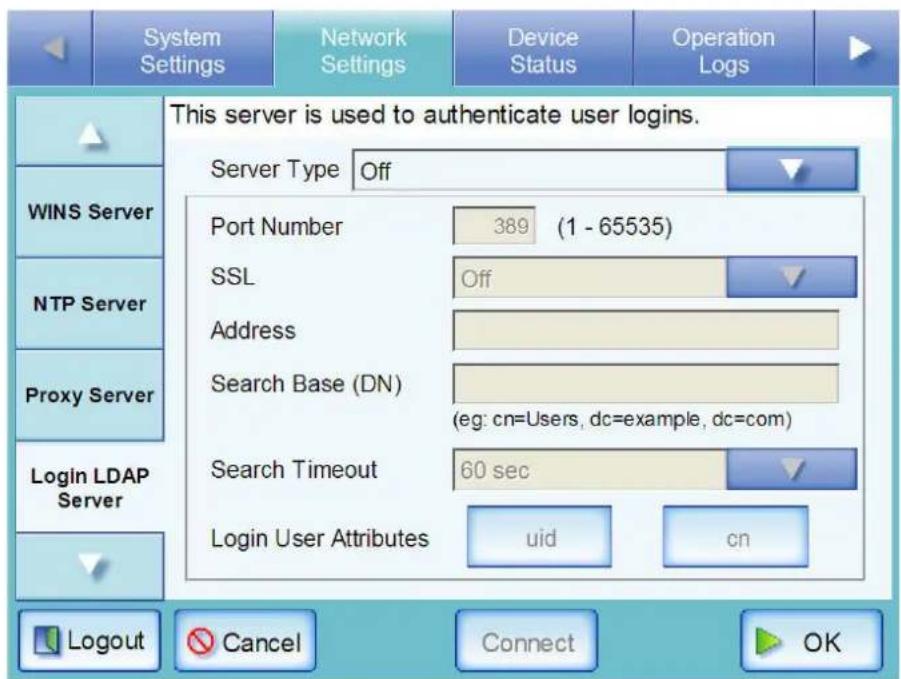
text_image
System Settings Network Settings Device Status Operation Logs This server is used to authenticate user logins. Server Type Off WINS Server Port Number 389 (1 - 65535) SSL Off Address Search Base (DN) (eg: cn=Users, dc=example, dc=com) Login LDAP Server Search Timeout 60 sec Login User Attributes uid cn Logout Cancel Connect OK- Set the connection settings for the login LDAP server.
Select [Active Directory] if the Active Directory server is to be used for user logins.
Select [Active Directory Global Catalog] if a global catalog LDAP server is to be used for user logins.
Select [Other LDAP Server] if an LDAP server other than the Active Directory is to be used for user logins.
Select [Off] if an LDAP server is not required for user logins. If [Off] is selected, no other settings can be entered. Select the [OK] button to confirm the setting contents.
- Enter a port number from 1 to 65535, to be used by the scanner to communicate with an LDAP server.
The default setting is as follows.
- When [Off] is selected for "SSL"
- If [Active Directory] or [Other LDAP Server] is selected, 389.
- If [Active Directory Global Catalog] is selected, 3268.
- When [On (Full Validation: CA + Certificate)] or [On (Certificate Only, CA not validated)] is selected for "SSL"
- If [Active Directory] or [Other LDAP Server] is selected, 636.
-
If [Active Directory Global Catalog] is selected, 3269.
-
Select whether and how to enable SSL (Transport Layer Security).
If [On (Full Validation: CA + Certificate)] is selected, SSL is enabled, and CAs and server certificates are validated as follows:
● Certificate authority (CA) validation
Check the certification path of the LDAP server certificate by following the chain of certifying authorities back to an accepted Trust Anchor.
- Server certificate validation
- Check that the current date/time is within the certificate validity period.
- Check that the public key certificate has not been tampered with.
- Check that the certificate has not been revoked.
If [On (Certificate Only, CA not validated)] is selected, SSL is enabled, and server certificates but not CAs are validated as follows:
- Server certificate validation
- Check that the current date/time is within the certificate validity period.
- Check that the public key certificate has not been tampered with.
- Check that the certificate has not been revoked.
If [Off] is selected, SSL is disabled.
-
Enter the LDAP server IP address, host name, or FQDN in the "Address" input field.
-
For an IP address
The following format should be used xxx.xxx.xxx.xxx (xxx is a value from 0 to 255).
● For a host name or FQDN
Up to 255 characters may be used. -
In the "Search Base (DN)" input field, enter the distinguished name of the LDAP search base.
The character string entered here will be the root under which LDAP entries will be searched for.
This may be up to 255 characters long.
When [Active Directory] or [Other LDAP Sever] is selected, if settings are omitted, the entire contents of the LDAP server are searched.
When [Active Directory Global Catalog] is selected, if settings are omitted, the entire contents of the global server are searched.
For more details about the character string to be entered, and connection to the LDAP search target, refer to "LDAP Search Target" (page 104).
- Press the [List] button for the "Search Timeout" input field.
A list of "search timeout" times appears.
- Select the LDAP List search timeout delay.
The default time is 60 seconds.
⇒ The selected "Search Timeout" value is displayed.
- Select login user attributes.
When [Other LDAP Server] is selected for the "Server Type", select whether LDAP server login users can be searched for by "uid" or "cn".
When [uid] is selected, users to be logged in are searched with "uid".
When [cn] is selected, users to be logged in are searched with "cn".
- To check the connection with the LDAP server, press the [Connect (Test)] button.
→ The screen for setting access authorization details appears.
- Enter the authentication details for confirming access to the LDAP server.
- When the "Server Type" is [Active Directory] or [Active Directory Global Catalog]
- When the "Server Type" is [Other LDAP Server]
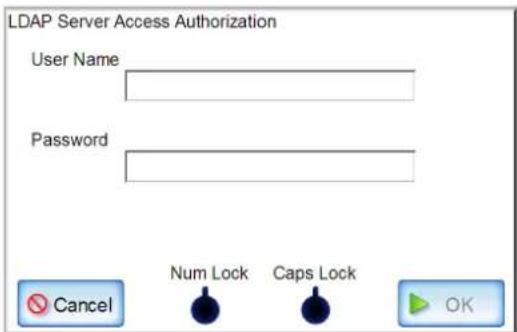
text_image
LDAP Server Access Authorization User Name Password Cancel Num Lock Caps Lock OK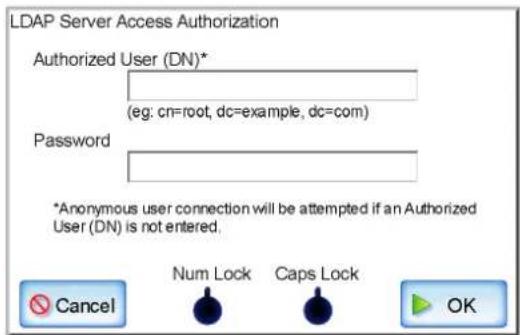
text_image
LDAP Server Access Authorization Authorized User (DN)* (eg: cn=root, dc=example, dc=com) Password *Anonymous user connection will be attempted if an Authorized User (DN) is not entered. Cancel Num Lock Caps Lock OK- For the "User Name" and/or "Authorized User (DN)", alphanumeric characters (case sensitive) and symbols may be entered.
- Enter an "Authorized User (DN)" in DN format.
- For the "Password", alphanumeric characters (case sensitive) and symbols may be entered.

- For settings via the Admin Tool, when [Other LDAP Server] is selected for "Sever Type", even if the [Connect (Test)] button is pressed, the screen for setting access authorization details will not be shown. Enter the access authorization details on the "Login LDAP Server" screen.
- The "Caps Lock" and "Num Lock" indicators are shown when the administrator logs in via the scanner's touch panel.
The "Caps Lock" indicator is on if the keyboard's Caps Lock is set. The "Num Lock" indicator is on if the keyboard's Num Lock is set.
- Press the [OK] button.
When the connection is successful, the "Login LDAP Server" screen appears.
12. Press the [OK] button.
If a setting other than [Other LDAP Server] is selected for "Server Type", the login LDAP server settings are completed.
If [Other LDAP Server] is selected for "Sever Type", the screen for setting access authorization details is displayed.
Enter the access authorization details for the LDAP server login user to be searched and press the [OK] button to set the login LDAP server.
![FUJITSU fi-6010N - Press the [OK] button. - 1](/content/2026/06/1236812/images/49b176a9d5ddc2bc6af828a955942f0e842a268584e4f6debcc011de6de57ca9.jpg)
text_image
LDAP Server Access Authorization Authorized User (DN)* (eg: cn=root, dc=example, dc=com) Password *Anonymous user connection will be attempted if an Authorized User (DN) is not entered. Cancel Num Lock Caps Lock OK- For the "Authorized User (DN)", alphanumeric characters (case sensitive) and symbols may be entered.
- Enter an "Authorized User (DN)" in DN format.
- For the "Password", alphanumeric characters (case sensitive) and symbols may be entered.
![FUJITSU fi-6010N - Press the [OK] button. - 2](/content/2026/06/1236812/images/ffd2b461bd3a4572a220925ed59fe2ec9cfab8c89d14f7ef990c16172319eb2f.jpg)
- For settings via the Admin Tool, when [Other LDAP Server] is selected for "Sever Type", even if the [OK] button is pressed, the screen for setting access authorization details will not be displayed. Enter the access authorization details on the "Login LDAP Server" screen.
- The "Caps Lock" and "Num Lock" indicators are shown when the administrator logs in via the scanner's touch panel. The "Caps Lock" indicator is on if the keyboard's Caps Lock is set. The "Num Lock" indicator is on if the keyboard's Num Lock is set.
■ LDAP Search Target
The search range and method for LDAP server searches differs according to the LDAP server connection, or search base (DN) settings (Step 3 or Step 7 of "4.7.8 Setting the Login LDAP Server" (page 100)).
- For connecting with LDAP server (when [Active Directory] or [Other LDAP Server] is selected in Step 3)
The following shows an example (where the domain name is example.com) for the "Search Base (DN)" to be entered in Step 7. The italic text represents variable character strings.
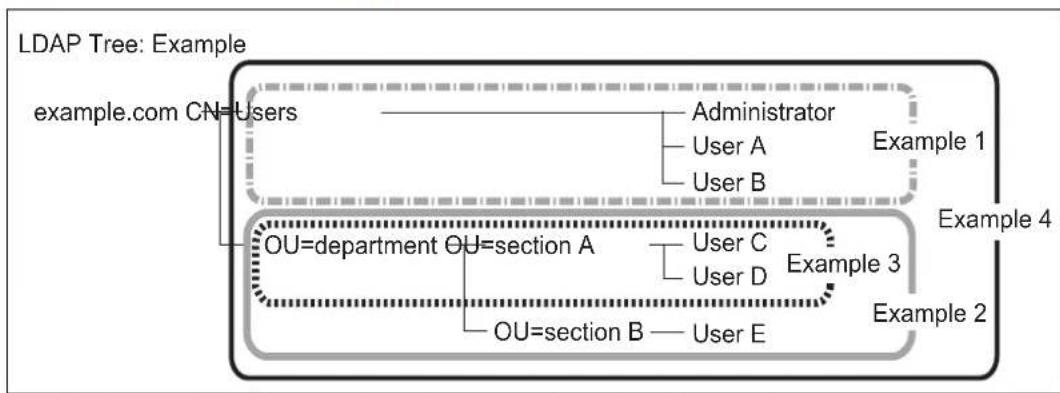
flowchart
graph TD
    A["example.com CN=Users"] --> B["Administrator"]
    B --> C["User A"]
    B --> D["User B"]
    B --> E["OU=department OU=section A"]
    E --> F["User C"]
    E --> G["User D"]
    E --> H["OU=section B"]
    H --> I["User E"]
    B --> J["Example 1"]
    E --> K["Example 2"]
    E --> L["Example 3"]
    style A fill:#f9f,stroke:#333
    style B fill:#ccf,stroke:#333
    style C fill:#cfc,stroke:#333
    style D fill:#fcc,stroke:#333
    style E fill:#cff,stroke:#333
    style F fill:#ffc,stroke:#333
    style G fill:#ffc,stroke:#333
    style H fill:#ffc,stroke:#333
    style I fill:#ffc,stroke:#333
    style J fill:#cfc,stroke:#333
    style K fill:#cfc,stroke:#333
    style L fill:#cfc,stroke:#333
Hereinafter, Active Directory is used an example to describe search targets.
Example 1: When searching for (administrator, user A, user B)
CN=Users, DC=example, DC=com
Active Directory configuration is as follows.
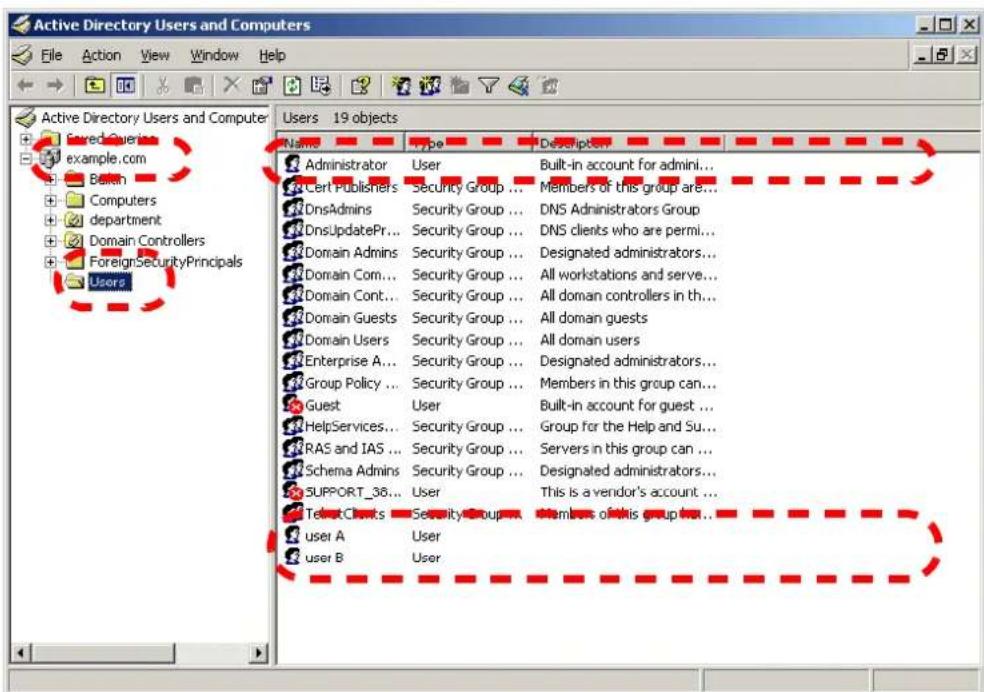
text_image
Active Directory Users and Computers File Action View Window Help Active Directory Users and Computer Saved Users example.com Bekin Computers department Domain Controllers ForeignSecurityPrincipals Users Users 19 objects Name Type Description Administrator User Built-in account for admini... Cert Publishers Security Group ... Members of this group are... DnsAdmins Security Group ... DNS Administrators Group DnsUpdatePr... Security Group ... DNS clients who are peri... Domain Admins Security Group ... Designated administrators... Domain Com... Security Group ... All workstations and serve... Domain Cont... Security Group ... All domain controllers in th... Domain Guests Security Group ... All domain guests Domain Users Security Group ... All domain users Enterprise A... Security Group ... Designated administrators... Group Policy ... Security Group ... Members in this group can... Guest User Built-in account for guest ... HelpServices... Security Group ...Group for the Help and Su... RAS and IAS... Security Group ... Servers in this group can ... Schema Admins Security Group ... Designated administrators... SUPPORT_38... User.This is a vendor's account ... Telecat Clients Security Group ... Members of this group that... user A User user B UserExample 2: When searching for (user C, user D, user E)
OU=department, DC=example, DC=com
Active Directory configuration is as follows.
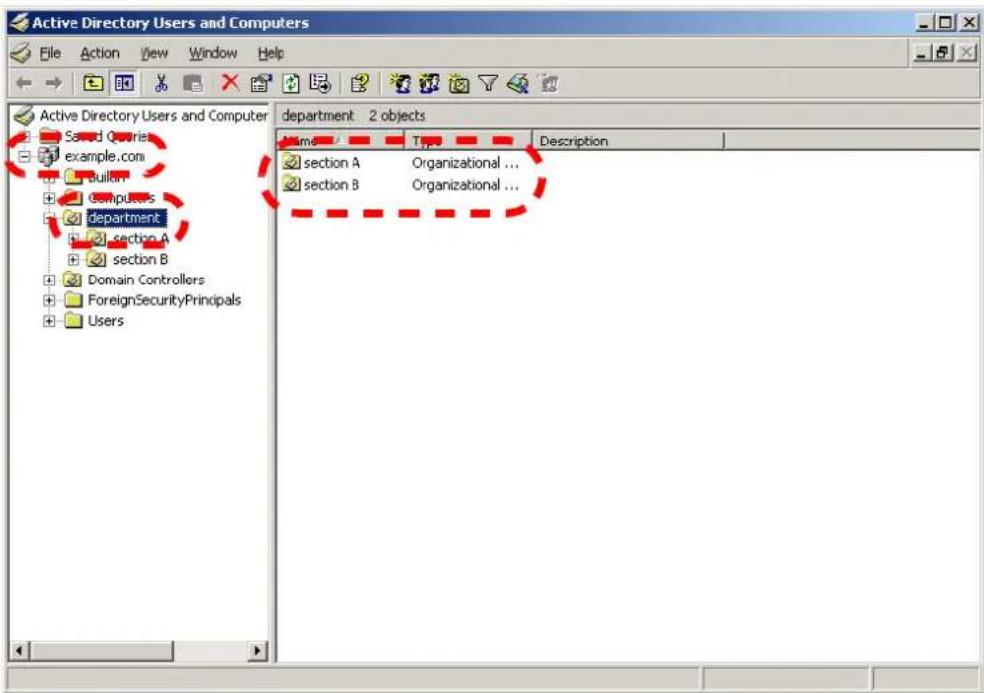
text_image
Active Directory Users and Computers File Action View Window Help Active Directory Users and Computer SaaS Course example.com Bullim Computers department section A section B Domain Controllers ForeignSecurityPrincipals Users department 2 objects Name Type Description section A Organizational ... section B Organizational ...Example 3: When searching for (user C, user D)
OU=section A, OU=department, DC=example, DC=com
Active Directory configuration is as follows.

text_image
Active Directory Users and Computers File Action View Window Help Active Directory Users and Computer Saved Queries example.com builtin Computers department section A section B Domain Controllers ForeignSecurityPrincipals Users section A 2 objects Name Type Description user C User user D UserExample 4: When searching for all users
no "Search Base (DN)" setting, or DC=example, DC=com

text_image
Active Directory Users and Computers File Action View Window Help Active Directory Users and Computer Saved Objects example.com Builtin Computers department section A section B Domain Controllers ForeignSecurityPrincipals Users example.com 6 objects Name Type Description Builtin builtinDomain Computers Container Default container for upgr... department Organizational ... Domain Cont... Organizational ... Default container for dom... ForeignSecur... Container Default container for secu... Users Container Default container for upgr...- For connecting with Global Catalog (when [Active Directory Global Catalog] is selected in Step 3)
The following shows an example (where the parent domain name is example.com, and sub-domain name is sub.example.com) for the "Search Base (DN)" to be entered in Step 7. The italic text represents variable character strings.

flowchart
graph TD
    A["sAMA accountName"] --> B["example.com GN=Users"]
    A --> C["Administrator01"]
    C --> D["User A"]
    C --> E["userA"]
    C --> F["userA@example.com"]
    C --> G["User B"]
    A --> H["OU=department OU=section A"]
    H --> I["User C"]
    H --> J["User D"]
    H --> K["OU=section B"]
    K --> L["User E"]
    A --> M["sub.example.com"]
    M --> N["CN=Users"]
    N --> O["Administrator02"]
    O --> P["User H"]
    O --> Q["userH@sub.example.com"]
    O --> R["User I"]
    M --> S["OU=department OU=F"]
    S --> T["User J"]
    S --> U["User K"]
    S --> V["OU=G"]
    V --> W["User L"]
    A --> X["Top:sAMA accountName\nBottom:userPrincipalName"]
Example: When searching in whole domain
no "Search Base (DN)" setting, or DC=example, DC=com
The LDAP search target differs as follows, according to whether a user logs in with a sAMAccountName or userPrincipalName.
| Regular User | Login Name | Login Possible |
| Top: sAMAccountNameBottom: userPrincipleName | ||
| User A userA OK | ||
| userA@example.com OK | ||
| User H userH NG | ||
| userH@sub.example.com OK |
The SAM Account Name is the Active Directory user login name (sAMAccountName).
The User Principal Name is the Active Directory user login name (userPrincipalName).
4.7.9 Setting the e-Mail LDAP Server

If an e-mail LDAP server is set, the searches within the LDAP List on the "e-Mail Address Book" screen can be performed.
- Select the [Network Settings] tab on the top menu.
- Select the [e-Mail LDAP Server] tab.
⇒ The "e-Mail LDAP Server" screen appears.
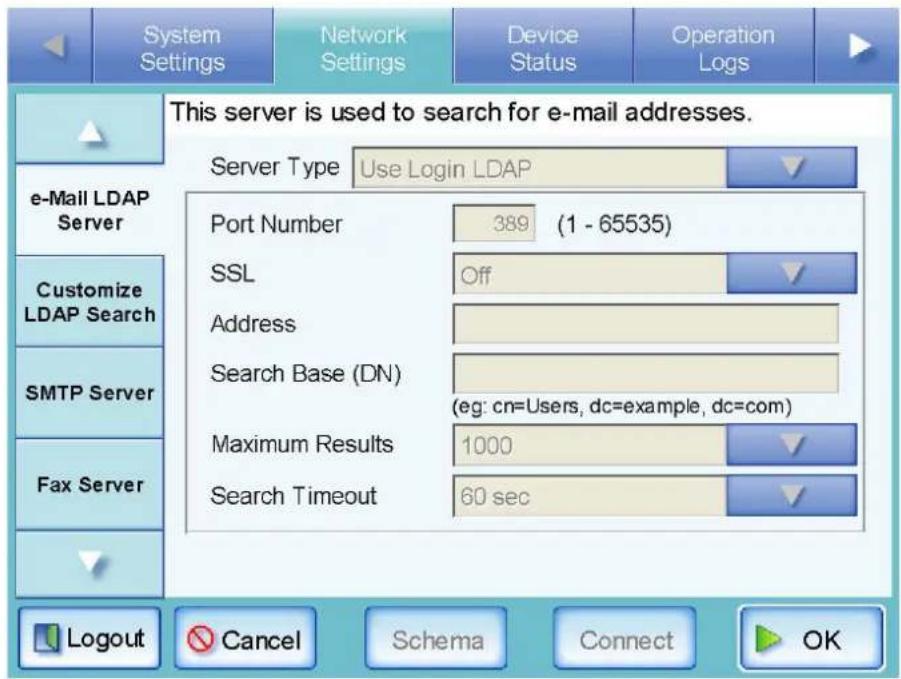
text_image
System Settings Network Settings Device Status Operation Logs This server is used to search for e-mail addresses. Server Type Use Login LDAP Port Number 389 (1 - 65535) SSL Off Address Search Base (DN) Maximum Results 1000 Search Timeout 60 sec e-Mail LDAP Server Customize LDAP Search SMTP Server Fax Server Logout Cancel Schema Connect OK- Set the e-mail LDAP server connection settings.
Select [Use Login LDAP] to reuse the user login LDAP server settings for e-mail address searches or lookup. If [Use Login LDAP] is selected, no other settings can be entered. Press the [OK] button to set the e-mail LDAP server settings.
Select [Active Directory] if the Active Directory server is to be used for e-mail address searches.
Select [Active Directory Global Catalog] if a global catalog LDAP server is to be used for e-mail address searches.
Select [Other LDAP Server] if an LDAP server other than the Active Directory is to be used for e-mail address searches.
- Perform Step 4 to Step 11 (excluding Step 10) of "4.7.8 Setting the Login LDAP Server" (page 100).
- Press the [List] button for the "Maximum Results" input field.
A list of "number of maximum results" appears.
- Select the maximum number of results for e-mail LDAP list searches.
The default maximum is 1000.
⇒ The selected "Maximum Results" value is displayed.
- When [Other LDAP Server] is selected for "Sever Type" only, press the [Schema] button to use the search items and schema.
→ The screen for adjusting the search item schema for LDAP search appears.
Press the [Use Defaults] button to return entered contents to the default values.
Press the [OK] button to set the search item schema, and return to the "e-Mail LDAP Server" screen.
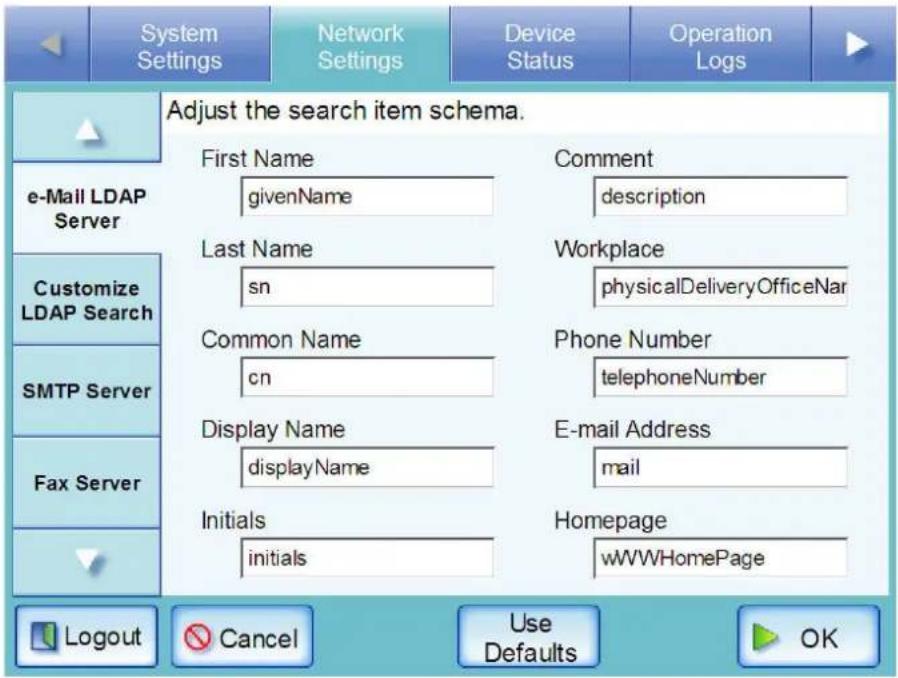
text_image
System Settings Network Settings Device Status Operation Logs Adjust the search item schema. First Name givenName Comment description e-Mail LDAP Server Last Name sn Workplace physicalDeliveryOfficeNar Customize LDAP Search Common Name cn Phone Number telephoneNumber SMTP Server Display Name displayName E-mail Address mail Fax Server Initials initials Homepage wWWHomePage Logout Cancel Use Defaults OK| Search Item Description | |
| First Name Enter the schema | Name name that is to be associated with the "First Name" search item.The default value is "givenName". |
| Last Name Enter the schema | Name name that is to be associated with the "Last Name" search item.The default value is "sn". |
| Common Name Enter the schema | Name name that is to be associated with the "Common Name" search item.The default value is "cn". |
| Display Name | Enter the schema name that is to be associated with the "Display Name" search item.The default value is "displayName". |
| Search Item Description | |
| Initials Enter the schema | name that is to be associated with the "Initials" search item.The default value is "initials". |
| Comment Enter the schema | name that is to be associated with the "Comment" search item.The default value is "description". |
| Workplace Enter the schema | name that is to be associated with the "Workplace" search item.The default value is "physicalDeliveryOfficeName". |
| Phone Number Enter the schema | name that is to be associated with the "Phone Number" search item.The default value is "telephoneNumber". |
| E-mail Address Enter the schema | name that is to be associated with the "E-mail Address" search item.The default value is "mail". This cannot be omitted. |
| Homepage Enter the schema | name that is to be associated with the "Homepage" search item.The default value is "wWWHomePage". |
8. Press the [OK] button.
⇒ The e-mail LDAP server is set.
![FUJITSU fi-6010N - Press the [OK] button. - 1](/content/2026/06/1236812/images/e91973f1060febb7006446de395d6110e288d3f4d4eec7d5fa7b48fe2aa40216.jpg)
![FUJITSU fi-6010N - Press the [OK] button. - 2](/content/2026/06/1236812/images/ff021c1cc9534fb1aa3b16185e1f9b632f03d43ff03af636fff9deda70c386aa.jpg)
To use the e-mail LDAP server, use a login user account. If the login LDAP server and e-mail LDAP server are different, according to the domain configuration or login name format, it may not be possible to use the e-mail LDAP server. For more details, refer to "LDAP Search Target" (page 104).
4.7.10 Setting the LDAP Search Parameters

The search conditions ([First Name] and [Last Name] buttons on the following screen) on the "e-Mail Address Book" - [LDAP List] tab can be customized.

text_image
e-Mail Address Book My List LDAP List First Name Last Name e-Mail Address Search Target : FindFor details about the "e-Mail Address Book" - [LDAP List] tab, refer to "6.4.1 Selecting an e-Mail Target from the e-Mail Address Book" (page 319).
- Select the [Network Settings] tab on the top menu.
- Select the [Customize LDAP Search] tab on the left side menu.
→ The "Customize LDAP Search" screen appears.
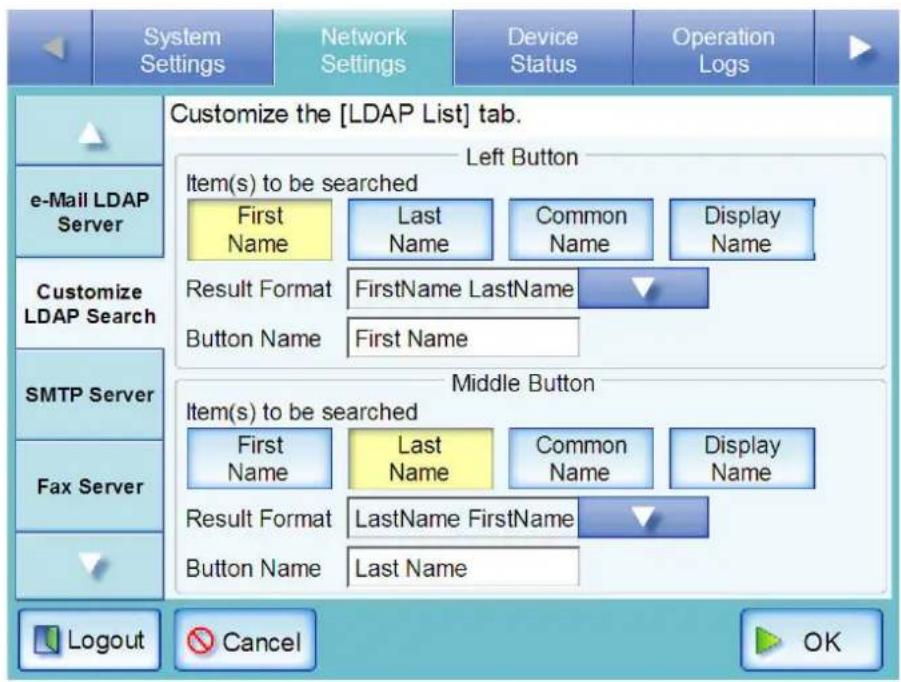
text_image
System Settings Network Settings Device Status Operation Logs Customize the [LDAP List] tab. Left Button e-Mail LDAP Server Item(s) to be searched First Name Last Name Common Name Display Name Customize LDAP Search Result Format FirstName LastName Button Name First Name SMTP Server Middle Button Item(s) to be searched First Name Last Name Common Name Display Name Fax Server Result Format LastName FirstName Button Name Last Name Logout Cancel OK
The following table shows the correspondence between the administrator "Customize LDAP Search" screen settings, and the regular user search condition buttons on the "e-Mail Address Book" - [LDAP List] tab.
| Setting Area Descriptions | |
| Left Button Determines the setting of the left button on the [LDAP List] tab. | 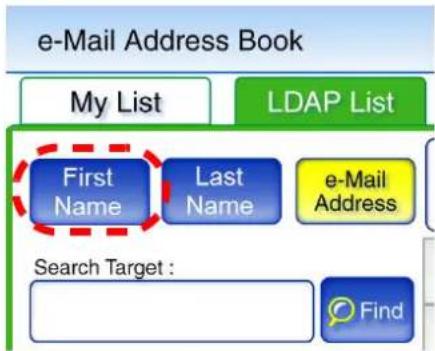 |
| Middle Button Determines the setting of the middle button on the [LDAP List] tab. | 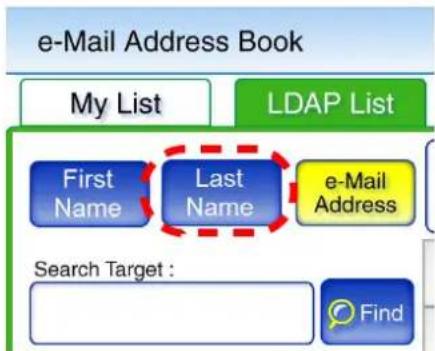 |
3. Specify the item(s) to be searched.
LDAP search is performed on the specified item(s).
Multiple search items can be selected. If multiple items are selected, an "OR" search is performed, finding entries containing any of the search words.
| Buttons The items to be searched in the Active Directory | |
| First Name Searches the first names of users registered in the LDAP server. | |
 | |
| Last Name Searches the last names of users registered in the LDAP server. | |
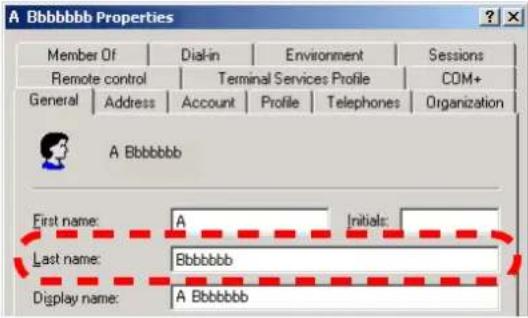 | |
| Common Name | Searches the common names of users registered in the LDAP server. |
 | |
| This item can be set in the "Active Directory Users and Computers". The [Common Name] button must be selected to search for Active Directory groups. | |
| Display Name Searches the display names of users registered in the LDAP server. | 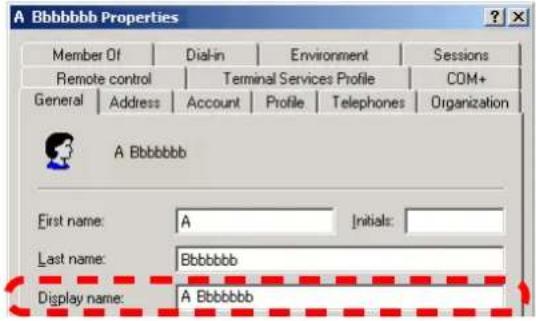 |

- If none of the [First Name], [Last Name], [Common Name], or [Display Name] buttons are selected, the corresponding search parameter button on the "e-Mail Address Book" - [LDAP List] tab cannot be selected.
- If the [Display Name] button is selected, and the display format for LDAP search results is "First Name" - "Last Name" or "Last Name" - "First Name", search results are shown as a "-" if a first name or last name has not been registered.
Example: For LDAP search results format "First Name" - "Last Name", with a first name not registered
Search result display format: Last Name ----
- Press the [List] button for the "Result Format" input field.
→ The result format screen appears.
- Specify the format of the LDAP search result.
Displays the LDAP search result according to the specified format.
| Result Format Descriptions | |
| FirstName LastName Shows | "First Name" - "Last Name" of the users registered in the LDAP server. |
| LastName FirstName | Shows "Last Name" - "First Name" of the users registered in the LDAP server. |
| CommonName Shows | "Common Name" of the users registered in the LDAP server.The [Common Name] button must be selected to have group names appear when searching for Active Directory groups. |
| DisplayName Shows | "Display Name" of the users registered in the LDAP server. |
6. Enter the button name.
The characters input here are displayed on the button name on the [LDAP List] tab.
This may be up to 18 characters long. Only alphanumeric characters may be entered.
A space (only one) also can be used, but the space will be displayed as a line break on the button. Please note that a space between words cannot be made within a line. Only one blank space can be entered.


If the button names are changed, check the actual button image shown on the LDAP "e-Mail Address Book" screen.
The button image may not show all characters entered.
7. Press the [OK] button.
⇒ The LDAP search parameters are set.
4.7.11 Setting the e-Mail Server (SMTP Server) Touch Panel Admin Tool Central Admin

e-Mail cannot be sent if authentication is required by the e-mail server before sending.
- Select the [Network Settings] tab on the top menu.
- Select the [SMTP Server] tab on the left side menu.
→ The "SMTP Server" screen appears.
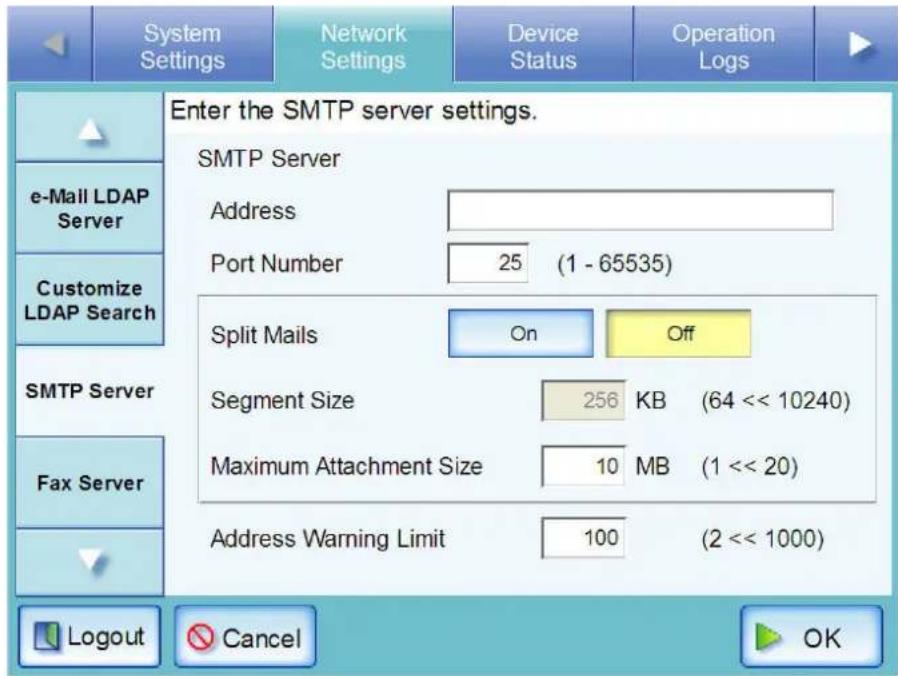
text_image
System Settings Network Settings Device Status Operation Logs Enter the SMTP server settings. SMTP Server Address Port Number 25 (1 - 65535) Split Mails On Off Segment Size 256 KB (64 << 10240) Maximum Attachment Size 10 MB (1 << 20) Address Warning Limit 100 (2 << 1000) e-Mail LDAP Server Customize LDAP Search SMTP Server Fax Server Logout Cancel OK-
Enter the SMTP server IP address, host name, or FQDN in the "Address" input field.
-
For an IP address
The following format should be used xxx.xxx.xxx.xxx (xxx is a value from 0 to 255). -
For a host name or FQDN
This may be up to 255 characters long.
If an SMTP server is not required, leave this field blank. -
Enter a port number from 1 to 65535, to be used by the scanner to communicate with the SMTP Server.
The default setting is 25.
- At "Split Mails", set whether to send split e-mails.
The default setting is [Off].
Press the [On] button to send split e-mails.
Press the [Off] button to send an e-mail without splitting it.
- For "Segment Size", set a value from 64 to 10240 as the maximum size for splitting an e-mail.
The default size is "256 KB".
- Set the "Maximum Attachment Size" for e-mails (total data size when sending an e-mail). This may be between 1 and 20 MB.
The default size is "10MB".


Set this value so as not to exceed the value of the message size restriction set in the SMTP server.

- For "Address Warning Limit", set a value from 2 and 1000 as the maximum number of addresses to which e-mail can be sent without confirmation. If the number of recipient addresses specified for an e-mail is then larger than this value, a warning dialog will be shown to prevent inadvertent transmission of a mass e-mailing.
The default value is "100".
- Press the [OK] button.
→ The SMTP server is set.
4.7.12 Setting the Fax Server


- Select the [Network Settings] tab on the top menu.
- Select the [Fax Server] tab on the left side menu.
→ The "Fax Server" screen appears.

text_image
System Settings Network Settings Device Status Operation Logs Enter the e-mail address for the fax server. e-Mail LDAP Server Customize LDAP Search SMTP Server Fax Server Logout Cancel OK- Enter a monitored fax server (RightFax) e-mail address in the "Fax Server e-Mail Address" field.
If the fax server setting is not required, leave the field blank. For more details about e-mail Address setting values, refer to "B.1 e-Mail Address Setting Values" (page 490).
- Press the [OK] button.
→ The fax server is set.
4.7.13 Setting the Network Printers
Touch Panel
Admin Tool
Central Admin
Set a printer connected to the network.
The procedure for setting a network printer is as follows.
- Check the printer driver.
For more details, refer to "Checking the Printer Drivers" (page 120).
- Set the printer properties.
For more details, refer to "Setting the Printer Properties" (page 121).
- Register the network printer.
Up to 100 network printers can be registered.
A network printer can be registered in one of the following ways.
- Network Tree
Select a network printer from the network tree.
For more details, refer to "Registering a Network Printer (Network Tree)" (page 124). - Network Path
Directly enter the network printer path name.
For more details, refer to "Registering a Network Printer (Network Path)" (page 127).

- Be sure to read the printer manual beforehand for information about setting a printer, adding a network printer, and other cautions.
- If the drive on which the spool folder for the print server exists does not have enough free space, printing will stop. Make sure that there is enough space in the drive before printing.
- Do not set a virtual printer.
- If a printer connected to different print servers is to be registered as a network printer multiple times, the software version of the driver should be the same on each print server. If the software version of the printer driver differs, printing errors may occur.
■ Checking the Printer Drivers
The driver installed on the print server must be compatible with Windows XP.
Use the following procedure to check whether the drivers installed on the print server are Windows XP compatible drivers.
- From the [Start] menu on the print server, select [Control Panel] - [Printers and Faxes].
→ The "Printers and Faxes" window appears.
- Right-click on a printer, and select [Properties].
→ Printer properties appear.
- Press the [Additional Drivers] button in the [Sharing] tab.
→ The "Additional Drivers" window appears.
- Check that the "Processor" is "x86" (or intel), and that "Installed" is "Yes" for version Windows XP.

text_image
Additional Drivers You can install additional drivers so that users on the following systems can download them automatically when they connect. Processor Version Installed □ Itanium Windows XP and Windows Server 2... No □ x64 Windows XP and Windows Server 2... No ☑ x86 Windows 2000, Windows XP and WI... Yes □ x86 Windows 95, Windows 98, and Win... No □ x86 Windows NT 4.0 No OK CancelWhen the "Installed" status is "Yes", the driver has been installed and the printer can be used as a network printer. Press the [Cancel] button.
When the "Installed" status is "No", select version "Windows XP", and press the [OK] button.
→The Windows XP compatible driver is installed.
■ Setting the Printer Properties
Use the following procedures to set a printer.
- From the [Start] menu on the print server, select [Control Panel] - [Printers and Faxes].
→ The "Printers and Faxes" window appears.
- Right-click on a printer, and select [Properties].
⇒ The "printer properties" window appears.
- Press the [Printing Defaults] button in the [Advanced] tab.
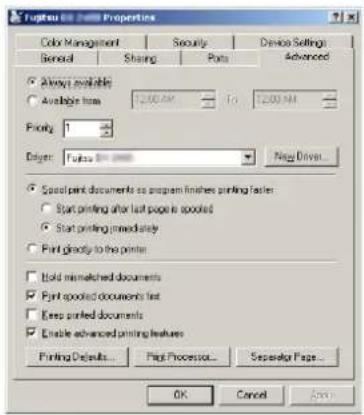
text_image
Fujitsu 6.0 Properties Color Management Security Device Settings General Sharing Ports Advanced Always available Average from 1200 AM 1:0 1200 AM Priority: Layer: Future New Drive Spot print documents as program finishes printing faster: Start printing after last page is pooled Start printing immediately Print clearly to the printer Hold mismatched documents Print pooled documents list Keep pooled documents Enable advanced printing features Printing Defaults... Past Processo... Separerio Page... OK Cancel Help→The "printing defaults" window is displayed.
- Change the settings and press the [OK] button.

text_image
Fujitsu 2008 Printing Defaults Layout | Paper/Quality | Orientation ● Forward ○ Landscape Page Order ● Front to Back ○ Back to Front Pages Per Sheet: 1 Advanced... OK Cancel Help→ The printer properties are set.

It is recommended that the same one printer is added to the print server multiple times for each set of properties settings, according to usage. For example, "for color printing" and "for black & white printing".
For a color printing example, the procedure for adding a printer is as follows.
- From the [Start] menu on the print server, select [Control Panel] - [Printers and Faxes].
→The "Printers and Faxes" window appears.
- Double-click the [Add Printer].
→The "Add Printer Wizard" window appears.
-
Follow prompts on the wizard window until the "Use Existing Driver" window appears.
-
Select "Keep existing driver [recommended]" and press the [Next] button.
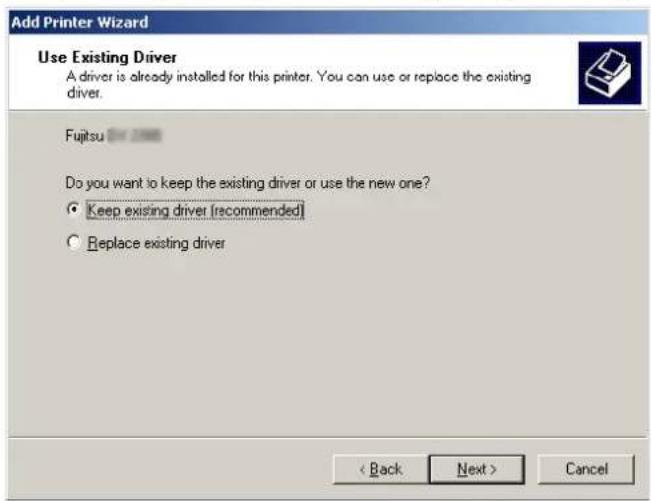
text_image
Add Printer Wizard Use Existing Driver A driver is already installed for this printer. You can use or replace the existing driver. Fujitsu Do you want to keep the existing driver or use the new one? ● Keep existing driver [recommended] ○ Replace existing driver < Back Next > Cancel-
Follow the prompts on the wizard window until the "Printer Sharing" window appears.
-
Specify the shared name.
Enter "FUJITSUX.2 (Color)" for color printing.
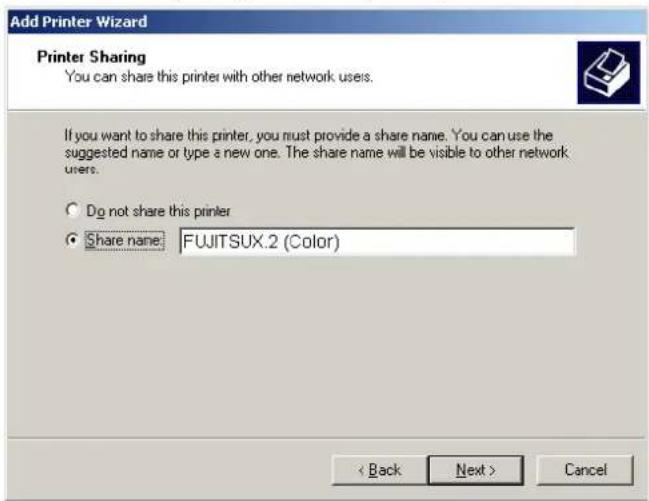
text_image
Add Printer Wizard Printer Sharing You can share this printer with other network users. If you want to share this printer, you must provide a share name. You can use the suggested name or type a new one. The share name will be visible to other network users. Do not share this printer Share name: FUJITSUX.2 (Color) < Back Next > CancelIt is recommended to name the printer with an alias that indicates the contents of the properties settings as follows.

text_image
System Settings Network Settings Device Status Operation Logs Setup the network printers. Printer List FUJITSUX.2(Black&White) FUJITSUX.2(Color) FUJITSUX.2(Duplex A4) Network Printer Network Folder Alert Notification Ping 1 / 1 Logout Add Rename Remove Details→Follow the prompts on the wizard window. The "Completing the Add Printer Wizard" message indicates that the printer addition has completed. Press the [Finish] button.
→The printer is added on the "Printers and Faxes" window.
- Right-click the added printer and select [Properties].
→The "printer properties" window appears.
- Press the [Printing Defaults] button on the [Advanced] tab.
→The printing defaults window appears.
- Select "Color" on the [Paper/Quality] tab, and press the [OK] button.
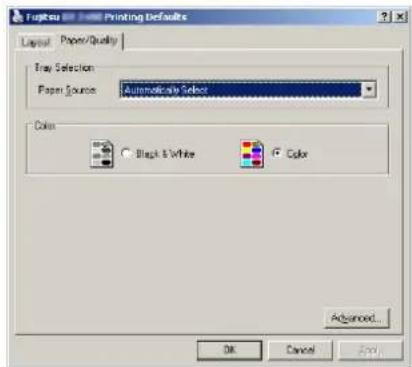
text_image
Fujitsu Printing Defaults Layout Paper/Quality Tray Selection Paper Source: Automaticly Select Color Black & White Color Advanced... OK Cancel Apply⇒Printing is set to "Color".
After this, if the printer set for color printing on the print server is added to the scanner printer list, the user can specify to use this printer already set for color printing.
For details about adding the printer to the scanner printer list, refer to "Registering a Network Printer (Network Tree)" (page 124) or "Registering a Network Printer (Network Path)" (page 127).
■ Registering a Network Printer (Network Tree)
- Select the [Network Settings] tab on the top menu.
- Select the [Network Printer] tab on the left side menu.
→ The "Network Printer" screen appears.
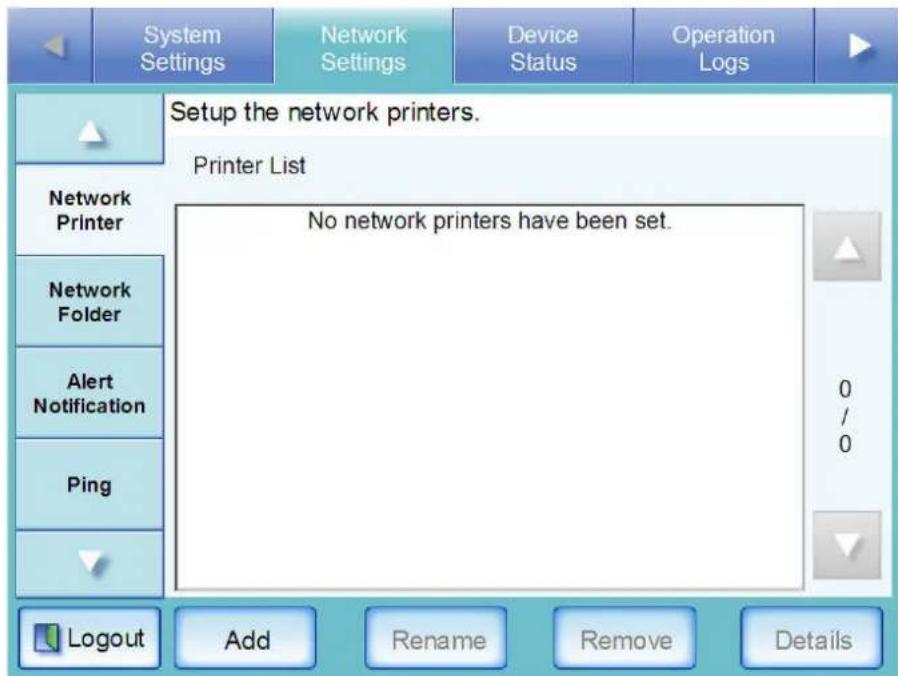
text_image
System Settings Network Settings Device Status Operation Logs Setup the network printers. Printer List No network printers have been set. Network Printer Network Folder Alert Notification Ping 0 / 0 Logout Add Rename Remove Details- Press the [Add] button.
→ The screen for selecting a network printer is displayed.

Desired domains may not be shown in the Printer Network. In this case, directly enter the network printer path name, or wait for a few minutes and re-open the screen for selecting a network printer.
4. Select a domain


text_image
System Settings Network Settings Device Status Operation Logs Select a printer. Printer Network Find WORKGROUP Network Printer Network Folder Alert Notification Ping 1 / 1 Logout Cancel Network Path SelectIf login is required, an "Authentication" screen appears.
If login is not required, the network tree expands and computer names are displayed under the selected domain.

text_image
Authentication required for access. User Name Password Cancel Num Lock Caps Lock OK
The "Caps Lock" and "Num Lock" indicators are shown on the authentication screen, when the administrator logs in via the scanner's touch panel. The "Caps Lock" indicator is on if the keyboard's Caps Lock is set. The "Num Lock" indicator is on if the keyboard's Num Lock is set.
- Enter a User Name.
This may be up to 256 characters long.
- Enter a Password.
This may be up to 256 characters long (case sensitive).
- Press the [OK] button.
When the user name and password are valid, or if login is not required, the network tree expands and computer names are displayed under the selected domain.

5. Select a computer
If login is required, a login authentication screen appears.
If login is not required, the network tree expands and computer names are displayed under the selected domain.
- Enter a User Name.
This may be up to 256 characters long.
- Enter a Password.
This may be up to 256 characters long (case sensitive).
- Press the [OK] button.
When the user name and password is valid, or if login is not required, the network tree expands and network printers are displayed under the selected computer name.
6. Select a network printer


A network printer that has already registered cannot be added.
7. Press the [Select] button.
The screen returns to the "Network Printer" screen, and the registered network printer is added to the network printer list.
![FUJITSU fi-6010N - Press the [Select] button. - 1](/content/2026/06/1236812/images/f506f561f0ca30c52b4a5c8a9e7ca6546be2767796b6f70c50182389387ce6f8.jpg)
- Once the network printer is registered, do not change the shared name or printer alias on the print server.
- To change the shared name or printer alias, remove the registered network printer first, and then change the share name/printer alias, and register it again.
![FUJITSU fi-6010N - Press the [Select] button. - 2](/content/2026/06/1236812/images/17edc574cc675cc97fea559c0ec9a2e158a1143ab6d079629825f1d4b67529fe.jpg)
- The default network printer alias will be the same as the alias selected from the network tree. For details on changing the printer alias, refer to "Renaming a Network Printer" (page 129).
- While the network tree is displayed, enter characters to be searched for in the "Find" field, and press the [Back] or [Next] button to focus the network tree on the specified characters.
■ Registering a Network Printer (Network Path)
- Select the [Network Settings] tab on the top menu.
- Select the [Network Printer] tab on the left side menu.
→ The "Network Printer" screen appears.
- Press the [Add] button.
→ The screen for selecting a network printer is displayed.
- Press the [Network Path] button.
→ The screen for adding a network printer is displayed.

text_image
System Settings Network Settings Device Status Operation Logs Add a network printer. Network Printer Printer Alias * If left blank, the shared printer name will be used. Network Folder Alert Notification Ping Network Path (eg: \\Domain\\Computer\\Printer) Logout Cancel Network Tree Add
Pressing the [Network Tree] button returns to the screen for selecting a network printer from the network tree.
- Enter a "Printer Alias".
This may be up to 80 characters long. "\" cannot be used in a printer alias. If you do not enter a name for "Printer Alias" and press the [Add] button, the shared name will be used as the "Printer Alias".
6. Enter a "Network Path".
"Network Path" may be up to 255 characters long.
Set the network path in the following format:
\Domain_name\Computer_name\Printer_alias
For the "Domain_name", specify the NetBIOS domain name or the workgroup name that the network printer belongs to.
For the "Computer_name", specify the IP address, host name, or FQDN.
When specifying the IP address or FQDN for "Computer_name", a primary DNS suffix setting for the print server is required.
When a primary DNS suffix for the print server is already set, the following settings are not required.
The procedure for setting a primary DNS suffix is as follows.
- From the [Start] menu on the print server, select [Control Panel]-[System].
⇒The "System Properties" window appears.
- Select the [Change] button in the [Computer Name] tab.
For the Windows 2000 Server, select the [Properties] button in the [Network Identification] tab.
⇒The "Computer Name Changes" window appears.
- Select the [More] button.
⇒The "DNS Suffix and NetBIOS Computer Name" window appears.
- For "Primary DNS suffix of this computer", specify the DNS suffix to be appended to the name of this computer when completing its FQDN.
Example: example.com
- After these changes are applied, restart the computer.
7. Press the [Add] button.
⇒ The screen returns to the "Network Printers" screen, and the registered network printer is added to the network printer list.
![FUJITSU fi-6010N - Press the [Add] button. - 1](/content/2026/06/1236812/images/55af698d8866bb227c86a57c96247fbe5a64508a88a0cfb5b5823c0367b63956.jpg)
● The already registered network printer cannot be added.
- Once the network printer is registered, do not change the shared name or printer alias on the print server.
- To change the shared name or printer alias, remove the registered network printer first, and then change the share name/printer alias, and register it again.
![FUJITSU fi-6010N - Press the [Add] button. - 2](/content/2026/06/1236812/images/a17d369e3a8a42285fb9eea78812c20248e2401b7e8f98d7bc093b14bf742b73.jpg)
- The default network printer alias will be the same as the alias selected from the network tree. For details on changing the printer alias, refer to "Renaming a Network Printer" (page 129).
● The authentication screen may appear.
■ Renaming a Network Printer
- Select the [Network Settings] tab on the top menu.
- Select the [Network Printer] tab on the left side menu.
→ The "Network Printer" screen appears.
-
Select the network printer that is to be renamed.
-
Press the [Rename] button.
→ The screen for renaming a network printer is displayed.
- Enter a new printer alias.
This may be up to 80 characters long. The folder alias may not contain backslashes (). Trailing spaces are truncated, so a spaces-only alias is not allowed.

text_image
Enter the new printer alias. Printer Alias: Printer02 Network Path: \WORKGROUP\WORK\FUJITSUX Cancel OK- Press the [OK] button.
→ The network printer is renamed.
■ Removing a Network Printer
- Select the [Network Settings] tab on the top menu.
- Select the [Network Printer] tab on the left side menu.
→ The "Network Printer" screen appears.
-
Select the network printer that is to be removed from the printer list.
-
Press the [Remove] button.
→ The screen for removing a network printer is displayed.
- Confirm the details of the network printer that is to be removed are correct, and press the [Yes] button.
→ The selected network printer is removed from the network printers list.

If removing a network printer is attempted while the network is not connected, the "Deleting" status on the screen be stopped. Before removing a network printer, check that the network is functioning normally.
■ Viewing the Printer Details
- Select the [Network Settings] tab on the top menu.
-
Select the [Network Printer] tab on the left side menu.
→ The "Network Printer" screen appears. -
Select the desired network printer from the printer list.
-
Press the [Details] button.
→ The information for the selected network printer is displayed.
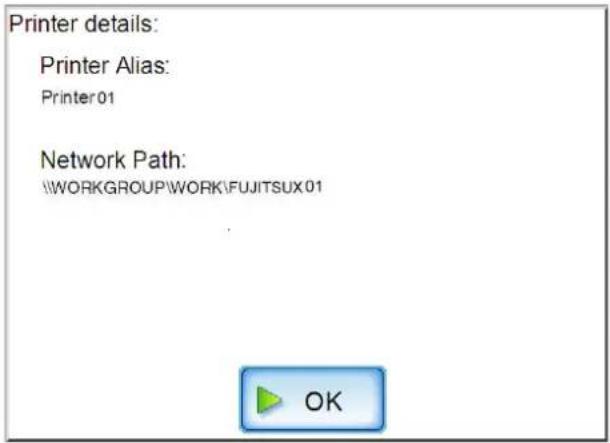
text_image
Printer details: Printer Alias: Printer01 Network Path: \WORKGROUP\WORK\FUJITSUX01 OK4.7.14 Setting the Network Folders
Touch Panel
Admin Tool
Central Admin
A list of network folders may be set as "Save" targets for scanned data.
Any accessible file server folder or FTP server folder may be specified.
Up to 100 network folders and FTP server folders can be added.
A network folder can be added in either of the following ways.
- Network Tree
Select a network folder from the network tree.
For details, refer to "Registering a Network Folder (Network Tree)" (page 133). - Network Path
Set a network folder by directly entering the path alias for the file server folder.
For details, refer to "Registering a Network Folder (Network Path)" (page 136). - FTP Path
Set a network folder by directly entering the path alias for the FTP server folder.
For details, refer to "Registering a Network Folder (FTP Path)" (page 138).

Note the following when registering a network folder.
- The network folder is registered as a network path. If the network folder is on a Windows file server and the length of the full Windows path including the file name exceeds 259 characters, the scan data will not be saved.
Before registering a (Windows) network folder, check that the length of the full file path+name is not likely to exceed 259 characters. - If the selected folder was created using a language foreign to that of the browsing operating system, the network folder may not register correctly. If the name of the network folder contains unrecognizable characters, check the codeset used.
- If the number folders to be displayed is large, they may take a long time to appear.
■ Registering a Network Folder (Network Tree)
- Select the [Network Settings] tab on the top menu.
- Select the [Network Folder] tab on the left side menu.
→ The "Network Folder" screen appears.
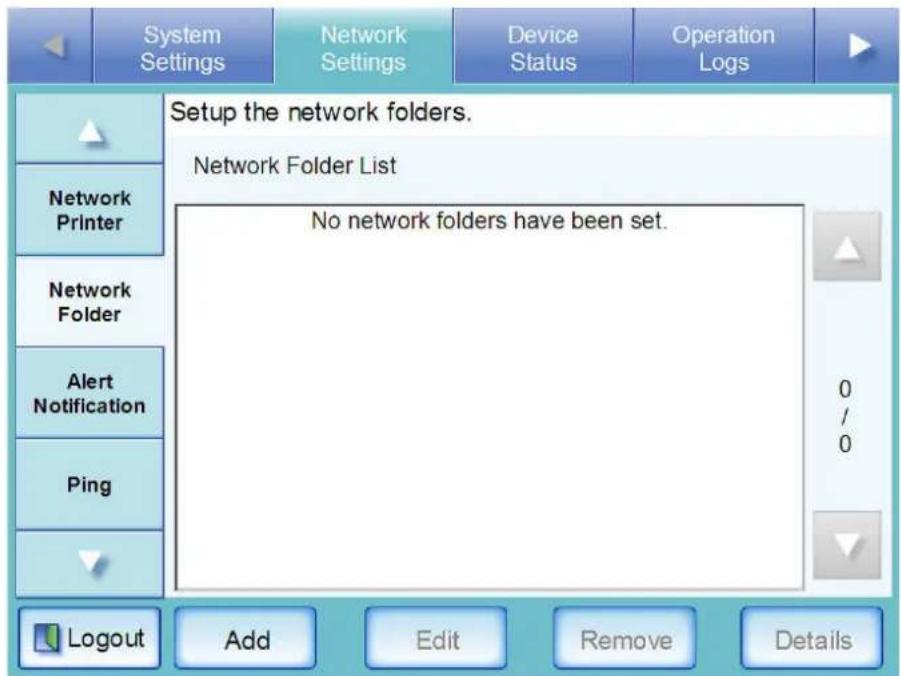
text_image
System Settings Network Settings Device Status Operation Logs Setup the network folders. Network Folder List No network folders have been set. Network Printer Network Folder Alert Notification Ping Logout Add Edit Remove Details- Press the [Add] button.
→ The screen for adding a network folder is displayed.

Desired domains may not be shown in the Network Folders. In this case, directly enter the path alias for the file server, or wait for a few minutes and re-open the screen for adding a network folder.
4. Select a domain


text_image
System Settings Network Settings Device Status Operation Logs Select a network folder. Network Folders Find WORKGROUP 1 / 1 Alert Notification Ping Logout Cancel Network Path FTP Path SelectIf login is required, an "Authentication" screen appears.
If login is not required, the network tree expands and computer names are displayed under the selected domain.
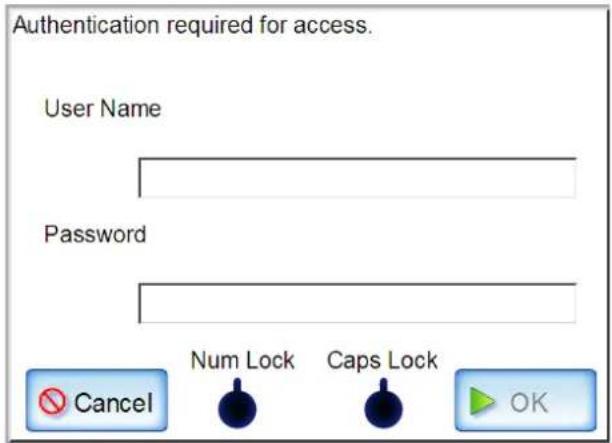
text_image
Authentication required for access. User Name Password Cancel Num Lock Caps Lock OK
The "Caps Lock" and "Num Lock" indicators are shown on the authentication screen, when the administrator logs in via the scanner's touch panel. The "Caps Lock" indicator is on if the keyboard's Caps Lock is set. The "Num Lock" indicator is on if the keyboard's Num Lock is set.
- Enter a User Name.
This may be up to 256 characters long.
- Enter a Password.
This may be up to 256 characters long (case sensitive).
- Press the [OK] button.
When the user name and password are valid, or if login is not required, the network tree expands and computer names are displayed under the selected domain.

5. Select a computer .
If login is required, an "Authentication" screen appears.
If login is not required, the network tree expands and computer names are displayed under the selected domain.
- Enter a User Name.
This may be up to 256 characters long.
- Enter a Password.
This may be up to 256 characters long (case sensitive).
- Press the [OK] button.
When the user name and password is valid, or if login is not required, the network tree expands and network folders are displayed under the selected computer name.

6. Select a network folder .
The selected folder will be opened to show any sub-folders, which themselves may be selected in turn (up to seven levels deep, including the parent domain).
7. Press the [Select] button.
⇒ The selected network folder is added to the network folder list.
![FUJITSU fi-6010N - Press the [Select] button. - 1](/content/2026/06/1236812/images/f361fae3891ddff34736c9a0cea26f0c342455dcdabbf59a084ee6cc4aec8ae2.jpg)
- The default network folder alias will be the same as the alias selected from the network tree. For details on changing the folder alias, refer to "Renaming a Network Folder" (page 141).
- Select a readable and writable network folder.
- The "Network" tree can show up to 400 domain, computer, and network folder items on the touch panel screen, and up to 10,000 items on the Admin Tool screen.
- While the network tree is displayed, enter characters to be searched for in the "Find" field, and press the [Back] or [Next] button to focus the network tree on the specified characters.
■ Registering a Network Folder (Network Path)
- Select the [Network Settings] tab on the top menu.
- Select the [Network Folder] tab on the left side menu.
→ The "Network Folder" screen appears.
- Press the [Add] button.
→ The screen for selecting a network folder is displayed.
- Press the [Network Path] button.
⇒ The screen for adding a network folder (Network Path) is displayed.
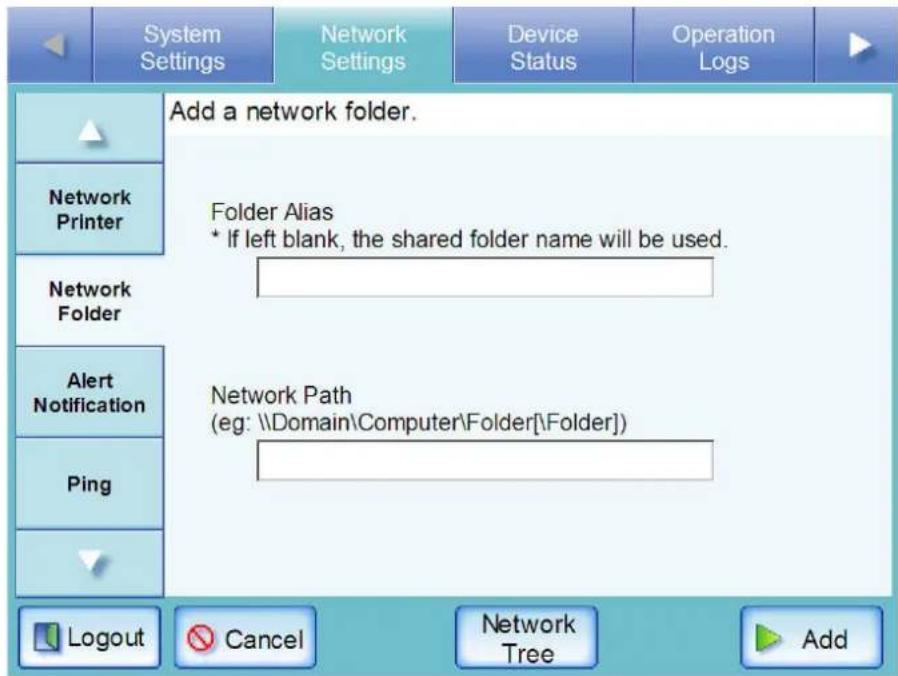
text_image
System Settings Network Settings Device Status Operation Logs Add a network folder. Network Printer Folder Alias * If left blank, the shared folder name will be used. Network Folder Alert Notification Ping Network Path (eg: \\Domain\\Computer\Folder[\Folder]) Logout Cancel Network Tree Add
Pressing the [Network Tree] button returns to the screen for selecting a folder from the network tree.
- Enter a "Folder Alias".
This may be up to 80 characters long. "\" cannot be used in a folder alias. If you do not enter a name for "Folder Alias" and press the [Add] button, the shared name will be used as the "Folder Alias".
6. Enter a "Network Path".
Set the network path in the following format:
\Domain_name\Computer_name\Folder_name[\Folder_name]
The minimum requirement for a network path is:
\Domain_name\Computer_name\Folder_name
This may be up to 255 characters long.
Sub folders ([\Folder_name] is the example above) are optional.
"/" and "\" can be used as a delimiter for the folder alias.
If "/" is used, the network folder name is registered as "folder_name/folder_name".
For the "Domain_name", specify the NetBIOS domain name or the workgroup name that the network folder belongs to.
For the "Computer_name", specify the IP address, host name, or FQDN.
7. Press the [Add] button.
⇒ The network folder is added to the network folder list.
![FUJITSU fi-6010N - Press the [Add] button. - 1](/content/2026/06/1236812/images/b91e9cc0aaf3ace0c5c772e354a5a70b798bda3549efbbd64aad5085beb85e50.jpg)
- The default network folder alias will be the same as the alias selected from the network tree. For details on changing the folder alias, refer to "Renaming a Network Folder" (page 141).
- Select a readable and writable network folder.
● The authentication screen may be displayed.
■ Registering a Network Folder (FTP Path)
- Select the [Network Settings] tab on the top menu.
- Select the [Network Folder] tab on the left side menu.
→ The "Network Folder" screen appears.
- Press the [Add] button.
→ The screen for selecting a network folder is displayed.
- Press the [FTP Path] button.
→ The screen for entering a network folder (FTP Path) is displayed.

text_image
System Settings Network Settings Device Status Operation Logs Enter the FTP server settings. Folder Alias FTP Path User Name Password Network Printer Network Folder Authentication Remember Each Time Port Number Protocol FTP FTPS 21 Passive Mode On Off (1 - 65535) Encryption Explicit Implicit Proxy * On Off *See the Proxy Server Menu Alert Notification Ping Logout Cancel OK- Enter a "Folder Alias".
This may be up to 80 characters long. "\" cannot be used in a folder alias. If you do not enter a name for "Folder Alias" and press the [OK] button, the FTP path will be used as the "Folder Alias". If the FTP path includes "\", the name of the bottommost folder in the path is used as the "Folder Alias". For example, if the FTP path is specified as "FTPSERVER\folder", the "Folder Alias" will be "folder".
- Enter a "FTP Path".
This may be up to 255 characters long.
Set the FTP path in the following format:
Computer_name\Folder_alias
For the "Computer_name", specify the IP address, host name, or FQDN.
- Enter a user name and password for login to the FTP sever.
"User Name" or "Password" may be up to 256 characters long. Passwords are case sensitive.
- For "Authentication", specify whether or not to save the entered "User Name" and "Password".
When the [Remember] button is selected, the "User Name" and "Password" are saved. The "User Name" and "Password" saved for authentication are used on the regular user screen.
When the [Each Time] button is selected, the "User Name" and "Password" are not saved. When selecting a network folder initially, authentication is required on the regular user screen. However, if the user is registered in the LDAP server, and the LDAP user name and password can be used for authentication, the authentication screen will not appear even if the [Each Time] button is selected.
- For "Protocol", specify how to access the FTP server.
The default value is "FTP".
When the [FTP] button is selected, the FTP server will be connected without SSL encryption.
When the [FTPS] button is selected, the FTP server will be connected through SSL encryption.
- Set a "Port Number" for the FTP server.
The default number is 21. Numbers from 1 to 65535 can be set.
- For "Passive Mode", specify whether or not to access in passive mode.
The default value is "On".
"Passive Mode" can be selected only when the [FTP] button is selected in Step 9.
When the [On] button is selected, the FTP server is connected in passive mode.
When the [Off] button is selected, the FTP server is connected in active mode.
When the [FTPS] button is selected in Step 9, the FTP server is connected in passive mode.
- For "Encryption", specify the type of encryption.
"Encryption" can be selected when the [FTPS] button is selected in Step 9.
When the [Explicit] button is selected, the FTP server will be connected without SSL encryption, and encryption will start before user name and password are authenticated.
When the [Implicit] button is selected, SSL encryption will work when the FTP server connection is started.
- For "Proxy", specify whether or not a proxy server is to be used.
The "Proxy" setting is only available when a proxy server has been set on the "Proxy Server" screen. For details about proxy server settings, refer to "4.7.7 Setting the Proxy Server" (page 98).
When the [ON] button is selected, the FTP connection is via the proxy server specified on the "Proxy Server" screen.
When the [OFF] button is selected, the FTP server is connected to directly, without using the proxy server.
14. Press the [OK] button.
User authentication may be required to access the FTP server. Then, the network folder is added to the network folder list.
![FUJITSU fi-6010N - Press the [OK] button. - 1](/content/2026/06/1236812/images/b64062bbb078bccdbb6b4785af7a1bb3ab4f24b87cda36bba4e05ef1bf12464d.jpg)
For the Central Admin Console, to use a Central Admin Sever with an enabled firewall, set the "Passive Mode" to "On".
![FUJITSU fi-6010N - Press the [OK] button. - 2](/content/2026/06/1236812/images/3202bc193eb608da49de25057172bfd691a65f44ee19273426f2bcfbe612f4ca.jpg)
Select a readable and writable network folder.
■ Renaming a Network Folder
- Select the [Network Settings] tab on the top menu.
-
Select the [Network Folder] tab on the left side menu.
→ The "Network Folder" screen appears. -
Select the network folder that is to be renamed.
-
Press the [Edit] button.
→ The screen for renaming a network folder is displayed.
- Enter a folder alias.
This may be up to 80 characters long. The folder alias may not contain backslashes (). Trailing spaces are truncated, so a spaces-only alias is not allowed.
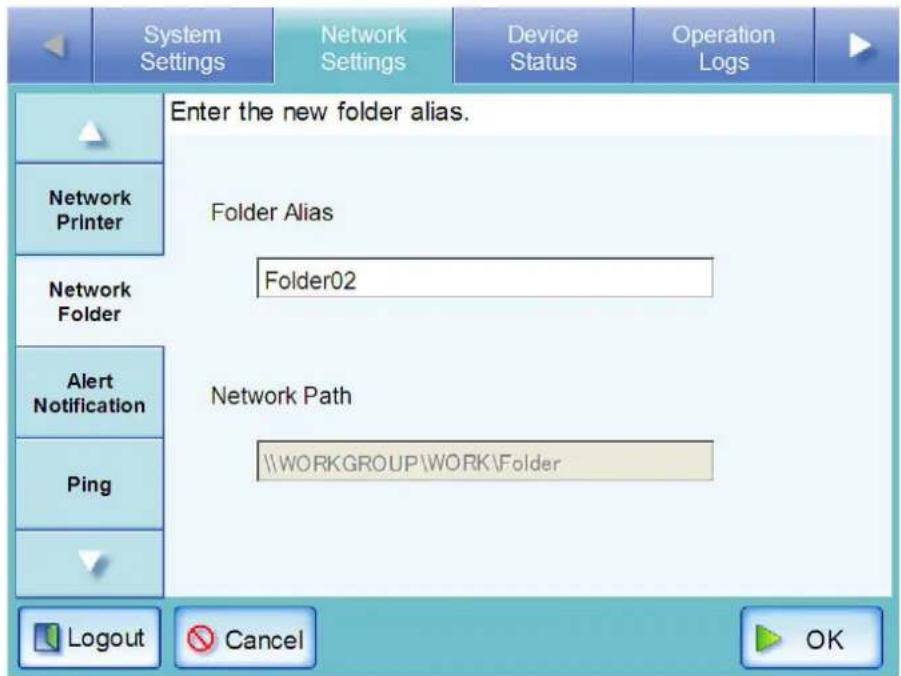
text_image
System Settings Network Settings Device Status Operation Logs Enter the new folder alias. Network Printer Folder Alias Network Folder Folder02 Alert Notification Network Path \\WORKGROUP\WORK\Folder Ping Logout Cancel OK
If the network folder is an FTP server folder, the following screen is displayed. In this case, the "FTP Path" cannot be changed.

text_image
System Settings Network Settings Device Status Operation Logs Enter the FTP server settings. Folder Alias Folder02FTP FTP Path User Name abc Password ... Network Printer Network Folder Authentication Remember Each Time Port Number Protocol FTP FTPS 21 Alert Notification Passive Mode On Off (1 - 65535) Ping Encryption Explicit Implicit Proxy * On Off *See the Proxy Server Menu Logout Cancel OK- Press the [OK] button.
→ The network folder is renamed.
■ Removing a Network Folder
- Select the [Network Settings] tab on the top menu.
- Select the [Network Folder] tab on the left side menu.
→ The "Network Folder" screen appears.
-
Select the network folder that is to be removed from the folder list.
-
Press the [Remove] button.
The screen for removing a network folder is displayed.
- Confirm the details of the network folder that is to be removed are correct, and press the [Yes] button.
→ The selected network folder is removed from the network folders list.
■ Viewing the Network Folder Details
- Select the [Network Settings] tab on the top menu.
-
Select the [Network Folder] tab on the left side menu.
→ The "Network Folder" screen appears. -
Select the desired network folder from the folder list.
-
Press the [Details] button.
→ The information for the selected network folder is displayed.
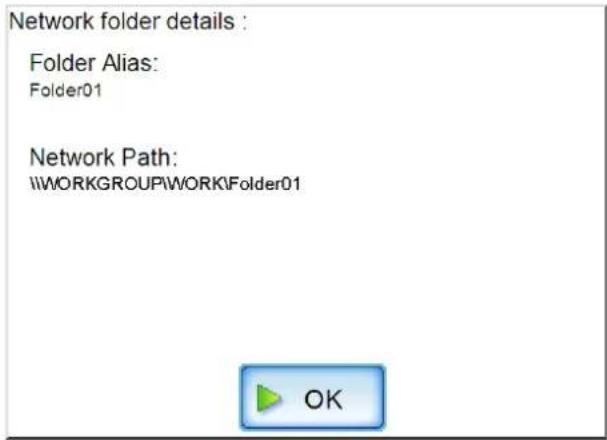
text_image
Network folder details : Folder Alias: Folder01 Network Path: \\WORKGROUP\\WORK\\Folder01 OK
If the network folder is an FTP server folder, the following screen is displayed.
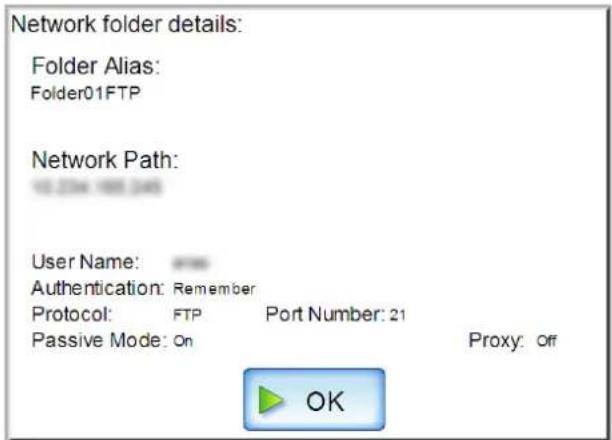
text_image
Network folder details: Folder Alias: Folder01FTP Network Path: User Name: Authentication: Remember Protocol: FTP Port Number: 21 Passive Mode: On Proxy: off OK4.7.15 Setting the SharePoint Folders

A list of SharePoint folders may be set as "Scan to SharePoint" targets for scanned data.
- Select the [Network Settings] tab on the top menu.
- Select the [SharePoint Folder] tab on the left side menu.
→ The "SharePoint Folder" screen appears.
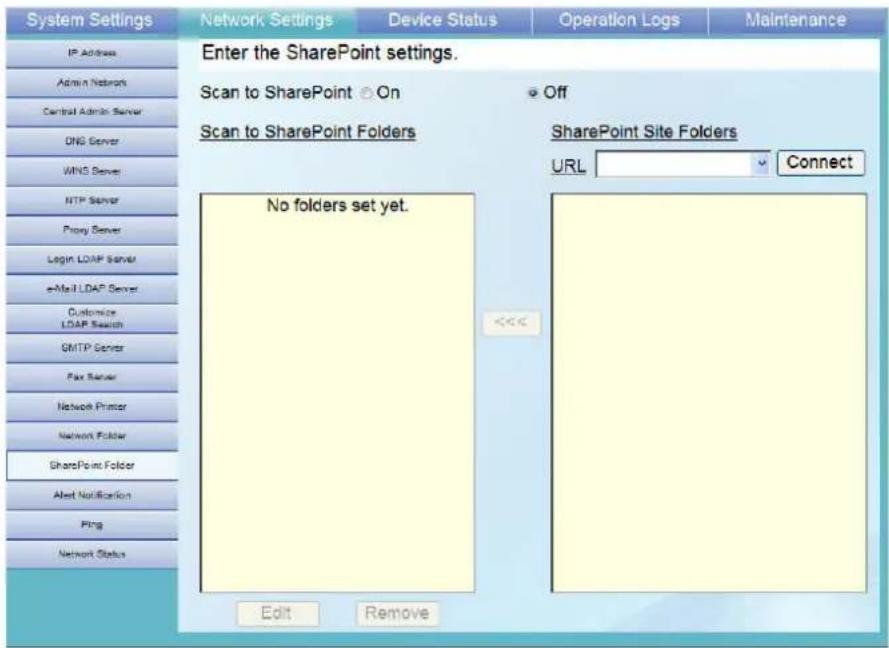
text_image
System Settings Network Settings Device Status Operation Logs Maintenance IP Address Enter the SharePoint settings. Scan to SharePoint ○ On ○ Off Scan to SharePoint Folders SharePoint Site Folders URL Connect No folders set yet. Edit Remove- The "Scan to SharePoint" option determines whether users are allowed to save scanned data in SharePoint folders.
The default setting is [Off].
Selecting [On] allows scanned data to be saved in a SharePoint folder.
Selecting [Off] prevents scanned data from being saved in a SharePoint folder.
- Specify a SharePoint server site URL in the "URL" field.
Either of the following formats may be used:
- Not using SSL http://SharePoint_server_IP_address, host_name, or FQDN[:port_number]/[site_name] Port 80 is used if the port number is skipped.
- Using SSL https://SharePoint_server_IP_address,host_name,orFQDN[:port_number]/[site_name] Port 443 is used if the port number is skipped.
If a site name is not entered, all sites under the base URL are shown.
URLs up to 512 characters long may be entered.
Pressing produces a list of the (up to) ten most recently specified URLs, allowing easy reselection of URLs.
- Press the [Connect] button.
A "Sign In" screen appears.
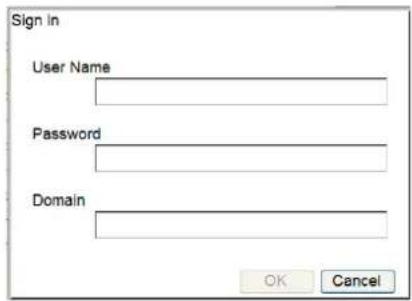
text_image
Sign in User Name Password Domain OK CancelEnter the sign in details for the specified SharePoint server.
- Enter a User Name.
This may be up to 256 characters long.
- Enter a Password.
This may be up to 256 characters long (case sensitive).
- Enter a Domain.
This may be up to 64 characters long.
- Press the [OK] button.
If the sign in is successful, the available SharePoint server folders are shown in the "SharePoint Site Folders" list area.
- Select the folder that is to be a save target from the "SharePoint Site Folders" list, and press the [<<] button.
⇒ The selected folder is added to the "Scan to SharePoint Folders" list, making it available to users as a save target.

- Do not set a folder in which scan data cannot be saved, such as a SharePoint library "Slide Library" type.
- Do not set a server site and folder URL path that exceeds 184 characters.
- When a folder is added to "Scan to SharePoint Folders" list, if the specified folder name already exists in the list, a parenthesized sequence number (starting from "(2)") will be appended to the folder name.

- To set a SharePoint folder from the Central Admin Server, install .NET Framework 3.0 Service Pack 1 or later into the Central Admin Server, and restart it.
- In the following cases, SharePoint folders cannot be set from the Central Admin Server.
- .NET Framework 3.0 Service Pack 1 or later is not installed in the Central Admin Server
● Central Admin Server software is installed in the Windows 2000 Server
■ Renaming a SharePoint Folder (Display Name)
SharePoint folder display names may be changed as follows.
- Select the [Network Settings] tab on the top menu.
- Select the [SharePoint Folder] tab on the left side menu.
→ The "SharePoint Folder" screen appears.
-
From the "Scan to SharePoint Folders" list, select the folder that is to be renamed.
-
Press the [Edit] button.
→ The "Scan to SharePoint folder details" screen appears.
- Enter the name that is to be shown for the selected SharePoint folder.
Up to 80 characters can be used. A folder name may not consist only of blank spaces. Spaces at the end of a folder name will not be recognized as part of the folder name.

text_image
System Settings Network Settings Device Status Operation Logs Maintenance IP Address Scan to SharePoint folder details. Admin Network Central Admin Server DNS Server Document WIND Server NTP Server Proxy Server Login LDAP Server e-Mail LDAP Server Customize LDAP Search SMTP Server Fax Server Network Printer Network Folder SharePoint Folder Alert Notification Ping Network Status Display Name Document Folder Hierarchy http:// OK Cancel- Press the [OK] button.
⇒ The SharePoint folder is renamed.
■ Removing a SharePoint Folder
An already set SharePoint folder may be removed from the list of save targets.
- Select the [Network Settings] tab on the top menu.
- Select the [SharePoint Folder] tab on the left side menu.
⇒ The "SharePoint Folder" screen appears.
-
From the "Scan to SharePoint Folders" list, select the folder that is to be removed.
-
Press the [Remove] button.
A confirm removal screen appears for the selected folder.
- Check that the correct folder is being removed, then press the [Yes] button.
→ The indicated folder is removed.
4.7.16 Setting the Destination for Alert Notifications

An e-mail address can be specified to which an alert notification will be sent whenever a scanner alert situation occurs.
If an SMTP server has not been setup, alert notifications cannot be sent. For more details about how to set an SMTP server, refer to "4.7.11 Setting the e-Mail Server (SMTP Server)" (page 116). When the destination for alert notification is set, alert notification messages will be sent to the registered e-mail address in the following title.
Network Scanner (XXXX) Error
For more details, refer to "E.1.3 Alert Monitor System Log Messages" (page 524).
- Select the [Network Settings] tab on the top menu.
- Select the [Alert Notification] tab on the left side menu.
→ The "Alert Notification" screen appears.

text_image
System Settings Network Settings Device Status Operation Logs Specify where alerts are to be sent. Notification e-Mail Address Network Printer Network Folder Alert Notification Test Ping Logout Cancel OK- Enter an e-mail address to which the alert notification will be sent.
For details about e-mail address settings values, refer to "B.1 e-Mail Address Setting Values" (page 490).
- To confirm that the entered e-mail address is valid, press the [Test] button.
Check that the test mail successfully arrives at the expected e-mail address.
- Press the [OK] button.
→ The destination for alert notifications is set.
4.7.17 Checking the Network Connection with a Ping Test
The network connection can be checked using a ping test.
- Select the [Network Settings] tab on the top menu.
- Select the [Ping] tab on the left side menu.
⇒ The "Ping" screen appears.
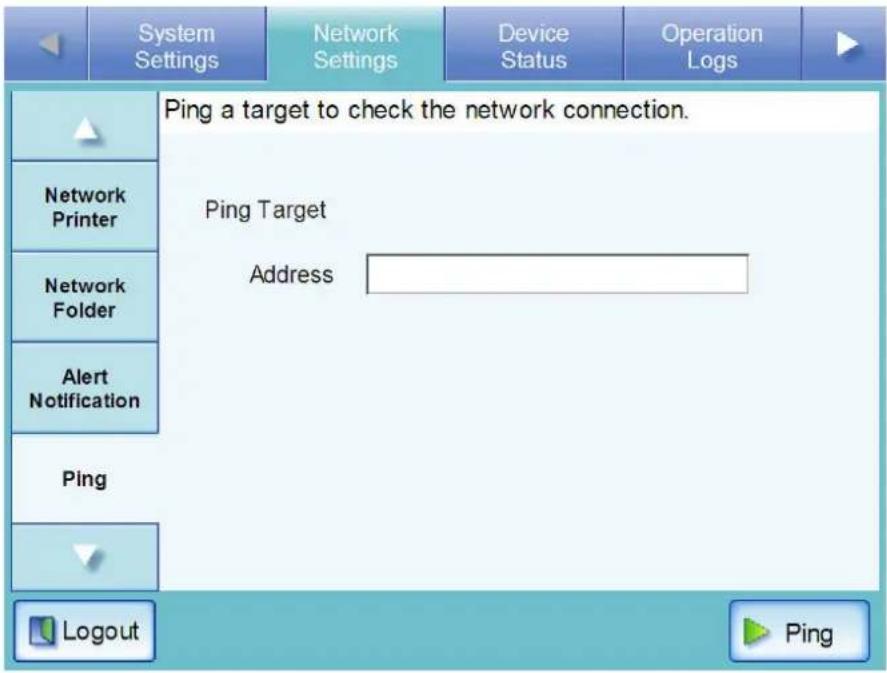
text_image
System Settings Network Settings Device Status Operation Logs Ping a target to check the network connection. Network Printer Ping Target Address Network Folder Alert Notification Ping Logout Ping-
Enter the IP address, host name, or FQDN for the server to be used to check the network connection.
-
For an IP address
The following format should be used xxx.xxx.xxx.xxx (xxx is a value from 0 to 255).
● For a host name or FQDN
Up to 255 characters may be used.
4. Press the [Ping] button.
A ping test is performed and the results are displayed.
For more details about the result, refer to "Checking basic network operation with a Ping test" (page 458).
![FUJITSU fi-6010N - Press the [Ping] button. - 1](/content/2026/06/1236812/images/f83fed568868a25fda7e226903639207f9ff00562221c2e7fa717d069d22bda8.jpg)
text_image
System Settings Network Settings Device Status Operation Logs Ping a target to check the network connection. Result Pinging 102 108.0.1 with 32 bytes of data: Reply from 102 108.0.1: bytes=32 time<1ms TTL=128 Reply from 102 108.0.1: bytes=32 time<1ms TTL=128 Reply from 102 108.0.1: bytes=32 time<1ms TTL=128 Reply from 102 108.0.1: bytes=32 time<1ms TTL=128 Ping statistics for 102 108.0.1: Packets: Sent = 4, Received = 4, Lost = 0 (0% loss), Approximate round trip times in milli-seconds: Minimum = 0ms, Maximum = 0ms, Average = 0ms Alert Notification Ping Logout OK4.7.18 Checking the Network Operating Status
■ Checking the Network Status
The operating status of the network can be checked.
The following information is shown. If the information is not shown, refer to "8.3 Network Connection Troubleshooting" (page 458) and check the settings.
The following information is shown.
- MAC Address
IP Address - Subnet Mask
-
Default Gateway
● DNS Server IP Address
● WINS Server IP Address -
Select the [Network Settings] tab on the top menu.
- Select the [Network Status] tab on the left side menu.
⇒ The "Network Status" screen shows the status of the currently operating network connection.

text_image
System Settings Network Settings Device Status Operation Logs Check the network information. Network Settings Item Value MAC Address 05.01.28.03 05.04 IP Address 162.168.0.34 Subnet Mask 259.259.259.0 Default Gateway 162.168.0.1 DNS Server 162.168.0.1 WINS Server 162.168.0.1 Link Speed/Duplex Mode Auto-Negotiation Logout Cancel OK
- If connection to LDAP server is not possible, try the following steps:
- Disconnect the LAN cable, and press the [Shutdown] button on the touch panel to turn the scanner off.
- Reboot the scanner with the LAN cable disconnected, and enter a nonduplicate IP address.
- Re-connect the LAN cable to the scanner.
- If the DHCP server cannot be reached when DHCP is set to [On], the IP Address is set to "169.254.XXX.YYY" (where XXX and YYY are arbitrary values between 0 and 255).
■ Setting the Link Speed/Duplex Mode
If the network is not communicating properly, even though the network operating status is correct, change the Link Speed/Duplex Mode settings.
- Select the [Network Settings] tab on the top menu.
- Press the [Network Status] tab on the left side menu.
⇒ The "Network Status" screen shows the status of the currently operating network connection.
- Press the Link Speed/Duplex Mode [List] button.
→ The Link Speed/Duplex Mode list appears. - Change the setting from "Auto-Negotiation" to a fixed Link Speed/Duplex Mode.
- Press the [OK] button.
⇒ The Link Speed/Duplex Mode setting is changed.
4.8 Using the Device Status Menus
4.8.1 Viewing the System Status

- Select the [Device Status] tab on the top menu.
- Select the [System Status] tab on the left side menu.
→ The system status information is displayed.
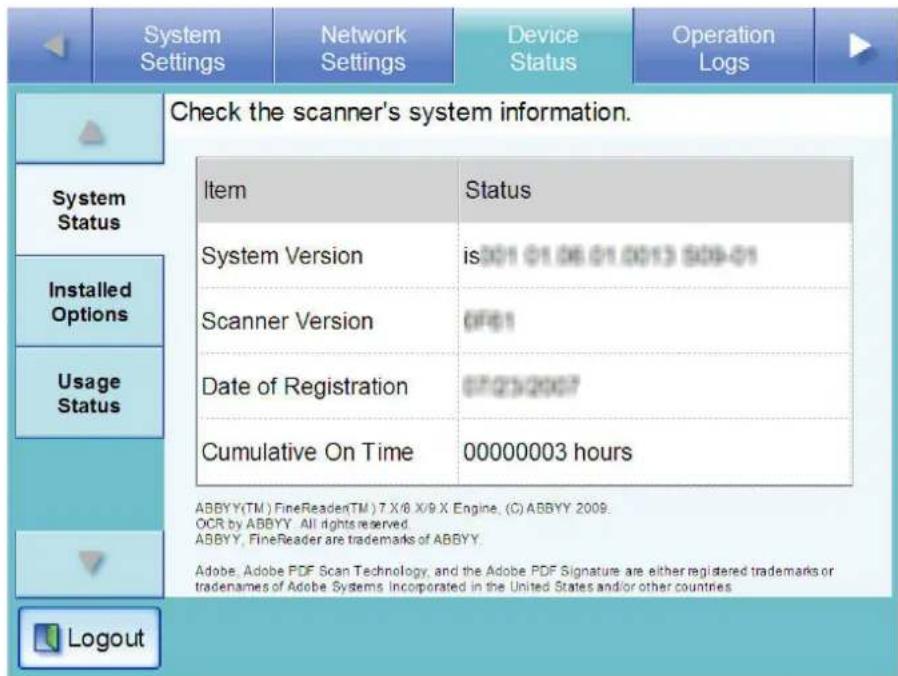
text_image
System Settings Network Settings Device Status Operation Logs Check the scanner's system information. Item Status System Version is001 01 06 01 0013 009-01 Scanner Version 07-01 Date of Registration 07-05-2007 Cumulative On Time 00000003 hours ABBYY(TM) FineReader(TM) 7 X/8 X/9 X Engine, (C) ABBYY 2009. OCR by ABBYY. All rights reserved. ABBYY, FineReader are trademarks of ABBYY. Adobe, Adobe PDF Scan Technology, and the Adobe PDF Signature are either registered trademarks or tradenames of Adobe Systems Incorporated in the United States and/or other countries. LogoutThe following system status information is available.
| Info Details | |
| System Version Shows | the current scanner system and security versions. |
| Scanner Version Shows | the current scanner firmware version. |
| Date of Registration Shows | the date on which the scanner was first used. |
| Cumulative On Time Shows | the total elapsed usage time of the scanner. |
4.8.2 Viewing the Status of Installed Options
Details of what options and when they were installed in the scanner can be viewed.
- Select the [Device Status] tab on the top menu.
- Select the [Installed Options] tab on the left side menu.
→ The "Installed Options" screen appears.
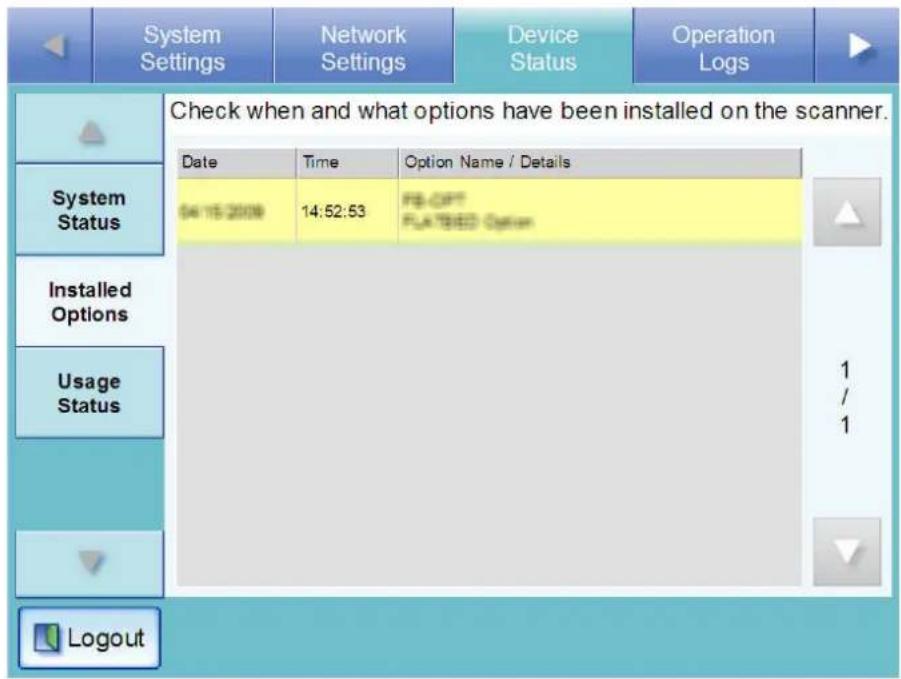
text_image
System Settings Network Settings Device Status Operation Logs Check when and what options have been installed on the scanner. Date Time Option Name / Details System Status 04/15/2008 14:52:53 PB-OPT PLATBED Option Installed Options Usage Status 1 / 1 LogoutThe following status for installed options is available.
| Info Details | |
| Date Shows the date on which an option was installed. | |
| Time Shows the time when an option was installed. | |
| Option Name / Details Shows the name and details of an installed option. | |
4.8.3 Viewing the Usage Status
Information about the number of documents that have been scanned and the status of the scanner's consumable parts (pad assy or pick roller) can be viewed.
For details on consumable replacement, refer to "7.6 Replacing Parts" (page 436).
■ Viewing the Status of Consumable Parts
- Select the [Device Status] tab on the top menu.
- Select the [Usage Status] tab on the left side menu.
→ The "Usage Status" screen appears.

text_image
System Settings Network Settings Device Status Operation Logs Check the consumables usage status. Total Throughput 50,440 Sheets PAD ASSY 50,000 / (50,000) Sheets Status Replace pad assy now Clear Usage Status PICK ROLLER 0 / (100,000) Sheets Status LogoutThe "Status" fields show the total number or pages scanned and the current conditions of the pad assy or pick roller.
"Total Throughput" is shown in units of 10 sheets scanned.
"PAD ASSY" and "PICK ROLLER" are shown in units of 500 sheets scanned.
| Consumables Color Status | Action | ||
| PAD ASSY Green | Total throughput: 0 to 44,999 sheets | No action required. | |
| Orange Total throughput: 45,000 to 49,999 sheets | Pad assy needs to be replaced soon. Obtain a replacement part. | ||
| Red Total throughput: Over 50,000 sheets | Pad assy has passed its rated lifetime and needs to be replaced. | ||
| PICK ROLLER Green Total throughput: 0 to 94,999 sheets | No action required. | ||
| Pick roller needs to be replaced soon. Obtain a replacement part. | |||
| Pick roller has passed its rated lifetime and needs to be replaced. | |||
■ Resetting the Usage Counter
After part replacement, the usage counter can be reset to return the part status to normal. For more details about replacing consumable parts, refer to "7.6 Replacing Parts" (page 436).
- Select the [Device Status] tab on the top menu.
- Select the [Usage Status] tab on the left side menu.
→ The "Usage Status" screen appears.
- Press the [Clear] button for the part replaced.
→ The counter reset confirmation screen appears.
- Press the [Yes] button.
⇒ The counter value is reset to "0", and the "Status" field turns green again.
4.8.4 Viewing the Add-in Status
If an add-in module is installed, the following steps can be performed.
An Add-in is an application created by using the fi-6010N SDK (development kit).
- Select the [Device Status] tab on the top menu.
- Select the [Add-in Status] tab on the left side menu.
→ The "Add-in Status" screen appears.

text_image
System Settings Network Settings Device Status Operation Logs Check add-in status. Add-in Version System Status Installed Options Usage Status Add-In Status LogoutThe following information is shown.
| Info Details | |
| Add-in Shows the name of the | add-in module. |
| Version Shows the current add- | in module version number. |
4.9 Using the Operation Logs Menus
4.9.1 Managing the User Log
The most recent 1,000 user log entries are saved by the scanner.

text_image
User logs may contain private information such as e-mail addresses or fax numbers, so care should be taken when managing such data. If a log file error is detected during system operation, the log file will be cleared and the following log entry recorded: Error 81001004 Corrupted user log file was deleted.■ Viewing the User Log Details Touch Panel Admin Tool
The user log summary is shown in date/time order.
Even if the [Region/Timezone] or [Date/Time] settings are changed, the order of the log entries will not be changed.
- Select the [Operation Logs] tab on the top menu.
- Select the [User Log] tab on the left side menu.
⇒ The "User Log" screen appears.

text_image
Operation log records for all users: Date Time User Result Code Operation 09:30:00 guest OK 0000000 Print 09:29:02 guest OK 0000000 Print 09:28:15 guest OK 0000000 Save 09:28:14 guest Error 12010002 e-Mail 09:26:39 guest OK 0000000 Print 09:25:50 guest OK 0000000 Save 09:22:16 guest OK 0000000 Print 09:22:01 guest OK 0000000 Print Download Clear All Refresh Details3. Select the log you wish to view.
→ The details of the selected log are displayed.
Pressing the [OK] button returns to the "User Log" screen.

On the "User Log" screen, pressing the [Refresh] button updates the information shown.
The following information is shown.
| Info Info | options Description | |
| Date MM/dd/yyyy | yyyydd/MM/yyyyyyyy/MM/dd | Shows the date of each operation (format specified on the Date/Time screen is used).For more details, refer to "4.6.5 Setting the Date/Time" (page 64). |
| Time hh:mm:ss | ss Shows the time of each operation. | |
| User xxxxxxxxxxxxxxxxxxxx | Operating user names are displayed in the following format.SAM_account_name@domain_name | |
| Result In Progress | Currently processing a scan operation. | |
| OK Operation completed successfully. | ||
| Error Operation failed to complete successfully. | ||
| Code xxxxxxxxx | Shows a code for each operation.If a response is required, refer to "Appendix E Operation Messages" (page 503). | |
| Operation e-Mail | The scanned data is sent as an e-mail attachment. | |
| Fax | The scanned data is sent as a fax. | |
| The scanned data is sent to the print server, and the sending status is shown in the "Result" column until the scanned data is completely sent to the print server. | ||
| Save | Scanned data is saved in a network folder. | |
| Pages | xxx | Shows the number of pages scanned. |
| Description | xxxxxxxxxxxxxxxxx | Shows detailed information for each message. |
■ Downloading the User Logs in CSV Format Admin Tool
Operation logs for regular users are stored in the scanner with the default file name "OperationLog.csv".
When downloaded to a computer, the file will contain CSV format data. The file is saved in the following form:
"Date", "Time", "User", "Result", "Code", "Operation", "Pages", "Description"
- Select the [Operation Logs] tab on the top menu.
- Select the [User Log] tab on the left side menu.
⇒ The "User Log" screen appears.
- Press the [Download] button.
⇒ The "File Download" dialog box appears.
- Press the [Save] button.

The size of the user log file is displayed in the "File Download" dialog box. Make sure there is enough free space on the disk where it is to be saved and press the [Save] button. If there is not enough free disk space, an incomplete file may be saved.
⇒ The "Save As" dialog box appears.
- Enter a file name.
The file will contain CSV format data.
- Press the [Save] button.
A file containing CSV format data is saved.
■ Clearing the User Logs Touch Panel Admin Tool
- Select the [Operation Logs] tab on the top menu.
- Select the [User Log] tab on the left side menu.
⇒ The "User Log" screen appears.
- Press the [Clear All] button.
⇒ The "clear all" confirmation screen appears.
- Press the [Yes] button.
→ All the user operation logs are cleared.
4.9.2 Managing the System Log
Up to 1,000 system information logs (such as for startup, shutdown, and system errors) are saved in the scanner.

- System log may contain private information such as e-mail addresses or fax numbers, so care should be taken when managing such data.
- If a log file error is detected during system operation, the log file will be cleared and the following log entry recorded:
Error 81001003 Corrupted system log file was deleted.
■ Viewing the System Log Details

The system log summary is shown in date/time order.
Even if the [Region/Timezone] or [Date/Time] settings are changed, the order of the log entries will not be changed.
-
Select the [Operation Logs] tab on the top menu.
-
Select the [System Log] tab on the left side menu.
→ The "System Log" screen appears.
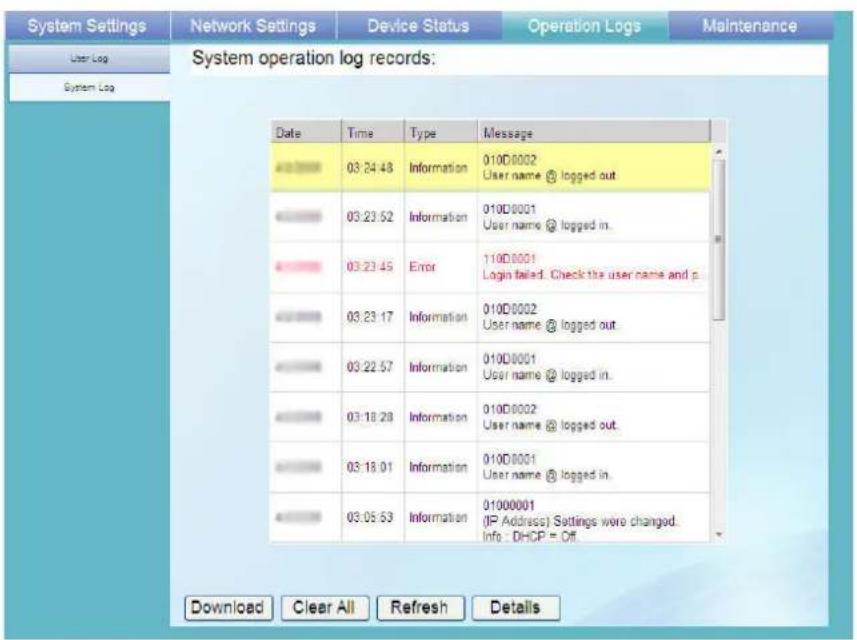
text_image
System Settings User Log System Log System operation log records: Date Time Type Message 03:24:48 Information 010D0002 User name @ logged out 03:23:52 Information 010D0001 User name @ logged in. 03:23:45 Error 110D0001 Login failed. Check the user name and p. 03:23:17 Information 010D0002 User name @ logged out 03:22:57 Information 010D0001 User name @ logged in. 03:18:28 Information 010D0002 User name @ logged out. 03:18:01 Information 010D0001 User name @ logged in. 03:05:53 Information 01000001 (IP Address) Settings were changed. Info - DHCP = Off Download Clear All Refresh Details3. Select the log you wish to view.
→ The details of the selected log are displayed.
⇒ Pressing the [OK] button returns to the "System Log" screen.

On the "System Log" screen, pressing the [Refresh] button updates the information shown.
The following information is shown.
| Info Info | options Details | |
| Date MM/dd/yyyy | dyyyy | Shows the date of each operation (format specified on the Date/Time screen is used).For more details, refer to "4.6.5 Setting the Date/Time" (page 64). |
| dd/MM/yyyyyyyy/MM/dd | ||
| Time hh:mm:ss Shows the system log time record. | ||
| Type Information Shows information about the system.No action required. | ||
■ Downloading the System Log in CSV Format
Admin Tool
The default file name is "SystemLog.csv".
When downloaded to a computer, the file will contain CSV format data. The file is saved in the following form:
"Date", "Time", "Type", "Message"
-
Select the [Operation Logs] tab on the top menu.
-
Select the [System Log] tab on the left side menu.
→ The "System Log" screen appears.
- Press the [Download] button.
→ The "File Download" dialog box appears.
- Press the [Save] button.

The size of the user log file is displayed in the "File Download" dialog box. Make sure there is enough free space on the disk where it is to be saved and press the [Save] button. If there is not enough free disk space, an incomplete file may be saved.
⇒ The "Save As" dialog box appears.
- Enter a file name.
The file will contain CSV format data.
- Press the [Save] button.
A file containing CSV format data is saved.
■ Clearing the System Log
Touch Panel Admin Tool
-
Select the [Operation Logs] tab on the top menu.
-
Select the [System Log] tab on the left side menu.
⇒ The "System Log" screen appears.
- Press the [Clear All] button.
→ The "clear all" confirmation screen appears.
- Press the [Yes] button.
The system log is cleared.
4.10 Using the Maintenance Menus
4.10.1 Maintaining the User Data Store
The scanner's user data store can be backed-up, restored, and deleted.
The user data store contains the following information:
- Fax Number List
● "My List" e-Mail Address Books - Scan Settings
- User Logs
● Name of the last network printer used
● Name of the last network folder used - Name of the last SharePoint folder used
Scanner login user names are authenticated with the LDAP server, and when a new name is encountered, the scanner automatically adds an entry for that user to the user data store. The user data store may contain up to 1,000 users.

- Once 1,000 user names have been used to login, new user logins are no longer possible until the entire user data store is cleared. Refer to "Backing up the User Data Store" (page 167) and "Clearing the User Data Store" (page 170) for details. It is recommended that the user data store be backed up before it is cleared.
- When restoring from a user data store backup, if a backed up user name corresponds to that of an existing user in the current user data store, the backup user data will overwrite the current user data. If the backed up user name is "unknown", the backed up data will be added as a "new" user. Addition of new users cannot cause the 1,000 user limit to be exceeded, or the user data store restoration will fail.
- When the User Data Store is restored from a backup, the Fax Number List is also reverted to its old state.
The following example illustrates how the number of users could exceed 1,000:
- 100 users (A001 to A100) log in.
- The user data store is backed up (with 100 users: A001 to A100).
- The user data store (containing users A001 to A100) is cleared.
-
960 "new" users (A001 to A050 and B001 to B910) login.
-
The user data store (containing users A001 to A100) backed up in Step 2 is restored.
Users A001 to A100 are to be restored, of whom 50 are already in the current user data store (users A001 to A050) and so will be overwrite targets.
Users A051 to A100 are considered "new" users and thus need to be added to the user data store. However 960 existing users + 50 new users = 1010 users.
As the number of users would exceed the 1,000 user limit, the Step 2 user data store (containing users A001 to A100) is not restored.
The user data store contents are organized as follows:

flowchart
graph TD
    A["Common Data (one per scanner)"] --> B["Fax Number List"]
    C["Individual Data (one set per user)"] --> D["User A e-Mail Address Book"]
    C --> E["User B e-Mail Address Book"]
    D --> F["Scan Settings"]
    D --> G["User Log"]
    E --> H["Scan Settings"]
    E --> I["User Log"]
    F --> J["..."]

The user data store may contain private information such as e-mail addresses or fax numbers, so care should be taken when managing such data.
■ Backing up the User Data Store
As a precaution, the user data store should be backed up regularly. The default file name is "restored_data".
User logs cannot be backed up.
HINT
- Select the [Maintenance] tab on the top menu.
- Select the [User Data Store] tab on the left side menu.
→ The "User Data Store" screen appears. - Press the [Backup] button.
⇒ The "File Download - Security Warning" dialog box appears.
- Press the [Save] button.
HINT
The size of the user log file is displayed in the "File Download - Security Warning" dialog box. Make sure there is enough free space on the disk where it is to be saved and press the [Save] button. If there is not enough free disk space, an incomplete file may be saved.
→ The "Save As" dialog box appears.
5. Enter a file name.
Use of a name that includes the scanner name and backup date is recommended.
6. Press the [Save] button.
A backup copy of the user data store is saved.
![FUJITSU fi-6010N - Press the [Save] button. - 1](/content/2026/06/1236812/images/a2fcf9c0a647f5a3f8f286e0cff2af780ebba35aa61be935ce753a76d24ba766.jpg)
Do not change the contents of data store backup files.
If changed, the file may no longer be used as a backup. Trying to restore from a changed user data store backup file may render the scanner inoperable.
■ Restoring the User Data Store
The scanner's user data store can be restored from a backed-up user data store file.

- Restoring user data overwrites all user information stored at the time of restoration, and returns all e-mail address books, fax number list, and scan settings to the time the backup was taken.
- During user data store restoration, do not press and hold down the startup button for longer than 4 seconds, as it may cause the scanner to function abnormally.

User logs cannot be backed up, therefore cannot be restored.
- Select the [Maintenance] tab on the top menu.
- Select the [User Data Store] tab on the left side menu.
⇒ The "User Data Store" screen appears.
- Select a user data store backup file.
Press the [Browse] button to select a file.
- Press the [Restore] button.
⇒ An "OK to overwrite?" confirmation message appears.
- Press the [Yes] button.
⇒ After the user data store is restored, a restore completion message appears.
- Press the [OK] button.
■ Clearing the User Data Store
The scanner's user data store can be deleted.

Clearing the user data store cannot be undone.
- Select the [Maintenance] tab on the top menu.
- Select the [User Data Store] tab on the left side menu.
⇒ The "User Data Store" screen appears.
- Press the [Clear] button.
→ The clear confirmation screen appears. - Press the [Yes] button.
→ The user data store is cleared.
4.10.2 Maintaining the System Settings
The scanner's system settings set by the administrator can be saved in CSV format, backed up, restored, or returned to their factory default values.

System settings do not include the network printer settings.

■ Downloading the System Settings in CSV Format
System settings downloaded in CSV format may be viewed by using spreadsheet software. CSV system settings files are of the following format:
"Function_name", "Option_name", "Value" The default file name is "Configuration_download.csv".
- Select the [Maintenance] tab on the top menu.
- Select the [System Settings File] tab on the left side menu.
→ The "System Settings File" screen appears.
- Press the [Get CSV] button.

text_image
System Settings Network Settings Device Status Operation Logs Maintenance Bulk manage the system settings. Download system settings as viewable file Get CSV Download system settings backup file Backup Select a backup file to restore from: Restore Browse Revert to factory defaults and clear logs Reset→ The "File Download" dialog box appears.
- Press the [Save] button.

The size of the user log file is displayed in the "File Download" dialog box. Make sure there is enough free space on the disk where it is to be saved and press the [Save] button. If there is not enough free disk space, an incomplete file may be saved.
⇒ The "Save As" dialog box appears.
- Name the file and specify where it should be saved.
The file will contain CSV format data.
- Press the [Save] button.
The system settings for the scanner are downloaded.
■ Backing up System Settings
The administrator can backup the scanner system settings.
Backup files can later be used to restore system settings. Backup should be performed regularly. The default file name is "SystemSettingsFile".
-
Select the [Maintenance] tab on the top menu.
-
Select the [System Settings File] tab on the left side menu.
⇒ The "System Settings File" screen appears.
- Press the [Backup] button.
⇒ The "File Download - Security Warning" dialog box appears.
- Press the [Save] button.

The size of the user log file is displayed in the "File Download - Security Warning" dialog box. Make sure there is enough free space on the disk where it is to be saved and press the [Save] button. If there is not enough free disk space, an incomplete file may be saved.
⇒ The "Save As" dialog box appears.
- Name the file and specify where it should be saved.
The date of backup or scanner name should be used as an easy-to-understand file name.
- Press the [Save] button.
→ The system settings are backed up.

Do not change the contents of system settings backup files.
If changed, the file may no longer be used as a backup. Trying to restore from a changed system settings backup file may render the scanner inoperable.
■ Restoring System Settings
The system settings backup file can be returned to the scanner to restore system settings to those at the time backup was taken.
- Select the [Maintenance] tab on the top menu.
- Select the [System Settings File] tab on the left side menu.
→ The "System Settings File" screen appears. - Enter a backup file to restore from.
Press the [Browse] button to select a file.
- Press the [Restore] button.
→ A confirmation message appears.
- Press the [Yes] button.
→ After factory default settings have been restored, the scanner is restarted.

During system settings restoration, do not press and hold down the startup button for longer than 4 seconds, as it may cause the scanner to function abnormally.

The network interface connection will be lost when the scanner is restarted to complete the restoration of the system settings. To continue with other settings, wait a short time for the device to restart, then login to the network interface again.
As the network interface connection to the scanner requires the IP address or scanner name, if this is changed by the restoration of the system settings (i.e. if the backed up IP address or scanner name is different to the pre-restoration IP address or scanner name), the new IP address or scanner name will be needed. If not known, the current state of these settings can always be checked by physically logging in to the scanner via the touch panel interface.
■ Resetting Factory Defaults
- Select the [Maintenance] tab on the top menu.
- Select the [System Settings File] tab on the left side menu.
⇒ The "System Settings File" screen appears.
- Press the [Reset] button.
→ A confirmation message appears.
- Press the [Yes] button.
→ System settings revert to factory defaults.
→ After factory default settings have been restored, the scanner is restarted.

During factory defaults reset, do not press and hold down the startup button for longer than 4 seconds, as it may cause the scanner to function abnormally.

After the factory default settings are restored, the scanner name, IP address, and other settings will need to be set again, as described in "4.6 Using the System Settings Menus" (page 56).
4.10.3 Updating the Scanner's System Software
Admin Too
The scanner system, security system, and installed options can be updated as follows.
- Select the [Maintenance] tab on the top menu.
- Select the [System Update] tab on the left side menu.
→ The "System Update" screen appears.
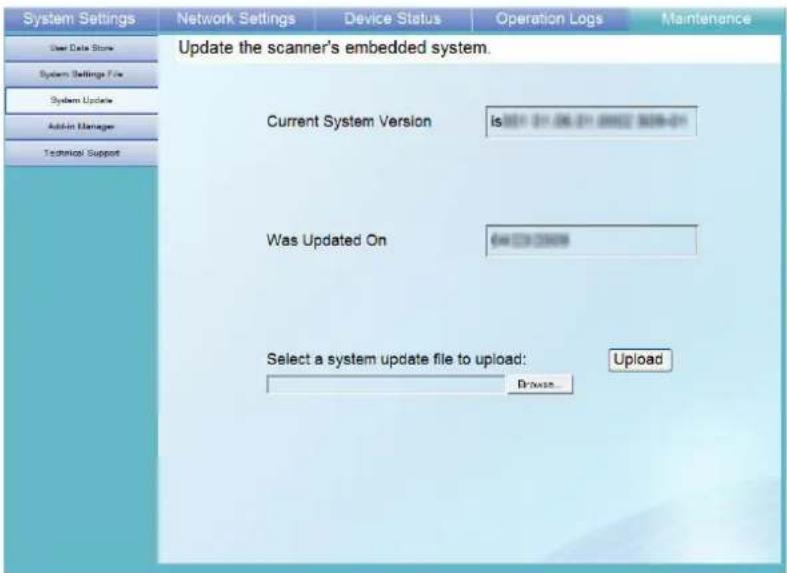
text_image
System Settings User Date Store System Settings File System Update Add-in Manager Technical Support Network Settings Device Status Operation Logs Maintenance Update the scanner's embedded system. Current System Version is Was Updated On Select a system update file to upload: Upload Browse...- Select a system update file.
Press the [Browse] button to select a file.
- Press the [Upload] button.
⇒ The "Current System Version" and "Was Updated On" values are displayed.

text_image
System Settings User Data Store System Settings File System Update Add-in Manager Technical Support Network Settings Device Status Operation Logs Maintenance Update the scanner's embedded system. Current System Version 01.00 01.0001 Was Updated On 00/10/2009 New System Version 01.00 01.0001 The system needs to be restarted to finalize the update. OK to update now? OK: update and restart immediately. Login will not be possible until the restart completes. Cancel: return to the Update screen without updating. OK Cancel
When installed options or the system including installed options are updated, the following window appears.
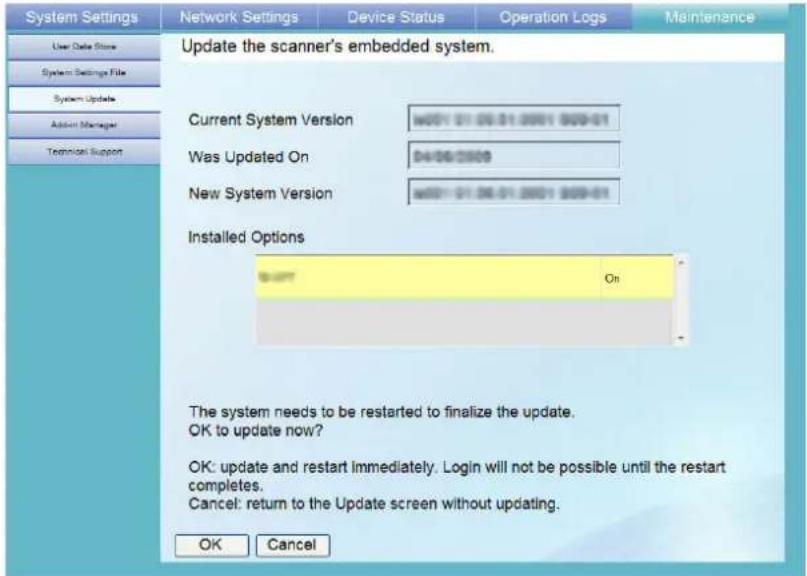
text_image
Update the scanner's embedded system. Current System Version Was Updated On New System Version Installed Options The system needs to be restarted to finalize the update. OK to update now? OK: update and restart immediately. Login will not be possible until the restart completes. Cancel: return to the Update screen without updating. OK Cancel5. Press the [OK] button.
→ The system update process is started.
After the system has updated, the scanner is restarted.
![FUJITSU fi-6010N - Press the [OK] button. - 1](/content/2026/06/1236812/images/e33c899c5f9cfe93a37768e118e0606a20bb77cb74856843fa7772cd9b7de48a.jpg)
- Wait for the system to restart.
● During the update, do not press and hold down the startup button for longer than 4 seconds, as it may cause the scanner to function abnormally.
![FUJITSU fi-6010N - Press the [OK] button. - 2](/content/2026/06/1236812/images/2f1abee1f09b7d65f7bfa5f7e3c51abbc0759d3f3fb28a7dd7e590db33844e29.jpg)
The network interface connection will be lost when the scanner is restarted to complete the system update. To continue with other settings, wait a short time for the device to restart, then login to the network interface again.
4.10.4 Installing/Uninstalling an Add-in Module
Admin Tool
An Add-in is an application created using the fi-6010N SDK (Developer's Kit). This section describes how to install and uninstall an Add-in module.
■ Installing an Add-in Module
- Select the [Maintenance] tab on the top menu.
- Select the [Add-in Manager] tab on the left side menu.
→ The "Add-in Manager" screen appears.

text_image
System Settings Network Settings Device Status Operation Logs Maintenance User Data Store System Settings File System Update Add-in Manager Technical Support Install/Uninstall Add-in Add-In Module not installed Version Browse... Install Uninstall- Select an Add-in installation file.
Press the [Browse] button to select a file.
- Press the [Install] button.
A confirmation message appears.
- Press the [OK] button.
→ After the Add-in module has been installed, the scanner is restarted.
■ Uninstalling an Add-in Module
- Select the [Maintenance] tab on the top menu.
- Select the [Add-in Manager] tab on the left side menu.
→ The "Add-in Manager" screen appears.

text_image
System Settings Network Settings Device Status Operation Logs Maintenance Install/Uninstall Add-in Add-in: Version: Browse... Install Uninstall- Press the [Uninstall] button.
→ A confirmation message appears.
- Press the [OK] button.
→ After the Add-in module has been uninstalled, the scanner is restarted.
4.10.5 Setting the Information Output Level Touch Panel Admin Tool
- Select the [Maintenance] tab on the top menu.
- Select the [Technical Support] tab on the left side menu.
→ The "Technical Support" screen appears.

text_image
Network Settings Device Status Operation Logs Maintenance Set the information output level for technical support. Technical Support Information Output Level 1 (1 << 5) Set Logout- Enter the desired information output level.
The default level is "1".
Increasing the value of the output level increases the amount of information details collected, but decreases the performance level. Set the level requested by your FUJITSU scanner dealer or an authorized FUJITSU scanner service provider.
- Press the [Set] button.
→ The information output level is set.

text_image
If the "Information Output Level" is set to "5", the output data may contain private user information such as e-mail addresses, so care should be taken when managing such data.4.10.6 Obtaining Technical Support
If any problems occur when setting up or using the scanner, technical support information can be collected to help determine the cause of the problem.
The information obtained should be sent to your FUJITSU scanner dealer along with the scanner when given for repair.
- Select the [Maintenance] tab on the top menu.
- Select the [Technical Support] tab on the left side menu.
→ The "Technical Support" screen appears.
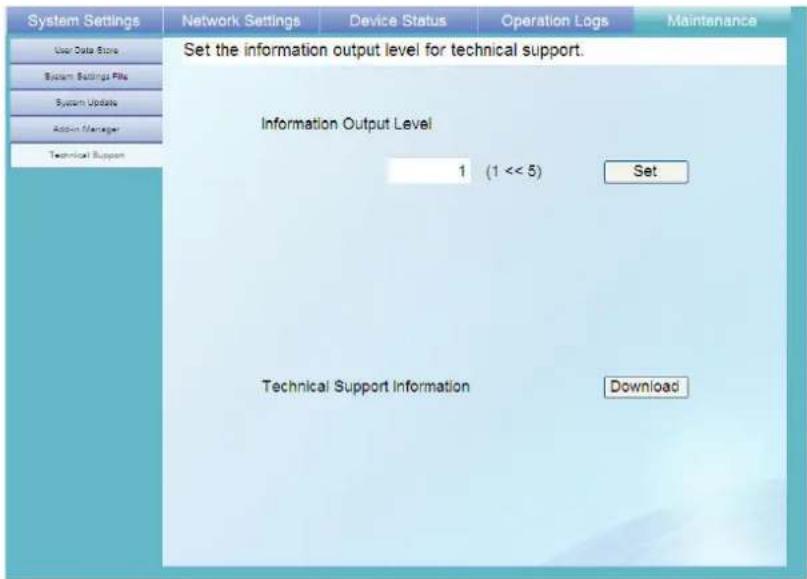
text_image
System Settings User Data Store System Settings File System Update Addn Manager Technical Support Network Settings Device Status Operation Logs Maintenance Set the information output level for technical support. Information Output Level 1 (1 << 5) Set Technical Support Information Download- Press the [Download] button.
⇒ The "File Download - Security Warning" dialog box appears.
- Press the [Save] button.

The size of the user log file is displayed in the "File Download - Security Warning" dialog box. Make sure there is enough free space on the disk where it is to be saved and press the [Save] button. If there is not enough free disk space, an incomplete file may be saved.
→ The "Save As" dialog box appears.
-
Name the file and specify where it should be saved.
-
Press the [Save] button.
→ The technical information is downloaded.
4.11 Setting Job Features
After the job sequence, job menu, and job group settings are performed on the Job Menu, a regular user can use each assigned job menu at login, and process a job.
1. Job Sequence Settings
A job sequence is a single operation that pulls together several user operations (e-Mail/Fax/Print/Save) according to the settings on the "Scan Settings" screen.
For example, the operation of sending scanned data by e-mail and then saving it in a folder can be set as a single job sequence.
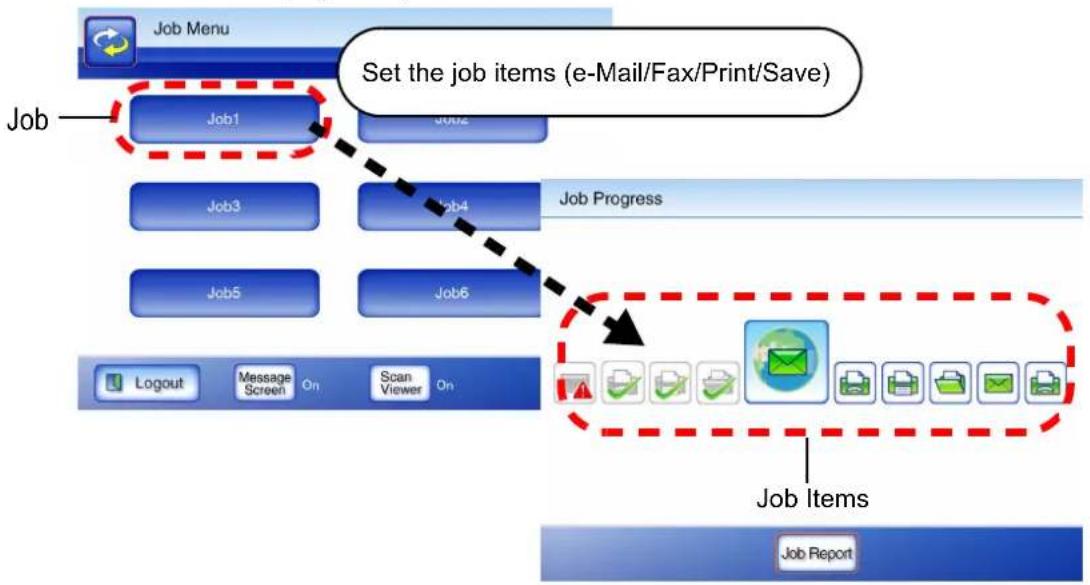
flowchart
graph TD
    A["Job Menu"] --> B["Job1"]
    B --> C["Job2"]
    D["Job Progress"] --> E["Job3"]
    E --> F["Job4"]
    F --> G["Job5"]
    G --> H["Job6"]
    I["Logout"] --> J["Message Screen On"]
    J --> K["Scan Viewer On"]
    L["Job Items"] --> M["Email Icon"]
    M --> N["Print Icon"]
    N --> O["Print Save Icon"]
    P["Job Report"] --> Q["End"]
4
2. Job Menu Settings
A job menu is a menu arrangement of the job sequences set by the user.
For example, you can assign a job sequence that sends scan data by e-mail and then saves it in a folder as a button, and set it on a "Job Menu".
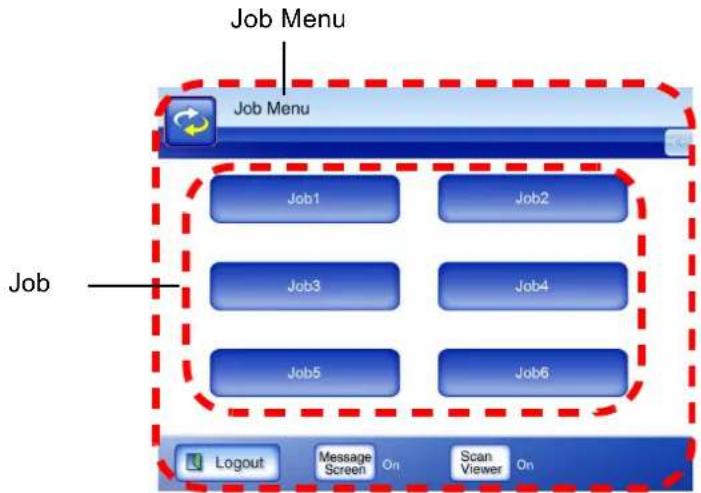
flowchart
graph TD
    A["Job Menu"] --> B["Job"]
    B --> C["Job1"]
    B --> D["Job2"]
    B --> E["Job3"]
    B --> F["Job4"]
    B --> G["Job5"]
    B --> H["Job6"]
    I["Logout"] --> J["Message Screen On"]
    J --> K["Scan Viewer On"]
3. Job Group Settings
A job group is a group of users assigned with the same job menu, by the administrator.
Users associated with a group can use its job menu. All users who are not included in any job group belong to a default group.
For example, job menu A is assigned to group A, and job menu D is assigned to the default group. User C is included in group A, therefore can use job menu A. Users not included in a job group are able to use job menu D.
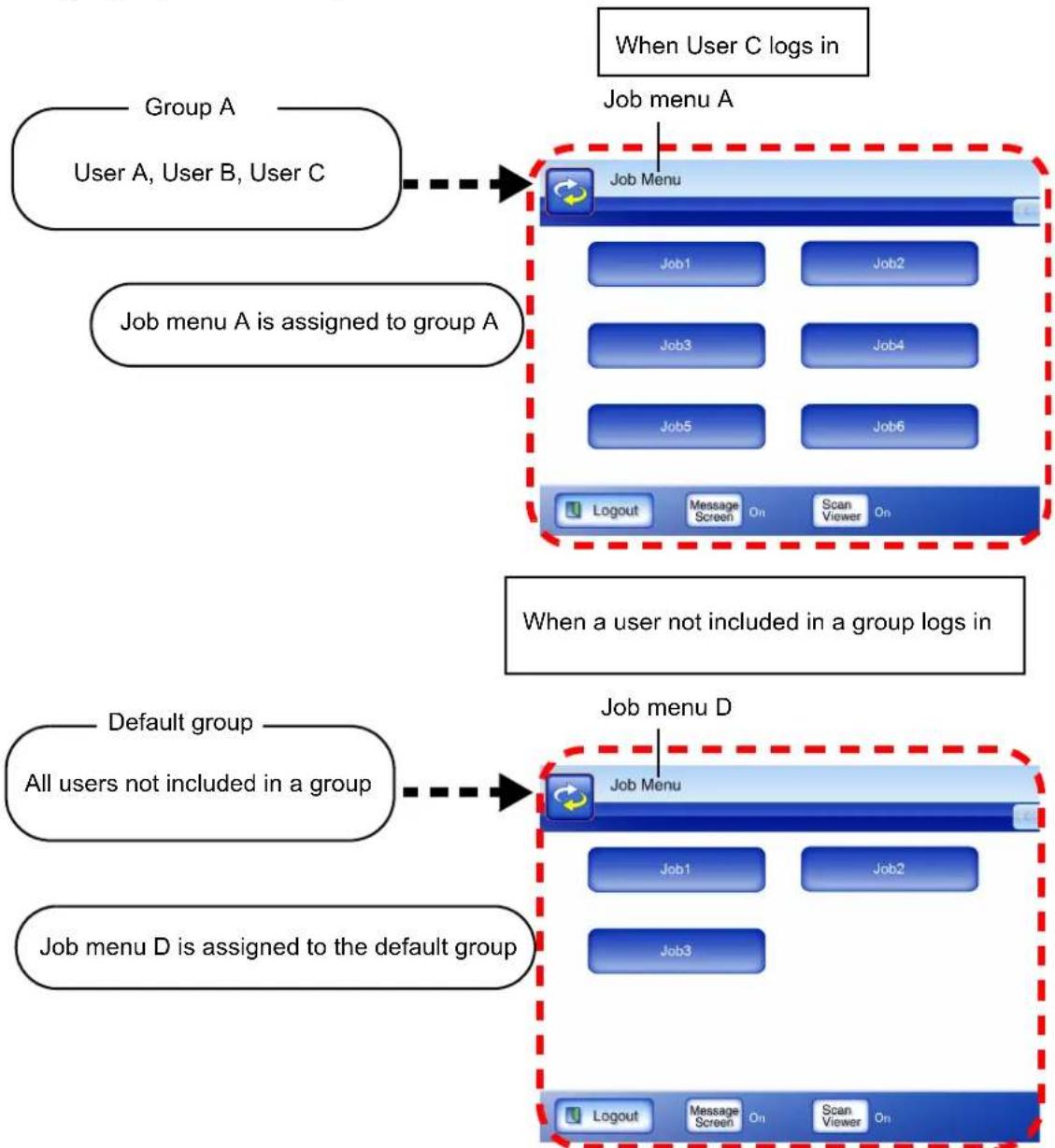
flowchart
graph TD
    A["User A, User B, User C"] --> B["Job Menu"]
    B --> C["Job menu A"]
    C --> D["Group A: User A, User B, User C"]
    D --> E["Job menu A is assigned to group A"]
    E --> F["Default group: All users not included in a group"]
    F --> G["Job menu D: Job menu D"]
    G --> H["User D: Job menu D"]
    H --> I["User D: Job menu D"]
    style A fill:#f9f,stroke:#333
    style B fill:#bbf,stroke:#333
    style C fill:#bfb,stroke:#333
    style D fill:#ffb,stroke:#333
    style E fill:#ffb,stroke:#333
    style F fill:#ffb,stroke:#333
    style G fill:#ffb,stroke:#333
    style H fill:#ffb,stroke:#333
    style I fill:#ffb,stroke:#333
4.11.1 Job Setting Quick User Guide
The procedure for an administrator to set up job is shown below.
Setting a job sequence
Jobs List
View, add to, or edit the Jobs List.
Job Details
Set the scan options, message screen, and operations after scanning for a selected job.
Setting a job menu
Job Menus List
View, add to, or edit the Job Menus List.
Job Menu Layout
Set the job button for the selected job menu.
Setting a job group
Job Groups List
View, add to, or edit the Job Groups List.
Settings For Selected Group(s)
Set the assigned job menus, initial post-login menu, and job group members for the selected job group.
For details, refer to
"4.11.2 Setting a Job
Sequence" (page 185).
For details, refer to
"4.11.3 Setting a Job
Menu" (page 203).
For details, refer to
"4.11.4 Setting a Job
Group" (page 210).
Processing a job
Process the job.
When a user logs in, the assigned job menu is displayed, and a job can be selected and processed.
Before processing a job set on the Central Admin
Console "Job Mode Settings" screen, the job mode settings set on the "Job Mode Settings" screen must be released.
For details, refer to "6.14 Processing a Job" (page 413).
4.11.2 Setting a Job Sequence

Set the scan options and job item (e-Mail/Fax/Print/Save) to be processed together as a job sequence.
Up to 1,000 job sequences can be set.
■ Adding a job sequence
This section describes how to add a job sequence.
- Select the [Job Sequences] tab.
→ The "Jobs List" window appears.
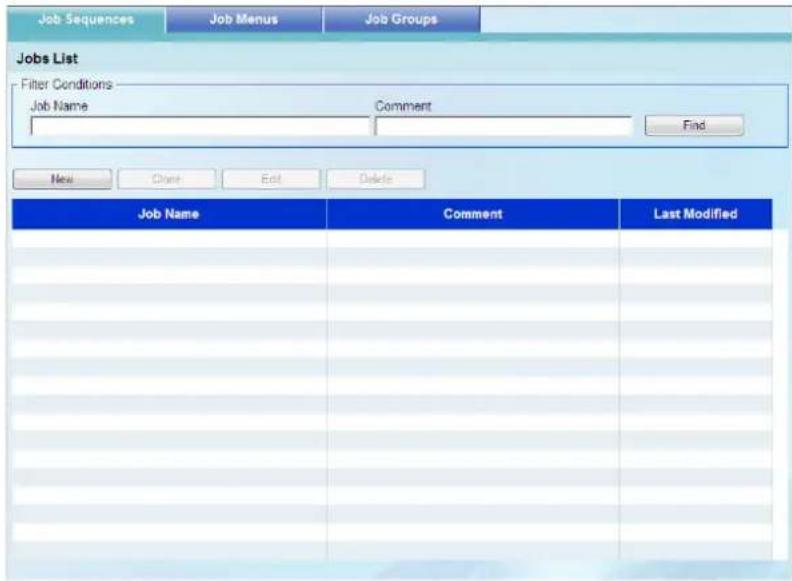
text_image
Job Sequences Job Menus Job Groups Jobs List Filter Conditions Job Name Comment Find New Close Edit Delete Job Name Comment Last Modified- Select the [New] button.
→ The "Job Details" window appears.
- Set the [Job Name] and [Comment].
Enter a job name in [Job Name]. This may be up to 64 characters long. Enter comments about the job sequence in [Comment]. This may be up to 256 characters long.

text_image
Job Details Job Name Comment- Select the [] button to the left of [Common Settings], and set the operations for when a job is processed.

text_image
Common Settings Message Screen Title Message Allow per-Job adjustment Scanier Name@bladyyythemnis Name Format... Common File Name Yes No Expected Count sheets (1-996) Allow per-Job adjustment If one of the job items is a "Front", then target Expected Count values will be reduced to a minimum at "100" Confront the Scan Count If error occurs ... Proceed to next Job Item Terminate the Job When Job finishes ... Pause on Job Progress screen Close the Job Progress screen- Message Screen
Set whether or not to display the actual "Message Screen" when a job is processed. For details about the "Message Screen", refer to "6.14.1 Enabling/Disabling the Message Screen" (page 417).
Enter a title and message text for the message shown on the "Message Screen".
"Title" may be up to 24 characters long.
"Message" may be up to 256 characters long.


The layout of the message displayed in the message screen settings, and the actual "Message Screen" layout in the scanner may differ. Check the layout in the scanner and then enter the title and message in the "Message Screen".



- Whether or not the title and message set in "Message Screen" are shown depends on whether the [Message Screen] button on the "Job Menu" screen is [On] or [Off].
- If a title or message is not set in "Message Screen", even if the [Message Screen] button on the "Job Menu" is set to [On], the actual "Message Screen" is not displayed.
- Common File Name
Select the [Allow per-Job adjustment] checkbox to make it possible to change the file name when scanned data is sent by e-mail or saved in a folder, when processing a job.
Set a file name format when scanned data is sent with e-mail/saved in a folder.

Press the [Name Format] button to specify a file name on the "File Names (Common)" screen.
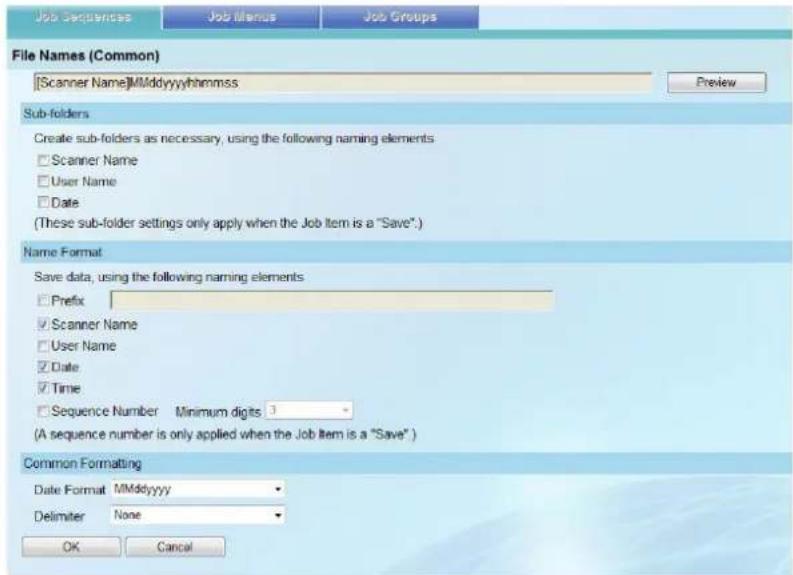
text_image
Job Sequences Job Items Job Groups File Names (Common) [Scanner Name]MMddyyyhhmmss Preview Sub-folders Create sub-folders as necessary, using the following naming elements □ Scanner Name □ User Name □ Date (These sub-folder settings only apply when the Job Item is a "Save".) Name Format Save data, using the following naming elements □ Prefix ✓ Scanner Name □ User Name ✓ Date ✓ Time □ Sequence Number Minimum digits 1 (A sequence number is only applied when the Job Item is a "Save") Common Formatting Date Format MMddyyyy Delimiter None OK Cancel"Sub-folders" is enabled only when scanned data is saved to a folder. For details about setting values, refer to "4.6.9 Setting a File Name Format for When Saving Scanned Data" (page 72).
- Check the Scan Count
When the number of sheets to be scanned for a job is fixed, set whether to check that the expected amount of sheets has been scanned.
- If [Yes] is selected
The number of scanned sheets is checked while a job is being processed.
- For "Expected Count", enter the expected number of sheets to be scanned, between 1 and 999.


- If a "Print" job item is included, the expected number of sheets to be scanned becomes 1 to 100.
- For "Print", up to 100 pages can be scanned. For other than "Print", up to 999 pages can be scanned. For duplex scanning, make sure to set the number of pages so as not to exceed these respective maximums.

- Select the [Allow per-Job adjustment] checkbox to make it possible to change the expected count of sheets to be scanned on the "Scan Count" screen, according to each job.
- Select the [Confirm the Scan Count] checkbox to have the actual and expected sheet counts displayed on the "Scan Count" screen after scanning is complete.
- If [No] is selected
The number of scanned sheets is not checked while a job is being processed.
- If error occurs
If an error occurs while an item in the job sequence is being performed, set whether or not to continue with unfinished items before ending a job.
- If [Proceed to next Job Item] is selected If an error occurs while an item in the job sequence is being performed, job processing proceeds to the next item in the sequence and completes all unfinished items before ending a job.
- If [Terminate the Job] is selected If an error occurs while an item in the job sequence is being performed, job processing ends without completing any unfinished items.
- When Job finishes
Set whether to notify of a completion when all operations of a job finish successfully.
- If [Pause on Job Progress screen] is selected When the job finishes successfully, the "Job Progress" screen is shown to notify that the job is completed.
- If [Close the Job Progress screen] is selected Returns to the Job Menu when the job finishes successfully.
5. Select the [] button to the left of [Scan Settings].
Set the desired scan options, such as Carrier Sheet, color mode, and paper size.
For details about setting values, refer to "6.9 Setting the Scan Options" (page 365).
| Scan Settings | ||||
| Save | File Format | PDF TIFF MTIFF JPEG * Fax uses the "TIFF" setting * Print uses the "JPEG" setting | ||
| Searchable PDF | No | |||
| Searchable PDF for Pages Search Page to | ||||
| Text Recognition Language English | ||||
| Require PDF Password | No Yes PDF Password Password Confirm Password | |||
| Compression | Medium | |||
| Basic | Carrier Sheet | Off A3 B4 11" x 17" | ||
| Color Mode | Auto RGB Color Grayscale Black & White * Fax uses the "Black & White" setting. | |||
| Paper Size | Auto Custom Paper Size Width 2 inch 50.0 mm Height 2 inch 74 mm Lang Page Mode Off On | |||
| Resolution | 150dpi 200dpi 300dpi 600dpi | |||
| Scan Mode | Simplex Duplex | |||
| Quality | Brightness | Medium | ||
| Contrast | Medium | |||
| Sharpness | None | |||
| Dropout Color | None | |||
| Background Removal | Medium | |||
| Advanced | Blank Page Skip | Off Auto | ||
| Page Orientation | Auto Long Edge Short Edge * Print uses the "Off" setting. | |||
| Multifeed Setup | None Ultrasonic Length Both | |||
| Edge Cropping | Off On Edge Cropping Width Top/Bottom 0 mm (0-50) Left/Right 0 mm (0-50) | |||
6. Set a job item.
Select the list button under [Job Items] to select one of following items:
e-Mail
Fax
- Print
- Save
When the [Delete This Item] button is clicked, a confirmation window appears. Click the [OK] button to delete the item.
When the [Insert New Item] button is selected, the item selected in the list of items is inserted before the current item.

text_image
Job Items 1 Delete This Item Insert New Item
Up to ten items can be set.
7. If [e-Mail] is selected for the job item in Step 6, perform settings related to sending e-mail.
For details about setting values, refer to "6.4 Sending the Scanned Data by e-Mail" (page 314).
If the [e-Mail address of user] option button is selected for [To] and/or [From], when a job is processed, the e-mail address of the logged in user is specified. However, in the following cases, an error will occur during the job process.
- If the currently logged in user does not have an e-mail address
- If the currently logged in user is using the guest account
![FUJITSU fi-6010N - If [e-Mail] is selected for the job item in Step 6, perform settings related to sending e-mail. - 1](/content/2026/06/1236812/images/253544cff86066ede4c0a1bd2e00ff01ea5415b7b34298423569cfbc5db164e5.jpg)
text_image
e-Mail Settings To e-Mail address of user Fixed e-mail address Cc Browse... Bcc File Name [Scanner Name]MMddyyyhhmmss Name Format... From e-Mail address of user Fixed e-mail address Browse... Request a return receipt Yes No Subject Body When the File Format is "JPEG" or "TIFF", a separate image file will be attached to the e-mail for each scanned page.![FUJITSU fi-6010N - If [e-Mail] is selected for the job item in Step 6, perform settings related to sending e-mail. - 2](/content/2026/06/1236812/images/866fd5167117f7ca3e0ebeabf3c34468f4dd7af97a2f2b8701226063363c2f29.jpg)
Select the [Browse] button to set a different e-mail address from the "LDAP List" window.
![FUJITSU fi-6010N - If [e-Mail] is selected for the job item in Step 6, perform settings related to sending e-mail. - 3](/content/2026/06/1236812/images/a3fec869e13788147677866476b6deb7a0a6e18373c298af2f8f2cd072600c13.jpg)
text_image
Job Sequences Job Mantos Job Groups LDAP List User Name FirstName LastName Search Base LDAP.// Filter Conditions Search Position Head (abc...) User Name e-Mail Address Find First Name Last Name Common Name Display Name User Name e-Mail Address OK CancelSettings entered in the following screen are shown.
- For Admin Tool
"e-Mail LDAP Server" screen
● For Central Admin Console
"LDAP Server" section on the "Central Admin Server Settings" screen. However, whether or not SSL is used, depends on each LDAP server settings.
For more details about how to filter the LDAP List, refer to "Filtering the LDAP List" (page 199).
![FUJITSU fi-6010N - If [e-Mail] is selected for the job item in Step 6, perform settings related to sending e-mail. - 4](/content/2026/06/1236812/images/5bad561372b162d82d2465a8296f7705d8d097de15ff4bfb1fc5e0d242001a55.jpg)
Press the [Name Format] button, and specify a file name from the "File Names (e-Mail)" screen.
![FUJITSU fi-6010N - If [e-Mail] is selected for the job item in Step 6, perform settings related to sending e-mail. - 5](/content/2026/06/1236812/images/39fe833a18e4530a9569a3e9c954dfcb06c69db595e15c67bc2317d34bb6948f.jpg)
text_image
Job Subgroups Job Names Job Groups File Names (e-Mail) [Scanner Name]MMddyyyhhmmss Preview Name Format When e-mailing data, using the following naming elements Prefix Scanner Name User Name Date Time Common Formatting Date Format MMddyyyy Delimiter None OK CancelFor details about setting values, refer to "4.6.10 Setting a File Name Format for When Attaching Scanned Data to e-Mail" (page 76).
-
If [Fax] is selected for the job item in Step 6, perform settings related to sending a fax. For details about setting values, refer to "6.5 Sending the Scanned Data by Fax" (page 330). If the [e-Mail address of user] option button is selected for "Notification To (Sender's e-Mail Address)", the e-mail address of the logged in user is used when a job sequence is performed. However, in the following cases, an error will occur when a job sequence is performed.
-
If the currently logged in user does not have an e-mail address
- If logged in with the guest account
![FUJITSU fi-6010N - If [e-Mail] is selected for the job item in Step 6, perform settings related to sending e-mail. - 6](/content/2026/06/1236812/images/cfe5b65675a815f37fe52720eb924314956e5f064f2ab06700db0e61d32e2864.jpg)
text_image
2 Fax Delete This Item Insert New Item Fax Settings Recipient Fax No: Notification To (Sender's e-Mail Address) e-Mail address of user Fixed e-mail address Browse![FUJITSU fi-6010N - If [e-Mail] is selected for the job item in Step 6, perform settings related to sending e-mail. - 7](/content/2026/06/1236812/images/208fc1b5edff77a57cfa3f1f862ccd5810a318d16ff380bb63f0d7a40cd0ec29.jpg)
Select the [Browse] button to set a different e-mail address from the "LDAP List" window.
![FUJITSU fi-6010N - If [e-Mail] is selected for the job item in Step 6, perform settings related to sending e-mail. - 8](/content/2026/06/1236812/images/9e372f586f10d3bd090a2682eda98abc6fe6d8d7f641e6a1817dd2d19745a9d3.jpg)
text_image
Job Sequences Job Members Job Groups LDAP List User Name FirstName LastName Search Base LDAP.// Filter Conditions Search Position Head (abc...) User Name e-Mail Address First Name Last Name Common Name Display Name Find User Name e-Mail Address OK CancelSettings entered in the following screen are shown.
-
For Admin Tool
"e-Mail LDAP Server" screen
● For Central Admin Console
"LDAP Server" section on the "Central Admin Server Settings" screen However, whether or not SSL is used, depends on each LDAP server settings.
For more details about how to filter the LDAP List, refer to "Filtering the LDAP List" (page 199). -
If [Print] is selected for the job item in Step 6, perform settings related to printing. For details about setting values, refer to "6.6 Printing the Scanned Data" (page 339).
![FUJITSU fi-6010N - If [e-Mail] is selected for the job item in Step 6, perform settings related to sending e-mail. - 9](/content/2026/06/1236812/images/5674112c63750bcd5c5b27650da8e53e452c9b224ff3486e56aceac77520bc10.jpg)
text_image
3 Print Delete This item Insert New item Print Settings Network Printer Printer Alias Network Path Print Server Authentication User Name: Password No. of Copies 1 Scaling Shrink to Fit 100% Positioning Center Top Left Simplex / Duplex Simplex (Single-sided) Duplex (Long Edge) Duplex (Short Edge)![FUJITSU fi-6010N - If [e-Mail] is selected for the job item in Step 6, perform settings related to sending e-mail. - 10](/content/2026/06/1236812/images/fe0709c79573d6112961c2699bec6dc681cb0c61b74c605f92a7f0c37eec3de2.jpg)
Select the [Browse] button to set the network printer from the "Printer List" window.
![FUJITSU fi-6010N - If [e-Mail] is selected for the job item in Step 6, perform settings related to sending e-mail. - 11](/content/2026/06/1236812/images/26627da23484e695d4343ac61682623a5ae1765a045fddebe70fce3fb09670b3.jpg)
text_image
Printer List Filter Conditions Printer Alias Network Path Find Printer Alias* FUJITSUX.2(Black&White) FUJITSUX.2(Duplex A4) FUJITSUX.2(RGB Color) Printer01 Printer02 Network Path XDOMAIN0SERVER(FUJITSUX.2(Black&White) XDOMAIN0SERVER(FUJITSUX.2(Duplex A4) XDOMAIN0SERVER(FUJITSUX.2(RGB Color) XDOMAIN0SERVER(FUJITSUX2 XDOMAIN0SERVER(FUJITSUX OK Cancel- If [Save] is selected for the job item in Step 6, perform settings related to saving.
For details about setting values other than those for a "Save process results file", refer to "6.7 Saving the Scanned Data to a Network Folder" (page 352).
![FUJITSU fi-6010N - If [e-Mail] is selected for the job item in Step 6, perform settings related to sending e-mail. - 12](/content/2026/06/1236812/images/186292218060bad173d032941a4872749fcf585fa23dafc86393dd3518b42a12.jpg)
text_image
Save Delete This item Insert New item Save Settings Network Folder Folder Alias Network Path Browse... File Server Authentication User Name Password Save as [Scanner Name]MMddyyyyhhmmss001 Name Format... Overwrite Same Name Files No Yes Save process results file No Yes- Save process results file
When a job to save scanned data in a folder is processed, set whether to output the job process result (process results file) to the same folder as the scanned data.
- If [Yes] is selected
A process results file is also output when scanned data is saved.
The file name of the process result that is output, is the file name of the saved scanned data (including the extension), with ".xml" added to change it to that format.
For example, if the file name of the saved scanned data is "abc.pdf", it becomes "abc.pdf.xml".
If multiple TIFF or JPEG files are saved, a sequence number is added after the file name.
Example: abc-0001.tif.xml, abc-0001.jpg.xml
![FUJITSU fi-6010N - If [e-Mail] is selected for the job item in Step 6, perform settings related to sending e-mail. - 13](/content/2026/06/1236812/images/5b4080b88536f4bdc1c3e7ca8db05cc2fd3fef224db1ec06dc8adb0be863d782.jpg)
![FUJITSU fi-6010N - If [e-Mail] is selected for the job item in Step 6, perform settings related to sending e-mail. - 14](/content/2026/06/1236812/images/4d515dab6fa41f00e672147890e30581b01ec81957574424ff72fe78b9ee792b.jpg)
- If a process results file with the same name already exists, set whether to overwrite the process results file in the [Overwrite Same Name Files] option button.
- It may not be possible to output a process results file if scanning fails, according to the cause of the failure.
- When a process results file is output for the saving multiple TIFF or JPEG format files case, it is assigned the name of the first output file with ".xml" appended, and all of the TIFF or JPEG output file names are recorded in the process results file's "FileName" field.
- If [No] is selected
A process results file is not output when scanned data is saved.
Process results files are formatted as follows:
● Process results files are in an XML format.
● Process results files use the UTF-8 charset.
● Process results files contain the following output:
| Item Value | |
| ResultFileVersion V1.0 | |
| ScannerName Scanner name | |
| User User name | |
| Date Save completion date | |
| Time Save completion time | |
| Result Save process results | |
| ResultCode Result code | |
| Result Description Result details | |
| Pages Number of saved pages | |
| SheetCount_Job Number of sheets to be scanned, set by the job | |
| SheetCount_User Number of sheets to be scanned, set by the user | |
| SheetCount_Scan | Actual number of scanned sheets |
| FileName | Saved file name(s) (Multiple files) |
| Path | Saved file path name |
![FUJITSU fi-6010N - - If [No] is selected - 1](/content/2026/06/1236812/images/86c104d2ad8cd3b4ec2144f4adad74835e51b6bb8abb44c35893c55d958b8e87.jpg)
- Select the [Browse] button to set the network folder from the "Folder List" window.
![FUJITSU fi-6010N - - If [No] is selected - 2](/content/2026/06/1236812/images/f1bb000b2fcff45ddc0b4e4e377ab55e88afd863df058d0309c7d76b554d8fc8.jpg)
text_image
Job Sequences Job Menus Job Groups Folder List Filter Conditions Folder Alias Network Path Find Folder Alias▲ Network Path Folder01 DOMAIN0SERVERFolder01 Folder02 DOMAIN0SERVERFolder Folder03 DOMAIN0SERVERCatalog Folder04 DOMAIN0SERVERLetter Folder05 DOMAIN0SERVERPhoto OK Cancel- Select the [Name Format] button to set the file name from the "File Names (Save)" window.
![FUJITSU fi-6010N - - If [No] is selected - 3](/content/2026/06/1236812/images/6e270c989c9abe77bf95ab5c65b8e626bc0acb301f989da7fc923d58ecd3aebc.jpg)
text_image
Job Subfitters Job Masters Job Groups File Names (Save) [Scanner Name]MMddyyyyhhmmss001 Preview Sub-folders Create sub-folders as necessary, using the following naming elements Scanner Name User Name Date Name Format Save data, using the following naming elements Prefix Scanner Name User Name Date Time Sequence Number Minimum digits 3 Common Formatting Date Format MMddyyyy Delimiter None OK CancelFor more details about settings values, refer to "4.6.9 Setting a File Name Format for When Saving Scanned Data" (page 72).
- Select the [OK] button.
A job sequence is added to the "Jobs List" window.
■ Cloning a job sequence
This section describes how to clone a job sequence.
- Select the [Job Sequences] tab.
⇒ The "Jobs List" window appears.
-
Select the job sequence to be cloned.
-
Select the [Clone] button.
⇒ The "Job Details" window appears.
-
Clone the detailed job sequence settings.
-
Select the [OK] button.
A job sequence is added to the "Jobs List" window.
■ Editing a job sequence
This section describes how to edit a job sequence.
- Select the [Job Sequences] tab.
→ The "Jobs List" window appears.
-
Select the job sequence to be edited.
-
Select the [Edit] button.
→ The "Job Details" window appears.
-
Edit the detailed job sequence settings.
-
Select the [OK] button.
The settings of the job sequence are changed.
■ Deleting a job sequence
This section describes how to delete a job sequence.
- Select the [Job Sequences] tab.
⇒ The "Jobs List" window appears.
-
Select the job sequence to be deleted.
-
Select the [Delete] button.
→ The confirmation window appears.
- Select the [OK] button.
→ The job sequence is deleted.
■ Filtering job sequences
This section describes how to filter job sequences.
- Select the [Job Sequences] tab.
⇒ The "Jobs List" window appears.
- Enter [Job Name] and [Comment].
Enter either a part of or full [Job Name] and [Comment] for the job sequence(s) to be filtered.
"Job Name" may be up to 64 characters long.
"Comment" may be up to 256 characters long.
- Select the [Find] button.
→ The filtered results appear.

To display all results, delete all information for [Job Name] and [Comment], and then select the [Find] button.
■ Filtering the LDAP List
This section describes how to filter the LDAP List on the "LDAP List" window.
- In the [User Name] drop-down list box, select the display format for the user names shown on the user name/e-mail address list.
- Enter the LDAP server and character string to be used for LDAP searches in the "Search Base" field.
The LDAP entries under the character string entered here will become the search target. This may be up to 520 characters long.
- In the [Search Position] drop-down list box, select the filtering method.
The default setting is [Head (abc...)].
| Search Position | Description | Example Target | Search Result |
| Head (abc...) | Filtered by words that start with the character string entered in Step 4. | abc abc, abc1, abcd, ... | |
| Anywhere (...abc...) | Filtered by words that include the character string entered in Step 4. | abc abc, abc1, xabc, xabcy, ... | |
| Tail (...abc) | Filtered by words that end with the character string entered in Step 4. | abc abc, 1abc, xabc, ... |
- Enter the filter character string.
Enter the user name and e-mail address to be filtered, in whole or in part.
Up to 256 characters may be entered for both user names and e-mail addresses.
If both a user name and e-mail address is entered, data containing either of them are searched as "AND Search".
5. Select the filter target.
If multiple items are selected, data containing any of the search words are searched as "OR Search".
- The "Server Type" of the login LDAP server is [Active Directory] or [Active Directory Global Catalog]
| Checkbox name | Filter target in the Active Directory/Active Directory Global Catalog |
| First Name Filters the first names of users registered in the LDAP server. | |
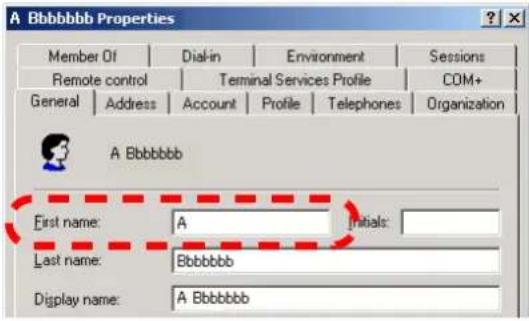 | |
| Last Name Filters the last names of users registered in the LDAP server. | |
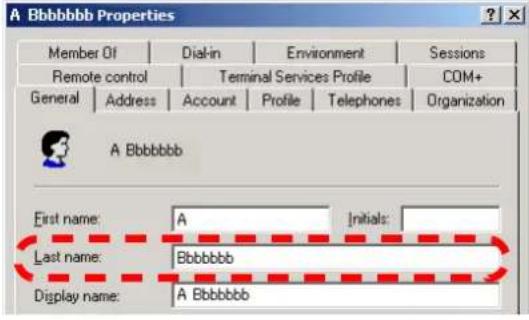 | |
| Common Name | Filters the common names of users registered in the LDAP server. |
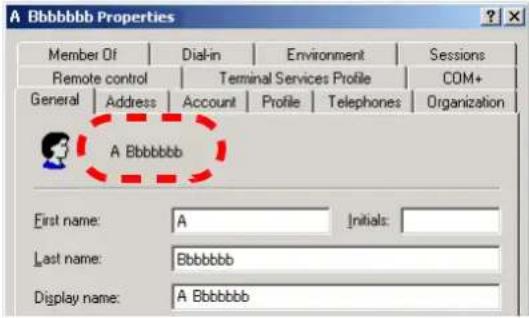 | |
| This item can be set in [Active Directory Users and Computers].The [Common Name] checkbox must be selected to filter the Active Directory group names. | |
| Display Name | Filters the display names of users registered in the LDAP server.  |
● The "Server Type" of the login LDAP server is [Other LDAP Server]
| Checkbox name | Filter target in the LDAP server |
| First Name | Filters on the first names of users as such are defined by the "First Name" field in the "Adjust the search item schema" screen from the "e-Mail LDAP Server" screen. |
| Last Name | Filters on the last names of users as such are defined by the "Last Name" field in the "Adjust the search item schema" screen from the "e-Mail LDAP Server" screen. |
| Common Name | Filters on the common names of users as such are defined by the "Common Name" field in the "Adjust the search item schema" screen from the "e-Mail LDAP Server" screen. |
| Display Name | Filters on the display names of users as such are defined by the "Display Name" field in the "Adjust the search item schema" screen from the "e-Mail LDAP Server" screen. |
- Select the [Find] button.
→ The filtered results appear.

- If the [Find] button is selected, an authentication screen appears. Perform the following procedure for authentication.
- Enter a user name and password.
User names may be up to 129 characters long.
Passwords may be up to 256 characters long (case sensitive).

text_image
Connecting to the LDAP server. Enter a User Name and Password User Name Password OK Cancel- Select the [OK] button.
- To display all results, delete all filter strings and then select the [Find] button.
4.11.3 Setting a Job Menu
Admin Tool
Central Admin
Assign the job sequence set in "4.11.2 Setting a Job Sequence" (page 185) to a job button, and job buttons on a job menu.
Up to 100 job menus may be set.
■ Adding a job menu
This section describes how to add a job menu.
1. Select the [Job Menus] tab.
→ The "Job Menus List" window appears.
![FUJITSU fi-6010N - Select the [Job Menus] tab. - 1](/content/2026/06/1236812/images/709d74870d823cf2c2d562b2ae22bcfd72fb8e1d7640c2d8a1f2ac6d1418978c.jpg)
text_image
Job Sequences Job Menus Job Groups Job Menus List New Close Edit Delete Job Menu Name Last Modified Job Menu Layouts Job Menu Name: Job Button Settings Exit Delete X Job Button Name Job Name (1) (2) (3) (4) (5) (6) Message Screen Decide per-Job Scan Viewer Decide per-Job OK Cancel2. Select the [New] button.
→ The "Job Menu Layout" area becomes active.
![FUJITSU fi-6010N - Select the [New] button. - 1](/content/2026/06/1236812/images/d525d36c1eea092482bcf6becadd6ef47fc10b31af8969f3b5dff017c62fa91e.jpg)
text_image
Job Sequences Job Slantia Job Groups Job Menus List New Close Edit Delete Job Menu Name List Modified Job Menu Layout Job Menu Name Job Button Settings 1 2 3 4 5 6 Edit DeleteJob Button Name Job Name
(1) (2) (3) (4) (5) (6) Message Screen Decide per-Job Scan Viewer Decide per-Job OK Cancel- Enter the job menu name.
This may be up to 64 characters long.
- Select the job button position, and select the [Edit] button.
⇒ The "Job Button Settings" window appears.

text_image
Job Sequence Job Many Job Groups Job Button Settings Job Button Name Select Button Pixmap Job Button Pixmap 1 Use button to start Add-in module Filter Conditions Job Name Comment Find Job Name ▲ Comment Last Modified Job1 Job1 9:43:17 AM Job2 Job2 9:46:33 AM Job3 Job3 9:47:09 AM Job4 Job4 9:47:23 AM Job5 Job5 9:47:38 AM Job6 Job6 9:47:49 AM OK Cancel- Enter the job button name.
This may be up to 32 characters long.
- In the [Select Button Pixmap] drop-down list box, select a job button pixmap.
The selected job button pixmap is inserted into the job button mockup image on the right, allowing the resulting button design to be checked.
- Set whether to start up the Add-in module.
To start up the Add-in module when the job button is selected, select the [Use button to start Add-in module] checkbox.
If this checkbox is selected, the Add-in module is assigned to the job button, rather than the job sequence. The "Job Button Name" and "Select Button Pixmap" are ignored. The button specified by the Add-in module appears in the Job Menu.

text_image
ATTENTION Even if the checkbox is selected, if the Add-in module is not installed in a scanner, the target job menu button will not be shown on the screen.8. Select a job from the list.

To filter jobs, enter part of a "Job Name" and "Comment", or select all, and press the [Find] button.
"Job Name" may be up to 64 characters long.
"Comment" may be up to 256 characters long.
To clear all filtered results, delete the entered "Job Name" and "Comment", and press the [Find] button.
9. Select the [OK] button.
A job button is set on the "Job Menu Layout" area.
10. Repeat Step 4 through Step 9 as required for the number of job buttons.

- Up to six job buttons can be set.
- To delete a job button, select the job button that you want to delete and press the [Delete] button.
11. Change the position of the job buttons as necessary.
Select the job button to move, and then select either the [Up] button or the [Down] button to move it.
The relationship between the order of job buttons on the "Job Menu Layout" area and the arrangement of buttons on the "Job Menu" is shown below.
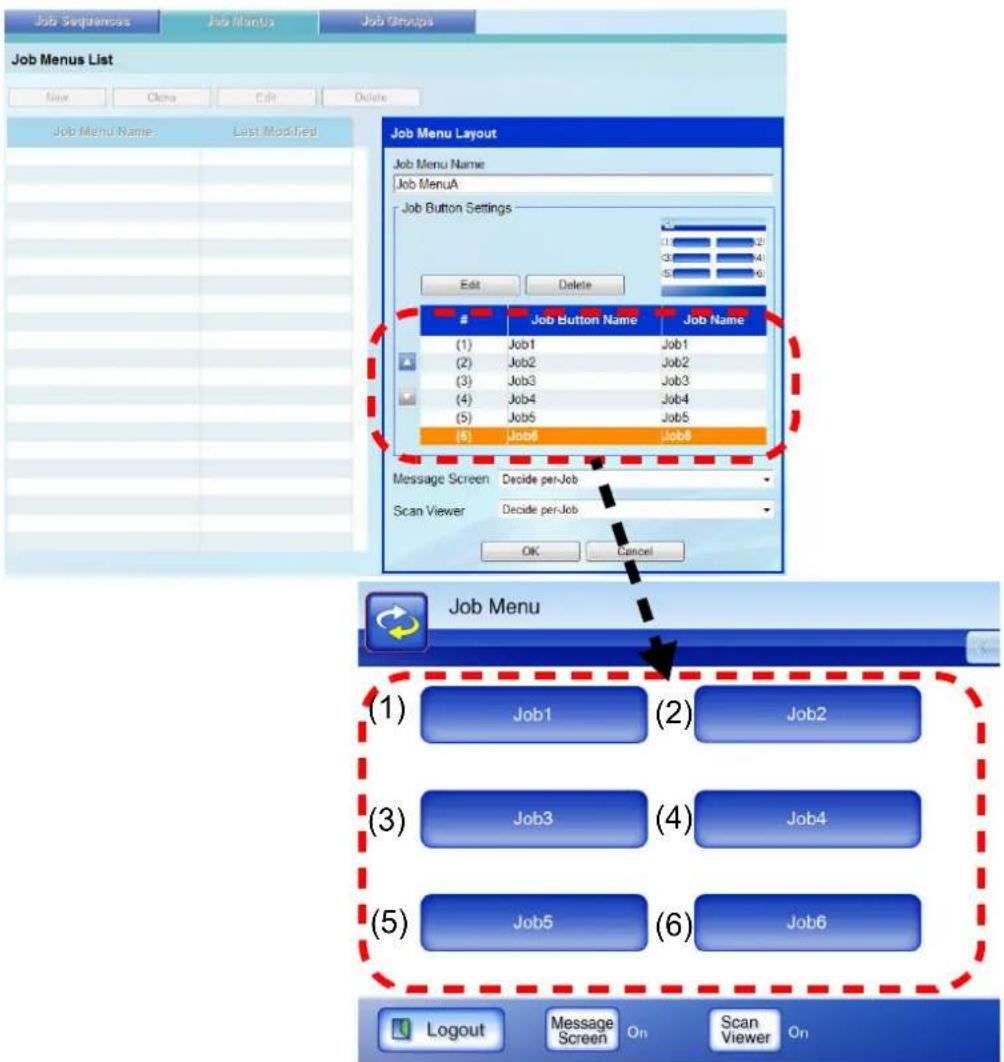
text_image
Job Sequences Job Months Job Groups Job Menus List Next Close Edit Delete Job Menu Name: Last-Modified Job Menu Layout Job Menu Name Job MenuA Job Button Settings Edit DeleteJob Button Name Job Name
(1) Job1 Job1 (2) Job2 Job2 (3) Job3 Job3 (4) Job4 Job4 (5) Job5 Job5 (6) Job6 Job6 Message Screen Decide per-Job Scan Viewer Decide per-Job OK Cancel Job Menu (1) Job1 (2) Job2 (3) Job3 (4) Job4 (5) Job5 (6) Logout Message On Scan Viewer On12. In the Message Screen list, set whether to show a [Message Screen] button on the "Job Menu" screen.
- If [Decide per-Job] is selected
The [Message Screen] button on the "Job Menu" screen is enabled, and it is possible to select whether or not to show the message screen when a job is processed according to each job. - If [Always display] is selected
The [Message Screen] button on the "Job Menu" screen is disabled, and the message screen is displayed when a job is processed. -
If [Never display] is selected
The [Message Screen] button on the "Job Menu" screen is disabled, and the message screen is not displayed when a job is processed. -
In the Scan Viewer list, set whether to show the [Scan Viewer] button on the "Job Menu" screen.
- If [Decide per-Job] is selected The [Scan Viewer] button on the "Job Menu" screen is enabled, and it is possible to select whether or not to show the "Scan Viewer" when scanning, according to each job.
- If [Always display] is selected The [Scan Viewer] button on the "Job Menu" screen is disabled, and the "Scan Viewer" is shown when scanning.
- If [Never display] is selected The [Scan Viewer] button on the "Job Menu" screen is disabled, and the "Scan Viewer" is not shown when scanning.
- Select the [OK] button.
A job menu is added to the "Job Menus List" window.
■ Cloning a job menu
This section describes how to clone a job menu.
- Select the [Job Menus] tab.
→ The "Job Menus List" window appears.
-
Select the job menu to be cloned.
-
Select the [Clone] button.
⇒ The "Job Menu Layout" area becomes active.
-
Clone the detailed job menu settings.
-
Select the [OK] button.
A job menu is added to the "Job Menus List" window.
■ Editing a job menu
This section describes how to edit a job menu.
- Select the [Job Menus] tab.
→ The "Job Menus List" window appears.
-
Select the job menu to be edited.
-
Select the [Edit] button.
→ The "Job Menu Layout" area becomes active.
-
Edit the detailed job menu settings.
-
Select the [OK] button.
→ The details of the job menu are changed.
■ Deleting a job menu
This section describes how to delete a job menu.
- Select the [Job Menus] tab.
→ The "Job Menus List" window appears.
-
Select the job menu to be deleted.
-
Select the [Delete] button.
→ The confirmation window appears.
- Select the [OK] button.
⇒ The job menu is deleted.
■ Viewing the detailed settings for a job menu
This section describes how to view the detailed settings for a job menu.
- Select the [Job Menus] tab.
⇒ The "Job Menus List" window appears.
- Select the job menu to view.
→ The details for the selected job menu appears in the "Job Menu Layout" area.


The information for the selected job menu shown in the "Job Menu Layout" area cannot be edited. To edit this information, select the [Edit] button.
4.11.4 Setting a Job Group


Assign the job menu set in "4.11.3 Setting a Job Menu" (page 203) to a job group. Users included in a job group can use the job menus assigned to the group. Users included in multiple job groups can use the multiple job menus assigned to those groups.
Up to 100 job groups may be set.
■ Adding a job group
This section describes how to add a job group.
1. Select the [Job Groups] tab.
→ The "Job Groups List" window appears.
![FUJITSU fi-6010N - Select the [Job Groups] tab. - 1](/content/2026/06/1236812/images/739697e437838891ec0f39caf8d3ea004fb92243d9c0cf229aa1032d86ab3939.jpg)
text_image
Job Sequences Job Menus Job Groups Job Groups List New Edit Delete Job Group Name Last Modified Default Group 12:58:39 PM Settings For Selected Group(s) Job Group Name: Default Group Design the Following Job Menu Select Modes Available To User @ Both Job & Out-Function Job Grid: Initial Point Logis Menu @ Multi-Function Menu Job Menu Group Member Settings Number of Members Edit Include a new account as a member OK Cancel2. Select the [New] button.
⇒ The "Settings For Selected Group(s)" area become active.
![FUJITSU fi-6010N - Select the [New] button. - 1](/content/2026/06/1236812/images/5fc32845af82a383fd378ce845929a31d44240215e4b46cb1f26893f7da3ba86.jpg)
text_image
Job Groups List New Edit Delete Job Group Name Last Modified Default Group 12.5820 PM Settings For Selected Group(s) Job Group Name Assign the following Job Menu Select... Modes Available To User Both Job & Multi-Function Job Only Initial Post-Login Menu Multi-Function Menu Job Menu Group Member Settings Number of Members: 0 Edit Include guest account as a member OK Cancel3. Enter the job group name.
This may be up to 64 characters long.
4. Select the [Select] button.
→ The "Select Job Menu" window appears.
![FUJITSU fi-6010N - Select the [Select] button. - 1](/content/2026/06/1236812/images/16bf60ba9bf7f4cf40e73649be98ee0ab1bf0b61d685fe18f54d3df4c17eb457.jpg)
text_image
Job Sequences Job Menus Job Groups Select Job Menu Job Menu Name4 Last Modified Job MenuA 9:30:17 AM Job MenuD 9:31:23 AM OK Cancel5. Select a job menu.
6. Select the [OK] button.
A job menu is set on the "Settings For Selected Group(s)" area.
- Set the whether or not to show the Multi-Function Main Menu after login.
- If [Both Job & Multi-Function] is selected
The menu to appear first after a regular user login can be set on the "Initial Post-Login Menu".
- If the [Multi-Function Menu] option button is selected The Multi-Function Main Menu appears first after a regular user login.
- If the [Job Menu] option button is selected The Job Menu appears first after a regular user login.
The user can use both the Multi-Function Main Menu (refer to "3.2 Required Scanner Function Settings" (page33)) and Job Menu (refer to "4.11.3 Setting a Job Menu" (page203)) by pressing the [Menu Mode] button.
- If [Job Only] is selected
The Multi-function Main Menu is not shown. The Job Menu always appears after a regular user login.
The user cannot switch between the Multi-Function Main Menu and Job Menu by pressing the [Menu Mode] button.
![FUJITSU fi-6010N - Select the [OK] button. - 1](/content/2026/06/1236812/images/e8fe8c2e6227648d547ae9cc8e8b9f594d5378ee7539e8e8724eec96ae25cb3c.jpg)
If the same one user is included in multiple job groups, the "Modes Available To User" settings of the group that appears first in the list on the "Job Groups List" window are used. For example, if a user belongs to the 3rd and 5th groups in the list, the settings for the 3rd group will be used. Therefore, specify the same "Modes Available To User" settings for all groups.
- Select the [Edit] button.
⇒ The "Group Member Settings" window appears.
![FUJITSU fi-6010N - Select the [OK] button. - 2](/content/2026/06/1236812/images/ef2c8406c18847533f3e56473c5171155e2c02f5591bd55155a562b1125c6cbe.jpg)
text_image
Job Sequences Job Intent Job Groups Group Member Settings Member Name Format User Principal Name SAM Account Name Search Base LDAP # Group Membership List < Job Group Name > Job Filter Conditions Member Name Domain Name Find Select All Deselect All LDAP List Filter Conditions Head (abc...) Find User Principal Name SAM Account Name First Name Last Name Common Name Display Name Select All Deselect All Member Name Domain Name Member Name Domain Name OK Cancel- Select the member name format.
The "Member Name" of the "Group Membership List" or "LDAP List" is shown, according to the format selected in [Member Name Format].
- Enter the LDAP server and character string to be used for LDAP searches in the "Search Base" field.
The LDAP entries under the character string entered here will become the search target. This may be up to 520 characters long.
Settings entered in the following screen are shown.
- For Admin Tool
"Login LDAP Server" screen
● For Central Admin Console
"LDAP Server" section on the "Central Admin Server Settings" screen
However, whether or not SSL is used, depends on each LDAP server settings.
- Select the checkbox of a user name or Active Directory group to be added to a job group from the LDAP List.
![FUJITSU fi-6010N - Select the [OK] button. - 3](/content/2026/06/1236812/images/1139ceafafab3adffcccd63d6e860b8a1faa67c76e6b30229957b49716435b58.jpg)
- To view detailed information about a logged in user or Active Directory group, select the "Member Name" or "Domain Name" link.
![FUJITSU fi-6010N - Select the [OK] button. - 4](/content/2026/06/1236812/images/6223e4cecf45543f1bde85e875e7635365c6e29bc41d145e73caf855ffc4dafb.jpg)
text_image
Job Sequences Job Ments Job Groups Member Details User Principal Name @domain0.com SAM Account Name Job Group Name Search Base LDAP://CN=Users,DC=domain0,DC=com Member Details Common Name First Name Initials Last Name Display Name Comment Workplace Phone Number E-mail Address ZABC@example.com Homepage OK- To select the checkboxes for all users and Active Directory groups, press the [Select All] button.
To clear the checkboxes for all users and Active Directory groups, press the [Deselect All] button.
- To filter the LDAP List, refer to "Filtering the LDAP List" (page 218) for more details.
- Select the [<<] button.
⇒ The user or Active Directory group is added to the in the Group Membership List. Users or Active Directory groups added to the Group Membership List are grayed on the LDAP list.
![FUJITSU fi-6010N - Select the [OK] button. - 5](/content/2026/06/1236812/images/40206836c47e837a67b1c4857b1d4d1089174a9cd2813a40de01594523687519.jpg)
- Up to 1,000 users or Active Directory groups can be registered as job group members.
- To delete a user or Active Directory group registered in the Group Membership List, select the checkbox for the user or Active Directory group to be deleted, and then select the [>>>] button. Users or Active Directory groups deleted from the Group Membership List are returned to the LDAP List.
- To filter job group members, enter the "Member Name" and "Domain Name" in part or in full, and then select the [Find] button.
If "User Principle Name" is selected for the member name format, the "Member Name" may be up to 1024 characters long.
If "SAM Account Name" is selected for the member name format, the "Member Name" may be up to 20 characters long.
"Domain Name" may be up to 256 characters long.
To display all results, clear both "Member Name" and "Domain Name" fields under the Filter Conditions, and then select the [Find] button. -
If the login LDAP server type is changed, all job group members of the old server type are automatically deleted the next time the group members are edited.
-
Select the [OK] button.
⇒ The number of members registered as job group members is shown in "Number of Members" on the "Settings For Selected Group(s)" window.
-
To include the guest account as a job group member, select the [Include guest account as a member] checkbox.
-
Select the [OK] button.
A job group is added to the "Job Groups List" window.
■ Editing a job group
This section describes how to edit a job group.
- Select the [Job Groups] tab.
→ The "Job Groups List" window appears.
-
Select the checkbox for the job group to be edited.
-
Select the [Edit] button.
⇒ The "Settings For Selected Group(s)" input fields become active.
-
Change the detailed job group settings.
-
Select the [OK] button.
⇒ The details of the job group are changed.
■ Deleting a job group
This section describes how to delete a job group.
- Select the [Job Groups] tab.
→ The "Job Groups List" window appears.
-
Select the job group to be deleted.
-
Select the [Delete] button.
→ The confirmation window appears.
- Select the [OK] button.
→ The job group is deleted
■ Viewing the detailed settings for a job group
This section describes how to view the detailed settings for a job group.
- Select the [Job Groups] tab.
→ The "Job Groups List" window appears.
- Select the job group to view.
⇒ The details for the selected job menu appears in the "Settings For Selected Group(s)" area.


The information for the selected job group shown on the "Settings For Selected Group(s)" screen cannot be edited. To edit this information, select the [Edit] button.
■ Assigning job menus to users not included in a job group
Users who are not included in any job group automatically belong to a Default Group. This section describes how to assign job menus to those users.
- Select the [Job Groups] tab.
⇒ The "Job Groups List" window appears.
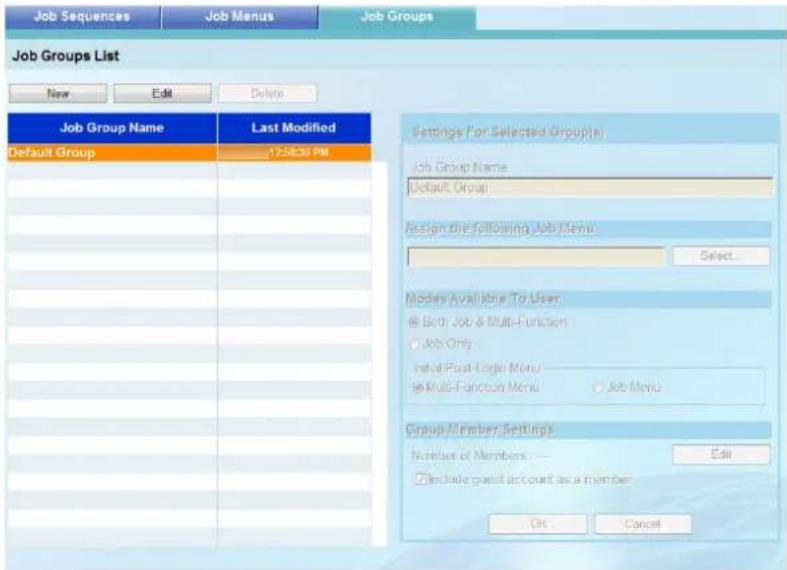
text_image
Job Sequences Job Menus Job Groups Job Groups List New Edit Delete Job Group Name Last Modified Default Group 12:58:39 PM Settings For Selected Group(s) Job Group Name Default Group Assign the following Job Menu: Select... Modes Available To User: Both Job & Multi-Function Job Only Initial Post-Legal Menu Multi-Function Menu Job Menu Group Member Settings Number of Members Edit Include guest account as a member. OK Cancel- Select the "Default Group" option button.
3. Press the [Edit] button.
→ The "Settings For Selected Group(s)" area becomes active.
![FUJITSU fi-6010N - Press the [Edit] button. - 1](/content/2026/06/1236812/images/51280d95a462e3c75ec14f3c092e5e5c87c3a319ccc7519cef96cc8e82abf831.jpg)
text_image
Job Groups List New Edit Delete Job Group Name Last Modified Default Group 12.563a PM Settings For Selected Group(s) Job Group Name Default Group Assign the following Job Menu Select... Modes Available To User Both Job & Multi-Function Job Only Initial Post-Login Menu Multi-Function Menu Job Menu Group Member Settings Number of Members Edit Include guest account as a member OK Cancel- Select the [Select] button.
→ The "Select Job Menu" window appears.
-
Select a job menu.
-
Select the [OK] button.
A job menu is set on the "Settings For Selected Group(s)" area.
- Set whether or not to display the "Multi-Function Main Menu".
- If [Both Job & Multi-Function] is selected The menu to appear first after a regular user login can be set on the "Initial Post-Login Menu".
- If the [Multi-Function Menu] option button is selected The Multi-Function Main Menu appears first after a regular user login.
- If the [Job Menu] option button is selected The Job Menu appears first after a regular user login.
The user can use both the Multi-Function Main Menu (refer to "3.2 Required Scanner Function Settings" (page33)) and Job Menu (refer to "4.11.3 Setting a Job Menu" (page203)) by pressing the [Menu Mode] button.
- If [Job Only] is selected The Multi-function Main Menu is not shown. The Job Menu always appears after a regular user login. The user cannot switch between the Multi-Function Main Menu and Job Menu by pressing the [Menu Mode] button.
- Select the [OK] button.
A job menu is assigned to users who are not included in a job group.
■ Filtering the LDAP List
This section describes how to filter the LDAP List on the "Job Group Member Settings" screen.
- In the [Search Position] drop-down list box on the "LDAP List" window, select the filtering method.
The default setting is [Head (abc...)].
| Search Position | Description | Example Target | Search Result |
| Head (abc...) | Filtered by words that start with the character string entered in Step 2. | abc abc, abc1, abcd, ... | |
| Anywhere (...abc...) | Filtered by words that include the character string entered in Step 2. | abc abc, abc1, xabc, xabcy, ... | |
| Tail (...abc) | Filtered by words that end with the character string entered in Step 2. | abc abc, 1abc, xabc, ... |
- Enter the filter character string.
Enter the filter target, in whole or in part.
This may be up to 256 characters long.
- Select the filter target.
If multiple items are selected, data containing any of the search words are searched as "OR Search".
- The "Server Type" of the login LDAP server is [Active Directory] or [Active Directory Global Catalog]
| Checkbox name | Filter target in the Active Directory/Active Directory Global Catalog | |
| User Princi-pal Name | Filters the user principal names registered in the LDAP server. | |
| SAM Account Name | Filters the SAM account names of users registered in the LDAP server. 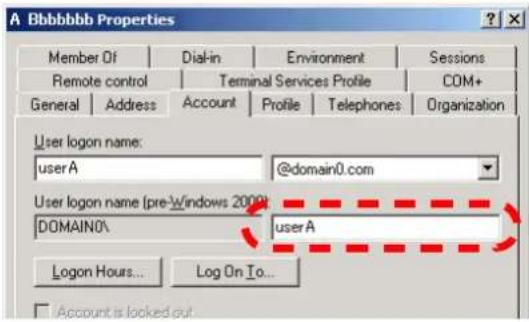 | |
Last Name Filters the last names of users registered in the LDAP server. 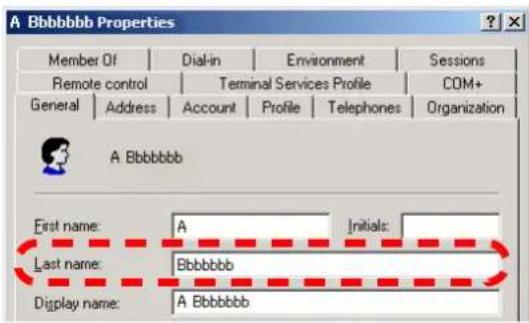 | ||
First Name Filters the first names of users registered in the LDAP server. 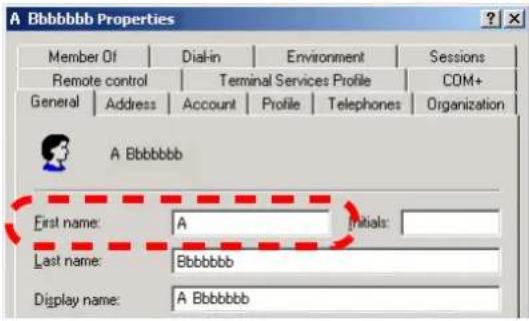 | ||
| Common Name | Filters the common names of users registered in the LDAP server.  This item can be set in [Active Directory Users and Computers]. The [Common Name] checkbox must be selected to filter the Active Directory group names. This item can be set in [Active Directory Users and Computers]. The [Common Name] checkbox must be selected to filter the Active Directory group names. | |
| Display Name | Filters the display names of users registered in the LDAP server.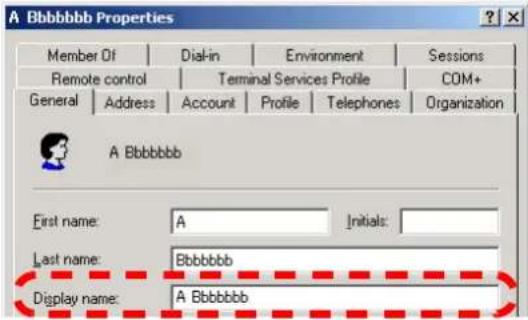 | |
- If the "Server Type" of the login LDAP server is [Other LDAP Server]
| Checkbox name | Filter target in the LDAP server |
| cn Filters users | on the "cn" attribute. |
| uid Filters users | on the "uid" attribute. |
| First Name | Filters on the first names of users as such are defined by the "First Name" field in the "Adjust the search item schema" screen from the "e-Mail LDAP Server" screen. |
| Last Name | Filters on the last names of users as such are defined by the "Last Name" field in the "Adjust the search item schema" screen from the "e-Mail LDAP Server" screen. |
| Common Name | Filters on the common names of users as such are defined by the "Common Name" field in the "Adjust the search item schema" screen from the "e-Mail LDAP Server" screen. |
| DisplayName | Filters on the display names of users as such are defined by the "Display Name" field in the "Adjust the search item schema" screen from the "e-Mail LDAP Server" screen. |
4. Select the [Find] button.
⇒ The filtered results appear.
![FUJITSU fi-6010N - Select the [Find] button. - 1](/content/2026/06/1236812/images/c45ae10fd129e8eb5a5ad599908387ae0602451acf7d8d06a66e99392a2a4b4c.jpg)
- If the login LDAP server type is [Active Directory] or [Active Directory Global Catalog], when the [Find] button is pressed, a confirmation window appears.
Perform the following procedure for authentication.
- Enter a user name and password.
User names may be up to 129 characters long.
Passwords may be up to 256 characters long (case sensitive).
![FUJITSU fi-6010N - Select the [Find] button. - 2](/content/2026/06/1236812/images/02ee2eccfb8e80cfce6f3e612b84889d19d8dbad22ba4b3c55b5f19ed871a63a.jpg)
text_image
Connecting to the LDAP server. Enter a User Name and Password. User Name Password OK Cancel-
Select the [OK] button.
-
To display all results, delete all filter strings and then select the [Find] button.
-
When there is a large number of filtered results on the "LDAP List" window, or a large number registered job group members (1000 at maximum), it may take several seconds until the [Group Member Settings] window appears. This can be resolved by performing the following.
-
Add a filter condition(s)
- Reduce the "Maximum Results" specified on the "e-Mail LDAP Server" screen
- Divide job groups
- Specify an Active Directory group
Administrator Operations (Central Admin Console)
Admin
This chapter explains system setting and control of this scanner performed using the Central Admin Console.
Messages may appear while performing operations described in this chapter. For more details about these messages and actions to take, refer to "E.1.2 System Log Messages" (page 518).
5.1 Function List.... 224
5.2 Using Central Admin Console Window.... 227
5.3 Central Admin Console Quick Guide 229
5.4 Pre-settings for Using Central Admin Console.... 231
5.5 Central Admin Server Login: via the Central Admin Console 241
5.6 Setting the Central Admin Server.... 244
5.7 Setting Scanner Configuration 254
5.8 Monitoring and Maintaining the iScanner Network 263
5.9 Updating the System 266
5.10 Installing an Add-in.... 268
5.11 Updating the Scanner System Settings 271
5.12 Setting the Job Mode.... 275
5.13 Viewing the Update Status Lists.... 278
5.14 Viewing the Scanners Operating Status.... 281
5.15 Viewing Event Log 284
5.16 Collecting and Exporting Audit Logs.... 286
5.17 Maintaining Central Admin Settings 291
5.1 Function List
The functions that can be used in the Central Admin Console are as follows.
| Function Used to... See... | ||
| Scanner Configuration Management | View information for each scanner in the Central Admin Console. Also you can export the information in CSV format by using the export function.●Edit Scanner Configuration Settings for the configuration of scanners can be added, edited and deleted in the Central Admin Console. Files can also be imported or exported in CSV format.●fi Network Scanner Admin Tool [Start] An Admin Tool of a specified scanner can be started up from the Central Admin Console. | "5.7 Setting Scanner Configuration" (page 254) |
| Software Update Update | modules for scanner system/security/installed options. Add-ins can be predefined in the Central Admin Server, and applied to multiple scanners.●Update Call Pre-defined system update modules and Add-ins can be applied to multiple scanners at once.●Scanner Notification Schedule A time zone for an update can be specified. | "5.6 Setting the Central Admin Server" (page 244) |
| "5.7 Setting Scanner Configuration" (page 254) | ||
| "5.8 Monitoring and Maintaining the iScanner Network" (page 263) | ||
| "5.9 Updating the System" (page 266) | ||
| "5.10 Installing an Add-in" (page 268) | ||
| "5.13 Viewing the Update Status Lists" (page 278) | ||
| Scanner Settings Update | Create scanner settings in the Central Admin Server, and upload/release them to multiple scanners.The contents of the scanner settings can be changed per settings group.●Update Call Scanner settings can be applied to multiple scanners at once. | "5.8 Monitoring and Maintaining the iScanner Network" (page 263) |
| "5.11 Updating the Scanner System Settings" (page 271) | ||
| "5.13 Viewing the Update Status Lists" (page 278) | ||
| Automatic Update Automatically update scanner systems, security, installed options, scanner settings, and Add-ins, on the date specified on the scanner side. Updates can be performed on a specified date even in an environment where update calls or Wake-On-LAN cannot be used, because the scanner is automatically resumed and updated even when in standby mode. | "4.7.3 Setting a Central Admin Server" (page 90) | |
| "5.11 Updating the Scanner System Settings" (page 271) | ||
| Status Monitoring Monitor the error status, operating status, and consumable part status for each scanner.●Normalcy Monitoring Monitoring of scanner errors can be performed in the Central Admin Server. Errors can be notified of to the Central Admin Console. If an error occurs, a notification e-mail can be sent to the administrator.●Operating Status Monitoring The power status and login status of each scanner can be displayed in the Central Admin Console.●Consumables Monitoring When a consumable part needs to be replaced in the near future, a notification can be displayed in the Central Admin Console. | "5.6 Setting the Central Admin Server" (page 244) | |
| "5.7 Setting Scanner Configuration" (page 254) | ||
| "5.14 Viewing the Scanners Operating Status" (page 281) | ||
| Job Mode Settings Share | jobs between multiple scanners. Job mode settings can be created and edited in the Central Admin Console. | "5.12 Setting the Job Mode" (page 275) |
| User Data Roaming Share | user information such as the e-mail address book and scan settings between scanners. | "4.7.3 Setting a Central Admin Server" (page 90) |
| "5.6 Setting the Central Admin Server" (page 244) | ||
| Audit Log Collection | Collect the scanner system and user logs in the Central Admin Server, so that each operation performed by a scanner can be inspected. Collected logs can be exported using the audit log export command, and output to an arbitrary folder. | "5.6 Setting the Central Admin Server" (page 244) |
| "5.16 Collecting and Exporting Audit Logs" (page 286) | ||
5.2 Using Central Admin Console Window
The main windows of the Central Admin Console are as follows.
- "Scanner Admin Operations" window
● "Scanner Operation Monitor" window - "Scanner Config List" window
- "Event Log" window
You can set the "Scanner Admin Operations" window or "Scanner Operation Monitor" window as the Main screen to be displayed after a Central Admin Console login.
This section describes the buttons and links displayed on the Central Admin Console window.
Menu

text_image
Scanner Admin Operations Central Admin Server Settings iScanner NetworkScanners # Registered # Unregistered Consumable Alerts
11 10 1 0 iScanner Updates Update Type Scanner-Side Update Status Targeted Finished Pending Failed System Updates None 0 0 0 0 Add in Installs None 0 0 0 0 Scanner Settings Available 1 0 1 0 Job Mode Settings None — — — — iScanner Events Date/Time Origin Type Message 44823698-1-0000| Button/Link | Shown in manual as... | Used to ... |
| [Exit] button Exit the | Central Admin Console. | |
| [Disconnect] button D | Disconnect the connection to the Central Admin Server. | |
| [About] button Show | the version of the Central Admin Console. | |
| [Central Admin Server Settings] | [Central Admin Server Settings] link | Access the "Central Admin Server Settings" window. For details, refer to "5.6 Setting the Central Admin Server" (page 244). |
| Admin Operations | [Admin Operations] button | Show the "Scanner Admin Operations" window. For details, refer to "5.8 Monitoring and Maintaining the iScanner Network" (page 263). |
| Operation Monitor | [Operation Monitor] button | Show the "Scanner Operation Monitor" window. For details, refer to "5.14 Viewing the Scanners Operating Status" (page 281). |
| Config List | [Config List] button | Show the "Scanner Config List" window. For details, refer to "5.7 Setting Scanner Configuration" (page 254). |
| Event Log | [Event Log] button | Show the "Event Log" window. For details, refer to "5.15 Viewing Event Log" (page 284). |
5.3 Central Admin Console Quick Guide
Administrator operations for management using the Central Admin Console are as follows.
Pre-settings
- Installing the Central Admin Server Software
- Installing the Central Admin Console
- Setting up a Firewall for the Central Admin Server
- Configuring the Scanner Settings for Central Admin Management
For more details, refer to "5.4 Pre-settings for Using Central Admin Console" (page 231).

Login to Central Admin Console

Set the Central Admin Server

Register the scanners to be managed

For more details, refer to "5.5 Central Admin Server Login: via the Central Admin Console" (page 241).
For more details, refer to "5.6 Setting the Central Admin Server" (page 244).
For more details, refer to "5.7 Setting Scanner Configuration" (page 254)
Scanner settings / management
● Monitoring and Maintaining the iScanner Network
- Updating the System
- Installing an Add-in
- Updating the Scanner System Settings
- Setting the Job Mode
- Viewing the Update Status Lists

Monitoring
- Viewing the Scanners Operating Status
- Viewing Event Log
- Collecting and Exporting Audit Logs

Maintaining
For more details, refer to the following.
- "5.8 Monitoring and Maintaining the iScanner Network" (page 263)
- "5.9 Updating the System" (page 266)
- "5.10 Installing an Add-in" (page 268)
- "5.11 Updating the Scanner System Settings" (page 271)
- "5.12 Setting the Job Mode" (page 275)
- "5.13 Viewing the Update Status Lists" (page 278)
For more details, refer to the following.
- "5.14 Viewing the Scanners Operating Status" (page 281)
- "5.15 Viewing Event Log" (page 284)
- "5.16 Collecting and Exporting Audit Logs" (page 286)
For more details, refer to "5.17
Maintaining Central Admin Settings" (page 291).
5.4 Pre-settings for Using Central Admin Console
This section explains the required pre-settings for using the Central Admin Console.
5.4.1 Installing the Central Admin Server Software
Instal the Central Admin Server software in a computer.
The following describes the required settings for scanner.
- Perform Step 1 to Step 3 of "Installing the Admin Tool" (page 47).
→ The download screen appears.
- Press the [Next] button for the iScanner Central Admin Server.
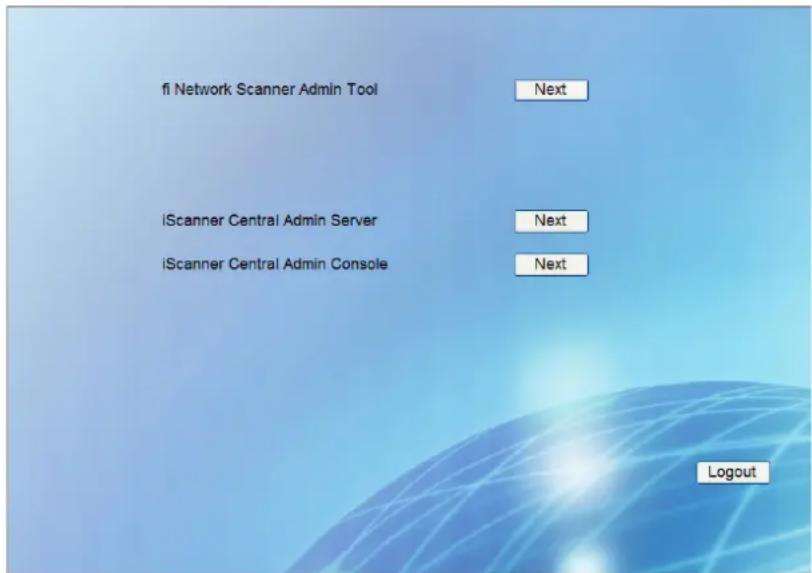
text_image
fi Network Scanner Admin Tool Next iScanner Central Admin Server Next iScanner Central Admin Console Next Logout→ The iScanner Central Admin Server download screen appears.
3. Press the [Download] button.
![FUJITSU fi-6010N - Press the [Download] button. - 1](/content/2026/06/1236812/images/77b1beeab35da6f66a2ffc4243a7500fc009c9e197ba49f6f6e42b838e5a7a08.jpg)
text_image
Download iScanner Central Admin Server. (Version 83.88.16) The iScanner Central Admin Server software requires: OS: Microsoft(R) Windows(R) 2000 Server SP4 (or later) Microsoft(R) Windows Server(R) 2003 SP2 (or later) Microsoft(R) Windows Server(R) 2008 Microsoft(R).NET Framework 2.0 Service Pack 1 (or later), or Microsoft(R).NET Framework 3.0 Service Pack 1 (or later) Memory: 512MB (or more) Disk space: 700MB (or more) Attention : Since .NET Framework and SQL Server 2005 Express are required to use this software; confirm that they have been installed. If these components need to be installed, the following (minimum) amounts of free disk space will be required: .NET Framework 2.0 280MB SQL Server 2005 Express 200MB Back Logout![FUJITSU fi-6010N - Press the [Download] button. - 2](/content/2026/06/1236812/images/4e4526ff9c6d38d7ccb9e9d71284122947d3c1c1dfaa00ee6133b9096b55044e.jpg)
- Downloading is not possible while a scanner operation is in process.
- Do not close the Web browser or logout until installation is complete.
- The required 700MB of free disk includes 200MB which is required to install SQL Server 2005 Express Edition.
→ Follow the wizard instructions displayed on the window.
The following port number and protocol settings will be required. Enter the same port number and protocol settings as used for the pre-settings.
● Port number for scanner communication
● Port number for Central Admin Console communication
After installation, the port number and protocol settings can be changed on the Central Admin Console "Central Admin Server Settings" screen.
→ After installation is complete, restart the computer.
![FUJITSU fi-6010N - Press the [Download] button. - 3](/content/2026/06/1236812/images/4bf4f91ceaf1347601cf347fb31e243c8c9d8b57f81af5c8b366a9383e5a1978.jpg)
- If the Central Admin Server software is already installed, skip to "5.4.2 Installing the Central Admin Console" (page 236).
- When installing the Central Admin Server over an older version of the software, all of the old Central Admin system settings should be automatically reused. However, as a precaution, it is still recommended that the old settings be backed up before proceeding with the upgrade installation. To back up the Central Admin settings, refer to "5.17.1 Backing Up Central Admin Settings" (page 291).
- Make sure that the Central Admin Server date and time values are set correctly. If the date/time difference between the values set in the server and actual values is large, normal operation may not be possible.
- After the Central Admin Server software is installed, a Windows user account (Account name: iSCentralAdmin) is added. This user is required for Central Admin, therefore, do not change or delete the account.
![FUJITSU fi-6010N - Press the [Download] button. - 4](/content/2026/06/1236812/images/a49bc140cc57c21432a77c30083799c1339d983daadf0bf3db2e4feb991d3ef2.jpg)
- For details of the operating environment when installing the Central Admin Server software, refer to "1.4.3 Requirements for Central Admin Server" (page 14).
- When installing the Central Admin Server software, the same necessary pre-settings before logging in with the Admin Tool are required. For more details, refer to "4.4 Setting up for Administrator Access via the Admin Tool" (page 44).
- To install the Central Admin Server software on Windows Server 2008, login as an administrator. Do not install with Administrators group rights.
- If the following error message appears, installation was not successful. An installation package for the product Microsoft SQL Server Native Client cannot be found. Try the installation agent using a valid copy of the installation package 'sqlncli.msi'.
In this case, uninstall "SQL Server Native Client". Then, try installing the Central Admin Server software again.
- If the installation process fails and the following error message appears, stop the IIS service and re-start manually. Then, re-install the Central Admin Server software.
The installation process was canceled because the system was busy. Try restarting the Installation Wizard again later.
- If the following error message appears in Windows Server 2008, check that IIS Management Console is installed. If IIS Management Console is not installed, select and install IIS Management Console in "Role Services".
Installation requires that the IIS Management Console be installed.
Refer to the manual for details.
To select the role services for IIS, point to [Administrative Tools] - [Server Manager], select Web Server (IIS) in "Roles Summary".
![FUJITSU fi-6010N - Press the [Download] button. - 5](/content/2026/06/1236812/images/8f017857fc5b0b15caff4f3f3c08d37ec348a12e2c80822f60091cb326f97015.jpg)
- In order to use HTTPS for communication to a scanner, or computer installed with Central Admin Console software, a self-signed certificate is automatically imported on the Central Admin Server. However, it is recommended that a formal certificate is installed manually. For more details, refer to "Importing the Certificate" (page 235).
- If an interruption or error occurs during the installation or uninstallation process, the following software components may be installed.
● AMMANAGER instance of Microsoft SQL Server 2005
● Microsoft SQL Server Native Client
● Microsoft SQL Server Setup Support Files
● Microsoft SQL Server VSS Writer
- MSXML 6.0 Parser
In this case, uninstall the software components described above.
For more details about uninstalling software components, the following is a description of the process using Windows Server 2003 as an example.
To uninstall a software component, select [Control Panel] - [Add or Remove Programs].
To uninstall "Microsoft SQL Server 2005 AMMANAGER instance", point to "Add or Remove Programs", select "Microsoft SQL Server 2005" and press the [Remove] button. Select the [Remove SQL Server 2005 instance components] checkbox, select "AMMANAGER: Database Engine" under
"Select all instance", and press the [Next] button. From here on after, follow the instructions on the wizard displayed on the screen. For programs other than "Microsoft SQL Server 2005 AMMANAGER instance", deletion is not necessary as they are used by other applications.
- If the following changes are to be made after the Central Admin Server software has been installed, uninstall the Central Admin Server software, and re-install after making the changes.
- If the Central Admin Sever is to be used as the Active Directory domain controller
- If the domain controller role assignment is to be deleted
■ Importing the Certificate
This section uses Windows Server 2003 as an example.
- To startup IIS Manager, on the [Start] menu, point to [Administrative Tools], and select [Internet Information Services (IIS) Manager].
- Show the web sites for importing the certificate.
Certificates are be imported to the following Web sites:
AmConsole
AmService
- Right-click the Web site and select "Properties".
- On the [Directory Security] tab, select "Server Certificate" in the "Secure communications" frame.
→ The [Welcome to the Web Server Certificate Wizard] appears.
→ Follow the wizard instructions displayed on the window.

For Windows Server 2008, set the fingerprint for the imported certificate in the CertHash.xml file.
The CertHash.xml installation path is as follows.
Central_Admin_Server_installation_folder\AmManager\Sys\Cert Hash.xml
An example for setting the fingerprint for the certificate "cc ce a0 66 e3 9c 9b 2a 65 45 03 a3 c4 f4 e5 e6 ad ec df 9f" is as follows.
<?xml version="1.0" encoding="utf-8"?>
<IISPolicy>
    <CertHash>cc ce a0 66 e3 9c 9b 2a 65 45 03 a3 c4 f4 e5 e6
ad ec df 9f</CertHash>
</IISPolicy>
5.4.2 Installing the Central Admin Console
Install the Central Admin Console in a computer.
- Perform Step 1 to Step 3 of "Installing the Admin Tool" (page 47).
→ The download screen appears.
- Press the [Next] button for the iScanner Central Admin Console.
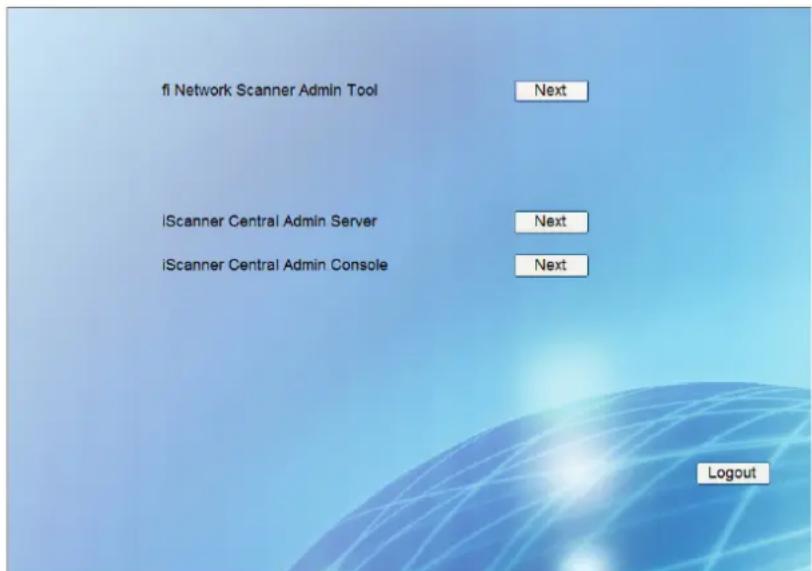
text_image
fi Network Scanner Admin Tool Next iScanner Central Admin Server Next iScanner Central Admin Console Next Logout⇒ The iScanner Central Admin Console download screen appears.
3. Press the [Download] button.
![FUJITSU fi-6010N - Press the [Download] button. - 1](/content/2026/06/1236812/images/4eb2b03debc34acf96d9953ff00515f555b99e304cc731b96f7031cd9118f559.jpg)
text_image
Download iScanner Central Admin Console. (Version 2019) Download The iScanner Central Admin Console requires: OS: Microsoft(R) Windows(R) XP SP2 (or later) Microsoft(R) Windows Vista(R) Microsoft(R) Windows(R) 7 Microsoft(R) Windows Server(R) 2003 SP2 (or later) Microsoft(R) Windows Server(R) 2008 Microsoft(R) .NET Framework 2.0 Service Pack 1 (or later), or Microsoft(R) .NET Framework 3.0 Service Pack 1 (or later) Memory: 32MB (or more) Disk space: 64MB (or more) Attention : .NET Framework is required for use of this tool, therefore confirm that it has been installed. If not already installed, a message will appear telling you to install .NET Framework from the Microsoft Web site. When installing .NET Framework, at least 280MB of additional free disk space is required. Back Logout![FUJITSU fi-6010N - Press the [Download] button. - 2](/content/2026/06/1236812/images/e7f6c55813e645356e1b85d33e0f4912389ec88289b1bcf99cb585777d0ba21c.jpg)
text_image
• Downloading is not possible while a scanner operation is in process. • Do not close the Web browser or logout until installation is complete.→ Follow the wizard instructions displayed on the window.
When "Installation complete" is displayed, the installation is complete. Press the [Close] button.
After installation is completed, log out from fi-6010N on the Web browser and close the Web browser.
After installation, the Central Admin Console can be started by selecting the [Start] menu - [All Programs] - [iScanner Central Admin] - [iScanner Central Admin Console].
![FUJITSU fi-6010N - Press the [Download] button. - 3](/content/2026/06/1236812/images/95befdaf205e971b5e7a11d83f2a6359954d5fb6a81f4c5cdc1f2fd3af1987f5.jpg)
- The Admin Tool must be installed before installing the Central Admin Console. For more details about how to install the Admin Tool, refer to "4.4.3 Installing the Admin Tool" (page 47).
- If the Central Admin Console is already installed, skip to "5.4.3 Setting up a Firewall for the Central Admin Server" (page 239).
-
From the Web browser [Tools] menu, select [Internet Options], and note the following points about the settings shown on the [Internet Options] dialogbox.
-
In the [Accessibility] dialog box shown when selecting the [Accessibility] button on the [General] tab, do not change the formatting and user style sheet settings. If these settings are changed, the displayed style of the Central Admin Console may be corrupted.
- In the [Language Preference] dialog box shown when selecting the [Languages] button on the [General] tab, move the same language as for the Central Admin Server operation system to the top. If a different language is specified, a problem may occur with the input or displays for the Central Admin Console.
- On the [Security] tab, if "Security level for this zone" is set to "High", part of the Admin Tool screen may not be correctly displayed. In this case, on the [Security] tab, add the scanner or Central Admin Server to the trusted site zone and select the [Default Level] button. Or select the [Custom Level] button and set [Binary and script behaviors] to "Enable".
- On the [Advanced] tab, select the "Play animations in webpages" checkbox under "Multimedia". In Windows Server 2003 or Windows Server 2008, this checkbox is not selected by default.
- When the font size is large, part of the dialog box may not be shown correctly. In this case, use a smaller font size.
![FUJITSU fi-6010N - Press the [Download] button. - 4](/content/2026/06/1236812/images/2d4a08e09818f6ebfa54519b7b9eb63c25c2708be9726e2fde38123034ff0145.jpg)
- For details of the operating environment when installing the Central Admin Console, refer to "1.4.2 Requirements for Central Admin Console" (page 13).
- When installing the Central Admin Console, the same necessary pre-settings before logging in with the Admin Tool are required. For more details, refer to "4.4 Setting up for Administrator Access via the Admin Tool" (page 44).
5.4.3 Setting up a Firewall for the Central Admin Server
This section describes how firewall settings for the Central Admin Server.
Set the following port number for communication in the Central Admin Server, to enable management by the Central Admin Console.
| From/To Protocol Port Number | ||
| Scanner ⇒ Central Admin Server HTTP/ | HTTPS (TCP) | Port number set for scanner communication |
| Central Admin Console ⇒ Central Admin Server H | HTTP/ HTTPS (TCP) | Port number set for Central Admin communication |
For details about setting a firewall, refer to the manual for the relevant firewall.
5.4.4 Configuring the Scanner Settings for Central Admin Management
This section describes the scanner settings environment.
The following settings for connecting a scanner to the Central Admin Server are required to enable management by the Central Admin Console.
- "Admin Network" screen from the "Network Settings" tab
For more details, refer to "4.7.2 Setting the Admin Network" (page 88).
● "Central Admin Server" screen from the "Network Settings" tab
For more details, refer to "4.7.3 Setting a Central Admin Server" (page 90).
5.4.5 Uninstalling the Central Admin Server Software/Console
This section describes how to uninstall the Central Admin Server Software/Console. Refer to this section if uninstallation is required.
■ Uninstalling the Central Admin Server Software
This section uses Windows Server 2008 as an example.
Uninstall Central Admin Server software from [Control Panel] - [Programs] - [Programs and Features] in the computer in which it is installed.

- Before starting uninstallation, disconnect the Central Admin Server from the network.
If the uninstallation process is completed while the Central Admin Server is connected to the network, normal operation cannot be guaranteed. - All files in the installation folder are deleted when the Central Admin Server software is uninstalled. Back up the information related to Central Admin as required. For details, refer to "5.17.1 Backing Up Central Admin Settings" (page 291).
- If the following message appears while uninstalling the Central Admin Server software, press the [Retry] button. Even if the same message appears again, re-start the Central Admin Server, and uninstall it again.
Another application has exclusive access to the file ASPNETDB.MDF.Please shut down all other applications, then click Retry.
■ Uninstalling the Central Admin Console
This section uses Windows Vista as an example.
Uninstall the Central Admin Console from [Control Panel] - [Programs] - [Programs and Features] in the computer in which it is installed.

- Before starting uninstallation, close the Central Admin Console. If the uninstallation process is completed while the Central Admin Console is in operation, normal operation cannot be guaranteed.
- Even if uninstalled, data will remain. Delete this data if it is not required. For Windows XP, data is saved in the following way.
C:\Documents and Settings\User_name \Local Settings\Application Data\FUJITSU \iScannerCentralAdminConsoxxx
The character string shown in italics is variable.
User_name can be the name of any Central Admin Console user.
5.5 Central Admin Server Login: via the Central Admin Console
Using the Central Admin Console allows an administrator to set multiple scanners via the network interface.
This section describes how to login from the Central Admin Console.

If the normal screen display does not appear (for example: an "X" mark appears), wait for a few minutes and try again. If the problem still occurs, contact your FUJITSU scanner dealer or an authorized FUJITSU scanner service provider.

- The default user name and password for the administrator are set as follows: User name: admin Password: password
-
Session timeout time is 20 minutes (fixed). Selecting links and buttons extends the session timeout time by 20 minutes. However, the session timeout time is extended automatically when the "Scanner Admin Operations" window or "Scanner Operation Monitor" window of the Central Admin Console is shown, so as not to result in a session timeout.
-
Select the [Start] menu - [All Programs] - [iScanner Central Admin] - [iScanner Central Admin Console].
→ The Central Admin Console starts.
- Set the "Connect to" field.
Enter the Central Admin Server IP address, host name, or FQDN.

text_image
Scanmer Central Admin Console Edit Disconnect About... iScanner Connect to... Specify the IP address, host name, or FQDN of the target server. Port Number Use HTTPS Connect
- If the port number was changed in "5.6 Setting the Central Admin Server" (page 244), enter the port number changed for Port Number.
- To use SSL, select the [Use HTTPS] checkbox.
- If Central Admin Console is started while there is insufficient free memory, a script error may occur. Try again after ensuring that there is enough free memory.
-
For Windows Server 2003 and Windows Server 2008, when first connecting to the Central Admin Server, a confirmation screen for whether or not to add the specified URL to the trusted site zone may appear. In this case, after adding the Central Admin Server URL as a trusted site, close the Central Admin Console once, and re-open.
-
Press the [Connect] button.
→ The Central Admin Console login screen appears.
4. Enter a "User Name" and "Password".
Enter "admin" for the user name.
Passwords must be between 7 and 127 alphanumeric characters long (case sensitive).
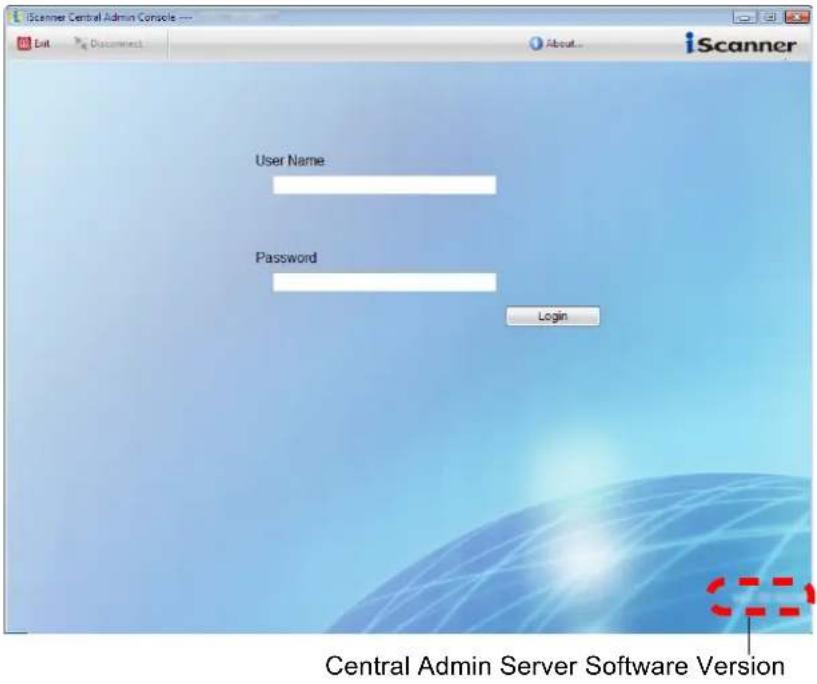
text_image
iScanner Central Admin Console User Name Password Login Central Admin Server Software Version5. Select the [Login] button.
If the user is authenticated, the Central Admin Console main window appears.
The main window shown after login can be changed.
For details, refer to "5.6 Setting the Central Admin Server" (page 244).
![FUJITSU fi-6010N - Select the [Login] button. - 1](/content/2026/06/1236812/images/73e4e30759f37a89f8779596bcbf487d2ee242391d355570523b4d79bb39623d.jpg)
text_image
Scanner Admin Operations [Central Admin Server Settings]Scanners # Registered # Unregistered Consumable Alerts
11 10 1 0 iScanner Network iScanner Updates Update Type Server-Side Data Scanner-Side Update Status Targeted Finished Pending Failed System Updates None 0 0 0 0 Add-in Installs None 0 0 0 0 Scanner Settings Available 1 0 1 0 Job Mode Settings None --- --- --- --- iScanner Events Date/Time Origin Type Message5.6 Setting the Central Admin Server
Operating environment for the Central Admin Server is set up by changing the administrator password and setting network and LDAP server.
The central admin server settings can be set from the "Central Admin Server Settings" window. To open the "Central Admin Server Settings" window, select the [Central Admin Server Settings] link in the Central Admin Console main window.

text_image
Central Admin Server Settings Change Administrator Password Use Roamery Data (Select & Clear) Scanner Registration Automatically add new scanners to the Central Admin configuration when they are discovered. Network Connection Use HTTPS to communicate with the Central Admin Console Central Admin Console Port Number 18444 Use HTTPS to communicate with scanners Scanner Communication Port Number 20444 Maximum Connections 10 Wake-On-LAN Port Number 443Tries 3
Interval 1 - 666 Screen Settings Default Screen Admin Operations Screen Refresh Interval 60 - sec. LDAP Server Enable LDAP searches LDAP Server Type: Active Display CLUse SQL Checkthrough Only LAN-My-Word LDAPServer IP address/ network in FODN Port Numbers 989 LDAP Server Administration: Authentication Service Password: No Interface Connection Options Password: Authentication after connection will be addressed or Authentication used at Port's port or http Login Server Peripherals and Search Base Only... Log and log values displayed by TCP/IP Maximum Results 1000 Socket, Tabesat: 100 - sec. Schemes: Adopt SharePoint Server Connection Settings Use a proxy server for SharePoint server connections Proxy Server Port Number 40 Exceptions Scaner Shared Folder Service Port Number 36444 Software Update Time-Period Restrictions Always allow Never allow Only allow in the following time period Start: 00 - Import: 00 - Use End: 00 - Import: 00 - Use Operation Monitor Check Operating Status Operating Status Icon Labels Scanner Name - Error Notification Settings Send error notification e-mails SMTP Server IP address/ network in FODN SMTP Server Port Number 25 Regulator Mail Address Rename or Mail Manager Text Data ImportExport CSV File Charset Shift_15 - Log Retention Keep records for 30 - days Audit Log Settings Collect Audit Logs Save for 70 - days OK Cancel■ [Change Administrator Password] button
This opens the "Change Administrator Password" window to change the administrator password.
![FUJITSU fi-6010N - ■ [Change Administrator Password] button - 1](/content/2026/06/1236812/images/5465d1ebf9b60c80aa2fb345ca77dc12afa35ad7a05ebdd44363e73f94d07c90.jpg)
text_image
Change Administrator Password Current Password New Password Confirm New Password Change Password Cancel- Current Password Enter the current password.
- New Password/Confirm New Password Password must be between 7 and 127 characters long (case sensitive). Blank spaces at the start and end will be removed.
- [Change Password] button Changes the administrator password to the entered password.
- [Cancel] button Returns to the "Central Admin Server Settings" window without confirming the entered contents.
■ [User Roaming Data (Select & Clear)] button
This opens the "User Roaming Data (Select & Clear)" window to delete unnecessary user roaming data.
![FUJITSU fi-6010N - ■ [User Roaming Data (Select & Clear)] button - 1](/content/2026/06/1236812/images/b0e2f2aa7cb3f4be985d7549ab76620a68e8f738e3239460ebdf2d560410c89a.jpg)
text_image
User Roaming Data (Select & Clear) Select the user(s) whose user roaming data is to be deleted from the central admin server, then click the [Clear] button. Clear All Filter Conditions User Name Refresh List Clear Select All Deselect All User Name Info Last Modified abc@ user01@ user02@ xyz@ 8:42:42 AM 8:43:11 AM 8:43:40 AM 8:45:44 AM Pages : 1 * "Select All" and "Deselect All" apply to the current page only. Back- [Clear All] button Deletes all user roaming data even if filtered.
- Filter Conditions
Filters the users displayed in the user list.
- User Name
Enter a part of or entire user name of the scanner to be filtered.
This can be up to 64 characters long.
● [Refresh List] button
Refreshes the list by filtering using the entered filtering conditions.
- [Clear] button
Select the checkbox of the user name to be deleted, and select the [Clear] button to delete.
- [Select All] button
Selects all checkboxes in the user list.
● [Deselect All] button
Deselects all checkboxes in the user list.
- User list
Access the user list.
- [Back] button
Returns to the "Central Admin Server Settings" window.
■ Scanner Registration
Sets whether to reject registration of a scanner whose configuration information is not set.
- Automatically add new scanners to the Central Admin configuration when they are discovered. Select the checkbox to add a new scanner automatically.
If the checkbox is selected, scanner configuration can automatically be added to the Central Admin Server.
Scanner configuration information can be set from the "Scanner Config List" window displayed by selecting the [Config List] button in the Central Admin Console main window.
■ Network Connection
Sets up the network to communicate with scanners and the Central Admin Console.
- Use HTTPS to communicate with the Central Admin Console
Select this checkbox to use HTTPS for Central Admin Console communication.
● Central Admin Console Port Number
Enter the port number used to communicate with the Central Admin Console.
The default is "10444". Values that can be specified are 80, 443, and within the range 1024 to 65535.
- Use HTTPS to communicate with scanners
Select the checkbox to use HTTPS to communicate with scanners. If this checkbox setting is changed, the "SSL" setting on the "Admin Network" screen from the "Network Settings" tab screen must also be changed for all managed scanners.
- Scanner Communication Port Number
Enter the port number used to communicate with scanners using HTTP/HTTPS.
The default is "20444". The value can be specified within the range of 1 to 65535.
● Maximum Connections
Select the maximum number of scanners that can be connected simultaneously to the Central Admin Server. The default is "10".
- Wake-On-LAN
Configures the Wake-On-LAN settings to start the scanner to be controlled from the Central Admin Server.
- Port Number Enter the port number to be used to send magic packet for Wake-On-LAN. The default is "443". The value can be specified within the range of 1 to 65535.
-
Tries Select the number of times magic packet is sent for Wake-On-LAN. The default is "3".
- Interval Select the interval for sending magic packet for Wake-On-LAN. The default is "1" sec.
■ Screen Settings
These settings are for the Central Admin Console main windows.
- Default Screen
Select the main window ("Scanner Admin Operations" or "Scanner Operation Monitor" window) to be shown after a Central Admin Console login.
- Screen Refresh Interval
Enter the interval in seconds, in which to automatically refresh the "Scanner Admin Operations" window and "Scanner Operating Monitor" window displays. The default is 60 seconds.
■ LDAP Server
Configures the LDAP server used for the "Job Mode Settings" window displayed by selecting the [Job Mode Settings] link on the "Scanner Admin Operations" window in the Central Admin Console.
- Enable LDAP searches
Select this checkbox to enable LDAP searches. If the checkbox is not selected, the following items cannot be entered.
- LDAP Server Type Select the type of the LDAP server to be connected.
- Use SSL Select the checkbox to use SSL to communicate with the LDAP server.
- Certificate Only, CA not validated Select this checkbox to validate the server certificate but not the certification path (certificate authority).
- LDAP Server Enter the LDAP server IP address, host name, or FQDN. This may be up to 255 characters long.
- Port Number
Enter a port number to be used for communication with the LDAP server. Input a value between 1 and 65535.
The default values are as follows.
- If the [Use SSL] checkbox is selected The default value is "636" if [Active Directory] or [Other LDAP Server] is selected. The default value is "3269" if [Active Directory Global Catalog] is selected.
- If the [Use SSL] checkbox is not selected The default value is "389" if [Active Directory] or [Other LDAP Server] is selected. The default value is "3268" if [Active Directory Global Catalog] is selected.
- LDAP Server Authentication
Enter an authorized user name and password when searching for users to be logged in to the LDAP server, only when [Other LDAP Server] is selected for "LDAP Server Type".
- Authorized User (DN) Alphanumeric characters and symbols can be used for an authorized user name. Enter an authorized user name in DN format. If left blank, the user is authenticated as an anonymous user.
- Password Alphanumeric characters (case sensitive) and symbols can be used for a password. This may be up to 255 characters long.
- Login User Attributes
Select login user attributes. Select whether to search for LDAP server login users by either "uid" or "cn", only when [Other LDAP Server] is selected for the "LDAP Server Type".
- Search Base (DN)
Enter a character string to be used as the LDAP search base. LDAP entry under the string entered here is set as the search target. This may be up to 255 characters long.
● Maximum Results
Select the maximum number of LDAP search results to be displayed. The default is 1000.
- Search Timeout
Select the timeout time of LDAP search. The default is 60 sec.
- Schema
If [Other LDAP Server] is selected for "LDAP Server Type", press the [Adjust] button to set the search items for LDAP searches and the LDAP server schema.
When a server type other than [Other LDAP Server] is selected for the "LDAP Server Type", the search item schema cannot be adjusted (the [Adjust] button is disabled).
Press the [Use Defaults] button to reset the input values to default values.

text_image
Adjust the search item schema. First Name givenName Comment description Last Name sn Workplace physicalDeliveryOfficeName Common Name cn Phone Number telephoneNumber Display Name displayName E-mail Address mail Initials initials Homepage wWWHomePage Use Defaults OK Cancel| Search Item Description | |
| First Name Enter the schema | Name that is to be associated with the "First Name" search itemThe default value is "givenName". |
| Last Name Enter the schema | Name that is to be associated with the "Last Name" search item.The default value is "sn". |
| Common Name Enter the schema | Name that is to be associated with the "Common Name" search item.The default value is "cn". |
| Display Name | Enter the schema name that is to be associated with the "Display Name" search item.The default value is "displayName". |
| Initials Enter the schema | name that is to be associated with the "Initials" search item.The default value is "initials". |
| Comment Enter the schema | Name that is to be associated with the "Comment" search item.The default value is "description". |
| Search Item Description | |
| Workplace Enter the schema | schema name that is to be associated with the "Workplace" search item.The default value is "physicalDeliveryOfficeName". |
| Phone Number Enter the schema | schema name that is to be associated with the "Phone Number" search item.The default value is "telephoneNumber". |
| E-mail Address Enter the schema | schema name that is to be associated with the "E-mail Address" search item.The default value is "mail". This search item cannot be skipped. |
| Homepage Enter the schema | schema name that is to be associated with the "Homepage" search item.The default value is "wWWHomePage". |
■ SharePoint Server Connection Settings
These settings are for connecting with SharePoint server when a SharePoint folder is to be used in the scanner system settings.
- Use a proxy server for SharePoint server connections
Select this check box to use a proxy server for SharePoint Server connections. If this check box is not selected, the following cannot be entered.
- Proxy Server
Enter the IP address, host name, or FQDN for the proxy server to be used. Up to 255 characters may be entered.
● Proxy Server Port Number
Enter a port number from 1 to 65535, to be used by the scanner to communicate with the proxy server.
- Exceptions
Enter any IP addresses, host names, or FQDN that are to be accessed directly (not via the proxy server).
- Multiple addresses must be separated using semi-colons (";").
● "*" may be used as a wildcard character.
Up to 2064 characters may be entered.
- iScanner Shared Folder Service Port Number
Enter the port number to be used by the iScanner Shared Folder Service.
The default value is the port number which was specified at the time of installation (the default value at installation is 30444).
The value can be specified within the range of 1024 to 65535.

When Central Admin Server software is installed in the Windows 2000 Server, "SharePoint Server Connection Settings" cannot be set.

When no SharePoint folders are used, stopping the iScanner Shared Folder Service causes no problems.
■ Software Update Time-Period Restrictions
Set whether to automatically update the scanner system, security, installed options, and Add-ins using the Central Admin Server.
● Always allow
Always allow updates.
- Never allow
Never allow updates.
● Only allow in the following time period
Only allow updates within a restricted time period. Set the restricted time period with the [Start] and [End] fields.

- When an update is available for both systems (security and installed options included) and Add-ins, if the update of systems is completed outside the specified time-period, update is not run for Add-ins.
● The length of time required for a software update can be estimated as follows:
Update module size × No. of target scanners × 1.5
Network throughput
Example: the following update case should be estimated as:
$$ \frac {1 5 \times 4 0 \times 1 . 5}{1} = 9 0 0 \text { seconds (15 minutes) } $$
- Update module size: 15 MB
● Number of scanners: 40
● Network throughput: 8 Mbps = 1 MB/s
■ Operation Monitoring
Set whether to check the operating status of scanners.
- Check Operating Status
Select this checkbox to check the operating status of scanners.
● Operating Status Icon Labels
Select the type of character string to be shown below icons to indicate the scanner status on the "Scanner Operation Monitor" window (page 281).
■ Error Notification Settings
Set whether to send a notification e-mail to the administrator if an error occurs.
A notification e-mail is sent when the "Error" event log occurs.
If an error of the same code occurs more than once continuously within a minute, a notification e-mail is sent only for the first occurrence of the error.
- Send error notification e-mails
Select this checkbox to send a notification e-mail to the administrator when an error occurs.
- SMTP Server
Set the IP address of the SMTP server, host name, or FQDN.
- SMTP Server Port Number
Enter the number of the port to be used for communication between the scanners and SMTP server. Input a value between 1 and 65535. The default value is 25.
● Recipient e-Mail Address
Set the recipient e-mail address for the administrator.
- Sender e-Mail Address
Set the sender e-mail address.
- [Test] button
Send a test e-mail to confirm that the e-mail address set in [Recipient e-Mail Address] can receive error notification e-mails correctly.
■ Data Import/Export
Set the character code for input/output files.
- CSV File Charset
Select the charset of CSV files to be used for scanner configuration import/export or event download.
■ Log Retention
Sets the number of days to keep the event log.
- Keep records for
Select the maximum number of days to keep the event log.
The default is 30 days.
■ Audit Log Settings
Set whether to automatically collect scanner system logs and user logs, and save them in the Central Admin Server. The system and user logs collected in the Central Admin Server are collectively referred to as "audit log(s)".
- Collect Audit Logs
Select this checkbox to automatically collect the audit logs and save them in the Central Admin Server.
- Save for
Select the maximum number of days to keep the audit logs.
The default is 30 days.
■ [OK] button
Confirms the entered contents and returns to the Central Admin Console main window.
■ [Cancel] button
Returns to the Central Admin Console main window without confirming the entered contents.
5.7 Setting Scanner Configuration
Scanner configuration is set by adding, editing and deleting scanner configuration.
Scanner configuration can be set from the "Scanner Config List" window.
The "Scanner Config List" window is displayed by selecting the [Config List] button in the Central Admin Console main window.
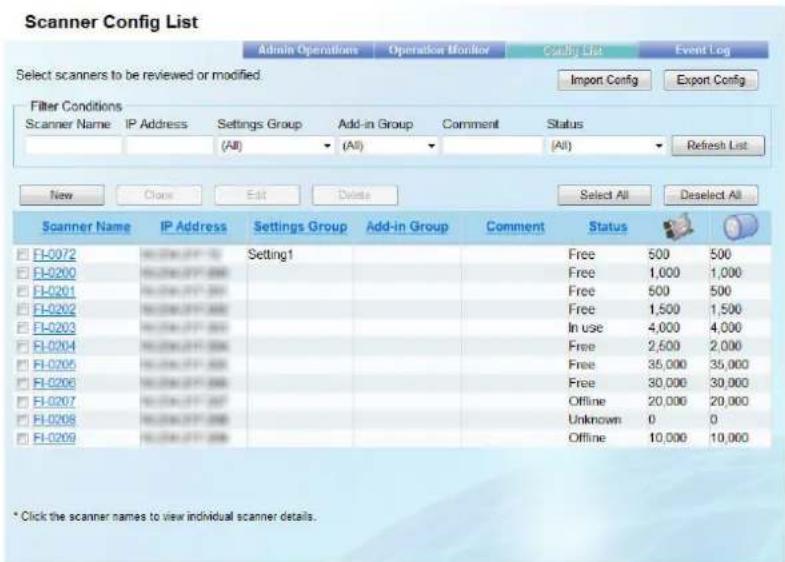
text_image
Scanner Config List Admin Operations Operation Monitor Case Log Event Log Select scanners to be reviewed or modified. Import Config Export Config Filter Conditions Scanner Name IP Address Settings Group Add-in Group Comment Status (All) (All) (All) Refresh List New Clone Edit Delete Select All Deselect All Scanner Name IP Address Settings Group Add-in Group Comment Status FI-0072 Setting1 Free 500 500 FI-0200 FI-0201 FI-0202 FI-0203 FI-0204 FI-0205 FI-0206 FI-0207 FI-0208 FI-0209 Free 1,000 1,000 Free 500 500 Free 1,500 1,500 In use 4,000 4,000 Free 2,500 2,500 Free 35,000 35,000 Free 30,000 30,000 Offline 20,000 20,000 Unknown 0 0 Offline 10,000 10,000 * Click the scanner names to view individual scanner details.Scanner configuration is information used to identify scanners on the Central Admin Server, when registering configuration information from a scanner to the Central Admin Server.
The registered scanners can be reviewed, and modified by the Central Admin Server functions. Initially, scanner configuration for each scanner in the scanner group is automatically added. To prevent scanner configuration from automatically being added, clear the [Automatically add new scanners to the Central Admin configuration when they are discovered] checkbox in the "Central Admin Server Settings" window in advance.
Scanner configuration can be registered on the Central Admin Server in the following ways.
- Import from the Central Admin Console "Scanner Config List" window Import a defined scanner configuration file, and register scanner configuration for several scanners at once.
- Add directly from the Central Admin Console "Scanner Config List" window Add scanner configuration directly from the Central Admin Console "Scanner Config List" window for one scanner at a time.
The following table shows which config items are added/imported to the Central Admin Server from a config file or from a scanner.
| Item Comment | Configuration from file | Configuration from scanner | |
| MAC Address Scanner | MAC address Yes Yes | ||
| IP Address Scanner | IP address Yes Yes | ||
| Subnet Mask Scanner | subnet mask Yes Yes | ||
| Scanner Name Scanner | name Yes Yes | ||
| Port Number Scanner | port number Yes Yes | ||
| Use HTTPS? Whether | or not HTTPS is used to communicate with the scanner | Yes Yes | |
| Model | Scanner model | Yes Yes | |
| Add-in Group | Group name used to identify applied Add-in install modules | Yes | — |
| Settings Group | Group name used to identify applied scanner settings | Yes | — |
| Comment | Note | Yes | — |
| System Updates | Whether or not the system is to be updated | Yes | — |
| Info Last Modified | Last date and time scanner configuration was modified | — (*1) | — (*1) |
| Registered | Whether or not a target scanner is added to the Central Admin Server from the scanner. | — (*1) | — (*1) |
| Update Status | Indicates the most recent update statuses (System Updates, Add-in Installs, Scanner Settings) | — (*1) | — (*1) |
| System Version | Scanner system version | — | Yes |
| Add-in Version | Scanner Add-in install module version | — | Yes |
| Scanner Settings | Identifies which set of Central Admin Server supplied scanner settings has been applied | — | Yes |
| Last Inventory Taken | Date and time inventory was last taken | — (*1) | — (*1) |
| Item | Comment | Configuration from file | Configuration from scanner |
| Last System Update | Date/time of the last known successful system update | — (*1) — (*1) | |
| Last Add-in Install Date | Date/time of the last known successful add-in install | — (*1) — (*1) | |
| Last Scanner Settings Update | Date/time of the last known successful scanner settings update | — (*1) — (*1) | |
| Current System Update Status | The current system update status — (*1) — (*1) | ||
| Current Add-in Install Status | The current add-in installs status — (*1) — (*1) | ||
| Current Scanner Settings Status | The current scanner settings status — (*1) — (*1) | ||
| Scanner Version | Scanner firmware version | — | Yes |
| PAD ASSY (Sheets) | Number of times pad assy has been used | — Yes | |
| PICK ROLLER (Sheets) | Number of times pick roller has been used | — Yes | |
| Total Throughput (Sheets) | Total number of scanned sheets — Yes | ||
| Date of Registration | Date on which scanner was registered | — Yes | |
| Cumulative On Time (Hours) | Total scanner "On" time, in hours — Yes | ||
| Last Audit Log Collected | Last date and time audit log was collected | — (*1) — (*1) | |
| Security Update Version | Security update version — Yes | ||
| Error Status Whether or not an error occurred in the scanner | — | — | |
| Operating Status Scanner operating status — Yes | |||
| Installed Options A list of installed options — Yes | |||
(*1): Automatically set from the Central Admin Sever.
■ [Import Config] button
This button opens the "Import Scanner Config" window to allow the import of pre-created scanner configuration data from a file. Such a scanner configuration file may contain data for several scanners, all of whose configurations are then changed at once.
Details of the importable data (settings) allowed in a scanner configuration file are given in "B.2.1 Scanner Configuration File Format (for Importing)" (page 491). Note that only those settings detailed as being importable may be imported.
![FUJITSU fi-6010N - ■ [Import Config] button - 1](/content/2026/06/1236812/images/6cfba59c19b97267b3010ab474b0157ca6a4647b0cf128ec39664db976dd5be5.jpg)
text_image
Import Scanner Config The current scanners configuration will be replaced by the imported data. Scanner Config File Browse... Import Cancel- Scanner Config File
Select the [Browse] button and specify the scanner configuration file to be imported.
- [Import] button
Imports the entered scanner configuration file and returns to the "Scanner Config List" window.
![FUJITSU fi-6010N - ■ [Import Config] button - 2](/content/2026/06/1236812/images/871abb3872f432bb76fa2d47f29e5383e2761defd5799d024473394b3d4723bb.jpg)
- Importing a scanner configuration file that contains zero scanner entries will cause all of the existing scanner configuration information to be deleted.
- The imported scanner configuration file overwrites the current scanner configuration.
- If the imported scanner configuration information contains the same MAC address or scanner name as in the existing scanner configuration information, the MAC address or the scanner name will be recognized as already existing. This is determined in the order of MAC address, scanner name. In this case, on the table shown in "5.7 Setting Scanner Configuration" (page 254), items in the "Configuration from file" column marked "Yes" are replaced, and those marked with "-" are left as they are.
- If the same MAC address or scanner name does not exist, the imported scanner configuration information will be added.
- [Cancel] button
Returns to the "Scanner Config List" window without confirming the entered contents.
■ [Export Config] button
Shows the "Save As" window to specify a file to export scanner configuration.
A screen to confirm whether or not to export the scanner configuration will be displayed directly after the [Export Config] button is selected.
● [Include detailed scanner information] checkbox
Select this checkbox to output all scanner information.
- [Add configuration item titles] checkbox
Select this checkbox to add item titles to the first column of the scanners configuration file.
For details on the format of the scanner configuration file to be exported, refer to "B.2.1 Scanner Configuration File Format (for Importing)" (page 491).
■ Filter Conditions
Filters the scanners displayed in the scanner list.
- Scanner Name
Enter a part of or entire scanner name of the scanner to be filtered. This may be up to 15 characters long.
- IP Address
Enter a part of or entire IP address of the scanner to be filtered. This may be up to 15 characters long.
- Settings Group
Select the settings group of the scanner to be filtered. The default is "(All)".
- Add-in Group
Select the Add-in group of the scanner to be filtered. The default is "(All)".
- Comment
Enter a part of or entire comment on the scanner to be filtered. This may be up to 64 characters long. Line-feed cannot be used.
Status
Select the operating status of the scanner to be filtered. The default is "(All)".
- [Refresh List] button
Refreshes the list by filtering using the entered filtering conditions.
■ [New] button
The button displays the "Edit Scanner Details" window to add scanner configuration information.
Edit Scanner Details
![FUJITSU fi-6010N - ■ [New] button - 1](/content/2026/06/1236812/images/3818eee1db49e032cc944b0719d3e6be60f1f9dbfa657c8ee9d572b08a3c267c.jpg)
text_image
Enter the scanner details, then click the [OK] button. Scanner Name IP Address (eg: 192.168.0.10) MAC Address (eg: 01.23.45.ab.cd.ef) Settings Group Add-in Group System Updates □ Should not be applied Comment OK Cancel- Scanner Name (Required)
Enter the scanner name.
This may be up to 15 characters long. Alphanumerical characters and hyphens may be used.
Scanner names cannot consist of numerical characters only.
A hyphen cannot be used as the first character of a scanner name.
- IP Address
Enter the numeric IP address.
This may be up to 15 characters long. Numbers and periods (.) may be used.
- MAC Address
Enter the MAC address of the scanner.
This may be up to 17 characters long. Alphanumeric characters and colons (:) may be used.
- Settings Group
Enter the settings group of the scanner. Press the list button to select a settings group name from the currently used settings groups.
This group name is used to identify the settings contents of a group.
The settings group name entered here is displayed on the "Scanner Settings" window, Settings Groups.
This may be up to 32 characters long.
The following character strings cannot be used:
(Default) (All) _default_ _all_
" " is two underbars entered one after another.
- Add-in Group
Enter the Add-in group of the scanner. Press the list button to select an Add-in group name from the currently used Add-in groups.
This group name is used to identify an Add-in module.
The Add-in name entered here is displayed on the "Add-in Installs" window, Add-in Groups.
This may be up to 32 characters long.
The following character strings cannot be used:
(Default) (All) __default__ __all__
"_" is two underbars entered one after another.
- System Updates
Select the checkbox to not update the system.
- Comment
Enter the comments on the scanner.
This may be up to 256 characters long.
- [OK] Button
Adds the entered scanner configuration information and returns to the "Scanner Config List" window.
- [Cancel] button
Returns to the "Scanner Config List" window without confirming the entered contents.
■ [Clone] button
Select the checkbox of the scanner to be cloned and select the [Clone] button to display the "Edit Scanner Details" window to clone the scanner configuration information.
■ [Edit] button
Select the checkbox of the scanner to be edited and select the [Edit] button to display the "Edit Scanner Details" window to edit the information.
■ [Delete] button
Deletes a scanner from the scanner network.
Select the checkbox(es) of the scanner(s) to be deleted, and select the [Delete] button to delete.
![FUJITSU fi-6010N - ■ [Delete] button - 1](/content/2026/06/1236812/images/35b99c320fe4f2c183e30a12510d1ce56bc434ce048e9d201ea384fc9450624e.jpg)
- Deleting the scanner configuration does not exclude a scanner from Central Admin management. Therefore, the Central Admin Server setting in the scanner will not be "Unregistered". To exclude a scanner from Central Admin management, select "Central Admin" to [Off] in the scanner.
- To exclude multiple scanners from Central Admin management at one time, release a new set of scanner settings to target scanners.
- To include the scanner in the iScanner Network again, re-register the scanner on the Central Admin Server.
■ [Select All] button
Selects all checkboxes in the scanner list.
■ [Deselect All] button
Deselects all checkboxes in the scanner list.
■ Scanner information list
Shows the scanner information list.
- Scanner name link
Shows the "Scanner Details" window to view the scanner information details.

text_image
Scanner Details Back Clear Error Status Event Log fi Network Scanner Admin Tool [Start] Networking Info Scanner Name Fi-HUM0UERP4AOQ Model fi-8010N IP Address 80 Port Number No Use HTTPS? No MAC Address 80 Comment Info Last Modified 75000000000000000000000000000000000000000000000000000000000000000000000000000000000000 Software Status System Updates Apply Current System Update Status NotTarget System Version 6887 6887 6887 6887 6887 6887 6887 6887 6887 6887 6887 6887 6887 6887 6887 6887 6887 6887 6887 6887 6887 Scanner Version 9999 Installed Options 9999 Last System Update Add-in Group Current Add-in Install Status NotTarget Add-In Version Last Add-in Install Settings Group Current Scanner Settings Status NotTarget Last Scanner Settings Update Hardware Status Operating Status Free Error Status No Last Inventory Taken 123333333333333333333333333333333333333333333333333333333333333333333333333333333333333333333333333333 Total Throughput (Sheets) 4,100 PAD ASSY (Sheets) 4,000 PICK ROLLER (Sheets) 4,000 Date of Registration 12222222222222222222222222222222222222222222222222222222 Cumulative On Time (Hours) 1 Last Audit Log Collected Back- [Back] button Returns to the "Scanner Config List" window.
- [Clear Error Status] button Clears error marks when the "Error Status" is indicated as "Yes". When the error marks are cleared, "Yes" changes to "No".
- [Event Log] button Displays the "Event Log" screen so that the event of the selected scanner can be checked.
- [fi Network Scanner Admin Tool [Start]] button Communicates to the Wake-On-LAN Magic Packet and starts and connects the Admin Tool to a scanner, after the scanner has started up.

- If "Auto Login" is set to [On] on the [System Settings] - "Login Settings" screen, the Admin Tool cannot be started.
- Scanners are identified by their IP addresses. If the scanner information includes multiple scanners with the same IP address, scanners which are not to be targeted may be connected.

If the scanner is not started, using Wake-On-LAN to start the scanner and connect with the Admin Tool will take a few minutes. If a "Connection error" occurs, and the screen returns to the screen for specifying a connection, try re-connecting.
5.8 Monitoring and Maintaining the iScanner Network
The registration status of scanners, the status of various scanner processes, and the event log can be viewed.
Selecting an [iScanner Updates] link on the "Scanner Admin Operations" window opens another window for a specific management operation such as a system update.
The "Scanner Admin Operations" window is displayed by selecting the [Admin Operations] button in the Central Admin Console main window.
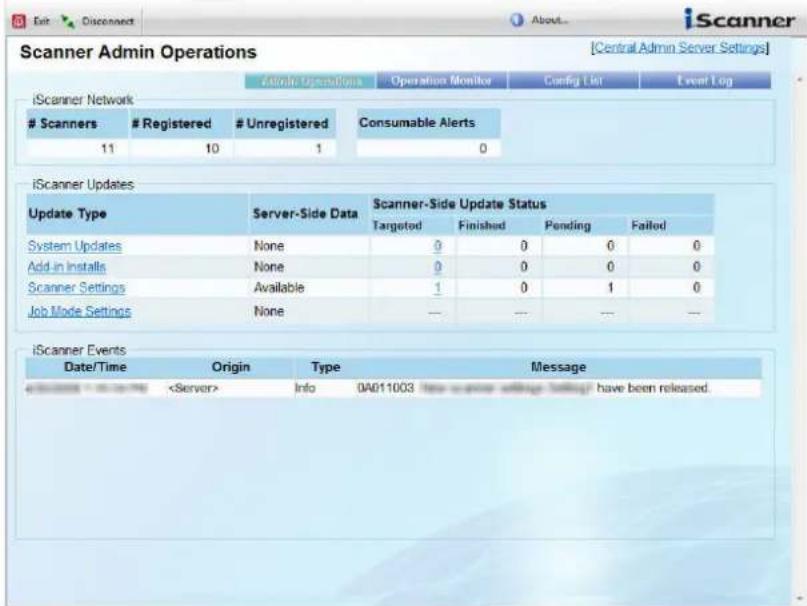
text_image
Scanner Admin Operations Central Admin Server Settings iScanner NetworkScanners # Registered # Unregistered Consumable Alerts
11 10 1 0 iScanner Updates Update Type Server-Side Data Scanner-Side Update Status Targeted Finished Pending Failed System Updates None 0 0 0 0 Add in Installs None 0 0 0 0 Scanner Settings Available 1 0 1 0 Job Mode Settings None --- --- --- --- iScanner Events Date/Time Origin Type Message■ iScanner Network
Shows the registration status of scanners.
The scanner group managed by the Central Admin Server is called the "iScanner Network".
- # Scanners
Shows the total number of scanners.
- # Registered
Shows the total number of scanners registered with the Central Admin Server.
- # Unregistered
Shows the total number of scanners not registered, according to the scanner configuration defined on the Central Admin Server.
- Consumable Alerts
Shows a replacement notification for the following consumables.
- Pad assy
- Pick roller
■ iScanner Updates
Shows the status of various scanner processes.
The following is a description of the displayed items.
- Update Type
- System Updates Shows the "System Updates" window to register update module, set notifications etc. For details, refer to "5.9 Updating the System" (page 266).
- Add-in Installs Shows the "Add-in Installs" window to register install module, set notification calls etc. For details, refer to "5.10 Installing an Add-in" (page 268).
- Scanner Settings Shows the "Scanner Settings" window to register scanner settings, set notification calls etc. For details, refer to "5.11 Updating the Scanner System Settings" (page 271).
- Job Mode Settings Shows the "Job Mode Settings" window to register jobs, perform settings etc. For details, refer to "5.12 Setting the Job Mode" (page 275).
- Server-Side Data
● Available Shows available status.
- Available(*) Scanners already targeted to receive an update notification call are marked with an asterisk (*).
● None Shows unavailable status.
- Scanner-Side Update Status
- Targeted Shows the number of scanners targeted for updates.
- Finished Shows the number of scanner which have finished updating.
- Pending Shows the number of scanners updating/waiting to be updated.
- Failed Shows the number of scanners which could not be updated.

Access the "Update Status List" window for each of the following update types:
- System Updates
- Add-in Installs
- Scanner Settings
For details, refer to "5.13 Viewing the Update Status Lists" (page 278).
■ iScanner Events
Shows latest 100 events in the event log.
● Log for events that occur in the Central Admin Server
- Log for events that occur in a scanner, where "Type" is "Error" or "Warning"
The following is a description of the displayed items.
- Date/Time
Date and time of event that occurred in the Central Admin Server. - Origin
If the originating event occurred in the Central Admin Server,is shown. If it occurred in a scanner, the scanner name is shown.
- Type
There are three event log types.
- Info
- Error
- Warning
- Message
5.9 Updating the System
The system, security, and installed options can be updated by uploading a new system update module and setting update calls.

The system can be updated according to the time specified on the scanner side. For more details, refer to "4.7.3 Setting a Central Admin Server" (page 90).
The system can be updated from the "System Updates" window.
The "System Updates" window is displayed by selecting the [System Updates] link on the "Scanner Admin Operations" window in the Central Admin Console.
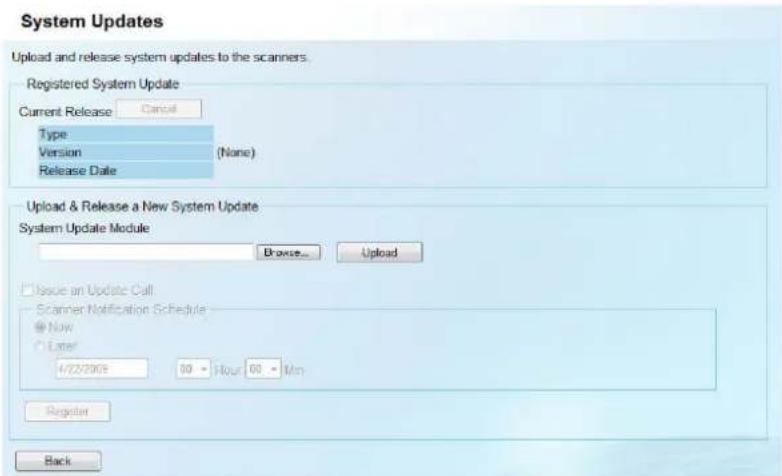
text_image
System Updates Upload and release system updates to the scanners. Registered System Update Current Release Cancel Type Version (None) Release Date Upload & Release a New System Update System Update Module Browse... Upload Issue an Update Call Scanner Notification Schedule Now Layer 4/22/2009 80 - Hour 60 - Min Register Back■ Registered System Update
- Current Release
Displays the type and version, and the release date of the currently available update module. Selecting the [Cancel] button cancels release of the update module and deletes the module.
■ Upload & Release a New System Update
Uploads a new system update module and issues an update call as needed.
The new system update module will be released, and applied to the scanners when one of the following occurs:
- Scanner is started, or resumed from the standby mode
- Scanner is logged out
- Scanner is notified of any update modules
- Scanner has an automatic update scheduled
Updates can be applied to the scanners that are in power-off or standby mode using Wake-On-LAN.
In the following cases, update modules cannot be uploaded.
- The module type is either a system or security option, and the same or upgraded module version has already been registered
- For an installed option update module, the same update module is already uploaded
● System Update Module
Select the [Browse] button to specify the update module file.
Select the [Upload] button to upload the update module.
- Issue an Update Call
Select the checkbox to issue an update call.
When the checkbox is selected, even if a scanner is not started or logged in to, the update module is sent and applied to the scanner according to the Scanner Notification Schedule.
However, if the update is released while logged in to a scanner, the update will be applied after logged out. If any other available updates are pending, those are also applied at the same time.
- Scanner Notification Schedule
Sets the schedule to notify update module.
- Now
Issues a call immediately.
- Later
Specifies the date and time to issue a call.
The default value is 00:00 of the following day. The value can be specified within the range between the current time and a month later.
The scanner notification schedule uses the Central Admin Server timezone.


When issuing a call, set a time that does not conflict with that set for "Software Update Time-Period Restrictions" on the "Central Admin Server Settings" window.

- [Register] button
Registers the uploaded update module.

When a new system update is available, it will only be installed in a scanner if the new version is higher than the current version. Targeted scanners are restarted after the new system update has been installed.
Pending updates are performed in the following order:
- System Updates
- Add-in Installs
- Scanner Settings
■ [Back] button
Returns to the Central Admin Console main window.
5.10 Installing an Add-in
An Add-in for scanner can be installed by uploading an Add-in module and setting update calls.

Add-ins can be updated according to the time specified on the scanner side. For more details, refer to "4.7.3 Setting a Central Admin Server" (page 90).
An Add-in can be installed from the "Add-in Installs" window.
The "Add-in Installs" window is displayed by selecting the [Add-in Installs] link on the "Scanner Admin Operations" window in the Central Admin Console.
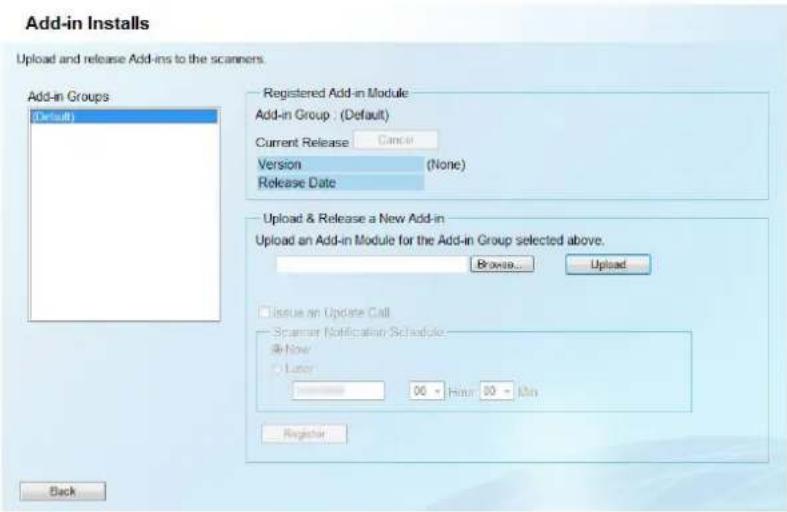
text_image
Add-in Installs Upload and release Add-ins to the scanners. Add-in Groups (Default) Registered Add-in Module Add-in Group : (Default) Current Release Cancel Version (None) Release Date Upload & Release a New Add-in Upload an Add-in Module for the Add-in Group selected above. Browse... Upload Issue on Update Call Scanner Notification Schedule @ Now Later 00 - Hour 30 - Min Register Back■ Add-in Groups
Displays Add-in groups.
Scanners which are not to be assigned to Add-in groups belong to the "(Default)" group.
Select a group for registering a new Add-in module.
If an Add-in is released, "(Released)" is shown after the Add-in group name.
The default value is "(Default)".
■ Registered Add-in Module
- Add-in Group
Displays the Add-in group name selected in the "Add-in Groups" list.
- Current Release
Displays the version and the release date of the currently available Add-in module.
Selecting the [Cancel] button cancels release of the Add-in module and deletes the module.
■ Upload & Release a New Add-in
Uploads a new Add-in module and issues an update call as needed.
The new Add-in update module will be released, and applied to the scanners when the one of the following occurs:
- Scanner is started, or resumed from the standby mode
- Scanner is logged out
- Scanner is notified of any update modules
- Scanner has an automatic update scheduled
Updates can be applied to the scanners that are in power-off or standby mode using Wake-On-LAN.
If the Add-in module is already available, the module is replaced. However, if the date of the last modified Add-in module version is the same as, or earlier than the currently available one, the module cannot be uploaded.
- Upload an Add-in Module for the Add-in Group selected above.
Select the [Browse] button to specify the install module file.
Select the [Upload] button to upload the Add-in module.
- Issue an Update Call
Check the checkbox to issue an update call.
When the checkbox is selected, even if a scanner is not started or logged in to, the update module is sent and applied to the scanner according to the Scanner Notification Schedule. However, if the update is released while logged in to a scanner, the update will be applied after logged out. If any other available updates are pending, those are also applied at the same time.
- Scanner Notification Schedule
Sets the schedule to notify Add-in module.
- Now
Issues a call immediately.
- Later
Specifies the date and time to issue a call.
The default value is 00:00 of the following day. The value can be specified within the range between the current time and a month later.
Update call schedule uses the Central Admin Server timezone.


When issuing a call, set a time that does not conflict with that set for "Software Update Time-Period Restrictions" on the "Central Admin Server Settings" window.
- [Register] button
Registers the uploaded Add-in module to the selected Add-in group.
![FUJITSU fi-6010N - - [Register] button - 1](/content/2026/06/1236812/images/2130e6962ee00de175e4d8fbffe7b8428d92c60f2cc67fc2fef2a9b29526ce7f.jpg)
When a new Add-in module is available, it will only be not installed in a scanner if both the name and version match that of the current Add-in. Scanners are restarted twice when installing a new Add-in, once to uninstall the old Add-in, and once again after the new Add-in has been installed.
Pending updates are performed in the following order:
- System Updates
- Add-in Installs
- Scanner Settings
■ [Back] button
Returns to the Central Admin Console main window.
5.11 Updating the Scanner System Settings
The scanner settings can be updated by uploading new sets of scanner settings and setting update calls.

The scanner settings can be updated according to the time specified on the scanner side.
For more details, refer to "4.7.3 Setting a Central Admin Server" (page 90).
The scanner settings can be updated from the "Scanner Settings" window.
The "Scanner Settings" window is displayed by selecting the [Scanner Settings] link on the "Scanner Admin Operations" window in the Central Admin Console.
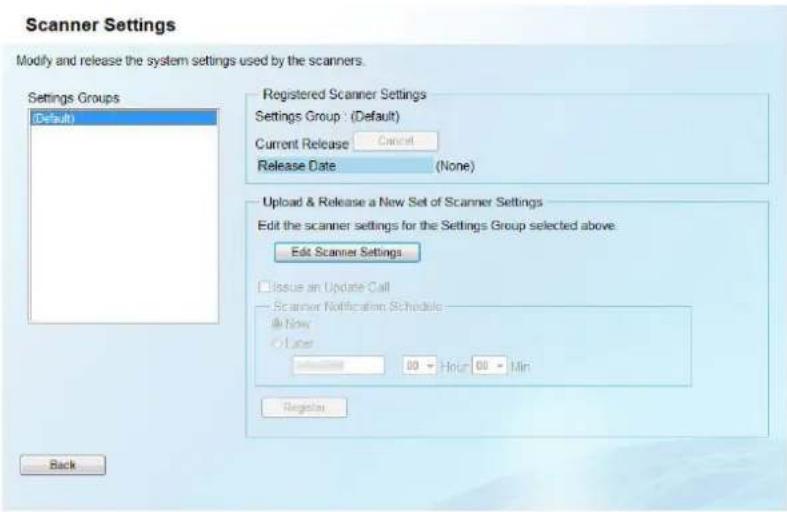
text_image
Scanner Settings Modify and release the system settings used by the scanners. Settings Groups (Default) Registered Scanner Settings Settings Group : (Default) Current Release Cancel Release Date (None) Upload & Release a New Set of Scanner Settings Edit the scanner settings for the Settings Group selected above: Edit Scanner Settings Issue an Update Call Scanner Notification Schedules @ Now Local 00 Hour 00 Min Register Back■ Settings Groups
Displays the settings groups.
Scanners which are not to be assigned to settings groups belong to the "(Default)" group.
Select a group for registering a new set of scanner settings.
If scanner settings are released, "(Released)" is shown after the settings group name.
The default value is "(Default)".
■ Registered Scanner Settings
- Settings Group
Displays the settings group name selected in the "Settings Groups" list.
- Current Release
Displays the release date of the currently available scanner settings.
Selecting the [Cancel] button cancels release of the scanner settings.


If the scanner settings are canceled, checking or changing the settings contents becomes difficult. Also, editing and viewing of the network printers/folders setting contents on the Job Sequence "Job Mode Settings" screen, may not be possible. For more details, refer to "Create & Release a New Set of Job Mode Settings" (page 276).

■ Upload & Release a New Set of Scanner Settings
Uploads scanner settings and issues an update call as needed.
The new set of scanner settings will be released, and applied to the scanners when one of the following occurs:
- Scanner is started, or resumed from the standby mode
- Scanner is logged out
- Scanner is notified of any update modules
- Scanner has an automatic update scheduled
Updates can be applied to the scanners that are in power-off or standby mode using Wake-On-LAN. However, if the update is released while logged in to a scanner, the update will be applied after logged out.
If scanner settings are already available, the scanner settings are replaced.
● [Edit Scanner Settings] button
Shows the "Edit Scanner Settings" window to set up the scanner settings. If scanner settings are available, the available scanner settings values are shown. If no scanner settings have been released, the default values are shown.
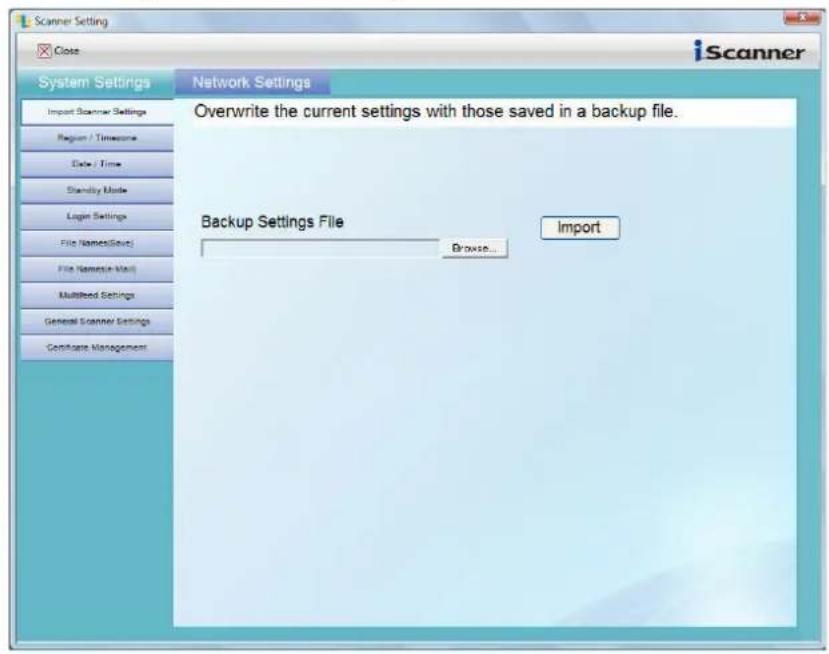
text_image
Scanner Setting Close iScanner System Settings Network Settings Import Scanner Settings Region / Timeframe Date / Time Standby Mode Login Settings File Names(Boost) File Names(Max) Multihead Settings General Scanner Settings GenSource Management Overwrite the current settings with those saved in a backup file. Backup Settings File Browse... Import
If you return to the Main Menu from the "Scanner Settings" screen without registering the scanner settings, the edited contents will be lost.
• [System Settings] tab
The setting items are the same as those set in the system settings menu in the window for administrator operations. For details, refer to "4.6 Using the System Settings Menus" (page 56).
However, the [Import Scanner Settings] button for the "System Settings" menu is only displayed on the Central Admin Console "Edit Scanner Settings" window.
The current configuration of the scanners saved by using the Admin Tool can be sent to the Central Admin Server from the "Import Scanner Settings" screen. The current configuration of the scanners is the information saved in "Backing up System Settings" (page 172). The current configuration of the scanners can be imported in the following way.
1 Specify the scanner configuration file to be imported.
Select a file using the [Browse] button.
2 Press the [Import] button.
⇒ The current configuration of the scanners is sent to the Central Admin Server. The imported scanner settings are applied to the scanner according to the Scanner Notification Schedule.
• [Network Settings] tab
The setting items are the same as those set in the network settings menu in the window for administrator operations. For details, refer to "4.7 Using the Network Settings Menus" (page 86).
- [Close] button
Registers the entered scanner settings and returns to the "Scanner Settings" window.
- Issue an Update Call
Select the checkbox to issue an update call.
When the checkbox is selected, even if a scanner is not started or logged in to, the update module is sent and applied to the scanner according to the Scanner Notification Schedule. However, if the update is released while logged in to a scanner, the update will be applied after logged out. If any other available updates are pending, those are also applied at the same time.
- Scanner Notification Schedule
Sets the schedule to notify scanner settings.
- Now
Issues a call immediately.
- Later
Specifies the date and time to issue a call.
The default value is 00:00 of the following day. The value can be specified within the range between the current time and a month later.
The Scanner Notification Schedule uses the Central Admin Server timezone.
- [Register] button
Registers the entered scanner settings to the selected settings group.

When a new set of scanner settings is available, first any existing network printer and network folder settings are deleted, then the new scanner settings are written over the old scanner settings.
Once the new scanner settings have been applied, any changes to the settings of individual scanners are retained until the next time a new set of scanner settings becomes available from the Central Admin Server.
Pending updates are performed in the following order:
- System Updates
- Add-in Installs
- Scanner Settings
■ [Back] button
Returns to the Central Admin Console main window.
5.12 Setting the Job Mode
The job mode can be set by registering a new job mode and setting a release schedule.
The job mode can be set from the "Job Mode Settings" window.
The "Job Mode Settings" window is displayed by selecting the [Job Mode Settings] link on the "Scanner Admin Operations" window in the Central Admin Console.
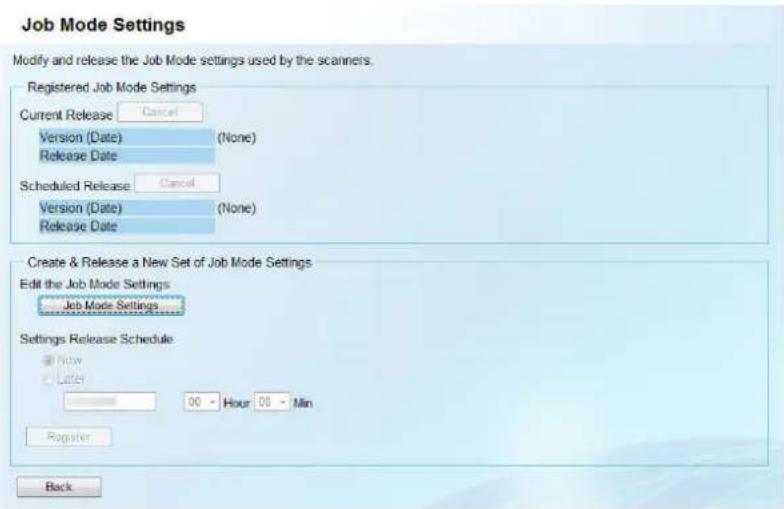
text_image
Job Mode Settings Modify and release the Job Mode settings used by the scanners. Registered Job Mode Settings Current Release Cancel Version (Date) (None) Release Date Scheduled Release Cancel Version (Date) (None) Release Date Create & Release a New Set of Job Mode Settings Edit the Job Mode Settings Job Mode Settings Settings Release Schedule Now Later 00 Hour 08 Min Register Back■ Registered Job Mode Settings
- Current Release
Shows the upload date and the release date of the current job mode settings. Selecting the [Cancel] button cancels release of the job mode settings.
- Scheduled Release
Shows the next scheduled upload date and the release date of the job mode settings. Selecting the [Cancel] button cancels release schedule of the job mode settings.
Even if available job mode settings are canceled, job mode settings already sent to a scanner will not become invalid. To not use job mode settings in a scanner, on the [Network Settings], "Central Admin Server" screen, set "Job Mode" to "Off".
■ Create & Release a New Set of Job Mode Settings
Creates and releases a new set of job mode settings.
After registering a new set of job mode settings, the job mode settings are replaced.
● [Job Mode Settings] button
The button displays the "Job Mode Settings" window to configure job mode settings. The contents of the last configured job mode settings are shown.

text_image
Job Close iScanner Job Sequences Job Menus Job Groups Jobs List Filter Conditions Job Name Comment Find New Clone Edit Delete Job Name Comment Last Modified• [Job Sequences] tab
The setting items are the same as those set in the [Job Sequences] tab in the job mode settings menu in the window for administrator operations. For details, refer to "4.11.2 Setting a Job Sequence" (page 185).
To set "Print" or "Save" for a job sequence, a network printer or network folder must be previously added on the "Edit Scanner Settings" screen. The job sequences and "Edit Scanner Settings" screen settings are related in the following way.
- The network printers shown on the "Printer List" window when "Print" is selected as a job item, are the network printers set on the "Edit Scanner Settings" screen.
- The network folders shown on the "Folder List" window when "Save" is selected as a job item, are the network folders set on the "Edit Scanner Settings" screen.
[Job Menus] tab
The setting items are the same as those set in the [Job Menus] tab in the job mode settings menu in the window for administrator operations. For details, refer to "4.11.3 Setting a Job Menu" (page 203).
• [Job Groups] tab
The setting items are the same as those set in the [Job Groups] tab in the job mode settings menu, in the window for administrator operations. For details, refer to "4.11.4 Setting a Job Group" (page 210).
- [Close] button
Registers the entered job mode settings and returns to the "Job Mode Settings" window.
● Settings Release Schedule
Sets the schedule to release job mode settings.
- Now
Release immediately.
- Later
Specifies the date and time to release.
The default value is 00:00 of the following day. The value can be specified within the range between the current time and a month later.
The Release Schedule uses the Central Admin Server timezone.
- [Register] button
Registers the entered job mode settings.
■ [Back] button
Returns to the Central Admin Console main window.
5.13 Viewing the Update Status Lists
Status details can be viewed for each of the following update types:
- System Updates
- Add-in Installs
- Scanner Settings
The update status list for each update type can be viewed in the respective "Status Details" window.
This window appears when one of the "Scanner-Side Update Status" - "Targeted" numerical links is selected on the "Scanner Admin Operations" window in the Central Admin Console.

text_image
Update Status List (System Updates) Select target scanners and click the [Call Now] button to notify them of a pending update. Filter Conditions Scanner Name IP Address Settings Group Add-in Group Status ------------------------ (All) (All) (All) Refresh List Call Now Clear Update Failures Select All Deselect All Scanner Name IP Address Settings Group Add-in Group Status]^1 iScanner0 SG01 AG01 Pending SPD20000000000000000000000000000000000000000000000000000000000000000000000000000000000000000000000000000 iScanner1 SG01 AG01 Pending SPD2555555555555555555555555555555555555555555555555555555555555555555555555555555555555 iScanner2 SG01 AG01 Pending SPD287888888888888888888888888888888888888888888888888888888 iScanner3 SG02 AG01 Pending SPD29999999999999999999999999999999999999999999999999999999999999999999999999999999999999999999999999999 iScanner4 SG11 SG11 AG11 Pending SPD316666666666666666666666666666666666666666666666666666666666666666666666666666666666666666666666666666 iScanner5 SG12 SG12 AG12 Pending SPD33777777777777777777777777777777777777777777777777777777777777777777777777 iScanner6 SG13 SG13 AG13 Pending SPD35888888888888888888888888888888888888888888888888888 iScanner7 SG14 SG14 AG14 Pending SPD371433333333333333333333333333333333333333333333333333333333333333333333333333333333333333333333333333 iScanner8 SG15 SG15 AG15 Pending SPD42222222222222222222222222222222222222222222222222222222222222222222 iScanner9 SG16 SG16 AG16 Pending SPD44444444444444444444444444444444444444444444444444444444 * Click the scanner names to view individual scanner details. * Scamers already targeted to receive an update notification call are marked with an asterisk (*). Back■ Filter Conditions
Filters the scanners displayed in the scanner list.
- Scanner Name
Enter a part of or entire scanner name of the scanner to be filtered. This may be up to 15 characters long.
IP Address
Enter a part of or entire IP address of the scanner to be filtered. This may be up to 15 characters long.
- Settings Group
Select the settings group of the scanner to be filtered. The default is "(All)".
- Add-in Group
Select the Add-in group of the scanner to be filtered. The default is "(All)".
- Status
Select the update status of the scanner to be filtered. The default is "(All)".
- [Refresh List] button
Refreshes the list by filtering using the entered filtering conditions.
■ [Call Now] button
Select the checkbox of the scanners to be notified, and select the [Call Now] button to issue a call. If a target scanner is in error status, the error is cleared before notification. The scanner-side status is changed to "Pending", and becomes an update target. All update call targets are "Pending" for "Scanner-Side Status".
■ [Clear Update Failures] button
Select the checkbox for the scanner in error status, and press the [Clear Update Failures] button to clear the error. The scanner-side status is changed to "Pending", and becomes an update target.
■ [Select All] button
Selects all checkboxes in the scanner list.
■ [Deselect All] button
Deselects all checkboxes in the scanner list.
Scanner list
Shows the list of scanners and their status with respect to the type of Scanner-Side Update selected in the Central Admin Console main window.
- Scanner name link
Opens the "Scanner Details" window to view the scanner details.
For details on the "Scanner Details" window, refer to "5.7 Setting Scanner Configuration" (page 254).

text_image
Scanner Details Back Clear Error Status Event Log # Network Scanner Admin Tool [Start] Networking Info Scanner Name FI-HUM0UERP4AOQ Model 6-8010N IP Address 80 Port Number 80 Use HTTPS? No MAC Address 80100 25000000 Comment Info Last Modified 777777777777777777777777777777777777777777777777777777 Software Status System Updates Apply Current System Update Status NotTarget System Version 80100 25000000 Scanner Version 80100 Installed Options 80100 25000000 Last System Update Add-In Group Current Add-in Install Status NotTarget Add-In Version Last Add-In Install Settings Group Current Scanner Settings Status NotTarget Last Scanner Settings Update Hardware Status Operating Status Free Error Status No Last Inventory Taken 80100 25000000 Total Throughput (Sheets) 4,100 PAD ASSY (Sheets) 4,000 PICK ROLLER (Sheets) 4,000 Date of Registration 80100 25000000 Cumulative On Time (Hours) 1 Last Audit Log Collected Back- Version
The versions shown apply to the type of Scanner-Side Update selected in the Central Admin Console main window.
■ [Back] button
Returns to the Central Admin Console main window.
5.14 Viewing the Scanners Operating Status
The operating status of the scanners can be viewed.
The operating status of the scanners can be viewed on the "Scanner Operation Monitor" window. The "Scanner Operation Monitor" window is displayed by selecting the [Operation Monitor] button in the Central Admin Console main window.
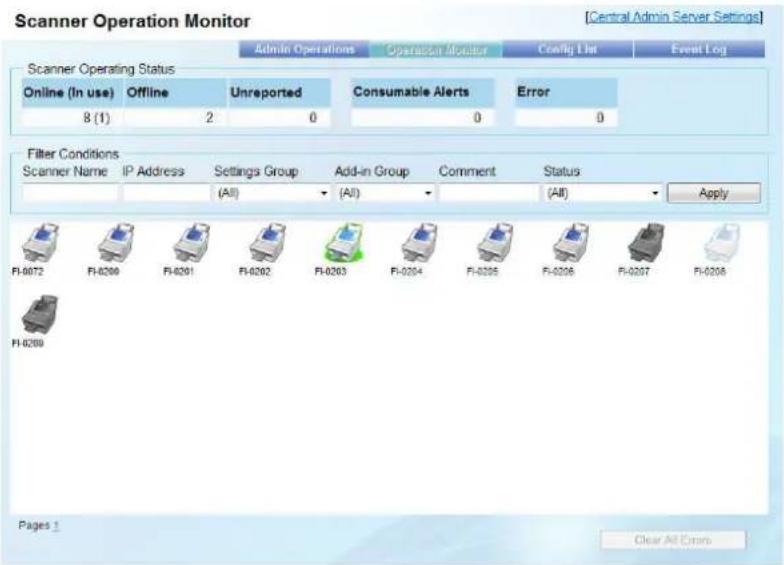
text_image
Scanner Operation Monitor [Central Admin Server Settings] Admin Operations Operation Monitor Config List Event Log Scanner Operating Status Online (In use) Offline Unreported Consumable Alerts Error 8 (1) 2 0 0 0 Filter Conditions Scanner Name IP Address Settings Group Add-in Group Comment Status (All) (All) (All) Apply FI-0072 FI-0200 FI-0201 FI-0202 FI-0203 FI-0204 FI-0205 FI-0206 FI-0207 FI-0208 FI-0209 Pages 1 Clear All ErrorsThe operating status of a scanner is indicated by the following icons/marks.
Press an icon to show the "Scanner Details" window.
| Icon/Mark Status Description | ||
 | In Use Shows | that the scanner is online, and that a user is logged in. |
 | Free Shows that | the scanner is online, and that no user is logged in. |
 | Offline Shows | that scanner power is off, or that the scanner is in standby mode. |
 | Unreported Shows | that the operating status of the scanner is unknown. |
 | Unregistered Shows | that the scanner is added to the scanner configuration, and is not added to the Central Admin configuration. |
| Icon/Mark Status Description | ||
 | Error Shown if the following errors occur in a scanner.● Scanner monitoring error (messages with an error code from 81000001 to 81000012)For details of errors, refer to "E.1.3 Alert Monitor System Log Messages" (page 524).● Unexpected error (messages with the error code 81001001 or 81001002)For details of errors, refer to "E.1.2 System Log Mes-sages" (page 518). | |
 | Consumable Alerts | Shown when a consumable part is near or has reached its replacement time. |

Immediately after the Central Admin Server starts up, the operating status of the registered scanners is shown as "Unreported". In this case, the status of each scanner will be updated when one of the following occurs:
● A scanner is logged in/out
● The scanner power is turned on, or it is resumed from standby mode
● The scanner power is turned off, or it is set to standby mode
■ Scanner Operating Status
- Online (In use)
Shows the number of scanners that are currently operating. The number of scanners with logged in users are shown in (). - Offline
Shows the number of scanners that are currently turned off or in standby mode. - Unreported
Shows the number of scanners whose operating status is not reported. - Consumable Alerts
Shows the number of scanners whose consumable parts are soon to pass or have passed their rated lifetime already. - Error
Shows the number of scanners in which an error has occurred. The error mark (E) is shown to indicate the scanner with an error.
■ Filter Conditions
Filters the scanners displayed in the scanner list.
- Scanner Name Enter a part of or entire scanner name of the scanner to be filtered. This may be up to 15 characters long.
- IP Address Enter a part of or entire IP address of the scanner to be filtered. This may be up to 15 characters long.
- Settings Group Select the settings group of the scanner to be filtered. The default is "(All)".
- Add-in Group Select the Add-in group of the scanner to be filtered. The default is "(All)".
- Comment Enter the description of the scanner to be filtered.
- Status Select the operating status of the scanner to be filtered. The default is "(All)".
- [Apply] button Apply the entered filter conditions and refresh the list.
■ [Clear All Errors] Button
Clear all error marks shown on the "Scanner Operation Monitor" window.
If there are multiple pages of scanner operating status, the status of all error marked scanners are cleared.
5.15 Viewing Event Log
Event logs output from the scanners or the Central Admin Server can be viewed.
The latest 100 event log items can be viewed on the "Scanner Admin Operations" window.
● Log for all events that occur on the Central Admin Server
- Log for events that occur in the scanners, where "Type" is "Error" or "Warning"
To view all event logs, check the "Event Log" window.
The "Event Log" window is displayed by selecting the [Event Log] button in the Central Admin Console main window.

text_image
Event Log Admin Operations Operation Monitor Config List Event Log Select the type of iScanner network events that you wish to check and click the [Refresh List] button. Download Clear Log Filter Conditions Origin: Server Scanner Type: Error Warning Info Refresh List Date/Time Origin Type Message 135:54 PM Camera Info Email: Email: Email: Email: Email: Email: Email: Email: Email: Email: Email: Email: Email: Email: Email: Email: Email: Email: Email: Email: Email: Email: Email: Email: Email: Email: Email: Email: Email: Email: Email: Email: Email: Email: Email: Email: Email: Email: Email: Email: Email: Email: Email: Email: Email: Email: Email: Email: Email: Email: Email 12.21.26 PM Camera Info Email: Email: Email: Email: Email: Email: Email: Email: Email: Email: Email: Email: Email: Email: Email: Email: Email: Email: Email: Email: Email: Email: Email: Email: Email: Email: Email: Email: Email: Email: Email: Email: Email: Email: Email: Email: Email: Email: Email: Email: Email: Email: Email: Email: Email: Email: Email: Email: email Pages : 1■ [Download] button
Shows the "Save As" window to specify a file to output event logs.
The default file name is "execlog.csv".
When downloaded to a computer, the file will contain CSV format data. The file is saved in the following form:
Date/Time, Origin, Type, Event_ID, "Message"
The types are, E: Error, W: Warning, I: Info.
■ [Clear Log] button
Clears all event logs.
■ Filter Conditions
Filters the events displayed in the event log list.
- Origin
Select the origin of the events to be displayed.
- Server
Shows the events that occurred in the Central Admin Server. - Scanner
Shows the events that occurred in each scanner.
- Type
Select the type of the events to be opened.
- Error
Opens the event logs whose type is Error.
● Warning Opens the event logs whose type is Warning. - Info Opens the event logs whose type is Info.
- [Refresh List] button
Refreshes the list by filtering using the entered filtering conditions.
■ Event Log
Opens the event list.
- Date/Time link
Displays the "Event Details" window to view the event details.

text_image
Event Details Date/Time 3:38:44 PM Origin- [Back] button Returns to the "Event Log" window.
5.16 Collecting and Exporting Audit Logs
Scanner system logs and user logs can be collected and saved in the Central Admin Server.
System logs collected in the Central Admin Server are referred to as "audit logs (system)", and user logs as "audit logs (user)". Both types of logs are referred to collectively as "audit logs".
By automatically collecting system logs and user logs in the Central Admin Server, you can record users' past operations.
To view audit logs, export those collected in the Central Admin Server to an arbitrary folder by executing a command.
The status of audit logs collection can be checked in the "Scanner Details" window.

flowchart
graph TD
    A["Central Admin Server"] --> B["Audit logs"]
    C["Central Admin Console"] --> D["Computer"]
    B --> E["Audit logs"]
    D --> E
    E --> F["Server in which audit logs are saved"]
    G["Automatically collect system logs/user logs"] --> B
    H["Scanner Scanner Scanner"] --> D
    I["Audit log export command"] --> B
    J["Check the status of log collection"] --> D
5.16.1 Collecting Audit Logs
To automatically collect audit logs in the Central Admin Server, enable the audit log collection in the "Central Admin Server Settings" window. For more details, refer to "5.6 Setting the Central Admin Server" (page 244).

The audit logs are managed according to the date on which they are collected in the Central Admin Server. Do not change the Central Admin Server date and time setting to a date that has already passed.

If the audit log is collected, disk space for saving the audit log is required. Refer to the following for estimates of the required disk space.
Under the following conditions, one log per days requires 25 KB.
Power on/off: once, Login/Logout: 20 times, Number of scan operations: 100.
5.16.2 Exporting Audit Logs
To export audit logs collected in the Central Admin Server, execute "AmExportLog.exe" in the command prompt on the computer installed with the Central Admin Server software.
- Command storage location
Under the [\AmManager\Bin] folder in the installation folder of the Central Admin Server software
- Command executable format
AmExportLog -d OutputFolder [-v]
The italic text represents variable character strings.
To show the status of the process, specify -v.

An [AuditLogs] folder is created in the specific output folder. In this [Audit- Logs] folder, a folder is created for each date to save audit logs.
The date of a folder corresponds to that of when audit logs are collected in the Central Admin Server. Therefore, the date may differ from that on the scanner when the logs are created.
● File name format of an output audit log
- Audit log (system)
ScannerName_MACAddress_syslog.csv
- Audit log (user)
ScannerName_MACAddress_usrlog.csv
- Return value
0
Succeeded
- Other than 0
Failed

- Do not execute this command twice at the same time.
- If a file name already exists, the existing file will be overwritten.
- When exported, audit logs are deleted from the Central Admin Server.
- If an error occurs while exporting, the audit logs that have been exported are deleted from the Central Admin Server.
5.16.3 File Format of Audit Logs
Audit log files are formatted as follows:
● Audit logs use the UTF-8 charset.
● Audit logs are in a CSV format.
● Audit logs contain the following output:
- Audit log (system)
This log contains the following output items:
"Sequence number", "Date", "Time", "Type", "Code", "Message"
These items are defined as follows:
| Log Item Description | |
| Sequence number | A file sequence number between "1" and "4294967295". This number increments from "1" as files are added, and resets to "0" (indicating an overflow) after "4294967295". |
| Date Corresponds to the system log "Date". (*) | |
| Time Corresponds to the system log "Time". (*) | |
| Type Corresponds to the system log "Type". (*) | |
| Code Detailed in "E.1.2 System Log Messages" (page 518). | |
| Message Corresponds to the system log "Messages". (*) Also refer to "E.1.2 System Log Messages" (page 518). | |
(*): For details, refer to "4.9.2 Managing the System Log" (page 162).
- Audit log (user)
This log contains the following output items:
"Sequence number","Date","Time","User","Code", "Operation","Result","Pages","Description"
These items are defined as follows:
| Log Item Description | |
| Sequence number | A file sequence number between "1" and "4294967295". This number increments from "1" as files are added, and resets to "0" (indicating an overflow) after "4294967295". |
| Date Corresponds to the user log "Date". (*) | |
| Time Corresponds to the user log "Time". (*) | |
| User Corresponds to the user log "User". (*) | |
| Code Corresponds to the user log "Code". (*) | |
| Operation Corresponds to the user log "Operation". (*) | |
| Result Corresponds to the user log "Result". (*) | |
| Pages Corresponds to the user log "Pages". (*) | |
| Description Corresponds to the user log "Description". (*) | |
(*): For details, refer to "4.9.1 Managing the User Log" (page 159).
5.17 Maintaining Central Admin Settings
Central admin settings set by the administrator can be backed up, restored, and obtained.


Audit logs are not backed up or restored by the operations described below, because they are not included in the central admin settings.
5.17.1 Backing Up Central Admin Settings
All data managed in the Central Admin Server (excluding audit logs) can be backed up.
Central admin settings can be restored using the backup file. Take backups periodically just in case.
To back up central admin settings, execute "AmBackup.exe" in the command prompt on the computer installed Central Admin Server software.
When backing up, the Central Admin Server is in a temporarily suspended state, and connection from the Central Admin Console or uploading/downloading of user roaming data, and release of updates to scanners is not possible. On the "Scanner Operation Monitor" window, the operating status of all scanners is indicated as "Unreported".
- Command storage location
Under the [\AmManager\Bin] folder in the installation folder of the Central Admin Server software
- Command executable format
AmBackup.exe BackupFolderName
The character string shown in italics is variable.
- Return value
0
Succeeded
- other than 0
Failed

- Specify a folder without files and sub-folders as the backup folder. If the specified backup folder does not exist, it is created.
- Do not change the backup folder structure. If changed, restoration may not be processed correctly.
- Do not change the content of the backup file of central admin settings. If the backup file content is changed and restored, processes related to central control may operate improperly.
- For Windows 2000 Server, IIS will be stopped while a command is running.
- All files in the installation folder are deleted when the Central Admin Server software is uninstalled. Therefore, save all backup files to a location other than in the installation folder.

Before executing the AmBackup.exe command, confirm that the storage disk has sufficient free space. If free space is insufficient, an incomplete file may be saved.
The required free capacity is approximately twice the free capacity under the [Data] folder in the installation folder.
5.17.2 Restoring Central Admin Settings
Central admin settings that has been backed up can be restored to the Central Admin Server. To restore central admin settings, execute "AmRestore.exe" in the command prompt on the computer installed with the Central Admin Server software.
- Command storage location
Under the [\AmManager\Bin] folder in the installation folder of the Central Admin Server software
- Command executable format
AmRestore.exe BackupFolderName
The character string shown in italics is variable.
- Return value
0
Succeeded
- other than 0
Failed

- Make sure to run the AmRestore.exe command after changing the current directory to the [Bin] folder in the installation folder of the Central Admin Server software.
- The language for the backup and restore Central Admin Servers must be the same. If languages are different, Central Admin may not operate correctly when restoring.
- For Windows 2000 Server, IIS will be stopped while a command is running.

- The admin password is not backed up and restored by using the AmBackup.exe and AmRestore.exe commands. Even if the AmRestore.exe command is executed, the admin password is not changed.
- For Windows Server 2008, to use HTTPS for communication to a scanner, or computer installed with the Central Admin Console, additional settings may be required for the target Central Admin Server to be restored. For more details, refer to "Importing the Certificate" (page 235).
5.17.3 Obtaining Technical Support on the Central Admin Server
If any problems occur when setting up or using central admin, technical support information on the Central Admin Server can be collected to help determine the cause of the problem.
To obtain technical support information, execute "AmInvestigate.exe" in the command prompt on the computer installed with the Central Admin Server software.
When obtaining technical support, the Central Admin Sever is in a temporarily suspended state. Do not try to obtain technical support unless requested by your FUJITSU scanner dealer, or a problem occurs.
- Command storage location
Under the [\AmManager\Bin] folder in the installation folder of the Central Admin Server software
- Command executable format
AmInvestigate.exe -d OutputFolder [-p EncryptedPassword] [-v]
The character string shown in italics is variable.
To show the status of the process, specify -v.
- Return value
0
Succeeded
- other than 0
Failed
The information is output to the specific output folder for each type. If an encrypted password is specified, the technical support information is encrypted.
5.17.4 Migrating Data to an Updated Version of the Central Admin Server Software
When updating the Central Admin Server software version in order to use a different server as the Central Admin Server, data from the previous version of the Central Admin Server software must be transferred to the new version.
The data can be migrated by executing the "AmBackup.exe" and "AmRestore.exe" commands in the computer in which the Central Admin Server software is installed.

If you back up data by executing "Ambackup.exe" in the [Bin] folder from the installation folder of the previous version, you cannot restore the data in the new version of the Central Admin Server.

- If updating the version of the current Central Admin Sever software, you do not need to migrate data.
-
Make sure to export audit logs in advance, as they are not migrated by this operation.
-
Copy the following folder in the new version of the Central Admin Server software to an arbitrary folder of the previous version.
[\AmManager\Bin] folder in the installation folder of the new Central Admin Server software
In the following cases, overwrite the "ServiceSetting.dll" file in the Bin folder that was copied to an arbitrary location in Step 1, with the file of the same name from the previous version of the Central Admin Server software.
- When migrating data from Windows 2000 Server or Windows Server 2003 to Windows Server 2008
- When migrating data from Windows Server 2008 to Windows 2000 Server or Windows Server 2003
The "ServiceSetting.dll" file is stored in the following location:
Under the [\AmManager\Bin] folder in the installation folder of the previous Central Admin Server software
- Execute "AmBackup.exe" in the [Bin] folder which was copied to an arbitrary folder of the previous version of the Central Admin Server.
For details about "AmBackup.exe", refer to "5.17.1 Backing Up Central Admin Settings" (page 291).
→ The data of the previous version of the Central Admin Server is backed up.
- Execute "AmRestore.exe" in the following folder of the new version of the Central Admin Server.
For details about "AmRestore.exe", refer to "5.17.2 Restoring Central Admin Settings" (page 293).
Under the [\AmManager\Bin] folder in the installation folder of the Central Admin Server software
→ The data backed up in Step 2 is restored in the new version of the Central Admin Server.
This concludes migrating the data from a previous version of the Central Admin server to a new version.
Regular User Operations
User
This scanner is used to scan documents which then can be sent by e-mail or fax, printed on a network printer, or saved to a network folder.
To perform the operations described in this chapter, the scanner must first be setup by the administrator.
For details of scanner setup, refer to "Chapter 4 Administrator Operations (Touch Panel and Admin Tool)" (page37).
Messages may appear while performing operations described in this chapter. For more details about these messages and actions to take, refer to "E.2 Regular User Messages" (page 528).
6.1 Loading Documents.... 298
6.2 Using Touch Panel Screens: Regular User 304
6.3 Logging in: Regular User Mode.... 311
6.4 Sending the Scanned Data by e-Mail 314
6.5 Sending the Scanned Data by Fax 330
6.6 Printing the Scanned Data 339
6.7 Saving the Scanned Data to a Network Folder.... 352
6.8 Saving the Scanned Data in a SharePoint Folder 357
6.9 Setting the Scan Options ...... 365
6.10 Enabling/Disabling the Scan Viewer 402
6.11 Editing the Scanned Data in the Scan Viewer 405
6.12 Checking the User Log.... 410
6.13 Maintenance 412
6.14 Processing a Job 413
6.1 Loading Documents
This section describes how to load documents onto the scanner.
6.1.1 How to Load Documents
- Check the number of document sheets.
For document sheet limits, refer to "A.3 Maximum Document Loading Capacity" (page 484).
-
Fan the documents.
-
Lightly grip the ends of the document stack in both hands, and flex it back and forth two or three times.
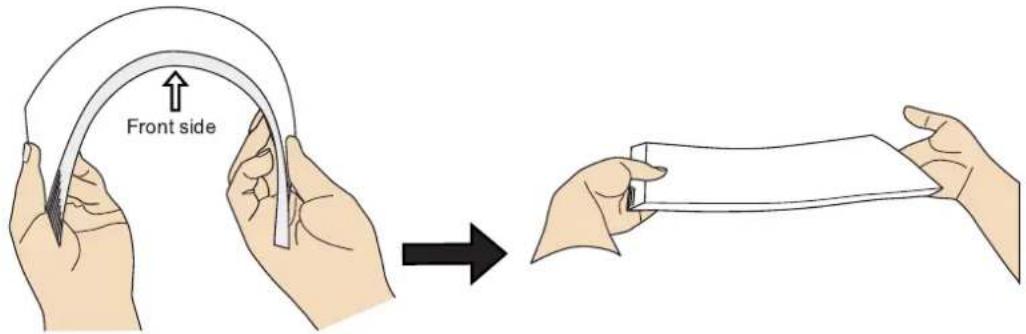
text_image
Front side-
Rotate the documents 90 degrees, and fan again.
-
Align the edges of the document sheets.
-
Load the documents into the ADF paper chute.
-
Extend the ADF paper chute and adjust the side guides to hold the documents.

natural_image
Line drawing of a handheld electronic device with control panel and scroll (no text or symbols)- Load the documents face down. If only one side is to be scanned, it should face down in the ADF paper chute.

text_image
Reverse Slide- Adjust the side guides to the width of the documents.
Move the side guides so that they touch both sides of the documents.
If there is any space between the side guides and the edges of documents, the scanned data may be skewed.

- The output tray holds the document sheets after they have been scanned. It can be pulled out and adjusted to the size of the document being scanned.
-
Pull out before scanning.
-
The extension flap of output tray may also be lifted up, as shown in the figure below.

text_image
Diagram showing a printer's internal structure with labeled parts 1 and 2, indicating assembly or processing steps.- Small documents may be retrieved by lifting up the keyboard after scanning has completed.
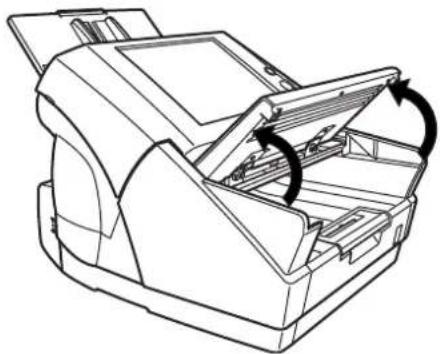
natural_image
Line drawing of a printer with internal compartments and directional arrows indicating motion (no text or symbols)6.1.2 Loading Documents Using a Carrier Sheet
A Carrier Sheet is a plastic sheet specifically used for loading non-standard documents onto the scanner. It allows you to scan documents that cannot be scanned in the regular way. Also, documents larger than A4 size, such as A3 and B4, can be scanned by folding in half, inserting into the Carrier Sheet, and scanning in duplex mode. The scanned images will be merged output as one page. You can also merge both front and back side images of a document smaller than A4 size to output a double-page spread image.

- When using a Carrier Sheet, set the size of the scanned document to be output. For more details, refer to "6.9.1 Carrier Sheet" (page 372).
- When a Carrier Sheet is used for scanning, continuous scanning is not possible. Scan one page at one time.
1. Fold the sheet to be scanned in half.
Fold the sheet tightly and smooth out the crease. Otherwise, the sheet may be skewed during scanning.

flowchart
graph LR
    A["Blank Document Page"] --> B["Arrow pointing to Document Page"]
    style A fill:#f9f,stroke:#333
    style B fill:#bbf,stroke:#333
2. Open the Carrier Sheet and insert the document.
Align the fold with the right edge of the Carrier Sheet so that the document fits into the Carrier Sheet at the upper corner.
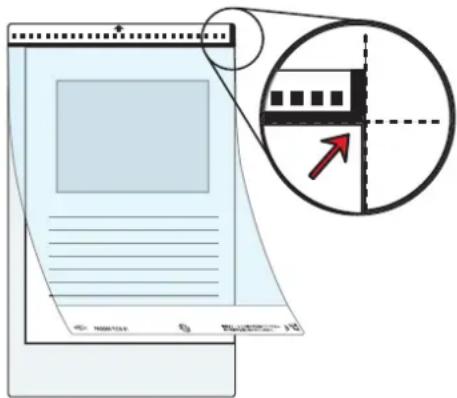
text_image
Diagram showing a document with a magnified inset highlighting a specific section, including a red arrow and grid lines.- Load the Carrier Sheet with the black and white striped section (printed section) facing downwards as shown in the following figure.
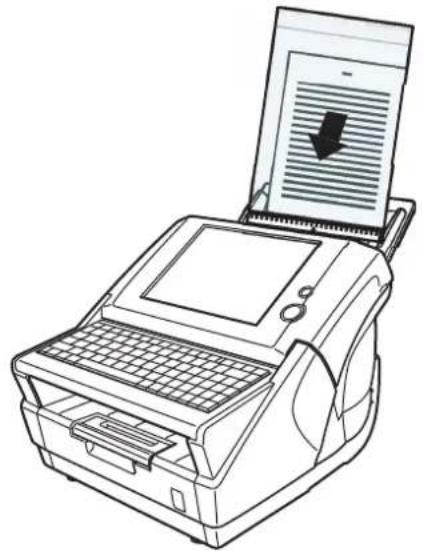
natural_image
Line drawing of a printer with a paper feedlet and downward arrow indicating print (no text or symbols present)- Adjust the side guides to the width of the Carrier Sheet.
Adjust the side guides so that there is no space between the guides and the Carrier Sheet. Space between the guides and Carrier Sheet may cause the Carrier Sheet to become unaligned during scanning, and skew the scanned image.
- Start the scan.
→ The front and back side images are merged into a double-page spread image.

text_image
Diagram showing two document layout with a gray rectangle and horizontal lines, possibly representing a table or layout.
There may be a gap between the front and back side images, or a line may appear on the output image.
When a sheet of thick paper is scanned, images on the both right and left side may be skewed to a trapezoidal shape.
The degree of skewing varies depending on the condition of the document (how it is folded or loaded).
Troubleshoot the problem as follows, and the situation may be improved.
- Is the document neatly folded? If not, fold it neatly.
- Is the edge of the document aligned with the edge of the Carrier Sheet? If not, align the document with the Carrier Sheet.
- Try to scan the document with the front side of the Carrier Sheet facing the paper chute or vice verse.
Also, the folded part of the document may be mis-detected, causing unintentional trimming of the scanned image. In this case, the folded edge of the document should be placed 1mm away from the edge of the Carrier Sheet.
6.2 Using Touch Panel Screens: Regular User
6.2.1 Common Buttons and Indicators
After the user logs in, the following buttons and indicators are shown on the touch panel screens.
| Icon Shown in manual as... Used to ... | ||
 | [Up] button, [Down] button Scroll up or down between items. | |
 | [OK] button Set the contents of the current screen. | |
 | [Cancel] button Cancel the contents of the current screen,or return to the previous screen. | |
 | [Yes] button If the color of the button is yellow, itmeans that the button is selected. | |
 | [No] button If the color of the button is blue, it meansthat the button is not selected. | |
 | [Caps Lock] indicator Indicate that the [Caps Lock] key hasbeen set (on the keyboard). | |
 | [Num Lock] indicator Indicate that the [Num Lock] key hasbeen set (on the keyboard). | |

If the [Logout] button or [Cancel] button is pressed before the [OK] button, the contents of the screen will not be set.
6.2.2 Regular User Settings Overview
Regular users can configure the following settings.
- Login
Set the scanner to automatically login without displaying the "Login" screen, when the scanner power is switched on or restarted.
Also, set whether or not to enable login with the guest account.
- Initial Post-Login Menu
Set whether to display the "Multi-Function Main Menu" or "Job Menu".
Switch between the "Multi-Function Man Menu" and "Job Menu", or display only the "Job Menu".
- User Roaming Data
If roaming mode is enabled, a regular user can login on different scanners while retaining their user data.
The following user data can be used in roaming mode.
● "My List" e-Mail Address Books
- Scan Settings
● Name of the last network printer used
● Name of the last network folder used
If the same network printer/folder is not set for each scanner, the name of the latest one used is not shown.
- Job Roaming Info
Retain job settings managed on the Central Admin Server, when logging in to different scanners.

When Roaming Mode or Job Mode is [On], if communication with the Central Admin Server is not possible at login, a confirmation message will appear. If the [OK] button is selected, the settings saved in the scanner are used. Selecting the [Cancel] button returns to the login screen.
6.2.3 Main Menu Screen
The type of buttons (e-Mail/Fax/Print/Save) displayed on the main menu differs according to the settings of the relevant server.
The following describes the main menu according to settings for e-Mail, Fax, Print and Save.
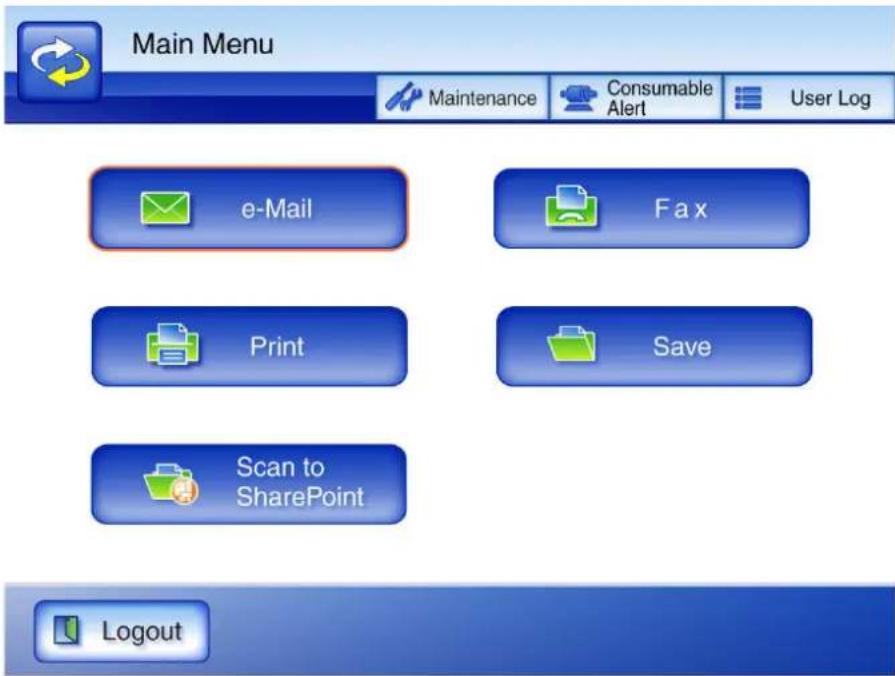
text_image
Main Menu Maintenance Consumable User Log e-Mail Fax Print Save Scan to SharePoint Logout| Icon | Shown in manual as... | Used to ... |
 | [Menu Mode] button | Switch between the "Multi-Function Main Menu" and the "Job Menu". For details, refer to "6.2.4 Job Menu Screen" (page 308). |
 | [Maintenance] button | Access the "Maintenance" screen. For details, refer to "6.13 Maintenance" (page 412). |
 | [Consumable Alert] button | Access the "Consumable Alert" screen. A colored alert indicator is used to warn that a "consumable replacement" is pending. Replacement is not required. Replacement is not required. Parts need to be replaced soon. Contact a system administrator. Parts need to be replaced soon. Contact a system administrator. Parts need to be replaced now. Replace the necessary part. For details, refer to "7.6 Replacing Parts" (page 436). Parts need to be replaced now. Replace the necessary part. For details, refer to "7.6 Replacing Parts" (page 436). |
| User Log | [User Log] button Access the "User Log" screen. For details, refer to "6.12 Checking the User Log" (page 410). | |
 | [e-Mail] button Access the "Send e-Mail" screen. For details, refer to "6.4 Sending the Scanned Data by e-Mail" (page 314). | |
 | [Fax] button Access the "Send Fax" screen. For details, refer to "6.5 Sending the Scanned Data by Fax" (page 330). | |
 | [Print] button Access the "Print" screen. For details, refer to "6.6 Printing the Scanned Data" (page 339). | |
 | [Save] button Access the "Save" screen. For details, refer to "6.7 Saving the Scanned Data to a Network Folder" (page 352). | |
 | [Scan to SharePoint] button | Access the "Scan to SharePoint" screen. For details, refer to "6.8 Saving the Scanned Data in a SharePoint Folder" (page 357). |
 | [Logout] button Logout the current user. | |
6.2.4 Job Menu Screen
The type of buttons displayed on the job menu differs according to the job settings. The following describes an example of a job menu according to job settings.
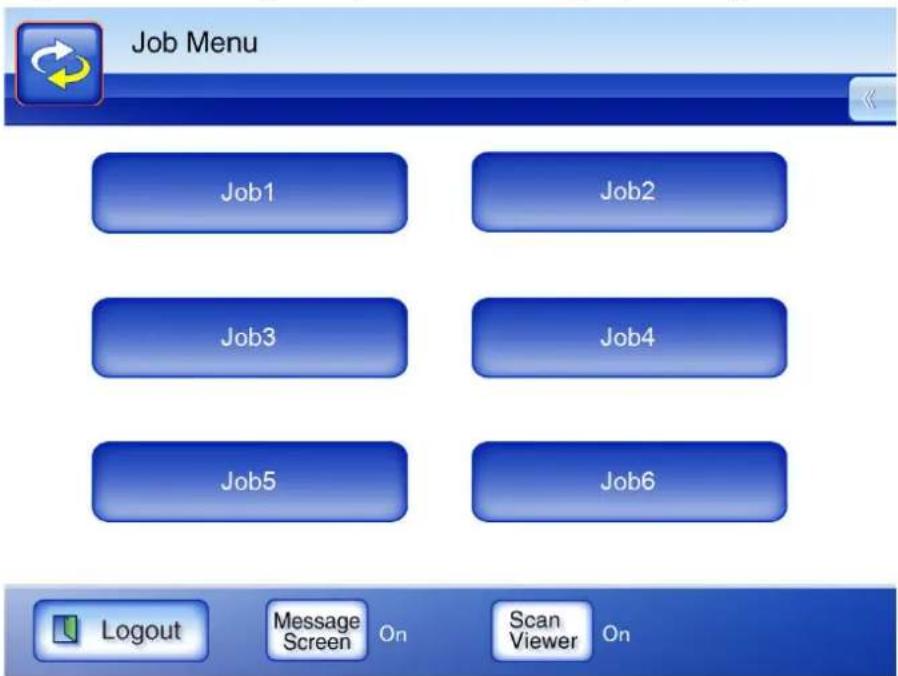
text_image
Job Menu Job1 Job2 Job3 Job4 Job5 Job6 Logout Message On Scan Viewer OnWhen a regular user belongs to multiple job groups, buttons to switch the job menu name or "Job Menu" screen appear as shown below.
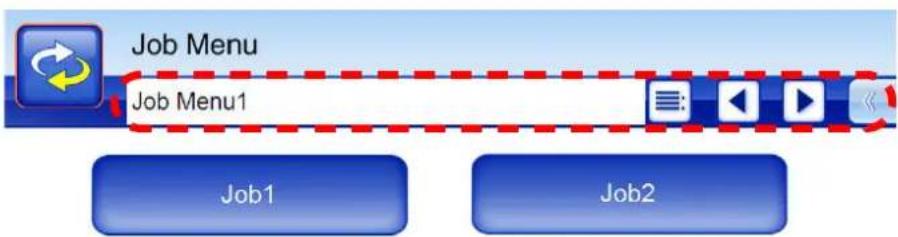
text_image
Job Menu Job Menu1 Job1 Job2
text_image
Logout Message Screen On Scan Viewer On| Icon | Shown in manual as... | Used to... |
 | [Menu Mode] button | Switch between the "Multi-Function Main Menu" and the "Job Menu". For more details refer to, "6.2.3 Main Menu Screen" (page 306) |
| [DCx4] | [Switch Menu] button | Switch between the following menus.●The menu containing the [Maintenance], [Consumable Alert], and [User Log] buttons●The menu containing job menu switch buttons (shown when a regular user belongs to multiple job groups) |
 | [Maintenance] button | Access the "Maintenance" screen. For details, refer to "6.2.3 Main Menu Screen" (page 306). |
 | [Consumable Alert] button | Access the "Consumable Alert" screen. For details, refer to "6.2.3 Main Menu Screen" (page 306). |
| [TZY] | [User Log] button | Access the "User Log" screen. For details, refer to "6.2.3 Main Menu Screen" (page 306). |
 | Job menu name field | This field appears only when a regular user belongs to multiple job groups. The currently selected job menu name is shown in this area. |
 | Job menu switch buttons | These buttons appear only when a regular user belongs to multiple job groups.●Press show a list of job groups to which a regular user belongs. When a job menu is selected, the corresponding "Job Menu" screen appears.●Press move to the previous "Job Menu" screen.●Press move to the next "Job Menu" screen. |
 | [Job] button Start the | specified job process for each job button.For more details, refer to "6.14 Processing a Job" (page 413). |
 | [Logout] button Logout the current user. | |
 (When the button is enabled) (When the button is enabled) | [Message Screen] button | Set whether or not to show the "Message Screen".For more details, refer to "6.14.1 Enabling/Disabling the Message Screen" (page 417). |
 (When the button is disabled) (When the button is disabled) | — It is not possible to select whether or not to show the "Message Screen".Whether or not to show the "Message Screen" depends on the settings configured by the administrator. | |
 (When the button is enabled) (When the button is enabled) | [Scan Viewer] button | Set whether or not to show the "Scan Viewer".For more details, refer to "6.10 Enabling/Disabling the Scan Viewer" (page 402). |
 (When the button is disabled) (When the button is disabled) | — It is not possible to select whether or not to show the "Scan Viewer".Whether or not to show the "Scan Viewer" depends on the settings configured by the administrator. | |
6.3 Logging in: Regular User Mode

Do not move or shake the scanner when it is turned on. This can damage the rotating hard disk drive and cause data to be lost.

LDAP authentication for the scanner requires entry of a login name that matches the type of user names saved on the LDAP server.
The following forms of login authentication may be used by the scanner, depending on the LDAP server type and user name format.
- When the "Server Type" of the LDAP server is [Active Directory] or [Active Directory Global Catalog]
| User Name Format Authentication Process | |
| SAM Account Name Does not contain a "@" | Authenticate the user login name (sAMAccountName).Example: user |
| User Principal Name Contains a "@" | Authenticate the user login name (userPrincipalName).Example: user@example.com |
- When the "Server Type" of the LDAP server is [Other LDAP Server]
| User Name Format Authentication Process | |
| uid Authenticate the user login | name (uid).Example: user |
| cn Authenticate the user login | name (cn).Example: user |
Note that the authenticated user info is also used when saving scans to a network folder.
When the scanner is turned on or restarted, automatic login without displaying the "Login" screen is possible.
Login is not possible if the Active Directory account option is "User must change password at next logon". Contact an administrator to change a password, and then try logging in.

- When using the scanner without an LDAP server, enter the following user name and password. For details about the LDAP server, refer to "LDAP Server" (page 17).
User Name: guest
Password: guest
However, this cannot be used if login with the guest account is disabled.
- For details about automatic login or enabling login with the guest account, refer to "4.6.7 Setting the Login Method" (page 68).
- Only one administrator or user can login to the scanner at any one time.
1. Push the startup button.

text_image
Startup button→ The "Login" screen appears.
2. Enter a "User Name" and "Password" that has been stored in the LDAP server.

text_image
Login User Name : guest Password : *****| Field Name Description | |
| User Name User | names may be up to 64 characters long.All alphanumerics (case sensitive) and some symbols are allowed. User names may not start with a "@" or ".". The following symbols cannot be used: /\[ ] : ; |= , + * ? <> " |
| Password Passwords | words may be up to 256 characters long, and all alphanumerics (case sensitive) and symbols are allowed. |

● The "Caps Lock" indicator is on if the keyboard's Caps Lock is set.
- The "Num Lock" indicator is on if the keyboard's Num Lock is set.
- If "Active Directory Global Catalog" is selected for the login LDAP server, the "UPN Suffix" input field is displayed.

text_image
Login User Name : user Password : **** UPN Suffix : example.com Cape Lock Num Lock Shutdown LoginUser names including a UPN suffix may be up to 64 characters long.
If a UPN suffix is entered, "@" and the "UPN_suffix" will be appended to the "User_name".
The entered UPN suffix is remembered and used again at the next login. For example, if the user name is "user", and "example.com" is entered for the UPN suffix, it is corrected to "user@example.com".
In this case, this is the "User Principal Name".
A UPN suffix is not required when logging in as a guest. Even if entered, it will be ignored.
3. Press the [Login] button.
If the user name and password are valid, the "Main Menu" screen appears.
6.4 Sending the Scanned Data by e-Mail

If an LDAP server is set, register the user e-mail address with the LDAP server. If not registered, e-mails cannot be sent.
- On the "Main Menu" screen, press the [e-Mail] button.
⇒ The "Send e-Mail" screen appears.

The scan information can be changed by pressing the [Scan Settings] button.
For more details, refer to "6.9 Setting the Scan Options" (page 365).
- Enter distribution list names or e-mail addresses in "To", "Cc", and "Bcc" fields.
Enter a distribution list name to send a single e-mail to multiple e-mail addresses contained in the distribution list.
For more details about e-mail address setting values, refer to "B.1 e-Mail Address Setting Values" (page 490).
To enter multiple e-mail targets, separate each e-mail target with a ";". A scan can be sent to a maximum of 30 e-mail targets at any one time.

e-Mail addresses can be selected directly from the e-mail address book. For details, refer to "6.4.1 Selecting an e-Mail Target from the e-Mail Address Book" (page 319).
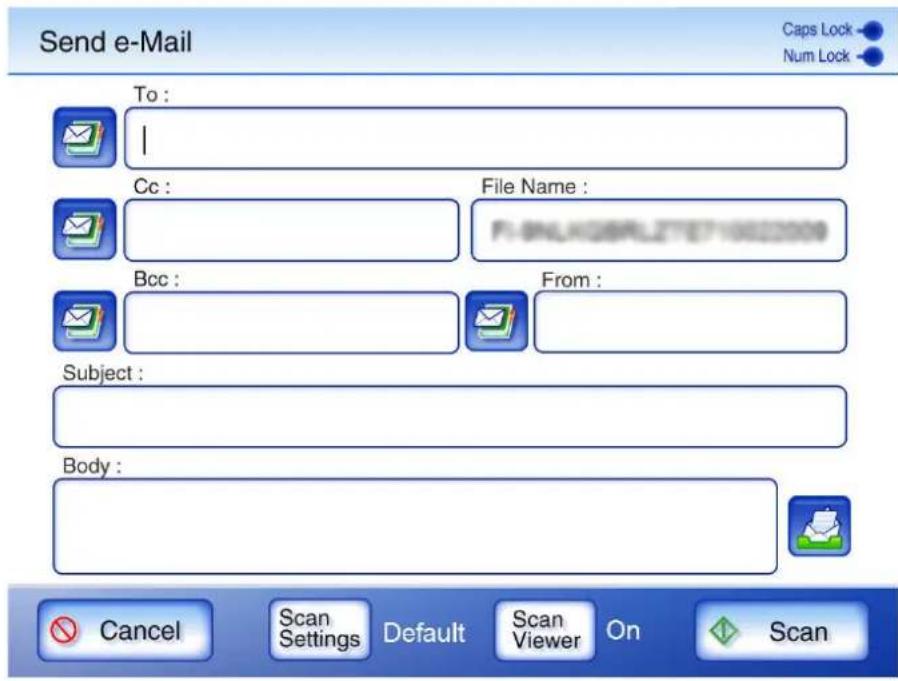
text_image
Send e-Mail Caps Lock - Num Lock - To : I Cc : File Name : F:\ONLABRJETE\1002000 Bcc : From : Subject : Body : Cancel Scan Settings Default Scan Viewer On Scan- Enter a file name for the scan data into the "File Name:" field.
File names may be up to 128 characters long, excluding the following symbols.
$$ \backslash : *? ^ {\prime \prime} < > | $$
The default value is the file name specified on the administrator "File Names (e-Mail)" screen. For details, refer to "4.6.10 Setting a File Name Format for When Attaching Scanned Data to e-Mail" (page 76).


The following file names cannot be used:
CON
PRN
- AUX
- CLOCK\$
NUL
- COM0 to COM9
- LPT0 to LPT9
- Check that address shown in the "From:" field is correct.
- Direct input for this field is only possible if logged in with the guest account. Enter a "From" e-mail address. For details about the e-mail address settings, refer to "B.1 e-Mail Address Setting Values" (page 490).

e-Mail addresses can be selected directly from the e-mail address book. For details, refer to "6.4.1 Selecting an e-Mail Target from the e-Mail Address Book" (page 319).
- If logged in with an account other than the guest account, the "From" input field is not shown, but the user e-mail address registered with the LDAP server is set for this field.
- Enter an e-mail title into the "Subject:" field.
The subject may be up to 128 characters long.
- Enter the e-mail contents into the "Body:" field.
The body may be up to 512 characters long, including line feeds.
- Select whether or not to request a return receipt.
- Press the [Scan] button.
When [Scan Viewer] is Off, this will be a [Scan&Send] button.
→ Scanning starts.
Each page is briefly shown on the screen as it is scanned.
The maximum number of pages that can be scanned is 999.
When [Blank Page Skip] is enabled, the number of scanned pages excluding skipped blank pages is shown.
Additional pages can be scanned in place of skipped blank pages, until the maximum number of scanned pages is reached.
When the scan has completed, the "Scan Viewer" screen opens.
For more details about the "Scan Viewer" screen, refer to "6.11 Editing the Scanned Data in the Scan Viewer" (page 405).

● [Scan Viewer] is initially "On".
- When the [Scan&Send] button is pressed (when [Scan Viewer] is "Off"), after the last page has been displayed on the "Scanning" screen, the scan data is attached to an e-mail and sent, and the touch panel screen returns to the "Main Menu".
For more details, refer to "6.10 Enabling/Disabling the Scan Viewer" (page 402)
9. Check the scanned data.
For more details about the "Scan Viewer" screen, refer to "6.11 Editing the Scanned Data in the Scan Viewer" (page 405).
10. On the "Scan Viewer" screen, press the [Send] button.
⇒ The scanned data is sent with the specified file as an e-mail attachment.
If "Split Mails" is set to "On", split e-mails will be sent.
If the number of e-mail addresses exceeds the specified maximum number, a warning message will appear.
![FUJITSU fi-6010N - On the "Scan Viewer" screen, press the [Send] button. - 1](/content/2026/06/1236812/images/c99e5c38c8dc1b3717aaa7bb73b9f4b31e57d79d65e50e1d66e8e9b755b05879.jpg)
natural_image
Icon of an envelope inside a globe, symbolizing global communication (no text or symbols)Mailing scan data to cdef@example.com
→ The "Main Menu" screen is shown again.
![FUJITSU fi-6010N - On the "Scan Viewer" screen, press the [Send] button. - 2](/content/2026/06/1236812/images/e21ee505de7863eec56cdbb0b17ba659e88a979ca8cdf313ff0cba850bee8ece.jpg)
- The following items are set by the administrator in advance.
- The maximum number of e-mail addresses to be specified in the "To" field
- Whether to split an e-mail to be sent, and the maximum size of a split e-mail
● The maximum size of an attached file
To change these settings, contact the administrator. For more details about these settings, refer to "4.7.11 Setting the e-Mail Server (SMTP Server)" (page 116).
- For photos and images, a high compression level can be used to create a smaller file. For more details, refer to "6.9.9 Compression" (page 387).
- If the file format is JPEG or TIFF, a file will be attached for each page in the scan.
- If the number of pages is over ten and the [Scan Viewer] is On, a confirmation dialog will appear after the "Send e-Mail" screen [Send] button is pressed.
- If the number of pages is over ten and the [Scan Viewer] is Off, a confirmation dialog will appear after the "Send e-Mail" screen [Scan&Send] button is pressed.
- If the e-mail fails to send, an error message with the following title is sent by e-mail from the scanner to the "From" address. Network Scanner (XXXX) Error
6.4.1 Selecting an e-Mail Target from the e-Mail Address Book
The following explains how to select e-mail addresses by using an e-mail address book, not by directly entering an e-mail address with a keyboard as described in Step 2 and Step 4 of "6.4 Sending the Scanned Data by e-Mail" (page 314).
The e-mail address book contains "My List" and "LDAP List" sections. Operations other than search operations for both sections are the same. The search method for "My List" is Anywhere.
For "LDAP List" searches, choose from Head, Anywhere, and Tail search methods.
● "My List" is an e-mail address book that can be created by each user.
- "LDAP list" is an e-mail address book which uses data stored on the LDAP server. The LDAP list cannot be edited.
In the following cases, the [LDAP List] tab is not shown, therefore cannot be used.
- If an LDAP server is not used
- If logged in with the guest account
The following e-mail targets can be selected from the e-mail address book.
| e-Mail Target | Icon Shown in the e-Mail Address Book | My List LDAP List | |
| Distribution List |  | A | — |
| e-Mail Address |  | A | A |
A: available —: not available
(*): Not shown in the LDAP list.
The following explains how to select an e-mail address using the "LDAP List".

- On the "Send e-Mail" screen, press the address field.
button to the right of the e-mail
⇒ The "e-Mail Address Book" screen for the LDAP list appears.

text_image
e-Mail Address Book Caps Lock Num Lock My List LDAP List First Name Last Name e-Mail Address + Search Target : Find 0 / 0 Search Position Head (abc...) Add to My List Cancel Details OK- Select the search parameter.
The search parameters and button names shown on the left and middle buttons can be customized. For details about customizing the search parameters and the button names, refer to "4.7.10 Setting the LDAP Search Parameters" (page 111).
Pressing the left or middle button displays the search results according to the search parameter shown on the button, in alphabetical order. If multiple items are selected, data containing any of the search words are searched as "OR Search".
Pressing the [e-Mail Address] button displays the search results by e-mail address, in alphabetical order.
- Press the [Search Position] button.
→ The "Search Position" screen appears.
4. Select a search position setting.
By default, [Head (abc...)] is set.
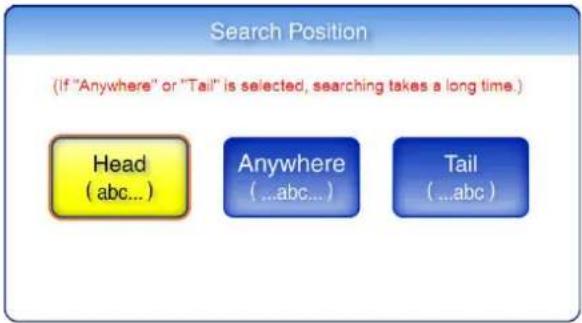
text_image
Search Position (If "Anywhere" or "Tail" is selected, searching takes a long time.) Head ( abc... ) Anywhere ( ...abc... ) Tail ( ...abc )| Search Position | Search Method | Example Target | Search Result |
| Head (abc...) | The LDAP e-mail address book is searched for entries which start with the character string entered in Step 5. | abc abc, abc1, abcd, ... | |
| Anywhere (...abc...) | The LDAP e-mail address book is searched for entries which include the character string entered in Step 5. | abc abc, abc1, xabc, xabcy, ... | |
| Tail (...abc) | The LDAP e-mail address book is searched for entries which end with the character string entered in Step 5. | abc abc, 1abc, xabc, ... |

When the LDAP server contains several tens of thousands of entries, "Anywhere" and "Tail" searches can take a long time.
The screen returns to the "e-Mail Address Book" LDAP list. The selected position is displayed to the right of the [Search Position] button.
5. Enter a search string.
Contacts can be searched for individually, or all at the same time. Search strings may be up to 256 characters long.
Wild card characters cannot be used. The actual characters * ? [ ] will be searched for.
6. Press the [Find] button.
→ The search results are displayed on the right side. Five results are displayed at a time.
![FUJITSU fi-6010N - Press the [Find] button. - 1](/content/2026/06/1236812/images/3d8e81e17101c1c04485138fee86a330bf605cf4911f13a51b705b609f86d277.jpg)
text_image
e-Mail Address Book Caps Lock Num Lock My List LDAP List First Name Last Name e-Mail Address Search Target : Search Position Head (abc...) ABC@example.com cedf@example.com dddddd@example.com pfu@example.com xxx@example.com Add to My List Cancel Details OK![FUJITSU fi-6010N - Press the [Find] button. - 2](/content/2026/06/1236812/images/a2d936514a65d45ac56bb0f5697e22c3d61de59037106d0eaa8172bd7e5480d7.jpg)
- The number of LDAP search results displayed can be specified. LDAP server settings can be changed by the administrator.
For details, refer to "4.7.8 Setting the Login LDAP Server" (page 100).
- If items are missing for search results according to the display format of the search results, "----" is shown instead.
For example, if the display format is "LastName FirstName", and the user "LastName: Fujitsu, FirstName: None" is registered on the LDAP server, the search result is displayed as follows.
Search result display format: Fujitsu ----
- Search methods differ for the My List and LDAP List. Therefore, search results differ according to the list selected.
| Search Character My List LDAP List | |
| Case Insensitive Insensitive | |
| Diacritical/Accent marks Sensitive Insensitive |
7. Select the desired e-mail target from the search results.

- Selecting an e-mail address and pressing the [+] button, can be used to add a selected e-mail address to an e-mail. To add multiple e-mail addresses, simply select another e-mail address and press the [+] button.
- Selecting an e-mail address and pressing the [Add to My List] button, adds the selected e-mail address to the "My List" e-mail address book.
- Selecting an e-mail address and pressing the [Details] button, allows you to check information for the selected e-mail contact.
e-Mail Address Details
| Last Name | ABC |
| First Name | DEF |
| e-Mail Address | ABC@example.com |
| Common Name | ABC |
| Display Name | ABC |

8. Press the [OK] button.
⇒ The address is added to the field in the "Send e-Mail" screen.
When multiple e-mail addresses are entered using the e-mail address book, a ";" is automatically entered in between each address.
Up to 30 e-mail addresses can be entered at one time.
6.4.2 Adding an e-Mail Target to the e-Mail Address Book
The following explains how to add an e-mail address or a distribution list to your My List. e-Mail targets cannot be added to the LDAP list.
The maximum number of e-mail targets that can be stored in the e-mail address book is as follows.
● Total of 5,000 e-mail targets which include distribution lists and/or e-mail addresses
● Total of 10,000 e-mail addresses
- Open the "e-Mail Address Book" screen in either of the following ways.

- On the "Send e-Mail" screen, press to the right of an e-mail address field.
-
On the "Main Menu" or "Job Menu" screen, press the [Maintenance] button, then on the "Maintenance" screen, press the [Edit e-Mail Address] button. For details, refer to "6.13 Maintenance" (page 412).
-
Select the [My List] tab.
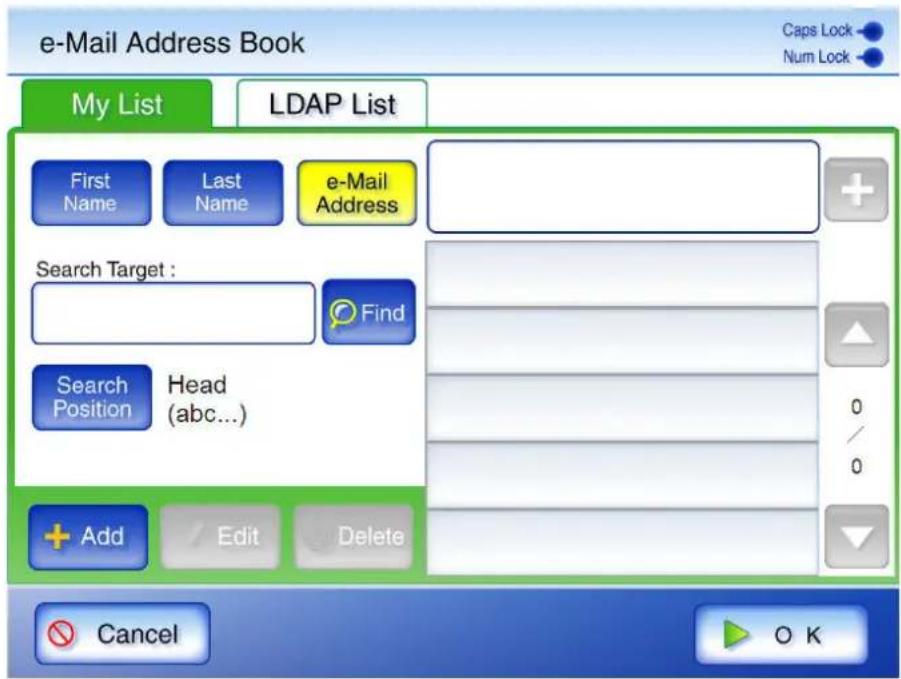
text_image
e-Mail Address Book Caps Lock Num Lock My List LDAP List First Name Last Name e-Mail Address Search Target : Find Search Position Head (abc...) 0 / 0 Add Edit Delete Cancel OK- Press the [Add] button.
⇒ The "Add e-Mail Address" screen appears.
4. Enter the details of the e-mail target being added.
- For e-mail addresses
On the [e-Mail Address] tab, enter the "First Name", "Last Name", and "e-Mail Address". Up to 64 characters can be specified for "First Name" and "Last Name". "First Name" and "Last Name" can be skipped.
For more details about e-mail address setting values, refer to "B.1 e-Mail Address Setting Values" (page 490).
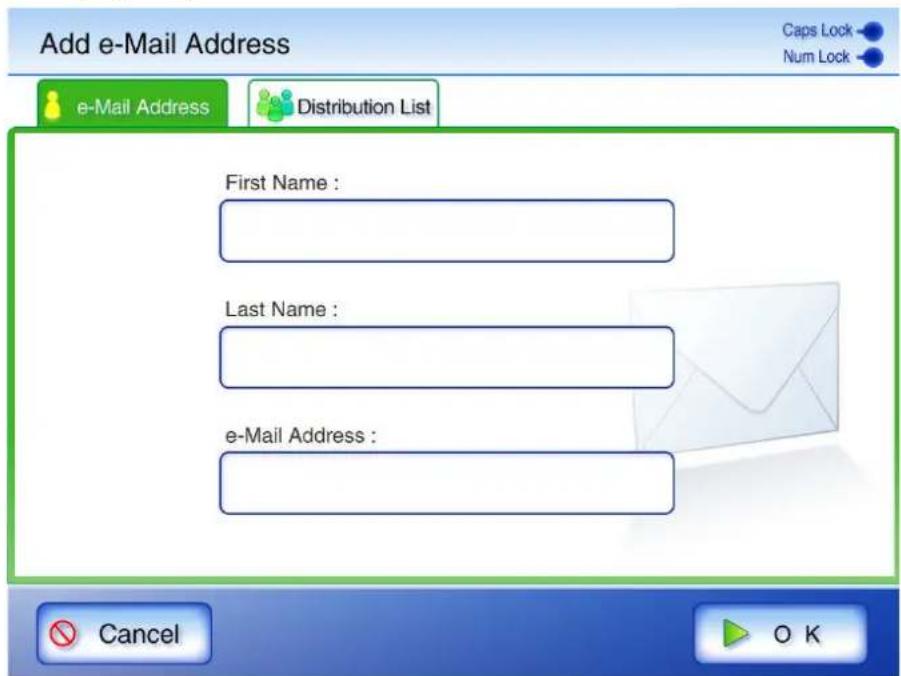
text_image
Add e-Mail Address e-Mail Address Distribution List First Name : Last Name : e-Mail Address : Caps Lock Num Lock Cancel OK- For distribution lists
On the [Distribution List] tab, enter the "List Name" and "e-Mail Addresses" to be added to the distribution list.
Up to 64 characters can be specified for "List Name". The following symbols cannot be used.
;@
For more details about e-mail address setting values, refer to "B.1 e-Mail Address Setting Values" (page 490).
A distribution list can contain up to 100 e-mail addresses. Multiple addresses must be separated using semi-colons (";").
e-Mail addresses can be selected from the e-mail address book, which can be accessed by

pressing
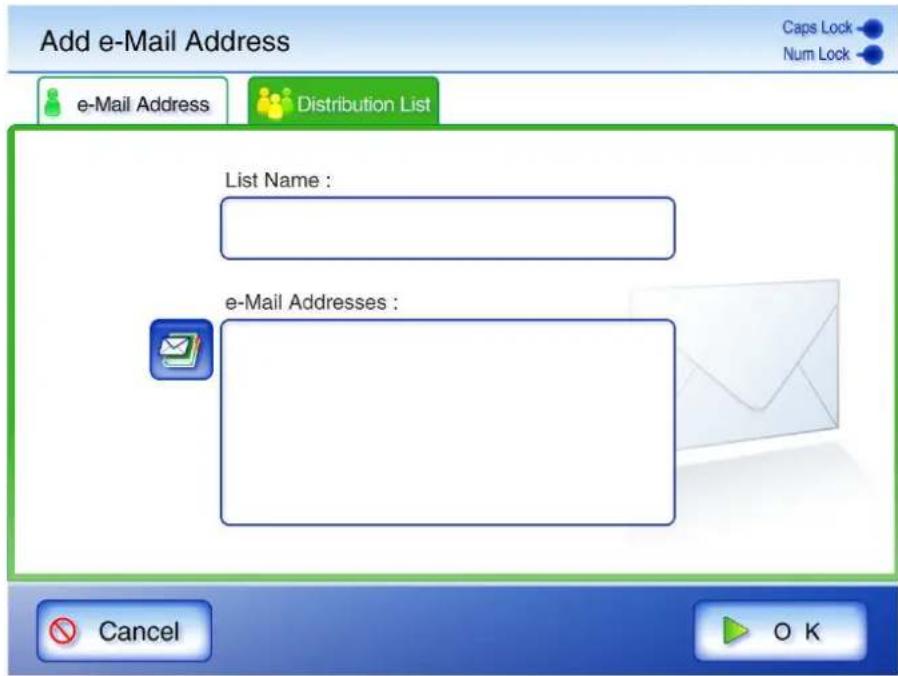
text_image
Add e-Mail Address e-Mail Address Distribution List List Name : e-Mail Addresses : Cancel Caps Lock Num Lock- Press the [OK] button.
⇒ The e-mail address or distribution list is added to your My List address book.
6.4.3 Editing an e-Mail Target in the e-Mail Address Book
The following explains how to edit an e-mail address or distribution list stored in your My List. e-Mail targets stored in the LDAP list cannot be edited.
- Open the "e-Mail Address Book" screen in either of the following ways.

- On the "Send e-Mail" screen, press to the right of an e-mail address field.
- On the "Main Menu" or "Job Menu" screen, press the [Maintenance] button, then on the "Maintenance" screen, press the [Edit e-Mail Address] button. For details, refer to "6.13 Maintenance" (page 412).
- Select the [My List] tab.
- Select the e-mail address or distribution list to be edited.
- Press the [Edit] button.
⇒ The "Edit e-Mail Address" screen appears.
- Edit the details of the selected e-mail target.
- For e-mail addresses
Edit the "First Name", "Last Name", and "e-Mail Address".
Up to 64 characters can be specified for "First Name" and "Last Name". "First Name" and "Last Name" can be skipped.
For more details about e-mail address setting values, refer to "B.1 e-Mail Address Setting Values" (page 490).
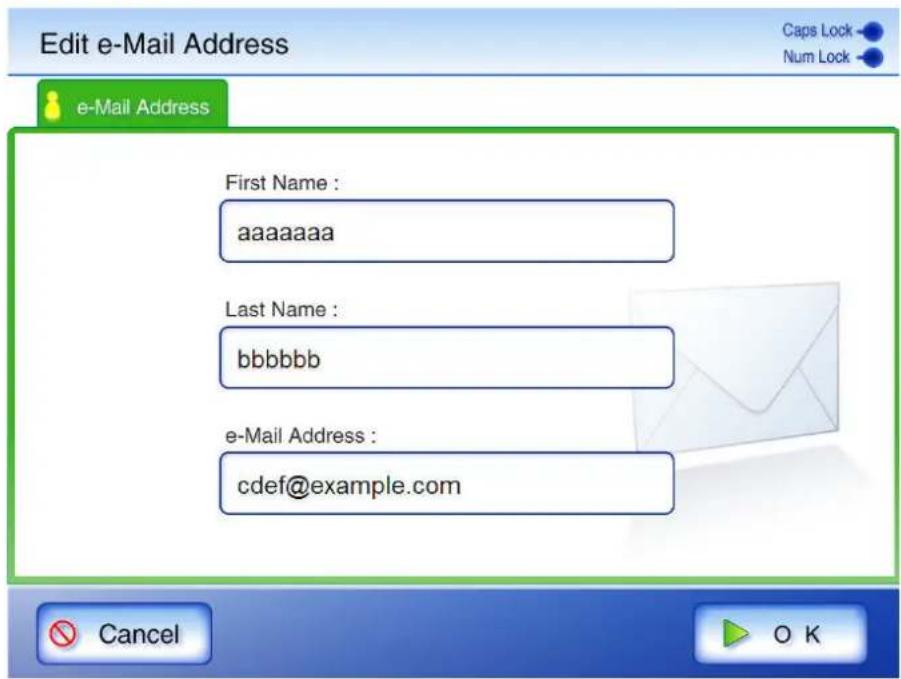
text_image
Edit e-Mail Address Caps Lock Num Lock e-Mail Address First Name : aaaaaaa Last Name : bbbbbb e-Mail Address : cdef@example.com Cancel- For distribution lists
Edit the "List Name" and "e-Mail Addresses" contained in the distribution list.
Up to 64 characters can be specified for "List Name". The following symbols cannot be used.
;@
For more details about e-mail address setting values, refer to "B.1 e-Mail Address Setting Values" (page 490).
A distribution list can contain up to 100 e-mail addresses. Multiple addresses must be separated using semi-colons (";").
e-Mail addresses can be selected from the e-mail address book, which can be accessed by
pressing

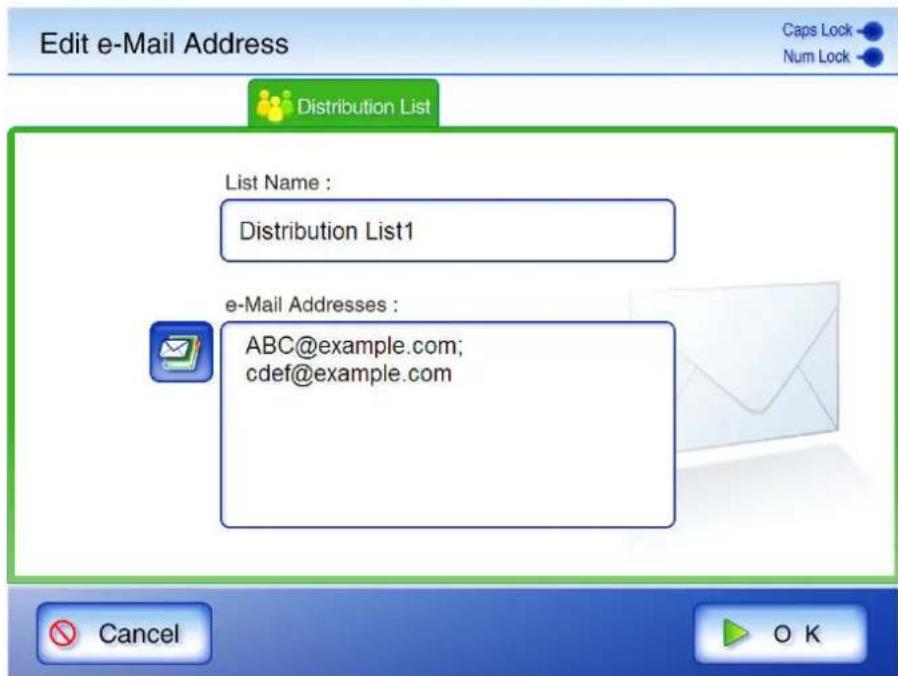
text_image
Edit e-Mail Address Caps Lock Num Lock Distribution List List Name : Distribution List1 e-Mail Addresses : ABC@example.com; cdef@example.com Cancel OK- Press the [OK] button.
The edited e-mail address is saved in your My List address book.
6.4.4 Deleting an e-Mail Target from the e-Mail Address Book
The following explains how to delete an e-mail address or a distribution list from your My List. e-Mail targets cannot be deleted from the LDAP list.
- Open the "e-Mail Address Book" screen in either of the following ways.

- On the "Send e-Mail" screen, press to the right of an e-mail address field.
- On the "Main Menu" or "Job Menu" screen, press the [Maintenance] button, then on the "Maintenance" screen, press the [Edit e-Mail Address] button. For details, refer to "6.13 Maintenance" (page 412).
- Select the [My List] tab.
- Select the e-mail address or distribution list to be deleted.
- Press the [Delete] button.
→ The "Delete e-Mail Address" screen appears.
The following is an example screen which is shown when an e-mail address is deleted.
- Check the correct e-mail target has been set for deletion and press the [OK] button.
Delete e-Mail Address
OK to delete the following data?
First Name : aaaaaaaa
Last Name : bbbbbbb
e-Mail Address : cdef@example.com


Cancel

OK
→ The e-mail target is deleted from the e-mail address book.
6.5 Sending the Scanned Data by Fax
- On the "Main Menu" screen, press the [Fax] button.
→ The "Send Fax" screen appears.

The scan information can be changed by pressing the [Scan Settings] button.
For more details, refer to "6.9 Setting the Scan Options" (page 365).
- Enter a fax number into the "Recipient Fax No." field.
Recipient fax numbers may be up to 64 digits long.
Numbers and the following symbols can also be used.
-*#

Recipient fax numbers can be selected directly from the fax number list. For details, refer to "6.5.1 Selecting a Fax Number from the Fax Number List" (page 332).
Send Fax
Caps Lock
Num Lock
Recipient Fax No.:

Notification To (Sender's e-Mail Address) :

Cancel
Scan Settings
Default
Scan Viewer
Off
Scan & Send
- In the "Notification To (Sender's e-Mail Address)" field, enter an e-mail address for Send Fax result alert e-mails.
For more details about e-mail address setting values, refer to "B.1 e-Mail Address Setting Values" (page 490).
4. Press the [Scan&Send] button.
When [Scan Viewer] is On, this will be a [Scan] button.
→ Scanning starts.
After the last page is displayed on the "Scanning" screen, the scan data is sent by fax, and the touch panel screen returns to the "Main Menu".
![FUJITSU fi-6010N - Press the [Scan&Send] button. - 1](/content/2026/06/1236812/images/ad81bb17627393428474e9fe0b9df48b1a82aa6f1f785be6d2660efd04808393.jpg)
natural_image
Illustration of a printer and a digital fax with a green connection line (no text or symbols)Faxing scan data to 123456789
![FUJITSU fi-6010N - Press the [Scan&Send] button. - 2](/content/2026/06/1236812/images/bab68cebbfe59bf2e81ddd57b67299271e8f341df2ab654b2b2bf042544b8a4e.jpg)
● [Scan Viewer] is initially "Off".
- When the [Scan] button is pressed (when [Scan Viewer] is "On"), each page is briefly shown on the screen as it is scanned.
The maximum number of pages that can be scanned is 999.
When [Blank Page Skip] is enabled, the number of scanned pages excluding skipped blank pages is shown.
Additional pages can be scanned in place of skipped blank pages, until the maximum number of scanned pages is reached.
When the scan has completed, the "Scan Viewer" screen opens.
For more details about the "Scan Viewer" screen, refer to "6.10 Enabling/Disabling the Scan Viewer" (page 402)" and "6.11 Editing the Scanned Data in the Scan Viewer" (page 405).
- A delivery report message with the following title is sent by e-mail from the scanner to the "Notification To (Sender's e-Mail Address)" address.
Network Scanner (XXXX) Error
6.5.1 Selecting a Fax Number from the Fax Number List
As mentioned in Step 2 of "6.5 Sending the Scanned Data by Fax" (page 330), instead of entering a fax number with keyboard, fax numbers may be directly selected from a fax number list.

- On the "Send Fax" window, press
→ The "Fax Number List" screen appears.
- Select the search parameter.
Pressing the [Fax No.] button displays the search results by fax numbers, in number order. Pressing the [Recipient] button displays the search results by recipient names, in alphabetical order.

text_image
Fax Number List Caps Lock Num Lock Recipient Fax No. Search Target : Find Search Position Head (abc...) Add Edit Delete Dingh David Gauthover John Fitzgerald Kennedy London Barrowa Johnson Sutherland Richard Hay Session Brown Clash Cancel OK- Press the [Search Position] button.
→ The "Search Position" screen appears.
4. Select a search position setting.
By default, [Head (abc...)] is set.

text_image
Search Position (If "Anywhere" or "Tail" is selected, searching takes a long time.) Head ( abc... ) Anywhere ( ...abc... ) Tail ( ...abc )| Search Position | Search Method | Example Target | Search Result |
| Head (abc...) | The LDAP fax number list is searched for entries which start with the character string entered in Step 5. | abc abc, abc1, abcd, ... | |
| Anywhere (...abc...) | The LDAP fax number list is searched for entries which include the character string entered in Step 5. | abc abc, abc1, xabc, xabcy, ... | |
| Tail (...abc) | The LDAP fax number list is searched for entries which end with the character string entered in Step 5. | abc abc, 1abc, xabc, ... |
The screen returns to the "Fax Number List". The selected position is displayed to the right of the [Search Position] button.
5. Enter a search string.
Contacts can be searched for individually, or all at the same time. A search string may be up to 64 characters long. Wild card characters cannot be used (the actual characters * ? [ ] will be searched for).
6. Press the [Find] button.
The search results are displayed on the right side. Five results are displayed at a time.
![FUJITSU fi-6010N - Press the [Find] button. - 1](/content/2026/06/1236812/images/f38ad9abae886bf1d7de36f6b933ce87638e2d197dfa6453d2c11eec287127bc.jpg)
text_image
Fax Number List Caps Lock Num Lock Recipient Fax No. Search Target : abc Find abcdefghijklmnopqrstuvwxyz Search Position Head (abc...) 1 / 1 Add Edit Delete Cancel OK- Select a fax number.
- Press the [OK] button.
⇒ The fax number is added to the field in the "Send Fax" screen. Only one fax number can be entered at a time.
6.5.2 Adding a Contact to the Fax Number List
A maximum of 1,000 contacts can be stored in the fax number list. Fax contact numbers added to the list are accessible to all users.
- Open the "Fax Number List" screen in either of the following ways.

● On the "Send Fax" screen, press
- On the "Main Menu" or "Job Menu" screen, press the [Maintenance] button, then on the "Maintenance" screen, press the [Edit Fax Numbers] button. For details, refer to "6.13 Maintenance" (page 412).
- Press the [Add] button.
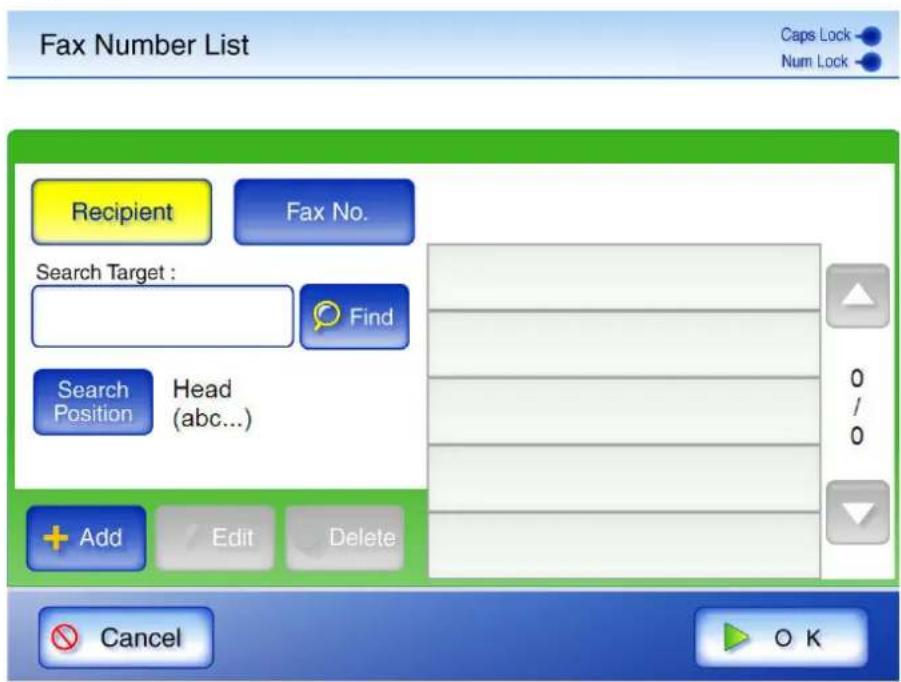
text_image
Fax Number List Caps Lock Num Lock Recipient Fax No. Search Target : Find Search Position Head (abc...) 0 / 0 Add Edit Delete Cancel OK⇒ The "Add Fax Number" screen appears.
3. Enter the fax contact details.
Recipients may be up to 64 characters long.
Fax numbers may be up to 64 digits long. Numbers and the following symbols can also be used.
-*#

text_image
Add Fax Number Caps Lock Num Lock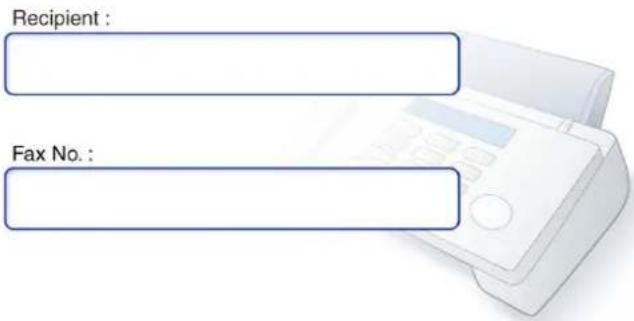
text_image
Recipient : Fax No. :
text_image
Cancel OK4. Press the [OK] button.
→ The contact is added to the fax number list.
6.5.3 Editing a Contact in the Fax Number List
Fax contact numbers edited in the list are accessible to all users.
- Open the "Fax Number List" screen in either of the following ways.
● On the "Send Fax" screen, press
- On the "Main Menu" or "Job Menu" screen, press the [Maintenance] button, then on the "Maintenance" screen, press the [Edit Fax Numbers] button. For details, refer to "6.13 Maintenance" (page 412).
-
Select the fax contact that is to be edited.
-
Press the [Edit] button.
→ The "Edit Fax Number" screen appears.
- Edit the contact information.
Recipients may be up to 64 characters long.
Fax numbers may be up to 64 digits long. Numbers and the following symbols can also be used.
-*#
Edit Fax Number
Caps Lock
Num Lock
Recipient :
abcdefg
Fax No.:
123456789

Cancel

OK
- Press the [OK] button.
→ The edited fax number list contact is saved.
6.5.4 Deleting a Contact from the Fax Number List
Fax contact numbers deleted from the list are no longer accessible to any user.
- Open the "Fax Number List" screen in either of the following ways.
● On the "Send Fax" screen, press
- On the "Main Menu" or "Job Menu" screen, press the [Maintenance] button, then on the "Maintenance" screen, press the [Edit Fax Numbers] button. For details, refer to "6.13 Maintenance" (page 412).
-
Select the fax contact that is to be deleted.
-
Press the [Delete] button.
→ The "Delete Fax Number" confirmation screen appears.
- Check the contact that is set to be deleted is the correct one and press the [OK] button.
Delete Fax Number
OK to delete the following data?
Recipient : abcdefg
Fax No.: 123456789

natural_image
Illustration of a white telephone handset with keypad and front panel (no text or symbols)
Cancel

OK
→ The contact is deleted from the fax number list.
6.6 Printing the Scanned Data
- On the "Main Menu" screen, press the [Print] button.
⇒ The "Print" screen appears.
Network printer preferences are saved for each user, and will be shown each time that user logs in.

The scan information can be changed by pressing the [Scan Settings] button.
For more details, refer to "6.9 Setting the Scan Options" (page 365).
- To change the printer, press the [Select] button.
At the first login, the network printer registered by the administrator in "Printer" is displayed. After the first login, each time a user logs in, the name of the last network printer used is displayed.

text_image
Print Printer : FUJITSUX.2(Color) \\SERVER\FUJITSUX.2(RGB Color) Select ... Scaling 100% Positioning Center Simplex / Duplex Duplex ↓ Duplex (Long Edge) No. of Copies 1 Default Cancel Scan Settings Default Scan Viewer On Scan⇒ The "Printer List" screen appears.
3. Select a printer.

- Pressing the [Details] button on the "Printer List" screen displays information about the selected network printer. If a printer name is too long for one line, it will wrap onto the next line. Any hidden parts of the name may be revealed by finger dragging and scrolling.
- Only the administrator may add printers to the list, or edit the details of printers already on the list. For more details about adding printers, refer to "4.7.13 Setting the Network Printers" (page 119).
Printer List
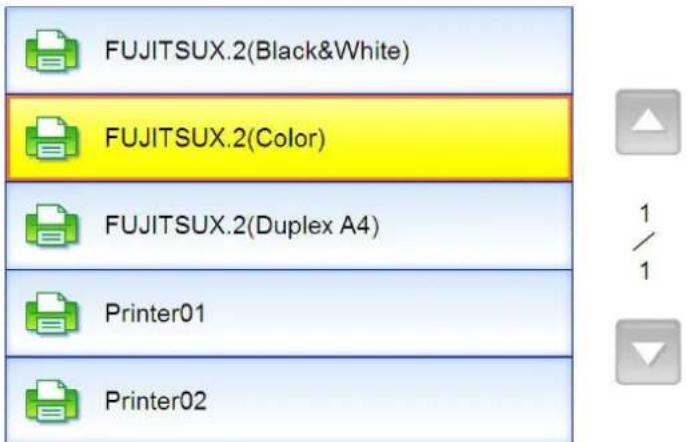
text_image
FUJITSUX.2(Black&White) FUJITSUX.2(Color) FUJITSUX.2(Duplex A4) Printer01 Printer02
Cancel
Details

OK
4. Press the [OK] button.
→ This returns you to the "Print" screen.
![FUJITSU fi-6010N - Press the [OK] button. - 1](/content/2026/06/1236812/images/4f01063843e6a212e75340320d1678ae1df4f141a3458fbcf60a41e74d281f30.jpg)
- User authentication may sometimes be required to access a network printer. When the authentication is required, the "Print Server Authentication" screen appears. The authentication procedure follows.
- Enter a "User Name" and "Password" for the printer.
Passwords are case sensitive.
![FUJITSU fi-6010N - Press the [OK] button. - 2](/content/2026/06/1236812/images/74994d48b3b17d3669c7ab0d5acaed71335818d8d84f6e609f343b1a181d6b45.jpg)
text_image
Print Server Authentication User Name : Password : Cancel Cape Lock Num Lock- Press the [OK] button.
- Current user printing privileges for the specified printer are checked before printing. When printing privileges are being checked, data may be spooled temporarily.
5. Make any required print setting changes.
[Scaling], [Positioning], and [Simplex/Duplex] settings can be changed. For more details refer to "6.6.1 Scaling" (page 344), "6.6.2 Positioning" (page 349), and "6.6.3 Simplex/Duplex" (page 351).
To return to the print setting to the factory settings, press the [Default] button.
According to the printer, settings from the printers properties screen may be used instead.
6. Enter a number in "No. of Copies" field.
The default number is 1. Numbers from 1 to 99 can be used.
According to the printer, settings from the printers properties screen may be used instead.
7. Press the [Scan] button.
When [Scan Viewer] is Off, this will be a [Scan&Print] button.
→ Scanning starts.
Each page is briefly shown on the screen as it is scanned.
The maximum number of pages that can be scanned is 100.
When [Blank Page Skip] is enabled, the number of scanned pages excluding skipped blank pages is shown.
Additional pages can be scanned in place of skipped blank pages, until the maximum number of scanned pages is reached.
When the scan has completed, the "Scan Viewer" screen opens.
For more details about the "Scan Viewer" screen, refer to "6.11 Editing the Scanned Data in the Scan Viewer" (page 405).
![FUJITSU fi-6010N - Press the [Scan] button. - 1](/content/2026/06/1236812/images/48e7e421c957f91d0b74cbcf047b88cbeaa576f5299bbb6e4d33bb30cb4c7bab.jpg)
● [Scan Viewer] is initially "On".
- When the [Scan&Print] button is pressed (when [Scan Viewer] is "Off"), after the last page is displayed on the "Scanning" screen, the scan data is printed, and the touch panel screen returns to the "Main Menu". For details, refer to "6.10 Enabling/Disabling the Scan Viewer" (page 402).
- Current user printing privileges for the specified printer are checked before printing. When printing privileges are being checked, data may be spooled temporarily.
8. Check the scanned data.
For more details about the "Scan Viewer" screen, refer to "6.11 Editing the Scanned Data in the Scan Viewer" (page 405).
- On the "Scan Viewer" screen, press the [Print] button.
→ The scanned data is printed.
The document name for the scanned data to be printed is the name of the scanner.
natural_image
Illustration of a printer with paper output (no text or symbols)Printing scan data on FUJITSUX.2(Color)

The printing status is displayed in the user log until printing has finished. The network printer printing result is not displayed. For more details about the user log, refer to "6.12 Checking the User Log" (page 410).

If the printing fails, an error message with the following title is sent by e-mail from the scanner, to the e-mail address registered in the LDAP server for the currently logged-in user.
Network Scanner (XXXX) Error
6.6.1 Scaling
Set the print size for the scanned data.
The setting selected here will be used every time the user prints a document.
1. Press the [Scaling] button.
![FUJITSU fi-6010N - Press the [Scaling] button. - 1](/content/2026/06/1236812/images/256b9970509d40645fc963486cbc561b720968f0284fcad5799c880a8e6d9a8f.jpg)
text_image
Print Printer : FUJITSUX.2(Color) \\SERVER\FUJITSUX.2(RGB Color) Select ... Scaling 100% Positioning Center Simplex / Duplex ↓ Duplex (Long Edge) No. of Copies 1 Default Cancel Scan Settings Default Scan Viewer On Scan⇒ The "Scaling" screen appears.
2. Select the print scale of the data.
By default, this is "100%".
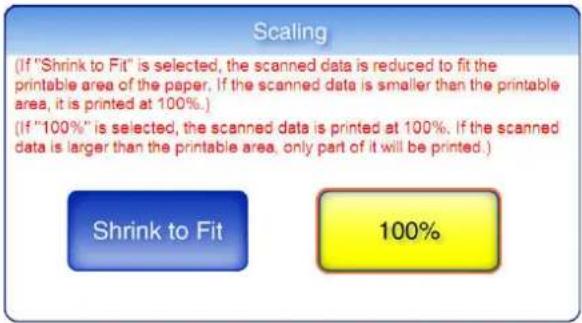
text_image
Scaling (If "Shrink to Fit" is selected, the scanned data is reduced to fit the printable area of the paper. If the scanned data is smaller than the printable area, it is printed at 100%.) (If "100%" is selected, the scanned data is printed at 100%. If the scanned data is larger than the printable area, only part of it will be printed.) Shrink to Fit 100%- Shrink to Fit
The image is reduced so that the entire image fits into the area available for printing (area inside the dotted line). Further enlargement is not possible.
If the positioning setting is "Center", the control point for printing is the center point of the area available for printing. If the positioning setting is "Top Left", the control point for printing is the top left corner of the area available for printing. For more details on the positioning setting, refer to "6.6.2 Positioning" (page 349).

text_image
Center Available Area for Printing Control Point Top Left Control Point Available Area for Printing| Print Sheet | Scanned Data | Positioning | Result |
Small Large Center |  | 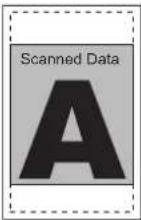 | |
| Top Left | 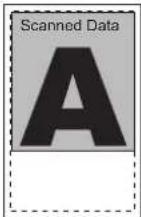 | ||
| Print Sheet Scanned Data Positioning Result | |||
Large Small Center 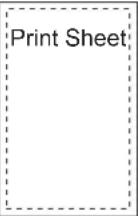 |  | 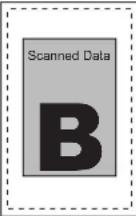 | |
| Top Left | 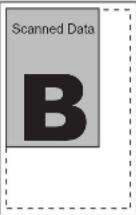 | ||
Same Same Center  |  | 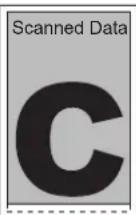 | |
| Top Left | |||
100%
The image is printed at full scale, regardless of the paper size.
If the positioning setting is "Center", the control point for printing is the center point of the print sheet. If the positioning setting is "Top Left", the control point for printing is the top left corner of the print sheet. For more details on the positioning setting, refer to "6.6.2 Positioning" (page 349).

text_image
Center Available Area for Printing Control Point Top Left Control Point Available Area for Printing| Print Sheet Scanned Data Positioning Result | |||
Small Large Center |  | 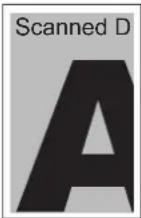 | |
| Top Left | |||
Large Small Center | 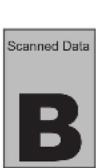 | 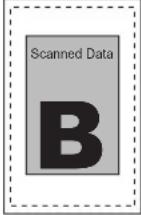 | |
| Top Left |  | ||
| Print Sheet | Scanned Data | Positioning | Result |
Same Same Center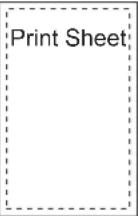 |  |  | |
| Top Left | |||
This returns to the "Print" screen. The selected scaling setting is displayed to the right of the [Scaling] button.

● Nothing is printed in the margin set in the printer settings.
If edge cropping has been set, the width of the edge cropping setting may be larger than the margin set in the printer settings. For more details, refer to "6.9.18 Edge Cropping" (page 400).
- If "Shrink to Fit" is set, the edge cropping area is not included in the print data.
If "100%" is set, the edge cropping area is included in the print data.
- When "Shrink to Fit" is set, the printing result may differ from the original document since the starting position or available area of printing depends on each individual printer.
6.6.2 Positioning
Set the print position of the scanned data.
The setting selected here will be used every time the user prints a document.
- Press the [Positioning] button.
→ The "Positioning" screen appears.
- Select the print positioning of the data.
By default, this is "Center".
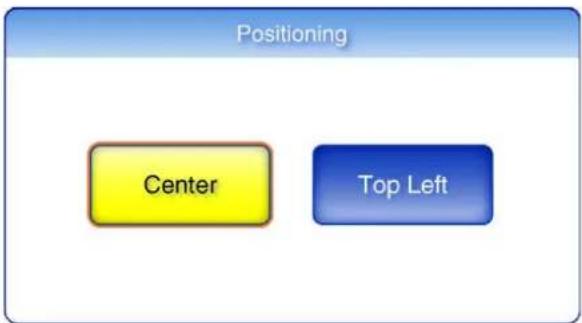
text_image
Positioning Center Top Left| Button Scaling Control Point | |
Center Shrink to Fit Uses the center point of the area available for printing as a control point. Center  | |
100% Uses the center point of the sheet as a control point. 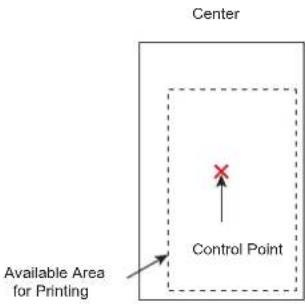 | |
Top Left Shrink to Fit Uses the top left corner of the area available for printing as a control point.Top Left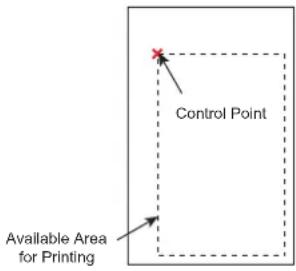 | |
100% Uses the top left corner of the print sheet as a control point.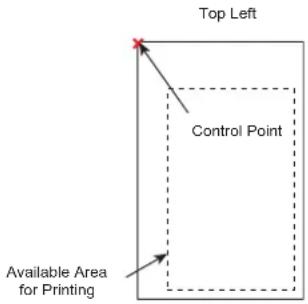 | |
For more details on the print scaling setting, refer to "6.6.1 Scaling" (page 344).
This returns to the "Print" screen. The selected positioning setting is displayed to the right of the [Positioning] button.
6.6.3 Simplex/Duplex
Set whether to print on one side (simplex mode) or both sides (duplex mode).
- Press the [Simplex/Duplex] button.
→ The "Simplex/Duplex" screen appears.
- Select a print mode.
Initially, this setting is "Duplex (Long Edge)".
"Long Edge" means that sheets are flipped vertically for printing.
"Short Edge" means that sheets are flipped horizontally for printing.


According to the printer, settings from the printers properties screen may be used instead.

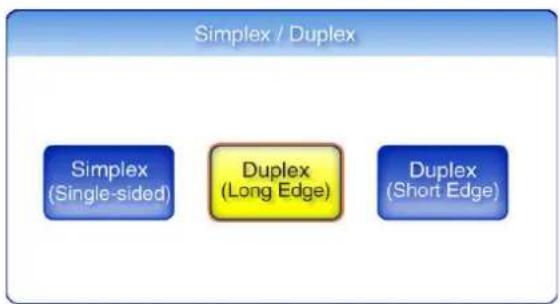
flowchart
graph LR
    A["Simplex / Duplex"] --> B["Simplex (Single-sided)"]
    A --> C["Duplex (Long Edge)"]
    A --> D["Duplex (Short Edge)"]
→ This returns you to the "Print" screen.
The selected mode is displayed to the right of the [Simplex/Duplex] button.
6.7 Saving the Scanned Data to a Network Folder
- On the "Main Menu" screen, press the [Save] button.
→ The "Save" screen appears.
Network folder preferences are saved for each user, and will be shown each time that user logs in.

Scan preferences can be changed by pressing the [Scan Settings] button. For more details, refer to "6.9 Setting the Scan Options" (page 365).
- Press the [Select] button.
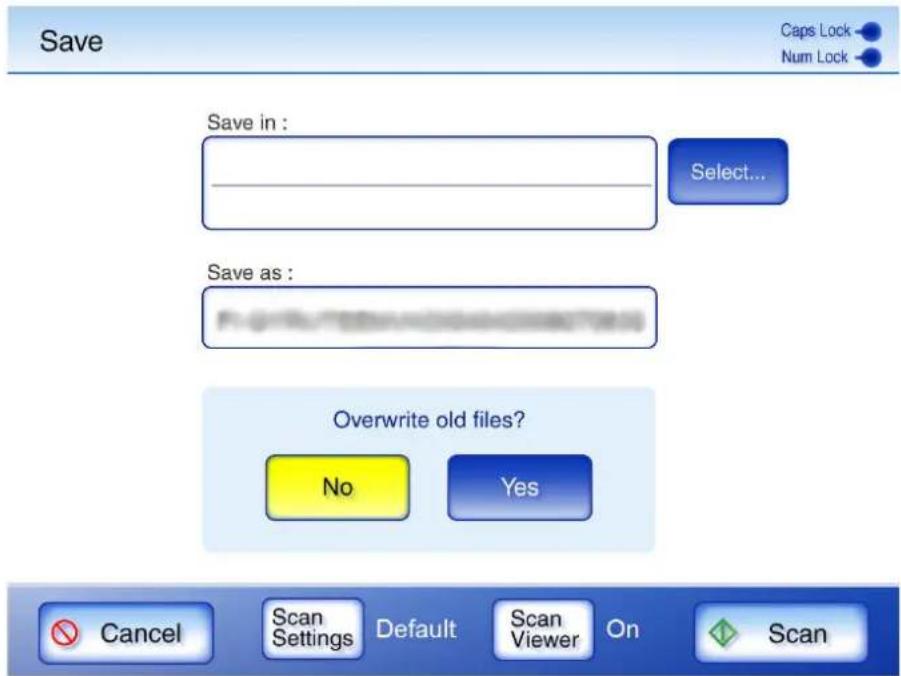
text_image
Save Caps Lock Num Lock Save in : Select... Save as : Overwrite old files? No Yes Cancel Scan Settings Default Scan Viewer On Scan⇒ The "Folder List" screen appears.
3. Select a network folder.

- On the "Folder List" screen, select a folder and press the [Details] button to view the details of the selected network folder. If a folder name is too long for one line, it will wrap onto the next line. Any hidden parts of the name may be revealed by finger dragging and scrolling.
- Only network folders which are in the list may be selected. Only the administrator may add folders to the list, or edit the details of folders already on the list.
For more details about adding network folders, refer to "4.7.14 Setting the Network Folders" (page 132).
Folder List
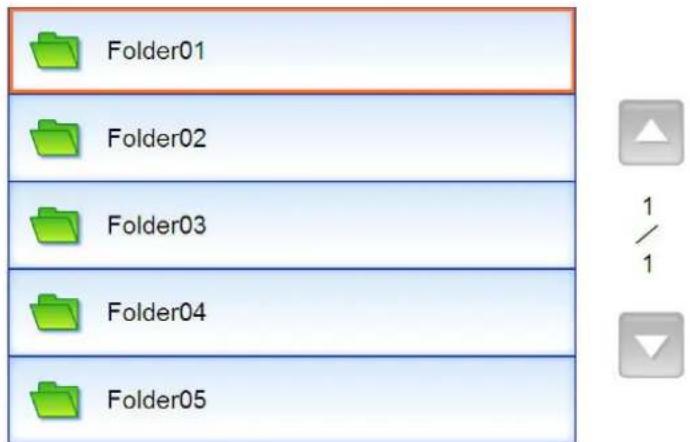
text_image
Folder01 Folder02 Folder03 Folder04 Folder05
Cancel
Details

OK
4. Press the [OK] button.
→ This returns you to the "Save" screen.
![FUJITSU fi-6010N - Press the [OK] button. - 1](/content/2026/06/1236812/images/fafb3830a5dcdd9e5e64e74793eb089618aeca5421fb4d283c40a56f1cb3e0b4.jpg)
User authentication may sometimes be required to access the file server. If authentication is required, the "File Server Authentication" screen appears. The authentication procedure is as follows.
- Enter a "User Name" and "Password" for the file server. Passwords are case sensitive.
![FUJITSU fi-6010N - Press the [OK] button. - 2](/content/2026/06/1236812/images/f94eb0ddc3de0ccec43ec02d435e2ae66a92aa4f78eddaa2433a8908f0a8c420.jpg)
text_image
File Server Authentication Caps Lock Num Lock User Name : Password : Cancel OK- Press the [OK] button.
5. In the "Save as:" field, enter a file name for the scanned data to be saved.
File names may be up to 128 characters long. \ and / are used as folder separator characters. The following symbols cannot be used.
$$ : *? ^ {\prime \prime} < > | $$
The default setting is the file name set on the administrator "File Names (Save)" screen. For more details, refer to "4.6.9 Setting a File Name Format for When Saving Scanned Data" (page 72).

● The following file names cannot be used:
CON
PRN
- AUX
- CLOCK\$
NUL
- COM0 to COM9
- LPT0 to LPT9
- If the file format is changed in "Scan Settings", the file name set on the "File Names (Save)" screen is reset in the "Save As" field.
- Select if existing files with the same name are to be overwritten.
The default setting is [No].
If a file name already exists on the network, the existing file will not be overwritten and the scanned data will be lost. Whether or not the file was successfully saved can be checked in the user log.
For more details about accessing the user log, refer to "6.12 Checking the User Log" (page 410).
- Press the [Scan] button.
When [Scan Viewer] is Off, this will be a [Scan&Save] button.
→ Scanning starts.
Each page is briefly shown on the screen as it is scanned.
The maximum number of pages that can be scanned is 999.
When [Blank Page Skip] is enabled, the number of scanned pages excluding skipped blank pages is shown.
Additional pages can be scanned in place of skipped blank pages, until the maximum number of scanned pages is reached.
When the scan has completed, the "Scan Viewer" screen opens.
For more details about the "Scan Viewer" screen, refer to "6.11 Editing the Scanned Data in the Scan Viewer" (page 405).

- [Scan Viewer] is initially "On".
- When the [Scan&Save] button is pressed (when [Scan Viewer] is "Off"), after the last page is displayed on the "Scanning" screen, the scan data is saved, and the touch panel screen returns to the "Main Menu".
For more details, refer to "6.10 Enabling/Disabling the Scan Viewer" (page 402).
- Check the scanned data.
For more details about the "Scan Viewer" screen, refer to "6.11 Editing the Scanned Data in the Scan Viewer" (page 405).
- On the "Scan Viewer" screen, press the [Save] button.
The specified file name is used to save the scanned data in the selected network folder.

Saving scan data in Folder01
→ The "Main Menu" screen is shown again.

If the saving to the network folder fails, an error message with the following title is sent by e-mail from the scanner to the e-mail address registered in the LDAP server for the currently logged-in user.
Network Scanner (XXXX) Error
6.8 Saving the Scanned Data in a SharePoint Folder
- On the "Main Menu" screen, press the [Scan to SharePoint] button.
→ The "Scan to SharePoint" screen appears.

Scan preferences can be changed by pressing the [Scan Settings] button. For more details, refer to "6.9 Setting the Scan Options" (page 365).
- Press the [Select] button for the "Save in" field.

text_image
Scan to SharePoint Caps Lock Num Lock Save in : Select... Save as : Document Splitting Content Type : Select... Overwrite old files? No Yes Cancel Scan Settings Default Scan Viewer On Scan→ The "Folder List" screen appears.
3. Select a folder.

- On the "Folder List" screen, select a folder and press the [Details] button to view the details of the selected folder. If a folder name is too long for one line, it will wrap onto the next line. Any hidden parts of the name may be revealed by finger dragging and scrolling.
- Only folders which are in the list may be selected. Only the administrator may add folders to the list, or edit the details of sites or folders already on the list. For more details about adding folders, refer to "4.7.15 Setting the SharePoint Folders" (page 145).
Folder List

text_image
SharePoint Folder1 SharePoint Folder2 SharePoint Folder3 SharePoint Folder4
text_image
Cancel Details OK4. Press the [OK] button.
![FUJITSU fi-6010N - Press the [OK] button. - 1](/content/2026/06/1236812/images/a8e3f44d7d0e842d90ddad0809d9014bc4de6b65b3ca83c9d9fbe8bf591b84e1.jpg)
According to the setting, user authentication may be required to access the SharePoint server. In this case, the "Sign In" screen is shown. Perform the following procedure for authentication.
- Enter the "User Name", "Password", and "Domain". Passwords are case sensitive.
![FUJITSU fi-6010N - Press the [OK] button. - 2](/content/2026/06/1236812/images/8bf21ee1c836c218ddf7c3db7b04e0ad9d057697a0335d7424e6c75383f56dca.jpg)
text_image
Sign In User Name : Password : Domain : Cancel Caps Lock Num Lock- Press the [OK] button.
→ This returns you to the "Scan to SharePoint" screen.
- In the "Save as" field, enter a file name for the scanned data to be saved.
File names may be up to 113 characters long. \ and / are used as folder separator characters. The following symbols cannot be used.
$$ \sim \text {"} # \% \& *: < >? {\mid } $$
The default setting is the file name set on the administrator "File Names (Save)" screen. For more details, refer to "4.6.8 Changing the Admin Password" (page 71).
![FUJITSU fi-6010N - Press the [OK] button. - 3](/content/2026/06/1236812/images/f8d492ac79af1aeefd1dae5b7a62c33e47d12fe3e1f818ea7cd378e1f45b099c.jpg)
● The following file names cannot be used:
CON
PRN
- AUX
- CLOCK\$
• NUL
- COM0 to COM9
- LPT0 to LPT9
- If the file format is changed in "Scan Settings", the file name set on the "File Names (Save)" screen is reset in the "Save As" field.
6. Press the [Document Splitting] button.
→ The "Document Splitting" screen appears.
Configure the settings to split a file of scanned data into multiple files when the file size exceeds the maximum file limit.
![FUJITSU fi-6010N - Press the [Document Splitting] button. - 1](/content/2026/06/1236812/images/62bf17cca3e0d354b05e289d1d9173100ade4006a646bf5fbbb0d905727b79a0.jpg)
text_image
Document Splitting Scan data larger than 45MB needs to be split into multiple files for saving. Specify the size of the split files. Max. File Size : 45 [MB] Approx. Page Limits : RGB Color : 80 Page Grayscale : 80 Page Black & White : 202 Page Cancel O K- In the "Max. File Size" field, enter the maximum file size at which a file is to be split into multiple files.
The default setting is 45. The value can be specified within the range of 1 to 45 MB. The number of pages that can be saved in a file varies according to the resolution and color mode of scanned data.
Approximate page file sizes are shown below.
Page sizes are estimated for when the paper size is specified as A4, and the color mode and resolution are changed accordingly, from default scan settings.
Actual paper size: A4 size (general catalog)
File format: PDF
Scanner paper size setting: A4
| Resolution | Approximate File Size of a Page (KB) | ||
| RGB Color Grayscale Black & White | |||
| 150 dpi 310 124 | |||
| 200 dpi 550 220 | |||
| 300 dpi 1250 500 | |||
| 600 dpi 5000 2000 | |||
![FUJITSU fi-6010N - Press the [Document Splitting] button. - 2](/content/2026/06/1236812/images/bc0d38b7a7c5f2a400cad3f7e3a32bd113071ba23520bd88ca15e14d73ad4041.jpg)
- When the file size of a single page exceeds the specified maximum file size, the page is saved as one file.
-
The file name format of split files is: "original_file_name-file_number-total_number_of_split_files" File numbers and the total number of split files are added in 4 digits. For example, if the total number of split files is "5", it will be shown as "0005".
-
Press the [OK] button.
→The "Scan to SharePoint" screen is shown again.
-
In "Content Type", set the content type for the scanned data to be managed on the SharePoint server.
-
Press the [Select] button for the "Content Type" field.
→A content type selection screen appears. -
Select a content type, and press the [OK] button.
![FUJITSU fi-6010N - Press the [Document Splitting] button. - 3](/content/2026/06/1236812/images/4b658a7028901e34396d6a09992089080246638cb9affa8e083d02864491f10b.jpg)
text_image
Content Type Document Picture 1 / 1 Cancel OK⇒The selected content type is set.
According to the selected content type, a list of properties defined on the SharePoint server is shown in the "Scan to SharePoint" screen.
-
Set properties in either of the following ways.
-
Enter properties directly in the "Scan to SharePoint" screen.
-
Press the button on the side of a property to be edited, and set the property in the "Edit Properties" screen.
-
is shown for a property setting that can be directly entered. These settings can also be directly entered on the "Scan to SharePoint" screen.
- is shown for a property to be set by selecting an available item.
Edit Properties
![FUJITSU fi-6010N - Press the [Document Splitting] button. - 4](/content/2026/06/1236812/images/0ad1a2ebabf7a35a469931bd7830989b2ff2bafd260c8e0a4c1c8ac3b2302d4f.jpg)
![FUJITSU fi-6010N - Press the [Document Splitting] button. - 5](/content/2026/06/1236812/images/4740e1e3402a4cb9e60dbc6ba127cc6e62e2cf7e640e2a02ad36a84e281ed5b7.jpg)
text_image
Title![FUJITSU fi-6010N - Press the [Document Splitting] button. - 6](/content/2026/06/1236812/images/e8768608c30d5628b05b33daa9ff7e2fe418cae217a88a5952a04e6ffd35824e.jpg)
Cancel
![FUJITSU fi-6010N - Press the [Document Splitting] button. - 7](/content/2026/06/1236812/images/53c136d171ab751450ed6b7d72701a65b3b3880786971ddca3f051bbd3268f93.jpg)
![FUJITSU fi-6010N - Press the [Document Splitting] button. - 8](/content/2026/06/1236812/images/b3ba7b3e8ce0a60ab5cd2c0e1bf4da262287375d474cb5a2da40ccf6043bb87f.jpg)
- The following properties cannot be set via the "Edit Properties" screen:
- Description
- Categories
● Date Picture Taken
- If properties that cannot be set are required when saving to a SharePoint folder, the file will be saved in a checked out state. The checked out state can be released once the mandatory fields have been set. Checked out files cannot be overwritten.
![FUJITSU fi-6010N - Press the [Document Splitting] button. - 9](/content/2026/06/1236812/images/1a5f8898ae8eeb28ea8e7a5260249b9691c78d7385f289815d5601b8bb93e4dc.jpg)
The following properties can be set.
- Single line of text
● Multiple lines of text - Choice
Number - Currency
- Date and Time
- Yes/No
-
Person or Group
● Hyperlink or Picture -
Select if existing files with the same name are to be overwritten.
The default setting is [No].
If a file name already exists, the existing file will not be overwritten and the scanned data will be lost. Whether or not the file was successfully saved can be checked in the user log. For more details about accessing the user log, refer to "6.12 Checking the User Log" (page 410).
- Press the [Scan] button.
When [Scan Viewer] is Off, this will be a [Scan&Save] button.
→ Scanning starts.
Each page is briefly shown on the screen as it is scanned.
The maximum number of pages that can be scanned is 999.
When [Blank Page Skip] is enabled, the number of scanned pages excluding skipped blank pages is shown.
Additional pages can be scanned in place of skipped blank pages, until the maximum number of scanned pages is reached.
When the scan has completed, the "Scan Viewer" screen opens.
For more details about the "Scan Viewer" screen, refer to "6.11 Editing the Scanned Data in the Scan Viewer" (page 405).
![FUJITSU fi-6010N - Press the [Document Splitting] button. - 10](/content/2026/06/1236812/images/4b99e2af020d79243d27b1a6d7419c358f7c88294eaa834a96f16aeb281b4741.jpg)
- [Scan Viewer] is initially "On".
-
When the [Scan&Save] button is pressed (when [Scan Viewer] is "Off"), after the last page is displayed on the "Scanning" screen, the scan data is saved, and the touch panel screen returns to the "Main Menu".
For more details, refer to "6.10 Enabling/Disabling the Scan Viewer" (page 402). -
Check the scanned data.
For more details about the "Scan Viewer" screen, refer to "6.11 Editing the Scanned Data in the Scan Viewer" (page 405).
- On the "Scan Viewer" screen, press the [Save] button.
![FUJITSU fi-6010N - Press the [Document Splitting] button. - 11](/content/2026/06/1236812/images/260641afa6b9f755ed40a59a2952d3a8d80ce826e8862892bda84b20b3b897e6.jpg)
- When a file is overwritten, the properties of the existing file are replaced by those of the new file.
- When multiple files are saved in TIFF or JPEG format, identical properties are set to all the files.
- If required items other than "Single line of text" or "Multiple lines of text" are set for the properties of the specified folder content types, files saved in the SharePoint folder will be checked out. To change the checkout status, enter values for the required items via a Web browser, and then check in the files.
The specified file name is used to save the scanned data in the selected SharePoint folder.
![FUJITSU fi-6010N - Press the [Document Splitting] button. - 12](/content/2026/06/1236812/images/c5b31014a276d5246fa8c62c8770a7813882e2de107542e09f508cb58fa91cdb.jpg)
Saving scan data in SharePoint Folder1
⇒ The "Main Menu" screen is shown again.
6.9 Setting the Scan Options
On the following screens, press the [Scan Settings] button to access the "Scan Settings" screens.
● "Send e-Mail" screen
- "Send Fax" screen
- "Print" screen
- "Save" screen
- "Scan to SharePoint" screen
The "Scan Settings" screen contains the following items.
• [Basic] tab
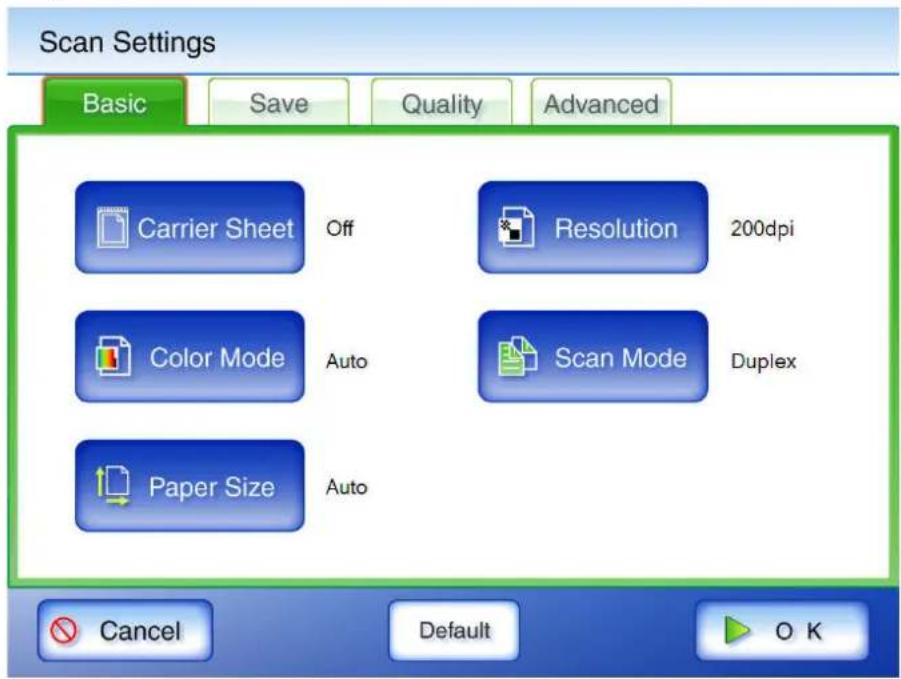
text_image
Scan Settings Basic Save Quality Advanced Carrier Sheet Off Resolution 200dpi Color Mode Auto Scan Mode Duplex Paper Size Auto Cancel Default OK- [Save] tab

text_image
Scan Settings Basic Save Quality Advanced File Format PDF PDF Password No Searchable PDF No Compression Medium Cancel Default OK• [Quality] tab

text_image
Scan Settings Basic Save Quality Advanced Brightness Medium Dropout Color None Contrast Medium Background Removal Medium Sharpness None Cancel Default OK- [Advanced] tab
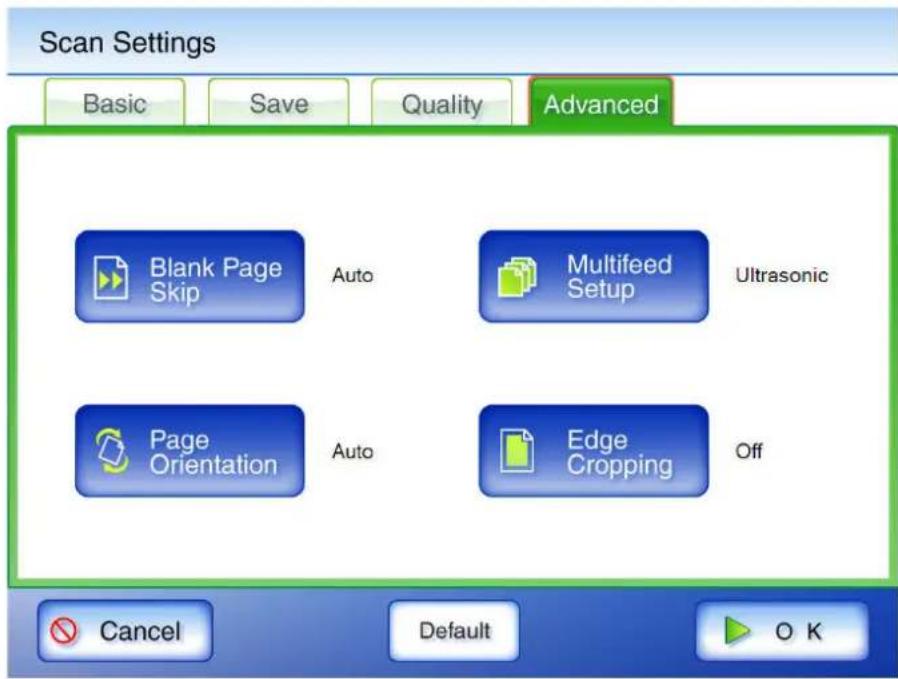
text_image
Scan Settings Basic Save Quality Advanced Blank Page Skip Auto Multifeed Setup Ultrasonic Page Orientation Auto Edge Cropping Off Cancel Default OKThe following two classes of setting options are available.
- Default
These are the factory settings. To put a high priority on the scan speed, press the [Default] button.
- Custom
This is shown when the user has customized any scanning preferences from the "Default" option.
Press each scan option button to set it as desired.
Function settings (for e-Mail, Fax, Print, Save) are saved for each user, and will be used each time that user logs in.
For details, refer to the sections from "6.9.1 Carrier Sheet" (page 372) onward.
The following scan option settings are used if the Default settings are selected.
| Tab Option | Default | When Custom, see...e-M | |||||
| Scan to SharePoint | |||||||
| Basic Carrier Sheet | Off Off Off Off | page 372 | |||||
| Color Mode Auto Black & White(*) | Auto Auto | Auto page 373 | |||||
| Paper Size | Auto | Auto | Auto | Auto | page 374 | ||
| Resolution | 200dpi | 200dpi | 200dpi | 200dpi | page 378 | ||
| Scan Mode | Duplex | Duplex | Duplex | Duplex | page 379 | ||

| Tab Option | Default | When Custom, see... | |||||
| Fax | Save | Scan to SharePoint | |||||
| Save File Format PDF TIF | F(*) JPEG(*) PDF PDF | page 380 | |||||
| Searchable PDF | No No(*) No (*) No No page 382 | ||||||
| PDF Pass-word | No No(*) No (*) No no page 385 | ||||||
| Compression | Medium | Medium(*) | Low(*) | Medium | Medium | ||
| Quality | Brightness | Medium | Medium | Medium | Medium | Medium | page 390 |
| Contrast | Medium | Medium | Medium | Medium | Medium | page 391 | |
| Sharpness | None | None | None | None | None | page 392 | |
| Dropout Color | None | None | None | None | None | page 393 | |
| Background Removal | Medium | Medium | Medium | Medium | Medium | page 394 | |
| Advanced Blank Page Skip | Auto | Auto | Off | Auto | Auto | page 395 | |
| Page Orientation | Auto | Off | Off(*) | Auto | page 396 | ||
| Multifeed Setup | Ultra-sonic | Ultrasonic | Ultra-sonic | Ultra-sonic | page 399 | ||
| Edge Cropping | Off | Off | Off | Off | page 400 | ||
(*): Fixed value. Cannot be changed.

● The selected setting is displayed to the right of each button.
- Settings changed before the previous logout are shown by red characters for each regular user.
- When the "Scan Settings" screen is opened from the "Send Fax" or "Print" screen, the [Save] tab is not displayed.
Setting these scan options may influence other scan settings items.
- Setting an option may cause other option settings to become invalid.
- Other option settings may cause these option settings to become invalid.
Scan option settings may be influenced in the following ways.
| Tab Option | Setting which become invalid | Conditions of setting which become invalid | ||
| Basic Carrier Sheet ● Paper Size | ● Resolution, "600dpi"● Scan Mode● Brightness● Contrast● Dropout Color● Background Removal● Blank Page Skip● Page Orientation, other than "Auto"● Multifeed Setup | — | ||
| Basic | Paper Size | Auto | ● Resolution, "600dpi" | ● Carrier Sheet |
| Long Page Mode | ● Resolution, "600dpi"● Searchable PDF● Blank Page Skip● Page Orientation● Multifeed Setup | ● Carrier Sheet● Color Mode, "Auto" | ||
| Other than Auto and Long Page Mode | — | ● Carrier Sheet | ||
| Resolution 600dpi ● Searchable PDF, "All Pages" and "Pages"● High Compression for Color PDF● Dropout Color, "None" (when Color Mode is "Grayscale")● Page Orientation, other than "Auto" | ● Carrier Sheet● Paper Size, "Auto" and long page mode | |||
| Scan Mode | — | ● Carrier Sheet | ||
| Save File Format PDF | — | — | ||
| JPEG ● Searchable PDF● PDF Password lock● Compression, "High Compression for Color PDF" | ● Color Mode, "Auto" or "Black & White" | |||
| TIFF MTIFF | — | |||
| Searchable PDF | First Page | — | ||
| All Pages Pages | — | |||
| Require PDF Password | — | |||
| Save Compression | High Compression for Color PDF | — | ● Color Mode, "Grayscale" or "Black & White"● Other than PDF output file format● Resolution, "600dpi" | |
| Other than High Compression for Color PDF | — | ● Color Mode, "Black & White" | ||
| Quality Brightness | — | ● Carrier Sheet | ||
| Contrast | — | |||
| Sharpness | — | |||
| Dropout Color | None | |||
| — | ||||
| Other than None | — | |||
| Background Removal | — | |||
| Advanced Blank Page Skip | — | ● Carrier Sheet● Paper Size, long page mode | ||
| Page Orientation | Auto | |||
| Other than Auto | ||||
| Multifeed Setup | — | |||
| Edge Cropping | — | |||
6.9.1 Carrier Sheet
Set whether or not to use a Carrier Sheet. If a Carrier Sheet is to be used, set the output size of the scanned image.
- On the "Scan Settings" screen, select the [Basic] tab.
- Press the [Carrier Sheet] button.
→ The "Carrier Sheet Output Image Size" screen appears.
- If a Carrier Sheet is to be used, select the output size for the scanned image.
Carrier Sheet Output Image Size
When this option is used, the front and back scans are stitched together into a single image.

flowchart
graph LR
    A["Document with ABC"] --> B["Photo editing with ABC"]
    B --> C["Printer printing with a downward arrow"]
Fold the oversize document being scanned, and fully insert it into the carrier sheet, with the fold against the edge with the thick line.

text_image
Off A 3 B 4 11"×17"
natural_image
Solid blue gradient background with no text, symbols, or discernible objects| Carrier Sheet Setup Status | |
| Off Scan without using a Carrier Sheet | |
| A3 Scan with a Carrier | Sheet, and output as A3 size (297 × 420mm) |
| B4 Scan with a Carrier | Sheet, and output as B4 size (257 × 364mm) |
| 11" × 17" Scan with a | Carrier Sheet, and output as a "11 × 17 inch" size(279.4 × 431.8mm) |
*: All paper sizes are of portrait orientation.
This returns you to the "Scan Settings" screen. The selected setting is displayed to the right of the [Carrier Sheet] button.
6.9.2 Color Mode
Set whether the document is scanned in "color" or "black and white".
- On the "Scan Settings" screen, select the [Basic] tab.
- Press the [Color Mode] button.
→ The "Color Mode" screen appears.
- Select the color mode.

text_image
Color Mode Auto RGB Color Grayscale Black & White| Color Mode Description | |
| Auto Automatically | decides whether to scan in color or in black and white based on document contents. |
| RGB Color Scans documents in color. | |
| Grayscale Scans documents in grayscale. | |
| Black & White Scans documents in black and white. | |
→ Selecting a color mode returns you to the "Scan Settings" screen.
The selected mode is displayed to the right of the [Color Mode] button.

Usually, the color mode should be set as [Auto].
If this setting is specified, there is no need to change the color mode each time you scan a document.
Note that black and white mode may be automatically selected for the following kinds of documents:
● Faintly toned nonwhite papers
● Documents with only a minor amount of color
- Documents printed in gray or other close-to-black colors.
To ensure such documents are scanned in color mode, press the [RGB Color] button on the "Color Mode" screen.
6.9.3 Paper Size
Set a paper size for the scan data.
- On the "Scan Settings" screen, select the [Basic] tab.
-
Press the [Paper Size] button.
⇒ The "Paper Size" screen appears. -
Select a paper size for the scan data.
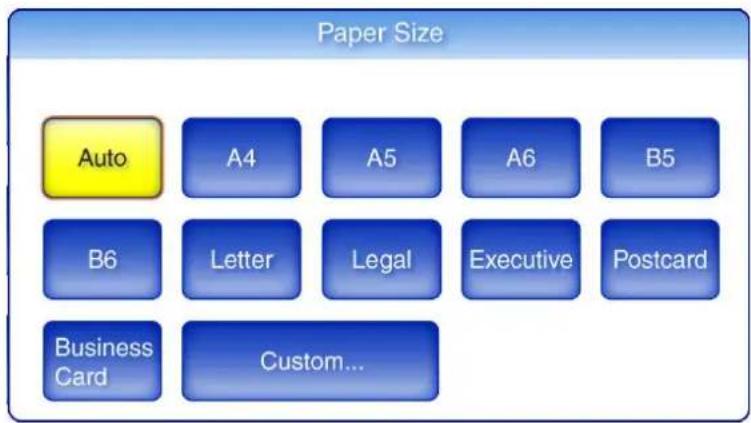
text_image
Paper Size Auto A4 A5 A6 B5 B6 Letter Legal Executive Postcard Business Card Custom...| Button Paper size (mm) Button Paper size (mm) | ||
| A4 210 × 297 Letter 215.9 × 279.4 | ||
| A5 148 × 210 Legal 215.9 × 355.6 | ||
| A6 105 × 148 Executive 184.2 × 266.7 | ||
| B5 182 × 257 Postcard 100 × 148 | ||
| B6 128 × 182 Business Card 51 × 89 | ||
*: All paper sizes are of portrait orientation.
Selecting a paper size returns you to the "Scan Settings" screen. The selected size is displayed to the right of the [Paper Size] button.


When the [Auto] setting is used, the paper size is set to the same size (Maximum: 215.9 × 355.6mm) as the actual document being scanned. However, if using any of the following types of documents, the automatic paper size detection may not function correctly:
● Paper of weight less than 52g/m^2 (14lb)
- Documents that are not rectangular
● Documents with margins that are filled with dark colors

- If a paper size other than [Auto] is selected and only one side of the documents is scanned, artwork on the reverse side of the paper may bleed through onto the front side scan. If this happens, blank pages may not be recognized as such, and thus may not be skipped by the "Skip Blank Page" function. For more details, refer to "6.9.15 Blank Page Skip" (page 395).
-
When [Custom] settings are used, any paper size for the scan data can be specified.
-
Press the [Custom] button.
→The "Custom Paper Size" screen appears.
- Enter the paper size for the scan data.
The size ranges that can be set are:
Width: 2 to 8.5in (50.8 to 216mm)
Height: 2.91 to 14in (74 to 355.6mm)
If the height is 14in or longer, the paper size setting must be set to allow long pages. For more details, refer to "Long Page Mode" (page 376).

text_image
Custom Paper Size Width 2.00 inch 2.00 to 8.50 50.8 mm 50.8 to 216.0 Height 2.91 inch 2.91 to 14.00 74.0 mm 74.0 to 355.6 Allow long pages? No Yes ("Long Page" paper size is incompatible with the "Auto" color mode) Cancel OK- Press the [OK] button.
→The custom paper size is set.
■ Long Page Mode
When scanning pages which are longer than standard documents, the "Allow long pages" setting must be specified.
- On the "Scan Settings" screen, select the [Basic] tab.
- Press the [Paper Size] button.
→ The "Paper Size" screen appears.
- Press the [Custom] button.
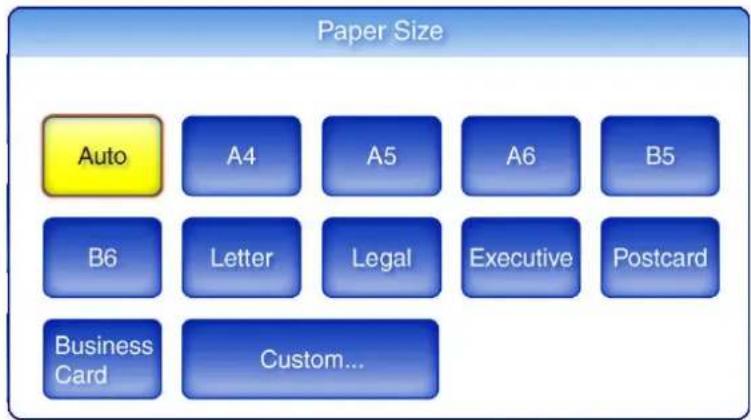
text_image
Paper Size Auto A4 A5 A6 B5 B6 Letter Legal Executive Postcard Business Card Custom...→ The "Custom Paper Size" screen appears.
- For "Allow long pages?", press the [Yes] button.
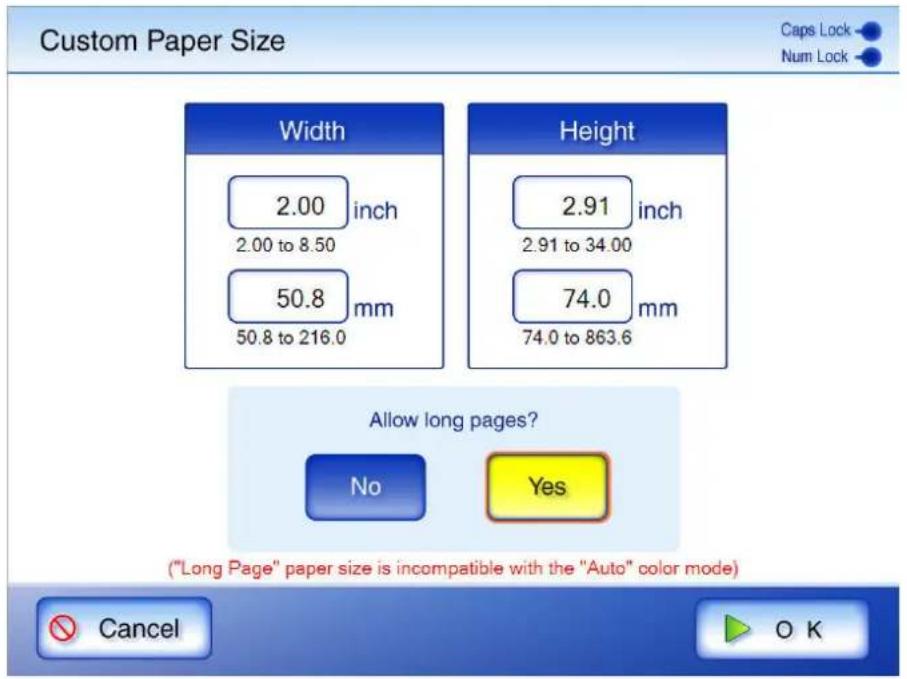
text_image
Custom Paper Size Width 2.00 inch 2.00 to 8.50 50.8 mm 50.8 to 216.0 Height 2.91 inch 2.91 to 34.00 74.0 mm 74.0 to 863.6 Allow long pages? No Yes ("Long Page" paper size is incompatible with the "Auto" color mode) Cancel OK- Enter the paper size for the scan data.
The size ranges that can be set are:
Width: 2 to 8.5 in (50.8 to 216 mm)
Height: 2.91 to 34 in (74 to 863.6 mm)
- Press the [OK] button.
⇒ This returns you to the "Scan Settings" screen. "Custom" is displayed to the right of the [Paper Size] button.
6.9.4 Resolution
Changing the resolution level affects the scan data in the following ways.
| High resolution Low resolution | ||
| Scan speed Slow Fast | ||
| Scan quality High Low | ||
| File size Large Small |
- On the "Scan Settings" screen, select the [Basic] tab.
- Press the [Resolution] button.
→ The "Resolution" screen appears.
- Select a resolution level.
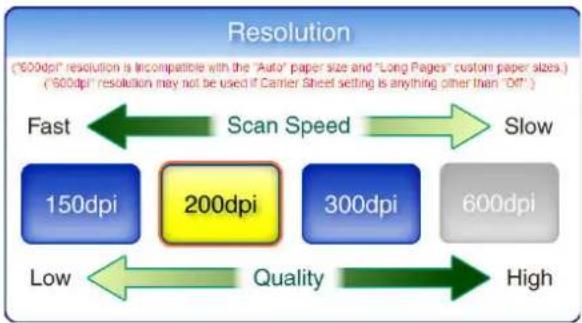
flowchart
graph LR
    A["Fast"] --> B["Scan Speed"]
    B --> C["Slow"]
    D["150dpi"] --> E["200dpi"]
    E --> F["300dpi"] --> G["600dpi"]
    H["Low"] --> I["Quality"]
    I --> J["High"]
    style A fill:#4CAF50,stroke:#388E3C
    style B fill:#FFA500,stroke:#388E3C
    style C fill:#4CAF50,stroke:#388E3C
    style D fill:#4CAF50,stroke:#388E3C
    style E fill:#FFA500,stroke:#388E3C
    style F fill:#4CAF50,stroke:#388E3C
    style G fill:#4CAF50,stroke:#388E3C
    style H fill:#4CAF50,stroke:#388E3C
    style I fill:#4CAF50,stroke:#388E3C
    style J fill:#4CAF50,stroke:#388E3C
Selecting a resolution level returns you to the "Scan Settings" screen. The selected level is displayed to the right of the [Resolution] button.
6.9.5 Scan Mode
Set whether one side or both sides of documents are scanned.
-
On the "Scan Settings" screen, select the [Basic] tab.
-
Press the [Scan Mode] button.
→ The "Scan Mode" screen appears.
- Select [Simplex] if only the front sides of the documents are to be scanned. Select [Duplex] if both front and reverse sides are to be scanned.
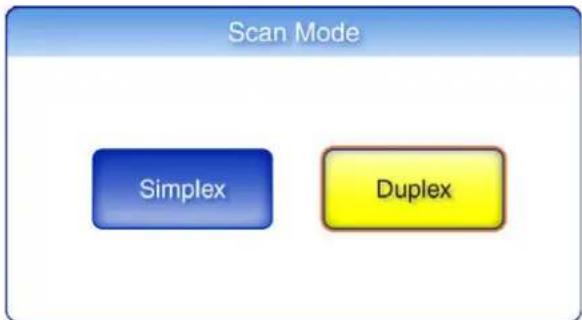
text_image
Scan Mode Simplex DuplexSelecting a scan mode returns you to the "Scan Settings" screen. The selected mode is displayed to the right of the [Scan Mode] button.
6.9.6 File Format
Set the file format for the scan data.
For some scan settings, it may not be possible to select certain file formats.
| Option PDF JPEG TIFF MTIFF | |||
| Searchable PDF | A | — | — |
| PDF Password | A | — | — |
| Compression | A (*1) A A (*1) A (*1) |
A: Format can be used, —: Format cannot be used
(*1): Can only be used if the "Color Mode" is [Auto] or [RGB Color]
Compression also differs for certain file formats as follows:
| Color Mode Document | File Format | |||
| PDF JPEG TIFF/MTIFF | ||||
| Auto | Color | JPEGHigh Compression for Color PDF | JPEG JPEG | |
| Black & White (*) | MMR (NA) MMR | |||
| RGB Color | Color or Black & White | JPEGHigh Compression for Color PDF | JPEG JPEG | |
| Grayscale | Color or Black & White | JPEG JPEG JPEG | ||
| Black & White | Color or Black & White | MMR (NA) MMR | ||
(NA): Not available

- When PDF format is selected, select whether or not to use "High Compression for Color PDF" mode. When "High Compression for Color PDF" is selected, characters and backgrounds on the document are compressed separately. In order to do this, the file size of the document that mostly consists of text characters becomes smaller while keeping the quality of the characters as they are. However, this mode is not appropriate for scanning photographs or pictures since these graphical materials are recognized as background and compressed as such, causing degradation in the scanned image. If this setting is specified, the contrast of the image may become higher.
- If PDF format is selected, Adobe Reader 4.0 or later is required to view the created PDF file.
-
On the "Scan Settings" screen, select the [Save] tab.
-
Press the [File Format] button.
⇒ The "File Format" screen appears.
- Select a file format.

text_image
File Format ("JPEG" format is incompatible with the "Auto" or "Black & White" color mode) PDF JPEG TIFF MTIFFSelecting a file format returns you to the "Scan Settings" screen. The selected format is displayed to the right of the [File Format] button.
6.9.7 Searchable PDF
When the file format is PDF, the scanned data can be converted to a searchable PDF.

The scanner may fail to correctly recognize the following kinds of documents (characters) as text. However, by changing color mode and/or improving image quality for scanning, such a document may be successfully recognized.
● Handwritten documents
● Documents including smaller characters and scanned in low quality
- Skewed documents
● Documents written in languages other than English
● Documents including texts written in italic characters
- Superscript/subscript letters and complex mathematical formulas
● Characters are written against an unevenly-colored or patterned background
● Characters to which effects (Shadow, Outline, and the like) are applied
- Shaded characters
- Documents of complex layout as well as documents including unreadable characters due to print-through and smudges
(For such documents, the recognition time may be long)

Creating a searchable PDF will take some additional time.
- On the "Scan Settings" screen, select the [Save] tab.
- Press the [Searchable PDF] button.
→ The "Searchable PDF" screen appears.
- Select which pages are to be made searchable in the PDF.
Searchable PDF
(Creating a Searchable PDF can take a long time)
("All Pages" and "Pages..." may not be used with "600dpi" resolution)

text_image
No First Page All Pages Pages...Text Recognition Language
English

Cancel

OK
| Searchable PDF Description | |
| No A searchable PDF is not created. | |
| First Page Only the first page of the PDF is made searchable. | |
| All Pages All pages of the PDF are made searchable. | |
| Pages... Only the specified range of pages in the PDF is made searchable. |

- The page numbers set here correspond to those shown on the Preview and "Scan Viewer" windows.
- After pressing the [Pages] button, the "Searchable PDF for Pages" screen appears. Multiple ranges of pages cannot be set.
- Press the [Pages] button.
→The "Searchable PDF for Pages" screen appears.
- Enter a start page and end page.
Values between 1 and 999 may be entered.

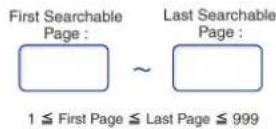
These numbers are the same as those in the Preview and Scan Viewer.

text_image
Cancel OK- Press the [OK] button.
- If [First Page], [All Pages], or [Pages] is selected, [Text Recognition Language] can also be selected.
- Press the [Text Recognition Language] button.
→The "Text Recognition Language" screen appears.
-
Select the searchable language for the PDF.
-
Press the [OK] button.
⇒This returns you back to the "Searchable PDF" screen. The selected range is displayed to the right of the [Text Recognition Language] button.
- Press the [OK] button.
This returns you to the "Scan Settings" screen. The selected range is displayed to the right of the [Searchable PDF] button.
6.9.8 PDF Password
PDF files can be locked with a user-specified password.


The password will need to be entered every time the password protected PDF file is opened. Do not forget or lose this password.
- On the "Scan Settings" screen, select the [Save] tab.
- Press the [PDF Password] button.
⇒ The "Require PDF Password" screen appears.
- Select whether or not a password is required.
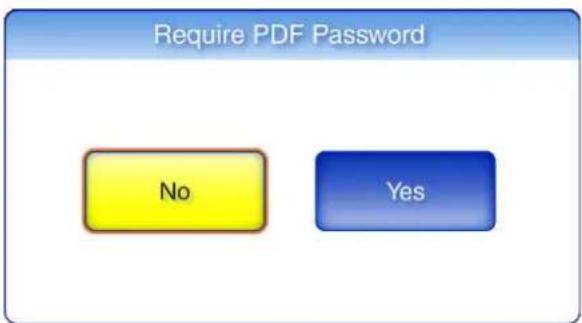
text_image
Require PDF Password No YesWhen [Yes] is selected, the "PDF Password" screen appears.
- Enter a password and confirm password.
Passwords may be up to 16 characters long.
In addition to alphanumeric characters, spaces and the following symbols can be used:
$$ !" # S \% \& ^ {\prime} () * +, -. /:; < = >? @ [ \backslash ] ^ {\wedge} _ {-} ^ {\prime} {| } \sim $$
"Password" and "Confirm Password" are case sensitive.
PDF Password
Password :

Confirm Password :

text_image
PDF
Cancel

OK

● The "Caps Lock" indicator is on if the keyboard's Caps Lock is set.
● The "Num Lock" indicator is on if the keyboard's Num Lock is set.
- Press the [OK] button.
→ The PDF will be created with password protection.

On the "Require PDF Password" screen, pressing the [No] button cancels the set password.
The next time a password is set, pressing the [Yes] button enters the previously set password by default.
6.9.9 Compression
When [Auto], [RGB Color], or [Grayscale] is selected for the "6.9.2 Color Mode" (page 373), it is also possible to set the compression level.
Setting a compression level (1 to 5) reduces the file size when scanning documents such as photographs or figures.
Changing the compression level affects the scanned data in the following ways.
| High compression Low compression | ||
| Quality Low High | ||
| File size Small Large | ||
- On the "Scan Settings" screen, select the [Save] tab.
- Press the [Compression] button.
⇒ The "Compression" screen appears.
- Select a compression level.
The lower the selected compression level is, the higher the quality of the resulting scan will be, but at the expense of a larger file.
When PDF format is selected in "6.9.6 File Format" (page 380), "High Compression for Color PDF" can be used.
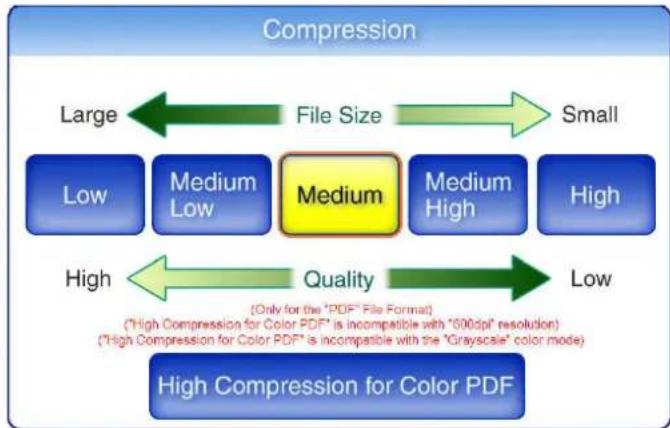
flowchart
graph LR
    A["Large"] --> B["File Size"]
    B --> C["Small"]
    D["Low"] --> E["Medium Low"]
    E --> F["Medium"]
    F --> G["Medium High"]
    G --> H["High"]
    I["High"] --> J["Quality"]
    J --> K["Low"]
    style F fill:#FFD700,stroke:#333
    note right of F
        (Only for the "PDF" File Format)
        (High Compression for Color PDF* is incompatible with "600dpi" resolution)
        (High Compression for Color PDF* is incompatible with the "Grayscale" color mode)
    end
Selecting a compression level returns you to the "Scan Settings" screen. The selected level is displayed to the right of the [Compression] button.

- When "High Compression for Color PDF" is selected, characters and backgrounds on the document are compressed separately. In order to do this, the file size of the document that mostly consists of text characters becomes smaller while keeping the quality of the characters as they are. However, this mode is not appropriate for scanning photographs or pictures since these graphical materials are recognized as background and compressed as such, causing degradation in the scanned image. If this setting is specified, the contrast of the image may become higher.
- If "High Compression for Color PDF" is selected, according to the type of document, the file size may be larger than if a standard compression level is used.
● Documents with many photographs or figures and only a few characters
● Complex layout documents with multiple columns
● Documents which have a background pattern behind characters
- For documents with many characters scanned at 300dpi resolution, a smaller file size than that of High Compression for Color PDF is possible.
- When one color page is scanned, the file size criteria are shown as follows. These numbers are for reference, other documents may vary in size.
Actual paper size: A4 size (general catalog)
File format: PDF
Scanner paper size setting: A4
● File size (KB) for color files
| Resolution | Low | Medium Low | Medium | Medium High | High | High Compression for Color PDF |
| 150dpi 406 | 232 197 | 153 94 158 | ||||
| 200dpi 647 | 358 302 | 238 149 140 | ||||
| 300dpi 1319 | 693 580 | 448 272 115 | ||||
| 600dpi 3827 | 2034 17 | 36 1377 854 | — |
● File size (KB) for grayscale files
| Resolution | Low | Medium Low | Medium | Medium High | High | High Compression for Color PDF |
| 150dpi 380 | 233 186 | 153 85 | — | |||
| 200dpi 618 | 373 293 | 239 133 | — | |||
| 300dpi 1422 | 825 606 | 494 245 | — | |||
| 600dpi 3416 | 2147 18 | 27 1338 720 | — |

● File size (KB) for black & white files
| Resolution | Compression level cannot be selected |
| 150dpi 104 | |
| 200dpi 176 | |
| 300dpi 382 | |
| 600dpi 1430 |
6.9.10 Brightness
The brightness setting can be adjusted to improve the visual appearance of the scanned data.
- On the "Scan Settings" screen, select the [Quality] tab.
- Press the [Brightness] button.
⇒ The "Brightness" screen appears.
- Select a brightness level.
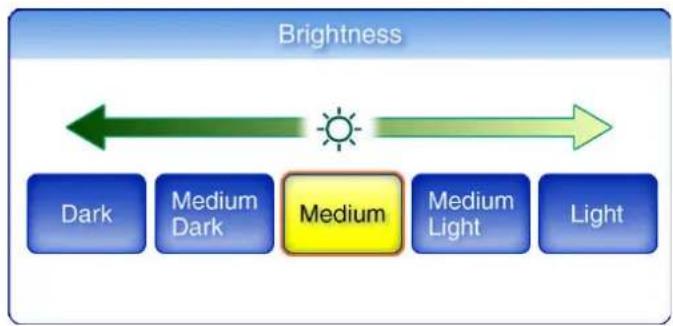
flowchart
graph LR
    A["Dark"] --> B["Medium Dark"]
    B --> C["Medium"]
    C --> D["Medium Light"]
    D --> E["Light"]
    F["Brightness"] --> G["Sun Icon"]
    G --> H["Green Arrow"]
Selecting a brightness level returns you to the "Scan Settings" screen. The selected level is displayed to the right of the [Brightness] button.
6.9.11 Contrast
The color contrast setting can be adjusted to improve the visual appearance of the scan.
- On the "Scan Settings" screen, select the [Quality] tab.
- Press the [Contrast] button.
⇒ The "Contrast" screen appears.
- Select a contrast level.
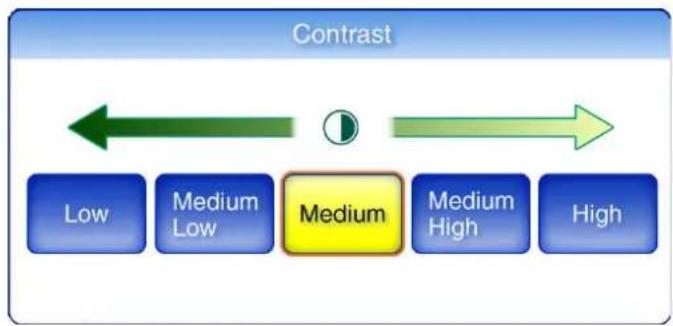
flowchart
graph LR
    A["Low"] --> B["Medium Low"]
    B --> C["Medium"]
    C --> D["Medium High"]
    D --> E["High"]
    style C fill:#FFD700,stroke:#333
    style D fill:#66B2FF,stroke:#333
    style E fill:#90EE90,stroke:#333
Selecting a contrast level returns you to the "Scan Settings" screen. The selected level is displayed to the right of the [Contrast] button.
6.9.12 Sharpness
The sharpness setting adjusts the sharpness of characters on an image to improve the visual appearance of the scanned data. When using the sharpness setting, the sharpness level can be adjusted with this setting.
-
On the "Scan Settings" screen, select the [Quality] tab.
-
Press the [Sharpness] button.
→ The "Sharpness" screen appears.
- If the sharpness setting is to be used, select a sharpness level.

flowchart
graph TD
    A["Weak"] --> B["Medium Weak"]
    B --> C["Medium"]
    C --> D["Medium Strong"]
    D --> E["Strong"]
    F["None"] --> G["Green Arrow"]
    G --> H["Green Arrow"]
    H --> I["Green Arrow"]
    I --> J["Green Arrow"]
    J --> K["Green Arrow"]
| Sharpness Status | |
| None Characters are not sharpened. | |
| Weak Sharpens characters | at a weak level |
| Medium Weak Sharpens characters | at a medium weak level |
| Medium Sharpens characters | at a medium level |
| Medium Strong Sharpens characters | at a medium strong level |
| Strong Sharpens characters | at a strong level |
Selecting a sharpness level returns you to the "Scan Settings" screen. The selected level is displayed to the right of the [Sharpness] button.
6.9.13 Dropout Color
Selecting either green, red, or blue (primary colors), removes the details of the selected color from a scanned image.
For example, if a document with black characters and a green border is scanned, only the black characters will appear on the scanned image if [Green] is selected at the dropout color.
When using the dropout color setting, the color details to be removed can be selected with this setting.

natural_image
A row of identical black squares on a white background, no text or symbols present.
This setting may not remove colors that are of dark density.

-
On the "Scan Settings" screen, select the [Quality] tab.
-
Press the [Dropout Color] button.
→ The "Dropout Color" screen appears.
- If color details are to be removed, select a color to be used as the dropout color.
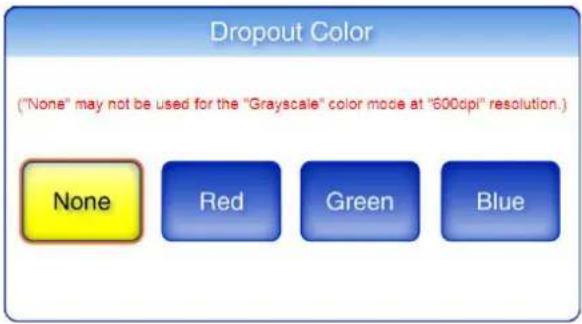
text_image
Dropout Color ("None" may not be used for the "Grayscale" color mode at "600dpi" resolution.) None Red Green Blue| Dropout Color Status | |
| None Scan without removing any color details. | |
| Red Scan and remove all red details. | |
| Green Scan and remove all green details. | |
| Blue Scan and remove all blue details. | |
Selecting a dropout color returns you to the "Scan Settings" screen. The selected setting is displayed to the right of the [Dropout Color] button.
6.9.14 Background Removal
The background of a scanned image can be removed to make image clearer. The level of background removal can be adjusted.
-
On the "Scan Settings" screen, select the [Quality] tab.
-
Press the [Background Removal] button.
⇒ The "Background Removal" screen appears.
- Select a background removal level.

flowchart
graph LR
    A["Weak"] --> B["Medium Weak"]
    B --> C["Medium"]
    C --> D["Medium Strong"]
    D --> E["Strong"]
    F["OBA"] --> C
    G["Green Arrow"] --> F
Selecting a background removal level returns you to the "Scan Settings" screen. The selected level is displayed to the right of the [Background Removal] button.

When [Image Quality] is selected for "Operating Mode" on the "General Scanner Settings" screen, the background removal level cannot be adjusted. For details, refer to "4.6.13 Setting General Scanner Settings" (page 83).
6.9.15 Blank Page Skip
The scan process can be set to skip any blank pages in the scanned document.
For example, when a stack of documents containing both two-sided and one-sided documents is scanned in duplex scan mode, this feature removes only the reverse side (i.e. blank page) of one-sided documents from the scanned data.

- If the Brightness setting (see "6.9.10 Brightness" (page 390)) is set to [Dark] or [Medium Dark], blank pages may not be recognized as such by the scanner.
- No scanned data is produced if all of the sheets in the document stack are recognized as blank pages.
- The following types of documents may be accidentally recognized as blank pages.
Before discarding the scanned documents, check for pages accidentally removed from the scanned data. If any pages have been removed, the document may need to be re-scanned. - Almost blank pages containing only a few characters
-
Page of only one color (including black), without any patterns, lines, or characters.
-
On the "Scan Settings" screen, select the [Advanced] tab.
- Press the [Blank Page Skip] button.
→ The "Blank Page Skip" screen appears.
- Select whether or not blank pages are to be skipped.
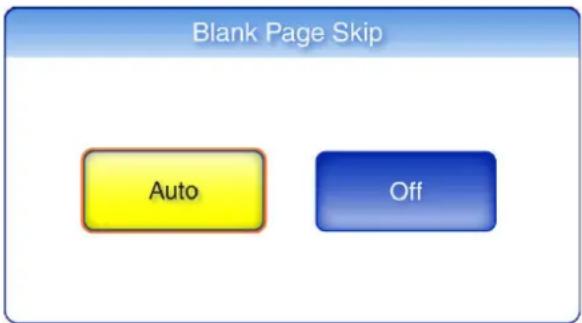
text_image
Blank Page Skip Auto Off⇒ This returns you to the "Scan Settings" screen. The selected setting is displayed to the right of the [Blank Page Skip] button.
6.9.16 Page Orientation
Automatically rotates each scanned data page that contains text through 0^ , 90^ , 180^ , or 270^ , so the text is upright.

This function determines a document orientation based on Roman characters printed on the document. Therefore, it may not work properly for the following kinds of documents: When scanning such documents, do not set automatic page orientation.
● Documents with many extremely large/small characters
- Documents on which the pitch of lines or characters is extremely narrow, or characters overlap
● Documents with many characters that contact underlines or ruled lines
● Documents with many photographs or figures and only a few characters
● Documents which have a background pattern behind characters
● Documents with characters printed in various direction (e.g. plans)
● Documents written in languages other than English
● Documents with only capital letters
● Handwritten documents
● Unclear or smeared characters
- On the "Scan Settings" screen, select the [Advanced] tab.
- Press the [Page Orientation] button.
→ The "Page Orientation" screen appears.
- Select whether or not automatic page orientation is required.
Page Orientation
Should page orientation be used?

If every page is to be rotated in the same direction, set the angle. (Only "Off" and "Auto" are allowed when Carrier Sheet is used or for "600dpi")




What is the bind direction?
(Only available for "Duplex" scans.)



Cancel

OK
| Page Orientation | Status |
| Off Scanned page is not automatically rotated. | |
| Auto Automatically rotates scanned page. | |
Top-feed Scanned page is not rotated. | |
Left-feed Rotates scanned page 90 degrees left. | |
Right-feed Rotates scanned page 90 degrees right. | |
Bottom-feed Rotates scanned page 180 degrees. | |
Long Edge | This setting can only be used if the [Top-feed], [Left-feed], [Right-feed], or [Bottom-feed] button is selected.Select this setting when scanning a document with opposing left and right pages.The scanned data is output with the same orientation as the original document. Front side From Reaside SideFeed directionScanned dataOriginal do Front side From Reaside SideFeed directionScanned dataOriginal do |
Short Edge | This setting can only be used if the [Top-feed], [Left-feed], [Right-feed], or [Bottom-feed] is selected.Select this setting when scanning a document with opposing top and bottom pages.The front side of the document is output with the same orientation as the original data, whereas the data on the reverse side is rotated 180 degrees. |
 F F | |
This returns you to the "Scan Settings" screen. The selected setting is displayed to the right of the [Page Orientation] button.

Irrespective of what page orientation is decided, pages may still be manually rotated as desired in the "Scan Viewer" screen.
For more details about the "Scan Viewer" screen, refer to "6.11 Editing the Scanned Data in the Scan Viewer" (page 405).
6.9.17 Multifeed Detection (Layer and Length)
"Multifeed" is an error that occurs when two or more sheets are fed simultaneously into the scanner by the ADF. The scanner can be set to detect multifeeds and stop the scan with an error message. Multifeeds are to be detected by layer and length. The following explains how to set whether or not multifeeds are to be detected, and setup multifeed detection method.
For multifeed requirements, refer to "A.5 Multifeed Detection Conditions" (page 486).
-
On the "Scan Settings" screen, select the [Advanced] tab.
-
Press the [Multifeed Setup] button.
→ The "Multifeed Setup" screen appears.
- If mutlifeeds are to be detected, select which detection method is to be used.
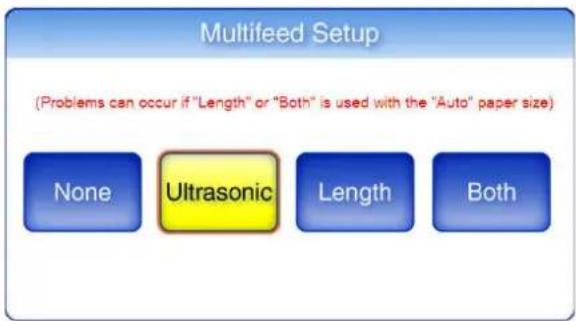
text_image
Multifeed Setup (Problems can occur if "Length" or "Both" is used with the "Auto" paper size) None Ultrasonic Length Both| Multifeed Setup | Status |
| None Multifeeds | are not detected.If scanning plastic cards, select [None]. For more details about scanning plastic cards, refer to "A.2 Paper Requirements" (page 481). |
| Ultrasonic Multifeeds are detected by layer. | |
| Length Multifeeds | are detected by length. |
| Both Multifeeds are detected by both layer and length. | |

An error will occur if the [Length] or [Both] multifeed setting is used with the [Auto] paper size, and the document bundle being scanned contains different size pages.
This returns you to the "Scan Settings" screen. The selected setting is displayed to the right of the [Multifeed Setup] button.
For scanned data, the width of the area for edge cropping can be adjusted, so that unwanted sections are not scanned.
If using edge cropping, the width of the edges to be cropped can be adjusted with this setting.
-
On the "Scan Settings" screen, select the [Advanced] tab.
-
Press the [Edge Cropping] button.
→ The "Edge Cropping" screen appears.
- If edge cropping is to be used, enter the width of the edges to be cropped.
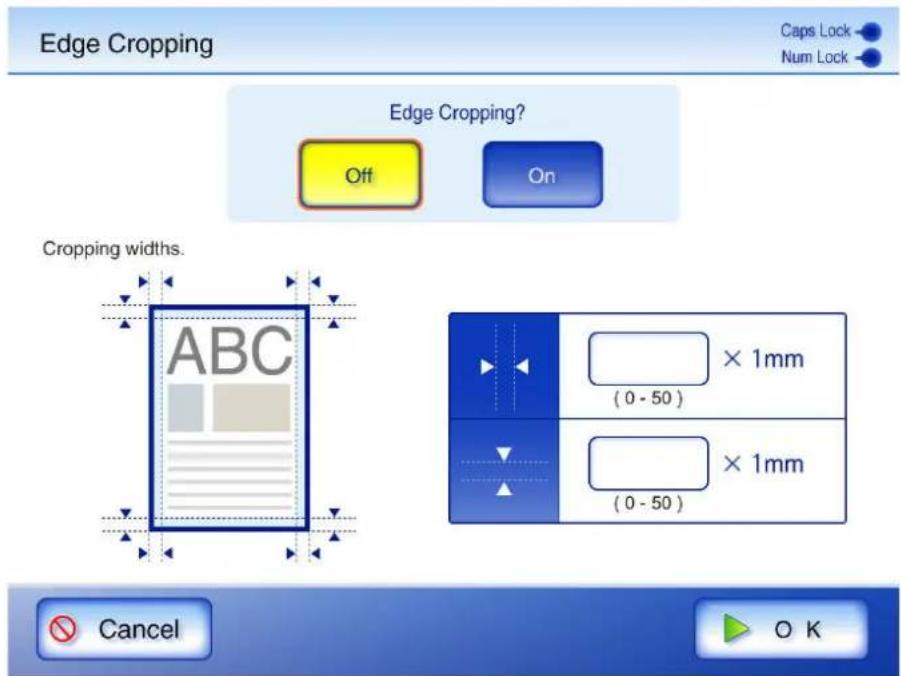
text_image
Edge Cropping Caps Lock Num Lock Edge Cropping? Off On Cropping widths. ABC × 1mm (0 - 50) × 1mm (0 - 50) Cancel OK| Edge Cropping Setup Status | |
| Off Scan without cropping edges. | |
| On Scan and crop edges. | Enter a value for Top/Bottom and Left/Right from 0 to 50.Enter values in units of 1mm. |
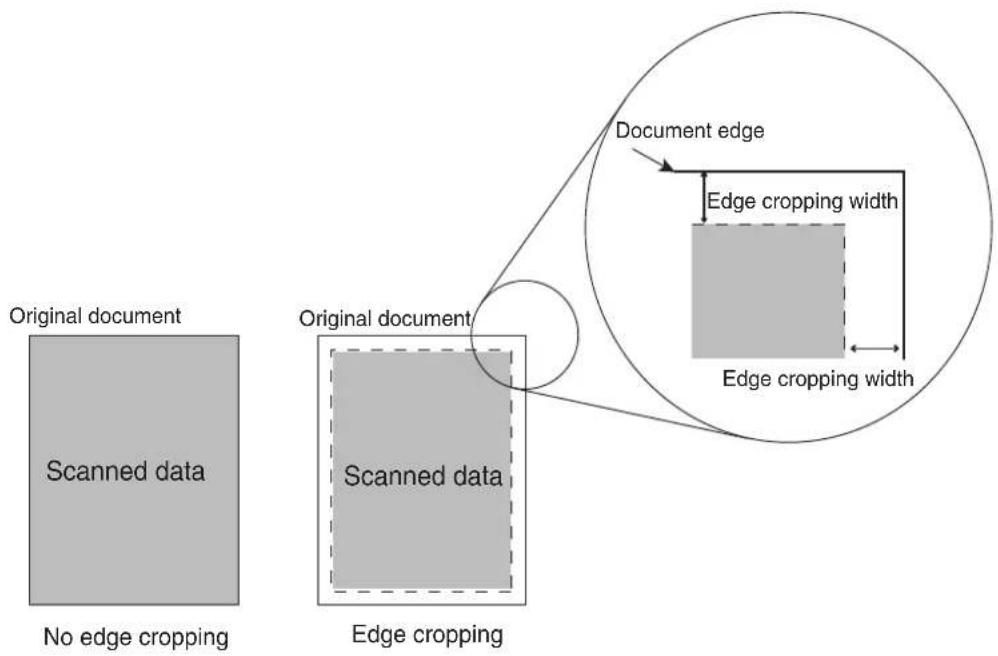
text_image
Original document Scanned data No edge cropping Original document Scanned data Edge cropping Document edge Edge cropping width Edge cropping width4. Press the [OK] button.
This returns you to the "Scan Settings" screen. The selected setting is displayed to the right of the [Edge Cropping] button.
![FUJITSU fi-6010N - Press the [OK] button. - 1](/content/2026/06/1236812/images/f9e05eb2236e76f244c9133e2992dfc46db1486c3180630872ddfde535940299.jpg)
- If the edge cropping width (top to bottom/left to right edge cropping width total) is larger than the document, the edge cropping setting is not applied.
- If page orientation is set, edge cropping is performed after the document orientation is corrected. In the following example, [Left-feed] is selected for page orientation.
![FUJITSU fi-6010N - Press the [OK] button. - 2](/content/2026/06/1236812/images/58af73c3020e1ebfad871c726d541a71f6d62feb4e419db1d683588b84a8a109.jpg)
flowchart
graph LR
    A["Document"] --> B["Page Orientation"]
    B --> C["Edge Cropping"]
    A --> D["ABC"]
    B --> E["ABC"]
    C --> F["ABC"]
    style A fill:#333,stroke:#000,color:#fff
    style B fill:#333,stroke:#000,color:#fff
    style C fill:#333,stroke:#000,color:#fff
    style D fill:#999,stroke:#000,color:#fff
    style E fill:#999,stroke:#000,color:#fff
    style F fill:#999,stroke:#000,color:#fff
6.10 Enabling/Disabling the Scan Viewer
The "Scan Viewer" can be set to appear before the scanned data is processed.
The scanned data can be checked and edited on the "Scan Viewer". For details, refer to "6.11 Editing the Scanned Data in the Scan Viewer" (page 405).
If desired, in the following screens, the "Scan Viewer" can be set to be appear before the scanned data is finally processed.
● "Send e-Mail" screen
- "Send Fax" screen
- "Print" screen
- "Save" screen
- "Scan to SharePoint" screen
● "Job Menu" screen


When the [Scan Viewer] button is disabled on the "Job Menu" screen, it is not possible to select whether or not to show the "Scan Viewer".
The following explains how to enable or disable the "Scan Viewer" using the "Send e-Mail" screen.
- On the "Send e-Mail" screen, press the [Scan Viewer] button.
⇒ Pressing the [Scan Viewer] button will toggle the setting back and forth between "On" and "Off".
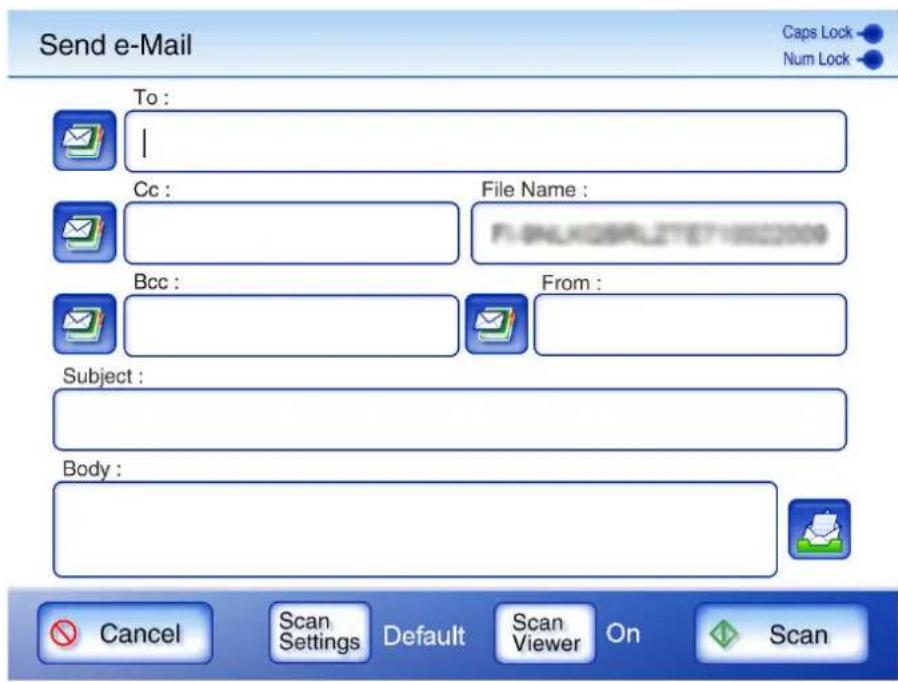
text_image
Send e-Mail Caps Lock Num Lock To : I Cc : File Name : F:\ALL\GBRJETF\1602000 Bcc : From : Subject : Body : Cancel Scan Settings Default Scan Viewer On ScanOperations after scanning vary according to whether the "Scan Viewer" is set to "On" or "Off". If sending an e-mail, scan operation proceeds as follows:
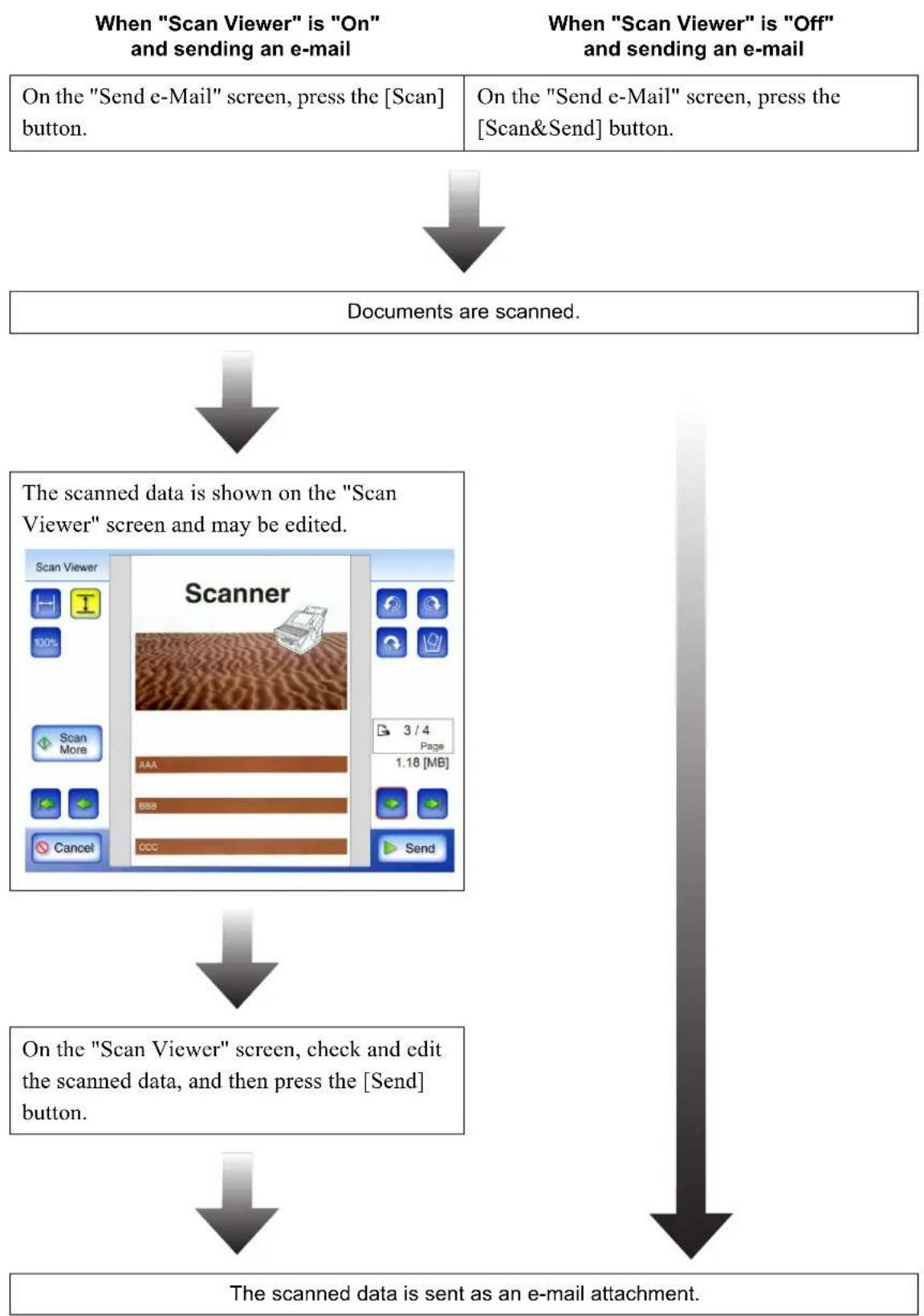
flowchart
graph TD
    A["When "Scan Viewer" is "On" and sending an e-mail"] --> B["On the "Send e-Mail" screen, press the [Scan"] button.]
    C["When "Scan Viewer" is "Off" and sending an e-mail"] --> D["On the "Send e-Mail" screen, press the [Scan&Send"] button.]
    E["Documents are scanned."] --> F["The scanned data is shown on the "Scan Viewer" screen and may be edited."]
    F --> G["Scan Viewer Scanner with AAA/BBB/CCC/Send"]
    G --> H["On the "Scan Viewer" screen, check and edit the scanned data, and then press the [Send"] button.]
    H --> I["The scanned data is sent as an e-mail attachment."]

● During the scan, the following screen is shown.
The file size is shown in units of 10KB on the right of the screen.
If "High Compression for Color PDF" has been selected, the pre-compression file size is shown.
Note that because the final output file has not been created yet, the actual file size may differ from the estimated value shown.
Also note that skipped blank pages are not included in the total file size page count.
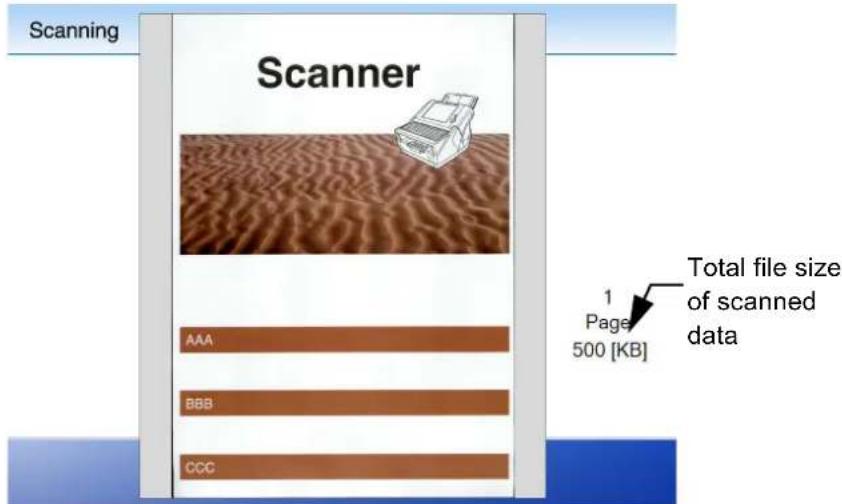
text_image
Scanning Scanner AAA BBB CCC 1 Page 500 [KB] Total file size of scanned data- When the "Scan Viewer" is set to "Off", after the last page has been scanned, the [Cancel] button is displayed for 5 seconds.
text_image
Scanning Scanner AAA BBB CCC 1 Page 2.10 [MB] CancelIf the [Cancel] button is pressed, a confirmation message appears. When the [OK] button is pressed, the scanned data is deleted and the screen returns to one of the following:
- Send e-Mail
- Send Fax
- Save
- Scan to SharePoint
- Job Menu
6.11 Editing the Scanned Data in the Scan Viewer
When the "Scan Viewer" is set to "On", the scanned data can be checked and edited in the "Scan Viewer".
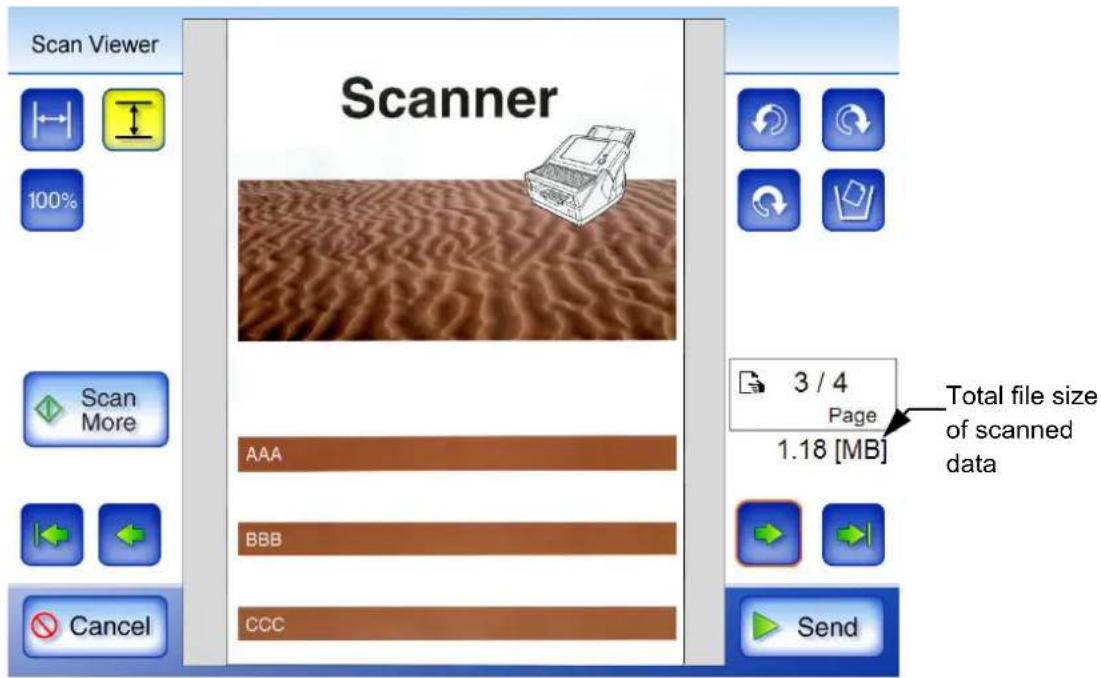
text_image
Scan Viewer 100% Scan More Cancel Scanner AAA BBB CCC 3 / 4 Page 1.18 [MB] Total file size of scanned data Send6.11.1 Viewing a Scanned Page
The scanned data shown in the "Scan Viewer" screen can be displayed as actual or reduced size. The scanned data can be moved by dragging it across the screen.
- On the "Scan Viewer" screen, use the following buttons to scroll though the pages of scanned data.
text_image
When is pressed, the top page of the scanned data will be shown. When is pressed, the previous page of the scanned data will be shown. When is pressed, the next page of the scanned data will be shown. When is pressed, the last page of the scanned data will be shown.- Check the contents of the page shown.
When ispressed, the scanned data will be shown without any magnification or reduction.
When is pressed, the width of the scanned data will be scaled to fit the "Scan Viewer" screen.
When is pressed, the height of the scanned data will be scaled to fit the "Scan Viewer" screen.
6.11.2 Rotating a Scanned Page
The scanned data showed on the "Scan Viewer" screen can be rotated 90 degrees right or left, or 180 degrees.
If the scanned data is rotated 90 degrees, the edited scanned data, in its rotated condition, can be sent as an e-mail attachment, by fax, print, or saved to a network folder.
- On the "Scan Viewer" screen, use the following buttons to display the page you wish to rotate.
text_image
When is pressed, the top page of the scanned data will be shown. When is pressed, the previous page of the scanned data will be shown. When is pressed, the next page of the scanned data will be shown. When is pressed, the last page of the scanned data will be shown.- Press either [90^] or the [180^] button.
text_image
When is pressed, the page is rotated 90 degrees to the left. When is pressed, the page is rotated 90 degrees to the right. When is pressed, the page is rotated 180 degrees.
The actual scanned data is updated to include the rotated page as soon as the button is pressed.
If the [Cancel] button is pressed, all the scanned data is deleted and the screen returns to one of the following.
- Send e-Mail
- Send Fax
- Save
- Scan to SharePoint
- Job Menu
6.11.3 Adding a Scanned Page
On the "Scan Viewer" screen, an additional page can be scanned.
-
Load the documents into the ADF paper chute.
-
On the "Scan Viewer" screen, press the [Scan More] button.
→ Scanning starts.
Each page is briefly shown on the screen as it is scanned.
Any additionally scanned pages are added after the current scanned data. The page numbers of additional pages will follow on from the last page of the current scanned data.
The maximum number of pages that can be scanned is 100 for a print operation, and 999 for other operations.
When [Blank Page Skip] is enabled, the number of scanned pages excluding skipped blank pages is shown.
Additional pages can be scanned in place of skipped blank pages, until the maximum number of scanned pages is reached.
When the scan has completed, the "Scan Viewer" screen opens and shows any additionally scanned pages.
6.11.4 Deleting a Scanned Page
Specified pages can be deleted from the scanned data shown on the "Scan Viewer" screen.
If specified pages are deleted, the remaining scanned data is sent as an e-mail attachment, by fax, print, or saved to a network folder, without the deleted pages.
-
On the "Scan Viewer" screen, press the [Previous] or [Next] button to display the page you wish to delete.
-
Press the [Delete] button.
A confirmation message appears.
- Press the [OK] button.
⇒ The page is deleted.

- If the scanned data consists of only one page, that page cannot be deleted. To re-scan the document, press the [Cancel] button.
- The deleted page is removed from the actual scanned data as soon as the button is pressed, so this procedure can not be undone.
- If the [Cancel] button is pressed, a confirmation message appears. When the [OK] button is pressed, the scanned data is deleted and the screen returns to whichever one of the following it came from:
- Send e-Mail
- Send Fax
- Save
- Scan to SharePoint
- Job Menu
6.12 Checking the User Log
The latest 100 user operation logs are shown for the current user.
Even if the [Region/Timezone] or [Date/Time] settings are changed, the order of the log entries will not be changed.
- On the "Main Menu" or "Job Menu" screen, press the [User Log] button.
⇒ The "User Log" screen appears.
User Log
| Result | Code | Date | Time | Operation | Pages |
| OK | 00000000 | 00:29:53 | 2 | ||
| Error | 12010001 | 00:29:29 | 4 | ||
| Error | 12010001 | 00:28:15 | 4 | ||
| OK | 00000000 | 23:39:46 | Save | 18 | |
| OK | 00000000 | 23:37:59 | Save | 12 | |
| OK | 00000000 | 23:36:30 | Save | 6 |

- Select the log you wish to view.
→ The details of the selected log are displayed.
Pressing the [OK] button returns to the "User Log" screen.

If the [Update] button is pressed, the log is updated to include the most recent operations.
The following information is shown.
| Info Info options Description | ||
| Result In Progress Currently processing a scan operation. | ||
| Code xxxxxxxx | Shows a code for each operation. For details, refer to "E.2 Regular User Messages" (page 528). | |
| Date MM/dd/yyyy | Shows the date of each operation (format specified on the Date/Time screen is used). For details, refer to "4.6.5 Setting the Date/ Time" (page 64). | |
| Time hh:mm:ss | Shows the time of each operation. | |
| Operation e-Mail | The scanned data is sent as an e-mail attachment. | |
| Fax The scanned data is sent as a fax. | ||
| Print The scanned data is sent to the print server, and the sending status is shown in the "Result" column until the scanned data is completely sent to the print server. | ||
| Save Scanned data is saved in a network folder. | ||
| Pages | xxx Shows the number of pages scanned. | |
| Description | xxxxxxxxxxxxxxxxxx | Shows the status and description of the operation. |
6.13 Maintenance
- On the "Main Menu" or "Job Menu" screen, press the [Maintenance] button.
→ The "Maintenance" screen appears.
Maintenance

Edit e-Mail Addresses

Roller Cleaning

Edit Fax Numbers

Scan Test

Cancel
- Pressing the [Edit e-Mail Addresses] button opens the "e-Mail Address Book" screen. e-Mail addresses can be added, edited, or deleted on the "e-Mail Address Book" screen. For details, refer to "6.4.2 Adding an e-Mail Target to the e-Mail Address Book" (page 324), "6.4.3 Editing an e-Mail Target in the e-Mail Address Book" (page 327), or "6.4.4 Deleting an e-Mail Target from the e-Mail Address Book" (page 329).
- Pressing the [Edit Fax Numbers] button opens the "Fax Number List" screen. Fax numbers can be added, edited, or deleted on the "Fax Number List" screen. For details, refer to "6.5.2 Adding a Contact to the Fax Number List" (page 335), "6.5.3 Editing a Contact in the Fax Number List" (page 337), or "6.5.4 Deleting a Contact from the Fax Number List" (page 338).
- Pressing the [Roller Cleaning] button opens the "Roller Cleaning" screen. The "Roller Cleaning" screen allows the feed rollers to be step rotated for cleaning. For details, refer to "Feed rollers" (page 430).
- Pressing the [Scan Test] button starts scan test. Scanned data can be checked on the "Scan Viewer" screen.
Use this to check that the scanner scans normally.
For more details about the "Scan Viewer" screen, refer to "7.8 Performing a Scan Test" (page 447).
6.14 Processing a Job
This section uses an example where buttons from [Job1] to [Job6] have been set.
- On the "Job Menu" screen, press the [Job] button.

When you are included in multiple job groups, the "Job Menu" screens can be switched by using the job menu switch buttons.

text_image
Job Menu Job Menu1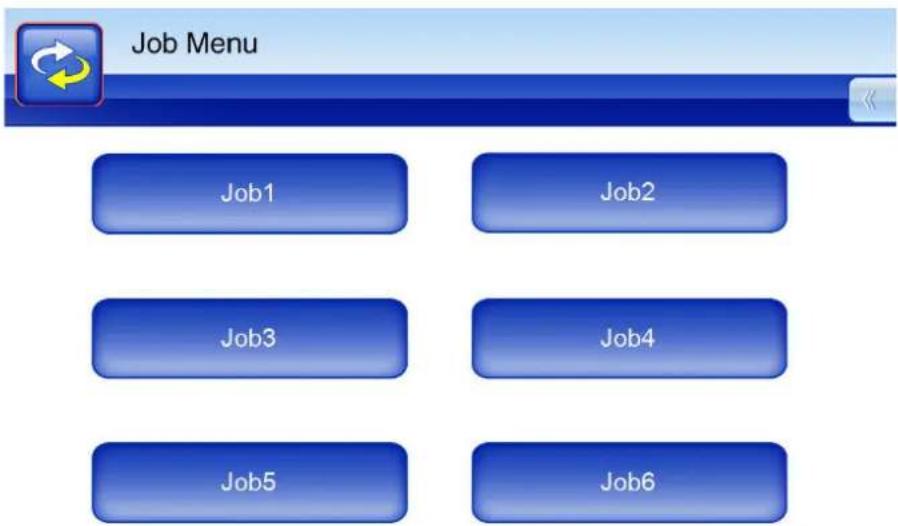
text_image
Job Menu Job1 Job2 Job3 Job4 Job5 Job6
text_image
Logout Message Screen On Scan Viewer On→ The "Message Screen" appears.

- If either the title or message is not set in [Message Screen] on the "Job Details" window, even if the [Message Screen] button is set to [On], the "Message Screen" will not be shown. For more details, refer to Step 4 of "4.11.2 Setting a Job Sequence" (page 185).
- If "Off" is selected for the [Message Screen] button, scanning is started without showing the "Message Screen", and the job is processed. For more details, refer to "6.14.1 Enabling/Disabling the Message Screen" (page 417).
- When the [Message Screen] button is disabled, whether or not the "Message Screen" is shown depends on the settings configured by the administrator.
2. Press the [Scan] button on the "Message Screen".
→ Scanning starts.
Each page is briefly shown on the screen as it is scanned.
When the scan has completed, the "Scan Viewer" opens.
For more details about the "Scan Viewer", refer to "6.11 Editing the Scanned Data in the Scan Viewer" (page 405).
![FUJITSU fi-6010N - Press the [Scan] button on the "Message Screen". - 1](/content/2026/06/1236812/images/78671024c86e43a2f86c4ae7223c90faa71e911354aa9320c9ae5fa0f8e23d28.jpg)
- When "Off" is set, the "Scan Viewer" is not shown.
- When a file name can be changed, the "File Name" screen is shown before a scan. For more details, refer to "6.14.2 Changing a File Name (for Save/e-Mail Attachment)" (page 419).
- When the setting of the "Scan Count" can be changed, the "Scan Count" screen is shown before a scan. For more details, refer to "6.14.3 Checking the Number of Sheets to Be Scanned" (page 420).
3. Check the scanned data.
For more details about the "Scan Viewer" screen, refer to "6.11 Editing the Scanned Data in the Scan Viewer" (page 405).
- Press the [OK] button on the "Scan Viewer".
⇒ The data is processed according to the specified job.
While the job is being processed, the process is shown in real time on the "Job Progress" screen.
Job Progress

text_image
Row of icons representing email, print, and envelope functions with warning symbolsJob Report
| Icon | Used to... | |||
| e-Mail Fax | Print Save | |||
 |  |  |  | Show the current item in process (big icon). |
 |  |  |  | Show items waiting to be processed. |
 |  |  |  | Show items which have completed successfully. |
 |  |  |  | Show items which have not completed successfully. |
 |  |  |  | Show items which have been canceled. |

- To view the job report, press the [Job Report] button on the "Job Progress" screen.

text_image
Job Report Operation Status 1 : e-Mail Error 12010100 2 : Fax OK 3 : Print OK 4 : Save OK 5 : e-Mail OK 6 : Fax Error 12020100 Details Icon View OK- To view detailed information for the job report, select a function name on the "Job Report" screen and press the [Details] button.

text_image
Job Detail Information Result Error Code 12010100 Date Time 07:14:53 Operation e-Mail Pages 1 Description Error: e-mail could not be sent.- If the status is shown as "Error", the [Report To Administrator] button is shown on the "Job Report Details" screen. Press the [Report To Administrator] button to send detailed information of the job report to an administrator by e-mail. (The e-mail address is the "Notification e-Mail Address" set on the administrator "Alert Notification" screen.)
If the job sequence is processed successfully, the touch panel screen returns to the "Job Menu".
If an error occurs during the job process, press the [OK] button on the "Job Progress" or "Job Report" screen. Pressing the [OK] button returns to the "Job Menu".
6.14.1 Enabling/Disabling the Message Screen
You can select whether to show the "Message Screen" for checking the contents of a job.

natural_image
A row of identical dark gray squares on a white background, no text or symbols present.
When the [Message Screen] button is disabled, it is not possible to select whether or not to show the "Message Screen".
This section uses an example where buttons from [Job1] to [Job6] have been set.
- On the "Job Menu" screen, press the [Message Screen] button.
If the [Message Screen] button is set to "Off", pressing the button will change it to "On", and vice-versa.

text_image
Job Menu Job1 Job2 Job3 Job4 Job5 Job6 Logout Message Screen On Scan Viewer OnOperations differ according to whether the [Message Screen] button is "Off" or "On".
- If a job sequence is processed when the [Message Screen] button is set to "On", the "Message Screen" will be shown.
Processing Job1.
1.e-Mail
2.Fax
3.Print
4.Save
5.e-Mail
6.Fax
7.Print
8.Save
9.e-Mail
10.Fax

Cancel

Scan

After checking the message, press the [Scan] button to start the scan. If any further job setup steps are required, press the [OK] button that appears instead.
- If a job sequence is processed when the [Message Screen] button is set to "Off", the job will be processed without showing the "Message Screen".
6.14.2 Changing a File Name (for Save/e-Mail Attachment)
When a job is processed, file names to be used when saving or attaching scanned data to an e-mail can be changed.

It is not possible to change a file name when the "File Name" screen is set not to be shown.
- Press a job button on the "Job Menu" screen.
- On the "File Name" screen, enter the file name for the scanned data to be saved or sent by e-mail.
File names may be up to 128 characters long. \ and / are used as folder separator characters. The following symbols cannot be used.
$$ : *? ^ {\prime \prime} < > | $$
The default value is the file name specified in the "Common File Name" input field on the "Job Details" window. For details, refer to "4.11.2 Setting a Job Sequence" (page 185).
File Name
Enter the file name to be used for the scan data.

text_image
|A sequence number will be appended to the file name.

Cancel


- When sequence numbers are set to be appended to file names, a sequence number is appended to the end of the default file name. The guidance message "A sequence number will be appended to the file name." is shown on the screen.
- A sequence number will not be appended to a file name that has been edited.
- After entering the file name, press the [Scan] button to start the scan. If any further job setup steps are required, press the [OK] button that appears instead.
6.14.3 Checking the Number of Sheets to Be Scanned
When a job is processed, the expected number of sheets to be scanned can be specified, so that the actual number of scanned sheets can be checked after a scan.

For either of the following settings, the "Scan Count" screen is not shown.
● The "Scan Count" is not to be checked
- The "Scan Count" is to be checked, but the "Scan Count" screen is set not to appear (The [Allow per-Job adjustment] checkbox in the "Check the Scan Count" on the "Job Details" window is disabled)
- Press a job button on the "Job Menu" screen.
- On the "Scan Count" screen, enter the number of sheets that are to be scanned, between 1 and 999.

- When [Print] is included in the job sequence, the number of sheets to be scanned can be set within the range of 1 to 100, but not 1 to 999.
- For printing, the maximum number of pages that can be scanned at once is 100, and for the other operations it is 999. Make sure not to set a value that exceeds the maximum number when performing a duplex scan.
Scan Count
Enter the number of sheets that are to be scanned.
Expected Count:
5
sheets (1-999)

Cancel

Scan
3. Press the [Scan] button.
→ Scanning starts.
![FUJITSU fi-6010N - Press the [Scan] button. - 1](/content/2026/06/1236812/images/e589dad3c40d46649bb36c6f9ec7e6ce3b788d452aa942cc2187cccc88ab1b86.jpg)
When the "Scan Viewer" is shown after a scan, you can check whether the number of scanned sheets is the same as that set in the "Scan Count" screen at ____
![FUJITSU fi-6010N - Press the [Scan] button. - 2](/content/2026/06/1236812/images/43e720de12005af30897703e26b73746f4eae2c4e5daacd8f808eae7f25d96c6.jpg)
text_image
Scan Viewer 100% Scanner Number of scanned sheets 4 5 sheets Number of expected sheets Scan More AAA BBB CCC 1 / 8 Page 2.76 [MB] Cancel OKEven if pages are deleted on the "Scan Viewer", the number of scanned sheets is not changed.
After scanning has completed, the following confirmation screen is shown if the number of scanned sheets is set to be checked. Contact the administrator to change the setting of whether or not to check the scan count. For more details, refer to "4.11.2 Setting a Job Sequence" (page 185).
The Scan Count is as follows:
Scanned: 4 sheets
Expected: 5 sheets
Press the "OK" button to continue the scan, the "Cancel" button to end it, or the "Scan More" button to add further pages.
![FUJITSU fi-6010N - Press the [Scan] button. - 3](/content/2026/06/1236812/images/a69cf1b66809620372ba1f645c1eaa1656ed4b62bc93db02b42af8d6567f66d1.jpg)
![FUJITSU fi-6010N - Press the [Scan] button. - 4](/content/2026/06/1236812/images/3ad42cae804f322739be0f628e29dc5a5d6be5707e31087a3a30e851271ab616.jpg)
![FUJITSU fi-6010N - Press the [Scan] button. - 5](/content/2026/06/1236812/images/1c3aaa01fc0d54b92d655145c6b3188d6cee12329ff2ad24b17a432149ce3537.jpg)
![FUJITSU fi-6010N - Press the [Scan] button. - 6](/content/2026/06/1236812/images/f98d184f3d1a5e7e6008ed7218be0ae7b987ab4cddf854e69be1a5353a3d92ef.jpg)
When the [Scan More] button is shown, press the button to add further pages.
To continue, press the [OK] button.
To cancel the process and delete the scanned data, press the [Cancel] button.
Scanner Care
Admin
User
This chapter describes how to clean the scanner and replace parts in order to maintain the scanner in optimum scanning condition.


The glass scanner windows inside the ADF can become hot when the scanner is used.
Before cleaning inside the scanner or replacing any parts, turn off the power, unplug the AC adapter from the outlet, and wait for at least 15 minutes.
The power does not need to be turned off when cleaning the feed rollers.



Do not use any aerosol sprays or alcohol based sprays to clean the scanner.
Dust blown up by strong air from the spray may enter the inside of the scanner. This may cause the scanner to fail or malfunction.
Sparks, caused by static electricity, generated when blowing off dust and dirt from the outside of the scanner may cause a fire.
7.1 Cleaning 424
7.2 Cleaning the ADF 426
7.3 Cleaning the LCD Touch Panel.... 433
7.4 Cleaning the Keyboard/Keyboard Cover 434
7.5 Cleaning the Carrier Sheet.... 435
7.6 Replacing Parts 436
7.7 Changing the Keyboard Cover 445
7.8 Performing a Scan Test.... 447
7.1 Cleaning
7.1.1 Cleaning Materials
The following table shows the cleaning materials to be used with this scanner.
| Item Part No. | Remarks | |
| Cleaner F1 PA039 | 50-0352 1 bottle (100 ml)Used to moisten the cloths before wiping parts clean. | |
| Cleaning Paper CA | 99501-0012 1 pack | (10 sheets)For use with Cleaner F1. |
| Cleaning Wipe PA | 03950-0419 1 pack | (24 sheets)Pre-moistened with Cleaner F1, Cleaning Wipes are used instead of moistened cloths. |
| Soft, dry cloth Any | commercially available lint-free product | |
Contact your FUJITSU scanner dealer or an authorized FUJITSU scanner service provider to obtain these products.
7.1.2 Which Parts and When
Clean all parts after every 1,000 sheets scanned.
- Pad assy
- Feed rollers
- Pick roller
- Idler rollers
● Glass scanner windows - Ultrasonic sensors

The scanner must be cleaned more frequently when the following types of documents are used:
- Coated paper
● Documents with large areas of printing
● Chemically treated paper such as carbonless paper
● Paper containing large amounts of calcium carbonate filler
● Documents written in pencil
● Documents with insufficiently fused toner
7.2 Cleaning the ADF
The ADF should be cleaned after approximately every 1,000 scanned sheets. However, this criteria varies according to the type of documents scanned. For example, it may be necessary to clean the ADF more frequently when documents with insufficiently fused toner are scanned.


The glass scanner windows inside the ADF can become hot when the scanner is used.
Before cleaning inside the scanner or replacing any parts, turn off the power, unplug the AC adapter from the outlet, and wait for at least 15 minutes.
The power does not need to be turned off when cleaning the feed rollers.



When you perform cleaning, make sure that the inside of the scanner is free of any foreign object, and be careful not to get your hand or the cloth caught on the pick spring (metal part) as a deformed pick spring (metal part) may cause injury.
7.2.1 Cleaning the ADF
- Push the ADF release button, then hold both sides of the top cover and lift it open.

text_image
Hold both sides to open Push the ADF release button to open
Be careful that the top cover does not shut on your fingers.
- Clean the following parts with a soft cloth moistened with Cleaner F1.
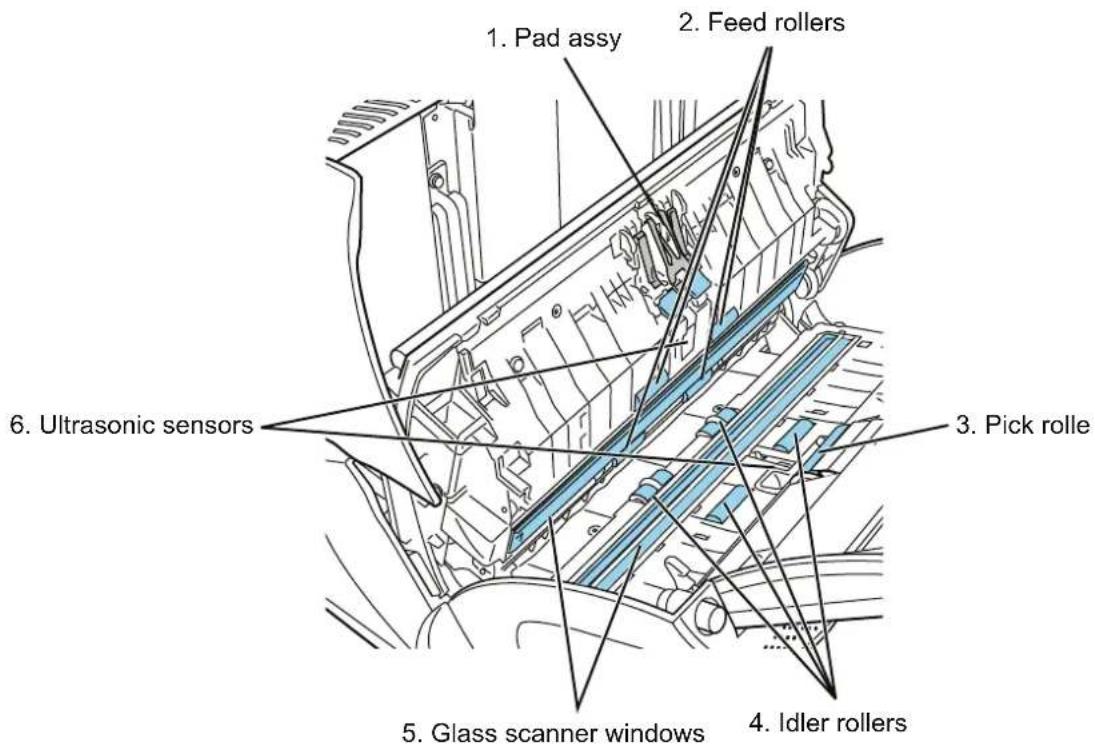
text_image
1. Pad assy 2. Feed rollers 3. Pick rolle 4. Idler rollers 5. Glass scanner windows 6. Ultrasonic sensors| No. | Part name Cleaning method | |
| 1 Pad | assy Refer to | "Pad assy" (page 429). |
| 2 | Feed rollers ( × 4) | Refer to "Feed rollers" (page 430). |
| 3 | Pick roller ( × 1) | Refer to "Pick roller" (page 431). |
| 4 Idler | rollers ( × 4) Refer to | "Idler rollers" (page 431). |
| 5 | Glass scanner windows ( × 2) | Refer to "Glass scanner windows" (page 431). |
| 6 | Ultrasonic sensors ( × 2) | Refer to "Ultrasonic sensors" (page 431). |

When cleaning inside the ADF, take care that the cloth does not get snagged by the document sensors and damage them.

natural_image
Diagram of a car interior showing hand positioning and two circled zones of the engine (no text or symbols present)- Pad assy
When you perform cleaning, make sure that the inside of the scanner is free of any foreign object, and be careful not to get your hand or the cloth caught on the pick spring (metal part) as a deformed pick spring (metal part) may cause injury.

text_image
Pick spring (metal part) *Gray part Rubber pads (clean here)- Feed rollers
Use the following procedure when cleaning the feed rollers.
1 On the "Main Menu" or "Job Menu" screen, press the [Maintenance] button.
⇒ The "Maintenance" screen appears.
2 Press the [Roller Cleaning] button.
Maintenance

Edit e-Mail Addresses

Roller Cleaning

Edit Fax Numbers

Scan Test

Cancel
→ The "Roller Cleaning" screen appears.
Roller Cleaning
Press the keyboard [C] key to step the feed rollers forward.
Press the [OK] button after the feed rollers have been cleaned.
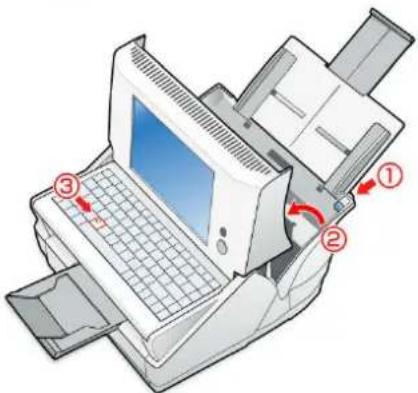
text_image
Diagram of a printer with labeled parts showing the keyboard, paper plane, and printer handle mechanism
OK
3 Open the top cover.
4 Lightly press a soft cloth moistened with Cleaner F1 against the surface of the feed rollers.
5 Press the [c] key on the keyboard.
⇒ The feed rollers will advance one step each time the [c] key is pressed. Lightly press a soft cloth moistened with Cleaner F1 against the surface of the rotating rollers to clean them. Pressing the [c] key seven times will turn the roller one complete revolution. The feed rollers should be cleaned carefully and thoroughly, as dirty pick rollers can adversely affect the paper pickup performance.


In Step 5, all four feed rollers will turn at the same time. When cleaning the feed rollers, be careful not to touch the rollers with your fingers while they are rotating.
- Pick roller
Gently rotate the pick roller as you wipe its surface clean, taking care not to damage the soft rubber. The pick roller should be cleaned carefully and thoroughly, as dirty pick rollers can adversely affect the paper pickup performance. When cleaning the pick roller, also be careful not to damage the black plastic glide strip.

text_image
Glide strip- Idler rollers
Gently rotate the idler rollers as you wipe them clean, taking care not to scratch or ding them, or tear the sponge wheels. The idler rollers should be cleaned carefully and thoroughly, as dirty idler rollers can adversely affect the paper pickup performance.
● Glass scanner windows
Clean lightly with a soft cloth moistened with Cleaner F1.

A vertical black line on the scanned data may indicate the glass scanner windows are dirty.
- Ultrasonic sensors
Clean lightly with a soft cloth moistened with Cleaner F1.
- Holding both sides of the top cover, return it to its original position.
You should hear a click.

● Make sure that the top cover is completely closed. If not completely closed, document jams and feeding errors may occur.
- When closing the top cover, do not slam it shut by pushing the touch panel as this may damage it.
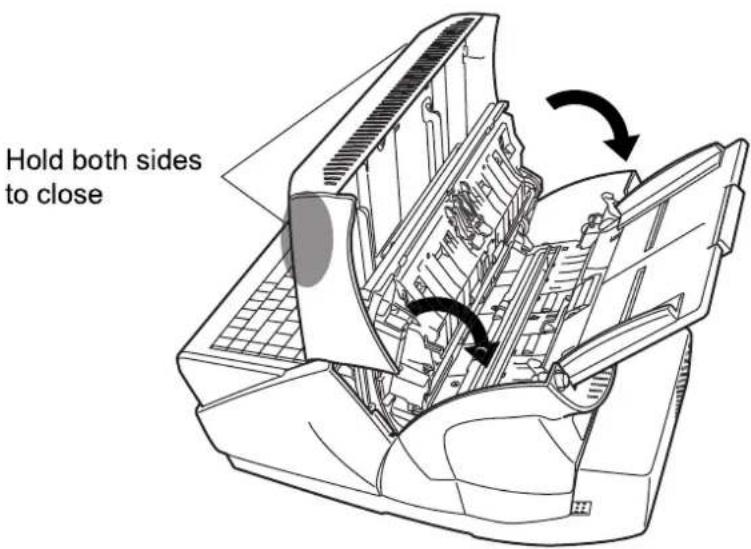
text_image
Hold both sides to close7.3 Cleaning the LCD Touch Panel
To prevent the touch panel screen from becoming dirty, it should be regularly cleaned with a soft, dry cloth.
Take care when cleaning the touch panel. It can be easily damaged, and should never be scratched or banged with hard objects.

Always use a dry (not damp) cloth to clean the screen.
If dust is allowed to collect and compact around the frame of the screen, it can cause the touch panel to malfunction.
7.4 Cleaning the Keyboard/Keyboard Cover
To prevent the keyboard and/or keyboard cover from becoming dirty, it should also be regularly cleaned with a soft, dry cloth.

Always use a dry (not damp) cloth to clean the keyboard (with or without cover). Do not apply Cleaner F1.
Replace the keyboard cover if stains cannot be removed by cleaning.
For more details, refer to "7.7 Changing the Keyboard Cover" (page 445).
To obtain replacement keyboard covers, contact your FUJITSU dealer or an authorized FUJITSU scanner service provider.
| Part name Part | No. Remarks | |
| Keyboard Cover PA03544-K608 1 cover | GBR: English (UK) | |
7.5 Cleaning the Carrier Sheet
If the surface or interior of the Carrier Sheet becomes dirty or dusty, use a soft dry cloth slightly moistened with Cleaner F1 (sold separately) or a mild detergent, to lightly wipe off the dirt and dust.

● Never use paint thinner or other organic solvents.
- Do not rub too hard, as the Carrier Sheet may become scratched or deformed.
- After cleaning the interior of the Carrier Sheet, wait until it has completely dried before closing it.
- As a guideline, it is recommended to replace the Carrier Sheet every 500 scans. For details about purchasing a Carrier Sheet, refer to "7.6.5 Purchasing the Carrier Sheet" (page 444).
7.6 Replacing Parts
7.6.1 Part Numbers and Replacement Cycles
■ Part numbers and replacement cycle for consumable parts
The following table specifies the replacement part numbers, the standard replacement cycles, and the color of the [Consumable Alert] button.
| Part name | Part No. | Replacement cycle | Consumable alert status |
PAD ASSY PA0328 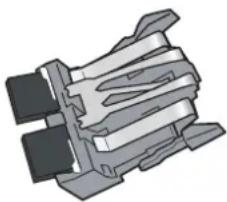 | 9-0111 | After every 50,000 sheets scanned or once a year (when using 80 g/m^2 (20 lb) A4/Letter woodfree or wood containing paper) | Green until the number of documents scanned reaches 45,000 sheets. Orange after 45,000 sheets. Red after 50,000 sheets. For more details about how to check the consumable alert status, refer to "7.6.2 Checking the Consumable Alert Status" (page 438). |
PICK ROLLER PA0 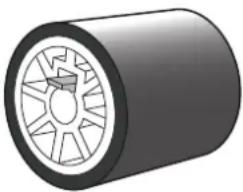 | 3289-0001 | After every 100,000 sheets scanned or once a year (when using 80 g/m^2 (20 lb) A4/Letter woodfree or wood containing paper) | Green until the number of documents scanned reaches 95,000 sheets. Orange after 95,000 sheets. Red after 100,000 sheets. For more details about how to check the consumable alert status, refer to "7.6.2 Checking the Consumable Alert Status" (page 438). |
These replacement cycles are rough guidelines. They may vary according to the type of documents scanned, scanner usage, and cleaning frequency.

- When the consumable alert status is orange or red, contact your scanner administrator to replace the necessary part.
- Use only the PFU LIMITED parts specified. Do not use consumable parts made by other manufacturers.
To obtain these parts, contact your FUJITSU dealer or an authorized FUJITSU scanner service provider.
■ Part numbers and replacement cycle for Carrier Sheet
The following table specifies the replacement part numbers and the standard replacement cycles.
| Part name | No. of items | Part No. Replacement cycle Remarks | |
Carrier Sheet 5 PA03 | 360- | After used for 500 scans For details about purchasing a Carrier Sheet, refer to "7.6.5 Purchasing the Carrier Sheet" (page 444). | |
| 0013 | |||
This replacement cycle is a rough guideline. This may vary according to the type of documents scanned, scanner usage, and cleaning frequency. If parts become noticeably dirty, replace them accordingly.

Use only the PFU LIMITED parts specified. Do not use parts made by other manufacturers.
To obtain these parts, contact your FUJITSU dealer or an authorized FUJITSU scanner service provider.
7.6.2 Checking the Consumable Alert Status
- On the "Main Menu" or "Job Menu" screen, press the [Consumable Alert] button.
→ The "Consumable Alert" screen appears.
- Check which part needs to be replaced and press the [OK] button.
Parts whose "Usage Counter" value is bigger than the "Replace at" value should be replaced. The value of the "Usage Counter" is in units of 500 sheets scanned.
For details on how to check the status of consumable parts on the administrator screen, refer to "4.8.3 Viewing the Usage Status" (page 156).
Consumable Alert
| Part | Usage Counter | Replace At | Current Status |
PAD ASSY | 60.500 | 50.000 | Replace Now |
PICK ROLLER | 60.500 | 100.000 |
- Replace the part.
Part replacement procedures are detailed in the following sections, "7.6.3 Replacing the Pad Assy" (page 439), "7.6.4 Replacing the Pick Roller" (page 440).
7.6.3 Replacing the Pad Assy
- Remove any documents from the ADF paper chute.
- Push the ADF release button, then hold both sides of the top cover and lift it open.


Be careful that the top cover does not shut on your fingers.
- Remove the pad assy from the scanner.
Squeeze the prongs on either side of the pad assy together and pull it upwards and to the front, taking care not to snag the pick springs.
Squeeze prongs together and pull up
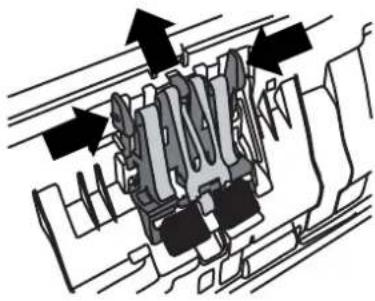
natural_image
Mechanical assembly diagram showing internal components with directional arrows (no text or labels)- Insert the new pad assy.
Holding the new pad assy by its sides, insert into the pad assy socket, taking care not to snag the pick springs.


Make sure that the pad assy is firmly and fully inserted. If it is not correctly attached, document jams and other feeding errors may occur.
5. Close the top cover.
You should hear a click when it is returned to its original position.


Be careful that the top cover does not shut on your fingers.
6. Reset the pad assy usage counter.
The usage counter must be reset by an administrator. For details, refer to "Resetting the Usage Counter" (page 157).
7.6.4 Replacing the Pick Roller
- Remove any documents from the ADF paper chute.
-
Remove the ADF paper chute.
-
Push the ADF release button, then hold both sides of the top cover and lift it open.


Be careful that the top cover does not shut on your fingers.
-
Remove the pick roller and its shaft from the scanner.
-
Squeeze the tabs of the sheet guide release catch together with your fingers, and lift the sheet guide plate up and away.

natural_image
Technical diagram showing a mechanical component with an inset close-up view highlighting a specific section (no text or symbols present)- Rotate the left side pick roller bushing in the direction indicated by the arrow.
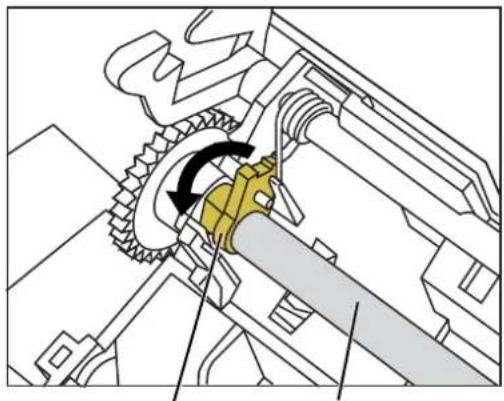
natural_image
Mechanical gear assembly diagram showing gear meshing and shaft alignment (no text or labels)Pick roller bushing
Pick roller shaft
- Gently lift and slide the pick roller shaft out of the left side of the ADF in the direction of the arrow. Be careful as it is easy to bind the shaft in the right side bushing.
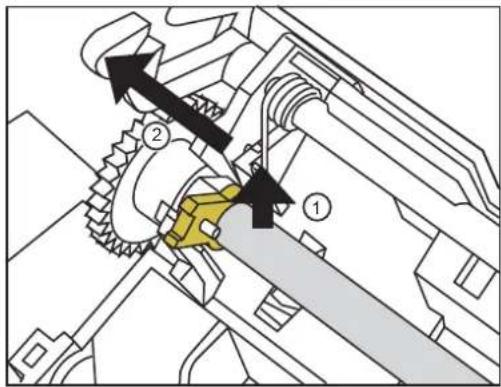
text_image
Technical diagram showing gear meshing with numbered components and directional arrows indicating movement or assembly.
The pick roller bearing may be hard to rotate. Do not try to turn it with your fingernail. Use a paper clip to turn the roller bearing if you can not rotate it with your fingertip.
- Remove the pick roller from the shaft.
Lift up the lock tab and slide the pick roller off the shaft.

Take care if lifting the pick roller lock tab with your fingernail as it may get chipped or broken. If worried, try lifting the tab using a paper clip as shown in the following diagram.
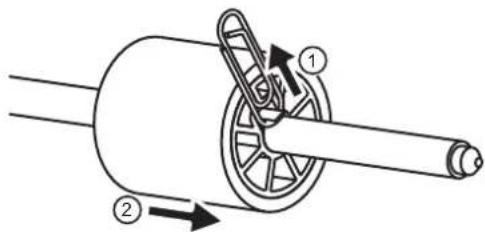
text_image
Diagram of a mechanical device with labeled components and directional arrows indicating motion or force- Attach the new pick roller.
Insert the shaft into the new pick roller, aligning the protruding pin on the shaft with the matching notch in the pick roller.

natural_image
Diagram of a mechanical component with a rotating wheel and directional arrow (no text or symbols)Pin on shaft
Pick roller notch

Make sure that the pick roller shaft is fully inserted. If it is not correctly attached, document jams and other feeding errors may occur. You should hear a "click" when the pick roller shaft is inserted correctly. Make sure you hear this noise when inserting the shaft into the pick roller.

text_image
"Click"- Insert the pick roller and shaft back in the scanner.
To attach the pick roller to the scanner, follow the pick roller and shaft removal procedure in reverse.
- Rotate the left side pick roller bushing in the direction indicated by the arrow.
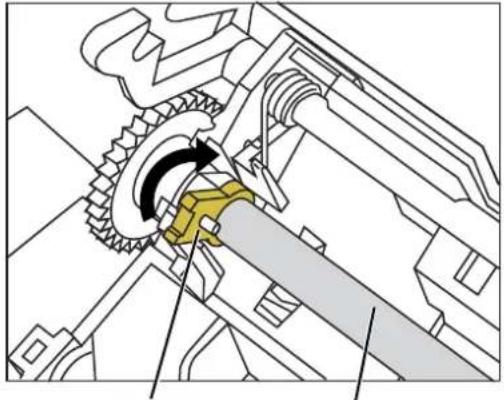
natural_image
Mechanical gear assembly diagram showing gear meshing and a rotating shaft (no text or labels)Pick roller bushing
Pick roller shaft
- Open the tabs of the sheet guide release catch in the direction indicated by the arrow to lock the sheet guide in place.

natural_image
Technical diagram showing a mechanical component with an inset close-up view of its internal structure (no text or symbols)- Close the top cover.
You should hear a click when it is returned to its original position.


Be careful that the top cover does not shut on your fingers.
7
-
Attach the ADF paper chute.
-
Reset the pick roller usage counter.
The usage counter must be reset by an administrator. For details, refer to "Resetting the Usage Counter" (page 157).
7.6.5 Purchasing the Carrier Sheet
If the "Carrier Sheet" provided with the scanner can no longer be used for scanning due to damage or wear-and-tear, you can purchase a new Carrier Sheet separately.
As a guideline, it is recommended to replace the Carrier Sheet every 500 scans.
However, the number of times of use differs according to usage. Replace the Carrier Sheet when it becomes scratched or dirty.
The Carrier Sheet is as shown below:

natural_image
Simple line drawing of a rectangular sheet with a textured top and bottom edge (no text or symbols)To obtain the Carrier Sheet, contact your FUJITSU dealer or an authorized FUJITSU scanner service provider.
7.7 Changing the Keyboard Cover
- Remove the keyboard cover from the scanner.
- Remove any remaining adhesive tape.

text_image
Pay particular attention to these areas- Turn the keyboard cover over and remove the paper backing from the top strip of double-sided tape.

text_image
Paper backing tape Underside- Align the top edge of the keyboard cover with the protruding guides, and firmly smooth the double-sided tape down.
Align and attach the top-left corner first, then the center, and last the top-right corner.

text_image
Top-left guide Top-center guide Top-right guide Top attachment area 1 2 3- Flip up the keyboard cover and remove the paper backing from the bottom strip of double-sided tape.

text_image
Paper backing tape Flip up the keyboard cover- Gently stretch the keyboard cover forward and smooth the double-sided tape down.

text_image
Bottom attachment area7.8 Performing a Scan Test
After scanner cleaning or replacement of consumable parts, perform a scan test.
- On the "Main Menu" or "Job Menu" screen, press the [Maintenance] button.
→ The "Maintenance" screen appears.
- Press the [Scan Test] button.
Maintenance

Edit e-Mail Addresses

Roller Cleaning

Edit Fax Numbers

Scan Test

Cancel
→ The "Scan Test" screen appears.
- Load the document into the ADF paper chute for the scan test.
4. Press the [Scan] button.
Scan Test
Load a test page and press the [Scan] button.
Scan Settings Used
| Option | Setting |
| Color Mode | Auto |
| Paper Size | Auto |
| Resolution | 200dpi |
| Scan Mode | Duplex |
| Compression | Medium |
| Brightness | Medium |
| Contrast | Medium |

Cancel

Scan
→ The scan test starts.
When the scan test has completed, the "Scan Viewer" screen appears.
If the scanner fails to scan correctly, an error message is displayed. For more details about how to deal with error messages, refer to "E.2 Regular User Messages" (page 528).
5. Check the scanned data.
For more details about "Scan Viewer", refer to "6.11.1 Viewing a Scanned Page" (page 406) or "6.11.2 Rotating a Scanned Page" (page 407).

text_image
Scan Viewer 100% Scan More AAA BBB CCC 3 / 4 Page 1.18 [MB] Cancel O K6. Press the [OK] button.
→ The "Maintenance" screen is shown again.
Troubleshooting
Admin
User
This chapter provides information on dealing with scanner operation problems such as paper jams, points to check before contacting your FUJITSU scanner dealer, and help on how to check device labels.
For details of error messages which may appear during administrator setting procedures, refer to "E.1.1 Administrator Screen Messages" (page 505).
For details of error messages which may appear during scanner operations or cleaning, refer to "E.2 Regular User Messages" (page 528).
For details of messages which might appear when acquiring log information in "4.9 Using the Operation Logs Menus" (page 159), refer to "E.1.2 System Log Messages" (page 518).
For details of device status messages, refer to "E.1.3 Alert Monitor System Log Messages" (page 524).
8.1 Removing Jammed Documents.... 452
8.2 Dealing with Detached Keycaps.... 456
8.3 Network Connection Troubleshooting.... 458
8.4 Other Troubleshooting 470
8.5 Points to Check before Contacting Your FUJITSU Scanner Dealer...... 474
8.6 Checking the Scanner Labels...... 477
8.7 Pre-Maintenance Preparations 478
8.1 Removing Jammed Documents
If a document jam occurs, follow the procedure below to remove the jammed documents.
text_image
ATTENTION ● When removing jammed documents, take care with dangling neckties, necklaces, etc. as they may easily become entangled in the scanner. ● The glass scanner windows inside the ADF can become hot when the scanner is used. Take care not burn your hands.-
Remove all documents from the ADF paper chute.
-
Push the ADF release button, then hold both sides of the top cover and lift it open.
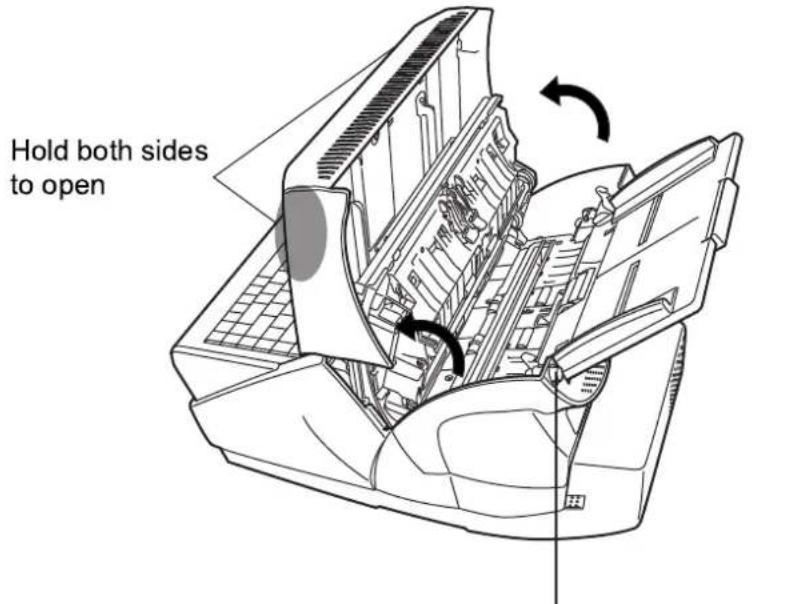
text_image
Hold both sides to openPush the ADF release button to open

Be careful that the top cover does not slam shut on your fingers.
- Remove the jammed document.

-
Staples, paper clips, etc. can cause document jams. Check the document and feed path, and remove any such objects that may have come loose.
Any staples, clips, etc. should be removed from the document before starting a scan.
● Take care not to snag the pick springs when removing jammed documents. -
Holding both sides of the top cover, return it to its original position.
You should hear a click.

- Be careful that the top cover does not shut on your fingers.
● Make sure that the top cover is completely closed. If not completely closed, document jams and feeding errors may occur. - When closing the top cover, do not slam it shut by pushing the touch panel as this may damage it.

text_image
Hold both sides to close
- Although no error message is displayed, document pages may remain in the ADF even after scanning is completed or canceled. Follow the procedure below to remove any such pages from the ADF.
-
Remove all documents from the ADF paper chute.
-
Push the ADF release button, then hold both sides of the top cover and lift it open.
-
Remove the remaining documents.
-
Close the top cover.
- If document pages become blocked while scanning, check the scanned data. Document pages which could not be scanned correctly may be shown in the "Scan Viewer". In this case, delete all pages not correctly scanned using the [Delete] button.
For more details about the "Scan Viewer" screen, refer to "6.11.4 Deleting a Scanned Page" (page 409).
If document jams or multifeed errors occur frequently, try the following procedures.
-
Align the edges of the document sheets.
-
Lightly grip the ends of the document stack in both hands and flex it back forth, as shown below.

text_image
Front side⇒ The edge of the document stack that will be loaded into the ADF paper chute should be skewed.
- Load the documents into the ADF paper chute, as shown in the following diagram.
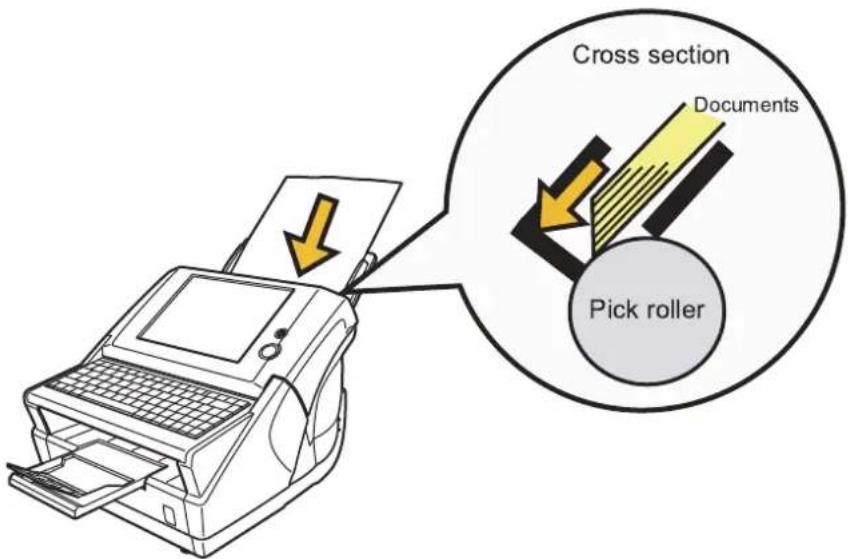
text_image
Cross section Documents Pick roller8.2 Dealing with Detached Keycaps
If a keycap comes loose from the keyboard, fit it back onto its original location and push it down until it clicks into place.

text_image
KeycapIf a keycap and key switch become loose, they should be reattached as follows.
- Remove the key switch from the keycap.

text_image
Gear link Keycap underside- With the flat part of the key switch facing downwards, reattach it to the keyboard.
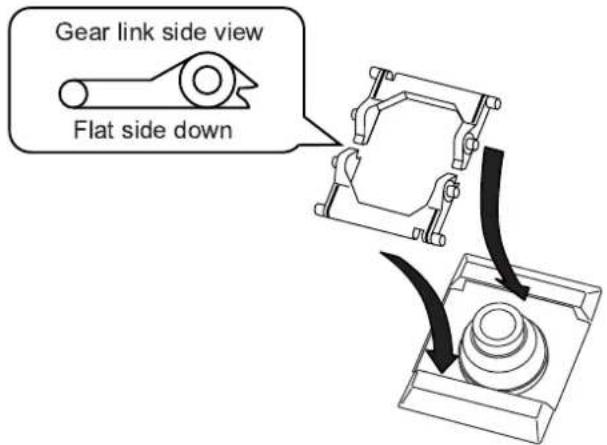
text_image
Gear link side view Flat side down- Fit the keycap back onto its original location and push it down until it clicks into place.
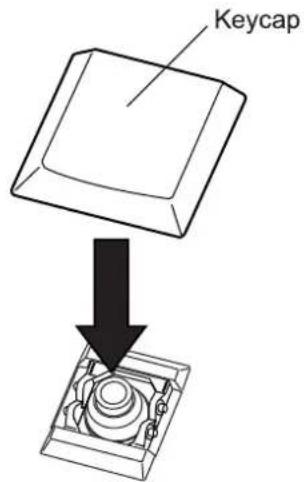
text_image
Keycap
If the detached keycap has a wire brace, reattach the wire to the keyboard, align the keycap over the middle of the wire, and push the keycap down until it clicks into place.
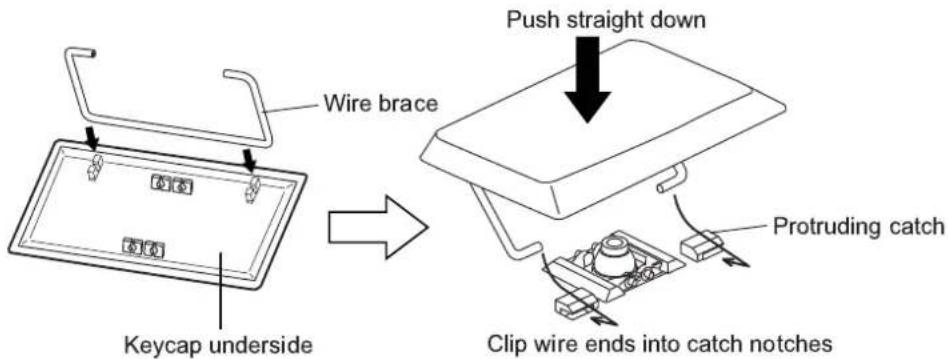
text_image
Wire brace Keycap underside Push straight down Protruding catch Clip wire ends into catch notches8.3 Network Connection Troubleshooting
If a network connection is not possible, first check the scanner status and system settings.
The following section provides information about general troubles that may occur when connecting to a network.
If the cause of the problem is unknown or the problem persists, check the items in "8.5 Points to Check before Contacting Your FUJITSU Scanner Dealer" (page 474) and contact your FUJITSU scanner dealer or an authorized FUJITSU scanner service provider.
8.3.1 Basic Network Operation Tests
The following network operation tests are available on the administrator screen, and should be performed after the network has been setup.
- Checking basic network operation with a Ping test
- Checking the network operating status
- Checking the NTP server settings by synchronizing the system time (if using an NTP server)
- Checking the mail server by sending a test mail (if scanned data is to be sent as an e-mail, by fax, or when requesting alert notifications by e-mail)
- Checking basic network operation with a Ping test
Check the network connection status of the following computers and servers associated with the network.
For details about the pinging procedure, refer to "4.7.17 Checking the Network Connection with a Ping Test" (page 150).
● Computer with Admin Tool installed
● Computer with Central Admin Console installed
● Computer with Central Admin Server software installed
- DNS server
- WINS server
- NTP server
- LDAP server
- SMTP server
- File server
- FTP server
- Print server
- SharePoint server
- Domain controller


Depending on the server setting, there may be no response from a ping test.
When checking the network connection status of a server by its IP address, the following results are possible.
| Result Action | |
| "Ping statistics" shows "Lost=0 (0% loss)" | None |
| "Ping statistics" shows "Lost=4 (100% loss)" | Check that the ping target IP address is correct. |
| If the ping target IP address is correct, refer to "Failure to connect to a server using its IP address" (page 463) for further solutions. | |
| "Ping statistics" shows "Lost=N (1 to 99% loss)" | There may be a quality problem with the LAN cable. Replace the LAN cable and try again. |
| In "4.7.18 Checking the Network Operating Status" (page 152), change the [Link Speed/Duplex Mode] from "Auto-Negotiation" to a fixed mode. | |
| "Hardware error" The LAN cable may have become disconnected during the Ping test. Check the status of the LAN cable and try again. | |
When checking the network connection status of a server by its host name or FQDN, the following results are possible.
| Result Action | |
| "Ping statistics" shows "Lost=0 (0% loss)" | None |
| "Ping request could not find host xxxxxxxxx. Please check the name and try again." | Check that the ping target host name or FQDN is correct. |
| Check that the DNS server or WINS server settings are cor-rect. | |
| If the ping target host name or FQDN is correct, refer to "Failure to connect to a server using its host name or FQDN" (page 465) for further solutions. | |
| "Ping statistics" shows "Lost=4 (100% loss)" | Check that the ping target host name or FQDN is correct. |
| In "4.7.18 Checking the Network Operating Status" (page 152), change the [Link Speed/Duplex Mode] from "Auto-Negotiation" to a fixed mode. | |
| "Ping statistics" shows "Lost=N (1 to 99% loss)" | There may be a quality problem with the LAN cable. Replace the LAN cable and try again. |
| In "4.7.18 Checking the Network Operating Status" (page 152), change the [Link Speed/Duplex Mode] from "Auto-Negotiation" to a fixed mode. | |
| "Hardware error" The LAN cable | able may have become disconnected during the Ping test. Check the status of the LAN cable and try again. |
■ Checking the network operating status
Check the network status.
For details about the checking procedure, refer to "4.7.18 Checking the Network Operating Status" (page 152).
Check the "Network Information" screen, and follow each action described below according to the message that is shown.
| Network settings Action | |
| The information shown is all valid. | None |
| The information shown is not all valid. | If DHCP is not used:Check that the "IP Address" setting is correct. |
| If DHCP is used:● Check that physical network connection to the DHCP server is functioning correctly.● Check the DHCP server. The server may not be operating normally, or the DHCP settings (restricted number of leases or MAC address validation) may be causing invalid IP addresses to be assigned. | |
| The information shown is valid, but pinging indicates that the network connection is not functioning normally. | In "4.7.18 Checking the Network Operating Status" (page 152), change the [Link Speed/Duplex Mode] from "Auto-Negotiation" to a fixed mode.If the problem persists, refer to "Failure to connect to a server using its IP address" (page 463) for further solutions. |
- Checking the NTP server settings by synchronizing the system time
On the "NTP Server" screen, press the [Sync Time] button to check if the system time can be synchronized.
After pressing the [Sync Time] button, follow each action described below according to the message that is shown.
| Message Action | |
| System time has been successfully synchronized. | None |
| System time synchronization failed. | Try the following:Check the specified NTP server IP address, host name, or FQDN for mistakes, and correct them.Check the network path between to the NTP server for problems.The NTP server may be busy. Wait a short time before trying again to synchronize the system time. If that does not work, the specified server may not be an NTP server, so try a different NTP server.The specified NTP server cannot provide a trusted date and time. It attempted to acquire the date and time from a higher level NTP server, but failed. Try a different NTP server or have the network administrator investigate.Check that the time is correct.If the time is incorrect, adjust the date/time, and try again.Refer to "4.6.5 Setting the Date/Time" (page 64), adjust the date/time, and try again. |
■ Checking the mail server by sending a test mail
On the "Central Admin Server Settings" screen or "Alert Notification" screen, press the [Test] button to check if an e-mail can be sent to the specified destination.
After pressing the [Test] button, follow each action described below according to the message that is shown.
| Message Action | |
| Sending... If no error message | appears and the "sending" indicator disappears, the test mail was sent successfully to the mail server.Check that the alert notification e-mail has arrived at the specified destination. If the alert notification e-mail has not arrived at the expected destination, check that the part of thee-mail address before the "@" has been entered correctly. |
| Test e-mail could not be sent. | Check that the computer connected to the SMTP server is running properly. |
| Check if an e-mail can be sent to the address from other computers in the network. | |
| Ping the SMTP server to check that it and its network connection are working properly. | |
| If the SMTP server does not respond to the ping test, check that the system network is functioning normally by pinging the SMTP server from another machine in the network.If it is only the scanner's network connection that does not work, refer to "Failure to connect to a server using its IP address" (page 463) for further solutions.If the problem seems to be with the SMTP server's network connection, request the network administrator to check that the SMTP server and its network connection are functioning normally. | |
| Check that the same port number has been correctly set for the scanner to SMTP server connection in "4.7.11 Setting the e-Mail Server (SMTP Server)" (page 116) and "5.6 Setting the Central Admin Server" (page 244). |
8.3.2 Other Network Connection Troubleshooting
There are many reasons why a network connection may not be possible.
The following section provides information about general troubles that may occur when connecting to a network.
If the cause of the problem is unknown or the problem persists, check the items in "8.5 Points to Check before Contacting Your FUJITSU Scanner Dealer" (page 474) and contact your FUJITSU scanner dealer or an authorized FUJITSU scanner service provider.
■ Failure to connect to a server using its IP address
If a server cannot be connected to by using its IP address, and does not respond to a ping test, try the following steps:
| No. | Problem Action | |
| 1 | Connection error between a server and the scanner, or problem with the LAN cable. | Check that the LAN cable has been attached to both the scanner and server correctly.If the server is connected using a LAN cable (straight type), in case auto-mdi (automatic selection) is not supported, a LAN cable (crossover type), switch, or router is required between the scanner and server.If this is not the case, the LAN cable may be faulty. Find a LAN cable that functions normally and try again. |
| 2 | IP address or subnet mask is invalid. | On the "IP Address" screen, check that the IP address or subnet mask settings are correct.For more details about the "IP Address" screen, refer to "4.7.1 Giving the Scanner an IP Address" (page 86). |
| 3 | When using DHCP, the DHCP server does not operate normally, or there is a problem with the DHCP server settings. | If using DHCP, on the "Network Status" screen, check that IP address, subnet mask, and default gateway settings are all correct.If these settings are not correct, the DHCP server may not operate normally, or the DHCP server may not assign valid IP addresses because of restricted number of leases or MAC address validation.Check the DHCP server connection status and the details of the server settings.For more details about the "Network Status" screen, refer to "4.7.18 Checking the Network Operating Status" (page 152). |
| 4 | Another host or communication device is connected using the same IP address as the scanner. | If the same IP address has already been used by another host or communication device, then even if the other device has been given a different IP address the server may not recognize the scanner's "duplicate" IP address until it is rebooted.Restart the server.If a duplicate IP address connection from another host or communication device exists on a LAN, both it will be unusable.If a duplicate IP address connection from another host or communication device exists, pull out its LAN cable and restart the server. |
| 5 | Access is denied due to the establishment of a firewall between the server and the scanner. | If a firewall has been established between the server and the scanner, check that it has not been set to deny access to the network. |
| 6 | The network link speed/duplex mode for the scanner and server are different, or Auto-Negotiation is not supported by the server. | For this scanner, the default [Link Speed/ Duplex Mode] setting is "Auto-Negotiation".On the "Network Status" screen, match the scanner and server's network link speed/duplex mode settings.If the problem persists in spite of having set both the scanner and server's network link speed/duplex settings to "Auto-Negotiation", select something other than "Auto-Negotiation" and check again.For more details about the "Network Status" screen, refer to "4.7.18 Checking the Network Operating Status" (page 152). |
■ Failure to connect to a server using its host name or FQDN
If a server cannot be connected to by using its host name or FQDN, and does not respond to a ping test, try the following steps:
| No. | Problem Action | |
| 1 | Same as in "Failure to connect to a server using its IP address" (page 463). | Check if a network connection is possible by trying the same solution for "Failure to connect to a server using its IP address" (page 463). |
| 2 | The scanner's DNS server or WINS server settings are invalid. | Check that the DNS and WINS server settings are correct. |
| 3 | The DNS server or WINS server is not functioning normally, or there is an error with the DNS or WINS server network connection. | Ping the DNS and WINS servers to check they are functioning normally.If the DNS or WINS server is not functioning, request the network administrator to check its status. |
■ Failure to add a network printer
If adding a network printer to/from the scanner is not possible, try the following steps. Also, refer to how to set printer settings, how to add a network printer, and the printer manual before hand.
| No. | Problem Action | |
| 1 | The Windows XP printer driver has not been installed on the print server. | Install the Windows XP printer driver on the print server.Check that the Windows XP printer driver has been correctly installed on the print server. For more details, refer to "4.7.13 Setting the Network Printers" (page 119). |
| 2 | Network printer shared name has been changed. | Check the shared name on the print server. |
| 3 | The specified network printer path is invalid. | Check that the specified network printer path is correct. |
■ Failure to print on a network printer
If printing on a network printer which has been set in the scanner is not possible, try the following steps. Also, refer to how to set the printer settings, how to add a network printer, or the printer manual before hand.
| No. | Problem Action | |
| 1 | Printer is not usable, due to an out of paper error, paper jam, or similar problem. | Check whether or not the printer is ready for printing, deal with the cause of the error, and try again. |
| 2 | Same as in "Failure to connect to a server using its IP address" (page 463). | Check if a network connection is possible by trying the same solution for "Failure to connect to a server using its IP address" (page 463). |
| 3 | Not authorized to print on network printer. Contact the administrator to check if printing is allowed on the network printer. | |
| 4 | Printing is impossible due to a printer or spooler error. | Try the following:● Check that printing is possible from the print server application.● Check that the print server spooling is operating normally. |
8.3.3 Failure to Access the Scanner using a Web Browser, Admin Tool, or Central Admin Server
If access is not possible when attempting to connect to the scanner using a Web browser or the Admin Tool, or when attempting to connect to the Central Admin Server from the Central Admin Console, try the following steps:
| No. | Problem Action | |
| 1 | Same as in "Failure to connect to a server using its IP address" (page 463). | Check if a network connection is possible by trying the same solution for "Failure to connect to a server using its IP address" (page 463). |
| 2 | The DNS server or WINS server is not functioning nor-mally, or the scanner name has not been registered in the DHCP or WINS server. | Check the connectivity of the specified IP address. If it is possible to connect the scanner using the Admin Tool with a specified IP address, specify the scanner's IP address in the DNS or WINS server. Also, check the DNS or WINS server settings using the Admin Tool or Web browser. |
| 3 | A misconfigured firewall between the Admin Tool or Web browser and the scanner is denying access. | If there is a firewall between the computer running the Admin Tool or Web browser and the scanner, check that its settings are not preventing access. |
| 4 | The URL of the target scanner is not registered as a trusted site. | Set the scanner URL as a trusted site for Internet Explorer. In Internet Explorer, set the following set-tings in the "Tools" menu, "Internet Options". In the [Security] tab, select [Trusted sites]. Press the [Sites] button, enter the URL of the scanner in the "Add this website to the zone" field, and press the [Add] button. |
| 5 In | Internet Explorer, in the "Tools" menu, "Internet Options", [Security] tab, the security level for the corresponding zone is set as "High", or in [Custom level], "Scripting", "Active scripting" is set to "Prompt" or "Disable". | When connecting using the scanner name, the connection will be an intranet connection. When connecting using an IP address, it will be an internet connection. If the URL includes a scanner name, the scanner will be connected using an Intranet Zone. If the URL includes an IP address, the scanner will be connected using the Internet Zone.In Internet Explorer, in the "Tools" menu, "Internet Options", try the following settings for the corresponding zone.To enable "Active scripting", set in one of the following ways:In the [Security] tab, set the required "Security level for this zone" to "Medium".In the [Security] tab, select the [Custom level] button. Then, set the "Scripting", "Active scripting" to "Enable".If connecting via the Internet zone, on the [Privacy] tab, set the level to below "Medium High".After the above settings have been performed, in "Temporary Internet Files" or "Browsing history", press the [Delete cookies] button to delete all temporary internet files. |
| 6 The | scanner is in standby mode. | Press the startup button to start the scanner. |
| 7 A | proxy server is being used. Set the | proxy server to not be used.Open the "Internet Options" in the "Tools" menu of Internet Explorer, then press the [LAN settings] button in the [Connections] tab and remove the check from the "Use a proxy server for your LAN (These settings will not apply to dial-up or VPN connections)." option. |
| 8 There | is an error with the connection protocol setting. | Check if SSL is enabled on the "Admin Network" screen.For more details, refer to "4.7.2 Setting the Admin Network" (page 88). |
| 9 There | is an error with the port number setting. | Check the specified port number on the "Admin Network" screen.For more details, refer to "4.7.2 Setting the Admin Network" (page 88). |
| 10 In | Internet Explorer, "Tools" menu - "Internet Options" - [Advanced] tab, the [Use SSL 3.0] checkbox under "Settings" - "Security" section is not selected. | Open the "Internet Options" in the "Tools" menu of Internet Explorer, then press the [Advanced] tab, "Settings" - "Security" section, select the [Use SSL 3.0] checkbox. |
8.4 Other Troubleshooting
This section describes problems that may occur during scanning and gives information on how to deal with them. Before requesting repair, check the following list of common problems.
If the problem still cannot be solved after consulting the troubleshooting suggestions, check the points in "8.5 Points to Check before Contacting Your FUJITSU Scanner Dealer" (page 474) and then contact your FUJITSU scanner dealer or an authorized FUJITSU scanner service provider.
| Problem Check item Suggestion | ||
| Scanner cannot be turned on. | Has the Startup button been pressed? Press the Startup button. | |
| Are the AC cable and AC adapter properly connected to the scanner? | Connect the AC cable and the AC adapter. | |
| Disconnect the AC cable from the scanner, wait at least 10 seconds, then reattach the cable and turn the power back on again. If the problem persists, contact your FUJITSU scanner dealer or an authorized FUJITSU scanner service provider. | ||
| Scanning does not start. | Has the document been loaded correctly into the ADF paper chute? | Reload the documents into the ADF paper chute. |
| Is the ADF completely closed? Close the top cover completely. | ||
| Does the same problem occur after turning the scanner power off and back on again, and re-logging in? | Disconnect the AC cable from the scanner, wait at least 10 seconds, then reattach the cable and turn the power back on again. If the problem persists, contact your FUJITSU scanner dealer or an authorized FUJITSU scanner service provider. | |
| Even after pressing the top cover [SCAN] button, scanning does not start. | Is the button displayed on the touch panel? | The top cover [SCAN] button can only be used on the following screens."Send e-Mail" screen"Send Fax" screen"Print" screen"Save" screen"Scan Viewer" screen"Scan Test" screen"Message Screen"Scan Count" screenConfirmation screen showing the number of scanned sheets |
| Problem Check | item Suggestion | |
| Multifeed errors occur frequently. | Do the documents satisfy the conditions given in "A.2 Paper Requirements" (page 481)? | Use documents which satisfy the conditions described in "A.2 Paper Requirements" (page 481). |
| Has the document been loaded correctly into the ADF paper chute? | Riffle and realign the document stack, then load it back into the ADF paper chute. | |
| Is the document stack more than 5mm thick? | Remove sheets from the stack to reduce it to a thickness of 5mm or less. | |
| Is the pad assy dirty? Clean the pad assy. | For more details, refer to "7.2 Cleaning the ADF" (page 426). | |
| Is the pad assy worn out? Replace the pad assy. | For more details, refer to "7.6 Replacing Parts" (page 436). | |
| Paper is not fed into the scanner.(Pick errors are frequent or document feed stops midway) | Do the documents satisfy the conditions given in "A.2 Paper Requirements" (page 481)? | Use documents which satisfy the conditions described in "A.2 Paper Requirements" (page 481). |
| Is the pick roller dirty? Clean the pick roller. | For more details, refer to "7.2 Cleaning the ADF" (page 426). | |
| Is the pick roller worn out? Replace the pick roller. | For more details, refer to "7.6 Replacing Parts" (page 436). | |
| Is there any foreign matter in the document feed path? | Clean the document feed path. | |
| Scanned data is elongated. | Are the feed rollers dirty? Clean the feed rollers. | For more details, refer to "7.2 Cleaning the ADF" (page 426). |
| Shadow on the leading edge of the scanned data. | Are the feed rollers dirty? Clean the feed rollers. | For more details, refer to "7.2 Cleaning the ADF" (page 426). |
| Vertical line on the scanned data. | Are the glass scanner windows dirty? | For more details on cleaning the glass scanner windows, refer to "Chapter 7 Scanner Care" (page 423). |
| Scanned data appears skewed or distorted. | Has the document been loaded correctly? | Load the document correctly. |
| Quality of scanned data is poor. | Are the glass scanner windows dirty? | Clean the glass scanner windows. |
| Problem Check item Suggestion | ||
| Cannot login with administrator password. | Was the Caps Lock on when the password was entered? | Turn off the Caps Lock and try logging in again.If the password has been lost or forgotten, contact your FUJITSU scanner dealer or an authorized FUJITSU scanner service provider. |
| The "Keyboard error or not keyboard present" message is shown on the screen, the scanner does not startup. | After turning the scanner off, was the power turned back on again immediately? | Disconnect the AC cable from the scanner, wait at least 10 seconds, then reattach the cable and turn the power back on again. If the problem persists, contact your FUJITSU scanner dealer or an authorized FUJITSU scanner service provider. |
| Input field entry entered via the keyboard does not appear on the screen. | Has the input field been selected? Select the input field and try again. | |
| Saving is not possible after pressing [Save] on the "File Download" dialog box. | Does the length of the "Save As" folder path (folder path plus file name) exceed 259 characters? | Select a [Save As] folder that respects the limit. |
| Status screen stops at "Printing scan data to...". | Is there enough free space in the drive on which the spool folder for the print server exists? | Make sure that there is enough space in the drive. |
| No response from pressing tab or enter key after a file download operation has been selected via the network interface or the download process does not start. | Has the [Download], [Get CSV] or [Backup] button been selected? | Try pressing a different tab or button on the screen. |
| An error occurs when installing an Admin Tool. | Is an Admin Tool of another language already installed? | Uninstall the existing Admin Tool, and try again. |
| Problem Check | item Suggestion | |
| The login screen is not displayed when connecting via the network. | Are the SSL settings correct? Close the | screen, correct the settings, and try connecting again. |
| Was the [Yes] button selected on the "Security Warning" dialog box when connecting with HTTPS? | Close the screen and try connecting again. Select the [Yes] button on the "Security Warning" dialog box when connecting. | |
8.5 Points to Check before Contacting Your FUJITSU Scanner Dealer
Before contacting your FUJITSU scanner dealer or an authorized FUJITSU scanner service provider, check the following points.
8.5.1 General Details
| Info Findings | |
| Model fi-6010N | |
| Serial No. | |
| Example: 000001For the serial number, refer to "8.6 Checking the Scanner Labels" (page 477). | |
| Production date Year Month | |
| Date of purchase Year Month Day | |
| System version | |
| Symptoms | |
| Frequency of trouble | |
| Total throughput | |
8.5.2 Error Status
■ Problem when connecting to the scanner via computer
| Info Findings | |
| OS (Windows) | |
| Admin tool version | |
| Displayed error message |
■ Document feed trouble
| Info Findings | |
| Document type | |
| Main purpose of use | |
| Last cleaned on Year Month Day | |
| Consumables last replaced on | Year Month Day |
| Error message details | |
8
■ Problem with Central Admin
| Info Findings | |
| Type of OS (Windows)for Central Admin Server software | |
| Type of OS (Windows)for Central Admin Console | |
| Central Admin Server software version | |
| Central Admin Console version | |
| Displayed error message |
■ Other problems
| Info Findings | |
| Can both the original document and scanner image be sent by e-mail or fax? | Circle one:AvailableUnavailable |
8.6 Checking the Scanner Labels
This section provides help on how to check the scanner's two information labels. The following diagrams show where the labels are located on the scanner.
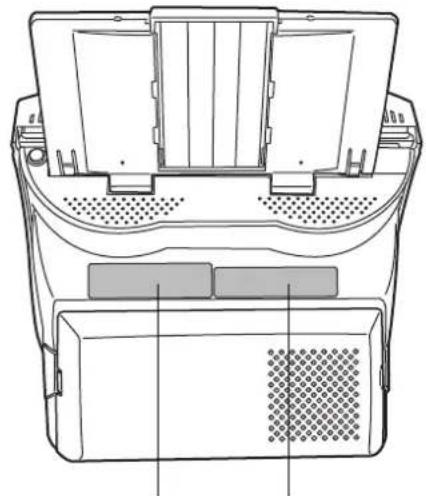
natural_image
Technical line drawing of a device rear panel with ventilation grilles and ventilation grilles (no text or symbols)Label A Label B
- Label A (example): Contains various scanner information.
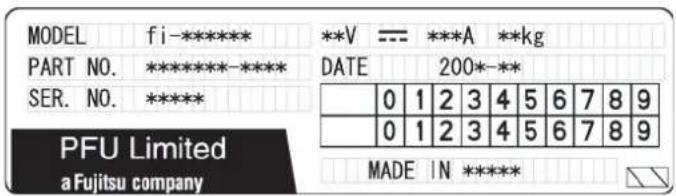
text_image
MODEL fi-***** **V --- ***A **kg PART NO. *******-**** DATE 200*-** SER. NO. **** PFU Limited a Fujitsu company MADE IN *****- Label B (example): Indicates the various standards that the scanner conforms to.

text_image
CE US 175524 FC N124 This Class B digital apperous comprises with Canadian ICS-003. Cot apperol nuérique de la classe B est conforme à la norme HMB-003 du Canada.8.7 Pre-Maintenance Preparations
Before sending the scanner for maintenance, the user data store and system settings should be backed up. Refer to the following sections for details:
- "Backing up the User Data Store" from "4.10.1 Maintaining the User Data Store" (page 165)"
- "4.10.2 Maintaining the System Settings" (page 171)
After backing up the user data store and system settings, the original data may be deleted. Refer to the following sections for details:
If the hard disk is replaced, all settings will revert to their factory default values.
- "Clearing the User Data Store" (page 170) from "4.10.1 Maintaining the User Data Store" (page 165)"
- "Clearing the System Log" (page 164) from "4.10.2 Maintaining the System Settings" (page 171)

The user data store may contain private information such as e-mail addresses or fax numbers, so care should be taken when managing such data.
ADF Paper Specifications
Admin
User
This appendix describes the paper size and quality requirements for ensuring that the ADF operates correctly when scanning documents.
A.1 Paper Size 480
A.2 Paper Requirements.... 481
A.3 Maximum Document Loading Capacity 484
A.4 Area not to be Perforated 485
A.5 Multifeed Detection Conditions.... 486
A.1 Paper Size
The following paper sizes can be scanned with this scanner:
Width: 52 to 216 mm (2.1 to 8.5 in)
Length: 74 to 356 mm (*) (2.9 to 14 in)
* When "Custom" paper size setting is used, a page length of up to 863 mm (34 in) is allowed for document scanning.
A.2 Paper Requirements
A.2.1 Paper Type
The following paper types are recommended for use with the ADF:
- Woodfree paper
● Wood containing paper
When documents of a paper type other than those listed above are used, test-scan a few sheets first to check if the document can be scanned without problem.
A.2.2 Paper Weight
The following paper weights can be used with the ADF:
- For general scanning
- 52 to 127g / m^2 (14 to 34 lb)
● For A8 and Business Card size, 127 g/m ^4 only
● For scanning with a Carrier Sheet
● Up to 127 g/m ^4 (Up to 34 lb) - Up to 63.5g / m^2 (Up to 17 lb) (when scanning half fold paper)
A.2.3 Precautions
The following documents may not scan successfully:
- Documents of non-uniform thickness (e.g. envelopes and documents with attachments)
● Wrinkled or curled documents (See the following HINT) - Folded or torn documents
● Documents with appended photographs, notes, etc. - Tracing paper
- Coated paper
- Carbon paper
- Carbonless paper
● Photosensitive paper
● Perforated or punched documents
● Documents that are not square or rectangular - Exceptionally thin documents (less than 52g / m^2 )
- Photographs
Do not attempt to scan the following types of documents:
● Paper-clipped or stapled documents
● Documents on which the ink is still wet
● Documents smaller than A8 Portrait
● Documents wider than Letter size (8.5 inches = 216mm, A4 is 210mm wide)
● Non-paper documents (such as fabric, foil, transparent paper)


- Carbonless paper contains chemical substances that may damage the pad assy or the pick and other rollers when documents are fed. Pay attention to the following:
Cleaning:
If pick errors occur frequently, clean the pad assy and pick roller.
For details on cleaning the pad assy and pick roller, refer to "Chapter 7 Scanner Care" (page 423).
Replacing parts:
The service life of the pad assy and pick roller may be shortened when compared to scanning only wood containing paper documents.
- When wood containing paper manuscripts are scanned, the life of the pad assy and pick roller may be shortened compared with the case where woodfree paper manuscripts are scanned.
- When scanning photographs, the face of the photograph may become damaged.

- When scanning semi-transparent documents, set the scan [Brightness] to "Light" to avoid image bleed through.
- To prevent the rollers from becoming dirty, avoid scanning documents containing large areas written or filled in with pencil. If scanning of such documents is unavoidable, clean the rollers frequently.
- To operate correctly, the ADF requires the leading edges of all document sheets be evenly aligned. Make sure that curling of the leading edge is within the following tolerances:

text_image
More than 30mm Less than 3mm Feed direction Leading edge of document Side being scanned
text_image
More than 30mm Less than 5mm Feed direction Leading edge of document Side being scanned
Take the following precautions when scanning plastic cards (for example ID cards).
- In Scan Settings, set the Multifeed Setup to [None]. For more details about Multifeed Setup, refer to "6.9.17 Multifeed Detection (Layer and Length)" (page 399).
- Place one card at a time into the ADF paper chute.
- Cards must be fed through the ADF in portrait mode, as in the following figure.
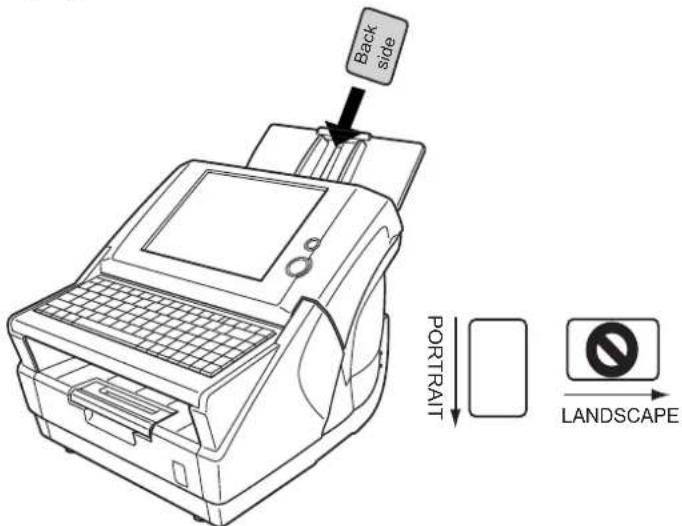
text_image
Back side PORTRAIT LANDSCAPE- Cards should be placed face down in the ADF paper chute.
- Embossed cards should be placed with the raised lettering side down.
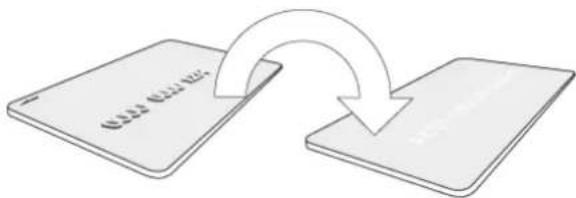
flowchart
graph TD
    A["Device 1: Data Input"] --> B["Device 2: Data Transfer"]
    B --> A
- Cards should be of the following specifications:
ISO7810-compliant, Type ID-1 cards
Width × Length: 2.1 × 3.4 in / 54 × 86 mm
Thickness: 0.03 ±0.003 in / 0.76 ±0.08 mm
Material: PVC (polyvinyl chloride) or PVCA (polyvinyl chloride acetate)
- Cards that are excessively stiff may not be fed smoothly by the ADF.
- Cards that have become dirty from handling should be wiped clean before scanning.
A.3 Maximum Document Loading Capacity
The maximum number of sheets that can be loaded into the ADF paper chute is determined by the length and weight of the document paper.
The following graph shows the maximum document loading capacity of ADF according to paper size and weight.

line
| X Value | Legal | A4/Letter or smaller size | | ------- | ----- | ------------------------- | | 52 | 50 | 50 | | 64 | 50 | 50 | | 80 | 41 | 50 | | 104 | 35 | 41 | | 127 | 29 | 35 | | 150 | 24 | 29 |Paper weight (g/m²)
| Unit Standard paper weights | |||||||
| g/m^2 | 52 64 | 75 80 90 | 104 127 | ||||
| lb | 14 17 | 20 21 24 | 28 34 | ||||
| kg | 45 55 | 64.5 69 7 | 7.5 90 110 | ||||
A.4 Area not to be Perforated
ADF feed problems can occur while scanning if the document has any holes (punched, etc) in the shaded area shown in the following figure.

text_image
17.5mm 17.5mm Page top Front side Feed direction Page bottom Center of paper
A.5 Multifeed Detection Conditions
There are three multifeed detection modes: document layer, document length, and both document layer and length. The following conditions must be satisfied in each of these detection modes. The type of document and document conditions can cause the multifeed detection rate to drop.
A.5.1 Detection by Layer
If [Ultrasonic] is selected in "6.9.17 Multifeed Detection (Layer and Length)" (page 399), mulifeeds are detected by layer.
In this case, set sheets of the same thickness in the ADF at any one time.
● Document thickness: 0.065 to 0.15mm
● Punched holes are not allowed within 17.5mm (0.7in) either side of the center of paper.
- Do not glue on any other paper within 17.5mm (0.7in) either side of the center of paper.
A.5.2 Detection by Length
If [Length] is selected in "6.9.17 Multifeed Detection (Layer and Length)" (page 399), multifeeds are detected by length
In this case, set sheets of the same length in the ADF at any one time.
● Document length deviation: 1% or less
● Punched holes are not allowed within 17.5mm (0.7in) either side of the center of paper.
A.5.3 Detection by both Layer and Length
If [Both] is selected in "6.9.17 Multifeed Detection (Layer and Length)" (page 399), mulifeeds are detected by both layer and length.
In this case, set sheets of the same thickness and length in the ADF at any one time.
● Document thickness: 0.065 to 0.15mm
● Document length deviation: 1% or less
● Punched holes are not allowed within 17.5mm (0.7in) either side of the center of paper.
- Do not glue on any other paper within 17.5mm (0.7in) either side of the center of paper.

- Multifeed detection by layer will often mis-detect very thick paper or plastic documents. When scanning such documents, select "None" on the "Multi-feed Setup" screen.
- Multifeed may not be detected for the top and bottom 25mm of a document.
Area where multifeed detection is possible

text_image
17.5mm 17.5mm Page top Front side Feed direction Page bottom Center of paperManagement Settings and Files
Admin
User
This appendix describes the scanner operating environment and management settings and files.
B
B.1 e-Mail Address Setting Values 490
B.2 Scanner Configuration File Format 491
B.1 e-Mail Address Setting Values
e-Mail addresses may be up to 256 characters long. One of the following e-mail address formats must be used:
- XXXXXX@IP_address
- XXXXXX@Host name
- XXXXXX@Domain_name
| XXXXXX Comprised of alphanumerics and the following symbols. ! # $ % & ' * + - / = ? ^ _ ` { | } ~ . However, periods (.) cannot be used in the following cases.● Using periods (.) as a initial character● Using periods (.) as a last element● Using periods (.) consecutively | |
| IP_address Comprised of numbers separated by periods (.).IP addresses within the following ranges may be used:1.0.0.1 - 126.255.255.254128.0.0.1 - 191.255.255.254192.0.0.1 - 223.255.255.254 | |
| Host_name | Comprised of alphanumerics and hyphens (-) only. Initial character may not be a hyphen. |
| Domain_name | Name elements comprised of alphanumerics and hyphens (-) are separated by periods (.).Each name element may contain up to 63 characters, and only alphabetic characters may be used for the last element. |
B.2 Scanner Configuration File Format
The scanner configuration file format requirements differ for the following two cases.
- For importing
- For exporting
B.2.1 Scanner Configuration File Format (for Importing)
This section describes the scanner configuration file format requirements for importing.
- The file charset should be the same as the value on the Central Admin Console, "Central Admin Server Settings" screen. The default charset is UNICODE (UTF-8).
- The file is in CSV format. The values for each item are as follows.
| Item Value and Format Remarks | ||
| Mac Address XX:XX | :XX:XX:XX(X is an alphanumeric character) | Optional |
| IP Address xxx.xxx.xxx | (xxx is a value from 0 to 255) | Optional |
| Subnet Mask xxx.xxx.xxx.xxx | (xxx is a value from 0 to 255) | Optional |
| Scanner Name Up to | 15 alphanumeric characters long(hyphens may also be used) | Required |
| Port Number Numerical value from 1 to 65535 Optional | ||
| Use HTTPS? 0: Do not use HTTPS (default)1: Use HTTPS | Optional | |
| Model Up to 64 characters long Optional | ||
| Add-in Group | Up to 32 characters long (*1) | Optional |
| Settings Group | Up to 32 characters long (*1) | Optional |
| Comment | Up to 256 characters long | Optional |
| System Updates | 0: Enable (default)1: Disable | Optional |
(*1): The following character strings cannot be used:
(Default) (All) __default__ __all__
"_" is two underbars entered one after another.
B.2.2 Scanner Configuration File Format (for Exporting)
This section describes the scanner configuration file format requirements for exporting.
- The default value for the file name is "scannerinfo.csv".
- The file charset should be the same as the value on the Central Admin Console, "Central Admin Server Settings" screen. The default charset is UNICODE (UTF-8).
● A title line can be added as the first line in a file when the file is exported.
● The file is in CSV format. The values for each item are as follows.
| Item Value and Format Remarks | ||
| Mac Address XX:XX:XX:XX:XX (X is an alphanumeric character) | None | |
| IP Address xxx.xxx.xxx. | xxx (xxx is a value from 0 to 255) | |
| Subnet Mask xxx.xxx.xxx. | xxx (xxx is a value from 0 to 255) | |
| Scanner Name — | ||
| Port Number Numerical | value from 1 to 65535 | |
| Use HTTPS? 0: Do not use HTTPS (default) 1: Use HTTPS | ||
| Model — | ||
| Add-in Group Arbitrary character string | ||
| Settings Group Arbitrary character string | ||
| Comment Arbitrary character string | ||
| System Updates 0: Enable (default) 1: Disable | ||
| Info Last Modified YYY | YMMDD hh:mm:ss When the [Include detailed scanner information.] checkbox is selected. | |
| Registered | 0: # Unregistered 1: # Registered | |
| Update Status | 0: NotTarget 1: Finished 2: Pending 3: Error 4: Unregistered | |
| System Version | — | |
| Add-in Version | — | |
| Scanner Settings | — | |
| Last Inventory Taken | YYYYMMDD hh:mm:ss | |
| Last System Update YY | YYMMDD hh:mm:ss When the | [Include detailed scanner information.] checkbox is selected. |
| Last Add-in Install YYY | YMMDD hh:mm:ss | |
| Last Scanner Settings Update | YYYYMMDD hh:mm:ss | |
| Current System Update Status | 0: NotTarget1: Finished2: Pending3: Error4: Unregistered | |
| Current Add-in Install Status | 0: NotTarget1: Finished2: Pending3: Error4: Unregistered | |
| Current Scanner Set- tings Status | 0: NotTarget1: Finished2: Pending3: Error4: Unregistered | |
| Scanner Version — | ||
| PAD ASSY Numerical value | ||
| PICK ROLLER Numerical value | ||
| Total Throughput Numerical value | ||
| Date of Registration YY | YYMMDD hh:mm:ss | |
| Cumulative On Time Numerical value | ||
| Last Audit Log Col- lected | YYYYMMDD hh:mm:ss | |
| Security Update Ver- sion | Syy-nn | |
| Error Status 0: No | 1: Yes | |
| Operating Status 0: Unreported/Unregistered1: Offline3: Free4: In use | ||
| Installed Options — | ||
Root Certification Authority
Admin
User
This appendix provides an explanation of root certification authority.
C
C.1 Root Certification Authority List.... 496
C.1 Root Certification Authority List
SSL (Secure Socket Layer) encrypted communication may be used by the scanner for user authentication and save operations to the FTP server or a SharePoint folder.
With SSL, trust certificates are exchanged to authenticate the communication opponents.
The following root certificate authorities are pre-registered in the scanner, but further root certificates may be imported. For details about importing certificates, refer to "4.6.14 Managing Certificates" (page 84).
| Issuer | Valid until... (YYYY/MM/DD) |
| C&W HKT SecureNet CA Root 2010/10/16 | |
| CA 1 2019/3/11 | |
| Certiposte Classe A Personne 2018/6/24 | |
| Certiposte Serveur 2018/6/24 | |
| Certisign - Autoridade Certificadora - AC2 2018/6/27 | |
| Certisign - Autoridade Certificadora - AC4 2018/6/27 | |
| Certisign Autoridade Certificadora AC1S 2018/6/27 | |
| Certisign Autoridade Certificadora AC3S 2018/7/10 | |
| Class 1 Primary CA 2020/7/7 | |
| Class 2 Primary CA 2019/7/7 | |
| Class 3 Primary CA 2019/7/7 | |
| Class 3 Public Primary Certification Authority 2028/8/2 | |
| Class 3P Primary CA 2019/7/7 | |
| Class 3TS Primary CA 2019/7/7 | |
| Deutsche Telekom Root CA 1 2019/7/10 | |
| Deutsche Telekom Root CA 2 2019/7/10 | |
| DST (ANX Network) CA 2018/12/10 | |
| DSTCA E1 2018/12/11 | |
| DSTCA E2 2018/12/10 | |
| DST-Entrust GTI CA | 2018/12/9 |
| Entrust.net Secure Server Certification Authority | 2019/5/26 |
| Equifax Secure Certificate Authority | 2018/8/23 |
| Equifax Secure eBusiness CA-1 2020/6/21 | |
| Equifax Secure eBusiness CA-2 2019/6/23 | |
| Equifax Secure Global eBusiness CA-1 2020/6/21 | |
| EUnet International Root CA 2018/10/3 | |
| FESTE, Public Notary Certs 2020/1/2 | |
| FESTE, Verified Certs 2020/1/2 | |
| First Data Digital Certificates Inc. Certification Authority 2019/7/4 | |
| FNMT Clase 2 CA 2019/3/19 | |
| GlobalSign Root CA 2014/1/28 | |
| GTE CyberTrust Global Root 2018/8/14 | |
| http://www.valicert.com/ 2019/6/26 | |
| Microsoft Root Authority 2020/12/31 | |
| Microsoft Root Certificate Authority 2021/5/10 | |
| NetLock Expressz (Class C) Tanusitvanykiado 2019/2/20 | |
| NetLock Kozjegyzoi (Class A) Tanusitvanykiado 2019/2/20 | |
| NetLock Uzleti (Class B) Tanusitvanykiado | 2019/2/20 |
| PTT Post Root CA | 2019/6/26 |
| Saunalahden Serveri CA | 2019/6/26 |
| SecureNet CA Root | 2010/10/16 |
| SecureSign RootCA1 | 2020/9/15 |
| SecureSign RootCA2 | 2020/9/15 |
| SecureSign RootCA3 | 2020/9/15 |
| SIA Secure Client CA | 2019/7/9 |
| SIA Secure Server CA | 2019/7/9 |
| Swisskey Root CA 2016/1/1 | |
| TC TrustCenter Class 1 CA | 2011/1/1 |
| TC TrustCenter Class 2 CA | 2011/1/1 |
| TC TrustCenter Class 3 CA | 2011/1/1 |
| TC TrustCenter Class 4 CA 2011/1/1 | |
| Thawte Premium Server CA 2021/1/1 | |
| Thawte Server CA 2021/1/1 | |
| UTN - DATACorp SGC 2019/6/25 | |
| UTN-USERFirst-Hardware 2019/7/10 | |
| UTN-USERFirst-Network Applications 2019/7/10 | |
| VeriSign Trust Network 2028/8/2 |
Scanner Specifications
Admin
User
This appendix gives specifications for the scanner as a whole, and for scanner parts.
D
D.1 Device Specifications.... 500
D.2 Scanner Specifications.... 501
D.3 Languages Supported By and Keyboard Covers Provided With.... 502
D.1 Device Specifications
| Item Specification | |
| Dimensions (W × D × H) 315 × 415 × 281mm | |
| Power consumption (AC) 88W | |
| Weight 13kg | |
| LCD touch panel 8.4-inch XGA TFT LCD monitorAnalog resistive touch panel | |
| Keyboard 101 keyboard | |
| Network interface LAN (10Base-T/100Base-TX) | |
| Input power AC100-240V± 10% 50/60Hz | |

This scanner is installed with a Wake-On-LAN card. If the last time the scanner power was turned off was due to an error of power failure, the Wake-On-LAN function will not work.
D.2 Scanner Specifications
| Item Specification | Note | ||
| Scanner type ADF (Automatic | Document Feeder) | ||
| Image sensor Color CCD × 2 | |||
| Light source White cold cathode | fluorescent discharge lamp × 2 | ||
| Scannable area Maximum: Legal (8.5 × 14 in)Minimum: A8 (portrait)(52 × 74 mm) or 2 × 3 in | When "Custom" paper size setting is used, a page length of up to 863 mm (34 in) is allowed for document scanning. | ||
| Paper weight | 52 to 127 g/m2(14 to 34 lb) | ||
| Scanning speed (A4/Letter, portrait) (*1) | Color Simplex: 30 sheets/min.Duplex: 60 pages/min. | 150 dpi | |
| Grayscale | |||
| Black & White | |||
| Color Simplex: 25 sheets/min.Duplex: 50 pages/min. | 200 dpi | ||
| Grayscale | |||
| Black & White | |||
| ADF paper chute capacity 50 sheets(Letter/A4, 80g/m2(20 lb)) | |||
| Optical resolution 600 dpi | |||
| Output resolution 150 dpi, 200 dpi, 300 dpi, 600 dpi | |||
| Grayscale level (internal/external) | 1024/256 levels | ||
(*1): The maximum hardware limitation. Actual scanning time includes software processing time such as data transfer time.
D.3 Languages Supported By and Keyboard Covers Provided With
| Scanner Unit Part Number | Supported Language Keyboard Cover | |||
| PA03544-B101 | English - | English (US Keyboard) | ||
| Italian | Italiano PA03544-K600 | ITA | ||
| German | Deutsch PA03544-K601 | DEU | ||
| French | Français PA03544-K602 | FRA | ||
| Spanish | Español PA03544-K603 | ESP | ||
| Portuguese | Português PA03544-K604 PRT | |||
| Russian | Русский | PA03544-K605 | RUS | |
| Korean | 한국어 | PA03544-K606 | KOR | |
| English | English (UK Keyboard) | PA03544-K608 | GBR | |
| Turkish | Türkçe | PA03544-K610 | TUR | |
| PA03544-B102 | English - | English (US Keyboard) | ||
| Traditional Chinese | 中文(繁體) | PA03544-K607 | CHN | |
| French (Canada) | Français (Canada) | PA03544-K609 | CAN | |
| PA03544-B105 PA03544-B205 | English - | English (US Keyboard) | ||
| Spanish | Español PA03544-K603 | ESP | ||
| Portuguese | Português (América do Sul) | PA03544-K604 | PRT | |
To obtain a keyboard cover, contact your FUJITSU dealer or an authorized FUJITSU scanner service provider.
Operation Messages
Admin
User
This appendix provides information about messages which may appear during scanner operations, and how to deal with them.
E.1 Administrator Messages.... 504
E.2 Regular User Messages 528
E.3 Central Admin Messages.... 586
E.1 Administrator Messages
The following messages may appear during administrator operation. Messages are displayed in the form of a dialog box as follows.
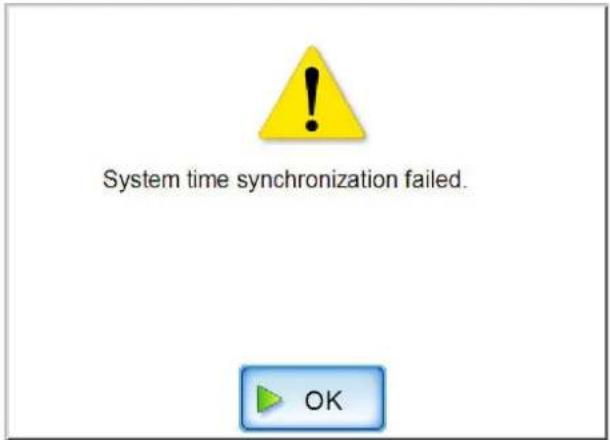
text_image
System time synchronization failed. OKThe following table describes the types of marks which may appear in a message dialog box.
| Marks Description | |
 | Warning message. Displayed if invalid values have been entered for a setting. Check the message and press the [OK] button. |
 | Error message. Check the message and press the [OK] button. |
 | Information message. Check the message and press the [OK] button. No action required. |
 | Inquiry message. Check the message, select and press a button. |
E.1.1 Administrator Screen Messages
| Screen Message Action | ||
| Scanner Name S | Scanner name contains invalid characters. | Re-enter the scanner name using only specified valid characters.Do not enter a blank space before or after the scanner name. Do not use control characters or any of the following symbols:"/\[ ] :|<>+ = ;, ? |
| Workgroup or domain name contains invalid characters. | Workgroup or domain name contains invalid characters.Workgroup names may be up to 15 alphanumeric characters long.Domain names may be up to 255 alphanumeric characters long, and".-_" can also be used. | |
| Domain login failed. Check the specified user name and password. | ||
| Specified domain cannot be found. Could not connect to domain.Check that the specified domain is correct, and that it is connected to the network. | ||
| Workgroup or domain name has not been entered. | Group or domain name contains invalid characters.Group names may be up to 15 alphanumeric characters long.Domain names may be up to 255 alphanumeric characters long, and".-_" can also be used. | |
| Date/Time Date | time setting is invalid. Re-enter the date/time using only valid numbers. | |
| Time adjustment has caused the session to timeout. Logging out now. | No action required. | |
| Login Settings In | Invalid user name. Enter a valid user name, and try again. | |
| User name contains invalid characters. Re-enter the user name using only specified valid characters. | ||
| Admin Password | New password contains invalid characters. | Enter a valid new password. Alphanumeric characters (case sensitive) and symbols may be entered. |
| File Names "Save as:" file name contains invalid characters ( :*?"<>| ), or is set to a reserved string (CON, PRN, AUX, CLOCKS, NUL, COM0, ..., COM9, LPT0, ..., LPT9). Re-enter the file name and try again. | Do not use the following symbols or reserved strings:\( \forall : * ? " <> | CON PRN AUX CLOCK$ NUL COM0 - COM9 LPT0 - LPT9 Re-enter the file name using only the specified valid characters. | |
| Certificate Management | Authentication certificate could not be imported. | Contact your FUJITSU scanner dealer or an authorized FUJITSU scanner service provider. |
| Authentication certificate could not be imported into the "Trusted Root Certificate Authorities" store. | Contact your FUJITSU scanner dealer or an authorized FUJITSU scanner service provider. | |
| Authentication certificate could not be deleted. | Contact your FUJITSU scanner dealer or an authorized FUJITSU scanner service provider. | |
| IP Address IP address could not be set. Try again. Try again. | If that does not work, restart the scanner and try again. | |
| Admin Network | Invalid combination of settings has been specified. | The following settings combinations are not possible.● Port Number "80" and SSL "On"● Port Number "443" and SSL "Off"Enter a valid settings combination for Port Number and SSL. |
| Central Admin Server | Scanner details could not be registered with the iScanner Central Admin server. | Check the Central Admin Server connection environment. |
| Invalid address has been specified. Enter a valid address, and try again. | ||
| DNS Server DNS suffix contains invalid characters. | Re-enter the DNS suffix using only specified valid characters. | |
| Screen Message Action | |
| NTP Server System time synchronization failed. Try the following:Check the NTP server IP address, host name, and FQDN settings.Check the network path between to the NTP server for problems.The NTP server may be busy. Wait a short time before trying again to synchronize the system time. If that does not work, the specified server may not be an NTP server, so try a different NTP server.The specified NTP server cannot provide a trusted date and time. It attempted to acquire the date and time from a higher level NTP server, but failed. Try a different NTP server or have the network administrator investigate.Check that the time is correct. If the time is incorrect, adjust the date/time, and try again.Refer to"4.6.5 Setting the Date/ Time" (page 64), adjust the date/time, and try again. | |
| Time synchronization has caused the session to timeout. Logging out now. | No action required. |
| LDAP Server Connection test failed.Check the LDAP settings. | Check that each item has been set correctly.AddressPort numberSSLSearch baseAuthorized user (DN)User namePasswordIf there are no problems with the settings, contact a network administrator. |
| Screen Message Action | ||
| Network Printer | Access was refused. Login is not possible at this time. | Try the following:● Try again when login is possible.● Contact a network administrator to have the time setting changed. |
| Access was refused. The specified account is currently locked out. | Contact a network administrator. | |
| Access was refused. Contact a server administrator to find out if an access permit has been set. | ||
| Operation not possible. Network path is not working. | Contact a server administrator. | |
| Not connected to the network. Check that the system network is functioning normally by performing a ping test from another machine in the network, other than the server with network printer. If the system network is not operating properly, refer to "Failure to connect to a server using its IP address" (page 463) for further solutions. | ||
| Number of network path connections has reached the maximum allowed. No more may be specified. | Close unneeded network connections, then try specifying the desired network path again. | |
| Length of specified network printer path exceeds the maximum selectable path length. This printer may not be selected. | Select a different network printer and try again. | |
| Cannot acquire network information. Contact an administrator for the specified server. | ||
| Specified user is no longer able to login to this network printer. | The specified user account has expired.Try the following:● Login with a different account.● Contact a network administrator to have the account validated. | |
| Network Printer | Specified password is no longer valid for this network printer. | Specified password was expired.Try the following:Login with a different account.Contact a network administrator to have the password validated again. |
| Specified user needs to renew their password for this network printer. | Change the password before logging in to the network printer for the first time.Try the following:Login with a different account.Contact a network administrator to have the password changed. | |
| Cannot add printer. Try the following: | Check the specified network printer path.Check that the printer settings and access privileges for the network printer have been set correctly.Check that the shared printer settings have been set correctly on the print server.By performing a ping test, check if the network connection to the printer is working properly. If there is no response from the ping test, check that the system network is functioning normally by performing a ping test from another machine in the network.Check that the primary DNS suffix of the print server has been set correctly. | |
| Network printer tree information is not available. | Check whether the Central Admin Server "Computer Browser" service is stopped. If stopped, start the service. | |
| SharePoint Folder | SharePoint access error occurred. Check | the network connection and server status, and try again. |
| SharePoint site cannot be accessed. | ||
| SharePoint site not found. Check the network connection and site settings, and try again. | ||
| Network Folder | Access was refused. Login is not possible at this time. | Try the following:● Try again when login is possible.● Contact a network administrator to have the time setting changed. |
| Access was refused. The specified account is currently locked out. | Contact a network administrator. | |
| Specified network folder alias is already being used. Try a different alias. | Rename the network folder whose alias is already being used, and try adding the folder again. | |
| Access was refused. Contact a server administrator to find out if an access permit has been set. | ||
| Cannot find the network folder path. Contact a server administrator. | ||
| Operation not possible. Network path is not working. | Contact a server administrator. | |
| Not connected to the network. Check that the system network is functioning normally by performing a ping test from another machine in the network, other than the server with network folder. If the system network is not operating properly, refer to "Failure to connect to a server using its IP address" (page 463) for further solutions. | ||
| Number of network path connections has reached the maximum allowed. No more may be specified. | Close unneeded network connections, then try specifying the desired network path again. | |
| Length of specified network folder path exceeds the maximum selectable path length. This folder may not be selected. | Select a different network folder and try again. | |
| Network Folder | Cannot acquire network information. | Contact an administrator for the specified server. |
| Specified user is no longer able to login to this network folder. | The specified user account has expired.Try the following:Login with a different account.Contact a network administrator to have the account validated. | |
| Specified password is no longer valid for this network folder. | Specified password was expired.Try the following:Login with a different account.Contact a network administrator to have the password validated again. | |
| Specified user needs to renew their password for this network folder. | Change the password before logging in to the network folder for the first time.Try the following:Login with a different account.Contact a network administrator to have the password changed. | |
| Cannot connect to FTP path. Try the following:Check that the FTP path is correct.Check the user name and password.Check the protocol settings.Check the port number.Check the passive mode settings.Check the encryption settings.Check proxy settings. | ||
| Network folder tree information is not available. | Check whether the Central Admin Server "Computer Browser" service is stopped. If stopped, start the service. | |
| Alert Notification | Test e-mail could not be sent. Try the following:Check if the computer connected to the SMTP server is running properly.Check if an e-mail can be sent to the address from another computer in the network.By performing a ping test, check if the SMTP server or the network connection to the SMTP server is working properly. If there is no response from the SMTP server ping test, check that the system network is functioning normally by performing an SMTP server ping test from another machine in the network.If the system network is not operating properly, refer to "Failure to connect to a server using its IP address" (page 463) for further solutions.If the only the SMTP server cannot connect to the network, request the network administrator to check that the SMTP server and the network connection to the server are functioning normally. | |
| System Status Cannot read data from a scanner unit. Try the following:If the scanner does not restart automatically, press the [Shutdown] button on the "Login" screen to turn the power off, and turn the power back on again to restart the scanner.If the error status persists after the scanner is restarted, press the [Shutdown] button on the "Login" screen, disconnect the AC cable from the scanner to turn the power off, wait for at least 10 seconds, then reconnect the AC cable and try turning the power back on again. If the error status persists, contact your FUJITSU scanner dealer or an authorized FUJITSU scanner service provider. | ||
| Usage Status Cannot read data from a scanner unit. Try the following:If the scanner does not restart automatically, press the [Shutdown] button on the "Login" screen to turn the power off, and turn the power back on again to restart the scanner.If the error status persists after the scanner is restarted, press the [Shutdown] button on the "Login" screen, disconnect the AC cable from the scanner to turn the power off, wait for at least 10 seconds, then reconnect the EC cable and try turning the power back on again. If the error status persists, contact your FUJITSU scanner dealer or an authorized FUJITSU scanner service provider. | ||
| Screen Message Action | ||
| User Data Store | Specified backup file could not be uploaded, or is not a valid user data store. | Try the following:● Check if the specified backup file is correct.● Try restoring the file again.● Specified backup file may not be uploaded because of network error. Check the network status. |
| Restoring from the specified backup file will cause the maximum number of user data stores to be exceeded. Clear the existing user data stores, and try again. | Up to 1,000 users can be registered. Clear the existing user data stores, and try again."Clearing the User Data Store" (page 170) | |
| User data could not be restored. Specified file contains unsupported data. | Versions do not match between the backup device and restoring device. Update the restoring device."4.10.3 Updating the Scanner's System Software" (page 175) | |
| User data could not be restored. The language of the backup file must be the same as the current language setting. | Change the language setting back to the language at the time of backup, and try restoring the user data again. | |
| System Settings File | Specified backup file could not be found or could not be uploaded. | Try the following:● Check if the specified backup file is correct.● Try restoring the file again.● Specified backup file may not be uploaded because of network error. Check the network status. |
| Backup data could not be restored. Specified file contains unsupported data. | Versions do not match between the backup device and restoring device.Update the restoring device."4.10.3 Updating the Scanner's System Software" (page 175) | |
| Backup data could not be restored. The language of the backup file must be the same as the current language setting. | Change the language setting back to the language at the time of backup, and try restoring the backup data again. | |
| System Settings File | System settings were successfully restored.The scanner will be restarted. | No action required. |
| System Updates | Specified update file cannot be applied to this system. | Check the applicable system for the update file. |
| Specified update file could not be uploaded, or is not a valid system update. | Try the following:● Check if the specified update file is correct, and try again.● Specified update file may not be uploaded because of network error. Check the network status. | |
| Common Error: | problem with XXXXXX.Contact your FUJITSU scanner dealer or an authorized FUJITSU scanner service provider.Error code=xxxxxxResult code=xxxxxx(XXXXXX: Function Name) | Contact your FUJITSU scanner dealer or an authorized FUJITSU scanner service provider. |
| Error: problem with XXXXXX.Contact your FUJITSU scanner dealer or an authorized FUJITSU scanner service provider.(XXXXXX: Function Name) | Contact your FUJITSU scanner dealer or an authorized FUJITSU scanner service provider. | |
| Add-in Manager | Specified Add-in data contents are invalid. | Check the contents of the specified Add-in module. |
| Specified Add-in file cannot be applied to this system. | Check the system version, prepare the correct version of the update file, and try again. | |
| Specified Add-in could not be uploaded. | Try the following:● Check if the specified update file is correct, and try again.● Specified update file may not be uploaded because of a network error. Check the network status. | |
| System version xx or later is required to install the specified Add-in. | Update the system, and then install the Add-in module. | |
| Admin Tool Connection error. For more details about the process, refer to "8.3.3 Failure to Access the Scanner using a Web Browser, Admin Tool, or Central Admin Server" (page 467). | ||
| Cannot connect to this system version. Install the Admin Tool from the scanner, and try again. | ||
| Job Settings Session has timed out. Click the "Close" button in the toolbar to close the edit settings window. | Close the edit settings window, and try again. | |
| Insufficient memory to continue. Close the Job Settings session, then try again. | Ensure that there is enough memory capacity available, and try again. | |
| LDAP Connection | LDAP search base setting is invalid. Correct the LDAP settings. | |
| LDAP server is busy. Wait for a while, and try again. | ||
| Search has timed out. Contact a system administrator. | Contact a system administrator. | |
| Cannot connect to the LDAP server. Check that the LDAP access settings are correct and that the LDAP server is running and accessible. | Contact a system administrator. | |
| LDAP server connection failed SSL authentication. | Contact a system administrator. | |
| LDAP access user name, password and/or search base settings are invalid. | Enter a valid user name and password, and try again. | |
| LDAP Connection | LDAP authorized user (DN), password and/or search base settings are invalid. | Try the following:● Check the LDAP server and search base settings.● Enter a valid authorized user (DN) and password. |
| LDAP server access failed.Check that the LDAP access settings and LDAP server settings are correct. | Contact a system administrator. | |
| Could not get data from the LDAP server.Check the LDAP search base settings. | Check the search base settings, and try again. | |
| Connecting to the LDAP server. Enter a User Name and Password. | Enter a user name and password. | |
| Connecting to the LDAP server. Enter an Authorized User (DN) and Password. | Try the following:● Check the LDAP server and search base settings.● Enter a valid authorized user (DN) and password. | |
| LDAP server access failed.Check that the LDAP access, LDAP server, Authorized User (DN), Password and Search Base settings are correct. | Try the following:● Contact a server administrator to check the LDAP server operation.● Check the network settings.● Check the LDAP server and search base settings.● Enter a valid authorized user (DN) and password. | |
| Number of matches has reached the maximum allowed. Try refining the search conditions. | Refine the search conditions, and try again. | |
E.1.2 System Log Messages
System log messages which may appear during administrator operations can be arranged into the following three categories:
- Information
- Error
- Warning
Information
| Code Message Action | |||
| 01000001 (XXXXXX) Settings were changed.Info:(XXXXXX: Function Name) | No action required. | ||
| 01000002 Pad assy usage counter was cleared. | |||
| 01000003 Pick roller usage counter was cleared. | |||
| 01000004 All users log was prepared for download. | |||
| 01000005 System log was prepared for download. | |||
| 01000006 User data store was prepared for download. | |||
| 01000007 User data store was restored. | |||
| 01000008 System settings were prepared for download. | |||
| 01000009 System was updated.Info: New System Version = x.x.x.x | |||
| 01000009 System was updated.Info: System Version = x.x.x.x | |||
| 01000009 System was updated.Info: Security Version = x.x.x.x | |||
| 01000009 System was updated.Info: Option xxxx = xxxx | |||
| 01000010 Test e-mail was sent successfully. | |||
| 01000011 User data store was cleared. | |||
| 01000012 System time was synchronized successfully. | |||
| 01000013 System settings restoral completed. | |||
| 01000014 Technical support data was prepared for download. | No action required. | ||
| 01000015 Add-in module was installed successfully.Add-in:xxxxxVersion:xxxxx | |||
| 01000016 Add-in module was uninstalled successfully. | |||
| 01000017 System settings restoral started. | |||
| 01000018 Update Scheduler has been enabled. | |||
| 01000019 Update Scheduler has been disabled. | |||
| 01000020 Login LDAP server connection test succeeded. | |||
| 01000021 e-Mail address LDAP server connection test succeeded. | |||
| 01000022 Update is already in effect, and was not applied again.Info: System Version = x.x.x.x | |||
| Update is already in effect, and was not applied again.Info: Security Version = x.x.x.x | |||
| 0C010001 Created new Job.Job name:XXXXXX | |||
| 0C010002 Copied existing Job.Job name:XXXXXSource name:YYYYY | |||
| 0C010003 Edited Job.Job name:XXXXXX | |||
| 0C010004 Deleted Job.Job name:XXXXXX | |||
| 0C020001 Created new Job Menu.Menu name:XXXXXX | |||
| 0C020002 Copied existing Job Menu.Menu name:XXXXXSource name:YYYYY | |||
| 0C020003 Edited Job Menu.Menu name:XXXXXX | |||
| 0C020004 Deleted new Job Menu.Menu name:XXXXXX | No action required. | ||
| 0C030001 Created new User Group.Group name:XXXXXX | |||
| 0C030003 EditedUser Group.(Deleted members belonging to a non-current server type.) (*)Group name:XXXXXX | |||
| 0C030004 Deleted User Group.Group name:XXXXXX | |||
| 0C040001 LDAPserver access succeeded.Search base:XXXXXX | |||
(*): Only recorded when a member of a different LDAP server type is deleted while editing the user group.
Error
| Code Message Action | ||
| 81001001 Error: | problem withXXXXXX.Contact your FUJITSU scanner dealer or an authorized FUJITSU scanner service provider.Error code=xxxxxxxResult code=xxxxxxx(XXXXXX: Function Name) | Contact your FUJITSU scanner dealer or an authorized FUJITSU scanner service provider. |
| 81001002 Error: | problem withXXXXXX.Contact your FUJITSU scanner dealer or an authorized FUJITSU scanner service provider.(XXXXXX: Function Name) | Contact your FUJITSU scanner dealer or an authorized FUJITSU scanner service provider. |
| 81001003 Corrupted system log file was deleted. No action required. | ||
| 81001004 Corrupted user log file was deleted. | ||
| 81001005 Settings could not be changed.Info:XXXXXXXAdd-in:xxxxxxVersion:xxxxxx | Failed to register an Add-in, change Add-in settings, or change the restored scanner system settings. Check the scanner status and setting value.Cause of the error and the failed setting value are shown at Info:XXXXXX. | |
| 81001006 (IP Address) Settings could not be changed.Info:Specified IP address is already being used.DHCP = OffIP Address = xxx.xxx.xxx.xxxSubnet Mask = xxx.xxx.xxx.xxxDefault Gateway = xxx.xxx.xxx.xxx | Returns to the previous IP address before it was changed.Enter a non-duplicated IP address, and try again. | |
| 81001007 Update Scheduler could not be enabled. | Contact your FUJITSU scanner dealer or an authorized FUJITSU scanner service provider. | |
| 81001008 Update Scheduler could not be disabled. | Contact your FUJITSU scanner dealer or an authorized FUJITSU scanner service provider. | |
| 7C040001 LDAP | search base setting is invalid.Search base:XXXXXX | Check the search base settings. |
| 7C040002 LDAP | server is busy.Search base:XXXXXX | Try the following:Wait for a while, and try again.Contact a server administrator to check LDAP server operation. |
| 7C040003 Search | has timed out. Contact a system administrator.Search base:XXXXXX | Contact a server administrator to check that the search timeout setting is correct. |
| 7C040005 Cannot | connect to the LDAP server.Check that the LDAP access settings are correct and that the LDAP server is running and accessible.Search base:XXXXXX | Try the following:Check the LDAP server and search base settings.Contact a server administrator to check LDAP server operation. |
| 7C040006 LDAP | server connection failed SSL authentication.Search base:XXXXXX | Contact a server administrator to check that the SSL authentication settings and certification for the LDAP server are correct. |
| 7C040008 LDAP | access user name, password and/or search base settings are invalid.Search base:XXXXXX | Try the following:Specify a correct user name and password.Specify a valid user name and password.Check the LDAP server and search base settings. |
| 7C040009 LDAP | server access failed. Check that the LDAP access settings and LDAP server settings are correct.Search base:XXXXXDetail error code:XXXXXXXXXDetail error message:XXXXXXXXXX | Try the following:Contact a server administrator to check LDAP server operation.Check that the network settings are correct. |
| 7C040010 Could | not get data from the LDAP server.Check the LDAP search base settings.Search base:XXXXXX | Check the search base settings. |
| 7C040011 LDAP | authorized user (DN),password and/or search base settings are invalid.Search base:XXXXXX | Try the following:Check the LDAP server and search base settings.Set a valid authorized user (DN) and password. |
| 7C040012 LDAP | server access failed. Check that the LDAP access, LDAP server, Authorized User (DN), Password and Search Base settings are correct.Search base:XXXXXDetail error code:XXXXXXXXXDetail error message:XXXXXXXXX | Try the following:Contact a server administrator to check the LDAP server operation.Check the network settings.Check the LDAP server and search base settings.Set a valid authorized user (DN) and password. |
■ Warning
| Code Message Action | |
| 82001001 Cannot read data from a scanner unit. Check the scanner connection. | |
| 82001002 Scheduled date/time for update is not more than 10 minutes away, so Update Scheduler could not be enabled. | Contact a server administrator to have the Update Scheduler set to a later time. |
E.1.3 Alert Monitor System Log Messages
System log messages which may be received from the scanner alert monitor service can be arranged into the following three types:
- Information
- Error
- Warning
Information
The following table gives a summary of system log information messages which may be received from the scanner alert monitoring service.
No action is required.
| Code Message Action | ||
| 01001014 Scanner | alert monitor started. Scanner alert monitor start date/time = MM/dd/yyyy HH:mm:ss | No action required. |
| 01001015 Scanner | alert monitor stopped. | |
| 01001016 Scanner | alert monitor stopped by system standby mode. | |
| 01001017 Scanner | alert monitor restarted after resume from standby. | |
Error
The following table gives a summary of system log error messages which may be received from the scanner alert monitoring service.
The messages shown here are sent to the e-mail address specified in "4.7.16 Setting the Destination for Alert Notifications" (page 149).
| Code Message Action | ||
| 81000001 CPU | power supply error. Contact your FUJITSU | scanner dealer or an authorized FUJITSU scanner service provider. |
| 81000002 1.5V | power supply error. | |
| 81000003 3.3V | power supply error. | |
| 81000004 5V | power supply error. | |
| 81000005 12V | power supply error. | |
| 81000006 -12V | power supply error. | |
| 81000007 5V Standby power supply error. | ||
| 81000008 Battery | power supply error. | |
| 81000009 | Internal temperature error. | ● Check if the air ventilation inlet is blocked. ● Contact your FUJITSU scanner dealer or an authorized FUJITSU scanner service provider. |
| 81000010 CPU | temperature error. | |
| 81000011 System | fan speed error. Contact your FUJITSU | scanner dealer or an authorized FUJITSU scanner service provider. |
| 81000012 CPU | fan speed error. | |
| 81002003 Alert notification e-mail could not be sent. | Check the following:● Check if the computer connected to the SMTP server is running properly.● Check if an e-mail can be sent to the address from another computer in the network.● By performing a ping test, check if the SMTP server or the network connection to the SMTP server is working properly. If there is no response from the SMTP server ping test, check that the system network is functioning normally by performing an SMTP server ping test from another machine in the network.● If the system network is not operating properly, refer to "Failure to connect to a server using its IP address" (page 463) for further solutions.● If only the SMTP server cannot connect to the network, request the network administrator to check that the SMTP server and the network connection to the server are functioning normally. | |
| 81002004 Device monitoring service error. Contact your FUJITSU scanner dealer or an authorized FUJITSU scanner service provider. | ||
■ Warning
The following table gives a summary of system log warning messages which may be received from the scanner alert monitoring service.
The messages shown here are sent to the e-mail address specified in "4.7.16 Setting the Destination for Alert Notifications" (page 149).
| Code Message Action | |
| 82000005 Pad assy needs replacement soon. Obtain a replacement pad assy soon.The pad assy should be replaced after every 50,000 scanned sheets or once a year. | |
| 82000006 Pad assy needs replacement now. Pad assy has passed its rated lifetime (50,000 scanned sheets or once a year) and needs to be replaced. | |
| 82000007 Pick roller needs replacement soon. Obtain a replacement pick roller.The pick roller should be replaced after every 100,000 scanned sheets or once a year. | |
| 82000008 Pick roller needs replacement now. Pick roller has passed its rated lifetime (100,000 scanned sheets or once a year) and needs to be replaced. | |
E.2 Regular User Messages
The following messages may appear during regular user operation.
E.2.1 Regular User Screen Messages
| Screen Message Action | ||
| Login Administrator operation in progress, please wait... | Only one administrator or user can login to the scanner at any one time. Please wait until operations are completed. | |
| Login failed. Check the user name and password, and try again. | ||
| Try the following:Enter a correct user name and password.Enter a valid user name and password.Contact a system administrator and have them check that the LDAP server is set.Contact a system administrator to have the server status checked.Contact a system administrator to check if the password has expired.Login is not possible if the Active Directory account option is "User must change password at next logon". Contact an administrator to set a password, and then try logging in. | ||
| Screen Message Action | ||
| Login LDAP authorized user (DN), password and/or search base settings are invalid. | Try the following:● Enter a correct authorized user (DN) and password.● Enter a valid authorized user (DN) and password.● Contact an administrator to check that the LDAP server is set.● Contact an administrator to check the status of the server.● Contact an administrator to check that the password has not expired. | |
| Scanner initialization has failed. Try turning the power off and back on again. The administrator should contact the FUJITSU scanner dealer or an authorized FUJITSU scanner service provider for help | ||
| If the error status persists after the scanner is restarted, press the [Shutdown] button on the "Login" screen, disconnect try turning the power off for 10 seconds, and back on again. If the error status persists, contact your FUJITSU scanner dealer or an authorized FUJITSU scanner service provider. | ||
| Invalid LDAP Search Base format. Contact a system administrator to have the LDAP search base format corrected."4.7.8 Setting the Login LDAP Server" (page 100) | ||
| Login LDAP server is busy. Try the following: | ● Contact a system administrator to have the network settings checked."8.3 Network Connection Troubleshooting" (page 458)● Contact a system administrator to have the server status checked. | |
| Number of user data stores has reached the maximum allowed. New users may not login until the old user data stores are deleted. | ||
| Communicating with the Central Admin Server. | ||
| User roaming data could not be downloaded from the Central Admin Server. OK to continue?(If you continue, the scanner will use the currently saved scan settings.) | ||
| Consumable Alert | Replace Soon Replace the consumable part when convenient. For details, refer to "7.6 Replacing Parts" (page 436). | |
| Replace Now Replace the consumable part when convenient. For details, refer to "7.6 Replacing Parts" (page 436). | ||
| Scanning Document not found. Load a document into the ADF, making sure the side guides are adjusted correctly and try again. | Load the document into the ADF paper chute, and try again. Load the document to prevent any space between the side guides and the edges of the documents. For details, refer to "6.1 Loading Documents" (page 298). | |
| Screen Message Action | ||
| Scanning Paper jam has occurred. Remove the documents from the ADF and try again. | Try the following:Remove the documents from the ADF.Remove the pages which were not scanned correctly. | |
| Scanning Insufficient memory. Try turning the power off and back on again. If problem persists, the administrator should contact the FUJITSU scanner dealer or an authorized FUJITSU scanner service provider for help | Try the following:Reduce the size of the scan data or set a lower resolution level, and try again.If the scanner does not restart automatically, press the [Shutdown] button on the "Login" screen to turn the power off, and turn the power back on again to restart the scanner.If the error status persists after the scanner is restarted, press the [Shutdown] button on the "Login" screen, disconnect the AC cable from the scanner to turn the power off, wait for at least 10 seconds, then reconnect the AC cable and try turning the power back on again. If the error status persists, contact your FUJITSU scanner dealer or an authorized FUJITSU scanner service provider. | |
| Screen Message Action | ||
| Scanning An error has occurred. Some pages were skipped. Try again after turning the power off and back on again. If problem persists, the administrator should contact the FUJITSU scanner dealer or an authorized FUJITSU scanner service provider for help.Number of Skipped Pages: XXX | Try the following:If the scanner does not restart automatically, press the [Shutdown] button on the "Login" screen to turn the power off, and turn the power back on again to restart the scanner.If the error status persists after the scanner is restarted, press the [Shutdown] button on the "Login" screen, disconnect the AC cable from the scanner to turn the power off, wait for at least 10 seconds, then reconnect the AC cable and try turning the power back on again. If the error status persists, contact your FUJITSU scanner dealer or an authorized FUJITSU scanner service provider. | |
| Scanner hardware failure. The administrator should contact the FUJITSU scanner dealer or an authorized FUJITSU scanner service provider for help. | Try the following:If the scanner does not restart automatically, press the [Shutdown] button on the "Login" screen to turn the power off, and turn the power back on again to restart the scanner.If the error status persists after the scanner is restarted, press the [Shutdown] button on the "Login" screen, disconnect the AC cable from the scanner to turn the power off, wait for at least 10 seconds, then reconnect the AC cable and try turning the power back again. If the error status persists, contact your FUJITSU scanner dealer or an authorized FUJITSU scanner service provider. | |
| Screen Message Action | ||
| Scanning When | the file format is [MTIFF], the maximum file size for the total scanned data is 2GB. If the size of the scanned data exceeds 2GB, no MTIFF files can be created. | Try the following:Delete scanned pages from Scan Viewer until the total file size of the scanned data is less than 2GB.Increase the compression level and try scanning again. |
| Scanning with the carrier sheet failed.Make sure the document is fully inserted into the top of the carrier sheet and the folded edge is on the side marked with the thick line, then try again. If the problem persists, the administrator should contact the FUJITSU scanner dealer or an authorized FUJITSU scanner service provider for help. | Make sure the document is fully inserted into the top of the Carrier Sheet and the folded edge is on the side marked with the thick line, then try again. If the problem persists, the administrator should contact the FUJITSU scanner dealer or an authorized FUJITSU scanner service provider for help. | |
| Roller Cleaning | Scanner top cover is closed. Open the cover and try again. | Open the top cover to clean the feed rollers, and try again. For details, refer to "7.2.1 Cleaning the ADF" (page 427). |
| Press the keyboard [C] key to step the feed rollers forward. Press the [OK] button after the feed rollers have been cleaned. | Clean the rollers, and then press the [OK] button. | |
| Shutdown Shutdown | down will occur after all jobs finish. Please wait... | Operations cannot be carried out while the scanner is shutting down. The scanner will shutdown automatically. Please wait. |
| Scan Test Document not found. Load a document into the ADF, making sure the side guides are adjusted correctly and try again. | Load the document into the ADF paper chute, and try again. Load the document to prevent any space between the side guides and the edges of the documents.For details, refer to "6.1 Loading Documents" (page 298). | |
| Scan Test Feed | Error: Document(s) may not match the set paper size, ADF may have grabbed more than one sheet, or documents may not be suitable for scanning. Remove the documents from the ADF, check them and try again. If problem persists, consult the manual. | Press the ADF release button to open the top cover, and remove the documents from the ADF. If more than one sheet has been fed, reset the document and try again.Check that the actual document(s) size matches the paper size specified in the "Paper Size" screen. If not, specify the paper size again.For details, refer to "6.9.3 Paper Size" (page 374). |
| Paper jam has occurred. Remove the documents from the ADF and try again. | Try the following:Remove the documents from the ADF.Remove the pages which were not scanned correctly. | |
| Scanner initialization has failed. Try turning the power off and back on again. The administrator should contact the FUJITSU scanner dealer or an authorized FUJITSU scanner service provider for help. | Try the following:Check that the cables are connected to the scanner properly.If the scanner does not restart automatically, press the [Shutdown] button on the "Login" screen to turn the power off, and turn the power back on again to restart the scanner.If the error status persists after the scanner is restarted, press the [Shutdown] button on the "Login" screen, disconnect the AC cable from the scanner to turn the power off, wait for at least 10 seconds, then reconnect the AC cable and try turning the power back on again. If the error status persists, contact your FUJITSU scanner dealer or an authorized FUJITSU scanner service provider. | |
| Send e-Mail Invalid "From" address. Re-enter the address and try again. | Enter a valid e-mail address including "@". | |
| Invalid "To" address. Re-enter the address and try again. | ||
| Invalid "Cc" address. Re-enter the address and try again. | ||
| Invalid "Bcc" address. Re-enter the address and try again. | ||
| No more than 30 "To" addresses are allowed. | ||
| No more than 30 "Cc" addresses are allowed. | ||
| No more than 30 "Bcc" addresses are allowed. | ||
| Current login (LDAP account) has become invalid. | ||
| e-Mail Address Book | Search has timed out. Contact a system administrator. | Contact a system administrator to check the time of the search timeout."4.7.8 Setting the Login LDAP Server" (page 100) |
| LDAP server is busy. Try the following: | ● Contact a system administrator to have the network settings checked."8.3 Network Connection Troubleshooting" (page 458)● Contact a system administrator to have the server status checked. | |
| Number of matches has reached the maximum allowed. Try refining the search conditions. | Enter more specific search conditions to narrow down the search. | |
| Send Fax Invalid | fax number. Try again. Enter a valid fax | number.Only numbers 0 to 9, -, *, and # can be used. |
| Invalid notification address (Sender's c-Mail Address). Try again. | Enter a valid notification address. | |
| Current login (LDAP account) has become invalid. | Contact a system administrator to have the login account validated. | |
| Add Fax Number | Invalid fax number. Try again. Enter a valid fax number.Only numbers 0 to 9, -, *, and # can be used. | |
| Edit Fax Number | Invalid fax number. Try again. Enter a valid fax number.Only numbers 0 to 9, -, *, and # can be used. | |
| Print Network is busy. Try again later. Wait for a while, and try again. | ||
| Print Current login (LDAP account) has become invalid. | Contact a system administrator to have the login account validated. | |
| Specified user is no longer able to login to this network printer. | ||
| Specified password is no longer valid for this network printer. | ||
| Specified user needs to renew their password for this network printer. | ||
| Access to network printer was refused. The specified account is currently locked out. | ||
| Access to network printer was refused. Login is not possible at this time. | ||
| Print Could not connect to the network printer. | Try the following:Check that the LAN cable is connected properly to the scanner and print server.Contact a network administrator to check that the print server is working properly.Check that the print server spooler is operating properly.Contact a network administrator to find out if an access permit has been set.Contact a system administrator to check that the scanner IP address and network printer settings are correct."8.3 Network Connection Troubleshooting" (page 458) | |
| Error: network printer could not be accessed. | ||
| Invalid No. of copies. Enter a value between 1 and 99, and try again. | ||
| Print Server Authentication | User name is required. Enter a user name. | |
| Network is busy. Try again later. Wait for a while, and try again. | ||
| User name or password may be incorrect. | Re-enter the user name and password. | |
| Cannot find the network printer path. Try the following:Contact a server administrator.Check that the spooler is operating properly. | ||
| Print Server Authentication | Not connected to the network. Check that the system network is functioning normally by performing a ping test from another machine in the network, other than the server with network printer. If the system network is not operating properly, refer to "Failure to connect to a server using its IP address" (page 463) for further solutions. | |
| Access to network printer was refused. | Contact a server administrator to find out if an access permit has been set. | |
| Number of network path connections has reached the maximum allowed. No more may be specified. | Close unneeded network connections, then try specifying the desired network path again. | |
| Specified user is no longer able to login to this network printer. | Try the following:● Login with a different account.● Contact a network administrator to have the account validated. | |
| Specified password is no longer valid for this network printer. | Try the following:● Login with a different account.● Contact a network administrator to have the account validated again. | |
| Specified user needs to renew their password for this network printer. | Try the following:● Login with a different account.● Contact a network administrator to have the password changed. | |
| Access to network printer was refused. The specified account is currently locked out. | Contact a network administrator to have the account unlocked. | |
| Access to network printer was refused. Login is not possible at this time. | Try the following:● Try again when login is possible.● Contact a network administrator to have the time setting changed. | |
| Print Server Authentication | Could not connect to the network printer. | Try the following:Check that the LAN cable is connected properly to the scanner and print server.Contact a network administrator to check that the print server is working properly.Check that the print server spooler is operating properly.Contact a network administrator to find out if an access permit has been set.Contact a system administrator to check that the scanner IP address and network printer settings are correct."8.3 Network Connection Troubleshooting" (page 458) |
| Error: network printer could not be accessed. | Contact a network administrator to check whether the network printer can be accessed. | |
| Save User name | or password may be incorrect. | Try the following:Directly enter a valid user name and password.Check that the proxy server is operating properly.Contact an administrator to check that the IP address settings, FTP server network folder, or proxy server settings are correct."8.3 Network Connection Troubleshooting" (page 458) |
| Cannot find the network folder path. | Contact a server administrator. | |
| File already exists. Choose a different name or change the overwrite permission setting. | Change the file name, or select [Yes] to overwrite the file with the same name. | |
| Screen Message Action | ||
| Save Not connected to the network. Check that the system | network is functioning normally by performing a ping test from another machine in the network, other than the server with network folder. If the system network is not operating properly, refer to "Failure to connect to a server using its IP address" (page 463) for further solutions. | |
| Screen Message Action | ||
| Save Specified user needs to renew their password for this network folder. | Try the following:Login with a different account.Contact a network administrator to have the password changed. | |
| File Server Authentication | Specified password is no longer valid for this network folder. | Try the following:● Login with a different account.● Contact a network administrator to have the password validated again. |
| Specified user needs to renew their password for this network folder. | Try the following:● Login with a different account.● Contact a network administrator to have the password changed. | |
| Access to network folder was refused. The specified account is currently locked out. | Contact a network administrator to have the account unlocked. | |
| Access to network folder was refused. Login is not possible at this time. | Try the following:● Try again when login is possible.● Contact a network administrator to have the time setting changed. | |
| Error: network folder could not be accessed. | Contact a network administrator to check whether the network folder can store data. | |
| Scan to SharePoint | Network path is too long. Set a folder and file URL path that does not exceed 260 characters. | |
| Properties of file saved to SharePoint could not be manipulated. | Check the file status and the properties and access permission settings of the specified site, and try again. | |
| File saved to SharePoint could not be accessed.Check the following, and fix as necessary:Is the SharePoint server running short of free space?If problem persists, the administrator should contact the FUJITSU scanner dealer or an authorized FUJITSU scanner service provider for help. | Check the following, and fix as necessary:Is the SharePoint server running short of free space?Is the SharePoint Server working properly?Contact a server administrator to find out if an access permit has been set.If the problem persists, the administrator should contact the FUJITSU scanner dealer or an authorized FUJITSU scanner service provider for help. | |
| Scan to SharePoint | Specified SharePoint folder not found. | Check that the specified folder exists. |
| Specified SharePoint library or folder not found. | Check that the specified library or folder exists. | |
| Specified SharePoint site not found.Check the following, and fix as necessary:Is the specified SharePoint site connectible to?If the SharePoint Server sign in screen appears, are the specified authentication settings correct?If problem persists, the administrator should contact the FUJITSU scanner dealer or an authorized FUJITSU scanner service provider for help. | Check the following, and fix as necessary:Is the specified SharePoint site connectible to?If the SharePoint Server sign in screen appears, are the specified authentication settings correct?Can scan data be saved in the specified SharePoint folder?If problem persists, the administrator should contact the FUJITSU scanner dealer or an authorized FUJITSU scanner service provider for help. | |
| Specified SharePoint site authentication failed. | Check the user name and password to be used for the site sign in. Also, check that the date/time and timezone of the SharePoint server, server for authentication, and the scanner coincide. Then, try again. | |
| Specified SharePoint site cannot be accessed.Check the following, and fix as necessary:Is the specified SharePoint site connectible to?If the SharePoint Server sign in screen appears, are the specified authentication settings correct?If problem persists, the administrator should contact the FUJITSU scanner dealer or an authorized FUJITSU scanner service provider for help. | Check the following, and fix as necessary:Is the specified SharePoint site connectible to?If the SharePoint Server sign in screen appears, are the specified authentication settings correct?If problem persists, the administrator should contact the FUJITSU scanner dealer or an authorized FUJITSU scanner service provider for help. | |
| Scan to SharePoint | Specified SharePoint site access permission refused. | Check the access permission of the site. Check that the date/time and timezone of the SharePoint server, server for authentication, and the scanner coincide. |
| Startup Scanner | Application could not be started. System restored to last known good state. Contact a system administrator. | System or user settings were restored at system restart. The administrator should check the restored system or user settings. |
| Scan Viewer Scan | not possible. Number of scan pages exceeds the maximum (XXX pages). | Finish all operations (sending mail or fax, printing, saving to network folders), and try again. |
| All scanned pages are blank. Check the documents."Blank Page Skip" is set to "Auto", so all scanned pages were cleared. | Turn the "Blank Page Skip" option "Off", and try again."6.9.15 Blank Page Skip" (page 395) | |
| Job Menu Notification | e-mail could not be sent to the administrator. | Contact an administrator to check if sending e-mail is possible. |
| Job Menu could not be displayed. Check the Job Menu settings. | Contact an administrator to check the job settings. | |
| "Save as:" file name contains invalid characters (:??"<>|), or is set to a reserved string (CON, PRN, AUX, CLOCK, NUL, COM0, ..., COM9, LPT0, ..., LPT9). Re-enter the file name and try again. | The following characters cannot be used.: * ? " <> | CON PRN AUX CLOCK NUL COM0 - COM9 LPT0 - LPT9Enter a file name using valid characters. | |
| File name must be specified. Enter a file | name. | |
| Others Cannot connect to the LDAP server. Try the following:The network settings may not be valid. Contact a system administrator to have the network settings checked."8.3 Network Connection Troubleshooting" (page 458)The server may not be working. Contact a system administrator to have the server status checked.If using SSL communication when connection to the LDAP server, contact an administrator to check if the server certificate, issued from a root certification authority, is installed on the LDAP server.Enter a valid user name and password. | ||
| Cannot connect to the LDAP server. Check that the LDAP access settings are correct and that the LDAP server is running and accessible. | Try the following:The network settings may not be valid. Contact a system administrator to have the network settings checked."8.3 Network Connection Troubleshooting" (page 458)The server may not be working. Contact a system administrator to have the server status checked.If using SSL communication when connection to the LDAP server, contact an administrator to check if the server certificate, issued from a root certification authority, is installed on the LDAP server.Enter a valid user name and password. | |
| Screen Message Action | ||
| Others LDAP server response error. Try the following: | ● Contact a system administrator to check whether the LDAP server is available. ● Enter a valid user name and password. | |
| LDAP server access failed. Check that the LDAP access settings and LDAP server settings are correct. | Try the following: ● Contact a system administrator to check whether the LDAP server is available. ● Enter a valid user name and password. | |
| LDAP server access failed. Check that the LDAP access, LDAP server, Authorized User (DN), Password and Search Base settings are correct. | Try the following: ● Contact a system administrator to check whether the LDAP server is available. ● Enter a valid user name and password. | |
| The system date/time has been reset. Check and correct the "Date/Time" setting. | Check and correct the "Date/Time" setting. | |
| An error has occurred. Try turning the power off and back on again. The administrator should contact the FUJITSU scanner dealer or an authorized FUJITSU scanner service provider for help.[alphanumeric eight digits] | Try the following: ● If the scanner does not restart automatically, press the [Shutdown] button on the "Login" screen to turn the power off, and turn the power back on again to restart the scanner. ● If the error status persists after the scanner is restarted, press the [Shutdown] button on the "Login" screen, disconnect the AC cable from the scanner to turn the power off, wait for at least 10 seconds, then reconnect the AC cable and try turning the power back on again. If the error status persists, contact your FUJITSU scanner dealer or an authorized FUJITSU scanner service provider. | |
| Screen Message Action | ||
| Others An error | has occurred. The system must be restarted. Any buffered jobs will be canceled. If problem persists, the administrator should contact a FUJITSU scanner dealer or an authorized FUJITSU scanner service provider for help.[alphanumeric eight digits] | If the problem persists, the administrator should contact a FUJITSU scanner dealer or an authorized FUJITSU scanner service provider. |
| An error has occurred. The system must be restarted. Any buffered jobs will be canceled. After restarting the system, if the same error occurs, it may be due to a scanner failure. In this case, remove any documents that have been fed into the scanner, disconnect and reattach the power cord, and restart the system again. If problem persists, the administrator should contact a FUJITSU scanner dealer or an authorized FUJITSU scanner service provider for help.[alphanumeric eight digits] | If the problem persists, the administrator should contact a FUJITSU scanner dealer or an authorized FUJITSU scanner service provider. | |
| An error has occurred. Try turning the power off and back on again. If the problem reoccurs after restarting, try disconnecting the scanner power cord, reattaching it, and restarting again. If the problem still persists, the administrator should contact the FUJITSU scanner dealer or an authorized FUJITSU scanner service provider for help.[alphanumeric eight digits] | Turn the scanner power off. After the power turns off, disconnect the AC cable from the scanner. Wait for at least 10 seconds, then reconnect the AC cable and turn the power back on again. If the error status persists, contact your FUJITSU scanner dealer or an authorized FUJITSU scanner service provider. | |
E.2.2 System Log Messages
System log messages which may appear during user operations can be arranged into the following three categories:
- Information
- Warning
- Error
Information
| Code Message Action | ||
| 01080101 Pick | roller cleaned. No action required. | |
| 01091000 Language setting changed toXXXX. | No action required. | |
| 010D0001 User name XXXX logged in. No action required. | required. | |
| 010D0002 User name XXXX logged out. No action required. | required. | |
| 01121001 Scanner started up. No action required. | ||
| 01121002 Scanner resumed from standby mode. | No action required. | |
| 01131001 Scanner will be shutdown. No action required. | required. | |
| 01131002 Scanner entered standby mode. No action required. | required. | |
| 03080001 Scanner firmware has been updated.Scanner firmware version:XXXX | No action required. | |
| 05050000 Add-in module loaded successfully. | No action required. | |
| 05050001 Add-in module operation started. | No action is required. However, the finish status of the Add-in module will also be displayed later on. 1.Operation started. 1.Operation started. Add-in Module2.Operation finished.1."1. Operation started" message● 050500012."2. Operation finished" messageThe finish status of the Add-in module is displayed, and one of the following message codes is output.● 05050002● 05050003● 05050004● 15050002After the "1. Operation started" message is displayed, if the "2. Operation finished" message is not displayed, control is not returned from the Add-in module to the scanner. Contact an Add-in module administrator. Add-in Module2.Operation finished.1."1. Operation started" message● 050500012."2. Operation finished" messageThe finish status of the Add-in module is displayed, and one of the following message codes is output.● 05050002● 05050003● 05050004● 15050002After the "1. Operation started" message is displayed, if the "2. Operation finished" message is not displayed, control is not returned from the Add-in module to the scanner. Contact an Add-in module administrator. | |
| 05050002 Add-in module operation finished successfully. | No action required. | |
| 05050003 Add-in module operation was canceled. | No action required. | |
| 05050004 Add-in module operation finished automatically. | No action required. | |
| 05050005 Add-in module passed self-authentication. | No action required. | |
| 05050006 Add-in module failed self-authentication. | No action required. | |
| 010902001 System time was synchronized using the backup NTP server. | No action required. | |
| 010902002 New system time has been acquired from the file server. | No action required. | |
| 010902003 New system time has been acquired from the Central Admin server. | No action required. | |
■ Warning
| Code Message Action | ||
| 110C0010 Password contains invalid characters. Re-enter the password, and try again. | Enter a password and try again. | |
| 15050001 Add-in module could not be loaded. | Contact a system administrator. | |
| 15050002 Add-in module operation error. Contact a system administrator. | ||
| 83070001 Pad assy needs replacing.Contact a system administrator. | To have the pad assy replaced, contact a system administrator.The system administrator should open the top cover and replace the pad assy."7.6.3 Replacing the Pad Assy" (page 439) | |
| 83070002 Pick roller needs replacing.Contact a system administrator. | To have the pick roller replaced, contact a system administrator.The system administrator should open the top cover and replace the pick roller."7.6.4 Replacing the Pick Roller" (page 440) | |
Error
| Code Message Action | ||
| 100B0001 Network is busy. Try again later. | Wait for a while, and try again. | |
| 11030003 Cannot find the network printer path. | Try the following:● Contact a network administrator to check server status.● Check that the spooler is operating properly. | |
| 11040003 Cannot find the network folder path. | Contact a network administrator to check server status. | |
| 11040005 Insufficient free space in the designated network folder. | Ensure the free space requirements are met, and try again. | |
| 11080001 Number of user data stores has reached the maximum allowed. New users may not login until the old user data stores are deleted. | To have the user data store cleared, contact a system administrator.Clearing the user data store is not an undoable action."Clearing the User Data Store" (page 170) | |
| 11090001 Application could not be started. System restored to last known good state. Contact a system administrator. | System or user settings were restored at system restart.Contact a system administrator.The administrator should check the restored system or user settings. | |
| 110B0001 Search has timed out. Contact a system administrator. | Contact a system administrator to check the time of the search timeout."4.7.8 Setting the Login LDAP Server" (page 100) | |
| 110B0002 Not connected to the network. Check that the system network is functioning normally by performing a ping test from another machine in the network, other than from a machine in the same server as network printer. If the system network is not operating properly, refer to "Failure to connect to a server using its IP address" (page 463) for further solutions. | ||
| 110B0004 LDAP server is busy. Try the following: | ● Contact a system administrator to have the network settings checked."8.3 Network Connection Troubleshooting" (page 458)● Contact a system administrator to have the server status checked. | |
| 110B0100 LDAP server response error. Try the following: | ● Contact a system administrator to check whether the LDAP server is available.● Enter a valid user name and password. | |
| 110B0101 LDAP server access failed. Check that the LDAP access settings and LDAP server settings are correct. | Try the following:● Contact a system administrator to check whether the LDAP server is available.● Enter a valid user name and password. | |
| 110B0102 LDAP | AP server access failed.Check that the LDAP access, LDAP server, Authorized User (DN), Password and Search Base settings are correct. | Try the following:● Contact a system administrator to check whether the LDAP server is available.● Enter a valid user name and password. |
| 110D0001 Login | failed. Check the user name and password, and try again. | Try the following:● Enter a user name and password.● Enter a valid user name and password.● Contact a system administrator and have them check that the LDAP server is set.● Contact a system administrator to have the server status checked.● Contact a system administrator to check if the password has expired.● Login is not possible if the Active Directory account option is "User must change password at next logon".Contact an administrator to set a password, and then try logging in. |
| 110D000E LDAP | authorized user (DN), password and/or search base settings are invalid. | Try the following:● Enter a correct authorized user (DN) and password.● Enter a valid authorized user (DN) and password.● Contact a system administrator and have them check that the LDAP server is set.● Contact a system administrator to have the server status checked.● Contact a system administrator to check if the password has expired. |
| 110D0002 Cannot connect to the LDAP server. | Try the following:● The network settings may not be valid. Contact a system administrator to have the network settings checked."8.3 Network Connection Troubleshooting" (page 458)● The server may not be working. Contact a system administrator to have the server status checked.● If using SSL communication when connecting to the LDAP server, contact an administrator to check if the server certificate, issued from a root certification authority, is installed on the LDAP server.● Enter a valid user name and password. | |
| 110D000F Cannot connect to the LDAP server. Check that the LDAP access settings are correct and that the LDAP server is running and accessible. | Try the following:● The network settings may not be valid. Contact a system administrator to have the network settings checked."8.3 Network Connection Troubleshooting" (page 458)● The server may not be working. Contact a system administrator to have the server status checked.● If using SSL communication when connecting to the LDAP server, contact an administrator to check if the server certificate, issued from a root certification authority, is installed on the LDAP server.●Enter a valid user name and password. | |
| 110D0004 Access to network folder was refused. | Contact a server administrator to find out if an access permit has been set. | |
| 110D0005 Number of network path connections has reached the maximum allowed. No more may be specified. | Close unneeded network connections, then try specifying the desired network path again. | |
| 110D0006 Invalid LDAP Search Base format. | Contact a system administrator to have the LDAP search base format corrected."4.7.8 Setting the Login LDAP Server" (page 100) | |
| 110D0007 Current login (LDAP account) has become invalid. | Contact a system administrator to have the login account validated. | |
| 110D0008 The file to be overwritten may be in use elsewhere. | Check that the file to be overwritten is closed, and try again. | |
| 110D0009 Specified password is no longer valid for this network folder. | Try the following:● Login with a different account.● Contact a network administrator to have the password validated again. | |
| 110D000A Specified user needs to renew their password for this network folder. | Try the following:● Login with a different account.● Contact a network administrator to have the password changed. | |
| 110D000B Specified user is no longer able to login to this network folder. | Try the following:● Login a with different account.● Contact a network administrator to have the account validated. | |
| 110D000C Access to network folder was refused. The specified account is currently locked out. | Contact a network administrator to have the account unlocked. | |
| 110D000D Access to network folder was refused. Login is not possible at this time. | Try the following:● Try again when login is possible.● Contact a network administrator to have the time setting changed. | |
| 110D0044 Access to network printer was refused. | Contact a server administrator to find out if an access permit has been set. | |
| 110D0049 Specified password is no longer valid for this network printer. | Try the following:● Login a with different account.● Contact a network administrator to have the account validated again. | |
| 110D004A Specified user needs to renew their password for this network printer. | Try the following:● Login a with different account.● Contact a network administrator to have the password changed. | |
| 110D004B Specified user is no longer able to login to this network printer. | Try the following:● Login a with different account.● Contact a network administrator to have the account validated. | |
| Code Message Action | ||
| 110D004C Access to network printer was refused. The specified account is currently locked out. | Contact a network administrator to have the account unlocked. | |
| 110D004D Access to network printer was refused. Login is not possible at this time. | Try the following:● Try again when login is possible.● Contact a network administrator to have the time setting changed. | |
| 110D004E Could not connect to the network printer. | Try the following:● Check that the LAN cable is connected properly to the scanner and print server.● Contact a network administrator to check that the print server is working properly.● Check that the print server spooler is operating properly.● Contact a network administrator to find out if an access permit has been set.● Contact a system administrator to check that the scanner IP address and network printer settings are correct."8.3 Network Connection Troubleshooting" (page 458) | |
| 110D0100 Error: network folder could not be accessed. | Contact a network administrator to check whether the network folder can store data. | |
| 110D0140 Error: network printer could not be accessed. | Contact a network administrator to check whether the network printer can be accessed. | |
| 110E0001 Notification e-mail could not be sent to the administrator. | Contact an administrator to check if sending e-mail is possible. | |
| 11150001 Corrupted system log file was deleted. | System log file was deleted because the scanner was turned off during operations. No action required. | |
| 11150002 Corrupted user log file was deleted. | User log file was deleted because the scanner was turned off during operations. No action required. | |
| 12010001 Scanned data size exceeded maximum size allowed for e-mail attachments. | Try the following:Reduce the number of pages to be scanned and send the e-mail in separate parts.Select a higher compression level and try again."6.9.9 Compression" (page 387)If the problem persists, contact a system administrator to check the "Maximum Attachment Size" setting."4.7.11 Setting the e-Mail Server (SMTP Server)" (page 116) | |
| 12010002 Could not connect to server when sending e-mail. | Try the following:Check that the LAN cable of the scanner and SMTP server is connected properly.Contact a system administrator to check that the scanner IP address and SMTP server settings are correct."8.3 Network Connection Troubleshooting" (page 458)Contact a system administrator to check that the SMTP server is working properly. | |
| 12010005 e-Mail size exceeded maximum e-mail size allowed by the SMTP server. | Contact a system administrator to check the maximum e-mail size allowed by the SMTP server. | |
| 12010006 SMTP server connection was lost while sending e-mail. | Try the following:Check that the LAN cable of the scanner and SMTP server is connected properly.Contact a system administrator to check that the scanner IP address and SMTP server settings are correct."8.3 Network Connection Troubleshooting" (page 458)Contact a system administrator to check that the SMTP server is working properly.Contact a system administrator to check the maximum e-mail size allowed by the SMTP server. | |
| 12010100 Error: e-mail could not be sent. Try the following: A message returned from the server is attached after the message displayed on the left. Contact a server administrator to deal with the error.If the [e-Mail address of user] option button is selected for [To] and/or [From], an error will occur during the job process in the following cases:If the currently logged in user does not have an e-mail addressIf the currently logged in user is using the guest accountIn this case, specify a user with a registered e-mail address and perform the job sequence. | ||
| 12020001 Scanned data size exceeded maximum size allowed for sending by fax. | Try the following:Reduce the number of pages to be scanned and send the fax in separate parts.Select a higher compression level, and try again."6.9.9 Compression" (page 387)If the problem persists, contact a system administrator to check the "Maximum Attachment Size" setting."4.7.11 Setting the e-Mail Server (SMTP Server)" (page 116) | |
| 12020002 Could not connect to server when sending fax. | Try the following:Check that the LAN cable of the scanner and SMTP server is connected properly.Contact a system administrator to check that the scanner IP address, SMTP server and fax server settings are correct."8.3 Network Connection Troubleshooting" (page 458)Contact a system administrator to check that the SMTP and fax servers are working properly. | |
| Code Message Action | ||
| 12020005 Fax | size exceeded maximumfax size allowed by the SMTPserver. | Contact a system administrator to checkthe "Maximum Attachment Size" setting."4.7.11 Setting the e-Mail Server (SMTPServer)" (page 116) |
| 12020006 SMTP | server connection waslost while sending fax data. | Try the following:Check that the LAN cable of the scannerand SMTP server is connected properly.Contact a system administrator to checkthat the scanner IP address and SMTPserver settings are correct."8.3 Network ConnectionTroubleshooting" (page 458)Contact a system administrator to checkthat the SMTP server is workingproperly.Contact a system administrator to checkthe maximum e-mail size allowed bythe SMTP server. |
| 12020100 Error: | fax could not be sent. Try the following: | A message returned from the server isattached. Contact a server administratorto deal with the error.If the [e-Mail address of user] optionbutton is selected for "Notification To(Sender's e-Mail Address)", an error willoccur when a job sequence is performed in the following cases:If the currently logged in user doesnot have an e-mail addressIf logged in with the guest accountIn this case, specify a user with aregistered e-mail address and performthe job sequence. |
| 12030001 Cannot find the network printer path. | Try the following:Check that the LAN cable of the scanner and print server is connected properly.Contact a network administrator to check that the print server is working properly.Check that the spooler is operating properly.Contact a system administrator to check that the scanner IP address and network printer settings are correct."8.3 Network Connection Troubleshooting" (page 458) | |
| 12030002 Access to network printer was refused. | Contact a server administrator to find out if an access permit has been set. | |
| 12030005 Network is busy. Try again later. | Wait for a while, and try again. | |
| 12030006 User name or password may be incorrect. | Re-enter the user name and password. | |
| 12030007 Not connected to the network. Check that the system network is functioning normally by performing a ping test from another machine in the network, other than from a machine in the same server as network printer. If the system network is not operating correctly, refer to "Failure to connect to a server using its IP address" (page 463) for further solutions. | ||
| 1203000A Number of network path connections has reached the maximum allowed. No more may be specified. | Close unneeded network connections, then try specifying the desired network path again. | |
| 1203000C Specified user is no longer able to login to this network printer. | Try the following:Login a with different account.Contact a network administrator to have the account validated. | |
| 1203000D Specified password is no longer valid for this network printer. | Try the following:Login a with different account.Contact a network administrator to have the password validated again. | |
| 1203000E Specified user needs to renew their password for this network printer. | Try the following:● Login a with different account.● Contact a network administrator to have the password changed. | |
| 1203000F Access to network printer was refused. The specified account is currently locked out. | Contact a network administrator to have the account unlocked. | |
| 12030010 Access to network printer was refused. Login is not possible at this time. | Try the following:● Try again when login is possible.● Contact a network administrator to have the time setting changed. | |
| 12030011 Could not connect to the network printer. | Try the following:● Check that the LAN cable is connected properly to the scanner and print server.● Contact a network administrator to check that the print server is working properly.● Check that the print server spooler is operating properly.● Contact a network administrator to find out if an access permit has been set.● Contact a system administrator to check that the scanner IP address and network printer settings are correct."8.3 Network Connection Troubleshooting" (page 458) | |
| 12030100 Error: could not print. Try the following: | ● Check that the LAN cable of the scanner and file server is connected properly.● Contact a system administrator to check that the scanner IP address and registered network printer path settings are correct.● Check the network printer authority privileges. | |
| Code Message Action | ||
| 12040001 Cannot find the network folder path. | Try the following:● Check that the LAN cable of the scanner and file server is connected properly.● Check that the file server is working properly.● Contact a system administrator to check that the scanner IP address and network folder settings are correct."8.3 Network Connection Troubleshooting" (page 458)● When creating a folder, if the name of the folder to be created is already used by a file in the target network folder for saving, it cannot be created. Change the name of the file, or change the file name settings.For saving to the FTP server network folder, try the following:● Contact a system administrator to check whether or not read or write access to the FTP server network folder is permitted for the currently logged in user or authenticated user.● Check if the file attribute has been set as hidden.● Check that the target file to be overwritten is not used, and try again. | |
| 12040002 Access to network folder was refused. | Try the following:● Contact a system administrator to check whether or not access to the network folder is permitted for the currently logged in user or authenticated user.● Check if the file attribute has been set as hidden. | |
| 12040003 File | already existed, so data could not be saved. | To overwrite the existing file, on the "Save" screen, set "Overwrite old files?" as "Yes", and try again. |
| 12040005 Network is busy. Try again later. | Try again later. | |
| 12040006 User | name or password may be incorrect. | Try the following:● Re-enter the user name and password.● Check that the proxy server is operating properly.● Contact an administrator to check that the IP address settings, FTP server network folder, or proxy server settings are correct."8.3 Network Connection Troubleshooting" (page 458) |
| 12040007 Not | connected to the network. Check that | that the system network is functioning normally by performing a ping test from another machine in the network, other than the server with network folder. If the system network is not operating correctly, refer to "Failure to connect to a server using its IP address" (page 463) for further solutions. |
| 12040009 Insufficient free space in the designated network folder. | Ensure the free space requirements are met, and try again. | |
| 1204000A Number of network path connections has reached the maximum allowed. No more may be specified. | Close unneeded network connections, then try specifying the desired network path again. | |
| 1204000B File | targeted for overwriting may already be in use. | Check that the file to be overwritten is closed, and try again. |
| 1204000C Specified user is no longer able to login to this network folder. | Try the following:● Login with a different account.● Contact a network administrator to have the account validated. | |
| 1204000D Specified password is no longer valid for this network folder. | Try the following:● Login with a different account.● Contact a network administrator to have the password validated again. | |
| 1204000E Specified user needs to renew their password for this network folder. | Try the following:● Login with a different account.● Contact a network administrator to have the password changed. | |
| Code Message Action | ||
| 12040100 Error: network folder access was refused. | Try the following:● Contact a network administrator to check whether the network folder is ready for use.● For the MTIFF format, the file size for the scanned data may not exceed 2GB. Try adjusting the scan parameters to decrease the size of the file.● Check that the file name format and number of characters of the file name are allowed for the file server. For saving to the FTP server network folder, try the following:● Check that the LAN cable is connected properly to the scanner and FTP server.● Contact a network administrator to check that the FTP server is working properly.● Contact a system administrator to check that the scanner IP address setting and FTP server network folder path are correct."8.3 Network Connection Troubleshooting" (page 458)● Ensure the free space requirements are met, and try again.● Close unneeded network connections, and try specifying the network path again. | |
| 1204000F Access to network folder was refused. The specified account is currently locked out. | Contact a network administrator to have the account unlocked. | |
| 12040010 Access to network folder was refused. Login is not possible at this time. | Try the following:● Try again when login is possible.● Contact a network administrator to have the time setting changed. | |
| Code Message Action | ||
| 12040011 "Save as:" file name contains invalid characters (:*?"<>|), or is set to a reserved string (CON, PRN, AUX, CLOCK, NUL, COM0, ..., COM9, LPT0, ..., LPT9).Re-enter the file name and try again. | The following characters and reserved strings cannot be used.: * ? " <> | CON PRN AUX CLOCK NUL COM0 ... COM9 LPT0 ... LPT9 Re-enter the file name using only valid characters. | |
| 12050001 Properties of file saved to SharePoint could not be manipulated. | Check the file status and the properties and access permission settings of the specified site, and try again. | |
| 12050002 File saved to SharePoint could not be accessed.Check the following, and fix as necessary:Is the SharePoint server running short of free space?If problem persists, the administrator should contact the FUJITSU scanner dealer or an authorized FUJITSU scanner service provider for help. | Check the following, and fix as necessary:Is the SharePoint server running short of free space?Is the SharePoint Server working properly?Contact a server administrator to find out if an access permit has been set. If problem persists, the administrator should contact the FUJITSU scanner dealer or an authorized FUJITSU scanner service provider for help. | |
| 12050003 File saved to SharePoint could not be overwritten. | Check the write access of the specified site and the file status, and try again. | |
| 12050004 SharePoint sub-folder could not be created. | Check the write access of the specified site and the file status, and try again. | |
| 12050005 File size exceeds the SharePoint folder's file size limit. | Check the permitted file size, and try again. | |
| 12050006 Specified SharePoint folder not found. | Check that the specified folder exists. | |
| 12050007 Specified SharePoint library or folder not found. | Check that the specified library or folder exists. | |
| 12050008 Specified SharePoint site not found.Check the following, and fix as necessary:Is the specified SharePoint site connectible to?If the SharePoint Server sign in screen appears, are the specified authentication settings correct?If problem persists, the administrator should contact the FUJITSU scanner dealer or an authorized FUJITSU scanner service provider for help. | Check the following, and fix as necessary:Is the specified SharePoint site connectible to?If the SharePoint Server sign in screen appears, are the specified authentication settings correct?Can scan data be saved in the specified SharePoint folder?If problem persists, the administrator should contact the FUJITSU scanner dealer or an authorized FUJITSU scanner service provider for help. | |
| 1205000A Specified SharePoint file is already in use. | Check whether the specified file is being used, and try again. | |
| 1205000B Specified SharePoint site authentication failed. | Check the user name and password to be used for the site sign in, and try again. | |
| 1205000C Specified SharePoint site cannot be accessed.Check the following, and fix as necessary:Is the specified SharePoint site connectible to?If the SharePoint Server sign in screen appears, are the specified authentication settings correct?If problem persists, the administrator should contact the FUJITSU scanner dealer or an authorized FUJITSU scanner service provider for help. | Check the following, and fix as necessary:Is the specified SharePoint site connectible to?If the SharePoint Server sign in screen appears, are the specified authentication settings correct?If problem persists, the administrator should contact the FUJITSU scanner dealer or an authorized FUJITSU scanner service provider for help. | |
| 1205000D Specified SharePoint site access permission refused. | Check the access permission of the site. | |
| Code Message Action | ||
| 12050015 Scan to SharePoint file transfer error has occurred.Check the following, and fix as necessary:● Is the specified SharePoint site connectible to?● If the SharePoint Server sign in screen appears, are the specified authentication settings correct?If problem persists, the administrator should contact the FUJITSU scanner dealer or an authorized FUJITSU scanner service provider for help. | Check the following, and fix as necessary:● Is the specified SharePoint site connectible to?● If the SharePoint Server sign in screen appears, are the specified authentication settings correct?● Can scan data be saved in the specified SharePoint folder?If problem persists, the administrator should contact the FUJITSU scanner dealer or an authorized FUJITSU scanner service provider for help. | |
| 12050016 File already exists. Choose a different name or change the overwrite permission setting. | Change the file name, or select [Yes] to overwrite the file with the same name. | |
| 12050018 Specified file type is not permitted for the selected SharePoint site. | Specify a file type that is permitted for the selected SharePoint site, and try again. | |
| 12050100 SharePoint access error occurred. | Try again. If the problem persists, contact your FUJITSU scanner dealer or an authorized FUJITSU scanner service provider. | |
| 12130001 Error: Scan&Buffer process could not output data for the scheduled jobs. | Try again. | |
| 13060001 Scanner initialization has failed. Try turning the power off and back on again. The administrator should contact the FUJITSU scanner dealer or an authorized FUJITSU scanner service provider for help | Try the following:Check that the cables are connected to the scanner properly.If the scanner does not restart automatically, press the [Shutdown] button on the "Login" screen to turn the power off, and turn the power back on again to restart the scanner.If the error status persists after the scanner is restarted, press the [Shutdown] button on the "Login" screen, disconnect the AC cable and try turning the power back on again. If the error status persists, contact your FUJITSU scanner dealer or an authorized FUJITSU scanner service provider. | |
| 1306001A | ||
| 1306001D | ||
| 1306002C Insufficient memory. Try turning the power off and back on again. If problem persists, the administrator should contact the FUJITSU scanner dealer or an authorized FUJITSU scanner service provider for help. | System might be unstable.Shutdown and press the startup button to restart the scanner.If the error status persists, contact your FUJITSU scanner dealer or an authorized FUJITSU scanner service provider. | |
| 1314002C Insufficient memory. Try turning the power off and back on again. If problem persists, the administrator should contact the FUJITSU scanner dealer or an authorized FUJITSU scanner service provider for help. | Reduce the size of the scan data or set a lower resolution level, and try again. | |
| 13061001 Scan error occurred.File name:XXXXError code:XXXX | Shutdown and press the startup button to restart the scanner.If the error status persists, contact your FUJITSU scanner dealer or an authorized FUJITSU scanner service provider. | |
| 13061002 | ||
| 13061003 | ||
| 13080001 Scanner firmware update failed. The administrator should contact the FUJITSU scanner dealer or an authorized FUJITSU scanner service provider for help. Scanner firmware version:XXXX | Contact your FUJITSU scanner dealer or an authorized FUJITSU scanner service provider. | |
| 83070006 Scanner hardware failure. The administrator should contact the FUJITSU scanner dealer or an authorized FUJITSU scanner service provider for help. | Shutdown and press the startup button to restart the scanner.If the problem persists, contact your FUJITSU scanner dealer or an authorized FUJITSU scanner service provider. | |
| 83070007 | ||
| 83070008 | ||
| 8307000C | ||
| 84000001 An error has occurred. Try turning the power off and back on again. If problem persists, the administrator should contact the FUJITSU scanner dealer or an authorized FUJITSU scanner service provider for help.[alphanumeric eight digits] | Try the following:If the scanner does not restart automatically, press the [Shutdown] button on the "Login" screen to turn the power off, and turn the power back on again to restart the scanner.If the error status persists after the scanner is restarted, press the [Shutdown] button on the "Login" screen, disconnect the AC cable from the scanner to turn the power off, wait for at least 10 seconds, then reconnect the AC cable and try turning the power back on again. If the error status persists, contact your FUJITSU scanner dealer or an authorized FUJITSU scanner service provider. | |
| 84000002 An error has occurred. The system must be restarted. Any buffered jobs will be canceled. If problem persists, the administrator should contact a FUJITSU scanner dealer or an authorized FUJITSU scanner service provider for help.[alphanumeric eight digits] | If the problem persists, the administrator should contact a FUJITSU scanner dealer or an authorized FUJITSU scanner service provider. | |
| 84000003 An error has occurred. The system must be restarted. Any buffered jobs will be canceled. After restarting the system, if the same error occurs, it may be due to a scanner failure. In this case, remove any documents that have been fed into the scanner, disconnect and reattach the power cord, and restart the system again. If problem persists, the administrator should contact a FUJITSU scanner dealer or an authorized FUJITSU scanner service provider for help.[alphanumeric eight digits] | If the problem persists, the administrator should contact a FUJITSU scanner dealer or an authorized FUJITSU scanner service provider. | |
| 84000004 An error has occurred. Try turning the power off and back on again. If the problem reoccurs after restarting, try disconnecting the scanner power cord, reattaching it, and restarting again. If the problem still persists, the administrator should contact the FUJITSU scanner dealer or an authorized FUJITSU scanner service provider for help.[alphanumeric eight digits] | Turn the scanner power off. After the power turns off, disconnect the AC cable from the scanner. Wait for at least 10 seconds, then reconnect the AC cable and turn the power back on again. If the problem persists, contact your FUJITSU scanner dealer or an authorized FUJITSU scanner service provider. | |
E.2.3 User Log
| Code Message Action | ||
| 00000000 ---- No action required. | ||
| 12010001 Scanned data size exceeded maximum size allowed for e-mail attachments. | Try the following:Reduce the number of pages to be scanned and send the e-mail in separate parts.Select a higher compression level and try again."6.9.9 Compression" (page 387)If the problem persists, contact a system administrator to check the "Maximum Attachment Size" setting."4.7.11 Setting the e-Mail Server (SMTP Server)" (page 116) | |
| 12010002 Could not connect to server when sending e-mail. | Try the following:Check that the LAN cable of the scanner and SMTP server is connected properly.Contact a system administrator to check that the scanner IP address and SMTP server settings are correct."8.3 Network Connection Troubleshooting" (page 458)Contact a system administrator to check that the SMTP server is working properly. | |
| 12010005 e-Mail size exceeded maximum e-mail size allowed by the SMTP server. | Contact a system administrator to check the maximum e-mail size allowed by the SMTP server. | |
| 12010006 SMTP server connection was lost while sending e-mail. | Try the following:Check that the LAN cable of the scanner and SMTP server is connected properly.Contact a system administrator to check that the scanner IP address and SMTP server settings are correct."8.3 Network Connection Troubleshooting" (page 458)Contact a system administrator to check that the SMTP server is working properly.Contact a system administrator to check the maximum e-mail size allowed by the SMTP server. | |
| 12010100 Error: c-mail could not be sent. Try the following:A message returned from the server is attached after the message displayed on the left. Contact a server administrator to deal with the error.If the [e-Mail address of user] option button is selected for [To] and/or [From], an error will occur during the job process in the following cases:If the currently logged in user does not have an e-mail addressIf the currently logged in user is using the guest accountIn this case, specify a user with a registered e-mail address and perform the job sequence. | ||
| 12020001 Scanned data size exceeded maximum size allowed for sending by fax. | Try the following:Reduce the number of pages to be scanned and send the fax in separate parts.Select a higher compression level, and try again."6.9.9 Compression" (page 387)If the problem persists, contact a system administrator to check the "Maximum Attachment Size" setting."4.7.11 Setting the e-Mail Server (SMTP Server)" (page 116) | |
| 12020002 Could not connect to server when sending fax. | Try the following:Check that the LAN cable of the scanner and SMTP server is connected properly.Contact a system administrator to check that the scanner IP address, SMTP server and fax server settings are correct."8.3 Network Connection Troubleshooting" (page 458)Contact a system administrator to check that the SMTP and fax servers are working properly. | |
| 12020005 Fax size exceeded maximum fax size allowed by the SMTP server. | Contact a system administrator to check the "Maximum Attachment Size" setting."4.7.11 Setting the e-Mail Server (SMTP Server)" (page 116) | |
| 12020006 SMTP server connection was lost while sending fax data. | Try the following:Check that the LAN cable of the scanner and SMTP server is connected properly.Contact a system administrator to check that the scanner IP address and SMTP server settings are correct."8.3 Network Connection Troubleshooting" (page 458)Contact a system administrator to check that the SMTP server is working properly.Contact a system administrator to check the maximum e-mail size allowed by the SMTP server. | |
| 12020100 Error: fax could not be sent. Try the following: | ||
| 12030001 Cannot find the network printer path. | Try the following:Check that the LAN cable of the scanner and the print server are connected properly.Contact a system administrator to check that the print server is working properly.Check that the spooler is operating correctly.Contact a system administrator to check that the scanner IP address and and SMTP server settings are correct."8.3 Network Connection Troubleshooting" (page 458) | |
| 12030002 Access to network printer was refused. | Contact a network administrator to find out if an access permit has been set. | |
| 12030005 Network is busy. Try again later. | Wait for a few minutes, and try again. | |
| 12030006 User name or password may be incorrect. | Enter the user name and password correctly. | |
| Code Message Action | ||
| 12030007 Not connected to the network. Check that the system network is functioning normally by performing a ping text from another machine in the network, other than the server with network folder. If the system network is not operating correctly, refer to "Failure to connect to a server using its IP address" (page 463) for further solutions. | ||
| 1203000A Number of network path connections has reached the maximum allowed. No more may be specified. | Close unneeded network connections, then try specifying the desired network path again. | |
| 1203000C Specified user is no longer able to login to this network printer. | Try the following:● Login with a different account.● Contact a network administrator to have the account for the network printer validated. | |
| 1203000D Specified password is no longer valid for this network printer. | Try the following:● Login with a different account.● Contact a network administrator to have the password validated again. | |
| 1203000E Specified user needs to renew their password for this network printer. | Try the following:● Login with a different account.● Contact a network administrator to have the password for the network printer changed. | |
| 1203000F Access to network printer was refused. The specified account is currently locked out. | Contact a network administrator to have the account for the network printer unlocked. | |
| 12030010 Access to network printer was refused. Login is not possible at this time. | Try the following:● Try again when login is possible.● Contact a network administrator to have the time setting changed. | |
| 12030011 Could not connect to the network printer. | Try the following:Check that the LAN cable is connected properly to the scanner and print server.Contact a network administrator to check that the print server is working properly.Check that the print server spooler is operating properly.Contact a network administrator to find out if an access permit has been set.Contact a system administrator to check that the scanner IP address and network printer settings are correct."8.3 Network Connection Troubleshooting" (page 458) | |
| 12030100 Error: could not print. Try the following: | Check that the LAN cable of the scanner and file server is connected properly.Contact a system administrator to check that the scanner IP address and registered network printer path settings are correct.Check the network printer authority privileges. | |
| Code Message Action | ||
| 12040001 Cannot find the network folder path. | Try the following:● Check that the LAN cable of the scanner and file server is connected properly.● Check that the file server is working properly.● Contact a system administrator to check that the scanner IP address and network folder settings are correct."8.3 Network Connection Troubleshooting" (page 458)● When creating a folder, if the name of the folder to be created is already used by a file in the save location network folder, it cannot be created. Change the name of the file, or change the file name settings.For saving to the FTP server network folder, try the following:● Contact a system administrator to check whether or not read or write access to the FTP server network folder is permitted for the currently logged in user or authenticated user.● Check if the file attribute has been set as hidden.● Check that the target file to be overwritten is not used, and try again. | |
| 12040002 Access to network folder was refused. | Try the following:● Contact a system administrator to check whether or not access to the network folder is permitted for the currently logged in user or authenticated user.● Check if the file attribute has been set as hidden. | |
| 12040003 File | already existed, so data could not be saved. | To overwrite the existing file, on the "Save" screen, set "Overwrite old files?" as "Yes", and try again. |
| 12040005 Network is busy. Try again later. | Try again later. | |
| Code Message Action | ||
| 12040006 User | name or password may be incorrect. | Try the following:● Re-enter the user name and password.● Check that the proxy server is operating properly.● Contact an administrator to check that the IP address settings, FTP server network folder, or proxy server settings are correct."8.3 Network Connection Troubleshooting" (page 458) |
| 12040007 Not | connected to the network. Check that the system network is functioning normally by performing a ping test from another machine in the network, other than the server with network folder. If the system network is not operating correctly, refer to "Failure to connect to a server using its IP address" (page 463) for further solutions. | |
| 12040009 Insufficient free space in the designated network folder. | Ensure the free space requirements are met, and try again. | |
| 1204000A Number of network path connections has reached the maximum allowed. No more may be specified. | Close unneeded network connections, then try specifying the desired network path again. | |
| 1204000B File | targeted for overwriting may already be in use. | Check that the file to be overwritten is closed, and try again. |
| 1204000C Specified user is no longer able to login to this network folder. | Try the following:● Login with a different account.● Contact a network administrator to have the account validated. | |
| 1204000D Specified password is no longer valid for this network folder. | Try the following:● Login with a different account.● Contact a network administrator to have the password validated again. | |
| 1204000E Specified user needs to renew their password for this network folder. | Try the following:● Login with a different account.● Contact a network administrator to have the password changed. | |
| 1204000F Access to network folder was refused. The specified account is currently locked out. | Contact a network administrator to have the account unlocked. | |
| 12040010 Access to network folder was refused. Login is not possible at this time. | Try the following:● Try again when login is possible.● Contact a network administrator to have the time setting changed. | |
| 12040011 "Save as:" file name contains invalid characters (:*?"<>|), or is set to a reserved string (CON, PRN, AUX, CLOCK, NUL, COM0, ..., COM9, LPT0, ..., LPT9).Re-enter the file name and try again. | Do not use the following symbols or character strings: : * ? " <> | CON PRN AUX CLOCK NUL COM0 ... COM9 LPT0 ... LPT9 Re-enter the file name using only valid characters. | |
| 12040100 Error: network folder access was refused. | Try the following:● Contact a network administrator to check whether the network folder is ready for use.● For the MTIFF format, the file size for the scanned data may not exceed 2GB. Try adjusting the scan parameters to decrease the size of the file.● Check that the file name format and number of characters of the file name are allowed for the file server. For saving to the FTP server network folder, try the following:● Check that the LAN cable is connected properly to the scanner and FTP server.● Contact a network administrator to check that the FTP server is working properly.● Contact a system administrator to check that the scanner IP address setting and FTP server network folder path are correct."8.3 Network Connection Troubleshooting" (page 458)● Ensure the free space requirements are met, and try again.● Close unneeded network connections, and try specifying the network path again. | |
| 12050001 Properties of file saved to SharePoint could not be manipulated. | Check the file status and the properties and access permission settings of the specified site, and try again. | |
| Code Message Action | ||
| 12050002 File | saved to SharePoint could not be accessed.Check the following, and fix as necessary:Is the SharePoint server running short of free space?If problem persists, the administrator should contact the FUJITSU scanner dealer or an authorized FUJITSU scanner service provider for help. | Check the following, and fix as necessary:Is the SharePoint server running short of free space?Is the SharePoint Server working properly?Contact a server administrator to find out if an access permit has been set.If problem persists, the administrator should contact the FUJITSU scanner dealer or an authorized FUJITSU scanner service provider for help. |
| 12050003 File | saved to SharePoint could not be overwritten. | Check the write access of the specified site and the file status, and try again. |
| 12050004 SharePoint sub-folder could not be created. | Check the write access of the specified site and the file status, and try again. | |
| 12050005 File size exceeds the SharePoint folder's file size limit. | Check the permitted file size, and try again. | |
| 12050006 Specified SharePoint folder not found. | Check that the specified folder exists. | |
| 12050007 Specified SharePoint library or folder not found. | Check that the specified library or folder exists. | |
| 12050008 Specified SharePoint site not found.Check the following, and fix as necessary:Is the specified SharePoint site connectible to?If the SharePoint Server sign in screen appears, are the specified authentication settings correct?If problem persists, the administrator should contact the FUJITSU scanner dealer or an authorized FUJITSU scanner service provider for help. | Check the following, and fix as necessary:Is the specified SharePoint site connectible to?If the SharePoint Server sign in screen appears, are the specified authentication settings correct?Can scan data be saved in the specified SharePoint folder?If problem persists, the administrator should contact the FUJITSU scanner dealer or an authorized FUJITSU scanner service provider for help. | |
| 1205000A Specified SharePoint file is already in use. | Check whether the specified file is being used, and try again. | |
| 1205000B Specified SharePoint site authentication failed. | Check the user name and password to be used for the site sign in, and try again. | |
| 1205000C Specified SharePoint site cannot be accessed.Check the following, and fix as necessary:Is the specified SharePoint site connectible to?If the SharePoint Server sign in screen appears, are the specified authentication settings correct?If problem persists, the administrator should contact the FUJITSU scanner dealer or an authorized FUJITSU scanner service provider for help. | Check the following, and fix as necessary:Is the specified SharePoint site connectible to?If the SharePoint Server sign in screen appears, are the specified authentication settings correct?If problem persists, the administrator should contact the FUJITSU scanner dealer or an authorized FUJITSU scanner service provider for help. | |
| 1205000D Specified SharePoint site access permission refused. | Check the access permission of the site. | |
| 12050015 Scan to SharePoint file transfer error has occurred.Check the following, and fix as necessary:Is the specified SharePoint site connectible to?Is the SharePoint server running short of free space?If problem persists, the administrator should contact the FUJITSU scanner dealer or an authorized FUJITSU scanner service provider for help. | Check the following, and fix as necessary:Is the specified SharePoint site connectible to?Is the SharePoint server running short of free space?Can scan data be saved in the specified SharePoint folder?If problem persists, the administrator should contact the FUJITSU scanner dealer or an authorized FUJITSU scanner service provider for help. | |
| 12050016 File already exists. Choose a different name or change the overwrite permission setting. | Change the file name, or select [Yes] to overwrite the file with the same name. | |
| 12050018 Specified file type is not permitted for the selected SharePoint site. | Specify a file type that is permitted for the selected SharePoint site, and try again. | |
| 12050100 Share | Point access error occurred. | Try the same operation again. If the problem persists, contact your FUJITSU scanner dealer or an authorized FUJITSU scanner service provider. |
| F4B30000 An | error has occurred. Try turning the power off and back on again. The administrator should contact the FUJITSU scanner dealer or an authorized FUJITSU scanner service provider for help.[alphanumeric eight digits] | Shutdown and press the startup button to restart the scanner.If the error status persists, contact your FUJITSU scanner dealer or an authorized FUJITSU scanner service provider. |
| F4CA0000 | ||
| F4EF0000 | ||
| F2010002 | ||
| F2020002 | ||
| F2040002 | ||
E.3 Central Admin Messages
The following messages may appear during central admin operations.
E.3.1 Central Admin Console Messages
| Screen Message Action | ||
| Connect Check the port number setting. Enter a port number. | ||
| Check the target server setting. Enter a target server. | ||
| Connection error. Check the connection origin and port number, and try again. | ||
| Language setting is different to that used by the Central Admin server. | ||
| Central Admin Console | fi Network Scanner Admin Tool could not be started. Check that it has been installed. | Check that the Admin Tool has been installed correctly. |
| Error Output was interrupted before it could finish, and the results cannot be displayed. Return to the previous screen, and try again. | Try again. | |
| System Error Cannot connect to the database. The server may be overloaded. Contact the administrator if this error persists. (Error code) | Try the following:● Try again.● Restart the Central Admin Server. | |
| Internal error has occurred. (Error type) | ||
| Edit Scanner Details | Scanner details cannot be found. This scanner may have already been deleted. | Check the Central Admin server scanner configuration. |
| Scanner registration limit has been reached. | Delete scanner configuration from the Central Admin server for scanners which are no longer needed, and try again. | |
| This scanner name or MAC address is already registered. | Delete scanner configuration information from the Central Admin server for scanners which are no longer needed, and try again.The MAC address may have been changed in the maintenance process. In this case, after deleting the relevant scanner configuration, restart the scanner. | |
| Scanner name must be specified. Enter a scanner name. | ||
| Scanner name contains invalid characters. | Re-enter the scanner name using only specified valid characters. | |
| Invalid IP address format. Re-enter the IP address in the valid format. | ||
| Invalid MAC address format. Re-enter the MAC address in the valid format. | ||
| Settings Group name contains a reserved string. | Enter a valid settings group name. | |
| Add-in Group name contains a reserved string. | Enter a valid Add-in group name. | |
| Duplicate scanner name or MAC address. | Ensure that there are no duplications in scanner configuration files. | |
| Scanner Details | No more WakeOnLAN packets may be sent at this time.Wait, then try again. | Wait for a few minutes, and try again. |
| System Updates | File format is not valid. Specify a valid file. | |
| Specified file does not exist or is empty. | Specify a valid update file. The error may also occur if the authority to access the file does not exist. | |
| A date/time within one month from now must be specified. | Specify a valid update call date/ time. | |
| A date/time within one month from now must be specified. | Enter a valid date/time. | |
| File must be specified. Specify a file, and try again. | ||
| The same or a newer system update has already been uploaded. | No action required. | |
| The same Add-in install module has already been uploaded. | No action required. However, to upload the same version of the Add-in install module again, first cancel the currently uploaded file. | |
| Scanner Settings/ Job Mode Settings | Cannot open the Setting window. It may be being accessed by another user. | Another user may be editing job mode settings or scanner configuration settings. Wait the other user to finish the operation, and try again. |
| Import Scanner Settings | Specified scanner settings file could not be found or could not be uploaded. | Try the following:● Check the scanner settings to be imported.● Try importing again.● Check that a network error did not occur while processing the import, and that the status of the network is "transmitting". |
| Scanner settings could not be imported. Specified file contains unsupported data. | The system versions of the import target scanner and import source scanner are incompatible.Update the target scanner's system software."4.10.3 Updating the Scanner's System Software" (page 175) | |
| Import Scanner Settings | Scanner settings could not be imported. The language of the scanner settings file must be the same as the current language setting. | Change the language setting back to the language at the time of backup, and try restoring the user data again. |
| Central Admin Server Settings | Invalid Central Admin Console port number. | Enter a valid Central Admin Console port number. |
| Invalid scanner communication port number. | Enter a valid scanner communication port number. | |
| Invalid WakeOnLAN port number. Enter a valid Wake-On-LAN port number. | ||
| LDAP server must be specified. Specify an LDAP server. | ||
| Invalid LDAP server address. Enter a valid LDAP server address. | ||
| Specified port number is already being used. | Specify a free port number. | |
| iScanner Central Admin | Could not get data from the server. Status code: (XXXX) | Some of the status codes are as follows. Errors 12007 or 12029 may appear immediately after resuming from standby mode.● -1: Timeout occurred waiting for a response from the server● 500: SQL server instance is not running● 503: Application pool is not running● 12007: Network error● 12029: Cannot communicate with Web site (AmConsole)● 12031: Network error |
E.3.2 System Log Messages
System log messages which may appear during central admin operations can be arranged into the following three categories:
- Information
- Warning
- Error
System log messages are shown in the scanner system log.
Information
| Code Message Action | ||
| 0B020001 Scanner registered by Central Admin server. | No action required. | |
| 0B020020 Add-in updated. | ||
| 0B020021 Scanner settings updated. | ||
| 0B020022 System updated. | ||
| 0B020023 User roaming data updated. | ||
| 0B020024 Job mode settings updated. | ||
| 0B020005 User roaming data uploaded. | ||
| 0B020006 Update process halted by login. | ||
| 0B020013 Central Admin server setting changed. | ||
| 0B020014 Update started by the Update Scheduler. | ||
| 0B020015 Update completed by the Update Scheduler. | ||
■ Warning
| Code Message Action | |
| 6B020003 Request received from invalid server. The scanner received an invalid access request.If the problem persists, contact the network administrator. | |
| Code Message Action | ||
| 6B020004 Network error occurred while contacting Central Admin server. | Refer to Code "7B020001" (page 592).The Central Admin Server will be contacted again when the scanner is re-started, resumed from standby mode, or when the user logs out. | |
| 6B020005 Audit log upload failed. Refer to Code "7B020001" (page 592). | ||
| 6B020006 Operating status notification could not be sent to the Central Admin server. | ||
| 6B020007 Error notification could not be sent to the Central Admin server. (xxxx) | Refer to Code "7B020001" (page 592).An error notification could not be sent to the Central Admin server.The error code is shown in "xxxx". | |
Error
| Code Message Action | ||
| 7B020001 Scanner registration by Central Admin server failed. | For Central Admin Server Check that the scanner is registered on the Central Admin Console "Scanner List" screen.For Scanner Enter the address of the Central Admin Server on the "Ping" screen on the [Network Settings] tab, and check whether or not there is a response from the Central Admin Server.If there is no response from the Central Admin Server, check whether or not DHCP is enabled on the "IP Address" screen on the [Network Settings] tab.If DHCP is disabled, check that the IP Address, Subnet Mask, Default Gateway settings are correct.Check also that the network between the scanner and the Central Admin Server is connected correctly.Also check that the scanner's server-side status is "Registered" on the "Central Admin Server" screen on the [Network Settings] tab.If the scanner's server-side status is "Unregistered", check the address and the port number of the Central Admin Server, and register the scanner on the Central Admin Server. | |
| 7B020039 Some scanner settings could not be applied. | When the scanner settings were applied, some settings may have failed to be applied. Using the Admin Tool, check the contents of the system error log, and try again. For more details about running the update process, refer to the action for error "7B020038" (page 593). | |
| 7B020060 | User Roaming Data download failed. | Refer to Error Code "7B020001" (page 592).The latest user roaming data may not be used because the user roaming data download failed.To use the latest user roaming data, deal with errors and try to login again.If the user roaming data download fails and the and error persists,new user roaming data is not uploaded to the Central Admin Server, even if the user data in the scanner is changed or the scanner is logged out.If both "Roaming Mode" and "Job Mode" are set as "On" on the "Central Admin Server" screen of the [Network Settings] tab, new job mode settings may also not be downloaded.To use the latest user roaming data, it must be downloaded from the Central Admin Server. After dealing with the error, re-login using the Central Admin Console and try again. |
| 7B020061 Job Mode Settings download failed. Refer to Error Code "7B020001" (page 592).Job mode settings cannot be downloaded because the job mode settings have not been updated.To use the job mode settings, they must be downloaded from the Central Admin Server. After dealing with the error, re-login using Central Admin Console and try again. | ||
| Code Message Action | ||
| 7B020023 New user data could not be uploaded to the server's User Roaming store. | Refer to Error Code "7B020001" (page 592).User roaming data cannot be updated because the new user data has not be uploaded to the Central Admin Server. | |
| 7B020035 Network error occurred while contacting Central Admin server. | Refer to Error Code "7B020001" (page 592).The new user roaming data and job mode settings cannot be used.To use the user roaming data and job mode settings, they must be downloaded from the Central Admin Server. After dealing with the error, re-login using Central Admin Console and try again. | |
| 7B020036 Network error occurred while contacting Central Admin server. | Refer to Error Code "7B020001" (page 592).The applied status was not notified to the Central Admin Server.The applied status will be notified to the Central Admin Server the next time the scanner is restarted, resumed from standby mode, or when the user logs out. | |
| 7B020011 Inventory Information acquisition failed. | Try the following:Check that physical network connection to the DHCP server is functioning correctly.Check the DHCP server. The server may not be operating normally, or the DHCP settings (restricted number of leases or MAC address validation) may be causing invalid IP addresses to be assigned.If there are no problems with the items described above, contact your FUJITSU scanner dealer or an authorized FUJITSU scanner service provider. | |
| Code Message Action | ||
| 7B020025 Contact with Central Admin server failed. | An error occurred.Contact your FUJITSU scanner dealer or an authorized FUJITSU scanner service provider. | |
| 7B020026 Contact with Central Admin server failed. | ||
| 7B020064 Scanner registration by Central Admin server failed. | Refer to Error Code "7B020001" (page 592). | |
| 7B020065 Operating status notification function could not be started. | An error occurred.Contact your FUJITSU scanner dealer or an authorized FUJITSU scanner service provider. | |
| 7B020066 Error notification function fatal error. An error occurred.Contact your FUJITSU scanner dealer or an authorized FUJITSU scanner service provider. | ||
E.3.3 Event Log
■ System Event Log
The system event log shows a list of all system events.
- Log Type: Application
● Event source: iScanner Central Admin
| Code Message Action | ||
| 11001 iScanner | Central Admin server started up. | No action required. |
| 11002 iScanner | Central Admin server shut down. | |
| 11901 Service started successfully. | ||
| 11902 Service stopped successfully. | ||
| 12001 Default setting is being used in place of invalid value.Parameter: XXXX Invalid value: XXXXDefault value: XXXX | ||
| 12002 Tried to exceed the scanner registration limit. | Delete unneeded scanner configuration. | |
| 12003 Tried to exceed the user roaming data registration limit. | Delete any unneeded user roaming data. | |
| 12902 Schedule notification failed. Retrying.(XXXX) | No action required. | |
| 13001 Error has occurred. Type: Error TypeDetails: Error Details | Check the error details and other event logs. | |
| 13002 Inhospitalable execution environment – process cannot continue. Details: Error Details | Check the error details and other event logs. | |
| 13003 Database could not be accessed.Details: Error Details | Check the database operating status. | |
| 13004 Schedule could not be set. Details:Error Details | Restart the iScanner Central Admin service. | |
| 13005 Settings used for communication between the Central Admin Server and Central Admin Console could not be changed. Details: Error Details | Restart the iScanner Central Admin service. | |
| 13901 | Scheduler could not be started. (XXXX) | Restart the iScanner Central Admin service. |
| 13902 | Schedule notification failed. (XXXX) | Check the operating status of the Web site using IIS Manager.If the operating system of the Central Admin Server is either Windows Server 2003 or Windows Server 2008, check the operating status of the Web site "AmService" and the application pool "AmService".If the operation system of the Central Admin Server is Windows 2000 Server, check the operating status of the Web site "AmService". |
| 13903 Schedule | (XXXX) expired and was deleted. [XXXX] events | The release schedules for seven or more days ago were deleted.Check the status of updates to the scanner, and issue any necessary update calls to scanners with "Pending" status. |
| 13904 Error has | occurred. (XXXX) Restart the iScanner Central Admin service. | |
■ Central Admin Console Event Log
This displays the Central Admin Console event list. For message error details, only text up to the maximum character limit (256 characters) will be shown.
| Code Message Action | ||
| 0A011001 New | system updateSystem_version has been released. [Scanner Notification Schedule:Date/time] | No action required.This indicates whether or not the [Scanner Notification Schedule: Date/time], [ ] is shown. |
| 0A011002 New | Add-in install Add-in_name [Add-in_group] has been released. [Scanner Notification Schedule:Date/time] | |
| 0A011003 New | scanner settingsSettings_group have been released. [Scanner Notification Schedule:Date/time] | |
| 0A011004 Notifying target scanners of system update System_version. | No action required. | |
| 0A011005 Target | scanners notified of system update System_version. | |
| 0A011006 Notifying target scanners of Add-in install Add-in_name [Add-in_group]. | ||
| 0A011007 Target | scanners notified of Add-in install Add-in_name [Add-in_group]. | |
| 0A011008 Notifying target scanners of scanner settings Settings_group. | ||
| 0A011009 Target | scanners notified of scanner settings Settings_group. | |
| 0A011010 New | Job Mode Settings released. | |
| 0A011011 User | roaming data uploaded to server.User:XXXX | |
| 0A011012 Update | call for system update System_version was canceled. | |
| 0A011013 Update | call for Add-in install Add-in_name [Add-in_group] was canceled. | |
| 0A011014 Update call for scanner settings Settings_group was canceled. | No action required. | |
| 0A011015 System update System_version release has been canceled. | ||
| 0A011016 Add-in module Add-in_name [Add-in_group] release has been canceled. | ||
| 0A011017 System settings Settings_group release has been canceled. | ||
| 0A011018 Job Mode Settings release has been canceled. | ||
| 0A021101 System update successfully applied. | ||
| 0A021102 Add-in install successfully applied. | ||
| 0A021103 Scanner settings successfully applied. | ||
| 0A021104 Scanner inventory has been updated. | ||
| 0A021105 Scanner has been registered. | ||
| 0A021106 Update call has been sent to scanner. | ||
| 0A021107 Wake-On-LAN magic packet sent to scanner. | ||
| 0A021108 Update cannot be applied immediately, because the scanner is being used, or for some other reason. It will be applied as soon as it is possible. | ||
| 0A021109 User roaming data uploaded to server. User:XXXX | ||
| 6A022101 Illegal access attempt. Scanner name: XXXX MAC address: XXXX IP address:XXXX | No action required.When registering from the scanner, if the its scanner configuration is not added to the Central Admin Server, and the [Automatically add new scanners to the Central Admin configuration when they are discovered.] checkbox in the "Central Admin Server Settings" window is not selected, this message appears. | |
| 6A012002 Duplicate scanner name. Scanner name: XXXX MAC address: XXXX IP address: XXXX | Change the scanner name or delete unneeded scanner data, and try again.This error may occur when the MAC address is changed in the maintenance process. In this case, delete scanner configuration data, and re-start the scanner. | |
| 6A012003 Tried to exceed the scanner registration limit. | Delete any unneeded scanner configuration data. | |
| 6A012004 Tried to exceed the user roaming data registration limit. | Delete any unneeded user roaming data. | |
| 7A013001 System update System_version could not be released. Details: XXXX | Ensure that there is enough free disk space available. Check that there are no errors in the event viewer. | |
| 7A013002 Add-in install Add-in_name [Add-in_group] could not be released.Details: XXXX | ||
| 7A013003 Scanner settings XXXX could not be released. Details: XXXX | ||
| 7A013004 Job Mode Settings could not be released. Details: XXXX | ||
| 7A013005 Update call for system update System_version failed. Details:XXXX | Check the network status. | |
| 7A013006 Update call for Add-in install Add-in_name [Add-in_group] failed.Details: XXXX | ||
| 7A013007 Update call for scanner settings Settings_group failed. Details:XXXX | ||
| 7A013008 Error notification e-mail could not be sent. Details: XXXX | Check whether the SMTP server set for the "Error Notification Settings" on the "Central Admin Server Settings" screen and its network connection are working properly. | |
| 7A023101 System | update could not be applied.Details:XXXX | Refer to the system log for the scanner. |
| 7A023102 Add-in | install could not be applied.Details:XXXX | |
| 7A023103 Scanner | settings could not be applied.Details:XXXX | |
E.3.4 Backup/Restore Command Messages
Backup/restore command messages which may appear during central admin operations can be arranged into the following two categories:
- Information
- Error
Backup/restore command messages will be shown on the command prompt.
Information
| Code Message Action | |
| 0A040001 Starting backup. No action required. | |
| 0A040002 Finishing backup. | |
| 0A040003 Starting restore. | |
| 0A040004 Finishing restore. |
Error
| Code Message Action | ||
| 7A040010 iScanner Central Admin is not installed. | Central Admin Server software is not installed.Try again in a Central Admin Server that has been correctly installed. | |
| 7A040011 Backup folder has not been specified. | The backup file name is not specified in the parameters of the backup command and restore command.Specify the backup file, and try again. | |
| 7A040012 Backup folder does not exist. Specify the backup folder that was specified with the backup command, and try again.Or, check the read privilege for the specified backup folder. | ||
| 7A040013 Backup folder contents are invalid. | The backup folder specified in the parameter for the restore command is not a backup folder for Central Admin.Specify the Central Admin backup folder and try again. | |
| 7A040014 | Backup file already exists. | A file or folder exists in the backup folder. Specify an empty folder.If a folder which does not exist is specified, it will be created. |
| 7A040015 Backup folder specification is invalid. | This error message is output in the following cases. After checking the error, run the command again.The backup folder specified in the parameter for the restore command does not have write access.The specified backup folder name already exists as a file.The backup file full path is longer than 128 bytes. | |
| 7A040016 | Server is busy. Try again later. | This message appears if the backup/restore command is executed during an update call on the Central Admin Server.Wait until the update call is finished, and try again. |
| 7A040017 Backup failed. If this message appears with auxiliary code [7A041012], free disk space may be insufficient. Ensure that there is enough free disk space available, and try again. If this message appears with auxiliary code [7A041015], it is possible that the database file used in the Central Admin Server is being used with a software other than the Central Admin Server software. Stop using the database file and try again. If this message appears without auxiliary code, the contents of the problem are shown in the following format....Problem details...If this message appears frequently with auxiliary code other than those mentioned above, contact your FUJITSU scanner dealer or an authorized FUJITSU scanner service provider. | ||
| Code Message Action | ||
| 7A040018 Restore failed. If this message appears | with auxiliary code[7A041013], free disk space may be insufficient. Ensure that there is enough free disk space available, and try again.If this message appears with auxiliary code [7A041008], a file in the restoration folder may be in use.Check that the file in not in use, and try again.If this message appears with auxiliary code [7A041015], it is possible that the database file used in the Central Admin Server is being used with a software other than the Central Admin Server software. Stop using the database file and try again.If this message appears without auxiliary code, the contents of the problem are shown in the following format....Problem details...If this message appears frequently with auxiliary code other than those mentioned above, contact your FUJITSU scanner dealer or an authorized FUJITSU scanner service provider. | |
| 7A040019 Backup or restore is already running. | Try again, after finishing the backup or restoration. | |
| 7A040020 Port number (XXXX) is already in use. | Port number (XXXX) is already in use by another application. Change the settings of the application using XXXX, and try restoring again. | |
| 7A040021 Backup folder is not empty. A file or folder exists in the backup folder.Specify an empty folder.If a folder which does not exist is specified, it will be created. | ||
| Code Message Action | |
| 7A040023 Restoration from this version of backup file is not possible. | The backup file saved by executing the AmBackup.exe command in the Central Admin Server of the previous version cannot be restored with the AmRestore.exe command in the Central Admin Server of new version.Refer to "5.17.4 Migrating Data to an Updated Version of the Central Admin Server Software" (page 295), and try backing up again. |
E.3.5 Audit Log Export Command Messages
| Code Message Action | ||
| 7A050010 iScanner | Central Admin is not installed.Error message details:XXXXXXXXX | Check whether or not the Central Admin Server is installed correctly. Check whether the command is being executed with administrative privileges for the computer. |
| 7A050012 Audit | log export failed.Error code details:XXXXXXXXXError message details:XXXXXXXXX | Confirm the error message, and try the following:Check that there is enough free disk space in the destination (export-to) folder.Check that the destination (export-to) folder is specified correctly.Check that the destination (export-to) folder, the destination (export-from) folder, and log file have write access.Check that there is not a file of the same file name without write access in the destination (export-to) folder.Check that the audit log that failed to be exported is not being used in another application. |
| 7A050014 Command is already running. Try again after the command execution is completed. | ||
| 7A050015 Error | has occurred.Error message details:XXXXXXXXX | An unexpected error occurred.Contact your FUJITSU scanner dealer or an authorized FUJITSU scanner service provider. |
| 7A050016 Length | of specified folder path exceeds the maximum allowed. | The copy destination folder path length specified in the command line exceeds 180 bytes. Specify a copy destination folder path that is no longer than 180 bytes. |
Compatibility with Different Versions Admin User
This appendix explains the compatibility with different versions of scanner systems and the Central Admin Server software.
F.1 Backing Up/Restoring User Data and Scanner Settings.... 610
F.2 Updating System Settings from the Central Admin Server 611
F.3 Functional Compatibility between the Scanner and Central Admin Server.. 612
F.4 Backing Up/Restoring Data between Different Versions of the Central Admin Server Software....613
F.1 Backing Up/Restoring User Data and Scanner Settings
The following shows the compatibility between different versions of the scanner system version, regarding backup and restoration of user data and scanner settings.
- User data
| Scanner Version for Backup | Scanner Version for Restoration | Compatibility |
| is001 02.01.xx.xxxx or later is0 | 01 02.01.xx.xxxx or later Yes | |
| is001 02.01.xx.xxxx or later is0 | 01 01.04.xx.xxxx or earlier Yes (*1) | |
| is001 01.04.xx.xxxx or earlier is | 001 02.01.xx.xxxx or later Yes (*2) |
- System settings
| Scanner Version for Backup | Scanner Version for Restoration | Compatibility |
| is001 02.01.xx.xxxx or later is0 | 01 02.01.xx.xxxx or later Yes | |
| is001 02.01.xx.xxxx or later is0 | 01 01.04.xx.xxxx or earlier No | |
| is001 01.04.xx.xxxx or earlier is | 001 02.01.xx.xxxx or later Yes (*2) |
(*1): Functions supported within the range of "is001 01.04.xx.xxxx or earlier" can be restored.
(*2): Default values are used for setting items added in "is001 02.01.xx.xxxx or later".
F.2 Updating System Settings from the Central
Admin Server
The following shows the compatibility of system setting updates between different versions of the Central Admin Server and the scanner system version.
The version of the Central Admin Server software can be checked on the Central Admin Console login screen.
| Central Admin Server Version | Scanner System Version Compatibility | |
| 2.4.x or later is001 02.01.xx.xxxx or later Yes | ||
| 2.4.x or later is001 01.04.xx.xxxx or earlier Yes (*1) | ||
| 2.3.x or earlier is001 02.01.xx. | xxxx or later Yes (*2) |
(*1): System settings within the range of "is001 01.04.xx.xxxx or earlier" can be updated.
(*2): Default values are used for setting items added in "is001 02.01.xx.xxxx or later".
F
F.3 Functional Compatibility between the
Scanner and Central Admin Server
The following shows the functional compatibility between different versions of the scanner system and the Central Admin Server.
The version of the Central Admin Server software can be checked on the Central Admin Console login screen.
| Central Admin Server Version | Scanner System Version Compatibility | |
| 2.4.x or later is001 02.01.xx.xxxx or later Yes | ||
| 2.4.x or later is001 01.04.xx.xxxx or earlier Yes (*1) | ||
| 2.3.x or earlier is001 02.01.xx. | xxxx or later Yes (*2) |
(*1): Can be connected and used within the range supported by the scanner.
(*2): Can be connected and used within the range supported by the Central Admin Server.
F.4 Backing Up/Restoring Data between Different Versions of the Central Admin Server Software
The following shows the compatibility between different versions of the Central Admin Server software for backing up or restoring data.
The version of the Central Admin Server software can be checked in the Central Admin Console "Login" window.
| Central Admin Server Software Version for Data Backup | Central Admin Server Software Version for Data Restoration | Compatibility |
| 2.4.x or later 2.4.x or later Yes | ||
| 2.4.x or later 2.3.x or earlier No | ||
| 2.3.x or earlier 2.4.x or later Yes (*1) (*2) |
(*1): When Central Admin Server settings are restored from a previous version of the Central Admin Server, default values are set for items newly added in that of later version.
(*2): To back up data, use the "AmBackup.exe" command from version 2.4.x of the Central Admin Sever. For how to execute the command, refer to "5.17.4 Migrating Data to an Updated Version of the Central Admin Server Software" (page 295).
Glossary
Admin
User
G
A4 size
A standard international paper size. (210 × 297mm / approximately 8.27 × 11.7 inches)
A5 size
A standard international paper size. (148 × 210mm / approximately 5.83 × 8.27inches)
A6 size
A standard international paper size. (105 × 148mm / approximately 4.13 × 5.83 inches)
ADF (Automatic Document Feeder)
A unit that allows the user to scan a number of pages consecutively.
Documents are transported from the ADF paper chute past the scanning area to the output tray. Actual scanning is performed by the CCD sensors inside of this unit.
B5 size
A standard international paper size. (182 × 257mm / approximately 7.17 × 10.12 inches)
B6 size
A standard international paper size. (128 × 182mm / approximately 5.04 × 7.17inches)
Brightness
Refers to the brightness level of the scanned images.
Business card size
A standard paper size. (51 × 89mm)
Portrait orientation is used for this scanner.
Canadian DOC Regulations
A standard issued by Industry Canada, a department of the Canadian government, which sets out the technical requirements relative to the radiated and conducted radio noise emissions from digital apparatus.
Carrier Sheet
A Carrier Sheet is a plastic sheet specifically used for loading non-standard documents onto the scanner.
Default settings
The settings installed at time of factory shipping.
Duplex scan mode
A scan mode where both sides of each document sheet are scanned. See also "Simplex scan mode".
dpi (dots per inch)
Dots per inch. Number of dots lined along one inch. The measurement of resolution normally used for scanners and printers. Higher dpi means better resolution.
Executive size
A standard international paper size. (184.2 × 266.7mm / approximately 7.25 × 10.5inches)
FCC
Acronym for "The Federal Communications Commission", an independent United States government agency which is in charge of regulating interstate and international communications via radio, television, wire, satellite and cable. The Part 15 of the FCC regulations mentioned in this manual is designed to prevent harmful interferences on radio communication of radio receivers and other devices which radiate radio frequency energy, and provides for the certification of radio receivers. It also provides the certification of low power transmitters and the operation of certificated transmitters without a license.
Feed roller
Rollers that feed documents through the ADF.
Idler roller
Rollers that feed documents through the ADF.
Interface
The connection that allows communication from the computer to the scanner.
Landscape orientation
A document with its long side horizontal and its short side vertical. See also "Portrait orientation".
LDAP (Lightweight Directory Access Protocol)
A protocol for accessing a directory database over a TCP/IP network.
Legal size
A standard international paper size. (215.9 × 355.6mm / 8.5 × 14inches)
Letter size
A standard North American paper size. (215.9 × 279.4mm / 8.5 × 11 inches)
MMR
ITU-T (CCITT) T.6 compression.
A compression method used when the color mode is black and white.
Multifeed detection
A scanner function which detects accidental feeding of multiple sheets into the ADF.
Noise
Isolated white (black) dots appearing on black (white) areas of an image.
Pad assy (PAD ASSY)
A collection of rubber pads and metal leaf springs that is used to help separate a single document sheet from a batch in the ADF paper chute for feeding into the ADF.
Paper jam
A warning that appears when a document sheet is jammed in the document feed path, or document feeding is interrupted by a slipping sheet.
Pick roller
A roller that picks the next document sheet out of the ADF paper chute and the ADF.
Portrait orientation
A document with its long side vertical and its short side horizontal.
See also "Landscape orientation".
Postcard size
A standard paper size. (100 × 148mm / approximately 3.94 × 5.83 inches)
Portrait orientation is used for this scanner.
Resolution
A measure of the fineness of details or grain of images. The customary metric of resolution is dpi (dots per inch). For any given image, the higher the resolution, the more dots or pixels that can be used, and the greater the resulting fineness of detail that can be expressed.
Simplex scan mode
A scan mode where only one side of each document sheet is scanned. See also "Duplex scan mode".
Ultrasonic sensor
A type of sensor that uses ultrasonic sound waves, in this case to detect document multifeeds by recognizing differences in how the sound penetrates single versus multiple sheets.
Index
A
AC adaptor connector 5
Add-in module 177
adding
a contact to the e-mail address book .....324
a contact to the fax number list ....335
a job group 210
a job menu 203
a job sequence 185
ADF 6
ADF paper chute 5
ADF release button 5
admin password 71
Admin Tool 47,52
administrator login 44
administrator 31, 37, 53, 223
administrator login 42
administrator screen messages ....505
administrator screens
via the Admin Tool 40
via the touch panel 38
alert notification 149
AmBackup.exe 291
AmExportLog 287
AmRestore.exe 293, 294
area not to be perforated 485
auto logout 66
B
background removal 394
backing up
data between different versions of the
Central Admin Server software ......613
system settings 172
the user data store 167
user data and scanner settings 610
black & white 373
blank page skip 395
brightness 390
C
carbonless paper 482
care 423
carrier sheet 372, 435, 437
Central Admin Console
main window 263
Central Admin Console window ..... 224, 227
central admin settings
backing up 291
maintaining 291
restoring 293
certificate management 84
changing
a file name (for save/e-mail
attachment) 419
the admin password 71
the keyboard cover 445
checking
the number of sheets to be scanned .....420
the user log 410
Cleaner F1 424
cleaning 424
frequency 425
the ADF 426
the carrier sheet 435
the keyboard 434
the keyboard cover 434
the LCD touch panel 433
cleaning paper 424
cleaning wipe 424
clearing
the system log 164
the user data store 170
the user logs 161
cloning
a job menu 208
a job sequence 197
color mode 373
common buttons and indicators ....304
compatibility with different versions .....609
compression 380, 387
contrast 391
converting scanned data into a searchable
PDF 382
CSV format 161, 164, 171
custom 367
D
date/time 64
default 367
deleting
a contact from the fax number list .....338
a job group 215
a job menu 209
a job sequence 198
a scanned page 409
device specifications ....500
DHCP server 18
document loading capacity ....484
downloading
the system log 164
the system settings 171
the user logs 161
dropout color 393
duplex 351
E
edge cropping 400
editing
a contact in the fax number list ....337
a job group 215
a job menu 208
a job sequence 197
an e-mail target in the e-mail address book 327
e-mail 314
e-mail address book ......319, 324, 327, 329
e-mail LDAP server 108
exporting audit logs 286
F
fax number list 332, 335, 338
fax number maximum contacts ....335
fax server 18,118
features 2
feed rollers 425, 430
file format 380, 381
of audit logs 289
file server 17
filtering job sequence 198
firewall 239
folder alias 135, 137
folder list 352
FTP path 138
FTP server 17
Functional Compatibility between the
Scanner and Central Admin Server ......612
G
glass scanner windows 6,431
glossary 615
grayscale 373
|
idler rollers 425, 431
installing
add-in 268
an add-in module 177
the Admin Tool 47
the Central Admin Console 236
the Central Admin Server software .....231
IP address 86
J
job menu 308
job progress 415
job report 416
job setting quick user guide 183
K
keyboard 5,29,434
keyboard cover 434, 445
L
LAN connector 5
LCD touch panel 5,28,433
LDAP list 199,218,320
LDAP server 312
location 63
login 311
via the Admin Tool 53
via the Central Admin Console .....241
via the touch panel 42
logout 38
long page 376
M
main menu 306
maintenance 165
managing
certificates 84
the system log 162
materials
cleaning 424
maximum document loading capacity .....484
menu mode 306, 309
menu tab 38
migrating data to an updated version of the
Central Admin Server software ....295
monitoring and maintaining the iScanner
Network 263
multifeed detection 78,399
multi-function main menu 217
my list 327
N
network folder 133
network folder details 144
network path 136
network printer alias 126, 128, 136
network settings 86,93
network tree 124
NTP server 18
0
obtaining technical support ....180
offset 81
operation logs 159
operation messages 503
operations 7,31,297
output tray 5
P
pad assy 6,425,429,436,439
page orientation 396
paper quality ....481
paper requirements 481
paper size 374, 376, 480
paper type 481
paper weight 481
part name 4
part to clean 425
PDF password 380, 385
pick roller 6,425,431,436,440
ping 150
plastic cards 483
port number list 20
positioning 349
pre-settings for using Central Admin Console ....231
print 339
print server 18
printer details 131
printer list 339
processing a job 413
proxy server 98
Q
quick guide
Central Admin Console 229
R
region/timezone 63
registering
a network folder 133, 136
a network printer 124, 127
regular user 297
removing
a network folder ....143
a network printer 130
renaming
a network folder 141
a network printer 129
replacement cycle 436, 437
replacing
parts 436
the pad assy 439
the pick roller 440
report to administrator 416
required scanner function settings ....33
resetting the usage counter 157
resolution 378
restoring
data between different versions of the
Central Admin Server software ....613
the user data store 169
user data and scanner settings 610
rotating a scanned page 407
s
SAM account name 107
save 352
saving
the scanned data in a SharePoint
server 357
to a network folder 352
scaling 344
SCAN button 5
scan mode 379
scan settings 365, 380
scan test 447
Scan to SharePoint 357
scan viewer 402, 405
scanner specifications ....501
search string 333
searchable PDF 380, 382
selecting
a fax number 332
an e-mail target 319
semi-transparent documents ....482
send fax 332
sending
by e-mail 314
by fax 330
setting
a file name format (e-mail) 76
a file name format (save) 72
a job group 210
a job item 189
a job menu 203
a job sequence 185
job features 181
scanner configuration 254
scanning performance 81
the Central Admin Server 244
the date/time 64, 66
the destination for alert notifications .....149
the DNS server 93
the e-mail server 116
the fax server 118
the information output level .....179
the job mode 275
the language 62
the LDAP search parameters .....111
the multideed detection method .....78
the network folders 132
the NTP server 96
the proxy server 98
the region/timezone 63
the scan options 365
the SharePoint folders .....145
the time to standby mode ....66
the WINS server 95
SharePoint server 17
sharpness 392
sheet guide 6
side guides 5
simplex 351
SMTP server 17,116
specifications 489, 495, 499
standby 26
standby mode 67
startup button 5,26,312
system log 162
system settings 56
system settings file 171
system status 154
T
text recognition language 384
top cover 5
touch panel 38
turning the power on/off 24
U
ultrasonic sensors 425, 431
uninstalling
an Add-in module 178
updating
scanner system settings 271
system settings from the Central Admin
Server 611
the scanner's system software ....175
URL 47
usage status 156, 157
user data store 170
user log 159,410
user log summary 159
user principal name 107
V
viewing
a scanned page 406
event log 284
the detailed settings for a job menu .....209
the scanners operating status ....281
the status of consumable parts ....156
the status of installed options ....155
the system log details 162
the system status 154
the update status lists 278
the user log details 159
W
WINS server 18
wood containing paper 482
fi-6010N Network Scanner
Operator's Guide
P3PC-2962-01ENZ0
Date of issuance: January, 2010
Issuance responsibility: PFU LIMITED
●The contents of this manual are subject to change without notice.
- PFU LIMITED is not liable whatsoever for any damages resulting from the use of this scanner and procedures described in this manual, profit loss due to defects, and any claims by a third party.
● Copying of the contents of this manual in whole or in part and copying of the scanner application is forbidden under the copyright law.