M4A78LT-M LX - Motherboard ASUS - Free user manual and instructions
Find the device manual for free M4A78LT-M LX ASUS in PDF.


User questions about M4A78LT-M LX ASUS
0 question about this device. Answer the ones you know or ask your own.
Ask a new question about this device
Download the instructions for your Motherboard in PDF format for free! Find your manual M4A78LT-M LX - ASUS and take your electronic device back in hand. On this page are published all the documents necessary for the use of your device. M4A78LT-M LX by ASUS.
USER MANUAL M4A78LT-M LX ASUS
Copyright © 2011 ASUSTeK Computer Inc. All Rights Reserved.
No part of this manual, including the products and software described in it, may be reproduced, transmitted, transcribed, stored in a retrieval system, or translated into any language in any form or by any means, except documentation kept by the purchaser for backup purposes, without the express written permission of ASUSTeK Computer Inc. ("ASUS").
Product warranty or service will not be extended if: (1) the product is repaired, modified or altered, unless such repair, modification of alteration is authorized in writing by ASUS; or (2) the serial number of the product is defaced or missing.
ASUS PROVIDES THIS MANUAL "AS IS" WITHOUT WARRANTY OF ANY KIND, EITHER EXPRESS OR IMPLIED, INCLUDING BUT NOT LIMITED TO THE IMPLIED WARRANTIES OR CONDITIONS OF MERCHANTABILITY OR FITNESS FOR A PARTICULAR PURPOSE. IN NO EVENT SHALL ASUS, ITS DIRECTORS, OFFICERS, EMPLOYEES OR AGENTS BE LIABLE FOR ANY INDIRECT, SPECIAL, INCIDENTAL, OR CONSEQUENTIAL DAMAGES (INCLUDING DAMAGES FOR LOSS OF PROFITS, LOSS OF BUSINESS, LOSS OF USE OR DATA, INTERRUPTION OF BUSINESS AND THE LIKE), EVEN IF ASUS HAS BEEN ADVISED OF THE POSSIBILITY OF SUCH DAMAGES ARISING FROM ANY DEFECT OR ERROR IN THIS MANUAL OR PRODUCT.
SPECIFICATIONS AND INFORMATION CONTAINED IN THIS MANUAL ARE FURNISHED FOR INFORMATIONAL USE ONLY, AND ARE SUBJECT TO CHANGE AT ANY TIME WITHOUT NOTICE, AND SHOULD NOT BE CONSTRUED AS A COMMITMENT BY ASUS. ASUS ASSUMES NO RESPONSIBILITY OR LIABILITY FOR ANY ERRORS OR INACCURACIES THAT MAY APPEAR IN THIS MANUAL, INCLUDING THE PRODUCTS AND SOFTWARE DESCRIBED IN IT.
Products and corporate names appearing in this manual may or may not be registered trademarks or copyrights of their respective companies, and are used only for identification or explanation and to the owners' benefit, without intent to infringe.
Offer to Provide Source Code of Certain Software
This product may contain copyrighted software that is licensed under the General Public License (“GPL”) and under the Lesser General Public License Version (“LGPL”). The GPL and LGPL licensed code in this product is distributed without any warranty. Copies of these licenses are included in this product.
You may obtain the complete corresponding source code (as defined in the GPL) for the GPL Software, and/or the complete corresponding source code of the LGPL Software (with the complete machine-readable "work that uses the Library") for a period of three years after our last shipment of the product including the GPL Software and/or LGPL Software, which will be no earlier than December 1, 2011, either
(1) for free by downloading it from http://support.asus.com/download; or
(2) for the cost of reproduction and shipment, which is dependent on the preferred carrier and the location where you want to have it shipped to, by sending a request to:
ASUSTeK Computer Inc.
Legal Compliance Dept.
15 Li Te Rd.,
Beitou, Taipei 112
Taiwan
In your request please provide the name, model number and version, as stated in the About Box of the product for which you wish to obtain the corresponding source code and your contact details so that we can coordinate the terms and cost of shipment with you.
The source code will be distributed WITHOUT ANY WARRANTY and licensed under the same license as the corresponding binary/object code.
This offer is valid to anyone in receipt of this information.
ASUSTeK is eager to duly provide complete source code as required under various Free Open Source Software licenses. If however you encounter any problems in obtaining the full corresponding source code we would be much obliged if you give us a notification to the email address gpl@asus.com, stating the product and describing the problem (please do NOT send large attachments such as source code archives etc to this email address).
Contents
Notices ...... vi
Safety information ...... vii
About this guide ...... vii
M4A78LT-M LX specifications summary ix
Chapter 1: Product introduction
1.1 Welcome! 1-1
1.2 Package contents 1-1
1.3 Special features 1-1
1.3.1 Product highlights 1-1
1.3.2 Innovative ASUS features 1-3
1.4 Before you proceed 1-5
1.5 Motherboard overview 1-6
1.5.1 Placement direction 1-6
1.5.2 Screw holes 1-6
1.5.3 Motherboard layout 1-7
1.5.4 Layout contents 1-7
1.6 Central Processing Unit (CPU) 1-8
1.6.1 Installing the CPU 1-8
1.6.2 Installing the heatsink and fan 1-10
1.7 System memory 1-11
1.7.1 Overview 1-11
1.7.2 Memory configurations.... 1-12
1.7.3 Installing a DIMM 1-16
1.7.4 Removing a DIMM 1-16
1.8 Expansion slots 1-17
1.8.1 Installing an expansion card 1-17
1.8.2 Configuring an expansion card 1-17
1.8.3 PCI slot 1-17
1.8.4 PCI Express x1 slots 1-17
1.8.5 PCI Express x16 slot 1-17
1.9 Jumpers 1-18
1.10 Connectors 1-20
1.10.1 Rear panel ports 1-20
1.10.2 Internal connectors 1-21
Contents
1.11 Software support 1-28
1.11.1 Installing an operating system 1-28
1.11.2 Support DVD information.... 1-28
Chapter 2: BIOS information
2.1 Managing and updating your BIOS 2-1
2.1.1 ASUS Update utility 2-1
2.1.2 ASUS EZ Flash 2 utility....2-2
2.1.3 ASUS CrashFree BIOS 3 utility 2-3
2.2 BIOS setup program 2-4
2.2.1 BIOS menu screen.... 2-5
2.2.2 Menu bar.... 2-5
2.2.3 Navigation keys.... 2-5
2.2.4 Menu items 2-6
2.2.5 Submenu items 2-6
2.2.6 Configuration fields 2-6
2.2.7 Pop-up window 2-6
2.2.8 Scroll bar....2-6
2.2.9 General help 2-6
2.3 Main menu 2-7
2.3.1 System Time 2-7
2.3.2 System Date 2-7
2.3.3 SATA_1\~6 2-7
2.3.4 SATA Configuration 2-8
2.3.5 System Information 2-9
2.4 Advanced menu 2-9
2.4.1 JumperFree Configuration 2-9
2.4.2 CPU Configuration 2-12
2.4.3 Chipset.... 2-12
2.4.4 Onboard Device Configuration.... 2-14
2.4.5 PCIPnP 2-14
2.4.6 USB Configuration 2-15
2.5 Power menu 2-16
Contents
2.5.1 Suspend Mode [Auto] 2-16
2.5.2 ACPI 2.0 Support [Enabled]....2-16
2.5.3 ACPI APIC Support [Enabled] 2-16
2.5.4 APM Configuration.... 2-16
2.5.5 HW Monitor Configuration.... 2-17
2.5.6 Anti Surge Support [Enabled] 2-17
2.6 Boot menu 2-18
2.6.1 Boot Device Priority 2-18
2.6.2 Boot Settings Configuration 2-18
2.6.3 Security 2-19
2.7 Tools menu 2-21
2.7.1 ASUS EZ Flash 2....2-21
2.7.2 ASUS O.C. Profile 2-22
2.8 Exit menu 2-23
Notices
Federal Communications Commission Statement
This device complies with Part 15 of the FCC Rules. Operation is subject to the following two conditions:
- This device may not cause harmful interference, and
- This device must accept any interference received including interference that may cause undesired operation.
This equipment has been tested and found to comply with the limits for a Class B digital device, pursuant to Part 15 of the FCC Rules. These limits are designed to provide reasonable protection against harmful interference in a residential installation. This equipment generates, uses and can radiate radio frequency energy and, if not installed and used in accordance with manufacturer's instructions, may cause harmful interference to radio communications. However, there is no guarantee that interference will not occur in a particular installation. If this equipment does cause harmful interference to radio or television reception, which can be determined by turning the equipment off and on, the user is encouraged to try to correct the interference by one or more of the following measures:
• Reorient or relocate the receiving antenna.
- Increase the separation between the equipment and receiver.
- Connect the equipment to an outlet on a circuit different from that to which the receiver is connected.
- Consult the dealer or an experienced radio/TV technician for help.

The use of shielded cables for connection of the monitor to the graphics card is required to assure compliance with FCC regulations. Changes or modifications to this unit not expressly approved by the party responsible for compliance could void the user's authority to operate this equipment.
Canadian Department of Communications Statement
This digital apparatus does not exceed the Class B limits for radio noise emissions from digital apparatus set out in the Radio Interference Regulations of the Canadian Department of Communications.
This class B digital apparatus complies with Canadian ICES-003.
REACH
Complying with the REACH (Registration, Evaluation, Authorisation, and Restriction of Chemicals) regulatory framework, we published the chemical substances in our products at ASUS REACH website at http://csr.asus.com/english/REACH.htm.

DO NOT throw the motherboard in municipal waste. This product has been designed to enable proper reuse of parts and recycling. This symbol of the crossed out wheeled bin indicates that the product (electrical and electronic equipment) should not be placed in municipal waste. Check local regulations for disposal of electronic products.

DO NOT throw the mercury-containing button cell battery in municipal waste. This symbol of the crossed out wheeled bin indicates that the battery should not be placed in municipal waste.
Safety information
Electrical safety
- To prevent electric shock hazard, disconnect the power cable from the electric outlet before relocating the system.
- When adding or removing devices to or from the system, ensure that the power cables for the devices are unplugged before the signal cables are connected. If possible, disconnect all power cables from the existing system before you add a device.
- Before connecting or removing signal cables from the motherboard, ensure that all power cables are unplugged.
- Seek professional assistance before using an adapter or extension cord. These devices could interrupt the grounding circuit.
- Ensure that your power supply is set to the correct voltage in your area. If you are not sure about the voltage of the electrical outlet you are using, contact your local power company.
- If the power supply is broken, do not try to fix it by yourself. Contact a qualified service technician or your retailer.
Operation safety
- Before installing the motherboard and adding devices on it, carefully read all the manuals that came with the package.
• Before using the product, ensure that all cables are correctly connected and the power cables are not damaged. If you detect any damage, contact your dealer immediately. - To avoid short circuits, keep paper clips, screws, and staples away from connectors, slots, sockets and circuitry.
- Avoid dust, humidity, and temperature extremes. Do not place the product in any area where it may become wet.
- Place the product on a stable surface.
- If you encounter technical problems with the product, contact a qualified service technician or your retailer.
About this guide
This user guide contains the information you need when installing and configuring the motherboard.
How this guide is organized
This guide contains the following parts:
• Chapter 1: Product introduction
This chapter describes the features of the motherboard and the new technology it supports.
• Chapter 2: BIOS information
This chapter tells how to change system settings through the BIOS Setup menus. Detailed descriptions of the BIOS parameters are also provided.
Conventions used in this guide
To ensure that you perform certain tasks properly, take note of the following symbols used throughout this manual.

DANGER/WARNING: Information to prevent injury to yourself when trying to complete a task.

CAUTION: Information to prevent damage to the components when trying to complete a task.

IMPORTANT: Instructions that you MUST follow to complete a task.

NOTE: Tips and additional information to help you complete a task.
Where to find more information
Refer to the following sources for additional information and for product and software updates.
1. ASUS websites
The ASUS website provides updated information on ASUS hardware and software products. Refer to the ASUS contact information.
2. Optional documentation
Your product package may include optional documentation, such as warranty flyers, that may have been added by your dealer. These documents are not part of the standard package.
Typography
Bold text Indicates a menu or an item to select.
Italics Used to emphasize a word or a phrase.
Example:
Example:
M4A78LT-M LX specifications summary
| CPU AMD | ^ Socket AM3 AMD ^ Phenom ^TM II / Athlon ^TM II / Sempron ^TM 100 series processorsSupports 45nm CPUAMD ^ Cool ‘n’ Quiet ^TM 2.0 Technology (depends on CPU type)Supports CPU up to 95W* Refer towww.asus.comfor the AMD ^ CPU support list |
| Chipset AMD | ^ 760G (780L)/ SB710 |
| Front side bus Up to 5200 MT/s HyperTransport ^TM 3.0 interface | |
| Memory Dual-channel memory architecture2 x 240-pin DIMM slots support maximum 8GB unbuffered ECC and non-ECC DDR3 1866(O.C.) / 1600 (O.C.) / 1333 / 1066MHz memory modules* Refer towww.asus.comfor the latest Memory QVL (Qualified Vendors List).** Use a 64-bit Windows ^ OS if you want to install 4GB or more memory on the motherboard. | |
| Graphics Integrated ATI Radeon ^TM HD 3000 GUPupports max. shared memory of 1GBSupports RGB with max. resolution of 2048 x 1536 (@85Hz)Supports Microsoft ^ DirectX 10Supports Hybrid CrossFireX ^TM (for Windows ^ Vista or later version)* Refer to www.amd.com for the discrete GPUs that support Hybrid CrossFireX ^TM . | |
| Expansion slots 1 x PCIe | 2.0 x16 slot2 x PCIe x1 slots1 x PCI slot |
| Storage / RAID 6 x Serial | ATA 3Gb/s connectors support RAID 0, RAID 1, RAID 10, and JBOD configurations |
| LAN Realtek Gigabit LAN | |
| Audio ALC887 supports 8-channel* High Definition AudioSupports Single SPDIF Out and Anti-pop function* Use the chassis with HD audio module in the front panel to support 8-channel audio output. | |
| USB Supports up to 10 USB | 2.0/1.1 ports (6 ports at mid-board, 4 ports at the back panel) |
(continued on the next page)
M4A78LT-M LX specifications summary
| Back panel I/O ports 1 x PS/2 Keyboard port1 x PS/2 Mouse port1 x COM connector1 x Printer port1 x D-Sub1 x LAN (RJ-45) port4 x USB 2.0/1.1 ports3 x Audio jacks |
| Internal I/O connectors 3 x USB 2.0/1.1 connectors support additional6 USB 2.0/1.1 ports6 x SATA connectors1 x CPU / 1 x Chassis fan connectors1 x Front panel audio connector1 x S/PDIF_OUT connector1 x Internal speaker connector1 x System panel connector1 x 24-pin ATX power connector1 x 4-pin ATX 12V power connector |
| BIOS 8Mb Flash ROM, AMI BIOS, PnP, DMI2.0, WfM2.0,ACPI2.0a, SM BIOS 2.5 |
| ASUS unique features ASUS Core unlockERASUS Q-FanASUS CrashFree BIOS3ASUS EZ Flash2ASUS AI ChargerASUS MyLogo2ASUS EPU-4 EngineASUS Anti Surge |
| ASUS exclusive overclocking features Intelligent overclocking tools:- Turbo KeySFS (Stepless Frequency Selection):- FSB frequency tuning from 200MHz up to 550MHz at 1MHz increment- Adjustable DRAM VoltageOverclocking Protection:- ASUS C.P.R (CPU Parameter Recall) |
| Accessories 2 x Serial ATA 3Gb/s cables1 x I/O shield1 x User Manual |
| Support DVD Drivers ASUS UpdateASUS UtilitiesAnti-Virus software (OEM version) |
| Form factor uATX form factor: 9.6 in x 8.0 in (24.4 cm x 20.3 cm) |
*Specifications are subject to change without notice.
Chapter 1
Product introduction
1.1 Welcome!
Thank you for buying an ASUS® M4A78LT-M LX motherboard!
The motherboard delivers a host of new features and latest technologies, making it another standout in the long line of ASUS quality motherboards!
Before you start installing the motherboard, and hardware devices on it, check the items in your package with the list below.
1.2 Package contents
Check your motherboard package for the following items.
Motherboard ASUS M4A78LT-M LX motherboard
Cables 2 x Serial ATA cables
Accessories 1 x I/O shield
Application DVD ASUS motherboard Support DVD
Documentation User Manual

If any of the above items is damaged or missing, contact your retailer.
1.3 Special features
1.3.1 Product highlights
AMD ^® Phenom ^™ II / Athlon ^™ II / Sempron ^™ 100 series CPU support
This motherboard supports AMD ^® Socket AM3 multi-core processors with unique L3 cache and delivers better overclocking capabilities with less power consumption. It features dual-channel DDR3 memory support and accelerates data transfer rate up to 5200MT/s via HyperTransport ^™ 3.0-based system bus. This motherboard also supports AMD ^® CPUs in the new 45nm manufacturing process.

HyperTransport™ 3.0 support
HyperTransport™ 3.0 technology provides 2.6 times more bandwidth than HT1.0 that radically improves system efficiency for a smoother and faster computing environment.

AMD® Cool 'n' Quiet Technology
This motherboard supports the AMD ^® Cool 'n' Quiet technology which monitors system operation and automatically adjusts CPU voltage and frequency for a cool and quiet operating environment.

Dual-Channel DDR3 1866 (O.C.) support
This motherboard supports DDR3 memory that features data transfer rates of 1866 (O.C.)/1600 (O.C.)/1333/1066 MHz to meet the higher bandwidth requirements of the latest operating system, 3D graphics, multimedia, and Internet applications.

Hybrid CrossFireX™ support
ATI Hybrid CrossFireX™ technology greatly boosts graphics performance with an onboard GPU and a discrete GPU.

- Hybrid CrossFireX™ is supported by Windows ^® Vista / Windows ^®7 OS only.
• Refer to www.amd.com for the discrete GPUs that support Hybrid CrossFireX™.

Gigabit LAN solution
The onboard LAN controller is a highly integrated Gb LAN controller. It is enhanced with an ACPI management function to provide efficient power management for advanced operating systems.

Serial ATA 3Gb/s technology and RAID support
This motherboard supports hard drives based on the Serial ATA (SATA) 3Gb/s storage specification, delivering enhanced scalability and doubling the bus bandwidth for high-speed data retrieval and save. It also supports RAID 0, RAID 1, and RAID 0+1 configurations for Serial ATA hard drives.
1.3.2 Innovative ASUS features

Core Unlocker
ASUS Core Unlocker simplifies the activation of a latent AMD® CPU-with just pressing a key. Enjoy an instant performance boost by simply unlocking the extra cores, without performing complicated BIOS changes.

ASUS Turbo Key
ASUS Turbo Key allows you to turn the PC power button into an overclocking button. After the easy setup, Turbo Key boosts performances without interrupting ongoing work or games, simply through pressing the button.

ASUS MyLogo2™
Turn your favorite photos into 256-color boot logos to personalize your system.

ASUS CrashFree BIOS 3
ASUS CrashFree BIOS 3 is an auto-recovery tool that allows you to restore a corrupted BIOS file using the bundled support DVD or a USB flash disk that contains the BIOS file.
ASUS EZ Flash 2
ASUS EZ Flash 2 allows you to update the BIOS from a USB flash disk before entering the OS.

ASUS Q-Fan
ASUS Q-Fan technology intelligently adjusts the CPU fan speed according to system loading to ensure a quiet, cool, and efficient operation.

ASUS Anti-Surge Protection
This special design prevents expensive devices and the motherboard from damage caused by power surges from switching power supply (PSU).

ASUS EPU
ASUS EPU is a unique power saving technology that detects the current system loadings and adjusts the power consumption in real time.

C.P.R. (CPU Parameter Recall)
The BIOS C.P.R. feature automatically restores the CPU default settings when the system hangs due to overclocking failure. C.P.R. eliminates the need to open the system chassis and clear the RTC data. Simply shut down and reboot the system, and the BIOS automatically restores the CPU parameters to their default settings.

ErP ready
The motherboard is European Union's Energy-related Products (ErP) ready, and ErP requires products to meet certain energy efficiency requirements in regards to energy consumptions. This is in line with ASUS vision of creating environment-friendly and energy-efficient products through product design and innovation to reduce carbon footprint of the product and thus mitigate environmental impacts.
1.4 Before you proceed
Take note of the following precautions before you install motherboard components or change any motherboard settings.

- Unplug the power cord from the wall socket before touching any component.
- Before handling components, use a grounded wrist strap or touch a safely grounded object or a metal object, such as the power supply case, to avoid damaging them due to static electricity.
- Hold components by the edges to avoid touching the ICs on them.
- Whenever you uninstall any component, place it on a grounded antistatic pad or in the bag that came with the component.
- Before you install or remove any component, switch off the ATX power supply and detach its power cord. Failure to do so may cause severe damage to the motherboard, peripherals, or components.
Onboard LED
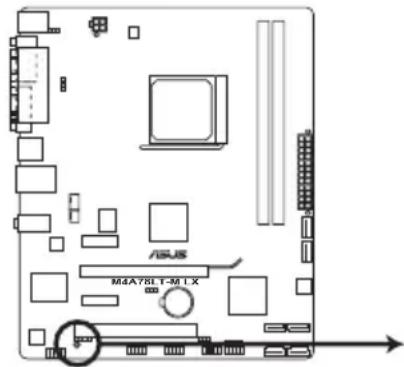
The motherboard comes with a standby power LED that lights up to indicate that the system is ON, in sleep mode, or in soft-off mode. This is a reminder that you should shut down the system and unplug the power cable before removing or plugging in any motherboard component. The illustration below shows the location of the onboard LED.
text_image
ASUS M4A781.T-M1.XSB_PWR


ON
OFF
Standby Power Powered Of f
M4A78LT-M LX Onboard LED
1.5 Motherboard overview
1.5.1 Placement direction
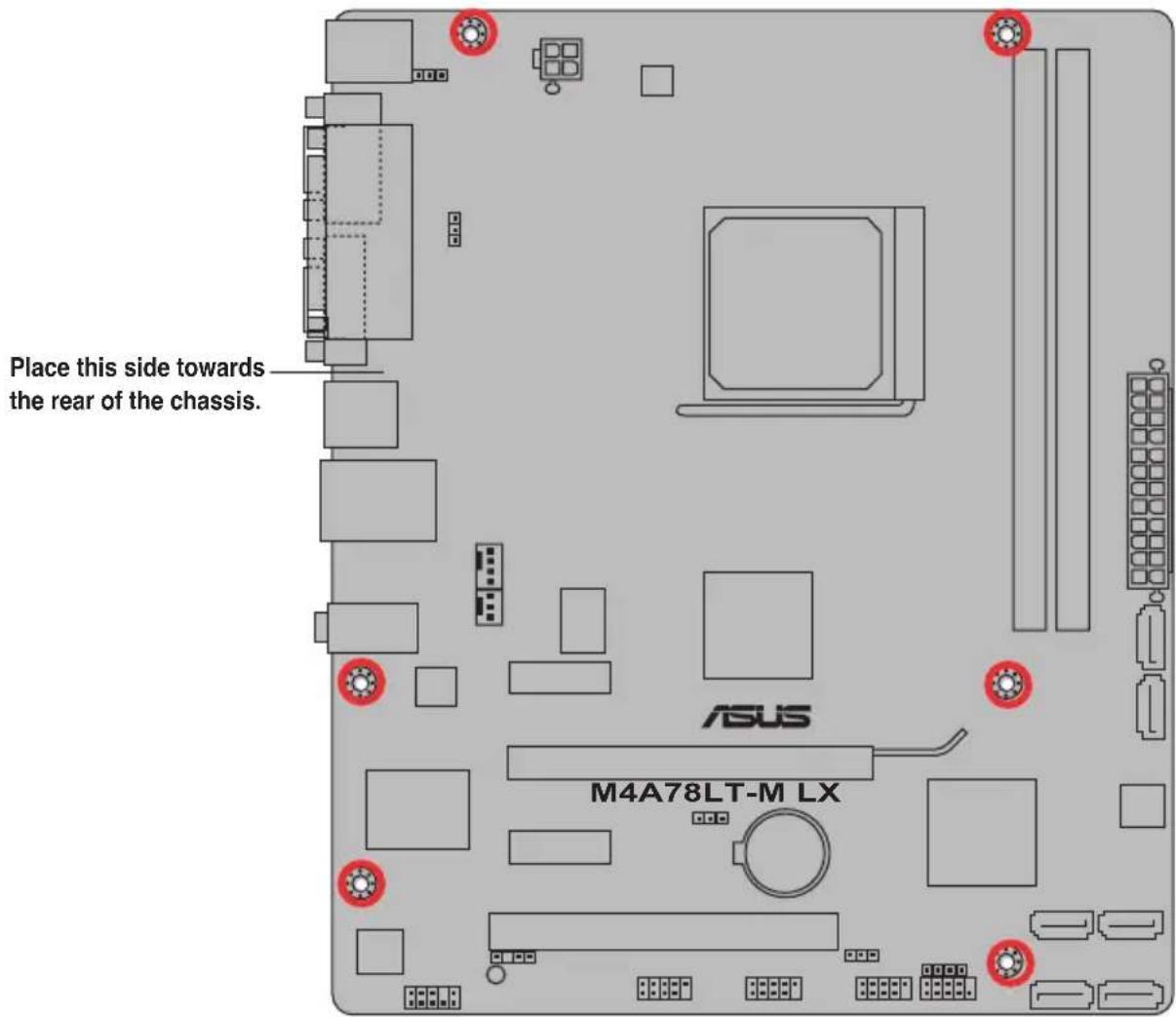
When installing the motherboard, ensure that you place it into the chassis in the correct orientation. The edge with external ports goes to the rear part of the chassis as indicated in the image below.
1.5.2 Screw holes
Place six screws into the holes indicated by circles to secure the motherboard to the chassis.

DO NOT overtighten the screws! Doing so can damage the motherboard.
text_image
Place this side towards the rear of the chassis. ASUS M4A78LT-M LX1.5.3 Motherboard layout

text_image
1 23 5 20.3cm(8.0in) KBMS KBPWR ATX12V EPU COM1 LPT USB34 LAN1_USB12 AUDIO CPU_FAN CHA_FAN ICSS 9L/RS683 PCIEX1_1 ASUS PCIEX16 M4A78LT-M_LX Super I/O PCIEX1_2 PCI1 AAPF SR_PWR SPDIF_OUT USB910 USB78 USB56 USBPW5-10 SPEAKER F PANEL AMD® RS780L DDR3 DIMM_A1 (64bit, 240-pin module) DDR3 DIMM_B1 (64bit, 240-pin module) EATXPWR SATX9G_5 SATX9G_6 BMB BIOS SATA3G_2 SATA3G_4 SATA3G_1 SATA3G_3 10 314 24.4cm(9.6in)1.5.4 Layout contents
| Connectors/Jumpers/Slots Page Connectors/Jumpers/Slots Page | ||||
| 1. | Keyboard power (3-pin KBPWR) | 1-19 | 8. | System panel connector (10-1 pin F_PANEL) |
| 2. | USB device wake-up (3-pin USBPW1-4, USBPW5-10,) | 1-19 | 9. | Speaker connector (4- pin SPEAKER) |
| 3. | ATX power connectors (24-pin EATXPWR, 4-pin ATX12V) | 1-22 | 10. | USB connectors (10-1 pin USB56, USB78, USB910) |
| 4. | CPU and chassis fan connectors (4-pin CPU_FAN and 3-pin CHA_FAN) | 1-27 | 11. | Digital audio connector (4-1 pin SPDIF_OUT) |
| 5. | AMD CPU socket | 1-8 | 12. | Onboard LED |
| 6. | DDR3 DIMM sockets | 1-11 | 13. | Front panel audio connector (10-1 pin AAFP) |
| 7. | Serial ATA connectors (7-pin SATA1-6) | 1-23 | 14. | Clear RTC RAM (CLRTC) |
1.6 Central Processing Unit (CPU)
This motherboard supports AMD ^® Phenom ^™ II / Athlon ^™ II / Sempron ^™ 100 series processors.

The AM3 socket has a different pinout from the 940-pin socket designed for the AMD Opteron™ processor. Use a CPU that is designed for the AM3 socket.
1.6.1 Installing the CPU
To install a CPU:
- Locate the CPU socket on the motherboard.
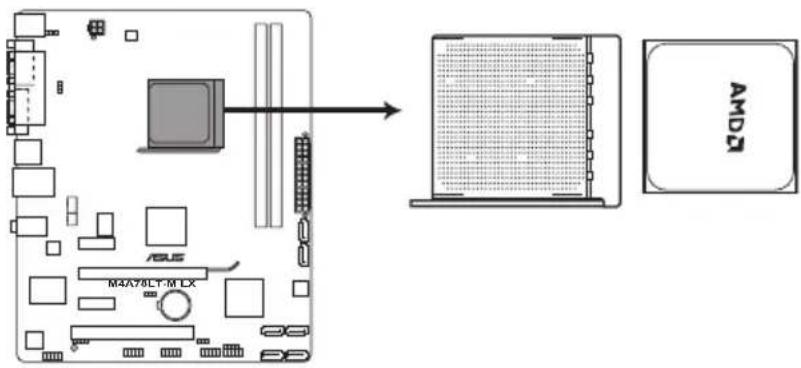
flowchart
graph TD
    A["Computer"] --> B["GPU"]
    B --> C["AMOS"]
    style A fill:#f9f,stroke:#333
    style C fill:#ccf,stroke:#333
M4A78LT-M LX CPU AM3
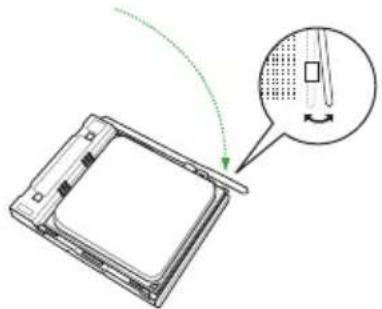
- Press the lever sideways to unlock the socket, then lift it up to a 90^-100^ angle.

text_image
Socket lever
Ensure that the socket lever is lifted up to a 90^ - 100^ angle; otherwise, the CPU will not fit in completely.
-
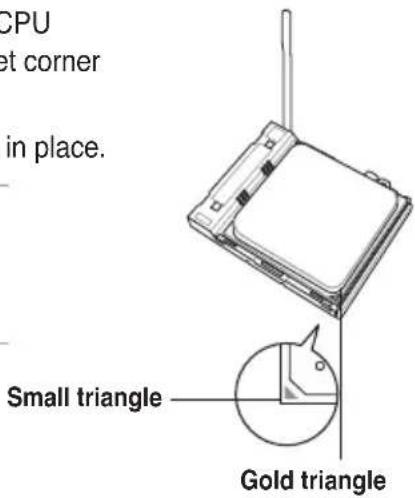
Position the CPU above the socket such that the CPU corner with the gold triangle matches the socket corner with a small triangle.
-
Carefully insert the CPU into the socket until it fits in place.

The CPU fits only in one correct orientation. DO NOT force the CPU into the socket to prevent bending the pins and damaging the CPU!
text_image
CPU et corner in place. Small triangle Gold triangle-
When the CPU is in place, push down the socket lever to secure the CPU. The lever clicks on the side tab to indicate that it is locked.
-
Install a CPU heatsink and fan following the instructions that comes with the heatsink package. You can also refer to section 1.6.2 Installing heatsink and fan for instructions.
-
Connect the CPU fan cable to the CPU_FAN connector on the motherboard.
natural_image
Diagram of a device with a magnified inset showing a screen and a curved arrow, no text or symbols present.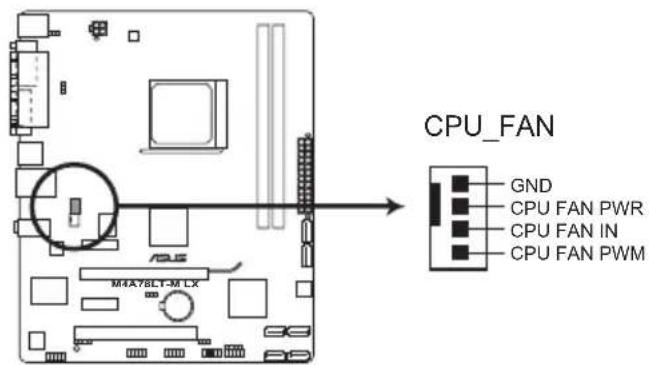
text_image
CPU_FAN GND CPU FAN PWR CPU FAN IN CPU FAN PWM M4A78LT-M LXM4A78LT-M LX CPU fan connector

DO NOT forget to connect the CPU fan connector! Hardware monitoring errors can occur if you fail to plug this connector.
1.6.2 Installing the heatsink and fan

Ensure that you use only AMD-certified heatsink and fan assembly.
To install the CPU heatsink and fan:
- Place the heatsink on top of the installed CPU, ensuring that the heatsink fits properly on the retention module base.

- The retention module base is already installed on the motherboard upon purchase.
- You do not have to remove the retention module base when installing the CPU or installing other motherboard components.
- If you purchased a separate CPU heatsink and fan assembly, ensure that a Thermal Interface Material is properly applied to the CPU heatsink or CPU before you install the heatsink and fan assembly.

text_image
CPU Fan CPU Heatsink Retention bracket Retention Module Base Retention bracket lock
Your boxed CPU heatsink and fan assembly should come with installation instructions for the CPU, heatsink, and the retention mechanism. If the instructions in this section do not match the CPU documentation, follow the latter.
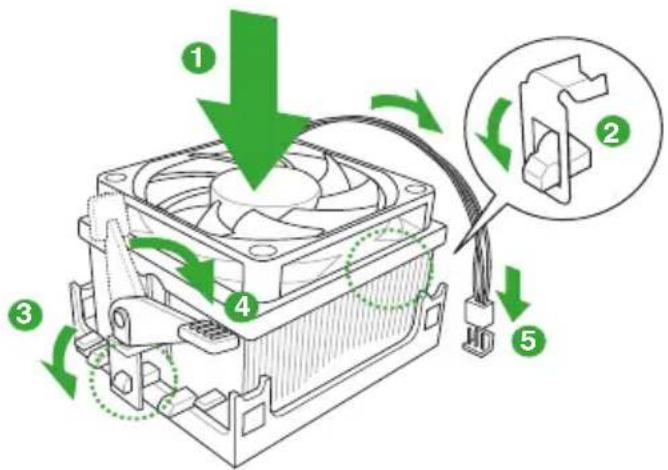
- Attach one end of the retention bracket to the retention module base.
text_image
Diagram illustrating the cooling process of a CPU, showing numbered steps from fan to terminal with green arrows indicating cooling direction.- Align the other end of the retention bracket to the retention module base. A clicking sound denotes that the retention bracket is in place.

Ensure that the fan and heatsink assembly perfectly fits the retention mechanism module base, otherwise you cannot snap the retention bracket in place.
-
Push down the retention bracket lock on the retention mechanism to secure the heatsink and fan to the module base.
-
When the fan and heatsink assembly is in place, connect the CPU fan cable to the connector on the motherboard labeled CPU_FAN.

DO NOT forget to connect the CPU fan connector! Hardware monitoring errors can occur if you fail to plug this connector.
1.7 System memory
1.7.1 Overview
The motherboard comes with two Double Data Rate 3 (DDR3) Dual Inline Memory Modules (DIMM) sockets. The figure illustrates the location of the DDR3 DIMM sockets:

text_image
ASLS M4A78LT-M_LX DIMM_A1 DIMM_B1Channel Sockets
Channel A DIMM_A1
Channel B DIMM_B1
M4A78LT-M LX 240-pin DDR3 DIMM sockets
1.7.2 Memory configurations
You may install 512MB, 1GB, 2GB, and 4GB unbuffered ECC and non-ECC DDR3 DIMMs into the DIMM sockets.

- You may install varying memory sizes in Channel A and Channel B. The system maps the total size of the lower-sized channel for the dual-channel configuration. Any excess memory from the higher-sized channel is then mapped for single-channel operation.
- Always install DIMMs with the same CAS latency. For optimum compatibility, we recommend that you obtain memory modules from the same vendor.
-
Due to the memory address limitation on 32-bit Windows ^ OS, when you install 4GB or more memory on the motherboard, the actual usable memory for the OS can be about 3GB or less. For effective use of memory, we recommend that you do any of the following:
-
Install a maximum of 3GB system memory if you are using a 32-bit Windows® OS.
- Use a 64-bit WindowsWindows if you want to install 4GB or more memory on the motherboard.
- This motherboard does not support DIMMs made up of 256 megabits (Mb) chips or less.
M4A78LT-M LX Motherboard Qualified Vendors Lists (QVL)
DDR3-1866(O.C.) MHz capability
| Vendor Part No. Size SS/DS Brand Chip NO. | Timing DIMM (BIOS) | Voltage | DIMM Support A* B* | |||||
| Apacer | 78.0AGCD.CDZ(XMP) | 2048MB(Kit of 2) | SS | N/A | Heat-Sink Package | • | ||
| Corsair | CM3X2G1800C8D | 2048MB | DS | N/A | Heat-Sink Package | • | ||
| Transcend | TX1800KLU-2GK | 1024MB | SS | N/A | Heat-Sink Package | • | ||
DDR3-1600(O.C.) MHz capability
| Vendor | Part No. | Size | SS/DS | Brand | Chip NO. | Timing DIMM (BIOS) | Voltage | DIMM Support | |
| A* | B* | ||||||||
| A-Data | AD31600X002GMU | 4096MB (Kit of 2) | DS | N/A | Heat-Sink Package | 7-7-7-20 | 1.75-1.85V | • | • |
| Corsair | CM3X1G1600C9DHX | 2048MB (Kit of 2) | SS | N/A | Heat-Sink Package | 9-9-9-24 | 1.8V | • | • |
| Corsair | CM3X2G1600C9DHX | 2048MB | DS | N/A | Heat-Sink Package | • | • | ||
| Corsair | TR3X6G1600C8 G(XMP) | 6144MB (Kit of 3 ) | DS | N/A | Heat-Sink Package | • | • | ||
| Corsair | TR3X6G1600C8D G(XMP) | 6144MB (Kit of 3 ) | DS | N/A | Heat-Sink Package | 8-8-8-24 | 1.65V | • | • |
| Corsair | TR3X6G1600C9 G(XMP) | 6144MB (Kit of 3 ) | DS | N/A | Heat-Sink Package | 9-9-9-24 | 1.65V | • | • |
| Corsair | TR3X6G1600C8D G(XMP) | 6144MB (Kit of 3) | DS | N/A | Heat-Sink Package | 8-8-8-24 | 1.65V | • | • |
| Crucial | BL12864BA1608.8SFB(XMP) | 3072MB (Kit of 3) | SS | N/A | Heat-Sink Package | 8-8-8-24 | 1.8V | • | |
| Crucial | BL12864BE2009.8SFB3(EPP) | 3072MB (Kit of 3) | SS | N/A | Heat-Sink Package | 9-9-9-28 | 2.0V | • | • |
| Crucial | BL25664BN1608.16FF(XMP) | 6144MB (Kit of 3 ) | DS | N/A | Heat-Sink Package | • | • | ||
| Crucial | BL25664TB1608.K16SF(XMP) | 6144MB (Kit of 3) | DS | N/A | Heat-Sink Package | 8-8-8-24 | • | ||
| Crucial | BL25664TG1608.K16SF(XMP) | 6144MB (Kit of 3) | DS | N/A | Heat-Sink Package | 8-8-8-24 | • | • | |
| Crucial | BL25664TR1608.K16SF(XMP) | 6144MB (Kit of 3) | DS | N/A | Heat-Sink Package | 8-8-8-24 | • | • | |
continued on the next page
DDR3-1600(O.C.) MHz capability
| Vendor Part No. Size | SS/DS | Brand Chip NO. | Timing DIMM (BIOS) | Voltage | DIMM Support A* B* | |||
| G.SKILL | F3-12800CL9D-2GBNQ | 2048MB (Kit of 2) | SS | N/A | Heat-Sink Package | 9-9-9-24 | 1.5V~1.6V | • • |
| G.SKILL | F3-12800CL8T-6GBHK | 2048MB | DS | N/A | Heat-Sink Package | 8-8-8-21 | 1.6~1.65 | • • |
| G.SKILL | F3-12800CL9T-6GBNQ | 6144MB (Kit of 3) | DS | N/A | Heat-Sink Package | 9-9-9-24 | 1.5V~1.6V | • • |
| Kingmax | FLGD45F-B8KG9 | 1024MB | SS | KFB8FNGXF-ANX-12A | • • | |||
| Kingmax | FLGD45F-B8MF7 MAEH(XMP) | 1024MB | SS | N/A | Heat-Sink Package | 7 | • • | |
| Kingmax | FLGE85F-B8KG9 | 2048MB | DS | KFB8FNGXF-ANX-12A | • • | |||
| Kingmax | FLGE85F-B8MF7 MEEH(XMP) | 2048MB | DS | N/A | Heat-Sink Package | 7 | • • | |
| Kingston | KHX1600C9D3K2/4G | 4096MB (kit of 2) | DS | N/A | Heat-Sink Package | 1.7-1.9V | • • | |
| Kingston | KHX1600C9D3K3/6GX(XMP) | 6144MB (Kit of 3) | DS | N/A | Heat-Sink Package | 1.65V | • • | |
| OCZ | OCZ3G1600LV3GK | 3072MB (Kit of 3) | SS | N/A | Heat-Sink Package | 8-8-8-24 | 1.65V | • • |
| OCZ | OCZ3G1600LV6GK | 6144MB (Kit of 3 ) | DS | N/A | Heat-Sink Package | 8-8-8-24 | 1.65V | • • |
| Super Talent | WA160UX6G9 | 6144MB (Kit of 3 ) | DS | N/A | Heat-Sink Package | 9 | • • | |
DDR3-1333 MHz capability
| Vendor | Part No. | Size | SS/DS | Brand Chip NO. | Timing DIMM (BIOS) | Voltage | DIMM Support A* B* | |
| A-Data | AD31333001GOU | 1024MB | SS | A-Data | AD30908C8D-151C E0906 | • • | ||
| A-Data | AD31333G001GOU | 3072MB (Kit of 3) | SS | N/A | Heat-Sink Package | 8-8-8-24 | 1.65-1.85V | • • |
| A-Data | AD31333002GOU | 2048MB | DS | A-Data | AD30908C8D-151C E0903 | • • | ||
| A-Data | AD31333G002GMU | 2048MB | DS | N/A | Heat-Sink Package | 8-8-8-24 | 1.65-1.85V | • • |
| Apacer | 78.01GC6.9L0 | 1024MB | SS | Apacer | AM5D5808AEWSBG0914E | 9 | • • | |
| Apacer | 78.A1GC6.9L1 | 2048MB | DS | Apacer | AM5D5808AEWSBG0908D | 9 | • • | |
| Corsair | CM3X1024-1333C9DHX | 1024MB | SS | N/A | Heat-Sink Package | 9-9-9-24 | 1.60V | • • |
| Corsair | CM3X1024-1333C9 | 1024MB | SS | N/A | Heat-Sink Package | • • | ||
| Corsair | TR3X3G1333C9 G | 3072MB (Kit of 3) | SS | N/A | Heat-Sink Package | 9-9-9-24 | 1.50V | • • |
| Corsair | TR3X3G1333C9 G | 3072MB (Kit of 3) | SS | N/A | Heat-Sink Package | 9-9-9-24 | 1.50V | • • |
| Corsair | TR3X3G1333C9 | 3072MB (Kit of 3) | SS | N/A | Heat-Sink Package | 9 | 1.5V | • • |
| Corsair | CM3X1024-1333C9DHX | 1024MB | DS | Corsair | Heat-Sink Package | • • | ||
| Corsair | CM3X2048-1333C9DHX | 2048MB | DS | N/A | Heat-Sink Package | • • | ||
| Corsair | TW3X4G1333C9 G | 4096MB (Kit of 2) | DS | N/A | Heat-Sink Package | 9-9-9-24 | 1.50V | • • |
| Crucial | CT12864BA1339.8FF | 1024MB | SS | Micron | 9FF22D9KPT | 9 | • • | |
| Crucial | CT12872BA1339.9FF | 1024MB | SS | Micron | 91F22D9KPT(ECC) | 9 | • • | |
| Crucial | BL12864TA1336.8SFB1 | 2048MB (Kit of 2) | SS | N/A | Heat-Sink Package | 6-6-6-20 | 1.8V | • • |
| Crucial | CT12864BA1339.8SFD | 3072MB (Kit of 3) | SS | Micron | 8XD22D9JNM | 9 | • • | |
| Crucial | CT25664BA1339.16FF | 2048MB | DS | Micron | 9KF27D9KPT | 9 | • • | |
| Crucial | CT25672BA1339.18FF | 2048MB | DS | Micron | 91F22D9KPT(ECC) | 9 | • • | |
| Crucial | BL25664ABA1336.16SFB1 | 4096MB (Kit of 2) | DS | N/A | Heat-Sink Package | 6-6-6-20 | 1.8V | • • |
| Crucial | BL25664BA1336.16SFB1 | 4096MB (Kit of 2) | DS | N/A | Heat-Sink Package | 6-6-6-20 | 1.8V | • • |
| Crucial | BL25664BN1337.16FF (XMP) | 6144MB (Kit of 3 ) | DS | N/A | Heat-Sink Package | 7-7-7-24 | 1.65V | • • |
| Crucial | CT25664BA1339.16SFD | 6144MB (Kit of 3 ) | DS | Micron | 8UD22D9JNM | 9 | • | |
(continued on the next page)
DDR3-1333 MHz capability
| Vendor Part No. Size | SS/DS | Brand Chip NO. | Timing DIMM (BIOS) | Voltage | DIMM Support A* B* | |||
| G.SKILL F3-10600CL8D-2GBHK 1024MB SS G.SKILL Heat-Sink Package • | ||||||||
| G.SKILL F3-10600CL9D-2GBPK 1024MB SS G.SKILL Heat-Sink Package • | ||||||||
| G.SKILL | F3-10666CL7T-3GBPK | 3072MB (Kit of 3) | SS | N/A | Heat-Sink Package | 7-7-7-18 | 1.5~1.6V | • • |
| G.SKILL | F3-10666CL9T-3GBNQ | 3072MB (Kit of 3) | SS | N/A | Heat-Sink Package | 9-9-9-24 | 1.5~1.6V | • • |
| G.SKILL F3-10600CL7D-2GBPI | 1024MB DS G.SKILL Heat-Sink Package • | |||||||
| G.SKILL F3-10600CL9D-2GBNQ | 1024MB DS G.SKILL Heat-Sink Package • | |||||||
| G.SKILL | F3-10666CL8D-4GBHK | 4096MB (Kit of 2 ) | DS | N/A | Heat-Sink Package | 8-8-8-21 | 1.5-1.6V | • • |
| G.SKILL | F3-10666CL7T-6GBPK | 6144MB (Kit of 3 ) | DS | N/A | Heat-Sink Package | 7-7-7-18 | 1.5~1.6V | • • |
| G.SKILL | F3-10666CL9T-6GBNQ | 6144MB (Kit of 3) | DS | N/A | Heat-Sink Package | 9-9-9-24 | 1.5V~1.6V | • • |
| GEIL | DDR3-1333 CL9-9-9-24 | 1024MB | SS | N/A | Heat-Sink Package | 9 | • • | |
| GEIL | GV34GB1333C7DC | 2048MB | DS | N/A | Heat-Sink Package | 7-7-7-24 | 1.5V | • • |
| GEIL | GG34GB1333C9DC | 4096MB (Kit of 2) | DS | GEIL | GL1L128M88BA12N | 9-9-9-24 | 1.3V(low voltage) | • • |
| GEIL | DDR3-1333 CL9-9-9-24 | 6144MB (Kit of 3 ) | DS | N/A | Heat-Sink Package | 9 | 1.5V | • • |
| Kingmax | FLFD45F-B8MH9 MAES | 1024MB | SS | Micron | 9CF22D9KPT | • • | ||
| Kingmax | FLFE85F-B8MF9 | 2048MB | DS | Micron | 8HD22D9JNM | • • | ||
| Kingmax | FLFE85F-B8MH9 MEES | 2048MB | DS | Micron | 9GF27D9KPT | • • | ||
| Kingston | KVR1333D3N9/1G | 1024MB | SS | Hynix | H5TQ1G83BFR | 9 | 1.5V | • • |
| Kingston | KVR1333D3N9/2G | 2048MB | DS | Qimonda | IDSH1G-03A1F1C-13H | 1.5V | • • | |
| Micron | MT8JTF12864AY-1G4D1 | 1024MB | SS | Micron | 8LD22D9JNM | • • | ||
| Micron | MT8JTF12864AZ-1G4F1 | 1024MB | SS | Micron | 9FF22D9KPT | 9 | • • | |
| Micron | MT9JSF 12872AZ-1G4F1 | 1024MB | SS | Micron | 91F22D9KPT(ECC) | 9 | • • | |
| Micron | MT8JTF12864AY-1G4D1 | 3072MB (Kit of 3) | SS | Micron | 8XD22D9JNM | 9 | • • | |
| Micron | MT12JSF25672AZ-1G4F1 | 2048MB | DS | Micron | 91F22D9KPT(ECC) | 9 | • • | |
| Micron | MT16JTF25664AY-1G1D1 | 2048MB | DS | Micron | 8LD22 D9JNM | • • | ||
| Micron | MT18JTF25664AZ-1G4F1 | 2048MB | DS | Micron | 9KF27D9KPT | 9 | • • | |
| Micron | MT16JTF25664AY-1G4D1 | 6144MB (Kit of 3 ) | DS | Micron | 8UD22D9JNM | 9 | • • | |
| OCZ | OCZ3X1333LV3GK(XMP) | 3072MB (Kit of 3) | SS | N/A | Heat-Sink Package | 1.6V | • | |
| OCZ | OCZ3G13334GK | 4096MB (Kit of 2) | DS | N/A | Heat-Sink Package | 1.7V | • • | |
| OCZ | OCZ3P13334GK | 4096MB (Kit of 2) | DS | N/A | Heat-Sink Package | 7-7-7-20 | 1.8V | • • |
| OCZ | OCZ3G1333LV6GK | 6144MB (Kit of 3 ) | DS | N/A | Heat-Sink Package | 9-9-9-20 | 1.65V | • • |
| OCZ | OCZ3P1333LV6GK | 6144MB (Kit of 3 ) | DS | N/A | Heat-Sink Package | 7-7-7-20 | 1.65V | • • |
| OCZ | OCZ3X1333LV6GK(XMP) | 6144MB (Kit of 3 ) | DS | N/A | Heat-Sink Package | 8-8-8-20 | 1.60V | • • |
| SAMSUNG | M378B2873DZ1-CH9 | 1024MB | SS | Samsung | K4B1G0846D-HCH9 | • • | ||
| SAMSUNG | M378B2873DZ1-CH9 | 1024MB | SS | Samsung | SEC 846 HCH9 K4B1G08460 | • • | ||
| SAMSUNG | M378B2873EH1-CH9 | 1024MB | SS | Samsung | SEC 913 HCH9 K4B1G0846E | • • | ||
| SAMSUNG | M391B2873DZ1-CH9 | 1024MB | SS | Samsung | K4B1G0846D-HCH9(ECC) | • • | ||
| SAMSUNG | M378B5673DZ1-CH9 | 2048MB | DS | Samsung | K4B1G0846D-HCH9 | • • | ||
| SAMSUNG | M378B5673EH1-CH9 | 2048MB | DS | Samsung | SEC 913 HCH9 K4B1G0846E | • • | ||
| SAMSUNG | M391B5673DZ1-CH9 | 2048MB | DS | Samsung | K4B1G0846D-HCH9(ECC) | • • | ||
| Super Talent | W1333X2GB8 | 1024MB | SS | N/A | Heat-Sink Package | • • | ||
| Transcend | TS128MLK64V3U | 1024MB | SS | N/A | SEC 813HCH9 K4B1G0846D | • • | ||
| Transcend | TS128MLK72V3U | 1024MB | SS | N/A | K4B1G0846D(ECC) | • • | ||
| Transcend | TS256MLK64V3U | 2048MB | DS | Micron | 9GF27D9KPT | • • | ||
| Transcend | TS256MLK64V3U | 2048MB | DS | N/A | SEC816HCH9K4B1G0846D | • • | ||
DDR3-1066 MHz capability
| Vendor Part No. Size | SS/DS | Brand Chip NO. | Timing DIMM (BIOS) | Voltage | DIMM Support A* B* | |||
| Crucial CT12864BA1067.8FF 1024MB SS Micron 9GF22D9KPT 7··· | ||||||||
| Crucial CT12872BA1067.9FF 1024MB SS Micron 9HF22D9KPT(ECC) 7··· | ||||||||
| Crucial | CT25664BA1067.16FF | 2048MB | DS | Micron | 9HF22D9KPT | 7 | • • | |
| Crucial | CT25672BA1067.18FF | 2048MB | DS | Micron | 9GF22D9KPT(ECC) | 7 | • • | |
| Elpida | EBJ51UD8BAFA-AC-E | 512MB | SS | Elpida | J5308BASE-AC-E | • • | ||
| Elpida | EBJ51UD8BAFA-AE-E | 512MB | SS | Elpida | J5308BASE-AC-E | • • | ||
| Kingston | KVR1066D3N7/1G | 1024MB | SS | Kingston | D1288JEKAPGA7U | 7 | 1.5V | • • |
| Kingston | KVR1066D3N7/2G | 2048MB | DS | Kingston | D1288JEKAPGA7U | 7 | 1.5V | • • |
| Micron | MT8JTF12864AY-1G1D1 | 1024MB | SS | Micron | 8ED22D9JNL | • • | ||
| Micron | MT8JTF12864AZ-1G1F1 | 1024MB | SS | Micron | 9GF22D9KPT | 7 | • • | |
| Micron | MT9JSF12872AZ-1G1F1 | 1024MB | SS | Micron | 9HF22D9KPT(ECC) | 7 | • • | |
| Micron | MT16JTF25664AY-1G1D1 | 2048MB | DS | Micron | 8LD22D9JNL | • • | ||
| Micron | MT16JTF25664AZ-1G1F1 | 2048MB | DS | Micron | 9HF22D9KPT | 7 | • • | |
| Micron | MT18JSF25672AZ-1G1F1 | 2048MB | DS | Micron | 9GF22D9KPT(ECC) | 7 | • • | |
| OCZ | OCZ3SOE10662GK | 2048MB (Kit of 2) | DS | N/A | Heat-Sink Package | 7-7-7-16 | 1.75V | • • |
| SAMSUNG | M378B2873EH1-CF8 | 1024MB | SS | Samsung | SEC 901 HCF8 K4B1G0846E | • • | ||
| SAMSUNG | M378B5273BH1-CF8 | 4096MB | DS | Samsung | 846 K4B2G0846B-HCF8 | • • | ||


- Due to CPU spec., AMD ^® 100 and 200 series CPUs support up to DDR3 1066MHz. With ASUS design, this motherboard can support up to DDR3 1333MHz.
- When overclocking, some AMD CPU models may not support DDR3 1600 MHz or higher frequency DIMMs.
SS: Single-sided / DS: Double-sided DIMM support:
- A*: Supports one module inserted into any slot as single-channel memory configuration.
- B*: Supports one pair of modules inserted into either the blue slots or the black slots as one pair of dual-channel memory configuration.
Visit the ASUS website at www.asus.com for the latest QVL.
1.7.3 Installing a DIMM

Unplug the power supply before adding or removing DIMMs or other system components. Failure to do so can cause severe damage to both the motherboard and the components.
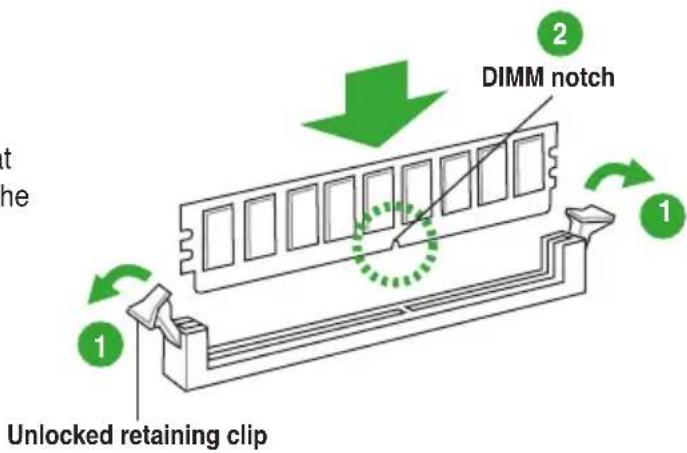
- Press the retaining clips outward to unlock a DIMM socket.
- Align a DIMM on the socket such that the notch on the DIMM matches the DIMM slot key on the socket.
text_image
DIMM notch 1 Unlocked retaining clip 2 1
A DIMM is keyed with a notch so that it fits in only one direction. DO NOT force a DIMM into a socket in the wrong direction to avoid damaging the DIMM.
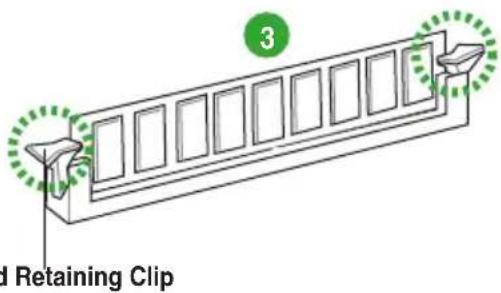
- Firmly insert the DIMM into the socket until the retaining clips snap back in place and the DIMM is properly seated.
text_image
3 I Retaining Clip1.7.4 Removing a DIMM
To remove a DIMM:
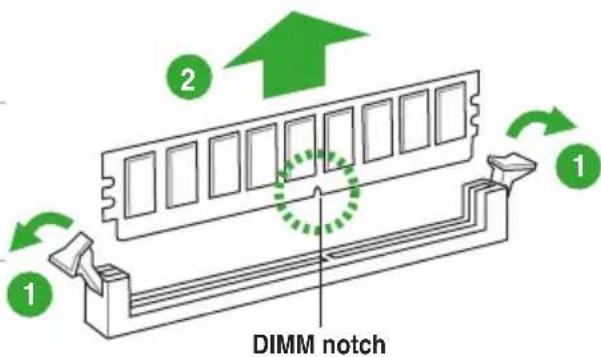
- Simultaneously press the retaining clips outward to unlock the DIMM.

Support the DIMM lightly with your fingers when pressing the retaining clips. The DIMM might get damaged when it flips out with extra force.
text_image
DIMM notch- Remove the DIMM from the socket.
1.8 Expansion slots
In the future, you may need to install expansion cards. The following sub-sections describe the slots and the expansion cards that they support.

Unplug the power cord before adding or removing expansion cards. Failure to do so may cause you physical injury and damage motherboard components.
1.8.1 Installing an expansion card
To install an expansion card:
- Before installing the expansion card, read the documentation that came with it and make the necessary hardware settings for the card.
- Remove the system unit cover (if your motherboard is already installed in a chassis).
- Remove the bracket opposite the slot that you intend to use. Keep the screw for later use.
- Align the card connector with the slot and press firmly until the card is completely seated on the slot.
- Secure the card to the chassis with the screw you removed earlier.
- Replace the system cover.
1.8.2 Configuring an expansion card
After installing the expansion card, configure it by adjusting the software settings.
- Turn on the system and change the necessary BIOS settings, if any. See Chapter 2 for information on BIOS setup.
- Assign an IRQ to the card.
- Install the software drivers for the expansion card.

When using PCI cards on shared slots, ensure that the drivers support "Share IRQ" or that the cards do not need IRQ assignments. Otherwise, conflicts will arise between the two PCI groups, making the system unstable and the card inoperable.
1.8.3 PCI slot
The PCI slot supports cards such as a LAN card, SCSI card, USB card, and other cards that comply with PCI specifications.
1.8.4 PCI Express x1 slots
This motherboard supports PCI Express x1 network cards, SCSI cards, and other cards that comply with the PCI Express specifications.
1.8.5 PCI Express x16 slot
This motherboard supports a PCI Express x16 graphics card that comply with the PCI Express specifications.
1.9 Jumpers
1. Clear RTC RAM (CLRTC)
This jumper allows you to clear the Real Time Clock (RTC) RAM in CMOS. You can clear the CMOS memory of date, time, and system setup parameters by erasing the CMOS RTC RAM data. The onboard button cell battery powers the RAM data in CMOS, which include system setup information such as system passwords.
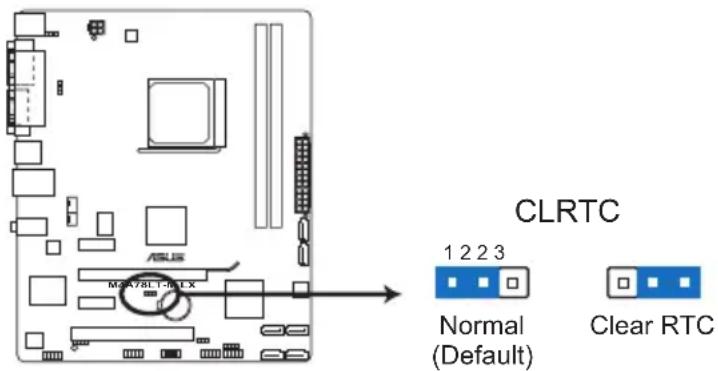
text_image
CLRTC 1 2 2 3 Normal (Default) Clear RTCM4A78LT-M LX Clear RTC RAM
To erase the RTC RAM:
- Turn OFF the computer and unplug the power cord.
- Move the jumper cap from pins 1-2 (default) to pins 2-3. Keep the cap on pins 2-3 for about 5\~10 seconds, then move the cap back to pins 1-2.
- Plug the power cord and turn ON the computer.
- Hold down the
key during the boot process and enter BIOS setup to reenter data.

Except when clearing the RTC RAM, never remove the cap on CLRTC jumper default position. Removing the cap will cause system boot failure!

- If the steps above do not help, remove the onboard battery and move the jumper again to clear the CMOS RTC RAM data. After clearing the CMOS, reinstall the battery.
- You do not need to clear the RTC when the system hangs due to overclocking. For system failure due to overclocking, use the CPU Parameter Recall (C.P.R) feature. Shut down and reboot the system so the BIOS can automatically reset parameter settings to default values.
2. USB device wake-up (3-pin USBPW1-4, USBPW5-10)
Set these jumpers to +5V to wake up the computer from S1 sleep mode (CPU stopped, DRAM refreshed, system running in low power mode) using the connected USB devices. Set these jumpers to +5VSB to wake up the computer from S3 and S4 sleep modes (no power to CPU, DRAM in slow refresh, power supply in reduced power mode).
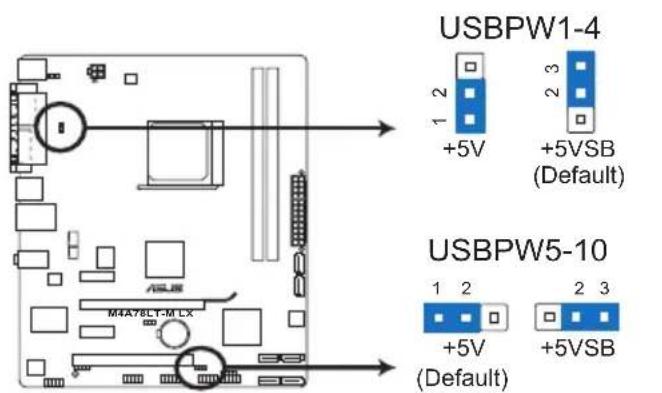
text_image
USBPW1-4 2 3 +5V +5VSB (Default) USBPW5-10 1 2 2 3 +5V +5VSB (Default)M4A78LT-M LX USB Device Wake Up
3. Keyboard power (3-pin KBPWR)
This jumper allows you to enable or disable the keyboard wake-up feature. When you set this jumper to pins 2-3 (+5VSB), you can wake up the computer by pressing a key on the keyboard. This feature requires an ATX power supply that can supply at least 1A on the +5VSB lead, and a corresponding setting in the BIOS.
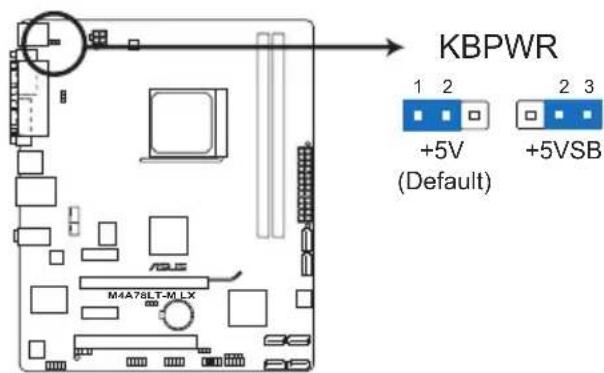
text_image
KBPWR 1 2 +5V (Default) 2 3 +5VSB M4A78LT-M.LXM4A78LT-M LX Keyboard Power Setting
1.10 Connectors
1.10.1 Rear panel ports

text_image
1 2 3 4 5 6 7 8 9 10 11- PS/2 Mouse port (green). This port is for a PS/2 mouse.
- Parallel port. This 25-pin port connects a parallel printer, a scanner, or other devices.
- LAN (RJ-45) port. This port allows Gigabit connection to a Local Area Network (LAN) through a network hub.
LAN port LED indications
| Activity/Link LED | Speed LED | |
| Status Description Status Description | ||
| OFF No link OFF 10Mbps connection | ||
| ORANGE Linked ORANGE 100Mbps connection | ||
| BLINKING Data activity GREEN 1Gbps connection | ||
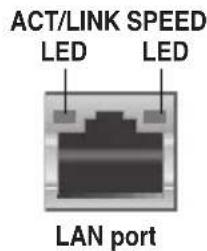
text_image
ACT/LINK SPEED LED LED LAN port- Line In port (light blue). This port connects to the tape, CD, DVD player, or other audio sources.
- Line Out port (lime). This port connects to a headphone or a speaker. In the 4, 6, and 8-channel configurations, the function of this port becomes Front Speaker Out.
- Microphone port (pink). This port connects to a microphone.

Refer to the audio configuration table below for the function of the audio ports in 2, 4, 6, or 8-channel configuration.
| Port | Headset 2-channel | 4-channel | 6-channel | 8-channel |
| Light Blue (Rear panel) | Line In | Rear Speaker Out | Rear Speaker Out | Rear Speaker Out |
| Lime (Rear panel) | Line Out | Front Speaker Out | Front Speaker Out | Front Speaker Out |
| Pink (Rear panel) Mic | In Mic In Bass/Center | Bass/Center | ||
| Lime (Front panel) | - | - | - | Side Speaker Out |

To configure an 8-channel audio output:
Use a chassis with HD audio module in the front panel to support 8-channel audio output.
- USB 2.0 ports 1 and 2. These two 4-pin Universal Serial Bus (USB) ports connect to USB 2.0 devices.
- USB 2.0 ports 3 and 4. These two 4-pin Universal Serial Bus (USB) ports connect to USB 2.0 devices.
- Video Graphics Adapter (VGA) port. This 15-pin port is for a VGA monitor or other VGA-compatible devices.
- Serial port. This 9-pin COM1 port is for pointing devices or other serial devices.
- PS/2 Keyboard port (purple). This port is for a PS/2 keyboard.
1.10.2 Internal connectors
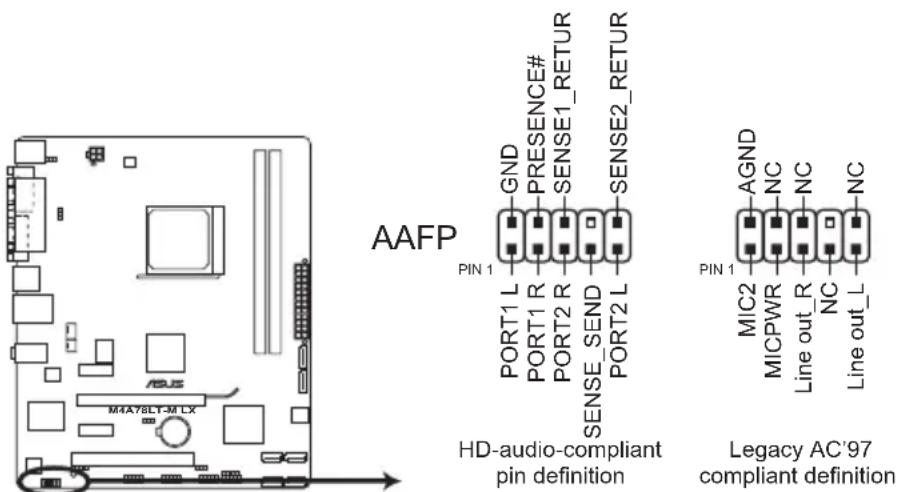
1. Front panel audio connector (10-1 pin AAFP)
This connector is for a chassis-mounted front panel audio I/O module that supports either High Definition Audio or AC'97 audio standard. Connect one end of the front panel audio I/O module cable to this connector.
text_image
AAFP PIN 1 GND PRESENCE# PORT1 L PORT1 R PORT2 R SENSE1_RETUR SENSE2_RETUR HD-audio-compliant pin definition Legacy AC'97 compliant definition PIN 1 AGND MIC2 MICPWR Line out_R NC Line out_LM4A78LT-M LX Front panel audio connector

- We recommend that you connect a high-definition front panel audio module to this connector to avail of the motherboard high-definition audio capability.
- If you want to connect a high definition front panel audio module to this connector, set the Front Panel Select item in the BIOS to [HD Audio]. See section 2.4.4 Onboard Device Configuration for details.
- The front panel audio I/O module is purchased separately.
2. ATX power connectors (24-pin EATXPWR, 4-pin ATX12V)
These connectors are for an ATX power supply. The plugs from the power supply are designed to fit these connectors in only one orientation. Find the proper orientation and push down firmly until the connectors completely fit.
ATX12V

text_image
M4A78LT-M LX +12V DC +12V DC GND GND PIN 1EATXPWR

text_image
+3 Volts +12 Volts +12 Volts +5V Standby Power OK GND +5 Volts GND +5 Volts GND +5 Volts GND +3 Volts +3 Volts GND +5 Volts -5 Volts GND +5 Volts GND +5 Volts PSON# GND +3 Volts -12 Volts +3 Volts PIN 1M4A78LT-M LX ATX power connectors

- We recommend that you use an ATX 12V Specification 2.0-compliant power supply unit (PSU) with a minimum of 300W power rating. This PSU type has 24-pin and 4-pin power plugs.
- If you intend to use a PSU with 20-pin and 4-pin power plugs, ensure that the 20-pin power plug can provide at least 15 A on +12 V and that the PSU has a minimum power rating of 300W. The system may become unstable or may not boot up if the power is inadequate.
- DO NOT forget to connect the 4-pin ATX12V power plug. Otherwise, the system will not boot up.
- We recommend that you use a PSU with higher power output when configuring a system with more power-consuming devices or when you intend to install additional devices. The system may become unstable or may not boot up if the power is inadequate.
- If you are uncertain about the minimum power supply requirement for your system, refer to the Recommended Power Supply Wattage Calculator at http://support.asus.com/PowerSupplyCalculator/PSCalculator.aspx?SLanguage=en-us for details.
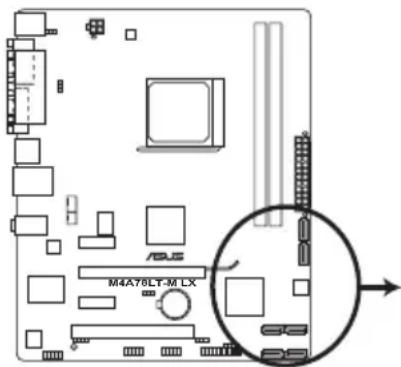
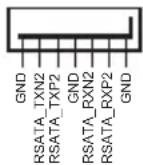
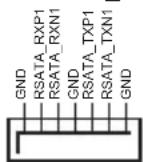
3. Serial ATA connectors (7-pin SATA1, SATA2, SATA3, SATA4, SATA5, and SATA6)
These connectors are for the Serial ATA signal cables for Serial ATA 3Gb/s hard disk and optical disk drives. The Serial ATA 3Gb/s is backward compatible with Serial ATA 1.5Gb/s specification. The data transfer rate of the Serial ATA 3Gb/s is faster than the standard parallel ATA with 133MB/s (Ultra DMA133). If you install Serial ATA hard disk drives, you can create a RAID 0, RAID 1, or RAID 10 set through the onboard SB710 chipset.
SATA3G 5

SATA3G 6

text_image
M4A78LY-M LX AS5SATA3G_2
SATA3G_4

SATA3G 1
SATA3G 3
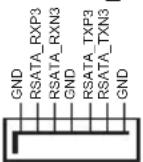
M4A78LT-M LX SATA connectors

- Install the Windows ^ XP Service Pack 3 or later versions before using Serial ATA.
- If you intend to create a SATA RAID set, set the type of the SATA connectors to [RAID] in the BIOS. See 2.3.4 SATA Configuration for details.
- The motherboard does not provide a floppy disk drive connector. You could use a USB floppy disk drive when installing Windows® XP operating system on a hard disk drive that includes a RAID/AHCI set.
- Due to Windows ^ XP limitation, Windows ^ XP may not recognize the USB floppy disk drive.
- For more details on RAID/AHCI, refer to the RA ID/AHCI Supplementary Guide included in the folder named Manual in the support DVD.
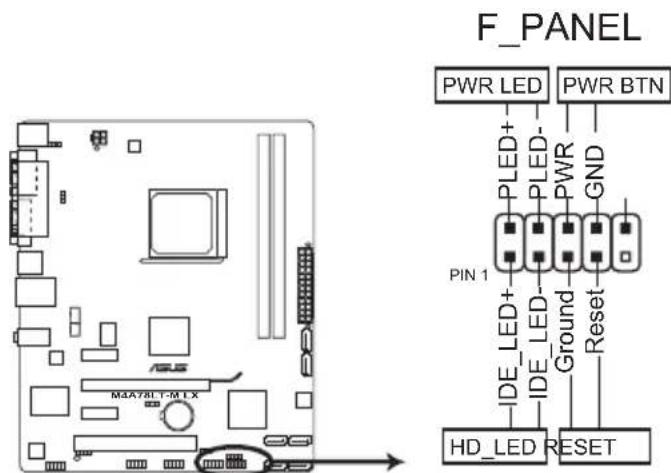
4. System panel connector (10-1 pin F\_PANEL)
This connector supports several chassis-mounted functions.
text_image
F_PANEL PWR LED PWR BTN PLED+ PLED- PLED- PWR GND PIN 1 IDE_LED+ IDE_LED- Ground Reset HD_LED RESETM4A78LT-M LX System panel connector
• System power LED (2-pin PWRLED)
This 2-pin connector is for the system power LED. Connect the chassis power LED cable to this connector. The system power LED lights up when you turn on the system power, and blinks when the system is in sleep mode.
- Hard disk drive activity LED (2-pin HDLED)
This 2-pin connector is for the HDD Activity LED. Connect the HDD Activity LED cable to this connector. The HDD Activity LED lights up or flashes when data is read from or written to the HDD.
• Power/Soft-off button (2-pin PWRBTN)
This 2-pin connector is for the system power button.
- Reset button (2-pin RESET)
This 2-pin connector is for the chassis-mounted reset button for system reboot without turning off the system power.
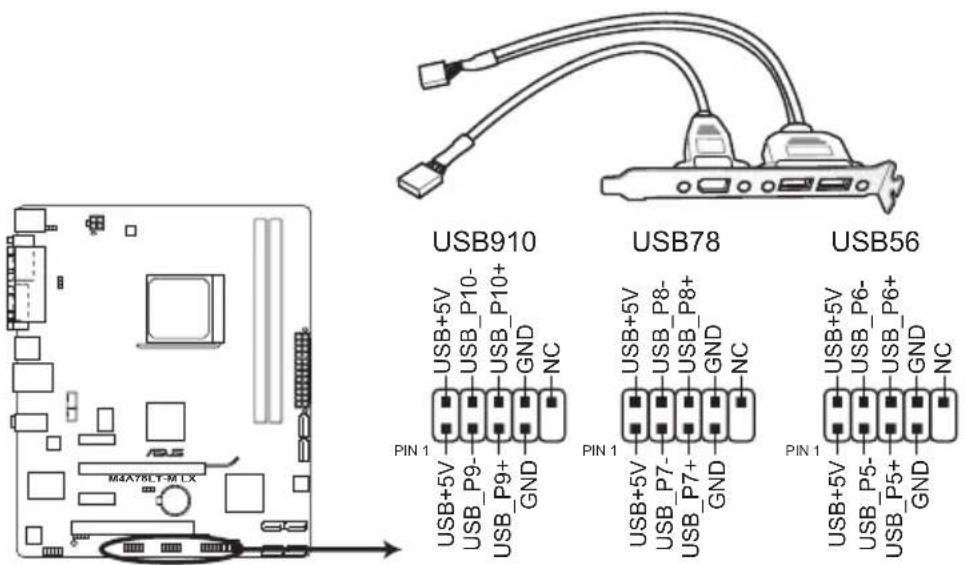
5. USB connectors (10-1 pin USB56, USB78, USB910)
These connectors are for USB 2.0 ports. Connect the USB module cable to any of these connectors, then install the module to a slot opening at the back of the system chassis. These USB connectors comply with USB 2.0 specification that supports up to 480Mbps connection speed.
text_image
USB910 USB78 USB56 M4A78LY-M1 LX PIN 1 USB+5V USB_P10- USB_P9- USB_P9+ GND NC PIN 1 USB+5V USB_P7- USB_P7+ GND NC PIN 1 USB+5V USB_P5- USB_P5+ GND NCM4A78LT-M LX USB2.0 connectors

Never connect a 1394 cable to the USB connectors. Doing so will damage the motherboard!

The USB 2.0 module is purchased separately.
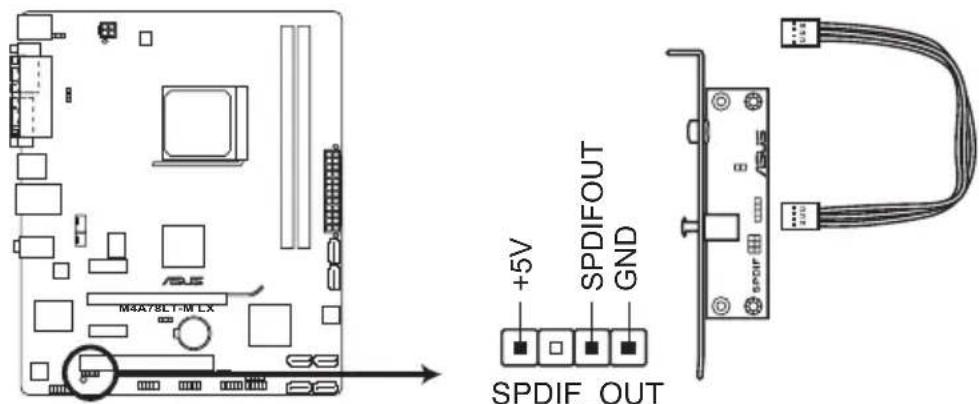
6. Digital audio connector (4-1 pin SPDIF\_OUT)
This connector is for an additional Sony/Philips Digital Interface (S/PDIF) port.
text_image
M4A78LT-M LX ASIS +5V SPDIF OUT GND SPDIF OUTM4A78LT-M LX Digital audio connector

Ensure that the audio device of Sound playback is Realtek High Definition Audio (the name may be different based on the OS). Go to Start > Control Panel > Sounds and Audio Devices > Sound Playback to configure the setting.

The S/PDIF module is purchased separately.
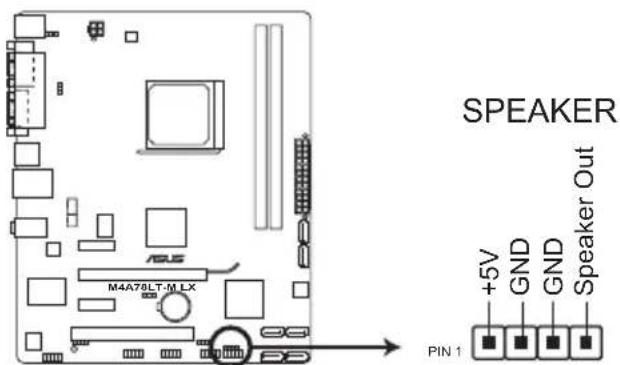
7. Speaker connector (4-pin SPEAKER)
This 4-pin connector is for the chassis-mounted system warning speaker. The speaker allows you to hear system beeps and warnings.
text_image
SPEAKER +5V GND GND Speaker Out PIN 1M4A78LT-M LX Speaker Out Connector
8. CPU and chassis fan connectors (4-pin CPU\_FAN and 3-pin CHA\_FAN)
Connect the fan cables to the fan connectors on the motherboard, ensuring that the black wire of each cable matches the ground pin of the connector.

text_image
CPU_FAN GND CPU FAN PWR CPU FAN IN CPU FAN PWM CHA_FAN GND +12V Rotation M4A78L T-M LXM4A78LT-M LX fan connectors

DO NOT forget to connect the fan cables to the fan connectors. Insufficient air flow inside the system may damage the motherboard components. These are not jumpers! DO NOT place jumper caps on the fan connectors.

Only the 4-pin CPU fan connector supports the ASUS Q-Fan feature.
1.11 Software support
1.11.1 Installing an operating system
This motherboard supports Windows ^® XP/Vista/7 Operating Systems (OS). Always install the latest OS version and corresponding updates to maximize the features of your hardware.

- Motherboard settings and hardware options vary. Refer to your OS documentation for detailed information.
- Ensure that you install Windows ^ XP Service Pack 3 or later versions / Windows ^ Vista Service Pack 1 or later versions before installing the drivers for better compatibility and system stability.
1.11.2 Support DVD information
The Support DVD that comes with the motherboard package contains the drivers, software applications, and utilities that you can install to avail all motherboard features.

The contents of the Support DVD are subject to change at any time without notice. Visit the ASUS website at www.asus.com for updates.
To run the Support DVD
Place the Support DVD into the optical drive. The DVD automatically displays the Drivers menu if Autorun is enabled on your computer.

The following screen is for reference only.

text_image
ASUS install AMD Chipset Driver Portugal Audio Driver AMD Graphics Driver Portugal LAN Driver ASUS EPU-4 Engine Browser Configuration Utility Norton Internet Security 2011 MB Please select items to install. Click an icon to display Support DVD/ motherboard informationClick an item to install

If Autorun is NOT enabled on your computer, browse the contents of the Support DVD to locate the file ASSETUP.EXE from the BIN folder. Double-click the ASSETUP.EXE to run the DVD.
Chapter 2
BIOS information
2.1 Managing and updating your BIOS

Save a copy of the original motherboard BIOS file to a USB flash disk in case you need to restore the BIOS in the future. Copy the original motherboard BIOS using the ASUS Update utility.
2.1.1 ASUS Update utility
The ASUS Update is a utility that allows you to manage, save, and update the motherboard BIOS in Windows® environment.

• ASUS Update requires an Internet connection either through a network or an Internet Service Provider (ISP).
- This utility is available in the support DVD that comes with the motherboard package.
Installing ASUS Update
To install ASUS Update:
-
Place the support DVD into the optical drive. The Drivers menu appears.
-
Click the Utilities tab, then click ASUS Update.
-
Follow the onscreen instructions to complete the installation.

Quit all Windows® applications before you update the BIOS using this utility.
Updating the BIOS
To update the BIOS:
-
From the Windows ^ desktop, click Start > Programs > ASUS > ASUS Update > ASUS Update to launch the ASUS Update utility.
-
From the dropdown list, select either of the following methods:
Updating from the Internet
a. Select Update BIOS from the Internet, then click Next.
b. Select the ASUS FTP site nearest you to avoid network traffic, or click Auto Select then click Next.
c. From the FTP site, select the BIOS version that you want to download then click Next.

The ASUS Update utility is capable of updating itself through the Internet. Always update the utility to avail all its features.
a. Select Update BIOS from a file, then click Next.
b. Locate the BIOS file from the Open window, then click Open.
- Follow the onscreen instructions to complete the updating process.
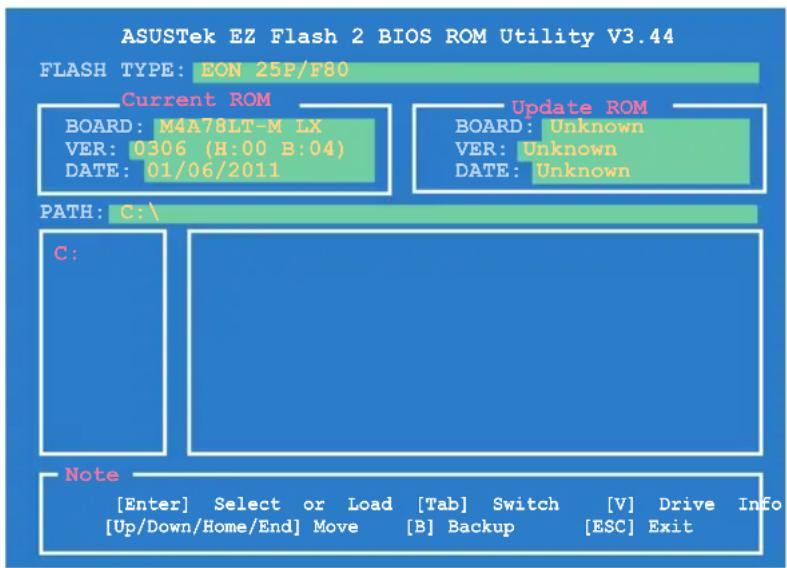
2.1.2 ASUS EZ Flash 2 utility
The ASUS EZ Flash 2 feature allows you to update the BIOS without using an OS-based utility.

Before you start using this utility, download the latest BIOS file from the ASUS website at www.asus.com.
To update the BIOS using EZ Flash 2:
- Insert the USB flash disk that contains the latest BIOS file to the USB port, then launch EZ Flash 2 in either of these two ways:
- Press
- Enter the BIOS setup program. Go to the Tools menu to select EZ Flash 2 and press
- Press
to switch between drives until the correct BIOS file is found, then press . EZ Flash 2 performs the BIOS updating process and automatically reboots the system when done.
text_image
ASUSTek EZ Flash 2 BIOS ROM Utility V3.44 FLASH TYPE: EON 25P/F80 Current ROM BOARD: M4A78LT-M LX VER: 0306 (H:00 B:04) DATE: 01/06/2011 Update ROM BOARD: Unknown VER: Unknown DATE: Unknown PATH: C:\ C: Note [Enter] Select or Load [Tab] Switch [V] Drive Info [Up/Down/Home/End] Move [B] Backup [ESC] Exit
• This function supports USB flash disks with FAT 32/16 format and single partition only.
- DO NOT shut down or reset the system while updating the BIOS to prevent system boot failure!
2.1.3 ASUS CrashFree BIOS 3 utility
The ASUS CrashFree BIOS 3 utility is an auto recovery tool that allows you to restore the BIOS file when it fails or gets corrupted during the updating process. You can restore a corrupted BIOS file using the motherboard support DVD or a removable device that contains the updated BIOS file.

- Before using this utility, rename the BIOS file in the USB flash drive into MA78TMLX.ROM.
- Download the latest BIOS file from the ASUS website at www.asus.com.
Recovering the BIOS
To recover the BIOS:
- Turn on the system.
- Insert the support DVD to the optical drive or the removable device that contains the BIOS file to the USB port or to the floppy disk drive, if supported.
-
The utility automatically checks the devices for the BIOS file. When the BIOS file is found, the utility reads it and starts flashing the corrupted BIOS file.
-
Turn off the system after the utility completes the updating process and turn it on again.

DO NOT shut down or reset the system while updating the BIOS! Doing so can cause system boot failure!

Ensure to load the BIOS default settings to ensure system compatibility and stability. Select the Load Setup Defaults item under the Exit menu. Refer to section 2.8 Exit menu for details.
2.2 BIOS setup program
Use the BIOS Setup program to update the BIOS or configure its parameters. The BIOS screens include navigation keys and brief online help to guide you in using the BIOS Setup program.
Entering BIOS Setup at startup
To enter BIOS Setup at startup:
- Press
Entering BIOS Setup after POST
To enter BIOS Setup after POST:
- Press
+ + simultaneously. - Press the reset button on the system chassis.
- Press the power button to turn the system off then back on. Do this option only if you failed to enter BIOS Setup using the first two options.

Using the power button, reset button, or the keys to force reset from a running operating system can cause damage to your data or system. We recommend that you always shut down the system properly from the operating system.

- The default BIOS settings for this motherboard apply to most conditions to ensure optimum performance. If the system becomes unstable after changing any BIOS settings, load the default settings to ensure system compatibility and stability. Select the Load Setup Defaults item under the Exit menu. See section 2.8 Exit Menu.
- The BIOS setup screens in this chapter are for reference only. They may not exactly match what you see on your screen.
- Visit the ASUS website at www.asus.com to download the latest BIOS file for this motherboard.
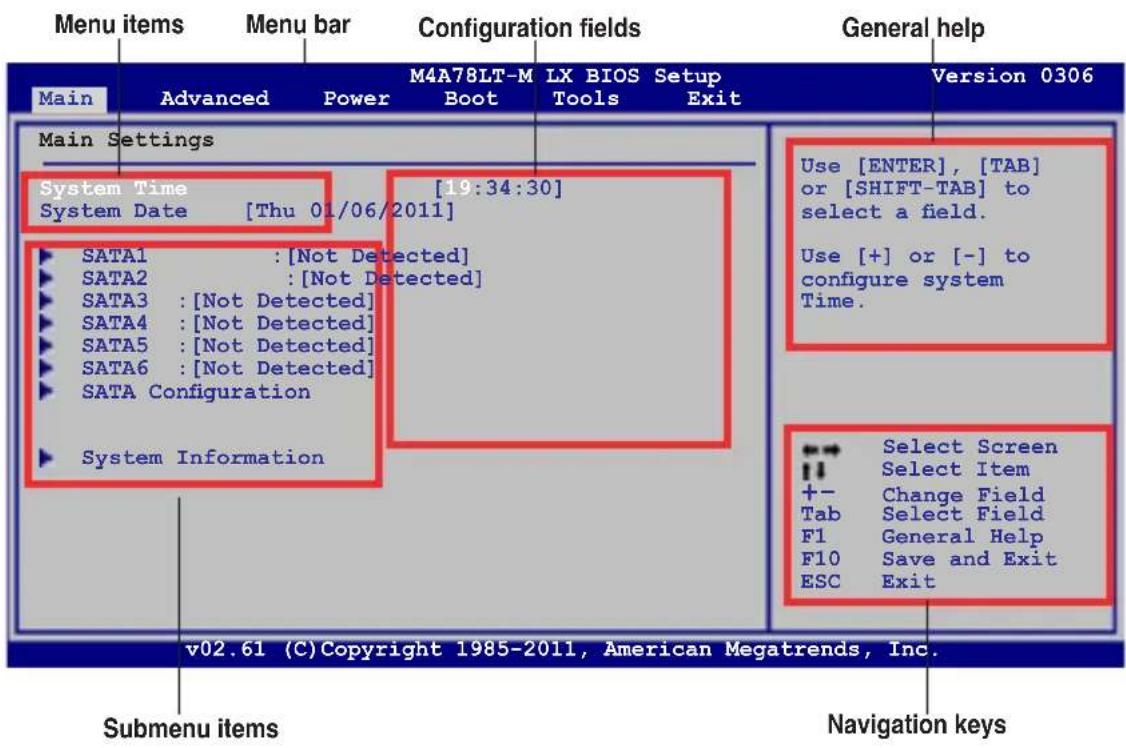
2.2.1 BIOS menu screen
text_image
Menu items Menu bar Configuration fields General help Main Advanced Power M4A78LT-M Boot LX BIOS Setup Tools Exit Version 0306 Main Settings System Time [Thu 01/06/2011] [SATA1 : [Not Detected] [SATA2 : [Not Detected] [SATA3 : [Not Detected] [SATA4 : [Not Detected] [SATA5 : [Not Detected] [SATA6 : [Not Detected] [SATA Configuration] System Information Use [ENTER], [TAB] or [SHIFT-TAB] to select a field. Use [+] or [-] to configure system Time. Select Screen Select Item +- Change Field Tab Select Field F1 General Help F10 Save and Exit ESC Exit v02.61 (C) Copyright 1985-2011, American Megatrends, Inc. Submenu items Navigation keys2.2.2 Menu bar
The menu bar on top of the screen has the following main items:
Main For changing the basic system configuration
Advanced For changing the advanced system settings
Power For changing the advanced power management (APM) configuration
Boot For changing the system boot configuration
Tools For configuring options for special functions
Exit For selecting the exit options and loading default settings.
To select an item on the menu bar, press the right or left arrow key on the keyboard until the desired item is highlighted.
2.2.3 Navigation keys
At the bottom right corner of a menu screen are the navigation keys for that particular menu. Use the navigation keys to select items in the menu and change the settings.

Some of the navigation keys differ from one screen to another.
2.2.4 Menu items
The highlighted item on the menu bar displays the specific items for that menu. For example, selecting Main shows the Main menu items.
The other items (Advanced, Power, Boot, Tools, and Exit) on the menu bar have their respective menu items.
2.2.5 Submenu items
A solid triangle before each item on a menu screen means that the item has a submenu. To display the submenu, select the item and press
2.2.6 Configuration fields
These fields show the values for the menu items. If an item is user- configurable, you can change the value of the field opposite the item. You cannot select an item that is not user-configurable.
A configurable field is enclosed in brackets, and is highlighted when selected. To change the value of a field, select it then press
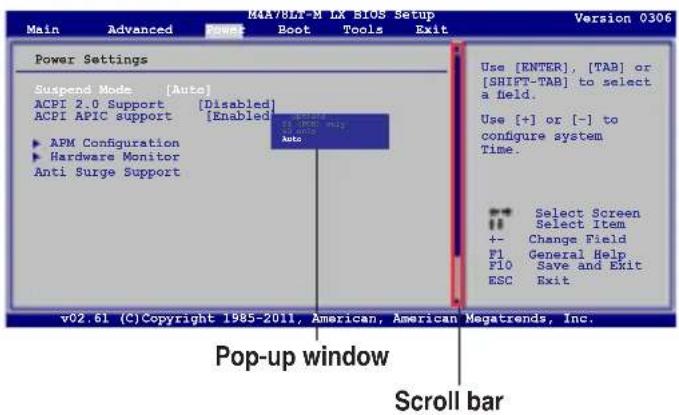
2.2.7 Pop-up window
Select a menu item then press
2.2.8 Scroll bar
A scroll bar appears on the right side of a menu screen when there are items that do not fit on the screen. Press the
text_image
Main Advanced Power Boot Tools Exit Version 0306 Power Settings Suspend Mode [Auto] ACPI 2.0 Support [Disabled] ACPI APIC support [Enabled] ▶ APM Configuration ▶ Hardware Monitor Anti Surge Support Use [ENTER], [TAB] or [SHIFT-TAB] to select a field. Use [+] or [-] to configure system Time. ▶ Select Screen Select Item +- Change Field F1 General Help F10 Save and Exit ESC Exit v02.61 (C) Copyright 1985-2011, American, American Megatrends, Inc. Pop-up window Scroll bar2.2.9 General help
At the top right corner of the menu screen is a brief description of the selected item.
2.3 Main menu
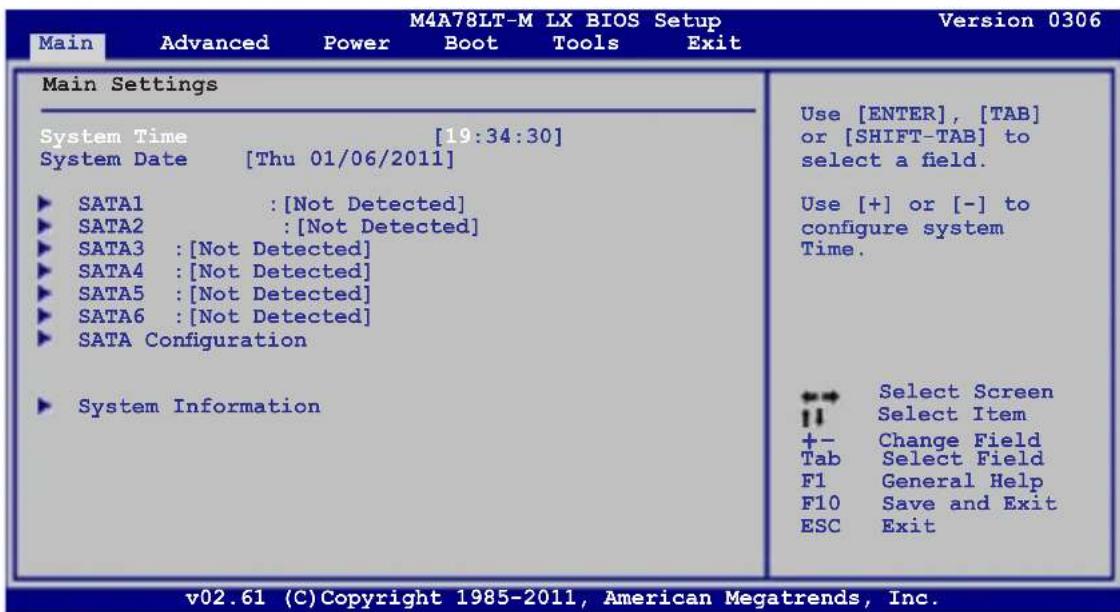
When you enter the BIOS Setup program, the Main menu screen appears, giving you an overview of the basic system information.
Refer to section 2.2.1 BIOS menu screen for information on the menu screen items and how to navigate through them.
text_image
M4A78LT-M LX BIOS Setup Version 0306 Main Advanced Power Boot Tools Exit Main Settings System Time [19:34:30] System Date [Thu 01/06/2011] ▶ SATA1 : [Not Detected] ▶ SATA2 : [Not Detected] ▶ SATA3 : [Not Detected] ▶ SATA4 : [Not Detected] ▶ SATA5 : [Not Detected] ▶ SATA6 : [Not Detected] ▶ SATA Configuration ▶ System Information Use [ENTER], [TAB] or [SHIFT-TAB] to select a field. Use [+] or [-] to configure system Time. ↔ Select Screen ++ Select Item Tab Change Field F1 Select Field F10 General Help ESC Save and Exit v02.61 (C)Copyright 1985-2011, American Megatrends, Inc.2.3.1 System Time [xx:xx:xx]
Allows you to set the system time.
2.3.2 System Date [Day xx/xx/xxxx]
Allows you to set the system date.
2.3.3 SATA\_1\~6SATA\_1\~6
While entering Setup, the BIOS automatically detects the presence of SATA devices. There is a separate submenu for each SATA device. Select a device item then press
The BIOS automatically detects the values opposite the dimmed items (Device, Vendor, Size, LBA Mode, Block Mode, PIO Mode, Async DMA, Ultra DMA, and SMART monitoring). These values are not user-configurable. These items show Not Detected if no SATA device is installed in the system.
Type [Auto]
Selects the type of SATA drive. Setting this item to [Auto] allows automatic selection of the appropriate SATA device type. Select [CDROM] if you are specifically configuring a CD-ROM drive. Select [ARMD] (ATAPI Removable Media Device) if your device is either a ZIP, LS-120, or MO drive. Configuration options: [Not Installed] [Auto] [CDROM] [ARMD]
![ASUS M4A78LT-M LX - Type [Auto] - 1](/content/2026/06/1236701/images/7e88cf68b2623a165b3e2abb5748fa821df95cbe8ac521a16433cd3e82075146.jpg)
This item only appears in the SATA_5/6 menus.
LBA/Large Mode [Auto]
Enables or disables the LBA mode. Setting this item to [Auto] enables the LBA mode if the device supports this mode, and if the device was not previously formatted with LBA mode disabled. Configuration options: [Disabled] [Auto]
Block (Multi-Sector Transfer) M [Auto]
Enables or disables data multi-sectors transfers. When this item is set to [Auto], the data transfer from and to the device occurs multiple sectors at a time if the device supports multi-sector transfer feature. When this item is set to [Disabled], the data transfer from and to the device occurs one sector at a time. Configuration options: [Disabled] [Auto]
PIO Mode [Auto]
Selects the PIO mode. Configuration options: [Auto] [0] [1] [2] [3] [4]
DMA Mode [Auto]
Selects the DMA mode. Configuration options: [Auto]
SMART Monitoring [Auto]
Sets the Smart Monitoring, Analysis, and Reporting Technology.
Configuration options: [Auto] [Disabled] [Enabled]
32Bit Data Transfer [Enabled]
Enables or disables 32-bit data transfer. Configuration options: [Disabled] [Enabled]
2.3.4 SATA Configuration
The SATA Configuration menu allows you to configure your storage devices. Select an item then press
OnChip SATA Channel [Enabled]
Enables or disables the onboard channel SATA port. Configuration options: [Disabled] [Enabled]
SATA Port1 - Port4 [IDE]
Configures SATA 1/2/3/4. Configuration options: [IDE] [RAID] [AHCI]
SATA Port5 - Port6 [IDE]
Configures SATA 5/6. Configuration options: [IDE] [RAID] [AHCI]
![ASUS M4A78LT-M LX - OnChip SATA Channel [Enabled] - 1](/content/2026/06/1236701/images/0601548845e540812f34d6cafd2d2ad183f6cd8c930ba9e237b4908b12c72b70.jpg)
- When SATA 1/2/3/4 are configured as [IDE], SATA 5/6 can only be configured as [IDE].
- When SATA 1/2/3/4/5/6 are configured as [AHCI], only SATA 1/2/3/4 can be detected under OS. Ensure to install the AHCI driver, so that you can use SATA 1/2/3/4/5/6 in AHCI mode under OS.
- When SATA 1/2/3/4 are configured as [AHCI] and SATA 5/6 are configured as [IDE], you can access the devices on SATA 5/6 before entering OS.
2.3.5 System Information
This menu gives you an overview of the general system specifications. The BIOS automatically detects the items in this menu.
BIOS Information
Displays the auto-detected BIOS information.
Processor
Displays the auto-detected CPU specification.
System Memory
Displays the auto-detected system memory.
2.4 Advanced menu
The Advanced menu items allow you to change the settings for the CPU and other system devices.

Take caution when changing the settings of the Advanced menu items. Incorrect field values can cause the system to malfunction.

text_image
M4A78LT-M LX BIOS Setup Version 0306 Main Advanced Power Boot Tools Exit Advanced Settings JumperFree Configuration CPU Configuration Chipset Onboard Devices Configuration PCIPnP USB Configuration Adjust System Frequency/Voltage etc. Select Screen Select Item +- Change Field Tab Select Field F1 General Help F10 Save and Exit ESC Exit v02.61 (C) Copyright 1985-2011, American Megatrends, Inc.2.4.1 JumperFree Configuration

The items and configuration options in this menu may vary depending on the AMD CPU type.
CPU OverClocking [Auto]
Selects the CPU overclocking options to achieve desired CPU internal frequency.
Configuration options: [Manual] [Auto] [Overclock Profile] [Test Mode]
![ASUS M4A78LT-M LX - CPU OverClocking [Auto] - 1](/content/2026/06/1236701/images/6605ac6e6abc10493c2ec892858a3147e3934bffe7cb437bf5705c65545ce86a.jpg)
The following item only appears when you set CPU Overclocking to [Manual].
CPU/HT Reference Clock (MHz) [200]
Sets the CPU/HT Reference Clock. Configuration options: [Min.=200] [Max.=550]
![ASUS M4A78LT-M LX - CPU OverClocking [Auto] - 2](/content/2026/06/1236701/images/4383b50e33eec838ddf92da790b320b399a414a35c4f35f9a1e76761dc957512.jpg)
The following item only appears when you set CPU Overclocking to [Overclock Profile].
Overclock Options [Auto]
Selects the overclocking profile. Configuration options: [Auto] [Overclock 2%]
[Overclock 5%] [Overclock 8%] [Overclock 10%]
GPU Overclocking [Auto]
Configures the GPU overclocking. Configuration options: [Auto] [Manual]
![ASUS M4A78LT-M LX - GPU Overclocking [Auto] - 1](/content/2026/06/1236701/images/35bacf258bf726334a07e9c2a0a3f5bf697902963ecdc65c1b22d16325ea24a0.jpg)
The following item only appears when you set GPU Overclocking to [Manual].
GPU Engine Clock [350]
Sets the GPU Engine Clock. Configuration options: [Min.=150] [Max.=1000]
PCIE Overclocking [Auto]
Configures the PCIE overclocking. Configuration options: [Auto] [Manual]
![ASUS M4A78LT-M LX - PCIE Overclocking [Auto] - 1](/content/2026/06/1236701/images/5756a76a1be07334d62e422d6e6b853d89eddc078db02825193a394cad14b4a6.jpg)
The following item only appears when you set PCIE Overclocking to [Manual].
PCIE Clock [100]
Sets the PCIE Clock. Configuration options: [Min.=100] [Max.=150]
Processor Frequency Multiplier [Auto]
Sets the processor frequency multiplier. Configuration options: [Auto] [x4.0 800MHz] [x4.5 900MHz] [x5.0 1000MHz] [x5.5 1100MHz] [x6.0 1200MHz] [x6.5 1300MHz] [x7.0 1400MHz] [x7.5 1500MHz] [x8.0 1600MHz] [x8.5 1700MHz] [x9.0 1800MHz] [x9.5 1900MHz] [x10.0 2000MHz] [x10.5 2100MHz] [x11.0 2200MHz] [x11.5 2300MHz] [x12.0 2400MHz] [x12.5 2500MHz] [x13.0 2600MHz] [x13.5 2700MHz] [x14.0 2800MHz] [x14.5 2900MHz] [x15.0 3000MHz]
CPU/NB Frequency [Auto]
Sets the CPU/Northbridge frequency. Configuration options: [Auto] [4.00x] [5.00x] [6.00x] [7.00x] [8.00x] [9.00x] [10.00x]
CPU Over Voltage [Auto]
Sets the CPU over voltage. The valid value ranges vary depending on your CPU model. Use <+> / <-> keys to adjust the ratio. Configuration options: [Auto]
VDDNB Over Voltage [Auto]
Sets the VDDNB over voltage. The valid value ranges vary depending on your CPU model. Use <+> / <-> keys to adjust the ratio. Configuration options: [Auto]
LoadLine Calibration [Auto]
Sets the LoadLine. Configuration options: [Auto] [0%] [3.225%] [6.450%] [9.675%] [12.90%] [16.125%] [19.35%] [22.575%] [25.8%] [29.025%] [32.25%] [35.475%] [38.7%] [41.925%] [45.15%] [48.375%] [51.6%] [54.825%] [58.05%] [61.275%] [64.5%] [67.725%] [70.95%] [74.175%] [77.4%] [80.625%] [83.85%] [87.075%] [90.3%] [93.525%] [96.75%] [100%]
![ASUS M4A78LT-M LX - LoadLine Calibration [Auto] - 1](/content/2026/06/1236701/images/99d6ed94bf5c031b567ea0e988909a5d6cdfb0b796261fde3bfd88f524c49fcb.jpg)
If the system becomes unstable after changing the setting, set it back to [Auto] for safe mode.
HT Link Frequency [Auto]
Sets the HyperTransport link speed. Configuration options: [Auto] [200MHz] [400MHz] [600MHz] [800MHz] [1000MHz] [1200MHz] [1400MHz] [1600MHz] [1800MHz] [2000MHz]
HT Link Width [Auto]
Sets the HyperTransport link width. Configuration options: [Auto] [8 Bit] [16 Bit]
HT Over Voltage [Auto]
Sets the HT over voltage. The values range from 1.20000V to 1.38000V with a 0.01500V increment. Use the <+> / <-> keys to adjust the value. Configuration options: [Auto] [Max. = 1.38000V] [Min. = 1.20000V]
Memory Clock Mode [Auto]
Sets the memory clock mode. Configuration options: [Auto] [Manual]
![ASUS M4A78LT-M LX - Memory Clock Mode [Auto] - 1](/content/2026/06/1236701/images/41e8d62362e7c7afa6d33fe6888f39c477d60df9915f4d9e3f1fbbdccc9c99e7.jpg)
The following item only appears when you set Memory Clock Mode to [Manual].
Memclock Value [400MHz]
Selects the DRAM frequency programming method.
Configuration options: [400MHz] [533MHz] [667MHz] [800MHz]
DRAM Timing Mode [Auto]
Sets the DRAM timing mode. Configuration options: [Auto] [DCT 0] [DCT 1] [Both]
Memory Over Voltage [Auto]
Sets the memory over voltage. The values range from 1.3500V to 2.2050V with a 0.0150V increment. Use the <+> / <-> keys to adjust the value. Configuration options: [Auto] [Max. = 2.2050V] [Min. = 1.3500V]
Chipset Over Voltage [Auto]
Sets the chipset over voltage. The values range from 1.10000V to 1.61000V with a 0.01500V increment. Use the <+> / <-> keys to adjust the value. Configuration options: [Auto] [Max. = 1.61000V] [Min. = 1.10000V]
PCI/PCIe CLK Status [Enabled]
Enables or disables clock for PCI/PCIe slot. Configuration options: [Disabled] [Enabled]
2.4.2 CPU Configuration
The items in this menu show the CPU-related information that the BIOS automatically detects.
GART Error Reporting [Disabled]
This option should remain disabled for the normal operation. The driver developer may enable it for testing purpose. Configuration options: [Disabled] [Enabled]
Microcode Updation [Enabled]
Enables or disables Microcode Updation. Configuration options: [Disabled] [Enabled]
Secure Virtual Machine Mode [Disabled]
Enables or disables Secure Virtual Machine Mode (SVM). Configuration options: [Disabled] [Enabled]
Cool 'n' Quiet [Enabled]
Enables or disables the AMD ^® Cool ‘n’ Quiet technology. Configuration options: [Enabled] [Disabled]
C1E Support [Disabled]
Enables or disables the CPU Enhanced Halt (C1E) function, a CPU power-saving function in system halt state. When this item is enabled, the CPU core frequency and voltage will be reduced during the system halt state to decrease power consumption.
Configuration options: [Disabled] [Enabled]
Advanced Clock Calibration [Disabled]
Adjusts the processor's overclocking capability. When this item is set to [Auto], the BIOS automatically adjusts this function. When this item is set to [All Cores], the processor has the best overclocking performance. When this item is set to [Per Core], the processor's overclocking capability is enhanced. Configuration options: [Disabled] [Auto] [All Cores] [Per Core]
2.4.3 Chipset
NorthBridge Configuration
Memory Configuration
Bank Interleaving [Auto]
Allows you to enable the bank memory interleaving. Configuration options: [Disabled] [Auto]
Channel Interleaving [XOR of Address bit]
Allows you to enable the channel memory interleaving.
Configuration options: [Disabled] [Address bits 6] [Address bits 12]
[XOR of Address bits [20:16, 6]] [XOR of Address bits [20:16, 9]]
Enable Clock to All DIMMs [Disabled]
Enables unused Clocks to DIMMs even though memory slots are not populated.
Configuration options: [Disabled] [Enabled]
MemClk Tristate C3/ATLVID [Disabled]
Allows you to enable or disable MemClk Tri-Stating during C3 and Alt VID.
Configuration options: [Disabled] [Enabled]
Memory Hole Remapping [Enabled]
Allows you to enable or disable memory remapping around memory hole.
Configuration options: [Disabled] [Enabled]
DCT Unganged Mode [Always]
Allows you to select the unganged DRAM mode (64-bit width).
Configuration options: [Auto] [Always]
Power Down Enable [Disabled]
Allows you to enable or disable DDR power down mode.
Configuration options: [Disabled] [Enabled]
ECC Configuration
ECC Mode [Disabled]
Allows you to set the ECC mode. Configuration options: [Disabled] [Basic] [Good]
[Super] [Max] [User]
Internal Graphics
Primary Video Controller [GFX0-GPP-IGFX-PCI]
Selects the primary display adapter. Configuration options: [GFX0-GPP-IGFX-PCI] [GPP-GFX0-IGFX-PCI] [PCI-GFX0-GPP-IGFX] [IGFX-GFX0-GPP-PCI]
![ASUS M4A78LT-M LX - Primary Video Controller [GFX0-GPP-IGFX-PCI] - 1](/content/2026/06/1236701/images/950c20ea5b68a6190d520fecfd3aa936a653165d424613cd34ff2b753b9bd99e.jpg)
GFX0: primary video controller on a PCIe x16 slot
GPP: primary video controller on a PCIe x1 slot
IGFX: onboard display output port
PCI: primary video controller on a PCI slot
UMA Frame Buffer Size [Auto]
Selects the UMA frame buffer size. Configuration options: [Auto] [32MB] [64MB]
[128MB] [256MB] [512MB] [1GB]
![ASUS M4A78LT-M LX - Primary Video Controller [GFX0-GPP-IGFX-PCI] - 2](/content/2026/06/1236701/images/7f1e08b8bb9464c89cddab94495c014d29bfb5b42906a7b76e7403a74ed66b33.jpg)
- The [512MB] option only appears when you install 1GB system memory or more.
- The [1GB] option only appears when you install 2GB system memory or more.
Surround View [Auto]
Disables or enables the Surround View function. Configuration options: [Auto] [Disabled] [Enabled]
![ASUS M4A78LT-M LX - Surround View [Auto] - 1](/content/2026/06/1236701/images/bd34c7de83cacec020968a27b78f7f46ae66299eb016c7d30f3a061a7ea151ca.jpg)
This item becomes user-configurable when you install an ATI graphics card into the PCIe x16 slot.
Frame Buffer Location [Above 4G]
Configuration options: [Below 4G] [Above 4G]
2.4.4 Onboard Device Configuration
Serial Port1 Address [3F8/IRQ4]
Allows you to select the Serial Port1 base address. Configuration options: [Disabled] [3F8/IRQ4][2F8/IRQ3] [3E8/IRQ4] [2E8/IRQ3]
Parallel Port Address [378]
Allows you to select the Parallel Port base addresses. Configuration options: [Disabled] [378] [278] [3BC]
Parallel Port Mode [Normal]
Allows you to select the Parallel Port mode. Configuration options: [Normal] [EPP] [ECP] [EPP+ECP]
Parallel Port IRQ [IRQ7]
Configuration options: [IRQ5] [IRQ7]
HDAudio Controller [Enabled]
Enables or disables the high definition audio controller. Configuration options: [Disabled]Disabled]] [Enabled]Enabled]]
Front Panel Select [HD Audio]
Configuration options: [AC97] [HD Audio]
OnBoard LAN Controller [Enabled]
Configuration options: [Disabled] [Enabled]
OnBoard LAN Boot ROM [Disabled]
Configuration options: [Disabled] [Enabled]
2.4.5 PCIPnP
The PCI PnP menu items allow you to change the advanced settings for PCI/PnP devices. The menu includes setting IRQ and DMA channel resources for either PCI/PnP or legacy ISA devices, and setting the memory size block for legacy ISA devices.

Take caution when changing the settings of the PCI PnP menu items. Incorrect field values can cause the system to malfunction.
Plug and Play O/S [No]
When this item is set to [No], BIOS configures all the devices in the system. When this item is set to [Yes] and if you install a Plug and Play operating system, the operating system configures the Plug and Play devices not required for boot. Configuration options: [No] [Yes]
2.4.6 USB Configuration
The items in this menu allows you to change the USB-related features. Select an item then press

The Module Version and USB Devices Enabled items show the auto-detected values. If no USB device is detected, the item shows None.
USB Functions [Enabled]
Allows you to enable or disable the USB functions. Configuration options: [Disabled] [Enabled]
USB 2.0 Controller [Enabled]
Enables or disables USB 2.0 Controllers. Configuration options: [Disabled] [Enabled]
Legacy USB Support [Auto]
Allows you to enable or disable support for Legacy USB storage devices, including USB flash drives and USB hard drives. Setting to Auto allows the system to detect the presence of USB devices at startup. If detected, the USB controller legacy mode is enabled. If no USB device is detected, the legacy USB support is disabled. Configuration options: [Disabled] [Enabled] [Auto]
USB 2.0 Controller Mode [HiSpeed]
Allows you to configure the USB 2.0 controller in HiSpeed (480Mbps) or Full Speed (12Mbps). Configuration options: [FullSpeed] [HiSpeed]
![ASUS M4A78LT-M LX - USB 2.0 Controller Mode [HiSpeed] - 1](/content/2026/06/1236701/images/c079a090daf9966eeaf0ab7b3deed0a570268a6c71be94b08d0f186ab61964f2.jpg)
The following items only appear when a USB storage device is plugged in.
USB Mass Storage Device Configuration
USB Mass Storage Reset Delay [20 Sec]
Sets the maximum time that the BIOS waits for the USB storage device to initialize.
Configuration options: [10 Sec] [20 Sec] [30 Sec] [40 Sec]
Emulation Type [Auto]
Allows you to set the emulation type. Configuration options: [Auto] [Floppy]
[Forced FDD] [Hard Disk] [CDROM]
2.5 Power menu
The Power menu items allow you to change the settings for the Advanced Configuration and Power Interface (ACPI) and the Advanced Power Management (APM). Select an item then press

text_image
M4A78LT-M LX BIOS Setup Version 0306 Main Advanced Power Boot Tools Exit Power Settings Select the ACPI state used for System Suspend. Suspend Mode [Auto] ACPI 2.0 Support [Enabled] ACPI APIC Support [Enabled] ▶ APM Configuration ▶ HW Monitor Configuration Anti Surge Support [Enabled] v02.61 (C) Copyright 1985-2011, American Megatrends, Inc.2.5.1 Suspend Mode [Auto]
Allows you to select the Advanced Configuration and Power Interface (ACPI) state to be used for system suspend. Configuration options: [S1 (POS) Only] [S3 Only] [Auto]
2.5.2 ACPI 2.0 Support [Enabled]
Allows you to enable or disable the Advanced Configuration and Power Interface (ACPI) 2.0 support. Configuration options: [Disabled] [Enabled]
2.5.3 ACPI APIC Support [Enabled]
Allows you to enable or disable the Advanced Configuration and Power Interface (ACPI) support in the Advanced Programmable Interrupt Controller (APIC). When set to Enabled, the ACPI APIC table pointer is included in the RSDT pointer list. Configuration options: [Disabled] [Enabled]
2.5.4 APM Configuration
Restore on AC Power Loss [Power Off]
When this item is set to [Power Off], the system goes into off state after an AC power loss. When this item is set to [Power On], the system goes on after an AC power loss. Configuration options: [Power Off] [Power On] [Last State]
Power on From S5 By PME# [Disabled]
Enables or disables PME wake from sleep states. Configuration options: [Disabled] [Enabled]
Power on From S5 By Ring [Disabled]
Enables or disables ring to generate a wake event. Configuration options: [Disabled] [Enabled]
Power on By PS/2 Keyboard [Disabled]
Enables or disables PS/2 Keyboard to generate a wake event.
Configuration options: [Disabled] [Space Bar] [Power Key] [Ctrl-Esc]
Power on From S5 By RTC Alarm [Disabled]
Enables or disables RTC to generate a wake event. Configuration options: [Disabled] [Enabled]
2.5.5 HW Monitor Configuration
CPU Temperature [xxx°C/xxx°F] or [Ignored]
MB Temperature [xxx°C/xxx°F] or [Ignored]
The onboard hardware monitor automatically detects and displays the motherboard and CPU temperatures. Select Ignored if you do not wish to display the detected temperatures.
CPU / Chassis Fan Speed [N/A], [xxxxRPM], or [Ignored]
The onboard hardware monitor automatically detects and displays the CPU / Chassis fan speeds in rotations per minute (RPM). If the fan is not connected to the motherboard, the field shows N/A. Select [gnored] if you do not want the detected speed to be displayed.
VCORE Voltage, 3.3V Voltage, 5V Voltage, 12V Voltage [xx.xxxV] or [Ignored]
The onboard hardware monitor automatically detects the voltage output through the onboard voltage regulators.
CPU Q-Fan Function [Enabled]
Enables or disables the ASUS Q-Fan feature that smartly adjusts the CPU fan speeds for more efficient system operation. Configuration options: [Disabled] [Enabled]
![ASUS M4A78LT-M LX - CPU Q-Fan Function [Enabled] - 1](/content/2026/06/1236701/images/3f96b0b94beba6af6d77fdf3817a0dde47b718ae89af703f0f08b2560537effa.jpg)
The following item only appears when you set CPU Q-Fan Function to [Enabled].
CPU Fan Speed Low Limit [200 RPM]
Allows you to manually set a lower limit for the CPU fan speed. If the CPU fan speed is below the specified limit, the system sends out warning beeps. Configuration options:
[500 RPM] [400 RPM] [300 RPM] [200 RPM] [100 RPM] [Ignored]
CPU Q-Fan Mode [Standard]
Allows you to set the appropriate performance level of the CPU fan.
[Standard] Sets to [Standard] to make the CPU fan automatically adjust depending on the CPU temperature.
[Silent] Sets to [Silent] to minimize the fan speed for quiet CPU fan operation.
[Turbo] Set to [Turbo] to achieve maximum CPU fan speed.
[Manual] Allows you to individually set the CPU fan parameters.
2.5.6 Anti Surge Support [Enabled]
Allows you to enable or disable the Anti-Surge protection feature.
Configuration options: [Disabled] [Enabled]
2.6 Boot menu
The Boot menu items allow you to change the system boot options. Select an item then press
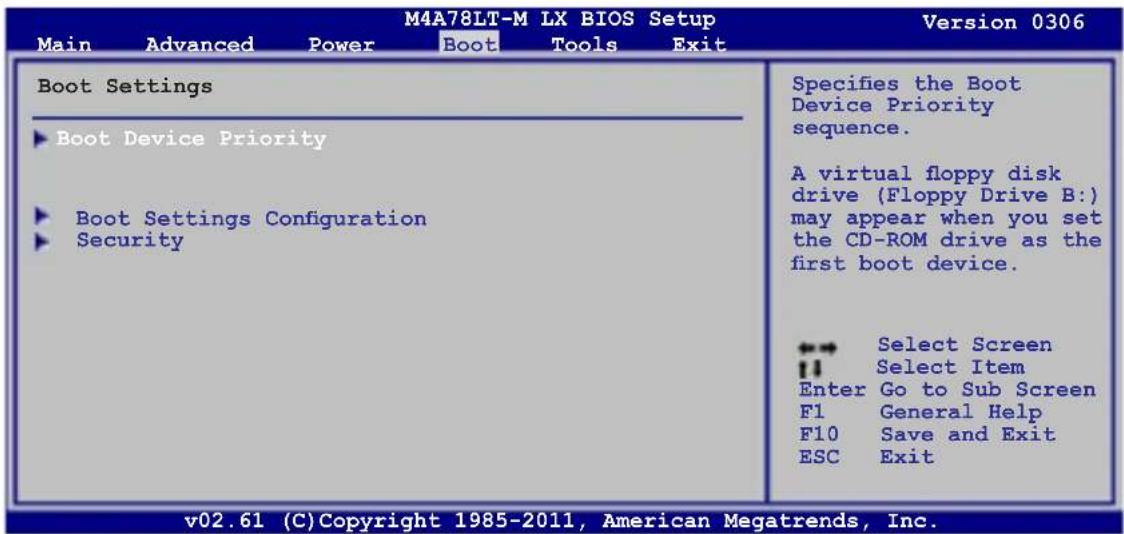
text_image
M4A78LT-M LX BIOS Setup Version 0306 Main Advanced Power Boot Tools Exit Boot Settings ▶ Boot Device Priority ▶ Boot Settings Configuration ▶ Security Specifies the Boot Device Priority sequence. A virtual floppy disk drive (Floppy Drive B:) may appear when you set the CD-ROM drive as the first boot device. ▶ Select Screen ▶ Select Item Enter Go to Sub Screen F1 General Help F10 Save and Exit ESC Exit v02.61 (C)Copyright 1985-2011, American Megatrends, Inc.2.6.1 Boot Device Priority
1st \~ xxth Boot Device
These items specify the boot device priority sequence from the available devices. The number of device items that appears on the screen depends on the number of devices installed in the system. Configuration options: [Removable Dev.] [Hard Drive] [ATAPI CD-ROM] [Disabled]

• To select the boot device during system startup, press
• To access Windows OS in Safe Mode, do any of the following:
- Press
when ASUS logo appears. - Press
after POST.
2.6.2 Boot Settings Configuration
Quick Boot [Enabled]
Enabling this item allows the BIOS to skip some power on self tests (POST) while booting to decrease the time needed to boot the system. When this item is set to [Disabled], BIOS performs all the POST items. Configuration options: [Disabled] [Enabled]
Full Screen Logo [Enabled]
Enables or disables the full screen logo display feature. Configuration options: [Disabled] [Enabled]
![ASUS M4A78LT-M LX - Full Screen Logo [Enabled] - 1](/content/2026/06/1236701/images/8e67c60e012bb5944356120f0b8dd5e76426af188e18b28a75127e636303f08c.jpg)
Set this item to [Enabled] to use the ASUS MyLogo2™ feature.
AddOn ROM Display Mode [Force BIOS]
Sets the display mode for option ROM. Configuration options: [Force BIOS] [Keep Current]
Bootup Num-Lock [On]
Selects the power-on state for the NumLock. Configuration options: [Off] [On]
Wait for 'F1' If Error [Enabled]
When this item is set to [Enabled], the system waits for the F1 key to be pressed when error occurs. Configuration options: [Disabled] [Enabled]
Hit 'DEL' Message Display [Enabled]
When this item is set to [Enabled], the system displays the message Press DEL to run Setup during POST. Configuration options: [Disabled] [Enabled]
2.6.3 Security
The Security menu items allow you to change the system security settings. Select an item then press
Change Supervisor Password
Select this item to set or change the supervisor password. The Supervisor Password item on top of the screen shows the default Not Installed. After you set a password, this item shows Installed.
To set a Supervisor Password:
-
Select the Change Supervisor Password item and press
. -
On the password box, key in a password containing up to six letters, or numbers, or both, then press
. -
Confirm the password when prompted.
The message Password Installed appears after you successfully set your password.
To change the supervisor password, follow the same steps as in setting a supervisor password.
To clear the supervisor password, select the Change Supervisor Password then press

If you forget your BIOS password, you can clear it by erasing the CMOS Real Time Clock (RTC) RAM. See section 1.9 Jumpers for information on how to erase the RTC RAM.
After you have set a supervisor password, the other items appear to allow you to change other security settings.
User Access Level [Full Access]
This item allows you to select the access restriction to the Setup items. Configuration options: [No Access] [View Only] [Limited] [Full Access]
No Access prevents user access to the Setup utility.
View Only allows access but does not allow change to any field.
Limited allows changes only to selected fields, such as Date and Time.
Full Access allows viewing and changing all the fields in the Setup utility.
Change User Password
Select this item to set or change the user password. The User Password item on top of the screen shows the default Not Installed. After you set a password, this item shows Installed. To set a User Password:
-
Select the Change User Password item and press
. -
On the password box, key in a password containing up to six letters, or numbers, or both, then press
. -
Confirm the password when prompted.
The message "Password Installed" appears after you set your password successfully.
To change the user password, follow the same steps as in setting a user password.
Clear User Password
Select this item to clear the user password.
Password Check [Setup]
When set to [Setup], BIOS checks for user password when accessing the Setup utility. When set to [Always], BIOS checks for user password both when accessing Setup and booting the system. Configuration options: [Setup] [Always]
2.7 Tools menu
The Tools menu items allow you to configure options for special functions. Select an item then press

text_image
M4A78LT-M LX BIOS Setup Version 0306 Main Advanced Power Boot Tools Exit Tools Settings Press ENTER to run the utility to select and update BIOS. This utility supports: 1.FAT 12/16/32 (r/w) 2.NTFS (read only) 3.CD-DISC (read only) ASUS EZ Flash 2 ▶ ASUS O.C. Profile Select Screen Select Item Enter Go to Sub Screen F1 General Help F10 Save and Exit ESC Exit v02.61 (C)Copyright 1985-2011, American Megatrends, Inc.2.7.1 ASUS EZ Flash 2
Allows you to run ASUS EZ Flash 2. When you press
2.7.2 ASUS O.C. Profile
This item allows you to store or load multiple BIOS settings.
Add Your CMOS Profile
Allows you to save the current BIOS file to the BIOS Flash. In the Name sub-item, type your profile name and press
Load CMOS Profiles
Allows you to load the previous BIOS settings saved in the BIOS Flash. Press
Start O.C. Profile
Allows you to run the utility to save and load CMOS. Press
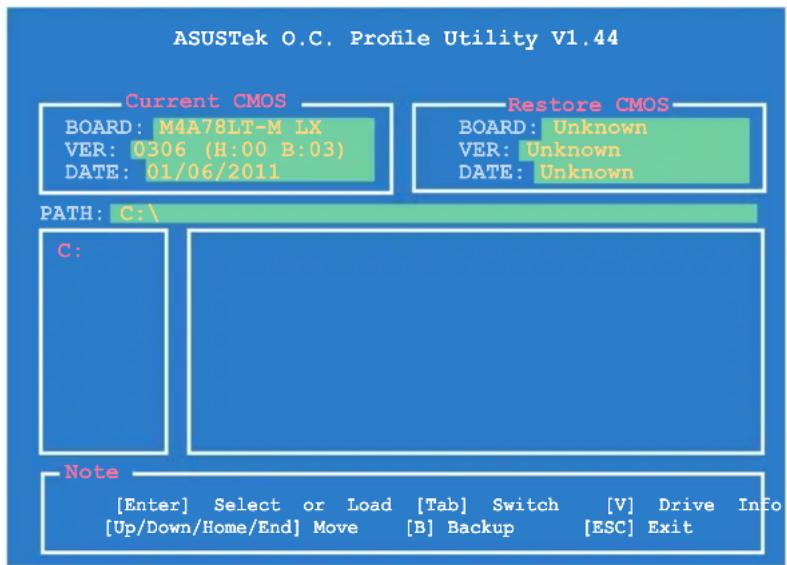
text_image
ASUSTek O.C. Profile Utility V1.44 Current CMOS BOARD: M4A78LT-M LX VER: 0306 (H:00 B:03) DATE: 01/06/2011 Restore CMOS BOARD: Unknown VER: Unknown DATE: Unknown PATH: C:\ C: Note [Enter] Select or Load [Tab] Switch [V] Drive Info [Up/Down/Home/End] Move [B] Backup [ESC] Exit
- This function can support devices such as a USB flash disk with FAT 32/16 format and single partition only.
- DO NOT shut down or reset the system while updating the BIOS to prevent the system boot failure!
- We recommend that you update the BIOS file only coming from the same memory/CPU configuration and BIOS version.
- Only the CMO file can be loaded.
2.8 Exit menu
The Exit menu items allow you to load the optimal or failsafe default values for the BIOS items, and save or discard your changes to the BIOS items.
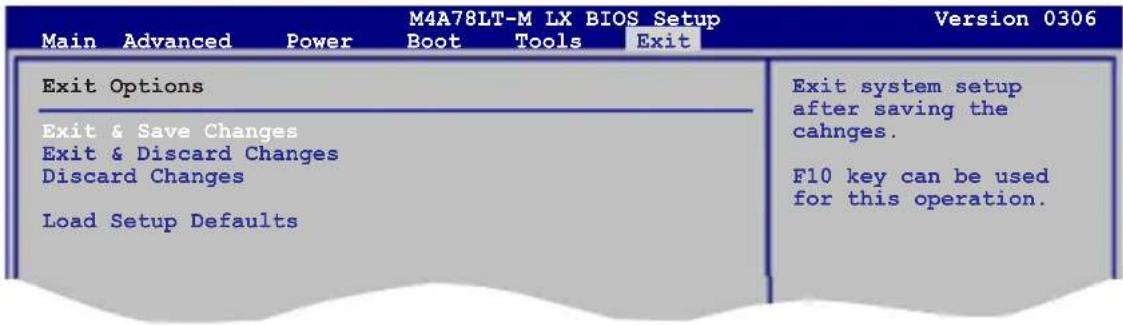
text_image
M4A78LT-M LX BIOS Setup Version 0306 Main Advanced Power Boot Tools Exit Exit Options Exit & Save Changes Exit & Discard Changes Discard Changes Load Setup Defaults Exit system setup after saving the cahnges. F10 key can be used for this operation.
Pressing
Exit & Save Changes
Once you are finished making your selections, choose this option from the Exit menu to ensure the values you selected are saved to the CMOS RAM. An onboard backup battery sustains the CMOS RAM so it stays on even when the PC is turned off. When you select this option, a confirmation window appears. Select OK to save changes and exit.
Exit & Discard Changes
Select this option only if you do not want to save the changes that you made to the Setup program. If you made changes to fields other than System Date, System Time, and Password, the BIOS asks for a confirmation before exiting.
Discard Changes
This option allows you to discard the selections you made and restore the previously saved values. After selecting this option, a confirmation appears. Select OK to discard any changes and load the previously saved values.
Load Setup Defaults
This option allows you to load the default values for each of the parameters on the Setup menus. When you select this option or if you press
ASUS contact information
ASUSTeK COMPUTER INC.
Address 15 Li-Te Road, Peitou, Taipei, Taiwan 11259
Telephone +886-2-2894-3447
Fax +886-2-2890-7798
E-mail info@asus.com.tw
Online support support.asus.com
ASUS COMPUTER INTERNATIONAL (America)
Address 800 Corporate Way, Fremont, CA 94539, USA
Telephone +1-510-739-3777
Fax +1-510-608-4555
Web site usa.asus.com
Technical Support
Telephone +1-812-282-2787
Support fax +1-812-284-0883
Online support support.asus.com
ASUS COMPUTER GmbH (Germany and Austria)
Address Harkort Str. 21-23, D40880 Ratingen, Germany
Fax +49-2102-9599-11
Online contact www.asus.com.de/sales
Technical Support
Component Telephone +49-1805-010923
System/Notebook /Eee/LCD Telephone +49-1805-010920
Support Fax +492102959911
Online support www.asus.com.de/support
EC Declaration of Conformity
We, the undersigned,
| Manufacturer: | ASUSTek COMPUTER INC. |
| Address, City: | No. 150, LI-TE RD., PEITOU, TAIPEI 112, TAIWAN R.O.C. |
| Country: | TAIWAN |
| Authorized representative in Europe: | ASUS COMPUTER GmbH |
| Address, City: HARKORT STR. 21-23, 40880 R | ATINGEN |
| Country: | GERMANY |
| Product name: Motherboard | |
| Model name: M4A78LT-M LX |
conform with the essential requirements of the following directives: 2004/108/EC-EMC Directive
| EN 55022:2006+A1:2007EN 61000-3-2:2006EN 55013:2001+A1:2003+A2:2006 | EN 55024:1998+A1:2001+A2:2003EN 61000-3-3:2008EN 55020:2007 |
| □1999/5/EC-R &TTE Directive | |
| EN 300 328 V1.7.1(2006-05) | EN 301 489-1 V1.8.1(2008-04) |
| EN 300 440-1 V1.4.1(2008-05) | EN 301 489-3 V1.4.1(2002-08) |
| EN 300 440-2 V1.2.1(2008-03) | EN 301 489-4 V1.3.1(2002-08) |
| EN 301 511 V9.0.2(2003-03) | EN 301 489-7 V1.3.1(2005-11) |
| EN 301 908-1 V3.2.1(2007-05) | EN 301 489-9 V1.4.1(2007-11) |
| EN 301 908-2 V3.2.1(2007-05) | EN 301 489-17 V2.1.1(2009-05) |
| EN 301 893 V1.4.1(2005-03) | EN 301 489-24 V1.4.1(2007-09) |
| EN 302 544-2 V1.1.1(2009-01) | EN 302 326-2 V1.2.2(2007-06) |
| EN 50360:2001 | EN 302 326-3 V1.3.1(2007-09) |
| EN 50371:2002 | EN 301 357-2 V1.3.1(2006-05) |
| EN 50385:2002 | EN 302 623 V1.1.1(2009-01) |
| 2006/95/EC-LVD Directive | |
| EN 60950-1:2006EN 60950-1:2006+A11:2009 | EN 60065:2002+A1:2006+A11:2008 |
| □2009/125/EC-ErP Directive | |
| Regulation (EC) No. 1275/2008□ EN 62301:2005Regulation (EC) No. 642/2009□ EN 62301:2005 | Regulation (EC) No. 278/2009□ EN 62301:2005Var. 110101 |

CE marking
(EC conformity marking)
Position : CEO
Name: Jerry Shen

Signature
Year to begin affixing CE marking:2011
DECLARATION OF CONFORMITY
Per FCC Part 2 Section 2. 1077(a)

Responsible Party Name: Asus Computer International
, CA 94539.
Address: 800 Corporate Way, Fremont
'hone/Fax No: (510)739-3777/(510)608-4555
hereby declares that the product
Product Name : Motherboard
Model Number : M4A78LT-M LX
Conforms to the following specifications:
☒ FCC Part 15, Subpart B, Unintentional Radiators
☐ FCC Part 15, Subpart C, Intentional Radiators
☐ FCC Part 15, Subpart E, Intentional Radiators
Supplementary Information:
This device complies with part 15 of the FCC Rules. Operation is subject to the following two conditions: (1) This device may not cause harmful interference, and (2) this device must accept any interference received, including interference that may cause undesired operation.
Representative Person's Name: Steve Chang / President

Jan. 20, 2011
Date :