WorkCentre 6015N - Printer XEROX - Free user manual and instructions
Find the device manual for free WorkCentre 6015N XEROX in PDF.


User questions about WorkCentre 6015N XEROX
0 question about this device. Answer the ones you know or ask your own.
Ask a new question about this device
Download the instructions for your Printer in PDF format for free! Find your manual WorkCentre 6015N - XEROX and take your electronic device back in hand. On this page are published all the documents necessary for the use of your device. WorkCentre 6015N by XEROX.
USER MANUAL WorkCentre 6015N XEROX
© 2012 Xerox Corporation. All rights reserved. Unpublished rights reserved under the copyright laws of the United States. Contents of this publication may not be reproduced in any form without permission of Xerox Corporation.
Copyright protection claimed includes all forms of matters of copyrightable materials and information now allowed by statutory or judicial law or hereinafter granted, including without limitation, material generated from the software programs which are displayed on the screen such as styles, templates, icons, screen displays, looks, and so on.
XEROX ^® and XEROX and Design ^® , Phaser ^® , PhaserSMART ^® , PhaserMatch ^® , PhaserCal ^® , PhaserMeter, CentreWare ^® , PrintingScout ^® , Walk-Up ^® , WorkCentre ^® , FreeFlow ^® , SMARTsend ^® , Scan to PC Desktop ^® , MeterAssistant ^® , SuppliesAssistant ^® , Xerox Secure Access Unified ID System ^® , Xerox Extensible Interface Platform ^® , ColorQube ^® , Global Print Driver ^® , and Mobile Express Driver ^® are trademarks of Xerox Corporation in the United States and/or other countries.
Adobe ^® Reader ^® , Adobe ^® Type Manager ^® , ATM ^™ , Flash ^® , Macromedia ^® , Photoshop ^® , and PostScript ^® are trademarks of Adobe Systems Incorporated in the United States and/or other countries.
Apple ^® , AppleTalk ^® , Bonjour ^® , EtherTalk ^® , Macintosh ^® , Mac OS ^® , and TrueType ^® are trademarks of Apple Inc., registered in the U.S. and other countries.
HP-GL ^® , HP-UX ^® , and PCL ^® are trademarks of Hewlett-Packard Corporation in the United States and/or other countries.
IBM ^® and AIX ^® are trademarks of International Business Machines Corporation in the United States and/or other countries.
Microsoft ^® , Windows Vista ^® , Windows ^® , and Windows Server ^® are trademarks of Microsoft Corporation in the United States and other countries.
Novell ^® , NetWare ^® , NDPS ^® , NDS ^® , IPX ^™ , and Novell Distributed Print Services ^™ are trademarks of Novell, Inc. in the United States and other countries.
SGI ^® and IRIX ^® are trademarks of Silicon Graphics International Corp. or its subsidiaries in the United States and/or other countries.
Sun, Sun Microsystems, and Solaris are trademarks or registered trademarks of Oracle and/or its affiliates in the United States and other countries.
UNIX ^® is a trademark in the United States and other countries, licensed exclusively through X/ Open Company Limited.
PANTONE ^® and other Pantone, Inc. trademarks are the property of Pantone, Inc.
Document version 1.1: March 2012
Contents
1 Safety 11
Electrical Safety 12
General Guidelines....12
Power Cord 13
Telephone Line Cord....13
Operational Safety 14
Operational Guidelines 14
Ozone Release....14
Printer Location 14
Printer Supplies 15
Maintenance Safety 16
Printer Symbols....17
Environmental, Health, and Safety Contact Information....18
2 Features 19
Parts of the Printer 20
Front View....20
Rear View 21
Control Panel 21
System Menus....25
Information Pages....26
Billing Meters 27
Admin Menu 28
Default Settings Menu....35
Tray Settings....37
Panel Language 37
Energy Saver Mode 38
Setting the Power Saver Timer 38
Exiting Energy Saver Mode 38
Administration Features....39
Information Pages....39
CentreWare Internet Services 39
More Information....41
Xerox ^® Welcome Center....41
3 Installation and Setup 43
Installation and Setup Overview....44
Selecting a Location for the Printer 45
Connecting the Printer 46
Selecting a Connection Method....46
Connecting to a Wired Network....47
Connecting to a Wireless Network 47
Connecting to a Computer Using USB....51
Connecting to a Telephone Line 51
Configuring Network Settings....52
About TCP/IP and IP Addresses 52
Assigning the IP Address of the Printer 53
Setting Up the Fax Header....56
Enabling the Printer for Scanning....57
Setting the Date and Time....58
Installing the Software....59
Operating System Requirements....59
Available Print Drivers 59
Installing the Print Drivers for a Windows Network Printer 60
Installing the Print Drivers for a Windows USB Printer....61
Installing the Drivers and Utilities for Macintosh OS X Version 10.5 and Later 62
Setting Up Scanning....64
Scanning Setup Overview 64
Setting Up Scanning to a Shared Folder on Your Computer....65
Setting Up Scanning to an FTP Server 68
Setting Up Scanning to an Email Address....69
Setting Up Scanning With USB 70
4 Printing 71
Supported Paper 72
Recommended Media 72
Ordering Paper 72
General Paper Loading Guidelines 72
Paper That Can Damage Your Printer....73
Paper Storage Guidelines....73
Supported Standard Paper Sizes....74
Supported Custom Paper Sizes....74
Supported Paper Types and Weights....74
Loading Paper 75
Loading Paper in the Main Tray 75
Loading Paper in the Bypass Tray 78
Setting Paper Types, Paper Sizes, and Display Screen 80
Selecting Printing Options....81
Selecting Printing Defaults in Windows 81
Selecting Printing Defaults in Windows for a Shared Network Printer 81
Selecting Printing Options for an Individual Job in Windows....82
Selecting Printing Options for Macintosh....82
Printing Envelopes 83
Guidelines for Printing Envelopes 83
Loading Envelopes in the Trays 84
Specifying the Main Tray Settings for Printing Envelopes 85
Printing Envelopes From an Application 85
Using Custom Paper Sizes 86
Defining Custom Paper Sizes....86
Printing on Custom Paper Sizes 87
Printing on Both Sides of the Paper 89
Setting Up 2-Sided Printing 89
Loading Paper for Manual 2-Sided Printing....90
Printing From a USB Flash Drive....91
5 Copying 93
Making Copies....94
Automatic Document Feeder Guidelines....95
Document Glass Guidelines 95
Adjusting Copying Options 96
Basic Settings 97
Image-Quality Settings 98
Image Layout Adjustments 99
Output Adjustments 100
Changing the Default Copy Settings....101
Changing the Color Mode....101
Changing the Auto Exposure Level....101
Changing the Color Balance....102
Changing the Manual Feed Slot Paper Size....102
Limiting Access to Copying 103
6 Scanning 105
Loading Documents for Scanning....106
Automatic Document Feeder Guidelines....106
Document Glass Guidelines ....107
Scanning to a USB Flash Drive....108
Scanning to a Folder on a USB Connected Computer....109
Scanning to a Shared Folder on a Network Computer 110
Sharing a Folder on a Windows Computer....110
Sharing a Folder Using Macintosh OS X Version 10.5 and Later....111
Adding a Folder as an Address Book Entry Using CentreWare Internet Services....111
Adding a Folder as an Address Book Entry Using the Address Book Editor....112
Scanning to a Folder on a Network Computer 112
Scanning to an Email Address....114
Scanning to an FTP Server....115
Scanning Images into an Application on a USB Connected Computer....116
Scanning an Image into an Application 116
Scanning an Image Using Windows XP 117
Scanning an Image Using Widows Vista or Windows 7....118
Adjusting Scanning Settings....119
Setting the File Format....119
Setting the Color Mode....119
Setting the Scan Resolution....120
Specifying the Original Size 120
Making the Image Lighter or Darker....120
Adjusting the Sharpness....120
Changing the Auto Exposure Level....120
Setting the Margins....121
Changing the Default Scan Settings....122
Setting the Scan to Network Option....122
Setting the File Format....123
Changing the Color Mode....123
Setting the Scan Resolution....123
Setting the Color Button Sets....123
Specifying the Original Size 123
Making the Image Lighter or Darker....124
Adjusting the Sharpness....124
Changing the Auto Exposure Level....124
Setting the Margins....124
Setting the TIFF File Format....125
Setting the Image Compression 125
Setting the Maximum Email Size....125
Limiting Access to Scanning 126
7 Faxing 127
Loading Documents for Faxing 128
Basic Faxing....129
Sending a Fax From the Printer 129
Sending a Fax From Your Computer....130
Using the Fax Book 131
Faxing to an Individual....132
Faxing to a Group 134
Selecting Fax Options for Single Jobs 137
Setting the Fax Resolution....137
Making the Image Lighter or Darker....137
Turning OnHook On or Off 137
Sending a Delayed Fax....138
Including a Fax Cover Page 138
Setting Up Polling....138
Configuring the Printer for Faxing....139
Changing the Default Fax Settings....139
Managing Fax Functions 140
Printing Monitor Reports....140
Printing a Monitor Report for a Group Fax....140
Turning Secure Fax Receive On or Off 141
Limiting Access to Faxing 141
Printing Fax Reports....143
Inserting Pauses in Fax Numbers....143
8 Maintenance 145
Cleaning the Printer 146
General Precautions....146
Cleaning the Scanner 147
Cleaning the Exterior 149
Cleaning the Interior 149
Adjustments and Maintenance Procedures....157
Color Registration 157
Adjusting Paper Type 158
Adjusting the Bias Transfer Roller 158
Adjusting the Fuser 159
Refreshing the Bias Transfer Roller 159
Adjusting the Altitude....159
Ordering Supplies....160
Consumables 160
When to Order Supplies....160
Toner Cartridges....161
Recycling Supplies....162
Managing the Printer 163
Checking Page Counts....163
Changing the Panel Lock Password....163
Moving the Printer 164
9 Troubleshooting 167
General Troubleshooting 168
Printer Does Not Turn On....168
Printer Resets or Turns Off Frequently....168
The Printer Does Not Print....169
Printer is Making Unusual Noises....169
Condensation has Formed Inside the Printer....170
Paper Jams....171
Minimizing Paper Jams....171
Locating Paper Jams....172
Clearing Paper Jams 173
Troubleshooting Paper Jams 179
Print-Quality Problems ....181
Getting Help....187
Error and Status Messages....187
PrintingScout Alerts....187
Online Support Assistant....187
Information Pages....187
More Information....188
A Specifications 189
Printer Configurations and Options....190
Available Configurations....190
Standard Features....190
Physical Specifications....191
Weights and Dimensions....191
Total Space Requirements....191
Clearance Requirements 191
Environmental Specifications....193
Temperature....193
Relative Humidity 193
Elevation....193
Electrical Specifications....194
Power Supply Voltage and Frequency 194
Power Consumption....194
ENERGY STAR Qualified Product....194
Performance Specifications....195
Controller Specifications....196
Processor 196
Memory....196
Interfaces....196
B Regulatory Information 197
Basic Regulations....198
United States FCC Regulations....198
Canada....198
European Union....199
Turkey RoHS Regulation....199
Copy Regulations....200
United States....200
Canada....202
Other Countries....202
Fax Regulations....203
United States....203
Canada....205
European Union....205
South Africa 205
New Zealand....206
Material Safety Data Sheets....207
C Recycling and Disposal 209
All Countries....210
North America....211
European Union....212
Domestic/Household Environment 212
Professional/Business Environment 212
Collection and Disposal of Equipment and Batteries....213
Battery Symbol Note 213
Battery Removal....213
Other Countries....214
Safety
1
This chapter includes:
• Electrical Safety 12
• Operational Safety 14
- Maintenance Safety 16
• Printer Symbols....17
• Environmental, Health, and Safety Contact Information 18
Your printer and the recommended supplies have been designed and tested to meet strict safety requirements. Attention to the following information ensures the continued safe operation of your Xerox ^® printer.
Electrical Safety
This section includes:
- General Guidelines....12
• Power Cord 12 - Telephone Line Cord....13
General Guidelines

WARNINGS:
- Do not push objects into slots or openings on the printer. Touching a voltage point or shorting out a part could result in fire or electrical shock.
- Do not remove the covers or guards that are fastened with screws unless you are installing optional equipment and are instructed to do so. Turn off the printer when performing these installations. Disconnect the power cord when removing covers and guards for installing optional equipment. Except for user-installable options, there are no parts that you can maintain or service behind these covers.
The following are hazards to your safety:
- The power cord is damaged or frayed.
- Liquid is spilled into the printer.
- The printer is exposed to water.
- The printer emits smoke, or the surface is unusually hot.
- The printer emits unusual noise or odors.
- The printer causes a circuit breaker, fuse, or other safety device to activate.
If any of these conditions occur, do the following:
- Turn off the printer immediately.
- Disconnect the power cord from the electrical outlet.
- Call an authorized service representative.
Power Cord
- Use the power cord supplied with your printer.
- Plug the power cord directly into a properly grounded electrical outlet. Ensure that each end of the cord is connected securely. If you do not know if an outlet is grounded, ask an electrician to check the outlet.
- Do not use a ground adapter plug to connect the printer to an electrical outlet that does not have a ground connection terminal.

WARNING: Avoid the potential of electrical shock by ensuring that the printer is grounded properly. Electrical products can be hazardous if misused.
- Only use an extension cord or power strip designed to handle the electrical current capacity of the printer.
- Verify that the printer is plugged into an outlet that is providing the correct voltage and power. Review the electrical specification of the printer with an electrician if necessary.
- Do not place the printer in an area where people can step on the power cord.
- Do not place objects on the power cord.
- Do not plug or unplug the power cord while the power switch is in the On position.
- If the power cord becomes frayed or worn, replace it.
• To avoid electrical shock and damage to the cord, grasp the plug when unplugging the power cord.
The power cord is attached to the printer as a plug-in device on the back of the printer. If it is necessary to disconnect all electrical power from the printer, disconnect the power cord from the electrical outlet.
Telephone Line Cord

WARNING: To reduce the risk of fire, use only No. 26 American Wire Gauge (AWG) or larger telecommunication line cord.
Operational Safety
Your printer and supplies were designed and tested to meet strict safety requirements. These include safety agency examination, approval, and compliance with established environmental standards.
Your attention to the following safety guidelines helps to ensure the continued, safe operation of your printer.
Operational Guidelines
- Do not remove the paper source tray that you selected in either the print driver or control panel while the printer is printing.
- Do not open the doors when the printer is printing.
- Do not move the printer when it is printing.
- Keep hands, hair, neckties, and so on away from the exit and feed rollers.
- Covers, which require tools for removal, protect the hazard areas within the printer. Do not remove the protective covers.
Ozone Release
This printer produces ozone during normal operation. The amount of ozone produced is dependent on copy volume. Ozone is heavier than air and is not produced in amounts large enough to harm anyone. Install the printer in a well-ventilated room.
For more information in the United States and Canada, go to www.xerox.com/environment. In other markets, please contact your local Xerox ^® representative or go to www.xerox.com/environment_europe.
Printer Location
- Place the printer on a level, solid, non-vibrating surface with adequate strength to hold its weight. To find the weight for your printer configuration, see Physical Specifications on page 191.
- Do not block or cover the slots or openings on the printer. These openings are provided for ventilation and to prevent overheating of the printer.
- Place the printer in an area where there is adequate space for operation and servicing.
- Place the printer in a dust-free area.
- Do not store or operate the printer in an extremely hot, cold, or humid environment.
- Do not place the printer near a heat source.
- Do not place the printer in direct sunlight to avoid exposure to light-sensitive components.
- Do not place the printer where it is directly exposed to the cold air flow from an air conditioning system.
- Do not place the printer in locations susceptible to vibrations.
- For optimum performance, use the printer at the elevations specified in Elevation on page 193.
Printer Supplies
- Use the supplies designed for your printer. The use of unsuitable materials can cause poor performance and a possible safety hazard.
- Follow all warnings and instructions marked on, or supplied with, the product, options, and supplies.
• Store all supplies in accordance with the instructions given on the package or container. - Keep all supplies away from the reach of children.
- Never burn supplies.
- When handling supplies, avoid skin or eye contact. Eye contact can cause irritation and inflammation. Do not attempt to disassemble supplies, which can increase the risk of skin or eye contact.

CAUTION: Use of non-Xerox ^® supplies is not recommended. The Xerox ^® Warranty, Service Agreement, and Total Satisfaction Guarantee do not cover damage, malfunction, or degradation of performance caused by use of non-Xerox ^® supplies, or the use of Xerox ^® supplies not specified for this printer. The Total Satisfaction Guarantee is available in the United States and Canada. Coverage could vary outside these areas. Please contact your Xerox representative for details.
Maintenance Safety
- Do not attempt any maintenance procedure that is not described in the documentation supplied with your printer.
- Do not use aerosol cleaners. Clean with a dry lint-free cloth only.
For more information on the Xerox ^® supplies recycling program, go to: www.xerox.com/gwa
Printer Symbols
The following safety symbols appear on the printer.
| Symbol | Description |
 | Warning or Caution:Ignoring this warning could cause serious injury or even death. Ignoring this caution could damage property. |
 | Hot surface on or in the printer. Use caution to avoid personal injury. |
 | Do not burn the item. |
 | Do not touch components with this symbol. Personal injury could result. |
 | Hot surface. Wait the indicated time before handling. |
Environmental, Health, and Safety Contact Information
For more information on Environment, Health, and Safety in relation to this Xerox® product and supplies, contact the following customer help lines:
United States: 1-800 828-6571
For product safety information in the United States, go to www.xerox.com/environment.
For product safety information in Europe, go to www.xerox.com/environment_europe.
Features
2
This chapter includes:
- Parts of the Printer....20
- System Menus....25
• Energy Saver Mode 38
• Administration Features....39
• More Information....41
Parts of the Printer
This section includes:
- Front View....20
- Rear View 21
• Control Panel 21
Front View
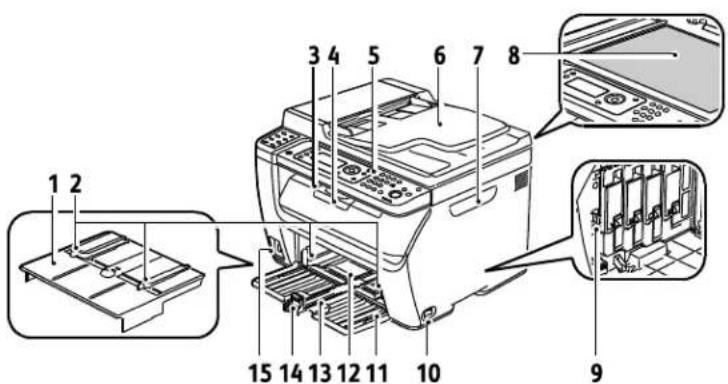
text_image
Technical diagram of a printer with numbered parts, showing internal structure and exploded view- Bypass Tray
- Width Guides
- Output Tray
- Output Tray Extension
- Control Panel
- Automatic Document Feeder Available on WorkCentre 6015N/NI Color Multifunction Printer only.
-
Side Door
-
Document Glass
- Cleaning Rod
- Power Switch
- Front Cover
- Bypass Tray
- Main Tray
- Slide Bar/Length Guide
- USB Memory Port
Rear View
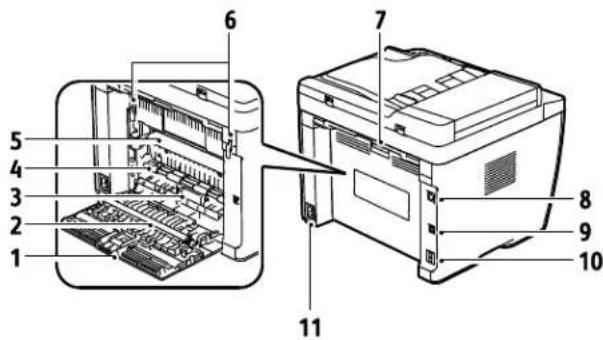
text_image
Technical diagram of a printer internal structure with numbered parts labeled 1 to 11-
Rear Cover
-
Transfer Roller
-
Paper Chute
-
Registration Roller
-
Transfer Belt
-
Fuser Roller Release Levers
-
Rear Cover Release Lever
Control Panel
- Ethernet Connection
Available on WorkCentre 6015N/NI Color Multifunction Printer only.
-
USB Port
-
Line In/Out (fax/telephone)
Available on WorkCentre 6015N/NI Color Multifunction Printer only.
- Power Connector
The control panel consists of a display, a keypad, and buttons you press to control the functions available on the printer. The control panel:
- Displays the current operating status of the printer.
- Provides access to copy, print, scan, and fax features.
- Provides access to information pages.
- Prompts you to load paper, replace supplies, and clear jams.
- Displays errors and warnings.
For details, see Control Buttons and Indicators on page 21.
Control Panel Buttons and Indicators

text_image
1 2 3 4 5 6 7 8 WorkCentre 6015 20 19 18 17 16 15 14 13 9 10 11 12- One Touch keypad: Use to speed dial a phone number. Available on WorkCentre 6015N/NI Color Multifunction Printer only.
- Copy, Scan, Print, and Fax buttons: Press to use the Copy, Scan, Print, and Fax menus on the display screen. Fax button available on WorkCentre 6015N/NI Color Multifunction Printer only.
- Arrow Buttons: Press to move up, down, forward, and back through the menus.
- Job Status button: Displays lists of the active or completed jobs on the touch screen.
- System button: Switches the display to the System menus.
- Alphanumeric keypad: Use to enter letters and numbers for names and phone numbers.
- Redial/Pause button: Press to recall the last fax number used or to insert pauses in fax numbers. Available on WorkCentre 6015N/NI Color Multifunction Printer only.
- Speed Dial button: Press to access directories of group or individual fax telephone numbers. Available on WorkCentre 6015N/NI Color Multifunction Printer only.
- Wake Up/Power Saver button: This button is illuminated in Energy Saver mode. Push the button to exit Energy Saver mode.
- Clear All button: Clears all current settings for print, copy, scan, or fax back to default settings.
-
Stop button: Cancels the current job.
-
Start button: Press to start a copy, scan, or fax job.
- Status indicator: The green or red light indicates printer status:
Lights green when the printer is ready to receive data.
Blinks green when the printer is busy receiving data.
Lights red to indicate an error condition or warning that requires your attention.
Blinks red when an error occurs that requires technical support.
Off when the printer is in Energy Saver mode.
- Cancel/Clear button: In menus, deletes a single character each time the button is pressed.
- Address Book button: Press to access the fax and email address books. Available on WorkCentre 6015N/NI Color Multifunction Printer only.
- OK button: Press to accept the selected setting.
- Back/Return button: Press to navigate up one level in the menu.
- Display Screen: Shows status messages, menus, and toner levels.
- Color Mode button: Press to switch between Color and Black and White modes for your copy, fax, and scan jobs.
- Black and White/Color indicators: The upper light indicates Black and White mode. The lower light indicates Color mode.
Control Panel Symbols
| Symbol | Name | Description |
 | Copy | Allows you to change job settings for copy jobs. |
 | Scan | Allows you to change job settings for scan jobs. |
 | Prints from USB memory. | |
 | Fax Available on WorkCentre 6015N/NI Color Multifunction Printer only. | Allows you to change job settings for fax jobs. |
 | Job Status | Displays active jobs. |
 | System | Displays or closes the System Menu screen. |
 | Address Book Available on WorkCentre 6015N/NI Color Multifunction Printer only. | Allows you to access the printer address book. |
 | Forward Arrow | Moves one level down in menu selections or moves the cursor to the right when setting a value. |
 | Back Arrow | Moves one level up in menu selections or moves the cursor to the left when setting a value. |
 | Up Arrow | Displays the previous menu or item. |
 | Down Arrow | Displays the next menu or item. |
 | OK | Selects or executes the option or function displayed on the screen. |
 | Return | Navigates up one menu level. |
 | Power Saver | Indicates the Energy Saver status. Controls exit from Energy Saver Mode. |
 | Stop | Stops the current operation. |
 | Clear All | Clears the current settings for print, copy, scan, or fax job to the default settings. |
 | Redial/Pause Available on WorkCentre 6015N/NI Color Multifunction Printer only. | Recalls the last fax number used or inserts pauses in fax numbers. |
 | Speed Dial Available on WorkCentre 6015N/NI Color Multifunction Printer only. | Allows you to access directories of group or individual fax telephone numbers. |
System Menus
This section includes:
• Information Pages......26
- Billing Meters....26
- Admin Menu 28
- Default Settings Menu 35
- Tray Settings....37
Panel Language 37
To access the control panel system menus, press the System button.
| Menu | Functions |
| Information Pages | Allows you to print various reports and lists. For details, see Information Pages on page 26. |
| Billing Meters | Displays the printed paper counts on the control panel. For details, see Billing Meters on page 26. |
| Admin Menu | Set up administrative options:Fax Book: Create or delete address book entries.Network: Configure the network settings for the printer.Available on WorkCentre 6015N/NI Color Multifunction Printer only.Fax Settings: Configure default fax settings.Available on WorkCentre 6015N/NI Color Multifunction Printer only.System Setup: Configure system settings, such as the Alarm and Power Saver Timer.Maintenance: Reset default settings or adjust color registration, bias transfer roller, and fuser temperature.Secure Settings: Set printer security settings.Scan to Email: Enables and disables the ability to edit the From field.USB Setup: Enable or disable the USB port.Note: For details, see Admin Menu on page 28. |
| Defaults Settings | Allows you to define default settings. For details, see:Copy Defaults on page 35Scan Defaults on page 36Fax Defaults on page 36Print from USB Defaults on page 37 |
| Tray Settings | Allows you to define the size and type of paper loaded in each tray. |
| Panel Language | Allows you to select the language that appears on the control panel. |
Information Pages
Use the Information Pages to print various reports and lists.
| Report or List | Contents |
| System Settings | Printer status, including hardware configuration and network information. Print this report to verify network information and to check page count. |
| Panel Settings | Prints settings results for the printer, including default settings, tray settings, network setup, fax settings, and system settings. |
| Job History | Information on previous printing jobs, including the date, time, job type, input port, document name, output color, paper size, number of pages, number of sheets, and results. The status of a maximum of 20 jobs can be printed on the Job History Report. |
| Error History | Information about System Fail and Paper Jam errors. |
| Demo Page | A sample document for checking the printer performance. |
| Protocol Monitor Available on WorkCentre 6015N/NI Color Multifunction Printer only. | Information about the previous fax job to help you determine fax protocol problems. |
| Address Book Available on WorkCentre 6015N/NI Color Multifunction Printer only. | A list of individual and group email entries. |
| Fax Activity Available on WorkCentre 6015N/NI Color Multifunction Printer only. | A list of faxes sent and received by job number, remote station, start time, duration, pages, mode, contents, and results. |
Billing Meters
The Meter Readings menu shows the number of processed print jobs. The meter is divided according to the color mode. You cannot reset the meter readings; they track the total number of pages printed for the life of the printer.
| Item | Description |
| Total Impressions | The total number of pages printed. |
| Color Impressions | The total number of pages printed in color. |
| Black Impressions | The total number of pages printed in black and white. |
See also:
Checking Page Counts on page 163
Admin Menu
This section includes:
- Fax Book....28
• Network 28 - Fax Settings....30
- System Setup.... 31
- Maintenance....32
- Secure Settings 33
- Scan to Email....34
USB Setup 34
Use the Admin Menu to access the configuration settings of the printer.
Fax Book
Use this menu to create, edit, and delete speed dial and group dial numbers.
Note: Available on WorkCentre 6015N/NI Color Multifunction Printer only.
| Item | Description |
| Speed Dial | Create, edit, and delete speed dial address book entries. |
| Group Dial | Create, edit, and delete speed dial group entries. |
Network
Use this menu to configure printer settings for jobs sent to the printer through a network port.
Notes:
• Available on WorkCentre 6015N/NI Color Multifunction Printer only.
- You cannot select this setting during printing.
- To activate menu setting changes, restart the printer. After changing settings, turn Off the printer, then turn it On again.
Wired Network Setup
This menu provides the selections for setting up the printer for wired Ethernet network connections.
Notes:
This menu is the default network menu for the WorkCentre 6015N Color Multifunction Printer.
- This menu appears on the WorkCentre 6015NI Color Multifunction Printer only when the printer is connected to a wired network connection.
| Item | Description |
| Ethernet | Specifies the Ethernet communication speed and the modes. |
| TCP/IP | Specifies the TCP/IP settings for the network.IP Mode: Dual Stack or IPv4 Mode.IPv4: Get IP Address, IP Address, Subnet Mask, or Gateway Address |
| Protocol | Select Enable when using the protocol. Select Disable to make the protocol unavailable.LPR: The default setting is Enable.Port9100: The default setting is Enable.WSD: The default setting is Enable.SNMP: The default setting is Enable.Email Alerts: The default setting is Enable.CentreWare Internet Services: The default setting is Enable.LLTD: The default setting is Enable.Bonjour (mDNS): The default setting is Enable. |
| Initialize NVM | Initializes network data stored in non-volatile memory. After executing this function and restarting the printer, all network settings are reset to their default values. |
Wireless Network Setup
This menu provides the selections for setting up the printer for wireless network connections.
Note: This menu appears on the WorkCentre 6015NI Color Multifunction Printer when the printer is not connected to a wired network connection.
| Item | Description |
| Status | Displays the status of the wireless network connection. |
| Wireless Setup | Specifies the method used for setting up the wireless connection:• Manual Setup• WPS |
| Reset Wireless | Resets the wireless network settings to the default settings. |
| TCP/IP | Specifies the TCP/IP settings for the network.• IP Mode: Dual Stack or IPv4 Mode.• IPv4: Get IP Address, IP Address, Subnet Mask, or Gateway Address |
| Protocol | Select Enable when using the protocol. Select Disable to make the protocol unavailable.LPR: The default setting is Enable.Port9100: The default setting is Enable.WSD: The default setting is Enable.SNMP: The default setting is Enable.Email Alerts: The default setting is Enable.CentreWare Internet Services: The default setting is Enable.LLTD: The default setting is Enable.Bonjour (mDNS): The default setting is Enable. |
| Initialize NVM | Initializes network data stored in non-volatile memory. After executing this function and restarting the printer, all network settings are reset to their default values. |
Fax Settings
Use this menu to specify fax settings.
Note: Available on WorkCentre 6015N/NI Color Multifunction Printer only.
| Item | Description |
| Ans Select | Specifies the receiving mode:TEL Mode: Automatic fax reception is turned Off. You can receive a fax by picking up the handset of the external phone, then pressing the remote receive code. You can also set OnHook to On to start the Fax after you hear fax tones from the remote device.FAX Mode: Automatically receives faxes.TEL/FAX Mode: When the printer receives an incoming fax, the external telephone rings for the time specified by Auto Ans, then the printer automatically receives the fax. If the incoming data is not a fax, the printer beeps.Ans/FAX Mode: The printer can share one telephone line with an answering machine. In this mode, the printer monitors the fax signal and picks up the line if there are fax tones. If the phone communication in your country is serial, this mode is not available.DRPD Mode: Before using the Distinctive Ring Pattern Detection (DRPD) option, distinctive ring service must be installed on your telephone line by the telephone company. After the telephone company provides a separate number with a distinctive ring pattern, configure the fax setup to monitor for that specific ring pattern. |
| Auto Answer Fax | When FAX Mode is enabled, specifies how long the printer waits before answering an incoming call. Specify values from 0–255 seconds. |
| Auto Ans. TEL/FAX | When TEL/FAX Mode is enabled, specifies how long the printer waits before answering an incoming call. Specify values from 0–255 seconds. |
| Auto Ans. Ans/FAX | When Ans/FAX Mode is enabled, specifies how long the printer waits before answering an incoming call. Specify values from 0–255 seconds. |
| Line Monitor | Specifies the volume of the external phone. |
| Ring Tone Volume | Specifies the ring volume for incoming faxes. |
| Line Type | Specifies the default line type: PSTN or PBX. |
| Dialing Type | Specifies the dialing type. |
| Interval Timer | Specifies the interval timer from 3–255 seconds. |
| Number of Redial | Specifies the number of attempts made to redial a fax number from 0–9. |
| Redial Delay | Specifies the interval between redial attempts from 1–15 minutes. |
| Junk Fax Filter | When set to On, accepts incoming faxes only from numbers registered in the Address Book. |
| Remote Receive | When set to On, you can elect to receive a fax by pressing the remote receive code on the external telephone. Press the remote receive code after you pick up the telephone handset. |
| Remote Rcv Tone | Specifies the tone in two digits from 00–99, when Remote Receive is set to On. |
| Send Header | When set to On, each outgoing fax includes a header, including the company name, fax number, and the date and time the fax was sent. When set to Off, no header information is included in the outgoing faxes.Note: Many countries have fax regulations that require Send Headers in each outgoing fax. The regulations specify the information that must be included in the header. |
| Company Name | Specifies the sender name that is recorded in the sender report. |
| Your Fax Number | Specifies your telephone number, which is printed at the top of each page sent from your printer. |
| Fax Cover Page | When set to On, automatically prints a fax cover page. When set to Off, does not print a fax cover page. |
| DRPD Pattern | Specifies a distinctive ring pattern for use with DRPD service. Your telephone company specifies the DRPD Patterns. |
| Prefix Dial | Specifies if you want to add the prefix number when you send a fax. |
| Prefix Dial Num | Specifies the prefix dial number, up to five digits. This number dials before any auto dial number is started. |
| Discard Size | Specifies if the printer discards any excess data at the bottom of the page. |
| ECM | If Error Correction Mode (ECM) is set to On, it attempts to correct errors in the fax transmission from problems, such as a noisy telephone line. The default setting is On. |
| Extel Hook Threshold | Specifies the threshold value for the external telephone. |
| Modem Speed | Specifies the fax modem speed. |
| Fax Activity | Turns Auto Print On or Off. |
| Fax Transmit | Specifies the fax transmit mode. |
| Fax Broadcast | Specifies the fax broadcast mode. |
| Country | Specifies the country in which the fax is installed. |
System Setup
Use this menu to configure general settings of the printer. For example, time to Energy Saver mode, alarm settings, and so on.
| Item | Description |
| Power Saver Timer | Specifies the transitional time for Energy Saver Modes 1 and 2.• Energy Saver Mode 1 (Low Power): 5–60 min. The default setting is 60 minutes.• Energy Saver Mode 2 (Sleep): 1–60 min. The default setting is 1 minute.For details, seeEnergy Saver Modeon page 38. |
| Auto Reset | Specifies the time the printer waits for further control panel input before resetting the Copy, Scan, or Fax settings and returning to standby mode. |
| Fault Timeout | You can cancel a printing process when a fault occurs while printing. Set the time until the print job is canceled:• On: Specifies the amount of time that the printer waits for additional data before it cancels the job. The default setting is 60 seconds.• Off: Cannot cancel. |
| Job Timeout | You can cancel a printing process when it fails to print after a specified amount of time. Set the time until the print job is canceled:• On: Specifies the amount of time that the printer waits before it cancels the job. The default setting is 30 seconds.• Off: Cannot cancel. |
| Clock Settings | Specifies the date and time, and the format of the settings:• Set Date and Time.• Date Format: Select yy/mm/dd, mm/dd/yy, or dd/mm/yy.• Time Format: Select 12H or 24H format.• Time Zone: Allows you to set your time zone by geographic region. |
| Alert Tone | Specifies what prompts an alarm when an error occurs in the printer, and sets the sound volume to Off, Min, Middle, or Max:• Panel Select Tone: The default setting is Off.• Panel Alert Tone: The default setting is Off.• Auto Clear Alert: The default setting is Off.• Job Tone: The default setting is Middle.• Alert Tone: The default setting is Middle.• Out of Paper: The default setting is Middle.• All Tones: The default setting is Off. |
| mm/inch | Set the units for the custom paper size to millimeters or inches.• Millimeter (mm): The paper size is displayed in millimeters. The default setting is mm.• Inch ("): The paper size is displayed in inches. |
| Low Toner Alert Msg | Turns the Low Toner alert message On or Off. |
| Power On Wizard | Turns the Power On Wizard On or Off. |
Maintenance
Use this menu to find firmware information, make adjustments, and reset defaults.
| Item | Description |
| F/W Version | Displays the latest firmware version. |
| Adjust Paper Type | Adjusts the paper type settings to match the paper loaded in the paper tray. |
| Adjust BTR | Specifies the bias transfer roller (BTR) voltage for printing on the selected paper type. |
| Adjust Fuser | Specifies the optimum Fusing Unit voltage for printing on the selected paper type. |
| Auto Regi Adjust | Adjusts the color registration automatically. The default setting is On. |
| Adjust ColorRegi | Corrects the color registration.For details, seeColor Registrationon page 157. |
| Clean Developer | Rotates the developer motors and stirs the toner cartridges to clear old toner from the developers. |
| Toner Refresh | Rotates the developer and stirs the toner in the selected color developer. |
| BTR Refresh | Specifies when to execute a routine to refresh the BTR to prevent curling and improve paper separation. |
| Initialize NVM | Initializes the settings stored in the non-volatile memory (NVM) except for the network settings. The NVM stores the printer settings even after the power is turned off. After executing this function and restarting the printer, all the menu settings are reset to their default values.Note: You cannot select this setting during printing. |
| Adjust Altitude | Adjusts the altitude of the printer to obtain optimal printing results. |
Secure Settings
Use this menu for controlling access to printer features.
| Item | Description |
| Panel Lock | When enabled, access to the Admin Menu requires a password. For details, see Changing the Panel Lock Password on page 142. |
| Service Lock | Specifies if a function is unlocked and available to everyone, locked from everyone, or password locked, requiring a password for access:CopyFaxAvailable on WorkCentre 6015N/NI Color Multifunction Printer only.ScanPrint from USBNote:Panel Lock must be enabled before setting the service locks. |
| Secure Receive | Turns Secure Receive Set On or Off. |
Features
Scan to Email
Use this menu to enable and disable the ability to edit the From field when an image is scanned to an email address.
| Item | Description |
| Edit From Field | Enables or disables the edit From field function. |
USB Setup
Use this menu to configure the USB port.
| Item | Description |
| Port Status | Enables or disables the USB port. |
Default Settings Menu
This section includes:
• Copy Defaults....35
- Scan Defaults .... 36
- Fax Defaults.... 36
• Print from USB Defaults 37
Use the Default Settings menu to set default behaviors for Copy, Scan, Fax, and Print from USB functions.
Copy Defaults
Use this menu to set default copying behaviors. For details, see Selecting the Default Copy Settings on page 101.
| Item | Description |
| Color | Specifies Black and White or Color output. |
| Collated | Turns collation On or Off. |
| Reduce/Enlarge | Reduces or enlarges the copies. |
| Document Size | Specifies the size of the original. |
| Document Type | Specifies the type of the original. |
| Lighten/Darken | Lightens or darkens the output. |
| Sharpness | Specifies the sharpness of the copies. |
| Auto Exposure | Turns Auto Exposure On or Off when copying. Auto Exposure suppresses the document background of off-white colored paper and show-through when copying 2-sided thin paper. |
| Color Balance Red | Adjusts the red levels of your copies. |
| Color Balance Green | Adjusts the green levels of your copies. |
| Color Balance Blue | Adjusts the blue levels of your copies. |
| Gray Balance | Adjusts the gray balance of the copies to neutral gray. |
| N-up | Use to copy two original page images onto one side of a sheet of paper:OffAuto (Autoscale)ID Card CopyManual (Manual Scale) |
| Margin Top/Bottom | Turns On or Off the copy margins for the top and bottom of the page. |
| Margin Left/Right | Turns On or Off the copy margins for the left and right of the page. |
| Margin Middle | Turns On or Off the copy margins for the middle of the page. Use to create a gutter in the middle of the page when you print using the N-up feature. |
Scan Defaults
Use this menu to set default scanning behaviors. For details, see Adjusting Scanning Settings on page 119.
| Item | Description |
| Scan to Network | Selects the scan destination: Computer (Network) or Server (FTP). |
| File Format | Selects the file type of the scanned image. |
| Color | Specifies Black and White or Color output. |
| Color Button Set | Adjusts the Color Mode settings:• B&W button: Black and White or Grayscale• Color Button: Color or Color (Photo) |
| Resolution | Selects the scan resolution. |
| Document Size | Specifies the size of the original. |
| Lighten/Darken | Lightens or darkens the output. |
| Sharpness | Specifies the sharpness of the scanned images. |
| Auto Exposure | Turns Auto Exposure On or Off when copying. Auto Exposure suppresses the document background of off-white colored paper and show-through when copying 2-sided thin paper. |
| Margin Top/Bottom | Turns On or Off the copy margins for the top and bottom of the page. |
| Margin Left/Right | Turns On or Off the copy margins for the left and right of the page. |
| Margin Middle | Turns On or Off the copy margins for the middle of the page. Use to create a gutter in the middle of the page when you print using the N-up feature. |
| TIFF File Format | Sets the TIFF file format: TIFF V6 or TTN2. |
| Image Compression | Specifies the amount of image compression: Lower, Normal, or Higher. |
| Max Email Size | Sets limits on the size of attachments that can be emailed from 50–16384 KB. |
Fax Defaults
Use this menu to set default faxing behaviors. For details, see Changing the Default Fax Job Settings on page 139.
Note: Available on WorkCentre 6015N/NI Color Multifunction Printer only.
| Item | Description |
| Resolution | Specifies the resolution of the fax. |
| Document Type | Specifies if the document is a text or photo document. |
| Lighten/Darken | Lightens or darkens the output. |
| Delayed Start | Specifies the time delay before sending a fax job, up to 23 hours and 59 minutes. |
Print from USB Defaults
Use this menu to set default behaviors for printing from USB.
| Item | Description |
| Layout | Specifies the layout options. |
Tray Settings
Tray Settings configures the paper size and paper type settings for the main paper tray. If the type of paper that is loaded is different from the setting, print quality can be reduced or paper jams can occur. If the size of the paper that is loaded is different from the tray setting, it can cause a mismatch error.
Specify the correct paper type and size.
| Item | Description |
| Paper Size | Specifies the paper size and orientation for the main tray.For details, see Supported Paper on page 72, and Setting Paper Types and Sizes on page 79. |
| Paper Type | Specifies the type of paper loaded in the main tray.For details, see Supported Paper on page 72, and Setting Paper Types and Sizes on page 79. |
| Display Screen | Turn On to display the message that prompts you to set the paper size and type every time you load paper in the tray. The default setting is Off. |
Panel Language
Panel Language allows you to set the language that appears on the control panel display.
Energy Saver Mode
This section includes:
- Setting the Power Saver Timer....38
- Exiting Energy Saver Mode 38
You can set the time the printer spends idle in ready mode before it automatically transitions to a lower power level. You can also turn off the automatic transition.
Setting the Power Saver Timer
- On the printer control panel, press the System button.
- To select Admin Menu, press the arrow buttons, then press OK.
- To select System Setup, press the arrow buttons, then press OK.
- At Power Saver Timer, press OK.
-
Press the arrow buttons to select one of the following:
-
Power Saver Mode 1: Reduces power consumption to 15 W or less when the printer is left idle. Set the timer from 5–60 minutes. The default setting is 60.
-
Power Saver Mode 2: Disables control panel and all sensors after the printer enters Mode 1. Reduces power consumption to 7 W or less. Set the timer from 1–60 minutes. The default setting is 1.
-
Press OK.
-
To select the desired time, press the arrow buttons, then press OK to save the changes.
- To return to Ready, press the Return button four times.
Exiting Energy Saver Mode
The printer automatically cancels Energy Saver mode when it receives data from a connected computer.
To exit Energy Saver mode manually, press the Power Saver button on the control panel.
Administration Features
This section includes:
• Information Pages....39
• CentreWare Internet Services 39
Information Pages
Your printer has a printable set of information pages. These include configuration and font information, demonstration pages, and more.
System Settings Page
The System Settings page lists printer information such as default settings, installed options, network settings including IP address, and font settings. Use the information on this page to help you configure network settings for your printer, and to view page counts and system settings.
To print the System Settings page:
- On the printer control panel, press the System button.
- At Information Pages, press OK.
- Select System Settings using the arrow buttons.
- Press OK.
CentreWare Internet Services
CentreWare Internet Services is the administration and configuration software installed on the embedded Web server in the printer. It allows you to configure and administer the printer from a Web browser.
Note: Available on WorkCentre 6015N/NI Color Multifunction Printer only.
CentreWare Internet Services requires:
- A TCP/IP connection between the printer and the network in Windows, Macintosh, UNIX, or Linux environments.
- TCP/IP and CentreWare Internet Services enabled on the printer.
• A network-connected computer with a Web browser that supports JavaScript.
Features
Accessing CentreWare Internet Services
At your computer, open a Web browser, type the IP address of the printer in the address field, then press Enter or Return.
If you do not know the IP address of your printer, see Finding the IP Address of Your Printer on page 55.
More Information
You can obtain more information about your printer from these sources:
| Resource | Location |
| Installation Guide | Packaged with the printer. |
| Quick Use Guide | Packaged with the printer. |
| Video Tutorials | www.xerox.com/office/WC6015docs |
| Recommended Media List | United States: www.xerox.com/paperEurope: www.xerox.com/europaper |
| Technical support information for your printer; includes online Technical Support, Online Support Assistant, and driver downloads. | www.xerox.com/office/WC6015support |
| Information Pages | Print from the control panel menu. |
| Order supplies for your printer | www.xerox.com/office/WC6015supplies |
| A resource for tools and information, including interactive tutorials, printing templates, helpful tips, and customized features to meet your individual needs. | www.xerox.com/office/businessresourcecenter |
| Local sales and support center | www.xerox.com/office/worldcontacts |
| Printer Registration | www.xerox.com/office/register |
| Xerox ^® Direct online store | www.direct.xerox.com/ |
Xerox ^® Welcome Center
If you need assistance during or after printer installation, visit the Xerox ^® website for online solutions and support at www.xerox.com/office/worldcontacts.
If you require further assistance, contact the experts at the Xerox® Welcome Center. If a local representative telephone number was provided during printer installation, record the telephone number in the following space.
#
Xerox ^® Canada Welcome Center: 1-800-93-XEROX (1-800-939-3769)
If you need additional help using your printer:
- Refer to this User Guide.
- Contact the Key Operator.
- Visit our customer website at www.xerox.com/office/WC6015support.
Features
The Welcome Center wants to know the following information:
• The nature of the problem.
- The serial number of the printer.
- The fault code.
• The name and location of your company.
Locating the Serial Number
You need the printer serial number to order supplies or to contact Xerox for assistance. The serial number is located on a tag on the rear door of the printer. The serial number also appears in the System Settings Page. To print the System Settings Page:
- On the printer control panel, press the System button.
- At Information Pages, press OK.
- Select System Settings using the arrow buttons.
- Press OK.
Installation and Setup
3
This chapter includes:
• Installation and Setup Overview....44
- Selecting a Location for the Printer....45
- Connecting the Printer 46
- Configuring Network Settings....52
- Setting the Date and Time....58
• Installing the Software 59
- Setting Up Scanning....64
See also:
Installation Guide packaged with your printer.
Online Support Assistant at www.xerox.com/office/WC6015support
Installation and Setup Overview
Before printing, your computer and the printer must be plugged in, turned on, and connected. Configure the initial settings of the printer, then install the driver software and utilities on your computer.
You can connect to your printer directly from your computer using USB, or connect over a network using an Ethernet cable or wireless connection. Hardware and cabling requirements vary for the different connection methods. Routers, network hubs, network switches, modems, Ethernet cables, and USB cables are not included with your printer and must be purchased separately. Xerox recommends an Ethernet connection because it is typically faster than a USB connection, and it provides access to CentreWare Internet Services.
Note: If the Software and Documentation disc is not available, you can download the latest drivers from www.xerox.com/office/WC6015drivers.
See also:
Selecting a Location for the Printer on page 45
Choosing a Connection Method on page 46
Connecting the Printer on page 46
Configuring Network Settings on page 52
Installing the Software on page 59
Selecting a Location for the Printer
- Select a dust-free area with temperatures from 10–32°C (50–90°F), and relative humidity 15–85%.
Note: Sudden temperature fluctuations can affect print quality. Rapid heating of a cold room can cause condensation inside the printer, directly interfering with image transfer.
- Place the printer on a level, solid, non-vibrating surface with adequate strength for the weight of the printer. The printer must be horizontal with all four feet in solid contact with the surface. To find the weight for your printer configuration, see Physical Specifications on page 191.
After positioning the printer, you are ready to connect it to the power source and computer or network.
See also:
Total Space Requirements on page 191
Clearance Requirements on page 191
Connecting the Printer
This section includes:
- Selecting a Connection Method....46
- Connecting to a Wired Network....47
- Connecting to a Wireless Network 47
- Connecting to a Computer Using USB....51
- Connecting to a Telephone Line .... 51
Selecting a Connection Method
The printer can be connected to your computer using a USB cable or an Ethernet cable. The method you select depends on how your computer is connected to the network. A USB connection is a direct connection and is the easiest to set up. An Ethernet connection is used for networking. If you are using a network connection, it is important to understand how your computer is connected to the network. For details, see About TCP/IP and IP Addresses on page 52.
Note: Hardware and cabling requirements vary for the different connection methods. Routers, network hubs, network switches, modems, Ethernet cables, and USB cables are not included with your printer and must be purchased separately.
- Network: If your computer is connected to an office network or home network, use an Ethernet cable to connect the printer to the network. You cannot connect the printer directly to the computer. It must be connected through a router or hub. An Ethernet network can be used for one or more computers and supports many printers and systems simultaneously. Ethernet connection is typically faster than USB and allows you direct access to the settings of the printer using CentreWare Internet Services.
- Wireless Network: If your computer includes a wireless router or wireless access point, you can connect the printer to the network with a wireless connection. A wireless network connection provides the same access and services as a wired connection provides. A wireless network connection is typically faster than USB and allows direct access to the setting of the printer using CentreWare Internet Services.
- USB: If you connect the printer to one computer and do not have a network, use a USB connection. A USB connection offers fast data speeds, but typically not as fast as an Ethernet connection. In addition, a USB connection does not provide access to CentreWare Internet Services.
- Telephone: To send and receive faxes, the multifunction printer must be connected to a dedicated telephone line.
Connecting to a Wired Network
Note: Available on WorkCentre 6015N/NI Color Multifunction Printer only.
To connect the printer to a wired network:
- Ensure that the printer is turned off.
- Attach a Category 5 or better Ethernet cable from the printer to the network or router socket. Use an Ethernet hub or router, and two or more Ethernet cables. Connect the computer to the hub or router with one cable, then connect the printer to the hub or router with the second cable. Connect to any port on the hub or router except the uplink port.
- Attach the power cord, then plug in the printer and turn it on.
- Set or automatically discover the network IP address of the printer. For details, see Assigning the IP Address of the Printer on page 53.
Connecting to a Wireless Network
Note: Available on WorkCentre 6015NI Color Multifunction Printer only.
A wireless local area network (LAN) provides the means to connect two or more devices in a LAN without a physical connection. The printer can connect to a wireless LAN that includes a wireless router or wireless access point. Before connecting the printer to a wireless network, the wireless router must be configured with a service set identifier (SSID), a passphrase, and security protocols.
Resetting Wireless Settings
If the printer was previously installed in a wireless network environment, it could retain setup and configuration information.
To prevent the printer from trying to connect to the previous network, perform the following steps:
- On the printer control panel, press the System button.
- To select Admin Menu, press the arrow buttons, then press OK.
- To select Wireless, press the arrow buttons, then press OK.
- To select Reset Wireless, press the arrow buttons, then press OK.
- To select Yes, press the arrow buttons, then press OK.
Connecting to a Network With a Wi-Fi Protected Setup-Compliant Router
Wi-Fi Protected Setup (WPS) is a network standard for setting up a wireless network. The WPS protocols allow you with no wireless network experience to set up devices in a secure wireless network. With a WPS-certified router, you can use tools in the router and the printer to connect the printer to the network. In order to use the tools, the wireless router must be configured properly and must be compliant with the WPS.
- Push Button Connection (PBC) is the easiest way to connect the printer to a wireless network. It automatically connects when you push a button on the router and on the printer. After the router and printer exchange information, the printer accepts the security and configuration information from the router and connects to the network. The PBC is a moderately secure way to connect the printer to the network. You do not need to enter any information to make the network connection.
- PIN (Personal Identification Number) automatically connects the printer to wireless router by using a common PIN. The printer generates and prints a PIN for use in the setup process. When you enter the PIN into the router, the router broadcasts network information using the PIN. When both devices recognize the PIN, the router provides the security and configuration information to the printer, which uses it to connect to the network.
To connect to a WPS wireless network using the PBC method:
Note: The wireless router must be connected and properly configured for the network before you install the printer.
- Push the PBC button on the wireless router.
The router begins broadcasting setup information for 120 seconds.
Note: If the wireless router does not have a physical PBC button, use your computer to push the virtual button in the router control panel. For details, see your router documentation.
- On the printer control panel, press the System button.
- To select Network, press the arrow buttons, then press OK.
- To select Wireless Setup, press the arrow buttons, then press OK.
- To select WPS, press the arrow buttons, then press OK.
- To select Push Button Control, press the arrow buttons, then press OK.
- To select Yes, press the arrow buttons, then press OK.
The printer communicates with the router to resolve setup and configuration information. The counter starts counting down from 100. When the printer has the correct information, it connects to the router and restarts with the proper setup and configuration information.
To connect to a WPS wireless network using the PIN method:
Note: The wireless router must be connected and properly configured for the network before you install the printer.
- On the printer control panel, press the System button.
- To select Admin Menu, press the arrow buttons, then press OK.
-
To select Network, press the arrow buttons, then press OK.
-
To select Wireless Setup, press the arrow buttons, then press OK.
- To select WPS, press the arrow buttons, then press OK.
- To select PIN Code, press the arrow buttons, then press OK.
- To select Print PIN, press the arrow buttons, then Press OK.
The PIN is printed at the top of the PIN Code Print.
- At your computer, open the router control panel and select Add WPS Client.
Note: For details, see your router documentation.
- Select PIN Method.
Note: The following steps can vary with different router manufacturers.
- Enter the PIN from the PIN Code Print into the Client PIN field, then click Next.
- On the printer control panel, press the System button.
- To select Admin Menu, press the arrow buttons, then press OK.
- To select Network, press the arrow buttons, then press OK.
- To select Wireless Setup, press the arrow buttons, then press OK.
- To select WPS, press the arrow buttons, then press OK.
- To select PIN Code, press the arrow buttons, then press OK.
- To select Start Configuration, press the arrow buttons, then press OK.
The printer communicates with the router to resolve setup and configuration information. The counter starts counting down from 100. When the printer has the correct information, it connects to the router and restarts with the proper setup and configuration information.
Connecting to a Wireless Network Manually
When connecting to a wireless network that does not include a WPS-compliant router, you must set up and configure the printer manually. Before starting, you must get the setup and configuration information, such as name and passphrase, from the router. After you collect the network information, you can set up the printer from the control panel or from CentreWare Internet Services. The easiest manual connection is by using CentreWare Internet Services.
To record the network information from the wireless router:
- On your computer, use your Web browser to open the control panel for the wireless router.
- Click Wireless Settings.
-
Record the following information. The network name and passphrase are case sensitive. Ensure that you record them exactly as they appear in the wireless router control panel.
-
Name (SSID)
• Security Options (Encryption Type) - Passphrase
Note: The wireless router must be connected and properly configured for the network before you install the printer. For details, see your router documentation.
To connect to a wireless network manually from the printer control panel:
- On the printer control panel, press the System button.
- To select Admin Menu, press the arrow buttons, then press OK.
- To select Network, press the arrow buttons, then press OK.
- To select Wireless Setup, press the arrow buttons, then press OK.
- To select Manual Setup, press the arrow buttons, then press OK.
- At Enter Network (SSID), enter the name (SSID) of the network, then press OK.
- To select Infrastructure or AdHoc, press the arrow buttons, then press OK.
Note: Infrastructure provides the greatest selection of security options. AdHoc provides only WEP encryption in most networks.
- To select the Encryption Type, use the arrow buttons, then press OK.
- Enter the passphrase using the keypad.
Use multiple keystrokes to select each character and character case or number. To erase a character, press the Clear button for each character starting from the right.
- Press OK.
If the printer does not connect to the network within 90 seconds, check the network information and try again.
To connect to a wireless network manually using CentreWare Internet Services:
-
At your computer, open a Web browser, type the IP address of the printer in the address field, then press Enter or Return.
Note: If you do not know the IP address of your printer, see Finding the IP Address of Your Printer on page 55. -
Click the Properties button.
- In the Properties pane at the left of the window, click Wireless Lan.
- In the SSID field, enter the network name (SSID).
- To select the Network Type, use the drop-down menu to select Infrastructure or AdHoc.
Note: Infrastructure provides the greatest selection of security options. AdHoc provides only WEP encryption in most networks.
- To select Encryption, use the drop-down list to select the match the security option of the router.
- To remove the five dots in the Passphrase field, select them, then press Backspace.
- Enter the network passphrase in the Passphrase field.
- To remove the five dots in the Re-enter Passphrase field, select them, then press Backspace.
- Enter the network passphrase in the Re-enter Passphrase field.
-
Click Save Changes.
-
Disconnect the Ethernet cable from the printer.
- Turn off the printer, then turn it on again.
When the printer restarts, it uses the information from CentreWare Internet Services to connect with the wireless router. Print a System Settings Page to check the connection information. If the printer does not successfully connect with the wireless network, check your network information and try again.
Connecting to a Computer Using USB
To use USB, you must have Windows XP SP1 and later, Windows Server 2003 and later, or Macintosh OS X version 10.5 and later.
To connect the printer to the computer using a USB cable:
- Ensure that the printer is turned off.
- Connect the B end of a standard A/B USB 2.0 cable to the USB Port on the back of the printer.
- Attach the power cord and then plug in the printer and turn it on.
- Connect the A end of the USB cable to the USB Port on the computer.
- When the Windows Found New Hardware Wizard appears, cancel it.
- You are ready to install the print drivers. For details, see Installing the Software on page 59.
Connecting to a Telephone Line
- Ensure that the printer is turned off.
- Connect a standard RJ11 cable, No. 26 American Wire Gauge (AWG) or larger, to the Line port on the back of the printer.
- Connect the other end of the RJ11 cable to an operating telephone line.
- Enable and configure the Fax functions.
For details, see Changing the Default Fax Job Settings on page 139.
Configuring Network Settings
This section includes:
- About TCP/IP and IP Addresses .... 52
- Assigning the IP Address of the Printer 53
- Setting Up the Fax Header....56
- Enabling the Printer for Scanning....57
Note: Available on WorkCentre 6015N/NI Color Multifunction Printer only.
About TCP/IP and IP Addresses
Computers and printers primarily use TCP/IP protocols to communicate over an Ethernet network. Generally, Macintosh computers use either TCP/IP or the Bonjour protocol to communicate with a network printer. For Macintosh OS X systems, TCP/IP is preferred. Unlike TCP/IP, however, Bonjour does not require printers or computers to have IP addresses.
With TCP/IP protocols, each printer and computer must have a unique IP address. Many networks and cable and DSL routers have a Dynamic Host Configuration Protocol (DHCP) server. A DHCP server automatically assigns an IP address to every computer and printer on the network that is configured to use DHCP.
If you use a Cable or DSL router, see the documentation for your router for information on IP addressing.
Assigning the IP Address of the Printer
This section includes:
- Assigning the IP Address Automatically .... 53
- Assigning the IP Address Manually....53
• Finding the IP Address of the Printer 55 - Changing the IP Address Using CentreWare Internet Services.... 56
By default, the printer is set to acquire an IP address from the network server using DHCP. Network addresses assigned by DHCP are temporary, however. After a specified time, the network could assign a new IP address to the printer. If the print driver is set to an IP address that changes periodically, you can experience connectivity issues. To avoid problems, or if your network administrator requires a static IP address for the printer, you can assign the IP address to the printer.
Note: You can view the IP address of your printer from the System Settings Page, the printer control panel, or CentreWare Internet Services.
See also:
Assigning the IP Address Manually on page 53
Finding the IP Address of Your Printer on page 55
Assigning the IP Address Automatically
- On the printer control panel, press the System button.
- To select Admin Menu, press the arrow buttons, then press OK.
- At Network, press OK.
- To select TCP/IP, press the Down Arrow button, then press OK.
- To select IPv4, press the arrow buttons, then press OK.
- At Get IP Address, press OK.
- To select DHCP/AutoIP, press the arrow buttons, then press OK.
- To return to the Ready screen, press Return.
Assigning the IP Address Manually
You can assign a static IP address to your printer from the printer control panel. Once an IP address is assigned, you can change it using CentreWare Internet Services.
To assign a static IP address to the printer, you need the following information:
- An IP address properly configured for your network
• The Network Mask address
- The default Router/Gateway address
If you are on a network managed by a network administrator, contact your network administrator to obtain the network information.
For a home network using routers or other devices to connect the printer to the network, refer to the device instructions on assigning network addresses. The router or device documentation can give you a range of acceptable address numbers you can use. It is important that the addresses be similar to the IP addresses used by other printers and computers on the network, but not the same. Only the last digit must be different. For example, your printer can have the IPv4 address 192.168.1.2 while your computer has the IP address 192.168.1.3. Another device can have the IP address 192.168.1.4.
The router could assign the static IP address of the printer to another computer that obtains its IP address dynamically. To avoid having the IP address reassigned, give the printer an address at the higher end of the range allowed by the router or device. For example, if your computer has IP address 192.168.1.2, and your device allows IP addresses to 192.168.1.25, select an address between 192.168.1.20 and 192.168.1.25.
In IPv6 network configurations, the IPv6 address is assigned automatically.
To assign a static IP address to the printer:
- On the printer control panel, press the System button.
- To select Admin Menu, press the arrow buttons, then press OK.
- To select Network, press the arrow buttons, then press OK.
- To select TCP/IP, press the Down Arrow button, then press OK.
- To select IPv4, press the arrow buttons, then press OK.
- At Get IP Address, press OK.
- To select Panel, press the arrow buttons, then press OK to enable this option.
- To return to the IPv4 menu, press Return once.
-
To select IP Address, press the arrow buttons, then press OK.
When undefined, the address is 000.000.000.000. -
Set the IP address:
a. In the first field, press the arrow buttons, or use the alphanumeric keypad, to enter the desired number.
b. To move to the next field, press the Forward Arrow, then enter the desired number.
c. Move to the next two fields and enter the desired numbers.
Note: To scroll quickly to a number, press the Up or Down Arrow. To return to a field, press the Back Arrow.
d. When finished, press OK to confirm the address.
- To return to IP Address, press the Back Arrow once.
- To select Network Mask, press the Down Arrow, then press OK. Repeat step 10 to set the Network Mask address.
- To return to Network Mask, press the Back Arrow once.
- To select Gateway Address, press the Down Arrow, then press OK. Repeat step 10 to set the Gateway Address.
- To return to the Ready screen, press Return.
- Print the System Settings Page to verify the new settings.
You are ready to install software.
See also:
Online Support Assistant at: www.xerox.com/office/WC6015support
Finding the IP Address of the Printer
To install the print drivers for a network-connected printer, you need the IP address of your printer. You also need the IP address to access the settings of your printer through CentreWare Internet Services. You can view the IP address of your printer from the System Settings Page or on the printer control panel.
To print the System Settings Page:
- On the printer control panel, press the System button.
- At Information Pages, press the OK button.
- To select System Settings, press the arrow buttons, then press OK to print the page.
The IP address of the printer is listed in the Wired Network section of the page.
Note: After the printer has been on for two minutes, print the System Settings Page. The TCP/IP address appears in the Network section of the page. If the IP address listed on the page is 0.0.0.0, the printer needs more time to acquire an IP address from the DHCP server. Wait two minutes, then print the System Settings Page again.
To view the IP address of the printer on the control panel:
- On the printer control panel, press the System button.
- To select Admin Menu, press the arrow buttons, then press OK.
- To select Network, press the arrow buttons, then press OK.
- To select TCP/IP, press the arrow buttons, then press OK.
- To select IPv4, press the arrow buttons, then press OK.
- To select IP Address, press the arrow buttons, then press OK. The IP address of the printer appears on the IP Address screen.
WorkCentre 6015 Color Multifunction Printer 55
User Guide
Changing the IP Address Using CentreWare Internet Services
To change the IP address of the printer using CentreWare Internet Services:
- At your computer, open a Web browser, type the IP address of the printer in the address field, then press Enter or Return.
Note: If you do not know the IP address of your printer, see Finding the IP Address of Your Printer on page 55.
- Click the Properties link.
If the Protocols link is not expanded under Properties, scroll to the Protocols link and expand it.
-
Click TCP/IP.
-
In the IPv4 section of the page, make the desired changes. For example, to change the way the printer acquires the IP address, in the Get IP Address field, select a method from the drop-down list.
-
After changing the address information, scroll to the bottom of the page and click Save Changes.
Setting Up the Fax Header
It is unlawful to send a message from a fax machine without the proper Fax Send Header information. The following information must appear on the first transmitted page, or in the top or bottom margin of each transmitted page:
- Identity of the business or individual sending the fax
- Telephone number of the sending machine
- Date and time of the transmission
To set the required Fax Send Header information at the control panel:
- On the printer control panel, press the System button.
- To select Admin Menu, press the arrow buttons, then press OK.
- To select Fax Setting, press the arrow buttons, then press OK.
-
Identify the business or individual sending the fax:
a. To select Company Name, press the arrow button, then press OK.
b. Use the alphanumeric keypad to enter the name of your company, then press OK. -
Identify the telephone number of the sending fax machine:
a. To select Your Fax Number, press the arrow button, then press OK.
b. Use the alphanumeric keypad to enter the telephone number of the printer, then press OK.
6. Identify the country:
a. To select Country, press the arrow button, then press OK.
b. To select your country name, press the arrow button, then press OK.
c. At the Restart System (Are You Sure?) prompt, press the Down Arrow to select Yes, then press OK.
7. To return to the Ready screen, press Return.
See also:
Setting the Date and Time on page 58
CentreWare Internet Services on page 39
Faxing on page 127
Adding Fax Numbers and Email Addresses to the Address Book
If the printer is connected to a network, you can add fax numbers and email addresses to the printer address book using CentreWare Internet Services.
If the printer is connected with a USB cable, you can add fax numbers and email addresses to the printer address book using the Address Book Editor.
For details, see Adding an Individual Fax Address Book Entry on page 132, Creating a Fax Group on page 134, and Editing Address Book Fax Groups on page 135.
For more information, see Faxing on page 127.
Enabling the Printer for Scanning
If the printer is connected to a network, you can scan to an FTP address, an email address, or a shared folder on your computer. First you must set up scanning in CentreWare Internet Services. For details, see CentreWare Internet Services on page 39.
If the printer is connected with a USB cable, you can scan to a folder on your computer, or scan into an application. First you must install the scan drivers and the Express Scan Manager utility.
Note: If your printer is connected using the USB cable, you cannot scan to an email address or a network location, such as a shared folder on your computer.
For details, see Scanning Setup Overview on page 64.
Setting the Date and Time
Set the date and time on the printer before using it to send fax transmissions. It is unlawful to send a fax without the proper Fax Send Header information. For details, see Enabling the Printer for Faxing on page 56.
To set the date and time:
- On the printer control panel, press the System button.
- To select Admin Menu, press the arrow buttons, then press OK.
- To select System Setup, press the arrow buttons, then press OK.
- To select Clock Settings, press the arrow buttons, then press OK.
- To select Set Date, press the arrow buttons, then press OK.
- To set the month, press the arrow buttons, then press the Right Arrow button.
- To set the day, press the arrow buttons, then press the Right Arrow button.
- To set the year, press the arrow buttons, then press OK.
- To select Set Time, press the arrow buttons, then press OK.
- To set the hour, press the arrow buttons, then press the Right Arrow button. If the time format is set to 12H, ensure that you set the hour correctly for AM or PM.
- To set the minutes, press the arrow buttons, then press OK.
- To select Date Format, press the arrow buttons, then press OK.
- To select the date format to use, press the arrow buttons, then press OK.
- To select Time Format, press the arrow buttons, then press OK.
- To select 12H or 24H, press the arrow buttons, then press OK.
- To select Time Zone, press the arrow buttons, then press OK.
- To select the Greenwich Mean Time (GMT) offset for your time zone, press the arrow buttons, then press OK. For example, the GMT offset for Pacific Standard time is -08.00.
- To return to the Ready screen, press Return.
Note: You can also set the date and time using CentreWare Internet Services.
Installing the Software
This section includes:
• Operating System Requirements....59
• Available Print Drivers 59
• Installing the Print Drivers for a Windows Network Printer 59
• Installing the Print Drivers for a Windows USB Printer....61
• Installing the Drivers and Utilities for Macintosh OS X Version 10.5 and Later 62
Before installing driver software, verify that the printer is plugged in, turned on, connected correctly, and has a valid IP address. The IP address usually appears in the upper right corner of the control panel. If you cannot find the IP address, see Finding the IP Address of the Printer on page 55.
If the Software and Documentation disc is not available, download the latest drivers from www.xerox.com/office/WC6015drivers.
Operating System Requirements
- Windows XP SP1 and later, or Windows Server 2003 and later
• Macintosh OS X version 10.4 or later
Available Print Drivers
To access special printing options, use a Xerox ^® print driver. The following print drivers are available for various operating systems. To download the latest drivers, go to www.xerox.com/office/WC6015drivers.
| Print Driver | Source | Description |
| Windows GDI Driver | Software and Documentation disc and Web | The GDI, or raster, driver is recommended to take full advantage of the custom features of your printer. |
| Mac OS X version 10.5 and later Driver | Software and Documentation disc and Web | This GDI driver enables printing from a Macintosh OS X version 10.5 and later operating system. |
Installing the Print Drivers for a Windows Network Printer
- Insert the Software and Documentation disc into the appropriate drive on your computer.
If the installer does not start automatically, navigate to the drive, and double-click the Setup.exe installer file. - Click the Network Installation button.
- At the bottom of the Driver Installation window, click Language.
- Select your language, then click OK.
- Click Next.
- Click I accept the terms to accept the agreement, then click Next.
- In the Discovered Printers list, select your WorkCentre 6015 printer, then click Next.
Note: When installing drivers for a network printer, if you do not see your printer in the list, click the IP Address or DNS Name button. In the IP Address or DNS Name field, type the IP address of your printer, then click Search to locate your printer. If you do not know the IP address of the printer, see Finding the IP Address of Your Printer on page 55.
- Click Next to start the installation.
-
When the installation is complete, at the Enter Printer Settings screen, select the following:
-
Share this printer with other computers on the network (optional)
- Set this printer as default for printing (optional)
- Set this printer as default for scanning ensures that the scanner works properly with your computer.
Note: If Set this printer as default scanning is not selected when the drivers are installed, the scanner will not be available for network scanning.
• FAX Driver ensures that the fax works properly with your computer.
- Click Next.
- In the Software and Documentation window, clear the check box for any of the options you do not want to install.
- Click Install.
- At the InstallShield Wizard, click Yes to restart your computer, then click Finish.
- At the Product Registration screen, select your country from the list, then click Next. Complete the registration form and submit it.
Notes: The following applications are installed on your computer with the print driver:
- PrintingScout
- Launcher
• Express Scan Manager
• Address Book Editor: Available on WorkCentre 6015N/NI Color Multifunction Printer only.
See also:
Online Support Assistant at: www.xerox.com/office/WC6015support
Installing the Print Drivers for a Windows USB Printer
- Insert the Software and Documentation disc into the appropriate drive on your computer.
If the installer does not start automatically, navigate to the drive, and double-click the Setup.exe installer file. - Click the Personal Installation (USB) button.
- At the bottom of the Driver Installation window, click Language.
- Select your language, then click OK.
- Click Next.
- Click I accept the terms to accept the agreement, then click Next.
- At the InstallShield Wizard, click Yes to restart your computer, then click Finish.
- At the Product Registration screen, select your country from the list, then click Next. Complete the registration form and submit it.
Notes: The following applications are installed on your computer with the print driver:
- PrintingScout
- Launcher
• Express Scan Manager - Address Book Editor: Available on WorkCentre 6015N/NI Color Multifunction Printer only.
See also:
Online Support Assistant at: www.xerox.com/office/WC6015support
Installing the Drivers and Utilities for Macintosh OS X Version 10.5 and Later
This section includes:
• Installing the Print Driver 62
- Adding the Printer....62
• Utilities....63
To access all features of the printer, you must:
- Install the print driver.
- Add the printer.
Note: Before installing drivers, verify that the printer is plugged in, turned on, and connected to an active network or by USB. Ensure that the printer is receiving network information by monitoring the LEDs on the back of the printer near the Ethernet cable connection. When the printer is connected to a functioning network and receiving traffic, the link LED is green, and its amber traffic LED flashes rapidly.
Installing the Print Driver
- Insert the Software and Documentation disc into the appropriate drive on your computer.
Note: If the Software and Documentation disc is not available, you can download the latest drivers from www.xerox.com/office/WC6015drivers.
- Double-click WorkCentre 6015 Installer.
- At the Introduction installer window, click Continue.
- Read the warning notice, then click Continue.
- Read the license agreement, click Continue, then click Agree.
- Click Install.
- If prompted, enter your password, then click OK.
- Click Continue Installation.
When the driver is finished installing, click Logout to complete the installation and restart your computer.
Adding the Printer
For networking, set up your printer using Bonjour (Rendezvous), or connect using the IP address of your printer for an LPD/LPR connection. For a non-network printer, create a desktop USB connection.
To add the printer using Bonjour:
- From the computer Applications folder or from the dock, open System Preferences.
- Click Print & Fax.
The list of printers appears on the left of the window.
62 WorkCentre 6015 Color Multifunction Printer
User Guide
- Click the plus button (+) under the list of printers.
- Click the Default icon at the top of the window.
- Select your printer from the list and click Add.
Note: If your printer was not detected, verify that the printer is on and that the Ethernet or USB cable is connected properly.
To add the printer by specifying the IP address:
- From the computer Applications folder or from the dock, open System Preferences.
- Click Print & Fax.
The list of printers appears on the left of the window. - Click the plus button (+) under the list of printers.
- Click IP.
- From the Protocol drop-down menu, select the protocol.
- In the Address field, enter the IP address of the printer.
- In the Name field, enter a name for the printer.
- From the Print Using drop-down list, choose Select a driver to use.
- Select the print driver for your printer model from the list.
- Click Add.
Now you can print and scan. For details, see Printing on page 71 and Scanning on page 105.
See also:
Online Support Assistant at: www.xerox.com/office/WC6015support
Utilities
The Address Book Editor and Express Scan Manager are installed automatically when you install the scan driver. For details, see Installing the Drivers and Utilities for Macintosh OS X Version 10.5 and Later on page 62.
Setting Up Scanning
This section includes:
- Scanning Setup Overview 64
- Setting Up Scanning to a Shared Folder on Your Computer....65
- Setting Up Scanning to an FTP Server 68
- Setting Up Scanning to an Email Address....68
- Setting Up Scanning With USB 69
See also:
Scanning on page 105
Scanning Setup Overview
If the printer is connected to a network, it is enabled for scanning. Before you can scan, you must do the following:
- If you are scanning to a shared folder on your computer, share the folder, set the correct permissions, and add the folder as an Address Book entry in CentreWare Internet Services.
- If you are scanning to an FTP server, add the FTP server and set the correct folder permissions as an Address Book entry in CentreWare Internet Services.
- If you are scanning to an email address, configure the email server in CentreWare Internet Services.
If the printer is connected using a USB cable, you cannot scan to an email address or a network location. You can scan to a folder on your computer, or scan into an application after installing the scan drivers and the Express Scan Manager utility.
For details, see Installing the Software on page 59.
Setting Up Scanning to a Shared Folder on Your Computer
This section includes:
• Sharing a Folder Using Windows 65
• Sharing the Folder Using Macintosh OS X Version 10.5 and Later....65
- Adding the Folder as an Address Book Entry Using the Address Book Editor....67
- Adding the Folder as an Address Book Entry Using CentreWare Internet Services 67
Before you can scan to a shared folder, you must share the folder, then add the folder as an Address Book entry in CentreWare Internet Services.
For details, see CentreWare Internet Services on page 39.
Sharing a Folder Using Windows
- Open Windows Explorer.
- Right-click the folder you want to share and select Properties.
- Click the Sharing tab, then click Share this folder.
- Click the Permissions button.
- Select the Everyone group, and verify that all permissions are enabled.
- Click OK.
Note: Remember the Share name for later use.
- Click OK again.
- Open a DOS Command Prompt window:
a. On the Start menu, select Run.
b. In the Open field, type cmd and click OK.
- Type ipconfig, then press Enter.
- Record the IP address.
- Close the DOS Command Prompt window.
The folder is ready. Now add the folder as an Address Book entry. For details, see Adding the Folder as an Address Book Entry Using CentreWare Internet Services on page 67.
Sharing the Folder Using Macintosh OS X Version 10.5 and Later
To enable a folder on your Macintosh computer for network sharing:
- From the Apple menu, select System Preferences.
- From the View menu, select Sharing.
- From the Services list, select File Sharing.
- Click the plus icon (+) below the Shared Folders field. A folder list appears.
- Select the folder you want to share on the network, then click Add.
-
Select the folder you want to share from the Shared Folders window.
-
From the Users list, click Everyone.
-
From the list to the right of the Users window, use the arrow buttons to select user privileges for the shared folder.
-
Click the Options button.
-
Do one or more of the following:
-
Select Share files and folders using AFP to share this folder with other Macintosh computers.
- Select Share files and folders using FTP to share this folder with computer connected to an FTP server.
-
Select Share files and folders using SMB to share this folder with Windows computers.
-
Select the On check box to the left of File Sharing in the Service pane.
The folder and its contents are shared with network users.
- Close the Sharing window.
Note: When you open a shared folder, a Shared Folder banner appears in the Finder for the folder and its subfolders.
The folder is ready. Now add the folder as an Address Book entry. For details, see Adding the Folder as an Address Book Entry Using CentreWare Internet Services on page 67.
Adding the Folder as an Address Book Entry Using the Address Book Editor
- On your computer select Start > All Programs > Xerox Office Printing > WorkCentre 6015N-NI > Address Book Editor.
- Double-click the Server icon under the Printer Address Book in the left navigation pane.
- Enter a name in the Name field to identify this access to the shared file on your computer.
- Select Computer (SMB) as the Server Type.
- Click the Computer Settings Wizard button.
- Click the Browse button.
- Browse to the shared folder that you created on your computer.
- Click OK, then click Next.
- Enter a Login Name, which is your computer user name, for the printer to use to access the shared folder.
- Enter, then confirm, your computer login password for the printer to use to access the shared folder.
- Click Next, then click Finish. At the Server Address window, click OK. The new server appears in the Server pane at the top of the window.
For details, see Setting Up Scanning to a Shared Folder on Your Computer on page 65.
Adding the Folder as an Address Book Entry Using CentreWare Internet Services
- At your computer, open a Web browser, type the IP address of the printer in the address field, then press Enter or Return.
Note: If you do not know the IP address of your printer, see Finding the IP Address of Your Printer on page 55.
- Click Address Book.
- Under Network Scan (Comp./Serv.), click Computer/Server Address Book.
- Click Add next to any empty field, and enter the following information:
• Name: Enter the name that you want to appear in the Address Book.
• Network Type: Select Computer (SMB).
- Host Address: Enter the IP address of your computer.
- Port Number: Enter the default port number for SMB, 139, or select a number from the range provided.
- Login Name: Enter your computer user name.
- Login Password: Enter your computer login password.
• Re-enter Password: Enter your login password again.
- Name of Shared Directory: Enter a name for the directory or folder. For example, if you want the scanned files to go in a folder named scans type /scans.
- Subdirectory Path: Enter the path of the folder on the FTP server. For example, if you want the scanned files to go in a folder named colorscans inside the scans folder, type /colorscans.
5. Click Save Changes.
Now you can scan to a folder on your computer. For details, see Setting Up Scanning to a Shared Folder on Your Computer on page 65.
Setting Up Scanning to an FTP Server
Note: Before setting up scanning to an FTP Server, it must have the proper software installed and be configured with shared folders for each user.
- At your computer, open a Web browser, type the IP address of the printer in the address field, then press Enter or Return.
Note: If you do not know the IP address of your printer, see Finding the IP Address of Your Printer on page 55.
- In CentreWare Internet Services, click Address Book.
- Under Network Scan (Comp./Serv.), click Computer/Server Address Book.
- Click Add next to any blank field, and enter the following information:
• Name: Enter the name that you want to appear in the Address Book.
• Network Type: Select Server (FTP).
- Host Address: Enter the IP address or DNS name of the FTP server.
- Port Number: Enter the default port number for FTP, 21, or select a number from the range provided.
- Login Name: Enter a valid login name for your FTP server.
- Password: Enter a valid password for your FTP server.
• Re-enter Password: Enter the password again.
- Name of Shared Directory: Enter a name for the directory or folder. For example, if you want the scanned files to go in a folder named scans type /scans.
- Subdirectory Path: Enter the path of the folder on the FTP server. For example, if you want the scanned files to go in a folder named colorscans inside the scans folder, type /colorscans.
- Click Save Changes. A new address book entry is created.
Now you can scan to the FTP server.
Setting Up Scanning to an Email Address
Before you can scan to an email address, you must configure the printer to communicate with your SMTP email server.
To configure the SMTP server settings:
- At your computer, open a Web browser, type the IP address of the printer in the address field, then press Enter or Return.
Note: If you do not know the IP address of your printer, see Finding the IP Address of Your Printer on page 55.
- Click Properties.
- Under Protocols in the left pane, click Email Server.
-
Enter the following information:
-
SMTP Server (IP Address or DNS Name): Enter the IP address or DNS name of the SMTP server.
-
SMTP Port: Enter the default port number for SMTP, 25, or select a number from the range provided.
-
Select an Authentication Type.
Note: The authentication type needs to be compatible with your SMTP server.
- Enter a valid SMTP Login Name for the SMTP Server.
- Enter a valid password for the SMTP server.
- Re-enter the password.
- Scroll down and click Save Changes.
Note: Contact your Internet service provider or system administrator to obtain your SMTP server name or IP address. Some Internet service providers require authentication. Ensure that you confirm the authentication type, login, and password.
Now you can scan to an email address. For details, see Setting Up Scanning to an Email Address on page 68.
Setting Up Scanning With USB
If the printer is connected using a USB cable, you cannot scan to an email address or a network location. You can scan to a folder on your computer, or scan into an application after installing the scan drivers and the Express Scan Manager utility. For details, see Installing the Software on page 59.
Setting Up Scanning to a Folder on Your Computer With USB
1. Start Express Scan Manager:
- Windows: Click Start > Programs > Xerox. Select your printer from the list. Double-click Express Scan Manager.
-
Macintosh: Navigate to Applications > Xerox. Select your printer from the list. Double-click Express Scan Manager.
-
Click OK to accept the default Destination Path folder, or click Browse to navigate to another folder.
-
Press OK.
Now you can scan to a folder on your computer. For details, see Scanning to a Folder on USB Connected Computer on page 109.
Printing
4
This chapter includes:
• Supported Paper 72
- Loading Paper 75
- Selecting Printing Options....81
- Printing Envelopes 83
• Using Custom Paper Sizes....86
- Printing on Both Sides of the Paper 89
- Printing From a USB Flash Drive 91
Supported Paper
This section includes:
- Recommended Media 72
- Ordering Paper 72
- General Paper Loading Guidelines .... 72
• Paper That Can Damage Your Printer....73
• Paper Storage Guidelines....73
• Supported Standard Paper Sizes....74
• Supported Custom Paper Sizes....74
• Supported Paper Types and Weights....74
Your printer is designed to use various paper and other media types. Follow the guidelines in this section to ensure the best print quality and to avoid jams.
For best results, use Xerox ^® paper and media recommended for your printer.
Recommended Media
A list of paper and media recommended for your printer is available at:
• www.xerox.com/paper Recommended Media List (United States)
• www.xerox.com/europaper Recommended Media List (Europe)
Ordering Paper
To order paper, transparencies, or other media, contact your local reseller or go to www.xerox.com/office/WC6015supplies.
General Paper Loading Guidelines
- Do not overfill the paper trays. Do not load paper above the maximum fill line in the tray.
- Adjust the paper guides to fit the paper size.
- Fan paper before loading it in the paper tray.
- If excessive jams occur, use paper or other approved media from a new package.
- Use only recommended Xerox ^ transparencies. Print quality could vary with other transparencies.
- Do not print on label media once a label has been removed from a sheet.
- Use only paper envelopes. Print envelopes 1-sided only.
Paper That Can Damage Your Printer
Some paper and other media types can cause poor output quality, increased paper jams, or damage your printer. Do not use the following:
- Rough or porous paper
- Inkjet paper
• Non-laser glossy or coated paper
• Paper that has been photocopied
• Paper that has been folded or wrinkled
• Paper with cutouts or perforations - Stapled paper
- Padded envelopes
- Plastic media
- Envelopes with windows, metal clasps, side seams, or adhesives with release strips

CAUTION: The Xerox ^® Warranty, Service Agreement, or Xerox ^® Total Satisfaction Guarantee does not cover damage caused by using unsupported paper or specialty media. The Xerox ^® Total Satisfaction Guarantee is available in the United States and Canada. Coverage could vary outside these areas. Please contact your local representative for details.
Paper Storage Guidelines
Storing your paper and other media properly contributes to optimum print quality.
- Store paper in dark, cool, relatively dry locations. Most paper is susceptible to damage from ultraviolet and visible light. Ultraviolet light, from the sun and fluorescent bulbs, is particularly damaging to paper.
- Reduce the exposure of paper to strong lights for long periods of time.
- Maintain constant temperatures and relative humidity.
- Avoid storing paper in attics, kitchens, garages, or basements. These spaces are more likely to collect moisture.
• Store paper flat, either on pallets, cartons, shelves, or in cabinets. - Avoid food or drinks in the area where paper is stored or handled.
- Do not open sealed packages of paper until you are ready to load them into the printer. Leave stored paper in the original packaging. The paper wrapper protects the paper from moisture loss or gain.
- Some special media is packaged inside resealable plastic bags. Store the media inside the bag until you are ready to use it. Keep unused media in the bag and reseal it for protection.
Supported Standard Paper Sizes
| European Standard Sizes | North American Standard Sizes |
| A4 (210 x 297 mm, 8.3 x 11.7 in.) | Executive (184 x 267 mm, 7.25 x 10.5 in.) |
| A5 (148 x 210 mm, 8.3 x 5.8 in.) | Letter (216 x 279 mm, 8.5 x 11 in.) |
| JIS B5 (182 x 257 mm, 7.2 x 10.1 in.) | Legal (216 x 356 mm, 8.5 x 14 in.) |
| C5 envelope (162 x 229 mm, 6.4 x 9 in.) | 216 x 330 mm, 8.5 x 13 in. |
| DL envelope (110 x 220 mm, 4.33 x 8.66 in.) | Monarch envelope (98 x 190 mm, 3.9 x 7.5 in.) |
| No. 10 envelope (241 x 105 mm, 4.1 x 9.5 in.) |
Supported Custom Paper Sizes
• Width: 76.2–216 mm (3–8.5 in.)
• Length: 127–355.6 mm (5–14 in.)
Supported Paper Types and Weights
The printer supports the following paper types with paper weights from 60–163 g/m ^2 (16 lb. Plain–60 lb. Cover):
- Plain
- Bond
• Lightweight Cardstock
• Lightweight Glossy Cardstock - Labels
- Recycled
- Envelope
- Plain S2
- Bond S2
• Lightweight Cardstock S2
• Lightweight Glossy Cardstock S2 - Recycled S2
Note: S2 refers to the second side of a manual 2-sided print job.
Loading Paper
This section includes:
- Loading Paper in the Main Tray....75
- Loading Paper in the Bypass Tray 78
- Setting Paper Types, Paper Sizes, and Display Screen....79
Loading Paper in the Main Tray
The main tray holds up to 150 sheets of paper.
Note: To avoid paper jams, do not remove the paper cover while printing is in progress.
- Open the front cover.
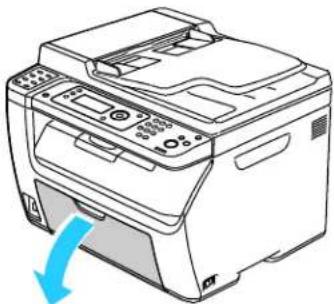
natural_image
Line drawing of a printer with a blue arrow indicating compression or disassembly (no text or symbols present)- Pull the slide bar forward until it stops.
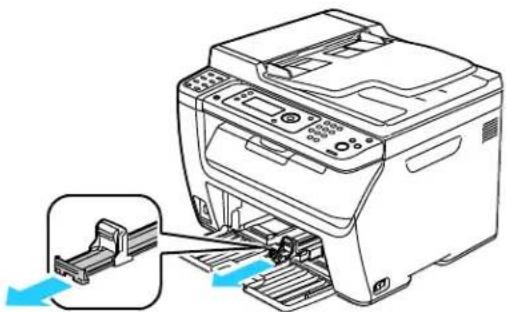
natural_image
Diagram of a printer with an open slot and blue arrows indicating a process (no text or symbols present)Printing
- Pull the length guide forward until it stops.
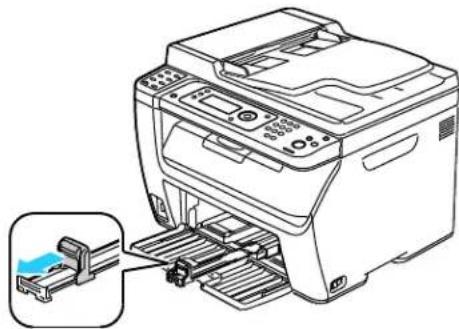
natural_image
Line drawing of a printer with an inset showing a mechanical component inserted into the base (no text or symbols present)- Move the width guides to the edges of the tray.

natural_image
Line drawing of a printer with blue arrows indicating motion or operation, no text or symbols present- Flex the sheets back and forth and fan them, then align the edges of the stack on a level surface. This procedure separates any sheets that are stuck together and reduces the possibility of jams.
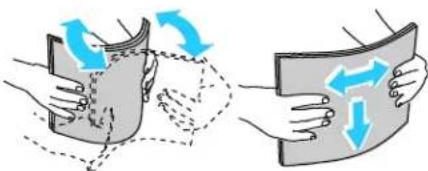
natural_image
Illustration of two hands holding a folded paper or sheet, with blue arrows indicating motion or movement (no text or symbols)- Load the paper into the tray with the top edge going into the printer and the print side up.
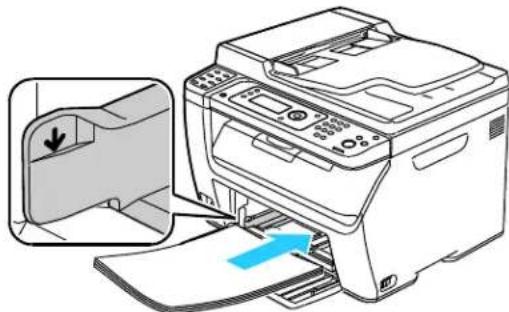
natural_image
Illustration of a printer being inserted into a paper, showing the printer's internal structure and paper path (no text or symbols present)76 WorkCentre 6015 Color Multifunction Printer User Guide
- Adjust the width guides until they touch the edges of the paper.
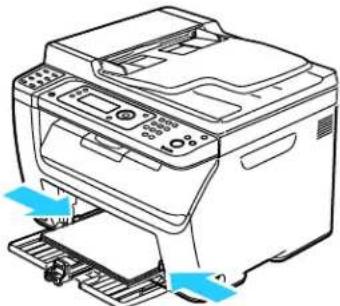
natural_image
Illustration of a printer with blue arrows indicating print direction (no text or symbols present)- Push in the length guides and slide bar until they stop.
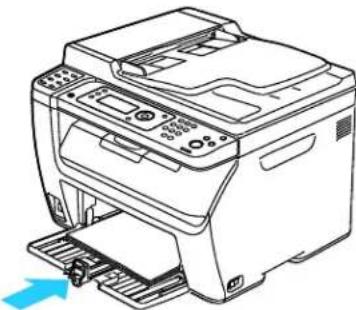
natural_image
Line drawing of a printer with paper feed and control panel (no text or symbols)Note: Depending on the size of the paper, first push the slide bar toward the printer until it stops. Pinch the length guide and slide it in until it touches the paper edge.
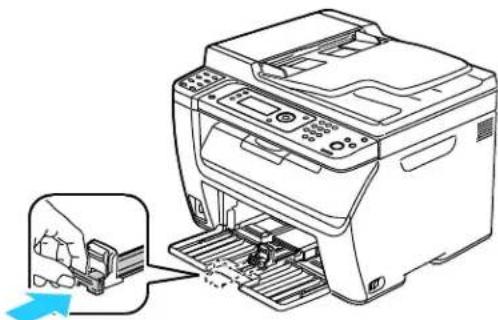
natural_image
Line drawing of a printer with a hand inserting a small object into the print (no text or symbols present)- Place the bypass tray on the main tray, then align the tabs with the marks.
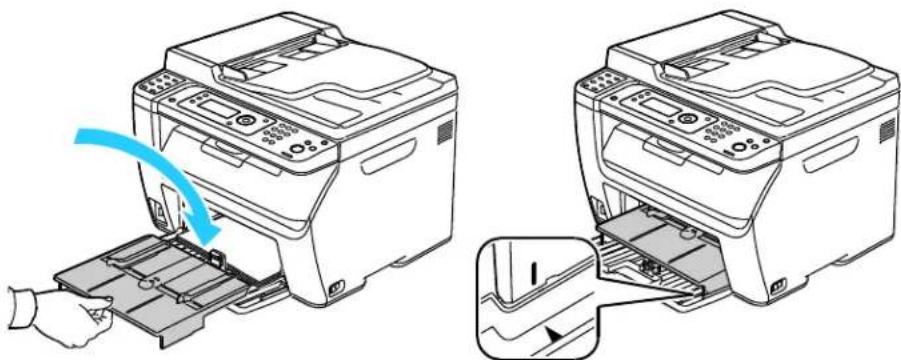
natural_image
Illustration of two printer machines with a hand inserting a cable into one (no text or symbols present)WorkCentre 6015 Color Multifunction Printer 77 User Guide
Printing
- If the paper you loaded is not plain, set the correct paper type and size at the control panel and in your print driver. For details, see Setting Paper Types, Paper Sizes, and Display Screen on page 79.
Note: If you are printing on custom size paper, define the custom size in the printer properties before printing.
Loading Paper in the Bypass Tray
The bypass tray holds up to 10 pages of paper. Paper loaded in the bypass tray is used before paper loaded in the main tray.
Note: To avoid paper jams, do not remove the paper cover while printing is in progress.
- Open the front cover.

natural_image
Line drawing of a printer with a blue arrow indicating compression or disassembly (no text or symbols present)- Place the paper cover on the main tray and align the tabs with the marks on the tray.
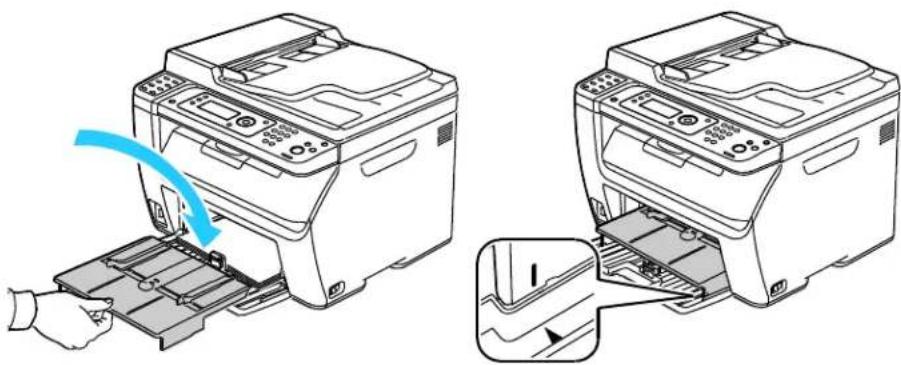
natural_image
Illustration of two printer machines with a hand inserting a cable into one, showing the process (no text or symbols present)- Move the width guides to the edges of the tray.
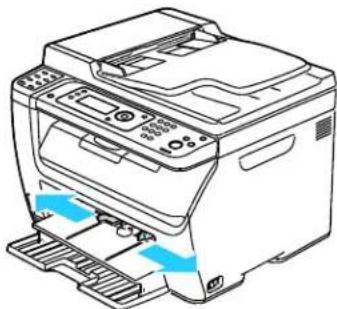
natural_image
Line drawing of a printer with blue arrows indicating motion or operation (no text or symbols)78 WorkCentre 6015 Color Multifunction Printer User Guide
- Flex the sheets back and forth and fan them, then align the edges of the stack on a level surface. This procedure separates any sheets that are stuck together and reduces the possibility of jams.

natural_image
Illustration showing two hands performing a roll-up or folding motion on a document (no text or symbols present)- Load the paper into the tray with the top edge going into the printer and the print side up.
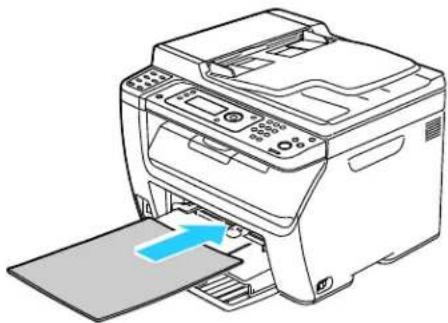
natural_image
Illustration of a printer with a blue arrow indicating print direction (no text or symbols present)- Adjust the width guides until they touch the edges of the paper.

natural_image
Line drawing of a printer with blue arrows indicating print process (no text or symbols)- If the paper you loaded is different from the paper in the main tray, set the correct paper type and size. Ensure that you change the paper type and size at the control panel and in your print driver software. For details, see Setting Paper Types, Size, and Display Screen on page 79.
Note: If you are printing on custom size paper, define the custom size in the printer properties before printing. For details, see Defining Custom Paper Sizes on page 86.
Printing
Setting Paper Types, Paper Sizes, and Display Screen
After loading paper in the main tray or bypass tray, the printer prompts you to set the paper type and size on the control panel. If you want the control panel message to appear when you load the main tray, turn Display Screen on.

CAUTION: To prevent print-quality problems, ensure that paper type settings match the paper type loaded in the tray.
To set the paper size or type for paper in a tray:
- On the printer control panel, press the System button.
- To select Tray Settings, press the arrow buttons, then press OK.
- At Main Tray, press OK.
- To select Paper Size, Paper Type, or Display Screen, press the arrow buttons, then press OK.
- To select the desired paper setting, press the arrow buttons, then press OK.
- To return to the Ready screen, press Return.
Selecting Printing Options
This section includes:
- Selecting Printing Defaults in Windows 81
- Selecting Printing Defaults in Windows for a Shared Network Printer....81
- Selecting Printing Options for an Individual Job in Windows....82
- Selecting Printing Options for Macintosh 82
Print driver settings override control panel settings when you print using the print driver software on your computer.
Selecting Printing Defaults in Windows
Use these instructions to set print driver defaults for the print driver software installed on your computer. You can override the default settings for an individual print job when printing from an application. You can set default settings for a network printer that apply to that printer for anyone who accesses it over the network. For details, see Selecting Printing Defaults in Windows for a Shared Network Printer on page 81.
To set the default settings:
-
Navigate to the list of printers on your computer:
-
For Windows XP SP1 and later, click Start > Settings > Printers and Faxes.
- For Windows Vista, click Start > Control Panel > Hardware and Sound > Printers.
-
For Windows Server 2003 and later, click Start > Settings > Printers.
• For Windows 7, click Start > Devices and Printers. -
In the Printers folder, right-click the name of your print driver and select Printing Preferences.
-
Make selections on the print driver tabs as desired, then click OK.
Note: For more information about Windows print driver options, click Help in the Printing Preferences dialog box.
Selecting Printing Defaults in Windows for a Shared Network Printer
If the printer is shared on a network, you can set printing defaults that apply to anyone who accesses it from the network. You can override network-level defaults through the driver settings on your computer.
-
Navigate to the list of printers on your computer:
-
For Windows XP SP1 and later, click Start > Settings > Printers and Faxes.
- For Windows Vista, click Start > Control Panel > Hardware and Sound > Printers.
-
For Windows Server 2003 and later, click Start > Settings > Printers.
• For Windows 7, click Start > Devices and Printers. -
In the Printers folder, right-click the name of your print driver and select Properties.
Printing
- In the printer Properties dialog box, click the Advanced tab.
- On the Advanced tab, click Printing Defaults.
- Make your selections on the driver tabs as desired, then click Apply.
- Click OK to save your selections.
Selecting Printing Options for an Individual Job in Windows
To use special printing options for a particular job, change the print driver settings in the application before sending the job to the printer.
Note: The print driver includes online help with more information on selecting printing options. To access help from any print driver dialog box, click Help.
To select printing options:
- With the desired document or graphic open in your application, open the Print dialog box. For most software applications, click File > Print or press CTRL+P.
- Select your printer, then click Properties to open the print driver dialog box.
- Make selections from the driver tabs as desired, beginning with settings in the Paper/Output tab.
- Click OK in the Properties window, then click OK in the Print window.
Selecting Printing Options for Macintosh
To use specific printing options, change the settings before sending the job to the printer.
- With the document open in your application, click File > Print.
- Select your printer from the list.
- Select Xerox ^® Features from the Copies & Pages menu.
- Select the desired printing options from the drop-down lists.
- Click Print to send the job to the printer.
Printing Envelopes
This section includes:
• Guidelines for Printing Envelopes 83
- Loading Envelopes in the Trays....83
- Specifying the Main Tray Settings for Printing Envelopes 85
- Printing Envelopes From an Application 85
You can print envelopes from either the main tray or the bypass tray. To print from either tray, select the correct envelope size in the control panel Main Tray settings and in the print driver. Print driver settings override control panel settings when you print using the print driver software on your computer.

CAUTION: Never use self-stick envelopes or envelopes with windows. They can damage the printer and cause jams.

CAUTION: The Xerox ^® Warranty, Service Agreement, or Xerox ^® Total Satisfaction Guarantee does not cover damage caused by using unsupported paper or specialty media. The Xerox ^® Total Satisfaction Guarantee is available in the United States and Canada. Coverage could vary outside these areas. Please contact your local representative for details.
Guidelines for Printing Envelopes
- Print quality depends on the quality and construction of the envelopes. Try another envelope brand if you do not get desired results.
- Maintain constant temperatures and relative humidity.
- Store unused envelopes in their packaging to avoid the excess moisture and dryness which can affect print quality and cause wrinkling. Excessive moisture can cause the envelopes to seal before or during printing.
- Remove air bubbles from the envelopes before loading them into the tray by setting a heavy book on top of them.
- In the print driver software, select Envelope as the paper type.
- Do not use padded envelopes. Use envelopes that lie flat on a surface.
- Do not use envelopes with heat activated glue.
- Do not use envelopes with press and seal flaps.
- Use only paper envelopes.
- Do not use envelopes with windows or metal clasps.
Printing
Loading Envelopes in the Trays
Use the following procedure to load envelopes in the main tray and bypass tray:
-
Slide open the paper guides.
-
Do one of the following:
- Insert No. 10, DL, or Monarch envelopes with the print side up, flaps closed and facing down, and the flap side to the right.
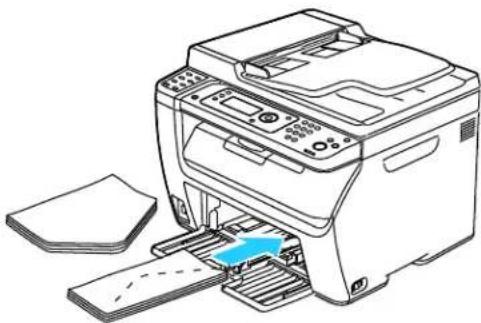
natural_image
Line drawing of a printer with paper sheets and a blue arrow indicating a process (no text or symbols present)Note: To prevent wrinkling on No. 10, DL, or Monarch envelopes, load them with the print side up, flaps open and facing away from the printer.
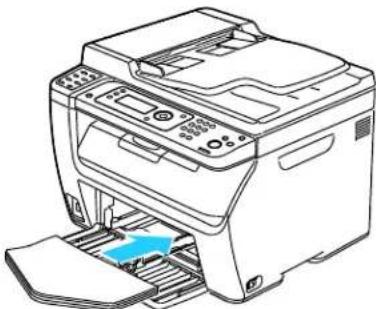
natural_image
Line drawing of a printer with a blue arrow indicating print process (no text or symbols)Note: When you load envelopes long-edge feed, ensure that you specify landscape orientation in the print driver.
- Insert C5 envelopes with the print side up, flaps open and facing away from the printer.

natural_image
Line drawing of a printer with a blue arrow indicating a process or operation (no text or symbols present)- Adjust the paper guides so they rest lightly against the edges of the envelopes.
84 WorkCentre 6015 Color Multifunction Printer User Guide
Specifying the Main Tray Settings for Printing Envelopes
- On the printer control panel, press the System button.
- To select Tray Settings, press the arrow buttons, then press OK.
- At Main Tray, press OK.
- Select Paper Type using the arrow buttons, then press OK.
- Select Envelope using the arrow buttons, then press OK.
- Press the Return button once.
- Select Paper Size using the arrow buttons, then press OK.
- Select the desired envelope size using the arrow buttons, then press OK.
- To return to the Ready screen, press Return.
Printing Envelopes From an Application
- With the desired document or graphic open in your application, open the Print dialog box. For most software applications, click File > Print or press CTRL+P.
- Select your printer, then click Properties to open the print driver dialog box.
- Make selections from the driver tabs as desired, beginning with settings in the Paper/Output tab.
- Click OK in the Properties window, then click OK in the Print window.
Note: For illustrated instructions for printing on envelopes, refer to the Envelope/Paper Setup Navigator on the Paper/Output tab of the print driver.
Using Custom Paper Sizes
This section includes:
- Defining Custom Paper Sizes....86
- Printing on Custom Paper Sizes....87
The WorkCentre 6015 Color Multifunction Printer prints on custom paper sizes that are within the minimum and maximum size range supported by the printer.
Defining Custom Paper Sizes
To print custom paper sizes, define the custom width and length of the paper in the print driver software and on the printer control panel. When setting the paper size, ensure that you specify the same size as the paper in the tray. Setting the wrong size can cause a printer error. Print driver settings override control panel settings when you print using the print driver software on your computer.
Defining a Custom Paper Size for Windows
You can save up to 20 custom paper sizes in the Windows print driver. Save each custom size with a unique name and the dimensions are retained until you change them.
-
Navigate to the list of printers on your computer:
-
For Windows XP SP1 and later, click Start > Settings > Printers and Faxes.
- For Windows Vista, click Start > Control Panel > Hardware and Sound > Printers.
-
For Windows Server 2003 and later, click Start > Settings > Printers.
• For Windows 7, click Start > Devices and Printers. -
From the Printers and Faxes window, select a printer, right-click the printer, and select Properties.
Notes:
- For Windows 7, in the Devices and Printers window, right click the printer, and select Printer Properties from the middle of the drop-down list.
-
For Windows 7, you must have an Administrator Account to select Custom Settings in the print driver.
-
In the Properties dialog box, click the Configuration tab, then click Custom Paper Size.
- In the Custom Paper Size Settings dialog box, select the units of measurement to use.
- In the Custom Size Settings section, specify the size for the short edge and the long edge of the paper.
- Select the Name the Paper Size check box, type a name in the Paper Name dialog box, then click OK.
- In the Properties dialog box, click OK.
The custom size appears in the Paper Size list in the print driver Properties window.
86 WorkCentre 6015 Color Multifunction Printer
User Guide
Defining a Custom Paper Size for Macintosh
- In the application you are printing from, select File > Page Setup.
- From the Format For drop-down list, select the printer.
- From the Paper Size drop-down list, select Manage Custom Sizes.
- In the Custom Paper Sizes window, click plus (+) to add the new custom size.
- For the custom paper size, enter the width and height.
- In the Non-Printable Area drop-down list, select the printer.
- Double-click untitled, then type a name for the new custom size.
- Click OK to close the Custom Paper Sizes window.
- Click OK to close the Page Setup window.
The new custom size is available in the Paper Size drop-down list of the print driver and in Page Setup.
Note: To use the custom paper size, select Page Setup, and select the custom size that you created from the Paper Size drop-down list.
Printing on Custom Paper Sizes
Note: Before printing on a custom paper size, use the Custom Paper Sizes feature in printer properties to define the custom size. For details, see Defining Custom Paper Sizes on page 86.
Printing on Custom Paper Size Using Windows
- Load the custom-size paper in the tray. For details, see Loading Paper on page 75.
- In the application, click File > Print and select your printer.
- In the Print dialog box, click Properties.
- On the Paper/Output tab, use the Paper Size drop-down list to select the desired custom size.
Note: If you are printing on custom size paper, define the custom size in the printer properties before printing.
- From the Paper Type drop-down list, select the paper type.
- Select any other desired options, then click OK.
- In the Print dialog box, click OK to start printing.
Printing
Printing on Custom Paper Size Using Macintosh
- Load the custom-size paper. For details, see Loading Paper on page 75.
- In the application, click Page Setup.
- From the Paper Size drop-down list, select the custom paper size.
- Click OK.
- In the application, click Print.
- Click OK.
Printing on Both Sides of the Paper
This section includes:
- Setting Up 2-Sided Printing....89
- Loading Paper for Manual 2-Sided Printing....90
The WorkCentre 6015 Color Multifunction Printer supports manual 2-sided printing. You can set printing preferences to print your jobs on both sides of the paper.
Use 2-Sided Printing to specify the page orientation for the printed output.
You can specify the page layout for 2-sided printing, which determines how the printed pages turn. These settings override the application page orientation settings.
| Portrait | Landscape | ||
 |  |  |  |
| Portrait2-Sided Print | Portrait2-Sided Print, Flip on Short Edge | Landscape2-Sided Print | Landscape2-Sided Print, Flip on Short Edge |
Setting Up 2-Sided Printing
To set up manual 2-sided printing:
- From the File menu, select Print.
- Select the printer from the Select Printer list, then click Properties.
- From the Duplex window on the Paper/Output tab, select Flip on Long Edge or Flip on Short Edge.
- Select the Paper Size and Paper Type to match the paper you are using.
- To close the Printing Preferences dialog box, click OK.
- To start printing, click Print.
Note: When you start manual 2-sided printing, the Manual Duplex Setup window appears. Do not close the window until you have completed the 2-sided printing. Once the window is closed, it cannot be reopened.
Printing
Loading Paper for Manual 2-Sided Printing
For manual 2-sided printing, the back sides of the pages are printed first in reverse order. For a six-page document, the pages are printed page 6, page 4, and then page 2. Once the even pages are printed, the paper is reloaded. The odd pages are printed page 1, page 3, and then page 5.
- Load the paper to print the even pages.
Note: Load letterhead into the main tray with the printed side down and the top going into the printer.
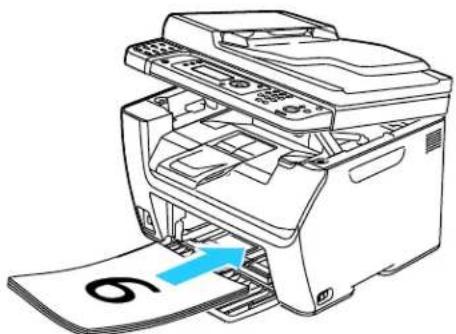
natural_image
Illustration of a printer with paper being inserted, showing internal components and a blue arrow indicating the paper's edge (no text or symbols present)Once the even pages have printed, the Error indicator lights and the Ready indicator flashes.
- Remove the printed pages from the output tray and reload them into the main tray without rotating or flipping the pages. The unprinted sides of the pages are facing up.
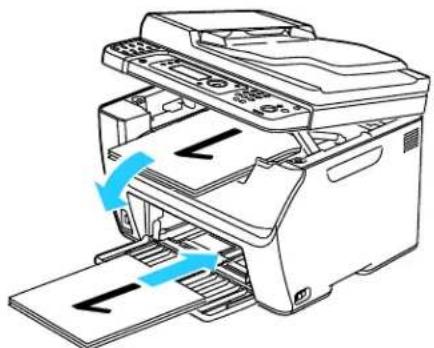
natural_image
Line drawing of a printer with blue arrows indicating motion or movement, no text or symbols present- Press OK.
The odd pages are printed, page 1, page 3, then page 5.
Printing From a USB Flash Drive
You can print a file stored on a USB Flash drive. The USB port is on the front of the printer. The print from USB function supports .jpg, .pdf, and .tiff file formats.
Notes:
- Before pressing the Print button or inserting the USB Flash drive, press the Power Saver button, then wait until the Power Saver indicator turns off.
- You can print files stored using the Scan to USB Memory feature. File types created from other sources can fail to print properly.
To print from the USB Flash drive:
- Insert the USB Flash Drive into the USB memory port on the printer.
- To select Print From, press the arrow buttons then press the OK button.
Note: If the USB Flash drive was already in the USB memory port, press the Print button.
- To select a file, press the arrow buttons, then press OK.
- Do one of the following:
• To print the file page-size, press the arrow buttons to select Auto On.
• To print the file the original size, press the arrow buttons to select Auto Off.
If necessary, press the arrow buttons to highlight the file name.
- Press the green Start button on the control panel.
Note: For best results, save files in .jpg format.
Copying
5
This chapter includes:
• Making Copies....94
- Adjusting Copying Options 96
- Changing the Default Copy Settings....101
• Limiting Access to Copying 103
Making Copies
-
To clear previous control panel copy settings, press the Clear All button.
-
Load your original documents:
- Use the document glass for single pages or paper that cannot be fed using the automatic document feeder. Lift the automatic document feeder or the document glass cover, then place the original face down in the upper left corner of the document glass.

natural_image
Line drawing of a printer with an open lid and a blue arrow indicating direction (no text or symbols)- Use the automatic document feeder for multiple or single pages. Remove any staples and paper clips from the pages, then place them face up in the document feeder. Insert originals face up with the top of the page entering the feeder first. Adjust the paper guides so they fit against the originals.
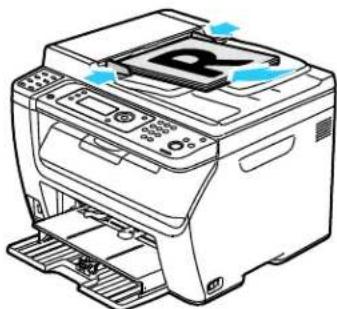
natural_image
Line drawing of a printer with control panel and paperclip (no text or symbols)-
On the control panel, press the Copy button.
-
Using the control panel keypad, enter the desired number of copies. The number of copies appears on the upper right corner of the display. To reset the number of copies to 1, press the Clear All button.
-
To select the copying option you want to change, press the arrow buttons. For details, see Adjusting Copying Options on page 96.
-
Press the Start button. One set of copies prints.
If you place originals in the automatic document feeder, copying continues until the automatic document feeder is empty.
94 WorkCentre 6015 Color Multifunction Printer User Guide
Automatic Document Feeder Guidelines
Note: Available on WorkCentre 6015N/NI Color Multifunction Printer only.
The automatic document feeder accommodates the following originals:
• Width: 148–216 mm (4.1–8.5 in.)
• Length: 210–355.6 mm (8.3–14 in.)
• Weight: 60–105 g/m² (16–28 lb. Bond)
Follow these guidelines when loading originals into the automatic document feeder:
- Load originals face up so that the top of the document enters the feeder first.
- Place only loose sheets of paper in the automatic document feeder.
- Adjust the paper guides so that they fit against the originals.
- Insert paper in the automatic document feeder only when ink on the paper is dry.
- Do not load originals above the MAX fill line.
Document Glass Guidelines
The document glass accommodates original sizes up to 216 x 297 mm (8.5 x 11.7 in.). Use the document glass rather than the automatic document feeder to copy or scan the following types of originals:
• Paper with paper clips or staples attached
• Paper with wrinkles, curls, folds, tears, or notches
- Coated or carbonless paper or items other than paper such as cloth or metal
- Envelopes
- Books
Adjusting Copying Options
This section includes:
- Basic Settings 97
• Image-Quality Settings....98
• Image Layout Adjustments 99
• Output Adjustments ....100
You can adjust numerous options for your copy jobs, specify characteristics of the original documents, and customize the output. For details, see Basic Copying on page 94.
You can also modify the default settings for many options. For details, see Selecting Default Copy Settings on page 101.
Basic Settings
This section includes:
- Selecting Color or Black and White Copies....97
- Specifying the Original Size....97
- Specifying the Original Document Type 97
Selecting Color or Black and White Copies
If the original document contains color, you can create copies in full color or in black and white. The color mode indicators light to show the current setting.
Press the Color Mode button to toggle the selection between color and black and white.
Note: The Color Mode returns to the default setting after the copy job is complete. To modify the default setting, see Selecting the Default Copy Settings on page 101.
Specifying the Original Size
- To select Document Size, press the arrow buttons, then press OK.
- Select the document size.
- Press OK.
Specifying the Original Document Type
The scanner optimizes the appearance of the output based on the contents of the original document.
To specify the type of the original document:
- To select Document Type, press the arrow buttons, then press OK.
- Select the document type:
• Text for black and white or colored text.
- Mixed for both text and photographs, such as magazines or newspapers. This is the default setting.
• Photo for photographs.
- Press OK.
Image-Quality Settings
This section includes:
- Reducing or Enlarging the Image....98
- Making the Image Lighter or Darker 98
- Adjusting the Sharpness....98
- Setting Auto Exposure....99
Reducing or Enlarging the Image
You can reduce the image to as little as 25% of its original size or enlarge it as much as 400%.
To reduce or enlarge the copied image:
- To select Reduce/Enlarge, press the arrow buttons, then press OK.
-
Do one of the following:
-
To select a preset image size, press the arrow buttons.
- To set the copy size in increments of 1 %, press the arrow buttons or use the keypad to set the percentage. The default setting is 100 %.
3. Press OK.
Making the Image Lighter or Darker
- To select Lighten/Darken, press the arrow buttons, then press OK.
- To lighten or darken the image, press the arrow buttons to move the slider.
- Press OK.
Adjusting the Sharpness
- To select Sharpness, press the arrow buttons, then press OK.
-
Select a sharpness setting:
-
Sharpest
- Sharper
- Normal
- Softer
- Softest
The default setting is Normal.
3. Press OK.
Setting Auto Exposure
Paper that is close to white, such as newsprint or parchment, can cause the printer to put toner on the entire page. The Auto Exposure setting removes the light background and only prints the image.
To turn Auto Exposure on or off:
- To select Auto Exposure, press the arrow buttons, then press OK.
-
Select an option:
-
Off
- On
The default setting is On.
- Press OK.
Image Layout Adjustments
You can change the following image layout adjustment settings. For details, see:
• Printing Multiple Pages per Side on page 99
• Setting the Copy Margins on page 99
Printing Multiple Pages per Side
You can copy a single page and have it print multiple times onto one or both sides of the paper. The printer reduces the pages proportionally to fit.
To print multiple pages per side:
- To select N-Up, press the arrow buttons, then press OK.
-
Select an option:
-
Off copies one original image onto one side of a page. This is the default setting.
• Auto copies two original pages, reduces the images, and prints them onto one side of a page. - ID Card Copy copies two original size images onto one side of a page. The images are not reduced.
-
Manual reduces the two original images as specified in Reduce/Enlarge, and prints them onto one side of a page.
-
Press OK.
Setting Copy Margins
-
To select the margin you want to change, press the arrow buttons for:
-
Margin Top/Bottom
- Margin Left/Right
-
Margin Middle
-
Press OK.
Copying
- Adjust the margins from 0.0–2.0 in. using the arrow buttons.
- Press OK.
- Repeat the steps for other margins, then press the Return button.
Note: The margin left/right settings only apply when copying from the document glass.
Output Adjustments
Collating Copies
You can automatically collate multi-page copy jobs. For example, when making three 1-sided copies of a six-page document, the copies are printed in this order:
1, 2, 3, 4, 5, 6; 1, 2, 3, 4, 5, 6; 1, 2, 3, 4, 5, 6
Uncollated copies print in the following order:
1, 1, 1, 2, 2, 2, 3, 3, 3, 4, 4, 4, 5, 5, 5, 6, 6, 6
To select a collating option:
- To select Collated, press the arrow buttons, then press OK.
-
Select an option:
-
Off turns collation off.
-
On turns collation on.
• Auto turns collation on. This is the default setting. -
Press OK.
Changing the Default Copy Settings
This section includes:
- Changing the Color Mode....101
- Changing the Auto Exposure Level 101
- Changing the Color Balance ....102
- Changing the Manual Feed Slot Paper Size....102
The printer uses the default copy settings on all copy jobs unless you change them for an individual job. You can modify the default copy settings.
To change the default copy settings:
- On the control panel, press the System button.
- To select Default Settings, press the arrow buttons, then pressOK.
- Select Copy Defaults, then press OK.
- To select the option you want to change, press the Down Arrow button, then press OK.
- Select the desired setting, then press OK to confirm the new setting.
- Repeat steps 4 and 5 as needed to change the defaults.
- To return to the Ready screen, press Return.
Changing the Color Mode
- To select Color, press the arrow buttons, then press OK.
- Select a color setting:
- Black & White
- Color
- Press OK.
Changing the Auto Exposure Level
- To select Auto Exposure Level, press the arrow buttons, then press OK.
-
Select an auto exposure setting:
-
Off
• On
The default setting is On.
- Press OK.
Copying
Changing the Color Balance
The Color Balance control allows you to adjust the print color of your printer. Each of the four primary colors of red, green, blue, and gray balance, have five density settings. The density settings adjust the output based on the level of color saturation. Adjusting the setting negatively lowers the density and lightens the output. Adjusting the setting positively increases the density and darkens the output.
Examples of low density areas include faces and sky.
To change the color balance:
- To select Color Balance, press the arrow buttons, then press OK.
- Select the color you want to adjust, then press OK.
- To adjust the density setting from -2 through +2, press the arrow buttons.
- Press OK.
- Select another color and adjust its density, or press the Return button to return to the Ready screen.
Changing the Manual Feed Slot Paper Size
- To select Document Size, press the arrow buttons, then press OK.
- Select a Document Size.
- Press OK.
Limiting Access to Copying
The Copy Lock options limit access to copying by requiring a password to use the Copy function or to make color copies. You can also turn off copying.
To set the copy lock:
- On the printer control panel, press the System button.
- To select Admin Menu, press the arrow buttons, then press OK.
If prompted, enter the four-digit password, then press OK.
- Select Secure Settings, then press OK.
- Select Service Lock, then press OK.
Note: Panel Lock must be enabled before setting the service locks. For more information, see Changing the Panel Lock Password on page 142.
- Select Copy, then press OK.
-
Select an option:
-
Unlocked turns off the service lock.
- Locked turns on the service lock, and turns off the copy function.
-
Password Locked requires a password to use the copy function. Enter a new password, then press OK.
• Color Pass requires a password to make color copies. -
Press OK.
Scanning
6
This chapter includes:
- Loading Documents for Scanning....106
- Scanning to a USB Flash Drive....108
- Scanning to a Folder on a USB Connected Computer....109
- Scanning to a Shared Folder on a Network Computer ....110
- Scanning to an Email Address....114
- Scanning to an FTP Server....115
- Scanning Images into an Application on a USB Connected Computer....116
- Adjusting Scanning Settings....119
- Changing the Default Scan Settings 122
- Limiting Access to Scanning 126
See also:
Installation and Setup Overview on page 44
Loading Documents for Scanning
Position the original document as shown.

natural_image
Line drawing of a printer with an open lid and control panel, showing no text or symbols.Document Glass
Lift the automatic document feeder or the document glass cover, then place the original face down in the upper left corner of the document glass.
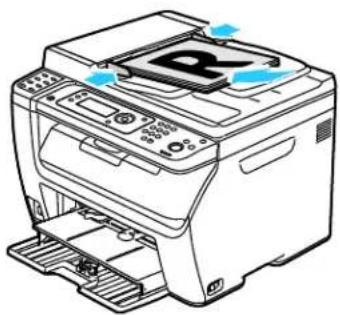
natural_image
Line drawing of a printer with a paperclip and control panel (no text or symbols)Automatic Document Feeder
Insert originals face up with the top of the page entering the feeder first. Adjust the paper guides so they fit against the originals.
Automatic Document Feeder Guidelines
Note: Available on WorkCentre 6015N/NI Color Multifunction Printer only.
The automatic document feeder accommodates the following originals:
• Width: 148–216 mm (4.1–8.5 in.)
• Length: 210–355.6 mm (8.3–14 in.)
• Weight: 60–105 g/m² (16–28 lb. Bond)
Follow these guidelines when loading originals into the automatic document feeder:
- Load originals face up so that the top of the document enters the feeder first.
- Place only loose sheets of paper in the automatic document feeder.
- Adjust the paper guides so that they fit against the originals.
- Insert paper in the automatic document feeder only when ink on the paper is dry.
- Do not load originals above the MAX fill line.
Document Glass Guidelines
The document glass accommodates original sizes up to 216 x 297 mm (8.5 x 11.7 in.). Use the document glass rather than the automatic document feeder to copy or scan the following types of originals:
• Paper with paper clips or staples attached
• Paper with wrinkles, curls, folds, tears, or notches
- Coated or carbonless paper or items other than paper such as cloth or metal
- Envelopes
- Books
Scanning to a USB Flash Drive
You can scan a document and store the scanned file on a USB Flash drive. The Scan to USB function supports .jpg, .pdf, and .tiff file formats.
Note: Before pressing the Scan button or inserting the USB Flash drive, press the Power Saver button, then wait until the Power Saver indicator turns off.
- Load the original on the document glass or in the automatic document feeder.
-
Do one of the following:
-
Insert your USB Flash drive in the USB port on the front of the printer, then select Scan to using the arrow buttons.
-
Press the Scan button, press the arrow buttons to select Scan to USB Memory, then press OK.
-
Press OK.
-
Do one of the following:
-
Do one of the following:
• To save the scanned file directly to the USB Flash drive, select Save to USB Drive, then press OK.
- To save the scanned file to a folder on the USB Flash drive, press the arrow buttons to navigate to the folder, then press OK.
- To save the scanned file directly to the USB Flash drive, select Save to USB Drive, then press OK. - To save the scanned file to a folder on the USB Flash drive, press the arrow buttons to navigate to the folder, then press OK.
- At Save to USB Drive or Save to this folder, press OK.
- To select any scanning options you want to change, press the arrow buttons.
- To select Scan to, press the arrow buttons.
- Press Start to begin the scan.
-
If the Another Page? prompt appears, select an option:
-
No completes the scanning process.
• Yes prompts you to place the next page on the document glass. -
Select Continue or Cancel the Action.
-
Press OK.
The printer scans your images to the folder you specified.
Scanning to a Folder on a USB Connected Computer
-
Start Express Scan Manager:
-
Windows: Click Start > Programs > Xerox. Select your printer from the list. Double-click Express Scan Manager.
-
Macintosh: Navigate to Applications > Xerox. Select your printer from the list. Double-click Express Scan Manager.
-
Click OK to accept the default Destination Path folder, or click Browse to navigate to another folder.
- Press OK.
- Load the original on the document glass or in the automatic document feeder.
- On the printer control panel, press the Scan button.
- To select Scan to Computer (USB), press the arrow buttons, then press OK.
- To change any of the options, press the arrow buttons to select the option, then press OK.
- To begin the scan, press the arrow buttons to select Scan to, then press Start. An Express Scan Manager dialog box opens on your computer to indicate the progress. The printer scans your documents to the output destination specified in Express Scan Manager.
Scanning to a Shared Folder on a Network Computer
This section includes:
• Sharing a Folder on a Windows Computer....110
• Sharing a Folder Using Macintosh OS X Version 10.5 and Later....111
- Adding a Folder as an Address Book Entry Using CentreWare Internet Services....111
- Adding a Folder as an Address Book Entry Using the Address Book Editor....112
- Scanning to a Folder on a Network Computer....112
Before using the printer as a scanner on a network, you must:
- Create a shared folder on your computer hard drive.
- Create an address using CentreWare Internet Services or the Address Book Editor pointing the scanner to the computer.
Note: For more information, see Connecting the Printer on page 46.
Sharing a Folder on a Windows Computer
- Open Windows Explorer.
- Right-click the folder you want to share and select Properties.
- Click the Sharing tab, then click Share this folder.
- Click the Permissions button.
- Select the Everyone group, and verify that all permissions are enabled.
- Click OK.
Note: Remember the Share name for later use.
- Click OK again.
Sharing a Folder Using Macintosh OS X Version 10.5 and Later
- From the Apple menu, select System Preferences.
- From the View menu, select Sharing.
- From the Services list, select File Sharing.
- Click the plus icon (+) below the Shared Folders field. A folder list appears.
- Select the folder you want to share on the network, then click Add.
- Select the folder you want to share from the Shared Folders window.
- From the Users list, click Everyone.
- From the list to the right of the Users window, use the arrow buttons to select user privileges for the shared folder.
- Click the Options button.
-
Do one or more of the following:
-
Select Share files and folders using AFP to share this folder with other Macintosh computers.
- Select Share files and folders using FTP to share this folder with computer connected to an FTP server.
-
Select Share files and folders using SMB to share this folder with Windows computers.
-
Select the On check box to the left of File Sharing in the Service pane.
The folder and its contents are shared with network users.
- Close the Sharing window.
Note: When you open a shared folder, a Shared Folder banner appears in the Finder for the folder and its subfolders.
Adding a Folder as an Address Book Entry Using CentreWare Internet Services
- At your computer, open a Web browser, type the IP address of the printer in the address field, then press Enter or Return.
Note: If you do not know the IP address of your printer, see Finding the IP Address of Your Printer on page 55.
- Click Address Book.
- Under Network Scan (Comp./Serv.), click Computer/Server Address Book.
- Click Add next to any empty field, and enter the following information:
• Name: Enter the name that you want to appear in the Address Book.
• Network Type: Select Computer (SMB).
- Host Address: Enter the IP address of your computer.
- Port Number: Enter the default port number for SMB, 139, or select a number from the range provided.
- Login Name: Enter your computer user name.
- Login Password: Enter your computer login password.
• Re-enter Password: Enter your login password again.
- Name of Shared Directory: Enter a name for the directory or folder. For example, if you want the scanned files to go in a folder named scans type /scans.
- Subdirectory Path: Enter the path of the folder on the FTP server. For example, if you want the scanned files to go in a folder named colorscans inside the scans folder, type /colorscans.
5. Click Save Changes.
Adding a Folder as an Address Book Entry Using the Address Book Editor
- On your computer select Start > All Programs > Xerox.
- Select your printer from the list.
- Click Address Book Editor.
- Double-click the Server icon under the Printer Address Book in the left navigation pane.
- Enter the following information:
• Name: Enter the name that you want to appear in the Address Book.
• Server Type: Select Computer (SMB).
• Server Name/IP Address: Enter the IP address of your computer.
• Share Name: Enter a name for the directory or folder.
- Subdirectory Path: Enter the path of the folder on the FTP server. For example, if you want the scanned files to go in a folder named colorscans inside the scans folder, type /colorscans.
- Login Name: Enter your computer user name.
- Login Password: Enter your computer login password.
• Re-enter Password: Enter your login password again.
- Port Number: Enter the default port number for SMB, 139, or select a number from the range provided.
6. Click OK.
The new server appears in the Server pane.
7. Click File > Save All.
Scanning to a Folder on a Network Computer
- On the printer control panel, press the Scan button.
- To select Scan to Network, press the arrow buttons, then press the OK button.
- At Scan to, press OK.
- At Computer (Network), press OK.
- To select the shared folder on your computer, press the arrow buttons, then press OK.
- To change any other scan settings, press the arrow buttons to select the setting, and make the desired changes. For details, see Adjusting Scanning Settings on page 119.
- To begin the scan, press the Start button.
- If the Another Page? prompt appears, select an option:
- No completes the scanning process.
• Yes prompts you to place the next page on the document glass.
112 WorkCentre 6015 Color Multifunction Printer
User Guide
- Select Continue or Cancel the Action.
- Press OK.
The printer scans the documents to the shared folder on your computer.
Scanning to an Email Address
Before scanning to an email address, you must set up the printer up with the email server information. For details, see Setting Up Scanning to an Email Address on page 68.
To scan an image and send it to an email address:
- On the printer control panel, press the Scan button.
- To select Scan to Email, press the arrow buttons, then press OK.
- At Email to, press OK.
-
Select the method for selecting the recipient:
-
Keypad allows you to enter the email address manually. Use the keypad to enter the address.
- Address Book allows you to select an email address from the Address Book.
- Email Group allows you to select a group email address from the Address Book.
Note: When using the Address Book, press the arrow buttons to select the address for the desired recipient. Press the Forward Arrow button to select TO or BCC. When finished selecting addresses, press OK.
- To begin the scan, press the Start button.
-
If the Another Page? prompt appears, select an option:
-
No completes the scanning process.
• Yes prompts you to place the next page on the document glass. -
Select Continue or Cancel the Action.
-
Press OK.
The printer sends the scanned image as email attachments of the default file type.
See also:
Adjusting Scanning Settings on page 119
Scanning to an FTP Server
Before using this feature, you must:
- Set up an FTP server.
- Create an address for the printer to use. You can use CentreWare Internet Services or the Address Book Editor.
To scan to an FTP server:
- Load the original on the document glass or in the automatic document feeder.
- On the printer control panel, press the Scan button.
- To select Scan to Network, press the arrow buttons, then press OK.
- At Scan to, press OK.
- To select Server (FTP), press the arrow buttons, then press OK.
- To select the FTP address, press the arrow buttons, then press OK.
- To begin the scan, press the Start button.
The printer scans the document and places the image on the FTP server.
See also:
Adjusting Scanning Settings on page 119
Scanning Images into an Application on a USB Connected Computer
This section includes:
- Scanning an Image into an Application ....116
- Scanning an Image Using Windows XP ....117
• Scanning an Image Using Widows Vista or Windows 7....118
You can import images directly from the scanner into a folder on your computer. With a Macintosh computer, and some Windows applications, you can import the images directly into an application.
Scanning an Image into an Application
Notes:
• To use this feature, the printer must be connected to the computer with a USB cable.
• Some Windows applications, including Office 2007, do not support this feature.
To import images into an application:
- Open the file in which you want to place the image.
- In the application, select the menu item to acquire the image.
- From the Paper Source menu in Windows, or from the Scan From menu on a Macintosh computer, select:
- Document Glass
- Document Feeder
- Specify the other scan driver settings as desired.
Note: For more information, click the Help button to view the online help.
- To begin the scan, press the Start button.
The printer scans the document and places the image in your application.
Scanning an Image Using Windows XP
Note: To use this feature, the printer must be connected to the computer with a USB cable.
- On your computer, select Start > Control Panel.
- Double-click Scanners and Cameras.
- Double-click Xerox WC6015.
-
Select an option:
-
Color picture
- Grayscale picture
- Black and white picture or text
-
Custom
-
Select the paper source:
-
Document Glass
-
Document Feeder
-
To preview the document or select a portion of the document to scan, select Preview. The printer scans a preview copy of the image.
- To select a portion of the document to scan, use the corner points to resize the frame.
- Click Next.
- Type a name for this group of pictures.
-
Select a file format:
-
BMP
• TIF - JPG
-
PNG
-
Type in a path name or browse to a location for the scanned images.
- To save the image to the folder, select Nothing.
- Click Next.
- To view the scanned image, click the folder link in the window.
- Click Finish.
The image is stored in the folder and ready for use in your applications.
Scanning an Image Using Widows Vista or Windows 7
Note: To use this feature, the printer must be connected to the computer with a USB cable.
- On your computer, select Start > All Programs > Windows Fax and Scan.
- Click New Scan.
- If the WorkCentre 6015 Color Multifunction Printer is not already selected, click Change, then double-click Xerox WC6015.
-
Select an option:
-
Add Profile
- Documents
- Last used profile
-
Photo (Default)
-
Select the paper source:
-
Document Glass
-
Document Feeder
-
Select Color format.
-
Select a file format:
-
BMP
• TIF
• JPG -
PNG
-
Select a resolution for the scanned image.
- Use the sliders to adjust Brightness and Contrast.
- To preview the document or select a portion of the document to scan, select Preview.
The printer scans a preview copy of the image.
- To select a portion of the document, clear the Preview or scan images as separate files check box, then use the corner points to resize the frame.
- Click Scan.
The scanned image is stored in the default Scanned Documents folder or in a folder that you selected.
Adjusting Scanning Settings
This section includes:
- Setting the File Format....119
- Setting the Color Mode....119
- Setting the Scan Resolution....119
- Specifying the Original Size....120
• Making the Image Lighter or Darker....120 - Adjusting the Sharpness....120
- Changing the Auto Exposure Level 120
- Setting the Margins....121
You can modify the scan settings for individual jobs, once you select the scan mode.
You can also change the default values of some settings. For details, see Changing the Default Scan Settings on page 122.
Setting the File Format
- To select File Format, press the arrow buttons, then press OK.
- Select a setting.
- Press OK.
Setting the Color Mode
If the original image contains color, you can scan the image in color or in black and white. Selecting black and white significantly reduces the file size of the scanned images.
To set the color mode:
- To select Color Mode, press the arrow buttons, then press OK.
- Select a color mode.
- Press OK.
Setting the Scan Resolution
The scan resolution depends on how you plan to use the scanned image. Scan resolution affects both the size and image quality of the scanned image file. Higher scan resolution produces better image quality and a larger file size.
To set the scan resolution:
- To select Resolution, press the arrow buttons, then press OK.
- Select an option.
- Press OK.
Specifying the Original Size
- To select Document Size, press the arrow buttons, then press OK.
- Select the document size.
- Press OK.
Making the Image Lighter or Darker
- To select Lighten/Darken, press the arrow buttons, then press OK.
- To lighten or darken the image, press the arrow buttons to move the slider.
- Press OK.
Adjusting the Sharpness
- To select Sharpness, press the arrow buttons, then press OK.
- Select a sharpness setting:
- Sharpest
- Sharper
- Normal
- Softer
- Softest
The default setting is Normal.
- Press OK.
Changing the Auto Exposure Level
- To select Auto Exposure Level, press the arrow buttons, then press OK.
- Select an auto exposure setting:
- Off
- On
The default setting is On.
- Press OK.
120 WorkCentre 6015 Color Multifunction Printer User Guide
Setting the Margins
-
To select the margin you want to change, press the arrow buttons for:
-
Margin Top/Bottom
- Margin Left/Right
-
Margin Middle
-
Press OK.
- Adjust the margins from 0.0–2.0 in. using the arrow buttons.
- Press OK.
- Repeat the steps for other margins, then press the Return button.
Changing the Default Scan Settings
This section includes:
- Setting the Scan to Network Option....122
- Setting the File Format....123
- Changing the Color Mode......123
- Setting the Scan Resolution....123
- Setting the Color Button Sets....123
- Specifying the Original Size....123
• Making the Image Lighter or Darker....124 - Adjusting the Sharpness....124
- Changing the Auto Exposure Level 124
- Setting the Margins....124
- Setting the TIFF File Format....125
- Setting the Image Compression ....125
- Setting the Maximum Email Size....125
The printer uses the default scan settings on all scan jobs unless you change them for an individual job. You can modify the default scan settings.
To change the default scan settings:
- On the printer control panel, press the System button.
- To select Default Settings, press the arrow buttons, then press OK.
- Select Scan Defaults, then press OK.
- To select the option that you want to modify, press the arrow buttons, then press OK.
- To select the new setting, press the arrow buttons, then press OK.
Press Return at any time to return to the previous selection.
Setting the Scan to Network Option
- To select Scan to Network, press the arrow buttons, then press OK.
- To select a setting, press the arrow buttons:
- Computer (Network)
- Server (FTP)
- Press OK.
122 WorkCentre 6015 Color Multifunction Printer User Guide
Setting the File Format
- To select File Format, press the arrow buttons, then press OK.
- Select a setting.
- Press OK.
Changing the Color Mode
- To select Color, press the arrow buttons, then press OK.
-
Select a color setting:
-
Black & White
-
Color
-
Press OK.
Setting the Scan Resolution
The scan resolution depends on how you plan to use the scanned image. Scan resolution affects both the size and image quality of the scanned image file. Higher scan resolution produces better image quality and a larger file size.
To set the scan resolution:
- To select Resolution, press the arrow buttons, then press OK.
- Select an option.
- Press OK.
Setting the Color Button Sets
- To select Color Button Set, press the arrow buttons, then press OK.
-
Select B & W Button, then press OK.
-
Select a setting:
-
Black & White
-
Grayscale
-
Press OK.
-
Select Color Button, then press OK.
-
Select a setting:
-
Color
-
Color (Photo)
-
Press OK.
Specifying the Original Size
- To select Document Size, press the arrow buttons, then press OK.
- Select the document size.
- Press OK.
WorkCentre 6015 Color Multifunction Printer 123
User Guide
Making the Image Lighter or Darker
- To select Lighten/Darken, press the arrow buttons, then press OK.
- To lighten or darken the image, press the arrow buttons to move the slider.
- Press OK.
Adjusting the Sharpness
- To select Sharpness, press the arrow buttons, then press OK.
- Select a sharpness setting:
- Sharpest
- Sharper
- Normal
- Softer
-
Softest
The default setting is Normal. -
Press OK.
Changing the Auto Exposure Level
- To select Auto Exposure Level, press the arrow buttons, then press OK.
- Select an auto exposure setting:
- Off
-
On
The default setting is On. -
Press OK.
Setting the Margins
- To select the margin you want to change, press the arrow buttons for:
- Margin Top/Bottom
- Margin Left/Right
-
Margin Middle
-
Press OK.
-
Adjust the margins from 0.0–2.0 in. using the arrow buttons.
-
Press OK.
-
Repeat the steps for other margins, then press the Return button.
Setting the TIFF File Format
Note: TIFF files created by this printer can fail to open properly in some computer applications.
- To select TIFF File Format, press the arrow buttons, then press OK.
- Select a setting:
- TIFF V6
• TTN2
- Press OK.
Setting the Image Compression
- To select Image Compression, press the arrow buttons, then press OK.
-
Select a setting:
-
Higher
- Normal
-
Lower
-
Press OK.
Setting the Maximum Email Size
- To select Max Email Size, press the arrow buttons, then press OK.
- To set a size from 50–16384 KB, press the arrow buttons, or use the alphanumeric keypad. The default setting is 2048 KB.
- Press OK.
Limiting Access to Scanning
The Scan Lock options limit access to scanning by requiring a password to use the Scan function. You can also turn off scanning.
To set the Scan Lock:
- On the printer control panel, press the System button.
- To select Admin Menu, press the arrow buttons, then press OK.
- If prompted, enter the four-digit password, then press OK.
- Select Secure Settings, then press OK.
Note: Panel Lock must be enabled before setting the service locks. For more information, see Changing the Panel Lock Password on page 142.
- Select Service Lock, then press OK.
-
Select an option:
-
Scan to Computer
- PC Scan
- Scan to Email
- Scan to Network
-
Scan to USB Memory
-
Press OK.
-
Select an option:
-
Unlocked turns off the service lock.
- Locked turns on the service lock, and turns off the scan function.
-
Password Locked requires a password to use the scan function. Enter a new password, then press OK.
-
Press OK.
Faxing
7
This chapter includes:
- Loading Documents for Faxing 128
- Basic Faxing 129
• Using the Fax Book....131 - Selecting Fax Options for Single Jobs 137
- Configuring the Printer for Faxing....139
• Managing Fax Functions....140
Loading Documents for Faxing
Position the original document as shown.
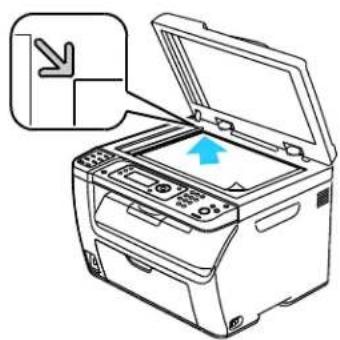
natural_image
Line drawing of a printer with an open lid and control panel, showing no text or symbols.Document Glass
Lift the automatic document feeder or the document glass cover, then place the original face down in the upper left corner of the document glass.

natural_image
Line drawing of a printer with a paperclip and control panel (no text or symbols)Automatic Document Feeder
Insert originals face up with the top of the page entering the feeder first. Adjust the paper guides so they fit against the originals.
Note: For details, see Automatic Document Feeder Guidelines on page 95.
Basic Faxing
This section includes:
- Sending a Fax From the Printer 129
- Sending a Fax From Your Computer....130
Note: Before faxing, you must set the country code and fax number for the printer. For details, see Setting Up the Fax Header on page 56.
Sending a Fax From the Printer
To send a fax from the printer to a single recipient using the default settings:
- Load the original on the document glass or in the automatic document feeder.
- On the printer control panel, press the Fax button.
- At Fax to, press the OK button.
-
To address the fax, press the arrow buttons to select an option:
-
Keypad allows you to enter the fax number manually using the alphanumeric keypad.
- Speed Dial allows you to select a previously programmed speed dial. Use the alphanumeric keypad to enter a three-digit speed dial number.
- Fax Book allows you to select a number from the Fax Address Book. For details, see Faxing to an Individual in the Address Book on page 133.
-
Group Dial allows you to send the fax to numerous recipients. For details, see Faxing to an Address Book Group on page 136.
-
Press OK.
-
To select the fax options you want to change, press the arrow buttons, then press OK. For details, see Selecting Fax Options for Single Jobs on page 137.
- Press the green Start button.
-
If the Another Page? prompt appears, select an option:
-
No completes the scanning process.
• Yes prompts you to place the next page on the document glass. -
Select Continue or Cancel the Action.
-
Press OK.
- The printer scans the pages and transmits the fax.
Note: If monitor reports are set to print, the report shows the fax transmission status. For details, see Printing Monitor Reports on page 140.
See also:
Using the Fax Address Book on page 131
Managing Fax Functions on page 140
Printing Monitor Reports on page 140
Inserting Pauses in Fax Numbers on page 143
WorkCentre 6015 Color Multifunction Printer 129
User Guide
Sending a Fax From Your Computer
This section includes:
- Sending a Fax Using Windows Applications....130
- Sending a Fax Using Macintosh Applications....130
You can send a fax to the printer from an application on your computer.
Sending a Fax Using Windows Applications
You can send a fax from many Windows applications by using the fax driver.
To send a fax from a Windows XP SP1 and later, or Windows Server 2003 and later computer:
- In the application, access the Print dialog box.
- To select your WorkCentre 6015-xxxx Fax printer, click the printer name once, then click Properties or Preferences to open the Fax Properties or Printing Preferences window.
- Select the options for the following:
• Quality
- Paper Size
• Image Orientation
-
Click OK.
-
To open the Recipient Setting window, do one of the following:
• For Windows Vista and Windows 7, click OK.
• For earlier versions of Windows, click Print.
-
Add recipients to the Recipient List. For more information, click the Help button to view the online help.
-
To delay sending the fax, select the Delayed Send check box, then adjust the delay time.
- Click Start Sending to send the fax.
To stop a fax from sending, click the Stop Sending button.
Sending a Fax Using Macintosh Applications
To send a fax from a Macintosh OS X version 10.5 and later computer, download the latest driver from www.xerox.com/office/WC6015drivers.
Using the Fax Book
This section includes:
- Faxing to an Individual....132
- Faxing to a Group 134
You can create and save fax information for individuals or groups. You can select saved names and numbers without re-entering them each time you want to send a fax.
Faxing to an Individual
This section includes:
- Adding an Individual Fax Address Book Entry....132
- Faxing to an Individual in the Address Book....133
You can set up and save individual names and fax numbers to use when you want to send a fax.
Adding an Individual Fax Address Book Entry
You can create individual address book entries using CentreWare Internet Services or the Address Book Editor. Use the book entries when sending faxes from the printer or from your computer.
To add an individual entry using CentreWare Internet Services:
- At your computer, open a Web browser, type the IP address of the printer in the address field, then press Enter or Return.
Note: If you do not know the IP address of your printer, see Finding the IP Address of Your Printer on page 55.
- In CentreWare Internet Services, click Address Book.
- Under Address Book in the left navigation pane, click FAX Address Book.
- In the Directory Listing, click the Add button for an entry that is not in use.
Note: The first eight entries in the Address Book correspond to the eight one-touch buttons on the left side of the printer control panel.
- Type the name, phone number, and email address for the individual.
- Click the Save Changes button to create the address.
The address book is saved in the printer with the entries.
Note: Three-digit speed dial entries are assigned automatically in CentreWare Internet Services.
To add an individual entry using the Address Book Editor:
-
To access the Address Book Editor, do one of the following:
-
For Windows computers, select Start > Programs > Xerox > WorkCentre 6015 > Address Book Editor.
-
For Macintosh computers, open the Applications folder, select Xerox > WorkCentre 6015 > Address Book Editor, then click OK.
-
If an Address Book Editor Select Device window opens, click the link for the WorkCentre 6015 Fax.
- In the left pane, right-click the Fax/Email icon, then select New > New Entry.
The Personal Address dialog box appears. The Address Book Editor automatically assigns the speed dial number to the first empty entry.
132 WorkCentre 6015 Color Multifunction Printer
User Guide
- To assign the speed dial number manually, select the Specify an Address Number check box, then enter a value from 1–200.
Note: The first eight entries in the Address Book correspond to the eight one-touch buttons on the left side of the printer control panel.
- Type the name, phone number, and email address for the individual. To insert a pause, type a hyphen.
- To add this entry to an existing group:
a. Click Group Membership.
b. Select the groups to add this entry to, then click Add.
c. Confirm the group members, then click OK.
-
Click OK.
-
Click the File menu, then select Save All.
The address book is saved in the printer with the entries.
Faxing to an Individual in the Address Book
- On the printer control panel, press the Fax button.
- At Fax to, press the Address Book button.
- At All Entries, press the OK button.
- To scroll through the address book list, press the arrow buttons, then press OK to select the recipient. You can select more than one recipient.
- After selecting the recipients, press OK.
- Press the green Start button. To stop a fax from sending, click the Stop Sending button.
Faxing to a Group
This section includes:
- Creating a Fax Group ....134
• Editing Address Book Fax Groups....135 - Faxing to an Address Book Group ....136
• Searching the Local Phone Book....136
To send a fax to multiple individuals, create a group speed dial entry. Groups can include both previously stored individual and group entries.
Note: Individual entries must be set up before groups can be defined. For details, see Adding an Individual Fax Address Book Entry on page 132.
Creating a Fax Group
You can create group address book entries using CentreWare Internet Services or the Address Book Editor.
To create a fax group using CentreWare Internet Services:
- At your computer, open a Web browser, type the IP address of the printer in the address field, then press Enter or Return.
Note: If you do not know the IP address of your printer, see Finding the IP Address of Your Printer on page 55. - In CentreWare Internet Services, click Address Book.
- Under Address Book in the left navigation pane, click FAX Groups.
- In Directory Listing, click the Add link of any group that is not in use.
- Type a group name, then click the Save Changes button.
- When you see a Request Acknowledged message, click the Return button.
- Click the Edit link for the group you created.
- Select the check boxes of individuals you want to include in the group.
- Click the Additional Entries links at the bottom of the Group Members column to see additional Fax Address Book entries. You can also add existing groups to this group.
- When you have finished selecting group members, click Save Changes.
The address book is saved in the printer with the entries.
134 WorkCentre 6015 Color Multifunction Printer
User Guide
To create a fax group using the Address Book Editor:
-
To access the Address Book Editor, do one of the following:
-
For Windows computers, select Start > Programs > Xerox > WorkCentre 6015 > Address Book Editor.
-
For Macintosh computers, open the Applications folder, select Xerox > WorkCentre 6015 > Address Book Editor, then click OK.
-
In the left pane, right-click the Fax/Email icon, then select New > New Group.
The Group Dial dialog box opens. The Address Book Editor automatically assigns the Group ID to the first empty entry. - To specify the Group ID manually, select the Specify an Address Number check box, then enter a value from 1–6.
- Type a group name in the Group Name field.
- Click the Add or Delete button.
- Select group members from the list on the left side of the screen, then click the Add button to add them to the group. To select multiple group members, press and hold the Ctrl key while making selections.
- When you have finished adding group members, click OK.
- Click OK a second time to create the group.
- Confirm the group members, then click OK to save the group.
- Click the File menu, then select Save All.
The address book is saved in the printer with the entries.
Editing Address Book Fax Groups
You can edit address book entries using CentreWare Internet Services, or use the Address Book Editor to add or delete individuals from the groups.
To edit an existing fax group using CentreWare Internet Services:
- At your computer, open a Web browser, type the IP address of the printer in the address field, then press Enter or Return.
Note: If you do not know the IP address of your printer, see Finding the IP Address of Your Printer on page 55. - In CentreWare Internet Services, click Address Book.
- Under Address Book in the left navigation pane, click FAX Groups.
- In the Directory Listing, click Edit to the right of the group you want to edit.
- Click the Add or Delete button.
- Select the check boxes of the individuals that you want in the group.
- Clear the check boxes of the individuals that you want to remove from the group.
- To see additional Fax Address Book entries, click the Additional Entries links at the bottom of the Group Members column.
- When you have finished editing the group, click Save Changes.
The address book is saved in the printer with the entries.
To edit an existing fax group using the Address Book Editor:
-
To access the Address Book Editor, do one of the following:
-
For Windows computers, select Start > Programs > Xerox > WorkCentre 6015 > Address Book Editor.
-
For Macintosh computers, open the Applications folder, select Xerox > WorkCentre 6015 > Address Book Editor, then click OK.
-
In the left pane, click the Fax icon.
- In the upper right pane, right-click the group you want to edit, then select Edit.
- Click the Group Membership button.
- To add individuals, select entries from the list on the left side of the screen, then click Add.
- To remove individuals, select entries from the list on the right side of the screen, then click Delete.
- Click OK.
- Confirm the group members, then click OK.
- Click the File menu, then select Save all.
The address book is saved in the printer with the entries.
Faxing to an Address Book Group
- On the printer control panel, press the Fax button.
- At Fax to, press the Address Book button.
- To select Group Dial, press the arrow buttons, then press OK.
- To select the group, press the arrow buttons to scroll through the address book list, then press OK. You can select more than one group.
- After selecting the groups, press OK.
- Press the green Start button.
Searching the Local Phone Book
You can search for an individual or group in the local Fax Book by using a partial name.
To search the Fax Book for an individual or group:
- On the printer control panel, press the Fax button.
- At Fax to, press the OK button.
- To select Search Fax Book, press the arrow buttons, then press OK.
- Use the alphanumeric keypad to enter the search text, then press OK. The search is case-sensitive.
- To scroll through the local address book results, press the arrow buttons.
- To select the entry, press OK.
- Press OK.
Selecting Fax Options for Single Jobs
This section includes:
- Setting the Fax Resolution ....137
• Making the Image Lighter or Darker....137 - Turning OnHook On or Off 137
- Sending a Delayed Fax....137
• Including a Fax Cover Page 138 - Setting Up Polling 138
Setting the Fax Resolution
- On the printer control panel, press the Fax button.
- To select Resolution, press the arrow buttons, then press OK.
- Select an option. The default setting is Standard.
- Press OK.
Making the Image Lighter or Darker
- On the printer control panel, press the Fax button.
- To select Lighten/Darken, press the arrow buttons, then press OK.
- To move the slider to lighten or darken the fax, press the arrow buttons. The default setting is Normal.
- Press OK.
Turning OnHook On or Off
When you turn on the OnHook option, the telephone line is ready to dial out when you enter a phone number. You cannot receive incoming faxes while OnHook is turned on.
To turn OnHook on or off:
- On the printer control panel, press the Fax button.
- To select OnHook, press the arrow buttons, then press OK.
- Select Off or On, then press OK.
Sending a Delayed Fax
You can set a time in the future for the printer to send your fax job. The time delay can be from 15 minutes to 24 hours from the current time.
Note: The printer must be set to the current time before you can use this feature.
To send a fax at a specified time:
- On the printer control panel, press the Fax button.
- To select Delayed Start, press the arrow buttons, then press OK.
- Select On, then press OK.
- Select the time to send the fax:
a. To select a number from 0–23 for the hour, press the arrow buttons.
b. To select Minutes, press the Forward or Back Arrow buttons.
c. To select a number from 0–59 for minutes, press the Up or Down Arrow buttons, then press OK.
- Press the green Start button.
The fax is scanned and saved, and sent at the time you specified.
Including a Fax Cover Page
- On the printer control panel, press the Fax button.
- To select Fax Cover Page, press the arrow buttons, then press OK.
- Select On, then press OK.
Setting Up Polling
Fax Polling allows you to store a fax document on the printer and make it available for other fax machines to poll. You can also retrieve faxes stored on other fax machines.
Note: Both printers must have the Fax Polling feature.
To turn on Polling:
- On the printer control panel, press the Fax button.
- To select Polling, press the arrow buttons, then press OK.
- Select On, then press OK.
Configuring the Printer for Faxing
Before you use the fax, you must configure the Fax Settings to make it compatible with your local connection and regulations. The Fax Settings include optional features you can use to configure the printer for faxing.
To configure the printer for faxing:
- On the printer control panel, press the System button.
- To select Admin Menu, press the arrow buttons, then press OK. If prompted, enter the password, then press OK.
- Select Fax Settings, then press OK.
- Change the fax settings as desired.
- Press OK.
For details on the Fax Settings menu items, see Fax Settings on page 30.
Changing the Default Fax Settings
- On the printer control panel, press the System button.
- To select Default Settings, press the arrow buttons, then press OK.
- Select Fax Defaults, then press OK.
- To select the option that you want to modify, press the arrow buttons, then press OK.
- To select the new setting, press the arrow buttons, then press OK.
For details on Fax Default menu items, see Fax Defaults on page 36.
Managing Fax Functions
This section includes:
- Printing Monitor Reports....140
- Printing a Monitor Report for a Group Fax....140
• Turning Secure Fax Receive On or Off 141
• Limiting Access to Faxing 141 - Printing Fax Reports....142
- Inserting Pauses in Fax Numbers....143
Printing Monitor Reports
- On the printer control panel, press the System button.
- To select Admin Menu, press the arrow buttons, then press OK.
- If prompted, enter the password, then press OK.
- Select Fax Settings, then press OK.
-
To select Fax Transmit, press the arrow buttons, then press OK.
-
Select an option:
• Print Always prints a monitor report for every fax. This is the default setting.
• Print on Error prints a monitor report when an error occurs with the fax transmission.
• Print Disabled does not print a monitor report.
7. Press OK.
Printing a Monitor Report for a Group Fax
- On the printer control panel, press the System button.
- To select Admin Menu, press the arrow buttons, then press OK.
- If prompted, enter the password, then press OK.
- Select Fax Settings, then press OK.
- Select Fax Broadcast, then press OK.
- Select an option:
• Print Always prints a monitor report for every fax. This is the default setting. - Print on Error prints a monitor report when an error occurs with the fax transmission.
• Print Disabled does not print a monitor report.
7. Press OK.
Turning Secure Fax Receive On or Off
When the Secure Receive setting is enabled, you must enter a password before faxes can be printed.
To turn Secure Receive Lock on or off:
- On the printer control panel, press the System button.
- To select Admin Menu, press the arrow buttons, then press OK.
- If prompted, enter the password, then press OK.
- Select Secure Settings, then press OK.
- Select Secure Receive, then press OK.
- At Secure Receive Set, press OK.
-
Select Enable or Disable, then press OK.
-
To change your password:
a. Select Change Password, then press OK.
b. Enter the current password, then press OK.
c. Enter a new four-digit password, then press OK. The default password is 0000.
Printing Secure Faxes
When the Secure Receive setting is enabled, you must enter a password before faxes can be printed.
To print all secure faxes:
- On the printer control panel, press the Fax button.
- At Secure Receive, press OK.
When prompted, enter your four-digit password, then press OK.
Limiting Access to Faxing
The Fax Lock options limit access to faxing by requiring a password to use the Fax function. You can also turn off faxing.
To set the Fax Lock:
- On the printer control panel, press the System button.
- To select Admin Menu, press the arrow buttons, then press OK.
- If prompted, enter the password, then press OK.
- Select Secure Settings, then press OK.
- Select Service Lock, then press OK.
-
Select Fax, then press OK.
-
Select an option:
-
Unlocked turns off the service lock.
- Locked turns on the service lock, and turns off the fax function.
-
Password Locked requires a password to use the fax function. Enter a new password, then press OK.
-
Press OK.
Changing the Panel Lock Password
The Panel Lock password limits access to the Admin menu.
- On the printer control panel, press the System button.
- To select Admin Menu, press the arrow buttons, then press OK.
- Enter the current four-digit password, then press OK.
- Select Secure Settings, then press OK.
- At Panel Lock, press OK.
- Select Change Password, then press OK.
- Enter a new four-digit password, then press OK. The default password is 0000.
Limiting Who Can Send Faxes to the Printer
When the Junk Fax Filter setting is On, the printer only receives faxes from phone numbers in the address book.
To turn the Junk Fax Filter on or off:
- On the printer control panel, press the System button.
- To select Admin Menu, press the arrow buttons, then press OK.
- If prompted, enter the password, then press OK.
- Select Fax Settings, then press OK.
- Select Junk Fax Filter, then press OK.
-
Select an option:
-
Off allows anyone to send you a fax.
-
On only receives faxes from phone numbers in the printer address book.
-
Press OK.
Printing Fax Reports
Fax reports provide information about faxing activities, directories, and pending jobs.
To print a fax report:
- On the printer control panel, press the System button.
- At Information Pages, press OK.
- If prompted, enter the password, then press OK.
- To select Fax Activity, press the arrow buttons, then press OK.
- Press OK to print the report.
Inserting Pauses in Fax Numbers
Some fax numbers require one or more pauses during the dialing sequence.
To insert pauses in a fax number:
- On the printer control panel, press the Fax button.
- Select Fax To, then press OK.
- To select Keypad, press the arrow buttons, then press OK.
- Use the alphanumeric keypad to enter the fax number.
If necessary, press the Redial/Pause button to insert a pause, represented by a hyphen. Press the Redial/Pause button multiple times to add additional pauses. - Press the green Start button.
Maintenance
8
This chapter includes:
- Cleaning the Printer 146
• Adjustments and Maintenance Procedures....157 - Ordering Supplies....160
• Managing the Printer 163 - Moving the Printer 164
Cleaning the Printer
This section includes:
• General Precautions....146
- Cleaning the Scanner ....147
• Cleaning the Exterior 149
- Cleaning the Interior ....149
General Precautions

CAUTION: When cleaning your printer do not use organic or strong chemical solvents or aerosol cleaners. Do not pour fluids directly into any area. Use supplies and cleaning materials only as directed in this documentation.

WARNING: Keep all cleaning materials out of the reach of children.

WARNING: Do not use pressurized spray cleaning aids on or in the printer. Some pressurized sprays contain explosive mixtures and are not suitable for use in electrical applications. Use of such cleaners increase the risk of fire and explosion.

WARNING: Do not remove the covers or guards that are fastened with screws. You cannot maintain or service any parts that are behind these covers and guards. Do not attempt any maintenance procedure that is not described in the documentation supplied with your printer.

WARNING: Internal parts of the printer can be hot. Use caution when doors and covers are open.
- Do not place anything on top of the printer.
- Do not leave the covers and doors open for any length of time, especially in well-lit places. Light exposure can damage the imaging units.
- Do not open covers and doors during printing.
- Do not tilt the printer while it is in use.
- Do not touch the electrical contacts or gears. Doing so could damage the printer and cause the print quality to deteriorate.
- Ensure any parts removed during cleaning are replaced before you plug in the printer.
Cleaning the Scanner
- Slightly dampen a soft, lint-free cloth with water.
- Lift and open the scanner.

natural_image
Illustration of a printer with a blue arrow pointing to the cover (no text or symbols present)- Remove any paper or other media from the output tray.

natural_image
Technical line drawing of a printer or printer with internal components and a blue arrow indicating a flow or movement (no text or symbols present)- Wipe the area under the scanner until it is clean.
- Lower the scanner and close it.
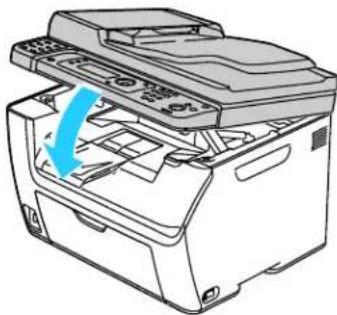
natural_image
Diagram of a printer with a blue arrow indicating a process or operation, no text or symbols presentMaintenance
- Open the document cover.
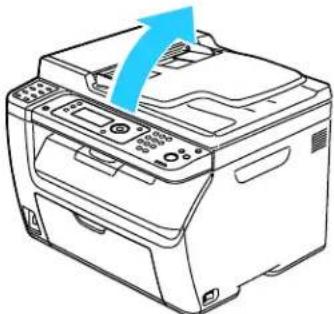
natural_image
Line drawing of a printer with an arrow indicating compression or shift (no text or symbols present)- Wipe the surface of the document glass until it is clean and dry.
Note: For best results, use Xerox ^® Glass Cleaner to remove marks and streaks.
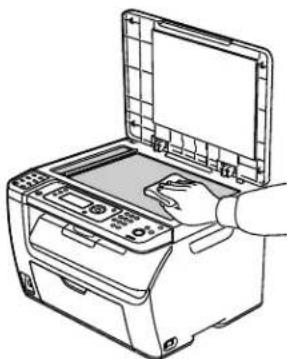
natural_image
Line drawing of a hand operating a printer with an open lid (no text or symbols)- Wipe the white underside of the document cover until it is clean and dry.
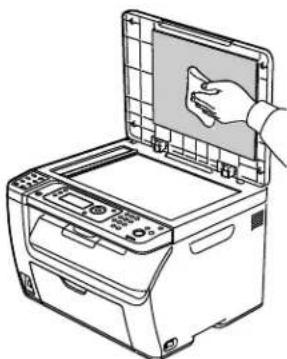
natural_image
Line drawing of a printer with a hand inserting a component into the cover (no text or symbols)148 WorkCentre 6015 Color Multifunction Printer User Guide
- Close the document cover.
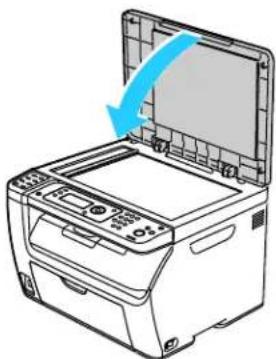
natural_image
Illustration of a printer with an open lid and a blue arrow indicating the process (no text or symbols present)Cleaning the Exterior
Clean the exterior of the printer once a month.
- Wipe the paper tray, output tray, control panel, and other parts with a damp, soft cloth.
• After cleaning, wipe with a dry, soft cloth. - For stubborn stains, apply a small amount of mild detergent to the cloth and gently wipe the stain off.

CAUTION: Do not spray detergent directly on the printer. Liquid detergent could enter the printer through a gap and cause problems. Never use cleaning agents other than water or mild detergent.
Cleaning the Interior
After clearing paper jams or replacing a toner cartridge, inspect the inside of the printer before closing the printer covers.
- Remove any remaining pieces of paper or debris. For details, see Clearing Paper Jams on page 173.
- Remove any dust or stains with a dry, clean cloth.

WARNING: Never touch a labeled area on or near the heat roller in the fuser. You can get burned. If a sheet of paper is wrapped around the heat roller, do not try to remove it immediately. Switch off the printer immediately and wait 20 minutes for the fuser to cool. Try to remove the jam after the printer has cooled.
Maintenance
Cleaning Inside the Printer
- Turn off the printer.
- Open the side door.
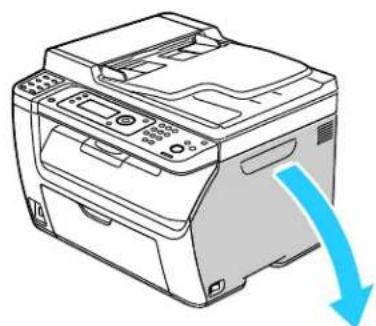
natural_image
Line drawing of a printer with a blue arrow indicating compression or disassembly (no text or symbols present)- Pinch the release tab on the toner cartridge as shown.
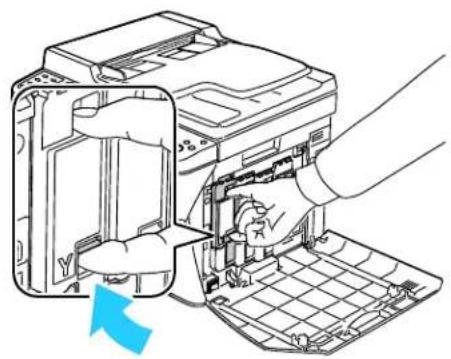
natural_image
Line drawing of a printer's internal structure showing paper feeding into a grid (no text or symbols)- Pull out the toner cartridge.
Note: To avoid spilling toner, pull out the toner cartridge slowly.
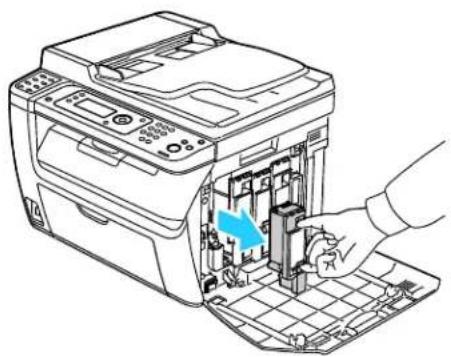
natural_image
Line drawing of a printer with a hand inserting a component into the main chamber (no text or symbols visible)150 WorkCentre 6015 Color Multifunction Printer User Guide
-
Remove the remaining toner cartridges in the same manner.
-
Pull out the cleaning rod.
Note: To remove toner and debris from the top of the cleaning rod, wipe it with a clean lint-free cloth.
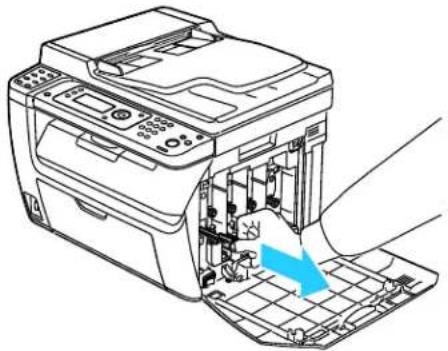
natural_image
Line drawing of a printer with a blue arrow indicating a process or operation, showing internal components and no text or symbols.- Insert the cleaning rod into the hole indicated by the arrow in the middle of the toner cartridge slot. Push in the cleaning rod until it stops, then pull it out.
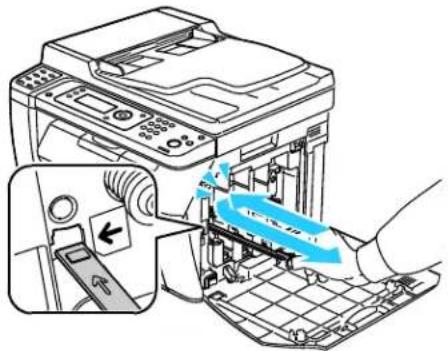
text_image
Diagram showing printer press operation with blue arrow indicating motion direction and control panel-
Repeat the procedure for the holes in the other three slots.
-
Return the cleaning rod to its original location.
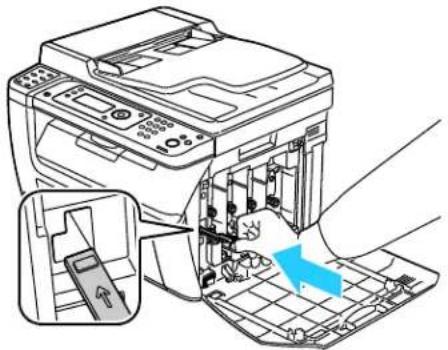
natural_image
Line drawing of a printer with paper feed being inserted, showing internal components and a blue arrow indicating the process (no text or symbols present)Maintenance
- Align the black toner cartridge with the rear toner slot. Press firmly near the center of the cartridge until it clicks into place.
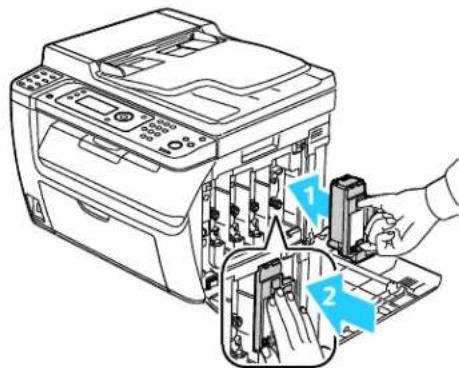
text_image
Diagram showing printer operation with labeled parts and hand pointing to a printer's internal structure-
Replace the remaining three toner cartridges in the same manner.
-
Close the side door.
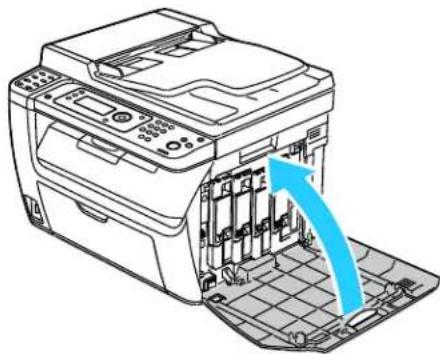
natural_image
Line drawing of a printer with an open base and a blue arrow indicating the process (no text or symbols present)152 WorkCentre 6015 Color Multifunction Printer User Guide
Cleaning the LED Lenses
If prints have voids or light streaks through one or more color, use the following instructions to clean the Light Emitting Diode (LED) lenses.

WARNING: If you accidentally get toner on your clothes, lightly dust them off as best as you can. If some toner remains on your clothes, use cool water, not hot, to rinse off the toner. If toner gets on your skin, wash it off with cool water and a mild soap. If you get toner in your eyes, wash it out immediately with cool water and consult a doctor.
- Turn off the printer.
- Open the side door.

natural_image
Line drawing of a printer with a blue arrow indicating compression or disassembly (no text or symbols present)- Pinch the release tab on the toner cartridge as shown.
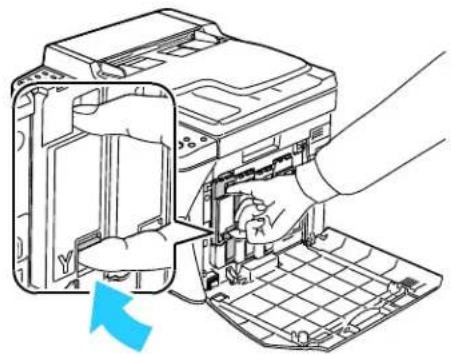
natural_image
Diagram of a printer's internal structure showing paper feeding into a grid-patterned base, with no visible text or symbols.- Pull out the toner cartridge.
Note: To avoid spilling toner, pull out the toner cartridge slowly.
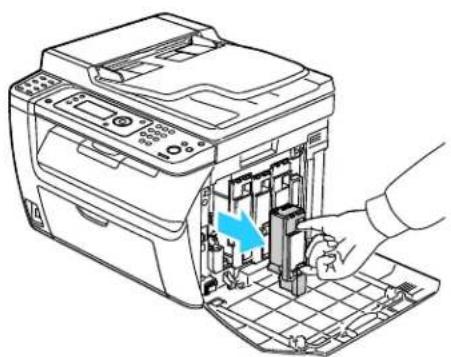
natural_image
Line drawing of a printer with a hand inserting a component into the main frame (no text or symbols visible)WorkCentre 6015 Color Multifunction Printer 153 User Guide
Maintenance
-
Remove the remaining toner cartridges in the same manner.
-
Pull out the cleaning rod.
Note: To remove toner and debris from the top of the cleaning rod, wipe it with a clean lint-free cloth.

natural_image
Line drawing of a printer with a blue arrow indicating a process or operation, showing internal components without any text or symbols.- Insert the cleaning rod into the hole indicated by the arrow in the middle of the toner cartridge slot. Push in the cleaning rod until it stops, then pull it out.
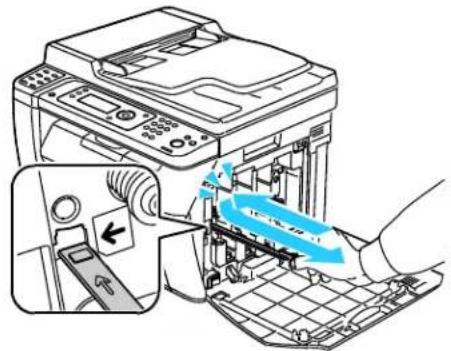
text_image
Diagram showing printer press operation with blue arrow indicating action and control panel, labeled in English-
Repeat the procedure for the holes in the other three slots.
-
Return the cleaning rod to its original location.
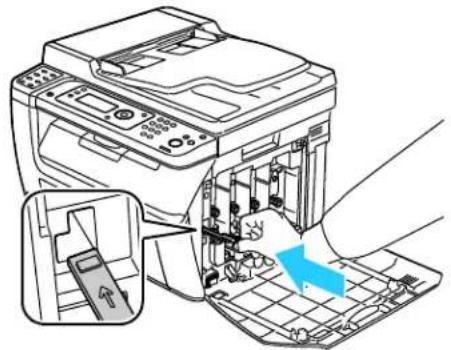
natural_image
Line drawing of a printer with a blue arrow indicating a process or operation, showing internal components and a close-up view (no text or symbols)154 WorkCentre 6015 Color Multifunction Printer User Guide
- Align the black toner cartridge with the rear toner slot. Press firmly near the center of the cartridge until it clicks into place.
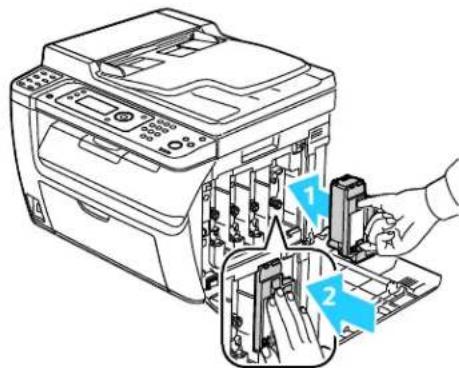
text_image
Diagram showing printer operation with labeled parts, including a hand inserting a component into a printer's internal structure.-
Replace the remaining three toner cartridges in the same manner.
-
Close the side door.

natural_image
Line drawing of a printer with an open base and a blue arrow indicating the process (no text or symbols present)Cleaning the Color Toner Density Sensors
Note: Clean the color toner density (CTD) sensors when an alert for the CTD sensors appears on the control panel or in PrintingScout Printer Status window.
-
Turn off the printer.
-
Push down the rear cover release lever and pull open the cover.

natural_image
Diagram of a printer with blue arrows indicating process flow (no text or symbols)Maintenance
- Use a dry cotton swab to clean the color toner density sensors.

natural_image
Line drawing of a printer with internal components and an inset view showing internal structure (no text or symbols)- Close the rear cover.

natural_image
Diagram of a printer with an open circuit board and blue arrow indicating a process (no text or symbols present)Adjustments and Maintenance Procedures
This section includes:
• Color Registration 157
- Adjusting Paper Type 158
- Adjusting the Bias Transfer Roller ....158
- Adjusting the Fuser ....158
- Refreshing the Bias Transfer Roller ....159
- Adjusting the Altitude....159
Color Registration
The printer automatically adjusts the color registration when automatic adjustment is turned on. You can also adjust color registration manually any time the printer is idle. You must adjust the color registration any time the printer is moved. If you are having printing problems, adjust the color registration.
Setting Automatic Color Registration
- On the printer control panel, press the System button.
- To select Admin Menu, press the arrow buttons, then press OK.
- Select Maintenance, then press OK.
- Select Auto Regi Adjust, then press OK.
- Select On, then press OK.
- To return to the Ready screen, press Return.
Performing an Automatic Color Registration Adjustment
Automatic color registration adjustment occurs every time a new toner cartridge is installed. You can run this adjustment at other times as needed.
To perform an automatic color registration adjustment:
- On the printer control panel, press the System button.
- To select Admin Menu, press the arrow buttons, then press OK.
- Select Maintenance, then press OK.
- Select Adjust Color Regi, then press OK.
- At Auto Adjust, press OK.
- At the Are you sure? prompt, press the arrow buttons to select Yes.
- To begin the calibration, press OK.
Adjusting Paper Type
Use Adjust Paper Type to compensate for paper thickness within a paper type. If the printed image is too light, use a heavier setting for the paper you are using. If the printed image is mottled or blotchy-looking, decrease the setting for the paper you are using.
To adjust the paper type:
- On the printer control panel, press the System button.
- To select Admin Menu, press the arrow buttons, then press OK.
- Select Maintenance, then press OK.
- Select Adjust Paper Type, then press OK.
- Select Plain or Label, then press OK.
- Select Lightweight or Heavyweight, then press OK.
- To return to the Ready screen, press Return.
Adjusting the Bias Transfer Roller
Use Adjust BTR to specify the bias transfer roller (BTR) voltage for printing on the selected paper type. If the printed image is too light, increase the offset for the paper you are using. If the printed image is mottled or blotchy-looking, decrease the offset for the paper you are using.
To adjust the bias transfer roller:
- On the printer control panel, press the System button.
- To select Admin Menu, press the arrow buttons, then press OK.
- Select Maintenance, then press OK.
- Select Adjust BTR, then press OK.
- Press the arrow buttons to select the paper type for the adjustment, then press OK.
- Press the arrow buttons to increase or decrease the amount of offset, then press OK.
- Repeat this procedure for each paper type you need to adjust.
- To return to the Ready screen, press Return.
Adjusting the Fuser
Use Adjust Fuser for optimum print quality across a wide range of paper types. If the toner on a print is smearing or can be rubbed off the paper, increase the offset for the paper you are using. If the toner is blistered or mottled, decrease the offset for the paper you are using.
To adjust the fuser:
- On the printer control panel, press the System button.
- To select Admin Menu, press the arrow buttons, then press OK.
- Select Maintenance, then press OK.
- Select Adjust Fuser, then press OK.
- Press the arrow buttons to select the paper type for the adjustment, then press OK.
- Press the arrow buttons to increase or decrease the amount of offset, then press OK.
- Repeat this procedure for each paper type you need to adjust.
- To return to the Ready screen, press Return.
Refreshing the Bias Transfer Roller
Use the BTR Refresh procedure to reduce paper curling and improve paper discharge.
To refresh the bias transfer roller:
- On the printer control panel, press the System button.
- To select Admin Menu, press the arrow buttons, then press OK.
- Select Maintenance, then press OK.
- Select BTR Refresh, then press OK.
- Select On, then press OK.
- To return to the Ready screen, press Return.
Adjusting the Altitude
Use Adjust Altitude to adjust the altitude to match that of the location where the printer is installed. If the altitude setting is incorrect, it can cause print-quality problems.
To adjust the altitude:
- On the printer control panel, press the System button.
- To select Admin Menu, press the arrow buttons, then press OK.
- Select Maintenance, then press OK.
- Select Adjust Altitude, then press OK.
- Press the arrow buttons to select the altitude of the location of the printer, then press OK.
- To return to the Ready screen, press Return.
Ordering Supplies
This section includes:
Consumables 160
- When to Order Supplies....160
- Toner Cartridges....161
• Recycling Supplies....162
Consumables
Consumables are printer supplies that get depleted during the operation of the printer. Consumable supplies for this printer are the Genuine Xerox ^® Toner Cartridges in Cyan, Magenta, Yellow, and Black.
Notes:
• Each consumable includes installation instructions.
• Install only new cartridges in your printer. If a used toner cartridge is installed, then the toner remaining amount displayed could be inaccurate.
- To ensure print quality, the toner cartridge has been designed to cease functioning at a predetermined point.

CAUTION: Use of toner other than genuine Xerox ^® Toner can affect print quality and printer reliability. Xerox ^® Toner is the only toner designed and manufactured under strict quality controls by Xerox for specific use with this printer.
When to Order Supplies
A warning appears on the control panel when supplies near their replacement time. Verify that you have replacements on hand. It is important to order these items when the messages first appear to avoid interruptions to your printing. An error message appears on the control panel when supplies must be replaced.
Order supplies from your local reseller or go to www.xerox.com/office/WC6015supplies.

CAUTION: Use of non-Xerox ^® supplies is not recommended. The Xerox ^® Warranty, Service Agreement, and Total Satisfaction Guarantee do not cover damage, malfunction, or degradation of performance caused by use of non-Xerox ^® supplies, or the use of Xerox ^® supplies not specified for this printer. The Total Satisfaction Guarantee is available in the United States and Canada. Coverage could vary outside these areas. Please contact your Xerox representative for details.
Toner Cartridges
This section includes:
- General Precautions....161
• Replacing a Toner Cartridge....161 - Refreshing the Toner ....162
• Cleaning the Developer 162
General Precautions

WARNINGS:
- When replacing a toner cartridge, be careful not to spill the toner. If any toner spills, avoid contact with clothes, skin, eyes, and mouth. Do not inhale the toner dust.
- Keep toner cartridges out of the reach of children. If a child accidentally swallows toner, have the child spit out the toner, and rinse out their mouth with water. Consult a physician immediately.

WARNING: Use a damp cloth to wipe off spilled toner. Never use a vacuum cleaner to remove spills. Electric sparks inside the vacuum cleaner can cause a fire or explosion. If you spill a large volume of toner, contact your local Xerox representative.

WARNING: Never throw a toner cartridge into an open flame. Remaining toner in the cartridge can catch fire and cause burn injuries or an explosion.
Replacing a Toner Cartridge
When a toner cartridge reaches its usable life span, the control panel displays a message. PrintingScout displays the toner status in the Printer Status window. When a toner cartridge is empty, the printer stops and displays messages on the control panel and in the PrintingScout Printer Status window.
Install only new cartridges in your printer. If a used toner cartridge is installed, then the toner remaining amount displayed could be inaccurate.
Note: Each toner cartridge includes installation instructions.
| Printer Status Message | Cause and Solution |
| Printer Toner Cartridge is Close to Life. | The toner cartridge is low. Order a new toner cartridge. |
| Replace the toner cartridge or check that the toner cartridge is properly seated. | The toner cartridge is empty. Replace the toner cartridge with a new one. |
Refreshing the Toner
Use Toner Refresh to use the last of the toner in a cartridge before you replace it, or to stir toner in a new cartridge.
To refresh the toner:
- On the printer control panel, press the System button.
- To select Admin Menu, press the arrow buttons, then press OK.
- Select Maintenance, then press OK.
- Select Toner Refresh, then press OK.
- To select the toner to refresh, press the arrow buttons, then press OK.
- Select Yes, then press OK.
The process runs automatically. Wait three minutes for the process to complete and the printer to return to Ready.
Note: Do not use this procedure repeatedly for a single toner color. Running the procedure repeatedly uses the toner supply more quickly.
Cleaning the Developer
Clean Developer runs the developer motor and stirs the toner in the toner cartridge. Use Clean Developer to clean toner from a cartridge just before changing it or to refresh the toner after replacing a toner cartridge.
To clean the developers:
- On the printer control panel, press the System button.
- To select Admin Menu, press the arrow buttons, then press OK.
- Select Maintenance, then press OK.
- Select Clean Developers, then press OK.
- Select Yes, then press OK.
The process runs automatically. Wait three minutes for the process to complete and the printer to return to Ready.
Recycling Supplies
For more information on the Xerox ^® supplies recycling program, go to: www.xerox.com/gwa.
Managing the Printer
This section includes:
- Checking Page Counts....163
- Changing the Panel Lock Password....163
Checking Page Counts
You can check the total number of printed pages on the System Settings page. It lists the print volume by the total number of pages printed on each paper size.
Use Billing Meters to view impression count details for the printer. The current counts for color, black and white, and combined total impressions appear on the Billing Meters screen. The impression counts shown are used for billing. A page is one side of a sheet of paper that can be printed on one or two sides. A sheet printed on two sides counts as two impressions.
Printing the System Settings Page
- On the printer control panel, press the System button.
- At Information Pages, press OK.
- Select System Settings using the arrow buttons.
- Press OK.
Viewing the Billing Meters
- On the printer control panel, press the System button.
- Press the arrow buttons to select Billing Meters.
- Press OK.
Changing the Panel Lock Password
The Panel Lock password limits access to the Admin menu.
- On the printer control panel, press the System button.
- To select Admin Menu, press the arrow buttons, then press OK.
- Enter the current four-digit password, then press OK.
- Select Secure Settings, then press OK.
- At Panel Lock, press OK.
- Select Change Password, then press OK.
- Enter a new four-digit password, then press OK. The default password is 0000.
WorkCentre 6015 Color Multifunction Printer 163
User Guide
Moving the Printer
Follow these instructions when moving the printer:
- Turn off the printer and disconnect the power cord and other cables from the back of the printer.
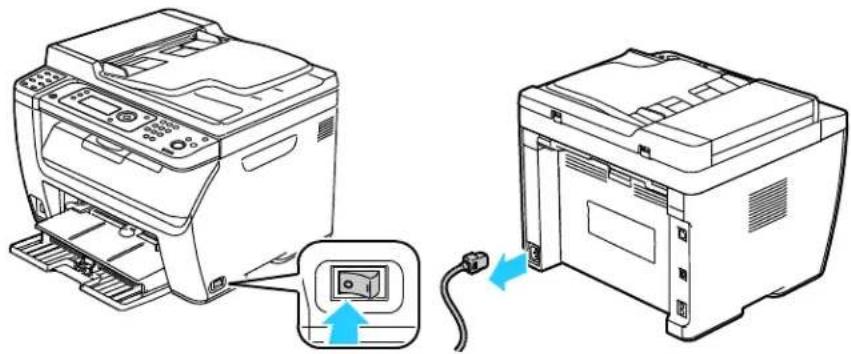
natural_image
Line drawing of a printer and its internal card device connected to a paper holder (no text or symbols present)
WARNING: To prevent electric shock, never touch the power plug with wet hands. When removing the power cord, ensure that you pull the plug and not the cord. Pulling the cord can damage it, which can lead to fire or electric shock.
- Remove any paper or other media from the output tray. If the output tray extension is extended, close it.
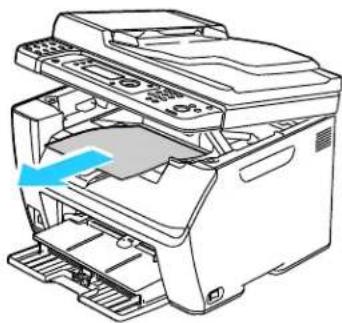
natural_image
Diagram of a printer with internal components and a blue arrow indicating a specific part (no text or symbols present)- Remove the paper from the paper tray.
Keep the paper wrapped and away from humidity and dirt.
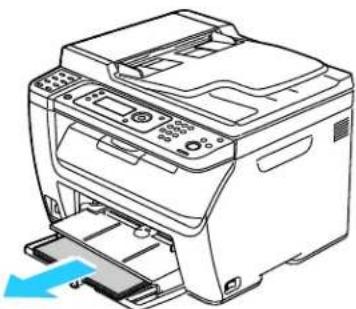
natural_image
Line drawing of a printer with a blue arrow indicating compression or disassembly (no text or symbols present)164 WorkCentre 6015 Color Multifunction Printer User Guide
- Lift the bypass tray and push it into the printer.
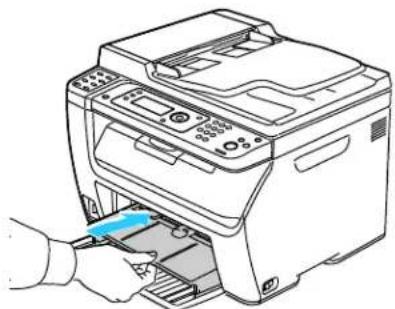
natural_image
Illustration of a printer being inserted into a paper holder (no text or symbols visible)- Push in the length guides and slide bar until they stop.
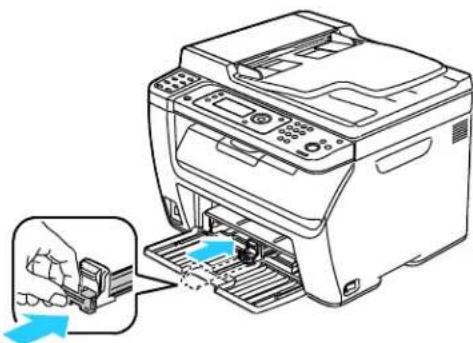
natural_image
Illustration of a printer with a hand inserting a component into the print (no text or symbols visible)- Fold up the main tray to cover the paper feed.
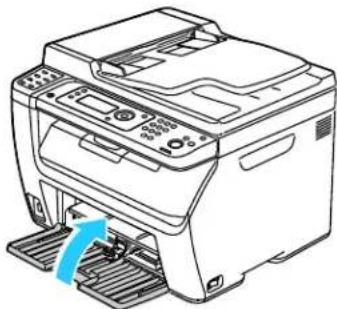
natural_image
Line drawing of a printer with a blue arrow indicating the press operation (no text or symbols present)- Lift and carry the printer as shown in the illustration.
Note: To find the weight for your printer configuration, see Physical Specifications on page 191.
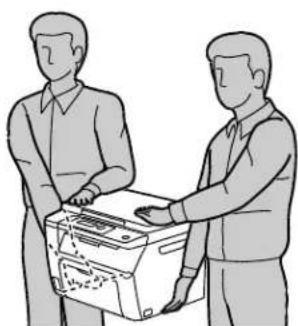
natural_image
Two men exchanging a printer or scanner device (no text or symbols visible)WorkCentre 6015 Color Multifunction Printer 165
User Guide

CAUTION: Failure to repackage the printer properly for shipment can result in damage not covered by the Xerox® Warranty, Service Agreement, or Total Satisfaction Guarantee. The Xerox® Warranty, Service Agreement, or Total Satisfaction Guarantee do not cover damage to the printer caused by improper moving.
When moving the printer, do not tilt it more than 10 degrees to the front, back, left, or right. Tilting the printer more than 10 degrees can cause toner spillage.
After moving the printer:
- Reinstall any parts you removed.
- Reconnect the printer to the cables and power cord.
- Plug in and turn on the printer.
Troubleshooting
9
This chapter includes:
- General Troubleshooting....168
Paper Jams....171
• Getting Help....187
General Troubleshooting
This section includes:
• Printer Does Not Turn On....168
• Printer Resets or Turns Off Frequently....168
• The Printer Does Not Print....169
• Printer is Making Unusual Noises....169
• Condensation has Formed Inside the Printer....170
This section contains procedures to help you locate and resolve problems. Resolve some problems by simply restarting the printer.
Printer Does Not Turn On
| Probable Causes | Solutions |
| The power switch is not turned on. | Turn on the switch. |
| The power cord is not correctly plugged into the outlet. | Turn off the printer power switch, and plug the power cord securely into the outlet. |
| Something is wrong with the outlet connected to the printer. | Plug another electrical appliance into the outlet and see if it operates properly.Try a different outlet. |
| The printer is connected to an outlet with a voltage or frequency that does not match the printer specifications. | Use a power source with the specifications listed in the Electrical Specifications on page 194. |

CAUTION: Plug the three-wire cord with grounding prong directly into a grounded AC outlet.
Printer Resets or Turns Off Frequently
| Probable Causes | Solutions |
| The power cord is not plugged into the outlet correctly. | Turn off the printer, confirm that the power cord is plugged in correctly to the printer and the outlet, then turn on the printer. |
| A system error occurred. | Turn off the printer, then turn it on again. Print the Error History from the Information Pages of the Printer Setting Utility. If the error persists, contact your Xerox representative. |
| The printer is connected to an uninterruptible power supply. | Turn off the printer, then connect the power cord to a suitable outlet. |
| The printer is connected to a power strip shared with other high-power devices. | Plug the printer directly into the outlet or into a power strip that is not shared with other high-power devices. |
The Printer Does Not Print
| Probable Causes | Solutions |
| The printer is in Energy Saver mode. | Push the control panel button. |
| PrintingScout displays an error message. | Follow the instructions in the PrintingScout message to correct the problem. If the error persists, contact your Xerox representative. |
| The printer is out of paper. | Load paper into the tray. |
| A toner cartridge is empty. | Replace the empty toner cartridge. |
| The Error Indicator is blinking. | If the Ready Indicator is off, the printer has stopped working. Turn off the printer, then turn it on again. If the error persists, contact your Xerox representative. |
| Both control panel indicators are off. | Turn off the printer, confirm that the power cord is plugged in correctly to the printer and the outlet, then turn on the printer. If the error persists, contact your Xerox representative. |
| The printer is busy. | ·If the Ready Indicator is flashing, it is normal. A previous print job could be the problem. Use PrintingScout to delete all print jobs in the print queue.Load the paper in the tray.·If the Ready Indicator is not flashing after you send a print job, check the USB connection between the printer and the computer. Turn off the printer, then turn it on again. |
| The printer cable is disconnected. | ·If the Ready Indicator is not flashing after you send a print job, check the USB connection between the printer and the computer.·For the WorkCentre 6015N/NI Color Multifunction Printer: If the Ready Indicator is not flashing after you send a print job, check the Ethernet connection between the printer and the computer. |
Printer is Making Unusual Noises
| Probable Causes | Solutions |
| There is an obstruction or debris inside the printer. | Turn off the printer and remove the obstruction or debris. If you cannot remove it, contact your Xerox representative. |
Condensation has Formed Inside the Printer
Moisture can condense inside a printer where the humidity is above 85% or when a cold printer is located in a warm room. Condensation can form in a printer after it has been sitting in a cold room that is heated quickly.
| Probable Causes | Solutions |
| The printer has been sitting in a cold room. | Allow the printer to operate for several hours at room temperature. |
| The relative humidity of the room is too high. | Reduce the humidity in the room.Move the printer to a location where the temperature and relative humidity are within the operating specifications. |
Paper Jams
This section includes:
- Minimizing Paper Jams....171
- Locating Paper Jams....172
- Clearing Paper Jams....173
- Troubleshooting Paper Jams 179
• Print-Quality Problems ....181
Minimizing Paper Jams
The printer is designed to function with minimal paper jams using Xerox ^® supported paper. Other paper types can cause jams. If supported paper is jamming frequently in one area, clean that area of the paper path.
The following can cause paper jams:
- Selecting the incorrect paper type in the print driver.
• Using damaged paper.
• Using unsupported paper. - Loading paper incorrectly.
• Overfilling the tray. - Adjusting the paper guides improperly.
Most jams can be prevented by following a simple set of rules:
• Use only supported paper. For details, see Supported Paper on page 72.
- Follow proper paper handling and loading techniques.
• Always use clean, undamaged paper.
- Avoid paper that is curled, torn, moist, creased, or folded.
• To separate the sheets before loading into the tray, fan the paper.
- Observe the paper tray fill line; never overfill the tray.
- Adjust the paper guides in all trays after inserting the paper. A guide that is not properly adjusted can cause poor print quality, misfeeds, skewed prints, and printer damage.
• After loading the trays, select the correct paper type and size on the control panel.
- When printing, select the correct type and size in the print driver.
- Store paper in a dry location.
- Use only Xerox ^ paper and transparencies designed for the printer.
Troubleshooting
Avoid the following:
• Polyester coated paper that is specially designed for inkjet printers.
• Paper that is folded, wrinkled, or excessively curled.
- Loading more than one type, size, or weight of paper in a tray at the same time.
• Overfilling the trays.
- Allowing the output tray to overfill.
For a detailed list of supported paper, go to www.xerox.com/paper.
Locating Paper Jams

WARNING: Never touch a labeled area on or near the heat roller in the fuser. You can get burned. If a sheet of paper is wrapped around the heat roller, do not try to remove it immediately. Switch off the printer immediately and wait 20 minutes for the fuser to cool. Try to remove the jam after the printer has cooled. If the error persists, contact your Xerox representative.

CAUTION: Do not attempt to clear any paper jams using tools or instruments. This can permanently damage the printer.
The following illustration shows where paper jams can occur along the paper path:
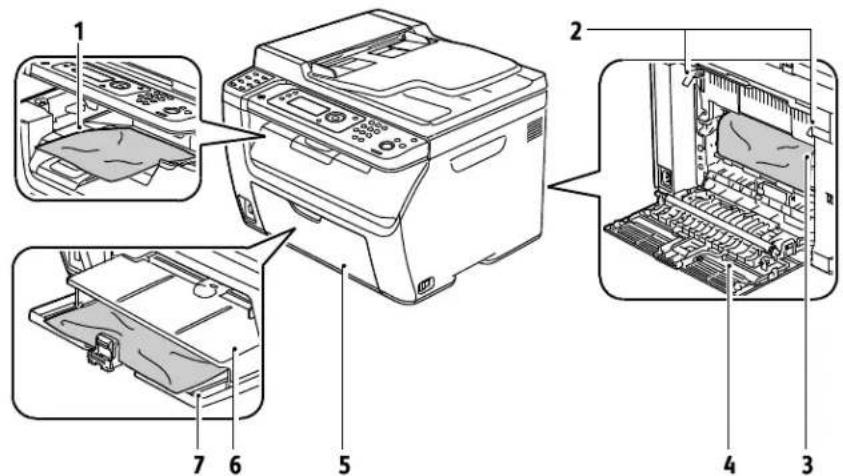
text_image
Technical diagram of a printer with numbered parts for identification and assembly reference.- Output Tray
- Release Levers
- Transfer Belt
- Rear Cover
- Front Cover
- Bypass Tray
- Main Tray
172 WorkCentre 6015 Color Multifunction Printer User Guide
Clearing Paper Jams
This section includes:
- Clearing Paper Jams From the Front of the Printer 173
- Clearing Paper Jams From the Back of the Printer....174
- Clearing Paper Jams From the Output Tray ....176
Clearing Paper Jams From the Front of the Printer
Note: To resolve the error displayed on the control panel you must clear all paper from the paper path.
- Remove any paper from the bypass tray.
- Remove the bypass tray.
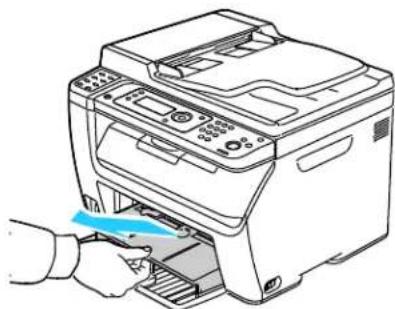
natural_image
Illustration of a hand inserting a printer into a paper airplane (no text or symbols visible)- Remove any paper jammed at the front of the printer.

natural_image
Line drawing of a printer with a blue arrow indicating print direction (no text or symbols present)Troubleshooting
- Place the bypass tray on the main tray, then align the tabs with the marks.

natural_image
Illustration of a printer being inserted into a rack, with a blue arrow indicating the process (no text or symbols present)- Follow the instructions on the control panel display and in the Printer Status window of PrintingScout. Press OK.
Clearing Paper Jams From the Back of the Printer
Note: To resolve the error displayed on the control panel you must clear all paper from the paper path.
- Push down on the rear cover release and pull the cover open.
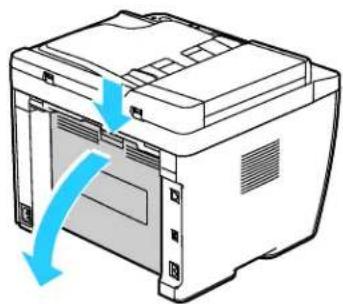
natural_image
Diagram of a computer printer with blue arrows indicating rotation or movement (no text or symbols)- Lift the levers as shown.

natural_image
Diagram of a printer with internal circuitry and a hand inserting a cable into it (no text or symbols present)174 WorkCentre 6015 Color Multifunction Printer User Guide
- Remove any jammed paper from the back of the printer.
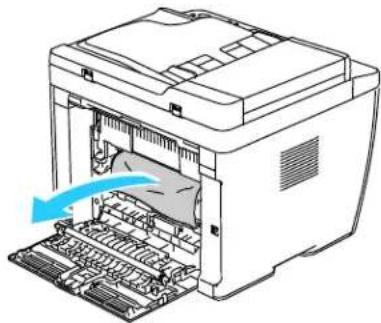
natural_image
Illustration of a printer with a blue arrow indicating a process or operation, showing internal components without any text or symbols.- Lower the levers to their original position.
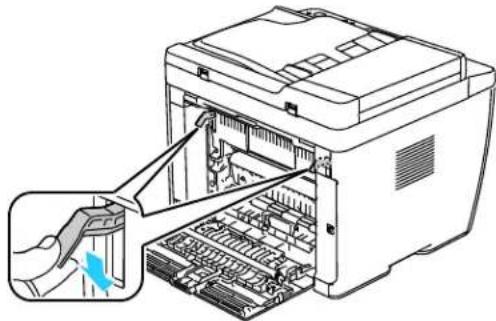
natural_image
Diagram of a printer with an open circuit board and a hand inserting a cable into it (no text or symbols present)- Close the rear cover.
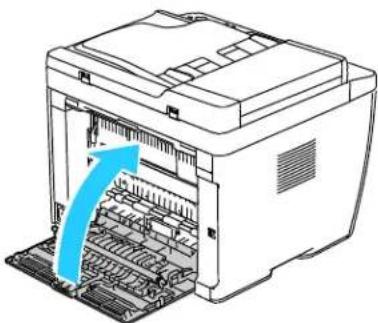
natural_image
Diagram of a printer with an open circuit board and blue arrow indicating a process (no text or symbols present)- Follow the instructions on the control panel display and in the Printer Status window of PrintingScout. Press OK.
Troubleshooting
Clearing Paper Jams From the Output Tray
Note: To resolve the error displayed on the control panel you must clear all paper from the paper path.
- Push down on the rear cover release and pull the cover open.

natural_image
Diagram of a printer with blue arrows indicating motion or transformation (no text or symbols)- Lift the levers as shown.
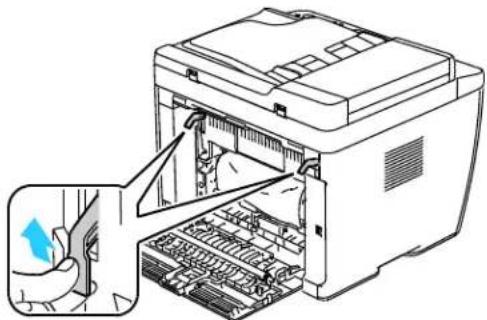
natural_image
Diagram of a printer's internal structure showing internal components and a close-up of the printer's handle (no text or symbols present)- Remove any jammed paper from the back of the printer.
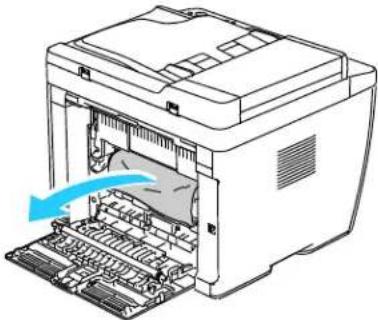
natural_image
Diagram of a printer with an open circuit board and a blue arrow indicating the process (no text or symbols present)176 WorkCentre 6015 Color Multifunction Printer User Guide
- Lift and open the scanner.

natural_image
Illustration of a printer with a blue arrow indicating the process (no text or symbols present)- Remove any paper or other media from the output tray.
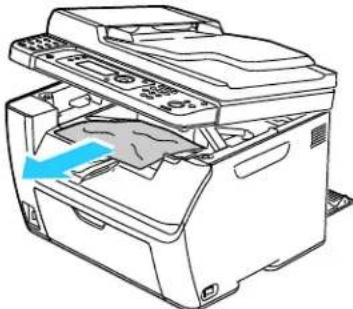
natural_image
Line drawing of a printer with a blue arrow indicating a component (no text or symbols present)- Lower the scanner and close it.
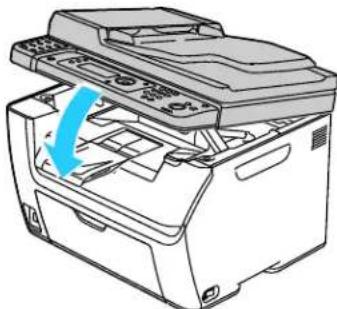
natural_image
Diagram of a printer with a blue arrow indicating a component or operation, no text or symbols present.- Lower the levers to their original position.
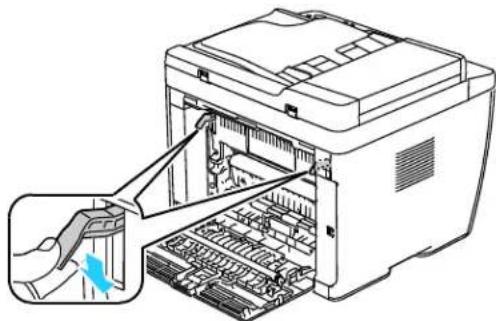
natural_image
Diagram of a printer's internal structure showing paper feeding into a slot (no text or symbols present)Troubleshooting
- Close the rear cover.
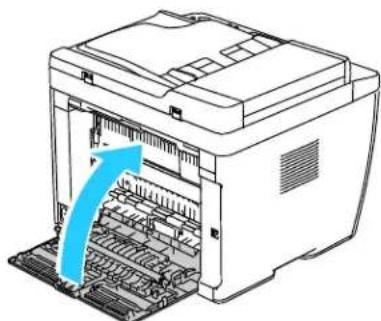
natural_image
Illustration of a printer with a blue arrow indicating the process, showing internal structure without any text or symbols.- Follow the instructions on the control panel display and in the Printer Status window of PrintingScout. Press OK.
Troubleshooting Paper Jams
This section includes:
• Multiple Sheets Pulled Together 179
• Paper Misfeeds....179
- Label and Envelope Misfeeds....180
• Paper Jam Message Stays On....180
Multiple Sheets Pulled Together
| Probable Causes | Solutions |
| The paper tray is too full. | Remove some of the paper. Do not load paper past fill line. |
| The edges of the paper are not even. | Remove the paper, align the edges, and then reload it. |
| The paper is moist from humidity. | Remove the paper from the tray, and replace it with new dry paper. |
| Too much static electricity is present. | Try a new ream of paper.Do not fan transparencies before loading in tray. |
| Using unsupported paper. | Use only Xerox®-approved paper. For details, see Supported Paper on page 72. |
| Humidity is too high for coated paper. | Feed paper one sheet at a time. |
Paper Misfeeds
| Probable Causes | Solutions |
| The paper is not correctly positioned in the tray. | Remove the misfed paper and reposition it properly in the tray.Adjust the paper guides in the tray to match the size of the paper. |
| The paper tray is too full. | Remove some of the paper. Do not load paper past the fill line. |
| The paper guides are not correctly adjusted to the paper size. | Adjust the paper guides in the tray to match the size of the paper. |
| The tray contains warped or wrinkled paper. | Remove the paper, smooth it out, and reload it. If it still misfeeds, do not use that paper. |
| The paper is moist from humidity. | Remove the moist paper and replace it with new, dry paper. |
| Using paper of the wrong size, thickness, or type. | Use only Xerox® approved paper. For details, see Supported Paper on page 72. |
Label and Envelope Misfeeds
| Probable Causes | Solutions |
| The label sheet is facing the wrong way in the tray. | Load label sheets according to the instructions from the manufacturer. Load labels face up in either tray. |
| Envelopes are loaded incorrectly. | Load No. 10, DL, and Monarch envelopes in the trays with the print side up, flaps closed, flap-side down, and the short edge leading into the printer.Load C5 envelopes with the print side up, flaps open and facing away from the printer. |
| No. 10, DL, and Monarch envelopes are wrinkling. | To prevent wrinkling on No. 10, DL, or Monarch envelopes, load them with the print side up, flaps open and facing away from the printer.Note:When you load envelopes long-edge feed, ensure that you specify landscape orientation in the print driver. |
Paper Jam Message Stays On
| Probable Causes | Solutions |
| Some paper remains jammed in the printer. | Recheck the media path and make sure that you have removed all of the jammed paper. |
| One of the printer doors is open. | Check the doors on the printer. Close any door that is open. |
Note: Check for, and remove, torn pieces of paper in the paper path.
Print-Quality Problems
This section includes:
• Controlling Print Quality....181
- Solving Print-Quality Problems....182
Your printer is designed to produce consistently high-quality prints. If you observe print-quality problems, use the information in this section to troubleshoot the problem. For more information, go to www.xerox.com/office/WC6015support.

CAUTION: The Xerox ^® Warranty, Service Agreement, or Xerox ^® Total Satisfaction Guarantee does not cover damage caused by using unsupported paper or specialty media. The Xerox ^® Total Satisfaction Guarantee is available in the United States and Canada. Coverage could vary outside these areas. Please contact your local representative for details.
Notes:
- To ensure consistent print quality, the toner cartridges and imaging units for many models of equipment are designed to cease functioning at a predetermined point.
- Grayscale images printed with the composite black setting increment the color pages counter, because color consumables are used. Composite black is the default setting on most printers.
Controlling Print Quality
Various factors can affect the quality of the output of your printer. For consistent and optimum print quality, use paper designed for your printer, and correctly set the Print-Quality Mode and Color Adjustments. Follow the guidelines in this section to maintain optimum print quality from your printer.
Temperature and humidity affect the quality of the printed output. The guaranteed range for optimal print quality is: 15–28°C (59–82°F) and 20–70% relative humidity.
Paper and Media
Your printer is designed to use various paper and other media types. Follow the guidelines in this section for the best print quality and to avoid jams:
- Use only Xerox ^ approved paper. For details, see Supported Paper on page 72.
- Use only dry, undamaged paper.

CAUTION: Some paper and other media types can cause poor output quality, increased paper jams, or damage your printer. Do not use the following:
- Rough or porous paper
- Inkjet paper
• Non-laser glossy or coated paper
• Paper that has been photocopied
• Paper that has been folded or wrinkled
• Paper with cutouts or perforations - Stapled paper
- Envelopes with windows, metal clasps, side seams, or adhesives with release strips
- Padded envelopes
-
Plastic media
-
Ensure the paper type selected in your print driver matches the paper type on which you are printing.
- If you have the same size paper loaded in more than one tray, ensure that the proper tray is selected in the print driver.
- Store your paper and other media properly for optimum print quality. For details, see Paper Storage Guidelines on page 73.
Solving Print-Quality Problems
When the print quality is poor, select the closest symptom from the following table and see the corresponding solution to correct the problem. You can also print a Demo Page to more precisely determine the print-quality problem. For details, see Information Pages on page 26.
If the print quality does not improve after carrying out the appropriate action, contact your Xerox representative.
Notes:
- To enhance print quality, toner cartridges for many models of equipment have been designed to cease functioning at a predetermined point.
- Grayscale images printed with the composite black setting increment the color pages counter, because color consumables are used. Composite black is the default setting on most printers.
| Symptom | Cause | Solution |
Faded printouts with multiple colors faded. | The toner cartridges are not Xerox®toner cartridges. | Verify that the toner cartridges meet specifications, and replace them if necessary. |
| The paper being used is outside the recommended specification range. | Replace the paper with a recommended size and type, and confirm that your control panel and print driver settings are correct. For details, see Supported Paper on page 72. | |
| The paper type is heavier or thicker than the paper type selection. | Adjust the paper type settings. For details, see Adjusting Paper Type on page 158. | |
| The bias transfer voltage needs to be adjusted for the paper type. | Adjust the bias transfer roller. For details, see Adjusting the Bias Transfer Roller on page 158. | |
| The fuser needs to be adjusted for the paper type. | Adjust the fuser. For details, see Adjusting the Fuser on page 158. | |
| The paper is damp. | Replace the paper. | |
| The high-voltage supply is defective. | For assistance, go to the Xerox®Support website at www.xerox.com/office/WC6015support. | |
Only one color is faded. | Toner cartridge is empty or damaged. | Check the condition of the toner cartridge and replace it if necessary. |
Stray black dots or white areas (dropouts).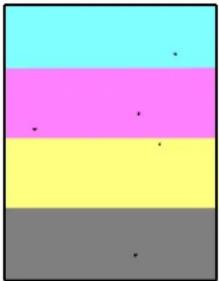 | The paper is outside the recommended specification range. | Replace the paper with a recommended size and type, and confirm that your control panel and print driver settings are correct. For details, see Supported Paper on page 72. |
| The toner cartridges are not Xerox®toner cartridges. | Verify that the toner cartridges meet specifications and replace them if necessary. For details, see Consumables on page 160. | |
Vertical black or color streaks or multiple colored streaks or lines.Streaks in only one color. | The toner cartridges are not Xerox®toner cartridges. | Verify that the toner cartridges meet specifications and replace them if necessary. For details, see Consumables on page 160. |
| There is a problem with the toner cartridge for that color. | Check the toner cartridge for damage and replace if necessary. For assistance, go to the Xerox®Support website at www.xerox.com/office/WC6015support. | |
| Color around the edge of printing is incorrect. | The color registration is incorrect. | Adjust the color registration. For details, see Color Registration on page 157. |
| Partial blanks, creased paper, or blotted printing. | The paper is damp. | Replace the paper. |
| The paper is outside the recommended specification range. | Replace the paper with a recommended size and type. For details, see Supported Paper on page 72. | |
 | The printer is worn or damaged. | For assistance, go to the Xerox®Support website at www.xerox.com/office/WC6015support. |
| The toner cartridges are not Xerox®toner cartridges. | Verify that the toner cartridges meet specifications and replace if necessary. For details, see Consumables on page 160. | |
| The altitude setting is incorrect. | Adjust the altitude setting of the printer. For details, see Adjusting the Altitude on page 159. | |
| Condensation inside the printer causes partial blanks or creased paper. | Turn on the printer and leave it on for at least one hour to get rid of the condensation. For assistance, go to the Xerox®Support website at www.xerox.com/office/WC6015support. | |
Vertical blanks.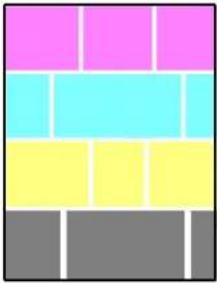 | The lenses are being blocked. | Clean the lenses in the inside of the printer. For details, see Cleaning the LED Lenses on page 152. |
| The printer is worn or damaged. | For assistance, go to the Xerox®Support website at www.xerox.com/office/WC6015support. | |
| The toner cartridges are not Xerox®toner cartridges. | Verify that the toner cartridges meet specifications and replace if necessary. | |
Slanted printing. | The paper guides in the trays are not set correctly. | Reset the paper tray guides. For details, see Loading Paper on page 75. |
| Colors are blurry or there is white area around objects. | Color-to-color alignment is not correct. | Perform an automatic color registration adjustment. For details, see Color Registration on page 157. |
Blotchy or mottled images. | The paper is too light or too thin. | Compensate for the paper thickness. For details, see Adjusting Paper Type on page 158. |
| The bias transfer voltage needs to be adjusted for the paper type. | Adjust the bias transfer roller. For details, see Adjusting the Bias Transfer Roller on page 158. | |
| The fuser needs to be adjusted for the paper type. | Adjust the fuser. For details, see Adjusting the Fuser on page 158. | |
| Paper curls or frequent jams in the rear cover. | Bias transfer roller needs to be refreshed. | Refresh the bias transfer roller. For details, see Refreshing the Bias Transfer Roller on page 159. |
Getting Help
This section includes:
- Error and Status Messages....187
- PrintingScout Alerts....187
• Online Support Assistant....187
• Information Pages....187
• More Information....188
Your printer comes with utilities and resources to help you troubleshoot printing problems.
Error and Status Messages
The printer control panel provides information and troubleshooting help. When an error or warning condition occurs, the control panel informs you of the problem. Error messages warn you about printer conditions, such as low supplies or doors open, that require your attention.
PrintingScout Alerts
PrintingScout is a utility installed with your Xerox ^® print driver. It automatically checks the printer status when you send a print job. If the printer is unable to print, a PrintingScout alert appears on your computer screen to let you know that the printer needs attention. In the PrintingScout dialog box, click the alert to view instructions explaining how to fix the problem.
Note: PrintingScout is a Windows-only application.
Online Support Assistant
Online Support Assistant is a knowledge base that provides instructions and troubleshooting help to solve your printer problems. You can find solutions for print-quality problems, paper jams, software installation issues, and more.
To access the Online Support Assistant, go to www.xerox.com/office/WC6015support.
Information Pages
Your printer has a printable set of information pages. These include configuration and font information, demonstration pages, and more.
More Information
You can obtain more information about your printer from these sources:
| Resource | Location |
| Installation Guide | Packaged with the printer. |
| Quick Use Guide | Packaged with the printer. |
| Video Tutorials | www.xerox.com/office/WC6015docs |
| Recommended Media List | United States: www.xerox.com/paperEurope: www.xerox.com/europaper |
| Technical support information for your printer; includes online Technical Support, Online Support Assistant, and driver downloads. | www.xerox.com/office/WC6015support |
| Information Pages | Print from the control panel menu. |
| Order supplies for your printer | www.xerox.com/office/WC6015supplies |
| A resource for tools and information, including interactive tutorials, printing templates, helpful tips, and customized features to meet your individual needs. | www.xerox.com/office/businessresourcecenter |
| Local sales and support center | www.xerox.com/office/worldcontacts |
| Printer Registration | www.xerox.com/office/register |
| Xerox® Direct online store | www.direct.xerox.com/ |
Specifications
A
This appendix includes:
• Printer Configurations and Options....190
• Physical Specifications....191
• Environmental Specifications....193
• Electrical Specifications....194
• Performance Specifications ....195
• Controller Specifications ....196
Printer Configurations and Options
Available Configurations
The WorkCentre 6015 Color Multifunction Printer is available in three configurations:
- WorkCentre 6015B Color Multifunction Printer: Printer with copy, print, and scan functions, and USB connectivity.
- WorkCentre 6015N Color Multifunction Printer: Network printer with copy, print, scan, and fax functions and USB or network connectivity.
- WorkCentre 6015NI Color Multifunction Printer: Wireless network printer with copy, print, scan, and fax functions and USB, Ethernet, or wireless network connectivity.
Standard Features
The WorkCentre 6015 Color Multifunction Printer provides the following features:
| Feature | WorkCentre 6015BColor Multifunction Printer | WorkCentre 6015N/NIColor Multifunction Printer |
| Print and Copy speed | Up to 12 ppm colorUp to 15 ppm black and white | Up to 12 ppm colorUp to 15 ppm black and white |
| Functions | Copy, scan, and print | Copy, scan, print, and fax |
| Print resolution | 1200 x 2400 dpi | 1200 x 2400 dpi |
| Paper capacity | 150-sheet main tray10-sheet bypass tray100-sheet output tray | 150-sheet main tray10-sheet bypass tray100-sheet output tray |
| 2-Sided Printing | Manual only | Manual only |
| Maximum copy size | 216 x 297 mm (8.5 x 11.6 in.) | 216 x 297 mm (8.5 x 11.6 in.) |
| Maximum print size | Legal (216 x 356 mm, 8.5 x 14 in.) | Legal (216 x 356 mm, 8.5 x 14 in.) |
| Document feeder | None | Automatic Document Feeder |
| Control panel | Button-navigated menu with four-line display | Button-navigated menu with a four-line display and eight short address book keys |
| Connectivity | Universal Serial Bus (USB 2.0) | Universal Serial Bus (USB 2.0)Ethernet 10/100 Base-TWireless network connectivity: Available on WorkCentre 6015NI Color Multifunction Printer only. |
| Scan functions | Scan to USB MemoryScan to Computer | Scan to USB MemoryScan to EmailScan to NetworkScan to Computer (USB) |
| Scan resolution | 600 x 600 dpi | 600 x 600 dpi |
| Remote access | None | CentreWare Internet Services |
Physical Specifications
Weights and Dimensions
| WorkCentre 6015B Color Multifunction Printer | WorkCentre 6015N/NI Color Multifunction Printer | |
| Width | 410 mm (16.1 in.) | 410 mm (16.1 in.) |
| Depth | 389 mm (15.3 in.) | 389 mm (15.3 in.) |
| Height | 318 mm (12.5 in.) | 337.5 mm (13.3 in.) |
| Weight | 14.3 kg (31.5 lb.) | 15.2 kg (33.4 lb.) |
Total Space Requirements
| WorkCentre 6015B Color Multifunction Printer | WorkCentre 6015N/NI Color Multifunction Printer | |
| Width | 848 mm (33.4 in.) | 879 mm (34.6 in.) |
| Depth | 936.5 mm (36.9 in.) | 936.5 mm (36.9 in.) |
| Height | 690.5 mm (27.2 in.) | 701.5 mm (27.6 in.) |
Clearance Requirements
WorkCentre 6015B Color Multifunction Printer

text_image
93.6 cm (36.8 in.) 10 cm (3.9 in.) 69 cm (27.2 in.) 10 cm (3.9 in.) 11.4 cm (4.5 in.) 84.8 cm (33.4 in.) 20 cm (7.9 in.) 10 cm (3.9 in.)Specifications
WorkCentre 6015N/NI Color Multifunction Printer

WARNING: The WorkCentre 6015NI Color Multifunction Printer requires 20 cm (7.9 in.) separation from the left side of the printer to any people.
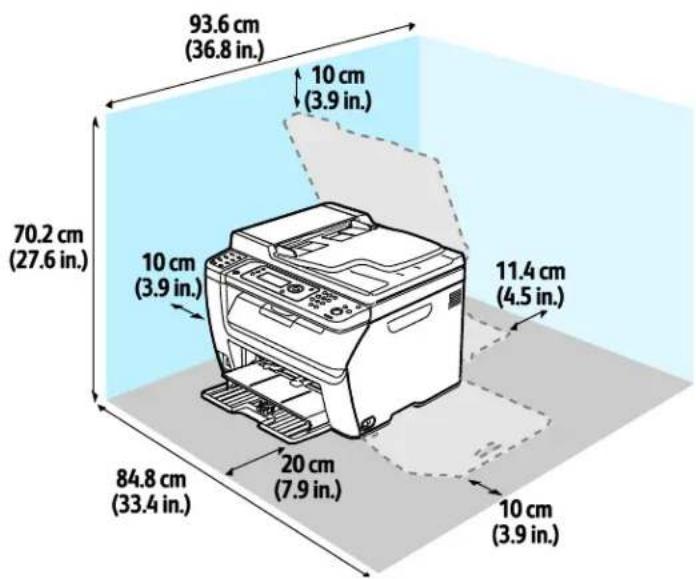
text_image
93.6 cm (36.8 in.) 10 cm (3.9 in.) 70.2 cm (27.6 in.) 10 cm (3.9 in.) 11.4 cm (4.5 in.) 84.8 cm (33.4 in.) 20 cm (7.9 in.) 10 cm (3.9 in.)Environmental Specifications
Temperature
- Operating temperature: 10–32°C (50–90°F)
• Optimum temperature: 15–28°C (59–82°F)
Relative Humidity
• Minimum–Maximum Humidity Range: 15–85 % relative humidity at 28°C (82°F)
• Optimal Humidity Range: 20–70% relative humidity at 28°C (82°F)
Note: Under extreme environmental conditions, such as 10^ C and 85% relative humidity, defects can occur due to condensation.
Elevation
For optimum performance, use the printer at elevations below 3100 m (10,170 ft.).
Electrical Specifications
Power Supply Voltage and Frequency
| Power Supply Voltage | Power Supply Frequency |
| 110–127 VAC +/-10 %, (99–140 VAC) | 50 Hz +/- 3 Hz60 Hz +/- 3 Hz |
| 220–240 VAC +/-10 %, (198–264 VAC) | 50 Hz +/- 3 Hz60 Hz +/- 3 Hz |
Power Consumption
• Energy Saver Mode 2 (Sleep): 8 W or less
• Energy Saver Mode 1 (Low Power): 15 W or less
• Ready: 37 W or less with fuser on
• Continuous printing: 310 W or less
This printer does not consume electric power when the power switch is turned off even if the printer is connected to an AC outlet.
ENERGY STAR Qualified Product

The WorkCentre 6015 Color Multifunction Printer is ENERGY STAR ^® qualified under the ENERGY STAR Program Requirements for Imaging Equipment.
The ENERGY STAR and ENERGY STAR mark are registered United States trademarks.
The ENERGY STAR Imaging Equipment Program is a team effort between United States, European Union, and Japanese governments and the office equipment industry to promote energy-efficient copiers, printers, fax, multifunction printers, personal computers, and monitors. Reducing product energy consumption helps combat smog, acid rain, and long-term changes to the climate by decreasing the emissions that result from generating electricity.
Xerox ^® ENERGY STAR equipment is preset at the factory to switch to Energy Saver Modes after 60 minutes and 1 minute from the last copy or print.
Performance Specifications
| Item | Specifications |
| Printer warm up time | Power on: 25 seconds or less.Recovery from sleep mode: 25 seconds or less.Note:Warm up time assumes an ambient temperature of 22^ ( 71.6^ ). |
Controller Specifications
Processor
295 MHz ARM9 processor
Memory
| Memory | WorkCentre 6015B Color Multifunction Printer | WorkCentre 6015N/NI Color Multifunction Printer |
| Standard memory | 128 MB RAM | 128 MB RAM |
| Flash memory | 16 MB NVRAM | 16 MB NVRAM |
| Fax memory | None | 2 MB RAM |
Interfaces
| WorkCentre 6015B Color Multifunction Printer | WorkCentre 6015N/NI Color Multifunction Printer |
| Universal Serial Bus (USB 2.0) | Universal Serial Bus (USB 2.0)Ethernet 10/100/1000Base-TXWireless network connectivity: Available on WorkCentre 6015NI Color Multifunction Printer only. |
Regulatory Information
B
This appendix includes:
• Basic Regulations....198
• Copy Regulations....200
• Fax Regulations....203
• Material Safety Data Sheets 207
Basic Regulations
Xerox has tested this printer to electromagnetic emission and immunity standards. These standards are designed to mitigate interference caused or received by this printer in a typical office environment.
United States FCC Regulations
This equipment has been tested and found to comply with the limits for a Class B digital device, pursuant to Part 15 of the FCC Rules. These limits are designed to provide reasonable protection against harmful interference when the equipment is operated in a residential environment. This equipment generates, uses, and can radiate radio frequency energy. If it is not installed and used in accordance with these instructions, it may cause harmful interference to radio communications. However, there is no guarantee that interference will not occur in a particular installation.
If this equipment does cause harmful interference to radio or television reception, which can be determined by turning the equipment off and on, the user is encouraged to try to correct the interference by one or more of the following measures:
- Reorient or relocate the receiving antenna.
- Increase the separation between the equipment and receiver.
- Connect the equipment into an outlet on a circuit different from that to which the receiver is connected.
- Consult the dealer or an experienced radio/TV technician for help.
Changes or modifications to this equipment not approved by Xerox can void the authority of the user to operate this equipment.
Note: To ensure compliance with Part 15 of the FCC rules, use shielded interface cables.
Canada
This Class B digital apparatus complies with Canadian ICES-003.
The CE mark applied to this product symbolizes a declaration of conformity by Xerox with the following applicable Directives of the European Union as of the dates indicated:
• December 12, 2006: Low Voltage Directive 2006/95/EC
• December 15, 2004: Electromagnetic Compatibility Directive 2004/108/EC
• March 9, 1999: Radio & Telecommunications Terminal Equipment Directive 1999/5/EC
This printer, if used properly in accordance with the instructions, is not dangerous for the consumer or for the environment.
To ensure compliance with European Union regulations, use shielded interface cables.
A signed copy of the Declaration of Conformity for this printer can be obtained from Xerox.
Turkey RoHS Regulation
In compliance with Article 7 (d), we hereby certify “it is in compliance with the EEE regulation.”
Congress, by statute, has forbidden the reproduction of the following subjects under certain circumstances. Penalties of fine or imprisonment may be imposed on those guilty of making such reproductions.
- Obligations or Securities of the United States Government, such as:
• Certificates of Indebtedness.
• National Bank Currency.
- Coupons from Bonds.
• Federal Reserve Bank Notes.
• Silver Certificates.
• Gold Certificates.
• United States Bonds.
- Treasury Notes.
• Federal Reserve Notes.
- Fractional Notes.
• Certificates of Deposit.
- Paper Money.
• Bonds and Obligations of certain agencies of the government, such as FHA and so on.
- Bonds. United States Savings Bonds may be photographed only for publicity purposes in connection with the campaign for the sale of such bonds.
- Internal Revenue Stamps. If it is necessary to reproduce a legal document on which there is a canceled revenue stamp, this may be done provided the reproduction of the document is performed for lawful purposes.
- Postage Stamps, canceled or uncanceled. For philatelic purposes, Postage Stamps may be photographed, provided the reproduction is in black and white and is less than 75% or more than 150% of the linear dimensions of the original.
- Postal Money Orders.
• Bills, Checks, or Drafts of money drawn by or upon authorized officers of the United States.
- Stamps and other representatives of value, of whatever denomination, which have been or may be issued under any Act of Congress.
- Adjusted Compensation Certificates for Veterans of the World Wars.
-
Obligations or Securities of any Foreign Government, Bank, or Corporation.
-
Copyrighted materials, unless permission of the copyright owner has been obtained or the reproduction falls within the "fair use" or library reproduction rights provisions of the copyright law. Further information of these provisions may be obtained from the Copyright Office, Library of Congress, Washington, D.C. 20559. Ask for Circular R21.
- Certificate of Citizenship or Naturalization. Foreign Naturalization Certificates may be photographed.
- Passports. Foreign Passports may be photographed.
- Immigration papers.
- Draft Registration Cards.
-
Selective Service Induction papers that bear any of the following Registrant's information:
-
Earnings or Income.
- Court Record.
• Physical or mental condition. -
Dependency Status.
• Previous military service.
• Exception: United States military discharge certificates may be photographed. -
Badges, Identification Cards, Passes, or Insignia carried by military personnel, or by members of the various Federal Departments, such as FBI, Treasure, and so on (unless photograph is ordered by the head of such department or bureau).
Reproducing the following is also prohibited in certain states:
• Automobile Licenses.
- Drivers' Licenses.
• Automobile Certificates of Title.
The preceding list is not all inclusive, and no liability is assumed for its completeness or accuracy. In case of doubt, consult your attorney.
For more information about these provisions contact the Copyright Office, Library of Congress, Washington, D.C. 20559. Ask for Circular R21.
Canada
Parliament, by stature, has forbidden the reproduction of the following subjects under certain circumstances. Penalties of fine or imprisonment may be imposed on those guilty of making such reproductions.
- Current bank notes or current paper money
- Obligations or securities of a government or bank
- Exchequer bill paper or revenue paper
- The public seal of Canada or of a province, or the seal of a public body or authority in Canada, or of a court of law
- Proclamations, orders, regulations, or appointments, or notices thereof (with intent to falsely cause same to purport to have been printed by the Queens Printer for Canada, or the equivalent printer for a province)
- Marks, brands, seals, wrappers, or designs used by or on behalf of the Government of Canada or of a province, the government of a state other than Canada or a department, board, Commission, or agency established by the Government of Canada or of a province or of a government of a state other than Canada
- Impressed or adhesive stamps used for the purpose of revenue by the Government of Canada or of a province or by the government of a state other than Canada
- Documents, registers, or records kept by public officials charged with the duty of making or issuing certified copies thereof, where the copy falsely purports to be a certified copy thereof
- Copyrighted material or trademarks of any manner or kind without the consent of the copyright or trademark owner
This list is provided for your convenience and assistance, but it is not all-inclusive, and no liability is assumed for its completeness or accuracy. In case of doubt, consult your solicitor.
Other Countries
Copying certain documents may be illegal in your country. Penalties of fine or imprisonment may be imposed on those found guilty of making such reproductions.
- Currency notes
• Bank notes and checks
• Bank and government bonds and securities
• Passports and identification cards
• Copyright material or trademarks without the consent of the owner - Postage stamps and other negotiable instruments
This list is not inclusive and no liability is assumed for either its completeness or accuracy. In case of doubt, contact your legal counsel.
Fax Regulations
United States
Fax Send Header Requirements
The Telephone Consumer Protection Act of 1991 makes it unlawful for any person to use a computer or other electronic device, including a fax machine, to send any message unless such message clearly contains in a margin at the top or bottom of each transmitted page or on the first page of the transmission, the date and time it is sent and an identification of the business or other entity, or other individual sending the message and the telephone number of the sending machine or such business, other entity, or individual. The telephone number provided may not be a 900 number or any other number for which charges exceed local or long-distance transmission charges.
Data Coupler Information
This equipment complies with Part 68 of the FCC rules and the requirements adopted by the Administrative Council for Terminal Attachments (ACTA). On the cover of this equipment is a label that contains, among other information, a product identifier in the format US:AAAEQ##TXXXX. If requested, this number must be provided to the Telephone Company.
A plug and jack used to connect this equipment to the premises wiring and telephone network must comply with the applicable FCC Part 68 rules and requirements adopted by the ACTA. A compliant telephone cord and modular plug is provided with this product. It connects to a compatible modular jack that is also compliant. See installation instructions for details.
You can safely connect the printer to the following standard modular jack: USOC RJ-11C using the compliant telephone line cord (with modular plugs) provided with the installation kit. See installation instructions for details.
The Ringer Equivalence Number (REN) is used to determine the number of devices that can be connected to a telephone line. Excessive RENs on a telephone line could result in the devices not ringing in response to an incoming call. In most but not all areas, the sum of RENs should not exceed five (5.0). To be certain of the number of devices that can be connected to a line, as determined by the RENs, contact the local Telephone Company. For products approved after July 23, 2001, the REN is part of the product identifier that has the format US:AAAEQ##TXXXX. The digits represented by ## are the REN without a decimal point (for example, 03 is a REN of 0.3). For earlier products, the REN is separately shown on the label.
To order the correct service from the local Telephone Company, you could also have to quote the codes in the following list:
• Facility Interface Code (FIC) = 02LS2
• Service Order Code (SOC) = 9.0Y

CAUTION: Ask your local Telephone Company for the modular jack type installed on your line. Connecting this machine to an unauthorized jack can damage telephone company equipment. You, not Xerox, assume all responsibility and/or liability for any damage caused by the connection of this machine to an unauthorized jack.
If this Xerox ^® equipment causes harm to the telephone network, the Telephone Company could temporarily discontinue service to the telephone line to which it is connected. If advance notice is not practical, the Telephone Company notifies you of the disconnection as soon as possible. If the Telephone Company interrupts your service, they can advise you of your right to file a complaint with the FCC if you believe that it is necessary.
The Telephone Company could change its facilities, equipment, operations, or procedures which could affect the operation of the equipment. If the Telephone Company changes something that affects the operation of the equipment, they should notify you in order for you to make necessary modifications to maintain uninterrupted service.
If you experience trouble with this Xerox ^® equipment, please contact the appropriate service center for repair or warranty information. Contact information is contained in the Machine Status menu on the printer and in the back of the Troubleshooting section of the User Guide. If the equipment is causing harm to the telephone network, the Telephone Company may request you to disconnect the equipment until the problem is resolved.
Only a Xerox Service Representative or an authorized Xerox Service provider are authorized to make repairs to the printer. This applies at any time during or after the service warranty period. If unauthorized repair is performed, the remainder of the warranty period is null and void.
This equipment must not be used on party lines. Connection to party line service is subject to state tariffs. Contact the state public utility commission, public service commission, or corporation commission for information.
Your office could have specially wired alarm equipment connected to the telephone line. Make sure that the installation of this Xerox ^® equipment does not disable your alarm equipment.
If you have questions about what could disable alarm equipment, consult your Telephone Company or a qualified installer.
Canada
This product meets the applicable Industry Canada technical specifications.
A representative designated by the supplier should coordinate repairs to certified equipment. Repairs or alterations made by the user to this device, or device malfunctions, could cause the telecommunications company to request you to disconnect the equipment.
For user protection, make sure that the printer is properly grounded. The electrical ground connections of the power utility, telephone lines, and internal metallic water pipe systems, if present, must be connected together. This precaution could be vital in rural areas.

WARNING: Do not attempt to make such connections yourself. Contact the appropriate electric inspection authority, or electrician, to make the ground connection.
The REN assigned to each terminal device provides an indication of the maximum number of terminals allowed to be connected to a telephone interface. The termination on an interface could consist of any combination of devices. The only limitation to the number of devices is the requirement that the sum of the RENs of the devices does not exceed 5. For the Canadian REN value, please see the label on the equipment.
European Union
Radio Equipment and Telecommunications Terminal Equipment Directive
The Facsimile has been approved in accordance with the Council Decision 1999/5/EC for pan-European single terminal connection to the public switched telephone network (PSTN). However, due to differences between the individual PSTNs provided in different countries, the approval does not give an unconditional assurance of successful operation on every PSTN network terminal point.
In the event of a problem you should contact your authorized local dealer.
This product has been tested to and is compliant with ES 203 021-1, -2, -3, a specification for terminal equipment for use on analog-switched telephone networks in the European Economic Area. This product provides a user-adjustable setting of the country code. The country code should be set prior to connecting this product to the network. Refer to the customer documentation for the procedure for setting the country code.
Note: Although this product can use either loop disconnect (pulse) or DTMF (tone) signaling, we recommend that you set it to use DTMF signaling for more reliable and faster call setup. Modification of this product, connection to external control software, or connection to an external control apparatus not authorized by Xerox ^® will invalidate its certification.
South Africa
This modem must be used in conjunction with an approved surge protection device.
New Zealand
- The grant of a Telepermit for any item of terminal equipment indicates only that Telecom has accepted that the item complies with minimum conditions for connection to its network. It indicates no endorsement of the product by Telecom, it does not provide any sort of warranty, and it does not imply that any Telepermitted product is compatible with all Telecom network services. Above all, it provides no assurance that any item will work correctly in all respects with another item of Telepermitted equipment of a different make or model.
The equipment may not be capable of correct operation at the higher data speeds designated. 33.6 kbps and 56 kbps connections are likely to be restricted to lower bit rates when connected to some PSTN implementations. Telecom will accept no responsibility for difficulties that arise in such circumstances.
- Immediately disconnect this equipment should it become physically damaged, then arrange for its disposal or repair.
- This modem shall not be used in any manner which could constitute a nuisance to other Telecom customers.
- This device is equipped with pulse dialing, while the Telecom standard is DTMF tone dialing. There is no guarantee that Telecom lines will always continue to support pulse dialing.
- Use of pulse dialing, when this equipment is connected to the same line as other equipment, may give rise to 'bell tinkle' or noise and cause a false answer condition. If you encounter such problems, do not contact the Telecom Faults Service.
- DTMF tones dialing is the preferred method because it is faster than pulse (decadic) dialing and is readily available on almost all New Zealand telephone exchanges.

WARNING: No '111' or other calls can be made from this device during a mains power failure.
- This equipment may not provide for the effective hand-over of a call to another device connected to the same line.
- Some parameters required for compliance with Telecom Telepermit requirements are dependent on the equipment (computer) associated with this device. The associated equipment shall be set to operate within the following limits for compliance with Telecom Specifications:
For repeat calls to the same number:
- There shall be no more than 10 call attempts to the same number within any 30 minute period for any single manual call initiation, and
- The equipment shall go on-hook for a period of not less than 30 seconds between the end of one attempt and the beginning of the next attempt.
For automatic calls to different numbers:
The equipment shall be set to ensure that automatic calls to different numbers are spaced such that there is no less than five seconds between the end of one call attempt and the beginning of another.
- For correct operation, total of the RNs of all devices connected to a single line at any time should not exceed five.
Material Safety Data Sheets
For Material Safety Data information regarding your printer, go to:
• North America: www.xerox.com/msds
• European Union: www.xerox.com/environment_europe
For the Customer Support Center phone numbers, go to www.xerox.com/office/worldcontacts.
Recycling and Disposal
C
This appendix includes:
• All Countries....210
• North America....211
• European Union....212
• Other Countries....214
All Countries
If you are managing the disposal of your Xerox® product, please note that the printer may contain lead, mercury, perchlorate, and other materials whose disposal may be regulated due to environmental considerations. The presence of these materials is fully consistent with global regulations applicable at the time that the product was placed on the market. For recycling and disposal information, contact your local authorities. Perchlorate Material: This product may contain one or more Perchlorate-containing devices, such as batteries. Special handling may apply, please see www.dtsc.ca.gov/hazardouswaste/perchlorate.
North America
Xerox operates an equipment take-back and reuse/recycle program. Contact your Xerox representative (1-800-ASK-XEROX) to determine if this Xerox® product is part of the program. For more information about Xerox® environmental programs, visit www.xerox.com/environment, or for recycling and disposal information, contact your local authorities.
European Union
Some equipment may be used in both a domestic/household and a professional/business application.
Domestic/Household Environment

Application of this symbol on your equipment is confirmation that you should not dispose of the equipment in the normal household waste stream.
In accordance with European legislation, end of life electrical and electronic equipment subject to disposal must be segregated from household waste.
Private households within EU member states may return used electrical and electronic equipment to designated collection facilities free of charge. Please contact your local disposal authority for information.
In some member states, when you purchase new equipment, your local retailer may be required to take back your old equipment free of charge. Please ask your retailer for information.
Professional/Business Environment

Application of this symbol on your equipment is confirmation that you must dispose of this equipment in compliance with agreed national procedures.
In accordance with European legislation, end of life electrical and electronic equipment subject to disposal must be managed within agreed procedures.
Prior to disposal, please contact your local reseller or Xerox representative for end of life take-back information.
Collection and Disposal of Equipment and Batteries

These symbols on the products and/or accompanying documents mean that used electrical and electronic products and batteries should not be mixed with general household waste.
For proper treatment, recovery, and recycling of old products and used batteries, please take them to applicable collection points, in accordance with your national legislation and the Directive 2002/96/EC and 2006/66/EC.
By disposing of these products and batteries correctly, you will help to save valuable resources and prevent any potential negative effects on human health and the environment which could otherwise arise from inappropriate waste handling.
For more information about collection and recycling of old products and batteries, please contact your local municipality, your waste disposal service or the point of sale where you purchased the items.
Penalties may be applicable for incorrect disposal of this waste, in accordance with national legislation.
Business Users in the European Union
If you wish to discard electrical and electronic equipment, please contact your dealer or supplier for further information.
Disposal Outside of the European Union
These symbols are only valid in the European Union. If you wish to discard these items, please contact your local authorities or dealer and ask for the correct method of disposal.
Battery Symbol Note

This wheeled bin symbol may be used in combination with a chemical symbol. This establishes compliance with the requirements set out by the Directive.
Battery Removal
Batteries should only be replaced by a MANUFACTURER-approved service facility.
Recycling and Disposal
Other Countries
Please contact your local waste management authority to request disposal guidance.