
TL-SC3171G - Surveillance Camera TP-LINK - Free user manual and instructions
Find the device manual for free TL-SC3171G TP-LINK in PDF.


| Product Type | Wireless Day/Night Surveillance Camera |
| Brand | TP-Link |
| Model | TL-SC3171G |
| Connectivity | IEEE 802.11b/g Wireless, Ethernet RJ45 |
| Video Compression | MPEG4, MJPEG, JPEG |
| Image Resolution | 640x480, 320x240, 160x120 |
| Frame Rate | Up to 30 fps (MPEG4), up to 15 fps (MJPEG) |
| Audio | Two-way audio (built-in microphone, audio input/output) |
| Night Vision | IR LEDs, effective range up to 10 meters |
| Power Supply | 12V DC via included power adapter |
| Security | HTTPS encryption, multi-user access, account management |
| Event Trigger | Motion detection, alarm input (I/O terminal) |
| Notification Methods | FTP, SMTP (email), HTTP event, IP notification |
| Mobile Viewing | 3G/2.5G mobile phones, iPhone, RTSP streaming |
| Mounting | Wall/ceiling mount bracket included |
| Operating Temperature | 0°C to 40°C (32°F to 104°F) (typical) |
| Compliance | FCC Class B, CE Mark, RoHS |
| Package Contents | Camera, power adapter, mounting bracket, RJ45 cable, CD, quick installation guide |
Frequently Asked Questions - TL-SC3171G TP-LINK
rtsp://<public IP>:<port>/video.3gp. For 2.5G phones, use the WAP or web interface at http://<public IP>/mobile.wml or http://<public IP>/mobile.htm. The camera also supports iPhone viewing via Safari.User questions about TL-SC3171G TP-LINK
0 question about this device. Answer the ones you know or ask your own.
Ask a new question about this device
Download the instructions for your Surveillance Camera in PDF format for free! Find your manual TL-SC3171G - TP-LINK and take your electronic device back in hand. On this page are published all the documents necessary for the use of your device. TL-SC3171G by TP-LINK.
USER MANUAL TL-SC3171G TP-LINK
Wireless Day/Night Surveillance Camera

COPYRIGHT & TRADEMARKS
Specifications are subject to change without notice. TP-LINK® is a registered trademark of TP-LINK TECHNOLOGIES CO., LTD. Other brands and product names are trademarks or registered trademarks of their respective holders.
No part of the specifications may be reproduced in any form or by any means or used to make any derivative such as translation, transformation, or adaptation without permission from TP-LINK TECHNOLOGIES CO., LTD. Copyright © 2010 TP-LINK TECHNOLOGIES CO., LTD.
All rights reserved.
http://www.tp-link.com
FCC STATEMENT

This equipment has been tested and found to comply with the limits for a Class B digital device, pursuant to part 15 of the FCC Rules. These limits are designed to provide reasonable protection against harmful interference in a residential installation. This equipment generates, uses and can radiate radio frequency energy and, if not installed and used in accordance with the instructions, may cause harmful interference to radio communications. However, there is no guarantee that interference will not occur in a particular installation. If this equipment does cause harmful interference to radio or television reception, which can be determined by turning the equipment off and on, the user is encouraged to try to correct the interference by one or more of the following measures:
Reorient or relocate the receiving antenna. Increase the separation between the equipment and receiver. Connect the equipment into an outlet on a circuit different from that to which the receiver is connected. Consult the dealer or an experienced radio/TV technician for help.
This device complies with part 15 of the FCC Rules. Operation is subject to the following two conditions:
1) This device may not cause harmful interference. 2) This device must accept any interference received, including interference that may cause undesired operation.
Any changes or modifications not expressly approved by the party responsible for compliance could void the user's authority to operate the equipment.
Note: The manufacturer is not responsible for any radio or TV interference caused by unauthorized modifications to this equipment. Such modifications could void the user's authority to operate the equipment.
CE Mark Warning

This is a class B product. In a domestic environment, this product may cause radio interference, in which case the user may be required to take adequate measures.
CONTENTS
Package Contents....1
Chapter 1 Minimum System Requirements....2
Chapter 2 Physical Overview....3
2.1 Front View....3 2.2 Bottom View....3
Chapter 3 Using IP Camera via Web Browser....5
3.1 Obtain the IP Address 5 3.2 Windows Web Browser 7 3.3 Mac Web Browser....9
Chapter 4 Operating IP Camera via Mobile Phone....12
4.1 3G Streaming Mobile View Mode....12
4.1.1 3G Mobile Phone Streaming Viewing....12 4.1.2 2.5G Mobile Phone WAP Viewing....12 4.1.3 2.5G Mobile Phone Browser Viewing....12
4.2 Using IP Camera via iPhone 13
Chapter 5 Configuration of Main Menu....14
5.1 Live View....14
5.1.1 Snapshot....14 5.1.2 Zoom in/out the image via the monitor window 15 5.1.1 Video play buttons....15 5.1.2 Audio buttons 15
5.2 Setting 16
5.3 Client Setting....17
5.3.1 Mode....17 5.3.2 View Size....17 5.3.3 Protocol 18 5.3.4 Video Buffer 18
5.4 Image Setup....18
5.4.1 Brightness 18 5.4.2 Contrast 19 5.4.3 Saturation 19 5.4.4 Hue 19 5.4.5 Default 19
Chapter 6 Setting-BASIC....20
6.1 System....20
6.1.1 Information 20 6.1.2 Date/Time....21 6.1.3 Initialize 22
6.2 Camera 23
6.2.1 General 23 6.2.2 MPEG4 24 6.2.3 MJPEG 27
6.3 Network 28
6.3.1 Information....29 6.3.2 PPPoE (Point-to-Point Protocol over Ethernet)....31 6.3.3 DDNS (Dynamic DNS) 32 6.3.4 UPnP (Universal Plug and Play) 36 6.3.5 Bonjour 37 6.3.6 IP Notification....38 6.3.7 Wireless 40 6.3.8 Messenger 44
6.4 Security 49
6.4.1 Account 50 6.4.2 HTTPS 51
Chapter 7 Setting-Advance....53
7.1 FTP client....53
7.1.1 General 54 7.1.2 Alarm sending....54 7.1.3 Periodical sending 57
7.2 SMTP 59
7.2.1 General 59 7.2.2 Alarm sending....62 7.2.3 Periodical sending 65
7.3 HTTP event....67
7.3.1 General 68 7.3.2 Alarm sending....69
7.4 Alarm output....71
7.4.1 Setting 72
7.5 Schedule 74
7.5.1 Setting....75
7.6 Alarm input 76
7.6.1 Setting 76
7.7 Motion detection 77
7.7.1 Setting....78
7.8 System Log 78
7.8.1 Setting 79
Appendix 80
FAQ 84
Package Contents
The following items should be found in your package:
TL-SC3171G Wireless Day/Night Surveillance Camera, Power Adapter, Mounting Bracket with three screws, a Lock Ring, a Brace and a Base Plate
RJ45 Cable, Quick Installation Guide, Resource CD, including:
- This User Guide
- Application Guide, Other helpful information
Note:
Make sure that the package contains the above items. If any of the listed items are damaged or missing, please contact your distributor.
Chapter 1 Minimum System Requirements
We strongly recommend your computers follow our minimum requirements in order to use this IP-Camera normally. If your computer doesn't meet these requirements below, it might cause some problems.
| Item Requirements | |
| CPU Pentium 4 1600MHz (or equivalent AMD) | |
| Graphic Card | 64 MB RAM graphic cards(or equivalent on-board graphic cards) |
| RAM | 512 MB |
| Operating System | Windows 98, Windows ME (Please see Note)Windows2000, 2003, XP, Vista, Mac OS X Leopard, Linux |
| Web Browser | Windows OS: Internet Explorer, Safari, Firefox, Google Chrome, Opera, Maxthon |
| MAC OS: Safari, Firefox | |
| Linux OS: Firefox | |

Note:
1) If you are using Windows 98 or Windows ME, please install IP Installer before using WEB UI to ensure the system runs normally. 2) If you can't view the record video file, please install Xvid codec while installing Intelligent IP Installer. (For Windows 98, ME or 2000 server, the codec might not work properly. You'll need to download Xvid codec 1.0 from the Internet.) 3) Please always update the latest Windows component. (Net Framework, Windows Media Player, Enhance ActiveX Security)
Chapter 2 Physical Overview
2.1 Front View
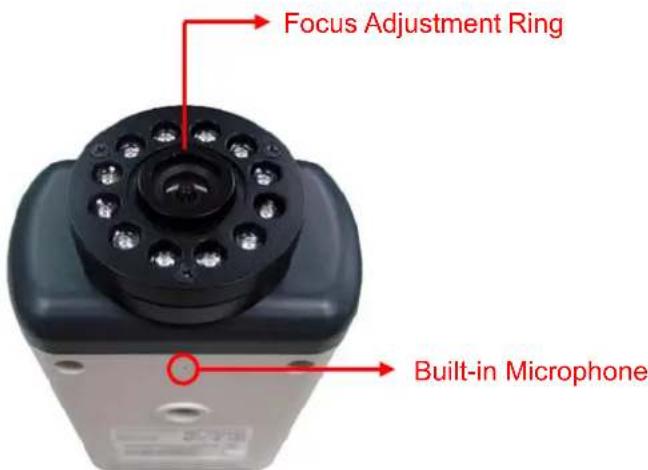
Figure 2-1
Focus Adjustment Ring: Adjust the focus to get a clear image.
Built-in Microphone: Built-in microphone for two-way audio.
2.2 Bottom View

Figure 2-2
Wireless Antenna: For connection to IEEE 802.11b/g wireless network.
Audio In: To support audio input with a microphone for two-way audio.
Audio Out: To support audio output with earphones or speakers for two-way audio.
Power Connector: For connection of 12V DC input.
Power LED Indicator: The power LED will light up after completing the boot process.
Reset: To successfully restore the camera to factory defaults, keep the device powered on,
then press and hold the Reset button for at least 10 seconds. The camera's CPU starts to work completely 1 minute after you release the Reset button.
I/O Terminal Connector: Input/Output to support external alarm and sensor used for motion detection, event triggering, and alarm notification, etc.
Network Connector: For connection to the Ethernet via RJ45 standard.
Chapter 3 Using IP Camera via Web Browser
3.1 Obtain the IP Address
- Insert the provided CD into your CD-ROM drive. The Setup Wizard will automatically pop up on your computer's screen as shown in the figure below.

Figure 3-1
- Choose the Intelligent IP Installer, and then the next screen appears. Click on Intelligent IP Installer to begin the installation.

Figure 3-2
- After the installation is finished, click Start > Program Files > TP-LINK > Intelligent IP Installer to start using the program.

Figure 3-3
- The following screen will then display. Click the Search button to search Network Cameras in the network; it displays Network Cameras information including IP Address.

Figure 3-4
3.2 Windows Web Browser
- Click Link to IE button in Figure 3-4 or launch your web browser, and enter the IP address (obtain from Figure 3-4) of the IP camera in the Location / Address field of your browser.

Note:
1) For the first time login with IE, you will need to enable "Download signed ActiveX controls". Please go to Tool→Internet Options...→Security→Custom Level... and find Download signed ActiveX controls to prompt it. For detailed information, please refer to the Quick Installation Guide. 2) If you only want to view the video without setting page, enter "http:// /index2.htm" as your web URL. For example, you can enter "http://192.168.1.100/index2.htm" as your web URL to view the video without setting page. 2. Enter the default User name "admin" and password "admin" in the login window as shown
below.

Figure 3-5
Note:
The default User name "admin" and Password "admin" are set at the factory for the administrator. You can change them in the Account Menu (Please check "SETTING → BASIC → Security → Account").
- The web-based management page will display on your screen. On the leftmost column of the web-based management page are Setting, Client Setting, and Image Setup. For more details, you can refer to Section 5.2 Setting, Section 5.3 Client Setting and Section 5.4 Image Setup.


Figure 3-6
3.3 Mac Web Browser
- Click the Safari icon on the screen as the figure below shown, and enter the IP address of the IP camera (which can be obtained from Figure 3-4) in the Location / Address field of your browser.
Note:
If you only want to view the video without setting page, enter "http:// /index2.htm" as your web URL. For example, you can enter "http://192.168.1.100/index2.htm" as your web URL to view the video without setting page.

Figure 3-7
- Enter the default User name "admin" and password "admin" in the dialog box as shown below.

Figure 3-8
Note:
The default Name "admin" and Password "admin" are set at the factory for the administrator. You can change them in the Account Menu (Please check "SETTING → BASIC → Security → Account").
- The web-based management page will be displayed on your screen. In the leftmost column of the web-based management page are Setting, Client Setting, and Image Setup. For more details, you can refer to Section 5.2, Section 5.3 and Section 5.4.
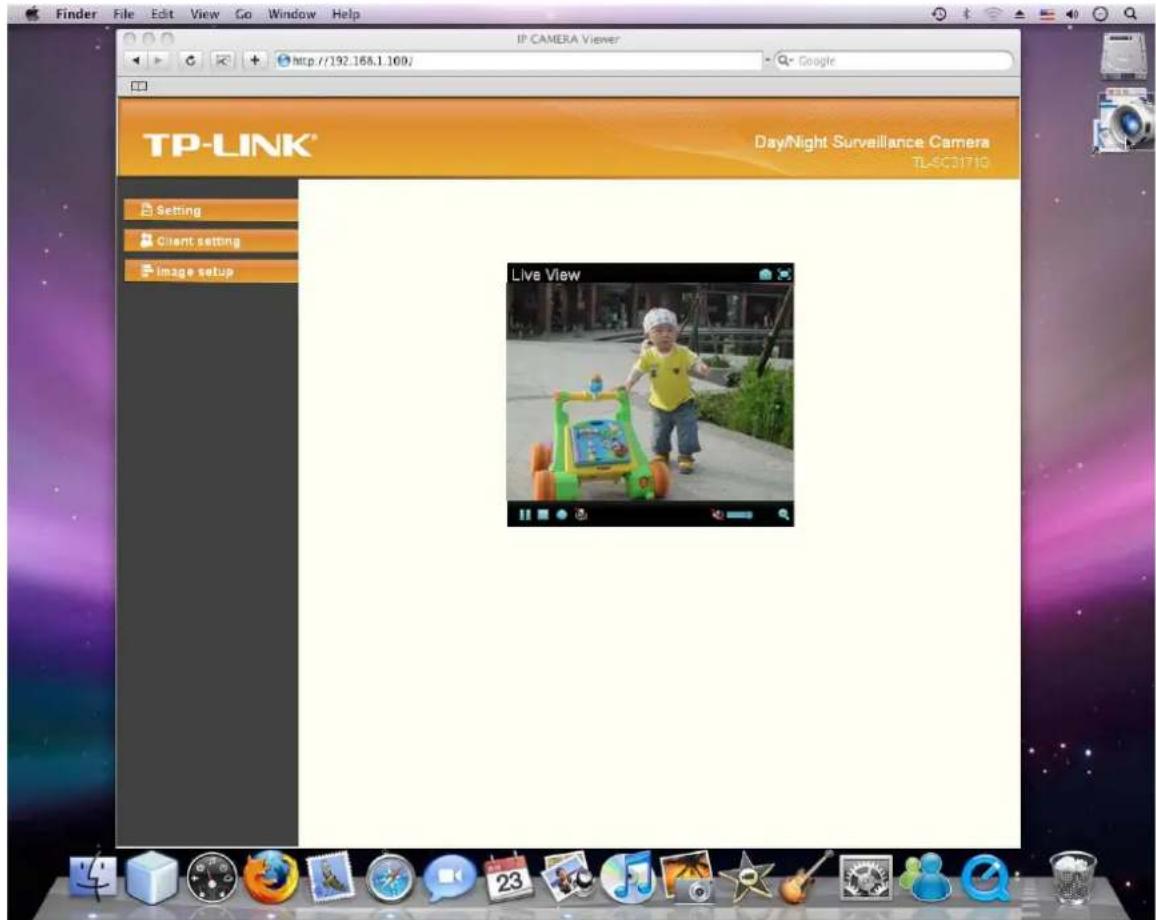
Figure 3-9
Chapter 4 Operating IP Camera via Mobile Phone
4.1 3G Streaming Mobile View Mode
4.1.1 3G Mobile Phone Streaming Viewing
For 3G mobile phone viewing, type "rtsp:// : /video.3gp" into your 3G Streaming Link. is the Public IP address of your IP camera; is the RTSP port of your IP camera (Default value is 554.) Example: rtsp://100.10.10.1:554/video.3gp
Note:
You can also use RTSP clients (RealPlayer, VLC, QuickTime Player...etc.) to view RTSP streaming, just type in "rtsp:// : /video.3gp" as the Player URL.
4.1.2 2.5G Mobile Phone WAP Viewing
For 2.5G mobile phone viewing, type "http:// /mobile.wml" into your 2.5G WAP Browser. is the Public IP address of your IP camera.
4.1.3 2.5G Mobile Phone Browser Viewing
For 2.5G mobile phone viewing, type "http:// /mobile.htm" into your 2.5G Web Browser. is the Public IP address of your IP camera.
4.2 Using IP Camera via iPhone
You can use TP-LINK Web User Interface via iPhone. Please follow the setting process below. Then you can use TP-LINK Web UI via iPhone.
1. Select Safari function
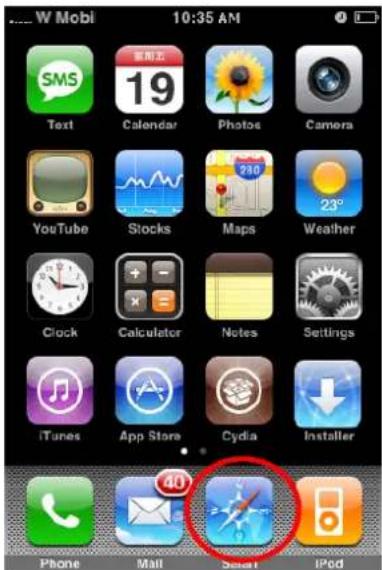
3. Enter name and password. Default values are both admin. Then click Log in

2. Enter the IP address in your web browser.

4. The TP-LINK user interface and live image will appear in the middle of the screen.

Note: It will show continuous snapshots, not real-time video streaming. Therefore, the recording feature is disabled.
Chapter 5 Configuration of Main Menu
You will find that the illustrative web pages in this manual are all orange. Please note that they are from our latest firmware, which can be downloaded from our website. Web pages in our previous firmware are blue.
On the leftmost column of the web-based management page are Setting, Client Setting, and Image Setup. For more details, refer to Section 5.2 Setting, Section 5.3 Client Setting, Section 5.4 Image Setup.

On the right column of the web-based management page, you can use Live View. There are four different functions: Snapshot, Zoom, Audio, and Video Play. You can see more details as follows.
5.1 Live View
5.1.1 Snapshot
You can capture a still image shot by the camera and save it on your computer.
| Symbols | Meaning |
 | click to display a snapshot window |
| Save Image | to save the picture in your computer |
| Close to | return to the view page |
 | full Screen |
5.1.2 Zoom in/out the image via the monitor window


- Click to display the digital zoom window.
- Pull W T
- You can use the left click of your mouse to move the □ to anywhere on the window to view the desired detail more clearly.
5.1.3 Video play buttons
 |
5.1.4 Audio buttons
| Symbols | Meaning | Note |
 | Speakers turned on | mean the speakers of your computer are turned on to transmit the sounds from the connected IP camera(s) |
 | Speakers turned off | |
 | Microphone turned on | mean you can broadcast to the connected IP camera(s) via the Ethernet using your microphone |
 | Microphone turned off | |
 | Volume control bar |
5.2 Setting

Setting
This function is only for the Administrator. Click this button to get into the Basic and Advance settings menus.

Home
SETTING
+BASIC
+Advanced
TP-LINK®
The Reliable Choice
WELCOME TO CAMERA SETTING PAGE
There are four sub-menus under the BASIC menu, which includes System, Camera, Network, and Security. For more information, you can refer to Section 6.1 System, Section 6.2 Camera, Section 6.3 Network and Section 6.4 Security.
There are eight sub-menus under the Advance menu, which includes FTP Client, SMTP, HTTP event, Alarm output, Schedule, Alarm input, Motion detection, and System Log. For more information, you can refer to Section 7.1, Section 7.2, Section 7.3, Section 7.4, Section 7.5, Section 7.6, Section 7.7 and Section 7.8.
5.3 Client Setting

Client setting
This function is only for the client.


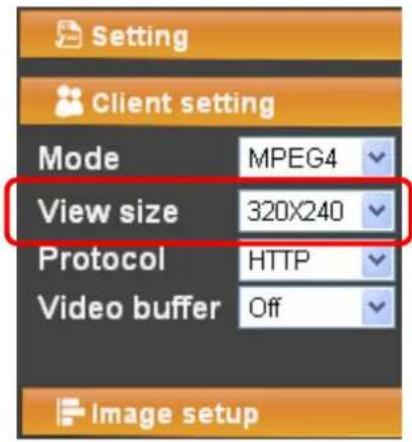
Click this button to configure the settings of the IP camera, including Mode, View Size, Protocol, and Video Buffer.
5.3.1 Mode
Click the drop-down list to choose MPEG4, MJPEG, or JPEG video compression mode.

Note:
MJPEG streaming is unavailable if RTSP mode is On (please check SETTING → BASIC → Camera → General).
5.3.2 View Size
Select the desired display image resolution: 640*480 or 320*240. It is suggested that you go to Client Setting to select a suitable View Size before using the IP camera, as shown in the figure below. For PCs with a resolution less than 1280*1024, a View Size of 320*240 is recommended.
5.3.3 Protocol
Select the transferring protocol from TCP, UDP, HTTP, and Multicast.
Note:
This item appears only when RTSP mode is enabled (selecting SETTING → BASIC → Camera → General).
5.3.4 Video Buffer
Turn the Video Buffer function ON or OFF. The Video Buffer function makes streaming smoother in unsteady network environments, but might cause a slight delay in live viewing.
5.4 Image Setup

You can use the toolbar to optimize video Brightness, Contrast, Saturation, and Hue.
5.4.1 Brightness


The higher the brightness value, the brighter the image.
5.4.2 Contrast
Contrast is a measure of a display system, defined as the ratio of white to black that the system is capable of producing. The higher the contrast value, the more delicate colors you can get.
5.4.3 Saturation
The saturation of a color is determined by a combination of light intensity and how much it is distributed across the spectrum of different wavelengths. The higher the saturation value, the more colorful the image will be.
5.4.4 Hue
Hue is one of the three main attributes of perceived color, which is affected by different wavelengths of color. With a higher hue value, colors will be much more vivid.
5.4.5 Default
After adjusting all settings, you can still click Default to reset the settings to the factory default.
Chapter 6 Setting - BASIC


Click BASIC to display the submenus including System, Camera, Network, and Security.
6.1 System
Click System to display the submenus including Information, Date/Time, and Initialize.
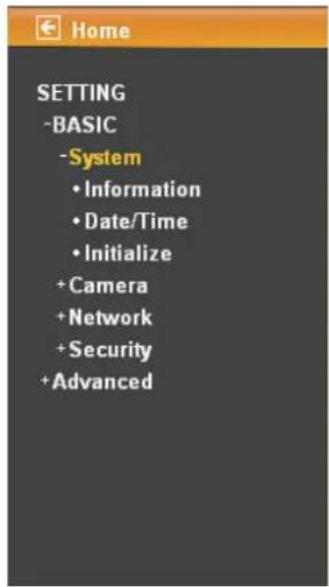

6.1.1 Information
The Information page provides the basic information of the product which includes Product name, Firmware version and Web version.

Information
6.1.2 Date/Time
The Date/Time page displays all options of time setting.

Date/Time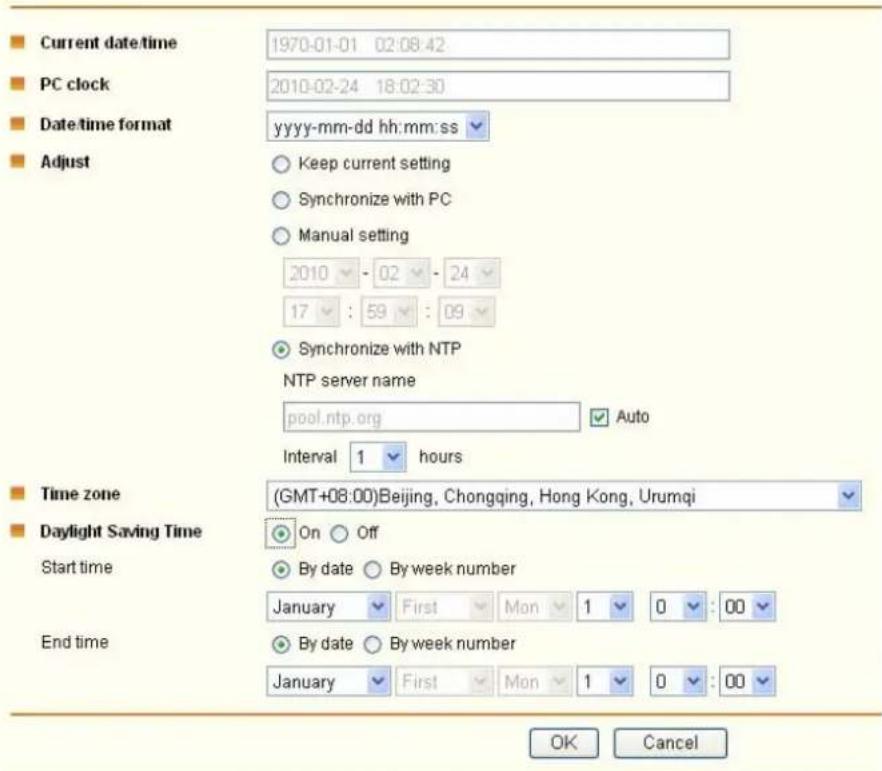
Current date/time: Displays the current date and time of this IP Camera. PC clock: Displays the date and time of the monitoring PC clock. Date/time format: You can click the drop-down list to select different time display formats. Adjust: You can select one of those four adjusting modes for your IP Camera.
- Keep current setting: Select this mode to keep the current date and time of this IP Camera.
- Synchronize with PC: Select this mode to keep the date and time of this IP Camera the same with the monitoring PC.
- Manual setting: Select this mode to adjust manually the date and time of this IP Camera.
- Synchronize with NTP: Specify the NTP server name and the Refresh Interval to
synchronize the date and time of this IP Camera with those of the time server, known as the NTP server.
Note:
The NTP server (Network Time Protocol) is the time server which is an Internet standard protocol built on the top of TCP / IP. This assures accurate synchronization to the millisecond of computer clock time in a network of computers.
- Time zone: You can select the format from Greenwich Mean Time. The time displayed will be the same as the current date / time option.
- Daylight Saving Time (DST; also summer time in British English): It is the practice of advancing clocks so that afternoons have more daylight and mornings have less. Here you can find the daylight saving time around the world:
http://en.wikipedia.org/wiki/Daylight_saving_time_around_the_world
6.1.3 Initialize
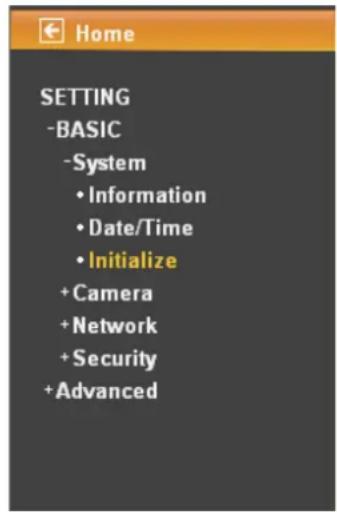
Initialize
Reboot
Reboot
Factory default
Factory default
Backup setting data
Save
Restore setting
Browse.
OK
Firmware upgrade
Browse.
OK
- Upload language pack
Browse.
OK
Language: English
➢ Reboot: Click this button to reboot this IP Camera. A confirmation dialogue will appear and then click OK to process. It takes two minutes to reboot this IP Camera. ➢ Factory default: Click this button to reset this IP Camera to the factory default settings. A confirmation dialogue will appear and then click OK to process. The network LED indicator on the IP Camera will start to blink. This IP Camera will reboot automatically after the restoring has been finished. Don't turn off this IP Camera during this process. Backup setting data: You can save configuration setting data of this IP Camera into a file. Click Save and follow the instructions on the browser to save this setting data file to specified location. Restore setting: Download the saved setting data of this IP Camera. Click Browse... and select the saved file. Click OK and this IP Camera is adjusted according to the loaded data and then restarted. Firmware upgrade: Upgrade the device software. Click Browse... and select the file for upgrading. A confirmation dialogue will appear. Click OK to start. This IP Camera will reboot after upgrading has been finished.
Note:
Use only upgrade files that are special for this IP Camera. Otherwise problems may occur. Don't
turn off the IP Camera power or disconnect the network until the upgrading is completed.
Upload language pack: Upgrade the device language pack. Click Browse... and select the file for upgrading. A confirmation dialogue will appear. Click OK to start upgrading. The upgrade is applied immediately. The default language is "English".
6.2 Camera
Click Camera to display the submenus including General, MPEG4 and MJPEG.


6.2.1 General


▶ RTSP: Switch On or Off.
- RTSP Port: Specify the transmission port number of RTSP streaming. The default value is 554.
- Port Range: Specify the transmission port range of RTP streaming video. RTP will select a port randomly from this range.
Note:
RTSP (Real Time Streaming Protocol) is a protocol used in streaming media systems that allows clients to remotely control a streaming video server. RTSP is supported by most media clients such as Real Player, QuickTime, and VLC, etc.
Image rotated: You can mirror or flip the display screen. ➢ Audio Codec: Switch On or Off. Exposure mode: You can choose Auto, 50Hz, or 60Hz. If you choose Auto, the camera will adjust automatically to perform well. White Balance: You can choose Auto, Sunny, Cloudy, or Black & White. IR: You can choose Auto, On, or Off. If you choose Auto, the camera will adjust automatically to perform well.
Note:
1) The effective range of the IR (Infrared) light is 10 meters (33 feet), and it is strongly suggested that you install it in a place without any barriers within 3 meters of the field of view (10 feet). Reflected light from a large closed barrier (such as a wall) may cause the camera to shut down the infrared light. 2) Normally, 10 seconds after the environment becomes darker than the threshold, the camera will turn on the IR (Infrared) light. One typical abnormal situation is that a barrier is very close to the camera and shields all available light.
▶ Overlay:
- Text Overlay: You can see some information on the display screen, which includes Date/Time and user-defined text. Also, you can change the background color.
- Privacy Mask: You can cover a specific area of the video image.
6.2.2 MPEG4
A. Computer View
If RTSP is On (see Setting → Basic → Camera → General), the screen will display as shown below.

Computer view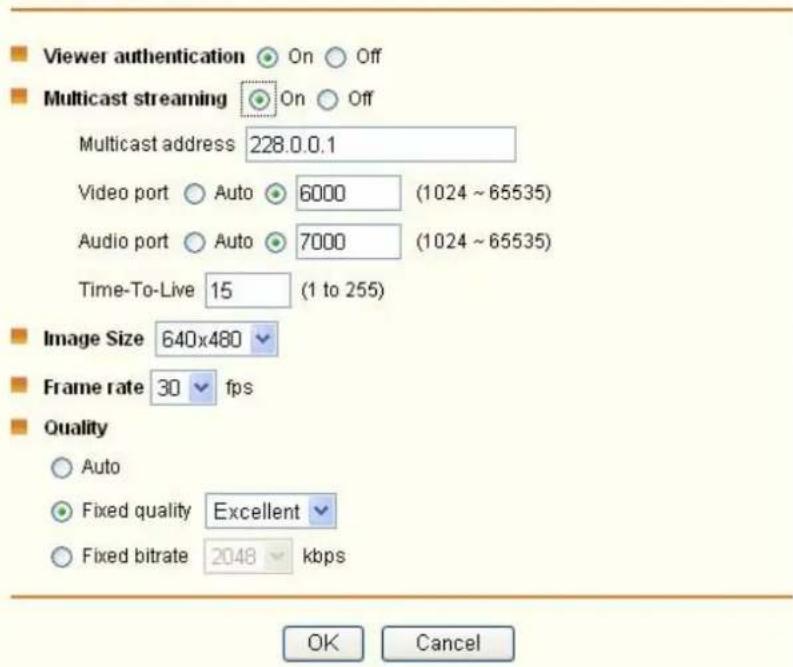
Viewer Authentication: If the viewer authentication is On, users will be requested to type in username and password when viewing through RTSP. Multicast Streaming (If it is ON)
- Multicast address: Specify the multicast server address.
- Video/Audio port: Specify the transmission port number of the video data, which is an even number from 1024 to 65534.
- Time-To-Live: Set the maximum TTL (Time-To-Live) that multicast can pass through.
Image Size: Specify the image size when the network camera transmits. You can choose among 640 x 480, 320 x 240, and 160 x 120. Frame rate: Set the frame rate of the MPEG4 image. You can choose values from 1, 2, 3, 4, 5, 7, 10, 15, 20, 25, and 30 fps. The unit "fps" stands for "frames per second". Quality:
• Auto: The quality and bitrate will be adjusted automatically according to the frame rate. - Fixed Quality: You can select the value of quality among Medium, Standard, Good, Detailed and Excellent. - Fixed bitrate: Set the bitrate of MPEG4 image transmission for a line. You can select the values from 64, 128, 256, 384, 512, 768, 1024, 1280, 1536, and 2048 kbps.
If RTSP is Off (see Setting → Basic → Camera → General), the screen will display as shown below.

Computer view
B. Mobile View
If RTSP is On (see Setting → Basic → Camera → General), the screen will display as shown below.

Mobile view
Viewer Authentication: If the viewer authentication is On, the users will be requested to type in username and password when viewing through RTSP. Multicast Streaming (If it is On)
• Multicast Address: Specify the multicast server address. • Video/Audio Port: Specify the transmission port number of the video data, which is an
even number from 1024 to 65534. It is set to 10000 and 11000 by default.
- Time-To-Live: Set the maximum TTL (Time-To-Live) that multicast can pass through.
Image Size: The image size of Mobile View is fixed at 160 x 120. Frame Rate: Set the frame rate of the MPEG4 image. You can choose values from 5, 10fps. The unit "fps" stands for "frames sent per second". Quality:
- Auto: The quality and bitrate will be adjusted automatically according to the frame rate.
- Fixed Quality: You can select the value of quality among Medium, Standard, Good, Detailed and Excellent.
- Fixed bitrate: Set the bitrate of MPEG4 image transmission for a line. You can select the values from 16, 32, 48, 64, 128, 256bps.
If RTSP is Off (see Setting → Basic → Camera → General), the screen will display as shown below.

6.2.3 MJPEG
If RTSP is On (see Setting → Basic → Camera → General), the screen will display as shown below.


If RTSP is Off (see Setting → Basic → Camera → General), the screen will display as shown below.


Image Size: Specify the image size when the network camera transmits. You can choose among 640 x 480, 320 x 240, and 160 x 120. Frame Rate: Set the frame rate of the MJPEG image. You can choose values from 1, 2, 3, 4, 5, 7, 10, 15fps. The unit "fps" stands for "frames per second". Quality:
• Auto: The quality will be automatically decided. - Fixed Quality: You can select the value of quality among Medium, Standard, Good, Detailed and Excellent.
6.3 Network
Click Network to display the submenus including Information, PPPoE, DDNS, UPnP, Bonjour, IP Notification, Wireless and Messenger.


6.3.1 Information
The page of Information displays the MAC address of the device.

Information
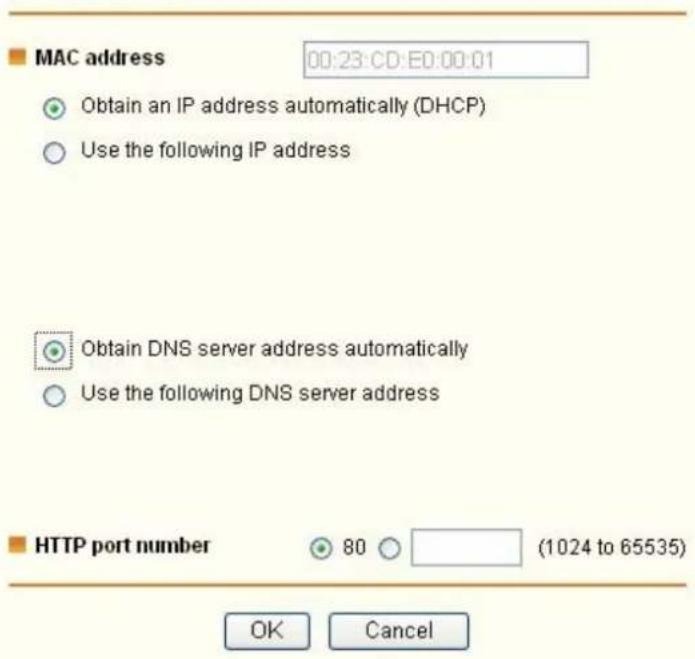
Obtain an IP address automatically (DHCP): (If a DHCP server is installed on the network) Select this, the IP will be assigned by the DHCP server. Obtain DNS server address automatically: Select this to obtain the address of DNS server automatically.

Information
Use the following IP address: Select this when the fixed IP address is set.
• IP address: Enter the IP address of the device. - Subnet mask: Enter the subnet mask. - Default gateway: Enter the default gateway.
Use the following DNS server address: Select this when you set the fixed IP address as the IP address of DNS server.
• Primary DNS server: Enter the IP address of the primary DNS server. - Secondary DNS server (optional): Enter the IP address of the secondary DNS server if necessary.
HTTP port number: Select 80 in general situations. If you want to use a port number other than 80, select the radio button before the text box and enter a port number between 1024 and 65535.
- When you have set the HTTP port number to a number other than 80 on the Network setting page or in the Setup Program, access the device by typing the IP address of the device on the web browser as follows: for example, when HTTP port number is set to 2000 and the IP address of your camera is set to 192.168.1.100, you should type in http://192.168.1.100:2000/ to access the device.
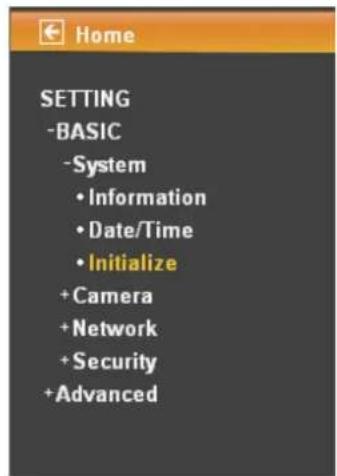
The change of settings will not take effect until the camera is rebooted. Please go to "SETTING→BASIC→System→Initialize" page and click the Reboot button as shown in the figure below after you make some changes.

6.3.2 PPPoE (Point-to-Point Protocol over Ethernet)
If your ISP provides Dynamic IP with authentication by username and password, enter all PPPoE information in this part. When you use the PPPoE function, you need to turn on the DDNS or IP Notification function at the same time.


IP address: The IP address obtained when the IP camera connecting with network at PPPoE. User ID: Enter the user ID for authentication necessary for PPPoE connections. Type it up to 64 characters. ➢ Password: Enter the password for authentication necessary for PPPoE connections. Type it up to 32 characters. Re-type password: Re-type the password to confirm. Obtain DNS server address automatically: Select this to obtain the address of DNS server automatically.


Use the following DNS server address: Select this when you set the fixed IP address as the IP address of DNS server.
• Primary DNS server: Enter the IP address of the primary DNS server. • Secondary DNS server: Enter the IP address of the secondary DNS server.
Note:
1) PPPoE (Point-to-Point Protocol over Ethernet): PPPoE is a network protocol for encapsulating Point-to-Point Protocol frames inside Ethernet frames. PPPoE connection is used mainly with ADSL service where individual users connect to the ADSL transceiver (modem) over Ethernet. It is also widely used in XDSL (digital subscriber line such as ADSL, VDSL or SDSL). 2) The IP Camera needs to be rebooted after it finishes changing the network completely. For more details, please refer to Section 6.1.3 Initialize. 3) The IP Camera with Intelligent IP Installer can't be found after PPPoE is active, but you can get the IP address of the camera by IP Notification function. For more details, please refer to Section 6.3.6 IP Notification. 4) If the IP Notification function is not configured to report the IP address of the camera, you can reset the camera to its factory default settings by pressing the Reset button. Then the camera can be found by Intelligent IP Installer.
6.3.3 DDNS (Dynamic DNS)
Choose menu "Dynamic DNS", you can configure the Dynamic DNS function.
The IP Camera offers the DDNS (Dynamic Domain Name System) feature, which allows the hosting of a website, FTP server, or e-mail server with a fixed domain name (named by yourself) and a dynamic IP address, and then your friends can connect to your server by entering your domain name no matter what your IP address is. Before using this feature, you need to sign up for DDNS service providers such as www.dyndns.org, or www.noip.org. The Dynamic DNS client service provider will give you a password or key.

DDNS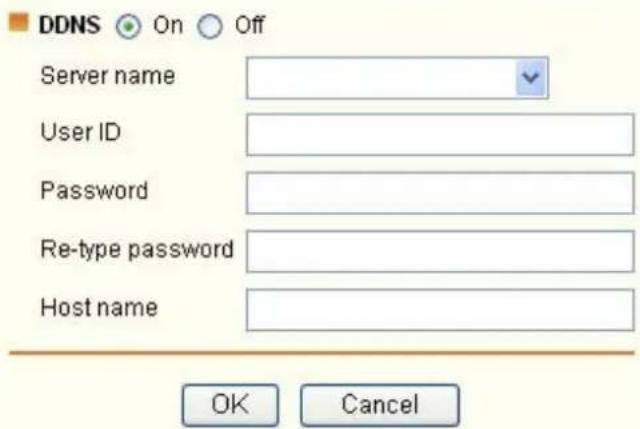
Server name: Choose the DDNS Server from the list. User ID: Enter the user ID for authentication necessary for DDNS connections. Type it up to 64 characters. Password: Enter the password for authentication necessary for DDNS connections. Type it up to 32 characters. Re-type password: Re-type the password to confirm. Host name: Enter the host name that is registered to the DDNS server.
Note:
How to apply DDNS username and Host name?
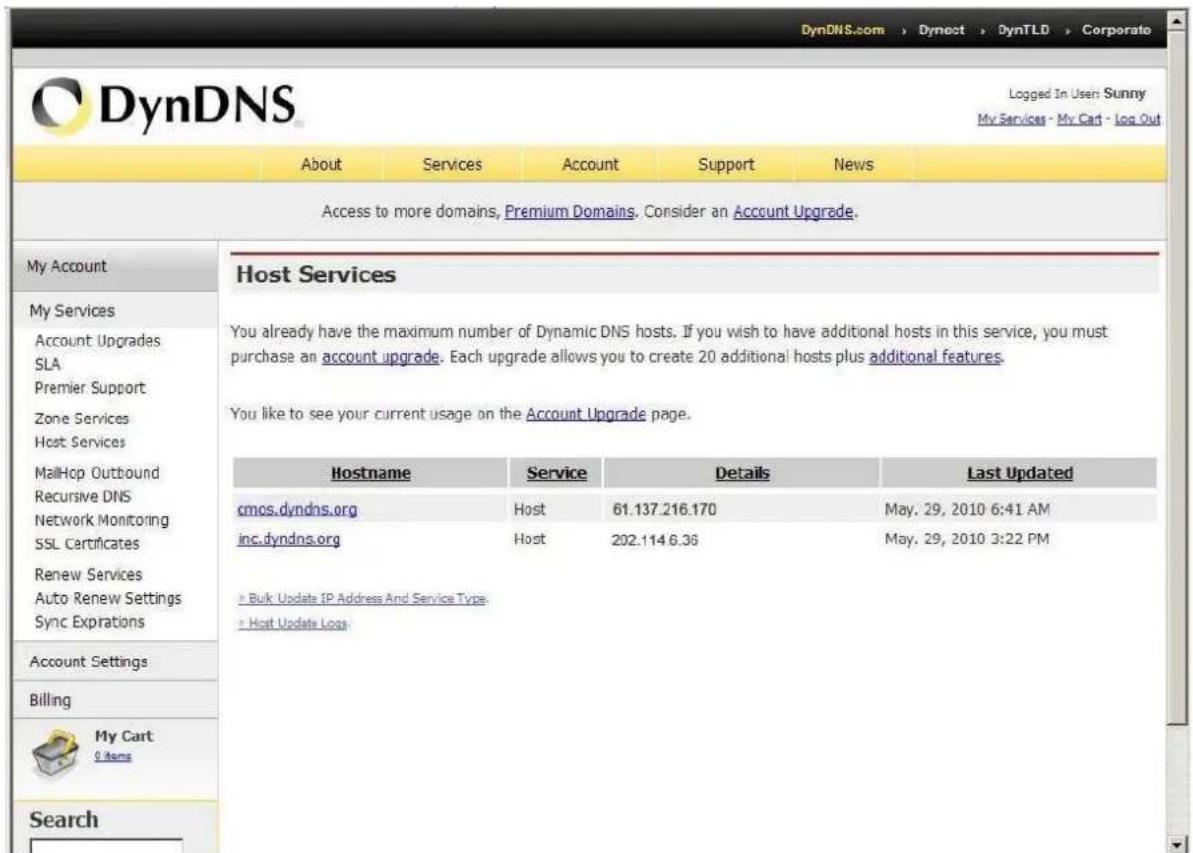
You can apply DDNS username and Host name by the following steps:
- Log in http://www.dyndns, click the Create Account.

- Input all information and follow step by step with DynDNS.

- Log in with new account and click Account → My Hosts → Add Host Services.

- Type domain in the Hostname field and select sub-domain.

- After typing in information, check your DDNS service.
- Type your DDNS User ID, Password and Host name in Setting → Basic → Network → DDNS. After completing setting, reboot IP Camera.

DDNS

6.3.4 UPnP (Universal Plug and Play)
Choose menu "Network→UPnP", and you can view the information about UPnP (Universal Plug and Play) in the screen as shown in the following figure. The UPnP feature allows devices, such as Internet computers, to access local host resources or devices as needed. UPnP devices can be automatically discovered by the UPnP service application on the LAN.


HTTP port: Enter the HTTP port number. The default HTTP port is 80. SSL port: Enter the SSL port number. The default SSL port is 443. MPEG4 RTSP port: Enter the MPEG4 RTSP port. The default value is 554.
Note:
UPnP (Universal Plug and Play): UPnP is a set of computer network protocols. It allows devices to connect seamlessly and simplifies the implementation of networks in home and corporate environments. The device supports UPnP, which is enabled by default. The device will be automatically detected and a new icon will be added to "My Network Places" if UPnP is also enabled on your computer. It provides Port Forwarding for opening a port in a router or firewall in a private network in order to let a party from the outside world contact an inside user.
6.3.5 Bonjour
Bonjour, also known as zero-configuration networking, enables automatic discovery of computers, devices, and services on IP networks. Bonjour uses industry standard IP protocols to allow devices to automatically discover each other without the need to enter IP addresses or configure DNS servers.


Device Name: Enter a Device Name according to your needs.
Note:
How to use Bonjour in your Windows Browser UI? Please check the link below: http://www.apple.com/support/downloads/bonjourforwindows.html
6.3.6 IP Notification
Once IP Notification is set to "On", the camera will automatically send an e-mail notification to tell users its updated network parameters if the network settings about IP address, network connection type, HTTP port, or wireless connection are changed or completed. (Some settings will take effect after rebooting.)
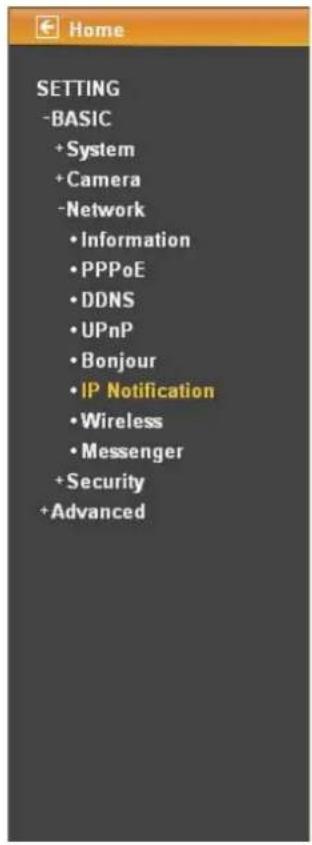
IP Notification
Notify Type: You can select the notify type among DHCP, Static IP, and PPPoE. When the network settings related to the chosen notify type are changed, an e-mail notification will be sent to inform you of the updated network information of the camera. SMTP Server Name: Type the SMTP server name up to 64 characters, or the IP address of the SMTP server. SMTP Server Port: You can set port number from 1 to 65535 according to your mail server. The default value is 25.
- SSL: This is a security setting. Check the SSL box if the mail server you use has security restrictions.
Note:
If you use Gmail as your mail server, you should set 587 as your port number and check the SSL box.
Authentication: Select the authentication required when you send an email.
- Off: Select this if no authentication is necessary when an email is sent.
- On: If authentication is necessary when an email is sent, there are three options: SMTP, POP before SMTP, or both.
- SMTP: Select this if SMTP authentication is necessary when an email is sent.
- POP before SMTP: Select this if POP before SMTP authentication is necessary when an email is sent. If this option is selected, the IP Notification page will be different as shown in the following figure.

IP Notification
- POP server name: This is necessary when POP before SMTP is selected in Authentication. Type the POP (receiving mail) server name up to 64 characters, or type the IP address of the POP server. This setting is necessary when the SMTP server that sends emails performs authentication using the POP user account.
- User name, Password: Type the username and password of the user who has the mail account. This setting is necessary when the SMTP server that sends emails performs authentication.
Recipient e-mail address: Type the recipient email address. You can specify more than one recipient email address using ";" to separate them. Administrator e-mail address: Type the administrator email address up to 64 characters. This address is used for reply mail and sending system messages from the SMTP server. Subject: Type the subject/title of the email up to 64 characters, with respect to mail that is sent according to the IP notification. Message: Type the text of the email up to 384 characters. The default value provides network information including IP, Port, MAC, Model, Firmware Version, and Web Version.
6.3.7 Wireless
Choose Network → Wireless, you can configure the wireless function for the camera in the figure below.

Wireless
Wireless On Off
| Status of wireless networks | |||||
| ESSID | Mode | Security | Channel | Signal strength | Bit rate |
| TP-LINK | Managed | WPA(2)-PSK/TK...1 | 69 | 0 | |
| TP-LINK_010618 | Managed | Open/NoSecurity 1 | 71 | 0 | |
| yin hong | Managed | Open/WEP 1 | 81 | 0 | |
| 541G | Managed | Open/NoSecurity 1 | 55 | 0 | |
| TP-LINK_EF127B | Managed | WPA2-PSK/AES 2 | 77 | 0 | |
Refresh
MAC address
IP address
ESSID
Mode
Authentication
Encryption
Key length
Active transmit key:


Obtain an IP address automatically (DHCP)
Use the following IP address
Obtain DNS server address automatically
Use the following DNS server address
OK Cancel
The wireless network has to be set up by using a cable network connection. After setting the camera correctly, the wireless function can work without a cable network connection. Please follow the setting process below step by step:
- Connect the IP camera with an Ethernet connection.
- Go to SETTING → BASIC → Network → Wireless, and choose option "On". You will see the wireless setting page.
- Then click Refresh. All access points (AP) around you will show up.

- Select the AP you wish to connect.
- Enter the password in the Passphrase field if needed. If you don't know the setting of the wireless AP, please ask your network administrator.

- Choose the option of Obtain an IP address automatically (DHCP) or Use the following IP address:

Use the following IP address: Select this when the fixed IP address is set.
- IP address: Enter the IP address of the device.
- Subnet mask: Enter the subnet mask.
- Default gateway: Enter the default gateway.
Use the following DNS server address: Select this when you set the fixed address as the IP address of the DNS server.
- Primary DNS server: Enter the IP address of the primary DNS server.
- Secondary DNS server: Enter the IP address of the secondary DNS server, if necessary.
- Please click OK button to finish the wireless setting. Now please have a short rest or work on other business, for the wireless setting will take effect 1 minute after you click OK.
- Please unplug the Ethernet cable connecting the TL-SC3171G and the Router (or the PC), and log into the IP camera with its wireless address.
6.3.8 Messenger (Supports up to Windows Live Messenger version 8089)
If the firmware of your IP Camera has been updated to LM.1.6.16.03P5, then the Messenger submenu will be displayed under the Network menu. Click the Messenger submenu, the Messenger configuration page will be displayed similar to the figure shows below. This function allows you to use the desired computer with MSN installed to view the video captured by the IP camera.
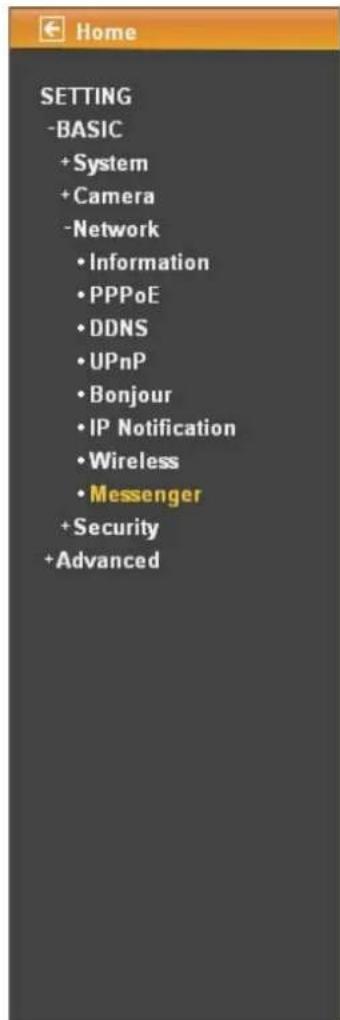
Messenger
➢ Messenger: Check the radio button before On, so you can use your IP Camera via this function. Protocol: Displays the protocol used. Login Account: Enter the MSN account registered for you IP Camera. ➢ Password: Enter the password of the MSN account. Re-type password: Type the password again. Alias: Give an alias for the account of your IP Camera. The figure above takes "TL-SC3171G" for example. Port range: Enter the port range used. IP Notification: When this feature is enabled, the IP camera would notify "friends" on MSN about its IP address when it logs into the MSN account or when its IP address is changed. Privacy: When this feature is enabled, the MSN stream will be secured, then only users whose MSN ids are in the Allow List can add the camera's MSN account and view the camera video. When it's disabled, any user can add the camera's MSN id and see it.
Allow list: Enter the account of the MSN user you want communicate with in "User" field. Click Add button and then the account will be added to the "Allow list". Choose an account in the "Allow list" and click Remove button to delete it.
To use MSN to view the video captured by the IP camera, please follow the steps below.
A. Configuring your IP camera
Note:
If you use a Modem Router to access the Internet, you should set your IP Camera as the virtual server with port range 20000-21000 on the Modem Router's web-based management page.
- Click "BASIC->Network->Messenger" to enter the "Messenger" page. Enable Messenger and then set the Login Account, Password, Alias, Port range, IP Notification, Privacy and Allow list parameters as the above figure shows. Click OK to save your settings.
- Click "BASIC->Network->Information" to enter the "Information" page. Add 192.168.1.1 as the Primary DNS server.

Information

- Click "Advanced->System Log->Setting" to see if there is "Messenger is Ready" information as the figure below shows. If there is, go on with the following steps.

B. Add the camera's MSN account
- Make sure the desired computer has MSN installed. Log into MSN.
- Make sure the MSN view plugin is installed.
This plugin is embedded in IntelligentIPInstallerSetup(TPLink)-1.1.16.09.exe and will be installed automatically when you install IntelligentIPInstallerSetup(TPLink)-1.1.16.09.exe.
▲ You can download the IntelligentIPInstallerSetup(TPLink)-1.1.16.09.exe here: http://www.tp-link.com/download/ipcamera/Intelligent IP Installer.rar
- Log into your MSN account.
- Add the camera's MSN account as a contact.

- Check its status. Normally it should be online.

- Click the camera icon and select "View a contact's webcam" to view the video.

- Wait for a moment, and you will see the video captured by your IP Camera.

6.4 Security
Click Security to display the submenus including Account and HTTPS.


6.4.1 Account
The device default account and password setting is "admin / admin". That means everyone who knows the IP address can access the device including all configuration. Therefore, it is necessary to assign a password if the device is intended to be accessed by others.


User name: Set a user name between 4-16 characters. ➢ Password: Set a password between 4-16 characters. Re-type Password: Re-type the password to confirm. Viewer Mode: Set the user mode among Admin, Operator, and Viewer. Different viewer mode has different limits of authority.
- The Admin mode has all authority of configuration.
- The Operator mode can not only view the Live View but also control the PTZ (apply in speed dome).
- The Viewer mode only can view the Live View.
➢ Viewer Authentication: Select whether the authentication is needed when users access to live view.
- On: Authentication is required to let different users have different levels of permission to access the camera view.
- Off: Authentication is not required to access the camera. Click Off and select one (among Admin, Operator and Viewer) from the pull-down list as default, then all users can view directly the video with the default permission without entering username and password.
* If you want to have a higher authority than the default, you can key in appropriate username and password in the dialog box that pops up when performing advanced operations that are only allowed by the higher authority.
6.4.2 HTTPS
HTTPS is a URL scheme used to indicate a secure HTTP connection. It is syntactically identical to the http:// scheme normally used for accessing resources using HTTP. Using https://URL/ with a different default TCP port (443) and an additional encryption / authentication layer between the HTTP and TCP, you can use the IP camera through HTTPS easily by using "https://" instead of "http://".

Create & Install: Create a self-signed certificate for HTTPS to recognize. Installed Certificate: Display or remove the properties of the installed certificate. HTTPS Connection Policy: Set HTTPS connection policy for different level of users.
To use the HTTPS encryption, please set up "Create self-signed certificate" for the first time you use the HTTPS function, and then set up the connection policy for different users.


Note:
1) When enable HTTPS with RTSP on mode, the IP Camera only protect the setting such as username and password and do not protect video and audio. 2) When enable HTTPS with RTSP off mode, the IP Camera will protect all setting including video and audio.
Chapter 7 Setting-Advance
Click Advance to display the submenus including FTP client, SMTP, HTTP event, Alarm output, Schedule, Alarm input, Motion detection and System Log.
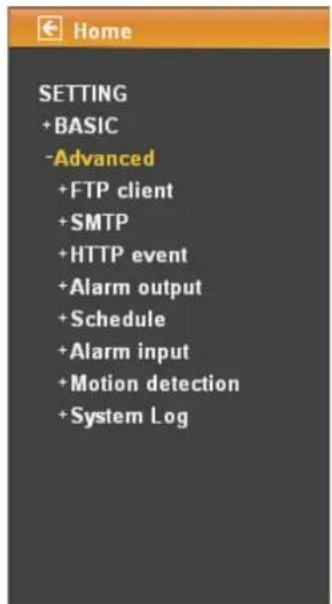

7.1 FTP client
Use this menu to set up for capturing and sending images to an FTP server. By using FTP client function, you can send the image and video file which has been shot and recorded linked with the built-in motion detection function to FTP server. FTP client setting menu is composed of three items, General, Alarm sending and Periodical sending.
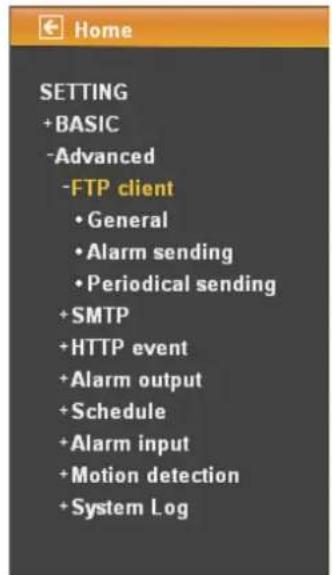

7.1.1 General
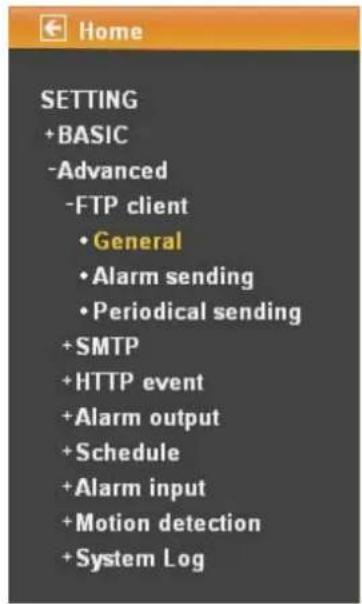
General
Select On when you use FTP function. The FTP client setting page will appear.
Select Off when you do not wish to use the FTP client function.
Note:
The frame rate and operability on the main viewer may decrease while a file is being transmitted by the FTP client function.
FTP server name: Type the FTP server name to upload still images up to 64 characters, or the IP address of the FTP server. User name: Type the user name for the FTP server. Password: Type the password for the FTP server. Retype password: To confirm the password, type the same characters as you have typed in the Password box. Passive mode: Set whether you use the passive mode of FTP server or not when connecting to FTP server. Select On to connect to FTP server using the passive mode.
7.1.2 Alarm sending
Set to forward the image and video file to the specified FTP server linked with the alarm detection by the built-in motion detection function. Select On to send the image file to FTP server linked with the alarm detection.

Alarm sending
Remote Path: Type the path to the destination in FTP server up to 64 characters. Image File Name: Type the file name you want to assign to the images when sending to the FTP server. You can use up to 10 alphanumeric characters, - (hyphen) and _ (underscore) for naming. Suffix: Select a suffix to add to the file name
- Date & time: The date & time suffix is added to the Image file name. The date/time suffix consists of lower two-digits of year (2 digits), month (2 digits), date (2 digits), hour (2 digits), minute (2 digits), second (2 digits), and consecutive number (2 digits), thus 14-digit number is added to the file name.
- Sequence number: A consecutive number of 10 digits between 0000000001 and 4294967295, and two fixed digits 00 are added to the image file name.
- Sequence number clear: Click Clear and the suffix of the sequence number returns to 1.
Alarm
- Motion Detection: Click it to use the Motion Detection function as a sensor. You can set the motion detection function on the Motion Detection page.
Motion detection
Setting


Note:
1) You can set motion detection on the Motion Detection page (Please go to "Setting → Advance → Motion detection → Setting"). For more details, you can check Section 7.7. 2) Motion Detection works only when the MPEG4 function is On and the Cropping is set to Off. - Alarm Input: Select the connected alarm. Sensor input1: The external sensor which is connected to sensor input1 of the alarm input.
Setting
Alarm input
Sensor input 1
Trigger condition ◦ High ○ Low

Note:
You can set the alarm input function on the Alarm Input page. (Please go to "Setting → Advance → Alarm Input → Setting"). For more details, you can check Section 7.6.
Effective period: Set the period when the periodical sending is effective.
• Always: The periodical sending is always effective. - Schedule: You can specify the period when the periodical sending is effective in the Schedule setting in the other section.
Schedule
Setting
OK Cancel
Note:
You can set the schedule function on the Schedule page. (Please go to "Setting → Advance → Schedule → Setting") For more details, you can check Section 7.5.
7.1.3 Periodical sending
You can set to send an image file to the FTP server periodically by selecting On to send the image file to the FTP server linked with the setting period.

Periodical sending
Remote Path: Type the path to the storage location of the FTP server which you have authorized. Image file name: Type the file name of the image sent by SMTP up to 10 alphanumeric characters, - (hyphen) and _ (underscore). Suffix: Select a suffix to be added to the file name sent by SMTP.
• None: The name of the sent file will be the Image file name. - Date Time: The date time suffix is added to the Image file name. The date time suffix consists of lower two-digits of year (2 digits), month (2 digits), date (2 digits), hour (2 digits), minute (2 digits) and second (2 digits), and consecutive number (2 digits), thus 14-digit number is added to the file name. • Sequence number: A consecutive number is added to the Image file name. - Sequence number clear: Click Clear and the suffix of the sequence number returns to 1.
Interval: Set the time interval of the period sending. Min value is 1 min and Max value is 24 hours. ➢ Effective period: Set the period when the periodical sending is effective.
• Always: The periodical sending is always effective. - Schedule: You can specify the period when the periodical sending is effective in the schedule setting in the other section.
Schedule
Setting

Note:
You can set the schedule function on the Schedule page. (Please go to "Setting → Advance → Schedule → Setting") For more details, you can check Section 7.5.
7.2 SMTP
Set the SMTP menu when you want to send an image via e-mail. By using the Mail (SMTP) function, you can send a mail with an attached image and video that has been shot, linked with the built-in motion detection function. The image file can also be sent periodically. The E-Mail (SMTP) setting menu is composed of three items: General, Alarm sending, and Periodical sending.

7.2.1 General
Select On when you use the SMTP function. The common setting options are displayed below. Select Off if you do not wish to use the e-Mail (SMTP) function.
Note:
The Setting of General will be the same as the setting of IP Notification (Please check "SETTING → BASIC → Network → IP Notification").


SMTP server name: Type the SMTP server name up to 64 characters, or the IP address of the SMTP server. SMTP Server Port: You can set the port number from 1 to 65535 according to your mail server. The default value is 25. ➢ Security setting: Check the SSL box if the mail server you use has security restrictions.
Note:
If you use Gmail as your mail server, you should set 587 as your port number and check the SSL box.
Authentication: Select the authentication required when you send an email.
- Off: Select this if no authentication is required when sending an email.
- On: When authentication is required to send an email, select one of the authentication methods from the following options.

General
SMTP: Select this if SMTP authentication is required when sending an email. POP before SMTP: Select this if POP before SMTP authentication is required when sending an email.
Note:
When set to On, be sure to select either SMTP, POP before SMTP, or both.
- POP server name: When POP before SMTP is selected under Authentication, enter the POP (incoming mail) server name (up to 64 characters) or the IP address of the POP server. This setting is necessary when the SMTP server that sends emails performs authentication using the POP user account.
- User name, Password: Enter the user name and password of the user who has the mail account. This setting is necessary when the SMTP server that sends emails performs authentication.
Recipient email address: Enter the recipient email address (up to 64 characters). You can specify up to three recipient email addresses. Administrator email address: Enter the administrator email address (up to 64 characters). This address is used for reply mail and for sending system messages from the SMTP server. Subject: Enter the subject/title of the email (up to 64 characters). For emails sent due to alarm detection when Alarm sending on the Alarm tab is set to On, characters representing the sensor type are added to the subject. Message: Enter the text of the email (up to 384 characters). (A line break counts as 2 characters.)
7.2.2 Alarm sending
Set to send mail in connection with alarm detection via external sensor input or the built-in motion detection function. Select On to send the image and file to the SMTP server linked with alarm detection.

Alarm sending: Select On to send mail in connection with alarm detection. File attachment: Set whether an image file is attached to the sent mail. When On is selected, the image file created by the settings below is attached. When Off is selected, only the message is sent. Image file name: Enter the file name you want to assign to the image to attach to the mail. You can use up to 10 alphanumeric characters, hyphens (-), and underscores (_) for naming. Suffix: Select a suffix to add to the file name.
- Date Time: The date/time suffix is added to the image file name. The date/time suffix consists of the last two digits of the year (2 digits), month (2 digits), day (2 digits), hour (2 digits), minute (2 digits), second (2 digits), and a consecutive number (2 digits), resulting in a 14-digit number added to the file name.
- Sequence number: A consecutive number of 10 digits between 0000000001 and 4294967295, plus two fixed digits 00, is added to the image file name.
- Sequence number clear: Click Clear to reset the sequence number suffix to 1.

Alarm sending
> Alarm
- Motion Detection: Click it to use the Motion Detection function as a sensor. You can configure the motion detection function on the motion detection page.
Motion detection
Setting




Note:
1) You can set motion detection on the motion detection page (go to "Setting → Advance → Motion detection → Setting"). For more details, refer to Section 7.7. 2) Motion Detection works only when the MPEG4 function is On and the Cropping is set to Off. - Alarm input: Select the connected alarm. Sensor input1: The external sensor connected to sensor input1 of the alarm input.
Alarm input
Setting
Alarm input
Sensor input 1
Trigger condition ◆ High ○ Low
OK
Cancel
Note:
You can set the alarm input function on the alarm input page (go to "Setting → Advance → Alarm input → Setting"). For more details, see Section 7.6.
Effective period: Set the period during which the periodic sending is effective.
• Always: The periodic sending is always effective. - Schedule: You can specify the period during which the periodic sending is effective in the Schedule setting in the other section.
Schedule
Setting
Note:
You can set the schedule function on the Schedule page (go to "Setting → Advance → Schedule → Setting"). For more details, see Section 7.5.
7.2.3 Periodic sending
You can set the camera to send an image file via SMTP server periodically by selecting On, and the image will be sent according to the set period.

Periodic sending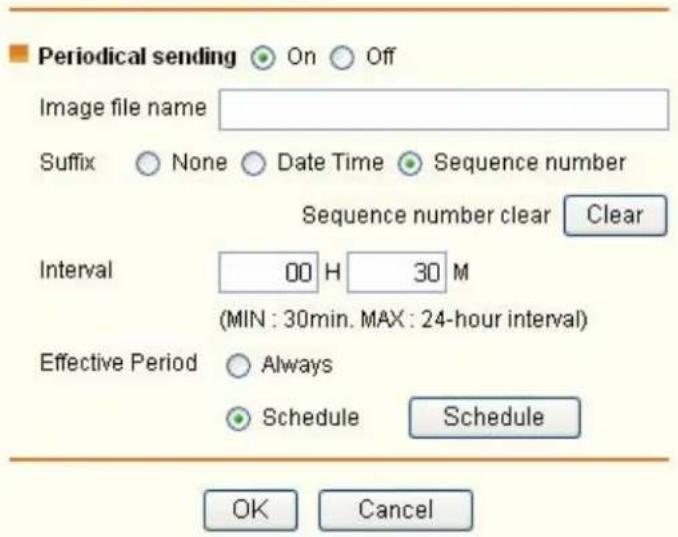
Image file name: Enter the file name of the image sent via SMTP, up to 10 alphanumeric characters, hyphens (-), and underscores (_). Suffix: Select a suffix to be added to the file name sent via SMTP.
• None: The sent file name will be the Image file name. - Date Time: The date and time suffix is added to the Image file name. The suffix consists of the last two digits of the year (2 digits), month (2 digits), day (2 digits), hour (2 digits), minute (2 digits), second (2 digits), and a consecutive number (2 digits), resulting in a 14-digit number added to the file name. - Sequence number: A consecutive number is added to the Image file name. - Sequence number clear: Click Clear to reset the sequence number suffix to 1.
Interval: Set the time interval for periodic sending. The minimum value is 30 minutes, and the maximum value is 24 hours. Effective period: Set the period during which the periodic sending is effective.
• Always: The periodic sending is always effective. - Schedule: You can specify the period during which the periodic sending is effective in the schedule setting in the other section. Please check "SETTING → BASIC → Advance → Schedule → Setting".
Schedule
Setting

Note:
You can set the schedule function on the Schedule page (go to "Setting → Advance → Schedule → Setting"). For more details, see Section 7.5.
7.3 HTTP event
Use this menu to set up capturing and sending images to an HTTP server. By using the HTTP client function, you can send the image and audio files that have been captured and recorded, linked with the built-in motion detection function, to the HTTP server. The HTTP client setting menu consists of two items: General and Alarm sending.


7.3.1 General

General
HTTP event: Set up the HTTP server URL, port, User ID, Password, and Proxy Server settings.

General
For example: URL: 192.168.1.7/cgi-bin/operator/ptzset
Note:
- The URL setting should be the same as the CGI.
- The example above is for reference only. For more details, please refer to the SDK in the subdirectory of the IP camera product on our website http://www.tp-link.com.
7.3.2 Alarm sending
Set to send the mail with connection to the alarm detection by the built-in motion detection function. Select On to send the image and audio files to the HTTP server linked with the alarm detection.

Alarm sending: Select On to send a command when an alarm is detected.
> Alarm
- Motion detection: Click to use the Motion Detection function as a sensor. You can configure the motion detection function on the motion detection function page.
√ Parameter: the parameter of the CGI (defined in Setting → Advance → HTTP event → General → URL) comes from your target device. For example, move=down. √ Message: the message will appear in the form of Message = PTZ down. If your target device does not support the message parameter, you won't see the message. So you can treat the message as a note. For example: PTZ down.
Motion detection
Setting



Note:
- You can set motion detection on the motion detection page (go to "Setting → Advance → Motion detection → Setting"). For more details, see Section 7.7.
- Motion Detection works only when the MPEG4 function is On and the Cropping is set to Off.
- Alarm input: Select the connected alarm. Sensor input1: The external sensor connected to sensor input1 of the alarm input.
√ Parameter: the parameter of the CGI (defined in the URL of HTTP→General) comes from your target device. For example, move=down. √ Message: the message will appear in the form of Message = PTZ down. If your target device does not support the message parameter, you won't see the message. So you can treat the message as a note. For example: PTZ down.
Alarm input
Setting
Alarm input
Sensor input 1
Trigger condition
High Low
OK
Cancel
Note:
You can set the alarm input function at the alarm input page (go to "Setting → Advance → Alarm input → Setting"). For more details, check Section 8.6.
Effective period: Set the period when the periodical sending is effective.
• Always: The periodical sending is always effective. - Schedule: You can specify the period when the periodical sending is effective in the schedule setting in the other section.
Schedule
Setting

OK Cancel
Note:
You can set the schedule function on the Schedule page (go to "Setting → Advance → Schedule → Setting"). For more details, check Section 7.5.
7.4 Alarm output
When you click Alarm output on the Advance mode menu, the Alarm output setting menu appears. You can set in this menu to control the alarm out of the I/O port on the rear of the device linked to the alarm detection and the timer.


7.4.1 Setting


Alarm output: To activate the Alarm output function, select On. When you do not use the Alarm output function, select Off.
Digital output: Select High signal output and Low signal output as your alarm. Trigger condition: Select the mode of the Alarm output function. You can choose "Alarm" or "Timer". Alarm: Controls alarm output by synchronizing with an external sensor input or the built-in activity detection function.
- Motion Detection: Click it on for using Motion Detection function as a sensor. You can set motion detection function at the motion detection function page.
Motion detection
Setting
√ Motion detection 1 Threshold
Sensitivity
√ Motion detection 2 Threshold

Motion detection 3 Threshold


OK
Cancel
Note:
- You can set motion detection on motion detection page (Please go to "Setting → Advance → Motion detection → Setting"). For more details, you can check Section 7.7.
- Motion Detection works only when the MPEG4 function is On and the Cropping is set to Off.
- Alarm Input: Select the connected alarm. Sensor input1: The external sensor which is connected to sensor input1 of the alarm input.
Alarm input
Setting
Alarm input
Sensor input 1
Trigger condition ● High ○ Low
OK
Cancel
Note:
You can set the alarm input function at alarm input page (Please go "Setting → Advance → Alarm input → Setting"). For more details, you can check Section 7.6.
➢ Alarm duration: There are up to 60 second options to choose for alarm duration interval. Effective period: Set the period when the periodical sending is effective.
• Always: The periodical sending is always effective. - Schedule: You can specify the period when the periodical sending is effective in the Schedule setting in the other section.
Schedule
Setting


Note:
You can set the schedule function on the Schedule page. (Go to "Setting → Advance → Schedule → Setting") For more details, refer to Section 7.5.
7.5 Schedule
When you click Schedule on the Advance mode menu, the Schedule setting menu appears.
This is the same menu as the one displayed when you click Schedule to set the effective period and schedule in the FTP client setting menu, e-Mail (SMTP) setting menu, HTTP Event setting menu, and so on.
Example: When setting e-Mail (SMTP) (for alarm sending) in the Schedule setting menu.


7.5.1 Setting

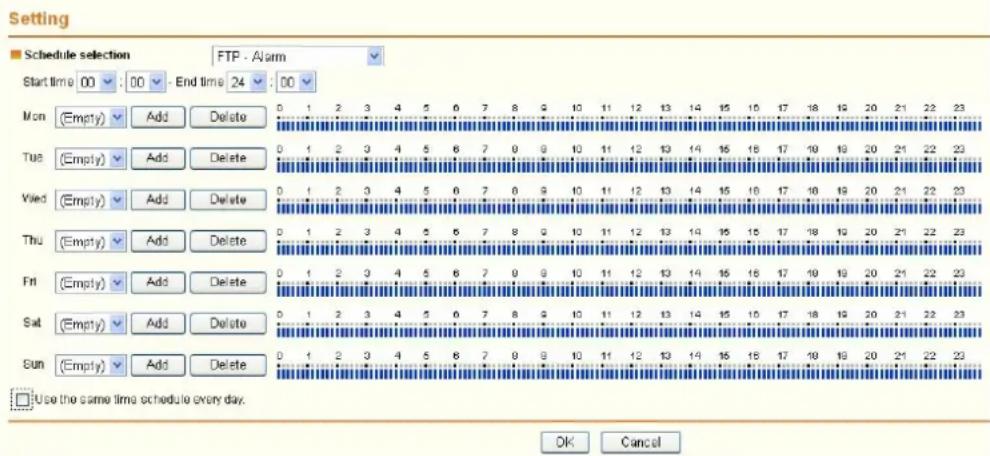
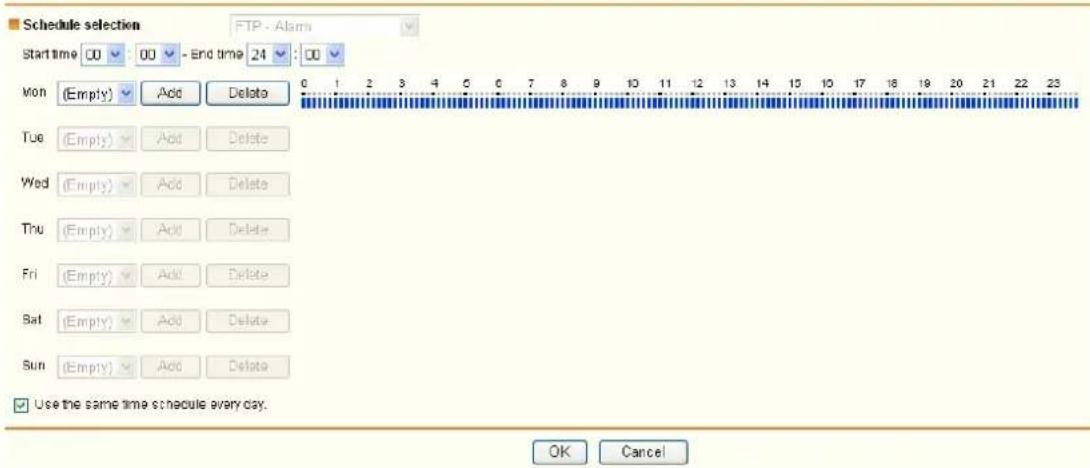
Schedule Selection: Select the list box to specify the schedule you want to set.
- FTP - Alarm
- FTP - Periodical • e-Mail (SMTP) - Alarm • e-Mail (SMTP) - Periodical
- HTTP event - Alarm
Mon (Monday) to Sun (Sunday): The time period on the right of the checked day is the effective period of the schedule. Start time/End time: Specify the start time and end time. Use the same time schedule every day: When this is checked, the start time and end time
set to Mon (Monday) are applied to all days. In this case, the start time and end time of the other days than Mon (Monday) cannot be input.
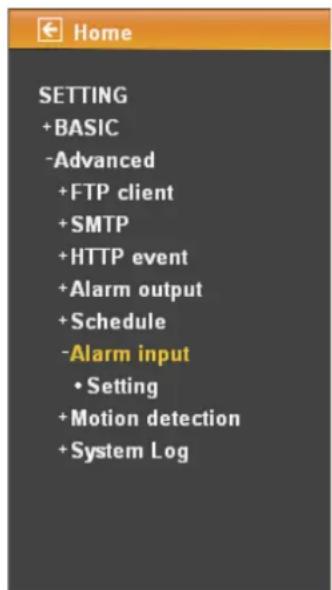
7.6 Alarm input
When you click Alarm Input on the Advance mode menu, the Alarm input setting menu appears. You can set in this menu to control the external alarm input of the I/O port on the rear of the device linked to FTP, SMTP, and HTTP sending functions.

7.6.1 Setting

Setting

Alarm input

Sensor input 1
Trigger condition

High ○ Low
OK
Cancel
➢ Sensor input 1: Click it on to use an external sensor connected to sensor input 1 of the camera's I/O port.
- Trigger condition: Select High signal output or Low signal output as your alarm.
- Camera move: Pull down the window to select the camera preset position.
7.7 Motion detection
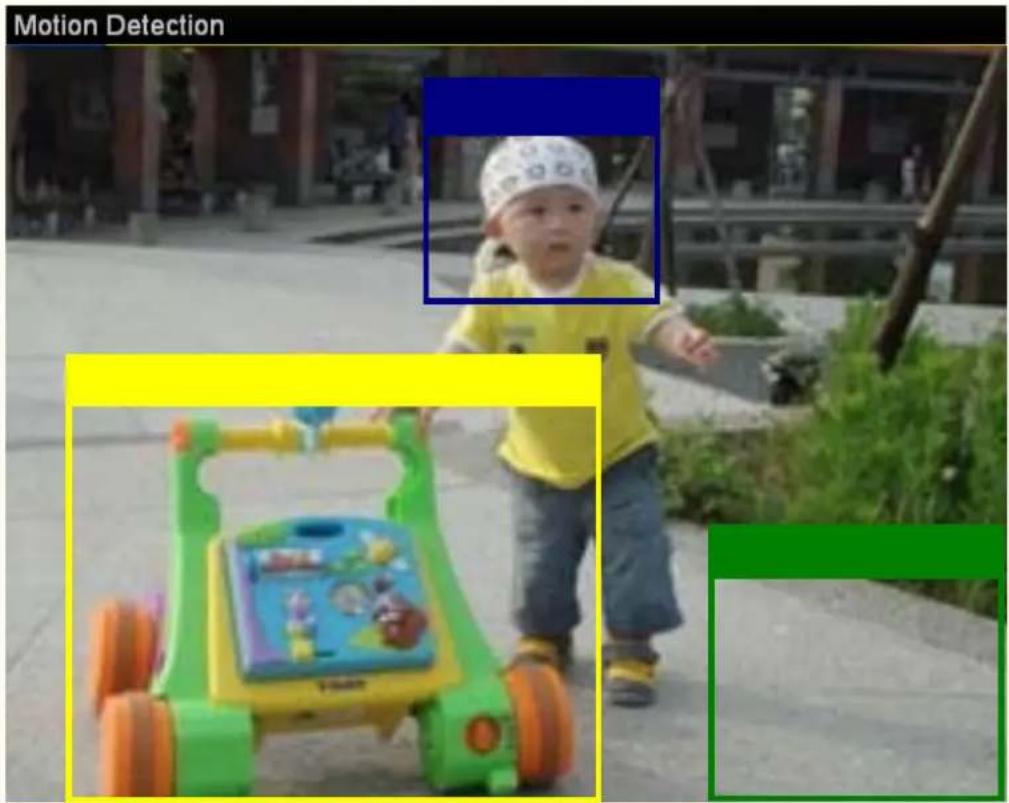
There are three Motion Detection functions as sensors to set for different detecting zones. Each one has Threshold and Sensitivity inputs which you can adjust to specific zones sequentially. Motion Detection function can support FTP, SMTP, and Alarm output for capturing and sending images or starting alarm output.

Home
SETTING
+BASIC
-Advanced
+FTP client
+SMTP
+HTTP event
+Alarm output
+Schedule
+Alarm input
-Motion detection
- Setting
+System Log
TP-LINK®
The Reliable Choice
WELCOME TO CAMERA SETTING PAGE
7.7.1 Setting
Setting


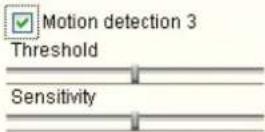
Threshold: It means the extent to which the alarm will be triggered. The default value is 50 and the value range is 0~100. The larger the value, the higher the threshold. Sensitivity: It means how often the sensor will scan the image for differences. The higher the sensitivity, the more frequently it scans. The default value is 50 and the value range is 0~100. The larger the value, the higher the sensitivity.
- Motion Detection 1: Click it on to use Motion Detection 1 function as a sensor. You can adjust and move the detecting zone by using the mouse.
- Motion Detection 2: Click it on to use Motion Detection 2 function as a sensor. You can adjust and move the detecting zone by using the mouse.
- Motion Detection 3: Click it on to use Motion Detection 3 function as a sensor. You can adjust and move the detecting zone by using the mouse.
7.8 System Log
The System Log function allows users to review any changes and events that have occurred. The system begins logging automatically after it starts.


7.8.1 Setting


Enable remote log: Enables the user to send the log data to a specified log server.
Note:
There is a function called Watchdog which can automatically detect errors and restart the IP camera while mpeg, mjepg, 3gpp, or web cannot work. It will take about 5 minutes from detection to reboot, and it will show up with "connecting" on the main page during this 5 minutes. If the Watchdog function detects errors, "*** ffmpeg", "*** mjpeg", "*** gsm" or "*** boa" will be shown in the system log. In this case, please send the file "backup" to TP-LINK (you can save it from Setting > Basic > System > Initialize > Backup setting data), and also provide the router spec you're using. We will analyze and solve the problem as soon as possible.
E-mail: support@tp-link.com
Appendix
APPENDIX A - FRAME RATE & BIT RATE TABLE
This chapter provides tables that help you to optimize your IP camera with your network environment. Based on your network upload environment, choose the best Image-Quality setting.
For example, if the network environment is ADSL 256Kb (upload) / 2Mb (download), the most fluent Image-Quality needs to be set up under 256 Kb situation.
A.1 MPEG4 @ 30fps / kbps
| Quality | 640*480 | 320*240 | 160*120 |
| Excellent 1000 | 300 | 90 | |
| Detailed 400 | 150 | 50 | |
| Good 300 | 100 | 30 | |
| Standard 250 | 70 | 25 | |
| Medium 250 | 55 | 20 |
A.2 MPEG4 / kbps, fps
| Image-Size | Bitrate Setting | Frame-Rate Setting | Current Bitrate | Current Frame-Rate |
| 640*480 | 2048 | 30 | 1800 26 | |
| 640*480 | 2048 | 15 | 2200 16 | |
| 640*480 | 1536 | 30 | 1500 30 | |
| 640*480 | 1536 | 15 | 1700 16 | |
| 640*480 | 1024 | 30 | 1000 30 | |
| 640*480 | 1024 | 15 | 1000 16 | |
| 640*480 | 512 | 30 | 500 30 | |
| 640*480 | 512 | 15 | 600 16 | |
| 320*240 | 1536 | 30 | 1500 30 | |
| 320*240 | 1536 | 15 | 1600 16 | |
| 320*240 | 1024 | 30 | 1000 30 | |
| 320*240 | 1024 | 15 | 1000 16 | |
| 320*240 | 512 | 30 | 550 | 30 |
| 320*240 | 512 | 15 | 600 | 16 |
| 160*120 | 1024 | 30 | 950 | 30 |
| 160*120 | 1024 | 15 | 750 | 16 |
| 160*120 | 512 | 30 | 500 | 30 |
| 160*120 | 512 | 15 | 50 | 16 |
| 160*120 | 128 | 30 | 130 | 30 |
| 160*120 | 128 | 15 | 140 | 16 |
A.3 MJPEG @ 15fps / kbps
| Quality | 640*480 | 320*240 | 160*120 |
| Excellent 4000 | 1500 | 600 | |
| Detailed 2400 | 900 | 400 | |
| Good 1600 | 650 | 300 | |
| Standard 1300 | 500 | 240 | |
| Medium 900 | 350 | 170 |
A.4 MJPEG / kbps, fps
| Image-Size | Quality Setting | Frame-Rate Setting | Current Bitrate | Current Frame-Rate |
| 640*480 | Excellent | 15 | 4000 | 13 |
| 640*480 | Excellent | 5 | 1600 | 5 |
| 640*480 | Good | 15 | 1600 | |
| 640*480 | Good | 5 | 650 | |
| 640*480 | Medium | 15 | 900 | |
| 640*480 | Medium | 5 | 360 | 5 |
| 320*240 | Excellent | 15 | 1500 | 13 |
| 320*240 | Excellent | 5 | 550 | 5 |
| 320*240 | Good | 15 | 650 |
| 320*240 | Good | 5 | 260 | 5 | |
| 320*240 | Medium | 15 | 350 | 13 | |
| 160*120 | Medium | 5 | 130 | 5 | |
| 160*120 | Excellent | 15 | 600 | 13 | |
| 160*120 | Excellent | 5 | 230 | 5 | |
| 160*120 | Good | 15 | 300 | 13 | |
| 160*120 | Good | 5 | 115 | 5 | |
| 160*120 | Medium | 15 | 170 | 13 | |
| 160*120 | Medium | 5 | 65 | 5 |
APPENDIX B - STORAGE REQUIREMENT TABLE
This chapter provides tables that help you set your recording storage system.
Please refer to the following table to find out the capability for recording into your hard disk.
B.1 MPEG4 Storage Requirement GB / channel / day @ 30fps
| Quality | 640*480 | 320*240 | 160*120 |
| Excellent 10.5 | 3.2 | 0.9 | |
| Detailed 4.2 | 1.6 | 0.5 | |
| Good | 3.2 | 1.1 | 0.3 |
| Standard | 2.6 | 0.7 | 0.3 |
| Medium | 2.6 | 0.6 | 0.2 |
B.2 MPEG4 Storage Requirement GB / channel / day @ 15fps
| Quality | 640*480 | 320*240 | 160*120 |
| Excellent | 5.3 | 1.6 | 0.4 |
| Detailed 2.1 | 0.8 | 0.3 | |
| Good | 1.6 | 0.6 | 0.2 |
| Standard | 1.3 | 0.4 | 0.1 |
| Medium | 1.3 | 0.3 | 0.1 |
B.3 MPEG4 Storage Requirement GB / channel / day
| Image-Size Bitrate Setting Frame-Rate Setting Current Bitrate | |||
| 640*480 | 2048 | 30 | |
| 640*480 | 2048 | 15 | |
| 640*480 | 1536 | 30 | |
| 640*480 | 1536 | 15 | |
| 640*480 | 1024 | 30 | |
| 640*480 | 1024 | 15 | |
| 640*480 | 512 | 30 | |
| 640*480 | 512 | 15 | |
| 320*240 | 1536 | 30 | |
| 320*240 | 1536 | 15 | |
| 320*240 | 1024 | 30 | |
| 320*240 | 1024 | 15 | |
| 320*240 | 512 | 30 | |
| 320*240 | 512 | 15 | |
| 160*120 | 1024 | 30 | |
| 160*120 | 1024 | 15 | |
| 160*120 | 512 | 30 | |
| 160*120 | 512 | 15 | |
| 160*120 | 128 | 30 | |
| 160*120 | 128 | 15 | |
FAQ
Q1. What can I do if I forgot the login name and password?
Press and hold the Reset button on the bottom panel with a pin or paperclip. Please continue holding down the Reset button for approximately 15 seconds. And then IP Camera will reboot. It will require 45 seconds. Both the default username and password are admin.
Q2. Why can't I view the image from the web browser?
First, please make sure that you are using the web browser that supports ActiveX (Internet Explorer) or Java script (Firefox or Safari). If it is, please install the ActiveX and Java script.
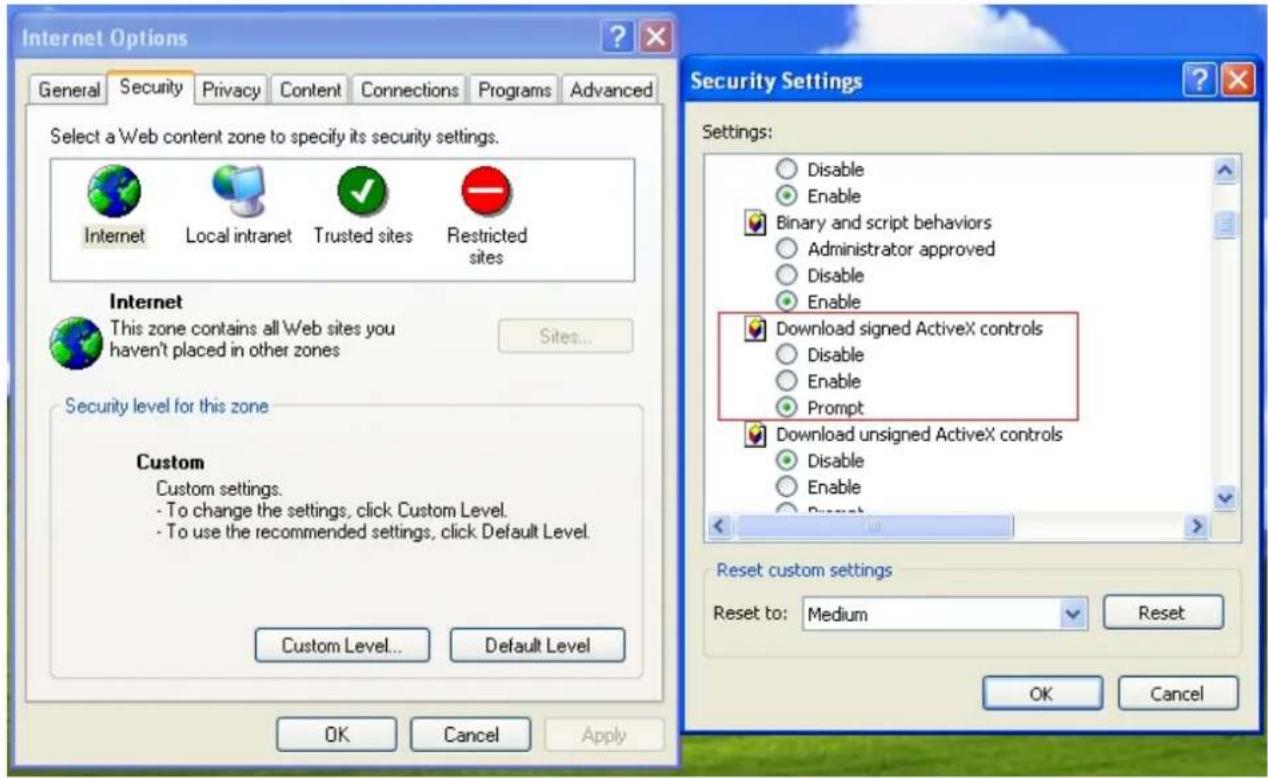
As to the ActiveX installation, please check your internet option settings to confirm whether you're allowed to install the ActiveX plug-in, which is embedded in the IP camera.
Please click "prompt" in "Download signed ActiveX controls" in the Internet Option → Security Settings.
If you check that box, the ActiveX plug-in program would prompt automatically when you log in the camera's web page, and then please choose to install it.
As to the Java script installation, please visit the official website here:
http://www.java.com/en/download/manual/jsp
Q3. If the image is blurry, what can I do?
Please adjust the IP Camera's focus by rotating the Lens.
Q4. If I forgot the IP address and port of my IP Camera. What should I do?
Please download the Intelligent IP Installer Setup from our web site, or run the CD firstly. This software will search the IP Camera automatically. Double click your IP Camera in this software, you will view the IP address and port of your IP Camera.



- COPYRIGHT & TRADEMARKS
- FCC STATEMENT
- CE MARK WARNING
- CONTENTS
- PACKAGE CONTENTS
- CHAPTER 1 MINIMUM SYSTEM REQUIREMENTS
- CHAPTER 2 PHYSICAL OVERVIEW
- CHAPTER 3 USING IP CAMERA VIA WEB BROWSER
- CHAPTER 4 OPERATING IP CAMERA VIA MOBILE PHONE
- CHAPTER 5 CONFIGURATION OF MAIN MENU
- CHAPTER 6 SETTING-BASIC
- SECURITY
- CHAPTER 7 SETTING-ADVANCE
- FTP CLIENT
- SMTP
- HTTP EVENT
- ALARM OUTPUT
- SCHEDULE
- ALARM INPUT
- MOTION DETECTION
- SYSTEM LOG
- APPENDIX
- FAQ
- NOTE
- FRONT VIEW
- BOTTOM VIEW
- OBTAIN THE IP ADDRESS
- WINDOWS WEB BROWSER
- MAC WEB BROWSER
- G STREAMING MOBILE VIEW MODE
- G MOBILE PHONE STREAMING VIEWING
- G MOBILE PHONE WAP VIEWING
- G MOBILE PHONE BROWSER VIEWING
- USING IP CAMERA VIA IPHONE
- SELECT SAFARI FUNCTION
- ENTER NAME AND PASSWORD. DEFAULT VALUES ARE BOTH ADMIN. THEN CLICK LOG IN
- ENTER THE IP ADDRESS IN YOUR WEB BROWSER
- THE TP-LINK USER INTERFACE AND LIVE IMAGE WILL APPEAR IN THE MIDDLE OF THE SCREEN
- LIVE VIEW
- SNAPSHOT
- ZOOM IN/OUT THE IMAGE VIA THE MONITOR WINDOW
- VIDEO PLAY BUTTONS
- AUDIO BUTTONS
- SETTING
- HOME
- TP-LINK®
- CLIENT SETTING
- MODE
- VIEW SIZE
- PROTOCOL
- VIDEO BUFFER
- IMAGE SETUP
- BRIGHTNESS
- CONTRAST
- SATURATION
- HUE
- DEFAULT
- CHAPTER 6 SETTING - BASIC
- SYSTEM
- INFORMATION
- DATE/TIME
- INITIALIZE
- CAMERA
- GENERAL
- MPEG
- COMPUTER VIEW
- MOBILE VIEW
- MJPEG
- NETWORK
- PPPOE (POINT-TO-POINT PROTOCOL OVER ETHERNET)
- DDNS (DYNAMIC DNS)
- DDNS
- UPNP (UNIVERSAL PLUG AND PLAY)
- BONJOUR
- IP NOTIFICATION
- WIRELESS
- MESSENGER (SUPPORTS UP TO WINDOWS LIVE MESSENGER VERSION 8089)
- CONFIGURING YOUR IP CAMERA
- ADD THE CAMERA'S MSN ACCOUNT
- ACCOUNT
- HTTPS
- ALARM SENDING
- PERIODICAL SENDING
- ALARM
- PERIODIC SENDING
- THE RELIABLE CHOICE
- WELCOME TO CAMERA SETTING PAGE
- APPENDIX A - FRAME RATE & BIT RATE TABLE
- APPENDIX B - STORAGE REQUIREMENT TABLE
- B.1 MPEG4 STORAGE REQUIREMENT GB / CHANNEL / DAY @ 30FPS
- B.2 MPEG4 STORAGE REQUIREMENT GB / CHANNEL / DAY @ 15FPS
- Q1. WHAT CAN I DO IF I FORGOT THE LOGIN NAME AND PASSWORD
- Q2. WHY CAN'T I VIEW THE IMAGE FROM THE WEB BROWSER
- Q3. IF THE IMAGE IS BLURRY, WHAT CAN I DO
- Q4. IF I FORGOT THE IP ADDRESS AND PORT OF MY IP CAMERA. WHAT SHOULD I DO
Brand : TP-LINK
Model : TL-SC3171G
Category : Surveillance Camera